


Abstract
Unmanned aerial vehicles (UAVs) have shown significant advantages in disaster relief, emergency communication, and Integrated Sensing and Communication (ISAC). However, the escalating demand for UAV spectrum is severely restricted by the scarcity of available spectrum, which in turn significantly limits communication performance. Additionally, the openness of the wireless channel poses a serious threat, such as wiretapping and jamming. Therefore, it is necessary to improve the security performance of the system. Recently, Reconfigurable Intelligent Surfaces (RIS), as a highly promising technology, has been integrated into Cognitive UAV Network. This integration enhances the legitimate signal while suppressing the eavesdropping signal. This paper investigates a RIS-assisted Cognitive UAV Network with multiple corresponding receiving users as cognitive users (CUs) in the presence of malicious eavesdroppers (Eav), in which the Cognitive UAV functions as the mobile aerial Base Station (BS) to transmit confidential messages for the users on the ground. Our primary aim is to attain the maximum secrecy bits by means of jointly optimizing the transmit power, access scheme of the CUs, the RIS phase shift matrix, and the trajectory. In light of the fact that the access scheme is an integer, the original problem proves to be a mixed integer non-convex one, which falls into the NP-hard category. To solve this problem, we propose block coordinate descent and successive convex approximation (BCD-SCA) algorithms. Firstly, we introduce the BCD algorithm to decouple the coupled variables and convert the original problem into four sub-problems for the non-convex subproblems to solve by the SCA algorithm. The results of our simulations indicate that the joint optimization scheme we have put forward not only achieves robust convergence but also outperforms conventional benchmark approaches.
1. Introduction
In recent years, unmanned aerial vehicles (UAVs) have garnered widespread attention, such as disaster relief and emergency communication, especially Integrated Sensing and Communication (ISAC) [1,2,3]. However, the unlicensed spectrum is becoming overcrowded, and UAVs will face spectrum scarcity severely. Driven by these new demands, both the academic community and the industrial sector have been prompted to explore novel and promising techniques to boost the performance of future wireless networks in ways that are both energy-efficient and can make the best use of the limited spectrum resources. In particular, noticing that most of the licensed spectrum is used in an inefficient manner, cognitive radio (CR) techniques have been proposed to reuse the licensed frequency bands in unlicensed cognitive systems as long as the performance of the primary systems is not impaired. Therefore, UAVs can achieve dynamic spectrum access (DSA) by CR to improve spectrum utilization [4,5,6].
Compared with the traditional wired communication network, wireless communication uses electromagnetic waves instead of cable as the carrier of information transmission. However, owing to the inherent characteristic of wireless transmission that allows signals to be broadcast widely, wireless links are vulnerable to security threats such as interference attacks and information leakage [7,8]. Therefore, it holds crucial importance and pressing urgency to look into the methods for enhancing security performance. On the one hand, encryption methods used at the application layer can be applied to security with the help of cryptographic principles [9]. On the other hand, Physical Layer Security (PLS) technology has drawn significant attention as it can avoid the need for elaborate key exchange protocols. From the perspective of information theory, the PLS technology can obtain security capacity by using the channel capacity difference between the legitimate communication link and the eavesdropping link, which can ensure the security of the physical layer transmission of the wireless network without increasing the network overhead and realize the complement and even replace the upper layer cryptographic encryption technology [10,11,12].
However, when the legitimate user and eavesdropper have related channels or in a situation where the eavesdropper is nearer to the Base Station compared to the legitimate user, the security rate that can be achieved is still limited. It is imperative to study a new technology of controllable and programmable wireless propagation environment. The Reconfigurable Intelligent Surfaces (RIS) is able to offer extra communication channels for the conveyance of confidential data, allowing it to bypass eavesdroppers and reach legitimate receivers, substantially enhancing comprehensive security proficiency in an overall sense [13,14,15]. To enhance the security and reliability of communication through the joint optimization of RIS reflection and UAV flight trajectories, a communication security model based on unmanned UAVs equipped with RIS has been established in [16]. Focusing on the optimization of full-duplex UAV secure communication with the assistance of RIS and striving to solve problems such as interference management and signal reflection to achieve secure and efficient communication, an optimization algorithm for RIS configuration has been designed in [17]. A deep reinforcement learning algorithm for secure transmission in RIS—enabled UAV communication networks has been proposed in [18], which can continuously learn through the interaction between the agent and the environment in complex and dynamically changing environments and automatically find the optimal transmission strategy.
With the aim of making the average secrecy rate reach its maximum, a joint optimization is performed on several crucial parameters, namely beamforming power, phase shift matrix, as well as the trajectory of the UAV to achieve better secure communication performance in [19,20,21,22]. A UAV relay communication system model incorporating malicious eavesdroppers has been established in [23], taking into account communication quality and information causality constraints, thus providing a holistic foundation for the study of PLS in UAV-assisted relay communications. In view of the security challenges presented by RIS-assisted UAV communication within the framework of the Internet of Things (IoT), a new robust scheme is proposed in [24]. It can effectively deal with simultaneous interference and eavesdropping attacks, providing a reliable solution to ensure the safety concerns related to UAV communication under the umbrella of the IoT. Aiming to enhance the energy efficiency of industrial IoT communications and reduce energy consumption, a RIS-assisted UAV green communication model suitable for the industrial IoT has been constructed based on deep learning in [25]. A system model for RIS-assisted UAV wireless-powered communication has been constructed in [26], comprehensively considering the flight trajectory of the UAV, the reflection characteristics of the RIS, and the interaction between wireless energy transfer and information transfer.
The trade-off between safety and reliability in an active RIS-assisted cooperative network is deeply studied in [27], and a scheme is put forward to carry out a joint optimization on the UAV trajectory, the phase shift of the active RIS, transmit power as well as other parameters to achieve an effective balance between safety and reliability. Aiming at the RIS-assisted UAV communication system, a beamforming algorithm is designed in [28] by optimizing the parameters, the directivity and gain of signal transmission are improved, and the coverage and reliability of the communication system are enhanced. The safety metrics of RIS-assisted wireless communication systems of UAVs are analyzed in [29,30,31], such as the influence of channel characteristics, interference, and eavesdropping. Moreover, the internal relationship between these factors and the system security performance is revealed. A UAV-RIS-assisted maritime communication system based on energy harvesting is proposed in [32] and combined with deep reinforcement learning to combat interference to improve the quality and stability of maritime communication. A downlink communication network model for air-to-ground (A2G) transmission consisting of RIS and UAVs is suggested, and the communication requirements in multi-user scenarios are considered in [33]. A secure communication scheme for UAV-MEC systems based on RIS is designed in [34]. Users unload data to legal UAVs by RIS and, at the same time, interfere with eavesdroppers by using a jammer, which effectively enhances the security of the system.
The above research provides a lot of references and inspiration for secure communication in RIS-assisted Cognitive UAV Networks, but there are still some challenges that need to be further studied. (1) Existing studies have considered a system model that is rather simplistic. In addition, the channel assumptions are limited to exclusive scenarios. Expanding the scope of previous efforts to intricate urban environments, especially in relation to the Line-of-Sight (LoS) transmission of the Air-to-Ground (A2G) link, is subject to significant degradation, None-Line-of-Sight (NLoS) transmission confronts a challenge that requires further research. (2) In the Cognitive UAV Network with multiple corresponding receiving users as cognitive users (CUs), there is a need to explore more effective methods for coordinating and managing interference among CUs, as well as for allocating resources and optimizing configurations to accommodate the diverse communication requirements of different users. (3) In complex and dynamic environments, the challenge of how RIS can rapidly and adaptively adjust reflection phases to maintain secure communication performance in Cognitive UAV Networks remains an open question.
Motivated by the above discussion, this study investigates a RIS-assisted wireless communication system by attaching the RIS to the building’s surface, where the Cognitive UAV (UAV-C) acts as the mobile aerial Base Station (BS) to transmit confidential messages for the users on the ground. The paper mainly investigates the transmit power, RIS phase shift matrix, access scheme of the CUs and the trajectory of UAV-C optimization to improve the secrecy performance in RIS-assisted Cognitive UAV Networks. To the authors’ greatest knowledge, the existing research seldomly investigated RIS-assisted Cognitive UAV Networks when there are multiple CUs under malicious eavesdroppers. To handle the non-convex optimization problem, the block coordinate descent and successive convex approximation (BCD-SCA) algorithm is utilized. The principal achievements of this research are detailed below:
- An RIS-assisted Cognitive UAV Network under the condition of malicious eavesdropping is constructed in this paper. By introducing RIS to regulate the phase shift matrix for beamforming, the channel quality of legitimate users is enhanced while the signal-to-noise ratio (SNR) of the eavesdropper is reduced. To solve the secure bits maximum of the constructed system, a problem is formulated through jointly optimizing the transmit power, RIS phase shift matrix, access scheme, and the trajectory of UAV-C.
- The optimization problem under consideration poses a considerable challenge directly attributable to its non-convex characteristics, so we divide the original optimization problem into a series of tractable sub-problems, and, thus, we design an iterative algorithm based on BCD-SCA algorithms. By making full use of this newly designed algorithm, we can systematically tackle each sub-problem and consequently overcome the principal optimization obstacle.
- The simulation outcomes are presented to show that, in contrast to multiple comparison benchmarks, the proposed algorithm notably enhances the number of secure bits. This enhancement not only highlights the practical value of the proposed algorithm but also effectively demonstrates its inherent superiority and effectiveness over the existing alternatives, providing a solid foundation for further advancements in the related area.
The remainder of our paper is organized in the manner detailed below: Section 2 presents the closed-form expressions for the channel power gain, including the wiretap and relevant channel models. Section 3 focuses on deriving the proposed algorithm. Section 4 presents and elucidates the numerical outcomes and corresponding discussions, and Section 5, as the conclusive part of the paper, summarizes the contributions, limitations, and future directions. The notations and representations are shown in Table 1.
Table 1.
Notations and representations.
2. System Model and Problem Formulation
2.1. System Model
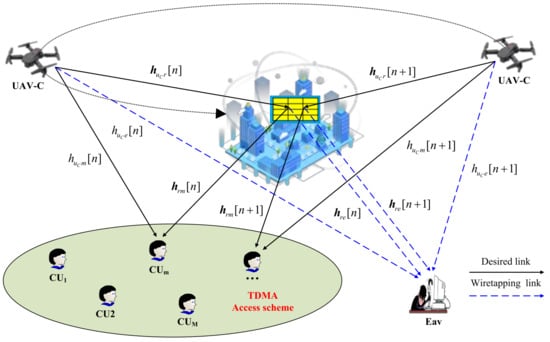
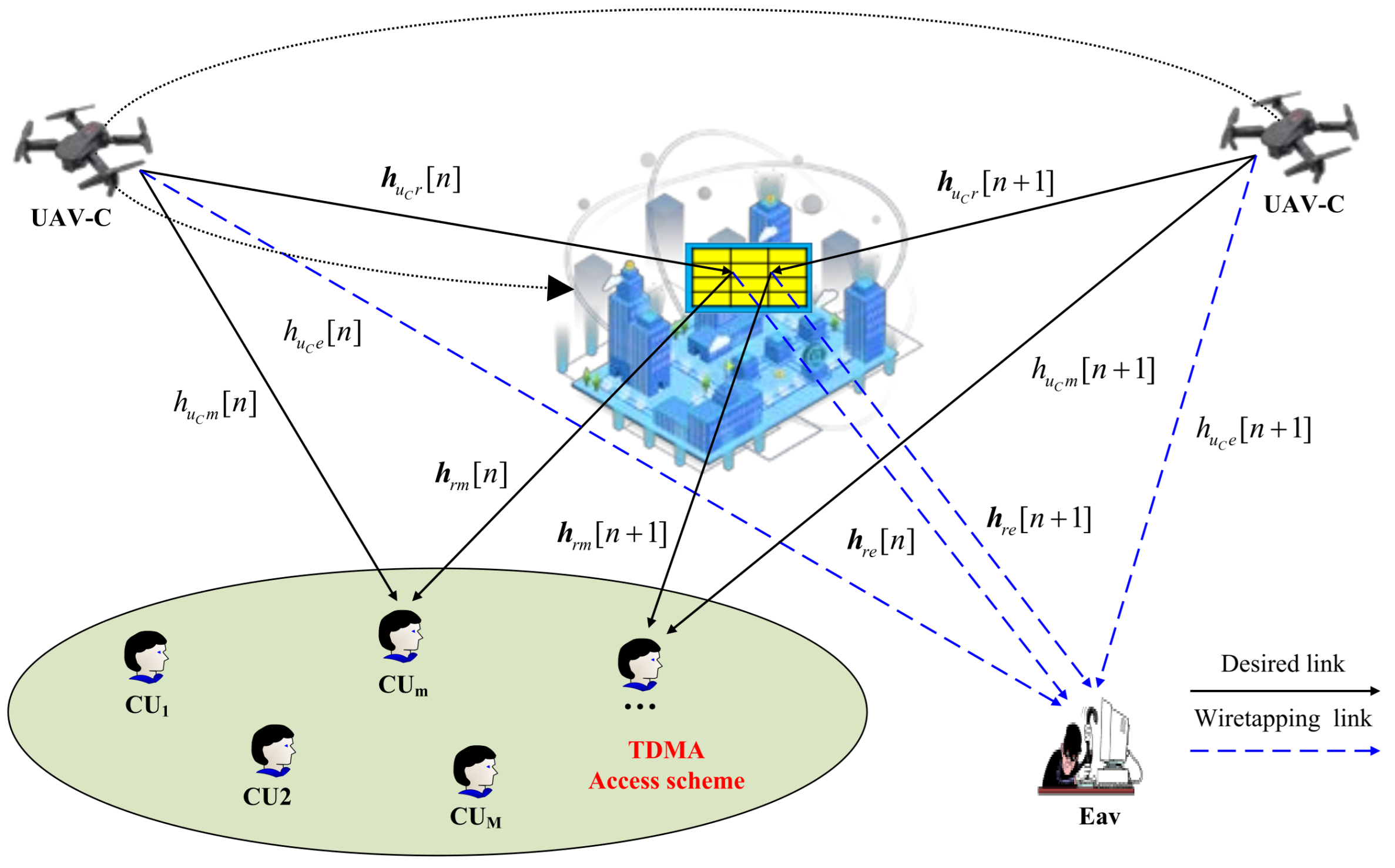
We take into consideration a Cognitve UAV Network that is assisted by RIS, in which the UAV-C functions as the mobile aerial BS to transmit confidential messages for the CUs, and one eavesdropper makes attempts to wiretap the legitimate messages, a spectrum-sharing scenario under a malicious eavesdropper as shown in Figure 1.
Figure 1.
System model.
As depicted in Figure 1, it is assumed that the UAV-C, CUs, and Eav are all furnished with a single omni-directional antenna. Let signify the set of CUs, and CUm denotes the CU. Assuming the complete flight duration of the UAV-C is , and we divide the finite time into time slots with the step size , namely, ,. Without loss of generality, all communication nodes are assumed to be placed in the three-dimensional cartesian coordinate system. The horizontal coordinate of the UAV-C is denoted by ,, and the vertical height of the UAV-C is constant. During the complete flight duration , it is supposed that the horizontal coordinate of the CUm, Eav, and RIS is ,, and , respectively. Furthermore, and is the altitude of the UAV-C and RIS, respectively, where is the minimum altitude of the UAV-C and is the maximum altitude of the UAV-C. According to the regulations on the flight management of unmanned aircraft, the flight height of the UAV-C is generally between 10~100 m. In addition, the initial and final horizontal locations of the UAV-C are pre-determined as and , and each equal time slot is sufficiently small, the state of the UAV-C can be considered static within each time slot. Consequently, the following constraints can be formulated as follows.
where denotes the maximum velocity of the UAV-C in the horizontally-oriented way. The maximum separation distance between two successive time slots is . Moreover, denote the transmitting power of the UAV-C during each time slot and denote the average and peak transmitting power of the UAV-C, respectively.
In the considered system, we suppose that the RIS is attached to the buildings to enhance the NLOS links. Moreover, the RIS is composed of Passive Reflective Units (PRUs), which are formed as uniform linear arrays (ULAs). The diagonal RIS phase shift matrix is denoted by , where , represents the phase shift of the PRU.
In the intricate environment, the LoS link of A2G communication is more prone to obstruction as a result of the towering buildings and trees. The direct link channel from the UAV to the CUs and to the Eav is formulated as the Rayleigh fading channel as [30].
where represents the channel power gain at the reference distance , is the path loss exponent from UAV-C to the users on the ground. and are the distances from UAV-C to CU and to Eav in the time slot , respectively. and denote independent and identically distributed Circularly Symmetric Complex Gaussian (CSCG) random variables that possess zero mean and unit variance, respectively.
As stated in [35], the link between the UAV-C and RIS is supposed to be dominated by LoS links since both of them possess vertical elevations and no obstacles are present. Therefore, the channel gain in the time slot is denoted by
where is the distance from the UAV-C to the RIS.
where and denote antenna separation and wavelength, respectively, and represents the cosine of the angle of arrival (AoA) at RIS in each time slot.
In comparison with the link connecting the UAV-C and RIS, the link between the RIS and the users on the ground is more complex and contains both LoS and NLoS components. Thus, it is modeled as Rician fading channels similar to [35], which can be provided by
where represents the path loss exponent from RIS to the ground users. and is the distance from RIS to CUm and to Eav in the time slot
, respectively. and is formulated as
where is the Rician factor. The LoS component is represented by the responses of the PRU similar to Equation (6),
and are the cosine of AOA of the signal from the PRU to CUm and to Eav, respectively. In addition, the NloS component is modeled as CSCG distributed similar to and . For tractability, the complex vector can be further represented as
where and are the phase angles of the element of the complex vector, ,.
Furthermore, it is assumed that the CSI is perfectly known by the UAV-C furnished with either the optical camera or the synthetic aperture radar. The UAV-C, with such equipment, has the capacity to detect and track the position of the potential eavesdropper on the ground.
When the CUm communicates with UAV-C in the time slot , the SNR at CUm and Eav is expressed as
when UAV-C transmits the signal to CUm in the time slot , the communication rate that can be achieved by CUm and Eav is expressed as
where represents the bandwidth of the system. The secure communication rate that can be achieved by CUm in the time slot is expressed as
In addition, the CUs communicate with the UAV-C using the Time-Division-Multiple-Access (TDMA) scheme. Compared with other multiple access technologies, TDMA has the advantages of high spectrum utilization, strong anti-interference capability, and high flexibility. Defining is the access scheme, when denotes the CU access to UAV-C for communication, otherwise . We have
Then, the secure bits of the system are defined as
s.t. (1)–(3),(16)
2.2. Problem Formulation
Based on the previous analysis, our aim is to maximize the secure bits by jointly optimizing the transmit power of UAV-C , RIS phase shift matrix , access scheme of the CUs , and trajectories of UAV-C . Accordingly, the considered optimization problem can be formulated as
where (1a) gives the initial and final horizontal location constraints of UAV-C and (1b) includes the maximum horizontal velocity limit for UAV-C. (2a) indicates the average transmit power. At the same time, the transmit power constraint is denoted by (2b), with a maximum transmit power . (3) denotes the RIS phase shift matrix constraint, and (16) is the access scheme. It should be noted that Problem (18) is hard to solve directly owing to its non-convex characteristic. As a subsequent step in addressing the proposed optimization problem, we will elaborate on the details in the following sections to derive a suboptimal solution.
s.t. (1)–(3),(16)
3. Proposed Algorithm
Firstly, the original optimization of Problem (18) is divided into four sub-problems: (1) RIS phase shift matrix optimization ; (2) access scheme optimization ; (3) power optimization ; and (4) trajectories optimization . Specifically, for a given transmit power, access scheme, and trajectory of the UAV-C, the closed-form expression of the optimal RIS phase shift matrix is deduced. Then, for a given transmit power, RIS phase shift matrix, and trajectory of the UAV-C, the access scheme is optimized. Afterwards, for the given transmit power and RIS phase shift matrix and trajectory of the UAV-C, the transmit power is optimized. Finally, for the given transmit power and RIS phase shift matrix and access scheme, the trajectory of the UAV-C is optimized.
3.1. Phase Shift Matrix Optimization
In this subsection, optimized with given , and . Consequently, the optimization problem can be represented as
s.t. (3)
In designing the RIS phase shift matrix similar to [36], there exists the triangle inequality . When (a) takes the equal sign, the UAV-C can obtain the maximum SNR. This means that the maximum secure bits of the UAV-C can be achieved when the direct link signal phase and the reflected signal phase are equal [37]. Then, we have
where and are the elements of the complex vector and the complex vector , respectively.
3.2. Access Scheme Optimization
In this subsection, we fix , , and to optimize in order to solve the subproblem. Accordingly, the optimization problem can be expressed as
s.t. (16)
Because secure bits are not negative, the access scheme is designed using Lemma 1. We have
Lemma 1:
if , then ,
In this case, it is the access scheme that optimizes the security bits.
3.3. Transmit Power Optimization
In this subsection, we fix , , and to optimize in order to solve the subproblem. Consequently, the optimization problem can be represented as
s.t. (2)
Because there is only one CU communicating with the UAV-C in the same slot, the power between different slots does not affect each other. So, the power optimization problem of the system can be transformed into an optimization problem of a single time slot. Hence, Problem (25) could be formulated as
s.t. (2)
Assuming
,.
Therefore, Problem (26) may be restated as
s.t. (2)
Problem (27a) is non-convex. The slack variables are used to linearize the non-convex constraints using first-order Taylor expansions. This linearization technique converts the non-convex constraints into convex ones, which can be efficiently solved using standard convex optimization tools. With the aim of acquiring a tractable problem, the slack variables and are introduced, as well as and . Problem (27) can be given by
(2)
The first-order Taylor expansion of and can be expressed as
Thus, Problem (28) can be restated as
s.t. (2),(29)
It can be obtained that Problem (30) is convex, which can thereby be resolved by means of the CVX toolbox.
3.4. Trajectories Optimization
Aiming to solve the subproblem, we fix , , and to optimize in this subsection. Correspondingly, the optimization problem could be formulated as
s.t. (1)
For the purpose of acquiring a tractable problem, the slack variables and are introduced, and Problem (31) can be rewritten as
where .
(1)
Although the objective function is made convex by introducing auxiliary variables, the constraint is highly non-convex, and Problems (32b) and (32c) remain challenging to solve. Hence, we adopt the SCA technique with regard to the constraint. With the RIS phase shift obeying Equation (20), we have
where and .
Because UAV-C only communicates with one CU in each time slot, so . The constraint is highly non-convex, and Problem (32b) is still difficult to solve. We introduce the slack variables , , , and . Thus, can be expressed by
where and denote the values of the iteration of the variables and , respectively. The first-order Taylor expansion of at Equation (34) is feasible to be transformed into the following inequality.
where
The constraint on the variable can be reformulated as
In a like manner, the constraint associated with the variable can be reformulated as
The constraint is highly non-convex, and Problem (32c) is still difficult to solve. The slack variables and are introduced, and and . Assuming , can be expressed by
where is related to the trajectory of the iteration.
Based on and , we have
where , denote the distance of the iteration.
Thus, is a convex constraint. Problem (32) can be expressed as
(1),(35),(41)
We use the BCD algorithm to acquire a suboptimal solution for the problem iteratively. The particulars of the algorithm are illustrated in Algorithm 1. We first initialize the trajectory , the access scheme , and the transmit power to obtain the phase shift of the RIS. For the non-convex subproblem of power and trajectory optimization, the SCA technique is used to iteratively solve the problem. Given that the target value of the problem is such that it is monotonically non-decreasing and remains finite following each iteration, the alternation-based approach ensures convergence with accuracy . The complexity of subproblems 1 and 2 is , and the complexity of subproblems 3 and 4 is and , respectively, where and are the maximum number of iterations of subproblem 3 and subproblem 4. In total, the complexity of Algorithm 1 is [29].
| Algorithm 1 Resource and Trajectory Joint Optimization Algorithm (RTJOA) |
| 1: Initialization: Set the iteration number , and the initial variables , iteration precision 2: Repeat: 3: Given , obtain the by solving (20) 4: Given , obtain the by solving (24) 5: Given , obtain the by solving (30) 6: Given , obtain the by solving (43) 7: 8: Until: The objective value of (43) is inclined to approach convergence following a specific number of iterations or with a given precision. |
| 9: Output: |
4. Numerical Results
Within this section, we assess the performance of the proposed method to optimize the transmit power, the RIS phase shift matrix, the access scheme of the Cus, and the trajectory of the UAV-C by exhibiting the acquired numerical results. We consider the region of m2, where the CUs are placed in ,, and . In addition, the horizontal position of the Eav is . The UAV-C flies from the initial location of to the final location of . Assuming that the antenna separation is and , the remaining parameters are specified in Table 2.
Table 2.
Parameter settings in the simulation.
To illustrate the advantages of the RTJOA scheme, we compare it with the following schemes.
RTJOA/NRIS scheme: The transmit power, access scheme, and trajectory are jointly optimized without RIS.
RTJOA/SLT scheme: The RIS phase shift, access scheme, and transmit power are jointly optimized with a straight line trajectory.
RTJOA/NAS scheme: The transmit power, the trajectory, and the RIS phase shift are jointly optimized where the access scheme is [100;010;001]. Each time slot selects CUs in turn.
RTJOA/RP scheme: The transmit power, access scheme, and trajectory are jointly optimized with a random RIS phase.
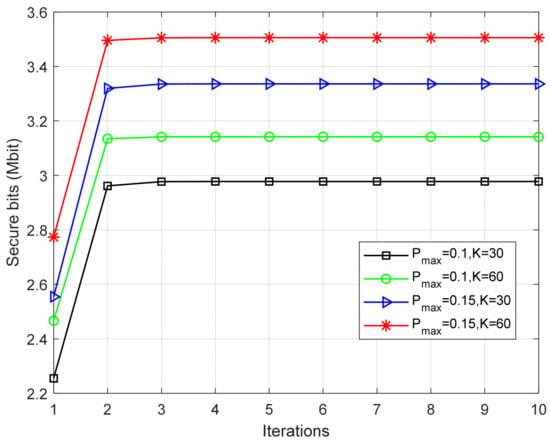
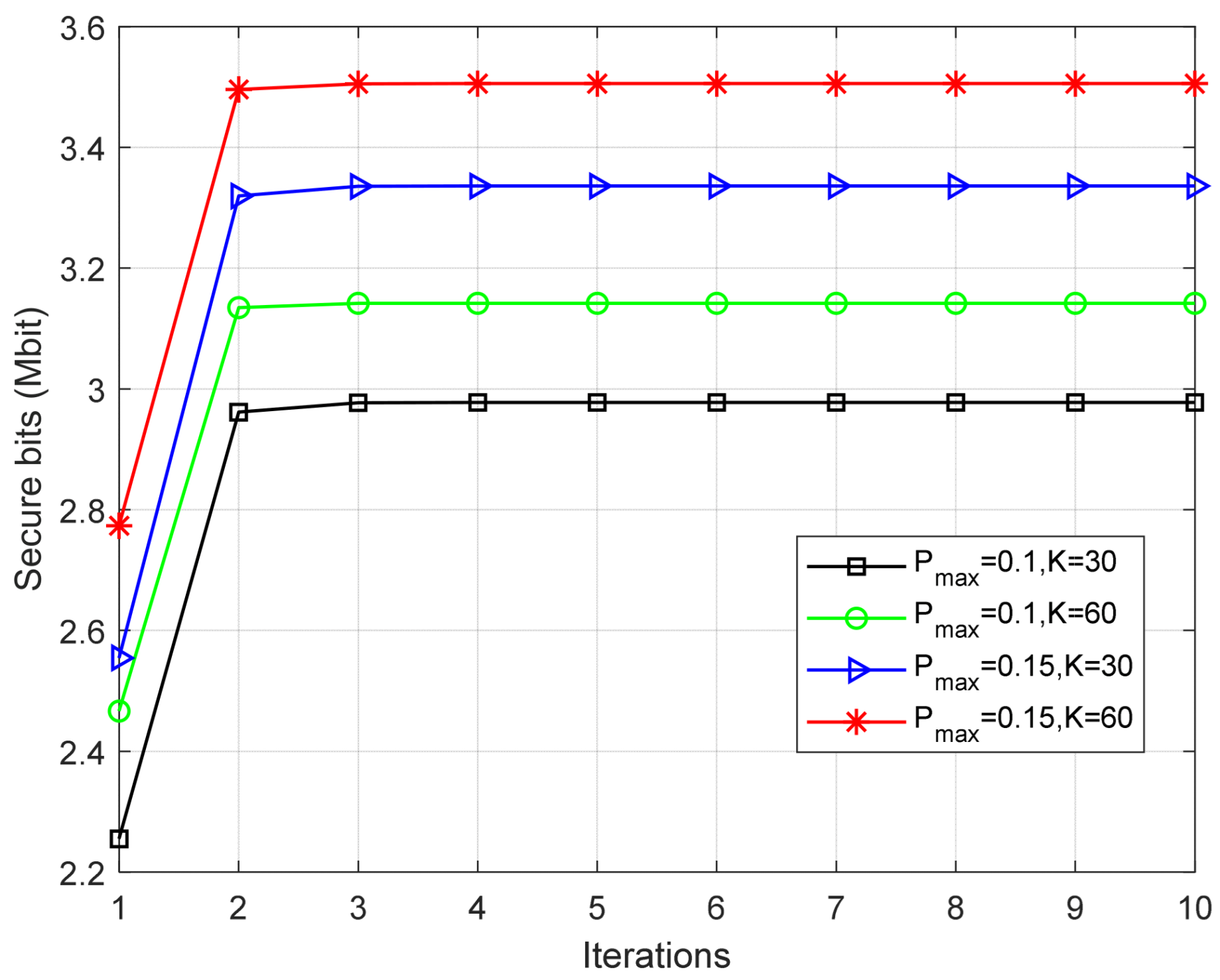
Figure 2 demonstrates the convergence characteristics of the proposed algorithm with different values of and for s. The x-axis represents the number of iterations, while the y-axis shows the secure bits achieved by the system. The legend indicates different combinations of and . It is evident that the proposed algorithm converges within a finite number of iterations regardless of the values of and . Additionally, as and increase, the secure bits of the system also increase. This trend can be attributed to the enhanced signal strength and better interference mitigation provided by higher transmit power and a larger number of RIS elements.
Figure 2.
Convergence of the RTJOA scheme with different value of and .
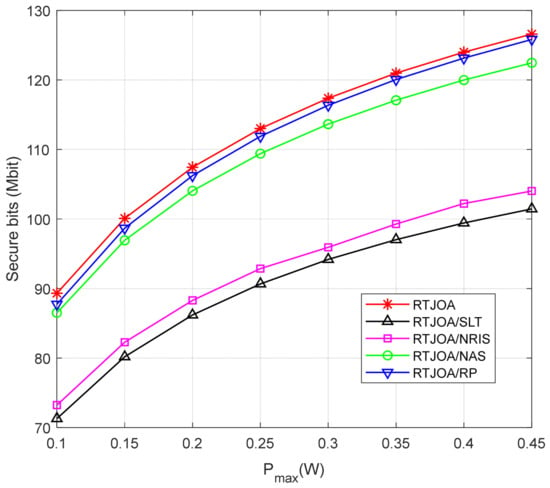
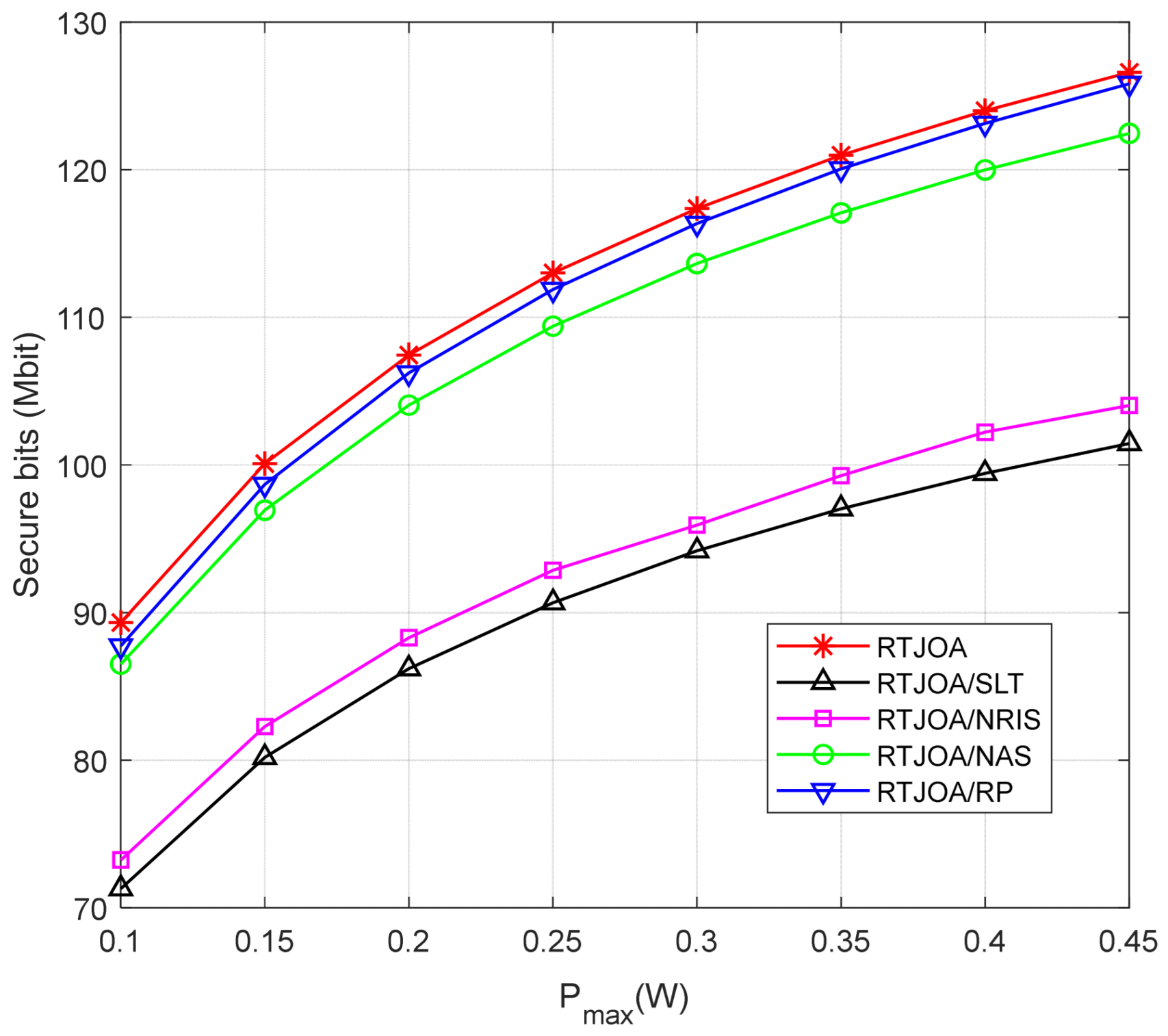
Figure 3 shows the variation of secure bits with the transmit power of the UAV-C within diverse schemes. From Figure 3, it is evident that the proposed algorithm can obtain maximum secure bits compared with other schemes under different transmission power. Under , the RTJOA/NRIS scheme is superior to the RTJOA/SLT algorithm, indicating that the importance of UAV-C trajectory optimization still requires special attention when RIS is introduced. The proposed RTJOA outperforms RTJOA/RP and RTJOA/NAS at the same transmit power, demonstrating the importance of RIS phase optimization and access scheme in a secure communication system that is assisted by RIS.
Figure 3.
The impact of transmit power on secure bits under different schemes.
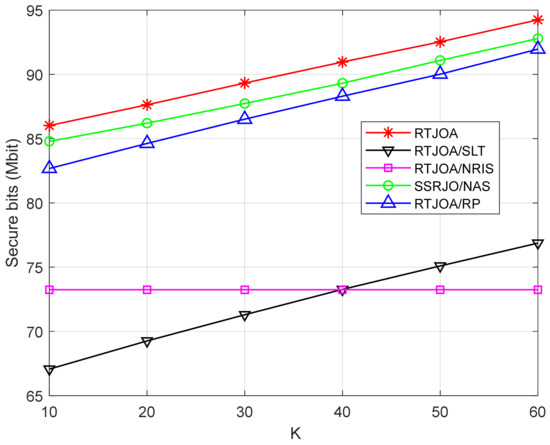
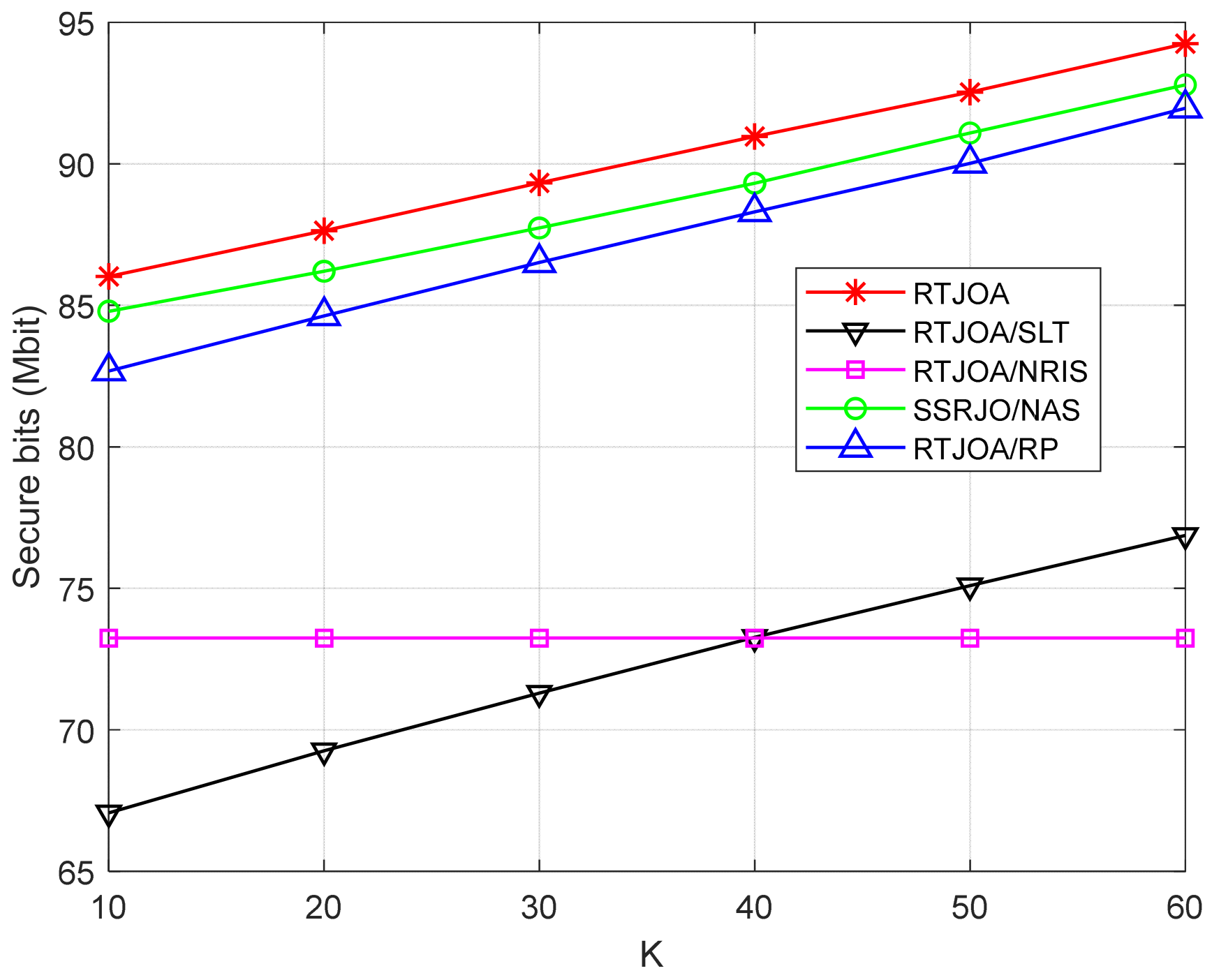
Figure 4 illustrates the impact of the number of RIS elements () on the secure bits achieved by different schemes. The x-axis represents the number of RIS elements, while the y-axis shows the secure bits. The results indicate that the proposed RTJOA scheme consistently outperforms other schemes as increases. Specifically, the RTJOA/SLT scheme shows a significant improvement in secure bits compared with RTJOA/NRIS, especially when . This suggests that a larger number of RIS elements can significantly enhance secure performance, particularly when combined with a straight-line trajectory. The linear increase in secure bits with in the proposed RTJOA scheme can be attributed to the enhanced beamforming capabilities and interference mitigation provided by the RIS. As the number of RIS elements increases, the system can more effectively shape the signal toward legitimate users while simultaneously reducing the signal strength at the eavesdropper. This leads to a linear improvement in secure bits, highlighting the effectiveness of the RIS in enhancing secure communication.
Figure 4.
The impact of on secure bits under different schemes.
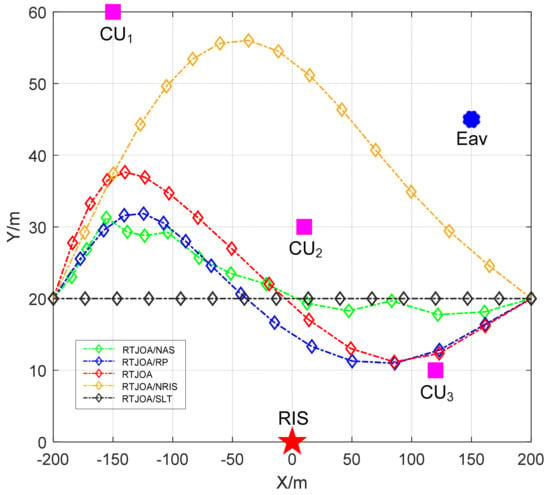
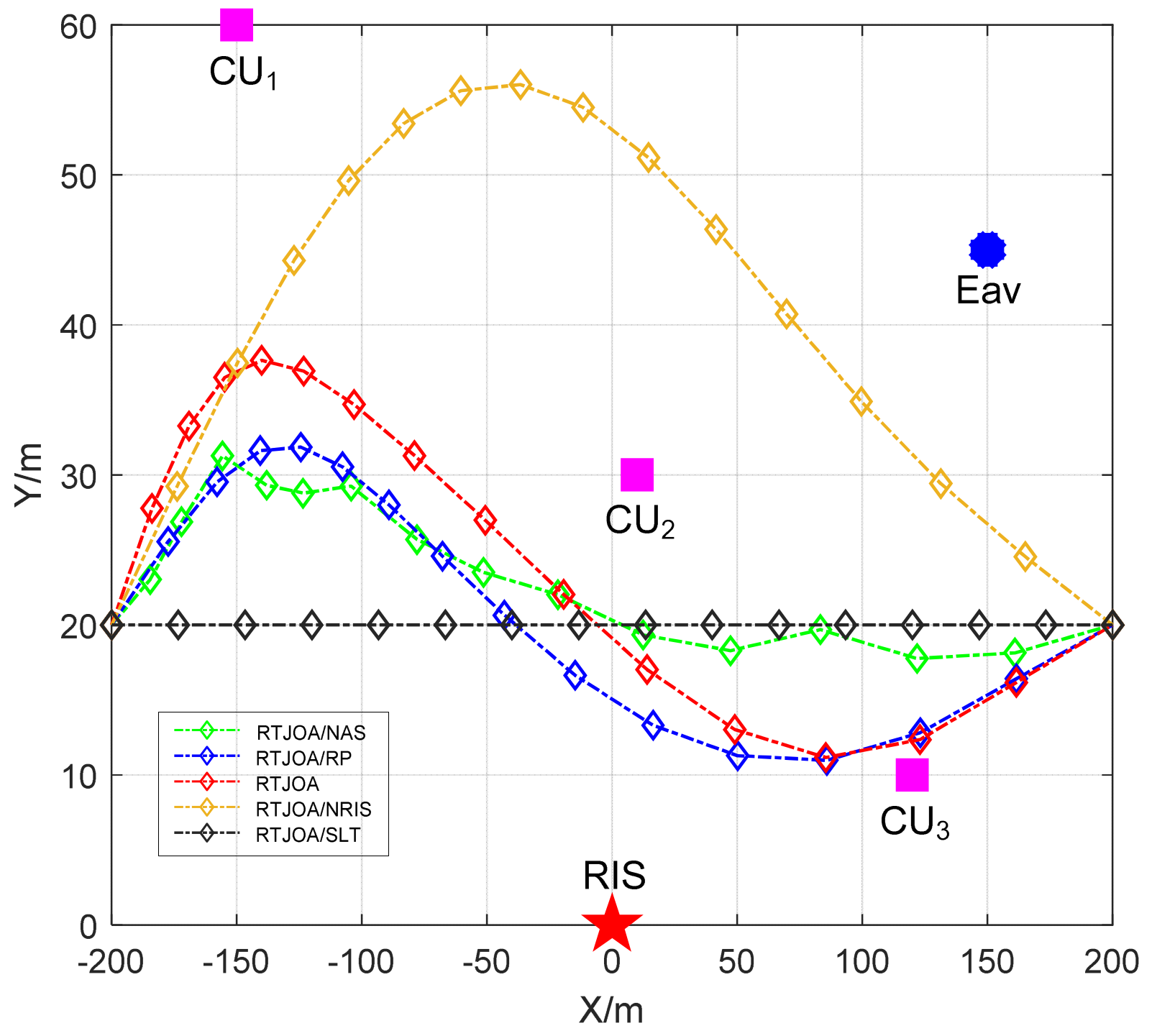
Figure 5 shows the trajectory of the UAV-C under different schemes when m/s. For the RTJOA/NRIS scheme, the UAV-C will fly close to the CUs to reduce channel loss and minimize the distance to the Eav to improve secure capabilities. With regard to the proposed scheme, the UAV-C will balance the position of CUs and RIS in the flight direction and will not be as close to the CUs as RTJOA/NRIS because RIS can reflect better quality signals to the CUs to improve the performance and achieve beamforming through the phase shift of RIS, which will further reduce the eavesdropping capability of the Eav. For RTJOA/NAS, because the choice of the CUs is uniform, the UAV-C will be as close as possible to CUs and RIS in the time slot, so the trajectory of the UAV-C changes obviously. For RTJOA/RP, because the phase of RIS is random, the influence of RIS will decrease compared with the RTJOA scheme. Therefore, the compromise between RIS and CUs will be more obvious, and the UAV-C will be closer to RIS so as to mitigate the influence of the random phase.
Figure 5.
Comparison trajectory of the UAV-C with m/s.
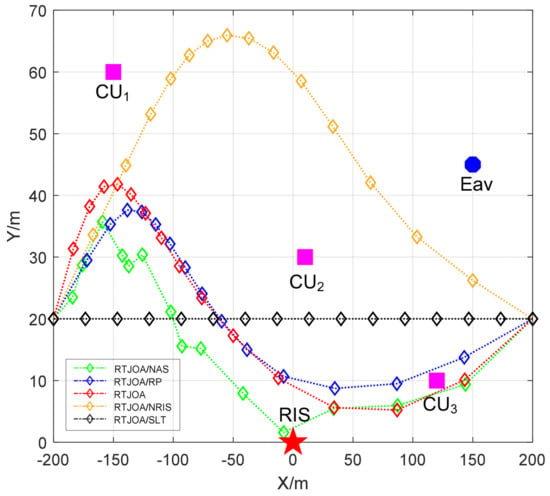
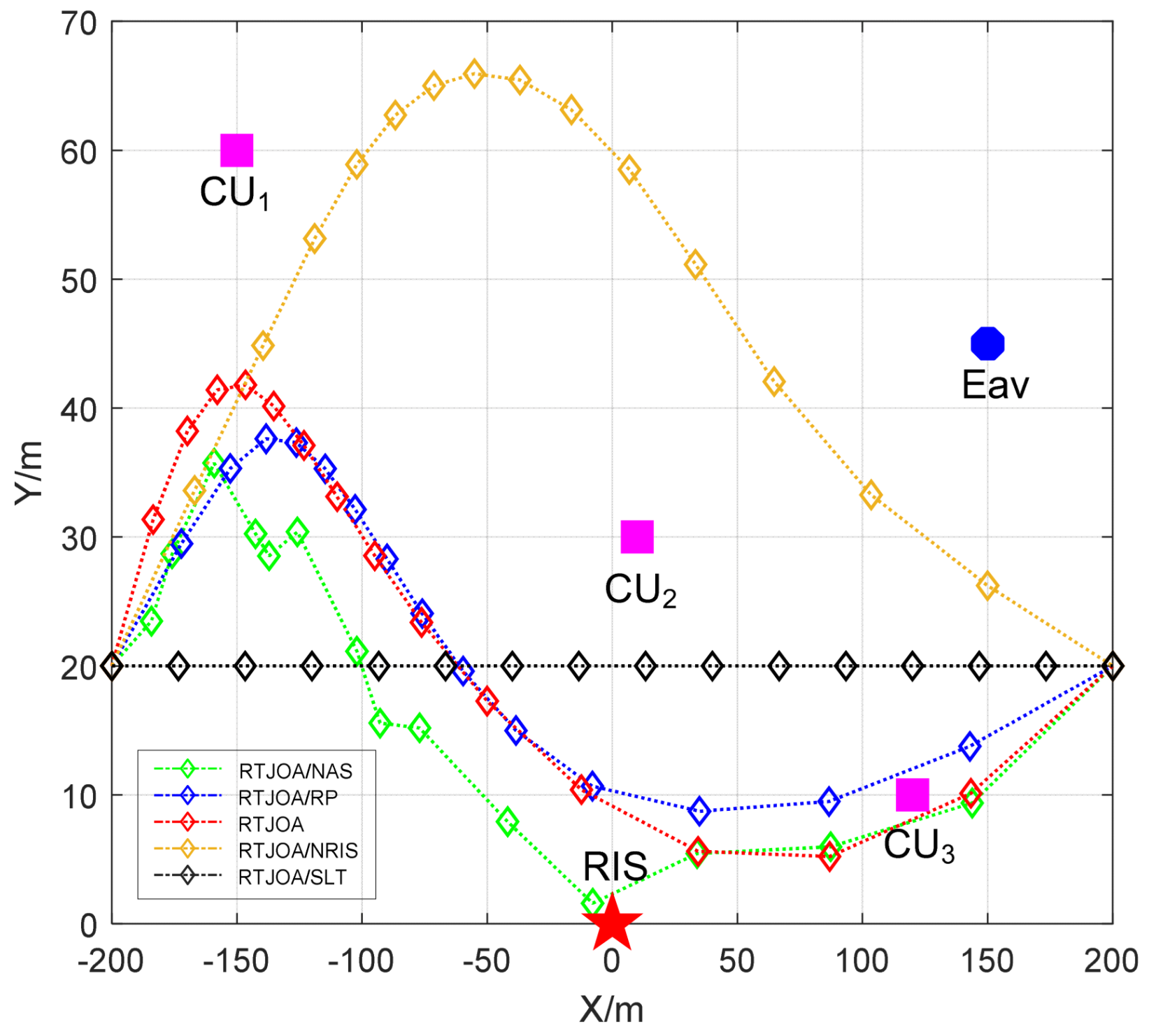
Figure 6 shows the trajectory of the UAV-C within different schemes when m/s. Compared with m/s, the trajectory of the UAV-C exhibits more significant changes. This is because the increased maximum horizontal velocity relaxes the constraints on the UAV-C’s initial and final horizontal locations, thus providing greater flexibility in trajectory optimization. Consequently, the UAV-C can better balance its position relative to the RIS and cognitive users (CUs) to optimize secure communication performance. In particular, the proposed RTJOA scheme demonstrates a clear trajectory optimization strategy. The UAV-C tends to stay closer to the RIS, especially in areas where the eavesdropper (Eav) is present. This positioning leverages the RIS’s ability to enhance signal quality for legitimate users while reducing the eavesdropper’s capability to intercept the signal. In contrast, the RTJOA/NRIS scheme, which does not utilize RIS, results in the UAV-C flying closer to the CUs to minimize channel loss. However, this also brings it closer to the eavesdropper, compromising security. The RTJOA/SLT scheme, which employs a straight-line trajectory, shows a more pronounced sensitivity to the number of RIS elements. However, its trajectory does not dynamically adapt to the presence of the eavesdropper, limiting its security performance compared with the proposed RTJOA scheme. The RTJOA/NAS scheme, which uses a fixed access scheme, results in a more rigid trajectory that does not fully exploit the benefits of the RIS. Furthermore, as increases, the constraints on the UAV-C’s initial and final horizontal locations are further relaxed during trajectory optimization. This provides the UAV-C with even more flexibility in selecting its trajectory. Consequently, the UAV-C can more effectively utilize the enhanced security performance of the RIS, especially in areas near the eavesdropper. Therefore, the proposed scheme aims to position the UAV-C as close as possible to the RIS to maximize secure communication performance.
Figure 6.
Comparison trajectory of UAV-C with m/s.
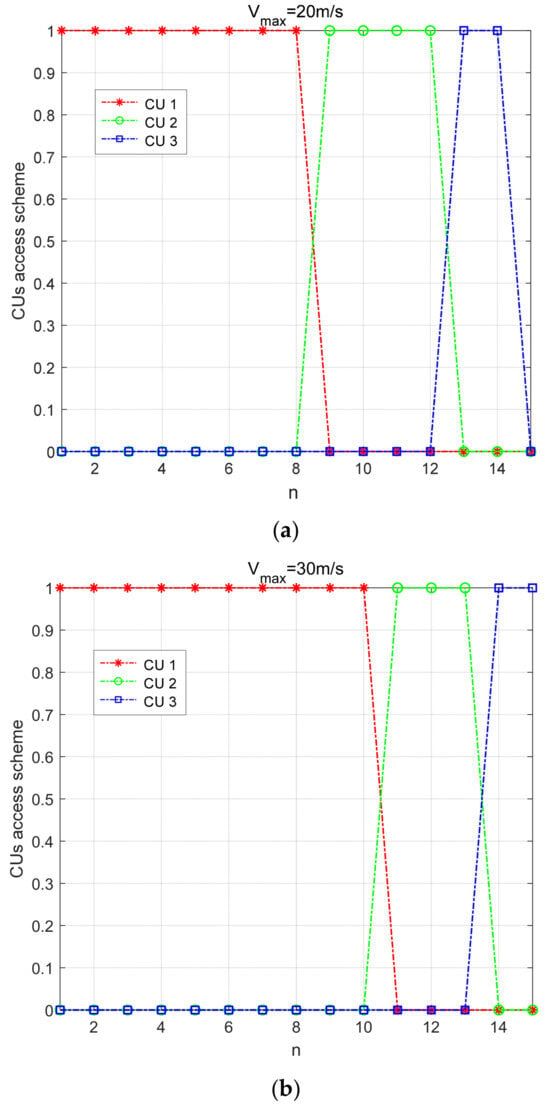
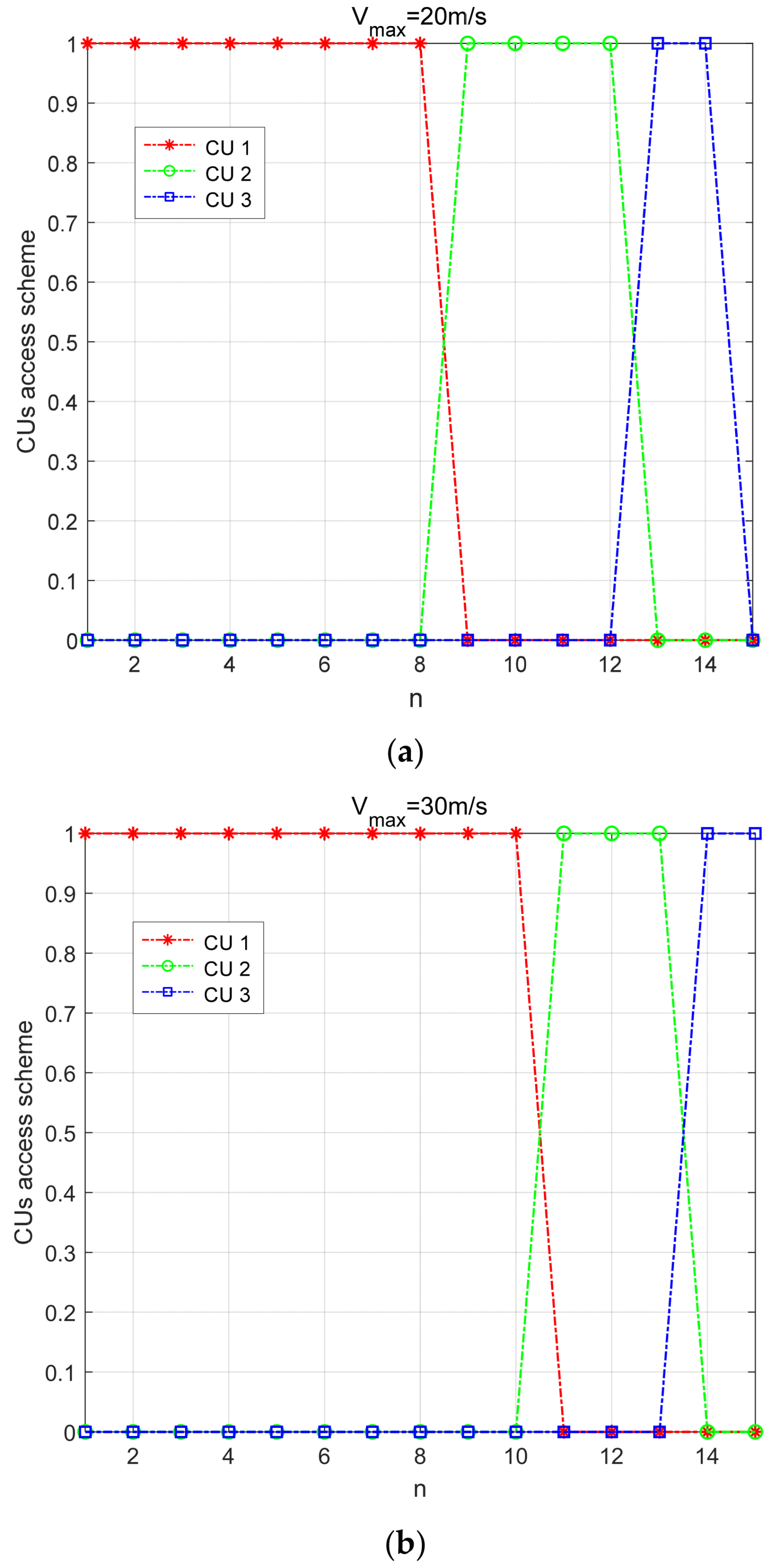
Figure 7 shows the access scheme of the proposed scheme under different . As shown in Figure 7a, CU1 accesses the UAV-C to communicate in time slots 1 to 8, CU2 accesses the UAV-C to communicate in time slots 9 to 12, and CU3 accesses the UAV-C to communicate in time slots 13 to 14. As shown in Figure 7b, CU1 accesses the UAV-C to communicate in time slots 1 to 10, CU2 accesses the UAV-C to communicate in time slots 11 to 13, and CU3 accesses the UAV-C to communicate in time slots 14 to 15. It is evident that the system can transmit data in parallel to improve system performance through reasonable slot allocation to meet the needs of high spectrum utilization and anti-interference capability. Moreover, as increases, the access scheme of the CUs will change, and the UAV-C will choose CU1 far away from the Eav as much as possible.
Figure 7.
Access scheme of the proposed scheme. (a) Access scheme of the proposed scheme with m/s. (b) Access scheme of the proposed scheme with m/s.
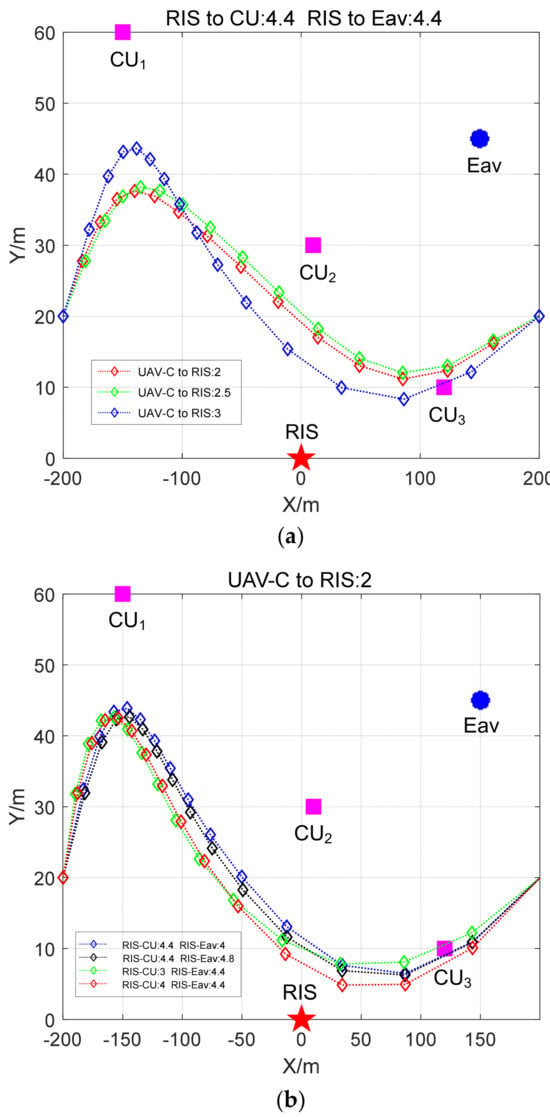
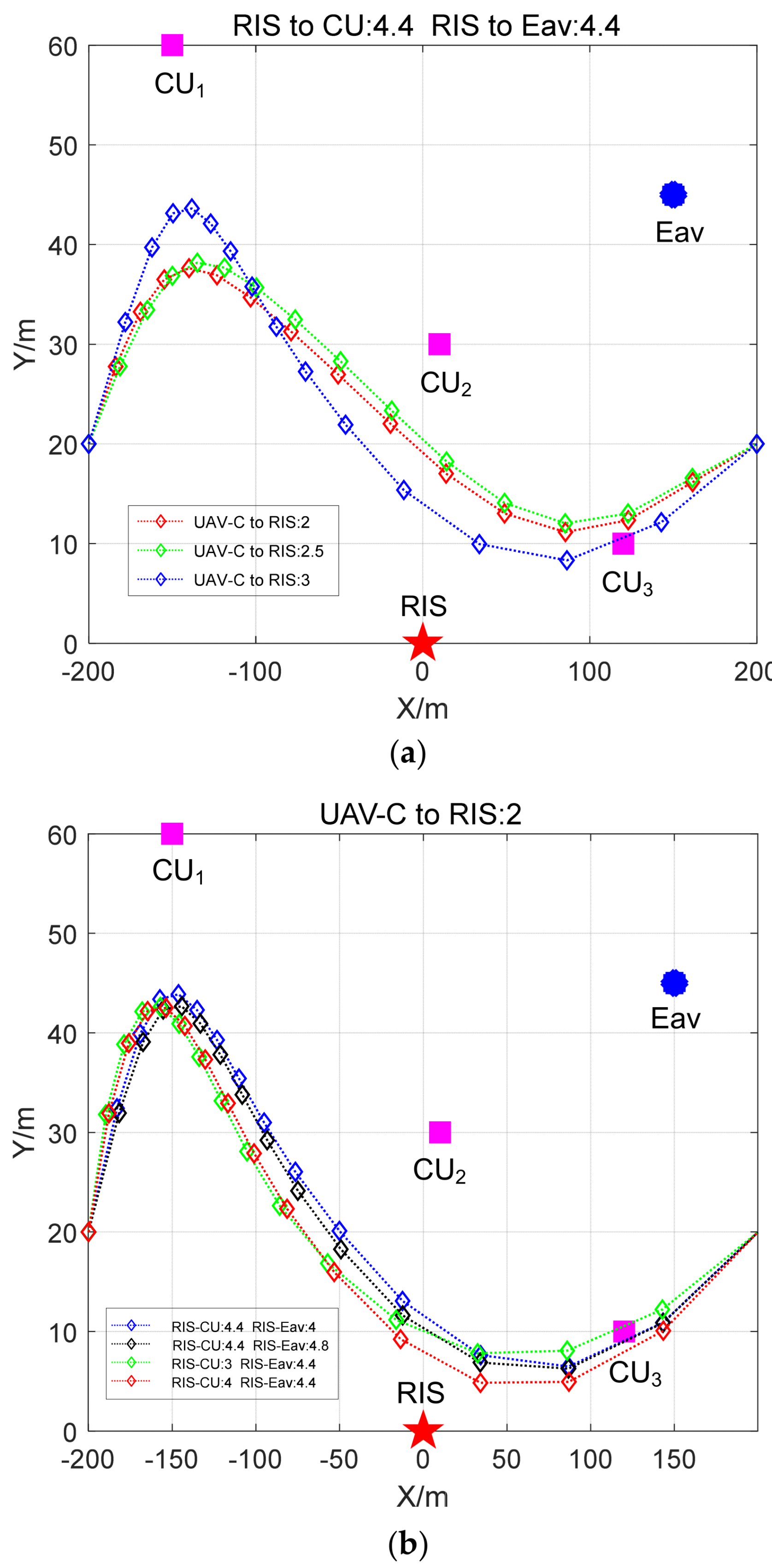
Figure 8 shows the trajectory changes under different channel coefficients. As shown in Figure 8a, the channel coefficient from RIS to CU and to Eav both are 4.4. It is evident that the channel coefficient from UAV-C to RIS will influence the trajectory of the UAV-C. The channel quality is better (the channel coefficient is smaller), and the UAV-C is closer to RIS during the total flight period. As the channel coefficient of UAV-C to RIS decreases, the UAV-C tends to be closer to CUs to improve the overall safety performance. Figure 8b shows the trajectory change of the UAV-C under different channel coefficients of RIS-CU and RIS-Eav when the channel coefficient between UAV-C and RIS is fixed. It can be seen that although the channel coefficient change from RIS to CU and to Eav will affect the trajectory of the UAV-C, the relative change is not as significant as RIS-CU. In addition, the channel coefficient of RIS-Eav is smaller, and the UAV-C is far away from the Eav. While the channel coefficient of RIS-Eav is smaller (the channel quality is better), the UAV-C is closer to the CUs.
Figure 8.
The trajectory changes of UAV-C with different channel coefficients. (a) The trajectory changes under different channel coefficients from UAV-C to RIS when RIS-CU:4.4 and RIS-Eav:4.4. (b) The trajectory changes under different channel coefficients of RIS-CU and RIS-Eav when UAV-C to RIS:2.
In this section, we present the performance evaluation of the proposed method compared to several baseline schemes. The proposed method, RTJOA, jointly optimizes the transmit power, access scheme, RIS phase shift matrix, and UAV trajectory to maximize secure communication. The baseline schemes include RTJOA/NRIS, RTJOA/SLT, RTJOA/NAS, and RTJOA/RP. The results demonstrate that the proposed method outperforms these baseline schemes in terms of secure bits. The performance differences can be attributed to the following factors: (1) The proposed method optimizes the RIS phase shifts to enhance the signal quality for legitimate users while suppressing the signal strength at the eavesdropper. This results in a higher secure communication rate compared to schemes that do not utilize RIS or use a random RIS phase. (2) Trade-off with complexity: The optimization of RIS phase shifts introduces additional computational complexity. However, the performance gains in secure communication justify this added complexity. (3) The proposed method dynamically adjusts the UAV’s trajectory to balance the distance to the CUs and the RIS, thereby optimizing the signal strength and reducing the eavesdropping capability of the malicious eavesdropper. (4) The UAV trajectory optimization must consider constraints such as maximum velocity and initial/final positions. These constraints can limit the UAV’s ability to achieve the optimal trajectory, requiring a trade-off between performance and feasibility.
The baseline schemes, such as RTJOA/NRIS, RTJOA/SLT, RTJOA/NAS, and RTJOA/RP, do not fully exploit the benefits of RIS phase optimization and UAV trajectory optimization. As a result, they perform worse in terms of secure bits compared to the proposed method. The detailed analysis of these trade-offs highlights the effectiveness of the proposed method in enhancing secure communication in RIS-assisted Cognitive UAV Networks.
5. Conclusions
In this paper, we have carried out the secrecy bits maximization problem for RIS-assisted Cognitive UAV Networks, which proves crucial for wireless communications in scenarios where A2G LoS links are obstructed severely. To maximize the achievable secure bits of the system, we propose a method to jointly optimize the power, the access scheme of the CUs, the RIS phase shifts matrix, and the trajectory of the UAV-C. An iterative algorithm has been put forward as a means to address the non-convex optimization problem with the help of the BCD-SCA algorithm. The simulation outcomes were provided to validate that the devised algorithm is effective in enhancing the secure bits of the system. The proposed scheme can furthermore be extended to the multi-eavesdropper system. In future work, we can introduce cooperative jamming by transmitting artificial noise or friendly jamming signals in order to further enhance the security performance of the system. Several promising directions for future research can build upon the current work. For instance, First, the application of advanced optimization techniques, such as machine learning-based approaches, could enhance the adaptability and efficiency of the optimization process in dynamic environments. Furthermore, extending the current framework to include multiple eavesdroppers and dynamic NLoS environments would address more complex and realistic scenarios, making the proposed solutions more robust and versatile.
Author Contributions
Conceptualization, J.L. and G.W.; methodology, J.L. and H.H.; software, J.L.; validation, H.H. and H.J.; formal analysis, J.L.; investigation, J.Z.; resources, H.H.; data curation, G.W.; writing—original draft preparation, J.L.; writing—review and editing, G.W.; visualization, J.L.; supervision, W.L.; project administration, H.J.; funding acquisition, H.H. and W.L. All authors have read and agreed to the published version of the manuscript.
Funding
This work is supported by the Shaanxi Province Natural Science Basic Research Program (2024JC-YBMS-514) and the National Science Foundation of China, grant number 62271500.
Data Availability Statement
Data sharing is not applicable to this article.
Conflicts of Interest
The authors declare no conflicts of interest.
References
- Meng, K.; Wu, Q.; Xu, J.; Chen, W.; Feng, Z.; Schober, R.; Swindlehurst, A.L. UAV-enabled integrated sensing and communication: Opportunities and challenges. IEEE Wirel. Commun. 2023, 31, 97–104. [Google Scholar] [CrossRef] [Scilit]
- Peng, H.; Zheng, Y.; He, P.; Cui, Y.; Wang, R.; Wu, D. Reliability optimization in IRS-assisted UAV networks. Veh. Commun. 2023, 44, 100679. [Google Scholar] [CrossRef] [Scilit]
- Wang, Z.; Zheng, J. Performance analysis of location-based base station cooperation for cellular-connected UAV networks. IEEE Trans. Veh. Technol. 2023, 72, 14787–14800. [Google Scholar] [CrossRef] [Scilit]
- Pan, Y.; Li, R.; Da, X.; Hu, H.; Zhang, M.; Zhai, D.; Dobre, O.A. Cooperative Trajectory Planning and Resource Allocation for UAV-enabled Integrated Sensing and Communication Systems. IEEE Trans. Veh. Technol. 2023, 73, 6502–6516. [Google Scholar] [CrossRef] [Scilit]
- Hai, X.; Qiu, H.; Wen, C.; Feng, Q. A novel distributed situation awareness consensus approach for UAV swarm systems. IEEE Trans. Intell. Transp. Syst. 2023, 24, 14706–14717. [Google Scholar] [CrossRef] [Scilit]
- Lu, Z.; Jia, Z.; Wu, Q.; Han, Z. Joint Trajectory Planning and Communication Design for Multiple UAVs in Intelligent Collaborative Air-Ground Communication Systems. IEEE Internet Things J. 2024, 11, 31053–31067. [Google Scholar] [CrossRef] [Scilit]
- Li, J.; Sun, G.; Kang, H.; Wang, A.; Liang, S.; Liu, Y.; Zhang, Y. Multi-objective optimization approaches for physical layer secure communications based on collaborative beamforming in UAV networks. IEEE/ACM Trans. Netw. 2023, 31, 1902–1917. [Google Scholar] [CrossRef] [Scilit]
- Gu, X.; Duan, W.; Zhang, G.; Sun, Q.; Wen, M.; Ho, P.H. Physical layer security for RIS-aided wireless communications with uncertain eavesdropper distributions. IEEE Syst. J. 2022, 17, 848–859. [Google Scholar] [CrossRef] [Scilit]
- Sharma, D.; Gupta, S.K.; Rashid, A.; Gupta, S.; Rashid, M.; Srivastava, A. A novel approach for securing data against intrusion attacks in unmanned aerial vehicles integrated heterogeneous network using functional encryption technique. Trans. Emerg. Telecommun. Technol. 2021, 32, e4114. [Google Scholar] [CrossRef] [Scilit]
- Jiang, Y.; Zhu, J. Three-dimensional trajectory optimization for secure UAV-enabled cognitive communications. China Commun. 2021, 18, 285–296. [Google Scholar] [CrossRef] [Scilit]
- Na, Z.; Ji, C.; Lin, B.; Zhang, N. Joint optimization of trajectory and resource allocation in secure UAV relaying communications for Internet of Things. IEEE Internet Things J. 2022, 9, 16284–16296. [Google Scholar] [CrossRef] [Scilit]
- Yu, K.; Feng, Z.; Yu, J.; Chen, T.; Peng, J.; Li, D. Secure Ultra-Reliable and Low Latency Communication in UAV-Enabled NOMA Wireless Networks. IEEE Trans. Veh. Technol. 2024, 73, 14908–14922. [Google Scholar] [CrossRef] [Scilit]
- Khan, W.U.; Lagunas, E.; Ali, Z.; Javed, M.A.; Ahmed, M.; Chatzinotas, S.; Popovski, P. Opportunities for physical layer security in UAV communication enhanced with intelligent reflective surfaces. IEEE Wirel. Commun. 2022, 29, 22–28. [Google Scholar] [CrossRef] [Scilit]
- Su, Y.; Pang, X.; Chen, S.; Jiang, X.; Zhao, N.; Yu, F.R. Spectrum and energy efficiency optimization in IRS-assisted UAV networks. IEEE Trans. Commun. 2022, 70, 6489–6502. [Google Scholar] [CrossRef] [Scilit]
- Shang, Y.; Peng, Y.; Ye, R.; Lee, J. RIS-Assisted Secure UAV Communication Scheme Against Active Jamming and Passive Eavesdropping. IEEE Trans. Intell. Transp. Syst. 2024, 25, 16953–16963. [Google Scholar] [CrossRef] [Scilit]
- Tang, X.; Jiang, T.; Liu, J.; Li, B.; Zhai, D.; Yu, F.R.; Han, Z. Secure communication with UAV-enabled aerial RIS: Learning trajectory with reflection optimization. IEEE Trans. Intell. Veh. 2023. [Google Scholar] [CrossRef] [Scilit]
- Lai, H.; Li, D.; Xu, F.; Wang, X.; Ning, J.; Hu, Y.; Duo, B. Optimization of full-duplex UAV secure communication with the aid of RIS. Drones 2023, 7, 591. [Google Scholar] [CrossRef] [Scilit]
- Dong, R.; Wang, B.; Cao, K.; Tian, J.; Cheng, T. Secure Transmission Design of RIS Enabled UAV Communication Networks Exploiting Deep Reinforcement Learning. IEEE Trans. Veh. Technol. 2024, 73, 8404–8419. [Google Scholar] [CrossRef] [Scilit]
- Yang, H.; Liu, S.; Xiao, L.; Zhang, Y.; Xiong, Z.; Zhuang, W. Learning-based reliable and secure transmission for UAV-RIS-assisted communication systems. IEEE Trans. Wirel. Commun. 2023, 23, 6954–6967. [Google Scholar] [CrossRef] [Scilit]
- Wang, D.; Zhao, Y.; He, Y.; Tang, X.; Li, L.; Zhang, R.; Zhai, D. Passive beamforming and trajectory optimization for reconfigurable intelligent surface-assisted UAV secure communication. Remote Sens. 2021, 13, 4286. [Google Scholar] [CrossRef] [Scilit]
- Arzykulov, S.; Celik, A.; Nauryzbayev, G.; Eltawil, A.M. Aerial RIS-aided physical layer security: Optimal deployment and partitioning. IEEE Trans. Cogn. Commun. Netw. 2024, 10, 1867–1882. [Google Scholar] [CrossRef] [Scilit]
- Guo, J.; Yu, L.; Chen, Z.; Yao, Y.; Wang, Z.; Wang, Z.; Zhao, Q. RIS-assisted secure UAV communications with resource allocation and cooperative jamming. IET Commun. 2022, 16, 1582–1592. [Google Scholar] [CrossRef] [Scilit]
- An, Q.; Pan, Y.; Han, H.; Hu, H. Secrecy capacity maximization of UAV-enabled relaying systems with 3D trajectory design and resource allocation. Sensors 2022, 22, 4519. [Google Scholar] [CrossRef] [Scilit] [PubMed]
- Qian, P.; Zhang, Y.; Yan, X.; Chen, Y.; Sun, Y. A Robust Scheme for RIS-Assisted UAVSecure Communication in IoT. Electronics 2023, 12, 2507. [Google Scholar] [CrossRef] [Scilit]
- Xu, Q.; You, Q.; Gong, Y.; Yang, X.; Wang, L. RIS-Assisted UAV-Enabled Green Communications for Industrial IoT Exploiting Deep Learning. IEEE Internet Things J. 2024, 11, 26595–26609. [Google Scholar] [CrossRef] [Scilit]
- Zhai, L.; Zou, Y.; Zhu, J.; Jiang, Y. RIS-assisted UAV-enabled wireless powered communications: System modeling and optimization. IEEE Trans. Wirel. Commun. 2023, 23, 5094–5108. [Google Scholar] [CrossRef] [Scilit]
- Yuan, J.; Chen, G.; Wen, M.; Wan, D.; Cumanan, K. Security-reliability tradeoff in UAV-carried active RIS-assisted cooperative networks. IEEE Commun. Lett. 2023, 28, 437–441. [Google Scholar] [CrossRef] [Scilit]
- Abualhayja’a, M.O.T. Beamforming and Optimisation of RIS-Assisted UAV Communication Systems. Ph.D. Thesis, University of Glasgow, Glasgow, UK, 2024. [Google Scholar]
- Liu, X.; Xie, C.; Xie, W.; Zhu, P.; Yang, Z. Security performance analysis of RIS-assisted UAV wireless communication in industrial. IoT J. Supercomput. 2022, 78, 5957–5973. [Google Scholar] [CrossRef] [Scilit]
- Mughal, U.A.; Alkhrijah, Y.; Almadhor, A.; Yuen, C. Deep learning for secure UAV-assisted RIS communication networks. IEEE Internet Things Mag. 2024, 7, 38–44. [Google Scholar] [CrossRef] [Scilit]
- Diao, D.; Wang, B.; Cao, K.; Zheng, B.; Weng, J.; Chen, J. Secure RIS Deployment Strategies for Wireless-Powered Multi-UAV Communication. IEEE Internet Things J. 2024, 11, 18154–18166. [Google Scholar] [CrossRef] [Scilit]
- Yang, H.; Lin, K.; Xiao, L.; Zhao, Y.; Xiong, Z.; Han, Z. Energy harvesting UAV-RIS-assisted maritime communications based on deep reinforcement learning against jamming. IEEE Trans. Wirel. Commun. 2024, 23, 9854–9868. [Google Scholar] [CrossRef] [Scilit]
- Yao, Y.; Lv, K.; Huang, S.; Li, X.; Xiang, W. UAV trajectory and energy efficiency optimization in RIS-assisted multi-user air-to-ground communications networks. Drones 2023, 7, 272. [Google Scholar] [CrossRef] [Scilit]
- Liu, S.; Huang, Y.; Hu, H.; Si, J.; Cheng, G.; Huang, T.; Hu, X. Resource and trajectory optimization for secure communication in RIS assisted UAV-MEC system. IET Commun. 2023, 17, 2068–2079. [Google Scholar] [CrossRef] [Scilit]
- Li, J.; Xu, S.; Liu, J.; Cao, Y.; Gao, W. Reconfigurable intelligent surface enhanced secure aerial-ground communication. IEEE Trans. Commun. 2021, 69, 6185–6197. [Google Scholar] [CrossRef] [Scilit]
- Fang, S.; Chen, G.; Li, Y. Joint Optimization for Secure Intelligent Reflecting Surface Assisted UAV Networks. IEEE Wirel. Commun. Lett. 2021, 10, 276–280. [Google Scholar] [CrossRef] [Scilit]
- Pang, X.; Zhao, N.; Tang, J.; Wu, C.; Niyato, D.; Wong, K.K. IRS-assisted secure UAV transmission via joint trajectory and beamforming design. IEEE Trans. Commun. 2021, 70, 1140–1152. [Google Scholar] [CrossRef] [Scilit]

Disclaimer/Publisher’s Note: The statements, opinions and data contained in all publications are solely those of the individual author(s) and contributor(s) and not of MDPI and/or the editor(s). MDPI and/or the editor(s) disclaim responsibility for any injury to people or property resulting from any ideas, methods, instructions or products referred to in the content. |
© 2025 by the authors. Licensee MDPI, Basel, Switzerland. This article is an open access article distributed under the terms and conditions of the Creative Commons Attribution (CC BY) license (https://creativecommons.org/licenses/by/4.0/).