


Abstract
Botulinum toxin type A (BoNT-A) is widely used for upper facial lines, but investigator-based responder efficacy and durability across formulations, doses, and assessment methods remain inconsistently reported. In a post hoc analysis of randomized placebo-controlled trials, we evaluated timepoint-specific responder prevalence from clinician assessments at maximum frown and at rest. Four binary responder definitions from ordinal wrinkle severity scales were analyzed separately: none or mild severity (G0–1), ≥1-point improvement, conversion from G2–3 to G0–1, and ≥2-point improvement. Proportions were pooled by random-effects meta-analysis, separately at each reported time point, and for each formulation/dose. Heterogeneity was quantified using I2. Estimates required at least two contributing study arms, and formulations were not compared with one another. At maximum frown, pooled G0–1 prevalence with daxibotulinumtoxinA 40 U was 97% at week 1, 99% at month 1, and 41% at month 6. OnabotulinumtoxinA showed dose-dependent patterns, declining from 95% at week 2 to 8% at month 6 at 40 U, and from 80% at week 1 to 34% at month 4 at 20 U. AbobotulinumtoxinA 50 U declined from 83% at month 1 to 16% at month 6. More restrictive endpoints declined more steeply. At rest, temporal patterns were similar, and the two conditions were not formally compared. Responder prevalence was high early and attenuated substantially by 6 months, with a month 6 prevalence of 41% for daxibotulinumtoxinA 40 U and 8% to 23% for other combinations. These are descriptive formulation-specific observations, not evidence of comparative superiority, because potency units are not interchangeable between products. Timepoint-specific responder reporting is needed in BoNT-A trials.
1. Introduction
The global demand for minimally invasive aesthetic procedures continues to increase, with botulinum toxin type A (BoNT-A) injections consistently ranking among the most frequently performed treatments for facial rejuvenation [1]. Since the initial approval of onabotulinumtoxinA for the treatment of glabellar lines, several BoNT-A formulations—including abobotulinumtoxinA, incobotulinumtoxinA, prabotulinumtoxinA, daxibotulinumtoxinA, and newer regional variants—have been widely adopted in aesthetic practice [2,3,4,5,6]. These agents are primarily used to reduce dynamic facial rhytides through temporary chemodenervation, and their clinical efficacy has been demonstrated across multiple randomized controlled trials (RCTs) [7].
Despite the extensive clinical use of BoNT-A, evaluation of treatment efficacy in aesthetic trials remains heterogeneous. Most RCTs report outcomes using a variety of wrinkle severity scales, responder definitions, and follow-up schedules, often emphasizing peak response rather than durability over time [8]. Prior reviews have largely focused on specific facial regions such as the glabellar complex [9], particular techniques such as intradermal injection [7], or adjacent applications including postoperative scar modulation [10,11,12]. While these studies confirm the overall effectiveness of BoNT-A, they provide limited insight into how investigator-based responder efficacy evolves over time across different formulations, doses, and assessment conditions.
Importantly, investigator-assessed responder outcomes—such as achievement of none or mild severity, predefined point improvements from baseline, and objective clinical measures—form the foundation of regulatory evaluation and clinical decision-making in aesthetic medicine. These endpoints provide the objective framework upon which treatment protocols, dosing regimens, and retreatment intervals are established. However, these investigator-based endpoints are variably defined and inconsistently reported across trials, limiting cross-study comparability and clinical interpretation. In addition, the durability of investigator-assessed response, particularly beyond early follow-up, is often underexplored, despite its direct relevance to clinical practice, treatment planning, and patient counseling regarding expected outcomes and retreatment timing.
These challenges are further amplified by the introduction of newer formulations, including daxibotulinumtoxinA and HBTX-A, and earlier comparative reviews addressed a smaller set of formulations [13]. A recent systematic review of upper facial BoNT-A treatment reported substantial heterogeneity in outcome definitions and called for uniform outcome evaluation [7,14]. The reliability of investigator-based severity scales has also been examined. Agreement between raters was variable, even among experienced assessors, which supports the need for standardized training and calibration [15].
To address these gaps, we conducted a comprehensive investigator-based responder analysis derived from 44 placebo-controlled RCTs of BoNT-A for upper facial lines. By focusing on standardized binary responder definitions and reporting absolute responder prevalence at discrete follow-up time points, stratified by formulation and dose, this study aims to provide a transparent and clinically interpretable synthesis of investigator-assessed BoNT-A efficacy. This approach emphasizes response durability and reports assessments at maximum frown and at rest separately.
2. Materials and Methods
2.1. Study Design and Data Source
This study represents a post hoc investigator-based efficacy analysis derived from randomized, placebo-controlled clinical trials included in a previously assembled dataset [14]. The dataset was originally compiled through a systematic review of aesthetic BoNT-A trials and was reused here to ensure consistency in study populations, baseline characteristics, treatment regimens, and follow-up schedules.
All analyses were performed at the aggregate trial level using data extracted directly from published reports. No individual patient-level data were accessed. The design, analysis, and reporting of this responder-based efficacy study were conducted in accordance with the PRISMA 2020 guidelines, under a prespecified protocol registered on PROSPERO (CRD420251119849) [16]. The registered protocol covered both efficacy and safety outcomes. The safety analysis has been reported separately in the companion publication cited above. The present paper reports the prespecified investigator-based efficacy outcomes, which were not analyzed in that report.
The search was done on 12 April 2025 across PubMed, Scopus, Web of Science, and Cochrane Library (including EMBASE, ICTRP, CINAHL). Google Scholar was searched to cover the Grey Literature [17]. The detailed search query is provided in Table S1. A manual search supplemented the database search.
2.2. Eligibility Criteria for the Efficacy Analysis
Trials were eligible for inclusion in the present responder analysis if they met all of the following criteria:
- Randomized, placebo-controlled clinical trial design
- Adult participants treated for aesthetic facial indications (glabellar lines, forehead lines, lateral canthal lines, or crow’s feet)
- Use of a standardized ordinal wrinkle severity grading scale with four categories (0 = none, 1 = mild, 2 = moderate, 3 = severe)
- Reporting of baseline severity and at least one post-treatment investigator-based assessment
- Availability of investigator-based efficacy assessments
Trials were excluded from the quantitative efficacy analysis if they did not report investigator-based responder outcomes or if responder data could not be extracted at the trial or subgroup level. Studies were also excluded if efficacy outcomes were reported exclusively as changes in continuous values without dichotomized responder definitions, or if raw numerical data necessary to derive responder prevalence were unavailable. Post hoc analyses derived from previously included trials, such as subgroup analyses based on age or other secondary stratifications, were excluded to avoid duplication of data.
2.3. Outcome Measures and Responder Definitions
Efficacy outcomes were evaluated using binary responder definitions derived from ordinal wrinkle severity scales. Because responder outcomes were reported heterogeneously across trials—using definitions such as achievement of none or mild severity (grade 0/1), conversion from moderate or severe baseline severity (grade 2/3) to none or mild severity, or achievement of predefined one- or two-point improvements from baseline—responder outcomes were not pooled into a single composite endpoint. Instead, each responder definition was treated as a distinct efficacy endpoint and analyzed separately under investigator-based assessments at maximum frown and at rest. This approach was adopted to standardize reporting across trials while preserving the original outcome definitions used by individual studies and to minimize the risk of outcome reporting bias arising from selective aggregation or reclassification of responder outcomes.
2.4. Investigator-Based Assessment
Investigator-reported efficacy was analyzed separately under conditions of maximum voluntary contraction (maximum frown) and at rest. For each condition, four responder definitions were evaluated. Responders were defined as participants achieving a severity grade of none or mild (grade 0 or 1) at follow-up regardless of baseline severity, participants achieving at least a one-point improvement from baseline, participants converting from moderate or severe baseline severity (grade 2 or 3) to none or mild severity (grade 0 or 1) at follow-up, and participants achieving at least a two-point improvement from baseline.
2.5. Timepoints of Assessment
Responder prevalence was calculated independently for each follow-up timepoint reported in the included trials. The timepoints evaluated in this analysis—week 1, week 2, month 1, month 2, month 3, month 4, month 5, and month 6 after treatment—were selected because they represented the most frequently reported assessment intervals across eligible studies. The number of study arms contributing to a pooled estimate varies between timepoints because trials differed in the duration of follow-up they reported. The number of contributing arms is given for every estimate in the Supplementary File. Analyses were restricted to timepoints explicitly reported within each individual trial, and no assumptions were made regarding unreported follow-up intervals. Data interpolation, extrapolation, or imputation across timepoints was not performed.
A last-observation-carried-forward (LOCF) approach was not applied because the maximum follow-up duration varied substantially between trials, and the final assessment timepoint was not uniform across studies. Applying LOCF under these conditions could have introduced differential bias by artificially extending treatment effects beyond observed follow-up in some trials but not others. To account for this heterogeneity in follow-up duration and assessment schedules, analyses were stratified by discrete timepoints, thereby preserving the temporal structure of the original trial data and ensuring that responder prevalence at each timepoint reflected only observed outcomes.
2.6. Subgroup Stratification
Responder prevalence was analyzed overall and stratified according to BoNT-A formulation and injected dose. Each unique formulation–dose combination was treated as a separate analytical subgroup. No pooling across different formulations or dose levels was performed unless data were reported identically within a given subgroup.
2.7. Statistical Analysis
For each responder definition, the responder proportion reported by each contributing study arm was pooled using a random-effects meta-analysis of proportions, implemented with the metaprop routine in STATA. The unit of analysis was the study arm. Where a single publication reported more than one eligible arm, each arm contributed separately. This occurred only for daxibotulinumtoxinA 40 U, where three arms were contributed by two publications. Pooling was performed separately for each responder definition, each assessment condition, each formulation–dose combination, and each follow-up timepoint. No pooling was performed across timepoints, across doses, or across formulations. Pooled prevalence is reported as a percentage with a 95% confidence interval. Between-study heterogeneity was quantified using the I2 statistic, which is reported for every pooled estimate in the Supplementary File S1.
To reduce uncertainty and avoid unstable subgroup estimates, responder prevalence for a given formulation–dose combination was reported only when that combination was evaluated in at least two independent trials. Formulation–dose subgroups reported by a single study were not included in quantitative subgroup reporting.
Relative effect measures comparing BoNT-A with placebo, such as odds ratios or risk ratios, were not calculated for efficacy outcomes. This approach was chosen to avoid instability and potential inflation of relative estimates in the presence of low or zero responder rates in placebo groups, particularly at later follow-up timepoints.
Responder counts were derived from the responder proportions reported in each publication, applied to the denominator that the publication itself used at that timepoint. No individual participant data were available, so missing data could not be handled at the participant level. In most contributing arms, the reported denominator was the randomized or modified intention-to-treat sample, and it did not change across timepoints. Participants who discontinued therefore remained in the denominator and were not counted as responders. In a smaller number of arms, the publication reported a reduced evaluable sample at later visits, and that reduced denominator was used. The analysis consequently inherits the missing-data convention of each source trial, and these conventions were not uniform across trials. The numerator and denominator used at every timepoint for every contributing arm are reported in Supplementary Table S2.
All statistical analyses were performed using Stata Statistical Software, version 18 (StataCorp LLC, College Station, TX, USA). Graphical representations of responder prevalence over time were generated using standard Stata plot-ting functions and Microsoft Excel 365 (Microsoft Corporation, Redmond, WA, USA).
3. Results
3.1. Literature Search Results
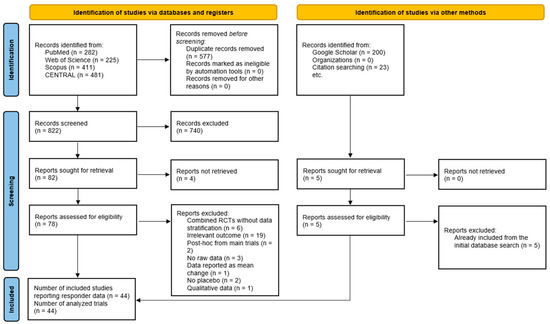
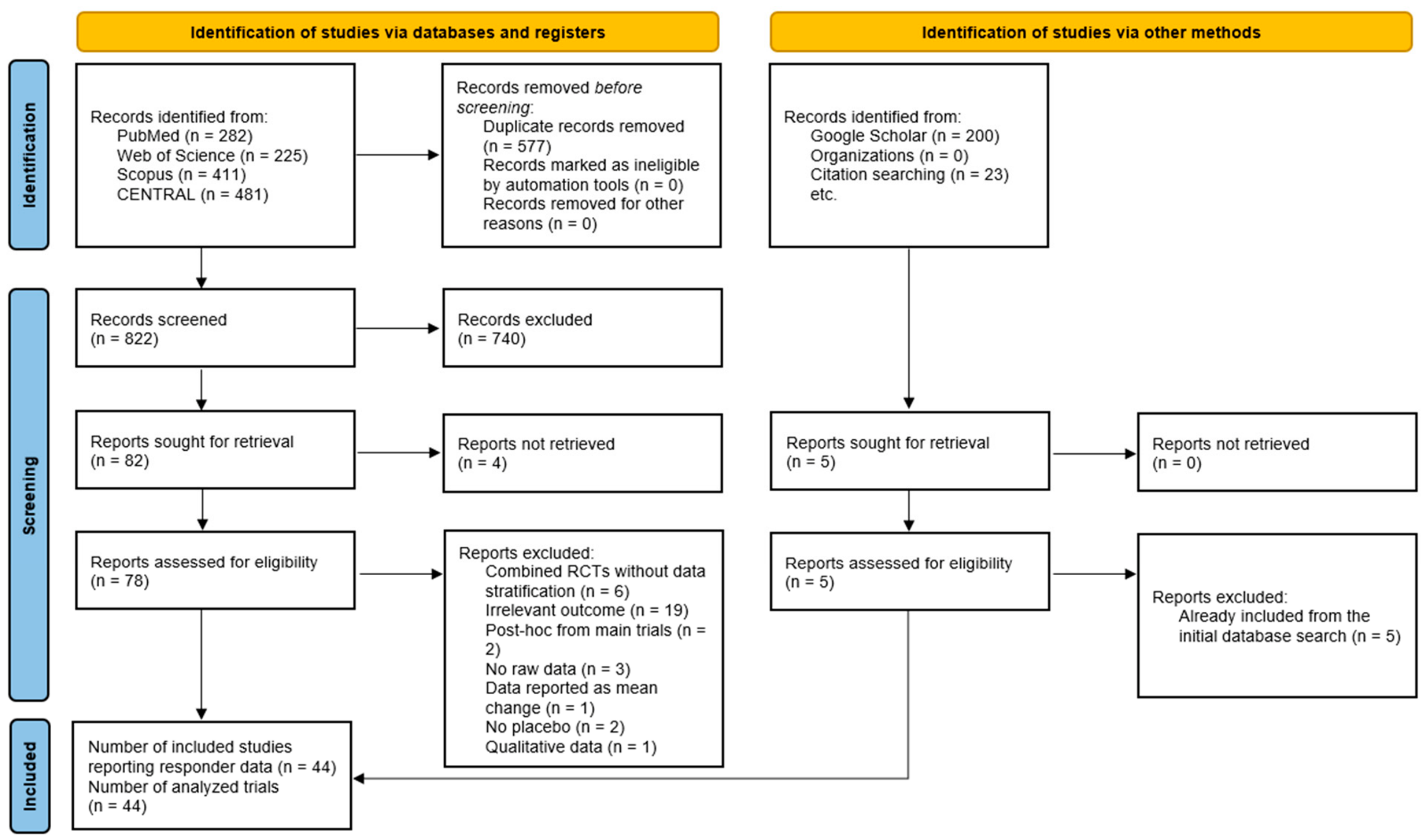
The electronic database search identified 1399 records, including 282 from PubMed, 225 from Web of Science, 411 from Scopus, and 481 from CENTRAL (Figure 1). Prior to screening, 577 duplicate records were removed, and no records were excluded by automation tools or for other reasons. This resulted in 822 records that were screened at the title and abstract level, of which 740 were excluded.
Figure 1.
PRISMA flow diagram of study selection.
A total of 82 reports were sought for full-text retrieval from database searches, of which 4 could not be retrieved. Consequently, 78 reports were assessed for eligibility. Of these, 34 reports were excluded for the following reasons: combined randomized controlled trials without data stratification (n = 6), irrelevant outcomes (n = 19), post hoc analyses of main trials (n = 2), absence of raw data (n = 3), outcomes reported as mean change only (n = 1), lack of a placebo comparator (n = 2), and qualitative data only (n = 1).
In parallel, 223 records were identified through other sources, including Google Scholar (n = 200) and citation searching (n = 23), with no records identified from organizations. Five reports from these sources were sought for retrieval, and all were successfully retrieved. All five reports were subsequently excluded at the eligibility stage because they represented studies already included from the initial database search.
Ultimately, 44 randomized controlled trials reporting investigator-based responder efficacy data were included in the analysis, and all 44 trials were included in the final quantitative synthesis [3,18,19,20,21,22,23,24,25,26,27,28,29,30,31,32,33,34,35,36,37,38,39,40,41,42,43,44,45,46,47,48,49,50,51,52,53,54,55,56,57,58,59,60].
3.2. Baseline Characteristics
Baseline characteristics of the included trials are summarized in Table 1. A total of 76 study arms were included in the descriptive analysis (10,403 patients receiving BoNT-A and 3775 receiving placebo). Most treatment arms targeted the glabellar region, either alone or in combination with other facial areas. Treatment of the glabellar region alone accounted for the majority of indications (44 arms, 57.9%). Additional combined treatment patterns included glabellar region with forehead and lateral canthal area (3 arms, 3.95%), glabellar region with crow’s feet (1 arm, 1.32%), and glabellar region with forehead (1 arm, 1.32%). Treatment of the lateral canthal area alone was reported in 15 arms (19.7%), while isolated treatment of the forehead, lateral canthal lines, crow’s feet, or combined crow’s feet and glabellar region each accounted for a small proportion of study arms (≤1.32% per category).
Table 1.
Baseline characteristics of included placebo-controlled trials reporting botulinum toxin-A injection efficacy for upper facial lines.
Regarding intervention characteristics, a wide range of botulinum toxin type A formulations and doses were evaluated. OnabotulinumtoxinA was the most frequently studied formulation across dose ranges, with the 20-U dose being the most commonly reported single regimen (10 arms, 13.2%), followed by 24 U (4 arms, 5.26%), 40 U (4 arms, 5.26%), and 44 U (2 arms, 2.63%). Higher doses, including 60–80 U, were less frequently represented.
AbobotulinumtoxinA was evaluated across multiple dosing regimens, most commonly at 50 U (11 arms, 14.5%), with additional arms assessing doses ranging from 15 U to 125 U, including combination or dose-range categories. DaxibotulinumtoxinA was evaluated primarily at doses of 40 U (3 arms, 3.95%) and 60 U (1 arm, 1.32%), with limited representation of lower doses. IncobotulinumtoxinA was reported at doses of 20 U (4 arms, 5.26%) and 24 U (1 arm, 1.32%), as well as a small number of dose-range arms. Other formulations, including prabotulinumtoxinA, relabotulinumtoxinA, HBTX-A, and abobotulinumtoxinA solution (ASI), were represented in a limited number of study arms, each accounting for a small proportion of the total.
3.3. Risk of Bias Assessment
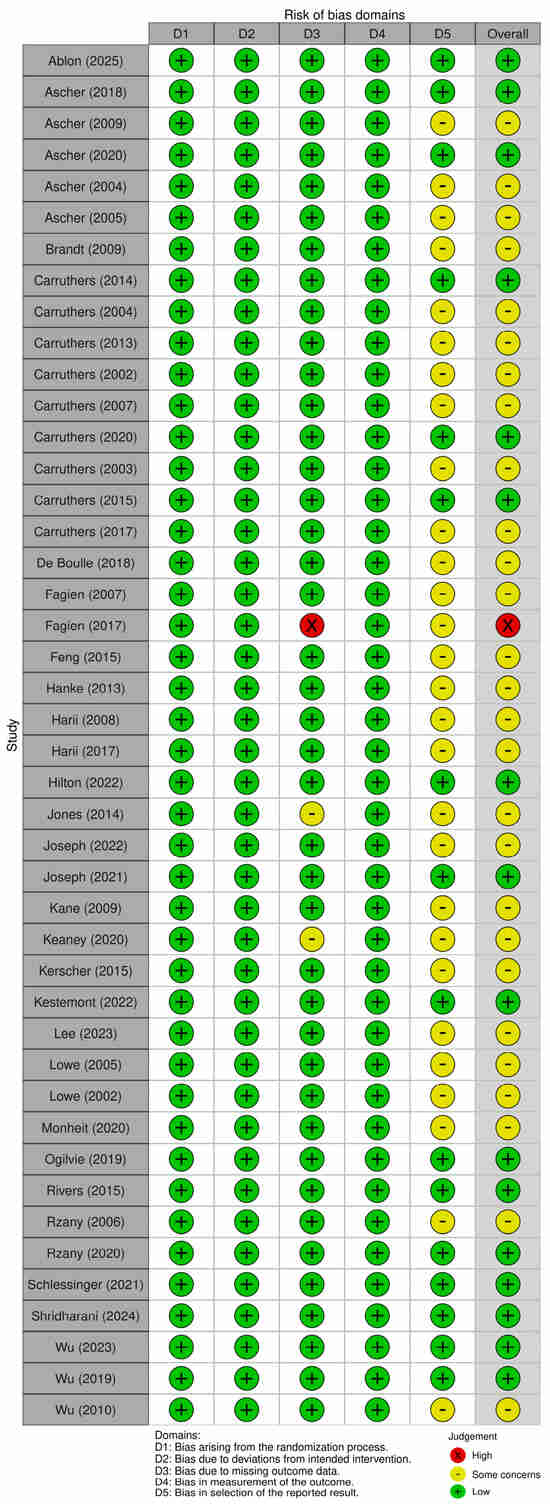
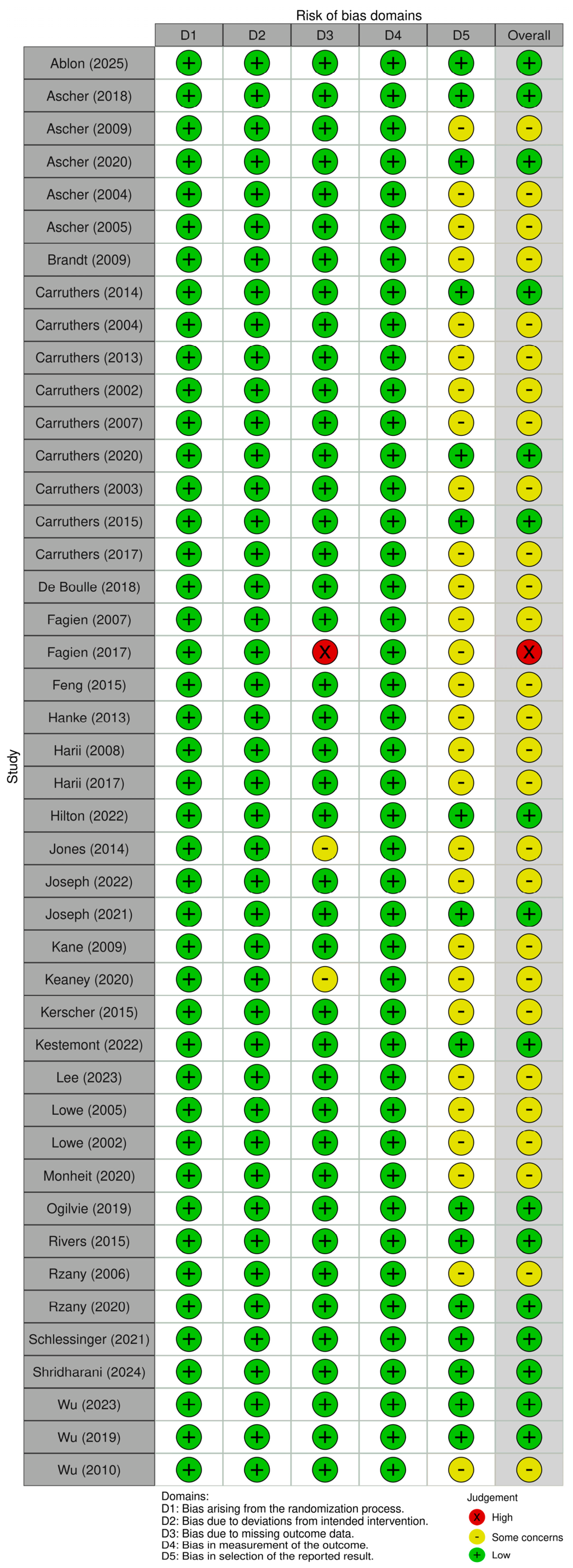
Sixteen trials had low risk of bias, 27 trials had some concerns (mainly due to lack of a pre-registered protocol or high dropout rate), and only one trial had high risk of bias (Figure 2).
Figure 2.
Risk of bias assessment of included randomized controlled trials [3,18,19,20,21,22,23,24,25,26,27,28,29,30,31,32,33,34,35,36,37,38,39,40,41,42,43,44,45,46,47,48,49,50,51,52,53,54,55,56,57,58,59,60].
3.4. Investigator-Based Assessment (Maximum Frown)—Figure 3
3.4.1. Achievement of None or Mild Severity (G0–1)
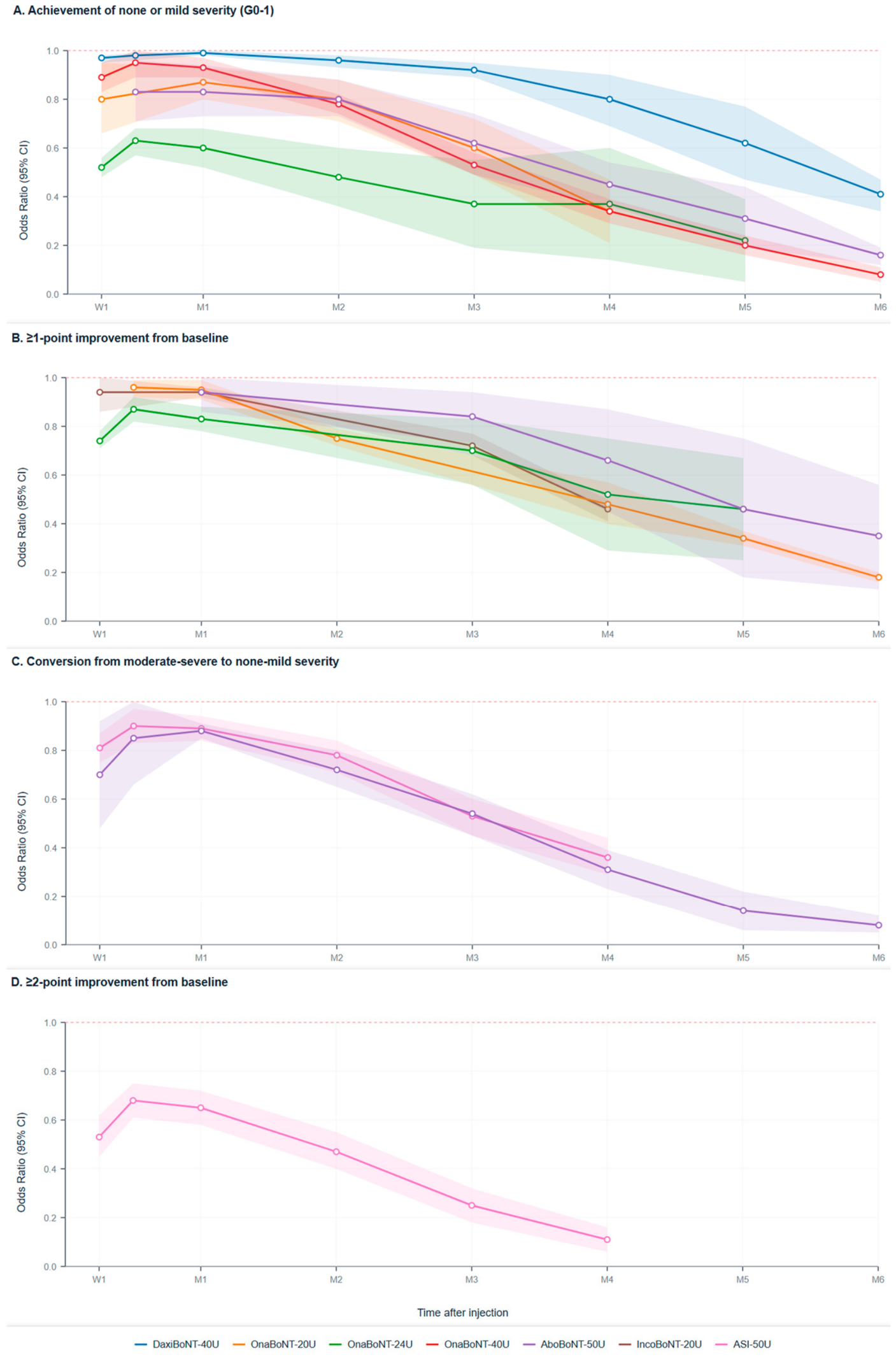
DaxibotulinumtoxinA 40 U showed high and sustained responder prevalence across all time points (3 study arms from 2 trials). Near-universal early response was observed with 97% efficacy (95% CI: 95–98%) at week 1, 98% efficacy (95% CI: 96–99%) at week 2, and peak response of 99% (95% CI: 98–100%) at month 1. Sustained high response was maintained at months 2 and 3, with 96% (95% CI: 93–98%) at month 2 and 92% (95% CI: 89–95%) at month 3. At extended follow-up, where three study arms contributed to each estimate: 80% efficacy (95% CI: 69–90%) at month 4, 62% (95% CI: 47–77%) at month 5, and 41% (95% CI: 34–47%) at month 6.
Figure 3.
Investigator-based responder prevalence at maximum frown over time. Line plots showing timepoint-specific prevalence (%) of investigator-assessed responder outcomes at maximum frown following botulinum toxin type A injection, stratified by formulation and dose. Panel (A) shows the proportion of participants achieving none or mild wrinkle severity. Panel (B) shows the proportion achieving a ≥1-point improvement from baseline. Panel (C) shows the proportion achieving none or mild severity among participants with moderate or severe baseline severity. Panel (D) shows the proportion achieving a ≥2-point improvement from baseline. Responder prevalence was calculated independently at each reported follow-up timepoint (week 1 to month 6) using available-case data only. Only formulation–dose combinations reported by at least two trials are shown.
3.4.2. ≥1-Point Improvement from Baseline
IncobotulinumtoxinA 20 U (2 study arms) showed high early response: 94% efficacy (95% CI: 86–100%) at week 1, maintained at 94% (95% CI: 92–96%) at month 1, declining to 72% (95% CI: 68–77%) at month 3 and 46% (95% CI: 41–50%) at month 4.
OnabotulinumtoxinA 20 U (5 study arms) showed: 96% (95% CI: 92–99%) at week 2, 95% (95% CI: 91–99%) at month 1, 75% (95% CI: 72–79%) at month 2, with progressive decline to 18% (95% CI: 16–20%) at month 6. The 24 U dose (5 study arms) showed higher early response: 74% efficacy (95% CI: 71–78%) at week 1, 87% (95% CI: 82–92%) at week 2, and 83% (95% CI: 78–88%) at month 1, with gradual decline to 46% (95% CI: 25–67%) at month 5.
AbobotulinumtoxinA 50 U (3 study arms) maintained high efficacy at month 1 with 94% (95% CI: 86–100%), declining gradually through 84% (95% CI: 73–94%) at month 3, 66% (95% CI: 45–87%) at month 4, 46% (95% CI: 18–75%) at month 5, to 35% (95% CI: 13–56%) at month 6.
3.4.3. Conversion from Moderate–Severe to None–Mild Severity (G2–3 → G0–1)
ASI 50 U (2 study arms) achieved high early conversion rates: 81% efficacy (95% CI: 75–87%) at week 1, peaking at 90% (95% CI: 83–97%) at week 2, and maintaining 89% (95% CI: 84–94%) at month 1. Subsequent decline occurred with 78% (95% CI: 71–84%) at month 2, 53% (95% CI: 45–60%) at month 3, and 36% (95% CI: 29–44%) at month 4.
AbobotulinumtoxinA 50 U (3 study arms) showed similar early patterns: 70% efficacy (95% CI: 48–92%) at week 1, 85% (95% CI: 66–100%) at week 2, and 88% (95% CI: 85–91%) at month 1. Progressive decline continued with 72% (95% CI: 65–80%) at month 2, 54% (95% CI: 45–62%) at month 3, 31% (95% CI: 23–39%) at month 4, 14% (95% CI: 6–22%) at month 5, and 8% (95% CI: 5–12%) at month 6.
3.4.4. ≥2-Point Improvement from Baseline
ASI 50 U (2 study arms) showed moderate early response for this restrictive endpoint: 53% efficacy (95% CI: 45–62%) at week 1, improving to 68% (95% CI: 61–75%) at week 2 and 65% (95% CI: 58–72%) at month 1. Steep decline followed by 47% (95% CI: 40–55%) at month 2, 25% (95% CI: 18–32%) at month 3, and 11% (95% CI: 6–16%) at month 4.
3.5. Investigator-Based Assessment at Rest—Figure 4
3.5.1. Achievement of None or Mild Severity (G0–1) at Rest
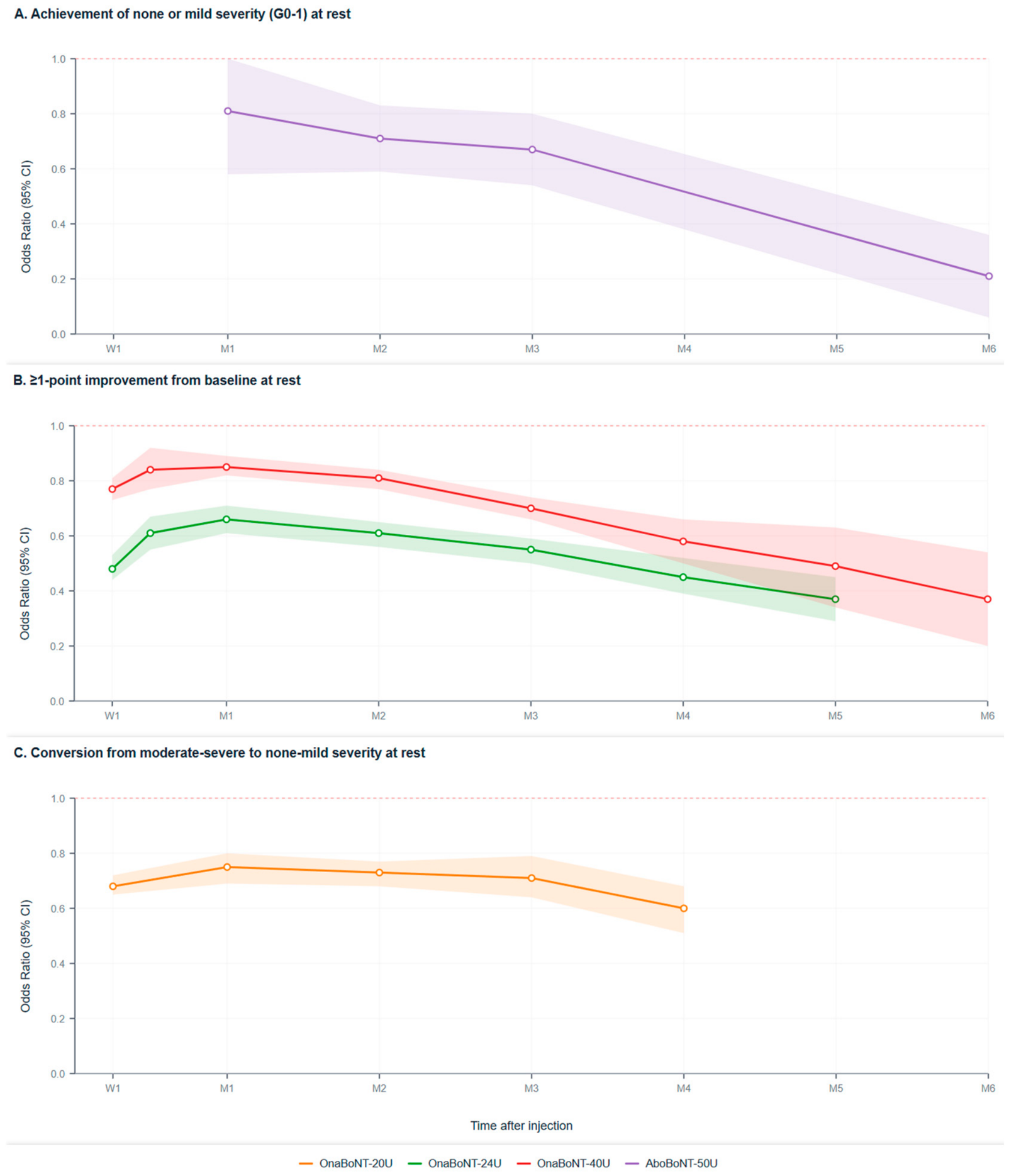
AbobotulinumtoxinA 50 U (2 study arms) showed high responder prevalence at rest: 81% (95% CI: 58–100%) at month 1, 71% (95% CI: 59–83%) at month 2, declining to 67% (95% CI: 54–80%) at month 3 and 21% (95% CI: 6–36%) at month 6.
Figure 4.
Investigator-based responder prevalence at rest over time. Line plots showing timepoint-specific prevalence (%) of investigator-assessed responder outcomes at rest following botulinum toxin type A injection, stratified by formulation and dose. Panel (A) shows the proportion of participants achieving none or mild wrinkle severity. Panel (B) shows the proportion achieving a ≥1-point improvement from baseline. Panel (C) shows the proportion achieving none or mild severity among participants with moderate or severe baseline severity. Responder prevalence was calculated independently at each reported follow-up timepoint (week 1 to month 6) using available-case data only. Only formulation–dose combinations reported by at least two trials are shown.
3.5.2. ≥1-Point Improvement from Baseline at Rest
OnabotulinumtoxinA 24 U (4 study arms) showed sustained efficacy at rest: 48% (95% CI: 44–53%) at week 1, improving to 61% (95% CI: 55–67%) at week 2 and 66% (95% CI: 61–71%) at month 1. Gradual decline occurred with 61% (95% CI: 56–65%) at month 2, 55% (95% CI: 50–59%) at month 3, 45% (95% CI: 39–52%) at month 4, and 37% (95% CI: 29–45%) at month 5.
OnabotulinumtoxinA 40 U (2 study arms) showed higher and more sustained responder prevalence: 77% (95% CI: 73–81%) at week 1, 84% (95% CI: 77–92%) at week 2, and 85% (95% CI: 82–89%) at month 1. Sustained response continued with 81% (95% CI: 77–84%) at month 2, 70% (95% CI: 66–74%) at month 3, 58% (95% CI: 50–66%) at month 4, 49% (95% CI: 34–63%) at month 5, and 37% (95% CI: 20–54%) at month 6.
Conversion from Moderate–Severe to None–Mild Severity (G2–3 → G0–1) at Rest.
OnabotulinumtoxinA 20 U (3 study arms) achieved sustained conversion rates at rest: 68% efficacy (95% CI: 65–72%) at week 1, 75% (95% CI: 69–80%) at month 1, 73% (95% CI: 68–77%) at month 2, 71% (95% CI: 64–79%) at month 3, and 60% (95% CI: 51–68%) at month 4.
3.6. Summary of Meta-Analytic Findings
Across all investigator-based endpoints, pooled responder prevalence declined between month 1 and month 6 for every formulation–dose combination analyzed. For daxibotulinumtoxinA 40 U, the month 6 estimate for the G0–1 endpoint at maximum frown was 41%, while for onabotulinumtoxinA 40 U and abobotulinumtoxinA 50 U it was 8% and 16%, respectively. Within onabotulinumtoxinA, higher doses retained higher prevalence at later timepoints. Estimates for each formulation derive from separate trials and were not compared statistically. The number of study arms contributing to each estimate varies by timepoint and is reported for every estimate in the Supplementary File. At months 5 and 6, most estimates were contributed by two or three study arms. Responder prevalence at rest was not formally compared with prevalence at maximum frown. Only a small number of formulation–dose combinations were reported under both conditions, and the differences between conditions were inconsistent in direction. More restrictive responder definitions (≥2-point improvement, G2–3 → G0–1 conversion) showed steeper efficacy decline over time compared to less restrictive endpoints, reflecting the challenge of maintaining substantial wrinkle reduction at extended follow-up.
4. Discussion
This investigator-based responder analysis provides a timepoint-specific synthesis of clinician-assessed efficacy outcomes following BoNT-A treatment for upper facial lines. Across all efficacy domains, the findings show high early responder prevalence followed by progressive attenuation over time, with meaningful differences emerging primarily in response durability rather than peak efficacy. These patterns have important implications for clinical practice, treatment planning, and patient counseling regarding expected outcomes and retreatment timing.
4.1. Interpretation of Investigator-Based Efficacy Patterns
Across investigator-based assessments at maximum frown, early response rates were uniformly high across most formulations and doses, particularly for less restrictive endpoints such as achievement of none or mild severity (G0–1) and ≥1-point improvement. However, by month 6, responder prevalence declined substantially for most regimens, reaching very low levels for onabotulinumtoxinA doses, with the notable exception of daxibotulinumtoxinA 40 U, which retained a responder prevalence of approximately 41% for G0–1 at maximum frown. This temporal pattern suggests that the extent of attenuation, rather than initial response, is where the estimates differed most in this dataset. That is a description of the pooled estimates and not a direct comparison between products.
Computational modelling has been applied to the question of duration of effect. A 20-year in silico simulation predicted differences between formulations, with daxibotulinumtoxinA showing the longest modelled duration at a median of 142 days [61]. That model was calibrated against published randomized trial data, including trials included in the present analysis, so it cannot serve as independent corroboration. It is consistent with the present observations rather than confirmatory of them.
The dose-dependent variability observed with onabotulinumtoxinA is consistent with established pharmacodynamic principles. Within this formulation, higher unit doses were associated with greater retention of response at later timepoints in the present analysis. This pattern was observed within onabotulinumtoxinA only. It cannot be extended to other formulations, because potency units are product-specific and are not interchangeable between products.
The pattern of decline observed for abobotulinumtoxinA is consistent with its established clinical pharmacology. Reported outcomes for this formulation varied considerably between studies [14].
4.2. Clinical Implications of Investigator Assessment Methods
The reliability and validity of investigator-based assessments have become increasingly important considerations in aesthetic medicine research and clinical practice. Agreement between raters using standardized wrinkle severity scales has been reported as variable, including among board-certified specialists, and agreement between raters of differing experience was unpredictable [15].
The evolution of patient-reported outcome measures (PROMs) in aesthetic medicine has highlighted both the strengths and limitations of purely investigator-based assessments. Recent analysis traced the development of aesthetic outcome measures over the past 20 years, noting that while investigator assessments provide essential objective frameworks for clinical decision-making, they may not fully capture patient-perceived benefits or satisfaction [62]. This perspective supports the importance of our investigator-focused analysis while acknowledging the complementary value of patient-reported outcomes, which will be addressed in our companion publication focusing specifically on patient-reported measures.
Assessment at rest versus maximum contraction represents another important consideration in investigator-based evaluation. Responder prevalence at rest and at maximum frown was not formally compared in the present analysis. The two conditions were reported together for only a small number of formulation–dose combinations, and the differences observed were inconsistent in direction. Any difference between assessment conditions requires direct study before it can inform patient counselling. Cumulative effects of repeated treatment on static lines have been described separately [63].
4.3. Formulation-Specific Considerations and Recent Evidence
The retention of response observed with daxibotulinumtoxinA 40 U has a proposed pharmacological basis. Preclinical and clinical investigations have suggested that the peptide stabilization approach used in this formulation may contribute to enhanced duration of effect without proportional increases in adverse events [6]. The present analysis cannot establish a comparative advantage. The estimates for each formulation derive from different trials that differed in population, dose, indication, assessment method, and follow-up schedule. A head-to-head randomized comparison would be required.
The dose-dependent patterns observed with onabotulinumtoxinA are consistent with established clinical experience but highlight important considerations for optimal dosing protocols. Higher doses must be balanced against potential adverse effects and against the goal of maintaining natural facial expression. The estimates for abobotulinumtoxinA in the present analysis are timepoint-specific prevalences and are not a comparative finding.
Importantly, our analysis was limited to formulations with sufficient data for comparative assessment. Newer formulations including letibotulinumtoxinA, prabotulinumtoxinA, and regional variants were represented in limited studies, precluding robust comparative analysis. As these formulations gain broader clinical adoption and more comparative data become available, future analyses will be able to provide more comprehensive formulation comparisons [2].
4.4. Endpoint Availability and Methodological Considerations
Several investigator-based efficacy endpoints were evaluable only for a limited subset of formulations and doses. More restrictive responder definitions, including conversion from moderate–severe to none–mild severity (G2–3 → G0–1) and ≥2-point improvement at maximum frown, were reported primarily for select formulations. This restricted coverage limits the generalizability of findings for these more stringent endpoints and underscores the uneven reporting practices across BoNT-A trials.
The heterogeneity in outcome definitions and reporting practices has been consistently highlighted as a major limitation in the cosmetic BoNT-A literature. A systematic review of outcome measures in cosmetic BoNT-A treatment found that most studies relied on single-item satisfaction scales and that validated instruments were applied inconsistently [64].
Our timepoint-stratified analytical approach was designed to address some of these methodological challenges while preserving the temporal structure of individual trial data. This approach avoids the potential biases associated with data imputation or last-observation-carried-forward methods while providing clinically relevant insights into the time course of treatment effects. However, it necessarily limits our ability to perform longitudinal modeling or generate pooled durability estimates across timepoints.
4.5. Limitations
Although the study was done following PRISMA (Supplementary File S2), it has several important limitations. First, although responder prevalence was reported only for formulation–dose combinations evaluated in at least two trials, several subgroups still exhibited considerable heterogeneity in study design, baseline severity distributions, and follow-up schedules. Accordingly, findings should not be interpreted as conclusive evidence of comparative efficacy.
Second, risk-of-bias assessment indicated that many included trials had some concerns, and a minority were rated as high risk, primarily due to incomplete reporting, lack of published protocols, or attrition. These factors may influence the precision and reliability of pooled prevalence estimates.
Third, analyses were conducted at the aggregate trial level, and individual patient-level modifiers of response could not be evaluated. Participant age, baseline severity, injection technique, and anatomical factors could not be examined as modifiers of response. Finally, later follow-up timepoints were not uniformly available across trials, necessitating a timepoint-stratified approach rather than longitudinal modeling.
Fourth, statistical heterogeneity was substantial for many pooled estimates. I2 exceeded 75% for a number of formulation–dose and timepoint combinations, reaching 95.5% for onabotulinumtoxinA 20 U at week 1 and 97.0% for onabotulinumtoxinA 24 U at month 4. A random-effects model was used throughout for this reason. The sources of this heterogeneity were not investigated formally, because most estimates were contributed by between two and seven study arms and because the trial-level covariates required for meta-regression were not reported uniformly. Pooled estimates at the affected timepoints should therefore be interpreted as summaries of a heterogeneous set of trials rather than as precise estimates of a common underlying response rate.
Fifth, the included indications were concentrated in the upper face and, within it, in the glabellar region, which accounted for 44 of 76 study arms. The lateral canthal area accounted for a further 15 arms. Data for the lower face were absent. The scope of this analysis is therefore limited to upper facial lines, and the findings should not be extrapolated to lower facial or neck indications.
Sixth, responder counts were reconstructed from published proportions applied to trial-level denominators, and no individual participant data were available. In most arms, the denominator did not change across follow-up, so participants who discontinued remained in the denominator and were not counted as responders. This is conservative at later timepoints rather than optimistic, because attrition does not inflate the estimate. It nonetheless means that the analysis carries forward the missing-data convention chosen by each source trial, and those conventions were not uniform. Readers can inspect the numerator and denominator used for every arm and timepoint in Supplementary Table S2.
Seventh, the unit of analysis was the study arm rather than the publication. For daxibotulinumtoxinA 40 U, three arms were contributed by two publications, so two of the pooled arms are not statistically independent. This affects the formulation for which the longest retention of response was observed, and the corresponding estimates should be read with that dependency in mind.
Eighth, the number of study arms contributing to a pooled estimate falls at later follow-up, because trials differed in how long they reported outcomes. At months 5 and 6, most estimates were contributed by two or three study arms. Confidence intervals at these timepoints are correspondingly wide, and the estimates are less precise than the earlier ones despite being presented in the same way. They should not be read as equally well supported. This is compounded by the differing missing-data conventions described above, which have their greatest influence at exactly these later visits, when attrition in the source trials was highest.
4.6. Clinical Implications and Future Directions
From a clinical perspective, these findings reinforce several evidence-based considerations for aesthetic practice. First, practitioners can counsel patients that high early investigator-assessed response rates are expected across most BoNT-A formulations, but visible and measurable effects diminish substantially by 6 months for most regimens. Second, durability varies meaningfully across formulations and doses, particularly for objective investigator-based outcomes at maximum frown. Third, assessment at rest generally yields higher responder rates compared to maximum contraction, providing valuable information for patient counseling and expectation management.
These results support the use of timepoint-specific responder reporting in both clinical trials and routine practice, rather than reliance on single peak-response assessments, to more accurately reflect real-world treatment durability. The establishment of standardized investigator training protocols and assessment guidelines will be important for maintaining consistency across clinical settings and research studies.
Future research directions should focus on developing standardized investigator assessment protocols, establishing optimal dosing algorithms that balance efficacy and durability, and investigating patient-specific factors that influence treatment outcomes. Objective measurement techniques, including three-dimensional analysis of facial surface irregularity, may provide more reproducible assessment than ordinal investigator scales and could complement them in future trials [65].
5. Conclusions
In summary, investigator-based responder efficacy following BoNT-A treatment for upper facial lines is characterized by high early response across formulations, followed by substantial attenuation over time, with substantial variation between formulation–dose combinations in the extent of that attenuation. On the G0–1 endpoint at maximum frown, pooled prevalence at month 6 was 41% for daxibotulinumtoxinA 40 U, 16% for abobotulinumtoxinA 50 U, and 8% for onabotulinumtoxinA 40 U. Within onabotulinumtoxinA, higher doses retained higher prevalence at later timepoints. These are descriptive formulation-specific observations. They are not evidence of comparative superiority, because the estimates derive from separate trials and because potency units are not interchangeable between products. Temporal patterns at rest resembled those at maximum frown, and the two conditions were not formally compared.
Limited endpoint availability, heterogeneity in responder definitions, and variable risk of bias constrain definitive comparisons across formulations for some outcomes. Standardized investigator-based responder endpoints and consistent longitudinal reporting are essential to advance comparative efficacy research and inform evidence-based clinical decision-making. These findings provide a foundation for clinical practice guidelines, treatment planning protocols, and patient counseling regarding expected investigator-assessed outcomes and durability patterns following BoNT-A treatment for upper facial lines.
Supplementary Materials
The following supporting information can be downloaded at: https://www.mdpi.com/article/10.3390/cosmetics13050243/s1. Table S1: Detailed search strategy and search queries used for the systematic review; Table S2: Numerator and denominator used for each contributing study arm at each follow-up timepoint. Supplementary File S1: Investigator Meta-Analysis Findings. Supplementary File S2: PRISMA 2020 Checklist.
Author Contributions
Conceptualization, A.S., R.B. and N.B.; methodology, A.S. and R.B.; software, A.S.; validation, A.S., R.B. and N.B.; formal analysis, A.S.; investigation, A.S., R.B. and N.B.; resources, R.B. and N.B.; data curation, A.S. and R.B.; writing—original draft preparation, A.S.; writing—review and editing, A.S., R.B. and N.B.; visualization, A.S.; supervision, R.B. and N.B.; project administration, A.S. and R.B.; funding acquisition, none. All authors have read and agreed to the published version of the manuscript.
Funding
This research received no external funding.
Institutional Review Board Statement
Not applicable.
Informed Consent Statement
Not applicable.
Data Availability Statement
The analyzed dataset in this research study can be provided by the corresponding author upon reasonable request.
Acknowledgments
We thank Abdelaziz for methodological support and assistance with systematic review conduct and manuscript preparation. Generative artificial intelligence (Claude 3.5 Sonnet (Anthropic, San Francisco, CA, USA)) was used in the preparation of this manuscript. An AI assistant was used to draft and edit manuscript prose. The protocol registration, literature search, study selection, data extraction, and all statistical analyses were performed by the authors without the use of generative AI. All AI-generated text and output were reviewed and verified by the authors, who take full responsibility for the content of this manuscript.
Conflicts of Interest
The authors declare no conflicts of interest.
References
- Sundaram, H.; Signorini, M.; Liew, S.; de Almeida, A.R.T.; Wu, Y.; Braz, A.V.; Fagien, S.; Goodman, G.J.; Monheit, G.; Raspaldo, H. Global aesthetics consensus: Botulinum toxin type A—Evidence-based review, emerging concepts, and consensus recommendations for aesthetic use, including updates on complications. Plast. Reconstr. Surg. 2016, 137, 518e–529e. [Google Scholar]
- Coleman, W.; Bertucci, V.; Humphrey, S.; Kaufman-Janette, J.; Keaney, T.; Pariser, D.; Solish, N.; Wirta, D.; Weiss, R.A. NivobotulinumtoxinA in the Treatment of Glabellar Lines with or Without Concurrent Treatment of Lateral Canthal Lines in Two Phase 3 Clinical Trials. Aesthetic Surg. J. 2025, 45, 404–413. [Google Scholar] [CrossRef] [Scilit]
- Joseph, J.; Moradi, A.; Lorenc, Z.P.; Coleman, K.; Ablon, G.; Kaufman-Janette, J.; Cox, S.E.; Campbell, A.; Dayan, S.; Berg, A.K.; et al. AbobotulinumtoxinA for the Treatment of Moderate-to-Severe Glabellar Lines: A Randomized, Dose-Escalating, Double-Blind Study. J. Drugs Dermatol. JDD 2021, 20, 980–987. [Google Scholar] [CrossRef] [Scilit]
- Joseph, J.; Sudimac, V.; Mersmann, S.; Kerscher, M. IncobotulinumtoxinA in the Treatment of Upper Facial Lines: Results From Two Randomized, Double-Blind, Placebo-Controlled, Phase III Studies. Aesthetic Surg. J. 2025, 45, 293–304. [Google Scholar] [CrossRef] [Scilit]
- Beer, K.R.; Shamban, A.T.; Avelar, R.L.; Gross, J.E.; Jonker, A. Efficacy and Safety of PrabotulinumtoxinA for the Treatment of Glabellar Lines in Adult Subjects: Results From 2 Identical Phase III Studies. Dermatol. Surg. 2019, 45, 1381–1393. [Google Scholar] [CrossRef] [Scilit]
- Bertucci, V.; Solish, N.; Kaufman-Janette, J.; Yoelin, S.; Shamban, A.; Schlessinger, J.; Snyder, D.; Gallagher, C.; Liu, Y.; Shears, G.; et al. DaxibotulinumtoxinA for Injection has a prolonged duration of response in the treatment of glabellar lines: Pooled data from two multicenter, randomized, double-blind, placebo-controlled, phase 3 studies (SAKURA 1 and SAKURA 2). J. Am. Acad. Dermatol. 2020, 82, 838–845. [Google Scholar] [CrossRef] [Scilit]
- Rahman, E.; Rao, P.; Philipp-Dormston, W.; Webb, W.R.; Garcia, P.E.; Ioannidis, S.; Kefalas, N.; Kajaia, A.; Friederich, L.; Yu, N. Intradermal botulinum toxin A on skin quality and facial rejuvenation: A systematic review and meta-analysis. Plast. Reconstr. Surg.–Glob. Open 2024, 12, e6084. [Google Scholar] [CrossRef] [Scilit]
- Zargaran, D.; Zoller, F.; Zargaran, A.; Rahman, E.; Woollard, A.; Weyrich, T.; Mosahebi, A. Complications of cosmetic botulinum toxin A injections to the upper face: A systematic review and meta-analysis. Aesthetic Surg. J. 2022, 42, N327–N336. [Google Scholar] [CrossRef] [Scilit]
- Li, X.; Sui, C.; Xia, X.; Chen, X. Efficacy and safety of botulinum toxin type A for treatment of glabellar lines: A network meta-analysis of randomized controlled trials. Aesthetic Plast. Surg. 2023, 47, 365–377. [Google Scholar] [CrossRef] [Scilit]
- Fu, Z.; Huang, H.; Huang, J. Efficacy and safety of botulinum toxin type A for postoperative scar prevention and wound healing improvement: A systematic review and meta-analysis. J. Cosmet. Dermatol. 2022, 21, 176–190. [Google Scholar] [CrossRef] [Scilit]
- Jiang, A.; Jiang, R.; Liu, T. A Meta-Analysis of the Efficacy and Safety of Botulinum Toxin Type A for the Management of Scars After Facial Surgery. J. Cosmet. Dermatol. 2025, 24, e70111. [Google Scholar] [CrossRef] [Scilit]
- Wang, W.; Liu, G.; Li, X. The efficacy and safety of botulinum toxin type A injections in improving facial scars: A systematic review and meta-analysis. Pharmacology 2022, 107, 241–249. [Google Scholar] [CrossRef] [Scilit]
- Bonaparte, J.P.; Ellis, D.; Quinn, J.G.; Ansari, M.T.; Rabski, J.; Kilty, S.J. A comparative assessment of three formulations of botulinum toxin A for facial rhytides: A systematic review and meta-analyses. Syst. Rev. 2013, 2, 40. [Google Scholar] [CrossRef] [Scilit]
- Safia, A.; Elhadi, U.A.; Merchavy, S.; Batheesh, R.; Bathish, N. Cosmetic Botulinum Toxin A Injections to the Upper Face: A Systematic Review and Meta-Analysis of Clinical Studies. J. Cosmet. Dermatol. 2026, 25, e70655. [Google Scholar] [CrossRef] [Scilit]
- Conkling, N.; Bishawi, M.; Phillips, B.T.; Bui, D.T.; Khan, S.U.; Dagum, A.B. Subjective rating of cosmetic treatment with botulinum toxin type A: Do existing measures demonstrate interobserver validity? Ann. Plast. Surg. 2012, 69, 350–355. [Google Scholar] [CrossRef] [Scilit]
- Page, M.J.; McKenzie, J.E.; Bossuyt, P.M.; Boutron, I.; Hoffmann, T.C.; Mulrow, C.D.; Shamseer, L.; Tetzlaff, J.M.; Akl, E.A.; Brennan, S.E. The PRISMA 2020 statement: An updated guideline for reporting systematic reviews. BMJ 2021, 372, n71. [Google Scholar] [CrossRef] [Scilit]
- Muka, T.; Glisic, M.; Milic, J.; Verhoog, S.; Bohlius, J.; Bramer, W.; Chowdhury, R.; Franco, O.H. A 24-step guide on how to design, conduct, and successfully publish a systematic review and meta-analysis in medical research. Eur. J. Epidemiol. 2020, 35, 49–60. [Google Scholar] [CrossRef] [Scilit]
- Ablon, G.; Bank, D.; Kontis, T.C.; Ibrahim, S.F.; Palm, M.; Cox, S.E.; Rivers, J.K.; Grunebaum, L.; Goldman, M.P.; Humphrey, S.; et al. Efficacy and Safety of RelabotulinumtoxinA Liquid Botulinum Toxin in the Treatment of Lateral Canthal Lines: Results From the Phase 3 READY-2 Study. Dermatol. Surg. 2025, 51, 277–283. [Google Scholar] [CrossRef] [Scilit]
- Ascher, B.; Kestemont, P.; Boineau, D.; Bodokh, I.; Stein, A.; Heckmann, M.; Dendorfer, M.; Pavicic, T.; Volteau, M.; Tse, A.; et al. Liquid Formulation of AbobotulinumtoxinA Exhibits a Favorable Efficacy and Safety Profile in Moderate to Severe Glabellar Lines: A Randomized, Double-Blind, Placebo- and Active Comparator-Controlled Trial. Aesthetic Surg. J. 2018, 38, 183–191. [Google Scholar] [CrossRef] [Scilit]
- Ascher, B.; Rzany, B.; Kestemont, P.; Hilton, S.; Heckmann, M.; Bodokh, I.; Noah, E.M.; Boineau, D.; Kerscher, M.; Volteau, M.; et al. Liquid Formulation of AbobotulinumtoxinA: A 6-Month, Phase 3, Double-Blind, Randomized, Placebo-Controlled Study of a Single Treatment, Ready-to-Use Toxin for Moderate-to-Severe Glabellar Lines. Aesthetic Surg. J. 2020, 40, 93–104. [Google Scholar] [CrossRef] [Scilit]
- Ascher, B.; Rzany, B.J.; Grover, R. Efficacy and safety of botulinum toxin type A in the treatment of lateral crow’s feet: Double-blind, placebo-controlled, dose-ranging study. Dermatol. Surg. 2009, 35, 1478–1486. [Google Scholar] [CrossRef] [Scilit]
- Ascher, B.; Zakine, B.; Kestemont, P.; Baspeyras, M.; Bougara, A.; Niforos, F.; Malet, T.; Santini, J. Botulinum toxin A in the treatment of glabellar lines: Scheduling the next injection. Aesthetic Surg. J. 2005, 25, 365–375. [Google Scholar] [CrossRef] [Scilit]
- Ascher, B.; Zakine, B.; Kestemont, P.; Baspeyras, M.; Bougara, A.; Santini, J. A multicenter, randomized, double-blind, placebo-controlled study of efficacy and safety of 3 doses of botulinum toxin A in the treatment of glabellar lines. J. Am. Acad. Dermatol. 2004, 51, 223–233. [Google Scholar] [CrossRef] [Scilit]
- Brandt, F.; Swanson, N.; Baumann, L.; Huber, B. Randomized, placebo-controlled study of a new botulinum toxin type a for treatment of glabellar lines: Efficacy and safety. Dermatol. Surg. 2009, 35, 1893–1901. [Google Scholar] [CrossRef] [Scilit]
- Carruthers, A.; Bruce, S.; de Coninck, A.; Connolly, S.; Cox, S.E.; Davis, P.G.; Campo, A.; Lei, X.; Somogyi, C.; Lee, E.; et al. Efficacy and safety of onabotulinumtoxinA for the treatment of crows feet lines: A multicenter, randomized, controlled trial. Dermatol. Surg. 2014, 40, 1181–1190. [Google Scholar] [CrossRef] [Scilit]
- Carruthers, A.; Carruthers, J.; Coleman, W.P., 3rd; Donofrio, L.; Flynn, T.; Gold, M.; Heinz, M.; Harrington, L.; Jones, D.; McDaniel, D.; et al. Multicenter, randomized, phase III study of a single dose of incobotulinumtoxinA, free from complexing proteins, in the treatment of glabellar frown lines. Dermatol. Surg. 2013, 39, 551–558. [Google Scholar] [CrossRef] [Scilit]
- Carruthers, A.; Carruthers, J.; Lowe, N.; Menter, A.; Gibson, J.; Nordquist, M.; Mordaunt, J. One-year, randomised, multicenter, two-period study of the safety and efficacy of repeated treatments with botulinum toxin type A in patients with glabellar lines. J. Clin. Res. 2004, 7, 1–20. [Google Scholar]
- Carruthers, J.; Carruthers, A. Botulinum toxin type A treatment of multiple upper facial sites: Patient-reported outcomes. Dermatol. Surg. 2007, 33, S10–S17. [Google Scholar] [CrossRef] [Scilit]
- Carruthers, J.; Rivkin, A.; Donofrio, L.; Bertucci, V.; Somogyi, C.; Lei, X.; Davis, P.G.; Campo, A.; Beddingfield, F.C. A Multicenter, Randomized, Double-Blind, Placebo-Controlled Study to Evaluate the Efficacy and Safety of Repeated OnabotulinumtoxinA Treatments in Subjects with Crow’s Feet Lines and Glabellar Lines. Dermatol. Surg. 2015, 41, 702–711. [Google Scholar] [CrossRef] [Scilit]
- Carruthers, J.; Solish, N.; Humphrey, S.; Rosen, N.; Muhn, C.; Bertucci, V.; Swift, A.; Metelitsa, A.; Rubio, R.G.; Waugh, J.; et al. Injectable DaxibotulinumtoxinA for the Treatment of Glabellar Lines: A Phase 2, Randomized, Dose-Ranging, Double-Blind, Multicenter Comparison with OnabotulinumtoxinA and Placebo. Dermatol. Surg. 2017, 43, 1321–1331. [Google Scholar] [CrossRef] [Scilit]
- Carruthers, J.A.; Lowe, N.J.; Menter, M.A.; Gibson, J.; Nordquist, M.; Mordaunt, J.; Walker, P.; Eadie, N. A multicenter, double-blind, randomized, placebo-controlled study of the efficacy and safety of botulinum toxin type A in the treatment of glabellar lines. J. Am. Acad. Dermatol. 2002, 46, 840–849. [Google Scholar] [CrossRef] [Scilit]
- Carruthers, J.D.; Fagien, S.; Joseph, J.H.; Humphrey, S.D.; Biesman, B.S.; Gallagher, C.J.; Liu, Y.; Rubio, R.G. DaxibotulinumtoxinA for Injection for the Treatment of Glabellar Lines: Results from Each of Two Multicenter, Randomized, Double-Blind, Placebo-Controlled, Phase 3 Studies (SAKURA 1 and SAKURA 2). Plast. Reconstr. Surg. 2020, 145, 45–58. [Google Scholar] [CrossRef] [Scilit]
- Carruthers, J.D.; Lowe, N.J.; Menter, M.A.; Gibson, J.; Eadie, N. Double-blind, placebo-controlled study of the safety and efficacy of botulinum toxin type A for patients with glabellar lines. Plast. Reconstr. Surg. 2003, 112, 1089–1098. [Google Scholar] [CrossRef] [Scilit]
- De Boulle, K.; Werschler, W.P.; Gold, M.H.; Bruce, S.; Sattler, G.; Ogilvie, P.; Street, J.; Larsen, K.E.; Yushmanova, I.; Lei, X.; et al. Phase 3 Study of OnabotulinumtoxinA Distributed Between Frontalis, Glabellar Complex, and Lateral Canthal Areas for Treatment of Upper Facial Lines. Dermatol. Surg. 2018, 44, 1437–1448. [Google Scholar] [CrossRef] [Scilit]
- Fagien, S.; Cohen, J.L.; Coleman, W.; Monheit, G.; Carruthers, J.; Street, J.; Larsen, K.E.; Yushmanova, I.; Lei, X.; Lee, E.; et al. Forehead Line Treatment with OnabotulinumtoxinA in Subjects with Forehead and Glabellar Facial Rhytids: A Phase 3 Study. Dermatol. Surg. 2017, 43, S274–S284. [Google Scholar] [CrossRef] [Scilit]
- Fagien, S.; Cox, S.E.; Finn, J.C.; Werschler, W.P.; Kowalski, J.W. Patient-reported outcomes with botulinum toxin type A treatment of glabellar rhytids: A double-blind, randomized, placebo-controlled study. Dermatol. Surg. 2007, 33, S2–S9. [Google Scholar] [CrossRef] [Scilit]
- Feng, Z.; Sun, Q.; He, L.; Wu, Y.; Xie, H.; Zhao, G.; Xu, J.; Yao, C.; Li, H. Optimal dosage of botulinum toxin type A for treatment of glabellar frown lines: Efficacy and safety in a clinical trial. Dermatol. Surg. 2015, 41, S56–S63. [Google Scholar] [CrossRef] [Scilit]
- Hanke, C.W.; Narins, R.S.; Brandt, F.; Cohen, J.L.; Donofrio, L.M.; Downie, J.; Heinz, M.; Harrington, L.; McDaniel, D.H.; Nestor, M.; et al. A randomized, placebo-controlled, double-blind phase III trial investigating the efficacy and safety of incobotulinumtoxinA in the treatment of glabellar frown lines using a stringent composite endpoint. Dermatol. Surg. 2013, 39, 891–899. [Google Scholar] [CrossRef] [Scilit]
- Harii, K.; Kawashima, M. A double-blind, randomized, placebo-controlled, two-dose comparative study of botulinum toxin type A for treating glabellar lines in Japanese subjects. Aesthetic Plast. Surg. 2008, 32, 724–730. [Google Scholar] [CrossRef] [Scilit]
- Harii, K.; Kawashima, M.; Furuyama, N.; Lei, X.; Hopfinger, R.; Lee, E. OnabotulinumtoxinA (Botox) in the Treatment of Crow’s Feet Lines in Japanese Subjects. Aesthetic Plast. Surg. 2017, 41, 1186–1197. [Google Scholar] [CrossRef] [Scilit]
- Hilton, S.; Kestemont, P.; Sattler, G.; Volteau, M.; Thompson, C.; Andriopoulos, B.; Prygova, I.; Berg, A.K.; Ascher, B. Liquid AbobotulinumtoxinA: Pooled Data From Two Double-Blind, Randomized, Placebo-Controlled Phase III Studies of Glabellar Line Treatment. Dermatol. Surg. 2022, 48, 1198–1202. [Google Scholar] [CrossRef] [Scilit]
- Jones, D.; Carruthers, J.; Narins, R.S.; Coleman, W.P., 3rd; Harrington, L.; Brandt, F.S.; Cohen, J.L. Efficacy of incobotulinumtoxinA for treatment of glabellar frown lines: A post hoc pooled analysis of 2 randomized, placebo-controlled, phase 3 trials. Dermatol. Surg. 2014, 40, 776–785. [Google Scholar] [CrossRef] [Scilit]
- Joseph, J.H.; Maas, C.; Palm, M.D.; Lain, E.; Glaser, D.A.; Bruce, S.; Yoelin, S.; Cox, S.E.; Fagien, S.; Sangha, S.; et al. Safety, Pharmacodynamic Response, and Treatment Satisfaction with OnabotulinumtoxinA 40 U, 60 U, and 80 U in Subjects with Moderate to Severe Dynamic Glabellar Lines. Aesthetic Surg. J. 2022, 42, 1318–1327. [Google Scholar] [CrossRef] [Scilit]
- Kane, M.A.C.; Brandt, F.; Rohrich, R.J.; Narins, R.S.; Monheit, G.D.; Huber, M.B. Evaluation of variable-dose treatment with a new U.S. Botulinum Toxin Type A (Dysport) for correction of moderate to severe glabellar lines: Results from a phase III, randomized, double-blind, placebo-controlled study. Plast. Reconstr. Surg. 2009, 124, 1619–1629. [Google Scholar] [CrossRef] [Scilit]
- Keaney, T.C.; Cavallini, M.; Leys, C.; Rossi, A.; Drinkwater, A.; Manson Brown, S.; Garcia, J.K.; Mao, C. Efficacy, Patient-Reported Outcomes, and Safety in Male Subjects Treated with OnabotulinumtoxinA for Improvement of Moderate to Severe Horizontal Forehead Lines. Dermatol. Surg. 2020, 46, 229–239. [Google Scholar] [CrossRef] [Scilit]
- Kerscher, M.; Rzany, B.; Prager, W.; Turnbull, C.; Trevidic, P.; Inglefield, C. Efficacy and Safety of IncobotulinumtoxinA in the Treatment of Upper Facial Lines: Results From a Randomized, Double-Blind, Placebo-Controlled, Phase III Study. Dermatol. Surg. 2015, 41, 1149–1157. [Google Scholar] [CrossRef] [Scilit]
- Kestemont, P.; Hilton, S.; Andriopoulos, B.; Prygova, I.; Thompson, C.; Volteau, M.; Ascher, B. Long-term Efficacy and Safety of Liquid AbobotulinumtoxinA Formulation for Moderate-to-Severe Glabellar Lines: A Phase III, Double-Blind, Randomized, Placebo-Controlled and Open-Label Study. Aesthetic Surg. J. 2022, 42, 301–313. [Google Scholar] [CrossRef] [Scilit]
- Lee, S.K.; Kim, M.S.; Kwon, S.H.; Chung, B.Y.; Han, S.H.; Kim, H.J. Efficacy, Safety, and Subject Satisfaction of PrabotulinumtoxinA for Moderate-to-Severe Crow’s Feet: A Phase IV, Multicenter, Double-Blind, Randomized, Placebo-Controlled Trial. J. Clin. Med. 2023, 12, 6326. [Google Scholar] [CrossRef] [Scilit]
- Lowe, N.J.; Ascher, B.; Heckmann, M.; Kumar, C.; Fraczek, S.; Eadie, N. Double-blind, randomized, placebo-controlled, dose-response study of the safety and efficacy of botulinum toxin type A in subjects with crow’s feet. Dermatol. Surg. 2005, 31, 257–262. [Google Scholar] [CrossRef] [Scilit]
- Lowe, N.J.; Lask, G.; Yamauchi, P.; Moore, D. Bilateral, double-blind, randomized comparison of 3 doses of botulinum toxin type A and placebo in patients with crow’s feet. J. Am. Acad. Dermatol. 2002, 47, 834–840. [Google Scholar] [CrossRef] [Scilit]
- Monheit, G.D.; Baumann, L.; Maas, C.; Rand, R.; Down, R. Efficacy, Safety, and Subject Satisfaction After AbobotulinumtoxinA Treatment for Moderate to Severe Glabellar Lines. Dermatol. Surg. 2020, 46, 61–69. [Google Scholar] [CrossRef] [Scilit]
- Ogilvie, P.; Rivkin, A.Z.; Dayan, S.; Yoelin, S.G.; Weichman, B.M.; Garcia, J.K. OnabotulinumtoxinA for Treatment of Forehead and Glabellar Lines: Subject-Reported Satisfaction and Impact From a Phase 3 Double-Blind Study. Dermatol. Surg. 2019, 45, 689–699. [Google Scholar] [CrossRef] [Scilit]
- Rivers, J.K.; Bertucci, V.; McGillivray, W.; Muhn, C.; Rosen, N.; Solish, N.; Weichman, B.M.; Wheeler, S.; Daniels, S.R.; Gallagher, C.J. Subject satisfaction with onabotulinumtoxinA treatment of glabellar and lateral canthal lines using a new patient-reported outcome measure. Dermatol. Surg. 2015, 41, 950–959. [Google Scholar] [CrossRef] [Scilit]
- Rzany, B.; Ascher, B.; Fratila, A.; Monheit, G.D.; Talarico, S.; Sterry, W. Efficacy and safety of 3- and 5-injection patterns (30 and 50 U) of botulinum toxin A (Dysport) for the treatment of wrinkles in the glabella and the central forehead region. Arch. Dermatol. 2006, 142, 320–326. [Google Scholar] [CrossRef] [Scilit]
- Rzany, B.J.; Ascher, B.; Avelar, R.L.; Bergdahl, J.; Bertucci, V.; Bodokh, I.; Carruthers, J.A.; Cartier, H.; Delmar, H.; Denfeld, R.; et al. A Multicenter, Randomized, Double-Blind, Placebo-Controlled, Single-Dose, Phase III, Non-Inferiority Study Comparing PrabotulinumtoxinA and OnabotulinumtoxinA for the Treatment of Moderate to Severe Glabellar Lines in Adult Patients. Aesthetic Surg. J. 2020, 40, 413–429. [Google Scholar] [CrossRef] [Scilit]
- Schlessinger, J.; Friedmann, D.P.; Mayoral, F.; Mraz Robinson, D.; Glaser, D.; Wu, D.; Marcus, K.; Somenek, M.; Lin, X. AbobotulinumtoxinA Treatment of Glabellar Lines Using a New Reconstitution and Injection Volume: Randomized, Placebo-Controlled Data. J. Drugs Dermatol. JDD 2021, 20, 988–995. [Google Scholar] [CrossRef] [Scilit]
- Shridharani, S.M.; Moradi, A.; Donofrio, L.; Gold, M.H.; Biesman, B.; Chiang, M.; George, R.; Polder, K.; Solish, N.; Schwarcz; et al. Efficacy and Safety of RelabotulinumtoxinA, a New Ready-to-Use Liquid Formulation Botulinum Toxin: Results From the READY-1 Double-Blind, Randomized, Placebo-Controlled Phase 3 Trial in Glabellar Lines. Aesthetic Surg. J. 2024, 44, 1330–1340. [Google Scholar] [CrossRef] [Scilit]
- Wu, Y.; Fang, F.; Lai, W.; Li, C.; Li, L.; Liu, Q.; Lu, J.; Pang, X.; Sun, J.; Shi, X.; et al. Efficacy and Safety of AbobotulinumtoxinA for the Treatment of Glabellar Lines in Chinese Patients: A Pivotal, Phase 3, Randomized, Double-Blind and Open-Label Phase Study. Aesthetic Plast. Surg. 2023, 47, 351–364. [Google Scholar] [CrossRef] [Scilit]
- Wu, Y.; Wang, G.; Li, C.; Mao, C.; Lei, X.; Lee, E. Safety and Efficacy of OnabotulinumtoxinA for Treatment of Crow’s Feet Lines in Chinese Subjects. Plast. Reconstr. Surg. Glob. Open 2019, 7, e2079. [Google Scholar] [CrossRef] [Scilit]
- Wu, Y.; Zhao, G.; Li, H.; Zheng, Z.; Zhong, S.; Yang, Z.; Feng, Z.; Yang, Q.; Zhu, X. Botulinum toxin type A for the treatment of glabellar lines in Chinese: A double-blind, randomized, placebo-controlled study. Dermatol. Surg. 2010, 36, 102–108. [Google Scholar] [CrossRef] [Scilit]
- Rahman, E.; Michon, A.; Rao, P.; Ahmed, M.; Joseph, J.H.; Wu, W.T.; Carruthers, J.D.; Webb, W.R. Computational model-informed comparative evaluation of botulinum toxin a formulations: A 20-year simulation of onset, diffusion, duration, and immunogenicity. Toxicon 2026, 269, 108665. [Google Scholar] [CrossRef] [Scilit]
- Dayan, S.; Rivkin, A.Z.; Ogilvie, P.; Carruthers, J.D.A.; Wu, Y.; Lee, E.; Patel, V.; Musumeci, M. Revealing the Patient Perspective: Evolution of Patient-Reported Outcome Measures in Botulinum Toxin Studies in Aesthetic Medicine. J. Cosmet. Dermatol. 2025, 24, e70311. [Google Scholar] [CrossRef] [Scilit]
- Humphrey, S.; Jacky, B.; Gallagher, C.J. Preventive, Cumulative Effects of Botulinum Toxin Type A in Facial Aesthetics. Dermatol. Surg. 2017, 43, S244–S251. [Google Scholar] [CrossRef] [Scilit]
- Wang, J.; Rieder, E.A. A Systematic Review of Patient-Reported Outcomes for Cosmetic Indications of Botulinum Toxin Treatment. Dermatol. Surg. 2019, 45, 668–688. [Google Scholar] [CrossRef] [Scilit]
- Lumenta, D.B.; Selig, H.; Kitzinger, H.B.; Kamolz, L.P. Objective quantification of wrinkles: Three-dimensional analysis of surface irregularity. Plast. Reconstr. Surg. 2012, 129, 735e–737e. [Google Scholar] [CrossRef] [Scilit]

Disclaimer/Publisher’s Note: The statements, opinions and data contained in all publications are solely those of the individual author(s) and contributor(s) and not of MDPI and/or the editor(s). MDPI and/or the editor(s) disclaim responsibility for any injury to people or property resulting from any ideas, methods, instructions or products referred to in the content. |
© 2026 by the authors. Licensee MDPI, Basel, Switzerland. This article is an open access article distributed under the terms and conditions of the Creative Commons Attribution (CC BY) license.