


Abstract
Water reuse can help address water scarcity and supply vulnerability, but its feasibility depends on technical and non-technical conditions. This study develops a multidimensional framework for assessing water reuse feasibility based on four operating systems (Windhoek, Ulu Pandan, Roldán–Lo Ferro–Balsicas, and Big Spring) and three contrast cases that did not proceed as intended (Toowoomba, Western Corridor, and San Diego). Six feasibility dimensions were assessed using a three-level, evidence-based ordinal scale. The assessment used nine common indicators and evaluated operational maturity in the operating systems and operational readiness in the contrast cases. All four operating systems received favorable scores for treatment suitability, operational maturity, institutional capacity, health protection, and resource conservation. Regulatory clarity and relative economic competitiveness varied across these systems. Each contrast case had at least one limiting condition among the shared indicators. Western Corridor, for example, received favorable scores for treatment suitability and health protection alongside limiting scores on both economic indicators. Based on the cross-case patterns, the proposed framework integrates local context, implementation drivers, and trade-offs across dimensions. It supports fit-for-purpose assessment at the pre-feasibility stage by organizing evidence, identifying constraints, and highlighting gaps for further assessment.
1. Introduction
Water scarcity has emerged as one of the most critical global challenges of the 21st century, driven by the combined effects of climate change, population growth, urbanization, and increasing water demand across agricultural, industrial, and domestic sectors [1,2,3]. Using data for 1996–2005, Mekonnen and Hoekstra estimated that approximately 4.0 billion people experienced severe water scarcity for at least one month per year [4]. These pressures are progressively reducing the availability of conventional freshwater resources, particularly in water-scarce regions, thereby intensifying competition for water among agricultural, industrial, and domestic users. As a result, alternative and more resilient water-management strategies are increasingly required [5,6].
Within this context, water reuse has gained recognition as a key component of circular and resilient water management. Although wastewater reuse has a long historical precedent [7,8,9], contemporary systems differ substantially in technological sophistication, regulatory oversight, and intended end use. Advances in treatment and monitoring now allow reclaimed water to be used for applications ranging from agricultural irrigation and industrial processes to potable water supply [10,11,12,13].
International experience illustrates how these reuse pathways have developed under markedly different water resource and institutional contexts. Windhoek has become an internationally recognized example of direct potable reuse developed under persistent water-supply constraints [14,15,16], whereas Singapore incorporated NEWater into a long-term national water-security strategy, with reclaimed water used extensively for industrial applications as well as indirect potable reuse [17]. In southeastern Spain, particularly in the Region of Murcia, reclaimed water has become strongly integrated into agricultural irrigation under conditions of structural water deficit [18]. Big Spring, Texas, provides another example of direct potable reuse implemented in response to severe drought and vulnerability of conventional reservoir supplies [15,16,19]. These contrasting trajectories indicate that water scarcity may provide an important motivation for reuse, but does not by itself determine the configuration through which reuse is implemented.
The implementation of water reuse cannot therefore be explained solely by technological capability. Regulatory clarity, institutional coordination, economic conditions, environmental implications, public health protection, and social acceptance can all influence whether a technically feasible reuse option is implemented and sustained over time [20,21]. Previous studies have examined many of these dimensions individually, including treatment performance, health risk, economic feasibility, governance, and public perception. However, comparing established full-scale implementations across different contexts requires a common analytical structure, because available case evidence is often reported at different spatial scales and using different indicators. This complicates the systematic assessment of how contextual drivers, enabling conditions, constraints, and trade-offs vary across reuse pathways.
Previous studies have approached water reuse feasibility from different perspectives. Papa et al. [22] developed a decision-support tool that combines indices for the treatment plant, conveyance system, and end user to evaluate reuse scenarios. Wester and Broad [19] examined how policy, communication, and public attitudes shaped decisions in three direct potable reuse cases in Texas. Building on this work, the present study uses a common set of evidence-based indicators to compare four mature, full-scale systems across three reuse pathways (direct potable reuse, industrial reuse, and agricultural reuse), and three projects that did not proceed as intended. The comparison uses nine shared indicators and assesses operational maturity for the operating systems and operational readiness for the contrast cases.
Each case is examined by considering both the characteristics of the focal facility and the broader water resource, regulatory, institutional, economic, environmental, and social context. The study aims to (i) identify common drivers, enabling conditions, constraints, and trade-offs across the four operating systems, (ii) examine which conditions were limiting in the three contrast cases, and (iii) use these findings to develop a conceptual framework for the early-stage assessment of future water reuse projects. The resulting profiles show where conditions are favorable, where constraints arise, and where the evidence is insufficient to assign a score.
2. Materials and Methods
2.1. Research Design and Analytical Approach
This study uses a comparative multiple-case study approach to examine water reuse under different end-use, environmental, institutional, and socioeconomic conditions. The analysis combines information on each focal system with evidence from its broader context. System-level information is used to describe treatment configuration, operational scale, intended reuse application, monitoring practices, and operational maturity. Broader contextual information is used to examine water resource conditions, regulatory frameworks, institutional arrangements, economic conditions, environmental implications, and public health and social factors.
The four operating systems are the primary focus of the detailed analysis across the six feasibility dimensions. Their full-scale operating records provide evidence on the conditions that shaped implementation and sustained operation. The three contrast cases are assessed retrospectively to examine whether the framework can also identify conditions that limited the proposed potable reuse applications. All seven cases are assessed using nine common indicators and the applicable variant of the operational indicator (T2). The findings from both groups inform the conceptual framework for the early-stage assessment of future water reuse projects.
2.2. Case Selection and Unit of Analysis
The four operating systems were selected to represent mature, full-scale water reuse implementations operating under contrasting reuse pathways and institutional contexts. Case selection was intended to enable analytical comparison across well-documented implementations with demonstrated operational experience. Four selection criteria were applied: (i) operation at full scale; (ii) sufficient operational maturity to provide evidence beyond pilot or demonstration conditions; (iii) diversity in intended reuse pathway, water resource context, and institutional setting; and (iv) availability of sufficient scientific, technical, and official documentation to support systematic cross-case comparison.
Based on these criteria, four focal implementations were selected: the New Goreangab Water Reclamation Plant in Windhoek, Namibia; the Ulu Pandan NEWater Factory in Singapore; the Roldán–Lo Ferro–Balsicas water reuse system in the Region of Murcia, Spain; and the Big Spring Raw Water Production Facility in Texas, United States. Together, these cases represent three major reuse pathways: direct potable reuse, industrial reuse, and agricultural reuse. The selected cases and their analytical scope are summarized in Table 1.
Table 1.
Operating water reuse systems and analytical scope.
The focal implementation serves as the main unit for comparing technical and operational characteristics. However, several factors influencing water reuse extend beyond the city scale. Water resource conditions, regulations, institutional coordination, financing, environmental constraints, and public acceptance may depend on decisions made at municipal, regional, basin, state, or national scales. Consequently, each focal implementation was analyzed within its broader water-management and institutional context. This approach allows consistent comparisons of facility-specific characteristics while considering the broader conditions that influence their implementation.
The selection of mature, full-scale systems favored projects with demonstrated operational continuity. To examine whether the framework could also identify limiting conditions, we selected three potable reuse projects as contrast cases: Toowoomba Water Futures, the Western Corridor Recycled Water Scheme, and the San Diego Water Repurification Project. Each project had reached a formal proposal with a defined treatment train and intended use, but the proposed potable application was rejected, cancelled, or curtailed. The available documentation allowed us to reconstruct the proposed reuse application and the conditions surrounding the relevant decision.
2.3. Data Sources and Evidence Collection
Information for each case study was compiled from peer-reviewed publications, official reports and regulations, technical documents from water utilities and public agencies, and other institutional sources related to the selected water reuse systems. Primary and official sources were preferred for facility characteristics, operational data, regulatory requirements, and institutional arrangements, while peer-reviewed literature was used to complement technical, environmental, economic, and public health and social analysis.
The documentary search began in September 2025 and was last updated on 15 November 2026. Peer-reviewed literature was identified through Scopus and the Web of Science Core Collection, complemented by Google Scholar and targeted searches of official websites, institutional repositories, water utilities, regulatory agencies, and public authorities. These additional sources were used to identify technical reports, regulations, operational data, and other institutional documents relevant to the selected cases. The final documentary corpus comprised 67 unique sources across the seven cases, including peer-reviewed publications, regulatory and legal documents, technical and operational reports, and other institutional sources. The number of sources by case was 17 for Windhoek, 19 for Ulu Pandan, 15 for Roldán–Lo Ferro–Balsicas, 10 for Big Spring, 4 for Toowoomba, 4 for Western Corridor, and 3 for San Diego. Sources that informed more than one case were counted for each relevant case and only once in the overall total.
The bibliographic search combined the name of each focal implementation and its location with terms related to the analytical dimensions. Search strings included combinations of “water reuse”, “water reclamation”, “treatment”, “operation”, “monitoring”, “regulation”, “governance”, “cost”, “energy”, “environmental impact”, “public health”, “public acceptance”, “perception”, and “stakeholder engagement”. Search was adapted to the syntax of each database and supplemented with case-specific terms when necessary.
Sources were included when they (i) referred directly to the focal implementation or its broader water-management context; (ii) provided information relevant to at least one analytical dimension; and (iii) came from peer-reviewed literature, public authorities, water utilities, regulatory agencies, or other identifiable institutional sources.
2.4. Analytical Dimensions and Evidence Categories
Each case was first characterized according to its water resource context and subsequently examined across six analytical dimensions: (i) technical and operational; (ii) regulatory and institutional; (iii) economic; (iv) environmental; (v) public health; and (vi) social. These dimensions capture both implementation-specific and broader contextual factors influencing water reuse development and long-term operation. Public health and social conditions were assessed separately to distinguish health protection and risk management from public acceptance, communication, and engagement.
To support consistent cross-case comparison, a common set of evidence categories was defined within each dimension. The categories were selected according to their relevance to water reuse implementation and the availability of supporting information from scientific, technical, regulatory, and institutional sources. The water resource context was considered separately, before the multidimensional analysis, as it represents the conditions that may increase the need for alternative water sources.
The analytical dimensions and corresponding evidence categories are summarized in Table 2.
Table 2.
Analytical dimensions and evidence categories used in the cross-case comparison.
The evidence categories provided a common structure for data extraction and cross-case comparison. Information from the reviewed sources was organized according to these categories to identify recurrent patterns, differences among reuse pathways, and interactions between implementation conditions.
2.5. Cross-Case Analysis and Evidence-Based Coding
The information extracted for each case was organized according to the six analytical dimensions defined in this study: technical and operational, regulatory and institutional, economic, environmental, public health, and social. The assessment used nine common indicators and one of two variants of the operational indicator (T2) for each case. The technical and operational, regulatory and institutional, economic, and environmental dimensions were each represented by two indicators: treatment suitability and operational maturity; regulatory clarity and institutional capacity; relative economic competitiveness and long-term economic viability; and resource conservation and environmental burden, respectively. The public health dimension was represented by health protection, while the social dimension was represented by public acceptance and communication.
A structured cross-case analysis was then conducted to identify recurrent and contrasting patterns across reuse pathways and implementation contexts. The same scoring criteria were applied to the nine common indicators across all seven cases. Because the cases differ in intended use, treatment configuration, and institutional setting, indicators were interpreted relative to the specific reuse application. For example, lower treatment intensity was not considered a limitation when the treatment configuration was appropriate for the intended use.
For indicators that could be meaningfully compared on an ordinal basis, a three-level evidence-based coding scheme was applied. A score of 0 represented a limiting condition or a relevant constraint; 1 represented an intermediate, partial, or strongly context-dependent condition; and 2 represented a favorable or clearly enabling condition. The general meaning of the scale was maintained across indicators, while criterion-specific operational definitions were used to account for differences in the type of evidence required for each indicator. The scoring rubric used for this purpose is presented in Table A1.
All authors contributed to the scoring according to their areas of expertise. Scores were assigned jointly through discussion. When interpretations differed, the authors reviewed the documentary evidence against the rubric and agreed on the final score.
The operational indicator (T2) has two variants, and only one is applied in each assessment. Operational maturity (T2a) is used when evaluating the continued operation or expansion of an existing system for the same reuse application. It is based on the focal system’s operating record. For an expansion, the assessment also considers how far that record supports operation at the proposed scale. Operational readiness (T2b) is used when evaluating the pre-feasibility of a new project or a new reuse application. It considers whether experience from pilots, demonstrations, or comparable full-scale facilities supports reliable operation under the proposed conditions. Treatment suitability (T1) concerns the ability of the proposed treatment train to meet the water-quality requirements of the intended application, whereas T2b concerns the evidence for operating it reliably under the proposed conditions. In this study, T2a was applied to the four operating systems, and T2b was applied to the three contrast cases to assess the available evidence supporting reliable operation of their proposed water reuse application. When the available evidence is insufficient to assign a score under the applicable variant, T2 is recorded as not determined (ND).
The contrast cases were assessed retrospectively. For Toowoomba and San Diego, the assessment focused on the conditions documented up to the 2006 referendum and the 1998–1999 municipal decision to halt the project, respectively. For Western Corridor, the assessment covered the period from completion in 2008 to the transition to care and maintenance in 2015. Later publications were used for scoring when they documented conditions within the assessment period. Subsequent developments were reported as context.
Scores were assigned exclusively on the basis of evidence reported in peer-reviewed publications, official documents, regulatory sources, technical reports, and institutional documentation. Each classification was supported by the documentary evidence reviewed for the corresponding case. For the four operating systems, scores reflect the most recent operating conditions documented within the review period. Historical evidence is used to explain implementation and subsequent evolution. When the reviewed evidence was insufficient to support a classification, the indicator was recorded as ND (not determined).
The ordinal scores were used to compare and visualize the evidence across cases. Differences between scores were interpreted as changes in category. The scores were not combined into a single overall feasibility score because the relative importance of each dimension may vary depending on the context. Instead, they were used to identify common patterns and differences among cases. The comparison between the operating systems and the contrast cases was based on the nine indicators other than T2.
The resulting evidence matrix was examined to identify: (i) common conditions that support implementation across cases; (ii) context-dependent conditions; (iii) relevant constraints; and (iv) trade-offs and interdependencies among feasibility dimensions. These patterns were subsequently used to develop the proposed conceptual framework for the early-stage assessment of future water reuse projects.
2.6. Conceptual Synthesis
The cross-case findings were integrated into a conceptual synthesis describing the relationships among water resource context, reuse pathway, and the multidimensional conditions associated with water reuse implementation. The synthesis was based on the recurrent drivers, enabling conditions, constraints, and trade-offs identified across the selected cases.
The resulting framework drew on recurring patterns across the four operating systems and on the limiting conditions identified in the three contrast cases, while preserving differences among reuse pathways and implementation contexts. These cross-case patterns were subsequently translated into a prospective framework intended to support the early-stage assessment of future water reuse projects.
3. Results and Discussion
3.1. Characteristics of the Selected Water Reuse Implementations
The operational scale and local water resource context of the selected cases are summarized in Table 3. In contrast to country-level demographic or water-stress indicators, the table prioritizes information corresponding to the focal facility and its effective service area. Because the selected systems support different end uses, service scale is expressed using the most relevant unit for each case, including population served, industrial user base, irrigated area, or regional supply coverage. Facility-specific cost and energy data are reported only when comparable information was available.
Table 3.
Main characteristics of the selected water reuse implementations.
The selected implementations differ substantially in operational scale and treatment configuration, reflecting the requirements associated with their intended end uses. The two direct potable reuse systems, New Goreangab and Big Spring, rely on advanced multi-barrier treatment configurations designed to provide a high level of water-quality protection before incorporation into potable water supplies. Ulu Pandan similarly applies advanced membrane-based treatment, although its principal role within the NEWater system is to supply high-quality reclaimed water for industrial and commercial uses. In contrast, Roldán–Lo Ferro–Balsicas uses a tertiary treatment configuration adapted to agricultural irrigation, combining biological treatment with physicochemical treatment, filtration, and UV disinfection.
These differences illustrate the fit-for-purpose character of water reuse: treatment configuration is closely linked to the quality requirements and exposure pathways associated with the intended application [38]. At the same time, the four cases share an important characteristic, that is, water reuse has been incorporated into broader water-management systems in response to pressures on conventional water resources or specific sectoral water demands. The following sections examine how these contextual pressures interact with technical, regulatory and institutional, economic, environmental, and public health and social conditions across the selected implementations. The comparison shows that plant capacity alone does not capture the strategic role of water reuse. New Goreangab and Big Spring provide comparatively modest treatment volumes but make important contributions to vulnerable potable-water systems. Ulu Pandan operates at a substantially larger scale and supports industrial demand within an integrated national supply strategy, whereas Roldán–Lo Ferro–Balsicas contributes to agricultural production within a structurally water-deficit basin. Accordingly, the relevance of each system should be interpreted in relation to the demand served, the conventional source displaced, and the local degree of water-supply vulnerability.
3.2. Water Resource Context and Implementation Drivers
All four cases face constraints on water availability, although the nature and severity of those constraints vary. In Windhoek, recurrent drought and limited conventional water availability have historically constrained urban water supply and contributed to the development of potable reuse as an integral component of the city’s water-management strategy [31,39,40]. Under average meteorological conditions, the three-dam system supplies approximately 70–75% of Windhoek’s water. Reclaimed water provides most of the remaining supply, while groundwater accounts for 5% or less of the total [41]. Potable reuse thus reduces the city’s dependence on conventional sources.
Singapore presents a different resource profile. Limited natural freshwater resources and restricted land availability for water collection and storage have supported a long-term strategy of supply diversification in which NEWater constitutes one of the country’s Four National Taps [17,42,43]. Singapore’s total water demand is currently approximately 440 million gallons per day, and the non-domestic sector accounts for more than half of this demand; this share is projected to increase further as industrial activity expands. NEWater production capacity is approximately 760,000 m3/d, equivalent to close to 40% of current national water demand, with most NEWater supplied to industrial users and a smaller fraction used for indirect potable reuse [24,44,45]. These conditions indicate that Singapore’s reuse strategy responds both to limited freshwater availability and to the need to meet substantial industrial water demand while reducing pressure on potable-water resources.
Water scarcity in the Region of Murcia is closely linked to demand for irrigated agriculture. The Segura River Basin faces a structural water deficit and recurrent pressure on conventional water resources [46]. Reclaimed wastewater has therefore become an important source of water for irrigation [46]. In 2015, approximately 48.7 hm3 of reclaimed wastewater was used directly for irrigation across Murcia, including approximately 12.6 hm3 in Campo de Cartagena, where Roldán–Lo Ferro–Balsicas is located [47]. More recent ESAMUR data indicate that Murcia reuses approximately 98% of its treated wastewater and makes about 121 hm3 of reclaimed water available annually for irrigation, equivalent to approximately 15% of the region’s agricultural water use [48]. At the facility level, the Roldán–Lo Ferro–Balsicas plant treated 579,312 m3 in 2024, equivalent to approximately 29% of its annual design capacity of 2,007,500 m3 [30]. The facility data do not explain the difference between the volume treated and the design capacity.
In West Texas, the development of the Big Spring Raw Water Production Facility was closely associated with prolonged drought and increasing vulnerability of conventional reservoir supplies. During the severe drought preceding implementation of the facility, storage in the E.V. Spence Reservoir fell to less than 1% of capacity, reinforcing the need for alternative water sources [49]. The facility subsequently incorporated advanced-treated municipal wastewater into the regional raw-water supply system. In its 2017 case study, the U.S. EPA reported that reclaimed water accounted for approximately 15–20% of the blended raw-water volume before conventional drinking-water treatment [26]. Although its development followed a different trajectory from Windhoek, both cases demonstrate how acute vulnerability of potable-water supplies can create a strong incentive for direct potable reuse.
Water scarcity and supply vulnerability are common drivers of reuse across the four cases. In Windhoek and Big Spring, reclaimed water helps diversify drought-prone municipal water supplies, whereas in Murcia it supports irrigated agriculture. In Singapore, limited domestic freshwater availability and high industrial demand have encouraged large-scale supply diversification through NEWater. The differences in water demand and supply conditions help explain the reuse pathway and scale adopted in each case.
3.3. Technical and Operational Dimension
The four selected implementations differ substantially in treatment configuration, operational scale, and process complexity, reflecting the water-quality and risk-management requirements associated with their intended reuse applications. Their design capacities range from approximately 5500 m3/d at Roldán–Lo Ferro–Balsicas to 162,800 m3/d at Ulu Pandan, representing an almost 30-fold difference in operational scale. Potable reuse generally requires stringent control of microbial and chemical hazards and multiple treatment barriers, whereas industrial and agricultural applications can adopt treatment configurations tailored to the quality requirements of specific end uses. This pattern is consistent with the fit-for-purpose principle, whereby treatment trains are selected according to source-water quality, intended use, and associated health and environmental requirements [38].
New Goreangab is a long-established direct potable reuse system. The current plant, commissioned in 2002 with a design capacity of approximately 21,000 m3/d, combines physicochemical treatment, ozonation, adsorption, ultrafiltration, and disinfection to meet drinking-water quality requirements without reverse osmosis. Reverse osmosis provides an additional barrier for dissolved salts, including sodium and chloride, which ultrafiltration does not effectively retain [26]. Removal of trace organic compounds by ozonation and activated carbon depends on how readily each compound is oxidized or adsorbed [26]. The system has also evolved through successive technological upgrades, reflecting accumulated operational experience and the need to maintain reliable potable production under chronic water-supply constraints [14,31,39,40].
Ulu Pandan follows a membrane-intensive treatment strategy within Singapore’s NEWater system. The facility, operational since 2007 and currently designed to produce approximately 162,800 m3/d, applies microfiltration or ultrafiltration followed by reverse osmosis and ultraviolet disinfection [29,42]. This configuration produces high-quality reclaimed water primarily for industrial and commercial users, while the broader NEWater system also supports indirect potable reuse. The use of RO despite the predominantly industrial end use illustrates that treatment complexity is not determined solely by whether reuse is potable or non-potable, but also by the specific quality requirements of the receiving users.
The Roldán–Lo Ferro–Balsicas plant applies a tertiary treatment configuration adapted to agricultural reuse. The facility receives wastewater from Roldán, Lo Ferro, and Balsicas and combines activated sludge with extended aeration and secondary sedimentation with tertiary coagulation–flocculation, sand filtration, and UV disinfection [50]. Treated effluent is routinely used for agricultural irrigation in Campo de Cartagena, and its suitability for crop irrigation has also been evaluated experimentally [50,51]. The plant has a design capacity of approximately 5500 m3/d and has operated since 2006 [30,47]. Unlike the membrane-based systems at Ulu Pandan and Big Spring, Roldán does not employ reverse osmosis or advanced oxidation, illustrating a treatment configuration matched to agricultural water-quality requirements rather than to potable reuse standards.
Big Spring represents a compact but technologically intensive direct potable reuse system. The Raw Water Production Facility began operation in 2013 and has a design treatment capacity of approximately 6800 m3/d. Its treatment train combines microfiltration, reverse osmosis, and UV/H2O2 advanced oxidation before the reclaimed water is blended with conventional raw-water sources and subsequently treated at municipal drinking-water facilities [26,52,53]. The system therefore incorporates both advanced treatment and an additional downstream drinking-water treatment step, providing multiple barriers before potable distribution.
The cross-case comparison shows that treatment configuration is primarily shaped by end-use and risk-management requirements rather than plant scale. Ulu Pandan and Big Spring use similar membrane-based treatment despite their very different sizes, while New Goreangab demonstrates that DPR can be achieved through an alternative multi-barrier configuration without reverse osmosis. In contrast, Roldán–Lo Ferro–Balsicas follows a fit-for-purpose approach based on tertiary treatment for irrigation. Overall, technical suitability depends on whether the selected treatment barriers can reliably meet the quality and monitoring requirements of the intended reuse pathway.
3.4. Regulatory and Institutional Dimension
The four selected cases show that successful water reuse implementation depends not only on the existence of regulations, but also on the clarity of institutional responsibilities, coordination among agencies, monitoring capacity, and the ability of the regulatory framework to accommodate different reuse pathways. The cases represent markedly different governance models, ranging from centralized national management in Singapore to decentralized and multi-level governance in Spain and the United States.
Singapore represents the most centralized institutional model among the selected cases. The Public Utilities Board (PUB) is responsible for the integrated management of water supply, wastewater collection and treatment, and reclaimed-water production. The Public Utilities Act provides the institutional basis for PUB’s role in the national water system, while the Sewerage and Drainage Act and associated regulations establish requirements for wastewater management and industrial discharges [54,55]. These instruments are complemented by water-efficiency and recycling requirements directed at major industrial users [56]. This institutional integration has facilitated the incorporation of NEWater into Singapore’s long-term water-security strategy and enables coordination between source-water management, wastewater treatment, reclaimed-water production, distribution, and industrial demand [17,42].
Big Spring operates under a different regulatory structure. The United States does not have a single federal regulatory framework specifically dedicated to direct potable reuse, and responsibility for project authorization and oversight is largely exercised at the state level. In Texas, the Big Spring system operates under permitting, monitoring, and drinking-water quality requirements established through state regulatory oversight [52,53]. The Colorado River Municipal Water District provides an additional layer of regional coordination by integrating reclaimed water with other raw-water sources serving multiple municipalities. This combination of state-level regulation and regional water-supply management illustrates how DPR can be implemented through project-specific approval and operational controls even in the absence of a dedicated federal DPR framework.
Windhoek illustrates a different regulatory trajectory, in which direct potable reuse preceded the development of a comprehensive reuse-specific legal framework. Potable reuse has operated in the city since 1968, initially under the broader national water legislation in force at the time. For decades, system safety therefore depended strongly on technical controls, institutional capacity, operational experience, multi-barrier treatment, and continuous monitoring rather than on a dedicated statutory framework for potable reuse. More recently, Namibia strengthened its national water-governance framework through the Water Resources Management Act No. 11 of 2013 and the Water Resources Management Regulations of 2023, which entered into force in 2023 and explicitly incorporate beneficial water use and reuse into national water management [57,58]. The Windhoek experience therefore illustrates how institutional and technical capacity can enable early implementation, while subsequent regulation can provide greater legal certainty and a more formal basis for long-term operation and replication.
Spain represents the most explicitly multi-level governance structure among the four cases. Water reuse involves national authorities, river-basin organizations, regional administrations, municipalities, wastewater utilities, and end users. In Murcia, ESAMUR plays a central regional role in the management, operation, control, and planning of wastewater-treatment infrastructure, while municipalities and the Segura River Basin Authority retain complementary responsibilities. The regional planning framework establishes coordinated responsibilities for wastewater treatment, financing, infrastructure management, and reuse [47]. At the national and European levels, the regulatory framework has recently undergone significant change. Royal Decree 1085/2024 approved a new Water Reuse Regulation and repealed Royal Decree 1620/2007, while Regulation (EU) 2020/741 establishes minimum requirements for agricultural water reuse and promotes risk-based management [59,60]. These developments provide a more explicit legal framework for reclaimed-water use while maintaining restrictions on potable applications.
Across the four cases, regulatory effectiveness appears to depend less on a single institutional model than on the degree of alignment among legal requirements, responsible institutions, monitoring arrangements, and the intended reuse pathway. Singapore demonstrates the advantages of centralized coordination, Texas illustrates a state-led and project-specific regulatory approach, Windhoek shows the importance of institutional and technical capacity during the evolution of regulation, and Murcia demonstrates how large-scale reuse can operate within a decentralized but clearly structured multi-level governance system. These differences suggest that regulatory maturity should not be interpreted simply as the number or strictness of legal instruments, but in terms of whether the institutional framework provides clear responsibilities, enforceable water-quality requirements, monitoring capacity, and sufficient legal certainty to support implementation.
3.5. Economic Dimension
The economic implications of water reuse differ substantially among the selected cases and depend not only on treatment costs, but also on the availability and cost of alternative water sources. This is particularly relevant for advanced reuse systems, where membrane treatment and advanced processes can increase capital, energy, and operational requirements. Accordingly, the economic performance of water reuse should be evaluated in relation to both treatment configuration and competing water-supply alternatives [61].
In Windhoek, Lahnsteiner et al. reported a water reclamation cost of €0.72/m3 at New Goreangab, comprising €0.12/m3 in capital costs and €0.60/m3 in operating costs. Including conveyance and blending, the reported cost was approximately €0.86/m3 [15]. The study was first published online in 2017 and did not specify a price year. The economic attractiveness of the system is strengthened by the limited availability of nearby conventional sources and the high costs associated with developing and conveying additional water to Windhoek [40]. Thus, the economic relevance of potable reuse in this case derives from both its production cost and the avoided need for more distant and infrastructure-intensive supply alternatives.
Singapore illustrates a different economic rationale. NEWater provides a locally controlled source of high-quality reclaimed water, particularly for water-intensive industries, and reduces dependence on imported and other conventional water sources [17,33,42]. Its production involves energy-intensive membrane processes, including reverse osmosis, but water reclamation remains less energy-intensive than seawater desalination [62,63]. From a system perspective, NEWater therefore contributes economic value through supply diversification, industrial water security, and reduced pressure on potable-water resources. The scale of implementation, currently providing production capacity equivalent to a substantial fraction of national demand, also allows reclaimed water to function as a strategic component of Singapore’s long-term water-supply portfolio rather than as a marginal alternative.
Big Spring provides a more clearly documented capital-cost example. The Raw Water Production Facility was constructed at a reported cost of approximately US$14 million for an advanced-treatment capacity of about 1.8 MGD (6800 m3/d) [26]. The investment provided a drought-resilient source within an existing regional water-supply network at a time when conventional reservoir storage had become critically depleted. The project also avoided some of the constraints associated with indirect potable reuse, including water losses and poor water quality in potential environmental buffers. Its economic rationale therefore reflects a combination of capital investment, use of existing regional infrastructure, and the value of maintaining water supply during prolonged drought.
Murcia differs from the potable-reuse cases because the economic viability of reclaimed water is closely linked to agricultural affordability and public financing. Reclaimed water represents a strategic irrigation source, but its use depends on treatment and distribution costs, the price and availability of alternative irrigation water, and the capacity of farmers to absorb these costs. Previous Spanish analyses have shown that, for agricultural reuse, users have often covered only a small share of infrastructure investment costs while assuming most or all operating costs [64]. Reclaimed water may also provide additional economic value through the nutrient content of treated effluent, potentially reducing fertilizer requirements under suitable conditions [65].
The four cases therefore represent different economic models of reuse implementation. Windhoek combines relatively low reported production costs with limited alternative supplies; Big Spring required substantial upfront investment under severe drought conditions; Murcia depends more strongly on public financing and cost-sharing to support agricultural reuse; and Singapore derives economic value from large-scale supply diversification and industrial water security. Overall, the comparison shows that economic feasibility is shaped not only by treatment costs, but also by financing conditions, alternative water sources, and the broader value of supply reliability.
3.6. Environmental Dimension
Water reuse can reduce pressure on conventional freshwater sources and provide additional value through wastewater recovery, but these benefits may be accompanied by environmental trade-offs related to energy consumption, chemical use, and end-use-specific impacts [66,67]. The balance between these benefits and burdens differs among the selected cases because the environmental implications of reuse depend on both treatment configuration and the function that reclaimed water performs within the broader water system.
In Windhoek, direct potable reuse reduces dependence on scarce and vulnerable conventional water sources and provides a locally available supply in a highly water-constrained environment [39,41]. The environmental benefit is therefore closely linked to extending the productive use of a limited water resource and reducing reliance on alternative supply options that may require more extensive conveyance infrastructure. At the same time, potable reuse requires a multi-barrier treatment train involving ozonation, adsorption, ultrafiltration, and disinfection, which entails additional energy and chemical inputs relative to less intensive reuse applications [15,61,66]. At full production, New Goreangab was reported to use approximately 1.00 kWh/m3 including product-water pumping and 0.57 kWh/m3 excluding it [37]. The environmental performance of the system therefore reflects a trade-off between treatment intensity and the water-security benefits obtained from local reclamation.
In Singapore, NEWater diversifies the water supply and reduces demand for conventional freshwater and imported water by supplying high-quality reclaimed water primarily to industrial users [17,24,42,44]. Membrane treatment, including reverse osmosis, contributes to the electricity demand of NEWater production. Reported energy use at Changi NEWater Project Phase 2 was approximately 0.6–0.8 kWh/m3, including treatment and pumping of feedwater and product water [62]. At the national level, Singapore’s Ministry of Sustainability and the Environment reports that NEWater production is less energy-intensive than seawater desalination [63]. At Ulu Pandan, a third reverse osmosis stage added in 2017 recovers additional water from the second-stage concentrate [29]. The sources reviewed did not establish the plant’s energy intensity or where the final concentrate goes, so its environmental impact could not be assessed.
The environmental implications of agricultural reuse in Murcia are different. Reclaimed water reduces demand for conventional irrigation sources and can provide nutrients that would otherwise be discharged with treated wastewater. In southeastern Spain, reclaimed water has been shown to contribute meaningful quantities of nitrogen, phosphorus, and potassium to irrigated crops, potentially reducing fertilizer requirements under suitable conditions [65]. At the same time, reclaimed-water quality may generate agronomic and environmental constraints. Maestre-Valero et al. reported that salinity could reduce yields in sensitive crops, with estimated reductions reaching approximately 23% for peach under the conditions evaluated, while sodicity risks were generally lower [65]. These findings illustrate that agricultural reuse can simultaneously provide water- and nutrient-recovery benefits while requiring careful management of salinity and specific ions to protect soils and crop productivity.
Big Spring illustrates the energy trade-off associated with advanced potable reuse particularly clearly. Its treatment train combines microfiltration, reverse osmosis, and UV/H2O2 advanced oxidation before blending and subsequent conventional drinking-water treatment [26,52]. These processes remove contaminants and require electricity and chemical inputs. Reported electricity use was approximately 1.41 kWh/m3, including membrane treatment, UV oxidation, and pumping of feedwater and product water [26]. Reverse osmosis concentrate is discharged under permit to Beal’s Creek, a naturally brackish stream. The EPA case study does not quantify the impact of the discharge on the receiving stream [26]. The reported energy figures for Big Spring and Changi Phase 2 include advanced treatment and pumping. At Changi, energy use varies with the pressure required at the pumping station outlet [62]. The difference between the reported values therefore reflects both the treatment trains and the pumping conditions at each facility.
Across the four cases, the principal environmental benefit of reuse is the substitution or supplementation of conventional freshwater resources, but the associated trade-offs differ according to reuse pathway and treatment intensity. Potable and high-quality industrial reuse provide substantial water-security benefits but generally require greater energy and chemical inputs, whereas agricultural reuse can achieve water substitution with less intensive treatment while introducing different concerns related to salinity, nutrient loading, and soil management. The comparison therefore indicates that environmental performance should not be assessed solely from the volume of water reused. It also depends on the source displaced, the energy and material requirements of treatment, and the environmental consequences associated with the intended end use.
3.7. Public Health and Social Dimensions
Public-health protection and social acceptance are closely interconnected dimensions of water reuse feasibility, particularly when reclaimed water is intended for potable applications. Advanced treatment can provide high levels of pathogen and contaminant removal, but technical performance alone does not guarantee public confidence. Risk perception, trust in responsible institutions, transparency, communication, and opportunities for public engagement can strongly influence the acceptance of potable reuse schemes [68]. Accordingly, public health and social acceptance are discussed together in this section because public confidence depends partly on the perceived reliability of treatment, monitoring, and institutional oversight, although they are assessed as separate dimensions in the comparative analysis.
Windhoek provides one of the clearest examples of how long-term operational experience can contribute to the social feasibility of direct potable reuse. The long-term experience has demonstrated that direct potable reuse can be operated without compromising drinking-water requirements, while continued monitoring and quality control have been central elements of the system [15]. Nevertheless, acceptance should not be assumed to be universal. A survey conducted among informed Windhoek stakeholders found that slightly more than half of respondents were willing to drink certified reclaimed water when necessary, while more than 60% expressed confidence in the safety assurance provided by the reuse system; respondents also emphasized the importance of communicating water-quality information [69]. These findings indicate that water scarcity and long operational experience can favor acceptance, but communication and institutional trust remain relevant even in a mature reuse system.
Singapore illustrates a more explicitly communication-oriented approach. Beyond treatment performance, the development of NEWater has been accompanied by sustained public education and communication. The NEWater Visitor Centre, opened in 2003, received more than 1.7 million visitors over approximately two decades through exhibitions, tours, and educational activities explaining water recycling and treatment processes [70]. Research examining the Singapore experience suggests that acceptance has also been facilitated by the framing of NEWater within broader objectives of national water security, sustainability, and technological competence [68]. Thus, the Singapore case demonstrates that social acceptance can be actively supported through long-term communication strategies that connect treatment reliability with broader societal benefits.
The situation in Murcia differs substantially because reclaimed water is used predominantly for agricultural irrigation rather than potable supply. The direct psychological barriers associated with drinking reclaimed wastewater are therefore less central than in Windhoek, Singapore, or Big Spring. public-health protection nevertheless remains fundamental because agricultural reuse may create exposure pathways involving agricultural workers, crops, consumers, soils, and surrounding ecosystems. The European regulatory framework requires minimum reclaimed-water quality and monitoring standards as well as risk-management plans designed to protect human and animal health and the environment [59]. In the Region of Murcia, reclaimed wastewater has long represented an important supplementary resource for irrigation under conditions of structural water scarcity; regional data show extensive direct and indirect reuse of treated wastewater for agricultural purposes [47]. However, the sources examined here provide considerably less direct evidence on public attitudes toward reuse in Murcia than is available for potable-reuse cases. The social feasibility of the Murcia case should therefore be interpreted primarily in terms of established agricultural demand, institutionalized reuse practices, and regulatory risk management rather than inferred levels of public acceptance.
Big Spring similarly illustrates the interaction between severe water scarcity, health protection, and social considerations. The feasibility assessment undertaken before implementation included not only water quantity, quality, regulatory, and economic considerations, but also a public-outreach strategy, indicating that communication was incorporated into project planning rather than treated solely as a post-implementation issue [26]. The project therefore demonstrates how water-supply urgency can provide a strong driver for potable reuse, while advanced treatment, monitoring, regulatory review, and communication remain necessary components of implementation.
Overall, the four cases demonstrate that public health requirements are universal, whereas the social conditions affecting feasibility are strongly dependent on the intended use and local context. The comparison shows that social acceptance should not be treated as a fixed prerequisite. Experience from Windhoek and Singapore indicates that confidence in water reuse can evolve through demonstrated operational performance, credible institutions, communication, and the perceived necessity and benefits of alternative water supplies [68,69]. Accordingly, public health protection and social engagement should be integrated throughout the planning and operation of reuse projects rather than evaluated only after technical feasibility has been established.
3.8. Semi-Quantitative Cross-Case Synthesis
To synthesize the evidence discussed in the preceding sections, the four operating systems were assessed using ten indicators across six feasibility dimensions. Each indicator was assessed on a three-level ordinal scale. A score of 0 represents a limiting condition, 1 an intermediate or context-dependent condition, and 2 a favorable condition supported by the reviewed evidence. The scores were assigned relative to the intended reuse application and local context. For example, lower treatment intensity was considered suitable when it met the requirements of the intended use.
Three contrast cases were assessed retrospectively to examine whether the framework could also identify limiting conditions in projects whose proposed potable reuse applications did not proceed as intended. Table 4 summarizes the intended reuse applications, assessment periods, and outcomes for these cases.
Table 4.
Contrast cases, assessment periods, and project outcomes.
Figure 1 presents the indicator scores for the four operating systems and the three contrast cases. The nine shared indicators provide the basis for comparison between the two groups. Table A2 provides the evidence and rationale for the scores assigned to each case.
Figure 1.
Semi-quantitative cross-case assessment of water reuse feasibility for the four operating systems and the three contrast cases. T2a denotes operational maturity and T2b denotes operational readiness. Ordinal scores represent 0 = limiting condition, 1 = intermediate or context-dependent condition, and 2 = favorable condition. ND = insufficient evidence to assign a score. Supporting evidence is provided in Table A2.
All four operating systems received favorable scores for treatment suitability and operational maturity. Windhoek, Singapore, Murcia, and Big Spring use substantially different treatment strategies, and each has demonstrated an adequate fit between its treatment configuration and intended reuse application. All four cases also received favorable scores for institutional capacity (R2) and health protection (H1).
The convergence observed for treatment suitability and operational maturity should be interpreted in light of the case-selection criteria. The four operating systems were selected as mature, full-scale implementations with demonstrated operational continuity, so favorable scores for these indicators were partly expected. Similarly, the favorable institutional-capacity and health-protection profiles reflect arrangements developed to support continued operation. These results characterize mature implementations and should be applied cautiously to projects at earlier planning or development stages.
Regulatory clarity varies across the four operating systems. It was assessed as favorable in Singapore and Murcia, where reuse is supported by relatively explicit and established regulatory arrangements. Windhoek and Big Spring received intermediate scores because their regulatory frameworks developed alongside or after implementation or relied on project-specific oversight. All four systems showed favorable institutional capacity across these different regulatory settings.
Relative economic competitiveness (E1) varied across the four operating systems. Windhoek and Singapore (Ulu Pandan) received favorable scores based on the documented value of reuse relative to realistic supply alternatives. Murcia and Big Spring received intermediate scores. In Murcia, competitiveness depends on the cost and availability of alternative sources and conveyance requirements. In Big Spring, the available comparison with alternative supply options covers energy use, leaving overall cost competitiveness uncertain. Long-term economic viability (E2) was rated favorable in Windhoek, Ulu Pandan, and Big Spring, and intermediate in Murcia.
The environmental assessment revealed another common pattern. All four operating systems received favorable scores for resource conservation because reuse reduces pressure on conventional supplies or contributes to supply diversification. Environmental burdens were assigned intermediate scores in all four cases, although for different reasons. In Windhoek, multi-barrier treatment entails energy and chemical inputs, partly offset by the benefits of local water reclamation under conditions of scarcity. In Singapore and Big Spring, membrane-based advanced treatment entails energy and resource requirements. In Murcia, agricultural reuse introduces potential concerns related to salinity, soil quality, and contaminant accumulation despite comparatively lower treatment intensity.
Public acceptance and communication (S1) received intermediate scores in Windhoek, Ulu Pandan, and Big Spring. In Windhoek, survey responses showed variation in willingness to drink reclaimed water. In Ulu Pandan, the NEWater program included sustained public outreach and engagement with industrial users, while evidence of acceptance specific to the plant was limited. In Big Spring, public outreach was documented during project planning, while evidence of long-term acceptance remained limited. Murcia was recorded as ND because the reviewed sources provided insufficient evidence on public acceptance or communication to assign a score.
Overall, the operating systems shared favorable scores across several indicators. Regulatory clarity and relative economic competitiveness varied across cases, as did the types of environmental burdens and the evidence available for the social indicator.
Each of the three contrast cases had at least one limiting condition among the nine indicators shared with the operating systems (Figure 1). Toowoomba had limiting scores for regulatory clarity, institutional capacity, and public acceptance and communication. San Diego had limiting scores for institutional capacity and public acceptance and communication. In Western Corridor, the limiting scores were for relative economic competitiveness and long-term economic viability.
Treatment suitability and health protection were rated as intermediate or favorable in all three contrast cases. Western Corridor received favorable scores on both indicators, alongside limiting scores on both economic indicators. The profiles thus show how different constraints can emerge even when treatment suitability and health protection are rated favorably.
3.9. Trade-Offs and Interdependencies Among Feasibility Dimensions
The comparative analysis shows that favorable and limiting conditions can coexist within the same water reuse project. Figure 2 summarizes potential trade-offs and reinforcing relationships among the technical and operational, regulatory and institutional, economic, environmental, public health, and social dimensions. The relative importance of these interactions varies according to the intended reuse application and local water resource context.
Figure 2.
Conceptual representation of potential interdependencies and trade-offs among dimensions of water reuse feasibility.
Higher treatment requirements can improve health protection but may also increase energy use, operational complexity, and cost. In Big Spring, the reported electricity use includes membrane treatment, UV oxidation, and pumping (Section 3.6). In Western Corridor, favorable scores for treatment suitability and health protection coexisted with limiting scores for both economic indicators (Figure 1). These observations identify different types of constraints. Quantifying the contribution of treatment requirements to overall costs would require comparable cost and energy data.
Other relationships in Figure 2 are plausible mechanisms. Regulatory requirements can increase compliance demands while strengthening risk management. Water scarcity and supply vulnerability can increase the strategic value of reuse where it improves supply reliability or diversification. Communication about health safeguards, monitoring, and institutional responsibilities may help build public confidence. The case evidence documents outreach in some projects, while evidence linking that outreach to public acceptance remains limited.
Potential synergies are also relevant to project design. Fit-for-purpose treatment can avoid unnecessary treatment intensity, and reuse can improve supply reliability while reducing pressure on conventional freshwater resources. The case profiles illustrate how these benefits and constraints can coexist under different reuse applications and local conditions.
3.10. Conceptual Multidimensional Framework for Water Reuse
Figure 3 presents the conceptual multidimensional framework proposed for assessing water reuse feasibility. The framework integrates the local context and implementation drivers with six interacting feasibility dimensions: technical and operational, regulatory and institutional, economic, environmental, public health, and social. Each dimension is represented through the key indicators identified in the comparative analysis, while the relationships among dimensions are recognized through potential interdependencies, synergies, and trade-offs.
Figure 3.
Conceptual multidimensional framework for assessing water reuse feasibility. The framework integrates local context and implementation drivers with six interacting feasibility dimensions to generate a multidimensional feasibility profile. Interdependencies, synergies, trade-offs, and cross-cutting considerations are incorporated throughout the assessment.
The framework leads to a multidimensional feasibility profile that distinguishes enabling conditions and strengths, context-dependent conditions, and key constraints requiring further analysis. This profile reflects that feasibility may be supported by different combinations of conditions across projects and regions, depending on water availability, intended reuse, institutional arrangements, socioeconomic characteristics, and environmental pressures.
At the pre-feasibility stage, the assessment starts by defining the intended reuse application and the alternatives to be compared. The initial profile can draw on applicable water-quality requirements, preliminary estimates of demand, costs and energy use, and early input from affected groups. Operational readiness (T2b) can be assessed using evidence from pilot studies, demonstration projects, or comparable full-scale facilities under relevant conditions. Indicators with insufficient evidence are recorded as ND, and the gaps help identify what information to collect before advancing to detailed feasibility.
Cross-cutting considerations, including resilience and reliability, innovation and flexibility, equity and social inclusion, and transparency and participation, accompany the assessment because they may influence several dimensions simultaneously. For example, the assessment can examine how each option would perform during drought or supply disruptions, whether its design can adapt to changes in demand, and how its costs and benefits would be distributed. Sharing the assumptions behind each profile and inviting affected groups to comment can bring local concerns into the comparison. The framework therefore provides a structured basis for comparing reuse options and identifying the conditions that should be strengthened or examined in greater detail before implementation.
3.11. Study Limitations
This study has several limitations that should be considered when interpreting the cross-case assessment and applying the proposed framework. First, the four operating systems were purposefully selected because they represent mature, full-scale, and comparatively well-documented water reuse implementations. This selection enabled a comparison across contrasting reuse pathways and favored systems with demonstrated operational continuity. It partly explains the convergence observed for treatment suitability, operational maturity, institutional capacity, and health protection. Operational maturity was both a selection criterion and an assessment indicator for the operating systems, so the favorable scores on this indicator primarily describe the selected sample.
Second, the three contrast cases broadened the comparison and showed how the framework can identify limiting conditions in projects that did not proceed as intended. The contrast cases were assessed retrospectively using evidence relevant to their respective assessment periods. The ability of the framework to anticipate outcomes in new projects remains to be evaluated prospectively.
Third, the assessment was based on documentary evidence reported at different spatial and temporal scales. Differences in data availability and reporting may have influenced individual classifications, particularly for economic performance, environmental burdens, and public acceptance. The ordinal scores summarize the strength and interpretation of the available evidence for each indicator.
The framework can support early-stage assessment by organizing available evidence, identifying enabling conditions and constraints, and showing where further analysis is needed. Future research could apply the framework during project planning and follow the projects through subsequent decisions and implementation to assess its usefulness prospectively.
4. Conclusions
This study shows that water reuse feasibility is shaped by the interaction of technical and operational, regulatory and institutional, economic, environmental, public health, and social conditions, together with the local water resource context. The comparison of Windhoek, Ulu Pandan in Singapore, Roldán–Lo Ferro–Balsicas in Murcia, and Big Spring showed that different combinations of enabling factors and context-dependent constraints can support viable reuse systems.
The four operating systems received favorable scores for treatment suitability, operational maturity, institutional capacity, health protection, and resource conservation. Regulatory clarity and relative economic competitiveness varied across the four systems. Environmental burden received intermediate scores in all four, with different sources of burden across cases. The evidence available to assess public acceptance and communication also varied.
The three contrast cases showed distinct patterns of limiting conditions. Institutional capacity and public acceptance and communication were rated as limiting in Toowoomba and San Diego. In Western Corridor, favorable scores for treatment suitability and health protection coexisted with limiting scores on both economic indicators. These patterns illustrate how the feasibility profiles can identify different constraints across projects.
Based on these findings, the study proposes a conceptual framework for the early-stage assessment of future water reuse projects. The framework integrates local context and implementation drivers with six interacting feasibility dimensions and explicitly considers interdependencies, synergies, and trade-offs. At the pre-feasibility stage, it can help organize available evidence, identify enabling conditions and constraints, and prioritize information gaps for further assessment. Its usefulness in anticipating project outcomes remains to be evaluated prospectively.
Author Contributions
Conceptualization, E.L. and C.R.; methodology, E.L. and C.R.; formal analysis, E.L. and C.R.; validation, C.R. and E.L.; writing—original draft preparation, E.L.; writing—review and editing, E.L., C.R., R.S.-G., J.S. and T.C.B.; supervision, E.L. and T.C.B.; project administration, E.L. and T.C.B.; funding acquisition, E.L. and T.C.B. All authors have read and agreed to the published version of the manuscript.
Funding
This research was funded by Fondecyt Regular 1241833 (2024–2027), Fondecyt Exploración 13240224 (2024–2027), Consorcio Tecnológico del Agua CoTH2O CTI250001 and San Sebastián University: USS-FIN-26-PNTE-04.
Data Availability Statement
The information supporting the analysis is available in the sources cited in the manuscript.
Acknowledgments
Our gratitude is also extended to the reviewers for their corrections and suggestions, which contributed significantly to the improvement of the quality of this manuscript.
Conflicts of Interest
The authors declare no conflicts of interest.
Abbreviations
The following abbreviations are used in this manuscript:
| DPR | Direct potable reuse |
| ESAMUR | Entidad Regional de Saneamiento y Depuración de Aguas Residuales de Murcia |
| GAC | Granular activated carbon |
| MF | Microfiltration |
| MGD | Million gallons per day |
| ND | Not determined due to insufficient evidence |
| O&M | Operation and maintenance |
| PUB | Public Utilities Board/Singapore’s National Water Agency |
| RO | Reverse osmosis |
| UF | Ultrafiltration |
| UV | Ultraviolet |
| WWTP | Wastewater treatment plant |
Appendix A
Table A1.
Operational definitions used for evidence-based ordinal coding.
Table A2.
Evidence supporting the ordinal classification of the selected water reuse cases.
References
- Liu, J.; Yang, H.; Gosling, S.N.; Kummu, M.; Flörke, M.; Pfister, S.; Hanasaki, N.; Wada, Y.; Zhang, X.; Zheng, C.; et al. Water Scarcity Assessments in the Past, Present, and Future. Earth’s Future 2017, 5, 545–559. [Google Scholar] [CrossRef] [Scilit] [PubMed]
- Kummu, M.; Guillaume, J.H.A.; De Moel, H.; Eisner, S.; Flörke, M.; Porkka, M.; Siebert, S.; Veldkamp, T.I.E.; Ward, P.J. The World’s Road to Water Scarcity: Shortage and Stress in the 20th Century and Pathways towards Sustainability. Sci. Rep. 2016, 6, 38495. [Google Scholar] [CrossRef] [Scilit] [PubMed]
- Leiva, E.; Vargas, I.T.; Labatut, R. Water Reuse in Chile: An Alternative to Face the Drought. In Global Issues in Water Policy; Springer: Cham, Switzerland, 2025; Volume 31, pp. 365–385. [Google Scholar] [CrossRef] [Scilit]
- Mekonnen, M.M.; Hoekstra, A.Y. Four Billion People Facing Severe Water Scarcity. Sci. Adv. 2016, 2, e1500323. [Google Scholar] [CrossRef] [Scilit] [PubMed]
- United Nations. The United Nations World Water Development Report 2023: Partnerships and Cooperation for Water; UNESCO: Paris, France, 2023. [Google Scholar]
- United Nations. The United Nations World Water Development Report 2024: Water for Prosperity and Peace; UNESCO: Paris, France, 2024. [Google Scholar]
- Angelakis, A.N.; Asano, T.; Bahri, A.; Jimenez, B.E.; Tchobanoglous, G. Water Reuse: From Ancient to Modern Times and the Future. Front. Environ. Sci. 2018, 6, 366552. [Google Scholar] [CrossRef] [Scilit]
- Angelakis, A.N.; Snyder, S.A. Wastewater Treatment and Reuse: Past, Present, and Future. Water 2015, 7, 4887–4895. [Google Scholar] [CrossRef] [Scilit]
- Angelakis, A.N.; Gikas, P. Water Reuse: Overview of Current Practices and Trends in the World with Emphasis on EU States. Water Util. J. 2014, 8, 67–78. [Google Scholar]
- Rodriguez, D.; Van Buynder, P.; Lugg, R.; Blair, P.; Devine, B.; Cook, A.; Weinstein, P. Indirect Potable Reuse: A Sustainable Water Supply Alternative. Int. J. Environ. Res. Public Health 2009, 6, 1174–1203. [Google Scholar] [CrossRef] [Scilit] [PubMed]
- Drewes, J.E.; Khan, S.J. Contemporary Design, Operation, and Monitoring of Potable Reuse Systems. J. Water Reuse Desalin. 2015, 5, 1–7. [Google Scholar] [CrossRef] [Scilit]
- Leverenz, H.L.; Tchobanoglous, G.; Asano, T. Direct Potable Reuse: A Future Imperative. J. Water Reuse Desalin. 2011, 1, 2–10. [Google Scholar] [CrossRef] [Scilit]
- Gerrity, D.; Pecson, B.; Shane Trussell, R.; Rhodes Trussell, R. Potable Reuse Treatment Trains throughout the World. J. Water Supply Res. Technol. AQUA 2013, 62, 321–338. [Google Scholar] [CrossRef] [Scilit]
- Du Pisani, P.; Menge, J.G. Direct Potable Reclamation in Windhoek: A Critical Review of the Design Philosophy of New Goreangab Drinking Water Reclamation Plant. Water Supply 2013, 13, 214–226. [Google Scholar] [CrossRef] [Scilit]
- Lahnsteiner, J.; van Rensburg, P.; Esterhuizen, J. Direct Potable Reuse—A Feasible Water Management Option. J. Water Reuse Desalin. 2018, 8, 14–28. [Google Scholar] [CrossRef] [Scilit]
- Santos, A.S.P.; Pachawo, V.; Melo, M.C.; Vieira, J.M.P. Progress on Legal and Practical Aspects on Water Reuse with Emphasis on Drinking Water—An Overview. Water Supply 2022, 22, 3000–3014. [Google Scholar] [CrossRef] [Scilit]
- Lee, H.; Tan, T.P. Singapore’s Experience with Reclaimed Water: NEWater. Int. J. Water Resour. Dev. 2016, 32, 611–621. [Google Scholar] [CrossRef] [Scilit]
- Simón, P.; Oller, I. Water Reuse in Spain: Drivers and Barriers in Murcia and Almeria Region. In Water Reuse and Unconventional Water Resources; Minella, M., Bianco Prevot, A., Maurino, V., Eds.; Springer: Cham, Switzerland, 2024; pp. 617–641. [Google Scholar]
- Wester, J.; Broad, K. Direct Potable Water Recycling in Texas: Case Studies and Policy Implications. J. Environ. Policy Plan. 2021, 23, 66–83. [Google Scholar] [CrossRef] [Scilit]
- Salgot, M.; Folch, M. Wastewater Treatment and Water Reuse. Curr. Opin. Environ. Sci. Health 2018, 2, 64–74. [Google Scholar] [CrossRef] [Scilit]
- Smith, H.M.; Brouwer, S.; Jeffrey, P.; Frijns, J. Public Responses to Water Reuse—Understanding the Evidence. J. Environ. Manag. 2018, 207, 43–50. [Google Scholar] [CrossRef] [Scilit] [PubMed]
- Papa, M.; Bertanza, G.; Abbà, A. Reuse of Wastewater: A Feasible Option, or Not? A Decision Support System Can Solve the Doubt. Desalin. Water Treat. 2016, 57, 8670–8682. [Google Scholar] [CrossRef] [Scilit]
- Namibia Statistics Agency. Namibia 2023 Population and Housing Census: Main Report. Available online: https://nsa.org.na/document/2023-population-and-housing-census-main-report/ (accessed on 12 October 2026).
- PUB Singapore’s National Water Agency. PUB Singapore’s Water Loop. Available online: https://www.pub.gov.sg/Public/WaterLoop/ (accessed on 4 October 2026).
- Comunidad De Regantes Del Campo De Cartagena. Concesiones. Available online: https://www.crcc.es/concesiones/ (accessed on 12 October 2026).
- U.S. Environmental Protection Agency. 2017 Potable Reuse Compendium; U.S. Environmental Protection Agency: Washington, DC, USA, 2017.
- Veolia. Windhoek Municipality—Namibia. Available online: https://www.veolia.com/en/our-customers/achievements/windhoek-municipality-namibia (accessed on 4 October 2026).
- WABAG. Direct Potable Water Reuse Water Treatment Plant, Windhoek. Available online: https://www.wabag.com/project/direct-potable-water-reuse-water-treatment-plant-windhoek/ (accessed on 4 October 2026).
- Keppel Corporation Limited. Keppel Seghers Completes Ulu Pandan NEWater Plant Capacity Upgrade. Available online: https://www.keppel.com/media/keppel-seghers-completes-ulu-pandan-newater-plant-capacity-upgrade-5584/ (accessed on 4 October 2026).
- ESAMUR. Estación Depuradora De Aguas Residuales Roldán, Lo Ferro, Balsicas (Torre Pacheco). Available online: https://www.esamur.com/esamur/edar/37H (accessed on 4 October 2026).
- Lahnsteiner, J.; Honer, T.; Ashipala, L.; Nikodemus, K.; Poussade, Y.; van Rensburg, P. Windhoek/Goreangab Direct Potable Water Reuse, Case Study Namibia. In Handbook of Water and Used Water Purification; Springer: Cham, Switzerland, 2024; pp. 1301–1318. [Google Scholar]
- Colorado River Municipal Water District (CRMWD). Monthly Water Report. Available online: https://www.crmwd.org/wp-content/uploads/2026/01/December-2025-Water-Report.pdf (accessed on 4 October 2026).
- PUB Singapore’s National Water Agency. PUB NEWater. Available online: https://www.pub.gov.sg/Public/WaterLoop/OurWaterStory/NEWater (accessed on 28 October 2025).
- Tao, G.; Kekre, K.; Visvanath, B.; Oo, M.H.; Seah, H. Membrane Bioreactor for Water Reclamation in Singapore. Water Pract. Technol. 2008, 3. [Google Scholar] [CrossRef] [Scilit]
- Tortajada, C. Water Management in Singapore. Water Resour. Dev. 2006, 22, 227–240. [Google Scholar] [CrossRef] [Scilit]
- Pedrero, F.; Kalavrouziotis, I.; Alarcón, J.J.; Koukoulakis, P.; Asano, T. Use of Treated Municipal Wastewater in Irrigated Agriculture—Review of Some Practices in Spain and Greece. Agric. Water Manag. 2010, 97, 1233–1241. [Google Scholar] [CrossRef] [Scilit]
- Turner, K.N.; Naidoo, K.; Theron, J.G.; Broodryk, J. Investigation into the Cost and Operation of Southern African Desalination and Water Reuse Plants. Volume III: Best Practices on Cost and Operation of Desalination and Water Reuse Plants; Water Research Commission: Gezina, South Africa, 2015; Volume 3. [Google Scholar]
- Chhipi-Shrestha, G.; Hewage, K.; Sadiq, R. Fit-for-Purpose Wastewater Treatment: Conceptualization to Development of Decision Support Tool (I). Sci. Total Environ. 2017, 607–608, 600–612. [Google Scholar] [CrossRef] [Scilit] [PubMed]
- van Rensburg, P. Overcoming Global Water Reuse Barriers: The Windhoek Experience. Int. J. Water Resour. Dev. 2016, 32, 622–636. [Google Scholar] [CrossRef] [Scilit]
- Olivieri, F.; Koop, S.H.A.; Van Leeuwen, K.; Hofman, J. Enhancing Governance Capacity to Ensure a Long-Term Water Supply: The Case of Windhoek, Namibia. Sustainability 2022, 14, 2387. [Google Scholar] [CrossRef] [Scilit]
- van Rensburg, P.; Tortajada, C. An Assessment of the 2015–2017 Drought in Windhoek. Front. Clim. 2021, 3, 602962. [Google Scholar] [CrossRef] [Scilit]
- Lefebvre, O. Beyond NEWater: An Insight into Singapore’s Water Reuse Prospects. Curr. Opin. Environ. Sci. Health 2018, 2, 26–31. [Google Scholar] [CrossRef] [Scilit]
- Luan, I.O.B. Singapore Water Management Policies and Practices. Int. J. Water Resour. Dev. 2010, 26, 65–80. [Google Scholar] [CrossRef] [Scilit]
- PUB Singapore’s National Water Agency. PUB Singapore’s Industrial Water Revolution. Available online: https://www.pub.gov.sg/Resources/News-Room/Featured-Stories/2025/Singapore-Industrial-Water-Revolution (accessed on 4 October 2026).
- U.S. Environmental Protection Agency. Summary of Singapore’s Water Reuse Guideline or Regulation for Industry|US EPA. Available online: https://www.epa.gov/waterreuse/summary-singapores-water-reuse-guideline-or-regulation-industry (accessed on 4 October 2026).
- Gómez-Ramos, A.; Blanco-Gutiérrez, I.; Ballesteros-Olza, M.; Esteve, P. Are Non-Conventional Water Resources the Solution for the Structural Water Deficit in Mediterranean Agriculture? The Case of the Segura River Basin in Spain. Water 2024, 16, 929. [Google Scholar] [CrossRef] [Scilit]
- García Cabrera, R. Plan Director De Saneamiento Y Depuración De La Región De Murcia. Bachelor’s Thesis, Universitat Politècnica de València, Valencia, Spain, 2019. [Google Scholar]
- ESAMUR. ESAMUR. Available online: https://www.esamur.com/esamur (accessed on 6 September 2026).
- Texas Water Development Board. Texas Water Conditions. Available online: https://www.twdb.texas.gov/publications/reports/waterconditions/twc_pdf_archives/2011/twcJul2011.pdf (accessed on 5 October 2026).
- Ponce-Robles, L.; Masdemont-Hernández, B.; Munuera-Pérez, T.; Pagán-Muñoz, A.; Lara-Guillén, A.J.; García-García, A.J.; Pedrero-Salcedo, F.; Nortes-Tortosa, P.A.; Alarcón-Cabañero, J.J. WWTP Effluent Quality Improvement for Agricultural Reuse Using an Autonomous Prototype. Water 2020, 12, 2240. [Google Scholar] [CrossRef] [Scilit]
- Intriago, J.C.; López-Gálvez, F.; Allende, A.; Vivaldi, G.A.; Camposeo, S.; Nicolás Nicolás, E.; Alarcón, J.J.; Pedrero Salcedo, F. Agricultural Reuse of Municipal Wastewater through an Integral Water Reclamation Management. J. Environ. Manag. 2018, 213, 135–141. [Google Scholar] [CrossRef] [Scilit] [PubMed]
- Steinle-Darling, E.; Salveson, A.; Sutherland, J.; Dickenson, E.; Hokanson, D.; Trussell, S.; Stanford, B. Direct Potable Reuse Monitoring: Testing Water Quality in a Municipal Wastewater Effluent Treated to Drinking Water Standards; Texas Water Development Board: Austin, TX, USA, 2016; Volume 2.
- Texas Commission on Environmental Quality (TCEQ). Direct Potable Reuse for Public Water Systems; TCEQ Water Supply Division: Austin, TX, USA, 2022.
- Republic of Singapore. Public Utilities Act 2001 (2020 Revised Edition). Available online: https://sso.agc.gov.sg/Act/PUA2001 (accessed on 23 September 2026).
- Republic of Singapore. Sewerage and Drainage Act 1999 (2020 Revised Edition). Available online: https://sso.agc.gov.sg/Act/SDA1999 (accessed on 23 September 2026).
- PUB Singapore’s National Water Agency. Mandatory Water Efficiency Requirements. Available online: https://www.pub.gov.sg/Public/WaterLoop/Water-Conservation/Mandatory-Water-Efficiency-Requirements? (accessed on 23 September 2026).
- Republic of Namibia. Water Resources Management Regulations, 2023. Available online: https://namiblii.org/akn/na/act/gn/2023/269/eng@2023-08-29 (accessed on 23 September 2026).
- Republic of Namibia. Water Resources Management Act, 2013 (Act No. 11 of 2013). Available online: https://namiblii.org/akn/na/act/2013/11/eng@2013-12-19 (accessed on 23 September 2026).
- European Parliament and Council of the European Union. Regulation (EU) 2020/741 of the European Parliament and of the Council of 25 May 2020 on Minimum Requirements for Water Reuse. Off. J. Eur. Union 2020, 63, 32–55. [Google Scholar]
- Gobierno de España. Real Decreto 1085/2024, de 22 de Octubre, Por El Que Se Aprueba El Reglamento de Reutilización Del Agua y Se Modifican Diversos Reales Decretos Que Regulan La Gestión Del Agua. Available online: https://www.boe.es/buscar/act.php?id=BOE-A-2024-21701 (accessed on 23 September 2026).
- Giammar, D.E.; Greene, D.M.; Mishrra, A.; Rao, N.; Sperling, J.B.; Talmadge, M.; Miara, A.; Sitterley, K.A.; Wilson, A.; Akar, S.; et al. Cost and Energy Metrics for Municipal Water Reuse. ACS ES&T Eng. 2022, 2, 489–507. [Google Scholar] [CrossRef] [Scilit]
- Bai, Y.; Shan, F.; Zhu, Y.Y.; Xu, J.Y.; Wu, Y.S.; Luo, X.G.; Wu, Y.H.; Hu, H.Y.; Zhang, B.L. Long-Term Performance and Economic Evaluation of Full-Scale MF and RO Process—A Case Study of the Changi NEWater Project Phase 2 in Singapore. Water Cycle 2020, 1, 128–135. [Google Scholar] [CrossRef] [Scilit]
- Ministry of Sustainability and the Environment. Written Reply to Parliamentary Question on Unit Cost and Energy Intensity of Desalinated Water vs. NEWater and Imported Water. Available online: https://www.mse.gov.sg/latest-news/written-reply-to-parliamentary-question-on-unit-cost-and-energy-intensity-of-desalinated-water-vs-newater-and-imported-water/ (accessed on 4 October 2026).
- Villar-García, A. del Reutilización de Aguas Regeneradas: Aproximación a Los Costes de Producción y Valoración de Su Uso. Agua Territ. 2016, 8, 70–79. [Google Scholar] [CrossRef] [Scilit]
- Maestre-Valero, J.F.; Gonzalez-Ortega, M.J.; Martinez-Alvarez, V.; Gallego-Elvira, B.; Conesa-Jodar, F.J.; Martin-Gorriz, B. Revaluing the Nutrition Potential of Reclaimed Water for Irrigation in Southeastern Spain. Agric. Water Manag. 2019, 218, 174–181. [Google Scholar] [CrossRef] [Scilit]
- Sim, A.; Mauter, M.S. Cost and Energy Intensity of U.S. Potable Water Reuse Systems. Environ. Sci. Water Res. Technol. 2021, 7, 748–761. [Google Scholar] [CrossRef] [Scilit]
- Bunney, S.; Melville-Shreeve, P.; Chisholm, A.; Cotterill, S. Perspectives on Multi-Benefit Water Reuse Systems: A Confluence of Water and Wastewater Management Planning. Water Environ. J. 2023, 37, 561–572. [Google Scholar] [CrossRef] [Scilit]
- Hartley, K.; Tortajada, C.; Biswas, A.K. A Formal Model Concerning Policy Strategies to Build Public Acceptance of Potable Water Reuse. J. Environ. Manag. 2019, 250, 109505. [Google Scholar] [CrossRef] [Scilit] [PubMed]
- Pazvakawambwa, G.T.; Ogunmokun, A.A.; Tjipangandjara, K.F. Assessment of the Ethical, Social and Health Acceptability Perceptions of Water Reuse for Potable Purposes in Windhoek. Namib. J. Manag. Sci. 2020, 3, 107–118. [Google Scholar] [CrossRef] [Scilit]
- PUB Singapore’s National Water Agency. PUB NEWater Visitor Centre to Close on 31 July 2024. Available online: https://www.pub.gov.sg/Resources/News-Room/PressReleases/2024/06/NEWater-Visitor-Centre-to-close-on-31-July-2024 (accessed on 4 October 2026).
- Hurlimann, A.; Dolnicar, S. When Public Opposition Defeats Alternative Water Projects—The Case of Toowoomba Australia. Water Res. 2010, 44, 287–297. [Google Scholar] [CrossRef] [Scilit] [PubMed]
- Price, J.; Fielding, K.; Leviston, Z. Supporters and Opponents of Potable Recycled Water: Culture and Cognition in the Toowoomba Referendum. Soc. Nat. Resour. 2012, 25, 980–995. [Google Scholar] [CrossRef] [Scilit]
- Seqwater. Water for Life—South East Queensland’s Water Security Program 2015–2045. Available online: https://cabinet.qld.gov.au/documents/2015/Jun/SEQWatSec/Attachments/Water%20Security%20Program.PDF (accessed on 4 October 2026).
- Tortajada, C.; Radcliffe, J.C. Potable Water Reuse in Australia: Legal and Regulatory Frameworks, Communication Strategies, and Experiences. In The Palgrave Handbook of Climate Resilient Societies: Volumes 1–2; Palgrave Macmillan: Cham, Switzerland, 2022; Volume 1, pp. 347–396. [Google Scholar] [CrossRef] [Scilit]
- City of San Diego. Water Reuse Study: Section 3. Development and Supply Availability of Recycled Water. Available online: https://www.sandiego.gov/sites/default/files/legacy/water/purewater/pdf/ir06sec3.pdf (accessed on 4 October 2026).
- WateReuse Foundation. Best Practices for Developing Indirect Potable Reuse Projects: Phase 1 Report. Available online: https://www.waterboards.ca.gov/water_issues/programs/grants_loans/water_recycling/research/01_004_01.pdf (accessed on 4 October 2026).
- Pazvakawambwa, G.T. Water Resources Governance in the Upper Swakop Basin of Namibia. Ph.D. Thesis, University of Namibia, Windhoek, Namibia, 2018. [Google Scholar]
- Veolia. Windhoek: From Wastewater to Potable Water. Available online: https://www.veolia.bg/sites/g/files/dvc2926/files/document/2023/09/CSC%20Windhoek%20Municipal%20Namibia%20Water%20EN.pdf (accessed on 4 October 2026).
- Keppel Infrastructure Trust. Momentum—Annual Report 2025. Available online: https://www.kepinfratrust.com/file/agm2026-fy-2025-/keppel-infrastructure-trust-ar2025.pdf (accessed on 4 October 2026).
- Keppel Infrastructure Trust. Information Memorandum Dated 20 April 2026. Available online: https://www.kepinfratrust.com/file/kit-2026-information-memorandum-20-april-2026-.pdf (accessed on 4 October 2026).
- Boletín Oficial del Estado. Ley 3/2000, de 12 de Julio, de Saneamiento y Depuración de Aguas Residuales de La Región De Murcia e Implantación del Canon de Saneamiento. Available online: https://www.boe.es/eli/es-mc/l/2000/07/12/3/con (accessed on 4 October 2026).
- ESAMUR. Cuenta Anual 2023. Available online: https://www.esamur.com/archivo/descargar/233 (accessed on 4 October 2026).
- Scruggs, C.E.; Pratesi, C.B.; Fleck, J.R. Direct Potable Water Reuse in Five Arid Inland Communities: An Analysis of Factors Influencing Public Acceptance. J. Environ. Plan. Manag. 2020, 63, 1470–1500. [Google Scholar] [CrossRef] [Scilit]
- S&P Global. Colorado River Municipal Water District, TX|S&P Global Ratings. Available online: https://www.spglobal.com/ratings/en/regulatory/delegate/getPDF?articleId=3648483&type=NEWS&subType=RATING_ACTION&defaultFormat=HTML (accessed on 4 October 2026).
- Roux, A.; Robillot, C.; Walker, T.; Hester, B. The Western Corridor Recycled Water Project—Challenges in Ensuring Water Quality on a Large Indirect Potable Reuse Scheme. Proc. Water Environ. Fed. 2010, 2010, 6566–6579. [Google Scholar] [CrossRef] [Scilit]
- Radcliffe, J.C. Water Recycling in Australia—During and after the Drought. Environ. Sci. Water Res. Technol. 2015, 1, 554–562. [Google Scholar] [CrossRef] [Scilit]
- Binz, C.; Harris-Lovett, S.; Kiparsky, M.; Sedlak, D.L.; Truffer, B. The Thorny Road to Technology Legitimation—Institutional Work for Potable Water Reuse in California. Technol. Forecast. Soc. Change 2016, 103, 249–263. [Google Scholar] [CrossRef] [Scilit]
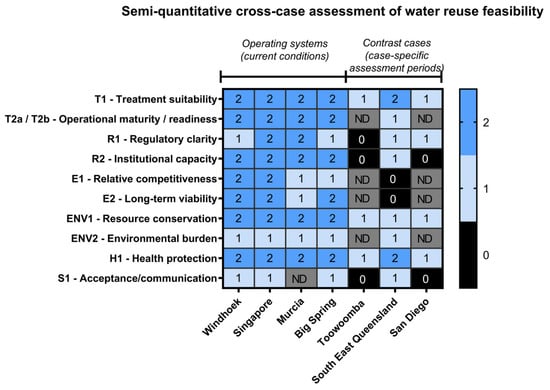
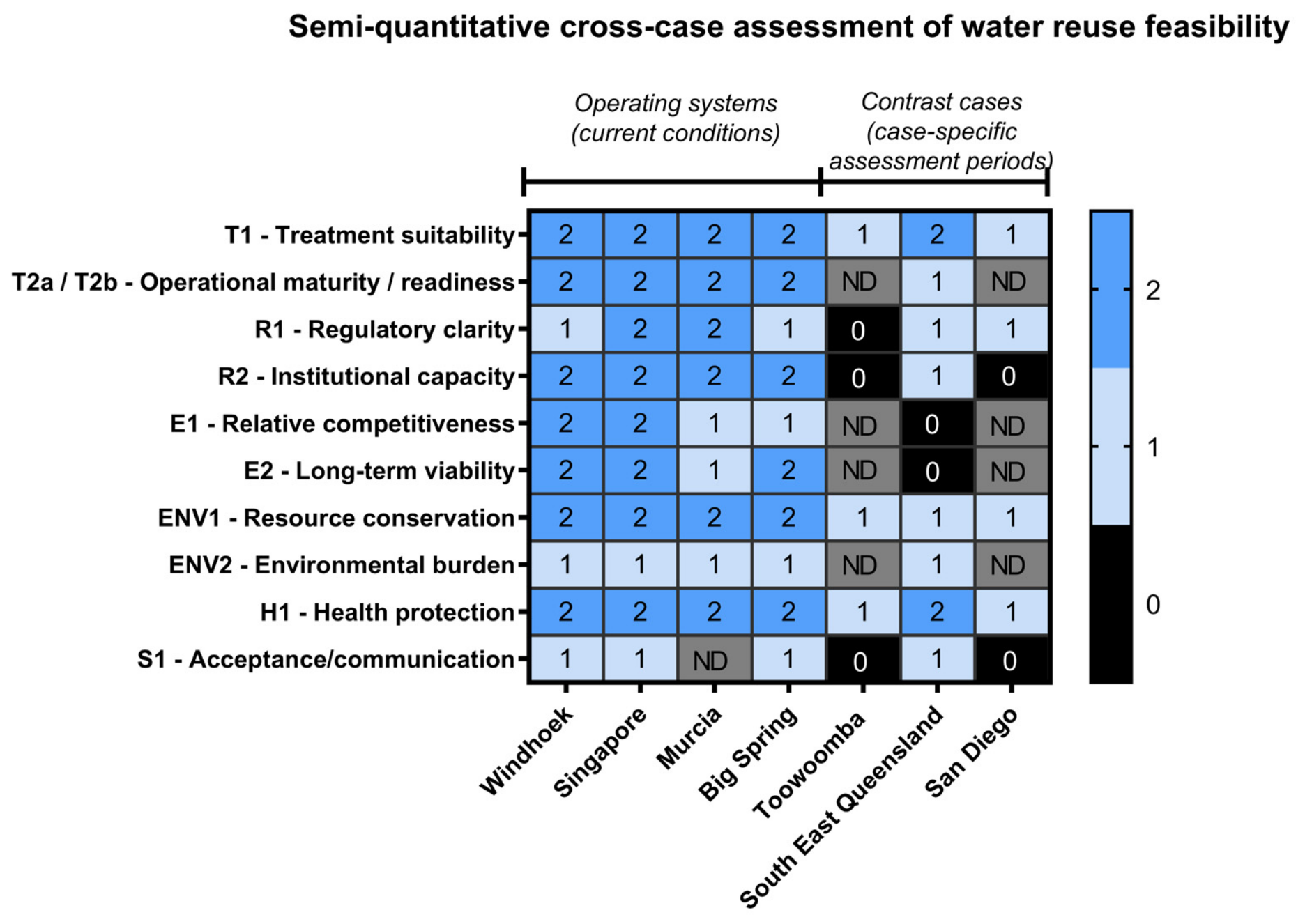
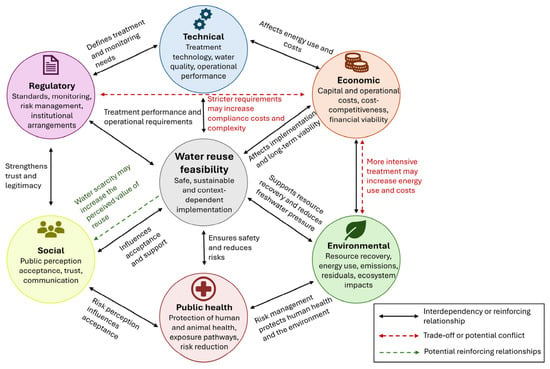
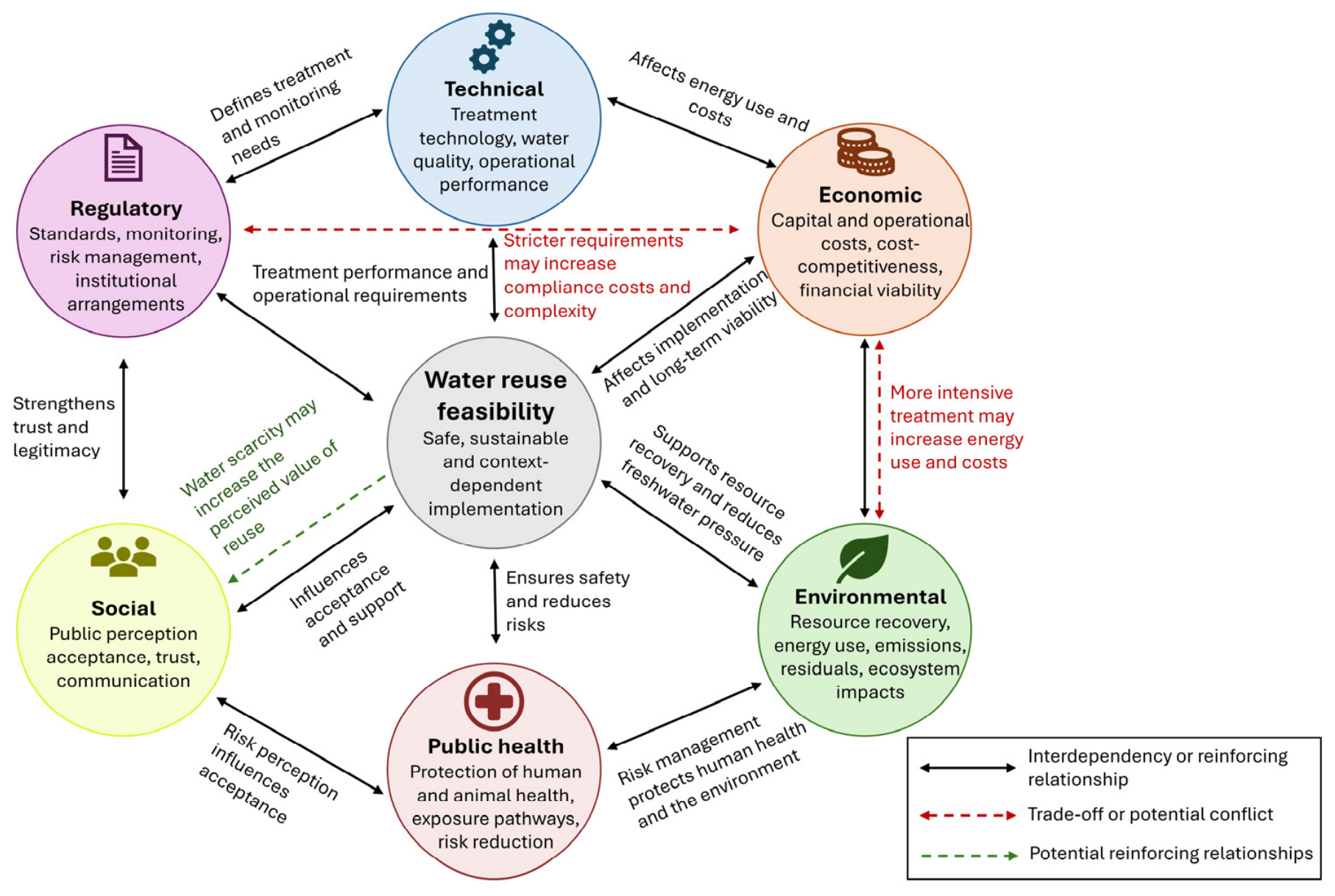
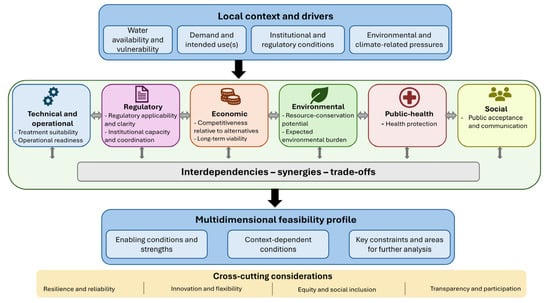
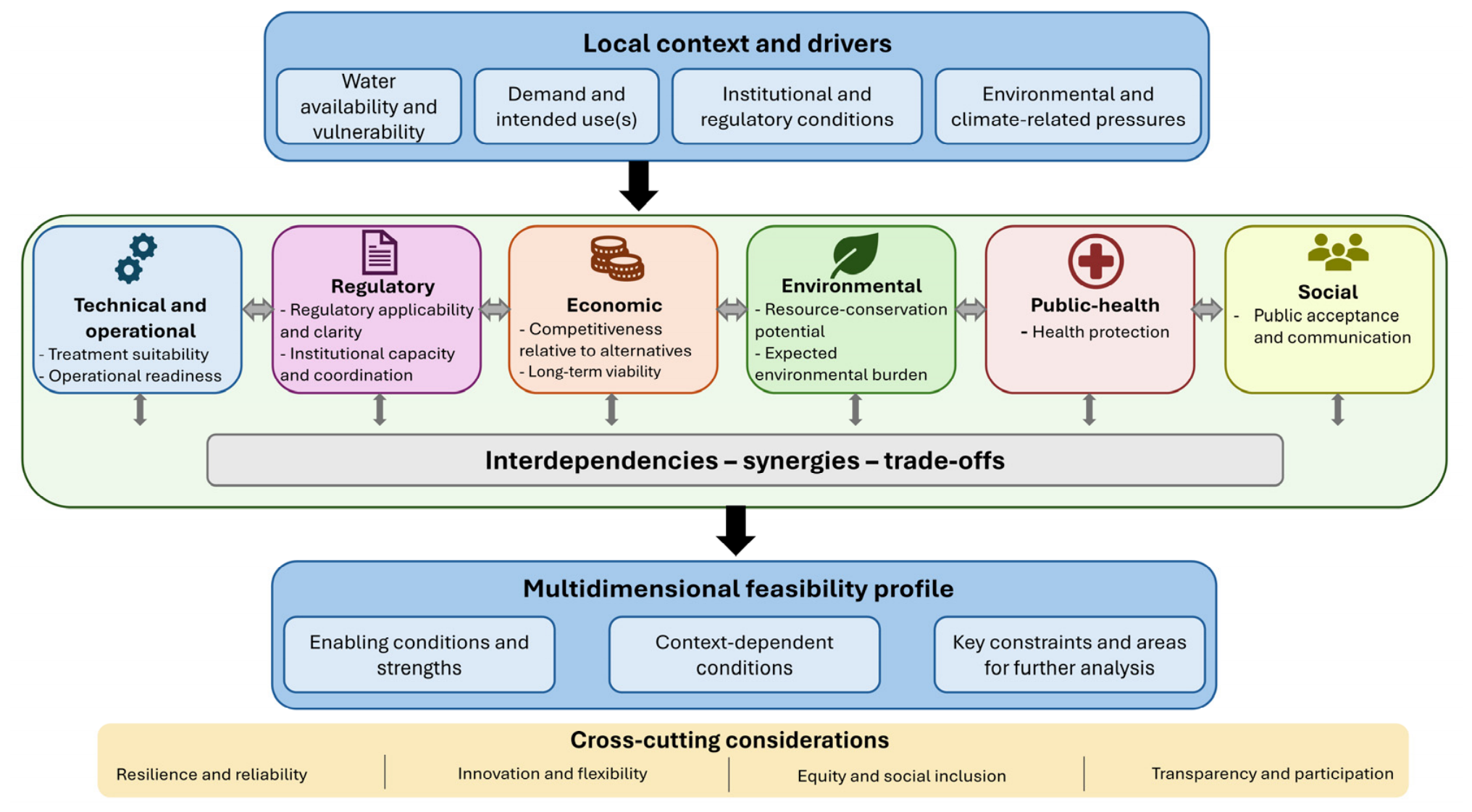

Disclaimer/Publisher’s Note: The statements, opinions and data contained in all publications are solely those of the individual author(s) and contributor(s) and not of MDPI and/or the editor(s). MDPI and/or the editor(s) disclaim responsibility for any injury to people or property resulting from any ideas, methods, instructions or products referred to in the content. |
© 2026 by the authors. Licensee MDPI, Basel, Switzerland. This article is an open access article distributed under the terms and conditions of the Creative Commons Attribution (CC BY) license.