


Abstract
Electrolytic manganese residue (EMR) is a major industrial byproduct, but its potential as a secondary resource lacks a quantitative assessment. This study provides a retrospective analysis of 239 articles published between 2009 and 2023, a period that covers the transition of EMR from a waste disposal challenge to a resource recovery priority. Technical data shows that EMR composition varies by site, with high concentrations of silicon, manganese, and ammonia nitrogen. China is the primary contributor to this field, reflecting its 90% share of global manganese production, with Chongqing University as the most active institution. Keyword analysis identifies “heavy metals,” “ammonia nitrogen,” and “extraction electric field” as the main research areas. Approximately 41% of the literature is concentrated in 11 journals, notably Construction and Building Materials, suggesting a trend toward using EMR in civil engineering. While stabilization methods have improved, high operational costs for removing ammonia nitrogen and heavy metals limit large-scale recovery. Future research will likely focus on cost-effective strategies to reduce these pollutants to facilitate industrial reuse. Furthermore, bibliometric trends indicate scholarly interest but do not confirm the industrial readiness or economic feasibility of specific technologies.
1. Introduction
Manganese (Mn) metal plays a pivotal role as a deoxidizing and desulfurizing agent in iron (Fe) and steel production, where it forms Fe-Mn alloys that are widely used across industries [1]. The sustained demand for Mn ore reflects its strategic importance in supporting economic growth and securing critical mineral resources. Beyond metallurgy, Mn ore also underpins the development of emerging sectors such as energy storage, catalysis, and advanced materials, thereby reinforcing its national economic significance [2]. This dual role, supporting both traditional industries and new technologies, has intensified global interest in its extraction, processing, and byproducts.
Electrolytic manganese residue (EMR), the principal byproduct of electrolytic manganese production, is generated during the acid leaching of Mn ore with sulfuric acid (H2SO4). EMR is a fine-grained, slimy, black acidic solid with a complex chemical composition that includes ammonium (NH4+-N), Mn, magnesium (Mg), soluble sulfate, silicon dioxide (SiO2), selenium dioxide (SeO2), and multiple other heavy metals [3,4,5,6,7]. Managing this waste is challenging as disposal currently relies heavily on dry open-air storage in tailings ponds, reflecting the low rate of resource utilization [8]. Such practices not only consume substantial land resources but also introduce ecological risks, as heavy metals such as lead (Pb), chromium (Cr), nickel (Ni), copper (Cu), and Mn leach into soils and water bodies, posing significant threats to ecosystems and aquatic organisms [9]. Given the increasing production of electrolytic Mn metal, the safe and sustainable handling of EMR has become a pressing environmental issue with global relevance.
In response, numerous studies have explored EMR management strategies, including recovery of valuable metals, development of environmentally benign treatment technologies, and ecological restoration of residue sites. These approaches highlight the potential for transforming EMR from a hazardous waste into a usable secondary resource. However, despite this growing body of research, systematic assessments of progress and research frontiers remain scarce. A clearer understanding of the intellectual landscape is essential to connect fragmented findings, identify technological gaps, and guide resource-efficient solutions.
Bibliometric analysis offers a powerful interdisciplinary approach to address this need, employing statistical and mathematical methods to map scientific outputs and their interrelationships [10,11,12]. Unlike traditional reviews, bibliometric studies can capture the scale, structure, and dynamics of a field, providing a macro-level perspective on how knowledge evolves over time. To fill the gaps and address the limitations of earlier reviews, this study used CiteSpace to conduct both qualitative and quantitative analyses of the EMR-related literature from 2009 to 2023 (the 2009–2023 period as a defined “snapshot of foundational growth”), including key topics, emerging trends, and research frontiers in EMR. The primary objectives were to: (1) examine the temporal publication patterns of EMR research, (2) evaluate collaboration among authors, institutions, countries, and literature co-citations, and (3) identify major research hotspots while forecasting future directions in the field.
The ultimate aim of this study is to identify technical gaps in EMR management by synthesizing data on its chemical composition, leaching behavior, and recovery pathways. A retrospective analysis of 239 articles shows how research has shifted from simple stabilization to high-value mineral recovery. These findings provide a data-driven framework for prioritizing cost-effective remediation strategies. However, bibliometric analysis is limited to reported data and cannot evaluate the actual process efficiency or economic feasibility of the identified technologies. This study serves as a guide for future research by highlighting where technical progress is most needed to achieve industrial-scale EMR utilization.
It is important to distinguish between bibliometric trends and industrial readiness. While this study identifies ‘hotspots’ based on publication frequency and citation bursts, these metrics indicate the direction of scholarly attention rather than the economic feasibility or technological efficiency of specific EMR treatments. For example, a high concentration of research on geopolymer synthesis shows strong academic interest, but it does not confirm that these materials meet current industrial cost–performance standards. Therefore, the conclusions of this study should be interpreted as a map of the intellectual landscape and a guide for future research priorities, rather than a final assessment of industrial maturity.
2. Materials and Methods
2.1. Data Collection and Search Strategy
The data for this study were retrieved from the Web of Science Core Collection (WoS CC) on 15 December 2023, using the Science Citation Index Expanded (SCI-EXPANDED) database to ensure high-quality, peer-reviewed data. The search query was: TS = (“Electrolytic Manganese Residue” OR “Electrolytic Manganese Slag”). The search was restricted to the years 2009–2023 and to documents published in English. We chose the 2009–2023 period as a defined “snapshot of foundational growth” because the period from 2009 to 2023 covers the most important era where EMR research moved from basic waste disposal to complex resource recovery. This 15-year window captures the foundational transition of EMR from a hazardous waste to a secondary resource [13].
To ensure the relevance of the dataset, we applied the following inclusion and exclusion criteria:
- Inclusion: (a) Original research articles and review papers; (b) studies where EMR is the primary subject of investigation; (c) studies focusing on EMR remediation, stabilization, or resource recovery.
- Exclusion: (a) Meeting abstracts, news items, and editorial materials; (b) studies on general manganese ore mining that do not discuss residue management; (c) duplicate records.
The initial search query yielded 254 records. During manual screening, 15 records were removed. These included 9 conference proceedings papers that the database had misclassified as articles and 6 ‘Early Access’ entries that were duplicates of already indexed papers. This process resulted in a final dataset of 239 unique peer-reviewed articles. To ensure the accuracy of the co-occurrence analysis, we used a thesaurus file to merge synonymous keywords. For example, (1) ‘EMR’ was merged with ‘electrolytic manganese residue,’ and ‘NH4+-N’ was merged with ‘ammonia nitrogen.’, and (2) unifying singular and plural forms (e.g., “heavy metal” and “heavy metals”). This process prevents the artificial inflation of node counts and ensures that the clusters accurately reflect thematic hotspots [11]. A complete list of the 32 merged keyword pairs is provided in Supplementary Table S1.
2.2. Methods of Data Analysis
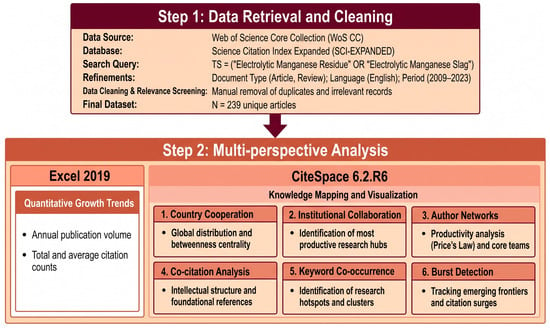
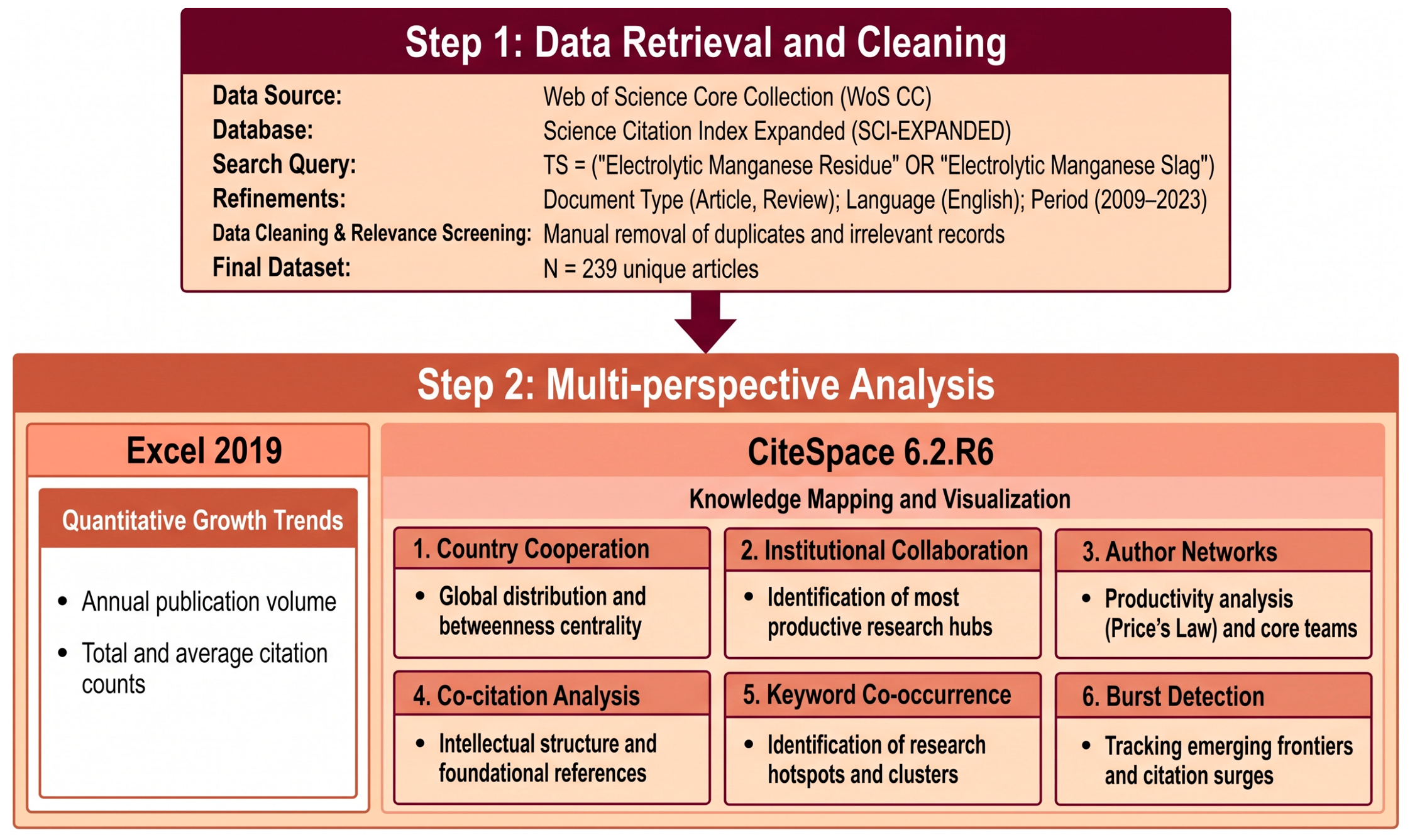
The research workflow consisted of three stages. First, we used Excel 2019 to calculate annual publication and citation counts from 2009 to 2023. This step shows the growth trajectory of EMR research and the level of scholarly attention over 15 years (Figure 1). Second, we used CiteSpace (versions 6.1.R3 and 6.2.R6) to map co-authorship networks, co-citation clusters, and keyword evolution. CiteSpace is used to identify intellectual structures and trends in the scientific literature [14]. We used betweenness centrality to identify nodes that act as knowledge bridges within the network. This metric identifies publications or institutions that connect different research clusters, indicating their structural importance in the flow of information. It is a measure of network position and does not directly indicate the scientific quality, technological effectiveness, or industrial success of the identified nodes.
Figure 1.
Research framework for the bibliometric analysis of electrolytic manganese residue (EMR), illustrating the stages of data retrieval, cleaning, and multidimensional mapping.
The final stage involved network construction and refinement. We used keyword co-occurrence, cluster analysis, and burst detection to identify research themes and shifting frontiers. To reduce data fragmentation, we merged similar keywords and synonyms manually. We analyzed nodes by type, including author, institution, country, keyword, and reference. To manage network complexity, we pruned the merged networks using the “Pathfinder” and “Pruning the merged network” options. These methods retain the most influential nodes and links, which makes the resulting maps easier to interpret.
We maintained default parameters for other settings to ensure our results are comparable with other bibliometric studies. This framework identifies key contributors and research hotspots over a 15-year period. However, these bibliometric indicators show the frequency of scientific discussion and do not measure the actual process efficiency or economic feasibility of EMR treatment methods. The results indicate which topics are gaining academic interest, but they do not confirm the industrial readiness or technologies.
To provide technical context, we synthesized 20 publications selected from the bibliometric dataset based on citation frequency and their focus on EMR physicochemical properties and resource recovery. The complete list of publications is provided in Supplementary Table S2. This synthesis provides a representative overview of technical findings rather than a systematic analysis of the entire dataset.
3. Results and Discussion
3.1. Composition of Electrolytic Manganese Residue Research
3.1.1. Physicochemical Characteristics of Electrolytic Manganese Residue in the Surveyed Literature
The chemical composition of EMR is inconsistent across the analyzed studies, which affects its potential as a secondary resource. Most studies identify silicon dioxide (SiO2), calcium oxide (CaO) and iron oxide (Fe2O3) as the main mineral components, but their concentrations vary [8]. For example, SiO2 content ranges from 15% to 35% depending on the gangue minerals in the original ore. Manganese content usually stays between 1% and 5%, existing mainly as Manganese(II) sulfate (MnSO4) or manganese(II) carbonate (MnCO3) [15,16]. Recent studies on magnesium phosphate cement indicate that EMR can contain up to 25.4% SiO2 and 8.2% aluminium oxide (Al2O3), which influences the hydration products when used as an additive [17].
Pollutant concentrations also show high variability. Ammonium nitrogen (NH4+-N) levels in the surveyed papers range from 1500 mg/kg to over 5000 mg/kg [18,19,20]. This high concentration is a result of the ammonia neutralization step used during manganese electrolysis. Heavy metal content, including Pb, Cd and Cr, also differs by site. In several studies, Pb concentrations exceeded 500 mg/kg, which is high enough to limit the direct use of EMR in agricultural applications. These variations indicate that EMR treatment must be tailored to the specific chemical profile of the residue at each production site. However, many bibliometric records do not provide full elemental assays, which makes it difficult to correlate specific recovery outcomes with residue composition (Table 1).
Table 1.
Chemical composition and major pollutants of electrolytic manganese residue: representative data from high-impact studies identified in the co-citation analysis.
3.1.2. Leaching Procedures for Resource Recovery and Remediation
Leaching is the most common procedure for recovering Mn and removing NH4+-N from EMR. The bibliometric data shows that research focuses on three main methods: chemical acid leaching, bio-leaching, and field-enhanced leaching. Chemical leaching typically uses (H2SO4 because it is low-cost and has high solubility for manganese salts. However, this method often results in the non-selective dissolution of heavy metals, which increases the complexity of downstream purification. Bio-leaching is an emerging alternative that uses microorganisms to mobilize metals. For example, using Penicillium oxalicum resulted in a manganese recovery rate of 85.2%, though the process is slower than chemical leaching [23]. Field-enhanced leaching is a significant research hotspot identified in our keyword analysis. This procedure uses an external electric field to increase the migration rate of ions. Evidence shows that electric-field-enhanced leaching reduces the required leaching time by approximately 40% compared to traditional mechanical stirring [24]. Researchers have introduced organic acid leaching systems, such as citric acid, which can selectively recover manganese while keeping heavy metal impurities in the solid phase. While these advanced procedures show high efficiency in laboratory settings, their industrial application is limited by high energy consumption and the need for specialized equipment [25].
3.1.3. Technical Pathways for Electrolytic Manganese Residue Valorization
The literature identifies two main technical pathways for EMR valorization: the mineral recovery route and the construction material route. The mineral recovery route focuses on extracting high-value components. This process begins with leaching, followed by the removal of impurities like Fe and Mg. The purified leachate then undergoes fractional precipitation. For example, adding ammonium carbonate (NH4)2CO3 precipitates Mn as MnCO3, while adding phosphate salts allows for the recovery of NH4+-N as struvite (MgNH4PO4⋅ 6H2O) [20,26]. This route is efficient for producing industrial-grade chemicals but generates secondary wastewater that requires further treatment.
The construction material route is the primary method for large-scale EMR consumption. This pathway involves a stabilization step where EMR is mixed with alkaline additives, such as lime or calcium carbide (CaC2) residue, to fix heavy metals and neutralize acidity. The stabilized residue is then mixed with binders like fly ash or Portland cement to produce permeable bricks, road-base materials, or geopolymers [21,27]. Evidence shows that the high SiO2 and Al2O3 content in EMR contributes to the formation of hydrate products that increase the compressive strength of these materials [28]. However, the long-term leaching stability of ammonia nitrogen remains a challenge for this route. Below are the two typical flow paths, showing the transition from raw residue to final products.
Path A: EMR → Leaching → Purification → Precipitation → MnCO3/Struvite
Path B: EMR → Stabilization → Mixing with Binders → Curing → Bricks/Road-base
3.1.4. Secondary Effluents and Solid Waste from Electrolytic Manganese Residue Processing
The transition of EMR into a secondary resource generates its own environmental costs, primarily in the form of secondary effluents and leached residues. In the mineral recovery route, the precipitation of Mn and NH4+-N leaves a “mother liquor.” This effluent has sulfate concentrations typically ranging from 25,000 to 45,000 mg/L [19,20,26]. High sulfate levels cause equipment corrosion and increase the difficulty of water recycling. Recent data shows that removing these sulfates through ettringite precipitation is effective but requires large amounts of aluminum-based reagents, which adds to the operational cost [29].
The chemical leaching process also produces a leached filter cake as a secondary solid waste. Although this residue has a lower Mn content, it still contains residual heavy metals that were not mobilized during the leaching stage. If this filter cake is not stabilized, it remains a hazardous waste that requires landfilling [21]. In the construction material route, the primary effluent risk is alkaline runoff from storage sites, which can reach a pH of 11 or higher. These secondary impacts indicate that EMR valorization has environmental trade-offs that are not always fully addressed in the analyzed literature. The lack of research on the long-term stability of these secondary wastes represents a significant gap in the current research landscape.
3.1.5. Critical Metals and Recovery Potential
Manganese is the most important metal recovered from EMR. It is a critical raw material for the production of Fe-Mn alloys and is increasingly used in lithium-ion battery cathodes, such as lithium manganese oxide (LiMn2O4). In the surveyed literature, Mn concentrations in EMR range from 1% to 5% [8]. While this is lower than the concentration in primary Mn ores, the large volume of accumulated residue makes it a significant secondary source. Magnesium is another metal with recovery potential, often found in EMR at concentrations between 1.5% and 3.0% [21]. Magnesium is typically recovered as a byproduct during the purification of Mn leachate. Iron is also present, with concentrations ranging from 2% to 6%, but its recovery is difficult because it exists in complex mineral phases that are hard to dissolve selectively. Trace amounts of Zn and Cu are reported in some studies, but their levels are usually below 0.1%, which is too low for profitable extraction using current chemical leaching methods [19,20,26]. The recovery of these metals depends on the market price of primary resources and the development of more selective leaching agents. Currently, Mn recovery remains the only metal extraction process from EMR that shows potential for industrial-scale application.
3.1.6. Global Distribution of EMR Generation
The generation of EMR is directly proportional to the production of electrolytic manganese metal (EMM). For every ton of EMM produced, approximately 10 to 12 tons of EMR are generated [13]. China is the dominant producer, accounting for more than 90% of global EMM capacity. This results in an annual generation of approximately 10 to 12 million tons of EMR within China. Most of this waste is concentrated in the “Manganese Triangle” region, which includes parts of the Hunan, Guizhou, and Chongqing provinces.
In contrast, other major Mn-producing nations, such as South Africa, Australia, and Gabon, primarily export Mn ore rather than processing it into EMM. Consequently, their EMR generation is significantly lower. For example, while South Africa holds the largest global Mn reserves (accounting for roughly 70% to 80% of known world resources), its EMM production remains a small fraction of China’s output. Precise annual EMR tonnage for these regions is difficult to verify because industrial reports often group EMR with general mining tailings. This geographical imbalance explains why 95% of the literature in our bibliometric dataset originates from Chinese institutions. The lack of reported data from other regions indicates that EMR is currently managed as a localized industrial challenge rather than an international research priority.
3.2. Number of Published Articles and National Cooperative Relations
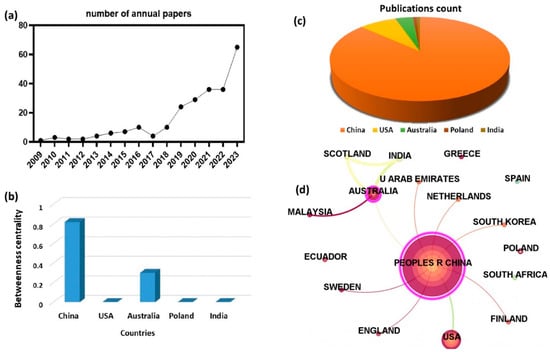
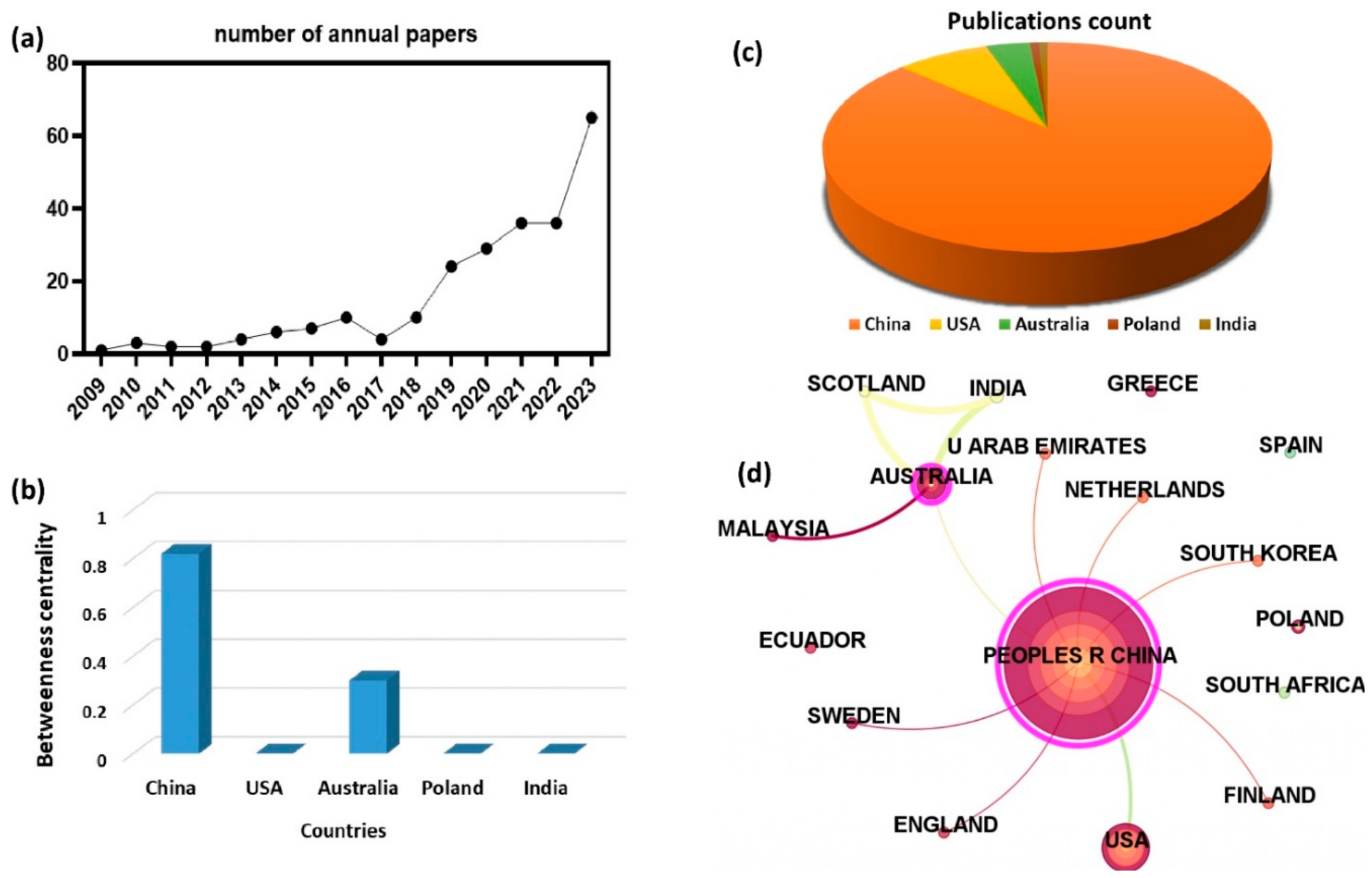
The number of publications is widely recognized as an indicator of research activity within a field. As shown in Figure 2a, EMR research has progressed through three distinct stages. The initial stage (2009–2017) was characterized by very limited output and minimal growth. The slow growth stage (2017–2022) witnessed a steady increase in publications, reflecting growing awareness of EMR-related environmental issues and potential resource utilization. Finally, the rapid growth stage (2022–2023) marked a sharp rise in publication volume, underscoring the increasing strategic importance of EMR research and its potential for future expansion. The participation of scholars from diverse disciplinary backgrounds further highlights the multidisciplinary nature of this field.
Figure 2.
(a) Trends of annual number of publications indexed in the Science Citation Index Expanded in Web of Science (WOS) databases about the research on electrolytic manganese residue from 2009–2023. (b,c) Top five nations in terms of documents produced on electrolytic manganese residue. (d) Common line map of national level collaboration among different countries about documents produced on electrolytic manganese residue. The nodes represent the countries. Critical nodes are highlighted with a purple ring. The line between countries indicates a collaborative relationship. The thicker the line, the more frequently they collaborate.
The pioneering study by Tao et al. [30] represents the inception of systematic EMR research. Their work investigated EMR composition and proposed a recycling method in which residue was washed, manganese ammonia was extracted through pressure filtration, and Mn2+ was converted into manganese carbonate via controlled neutralization and precipitation. This provided the basis for subsequent resource utilization research.
Over the past 15 years, EMR research has demonstrated a fluctuating yet generally upward trajectory, reflecting intensified interest in its hazard reduction and resource valorization. However, regional and process-specific differences in manganese ores and electrolytic processes have led to considerable heterogeneity in EMR composition across production sites. Such variation complicates the design of universal treatment strategies, emphasizing the need for site-specific approaches that maximize efficiency while minimizing environmental risks.
A centrality value above 0.1 indicates that a node has high structural importance, connecting different research clusters. This metric describes the position of a publication or institution within the scientific conversation; it does not measure the technical effectiveness, scientific quality, or industrial success of the research [31]. China, the United States, and Australia emerged as leading contributors, with China accounting for 229 articles, reflecting high productivity (Figure 2b). Furthermore, China occupies a central position in the international collaboration network, as shown by its high betweenness centrality value of 0.88 (Figure 2c). This indicates that Chinese research serves as a main link between different geographical clusters in the EMR field. While publication count measures productivity, this centrality value shows the structural influence of Chinese institutions in the global scientific exchange. Several countries phased out electrolytic Mn production due to environmental restrictions [32], yet China remains the dominant producer and exporter, resulting in vast residue accumulation with diverse physicochemical characteristics [13]. The widespread use of high-grade MnO2 ore in some enterprises also alters residue output and impurity composition. These factors illustrate the complexity of EMR treatment and explain why China has taken the lead in international research efforts.
The collaboration density value of 0.0956 (Figure 2d) suggests that while cooperation between countries is relatively cohesive, stronger integration is still required. Beyond the top five publishing countries (Figure 2c), several others also contribute significantly but with lower centrality, indicating potential to expand international collaboration. Such cooperation could accelerate knowledge transfer and harmonization of treatment strategies worldwide [31].
3.3. Institutional Partnership
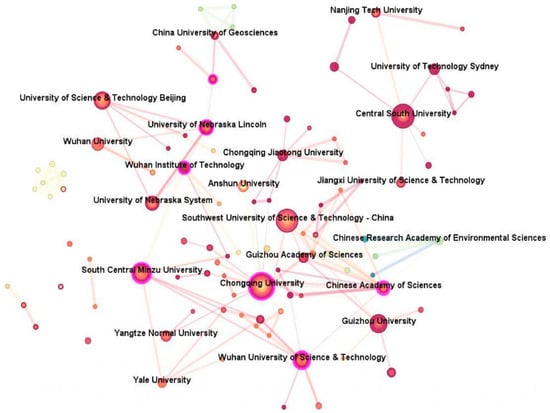
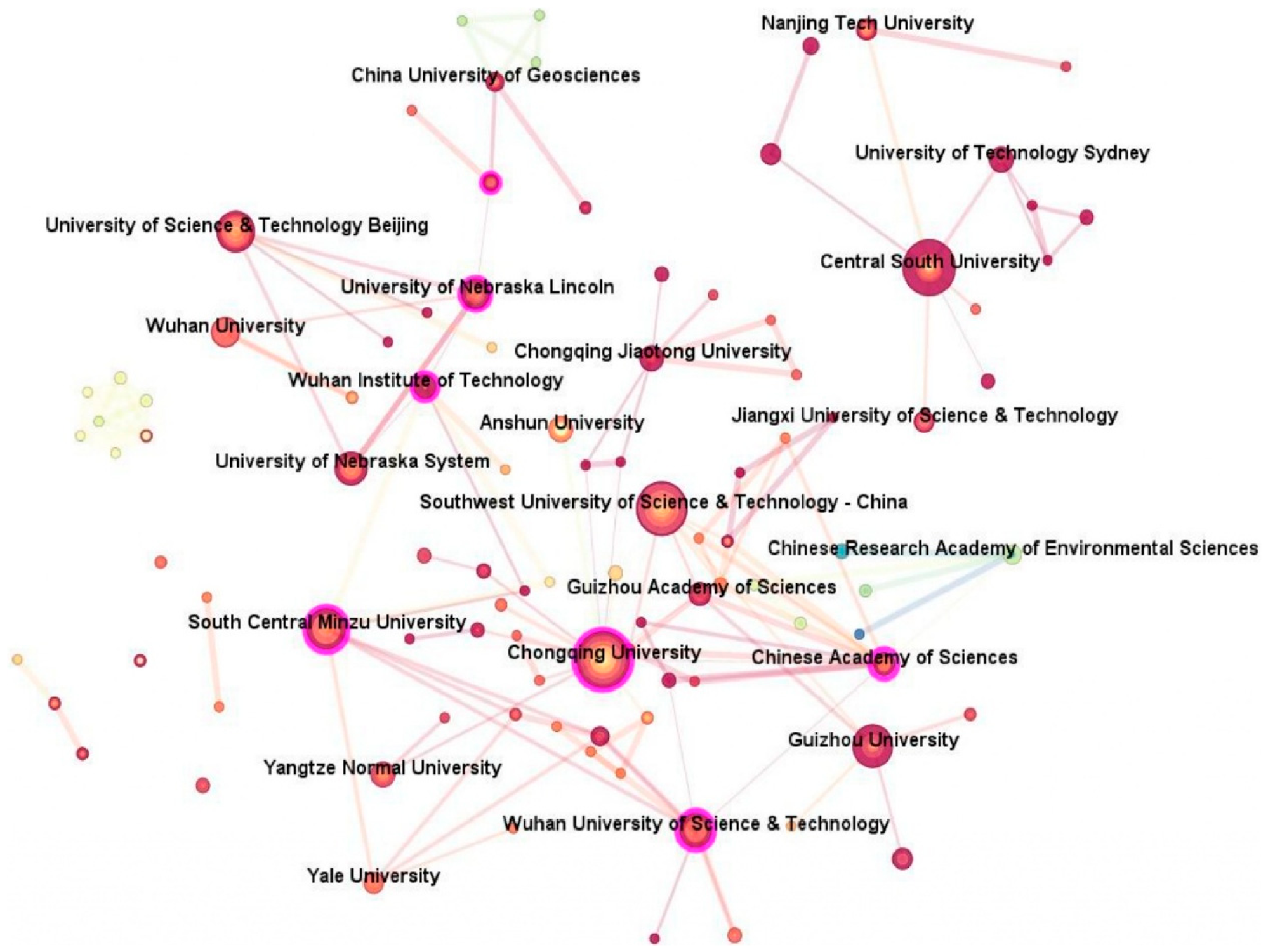
Research institutions serve as the backbone of scientific progress, shaping disciplinary directions and fostering talent. Institutional-level analysis highlights Chongqing University as the most productive contributor, underscoring its central role in EMR studies (Table S3, Figure 3). High-centrality institutions are concentrated in China, particularly within the Mn Triangle [33], where EMR issues are of direct economic and environmental relevance. Local authorities in this region have prioritized EMR management and incentivized universities and research institutes to pursue technological innovations that enable safe disposal and sustainable utilization [34].
Figure 3.
The institutional cooperation network for electrolytic manganese residue research. Nodes represent research institutions, and the size of each node indicates the number of publications. Lines between nodes show collaborative relationships.
Despite strong national productivity, the collaboration map exhibits a sparse structure with a low graph density of 0.0209, reflecting limited interconnectivity between institutions. This fragmentation suggests that large-scale cooperative frameworks are not yet established. Strengthening inter-institutional networks, both within and outside China, will be essential to consolidate research efforts and accelerate breakthroughs in EMR valorization.
3.4. Author Collaboration and Journal Publication Frequency
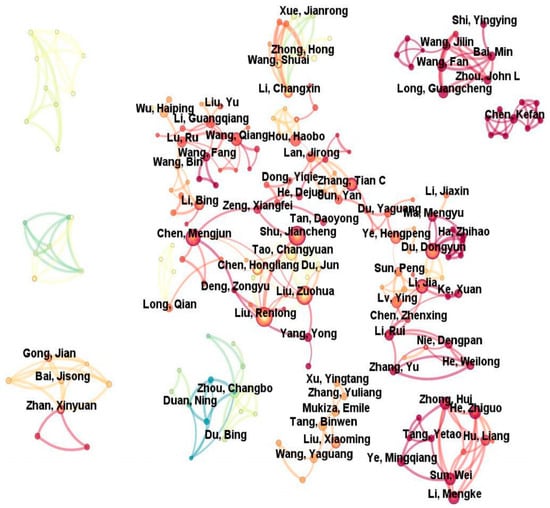
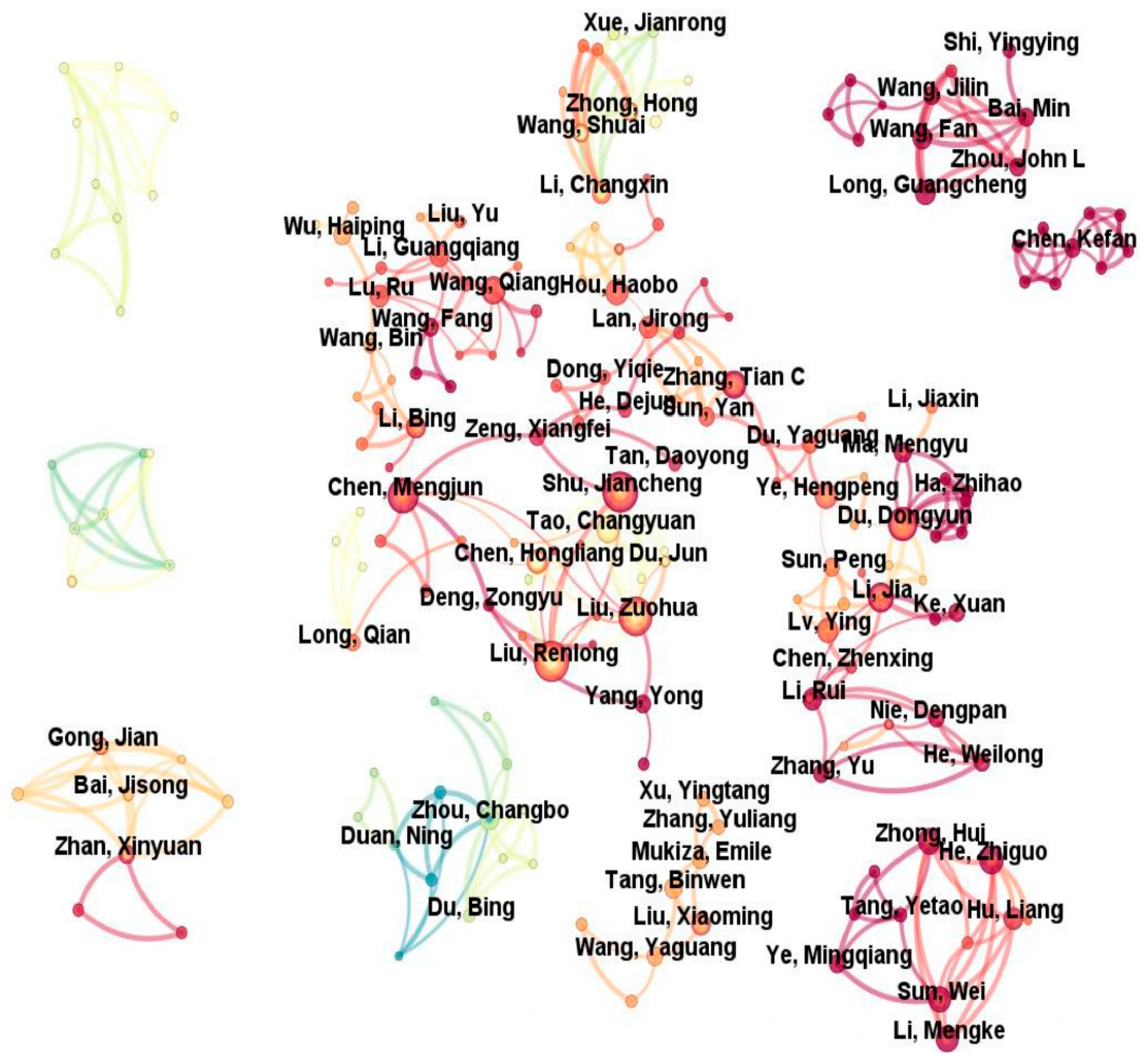
Given that electrolytic manganese production is concentrated in China, authorship analysis confirms a predominance of Chinese scholars in the field (Table S4, Figure 4). While publication volumes are high, collaboration networks remain clustered within small research teams, with relatively limited external partnerships. Within these teams, core authors such as Shu et al. [18] emerge as particularly influential, but cross-team communication appears limited. To achieve comprehensive progress, scholars should broaden collaborative engagement, encourage cross-team integration, and foster interdisciplinary dialogue.
Figure 4.
The collaboration network among authors, focusing on documents concerning electrolytic manganese residue. Each node represents an author, with node size corresponding to the number of articles they have published. The thickness of links between nodes signifies the strength of academic cooperation among authors, with thicker lines indicating closer collaboration.
Journal analysis revealed that EMR studies are published across multiple disciplines, including materials science, environmental engineering, and chemical technology. Between 2009 and 2023, the top 11 journals accounted for 98 articles (41% of total). Leading outlets include Construction and Building Materials, Journal of Cleaner Production, Journal of Hazardous Materials, Environmental Science and Pollution Research, and Separation and Purification Technology (Table 2). Among these, Journal of Cleaner Production focuses on green technology and sustainability [34], while Journal of Hazardous Materials emphasizes toxic substance mitigation [23]. This spread highlights the interdisciplinary nature of EMR research and its practical relevance across environmental remediation, resource recovery, and materials development (Table 2).
Table 2.
Top 11 journals in terms of documents published on electrolytic manganese residue.
One highly cited example is Li et al. [35], who introduced a mechanical grinding and roasting method to activate silicon in EMR, improving heavy metal fixation via enhanced silicate absorption. This demonstrates that the high-impact literature often focuses on transforming hazardous components into stable or reusable forms, a key driver of environmental risk reduction.
3.5. Literature Co-Citation Analysis
Literature co-citation analysis identifies seminal studies that shape a research field [36]. The top 10 most frequently co-cited works were published between 2018 and 2020, underscoring the recency of influential contributions (Table 3). The most cited work, Shu et al. [18], investigated fractional removal of Mn and NH4+-N from EMR leachate using carbonate and struvite precipitation, offering an effective treatment pathway. Tian et al. [24] further advanced recovery approaches through electric-field-enhanced leaching, followed by carbonate and struvite precipitation, published in Journal of Cleaner Production. Li et al. [35] demonstrated mechanical activation of silicon in EMR through grinding and roasting, which significantly improved the fixation of heavy metals. Collectively, these studies emphasize a dual research focus: reducing pollutant leaching and developing innovative pathways for residue utilization.
Table 3.
Top ten most frequently cited documents published on electrolytic manganese residue.
3.6. Keyword Analysis and Clustering
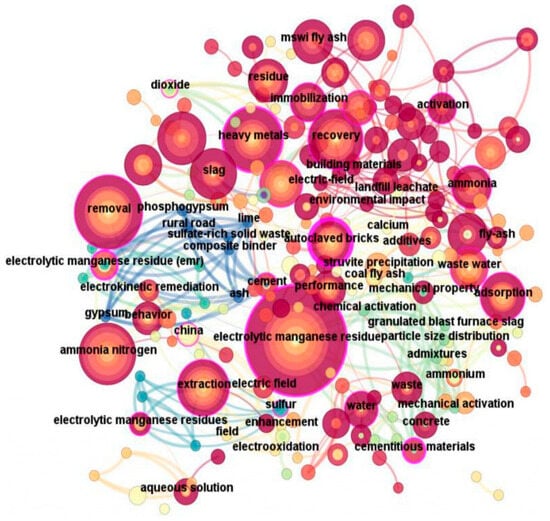
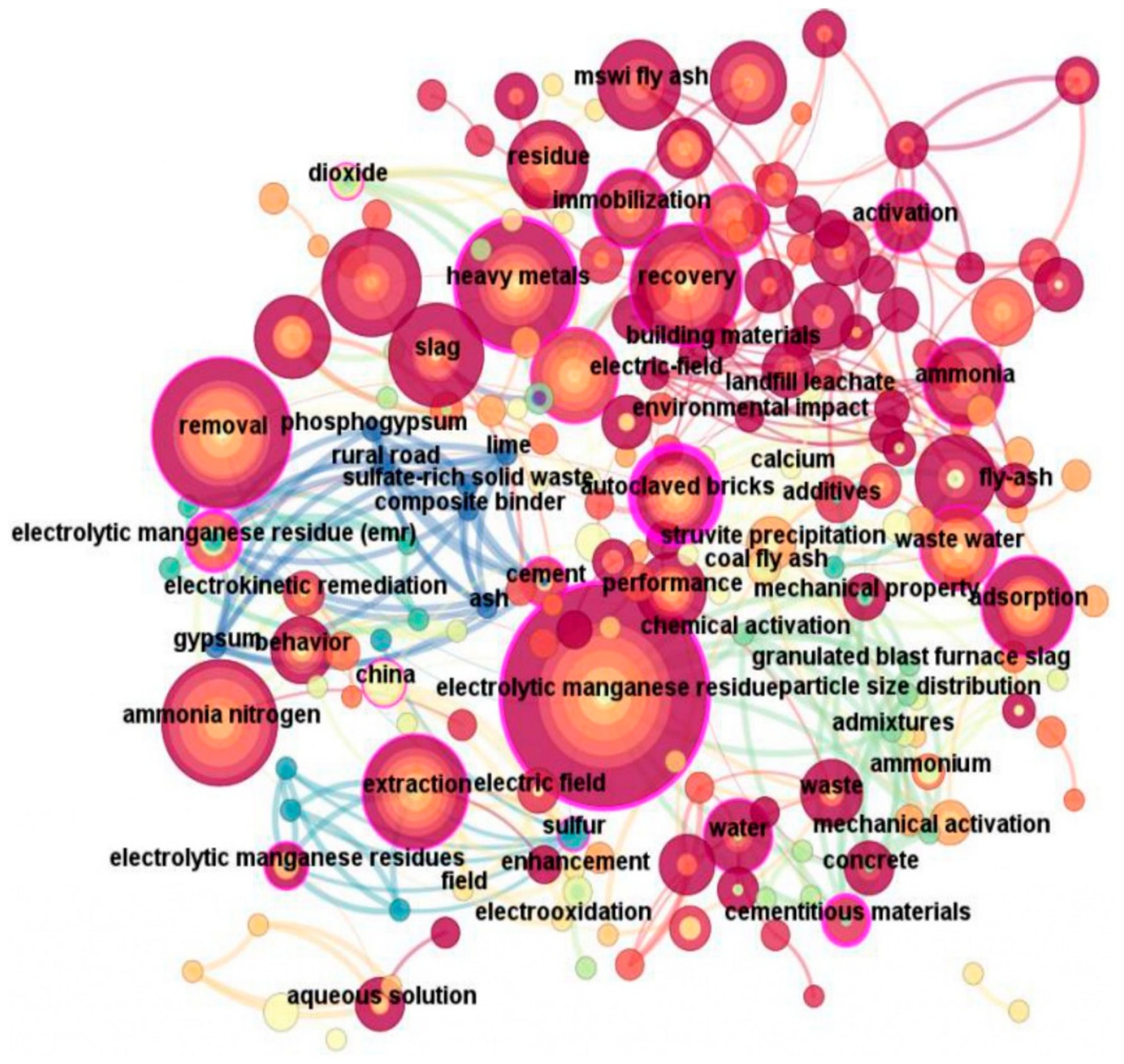
Keyword frequency and co-occurrence reflect thematic priorities in EMR research. From 2009 to 2023, analysis revealed 314 nodes and 719 interconnections (Figure 5), with dominant keywords including “heavy metals,” “recovery,” “removal,” “adsorption,” and “solidification/stabilization” (Table 4). The prevalence of terms such as “oxidation” and “kinetics” highlights mechanistic studies of pollutant stabilization. Currently, EMR research emphasizes stabilizing toxic pollutants to minimize environmental risks. Common approaches include adjusting pH, applying pressure and temperature, or introducing binders and inert materials to immobilize heavy metal ions [21]. Owing to its composition, rich in Mn, Al, and Si, EMR also presents dual potential for both hazard mitigation and reuse, such as in agriculture, cement production, or brick manufacturing [32].
Figure 5.
A network depicting the co-occurrence of keywords. Each node symbolizes a keyword, with node size reflecting its frequency. A purple ring highlights nodes with significant betweenness centrality, indicating their importance. Lines connecting nodes represent co-occurrence relationships, with thicker lines indicating higher frequencies of co-occurrence.
Table 4.
Top ten most frequently used keywords about electrolytic manganese residue publications.
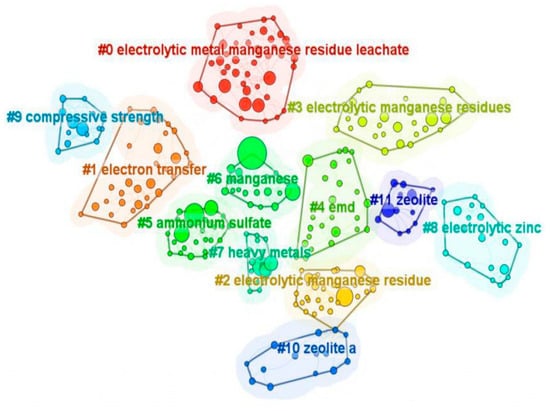
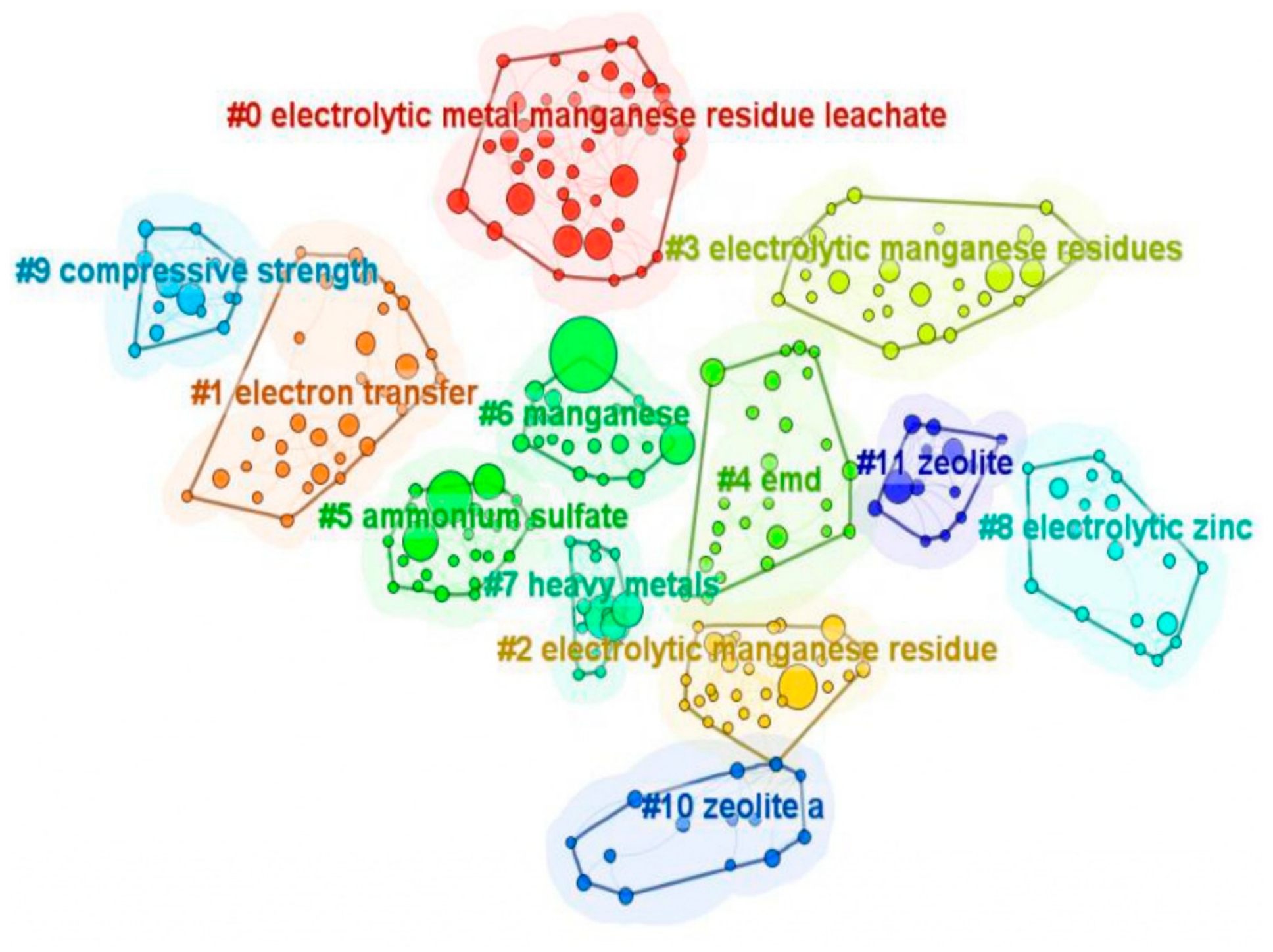
Clustering analysis further revealed seven major thematic clusters (Q = 0.8003, S = 0.9071; Figure 6), reflecting the breadth and depth of EMR research. The first cluster focuses on leachate management, emphasizing strategies to mitigate heavy metal pollution from residue leachate [41,42]. The second centers on electron transfer processes, where studies have investigated redox mechanisms and their enhancement through carbon-based materials [43,44]. A third cluster addresses ammonium sulfate recovery, highlighting methods to reduce soluble ammonium content in EMR [45,46]. The fourth cluster examines heavy metal stabilization, particularly the leaching behavior of hazardous elements under variable pH and temperature conditions [47,48].
Figure 6.
A cluster map of keywords, wherein keywords are grouped into clusters, each denoted by a unique color and label. The order of labels reflects cluster size, with lower numbers indicating larger clusters. The visualization prioritizes clarity by excluding small clusters through network pruning, enhancing overall illustration quality.
The fifth involves cross-residue utilization, exploring co-processing approaches with zinc or lead smelting residues to enhance immobilization and resource recovery [49]. The sixth cluster pertains to compressive strength, with research assessing the performance and feasibility of EMR-derived building materials [50], the seventh cluster investigates zeolite synthesis, leveraging EMR’s silicon- and aluminum-rich composition to produce functional zeolites with promising adsorption applications [51]. Collectively, these clusters illustrate a dual research orientation: on one hand, the mitigation of environmental risks through stabilization and leachate control, and on the other, the valorization of EMR as a resource for building materials, zeolites, and the recovery of valuable elements [52].
3.7. Keyword Highlights
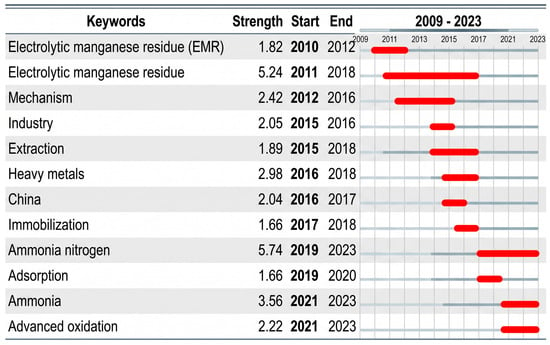
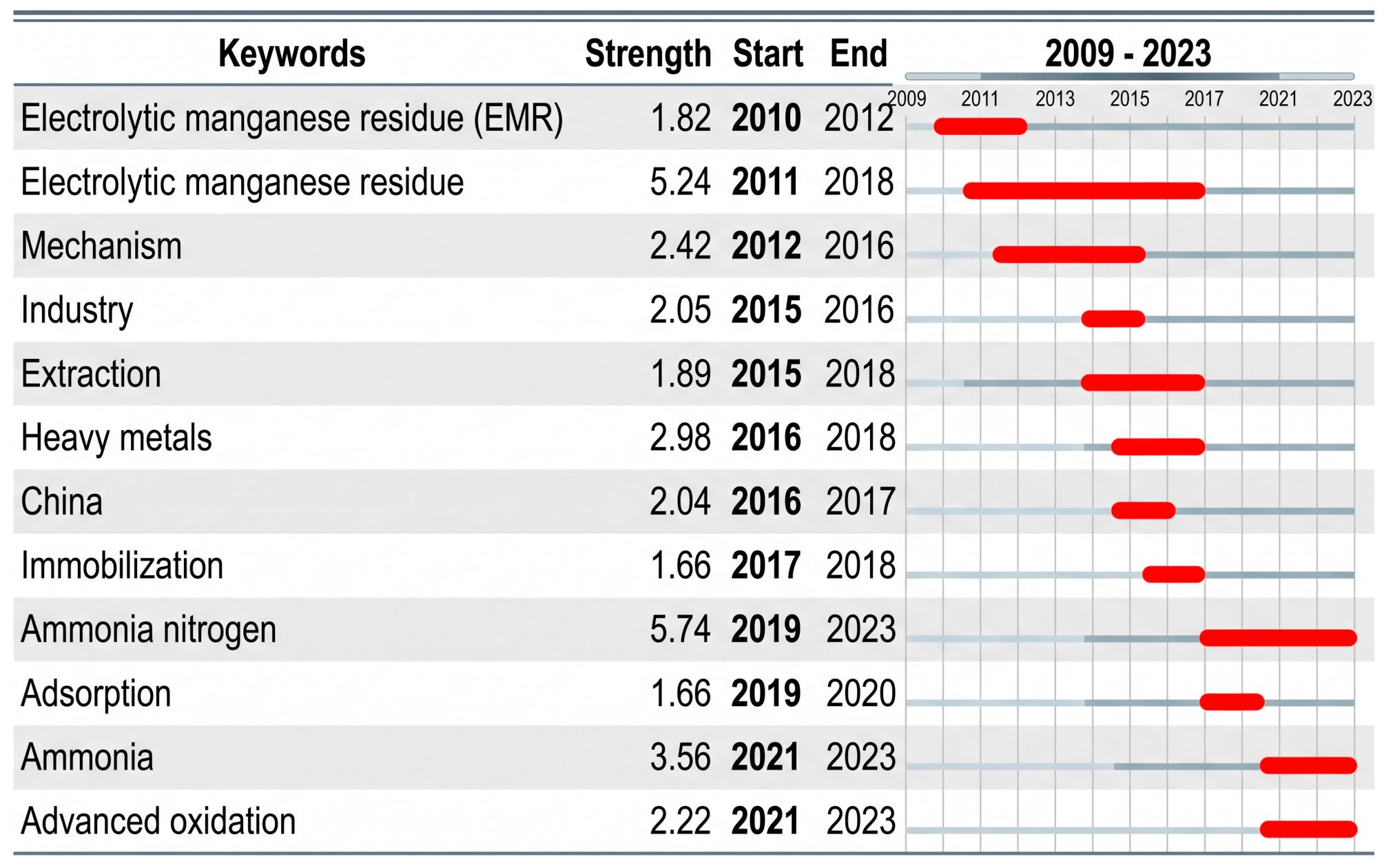
The keyword burst analysis and co-occurrence clusters indicate the trajectory of academic interest rather than guaranteed industrial outcomes. For example, the high frequency of ‘ammonia nitrogen’ (2019–2023) shows that this is a main research priority, but the technical literature indicates that high reagent costs still limit its large-scale application [18]. In addition, keywords such as “heavy metals” are consistent with the urgent need to mitigate major pollutants [24]. Earlier bursts such as “extraction” and “immobilization” (2015–2018) highlight the evolution of treatment strategies, while recent terms like “adsorption” and “advanced oxidation” indicate movement toward catalytic and value-added applications [43] (Figure 7).
Figure 7.
Keywords emergence map. The top 12 keywords with the strongest citation bursts in documents produced on electrolytic manganese residue
Therefore, these results should be interpreted as bibliometric trends. Future research is likely to focus on low-cost stabilization and the optimization of EMR-derived construction materials, as these topics show the strongest growth in citation bursts. However, the transition from research hotspots to industrial practice depends on economic factors and process efficiencies that bibliometric indicators do not measure. These trends suggest a diversifying research agenda, but they are not firm forecasts of which technologies will achieve commercial success.
4. Synthesis
Conventional reviews of EMR focus on specific chemical mechanisms or laboratory efficiencies [8]. In contrast, this bibliometric analysis reveals the social and thematic evolution of the field. The data shows a clear shift in research priorities. Between 2009 and 2017, keywords were dominated by “solidification” and “leaching behavior,” indicating that the primary goal was safe disposal. After 2018, the emergence of keywords like “struvite,” “adsorption,” and “advanced oxidation” shows that the research community shifted toward resource recovery. This transition is also reflected in the journal distribution; while environmental engineering journals remain important, 16% of the recent literature is now concentrated in construction-related journals, showing that EMR is increasingly viewed as a raw material for the building industry. However, the “hotspots” identified in our maps do not always correspond to industrial success. For example, while “ammonia nitrogen removal” has a high citation burst, the technical literature indicates that high reagent costs and secondary sulfate pollution remain major barriers to large-scale application [18]. Bibliometric analysis identifies what is being discussed in the scientific community, but it cannot evaluate the economic feasibility or industrial readiness of these methods.
4.1. Validation of Predicted Trends (2024–2026)
While this retrospective analysis ends in December 2023, recent publications from 2024 to 2026 align with the trajectory of the research hotspots identified in our dataset. Our data predicted a shift toward cost-effective, selective recovery methods. Recent publications illustrate how the research hotspots identified in our retrospective analysis are currently being explored. Recent lab studies illustrate the potential of organic-acid systems for manganese recovery. While some work focuses on low-grade manganese ores [53,54], these findings suggest that citric acid systems could be adapted for EMR treatment [55]. Regarding high-value utilization, EMR has been used to synthesize battery-grade materials, such as Mn3O4 nanomaterials via acid activation [56] and spinel MgMn2O4 cathode materials through hydrothermal-roasting [57]. Other recent work has focused on the electrokinetic removal of -N and using organic acids [55], and the purification of EMR leaching solutions [58].
While these studies align with the ‘resource recovery’ and ‘battery materials’ hotspots identified in our 2023 dataset, they represent specific laboratory successes rather than a full validation of the field’s industrial trajectory. The transition from these experimental results to industrial-scale application remains uncertain due to the complexity of EMR composition and the potential for secondary pollution during the purification process.
4.2. Study Limitations and Potential Biases
This bibliometric analysis has limitations related to database coverage and geographical concentration. We used the Web of Science Core Collection, which is a standard for high-quality peer-reviewed data but primarily indexes English-language journals [59]. This choice introduces a language bias, as it excludes a significant volume of Chinese-language research published in databases such as CNKI. Because China produces more than 90% of the global supply of electrolytic manganese metal, much of the practical engineering and local policy research is documented in Chinese [13].
The dominance of Chinese institutions in our results is therefore an accurate reflection of the industrial landscape [60], but it may not represent the full range of technical experiments conducted at the factory level. Furthermore, the use of English-language keywords may miss regional terminology used in other manganese-producing nations. While our study provides a map of the international scientific conversation, it likely underestimates local technical applications and “grey literature” from industrial hubs. Future studies could combine WoS data with regional databases to provide a more detailed comparison between international scientific trends and local industrial practices.
5. Conclusions
This study systematizes the research landscape of electrolytic manganese residue (EMR) from 2009 to 2023. By analyzing 239 articles from the Web of Science Core Collection, we identified a clear transition in the literature from basic hazard stabilization to complex resource recovery. The results show that research is heavily concentrated in Chinese institutions, which is a result of China’s role in producing over 90% of the world’s electrolytic manganese metal. However, the value of this analysis is in mapping scientific attention rather than measuring industrial success. The identified ‘hotspots,’ such as ammonia nitrogen removal and geopolymer synthesis, indicate where scholarly effort is focused. These metrics do not confirm that these technologies are currently cost-effective or ready for large-scale industrial use. Methodological transparency is maintained by documenting the full search query and keyword normalization rules, but the results remain limited by the use of a single database and the exclusion of non-English technical reports. This bibliometric map identifies significant research gaps, particularly the lack of international collaboration and the need for more data on the long-term stability of secondary wastes generated during EMR processing.
Journals contributing most actively span environmental science, materials engineering, and chemical technology, underscoring the multidisciplinary nature of the field. Citation patterns confirm that research hotspots concentrate on transforming harmful EMR components into stable or reusable forms, thereby mitigating ecological and health risks. At the same time, thematic priorities have expanded toward the extraction of valuable metals, development of functional and construction materials, and ecological remediation strategies.
However, this study has limitations inherent to bibliometric methodology. The identified trends reflect the volume of scientific output and do not account for the proprietary or unpublished industrial data that often dictates the success of waste management projects. Furthermore, the sharp rise in publications related to resource recovery indicates a shift in research focus, but the actual transition to a circular economy for EMR depends on variables such as market demand for secondary manganese and the cost of chemical reagents, which are not captured in this analysis.
Looking ahead, future work is expected to emphasize simple, cost-effective stabilization methods that reduce NH4+-N and heavy metal contents, as well as process optimization for EMR-derived building materials to ensure safe, scalable application. Collectively, these findings highlight an increasingly diversified and specialized research agenda, charting a path toward both environmental sustainability and innovative resource utilization of electrolytic manganese residue.
Supplementary Materials
The following supporting information can be downloaded at https://www.mdpi.com/article/10.3390/resources15110140/s1.
Author Contributions
Conceptualization, X.R. and J.W.; methodology, X.R. and B.L.; software, X.R. and Y.Z.; validation, J.W. and W.Y.; formal analysis, X.R.; investigation, X.R. and A.F.; resources, J.W.; data curation, C.W.; writing—original draft preparation, X.R. and T.H.F.; writing—review and editing, T.H.F.; visualization, X.R. and J.W.; supervision, X.W.; project administration, J.W.; funding acquisition, J.W. All authors have read and agreed to the published version of the manuscript.
Funding
This study was supported by the Science and Technology Program of Geological Bureau of Hunan Province (No.HNGSTP202603), the Innovation Research of Hunan Natural Science Foundation (2024JJ1016),the Hunan Provincial Natural Science Foundation of China (2026JJ50427).
Data Availability Statement
The data presented in this study are available on request from the corresponding author.
Acknowledgments
During the preparation of this work, the authors used large language models (LLMs) strictly to polish English language readability and structure. After using these tools, the authors comprehensively reviewed and edited the text as needed, and take full responsibility for the content of the published article.
Conflicts of Interest
The authors declare no conflict of interest.
References
- Lu, R.; Li, G.-Q.; Liu, C.; Gao, Y.-M.; Chen, Y.-F.; Wang, Q. Effects of residue composition and additive type on desulfurization of rejected electrolytic manganese metal scrap by Na2O-containing electroresidue. J. Iron Steel Res. Int. 2021, 28, 1515–1529. [Google Scholar] [CrossRef] [Scilit]
- Clarke, C.; Upson, S. A global portrait of the manganese industry—A socioeconomic perspective. Neurotoxicology 2017, 58, 173–179. [Google Scholar] [CrossRef] [Scilit]
- Kerroumi, M.; Karbak, M.; Afaryate, H.; El-Bchiri, A.; Aqil, M.; Manoun, B.; Tamraoui, Y.; Girault, H.; Ghamouss, F. Unveiling electrochemical insights of lithium manganese oxide cathodes from manganese ore for enhanced lithium-ion battery performance. Electrochim. Acta 2025, 509, 145286. [Google Scholar] [CrossRef] [Scilit]
- Li, W.; Jin, H.; Xie, H.; Wang, D. Progress in comprehensive utilization of electrolytic manganese residue: A review. Environ. Sci. Pollut. Res. 2023, 30, 48837–48853. [Google Scholar] [CrossRef] [Scilit]
- Larbi, A.; Chen, X.; Khan, S.M.; Fangheng, T. Innovative techniques for electrolytic manganese residue utilization: A review. Waste 2024, 2, 354–381. [Google Scholar] [CrossRef] [Scilit]
- Lv, X.; Deng, J.; Lei, J.; Shu, Z. Insight into mechanisms of Mn and NH4+-N removal with recovery of Mn and Mg from electrolysis manganese residue (EMR): Effect of humus and NaOH. Sep. Purif. Technol. 2025, 354, 128811. [Google Scholar] [CrossRef] [Scilit]
- Su, H.; Zhou, W.; Lyu, X.; Liu, X.; Gao, W.; Li, C.; Li, S. Remediation treatment and resource utilization trends of electrolytic manganese residue. Miner. Eng. 2023, 202, 108264. [Google Scholar] [CrossRef] [Scilit]
- He, S.; Jiang, D.; Hong, M.; Liu, Z. Hazard-free treatment and resource utilisation of electrolytic manganese residue: A review. J. Clean. Prod. 2021, 306, 127224. [Google Scholar] [CrossRef] [Scilit]
- Shi, Y.; Long, G.; Wang, F.; Xie, Y.; Bai, M. Innovative co-treatment technology for effective disposal of electrolytic manganese residue. Environ. Pollut. 2023, 335, 122234. [Google Scholar] [CrossRef] [Scilit]
- Chang, Y.-W.; Huang, M.-H. A study of the evolution of interdisciplinarity in library and information science: Using three bibliometric methods. J. Am. Soc. Inf. Sci. Technol. 2012, 63, 22–33. [Google Scholar] [CrossRef] [Scilit]
- Donthu, N.; Kumar, S.; Mukherjee, D.; Pandey, N.; Lim, W.M. How to conduct a bibliometric analysis: An overview and guidelines. J. Bus. Res. 2021, 133, 285–296. [Google Scholar] [CrossRef] [Scilit]
- Ellegaard, O.; Wallin, J.A. The bibliometric analysis of scholarly production: How great is the impact? Scientometrics 2015, 105, 1809–1831. [Google Scholar] [CrossRef] [Scilit]
- Hagelstein, K. Globally sustainable manganese metal production and use. J. Environ. Manag. 2009, 90, 3736–3740. [Google Scholar] [CrossRef] [Scilit]
- Chen, C.; Ibekwe-SanJuan, F.; Hou, J. The structure and dynamics of co-citation clusters: A multiple-perspective co-citation analysis. J. Am. Soc. Inf. Sci. Technol. 2010, 61, 1386–1409. [Google Scholar] [CrossRef] [Scilit]
- Zheng, G.; Zhang, Y.; Du, Q.; Zhang, Y.; Wang, K.; Du, J. Extraction of manganese and ammonia nitrogen from electrolytic manganese residue by enhanced leaching with ammonium persulfate. J. Environ. Chem. Eng. 2024, 12, 114984. [Google Scholar] [CrossRef] [Scilit]
- Wang, Y.; Gao, S.; Liu, X.; Tang, B.; Mukiza, E.; Zhang, N. Preparation of non-sintered permeable bricks using electrolytic manganese residue: Environmental and NH3-N recovery benefits. J. Hazard. Mater. 2019, 378, 120768. [Google Scholar] [CrossRef] [Scilit]
- Tang, L.; He, Z.; Chen, K.; Wang, X.; Xiao, Y.; Yu, Z.; Xiao, H. Study of microscopic properties and heavy metal solidification mechanism of electrolytic manganese residue-based cementitious materials. Environ. Sci. Pollut. Res. 2023, 30, 105056–105071. [Google Scholar] [CrossRef] [Scilit]
- Shu, J.C.; Wu, H.P.; Chen, M.J.; Peng, H.; Li, B.; Liu, R.L.; Liu, Z.H.; Wang, B.; Huang, T.; Hu, Z.B. Fractional removal of manganese and ammonia nitrogen from electrolytic metal manganese residue leachate using carbonate and struvite precipitation. Water Res. 2019, 153, 229–238. [Google Scholar] [CrossRef] [Scilit]
- Shu, J.; Wu, H.; Chen, M.; Wei, L.; Wang, B.; Li, B.; Liu, R.; Liu, Z. Simultaneous optimizing removal of manganese and ammonia nitrogen from electrolytic metal manganese residue leachate using chemical equilibrium model. Ecotoxicol. Environ. Saf. 2019, 172, 273–280. [Google Scholar] [CrossRef] [Scilit]
- Shu, J.; Chen, M.; Wu, H.; Li, B.; Wang, B.; Li, B.; Liu, R.; Liu, Z. An innovative method for synergistic stabilization/solidification of Mn2+, NH4+-N, PO43− and F− in electrolytic manganese residue and phosphogypsum. J. Hazard. Mater. 2019, 376, 212–222. [Google Scholar] [CrossRef] [Scilit]
- He, D.; Luo, Z.; Zeng, X.; Chen, Q.; Zhao, Z.; Cao, W.; Shu, J.; Chen, M. Electrolytic manganese residue disposal based on basic burning raw material: Heavy metals solidification/stabilization and long-term stability. Sci. Total Environ. 2022, 825, 153774. [Google Scholar] [CrossRef] [Scilit]
- Wang, H.; Jiang, Y.; Wang, J.; Zhou, H.; Kang, G.; Hu, Y. Synergistic utilization of electrolytic manganese residue and phosphogypsum in supersulfated cement. J. Build. Eng. 2026, 119, 115121. [Google Scholar] [CrossRef] [Scilit]
- Zhao, S.; Zheng, B.W.; Wang, Y.C.; He, F.; Wang, L.J.; Lin, X.; Luo, X.M.; Feng, J.X. Environmentally-friendly biorecovery of manganese from electrolytic manganese residue using a novel Penicillium oxalicum strain Z6-5-1: Kinetics and mechanism. J. Hazard. Mater. 2023, 446, 130662. [Google Scholar] [CrossRef] [Scilit]
- Tian, Y.; Shu, J.; Chen, M.; Wang, J.; Wang, Y.; Luo, Z.; Wang, R.; Yang, F.; Xiu, F.; Sun, Z. Manganese and ammonia nitrogen recovery from electrolytic manganese residue by electric field enhanced leaching. J. Clean. Prod. 2019, 236, 117708. [Google Scholar] [CrossRef] [Scilit]
- Luo, J.; Peng, Z.; Zhang, J.; Li, Z.; Cheng, J. Synergistic leaching process and mechanism of manganese and ammonia nitrogen from electrolytic manganese residue by malonic acid-ascorbic acid. J. Environ. Chem. Eng. 2025, 13, 115427. [Google Scholar] [CrossRef] [Scilit]
- Shu, J.; Wu, H.; Liu, R.; Liu, Z.; Li, B.; Chen, M.; Tao, C. Simultaneous stabilization/solidification of Mn2+ and NH4+-N from electrolytic manganese residue using MgO and different phosphate resource. Ecotoxicol. Environ. Saf. 2018, 148, 220–227. [Google Scholar] [CrossRef] [Scilit]
- Li, J.; Liu, Y.; Ke, X.; Jiao, X.; Li, R.; Shi, C. Geopolymer synthesized from electrolytic manganese residue and lead-zinc smelting residue: Compressive strength and heavy metal immobilization. Cem. Concr. Compos. 2022, 134, 104806. [Google Scholar] [CrossRef] [Scilit]
- Li, J.; Sun, P.; Li, J.; Lv, Y.; Ye, H.; Shao, L.; Du, D. Synthesis of electrolytic manganese residue-fly ash based geopolymers with high compressive strength. Constr. Build. Mater. 2020, 248, 118489. [Google Scholar] [CrossRef] [Scilit]
- Gao, Y.; Liu, Y.; Cheng, Z.; Tian, B.; Li, C. Synergistic effects of electrolytic manganese residue and phosphogypsum as a composite activator for salt-alkali co-activated cementitious materials: Strength, reaction mechanism and environmental benefits. Constr. Build. Mater. 2026, 523, 146264. [Google Scholar] [CrossRef] [Scilit]
- Tao, C.Y.; Li, M.Y.; Liu, Z.H.; Du, J. Composition and recovery method for electrolytic manganese residue. J. Cent. South Univ. Technol. 2009, 16, 309–312. [Google Scholar]
- Chen, C. Science mapping: A systematic review of the literature. J. Data Inf. Sci. 2017, 2, 1–40. [Google Scholar] [CrossRef] [Scilit]
- Han, F.; Wu, L.E.; Han, F.; Wu, L. Resource utilization of electrolytic manganese residues. In Industrial Solid Waste Recycling in Western China; Springer: Singapore, 2019; pp. 127–164. [Google Scholar]
- Chen, Y.-L. Analysis on the interest preference of the stakeholders in the co-governance of the contaminated mine areas: A case study of “Manganese Triangle Areas” in Southwest China. J. Jishou Univ. Nat. Sci. Ed. 2015, 36, 89. [Google Scholar]
- Mao, Q. Study on the status treatment countermeasures of manganese industrial pollution: An example from Guizhou Province. China Manganese Ind. 2023, 41, 1–6. [Google Scholar]
- Li, J.; Du, D.Y.; Peng, Q.J.; Wu, C.J.; Lv, K.L.; Ye, H.P.; Chen, S.H.; Zhan, W. Activation of silicon in the electrolytic manganese residue by mechanical grinding-roasting. J. Clean. Prod. 2018, 192, 347–353. [Google Scholar] [CrossRef] [Scilit]
- Boyack, K.W.; Klavans, R. Co-citation analysis, bibliographic coupling, and direct citation: Which citation approach represents the research front most accurately? J. Am. Soc. Inf. Sci. Technol. 2010, 61, 2389–2404. [Google Scholar] [CrossRef] [Scilit]
- Lan, J.; Sun, Y.; Guo, L.; Li, Z.; Du, D.; Zhang, T.C. A novel method to recover ammonia, manganese and sulfate from electrolytic manganese residues by bio-leaching. J. Clean. Prod. 2019, 223, 499–507. [Google Scholar] [CrossRef] [Scilit]
- Wang, D.; Wang, Q.; Xue, J. Reuse of hazardous electrolytic manganese residue: Detailed leaching characterization and novel application as a cementitious material. Resour. Conserv. Recycl. 2020, 154, 104645. [Google Scholar] [CrossRef] [Scilit]
- Zhang, Y.; Liu, X.; Xu, Y.; Tang, B.; Wang, Y.; Mukiza, E. Preparation and characterization of cement treated road base material utilizing electrolytic manganese residue. J. Clean. Prod. 2019, 232, 980–992. [Google Scholar] [CrossRef] [Scilit]
- Zhang, Y.; Liu, X.; Xu, Y.; Tang, B.; Wang, Y. Preparation of road base material by utilizing electrolytic manganese residue based on Si-Al structure: Mechanical properties and Mn2+ stabilization/solidification characterization. J. Hazard. Mater. 2020, 390, 122188. [Google Scholar] [CrossRef] [Scilit]
- Chen, H.; Long, Q.; Zhang, Y.; Wang, S.; Deng, F. A novel method for the stabilization of soluble contaminants in electrolytic manganese residue: Using low-cost phosphogypsum leachate and magnesia/calcium oxide. Ecotoxicol. Environ. Saf. 2020, 194, 110384. [Google Scholar] [CrossRef] [Scilit]
- Li, B.; Shu, J.; Wu, Y.; Su, P.; Yang, Y.; Chen, M.; Liu, R.; Liu, Z. Enhanced removal of Mn2+ and NH4+-N in electrolytic manganese residue leachate by electrochemical and modified phosphate ore flotation tailings. Sep. Purif. Technol. 2022, 291, 120959. [Google Scholar] [CrossRef] [Scilit]
- Li, M.; He, Z.; Zhong, H.; Hu, L.; Sun, W. Multi-walled carbon nanotubes facilitated Roxarsone elimination in SR-AOPs by accelerating electron transfer in modified electrolytic manganese residue and forming surface activated-complexes. Water Res. 2021, 200, 117266. [Google Scholar] [CrossRef] [Scilit]
- Schröder, U. Anodic electron transfer mechanisms in microbial fuel cells and their energy efficiency. Phys. Chem. Chem. Phys. 2007, 9, 2619–2629. [Google Scholar] [CrossRef] [Scilit]
- Lv, Y.; Li, J.; Liu, X.; Chen, B.; Zhang, M.; Chen, Z.; Zhang, T.C. Screening of silicon-activating bacteria and the activation mechanism of silicon in electrolytic manganese residue. Environ. Res. 2021, 202, 111659. [Google Scholar] [CrossRef] [Scilit]
- Zheng, F.; Xie, W.; Zhu, H.; Hou, H.B. Water column leaching recovery manganese and ammonium sulfate from electrolytic manganese residue: Extremely low water consumption toward practical applications. Environ. Sci. Pollut. Res. 2022, 29, 80323–80335. [Google Scholar] [CrossRef] [Scilit]
- Ngole-Jeme, V.M.; Fantke, P. Ecological and human health risks associated with abandoned gold mine tailings contaminated soil. PLoS ONE 2017, 12, e0172517. [Google Scholar] [CrossRef]
- Fosua, B.A.; Xie, H.M.; Xiao, X.Y.; Anaman, R.; Wang, X.Y.; Guo, Z.H.; Peng, C. Release characteristics of heavy metals from electrolytic manganese residue under varying environmental factors. Environ. Monit. Assess. 2023, 195, 486. [Google Scholar] [CrossRef] [Scilit]
- Martínez-Sánchez, M.; Solan-Marín, A.; Hidalgo, A.; Pérez-Sirvent, C. Characterization and mobilization of toxic metals from electrolytic zinc waste. Chemosphere 2019, 233, 414–421. [Google Scholar] [CrossRef] [Scilit]
- Zhou, C.B.; Du, B.; Wang, N.F.; Chen, Z. Preparation and strength property of autoclaved bricks from electrolytic manganese residue. J. Clean. Prod. 2014, 84, 707–714. [Google Scholar] [CrossRef] [Scilit]
- Li, W.L.; Jin, H.X.; Xie, H.Y.; Wang, D.L.; Lei, E.S. Utilization of electrolytic manganese residue to synthesize zeolite A and zeolite X for Mn ions adsorption. J. Ind. Eng. Chem. 2023, 120, 147–158. [Google Scholar] [CrossRef] [Scilit]
- Hu, W.; Li, C.-H.; Ye, C.; Wang, J.; Wei, W.-W.; Deng, Y. Research progress on ecological models in the field of water eutrophication: CiteSpace analysis based on data from the ISI Web of Science database. Ecol. Model. 2019, 410, 108779. [Google Scholar] [CrossRef] [Scilit]
- Top, S.; Altıner, M.; Vapur, H.; Kursunoglu, S.; Stopic, S. A novel biomass-derived reductant for nitric acid dissolution of manganiferous iron ore: Comparative assessment of organic reductants. Minerals 2026, 16, 47. [Google Scholar] [CrossRef] [Scilit]
- Astuti, W.; Mufakhir, F.R.; Supriyatna, Y.I.; Daulay, A.; Setyadji, M.; Dewi, J.S. Dual-synergistic effects of citric acid on atmospheric leaching of manganese ores. J. Rekayasa Proses 2025, 19, 101–108. [Google Scholar] [CrossRef] [Scilit]
- He, W.; Liang, N.; Yang, D.; Wang, M.; Fan, L.; Yang, Y.; Qiu, F.; Tao, C.; Liu, R.; Shu, J. Enhanced electrokinetic removal of NH4+-N and Mn2+ from electrolytic manganese residue by different organic acid. J. Hazard. Mater. 2025, 501, 140796. [Google Scholar] [CrossRef] [Scilit]
- Yan, Y.; Sun, S.; Wei, J.; An, S.; Xiao, F.; Tu, G. Transforming electrolytic manganese residue into Mn3O4 via acid activation: Structural evolution and leaching kinetics. J. Water Process Eng. 2025, 78, 108768. [Google Scholar] [CrossRef] [Scilit]
- Huang, L.; Li, X.; Hu, J.; Deng, Q.; Yang, C.; Liu, W.; Zhao, F.; Jiang, H. Recovery of manganese as spinel MgMn2O4 cathode material from electrolytic manganese residue by Na2CO3 hydrothermal-roasting process. Sep. Purif. Technol. 2024, 336, 126248. [Google Scholar] [CrossRef] [Scilit]
- Wen, Q.; Liu, B.; Zhang, J.; Shen, H.; Lu, X.; Wang, S.; Zhang, S. Efficient leaching of manganese from electrolytic manganese residue and recovery of the leaching solution: Reuse and purification. Sep. Purif. Technol. 2024, 332, 125648. [Google Scholar] [CrossRef] [Scilit]
- Asubiaro, T.; Onaolapo, S.; Mills, D. Regional disparities in Web of Science and Scopus journal coverage. Scientometrics 2024, 129, 1469–1491. [Google Scholar] [CrossRef] [Scilit]
- Yu, W.; Li, X.; Xu, W.; Guan, Q.; Zhou, F.; Zhang, J.; Wang, L.; Wang, Y.; Tang, H. Advances in electrolytic manganese residue: Harmless treatment and comprehensive utilization. Separations 2025, 12, 180. [Google Scholar] [CrossRef] [Scilit]

Disclaimer/Publisher’s Note: The statements, opinions and data contained in all publications are solely those of the individual author(s) and contributor(s) and not of MDPI and/or the editor(s). MDPI and/or the editor(s) disclaim responsibility for any injury to people or property resulting from any ideas, methods, instructions or products referred to in the content. |
© 2026 by the authors. Licensee MDPI, Basel, Switzerland. This article is an open access article distributed under the terms and conditions of the Creative Commons Attribution (CC BY) license.