


Highlights
Please indicate how your work links to systems science via your contributions to systems practice, theory, and/or methodology.
- The study develops a unified game-theoretic framework that explains how firms’ make-or-buy decisions lead to endogenous changes in supply chain relationships and market structures.
- The study extends the theoretical perspective in the make-or-buy literature by incorporating two important characteristics of eco-friendly markets—downstream competition and sustainability reputation spillovers.
What are the main findings and/or the implications of the main findings?
- The level of sustainability reputation spillovers changes the buyer’s make-or-buy decision and can consequently lead to different supply chain structures.
- The production costs of the supplier and the buyer have asymmetric effects on the buyer’s sourcing decision and the resulting supply chain structure.
Abstract
Large diversified firms seeking to enter eco-friendly markets must decide whether to source essential green components from specialized suppliers or develop comparable components in-house. External sourcing facilitates rapid market entry and avoids costly development, but it creates dependence on a specialized supplier that also competes downstream. Internal development eliminates this dependence and gives the diversified firm greater control over component production but it requires substantial investment and may place the firm at a production cost disadvantage relative to the specialized supplier. Moreover, sustainability reputation spillovers further complicate this make-or-buy dilemma, as participation in the eco-friendly market can generate positive reputational effects across the diversified firm’s broader product portfolio. To examine how these trade-offs and reputation spillovers jointly affect sourcing decisions and supply chain structures, we develop a game-theoretic model in which a specialized supplier serves as both a component provider and a downstream competitor. We identify three equilibrium supply chain structures: external sourcing with upstream–downstream coopetition, internal development with Cournot competition, and internal development leading to the supplier’s exit from the downstream market. A critical insight is the supplier’s dilemma: while moderate reputation benefits create mutually profitable coopetition, sufficiently large benefits trigger the diversified firm’s internalization, eliminating the supply relationship and potentially resulting in its exit from the downstream market. Further analysis shows that a higher supplier marginal production cost affects both the diversified firm’s sourcing decision and the conditions under which supplier market exit can occur, whereas a higher fixed development cost shifts the decision boundary toward external sourcing. Our findings suggest that policies amplifying reputation benefits may induce large firms to replace external sourcing from lower-cost specialized suppliers with higher-cost internal development, displacing specialized green producers and duplicating existing technology investments.
1. Introduction
Eco-friendly markets often rely on specialized suppliers that possess critical green technologies. Thus, large diversified firms seeking to enter these markets frequently face a strategic dilemma. They can accelerate market entry by sourcing eco-friendly components from specialized suppliers. Doing so, however, creates a strategically complex buyer–supplier relationship, as the supplier simultaneously serves as an upstream input provider and a downstream competitor through its own branded products. Alternatively, large diversified firms can develop comparable components in-house to avoid supplier dependence, but only by incurring substantial development costs and potentially operating at a production cost disadvantage. This trade-off is not merely theoretical but is increasingly evident in real-world eco-friendly industries.
The plant-based meat industry clearly illustrates this dilemma. Burger King partnered with Impossible Foods to launch the Impossible Whopper, while McDonald’s entered a global partnership with Beyond Meat for its McPlant products [1,2,3,4,5]. In these cases, large restaurant chains relied on specialized suppliers with advanced plant-based protein technologies to enter the market quickly. At the same time, these suppliers also competed in consumer-facing markets through their own products and retail channels. By contrast, other large firms have pursued internal development. Nestlé introduced proprietary plant-based products such as the Garden Gourmet Sensational Burger in Europe and the Sweet Earth Awesome Burger in the United States, while Tyson Foods and Kellogg’s also developed their own plant-based offerings [6,7,8]. These contrasting sourcing strategies suggest that firms facing similar opportunities in eco-friendly markets do not necessarily make the same sourcing decisions. This raises a fundamental question: why do some large diversified firms source eco-friendly components from specialized suppliers, whereas others choose to develop comparable components in-house?
A key reason why this sourcing decision becomes more complex in eco-friendly markets is that the benefits of market participation may extend well beyond the focal product itself. Prior research suggests that socially responsible or cause-related actions can generate spillover benefits across a firm’s product portfolio, affecting consumer evaluations, sales, or willingness to pay beyond the directly affected product [9]. Related research on green brand equity and product greening spillovers further suggests that green initiatives can create brand-level value across products and markets [10,11]. We refer to this cross-market reputation benefit as sustainability reputation spillover. For diversified firms, this spillover can be particularly valuable because selling eco-friendly products can enhance corporate image and strengthen consumer perceptions across a broader product portfolio. Unlike a specialized green supplier, whose identity is already tied to the eco-friendly market, a diversified firm can leverage green market participation to improve its reputation in other business segments, thereby creating value beyond the focal market. Accordingly, the diversified firm’s payoff from selling eco-friendly products includes not only operating profit from the green product itself, but also sustainability reputation spillover benefits.
This reputation spillover affects the trade-offs underlying the sourcing decision. External sourcing allows the diversified firm to leverage the specialized production capability and avoid fixed development costs. However, it also requires wholesale payments and, if the supplier markets its own branded products, creates a coopetitive relationship with a downstream rival. In contrast, internal development eliminates wholesale payments and gives the firm greater control over production, but it requires development investment and may involve a production cost disadvantage relative to the specialized supplier. Notably, because sustainability reputation spillover arises from green product sales regardless of whether the firm sources externally or develops in-house, it enhances the attractiveness of both sourcing options. Consequently, whether the diversified firm chooses external sourcing or internal development depends on how reputation spillover interacts with development cost, production cost asymmetry, and the supplier’s dual role as both an upstream supplier and a downstream competitor.
A substantial body of research has examined how firms make sourcing decisions. In particular, the make-or-buy literature explains these decisions as a trade-off between leveraging suppliers’ specialized capabilities and developing comparable capabilities in-house [12,13]. However, the traditional make-or-buy perspective generally views suppliers as upstream providers of specialized capabilities and often emphasizes access to those capabilities, sourcing costs, and internal development costs. This framing does not fully capture a setting in which the supplier also competes with the buying firm in the downstream market, because the sourcing decision determines not only where the required capability is obtained but also the nature of the competitive relationship between the two firms. Under external sourcing, the buying firm relies on a direct competitor for an essential component, and the wholesale price set by that competitor directly affects the buying firm’s downstream cost and competitive position. At the same time, the buying firm’s component purchases generate upstream revenue for the firm with which it competes downstream. Internal development terminates the vertical supply relationship and transforms coopetition into direct downstream competition, but it requires development investment and may place the buying firm at a production cost disadvantage. The sourcing decision becomes even more complex when the buyer is a diversified firm, because participation in the eco-friendly market can generate sustainability reputation benefits across its broader product portfolio. These cross-market benefits add a source of value that extends beyond the focal product market and is not explicitly incorporated into the traditional make-or-buy framework.
One line of research extends the traditional make-or-buy perspective by examining supplier encroachment and vertical coopetition, showing how downstream competition reshapes pricing, competition, and profit allocation [14,15]. However, this literature largely overlooks the additional reputation value that diversified firms may obtain from participating in eco-friendly markets. Conversely, research on corporate sustainability and green brand equity suggests that green initiatives generate brand-level value extending beyond the focal product market [9], but it pays little attention to how such benefits influence firms’ sourcing decisions. Neither research stream therefore fully explains how the supplier’s dual role as an upstream partner and downstream competitor interacts with the diversified firm’s cross-market reputation benefits to shape the sourcing decision. Taken together, these two research streams suggest that explaining sourcing decisions in eco-friendly markets requires extending the traditional make-or-buy framework to incorporate both supplier encroachment and sustainability reputation spillovers.
This gap gives rise to three related research questions concerning firms’ sourcing decisions, the resulting supply chain structures, and value distribution in eco-friendly markets. First, does sustainability reputation spillover make external sourcing more attractive by increasing the value of rapid market entry, or does it instead strengthen the incentive for internal development by increasing the value of proprietary green production? Second, how do development costs and sustainability reputation spillovers jointly determine firms’ sourcing decisions and the resulting supply chain structure? Third, how do sustainability reputation spillovers affect value distribution between the diversified firm and the specialized supplier, and under what conditions do they sustain mutually beneficial coopetition or instead result in the supplier’s exit from the focal downstream market?
To address the research questions, we develop a game-theoretic model involving a specialized supplier and a large diversified firm. In the model, the large firm participates in the eco-friendly market to obtain sustainability reputation benefits and chooses between component sourcing from the specialized supplier to enable rapid market entry and internal development to retain full control over green production. Our analysis shows that sustainability reputation spillovers fundamentally reshape firms’ sourcing decisions and give rise to three distinct equilibrium regimes. When reputation spillovers are limited or development costs are high, the large firm relies on external sourcing that leads to a coopetitive supply chain. As reputation spillovers become stronger and internal development becomes more attractive, the large firm switches from component sourcing to internal development. The buyer–supplier relationship ends, but both firms remain competitors in the downstream market. Finally, when reputation spillovers become sufficiently large, the diversified firm’s aggressive output expansion depresses the market price until the supplier’s equilibrium quantity reaches zero. We refer to this zero-output equilibrium as the supplier’s exit from the focal downstream market.
The central insight is that sustainability reputation spillovers create a fundamental tension in buyer–supplier relationships in eco-friendly markets. While moderate spillovers generate mutual gains by increasing both the value of the buyer’s eco-friendly market participation and the supplier’s component business, stronger spillovers gradually shift the buyer’s incentives toward internal development. Consequently, the same mechanism that initially supports cooperation can ultimately erode the sourcing relationship. The sourcing transition changes not only how profits are distributed between the firms, but also how production is organized. Internal Development shifts production from the specialized lower-cost supplier to the higher-cost buyer and requires the buyer to invest in replicating an existing production capability. Thus, stronger reputation spillovers can reshape both the sourcing relationship and the cost structure of production within the supply chain.
Grounded in the make-or-buy perspective, this study develops a unified analytical model that incorporates two key characteristics of eco-friendly markets: supplier coopetition and sustainability reputation spillovers. Whereas existing research on make-or-buy decisions has primarily focused on whether firms access suppliers’ specialized capabilities externally or develop comparable capabilities internally, our model shows that this decision also determines the nature of the relationship between a diversified firm and a specialized component supplier. The model further considers portfolio-wide sustainability reputation spillovers as an additional source of value that can alter the diversified firm’s incentives to source eco-friendly components externally or develop them internally. Analysis of this model shows how sustainability reputation spillovers reshape the buyer–supplier relationship: moderate spillovers sustain supplier coopetition, whereas stronger spillovers encourage internal development, thereby transforming the relationship into direct competition and potentially resulting in the supplier’s exit from the downstream market. This transition can ultimately threaten specialized suppliers’ continued participation in the focal downstream market.
The remainder of this paper is organized as follows. Section 2 reviews the relevant literature. Section 3 introduces the model setup and describes the roles of the diversified firm, the specialized green supplier, and the sustainability reputation spillover mechanism. Section 4 presents the equilibrium analysis of sourcing decisions and resulting supply chain structures. Section 5 discusses managerial and policy implications, and Section 6 concludes with directions for future research.
2. Literature Review
Our research question is how a diversified firm sources green components when the supplier is also a downstream rival and market participation itself carries reputational value. Since it lies at the intersection of three research streams, we organize the literature review accordingly. Section 2.1 reviews the make-or-buy literature. It provides the baseline logic of the sourcing decision: a trade-off between leveraging a supplier’s specialized capabilities and building comparable capabilities in-house. However, this literature assumes that the supplier remains a pure upstream partner and that the value of market participation is confined to the focal product. Section 2.2 and Section 2.3 review the two streams that relax these assumptions. Section 2.2 discusses corporate sustainability and multi-market spillovers. It shows that participating in green markets can create brand-level value beyond the focal product, thereby changing what the buyer gains from each sourcing option. Section 2.3 reviews vertical relationships with downstream competition. It shows that a supplier’s dual role as component provider and rival changes whom the buyer strengthens by sourcing externally. Each stream addresses one dimension separately, while our model integrates all three, thereby filling these gaps.
2.1. Make-or-Buy Decisions in Sustainable Supply Chains
Literature on sustainable supply chains has explored how firms acquire green capabilities and components—either through internal development or external sourcing. The decision to make (internalize) or buy (source externally) is fundamentally rooted in two competing theoretical perspectives. Transaction cost economics (TCE) suggests that when asset specificity creates high transaction risks—such as uncertainty and the potential for supplier opportunism—firms are incentivized to internalize production to retain control [16]. In contrast, the resource-based view (RBV) emphasizes that proprietary green technologies constitute rare and inimitable resources; hence, developing such capabilities internally can be a critical pathway for building sustained competitive advantage [17].
Extending these theoretical arguments to sustainability contexts, prior research has explored how firms manage the acquisition of green capabilities and components through internal development and external sourcing. Early studies on sustainable supply chains emphasized that firms should consider environmental factors when selecting and managing their suppliers [18,19]. Firms adopt sustainable procurement strategies, evaluating their suppliers on environmental performance and collaborating to improve sustainability across the supply chain [20,21]. Empirical evidence from matched buyer–supplier relationships further suggests that aligned sustainability practices can generate financial benefits for both parties [22]. Porter and van der Linde [23] highlight that accessing a supplier’s specialized eco-technology helps a buying firm meet green objectives but may involve reliance on external expertise. In contrast, internal development requires up-front R&D investment but can yield in-house capabilities that are hard for competitors to imitate [24]. Thus, a core trade-off emerges: Internal Development requires higher fixed investment but enables firms to produce green components independently, whereas External Sourcing from specialized green suppliers offers speed and flexibility at lower initial cost [12,13].
Within this domain, researchers have examined eco-innovation adoption and the role of external collaboration. De Marchi [25] showed that firms often engage in R&D cooperation with suppliers or partners to acquire environmental innovations. For example, firms may be more likely to adopt eco-innovations (such as cleaner production processes or green product designs) when they draw on suppliers’ expertise, especially under regulatory or market pressures for sustainability [26]. At the same time, internal development can foster unique technologies and sustainable products tailored to the firm’s broader strategy [27]. The presence of incumbent eco-specialist firms in the market provides an opportunity for entrants to source proven green components rather than developing them internally. However, this relationship is not one-sided—incumbent green suppliers might hold proprietary technologies, giving them bargaining power, and they may be wary of helping a large entrant that could become a rival [28].
Although general approaches to acquiring sustainable technologies are well-documented [25,29,30], few studies have explored how make-or-buy decisions between internal development and external sourcing play out in the presence of both a diversified entrant and a specialized incumbent. Our study addresses this gap by examining a setting involving a large multi-segment buyer and a specialized green supplier, thereby linking the buyer’s sourcing decision to the resulting downstream competitive structure and the supplier’s continued market participation.
2.2. Corporate Sustainability Positioning and Multi-Market Spillovers
A rich stream of research shows that environmental initiatives can enhance a firm’s reputation and brand value. Chernev and Blair [9] argue that firms that establish a strong sustainability image can enjoy a halo effect that positively colors consumer perceptions of their other products and businesses. Related empirical research shows that firms’ green practices can strengthen green brand image and favorable consumer responses [31]. Russo and Fouts [27] found that superior environmental performance is associated with higher financial profitability, suggesting that a good green reputation can create intangible value. Bansal and Clelland [32] found that firms with strong environmental reputations tend to experience lower levels of unsystematic risk—suggesting that a positive sustainability image can help protect a firm from negative shocks. These findings underline that sustainability reputation is a strategic asset, which strengthens stakeholder goodwill, brand equity, and even investor confidence in the firm [33]. This reputation impact extends across markets. Consumers and other stakeholders often generalize a firm’s eco-friendly actions in one domain to its broader image, leading to spillover effects. Awasthy et al. [10] confirm the existence of such spillovers: green efforts in one market can increase consumer demand or willingness-to-pay in another market where the firm operates. This multi-market reputational leverage incentivizes firms to invest in sustainability even in smaller segments [34].
One of the mechanisms for the reputation spillovers is green brand equity—the accumulation of brand assets linked to perceived environmental responsibility [11,35]. A firm with a credible sustainability record may find that consumers prefer its conventional products due to trust and goodwill earned from its green products or practices. For instance, Awasthy et al. [10] analyze product greening spillovers in a multi-product context and conclude that green efforts in one market often have spillover effects on other markets, affecting both pricing and investment strategies. This implies that a firm’s commitment to an eco-friendly line can elevate its overall brand, allowing it to charge premium prices or gain market share in other lines.
While these studies highlight the broad strategic value of sustainability reputation, far less is known about how such spillover benefits interact with firms’ operational or boundary decisions. Despite extensive evidence of positive spillovers, prior work has rarely examined how these reputation effects feed back into strategic decisions like make-or-buy for green technology. Our study bridges this gap by incorporating a reputation spillover parameter into the decision framework. This allows us to investigate how a diversified firm’s multi-market reputation might influence its sourcing choice. We highlight that the spillover gains from an eco-friendly market presence can alter the economics of the make-or-buy decision, potentially encouraging internal development to fully capture reputation value. This link between multi-market reputation incentives and boundary decisions has been largely absent from prior spillover research, and articulating this connection constitutes a key contribution of our study.
2.3. Vertical Relationships with Downstream Competition
When a supplier also sells products in the same market as its buyer, the two firms engage in vertical coopetition—a situation where they cooperate through supply agreements but compete in selling to end customers. This scenario has been studied in the literature on channel conflict, supplier encroachment, and dual distribution systems. Classic economic models showed that vertical integration can mitigate downstream competition, while in other cases independent supply with competition can yield lower prices and higher welfare [36]. Studies have examined when a supplier should sell directly to consumers, despite the risk of competing with its distributors or OEM clients [15,37]. A key finding is that downstream competition alters optimal wholesale pricing and profit division. If a supplier also sells directly to end customers, it may lower its wholesale price to avoid undercutting its downstream partner. This can help reduce double-marginalization problems. Arya et al. [14] describe this as the “bright side” of supplier encroachment—showing that retailers might actually benefit when their suppliers become competitors, because it pushes suppliers to lower prices and operate more efficiently. In other words, limited coopetition can produce a win–win if managed through pricing adjustments that increase total market output and jointly improve profits. On the other hand, if downstream competition becomes too intense, the buyer’s profit margin can shrink substantially, making it harder to sustain a stable partnership with the supplier [38].
Research has further explored how cooperation and competition interact when a supplier serves both as a component provider and as a direct rival. This dual role often creates tensions that reshape strategic choices, especially when the supplier begins selling directly to end customers [14]. In such cases, buyers must weigh the short-term cost benefits of outsourcing against the long-term risk of strengthening a competitor. To manage this tension, firms often use hybrid arrangements such as revenue-sharing or two-part tariff contracts to align incentives and reduce conflict [39]. These tools are particularly useful when full integration is too costly but purely competitive relationships are unstable. More broadly, supply chain collaboration can improve firm performance and create transaction cost advantages, although the magnitude of these benefits depends on the governance mechanisms used to manage the relationship [40]. In more extreme situations, vertical integration may be used to exclude rivals by restricting their access to essential inputs or distribution channels. This exclusionary mechanism, commonly described as market foreclosure, has been examined in classic industrial organization models [41]. However, most of these insights have been developed in conventional manufacturing or retail settings, without accounting for sustainability considerations. The outcome in our model differs from conventional foreclosure because the buyer does not restrict the supplier’s access to an input or distribution channel. Instead, sufficiently strong sustainability reputation benefits expand the buyer’s output and depress the market price until the supplier’s equilibrium quantity reaches zero. Our model therefore extends the literature on vertical competition to sustainable supply chains by showing how internal development can result in the supplier’s exit from the focal downstream market without an exclusionary mechanism.
Our study lies at the intersection of vertical coopetition and the make-or-buy decision in eco-friendly markets. While existing studies have explored supplier-buyer competition, they have typically focused on conventional settings, without considering sustainability dynamics. In particular, few studies examine how sourcing decisions change when the supplier is a green specialist and the buyer is a diversified firm that benefits from sustainability-related reputation. We aim to clarify under what conditions cooperative relationships between a green supplier and a large entrant can persist, and when they may shift toward competitive or integrated structures.
Table 1 summarizes the positioning of this study relative to representative prior studies from the three literature streams.
Table 1.
Comparison with Related Literature.
As shown in Table 1, prior studies have examined sourcing decisions, downstream competition, and reputation spillovers in isolation. To our knowledge, no existing model captures a make-or-buy decision in which the supplier is simultaneously a downstream competitor and market participation generates cross-market reputational value. Integrating these three streams in a single game-theoretic model is the main contribution of this study.
3. Model
3.1. Basic Framework
We consider a market that consists of two players: a supplier (S) and buyer (B). The supplier is a specialized firm that possesses proprietary green technology and operates exclusively in the eco-friendly product market. Through this specialization, the supplier develops expertise in product innovation and production. In contrast, the buyer is a large, diversified firm that operates across multiple industries and business segments, possessing an extensive downstream market presence but lacking internal green capabilities. Such a market structure is commonly observed in emerging, sustainability-oriented industries, most notably the plant-based meat sector, where specialized innovators (e.g., Beyond Meat, Impossible Foods) coexist with giant, diversified downstream firms (e.g., McDonald’s, Burger King, Nestlé).
The supplier may play a dual role in the market. On the one hand, the supplier sells eco-friendly products directly to end consumers under its own brand in the downstream market. On the other hand, it can provide necessary technology-enabled components to other firms. For example, Beyond Meat not only markets its own branded products through retail channels but also supplies plant-based patties to restaurant chains and food-service companies. This dual role creates a distinctive competitive environment when the buyer enters the market.
Upon entering the market, the buyer faces a sourcing decision: it may either source the required component from the supplier or develop the required component internally. If the buyer chooses external sourcing, the two firms become linked through a buyer–supplier relationship while both remain active in the downstream product market. Consequently, vertical collaboration and downstream competition coexist, as the supplier continues to market its own products while simultaneously supplying components to the buyer. Alternatively, if the buyer develops the technology internally, no vertical relationship is formed between the two firms. In this case, the firms interact solely as competitors in the downstream product market. Thus, the buyer’s component sourcing decision determines whether the market is characterized by simultaneous collaboration and competition or by pure downstream competition. The resulting market structures are illustrated in Figure 1.
Figure 1.
Two Strategic Pathways of Make-or-Buy Decision: (a) External Sourcing (b) Internal Development.
3.2. Market Demand and Cost Structures
We model the downstream competition as a Cournot game in which the supplier and the buyer simultaneously choose production quantities, denoted by and . For either firm , we interpret as its exit from the focal downstream market. The market is characterized by the inverse demand function , where denotes the final product price and captures the overall market potential. The supplier produces the eco-friendly product at a constant marginal cost of in the downstream market. If the buyer chooses internal development, it incurs fixed development cost F and thus can produce the product at a per-unit cost . We assume that , reflecting the supplier’s technological advantage arising from specialization and accumulated production experience. Throughout the analysis, we focus on the parameter region satisfying , under which internal development remains economically viable. Alternatively, if the buyer chooses external sourcing, it procures the required component from the supplier at a wholesale price .
3.3. Sustainability Reputation Spillovers
One important distinction between the supplier and the buyer lies in the scope of their business activities. Recently, consumers increasingly view a firm’s participation in environmentally sustainable markets as a signal of its commitment to sustainability. As a result, offering eco-friendly products may enhance a firm’s overall sustainability reputation beyond the focal product category. Such reputational gains can be particularly valuable for diversified firms. As the supplier operates exclusively within the eco-friendly market, its sustainability-oriented identity is already inherent in its core business, leaving little opportunity for reputational benefits to spill over beyond the focal industry. In contrast, the buyer can leverage its sustainability image across multiple business segments, allowing its sustainability reputation, strengthened through eco-friendly offerings, to spill over to the firm’s broader portfolio of products and services by enhancing consumers’ overall perceptions of the brand.
To capture this effect, we introduce a sustainability reputation spillover parameter, , assuming that the value of the spillover is not excessively large. Specifically, each unit sold by the buyer generates an additional benefit of ϕ, reflecting the reputational value created through its participation in the eco-friendly market. We adopt this linear specification to maintain analytical tractability and transparently isolate the role of reputation spillovers in the sourcing decision. Appendix B relaxes this assumption by allowing the marginal reputation benefit to diminish with the buyer’s sales. Importantly, this benefit accrues regardless of whether the buyer develops the component internally or sources it from the supplier, since consumers typically associate eco-friendly offerings with the buyer’s brand rather than with the supplier providing the underlying component. Both specifications nevertheless require reputation value to increase with the buyer’s focal-market sales. A purely fixed participation benefit would not affect quantity choices and therefore would not generate supplier market exit through output expansion.
3.4. Payoff Functions
We now derive the profit functions of the supplier and the buyer under the buyer’s decision between External Sourcing and Internal Development. Before deriving the payoff functions, we summarize the key variables and parameters used in the model in Table 2.
Table 2.
Key Variables and Parameters.
Under external sourcing (E), the buyer procures the required component from the supplier at a wholesale price w. In this case, the supplier acts simultaneously as an upstream component provider and a downstream competitor. Thus, the respective payoff functions are given by:
The buyer’s payoff incorporates both revenues from downstream product sales net of sourcing and the additional reputational value generated by the green image spillover effect. In contrast, the supplier’s payoff consists of returns from downstream sales and upstream component supply.
Under internal development (D), the buyer pursues internal development by producing the required component in-house. As a result, no upstream relationship exists between the two firms, and competition occurs solely in the downstream market. The buyer incurs a fixed development cost F and produces at a constant marginal cost y. Then, the corresponding payoff functions become:
The buyer’s payoff reflects revenues from downstream product sales net of the cost of internally producing the eco-friendly component, together with the additional reputational value generated by the green image spillover effect. In this case, the supplier’s payoff is derived solely from downstream product sales, as the buyer no longer procures components from the supplier.
3.5. Sequence of Events
The game begins with the buyer’s sourcing decision. First, the buyer chooses between two options, internal development (D) and external sourcing (E). Under internal development (D), the buyer develops the required eco-friendly technology independently, after which the two firms proceed directly to Cournot competition and simultaneously choose quantities . Under external sourcing (E), the buyer procures the required component from the supplier. Thus, after the supplier’s decision on the wholesale price , the two firms engage in Cournot competition and simultaneously choose quantities . This sequence represents a product-launch setting in which the sourcing architecture is selected before the transaction-specific wholesale term is finalized or renegotiated. For example, supplier qualification, product integration, certification, or launch planning may make the sourcing choice costly to reverse, while Internal Development would require a separate development process and additional lead time. Thus, once the buyer has committed to External Sourcing, failure to reach an agreement on the wholesale term prevents the buyer from serving the focal market within the current launch cycle rather than allowing an immediate switch to Internal Development. Because the game is solved by backward induction, the buyer anticipates the equilibrium wholesale price when making its sourcing decision. In Appendix D, we relax the assumption of unilateral supplier pricing by introducing Nash bargaining over the wholesale price and show that the qualitative equilibrium structure remains intact.
As illustrated in Figure 2, the game tree reveals two distinct subgame structures. Internal development (D) leads directly to Cournot competition, whereas external sourcing (E) introduces an intermediate wholesale-pricing stage before quantity competition. We solve for the subgame perfect equilibrium using backward induction, first analyzing the equilibrium outcomes under each sourcing option (Section 4.1 and Section 4.2) and then determining the buyer’s optimal sourcing decision (Section 4.3).
Figure 2.
Decision Timeline.
4. Analysis
4.1. External Sourcing (E) Subgame
External sourcing (E) gives rise to a two-stage subgame. First, the supplier determines the wholesale price (Stage 1). Then, given , the two firms engage in Cournot competition (Stage 2). As we solve the problem through backward induction, we begin with the Stage 2 Cournot competition and then proceed to the supplier’s Stage 1 pricing decision.
Stage 2. Cournot competition: Given the wholesale price , both firms choose their quantities to maximize the payoffs. The corresponding first-order conditions are given by and . Solving the first-order conditions simultaneously yields the equilibrium quantities and market price as functions of . We have: , , and
Stage 1. Wholesale pricing: The supplier chooses the wholesale price to maximize its payoff, , taking into account the downstream Cournot equilibrium derived in Stage 2. Substituting the equilibrium quantities into , the supplier’s payoff can be written as:
Taking the derivative of with respect to yields:
from which the optimal wholesale price can be obtained. The resulting equilibrium outcomes are summarized in Proposition 1.
Proposition 1.
Suppose that the buyer adopts external sourcing. The equilibrium wholesale price and the corresponding payoffs are given by: , , and
We now examine how changes in the model parameters affect the optimal wholesale price. As expected, increases with the market potential , implying that a larger market enables the supplier to charge a higher wholesale price. It also increases with the supplier’s marginal cost , as part of the higher production cost is passed on to the buyer through the wholesale price.
The effect of is less straightforward. From presented in Equation (3), one might initially expect ambiguous effects: higher erodes the supplier’s payoff from direct sales (the first term) by intensifying downstream competition, while increasing its payoff from component supply (the second term). Although these two effects work in opposite directions, the latter ultimately dominates. The intuition is as follows. The presence of a spillover benefit effectively reduces the buyer’s net sourcing cost from to , thereby increasing demand for the supplier’s component. As component demand expands, the supplier’s incentive to raise the wholesale price becomes stronger, as reflected by
Taken together, these results are formalized in Lemma 1. It indicates that, although spillover benefits primarily accrue to the buyer, the supplier is able to capture part of the resulting value through a higher wholesale price. We next turn to the analysis of the internal development (D) subgame.
Lemma 1.
The optimal wholesale price is increasing in , , and .
4.2. Internal Development (D) Subgame
Unlike the external sourcing subgame, the internal development subgame does not involve an upstream pricing decision. The buyer and the supplier therefore compete directly in the downstream market by simultaneously choosing their production quantities. The supplier and the buyer produce at constant marginal production costs of and , respectively, while the buyer additionally benefits from the green image spillover . Following the same procedure as in Section 4.1, we obtain the equilibrium quantities by simultaneously solving the first-order conditions, and :
The nature of the equilibrium depends on whether the supplier’s equilibrium quantity is positive, which occurs when . Intuitively, a sufficiently large spillover benefit can offset the buyer’s cost disadvantage, enabling it to overcome the supplier’s advantage in eco-friendly technology and eventually reducing the supplier’s equilibrium quantity to zero. Proposition 2 characterizes equilibrium under these two cases.
Proposition 2.
Under internal development (D), the equilibrium is characterized as follows:
- (i)
- Cournot Competition: If the spillover benefit is insufficient to offset the buyer’s cost disadvantage, i.e., , both firms produce positive quantities and remain active in the market. The equilibrium quantities are given by: and . The corresponding payoffs become: and .
- (ii)
- Supplier Market Exit: If the spillover benefit is sufficiently large, i.e., , to offset the buyer’s cost disadvantage, the supplier’s equilibrium quantity becomes zero, which we interpret as its exit from the focal downstream market, leaving the buyer as the sole producer. The equilibrium quantities are given by: and . The corresponding payoffs become: and .
Proposition 2 highlights that the spillover benefit fundamentally reshapes the competitive structure under internal development. When the spillover benefit is below the threshold, the additional value generated by the buyer’s eco-friendly positioning is insufficient to justify aggressive production expansion, allowing both firms to remain active in the downstream market. Once the spillover benefit exceeds the threshold, however, the buyer has an incentive to expand production because each additional unit sold generates not only operating profit but also spillover value. The resulting output expansion lowers the market price and reduces the supplier’s equilibrium quantity to zero, resulting in its exit from the focal downstream market and leaving the buyer as the sole active producer.
4.3. Buyer’s Sourcing Decision
Given the equilibrium outcomes, we now turn to the buyer’s technology sourcing decision. In Stage 1, the buyer chooses between internal development (D) and external sourcing (E) by comparing the equilibrium payoffs obtained in Section 4.1 and Section 4.2. The optimal choice depends on the spillover parameter and the fixed development cost . For notational convenience, let:
Then, using the notation introduced above, we characterize the buyer’s optimal sourcing decision in Proposition 3.
Proposition 3.
The subgame perfect equilibrium is characterized as follows:
- (i)
- If , the buyer chooses internal development (D) if , resulting in Cournot competition. Otherwise, i.e., , the buyer chooses external sourcing (E).
- (ii)
- If , the buyer chooses internal development (D) if , resulting in supplier market exit. Otherwise, i.e., , the buyer chooses external sourcing (E).
Proposition 3 identifies the buyer’s optimal sourcing decision as a function of the spillover benefit and the fixed cost of internal development. The threshold determines whether internal development leads to Cournot competition with both firms active or to supplier market exit. Conditional on the resulting market structure, the buyer chooses internal development whenever the fixed cost of internal development does not exceed the corresponding threshold, or ; otherwise, external sourcing is optimal.
The underlying economic intuition is straightforward. When the spillover benefit is relatively small, the additional value generated by internal development is insufficient to justify the fixed development cost, making external sourcing more attractive unless development costs are sufficiently low. As the spillover benefit increases, however, the buyer captures greater value from its eco-friendly positioning, making internal development attractive even at higher levels of development cost. Once the spillover benefit exceeds the critical threshold, internal development not only creates greater spillover value but also results in the supplier’s equilibrium quantity reaching zero, leaving the buyer as the sole active producer. The buyer consequently earns the corresponding monopoly profit and is therefore willing to incur a substantially higher fixed development cost while still preferring internal development over external sourcing.
Figure 3 illustrates the buyer’s optimal technology sourcing decision in the space. The parameter space is partitioned into three regions: external sourcing, internal development with Cournot competition (Develop–Coexist), and internal development with supplier market exit (Develop-Supplier Exit). When the spillover benefit is below the threshold , internal development, when optimal, allows both firms to remain active in the downstream market. Once the spillover benefit exceeds , internal development leads to the supplier’s market exit.
Figure 3.
Regime Map.
We next investigate how changes in the firms’ marginal production costs reshape the equilibrium regime boundaries. The following lemma presents the corresponding comparative statics.
Lemma 2.
The equilibrium regime boundaries exhibit the following comparative statics with respect to the firms’ marginal production costs:
- (i)
- Supplier’s marginal production cost : , , and .
- (ii)
- Buyer’s marginal production cost : , , and .
Lemma 2(i) reveals three implications as the supplier’s marginal production cost increases . First, the threshold falls, which means that supplier market exit occurs at lower levels of spillover benefits. Second, the threshold rises so that internal development remains optimal over a wider range of fixed development costs in the Cournot case. Third, the threshold remains unchanged because, once the supplier exits the downstream market, the buyer’s payoff no longer depends on the supplier’s production cost. Taken together, these effects expand the conditions under which internal development is optimal while expanding the Develop-Supplier Exit regime.
Lemma 2(ii) demonstrates three implications that arise from the increment in the buyer’s marginal production cost . First, the threshold rises, which means that supplier market exit occurs only at higher levels of spillover benefits. Second, the threshold falls so that internal development becomes viable only at lower levels of fixed development cost under the Cournot case. Third, the threshold falls. This increases the range of fixed development costs over which the buyer prefers external sourcing in the supplier market exit case. Taken together, these effects broaden the range of conditions under which the buyer prefers external sourcing while shrinking the Develop-Supplier Exit regime.
These asymmetries highlight fundamentally different strategic implications for the supplier and the buyer. An increase in the supplier’s marginal production cost () expands the conditions under which internal development is optimal while increasing the scope of the Develop-Supplier Exit regime, thereby increasing the likelihood of the supplier’s exit from the downstream market. In contrast, an increase in the buyer’s marginal production cost () broadens the conditions under which external sourcing is preferred by the buyer while reducing the scope of the Develop-Supplier Exit regime, allowing the supplier to maintain both its upstream supply relationship and downstream market presence. These findings suggest that the marginal production cost of each party—the supplier and the buyer—affects the equilibrium regime boundaries differently. A supplier’s loss of production efficiency can lower the spillover threshold at which its equilibrium quantity becomes zero, resulting in its exit from the focal downstream market. In contrast, a decline in the buyer’s production efficiency primarily reinforces continued reliance on external sourcing. Taken together, these results indicate that production cost asymmetry can lead to fundamentally different equilibrium supply chain structures.
4.4. Sensitivity Analysis
In this section, we examine how the spillover effect (ϕ) and the fixed development cost (F) influence equilibrium outcomes. Changes in these parameters not only affect firms’ payoffs within each regime but may also trigger a switch in the buyer’s optimal sourcing decision, resulting in discrete shifts in payoffs across regimes. We first consider the spillover effect in Proposition 4.
Proposition 4.
The effects of the spillover parameter ϕ on equilibrium payoffs are characterized as follows:
- (i)
- Within-regime effects:
- External Sourcing: and .
- Develop-Coexist: and .
- Develop-Supplier Exit: and
- (ii)
- Regime switching effects: An increase in induces a transition from external sourcing to develop-coexist at , which causes the supplier’s payoff to drop discontinuously from to .
Proposition 4 identifies two distinct effects of an increase in the spillover parameter . First, even within a given equilibrium regime, reputation spillovers affect firms’ equilibrium payoffs differently across sourcing regimes. Second, once the spillover parameter exceeds the threshold, the buyer switches from external sourcing to internal development, resulting in a discontinuous decline in the supplier’s payoff. Below, Figure 4 illustrates these analytical results1.
Figure 4.
Changes in Firm Payoffs as Spillover Increases: (a) Buyer (b) Supplier.
Figure 4a shows that the buyer’s payoff increases as reputation spillovers become stronger, although the rate of increase changes following the regime transition. Under external sourcing, the buyer’s payoff grows gradually because the supplier captures part of the value generated by reputation spillovers through a higher wholesale price. Once reputation spillovers become sufficiently strong to induce internal development, the buyer no longer purchases components from the supplier and therefore avoids paying the wholesale price. As a result, it captures a larger share of the value generated by reputation spillovers. Overall, stronger reputation spillovers make internal development increasingly attractive by allowing the buyer to retain a greater share of the value they create.
Figure 4b reveals a markedly different payoff trajectory for the supplier. Under external sourcing, the supplier’s payoff also increases because stronger reputation spillovers make component supply more profitable. However, this positive effect persists only as long as external sourcing remains optimal. Once reputation spillovers become sufficiently strong to trigger a regime transition to internal development, the buyer stops sourcing components from the supplier, which results in a discontinuous decline in the supplier’s payoff. Thereafter, further increases in reputation spillovers continue to strengthen the buyer’s downstream position. Accordingly, the supplier’s payoff declines steadily until its equilibrium quantity reaches zero, resulting in its exit from the focal downstream market.
We next investigate how an increase in the fixed development cost F affects firm payoffs. As fixed development cost increases, internal development becomes progressively less attractive, which may eventually induce a regime transition from internal development to external sourcing. Proposition 5 summarizes the resulting effects on firms’ equilibrium payoffs.
Proposition 5.
The effects of the fixed cost parameter on equilibrium payoffs are characterized as follows:
- (i)
- Within-regime effects:
- External sourcing: and .
- Internal Development: and .
- (i)
- Regime switching effects: If , an increase in induces a transition from internal development to external sourcing at . At the threshold, the buyer’s payoff shifts from decreasing in to remaining constant, and the supplier’s payoff jumps upward from to .
Proposition 5 shows that a higher fixed development cost reduces the buyer’s payoff only under Internal development. When the development cost increases further and exceeds the threshold, the buyer optimally switches its sourcing decision from Internal development to external sourcing, altering the pattern of the buyer’s payoff while generating a discrete upward jump in the supplier’s payoff. Figure 5 illustrates how this regime transition affects the equilibrium payoffs of both firms for a given spillover level2.
Figure 5.
Impact of Fixed Cost on Each Party’s Profit: (a) Buyer (b) Supplier.
Figure 5 illustrates the effects of the fixed development cost on the equilibrium payoffs of both firms. As expected, an increase in the fixed development cost reduces the buyer’s payoff under Internal development. Once the fixed development cost exceeds the threshold, the equilibrium switches to external sourcing, after which the buyer’s payoff remains constant because it no longer incurs the development cost. In contrast, the supplier’s payoff remains unchanged within each sourcing regime but increases discontinuously when a higher fixed development cost induces a switch to external sourcing. Under Internal development, the supplier earns lower profits because it loses upstream sales while facing downstream competition from the buyer. However, when the equilibrium switches to external sourcing, the supplier’s payoff increases discontinuously as it regains both upstream wholesale revenue and downstream profit. Thereafter, the supplier’s payoff remains constant because further increases in the fixed development cost no longer affect the external sourcing equilibrium.
5. Managerial and Policy Implications
5.1. For Suppliers: The Spillover Paradox
The spillover effect places suppliers in an inherently vulnerable strategic position. Although suppliers may initially benefit from reputation spillovers, stronger spillovers also increase the likelihood that the buyer will eventually replace external sourcing with internal development. From a managerial perspective, suppliers have limited but important strategic options. Suppliers should focus on preserving the competitive advantages that keep external sourcing more attractive. Maintaining cost leadership in production can help preserve the supply chain relationship. A higher supplier marginal production cost raises the wholesale price, thereby increasing the buyer’s incentive to replace external sourcing with internal development. It also lowers the spillover threshold at which supplier market exit can occur. This competitive advantage can be further reinforced through proprietary technologies, patent protection, and process-specific know-how that are difficult for the buyer to replicate internally, making internal development less attractive and helping preserve long-term sourcing relationships. Nevertheless, suppliers should recognize that the magnitude of reputation spillover remains largely outside their control. Because it is primarily shaped by the buyer’s branding and sustainability initiatives, sustaining competitive advantages can only reduce—rather than eliminate—the risk that the buyer will eventually shift from external sourcing to internal development.
5.2. For Large Firms: Leveraging Reputation Spillovers and Development Capability
From the large firm’s perspective, reputation spillovers represent a valuable strategic asset rather than merely a by-product of sustainability initiatives. Investments that strengthen the firm’s sustainability reputation can improve market performance by reinforcing its competitive position in environmentally conscious markets, thereby making the additional investment required for internal development economically justifiable. At the same time, firms should continuously strengthen their internal development capabilities through R&D investment, capability building, and organizational learning. Rather than making internal development the default strategy, such investments enhance the firm’s strategic flexibility by ensuring that internal development remains a viable option when needed. Nevertheless, stronger development capabilities should not necessarily be viewed as a reason to eliminate suppliers. Capable suppliers may continue to provide valuable expertise, operational flexibility, and future innovation opportunities. Large firms should therefore view internal development as a strategic option that complements, rather than automatically replaces, external sourcing and long-term supplier relationships.
5.3. For Policymakers: Balancing Multiple Objectives
Although our model does not examine a specific policy instrument, it raises a potential policy consideration. If policies or market initiatives strengthen firms’ private reputational returns from participating in eco-friendly markets, they may also affect firms’ sourcing incentives. In our model, stronger reputation spillovers can induce the buyer to replace External Sourcing with Internal Development. As shown in Appendix C, under the aggregate-surplus measure used in our model, defined as the sum of consumer surplus and the two firms’ payoffs, External Sourcing yields higher surplus than Internal Development at the buyer’s private sourcing threshold. This difference reflects two operational consequences of Internal Development: part of production shifts from the lower-cost specialized supplier to the higher-cost buyer, and the buyer incurs an additional fixed investment to replicate an existing capability.
These results point to a potential tension between stronger reputational incentives and the efficient use of specialized production capabilities. More broadly, sustainability initiatives may have consequences beyond encouraging participation in eco-friendly markets by reshaping sourcing relationships and firms’ reliance on specialized suppliers. Because our model does not explicitly represent the other markets in which reputation spillovers arise, however, these implications should be viewed as conditional implications of the model rather than general welfare conclusions.
6. Conclusions
This study examines how sustainability reputation spillovers influence large firms’ sourcing decisions when entering eco-friendly markets served by specialized green suppliers. Our analysis shows that sustainability reputation spillovers, together with development costs, fundamentally influence firms’ sourcing decisions, the resulting supply chain structures, and value distribution between large firms and specialized suppliers. Most importantly, sustainability reputation spillovers play a dual role. While moderate spillovers can sustain mutually beneficial coopetitive relationships by increasing the value of external sourcing, sufficiently large spillovers ultimately weaken buyer–supplier relationships and potentially lead to the supplier’s exit from the downstream market. These findings demonstrate that sustainability reputation is not merely a marketing asset but also a strategic force that reshapes sourcing incentives and the long-term evolution of eco-friendly supply chains.
Building on these findings, this study contributes to the sustainable supply chain literature in three important ways. First, existing studies have examined make-or-buy decisions and vertical coopetition as important strategic choices in supply chain management [12,13]. Building on this literature, our study demonstrates that sustainability reputation spillovers influence not only market value but also firms’ strategic sourcing decisions by altering the relative attractiveness of external sourcing and internal development. Second, although sustainability reputation has been widely recognized as a source of competitive advantage in the marketing and strategy literature [9,33], its implications for sourcing decisions and supply chain relationships have received relatively little attention. Our framework provides an integrated perspective on how development costs and sustainability reputation spillovers jointly shape sourcing decisions, supply chain structures, and value distribution within a unified analytical setting. Third, previous studies have typically focused on specific sourcing strategies or particular supply chain structures (e.g., [38]). In contrast, our findings reveal the dual role of sustainability reputation spillovers, showing that different levels of spillovers can either sustain mutually beneficial buyer–supplier relationships or ultimately result in the supplier’s exit from the downstream market. Together, these findings provide a more comprehensive understanding of how sustainability reputation spillovers reshape competitive interactions and the long-term evolution of eco-friendly supply chains.
Despite these contributions, several limitations provide opportunities for future research. Our model treats sustainability reputation spillovers as exogenous, whereas firms may strategically invest in sustainability initiatives or marketing activities to influence the magnitude of these spillovers. Endogenizing reputation-building decisions would provide additional insights into the interaction between sustainability investment and sourcing strategy. Our analysis also assumes that reputation value increases with the buyer’s focal-market sales. A purely fixed market-entry reputation benefit would not affect downstream quantity choices and therefore would not generate the supplier-exit mechanism studied here. In addition, the model considers a single buyer–supplier relationship within a static framework. Extending the analysis to a dynamic setting with multiple competing suppliers would enable future research to examine how sourcing decisions, supply chain relationships, and value distribution evolve over time through learning effects, relationship-specific investments, and changing consumer preferences for sustainability. Finally, future research could empirically validate the mechanisms proposed in this study using data from a variety of eco-friendly industries, such as plant-based food, renewable energy, and sustainable consumer products. Such efforts would help establish the external validity of these mechanisms and provide more generalizable managerial implications.
Author Contributions
Conceptualization, D.J.; methodology, D.J. and B.K.; formal analysis, B.K.; investigation, D.J. and S.L.; writing—original draft preparation, D.J.; writing—review and editing, D.J., S.L., S.K. and B.K.; supervision, D.J. All authors have read and agreed to the published version of the manuscript.
Funding
This work was supported by Jungseok Logistics Foundation.
Data Availability Statement
No new data were created or analyzed in this study. Data sharing is not applicable to this article.
Conflicts of Interest
The authors declare no conflicts of interest. The funders had no role in the design of the study; in the collection, analyses, or interpretation of data; in the writing of the manuscript; or in the decision to publish the results.
Appendix A. Mathematical Proofs
Proof of Proposition 2.
The proof of the Cournot competition case () is immediate and thus we omit its proof. In case of supplier market exit (), the unconstrained Cournot solution yields . Since quantities must be non-negative, the equilibrium occurs at the boundary where . Substituting into the large firm’s best response function yields: . This is precisely the monopoly quantity that maximizes , yielding: and in turn . The supplier optimally chooses not to produce since any positive quantity would generate negative profit given the large firm’s monopoly output. Therefore, . □
Proof of Proposition 3.
The large firm chooses internal development over external sourcing if and only if . The equilibrium structure depends on whether spillover exceeds the threshold .
Case (a):
Under internal development, both firms compete in Cournot fashion (Proposition 2), yielding: . Under external sourcing, from Proposition 1: . The large firm prefers Develop if , which simplifies to:
Case (b):
Under internal development, the supplier’s equilibrium quantity is zero (Proposition 2b), yielding: . Under external sourcing, as before. The large firm prefers internal development if , which simplifies to:
Combining both cases yields the characterization in Proposition 3. Note that under the assumption , we have for all , ensuring the large firm produces positive quantities under Develop in case (a). □
Proof of Proposition 4.
Within-regime effects
- External Sourcing: .
- Internal Development-Cournot: .
- Internal Development-Monopoly:
Regime switching effects
Let . Suppose that . At , the buyer is indifferent between External Sourcing and Internal Development–Cournot, so that . Hence, the buyer’s equilibrium payoff is continuous at the switching threshold. Moreover, , where the inequality follows from . Thus, the buyer’s payoff exhibits an upward kink at .
- For the supplier, for . Therefore, when the equilibrium switches from External Sourcing to Internal Development–Cournot at , the supplier’s payoff drops discontinuously from to . □
Appendix B. Robustness to Diminishing Marginal Reputation Benefits
The baseline model assumes that each unit sold by the buyer generates a constant marginal reputation benefit, so that the total spillover benefit is linear in the buyer’s sales. To examine whether our main results depend on this linearity, we instead consider a concave reputation benefit of the form
where governs the rate at which the marginal reputation benefit diminishes with the buyer’s sales and continues to capture the strength of the sustainability reputation spillover. All other elements of the baseline model remain unchanged. It is immediate that the marginal reputation benefit is positive over the relevant range of sales but decreases with the buyer’s sales:
Thus, additional eco-friendly sales continue to generate reputation value, but the incremental benefit declines as the buyer’s sales increase. As , the specification converges to the linear benchmark, .
Throughout Appendix B, we focus on the economically relevant parameter region defined by , , , and . Together, these conditions ensure that the supplier remains active under External Sourcing and that the marginal reputation benefit remains positive at the relevant equilibrium quantities. We maintain these conditions throughout the analysis.
Define and
Proposition A1.
Under the concave reputation benefit , the equilibrium is characterized as follows:
- (a)
- If , the buyer chooses Internal Development if , resulting in Develop–Coexist; otherwise, it chooses External Sourcing.
- (b)
- If , the buyer chooses Internal Development if , resulting in Develop–Supplier Exit; otherwise, it chooses External Sourcing.
Moreover, and .
Proof of Proposition A1.
Under External Sourcing, backward induction yields the buyer’s equilibrium payoff . Under Internal Development with both firms active, the supplier’s equilibrium quantity is and the buyer’s payoff is Since also ensures , if and only if
Comparing with gives , establishing part (a). For , the supplier optimally produces zero under Internal Development, and the buyer’s payoff becomes . Comparison with gives , establishing part (b).
Finally, under the maintained restrictions stated above, direct differentiation gives for and for . Thus, stronger reputation spillovers expand the Internal Development region, while sufficiently large spillovers lead to supplier market exit. □
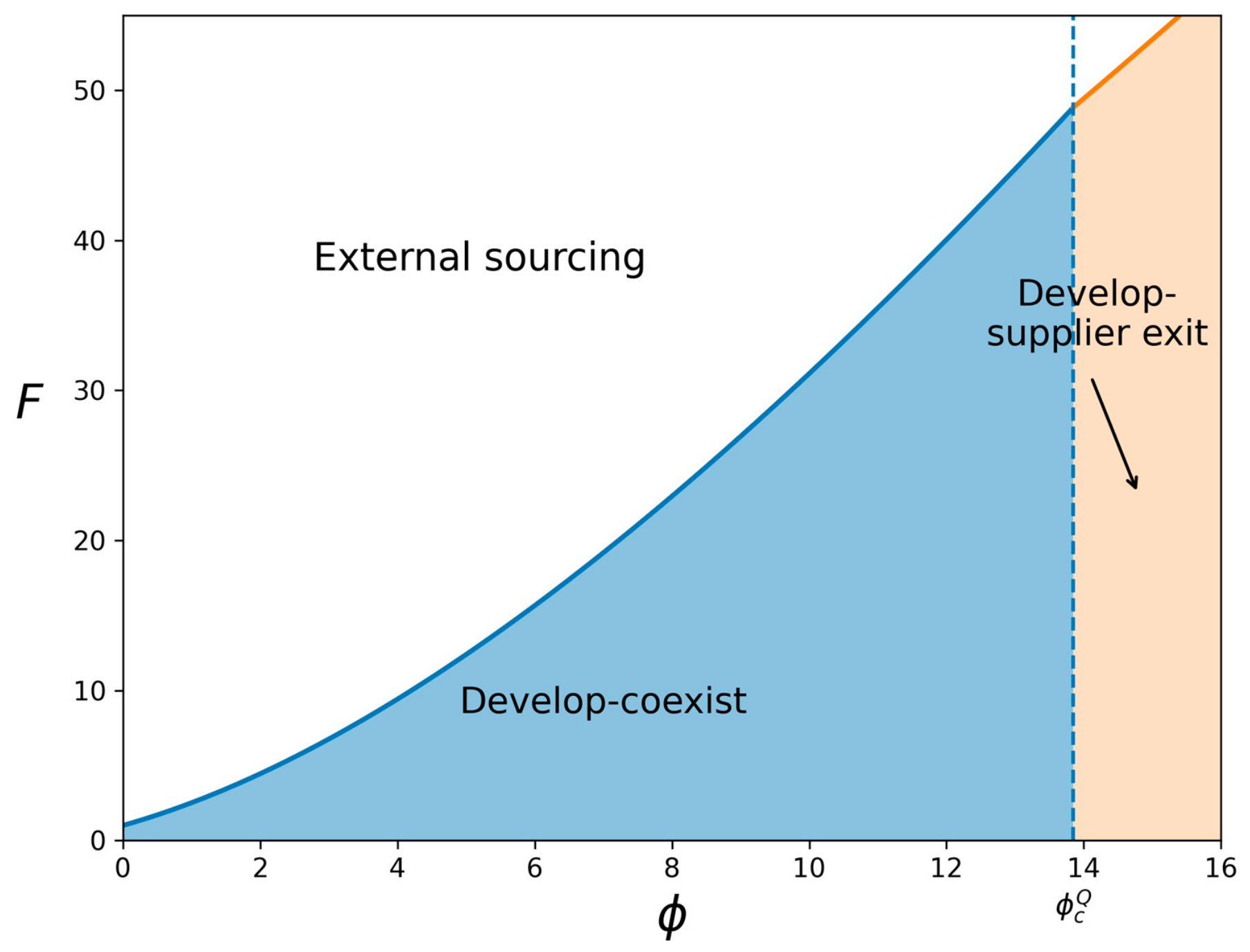
Figure A1 illustrates the equilibrium regimes under diminishing marginal reputation benefits. As the reputation spillover increases, the Internal Development region expands relative to External Sourcing, while the downstream outcome under Internal Development changes from supplier coexistence to supplier exit once exceeds . Thus, allowing reputation benefits to be concave preserves the three-regime structure of the baseline model.
Figure A1.
Regime Map under Concave Reputation Benefit Model (parameters: , , and ).
Appendix C. Aggregate-Surplus Comparison at the Sourcing Threshold
Define aggregate surplus as the sum of consumer surplus and the two firms’ payoffs:
Let and . Under the maintained assumptions, and . At , the large firm is indifferent between External Sourcing and Internal Development–Cournot. Direct substitution of the equilibrium outcomes yields: Because , and all remaining terms are nonnegative for . Therefore,
Thus, at the private sourcing threshold, the large firm switches to Internal Development even though External Sourcing generates greater aggregate surplus. The aggregate-surplus loss arises because Internal Development shifts production from the lower-cost supplier to the higher-cost large firm and incurs the duplicative development cost.
Appendix D. Bargaining over the Wholesale Price
The baseline model allows the supplier to set the wholesale price after the buyer chooses External Sourcing. We examine robustness by replacing this pricing stage with generalized Nash bargaining. Let denote the buyer’s bargaining power. If bargaining fails, the buyer does not enter the focal market and the supplier serves the market alone. The disagreement payoffs are therefore
If bargaining fails after External Sourcing has been chosen, the buyer cannot switch immediately to Internal Development within the same launch cycle. Therefore, its disagreement payoff is zero, while Internal Development is considered only at the earlier make-or-buy stage.
The negotiated wholesale price solves
where is the set of mutually acceptable agreements. We restrict attention to
which ensures that both firms remain active under External Sourcing.
Proposition A2.
Suppose that, after the buyer chooses External Sourcing, the buyer and supplier bargain over the wholesale price. Then and
Let and denote the baseline sourcing boundaries. Under bargaining, they become
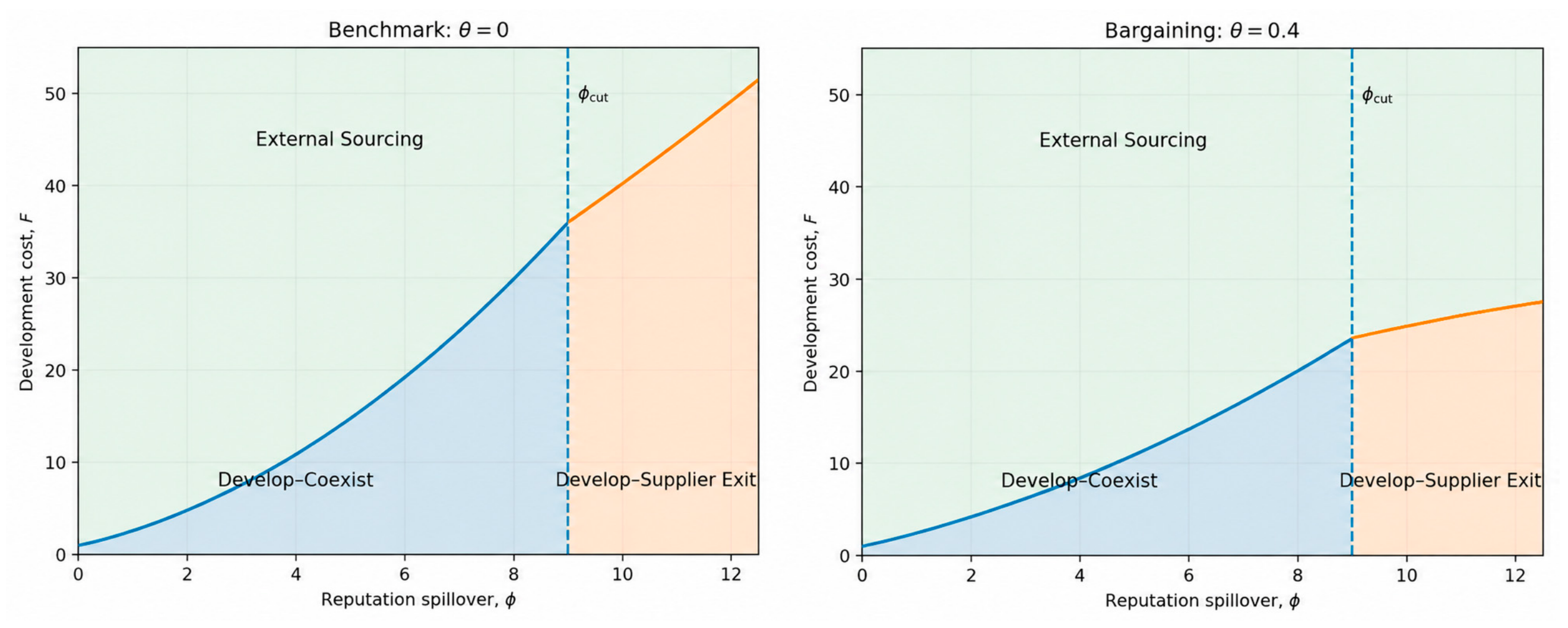
Hence, greater buyer bargaining power expands the External-Sourcing region, whereas the supplier-exit cutoff remains unchanged. Moreover, letting , all three regimes remain nonempty if .
Figure A2 illustrates the result. For , , and , the condition in Proposition A2 becomes . Thus, when buyer bargaining power increases from to , the External-Sourcing region expands, but all three regimes remain and the supplier-exit cutoff stays at .
Figure A2.
Make-or-buy regimes under alternative bargaining power. Panel (a) shows the baseline case (), and Panel (b) shows positive buyer bargaining power (). Parameters: , , and .
Proof of Proposition A2.
For a given , the downstream equilibrium quantities under External Sourcing are , . Letting , the gains from agreement can be written as , . The first-order condition of the Nash bargaining problem gives Substitution yields .
Because the Internal-Development payoffs are unchanged, the increase in the buyer’s External-Sourcing payoff shifts either baseline sourcing boundary downward by
Bargaining does not alter the Internal-Development subgame, so remains unchanged.
Finally, let and . At , the common sourcing boundary is
This value is positive if . Under this condition, positive Internal-Development regions exist on both sides of , while External Sourcing is optimal for sufficiently large . Hence, all three regimes remain nonempty. □
Notes
| 1 | The following parameter values are used: α = 10, x = 3, y = 5, and F = 10. |
| 2 | The following parameter values are used: a = 10, x = 3, y = 5, and ϕ = 6. |
References
- Beyond Meat. Beyond Meat Expands U.S. Retail Distribution Within Multiple National and Regional Grocery Chains. 8 April 2021. Available online: https://www.globenewswire.com/news-release/2021/04/08/2206760/0/en/Beyond-Meat-Expands-U-S-Retail-Distribution-Within-Multiple-National-and-Regional-Grocery-Chains.html (accessed on 28 July 2026).
- GlobeNewswire. Beyond Meat Announces Strategic Global Agreement with McDonald’s. 25 February 2021. Available online: https://www.globenewswire.com/news-release/2021/02/25/2182964/0/en/Beyond-Meat-Announces-Strategic-Global-Agreement-with-McDonald-s.html (accessed on 28 July 2026).
- Restaurant Dive. Impossible Whopper Drives 5% of Burger King’s Q3 US Comp Sales. 28 October 2019. Available online: https://www.restaurantdive.com/news/impossible-whopper-drove-5-of-burger-kings-q3-comp-sales/565958/ (accessed on 28 July 2026).
- TechCrunch. Beyond Meat Shares Rise on News That It Collaborated with McDonald’s on the McPlant Options. 9 November 2020. Available online: https://techcrunch.com/2020/11/09/beyond-meat-shares-rise-on-news-that-it-collaborated-with-mcdonalds-on-the-mcplant-options/ (accessed on 28 July 2026).
- Time. Burger King Is Rolling Out the Impossible Whopper Across the U.S. 1 August 2019. Available online: https://time.com/5641475/burger-king-impossible-whopper/ (accessed on 28 July 2026).
- CNN Business. Nestlé’s Awesome Burger Is the Company’s Answer to the Plant-Based Meat Craze. 24 September 2019. Available online: https://www.cnn.com/2019/09/24/business/nestle-awesome-burger-plant-based-meat/index.html (accessed on 28 July 2026).
- Nestlé. Nestlé to Launch New 100% Plant-Based Burgers in Europe and US. 1 April 2019. Available online: https://www.nestle.com/media/news/nestle-launch-plant-based-burgers (accessed on 28 July 2026).
- Nestlé. Nestlé’s Plant-Based Burger in Europe Is About to Get Even More Sensational. 8 September 2020. Available online: https://www.nestle.com/media/news/nestle-plant-based-garden-gourmet-sensational-burger-europe (accessed on 28 July 2026).
- Chernev, A.; Blair, S. Doing well by doing good: The benevolent halo of corporate social responsibility. J. Consum. Res. 2015, 41, 1412–1425. [Google Scholar] [CrossRef] [Scilit]
- Awasthy, P.; Gouda, S.; Ghosh, D.; Swami, S. Analyzing product greening spillovers in multi-product markets. Transp. Res. Part E Logist. Transp. Rev. 2022, 158, 102586. [Google Scholar] [CrossRef] [Scilit]
- Chen, Y.S. The drivers of green brand equity: Green brand image, green satisfaction, and green trust. J. Bus. Ethics 2010, 93, 307–319. [Google Scholar] [CrossRef] [Scilit]
- Leiblein, M.J.; Reuer, J.J.; Dalsace, F. Do make or buy decisions matter? The influence of organizational governance on technological performance. Strateg. Manag. J. 2002, 23, 817–833. [Google Scholar] [CrossRef] [Scilit]
- Parmigiani, A. Why do firms both make and buy? An investigation of concurrent sourcing. Strateg. Manag. J. 2007, 28, 285–311. [Google Scholar] [CrossRef] [Scilit]
- Arya, A.; Mittendorf, B.; Sappington, D.E. The bright side of supplier encroachment. Mark. Sci. 2007, 26, 651–659. [Google Scholar] [CrossRef] [Scilit]
- Chiang, W.Y.K.; Chhajed, D.; Hess, J.D. Direct marketing, indirect profits: A strategic analysis of dual-channel supply-chain design. Manag. Sci. 2003, 49, 1–20. [Google Scholar] [CrossRef] [Scilit]
- Williamson, O.E. The Economic Institutions of Capitalism; Free Press: New York, NY, USA, 1985. [Google Scholar]
- Hart, S.L. A natural-resource-based view of the firm. Acad. Manag. Rev. 1995, 20, 986–1014. [Google Scholar] [CrossRef] [Scilit]
- Carter, C.R.; Rogers, D.S. A framework of sustainable supply chain management: Moving toward new theory. Int. J. Phys. Distrib. Logist. Manag. 2008, 38, 360–387. [Google Scholar] [CrossRef] [Scilit]
- Seuring, S.; Müller, M. From a literature review to a conceptual framework for sustainable supply chain management. J. Clean. Prod. 2008, 16, 1699–1710. [Google Scholar] [CrossRef] [Scilit]
- Pagell, M.; Wu, Z. Building a more complete theory of sustainable supply chain management using case studies of 10 exemplars. J. Supply Chain Manag. 2009, 45, 37–56. [Google Scholar] [CrossRef] [Scilit]
- Walker, H.; Di Sisto, L.; McBain, D. Drivers and barriers to environmental supply chain management practices: Lessons from the public and private sectors. J. Purch. Supply Manag. 2008, 14, 69–85. [Google Scholar] [CrossRef] [Scilit]
- Yang, Y.; Lau, A.K.W.; Lee, P.K.C.; Cheng, T.C.E. The performance implication of corporate social responsibility in matched Chinese small and medium-sized buyers and suppliers. Int. J. Prod. Econ. 2020, 230, 107796. [Google Scholar] [CrossRef] [Scilit]
- Porter, M.E.; van der Linde, C. Toward a new conception of the environment-competitiveness relationship. J. Econ. Perspect. 1995, 9, 97–118. [Google Scholar] [CrossRef] [Scilit]
- Christmann, P. Effects of “best practices” of environmental management on cost advantage: The role of complementary assets. Acad. Manag. J. 2000, 43, 663–680. [Google Scholar] [CrossRef] [Scilit] [PubMed]
- De Marchi, V. Environmental innovation and R&D cooperation: Empirical evidence from Spanish manufacturing firms. Res. Policy 2012, 41, 614–623. [Google Scholar] [CrossRef] [Scilit]
- Horbach, J.; Rammer, C.; Rennings, K. Determinants of eco-innovations by type of environmental impact—The role of regulatory push/pull, technology push and market pull. Ecol. Econ. 2012, 78, 112–122. [Google Scholar] [CrossRef] [Scilit]
- Russo, M.V.; Fouts, P.A. A resource-based perspective on corporate environmental performance and profitability. Acad. Manag. J. 1997, 40, 534–559. [Google Scholar] [CrossRef] [Scilit] [PubMed]
- Hockerts, K.; Wüstenhagen, R. Greening Goliaths versus emerging Davids—Theorizing about the role of incumbents and new entrants in sustainable entrepreneurship. J. Bus. Ventur. 2010, 25, 481–492. [Google Scholar] [CrossRef] [Scilit]
- Puranam, P.; Singh, H.; Zollo, M. Organizing for innovation: Managing the coordination-autonomy dilemma in technology acquisitions. Acad. Manag. J. 2006, 49, 263–280. [Google Scholar] [CrossRef] [Scilit]
- Rothaermel, F.T.; Deeds, D.L. Exploration and exploitation alliances in biotechnology: A system of new product development. Strateg. Manag. J. 2004, 25, 201–221. [Google Scholar] [CrossRef] [Scilit]
- Namkung, Y.; Jang, S.C.S. Effects of restaurant green practices on brand equity formation: Do green practices really matter? Int. J. Hosp. Manag. 2013, 33, 85–95. [Google Scholar] [CrossRef] [Scilit]
- Bansal, P.; Clelland, I. Talking trash: Legitimacy, impression management, and unsystematic risk in the context of the natural environment. Acad. Manag. J. 2004, 47, 93–103. [Google Scholar] [CrossRef] [Scilit]
- Servaes, H.; Tamayo, A. The impact of corporate social responsibility on firm value: The role of customer awareness. Manag. Sci. 2013, 59, 1045–1061. [Google Scholar] [CrossRef] [Scilit]
- Porter, M.E.; Kramer, M.R. The link between competitive advantage and corporate social responsibility. Harv. Bus. Rev. 2006, 84, 78–92. [Google Scholar] [PubMed]
- Hartmann, P.; Apaolaza Ibáñez, V. Green value added. Mark. Intell. Plan. 2006, 24, 673–680. [Google Scholar] [CrossRef] [Scilit]
- Bonanno, G.; Vickers, J. Vertical separation. J. Ind. Econ. 1988, 36, 257–265. [Google Scholar] [CrossRef] [Scilit]
- Coughlan, A.T. Competition and cooperation in marketing channel choice: Theory and application. Mark. Sci. 1985, 4, 110–129. [Google Scholar] [CrossRef] [Scilit]
- Zhu, W.; He, Y. Green product design in supply chains under competition. Eur. J. Oper. Res. 2017, 258, 165–180. [Google Scholar] [CrossRef] [Scilit]
- Cachon, G.P.; Lariviere, M.A. Supply chain coordination with revenue-sharing contracts: Strengths and limitations. Manag. Sci. 2005, 51, 30–44. [Google Scholar] [CrossRef] [Scilit]
- Um, K.H.; Kim, S.M. The effects of supply chain collaboration on performance and transaction cost advantage: The moderation and nonlinear effects of governance mechanisms. Int. J. Prod. Econ. 2019, 217, 97–111. [Google Scholar] [CrossRef] [Scilit]
- Hart, O.; Tirole, J.; Carlton, D.W.; Williamson, O.E. Vertical integration and market foreclosure. Brook. Pap. Econ. Act. Microecon. 1990, 1990, 205–286. [Google Scholar] [CrossRef] [Scilit]
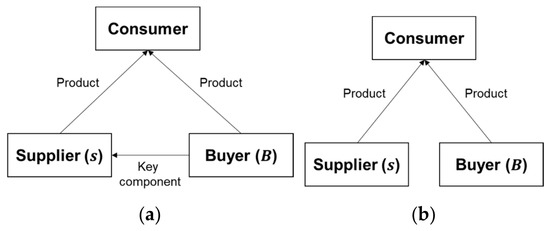
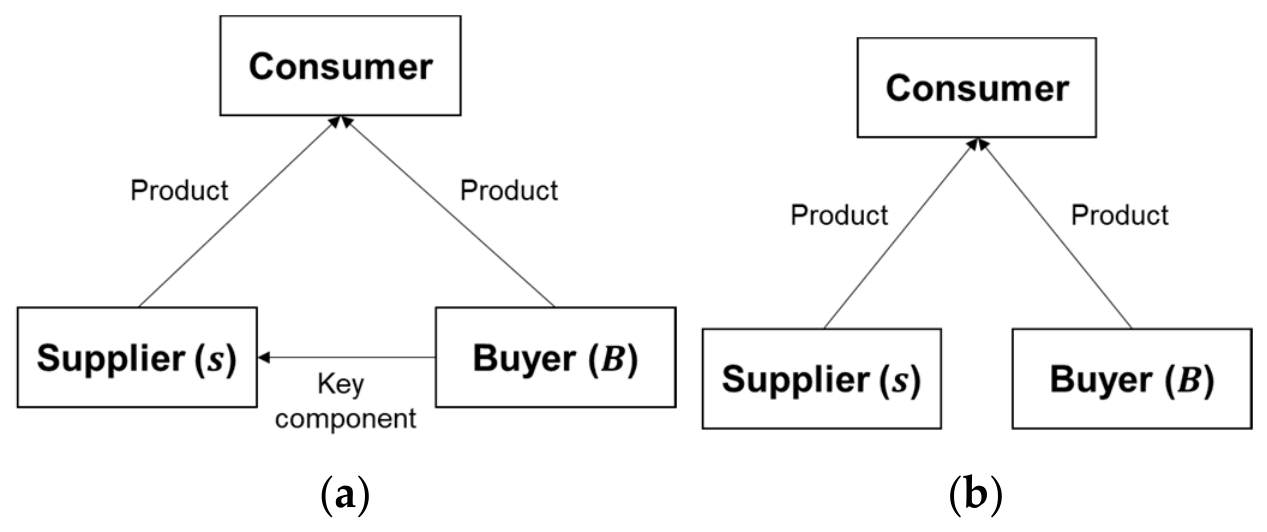
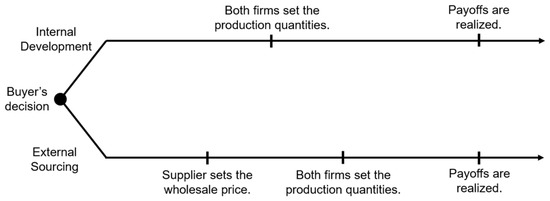
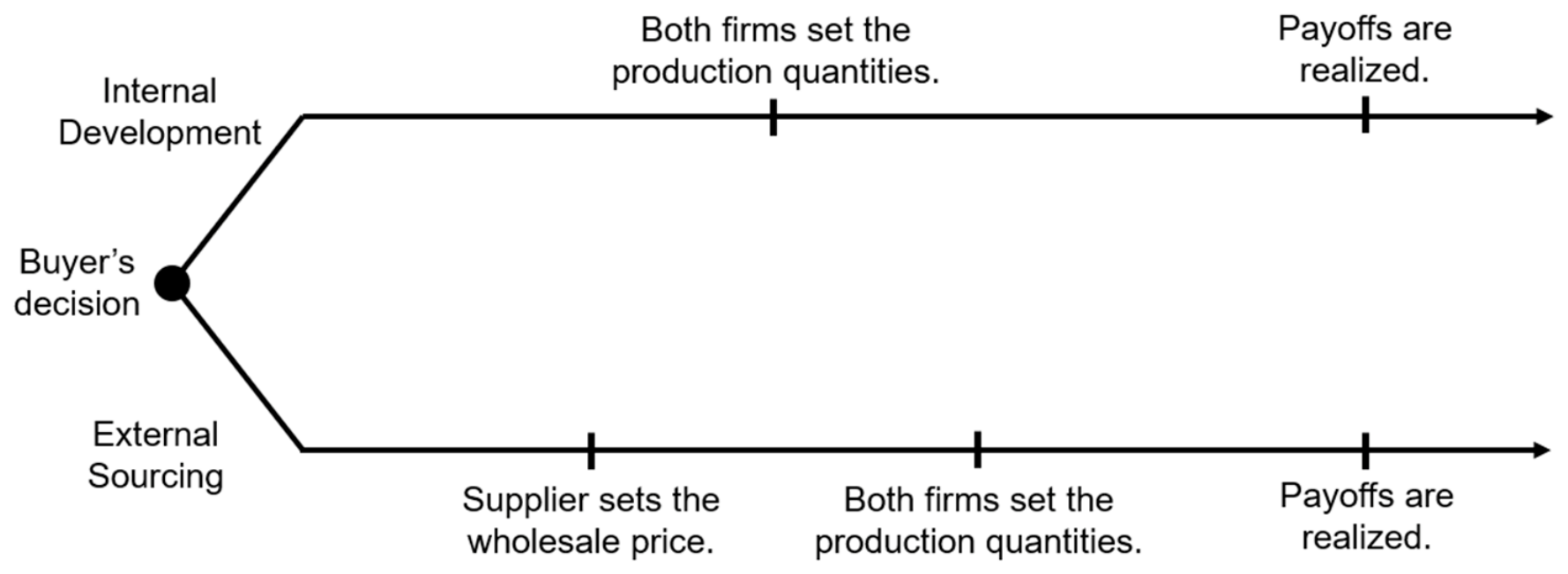
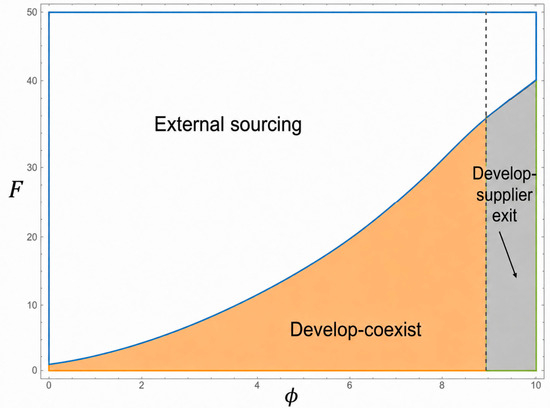
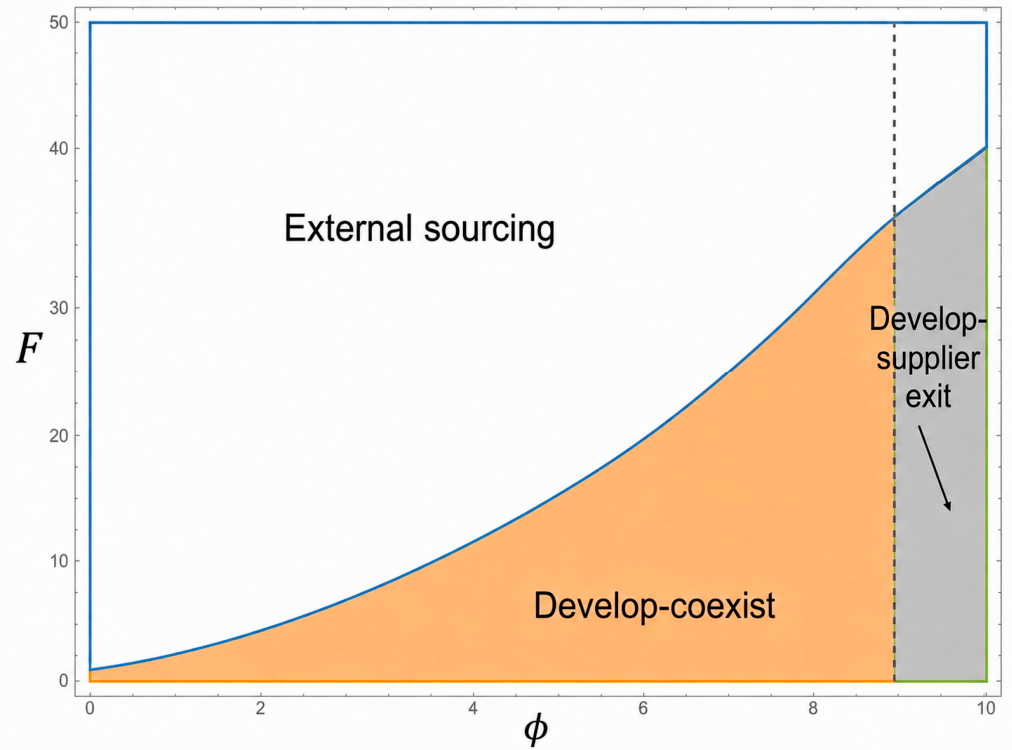
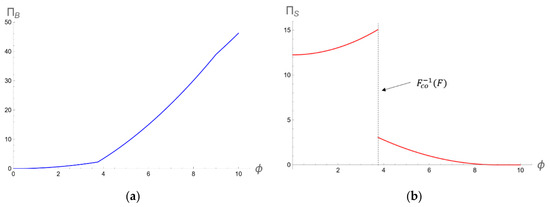
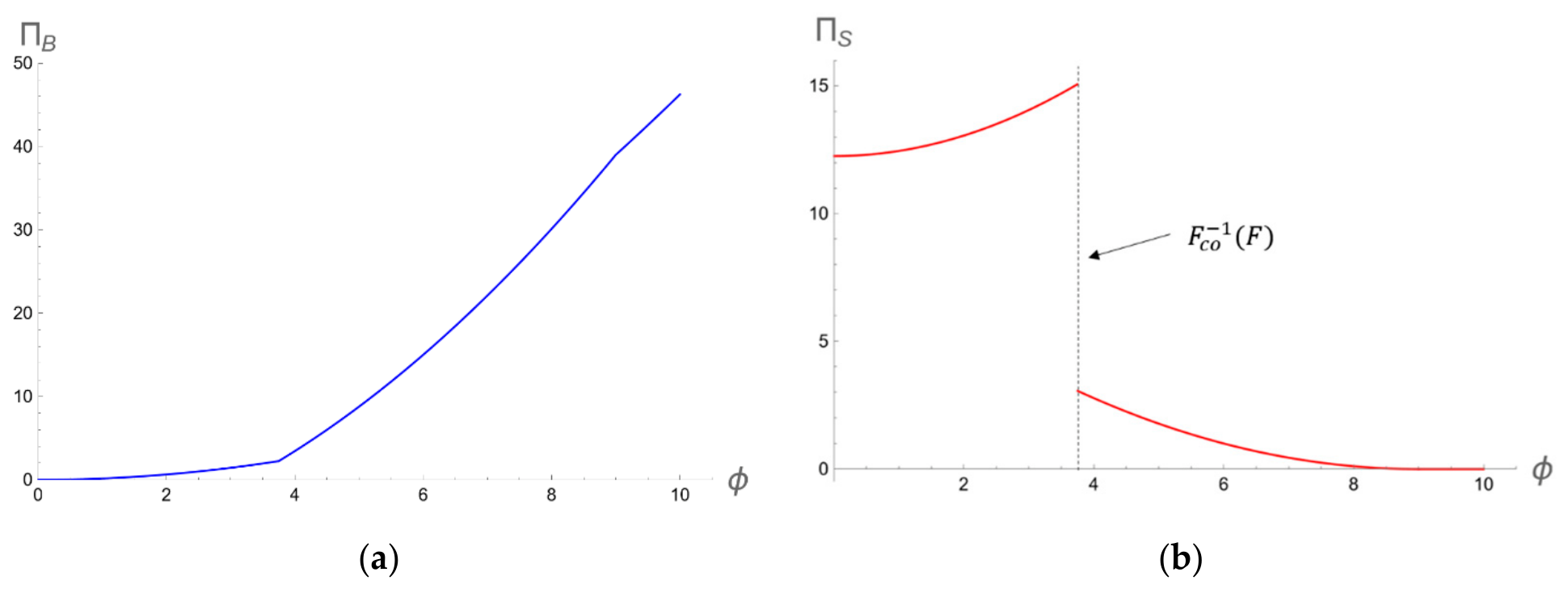
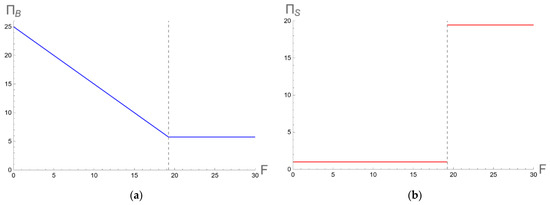
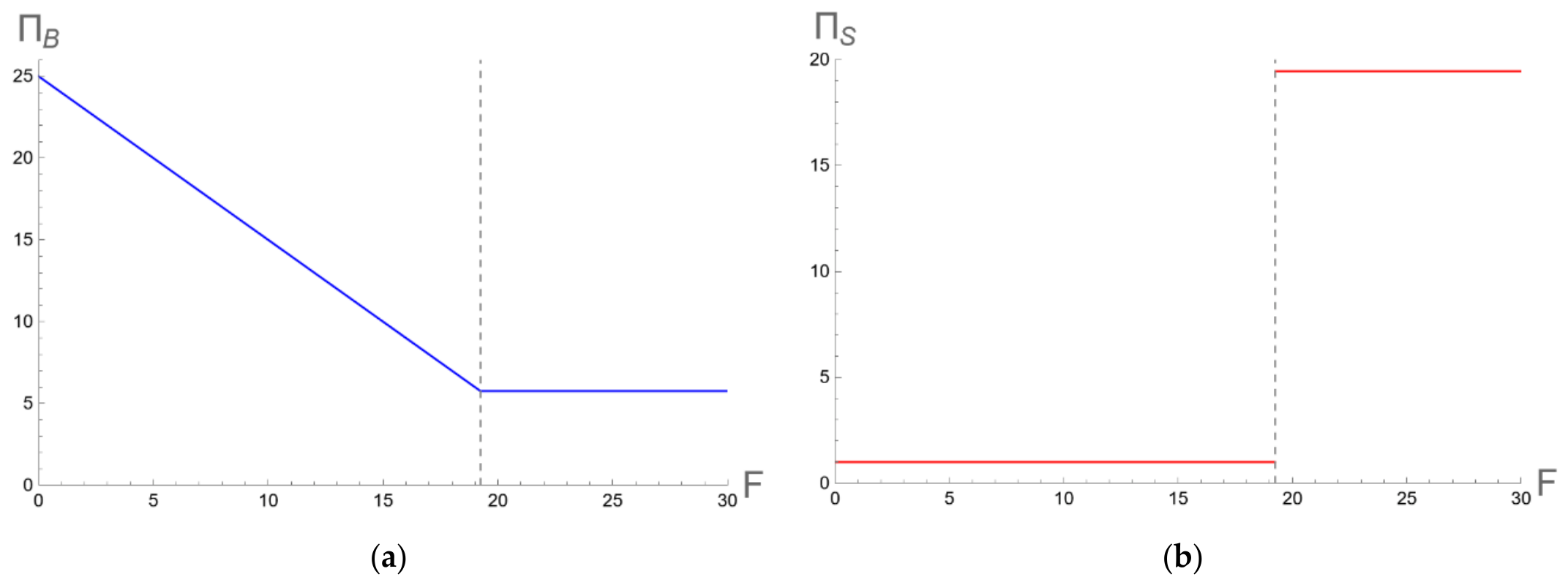

Disclaimer/Publisher’s Note: The statements, opinions and data contained in all publications are solely those of the individual author(s) and contributor(s) and not of MDPI and/or the editor(s). MDPI and/or the editor(s) disclaim responsibility for any injury to people or property resulting from any ideas, methods, instructions or products referred to in the content. |
© 2026 by the authors. Licensee MDPI, Basel, Switzerland. This article is an open access article distributed under the terms and conditions of the Creative Commons Attribution (CC BY) license.