


Highlights
Please indicate how your work links to systems science via your contributions to systems practice, theory, and/or methodology.
- This study develops a systems-oriented framework that examines new venture innovation through the interdependence among network centrality, resource orchestration, network responsiveness, and environmental dynamism.
- It contributes to systems theory by showing how structural network advantages, internal resource orchestration, and external relational responsiveness are linked to different forms of innovation ambidexterity.
What are the main findings and/or the implications of the main findings?
- Network centrality is positively associated with both balanced and combined innovation ambidexterity, with resource orchestration partially accounting for these relationships.
- Network responsiveness strengthens the associations between network centrality and resource orchestration and between resource orchestration and innovation ambidexterity, particularly when environmental dynamism is high.
Abstract
Network centrality provides new ventures with access to external knowledge, resources, and collaborative opportunities. Yet prior research has not fully explained how this structural advantage relates to different forms of innovation ambidexterity. Drawing on resource orchestration theory, this study develops a contingent framework examining how network centrality is associated with balanced innovation ambidexterity and combined innovation ambidexterity through resource orchestration. Using survey data from 345 new ventures in China, the results show that network centrality is positively associated with both balanced innovation ambidexterity and combined innovation ambidexterity, and that resource orchestration partially mediates these relationships. Network responsiveness conditions these relationships, particularly under high environmental dynamism. The study contributes by clarifying the role of resource orchestration in the relationship between network centrality and innovation ambidexterity, distinguishing internal resource orchestration from external relational responsiveness, and identifying contextual differences between balanced and combined innovation ambidexterity. These findings highlight the interdependence among network, resource, and environmental factors in explaining innovation ambidexterity in new ventures.
1. Introduction
New ventures face a persistent tension between exploring new opportunities and exploiting existing knowledge and capabilities. Exploratory innovation enables adaptation and future growth, whereas exploitative innovation generates value from existing resources and routines [1,2]. Managing both activities is particularly challenging for new ventures because they often face resource constraints and limited organizational experience [3,4]. This challenge gives rise to two distinct forms of innovation ambidexterity, with balanced innovation ambidexterity reflecting the relative balance between exploration and exploitation and combined innovation ambidexterity reflecting their joint magnitude [5].
Interorganizational networks can help new ventures overcome resource constraints by providing access to external knowledge, resources, and collaborative opportunities. A central network position enhances firms’ visibility, knowledge access, and ability to connect with diverse actors within interorganizational networks [6,7,8]. Firms occupying central positions are also more likely to obtain valuable information and participate in advantageous network structures associated with innovation activities [9,10]. These network advantages provide important foundations for pursuing both exploratory and exploitative innovation activities. Therefore, network centrality represents an important structural condition associated with innovation ambidexterity in resource-constrained new ventures.
However, network centrality alone cannot fully explain why new ventures occupying similar network positions may achieve different innovation outcomes. Prior studies have demonstrated that network structures are associated with innovation through knowledge exchange, resource acquisition, and external collaboration [11,12,13]. Recent research has further examined the relationship between network positions and innovation ambidexterity, suggesting that network characteristics influence firms’ ability to pursue multiple innovation activities simultaneously [14,15]. Yet, limited attention has been paid to the organizational processes through which new ventures utilize network-derived resources to support balanced and combined innovation ambidexterity. This gap is important because external knowledge and resources obtained through networks require internal structuring, integration, and deployment before contributing to exploratory and exploitative innovation activities.
Resource orchestration theory provides a useful perspective for explaining how new ventures organize network-derived resources. Rather than focusing solely on resource possession, this theory emphasizes how firms structure, bundle, and leverage resource portfolios to create value [16,17]. For new ventures, resource orchestration helps integrate external resources obtained through network relationships with internal resources and deploy them across innovation activities [18,19]. However, the effectiveness of resource orchestration may depend on firms’ ability to continuously align network relationships and resource configurations with changing innovation demands. Network responsiveness reflects firms’ ability to recognize and respond to changes in network relationships, whereas environmental dynamism increases the need for such adaptive responses as technologies, markets, and competitive conditions evolve [20,21].
Accordingly, this study asks: How is network centrality associated with balanced and combined innovation ambidexterity through resource orchestration, and under what conditions are these relationships strengthened? Using survey data from 345 new ventures in China, we develop and test a contingent framework examining the mediating role of resource orchestration in the relationship between network centrality and the two forms of innovation ambidexterity, as well as the moderating roles of network responsiveness and environmental dynamism.
This study makes three contributions. First, it deepens research on network centrality by identifying resource orchestration as an important mechanism linking network positions with innovation ambidexterity. Second, it extends resource orchestration research by distinguishing its roles in explaining balanced and combined innovation ambidexterity and highlighting the complementarity between internal resource orchestration and external network responsiveness. Third, it advances innovation ambidexterity research by examining contextual differences across balanced and combined forms. Together, these contributions provide a more integrated understanding of how network, resource, and environmental factors relate to innovation ambidexterity in new ventures.
2. Theoretical Background and Hypotheses
2.1. Innovation Ambidexterity
Innovation ambidexterity originates from the organizational-learning distinction between exploration and exploitation [1]. In the innovation context, exploratory innovation involves experimentation with new knowledge, technologies, products, and market opportunities, whereas exploitative innovation focuses on refining, extending, and applying existing knowledge, technologies, products, and experience [2,22]. Although both activities contribute to long-term competitiveness, they involve different levels of uncertainty, search, refinement, and efficiency, creating persistent tensions in resource allocation and managerial attention [23].
Building on He and Wong [22] and Cao et al. [5], this study distinguishes between the balanced and combined dimensions of innovation ambidexterity. Balanced innovation ambidexterity reflects the relative alignment between exploratory and exploitative innovation and increases as the difference between the two activities narrows. Combined innovation ambidexterity reflects their joint magnitude and captures the overall level of exploratory and exploitative innovation pursued by the firm. These dimensions represent different configurations of the same two innovation activities [5]. Firms may display similar balance while operating at different combined levels, and a higher combined magnitude may coexist with disparities between the two activities [24].
This distinction is particularly important for new ventures. Limited financial resources, managerial attention, experience, and specialized capabilities may increase the difficulty of simultaneously pursuing exploratory and exploitative innovation [3]. Maintaining relative balance requires new ventures to avoid persistent concentration on one innovation activity, whereas achieving higher combined innovation ambidexterity requires broader resources to support both activities [24]. Given these resource constraints, this study adopts a network centrality perspective to examine innovation ambidexterity in new ventures.
2.2. Network Centrality
Social network theory suggests that firms obtain external information, knowledge, resources, and collaborative opportunities through the interorganizational relationships in which they are embedded [25]. Network centrality refers to the extent to which a focal actor occupies a central position within the overall network structure [26]. A more central position is associated with greater visibility and access to valuable network exchanges [6].
Existing research recognizes that the significance of a central network position may derive from different structural mechanisms and therefore distinguishes four principal forms of network centrality. Degree centrality reflects the number of actors directly connected to the focal firm [6,26]. Closeness centrality captures the firm’s proximity to other network members through the shortest network paths [26]. Betweenness centrality indicates the extent to which the firm lies on the shortest paths connecting other actors and its potential role in mediating information or resource flows [26]. Eigenvector centrality assigns greater weight to ties with actors that are themselves central, reflecting the influence associated with connections to prominent network members [27]. Although these forms capture different structural mechanisms, they collectively reflect the extent to which a firm occupies a central position in network exchanges and accesses, channels, and influences information and resource flows.
This broader positional conception is particularly relevant to new ventures, which often face resource scarcity, limited legitimacy, and unstable access to external knowledge and established partners [28,29]. Rather than isolating a single graph-theoretic measure, this study follows Li et al. [30] in conceptualizing network centrality at the firm level as the extent to which a new venture occupies a visible, accessible, and exchange-relevant position within its collaboration network. Such a position is associated with greater access to external knowledge and complementary resources and greater involvement in interorganizational exchanges, but these potential benefits require effective managerial processes. Accordingly, this study examines how resource orchestration links network centrality with innovation ambidexterity.
2.3. Resource Orchestration
Resource orchestration theory extends the resource-based view by arguing that the possession of valuable resources alone is insufficient to create and sustain competitive advantage; firms must also manage those resources dynamically through purposeful managerial actions [16,17]. Sirmon and colleagues identify three interrelated processes of resource orchestration: resource structuring, resource bundling, and resource leveraging. Resource structuring involves acquiring, accumulating, and renewing resources; resource bundling combines resources to form capabilities; and resource leveraging mobilizes and deploys those capabilities in pursuit of strategic objectives [16,17,18].
Resource orchestration is particularly important for new ventures. Constrained by limited internal resource endowments, new ventures often rely on external networks to access knowledge, technologies, capital, and other complementary resources required for survival, growth, and innovation [28]. Resource orchestration enhances the innovation value of externally accessed resources through effective integration and deployment [19,31]. Accordingly, this study conceptualizes resource orchestration as an organizational capability through which new ventures structure resource portfolios, bundle resources into capabilities, and leverage those capabilities to support innovation.
2.4. Hypothesis Development
2.4.1. Network Centrality and Innovation Ambidexterity
Social network theory suggests that firms derive informational and resource benefits from their positions within interorganizational networks [7,13,30]. By embedding a venture in broader knowledge and exchange relationships, network centrality provides access to external resources that can support innovation activities. This positional advantage is particularly relevant for new ventures, whose limited internal endowments make exploratory and exploitative innovation dependent on resources beyond firm boundaries [28,32].
This external resource access is associated with both exploitative and exploratory innovation [15]. For exploitative innovation, network centrality increases exposure to customer and partner feedback, established technological knowledge, and implementation experience, providing external inputs for refining and extending existing products, processes, and market solutions [7,33]. For exploratory innovation, network centrality increases exposure to emerging technologies, unfamiliar knowledge domains, and prospective partners, expanding opportunities for experimentation and novel product, technology, and market development [9,34]. Firm-level evidence further indicates that network centrality is positively related to both exploitative and exploratory innovation, although the strength and timing of these relationships may differ [15].
These resource advantages connect network centrality with the balanced and combined dimensions of innovation ambidexterity. For balanced innovation ambidexterity, the central issue is the relative balance between exploratory and exploitative innovation [5,22]. New ventures often struggle to maintain this balance because limited resources, capabilities, and experience increase tension between the two activities [3]. By broadening external support for both innovation activities [32], network centrality may reduce resource competition and persistent divergence between them. For combined innovation ambidexterity, the central issue is the joint magnitude of exploratory and exploitative innovation [5]. Access to external resources reduces reliance on internal endowments for both activities [8]. A central network position may therefore provide conditions for expanding one innovation activity without substantially constraining the other. Recent evidence similarly associates central network positions with stronger innovation ambidexterity [15]. Therefore, network centrality is expected to be positively associated with both the relative balance and joint magnitude of exploratory and exploitative innovation. Accordingly:
H1a.
Network centrality is positively associated with balanced innovation ambidexterity.
H1b.
Network centrality is positively associated with combined innovation ambidexterity.
2.4.2. The Mediating Role of Resource Orchestration
Resource orchestration theory emphasizes that firms create value not merely by possessing resources, but by structuring resource portfolios, bundling resources into capabilities, and leveraging those capabilities to pursue market opportunities [16,17]. Network centrality is associated with these resource orchestration processes. First, high network centrality indicates that a new venture maintains extensive connections with network members and occupies a visible position. These positional attributes provide channels for locating and accessing external resources [8,30]. Improved information access helps the venture assess the value and compatibility of available resources, supporting the acquisition, accumulation, and renewal of resources required for resource structuring [7,17,18].
Second, a centrally positioned venture serves as an important conduit for information and knowledge exchange across the network [7,10]. Exposure to diverse resource inputs helps reveal complementarities among dispersed knowledge, technologies, and relational assets [9,11]. This supports the integration of external inputs with existing resources and the enrichment of the venture’s capability base, thereby contributing to resource bundling [18,35].
Third, accessible and connected network relationships allow central ventures to exchange knowledge with resource holders and coordinate participation more effectively [36]. Network visibility and influence may also help maintain partner commitment to emerging opportunities [8]. These conditions are associated with the mobilization, coordination, and deployment of bundled capabilities in market and innovation activities, reflecting resource leveraging [17,31]. Taken together, network centrality is associated with the resource access, integration, and deployment processes underlying resource orchestration. Accordingly:
H2.
Network centrality is positively associated with resource orchestration.
Resource orchestration theory focuses on the managerial actions through which firms transform resource endowments into organizational capabilities and strategic outcomes [16,17]. In innovation contexts, resource orchestration helps new ventures integrate dispersed and heterogeneous resources into exploratory and exploitative innovation activities, thereby providing an important foundation for innovation ambidexterity [18,19].
Balanced innovation ambidexterity requires new ventures to maintain a relative balance between exploring new knowledge and exploiting existing knowledge [5,22]. Because exploratory and exploitative innovation compete for limited resources, resource orchestration plays an important role in maintaining this balance [23]. First, through resource structuring, resource orchestration helps new ventures identify, acquire, accumulate, and renew heterogeneous resources. A richer resource portfolio reduces competition between exploratory and exploitative innovation for the same limited resources and provides a foundation for sustaining both activities [16,17]. Second, through resource bundling, resource orchestration helps new ventures integrate resources with different attributes and combine internal and external inputs into flexible resource configurations. These configurations improve resource adaptability across innovation tasks and reduce the likelihood that resources become persistently concentrated in one innovation mode [18,19]. Third, through resource leveraging, resource orchestration helps new ventures mobilize, coordinate, and redeploy resources as the relative demands of exploratory and exploitative innovation change. Such adjustments reduce allocation biases and the likelihood that either innovation activity crowds out the other [17,31]. Taken together, resource orchestration is positively associated with new ventures’ ability to maintain a closer relative balance between exploratory and exploitative innovation. Accordingly:
H3a.
Resource orchestration is positively associated with balanced innovation ambidexterity.
Combined innovation ambidexterity reflects the joint magnitude of exploratory and exploitative innovation and requires a sufficiently broad resource base to support both activities [5,24]. Resource orchestration is associated with this joint magnitude by expanding resource availability, generating complementarities among resources, and supporting the integration of resource combinations into innovation activities. First, through resource structuring, resource orchestration helps new ventures acquire, accumulate, and renew knowledge, technological, financial, and relational resources. The resulting resource base allows them to expand innovation activities without making the growth of one innovation mode entirely dependent on the contraction of the other [17,18]. Second, through resource bundling, resource orchestration helps new ventures combine heterogeneous resources into complementary capability configurations. These configurations generate value beyond isolated resources and broaden the range of innovation activities that the venture can support [16,19]. Third, through resource leveraging, resource orchestration helps new ventures mobilize and deploy these capability configurations in new-product development, market experimentation, and refinement of existing offerings. Effective deployment is associated with a higher joint magnitude of exploratory and exploitative innovation [17,31]. Taken together, resource orchestration is positively associated with the combined magnitude of exploratory and exploitative innovation. Accordingly:
H3b.
Resource orchestration is positively associated with combined innovation ambidexterity.
Social network theory suggests that a central network position provides new ventures with access to heterogeneous knowledge, technologies, market information, and other externally distributed resources [7,8,30]. However, access to external resources does not automatically generate innovation outcomes, because their value depends on how effectively firms manage and deploy them [16,19]. Resource orchestration helps new ventures structure network-derived resources, bundle them with internal resources, and leverage the resulting capabilities in innovation activities [17,18]. It therefore provides an internal mechanism through which the resource advantages associated with network centrality are linked to innovation ambidexterity [31,37].
More specifically, resource orchestration may connect network-derived resource advantages with balanced innovation ambidexterity and combined innovation ambidexterity through distinct pathways. For balanced innovation ambidexterity, network centrality broadens external resources available to new ventures, while resource orchestration helps address resource gaps, develop flexible configurations, and adjust resource deployment between exploratory and exploitative innovation. These processes may reduce resource competition and persistent allocation bias, helping new ventures maintain a closer relative balance between exploratory and exploitative innovation [17,23]. For combined innovation ambidexterity, network centrality expands access to heterogeneous and potentially complementary resources, while resource orchestration integrates these inputs into complementary capabilities and deploys them across exploratory and exploitative innovation. These processes broaden the productive resource base and support resource complementarities, contributing to a higher joint magnitude of exploratory and exploitative innovation [5,18,24]. Resource orchestration should therefore mediate the associations between network centrality and both balanced innovation ambidexterity and combined innovation ambidexterity. Accordingly:
H4a.
Resource orchestration mediates the relationship between network centrality and balanced innovation ambidexterity.
H4b.
Resource orchestration mediates the relationship between network centrality and combined innovation ambidexterity.
2.4.3. The Moderating Role of Network Responsiveness
Interorganizational networks evolve as partners enter and exit, relational priorities change, and firms’ strategic requirements develop over time [8]. Network responsiveness refers to a venture’s capability to respond rapidly and adapt effectively when its network relationships or the direction of network evolution change [20]. It is reflected in the timely adjustment of network structures, the breadth and depth of collaboration, and the coordination of relationship-related actions within and across organizational boundaries [21]. Network responsiveness therefore captures a venture’s ability to maintain adaptable and effective external relational arrangements as network conditions evolve.
Network centrality provides new ventures with broader access to external resources and greater influence [8]. However, because interorganizational networks evolve continuously, the extent to which network centrality is associated with resource orchestration depends partly on network responsiveness [20]. First, when network responsiveness is high, new ventures can adjust the breadth and depth of collaboration according to strategic priorities and changes in relationship relevance [21]. Such adjustments improve the relevance and timeliness of relational channels associated with a central network position, supporting more effective resource orchestration. Second, high network responsiveness allows new ventures to adapt interaction patterns with network members as network conditions change. By coordinating the intensity and focus of relational interactions, ventures can better align the information, influence, and relational accessibility associated with network centrality with current resource-orchestration requirements [20]. Network responsiveness therefore strengthens the positive relationship between network centrality and resource orchestration.
H5.
Network responsiveness positively moderates the relationship between network centrality and resource orchestration.
Resource orchestration is expected to be more strongly associated with balanced innovation ambidexterity when network responsiveness is high. Because exploratory and exploitative innovation compete for limited resources, their relative balance depends partly on whether resource orchestration can remain responsive to changing conditions [5]. First, network responsiveness allows new ventures to adjust the scope and depth of collaboration as strategic priorities and relationship relevance change, reducing the risk that established relational patterns become overly oriented toward one innovation mode [21]. Second, responsiveness to network evolution provides timely external feedback, helping resource orchestration adapt rather than remain constrained by outdated interaction arrangements [20]. Network responsiveness therefore strengthens the positive association between resource orchestration and balanced innovation ambidexterity. Accordingly:
H6a.
Network responsiveness positively moderates the relationship between resource orchestration and balanced innovation ambidexterity.
Resource orchestration is also expected to be more strongly associated with combined innovation ambidexterity when network responsiveness is high. Combined innovation ambidexterity depends on whether resource orchestration can support a greater joint magnitude of exploratory and exploitative innovation [18]. Network responsiveness allows new ventures to adjust interaction patterns and coordinate relationship-related actions across network members as conditions change [21]. Such relational coordination reduces barriers to information exchange and joint action, allowing resource orchestration to support multiple innovation activities more coherently [20]. Network responsiveness therefore strengthens the positive association between resource orchestration and combined innovation ambidexterity. Accordingly:
H6b.
Network responsiveness positively moderates the relationship between resource orchestration and combined innovation ambidexterity.
2.4.4. The Contingent Role of Environmental Dynamism
Environmental dynamism refers to the frequency, speed, and unpredictability of changes in a firm’s external market, technological, and competitive environment [2,38]. The moderating role of network responsiveness varies across such conditions because monitoring network change and adjusting relationships require managerial attention and coordination. When environmental dynamism is low, the strategic relevance of network relationships and established interaction patterns changes relatively slowly, limiting the additional value of network responsiveness [20]. Under high environmental dynamism, market and technological information becomes obsolete more rapidly, while relationship relevance and collaboration requirements change more frequently [39,40]. In this context, network responsiveness helps new ventures adjust the scope and depth of collaboration and adapt interaction patterns more promptly, strengthening the relevance of network centrality to resource orchestration [21,39]. Environmental dynamism therefore strengthens the positive moderating effect of network responsiveness on the relationship between network centrality and resource orchestration. Accordingly:
H7.
Environmental dynamism positively moderates the moderating effect of network responsiveness on the relationship between network centrality and resource orchestration, such that the moderating effect is stronger when environmental dynamism is high.
When environmental dynamism is high, network responsiveness is expected to exert a stronger positive moderating effect on the relationship between resource orchestration and balanced innovation ambidexterity. Compared with stable environments, dynamic environments involve faster changes in markets and technologies, increasing uncertainty around innovation requirements and established interaction arrangements [2,41]. Network responsiveness is therefore more valuable because it helps new ventures adjust collaboration and adapt interaction patterns as network conditions change [21]. These relational adjustments strengthen the association between resource orchestration and the relative balance between exploratory and exploitative innovation [39]. Environmental dynamism therefore strengthens the positive moderating effect of network responsiveness on the relationship between resource orchestration and balanced innovation ambidexterity. Accordingly:
H8a.
Environmental dynamism positively moderates the moderating effect of network responsiveness on the relationship between resource orchestration and balanced innovation ambidexterity, such that the moderating effect is stronger when environmental dynamism is high.
Similarly, when environmental dynamism is high, network responsiveness is expected to exert a stronger positive moderating effect on the relationship between resource orchestration and combined innovation ambidexterity. Under such conditions, the relational requirements of different innovation activities become more difficult to coordinate, increasing the possibility that resource orchestration faces constraints from fragmented interactions across network members [38,41]. Network responsiveness is therefore more valuable because it helps new ventures adapt interaction patterns and coordinate relationship-related actions as network conditions change [21]. Such relational coordination reduces implementation frictions and strengthens the association between resource orchestration and the joint magnitude of exploratory and exploitative innovation [39,40]. Environmental dynamism therefore strengthens the positive moderating effect of network responsiveness on the relationship between resource orchestration and combined innovation ambidexterity. Accordingly:
H8b.
Environmental dynamism positively moderates the moderating effect of network responsiveness on the relationship between resource orchestration and combined innovation ambidexterity, such that the moderating effect is stronger when environmental dynamism is high.
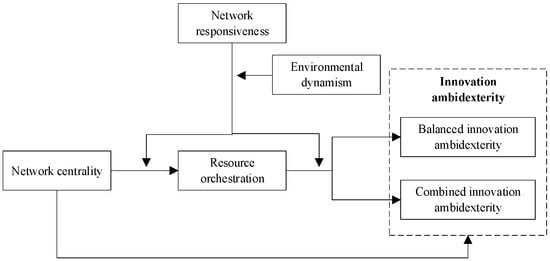
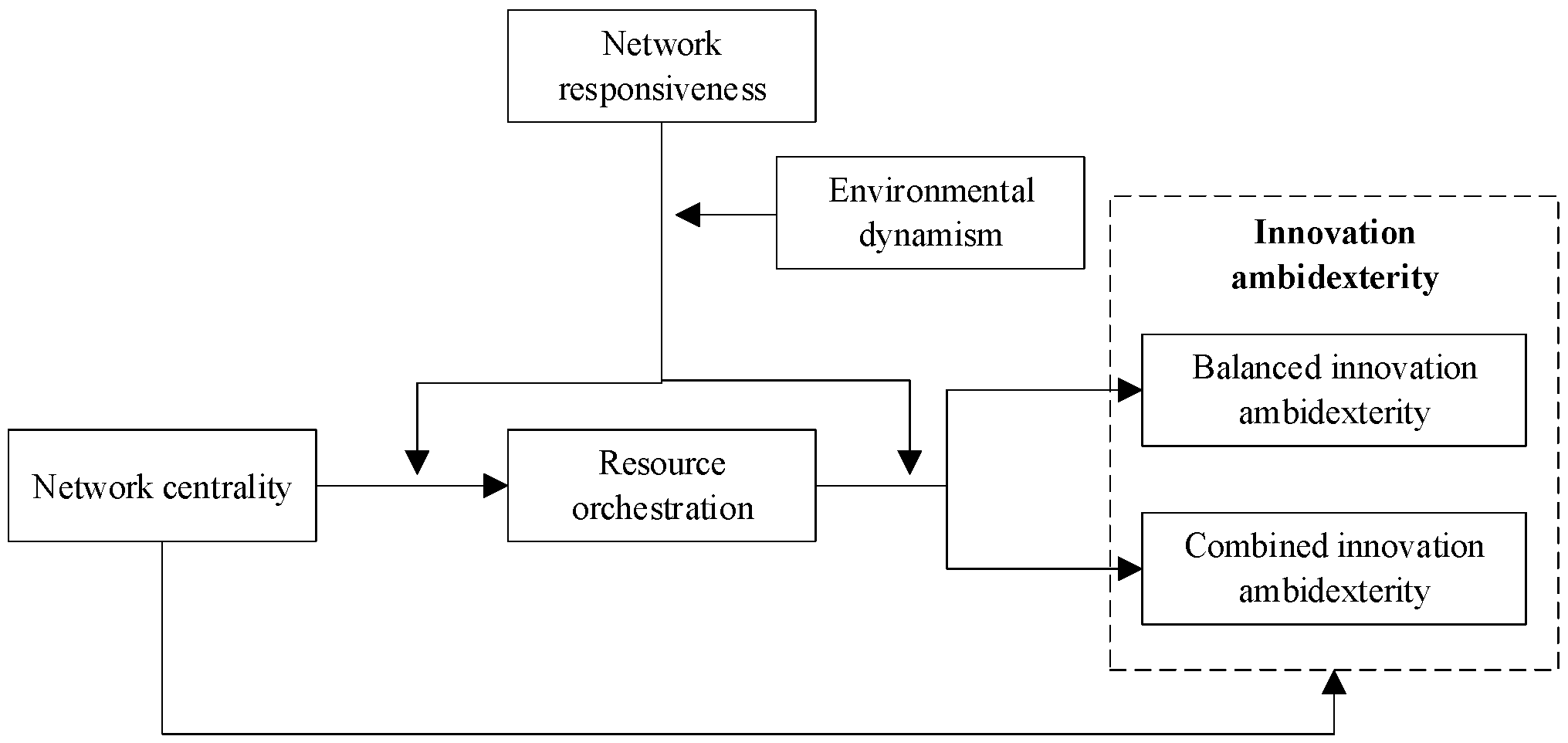
The resulting theoretical framework is presented in Figure 1.
Figure 1.
Theoretical model.
3. Materials and Methods
3.1. Sample and Data Collection
Following Zahra and Bogner [42], this study defined new ventures as firms established within the previous eight years. Senior managers were selected as key informants because they were familiar with their ventures’ collaboration networks, resource allocation, and innovation activities and were well positioned to provide firm-level assessments.
The measures were drawn from established studies and adapted to the new-venture context. Four entrepreneurship scholars reviewed the questionnaire for content relevance and wording. A pilot survey was then conducted to revise ambiguous or contextually inappropriate items.
Data were collected in Guangdong and Jiangsu between September and December 2025. These two provinces were selected because of their active entrepreneurial sectors and large populations of new ventures. Science and technology parks and entrepreneurship parks were used to identify potential sample firms. Information from local business directories and relevant government departments was then used to screen eligible new ventures, from which firms were randomly selected. Senior managers of the selected firms were contacted by telephone and invited to participate. A total of 420 questionnaires were distributed and 371 were returned, yielding a response rate of 88.33%. Twenty-six questionnaires were excluded due to insufficient completion time, long strings of identical responses, or extensive missing values on key items. The final sample comprised 345 valid responses, representing a usable response rate of 82.14%. Of these, 217 were from Guangdong and 128 were from Jiangsu. Detailed sample characteristics are presented in Table 1.
Table 1.
Sample characteristics (N = 345).
3.2. Measures
Network centrality. In this study, network centrality refers to the extent to which a new venture occupies a prominent and advantageous position within its interorganizational network. Because our focus is on how ventures utilize their network positions to facilitate resource access and innovation activities, network centrality was operationalized through key-informant assessments of ventures’ network positions rather than objective graph-theoretic calculations based on complete network data. Four items adapted from Li et al. [30] and Wang and Liu [43] were used to measure network centrality. The items assessed the venture’s prominence, relational accessibility, information intermediation, and information access within its network.
Resource orchestration. Resource orchestration was measured using six items adapted from Sirmon et al. [17] and Jin et al. [40]. The items assessed resource structuring, resource bundling, and resource leveraging.
Innovation ambidexterity. Exploratory and exploitative innovation were each measured with seven items from Jansen et al. [2]. Item means were first calculated for exploratory innovation (EXPI) and exploitative innovation (EXPL). Following Cao et al. [5], balanced innovation ambidexterity was calculated as 5 − |EXPI − EXPL|, whereas combined innovation ambidexterity was calculated as EXPI × EXPL.
Network responsiveness. Network responsiveness was measured using six retained items adapted from Jia et al. [21]. The items assessed perceptions of network changes, relationship adjustment, and adaptation.
Environmental dynamism. Environmental dynamism was measured using four items adapted from Jansen et al. [2] and Zhang et al. [44]. The items assessed changes in competitors, customers, industry innovation, and the external environment.
Controls. We controlled for firm age, firm size, organizational slack, industry, province, high-technology status, and ownership to account for differences in organizational resources and operating contexts. Organizational slack was measured using six items adapted from Tan and Peng [45]. Slack may facilitate experimentation by providing discretionary resources, but excessive slack may weaken resource-allocation discipline. It was therefore controlled to distinguish resource availability from the capability to structure, bundle, and leverage resources.
Except for firm and respondent characteristics, all continuous constructs were measured using five-point Likert scales ranging from 1 (strongly disagree) to 5 (strongly agree). Full measurement items and psychometric statistics are reported in Appendix A Table A1.
3.3. Analytical Strategy
SPSS 27.0 was used for descriptive statistics, correlations, reliability analysis, hierarchical regression, and bootstrap tests, whereas AMOS 29.0 was used for confirmatory factor analysis with maximum-likelihood estimation. After assessing reliability, validity, common method bias, and multicollinearity, we examined direct, mediating, two-way interaction, and three-way interaction effects. Mediation and conditional indirect effects were examined using 5000 bootstrap resamples. For the Model 58 analyses, because network responsiveness moderated both component paths, the conditional indirect effect was nonlinear in network responsiveness. We therefore estimated the conditional indirect effects at low (−1 SD), mean, and high (+1 SD) levels of network responsiveness and assessed their variation using the percentile-bootstrap contrast between the high and low conditional indirect effects. Variables involved in interaction terms were mean-centered, and significant interactions were probed at one standard deviation below and above the moderator means.
4. Results
4.1. Measurement Quality and Common Method Bias
All standardized factor loadings exceeded the recommended threshold of 0.50. Composite reliability values were above 0.70, average variance extracted values exceeded 0.50, and Cronbach’s alpha coefficients exceeded 0.80, supporting satisfactory reliability and convergent validity. KMO values exceeded 0.80 and Bartlett’s tests were significant at p < 0.001, confirming the suitability of the data for factor analysis.
To assess potential common method bias, we conducted Harman’s single-factor test, a single-factor CFA, and a latent common method factor analysis. The unrotated exploratory factor analysis yielded seven factors with eigenvalues greater than one, and the first factor accounted for 20.41% of total variance. As reported in Table 2, the single-factor CFA demonstrated substantially poorer fit than the proposed seven-factor model. Furthermore, adding a latent common method factor to the seven-factor model resulted in only minor changes in practical fit indices (ΔCFI = 0.004, ΔTLI = 0.004, ΔRMSEA = −0.004, and ΔSRMR = −0.002). The common method factor accounted for only 1.30% of total item variance (2.26% of common variance), and the theoretical factor loadings and construct correlations changed only marginally. These results suggest that common method variance may exist, but its influence appears limited based on the current diagnostic assessments.
Table 2.
Confirmatory factor analysis results.
CFA results are reported in Table 2. As organizational slack was included as a control variable, it was also incorporated into the CFA to assess whether it was empirically distinct from the focal constructs. The seven-factor model demonstrated a satisfactory fit and outperformed all alternative models, supporting the discriminant validity of the constructs. Descriptive statistics and correlations are reported in Table 3.
Table 3.
Descriptive statistics and correlations.
4.2. Hypothesis Tests
Table 4 reports the standardized coefficients from the baseline, main-effect, and traditional mediation-step regressions. Network centrality was positively associated with balanced innovation ambidexterity (β = 0.277, p < 0.001), combined innovation ambidexterity (β = 0.349, p < 0.001), and resource orchestration (β = 0.444, p < 0.001), supporting H1a, H1b, and H2. Resource orchestration was also positively associated with balanced innovation ambidexterity (β = 0.301, p < 0.001) and combined innovation ambidexterity (β = 0.443, p < 0.001), supporting H3a and H3b.
Table 4.
Baseline regressions, main effects, and traditional mediation-step tests.
When network centrality and resource orchestration were entered simultaneously, resource orchestration remained positively associated with balanced innovation ambidexterity (β = 0.219, p < 0.001) and combined innovation ambidexterity (β = 0.356, p < 0.001), while the coefficients for network centrality decreased to 0.180 and 0.191, respectively, but remained significant. As reported in Table 5, the indirect effect of network centrality on balanced innovation ambidexterity through resource orchestration was 0.061, with a 95% bootstrap confidence interval of [0.018, 0.109]. The corresponding indirect effect on combined innovation ambidexterity was 0.817, with a 95% bootstrap confidence interval of [0.503, 1.169]. Because neither confidence interval included zero and both direct effects remained significant, resource orchestration partially mediated both relationships, supporting H4a and H4b.
Table 5.
Bootstrap mediation effects (5000 resamples).
4.3. Moderation and Moderated Moderation
Table 6 reports the moderating and moderated-moderation results. The interaction between network centrality and network responsiveness was positively associated with resource orchestration (M3, B = 0.225, p < 0.01), supporting H5. Similarly, the interaction between resource orchestration and network responsiveness was positively associated with balanced innovation ambidexterity (M8, B = 0.113, p < 0.01) and combined innovation ambidexterity (M13, B = 0.958, p < 0.01), supporting H6a and H6b.
Table 6.
Moderating and moderated-moderation effects.
The three-way interaction among network centrality, network responsiveness, and environmental dynamism was positively associated with resource orchestration (M5, B = 0.123, p < 0.05), supporting H7. The three-way interaction among resource orchestration, network responsiveness, and environmental dynamism was also positively associated with balanced innovation ambidexterity (M10, B = 0.203, p < 0.01) and combined innovation ambidexterity (M15, B = 0.718, p < 0.05), supporting H8a and H8b.
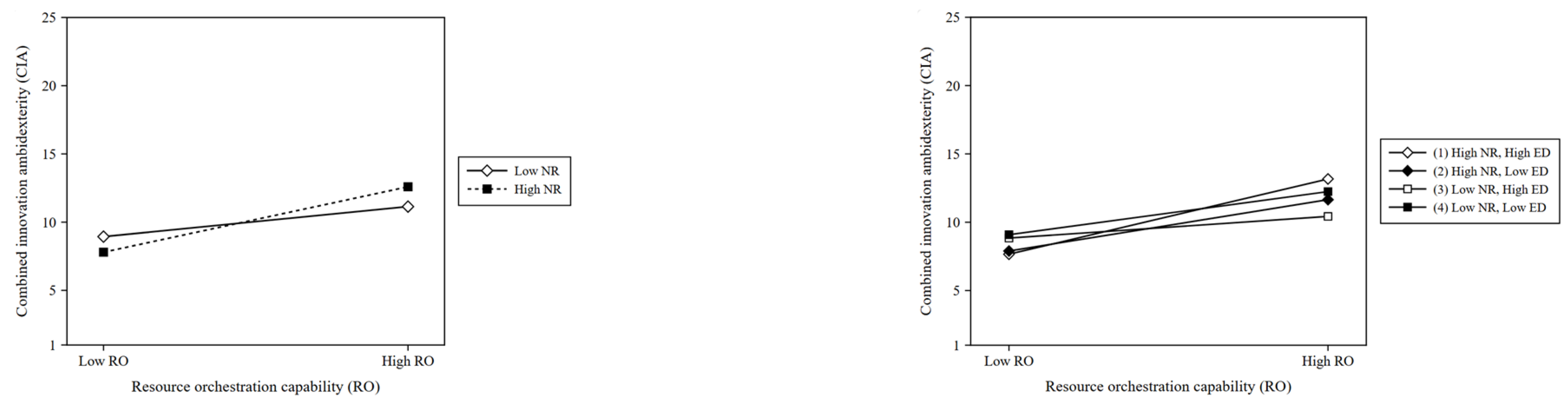
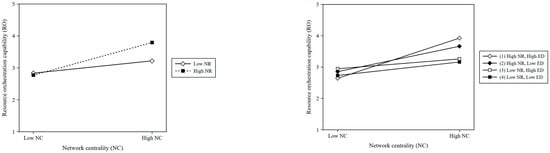
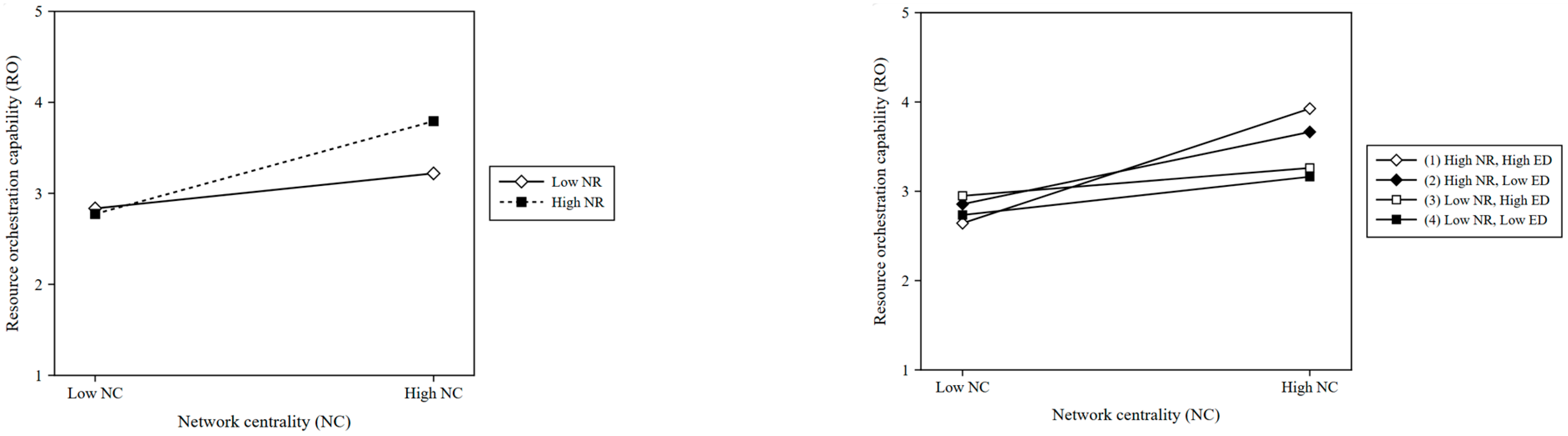
Simple-slope analyses further illustrated these interaction effects. As shown in Figure 2, the positive relationship between network centrality and resource orchestration became stronger as network responsiveness increased (slope = 0.228 at low NR vs. 0.604 at high NR). Under the three-way interaction condition, this relationship was strongest when both network responsiveness and environmental dynamism were high (slope = 0.760, p < 0.001), providing further support for H5 and H7. Additional analyses showed that higher network responsiveness strengthened the relationships between resource orchestration and both forms of innovation ambidexterity, particularly under high environmental dynamism, supporting H6a, H6b, H8a, and H8b (see Appendix A Figure A1 and Figure A2).
Figure 2.
Interaction effects of NR and ED on the relationship between NC and RO. Note: NC refers to network centrality; RO refers to resource orchestration; NR refers to network responsiveness; ED refers to environmental dynamism.
4.4. Conditional Indirect Effects and Robustness
PROCESS Model 58 [46] was used to examine whether network responsiveness moderated the indirect effects of network centrality on innovation ambidexterity through resource orchestration (Table 7). Because network responsiveness moderated both stages of the indirect effect, we evaluated the conditional indirect effects by comparing high (+1 SD) and low (−1 SD) levels of network responsiveness. The bootstrap contrasts were significant for balanced innovation ambidexterity (contrast = 0.120, Boot SE = 0.060, 95% CI [0.002, 0.230]) and combined innovation ambidexterity (contrast = 1.251, Boot SE = 0.301, 95% CI [0.665, 1.852]), indicating that the indirect effects became stronger as network responsiveness increased. Specifically, the indirect effect for BIA was significant at mean and high levels of network responsiveness but not at the low level, whereas the indirect effect for CIA was significant across all three levels and increased progressively.
Table 7.
Conditional indirect effects and bootstrap contrasts.
We further examined the conditional indirect effects under the joint influence of network responsiveness and environmental dynamism. For balanced innovation ambidexterity, the indirect effect was marginally significant when both network responsiveness and environmental dynamism were low (effect = 0.054, 90% bootstrap CI [0.003, 0.119]) and was significant and strongest when both moderators were high (effect = 0.247, 95% bootstrap CI [0.092, 0.394]). In contrast, the indirect effect on combined innovation ambidexterity was significant under most conditions and was strongest when both moderators were high (effect = 1.971, 95% bootstrap CI [1.079, 2.840]). These findings are consistent with the preceding three-way interaction results for H8a–H8b and further illustrate how the indirect effects vary jointly across network responsiveness and environmental dynamism.
Robustness tests using alternative ambidexterity indices, provincial subsamples, and repeated random subsamples yielded consistent results (Table 8). The focal coefficients remained positive and significant across alternative measures and provincial subsamples. In 1000 regressions based on randomly selected 80% subsamples, the significance rates of the focal relationships ranged from 99.2% to 100.0%. These results suggest that the findings are not driven by a single operationalization or sample composition, although they do not eliminate concerns regarding causal identification.
Table 8.
Robustness tests.
5. Discussion
5.1. Findings
This study examined how network centrality is associated with balanced and combined innovation ambidexterity through resource orchestration and how these associations vary across contextual conditions. Three findings emerge. First, network centrality was positively associated with both balanced and combined innovation ambidexterity, indicating that network centrality is relevant to different forms of innovation ambidexterity in new ventures. Second, resource orchestration partially mediated both relationships, suggesting that resource orchestration helps explain how network centrality is associated with innovation ambidexterity. Third, network responsiveness moderated these relationships, and the moderating effects were stronger under higher environmental dynamism. Notably, the indirect association with balanced innovation ambidexterity was more sensitive to high levels of network responsiveness and environmental dynamism, whereas the indirect association with combined innovation ambidexterity remained significant across a broader range of contextual conditions.
5.2. Theoretical Implications
First, this study deepens research on network centrality by clarifying how this network position is associated with innovation-related outcomes. Prior studies have shown that central network positions provide firms with greater visibility, information access, and connections to diverse partners and resources [6,7,8]. However, firms occupying similar network positions may still differ in their ability to benefit from these opportunities. Our findings suggest that resource orchestration partly accounts for the relationship between network centrality and innovation ambidexterity by enabling firms to structure, bundle, and leverage available resources [16,17]. Thus, this study provides a more nuanced understanding of how network centrality is associated with innovation ambidexterity in new ventures by incorporating the role of resource orchestration as an internal resource management capability.
Second, this study extends resource orchestration theory by highlighting its role in explaining heterogeneous innovation outcomes. Previous research has established that resource orchestration enables firms to structure, bundle, and leverage heterogeneous resources to achieve strategic objectives and innovation outcomes [16,17,18]. Yet, limited attention has been paid to how resource orchestration relates to different forms of innovation ambidexterity. Our findings show that resource orchestration is associated with both balanced and combined innovation ambidexterity, while these outcomes exhibit different contextual patterns. Furthermore, by distinguishing resource orchestration as an internal resource management capability from network responsiveness as an external relational adjustment capability, this study clarifies the complementary roles of internal and external capabilities in explaining innovation ambidexterity.
Third, this study advances innovation ambidexterity research by identifying heterogeneous contingency patterns between balanced and combined outcomes. Although prior research has distinguished balanced and combined innovation ambidexterity as different approaches to managing exploration and exploitation [5], limited attention has been paid to whether these forms depend on similar contextual conditions. Our findings indicate that the indirect association with balanced innovation ambidexterity is more sensitive to high levels of network responsiveness and environmental dynamism, whereas the association with combined innovation ambidexterity remains significant across a broader range of contextual conditions. These findings suggest that different forms of innovation ambidexterity vary in their sensitivity to relational and environmental contexts.
5.3. Practical Implications
This study provides several practical implications for managers of new ventures.
First, managers should develop approaches to effectively leverage the resources embedded in central network positions. Rather than focusing solely on expanding network connections, ventures should evaluate partners based on complementary knowledge, technological capabilities, and market opportunities. Cross-functional coordination mechanisms can facilitate the integration of external knowledge and resources into internal innovation activities, helping ventures better utilize network advantages.
Second, managers should develop dynamic network management approaches to sustain the value of network relationships under changing conditions. Ventures can regularly evaluate partner contributions, adjust collaboration breadth and depth, and maintain alternative resource channels when necessary. However, network responsiveness does not imply frequent disruption of existing relationships; instead, managers should balance adaptive adjustment with relational continuity by preserving strategically valuable partnerships while selectively modifying less productive connections.
Third, managers may consider differentiated approaches to managing innovation ambidexterity according to strategic objectives and contextual conditions. For ventures pursuing balanced innovation ambidexterity, innovation portfolio review practices can help monitor the allocation of attention and resources between exploratory and exploitative activities. For ventures pursuing combined innovation ambidexterity, resource-sharing practices and cross-project collaboration can support the simultaneous pursuit of both innovation activities. Therefore, ambidexterity management requires context-specific practices rather than uniform approaches.
5.4. Limitations and Future Research
This study has several limitations that provide directions for future research.
First, although the proposed resource–capability–outcome framework is theoretically grounded and empirically examined, the cross-sectional and single-respondent survey design limits causal interpretation. Reverse relationships and omitted variables cannot be fully excluded. Future studies could employ longitudinal, multiwave, or multisource designs, as well as instrumental variable or quasi-experimental approaches, to further examine the temporal relationships among network centrality, resource orchestration, and innovation ambidexterity.
Second, this study examines network centrality based on survey responses regarding firms’ network positions, which is consistent with prior research on interorganizational networks [30,43]. Future research could complement such measures with objective network data, such as alliance records or interfirm relationship datasets, and compare how different network structures, including degree centrality, betweenness centrality, and structural embeddedness, relate to innovation outcomes.
Third, this study conceptualizes resource orchestration as an aggregate capability encompassing structuring, bundling, and leveraging processes. Future research could further investigate whether these processes differ in their temporal sequences and relative importance when supporting different forms of innovation ambidexterity.
Fourth, this study focuses on new ventures located in Guangdong and Jiangsu, China, which may limit the generalizability of the findings to other institutional and industry contexts. Future research could replicate this framework across different regions, institutional environments, and industry settings to examine whether the observed relationships remain consistent.
6. Conclusions
Network centrality provides new ventures with access to knowledge, resources, and collaborative opportunities and is positively associated with balanced and combined innovation ambidexterity. The findings further indicate that resource orchestration partly accounts for these relationships by supporting ventures in structuring, bundling, and leveraging available resources. Network responsiveness conditions these relationships by helping firms align network relationships and resource configurations with innovation demands, particularly under high environmental dynamism. Taken together, the findings support a unified logic linking network centrality, resource orchestration, and network responsiveness in explaining how new ventures pursue innovation ambidexterity.
Author Contributions
Conceptualization, L.H.; methodology, L.H. and B.D.; software, L.H.; validation, L.H.; formal analysis, L.H.; investigation, L.H.; resources, L.H.; data curation, L.H.; writing—original draft preparation, L.H.; writing—review and editing, L.H. and B.D.; visualization, L.H.; supervision, B.D.; project administration, L.H. All authors have read and agreed to the published version of the manuscript.
Funding
This research received no external funding.
Institutional Review Board Statement
Ethical review and approval were waived for this study due to the non-interventional, voluntary, and anonymous nature of the questionnaire survey, which involved adult business managers and focused on organizational practices and innovation activities. No personally identifiable or sensitive information was collected, all responses were analyzed in aggregate form, and the study posed no foreseeable risk to participants.
Informed Consent Statement
Informed consent was obtained from all subjects involved in the study.
Data Availability Statement
The data supporting the findings of this study are available from the corresponding author upon reasonable request.
Conflicts of Interest
The authors declare no conflicts of interest.
Appendix A
Table A1.
Measurement items, reliability, and convergent validity.
Figure A1.
Interaction effects of NR and ED on the relationship between RO and BIA. Note: RO refers to resource orchestration; BIA refers to balanced innovation ambidexterity; NR refers to network responsiveness; ED refers to environmental dynamism.
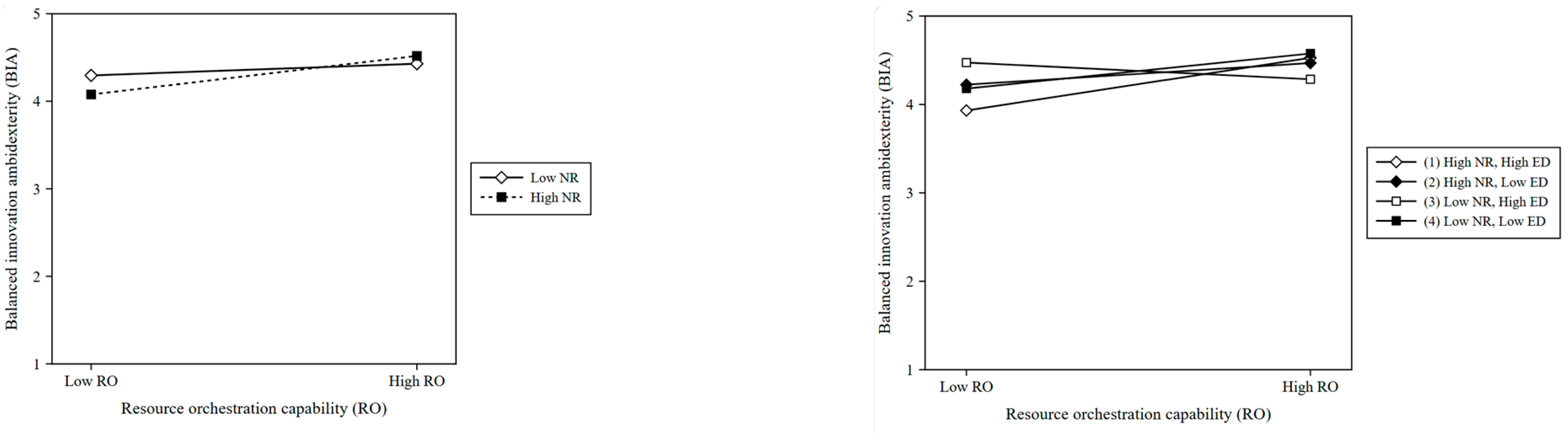
Figure A2.
Interaction effects of NR and ED on the relationship between RO and CIA. Note: RO refers to resource orchestration; CIA refers to combined innovation ambidexterity; NR refers to network responsiveness; ED refers to environmental dynamism.
References
- March, J.G. Exploration and exploitation in organizational learning. Organ. Sci. 1991, 2, 71–87. [Google Scholar] [CrossRef] [Scilit]
- Jansen, J.J.P.; Van Den Bosch, F.A.J.; Volberda, H.W. Exploratory innovation, exploitative innovation, and performance: Effects of organizational antecedents and environmental moderators. Manag. Sci. 2006, 52, 1661–1674. [Google Scholar] [CrossRef] [Scilit]
- Lee, I.H.; Lévesque, M. Do resource-constrained early-stage firms balance their internal resources across business activities? If so, should they? J. Bus. Res. 2023, 159, 113410. [Google Scholar] [CrossRef] [Scilit]
- Farzaneh, M.; Wilden, R.; Afshari, L.; Mehralian, G. Dynamic capabilities and innovation ambidexterity: The roles of intellectual capital and innovation orientation. J. Bus. Res. 2022, 148, 47–59. [Google Scholar] [CrossRef] [Scilit]
- Cao, Q.; Gedajlovic, E.; Zhang, H. Unpacking organizational ambidexterity: Dimensions, contingencies, and synergistic effects. Organ. Sci. 2009, 20, 781–796. [Google Scholar] [CrossRef] [Scilit]
- Ahuja, G. Collaboration networks, structural holes, and innovation: A longitudinal study. Adm. Sci. Q. 2000, 45, 425–455. [Google Scholar] [CrossRef] [Scilit] [PubMed]
- Tsai, W. Knowledge transfer in intraorganizational networks: Effects of network position and absorptive capacity on business unit innovation and performance. Acad. Manag. J. 2001, 44, 996–1004. [Google Scholar] [CrossRef] [Scilit]
- Ahuja, G.; Soda, G.; Zaheer, A. The genesis and dynamics of organizational networks. Organ. Sci. 2012, 23, 434–448. [Google Scholar] [CrossRef] [Scilit]
- Phelps, C.C. A longitudinal study of the influence of alliance network structure and composition on firm exploratory innovation. Acad. Manag. J. 2010, 53, 890–913. [Google Scholar] [CrossRef] [Scilit]
- Woods, J.; Galbraith, B.; Hewitt-Dundas, N. Network centrality and open innovation: A social network analysis of an SME manufacturing cluster. IEEE Trans. Eng. Manag. 2019, 69, 351–364. [Google Scholar]
- Jiang, Y.; Yang, Y.; Zhao, Y.; Li, Y. Partners’ centrality diversity and firm innovation performance: Evidence from China. Ind. Mark. Manag. 2020, 88, 22–34. [Google Scholar] [CrossRef] [Scilit]
- Lan, Y.; Massimino, B.J.; Gray, J.V.; Parker, G.G. The effects of product development network positions on product performance and confidentiality performance. J. Oper. Manag. 2020, 66, 866–894. [Google Scholar] [CrossRef] [Scilit]
- Reck, F.; Fliaster, A.; Kolloch, M. How to build a network that facilitates firm-level innovation: An integration of structural and managerial perspectives. J. Manag. Stud. 2022, 59, 998–1031. [Google Scholar]
- Ju, X.; Wang, G.; Fu, Y. Linking networking capability and ambidextrous innovation strategies: The mediating roles of knowledge assimilation application and knowledge transformation application. J. Knowl. Manag. 2023, 27, 1534–1561. [Google Scholar]
- Wang, Y.; Li, Z.; Lu, Y. Impact of degree centrality, structural holes, and network density of external corporate network ties on ambidextrous innovation. Can. J. Adm. Sci./Rev. Can. Sci. l’Adm. 2026, 43, e70027. [Google Scholar]
- Sirmon, D.G.; Hitt, M.A.; Ireland, R.D. Managing firm resources in dynamic environments to create value: Looking inside the black box. Acad. Manag. Rev. 2007, 32, 273–292. [Google Scholar] [CrossRef] [Scilit]
- Sirmon, D.G.; Hitt, M.A.; Ireland, R.D.; Gilbert, B.A. Resource orchestration to create competitive advantage: Breadth, depth, and life cycle effects. J. Manag. 2011, 37, 1390–1412. [Google Scholar]
- Carnes, C.M.; Chirico, F.; Hitt, M.A.; Huh, D.W.; Pisano, V. Resource orchestration for innovation: Structuring and bundling resources in growth- and maturity-stage firms. Long Range Plan. 2017, 50, 472–486. [Google Scholar] [CrossRef] [Scilit]
- D’Oria, L.; Crook, T.R.; Ketchen, D.J., Jr.; Sirmon, D.G.; Wright, M. The evolution of resource-based inquiry: A review and meta-analytic integration of the strategic resources-actions-performance pathway. J. Manag. 2021, 47, 1383–1429. [Google Scholar] [CrossRef] [Scilit]
- Kleinbaum, A.M.; Stuart, T.E. Network responsiveness: The social structural microfoundations of dynamic capabilities. Acad. Manag. Perspect. 2014, 28, 353–367. [Google Scholar] [CrossRef] [Scilit]
- Jia, Y.; Dong, B.; Luo, J.; Wang, X. Network orientation and new venture performance: A sequential mediation model based on relational learning and network responsiveness. South China J. Econ. 2020, 39, 92–107. [Google Scholar]
- He, Z.L.; Wong, P.K. Exploration vs. exploitation: An empirical test of the ambidexterity hypothesis. Organ. Sci. 2004, 15, 481–494. [Google Scholar] [CrossRef] [Scilit]
- Gupta, A.K.; Smith, K.G.; Shalley, C.E. The interplay between exploration and exploitation. Acad. Manag. J. 2006, 49, 693–706. [Google Scholar] [CrossRef] [Scilit]
- Guo, J.; Guo, B.; Zhou, J.; Wu, X. How does the ambidexterity of technological learning routine affect firm innovation performance within industrial clusters? The moderating effects of knowledge attributes. Technol. Forecast. Soc. Change 2020, 155, 119990. [Google Scholar] [CrossRef] [Scilit]
- Granovetter, M. Economic action and social structure: The problem of embeddedness. Am. J. Sociol. 1985, 91, 481–510. [Google Scholar] [CrossRef] [Scilit]
- Freeman, L.C. Centrality in social networks: Conceptual clarification. Soc. Netw. 1978, 1, 215–239. [Google Scholar] [CrossRef] [Scilit]
- Bonacich, P. Factoring and weighting approaches to status scores and clique identification. J. Math. Sociol. 1972, 2, 113–120. [Google Scholar] [CrossRef] [Scilit]
- Stuart, T.E.; Hoang, H.; Hybels, R.C. Interorganizational endorsements and the performance of entrepreneurial ventures. Adm. Sci. Q. 1999, 44, 315–349. [Google Scholar] [CrossRef] [Scilit]
- Hite, J.M.; Hesterly, W.S. The evolution of firm networks: From emergence to early growth of the firm. Strateg. Manag. J. 2001, 22, 275–286. [Google Scholar] [CrossRef] [Scilit]
- Li, W.; Veliyath, R.; Tan, J. Network characteristics and firm performance: An examination of the relationships in the context of a cluster. J. Small Bus. Manag. 2013, 51, 1–22. [Google Scholar] [CrossRef] [Scilit]
- Wales, W.J.; Patel, P.C.; Parida, V.; Kreiser, P.M. Nonlinear effects of entrepreneurial orientation on small firm performance: The moderating role of resource orchestration capabilities. Strateg. Entrep. J. 2013, 7, 93–121. [Google Scholar] [CrossRef] [Scilit]
- Son, B.G.; Ries, J.M.; Subramanian, N.; Kim, S. Bridging the innovation gap: Why organizational climate matters for leveraging innovation from supply networks. J. Supply Chain Manag. 2024, 60, 39–63. [Google Scholar] [CrossRef] [Scilit]
- Zhang, Z.; Luo, T. Network capital, exploitative and exploratory innovations: From the perspective of network dynamics. Technol. Forecast. Soc. Change 2020, 152, 119910. [Google Scholar] [CrossRef] [Scilit]
- Chen, Q.; Sun, T.; Wang, T. Network centrality, support organizations, exploratory innovation: Empirical analysis of China’s integrated circuit industry. Heliyon 2023, 9, e17709. [Google Scholar] [CrossRef] [Scilit] [PubMed]
- Wong, C.W.Y.; Wong, C.Y.; Boon-itt, S. How does sustainable development of supply chains make firms lean, green and profitable? A resource orchestration perspective. Bus. Strategy Environ. 2018, 27, 375–388. [Google Scholar] [CrossRef] [Scilit]
- Dhanaraj, C.; Parkhe, A. Orchestrating innovation networks. Acad. Manag. Rev. 2006, 31, 659–669. [Google Scholar] [CrossRef] [Scilit]
- Xie, X.; Sun, J.; Zhou, M.; Zhang, H. Network embeddedness and manufacturing SMEs’ green innovation performance: The moderating role of resource orchestration capability. Bus. Process Manag. J. 2024, 30, 884–908. [Google Scholar] [CrossRef] [Scilit]
- Mu, J.; Di Benedetto, C.A. Networking capability and new product development. IEEE Trans. Eng. Manag. 2012, 59, 4–19. [Google Scholar] [CrossRef] [Scilit]
- Li, Y.; Cui, L.; Wu, L.; Lowry, P.B.; Kumar, A.; Tan, K.H. Digitalization and network capability as enablers of business model innovation and sustainability performance: The moderating effect of environmental dynamism. J. Inf. Technol. 2024, 39, 687–715. [Google Scholar] [CrossRef] [Scilit]
- Jin, S.; Wang, J.; Zhu, P. Environmental scanning, resource orchestration, and disruptive innovation. R&D Manag. 2025, 55, 27–50. [Google Scholar] [CrossRef] [Scilit]
- Soto-Acosta, P.; Popa, S.; Martinez-Conesa, I. Information technology, knowledge management and environmental dynamism as drivers of innovation ambidexterity: A study in SMEs. J. Knowl. Manag. 2018, 22, 824–849. [Google Scholar] [CrossRef] [Scilit]
- Zahra, S.A.; Bogner, W.C. Technology strategy and software new ventures’ performance: Exploring the moderating effect of the competitive environment. J. Bus. Ventur. 2000, 15, 135–173. [Google Scholar]
- Wang, Y.; Liu, F. Network centrality and firm performance: Contingent roles of innovative ties, political ties and technological uncertainty. Res. Econ. Manag. 2019, 40, 113–127. [Google Scholar]
- Zhang, J.A.; O’Kane, C.; Chen, G. Business ties, political ties, and innovation performance in Chinese industrial firms: The role of entrepreneurial orientation and environmental dynamism. J. Bus. Res. 2020, 121, 254–267. [Google Scholar] [CrossRef] [Scilit]
- Tan, J.; Peng, M.W. Organizational slack and firm performance during economic transitions: Two studies from an emerging economy. Strateg. Manag. J. 2003, 24, 1249–1263. [Google Scholar] [CrossRef] [Scilit]
- Hayes, A.F. Introduction to Mediation, Moderation, and Conditional Process Analysis: A Regression-Based Approach, 3rd ed.; Guilford Press: New York, NY, USA, 2022. [Google Scholar]

Disclaimer/Publisher’s Note: The statements, opinions and data contained in all publications are solely those of the individual author(s) and contributor(s) and not of MDPI and/or the editor(s). MDPI and/or the editor(s) disclaim responsibility for any injury to people or property resulting from any ideas, methods, instructions or products referred to in the content. |
© 2026 by the authors. Licensee MDPI, Basel, Switzerland. This article is an open access article distributed under the terms and conditions of the Creative Commons Attribution (CC BY) license.