


Highlights
Please indicate how your work links to systems science via your contributions to sys-tems practice, theory, and or methodology.
- Frames Smart Factory transformation as a systems integration problem connecting data, decisions, feedback and value capture across manufacturing operations.
- Proposes a Data-Driven Operations Synchronization Stack to organize data capture, interoperability, analytics, closed-loop synchronization and operational value.
What are the main findings and/or the implications of the main findings?
- The reviewed literature is stronger in Smart Factory enablement than in explicit closed-loop operations synchronization.
- Value-stream coverage is uneven, with Quality and Assets less developed than Strategy, Make and Plan in synchronization research.
Abstract
Smart Factory programs increasingly connect shop-floor, quality, asset and planning data, but integrated data infrastructures do not necessarily align operational decisions. This paper reviews how smart manufacturing literature explains the transition from industrial data integration to closed-loop operations synchronization and value capture in high-throughput manufacturing contexts. Using the Systematic Search Flow method, 1949 records were screened and reduced to a final portfolio of 73 studies. The papers were coded by thematic cluster, dominant technology, research method, primary theme, value-stream coverage and operations-synchronization relevance. The coding shows that roadmaps, interoperability architectures, analytics applications and digital-twin models dominate the portfolio. Explicit operations-synchronization mechanisms are addressed in 16 of the 73 studies, mainly through planning-execution coupling and digital-twin-based decision support. Coverage across value streams is uneven, with stronger evidence for Strategy, Make and Plan than for Quality and Assets. Based on this evidence map, the paper proposes a Data-Driven Operations Synchronization Stack that links operational data capture, semantic and IT/OT interoperability, analytics-supported decision-making, closed-loop synchronization and operational or financial value capture.
1. Introduction
High-throughput manufacturing relies on data generated by planning, scheduling, production execution, quality control, asset management and delivery systems. Operational performance depends on converting these heterogeneous records into coordinated decisions at the cadence required by the line, the plant and supply-chain interfaces. This challenge is especially visible in high-throughput contexts, such as fast-moving consumer goods (FMCG), where demand volatility, short product life cycles, service-level pressure and quality losses can rapidly propagate across operations and supply-chain interfaces [1,2]. In such settings, operational performance depends both on local process efficiency and on the integration of information flows that connect plans, shop-floor states, asset conditions, quality feedback and delivery requirements [3,4].
Smart Factory and Industry 4.0 technologies have expanded the volume, velocity and granularity of manufacturing data. IoT (Internet-of-Things) and IIoT (Industrial IoT) infrastructures, cyber-physical systems, Manufacturing Execution Systems, analytics platforms, digital twins and optimization engines provide real-time or near-real-time operational intelligence [5,6,7]. Data availability and digital connectivity alone, however, do not ensure integrated decision-making. A factory may deploy sensors, dashboards and advanced analytics while still failing to align planning decisions, shop-floor execution, intralogistics, quality response, asset availability and performance outcomes. Earlier computer-integrated manufacturing and flexible manufacturing system programs already addressed automation, information flow and shop-floor integration. The present review starts from the Industry 4.0 and Smart Factory literature because its object is the data-driven transition from information integration to closed-loop operations synchronization.
In this review, operations synchronization is understood as the measurable alignment of planning, scheduling, execution and feedback decisions across manufacturing and supply-chain interfaces, based on traceable data, interoperable systems and closed-loop decision mechanisms [4,8]. From an industrial information integration perspective, a deployment-grade synchronization mechanism is understood as a documented data-to-decision loop that specifies the decision object, triggering event, data sources, system interfaces, decision cadence, responsible actor or automated routine, and KPI (Key Performance Indicator) used to evaluate the result. The term distinguishes implemented or implementation-ready synchronization mechanisms from broader descriptions of connectivity, visibility or analytics capability.
The literature on Smart Factory transformation has developed several relevant streams. One stream focuses on data-driven manufacturing infrastructures, including IoT, IIoT, cyber-physical systems, data architectures, analytics platforms and interoperability mechanisms [9,10,11,12]. A second stream examines analytics-enabled operational improvement, including predictive analytics, optimization, digital twins, simulation-based decision support and KPI-oriented performance management [13,14,15,16]. A third stream examines digital transformation roadmaps, maturity models and implementation guidelines that guide capability sequencing and adoption planning [17,18,19,20].
These streams identify relevant digital capabilities, but they do not consistently specify how those capabilities are assembled into synchronization loops that can be audited in operations. Much of the literature explains which digital capabilities are required, which technologies can be adopted, or how transformation programs can be structured. Less is known about how data capture, semantic interoperability, analytics, digital-twin decision support and governance mechanisms are configured into deployment-grade operations synchronization. This gap is especially relevant in brownfield manufacturing environments, where fragmented systems, heterogeneous semantics, legacy technologies and uneven data ownership constrain the transition from information integration to coordinated operational action.
The problem addressed in this paper is therefore how the literature documents the transition from Smart Factory enablement to synchronized operations. The analysis distinguishes information-integration capabilities that make operations visible, analytics and digital-twin mechanisms used for decision-making, and closed-loop synchronization mechanisms that translate decisions into measurable operational and financial outcomes. This framing positions Smart Factory transformation as an industrial information integration problem centered on data-to-decision alignment.
This review synthesizes 73 studies on data-driven Smart Factory transformation, operations synchronization and operational excellence. FMCG is used as a critical application context because its operational characteristics make synchronization specifically important, but the review also includes transferable manufacturing studies where data-driven integration, synchronization mechanisms or transformation components are applicable beyond a single sector.
The review is guided by three research questions: (1) How does the smart manufacturing literature define and operationalize data-driven operations synchronization?; (2) Which technologies, transformation mechanisms and value-stream domains are most frequently associated with operations synchronization?; (3) What evidence gaps limit the transition from Smart Factory enablement to auditable synchronization mechanisms and value capture?
The objective of the review is to examine how Smart Factory literature moves from data availability and information integration toward auditable operations-synchronization mechanisms. The analysis focuses on the documented links among data capture, interoperability, analytics, digital-twin decision support, feedback routines and KPI-based value attribution.
Methodologically, the study applies the Systematic Search Flow (SSF) approach. The initial search retrieved 1949 records, progressively filtered to a final portfolio of 73 studies. These studies were coded according to thematic cluster, dominant technology focus, research method, primary theme, value-stream coverage and operations-synchronization relevance.
Using this coded portfolio, the incremental contribution lies in separating three objects that are frequently combined in Smart Factory literature: digital enablement, integrated information structures and closed-loop operations synchronization. The paper documents how evidence is distributed across technologies, methods, themes and value-stream domains; identifies where synchronization is explicitly specified through decision loops or operational mechanisms; and organizes these findings into a Data-Driven Operations Synchronization Stack that links the reviewed evidence with an implementation-oriented systems view.
The remainder of the paper presents the conceptual background, methodology, evidence synthesis, proposed synchronization stack and research agenda.
2. Conceptual Background: From Smart Factory Enablement to Operations Synchronization
2.1. Smart Factory Enablement and Data-Driven Manufacturing
Given the complexity and volatility of disruptive value-chain environments, informed decision-making has become a strategic element in the resource-based view of firms [21,22]. In this review, Smart Factory enablement refers to the technological and data foundations that make manufacturing operations more visible, connected and analytically exploitable. These foundations include IoT and IIoT infrastructures, cyber-physical systems, data architectures, analytics platforms, interoperability mechanisms and data-engineering practices.
The integration of IoT technologies extends these capabilities by allowing real-time data acquisition and analysis, towards a more accurate situational assessment and rapid response to operational challenges [5,13,23]. Factory operations are also increasingly incorporating cyber-physical systems (CPS), which encompass manufacturing processes and activities such as planning, execution, production, quality assurance, operational adjustments and operational excellence [24,25]. These systems enable customized production processes and optimized machine utilization, relying on well-analyzed data in complex business environments [10].
Businesses collect large quantities of system data using technical protocols, transactional databases, radio-frequency tracking devices, sensory information and other forms of data capture and storage [6,7,26]. These systems integrate low-level hardware components with business operations, linking the fusion of Business Process Management (BPM) and IIoT [9,27]. In parallel, data-engineering principles, including well-defined data architecture design, efficient ingestion pipelines and reliable data transformation, enable the systematic exploitation of information [12,28,29].
Emerging technologies, including IoT/IIoT, cloud computing, machine learning, digital twins and optimization-powered analytics, are reshaping the connection between operations management and Smart Factory principles [30,31]. However, the presence of these technologies should not be interpreted as evidence of synchronization by itself. Data acquisition, connectivity and analytics readiness create the conditions for synchronization, but synchronization only occurs when these capabilities are embedded into decision mechanisms that align planning, scheduling, execution and feedback. Therefore, how analytics-ready data infrastructures translate into integrated decision models, closed-loop synchronization mechanisms and quantified operational improvements remains under-specified, specifically in FMCG and other high-throughput manufacturing contexts.
2.2. Operations Synchronization as a Closed-Loop Decision Problem
Operations synchronization is central to smart factories because the benefits of data-driven infrastructure and digital transformation materialize only when planning, scheduling, execution and feedback decisions remain consistently aligned across the shop floor, intralogistics and supply-chain interfaces [32]. In this review, operations synchronization is understood as a measurable alignment problem (Table 1). It involves coordinating decisions across time horizons, functions and value streams, while ensuring that deviations between planned and actual states trigger feedback, correction or re-planning mechanisms.
Table 1.
Conceptual boundaries used in this review.
From this perspective, synchronization is a closed-loop decision problem. It depends on the ability to detect operational states, interpret them through shared data and semantic structures, decide on corrective or optimizing actions, execute those actions through organizational routines or automated systems, and evaluate their effects through operational and financial indicators [6,8,33]. This loop connects Plan, Make, Quality, Assets and Deliver domains, and frames production execution as part of a cross-functional decision system.
Digital twins and related real-time, data-powered applications can assist synchronization by continuously updating policies and orchestrating manufacturing processes as operating conditions evolve [34]. However, implementation is often complex and costly, and many organizations struggle to integrate these approaches seamlessly across operations and processes [35]. This has intensified the need for integrated and interoperable analytics that bridge IT and OT and can be operationalized through Manufacturing Analytics System (MAS) to enable shared visibility and coordinated decision-making [7].
Importantly, the synchronization challenge requires alignment of decision structures, stakeholder engagement, communication and workflow coordination to translate analytics into improved business parameters such as cost [33]. Digital twins, simulation, optimization and real-time analytics are therefore relevant because they link planning and execution [8,16]. Their value lies in their capacity to update decisions as operating conditions change, making synchronization observable, actionable and measurable [8,36]. Nevertheless, when these mechanisms are demonstrated only through models, conceptual frameworks or isolated cases, their validity under industrial operating conditions remains uncertain.
2.3. Digital Transformation Roadmaps and Value Capture
The transition to Smart Factories is commonly framed as the transformation of systems and operations around a digital platform that handles data acquisition, processing, analytics and interoperability. In this program-embedding view, advanced analytics combines streaming and IoT data to improve real-time decision-making and supply-chain optimization, including manufacturing operations [37,38]. Typical capabilities include outcome prediction, discrete-event simulation, what-if planning and track-and-trace visibility, which together enable proactive responses to changes and disruptions [14,39].
In manufacturing contexts, KPIs can be used to gauge and optimize production schedules, mainly when a Manufacturing Execution System (MES) is used. This alignment between analytics, IoT data and MES functionality enables dynamic adjustments on the shop floor, improving efficiency, throughput and operational performance [22,40,41]. In high-throughput manufacturing contexts such as FMCG, additional decision-control layers can be created by fusing IIoT/BPM event loops with governed analytics, MAS and digital-twin optimization [16,42].
In practice, the combination of IIoT and BPM event loops with MAS and digital-twin optimization is reported to improve forecasting and dispatch accuracy and to stabilize plan-schedule-execution alignment on the shop floor [6,7,27]. The same stack can extend operational control to assets and intralogistics and reduce brownfield integration risk through reference architectures and maturity scaffolds [17,43,44]. Reported performance effects include higher service levels, shorter backlog, improved cost performance and finance-oriented metrics [11,15,16,33,36,38].
Digital transformation roadmaps, maturity models and implementation frameworks therefore give guidance for sequencing Smart Factory adoption. They help companies diagnose current capabilities, define target states, prioritize initiatives and structure the transition toward more data-driven operations [17,18,19,20]. However, the existence of a roadmap does not guarantee implemented synchronization routines. Many transformation frameworks identify capabilities such as connectivity, analytics, interoperability and organizational readiness, but give less detail on how these capabilities should be translated into specific decision loops, operational responsibilities, latency requirements, model governance practices and KPI-to-value attribution mechanisms [6,7,33].
The reviewed streams position data-driven smart factories, digital transformation architectures and synchronization mechanisms in adjacent but weakly connected bodies of work. Under brownfield constraints, the unresolved task is to connect these elements into operational blueprints that specify data sources, system interfaces, decision cadence, responsibilities and KPI-to-value attribution [11,44,45]. The synthesis therefore connects Smart Factory enablement, transformation components, synchronization requirements and analytics-driven outcomes.
3. Methodology
3.1. Review Design and Scope
The SSF method was used to identify, screen and synthesize the literature, following the structured logic proposed by Ferenhof and Fernandes [46]. The review was designed to examine how data-driven Smart Factory transformation, operations synchronization and operational excellence are connected in the manufacturing literature.
In line with the repositioning of this review, FMCG was not treated as the exclusive empirical boundary of the review. Instead, the search strategy combined FMCG and consumer-goods terms with broader smart manufacturing and data-driven operations terms. This allowed the review to capture both sector-specific studies and transferable evidence relevant to FMCG and other high-throughput manufacturing contexts. The review therefore focuses on the transition from Smart Factory enablement to operations synchronization and value capture. More specifically, it examines how digital infrastructures, analytics capabilities, transformation mechanisms and value-stream domains are represented in the literature, and whether they are explicitly connected to synchronization mechanisms.
The portfolio is focused on data-driven Smart Factory transformation, operations synchronization and value capture in high-throughput manufacturing contexts. Sector-specific manufacturing domains, including aerospace, machine tools, broaching and tool-wear monitoring, were considered relevant when they addressed the defined review object: data-driven integration, synchronization mechanisms, decision loops, interoperability, analytics-supported operational control or value capture.
3.2. Search Strategy and Selection Process
Scopus was selected as the primary database because of its interdisciplinary coverage of manufacturing, engineering, operations management and digital transformation research. Web of Science, IEEE Xplore and Emerald Insight were used as complementary databases due to their relevance for manufacturing technology, industrial systems, operations and management research.
The search strategy was organized into three keyword groups: Smart Factory transformation and data-driven digital initiatives; FMCG, consumer packaged goods and related high-throughput consumer-goods settings; and operations synchronization, operations integration and data analytics (Table 2). Together, these groups were intended to capture literature positioned at the intersection of digital manufacturing enablement, sectoral relevance and synchronization-oriented decision support.
Table 2.
Groups and Boolean logic used for the survey (a total of 1949 publications were found).
An adherence test was applied to the 1949 records initially retrieved. The inclusion criteria (Table 3) defined the review boundaries in terms of thematic relevance, citation impact, keyword coverage, publication quality, recency and language. Thematic relevance was assessed through explicit FMCG focus and through transferability to FMCG-relevant manufacturing settings. Accordingly, studies were retained when they addressed Smart Factory transformation, data-driven I4.0, operations synchronization, operational excellence, manufacturing analytics or related decision-support mechanisms in contexts that could inform high-throughput manufacturing operations.
Table 3.
Study inclusion criteria and selection specifications.
Citation impact was used as a screening support variable, not as a stand-alone measure of study quality. For older publications, citation counts helped identify established and influential contributions within each keyword group. For recent publications, especially studies published from 2022 onward, low citation counts were not used as an automatic exclusion criterion because citation accumulation is time-dependent. These recent records were retained when they were peer-reviewed, full-text accessible and directly relevant to Smart Factory transformation, operations synchronization, manufacturing analytics, interoperability, digital twins or high-throughput manufacturing contexts. This age-sensitive use of citation impact allowed the review to include both established contributions and recent studies addressing emerging synchronization mechanisms.
Following the SSF procedure, the initial 1949 records were filtered to 1521 records after limiting by language and publication type. Duplicate removal reduced the dataset to 1343 records. Application of the adherence criteria further reduced the corpus to 105 records, and the final portfolio comprised 73 studies after full-text availability and complete reading were confirmed (Table 4).
Table 4.
Systematic Search Flow screening and selection outcomes.
3.3. Clustering and Synthesis Structure
Before full-text analysis, the selected studies were mapped to three predefined thematic clusters (Table 5). Cluster A, Data-Driven Smart Factory, captures contributions focused on digital and data infrastructures that enable data and analytics capabilities at factory level. Cluster B, Operations Synchronization and Operational Excellence, covers studies applying data and analytics to operational improvement, decision support and synchronization mechanisms. Cluster C, Factory Digital Transformation, includes studies addressing transformation strategy, maturity/readiness assessment, capability development and roadmapping.
Table 5.
Thematic cluster and key characteristic taxonomy.
The full-text analysis was then organized through a coding matrix covering dominant technology focus, methodological profile, primary theme, industry context, value-stream coverage and operations-synchronization relevance. This matrix was used to separate general Smart Factory enablement from studies that specified decision loops, analytics mechanisms, digital-twin models, KPI structures or implementation pathways. The detailed coding rules, evidence-appraisal logic and bias-control safeguards are reported in Section 3.4.
The retained evidence was synthesized through three lenses. First, studies were mapped according to the value-stream domains where data-driven or I4.0 capabilities are applied, namely Plan, Make, Quality, Assets, Deliver and Strategy. Second, the analysis examined whether these capabilities were linked to operations-synchronization mechanisms, as evidenced by reported methods, decision loops, KPIs or implementation pathways. Third, the synthesis identified recurrent misalignments and evidence gaps, including semantic inconsistencies, limited multi-site validity, weak decision-grade deployment evidence and inconsistent KPI-to-value attribution.
3.4. Coding Protocol, Evidence Appraisal and Bias-Control Safeguards
The final portfolio was treated as a coded evidence base, with each record retained only when its full text allowed the extraction of methodological, technological and operational information. Full-text access included open-access articles, institutional subscription access, publisher-hosted files and other legally accessible full-text versions. Abstract-only records were excluded because they did not contain enough information to code the technological focus, method profile, value-stream coverage, operations-synchronization relevance and evidence type. The final set of 73 studies was verified through title and DOI checking, duplicate removal, full-text reading and consistency checking against the coding matrix used to construct Table 6, Table 7, Table 8, Table 9 and Table 10 and Appendix A Table A1.
Table 6.
Evolutionary phases of the Smart Factory literature and associated publications.
Table 7.
Method categories, outputs/artefacts, and mapped studies.
Table 8.
Distribution of Smart factory technologies across thematic clusters: A, data-driven Smart Factory; B, operations synchronization & operational excellence; C, factory digital transformation.
Table 9.
Distribution of primary themes over the publications studied.
Table 10.
Smart Factory technologies by methodological profile, as classified in Table 7. (1) Conceptual—MP1; (2) Empirical/case study (MP2); (3) Computational/model-based (MP3); (4) Synthesis/review (MP4).
The screening procedure used citation impact as an age-sensitive screening signal, while thematic fit, peer-reviewed publication status, full-text availability and coding relevance determined whether a record entered the final analysis. Older publications with higher citation counts were used to identify established contributions within each keyword group. Recent papers, especially those published from 2022 onward, were assessed mainly through topical relevance, methodological fit and full-text availability, because citation accumulation depends on publication age. Venue indexing established publication status, while the interpretation of evidence quality was based on the appraisal rules described below.
The coding process followed a two-stage procedure. One author performed the first full-text coding using a coding matrix covering thematic cluster, dominant technology, research method, primary theme, industry context, value-stream coverage and operations-synchronization relevance. Borderline records were then reviewed against the coding definitions and discussed by the authors until a consensus classification was reached. The 12 themes were assigned from the dominant problem focus and artefact reported in each paper, such as roadmap, maturity model, interoperability architecture, analytics method, digital-twin model, KPI logic or synchronization routine. The Op-Sync marker was assigned only when a study linked data-driven capabilities to the alignment of planning, scheduling, execution, feedback, quality, assets or delivery through a reported decision loop, model, implementation pathway, KPI structure or operational mechanism. General references to connectivity, visibility, analytics readiness or digital transformation were coded as Smart Factory enablement unless the paper specified a traceable decision mechanism.
The six value-stream categories were used as analytical domains for locating where each study positioned its data-driven or synchronization contribution. Plan captured planning, scheduling, forecasting and decision-preparation mechanisms; Make captured production execution and shop-floor control; Quality captured inspection, nonconformity, quality feedback and process-quality stabilization; Assets captured maintenance, equipment condition, reliability and asset availability; Deliver captured logistics, service level, distribution and supply-chain coordination; Strategy captured transformation roadmaps, maturity models, investment logic and organizational alignment. Multiple value-stream coding was allowed when a paper explicitly addressed more than one domain. Primary-theme coding remained single-assignment, while value-stream coding captured non-exclusive coverage across operational domains.
Evidence strength was appraised according to the type of study, using criteria aligned with conceptual, empirical, computational and review-based contributions. Conceptual and roadmap papers were appraised for construct clarity, architecture logic, implementation sequence and relation to existing industrial reference models. Empirical and case-based papers were appraised for industrial context, data source, process description, KPI reporting and replication potential. Computational and model-based papers were appraised for model assumptions, operational-data linkage, calibration or validation procedure and decision-use case. Review and synthesis papers were appraised for search transparency, taxonomy clarity and traceability between evidence and stated gaps. This appraisal guided the strength of interpretation assigned to each evidence group after corpus selection.
Several bias-control safeguards were applied during synthesis. Citation bias was bounded by treating citation counts as a screening support variable and by retaining recent low-citation papers when they matched the review scope and contained codable evidence. Publication bias was bounded by using multiple databases covering engineering, manufacturing, operations and management outlets. Availability bias was bounded by defining full-text access as a coding requirement and by interpreting the final portfolio as an evidence map of accessible and codable studies. Sectoral transferability was handled by retaining manufacturing studies outside FMCG only when they addressed high-throughput-relevant mechanisms, including repetitive production, short decision cadence, planning-execution coupling, quality-loss propagation, asset availability, supply-chain coordination or service-level pressure. The numerical results are therefore interpreted as within-portfolio evidence patterns, with the discussion focused on mechanisms, coding categories and evidence strength.
4. Results: Evidence Profile and Synchronization Patterns
This section reports the results of the final portfolio of 73 studies. The purpose is to identify how the literature connects Smart Factory enablement, transformation mechanisms and operations synchronization. The results are organized around three analytical questions: how mature the evidence base is, which technologies and themes dominate the literature, and where synchronization is explicitly operationalized across value streams.
4.1. Evidence Profile and Maturation of the Literature
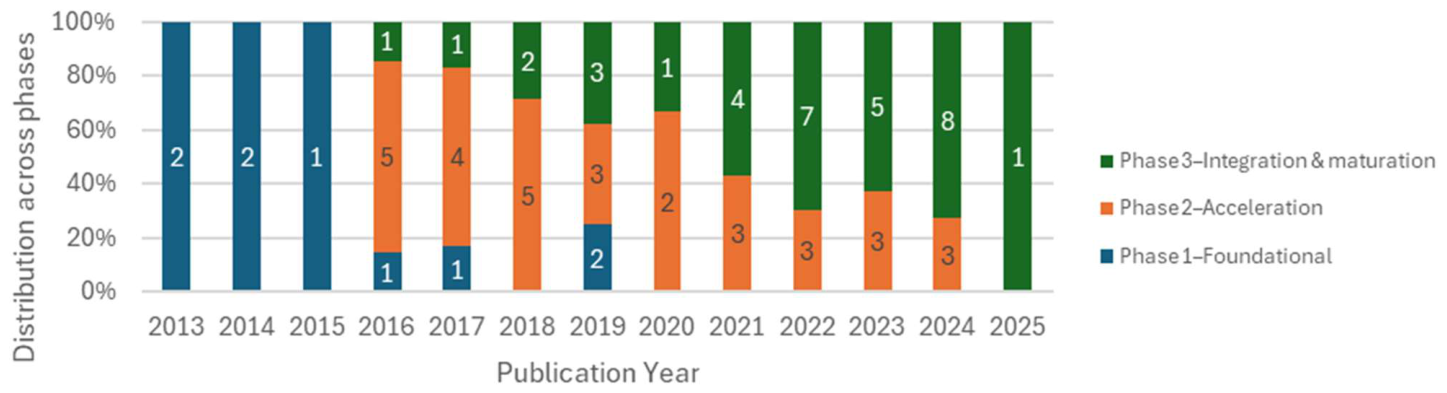
Figure 1 summarizes the annual distribution of the final coded portfolio, while Table 6 classifies the 73 studies into three maturity phases: foundational, acceleration, and integration/maturation. The phases overlap in publication years, so they should not be read as strictly separated chronological periods. For coding purposes, each study was assigned to one dominant phase according to its main contribution: conceptual and architectural foundations, implementation and roadmapping, or integration-oriented decision support. Table 6 therefore uses the phases as an analytical classification of the portfolio, showing how the literature has shifted from defining Smart Factory building blocks toward implementation guidance and, more recently, toward data-driven integration and closed-loop decision support. However, the evidence base has not yet fully stabilized the mechanisms through which these components operate as synchronized decision loops in industrial settings.
Figure 1.
Annual distribution of publications in the final coded portfolio (n = 73), by year and identified phase.
The portfolio is still dominated by conceptual and structuring contributions (Table 7). Conceptual studies account for the largest share of the sample (n = 36), followed by empirical/case-based studies (n = 14), synthesis/review studies (n = 12) and computational/model-based studies (n = 11). This profile shows that the literature is stronger in frameworks, roadmaps and capability structuring than in large-scale empirical validation of synchronization mechanisms.
Empirical studies add grounding by identifying constraints such as data availability, IT/OT (information technology/operational technology) integration gaps and organizational frictions. Computational and model-based studies contribute to the formalization of decision support through optimization, simulation and digital twins. However, their reliance on assumptions and controlled settings reinforces the need for calibration and validation using operational data.
An analysis of the geographic distribution of authorship was also conducted, with detailed results reported in Appendix A Figure A1. The portfolio is Europe-led, with additional contributions from Asia and North America and limited representation from other regions. This concentration shows that the evidence base is shaped by industrial contexts where Smart Factory roadmapping, interoperability and digital manufacturing initiatives are more established. It also cautions against generalizing synchronization mechanisms without stronger multi-site, cross-region and longitudinal validation.
4.2. Finding 1: Smart Factory Research Is Dominated by Transformation Scaffolding and Analytics-Enabled Value Realization
The first finding is that transformation scaffolding and analytics-enabled value realization dominate the portfolio, while fully specified synchronization mechanisms form a narrower evidence stream.
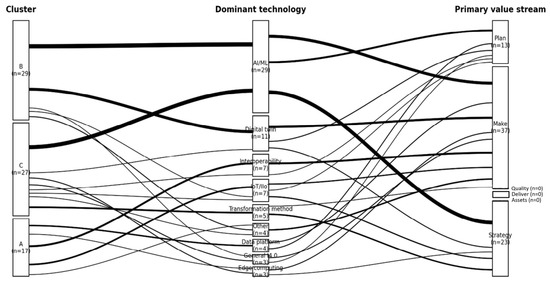
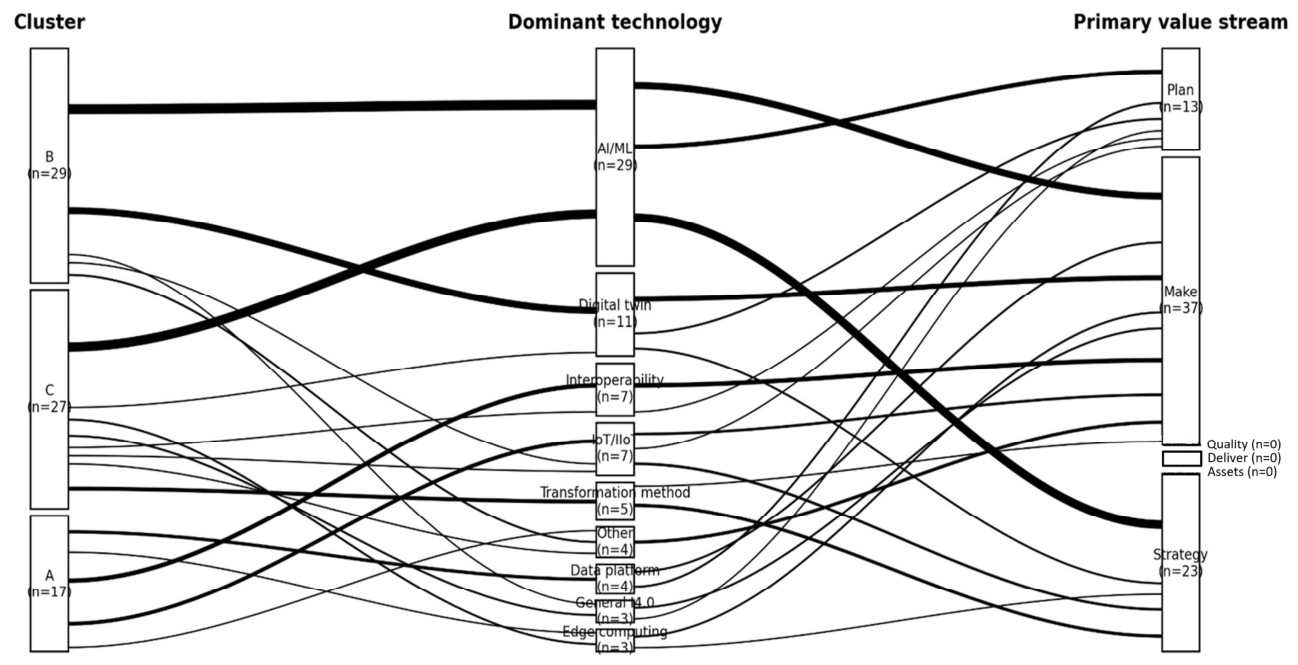
The technology-cluster analysis shows that Big Data Analytics, Artificial Intelligence (AI) and Machine Learning (ML) form the dominant technology category, with 29 papers, approximately 40% of the portfolio (Figure 2). These studies are mainly positioned in Cluster B and Cluster C, where analytics is associated with operational improvement, decision support and transformation framing (Table 8). Digital twins form the second largest technology stream, with 11 papers, approximately 15%, and are strongly concentrated in Cluster B, reflecting their role as synchronization and decision-loop artefacts.
Figure 2.
Alluvial overview of the SSF final portfolio (n = 73): Cluster, dominant technology, primary value stream. Flow widths are proportional to the number of studies. Each study is assigned to one cluster (A–C) and one dominant technology label; technology categories are shown for the eight most frequent labels, with the remainder grouped as “Other”.
By contrast, infrastructure-oriented technologies are less dominant as primary objects of study. Interoperability/reference architectures and IoT/IIoT each account for 7 papers, approximately 10% each. This pattern shows that the literature discusses value realization largely through analytics and digital twins, while the data-platform and governance foundations that often constrain synchronization are less developed as a sustained empirical stream.
The primary-theme distribution (Table 9) reinforces this interpretation. Roadmapping and implementation guidelines form the largest theme, with 19 papers, approximately 26%. Interoperability and reference architectures account for 10 papers, approximately 14%, followed by digital twin and simulation-based decision support with 9 papers, approximately 12%, and Supply Chain 4.0, resilience and risk analytics with 8 papers, approximately 11%.
The coded evidence concentrates on roadmaps, maturity constructs, interoperability architectures, analytics and digital twins. Operational-control routines are less frequently specified, especially where synchronization requires decision cadence, responsible actors, feedback rules and KPI-based evaluation. This evidence answers RQ2 by showing which technologies and transformation mechanisms dominate the portfolio and where the gap remains between transformation scaffolding and measurable synchronization routines.
4.3. Finding 2: Synchronization Evidence Is Concentrated Around Digital Twins, but Remains Weakly Validated
The Op-Sync coding shows that operations synchronization is a narrower research object than Smart Factory enablement or analytics adoption. Each paper was coded with an Op-Sync marker to identify studies that linked data-driven capabilities to the alignment of planning, scheduling, execution, feedback, quality, assets or delivery mechanisms.
Only 16 of the 73 papers, approximately 22%, were coded as containing a substantive operations-synchronization contribution. Although synchronization is frequently used as a motivation for Smart Factory transformation, relatively few studies formalize, model or empirically show synchronization mechanisms.
Within the Op-Sync subset (Table 10), digital twins are the dominant technology label, accounting for 7 of the 16 papers. These contributions are frequently computational or model-based, which shows that the literature tends to show synchronization through simulation, optimization or model-driven decision support. This distribution identifies digital twins as the clearest mechanism in the reviewed portfolio for linking planning and execution. At the same time, much of this evidence comes from computational models, simulations or isolated cases, leaving limited replicated industrial validation.
This finding relates to RQ1 and RQ3. For RQ1, it shows that integrated operational models are emerging most clearly through digital twins and related decision-support architectures. For RQ3, it shows that the evidence remains insufficient to claim broad performance improvement under replicated industrial conditions, because synchronization mechanisms are still often demonstrated through models, simulations or isolated cases, with limited longitudinal and multi-site industrial evidence.
4.4. Finding 3: Value-Stream Coverage Is Concentrated in Strategy, Make and Plan
The third finding concerns the distribution of synchronization-relevant evidence across value streams (Appendix A Table A1). Most studies are tagged to Strategy (39 papers, approximately 53%), Make (37 papers, approximately 51%) and Plan (33 papers, approximately 45%). This shows that the literature concentrates on transformation framing and on decision domains closest to planning, scheduling and production execution.
Deliver receives moderate coverage, with 16 papers, approximately 22%, mainly through Supply Chain 4.0, resilience and collaboration perspectives. By contrast, Assets (11 papers, approximately 15%) and especially Quality (7 papers, approximately 10%) are weakly represented as explicit synchronization domains. This imbalance is important because quality stability and asset availability are often binding constraints in FMCG and other high-throughput manufacturing environments.
The value-stream profile therefore shows that synchronization is still treated unevenly across the operational system. The strongest evidence concerns planning-execution coupling, through digital-twin and real-time decision-support approaches [8,15], while the integration of quality feedback, asset condition and delivery coordination into closed-loop mechanisms remains less mature. A synchronization model that concentrates mainly on Plan and Make risks underrepresenting constraints determining whether plans can be executed reliably. This finding reinforces the need for a broader synchronization framework that connects data capture, interoperability, analytics, and value capture across all relevant value streams [6,7]. It also supports the practical relevance of the review for FMCG and related high-throughput settings, where quality losses and delivery disruptions can rapidly propagate across the system.
Across the 73 coded studies, synchronization evidence is concentrated in planning and production-execution domains. Strategy appears in 39 studies, Make in 37 and Plan in 33. Deliver is represented in 16 studies, while Assets and Quality appear in 11 and 7 studies, respectively. This distribution shows that synchronization is mostly examined through transformation framing and planning-execution coupling, with weaker coverage of quality feedback, asset condition and cross-value-stream validation. Section 5 uses this evidence pattern to structure the Data-Driven Operations Synchronization Stack.
5. Discussion: The Data-Driven Operations Synchronization Stack
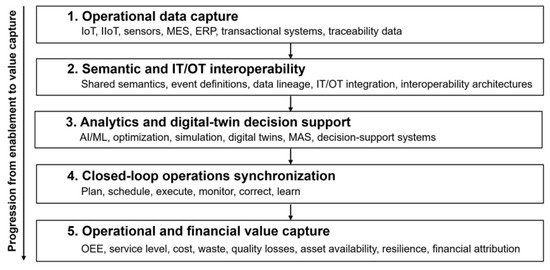
Section 4 shows that the reviewed literature describes Smart Factory technologies, transformation roadmaps and analytics-enabled decision support. However, the evidence remains less mature in explaining how these elements become explicit synchronization mechanisms at production cadence. Section 5 uses this evidence pattern to define a review-derived Data-Driven Operations Synchronization Stack (Figure 3), which separates the layers connecting digital enablement, closed-loop synchronization and value capture.
Figure 3.
Data-driven operations synchronization Stack.
The stack is a conceptual synthesis derived from the reviewed literature, showing how different research streams connect: data capture, interoperability, analytics, synchronization and value realization. It contains five layers: (1) operational data capture; (2) semantic and IT/OT interoperability; (3) analytics and digital-twin decision support; (4) closed-loop operations synchronization; and (5) operational and financial value capture.
Table 11 maps the five layers to the coded evidence base and separates the elements directly observed in the portfolio from the interpretive synthesis proposed in this paper. The term Stack is used here to denote a layered conceptual architecture derived from the coded literature, organizing the sequence of capabilities required for auditable synchronization: operational data capture, semantic and IT/OT interoperability, analytics and digital-twin decision support, closed-loop decision feedback, and operational or financial value attribution. The first three layers are strongly represented in the reviewed literature through IoT/IIoT, interoperability architectures, data platforms, analytics and digital-twin studies. The fourth and fifth layers are more selective because they require explicit decision loops, operational feedback and KPI-to-value attribution. The Stack therefore uses RAMI 4.0 and ISA-95-type logic as integration references, while organizing the reviewed evidence around synchronization and value-capture mechanisms.
Table 11.
Evidence-to-framework mapping for the data-driven operations synchronization Stack.
The first layer, operational data capture, represents the foundation of Smart Factory enablement. IoT, IIoT, sensors, MES data, transactional systems and traceability technologies expand operational visibility and create the data conditions required for faster decision-making [5,13,23,78]. However, the findings indicate that visibility should not be confused with synchronization. Data capture supplies the raw material for synchronization, but does not define how decisions are coordinated, how deviations are interpreted or how corrective actions are triggered.
The second layer, semantic and IT/OT interoperability, covers the transformation of heterogeneous operational data into shared information. This layer is critical because synchronization requires common meanings across systems and value streams. Without stable semantics, event definitions, data lineage and IT/OT integration, analytics outputs may remain local, or difficult to scale [9,12,29]. This is mainly relevant in brownfield environments, where legacy systems and fragmented data ownership constrain deployment [11,45].
The third layer, analytics and digital-twin decision support, converts integrated data into operational intelligence [79]. Across the portfolio, Big Data Analytics, AI/ML, optimization, simulation and digital twins form the dominant technology base for value realization [14,16,28]. Digital twins are especially relevant because they offer one of the clearest mechanisms for linking planning, scheduling, execution and feedback [8,15,36]. Nevertheless, the results show that many analytics and digital-twin contributions remain computational, model-based or limited to isolated cases.
The fourth layer, closed-loop operations synchronization, is the core of the stack. Synchronization requires explicit decision loops connecting planning, scheduling, execution, monitoring, correction and learning [4,6,8]. A deployment-grade synchronization mechanism should specify the decision object, the triggering event, the decision cadence, the responsible actor or system, and the KPI or value measure used to evaluate the outcome. These elements turn synchronization from a broad aspiration into an auditable operational capability.
The fifth layer, operational and financial value capture, concerns the translation of synchronization into measurable outcomes. The reviewed studies report potential benefits such as responsiveness, schedule stability, throughput, service level, cost performance and operational reliability [33,38,44]. However, KPI improvements are not consistently connected to financial attribution. This limits managerial justification for scaling Smart Factory initiatives.
At plant level, the stack can be used as a diagnostic sequence: the field should move from studying Smart Factory enablement as a collection of technologies toward studying synchronization as a measurable closed-loop capability. For researchers, the stack offers a structure for positioning future contributions across layers. For practitioners, it offers a diagnostic logic for transformation roadmaps: companies should verify whether data are captured reliably, whether systems and semantics are interoperable, whether analytics are governed and deployable, whether decision loops are explicit, and whether operational gains can be translated into financial and resilience outcomes. For FMCG and other high-throughput manufacturing environments, this also means expanding synchronization beyond Plan and Make to include Quality, Assets and Deliver, since quality instability, asset degradation and delivery disruptions often determine whether plans can be executed effectively.
6. Conclusions, Research Agenda and Future Work
This review examined how smart manufacturing literature connects Smart Factory enablement, industrial information integration, analytics-enabled decision support and operations synchronization, with particular relevance to FMCG and other high-throughput manufacturing contexts. The synthesis of 73 studies shows that the field has developed substantial knowledge on transformation roadmaps, interoperability architectures, analytics applications and digital-twin models. However, it remains less mature in explaining how these elements become measurable closed-loop synchronization mechanisms across planning, execution, quality, assets and delivery.
The paper provides three specific outputs. First, it reframes operations synchronization as a deployment mechanism that links industrial information integration to operational value through documented data-to-decision loops. Second, it sets out an evidence map organized through thematic, technological, methodological and value-stream coding, showing where synchronization is explicitly addressed and where it remains implicit. Third, it proposes the Data-Driven Operations Synchronization Stack as a conceptual synthesis of the transition from data capture and semantic and IT/OT interoperability to analytics-supported decision-making, closed-loop synchronization and value capture.
The coded portfolio shows an imbalanced evidence base. Conceptual studies account for 36 of the 73 publications, followed by empirical/case-based studies (14), synthesis/review studies (12) and computational/model-based studies (11). Synchronization-specific evidence is narrower: 16 studies contain a substantive operations-synchronization contribution, and 7 of these 16 are digital-twin centred. Value-stream coverage is also uneven, with Strategy, Make and Plan dominating the portfolio and Quality and Assets appearing in 7 and 11 studies, respectively.
Four conclusions follow from the evidence map: Smart Factory research remains stronger in enablement than in auditable synchronization; digital twins are the clearest synchronization artefact but remain weakly validated across sites; Strategy, Make and Plan dominate the evidence base while Quality and Assets are less developed; and future studies should treat synchronization as auditable data-to-decision loops.
The research agenda emerging from this review is summarized in Table 12. Future studies should report synchronization mechanisms as auditable data-to-decision loops, including triggering events, decision cadence, responsible actors or systems, data lineage, interoperability assumptions, latency requirements, model governance and KPI-to-value attribution. This would improve comparability across studies and show whether proposed architectures can operate at production cadence in brownfield environments.
Table 12.
Research agenda for deployment-grade operations synchronization.
Three limitations should be considered. First, FMCG implications are transfer-oriented, because most studies address manufacturing-general contexts and only a subset is exclusively FMCG-specific. Second, the evidence base remains dominated by conceptual and model-based contributions, with fewer longitudinal, multi-site or replication-oriented empirical studies. Third, heterogeneous reporting of synchronization definitions, data lineage, decision cadence, model governance and value attribution limits cross-study comparability.
These limitations also define the boundary of the proposed Stack, derived from a coded literature portfolio and from evidence-to-framework synthesis; it was not validated through expert panels, industrial pilots or longitudinal implementation measurement. Its current status is therefore conceptual and diagnostic. It can be used to locate missing elements in Smart Factory transformation projects, but future work must test whether the five layers operate as a repeatable sequence under production-cadence conditions.
Future validation should compare the Stack with industrial evidence from different manufacturing environments. High-throughput sectors such as FMCG require short decision cadence, quality-loss propagation control, asset availability and service-level stability. Other sectors, including aerospace, advanced machining and low-volume/high-complexity manufacturing, may require different validation criteria because certification requirements, process variability, technology-readiness pathways and equipment-specific constraints shape how synchronization is achieved. These contexts should be examined through case studies, cross-site comparisons, expert review, architecture mapping against RAMI 4.0 and ISA-95-type models, and empirical tracking of data-to-decision loops from event detection to KPI or financial outcome.
The reviewed literature now extends from generic digital enablement toward deployment-grade operations synchronization, while the evidence still lacks longitudinal, multi-site validation of synchronization routines. By organizing the evidence through the Data-Driven Operations Synchronization Stack, this review shows how industrial information integration can progress from visibility and connectivity toward governed decision loops, measurable synchronization and value capture.
Author Contributions
Conceptualization, A.Y.I.E. and P.P.; methodology, A.Y.I.E.; validation, A.Y.I.E. and P.P.; formal analysis, P.P.; investigation, A.Y.I.E.; data curation, A.Y.I.E.; writing—original draft preparation, A.Y.I.E.; writing—review and editing, P.P.; visualization, P.P.; supervision, P.P.; funding acquisition, P.P. All authors have read and agreed to the published version of the manuscript.
Funding
The authors acknowledge Fundação para a Ciência e a Tecnologia (FCT) for its financial support via LAETA (project https://doi.org/10.54499/UID/50022/2025). This work has been supported by the European Union under the Next Generation EU, through a grant of the Portuguese Republic’s Recovery and Resilience Plan (PRR) Partnership Agreement, within the scope of the project PRODUTECH R3—“Agenda Mobilizadora da Fileira das Tecnologias de Produção para a Reindustrialização”, Total project investment: 166,988,013.71 Euros; Total Grant: 97,111,730.27 Euros.
Institutional Review Board Statement
Not applicable.
Informed Consent Statement
Not applicable.
Data Availability Statement
Data are available upon request.
Acknowledgments
During the preparation of this manuscript/study, the authors used ChatGPT 5.4 for the purposes of checking for references citation and formatting alignment with Systems style. The authors have reviewed and edited the output and take full responsibility for the content of this publication.
Conflicts of Interest
The authors declare no conflicts of interest. The funders had no role in the design of the study; in the collection, analyses, or interpretation of data; in the writing of the manuscript; or in the decision to publish the results.
Abbreviations
The following abbreviations are used in this manuscript:
| AHP | Analytic hierarchy process |
| AI | Artificial intelligence |
| Auto-ID | Automatic identification |
| BPM | Business Process Management |
| CPG | Consumer packaged goods |
| CPS | Cyber-physical systems |
| DEMATEL | Decision-Making Trial and Evaluation Laboratory |
| DT | Digital twin |
| FCT | Fundação para a Ciência e a Tecnologia |
| FMCG | Fast-moving consumer goods |
| I4.0 | Industry 4.0 |
| IIoT | Industrial Internet of Things |
| IoT | Internet of Things |
| ISM | Interpretive structural modeling |
| IT | Information technology |
| IT/OT | Information technology/operational technology |
| KPI | Key performance indicator |
| MAS | Manufacturing Analytics System |
| MCDA | Multi-criteria decision analysis |
| MDP | Markov decision process |
| MES | Manufacturing Execution System |
| ML | Machine learning |
| MLOps | Machine learning operations |
| MP | Methodological profile |
| OEE | Overall equipment effectiveness |
| Op-Sync | Operations synchronization |
| OT | Operational technology |
| PRR | Plano de Recuperação e Resiliência |
| RFID | Radio-frequency identification |
| RL | Reinforcement learning |
| RQ | Research question |
| SME | Small and medium-sized enterprise |
| SSF | Systematic Search Flow |
| WoS | Web of Science |
Appendix A
Figure A1.
Geographic Distribution of Authorship.
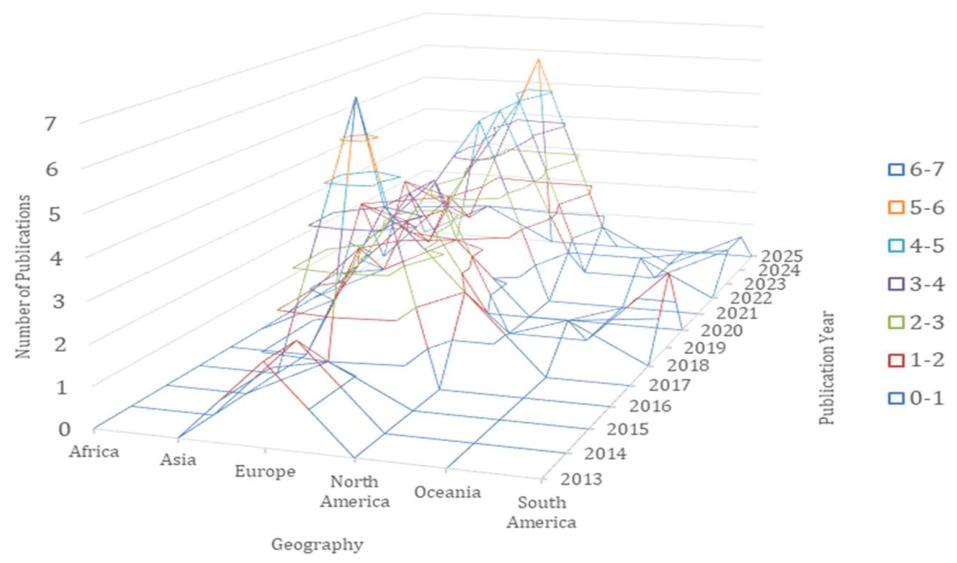
Table A1.
Value Stream–Technology Matrix: Paper Count, Cluster Spread, Evidence Profile, and Op-Sync.
References
- Nwachukwu, E.E.; Ighravwe, D.E.; Ajayi, S.T.; Amole, A.O.; Etangetuk, E.A.; Aikhuele, D.O.; Ogundijo, M.O. Analysis of Supply Chain Management Internal Process Criteria for Fast Moving Consumer Goods. In Proceedings of the 2024 International Conference on Science, Engineering and Business for Driving Sustainable Development Goals (SEB4SDG); IEEE: New York, NY, USA, 2024; pp. 1–6. [Google Scholar] [CrossRef] [Scilit]
- Radebe, B.; Ayomoh, M.; Yadavalli, S. Integrated Big Data Analytics Conceptual Framework for Information Sharing across the fast-moving consumer goods industry. In Proceedings of the 2022 IEEE Asia-Pacific Conference on Computer Science and Data Engineering (CSDE); IEEE: New York, NY, USA, 2022; pp. 1–6. [Google Scholar] [CrossRef] [Scilit]
- Alicke, K.; Rexhausen, D.; Seyfert, A. Supply Chain 4.0 in Consumer Goods. McKinsey & Company. 6 April 2017. Available online: https://www.mckinsey.com/industries/consumer-packaged-goods/our-insights/supply-chain-4-0-in-consumer-goods (accessed on 27 June 2026).
- Knapp, F.; Antons, O.; Arlinghaus, J.C. Opportunities for Synchronization in Manufacturing as Key Performance Indicator. Procedia CIRP 2022, 107, 1467–1472. [Google Scholar] [CrossRef] [Scilit]
- Kumar, B.; Sharma, A. Managing the supply chain during disruptions: Developing a framework for decision-making. Ind. Mark. Manag. 2021, 97, 159–172. [Google Scholar] [CrossRef] [Scilit]
- Seiger, R.; Malburg, L.; Weber, B.; Bergmann, R. Integrating process management and event processing in smart factories: A systems architecture and use cases. J. Manuf. Syst. 2022, 63, 575–592. [Google Scholar] [CrossRef] [Scilit]
- Senoner, J.; Kratzwald, B.; Philippsen, R.; Netland, T. Manufacturing Analytics System: A New IT Category Enabling Next-Level Operational Excellence. IFAC-Pap. 2024, 58, 831–835. [Google Scholar] [CrossRef] [Scilit]
- Jiang, Y.; Li, M.; Li, M.; Liu, X.; Zhong, R.Y.; Pan, W.; Huang, G.Q. Digital twin-enabled real-time synchronization for planning, scheduling, and execution in precast on-site assembly. Autom. Constr. 2022, 141, 104397. [Google Scholar] [CrossRef] [Scilit]
- Ferreira, J.; De Beca, M.F.; Agostinho, C.; Nunez, M.J.; Jardim-Goncalves, R. Standard Blueprints for Interoperability in Factories of the Future (FoF). IFAC Proc. Vol. 2013, 46, 1322–1327. [Google Scholar] [CrossRef] [Scilit]
- Wu, W.; Lu, J.; Zhang, H. Smart Factory Reference Architecture Based on CPS Fractal. IFAC-Pap. 2019, 52, 2776–2781. [Google Scholar] [CrossRef] [Scilit]
- Gröger, C. Building an Industry 4.0 Analytics Platform: Practical Challenges, Approaches and Future Research Directions. Datenbank-Spektrum 2018, 18, 5–14. [Google Scholar] [CrossRef] [Scilit]
- González-Velázquez, R.; Fernández, I.; Ferreira, R.; Carballo, C.; García, Á.; Santamaría, B.; González, D. Smart Factory Hub—Towards a Data Mesh in Smart Manufacturing. Procedia Comput. Sci. 2024, 232, 2709–2719. [Google Scholar] [CrossRef] [Scilit]
- Kho, D.D.; Lee, S.; Zhong, R.Y. Big Data Analytics for Processing Time Analysis in an IoT-enabled manufacturing Shop Floor. Procedia Manuf. 2018, 26, 1411–1420. [Google Scholar] [CrossRef] [Scilit]
- Santos, R.; Toscano, C.; De Sousa, J.P. A new Simulation-Based Approach in the Design of Manufacturing Systems and Real-Time Decision Making. IFAC-Pap. 2021, 54, 282–287. [Google Scholar] [CrossRef] [Scilit]
- Maheshwari, P.; Kamble, S.; Belhadi, A.; Venkatesh, M.; Abedin, M.Z. Digital twin-driven real-time planning, monitoring, and controlling in food supply chains. Technol. Forecast. Soc. Change 2023, 195, 122799. [Google Scholar] [CrossRef] [Scilit]
- De Giacomo, G.; Favorito, M.; Leotta, F.; Mecella, M.; Silo, L. Digital twin composition in smart manufacturing via Markov decision processes. Comput. Ind. 2023, 149, 103916. [Google Scholar] [CrossRef] [Scilit]
- Schumacher, A.; Erol, S.; Sihn, W. A Maturity Model for Assessing Industry 4.0 Readiness and Maturity of Manufacturing Enterprises. Procedia CIRP 2016, 52, 161–166. [Google Scholar] [CrossRef] [Scilit]
- Ghobakhloo, M. The future of manufacturing industry: A strategic roadmap toward Industry 4.0. J. Manuf. Technol. Manag. 2018, 29, 910–936. [Google Scholar] [CrossRef] [Scilit]
- Butt, J. A Strategic Roadmap for the Manufacturing Industry to Implement Industry 4.0. Designs 2020, 4, 11. [Google Scholar] [CrossRef] [Scilit]
- Spaltini, M.; Terzi, S.; Taisch, M. Development and implementation of a roadmapping methodology to foster twin transition at manufacturing plant level. Comput. Ind. 2024, 154, 104025. [Google Scholar] [CrossRef] [Scilit]
- Ozbiltekin-Pala, M.; Kazancoglu, Y.; Kumar, A.; Garza-Reyes, J.A.; Luthra, S. Analyzing critical factors of strategic alignment between operational excellence and Industry 4.0 technologies in smart manufacturing. TQM J. 2024, 36, 161–177. [Google Scholar] [CrossRef] [Scilit]
- Cortes, H.; Daaboul, J.; Le Duigou, J.; Eynard, B. Strategic Lean Management: Integration of operational Performance Indicators for strategic Lean management. IFAC-Pap. 2016, 49, 65–70. [Google Scholar] [CrossRef] [Scilit]
- Illa, P.K.; Padhi, N. Practical Guide to Smart Factory Transition Using IoT, Big Data and Edge Analytics. IEEE Access 2018, 6, 55162–55170. [Google Scholar] [CrossRef] [Scilit]
- Sampayo, M.; Peças, P. CPSD2: A new approach for cyber-physical systems design and development. J. Ind. Inf. Integr. 2022, 28, 100348. [Google Scholar] [CrossRef] [Scilit]
- Wilhelm, J.; Niermann, D.; Keiser, D.; Freitag, M. Towards Holistic Interoperability of Cyber-Physical Production Systems within RAMI 4.0. Procedia Comput. Sci. 2024, 232, 946–955. [Google Scholar] [CrossRef] [Scilit]
- Chankov, S.M.; Becker, T.; Windt, K. Towards Definition of Synchronization in Logistics Systems. Procedia CIRP 2014, 17, 594–599. [Google Scholar] [CrossRef] [Scilit]
- Butt, J. A Conceptual Framework to Support Digital Transformation in Manufacturing Using an Integrated Business Process Management Approach. Designs 2020, 4, 17. [Google Scholar] [CrossRef] [Scilit]
- Shang, C.; You, F. Data Analytics and Machine Learning for Smart Process Manufacturing: Recent Advances and Perspectives in the Big Data Era. Engineering 2019, 5, 1010–1016. [Google Scholar] [CrossRef] [Scilit]
- Martikkala, A.; Lobov, A.; Lanz, M.; Ituarte, I.F. Towards the Interoperability of IoT Platforms: A Case Study for Data Collection and Data Storage. IFAC-Pap. 2021, 54, 1138–1143. [Google Scholar] [CrossRef] [Scilit]
- Hafidy, I.; Benghabrit, A.; Zekhnini, K.; Benabdellah, A.C. Driving Supply Chain Resilience: Exploring the Potential of Operations Management and Industry 4.0. Procedia Comput. Sci. 2024, 232, 2458–2467. [Google Scholar] [CrossRef] [Scilit]
- Hines, P.; Tortorella, G.L.; Antony, J.; Romero, D.; Walsh, A.; Taylor, D.; Alves, A.C.; Bertolini, M.; Caiado, R.; Demeterj, K.; et al. A global industrial perspective on lean industry 4.0: A qualitative wide-angle lens approach. Prod. Plan. Control 2025, 37, 225–246. [Google Scholar] [CrossRef] [Scilit]
- Zaidi, S.A.H.; Khan, S.A.; Chaabane, A. Unlocking the potential of digital twins in supply chains: A systematic review. Supply Chain Anal. 2024, 7, 100075. [Google Scholar] [CrossRef] [Scilit]
- Geary, R.; Cosgrove, J. Manufacturing Reliability and Cost Improvements through Data Analytics: An Industry Case Study. Procedia Comput. Sci. 2023, 217, 395–402. [Google Scholar] [CrossRef] [Scilit]
- Tamym, L.; Benyoucef, L.; Moh, A.N.S.; Ouadghiri, M.D.E. Sustainable Value Creation of Networked Manufacturing Enterprises: Big Data Analytics Based Methodology. IFAC-Pap. 2022, 55, 804–809. [Google Scholar] [CrossRef] [Scilit]
- Resman, M.; Turk, M.; Herakovič, N. Methodology for planning smart factory. Procedia CIRP 2021, 97, 401–406. [Google Scholar] [CrossRef] [Scilit]
- Müller-Zhang, Z.; Kuhn, T.; Antonino, P.O. Towards live decision-making for service-based production: Integrated process planning and scheduling with Digital Twins and Deep-Q-Learning. Comput. Ind. 2023, 149, 103933. [Google Scholar] [CrossRef] [Scilit]
- Szozda, N. Industry 4.0 and its impact on the functioning of supply chains. Logforum 2017, 13, 401–414. [Google Scholar] [CrossRef]
- Gólcher-Barguil, L.A.; Nadeem, S.P.; Garza-Reyes, J.A. Measuring operational excellence: An operational excellence profitability (OEP) approach. Prod. Plan. Control 2019, 30, 682–698. [Google Scholar] [CrossRef] [Scilit]
- Ivanov, D.; Dolgui, A.; Sokolov, B. The impact of digital technology and Industry 4.0 on the ripple effect and supply chain risk analytics. Int. J. Prod. Res. 2019, 57, 829–846. [Google Scholar] [CrossRef] [Scilit]
- Chohan, B.S.; Xu, X.; Lu, Y. MES Dynamic interoperability for SMEs in the Factory of the Future perspective. Procedia CIRP 2022, 107, 1329–1335. [Google Scholar] [CrossRef] [Scilit]
- Zhu, L.; Johnsson, C.; Varisco, M.; Schiraldi, M.M. Key performance indicators for manufacturing operations management—Gap analysis between process industrial needs and ISO 22400 standard. Procedia Manuf. 2018, 25, 82–88. [Google Scholar] [CrossRef] [Scilit]
- Caputo, A.; Marzi, G.; Pellegrini, M.M. The Internet of Things in manufacturing innovation processes: Development and application of a conceptual framework. Bus. Process Manag. J. 2016, 22, 383–402. [Google Scholar] [CrossRef] [Scilit]
- Rauen, H.; Anderl, R.; Fleischer, J. Guideline Industrie 4.0: Guiding Principles for the Implementation of Industrie 4.0 in Small and Medium Sized Businesses; VDMA: Frankfurt am Main, Germany, 2016. [Google Scholar]
- Fatorachian, H.; Kazemi, H. Impact of Industry 4.0 on supply chain performance. Prod. Plan. Control 2021, 32, 63–81. [Google Scholar] [CrossRef] [Scilit]
- Raut, R.D.; Yadav, V.S.; Cheikhrouhou, N.; Narwane, V.S.; Narkhede, B.E. Big data analytics: Implementation challenges in Indian manufacturing supply chains. Comput. Ind. 2021, 125, 103368. [Google Scholar] [CrossRef] [Scilit]
- Ferenhof, H.A.; Fernandes, R.F. Demystifying the Literature Review as Basis for Scientific Writing: SSF Method. Rev. ACB 2016, 21, 550–563. [Google Scholar]
- Adolphs, P.; Bedenbender, H.; Dirzus, D.; Ehlich, M.; Epple, U.; Hankel, M.; Heidel, R.; Hoffmeister, M.; Huhle, H.; Kärcher, B.; et al. Reference Architecture Model Industrie 4.0 (RAMI4.0); VDI/VDE-GMA: Düsseldorf, Germany; ZVEI: Frankfurt am Main, Germany, 2015. [Google Scholar]
- Hozdić, E. Smart factory for Industry 4.0: A review. Int. J. Mod. Manuf. Technol. 2015, 7, 28–35. [Google Scholar]
- Jaeger, A.; Matyas, K.; Sihn, W. Development of an Assessment Framework for Operations Excellence (OsE), based on the Paradigm Change in Operational Excellence (OE). Procedia CIRP 2014, 17, 487–492. [Google Scholar] [CrossRef] [Scilit]
- Kagermann, H.; Wahlster, W.; Helbig, J. Recommendations for Implementing the Strategic Initiative INDUSTRIE 4.0: Final Report of the Industrie 4.0 Working Group; Acatech: Munich, Germany, 2013. [Google Scholar]
- Albukhitan, S. Developing Digital Transformation Strategy for Manufacturing. Procedia Comput. Sci. 2020, 170, 664–671. [Google Scholar] [CrossRef] [Scilit]
- De Carolis, A.; Macchi, M.; Negri, E.; Terzi, S. A Maturity Model for Assessing the Digital Readiness of Manufacturing Companies. In Advances in Production Management Systems. The Path to Intelligent, Collaborative and Sustainable Manufacturing; Lödding, H., Riedel, R., Thoben, K.-D., Von Cieminski, G., Kiritsis, D., Eds.; Springer International Publishing: Cham, Switzerland, 2017; pp. 13–20. [Google Scholar] [CrossRef] [Scilit]
- De Carolis, A.; Macchi, M.; Negri, E.; Terzi, S. Guiding manufacturing companies towards digitalization: A methodology for supporting manufacturing companies in defining their digitalization roadmap. In Proceedings of the 2017 International Conference on Engineering, Technology and Innovation (ICE/ITMC), Madeira, Portugal, 27–29 June 2017; pp. 487–495. [Google Scholar] [CrossRef] [Scilit]
- Frank, A.G.; Dalenogare, L.S.; Ayala, N.F. Industry 4.0 technologies: Implementation patterns in manufacturing companies. Int. J. Prod. Econ. 2019, 210, 15–26. [Google Scholar] [CrossRef] [Scilit]
- Gomes, G.; Rodrigues, A.L.V.; Bouzon, M. I4.0 assessment and roadmap: A case study in a medium-sized company in the consumer goods sector. Braz. J. Dev. 2023, 9, 22198–22215. [Google Scholar] [CrossRef] [Scilit]
- Hammad, M.; Islam, M.S.; Salam, M.A.; Jafry, A.T.; Ali, I.; Khan, W.A. Framework for the Implementation of Smart Manufacturing Systems: A Case in Point. Processes 2023, 11, 1436. [Google Scholar] [CrossRef] [Scilit]
- Hughes, L.; Dwivedi, Y.K.; Rana, N.P.; Williams, M.D.; Raghavan, V. Perspectives on the future of manufacturing within the Industry 4.0 era. Prod. Plan. Control 2022, 33, 138–158. [Google Scholar] [CrossRef] [Scilit]
- Issa, A.; Hatiboglu, B.; Bildstein, A.; Bauernhansl, T. Industrie 4.0 roadmap: Framework for digital transformation based on the concepts of capability maturity and alignment. Procedia CIRP 2018, 72, 973–978. [Google Scholar] [CrossRef] [Scilit]
- Kumar Sagar, P.; Garg, K.; Dutta, C. Application of Internet of Things in Fast Moving Consumer Goods Sector to increase Business Efficiency. In Proceedings of the 2018 Second International Conference on Green Computing and Internet of Things (ICGCIoT), Bangalore, India, 16–18 August 2018; pp. 629–636. [Google Scholar] [CrossRef] [Scilit]
- Padhi, N. Setting Up a Smart Factory (Industry 4.0), A Practical Approach; MESA International: Chandler, AZ, USA, 2017; pp. 13–17. [Google Scholar]
- Pessl, E. Roadmap Industry 4.0—Implementation Guideline for Enterprises. Int. J. Sci. Technol. Soc. 2017, 5, 193. [Google Scholar] [CrossRef] [Scilit]
- Pizoń, J.; Gola, A. Human-Machine Relationship-Perspective and Future Roadmap for Industry 5.0 Solutions. Machines 2023, 11, 203. [Google Scholar] [CrossRef] [Scilit]
- Rusev, S.J.; Salonitis, K. Operational Excellence Assessment Framework for Manufacturing Companies. Procedia CIRP 2016, 55, 272–277. [Google Scholar] [CrossRef] [Scilit]
- Sarvari, P.A.; Ustundag, A.; Cevikcan, E.; Kaya, I.; Cebi, S. Technology Roadmap for Industry 4.0. In Industry 4.0: Managing The Digital Transformation; Ustundag, A., Cevikcan, E., Eds.; Springer International Publishing: Cham, Switzerland, 2018; pp. 95–103. [Google Scholar] [CrossRef] [Scilit]
- Schumacher, A.; Nemeth, T.; Sihn, W. Roadmapping towards industrial digitalization based on an Industry 4.0 maturity model for manufacturing enterprises. Procedia CIRP 2019, 79, 409–414. [Google Scholar] [CrossRef] [Scilit]
- Singh, A.; Madaan, G.; Hr, S.; Kumar, A. Smart manufacturing systems: A futuristics roadmap towards application of Industry 4.0 technologies. Int. J. Comput. Integr. Manuf. 2023, 36, 411–428. [Google Scholar] [CrossRef] [Scilit]
- Spaltini, M.; Acerbi, F.; Pinzone, M.; Gusmeroli, S.; Taisch, M. Defining the Roadmap towards Industry 4.0: The 6Ps Maturity Model for Manufacturing SMEs. Procedia CIRP 2022, 105, 631–636. [Google Scholar] [CrossRef] [Scilit]
- Tonelli, F.; Demartini, M.; Loleo, A.; Testa, C. A Novel Methodology for Manufacturing Firms Value Modeling and Mapping to Improve Operational Performance in the Industry 4.0 Era. Procedia CIRP 2016, 57, 122–127. [Google Scholar] [CrossRef] [Scilit]
- Verhulst, E.; Brenden, S.F. Strategic Roadmapping Towards Industry 4.0 for Manufacturing SMEs. In Advances in Production Management Systems. Artificial Intelligence for Sustainable and Resilient Production Systems; Dolgui, A., Bernard, A., Lemoine, D., Von Cieminski, G., Romero, D., Eds.; Springer International Publishing: Cham, Switzerland, 2021; pp. 3–12. [Google Scholar] [CrossRef] [Scilit]
- Addo-Tenkorang, R.; Møller, C.; Chen, K.-L. Industrial Transformation Roadmap for Digitalisation and Smart Factories: The Danish SMEs Model. In Proceedings of the 20th International Conference on Smart Business Technologies; SCITEPRESS—Science and Technology Publications: Setúbal, Portugal, 2023; pp. 144–153. [Google Scholar] [CrossRef] [Scilit]
- Calà, A.; Boschi, F.; Fantini, P.; Tavola, G.; Taisch, M. Architectural Blueprint Solution for Migrating Towards FAR-EDGE. In Proceedings of UBICOMM 2019, The Thirteenth International Conference on Mobile Ubiquitous Computing, Systems, Services and Technologies, Porto, Portugal, 22–26 September 2019; IARIA Press: Wilmington, DE, USA, 2019; pp. 82–87. [Google Scholar]
- Chen, Z.; Xiao, Z.; Sun, Y.; Dong, Y.; Zhong, R.Y. Production efficiency analysis based on the RFID-collected manufacturing big data. Manuf. Lett. 2024, 41, 81–90. [Google Scholar] [CrossRef] [Scilit]
- Dias, L.S.; Ierapetritou, M.G. From process control to supply chain management: An overview of integrated decision making strategies. Comput. Chem. Eng. 2017, 106, 826–835. [Google Scholar] [CrossRef] [Scilit]
- Lick, J.; Weller, J.; Brock, J.; Pathak, S.; Disselkamp, J.-P.; Kühn, A.; Dumitrescu, R. Guiding The Transformation To A Digital Factory Twin: Towards An Enterprise-Architecture-Management-based Approach with The Help Of A Capability Map. Procedia CIRP 2024, 130, 736–742. [Google Scholar] [CrossRef] [Scilit]
- Newrzella, S.R.; Franklin, D.W.; Haider, S. Methodology for Digital Twin Use Cases: Definition, Prioritization, and Implementation. IEEE Access 2022, 10, 75444–75457. [Google Scholar] [CrossRef] [Scilit]
- Vinci-Carlavan, G.; Rossit, D.; Toncovich, A. A digital twin for operations management in manufacturing engineering-to-order environments. J. Ind. Inf. Integr. 2024, 42, 100679. [Google Scholar] [CrossRef] [Scilit]
- Wei, J.; Shen, Y. Impact and mechanism of digital transformation on performance in manufacturing firms. Innov. Green Dev. 2025, 4, 100205. [Google Scholar] [CrossRef] [Scilit]
- Martinho, R.; Lopes, J.; Jorge, D.; de Oliveira, L.C.; Henriques, C.; Peças, P. IoT Based Automatic Diagnosis for Continuous Improvement. Sustainability 2022, 14, 9687. [Google Scholar] [CrossRef] [Scilit]
- Donauer, M.; Peças, P.; Azevedo, A. Identifying nonconformity root causes using applied knowledge discovery. Robot. Comput.-Integr. Manuf. 2015, 36, 84–92. [Google Scholar] [CrossRef] [Scilit]

Disclaimer/Publisher’s Note: The statements, opinions and data contained in all publications are solely those of the individual author(s) and contributor(s) and not of MDPI and/or the editor(s). MDPI and/or the editor(s) disclaim responsibility for any injury to people or property resulting from any ideas, methods, instructions or products referred to in the content. |
© 2026 by the authors. Licensee MDPI, Basel, Switzerland. This article is an open access article distributed under the terms and conditions of the Creative Commons Attribution (CC BY) license.