


Abstract
Novice drivers often exhibit poor lane-changing competence due to ineffective risk identification and control instability. Existing driver training primarily focuses on mechanical skills, lacking systematic psychological interventions. To address this gap, this study constructs a four-stage intervention program (attention, retention, reproduction, and motivation) utilizing Bandura’s observational learning theory. A within-subject pre–post design driving simulator experiment was conducted with 46 drivers (16 experienced and 30 novices). Multimodal data—including eye movements, physiological responses, and vehicle kinematics—were collected and analyzed. The results demonstrate that the proposed intervention effectively bridged the initial significant capability gap between the two groups. Post-intervention, novice drivers exhibited significantly optimized visual search strategies, reduced mental workload, and enhanced vehicle control stability during lane-changing maneuvers. Ultimately, no statistical differences remained between novices and experienced drivers across all core indicators, fully validating the research hypotheses. These findings offer robust theoretical support and a practical paradigm for reforming novice driver training, contributing to reduced lane-changing accidents and enhanced active road safety.
1. Introduction
1.1. Research Background and Significance
Against the macro background of constructing a sustainable transportation system, road traffic safety is not only a core issue of social public health, but also the cornerstone of the sustainable development of the traffic system. As one of the most frequent and complex driving behaviors during vehicle operation, lane changing is accompanied by a sharp increase in drivers’ workload and psychological stress [1], which greatly raises the probability of operational errors and accident risks, making traffic accidents highly likely to occur [2]. Relevant statistics show that traffic accidents caused by lane changing account for approximately 5% of all traffic accidents [3], among which 18% are attributed to inappropriate lane-changing decision-making [4]. The above statistical data indicate that the safety of lane-changing behavior has become a key bottleneck restricting the improvement of traffic system safety.
In the “driver–vehicle–road–environment” system, drivers play a dominant role. They are road users, vehicle controllers, and perceivers of the external environment. Existing studies have demonstrated that about 90% of traffic accidents are mainly caused by human factors of drivers [5]. Driving behavior is not static but affected by multiple factors such as individual characteristics, driving experience, and the risk perception capability of drivers. There are significant differences in risk perception, operational behavior, and attention allocation mechanisms between drivers with different levels of driving experience. Among them, risk perception acts as a link between drivers’ internal knowledge system and external behavior, and is also one of the few driving skills proven to be correlated with traffic accidents [6,7]. Risk perception capability relies heavily on driving experience, and relevant studies have shown that drivers’ risk perception ability gradually improves with the accumulation of driving experience [8]. According to situational awareness theory, drivers need to go through three stages of perception, comprehension, and prediction for each element of the road traffic environment during driving. Novice drivers lack driving knowledge accumulated from sufficient driving experience, making it difficult for them to predict potential safety risks. In contrast, even in the absence of immediate hazards, experienced drivers can allocate attention to potentially dangerous areas [9]. Especially in lane-changing scenarios that require substantial cognitive resources, such differences are further amplified. Experienced drivers can judge lane-changing timing through brief visual observation, adopt smooth and continuous operations, and complete lane changing safely and efficiently. By contrast, novice drivers need to observe multiple areas simultaneously [10], and the resulting cognitive overload and psychological tension narrows their visual search range and weakens their ability to acquire traffic information.
At present, traditional driver training policies mostly focus on mechanical operational skill training, lacking systematic intervention based on cognitive and decision-making capabilities. Therefore, exploring scientific intervention strategies to improve novice drivers’ risk perception and lane-changing decision-making ability is not only a technical requirement for enhancing the level of active road safety, but also a strategic choice to optimize traffic safety-training policies and realize the safe and sustainable development of transportation systems.
1.2. Literature Review
1.2.1. Research on Drivers’ Lane-Changing Characteristics
Lane-changing ability is a comprehensive reflection of drivers’ multi-dimensional skills, including visual perception, risk decision-making, and vehicle control [11]. Existing studies have systematically revealed the differences in lane-changing behavioral characteristics of drivers with different driving experience levels from multiple dimensions.
From the perspective of visual cognition, drivers’ visual fixation points transfer from the current lane to the target lane during the lane-changing process. The current lane and the target lane serve as the core areas of drivers’ visual allocation, accounting for more than 65% of the total fixation duration [12]. In addition, experienced drivers form a standardized scanning sequence encompassing the current lane, target lane, and rearview mirror during lane changing. By contrast, novice drivers lack regularity in visual search, excessively focus on the narrow area directly in front of the vehicle, and pay insufficient attention to key areas such as rearview mirrors [13]. In the stage of lane-changing intention generation, novice drivers show a significantly later first fixation time on the rear-side traffic environment and a larger variation range of pupil diameter than experienced drivers, indicating lower information-processing efficiency and higher cognitive load [14].
At the psychological and decision-making level, existing studies have confirmed that physiological indicators such as heart rate and heart rate variability can effectively characterize drivers’ mental workload and risk perception level during lane changing [15,16,17]. Specifically, novice drivers present a significantly higher growth in heart rate and a larger judgment deviation in lane-changing gaps than experienced drivers, with both conservatism and randomness existing in their risk decision-making [18]. Moreover, in complex urban construction sections, drivers experience significantly higher mental workload under non-disturbed conditions than under disturbed conditions. Both the growth in heart rate and the maximum deceleration of drivers show a high partial correlation between disturbed and non-disturbed conditions [19].
From the perspective of vehicle control, there is a significant correlation between driving style and drivers’ lane-changing duration as well as gap-acceptance characteristics [20]. Under normal conditions, drivers follow a sinusoidal steering pattern in lane changing, with a second longer and flatter wave peak appearing at the vehicle centering stage. In addition, drivers tend to slightly decelerate before overtaking and lane changing, then accelerate rapidly after lane changing and maintain a high speed until returning to the original lane [12]. In comparison, novice drivers frequently perform steering corrections in lane-changing maneuvers, accompanied by large fluctuations in lateral acceleration and heading angle, poor stability in lane-changing trajectory, and unreasonable operations such as excessive deceleration [21].
1.2.2. Intervention Methods for Drivers’ Lane-Changing Ability
Risk perception ability is a core element of safe driving [22], and the exploration of its improvement methods has long been a research focus in the field of traffic safety. Although novice drivers have poor hazard perception during lane changing, such capability can be effectively improved through targeted training.
Hazard awareness and perception training adopts potential traffic hazard scenarios to cultivate drivers’ visual search skills [23]. By conducting video-based risk scenario training for novice drivers, researchers demonstrate standard visual search patterns in lane changing, clarify key fixation areas, and verify that the lane-changing decision-response speed of trained drivers is significantly improved [21,24]. In addition, commentary-based training includes self-commentary and expert commentary. For instance, self-commentary training can guide drivers to voluntarily explain their risk identification and operational logic during lane changing, which also effectively standardizes the lane-changing behaviors of novice drivers [25]. Action and prediction-based hazard perception training is also widely applied by using traffic scenario videos. Most existing studies carry out practical lane-changing training based on driving simulators. Training novice drivers by combining expert commentary with simulator practice has proven that trained novice drivers can take deceleration measures earlier in the lane-changing process, achieve enhanced vehicle control stability, and obtain a significantly lower accident rate in emergency lane-changing scenarios [26].
1.2.3. Current Research
Studies have shown that there is a profound relationship between drivers’ attitude, cognition, and behavior during the lane-changing process. Changing drivers’ attitude and cognition during lane changing can effectively improve the safety of their lane-changing behaviors [27,28]. Therefore, through observational learning intervention, optimizing the four processes of attention, retention, reproduction, and motivation, and targeting the potential mechanisms affecting drivers’ risky lane-changing behaviors, drivers’ lane-changing ability can be enhanced.
Bandura argued that if human knowledge and skills could only be acquired through personal experience and trial-and-error [29], the learning process would be excessively slow, and individual development would be greatly restricted. In real life, however, most people do not need to experience everything personally, but learn by observing others’ behaviors. Bandura defined this learning mode as observational learning. Simply put, observational learning means that individuals acquire certain behaviors by watching how others act and observing the corresponding outcomes [30]. Bandura proposed that observational learning is not merely mechanical imitation or rigid replication of others’ actions; instead, it follows a cognitive processing sequence consisting of four stages: attention, retention, reproduction, and motivation [30]. The integrity of these four processes determines the effectiveness of observational learning. The attention process refers to the psychological activity in which observers selectively focus on demonstrative information. Since observers cannot process all environmental stimuli simultaneously, information screening is indispensable. The retention process denotes the cognitive activity of encoding, storing, and rehearsing demonstrative information. The reproduction process is the transformation of symbolic representations stored in memory into actual behavioral movements. The motivation process involves internal and external incentive factors that influence observers’ implementation of learned behaviors.
A questionnaire survey on drivers’ risk perception level after observational learning training found that drivers reported a higher level of risk perception after training. Female drivers showed higher risk perception than male drivers, and older drivers had higher risk perception than young drivers. Moreover, the improvement effect remained significant two months after training [31]. In addition, integrating observational learning training into driver hazard-detection training has also achieved favorable results [32]. When applying observational learning theory to the risk perception training of novice drivers, compared with young, untrained, novice drivers, trained drivers can actively reduce vehicle speed when facing hazardous road sections, and their visual search strategies are also effectively improved [33].
To fill the research gap in improving novice drivers’ lane-changing ability and ultimately enhance road traffic safety, this study adopts a psychological perspective and follows the principles of observational learning theory. It aims to improve novice drivers’ lane-changing ability by optimizing their attention, retention, reproduction, and motivation processes. Multiple behavioral indicators of drivers in different lane-changing scenarios during simulated driving are used to analyze the effectiveness of the proposed improvement method. To scientifically and comprehensively evaluate the intervention’s effectiveness, it is imperative to clearly define the core concept of this research. In this study, “lane-changing ability” is defined as the driver’s overarching cognitive and operational capacity to safely, efficiently, and smoothly execute lane-changing maneuvers in dynamic and complex traffic environments. To operationalize and quantify this multi-dimensional attribute, we deconstruct lane-changing ability into three specific and measurable evaluation dimensions [34,35]:
- (1)
- Visual Perception Dimension, which characterizes visual search efficiency and attention allocation strategies during the maneuver;
- (2)
- Psychological and Cognitive Dimension, which reflects the driver’s mental workload and physiological stress levels in response to traffic complexity;
- (3)
- Behavioral Control Dimension, which evaluates the smoothness of the vehicle trajectory and the rationality of operational decision-making.
Based on this clearly defined multi-dimensional evaluation framework, this study proposes the following three research hypotheses:
H1.
The intervention method based on observational learning can optimize the visual search strategies of novice drivers during lane changing.
H2.
The intervention method based on observational learning can reduce the mental workload and tension level of novice drivers during lane changing.
H3.
The intervention method based on observational learning can optimize the lane-changing operational behaviors of novice drivers, and improve their vehicle control stability and the rationality of lane-changing decision-making.
2. Methodology
2.1. Participants
The driving simulation experiment was conducted from October to December 2025. Recruitment information was released through online and offline channels to recruit drivers holding a People’s Republic of China Class C1 or higher driving license. A total of 46 participants were finally enrolled, including professional drivers from transportation enterprises and university students. All participants were in good physical health, with no eye diseases and normal visual acuity. None suffered from driving simulator sickness, ensuring the safety and accuracy of the experimental process. Prior to the experiment, all participants were required to fill out a questionnaire to collect basic demographic information, including gender, age, educational background, driving experience, and records of previous traffic violations. This study was conducted in strict accordance with the ethical guidelines of the Declaration of Helsinki. To ensure participant safety and well-being, the experimental protocol and potential safety hazards were thoroughly discussed, reviewed, and internally approved by the academic professors within the research group, and sufficient contingency plans were established. During the preparation stage, all participants were fully informed of the research procedures and potential risks (e.g., simulator sickness), and provided written informed consent. Participants were explicitly instructed that they possessed the right to provide feedback, pause, or terminate the experiment at any time if they experienced any discomfort or felt unsafe. Furthermore, dedicated experimenters fully participated in the process, continuously monitoring the participants to guarantee their safety throughout the entire experimental session.
2.1.1. Experienced Drivers
Referring to previous studies, experienced drivers are defined as those with more than 10 years of driving experience and an annual mileage of over 8000 km [36]. A total of 16 experienced drivers were recruited in this study, among whom 10 were professional drivers. All participants successfully completed the experiment and were compensated with 80 RMB each. The participants were aged 37–56 years (M = 45.56, SD = 6.31), with driving experience of more than 10 years (M = 22.13, SD = 5.93) and an annual total mileage exceeding 100,000 km (M = 1,162,000, SD = 311,143.05). Detailed demographic information is presented in Table 1. The selection of older, professional drivers was highly intentional. In the context of observational learning, they represent a mature, conservative, and highly standardized driving style, making them ideal “demonstrators” to provide behavioral benchmarks for novice drivers.
Table 1.
Demographic information of the drivers.
2.1.2. Novice Drivers
A total of 30 novice drivers were recruited, all of whom were postgraduate students. All participants completed the experiment successfully and received compensation of 40 RMB each. The participants were aged 21–29 years (M = 23.83, SD = 1.78), with driving experience of less than 4 years (M = 3.14, SD = 1.69) and a total driving mileage of no more than 1000 km (M = 563.28, SD = 183.72) [36]. Most novice drivers lacked practical on-road driving experience after obtaining their driving licenses. Relevant details are shown in Table 1.
2.2. Experimental Equipment
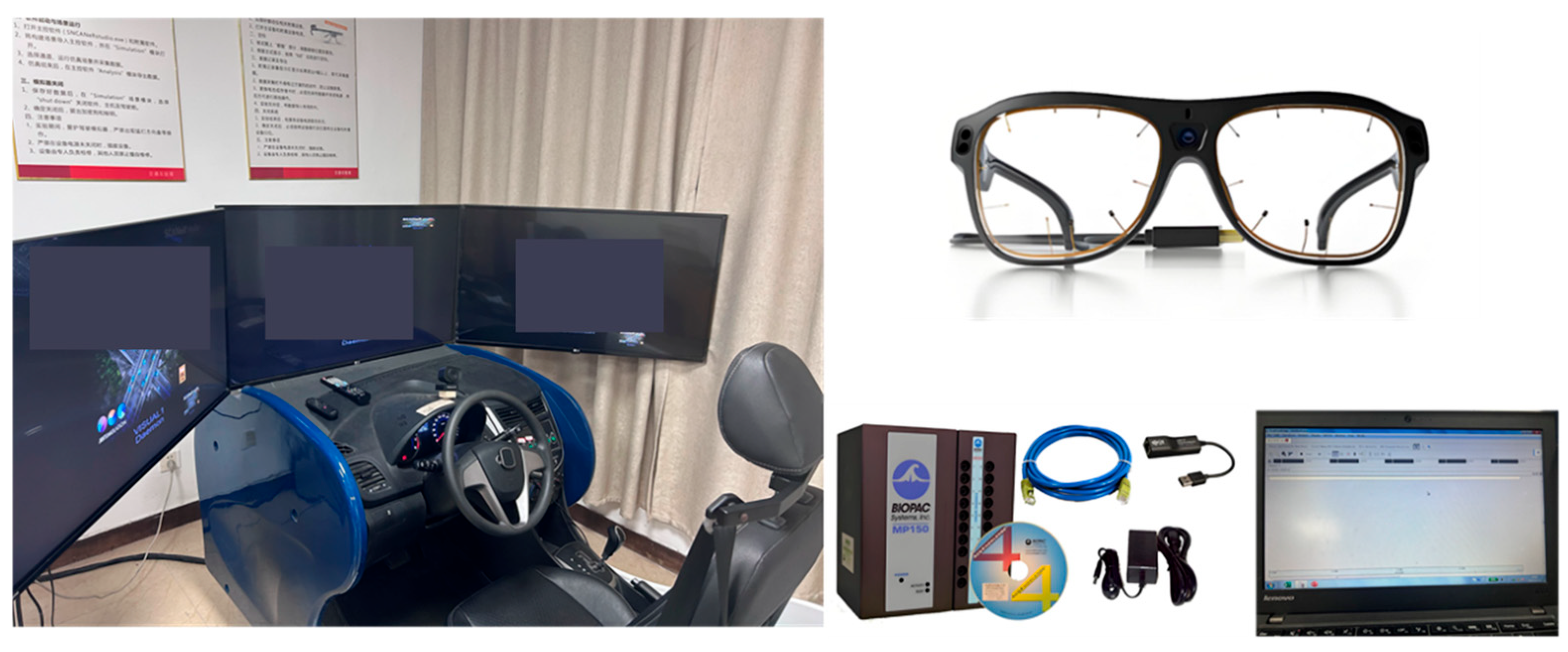
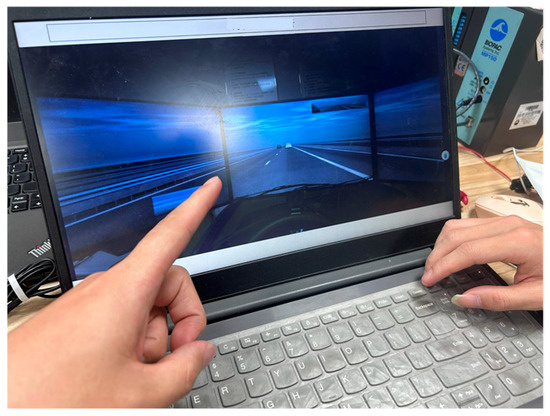
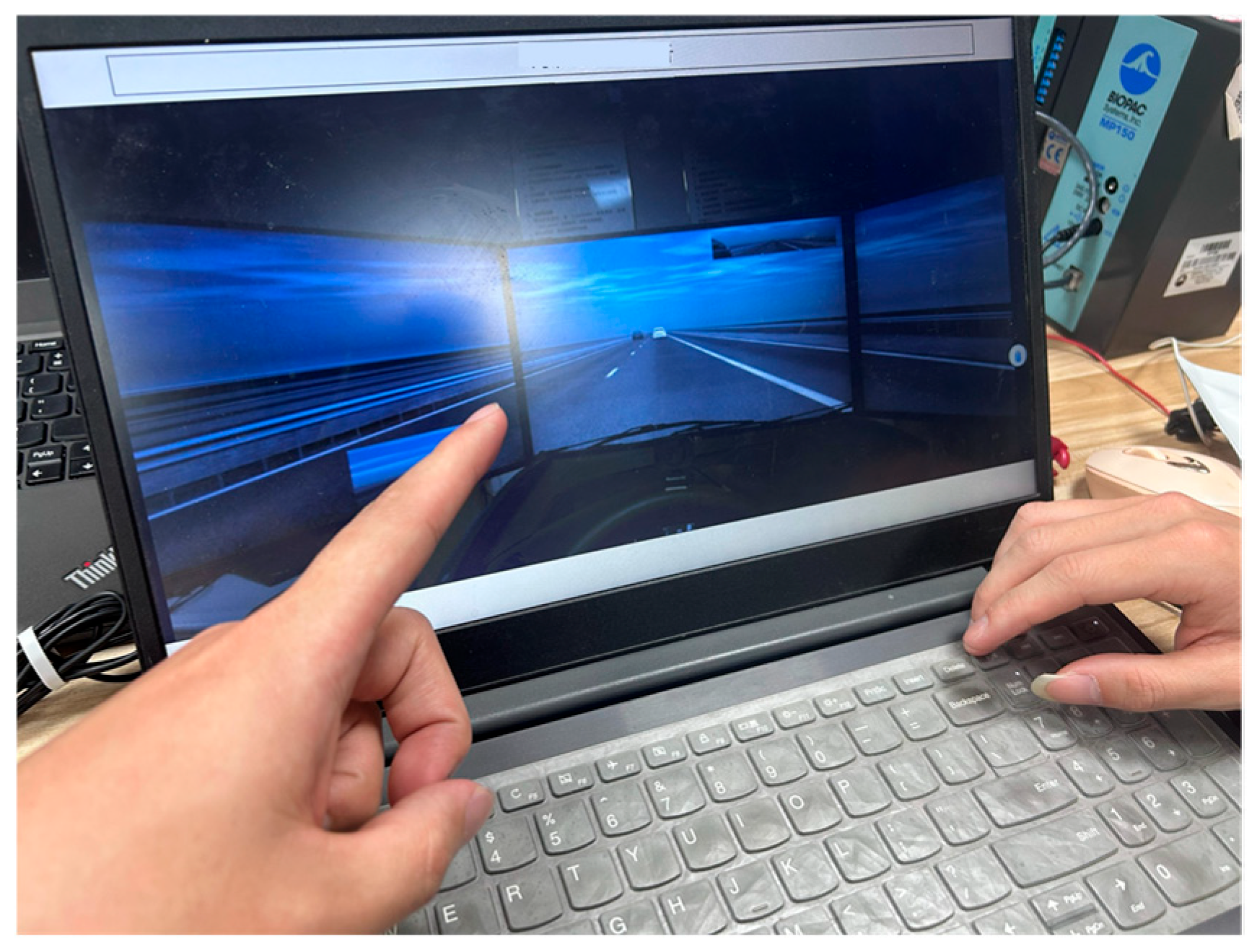
The experimental instruments adopted in this study mainly include the OKTAL driving simulator (Oktal Sydac, Toulouse, France), Tobii Glasses 3 eye tracker (Tobii AB, Stockholm, Sweden), and MP150 multi-channel physiological recorder (BIOPAC Systems, Inc., Goleta, CA, USA), supplemented by devices such as laptop computers (see Figure 1).
Figure 1.
Experimental platform and data acquisition equipment.
The OKTAL driving simulator is equipped with adjustable seats, safety belts, instrument panels, integrated light and wiper lever switches, an automatic manual transmission lever, and embedded DAQ data acquisition and sensors. The experimental scenarios are presented on three 43-inch liquid crystal displays, each with a resolution of 1920 × 1080 pixels. The system provides drivers with a wide driving field of view of 150° horizontally and 28° vertically. The audio system can reproduce the sound of vehicles and the surrounding road environment in experimental scenarios. The driving scenarios were established based on SCANeR studio (version 2.1). Vehicle kinematic data during simulated driving were synchronously collected at a sampling frequency of 100 Hz.
The Tobii Glasses 3 eye tracker is a lightweight wearable eye-tracking device with an appearance similar to ordinary glasses, integrating a binocular eye-tracking module and a scene camera. It adopts a binocular tracking mode and can record the real-time fixation coordinates of both eyes under conditions where the participant’s head moves freely. The device supports slippage compensation and automatic parallax correction, which can effectively reduce data anomalies caused by wearing slippage and ensure the accuracy and real-time performance of eye movement data. The sampling frequency of the eye tracker is 100 Hz, and the scene camera synchronously captures the driver’s first-person perspective video.
The MP150 multi-channel physiological recorder is manufactured by BIOPAC Systems, Inc., Goleta, CA, USA, and consists of hardware and software components. The hardware collects electrocardiogram signals through three lead wires connected to three electrode patches attached to the participant’s chest. Data acquisition and analysis were completed via AcqKnowledge software (Version 4.4) with a sampling frequency of 50 Hz. The software can display electrocardiogram (ECG) waveforms in real time, calculate various physiological indicators, and support data export.
2.3. Experimental Scenario
Based on the SCANeR Studio platform, two simulated road scenarios were established in this study, including a two-way four-lane highway and an urban road. The lane width complied with relevant design specifications: the lane width of the highway was 3.75 m with a road length of 20 km, while the urban road adopted a lane width of 3.5 m and a road length of 10 km. To reproduce real driving conditions, each road was divided into a steady driving section, a lane-changing task section, and a recovery driving section according to the scenario layout. During the steady driving phase, participants were required to maintain a specified speed of 50 km/h on urban roads and 110 km/h on the highway, so as to guarantee the accuracy and authenticity of the experiment.
The experimental scenarios were designed based on publicly available Chinese traffic accident cases. According to the annual statistical data of 2025, a total of 200 accident videos caused by lane-changing behavior on urban roads and highways were screened out. The contributing factors, accident locations, road environments, and other key elements were summarized and analyzed. On the basis of video observation and cause extraction, three types of lane-changing scenarios for urban roads and three types for highways were formulated, forming six typical lane-changing scenarios in total. All scenarios were balanced in task difficulty and have been widely adopted as classical lane-changing situations in human factor research. The detailed scenario settings are presented in Table 2.
Table 2.
Description of lane-changing scenarios.
To ensure the ecological validity and realism of the simulated environment, the scenarios were strictly calibrated against real-world physical and engineering parameters. First, the geometric road alignment, including lane widths (3.75 m for highways and 3.5 m for urban roads), was designed in strict accordance with Chinese highway and urban road design specifications. Second, the OKTAL driving simulator and SCANeR Studio software employ an industry-validated vehicle dynamics engine, providing high-fidelity visual, auditory, and kinesthetic feedback (e.g., steering wheel torque and acceleration simulation). Finally, during the adaptive driving stage prior to the formal experiment, all participants reported that the vehicle handling and scenario rendering closely mirrored real-world driving conditions, subjectively confirming the effectiveness and immersion of the simulated scenarios.
This study focuses only on the specific driving scenario of lane changing. The lane-changing scenarios are set to differ before and after the experimental intervention, while maintaining a high consistency in lane-changing type and task difficulty. This design serves to control environmental variables and eliminate the interference of scenario differences on lane-changing behavior. It ensures that the observed changes in driving behavior after intervention are mainly attributed to the improvement in drivers’ lane-changing ability, namely the genuine effect of the intervention method, rather than variations in scenario complexity or task difficulty.
2.4. Design of Intervention Content Based on Observational Learning Theory
2.4.1. Demographic Questionnaire
A questionnaire was designed in this study to collect participants’ demographic information and self-perceived driving ability. The demographic information included gender, age, educational background, driving experience, type of driving license, and average annual driving mileage.
2.4.2. Intervention Content
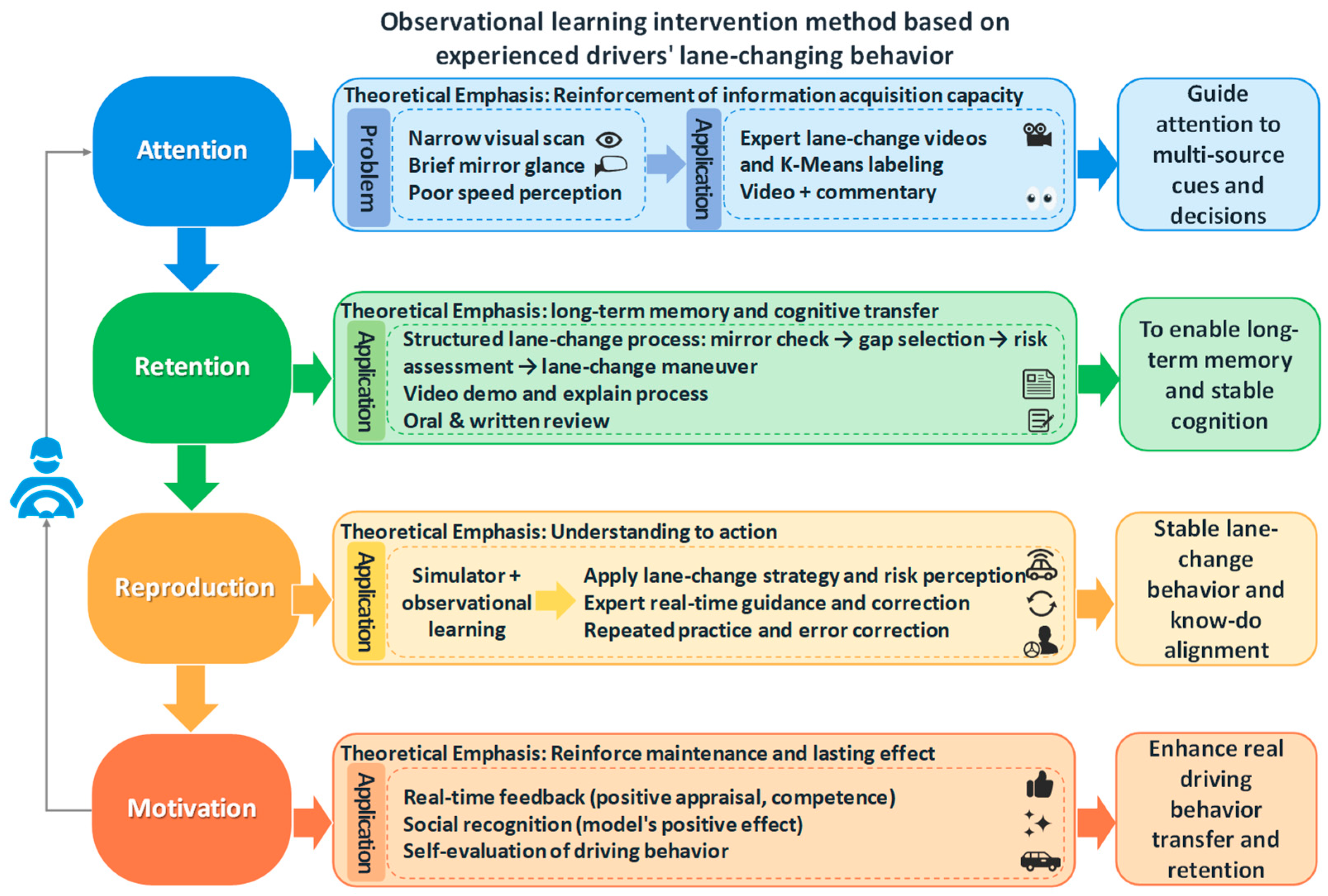
The ultimate goal of the intervention based on observational learning theory is to induce behavioral changes in learners. Behavioral change must be grounded in information acquisition capability, guaranteed by cognitive ability, and consolidated through reinforcement. Following this logical framework, this study constructs an intervention model consisting of the attention, retention, reproduction, and motivation processes, as shown in Figure 2, providing a new approach for improving the lane-changing ability of novice drivers. The entire intervention was implemented one-on-one by uniformly trained experimenters, with a total duration of approximately 45 min. The specific procedures are described as follows.
Figure 2.
Observational learning intervention method based on experienced drivers’ lane-changing behaviors.
Attention process: to strengthen novice drivers’ ability in information acquisition. Experienced and articulate drivers were selected as demonstrators, and their lane-changing behaviors in the driving simulator were recorded as video materials. MATLAB (R2022b) software was adopted to perform K-means clustering and marking on the fixation coordinates of experienced drivers during lane changing. With supplementary verbal explanations in the video, the behavioral adjustment strategies of experienced drivers were demonstrated. The training aimed to cultivate novice drivers’ capacity to acquire key information and execute decision-making during lane changing, and guide them to allocate attentional resources to extract multi-source traffic information.
Retention process: to promote novice drivers’ long-term memory of risk information extraction and driving decision-making. The experimenters structured the lane-changing procedure of experienced drivers into standardized steps (rearview mirror observation—lane-changing gap selection—risk judgment—lane-changing operation), which were presented and explained in the training videos. After video learning, novice drivers were required to summarize the key procedures of lane changing orally and in written form in their own words. Such verbal and written rehearsal helped transform their short-term memory into long-term memory.
Reproduction process: to enable novice drivers to transform comprehension into behavioral execution. Observational learning is not limited to passive observation and imitation, but aims to achieve practical behavioral improvement. Novice drivers applied the learned lane-changing strategies and risk perception methods to practical operations in the driving simulator. Meanwhile, the designated experienced demonstrators provided real-time guidance and behavioral correction during the simulation practice. Repeated training helped novice drivers form stable lane-changing operation habits and realize the transition from cognitive understanding to practical driving performance.
Motivation process: to strengthen behavioral maintenance and ensure persistent intervention effects. Firstly, experimenters gave positive evaluations on novice drivers’ lane-changing behaviors and decisions during the training session, enhancing their sense of competence and self-confidence. Secondly, targeted communication was conducted to illustrate the positive effects of the demonstrators’ standard lane-changing behaviors, so as to improve novice drivers’ recognition and acceptance of exemplary driving patterns. Finally, novice drivers were encouraged to conduct self-evaluation on their own lane-changing performance. The combination of external reinforcement and self-evaluation effectively promoted the behavioral transfer and long-term maintenance of standardized lane-changing behaviors in real driving scenarios.
2.5. Experimental Procedure
2.5.1. Adaptive Driving and Preparation Stage
Prior to the formal experiment, all participants were required to complete adaptive driving in a practice scenario to familiarize themselves with the operation of the driving simulator, ensuring that they could drive in accordance with the specified speed and operational requirements in the subsequent formal experiment. Participants could terminate the experiment at any time if they felt physical discomfort during simulated driving. The cross-sectional design of the practice scenario was consistent with the formal experimental scenario. To minimize the influence of repeated trials, the practice scenario only set physical obstacles for lane changing without additional traffic flow. This sufficient adaptive driving stage ensured that any subsequent behavioral changes were driven by the intervention rather than increased simulator familiarity.
After adaptive driving, all participants carefully read and signed the informed consent form and completed the demographic questionnaire to ensure experimental compliance and data integrity. Subsequently, participants were seated in the driving simulator cockpit. The experimenter attached three disposable electrode patches to the left side of the participant’s chest, right side of the chest, and navel, which were connected to the physiological recorder via wires to ensure accurate and stable collection of physiological data. Afterwards, participants were instructed to put on the eye-tracking device. Gaze calibration was performed to align the participants’ fixation points with the scene recorded by the eye-tracker camera. All eye movement data were stored in real time on the SD card of the eye-tracker controller for subsequent data analysis.
2.5.2. Pre-Intervention Data Collection
Following the preparation stage, both experienced and novice drivers participated in the baseline data collection experiment. To ensure the consistency of data acquisition, all participants completed two driving tasks in sequence: a highway scenario and an urban road scenario. This arrangement allowed participants to transition from a simple road environment to a relatively complex one, reducing the learning effect during task switching. The experimenter monitored the entire experimental process and the physical state of participants to guarantee a smooth implementation procedure. A short rest was arranged after each scenario task to avoid fatigue caused by continuous testing. Upon completion of all experimental sessions, experienced and novice drivers received a subsidy of 80 RMB and 40 RMB, respectively.
2.5.3. Implementation of the Intervention Scheme
After the completion of baseline data collection, the experimenter conducted observational learning intervention training for novice drivers based on the lane-changing behaviors of experienced drivers, following the four-stage procedure mentioned above, as shown in Figure 3. First, videos with K-means clustering marking and voice explanation were used to guide novice drivers to extract key information during lane changing. Second, novice drivers were required to make oral and written summaries of the lane-changing process to consolidate long-term memory. Third, practical operational training was carried out on the driving simulator, with real-time guidance from demonstrators to correct irregular driving behaviors. Finally, the experimenter provided positive feedback on their driving performance to enhance novice drivers’ sense of accomplishment.
Figure 3.
Intervention scenario.
2.5.4. Post-Intervention Data Collection
After the intervention training, novice drivers conducted lane-changing experiments in parallel experimental scenarios with the same task difficulty as the baseline experiment to eliminate the influence of memory effect. The eye movement, physiological, and driving behavior data of novice drivers during lane changing were collected after the intervention. The experimenters monitored the whole experimental process and closely observed participants’ physical status to ensure the smooth progress of the experiment. A short rest was arranged after each scenario task to prevent fatigue caused by continuous experiments.
2.6. Data Processing
2.6.1. Data Types
Based on experimental driving simulation data, this study mainly analyzes the characteristics of changes in driving behavior and physiological status during the lane-changing decision-making stage. The MP150 multi-channel physiological recorder and Tobii Pro Glasses 3 eye tracker were used to collect drivers’ physiological and eye movement data in order to characterize the changing rules of drivers’ physiological characteristics and visual attention allocation. Meanwhile, the driving simulator was adopted to collect driving behavior data such as vehicle speed as well as lateral and longitudinal acceleration, which were used to analyze the variation in characteristics of driving behavior. This provides a data foundation for describing the lane-changing characteristics of drivers with different driving experience. The collected data are shown in Table 3.
Table 3.
Types of collected data.
2.6.2. Analysis Methods
This study used SPSS (IBM SPSS Statistics 25) and Python software (version 3.9) to complete statistical data analysis. The specific analysis methods are as follows. First, timeline alignment, outlier elimination, and filtering processing were performed on the collected raw data. Invalid samples caused by equipment signal loss and operational errors of participants were excluded, and 228 valid lane-changing samples were finally retained. Second, the Shapiro–Wilk test was used to test the normality of all indicator data. Parametric tests were adopted for data conforming to normal distribution, and non-parametric tests were used for data that did not conform to normal distribution.
3. Results
3.1. Pre-Intervention Experimental Results
3.1.1. Analysis of Eye Movement Indicators
- 1.
- Average Fixation Duration
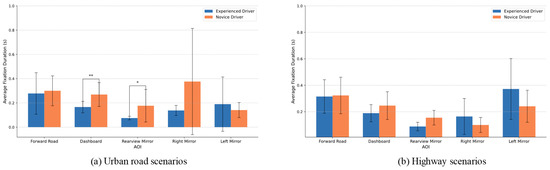
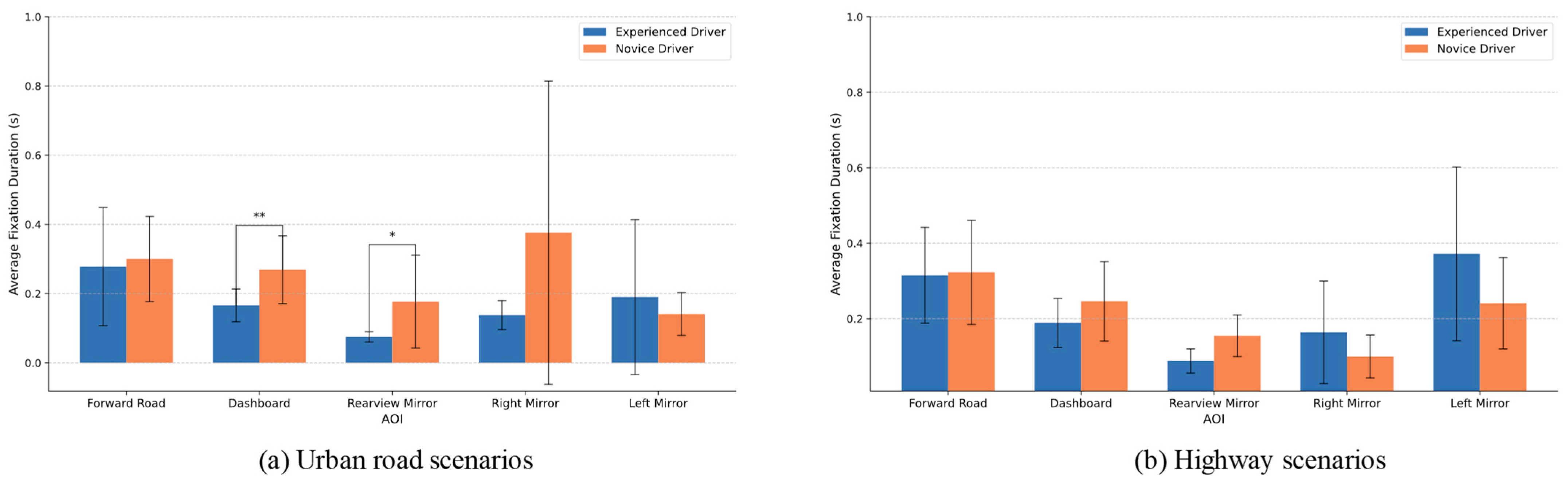
In urban lane-changing scenarios, the complex traffic environment requires frequent visual search for critical information. Average fixation duration, as a key indicator of visual processing, reflects drivers’ cognitive load and information-processing efficiency. Figure 4 presents the differences in fixation duration across AOIs between novice and experienced drivers in urban and highway conditions.
Figure 4.
Average fixation duration on each AOI in (a) urban road scenarios and (b) highway scenarios (Note: * and ** indicate significant differences at p < 0.05 and p < 0.01).
In the urban lane-changing scenario (Table 4), fixation duration differed between novice and experienced drivers across AOIs. The most significant difference was observed for the dashboard (U = 39.0, p = 0.002), with novice drivers showing longer fixation duration (M = 0.269 s, SD = 0.098 s) than experienced drivers (M = 0.166 s, SD = 0.047 s). A significant difference was also found for the rearview mirror (U = 1.0, p = 0.033), where novice drivers had a longer fixation duration. No significant differences were found for the forward road, right rearview mirror, or left rearview mirror (p > 0.05).
Table 4.
Average fixation duration of drivers with different experience levels for each AOI on urban roads.
In the highway lane-changing scenario (Table 5), no significant differences in fixation duration were found across all AOIs (p > 0.05). Both groups showed similar fixation duration on the forward road (U = 102.0, p = 0.885), and differences in other AOIs were not statistically significant.
Table 5.
Average fixation duration of drivers with different experience levels for each AOI on highways.
- 2.
- Percentage of Fixation Duration
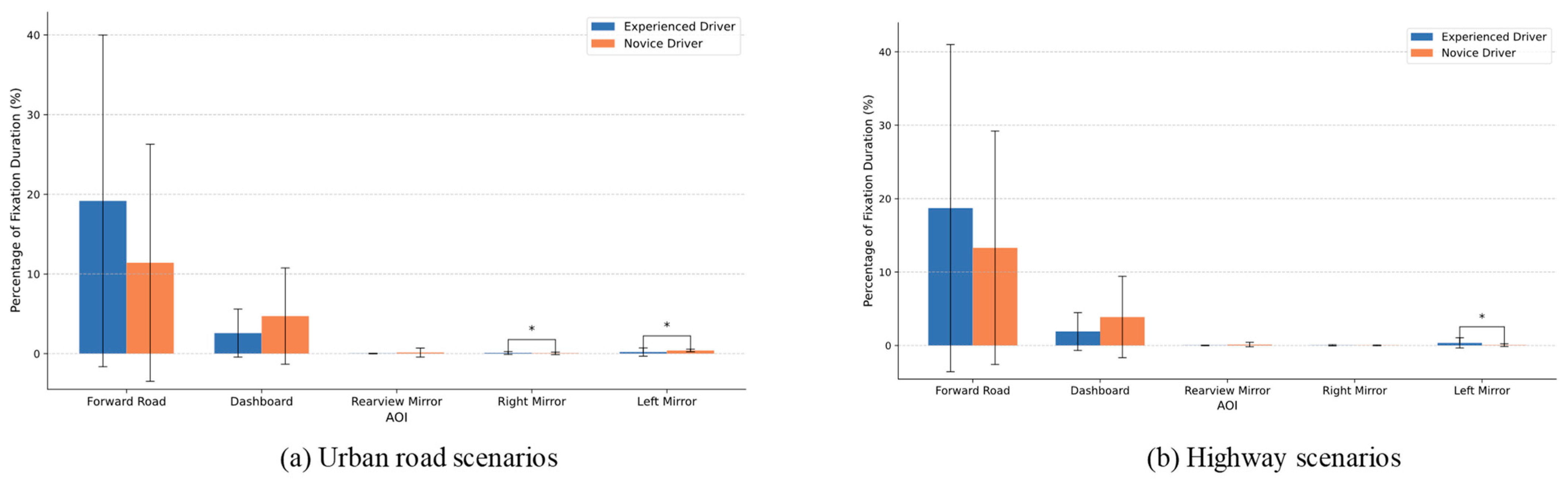
Percentage of fixation duration is a key indicator of drivers’ attention allocation. The Mann–Whitney U test was used to compare differences between novice and experienced drivers in urban and highway lane-changing scenarios. Figure 5 shows the distribution and statistical differences across AOIs in both scenarios.
Figure 5.
Percentage of fixation duration for each AOI in (a) urban road scenarios and (b) highway scenarios (Note: * indicate significant differences at p < 0.05).
In the urban lane-changing scenario (Table 6), significant differences in attention allocation were observed for the side rearview mirrors. Experienced drivers showed a higher percentage of fixation duration on the right rearview mirror (M = 0.09%, SD = 0.18%) than novice drivers (M = 0.04%, SD = 0.16%) (U = 521.5, p = 0.039). In contrast, novice drivers displayed a higher fixation for the left rearview mirror (M = 0.40%, SD = 0.16%) than experienced drivers (M = 0.21%, SD = 0.52%) (U = 542.5, p = 0.025). No significant differences were found in other AOIs (p > 0.05).
Table 6.
Percentage of fixation duration of drivers with different experience levels for each AOI on urban roads.
In the highway lane-changing scenario (Table 7), a similar pattern was observed. Significant differences were found for the right (p = 0.039) and left rearview mirrors (p = 0.025), while no significant differences were observed for other AOIs (p > 0.05).
Table 7.
Percentage of fixation duration of drivers with different experience levels for each AOI on highways.
- 3.
- First Fixation Duration
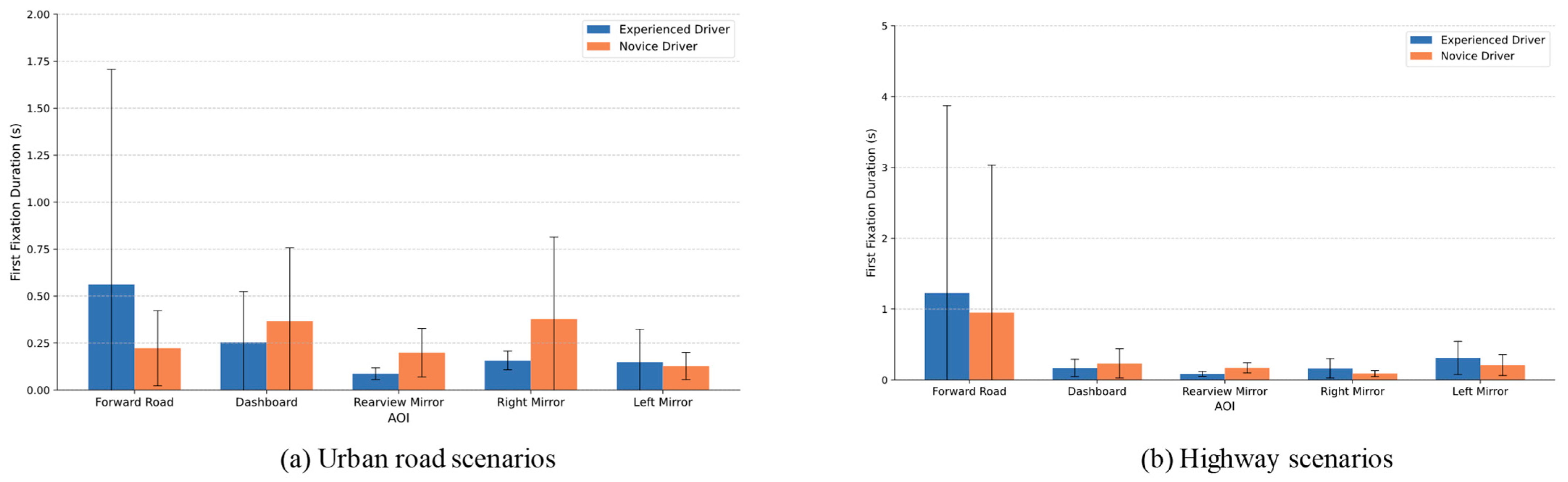
First fixation duration reflects drivers’ initial perceptual judgment during lane changing. The Mann–Whitney U test was used to compare differences between novice and experienced drivers. Figure 6 presents the distribution of first fixation duration across AOIs in urban and highway scenarios, highlighting the effect of driving experience on early information acquisition.
Figure 6.
Duration of first fixation for each AOI in (a) urban road scenarios and (b) highway scenarios.
In the urban lane-changing scenario (Table 8), no statistically significant differences in first fixation duration were found across AOIs (p > 0.05). However, a marginal difference was observed for the rearview mirror, where novice drivers showed longer fixation duration (M = 0.199 s, SD = 0.129 s) than experienced drivers (M = 0.087 s, SD = 0.031 s) (U = 152.0, p = 0.065). Novice drivers also had higher values for the right rearview mirror and dashboard, while experienced drivers showed longer fixation duration on the forward road.
Table 8.
First fixation duration of drivers with different experience levels for each AOI on urban roads.
In the highway lane-changing scenario (Table 9), no significant differences were observed across all AOIs (p > 0.05). The two groups showed similar first fixation durations, with slightly higher values for experienced drivers on the forward road and left rearview mirror.
Table 9.
First fixation duration of drivers with different experience levels for each AOI on highways.
3.1.2. Analysis of Physiological Indicators
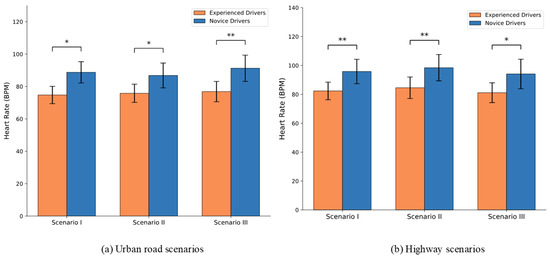
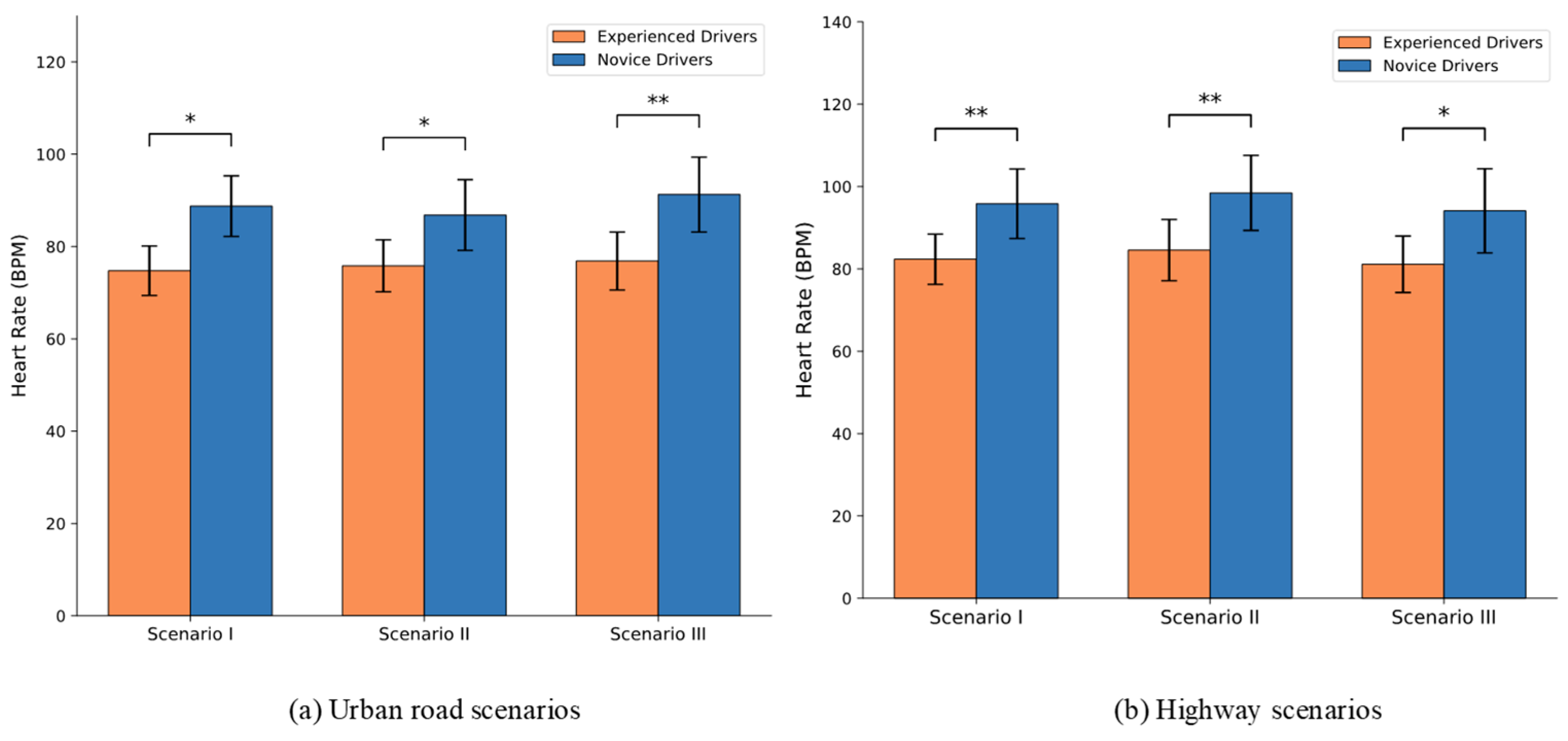
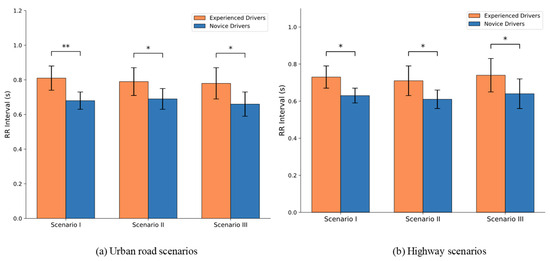
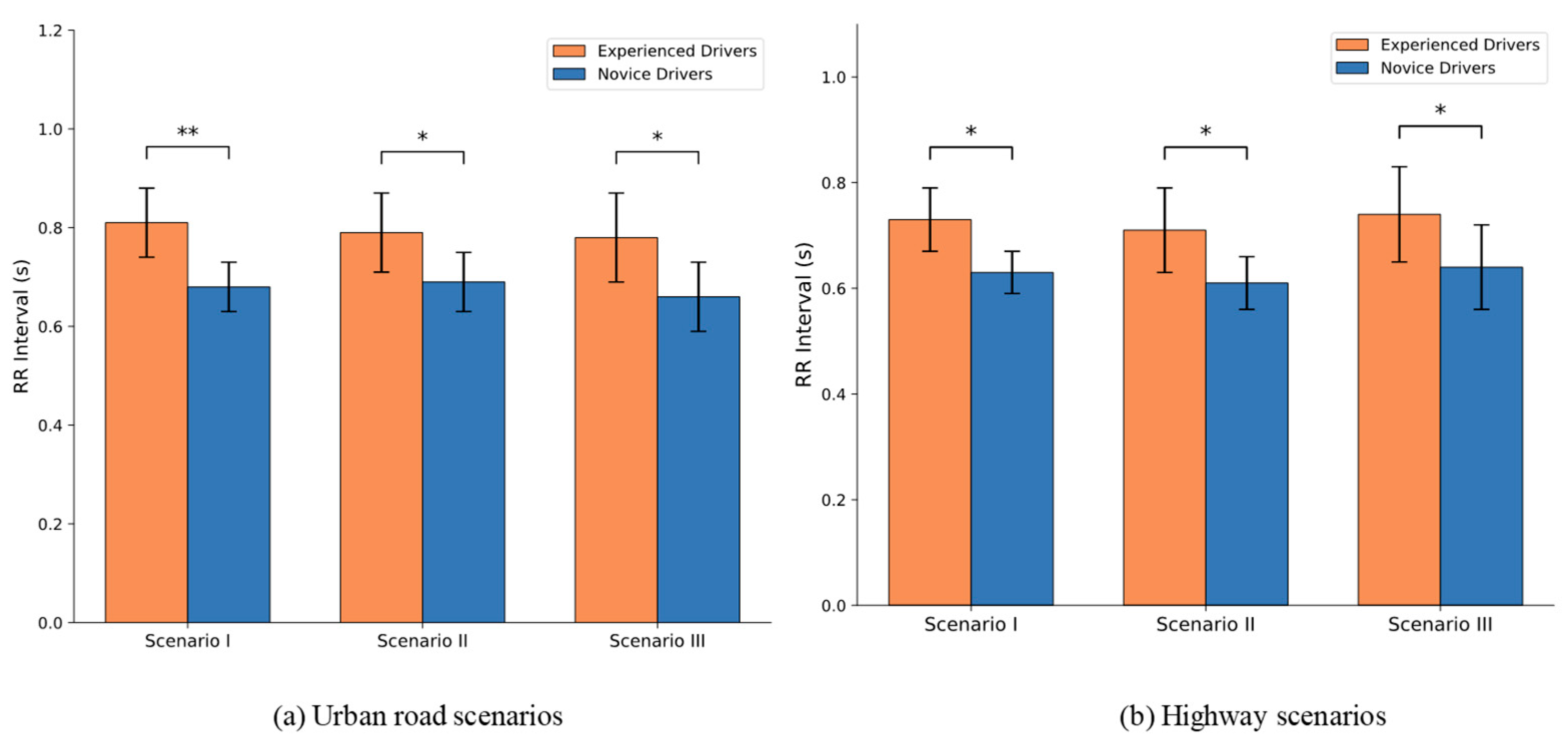
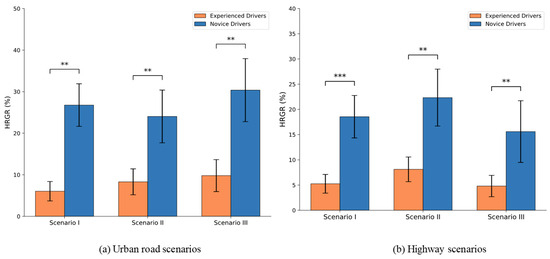
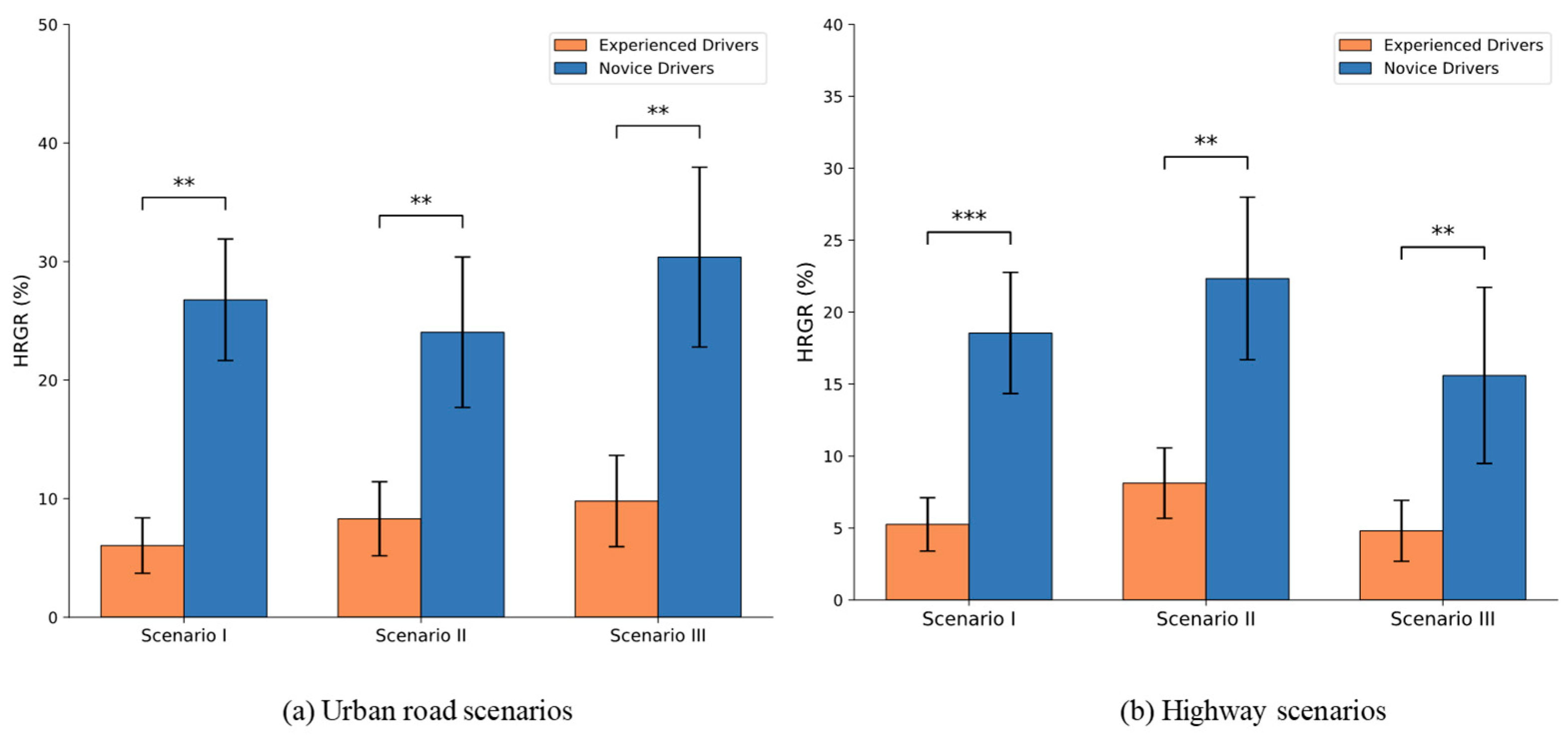
An independent-samples t-test was used to compare physiological indicators between novice and experienced drivers in urban lane-changing scenarios. Figure 7, Figure 8 and Figure 9 present comparisons of heart rate, RR interval, and HRGR across different road scenarios.
Figure 7.
Heart rate of drivers with different experience levels in various road scenarios in (a) urban road scenarios and (b) highway scenarios (Note: * and ** indicate significant differences at p < 0.05 and p < 0.01).
Figure 8.
RR interval of drivers with different experience levels in various road scenarios in (a) urban road scenarios and (b) highway scenarios (Note: * and ** indicate significant differences at p < 0.05 and p < 0.01).
Figure 9.
HRGR of drivers with different experience levels in various road scenarios in (a) urban road scenarios and (b) highway scenarios (Note: ** and *** indicate significant differences at p < 0.01 and p < 0.001).
Table 10 shows significant differences in physiological indicators between novice and experienced drivers in urban lane-changing scenarios. Novice drivers exhibited significantly higher heart rates and HRGR and lower RR intervals across all scenarios (p < 0.05). The highest heart rate was observed in Scenario III (M = 91.26 BPM, SD = 8.12 BPM), and HRGR values were consistently higher for novice drivers (all M > 24%), with significant inter-group differences.
Table 10.
Comparison of physiological indicators of different drivers on urban roads (Note: * and ** indicate significant differences at p < 0.05 and p < 0.01).
Table 11 indicates similar results in highway scenarios. Significant differences were found in all physiological indicators across scenarios (p < 0.05). Novice drivers showed higher heart rates and HRGR and lower RR intervals than experienced drivers. The highest heart rate occurred in Scenario II (M = 98.46 BPM, SD = 9.12 BPM), and HRGR differences reached a highly significant level in Scenario I (t = 10.125, p < 0.001).
Table 11.
Comparison of physiological indicators of drivers with different experience levels on highways (Note: *, **, and *** indicate significant differences at p < 0.05, p < 0.01, and p < 0.001).
3.1.3. Analysis of Driving Behavior Indicators
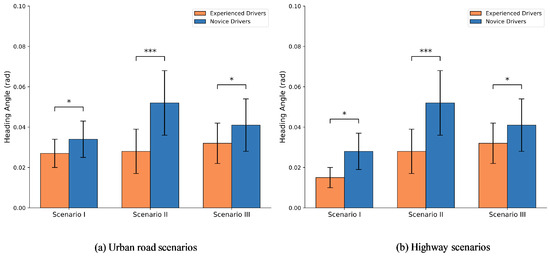
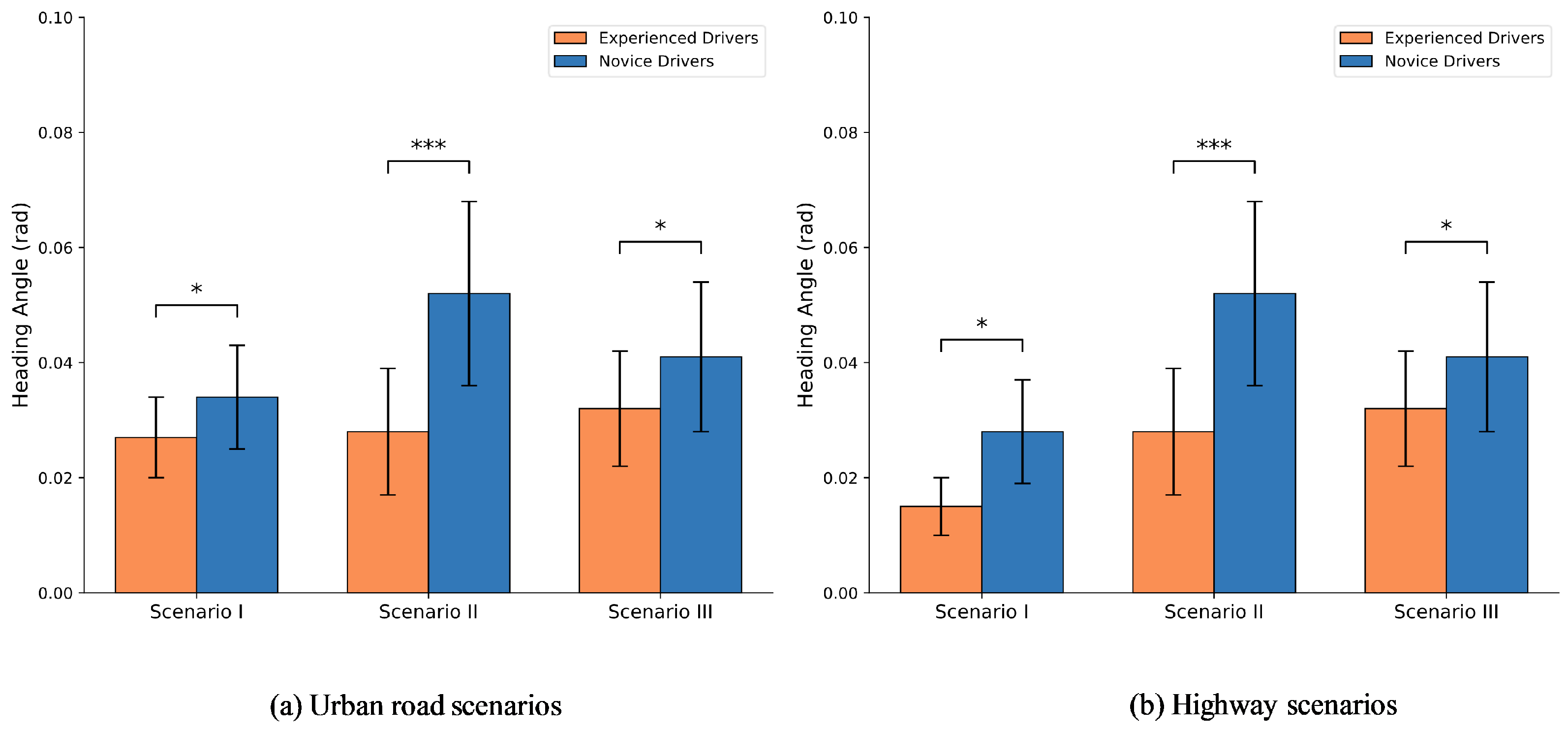
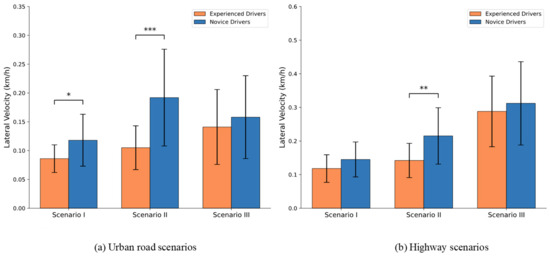
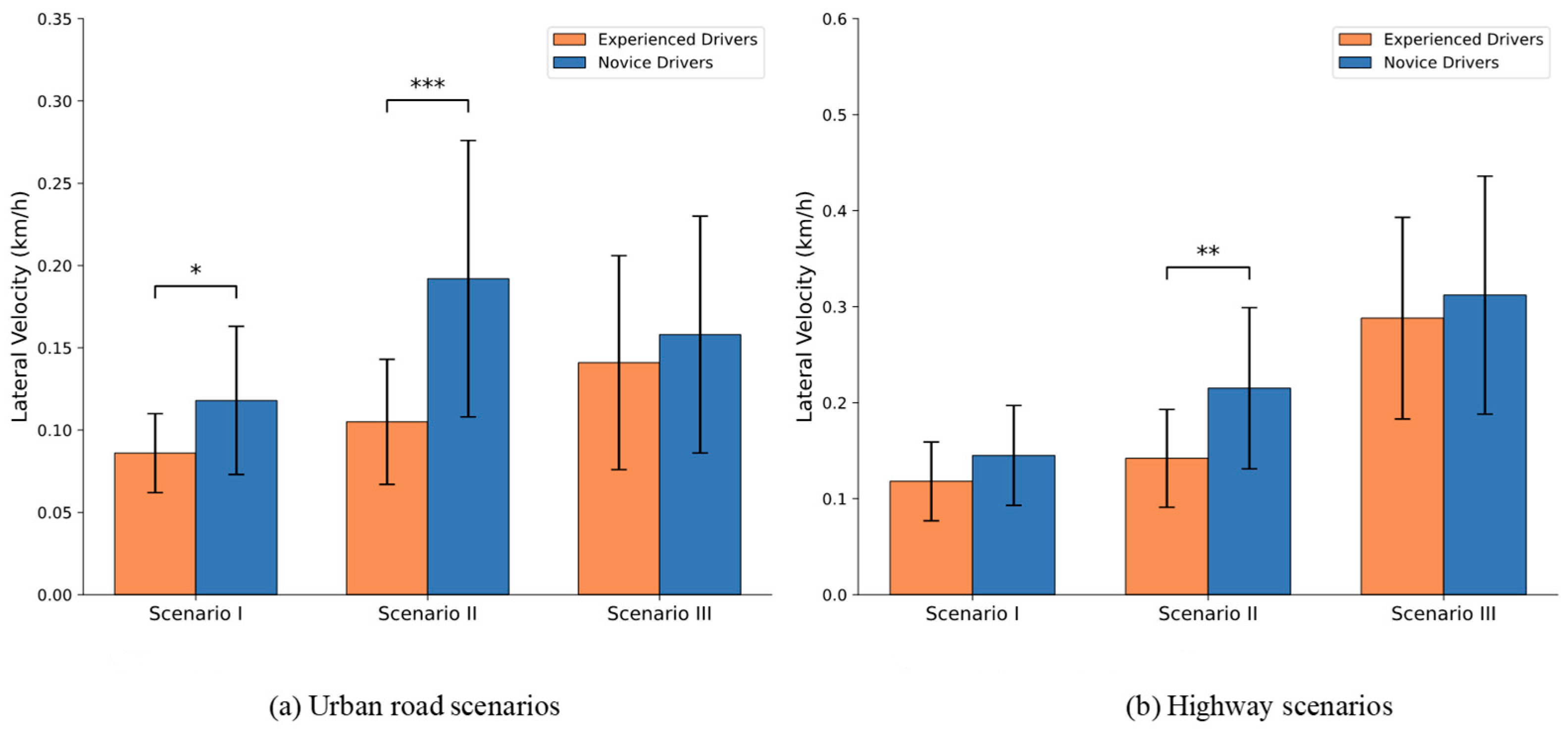
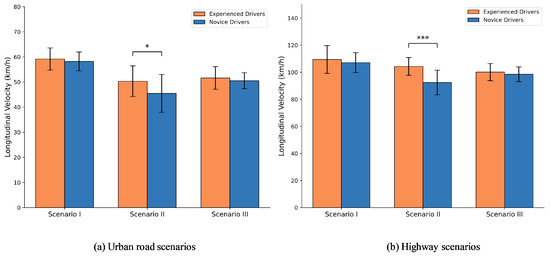
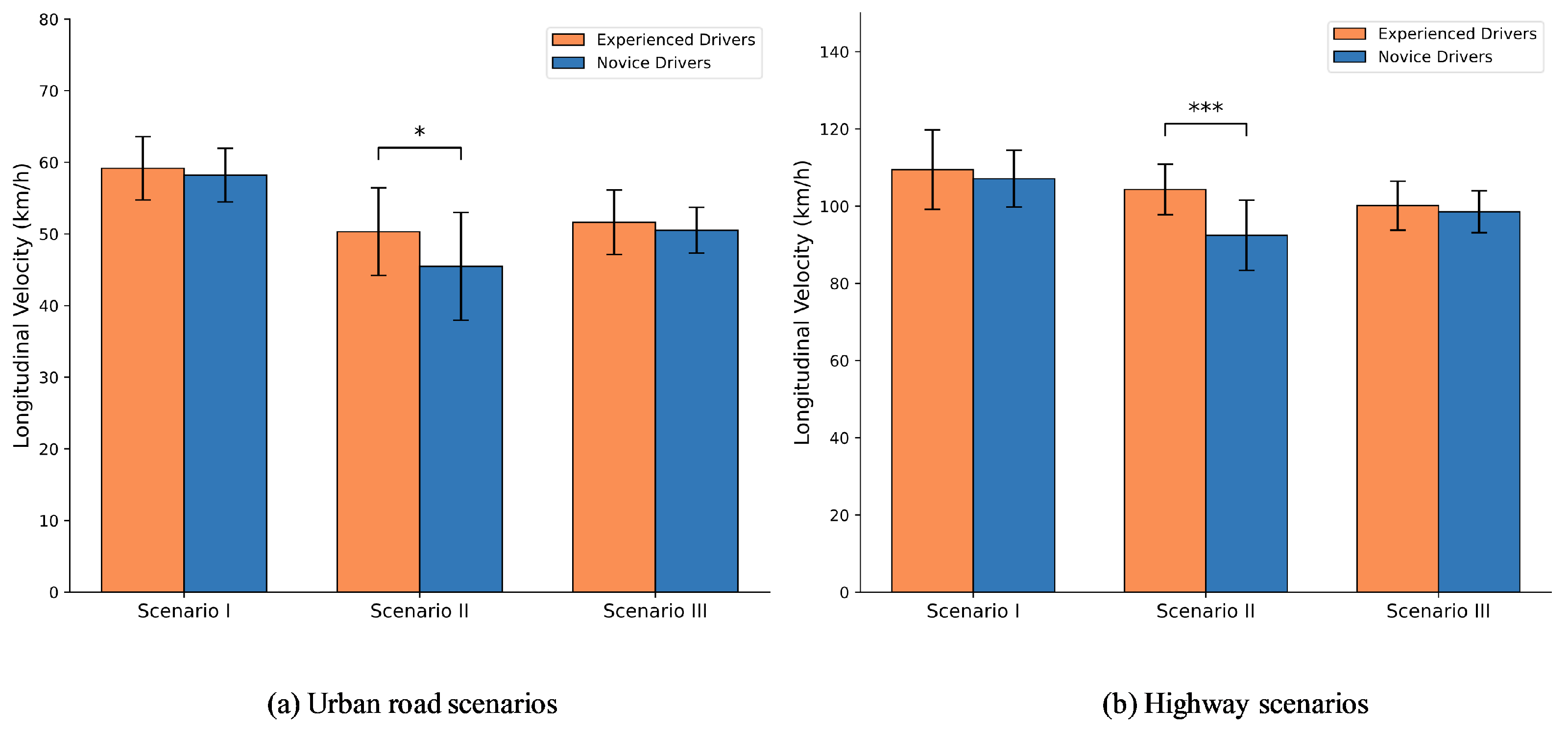
An independent-samples t-test was used to compare longitudinal velocity, lateral velocity, and heading angle between novice and experienced drivers before intervention in urban lane-changing scenarios. Figure 10, Figure 11 and Figure 12 show the results under different conditions.
Figure 10.
Heading angle of drivers with different experience levels in various road scenarios in (a) urban road scenarios and (b) highway scenarios (Note: * and *** indicate significant differences at p < 0.05, and p < 0.001).
Figure 11.
Lateral speed of drivers with different experience levels in various road scenarios in (a) urban road scenarios and (b) highway scenarios (Note: *, **, and *** indicate significant differences at p < 0.05, p < 0.01, and p < 0.001).
Figure 12.
Longitudinal speed of drivers with different experience levels in various road scenarios in (a) urban road scenarios and (b) highway scenarios (Note: * and *** indicate significant differences at p < 0.05 and p < 0.001).
Table 12 shows significant differences in driving behavior between novice and experienced drivers in urban lane-changing scenarios. Novice drivers generally exhibited a higher lateral velocity and heading angle in several scenarios (p < 0.05). In Scenario II, significant differences were observed in lateral velocity (M = 0.192 vs. 0.105 km/h, t = 3.821, p < 0.001) and heading angle (M = 0.052 vs. 0.028 rad, t = 5.114, p < 0.001). A significant difference in longitudinal velocity was also found in this scenario (t = −2.214, p = 0.032).
Table 12.
Comparison of driving behavior indicators of drivers with different experience levels on urban roads (Note: * and *** indicate significant differences at p < 0.05 and p < 0.001).
Table 13 shows similar patterns in highway scenarios. Significant differences were mainly observed in heading angle across all scenarios (p < 0.05). In Scenario II, novice drivers showed a lower longitudinal velocity (M = 92.45 km/h) than experienced drivers (M = 104.32 km/h) (t = −4.621, p < 0.001), along with a higher lateral velocity (p = 0.003) and heading angle (p < 0.001).
Table 13.
Comparison of driving behavior indicators of drivers with different experience levels on highways (Note: *, **, and *** indicate significant differences at p < 0.05, p < 0.01, and p < 0.001).
3.2. Within-Group Comparison of Novice Drivers
To formally demonstrate the direct effect of the observational learning intervention, a within-subject comparison was conducted comparing the 30 novice drivers’ performance before and after the intervention. Paired-samples t-tests and Wilcoxon signed-rank tests were employed depending on data normality.
For visual perception, the Wilcoxon signed-rank test revealed a statistically significant increase in the percentage of fixation duration on the rearview mirrors (Pre-intervention: Mean = 0.14%, SD = 0.57; Post-intervention: Mean = 0.03%, SD = 0.05, Z = −3.42, p < 0.01), alongside a significant decrease in fixation on the dashboard (Pre-intervention: Mean = 4.72%, SD = 6.03; Post-intervention: Mean = 2.95%, SD = 3.50, Z = −2.15, p < 0.05). The average fixation duration on the rearview mirror also shortened from 0.177 s (SD = 0.134) to 0.081 s (SD = 0.025), indicating more efficient visual sampling.
For physiological responses, the paired t-test indicated a significant reduction in HRGR across the scenarios. For example, in urban Scenario II, HRGR decreased from 24.04% (SD = 6.34) pre-intervention to 10.45% (SD = 4.20) post-intervention (t(29) = 6.85, p < 0.001), confirming a substantial alleviation of mental workload. Similarly, heart rate in the same scenario dropped from 86.83 BPM (SD = 7.65) to 78.45 BPM (SD = 6.20), t(29) = 4.21, p < 0.01.
Regarding driving behavior, the heading angle fluctuation was significantly stabilized after the intervention. In urban Scenario II, the heading angle decreased from 0.052 rad (SD = 0.016) to 0.033 rad (SD = 0.013), t(29) = 4.78, p < 0.001. Lateral velocity also showed a notable reduction from 0.192 km/h (SD = 0.084) to 0.115 km/h (SD = 0.042), t(29) = 3.62, p < 0.01.
These paired statistical results serve as the primary evidence that the proposed intervention actively and significantly improved the lane-changing capabilities of novice drivers.
3.3. Post-Intervention Experimental Results
3.3.1. Analysis of Eye Movement Indicators
To evaluate the intervention effect and remaining differences between novice and experienced drivers, eye movement indicators were analyzed after intervention. The Shapiro–Wilk test showed non-normal distributions, so the Mann–Whitney U test was used to compare the two groups.
- 1.
- Average Fixation Duration
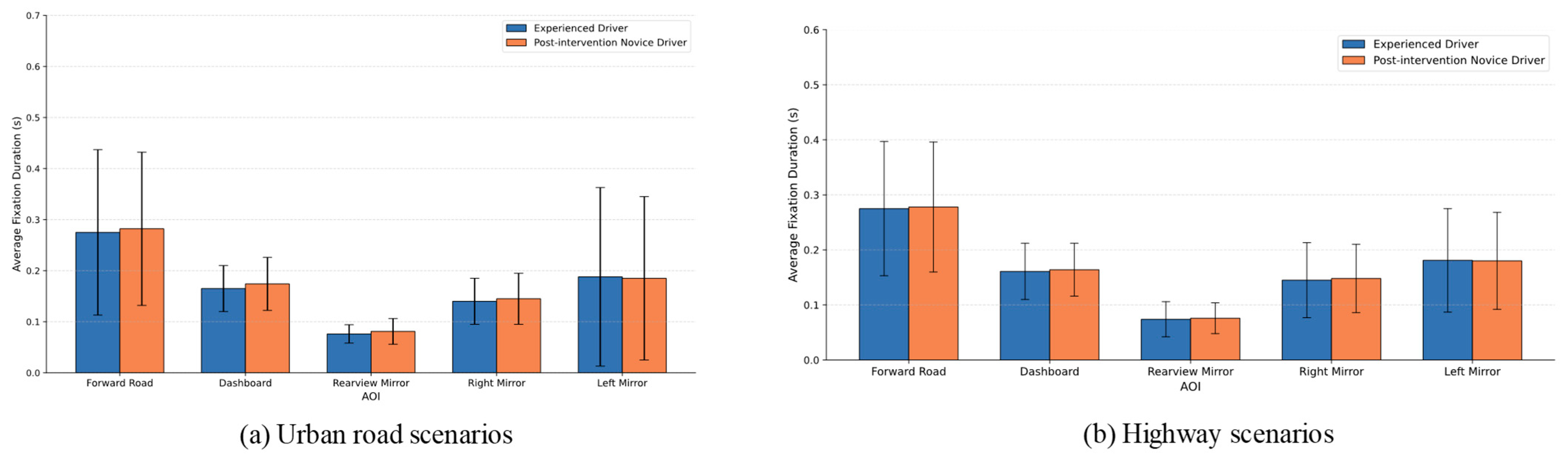
In the urban lane-changing scenario (Table 14), no significant differences in average fixation duration were found between experienced drivers and post-intervention novice drivers across all AOIs (p > 0.05), as illustrated in Figure 13. Values for key AOIs were comparable, including the dashboard (M = 0.165 s vs. 0.174 s) and rearview mirror (M = 0.076 s vs. 0.081 s).
Table 14.
Average fixation duration of experienced drivers and post-intervention novice drivers for each AOI on urban roads.
Figure 13.
Average fixation duration on each AOI in (a) urban road scenarios and (b) highway scenarios.
In the highway scenario (Table 15), similar results were observed, with no significant differences across all AOIs (p > 0.8). Fixation durations of novice and experienced drivers were nearly identical on the forward road (0.278 s vs. 0.275 s) and left rearview mirror (0.180 s vs. 0.181 s).
Table 15.
Average fixation duration of experienced drivers and post-intervention novice drivers for each AOI on highways.
- 2.
- Percentage of Fixation Duration
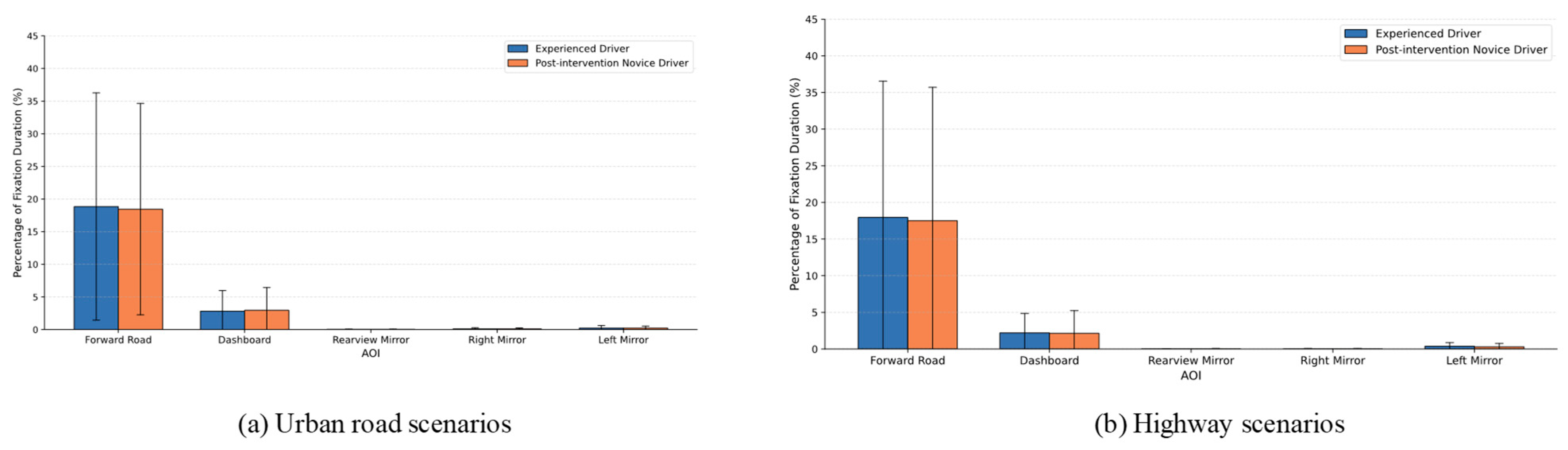
In the urban lane-changing scenario (Table 16), no significant differences in fixation proportion were found between novice and experienced drivers across all AOIs (p > 0.5), see Figure 14. The forward road accounted for 18.45% (SD = 16.20%) of the fixation for novice drivers and 18.85% for experienced drivers (p = 0.754). The dashboard was also similar between groups (2.95% vs. 2.82%, p = 0.621), as were the remaining AOIs.
Table 16.
Percentage of fixation duration of experienced drivers and post-intervention novice drivers for each AOI on urban roads.
Figure 14.
Percentage of fixation duration for each AOI in (a) urban road scenarios and (b) highway scenarios.
In the highway scenario (Table 17), no significant differences were observed across all AOIs (p > 0.4). The forward road (17.50% vs. 17.95%) and dashboard (2.15% vs. 2.20%) showed close consistency between novice and experienced drivers. For the left rearview mirror, values were 0.31% for novice drivers and 0.39% for experienced drivers, with no significant difference (p = 0.082).
Table 17.
Percentage of fixation duration of experienced drivers and post-intervention novice drivers for each AOI on highways.
- 3.
- First Fixation Duration
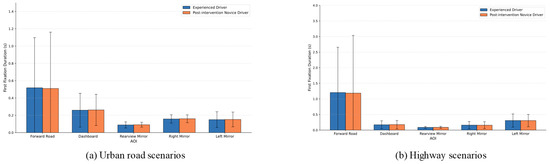
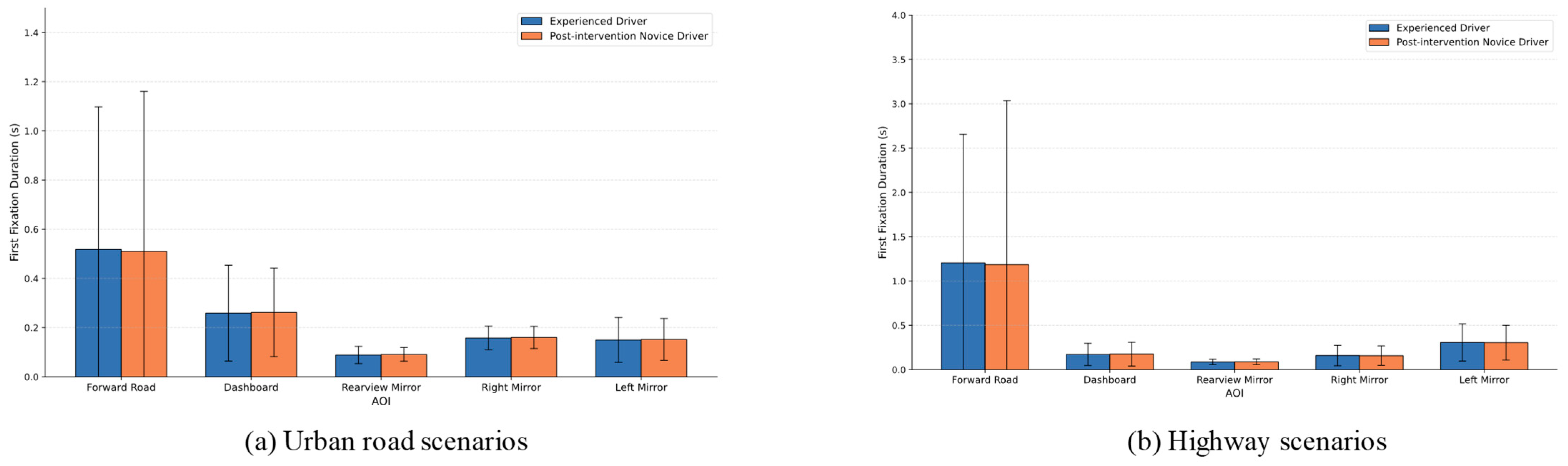
In the urban lane-changing scenario (Table 18), no significant differences in first fixation duration were found between experienced and post-intervention novice drivers across all AOIs (p > 0.78), see Figure 15. Values were highly comparable, including the forward road (0.518 s vs. 0.510 s), dashboard (0.259 s vs. 0.262 s), and all rearview mirror areas.
Table 18.
First fixation duration of experienced drivers and post-intervention novice drivers for each AOI on urban roads.
Figure 15.
Duration of first fixation on each AOI in (a) urban road scenarios and (b) highway scenarios.
In the highway scenario (Table 19), similar results were observed, with no significant differences across all AOIs (p > 0.76). First fixation durations were nearly identical between the two groups, including the forward road (1.205 s vs. 1.185 s) and left rearview mirror (0.308 s vs. 0.305 s).
Table 19.
First fixation duration of experienced drivers and post-intervention novice drivers for each AOI on highways.
3.3.2. Analysis of Physiological Indicators
An independent-samples t-test was used to compare the mean heart rate and RR interval between novice and experienced drivers after intervention in three urban lane-changing scenarios.
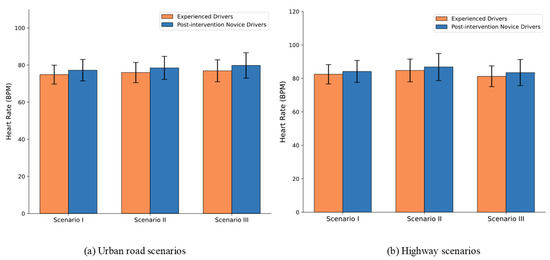
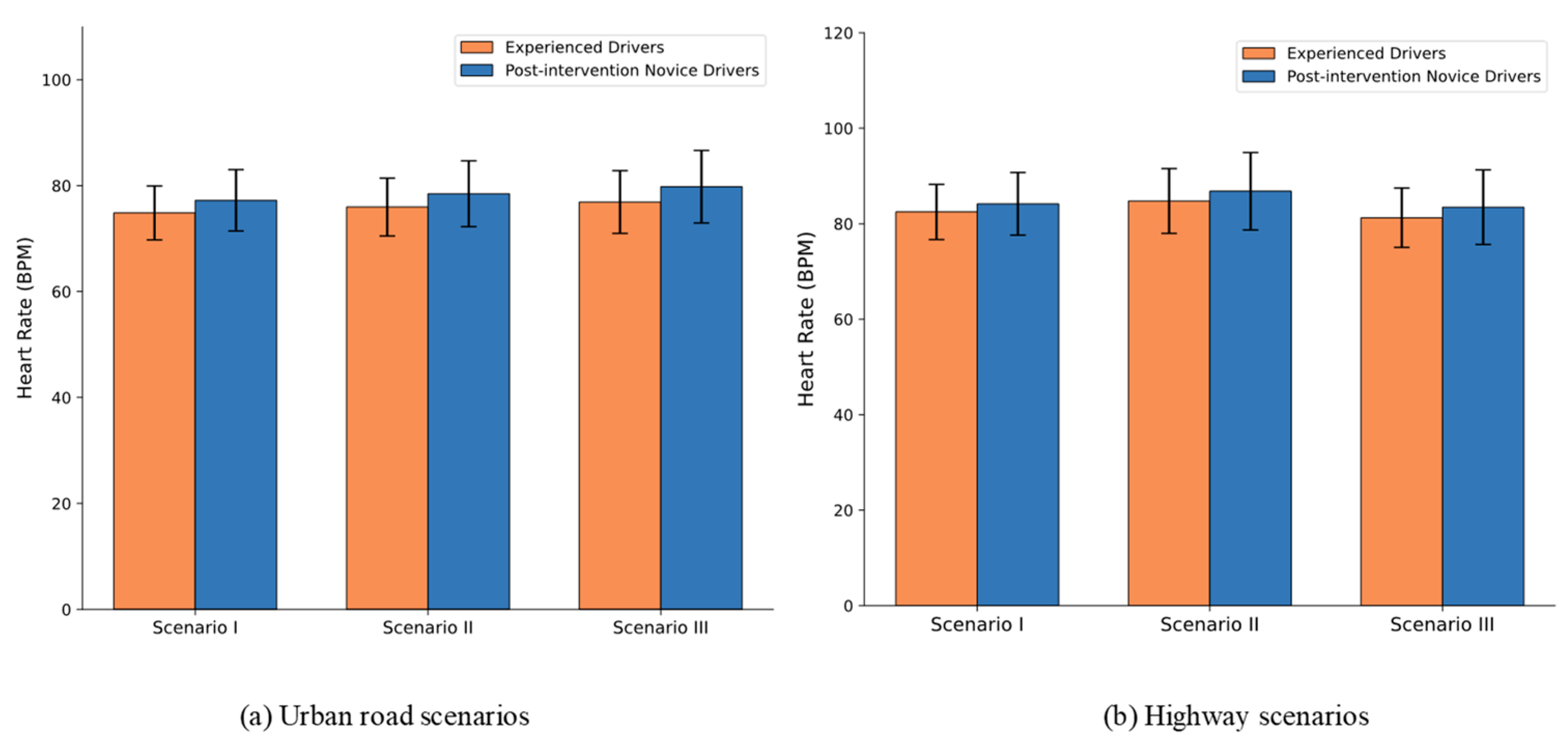
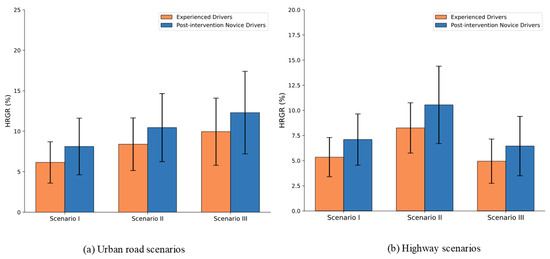
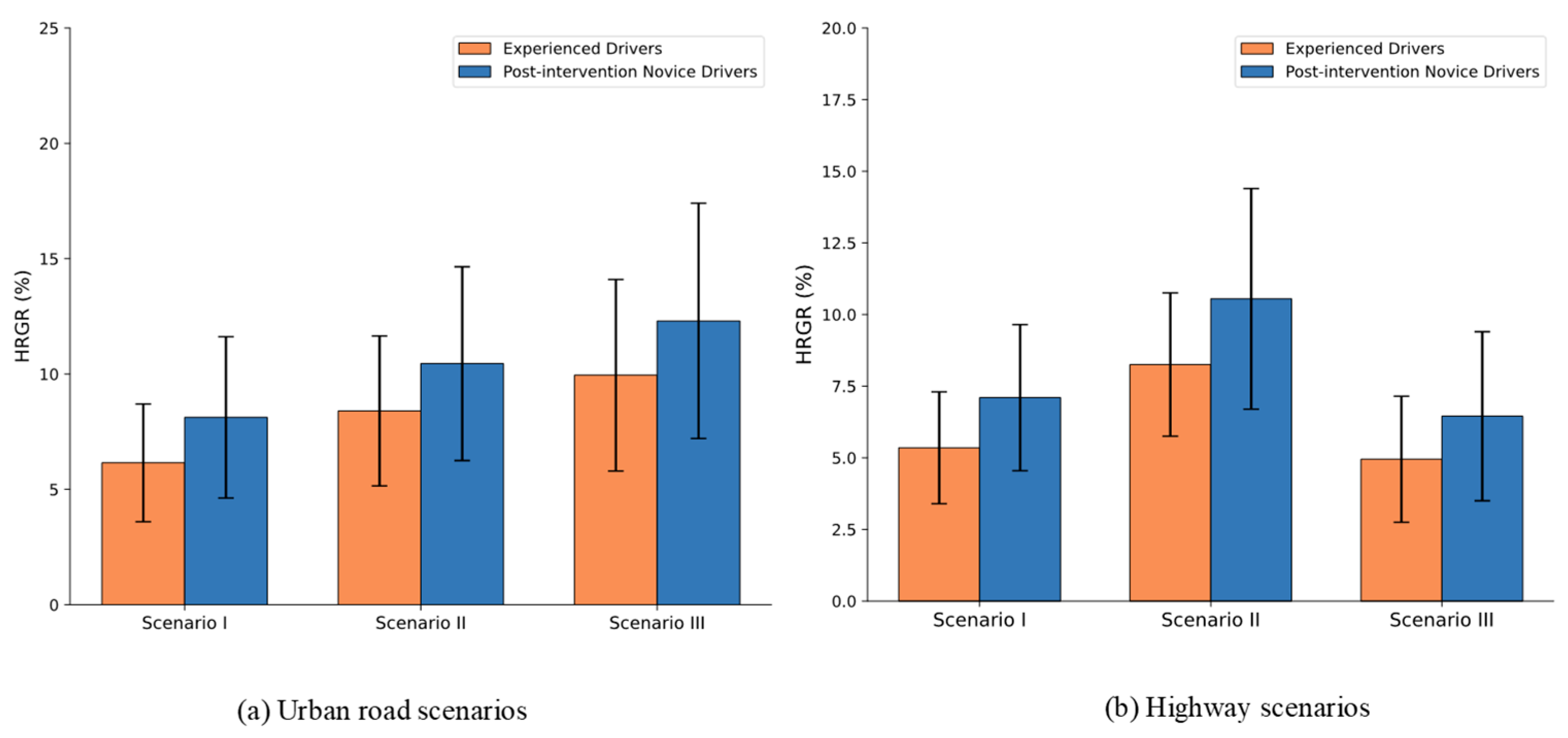
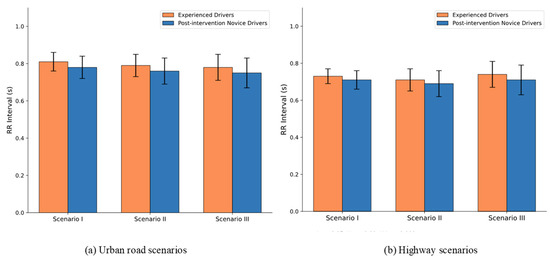
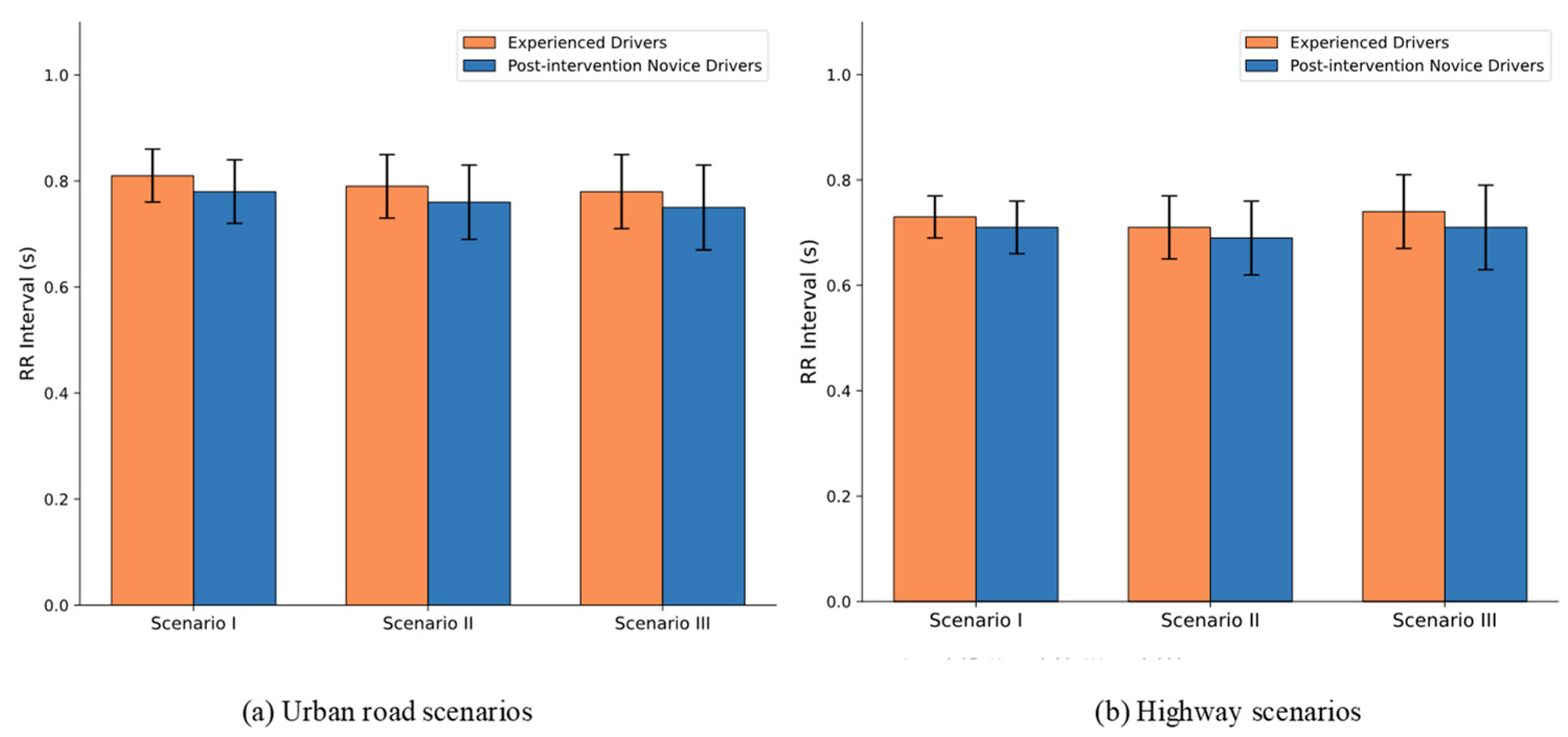
In urban scenarios (Table 20), no significant differences were found in heart rate or RR interval between novice and experienced drivers across all three lane-changing scenarios (p > 0.05). HRGR differences were also not significant, with only a marginal effect in Scenario I (p = 0.078). See Figure 16, Figure 17 and Figure 18.
Table 20.
Comparison of physiological indicators of experienced drivers and post-intervention novice drivers on urban roads.
Figure 16.
Heart rate of drivers with different experience levels in various road scenarios in (a) urban road scenarios and (b) highway scenarios.
Figure 17.
HRGR of drivers with different experience levels in various road scenarios in (a) urban road scenarios and (b) highway scenarios.
Figure 18.
RR interval of drivers with different experience levels in various road scenarios in (a) urban road scenarios and (b) highway scenarios.
In highway scenarios (Table 21), physiological indicators were also comparable between the two groups. No significant differences were observed in heart rate, RR interval, or HRGR across all scenarios (all p > 0.05).
Table 21.
Comparison of physiological indicators of experienced drivers and post-intervention novice drivers on highways.
3.3.3. Analysis of Driving Behavior Indicators
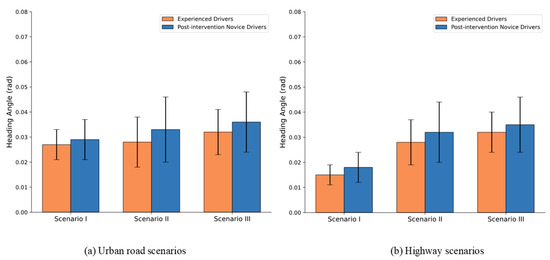
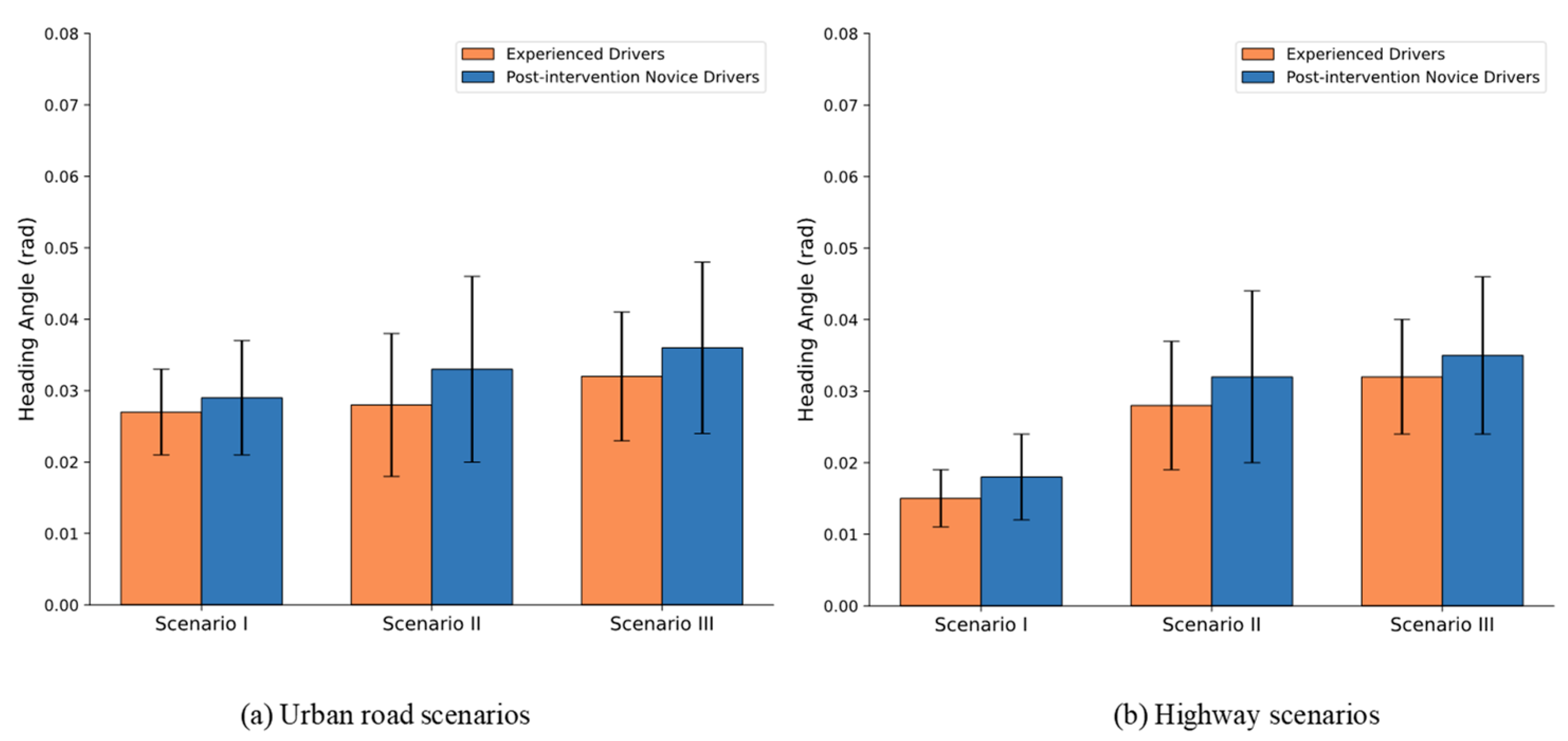
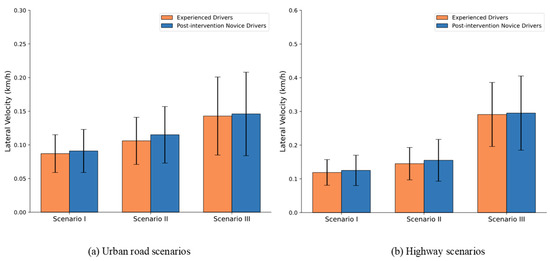
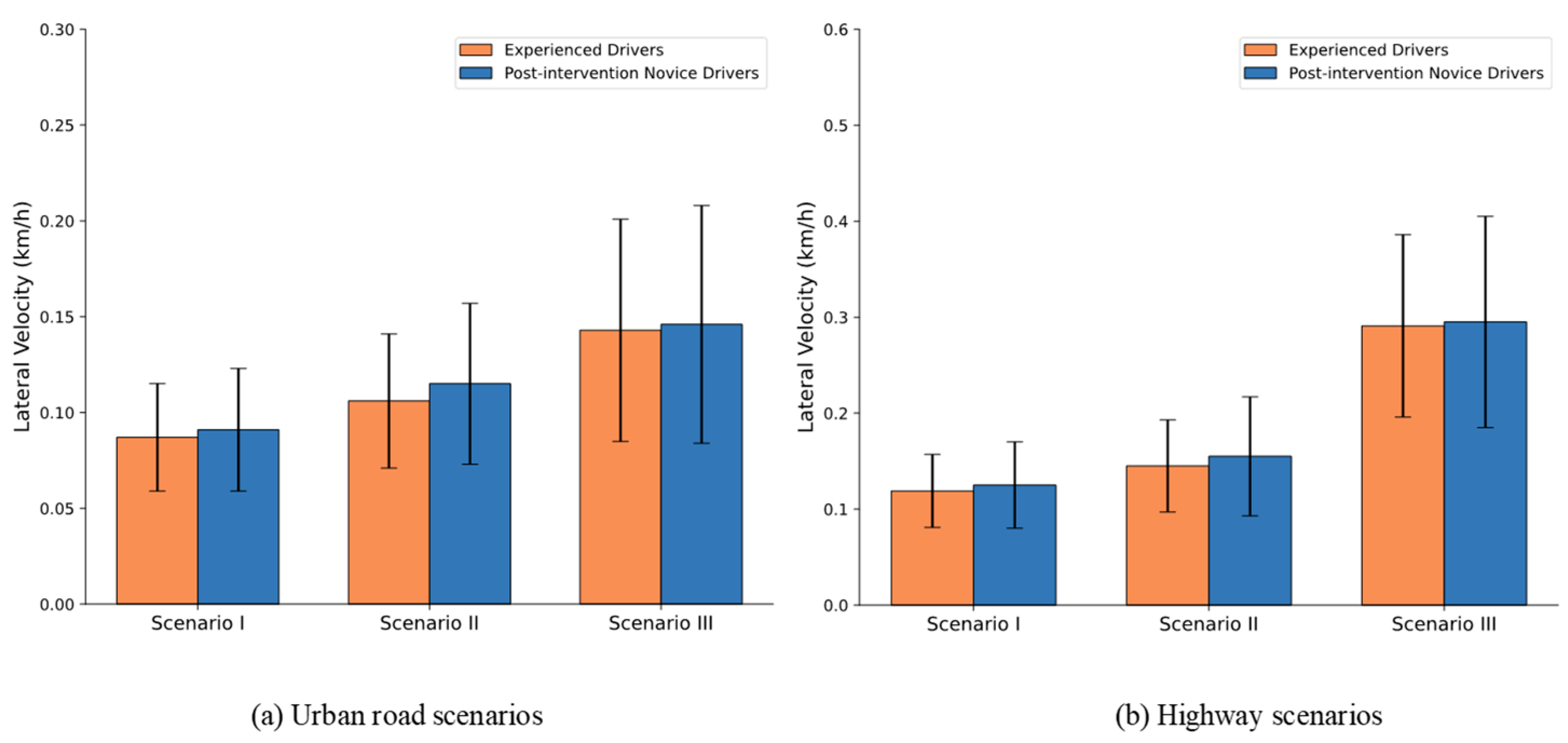
An independent-samples t-test was used to examine differences in mean longitudinal velocity, lateral velocity, and heading angle across three post-intervention lane-changing maneuvers between novice and experienced drivers in urban scenarios.
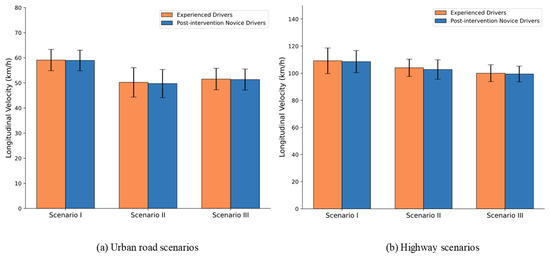
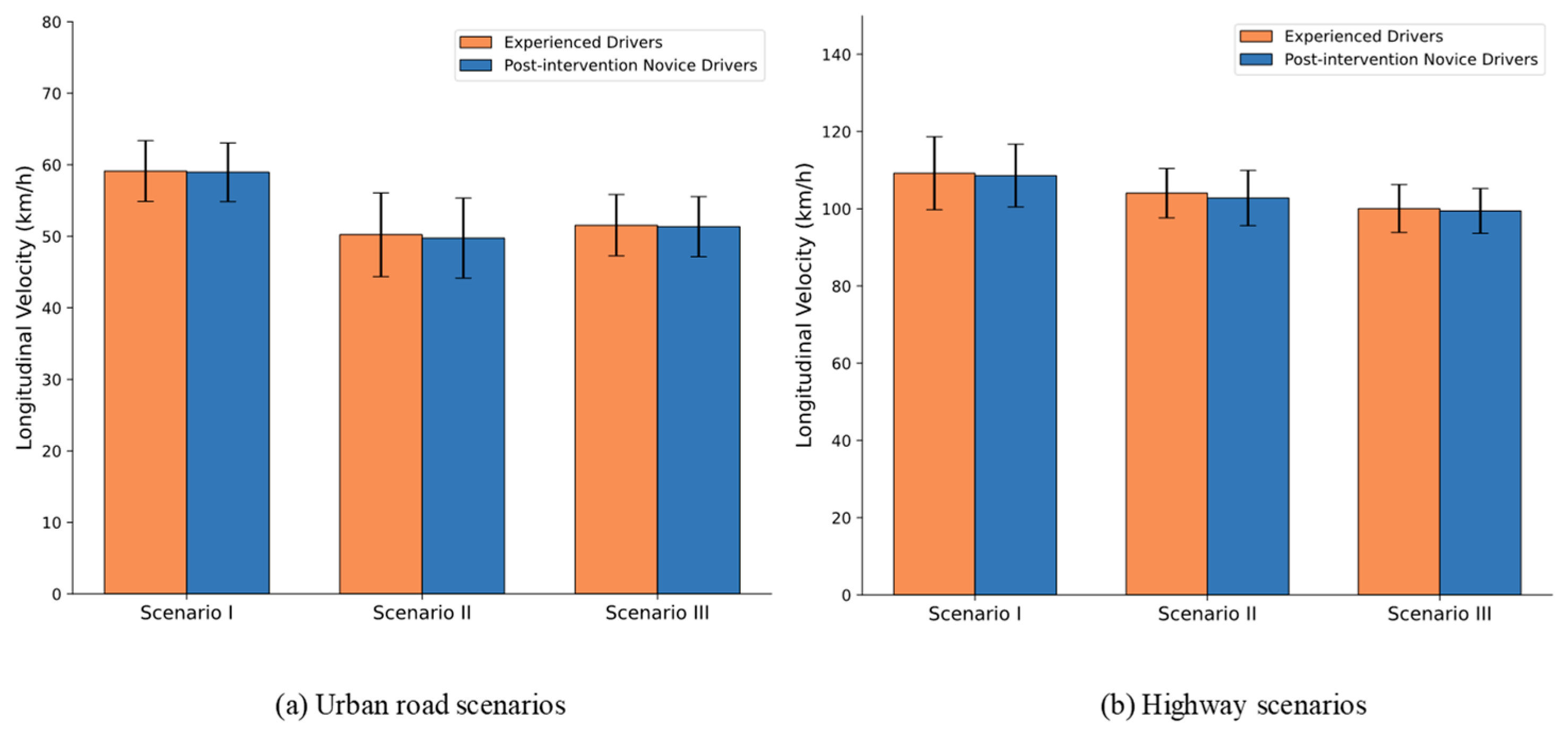
In urban scenarios (Table 22), no significant differences were found between novice and experienced drivers in longitudinal velocity, lateral velocity, or heading angle across all lane-changing maneuvers (p > 0.05). All indicators remained at similar levels between the two groups. See Figure 19, Figure 20 and Figure 21.
Table 22.
Comparison of driving behavior indicators of experienced drivers and post-intervention novice drivers on urban roads.
Figure 19.
Heading angle of drivers with different experience levels in various road scenarios in (a) urban road scenarios and (b) highway scenarios.
Figure 20.
Lateral speed of drivers with different experience levels in various road scenarios in (a) urban road scenarios and (b) highway scenarios.
Figure 21.
Longitudinal speed of drivers with different experience levels in various road scenarios in (a) urban road scenarios and (b) highway scenarios.
In highway scenarios (Table 23), the two groups also showed no significant differences in all driving behavior indicators across the three scenarios (p > 0.05), including longitudinal velocity, lateral velocity, and heading angle.
Table 23.
Comparison of driving behavior indicators of experienced drivers and post-intervention novice drivers on highways.
4. Discussion
Based on Bandura’s observational learning theory, this study constructed a four-stage intervention scheme for improving the lane-changing ability of novice drivers. Through within-subject pre–post design experiments using a driving simulator, the effectiveness of the intervention scheme was verified from three dimensions: eye movement, physiological response, and driving behavior. In addition, all three research hypotheses proposed in this study were fully verified by the analytical results.
The findings confirm that the observational learning intervention based on experienced drivers can effectively optimize the visual search strategy of novice drivers during lane changing. Before the intervention, novice drivers relied heavily on the dashboard to acquire driving-related information. From a psychological perspective, this is because novice drivers have not yet established inherent sensory mapping between vehicle speed and vehicle dynamics [37,38], and thus must frequently rely on the confirmation of external quantitative information. After the intervention, the visual search patterns of novice drivers became more consistent with those of experienced drivers. This indicates that the intervention helped novice drivers establish an association between vision and dynamics, which further facilitates their perception of traffic information [39]. Furthermore, according to the indicator of first fixation duration, the visual search behavior of novice drivers was no longer passively affected by the complexity of the traffic environment following the intervention. Their search mode transformed from a passive random response into an active search driven by the primary driving task [24,40]. This transformation in visual search mode essentially reflects an enhancement in novice drivers’ top-down attention control. Through observational learning, they acquired the cognitive flexibility to filter irrelevant stimuli and allocate limited cognitive resources efficiently to core risk areas. The observation frequency and information acquisition quality of novice drivers regarding the use of the left and right rearview mirrors improved significantly after intervention. It demonstrates that the proposed intervention can effectively compensate for the inherent visual allocation blind areas of novice drivers and further enhance driving safety [10].
The observational learning-based intervention can reduce the mental workload and tension level of novice drivers during lane changing. Before the intervention, novice drivers exhibited extreme physiological stress in highway Scenario II, represented by a shortened RR interval of 0.61 s and a sharp increase in HRGR. Physiologically, this can be explained as a visual tunneling effect caused by spatial cognitive overload. Specifically, fear and tension narrow the driver’s effective field of view, thereby leading to a sharp rise in heart rate [41,42]. Physiological data after the intervention indicate that observational learning effectively mitigates the psychological impact induced by lane-changing tasks. From the perspective of cognitive mechanisms and Social Cognitive Theory, this stress reduction is not accidental. During the retention process of the intervention, multi-source traffic information was repeatedly encoded in the drivers’ working memory and transformed into automated “driving schemas”, thereby significantly reducing their cognitive load during practical operations. Meanwhile, the positive feedback in the motivation process effectively enhanced the drivers’ self-efficacy, while observing safe maneuvers helped them establish positive outcome expectations. The synergistic effect of these cognitive mechanisms is the underlying psychological reason for the significant reduction in mental workload. Moreover, the HRGR of novice drivers remained within a relatively low and stable range after intervention, suggesting that their physiological arousal level entered the optimal arousal zone defined by the Yerkes–Dodson Law [43]. Such a stable physiological state serves as a prerequisite for efficient information processing and can significantly reduce fatigue risk caused by mental exhaustion during continuous long-distance driving [44].
The observational learning intervention can optimize the lane-changing operational behavior of novice drivers and improve their vehicle control stability and rationality in lane-changing decision-making. The drastic fluctuation of heading angle among novice drivers before intervention essentially reflects compensatory operation induced by visual perception hysteresis, namely abrupt steering correction occurring only after the vehicle deviates from the expected trajectory [45]. After the intervention, the significant reduction in the heading angle and its standard deviation indicates that novice drivers learned the feed-forward control strategy adopted by experienced drivers. This transition from passive compensatory steering to active feed-forward control signifies a remarkable improvement in the drivers’ executive functions, particularly in impulse inhibition and motor planning. By observing potential risks in advance and maintaining a stable psychological state, novice drivers can achieve smooth trajectory transition through slight steering adjustments. The improvement and stabilization of the longitudinal vehicle speed effectively resolve the common problem of deceleration-dependent lane changing among novice drivers. In highway scenarios, the constant-speed lane-changing behavior of novice drivers after intervention greatly reduces the risk of time-to-collision (TTC) with following vehicles in the target lane [45,46]. The optimization of decision-making logic enables novice drivers to behave more compatibly with the continuity of traffic flow, improving individual driving safety as well as the overall stability of traffic operation.
Furthermore, it is critical to recognize that the improvements across the three evaluated dimensions do not occur in isolation; rather, they form a tightly coupled “Perception–Cognition–Action” loop. Prior to the intervention, the novice drivers’ inefficient visual search patterns (e.g., over-reliance on the dashboard) created an information deficit regarding the surrounding traffic environment. This perceptual uncertainty directly triggered psychological apprehension, manifesting as severe physiological hyperarousal (i.e., significantly elevated HRGR). Operating under high cognitive stress and visual hysteresis, drivers were forced to execute delayed, compensatory vehicle control, leading to erratic heading angle fluctuations. The observational learning intervention essentially repaired this dysfunctional loop. By establishing a standardized visual search strategy (Perception), novice drivers acquired sufficient situational awareness, which in turn suppressed their uncertainty and maintained their physiological state within an optimal arousal zone (Cognition). Consequently, this stable psychological foundation and broadened visual field enabled drivers to transition from reactive steering to proactive, feed-forward trajectory control (Action), ultimately realizing a smooth and safe lane-changing maneuver.
The theoretical contributions of this study are mainly reflected in the following three aspects.
First, this study systematically applied Bandura’s observational learning theory to the field of lane-changing ability improvement for novice drivers for the first time and constructed a systematic four-stage intervention framework. It fills the research gap in existing lane-changing intervention studies lacking systematic psychological theoretical support, and provides a novel theoretical perspective and standardized research paradigm for novice driver training and driving license assessment. By systematically elucidating how observational learning modulates underlying cognitive mechanisms—such as attention control, working memory, and executive functions—this study elevates the empirical behavioral data to a profound cognitive theoretical level.
Second, based on driving simulator experiments, this study systematically quantified the overall capability differences between novice and experienced drivers in typical urban and highway lane-changing scenarios from eye movement, physiological, and driving behavior dimensions. It identifies the core deficiencies of novice drivers in lane-changing performance, provides comprehensive data support and theoretical basis for targeted intervention, and enriches research findings on the lane-changing behavioral characteristics of drivers.
Third, the logic of observational learning based on experienced drivers proposed in this study can be further applied to takeover training in autonomous driving, serving as a cognitive bridge for human drivers adapting to the intelligent driving environment.
5. Conclusions
Aiming at the core issues of insufficient hazard perception ability and poor operational stability among novice drivers during lane changing, this study applies Bandura’s observational learning theory. By guiding novice drivers to systematically observe and imitate the visual search patterns and operational behaviors of experienced drivers, their visual information acquisition strategies were optimized, thereby improving hazard perception capability. The results indicate that, compared with the pre-intervention level, novice drivers showed notable improvements after the intervention. Specifically, the proportion of potential hazard recognition increased, driving behavior became more cautious and stable, and attention allocation shifted more effectively toward key risk areas. These findings demonstrate that observational learning intervention can effectively enhance novice drivers’ visual search efficiency and risk awareness in lane-changing tasks.
Several limitations should be noted. First, no real-road driving experiments or long-term follow-up were conducted, limiting assessment of the intervention’s sustained effects. Second, there were significant demographic differences in age and occupation between the novice and experienced driver groups. All 30 novice drivers recruited in this study were postgraduate students. While the within-subject design (novice pre- vs. post-intervention) effectively controls for these variables when evaluating the intervention’s efficacy, the baseline comparison between novice and experienced drivers may still contain potential biases introduced by age-related cognitive differences or professional habits. Future studies should employ stricter demographic matching (e.g., comparing young novices with young, experienced drivers) to isolate the pure effect of driving experience. Third, real driving environments were simplified into discrete scenarios, which may not fully capture real-world complexity. Future work should include on-road experiments and longitudinal studies to evaluate long-term effectiveness, and expand participant diversity and scenario complexity to further validate the robustness and generalizability of the proposed intervention. Finally, while the within-subject design combined with sufficient pre-adaptation effectively mitigated practice effects, the lack of an independent control group of untrained novices remains a limitation. Future studies will incorporate strict randomized controlled trials to further isolate the intervention’s net efficacy.
Author Contributions
Conceptualization, J.L., Y.F., and K.J.; methodology, J.L. and K.J.; validation, Y.F.; investigation, J.L.; writing—original draft preparation, J.L.; writing—review and editing, J.L. and Y.F. All authors have read and agreed to the published version of the manuscript.
Funding
This research was funded by the National Natural Science Foundation of China under Grant No. 52402415, and Anhui Jianzhu University Talent Introduction and Doctoral Startup Fund Project under Grant No. 2023QDZ36.
Institutional Review Board Statement
This study was conducted in accordance with the Declaration of Helsinki. No approval by the Institutional Ethics Committee was necessary, as all data were collected anonymously from capable, consenting adults. The data are not traceable to participating individuals. The procedure complies with general data protection regulation (GDPR).
Informed Consent Statement
Informed consent for participation was obtained from all subjects involved in the study.
Data Availability Statement
Data will be available upon reasonable request from the corresponding author.
Acknowledgments
We sincerely thank the reviewers and the editor for their constructive comments and insightful suggestions, which have significantly improved the quality and clarity of the manuscript. In preparing this study, ChatGPT-4 (Open Al, San Francisco, CA, USA) and Grammarly (Grammarly, Inc., San Francisco, CA, USA) were used solely for translation, language editing, and grammar checking. The authors created all academic content, analysis, interpretation, and conclusions. Chat GPT and/or Grammarly were not used as primary sources for originality or for generating scientific opinions. All scientific responsibilities belong solely to the authors.
Conflicts of Interest
The authors declare no conflicts of interest.
References
- Shawky, M. Factors affecting lane change crashes. IATSS Res. 2020, 44, 155–161. [Google Scholar] [CrossRef] [Scilit]
- Sen, B.; Smith, J.D.; Najm, W.G. Analysis of Lane Change Crashes; Volpe National Transportation Systems Center: Cambridge, MA, USA, 2003.
- Hou, Y.; Edara, P.; Sun, C. Situation assessment and decision making for lane change assistance using ensemble learning methods. Expert Syst. Appl. 2015, 42, 3875–3882. [Google Scholar] [CrossRef] [Scilit]
- Dou, Y.; Yan, F.; Feng, D. Lane changing prediction at highway lane drops using support vector machine and artificial neural network classifiers. In Proceedings of the 2016 IEEE International Conference on Advanced Intelligent Mechatronics (AIM); IEEE: New York, NY, USA, 2016; pp. 901–906. [Google Scholar]
- Fisher, D.L.; Pollatsek, A.; Pradhan, A. Can novice drivers be trained to scan for information that will reduce their likelihood of a crash? Inj. Prev. 2006, 12, i25–i29. [Google Scholar] [PubMed]
- Boufous, S.; Ivers, R.; Senserrick, T.; Stevenson, M. Attempts at the practical on-road driving test and the hazard perception test and the risk of traffic crashes in young drivers. Traffic Inj. Prev. 2011, 12, 475–482. [Google Scholar] [CrossRef] [Scilit] [PubMed]
- Horswill, M.S.; Hill, A.; Wetton, M. Can a video-based hazard perception test used for driver licensing predict crash involvement? Accid. Anal. Prev. 2015, 82, 213–219. [Google Scholar] [CrossRef] [Scilit] [PubMed]
- Horswill, M.S. Hazard perception in driving. Curr. Dir. Psychol. Sci. 2016, 25, 425–430. [Google Scholar] [CrossRef] [Scilit]
- Underwood, G.; Ngai, A.; Underwood, J. Driving experience and situation awareness in hazard detection. Saf. Sci. 2013, 56, 29–35. [Google Scholar] [CrossRef] [Scilit]
- Vlakveld, W. Hazard Anticipation of Young Novice Drivers: Assessing and Enhancing the Capabilities of Young Novice Drivers to Anticipate Latent Hazards in Road and Traffic Situations. Ph.D. Thesis, University of Groningen, Groningen, The Netherlands, 2011. [Google Scholar]
- Zhou, H.; Itoh, M. How does a driver perceive risk when making decision of lane-changing? IFAC-PapersOnLine 2016, 49, 60–65. [Google Scholar] [CrossRef] [Scilit]
- Salvucci, D.D.; Liu, A. The time course of a lane change: Driver control and eye-movement behavior. Transp. Res. Part F Traffic Psychol. Behav. 2002, 5, 123–132. [Google Scholar] [CrossRef] [Scilit]
- Zhang, W.; Dai, J.; Pei, Y.; Li, P.; Yan, Y.; Chen, X. Drivers’ visual search patterns during overtaking maneuvers on freeway. Int. J. Environ. Res. Public Health 2016, 13, 1159. [Google Scholar] [CrossRef] [Scilit] [PubMed]
- Wang, W.; Cheng, G. The characteristics of driver lane-changing behaviour in congested road environments. Transp. Saf. Environ. 2024, 6, tdad039. [Google Scholar]
- Raza, M.; Muslam, M.M.; Murtaza, M.; Cheng, C.-T.; Albahlal, B.M. Driving through the mind: Investigating driver cognitive impairment with physiological measures of mental workload. Preprint 2024. [Google Scholar] [CrossRef] [Scilit]
- Lohani, M.; Payne, B.R.; Strayer, D.L. A review of psychophysiological measures to assess cognitive states in real-world driving. Front. Hum. Neurosci. 2019, 13, 57. [Google Scholar] [CrossRef] [Scilit] [PubMed]
- Ferrante, C. Evaluation of Driving Risk Levels Through Kinematic, Dynamic and Psycho-Physiological Measures. Ph.D. Thesis, Università Degli Studi Roma Tre, Rome, Italy, 2020. [Google Scholar]
- Qi, W.; Wen, H.; Wu, Y.; Qin, L. Effect model of urban traffic congestion on driver’s lane-changing behavior. Adv. Mech. Eng. 2017, 9, 1687814017724087. [Google Scholar] [CrossRef] [Scilit]
- Zhang, X.; Pan, C.; Lin, W.; Xu, J. Psychological load of drivers in multi-lane interweaving areas of urban roads. China Saf. Sci. J. 2022, 32, 25–32. [Google Scholar]
- Hill, C.; Elefteriadou, L.; Kondyli, A. Exploratory analysis of lane changing on freeways based on driver behavior. J. Transp. Eng. 2015, 141, 04014090. [Google Scholar] [CrossRef] [Scilit]
- Shi, J.; Liu, M. Impacts of differentiated per-lane speed limit on lane changing behaviour: A driving simulator-based study. Transp. Res. Part F Traffic Psychol. Behav. 2019, 60, 93–104. [Google Scholar] [CrossRef] [Scilit]
- Ram, T.; Chand, K. Effect of drivers’ risk perception and perception of driving tasks on road safety attitude. Transp. Res. Part F Traffic Psychol. Behav. 2016, 42, 162–176. [Google Scholar] [CrossRef] [Scilit]
- Cao, S.; Samuel, S.; Murzello, Y.; Ding, W.; Zhang, X.; Niu, J. Hazard perception in driving: A systematic literature review. Transp. Res. Rec. 2022, 2676, 666–690. [Google Scholar] [CrossRef] [Scilit]
- Chapman, P.; Underwood, G.; Roberts, K. Visual search patterns in trained and untrained novice drivers. Transp. Res. Part F Traffic Psychol. Behav. 2002, 5, 157–167. [Google Scholar] [CrossRef] [Scilit]
- Isler, R.B.; Starkey, N.J.; Sheppard, P. Effects of higher-order driving skill training on young, inexperienced drivers’ on-road driving performance. Accid. Anal. Prev. 2011, 43, 1818–1827. [Google Scholar] [CrossRef] [Scilit] [PubMed]
- Šeibokaitė, L.; Endriulaitienė, A.; Markšaitytė, R.; Slavinskienė, J. Improvement of hazard prediction accuracy after training: Moderation effect of driving self-efficacy and road safety attitudes of learner drivers. Saf. Sci. 2022, 151, 105742. [Google Scholar] [CrossRef] [Scilit]
- Zhou, B.; Feng, Z.; Liu, J.; Huang, Z.; Gao, Y. A method to enhance drivers’ hazard perception at night based on “knowledge-attitude-practice” theory. Accid. Anal. Prev. 2024, 200, 107565. [Google Scholar] [CrossRef] [Scilit] [PubMed]
- Greene, K.; Hecht, M.L. Introduction for Symposium on engaging youth in prevention message creation: The theory and practice of active involvement interventions. Health Commun. 2013, 28, 641–643. [Google Scholar] [CrossRef] [Scilit] [PubMed]
- Bandura, A. Social-cognitive theory. In An Introduction to Theories of Personality; Psychology Press: Hove, UK, 2014; pp. 341–360. [Google Scholar]
- Bandura, A. Bandura-Social Learning Theory. In Theories of Development: Concepts and Applications; Prentice Hall: Upper Saddle River, NJ, USA, 1977; pp. 175–192. [Google Scholar]
- Rosenbloom, T.; Shahar, A.; Elharar, A.; Danino, O. Risk perception of driving as a function of advanced training aimed at recognizing and handling risks in demanding driving situations. Accid. Anal. Prev. 2008, 40, 697–703. [Google Scholar] [CrossRef] [Scilit] [PubMed]
- Yuan, J.; Crowson, A.; Richardson, G.; Feng, J. Drive aware training: A computerized training program for older drivers’ detection of road hazards. Traffic Inj. Prev. 2021, 22, 443–448. [Google Scholar] [CrossRef] [Scilit] [PubMed]
- Zhang, W.; Wang, Y.; Feng, Z.; Zhu, S.; Cui, J.; Hao, W.; Wang, C. A method to improve the hazard perception of young novice drivers based on Bandura’s observational learning theory: Supplement to expert commentary training. Transp. Res. Part F Traffic Psychol. Behav. 2022, 85, 133–149. [Google Scholar] [CrossRef] [Scilit]
- van Winsum, W.; De Waard, D.; Brookhuis, K.A. Lane change manoeuvres and safety margins. Transp. Res. Part F Traffic Psychol. Behav. 1999, 2, 139–149. [Google Scholar] [CrossRef] [Scilit]
- Wang, C.; Li, Z.; Fu, R.; Zhang, M.; Sun, Q. Lane change safety assessment of coaches in naturalistic driving state. Saf. Sci. 2019, 119, 126–132. [Google Scholar] [CrossRef] [Scilit]
- Smith, S.S.; Horswill, M.S.; Chambers, B.; Wetton, M. Hazard perception in novice and experienced drivers: The effects of sleepiness. Accid. Anal. Prev. 2009, 41, 729–733. [Google Scholar] [CrossRef] [Scilit] [PubMed]
- Scialfa, C.T.; Deschênes, M.C.; Ference, J.; Boone, J.; Horswill, M.S.; Wetton, M. A hazard perception test for novice drivers. Accid. Anal. Prev. 2011, 43, 204–208. [Google Scholar] [CrossRef] [Scilit] [PubMed]
- Parmet, Y.; Borowsky, A.; Yona, O.; Oron-Gilad, T. Driving speed of young novice and experienced drivers in simulated hazard anticipation scenes. Hum. Factors 2015, 57, 311–328. [Google Scholar] [CrossRef] [Scilit] [PubMed]
- Pradhan, A.K.; Fisher, D.L.; Pollatsek, A. Risk perception training for novice drivers: Evaluating duration of effects of training on a driving simulator. Transp. Res. Rec. 2006, 1969, 58–64. [Google Scholar] [CrossRef] [Scilit]
- Robbins, C.; Chapman, P. How does drivers’ visual search change as a function of experience? A systematic review and meta-analysis. Accid. Anal. Prev. 2019, 132, 105266. [Google Scholar] [CrossRef] [Scilit] [PubMed]
- Reimer, B. Impact of cognitive task complexity on drivers’ visual tunneling. Transp. Res. Rec. 2009, 2138, 13–19. [Google Scholar] [CrossRef] [Scilit]
- Jiao, F.; Du, Z.; Wong, Y.D.; He, S.; Jiang, Z. Influence of different visual guiding facilities in urban road tunnel on driver’s spatial right-of-way perception. Accid. Anal. Prev. 2022, 172, 106688. [Google Scholar] [CrossRef] [Scilit] [PubMed]
- Chaby, L.E.; Sheriff, M.J.; Hirrlinger, A.M.; Braithwaite, V.A. Can we understand how developmental stress enhances performance under future threat with the Yerkes-Dodson law? Commun. Integr. Biol. 2015, 8, e1029689. [Google Scholar] [CrossRef] [Scilit] [PubMed]
- St Clair Gibson, A.; Swart, J.; Tucker, R. The interaction of psychological and physiological homeostatic drives and role of general control principles in the regulation of physiological systems, exercise and the fatigue process—The Integrative Governor theory. Eur. J. Sport Sci. 2018, 18, 25–36. [Google Scholar] [CrossRef] [Scilit] [PubMed]
- Patten, C.J.; Kircher, A.; Östlund, J.; Nilsson, L. Using mobile telephones: Cognitive workload and attention resource allocation. Accid. Anal. Prev. 2004, 36, 341–350. [Google Scholar] [CrossRef] [Scilit] [PubMed]
- Tarko, A.P. Modeling drivers’ speed selection as a trade-off behavior. Accid. Anal. Prev. 2009, 41, 608–616. [Google Scholar] [CrossRef] [Scilit] [PubMed]

Disclaimer/Publisher’s Note: The statements, opinions and data contained in all publications are solely those of the individual author(s) and contributor(s) and not of MDPI and/or the editor(s). MDPI and/or the editor(s) disclaim responsibility for any injury to people or property resulting from any ideas, methods, instructions or products referred to in the content. |
© 2026 by the authors. Licensee MDPI, Basel, Switzerland. This article is an open access article distributed under the terms and conditions of the Creative Commons Attribution (CC BY) license.