


Abstract
How would an expansion in the use of special drawing rights (SDR) affect the currency composition of the international reserve system? This study explores this question by proposing a novel analytical framework based on the analytic hierarchy process (AHP) model. We incorporate the use of SDR as a reserve asset and a denomination into an AHP model to determine the currency structure in global foreign exchange (FX) reserves. We then design scenario simulations to analyze changes in the currency structure of global FX reserves with expansion in the use of SDR. We show that greater SDR use can lead to convergence in the share of each SDR currency in international reserves based on their weight in the SDR. At present, the share of the USD in international reserves exceeds its weight in the SDR, and the share of other SDR currencies, such as the EUR and RMB, is below their respective weights. Hence, expanding SDR use would weaken the reserve position of the USD and strengthen that of the EUR and RMB, making the international reserve system more balanced.
1. Introduction
Since the collapse of the Bretton Woods system in the 1970s, the USD has dominated the international reserve system because of its network externality and the fact that the US has the largest, deepest, and most liquid financial markets in the world, though it is no longer the only reserve currency. The USD still accounts for more than half the world’s foreign exchange (FX) reserves, so the prevailing international reserve system is diversified but unbalanced and, to a large extent, still dominated by the USD1. Theoretically, an international monetary system that relies heavily on a single sovereign currency faces a Triffin dilemma (or paradox), which is the inability of a reserve currency issuer to provide liquidity to the world while ensuring stability in the value of its currency. Therefore, if reform is needed in the international monetary system, the key to doing so is eliminating dependence on a single reserve currency. Doing so will enable more balanced diversification, which necessarily reduces the dominance of the USD.
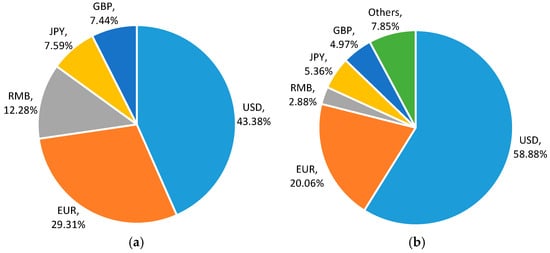
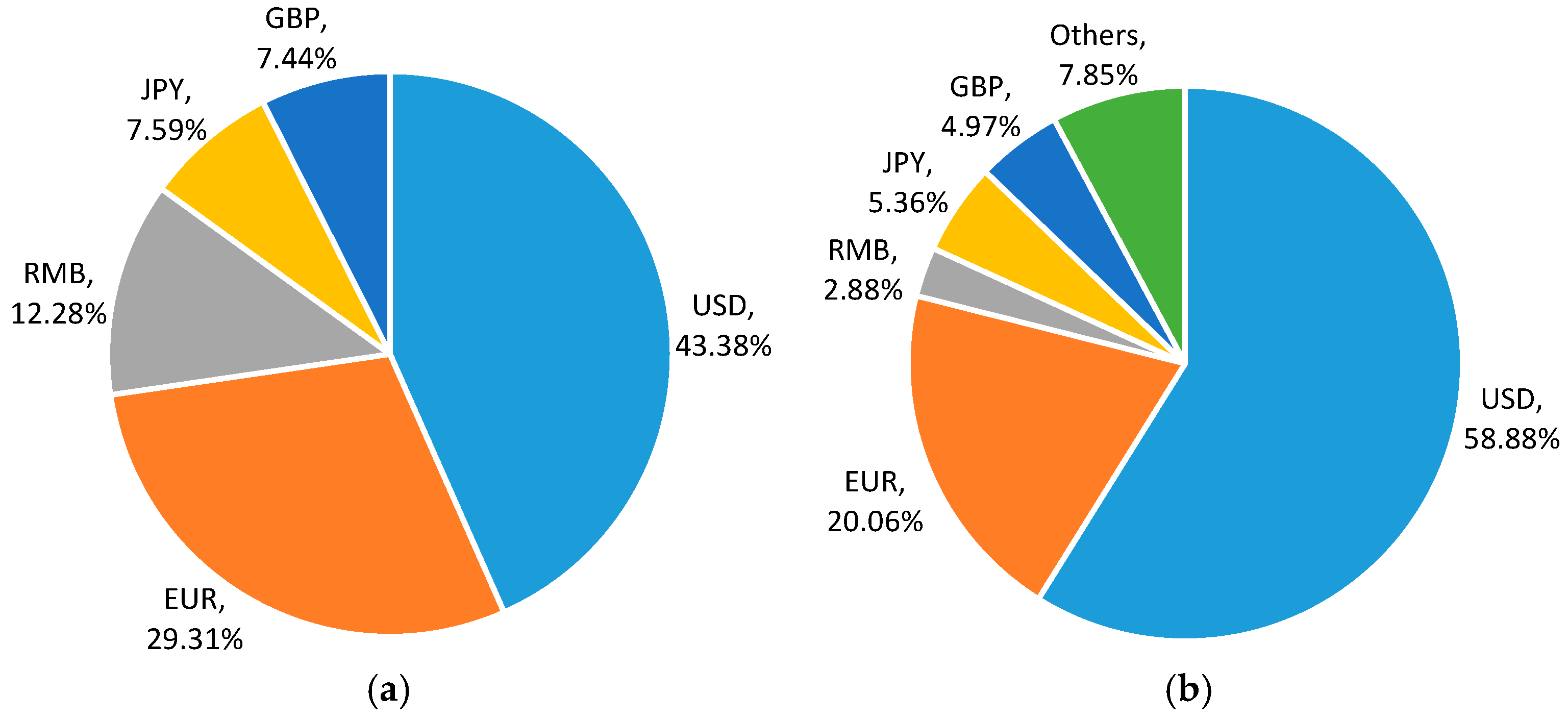
Special drawing rights (SDR) can play an essential role in this kind of reform in the international reserve system. The SDR functions as the reserve asset and denomination in the international monetary system [1,2]. Unlike the prevailing international reserve system, which is unbalanced, the SDR currency structure is more equally weighted. After the International Monetary Fund (IMF) completed its latest SDR valuation review in 2022, the weights of the USD, EUR, RMB, JPY, and GBP in the SDR basket are 43.38%, 29.31%, 12.28%, 7.59%, and 7.44%, respectively. Thus, the SDR weight of the USD is smaller than its share of international reserves, whereas the weight of the other SDR currencies, such as the EUR and RMB, is larger than their respective share of international reserves (for details, see Figure 1). The SDR basket has a more equally weighted currency structure because, every five years, the IMF uses rigorous criteria to re-evaluate and adjust the composition and currency weights of the SDR basket to ensure that it reflects the relative importance of every reserve currency in international trade and financial activities2. Accordingly, this study advances the following theoretical proposition: whether expanding the use of the SDR as a reserve asset and a denomination unit could promote a gradual convergence of the international reserve shares of the currencies in the SDR basket toward their respective SDR weights, thereby indirectly weakening the USD’s dominant position in the international reserve system, enhancing the reserve position of other international currencies, and steering the international reserve system toward a more balanced and diversified structure.
Figure 1.
Currency structure of the SDR basket compared to the currency structure of global FX reserves. Sources: IMF; IMF’s composition of official foreign exchange reserves (COFER) database. (a) Currency structure of the SDR basket; (b) Currency structure of global FX reserves.
Since the creation of the SDR—particularly in the aftermath of the 2008 global financial crisis (GFC)—scholars have devoted considerable attention to how to strengthen the role of the SDR in the international monetary system. These studies include both radical reform proposals that seek to transform the SDR into a fully fledged supranational currency and thereby replace sovereign currencies as the center of the international monetary system [3,4,5,6], as well as more conservative approaches that advocate the gradual expansion of SDR use within the existing institutional framework [7,8,9,10]. Although various proposals have been raised in the literature regarding the role of SDR in reforming the international monetary system, the issue surrounding the effect on the existing international reserve system from expanding SDR use has not been explored, with the absence of both a theoretical framework and an in-depth analysis of it. For the foreseeable future, it would be difficult to make the SDR a supersovereign currency. However, under the current system, there is room for making the SDR a more effective complement to the prevailing international reserve system by gradually upgrading its use as a reserve asset and denomination. To this end, starting from the premise of gradually expanding the use of the SDR within the institutional framework of the existing international monetary system, this study examines the mechanisms and effects through which expanding the use of the SDR as the reserve asset and denomination influences the currency composition of the international reserve system.
In this paper, we fill the literature gap by developing a novel analytical framework based on an analytic hierarchy process (AHP) model. Specifically, we introduce a variable for the scope of SDR use into an AHP model on the determination of the currency structure of global FX reserves; then, we use scenario simulation to examine the impact of expanding SDR use on the currency structure of global FX reserves. In our AHP-based analytical framework, the optimal allocation of the currency structure of FX reserves is based on four criteria: currency status, payment structure, exchange rate stability, and risk–return characteristics. Optimizing the currency structure of FX reserves requires comprehensive consideration of four criteria to fully employ the functions of FX reserves. Expanding the use of SDR as the reserve asset and denomination (including as an exchange rate anchor) would directly affect the share of the five SDR currencies—USD, EUR, RMB, JPY, and GBP—in the global FX reserves with respect to currency status, payment structure, and exchange rate stability, and ultimately affect the currency structure of FX reserves. We show that expanding SDR use can drive convergence in the share of all SDR currencies in international reserves to their respective weight in the SDR. This means that, under current conditions, the share of the USD in international reserves exceeds its weight in the SDR, and the share of other SDR currencies (e.g., EUR and RMB) in international reserves is below their respective weight in the SDR. Therefore, expanding SDR use would weaken the reserve position of the USD and strengthen that of the EUR and RMB, contributing to a more balanced international reserve system.
This study makes three contributions to the literature. First, we raise the important theoretical question of how expanding SDR use affects the international reserve system and examine it in a forward-looking manner, which advances research on the role of the SDR in reform of the international monetary system. The second contribution is methodological. We decompose the variable for the scope of SDR use into two subvariables: SDR as the reserve asset and as a denomination, and introduce them into an AHP model for the determination of the currency structure of global FX reserves. The AHP-based analytical framework that we develop offers a novel approach for predicting the impact of expanding SDR use on the currency composition of the international reserve system. Third, we use scenario simulation to quantitatively examine changes in the currency structure of global FX reserves under different scenarios of expansion in SDR use and then infer the effect of expanding SDR use on the reserve status of each SDR currency, with meaningful policy implications about the role of SDR in reform of the international monetary system.
The remainder of the paper is structured as follows. Section 2 reviews relevant literature. Section 3 presents the AHP methodology and constructs the benchmark AHP model for the currency structure determination of FX reserves. Section 4 uses the benchmark AHP to fit the current currency structure of global FX reserves and compares the relative positions of the five SDR currencies (USD, EUR, GBP, JPY, and RMB) in the international reserve system. Section 5 extends the benchmark AHP by introducing the scope of SDR use. Section 6 applies scenario simulation to project changes in the currency structure of global FX reserves using different scenarios of expansion in SDR use to examine the impact of doing so on the reserve position of each SDR currency. Section 7 concludes.
2. Literature Review
In 1969, the IMF created the SDR as a reserve asset to supplement the official reserves of its member countries. The value of the SDR was initially set as equivalent to 0.888671 g of gold, which was also equivalent to US$1. After the collapse of the Bretton Woods system in 1971, which ended the gold standard, the SDR was redefined as a basket of currencies. Since then, the basket has been adjusted in composition and weight several times and now includes the USD, EUR, RMB, JPY, and GBP. SDR performs two functions in the international monetary system [1,2]. First, the official SDR acts as a reserve asset. The official SDR is neither a currency nor a claim on the IMF but a potential claim on the freely usable currencies of IMF members, as SDRs can be exchanged for these currencies. At present, the IMF has allocated 660.6 billion SDRs to member countries, equivalent to approximately US$941.6 billion. Second, the SDR is used as a denomination, including for financial assets (e.g., SDR-denominated bonds), economic statistics, financial statements, and transaction prices, as well as acting as an exchange rate anchor. Currently, the size of SDR issuance as a reserve asset and its use as a denomination are both limited [2].
Ever since the SDR was created, especially since the 2008 GFC, scholars have explored how the role of the SDR in the international monetary system could be enhanced and have proposed various reforms. One radical proposal aims to construct a new SDR-based global reserve system, making the SDR a true supersovereign currency to replace sovereign currencies (including the USD) at the center of the international reserve system [3,4,5,6]. The measures proposed to implement this reform include making the SDR freely convertible, enabling private institutions and banks to hold and trade SDR, making the IMF a global central bank that issues and manages the SDR, providing real asset backing for the issuance of SDR, and establishing a clearing relationship between SDR and other currencies so that it becomes a recognized means of payment for international trade and financial transactions. A more conservative proposal would tinker within the existing framework, by gradually expanding use of the SDR to make it a truly effective complement to the existing international reserve system while maintaining the existing use of sovereign currencies as international reserve currencies [7,8,9,10]. The corresponding reform measures proposed include increasing the scale of official SDR issuance and expanding its use as a reserve asset [11,12]; enhancing SDR’s denomination function, including developing SDR-denominated bond markets [13], extending its transaction pricing function [14], promoting use of the SDR as an exchange rate anchor [15], and improving the SDR currency basket valuation [16].
Another strand of the literature closely related to this study examines the determinants of the currency composition of FX reserves, which constitutes a core issue in the field of the international monetary system. Although this literature is relatively extensive, no existing study has explicitly addressed the impact of expanding the use of the SDR on the global currency composition of FX reserves. Roger [17] argues that the management of reserve currency composition needs to meet transaction and FX intervention requirements, while ensuring desirable risk–return characteristics of the currency portfolio. Dellas and Yoo [18] and Papaioannou et al. [19], in their analyses of optimal currency weights in FX reserves, emphasize the constraining roles of returns, risks, and the currency of denomination. Chinn and Frankel [20] estimate the determinants of major currency shares in central bank FX reserves using econometric methods and find that key influencing factors include the economic size of the issuing country, inflation, exchange rate volatility, and FX market turnover. Eichengreen and Mathieson [21] show that trade flows, financial flows, and currency pegs are the main determinants of reserve currency composition. Using a cross-country panel dataset, Ito and McCauley [22] find that the currency composition of FX reserves is closely related to the co-movement between the domestic currency and major international currencies, as well as to the currency of trade invoicing. Iancu et al. [23] further point out that since the GFC, financial linkages have played an increasingly important role in shaping reserve currency allocations, and that inertia effects in reserve currency composition have strengthened. They also emphasize that new developments—such as digital currencies and emerging payment ecosystems—may accelerate the evolution of the international reserve currency system toward a new configuration.
3. Methodology
The AHP is a combined qualitative and quantitative approach for decision analysis in complex, multi-level problems [24]. Given that the optimal allocation of the FX reserve currency structure is inherently multi-objective, hierarchical, and systemic, the AHP framework is well-suited for analyzing it.
From a functional perspective, FX reserves are primarily held to ensure external payment capacity, maintain balance-of-payments stability, facilitate FX market intervention, and preserve or enhance asset value. Different reserve currency compositions are therefore required to fulfill different policy objectives. Optimization of the FX reserve currency structure can be understood as the process of rationalizing currency allocation in order to better perform these functions. Accordingly, we construct an AHP model to characterize the decision-making process of FX reserve currency structure management, combining qualitative judgments with quantitative weighting to determine the relative importance of each currency.
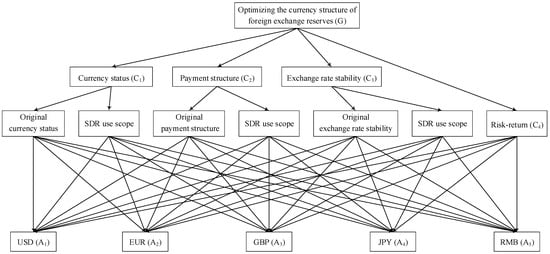
Following the standard AHP procedure, a three-level hierarchy is established. The top level represents the overall goal (G), namely, the optimal allocation of the FX reserve currency structure. The middle level consists of criteria (C) that capture the key determinants of reserve currency choice, and the bottom level includes the alternative reserve currencies (A). Pairwise comparison matrices are constructed using the standard 1–9 Saaty scale, and relative weights are derived through eigenvector calculations with consistency tests.
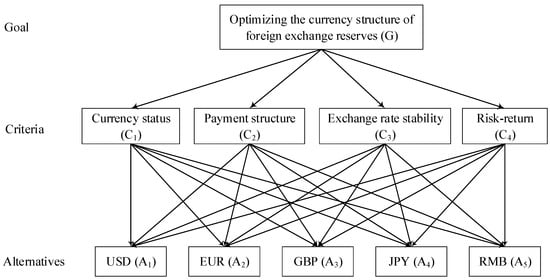
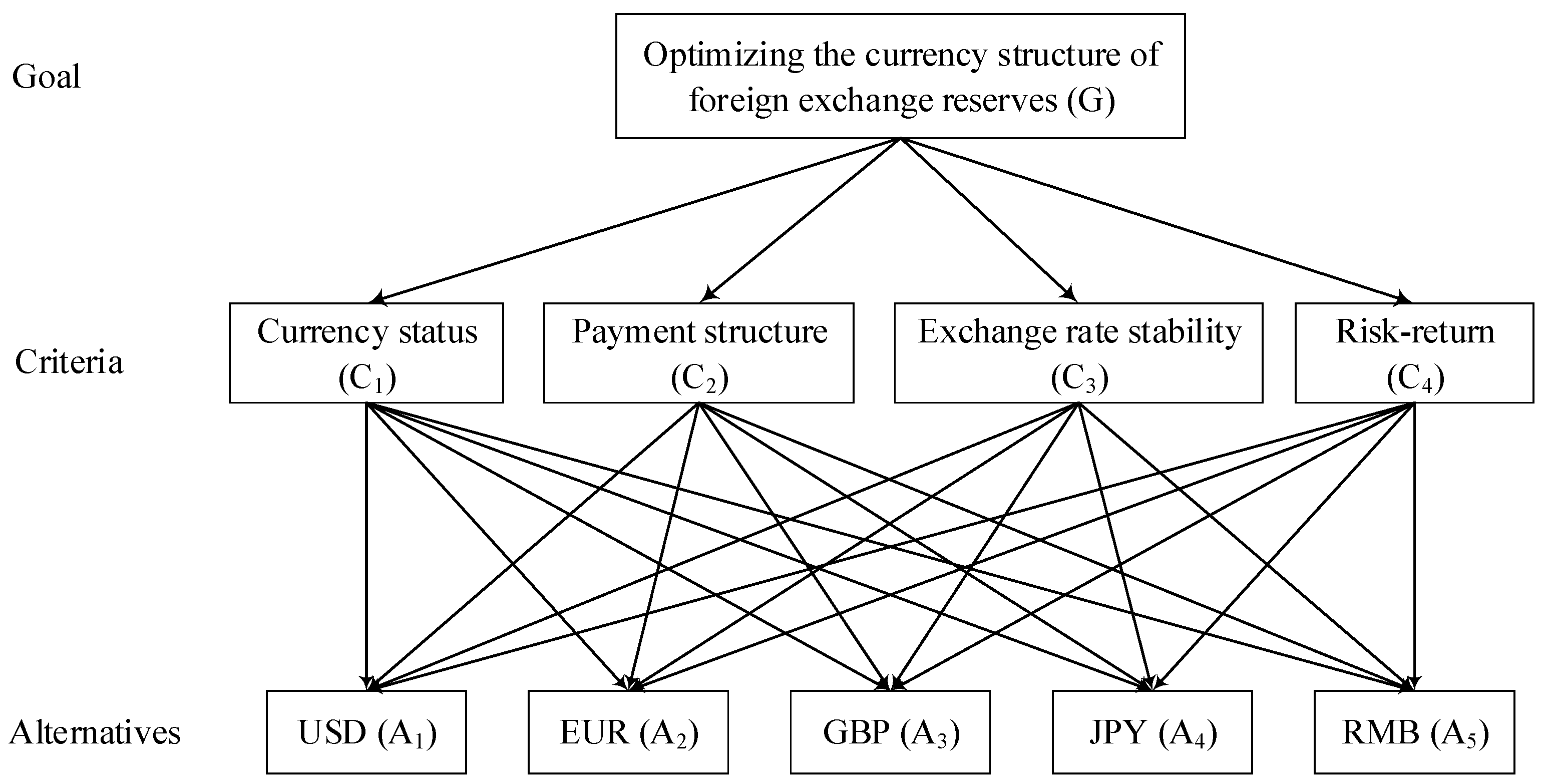
The criteria for managing the FX reserve currency structure are identified based on the literature and the functional roles of FX reserves. Factors such as trade structure, foreign debt structure, foreign direct investment (FDI) profit repatriation structure, international capital flows, FX market transactions, exchange rate regime arrangements, reserve currency status, path dependence and network externalities, risk–return characteristics, the economic and trade size, and the degree of currency liberalization have been emphasized in prior studies [17,18,19,20,21,22,23]. Based on these considerations, we classify the determinants of the FX reserve currency structure into four types: currency status (C1), payment structure (C2), exchange rate stability (C3), and risk–return properties (C4).
The alternatives correspond to the major reserve currencies considered in FX reserve management. In practice, international transactions and reserve holdings are concentrated in the currencies of a small number of advanced economies, notably the USD, EUR, GBP, and JPY. Since the 2008 GFC, China has actively promoted the internationalization of the RMB, enhancing its role in the international monetary system. These five currencies also constitute the SDR basket. Given our focus on analyzing the effects of expanding SDR use on the international reserve currency structure within the AHP framework, we select the SDR currencies—USD (A1), EUR (A2), GBP (A3), JPY (A4), and RMB (A5)—as the set of alternatives, and normalize their aggregate weight to unity. The resulting benchmark AHP framework, integrating the goal, criteria, and alternatives, is illustrated in Figure 2.
Figure 2.
Benchmark AHP model for currency structure optimization of FX reserves.
4. Fitting the Currency Structure of Global FX Reserves Using the Benchmark AHP
According to the benchmark AHP model, five pairwise comparison matrices, G-C, C1-A, C2-A, C3-A, and C4-A, are constructed to estimate the currency structure of global FX reserves. Qualitative judgments informed by economic reasoning and empirical evidence are combined with quantitative indicators to derive the relative weights of reserve currencies. Hierarchical single-ranking, total-ranking, and consistency tests are performed following standard AHP procedures. Since the purpose of this study is to analyze how the expansion of SDR use affects the currency structure of the international reserve system, and the SDR basket weights adopted in our analysis are those determined after the IMF completed its latest SDR valuation review in 2022, in this section we aim to use the benchmark AHP model to estimate the global FX reserve currency composition at the 2022 point in time, which serves as the baseline for subsequent analysis of the impact of expanding SDR use on the international reserve system. Therefore, the end date of the sample period for the empirical inputs in this section is set prior to 2022.
4.1. Construction and Testing of Each Pairwise Comparison Matrix
4.1.1. Analysis of the Relative Importance of Four Criteria and Determination of Their Weights
According to the benchmark AHP model, an analysis of the optimal currency structure of FX reserves should take into account four influencing factors: currency status, payment structure, exchange rate stability, and risk–return properties. These four factors on the currency structure of FX reserves have different degrees of influence.
First, currency status has the highest importance. The international status of a currency is not only a reflection of the power and credibility of the issuing country but also an important indicator of the ability of the currency to perform the function of a global currency. From the perspective of its function, a currency can become an international reserve currency only if it functions as a global currency. The degree of internationalization of a currency and its general acceptance in international economic activities directly affect its reserve status and reserve share. Thus, currency status is the most important factor and is assigned the highest importance among the four factors.
Second, the payment structure is second in importance to currency status. We define the payment structure to include the import structure, foreign debt structure, and FDI profit repatriation structure. The fundamental reason for a country to hold FX reserves is to meet these external payment needs to maintain the balance of payments.
Finally, exchange rate stability is more important than risk–return properties. Given the specific nature of the function of FX reserves, the profitability of reserve assets is a secondary objective. Therefore, maintaining exchange rate stability is considered more important than the risk–return properties of reserve assets. Based on this analysis, the G-C comparison matrix is constructed using a comparison scale from 1 to 9 in Mesh AHP analysis software, and the matrix-related indices are calculated with the output results shown in Table 1. It should be noted that the relatively large Saaty-scale values assigned in Table 1 are due to consideration of the dominant role of currency status over other criteria, as we analyzed earlier.
Table 1.
Comparison matrix G-C and eigenvectors.
In Table 1, the results of the comparison matrix show that the maximum eigenvalue is 4.0873. Wi is the normalized eigenvector that corresponds to the maximum eigenvalue, that is, W = (0.6269, 0.2003, 0.1191, 0.0538) T3. To confirm that the eigenvector is the desired weight vector, the consistency of the pairwise comparison matrix is tested. The consistency ratio (CR) is calculated as follows.
where is the random consistency index. is the consistency index, calculated as
where is the maximum eigenvalue of the matrix, and is the sum of the diagonal elements of the matrix. A pairwise comparison matrix is regarded as consistent if the CR is below 0.1. The calculated CR is 0.0327 < 0.1, indicating that the consistency test is passed. Hence, the weights of the four criteria are distributed as follows: currency status (62.69%), payment structure (20.03%), exchange rate stability (11.91%), and risk–return property (5.38%).
4.1.2. Reserve Currency Weights Relative to Currency Status
The factors that determine the international status of a currency are mainly its degree of internationalization and the scale of trade and economy of its issuing country. The degree of internationalization reflects recognition by other countries, whereas economic and trade power provide fundamental support for a currency’s international status. From the perspective of the extent of internationalization of a currency or its performance of international monetary functions, the USD, as the dominant international reserve currency, has the highest international status. Although the RMB has benefited from China’s active promotion of its internationalization in recent years, it still has less international status than the currencies of industrialized countries, such as the USD and EUR. As an indication of economic power, the gross domestic product (GDP) in 2021 is $22.99 trillion in the US (23.93% of global GDP), $14.49 trillion in the eurozone (15.08%), $17.73 trillion in China (18.45%), $4.94 trillion in Japan (5.14%), and $3.19 trillion in the UK (3.32%)4. In terms of the trade scale in 2021, the top ten countries in the world are China, the US, Germany, the Netherlands, Japan, France, South Korea, the UK, Italy, and Belgium, in that order5. Based on this analysis, the comparison matrix C1-A is constructed with the output results shown in Table 2. It should be noted that the highest-scale judgments of the USD in Table 2 capture its overwhelming reserve currency status, supported by its network externalities, market depth, and global acceptance. For the RMB, although China has strong economic and trade power, considering that the RMB is still not fully convertible under its capital account, unlike the other four currencies, this greatly inhibits the RMB’s international currency status. Therefore, in constructing the pairwise comparison matrix, we assign the RMB relatively low scale values.
Table 2.
Comparison matrix C1-A and eigenvectors.
In Table 2, the calculation results of the comparison matrix show that the maximum eigenvalue is 5.329. Wi is the normalized eigenvector corresponding to the maximum eigenvalue, that is, W = (0.6571, 0.1717, 0.0673, 0.0673, 0.0365)T. The equals 0.0734. Thus, the weights with respect to currency status are: USD, 65.71%; EUR, 17.17%; GBP, 6.73%; JPY, 6.73%; and RMB, 3.65%.
4.1.3. Reserve Currency Weights Relative to Payment Structure
The external payment structure includes the import structure, foreign debt structure, and FDI profit repatriation structure. With respect to the import structure, making import trade payments is one of the main motivations for holding FX reserves, so the structure of trade payments is an essential factor affecting the currency structure of FX reserves. From August 2012 to June 2022, the average market share of global trade payments was as follows: USD, 40.10%; EUR, 33.78%; GBP, 7.55%; JPY, 3.05%; and RMB, 1.77%6. These trade payment shares are normalized as the currency weights of FX reserves in the import structure—that is, if only the import structure is considered, the share of global FX reserves should be: USD, 46.49%; EUR, 39.16%; GBP, 8.75%; JPY, 3.54%; and RMB, 2.05%.
Regarding the foreign debt structure, the currency structure of FX reserves must be sufficient to meet debt servicing requirements, including repayment of foreign debt principal and interest. Assuming that the structure of the denomination of global foreign debt currency is consistent with the currency structure required to repay principal and interest, the required currency structure can be obtained by analyzing the structure of that denomination. The normalized average share of the denomination of global foreign debt from 2012 Q1 to 2022 Q1 is USD, 45.83%; EUR, 42.38%; GBP, 9.18%; JPY, 2.14%; and RMB, 0.47%7. These shares are used as the currency weights of FX reserves in foreign debt—that is, if only foreign debt denomination is considered, USD should comprise 45.83%; EUR, 42.38%; GBP, 9.18%; JPY, 2.14%; and RMB, 0.47%.
With respect to the FDI structure, a country needs to maintain the size and currency structure of FX reserves to meet the requirements for FDI profit repatriation in order to keep FDI operating in a benign environment. If the structure of the source of FDI in a country is consistent with the currency structure of profit repatriation, the currency structure of profit repatriation can be obtained by analyzing FDI sources. By analyzing the global share of outward direct investment (ODI) from major reserve currency issuers, we can infer the structure of FDI sources in other countries. The global share of ODI for the five reserve currency-issuing countries (regions) from 2012 to 2021 is shown in Table 3.
Table 3.
Global share of ODIs for the five reserve currency-issuing countries (regions), in percent.
Table 3 shows that the eurozone and the US are the largest providers of outward investment in 2012–2021, with average global shares of 21.24% and 13.85%, respectively. The global share of investment from the UK and Japan averages 4.01% and 2.58%, respectively. Although the global share of China’s outward investment has increased annually, it remains low in absolute terms, with a ten-year average share of 2.66%. The combined share of outward investment from the five economies is 44.34%. Accordingly, the currency structure in the repatriation of FDI profits should be 13.85% in USD, 21.24% in EUR, 4.01% in GBP, 2.58% in JPY, and 2.66% in RMB. The remaining 55.66% not included in Table 3 is counted in USD, considering the strong network externalities of the USD as the central currency in the international monetary system and its dominant position in global asset denomination and valuation. Therefore, considering only the repatriation of FDI profits, the currency structure of global FX reserves is USD, 69.51%; EUR, 21.24%; GBP, 4.01%; JPY, 2.58%; and RMB, 2.66%.
Based on the proportion of USD, EUR, GBP, JPY, and RMB in the import structure, foreign debt structure, and FDI profit repatriation structure, the average proportion of each currency (Table 4) is used as the currency structure of global FX reserves in the payment structure: USD, 53.94%; EUR, 34.26%; GBP, 7.31%; JPY, 2.75%; and RMB, 1.73%. These shares are used directly as the optimal eigenvector in the comparison matrix C2-A.
Table 4.
Reserve currency weights in the payment structure.
4.1.4. Reserve Currency Weights Relative to Exchange Rate Stability
To determine the importance of these currencies in maintaining exchange rate stability, we use the SDR, whose value is relatively stable, as the benchmark denomination to examine exchange rate fluctuations of USD, EUR, GBP, JPY, and RMB. Table 5 reports the annual fluctuations in their exchange rates against the SDR from 2016 to 2021 (direct quote, i.e., SDRs per unit of currency). The calculation is expressed as
where is the year. and denote the exchange rate of the reserve currency against the SDR in the current and previous years, respectively. is the annual rate of fluctuation in the exchange rate. > 0 indicates appreciation, whereas < 0 indicates depreciation.
Table 5.
Annual rate of fluctuation of the exchange rate of the five currencies against the SDR.
Table 5 shows that, from 2017 to 2021, the USD depreciated on average by 0.47% a year, the GBP depreciated by 0.12%, and the JPY depreciated by 0.68%; however, the EUR appreciated by 0.87%, and the RMB appreciated by 0.11%. Based only on maximizing returns, the allocation should be larger to RMB and EUR than to the other currencies. However, maintaining exchange rate stability is more important than earning reserve returns. Therefore, if the goal is the determination of the currency structure of foreign reserves with respect to exchange rate stability, we should be more interested in the magnitude of exchange rate fluctuation, whereas the return factor is considered in the risk–return criteria below. The USD, EUR, and JPY are more volatile, and the GBP and RMB are less volatile; thus, from the perspective of FX market intervention and exchange rate stabilization, more USD, EUR, and JPY should be held to smooth out currency volatility. Moreover, we should also consider the currencies to which countries around the world have pegged their exchange rates. Currently, the largest number of countries peg their exchange rates to the USD, followed by the EUR, and, to a lesser extent, the GBP, JPY, and RMB. Taking these factors into account, we construct the comparison matrix C3-A, with the output results shown in Table 6. Higher scale values in Table 6 are used to reflect the substantially greater role of the USD and EUR in global exchange rate anchoring and intervention practices.
Table 6.
Comparison matrix C3-A and eigenvectors.
In Table 6, the calculation results of the comparison matrix show that the maximum eigenvalue is 5.4246. Wi is the normalized eigenvector corresponding to the maximum eigenvalue, that is, W = (0.5371, 0.2943, 0.0717, 0.0717, 0.0252)T. The CR equals 0.0948. Thus, the weights with respect to exchange rate stability are: USD, 53.71%; EUR, 29.43%; GBP, 7.17%; JPY, 7.17%; and RMB, 2.52%.
4.1.5. Reserve Currency Weights Relative to Risk–Return Property
We use monthly data from January 2012 to July 2022 and combine it with asset selection theory to calculate the weight distribution of each reserve currency, considering only the risk–return property. Although central banks may differ in their selection of investment instruments when investing FX reserves, we focus on the proportion of currency allocation rather than on the specific form of investment. Therefore, for convenience, we select the three-month short-term government fixed-income securities of each reserve currency–issuing country as the underlying FX reserve investment, as shown in Table 7.
Table 7.
Investment instrument settings for reserve currencies.
We still use the SDR as the benchmark currency to denominate exchange rates. The equation for calculating the return on reserve currency investment is as follows.
where denotes the month, is the investment return, is the exchange rate of the SDR against the reserve currency under a direct quote (i.e., SDRs per unit of currency), and is the interest rate of the reserve currency. The risk of the FX reserve portfolio is calculated as
where is the risk of the FX reserve portfolio, measured by the variance of returns. is the weight of reserve currency in the portfolio (= USD, EUR, GBP, JPY, and RMB). is the covariance of the investment returns of reserve currencies and , representing the variance when = .
Because FX reserves differ from commercial investment funds that aim to maximize profits, monetary authorities generally do not sell a reserve currency short in the FX market purely for the purpose of profit. Moreover, the management of FX reserve assets focuses primarily on stability and safety, while the yield takes second place. Therefore, the FX reserve currency structure is determined with more emphasis on achieving portfolio risk minimization. In summary, we set the objective function of FX reserve currency structure optimization as risk minimization and add the constraint that the reserve currency weight is not negative, that is,
Using monthly data from January 2012 to July 2022 (including the exchange rates and interest rates of each reserve currency) obtained from the IMF and Wind databases, we calculate the investment returns of USD, EUR, GBP, JPY, and RMB and then calculate the variance and covariance of the investment returns of each reserve currency, and the results are listed in Table 8. If we use Equation (6), the optimal currency weights of FX reserves under the risk–return criteria are USD, 32.31%; EUR, 37.06%; GBP, 7.93%; JPY, 9.04%; and RMB, 13.67%8. The results are used directly as the optimal eigenvector of comparison matrix C4-A.
Table 8.
Variance and covariance of investment returns of each reserve currency.
4.2. Total Hierarchical Ranking and Analysis of Results
Based on the results of the hierarchical single-ranking calculation, the benchmark AHP model yields reserve currency weights of 60.13% for the USD, 23.13% for the EUR, 6.96% for the GBP, 6.11% for the JPY, and 3.67% for the RMB9. The CR of the total hierarchical ranking is calculated as follows:
where (i = 1, 2, 3, 4) denotes the consistency index of the hierarchical single ranking of the five reserve currencies with respect to currency status, payment structure, exchange rate stability, and risk–return property, respectively, and is the corresponding random consistency index. denotes the weight of each of the four criteria relative to the overall goal of optimizing the currency structure of foreign reserves. According to Equation (7), the CR of the hierarchical total ranking is 0.0573, indicating that the final analytical result of the AHP model is acceptable. Therefore, the optimal currency weights of global FX reserves based on the benchmark AHP model are USD, 60.13%; EUR, 23.13%; GBP, 6.96%; JPY, 6.11%; and RMB, 3.67%.
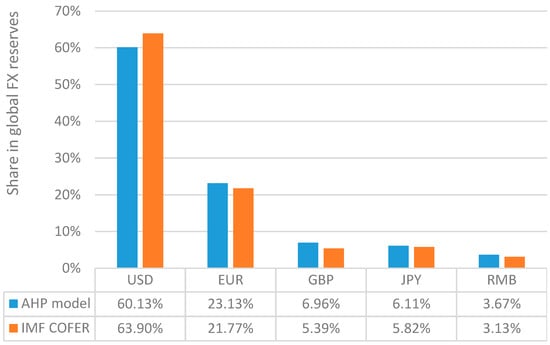
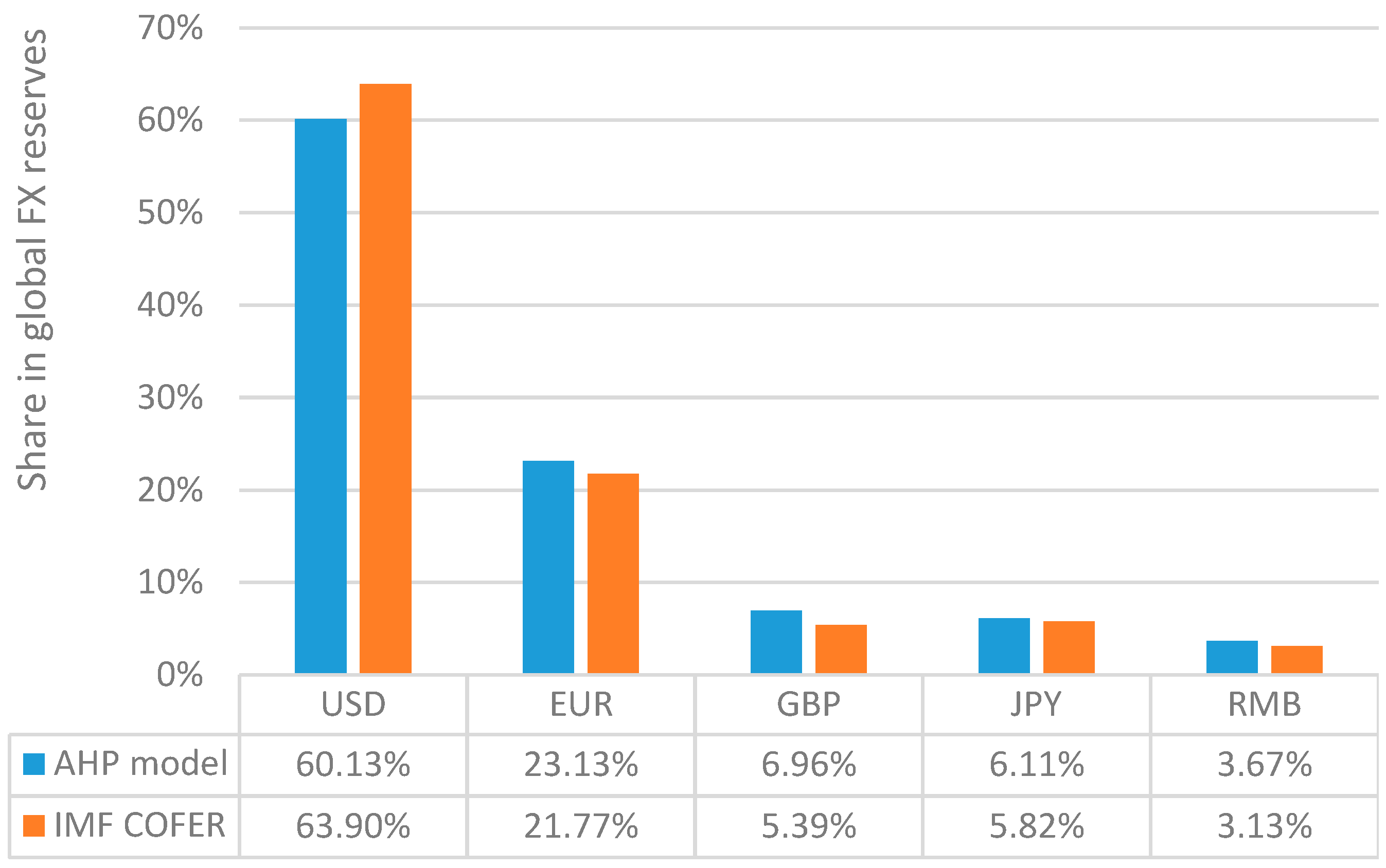
The IMF COFER database regularly publishes data on the share of global FX reserves. Figure 3 compares the results of the AHP analysis and the IMF COFER-reported values, showing that their model shares are not significantly different. We then conduct a correlation analysis between them and find that their Pearson correlation coefficient is 0.9992, and the corresponding p-value is 0. Their Spearman correlation coefficient is 0.9000, and the corresponding p-value is 0.0374. The test results show that the IMF COFER and AHP model shares are not significantly different statistically either, suggesting that our benchmark AHP model does a good job of predicting the shares reported with the IMF COFER. The minor difference between the IMF COFER and AHP model shares is that the USD’s share of global reserves is slightly lower in the AHP model than the IMF COFER report value, whereas the other four currencies are slightly higher. This is because the USD, as the dominant currency, has a higher reserve currency position in the international monetary system than in the AHP model; in reality, its reserve position exceeds the range of 1–9 in the pairwise comparison matrix in the AHP model, hence, to some extent, the USD weights are underestimated in the results of the AHP analysis. Despite some slight differences, the results of the benchmark AHP analysis still accurately reflect the relative positions of the USD, EUR, GBP, JPY, and RMB in the international reserve system; that is, the USD maintains its overwhelming reserve position, with a share of more than half the global reserve, followed by the EUR, then the GBP and JPY, and the RMB has the lowest. Rather than precisely estimating the currency structure of global FX reserves, we examine the impact of expanding SDR use on the international reserve system using the AHP model of optimizing the currency structure of FX reserves. In this sense, the results of the benchmark AHP model can serve as an ideal basis for the following analysis of the changes in the currency structure of FX reserves under different scenarios of expansion in SDR use.
Figure 3.
Comparison of the AHP model analysis results with the IMF COFER-reported values. Note: IMF COFER report values are data from 2022 Q1 and are normalized.
The results of the benchmark AHP analysis suggest that the current international reserve system is weighted unequally. The USD is the dominant reserve currency. In our AHP calculations, it accounts for more than 60% of the international reserves. Because of the dominance of the USD, expansion in the use of the EUR, GBP, JPY, and RMB as reserve currencies would be inhibited by the USD, would be gradual, and would take a long time. Among the latter, the RMB is the only currency from an emerging market and developing country, and its share of international reserves is low, lower than that of the GBP and JPY, and much lower than that of the USD and EUR. Although China has become a global economic power, the reserve status of the RMB is not commensurate with its status. The reasons for this are related not only to external factors, such as the dominance of the USD, but also to its own constraints, such as the inconvertibility of the RMB capital account. Capital account convertibility is a prerequisite for a currency to become an international reserve currency [25,26]. The current RMB is still not freely convertible under its capital account, which is clearly not conducive to enhancing the use of the RMB in international trade, investment, and financial transactions, and greatly limits its attractiveness as a reserve currency.
5. Extending the Benchmark AHP Model by Introducing the Scope of SDR Use
The currencies that comprise the SDR are USD, 43.38%; EUR, 29.31%; GBP, 7.44%; JPY, 7.59%; and RMB, 12.28%. The SDR structure is weighted more equally than the currency structure of global FX reserves. For example, the weight of the USD in SDR is lower than its share of international reserves, whereas the weight of the RMB and EUR in SDR is higher than their respective share of international reserves. Under these conditions, how will expanding SDR use affect the currency structure of existing global FX reserves? Will it help the international reserve system evolve in a more balanced direction? We extend the benchmark AHP model by adding the variable of the scope of SDR use to the benchmark, and then use the extended model to conduct scenario simulations to explore this question.
5.1. The Role of the SDR in the International Monetary System
The SDR is a reserve asset created by the IMF in 1969 to complement the official reserves of IMF member countries. It is neither a currency nor a debt instrument of the IMF. SDRs cannot be used directly in the private market; national monetary authorities must first convert them into freely usable currencies (including USD, EUR, GBP, JPY, and RMB) before they can be spent. As described in Section 2, the SDR functions as both a reserve asset and a denomination unit.
Therefore, expanding the use of the SDR means increasing the scale and share of international use of the SDR as both reserve assets and a unit of denomination. Expanding the use of SDR as a reserve asset in the current international monetary system can help reduce the burden on the US as a major reserve currency issuer and mitigate the Triffin dilemma. Expanding use of the SDR as a denomination can effectively reduce asset price volatility and associated risks from the use of sovereign reserve currency denomination [27]. Promoting the SDR as a price anchor for countries’ official exchange rates would also help relevant countries to relieve problems such as the loss of monetary policy independence caused by pegging to a single currency. Expanding SDR use can help enhance the stability and resilience of the international monetary system [28].
5.2. The Impact Channels of Expanding SDR Use on the Currency Structure of Global FX Reserves
Before analyzing the impacts of SDR expansion on the currency structure of global FX reserves, it should be noted that the following analysis represents analytical predictions derived within the AHP framework under strict assumptions. From the perspective of the factors that influence the currency structure of FX reserves, expanding the use of the SDR as the reserve asset and denomination (e.g., as an exchange rate anchor) would directly affect the weight of the USD, EUR, GBP, JPY, and RMB with respect to currency status, payment structure, and exchange rate stability.
First, expanding the scale of SDR issuance as a reserve asset would help promote convergence in the currency structure of global FX reserves, concerning the currency status criterion, to the SDR currency structure. The official SDR is a composite reserve asset. To use SDRs, SDR holders first need to convert them into freely usable currencies, such as the USD, EUR, GBP, JPY, and RMB. If the proportion of SDR holders who convert SDRs into freely usable currencies equals the weight of the SDR currencies in the SDR, it would directly contribute to convergence in the share of these reserve currencies in FX reserves to their weights in the SDR.
Second, expanding use of the SDR in international trade, investment, and asset denomination would help promote convergence in the currency structure of global FX reserves, concerning the payment structure criterion, to the SDR currency structure. The payment structure comprises the import structure, foreign debt structure, and FDI structure. We assume that when the SDR is used for denomination in international trade, investment, and financial transactions, the corresponding currency of payment also uses SDR currencies, and the proportion of payment in each currency is consistent with its weight in the SDR. Then, as the size and share of SDR use in the denomination of international trade, foreign debt, and FDI increase, it will facilitate convergence in the currency structure of global FX reserves with respect to the SDR currency structure.
Third, enhancing the use of the SDR as an exchange rate anchor would help promote convergence in the currency structure of global FX reserves, concerning the exchange rate stability criterion, to the SDR currency structure. As the SDR increasingly becomes the exchange rate anchor for various countries around the world, a country will have to correspondingly increase its allocation to the five SDR currencies in its FX reserves to maintain stability in the exchange rate of its currency against the SDR, and the proportion of allocation to the five currencies has to be consistent with their weight in the SDR basket. Therefore, this will facilitate convergence in the currency structure of FX reserves, concerning exchange rate stability, to the SDR currency structure.
5.3. The Extended AHP Model After the Introduction of the Scope of SDR Use
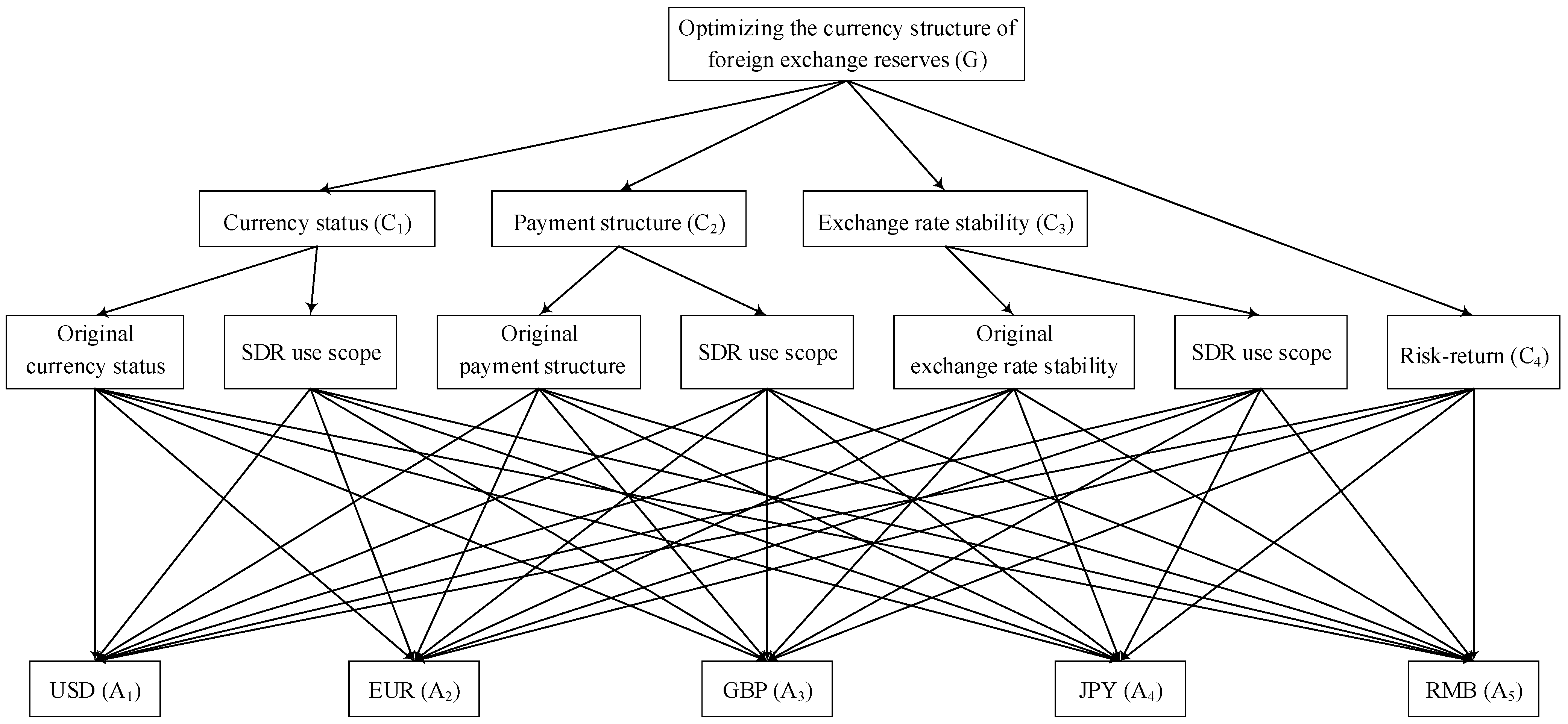
Based on our analysis, we incorporate the scope of SDR use into the benchmark AHP model to obtain the extended AHP model, which is shown in Figure 4. The levels of the goal and alternatives in the extended AHP model are the same as those in the benchmark. However, “currency status,” “payment structure,” and “exchange rate stability” are each divided into two subcriteria—for example, “currency status” is divided into “original currency status” and “scope of SDR use.” The weights of the two subcriteria add up to 1, but, as the scope of SDR use expands, the weight of the subcriteria of “original currency status” declines, and the weight of the subcriteria of the “scope of SDR use” increases. The reserve currency weights of “original currency status” are the same as for the benchmark model—that is, USD, 65.71%; EUR, 17.17%; GBP, 6.73%; JPY, 6.73%; and RMB, 3.65%. The reserve currency weights of the “scope of SDR use” mirror those of the SDR basket: USD, 43.38%; EUR, 29.31%; GBP, 7.44%; JPY, 7.59%; and RMB, 12.28%. In addition, the criteria of the payment structure and exchange rate stability are similarly decomposed. Therefore, within the extended AHP framework, expanding the assumed role of the SDR re-allocates the reserve currency weights, leading the relative importance of reserve currency selection to shift toward the SDR basket structure.
Figure 4.
The extended AHP model incorporating the scope of SDR use.
6. How Does Expanding SDR Use Affect the Currency Structure of Global FX Reserves? A Scenario Simulation Based on the Extended AHP Model
6.1. Scenario Simulation Results
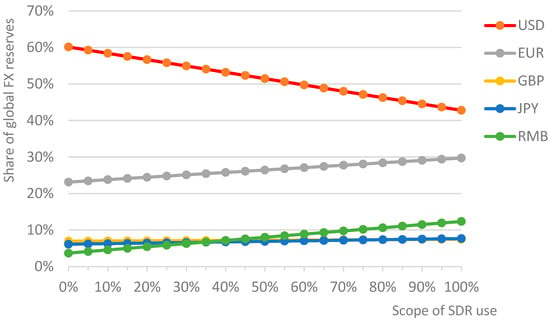
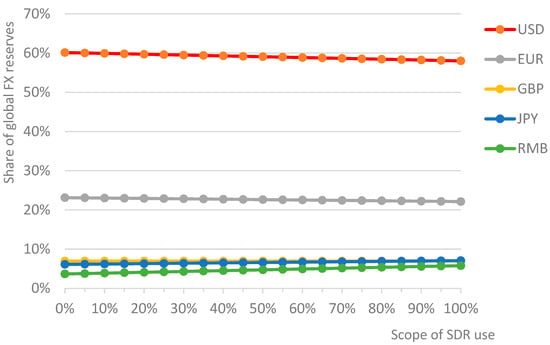
Based on the extended AHP model, we analyze the change in the currency structure of global FX reserves with the change in the scope of SDR use by simulating different scenarios of expansion in SDR use. For convenience, we assume that the use of the SDR as the reserve asset, denomination, and exchange rate anchor expands synchronously—that is, the weight of the scope of SDR use increases synchronously in terms of currency status, payment structure, and exchange rate stability. Table 9 reports the scenario simulation results. Figure 5 plots the change in the share of each currency in global FX reserves with the change in the scope of SDR use. Table 9 shows that, in all scenarios of expansion in SDR use, the estimation results pass the consistency test; therefore, the results of the extended AHP model analysis are acceptable.
Table 9.
Simulation results of changes in the currency structure of FX reserves in different scenarios of expansion in SDR use.
Figure 5.
Impact of expansion in SDR use on each currency’s share of global FX reserves.
As seen in Table 9 and Figure 5, first, when the scope of SDR use is zero, the currency structure of global FX reserves is the same as the result of the benchmark AHP analysis. Second, as the use of SDR as the reserve asset, denomination, and exchange rate anchor gradually increases, the share of the USD in global FX reserves gradually decreases, whereas the share of the other four SDR currencies gradually increases. This is because the current weight of the USD in the SDR is lower than its share of international reserves, while the weights of the other four currencies in the SDR are higher than their respective shares of global reserves. Expanding SDR use will contribute to lowering the international reserve share of the USD and increasing the international reserve share of other currencies. Third, when the use of the SDR reaches 100%—that is, an international monetary system fully based on the SDR has formed, the five reserve currencies’ share of global reserves will eventually converge to their respective weight in SDR10. A fully SDR-based system is a theoretical state, meaning that: (1) the SDR is widely used as a composite reserve asset; (2) SDR pricing is used exclusively in international trade, investment, and asset denomination; and (3) the SDR serves as the exchange rate anchor for all countries. Under this theoretical state of 100% SDR usage, the currency structure of global FX reserves under the three criteria—currency status, payment structure, and exchange rate stability—would all coincide with the SDR currency structure.
A further comparison of the magnitude of change in each currency’s share of global reserves to changes in the scope of SDR use indicates the largest change in the USD, RMB, and EUR. This is due to the large gap between the original share of the USD in international reserves in the benchmark AHP model (60.13%) and its weight in the SDR (43.38%) and the large gap between the original share of the RMB and EUR in international reserves (3.67% and 23.13%, respectively) and their respective weights in the SDR (12.28% and 29.31%, respectively). As a result, when use of the SDR expands, the USD, RMB, and EUR converge more quickly than other currencies, in terms of their share of international reserves, to their respective weight in the SDR. Hence, given that the current share of the USD in international reserves is much larger than its weight in SDR, whereas the share of the RMB and EUR in international reserves are much lower than their respective weight in the SDR, expanding SDR use will help accelerate the convergence of each currency’s share in international reserves to its weight in the SDR, thus weakening the reserve position of the USD and increasing the reserve position of the RMB and EUR.
It is worth noting that the USD share in international reserves estimated by the baseline AHP model in Section 4 (60.13%) is slightly lower than its actual share in global reserves (i.e., the IMF COFER reported share, 63.90%). By contrast, for the EUR, GBP, JPY, and RMB, the baseline AHP model slightly overestimates their shares in international reserves relative to their actual shares. If we further take into account the USD’s relatively higher actual share and the relatively lower shares of the other four currencies, expanding SDR usage would help accelerate the decline of the USD’s international reserve share and the increase in the other currencies’ shares. This would further weaken the USD’s dominant position and enhance the reserve position of the other currencies, thereby strengthening our conclusion.
Finally, we need to emphasize that the SDR expansion effects reported above reflect conditional outcomes within the extended AHP framework, rather than direct causal impacts in the real-world international reserve system. In other words, the above results are conditional on the model assumptions and do not imply automatic real-world convergence. Therefore, they should be interpreted as indicative patterns derived from a simulation-based AHP analytical framework, rather than predictions of automatic adjustment in actual reserve currency holdings.
6.2. Cases of Asynchronous Expansion of SDR Functions
In Section 6.1, when conducting scenario simulations on the impact of expanding SDR usage on the global FX reserve currency composition, we assumed a synchronous expansion of SDR’s three functions—as a reserve asset, as a denomination, and as an exchange rate anchor—to simplify the analysis. In reality, however, the expansion of each of these three functions faces different adoption barriers. For example, denomination adoption requires market acceptance, whereas anchor adoption requires policy coordination. Therefore, it is also necessary to consider whether the impact pattern on the global FX reserve currency composition would fundamentally change when the expansion of the SDR’s three functions occurs asynchronously, to provide a more comprehensive picture of the effects of expanding SDR usage on the international reserve system and to enhance the persuasiveness and robustness of our conclusions.
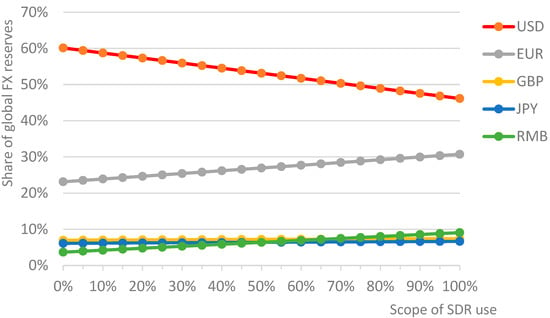
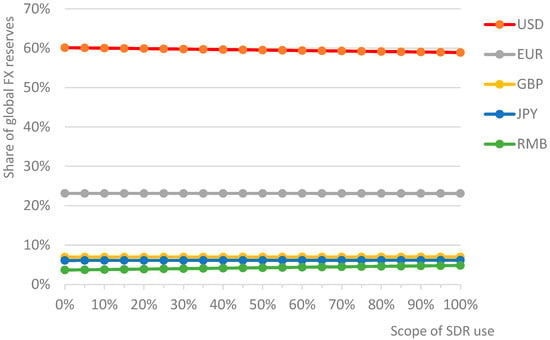
Specifically, we further examined scenarios in which only one of the SDR’s three functions is expanded while the other two remain unchanged. Table 10, Table 11 and Table 12 report the scenario simulation results for the expansion of only the reserve asset function, only the denomination function, and only the exchange rate anchor function, respectively. Figure 6, Figure 7 and Figure 8 illustrate the changes in each currency’s share of global reserves as each of the SDR’s reserve asset, denomination, and exchange rate anchor functions are expanded individually. The scenario simulation results for the expansion of each function individually exhibit the same qualitative pattern as the main results reported in Section 6.1. Whether it is the expansion of the SDR’s reserve asset function, the denomination function, or the exchange rate anchor function, each leads to a decline in the USD’s share of international reserves and an increase in the combined share of the other four currencies. This pattern is most pronounced under the expansion of the SDR’s reserve asset function, because this function influences the choice of global reserve currency composition through the currency status criterion, which carries a relatively high weight in reserve currency selection.
Table 10.
Simulation results of changes in the currency structure of FX reserves in different scenarios of expansion in SDR’s reserve asset function.
Table 11.
Simulation results of changes in the currency structure of FX reserves in different scenarios of expansion in SDR’s denomination function.
Table 12.
Simulation results of changes in the currency structure of FX reserves in different scenarios of expansion in SDR’s exchange rate anchor function.
Figure 6.
Impact of expansion in SDR’s reserve asset function on each currency’s share of global FX reserves.
Figure 7.
Impact of expansion in SDR’s denomination function on each currency’s share of global FX reserves.
Figure 8.
Impact of expansion in SDR’s exchange rate anchor function on each currency’s share of global FX reserves.
Overall, even when considering the asynchronous expansion of SDR functions, the results still indicate that expanding SDR usage helps reduce the USD’s reserve position while enhancing the reserve positions of other international currencies, thereby promoting a more equally diversified international reserve system. These results further demonstrate the robustness of our conclusions.
6.3. Further Discussion
The above analysis suggests that the existence of the SDR is an important potential mechanism for diversifying the international reserve system. Because the current use of the SDR is limited, the IMF’s adjustments in the composition of the SDR basket of currencies and their weights have not had a large impact on the international reserve system. By promoting the broader use of SDR globally, the IMF can accelerate the transition of the current USD-dominated international reserve system to one that is more balanced. The SDR consists of a basket of currencies, and the distribution of currency weights in the SDR basket is relatively balanced. The USD’s share of global FX reserves is much higher than its weight in the SDR, while the opposite is true for the other four SDR currencies, especially the EUR and the RMB. Thus, expanding SDR use is essentially a process of promoting diversification and equalization. If the SDR is used more widely globally, it will help accelerate the substitution of currencies, such as the EUR and the RMB, for the USD in the share of global FX reserves and promote more balanced diversification in the international monetary system.
The IMF has currently allocated 660.6 billion SDRs, approximately US$941.6 billion, for the SDR’s reserve asset function. As a result of the SDR allocation, the inclusion of the EUR and RMB in the SDR with weights of 29.31% and 12.28%, respectively, implies that the cumulative size of EUR and RMB assets held by IMF members would increase by approximately $276 billion and $115.6 billion, respectively. Moreover, those countries also have exposure of approximately $276 billion to the EUR and $115.6 billion to the RMB through their SDR holdings and would increase their use of EUR- and RMB-denominated instruments accordingly if they need to hedge this exposure. If the scale of SDR issuance continues to expand in the future, it will increase the share of EUR and RMB in the FX reserves of IMF member countries and drive global investors and central banks to enter the EUR and RMB markets and trading of EUR and RMB in international financial markets.
Promoting the use of the SDR as a denomination in international trade, investment, and financial transactions is conducive to enhancing international use of the EUR and RMB as currencies for investment and financing. For example, the development of SDR-denominated bond markets is equivalent to indirectly increasing the denomination share of the EUR and RMB in international financial assets, helping the EUR and RMB to be included as reserve assets by central banks and international financial institutions. Because of the purchase of SDR bonds, investors will also increase their use of EUR and RMB to hedge their SDR exposure. Enhancing the SDR’s function as an exchange rate anchor is conducive to driving monetary authorities to hold SDR constituent currencies in the same currency structure as the SDR basket, thereby serving as a substitute for the SDR. As the weight of the EUR and RMB in the SDR exceeds their respective share in international reserves, this will also enhance the reserve position of the EUR and RMB relative to the USD.
Despite the analytical insights provided by the scenario simulation analysis based on the extended AHP model, several practical limitations constrain the implementation of SDR-based reform in the current international monetary system. First, the use of SDR remains largely confined to the official sector, with limited liquidity and secondary market depth, which restricts its attractiveness as a reserve asset. Second, the effectiveness of SDR expansion depends critically on the willingness of major reserve currency-issuing economies and international institutions to coordinate policy actions, a condition that is difficult to satisfy in an environment of heightened geopolitical fragmentation. Third, the range of SDR-denominated financial products is currently limited, and the supporting financial infrastructure, such as clearing, settlement, and risk management mechanisms, is underdeveloped, making it difficult for market participants to build comprehensive asset allocation and risk-hedging frameworks around the SDR. This not only dampens private-sector incentives to use the SDR but also weakens its practical functions in cross-border trade, investment, and financial transactions. These limitations suggest that SDR-based reform should be interpreted as a complementary and long-term adjustment mechanism, rather than a substitute for existing reserve currencies.
7. Conclusions
The process of making the international monetary system more pluralistic raises an important theoretical issue: how will expansion in the use of the SDR affect the current international reserve system? We add the variable of the scope of SDR use to the AHP model for the determination of the global FX reserve currency structure, and then use a scenario simulation to predict, within this analytical framework, the impact on the international reserve system of expanding use of the SDR as a reserve asset and denomination. We show that, within the AHP-based simulations, expanding SDR use can promote convergence in the SDR currencies’ shares of international reserves toward their respective weights in the SDR. Currently, the USD’s share of international reserves is much higher than its weight in the SDR, and the RMB and EUR’s shares of international reserves are much lower than their respective weights in the SDR. Therefore, within the model, expanding SDR use would weaken the USD’s reserve position and strengthen the reserve position of the RMB and EUR, implying a tendency toward a more balanced development of the international reserve system.
The main contribution of this study is methodological, in that we introduce the scope of SDR use to the AHP model of FX reserve currency structure management, which creates a novel analytical framework for predicting the impact on the currency composition of the international reserve system of expanding SDR use.
Our findings have explicit policy implications. Promoting expansion in SDR use can be an important way to accelerate pluralistic reform in the international monetary system. The IMF can work with the international community to actively drive expansion in the use of the SDR as a reserve asset and a denomination and use this expansion to weaken the dominance of the USD and to enhance the reserve status of other currencies, such as the EUR and RMB, as part of pluralistic reform of the international monetary system.
This study has several limitations, which require further examination in future studies. First, our analysis of the impact of expanding SDR use on the currency structure of global FX reserves is only a simulated estimation under ideal scenario assumptions. Real-world institutional and political constraints may be oversimplified by assuming that the SDR is used as a reserve asset, a denomination, and an exchange rate coordination mechanism. In addition, there may be other potential geopolitical, governance, and strategic issues that we did not take into account, which can also hinder SDR expansion in practice. In fact, as the role of the SDR continues to increase, further expansion in its use will become increasingly difficult. The achievement of 100% SDR use implies that a fully SDR-based international monetary system has been formed, which is impossible in the short term and requires extraordinary foresight and courage from politicians in various countries [3]. Second, although promoting the expansion of SDR use helps to reduce USD dominance, the process may be accompanied by potential transition risks. Reducing dollar dominance implies a systemic reallocation of global official reserve assets as well as private asset portfolios, thereby triggering price revaluation centered on USD-denominated assets. As central banks and international investors reduce their holdings of USD assets, the resulting sharp decline in demand for USD assets may raise the global risk-free interest rate and transmit to international financial markets through interest rate, exchange rate, and asset price channels, amplifying global asset price volatility. Moreover, as the current dominant reserve currency, the USD is also the most important vehicle of liquidity in the international financial system. If a sufficiently large and credible alternative global liquidity provision mechanism is not established while USD dominance declines, global liquidity supply may weaken during crises. If non-USD reserve currencies fail to timely and effectively perform the function of the lender of last resort for global liquidity during crises, contractions in global USD financing may evolve into cross-border liquidity disruptions, thereby exerting adverse impacts on financial stability in emerging economies and the functioning of international trade. Third, our model is a simple static model that does not take into account dynamic changes in factors other than the scope of SDR use, as well as dynamic adjustment in the SDR basket of currencies and their weight by the IMF in the future, or the possible expansion of SDR functions beyond being a reserve asset and a denomination. Regarding the above issues, we hope to provide more detailed analysis or improvements in future research.
Author Contributions
Conceptualization, P.W. and J.S.; methodology, P.W. and S.W.; software, P.W. and S.W.; validation, P.W., J.S. and S.W.; formal analysis, P.W.; investigation, P.W. and S.W.; resources, P.W., J.S. and S.W.; data curation, P.W., J.S. and S.W.; writing—original draft preparation, P.W.; writing—review and editing, P.W., J.S. and S.W.; visualization, S.W.; supervision, P.W., J.S. and S.W.; project administration, P.W., J.S. and S.W.; funding acquisition, P.W., J.S. and S.W. All authors have read and agreed to the published version of the manuscript.
Funding
This research was funded by the National Natural Science Foundation of China [grant number 72303027]; the National Natural Science Foundation of China [grant number 72403128]; the Fundamental Research Funds for the Central Universities—Zhishan Youth Scholar Support Program of Southeast University [grant number 2242024RCB0043]; and the National Social Science Foundation of China [grant number 23FJYB006].
Data Availability Statement
The data presented in this study are available on request from the corresponding author.
Conflicts of Interest
The authors declare no conflicts of interest.
Abbreviations
The following abbreviations are used in this manuscript:
| FX | Foreign exchange |
| SDR | Special drawing rights |
| IMF | International Monetary Fund |
| COFER | Composition of official foreign exchange reserves |
| GFC | Global financial crisis |
| AHP | Analytic hierarchy process |
| FDI | Foreign direct investment |
| CR | Consistency ratio |
| GDP | Gross domestic product |
| ODI | Outward direct investment |
Notes
| 1 | As of 2022 Q1, the USD’s share of global foreign exchange (FX) reserves was 58.88% (IMF COFER database). |
| 2 | Two criteria are used for selecting the constituent currencies of the SDR. The SDR basket comprises five currencies (USD, EUR, GBP, JPY, and RMB) issued by members of the IMF or by monetary unions that include IMF members (1) with the highest value of exports of goods and services during the most recent five-year period before the effective date of the revision and (2) that have been determined by the IMF to be freely usable. The RMB was officially included in the SDR in 2016. By including the currencies not only of four developed countries but also of China, an emerging market and developing country, the SDR is globally representative. The equation for allocating the respective weight of each currency in the SDR gives equal weight to exports and financial variables. Specifically, the share of a currency in the basket is determined based on its share of exports and three financial variables, which, together, indicate use of the currency in private international financial transactions: (1) reserves (an indicator of use by public authorities), (2) FX turnover (used to measure the widely traded aspect of freely usable currencies), and (3) the sum of international bank liabilities and international debt securities. The equation gives 50% of the weight to exports and divides the other 50% equally among the three financial variables. This equation, to a certain extent, ensures that the currencies that comprise the SDR reflect their relative importance in the international monetary system. |
| 3 | That is, the sum of the elements in the vector equals 1. |
| 4 | Authors’ calculations based on data from the World Bank database. |
| 5 | Authors’ calculations based on data from the WTO database. |
| 6 | The data are sourced from SWIFT and were downloaded from the Wind Economic Database (access date: 5 December 2025). |
| 7 | Authors’ calculations based on data from the BIS database. |
| 8 | We solve using the fPortfolio package of R (developers: Diethelm Wuertz, Tobias Setz, Yohan Chalabi, and William Chen). |
| 9 | The detailed computation procedures are as follows: (1) The USD’s share in global FX reserves is calculated as 62.69% × 65.71% + 20.03% × 53.94% + 11.91% × 53.71% + 5.38% × 32.31% = 60.13%; (2) The EUR’s share in global FX reserves is calculated as 62.69% × 17.17% + 20.03% × 34.26% + 11.91% × 29.43% + 5.38% × 37.06% = 23.13%; (3) The GBP’s share in global FX reserves is calculated as 62.69% × 6.73% + 20.03% × 7.31% + 11.91% × 7.17% + 5.38% × 7.93% = 6.96%; (4) The JPY’s share in global FX reserves is calculated as 62.69% × 6.73% + 20.03% × 2.75% + 11.91% × 7.17% + 5.38% × 9.04% = 6.11%; (5) The RMB’s share in global FX reserves is calculated as 62.69% × 3.65% + 20.03% × 1.73% + 11.91% × 2.52% + 5.38% × 13.67% = 3.67%. |
| 10 | In the extended AHP model, only the currency status, payment structure, and exchange rate stability (the sum of their weights is 94.62%) are affected by the scope of SDR use, while the risk–return property (with a weight of 5.38%) is not affected by the scope of SDR use. Thus, to be precise, when use of the SDR is expanded to 100%, only 94.62% of each reserve currency’s share of global FX reserves converges to its SDR weight, while the other 5.38% is subject to the risk–return factor. That is, the USD’s share of global FX reserves eventually converges to: 43.38% × 94.62% + 32.31% × 5.38% = 42.78%; the EUR’s share of global FX reserves eventually converges to: 29.31% × 94.62% + 37.06% × 5.38% = 29.73%; the GBP’s share of global FX reserves eventually converges to: 7.44% × 94.62% + 7.93% x 5.38% = 7.47%; the JPY’s share of global FX reserves eventually converges to: 7.59% × 94.62% + 9.04% × 5.38% = 7.67%; and the RMB’s share of global FX reserves eventually converges to: 12.28% × 94.62% + 13.67% × 5.38% = 12.35%. |
References
- IMF. Enhancing International Monetary Stability—A Role for the SDR? International Monetary Fund: Washington, DC, USA, 2011. [Google Scholar]
- IMF. The Role of the SDR—Initial Considerations; International Monetary Fund: Washington, DC, USA, 2016. [Google Scholar]
- Zhou, X. Reform the International Monetary System; Bank for International Settlements: Basel, Switzerland, 2009. [Google Scholar]
- Stiglitz, J.E. The Stiglitz Report: Reforming the International Monetary and Financial Systems in the Wake of the Global Crisis; New Press: New York, NY, USA, 2010. [Google Scholar]
- Williamson, J. Why SDRs Could Rival the Dollar; No. PB09-20; Peterson Institute for International Economics: Washington, DC, USA, 2009. [Google Scholar]
- Williamson, J. The future of the reserve system. J. Glob. Dev. 2010, 1, 15. [Google Scholar] [CrossRef] [Scilit]
- Ocampo, J.A. Building an SDR-based global reserve system. J. Glob. Dev. 2010, 1, 14. [Google Scholar] [CrossRef] [Scilit]
- Erten, B.; Alonso, J.A. Building a stable and equitable global monetary system. In Alternative Development Strategies for the Post-2015 Era; Alonso, J.A., Cornia, G.A., Vos, R., Eds.; Bloomsbury Academic: London, UK, 2014; pp. 253–286. [Google Scholar] [CrossRef] [Scilit]
- L’Hotellerie-Fallois, P.; Sánchez, L.; Serra, X. Inclusion of the renminbi in the special drawing rights basket: Technical and economic implications. Econ. Bull. 2016, 24–37. Available online: https://www.bde.es/wbe/en/publicaciones/publicaciones-discontinuadas/articulos-analiticos/incorporacion-renminbi-derechos-especiales-giro--implicaciones-tecnicas-y-economicas.html (accessed on 9 January 2026).
- Harrison, M.; Xiao, G. Enhanced special drawing rights: How China could contribute to a reformed international monetary architecture. China World Econ. 2018, 26, 41–61. [Google Scholar] [CrossRef] [Scilit]
- Grubel, H.G. Basic methods for distributing special drawing rights and the problem of international aid. J. Financ. 1972, 27, 1009–1022. [Google Scholar] [CrossRef]
- Aryeetey, E. A Development-Focused Allocation of the Special Drawing Rights; No. DP2004-03; World Institute for Development Economic Research (UNU-WIDER): Helsinki, Finland, 2004. [Google Scholar]
- Hoguet, G.; Tadesse, S. The role of SDR-denominated securities in official and private portfolios. BIS Pap. 2011, 58, 165–186. [Google Scholar]
- Hassanain, K. Special drawing right and currency risk management. Int. J. Econ. Financ. Issues 2015, 5, 780–785. [Google Scholar]
- Harrison, M.; Xiao, G. Linking the Hong Kong Dollar to the SDR. China Rev. 2019, 19, 33–54. [Google Scholar]
- Bénassy-Quéré, A.; Capelle, D. On the inclusion of the Chinese renminbi in the SDR basket. Int. Econ. 2014, 139, 133–151. [Google Scholar] [CrossRef] [Scilit]
- Roger, S. The Management of FX Reserves; Bank for International Settlements: Basel, Switzerland, 1993. [Google Scholar]
- Dellas, H.; Yoo, C.B. Reserve currency preferences of central banks: The case of Korea. J. Int. Money Financ. 1991, 10, 406–419. [Google Scholar] [CrossRef] [Scilit]
- Papaioannou, E.; Portes, R.; Siourounis, G. Optimal Currency Shares in International Reserves: The Impact of the Euro and the Prospects for the Dollar; No. 12333; National Bureau of Economic Research: Cambridge, MA, USA, 2006. [Google Scholar] [CrossRef] [Scilit]
- Chinn, M.D.; Frankel, J.A. Will the Euro Eventually Surpass the Dollar as Leading International Reserve Currency? No. 11510; National Bureau of Economic Research: Cambridge, MA, USA, 2005. [Google Scholar] [CrossRef] [Scilit]
- Eichengreen, B.; Mathieson, D. The Currency Composition of Foreign Exchange Reserves: Retrospect and Prospect; No. 2000/131; International Monetary Fund: Washington, DC, USA, 2000. [Google Scholar]
- Ito, H.; McCauley, R.N. Currency composition of foreign exchange reserves. J. Int. Money Financ. 2020, 102, 102104. [Google Scholar] [CrossRef] [Scilit]
- Iancu, A.; Anderson, G.; Ando, S.; Boswell, E.; Gamba, A.; Hakobyan, S.; Lusinyan, L.; Meads, N.; Wu, Y. Reserve Currencies in an Evolving International Monetary System; No. 20/02; International Monetary Fund: Washington, DC, USA, 2020. [Google Scholar]
- Saaty, T.L. Decision Making for Leaders: The Analytic Hierarchy Process for Decisions in A Complex World; RWS Publications: Pittsburgh, PA, USA, 2001. [Google Scholar]
- Eichengreen, B. It may be our currency, but it’s your problem. Aust. Econ. Hist. Rev. 2011, 51, 245–253. [Google Scholar] [CrossRef] [Scilit]
- Frankel, J. Internationalization of the RMB and historical precedents. J. Econ. Integr. 2012, 27, 329–365. [Google Scholar] [CrossRef] [Scilit]
- Jin, J.; Han, L.; Xu, Y. Does the SDR stabilize investing in commodities? Int. Rev. Econ. Financ. 2022, 81, 160–172. [Google Scholar] [CrossRef] [Scilit]
- Gallagher, K.; Ocampo, J.A.; Volz, U. Special drawing rights: International monetary support for developing countries in times of the COVID-19 crisis. Econ. Voice 2020, 17, 20200012. [Google Scholar] [CrossRef] [Scilit]

Disclaimer/Publisher’s Note: The statements, opinions and data contained in all publications are solely those of the individual author(s) and contributor(s) and not of MDPI and/or the editor(s). MDPI and/or the editor(s) disclaim responsibility for any injury to people or property resulting from any ideas, methods, instructions or products referred to in the content. |
© 2026 by the authors. Licensee MDPI, Basel, Switzerland. This article is an open access article distributed under the terms and conditions of the Creative Commons Attribution (CC BY) license.