


Highlights
Please indicate how your work links to systems science via your contributions to systems practice, theory, and/or methodology.
- The study frames enterprise-oriented patent screening as a staged decision-support workflow linking multi-source enterprise representation, full-corpus candidate retrieval, bounded LLM review, and a proposed analyst-assessment layer.
- The architecture separates candidate generation from semantic review and treats source composition, candidate depth, and review depth as explicit design choices in the screening workflow.
What are the main findings and/or the implications of the main findings?
- Patent-derived profiles showed the strongest single-source retrieval in this cohort. The selected three-source setting had a slightly higher full-cohort macro-recall point estimate, while cross-validation favored patent-dominant configurations without identifying a uniquely optimal weight ratio.
- In the reported primary run, LLM-assisted reranking increased the Hit@10 and macro Recall@K point estimates relative to EMB, while Hit@20 and Hit@30 were unchanged. Paired analyses did not establish statistically significant differences.
Abstract
Technology-transfer organizations need effective approaches for matching enterprise technological needs with potentially relevant patents. When a formal technology-demand statement is unavailable, however, enterprise technological demand is only partially observable from organizational records produced for different purposes. This study therefore focuses on enterprise patent, recruitment, and product information as three indirect and differently oriented sources of technological information, and examines their use in enterprise–patent matching without treating these records as verified technological demand. The main purpose of the study is to determine how source composition, matching methods, and review depth affect the retrospective recovery of observed patent assignment or licensing links. To address this purpose, source-specific enterprise profiles are constructed from the three information sources, combined for dense retrieval against a fixed patent corpus, and subsequently reviewed and reranked using a large language model (LLM). The results show that patent-derived profiles provide the strongest retrieval signal under the present representation, while jointly incorporating recruitment and product information provides only limited additional retrieval value. LLM-assisted review can change the ordering of retrieved candidates, particularly at shallower review depth, but the observed differences do not establish a statistically reliable performance advantage over embedding-only retrieval. Scientifically, these findings clarify the respective roles of heterogeneous enterprise information and LLM-assisted reranking in enterprise–patent matching, while also showing that retrieval performance based on organizational traces should not be interpreted directly as measurement of enterprise technological demand. Future research should further examine source-specific contributions, control for shared patent vocabulary, and evaluate the framework using time-aligned, external, and prospective data.
1. Introduction
Identifying potentially relevant patents is one part of technology transfer, alongside technical evaluation, organizational absorption, negotiation, and implementation. Open innovation research emphasizes the use of external ideas and knowledge alongside internal R&D [1], while technology-transfer organizations connect suppliers and users of knowledge and provide services that facilitate knowledge and technology transfer [2]. Technology-transfer services have been linked to small- and medium-sized enterprise (SME) open innovation capabilities [3]. However, external patent acquisitions may also serve strategic intellectual-property purposes: Kwon [4] examines how such acquisitions can affect rival firms’ innovation. Accordingly, an observed transaction is evidence of a relationship, not a direct measurement of technological demand or successful implementation. The present study focuses on initial patent screening without using a formal technology-demand statement as input.
The demand-side problem is one of partial observability. A formal technology request can specify an intended solution, whereas organizational records are produced for other purposes: patents disclose inventions, recruitment postings advertise positions, and product descriptions communicate offerings. This study treats their different purposes and time horizons as a possible source of fragmented evidence. A record can reveal technical activity without establishing an unmet need, a willingness to acquire technology, or suitability for a particular patent. The analytical challenge is therefore to distinguish information about an enterprise from evidence of its current technological demand.
Patent, recruitment, and product texts were selected to represent three distinguishable and operationally separable perspectives on enterprise technological activity: disclosed technology, sought capabilities, and marketed applications. The purpose of this selection is to compare whether these three differently oriented organizational traces provide incremental retrieval evidence when no formal technology-demand statement is available. Annual reports, strategic planning documents, and other corporate disclosures may provide additional information, but they involve different disclosure practices, document structures, and coverage conditions and are outside the scope of the present bounded comparison. Their potential contribution should be examined in future extensions.
Accordingly, the scope of this study is deliberately bounded in three respects. First, it examines enterprise patent, recruitment, and product information as three differently oriented sources of enterprise technological information when no formal technology-demand statement is available; other corporate disclosures are not included. Second, the study focuses on matching enterprise profiles with patents in a fixed public-research patent corpus, rather than predicting technology adoption or measuring enterprise technological demand directly. Third, the evaluation is retrospective: observed patent assignment or licensing links are used as reference signals for comparing alternative source compositions and ranking procedures, rather than as direct observations of technological demand.
Within this scope, the research problem is whether differently oriented enterprise information can provide useful and complementary evidence for patent matching, and how such evidence should be combined with retrieval and LLM-assisted reranking. The main purpose of this study is therefore to compare source composition, matching methods, and review depth in the retrospective recovery of observed assignment or licensing links. The overall goal is to determine what each stage of the matching process contributes under the same bounded evaluation setting, while avoiding interpretation of retrieval performance as direct evidence of enterprise technological demand.
To address this purpose and goal, the study examines three related questions that together define the empirical focus of the research:
RQ1. Do recruitment and product profiles add retrospective transaction-link recovery value beyond patent-derived profiles in the evaluated cohort?
RQ2. Under a fixed enterprise-profile configuration, how do the implemented retrieval methods compare, and what additional ranking change is associated with LLM reranking of the dense candidates?
RQ3. How do the differences between dense retrieval and LLM reranking in enterprise coverage and macro-averaged recall change with review depth?
2. Literature Review
Following the research scope defined above, this section further refines the research area by distinguishing the present enterprise–patent matching problem from related work on enterprise technological indicators, patent recommendation and retrieval, technology transferability, and LLM-assisted reranking. The review is organized to clarify which prior approaches directly inform the present study, which address related but different matching or retrieval tasks, and which questions remain outside the scope of the current evaluation.
2.1. Fragmentation and Observability of Enterprise Technological Demand
A demand statement and an organizational trace have different evidential roles. The former articulates a requested outcome, whereas the latter records activity, capability requirements, or an offering. He et al. [5] examine a setting with supply and demand texts available for semantic comparison. Xin et al. [6] distinguish demand descriptions by completeness and use industry background, historical patents, and technical recruitment information when dealing with incomplete descriptions. In their earlier classification [7], implicit demands are characterized by incomplete demand-element coverage, with enterprise information used to supplement the available demand evidence. These studies treat incomplete demand articulation and auxiliary enterprise evidence as connected representation problems.
Fragmentation refers in this case to evidence distributed across documents written for different audiences and at different times. Patent texts describe disclosed technical solutions, recruitment texts describe sought skills and tasks, and product texts describe functions and use settings. These records make aspects of technological activity observable, while technological demand remains inferred. Their retrieval information may be complementary, redundant, outdated, or inconsistent, which motivates comparisons of incremental value and highlights shared vocabulary as a potential confounding factor.
2.2. Enterprise Texts as Indirect Indicators
The interpretation of an enterprise text depends on the indicator constructed from it. Antons et al. [8] systematically review text-mining applications in innovation research and identify methodological, conceptual, and contextual priorities for their use and further development. This methodological perspective informs the comparison of differently oriented enterprise records.
Enterprise patent information, represented by patent titles and abstracts, provides a comparatively structured source of information on previously disclosed inventions, specialized terminology, and technological trajectories. A key limitation is temporal: patents primarily reflect technologies that a firm has already disclosed or developed rather than technologies it is currently seeking. Patent publication lags may further weaken their ability to represent current demand. Moreover, when patent-derived enterprise profiles are compared with candidate patent texts, any apparent advantage may partly reflect genre and vocabulary similarity rather than superior demand representation alone.
Website studies use distinct units of evidence. Bottai et al. [9] analyze HTML coding features to distinguish innovativeness among Italian manufacturing SMEs. Heinrich [10] compares AI-related website keyword indicators with patent-based indicators. Arora et al. [11] use archived website data to operationalize market-seizing capability and examine strategic change in US green-goods ventures. These studies illustrate how website-derived indicators depend on the content and features selected. Product functions and application descriptions therefore warrant evaluation as a distinct source of enterprise information.
Recruitment evidence also differs across studies. Du et al. [12] use R&D job postings as timely indicators of firms’ investment in R&D human capital and examine their association with subsequent innovation outcomes. Cao et al. [13] study skill specificity in postings in relation to technological peer pressure. Babina et al. [14] combine resumes and job postings to measure AI investment and changes in workforce composition. These works support carefully defined indicators of sought skills or technological activity, rather than a general inference of unmet demand. Generic job requirements and positions outside technical functions can also weaken the relevance of recruitment-based profiles.
The three sources thus offer different perspectives on technological activity, but their availability alone does not imply equal information value. Their complementarity is a question about retrieval evidence, not proof that each source measures enterprise demand. Comparisons should distinguish the additional value of a source from the effects of extraction, embedding, and parameter selection.
2.3. Patent Retrieval, Recommendation, and Transferability
Patent recommendation studies address different units of relevance. He et al. [15] develop knowledge-map-based personalized patent recommendation. Trappey et al. [16] apply doc2vec-based patent recommendation to smart-machinery technology mining. Chen et al. [17] combine word embeddings with a heterogeneous topic model to recommend patents related to a target patent. Du et al. [18] model sequential patent-trading recommendation using a knowledge-aware attentional bidirectional LSTM. These studies span personalized, target-patent, and sequential transaction recommendation, with different inputs and definitions of relevance.
Lee et al. [19] use patent indicators and deep neural networks to predict the transferability of university and public-research technologies. This patent-level prediction task differs from ranking patents for a particular enterprise. These task distinctions matter when choosing comparators and interpreting what a positive reference represents.
Related retrieval research provides specific methodological alternatives. Helmers et al. [20] investigate full-text similarity for prior-art search. Choi et al. [21] propose a two-stage patent citation recommender with candidate selection and learned reranking. Vowinckel and Hähnke [22] introduce SEARCHFORMER for semantic prior-art retrieval. Bekamiri et al. [23] use patent-claim embeddings and nearest-neighbor classification in PatentSBERTa. These studies provide candidate comparator designs, although their relevance labels—such as prior-art relevance, citation relationships, or patent-class similarity—differ from the enterprise transaction links used in the present study.
Ali et al. [24] review prior-art retrieval techniques and challenges. Jiang and Goetz [25] survey NLP tasks in the patent domain. Shomee et al. [26] review patent analysis from NLP to multimodal AI. Their scopes distinguish prior-art retrieval from the broader set of patent-analysis tasks. Abolghasemi et al. [27] interpolate contextualized term-based TILDE/TILDEv2 scores with BM25 for query-by-example retrieval on SciDocs. Although evaluated outside the patent domain, this lexical and neural term-scoring hybrid provides a distinct comparator family alongside dense-vector retrieval.
2.4. Two-Stage Retrieval and LLM-Assisted Semantic Reranking
Sun et al. [28] evaluate LLMs as relevance rerankers using a listwise instructional permutation-generation formulation, whereas Qin et al. [29] propose pairwise ranking prompting. These studies illustrate different ways of eliciting ranking judgments from LLMs. Because permutation-based, pairwise, and pointwise formulations impose different ranking tasks on the model, prompting design is an important condition when comparing rerankers.
In innovation management, Mariani and Dwivedi [30] combine a literature review with a Delphi study to develop a GenAI research agenda. Xu et al. [31] introduce InnoMatch for explicit technology requirements posted on online technology-trading platforms, using HyDE-generated pseudo-patent texts, temporal knowledge-graph guidance, self-reflection, and temporal relevance modeling. This work connects LLM methods to technology matching, while its explicit requirement-text inputs define a different screening setting from the organizational traces examined in this paper.
A two-stage design allocates different functions to candidate retrieval and semantic review. Its second stage can reorder only the candidates supplied by the first. Consequently, its value depends on initial candidate coverage and the depth at which rankings are evaluated. Improvements at one cutoff need not imply improvements at every cutoff, and structured explanations require separate assessment before they can be treated as reliable evidence for analysts.
2.5. Synthesis and Research Gap
Taken together, the reviewed literature further delineates the research area of the present study. At the organizational level, innovation also depends on relationships with external partners. Silva and Leitão [32] report that cooperation with external partners, including science partners, is associated with advances in product innovation. This broader relational perspective places enterprise–patent matching within an interorganizational innovation context rather than treating text relevance as sufficient evidence of technology adoption. Accordingly, the present study does not treat organizational traces as direct observations of technological demand, does not address patent transferability as a patent-level prediction problem, and does not evaluate prior-art retrieval. Instead, it examines whether patent, recruitment, and product information provide useful retrieval evidence for enterprise–patent matching when no formal technology-demand statement is available. Observed assignment or licensing links provide a retrospective reference for comparing source composition and ranking procedures. Within this bounded setting, interpreting a retrieval difference as improved measurement of technological demand would require additional construct validation and controls for shared patent language.
3. Materials and Methods
3.1. Research Design and System Architecture
The study uses an exploratory retrospective design. Enterprise texts are converted into source-specific profiles, encoded, and combined under alternative weights. Dense retrieval ranks the fixed Chinese Academy of Sciences (CAS) patent corpus. A selected source configuration is then used for a comparison between dense retrieval and LLM-assisted review of a bounded candidate set. The full-cohort source-weight search and subsequent model comparison are reported as in-sample analyses. To assess the stability of source-weight selection and reduce potential optimism from selecting and evaluating weights on the same enterprises, we additionally conducted repeated enterprise-level five-fold cross-validation, as described in Section 3.4. This procedure provides internal held-out validation of source-weight selection, while external and time-aware validation remain outside the scope of the present study. Data, profiling, retrieval, reranking, baselines, and metrics are specified in Section 3.2, Section 3.3, Section 3.4, Section 3.5, Section 3.6 and Section 3.7.
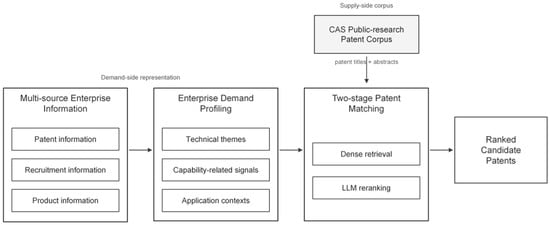
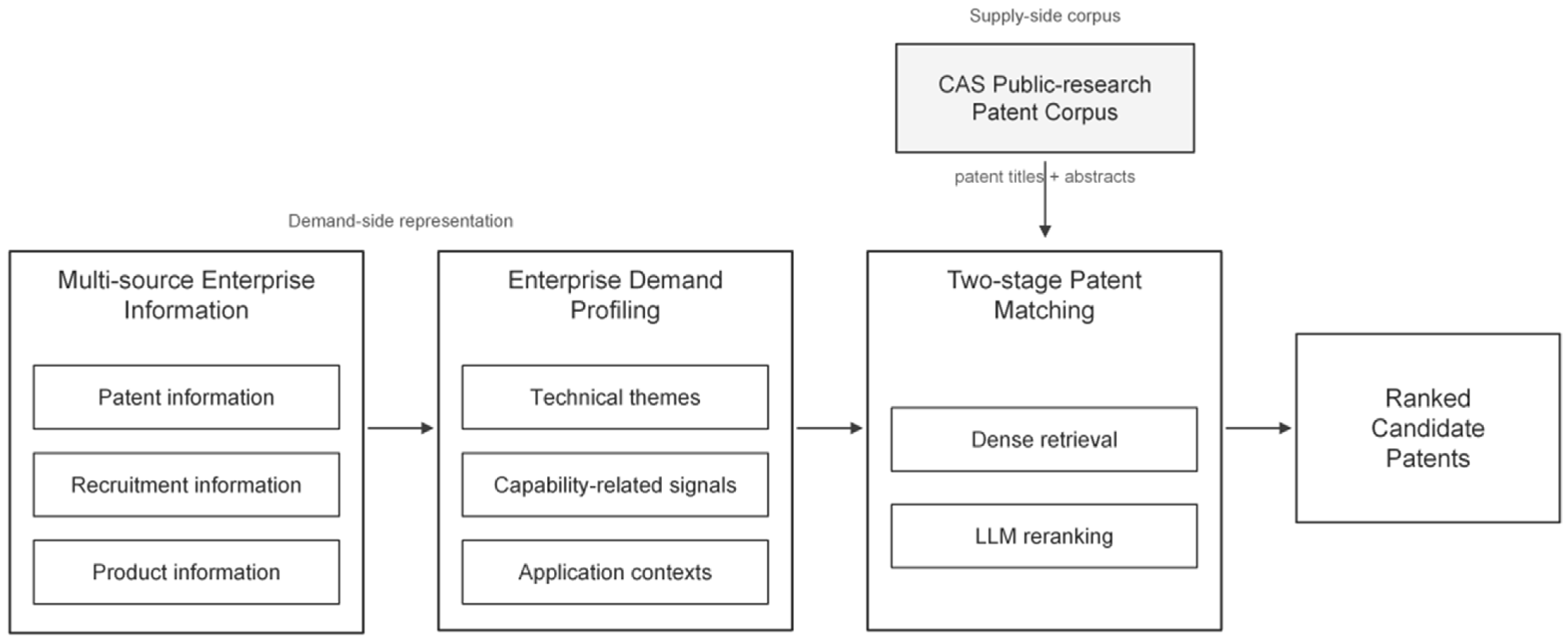
The enterprise-side inputs are patent titles and abstracts, recruitment responsibilities and technical requirements, and product functions and application descriptions. The extraction model converts them into technical themes, capability-related signals, and application contexts, respectively; these are inferred profile elements rather than verified enterprise requirements. Candidate CAS patents are represented by titles and abstracts. Figure 1 summarizes the operational flow; source weights enter Equation (1), text-vector similarity enters Equation (2), and the reranking score enters Equation (3).
Figure 1.
Enterprise-oriented patent screening workflow. Source: Authors’ own illustration. Enterprise-demand profiling denotes indirect proxies: technical themes, capability-related signals, and application contexts. Equations (1)–(3) specify source-vector fusion, candidate similarity, and dense/LLM score fusion, respectively. Source-weight exploration is an offline evaluation step (Section 3.4).
3.2. Data Sources and Retrospective Evaluation Design
The retrieval task was defined at the enterprise level, with individual enterprise–patent pairs constituting candidate matching relationships. Performance was evaluated using observed enterprise–CAS patent assignment and licensing links as positive reference signals. Because the evaluation cohort includes only enterprises with at least one observed CAS transaction, the reported Hit@K values measure recovery within a positive-enriched retrospective cohort rather than population-level adoption probability. The initial demand-side enterprise pool was compiled from official national lists of specialized and innovative “Little Giant” SMEs released through December 2025. Following enterprise-name standardization, website-based data collection, and screening for source availability, 5790 enterprises with complete coverage across all three enterprise-side information sources were retained. Enterprise patent records and the CAS patent corpus were obtained from IncoPat on 23 January 2026. In this study, “patent records” refer to granted patents only. Both the enterprise-side patent records used for profile construction and the CAS candidate corpus were restricted to granted patents, and design patents were excluded. Published applications that had not yet been granted were not included. Among the 5790 enterprises with complete three-source coverage, 98 had at least one observed CAS patent assignment or licensing link and formed the retrospective evaluation cohort. After enterprise-name and patent-identifier normalization and removal of duplicate transaction records, the positive reference set contained 584 observed enterprise–CAS assignment or licensing links involving 577 unique CAS patents.
The supply-side candidate corpus contained 138,117 CAS patent records. Publication and application identifiers were normalized, and records with missing essential text fields or duplicate identifiers were removed. The title and abstract of each patent were concatenated to form its retrieval text. The candidate corpus was held constant across all source-weight and model comparisons.
The three enterprise-side sources were represented as follows: enterprise patent information by patent titles and abstracts; recruitment information by job responsibilities, qualification requirements, skills, tools, and technical tasks; and product information by product introductions, functional descriptions, and application fields. Before profile construction, fields were validated, enterprise names were reconciled, invalid or duplicate records were removed, and texts were aggregated at the enterprise–source level.
Because the initial dataset required all three source categories to be present, the 98 evaluated enterprises had no missing source category by construction. Source-record availability does not guarantee a nonempty extracted profile or a nonzero fused query; the handling of empty outputs and zero-query cases is specified in Section 3.4. Source volume, specificity, and timeliness nevertheless varied across enterprises and data types. The three sources were selected to represent three distinguishable perspectives on enterprise technological activity: previously disclosed technologies through patent records, sought capabilities through recruitment postings, and marketed applications through product information. The study was therefore designed as a bounded comparison of these three source categories rather than as an exhaustive aggregation of publicly available enterprise information. Annual reports, strategic planning documents, and other corporate disclosures may provide additional evidence, but they differ in availability, reporting purpose, frequency, and document structure and were outside the scope of the present study. Their incremental value can be examined in future research.
The evaluation in this study is cross-sectional and retrospective rather than a historical backtest or prospective prediction experiment. The study does not establish that every enterprise-side record was available before the corresponding observed transaction. Observed assignment and licensing links are therefore used as retrospective reference signals for comparing source composition and ranking procedures, rather than as outcomes to be predicted using exclusively pre-transaction information.
3.3. Construction of Source-Specific Enterprise Profiles
The profiling procedure comprised three stages: passage preprocessing and selection, LLM-based element extraction, and multi-run output consolidation. First, each source-specific enterprise text was segmented into sentences or short passages, and segments shorter than six Chinese characters were removed. For each enterprise–source pair, term frequency–inverse document frequency (TF–IDF) weighting retained up to 160 information-rich passages. Maximal marginal relevance (MMR) was then applied to balance relevance and redundancy, retaining up to 80 passages with an MMR trade-off coefficient of 0.7. The text supplied to the extraction model was limited to 1200 Chinese characters for each source.
Second, a locally deployed gpt-oss-120b model [33] extracted three types of source-specific profile elements under constrained prompts:
- Technical themes, derived from enterprise patent information, describing technologies, components, materials, processes, or systems reflected in the enterprise’s documented technological trajectory;
- Capability-related signals, derived from recruitment information, describing engineering skills, tools, software, qualifications, experimental methods, and implementation-related expertise reflected in recruitment postings;
- Application contexts, derived from product information, describing products, functions, industries, operating environments, and use scenarios.
The extraction prompts required the model to use only the supplied text, return source-specific noun or noun-phrase elements, avoid unsupported external facts, and produce JSON with the expected source-specific key. The requested limit was 20 elements per dimension.
Third, extraction was performed at temperatures of 0.2, 0.35, and 0.5. Within each run, empty items were removed and exact duplicate strings were removed after whitespace normalization. Outputs from the three temperatures were then pooled, and recurring terms were prioritized according to their exact-string frequency, with up to 20 elements retained. No separate semantic synonym or near-duplicate clustering was applied during post-processing. This aggregation reduces reliance on a single output by design, but its effectiveness was not quantified through a repeated-run agreement or sensitivity experiment. The complete extraction prompts and implementation details are provided in Supplementary File S1 and Supplementary Table S2. Model responses were required to follow a predefined JSON schema. Responses were parsed as JSON objects and checked for the expected source-specific key and list structure. Invalid or missing JSON produced an empty list for that run. Failed requests were retried up to three times; if all attempts failed, that run was also treated as empty.
3.4. Source-Weight Exploration and Dense Candidate Retrieval
For retrieval, each source-specific profile was encoded separately. Let vi,p, vi,r, and vi,o denote the patent-, recruitment-, and product-profile vectors for enterprise i, normalized to unit Euclidean norm when nonzero. The subscript o denotes product information. L2 normalization means division by the Euclidean vector norm. The source-weighted enterprise query was defined as follows:
where qi is the fused enterprise query; wp, wr, and wo are the nonnegative patent, recruitment, and product weights, with wp + wr + wo = 1; and ‖·‖2 denotes the Euclidean norm. Each weight takes values in {0, 0.1, …, 1}, producing 66 feasible configurations. Empty source profiles are represented by zero vectors. Equation (1) is defined only when the weighted sum is nonzero. No evaluated enterprise produced a zero fused query under the reported configurations.
The first stage used Qwen3-Embedding-8B to map enterprise profiles and CAS patent texts into a shared vector space [34]. Candidate-patent embeddings were precomputed from patent titles and abstracts. Nonzero enterprise-query vectors and candidate-patent vectors were L2-normalized. Cosine similarity between enterprise i and candidate patent d was calculated as follows:
where d identifies a candidate patent, vd is its unit-normalized title–abstract embedding, semb(i,d) is its cosine similarity to qi, and ⊤ denotes transpose. For nonzero normalized vectors, cosine similarity equals the dot product. Embedding-only retrieval was run for all 66 configurations, retaining Top-100 candidates per enterprise and evaluating Hit@30 and macro-averaged Recall@30. Among configurations with equal Hit@30, higher Recall@30 was preferred. The selected configuration was fixed for the subsequent comparison on the same 98 enterprises. The Top-100 dense candidates per enterprise were passed to LLM review. The Top-100 candidates passed to the LLM reranker were the first 100 entries of the same deterministic dense ranking used for Top-100 retention. No candidates were added or removed before reranking; the LLM stage only reordered these 100 candidates. Consequently, the EMB ranking at K ≤ 30 is directly comparable with the reranked results.
To assess the stability of source-weight selection and separate parameter selection from held-out evaluation, repeated enterprise-level five-fold cross-validation was additionally conducted. The 98 enterprises were randomly partitioned into five folds, and the procedure was repeated 20 times using different random seeds. In each fold, four folds were used to select the source-weight configuration from the same 66-setting grid, using the same primary rule as the full-cohort analysis: higher Hit@30 was preferred, followed by higher macro-averaged Recall@30. Exact ties were resolved using micro-averaged Recall@30 and then the configuration identifier to ensure deterministic selection. The selected configuration was subsequently evaluated only on the held-out fold. The five held-out folds were combined to obtain one out-of-fold estimate for each repeat, resulting in 100 training–test folds across the 20 repeats. This procedure was used to assess both the stability of the selected source weights and held-out retrieval performance. Complete cross-validation results are reported in Supplementary Table S3.
3.5. Stage 2: LLM-Assisted Semantic Review and Reranking
The second stage applied gpt-oss-120b [33] to review the 100 candidates retrieved for each enterprise under the source configuration selected in Stage 1. For every enterprise–patent pair, the model received the structured enterprise profile together with the candidate patent’s title and abstract; titles were limited to 120 characters and abstracts to 800 characters. The prompt used pointwise scoring and instructed the model to assess three relations: (1) consistency between the enterprise’s technical themes and the patent’s disclosed technical mechanism or solution; (2) relevance between capability-related signals and the technical expertise indicated by the patent text; and (3) consistency between enterprise application contexts and the patent’s potential use scenarios. The prompt requested an overall relevance score between 0 and 1 and a short reason linked to the supplied text. The factual grounding of these reasons was not independently evaluated. The primary request used temperature 0.2 and top-p 0.1.
The final ranking combined the dense-retrieval score and the LLM-review score using a fixed linear fusion function:
where sfinal(i,d) is the fused ranking score, semb(i,d) is the dense cosine score, and sLLM(i,d) is the LLM score in [0, 1]. The coefficient α is the dense-score weight and was constant across enterprises and candidates. In the implemented pipeline, α was fixed at 0.7 for all enterprises and candidates, assigning a weight of 0.7 to the dense-retrieval score and 0.3 to the LLM-review score. The value was used as a fixed implementation setting and was not tuned on the evaluation cohort. It therefore should not be interpreted as an empirically optimized fusion weight. The raw cosine-similarity score was used directly in score fusion without min–max normalization or other cross-score calibration. LLM outputs were constrained to the interval [0, 1]; values outside this range were clipped to the nearest boundary. For each enterprise, the 100 candidates were divided into approximately four multi-candidate calls, corresponding to 25 candidates per call when all 100 candidates were present. Each candidate received an individual overall relevance score and reason, and no pairwise or listwise ranking instruction was used. Model responses were parsed as JSON arrays aligned to candidate order. Each request used a 120 s timeout. Up to three request rounds were allowed; within each round, the primary payload used temperature 0.2 and top-p 0.1, and a fallback payload retained temperature 0.2 without an explicit top-p value. Regex or JSON parsing failure assigned zero scores to the affected batch; missing or invalid array elements were zero-filled, while extra elements were ignored. Candidates were sorted by final score in descending order; the original reranker specified no additional secondary tie-break rule. The numerical source weights used in Stage 1 were not supplied to the LLM prompt and did not determine the three semantic-review criteria. Complete prompts and implementation settings are provided in Supplementary File S1 and Supplementary Table S2.
The present implementation used pointwise scoring within a fixed candidate set. The LLM stage should therefore be interpreted as local semantic review and reranking rather than as full-corpus retrieval.
3.6. Reference Baselines
To address RQ2, the comparison included the following methods under the source configuration selected in Stage 1:
- BM25, representing sparse lexical retrieval based on term frequency, inverse document frequency, and document-length normalization;
- Latent semantic analysis (LSA), representing a traditional low-dimensional semantic model based on TF–IDF representation and truncated singular-value decomposition;
- Embedding-only retrieval (EMB), representing dense semantic retrieval with Qwen3-Embedding-8B without LLM review;
- BM25–EMB RRF, representing a hybrid lexical–dense retrieval baseline that combines BM25 and embedding-based rankings using reciprocal rank fusion;
- Proposed two-stage method, representing EMB candidate retrieval followed by gpt-oss-120b semantic review and score fusion.
All methods used the same enterprises, candidate corpus, positive reference set, cutoffs, and extracted profile content. The 0.8/0.1/0.1 source configuration selected through dense retrieval was also fixed for BM25, LSA, and the BM25–EMB RRF baseline. This holds the extracted source content and nominal source weights fixed, but the implementations may use those weights differently. It does not provide each baseline with independently optimized source weights. The comparison should therefore be interpreted as a comparison under a fixed input configuration, rather than an exhaustive comparison of each method’s best achievable performance.
For BM25, Chinese text was tokenized using jieba (version 0.42.1). The implementation used k1 = 1.5 and b = 0.75, with a maximum vocabulary of 200,000 features and a minimum document frequency of 2. Source-specific enterprise-profile texts were vectorized separately and combined using the same source weights as the proposed method before scoring candidate patents.
For LSA, the same Chinese tokenization was used. Patent texts were represented using TF–IDF with a maximum of 60,000 features, unigram and bigram terms, and a minimum document frequency of 1. The TF–IDF matrix was projected to 256 latent dimensions using truncated singular-value decomposition with a random seed of 42, followed by L2 normalization and cosine-similarity ranking. Enterprise queries used the same source-specific profile content and source-weight configuration.
For BM25–EMB RRF, the Top-100 BM25 ranking and the Top-100 EMB ranking under the selected 0.8/0.1/0.1 source configuration were combined using reciprocal rank fusion. Following the standard RRF setting [35], the rank constant was fixed at 60 and was not tuned on the evaluation cohort. For candidate patent d, the fusion score was 1/(60 + rBM25(d)) + 1/(60 + rEMB(d)); a candidate absent from one component Top-100 list contributed zero from that component. The union of the two Top-100 lists was reranked by the resulting RRF score, and the Top-100 fused results were retained for evaluation. Ties were resolved deterministically by EMB rank, BM25 rank, and publication number, in that order.
BM25 and LSA provide traditional reference baselines, while BM25–EMB RRF provides a hybrid lexical–dense comparator. The evaluation does not include the patent-domain encoders discussed in Section 2.3, such as PatentSBERTa or SEARCHFORMER, or independently optimized variants of the reference baselines. Accordingly, the comparison broadens the baseline coverage but does not establish state-of-the-art performance.
3.7. Evaluation Metrics
Let C = {c1, …, cN} be the set of N = 98 enterprises. For enterprise ci, Gi is the set of unique observed positive CAS patents and Ri(K) is the set of the first K returned patents. A positive reference denotes an observed assignment or licensing relationship, rather than an independently verified demand match. Enterprise-level Hit@K was defined as follows:
where N is the number of enterprises, i indexes an enterprise, K is the evaluation cutoff, ∩ denotes set intersection, ∅ is the empty set, and I(·) equals 1 when its condition holds and 0 otherwise. Hit@K measures the fraction of enterprises with at least one observed positive patent in their Top-K list. The corresponding count is N × Hit@K before rounding.
Macro-averaged Recall@K was defined as follows:
where |·| denotes set size, |Ri(K) ∩ Gi| is the number of recovered positive references for enterprise i, and |Gi| is its positive-reference count. Every evaluated enterprise has at least one reference. Macro-averaging yields equal weight to enterprises; it is not the fraction of all 584 relationships recovered. Source configurations were compared at K = 30. Method comparisons used K = 10, 20, and 30. The evaluation cutoff K is distinct from the 100 candidates passed to the reranker.
Uncertainty in the comparison between EMB and LLM-assisted reranking was assessed at the enterprise level. For each cutoff, 95% percentile bootstrap confidence intervals were estimated using 10,000 paired resamples of the 98 enterprises with replacement. The same resampled enterprises were used for EMB and reranking to preserve the paired structure. Changes in enterprise-level Hit@K were evaluated using the exact McNemar test. Differences in enterprise-level Recall@K were evaluated using a two-sided paired sign-flip permutation test with 100,000 permutations. Randomized procedures used a base seed of 42. These analyses quantify uncertainty in the EMB–reranking comparison under the fixed 0.8/0.1/0.1 configuration; they do not provide held-out validation or remove potential optimism arising from source-weight selection on the same enterprise cohort.
4. Results
4.1. Comparison of Source-Profile Configurations
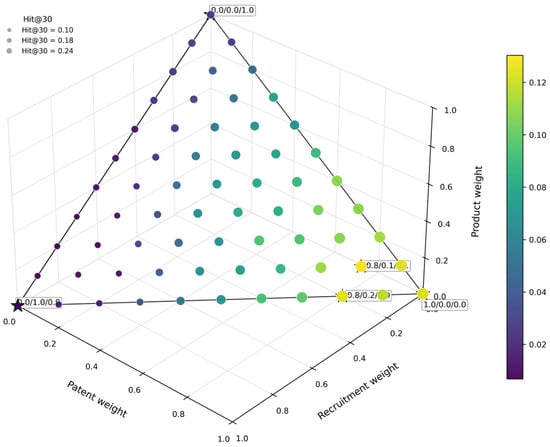
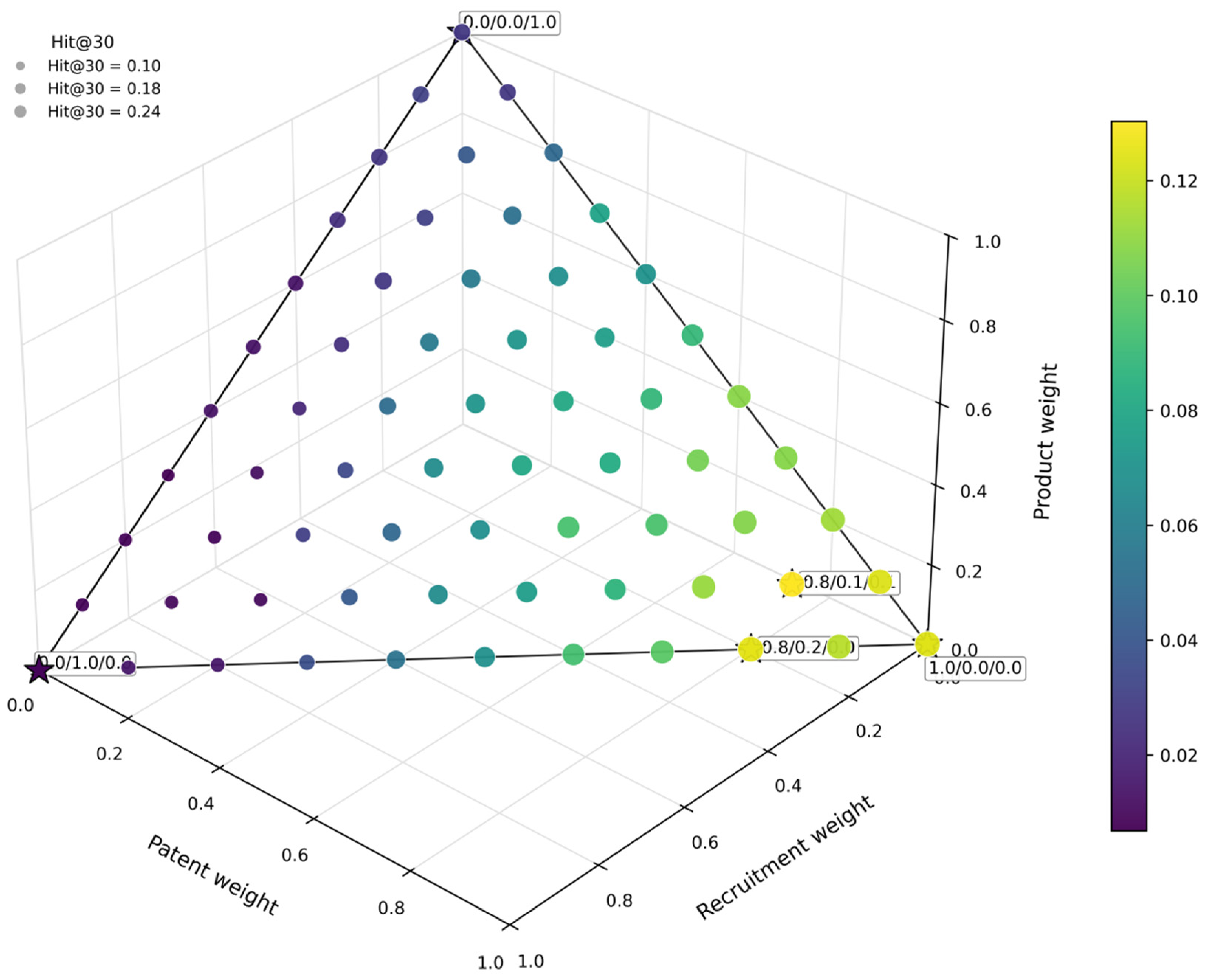
Figure 2 visualizes the source-weight search, and Table 1 reports the three single-source configurations together with the selected two-source and three-source settings. Complete results for all 66 source-weight configurations are reported in Supplementary Table S1. Because the 66-setting grid includes the three single-source configurations, multiple two-source combinations, and three-source combinations, it also serves as a source-composition ablation, allowing the contribution of different source combinations and weight allocations to be compared under the same retrieval framework.
Figure 2.
Top-30 performance across source-weight configurations. Source: Authors’ own illustration. The axes represent patent, recruitment, and product weights; marker size encodes Hit@30 and color encodes macro-averaged Recall@30. Selected configurations are highlighted. Stars indicate the selected configurations reported in Table 1; they do not represent statistical significance. Complete numerical results for all 66 configurations are provided in Supplementary Table S1.
Table 1.
Top-30 performance of single-source profiles and selected in-sample source combinations. Hit values include the number of hit enterprises out of 98; recall is macro-averaged.
Among the single-source profiles, enterprise patent information yielded higher point estimates than recruitment or product information, with Hit@30 = 0.2449 and Recall@30 = 0.1243. The selected two-source configuration combined patent and recruitment information at weights of 0.8/0.2/0.0 and achieved the same Hit@30 of 0.2449 with a slightly higher Recall@30 of 0.1254.
The selected 0.8/0.1/0.1 configuration had Recall@30 = 0.1303 and Hit@30 = 0.2449 (24/98 enterprises). Its macro recall exceeded the patent-only value by 0.0060 and the selected two-source value by 0.0049, while all three settings had the same number of hit enterprises. These small full-cohort differences do not establish statistical superiority or uniform source complementarity.
Repeated enterprise-level five-fold cross-validation was used to assess the stability of source-weight selection. Across 100 training folds generated from 20 repeated five-fold partitions, the 0.8/0.1/0.1 configuration was selected in 64 folds. The remaining selected configurations were 0.8/0.2/0.0 (15 folds), 1.0/0.0/0.0 (13 folds), 0.9/0.0/0.1 (7 folds), and 0.7/0.2/0.1 (1 fold). All selected configurations assigned at least 0.7 weight to the patent-derived profile. Mean out-of-fold Hit@30 was 0.2260 and mean macro-averaged Recall@30 was 0.1114. These results indicate that the exact weight vector was not uniquely stable across sample partitions, whereas the broader patent-dominant weighting pattern was consistently retained. Complete cross-validation results are reported in Supplementary Table S3.
For RQ1, the patent-dominant three-source configuration had a slightly higher full-cohort macro Recall@30 point estimate than patent-only profiling (0.1303 versus 0.1243), while both covered 24 of 98 enterprises at K = 30. Because this configuration was selected on the evaluation cohort and the cross-validation did not directly compare its held-out performance against patent-only retrieval, the results suggest a possible incremental contribution from the two additional sources without establishing a reliable advantage.
4.2. Comparison of the Two-Stage Method with Reference Baselines
Table 2 compares BM25, LSA, EMB, the BM25–EMB RRF hybrid baseline, and LLM-assisted reranking under the selected 0.8/0.1/0.1 profile configuration. The hybrid baseline provides an additional comparison between purely dense retrieval and a rank-level combination of lexical and dense retrieval.
Table 2.
Patent-matching performance under the selected in-sample profile configuration. Hit values include the number of hit enterprises out of 98; recall is macro-averaged. BM25–EMB RRF combines the Top-100 BM25 and EMB rankings using reciprocal rank fusion with a fixed rank constant of 60. The LLM-assisted reranked output uses the fused score in Equation (3).
Relative to EMB, reranking increased Hit@10 from 12/98 to 16/98 enterprises, while Hit@20 remained 18/98 and Hit@30 remained 24/98. At K = 10, six enterprises gained a hit and two lost one; the corresponding gain/loss counts were 4/4 at K = 20 and 5/5 at K = 30. All paired bootstrap confidence intervals for the Hit@K differences included zero, and exact McNemar tests did not identify a statistically significant difference at any cutoff (Table 3).
Table 3.
Enterprise-level paired comparison between EMB and LLM-assisted reranking.
The macro-averaged Recall@K point estimates after reranking were higher by 0.0328 at K = 10, 0.0121 at K = 20, and 0.0046 at K = 30. All paired confidence intervals included zero, and the corresponding paired permutation tests did not indicate statistically significant differences (Table 3). These results indicate a modest change in ordering in the reported primary run, most evident at the shallowest cutoff, rather than an established performance advantage.
For RQ2, under the fixed patent-dominant profile, EMB performed better than BM25 and LSA at K = 30, while comparisons with the BM25–EMB hybrid varied across cutoffs. Relative to EMB, reranking the same Top-100 candidates raised the primary-run Hit@10 point estimate from 12/98 to 16/98 and macro Recall@10 from 0.0499 to 0.0826, but the paired analyses did not establish a statistically significant advantage.
For RQ3, the Hit@K point-estimate difference was positive at K = 10 and zero at K = 20 and 30; the positive macro Recall@K differences became smaller as K increased, and none was statistically distinguishable from zero.
5. Discussion
5.1. Interpreting the Multi-Source Enterprise Profile
Patent-derived profiles were the strongest single-source configuration in Table 1. However, both the enterprise-side patent profiles and the candidate corpus are represented by patent titles and abstracts. Their shared document genre and technical vocabulary may therefore contribute to the observed retrieval advantage. The present experiment cannot separate this language-matching effect from the enterprise-specific informational value of patent records. Accordingly, patent dominance is interpreted only as stronger retrieval performance under the present representation, not as evidence that patent information is intrinsically a better indicator of enterprise technological demand.
Recruitment and product information describe sought capabilities and market-facing applications, respectively. Their stand-alone retrieval performance was weak, whereas the selected three-source configuration produced a small full-cohort increase in macro Recall@30 over the patent-only configuration without increasing Hit@30. Repeated five-fold cross-validation likewise selected patent-dominant configurations, although the exact weights varied across sample partitions. Taken together, these results identify patent-derived information as the strongest retrieval input under the present representation; the small full-cohort gain from the selected three-source setting does not establish separate or robust contributions from recruitment and product information. The full-cohort pattern is compatible with a limited contribution from non-patent sources within a patent-led profile, but it does not demonstrate a reliable gain over patent-only retrieval on held-out enterprises.
Further source tests should retain the same enterprise references and candidate corpus while replacing each enterprise’s patent input with patents from other enterprises, matched where feasible on industry, date, and text length. Repeated reassignment would test whether company-specific alignment adds information beyond generic patent-language similarity. Vocabulary-overlap stratification or controls, together with raw-text versus extracted-profile ablations, would probe related explanations. These controls have not been performed. A nontechnical-content control is useful only if separable source fields exist; title–abstract text alone may not provide a credible nontechnical subset.
5.2. Effects of the Two-Stage Architecture
The comparison with BM25–EMB RRF provides an additional lexical–dense reference. RRF yielded higher point estimates than EMB at some cutoffs, whereas EMB was higher at others; the results therefore do not establish uniform superiority of either approach. Encoder choice, input construction, retrieval formulation, and parameter settings should be considered when interpreting these differences.
The second stage uses pointwise scores, whereas the reranking studies discussed in Section 2.4 investigate other prompting formulations. Its three review criteria and generated reasons may help organize a future analyst workflow, but a reason is not itself evidence of correctness. Factual grounding, prompt sensitivity, and dependence on the three review criteria require separate validation.
Because the reranker operated on exactly the same fixed Top-100 candidates retrieved by EMB, the observed differences reflect changes in candidate ordering rather than candidate composition. The reported primary run shows a modest ranking adjustment after dense retrieval, with the clearest point-estimate change at the shallowest cutoff. Enterprise-level paired analyses nevertheless showed offsetting gains and losses, all confidence intervals for Hit@K and Recall@K differences included zero, and the corresponding McNemar and paired permutation tests were non-significant. The reranking stage should therefore be interpreted as a limited second-stage refinement in this cohort rather than as evidence of a statistically established performance advantage.
5.3. Implications for Open Innovation and Systems Practice
The proposed screening workflow assigns functions to information collection, profiling, retrieval, LLM review, and eventual analyst assessment. Landry et al. [2] examine services and business models of technology-transfer organizations. Feser [36] reviews intermediary roles in knowledge sharing. Silva and Leitao [32] examine external-partner cooperation in Portuguese firms and report a role for science partners in product-innovation advances. These studies situate screening within broader organizational relationships. A relevant text match can support initial assessment, while collaboration also depends on technical, commercial, and institutional considerations.
The architecture connects enterprise representation, patent supply, and a proposed intermediary review process. Source weights change the query used for retrieval, and the selected candidates constrain what reranking can recover. These dependencies define the workflow, but the experiments do not isolate the contribution of every stage. The pipeline provides a screening layer before technical and commercial assessment, while its positive references remain transaction records rather than verified demand judgments.
5.4. Practical Implications
For a technology-transfer organization, the proposed deployment workflow would begin with source provenance checks and enterprise review of the extracted profile. Dense retrieval would produce a candidate list, and LLM review would supply scores and text-linked reasons. An analyst would then verify the patent mechanism, ownership and legal status, implementation constraints, and commercial relevance. Profile corrections and expert relevance judgments could be recorded for subsequent evaluation. These analyst and feedback functions are proposed deployment extensions; they were not tested in the retrospective experiment.
Restricting review to 100 candidates implies 9800 enterprise–patent scoring judgments for one pass over 98 enterprises, excluding extraction, retries, and repeated runs. This is a workload calculation, not a measured runtime or number of API calls. Corpus embeddings can be reused, but extraction, indexing, memory, latency, and analyst time must be measured on the actual hardware before scalability can be claimed. Deployment should preserve source dates and model versions, protect licensed and personal information in source texts, validate generated reasons, and record both accepted and rejected recommendations. Feedback drawn only from accepted recommendations would reproduce selection bias.
5.5. Limitations and Future Research
The first limitation concerns the reference construct and selection. Assignment and licensing links reflect technological relevance together with commercial, legal, institutional, geographic, and historical factors. Untransferred patents are not verified negatives. The study therefore cannot estimate demand-classification false positives or treat all unmatched recommendations as irrelevant. Requiring both an observed CAS transaction and all three source categories also favors firms with transactions and richer public records. The results do not establish performance for non-adopters or firms with sparse information.
Second, the study does not establish pre-transaction availability for every enterprise-side record. Reliable historical timestamps were not consistently available for recruitment and product webpages, preventing reconstruction of fully time-aligned enterprise profiles. The reported results should therefore not be interpreted as prospective predictions. Future validation should use archived or prospectively collected enterprise records to evaluate the framework under transaction-date-aligned conditions.
Third, repeated enterprise-level five-fold cross-validation was conducted to separate source-weight selection from held-out evaluation and to examine selection stability. Patent-dominant configurations were consistently selected across folds, but the exact selected configuration varied, and out-of-fold performance was lower than the full-cohort estimates. The 0.8/0.1/0.1 configuration should therefore not be interpreted as a uniquely optimal parameter. The subsequent baseline and reranking comparisons nevertheless retain the full-cohort 0.8/0.1/0.1 configuration as a fixed comparison setting, and the baselines were not independently tuned for source weights. Moreover, the cross-validation remains an internal validation within the same 98-enterprise cohort; external, cross-institutional, and time-aware validation is still required.
Fourth, the 66-setting source-weight grid provides a source-composition ablation by comparing single-source, two-source, and three-source configurations, while the EMB–reranking comparison examines the effect of adding the second-stage LLM review under a fixed candidate set. These analyses do not, however, separately isolate the effects of raw source text versus extracted profiles, encoder choice, individual LLM review criteria, or alternative score-fusion designs. Combining extraction outputs at three temperatures is not a sensitivity study. Prompt variation, profile-extraction repeatability, agreement between individual LLM scores, and alternative score-fusion designs remain untested. The two supplementary reranking runs varied at Top-30 and did not establish a consistent gain over EMB at that cutoff (Supplementary Table S4). Variation in source volume, specificity, and timeliness further limits interpretation of each source’s contribution. Company-reassigned patent controls and vocabulary-overlap analyses are also needed before interpreting patent-derived retrieval strength as superior demand information.
Finally, the evaluation is limited to Chinese specialized and innovative SMEs, Chinese-language sources, and CAS transactions. Analyst interaction, latency, cost, and prospective outcomes were not evaluated. Cross-industry, cross-institutional, multilingual, and prospective studies are required before broader generalization or operational effectiveness can be claimed.
6. Conclusions
This study assessed retrospective recovery of observed CAS–SME assignment or licensing links, rather than independently verified technological demand. For RQ1, patent-derived profiles were the strongest single-source input, and the patent-led three-source configuration (0.8/0.1/0.1) produced a slightly higher in-sample macro Recall@30 than patent-only profiling (0.1303 versus 0.1243), with unchanged Hit@30 (24/98). Repeated enterprise-level cross-validation favored patent-dominant weights but did not establish a stable incremental advantage for the three-source setting over patent-only retrieval. The additional sources may therefore provide limited supplementary evidence under the tested representation, but neither a general performance benefit nor independent validity as measures of enterprise demand has been established.
For RQ2, dense retrieval under the fixed profile exceeded BM25 and LSA at K = 30, while the hybrid baseline showed cutoff-dependent differences. In the reported primary run, LLM-assisted reranking of the same Top-100 candidates increased Hit@10 from 12/98 to 16/98 and macro Recall@10 from 0.0499 to 0.0826 relative to EMB. These are point-estimate differences rather than statistically established improvements.
For RQ3, the primary run showed a Hit@K advantage only at K = 10, while Hit@20 and Hit@30 remained unchanged and the positive macro Recall@K differences decreased as review depth increased. Paired confidence intervals included zero at every cutoff, and the supplementary runs did not show a consistent Top-30 gain. LLM review may therefore alter the early ordering of retrieved candidates, but a reliable performance benefit, prospective utility, and transferability beyond this cohort require further validation.
7. Contributions
This study contributes an exploratory workflow linking enterprise profiling, public-research patent retrieval, and LLM-assisted review within a staged screening process. Its evaluation separates source-composition effects from second-stage ranking changes, distinguishes enterprise coverage from macro-averaged reference recovery across review depths, and uses repeated enterprise-level cross-validation to assess source-weight selection under held-out enterprises. These contributions concern retrospective screening within the evaluated setting; external, cross-institutional, and time-aware validation is required before inferring demand validity or operational effectiveness.
Supplementary Materials
The following supporting information can be downloaded at: https://www.mdpi.com/article/10.3390/systems14101284/s1. Supplementary File S1. Prompts used for enterprise profile extraction and patent semantic reranking; Supplementary Table S1. Complete Top-30 results for the 66 source-weight configurations; Supplementary Table S2. Implementation and experimental settings; Supplementary Table S3. Repeated enterprise-level five-fold cross-validation results for source-weight selection; and Supplementary Table S4. Repeated-run stability results for the Top-100 LLM reranking stage.
Author Contributions
Conceptualization, J.X., J.Z., Z.Z., L.L. and Y.Z.; methodology, J.X.; validation, J.X.; investigation, J.X.; data curation, J.Z. and Z.Z.; writing—original draft preparation, J.X.; writing—review and editing, J.X., J.Z., Z.Z., L.L. and Y.Z.; supervision, L.L. and Y.Z.; project administration, Y.Z.; funding acquisition, L.L. All authors have read and agreed to the published version of the manuscript.
Funding
This research was funded by the Young Scientists Fund of the National Natural Science Foundation of China, grant number 72304268.
Institutional Review Board Statement
Not applicable.
Informed Consent Statement
Not applicable.
Data Availability Statement
The patent transaction records, enterprise texts, and CAS patent records cannot be redistributed in full because they include licensed, platform-derived, or commercially sensitive information. Aggregate results for all 66 source-weight configurations are provided in Supplementary Table S1. The prompts used for enterprise-profile extraction and LLM-assisted reranking are provided in Supplementary File S1; implementation and experimental settings are provided in Supplementary Table S2; repeated source-weight cross-validation results are provided in Supplementary Table S3; and repeated reranking results are provided in Supplementary Table S4. Access to the restricted raw records is subject to institutional and data-provider conditions.
Acknowledgments
OpenAI Codex (https://openai.com/codex/) was used to assist with manuscript restructuring, drafting of revised passages and reviewer responses, language editing, and bibliographic checks. The gpt-oss-120b model used for profile extraction and reranking is described in Section 3.3 and Section 3.5.
Conflicts of Interest
The authors declare no conflicts of interest. The funders had no role in the design of the study; in the collection, analysis, or interpretation of data; in the writing of the manuscript; or in the decision to publish the results.
Abbreviations
| Abbreviation | Definition | |
| AI | Artificial intelligence | |
| BM25 | Okapi BM25 retrieval model | |
| CAS | Chinese Academy of Sciences | |
| EMB | Embedding-only retrieval baseline | |
| LLM | Large language model | |
| LSA | Latent semantic analysis | |
| MMR | Maximal marginal relevance | |
| SME | Small- and medium-sized enterprise | |
| TF–IDF | Term frequency–inverse document frequency | |
| RRF | Reciprocal rank fusion | |
| Symbols and Evaluation Quantities | ||
| Symbol | Definition | Equation |
| i | Enterprise index | 1–5 |
| d | Candidate-patent index | 2–3 |
| N | Number of evaluated enterprises (98) | 4–5 |
| vi,p; vi,r; vi,o | Patent, recruitment, and product profile vectors; unit-normalized when nonzero | 1 |
| wp; wr; wo | Nonnegative source weights summing to one | 1 |
| qi; ‖·‖2 | Fused query and Euclidean norm | 1–2 |
| vd; ⊤ | Unit-normalized candidate embedding and transpose | 2 |
| semb | Dense cosine similarity | 2–3 |
| sLLM; sfinal | LLM score and final ranking score | 3 |
| α | Dense-score weight; fixed at 0.7—Equation (3) | 3 |
| C; ci | Enterprise set and enterprise i | Section 3.7 |
| Gi | Unique observed positive patents for enterprise i | 4–5 |
| Ri(K); K | Set of the first K returned patents and evaluation cutoff | 4–5 |
| I(·); ∅ | Indicator function and empty set | 4 |
| ∩ | Set intersection | 4–5 |
| |·| | Set cardinality | 5 |
| Hit@K; Recall@K | Enterprise coverage and macro-averaged positive-reference recall | 4–5 |
| Top-100 | Reranker input size and depth retained in source-weight search | Section 3.4 and Section 3.5 |
References
- Chesbrough, H.W. The Era of Open Innovation. MIT Sloan Management Review, 15 April 2003; Volume 44, pp. 35–41. Available online: https://sloanreview.mit.edu/article/the-era-of-open-innovation/ (accessed on 13 July 2026).
- Landry, R.; Amara, N.; Cloutier, J.-S.; Halilem, N. Technology transfer organizations: Services and business models. Technovation 2013, 33, 431–449. [Google Scholar] [CrossRef] [Scilit]
- Battistella, C.; Ferraro, G.; Pessot, E. Technology transfer services impacts on open innovation capabilities of SMEs. Technol. Forecast. Soc. Change 2023, 196, 122875. [Google Scholar] [CrossRef] [Scilit]
- Kwon, S. How does patent transfer affect innovation of firms? Technol. Forecast. Soc. Change 2020, 154, 119959. [Google Scholar] [CrossRef] [Scilit]
- He, X.; Meng, X.; Wu, Y.; Chan, C.S.; Pang, T. Semantic matching efficiency of supply and demand texts on online technology trading platforms: Taking the electronic information of three platforms as an example. Inf. Process. Manag. 2020, 57, 102258. [Google Scholar] [CrossRef] [Scilit]
- Xin, Z.; Wei, F.; Deng, A. Patent recommendation methods for heterogeneous enterprise technology demands in the lithium battery industry. Sustainability 2026, 18, 3339. [Google Scholar] [CrossRef] [Scilit]
- Xin, Z.; Wei, F.; Deng, A.; Dou, L. Patent recommendation based on enterprise demand classification and supply-demand matching. Systems 2025, 13, 1008. [Google Scholar] [CrossRef] [Scilit]
- Antons, D.; Grünwald, E.; Cichy, P.; Salge, T.O. The application of text mining methods in innovation research: Current state, evolution patterns, and development priorities. R&D Manag. 2020, 50, 329–351. [Google Scholar] [CrossRef] [Scilit]
- Bottai, C.; Crosato, L.; Domenech, J.; Guerzoni, M.; Liberati, C. Scraping innovativeness from corporate websites: Empirical evidence on Italian manufacturing SMEs. Technol. Forecast. Soc. Change 2024, 207, 123597. [Google Scholar] [CrossRef] [Scilit]
- Heinrich, S. Deriving technology indicators from corporate websites: A comparative assessment using patents. Appl. Econ. Lett. 2025, 32, 28–41. [Google Scholar] [CrossRef] [Scilit]
- Arora, S.K.; Li, Y.; Youtie, J.; Shapira, P. Measuring dynamic capabilities in new ventures: Exploring strategic change in US green goods manufacturing using website data. J. Technol. Transf. 2020, 45, 1451–1480. [Google Scholar] [CrossRef] [Scilit]
- Du, Y.; Wang, W.; Zhang, B.; Zheng, Y. Taking the pulse of firms’ technological innovation from online job postings. SSRN 2026. [Google Scholar] [CrossRef] [Scilit]
- Cao, Y.; Cheng, S.; Tucker, J.W.; Wan, C. Technological peer pressure and skill specificity of job postings. Contemp. Account. Res. 2023, 40, 2106–2139. [Google Scholar] [CrossRef] [Scilit]
- Babina, T.; Fedyk, A.; He, A.X.; Hodson, J. Firm Investments in Artificial Intelligence Technologies and Changes in Workforce Composition; NBER Working Paper No. 31325; National Bureau of Economic Research: Cambridge, MA, USA, 2023. [Google Scholar] [CrossRef] [Scilit]
- He, S.; Guan, X.; Ran, C. A personalized patent recommendation system using knowledge maps to foster enterprise innovation. Sci. Rep. 2026, 16, 21266. [Google Scholar] [CrossRef] [Scilit]
- Trappey, A.J.C.; Trappey, C.V.; Hsieh, A.H.I. An intelligent patent recommender adopting machine learning approach for natural language processing: A case study for smart machinery technology mining. Technol. Forecast. Soc. Change 2021, 164, 120511. [Google Scholar] [CrossRef] [Scilit]
- Chen, J.; Chen, J.; Zhao, S.; Zhang, Y.; Tang, J. Exploiting word embedding for heterogeneous topic model towards patent recommendation. Scientometrics 2020, 125, 2091–2108. [Google Scholar] [CrossRef] [Scilit]
- Du, W.; Jiang, G.; Xu, W.; Ma, J. Sequential patent trading recommendation using knowledge-aware attentional bidirectional long short-term memory network (KBiLSTM). J. Inf. Sci. 2023, 49, 814–830. [Google Scholar] [CrossRef] [Scilit]
- Lee, J.; Lee, S.; Kim, C.-H.; Yoon, J. Technology-transferability analysis of universities and public research institutes using deep neural networks. IEEE Access 2023, 11, 135196–135211. [Google Scholar] [CrossRef] [Scilit]
- Helmers, L.; Horn, F.; Biegler, F.; Oppermann, T.; Müller, K.-R. Automating the search for a patent’s prior art with a full text similarity search. PLoS ONE 2019, 14, e0212103. [Google Scholar] [CrossRef] [Scilit]
- Choi, J.; Lee, J.; Yoon, J.; Jang, S.; Kim, J.; Choi, S. A two-stage deep learning-based system for patent citation recommendation. Scientometrics 2022, 127, 6615–6636. [Google Scholar] [CrossRef] [Scilit]
- Vowinckel, K.; Hähnke, V.D. SEARCHFORMER: Semantic patent embeddings by Siamese transformers for prior art search. World Pat. Inf. 2023, 73, 102192. [Google Scholar] [CrossRef] [Scilit]
- Bekamiri, H.; Hain, D.S.; Jurowetzki, R. PatentSBERTa: A deep NLP based hybrid model for patent distance and classification using augmented SBERT. Technol. Forecast. Soc. Change 2024, 206, 123536. [Google Scholar] [CrossRef] [Scilit]
- Ali, A.; Tufail, A.; De Silva, L.C.; Abas, P.E. Innovating patent retrieval: A comprehensive review of techniques, trends, and challenges in prior art searches. Appl. Syst. Innov. 2024, 7, 91. [Google Scholar] [CrossRef] [Scilit]
- Jiang, L.; Goetz, S.M. Natural language processing in the patent domain: A survey. Artif. Intell. Rev. 2025, 58, 214. [Google Scholar] [CrossRef] [Scilit]
- Shomee, H.H.; Wang, Z.; Ravi, S.N.; Medya, S. A survey on patent analysis: From NLP to multimodal AI. In Proceedings of the 63rd Annual Meeting of the Association for Computational Linguistics (Volume 1: Long Papers), Vienna, Austria, 27 July–1 August 2025; Association for Computational Linguistics: Stroudsburg, PA, USA, 2025; pp. 8545–8561. [Google Scholar] [CrossRef] [Scilit]
- Abolghasemi, A.; Askari, A.; Verberne, S. On the interpolation of contextualized term-based ranking with BM25 for query-by-example retrieval. In Proceedings of the 2022 ACM SIGIR International Conference on Theory of Information Retrieval, Madrid, Spain, 11–12 July 2022; ACM: New York, NY, USA, 2022; pp. 161–170. [Google Scholar] [CrossRef] [Scilit]
- Sun, W.; Yan, L.; Ma, X.; Wang, S.; Ren, P.; Chen, Z.; Yin, D.; Ren, Z. Is ChatGPT good at search? Investigating large language models as re-ranking agents. In Proceedings of the 2023 Conference on Empirical Methods in Natural Language Processing, Singapore, 6–10 December 2023; Association for Computational Linguistics: Stroudsburg, PA, USA, 2023; pp. 14918–14937. [Google Scholar] [CrossRef] [Scilit]
- Qin, Z.; Jagerman, R.; Hui, K.; Zhuang, H.; Wu, J.; Yan, L.; Shen, J.; Liu, T.; Liu, J.; Metzler, D.; et al. Large language models are effective text rankers with pairwise ranking prompting. In Findings of the Association for Computational Linguistics: NAACL 2024, Mexico City, Mexico, 16–21 June 2024; Association for Computational Linguistics: Stroudsburg, PA, USA, 2024; pp. 1504–1518. [Google Scholar] [CrossRef] [Scilit]
- Mariani, M.; Dwivedi, Y.K. Generative artificial intelligence in innovation management: A preview of future research developments. J. Bus. Res. 2024, 175, 114542. [Google Scholar] [CrossRef] [Scilit]
- Xu, Q.; Liu, Z.; Ma, J. Meeting companies’ innovative requirements on online technology trading platforms: A novel large language model-based framework. Inf. Process. Manag. 2026, 63, 104392. [Google Scholar] [CrossRef] [Scilit]
- Silva, M.J.; Leitao, J. Cooperation in innovation practices among firms in Portugal: Do external partners stimulate innovative advances? Int. J. Entrep. Small Bus. 2009, 7, 391–403. [Google Scholar] [CrossRef] [Scilit]
- OpenAI. gpt-oss-120b & gpt-oss-20b Model Card. arXiv 2025, arXiv:2508.10925. [Google Scholar] [CrossRef] [Scilit]
- Zhang, Y.; Li, M.; Long, D.; Zhang, X.; Lin, H.; Yang, B.; Xie, P.; Yang, A.; Liu, D.; Lin, J.; et al. Qwen3 Embedding: Advancing text embedding and reranking through foundation models. arXiv 2025, arXiv:2506.05176. [Google Scholar] [CrossRef] [Scilit]
- Cormack, G.V.; Clarke, C.L.A.; Büttcher, S. Reciprocal Rank Fusion Outperforms Condorcet and Individual Rank Learning Methods. In Proceedings of the 32nd Annual International ACM SIGIR Conference on Research and Development in Information Retrieval, Boston, MA, USA, 19–23 July 2009; ACM: New York, NY, USA, 2009; pp. 758–759. [Google Scholar]
- Feser, D. Innovation intermediaries revised: A systematic literature review on innovation intermediaries’ role for knowledge sharing. Rev. Manag. Sci. 2023, 17, 1827–1862. [Google Scholar] [CrossRef] [Scilit]

Disclaimer/Publisher’s Note: The statements, opinions and data contained in all publications are solely those of the individual author(s) and contributor(s) and not of MDPI and/or the editor(s). MDPI and/or the editor(s) disclaim responsibility for any injury to people or property resulting from any ideas, methods, instructions or products referred to in the content. |
© 2026 by the authors. Licensee MDPI, Basel, Switzerland. This article is an open access article distributed under the terms and conditions of the Creative Commons Attribution (CC BY) license.