


Simple Summary
This review explores how the integration of big data and artificial intelligence is revitalizing natural product drug discovery. While nature has historically provided our most successful medicines, traditional discovery methods have stalled due to high costs and the frequent rediscovery of known compounds. By combining genomic “blueprints” with machine learning and advanced chemical analysis, this research highlights a shift toward a “digital renaissance” in bioprospecting. These computational tools enable scientists to rapidly identify novel drug leads and predict their safety, positioning data-driven natural product research as a cornerstone for the next generation of effective and sustainable medicine.
Abstract
Natural products (NPs) have historically provided the foundational scaffolds for drug development, yet traditional bioprospecting faces critical limitations: high rediscovery rates, laborious isolation workflows, and substantial attrition during clinical translation. The emergence of big data technologies is fundamentally transforming this landscape, enabling a shift from serendipity-based discovery toward systematic, data-driven approaches. This review examines how the integration of artificial intelligence (AI), machine learning (ML), and multi-omics datasets is accelerating natural product research across three key domains: (1) genome mining for biosynthetic gene cluster identification using platforms such as antiSMASH, (2) cheminformatics-driven prediction of structure–activity relationships and ADMET properties, and (3) metabolomics-guided dereplication to prioritize novel bioactive scaffolds. We evaluate the convergence of genomics, metabolomics, and computational chemistry in enabling in silico lead optimization and the discovery of cryptic metabolites from previously inaccessible microbial taxa. While challenges in data standardization and scalability persist, the synergy between big data and NP research is accelerating clinical translation. Despite persistent challenges in data standardization, scalability, and equitable benefit-sharing, the convergence of big data and NP research is poised to redefine drug development. These advances position computational NP research as a cornerstone of next-generation drug development.
1. Introduction
Natural products (NPs) remain humanity’s most productive source of drug leads [1]. The history of public health is punctuated by landmark NP discoveries, most notably the antibiotic penicillin [2] and the potent anticancer agent paclitaxel [3]. These naturally derived scaffolds exhibit a degree of chemical diversity and biological specificity that is often unattainable through traditional synthetic drug libraries [4]. By evolving within complex ecological niches, these molecules are inherently pre-validated to interact with biological macromolecules, offering unique mechanisms of action.
However, despite this immense pharmacological potential, NP discovery has stalled. The process of extracting, isolating, and characterizing bioactive metabolites from complex biological matrices is notoriously time-intensive and cost-prohibitive [5]. Furthermore, the limited natural abundance of specific compounds and their structural intricacies—such as multiple chiral centers and dense functionalization—often impede large-scale exploration and clinical translation [6]. These barriers, combined with the pharmaceutical industry’s shift toward high-throughput synthetic screening in the 1990s, reduced investment in natural product programs for nearly two decades (Table 1) [7].
Three converging technologies are now reversing this decline [8]. First, high-throughput next-generation sequencing (NGS), coupled with sophisticated bioinformatics tools, now allows researchers to mine microbial and plant genomes for biosynthetic gene clusters (BGCs). This enables the discovery of novel metabolites from previously untapped sources, including unculturable microorganisms and extreme environments [9,10]. Second, parallel advancements in metabolomics and cheminformatics have provided deeper insights into structure–activity relationships (SAR) and pharmacokinetic profiles, bridging the gap between chemical complexity and clinical relevance [11,12]. Third, machine learning methods trained on expanding chemical and bioactivity databases can now predict compound function, prioritize leads, and guide biosynthetic engineering [13].
Here we examine how these data-intensive approaches are reshaping NP research. We assess how data-centric approaches are revolutionizing key phases of research, from the in silico identification of bioactive leads to the elucidation of complex biological pathways. Through the analysis of successful case studies and the discussion of persistent challenges, such as data standardization, computational complexity, and ethical frameworks, this paper provides a roadmap for future innovations in the field. By synthesizing these technological advancements, we aim to demonstrate the potential of big data to reinvigorate NP research and drive the next generation of drug development.
Table 1.
Comparative characteristics of NPs and Synthetic Compound libraries in drug discovery. Key differences in chemical properties, discovery workflows, and translational challenges. Neither approach is universally superior; optimal strategy depends on therapeutic target and program objectives.
2. The Importance of Natural Products in Drug Development
NPs occupy a distinct chemical space shaped by evolutionary selection for biological activity [19]. Derived from a diverse array of taxa, including terrestrial plants, fungi, bacteria, and marine invertebrates, these metabolites feature intricate architectures characterized by high stereochemical complexity and architectural rigidity [20]. Unlike synthetic libraries, which are often “flat” and follow narrow design rules, NP scaffolds possess a high density of sp3-hybridized carbons, multiple chiral centers, and unique functional groups [21,22,23]. This inherent complexity allows NPs to interact with biological macromolecules, such as protein-protein interfaces, with a degree of specificity and affinity that synthetic small molecules rarely achieve [24]. However, this same complexity poses a significant challenge for chemical tractability, as the total synthesis and rational modification of such structures remain resource-intensive and costly [16].
NPs have delivered foundational therapies across major disease areas, particularly in oncology, infectious diseases, and inflammatory disorders [25]. In oncology, paclitaxel and the vinca alkaloids remain frontline agents [26]. In infectious disease, vancomycin [27] and the β-lactams defined antibiotic therapy for decades. Secondary metabolites like curcumin continue to provide promising scaffolds for anti-inflammatory research [28]. More recent derivatives, including the rapamycin analogue everolimus and the halichondrin-derived eribulin, demonstrate that natural scaffolds continue to yield clinically differentiated medicines (Table 2).
Yet conventional discovery pipelines face diminishing efficiency. The reliance on bioassay-guided fractionation often leads to the repeated isolation of known compounds, a process that is both time-consuming and prone to high attrition [5]. Furthermore, challenges regarding metabolic stability, systemic bioavailability, and low natural abundance often hinder the transition from laboratory “hit” to clinical “lead” [6]. These limitations are further exacerbated by ecological concerns regarding the over-harvesting of rare species [29]. These pressures are driving a strategic shift toward genome-informed and computationally guided discovery—approaches that can identify novel chemistry while reducing dependence on destructive extraction [17].
Table 2.
Landmark natural product-derived drugs across therapeutic areas. Representative examples illustrating the taxonomic diversity of source organisms and the breadth of clinical applications. Drugs are grouped by primary therapeutic indication.
3. Data-Driven Approaches in Natural Product Research
The scale of available biological and chemical data has transformed NP research [8]. Genomic sequences, metabolomic profiles, bioactivity measurements, and structural annotations can now be integrated within unified computational frameworks, enabling systematic exploration that was previously impractical.
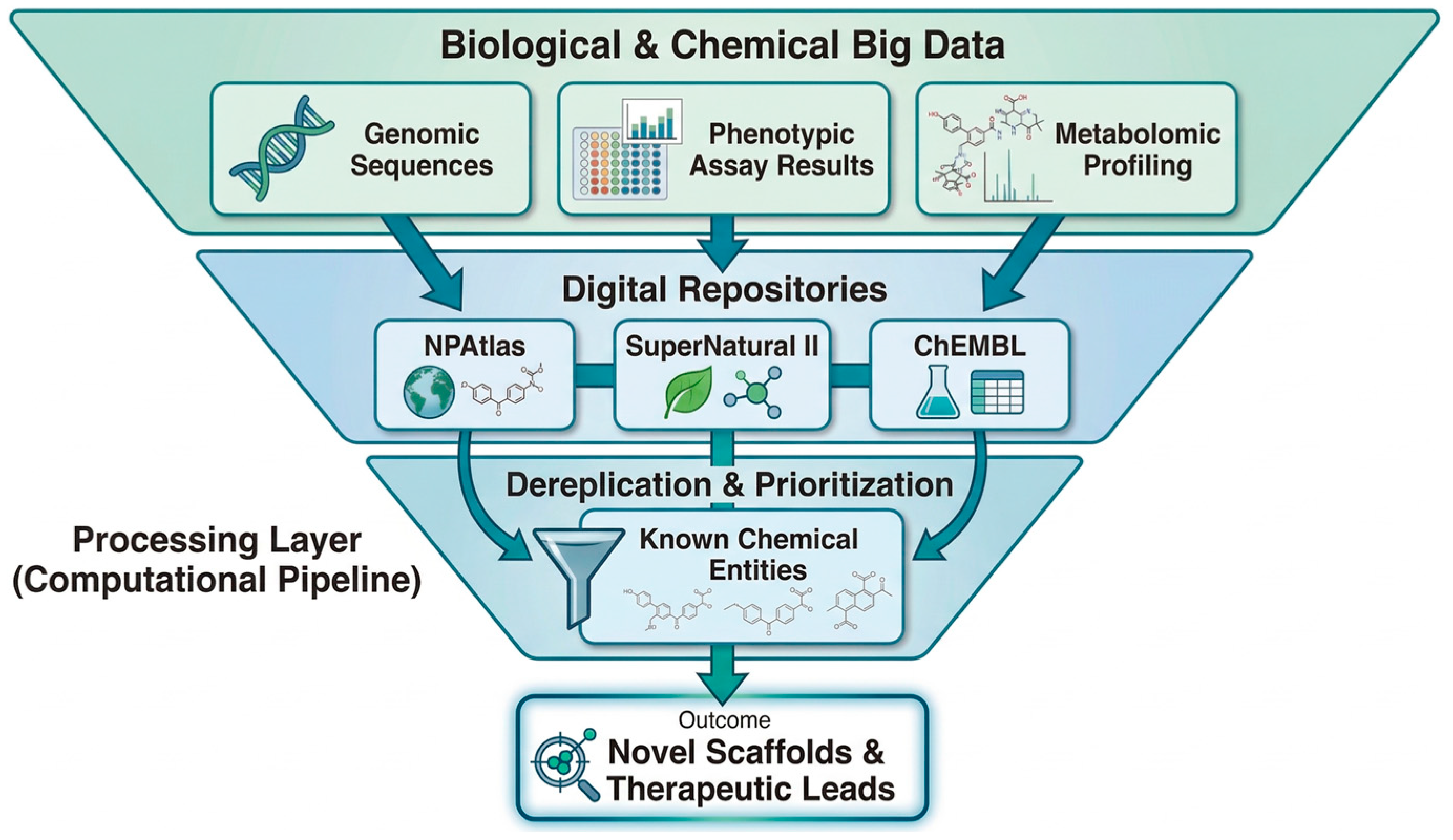
Public databases support this infrastructure. Among of these databases are NPAtlas [42], SuperNatural II [43], and ChEMBL [44]. NPAtlas catalogues microbial natural products with validated structural and taxonomic metadata. SuperNatural II is a comprehensive, publicly accessible database of natural products and their derivatives that are considered “ready for virtual screening.” ChEMBL links compounds to quantitative bioactivity data across target classes. Together, these resources enable rapid dereplication—distinguishing novel chemistry from known compounds early in the discovery process—and support machine learning applications that require large, annotated training sets (Figure 1).
Figure 1.
Data-Driven Workflow for NP Drug Discovery. Raw data streams—genomic sequences, metabolomic profiles, and bioactivity measurements—are integrated through curated repositories (NPAtlas, SuperNatural II, and ChEMBL) and processed via computational pipelines that perform dereplication, structural annotation, and bioactivity prediction. This framework enables systematic prioritization of novel scaffolds over known compounds, shifting discovery from phenotypic screening toward genome-guided target identification.
Two complementary strategies drive current discovery efforts. Genome mining identifies biosynthetic gene clusters encoding secondary metabolite pathways, revealing synthetic potential that often exceeds observed chemical output by an order of magnitude [45]. Metabolomics captures the compounds actually produced under defined conditions, providing ground-truth chemical phenotypes [46]. Integrating these approaches—correlating predicted biosynthetic capacity with detected metabolites—enables prioritization of “cryptic” or conditionally expressed pathways and guides efforts to activate silent gene clusters through heterologous expression or culture manipulation.
In this context, prioritization refers to the computational ranking of isolates based on a ‘Novelty Score’—calculated via tools like BiG-SCAPE [47] and a ‘Bioactivity Probability’ derived from ML models. By filtering out clusters or metabolites with high similarity to known entries in the MIBiG [48] or NPAtlas [49] databases, researchers can focus resources on ‘dark matter’ scaffolds that represent truly unique chemical space.
4. Computational and Multi-Omics Approaches
The advancement of Artificial Intelligence (AI) and Machine Learning (ML) has established new frontiers in NP research by providing the analytical rigor necessary to interpret high-dimensional datasets [50]. Deep learning architectures predict bioactivity from molecular structure, identify structure–activity relationships across large compound sets, and prioritize leads based on predicted ADMET (Absorption, Distribution, Metabolism, Excretion, and Toxicity) profiles—filtering compounds with poor pharmacokinetic or toxicity liabilities before synthesis [13,27,51,52,53]. These approaches complement physics-based methods: molecular docking estimates binding affinity, while molecular dynamics simulations assess conformational stability and binding kinetics at atomistic resolution. Beyond traditional metabolomics, the integration of lipidomics has emerged as an important tool for the massive investigation of lipid-based metabolites and cell membrane components [54]. Given that many natural products exert their effects by modulating membrane fluidity or signaling lipids, lipidomic profiling provides a systems-level view of how NPs interact with the cellular lipidome, offering insights that are often missed by broader metabolomic screens.
Multi-omics integration extends beyond individual compound discovery to system-level pathway elucidation. While correlating transcriptomic responses with metabolite production is conceptually powerful, it faces significant technical hurdles. Metatranscriptome datasets are often characterized by extreme sparsity and ‘zero-inflation’, where the absence of a signal does not necessarily imply the absence of expression [55]. Moving forward, the field is transitioning toward Zero-Inflated Negative Binomial (ZINB) models [56] and deep-learning-based imputation [57] to distinguish biological silence from technical noise, ensuring that multi-omics correlations remain statistically sound.
5. Genome Mining and Biosynthetic Gene Cluster Analysis
Microbial and plant genomes encode far more secondary metabolite pathways than phenotypic screens detection [58]. Genome mining systematically identifies biosynthetic gene clusters, revealing this hidden biosynthetic capacity [59]. Automated annotation platforms, particularly antiSMASH (Antibiotics and Secondary Metabolite Analysis Shell), have become indispensable for identifying and annotating these BGCs, effectively streamlining a process that was previously labor-intensive [60]. Beyond primary cluster detection, these tools facilitate the identification of homologous BGCs across diverse species, providing critical insights into evolutionary conservation and the resulting chemical diversity. This informatics-led strategy has enabled the targeted exploration of underexplored microbial taxa, such as rare actinomycetes and marine bacteria, which represent a significant but previously inaccessible reservoir of bioactive metabolites. Beyond primary detection, antiSMASH [61] facilitates the prediction of chemical scaffolds; however, this capability is currently most robust for modular biosynthetic gene clusters, such as Polyketide Synthases (PKS) and Non-Ribosomal Peptide Synthetases (NRPS). For these classes, scaffold prediction relies on identifying conserved substrate-specification domains (e.g., A-domains) and comparing them to experimentally validated clusters in the MIBiG database [48]. For more divergent or cryptic BGCs, scaffold prediction remains a significant computational challenge [62].
This approach has proven especially valuable in antibiotic discovery [63]. Facing rising multidrug-resistant pathogens, researchers have used genome mining to identify clusters encoding compounds with unprecedented mechanisms of action [64]. For example, systematic analysis of underexplored taxa—rare actinomycetes, marine bacteria, and fungal endophytes—has yielded new antibiotic and antifungal scaffolds targeting previously unexploited pathways [65]. Furthermore, genome mining has expanded the known scope of chemical diversity in natural products by enabling the systematic prediction of novel structural frameworks [66]. By studying variations in BGC organization across species, scientists can uncover unique biosynthetic pathways that lead to compounds with diverse pharmacological activities. This approach not only enhances the discovery of new drugs but also provides comprehensive insights into the untapped potential of microbial biosynthetic capabilities, establishing genome mining as a foundational pillar of modern natural product research.
6. Cheminformatics Infrastructure
Cheminformatics has evolved into an indispensable component of the NP discovery pipeline, providing the robust analytical tools required to navigate complex chemical spaces [67]. Structural similarity algorithms identify relationships between novel isolates and known bioactive scaffolds, accelerating dereplication and analogue identification [68]. Quantitative Structure–Activity Relationship (QSAR) modeling correlates molecular descriptors with biological endpoints, guiding rational optimization [69]. To gain atomistic resolution of these interactions, researchers utilize molecular docking and molecular dynamics (MD) simulations [70]. These computational techniques allow for the detailed exploration of ligand-protein binding affinities and conformational stability, effectively streamlining lead prioritization and reducing the resource expenditure associated with traditional in vitro screening.
The integration of AI and ML has significantly enhanced the predictive accuracy of lead discovery and optimization workflows [71]. These technologies excel at processing large, heterogeneous datasets to identify non-linear bioactivity patterns, often surpassing traditional statistical methods in both speed and precision. ML algorithms are now routinely deployed to predict ADMET profiles, aiding in the early identification of promising drug candidates while mitigating potential clinical failures [27]. Deep learning architectures, in particular, have demonstrated success in uncovering complex bioactivity relationships, as evidenced by the identification of novel antimicrobial and oncology agents from vast natural product libraries. The shift toward data-driven NP discovery has been enabled by a new generation of computational resources. Table 3 summarizes key bioinformatics and cheminformatics tools that form the backbone of the modern digital workflow—from genome mining and metabolomic profiling to AI-powered prediction and chemical data curation. Together, they represent the essential technological toolkit for translating biological and chemical data into actionable drug leads.
Table 3.
Essential Bioinformatics and Cheminformatics Resources in Modern NP Discovery. This table outlines core computational tools and platforms that have accelerated the “digital renaissance” in NP research. By transitioning from manual, low-throughput methods to automated, predictive workflows, these resources enable researchers to systematically decode, analyze, and harness nature’s chemical complexity at scale.
7. Applications in Drug Discovery and Development
The power of contemporary informatics extends far beyond initial discovery, fundamentally reshaping the entire therapeutic lifecycle of NP scaffolds [76]. By mining and integrating multi-dimensional datasets, researchers can now repurpose established NPs and accelerate the engineering of next-generation leads with unprecedented efficiency [77]. This data-driven re-evaluation allows for the discovery of “off-target” interactions that can be therapeutically exploited, effectively reducing the temporal and financial costs of development. A notable example is the polyene antifungal Amphotericin B. While its ability to target cancer stem cell phenotypes has been experimentally demonstrated, subsequent MD simulations have provided the computational rationale, revealing how AmB distinguishes between the sterol-rich membranes of tumor cells versus healthy mammalian cells based on van der Waals interaction energies [78].
Aspirin (acetylsalicylic acid), derived from the NP salicin, continues to see its therapeutic profile expand through data analytics, with established roles in cardiology and emerging evidence supporting its chemopreventive potential in oncology [79]. Central to this roadmap is the computational prioritization of metabolites, a process that filters large-scale -omics data to rank ‘hits’ based on their structural novelty and predicted biological relevance. This workflow typically utilizes a ‘Novelty Index’ (comparing BGCs to the MIBiG database) and ‘Bioactivity Scores’ (derived from deep learning models) to bypass known chemistry and focus resources exclusively on the most promising dark-matter scaffolds.
The practical utility of these computational roadmaps is best seen in how they bridge the gap between raw genomic data and actual chemical discovery. This was exemplified by the discovery of Pyrrolomycin K and L [80], which were identified not through traditional screening, but through a computational prioritization pipeline that integrated de novo genome sequencing with molecular networking. Researchers used these tools to prioritize and isolate novel antimicrobials, like those found in termite-associated microbes by using ecological insights to guide the mining of biosynthetic gene clusters [80]. This synergy extends to extreme environments, where metabologenomics-driven strategies, specifically pairing 2D-NMR-metabolomics with genome mining have successfully activated silent pathways to isolate compounds like nocardimicins from psychrophilic strains [81]. Furthermore, the persistent bottleneck of dereplication is being dismantled by machine learning frameworks trained on in silico fragmentation spectra. These models can classify bioactivity directly from LC-MS/MS data with over 93% accuracy, bypassing the need for experimental reference spectra and significantly accelerating the prioritization of novel bioactive scaffolds [82].
In the context of lead optimization, informatics frameworks have become essential for compressing the timeline from “hit” to “lead” [17]. The synthesis of high-throughput screening (HTS) technologies with machine learning algorithms allows for the rapid evaluation of thousands of metabolites against diverse biological targets [83]. Furthermore, in silico modeling of ADMET properties ensures that only compounds with viable pharmacokinetic profiles progress through the pipeline, thereby mitigating the high attrition rates traditionally associated with NP research [52]. Recent workflows often integrate molecular docking with machine learning-driven structural modifications to identify derivatives with enhanced bioavailability and reduced systemic toxicity [53].
8. Challenges and Limitations
The informatics-driven transformation of NP discovery has created unprecedented opportunities for therapeutic development. However, this progress is constrained by significant technical limitations and unresolved ethical considerations that must be addressed to ensure both scientific rigor and equitable practice.
A fundamental technical challenge lies in the quality and accessibility of the underlying data. Public repositories of natural product information frequently suffer from inconsistent annotation standards and incomplete metadata regarding biosynthetic origins, extraction methodologies, and comprehensive bioactivity profiles [84]. This missing data problem often leads to inconsistencies in predictive models, limiting the reliability of machine learning-driven lead identification. Furthermore, while big data platforms have streamlined early-stage discovery, the computational scalability required to integrate and analyze multi-source omics datasets in real-time remains a significant resource constraint for many research institutions [85].
Beyond data accessibility, the inherent bias in training datasets poses a significant risk to the predictive reliability of AI models [86]. Current natural product databases are heavily skewed toward well-characterized taxonomic groups, such as Streptomyces [87] and certain filamentous fungi [88], and established chemical classes like polyketides and non-ribosomal peptides. This taxonomic and chemical space bias can lead to AI models that excel at identifying analogues of known compounds but struggle to accurately predict the bioactivity or biosynthetic boundaries of truly novel ‘dark matter’ scaffolds. Such systemic bias necessitates the development of transfer learning and few-shot learning techniques that can generalize from small, high-quality datasets to broader, underexplored chemical spaces.
Apart from technical constraints, ethical and legal considerations have become increasingly prominent, particularly concerning biodiversity conservation and biopiracy [18]. The exploitation of genetic resources from biodiverse regions necessitates rigorous adherence to equitable benefit-sharing frameworks, often governed by the Nagoya Protocol [89,90]. Navigating these international legalities is essential for fostering sustainable collaborations between academia, industry, and indigenous communities. Additionally, the management of Intellectual Property Rights (IPR) for NPs and their semi-synthetic derivatives remains a complex domain, as patenting often intersects with traditional ecological knowledge [91]. The development of NPs derived from or inspired by traditional medicines raises complex questions about attribution, compensation, and the protection of cultural heritage alongside scientific innovation.
Addressing these interconnected challenges requires coordinated efforts across multiple domains. Technically, the field must establish standardized reporting frameworks and promote the adoption of FAIR (Findable, Accessible, Interoperable, Reusable) data principles to enhance data quality and interoperability. Ethically, developing transparent frameworks for benefit-sharing and intellectual property that respect both scientific innovation and traditional knowledge will be essential for sustainable research partnerships. Only through such integrated approaches can the field fully realize the potential of data-driven natural product discovery while ensuring its practice remains scientifically robust and ethically sound.
9. Future Directions and Opportunities
The future of NP research is increasingly defined by the adoption of systems biology frameworks [92]. By situating natural products within the context of entire biological networks, researchers can map the intricate regulation of biosynthetic pathways and their holistic interactions with human targets [93]. Furthermore, synthetic biology is poised to play a transformative role, enabling the rational redesign of biosynthetic gene clusters (BGCs) to produce “unnatural” NPs with optimized pharmacological profiles [94,95]. This not only addresses supply chain challenges but also paves the way for designing “unnatural” NPs with enhanced therapeutic properties.
Advancements in AI-driven automation are expected to establish a new benchmark for efficiency, where robotic platforms perform real-time hypothesis testing, from in silico prediction to automated microfluidic screening [96,97]. This shift toward precision medicine offers a unique opportunity to leverage patient-specific genomic data, allowing NP scaffolds to be tailored to align with individual metabolic profiles [98,99]. Finally, the development of hybrid drug candidates, which merge NP scaffolds with synthetic moieties, represents a potent strategy for overcoming multidrug resistance and improving therapeutic efficacy [100]. Together, these advancements promise to not only revitalize NP research but also redefine its role in modern drug discovery and development. The sustainability of these innovations will rely on the implementation of specialized bioinformatics platforms, utilizing scalable workflows such as Nextflow and Galaxy to democratize access to complex genomic analyses for the broader scientific community.
10. Conclusions
The integration of big data analytics with NP discovery marks a definitive paradigm shift in pharmaceutical science. This digital renaissance has systematically deconstructed historical bottlenecks, replacing serendipitous bioprospecting with predictive, hypothesis-driven workflows powered by genome mining, multi-omics integration, and machine intelligence. By transforming NPs from scarce chemical curiosities into digitally accessible, design-ready scaffolds, the field has secured its critical role in the future of therapeutic innovation.
Sustaining this progress demands a concerted commitment to interdisciplinary convergence and infrastructural equity. The most pressing challenges—from data standardization and computational scalability to ethical sourcing and equitable benefit-sharing—cannot be solved within traditional disciplinary silos. They require collaborative frameworks that unite bioinformaticians, synthetic biologists, chemists, ethnobotanists, and legal scholars. Furthermore, investment in open, harmonized computational platforms and reproducible analytical workflows will be crucial for democratizing access and ensuring that the benefits of data-driven discovery are globally shared.
Ultimately, this synergy between nature’s chemical legacy and computational foresight offers a powerful blueprint for addressing complex human diseases. As we refine these technologies and navigate their ethical implications, NPs will continue to serve as an indispensable foundation for developing the next generation of precise, sustainable, and accessible medicines.
Author Contributions
M.Y.A.: Conceptualization, Writing—Initial Draft, Writing—Review & Editing. S.W.C.: Writing—Review & Editing. All authors have read and agreed to the published version of the manuscript.
Funding
Open access funding provided by Wenzhou-Kean University. This work was funded by the High-Level Talent Recruitment Program for Academic and Research Platform Construction (Reference Number: 5000105) from Wenzhou-Kean University, and the IFIRI Talents Program (Grant Number: KY20250604000448).
Institutional Review Board Statement
Not applicable.
Informed Consent Statement
Not applicable.
Data Availability Statement
Data sharing is not applicable to this article as no datasets were generated or analyzed during the current study.
Acknowledgments
The authors would like to thank Sunway University and Wenzhou-Kean University for their support during the preparation of this manuscript.
Conflicts of Interest
The authors declare no conflicts of interest.
References
- Beutler, J.A. Natural Products as a Foundation for Drug Discovery. Curr. Protoc. Pharmacol. 2009, 46, 9.11.11–19.11.21. [Google Scholar] [CrossRef]
- Fleming, A. The Discovery Of Penicillin. Br. Med. Bull. 1944, 2, 4–5. [Google Scholar] [CrossRef]
- Wani, M.C.; Taylor, H.L.; Wall, M.E.; Coggon, P.; McPhail, A.T. Plant antitumor agents. VI. The isolation and structure of taxol, a novel antileukemic and antitumor agent from Taxus brevifolia. J. Am. Chem. Soc. 1971, 93, 2325–2327. [Google Scholar] [CrossRef]
- Atanasov, A.G.; Zotchev, S.B.; Dirsch, V.M.; International Natural Product Sciences Taskforce; Supuran, C.T. Natural products in drug discovery: Advances and opportunities. Nat. Rev. Drug Discov. 2021, 20, 200–216. [Google Scholar] [CrossRef]
- Zhang, Q.W.; Lin, L.G.; Ye, W.C. Techniques for extraction and isolation of natural products: A comprehensive review. Chin. Med. 2018, 13, 20. [Google Scholar] [CrossRef]
- Atanasov, A.G.; Waltenberger, B.; Pferschy-Wenzig, E.M.; Linder, T.; Wawrosch, C.; Uhrin, P.; Temml, V.; Wang, L.; Schwaiger, S.; Heiss, E.H.; et al. Discovery and resupply of pharmacologically active plant-derived natural products: A review. Biotechnol. Adv. 2015, 33, 1582–1614. [Google Scholar] [CrossRef]
- Beutler, J.A. Natural Products as a Foundation for Drug Discovery. Curr. Protoc. Pharmacol. 2019, 86, e67. [Google Scholar] [CrossRef]
- Xie, T.; Song, S.; Li, S.; Ouyang, L.; Xia, L.; Huang, J. Review of natural product databases. Cell Prolif. 2015, 48, 398–404. [Google Scholar] [CrossRef]
- Winter, J.M.; Behnken, S.; Hertweck, C. Genomics-inspired discovery of natural products. Curr. Opin. Chem. Biol. 2011, 15, 22–31. [Google Scholar] [CrossRef]
- Ayon, N.J. High-Throughput Screening of Natural Product and Synthetic Molecule Libraries for Antibacterial Drug Discovery. Metabolites 2023, 13, 625. [Google Scholar] [CrossRef]
- Demarque, D.P.; Dusi, R.G.; de Sousa, F.D.M.; Grossi, S.M.; Silverio, M.R.S.; Lopes, N.P.; Espindola, L.S. Mass spectrometry-based metabolomics approach in the isolation of bioactive natural products. Sci. Rep. 2020, 10, 1051. [Google Scholar] [CrossRef]
- Caesar, L.K.; Montaser, R.; Keller, N.P.; Kelleher, N.L. Metabolomics and genomics in natural products research: Complementary tools for targeting new chemical entities. Nat. Prod. Rep. 2021, 38, 2041–2065. [Google Scholar] [CrossRef]
- Paul, D.; Sanap, G.; Shenoy, S.; Kalyane, D.; Kalia, K.; Tekade, R.K. Artificial intelligence in drug discovery and development. Drug Discov. Today 2021, 26, 80–93. [Google Scholar] [CrossRef]
- Harvey, A.L.; Edrada-Ebel, R.; Quinn, R.J. The re-emergence of natural products for drug discovery in the genomics era. Nat. Rev. Drug Discov. 2015, 14, 111–129. [Google Scholar] [CrossRef]
- Newman, D.J.; Cragg, G.M. Natural Products as Sources of New Drugs over the Nearly Four Decades from 01/1981 to 09/2019. J. Nat. Prod. 2020, 83, 770–803. [Google Scholar] [CrossRef]
- Brown, D.G.; Bostrom, J. Analysis of Past and Present Synthetic Methodologies on Medicinal Chemistry: Where Have All the New Reactions Gone? J. Med. Chem. 2016, 59, 4443–4458. [Google Scholar] [CrossRef]
- Thomford, N.E.; Senthebane, D.A.; Rowe, A.; Munro, D.; Seele, P.; Maroyi, A.; Dzobo, K. Natural Products for Drug Discovery in the 21st Century: Innovations for Novel Drug Discovery. Int. J. Mol. Sci. 2018, 19, 1578. [Google Scholar] [CrossRef]
- Imran, Y.; Wijekoon, N.; Gonawala, L.; Chiang, Y.C.; De Silva, K.R.D. Biopiracy: Abolish Corporate Hijacking of Indigenous Medicinal Entities. Sci. World J. 2021, 2021, 8898842. [Google Scholar] [CrossRef]
- Hong, J. Role of natural product diversity in chemical biology. Curr. Opin. Chem. Biol. 2011, 15, 350–354. [Google Scholar] [CrossRef]
- Dias, D.A.; Urban, S.; Roessner, U. A historical overview of natural products in drug discovery. Metabolites 2012, 2, 303–336. [Google Scholar] [CrossRef]
- Huigens, R.W., 3rd; Morrison, K.C.; Hicklin, R.W.; Flood, T.A., Jr.; Richter, M.F.; Hergenrother, P.J. A ring-distortion strategy to construct stereochemically complex and structurally diverse compounds from natural products. Nat. Chem. 2013, 5, 195–202. [Google Scholar] [CrossRef]
- Ertl, P.; Schuhmann, T. A Systematic Cheminformatics Analysis of Functional Groups Occurring in Natural Products. J. Nat. Prod. 2019, 82, 1258–1263. [Google Scholar] [CrossRef]
- Bitchagno, G.T.M.; Nchiozem-Ngnitedem, V.A.; Melchert, D.; Fobofou, S.A. Demystifying racemic natural products in the homochiral world. Nat. Rev. Chem. 2022, 6, 806–822. [Google Scholar] [CrossRef] [PubMed]
- Galloway, W.R.; Isidro-Llobet, A.; Spring, D.R. Diversity-oriented synthesis as a tool for the discovery of novel biologically active small molecules. Nat. Commun. 2010, 1, 80. [Google Scholar] [CrossRef]
- Nasim, N.; Sandeep, I.S.; Mohanty, S. Plant-derived natural products for drug discovery: Current approaches and prospects. Nucleus 2022, 65, 399–411. [Google Scholar] [CrossRef]
- Wall, M.E.; Wani, M.C. Camptothecin and taxol: Discovery to clinic--thirteenth Bruce F. Cain Memorial Award Lecture. Cancer Res. 1995, 55, 753–760. [Google Scholar]
- LaPlante, K.L.; Woodmansee, S. Activities of daptomycin and vancomycin alone and in combination with rifampin and gentamicin against biofilm-forming methicillin-resistant Staphylococcus aureus isolates in an experimental model of endocarditis. Antimicrob. Agents Chemother. 2009, 53, 3880–3886. [Google Scholar] [CrossRef]
- Menon, V.P.; Sudheer, A.R. Antioxidant and anti-inflammatory properties of curcumin. Adv. Exp. Med. Biol. 2007, 595, 105–125. [Google Scholar] [CrossRef]
- Ahmad, M.; Ahmed, Z.; Yang, X.; Can, M. Natural Resources Depletion, Financial Risk, and Human Well-Being: What is the Role of Green Innovation and Economic Globalization? Soc. Indic. Res. 2023, 167, 269–288. [Google Scholar] [CrossRef]
- Fleming, A. On the antibacterial action of cultures of a penicillium, with special reference to their use in the isolation of B. influenzae. Br. J. Exp. Pathol. 1929, 10, 226. [Google Scholar] [CrossRef]
- Holton, R.A.; Kim, H.B.; Somoza, C.; Liang, F.; Biediger, R.J.; Boatman, P.D.; Shindo, M.; Smith, C.C.; Kim, S. First total synthesis of taxol. 2. Completion of the C and D rings. J. Am. Chem. Soc. 1994, 116, 1599–1600. [Google Scholar] [CrossRef]
- Witthauer, K. Aspirin, ein neues Salicylpräparat. Die Heilkunde 1899, 3, 396. [Google Scholar]
- McCormick, M.H.; McGuire, J.M.; Pittenger, G.; Pittenger, R.; Stark, W. Vancomycin, a new antibiotic. I. Chemical and biologic properties. Antibiot. Annu. 1955, 3, 606–611. [Google Scholar]
- Pelletier, P.J.; Caventou, J.-B. Recherches Chimiques sur les Quinquinas; Crochard: Jamisontown, Australia, 1820. [Google Scholar]
- Endo, A. Compactin (ML-236B) and related compounds as potential cholesterol-lowering agents that inhibit HMG-CoA reductase. J. Med. Chem. 1985, 28, 401–405. [Google Scholar] [CrossRef]
- Lomovskaya, N.; Otten, S.L.; Doi-Katayama, Y.; Fonstein, L.; Liu, X.C.; Takatsu, T.; Inventi-Solari, A.; Filippini, S.; Torti, F.; Colombo, A.L.; et al. Doxorubicin overproduction in Streptomyces peucetius: Cloning and characterization of the dnrU ketoreductase and dnrV genes and the doxA cytochrome P-450 hydroxylase gene. J. Bacteriol. 1999, 181, 305–318. [Google Scholar] [CrossRef]
- Borel, J.F.; Feurer, C.; Gubler, H.U.; Stahelin, H. Biological effects of cyclosporin A: A new antilymphocytic agent. Agents Actions 1976, 6, 468–475. [Google Scholar] [CrossRef]
- You-You, T.; Mu-Yun, N.; Yu-Rong, Z.; Lan-Na, L.; Shu-Lian, C.; Mu-Qun, Z.; Xiu-Zhen, W.; Zheng, J.; Xiao-Tian, L. Studies on the constituents of Artemisia annua Part II. Planta Med. 1982, 44, 143–145. [Google Scholar] [CrossRef]
- McGuire, J.M.; Bunch, R.L.; Anderson, R.C.; Boaz, H.E.; Flynn, E.H.; Powell, H.M.; Smith, J.W. Ilotycin, a new antibiotic. Schweiz. Med. Wochenschr. 1952, 82, 1064–1065. [Google Scholar]
- Oppenheimer, A. Turmeric (curcumin) in biliary diseases. Lancet 1937, 229, 619–621. [Google Scholar] [CrossRef]
- Sensi, P. History of the development of rifampin. Rev. Infect. Dis. 1983, 5, S402–S406. [Google Scholar] [CrossRef]
- van Santen, J.A.; Jacob, G.; Singh, A.L.; Aniebok, V.; Balunas, M.J.; Bunsko, D.; Neto, F.C.; Castano-Espriu, L.; Chang, C.; Clark, T.N.; et al. The Natural Products Atlas: An Open Access Knowledge Base for Microbial Natural Products Discovery. ACS Cent. Sci. 2019, 5, 1824–1833. [Google Scholar] [CrossRef]
- Banerjee, P.; Erehman, J.; Gohlke, B.O.; Wilhelm, T.; Preissner, R.; Dunkel, M. Super Natural II--a database of natural products. Nucleic Acids Res. 2015, 43, D935–D939. [Google Scholar] [CrossRef]
- Gaulton, A.; Bellis, L.J.; Bento, A.P.; Chambers, J.; Davies, M.; Hersey, A.; Light, Y.; McGlinchey, S.; Michalovich, D.; Al-Lazikani, B.; et al. ChEMBL: A large-scale bioactivity database for drug discovery. Nucleic Acids Res. 2012, 40, D1100–D1107. [Google Scholar] [CrossRef]
- Scherlach, K.; Hertweck, C. Mining and unearthing hidden biosynthetic potential. Nat. Commun. 2021, 12, 3864. [Google Scholar] [CrossRef]
- Qiu, S.; Cai, Y.; Yao, H.; Lin, C.; Xie, Y.; Tang, S.; Zhang, A. Small molecule metabolites: Discovery of biomarkers and therapeutic targets. Signal Transduct. Target. Ther. 2023, 8, 132. [Google Scholar] [CrossRef]
- Draisma, A.; Loureiro, C.; Louwen, N.L.L.; Kautsar, S.A.; Navarro-Munoz, J.C.; Doering, D.T.; Mouncey, N.J.; Medema, M.H. BiG-SCAPE 2.0 and BiG-SLiCE 2.0: Scalable, accurate and interactive sequence clustering of metabolic gene clusters. Nat. Commun. 2026, 17, 2000. [Google Scholar] [CrossRef]
- Zdouc, M.M.; Blin, K.; Louwen, N.L.L.; Navarro, J.; Loureiro, C.; Bader, C.D.; Bailey, C.B.; Barra, L.; Booth, T.J.; Bozhuyuk, K.A.J.; et al. MIBiG 4.0: Advancing biosynthetic gene cluster curation through global collaboration. Nucleic Acids Res. 2025, 53, D678–D690. [Google Scholar] [CrossRef] [PubMed]
- Poynton, E.F.; van Santen, J.A.; Pin, M.; Contreras, M.M.; McMann, E.; Parra, J.; Showalter, B.; Zaroubi, L.; Duncan, K.R.; Linington, R.G. The Natural Products Atlas 3.0: Extending the database of microbially derived natural products. Nucleic Acids Res. 2025, 53, D691–D699. [Google Scholar] [CrossRef]
- Saldivar-Gonzalez, F.I.; Aldas-Bulos, V.D.; Medina-Franco, J.L.; Plisson, F. Natural product drug discovery in the artificial intelligence era. Chem. Sci. 2022, 13, 1526–1546. [Google Scholar] [CrossRef]
- Sahayasheela, V.J.; Lankadasari, M.B.; Dan, V.M.; Dastager, S.G.; Pandian, G.N.; Sugiyama, H. Artificial intelligence in microbial natural product drug discovery: Current and emerging role. Nat. Prod. Rep. 2022, 39, 2215–2230. [Google Scholar] [CrossRef] [PubMed]
- Wu, F.; Zhou, Y.; Li, L.; Shen, X.; Chen, G.; Wang, X.; Liang, X.; Tan, M.; Huang, Z. Computational Approaches in Preclinical Studies on Drug Discovery and Development. Front. Chem. 2020, 8, 726. [Google Scholar] [CrossRef] [PubMed]
- Singh, S.; Gupta, H.; Sharma, P.; Sahi, S. Advances in Artificial Intelligence (AI)-assisted approaches in drug screening. Artif. Intell. Chem. 2024, 2, 100039. [Google Scholar] [CrossRef]
- Yang, K.; Han, X. Lipidomics: Techniques, Applications, and Outcomes Related to Biomedical Sciences. Trends Biochem. Sci. 2016, 41, 954–969. [Google Scholar] [CrossRef] [PubMed]
- Cho, H.; Qu, Y.; Liu, C.; Tang, B.; Lyu, R.; Lin, B.M.; Roach, J.; Azcarate-Peril, M.A.; Aguiar Ribeiro, A.; Love, M.I.; et al. Comprehensive evaluation of methods for differential expression analysis of metatranscriptomics data. Brief. Bioinform. 2023, 24, bbad279. [Google Scholar] [CrossRef] [PubMed]
- Mwalili, S.M.; Lesaffre, E.; Declerck, D. The zero-inflated negative binomial regression model with correction for misclassification: An example in caries research. Stat. Methods Med. Res. 2008, 17, 123–139. [Google Scholar] [CrossRef]
- Huang, L.; Song, M.; Shen, H.; Hong, H.; Gong, P.; Deng, H.W.; Zhang, C. Deep Learning Methods for Omics Data Imputation. Biology 2023, 12, 1313. [Google Scholar] [CrossRef]
- Meesil, W.; Muangpat, P.; Sitthisak, S.; Rattanarojpong, T.; Chantratita, N.; Machado, R.A.R.; Shi, Y.M.; Bode, H.B.; Vitta, A.; Thanwisai, A. Genome mining reveals novel biosynthetic gene clusters in entomopathogenic bacteria. Sci. Rep. 2023, 13, 20764. [Google Scholar] [CrossRef]
- Kountz, D.J.; Balskus, E.P. Leveraging Microbial Genomes and Genomic Context for Chemical Discovery. Acc. Chem. Res. 2021, 54, 2788–2797. [Google Scholar] [CrossRef]
- Medema, M.H.; Blin, K.; Cimermancic, P.; de Jager, V.; Zakrzewski, P.; Fischbach, M.A.; Weber, T.; Takano, E.; Breitling, R. antiSMASH: Rapid identification, annotation and analysis of secondary metabolite biosynthesis gene clusters in bacterial and fungal genome sequences. Nucleic Acids Res. 2011, 39, W339–W346. [Google Scholar] [CrossRef]
- Blin, K.; Shaw, S.; Vader, L.; Szenei, J.; Reitz, Z.L.; Augustijn, H.E.; Cediel-Becerra, J.D.D.; de Crecy-Lagard, V.; Koetsier, R.A.; Williams, S.E.; et al. antiSMASH 8.0: Extended gene cluster detection capabilities and analyses of chemistry, enzymology, and regulation. Nucleic Acids Res. 2025, 53, W32–W38. [Google Scholar] [CrossRef]
- Zhong, Z.; He, B.; Li, J.; Li, Y.X. Challenges and advances in genome mining of ribosomally synthesized and post-translationally modified peptides (RiPPs). Synth. Syst. Biotechnol. 2020, 5, 155–172. [Google Scholar] [CrossRef]
- Albarano, L.; Esposito, R.; Ruocco, N.; Costantini, M. Genome Mining as New Challenge in Natural Products Discovery. Mar. Drugs 2020, 18, 199. [Google Scholar] [CrossRef]
- Belknap, K.C.; Park, C.J.; Barth, B.M.; Andam, C.P. Genome mining of biosynthetic and chemotherapeutic gene clusters in Streptomyces bacteria. Sci. Rep. 2020, 10, 2003. [Google Scholar] [CrossRef]
- Moellering, R.C., Jr. Discovering new antimicrobial agents. Int. J. Antimicrob. Agents 2011, 37, 2–9. [Google Scholar] [CrossRef] [PubMed]
- Navarro-Munoz, J.C.; Selem-Mojica, N.; Mullowney, M.W.; Kautsar, S.A.; Tryon, J.H.; Parkinson, E.I.; De Los Santos, E.L.C.; Yeong, M.; Cruz-Morales, P.; Abubucker, S.; et al. A computational framework to explore large-scale biosynthetic diversity. Nat. Chem. Biol. 2020, 16, 60–68. [Google Scholar] [CrossRef]
- Chen, Y.; Kirchmair, J. Cheminformatics in Natural Product-based Drug Discovery. Mol. Inform. 2020, 39, e2000171. [Google Scholar] [CrossRef]
- Schenone, M.; Dancik, V.; Wagner, B.K.; Clemons, P.A. Target identification and mechanism of action in chemical biology and drug discovery. Nat. Chem. Biol. 2013, 9, 232–240. [Google Scholar] [CrossRef] [PubMed]
- Kwon, S.; Bae, H.; Jo, J.; Yoon, S. Comprehensive ensemble in QSAR prediction for drug discovery. BMC Bioinform. 2019, 20, 521. [Google Scholar] [CrossRef] [PubMed]
- Agu, P.C.; Afiukwa, C.A.; Orji, O.U.; Ezeh, E.M.; Ofoke, I.H.; Ogbu, C.O.; Ugwuja, E.I.; Aja, P.M. Molecular docking as a tool for the discovery of molecular targets of nutraceuticals in diseases management. Sci. Rep. 2023, 13, 13398. [Google Scholar] [CrossRef]
- Gupta, R.R. Application of Artificial Intelligence and Machine Learning in Drug Discovery. Methods Mol. Biol. 2022, 2390, 113–124. [Google Scholar] [CrossRef]
- Wang, M.; Carver, J.J.; Phelan, V.V.; Sanchez, L.M.; Garg, N.; Peng, Y.; Nguyen, D.D.; Watrous, J.; Kapono, C.A.; Luzzatto-Knaan, T.; et al. Sharing and community curation of mass spectrometry data with Global Natural Products Social Molecular Networking. Nat. Biotechnol. 2016, 34, 828–837. [Google Scholar] [CrossRef]
- Hannigan, G.D.; Prihoda, D.; Palicka, A.; Soukup, J.; Klempir, O.; Rampula, L.; Durcak, J.; Wurst, M.; Kotowski, J.; Chang, D.; et al. A deep learning genome-mining strategy for biosynthetic gene cluster prediction. Nucleic Acids Res. 2019, 47, e110. [Google Scholar] [CrossRef]
- Sander, T.; Freyss, J.; von Korff, M.; Rufener, C. DataWarrior: An open-source program for chemistry aware data visualization and analysis. J. Chem. Inf. Model. 2015, 55, 460–473. [Google Scholar] [CrossRef]
- Sorokina, M.; Merseburger, P.; Rajan, K.; Yirik, M.A.; Steinbeck, C. COCONUT online: Collection of Open Natural Products database. J. Cheminform. 2021, 13, 2. [Google Scholar] [CrossRef] [PubMed]
- Wright, G.D. Something old, something new: Revisiting natural products in antibiotic drug discovery. Can. J. Microbiol. 2014, 60, 147–154. [Google Scholar] [CrossRef] [PubMed]
- Glicksberg, B.S.; Li, L.; Chen, R.; Dudley, J.; Chen, B. Leveraging Big Data to Transform Drug Discovery. Methods Mol. Biol. 2019, 1939, 91–118. [Google Scholar] [CrossRef] [PubMed]
- Boukari, K.; Balme, S.; Janot, J.M.; Picaud, F. Towards New Insights in the Sterol/Amphotericin Nanochannels Formation: A Molecular Dynamic Simulation Study. J. Membr. Biol. 2016, 249, 261–270. [Google Scholar] [CrossRef]
- Montinari, M.R.; Minelli, S.; De Caterina, R. The first 3500 years of aspirin history from its roots—A concise summary. Vascul. Pharmacol. 2019, 113, 1–8. [Google Scholar] [CrossRef]
- Lin, M.; de Kruijff, M.; Poulsen, M.; Beemelmanns, C. Genome-Mining Based Discovery of Pyrrolomycin K and L from the Termite-Associated Micromonospora sp. RB23. J. Nat. Prod. 2025, 88, 2701–2709. [Google Scholar] [CrossRef]
- Xu, S.; Wang, N.; Meng, Q.; Ma, W.; Li, H. Metabologenomics-Driven Discovery of Nocardimicins from a Psychrophilic nocardia sp. Strain. J. Nat. Prod. 2025, 88, 103–109. [Google Scholar] [CrossRef]
- Brittin, N.J.; Anderson, J.M.; Braun, D.R.; Rajski, S.R.; Currie, C.R.; Bugni, T.S. Machine Learning-Based Bioactivity Classification of Natural Products Using LC-MS/MS Metabolomics. J. Nat. Prod. 2025, 88, 361–372. [Google Scholar] [CrossRef]
- Szymanski, P.; Markowicz, M.; Mikiciuk-Olasik, E. Adaptation of high-throughput screening in drug discovery-toxicological screening tests. Int. J. Mol. Sci. 2012, 13, 427–452. [Google Scholar] [CrossRef]
- Sorokina, M.; Steinbeck, C. Review on natural products databases: Where to find data in 2020. J. Cheminform. 2020, 12, 20. [Google Scholar] [CrossRef]
- Yang, A.; Troup, M.; Ho, J.W.K. Scalability and Validation of Big Data Bioinformatics Software. Comput. Struct. Biotechnol. J. 2017, 15, 379–386. [Google Scholar] [CrossRef]
- Norori, N.; Hu, Q.; Aellen, F.M.; Faraci, F.D.; Tzovara, A. Addressing bias in big data and AI for health care: A call for open science. Patterns 2021, 2, 100347. [Google Scholar] [CrossRef] [PubMed]
- Feng, Y.; Qaseem, A.; Moumbock, A.F.A.; Pan, S.; Kirchner, P.A.; Simoben, C.V.; Malange, Y.I.; Babiaka, S.B.; Gao, M.; Gunther, S. StreptomeDB 4.0: A comprehensive database of streptomycetes natural products enriched with protein interactions and interactive spectral visualization. Nucleic Acids Res. 2025, 53, D724–D729. [Google Scholar] [CrossRef] [PubMed]
- Xu, Y.; Yang, D.; Guo, Z.; Wu, N.; Shi, T.; Zhang, C. Advances and Potential of Aspergillus niger in Industrial Biomanufacturing. J. Agric. Food Chem. 2025, 73, 31653–31663. [Google Scholar] [CrossRef]
- Efferth, T.; Banerjee, M.; Paul, N.W.; Abdelfatah, S.; Arend, J.; Elhassan, G.; Hamdoun, S.; Hamm, R.; Hong, C.; Kadioglu, O.; et al. Biopiracy of natural products and good bioprospecting practice. Phytomedicine 2016, 23, 166–173. [Google Scholar] [CrossRef]
- Ortiz, A.M.D.; Outhwaite, C.L.; Dalin, C.; Newbold, T. A review of the interactions between biodiversity, agriculture, climate change, and international trade: Research and policy priorities. One Earth 2021, 4, 88–101. [Google Scholar] [CrossRef]
- Kartal, M. Intellectual property protection in the natural product drug discovery, traditional herbal medicine and herbal medicinal products. Phytother. Res. 2007, 21, 113–119. [Google Scholar] [CrossRef] [PubMed]
- Najmi, A.; Javed, S.A.; Al Bratty, M.; Alhazmi, H.A. Modern Approaches in the Discovery and Development of Plant-Based Natural Products and Their Analogues as Potential Therapeutic Agents. Molecules 2022, 27, 349. [Google Scholar] [CrossRef]
- Altaf-Ul-Amin, M.; Afendi, F.M.; Kiboi, S.K.; Kanaya, S. Systems biology in the context of big data and networks. Biomed Res. Int. 2014, 2014, 428570. [Google Scholar] [CrossRef]
- Zhang, M.M.; Wang, Y.; Ang, E.L.; Zhao, H. Engineering microbial hosts for production of bacterial natural products. Nat. Prod. Rep. 2016, 33, 963–987. [Google Scholar] [CrossRef]
- Roychowdhury, R.; Das, S.P.; Gupta, A.; Parihar, P.; Chandrasekhar, K.; Sarker, U.; Kumar, A.; Ramrao, D.P.; Sudhakar, C. Multi-Omics Pipeline and Omics-Integration Approach to Decipher Plant’s Abiotic Stress Tolerance Responses. Genes 2023, 14, 1281. [Google Scholar] [CrossRef] [PubMed]
- Zhu, H. Big Data and Artificial Intelligence Modeling for Drug Discovery. Annu. Rev. Pharmacol. Toxicol. 2020, 60, 573–589. [Google Scholar] [CrossRef] [PubMed]
- Gaudencio, S.P.; Bayram, E.; Lukic Bilela, L.; Cueto, M.; Diaz-Marrero, A.R.; Haznedaroglu, B.Z.; Jimenez, C.; Mandalakis, M.; Pereira, F.; Reyes, F.; et al. Advanced Methods for Natural Products Discovery: Bioactivity Screening, Dereplication, Metabolomics Profiling, Genomic Sequencing, Databases and Informatic Tools, and Structure Elucidation. Mar. Drugs 2023, 21, 308. [Google Scholar] [CrossRef] [PubMed]
- Mushtaq, S.; Abbasi, B.H.; Uzair, B.; Abbasi, R. Natural products as reservoirs of novel therapeutic agents. EXCLI J. 2018, 17, 420–451. [Google Scholar] [CrossRef]
- Atanasov, A.G.; Yeung, A.W.K.; Banach, M. Natural products for targeted therapy in precision medicine. Biotechnol. Adv. 2018, 36, 1559–1562. [Google Scholar] [CrossRef]
- Miethke, M.; Pieroni, M.; Weber, T.; Bronstrup, M.; Hammann, P.; Halby, L.; Arimondo, P.B.; Glaser, P.; Aigle, B.; Bode, H.B.; et al. Towards the sustainable discovery and development of new antibiotics. Nat. Rev. Chem. 2021, 5, 726–749. [Google Scholar] [CrossRef]
Disclaimer/Publisher’s Note: The statements, opinions and data contained in all publications are solely those of the individual author(s) and contributor(s) and not of MDPI and/or the editor(s). MDPI and/or the editor(s) disclaim responsibility for any injury to people or property resulting from any ideas, methods, instructions or products referred to in the content. |
© 2026 by the authors. Licensee MDPI, Basel, Switzerland. This article is an open access article distributed under the terms and conditions of the Creative Commons Attribution (CC BY) license.