


Simple Summary
Trees are slow and difficult subjects for genetic studies. It can take years to obtain a plant in which a gene has been permanently altered. This is a particular problem for Eucommia ulmoides, a tree native to China that yields natural rubber and a well-known medicinal material. Here, we tested a faster approach in which a plant virus carries a short fragment of one of the tree’s own genes into the plant. As the virus multiplies, the plant’s defence machinery destroys the matching messenger RNA, so the gene is temporarily switched off and its function can be observed directly. We chose a gene whose loss turns leaves yellow, making the effect visible to the naked eye. By testing different bacterial doses and different amounts of a chemical additive, we identified the conditions that worked best, and we confirmed that the gene was strongly suppressed. The same procedure worked in three cultivars, so it offers a practical way to test many genes in this valuable tree without tissue culture.
Abstract
A virus-induced gene silencing (VIGS) system would allow rapid functional testing of genes in Eucommia ulmoides, but no such system has been reported for this species. We used phytoene desaturase (EuPDS) as a reporter and delivered a silencing construct into cotyledons by Agrobacterium-mediated infiltration. Mottled chlorosis appeared on newly developed true leaves about 28 days after injection, when cotyledons were infiltrated at the onset of true-leaf emergence. Reverse-transcription quantitative PCR (RT-qPCR) showed a strong reduction in EuPDS transcripts in the chlorotic tissue, confirming systemic silencing. Optimisation of the infiltration parameters showed that silencing was most efficient with a bacterial suspension of OD600 = 0.6 and 200 μM acetosyringone (AS). A fragment from the EuPDS-N region also outperformed EuPDS-M. The optimised system silenced EuPDS in the cultivars ‘Huazhong 10’ and ‘Huazhong 30’ as well, which suggests that it is not restricted to a single genetic background. This method does not require tissue-culture-based plant regeneration and provides a practical route to the functional characterisation of genes underlying rubber biosynthesis, secondary metabolism and stress responses in E. ulmoides.
1. Introduction
Eucommia ulmoides Oliv., also known as the hardy rubber tree, is the only species in its family and the only member of the genus Eucommia [1]. It is a strategic resource tree in China and supplies natural rubber, a valuable medicinal material endemic to the country and an important woody oil. It also contributes to ecological security, carbon sequestration, national reserve forest construction and antibiotic-free livestock production [2,3].
With advances in biotechnology, the genome assembly of E. ulmoides has been continuously refined, evolving from early assemblies based on wild diploid trees to high-quality haploid and telomere-to-telomere (T2T) references. The E. ulmoides genome has been sequenced [4,5,6,7], and an increasing number of candidate genes for rubber polymerisation, quality traits and stress responses have since been cloned [8,9,10]. However, as a traditional medicinal plant, E. ulmoides accumulates high levels of antimicrobial secondary metabolites. Stable transformation is therefore inefficient, and regeneration cycles last from several months to several years. Existing stable transformation systems can support only a few long-term gene studies. They cannot meet the demand for rapid primary screening of many candidate genes, which constrains functional genomics and molecular breeding in E. ulmoides [1,11,12,13].
Virus-induced gene silencing (VIGS) enables rapid reverse-genetic analysis in plant and has been applied to gene-function screening in horticultural crops and forest trees [14,15,16,17,18,19,20]. Tobacco rattle virus (TRV) is the most widely used VIGS vector. It has a broad host range, it penetrates the shoot apical meristem, and it has mild effects on the host [21]. In woody plants, however, lignified cell walls, tightly regulated plasmodesmal pore size and strong antiviral immunity have slowed down progress [22]. Reports remain limited to a few species, including Hevea brasiliensis [23], Populus [24], apple and pear [25], tea plant [26], Catalpa bungei [27], Jatropha curcas [28] and Rosa hybrida [29]. As a transient tool, TRV-VIGS is well-suited to the high-throughput primary screening of many E. ulmoides candidate genes. It is particularly useful for genes that act cooperatively in the rubber biosynthesis and secondary metabolism pathways. The applicability of TRV-mediated VIGS to E. ulmoides, and the conditions that optimise it, have nevertheless not been reported systematically.
Phytoene desaturase (PDS) is a rate-limiting enzyme in carotenoid biosynthesis. Loss of PDS function depletes carotenoids and causes strong photo-oxidative degradation of chlorophyll, producing a visible chlorotic or albino phenotype. PDS is therefore a preferred reporter for establishing VIGS systems [30,31]. Here we targeted the endogenous EuPDS gene of E. ulmoides and examined how Agrobacterium infiltration density and exogenous AS concentration affect silencing efficiency. The resulting system is efficient and tissue-culture-free, and it extends rapid phenotypic screening to a species for which no such system was available. It also provides a route to dissecting the molecular mechanisms of rubber biosynthesis and quality-trait formation.
2. Materials and Methods
2.1. Plant Material and Growth Conditions
Seeds of the elite E. ulmoides cultivars ‘Huazhong 8’, ‘Huazhong 10’ and ‘Huazhong 30’ were harvested in the autumn of 2025. ‘Huazhong 8’ was approved by Henan Province in 2007 (approval no. S-SV-EU-004-2007) and nationally in 2019 (approval no. S-SV-EU-030-2019); ‘Huazhong 10’ was released nationally in 2012 (approval no. S-SV-EU-017-2012); ‘Huazhong 30’ was approved by Henan Province in 2019 (approval no. S-SV-EU-014-2019) and nationally in 2024 (approval no. S-SV-EU-009-2024). The latter two are female cultivars selected for fruit and oil traits. The collection site was the Yuanyang Experimental Base of the Research Institute of Non-timber Forestry, Chinese Academy of Forestry (34°55′22″ N, 113°46′16″ E). Plump, uniformly sized seeds were selected and their pericarps removed to retain the kernels. Kernels were soaked in water for one day and then surface-sterilised with 75% (v/v) ethanol for 1 min and 10% (v/v) sodium hypochlorite for 10 min. They were rinsed five times with sterile distilled water (1 min each). Sterilised kernels were placed on solid MS medium (4.43 g/L MS salts, 30 g/L sucrose, 8 g/L agar, pH 5.8–6.0) and grown under a 16 h/8 h (light/dark) photoperiod at 20,000 lx, with 22 °C temperature during the growth period, and 40% relative humidity. After 15 days of culture and 2 days of acclimation, seedlings were transferred to a nutrient soil:vermiculite (2:1, v/v) substrate. They were grown until the cotyledons had fully expanded to 3 cm and were then used for infiltration.
2.2. Identification and Sequence Analysis of EuPDS
The Arabidopsis thaliana PDS protein sequence (AtPDS, TAIR AT1G06570) was retrieved from The Arabidopsis Information Resource (https://www.arabidopsis.org/, accessed on 1 November 2026) and used as the initial query. A conserved Cucumis melo PDS sequence (CmPDS) was obtained from the Cucurbit Genomics Database (http://cucurbitgenomics.org/, accessed on 1 November 2026) and used as an intermediate query to search the E. ulmoides genome with TBtools (v2.142); the E. ulmoides sequence retrieved in this way (EuPDS) was used in all subsequent experiments. To place EuPDS in a broader phylogenetic context, the PDS protein sequences of Oryza sativa, Chlamydomonas reinhardtii, Selaginella moellendorffii, Pinus tabuliformis and Amborella trichopoda were retrieved from NCBI GenBank and the corresponding genome portals, so that the eight sequences analysed are the same. All eight sequences were aligned in DNAMAN with default parameters, and the FAD-binding and catalytic domains were annotated on the basis of the conserved motifs reported for Arabidopsis PDS.
2.3. Vector Construction
EuPDS was amplified by PCR from E. ulmoides leaf cDNA using KOD high-fidelity polymerase (TOYOBO, KOD-401, Osaka, Japan) with the primers listed in Table 1. The amplified fragments were inserted into the viral vector pTRV2 by homologous recombination (Vazyme, C112, Nanjing, China). Positive clones were verified by sequencing and transformed into Agrobacterium tumefaciens strain GV3101.
Table 1.
Primers used for vector construction and RT-qPCR in E. ulmoides.
2.4. VIGS Procedure
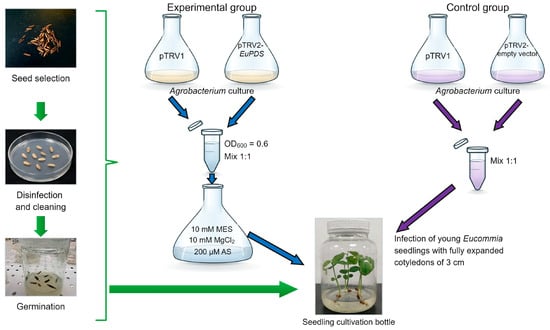
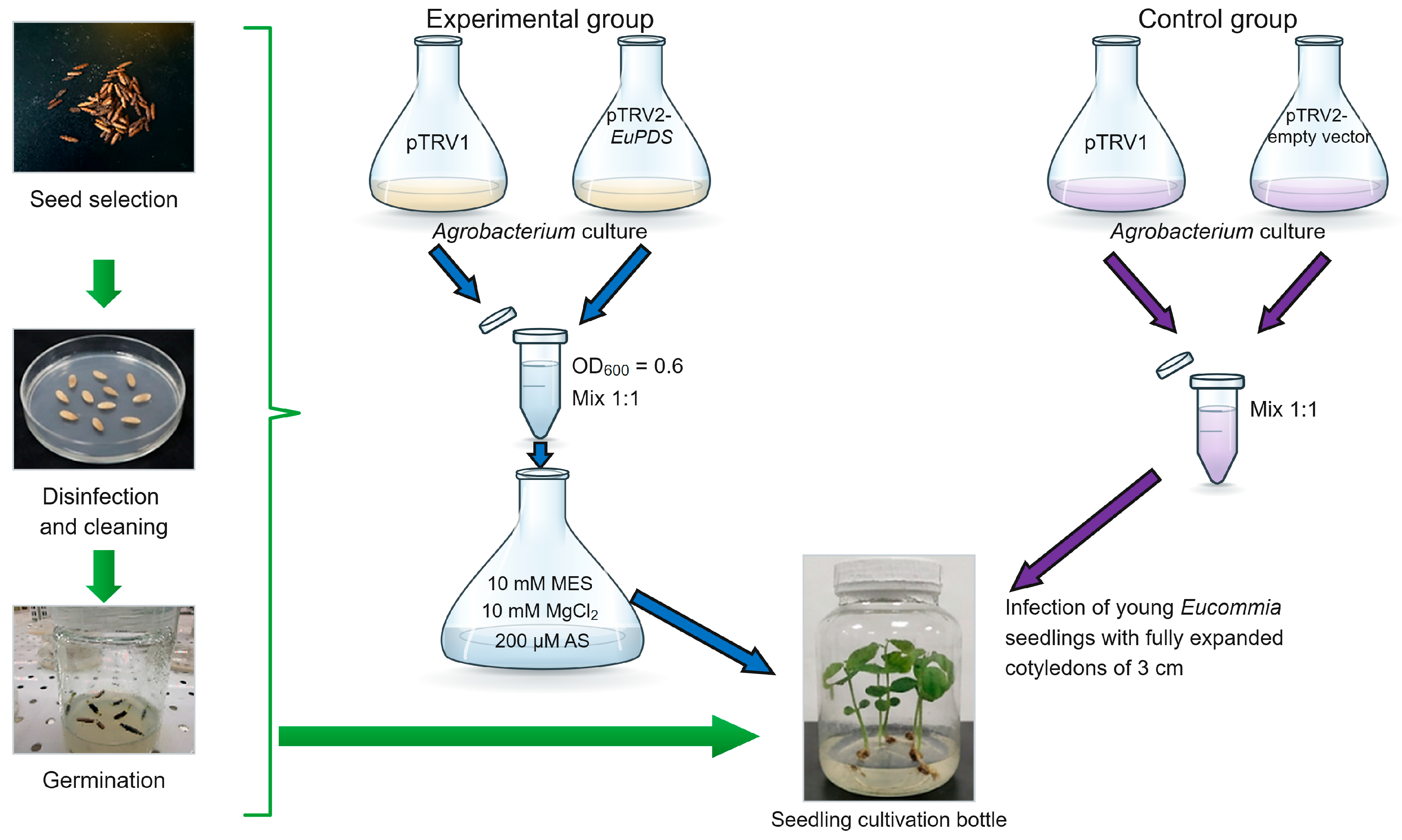
Agrobacterium strains carrying pTRV1, the pTRV2 empty vector, pTRV2-EuPDS-N or pTRV2-EuPDS-M were cultured at 28 °C with shaking at 220 rpm. Cells were harvested by centrifugation at 4000 rpm for 20 min and the supernatant was discarded. The pellet was resuspended in infiltration buffer (10 mM MES, 10 mM MgCl2) supplemented with 0, 200, 400 or 600 μM AS. Each suspension was adjusted to a final OD600 of 0.2, 0.6 or 1.0. Suspensions of the different constructs were mixed in a 1:1 ratio and held at room temperature in the dark for 3 h. The mixture was injected into E. ulmoides cotyledons from the abaxial side with a 1 mL syringe without a needle, until the suspension completely filled the cotyledon. All infiltrations were performed on 20-day-old seedlings, at which stage the cotyledons are thin and fully expanded and the suspension readily fills the whole cotyledon. After inoculation, plants were covered with a plastic bag and kept in the dark at 23 °C for two days, then transferred to a normally lit growth chamber (Figure 1). The pTRV1 and pTRV2 vectors were kindly provided by the research group of Prof. Jianbin Hu, College of Horticulture, Henan Agricultural University.
Figure 1.
Schematic overview of the TRV-mediated VIGS procedure in E. ulmoides. Seeds were surface-sterilised and germinated on MS medium; cotyledons of seedlings with fully expanded cotyledons (3 cm) were infiltrated with a 1:1 mixture of Agrobacterium cultures carrying pTRV1 and either pTRV2-EuPDS-N/M (experimental group) or the pTRV2 empty vector (control group). Plants were kept in the dark at 23 °C for two days and then grown under normal light for 28 days, after which newly developed true leaves were scored for mottled chlorosis.
Plants were scored for systemic silencing 28 days after injection. A plant was recorded as systemically silenced if its newly emerged true leaves showed the mottled chlorosis (yellow–green variegation) characteristic of EuPDS silencing. Plants whose newly emerged true leaves remained uniformly green were scored as non-silenced. Only the EuPDS-N and EuPDS-M constructs were expected to induce this phenotype; the empty-vector control served as the negative control. Silencing efficiency was defined as the number of systemically silenced plants divided by the total number of inoculated plants, expressed as a percentage. Silencing was additionally confirmed at the transcript level by RT-qPCR.
2.5. RNA Extraction and RT-qPCR
Leaves showing the silencing phenotype and leaves of the negative control were collected. Total RNA was extracted with TRIzol (Vazyme, VeZol Reagent R411-01, Nanjing, China) and reverse-transcribed into cDNA, and RT-qPCR was performed with the Vazyme SYBR Green kit (Q412-02). EuACT2 was used as the internal reference gene (primer sequences in Table 1). Relative expression levels were calculated by the 2−ΔΔCt method and plotted with GraphPad Prism 8.0. Each treatment comprised three independent biological replicates, each consisting of a mixed sample of at least three newly chlorotic leaves from different plants, and three technical replicates were performed.
2.6. Detection of TRV in Inoculated Plants
Total RNA was reverse-transcribed with HiScript III RT SuperMix for qPCR (+gDNA wiper) (Vazyme, R323-01). Residual genomic DNA was removed with the 4× gDNA wiper Mix at 42 °C for 2 min, and first-strand cDNA was then synthesised at 37 °C for 15 min followed by 85 °C for 5 s. A no-reverse-transcriptase (−RT) reaction, in which the RT mix was replaced with water, was run in parallel for every primer pair. RT-PCR was performed in a Bio-Rad thermal cycler with 2 × Phanta Max Master Mix (Vazyme, P515-01) in 50 µL reactions containing 0.2 µM of each primer and 2 µL of cDNA, using the pTRV2 universal primer pair and the pTRV2 forward primer combined with a gene-specific reverse primer. Cycling conditions were 95 °C for 3 min; 33 cycles of 95 °C for 15 s, 56 °C for 15 s and 72 °C for 30 s; and a final extension at 72 °C for 5 min. Products were resolved by agarose gel electrophoresis, stained with GelRed and photographed under UV light; no product was obtained in the −RT reactions.
2.7. Determination of Chlorophyll Content
Leaf tissue (0.2 g) was ground with a small amount of quartz sand and calcium carbonate in 2.5 mL of 80% (v/v) acetone. A further 3 mL of 80% acetone was added and grinding continued until the tissue was decolourised. The homogenate was left in the dark for 10 min, transferred to a 50 mL centrifuge tube and centrifuged at 4000 rpm for 15 min. The supernatant was collected and made up to 25 mL with 80% acetone. Absorbance was measured at 663 nm and 645 nm against an 80% acetone blank. Chlorophyll concentrations were calculated as previously [32]. Each treatment comprised three independent biological replicates, each consisting of at least three newly chlorotic leaves from different plants, with three technical replicates.
2.8. Statistical Analyses
When comparing multiple groups, analysis of variance (ANOVA) was performed by Tukey’s test; significant differences at the p < 0.05 level are indicated by different letters using SPSS version 13.0. The effects of bacterial density (OD600), acetosyringone (AS) concentration, and their interaction on silencing efficiency (Table 2) were evaluated using binomial logistic regression. The response variable was binary (1 = plant developed systemic silencing, 0 = no silencing), and the model was fitted to the 12 EuPDS-N treatment groups (3 bacterial densities × 4 AS concentrations, 10 plants per group, 120 plants in total). OD600 and AS concentration were both treated as categorical factors: OD600 with three levels (0.2, 0.6, 1.0; 0.2 as the reference) and AS with four levels (0, 200, 400, 600 μM; 0 as the reference). A full-factorial model was used, logit(p) = β0 + βOD + βAS + βOD × AS, fitted by maximum likelihood with a logit link, and each term was tested by a Wald test. Silencing efficiency was affected by OD600 (p < 0.001) and by AS concentration (p < 0.001), whereas the OD600 × AS interaction was not significant (p = 0.885). Each treated group was therefore compared with its paired empty-vector control by Fisher’s exact test instead.
Table 2.
Effect of bacterial density (OD600) and acetosyringone (AS) concentration on the silencing efficiency of TRV-mediated VIGS in E. ulmoides. Silencing efficiency is the proportion of inoculated plants that developed systemic silencing, scored 28 days after injection (n = 10 plants per treatment).
3. Results
3.1. Identification and Cloning of EuPDS in E. ulmoides
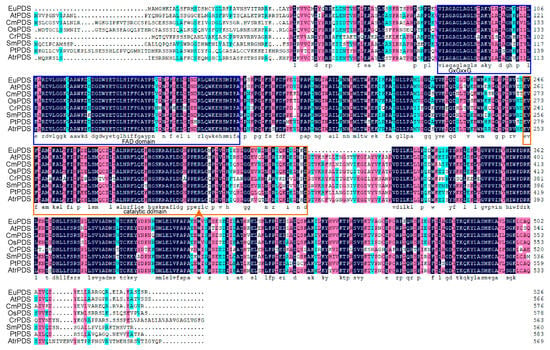
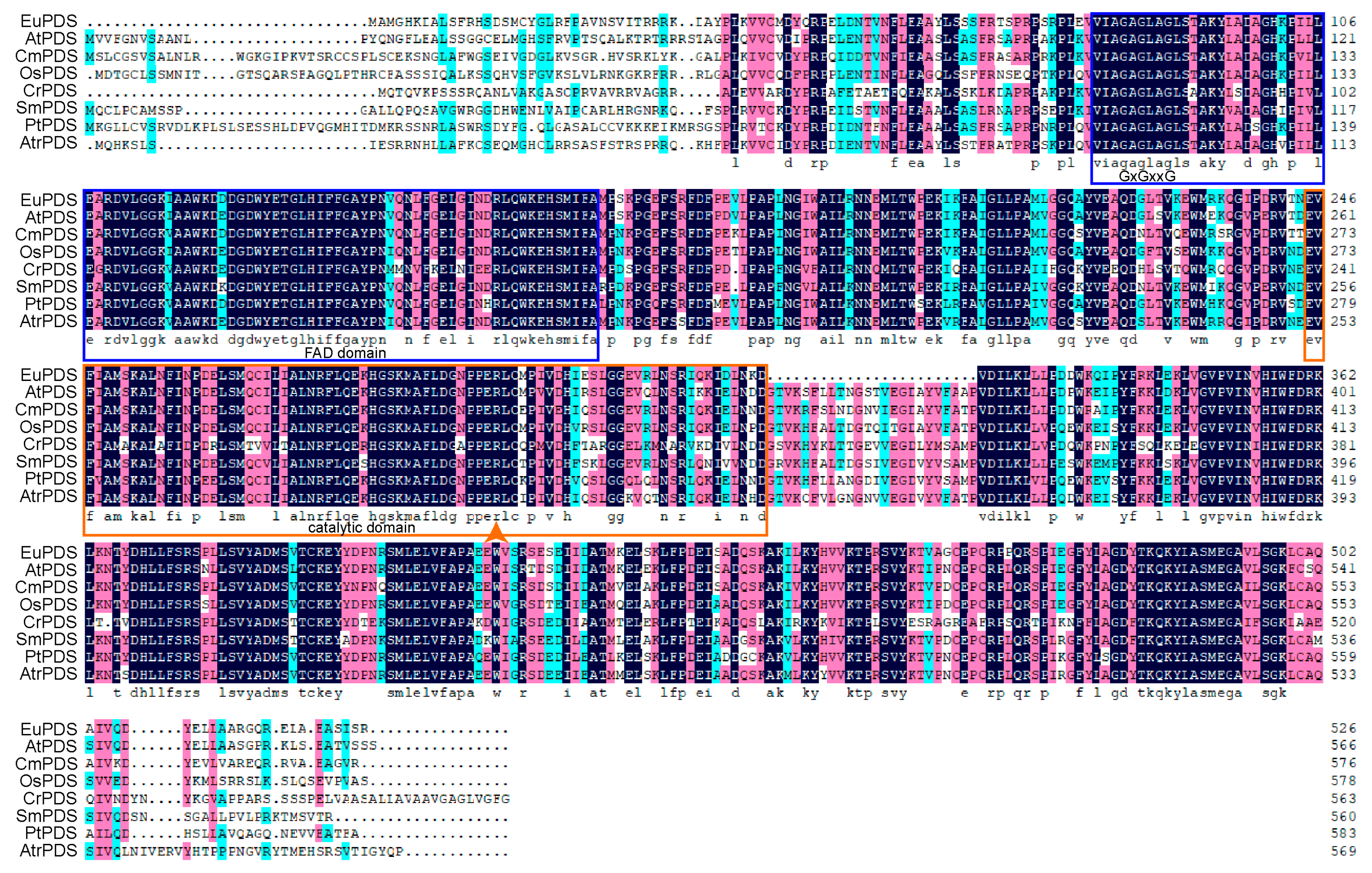
Using the PDS protein sequences of Arabidopsis thaliana as queries, a conserved EuPDS gene was identified by homology search of the E. ulmoides genome. The alignment showed high similarity among the PDS proteins of the eight species, indicating strong evolutionary conservation of this protein (Figure 2). This conservation is the basis for selecting the two silencing fragments described below.
Figure 2.
Alignment of PDS protein sequences from E. ulmoides (Eu), Arabidopsis thaliana (At), Cucumis melo (Cm), Oryza sativa (Os), Chlamydomonas reinhardtii (Cr), Selaginella moellendorffii (Sm), Pinus tabuliformis (Pt), and Amborella trichopoda (Atr). The conserved FAD and catalytic domain were labeled by blue and orange. The arrow of orange represents the conserved amino acid of catalytic domain.
To build an efficient VIGS system, and to test whether the targeted region affects silencing efficiency, two pairs of primers were designed against different conserved regions of EuPDS. The corresponding fragments, designated EuPDS-N and EuPDS-M, were obtained by PCR (Supplementary Table S1) and inserted into the pTRV2 vector by homologous recombination cloning. After sequencing confirmed the constructs, the recombinant plasmids were transformed into A. tumefaciens GV3101 for the subsequent in plant infection experiments.
3.2. Validation of TRV Infection in E. ulmoides
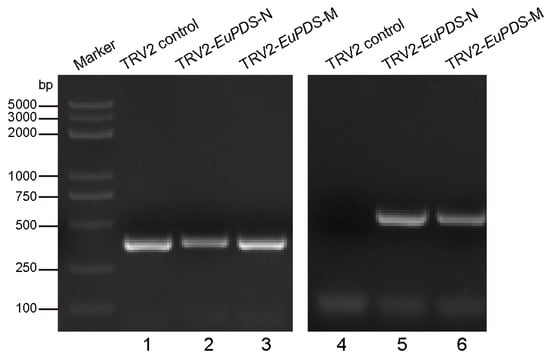
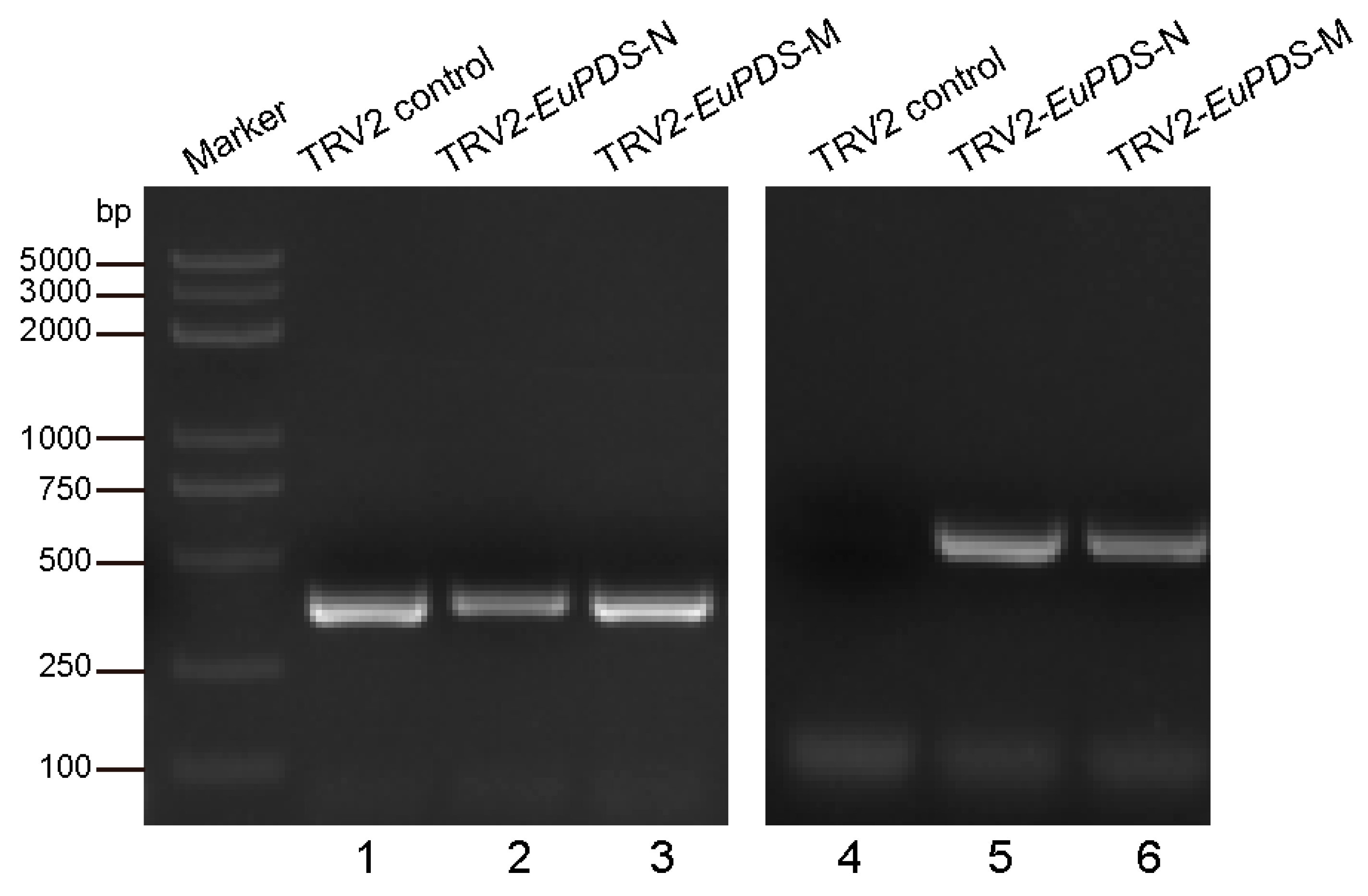
VIGS can only succeed if TRV infects the host plant. We therefore inoculated plants with the pTRV2 empty vector, pTRV2-EuPDS-N or pTRV2-EuPDS-M. After 28 days of culture, 30 newly developed leaves were collected from each treatment, pooled and analysed by RT-PCR. RT-PCR with the universal pTRV2 primer pair, and with the pTRV2 forward primer combined with a gene-specific reverse primer, showed that TRV had infected E. ulmoides leaves (Figure 3). This provided the basis for establishing and optimising the VIGS system.
Figure 3.
RT-PCR detection of virus in the E. ulmoides VIGS system. Lanes 1–3: pTRV2 forward and reverse universal primers; lanes 4–6: pTRV2 forward primer and target-gene reverse primer.
3.3. Screening of Silencing Fragments and Phenotypic Evaluation
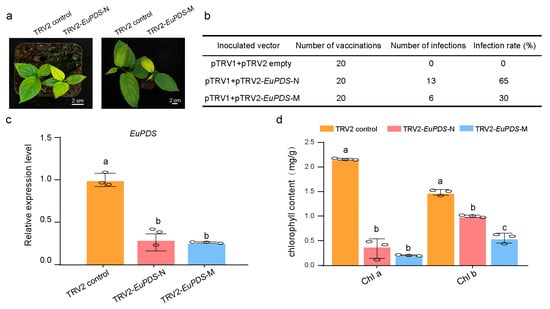
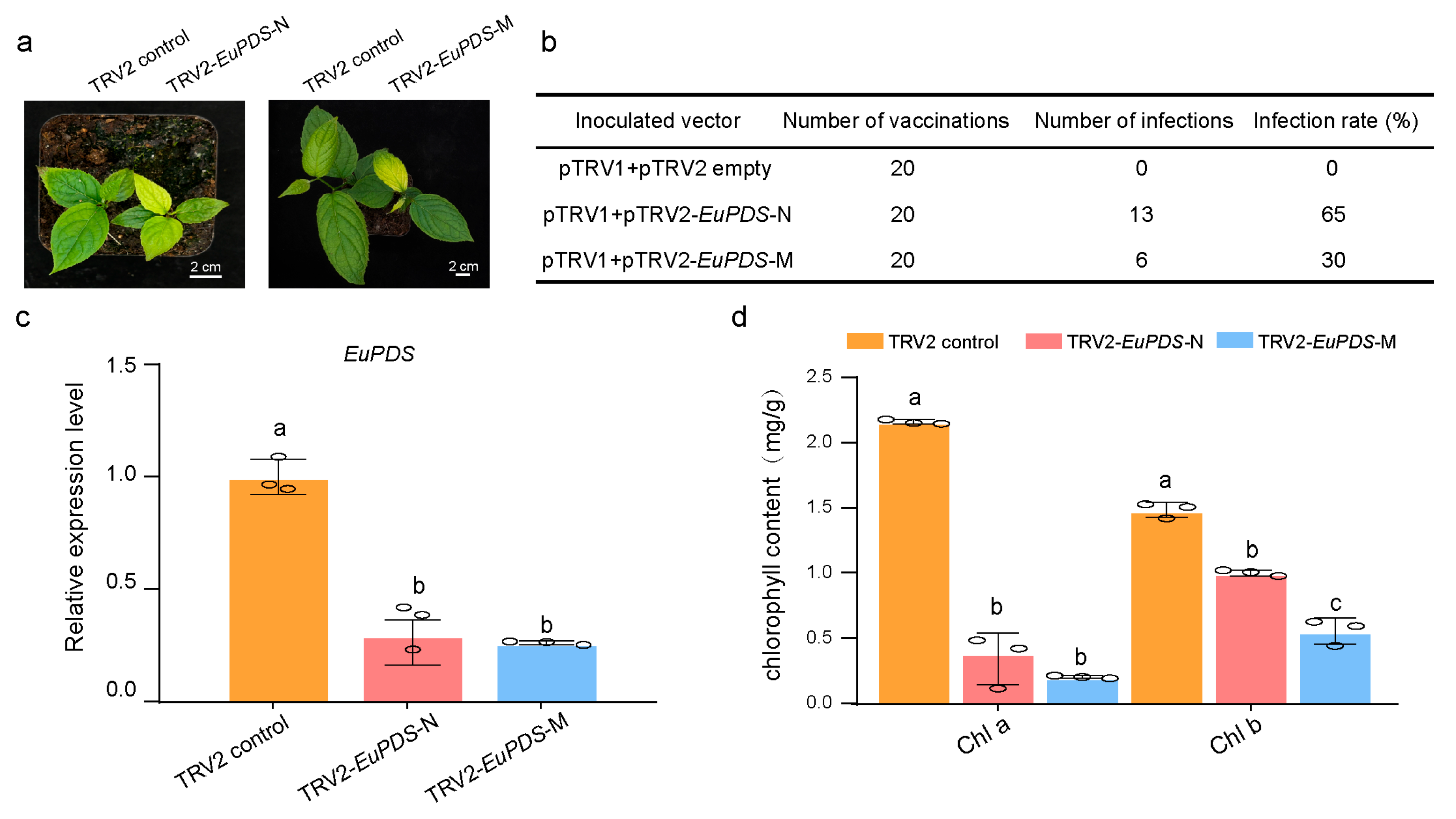
The EuPDS-N and EuPDS-M fragments were injected into young cotyledons of ‘Huazhong 8’ to establish TRV-mediated VIGS in E. ulmoides (preliminary conditions: OD600 = 0.5, AS = 400 μM). Compared with the empty-vector control, both fragments induced the typical leaf chlorosis phenotype on newly emerging leaves (Figure 4a). Silencing efficiency was higher for EuPDS-N (13/20, 65%) than for EuPDS-M (6/20, 30%), although the difference was not statistically significant (two-sided Fisher’s exact test, p = 0.056; Holm-adjusted p = 0.056) (Figure 4b).
Figure 4.
Screening of EuPDS silencing fragments and evaluation of silencing efficiency. (a) Phenotypes of newly developed true leaves in E. ulmoides inoculated with different silencing fragments (EuPDS-N and EuPDS-M); (b) numbers of plants inoculated and of plants that developed systemic silencing, with the corresponding silencing rates, for the empty-vector control and the two constructs (n = 20); (c) relative expression level of EuPDS; (d) leaf chlorophyll content. Bars represent means ± SD of three biological replicates, each consisting of at least three newly chlorotic leaves with three technical replicates. Statistical significance was determined by Tukey’s test; significant differences at the p < 0.05 level are indicated by different letters.
To characterise the silencing effect further, we measured EuPDS transcript levels in the new leaves by RT-qPCR and, in parallel, determined leaf chlorophyll contents. The relative expression of EuPDS was significantly reduced in chlorotic leaves (Figure 4c), and chlorophyll contents were reduced in parallel (Figure 4d). Together, these results show that the VIGS system was established in E. ulmoides leaves.
3.4. Optimisation of Agrobacterium Density and Acetosyringone Concentration
The more efficient EuPDS-N fragment was then used as the phenotypic indicator, and young cotyledons were used as the injection organ, to refine the technical parameters of the E. ulmoides VIGS system. The Agrobacterium suspension density (OD600 = 0.2, 0.6 or 1.0) and the AS concentration (0, 200, 400 or 600 μM) were optimised. The silencing efficiency was significantly affected by bacterial density (p < 0.001) and AS concentration (p < 0.001), whereas their interaction was not significant (p = 0.885). Among the tested conditions, an OD600 of 0.6 combined with 200 μM AS resulted in the highest silencing efficiency (80%). Furthermore, this treatment showed a significantly higher silencing efficiency than the corresponding empty-vector control (p = 0.0086, Holm-adjusted) (Table 2). Under this combination, 8 of 10 inoculated plants developed systemic silencing, a silencing efficiency of 80%. Increasing the bacterial density to OD600 = 1.0 did not improve efficiency, and omitting AS abolished systemic silencing.
3.5. Applicability of the VIGS System Across Different Cultivars
Having established the system in ‘Huazhong 8’, we tested two further elite cultivars, ‘Huazhong 10’ and ‘Huazhong 30’, to check whether it applies across different genetic backgrounds.
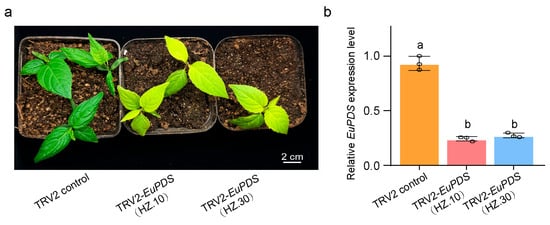
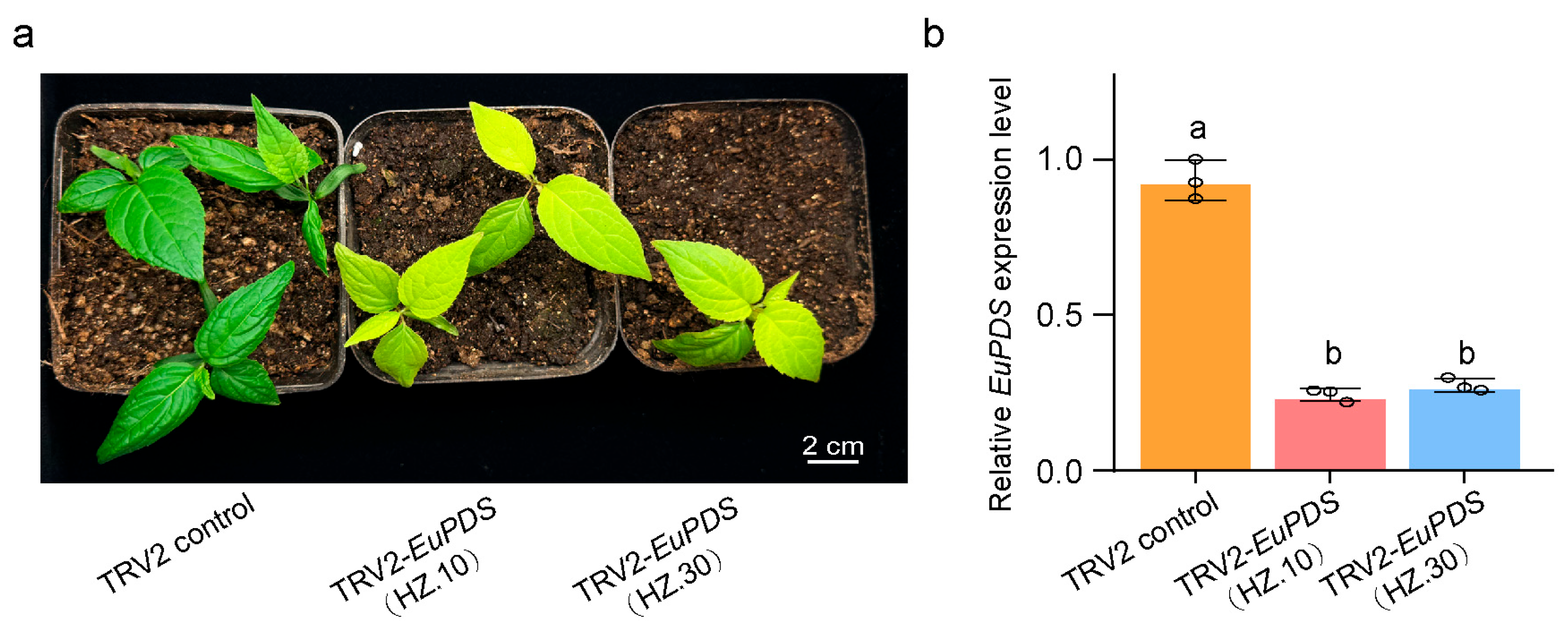
Under the optimised conditions, pTRV2-EuPDS-N induced extensive leaf chlorosis in both ‘Huazhong 10’ and ‘Huazhong 30’, whereas the pTRV2 empty-vector control remained green (Figure 5a). RT-qPCR confirmed a highly significant reduction in EuPDS transcript levels in both cultivars (Figure 5b). These results indicate that the optimised VIGS system is not restricted to a single genetic background, and that it applies to the elite cultivars tested.
Figure 5.
Validation of the applicability of the TRV-VIGS system across different E. ulmoides cultivars. (a) Phenotypes and (b) EuPDS expression levels in cotyledons of newly developed true leaves inoculated with EuPDS-N. Bars represent means ± SD of three biological replicates, each consisting of at least three newly chlorotic leaves with three technical replicates. Statistical significance was determined by Tukey’s test; significant differences at the p < 0.05 level are indicated by different letters.
4. Discussion
E. ulmoides is a rare strategic tree species endemic to China, valued for medicine, natural rubber, woody oil and ecological restoration [1,12,13]. As germplasm evaluation has improved, conventional breeding has struggled to meet the demand for germplasm innovation because of its long cycle and low efficiency. The E. ulmoides genome assembly makes it possible to characterise key genes and to dissect the regulation of target traits by marker-assisted breeding. This supports the exploitation of superior germplasm, the improvement of agronomic traits, and the study of how active compounds are synthesised and accumulated [1,12]. In this study, VIGS was used to validate gene function in E. ulmoides. The approach is simple, rapid, free of exogenous gene integration and independent of plant regeneration, so many candidate genes can be screened first. Those that warrant further study can then be analysed with the stable transformation system of E. ulmoides [22]. It is therefore a useful complement to gene discovery and mechanistic studies in this species.
VIGS systems are well established in model herbaceous plants such as Arabidopsis and cucurbits, enabling fast and large-scale gene function analysis. Progress in woody plants has been slower because of highly lignified cell walls, complex intercellular transport barriers and strong antiviral immunity that suppress viral vector propagation. Only a limited number of forest and perennial species have been reported so far, including Hevea brasiliensis, Populus, apple and pear, tea plant and Catalpa bungei [23,24,25,26,27,28,33]. Despite advances in omics research of E. ulmoides, many candidate genes and the mechanisms that control agronomically and industrially important traits remain uncharacterised. Furthermore, TRV-mediated VIGS had not been systematically investigated or optimised for E. ulmoides [12], leaving a major technical gap for high-throughput functional genomics in this species.
We used the TRV vector, which has a broad host range and low phytotoxicity, together with the classical reporter EuPDS. Vectors targeting different sequence regions were constructed, and the effects of silencing region, Agrobacterium density and AS concentration on silencing efficiency were examined (Table 2). The resulting system is efficient in E. ulmoides seedlings and performs stably in the cultivars ‘Huazhong 8’, ‘Huazhong 10’ and ‘Huazhong 30’. Because it does not depend on stable transformation, it can support the high-throughput in plant validation of genes involved in rubber biosynthesis, secondary metabolism and stress responses (Figure 5).
Leaf photobleaching caused by PDS silencing is a classical indicator of successful VIGS [30,31]. The EuPDS-silenced E. ulmoides plants in this study, however, showed pronounced mottled chlorosis rather than complete albinism (Figure 4a and Figure 5a). VIGS-mediated silencing is incomplete and transient, so a residual basal level of EuPDS expression is retained, which sustains limited carotenoid synthesis and alleviates complete photo-oxidative degradation of chlorophyll. Debarking, ultraviolet radiation and low-temperature stress have also been shown to raise some antioxidant contents in E. ulmoides [34,35,36], but neither phenolic compounds nor oxidative markers were measured in the present study, and we therefore do not attribute the incomplete bleaching to any specific antioxidant mechanism. EuPDS transcripts were strongly reduced in the chlorotic leaves, so mottled chlorosis is a reliable criterion for successful silencing in the E. ulmoides VIGS system. This provides a reference for phenotype evaluation in other woody-plant VIGS studies.
Delivery of genome-editing effectors such as TnpB by TRV has been achieved in model plants [37,38,39,40,41]. Based on the infection system established here, TnpB maybe coupled to TRV to construct a transient editing platform for E. ulmoides and would be a potential future direction that remains to be demonstrated.
This study established and optimised a TRV-VIGS transient silencing system for E. ulmoides. The system offers an efficient route to high-throughput in plant screening of functional genes in woody plants that are recalcitrant to transformation. The scope of the system is nevertheless narrow, because it was validated only in the cotyledons of seedlings. Restricting the assay to this single juvenile organ limits the genes that can be tested. Seedling cotyledons are thin, fully expanded and readily infiltrated, so the same conditions may not hold in other tissues. The system therefore cannot yet be applied to mature plants, to mature or lignified leaves, or to reproductive and storage organs such as fruit and kernel. All of these have a thicker cuticle, a more heavily lignified cell wall and a more complex intercellular transport barrier. Genes expressed specifically in these organs therefore remain out of reach, and extending the approach to them will require further optimisation of the infiltration and incubation conditions. In addition, only EuPDS was used as a reporter, and silencing has not been validated for functional genes involved in eucommia rubber biosynthesis, secondary metabolism or stress regulation. The utility of the system for such genes therefore remains untested. Little is also known about the interaction between E. ulmoides and TRV, and the effects of environmental factors and seedling age on silencing efficiency remain to be characterised. Because transient VIGS cannot achieve complete gene knockout, gene dosage effects and complete loss-of-function phenotypes remain difficult to dissect.
This study also has several methodological limitations. First, leaf phenotypes were scored visually without blinding, so a subjective component in the assessment cannot be excluded. Second, no buffer-only (mock-inoculation) control was included; the empty-vector treatment controls for the effect of the viral vector but not for the wounding caused by infiltration. Third, RT-qPCR and chlorophyll measurements were performed on leaves that already showed chlorosis and on control leaves, whereas inoculated plants that remained green were not sampled, so these data describe the selected chlorotic tissue and may overestimate the magnitude of silencing at the whole-plant level. Fourth, silencing was validated only for the EuPDS reporter and under a single set of growth conditions, so the performance of the system with other target genes and in rubber biosynthesis, secondary metabolism, and stress responses remains to be established. Finally, the optimization experiments of bacterial density (OD600) and acetosyringone (AS) concentration were not independently repeated using separately prepared inocula and different batches of seedlings. Although consistent silencing responses were subsequently observed in two additional E. ulmoides cultivars, further independent experiments are needed to rigorously assess the reproducibility of the optimized VIGS protocol.
5. Conclusions
EuPDS was used as a reporter to construct and optimise a TRV-VIGS transient silencing system for E. ulmoides seedlings. Injection of seedling cotyledons with OD600 = 0.6 and 200 μM AS produced efficient gene silencing. EuPDS silencing produced a mottled leaf chlorosis phenotype, and RT-qPCR confirmed that transcript levels were significantly reduced. This phenotype can therefore serve as a criterion for successful VIGS in E. ulmoides. The system also performed stably in the elite cultivars ‘Huazhong 8’, ‘Huazhong 10’ and ‘Huazhong 30’. It therefore supports the high-throughput in plant validation of genes involved in rubber biosynthesis, secondary metabolism and stress responses. Because the system differ from the traditional transgenic technology (regeneration of seedlings from callus), it provides a reverse-genetics tool for functional genomics and germplasm innovation in E. ulmoides seedlings.
Supplementary Materials
The following supporting information can be downloaded at: https://www.mdpi.com/article/10.3390/biology15232171/s1. Supplementary Table S1. Full-length nucleotide sequence of EuPDS and the sequences of the EuPDS-N (red), EuPDS-M (blue) and EuPDS-RT-qPCR (green) fragments used for VIGS vector construction.
Author Contributions
Y.B. and L.W. (First Author): methodology, data curation, and original draft preparation; W.M. and P.D. (Corresponding Author): writing—review and editing, project administration, and supervision; M.N. and Z.L.: data curation and software; J.W.: data curation and resources; Y.W.: resources and investigation; H.B. and H.D.: investigation. All authors have read and agreed to the published version of the manuscript.
Funding
This research was funded by Fundamental Research Funds of CAF, No (CAFYBB2025QF033).
Institutional Review Board Statement
Not applicable.
Informed Consent Statement
Not applicable.
Data Availability Statement
The data presented in this study are available on request from the corresponding author. The Eucommia ulmoides genome assembly used for sequence retrieval is publicly available as described in the cited references.
Acknowledgments
The authors thank Jianbin Hu (College of Horticulture, Henan Agricultural University) for kindly providing the pTRV1 and pTRV2 vectors. During the preparation of this manuscript, we used Doubao (https://www.doubao.com/, accessed on 1 November 2026) for the purposes of text editing. We have reviewed and edited the output and take full responsibility for the content of this publication.
Conflicts of Interest
The authors declare no conflicts of interest.
References
- Kang, X.Y. Bottleneck problems and their solutions in the industrialization process of Eucommia ulmoides. J. Beijing For. Univ. 2025, 47, 1–6. (In Chinese) [Google Scholar]
- Li, D.; Yang, C.; Huang, Y.; Li, L.; Han, W.; Kang, H.; Yang, F.; Fang, Q. Novel green resource material: Eucommia ulmoides gum. Resour. Chem. Mater. 2022, 1, 114–128. [Google Scholar] [CrossRef] [Scilit]
- Hong, T.; Gu, J.; Chen, L.; Wang, X.; Zhou, L.; Li, X.; Bai, W.; Gao, L.; Li, X.; Zhao, G.; et al. Metabolomic insights into pigment and bioactive metabolite alterations in Eucommia ulmoides leaves: A comparison between new variety and wild-type varieties. Food Chem. 2025, 491, 145126. [Google Scholar] [CrossRef] [Scilit] [PubMed]
- Wuyun, T.-N.; Wang, L.; Liu, H.; Wang, X.; Zhang, L.; Bennetzen, J.L.; Li, T.; Yang, L.; Liu, P.; Du, L.; et al. The hardy rubber tree genome provides insights into the evolution of polyisoprene biosynthesis. Mol. Plant 2018, 11, 429–442. [Google Scholar] [CrossRef] [Scilit] [PubMed]
- Li, Y.; Wei, H.; Yang, J.; Du, K.; Li, J.; Zhang, Y.; Qiu, T.; Liu, Z.; Ren, Y.; Song, L.; et al. High-quality de novo assembly of the Eucommia ulmoides haploid genome provides new insights into evolution and rubber biosynthesis. Hortic. Res. 2020, 7, 183. [Google Scholar] [CrossRef] [Scilit] [PubMed]
- Du, Q.; Wu, Z.; Liu, P.; Qing, J.; He, F.; Du, L.; Sun, Z.; Zhu, L.; Zheng, H.; Sun, Z.; et al. The chromosome-level genome of Eucommia ulmoides provides insights into sex differentiation and α-linolenic acid biosynthesis. Front. Plant Sci. 2023, 14, 1118363. [Google Scholar] [CrossRef] [Scilit] [PubMed]
- Yang, J.; Wang, H.; Chen, X.; Zhu, Y.; Li, Y.; Zhao, Y.; Zhao, D. The haplotype-resolved T2T genome of Eucommia ulmoides provides insights into the evolution of trans-polyisoprene biosynthesis. Hortic. Res. 2026, uhag304. [Google Scholar] [CrossRef] [Scilit]
- Ran, X.; Liu, Y.; Zhao, D. The relationship between EuSRPP1 gene expression and rubber biosynthesis in Eucommia ulmoides Oliver. Ind. Crops Prod. 2022, 175, 114246. [Google Scholar] [CrossRef] [Scilit]
- Xin, S.; Hua, Y.; Li, D.; Udayabhanu, J.; Yang, H.; Wu, R.; Huang, H.; Huang, T. Overexpression of the EuFPS5 gene in Hevea brasiliensis fails to produce Eucommia rubber but affects the biosynthesis of natural rubber. Ind. Crops Prod. 2023, 206, 117630. [Google Scholar] [CrossRef] [Scilit]
- Zhang, S.; Chen, H.; Wang, S.; Du, K.; Song, L.; Xu, T.; Xia, Y.; Guo, R.; Kang, X.; Li, Y. Positive regulation of the Eucommia rubber biosynthesis-related gene EuFPS1 by EuWRKY30 in Eucommia ulmoides. Int. J. Biol. Macromol. 2024, 268, 131751. [Google Scholar] [CrossRef] [Scilit] [PubMed]
- Du, P.; Zhang, J.; Li, Z.; Qiu, T.; Wang, Y.; Wang, L.; Wu, C. EuCHR11 and EuCHR17 negatively regulate trans-polyisoprene biosynthesis by repressing EuSRPP8 expression. Epigenet. Insights 2026, 19, e001. [Google Scholar] [CrossRef] [Scilit]
- Du, H. Advances in the molecular breeding of Eucommia ulmoides. J. Cent. South Univ. For. Technol. 2022, 42, 1–12. (In Chinese) [Google Scholar]
- Li, W.; Zhang, J.; Xie, X.; Shi, X. Research progress on chemical components, pharmacological activities and modern applications of Eucommiae Folium. Nat. Prod. Res. Dev. 2023, 36, 900–917. (In Chinese) [Google Scholar]
- Burch-Smith, T.; Anderson, J.; Martin, G.; Dinesh-Kumar, S. Applications and advantages of virus-induced gene silencing for gene function studies in plants. Plant J. 2004, 39, 734–746. [Google Scholar] [CrossRef] [Scilit] [PubMed]
- Broderick, S.; Jones, M. An optimized protocol to increase virus-induced gene silencing efficiency and minimize viral symptoms in Petunia. Plant Mol. Biol. Rep. 2014, 32, 219–233. [Google Scholar] [CrossRef] [Scilit] [PubMed]
- Fu, D.; Zhu, B.; Zhu, H.; Jiang, W.; Luo, Y. Virus-induced gene silencing in tomato fruit. Plant J. 2005, 43, 299–308. [Google Scholar] [CrossRef] [Scilit] [PubMed]
- Chen, Z.; Xin, L.; Wu, C.; Wang, Q.; He, S. Research progress on the application of VIGS technology in ornamental plants. North. Hortic. 2016, 13, 196–201. (In Chinese) [Google Scholar]
- Dommes, A.B.; Gross, T.; Herbert, D.B.; Kivivirta, K.I.; Becker, A. Virus-induced gene silencing: Empowering genetics in non-model organisms. J. Exp. Bot. 2019, 70, 757–770. [Google Scholar] [CrossRef] [Scilit] [PubMed]
- Hao, M.; Hang, Q.; Shi, G. Application and prospect of VIGS gene silencing technology in crop gene function research. China Agric. Sci. Technol. Her. 2022, 24, 1–13. (In Chinese) [Google Scholar]
- Wang, R.; Yang, X.; Wang, N.; Liu, X.; Nelson, R.S.; Li, W.; Fan, Z.; Zhou, T. An efficient virus-induced gene silencing vector for maize functional genomics research. Plant J. 2016, 86, 102–115. [Google Scholar] [CrossRef] [Scilit] [PubMed]
- Ren, H.; Li, D.; Yu, Y.; Lv, W.; Hao, X.; Wang, X.; Wang, Y. Research advances of strategies to engineer VIGS vectors and its application in plants. Acta Hortic. Sin. 2024, 51, 1455–1473. (In Chinese) [Google Scholar]
- Gao, P.; Xi, F.; Zhang, Z.; Hu, K.; Chen, K.; Wei, W.; Ding, J.; Gu, L. Research progress of plant VIGS technology and its application in forestry science. Biotechnol. Bull. 2021, 37, 141–153. (In Chinese) [Google Scholar]
- Li, H.; Guo, D.; Wang, Y.; Zhu, J.; Qu, L.; Peng, S. Tobacco rattle virus-induced gene silencing in Hevea brasiliensis. Biosci. Biotechnol. Biochem. 2021, 85, 562–567. [Google Scholar] [CrossRef] [Scilit] [PubMed]
- Shen, Z.; Sun, J.; Yao, J.; Wang, S.; Ding, M.; Zhang, H.; Qian, Z.; Zhao, N.; Sa, G.; Zhao, R.; et al. High rates of virus-induced gene silencing by tobacco rattle virus in Populus. Tree Physiol. 2015, 35, 1016–1029. [Google Scholar] [CrossRef] [Scilit] [PubMed]
- Sasaki, S.; Yamagishi, N.; Yoshikawa, N. Efficient virus-induced gene silencing in apple, pear and Japanese pear using apple latent spherical virus vectors. Plant Methods 2011, 7, 15. [Google Scholar] [CrossRef] [Scilit] [PubMed]
- Li, G.; Li, Y.; Yao, X.; Lu, L. Establishment of a virus-induced gene-silencing (VIGS) system in tea plant and its use in the functional analysis of CsTCS1. Int. J. Mol. Sci. 2023, 24, 392. [Google Scholar] [CrossRef] [Scilit] [PubMed]
- Fei, Y.; Wang, J.H.; Lu, N.; Zhang, M. Establishment of a transient gene silencing system in Catalpa bungei based on PDS homologous genes. Sci. Silvae Sin. 2025, 61, 49–60. (In Chinese) [Google Scholar]
- Ye, J.; Qu, J.; Bui, H.T.N.; Chua, N. Rapid analysis of Jatropha curcas gene functions by virus-induced gene silencing. Plant Biotechnol. J. 2009, 7, 964–976. [Google Scholar] [CrossRef] [Scilit] [PubMed]
- Jing, W.; Gong, F.; Liu, G.; Deng, Y.; Liu, J.; Yang, W.; Sun, X.; Li, Y.; Gao, J.; Zhou, X.; et al. Petal size is controlled by the MYB73/TPL/HDA19-miR159-CKX6 module regulating cytokinin catabolism in Rosa hybrida. Nat. Commun. 2023, 14, 7106. [Google Scholar] [CrossRef] [Scilit] [PubMed]
- Li, C.J.; Li, B.X.; Han, X.R. Advances in phytoene dehydrogenase—A review. Acta Microbiol. Sin. 2016, 56, 1680–1690. (In Chinese) [Google Scholar]
- Naing, A.H.; Kyu, S.Y.; Pe, P.P.W.; Park, K.I.; Lee, J.M.; Lim, K.B.; Kim, C.K. Silencing of the phytoene desaturase (PDS) gene affects the expression of fruit-ripening genes in tomatoes. Plant Methods 2019, 15, 110. [Google Scholar] [CrossRef] [Scilit] [PubMed]
- Mao, W.; Jing, W.; Cao, L.; Yang, R.; Bai, Y.; Liu, N.; Wang, L.; Du, P. The group IId WRKY transcription factors phosphorylated by mitogen-activated protein kinase 6 negatively regulate leaf senescence in Arabidopsis. Plant Physiol. 2026, 202, kiag513. [Google Scholar] [CrossRef] [Scilit] [PubMed]
- Liu, G.; Xu, N.; Shi, G.; Wang, L. Construction and identification of TRV-mediated VIGS transformation system of Iris sanguinea. Bull. Bot. Res. 2024, 44, 132–138. (In Chinese) [Google Scholar]
- Cao, R.; Zhang, X.; Yang, D.; Xia, G.; Dong, J. Effects of different barking treatments on secondary metabolites of Eucommia ulmoides and its ability of repairing injury. Sci. Silvae Sin. 2017, 53, 151–158. (In Chinese) [Google Scholar]
- Xiao, S.; Li, D.; Tang, Z.; Wei, H.; Zhang, Y.; Yang, J.; Zhao, C.; Liu, Y.; Wang, W. Supplementary UV-B radiation effects on photosynthetic characteristics and important secondary metabolites in Eucommia ulmoides leaves. Int. J. Mol. Sci. 2023, 24, 8168. [Google Scholar] [CrossRef] [Scilit] [PubMed]
- Zhang, Y.; Tian, X.; Zhou, W.; Tang, Z.; Yang, J.; Zhang, Y.; Tang, X.; Li, D.; Liu, Y. The physiological mechanism of low-temperature tolerance following the UV-B radiation of Eucommia ulmoides Oliver. Agriculture 2024, 14, 878. [Google Scholar] [CrossRef] [Scilit]
- Liu, Y.; Weiss, T.; Lee, J.; Powell, J.; Choo, S.Y.C.; Roshannai, E.; Kamalu, M.; Amerasekera, J.; Feng, S.; Jacobsen, S.E. Virus-induced transgene- and tissue culture-free heritable genome editing in tomato. Proc. Natl. Acad. Sci. USA 2026, 123, e2530029123. [Google Scholar] [CrossRef] [Scilit] [PubMed]
- Nagalakshmi, U.; Rodriguez, J.E.; Nguyen, T.; Weissman, R.F.; Thornton, B.W.; Terrace, C.I.; Savage, D.F.; Dinesh-Kumar, S.P. High-efficiency, transgene-free plant genome editing by viral delivery of an engineered TnpB. Nat. Plants 2026, 12, 503–511. [Google Scholar] [CrossRef] [Scilit] [PubMed]
- Ruwe, H.; Kleinelanghorst, V.; Zimmer, T. Virus-induced genome editing in the parasitic plant Phtheirospermum japonicum. Plant Cell Environ. 2026, 1–3. [Google Scholar] [CrossRef] [Scilit] [PubMed]
- Weiss, T.; Kamalu, M.; Shi, H.; Li, Z.; Amerasekera, J.; Zhong, Z.; Benjamin, A.; Michelle, M.; Kamakshi, V.; Gabriel, W.; et al. Viral delivery of an rna-guided genome editor for transgene-free germline editing in Arabidopsis. Nat. Plants 2025, 11, 967–976. [Google Scholar] [CrossRef] [Scilit] [PubMed]
- Marquart, K.; Mathis, N.; Mollaysa, A.; Saphira, M.; Lucas, K.; Tanja, R.; Lukas, S.; Péter, I.; Ahmed, A.; Masako, M.; et al. Effective genome editing with an enhanced isdra2 tnpb system and deep learning-predicted ωRNAs. Nat. Methods 2024, 21, 2084–2093. [Google Scholar] [CrossRef] [Scilit] [PubMed]

Disclaimer/Publisher’s Note: The statements, opinions and data contained in all publications are solely those of the individual author(s) and contributor(s) and not of MDPI and/or the editor(s). MDPI and/or the editor(s) disclaim responsibility for any injury to people or property resulting from any ideas, methods, instructions or products referred to in the content. |
© 2026 by the authors. Licensee MDPI, Basel, Switzerland. This article is an open access article distributed under the terms and conditions of the Creative Commons Attribution (CC BY) license.