


Simple Summary
Quinoa is a nutrient-dense crop that tolerates saline and other adverse growing conditions. Nevertheless, little is understood about the key internal genetic regulators enabling it to survive environmental stress. This work aimed to identify related genes in quinoa and investigate their biological roles. We uncovered 41 such genes, six of which showed strongly increased activity upon exposure to salt, drought-simulating, and cold conditions. Several of these genes function predominantly within developing seeds, whereas others are most active in plant roots. These results deepen our knowledge of quinoa’s stress-adaptation mechanisms and assist future breeding efforts to develop more stress-resilient quinoa varieties for agricultural production.
Abstract
The homeodomain-leucine zipper (HD-Zip) proteins are important transcription factors in the regulation of plant growth and development and abiotic stress responses. However, our understanding of the HD-Zip family is still limited in quinoa. In this study, 41 CqHD-Zip genes were identified in the quinoa genome and then phylogenetically classified into four subfamilies. Their characterizations, chromosomal locations, gene structures, conserved motifs, and phylogenetic relationships were comprehensively analyzed through genome-wide bioinformatics methods. Our RNA-Seq data showed that a subset of the 41 HD-Zip genes exhibited expression changes under salt stress, among which CqHDZ5, CqHDZ12, CqHDZ13, CqHDZ18, CqHDZ19, and CqHDZ21 responded positively to salt stress, and the results were confirmed by qRT-PCR analysis. Tissue expression revealed that CqHDZ5, CqHDZ13, CqHDZ18, and CqHDZ21 were significantly expressed in developing seeds, and CqHDZ12 and CqHDZ19 were highly expressed in roots. Additionally, the transcript levels of these six genes were significantly up-regulated in response to osmotic and low-temperature stress, indicating that they may participate in stress resistance against salt, osmosis, and low temperature. It is shown that HD-Zip is a multifunctional gene family, and the results will provide valuable information for further analysis of the potential role of HD-Zip genes in abiotic stress responses and genetic improvement of quinoa.
1. Introduction
Plant growth and development are often affected by a variety of adverse environmental factors, such as drought, soil salinity, and extreme temperatures. To adapt to these unfavorable environmental conditions, plants have evolved a series of regulatory mechanisms to respond to different stress signals [1,2]. These processes often lead to morphological and physiological changes in plants, which are controlled by complex gene regulatory networks [3]. As central regulators of gene expression, transcription factors play important roles in plant growth, development, and abiotic stress response [4]. Transcription factors are a group of DNA-binding proteins that can specifically bind to cis-acting elements of eukaryotic gene promoters to activate or inhibit the expression of downstream target genes. To date, more than 60 transcription factor families have been identified in plants [5]. The homologous domain leucine zipper (HD-Zip) gene family, one of the plant-specific transcription factor families, regulates various biological processes including plant growth and development, cell division, and responses to abiotic stresses [6,7]. HD-Zip proteins comprise a C-terminal homeodomain (HD) and an adjacent leucine zipper (LZ) domain. The HD can specifically bind to DNA, whereas the LZ domain mediates the formation of protein dimers [8]. Based on sequence conservation, gene structure, and cis-elements, the HD-Zip gene family can be divided into four subfamilies: HD-Zip I, II, III, and IV [9]. HD-Zip I and HD-Zip II members possess both HD and LZ domains, which could specifically bind to the dual symmetric DNA sequence of CAATNATTG [10]. Additionally, HD-Zip II proteins contain a conserved CPSCE (Cys-Pro-Ser-Cys-Glu) motif and N-terminal consensus sequences. Except for HD and LZ domains, the HD-Zip III and HD-Zip IV subfamilies possess a steroidogenic acute regulatory protein-related lipid transfer (START) domain and a START-associated domain (SAD) [11,12]. Different from HD-Zip IV, the HD-Zip III proteins share a common methionine-glutamic-lysine-histidine-leucine-alanine (MEKHLA) domain related to various chemical and physical stimuli [13]. Additionally, the genes of the same subfamily often exhibit functional conservation due to structural similarity.
Since the first HD-containing gene Knotted1 was isolated in maize [14], numerous HD-Zip transcription factors have been identified by genome-wide analysis in different species, such as pepper [15], grape [16], foxtail millet [17], watermelon [18], wheat [19], Chinese chestnut [20], and peach [21]. Moreover, the crucial roles of this family of genes in multiple biological processes of plants have also been reported by more researchers. Analysis of mutant and transgenic plants revealed that AtHB12, one HD-Zip I member, accelerates seedling root elongation and leaf development [22]. Tomato HD-Zip transcription factor SlHB15A could regulate pedicel abscission by modulating jasmonoyl-isoleucine biosynthesis [23], and the HD-Zip IV proteins could modify floral structures for self-pollination [24]. Overexpression of AtHB13 and HaHB1 can remarkably enhance the cold tolerance of transgenic plants via the induction of proteins able to stabilize cell membranes and inhibit ice growth [25]. Ectopic expression of an HD-Zip I family gene from physic nut, JcHDZ21, decreased the salt resistance of transgenic Arabidopsis, suggesting that JcHDZ21 was a negative regulator in regulating plant responses to salt stress [26]. In cucumber, the silencing of CsGL2-LIKE, an HD-Zip IV transcription factor, delayed male flowering by suppressing the expression of the florigen gene FT and reduced pollen viability and seed vigor [27]. Two HD-Zip proteins, GLABRA2 (GL2) and HOMEODOMAIN GLABROUS11 (HDG11), play redundant functions in Arabidopsis trichomes, and GL2 activates a positive feedback loop via MYB23 [28]. Overexpression of TaHDZipI-5 improved transgenic wheat freezing and drought tolerance [29]. ZmHDZ10 overexpression in both rice and Arabidopsis positively regulated drought and salt tolerance through altering the expression of stress/ABA-responsive genes, including P5CS1, RD22, RD29B, and ABI1 [30]. Cotton HD-Zip I transcription factor GhHB4-like-GhNAC007 regulated plant response to salt stress, potentially by modulating GhMYB96 and ABA signaling-related genes [31]. These studies suggested that the HD-Zip gene family may play a vital role in plant resistance to abiotic stress.
Quinoa (Chenopodium quinoa Willd.) is a dicotyledonous crop with abundant nutritional elements, originating from the Andean area of South America, belonging to the Chenopodiaceae family along with sugar beet (Beta vulgaris L.) and spinach (Spinacia oleracea L.) [32,33]. Many consumers favor quinoa because of its nutritional values and health-promoting properties such as antioxidant, anti-obesity, anticancer, antimicrobial, antidiabetic, and cardio-beneficial. Quinoa has become more and more popular among researchers due to its extraordinary adaptability to extreme climate and soil conditions. However, little is known about the HD-Zip gene family in quinoa. In this study, the HD-Zip members in quinoa were identified, and we analyzed their protein physicochemical properties, chromosome distributions, phylogenetic relationships, gene structures, and motif locations. Additionally, we performed transcriptome sequencing of quinoa roots under salt stress, and six genes of this family were found to be up-regulated, which were also confirmed by qRT-PCR analysis. Then, the expression patterns of these genes under osmotic and low-temperature stress and in different tissues were examined. These findings provide insights for a more systematic understanding of the characterization of the CqHD-Zip genes and contribute to the exploration of the functions and molecular breeding of abiotic stress tolerance in quinoa.
2. Materials and Methods
2.1. Identification and Sequence Analysis of HD-Zip Gene Family in Quinoa
Using the protein sequences of the Arabidopsis HD-Zip gene family retrieved from the TAIR database (http://www.arabidopsis.org, accessed on 8 July 2026) as query sequences, the quinoa genome database was searched using local BLASTP with an E-value < 10−5 (https://phytozome-next.jgi.doe.gov/info/Cquinoa_v1_0, accessed on 9 July 2026). Then the SMART web tool (http://smart.emblheidelberg.de, accessed on 12 July 2026) and the NCBI CDD search (http://www.ncbi.nlm.nih.gov/Structure/cdd/wrpsb.cgi, accessed on 13 July 2026) were used to confirm the presence of the HD (PF00046)/LZ (PF02183)/START (PF01852)/MEKHLA (PF08670) domain in the resulting 41 non-redundant CqHD-Zip protein sequences with the E value < 10−3. The ExPASy ProtParam tool (http://web.expasy.org/protparam/, accessed on 17 July 2026) was used to analyze the protein length, molecular weight, and isoelectric point of each CqHD-Zip protein. The open reading frames of the CqHDZs were determined by the Open Reading Frame Finder tool (https://www.ncbi.nlm.nih.gov/orffinder/, accessed on 22 July 2026). Subcellular localization prediction was performed using the PSORT WWW Server (https://psort.hgc.jp/, accessed on 23 July 2026). The chromosomal distribution of CqHDZs was visualized by TBtools-II (V2.096) software (https://github.com/CJ-Chen/TBtools, accessed on 26 July 2026).
2.2. Multiple Sequence Alignment and Phylogenetic Tree Construction
The full-length sequences of HD-Zip proteins from quinoa (CqHDZs) and Arabidopsis (AtHDZs) were aligned with ClustalW with default parameters. A neighbor-joining (NJ) phylogenetic tree was constructed using MEGA 5.0 based on the alignment. Additionally, the statistical parameters used to build the NJ tree were as follows: Poisson model, complete deletion, and 1000 bootstrap replicates.
2.3. Gene Structure and Conserved Motif Analysis
The exon-intron structures of the CqHDZs were determined based on their ORF sequences and corresponding genomic sequences, and visualized using the online program Gene Structure Display Server (GSDS 2.0, http://gsds.gao-lab.org/, accessed on 27 July 2026). The Multiple Em for Motif Elicitation (MEME) online program (http://meme-suite.org/, accessed on 3 August 2026) was employed to analyze the conserved motifs of the CqHD-Zip proteins. The parameters for performing this analysis were as follows: The number of repetitions is any, the maximum number of motifs is 20, and the optimum motif width is between 6 and 50 amino acids, E-value < 10−2.
2.4. Expression Profiling of CqHD-Zip Genes
RNA-Seq raw data of roots at different periods of salt treatment in a hydroponic experiment were obtained from our previous research [34]. Gene expression levels were determined by the fragments per kilobase of transcript per million mapped reads (FPKM). The expression heatmap of 41 CqHDZs was visualized using HemI(version 1.0) software [35], and the ratios were log2-transformed.
2.5. Plant Materials and Abiotic Stress Treatments
In this study, the quinoa variety Suli No.1 from Jiangsu Academy of Agricultural Sciences was used as the experimental material. For tissue-specific expression analysis, roots, stems, and leaves were harvested from 28-day-old seedlings grown in the greenhouse. Growth continued to the reproductive stage until flowers and developing seeds were collected. The seeds were sampled at 10, 20, and 30 days after pollination (DAP). The seedlings grown hydroponically to the sixth true leaf stage were then subjected to abiotic stress treatments to determine the expression profiles of CqHDZs under different stress conditions. Stress treatments included salt treatment (300 mM NaCl), osmotic treatment (20% PEG 6000), and low temperature treatment (4 °C). The root samples were harvested at 0, 3, 6, 12, and 24 h after stress treatments, immediately frozen in liquid nitrogen, and stored at −80 °C for RNA isolation and cDNA synthesis. Three independent biological replicates were set for each sample.
2.6. RNA Isolation and qRT-PCR Analysis
Total RNA was extracted using RNeasy Plant Mini Kit (Qiagen, Hilden, Germany) and purified using RNase-Free DNase Set (Qiagen, Hilden, Germany) as per manufacturer’s instructions. cDNA was synthesized using SuperScriptTMIII First-Strand Synthesis SuperMix (Thermo Fisher Scientific, Waltham, MA, USA) with gDNA Eraser (Takara, Kusatsu, Shiga, Japan) following the manufacturer’s protocol. Real-time quantitative polymerase chain reaction (qRT-PCR) was performed using Power SYBR® Green PCR Master Mix (Applied Biosystems, Foster City, CA, USA). The UBA2B was chosen as a reference gene. qRT-PCR reaction cycling conditions were set as follows: pre-denaturation at 95 °C for 1 min, then 40 cycles of 95 °C for 15 s, 60 °C for 25 s. The relative expression levels were calculated by the 2−△△CT method [36]. The expression profiles were drawn using Origin 8 software.
3. Results
3.1. Identification of HD-Zip Genes in Quinoa
Using the HD-Zip gene family protein sequences of Arabidopsis as a reference, a BLASTP search was carried out in the quinoa genome database. Candidate proteins harboring the HD domain were retained for further phylogenetic classification. Proteins were assigned to HD-Zip subfamilies based on their phylogenetic position and conserved domain architecture. For canonical HD-Zip proteins, the combination of HD and LZ is expected; however, the LZ motif can be degenerate or truncated in some HD-Zip members and may not be detected by SMART or NCBI CDD. Sequences lacking complete diagnostic domain profiles were annotated as divergent HD homologs in Table S1. A total of 41 quinoa HD-Zip genes were obtained, and they were named CqHDZ1 to CqHDZ41 on the basis of their location on the chromosomes. The general characteristics of all the CqHDZs, including gene ID, chromosome location, number of exons, open reading frame (ORF) length, number of amino acids (AAs), molecular weight (MW), isoelectric point (pI), and prediction of subcellular localization, are listed in Table 1. The ORF length of the CqHDZs ranged from 549 bp (CqHDZ33) to 2547 bp (CqHDZ37), and the number of AAs was 182 to 848, respectively, with an average of 452. Protein MW varied from 20.91 kDa (CqHDZ33) to 92.30 kDa (CqHDZ37), and the pI ranged from 4.62 (CqHDZ32) to 9.37 (CqHDZ15). Subcellular localization results indicated that 33 CqHD-Zip proteins were located in the nucleus, 5 CqHD-Zip proteins (CqHDZ2, CqHDZ7, CqHDZ29, CqHDZ38, and CqHDZ40) were found in the cytoplasm, and 3 CqHD-Zip proteins (CqHDZ3, CqHDZ31, and CqHDZ37) were located in the chloroplast. This is only an in silico prediction and requires further experimental validation.
Table 1.
Characteristics of CqHD-Zip genes in quinoa.
3.2. Phylogenetic Analysis and Group Classification of the CqHD-Zip Genes
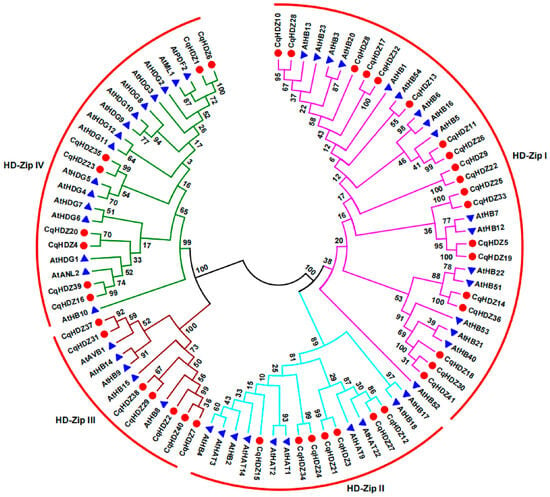
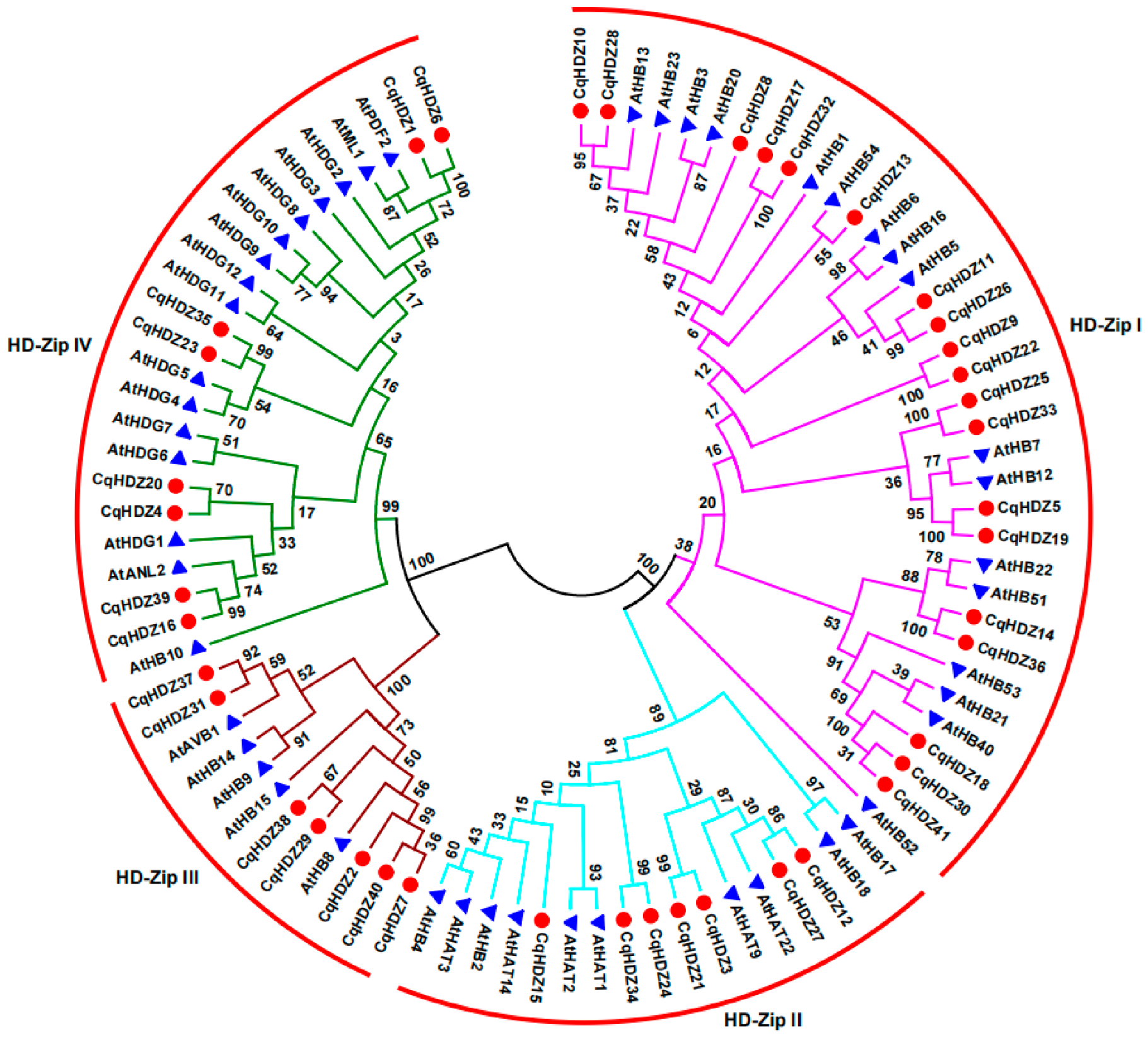
To assess the evolutionary relationship of the CqHD-Zip gene family, multiple sequence alignment of 41 CqHD-Zip proteins from quinoa and 48 AtHD-Zip proteins from Arabidopsis (Table S2) was performed; afterwards, a neighbor-joining (NJ) tree was constructed, and the phylogenetic relationship was analyzed. As shown in Figure 1, all 89 HD-Zip proteins were further divided into four subfamilies and were named I to IV, with 36 members in HD-Zip I, 17 in HD-Zip II, 12 in HD-Zip III, and 24 in HD-Zip IV. The 41 CqHDZs were distributed across all four subfamilies: HD-Zip II and HD-Zip III both had 7 members, HD-Zip IV had 8 members, while HD-Zip I had 19 members, which was the largest group. Generally, proteins in the same subfamily would have similar functions; hence, the clustering results of the phylogenetic tree could contribute to predicting the functions of CqHD-Zip proteins. For instance, CqHDZ13 and AtHB54 are classified into the same branch, suggesting that CqHDZ13 might have a similar biological function to AtHB54. In the HD-Zip I subfamily, CqHDZ5, CqHDZ19, CqHDZ25, CqHDZ33, AtHB7, and AtHB12 are in the same branch, exhibiting higher homology. Similarly, CqHDZ3, CqHDZ12, CqHDZ21, CqHDZ27, AtHAT9, and AtHAT22 have higher homology in HD-Zip II. CqHDZ7, CqHDZ29, CqHDZ38, CqHDZ40, AtHB8, and AtHB15 have higher homology in HD-Zip III. CqHDZ23 and CqHDZ35 were clustered with AtHDG4 and AtHDG5 in HD-Zip IV.
Figure 1.
Phylogenetic analyses of HD-Zip proteins from quinoa and Arabidopsis. Neighbor-joining (NJ) method was adopted, and the bootstrap value was set to be equal to 1000. The tree shows the division of HD-Zip proteins into four subfamilies. Arabidopsis HD-Zip proteins are shown by a blue triangle, and quinoa HD-Zip proteins are shown by a red circle.
3.3. Chromosomal Distribution of the CqHD-Zip Genes
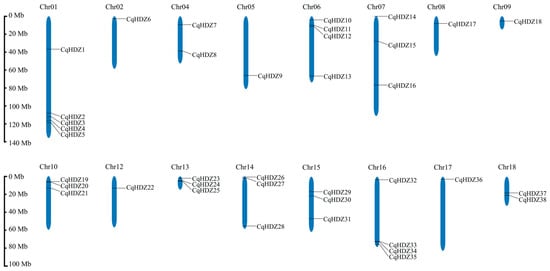
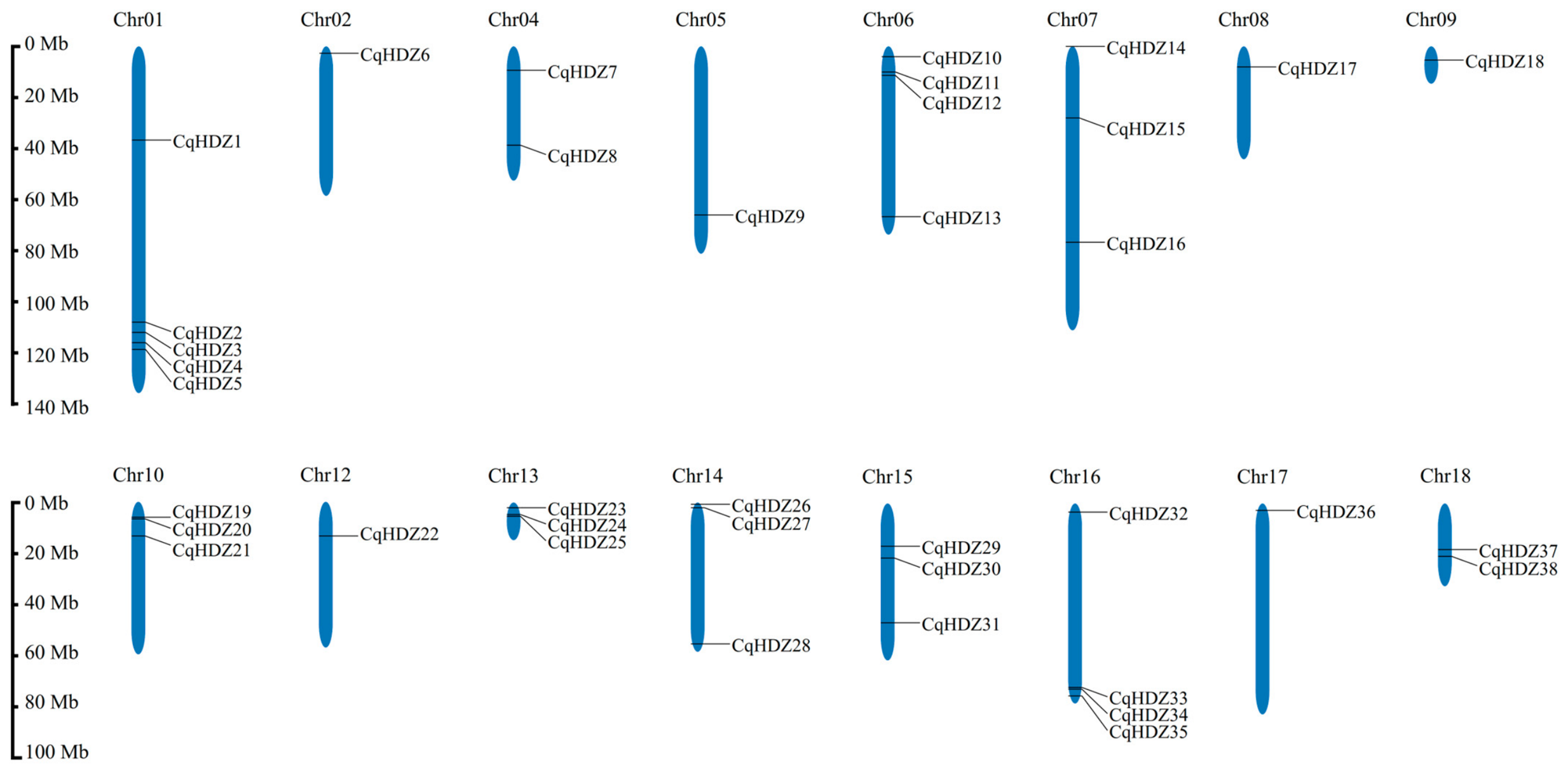
The chromosome mapping results demonstrated that the CqHD-Zip genes were unevenly distributed on 16 of the 18 chromosomes (Chr) of quinoa, and most of them were located close to the distal positions of the chromosomes (Figure 2). CqHD-Zip genes were not found on Chr 3 and Chr11. CqHDZ39, CqHDZ40, and CqHDZ41 were not accurately located on chromosomes and were named Chr 0 (Table 1). Additionally, it was also found that Chr1 contained five CqHDZs, which was the largest number of genes among these 16 chromosomes, followed by Chr6 and Chr16, which contained four. Six of the chromosomes (Chr2, Chr5, Chr8, Chr9, Chr12, and Chr17) carried only a single gene each, while two genes were located on Chr4 and Chr18, and three on Chr7, Chr10, Chr13, Chr14, and Chr15. Interestingly, some genes were densely distributed on the same chromosome, which might be related to gene replication events.
Figure 2.
The chromosomal location of the CqHD-Zip genes.
3.4. Gene Structure and Conserved Motif Analyses of CqHDZs
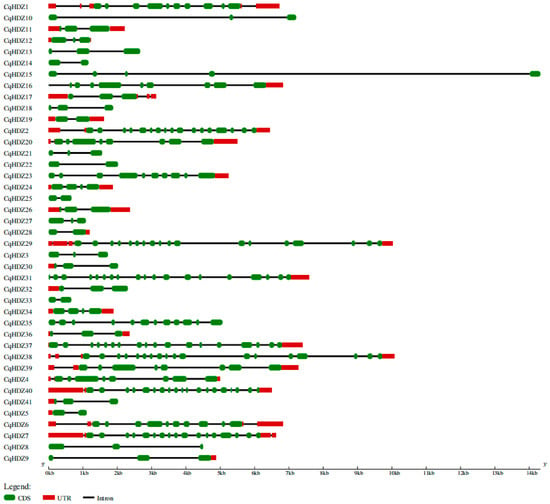
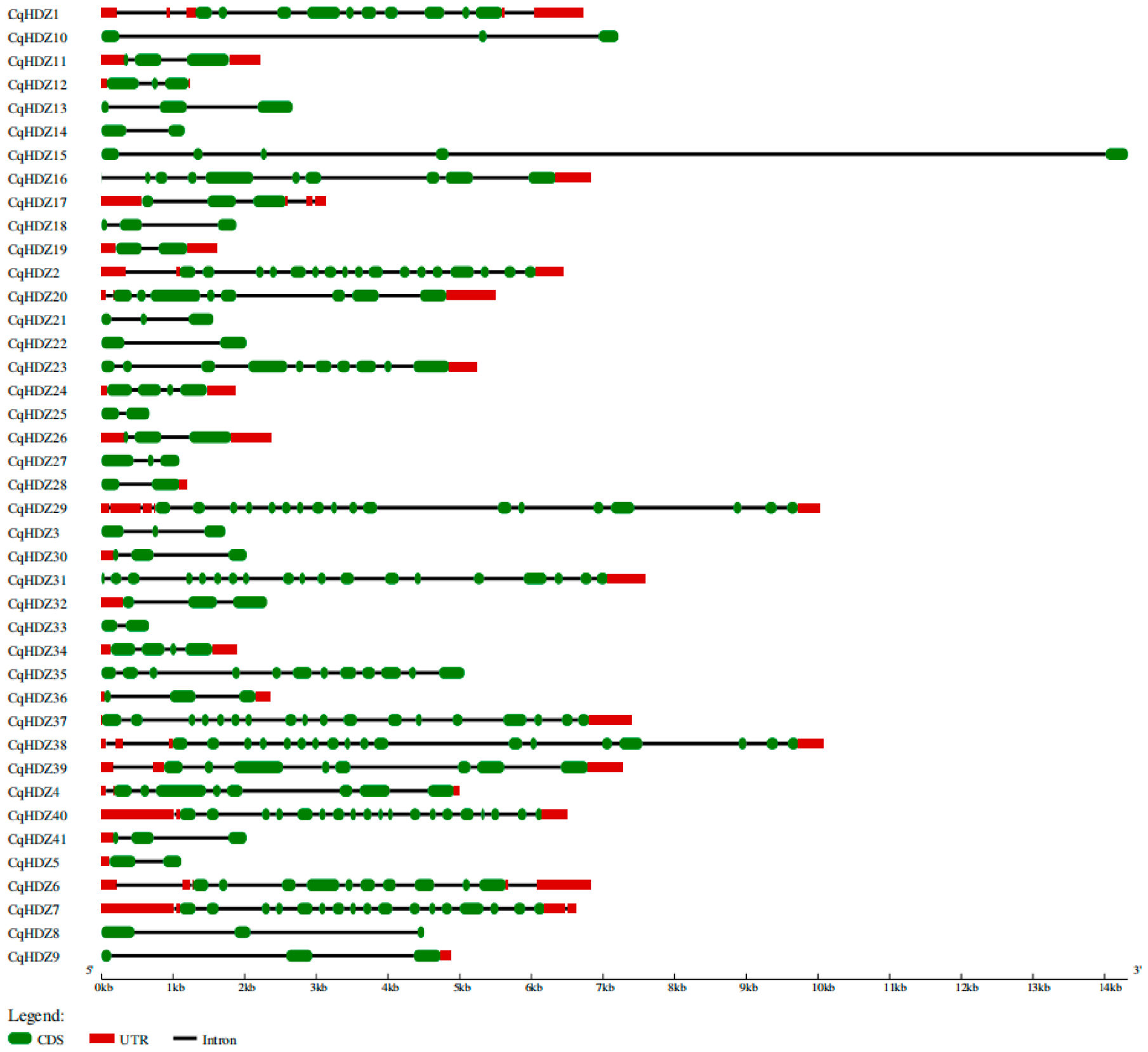
To gain insights into the structure of the CqHDZs, we analyzed their intron and exon composition by comparing their genome sequences with corresponding cDNA sequences. It was found that the number of UTRs, introns, and exons varied greatly among different CqHDZs (Figure 3). The number of UTRs varies from 0 to 5, the number of introns is from 1 to 18, and the number of exons is from 2 to 19. The gene structure of the CqHDZs in HD-Zip I and HD-Zip II subfamilies is relatively simple, with the number of introns ranging from 1 to 2 and 2 to 4, respectively. The HD-Zip III subfamily possesses the most complicated gene structure, with 16 to 18 introns, followed by the HD-Zip IV subfamily with 7 to 11 introns. This could be due to the evolution of more diverse functional roles. However, genes in the same branch of the phylogenetic tree have structural similarities, such as CqHDZ11 and CqHDZ26 in the HD-Zip I subfamily containing two introns and three exons, and CqHDZ24 and CqHDZ34 in the HD-Zip II subfamily containing three introns and four exons, which further confirms the results of quinoa HD-Zip classification. Notably, CqHDZ30 and CqHDZ41 possess identical CDS sequences and are likely assembly redundancies derived from the unplaced scaffold Chr00.
Figure 3.
Gene structure of the CqHD-Zip genes. Green squares represent the coding sequence (CDS), red squares represent the untranslated region (UTR), and the black lines represent the intron.
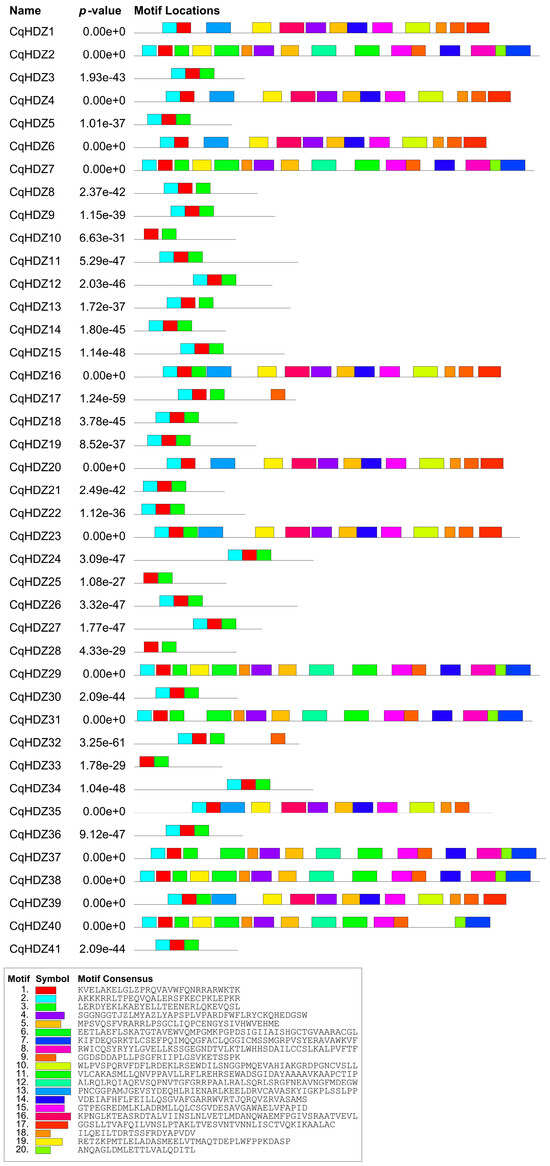
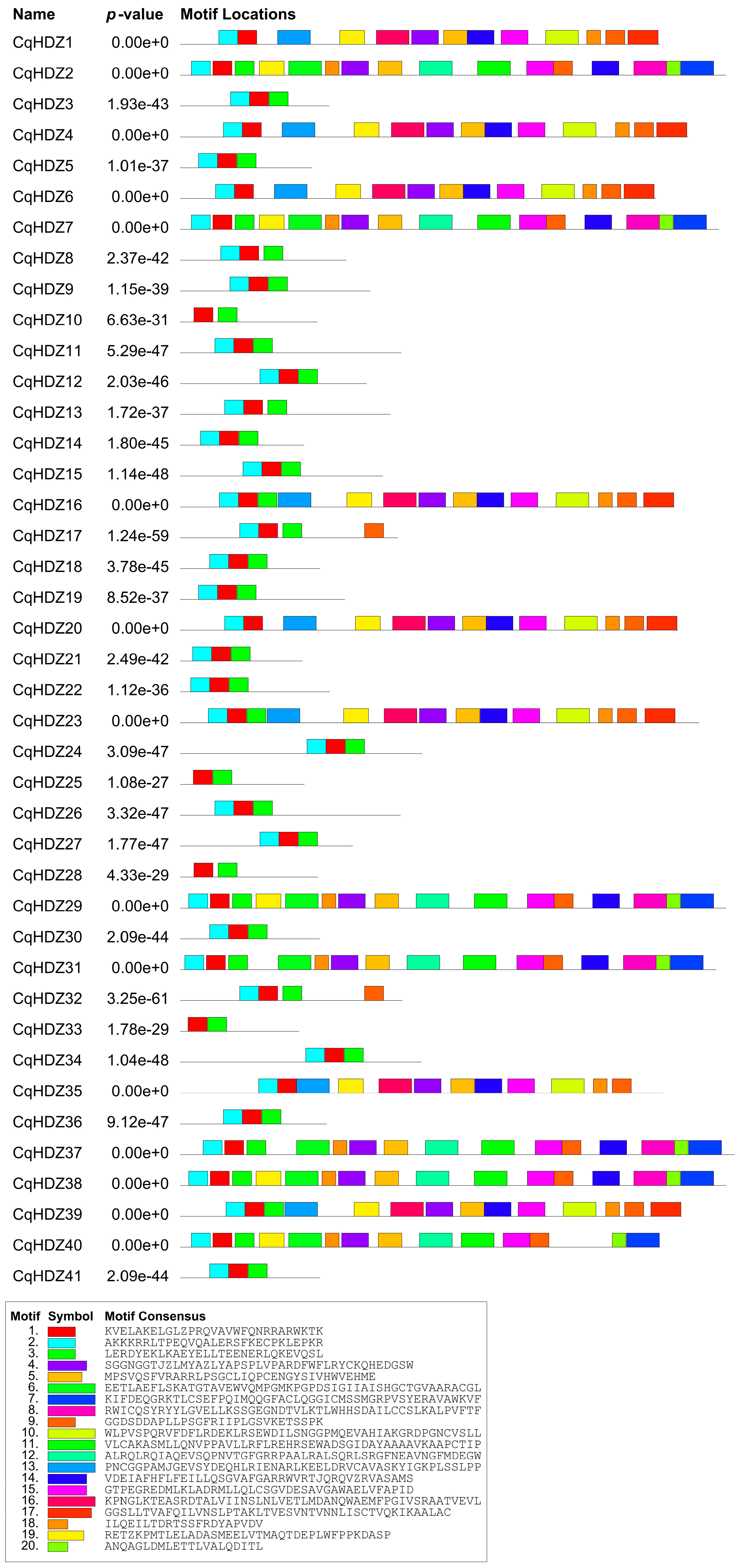
In order to further study the conservation and differences in the protein sequences of CqHDZs, their conserved motifs were analyzed using MEME Suite Version 5.5.5 software. Twenty conserved motifs were finally determined, and their lengths varied from 21 to 50 amino acid residues (Figure 4). The results showed that the CqHD-Zip gene family members contained different numbers and types of motifs, but each contained motif 1 located in the HD domain, indicating the conservation of this family. The complexity of motif composition in different subfamilies is similar to the complexity of their gene structure, with HD-Zip III having the largest number of motifs (14 to 16), followed by HD-Zip IV (12 to 14). All the members in CqHD-Zip II have three motifs (motif 1, motif2, and motif3) located in the core domains HD and LZ. The differences in motif compositions and distributions among different genes predict their different biological functions. The findings that members from the same subfamily have similar structural compositions and cluster together strongly support the reliability of evolutionary tree classification.
Figure 4.
The conserved motifs of the CqHD-Zip proteins. Different colors indicate different motifs, and their consensus sequences are also listed.
3.5. Expression Profiles of CqHD-Zip Gene Family Under Salt Stress
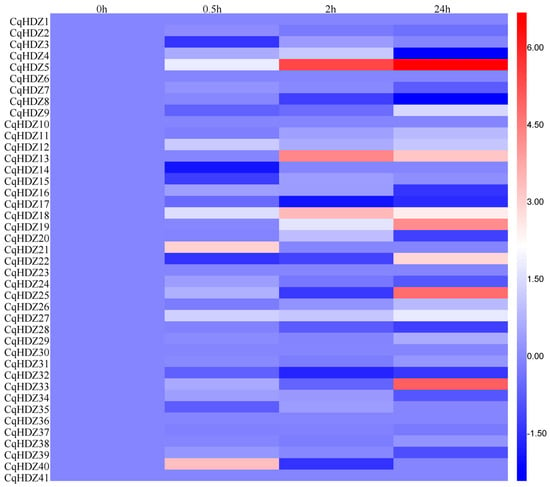
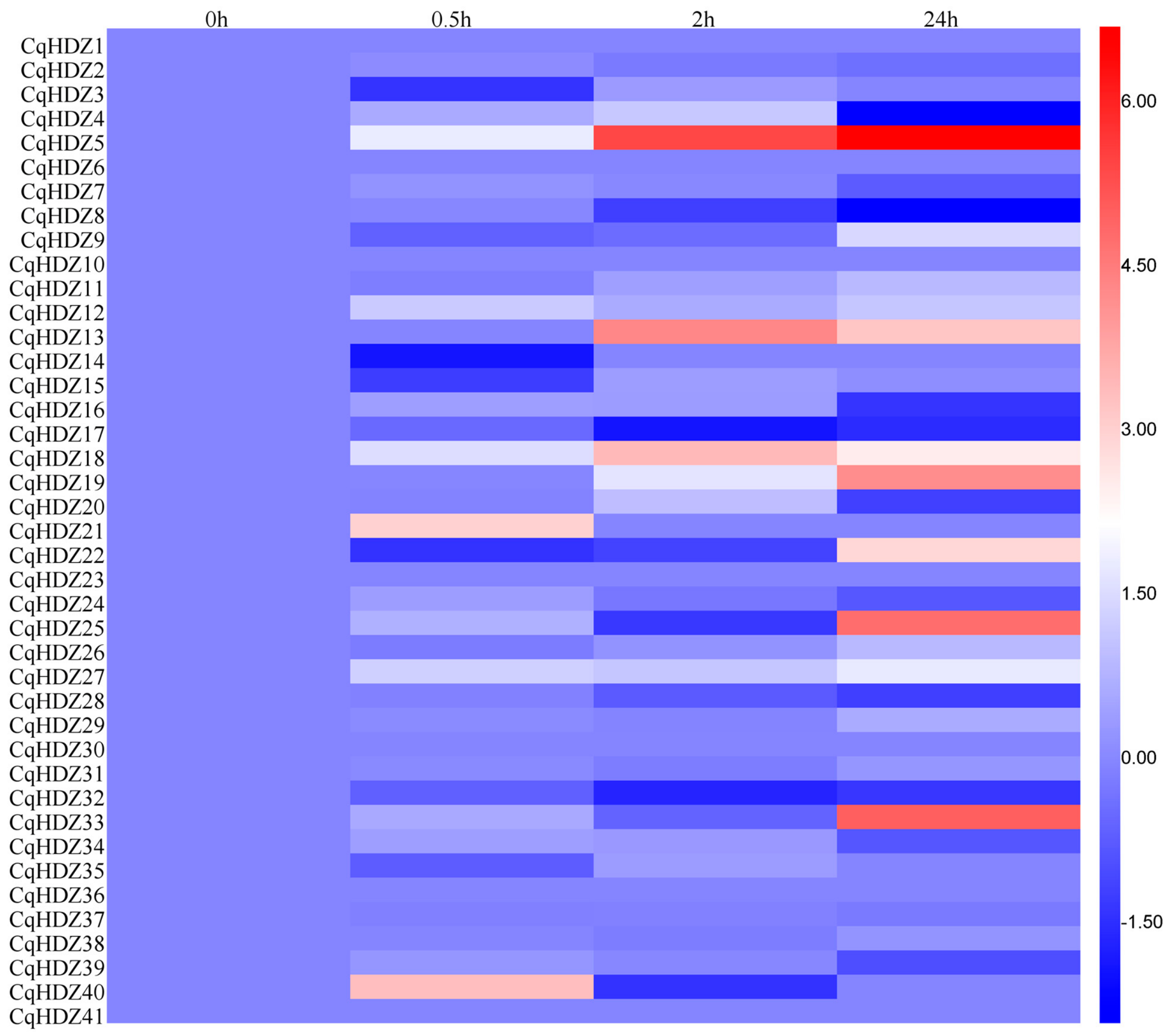
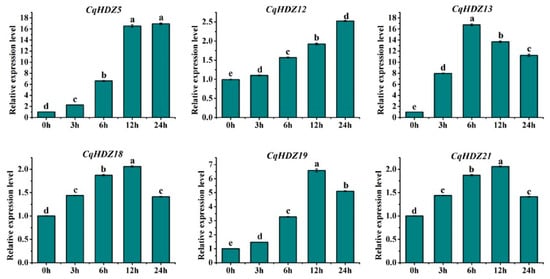
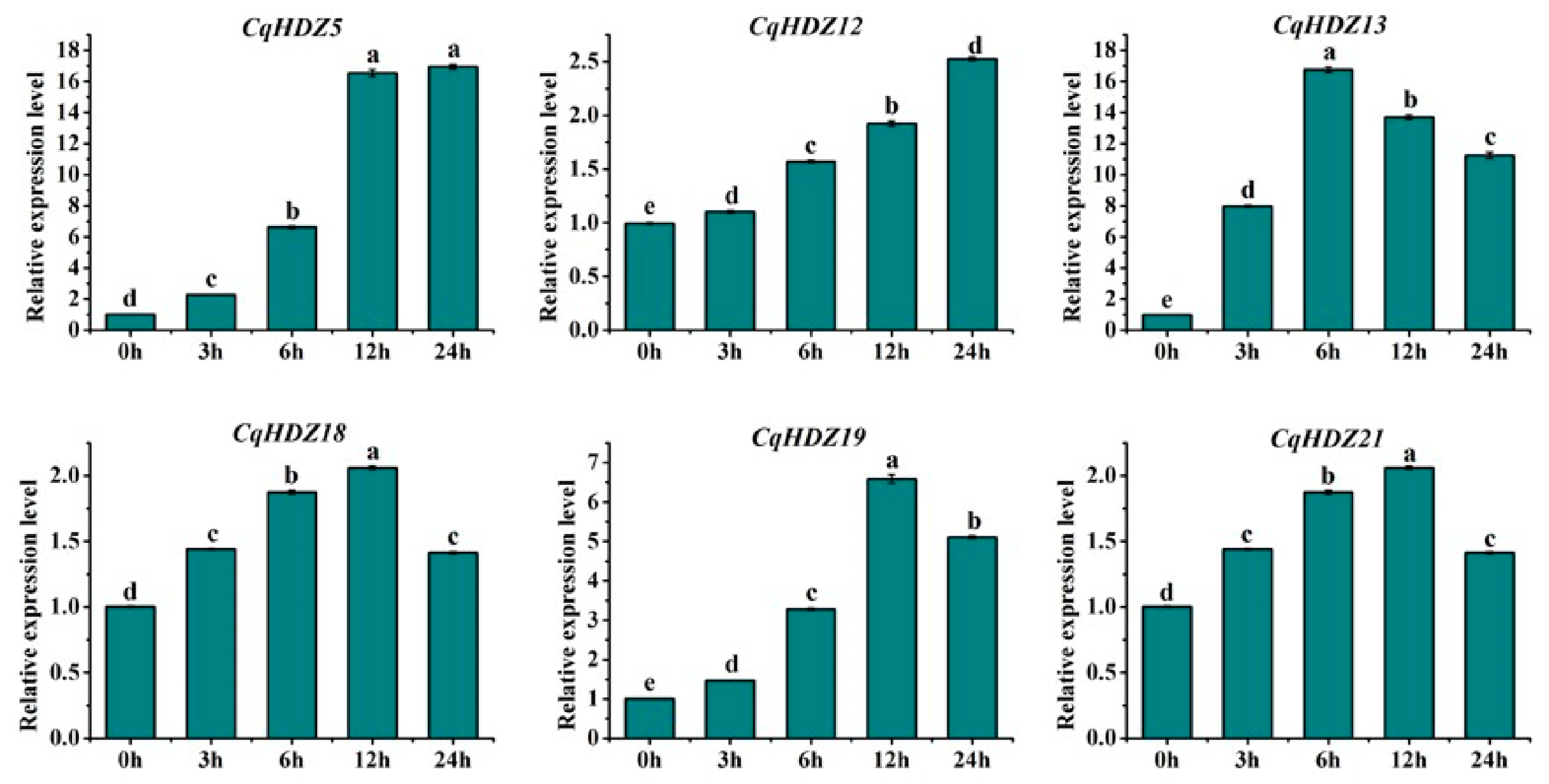
Combined with the transcriptome data from our previous research [34], the expression levels of CqHD-Zip genes treated with 300 mM NaCl at different time points were plotted into the heatmap as shown in Figure 5. There were certain differences in the expression patterns of CqHD-Zip family genes under salt stress. Among them, the expression levels of 7 genes, including CqHDZ1, CqHDZ6, CqHDZ10, CqHDZ23, CqHDZ30, CqHDZ36, and CqHDZ41, did not change, indicating that they may not participate in the response to salt stress, and the expression levels of the other 34 genes changed in varying degrees at different salt treatment time points. The expression of CqHDZ9 and CqHDZ22 was down-regulated at 0.5 h and 2 h, and up-regulated at 24 h, while the expression pattern of CqHDZ4 was opposite. With the extension of salt treatment time, the expression levels of CqHDZ25 and CqHDZ33 increased first, then decreased, and then increased. In particular, CqHDZ5, CqHDZ12, CqHDZ13, CqHDZ18, CqHDZ19 and CqHDZ21 were induced by salt stress, while the expression levels of CqHDZ8, CqHDZ17, CqHDZ28 and CqHDZ32 were inhibited by salt treatment. To further validate the reliability of the RNA-Seq results, six salt-induced CqHDZs identified above were selected for qRT-PCR in the current study, which illustrated the consistency (Figure 6). In addition, the specific primers for qRT-PCR were listed in Table S3.
Figure 5.
The expression heatmap of 41 CqHD-Zip genes at different time points under NaCl treatment as determined by RNA-Seq.
Figure 6.
Expression analysis of six CqHD-Zip genes by qRT-PCR. The X-axis represents different time points of salt stress treatment; the Y-axis represents the relative expression levels. The data were normalized to the UBA2B gene, and the vertical bars indicate the mean values of three biological replicates ± standard deviation. Columns with different letters represent significant differences at the p < 0.05 level (Duncan’s test).
3.6. Tissue-Specific Expression Pattern of CqHD-Zip Genes
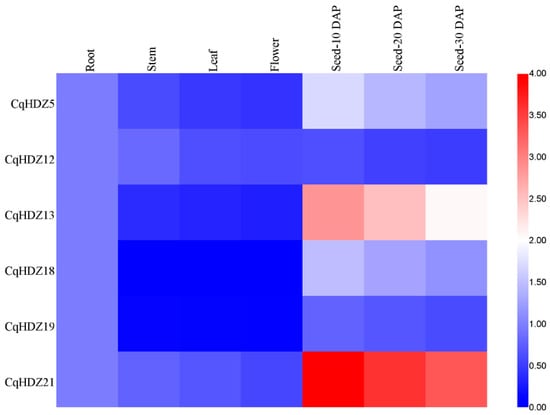
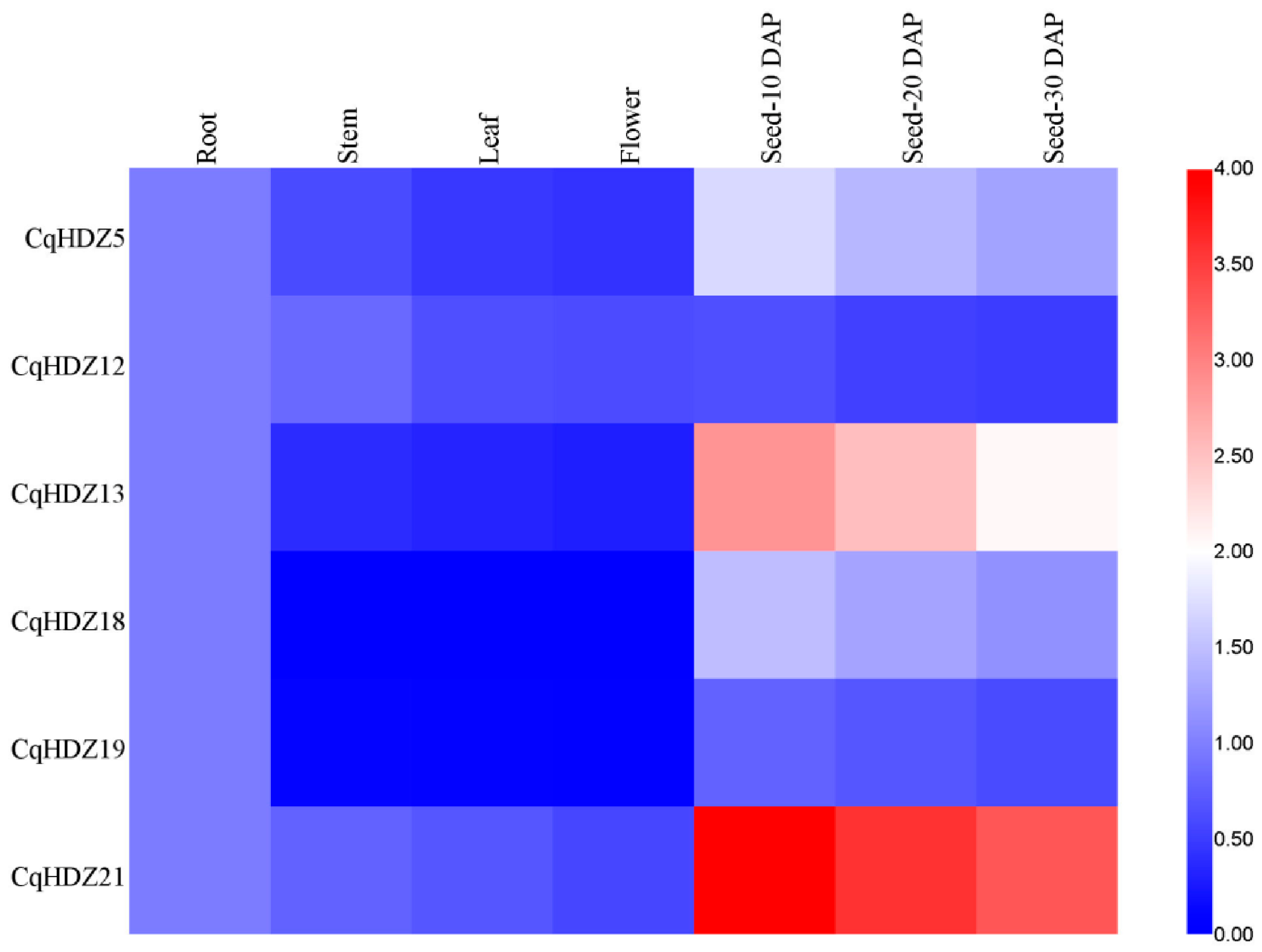
For more insights into the potential roles of CqHD-Zip genes in quinoa growth and development, the relative expression levels of the selected six salt-induced genes were then analyzed in different tissues and seed development stages by qRT-PCR. We found that the CqHD-Zip genes exhibited broad tissue expression, suggesting that they might play different regulatory roles. As shown in Figure 7, four genes (CqHDZ5, CqHDZ13, CqHDZ18, and CqHDZ21) showed the highest expression levels in seeds of all developmental stages, while the other two genes (CqHDZ12 and CqHDZ19) showed the highest expression levels in roots. Although CqHDZ18 and CqHDZ19 had higher relative expression in seeds and roots, they showed extremely low or no expression levels in stems, leaves, and flowers. These expression patterns imply that CqHD-Zip genes are potentially involved in seed and root development of quinoa, and functional validation is required to verify their biological functions.
Figure 7.
Expression profile of CqHD-Zip genes in different tissues and seed development stages. The X-axis represents samples, including root, stem, leaf, flower, seeds 10 days after pollination (seed-10 DAP), seed-20 DAP, and seed-30 DAP; the Y-axis represents CqHD-Zip gene names. Red indicates high relative gene expression, whereas blue indicates low relative gene expression.
3.7. Expression Analysis of CqHD-Zip Genes in Response to Other Abiotic Stresses
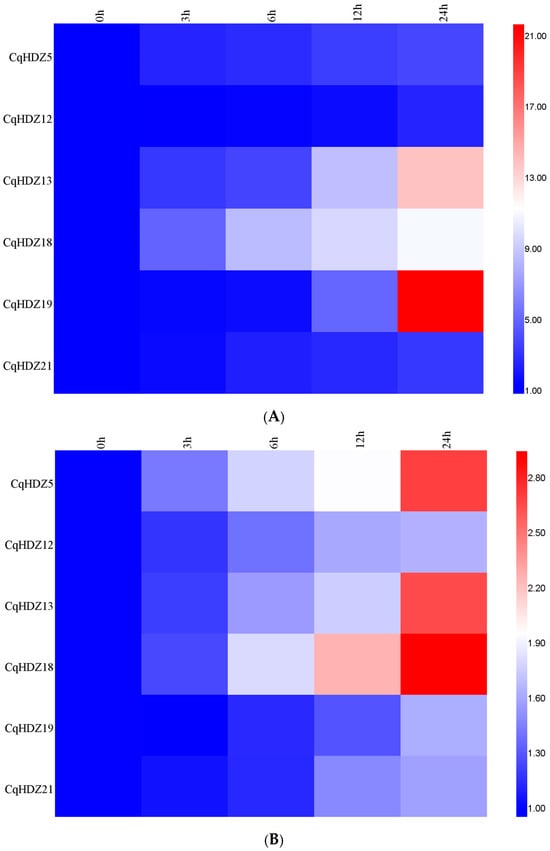
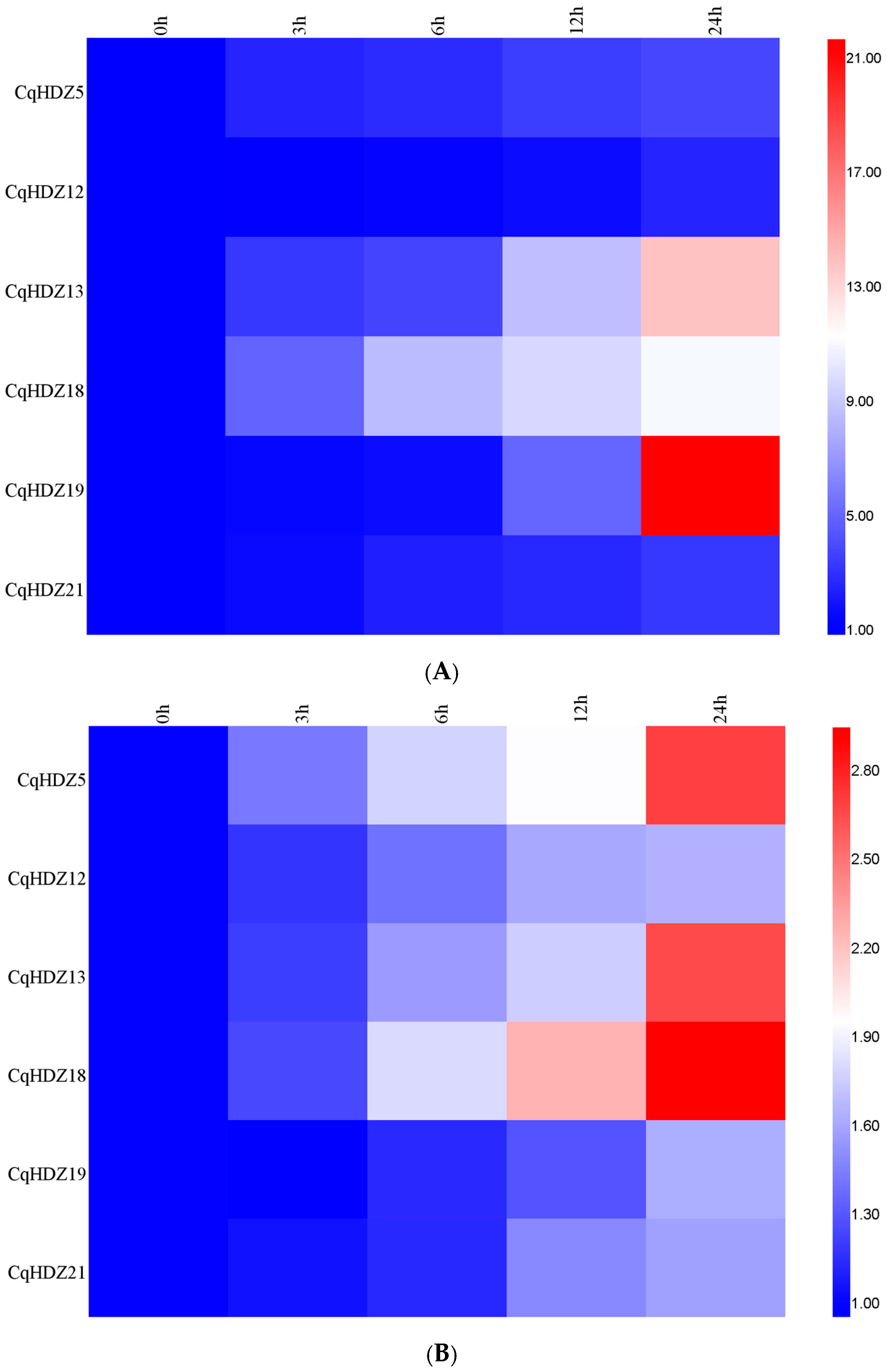
Previous studies have shown that HD-Zip family genes play a critical role in responding to abiotic stresses. To investigate the RNA transcript levels of HD-Zip genes in the roots of quinoa seedlings, the expression of the CqHD-Zip genes was detected under osmotic and cold conditions using qRT-PCR. After osmotic stress treatment, these six investigated genes were confirmed to show differential accumulation. Interestingly, all the genes were significantly induced, and the expression levels peaked at 24 h, up to 3.98-, 2.71-, 13.93-, 11.14-, 21.79-, and 3.41-fold, respectively (Figure 8A). Similarly, the six genes were up-regulated after cold stress treatment compared with the control (0 h sample), and the expression levels reached their highest at 24 h, showing an ultimate increase to 2.71-, 1.66-, 2.67-, 2.96-, 1.64-, and 1.59-fold, respectively (Figure 8B). Although the fold changes under cold stress are modest, these slight expression shifts could be functionally relevant. The results in this study demonstrated that CqHDZ5, CqHDZ12, CqHDZ13, CqHDZ18, CqHDZ19, and CqHDZ21 may play important roles in the response to osmotic and cold stress.
Figure 8.
Differential expression of the CqHD-Zip genes in response to osmotic stress (A) and cold stress (B). The relative expression levels were calculated by qRT-PCR (2−△△CT). The X-axis represents different time points of stress treatments; the Y-axis represents CqHD-Zip gene names. Red indicates high relative gene expression, whereas blue indicates low relative gene expression.
4. Discussion
Unfavorable environmental conditions, such as salinity, heat, cold, drought, oxidative stress, and toxic metals, have destructive effects on the growth and development of plant species, which could dramatically reduce crop yield and quality, resulting in significant economic losses [37]. It is estimated that approximately 20% and 22% of the world’s arable land is affected by drought and salinization, reducing crop yields in affected areas by more than 50% [38,39]. To better adapt to adverse circumstances, plants have evolved complicated regulatory pathways to deal with various stimuli, including stress sensing, signal transduction, and inducing the expression of stress-responsive genes, ultimately manifested at the cellular and physiological levels. With the completion of plant genome sequencing and the publication of whole-genome database, more and more stress-responsive genes have been identified, among which identification and analysis of plant gene families is an effective means to mine key functional genes. As key molecular switches, transcription factors regulate physiological and biochemical processes by turning on or inhibiting many genes in response to changes in the external environment to maintain the normal growth and survival of plants [40,41]. Plant-specific HD-Zip transcription factors are considered essential for the regulation of plant development and response against various environmental stresses [6,7,21]. Quinoa is an important pseudocereal crop that can play a strategic role in the development of degraded land in arid areas and saline-alkali land in coastal areas due to its high nutritional value, genetic diversity, and high adaptability to stressful environments [42]. A previous genome-wide survey of the quinoa homeobox superfamily has identified HD-Zip candidates as part of this large transcription factor family [43]. However, a focused, refined inventory and systematic functional characterization of the quinoa HD-Zip family remain limited. In the present study, a comprehensive identification and analysis of CqHD-Zip genes from quinoa were conducted. A total of 41 members were identified, which is 7 more than the previous study [43]. There are 30 overlapping genes between the two studies. We newly identified 11 HD-Zip genes, and this difference is attributed to the 11 newly identified genes in our study after removing the inconsistent ones. The phylogenetic relationships, chromosomal distribution, gene structure, conserved motifs, and the expression profiles under various abiotic stresses and in different tissues of this gene family were also analyzed. The results provide valuable information for further study on the function of CqHD-Zip genes.
Here, a total of 41 HD-Zip genes were identified in the quinoa genome database through bioinformatics methods, named CqHDZ1 to CqHDZ41 based on their chromosomal location. The number of HD-Zip genes in quinoa is similar in pepper (40 members), more than in rice (31 members), but lower than in Arabidopsis (48 members) and corn (55 members) [15,44,45]. This might be due to sequence duplication events occurring during genomic evolution. The length range of the CqHD-Zip proteins was 182 to 848, the variation range of MW was 20.91 kDa to 92.30 kDa, and the pI range was 4.62 to 9.37. The results of subcellular localization prediction showed that most CqHD-Zip family members were localized in the nucleus, and some were distributed in the cytoplasm, which could act as transcription factors to regulate downstream target genes, consistent with previous studies [12,46]. Furthermore, CqHDZ3, CqHDZ31, and CqHDZ37 were chloroplast-localized transcription factors, indicating their potential functions in plant photosynthesis. Chromosome analysis showed that the 41 CqHD-Zip genes were randomly distributed on 16 chromosomes.
In order to explore the evolutionary relationship of HD-Zip proteins, we performed a phylogenetic analysis of HD-Zip homologs from quinoa and Arabidopsis. The CqHD-Zip family can be classified into four subfamilies: HD-Zip I, HD-Zip II, HD-Zip III, and HD-Zip IV, in agreement with the results from previous studies [8,47]. Multiple sequence alignments and phylogenetic trees showed the conservation and high homology of these genes. HD-Zip I subfamily in Arabidopsis has more diverse compositions than the other three subfamilies, as it may be evolutionarily more ancient, which allows more time for gene duplication and rearrangement [48,49]. In quinoa, HD-Zip I is also the most abundant subfamily with the largest number of members, which is in line with previous research. It is reported that HD-Zip III is the most conserved subfamily among various species [50]. Our phylogenetic results also support the high conservation of quinoa HD-Zip III proteins.
The structural characteristics provide additional information for phylogenetic analysis and play a vital role in the evolution of gene families [51,52], while the conserved motifs can reflect their specific biological functions [53]. In this study, the intron/exon structure and conserved motifs were also analyzed; we found that CqHDZs in the same subfamily of the phylogenetic tree are similar in gene structure and motif arrangement, indicating that the functions of CqHDZs in different subfamilies change gradually during evolution, thereby helping organisms adapt to external environmental variation. The results further confirmed the accuracy of subgroup classification of the phylogenetic tree. Some motifs appeared more frequently, such as motif 1, motif 2, and motif 3, revealing their importance to the function of CqHD-Zip proteins. The members in CqHD-Zip I and CqHD-Zip II have relatively fewer introns and a different motif composition than in CqHD-Zip III and CqHD-Zip IV subfamilies. Furthermore, CqHD-Zip I proteins have high homology with CqHD-Zip II. Previous studies have noted a potential association between intron number and environmental responsiveness of plant genes [54]. Combined with the intron characteristics observed here, CqHD-Zip I and CqHD-Zip II members may participate in the response to biotic and abiotic stresses.
A vast number of studies found that HD-Zip I proteins played an extremely important role in the response to various abiotic stresses in plants, followed by fewer HD-Zip II subfamily proteins [55,56,57]. Generally, the expression analysis of genes is essential for providing clues for functional prediction [58]. Based on our transcriptomic data, obvious differences existed in the expression of different CqHDZs under salt stress. 7 genes were found not to participate in the salt stress response, while the other 34 genes were differentially expressed during salt stress. Among which, the expression levels of some CqHDZs changed irregularly at different stress time points; they might be up-regulated at one point and down-regulated at another. In addition, CqHDZ5, CqHDZ12, CqHDZ13, CqHDZ18, CqHDZ19, and CqHDZ21 showed continuous upregulation under salt treatment, implying their potential functions as salt stress-responsive regulators. To confirm the reliability of our RNA-Seq data, qRT-PCR was performed on the six genes, and the results were highly consistent. Interestingly, CqHDZ5, CqHDZ13, CqHDZ18, and CqHDZ19 belonged to the HD-Zip I subfamily, and CqHDZ12 and CqHDZ21 belonged to the HD-Zip II subfamily, in accordance with previous results. Then we analyzed the expression patterns of these six genes in different quinoa tissues and under osmotic stress and low-temperature stress. They exhibited tissue- and organ-specific expression profiles, most of which were highly expressed in seeds and roots. The qRT-PCR results showed that all the genes were significantly up-regulated in response to osmotic and cold treatments, and the variation trend of their transcript levels was similar in the two different treatments. This finding indicates the potential function of these genes in osmotic stress and low-temperature stress response in quinoa.
This study characterized the expression patterns of CqHDZ genes based on short-read RNA-seq data. It should be noted that quinoa is an allotetraploid species, and many CqHDZ genes exist as highly similar homeologous copies. Short sequencing reads derived from conserved regions shared by homeologs tend to map to multiple genomic loci, which limits the ability of short-read data to accurately resolve homeolog-specific expression. Therefore, the expression results presented here cannot completely distinguish transcriptional signals from individual homeologs. To reliably assign transcripts to specific homeologs, verify gene models, and identify alternative splicing isoforms, full-length transcript sequencing [59,60], ideally integrated with short-read quantification, will be required in future investigations.
Collectively, CqHD-Zip is a multifunctional gene family: CqHDZ5, CqHDZ12, CqHDZ13, CqHDZ18, CqHDZ19, and CqHDZ21 were highly expressed in quinoa seeds and roots, and might play important roles in the response to abiotic stresses such as salt, osmosis, and cold. Our findings would not only lay a foundation for further understanding the regulatory mechanisms of CqHD-Zip proteins, but also provide a new view for the genetic improvement of resistance in quinoa.
5. Conclusions
In this study, a total of 41 HD-Zip transcription factors were identified in the quinoa genome, which were subsequently divided into subfamilies I, II, III, and IV. The physicochemical properties, chromosomal locations, exon-intron structures, conserved motifs, phylogenetic relationships, and expression were comprehensively analyzed. These findings provide a strong foundation for further studies of the role of HD-Zip genes in abiotic stress responses and genetic improvement of quinoa.
Supplementary Materials
The following supporting information can be downloaded at: https://www.mdpi.com/article/10.3390/biology15212012/s1, Table S1: Conserved domains of CqHD-Zips in quinoa; Table S2: Multiple sequence alignment of 41 CqHD-Zip proteins; Table S3: Primer sequences for qRT-PCR.
Author Contributions
Conceptualization, P.S. and M.G.; software, P.S.; formal analysis, P.S., R.J. and D.W.; resources, P.S., Z.J. and B.L.; data curation, P.S., R.J. and D.W.; writing—original draft preparation, P.S.; writing—review and editing, P.S. and M.G. All authors have read and agreed to the published version of the manuscript.
Funding
This research was funded by Jiangsu Agricultural Science and Technology Innovation Fund (CX(22)2013).
Data Availability Statement
The original contributions presented in this study are included in the article. Further inquiries can be directed to the corresponding authors.
Conflicts of Interest
The authors declare no conflicts of interest.
References
- Chinnusamy, V.; Schumaker, K.; Zhu, J.K. Molecular genetic perspectives on cross-talk and specificity in abiotic stress signalling in plants. J. Exp. Bot. 2004, 55, 225–236. [Google Scholar] [CrossRef] [Scilit] [PubMed]
- Zhang, Y.; Xu, J.; Li, R.; Ge, Y.; Li, Y.; Li, R. Plants’ response to abiotic stress: Mechanisms and strategies. Int. J. Mol. Sci. 2023, 24, 10915. [Google Scholar] [CrossRef] [Scilit] [PubMed]
- Zhang, H.; Liu, S.; Ren, T.; Niu, M.; Liu, X.; Liu, C.; Wang, H.; Yin, W.; Xia, X. Crucial abiotic stress regulatory network of NF-Y transcription factor in plants. Int. J. Mol. Sci. 2023, 24, 4426. [Google Scholar] [CrossRef] [Scilit] [PubMed]
- Liu, W.; Stewart, C.N. Plant synthetic promoters and transcription factors. Curr. Opin. Biotechnol. 2016, 37, 36–44. [Google Scholar] [CrossRef] [Scilit] [PubMed]
- Tian, F.; Yang, D.C.; Meng, Y.Q.; Jin, J.; Gao, G. PlantRegMap: Charting functional regulatory maps in plants. Nucleic Acids Res. 2020, 48, D1104–D1113. [Google Scholar] [CrossRef] [Scilit] [PubMed]
- Ariel, F.D.; Manavella, P.A.; Dezar, C.A.; Chan, R.L. The true story of the HD-zip family. Trends Plant Sci. 2007, 12, 419–426. [Google Scholar] [CrossRef] [Scilit] [PubMed]
- Niu, Y.; Qi, Y.; Wang, L.; Li, W.; Dang, Z.; Xie, Y.; Zhao, W.; Wang, G.; Hu, Z.; Lu, N.; et al. Genome-wide identification and expression profiling of HD-Zip family genes in Flax (Linum usitatissimum L.). Curr. Issues Mol. Biol. 2026, 48, 402. [Google Scholar] [CrossRef] [Scilit] [PubMed]
- Elhiti, M.; Stasolla, C. Structure and function of homodomain-leucine zipper (HD-Zip) proteins. Plant Signal. Behav. 2009, 4, 86–88. [Google Scholar] [CrossRef] [Scilit] [PubMed]
- Mukherjee, K.; Brocchieri, L.; Burglin, T.R. A comprehensive classification and evolutionary analysis of plant homeobox genes. Mol. Bol. Evol. 2009, 26, 2775–2794. [Google Scholar] [CrossRef] [Scilit] [PubMed]
- Sharif, R.; Raza, A.; Chen, P.; Li, Y.; El-Ballat, E.M.; Rauf, A.; Hano, C.; El-Esawi, M.A. HD-ZIP gene family: Potential roles in improving plant growth and regulating stress-responsive mechanisms in plants. Genes 2021, 12, 1256. [Google Scholar] [CrossRef] [Scilit] [PubMed]
- Schrick, K.; Nguyen, D.; Karlowski, W.M.; Mayer, K.F. START lipid/sterol-binding domains are amplified in plants and are predominantly associated with homeodomain transcription factors. Genome Biol. 2004, 5, R41. [Google Scholar] [CrossRef] [Scilit] [PubMed]
- Li, Y.; Yang, Z.; Zhang, Y.; Guo, J.; Liu, L.; Wang, C.; Wang, B.; Han, G. The roles of HD-ZIP proteins in plant abiotic stress tolerance. Front. Plant Sci. 2022, 13, 1027071. [Google Scholar] [CrossRef] [Scilit] [PubMed]
- Zhu, Y.; Song, D.; Xu, P.; Sun, J.; Li, L. Identification of manganese-toxicity-responsive genes in roots. Plant Biotechnol. J. 2018, 16, 808–817. [Google Scholar] [PubMed]
- Vollbrecht, E.; Veit, B.; Sinha, N.; Hake, S. The developmental gene Knotted-1 is a member of a maize homeobox gene family. Nature 1991, 350, 241–243. [Google Scholar] [CrossRef] [Scilit] [PubMed]
- Zhang, Z.; Zhu, R.; Ji, X.; Li, H.J.; Lv, H.; Zhang, H.Y. Genome-wide characterization and expression analysis of the HD-ZIP gene family in response to salt stress in pepper. Int. J. Genom. 2021, 2021, 8105124. [Google Scholar] [CrossRef] [Scilit] [PubMed]
- Liu, K.; Han, X.; Liang, Z.; Yan, J.; Cong, P.; Zhang, C. Genome-wide identification, classification, and expression analysis of the HD-Zip transcription factor family in apple (Malus domestica Borkh.). Int. J. Mol. Sci. 2022, 23, 2632. [Google Scholar] [CrossRef] [Scilit] [PubMed]
- Chai, W.; Si, W.; Ji, W.; Qin, Q.; Zhao, M.; Jiang, H. Genome-wide investigation and expression profiling of HD-Zip transcription factors in foxtail millet (Setaria italica L.). BioMed Res. Int. 2018, 2018, 8457614. [Google Scholar] [CrossRef] [Scilit] [PubMed]
- Yan, X.; Yue, Z.; Pan, X.; Si, F.; Li, J.; Chen, X.; Li, X.; Luan, F.; Yang, J.; Zhang, X.; et al. The HD-ZIP gene family in watermelon: Genome-wide identification and expression analysis under abiotic stresses. Genes 2022, 13, 2242. [Google Scholar] [CrossRef] [Scilit] [PubMed]
- Yue, H.; Shu, D.; Wang, M.; Xing, G.; Zhan, H.; Du, X.; Song, W.; Nie, X. Genome-wide identification and expression analysis of the HD-Zip gene family in wheat (Triticum aestivum L.). Genes 2018, 9, 70. [Google Scholar] [CrossRef] [Scilit] [PubMed]
- Xu, X.; Cheng, S. Genome-wide identification of the CmHDZ gene family in Chinese chestnut (Castanea mollissima) and analysis of their expression patterns under different types of abiotic stress. Front. Plant Sci. 2026, 17, 1778593. [Google Scholar] [CrossRef] [Scilit] [PubMed]
- Wang, Z.; Wu, X.; Zhang, B.; Xiao, Y.; Guo, J.; Liu, J.; Chen, Q.; Peng, F. Genome-wide identification, bioinformatics and expression analysis of HD-Zip gene family in peach. BMC Plant Biol. 2023, 23, 122. [Google Scholar] [CrossRef] [Scilit] [PubMed]
- Ré, D.A.; Capella, M.; Bonaventure, G.; Chan, R.L. Arabidopsis AtHB7 and AtHB12 evolved divergently to fine tune processes associated with growth and responses to water stress. BMC Plant Biol. 2014, 14, 150. [Google Scholar] [CrossRef] [Scilit] [PubMed]
- Liu, X.; Cheng, L.; Li, R.; Cai, Y.; Wang, X.; Fu, X.; Dong, X.; Qi, M.; Jiang, C.Z.; Xu, T.; et al. The HD-Zip transcription factor SlHB15A regulates abscission by modulating jasmonoyl-isoleucine biosynthesis. Plant Physiol. 2022, 189, 2396–2412. [Google Scholar] [CrossRef] [Scilit] [PubMed]
- Wu, M.; Bian, X.; Huang, B.; Du, Y.; Hu, S.; Wang, Y.; Shen, J.; Wu, S. HD-Zip proteins modify floral structures for self-pollination in tomato. Science 2024, 384, 124–130. [Google Scholar] [CrossRef] [Scilit] [PubMed]
- Cabello, J.V.; Arce, A.L.; Chan, R.L. The homologous HD-Zip I transcription factors HaHB1 and AtHB13 confer cold tolerance via the induction of pathogenesis-related and glucanase proteins. Plant J. 2012, 69, 141–153. [Google Scholar] [CrossRef] [Scilit] [PubMed]
- Tang, Y.; Peng, J.; Lin, J.; Zhang, M.; Tian, Y.; Shang, Y.; Chen, S.; Bao, X.; Wang, Q. A HD-Zip I transcription factor from physic nut, JcHDZ21, confers sensitive to salinity in transgenic Arabidopsis. Front Plant Sci. 2023, 14, 1097265. [Google Scholar] [CrossRef] [Scilit] [PubMed]
- Cai, Y.; Bartholomew, E.S.; Dong, M.; Zhai, X.; Yin, S.; Zhang, Y.; Feng, Z.; Wu, L.; Liu, W.; Shan, N.; et al. The HD-ZIP IV transcription factor GL2-LIKE regulates male flowering time and fertility in cucumber. J. Exp. Bot. 2020, 71, 5425–5437. [Google Scholar] [CrossRef] [Scilit] [PubMed]
- Khosla, A.; Paper, J.M.; Boehler, A.P.; Bradley, A.M.; Neumann, T.R.; Schrick, K. HD-Zip proteins GL2 and HDG11 have redundant functions in Arabidopsis trichomes, and GL2 activates a positive feedback loop via MYB23. Plant Cell 2014, 26, 2184–2200. [Google Scholar] [CrossRef] [Scilit] [PubMed]
- Yang, Y.; Luang, S.; Harris, J.; Riboni, M.; Li, Y.; Bazanova, N.; Hrmova, M.; Haefele, S.; Kovalchuk, N.; Lopato, S. Overexpression of the class I homeodomain transcription factor TaHDZipI-5 increases drought and frost tolerance in transgenic wheat. Plant Biotechnol. J. 2018, 16, 1227–1240. [Google Scholar] [CrossRef] [Scilit] [PubMed]
- Zhao, Y.; Ma, Q.; Jin, X.; Peng, X.; Liu, J.; Deng, L.; Yan, H.; Sheng, L.; Jiang, H.; Cheng, B. A novel maize homeodomain-leucine zipper (HD-Zip) I gene, Zmhdz10, positively regulates drought and salt tolerance in both rice and Arabidopsis. Plant Cell Physiol. 2014, 55, 1142–1156. [Google Scholar] [CrossRef] [Scilit] [PubMed]
- Ren, A.; Wen, T.; Xu, X.; Wu, J.; Zhao, G. Cotton HD-Zip I transcription factor GhHB4-like regulates the plant response to salt stress. Int. J. Biol. Macromol. 2024, 278, 134857. [Google Scholar] [CrossRef] [Scilit] [PubMed]
- Anuradha; Kumari, M.; Zinta, G.; Chauhan, R.; Kumar, A.; Singh, S.; Singh, S. Genetic resources and breeding approaches for improvement of amaranth (Amaranthus spp.) and quinoa (Chenopodium quinoa). Front. Nutr. 2023, 10, 1129723. [Google Scholar] [CrossRef] [Scilit] [PubMed]
- Mu, H.; Xue, S.; Sun, Q.; Shi, J.; Zhang, D.; Wang, D.; Wei, J. Research progress of quinoa seeds (Chenopodium quinoa Wild.): Nutritional components, technological treatment, and application. Foods 2023, 12, 2087. [Google Scholar] [CrossRef] [Scilit] [PubMed]
- Shi, P.; Gu, M. Transcriptome analysis and differential gene expression profiling of two contrasting quinoa genotypes in response to salt stress. BMC Plant Biol. 2020, 20, 568. [Google Scholar] [CrossRef] [Scilit] [PubMed]
- Deng, W.; Wang, Y.; Liu, Z.; Cheng, H.; Xue, Y. HemI: A toolkit for illustrating heatmaps. PLoS ONE 2014, 9, e111988. [Google Scholar] [CrossRef] [Scilit] [PubMed]
- Livak, K.J.; Schmittgen, T.D. Analysis of relative gene expression data using real-time quantitative PCR and the 2−∆∆CT method. Methods 2001, 25, 402–408. [Google Scholar] [CrossRef] [Scilit] [PubMed]
- Patel, K.G.; Thankappan, R.; Mishra, G.P.; Mandaliya, V.B.; Kumar, A.; Dobaria, J.R. Transgenic peanut (Arachis hypogaea L.) overexpressing mt1D gene showed improved photosynthetic, physio-biochemical, and yield-parameters under soil-moisture deficit stress in lysimeter system. Front. Plant Sci. 2017, 8, 1881. [Google Scholar] [CrossRef] [Scilit] [PubMed]
- Rozema, J.; Flowers, T. Crops for a salinized world. Science 2008, 322, 1478–1480. [Google Scholar] [CrossRef] [Scilit] [PubMed]
- Agarwal, P.K.; Gupta, K.; Lopato, S.; Agarwal, P. Dehydration responsive element binding transcription factors and their applications for the engineering of stress tolerance. J. Exp. Bot. 2017, 68, 2135–2148. [Google Scholar] [CrossRef] [Scilit] [PubMed]
- Agarwal, P.K.; Agarwal, P.; Reddy, M.K.; Sopory, S.K. Role of DREB transcription factors in abiotic and biotic stress tolerance in plants. Plant Cell Rep. 2006, 25, 1263–1274. [Google Scholar] [CrossRef] [Scilit] [PubMed]
- Bhatnagar-Mathur, P.; Vadez, V.; Sharma, K.K. Transgenic approaches for abiotic stress tolerance in plants: Retrospect and prospects. Plant Cell Rep. 2008, 27, 411–424. [Google Scholar] [CrossRef] [Scilit] [PubMed]
- Oustani, M.; Mehda, S.; Halilat, M.T.; Chenchouni, H. Yield, growth development and grain characteristics of seven Quinoa (Chenopodium quinoa Willd.) genotypes grown in open-field production systems under hot-arid climatic conditions. Sci. Rep. 2023, 13, 1991. [Google Scholar] [CrossRef] [Scilit] [PubMed]
- Jiang, G.; Li, L.; Bai, Y.; Wang, X.; Zhang, L.; Zhang, P.; Liu, J.; Li, H.; Huang, L.; Zhang, S.; et al. Identification of homeobox gene family in Chenopodium quinoa and expression patterns in response to flooding stress during the filling stage. Genet. Resour. Crop Evol. 2025, 72, 9517–9535. [Google Scholar] [CrossRef] [Scilit]
- Agalou, A.; Purwantomo, S.; Overnäs, E.; Johannesson, H.; Zhu, X.; Estiati, A.; de Kam, R.J.; Engström, P.; Slamet-Loedin, I.H.; Zhu, Z.; et al. A genome-wide survey of HD-Zip genes in rice and analysis of drought-responsive family members. Plant Mol. Biol. 2008, 66, 87–103. [Google Scholar] [CrossRef] [Scilit] [PubMed]
- Zhao, Y.; Zhou, Y.; Jiang, H.; Li, X.; Gan, D.; Peng, X.; Zhu, S.; Cheng, B. Systematic analysis of sequences and expression patterns of drought-responsive members of the HD-Zip gene family in maize. PLoS ONE 2011, 6, e28488. [Google Scholar] [CrossRef] [Scilit] [PubMed]
- Zou, L.; Sun, X.; Zhang, Z.; Liu, P.; Wu, J.; Tian, C.; Qiu, J.; Lu, T. Leaf rolling controlled by the homeodomain leucine zipper class IV gene Roc5 in rice. Plant Physiol. 2011, 156, 1589–1602. [Google Scholar] [CrossRef] [Scilit] [PubMed]
- Li, Y.; Xiong, H.; Cuo, D.; Wu, X.; Duan, R. Genome-wide characterization and expression profiling of the relation of the HD-Zip gene family to abiotic stress in barley (Hordeum vulgare L.). Plant Physiol. Biochem. 2019, 141, 250–258. [Google Scholar] [CrossRef] [Scilit] [PubMed]
- Henriksson, E.; Olsson, A.S.B.; Johannesson, H.; Johansson, H.; Hanson, J.; Engström, P.; Söderman, E. Homeodomain leucine zipper class I genes in Arabidopsis. Expression patterns and phylogenetic relationships. Plant Physiol. 2005, 139, 509–518. [Google Scholar] [CrossRef] [Scilit] [PubMed]
- Capella, M.; Ribone, P.A.; Arce, A.L.; Chan, R.L. Arabidopsis thaliana HomeoBox 1 (AtHB1), a Homedomain-Leucine Zipper I (HD-Zip I) transcription factor, is regulated by Phytochrome-Interacting Factor 1 to promote hypocotyl elongation. New Phytol. 2015, 207, 669–682. [Google Scholar] [CrossRef] [Scilit] [PubMed]
- Hu, R.; Chi, X.; Chai, G.; Kong, Y.; He, G.; Wang, X.; Shi, D.; Zhang, D.; Zhou, G. Genome-wide identification, evolutionary expansion, and expression profile of homeodomain-leucine zipper gene family in poplar (Populus trichocarpa). PLoS ONE 2012, 7, e31149. [Google Scholar] [CrossRef] [Scilit] [PubMed]
- Moore, R.C.; Purugganan, M.D. The early stages of duplicate gene evolution. Proc. Natl. Acad. Sci. USA 2003, 100, 15682–15687. [Google Scholar] [CrossRef] [Scilit] [PubMed]
- Xu, G.; Guo, C.; Shan, H.; Kong, H. Divergence of duplicate genes in exon-intron structure. Proc. Natl. Acad. Sci. USA 2012, 109, 1187–1192. [Google Scholar] [CrossRef] [Scilit] [PubMed]
- Lai, E.C.; Burks, C.; Posakony, J.W. The K box, a conserved 3’ UTR sequence motif, negatively regulates accumulation of enhancer of split complex transcripts. Development 1998, 125, 4077–4088. [Google Scholar] [CrossRef] [Scilit] [PubMed]
- Jin, Z.; Chandrasekaran, U.; Liu, A. Genome-wide analysis of the Dof transcription factors in castor bean (Ricinus communis L.). Genes Genom. 2014, 36, 527–537. [Google Scholar] [CrossRef] [Scilit]
- Himmelbach, A.; Hoffmann, T.; Leube, M.; Höhener, B.; Grill, E. Homeodomain protein ATHB6 is a target of the protein phosphatase ABI1 and regulates hormone responses in Arabidopsis. EMBO J. 2002, 21, 3029–3038. [Google Scholar] [CrossRef] [Scilit] [PubMed]
- Liu, T.; Longhurst, A.D.; Talavera-Rauh, F.; Hokin, S.A.; Barton, M.K. The Arabidopsis transcription factor ABIG1 relays ABA signaled growth inhibition and drought induced senescence. eLife 2016, 5, e13768. [Google Scholar] [CrossRef] [Scilit] [PubMed]
- Li, W.; Dong, J.; Cao, M.; Gao, X.; Wang, D.; Liu, B.; Chen, Q. Genome-wide identification and characterization of HD-ZIP genes in potato. Gene 2019, 697, 103–117. [Google Scholar] [CrossRef] [Scilit] [PubMed]
- Shi, P.; Jiang, R.; Li, B.; Wang, D.; Fang, D.; Yin, M.; Yin, M.; Gu, M. Genome-wide analysis and expression profiles of the VOZ gene family in quinoa (Chenopodium quinoa). Genes 2022, 13, 1695. [Google Scholar] [CrossRef] [Scilit] [PubMed]
- Deem, K.D.; Brisson, J.A. New annotations for three pea aphid genome assemblies allow comparative analyses of duplication and gene family evolution. G3 2026, 16, jkag136. [Google Scholar] [PubMed]
- Zhang, T.; Li, J.; Tang, C.; Wu, Y.; Wu, H.; Zhu, X.; Luo, Z.; Qin, H.; Ding, L.; Zeng, Y.; et al. Nanopore direct RNA sequencing and the epitranscriptome: Advances in mapping native RNA landscapes. iMeta 2026, 5, e70136. [Google Scholar] [CrossRef] [Scilit] [PubMed]

Disclaimer/Publisher’s Note: The statements, opinions and data contained in all publications are solely those of the individual author(s) and contributor(s) and not of MDPI and/or the editor(s). MDPI and/or the editor(s) disclaim responsibility for any injury to people or property resulting from any ideas, methods, instructions or products referred to in the content. |
© 2026 by the authors. Licensee MDPI, Basel, Switzerland. This article is an open access article distributed under the terms and conditions of the Creative Commons Attribution (CC BY) license.