


Simple Summary
The samar tree (Vachellia tortilis subsp. tortilis) is a tree within the Fabaceae family and is widely distributed in the Middle East and Africa. To better understand the genetic diversity within the genus Vachellia, we mapped the complete chloroplast DNA sequence of the samar tree. Chloroplasts are tiny parts of plant cells that turn sunlight into food. The total number of genes within the samar tree is 132, consisting of about 164,956 genetic letters. By comparing this newly mapped chloroplast DNA with that of other Vachellia species, we were able to build a detailed phylogenetic tree. This type of data can help us figure out how different species within the genus Vachellia are related to one another and how they evolved over time. Ultimately, decoding this genetic information gives scientists valuable tools for future research, including biodiversity conservation strategies, agricultural crop improvement, the discovery of new plant-based medicines, and simply understanding the natural history of these plants.
Abstract
The Vachellia tortilis subsp. tortilis is a dryland tree included in the Fabaceae family. The genus Vachellia includes 164 species, 38 subspecies, and 25 varieties. The taxonomic placement of Vachellia has historically been unstable; the genus was only recently segregated from Acacia. In this study, we sequenced and characterized the chloroplast genome of V. tortilis subsp. tortilis and compared it with those of related species. The total chloroplast genome length of V. tortilis subsp. tortilis was 164,956 bp, and it contained 132 genes: 87 protein-coding genes, eight ribosomal RNA genes, and 37 transfer RNA genes. Simple repeat analysis showed that the chloroplast genome of V. tortilis subsp. tortilis contained 273 repeats. Codon usage bias analysis showed that the chloroplast genome of V. tortilis subsp. tortilis encoded 24,633 codons. The phylogenetic analysis revealed two distinct clades in the genus Vachellia: the first comprises V. tortilis subsp. tortilis and Vachellia tortilis subsp. raddiana, while the second includes Vachellia flava, Vachellia seyal, and Vachellia nilotica. This study improves knowledge of evolutionary relationships in the genus Vachellia and provides valuable genetic resources.
1. Introduction
Vachellia tortilis, previously referred to as Acacia tortilis, is a dryland tree in the Fabaceae family. The species is recognized as a keystone species in the dryland ecosystems of the Middle East and Africa [1]. It used to be included in the genus Acacia, but it is now classified under the genus Vachellia in the Mimosoideae subfamily in the Fabaceae family [2]. The genus Vachellia was found to be nested in the Mimoseae tribe (in the Parkia clade) and includes 164 species, 38 subspecies, and 25 varieties [3,4,5]. Moreover, V. tortilis is divided into five subspecies: tortilis, heteracantha, spirocarpa, raddiana, and campoptila [5].
Morphologically, Vachellia tortilis subsp. tortilis is a tree (commonly known as the samar tree) that grows from 3 m to 7 m. The leaves are dark green, alternate, and bipinnate with 4–6 pairs, each having 6–10 pairs of leaflets per pinna. The thorns bear pairs of short hooked spines alongside long, straight, and whitish spines. The flowers are highly aromatic and white to yellowish-white and appear round in tight clusters. Usually hairless, the pods are spirally contorted, 5–15 cm long and green to yellowish-brown.
Biodiversity in dryland ecosystems continues to undergo unprecedented degradation and destruction due to the overexploitation of its vegetation [6]. In the face of these threats to biodiversity, V. tortilis is one of the few wild Acacia that survives in arid lands, which makes it an essential species for conservation [7]. As V. tortilis is recognized as one of the most keystone species in dryland ecosystems, there is a need to understand genetic structure at the species level and genetic variation at the subspecies level to assist its conservation.
Genome sequences are relatively stable and offer a data reference and a strong theoretical basis for solving classification problems [8]. In angiosperms, chloroplast (cp) genomes are often maternally inherited, displaying exceptional conservation with little to no intraspecific variation, recombination events, and a relatively small genome size, thus making them an effective method for species identification, phylogenetic analyses, and comparative analysis [9,10,11]. In recent years, cp genome data have played a prominent role in the resolution of complex phylogenetic relationships at various taxonomical levels and can be used as a plant barcode, overcoming traditional DNA barcodes (rbcL, matK, ITS) [12,13]. Moreover, a significant gap exists in the rate of evolutionary progression between gene-coding and non-coding regions in cp genomes, which is ideal for investigating several taxonomic levels, such as the intraspecific level [14,15,16].
The evolutionary relationships of the genus Vachellia have attracted much attention, but only a limited number of studies have been conducted using the cp genome [17,18]. More characterization and comparative analysis studies are still needed to clarify the relationships between species and subspecies in this genus. Therefore, we initially performed the sequencing, assembly, and annotation of the cp genome of V. tortilis subsp. tortilis, followed by the construction of a phylogenetic tree. A comparative analysis was also performed in this study. This comprehensive approach aimed to acquire a deeper understanding of the cp genome features of V. tortilis subsp. tortilis at the intraspecific level and its related species in the genus Vachellia.
2. Materials and Methods
2.1. Plant Material, DNA Extraction, and Sequencing
The plant material used in this study was fresh leaves collected from the Jabal Uhud/Medina region (24°30′48.0″ N 39°37′04.6″ E) on 18 April 2024 and preserved using silica gel. Only single individual was collected from mid-altitude and semi-arid habitats of Jabal Uhud, identified and verified using the morphological approaches (leaf, stem and seed characteristics) by Dr. Mohammad Alawfi, Department of Biology, King Khalid University, Abha, Saudi Arabia. A voucher specimen (Number: KAU-V24087) has been deposited at the King Abdulaziz University herbarium. DNA extraction, library construction, and genome sequencing were conducted by BGI Genomics Company (Hong Kong) using the following methods: Total DNA was extracted from 20 mg of silica-dried leaf material using A DNeasy Plant Mini Kit (QIAGEN, Hilden, Germany), DNA quality and concentration were evaluated by Qubit fluorometry and agarose gel electrophoresis, and the DNBseq platform was used for library construction and sequencing. A total number of 43,132,243 clean reads (>Q20) were obtained, and the raw dataset was filtered with SOAPnuke software v2.1.9 [19] to eliminate low-quality reads and adaptor sequences, resulting in 28 GB of high-quality, 150 bp paired-end reads.
2.2. Assembly and Annotation
Assembly was conducted using NOVOPlasty v4.3.3 [20] with kmer (K-mer = 33). The cp genome of V. tortilis subsp. raddiana (KY100265) was used as the reference. After assembly, its quality was assessed using QUAST v5.3.0 [21] and sequencing depth was calculated using Unipro UGENE v53.1 [22]. The sequence was annotated using the GeSeq tool [23]. The annotated genome was created using OGDRAW v1.3.1 [24] and deposited in the GenBank database under accession numbers: (PZ387862).
2.3. Repeat Sequence, Codon Preference and IR Boundary Regions Analyses
The simple sequence repeats (SSRs) were recognized using MISA software v2.1 [25], and the minimum thresholds were set at 8, 5, 4, 3, 3, and 3 for mon, di, tri, tetra, penta, and hexa, respectively. MEGA v.12.1 [26] was used to analyze the codon usage across the protein-coding sequences (CDSs) and excluding duplicated coding genes and stop codons. The IRscope online program was used to compare and visualize in detail the boundary regions of five Vachellia cp genomes [27].
2.4. Nucleotide Diversity (π) and Genome Sequence Divergence Analyses
Nucleotide diversity was analyzed using DNAsp v6.12.03 [28], with a step size of 100 bp and a window length of 600 bp. Five Vachellia cp genomes were compared using the online program mVISTA v2.0 [29], with the Shuffle-LAGAN model, using the Vachellia flava cp genome as a reference.
2.5. Phylogenetic Analysis
To provide insight into the phylogeny in the members of the genus Vachellia, we constructed phylogenetic trees using the complete cp genome sequences of five Vachellia species, namely V. tortilis subsp. tortilis (PZ387862), V. tortilis subsp. raddiana (KY100265), V. flava (NC_036734), Vachellia nilotica (NC_045514) and Vachellia seyal (NC_036735), and four outgroup taxa, namely Acacia crassicarpa (OK_480071), Mimosa bimucronata (OM_687265), Parkia timoriana (OK662459) and Senegalia senegal (MK645903) (Table 1). The sequences were aligned using MAFFT v.7.313 [30], and the phylogenetic tree was inferred using the maximum likelihood (ML) method. ML trees were constructed using IQ-TREE v.2.2.2.6 [31], with the TVM + F + I + G4 model and 10,000 ultrafast bootstrap replications.
Table 1.
GenBank accession numbers and taxonomic affiliation of the cp genomes used in the phylogenetic analysis of the genus Vachellia.
3. Results
3.1. Characteristics of the V. tortilis subsp. tortilis Chloroplast Genome
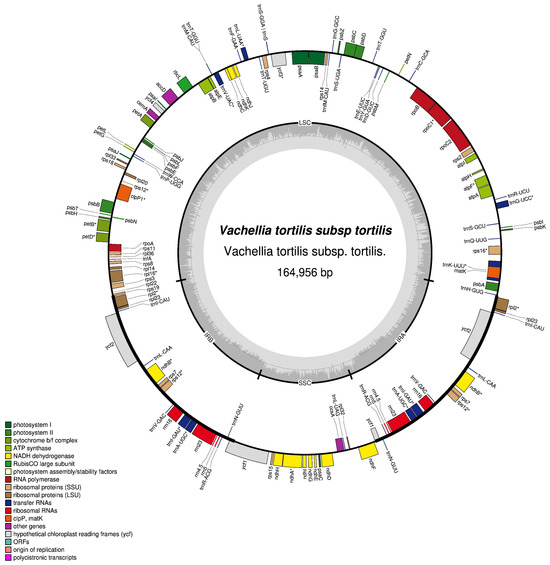
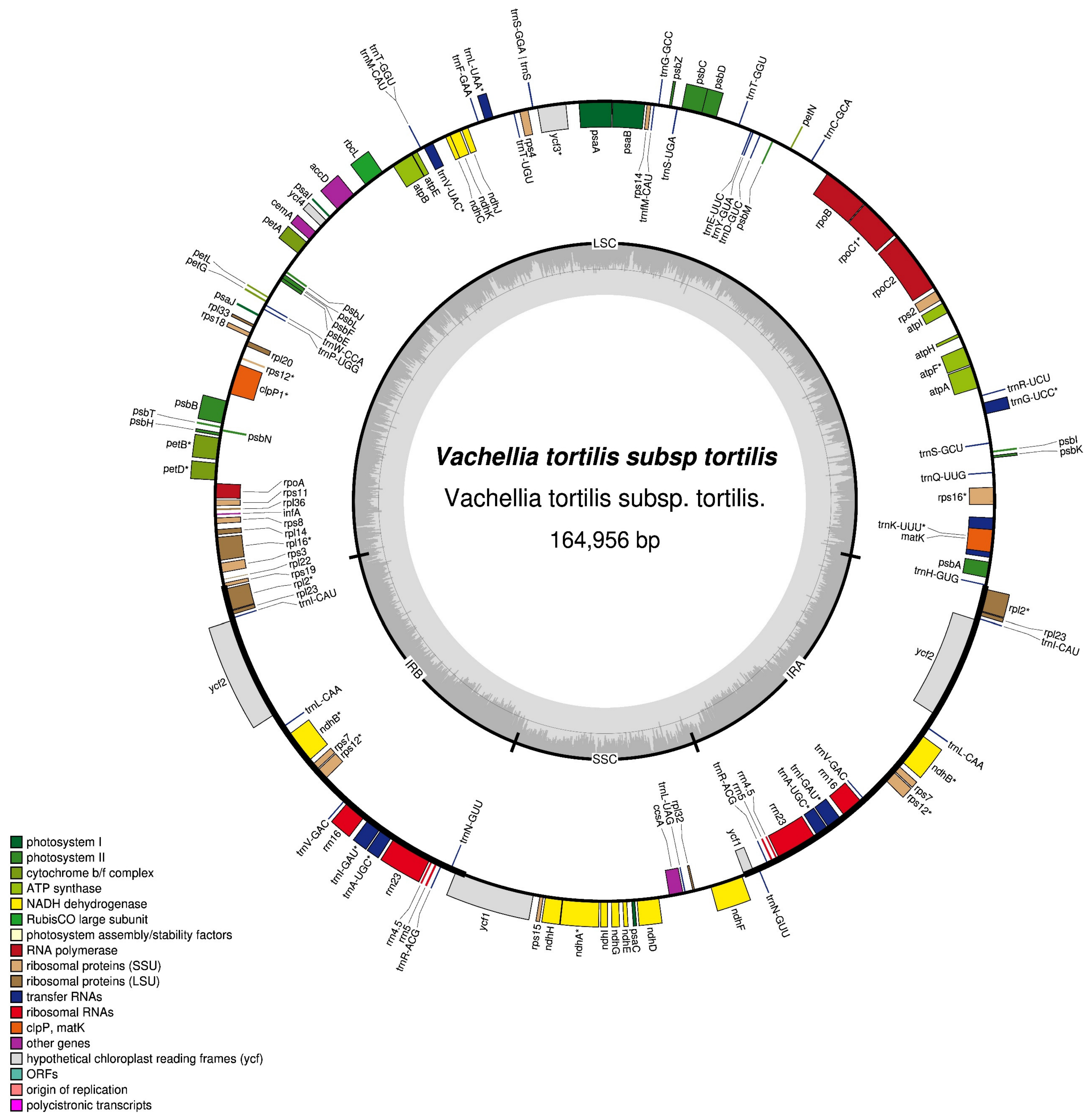
The cp genome of V. tortilis subsp. tortilis was 164,956 bp in size (Figure 1), with circular and quadripartite structures comprising a pair of inverted repeat (IR) regions (26,049 bp) each, a large single-copy (LSC) region (93,658 bp), and a small single-copy (SSC) region (19,200 bp). The total GC content in the V. tortilis subsp. tortilis cp genome was 35.38%. The GC contents of IR, LSC, and SSC were 42.67%, 32.5%, and 29.65%, respectively (Table 2). The average sequencing depth was 9798×, with a maximum depth of 26,356× and a minimum depth of 285×. The number of genes in the V. tortilis subsp. tortilis cp genome was 132 in total (113 unique genes), comprising 87 protein-coding genes, eight ribosomal RNA genes and 37 transfer RNA genes. Eighteen genes were identified as duplicated in two IR regions, comprising seven protein-coding genes (ndhB, rpl2, rpl23, rps7, rps12, ycf1, and ycf2), four rRNA genes (rrn4.5, rrn5, rrn16, and rrn23), and seven tRNA genes (trnA-UGC, trnI-CAU, trnI-GAU, trnL-CAA, trnN-GUU, trnR-ACG, and trnV-GAC). The rps12 gene appears in IRa and IRb regions, with its third copy found in the LSC region. The genes can be classified into four distinct categories based on function: self-replication genes, photosynthesis genes, other genes, and genes of unknown function (Table S1). The cp genome of V. tortilis subsp. tortilis comprises 18 introns in several CDSs and tRNA genes (Table S2). The ycf3 and clpP1 genes comprise more than one intron, while the trnK-UUU gene contains the largest intron, with a length of 2587 bp in size.
Figure 1.
The cp genome map of V. tortilis subsp. tortilis. The transcription of the genes located inside the circles is clockwise. Genes marked with an asterisk contain introns. The transcription of genes located outside of the circles occurs counterclockwise. Functional genes are shown by the colored bars.
Table 2.
Base composition and genome structural features of the cp genome of V. tortilis subsp. tortilis.
3.2. Simple Sequence Repeats, Codon Preference and IR Boundary Regions
SSRs, which are polymorphous and reliable, are considered typical molecular markers for species identification and phylogenetic analyses. In this study, the number of SSRs in the V. tortilis subsp. tortilis cp genome was 273 repeats and was mainly observed in the LSC region. These SSRs consisted of 235 mononucleotide repeats, 11 dinucleotide repeats, 14 trinucleotide repeats, 11 tetranucleotide repeats, one pentanucleotide repeat, and one hexanucleotide repeat (Table 3). These repeat units consisted mostly of adenine (A) and thymine (T), with mononucleotide A/T repeats representing the most frequent repeats, followed by trinucleotide AAT/ATT repeats (Table 3). Moreover, SSRs were distributed as follows: 216 SSRs (79.1%) at the LSC region, 47 SSRs (17.2%) at the SSC region and 10 SSRs (3.7%) at IR regions. The longest SSR was 18 bp in size and found in the LSC region, while the shortest SSR was 8 bp in size and distributed across the LSC and SSC regions.
Table 3.
Simple sequence repeats (SSRs) identified in the chloroplast genome of V. tortilis subsp. tortilis.
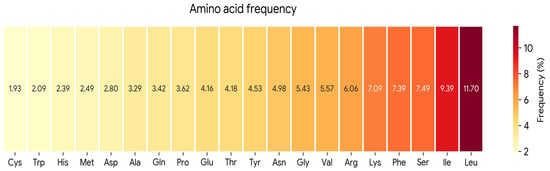
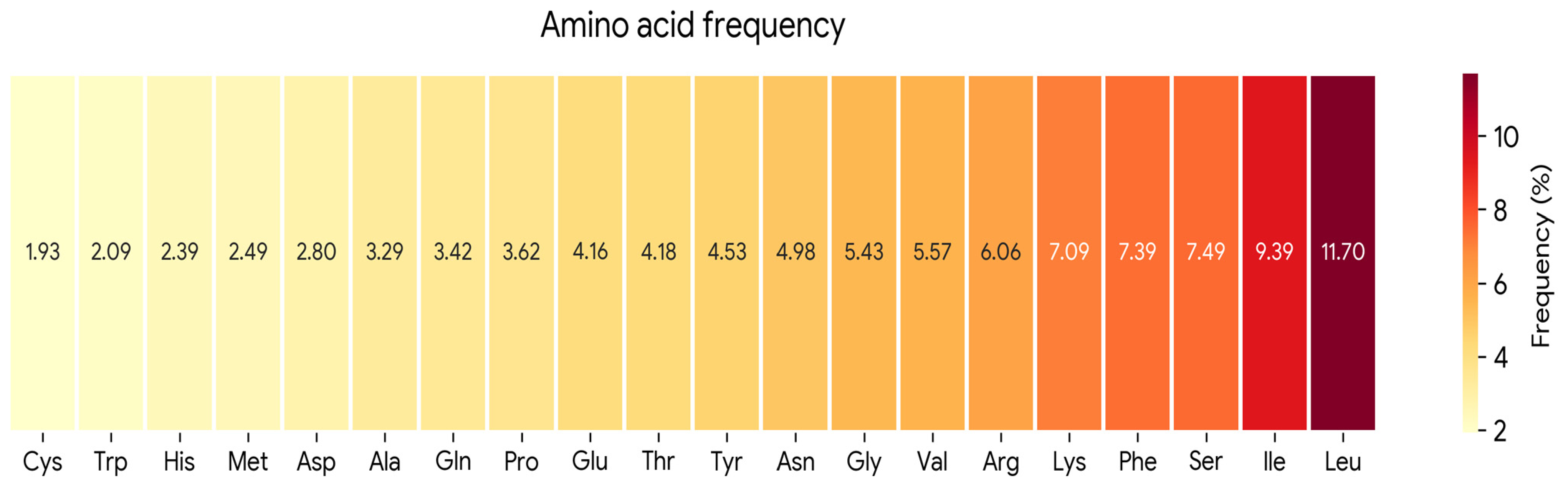
Codon usage bias (CUB) refers to the phenomenon that strongly affects the accuracy and efficiency of protein synthesis. In this study, the CUB of CDSs was examined, and the analysis showed that the V. tortilis subsp. tortilis cp genome encoded 24,633 codons. In terms of amino acid content, leucine was the most abundant codon (11.70%), while cysteine was the least abundant amino acid (1.93%) (Figure 2). The relatively synonymous codon usage (RSCU) examination showed that 28 codons had an RSCU value greater than 1 and that 92.8% of these codons ended with an A or U nucleotide base. By contrast, 31 codons were observed to have an RSCU value less than 1, and 83.8% of these codons ended with a C or G nucleotide base. Only three codons were neutral, with an RSCU value equal to 1, and all of these codons ended with a C or G nucleotide base. The AGA (Arg) is the only codon that is overrepresented, with an RSCU value greater than 2 (Table S3).
Figure 2.
Amino acid frequency heat map in the cp genome of V. tortilis subsp. tortilis.
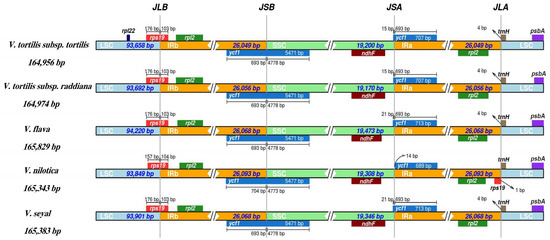
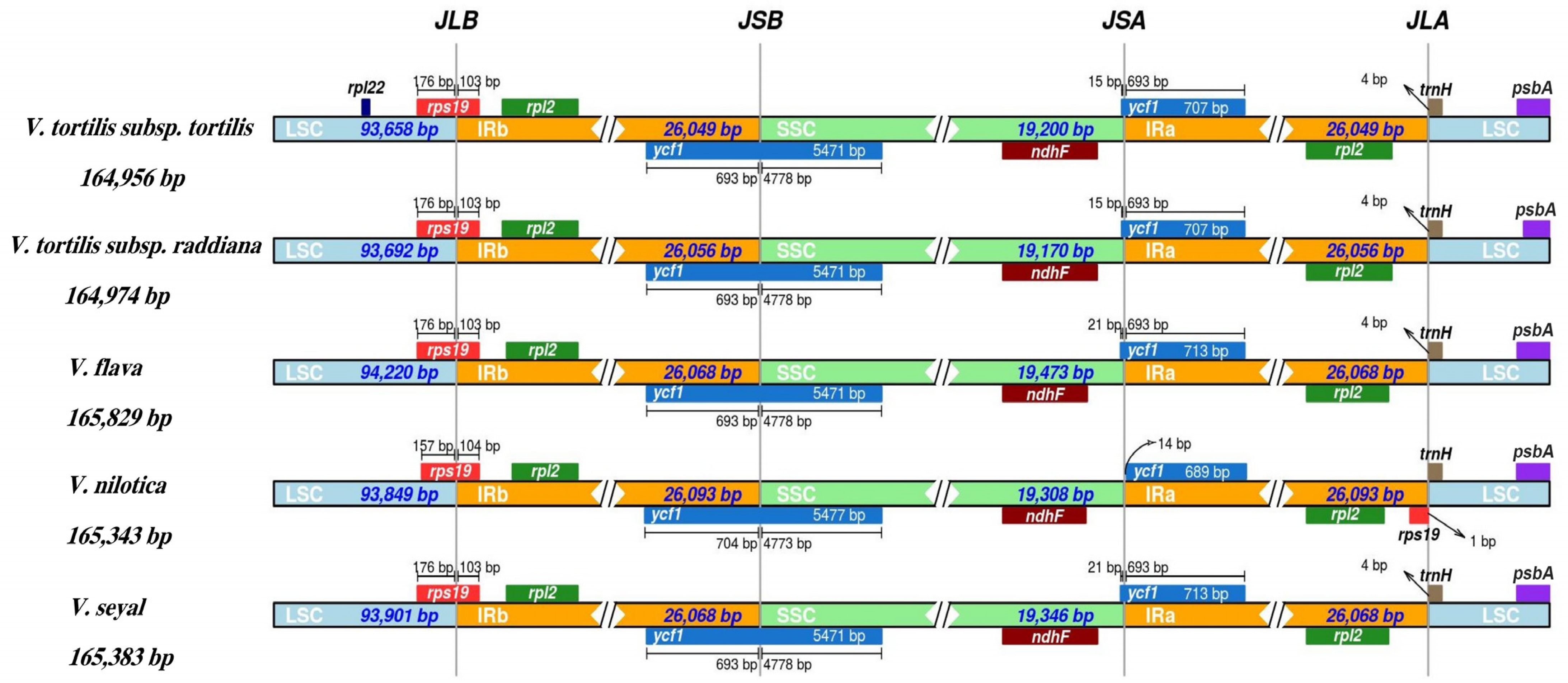
The boundaries of the IR, LSC, and SSC regions were compared between the assembled cp genome of V. tortilis subsp. tortilis (PZ387862) and the following cp genomes taxa: V. tortilis subsp. raddiana (KY100265), V. flava (NC_036734), V. nilotica (NC_045514), and V. seyal (NC_036735). The lengths of the IR, LSC, and SSC regions were similar among the five genomes (Figure 3), reflecting structural stability. However, a few structural variations were observed: the rpl22 gene was found in the LSC region in V. tortilis subsp. tortilis but was absent in the other taxa, the IRa/LSC junction in V. nilotica involved the rps19 gene, and the ycf1 gene was found only in the IRa region in V. nilotica, while it was located at the boundary of the IRa/SSC junction in the other taxa.
Figure 3.
Comparison of the borders of the inverted repeat (IR) regions, small single-copy (SSC) region and large single-copy (LSC) region between the five cp genomes of Vachellia species.
3.3. Nucleotide Diversity (π) and Genome Sequence Divergence
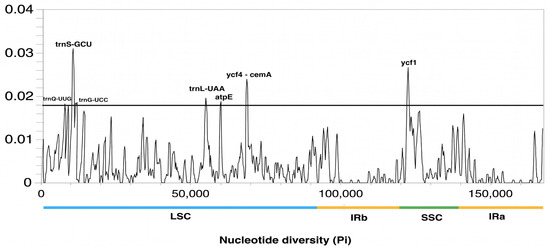
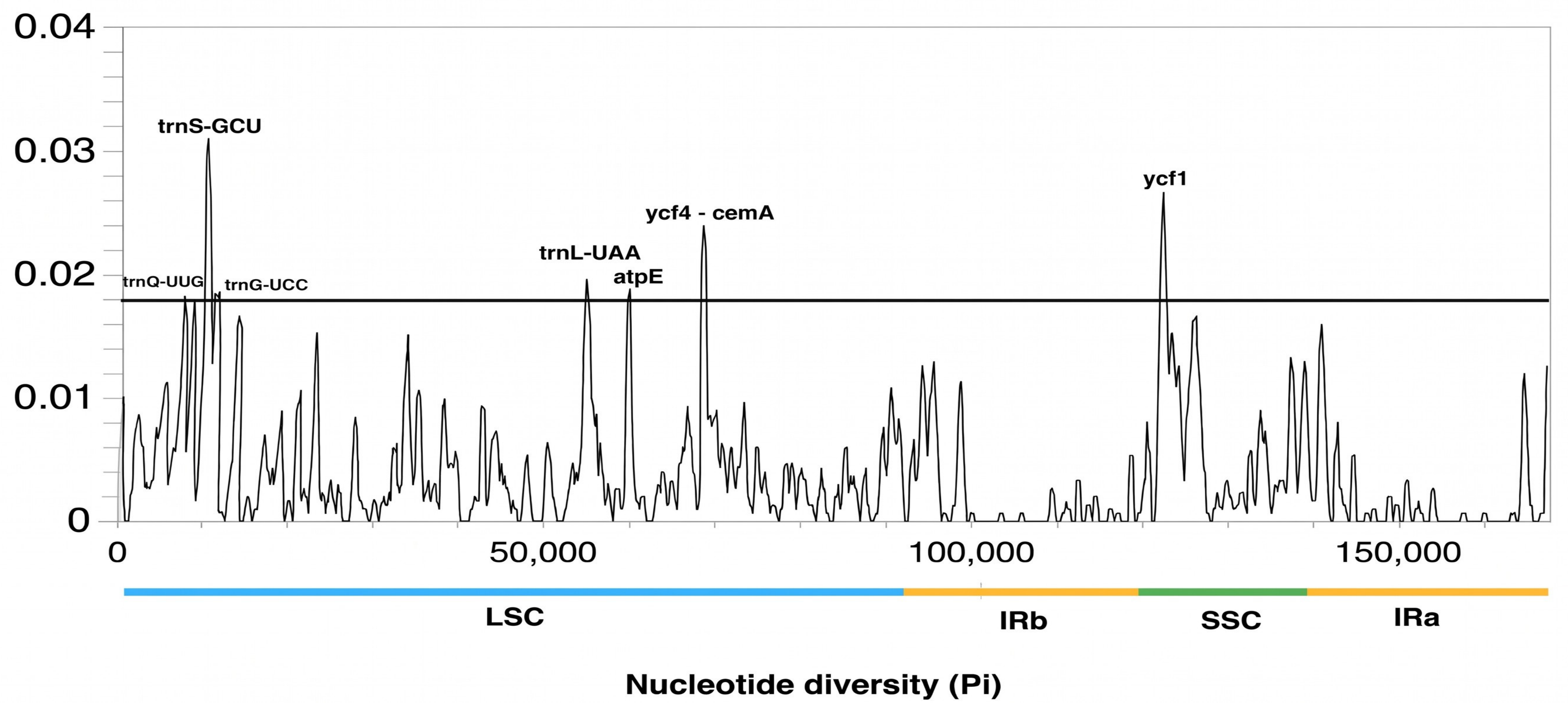
The identification of nucleotide diversity (π) provides a basis for the design of specific primers or barcodes that enhance resolution in species delimitation and phylogenetic studies. Nucleotide diversity analysis was conducted using five species within Vachellia. The π values ranged from 0.00000 to 0.03100 (Figure 4). A total of eight highly variable regions (π ≥ 0.018) were identified: trnQ-UUG (0.01833), trnS-GCU (0.03100), trnG-UCC (0.01867), trnL-UAA (0.01967), atpE (0.01900), ycf4 (0.02400), and cemA (0.02233) in the LSC region, and ycf1 (0.02667) in the SSC region.
Figure 4.
Nucleotide diversity values among cp genomes of V. tortilis subsp. tortilis, V. tortilis subsp. raddiana, V. flava, V. seyal and V. nilotica. Variation hotspots (Pi > 0.018) are labeled above the corresponding gene position.
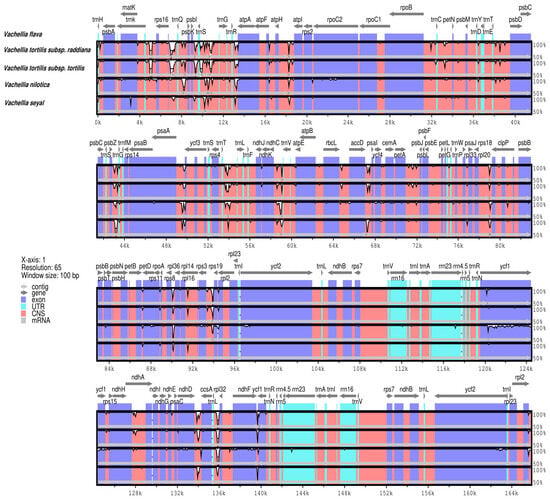
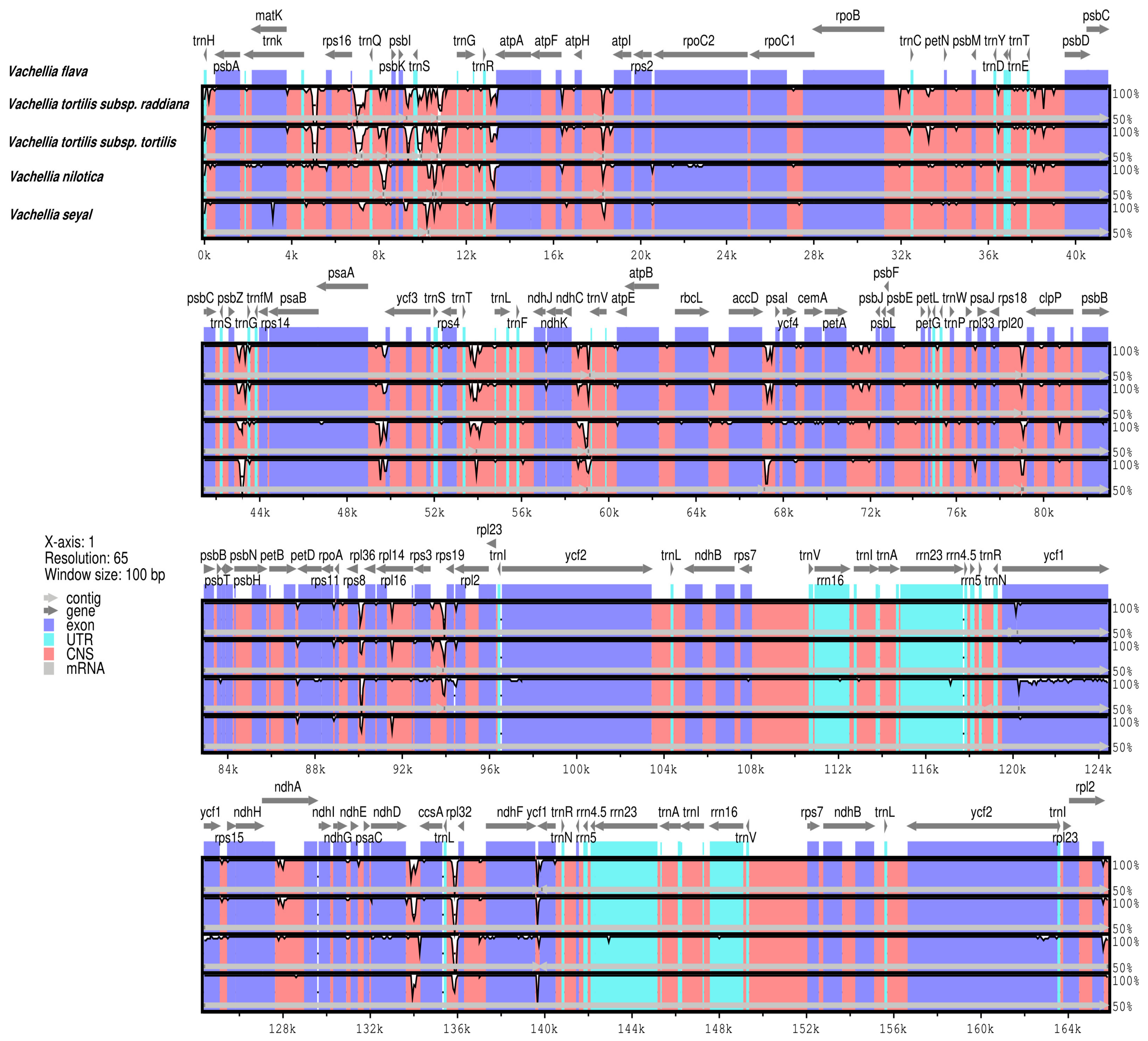
A comparative analysis was performed to identify sequence divergence regions among five Vachellia taxa, using Vachellia flava as the reference genome (Figure 5). The analysis revealed that noncoding regions exhibited greater nucleotide divergence than coding regions. The genes that showed nucleotide divergence within the coding regions included matK, trnK, rpoC2, psaA, ycf1, ycf2, ndhD, ccsA, and ndhF. V. nilotica had the greatest sequence divergence among the Vachellia taxa, whereas V. tortilis subsp. tortilis and V. tortilis subsp. raddiana were almost identical in terms of sequence divergence.
Figure 5.
Five Vachellia taxa cp genomes were visually aligned using V. flava as a reference. The x-axis displays the cp genome coordinate, and the y-axis shows the identity percentage, which ranges from 50% to 100%. The upper arrows show the direction of each gene. UTR stands for untranslated regions, and CNS for conserved non-coding regions. The sequence alignment was performed using the mVISTA software.
3.4. Phylogenetic Tree
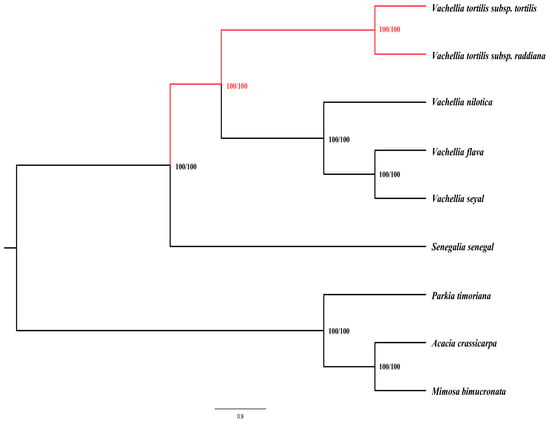
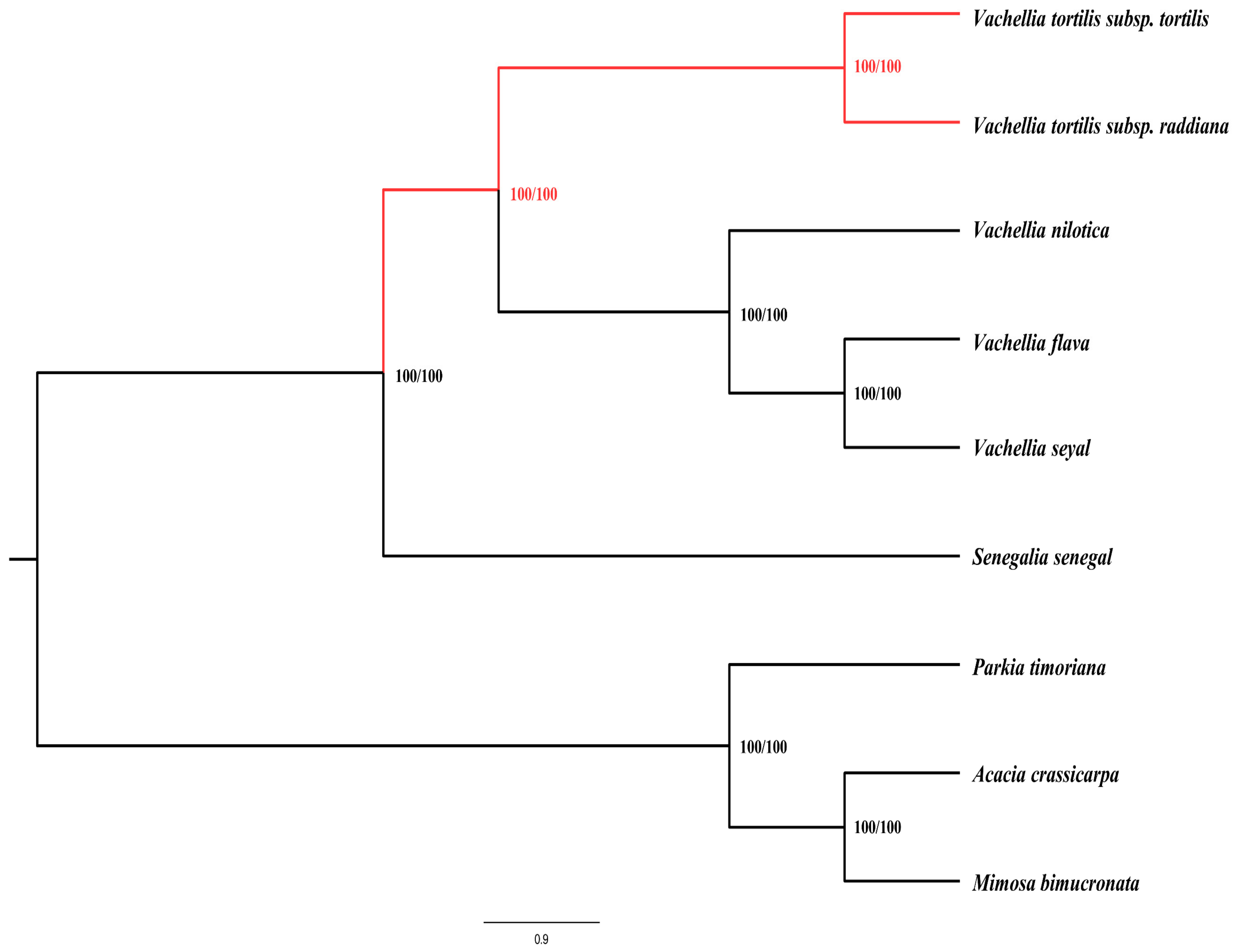
To clarify evolutionary relationships among Vachellia taxa, a phylogenetic analysis was reconstructed using the cp genome sequences of five Vachellia taxa along with four other Fabaceae taxa. The results showed that the Vachellia taxa were classified into two clades. One clade comprised V. tortilis subsp. tortilis and V. tortilis subsp. raddiana. The second clade was divided into two subclades: the first included V. flava and V. seyal, while the second contained only V. nilotica. Senegalia senegal was positioned as the sister clade to the Vachellia clade, while Acacia crassicarpa, Mimosa bimucronata, and Parkia timoriana demonstrated the most distant relationships (Figure 6). All branches showed full bootstrap support.
Figure 6.
Phylogenetic tree showing the relationships among five Vachellia taxa along with four other Fabaceae taxa, produced by ML analysis of 9 cp genomes. The branch node numbers represent the (BS) values.
4. Discussion
This study reports the complete cp genome of V. tortilis subsp. tortilis. The cp genome was 164,956 bp in length, encoded 132 genes, and had a GC content of 35.38%. Moreover, it displayed the typical conserved quadripartite structure observed in other angiosperm genomes [32,33]. The highest GC content was observed in the IR regions (42.67%), which may be due to their structural stability and the presence of all ribosomal RNA (rRNAs) genes within these regions [34,35]. A total of 18 of the 113 genes contained introns. Intron content is highly conserved within angiosperm cp genomes, with the majority of genomes containing 18 intron-bearing genes [36], which play an important role in regulating gene expression [37]. The SSR analysis revealed that the cp genome of V. tortilis subsp. tortilis included 273 repeats. SSRs have been used extensively as molecular markers in taxonomic studies [38]. Mononucleotide repeats were the dominant type, contributing to AT richness. These findings are consistent with those reported for most angiosperm cp genomes [39,40]. Because of their high mutation rates, SSRs represent valuable molecular markers for assessing genetic diversity and supporting biodiversity conservation efforts [41].
The CUB analysis indicated that the genome encoded 24,633 codons. CUB reflects the origins of genes or species, their temporal changes and evolutionary processes, highlighting genetic variations among organisms [42]. The RSCU analysis identified 28 codons with RSCU > 1, 31 codons with RSCU < 1 and only three codons with RSCU = 1. The cp genome exhibits high codon usage bias [43], driven by a balance between natural selection and mutational bias [44], leading to a preference for A/T-ending codons due to low GC content. Expansion and contraction at the boundaries of inverted repeat regions are common in angiosperm cp genomes and may result in genome size variation, gene duplication or deletion, and the formation of pseudogenes [45]. The IR regions of V. tortilis subsp. tortilis and four Vachellia taxa were compared; all five cp genomes displayed significant conservation. However, the rpl22 gene was detected in the LSC region of the cp genome of V. tortilis subsp. tortilis and absent in the other Vachellia taxa. The rpl22 gene has been reported as a pseudogene gene in some taxa in Fabaceae [46].
Nucleotide diversity analysis of the five Vachellia cp genomes indicated that π values ranged from 0.00000 to 0.03100. Moreover, eight mutated hotspots were identified. Among intergenic regions, the trnS-GCU interval exhibited the highest nucleotide diversity (π = 0.03100), while among coding regions, the ycf1 interval displayed the highest nucleotide diversity (π = 0.02667). These regions are likely to show a rise in nucleotide substitutions and may serve as effective DNA barcodes for species-level identification. For example, the ycf1 gene has been considered one of the most variable regions of the cp genome and is widely used as a DNA barcode in land plants [47]. Sequence divergence analysis indicated that all five Vachellia cp genomes were highly conserved; however, a few variable regions were detected in matK, trnK, rpoC2, psaA, ycf1, ycf2, ndhD, ccsA, and ndhF genes. Some of these markers have been used in different phylogenetic studies of flowering plants [48,49,50]. The use of these high-diversity regions as species-specific DNA barcodes within the genus Vachellia may be valuable.
The evolutionary relationship within the genus Vachellia (Fabaceae) has not been fully resolved previously, relying solely on a limited number of chloroplast markers [51,52]. Cp genomes are widely used in phylogenomic studies to explore relatedness, classify species [53], and resolve complex relationships at the species and subspecies levels, as demonstrated in Eriobotrya species [54]. Phylogenetic analysis based on cp genomes showed full congruence among the five Vachellia taxa and classified them into two clades. The first included the two subspecies V. tortilis subsp. tortilis and V. tortilis subsp. raddiana, while the second included V. flava, V. seyal and V. nilotica. These findings are consistent with the results of prior studies [17,18]. The clade containing Senegalia senegal was sister to the Vachellia clade, also consistent with the results of a previous study [18]. These results support the current placement of taxa within the genus Vachellia and reject the previous classification of these species within the genus Acacia.
5. Conclusions
In this study, the basic characteristics of V. tortilis subsp. tortilis were characterized and compared. Moreover, base composition, SSRs, codon usage, IR boundaries, nucleotide diversity (π), genome sequence divergence, and phylogenetic relationships were analyzed and compared. The cp genome of V. tortilis subsp. tortilis was 164,956 bp in length, with 132 genes in total, including 273 SSRs, which were mostly mononucleotides (A/T repeats). Moreover, the genome encoded 24,633 codons, the π values ranged from 0.00000 to 0.03100, and genes that showed nucleotide divergence, including matK, trnK, rpoC2, psaA, ycf1, ycf2, ndhD, ccsA, and ndhF, were identified as the most variable regions. A few variations in structure have been observed: In V. tortilis subsp. tortilis, the rpl22 gene was found in the LSC region; however, it was completely absent in the other Vachellia taxa. In the phylogenetic tree, the genus Vachellia was classified into two clades: the first represented by V. tortilis subsp. tortilis and V. tortilis subsp. raddiana, and the second represented by V. flava, V. seyal, and V. nilotica. Senegalia senegal was recovered as the sister clade to the Vachellia clade. The findings of this study validate the current classification of these taxa within the genus Vachellia rather than within the genus Acacia. Further cp genome sequencing of Vachellia species is recommended to strengthen comparative analyses, develop species-specific markers, and improve the understanding of evolutionary relationships within the genus.
Supplementary Materials
The following supporting information can be downloaded at: https://www.mdpi.com/article/10.3390/biology15211952/s1, Table S1: Genes contents in Vachellia tortilis subsp. tortilis chloroplast genome; Table S2: Length of introns and exons in Vachellia tortilis subsp. tortilis chloroplast genome; Table S3: Codon-anticodon recognition patterns and codon usage of the Vachellia tortilis subsp. tortilis chloroplast genome.
Author Contributions
Conceptualization, M.S.A. and D.A.A.; methodology, M.S.A.; software, E.J.A. and R.S.A.; validation, M.S.A. and R.S.A.; formal analysis, D.A.A.; investigation, E.J.A.; resources, M.S.A.; data curation, R.S.A.; writing—original draft preparation, M.S.A.; writing—review and editing, E.J.A. and R.S.A.; visualization, M.S.A.; supervision, D.A.A.; project administration, M.S.A. All authors have read and agreed to the published version of the manuscript.
Funding
This research received no external funding.
Data Availability Statement
The datasets generated and analyzed in this study are available in the GenBank of NCBI, and the complete chloroplast sequence of V. tortilis subsp. tortilis deposited in GenBank of NCBI under the following accession number: (PZ387862).
Conflicts of Interest
The authors declare no conflicts of interest.
References
- Andersen, G.L.; Krzywinski, K. Longevity and growth of Acacia tortills; Insights From 14C content and anatomy of wood. BMC Ecol. 2007, 7, 4. [Google Scholar] [CrossRef] [Scilit] [PubMed]
- POWO. Plants of the World Online. Facilitated by the Royal Botanic Gardens, Kew. Available online: https://powo.science.kew.org/ (accessed on 11 February 2026).
- Bruneau, A.; De Queiroz, L.P.; Ringelberg, J.J.; Borges, L.M.; Bortoluzzi, R.L.D.C.; Brown, G.K.; Cardoso, D.B.O.S.; Clark, R.P.; Conceição, A.D.S.; Cota, M.M.T.; et al. Advances in Legume Systematics 14. Classification of Caesalpinioideae. Part 2: Higher-Level Classification. PhytoKeys 2024, 240, 1–552. [Google Scholar] [CrossRef] [Scilit] [PubMed]
- Koenen, E.J.M.; Kidner, C.; de Souza, É.R.; Simon, M.F.; Iganci, J.R.; Nicholls, J.A.; Brown, G.K.; de Queiroz, L.P.; Luckow, M.; Lewis, G.P.; et al. Hybrid Capture of 964 Nuclear Genes Resolves Evolutionary Relationships in the Mimosoid Legumes and Reveals the Polytomous Origins of a Large Pantropical Radiation. Am. J. Bot. 2020, 107, 1710–1735. [Google Scholar] [CrossRef] [Scilit] [PubMed]
- LPWG (Legume Phylogenomics & Phylogenetics Working Group)—Vachellia Wight & Arn. Legume Data Portal. Available online: https://www.legumedata.org/taxonomy/taxon/2452411/ (accessed on 11 February 2026).
- UNEMG. Global Drylands: A UN System-Wide Response; United Nations: Geneva, Switzerland, 2011. [Google Scholar]
- Romdhane, S.B.; Nasr, H.; Samba-Mbaye, R.; Neyra, M.; Ghorbal, M.H.; De Lajudie, P. Genetic Diversity of Acacia tortilis ssp. raddiana Rhizobia in Tunisia Assessed by 16S and 16S-23S rDNA Genes Analysis. J. Appl. Microbiol. 2006, 100, 436–445. [Google Scholar] [CrossRef] [Scilit] [PubMed]
- Yu, W.; Li, X.J.; Lv, Z.; Yang, L.E.; Peng, D.L. The Complete Chloroplast Genome Sequences of Monotypic Genus Pseudogalium, and Comparative Analyses with Its Relative Genera. BMC Genom. 2025, 26, 93. [Google Scholar] [CrossRef] [Scilit] [PubMed]
- Weng, L.; Jiang, Y.; Wang, Y.; Zhang, X.; Zhou, P.; Wu, M.; Li, H.; Sun, H.; Chen, S. Chloroplast Genome Characteristics and Phylogeny of the Sinodielsia Clade (Apiaceae: Apioideae). BMC Plant Biol. 2023, 23, 284. [Google Scholar] [CrossRef] [Scilit] [PubMed]
- Wang, F.; Zhao, W.; Dong, Z.; Ma, L.; Li, W.; Li, Z.; Xin, P. Analysis of the Chloroplast Genome Characteristics of 6 Species of Yucca. Bull. Bot. Res. 2023, 43, 109–119. [Google Scholar] [CrossRef]
- Twyford, A.D.; Ness, R.W. Strategies for Complete Plastid Genome Sequencing. Mol. Ecol. Resour. 2017, 17, 858–868. [Google Scholar] [CrossRef] [Scilit] [PubMed]
- Guo, C.; Luo, Y.; Gao, L.M.; Yi, T.S.; Li, H.T.; Yang, J.B.; Li, D.Z. Phylogenomics and the Flowering Plant Tree of Life. J. Integr. Plant Biol. 2023, 65, 299–323. [Google Scholar] [CrossRef] [Scilit] [PubMed]
- Hollingsworth, P.M.; Li, D.Z.; Van Der Bank, M.; Twyford, A.D. Telling Plant Species Apart with DNA: From Barcodes to Genomes. Philos. Trans. R. Soc. B Biol. Sci. 2016, 371, 20150338. [Google Scholar] [CrossRef] [Scilit] [PubMed]
- Amar, M.H. Ycf1-NdhF Genes, the Most Promising Plastid Genomic Barcode, Sheds Light on Phylogeny at Low Taxonomic Levels in Prunus persica. J. Genet. Eng. Biotechnol. 2020, 18, 42. [Google Scholar] [CrossRef] [Scilit] [PubMed]
- Li, H.-T.; Yi, T.-S.; Gao, L.-M.; Ma, P.-F.; Zhang, T.; Yang, J.-B.; Gitzendanner, M.A.; Fritsch, P.W.; Cai, J.; Luo, Y.; et al. Origin of Angiosperms and the Puzzle of the Jurassic Gap. Nat. Plants 2019, 5, 461–470. [Google Scholar] [CrossRef] [Scilit] [PubMed]
- Xing, W.; Yu, W.; Kong, Y.; Ren, X.; Zhu, L.; Li, Q.; Yang, Y.; Cheng, Y.; Wang, H. Intraspecific Chloroplast Genome Genetic Polymorphism of Pinellia ternata (Xi Junecry) and Its Revelation of a Single Origin in Phylogeny. Genes 2024, 15, 1638. [Google Scholar] [CrossRef] [Scilit] [PubMed]
- Mensous, M.; Van de Paer, C.; Manzi, S.; Bouchez, O.; Baâli-Cherif, D.; Besnard, G. Diversity and Evolution of Plastomes in Saharan Mimosoids: Potential Use for Phylogenetic and Population Genetic Studies. Tree Genet. Genomes 2017, 13, 48. [Google Scholar] [CrossRef] [Scilit]
- Asaf, S.; Khan, A.; Khan, A.; Al-Harrasi, A.; Al-Rawahi, A. Complete Chloroplast Genomes of Vachellia Nilotica and Senegalia Senegal: Comparative Genomics and Phylogenomic Placement in a New Generic System. PLoS ONE 2019, 14, e0225469. [Google Scholar] [CrossRef] [Scilit] [PubMed]
- Chen, Y.Y.; Chen, Y.Y.; Shi, C.; Huang, Z.; Zhang, Y.; Li, S.; Li, Y.; Ye, J.; Yu, C.; Li, Z.; et al. SOAPnuke: A MapReduce Acceleration-Supported Software for Integrated Quality Control and Preprocessing of High-Throughput Sequencing Data. Gigascience 2018, 7, gix120. [Google Scholar] [CrossRef] [Scilit] [PubMed]
- Dierckxsens, N.; Mardulyn, P.; Smits, G. NOVOPlasty: De Novo Assembly of Organelle Genomes from Whole Genome Data. Nucleic Acids Res. 2017, 45, e18. [Google Scholar] [CrossRef] [Scilit] [PubMed]
- Gurevich, A.; Saveliev, V.; Vyahhi, N.; Tesler, G. QUAST: Quality Assessment Tool for Genome Assemblies. Bioinformatics 2013, 29, 1072–1075. [Google Scholar] [CrossRef] [Scilit] [PubMed]
- Okonechnikov, K.; Golosova, O.; Fursov, M. Unipro UGENE: A Unified Bioinformatics Toolkit. Bioinformatics 2012, 28, 1166–1167. [Google Scholar] [CrossRef] [Scilit] [PubMed]
- Tillich, M.; Lehwark, P.; Pellizzer, T.; Ulbricht-Jones, E.S.; Fischer, A.; Bock, R.; Greiner, S. GeSeq—Versatile and Accurate Annotation of Organelle Genomes. Nucleic Acids Res. 2017, 45, W6–W11. [Google Scholar] [CrossRef] [Scilit] [PubMed]
- Greiner, S.; Lehwark, P.; Bock, R. OrganellarGenomeDRAW (OGDRAW) Version 1.3.1: Expanded Toolkit for the Graphical Visualization of Organellar Genomes. Nucleic Acids Res. 2019, 47, W59–W64. [Google Scholar] [CrossRef] [Scilit] [PubMed]
- Beier, S.; Thiel, T.; Münch, T.; Scholz, U.; Mascher, M. MISA-Web: A Web Server for Microsatellite Prediction. Bioinformatics 2017, 33, 2583–2585. [Google Scholar] [CrossRef] [Scilit] [PubMed]
- Tamura, K.; Stecher, G.; Peterson, D.; Filipski, A.; Kumar, S. MEGA6: Molecular Evolutionary Genetics Analysis Version 6.0. Mol. Biol. Evol. 2013, 30, 2725–2729. [Google Scholar] [CrossRef] [Scilit] [PubMed]
- Amiryousefi, A.; Hyvönen, J.; Poczai, P. IRscope: An Online Program to Visualize the Junction Sites of Chloroplast Genomes. Bioinformatics 2018, 34, 3030–3031. [Google Scholar] [CrossRef] [Scilit] [PubMed]
- Librado, P.; Rozas, J. DnaSP v5: A Software for Comprehensive Analysis of DNA Polymorphism Data. Bioinformatics 2009, 25, 1451–1452. [Google Scholar] [CrossRef] [Scilit] [PubMed]
- Mayor, C.; Brudno, M.; Schwartz, J.R.; Poliakov, A.; Rubin, E.M.; Frazer, K.A.; Pachter, L.S.; Dubchak, I. VISTA: Visualizing Global DNA Sequence Alignments of Arbitrary Length. Bioinformatics 2000, 16, 1046–1047. [Google Scholar] [CrossRef] [Scilit] [PubMed]
- Katoh, K.; Standley, D.M. MAFFT Multiple Sequence Alignment Software Version 7: Improvements in Performance and Usability. Mol. Biol. Evol. 2013, 30, 772–780. [Google Scholar] [CrossRef] [Scilit] [PubMed]
- Nguyen, L.-T.; Schmidt, H.A.; von Haeseler, A.; Minh, B.Q. IQ-TREE: A Fast and Effective Stochastic Algorithm for Estimating Maximum-Likelihood Phylogenies. Mol. Biol. Evol. 2015, 32, 268–274. [Google Scholar] [CrossRef] [Scilit] [PubMed]
- Nguyen, N.N.; Nguyen, N.T.; Do, H.D.K. The Complete Chloroplast Genome of a Vietnam Endemic Aroid, Homalomena perplexa K.Z.Hein, Vuong, Bao & V.S.Dang, and Updated Comparative Genomics in Araceae. Ecol. Evol. 2026, 16, e73189. [Google Scholar] [CrossRef] [Scilit] [PubMed]
- Meng, S.; Jiang, Z.; Huang, J.; Yao, X. The First Complete Chloroplast Genome Sequence and Phylogenetic Analysis of Actinidia trichogyna. Mitochondrial DNA Part B 2026, 11, 462–467. [Google Scholar] [CrossRef] [Scilit] [PubMed]
- Zhou, C.; Tao, F.; Long, R.; Yang, X.; Wu, X.; Xiang, L.; Zhou, X.; Girdthai, T. The Complete Chloroplast Genome of Mussaenda Pubescens and Phylogenetic Analysis. Sci. Rep. 2024, 14, 9131. [Google Scholar] [CrossRef] [Scilit] [PubMed]
- Alawfi, M.S.; Alzahrani, D.A.; Albokhari, E.J. Complete Plastome Genomes of Three Medicinal Heliotropiaceae Species: Comparative Analyses and Phylogenetic Relationships. BMC Plant Biol. 2024, 24, 654. [Google Scholar] [CrossRef] [Scilit] [PubMed]
- Jansen, R.K.; Cai, Z.; Raubeson, L.A.; Daniell, H.; dePamphilis, C.W.; Leebens-Mack, J.; Müller, K.F.; Guisinger-Bellian, M.; Haberle, R.C.; Hansen, A.K.; et al. Analysis of 81 Genes from 64 Plastid Genomes Resolves Relationships in Angiosperms and Identifies Genome-Scale Evolutionary Patterns. Proc. Natl. Acad. Sci. USA 2007, 104, 19369–19374. [Google Scholar] [CrossRef] [Scilit] [PubMed]
- Shaul, O. How Introns Enhance Gene Expression. Int. J. Biochem. Cell Biol. 2017, 91, 145–155. [Google Scholar] [CrossRef] [Scilit] [PubMed]
- Ahmad, A.; Wang, J.-D.; Pan, Y.B.; Sharif, R.; Gao, S.J. Development and Use of Simple Sequence Repeats (SSRs) Markers for Sugarcane Breeding and Genetic Studies. Agronomy 2018, 8, 260. [Google Scholar] [CrossRef] [Scilit]
- Provan, J.; Powell, W.; Hollingsworth, P.M. Chloroplast Microsatellites: New Tools for Studies in Plant Ecology and Evolution. Trends Ecol. Evol. 2001, 16, 142–147. [Google Scholar] [CrossRef] [Scilit] [PubMed]
- Ishaq, M.N.; Ehirim, B.O.; Nwanyanwu, G.C.; Abubaka, R.I. DNA Fingerprinting Simple Sequence Repeat (SSR) Marker-Based of Some Varieties of Rice (Oryza sativa L.) Released in Nigeria. Afr. J. Biotechnol. 2019, 18, 242–248. [Google Scholar] [CrossRef] [Scilit]
- Boiko, S.M. Identification of Novel SSR Markers for Predicting the Geographic Origin of Fungus Schizophyllum commune Fr. Fungal Biol. 2022, 126, 764–774. [Google Scholar] [CrossRef] [Scilit] [PubMed]
- Parvathy, S.T.; Udayasuriyan, V.; Bhadana, V. Codon Usage Bias. Mol. Biol. Rep. 2022, 49, 539–565. [Google Scholar] [CrossRef] [Scilit] [PubMed]
- Wei, X.; Li, X.; Chen, T.; Chen, Z.; Jin, Y.; Malik, K.; Li, C. Complete Chloroplast Genomes of Achnatherum Inebrians and Comparative Analyses with Related Species from Poaceae. FEBS Open Bio 2021, 11, 1704–1718. [Google Scholar] [CrossRef] [Scilit] [PubMed]
- Yang, Q.; Xin, C.; Xiao, Q.-S.; Lin, Y.-T.; Li, L.; Zhao, J.-L. Codon Usage Bias in Chloroplast Genes Implicate Adaptive Evolution of Four Ginger Species. Front. Plant Sci. 2023, 14, 1304264. [Google Scholar] [CrossRef] [Scilit] [PubMed]
- Guo, Y.Y.; Yang, J.X.; Bai, M.Z.; Zhang, G.Q.; Liu, Z.J. The Chloroplast Genome Evolution of Venus Slipper (Paphiopedilum): IR Expansion, SSC Contraction, and Highly Rearranged SSC Regions. BMC Plant Biol. 2021, 21, 248. [Google Scholar] [CrossRef] [Scilit] [PubMed]
- Imai, R.; Kajita, Y.; Yamamoto, T.; Takayama, K.; Kajita, T. The Complete Chloroplast Genome of a Pantropical Legume, Canavalia rosea. Mitochondrial DNA B Resour. 2021, 6, 295–296. [Google Scholar] [CrossRef] [Scilit] [PubMed]
- Chin, L.-X.; Huang, Q.; Fan, Q.; Tan, H.; Li, Y.; Peng, C.; Deng, Y.; Li, Y. Complete Chloroplast Genome of Hygrophila polysperma (Acanthaceae): Insights into Its Genetic Features and Phylogenetic Relationships. Horticulturae 2025, 11, 1240. [Google Scholar] [CrossRef] [Scilit]
- Huang, J.L.; Sun, G.L.; Zhang, D.M. Molecular Evolution and Phylogeny of the Angiosperm Ycf2 Gene. J. Syst. Evol. 2010, 48, 240–248. [Google Scholar] [CrossRef] [Scilit]
- Dong, W.; Xu, C.; Li, C.; Sun, J.; Zuo, Y.; Shi, S.; Cheng, T.; Guo, J.; Zhou, S. Ycf1, the Most Promising Plastid DNA Barcode of Land Plants. Sci. Rep. 2015, 5, 8348. [Google Scholar] [CrossRef] [Scilit] [PubMed]
- Jiang, S.; Chen, F.; Qin, P.; Xie, H.; Peng, G.; Li, Y.; Guo, X. The Specific DNA Barcodes Based on Chloroplast Genes for Species Identification of Theaceae Plants. Physiol. Mol. Biol. Plants 2022, 28, 837–848. [Google Scholar] [CrossRef] [Scilit] [PubMed]
- Bouchenak-Khelladi, Y.; Maurin, O.; Hurter, J.; van der Bank, M. The Evolutionary History and Biogeography of Mimosoideae (Leguminosae): An Emphasis on African Acacias. Mol. Phylogenet. Evol. 2010, 57, 495–508. [Google Scholar] [CrossRef] [Scilit] [PubMed]
- Miller, J.T.; Seigler, D. Evolutionary and Taxonomic Relationships of Acacia s.l. (Leguminosae: Mimosoideae). Aust. Syst. Bot. 2012, 25, 217. [Google Scholar] [CrossRef] [Scilit]
- Sun, W.; Xu, Z.; Song, C.; Chen, S. Herbgenomics: Decipher Molecular Genetics of Medicinal Plants. Innovation 2022, 3, 100322. [Google Scholar] [CrossRef] [Scilit] [PubMed]
- Jin, L.; Qu, S.; Zhu, W.; Li, Q.; Tan, Y.; Cao, Z.; Xin, P.; Song, Y. Chloroplast-Genome-Based Insights into the Systematic Relationship of Eriobotrya (Rhaphiolepis). iScience 2025, 28, 113855. [Google Scholar] [CrossRef] [Scilit] [PubMed]

Disclaimer/Publisher’s Note: The statements, opinions and data contained in all publications are solely those of the individual author(s) and contributor(s) and not of MDPI and/or the editor(s). MDPI and/or the editor(s) disclaim responsibility for any injury to people or property resulting from any ideas, methods, instructions or products referred to in the content. |
© 2026 by the authors. Licensee MDPI, Basel, Switzerland. This article is an open access article distributed under the terms and conditions of the Creative Commons Attribution (CC BY) license.