
Deciphering Drought Resilience in Solanaceae Crops: Unraveling Molecular and Genetic Mechanisms


1
Suzhou Polytechnic Institute of Agriculture, Suzhou 215008, China
2
Wulanchabu Academy of Agricultural and Forestry Sciences, Wulanchabu 012000, China
3
College of Agriculture, Inner Mongolia Agricultural University, Hohhot 010018, China
*
Author to whom correspondence should be addressed.
Biology 2024, 13(12), 1076; https://doi.org/10.3390/biology13121076
Submission received: 13 November 2024
/
Revised: 17 December 2024
/
Accepted: 19 December 2024
/
Published: 20 December 2024
(This article belongs to the Section Biochemistry and Molecular Biology)
Simple Summary
This study addresses the challenge of drought stress, which significantly threatens crops in the Solanaceae family, such as tomatoes, peppers, eggplants, and potatoes. Drought stress disrupts plant growth, reduces yields, and impacts food security. Our research focuses on understanding how these plants respond to drought at the molecular level. In this review, key genes, proteins, and microRNAs—small molecules that regulate Solanaceae plant responses—linked to drought tolerance were summarized. By analyzing gene expression and protein changes in stressed plants, we identified essential components that help plants conserve water, maintain energy balance, and protect against damage. We also highlight the importance of breeding strategies to enhance drought tolerance in these crops, using both traditional methods and advanced technologies like gene editing. This research provides valuable insights for developing hardier, drought-resistant crops. Ultimately, these findings could lead to better agricultural practices and more resilient crops, helping to secure food production in the face of climate change and water scarcity, benefiting both farmers and society.
Abstract
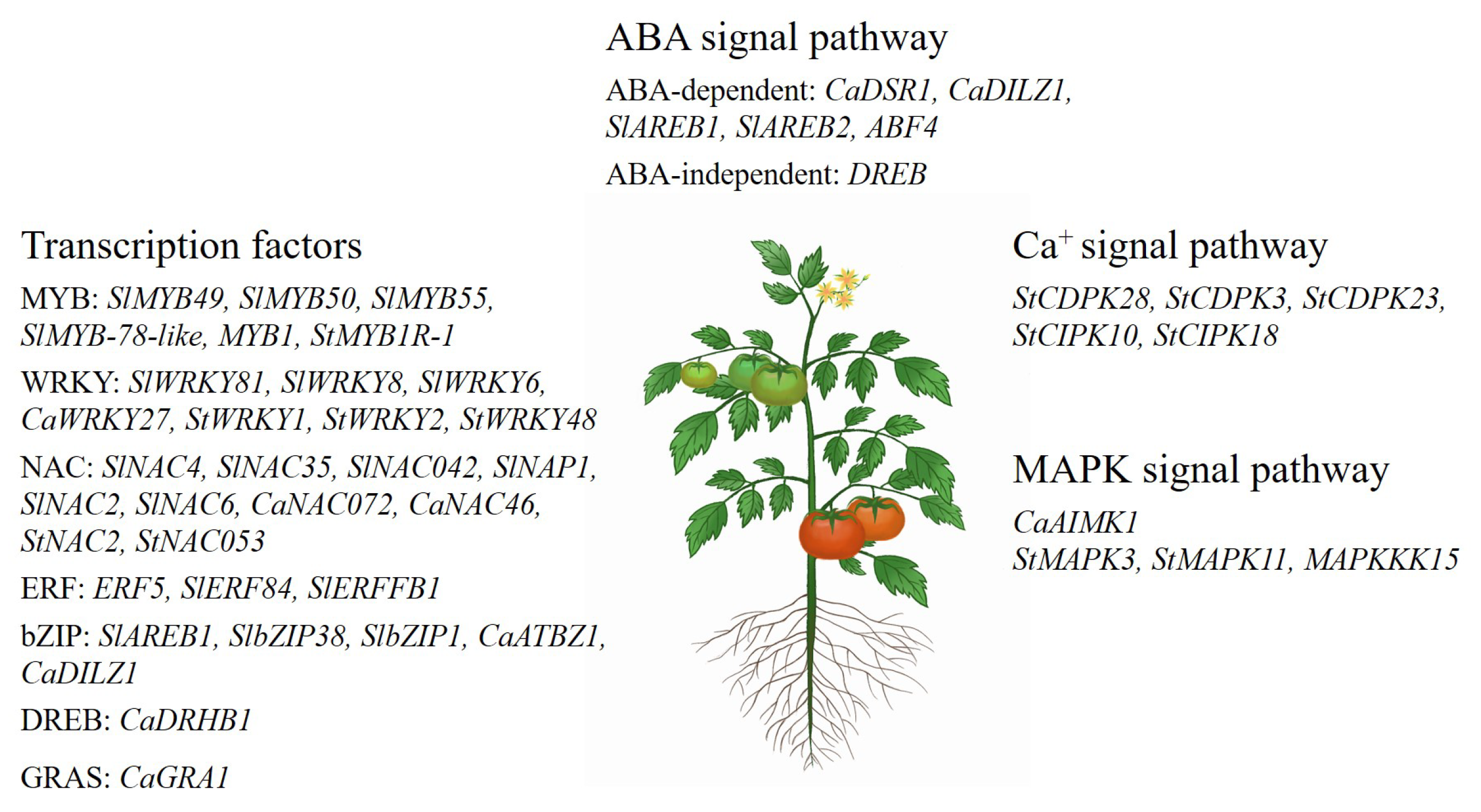
The Solanaceae family, which includes vital crops such as tomatoes, peppers, eggplants, and potatoes, is increasingly impacted by drought due to climate change. Recent research has concentrated on unraveling the molecular mechanisms behind drought resistance in these crops, with a focus on abscisic acid (ABA) signaling pathways, transcription factors (TFs) like MYB (Myeloblastosis), WRKY (WRKY DNA-binding protein), and NAC (NAM, ATAF1/2, and CUC2- NAM: No Apical Meristem, ATAF1/2, and CUC2: Cup-shaped Cotyledon), and the omics approaches. Moreover, transcriptome sequencing (RNA-seq) has been instrumental in identifying differentially expressed genes (DEGs) crucial for drought adaptation. Proteomics studies further reveal changes in protein expression under drought conditions, elucidating stress response mechanisms. Additionally, microRNAs (miRNAs) have been identified as key regulators in drought response. Advances in proteomics and transcriptomics have highlighted key proteins and genes that respond to drought stress, offering new insights into drought tolerance. To address the challenge of drought, future research should emphasize the development of drought-resistant varieties through precision breeding techniques such as gene editing, marker-assisted selection (MAS), and the integration of artificial intelligence. Additionally, the adoption of environmentally sustainable cultivation practices, including precision irrigation and the use of anti-drought agents, is crucial for improving water-use efficiency and crop resilience. International collaboration and data sharing will be essential to accelerate progress and ensure global food security in increasingly arid conditions. These efforts will enable Solanaceae crops to adapt the challenges posed by climate change, ensuring their productivity and sustainability.
Keywords:
Solanaceae crops; drought-resistant; research progress