


Highlights
What are the main findings?
- Spent mushroom substrate (SMS) can be valorised into binderless particleboards through hot pressing, with residual mycelium acting as a natural bio-binder without the need for synthetic adhesives;
- By tailoring the processing conditions, SMS-based particleboards can achieve promising and tuneable thermal, acoustic, moisture buffering and mechanical properties.
What are the implications of the main findings?
- SMS-based binderless particleboards represent a sustainable alternative for non-load-bearing interior building applications;
- The valorisation of SMS supports agro-industrial waste upcycling and promotes circular economy strategies in the construction sector.
Abstract
This review investigates the development of binderless particleboards through the upcycling of agro-industrial waste, with particular emphasis on spent mushroom substrate (SMS), a lignocellulosic by-product generated during mushroom cultivation. Owing to its renewable nature and widespread availability, SMS has emerged as a promising bio-based feedstock to produce sustainable biocomposites for the construction sector. The review focuses on the manufacturing of binderless particleboards by hot pressing, a process in which the residual mycelium inherently present in the substrate acts as a natural bio-binder, promoting internal cohesion without the need for synthetic adhesives. Attention is devoted to the influence of the main hot-pressing parameters, namely, temperature, pressure and pressing time, which play a crucial role in enhancing adhesion among biomass constituents while avoiding thermal degradation of the lignocellulosic fibres. Processing conditions reported in the literature are analysed to identify optimal operating windows. The properties of the resulting biocomposites are also reviewed. These materials generally exhibit low bulk densities, ranging from 250 to 1400 kg/m3, and an open-porous microstructure. Reported studies highlight promising thermal insulation properties, with thermal conductivity values ranging from 0.06 to 0.08 W/m·K, as well as moisture buffering capacity, with moisture buffer values ranging from 1.5 to 3.5 g/(m2%RH), and sound absorption performance, particularly in the medium- and high-frequency ranges. Owing to this unique combination of lightweight structure, hygrothermal regulation and acoustic performance, SMS-based binderless particleboards represent a promising class of sustainable materials for non-load-bearing interior applications, supporting circular economy strategies and regenerative building practices.
1. Introduction
To date, the construction industry is a major driver of global environmental pollution. In Europe, buildings account for about 40% of primary energy demand and 36% of greenhouse gas emissions. This impact covers the entire life cycle of the built environment, including construction, operation, maintenance, renovation, and end-of-life demolition [1]. Conventional construction materials account for a significant portion of this environmental burden, and their energy-intensive manufacturing processes produce carbon dioxide emissions [2].
In this context, the pursuit of alternative solutions should extend beyond improving the operational energy performance of buildings to encompass the environmental impacts associated with the entire cycle of construction materials [1,2]. In response to the growing urgency of mitigating the environmental impacts generated by the prevailing linear economic paradigm of “take, make, waste”, the construction sector is progressively adopting circular economy principles [3]. This approach seeks to close production loops by integrating design strategies that account for a building’s “end-of-life”. Within this framework, increasing attention has been devoted to bio-based, renewable, and waste-derived materials, which offer the potential to meet technical and functional requirements while reducing the environmental impacts associated with their life cycles [4].
From a circular economy perspective, agricultural activities generate large amounts of residues, including crop by-products, shell casings, and processing debris, which are often disposed of or incinerated, resulting in avoidable environmental impacts and loss of potentially valuable resources [5]. The global annual generation of agricultural waste was estimated to reach approximately 998 million tons in 2024 [6]. While this volume poses significant waste management challenges, it simultaneously represents a sustainable source of biomass that can be valorised as a feedstock for sustainable construction materials, thereby contributing to resource efficiency and the transition towards a circular built environment [6]. Commonly available agricultural wastes or agricultural waste biomass include materials such as rice husk [7], sugarcane bagasse [8], wheat straw [9], and nut and coconut shells [10], among others. These feedstocks contain high concentrations of lignocellulosic compounds, specifically cellulose, hemicellulose, and lignin. When incorporated into building materials, such components contribute to improved mechanical performance and enhanced thermal insulation properties [11].
Numerous recent studies have examined the use of these residues for the manufacture of binderless particleboards as a sustainable alternative to conventionally bonded wood-based panels. Binderless particleboards were developed to reduce reliance on synthetic adhesives, particularly urea-formaldehyde resins [12], which remain the most widely used binders in the particleboard industry. Despite their favourable performance and cost-effectiveness, synthetic resins remain standard in the industry; however, their use is questioned due to serious safety and ecological concerns. Antoun et al. [13] highlight the carcinogenic nature of these resins, identifying them as a significant risk to human health within manufacturing environments. Furthermore, Fernandes et al. [14] emphasise the substantial environmental footprint associated with their production and disposal, noting that they pose a critical challenge to sustainable development goals. In line with these findings, Tupciauskas et al. [15] categorise these materials as hazardous substances that require urgent mitigation strategies to address their long-term environmental toxicity. The intrinsic chemical composition of these biomass resources, particularly their lignocellulosic constituents, enables the development of self-bonding mechanisms under the combined action of heat and pressure. Exploiting this behaviour, numerous studies have investigated the feasibility of producing binderless particleboards from diverse waste-derived feedstocks, such as steam-exploded hemp and wheat residues [15,16], winery residues [14], brown algae [17], kenaf composites supplemented with potato starch [18] and rice straw–bagasse blends [19].
Among emerging bio-based materials, mycelium-based alternatives represent a particularly promising solution [20]. Mycelium constitutes the vegetative apparatus of the fungus: a dense network of hyphae that, once inoculated into a substrate, proliferates by consuming lignin and cellulose to ultimately produce the fruiting body, or mushroom [21]. In composites, the mycelium acts as a natural biological binder, forming a three-dimensional network of microfilaments that interfaces with the dispersed phase of the lignocellulosic substrate [22].
2. Literature Search Methodology
A structured literature search and review were conducted to identify and analyse publications addressing the physical, mechanical, thermal, environmental, processing, and performance-related properties of spent mushroom substrate (SMS) binderless particleboards. The search was conducted between March 2025 and May 2026 using three scientific databases and search platforms: Scopus, Google Scholar, and ScienceDirect. No restriction was initially imposed on publication year to identify both foundational studies and recent developments. The search strategy was developed around the general groups of concepts of (i) agricultural waste, (ii) binderless particleboards, and (iii) spent mushroom substrate.
In particular, the introduction and the conclusions have been tailored by looking at the combination of the keywords “binderless particleboards” and “agricultural waste”. In ScienceDirect, the search “Binderless particleboards” returned 344 results. The database classified all the papers in the materials area. The combination of “Binderless particleboards” with the keyword “waste” returned 87 records; 16 of them are review papers.
In Google Scholar, the search “Binderless particleboards” returned 3170 items, 2080 adding “agricultural waste” and the word “review” reduced the items to 650, which reduced to 117 once “mushroom” was added.
For the main part of the paper, the principal keywords included “spent mushroom substrate”, “SMS particleboard” and “binderless particleboards”. The Boolean operator AND was used to combine the keywords and to progressively refine the search. The search strategy was adapted to the search syntax and fields available in each database.
In ScienceDirect, the search using the exact term “spent mushroom substrate” returned 444 results. The database classified these results across several subject areas, including Environmental Science (190), Agricultural and Biological Sciences (114), Energy (76), Chemical Engineering (66), Biochemistry, Genetics and Molecular Biology (46), Immunology and Microbiology (36), Chemistry (20), Earth and Planetary Sciences (16), and Engineering (14). Within the 14 results classified under Engineering, the identified subject areas included Renewable Energy (5), Construction and Building Materials (2), Energy and Management (1), Applied Acoustics (1), International Rock Mechanics (1), Journal of Energy Storage (1), and other areas (3). Searches using the terms “SMS particleboard”, “mycelium-based composites”, “bio-boards”, “binderless particleboards”, and “bio-based panels” did not return results in ScienceDirect under the search conditions adopted. In Google Scholar, the search for “spent mushroom substrate” returned approximately 45,300 results. A more focused search combining “spent mushroom substrate” AND “particleboard” returned approximately 561 results, while the combination “spent mushroom substrate” AND “particleboard” AND “binderless” returned approximately 68 results. Within these results, particular attention was given to studies in which SMS was used as the principal lignocellulosic raw material without the addition of other aggregates, where this information was available. The references identified through Google Scholar were cross-checked against the results obtained from Scopus and ScienceDirect.
The following inclusion criteria were applied: (i) studies addressing SMS, mycelium, SMS-based composites, or mycelium-based composites; (ii) studies investigating physical, mechanical, thermal, environmental, processing, or performance-related properties; (iii) studies concerning the use of SMS for binderless particleboards; (iv) peer-reviewed journal articles and relevant conference papers or other scientific publications where appropriate; and (v) publications providing sufficient methodological and/or experimental information to allow for comparison with the objectives of the present study.
The selected literature was subsequently analysed to establish the current state of knowledge concerning SMS, SMS-based composites and the use in binderless particleboards. In particular, the bibliography can be divided as shown in Table 1.
Table 1.
Description of the bibliography.
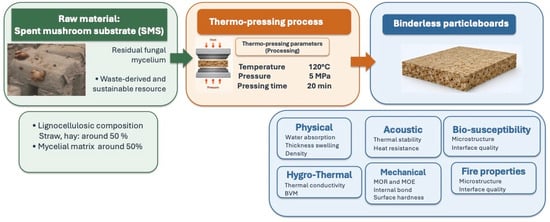
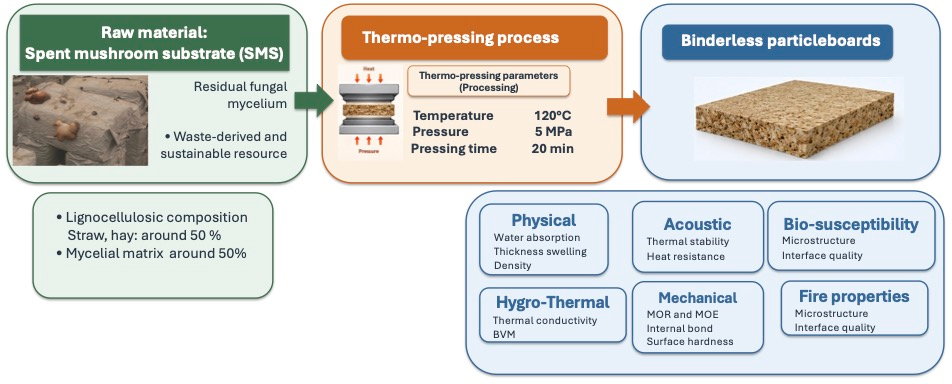
As illustrated in Figure 1, this review focuses on SMS and its application in the production of binderless particleboards. Particular attention is devoted to the hot-pressing process and to the key parameters governing it. Finally, the review examines the properties and performance of the resulting particleboards.
Figure 1.
Review sketch path.
3. Spent Mushroom Substrate (SMS) Properties and Use in Different Fields as a Raw Material Resource
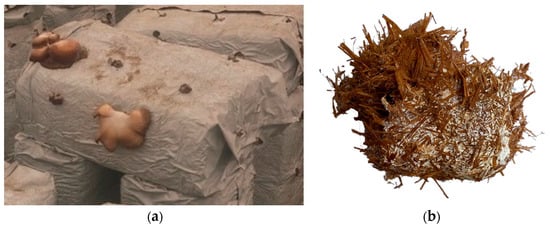
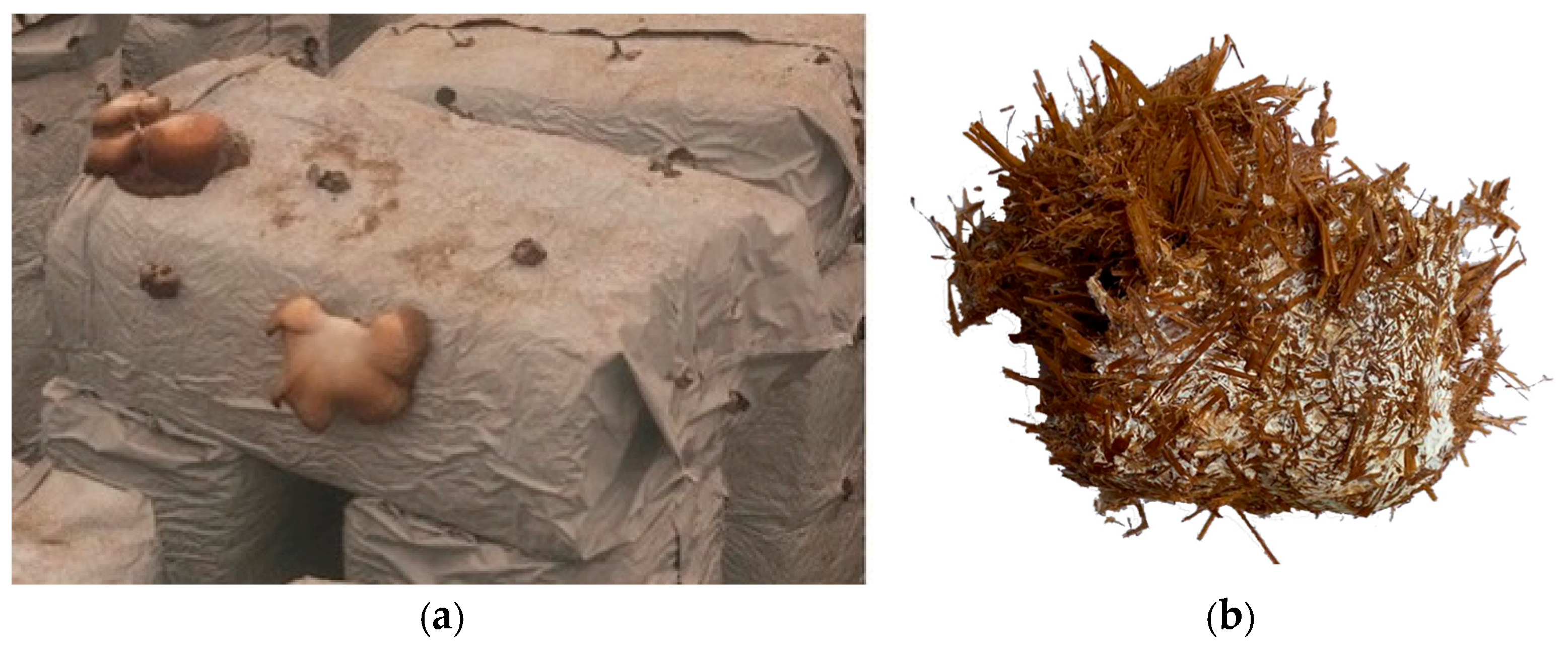
SMS is a lignocellulosic residue from commercial mushroom cultivation, and it consists of partially degraded plant biomass and residual mycelium (Figure 2) [54].
Figure 2.
(a) Spent mushroom substrate bale; (b) content of the bale straw and mycelium.
This waste is generally not suitable for direct use as a soil amendment [35,36]. During the substrate colonisation phase, the mycelium secretes enzymes, such as laccase, that degrade the lignin, thereby modifying the substrate properties, including pH and increasing its nitrogen content [21]. Consequently, the application of raw SMS to agricultural soils can induce nitrogen immobilisation, temporarily reducing nutrient availability for crops [37]. Therefore, its agronomic use generally requires composting or co-composting treatments, which promote the partial mineralisation of the organic fraction and improve the suitability for land application [37].
Beyond agricultural use, SMS has attracted growing interest in non-agronomic applications, where its structural characteristics can be more effectively exploited. Its porous matrix, combined with lignocellulosic fibres and residual mycelium, confers properties suitable for energy-related applications, such as its use as a feedstock for anaerobic digestion for biogas production [35]. Another promising application is the use of SMS as a biosorbent for the remediation of contaminants from water and soil. Various studies [36,38] report the capacity of SMS to sequester heavy metals and organic compounds, attributed to the functional groups associated with both the lignocellulosic fraction and the residual mycelium, thus opening significant prospects for environmental purification and wastewater treatment.
In recent years, studies [23,48] have further explored the potential of SMS as a secondary raw material to produce bio-based materials, particularly within the field of mycelium-based composites and low-impact insulation particleboards. In this context, the value of SMS lies not only in its nutrient content, usually straw, but also in its partially colonised fibrous structure, which can enhance material cohesion and reduce embodied energy compared to virgin substrates [55]. Mycelium-based particleboards can be classified as a hybrid category situated between bio-boards with natural binders and traditional binderless particleboards [56,57]. Although technically binderless, they are distinguished by the presence of fungal mycelium, which actively contributes to material cohesion by serving as an endogenous biological binder [58]. Unlike particleboards that use natural binders, where structural continuity depends on bio-based polymer matrices, or classic binderless particleboards, which primarily rely on the thermo-mechanical activation of lignin, the cohesive mechanism in mycelium-based particleboards arises from the interaction between the lignocellulosic matrix and the mycelium [40]. In this process, the mycelium proliferates within the material, stabilising the plant particles and enhancing inter-fibre contact [56,58,59].
Recent research has examined the effects of post-growth treatments on particleboard performance, with particular emphasis on hot pressing [23,49], which increases bulk density, improves inter-fibre cohesion, and reduces moisture sensitivity [60].
Depending on the processing route, SMS has been used either alone or in combination with other lignocellulosic residues, as well as in different physical forms, including finely ground powders, sawdust-like fractions, chopped fibres, and pelletised materials [56,57]. The final performance of SMS-based particleboards strongly depends on the particle size distribution and substrate composition [61].
4. SMS Particleboards: Parameters of Hot-Pressing Process
The hot-pressing process is essential in producing SMS particleboards, as it transforms low-density raw materials into structurally sound finished products [40]. Pressure and temperature are critical parameters, as they control both the compaction of the lignocellulosic substrate and the fungal hyphae [62]. Before hot pressing, the material is always pre-conditioned to permanently halt biological growth and ensure complete fungal inactivation. Although fungal growth ceases at temperatures well below those reached during hot pressing, structural components of the hyphal cell walls, particularly chitin and structural proteins, remain embedded within the matrix [20,54].
During hot pressing, simultaneous chemical transformations occur within both the lignocellulosic substrate and the mycelium. These processes facilitate the formation of new inter-fibre bonds, enhancing cohesion and mechanical strength of the particleboard.
Table 2 presents the main hot-pressing parameters used in various studies on SMS boards.
Table 2.
Processing parameters for hot-pressing process SMS boards production.
Further parameters related to other mycelium-based materials are reported in Table 3. Although these values provide useful benchmarks, in most cases the final product is a composite combined with other bio-based materials.
Table 3.
Processing parameters for the hot-pressing process: mycelium-based boards’ production.
Materials containing mycelium appear to possess a narrower “thermal operating window” compared to purely lignocellulosic materials. This window is likely situated between 120 and 190 °C, depending on the specific mycelial strain, the thermal stability of the hyphae, and the substrate type [63]. As detailed in Table 1, the minimum treatment temperatures reported in the literature for mycelium-based particleboards are 120 °C in Vincelli et al. [52] and Yan et al. [50] and 130 °C in Shakir et al. [23,49]. If the temperature exceeds a specific threshold (>130–150 °C), the mycelial structure may undergo thermal degradation: the hyphal cell walls are damaged, and the binding capacity is significantly reduced [53]. Also, in Boon et al. [41] and Miki et al. [42], it is shown that excessive heat can cause thermal degradation of the fibres, which would subsequently compromise the material’s physical properties. Vincelli et al. [52] observed that higher temperatures resulted in charring of the straw and hay fibres, as well as degradation of superficial hyphal filaments. Therefore, based on these observations, a thermal processing window between 100 and 130 °C may be a suitable range for the production of binderless SMS-based particleboards.
Compression reduces the material’s thermal insulation performance; however, despite the resulting densification, the material retains sufficient porosity to maintain favourable insulating properties [56,60]. In the specific case of superficial mycelial presence, the pressing process generates a compact and partially vitrified outer layer, termed the “mycelium skin”. This layer acts as the primary barrier against moisture absorption, thereby improving the overall durability of the product [65]. In Shakir et al. [49] and Vincelli et al. [52], the SMS binderless particleboard fabrication procedure was carried into two distinct phases: a first phase with cold pressing of multiple layers of SMS, stacked on top of one another, and a second phase with hot pressing to activate chemical reactions and ensure the internal cohesion of the material.
Beyond pressure and temperature, another key factor is moisture content (MC). Natural fibres are highly hygroscopic, and water acts as an essential plasticiser: a minimum MC of 3–5% is required to lower the softening point of lignin, enabling the polymeric components to compact effectively [40]. However, excessive moisture (above 10–15%) is detrimental; under heat, water turns into steam which, if trapped, causes internal delamination upon the opening of the press. Moisture control is, therefore, crucial [24], directly affecting the heat transfer rate to the particleboard core and the subsequent modification of natural chemical bonds [67].
During hot pressing, springback occurs upon the release of moulding pressure, as a result of the elastic recovery of the compressed material. This phenomenon can be particularly critical [40]. The material naturally tends to re-expand, counteracting the compression; consequently, particleboard stability depends on its internal bond (IB) strength, which must be sufficient to maintain the compacted structure by overcoming internal elastic stresses. In binderless particleboards (manufactured without synthetic adhesives), this equilibrium is even more complex, as cohesion relies exclusively on natural inter-fibre bonding [41]. For this reason, such particleboards often require higher densities, ranging from 800 to 1350 kg/m3 [40], to ensure good mechanical properties resulting from the drastic reduction of internal porosity [41].
5. Properties of the Binderless Particleboards Made from SMS
The performance of mycelium-based particleboards is inherently linked to their porous microstructure, which provides favourable thermal and acoustic insulation properties, making them suitable for lightweight, non-structural and semi-structural building applications [58]. However, the final properties are influenced by the fungal species, substrate type, degree of densification, and hygrothermal conditions during growth and post-treatment [56]. This leads to notable variability in performance [58,65]. Because no specific standard is currently available for these materials, the testing procedures reported in the literature generally follow established standards adapted to the specific characteristics of the materials under investigation. Consequently, the standards and testing conditions may differ from one study to another, and comparisons among reported results should, therefore, be interpreted with appropriate caution. Table 4 summarises the properties of binderless particleboards produced from sawdust of spent mushroom substrate (SMS) colonised by different fungal species [23,48].
Table 4.
Properties of three typologies of binderless particleboards from SMS colonised by different mycelia [48] and SMS sawdust from Pleurotus Ostreatus [49].
The boards developed by Khoo et al. [48] are made of sun-dried SMS, without the addition of chemical additives, ground and hot-pressed as shown in Table 1. The particleboards (Table 4, Ref. [48]) exhibited the highest internal bond strength (IBS), ranging from approximately 1.65 to 2.51 MPa, depending on the fungal species employed. In particular, the Ganoderma-lucidum-based board (B1) showed the best overall performance, combining the highest IBS with very low thickness swelling rate (4.1% after 48 h) and pronounced hydrophobicity (contact angle > 120°). Although Pleurotus ostreatus (B2) and Auricularia polytricha (B3) generated particleboards with lower bonding strength, they still maintained satisfactory structural integrity. Microstructural analyses revealed that the excellent properties of these boards were associated with effective matrix densification and the formation of a compact fibrous network. Furthermore, all samples exhibited comparable densities (1200–1400 kg/m3) and thermal degradation temperatures around 255 °C. The study by Shakir et al. [49] confirmed the ability of Pleurotus ostreatus to modify rubberwood sawdust and promote self-bonding during hot pressing. Fungal degradation reduced the particle size to approximately 687 μm and generated a characteristic three-stage decomposition profile. Although water absorption remained very high (161.94%) due to the porous mycelial structure, the thickness swelling rate decreased markedly to 14.85%, representing a significant improvement over untreated rubberwood sawdust. Mechanical properties were more modest, with tensile and flexural strengths of 2.08 and 5.98 MPa, respectively, highlighting the limitations associated with the complete absence of additional binders. Further improvements were achieved by Yan et al. [50], as shown in Table 5, whose process involved synergistic pretreatment with citric acid and epoxidised soybean oil, hot pressing at 20 MPa (at 120 °C or 190 °C) for 1 h. Conversely, more recent studies [51] analysed the production of mycelium-based composite boards (MBCBs) using only the spent fungal substrate (SMS) of Lentinula edodes, without chemical additives. Their process involves hot pressing via a wet route (soaking in water, grinding in pulp, and pressing at 2–8 MPa/160–220 °C) or a dry route (250 µm powder grinding and pressing at 5–11 MPa/160–200 °C).
Table 5.
Comparative analysis of SMS-based particleboards, with additives [50] and without [51].
The comparative analysis between the two approaches reveals distinct pathways to achieving structural integrity in SMS-based boards. While Yan et al. [50] rely on chemical modifications—specifically esterification and amidation reactions promoted by citric acid and epoxidised soybean oil—to generate a highly crosslinked, dense network (~1500 kg m−3), Cai et al. [51] demonstrate that comparable flexural strength can be attained through purely physical–thermal processes. Indeed, the dry-processed MBCBs developed by Cai et al. [51] achieved a flexural strength of 36.60 MPa, comparable with the performance reported by Yan et al. [50]. Two different binding mechanisms are involved: whereas Yan et al. [50] prioritise a smooth and dense microstructure characterised by chemical covalent bonding, Cai et al. [51] leverage starch gelatinisation and the Maillard reaction [67] to stabilise the material without the need for additives.
Furthermore, both studies confirm that density is a function of processing parameters. However, their strategies for moisture resistance diverge: Yan et al. [50] stabilise their panels through the crosslinked protein-based network, whereas Cai et al. [51] achieve reduced water absorption (30.01%) primarily through strong hydrogen bonds between cellulose and plasticised mycelium. Ultimately, these findings suggest that while chemical additives can facilitate high-density production, intrinsic thermal activation, as shown by Cai et al. [51], offers a more sustainable strategy to enhance internal cohesion and structural resistance. Vincelli et al. [52] analysed the development of insulation panels made from spent mushroom substrate (SMS) of Pleurotus Ostreatus as a raw material. The production process employs a two-stage hot-pressing process, combining a cold pre-pressing step with subsequent hot pressing at 120 °C. The physical, hygrothermal, acoustic, and mechanical properties of the specimens were also investigated. The results indicate good performance in terms of moisture regulation and thermal insulation, although the mechanical strength limits exclude their structural use, as shown in Table 6.
Table 6.
Properties of SMS-based particleboards [52].
The manufacturing process, centred on hot pressing at 120 °C, proved to be fundamental for the plasticisation of the components and the creation of a cohesive matrix without the use of synthetic adhesives. The resulting particleboards exhibit a low apparent density (~325 kg/m3), which categorises them as ultra-lightweight composites with values analogous to those of softwoods [26,27]. This microstructural reorganisation does not lead to biomass degradation; instead, it facilitates compaction and the removal of residual moisture while preserving the porosity typical of the raw material—which, in its loose state, records densities close to 400 kg/m3. This confirms the inherent insulating capacity of the matrix [11,28,40]. As reported in Table 6, the material exhibits a thermal conductivity of approximately 0.07 W/m·K, proving to be an effective lightweight insulator. Another particularly significant finding is the material’s capacity for passive indoor humidity regulation: with a moisture buffer value ranging between 1.5 and 3.5 g/(m2·%RH), the particleboard is classified as “Good” to “Excellent” according to the NORDTEST protocol, outperforming many traditional bio-based construction materials [26,29]. It should be noted that the formation of a superficial mycelial layer can induce a hydrophobic behaviour typical of mature hyphae, which partially limits vapour diffusion [68,69]. Simultaneously, however, this layer enhances fibre cohesion, significantly improving the particleboard’s dimensional stability. Finally, the acoustic and mechanical properties complete the performance profile of the biocomposite. The particleboards demonstrate excellent sound absorption, with absorption coefficients (α) ranging between 0.7 and 0.9 at high frequencies and a peak in the mid-frequency range (500–1000 Hz). This offers good performance also in respect to synthetic insulators such as EPS or XPS [30,31]. Although the mechanical behaviour is non-structural—characterised by limited compressive and flexural strength—the high deformability inherent to the fibrous nature of the matrix suggests its optimal use in multilayer insulation systems or lightweight drywall linings [70].
The reviewed literature demonstrates that SMS possesses an extraordinary chemical and structural versatility, allowing for the engineering of a wide spectrum of binderless materials whose final properties are primarily governed by its morphology, density, processing pathways, and specific fungal species. A clear cross-study analysis reveals a distinct bifurcation in the functional destination of these biocomposites, establishing a clear line between high-density structural boards and medium-to-low density functional panels. This functional bifurcation is fundamentally rooted in the physical state of the raw material prior to processing. Reducing the substrate into a fine powder maximises the inter-particle contact area and promotes a higher density, both of which are critical factors for achieving robust mechanical strength [69,70]. Conversely, utilising the unaltered, coarse substrate represents a significant added value on multiple fronts. From a physical perspective, preserving its macroscopic fibrous network and natural voids maintains the intrinsic porosity essential for good hygrothermal and acoustic insulation [27,57]. From both technological and social perspectives, preserving the fibres in their raw, unrefined state simplifies the manufacturing process by eliminating the need for energy-intensive milling stages. This low-tech, highly replicable approach makes the production of these biocomposites particularly viable in contexts with limited technological and economic resources, such as rural areas, developing regions, or community-driven self-construction projects [71,72].
On the one hand, the matrices developed by Khoo et al. [48], Yan et al. [50], and Cai et al. [51] target high-density structural applications (1050 to 1500 kg/m3) through intense thermo-mechanical parameters (5 to 20 MPa). These processing routes promote specialised binding mechanisms, such as natural crosslinking via starch gelatinisation, the Maillard reaction, or interfacial esterification/amidation when bio-additives (CA-ESO) are introduced. Consequently, these dense boards display remarkable mechanical properties, with flexural strengths reaching up to 36.60 MPa and internal bond strengths (IBSs) up to 2.51 MPa, coupled with robust water stability and surface hydrophobicity.
Conversely, a second macro-category shifts the paradigm toward medium-to-low-density configurations (325 to 800 kg/m3), prioritising biomass preservation and functional performance over pure mechanical loading. Within this group, Shakir et al. [49] bridge the transition with a medium-density particleboard (800 kg/m3), elucidating how fungal enzymatic action alters the biomass chemical composition (extractives, cellulose, and lignin), allowing residual free sugars to polymerise during a milder hot-pressing process (5 MPa). This structural arrangement yields a semi-structural flexural strength of 5.98 MPa while revealing a high-water absorption (161.94%), which directly exposes the intrinsic porosity and capillary networks of the raw SMS matrix. This underlying porosity is fully leveraged and taken to the ultra-lightweight scale (325 kg/m3) by Vincelli et al. [52]. The latter study intentionally harnesses these open capillary fibrous structures to unlock good hygrothermal and acoustic performances.
This comprehensive mapping confirms that SMS is not a rigid by-product, but rather a highly customizable precursor. Spent mushroom substrate can be effectively tailored either into performing structural elements or passive, indoor-comfort-regulating linings, representing a circular alternative within the modern sustainable construction sector.
6. Comparative Analysis and Conclusions
The scientific literature highlights a promising stage in the development of eco-friendly, binderless particleboards engineered from spent mushroom substrate with an array of methodological approaches; however, a standardised production protocol has yet to be established. In particular, building on the studies previously discussed and on preliminary laboratory trials, a specific processing window can be identified for the production of lightweight-, medium- and high-density binderless boards from SMS, targeting distinct panel configurations. While the lightweight, which was optimised for low density to prioritise thermal and acoustic insulation, relies on a tailored two-step procedure involving cold pressing followed by a thermal treatment (summarised in Table 7), the medium- and high-density panels are designed for a dense configuration requiring direct hot pressing at higher temperatures to maximise structural cohesion (summarised in Table 8 and Table 9). Rather than representing a universal standardised protocol, these complementary parametric ranges provide a preliminary reference for tailoring SMS binderless boards across different density profiles.
Table 7.
Processing parameters for low-density SMS binderless boards [52].
Table 8.
Processing parameters for medium-density SMS binderless boards [49].
Table 9.
Processing parameters for high-density SMS binderless boards [50,51].
The experimental analysis conducted seems to allow for the classification of spent mushroom substrate (SMS) particleboards within the broader landscape of bio-based materials produced without the aid of synthetic adhesives. Table 10 provides a general comparison between the performance levels reported in the literature for SMS composites and those of other binderless biocomposites derived from different plant-based matrices. It should be noted that, in the absence of a specific standard for these materials, the testing procedures reported in the literature are generally based on established standards adapted to the characteristics of the materials under investigation. As a result, the standards, testing methods, and experimental conditions may vary among studies, and the comparison of reported results should, therefore, be interpreted with appropriate caution.
Table 10.
Comparative synthesis: SMS particleboards vs. bio-based binderless biocomposites.
Spent mushroom substrate (SMS) should not be regarded as a single material with fixed properties. As demonstrated in the previous sections, its performance is strongly influenced by multiple factors, including the original substrate formulation, fungal species, degree of mycelial colonisation, particle size distribution, moisture content, and hot-pressing parameters. Nevertheless, if these parameters are carefully controlled—as is typically practised in industrial mushroom cultivation facilities—the overall production process can be effectively standardised. Consequently, the final properties of the spent mushroom substrate inherently depend on the specific facility and source from which the raw material is procured. Consequently, SMS-based particleboards exhibit a broader range of density and mechanical performance than most of the biomaterials considered, reflecting the intrinsic versatility of this biocomposite system.
This variability enables SMS particleboards to cover different application scenarios. At densities between approximately 250 and 800 kg/m3, they can function as lightweight thermo-acoustic insulating panels while simultaneously providing satisfactory mechanical integrity for non-structural or semi-structural applications. When higher compaction levels are achieved (up to about 1200 kg/m3), the material reaches bending strengths comparable to engineered particleboards, highlighting the effectiveness of the residual mycelial network as a natural binder that enhances fibre interlocking and contributes to dimensional stability.
These values position the material within the range of lightweight composites, distinguishing it from other case studies, such as those involving kenaf [45,46] or sugarcane bagasse [8,44], where achieving densities exceeding 700 kg/m3 is often a prerequisite for ensuring high mechanical properties [41]. On the other hand, alternative bio-based binderless systems, such as those formulated from date palm and cork particles, demonstrate that higher compaction levels (≈850 kg/m3) can successfully support moderate mechanical performance (flexural strength of 8.83 MPa) while maintaining specialised functional behaviours like high moisture sorption resistance [47].
From a hygrothermal perspective, SMS particleboards demonstrate one of the most balanced performances among the compared materials. Their thermal conductivity (approximately 0.07 W/m·K for medium-density panels) is comparable to or lower than many agricultural fibre composites, while maintaining significantly higher mechanical performance than other lightweight insulating biomaterials.
Even more remarkable is their moisture buffer value (MBV), reaching up to 3.5 g/(m2·%RH), which exceeds that of most lignocellulosic alternatives reported in the literature. According to the NORDTEST classification [25], these values identify SMS particleboards as excellent passive humidity-regulating materials capable of improving indoor hygrothermal comfort.
The research demonstrates how spent mushroom substrate (SMS) from Pleurotus Ostreatus can be reinterpreted as a bio-based resource for construction applications. This approach effectively moves beyond the traditional conception of agro-industrial waste to integrate principles of the circular economy, waste reduction, and the minimisation of embodied energy [56,57].
7. Research Gaps and Outlook
Standardisation remains a primary goal. In this regard, future research should first establish standardised protocols for the characterisation of spent mushroom substrate (SMS), including moisture content, particle-size distribution, bulk density, chemical composition, fibre characteristics, residual nutrients, and biological activity. Particular attention should be paid to the intrinsic heterogeneity of SMS, as its properties may vary according to mushroom species, substrate formulation, cultivation conditions, harvesting stage, and storage history. Batch-to-batch and seasonal variability should, therefore, be systematically quantified and incorporated into experimental designs.
The literature review highlights that the main potential of SMS lies in its ability to be transformed into different products by varying the processing conditions. The distinction emerging between high-density boards, primarily oriented towards mechanical performance, and lightweight boards, for which hygrothermal and acoustic properties are more relevant, suggests that the development of a single manufacturing process applicable to all types of SMS may not necessarily be desirable. Rather, an important research perspective lies in the definition of process windows according to the intended application of the board. In this regard, the processing windows previously identified for middle/low-density and high-density SMS-based boards produced from Pleurotus ostreatus represent a valuable starting point, which could be further developed through systematic studies aimed at clarifying the interactions among temperature, pressure, pressing time, moisture content, particle characteristics, and final density. Such studies should also consider energy consumption, production time, process-control requirements, and the reproducibility of the resulting properties, since optimisation of material performance alone may not lead to a viable manufacturing process.
A further priority is the harmonisation of testing methodologies. At present, comparisons among SMS-based boards remain difficult when different studies adopt different procedures for mechanical, thermal, acoustic, moisture-related, and dimensional characterisation. Future work should, therefore, promote standardised or clearly harmonised testing protocols and reporting criteria, including specimen conditioning, density and moisture normalisation, loading configurations, thermal and acoustic measurement conditions, and definitions of moisture resistance and dimensional stability. This would allow for results from different studies and SMS sources to be compared more reliably and would facilitate the development of performance databases for bio-based boards. Testing should also extend beyond initial material properties to include ageing, repeated wetting and drying, hygrothermal cycling, dimensional changes, and long-term mechanical stability.
This application-oriented perspective also opens possibilities for material and product design. Available results show that increasing density can enhance mechanical performance, whereas preserving the fibrous and porous structure of SMS is beneficial for thermal insulation, moisture regulation, and acoustic absorption. This trade-off suggests the development of differentiated configurations, such as multilayer, sandwich, or hybrid boards, in which different densities or materials could be combined to achieve a more balanced set of mechanical and functional properties. For boards intended for interior or insulation applications, these configurations should also be assessed in terms of long-term performance, focusing particularly on durability and biosusceptibility under prolonged moisture exposure, hygrothermal cycling, dimensional variations, ageing, fire behaviour, and biological resistance.
In parallel, future research should more clearly distinguish genuinely additive-free SMS boards from systems in which binders, coatings, chemical treatments, or other modifying agents are introduced. This distinction is particularly important when evaluating the environmental and circularity advantages of SMS-based products. Experimental studies should, therefore, explicitly report all additives and post-treatments and, where possible, compare untreated SMS boards with chemically modified systems under equivalent testing conditions. Such comparisons would clarify to what extent the reported performance derives from the intrinsic characteristics of SMS and to what extent it depends on additional materials or chemical modifications.
Indoor environmental quality and health-related performance also require greater attention before SMS-based boards can be considered for widespread building applications. Future studies should assess biosusceptibility. The identification of safe operating ranges and appropriate surface treatments, where necessary, would be particularly relevant for boards intended for interior applications.
The transition from laboratory-scale material development to a practical building product requires an assessment of manufacturing feasibility. The perspective becomes particularly relevant when SMS is considered a local resource within a circular production model. Recent investigations demonstrate the possibility of using locally sourced SMS [33]. In Italy, the annual production of cultivated mushrooms is estimated at approximately 62,000 tonnes, of which about 8% is attributed to Pleurotus ostreatus and other Pleurotus species [34]. This corresponds to approximately 5000 tonnes of Pleurotus-related mushroom production per year. Considering that the cultivation of Pleurotus ostreatus can generate approximately 5 kg of SMS per kilogram of harvested mushrooms [39], this production could correspond to an estimated 25,000 tonnes of Pleurotus-related SMS annually. Although this estimate includes Pleurotus species other than P. ostreatus, it highlights the potential availability of SMS as a locally sourced biomass resource for circular applications. Environmental and economic performance should be evaluated. Life-cycle assessment (LCA) and techno-economic assessment (TEA) should be incorporated into future research to quantify the environmental burdens and economic feasibility of SMS-based boards across different production scenarios. Such assessments should account not only for the potential benefits associated with waste valorisation and avoided disposal but also for transport, drying, pre-processing, pressing, energy consumption, additives where applicable, manufacturing infrastructure, maintenance, and end-of-life pathways.
Finally, future research should move from the characterisation of individual board specimens towards validation in realistic building applications. Laboratory results should be complemented with testing of complete wall, partition, ceiling, roof, or insulation assemblies under representative thermal, acoustic, moisture, fire, and mechanical conditions. Such system-level testing would help determine whether material-scale properties are effectively retained when SMS boards are combined with other construction components. At the same time, the development of SMS-based products should be accompanied by a systematic assessment of the requirements imposed by relevant building-product standards and certification frameworks. Future studies should identify which standardised tests, classification procedures, durability requirements, fire-performance criteria, indoor-air-quality requirements, and other regulatory evidence would be necessary for market acceptance. Establishing this pathway from material characterisation to product-level compliance would be essential for translating experimental results into technically and legally viable building solutions.
Author Contributions
Conceptualisation, I.V. and L.M.; methodology, I.V. and L.M.; resources, I.V.; writing—original draft preparation, I.V.; writing—review and editing, I.V. and L.M.; supervision, L.M. All authors have read and agreed to the published version of the manuscript.
Funding
This research received no external funding.
Data Availability Statement
No new data were created or analyzed in this study. Data sharing is not applicable to this article.
Acknowledgments
During the preparation of this manuscript, the authors used AI for English review. The authors have reviewed and edited the output and take full responsibility for the content of this publication.
Conflicts of Interest
The authors declare no conflicts of interest.
References
- Scrucca, F.; Ingrao, C.; Barberio, G.; Matarazzo, A.; Lagioia, G. On the role of sustainable buildings in achieving the 2030 UN sustainable development goals. Environ. Impact Assess. Rev. 2023, 100, 107069. [Google Scholar] [CrossRef] [Scilit]
- Bitting, S.; Derme, T.; Lee, J.; Van Mele, T.; Dillenburger, B.; Block, P. Challenges and Opportunities in Scaling up Architectural Applications of Mycelium-Based Materials with Digital Fabrication. Biomimetics 2022, 7, 44. [Google Scholar] [CrossRef] [Scilit] [PubMed]
- La Gennusa, M.; Marino, C.; Nucara, A.; Panzera, M.F.; Pietrafesa, M. Insulating building components made from a mixture of waste and vegetal materials: Thermal characterization of nine new products. Sustainability 2021, 13, 13820. [Google Scholar] [CrossRef] [Scilit]
- Duque-Acevedo, M.; Lancellotti, I.; Andreola, F.; Barbieri, L.; Belmonte-Ureña, L.J.; Camacho-Ferre, F. Management of agricultural waste biomass as raw material for the construction sector: An analysis of sustainable and circular alternatives. Environ. Sci. Eur. 2022, 34, 70. [Google Scholar] [CrossRef] [Scilit]
- Khalife, E.; Sabouri, M.; Kaveh, M.; Szymanek, M. Recent Advances in the Application of Agricultural Waste in Construction. Appl. Sci. 2024, 14, 2355. [Google Scholar] [CrossRef] [Scilit]
- Kumbasaroglu, H.; Kumbasaroglu, A. Applicability of Agro-Waste Materials in Structural Systems for Building Construction: A Scoping Review. Appl. Sci. 2024, 15, 71. [Google Scholar] [CrossRef] [Scilit]
- António, J.; Tadeu, A.; Marques, B.; Almeida, J.A.; Pinto, V. Application of rice husk in the development of new composite boards. Constr. Build. Mater. 2018, 176, 432–439. [Google Scholar] [CrossRef] [Scilit]
- Mobarak, F.; Fahmy, Y.; Augustin, H. Binderless lignocellulose composite from bagasse and mechanism of self-bonding. Holzforschung 1982, 36, 131–136. [Google Scholar] [CrossRef] [Scilit]
- Ferrandez-Garcia, M.T.; Ferrandez-Garcia, A.; Garcia-Ortuño, T.; Ferrandez-Garcia, C.E.; Ferrandez-Villena, M. Influence of particle size on the properties of boards made from Washingtonia palm rachis with citric acid. Sustainability 2020, 12, 4841. [Google Scholar] [CrossRef] [Scilit]
- van Dam, J.E.; Oever, M.J.v.D.; Teunissen, W.; Keijsers, E.R.; Peralta, A.G. Process for production of high density/high performance binderless boards from whole coconut husk. Ind. Crops Prod. 2004, 19, 207–216. [Google Scholar] [CrossRef] [Scilit]
- Asdrubali, F.; D’Alessandro, F.; Schiavoni, S. A review of unconventional sustainable building insulation materials. Sustain. Mater. Technol. 2015, 4, 1–17. [Google Scholar] [CrossRef] [Scilit]
- Vitrone, F.; Ramos, D.; Ferrando, F.; Salvadó, J. Binderless fiberboards for sustainable construction. Materials, production methods and applications. J. Build. Eng. 2021, 44, 102625. [Google Scholar] [CrossRef] [Scilit]
- Antoun, K.; Besserer, A.; El Hage, R.; Segovia, C.; Sonnier, R.; Brosse, N. Environmentally-friendly, binder-free, non-flammable particleboard with enhanced properties. Ind. Crops Prod. 2024, 222, 119578. [Google Scholar] [CrossRef] [Scilit]
- Fernandes, R.A.; Lopes, S.; Ferreira, N.; Santos, J.; Martins, J.M.; Carvalho, L.H. Binderless particleboards obtained 100% from winery by-products for the packaging industry. Front. Food Sci. Technol. 2024, 4, 1376415. [Google Scholar] [CrossRef] [Scilit]
- Tupciauskas, R.; Rizhikovs, J.; Andzs, M.; Bikovens, O. Influence of Manufacturing Conditions on Binder-Less Boards from Steam-Exploded Hemp Shives and Wheat Straw. Materials 2022, 15, 3141. [Google Scholar] [CrossRef] [Scilit] [PubMed]
- Tupciauskas, R.; Rizhikovs, J.; Brazdausks, P.; Fridrihsone, V.; Andzs, M. Influence of steam explosion pre-treatment conditions on binder-less boards from hemp shives and wheat straw. Ind. Crops Prod. 2021, 170, 113717. [Google Scholar] [CrossRef] [Scilit]
- Bauta, J.; Vaca-Medina, G.; Raynaud, C.D.; Simon, V.; Vandenbossche, V.; Rouilly, A. Development of a Binderless Particleboard from Brown Seaweed Sargassum spp. Materials 2024, 17, 539. [Google Scholar] [CrossRef] [Scilit] [PubMed]
- Nadhari, W.N.A.W.; Danish, M.; Abdullah, S.N.A.B.; Alanazi, A.M.; Karim, N.A.; Mustapha, A. Effect of potato starch on surface characteristics, mechanical, physical, and chemical binding mechanism of kenaf binderless particleboard. Ind. Crops Prod. 2024, 212, 118300. [Google Scholar] [CrossRef] [Scilit]
- Jamaludin, M.A.; Bahari, S.A.; Zakaria, M.N.; Saipolbahri, N.S. Influence of Rice Straw, Bagasse, and their Combination on the Properties of Binderless Particleboard. J. Korean Wood Sci. Technol. 2020, 48, 22–31. [Google Scholar] [CrossRef] [Scilit]
- Madusanka, C.; Udayanga, D.; Nilmini, R.; Rajapaksha, S.; Hewawasam, C.; Manamgoda, D.; Vasco-Correa, J. A review of recent advances in fungal mycelium based composites. Discov. Mater. 2024, 4, 13. [Google Scholar] [CrossRef] [Scilit]
- Özdemir, E.; Saeidi, N.; Javadian, A.; Rossi, A.; Nolte, N.; Ren, S.; Dwan, A.; Acosta, I.; Hebel, D.E.; Wurm, J.; et al. Wood-Veneer-Reinforced Mycelium Composites for Sustainable Building Components. Biomimetics 2022, 7, 39. [Google Scholar] [CrossRef] [Scilit] [PubMed]
- Thakur, V.K.; Singha, A.S. Biomass-Based Biocomposites; Smithers Rapra Technology: Shropshire, UK, 2013. [Google Scholar]
- Shakir, M.A.; Ahmad, M.I.; Mansur, F.Z.; Ramli, N.K.; Zaki, S.A. Processing of Waste Biomass: Production of Composite Thermal Insulation Panels from Empty Fruit Bunch and Spent Mushroom Substrates. Waste Biomass Valorization 2024, 15, 4501–4518. [Google Scholar] [CrossRef] [Scilit]
- Célino, A.; Fréour, S.; Jacquemin, F.; Casari, P. The hygroscopic behavior of plant fibers: A review. Front. Chem. 2014, 1, 43. [Google Scholar] [CrossRef] [Scilit] [PubMed]
- Rode, C.; Peuhkuri, R.H.; Hansen, K.K.; Time, B.; Svennberg, K.; Arfvidsson, J.; Ojanen, T. General rights NORDTEST Project on Moisture Buffer Value of Materials. In Proceedings of the Nordtest Project on Moisture Buffer Value of Materials, Brussels, Belgium, 21–23 September 2005. [Google Scholar]
- Pereira, H. Cork; Elsevier: Amsterdam, The Netherlands, 2007. [Google Scholar] [CrossRef] [Scilit]
- Ross, R.J. Wood Handbook: Wood as an Engineering Material; USDA Forest Service, Forest Products Laboratory: Madison, WI, USA, 2010. [Google Scholar] [CrossRef] [Scilit]
- Vėjelis, S.; Skulskis, V.; Kremensas, A.; Vaitkus, S.; Kairytė, A. Performance of Thermal Insulation Material Produced from Lithuanian Sheep Wool. J. Nat. Fibers 2023, 20, 2237682. [Google Scholar] [CrossRef] [Scilit]
- Liuzzi, S.; Hall, M.; Stefanizzi, P.; Casey, S. Hygrothermal behaviour and relative humidity buffering of unfired and hydrated lime-stabilised clay composites in a Mediterranean climate. Build. Environ. 2013, 61, 82–92. [Google Scholar] [CrossRef] [Scilit]
- Pedroso, M.; de Brito, J.; Silvestre, J.D. Characterization of eco-efficient acoustic insulation materials (traditional and innovative). Constr. Build. Mater. 2017, 140, 221–228. [Google Scholar] [CrossRef] [Scilit]
- Amziane, S.; Collet, F.; Lawrence, M.; Magniont, C.; Picandet, V.; Sonebi, M. Recommendation of the RILEM TC 236-BBM: Characterisation testing of hemp shiv to determine the initial water content, water absorption, dry density, particle size distribution and thermal conductivity. Mater. Struct. 2017, 50, 167. [Google Scholar] [CrossRef] [Scilit]
- Amziane, S.; Sonebi, M. Bio-Based Building Materials: Selected Peer-Reviewed Full Text Papers from the 4th International Conference on Bio-Based Building Materials (ICBBM 2021), Barcelona, Spain, 16–18 June 2021; Trans Tech Publications, Limited: Zurich, Switzerland, 2022. [Google Scholar]
- Food and Agriculture Organization of the United Nations. FAOSTAT Database. 2024. Available online: www.fao.org/faostat/en/#data (accessed on 3 September 2026).
- Associazione Italiana Fungicoltori (AIF). Produzione Italia: Dati Sulla Produzione Di Funghi Coltivati; Associazione Italiana Fungicoltori: Verona, Italy, 2026; Available online: www.fun.go.it (accessed on 3 September 2026).
- Phan, C.W.; Sabaratnam, V. Potential uses of spent mushroom substrate and its associated lignocellulosic enzymes. Appl. Microbiol. Biotechnol. 2012, 96, 863–873. [Google Scholar] [CrossRef] [Scilit] [PubMed]
- Zied, D.C.; Sánchez, J.E.; Noble, R.; Pardo-Giménez, A. Use of spent mushroom substrate in new mushroom crops to promote the transition towards a circular economy. Agronomy 2020, 10, 1239. [Google Scholar] [CrossRef] [Scilit]
- Lou, Z.; Sun, Y.; Zhou, X.; Baig, S.A.; Hu, B.; Xu, X. Composition variability of spent mushroom substrates during continuous cultivation, composting process and their effects on mineral nitrogen transformation in soil. Geoderma 2017, 307, 30–37. [Google Scholar] [CrossRef] [Scilit]
- Ma, X.; Yan, S.; Wang, M. Spent mushroom substrate: A review on present and future of green applications. J. Environ. Manag. 2025, 373, 123970. [Google Scholar] [CrossRef] [Scilit] [PubMed]
- Hřebečková, T.; Wiesnerová, L.; Hanč, A. Change in agrochemical and biochemical parameters during the laboratory vermicomposting of spent mushroom substrate after cultivation of Pleurotus ostreatus. Sci. Total Environ. 2020, 739, 140085. [Google Scholar] [CrossRef] [Scilit] [PubMed]
- Pintiaux, T.; Viet, D.; Vandenbossche, V.; Rigal, L.; Rouilly, A. Binderless Materials Obtained by Thermo-compressive Processing of Lignocellulosic Fibers: A Comprehensive Review. BioResources 2014, 10, 1915–1963. [Google Scholar] [CrossRef] [Scilit]
- Boon, J.G.; Hashim, R.; Sulaiman, O.; Hiziroglu, S.; Sugimoto, T.; Sato, M. Influence of processing parameters on some properties of oil palm trunk binderless particleboard. Eur. J. Wood Wood Prod. 2013, 71, 583–589. [Google Scholar] [CrossRef] [Scilit]
- Miki, T.; Takeuchi, K.; Sugimoto, H.; Kanayama, K. Material development from wood powder without adhesive by vapor steaming compaction process. J. Mater. Process Technol. 2008, 199, 396–401. [Google Scholar] [CrossRef] [Scilit]
- Okuda, N.; Sato, M. Manufacture and mechanical properties of binderless boards from kenaf core. J. Wood Sci. 2004, 50, 53–61. [Google Scholar] [CrossRef] [Scilit]
- Widyorini, R.; Xu, J.; Umemura, K.; Kawai, S. Manufacture and properties of binderless particleboard from bagasse I: Effects of raw material type, storage methods, and manufacturing process. J. Wood Sci. 2005, 51, 648–654. [Google Scholar] [CrossRef] [Scilit]
- Okuda, N.; Sato, M. Water resistance properties of kenaf core binderless boards. J. Wood Sci. 2006, 52, 422–428. [Google Scholar] [CrossRef] [Scilit]
- Xu, J.; Sugawara, R.; Widyorini, R.; Han, G.; Kawai, S. Manufacture and properties of low-density binderless particleboard from kenaf core. J. Wood Sci. 2004, 50, 62–67. [Google Scholar] [CrossRef] [Scilit]
- Ferrandez-Garcia, B.E.; Garcia-Ortuño, T.; Ferrandez-Villena, M.; Ferrandez-Garcia, M.T. Properties of Binderless Insulating Boards Made from Canary Island Date Palm and Cork Particles. Processes 2024, 12, 1245. [Google Scholar] [CrossRef] [Scilit]
- Khoo, S.C.; Peng, W.X.; Yang, Y.; Ge, S.B.; Soon, C.F.; Ma, N.L.; Sonne, C. Development of formaldehyde-free bio-board produced from mushroom mycelium and substrate waste. J. Hazard. Mater. 2020, 400, 123296. [Google Scholar] [CrossRef] [Scilit] [PubMed]
- Shakir, M.A.; Azahari, B.; Salehabadi, A.; Yusup, Y.; Yhaya, M.F.; Ahmad, M.I. Structural, thermal, and mechanical properties of spent mushroom substrate (SMS) and rubberwood sawdust (RWS) binderless particleboards. J. Adv. Res. Fluid Mech. Therm. Sci. 2020, 75, 113–124. [Google Scholar] [CrossRef] [Scilit]
- Yan, Y.; Li, Y.; Wang, B.; Zhang, X.; Zeng, X.; Ding, S.; Ren, B.; Yang, X. Energy-efficient and formaldehyde-free biomass-based boards derived from Pleurotus Ostreatus substrate waste: A novel sustainable utilization strategy. Bioresour. Technol. Rep. 2025, 32, 102458. [Google Scholar] [CrossRef] [Scilit]
- Cai, Z.; Chen, S.; Wen, J.; Liu, Y.; Takahashi, H.; Song, X. Fabrication and performance comparison of mycelium-based composite boards from spent mushroom substrate via dry and wet processing. Eur. J. Wood Wood Prod. 2026, 84, 42. [Google Scholar] [CrossRef] [Scilit]
- Vincelli, I.; Cintura, E.; Barbaresi, L.; Manzi, S.; Vannini, M.; Molari, L. Spent mushroom substrate boards for indoor applications. Sent. Publ. Constr. Build. Mater. 2026, 547, 148584. [Google Scholar] [CrossRef] [Scilit]
- Sun, W.; Tajvidi, M.; Howell, C.; Hunt, C.G. Functionality of Surface Mycelium Interfaces in Wood Bonding. ACS Appl. Mater. Interfaces 2020, 12, 57431–57440. [Google Scholar] [CrossRef] [Scilit] [PubMed]
- Lingam, D.; Narayan, S.; Mamun, K.; Charan, D. Engineered mycelium-based composite materials: Comprehensive study of various properties and applications. Constr. Build. Mater. 2023, 391, 131841. [Google Scholar] [CrossRef] [Scilit]
- Jones, M.; Huynh, T.; Dekiwadia, C.; Daver, F.; John, S. Mycelium Composites: A Review of Engineering Characteristics and Growth Kinetics. J. Bionanosci. 2017, 11, 241–257. [Google Scholar] [CrossRef] [Scilit]
- Elsacker, E.; Vandelook, S.; Brancart, J.; Peeters, E.; De Laet, L. Mechanical, physical and chemical characterisation of mycelium-based composites with different types of lignocellulosic substrates. PLoS ONE 2019, 14, e0213954. [Google Scholar] [CrossRef] [Scilit] [PubMed]
- Jones, M.; Mautner, A.; Luenco, S.; Bismarck, A.; John, S. Engineered mycelium composite construction materials from fungal biorefineries: A critical review. Mater. Des. 2020, 187, 108397. [Google Scholar] [CrossRef] [Scilit]
- Appels, F.V.; Camere, S.; Montalti, M.; Karana, E.; Jansen, K.M.; Dijksterhuis, J.; Krijgsheld, P.; Wösten, H.A. Fabrication factors influencing mechanical, moisture- and water-related properties of mycelium-based composites. Mater. Des. 2019, 161, 64–71. [Google Scholar] [CrossRef] [Scilit]
- Haneef, M.; Ceseracciu, L.; Canale, C.; Bayer, I.S.; Heredia-Guerrero, J.A.; Athanassiou, A. Advanced Materials from Fungal Mycelium: Fabrication and Tuning of Physical Properties. Sci. Rep. 2017, 7, srep41292. [Google Scholar] [CrossRef] [Scilit] [PubMed]
- Yang, L.; Qin, Z. Mycelium-based wood composites for light weight and high strength by experiment and machine learning. Cell Rep. Phys. Sci. 2023, 4, 101424. [Google Scholar] [CrossRef] [Scilit]
- Girometta, C.; Picco, A.M.; Baiguera, R.M.; Dondi, D.; Babbini, S.; Cartabia, M.; Pellegrini, M.; Savino, E. Physico-mechanical and thermodynamic properties of mycelium-based biocomposites: A review. Sustainability 2019, 11, 281. [Google Scholar] [CrossRef] [Scilit]
- Nussbaumer, M.; Van Opdenbosch, D.; Engelhardt, M.; Briesen, H.; Benz, J.P.; Karl, T. Material characterization of pressed and unpressed wood–mycelium composites derived from two Trametes species. Environ. Technol. Innov. 2023, 30, 103063. [Google Scholar] [CrossRef] [Scilit]
- Sun, W.; Tajvidi, M.; Howell, C.; Hunt, C.G. Insight into mycelium-lignocellulosic bio-composites: Essential factors and properties. Compos. Part A Appl. Sci. Manuf. 2022, 161, 107125. [Google Scholar] [CrossRef] [Scilit]
- Chan, X.Y.; Saeidi, N.; Javadian, A.; Hebel, D.E.; Gupta, M. Mechanical properties of dense mycelium-bound composites under accelerated tropical weathering conditions. Sci. Rep. 2021, 11, 22112. [Google Scholar] [CrossRef] [Scilit] [PubMed]
- Verhelst, J.; Vandersanden, S.; Nouwen, O.; Rineau, F. Fungal Strain Influences Thermal Conductivity, Hydrophobicity, Color Homogeneity, and Mold Contamination of Mycelial Composites. Materials 2024, 17, 6050. [Google Scholar] [CrossRef] [Scilit] [PubMed]
- Motamedi, S.; Rousse, D.R.; Promis, G. A Review of Mycelium Bio-Composites as Energy-Efficient Sustainable Building Materials. Energies 2025, 18, 4225. [Google Scholar] [CrossRef] [Scilit]
- Schmidt, B.; Freidank-Pohl, C.; Zillessen, J.; Stelzer, L.; Guitar, T.N.; Lühr, C.; Müller, H.; Zhang, F.; Hammel, J.U.; Briesen, H.; et al. Mechanical, physical and thermal properties of composite materials produced with the basidiomycete Fomes fomentarius. Fungal. Biol. Biotechnol. 2023, 10, 22. [Google Scholar] [CrossRef] [Scilit] [PubMed]
- Camilleri, E.; Narayan, S.; Lingam, D.; Blundell, R. Mycelium-based composites: An updated comprehensive overview. Biotechnol. Adv. 2025, 79, 108517. [Google Scholar] [CrossRef] [Scilit] [PubMed]
- Muñoz, H.; Molina, P.; Urzúa-Parra, I.A.; Vasco, D.A.; Walczak, M.; Rodríguez-Grau, G.; Chateau, F.; Sancy, M. Applicability of Paper and Pulp Industry Waste for Manufacturing Mycelium-Based Materials for Thermoacoustic Insulation. Sustainability 2024, 16, 8034. [Google Scholar] [CrossRef] [Scilit]
- Daâssi, D.M.; Alhumairi, A.; Mellah, B.; Fdhil, N.; Baccar, N.; Chamkha, M. Physico-mechanical, thermal, and biodegradation performance of mycelium biocomposites derived from residual agrowastes. Polym. Bull. 2025, 82, 11295–11321. [Google Scholar] [CrossRef] [Scilit]
- Akromah, S.; Chandarana, N.; Eichhorn, S.J. Mycelium Composites for Sustainable Development in Developing Countries: The Case for Africa. Adv. Sustain. Syst. 2023, 8, 2300305. [Google Scholar] [CrossRef] [Scilit]
- Akromah, S.; Chandarana, N.; Rowlandson, J.L.; Eichhorn, S.J. Potential environmental impact of mycelium composites on African communities. Sci. Rep. 2024, 14, 11867. [Google Scholar] [CrossRef] [Scilit] [PubMed]



Disclaimer/Publisher’s Note: The statements, opinions and data contained in all publications are solely those of the individual author(s) and contributor(s) and not of MDPI and/or the editor(s). MDPI and/or the editor(s) disclaim responsibility for any injury to people or property resulting from any ideas, methods, instructions or products referred to in the content. |
© 2026 by the authors. Licensee MDPI, Basel, Switzerland. This article is an open access article distributed under the terms and conditions of the Creative Commons Attribution (CC BY) license.