


Abstract
Proton exchange membranes (PEMs) with exceptional proton conductivity and minimal methanol permeability are considered an emerging factor in enhancing the efficiency of direct methanol fuel cells (DMFC). This study developed a novel nanocomposite membrane by incorporating ZIF-8 functionalized hydrolyzed polyacrylonitrile nanofibers (ZIF-8@H-PAN) into a sulfonated polysulfone (SPSF) matrix. After electrospinning and post-functionalization, a ZIF-8@H-PAN nanofiber mat was prepared to form a 3D proton conductor skeleton in the nanocomposite membrane. According to experimental findings, the incorporation of ZIF-8@H-PAN in the PEM significantly inhibited methanol molecules’ diffusion and improved proton transport. At 2 h of optimal functionalization, the nanocomposite membrane displayed the greatest 0.156 S cm−1 (H+ conductivity) at 100% RH, 80 °C. Furthermore, the single-cell performance test demonstrated the highest 82.94 mW cm−2 peak power density in the membrane. This study indicates the potential application of ZIF-8@H-PAN/SPSF nanocomposite membranes in DMFC.
1. Introduction
Direct methanol fuel cell (DMFC), an energy conversion device, converts chemical energy into electrical energy using methanol as fuel [1,2,3]. The proton exchange membrane (PEM) is a key component of a DMFC, facilitating proton transport while limiting methanol crossover and thereby influencing fuel cell performance [4,5]. Currently, membranes from the Nafion series manufactured by DuPont, consisting of a perfluorosulfonic acid polymer comprising a polytetrafluoroethylene backbone (hydrophobic main chain) and sulfonic acid-containing side chains (hydrophilic side chains), are commercially used as PEMs [6]. Due to its high cost, excessive swelling behavior, and low fuel barrier, Nafion significantly limits the commercialization process [7,8]. Previous studies have focused on preparing the non-Nafion PEMs using aromatic polymers like sulfonated polyethersulfones, sulfonated polyimides, sulfonated polysulfones (SPSF), and sulfonated poly(ether ether ketone) [9,10,11,12]. However, the main problem that needs to be addressed is how to successfully increase the proton conductivity of aromatic polymer membranes while limiting their swelling behavior.
To overcome these issues, composite PEMs have been developed via the incorporation of nanofillers, including silica, graphene oxide, carbon nanotubes, titanium dioxide, metal–organic frameworks (MOFs), and covalent organic frameworks to enhance their overall effectiveness [13,14,15,16,17,18,19]. Among these fillers, MOFs have attracted considerable attention for their potential to enhance proton conduction [20,21]. In particular, ZIF-8 combines a high specific surface area with an ordered microporous structure and opportunities for surface functionalization, offering a promising platform for developing favorable interfacial environments for proton transport in composite membranes [22,23]. Liu et al. developed an effective proton transfer promoter (GO@HZIF-8) to significantly improve the proton conductivity of GO@HZIF-8/Nafion composite membranes [24]. A series of PEMs have been developed by incorporating appropriate amounts of MOF nanofillers, demonstrating their effectiveness in enhancing proton conductivity [25,26,27]. However, their application in PEMs is severely limited due to their brittleness and poor dispersibility as nanofillers in membranes [28].
In recent years, nanofibers have been utilized more frequently to produce nanocomposite membranes, an efficient approach to form continuous proton-conducting channels [29,30,31]. A proton transfer channel was formed by embedding the sulfonated polyvinylidene fluoride fiber in the sulfonated polyetheretherketone matrix to significantly enhance the proton conductivity [32]. Meanwhile, the distinct three-dimensional (3D) network structure of nanofibers has been shown to restrain membrane swelling.
In this study, ZIF-8 was grown in situ on hydrolyzed polyacrylonitrile (H-PAN) nanofibers bearing amino and carboxyl groups to obtain ZIF-8-functionalized H-PAN (ZIF-8@H-PAN), which was subsequently incorporated into SPSF to prepare nanocomposite membranes. By varying the functionalization time, we investigated the relationships among ZIF-8 loading, fiber-surface morphology, and proton conductivity. The interconnected nanofiber network may promote the formation of proton-transport pathways while restricting membrane swelling and methanol diffusion. Meanwhile, interactions between the ZIF-8 surface and the sulfonic acid groups of SPSF may contribute to interfacial proton transport. This study highlights the potential of controlling ZIF-8 loading on nanofiber surfaces to develop composite PEMs with a favorable balance of proton conductivity, dimensional stability, and methanol resistance for DMFC applications.
2. Experimental
2.1. Materials
PAN (average Mw 130,000), methanol, N, N-dimethylformamide (DMF), and ethanol were acquired from Aladdin (Shanghai, China). Macklin reagent (Shanghai, China) supplied the 2-methylimidazole and Zinc nitrate hexahydrate (Zn(NO3)2·6H2O). Polysulfone and NaOH were sourced from Tianjin Kairuis Fine Chemical Co., Ltd. (Tianjin, China). SPSF with a 60% sulfonation degree was obtained using a previously described technique [33].
2.2. Preparation of Hydrolyzed PAN Nanofibers (H-PAN)
After complete dissolution of PAN (1.4 g) in DMF (10 mL) under continuous stirring, the solution was then loaded into the electrospinning apparatus and electrospun under the following spinning conditions: 25 kV, 2 mL/h feed rate, and a 17 cm receiving distance. The electrospun polyacrylonitrile nanofibers (PAN-NFs) were subsequently oven-dried for 3 h at 60 °C to eliminate residual solvent. The alkaline hydrolysis solution was prepared by dissolving 3 g of NaOH in a mixture of 85 mL of absolute ethanol and 15 mL of deionized water. The pre-cut PAN-NFs were immersed in the solution and hydrolyzed at 40 °C for 5 h. The resulting fibers were washed repeatedly with deionized water and oven-dried at 50 °C for 5 h to obtain H-PAN.
2.3. Preparation of ZIF-8 Functionalized Nanofibers
Zinc nitrate hexahydrate, 2-methylimidazole, and methanol in a molar ratio of 1:1:20 were prepared and reacted with predetermined amounts of H-PAN nanofibers for 1, 2, and 3 h to obtain ZIF-8-functionalized H-PAN nanofibers (ZIF-8@H-PAN). The resultant nanofiber membranes were repeatedly washed with deionized water, dried, and subsequently designated as ZIF-8@H-PAN-1h, ZIF-8@H-PAN-2h, and ZIF-8@H-PAN-3h according to the time of their respective reactions.
2.4. Preparation of Nanocomposite PEM
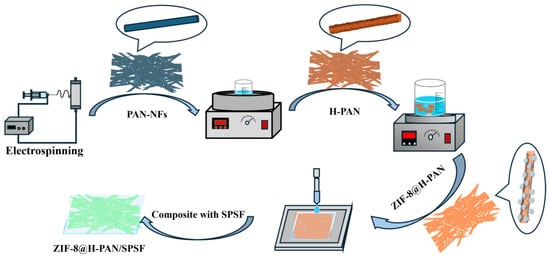
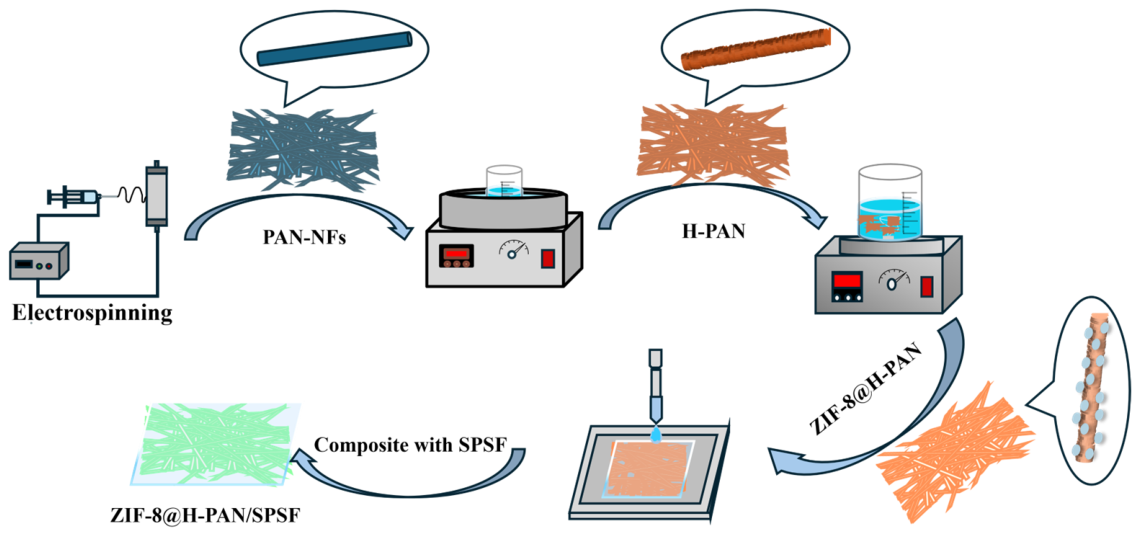
H-PAN and the prepared ZIF-8@H-PAN samples were impregnated with a 15 wt% SPSF solution and subsequently dried at 50 °C for 20 h to obtain composite membranes, designated as H-PAN/SPSF, ZIF-8@H-PAN-1h/SPSF, ZIF-8@H-PAN-2h/SPSF, and ZIF-8@H-PAN-3h/SPSF, respectively. The nanofiber content in the composite membranes was maintained at approximately 25 wt%. All nanocomposite membranes exhibited a thickness in the range of 50–60 μm. The preparation process of the ZIF-8@H-PAN/SPSF is shown in Figure 1.
Figure 1.
Preparation of ZIF-8@H-PAN/SPSF.
2.5. Characterization
The morphologies of nanocomposite membranes and nanofibers were examined while employing a Hitachi S-4800 scanning electron microscope (SEM; Hitachi High-Tech Corporation, Tokyo, Japan). The surface elemental components were assessed using the Nexsa G2 instrument for X-ray photoelectron spectroscopy (XPS, Thermo Fisher Scientific, Waltham, MA, USA). The structure was confirmed with a Nicolet 6700 Fourier transform infrared spectrometer (FTIR, Thermo Fisher Scientific, Waltham, MA, USA) and a D8 DISCOVER X-ray diffraction (XRD; Bruker AXS GmbH, Karlsruhe, Germany). The thermal stability of the composite membranes was evaluated using an STA 409 PC thermogravimetric analyzer (TGA, NETZSCH-Gerätebau GmbH, Selb, Germany) under a nitrogen atmosphere from 40 to 900 °C at a heating rate of 10 °C min−1.
2.6. Water Uptake (WU) and Swelling Ratio (SR)
The weight and area (2 cm × 2 cm) in the dry state were measured as W1 and S1, respectively. After immersing in distilled water at varying temperatures (20, 40, 60, and 80 °C) for 24 h, the surface moisture of the sample was extracted, and the weight and area were noted as W2 and S2, respectively. The WU and SR values were computed using the formula below:
WU = (W2 − W1)/W1 × 100%
SR = (S2 − S1)/S1 × 100%
2.7. Proton Conductivity
The proton conductivity of the membranes was determined by electrochemical impedance spectroscopy using an electrochemical workstation (CHI660D, CH Instruments, Shanghai, China). Before testing, each membrane was cut into a strip approximately 1 cm × 2 cm in size and mounted in a four-electrode fixture. Measurements were performed at 100% relative humidity (RH) and temperatures of 20, 40, 60, and 80 °C after the open-circuit potential had stabilized, using a frequency range of 0.1–105 Hz and an operating amplitude of 10 mV. The membrane resistance was obtained from the Nyquist plots. The proton conductivity was calculated using Equation (3):
where σ denotes the conductivity of protons and L is the distance between the two electrodes, R is the impedance value, and A represents the cross-sectional area.
σ = L R−1A−1
2.8. Mechanical Testing
The tensile strength and elongation at break of the membranes were determined using a tensile testing machine (PT-1198GD, Guangdong Pootab Shining Technology Co., Ltd., Dongguan, China). Prior to testing, the membranes were cut into 1 cm × 3 cm strips and immersed in deionized water at room temperature for 3 h.
2.9. Methanol Permeability
The composite membranes were placed in the middle of the diffusion cell, dividing two different compartments. A solution of methanol (10 M) and a specific amount of distilled water was introduced to the compartments, and subsequently, the methanol diffusion value was calculated using the following formula:
where DK represents the methanol permeability, CB(t) is the methanol on the receiving side, A is the area of the membrane, VB denotes the permeation cell’s volume, CA is the methanol’s initial concentration, and t represents time.
DK = CB(t) A−1 VB L CA−1 (t − t0)−1
2.10. Direct Methanol Single-Cell Tests
Pt–Ru and Pt/C catalysts were applied to the anode and cathode sides of the membrane, respectively, at a loading of 5 mg cm−2 on each side. Carbon paper was subsequently placed on both sides of the catalyst-coated membrane to serve as the gas diffusion layers, forming the membrane electrode assembly. Single-cell performance was evaluated using an Arbin Instruments (College Station, TX, USA) DMFC test system at 60 °C and 100% relative humidity. The flow rates of O2 and the 2 M methanol solution were maintained at 0.5 L min−1 and 2 mL min−1, respectively.
3. Results and Discussions
3.1. Characterization of ZIF-8@H-PAN and the Nanocomposite PEM
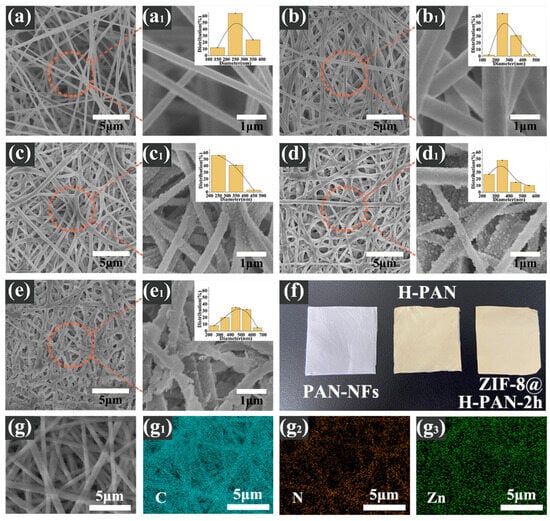
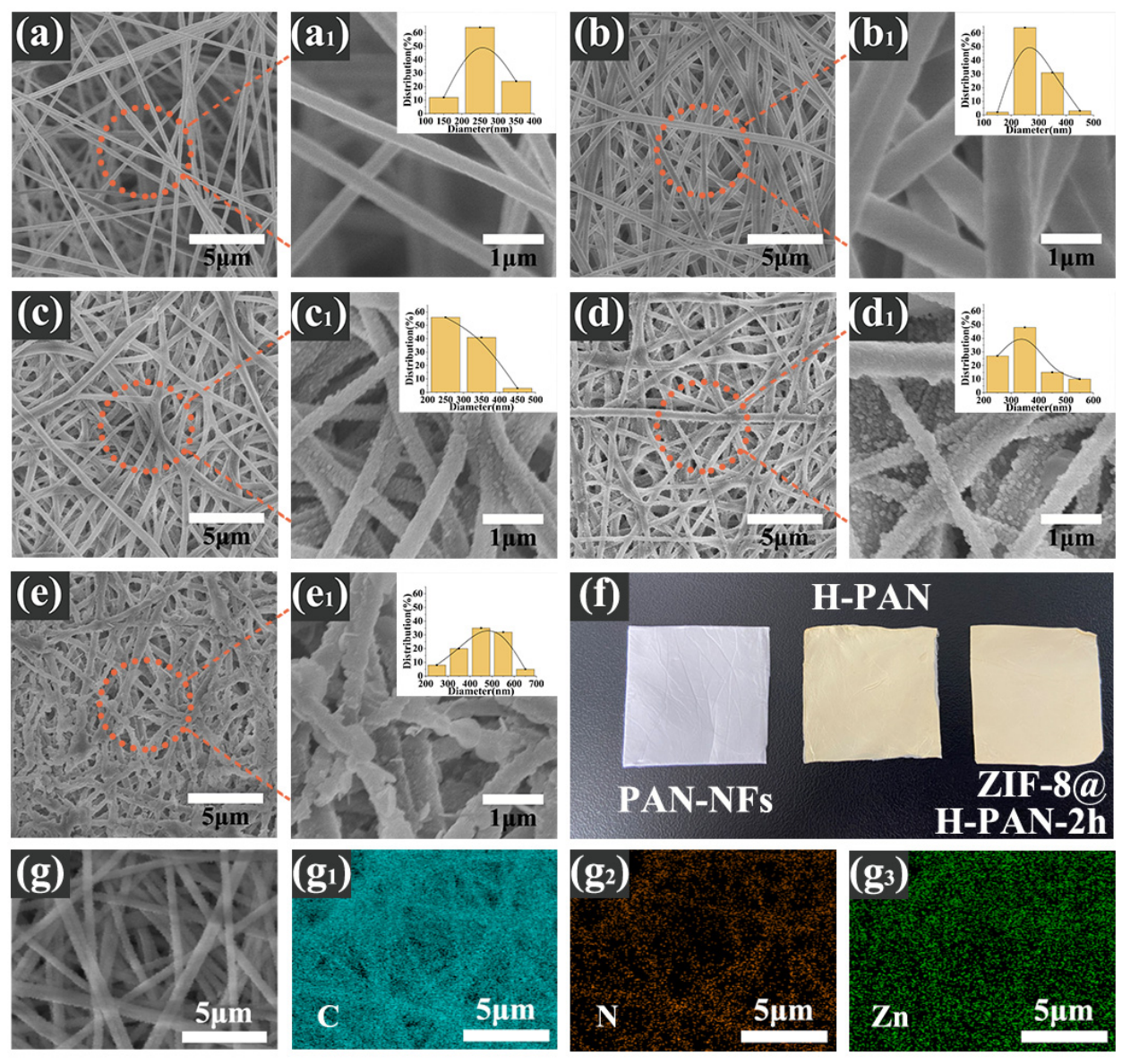
Figure 2 shows the SEM images of the microstructure and optical images of the nanofibers. The PAN-NFs and H-PAN showed a continuous 3D fiber aggregate structure, whereas the nanofibers demonstrated a smooth surface with no cracks, as shown in Figure 2(a,a1,b,b1). Figure 2c–e displayed a continuous and uniform distribution of ZIF-8 on H-PAN with a stable 3D fiber assembly structure, potentially contributing to the development of long-range and continuous proton conduction channels. Furthermore, particles were agglomerated on the surface of ZIF-8@H-PAN-3h. Statistical analysis of the SEM images using Image-Pro Plus revealed an increase in apparent fiber diameter with increasing functionalization time, consistent with progressive ZIF-8 deposition on the nanofiber surfaces.
Figure 2.
SEM images and fiber diameter distributions of (a,a1) PAN-NFs, (b,b1) H-PAN, (c,c1) ZIF-8@H-PAN-1h, (d,d1) ZIF-8@H-PAN-2h, (e,e1) ZIF-8@H-PAN-3h; (f) Optical image of PAN-NFs, H-PAN and ZIF-8@H-PAN-2h; (g–g3) EDS elemental mapping of C, N, Zn in ZIF-8@H-PAN-2h.
The PAN-NFs were successfully hydrolyzed, as suggested by color changes seen in the optical images displayed in Figure 2f. Moreover, ZIF-8@H-PAN-2h retained the original morphology of the fibers, providing a scaffold for the subsequent preparation of composite membranes. The results of EDS elemental mapping (ZIF-8@H-PAN-2h) of C, N, and Zn (Figure 2(g–g3)) confirmed that the ZIF-8 was uniformly distributed on the H-PAN.
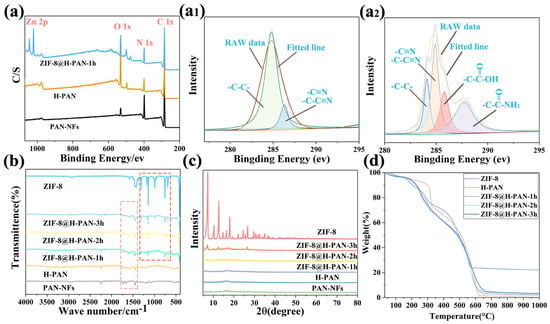
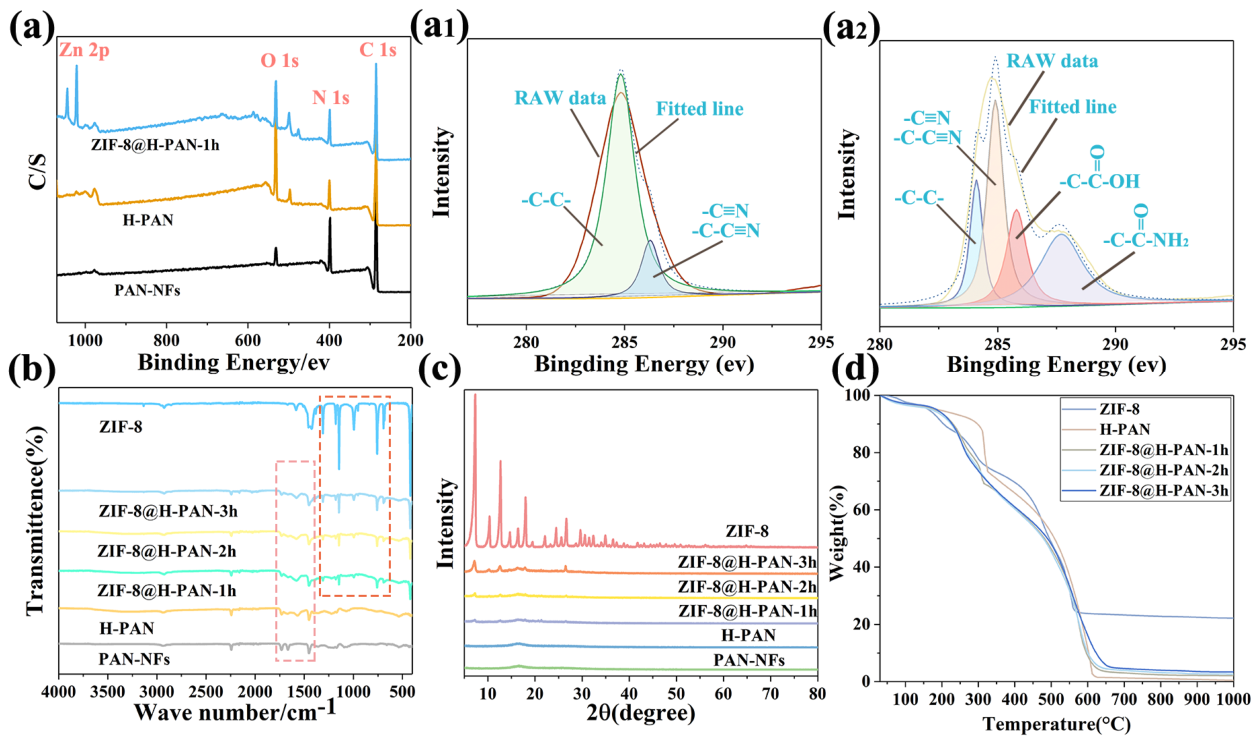
The XPS spectra of PAN-NFs, H-PAN, and ZIF-8@H-PAN-1h showed three peaks at approximately 286, 400, and 533 eV, corresponding to C 1s, N 1s, and O 1s, respectively (Figure 3a). After H-PAN was functionalized with ZIF-8, a new peak at around 1022 eV was observed, which belongs to Zn2p [34,35], further confirming the ZIF-8 immobilization on H-PAN. Figure 3(a1,a2) illustrates the C 1s deconvolution spectra of PAN-NFs and H-PAN. The PAN-NFs showed C 1s peaks at 284.8 and 286.3 eV, while the corresponding peaks for H-PAN were observed at 284.1, 284.9, 285.8, and 287.7 eV, indicative of four types of carbon [36,37], verifying that the PAN-NFs were successfully hydrolyzed.
Figure 3.
(a) XPS spectra of PAN-NFs, H-PAN, ZIF-8@H-PAN-1h; (a1,a2) XPS C 1s spectra of PAN-NFs and H-PAN; (b) FTIR curves, (c) XRD patterns and (d) TG of samples.
The chemical structure of the samples was examined using FTIR spectroscopy. The FTIR spectrum of PAN-NFs revealed distinct absorption bands at 2934 and 2243 cm−1, corresponding to the –CH2 stretching vibration and the nitrile group (–C≡N), respectively (Figure 3b) [36,38]. In comparison to PAN-NFs, the H-PAN spectrum showed new characteristic peaks at 1567 cm−1, indicating the carboxylic acid group’s C = O vibration [38]. Furthermore, the ZIF-8@H-PAN spectrum demonstrated characteristic bands corresponding to ZIF-8 and PAN-NFs, thus confirming their presence in the composite.
The XRD patterns of PAN-NFs and H-PAN displayed a pronounced peak at around 18° (Figure 3c). When ZIF-8 was functionalized on H-PAN, the XRD patterns showed characteristic diffraction peaks at 7.4° and 12.7° [39,40], which are in line with the previously reported peaks for ZIF-8. These results confirmed that the ZIF-8@H-PAN was successfully prepared.
Thermogravimetric analysis was conducted in air over a temperature range of 30–1000 °C to estimate the ZIF-8 loading on H-PAN (Figure 3d). Based on the residual mass fractions [41], the ZIF-8 loadings in ZIF-8@H-PAN-1h, ZIF-8@H-PAN-2h, and ZIF-8@H-PAN-3h were estimated to be 9.54, 12.28, and 15.42 wt%, respectively, indicating that ZIF-8 deposition increased with functionalization time.
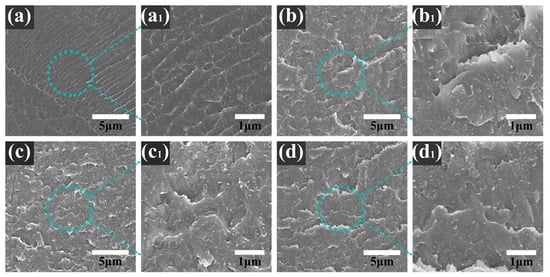
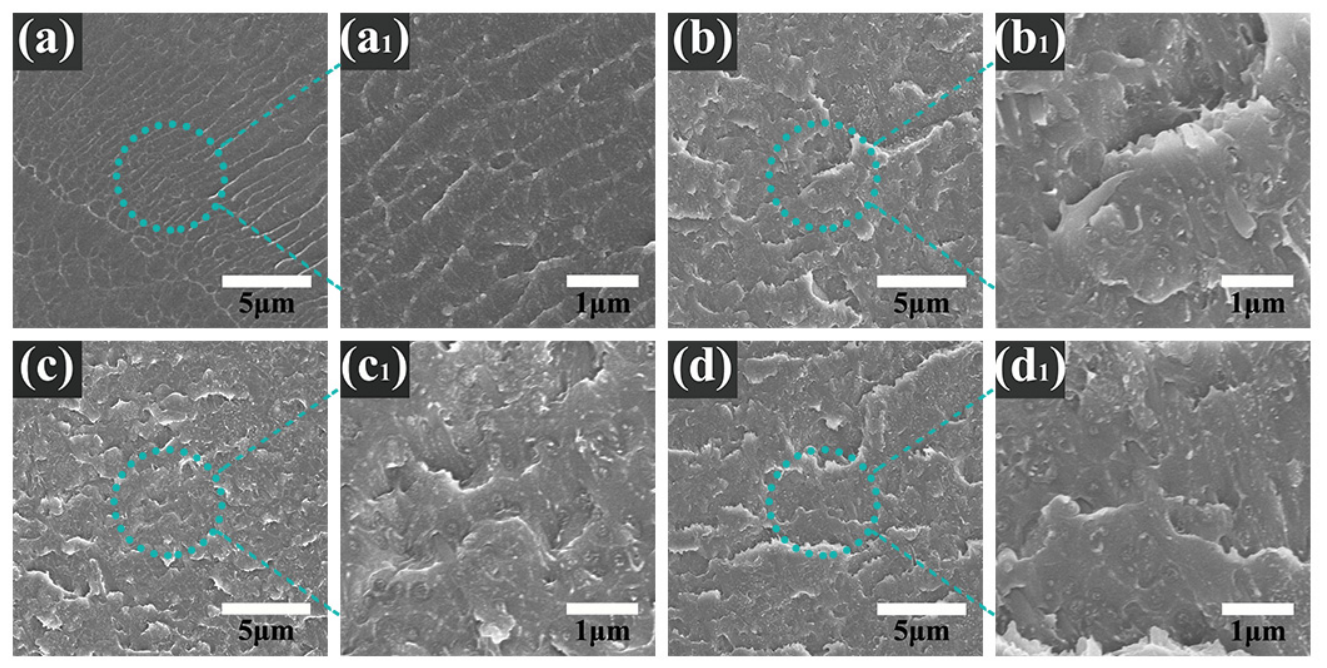
The microstructure and properties of nanocomposite PEMs were strongly correlated. To confirm the structural compactness of the prepared PEMs, the cross-sectional morphologies of the recast SPSF membrane and the ZIF-8@H-PAN/SPSF nanocomposite PEMs were examined, as depicted in Figure 4a–d. The results showed that the nanocomposite matrix preserved the 3D fibrous architecture well, with no observable interfacial defects between the SPSF continuous phase and the ZIF-8@H-PAN.
Figure 4.
Cross-sectional SEM images at different magnifications of (a,a1) SPSF membrane, (b,b1) ZIF-8@H-PAN-1h/SPSF, (c,c1) ZIF-8@H-PAN-2h/SPSF, (d,d1) ZIF-8@H-PAN-3h/SPSF.
3.2. Evaluation of Nanocomposite Membranes’ Performance
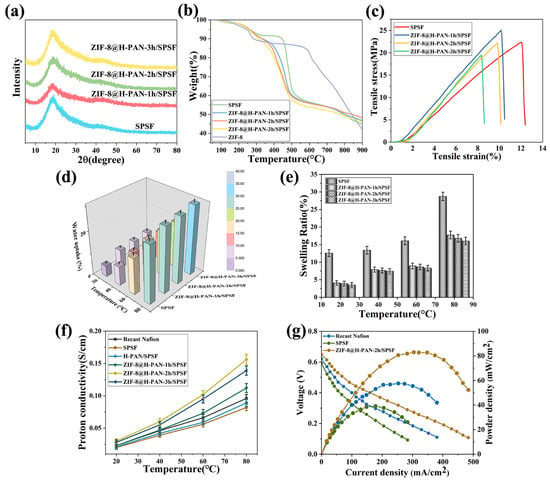
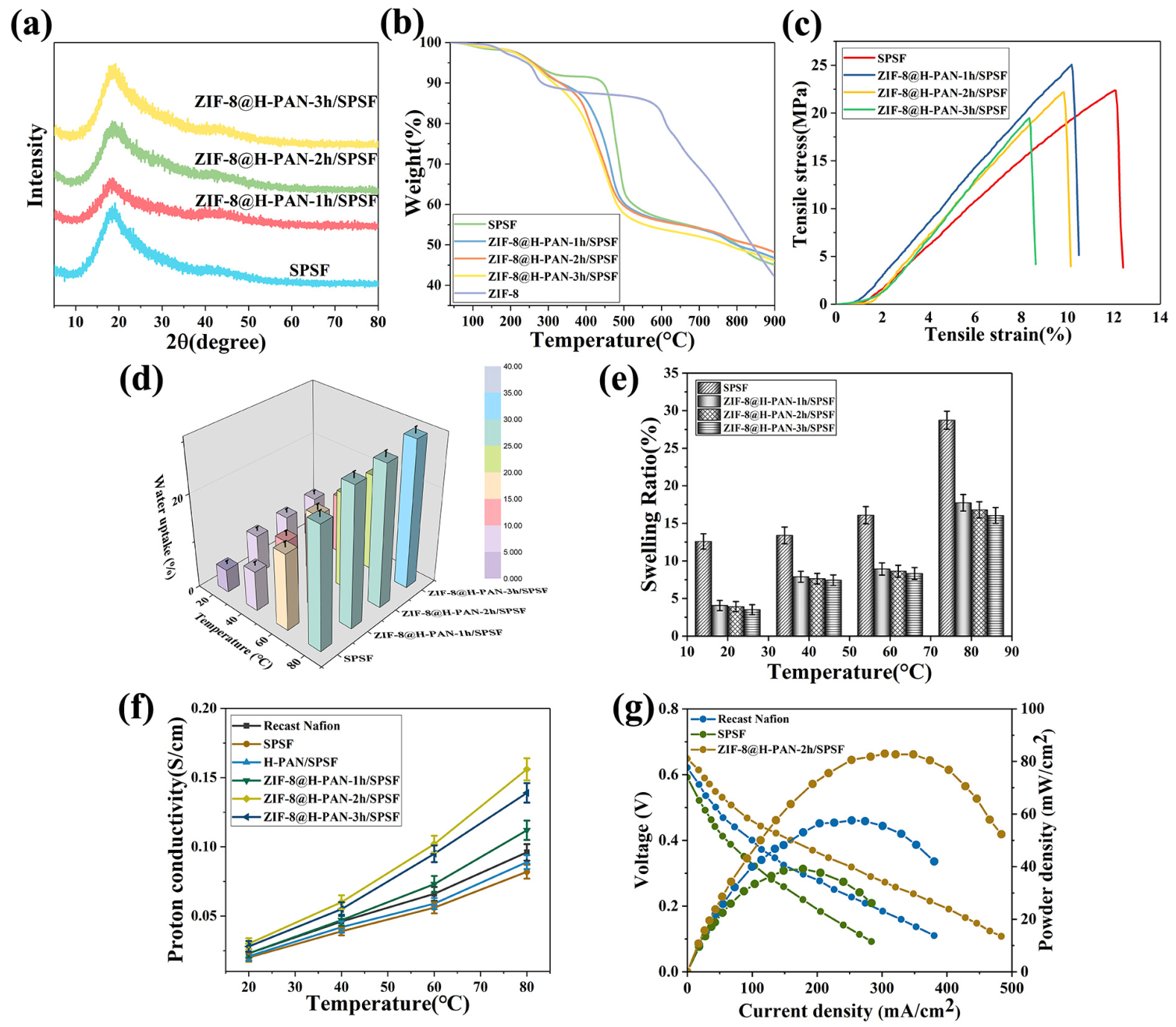
Figure 5a presents the XRD patterns of the nanocomposite PEMs. Pristine SPSF exhibited a broad diffraction feature centered at approximately 2θ = 18°, consistent with its predominantly amorphous structure. This feature appeared broader following the incorporation of ZIF-8@H-PAN, possibly owing to overlapping diffraction contributions from the membrane components, changes in the amorphous structure of the SPSF matrix, or both.
Figure 5.
(a) XRD, (b) TG, (c) mechanical properties, (d) water uptake, (e) swelling ratio, (f) proton conductivity, and (g) direct methanol fuel cell performance of samples.
The TGA curves of SPSF and ZIF-8@H-PAN/SPSF nanocomposite membranes showed three weight loss stages, as illustrated in Figure 5b. The initial weight loss was observed below 220 °C, which corresponds to the evaporation of absorbed water, hydrogen-bonded water, and residual solvent [42]. The rapid weight loss in the second stage was detected between 250 and 350 °C because of the degradation of side chain groups. The final weight loss over 400 °C resulted from the polymer’s main chain decomposition [43]. TGA results confirmed that ZIF-8@H-PAN/SPSF possesses exceptional thermal stability and is suitable for practical DMFC operating conditions.
As shown in Figure 5c, ZIF-8@H-PAN-1h/SPSF exhibited a tensile strength of 25.06 MPa, higher than that of SPSF (22.37 MPa), possibly due to reinforcement by the nanofiber network. With increasing functionalization time, tensile strength decreased to 22.18 and 19.48 MPa for ZIF-8@H-PAN-2h/SPSF and ZIF-8@H-PAN-3h/SPSF, respectively, together with a decline in elongation at break. All composite membranes exhibited lower elongation at break than SPSF, although ZIF-8@H-PAN-2h/SPSF retained comparable tensile strength. The deterioration observed for ZIF-8@H-PAN-3h/SPSF may be associated with particle aggregation, which could cause local stress concentrations and hinder interfacial stress transfer.
WU is essential to the proton transfer of nanocomposite PEMs. As the temperature increased, the WU of all membranes increased considerably, as depicted in Figure 5d. Compared with pristine SPSF, the ZIF-8@H-PAN/SPSF membrane showed significantly higher WU at a given temperature, which can be ascribed to the presence of hydrophilic functional groups (such as –COOH and –NH2) [44]. Moreover, the 3D ZIF-8@H-PAN network aided in increasing water retention in the nanocomposite membrane [45]. Figure 5e shows the dimensional stability of ZIF-8@H-PAN/SPSF nanocomposite membranes, demonstrating significantly lower SR values for all nanocomposite membranes than pure SPSF membranes. This behavior may be attributed to the three-dimensional nanofiber network, which constrains polymer expansion while allowing water uptake, thereby suppressing membrane swelling, consistent with previous findings [46].
A high-performance PEM should possess high proton conductivity and low methanol permeability. Figure 5f illustrates the temperature-dependent conductivity of protons in the recast Nafion, pristine SPSF, and ZIF-8@H-PAN/SPSF membranes over a range of 20–80 °C under 100% relative humidity (RH), demonstrating significantly higher proton conductivity for the nanocomposite membrane than that of both the pristine SPSF and the recast Nafion membranes. Compared with pristine SPSF, H-PAN/SPSF exhibited a modest increase in proton conductivity, possibly owing to the introduction of acidic and basic groups on the nanofiber surfaces, which may facilitate proton transport along the fibrous network. The ZIF-8@H-PAN-2h/SPSF composite membrane achieved a maximum proton conductivity of 0.156 S/cm, which can be ascribed to the synergistic contributions of the following mechanisms governing proton transport. First, interactions between the sulfonic acid groups (–SO3H) of SPSF and imidazole-related sites at the ZIF-8 interface may facilitate proton transport via the Grotthuss mechanism [47]. Second, the interconnected three-dimensional nanofiber network may help establish interconnected proton-transport pathways within the composite membranes [48,49]. Third, we speculate that the hydrophilicity and high specific surface area of the nanofibers may promote water uptake, potentially facilitating proton transport via the vehicle mechanism [50,51].
Excessive methanol permeability significantly deteriorates DMFC performance by inducing fuel waste and catalyst degradation, therefore decreasing overall cell efficiency. As shown in Table 1, all nanocomposite membranes exhibited lower methanol permeability than SPSF. The ZIF-8@H-PAN-1h/SPSF membrane demonstrated a permeability of 4.9 × 10⁻⁷ cm2 s−1, approximately 50% lower than that of pure SPSF. The observed significant reduction was ascribed to the ZIF-8@H-PAN 3D structure, which serves as an effective barrier to methanol transport [52]. ZIF-8@H-PAN-2h/SPSF exhibited the highest selectivity of 27.86 × 10⁴ S s cm−3, approximately 3.3 times that of pristine SPSF. These results suggest that the ZIF-8@H-PAN-2h/SPSF membrane achieves the most favorable balance between proton conductivity and methanol resistance among the membranes investigated.
Table 1.
Methanol permeability and selectivity of SPSF and composite membranes.
Figure 5g presents the polarization curves of single cells assembled with composite membranes, measured at 60 °C and 100% RH, with ZIF-8@H-PAN-2h/SPSF demonstrating a maximum power density of 82.94 mW/cm2, substantially exceeding that of the pristine SPSF membrane (39.14 mW/cm2) and recast Nafion (57.57 mW/cm2). For ZIF-8@H-PAN-2h/SPSF, enhanced water uptake and proton conductivity, together with limited swelling and relatively low methanol permeability, may collectively contribute to favorable cell performance. Furthermore, the performance of the membranes developed in this study was compared with that reported in related studies (Table 2). These findings highlight the significant potential of the ZIF-8@H-PAN/SPSF composite membrane as a promising candidate for DMFC applications.
Table 2.
Membrane performance comparison with related studies.
4. Conclusions
The current research reported the fabrication of a novel proton exchange membrane by embedding a ZIF-8-functionalized nanofiber mat into an SPSF matrix. The design combines the structural advantages of a three-dimensional nanofiber network with ZIF-8 functionalization, which may facilitate the formation of interconnected proton-transport pathways. The synthesized ZIF-8@H-PAN-2h/SPSF membrane demonstrated an outstanding proton conductivity of 0.156 S cm−1 at 80 °C and 100% relative humidity, while achieving a maximum power density of 82.94 mW cm−2 in a single-cell test, attributable to its superior proton conductivity and effective methanol barrier properties. The findings underscore the promising applicability of MOF-functionalized nanofiber-based proton exchange membranes in direct methanol fuel cells.
Author Contributions
Software, J.R.; Formal analysis, S.W.; Investigation, G.Y.; Data curation, J.R.; Writing—original draft, S.W.; Writing—review & editing, J.X.; Supervision, J.X.; Funding acquisition, S.W. and J.X. All authors have read and agreed to the published version of the manuscript.
Funding
This research was funded by Science and Technology Plans of Anhui Polytechnic University grant number (2022YQQ015, Xjky2022068, FFBK202234 and FFBK202334).
Data Availability Statement
The original contributions presented in this study are included in the article. Further inquiries can be directed to the corresponding authors.
Conflicts of Interest
The authors declare no conflicts of interest.
References
- Wang, Y.; Luo, Y.; Chen, R.; Sun, B.; Liu, H.; Wang, J.; Gong, C.; Zhang, Q. Durable direct methanol fuel cells through cytosine-modified sulfonated poly(ether ether ketone) matrix with phosphorylated metal-organic framework integration. Int. J. Hydrogen Energy 2024, 95, 630–640. [Google Scholar] [CrossRef] [Scilit]
- Shaari, N.; Osman, S.H.; Kamarudin, S.K.; Wani, A.A.; Wong, W.Y.; Beygisangchin, M.; Mohamed Nainar, M.A.; Zulkifli, M.Z.A. Unlocking MOF Potential in DMFC Systems: A critical analysis of structural innovations and future perspectives. Energy Fuels 2025, 39, 20729–20769. [Google Scholar] [CrossRef] [Scilit]
- Sun, B.; Sun, X.; Li, Z.; Yang, L.; Liu, H.; Hu, F.; Xu, Z.; Zhang, Q. Synergistic anchoring of emulsion-encapsulated phosphoric acid in cytosine-modified SPEEK toward durable direct methanol fuel cells. J. Membr. Sci. 2026, 742, 125122. [Google Scholar] [CrossRef] [Scilit]
- Teixeira, F.C.; de Sá, A.I.; Teixeira, A.P.S.; Rangel, C.M. Nafion phosphonic acid composite membranes for proton exchange membranes fuel cells. Appl. Surf. Sci. 2019, 487, 889–897. [Google Scholar] [CrossRef] [Scilit]
- Chen, R.; Li, J.; Zhao, P.; Tolj, I.; Li, S.; Tu, Z. Structure-property relationship analysis of metal-organic frameworks (MOFs) doped proton exchange membrane (PEM). Int. J. Hydrogen Energy 2025, 141, 811–822. [Google Scholar] [CrossRef] [Scilit]
- Okonkwo, P.C.; Ben Belgacem, I.; Emori, W.; Uzoma, P.C. Nafion degradation mechanisms in proton exchange membrane fuel cell (PEMFC) system: A review. Int. J. Hydrogen Energy 2021, 46, 27956–27973. [Google Scholar] [CrossRef] [Scilit]
- Tai, M.H.; Thiam, H.S.; Tee, S.F.; Lim, Y.S.; Saw, L.H.; Lai, S.O. Self-healing sulfonated poly(ether ether ketone)/polyvinyl alcohol membrane reinforced with sulfonated silica for direct methanol fuel cell. Int. J. Hydrogen Energy 2025, 104, 487–495. [Google Scholar] [CrossRef] [Scilit]
- Zhao, T.; Dong, H.; Zhai, P.; Ma, Z.; Wang, R.; Ding, T.; Long, Z.; Wang, Y.; Ren, Y. Sulfonated and phenylated polyphenylenes containing hexafluoroisopropylene in the backbone to enhance the flexibility and conductivity as proton exchange membranes. J. Power Sources 2025, 653, 237729. [Google Scholar] [CrossRef] [Scilit]
- Chen, K.; Hu, Z.; Endo, N.; Fang, J.; Higa, M.; Okamoto, K. Sulfonated polyimides bearing benzimidazole groups for direct methanol fuel cell applications. J. Membr. Sci. 2010, 351, 214–221. [Google Scholar] [CrossRef] [Scilit]
- Gil, S.C.; Kim, J.C.; Ahn, D.; Jang, J.-S.; Kim, H.; Jung, J.C.; Lim, S.; Jung, D.-H.; Lee, W. Thermally crosslinked sulfonated polyethersulfone proton exchange membranes for direct methanol fuel cells. J. Membr. Sci. 2012, 417–418, 2–9. [Google Scholar] [CrossRef] [Scilit]
- Liu, X.; Yang, Z.; Zhang, Y.; Li, C.; Dong, J.; Liu, Y.; Cheng, H. Electrospun multifunctional sulfonated carbon nanofibers for design and fabrication of SPEEK composite proton exchange membranes for direct methanol fuel cell application. Int. J. Hydrogen Energy 2017, 42, 10275–10284. [Google Scholar] [CrossRef] [Scilit]
- Gao, H.; Dong, C.; Wang, Q.; Zhu, H.; Meng, X.; Cong, C.; Zhou, Q. Improving the proton conductivity of proton exchange membranes via incorporation of HPW-functionalized mesoporous silica nanospheres into SPEEK. Int. J. Hydrogen Energy 2018, 43, 21940–21948. [Google Scholar] [CrossRef] [Scilit]
- Gao, J.; Dong, X.; Tian, Q.; He, Y. Carbon nanotubes reinforced proton exchange membranes in fuel cells: An overview. Int. J. Hydrogen Energy 2023, 48, 3216–3231. [Google Scholar] [CrossRef] [Scilit]
- Devrim, Y.; Bulanık Durmuş, G.N. Composite membrane by incorporating sulfonated graphene oxide in polybenzimidazole for high temperature proton exchange membrane fuel cells. Int. J. Hydrogen Energy 2022, 47, 9004–9017. [Google Scholar] [CrossRef] [Scilit]
- Huang, M.; Li, Y.; Lu, H.; Gao, S.; Kwofie, F.; Guo, X.; Meyer, Q.; Wang, Y.; Zhao, C.; Li, N.; et al. Construction of Efficient Proton Channels with Silica-encapsulated Carbon Nanotubes for Proton Exchange Membrane Water Electrolysers. Chem. Eng. J. 2025, 522, 167557. [Google Scholar] [CrossRef] [Scilit]
- Zhai, S.; Lu, Z.; Ai, Y.; Jia, X.; Yang, Y.; Liu, X.; Tian, M.; Bian, X.; Lin, J.; He, S. High performance nanocomposite proton exchange membranes based on the nanohybrids formed by chemically bonding phosphotungstic acid with covalent organic frameworks. J. Power Sources 2023, 554, 232332. [Google Scholar] [CrossRef] [Scilit]
- Chen, X.; Ren, Q.; Xu, J.; Ju, M.; Meng, L.; Wang, Z. Design, transport efficiency and structure-activity relationship of sulfonated poly (aryl ether ketone) proton exchange membrane based on multi-functional MOFs. Electrochim. Acta 2023, 469, 143210. [Google Scholar] [CrossRef] [Scilit]
- Xun, X.; Liu, S.; Lv, J.; Yue, C.; Wang, F.; Li, N.; Hu, Z.; Chen, S. Proton exchange membranes from double-filler of sulfonated titanium dioxide nanotubes and graphitic carbon nitride nanosheets integrated into sulfonated poly(aryl ether sulfone)s. Int. J. Hydrogen Energy 2024, 94, 13–22. [Google Scholar] [CrossRef] [Scilit]
- Sharma, V.; Upadhyay, P.; Rathod, N.H.; Sharma, J.; Mishra, S.; Raj, S.K.; Kishore, V.; Kulshrestha, V. Silica modified sulphonated Poly(ether ether ketone) proton exchange membranes for DMFC application. Int. J. Hydrogen Energy 2023, 48, 37784–37795. [Google Scholar] [CrossRef] [Scilit]
- Long, J.; Zhang, X.; Zeng, S.; Pei, T.; Ma, H.; Li, X.; Meng, X. Constructing a long-range proton conduction bridge in sulfonated polyetheretherketone membranes with low DS by incorporating acid-base bi-functionalized metal organic frameworks. Int. J. Hydrogen Energy 2023, 48, 2001–2012. [Google Scholar] [CrossRef] [Scilit]
- Liu, M.; Zhou, T.; Han, X.; Shen, Y.; Song, Y.; Wu, Y.; Gao, Y.; He, W. Polyoxometalates loaded metal-organic frameworks as functional proton conductors for high-temperature proton exchange membrane fuel cells with high performance. J. Membr. Sci. 2025, 724, 123981. [Google Scholar] [CrossRef] [Scilit]
- Abdirashev, O.; Temirbayeva, A.; Kabdrakhimova, G.; Satanova, B.; Abuova, A.; Abuova, F.; Ussen, Y.; Kalpakov, Y.; Konuhova, M.; Popov, A.I. Recent Advances in ZIF-8 Performance for Electrochemical Applications: A Comprehensive Review. Int. J. Mol. Sci. 2026, 27, 7975. [Google Scholar] [CrossRef] [Scilit] [PubMed]
- Liu, N.; Wang, J.; Yang, H.; Cheng, F.; Bi, S.; Liu, G.; Ou, Y.; Liu, H.; Gong, C. Ionic liquid functionalized ZIF-8 modified PVDF nanofiber-based composite proton exchange membranes towards direct methanol fuel cells applications. J. Membr. Sci. 2025, 724, 123990. [Google Scholar] [CrossRef] [Scilit]
- Rao, Z.; Zhang, A.; Liu, X.; He, Y.; Zhu, D.; Xu, Y.; Wang, G.; Wang, Z.; Tang, B.; Liu, H. Interconnected hollow metal–organic framework network towards excellent proton transfer for proton exchange membrane. Sep. Purif. Technol. 2024, 335, 126224. [Google Scholar] [CrossRef] [Scilit]
- Zhang, Z.; Ren, J.; Xu, J.; Wang, Z.; He, W.; Wang, S.; Yang, X.; Du, X.; Meng, L.; Zhao, P. Adjust the arrangement of imidazole on the metal-organic framework to obtain hybrid proton exchange membrane with long-term stable high proton conductivity. J. Membr. Sci. 2020, 607, 118194. [Google Scholar] [CrossRef] [Scilit]
- Meng, L.; Lan, T.; Xu, J.; Zhao, P.; Lei, J. Adjusting structure-activity relationship to obtain hybrid proton exchange membrane with enhanced transport efficiency by introducing functionalized nano-coated MOFs. J. Membr. Sci. 2024, 694, 122409. [Google Scholar] [CrossRef] [Scilit]
- Devrim, Y.; Colpan, C.O. Assessment of polybenzimidazole/MOF composite membranes for the improvement of high-temperature PEM fuel cell performance. Int. J. Hydrogen Energy 2024, 58, 470–478. [Google Scholar] [CrossRef] [Scilit]
- Wang, P.; Lin, J.; Wu, Y.; Wang, L. Construction of high-density proton transport channels in phosphoric acid doped polybenzimidazole membranes using ionic liquids and metal-organic frameworks. J. Power Sources 2023, 560, 232665. [Google Scholar] [CrossRef] [Scilit]
- Pugalenthi, M.R.; Punyawudho, K.; Arasi, M.A.; Shah, A.; Prabhu, M.R.; Kouthaman, M.; Velsankar, K.; Gayathri, R. Designing high performance electrospuned SPEEK nanofibers composite membrane for PEMFC application. Mater. Lett. 2023, 339, 134117. [Google Scholar] [CrossRef] [Scilit]
- Takemori, R.; Kawakami, H. Electrospun nanofibrous blend membranes for fuel cell electrolytes. J. Power Sources 2010, 195, 5957–5961. [Google Scholar] [CrossRef] [Scilit]
- Wang, H.; Zhang, J.; Ning, X.; Tian, M.; Long, Y.; Ramakrishna, S. Recent advances in designing and tailoring nanofiber composite electrolyte membranes for high-performance proton exchange membrane fuel cells. Int. J. Hydrogen Energy 2021, 46, 25225–25251. [Google Scholar] [CrossRef] [Scilit]
- Patel, R.; Sharma, Y. Integrated proton transport architecture in fiber-reinforced sulfonated membrane for high-performance proton exchange membrane fuel cell. J. Power Sources 2025, 653, 237763. [Google Scholar] [CrossRef] [Scilit]
- Zhang, Y.; Zheng, L.; Liu, B.; Wang, H.; Shi, H. Sulfonated polysulfone proton exchange membrane influenced by a varied sulfonation degree for vanadium redox flow battery. J. Membr. Sci. 2019, 584, 173–180. [Google Scholar] [CrossRef] [Scilit]
- Li, N.; Zhou, L.; Jin, X.; Owens, G.; Chen, Z. Simultaneous removal of tetracycline and oxytetracycline antibiotics from wastewater using a ZIF-8 metal organic-framework. J. Hazard. Mater. 2019, 366, 563–572. [Google Scholar] [CrossRef] [Scilit] [PubMed]
- Moghadam, F.; Zhang, C.; Li, Z.; Li, J.; Zhai, M.; Li, K. Structurally Stable Hollow-Fiber-Based Porous Graphene Oxide Membranes with Improved Rejection Performance by Selective Patching of Framework Defects with Metal-Organic Framework Crystals. ACS Appl. Mater. Interfaces 2025, 17, 1803–1812. [Google Scholar] [CrossRef] [Scilit] [PubMed]
- Jin, S.Y.; Kim, M.H.; Jeong, Y.G.; Yoon, Y.I.; Park, W.H. Effect of alkaline hydrolysis on cyclization reaction of PAN nanofibers. Mater. Des. 2017, 124, 69–77. [Google Scholar] [CrossRef] [Scilit]
- Lee, S.H.; Jeong, Y.G.; Yoon, Y.I.; Park, W.H. Hydrolysis of oxidized polyacrylonitrile nanofibrous webs and selective adsorption of harmful heavy metal ions. Polym. Degrad. Stab. 2017, 143, 207–213. [Google Scholar] [CrossRef] [Scilit]
- Patel, S.; Hota, G. Synthesis of novel surface functionalized electrospun PAN nanofibers matrix for efficient adsorption of anionic CR dye from water. J. Environ. Chem. Eng. 2018, 6, 5301–5310. [Google Scholar] [CrossRef] [Scilit]
- Jin, X.; Li, H.; Zhu, X.; Li, N.; Owens, G.; Chen, Z. Enhanced removal of oxytetracycline from wastewater using bimetallic Fe/Ni nanoparticles combined with ZIF-8 nanocomposites. J. Environ. Manag. 2022, 318, 115526. [Google Scholar] [CrossRef] [Scilit] [PubMed]
- Adhami, A.; Hamzehlouy, A.; Towfighi, J.; Soroush, M. Modeling and Optimization of PVDF-based Polymer Inclusion Membranes for High-selectivity Calcium-ion Separation. Chem. Eng. J. 2026, 530, 173301. [Google Scholar] [CrossRef] [Scilit]
- Han, J.; Gao, S.; Wang, R.; Wang, K.; Jiang, M.; Yan, J.; Jiang, K. Thermal Modulation of MOF and Its Application in Lithium-Sulfur Batteries. ACS Appl. Mater. Interfaces 2019, 11, 46792–46799. [Google Scholar] [CrossRef] [Scilit] [PubMed]
- Wang, H.; Zhuang, X.; Tong, J.; Li, X.; Wang, W.; Cheng, B.; Cai, Z. Solution-blown SPEEK/POSS nanofiber-nafion hybrid composite membranes for direct methanol fuel cells. J. Appl. Polym. Sci. 2015, 132, 42843. [Google Scholar] [CrossRef] [Scilit]
- Wang, H.; Zhuang, X.; Li, X.; Wang, W.; Wang, Y.; Cheng, B. Solution blown sulfonated poly(ether sulfone)/poly(ether sulfone) nanofiber-Nafion composite membranes for proton exchange membrane fuel cells. J. Appl. Polym. Sci. 2015, 132, 42572. [Google Scholar] [CrossRef] [Scilit]
- Wang, S.; Yan, G.; Kang, X.; Li, Z.; Zhuang, X. Bio-metal organic framework functionalized nanofibers as efficient proton-conducting for proton exchange membrane. Int. J. Hydrogen Energy 2024, 87, 1347–1355. [Google Scholar] [CrossRef] [Scilit]
- Li, H.; Lee, Y.; Lai, J.; Liu, Y. Composite membranes of Nafion and poly(styrene sulfonic acid)-grafted poly(vinylidene fluoride) electrospun nanofiber mats for fuel cells. J. Membr. Sci. 2014, 466, 238–245. [Google Scholar] [CrossRef] [Scilit]
- Zhao, G.; Xu, X.; Zhao, H.; Shi, L.; Zhuang, X.; Cheng, B.; Yin, Y. Zeolitic imidazolate framework decorated on 3D nanofiber network towards superior proton conduction for proton exchange membrane. J. Membr. Sci. 2020, 601, 117914. [Google Scholar] [CrossRef] [Scilit]
- Wang, J.; He, Y.; Zhao, L.; Li, Y.; Cao, S.; Zhang, B.; Zhang, H. Enhanced proton conductivities of nanofibrous composite membranes enabled by acid–base pairs under hydrated and anhydrous conditions. J. Membr. Sci. 2015, 482, 1–12. [Google Scholar] [CrossRef] [Scilit]
- Ju, J.; Shi, J.; Wang, M.; Wang, L.; Cheng, B.; Yu, X.; Cai, Y.; Wang, S.; Fang, L.; Kang, W. Constructing interconnected nanofibers@ZIF-67 superstructure in nafion membranes for accelerating proton transport and confining methanol permeation. Int. J. Hydrogen Energy 2021, 46, 38782–38794. [Google Scholar] [CrossRef] [Scilit]
- Rao, Z.; Tang, B.; Wu, P. Proton Conductivity of Proton Exchange Membrane Synergistically Promoted by Different Functionalized Metal-Organic Frameworks. ACS Appl. Mater. Interfaces 2017, 9, 22597–22603. [Google Scholar] [CrossRef] [Scilit] [PubMed]
- Wu, L.; Huang, C.; Woo, J.; Wu, D.; Yun, S.; Seo, S.; Xu, T.; Moon, S.H. Hydrogen bonding: A channel for protons to transfer through acid-base pairs. J. Phys. Chem. B 2009, 113, 12265–12270. [Google Scholar] [CrossRef] [Scilit] [PubMed]
- Wang, L.; Deng, N.; Liang, Y.; Ju, J.; Cheng, B.; Kang, W. Metal-organic framework anchored sulfonated poly(ether sulfone) nanofibers as highly conductive channels for hybrid proton exchange membranes. J. Power Sources 2020, 450, 227592. [Google Scholar] [CrossRef] [Scilit]
- Zhao, G.; Xu, X.; Shi, L.; Cheng, B.; Zhuang, X.; Yin, Y. Biofunctionalized nanofiber hybrid proton exchange membrane based on acid-base ion-nanochannels with superior proton conductivity. J. Power Sources 2020, 452, 227839. [Google Scholar] [CrossRef] [Scilit]
- Krathumkhet, N.; Vongjitpimol, K.; Chuesutham, T.; Changkhamchom, S.; Phasuksom, K.; Sirivat, A.; Wattanakul, K. Preparation of sulfonated zeolite ZSM-5/sulfonated polysulfone composite membranes as PEM for direct methanol fuel cell application. Solid State Ion. 2018, 319, 278–284. [Google Scholar] [CrossRef] [Scilit]
- Sun, H.; Tang, B.; Wu, P. Two-Dimensional Zeolitic Imidazolate Framework/Carbon Nanotube Hybrid Networks Modified Proton Exchange Membranes for Improving Transport Properties. ACS Appl. Mater. Interfaces 2017, 9, 35075–35085. [Google Scholar] [CrossRef] [Scilit] [PubMed]

Disclaimer/Publisher’s Note: The statements, opinions and data contained in all publications are solely those of the individual author(s) and contributor(s) and not of MDPI and/or the editor(s). MDPI and/or the editor(s) disclaim responsibility for any injury to people or property resulting from any ideas, methods, instructions or products referred to in the content. |
© 2026 by the authors. Licensee MDPI, Basel, Switzerland. This article is an open access article distributed under the terms and conditions of the Creative Commons Attribution (CC BY) license.