


Abstract
Copper bismuth oxide (CuBi2O4) was produced through a domestic microwave-assisted synthesis using water as an environmentally friendly solvent, whereas graphene oxide (GO) was obtained using a modified Hummers’ method. Structural characterization by XRD confirmed the formation of a pristine tetragonal CuBi2O4 phase, with no shift in diffraction peaks after GO incorporation, although a slight reduction in crystallinity was observed. FESEM analysis revealed the characteristic sheet-like morphology of GO and spherical CuBi2O4 particles. EDS analysis verified the elemental composition of the prepared composites. Incorporating GO into CuBi2O4 narrowed the optical band gap from 2.4 to 2.2 eV and suppressed electron–hole recombination, as evidenced by the lower photoluminescence intensity. Furthermore, BET measurements showed that the specific surface area increased markedly from 3.79 m2/g for pristine CuBi2O4 to 16.49 m2/g for the composite. This enhancement may provide additional adsorption sites for malachite green (MG) molecules, promoting their adsorption onto the composite surface before exposure to visible light. The composite achieved 86.5% MG removal within 150 min, with nearly twice the rate constant of pristine CuBi2O4. Reactive species trapping experiments indicated that photogenerated holes (h+) and superoxide radicals (•O2−) played major roles in the photocatalytic process. Meanwhile, the removal efficiency of pristine CuBi2O4 declined by approximately 40% after four consecutive reuse cycles.
1. Introduction
Among the available environmental remediation technologies, photocatalysis has emerged as a promising strategy due to its ability to utilize sunlight as an abundant and sustainable energy source for organic pollutant removal. Through various photoredox reactions, photocatalysis can be applied not only to the degradation of organic pollutants but also to the synthesis of value-added chemicals, depending on the intended application [1]. In this context, bismuth-based photocatalysts have gained increasing research interest in recent years due to their advantageous electronic characteristics and relatively narrow band gaps, which make them promising candidates for the photocatalytic degradation of environmental pollutants. These characteristics enable efficient utilization of visible light, which constitutes more than 40% of the solar spectrum, thereby offering a distinct advantage over ultraviolet (UV)-responsive semiconductors such as the benchmark photocatalyst TiO2. Consequently, bismuth-based materials, including BiVO4, Bi2O3, BiOBr, BiOCl, and BiOI, have been extensively investigated as visible-light-responsive photocatalysts. Copper bismuth oxide (CuBi2O4) is particularly attractive among bismuth-based photocatalysts because of its relatively narrow band gap, tetragonal crystalline structure, and favorable light-absorption characteristics [2,3]. CuBi2O4 is a ternary metal oxide that can be formed through the reaction of CuO and Bi2O3, resulting in a distinct crystalline phase. The relatively low band gap facilitates efficient absorption of low-energy photons, thereby enhancing visible-light responsiveness and imparting notable photocatalytic activity in heterogeneous systems [4,5,6,7]. Under light irradiation with sufficient photon energy, CuBi2O4 absorbs photons and produces electron–hole pairs. These photogenerated charge carriers can participate in surface redox reactions, potentially leading to the formation of reactive oxygen species, including hydroxyl radicals (•OH) and superoxide radicals (O2•–). However, the photocatalytic performance of pristine CuBi2O4 is often restricted by rapid electron–hole recombination, which reduces the availability of charge carriers for subsequent reactions.
Several strategies, particularly heterojunction construction, have been proposed to overcome the intrinsic limitations of photocatalysts and enhance their photocatalytic performance. For example, Nafees Ahmad et al. [8] reported the synthesis of a novel CuBi2O4/polyaniline (PANI) composite via the in situ polymerization of aniline. The composite exhibited a removal efficiency of 96% for ammonia solution, which was significantly higher than those of pristine CuBi2O4 (70%) and PANI (78%). The improved photocatalytic activity of CuBi2O4/PANI was primarily associated with more efficient separation of photogenerated charge carriers, suppression of electron–hole recombination, and greater surface area. In a related study, Fan Yang et al. [9] reported that integrating spinel CuBi2O4 with Bi2O3 to form a Z-scheme heterojunction effectively minimized charge-carrier recombination. The resulting CuBi2O4/Bi2O3 nanofibers, prepared via electrospinning, exhibited enhanced photocatalytic performance toward the degradation of methyl orange (MO).
In another study, Xin Wang et al. [10] further reported the formation of an Ag2WO4/CuBi2O4 S-type heterojunction, which significantly enhanced the sonocatalytic activity of CuBi2O4. Likewise, Tianji Ma et al. [11] developed BiOBr/CuBi2O4 composites that suppressed electron–hole recombination through Z-scheme heterojunction formation. Hangmin Guan et al. [12] also successfully prepared In2O3/CuBi2O4 heterojunctions, achieving improved photoelectric activity due to reduced charge recombination. Thus, these studies consistently demonstrate that heterojunction construction is an effective strategy for enhancing the photocatalytic performance of CuBi2O4 by promoting charge separation and suppressing charge carrier recombination.
Based on the literature review, graphene oxide (GO) was selected as a functional component for incorporation into CuBi2O4 -based composites in this study. GO is a two-dimensional carbon-based derivative of graphene that preserves the hexagonal lattice of sp2-hybridized carbon atoms, while being decorated with abundant oxygen-containing functional groups, including hydroxyl, epoxide, carbonyl, and carboxyl groups, located on both its basal planes and edges. In contrast to pristine graphene, which exhibits exceptional electrical and thermal conductivity, GO possesses a disrupted π-conjugated structure because of oxidation. This disruption reduces its electrical conductivity but simultaneously enhances its hydrophilicity, surface reactivity, and dispersibility in aqueous and polar solvents. Moreover, the presence of oxygen functionalities confers GO with a large specific surface area, tunable surface chemistry, and considerable mechanical strength. Owing to these unique physicochemical properties, GO has emerged as a promising platform for a wide range of applications, including sensors, energy storage and supercapacitors, batteries, and polymer-based nanocomposites [13,14,15,16,17,18].
When CuBi2O4 is coupled with GO, the resulting composite can significantly enhance the separation and migration of photogenerated charge carriers owing to the excellent electron conductivity of GO. In addition, the high adsorption capacity of GO enables the enrichment of organic contaminants from wastewater onto the surface of the composite photocatalyst, thereby increasing the probability of pollutant–catalyst interactions and facilitating more efficient degradation and removal processes.
Numerous studies have reported the successful integration of GO with various metal oxide photocatalysts, including TiO2, ZnO, BiVO4, WO3, CaTiO3, and BiOBr (Table 1) [19,20,21,22,23,24,25]. In these systems, the overall photocatalytic degradation rate was consistently improved, primarily due to the suppression of electron–hole pair recombination. This suppression enhances the likelihood of redox reactions occurring on the catalyst surface, leading to the generation of reactive radical species and their subsequent interaction with pollutant molecules.
Table 1.
Comparison of photocatalytic performance of GO-based composites under different conditions.
In this study, GO was synthesized using a modified Hummers method, while CuBi2O4 particles and CuBi2O4/GO composites were prepared using a household microwave-assisted method. Malachite Green (MG) dye was selected as the target pollutant in this work, serving not only as a standard model for evaluating photocatalytic efficiency but also as a representative environmental hazard. MG has been associated with mutagenic, carcinogenic, and teratogenic effects, raising significant concerns regarding its potential adverse impacts on human health and aquatic ecosystems.
Comprehensive material characterization was carried out to compare pristine CuBi2O4, GO, and the CuBi2O4/GO composite. The analyses included morphological features, crystal structure and phase composition, surface properties, and optical characteristics, with the objective of explaining how these differences influence the photocatalytic reaction mechanism in the degradation of MG synthetic wastewater. Furthermore, the proposed photocatalytic mechanism was investigated in detail to identify the dominant reactive species. The reusability of the heterogeneous photocatalysts and their potential contribution to the Sustainable Development Goals (SDGs) were also evaluated in this study.
2. Experimental
2.1. Chemicals and Reagents
Graphite powder (Sigma-Aldrich, St. Louis, MO, USA), sulfuric acid (H2SO4; QReC, New Zealand), sodium nitrate (NaNO3; KemAus, Cherrybrook, Australia), potassium permanganate (KMnO4; CARLO ERBA, Val-de-Reuil, France), 30% hydrogen peroxide (H2O2; QReC, New Zealand), and hydrochloric acid (HCl; RCl Labscan, Bangkok, Thailand) were used for the synthesis of graphene oxide (GO). Copper(II) nitrate trihydrate (Cu(NO3)2·3H2O, ≥99.5%; Loba Chemie, Mumbai, India), bismuth(III) nitrate pentahydrate (Bi(NO3)3·5H2O, >98.0%; QReC, New Zealand), and sodium hydroxide (NaOH, >98.0%; QReC, New Zealand) were employed for the synthesis of CuBi2O4. All reagents were used as received without further purification.
2.2. Material Characterizations
The crystalline structures of pristine CuBi2O4 and its composite were investigated by X-ray diffraction (XRD) using a Philips X’Pert MPD diffractometer (Philips Analytical, Almelo, The Netherlands) equipped with Cu Kα radiation (λ = 0.1546 nm). Surface morphology and elemental composition were analyzed using field-emission scanning electron microscopy (FESEM, AperoS, Thermo Fisher Scientific, Waltham, MA, USA) coupled with energy-dispersive X-ray spectroscopy (EDS). The specific surface areas of the synthesized materials were evaluated using the Brunauer–Emmett–Teller (BET) method based on N2 adsorption–desorption measurements performed with an Autosorb 1 MP analyzer (Quantachrome, Boynton Beach, FL, USA). Photoluminescence (PL) spectra were recorded using a fluorescence spectrophotometer (FluoroMax-4, Horiba Jobin Yvon, Edison, NJ, USA) with an excitation wavelength of 350 nm. The emission spectra were collected in scanning mode at room temperature using a solid sample holder. Furthermore, the optical absorption properties and band gap energies were investigated using ultraviolet–visible diffuse reflectance spectroscopy (UV–Vis DRS) with a Shimadzu UV-3101PC spectrophotometer (Shimadzu Corporation, Kyoto, Japan).
2.3. Synthesis of Graphene Oxide (Go) by Modified Hummer’s Method [26]
Graphite powder (1 g) was dispersed in 20 mL of concentrated H2SO4 (98%) under magnetic stirring for 30 min, while the reaction mixture was maintained in an ice bath below 15 °C to control the exothermic reaction. H2SO4 served as an acidic medium, facilitating the intercalation of chemical species between graphite layers and promoting subsequent oxidation. Subsequently, 0.5 g of NaNO3 was added to facilitate graphite intercalation and assist the oxidation process, followed by continuous stirring for an additional 1 h. KMnO4 (6 g) was then gradually introduced as a strong oxidizing agent to introduce oxygen-containing functional groups into the graphite structure. During this process, the suspension turned dark green, indicating changes in the manganese-containing species during oxidation. The reaction mixture was subsequently diluted with 100 mL of deionized (DI) water and maintained at room temperature for 18 h to promote further oxidation, swelling, and expansion of the graphite interlayer spacing, thereby facilitating subsequent exfoliation into GO sheets. Subsequently, 5 mL of H2O2 (30%) was slowly added to terminate the oxidation reaction by reducing residual permanganate ions (MnO4−) to Mn2+, resulting in the decolorization of the suspension. The resulting product was purified by centrifugation at 5000 rpm for 5 min, followed by removal of the supernatant and redispersion of the precipitate in fresh 1 M HCl solution. This washing procedure was repeated five times to remove residual manganese species and other metal ion impurities. The precipitate was then repeatedly washed with DI water, with centrifugation and replacement of the supernatant after each cycle, until the supernatant reached approximately neutral pH. The product was redispersed in DI water and ultrasonicated in an ultrasonic bath for 60 min to promote exfoliation into GO sheets. Finally, the GO was dried in an oven at 80 °C for 24 h and stored in a desiccator to minimize moisture absorption.
2.4. Synthesis of CuBi2O4 and CuBi2O4/GO Composite by Microwave-Assisted Method in Aqueous Medium
The CuBi2O4/GO composite was synthesized using a microwave-assisted precipitation method. Initially, aqueous precursor solutions of copper(II) nitrate trihydrate (0.05 mol/dm3) and bismuth(III) nitrate pentahydrate (0.10 mol/dm3) were prepared separately and subsequently combined. In contrast to our earlier work [27], DI water was employed as a more environmentally benign alternative to nitric acid. GO powder was then added to 50 mL of the mixed precursor solution to obtain a CuBi2O4/GO composite with a nominal GO content of 20 wt%. This composition was selected for the present study without systematic optimization of different GO loadings. The suspension was placed in a 100 mL Duran glass bottle and homogenized by magnetic stirring for 30 min. Subsequently, 25 mL of 2 mol/dm3 NaOH solution was introduced dropwise, followed by an additional 30 min of stirring. The mixture was then treated under microwave irradiation at a nominal power of 350 W for 15 min using a domestic microwave oven (Samsung MS20A3010AL/ST, Samsung Electronics, Suwon, Republic of Korea; maximum output power of 700 W and chamber capacity of 20 L). The corresponding chemical reactions are presented below:
Cu2+(aq) + 2OH−(aq) → Cu(OH)2 (s)
Bi3+(aq) + 3OH−(aq) → Bi(OH)3 (s)
Cu(OH)2(s) + 2Bi(OH)3(s) → CuBi2O4 (s) + 4H2O(l)
Upon completion of the microwave treatment, the suspension was allowed to reach room temperature through natural cooling. The solid precipitate was recovered by centrifugation, repeatedly washed with DI water, and dried at 100 °C for 2 h. The resulting powder was identified as the CuBi2O4/GO composite. Pristine CuBi2O4 was also synthesized under identical experimental conditions, except for the omission of GO, to serve as a reference material for comparison.
2.5. Photocatalysis Evaluation
For each photocatalytic experiment, 0.05 g of either pristine CuBi2O4 or the CuBi2O4/GO composite was dispersed in 50 mL of an aqueous MG solution with an initial concentration (C0) of 3 ppm. Prior to light irradiation, the mixture was continuously stirred in the absence of light for 30 min to attain adsorption–desorption equilibrium between the photocatalyst surface and MG molecules. Subsequently, the photocatalytic experiments were conducted under visible-light irradiation using two 30 W white LED floodlights positioned approximately 100 cm above the sample surface. The reaction was carried out under continuous irradiation for 120 min in a custom-designed photoreactor equipped with a magnetic stirring system and six 60 mm cooling fans to maintain the reaction temperature at 25 °C. At 30 min intervals (30, 60, 90, 120, and 150 min), aliquots were collected from the reaction suspension and centrifuged to separate the photocatalyst particles. The resulting supernatants were then analyzed to quantify the residual MG concentration (Ct) at each irradiation time. Control experiments were conducted to evaluate MG removal in the absence of a photocatalyst and to compare the photocatalytic performance of pristine CuBi2O4 and the CuBi2O4/GO composite under the same irradiation conditions. The residual MG concentration was determined by measuring the absorbance of the collected supernatant at 618 nm using a UV–Vis spectrophotometer (UH5300, Hitachi High-Tech Corporation, Tokyo, Japan). The percentage of photocatalytic degradation efficiency (%DE) was subsequently determined according to Equation (1).
Furthermore, the kinetics of MG photodegradation were investigated by applying a pseudo-first-order kinetic model, as described by Equation (2) [28]. This model enables comparison of the rate constants under identical temperature conditions (~35 °C), thereby providing additional confirmation beyond the photocatalytic degradation percentage.
where k1 denotes the pseudo-first-order rate constant (min−1), and C0 refers to the MG concentration measured after the dark adsorption stage (i.e., post-adsorption equilibrium), which differs from the initial concentration of 3 ppm.
3. Results and Discussion
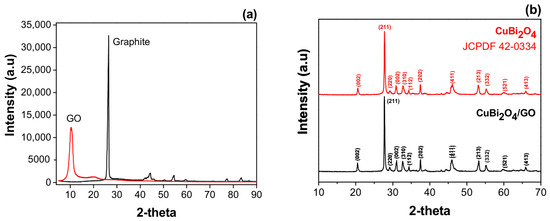
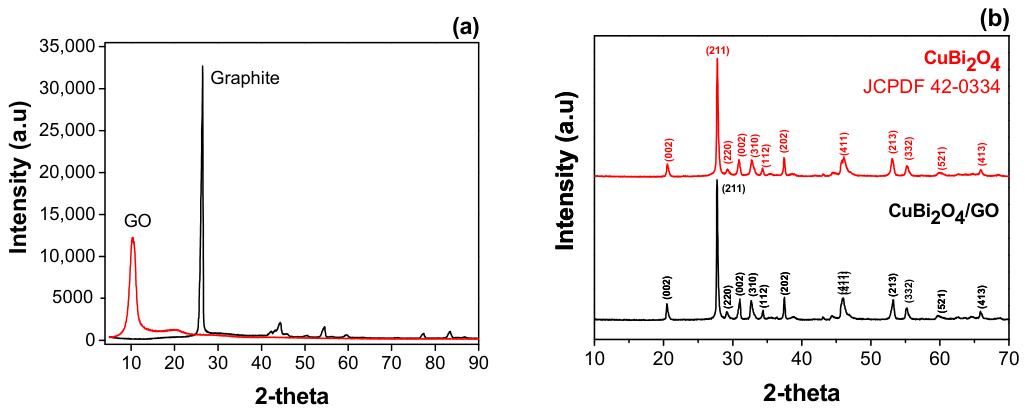
XRD analysis was performed to investigate the structural transformation of graphite into GO and to characterize the crystalline structure of CuBi2O4, as shown in Figure 1. The XRD patterns of graphite and GO (Figure 1a) reveal a significant structural change following oxidation. The characteristic (002) diffraction peak of graphite at 2θ = 26.3° disappeared, while a new diffraction peak emerged at 2θ = 10.5°, corresponding to the (001) plane of GO. These findings confirm the successful oxidation of graphite and the formation of graphite oxide with an expanded interlayer spacing [28].
Figure 1.
XRD patterns of (a) graphite and GO and (b) CuBi2O4 and CuBi2O4/GO composite.
As shown in Figure 1b, the XRD pattern of pristine CuBi2O4 exhibits characteristic diffraction peaks at 2θ values of 27.9°, 29.3°, 30.9°, 33.1°, 34.4°, 37.4°, 46.1°, 53.2°, 55.3°, 59.7°, and 65.9°, which correspond to the (211), (220), (002), (310), (112), (202), (411), (213), (332), (521), and (413) lattice planes of the tetragonal CuBi2O4 phase (JCPDS No. 42–0334) [29].
Following the incorporation of GO into CuBi2O4, the XRD pattern of the CuBi2O4/GO composite remained similar to that of pristine CuBi2O4, with no significant shifts in the diffraction peak positions. The absence of the characteristic GO diffraction peak may be attributed to its low content and weak diffraction intensity relative to the dominant CuBi2O4 phase.
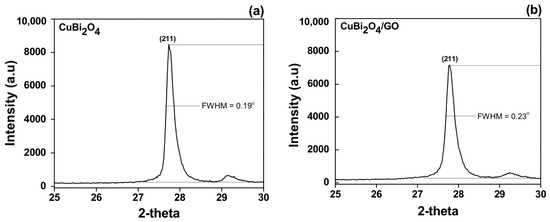
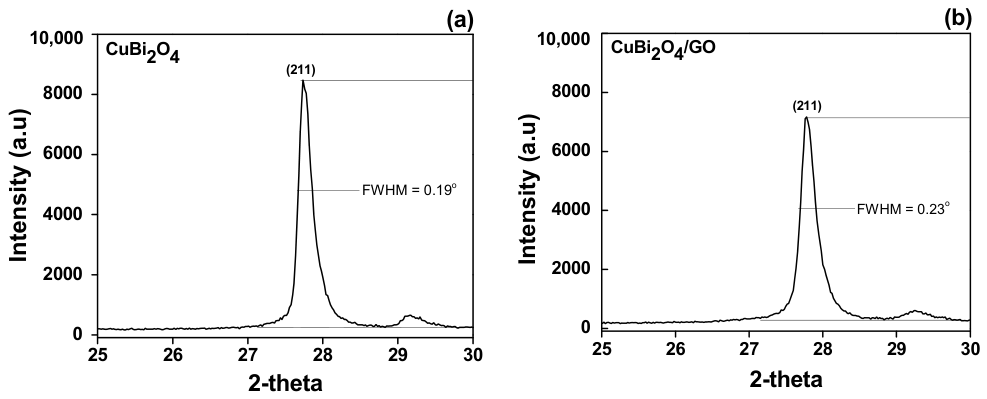
However, the incorporation of GO can inhibit crystal growth during synthesis, leading to smaller crystallite sizes and consequently lower diffraction intensity. This decrease in peak intensity reflects a reduced degree of crystallinity. Similar observations were reported by M.R. Venkatraman et al. [30], who found that the presence of GO sheets lowered the degree of crystallinity in TiO2 composites compared with pristine TiO2. To confirm this, the XRD patterns in the 2θ range of 25–30° were analyzed to highlight the (211) peak for the full width at half maximum (FWHM) estimation (Figure 2).
Figure 2.
XRD patterns in the 2θ range of 25–30° showing the (211) diffraction peak: (a) CuBi2O4 and (b) CuBi2O4/GO composite.
The crystallite size was estimated using the Scherrer equation, with FWHM determined using OriginPro8 software. The (211) diffraction peak was selected for analysis due to its high intensity and clear separation from neighboring peaks. The calculated crystallite size decreased from approximately ~43.0 nm for CuBi2O4 to ~35.6 nm for CuBi2O4/GO, suggesting that GO incorporation influenced the crystallite growth of CuBi2O4. This finding is supported by the reduced diffraction peak intensities and slight broadening of the XRD reflections, suggesting a decrease in crystallinity accompanied by a reduction in crystallite size.
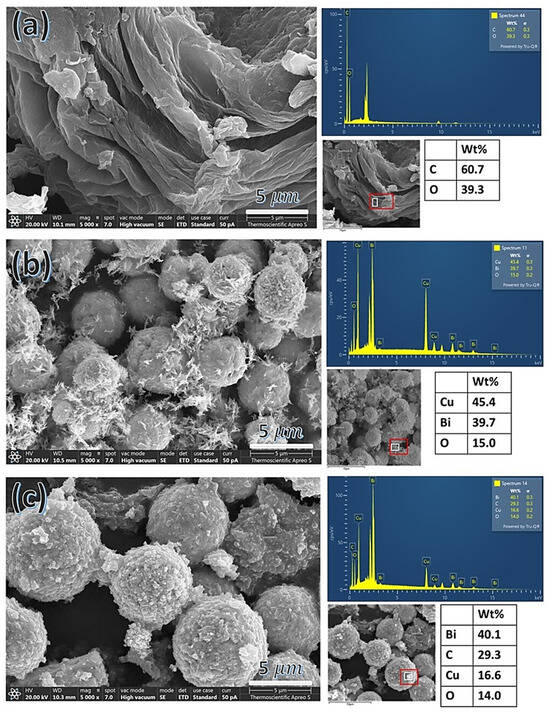
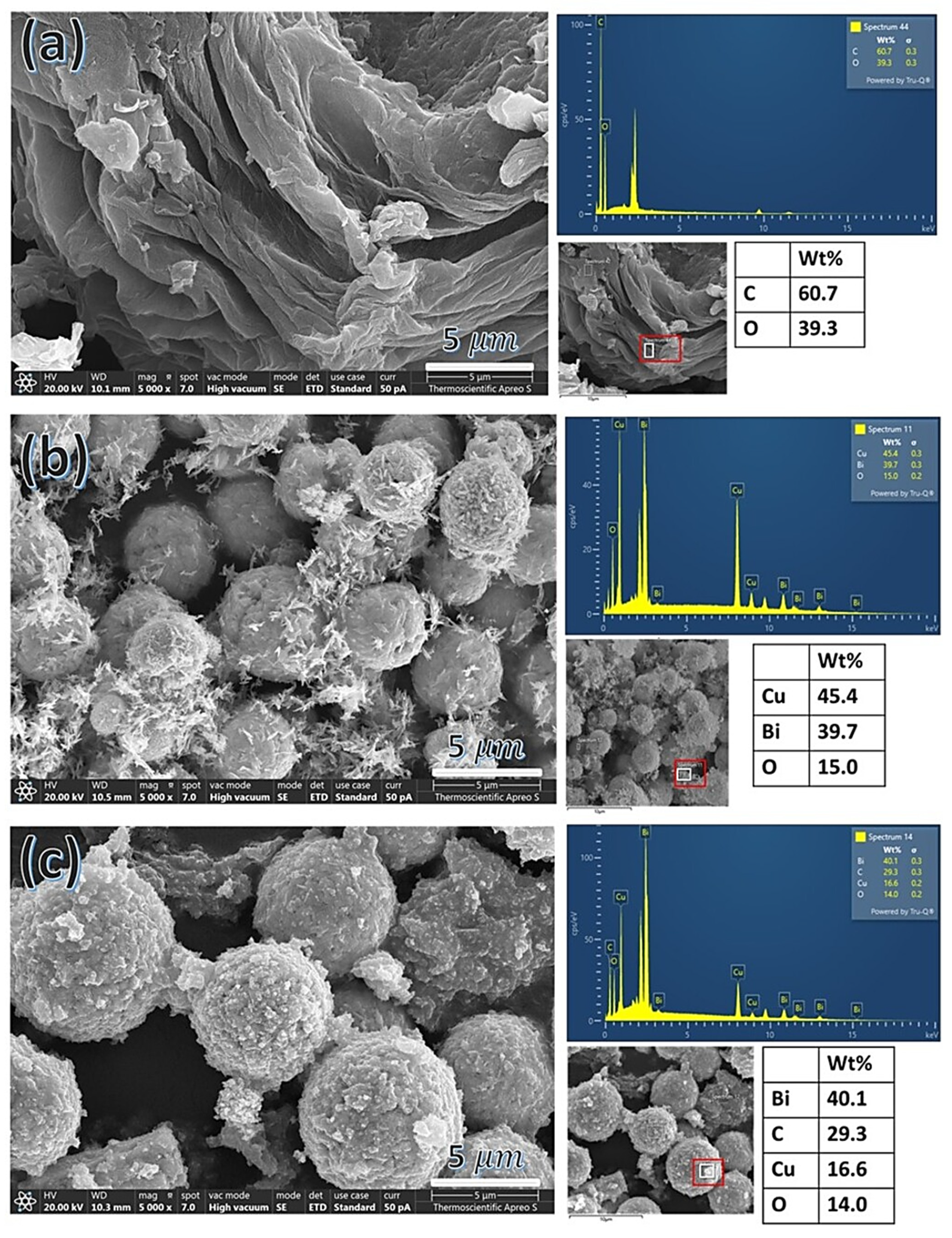
Another characteristic feature of GO is its sheet-like morphology, as shown in Figure 3a, where thin, layered structures are clearly observed. Simultaneous EDS analysis confirmed that carbon and oxygen were the dominant elements. The prominent EDS signal at approximately 2.1 keV is attributed to the gold layer deposited on the sample surface during SEM preparation to improve electrical conductivity. As illustrated in Figure 3b, the FESEM micrograph recorded at 5000× magnification reveals that the CuBi2O4 particles exhibit a distinct spherical morphology, with particle diameters ranging from approximately 2 to 5 µm. The surfaces of these spheres appear rough and are covered with nanoscale particles, suggesting secondary crystal growth or aggregation on the primary particles. EDS analysis confirmed that both the spherical and flake regions are composed of CuBi2O4, containing Bi, Cu, and O as the main constituent elements.
Figure 3.
FESEM images of (a) GO, (b) CuBi2O4, and (c) composite, with corresponding EDS spectra.
In comparison, the CuBi2O4/GO composite (Figure 3c) exhibits larger particles, possibly due to the deposition and aggregation of CuBi2O4 particles on GO sheets, which act as a supporting matrix during synthesis. The EDS point analysis confirms the presence of Cu, Bi, O, and C at the selected location, supporting the successful formation of the CuBi2O4/GO composite.
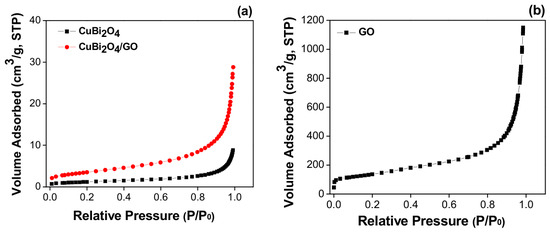
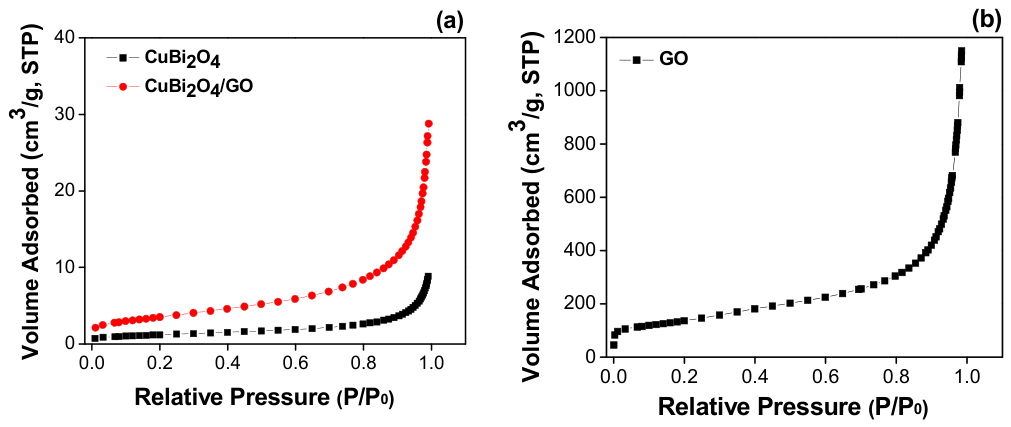
As shown in Table 2, the incorporation of GO, which has a high specific surface area of 485.28 m2/g, enhanced the surface area of the CuBi2O4/GO composite. The specific surface area increased approximately 4-fold, from 3.79 m2/g for pristine CuBi2O4 to 16.49 m2/g for the composite. The BJH desorption cumulative pore volume increased from 0.01 cm3/g for CuBi2O4 to 0.05 cm3/g for the composite (Figure 4a). As shown in Figure 4b, all samples exhibited type II adsorption isotherms according to the IUPAC classification. This type indicates that the materials possess large, open surfaces rather than a network of small pores [31]. The higher N2 adsorption capacity is reflected by the greater amount of N2 adsorbed, as indicated by the higher values on the y-axis of the isotherms. An increase in specific surface area may improve photocatalytic activity by providing a greater number of accessible surface sites for pollutant adsorption and subsequent photocatalytic reactions. However, photocatalytic activity also depends on other factors, including charge separation efficiency, light absorption, and interfacial charge transfer.
Table 2.
BET surface area and pore properties of GO, CuBi2O4, and CuBi2O4/GO.
Figure 4.
The N2 adsorption–desorption isotherm of GO, CuBi2O4 and the composite.
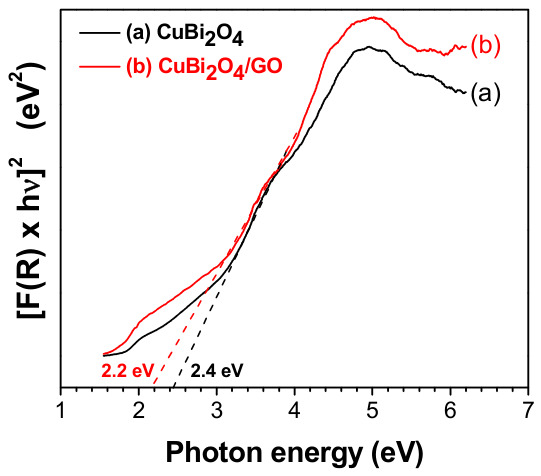
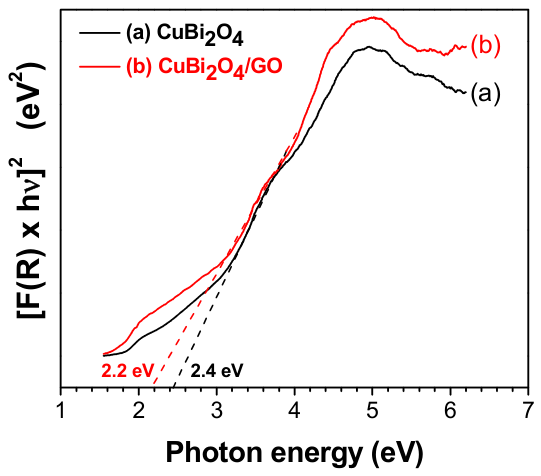
The optical band gap energies of the synthesized materials were estimated from Tauc plots constructed using ultraviolet–visible diffuse reflectance spectroscopy (UV–Vis DRS) data [32,33]. The measured reflectance values were converted into the Kubelka–Munk function, F(R), which was used to construct plots of [F(R)hν]2 against photon energy (hν), as presented in Figure 5. By extrapolating the linear portions of the plots to the photon energy axis, the optical band gap energies were determined to be 2.4 and 2.2 eV for pristine CuBi2O4 and the CuBi2O4/GO composite, respectively. The incorporation of GO resulted in a slight reduction in the apparent optical band gap, suggesting a modification of the optical absorption characteristics of CuBi2O4.
Figure 5.
Band gap of (a) CuBi2O4 and (b) CuBi2O4/GO composite.
To further investigate the electronic band structure, the valence band (EVB) and conduction band (ECB) edge potentials were estimated using the electronegativity-based relationships given in Equations (3) and (4) [34].
EVB = χ − EO + 0.5Eg
ECB = EVB − Eg
Here, χ denotes the absolute electronegativity of CuBi2O4 (4.59 eV) [35], E0 represents the energy of a free electron on the hydrogen scale (4.5 eV), and Eg is the optical band gap energy obtained from the Tauc analysis. For pristine CuBi2O4, an Eg value of 2.4 eV was used to estimate the corresponding band edge positions.
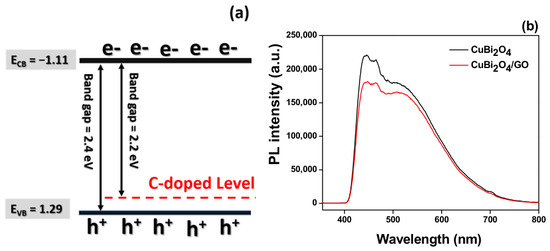
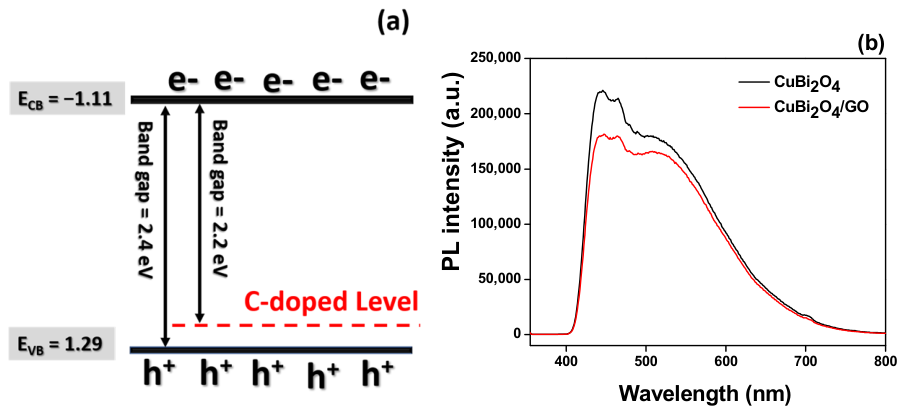
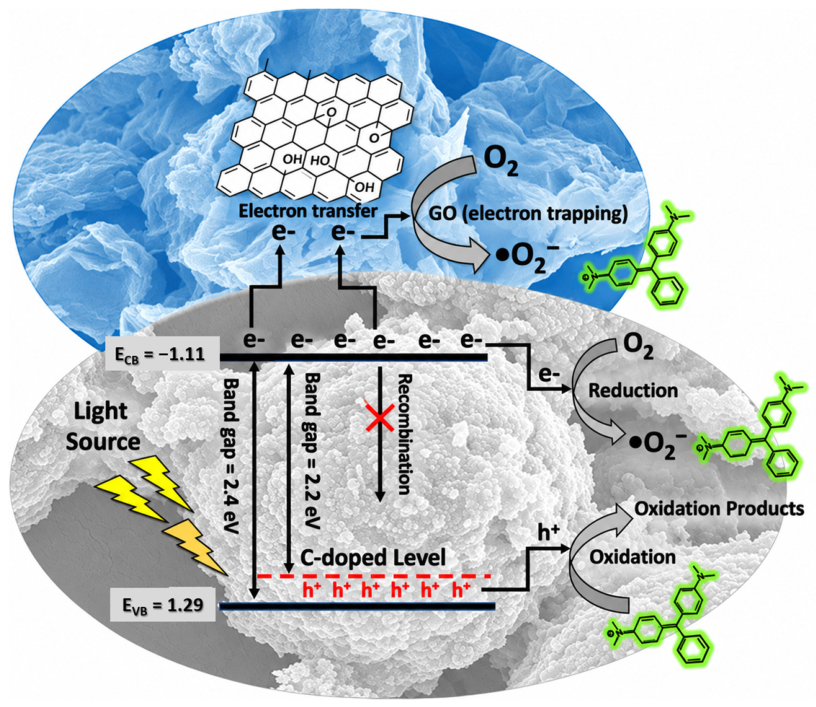
The incorporation of GO into the CuBi2O4 composite may introduce carbon-associated localized electronic states near the band edges through interfacial interactions. These states could provide additional pathways for photoexcitation at lower photon energies, potentially contributing to the reduction in the apparent optical band gap from 2.4 to 2.2 eV. The proposed energy states are schematically illustrated in Figure 6a. The recombination behavior of photogenerated charge carriers was further examined by photoluminescence (PL) spectroscopy. PL emission originates from radiative transitions of excited charge carriers to lower-energy states, making it a useful technique for investigating electron–hole recombination processes. Stronger emission generally reflects a greater contribution from radiative recombination, whereas diminished PL intensity may suggest that radiative recombination pathways have been suppressed. Such behavior can be favorable for photocatalysis because more charge carriers may remain available to participate in interfacial redox reactions. As depicted in Figure 6b, pristine CuBi2O4 displays a relatively intense PL emission, suggesting pronounced radiative recombination of photogenerated electrons and holes. This process may restrict the availability of charge carriers required for photocatalytic surface reactions, particularly those involved in producing reactive oxygen species (ROS), including superoxide radicals (•O2−) and hydroxyl radicals (•OH). In comparison, the CuBi2O4/GO composite exhibits a slightly weaker PL signal, indicating a possible reduction in radiative recombination following GO incorporation. The interaction between CuBi2O4 and GO may facilitate interfacial charge transfer and improve charge-carrier utilization during photocatalysis. As a result, the increased participation of photogenerated electrons and holes in surface redox processes could favor ROS production, which subsequently contributes to the oxidative degradation of MG into smaller molecular fragments.
Figure 6.
(a) Energy band structure and (b) PL spectra.
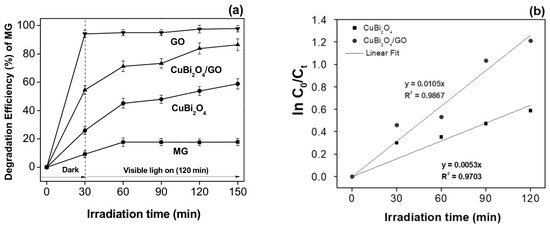
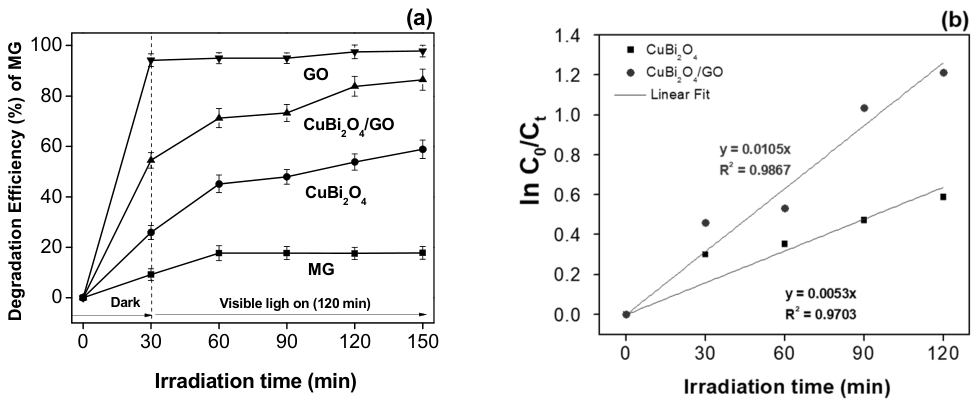
As shown in Figure 7a, GO exhibited the highest total MG removal efficiency of 97.8%, primarily due to its strong adsorption capacity. However, its photocatalytic contribution was minimal, as indicated by the nearly constant removal efficiency during the 120 min light irradiation period. In contrast, both pristine CuBi2O4 and the CuBi2O4/GO composite showed a continuous decrease in MG concentration under light irradiation, indicating photocatalytic degradation. The CuBi2O4/GO composite achieved a total removal efficiency of 86.5%, compared to 58.9% for pristine CuBi2O4, suggesting that the improved performance resulted from the combined effects of adsorption and photocatalytic degradation.
Figure 7.
(a) MG removal efficiency under irradiation (mean ± SD, n = 3) and (b) corresponding pseudo-first-order kinetic plots based on mean values.
To further distinguish photocatalytic degradation from dark adsorption, kinetic analysis was performed using only the data collected during the light irradiation period, as presented in Figure 7b. The initial concentration (C0) was defined as the MG concentration measured after dark adsorption equilibrium, immediately before light irradiation. The apparent rate constant of the composite (0.0105 min−1) was nearly twice that of pristine CuBi2O4 (0.0053 min−1), confirming its superior photocatalytic performance.
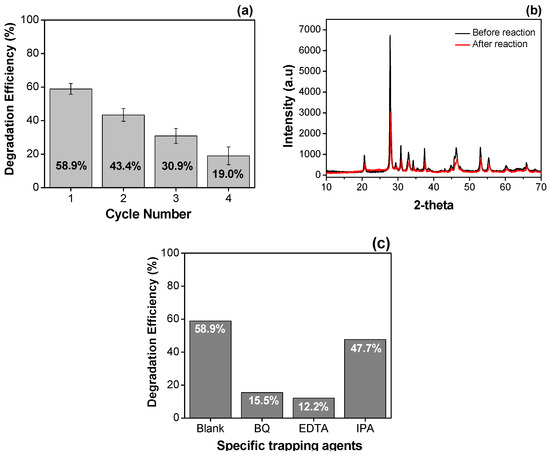
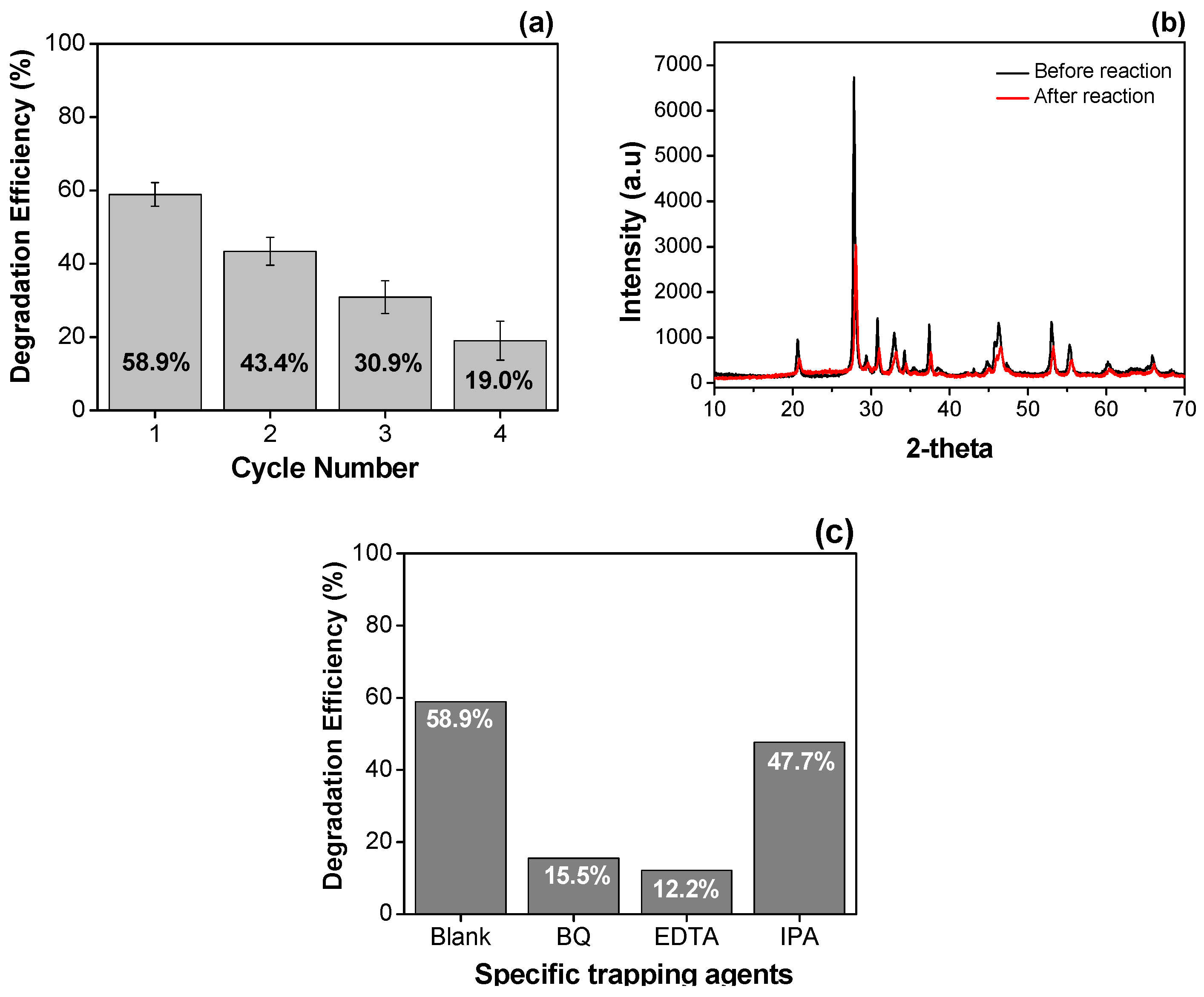
The operational stability and reusability of CuBi2O4 were assessed through successive photocatalytic degradation experiments using MG as the target pollutant. Each reaction was carried out for 150 min under identical experimental conditions. Following each cycle, the photocatalyst was separated from the reaction suspension by centrifugation, repeatedly rinsed with deionized water, dried in a hot-air oven, and weighed before being introduced into the subsequent experiment. Four consecutive photocatalytic degradation cycles were performed using pristine CuBi2O4 as a representative catalyst to evaluate its reusability, as shown in Figure 8a. The initial MG degradation efficiency was 58.9% in the first cycle, consistent with the result presented in Figure 7a, and gradually decreased to 43.4%, 30.9%, and 19.0% in the second, third, and fourth cycles, respectively. Overall, the degradation efficiency decreased by approximately 40 percentage points after four consecutive cycles. To further examine possible structural changes, XRD analysis was performed on the recovered photocatalyst. As illustrated in Figure 8b, the diffraction peaks of the reused CuBi2O4 exhibited lower intensities than those of the pristine material. However, the diffraction peak positions remained largely unchanged, suggesting that the main crystalline phase of CuBi2O4 was preserved after repeated photocatalytic cycles. Although the photocatalytic degradation efficiency decreased after repeated use, the results suggest that the prepared catalyst retained its structural stability during successive photocatalytic cycles. Therefore, the decline in photocatalytic efficiency may be attributed to the partial blockage of surface-active sites by adsorbed MG molecules and/or residual degradation intermediates, which could reduce the availability of active sites for subsequent photocatalytic reactions.
Figure 8.
(a) Reusability over successive 150 min cycles, (b) XRD patterns of the fresh and used catalysts, and (c) radical scavenging experiments.
To elucidate the reactive species governing MG photodegradation, radical and charge-carrier trapping experiments were performed using benzoquinone (BQ), ethylenediaminetetraacetic acid (EDTA), and isopropanol (IPA) as selective scavengers for superoxide radicals (•O2−), photogenerated holes (h+), and hydroxyl radicals (•OH), respectively. As illustrated in Figure 8c, the presence of EDTA and BQ markedly suppressed the photocatalytic degradation of MG, with the corresponding removal efficiencies decreasing to 12.2% and 15.5%, respectively. These findings suggest that h+ and •O2− play predominant roles in the photocatalytic process, whereas •OH appears to make a comparatively limited contribution. The relatively weak involvement of •OH may be explained by the estimated valence band potential of CuBi2O4 (+1.29 V vs. NHE), which is less positive than the potential generally required for the direct oxidation of H2O to •OH. Consequently, the formation of hydroxyl radicals through direct hole-mediated water oxidation is thermodynamically unfavorable under the proposed band alignment. This oxidation requires a potential of approximately +2.73 V vs. NHE at pH 0 (or +2.32 V at pH 7) [36]. Therefore, the direct generation of •OH by photogenerated holes (h+) is thermodynamically unfavorable, consistent with the relatively weak inhibitory effect observed in the IPA scavenging experiment.
When exposed to light with photon energies sufficient to overcome its band gap, CuBi2O4 becomes photoexcited, resulting in the formation of electron–hole pairs, as represented by Equation (5):
CuBi2O4 + hv → h+ (VB) + e− (CB)
As photogenerated holes were identified as one of the dominant reactive species, they may directly oxidize MG molecules through interfacial electron transfer, leading to the formation of oxidized intermediates and their subsequent degradation, as described in Equations (6) and (7):
h+ + MG → MG+• (VB)
MG+• → Oxidation intermediated (VB)
The scavenger experiment results agree with those reported by Thammaacheep et al. [37], who identified photogenerated holes as important reactive species in the photocatalytic degradation of tetracycline in aqueous media. Meanwhile, electrons generated in the CB can reduce dissolved molecular oxygen to form superoxide radical anions (•O2−), as expressed in Equation (8).
e− + O2 → •O2− (CB)
MG molecules + •O2− → CO2 + H2O + Other small molecules (CB)
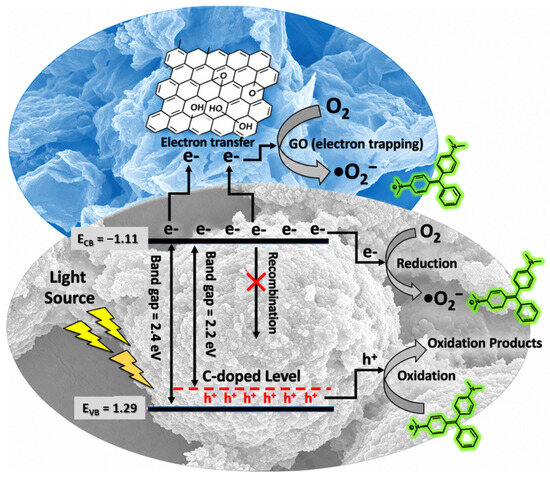
The generated superoxide radicals can react with MG molecules, leading to the breakdown of their molecular structure through oxidative reactions. Subsequent reactions may produce smaller organic intermediates, which could undergo further oxidation and eventual mineralization into CO2 and H2O, as described in Equation (9). Based on the findings from the scavenger experiments, a plausible photocatalytic mechanism for MG degradation was proposed, in which photogenerated holes (h+) and superoxide radicals (•O2−) serve as the principal reactive species, as schematically illustrated in Figure 9.
Figure 9.
Proposed mechanism of MG photodegradation over the CuBi2O4/GO composite.
4. Conclusions
In this study, CuBi2O4 was successfully synthesized using a microwave-assisted method with water as an environmentally benign solvent, aligning with green chemistry principles by avoiding the use of organic solvents. Comprehensive material characterization provided evidence of the successful incorporation of GO into CuBi2O4. XRD analysis revealed a reduction in diffraction peak intensity and crystallite size following GO addition. SEM images showed the coexistence of two distinct morphologies, corresponding to CuBi2O4 particles and GO sheets, while EDS analysis confirmed the presence of carbon alongside the constituent elements of CuBi2O4. Furthermore, the incorporation of GO, which possesses a relatively high specific surface area, increased the overall surface area of the composite. Optical characterization also revealed a change in the band gap energy of CuBi2O4 after GO incorporation, indicating modified optical absorption properties. The improved photocatalytic performance of the CuBi2O4/GO composite is primarily attributed to enhanced charge separation, facilitated interfacial charge transfer, and increased surface area, rather than the slight reduction in band gap energy. The lower PL intensity of the composite compared with pristine CuBi2O4 further supports the proposed suppression of radiative electron–hole recombination. Consequently, GO incorporation resulted in an approximately twofold increase in the photocatalytic reaction rate constant under identical temperature conditions.
Author Contributions
Conceptualization, S.P.; methodology, S.P. and P.T.; validation, P.T. and D.C.; formal analysis, P.T. and P.J.; investigation, P.T.; resources, S.P. and D.C.; data curation, D.C.; writing—original draft, S.P., P.J. and D.C.; writing—review & editing, D.C.; visualization, D.C.; supervision, S.P.; project administration, D.C.; funding acquisition, D.C. All authors have read and agreed to the published version of the manuscript.
Funding
This work was supported by Naresuan University (NU) and the National Science, Research and Innovation Fund (NSRF) under Grant No. R2569B024.
Data Availability Statement
The original contributions presented in this study are included in the article material. Further inquiries can be directed to the corresponding author.
Acknowledgments
ChatGPT Plus (GPT-6, OpenAI) was used to assist with English grammar correction. The authors reviewed and verified the AI-assisted content and take full responsibility for the final manuscript.
Conflicts of Interest
The authors declare no conflicts of interest.
References
- Haider, Z.; Ju, H. Strategies to Boost Photocatalytic Degradation of Emerging Contaminants Using ZnO Heterostructure Photocatalysts. Appl. Sci. 2026, 16, 5279. [Google Scholar] [CrossRef] [Scilit]
- Chen, X.; Dai, Y.; Guo, J. Hydrothermal synthesis of well-distributed spherical CuBi2O4 with enhanced photocatalytic activity under visible light irradiation. Mater. Lett. 2015, 161, 251–254. [Google Scholar] [CrossRef] [Scilit]
- Elaziouti, A.; Laouedj, N.; Bekka, A.; Vannier, R.N. Preparation and characterization of p–n heterojunction CuBi2O4/CeO2 and its photocatalytic activities under UVA light irradiation. J. King Saud Univ. Sci. 2015, 27, 120–135. [Google Scholar] [CrossRef] [Scilit]
- Kozlova, I.; Dudareva, M.; Zemskova, O.; Korshunov, A.; Samchenko, S. Self-cleaning cement material with bismuth titanate photocatalytic additive. Civ. Eng. J. 2025, 11, 4696–4708. [Google Scholar] [CrossRef] [Scilit]
- Wang, Y.; Cai, F.; Guo, P.; Lei, Y.; Xi, Q.; Wang, F. Short-time hydrothermal synthesis of CuBi2O4 nanocolumn arrays for efficient visible-light photocatalysis. Nanomaterials 2019, 9, 1257. [Google Scholar] [CrossRef] [Scilit] [PubMed]
- Yuan, X.; Liu, Y.; Yuan, H.; Liu, B.; Guo, T.; Zhou, H.; Li, X. An electrospun porous CuBi2O4 nanofiber photocathode for efficient solar water splitting. Polymers 2021, 13, 3341. [Google Scholar] [CrossRef] [Scilit] [PubMed]
- Kim, J.-H.; Cho, S. Photoelectrochemical Performance of a CuBi2O4 Photocathode with H2O2 as a Scavenger. Inorganics 2023, 11, 147. [Google Scholar] [CrossRef] [Scilit]
- Ahmad, N.; Anae, J.; Khan, M.Z.; Sabir, S.; Campo, P.; Coulon, F. A novel CuBi2O4/polyaniline composite as an efficient photocatalyst for ammonia degradation. Heliyon 2022, 8, e10210. [Google Scholar] [CrossRef] [Scilit] [PubMed]
- Yang, F.; Yu, X.; Liu, Z.; Niu, J.; Zhang, T.; Nie, J.; Zhao, N.; Li, J.; Yao, B. Preparation of Z-scheme CuBi2O4/Bi2O3 nanocomposites using electrospinning and their enhanced photocatalytic performance. Mater. Today Commun. 2021, 26, 101735. [Google Scholar] [CrossRef] [Scilit]
- Wang, X.; Han, Y.; Qiu, H.-T.; Yang, M.-Q.; Zhang, M.; Qi, X.-X.; Wang, Y.; Xiang, Z.; Liu, Y. Preparation of Ag2WO4/CuBi2O4 S-scheme heterojunction and its synergic ultrasonic removal of tetracycline with persulfate. SSRN Electron. J. 2024. [Google Scholar] [CrossRef] [Scilit]
- Ma, T.; Long, H.; Shi, Z.; Lang, Z.; Zhao, M.; Zhang, S.; Lei, C. Efficient photocatalytic degradation of tetracycline under visible light with three-dimensional flower-shaped N-doped BiOBr/CuBi2O4. Opt. Mater. 2023, 143, 114175. [Google Scholar]
- Guan, H.; Guo, R.; Chen, X.; Wang, Y.; Zhang, W.; Xiong, S.; Feng, J.; Hu, Y. In situ synthesized In2O3/CuBi2O4 heterojunction photocathodes for efficient photoelectrochemical water splitting. J. Photochem. Photobiol. A Chem. 2023, 444, 114990. [Google Scholar] [CrossRef] [Scilit]
- Luceño-Sánchez, J.A.; Maties, G.; Gonzalez-Arellano, C.; Diez-Pascual, A.M. Synthesis and characterization of graphene oxide derivatives via functionalization reaction with hexamethylene diisocyanate. Nanomaterials 2018, 8, 870. [Google Scholar] [CrossRef] [Scilit] [PubMed]
- Bo, Z.; Shuai, X.; Mao, S.; Yang, H.; Qian, J.; Chen, J.; Yan, J.; Cen, K. Green preparation of reduced graphene oxide for sensing and energy storage applications. Sci. Rep. 2014, 4, 4684. [Google Scholar] [CrossRef] [Scilit] [PubMed]
- Adnan, M. The future of energy storage: Advancements and roadmaps for lithium-ion batteries. Int. J. Mol. Sci. 2023, 24, 7457. [Google Scholar] [CrossRef] [Scilit] [PubMed]
- Kausar, A.; Ahmad, I.; Zhao, T.; Aldaghri, O.; Ibnaouf, K.H.; Eisa, M.H. Graphene nanocomposites as innovative materials for energy storage and conversion—Design and headways. Int. J. Mol. Sci. 2023, 24, 11593. [Google Scholar] [CrossRef] [Scilit] [PubMed]
- Wang, F.; Han, Y.; Feng, X.; Xu, R.; Li, A.; Wang, T.; Deng, M.; Tong, C.; Li, J.; Wei, Z. Mesoporous carbon-based materials for enhancing the performance of lithium-sulfur batteries. Int. J. Mol. Sci. 2023, 24, 7291. [Google Scholar] [CrossRef] [Scilit] [PubMed]
- Musa, A.A.; Bello, A.; Adams, S.M.; Onwualu, A.P.; Anye, V.C.; Bello, K.A.; Obianyo, I.I. Nano-enhanced polymer composite materials: A review of current advancements and challenges. Polymers 2025, 17, 893. [Google Scholar] [CrossRef] [Scilit] [PubMed]
- Pérez-Molina, Á.; Morales-Torres, S.; Maldonado-Hódar, F.J.; Pastrana-Martínez, L.M. Functionalized graphene derivatives and TiO2 for high visible light photodegradation of azo dyes. Nanomaterials 2020, 10, 1106. [Google Scholar] [CrossRef] [Scilit] [PubMed]
- Al-Zahrani, S.A.; Umar, K.; Tweib, S.A.; Rashd, J.A.M.; Afridi, S.K.; Bhawani, S.A.; Otaibi, A.A.; Masood, N.; Mansour, D.; Khan, A. Biomass mediated synthesis of ZnO and ZnO/GO for the decolorization of methylene blue under visible light source. Catalysts 2023, 13, 409. [Google Scholar] [CrossRef] [Scilit]
- Sun, J.; Wang, C.; Shen, T.; Song, H.; Li, D.; Zhao, R.; Wang, X. Engineering the dimensional interface of BiVO4–2D reduced graphene oxide nanocomposite for enhanced visible light photocatalytic performance. Nanomaterials 2019, 9, 907. [Google Scholar] [CrossRef] [Scilit] [PubMed]
- Esencan Türkaslan, B.; Çelik, A.K.; Dalbeyler, A.; Fantuzzi, N. The effect of different morphologies of WO3/GO nanocomposite on photocatalytic performance. Materials 2022, 15, 8019. [Google Scholar] [CrossRef] [Scilit] [PubMed]
- Altin, I. Perovskite-type BaTiO3 coupled with graphene oxide as efficient bifunctional composites for environmental remediation. Processes 2023, 11, 3191. [Google Scholar] [CrossRef] [Scilit]
- Shih, K.-Y.; Kuan, Y.-L.; Wang, E.-R. One-step microwave-assisted synthesis and visible-light photocatalytic activity enhancement of BiOBr/RGO nanocomposites for degradation of methylene blue. Materials 2021, 14, 4577. [Google Scholar] [CrossRef] [Scilit] [PubMed]
- Phanichphant, S.; Nakaruk, A.; Chansaenpak, K.; Channei, D. Evaluating the photocatalytic efficiency of the BiVO4/rGO photocatalyst. Sci. Rep. 2019, 9, 16091. [Google Scholar] [CrossRef] [Scilit] [PubMed]
- Channei, D.; Nakaruk, A.; Phanichphant, S. Controlled oxidative ageing time of graphite/graphite oxide to graphene oxide in aqueous media. J. Aust. Ceram. Soc. 2018, 54, 91–96. [Google Scholar] [CrossRef] [Scilit]
- Muankaew, R.; Banphot, C.; Thammaacheep, P.; Jannoey, P.; Khanitchaidecha, W.; Nakaruk, A.; Channei, D. Synthesis of flower-like CuBi2O4 microspheres and its photocatalytic activity. Trends Sci. 2024, 21, 7200. [Google Scholar] [CrossRef] [Scilit]
- Thammaacheep, P.; Suriwong, T.; Jannoey, P.; Khanitchaidecha, W.; Nakaruk, A.; Channei, D. Bio-synthesis of TiO2 photocatalyst: A reduced-step approach using leaf extract. Green Chem. Lett. Rev. 2024, 17, 2433607. [Google Scholar] [CrossRef] [Scilit]
- Monteserín, C.; Blanco, M.; Aranzabe, E.; Aranzabe, A.; Laza, J.M.; Larrañaga-Varga, A.; Vilas, J.L. Effects of graphene oxide and chemically-reduced graphene oxide on the dynamic mechanical properties of epoxy amine composites. Polymers 2017, 9, 449. [Google Scholar] [CrossRef] [Scilit] [PubMed]
- Venkatraman, M.R.; Muthukumarasamy, N.; Pitchaiya, S.; Agilan, S.; Pugazhendi, A.; Velauthapillai, D. UV-aided graphene oxide reduction by TiO2 towards TiO2/reduced graphene oxide composites for dye-sensitized solar cell. Int. J. Energy Res. 2021, 45, 17220–17232. [Google Scholar] [CrossRef] [Scilit]
- Rahman, M.M.; Shafiullah, A.Z.; Pal, A.; Islam, M.A.; Jahan, I.; Saha, B.B. Study on optimum IUPAC adsorption isotherm models employing sensitivity of parameters for rigorous adsorption system performance evaluation. Energies 2021, 14, 7478. [Google Scholar] [CrossRef] [Scilit]
- López, R.; Gómez, R. Band-gap energy estimation from diffuse reflectance measurements on sol-gel and commercial TiO2: A comparative study. J. Sol.-Gel Sci. Technol. 2012, 61, 1–7. [Google Scholar] [CrossRef] [Scilit]
- Boonprakob, N.; Huatong, N.; Chanlek, N.; Udonpan, K.; Sae-Kung, C.; Zhao, C. Novel Pt,Ru-Codoped In2S3/Ta2O5 Heterostructured Films for the Effective Enhancement of Visible-Light Photocatalytic Degradation of Rhodamine B. J. Nanopart. Res. 2026, 28, 246. [Google Scholar] [CrossRef] [Scilit]
- Channei, D.; Thammaacheep, P.; Jannoey, P. Utilizing banana peel in conjunction with TiO2 photocatalyst for the efficient decolorization of malachite green. Chem. Phys. Impact 2024, 8, 100629. [Google Scholar] [CrossRef] [Scilit]
- Ding, M.; Chen, X.; Ma, X.; Liu, Y.; Wang, X.; Xu, X.J. Constructing CuBi2O4/Ag3PO4 photocatalyst with improved photocatalytic performance for the degradation of tetracycline under visible-light irradiation. ChemistrySelect 2021, 6, 7062–7067. [Google Scholar] [CrossRef] [Scilit]
- Tang, Y.; Wang, W.; Ran, J.; Peng, C.; Xu, Z.; Chu, W. The evolution of photocatalytic H2O2 generation: From pristine water to natural systems and beyond. Energy Environ. Sci. 2024, 17, 6482–6498. [Google Scholar] [CrossRef] [Scilit]
- Thammaacheep, P.; Sriondee, M.; Kamei, T.; Suriwong, T.; Bongkarn, T.; Phanichphant, S.; Rattanachata, A.; Nakajima, H.; Jannoey, P.; Channei, D. BiOBr-Modified SrTiO3 Heterojunction for Efficient Antibiotic Degradation and Bacterial Inactivation. Photochem 2026, 6, 31. [Google Scholar] [CrossRef] [Scilit]

Disclaimer/Publisher’s Note: The statements, opinions and data contained in all publications are solely those of the individual author(s) and contributor(s) and not of MDPI and/or the editor(s). MDPI and/or the editor(s) disclaim responsibility for any injury to people or property resulting from any ideas, methods, instructions or products referred to in the content. |
© 2026 by the authors. Licensee MDPI, Basel, Switzerland. This article is an open access article distributed under the terms and conditions of the Creative Commons Attribution (CC BY) license.