


Abstract
Low-temperature pack aluminizing offers a promising approach to improving the surface properties of structural steels while limiting thermal damage. However, achieving sufficient coating growth at reduced temperatures remains challenging. Here, room-temperature pre-torsion was applied to quenched-and-tempered AISI 5140 (40Cr) steel with a tempered sorbite matrix prior to aluminizing at 700 °C for 3 h. Electron backscatter diffraction (EBSD) revealed a radial gradient in crystallographic misorientation, with the low-angle grain boundary (LAGB) fraction exceeding 62% near the surface. Pre-torsion increased the effective coating thickness from 236.4 to 298.5 μm (26.3%). Both coatings consisted predominantly of orthorhombic Fe2Al5, whereas monoclinic FeAl3 was also present throughout the coating in the pre-torsioned specimen, consistent with enhanced Al uptake and diffusion associated with the high deformation energy. Although pre-torsion reduced the maximum coating microhardness from 1010 to 920 HV0.2, potentially owing to localized Kirkendall microporosity and stress relaxation, it increased the hardened depth (>800 HV0.2) from 210–240 to 270–330 μm. In 3.5 wt.% NaCl solution, both coatings reduced the corrosion current density from 7.21 μA cm−2 for the bare substrate to 1.08 μA cm−2 for S-Al and 1.12 μA cm−2 for T-Al. These findings demonstrate that pre-torsion offers a promising strategy for modifying coating growth, increasing hardened depth, and maintaining corrosion protection during low-temperature pack aluminizing.
1. Introduction
AISI 5140 (40Cr) alloy steel is widely recognized as a cornerstone structural material in the machinery manufacturing industry, owing to its exceptional hardenability, high static strength, and well-balanced mechanical properties following quenching and tempering [1,2]. However, structural components fabricated from 40Cr steel are frequently susceptible to premature failure in aggressive service environments due to severe corrosion and wear [3,4]. Surface aluminizing has been established as an effective and economical surface-engineering strategy to enhance the environmental resistance of ferrous alloys [5,6]. The resulting aluminized surface layers consist predominantly of iron-aluminum (Fe-Al) intermetallic compounds, which are highly favored in modern industrial applications due to their high hardness [4], outstanding oxidation/corrosion resistance [7,8,9], elevated specific strength, and cost-effectiveness [10].
Various techniques have been developed to fabricate Fe-Al diffusion coatings, including hot-dip aluminizing [11,12], plasma immersion [3], and powder-pack cementation [13,14]. Among these surface alloying techniques, pack aluminizing is widely used because of its relatively simple operation, cost-effectiveness, and suitability for components with complex geometries [15,16]. In this process, the substrate is embedded in an aluminum-containing powder mixture, where an activator facilitates the transport of aluminum-bearing species to the surface, enabling the formation of protective intermetallic layers [17,18,19]. However, conventional pack aluminizing typically requires temperatures of 850–1050 °C [17,20]. Prolonged exposure to such elevated temperatures can cause substrate grain coarsening, thermal distortion, undesirable phase transformations, and deterioration of core mechanical properties [16,21]. Consequently, developing low-temperature pack-aluminizing protocols (below 750 °C) [15,22,23] is essential for reducing thermal damage while maintaining effective coating formation.
Nevertheless, lowering the process temperatures inherently elevates the activation energy barrier and suppresses atomic diffusion kinetics. To counteract this limitation, three primary approaches have been explored: applying external physical fields (e.g., electric, ionic, or ultrasonic fields) [24], introducing chemical additives or catalytic agents to modify thermodynamic conditions [15], and generating high-density defect networks near the surface to provide short-circuit diffusion pathways [25,26]. Recent studies indicate that severe plastic deformation (such as room-temperature torsional pre-strain) can introduce graded high-density dislocations and sub-boundaries, effectively accelerate atomic influx and enable low-temperature thermochemical processing [27,28]. Torsional pre-strain, in particular, generates a pronounced radial gradient in stored deformation energy and defect density, as demonstrated for pre-torsioned pearlitic steel wires, cyclic forward/reverse torsion of austenitic steel, and free-end torsion of extruded AZ31 rods [29,30,31].
Our team has previously explored surface-gradient-defect-assisted pack aluminizing utilizing normalized 40Cr steel substrates [16]. However, it is well established that the initial microstructural state of the substrate plays a decisive role in governing deformation behavior, defect storage capacity, and subsequent interdiffusion kinetics [22,31]. In practical industrial engineering, high-stress 40Cr components (such as heavy-duty shafts and gears) are almost exclusively deployed in the quenched-and-tempered (modulated) state rather than the normalized condition. Compared with the coarse ferrite-pearlite matrix of normalized 40Cr [16], quenched-and-tempered 40Cr features a refined tempered sorbite microstructure characterized by a significantly higher density of initial sub-boundaries, finely dispersed carbides, and an intrinsic internal stress field. These pre-existing substructures interact dynamically with pre-torsion-induced shear strain gradients, fundamentally altering dislocation evolution, defect recovery, and reactive diffusion pathways.
Building upon our previous exploratory work [16], the present study systematically investigates and compares quenched-and-tempered 40Cr specimens with and without pre-torsion following pack aluminizing under a controlled low-temperature condition (700 °C for 3 h). The underlying mechanisms by which the modulated initial matrix and pre-torsion synergistically influence coating growth, phase constitution (Fe2Al5 vs. FeAl3), quantitative compositional gradients, interface morphology, and electrochemical corrosion behavior are comprehensively elucidated.
2. Materials and Methods
2.1. Substrate Preparation
Commercial AISI 5140 steel (40Cr) rod with a nominal chemical composition (wt.%) of 0.37–0.44 C, 0.17–0.37 Si, 0.50–0.80 Mn, 0.80–1.10 Cr, and 97.3–98.23 Fe was utilized as the base substrate [2]. The specimens were austenitized at 860 °C for 1 h, water-quenched, subsequently tempered at 580 °C for 1 h and air-cooled to room temperature.
2.2. Room-Temperature Pre-Torsion Processing
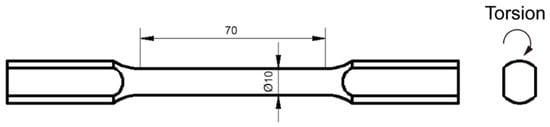
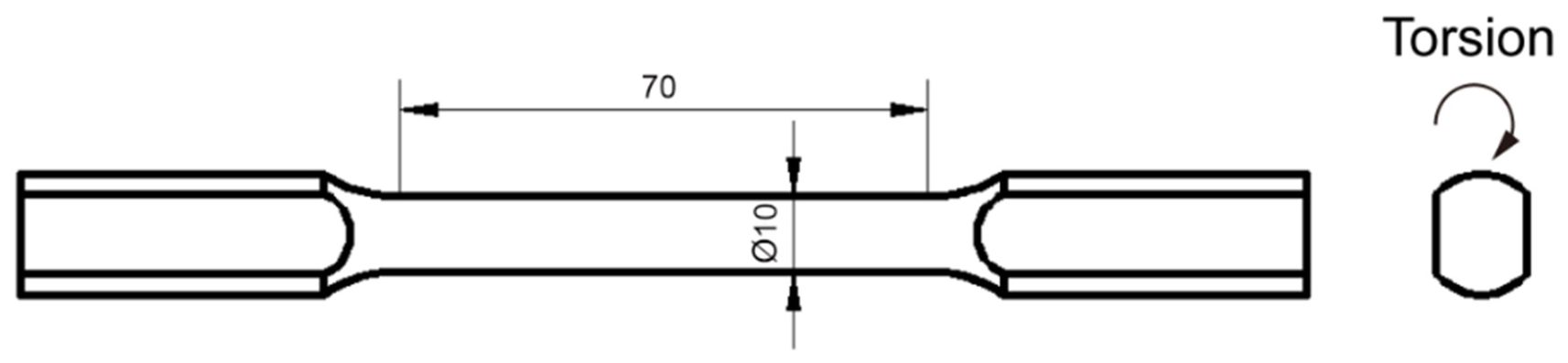
Cylindrical specimens for pre-torsion testing had a gauge diameter of 10 mm and a gauge length of 70 mm (Figure 1). Torsional deformation was applied at room temperature using an NDJ-500 microcomputer-controlled torsional testing machine by fixing one end of each specimen and rotating the opposing end about its longitudinal axis. The rotation rate was 25°/min, and the total rotation angle was 480°. Assuming a uniform twist along the gauge length without dimensional necking, the nominal engineering shear strain (γ) as a function of radial position (r) is calculated via Equation (1):
where r is the radial distance from the central axis (0 ≤ r ≤ 5), θ is the rotation angle in radians (480° ≈ 8.3776 rad), and L is the gauge length (70 mm).
Figure 1.
Schematic geometry and dimensions of cylindrical torsion specimen (gauge diameter 10 mm, gauge length 70 mm).
2.3. Pack Aluminizing Protocol
Both untorsion and pre-torsion specimens were sectioned by wire electrical discharge machining (WEDM) into cylindrical samples 15 mm in length. The samples were ground using 150–800-grit SiC abrasive papers to remove surface oxides, ultrasonically cleaned in absolute ethanol, and air-dried before storage in a desiccator. Pack aluminizing was performed using a high-activity powder mixture consisting of 75 wt.% Al powder (99.8% purity), 5 wt.% NH4Cl as the activator, and 20 wt.% Al2O3 as the inert filler for two-type samples. The relatively high aluminum content (75 wt.%) was selected to provide an aluminum-rich pack environment for coating formation at the comparatively low treatment temperature of 700 °C, compensating for reduced thermal diffusion kinetics at low temperature. The powders were weighed and thoroughly mixed, and the specimens were completely embedded in the mixture in a corundum crucible. The crucible was then heated to 700 °C and held for 3 h, and cooled inside the furnace to room temperature naturally. After cooling, residual pack material adhering to the specimen surfaces was removed by mechanical brushing and ultrasonic cleaning before subsequent characterization.
2.4. Phase Identification
The crystalline phases in the coatings and underlying substrates were identified using an X-ray diffractometer (XRD). For specimen preparation, cylindrical specimens with a diameter of 10 mm and a height of 8 mm were sectioned from the samples using wire electrical discharge machining. Diffraction patterns of the coated specimens were collected from the as-cleaned outer coating surface, without grinding through the coating or exposing the substrate. XRD measurements were conducted using a PANalytical Empyrean Series 2 diffractometer with Cu Kα radiation (λ = 1.5406 Å) at 40 kV and 40 mA. All scans were collected in plan-view θ-2θ geometry over a 2θ range of 20–90°, using a step size of 0.013° and a scanning speed of 0.05°/s. Phase identification was performed by matching diffraction patterns with ICDD PDF standard cards (α-Fe: PDF #06-0696; Fe2Al5: PDF #47-1435; FeAl3: PDF #50-0797) [32,33].
2.5. Microstructural Characterization
Microstructural characterization of samples, including the untreated substrate, pre-torsioned, untorsioned aluminized (S-Al) and pre-torsioned aluminized (T-Al) specimens, was performed using electron backscatter diffraction (EBSD) on a field-emission gun scanning electron microscope (FEG-SEM; Zeiss Sigma HD) operating at an accelerating voltage of 20 kV. Transverse cross-sectional specimens were ground to 3000 grit and electropolished in an electrolyte of 10 vol.% perchloric acid and 90 vol.% ethanol at −30 °C and 30 V (0.4 A) for 1 min.
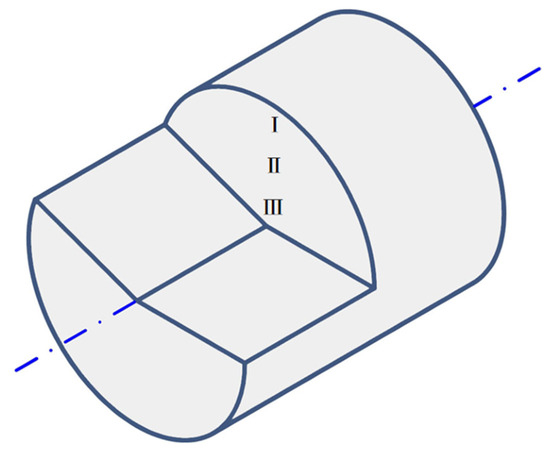
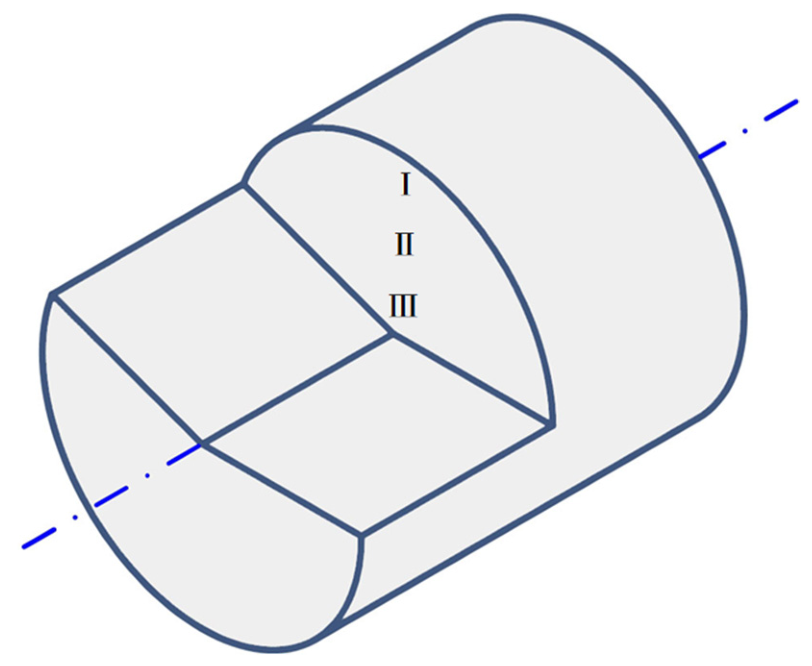
EBSD measurements of the pre-torsioned specimen were acquired at three distinct radial locations along the transverse direction (TD): Region I (near-surface), Region II (intermediate radius), and Region III (near-axis), as shown in Figure 2. Inverse pole figure (IPF) maps, grain boundary (GB) misorientation distribution maps, and Kernel Average Misorientation (KAM) maps were constructed using Oxford AZtecHKL software (2010-2024) [34,35,36]. In the GB maps, high-angle boundaries (HAGBs; misorientation > 15°) and low-angle boundaries (LAGBs; misorientation of 2–15°) are distinguished.
Figure 2.
Schematic illustration showing the EBSD mapping location across the transverse cross-section of the pre-torsion cylindrical rod (radius 5 mm).
Cross-sectional coating morphology, interface structures, and elemental distributions were evaluated via backscattered electron (BSE) imaging and quantitative energy-dispersive X-ray spectroscopy (EDS; Oxford AZtec Max2). Quantitative EDS point analysis (at.%) was performed to distinguish phase compositions across the coating thickness. Effective coating thickness was evaluated directly from step-like aluminum concentration transitions in EDS line profiles, cross-verified against microhardness transition profiles.
2.6. Cross-Sectional Vickers Microhardness Measurement
Vickers microhardness profiles were measured across the transverse cross-section using an HVS-1000 tester under an applied load of 200 gf (1.96 N) and a dwell time of 10 s. Indentation spacing was adjusted according to the coating depth, and five independent sets of measurements were obtained per specimen to calculate mean values and standard deviations.
2.7. Electrochemical Corrosion Tests
Electrochemical potentiodynamic polarization tests were conducted in a 3.5 wt.% NaCl aqueous solution at 25 °C using a Gamry Reference 3000 potentiate instrument (Warminster, PA, USA). A standard three-electrode cell was employed, consisting of the test sample as the working electrode, a platinum plate as the counter electrode, and a saturated calomel electrode (SCE) as the reference electrode. Samples mounted in dental acrylic resin were immersed for 30 min to establish a stable open-circuit potential (OCP), and potential scans were recorded from −0.3 to 0.4 V relative to OCP at a rate of 2 mV/s. Corrosion potential (Ecorr) and corrosion current density (Icorr) were derived via Tafel extrapolation.
3. Results and Discussion
3.1. Microstructure of Torsion Sample
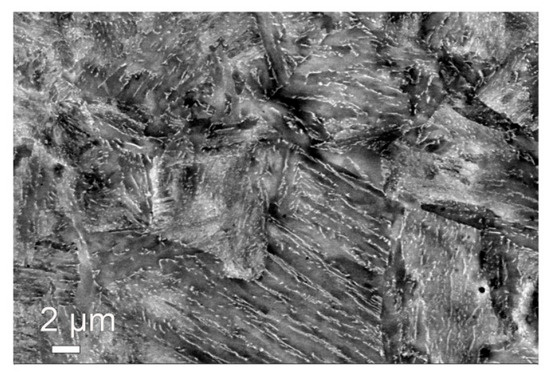
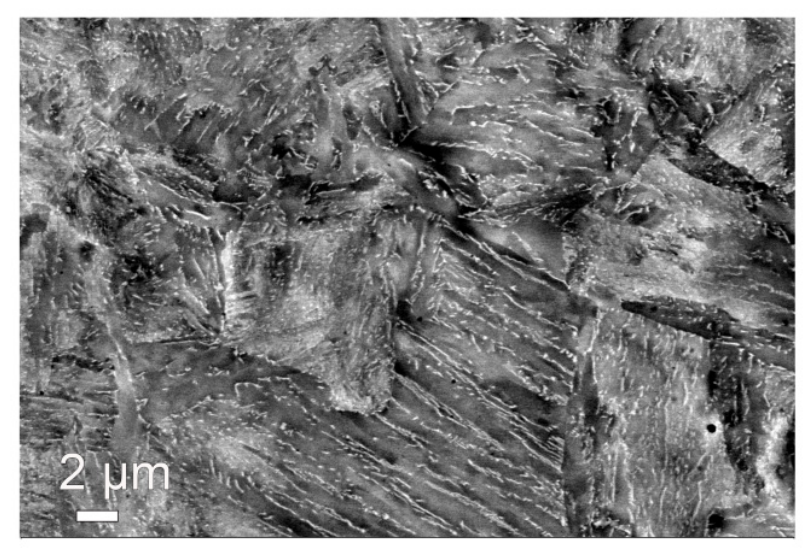
The untreated quenched-and-tempered AISI 5140 steel exhibited a tempered sorbite microstructure, consisting of a ferritic matrix containing fine, uniformly distributed carbide particles (Figure 3). The initial tempered martensitic microstructure, including its lath substructure and fine precipitates, may influence dislocation motion and strain accommodation during pre-torsion. In particular, the higher imposed shear strain near the outer surface promotes the development of deformation-induced lattice misorientation and subgrain boundaries, resulting in a radially heterogeneous microstructural state. This heterogeneity provides a basis for investigating the influence of pre-torsion on subsequent aluminizing behavior.
Figure 3.
High-resolution SEM micrograph depicting the initial tempered sorbite microstructure of the quenched-and-tempered AISI 5140 steel substrate.
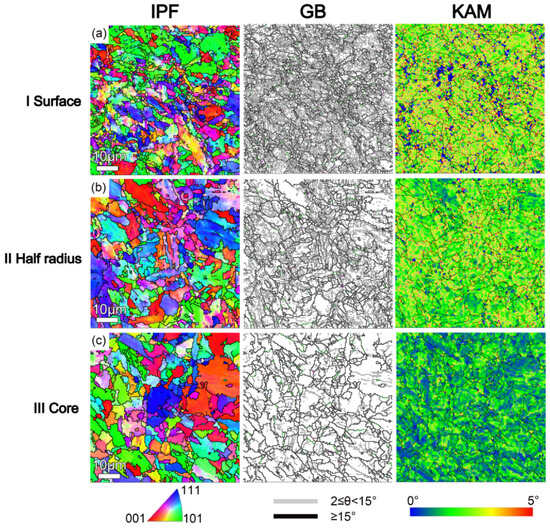
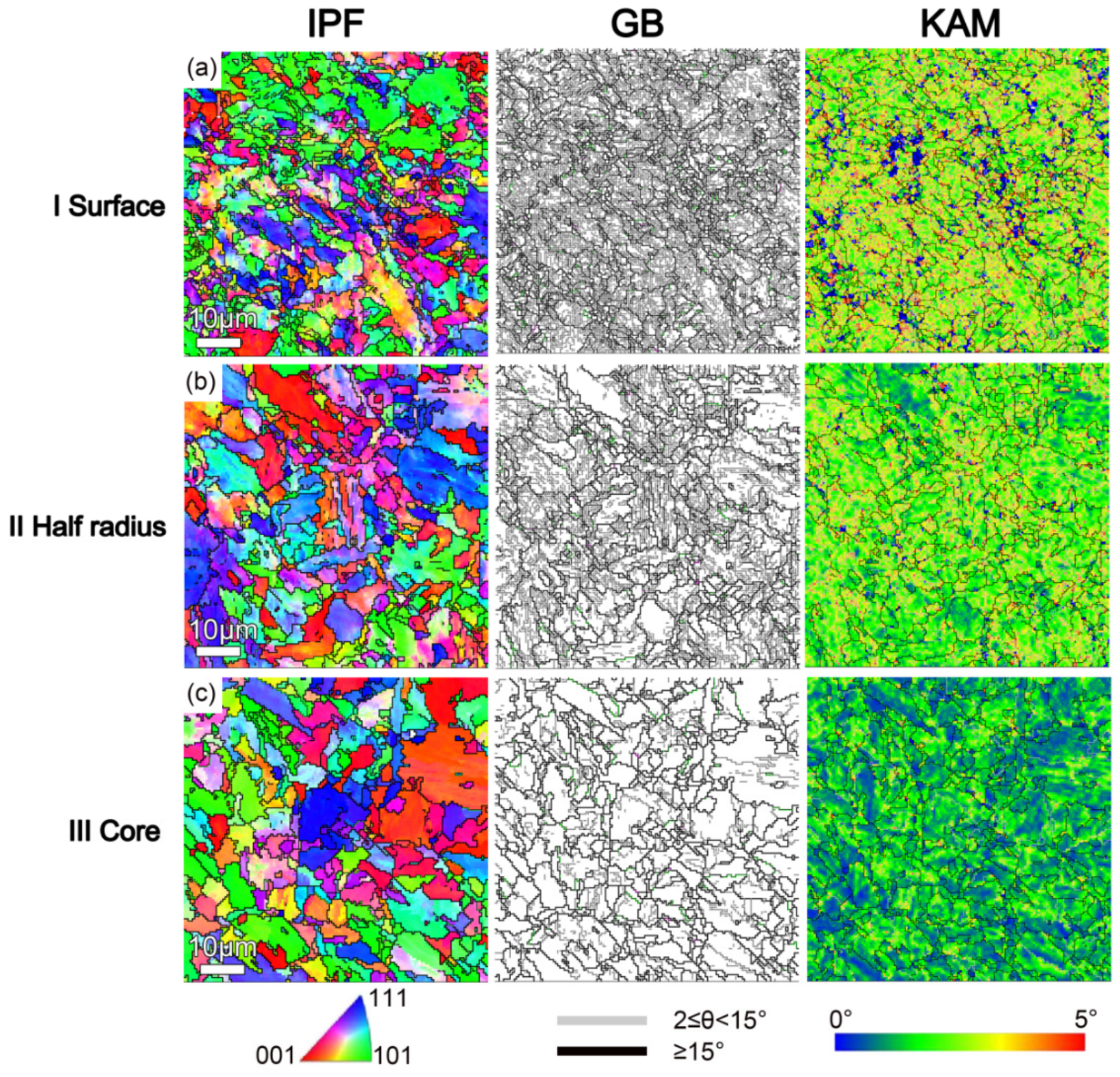
EBSD analysis at three radial positions in the pre-torsion positions revealed a distinct radial gradient in crystallographic orientation and grain boundary characteristics prior to aluminizing (Figure 4). Near the outer surface, the inverse pole figure (IPF) map exhibited substantial orientation variations and a finely subdivided microstructural appearance. The corresponding grain boundary (GB) map showed a dense boundary network, with low-angle grain boundaries (LAGBs, 2–15°), accounting for more than 62% of the total measured boundary length. These features suggest substantial deformation-induced lattice rotation and substructure development during pre-torsion. The KAM map also showed extensive green-to-yellow regions, indicating appreciable local crystallographic misorientation [35,36].
Figure 4.
EBSD microstructural characterization of the pre-torsioned AISI 5140 steel across three radial locations: (a) near surface (Region I); (b) at half radius (Region II); (c) near the core (Region III). Columns: IPF, GB, and KAM maps. The columns show the inverse pole figure (IPF), grain boundary (GB), and kernel average misorientation (KAM) maps, respectively.
At the intermediate radial position (Region II), the LAGB fraction decreased to approximately 38%, accompanied by a change in the KAM distribution, with fewer regions exhibiting relatively high misorientation than near the surface. In contrast, the core region (Region III) exhibited a comparatively less dense boundary network and predominantly blue-to-green KAM features, indicating generally lower local misorientation than in the outer regions. The radial differences in the IPF, GB, and KAM maps are consistent with the torsional strain gradient, in which the imposed shear strain increases with distance from the central axis [29,30,31].
3.2. Phase Composition and Crystallographic Features of Coatings
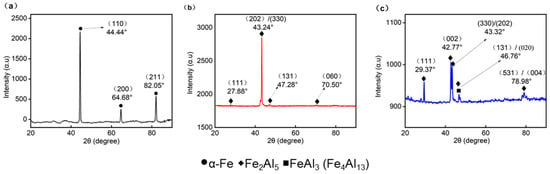
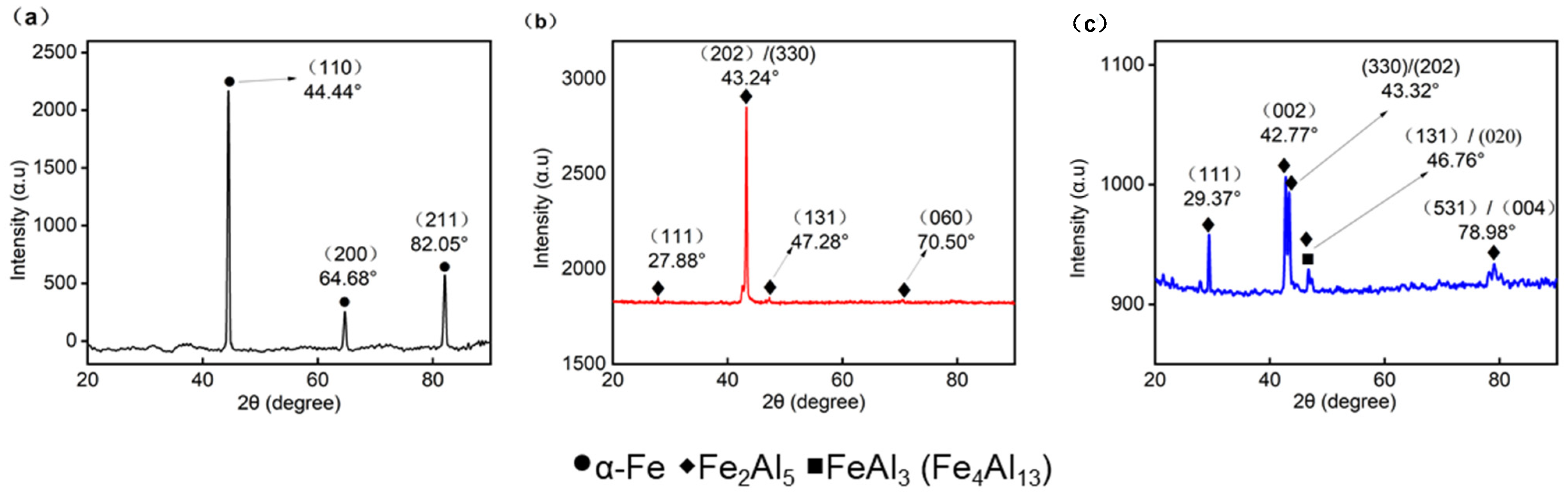
Figure 5 shows the detailed XRD patterns of the initial substrate, S-Al, and T-Al, with complete crystallographic indexing of all diffraction peaks (2θ angles, phases, and Miller indices (hkl). As shown in Figure 5a, the substrate pattern exhibits three distinct diffraction peaks at 2θ = 44.44°, 64.68°, and 82.05°, corresponding to the (110), (200), and (211) reflection planes of the body-centered cubic (bcc) α-Fe matrix, respectively (PDF #06-0696).
Figure 5.
XRD patterns of various samples. (a) bare quenched-and-tempered AISI 5140 substrate, (b) untorsioned aluminized specimen (S-Al), and (c) pre-torsioned aluminized specimen (T-Al).
After pack aluminizing at 700 °C for 3 h, the surface phase constitution undergoes a complete transformation. For the S-Al specimen (Figure 5b), the diffraction spectrum is predominant in the orthorhombic Fe2Al5 intermetallic phase [37]. The most prominent reflection occurs at 2θ = 43.24°, corresponding to the overlapping (202) and (330) crystallographic planes. Additional minor reflections of Fe2Al5 are detected at 2θ = 27.88° (111), 47.28° (131), and 70.50° (060) (ICDD PDF #47-1435). The strong (202) reflection indicates a prominent diffraction contribution from this crystallographic plane in Fe2Al5. Given the vacancy-related structural features of Fe2Al5, rapid diffusion through vacancy-associated pathways may contribute to coating growth [32,38]; however, the preferred diffusion direction cannot be inferred from the relative intensity of this reflection alone.
For the T-Al coating (Figure 5c), orthorhombic Fe2Al5 remains the dominant phase, exhibiting characteristic peaks at 2θ = 29.37° (111), 42.77° (002), 43.32° (330)/(202), and 78.98° (531)/(004) (ICDD PDF #47-1435). Notably, in addition to Fe2Al5, a distinct secondary peak is identified at 2θ = 46.76°, indexed as a combination of Fe2Al5 (131) (ICDD PDF #47-1435) and minor monoclinic FeAl3 (Fe4Al13) (131)/(020) (ICDD PDF #50-0797) [21,33,39]. The emergence of minor surface FeAl3 in T-Al is attributed to the combined effect of high Al chemical activity in the 75 wt.% Al pack and the intense defect energy stored in the near-surface zone of the pre-torsioned tempered sorbite matrix [16,25].
3.3. Cross-Sectional Microstructure and Coatings Thickness
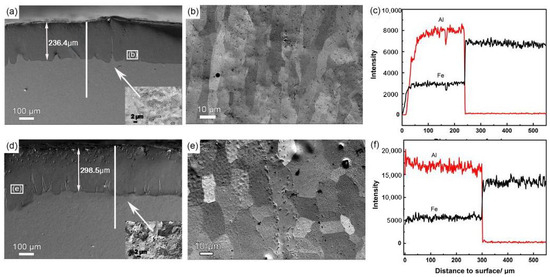
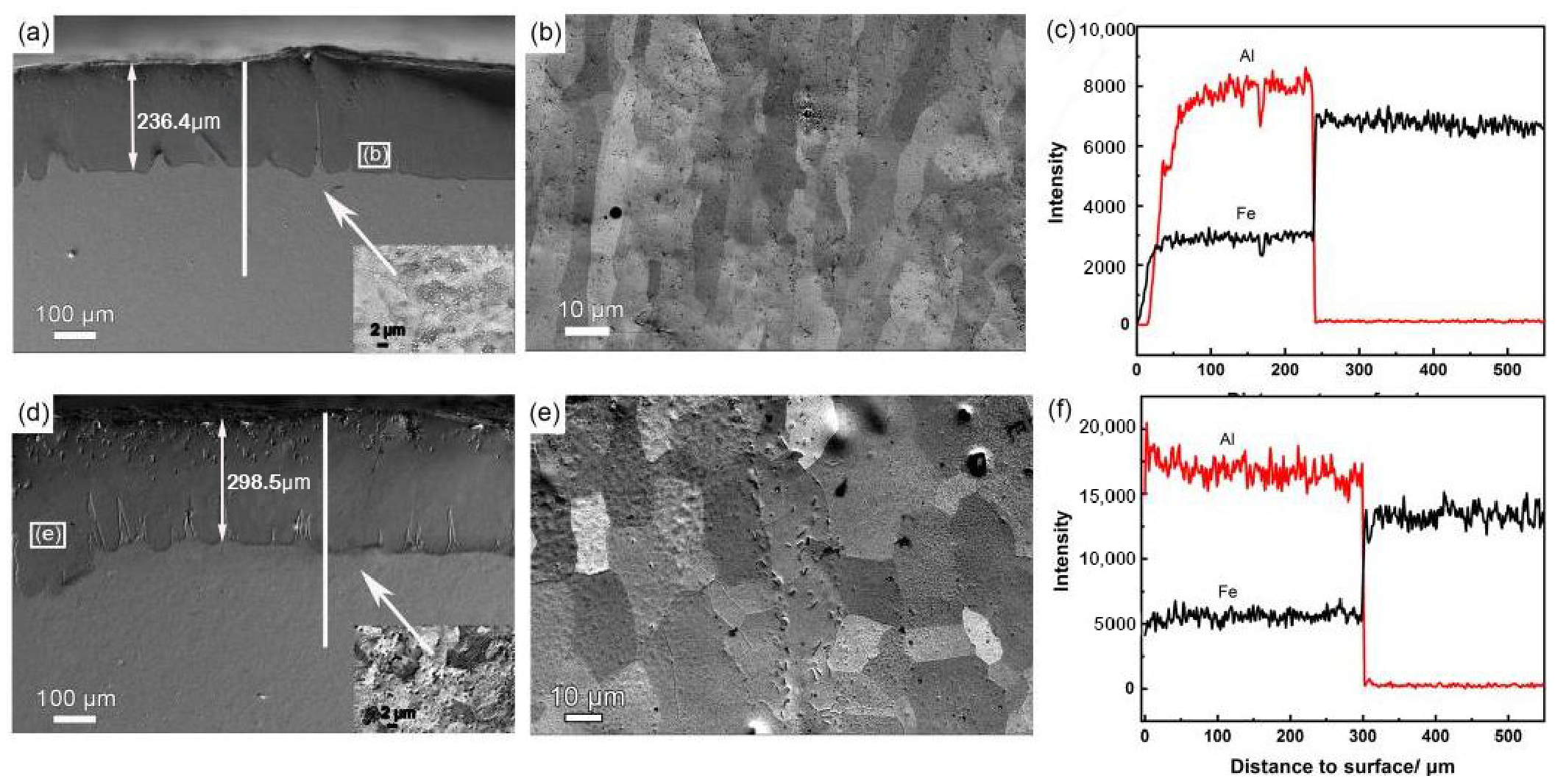
Figure 6 illustrates the cross-sectional BSE images and corresponding quantitative EDS line profiles illustrate morphological differences between the S-Al and T-Al coatings. S-Al coating exhibits a continuous, dense structure with an irregularly flat coating–substrate interface (Figure 6a) and elongated columnar grains oriented perpendicular to the substrate surface (Figure 6b) [39,40]. In contrast, T-Al coating exhibits a significantly thicker, an undulating, tongue-like (saw-tooth) coating–substrate interface, and equiaxed, refined grain structures within the inner reaction zone (Figure 6d,e) [11,41]. Additionally, pores are visible near the outer surface of T-Al. The EDS line profiles across the cross-sections clearly show Al enrichment in the coatings and a sharp concentration transition between the coating and the substrate (Figure 6f).
Figure 6.
Cross-sectional BSE micrographs and quantitative EDS element line profiles of aluminized specimens: (a) S-Al cross-section overview; (b) S-Al coating interior microstructure; (c) S-Al coating EDS elemental distribution profile; (d) T-Al overview; (e) T-Al coating interior microstructure; (f) T-Al coating EDS elemental distribution profile.
The effective coating diffusion depths are quantitatively derived directly from the sharp step-like aluminum concentration transitions in the cross-sectional EDS line profiles (Figure 6c,f). The effective coating diffusion depths are determined to be approximately ~236.4 μm for S-Al and ~298.5 μm for T-Al. Consequently, pre-torsion results in a thickness increase of approximately 62.1 μm (a ~26.3% increase relative to S-Al) under the investigated processing conditions (700 °C, 3 h). The pores observed near the T-Al surface may originate from diffusion-related Kirkendall voiding, local pack powder contact variations, or sample preparation artifacts [42,43]. Such porosity may locally affect microhardness measurements and potentially serve as crack initiation sites for electrolyte penetration pathways. However, because adhesion, fracture toughness, and interfacial mechanical integrity were not directly evaluated, no definitive enhancement in coating adhesion or mechanical robustness can be inferred solely from the increased thickness.
3.4. Quantitative Analysis of Aluminized Layers
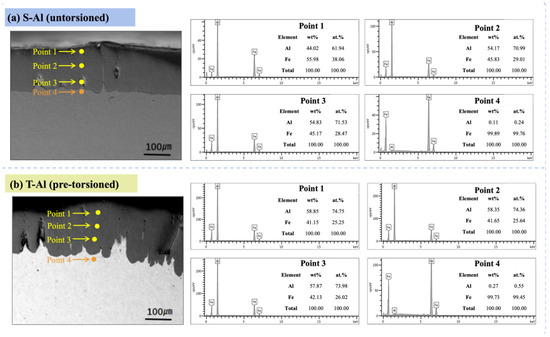
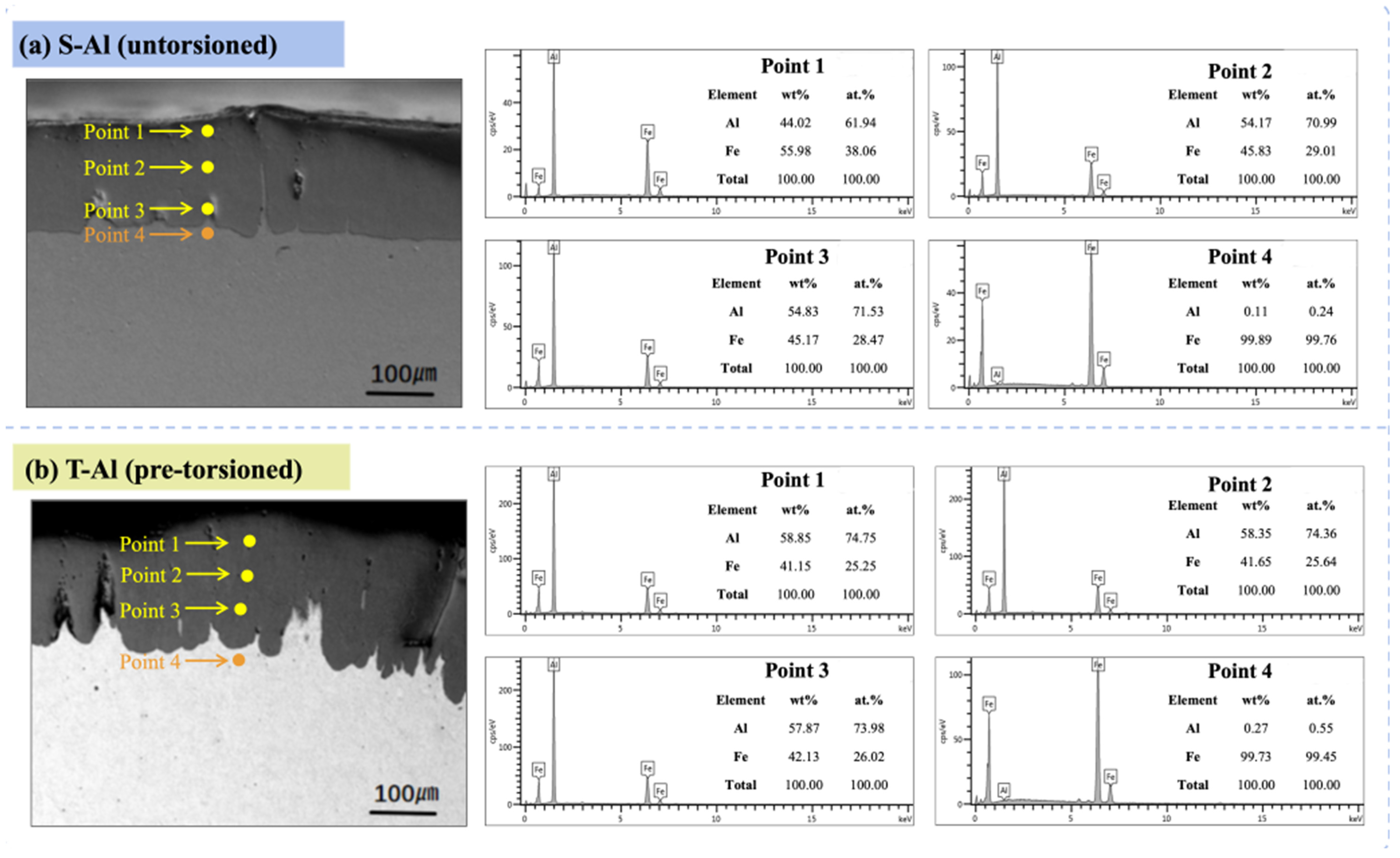
To further elucidate the compositional variations across the coating cross-sections, quantitative EDS point analyses were performed from the outer surface toward the substrate, as shown in Figure 7. For S-Al (Figure 7a), Point 1 near the outer surface contains 61.94 at.% Al and 38.06 at.% Fe, indicating a composition that deviates substantially from the nominal stoichiometries of Fe2Al5 and FeAl3. This deviation may reflect local compositional heterogeneity or contributions from adjacent phases within the EDS interaction volume. In contrast, Points 2 and 3 in the main coating region exhibit Al contents of 70.99 and 71.53 at.%, respectively, which are consistent with an Fe2Al5-rich region [33]. Point 4 located in the underlying substrate contains only 0.24 at.% Al, confirming the transition to the Fe-rich matrix.
Figure 7.
Cross-sectional SEM micrographs and corresponding quantitative EDS point analysis profiles (wt.% and at.%) of the aluminized layers: (a) untorsioned specimen (S-Al), and (b) pre-torsioned specimen (T-Al).
For T-Al (Figure 7b), Points 1–3 exhibit Al contents of 74.75, 74.36, 73.98 at.% Al, respectively, approaching the stoichiometry of FeAl3 and exceeding that measured in the corresponding coating region of S-Al [21,33]. These results support the presence of an Al-rich intermetallic region in the pre-torsioned specimen, consistent with the FeAl3 phase identified by XRD (Figure 5). Nevertheless, the precise phase assignment at each EDS point cannot be established solely from elemental composition, particularly in the tongue-like region where local compositional heterogeneity may occur. Point 4 in the unaffected substrate core contains only 0.55 at.% Al, confirming that the underlying matrix remains predominantly Fe-rich. Overall, the EDS results reveal distinct compositional gradients in the two coatings, with the pre-torsioned specimen with a potentially more Al-rich phase near the outer surface. This trend is consistent with the possibility that pre-torsion-induced defects influence Al uptake and inward diffusion during aluminizing.
3.5. Mechanism of Coating Formation
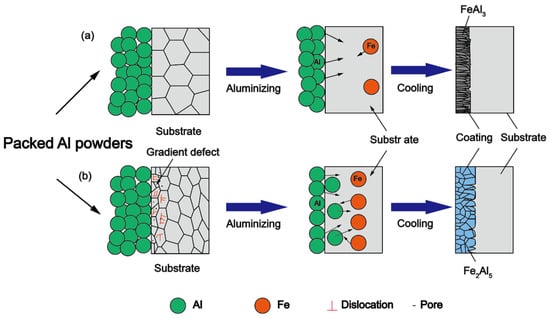
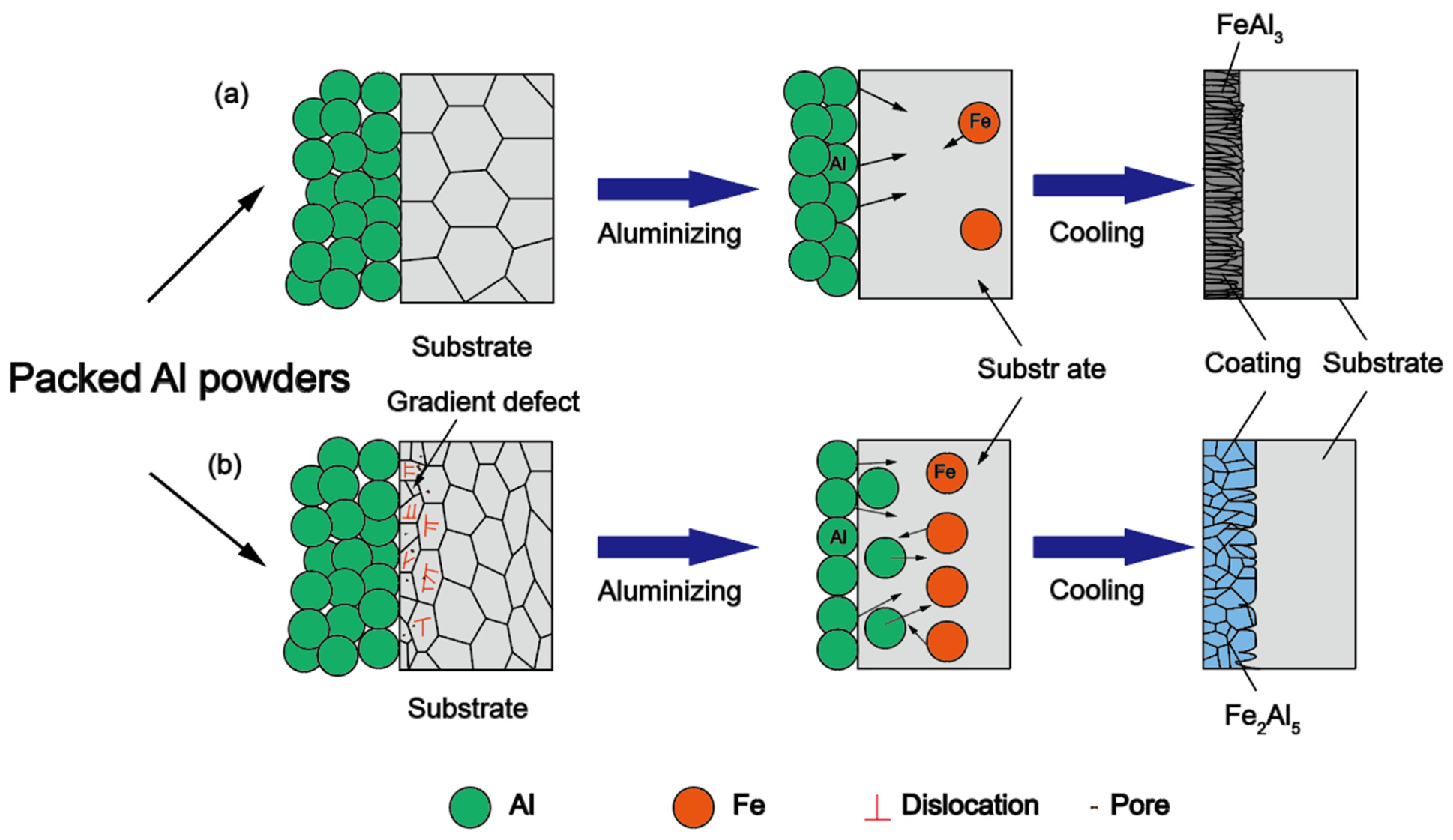
Figure 8 illustrates the differences in coating characteristics between the S-Al and T-Al specimens and presents a proposed mechanism of defect-assisted coating formation. Previous studies have shown that deformation-induced microstructural defects can modify surface reactivity and influence thermally activated diffusion processes [25,44,45]. In the present study, room-temperature pre-torsion introduces a radial gradient in the deformation state [29,30,31]. Specifically, the calculated nominal shear strain increases from zero at the specimen axis to approximately 0.287 at (r = 2.4) mm, 0.586 at (r = 4.9) mm, and 0.598 at the outer radius of 5 mm, corresponding to a nominal radial strain gradient of approximately 0.1196 mm−1. Within the outermost 400 μm, where the coating forms, the nominal shear strain varies only from approximately 0.550 to 0.598. Although these geometric estimates do not directly quantify the local dislocation density or defect structure retained during subsequent heating, they indicate that the near-surface region experienced substantial pre-deformation, which may influence the subsequent aluminizing reactions.
Figure 8.
Schematic illustration depicting the lower-temperature pack-aluminizing kinetics and morphological evolution mechanisms: (a) untorsioned tempered sorbite matrix-based aluminizing specimen (S-Al); (b) pre-torsion predeformed matrix-based aluminizing specimen (T-Al).
Pack-aluminizing was carried out at 700 °C for 3 h in a powder mixture containing 75 wt.% Al. Because this temperature lies above the melting point of pure aluminum (~660 °C), any unreacted Al donor in the pack is molten during the treatment, which increases the Al activity and the contact area with the substrate and thereby promotes rapid reactive diffusion [40]. For the S-Al, coating formation is expected to proceed through Al transport to the substrate and subsequent interdiffusion and intermetallic phase formation, producing a relatively continuous layer with a comparatively regular interface and an effective thickness of approximately 236.4 μm. In contrast, the T-Al contains a highly strained near-surface region with deformation-induced lattice defects and sub-boundaries, together with the fine carbides and transformation-related substructures characteristic of the quenched-and-tempered matrix. These features distinguish the T-Al substrate from the normalized matrix investigated previously [16] and may provide additional pathways for atomic transport and favorable sites for interfacial reaction and phase nucleation [26,46]. During heating to 700 °C, thermal recovery may reduce the initial defect density; however, residual substructures and the associated local heterogeneous microstructural state may still influence the early stage of aluminizing. In combination with the high-activity Al-rich powder pack, these features may promote localized reaction-front advancement and formation of characteristic tongue-like interface observed in T-Al [11,41]. The FeAl3 identified in the coating of T-Al is also consistent with localized early-stage phase formation under these conditions [21,46], although its formation mechanism cannot be established from the present observations alone.
The greater effective coating thickness of T-Al (~298.5 μm) compared with S-Al (~236.4 μm) is consistent with enhanced coating growth associated with pre-torsion. However, this difference does not establish that deformation-induced defects control the entire coating growth process. As the intermetallic layer develops, continued thickening is increasingly governed by mass transport through the growing reaction layer, including diffusion along available pathways within phases such as Fe2Al5 [37,40,47]. Therefore, the enhanced coating thickness and distinctive tongue-like interface morphology of T-Al are plausibly attributed to the combined effects of deformation-induced microstructural heterogeneity on early-stage interfacial reaction and subsequent mass transport through the developing intermetallic layer.
3.6. Coating Properties
3.6.1. Microhardness Profiles
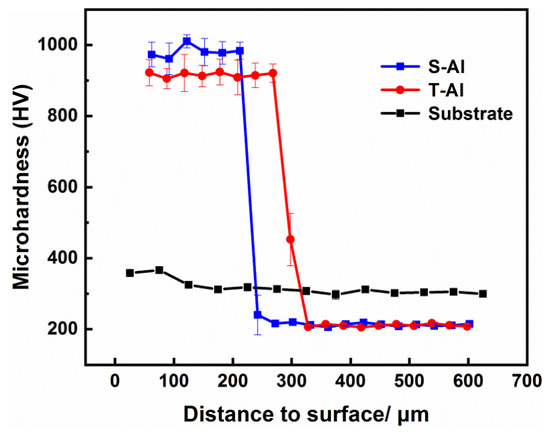
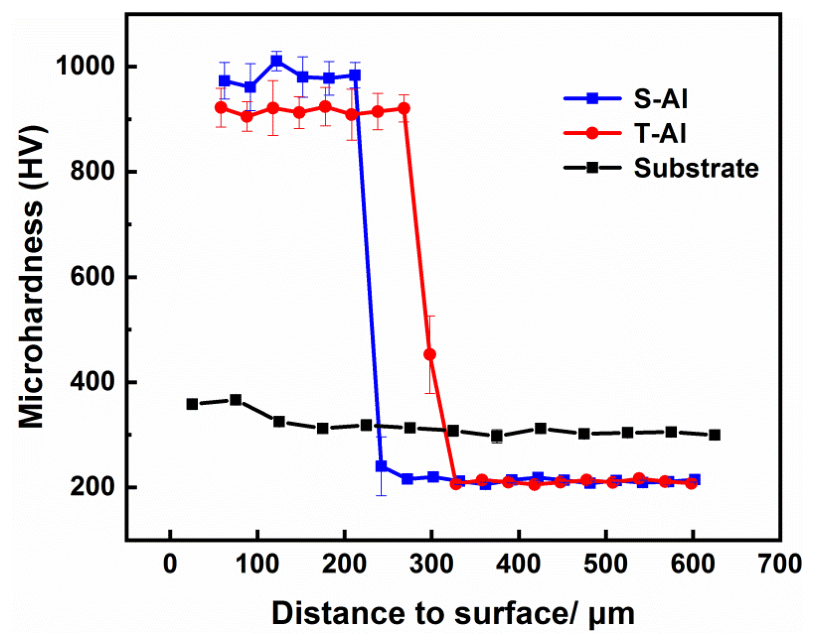
Cross-sectional microhardness profiles of the untreated substrate and aluminized specimens are evaluated (Figure 9). Both aluminized specimens exhibit high hardness near the surface, with values of approximately 960–1010 HV0.2 for S-Al and 900–920 HV0.2 for T-Al. The hardness remains relatively stable within the coating region before decreasing sharply to a level even lower than that of the substrate. The transition occurs at a distance of approximately 210–240 μm from the surface for S-Al and 270–330 μm for T-Al, consistent with the greater effective coating thickness of the pre-torsioned specimen. Although T-Al exhibits a lower maximum hardness than S-Al, its high-hardness region extends farther into the material. Specifically, the depth over which the hardness exceeds 800 HV0.2 increases from approximately 210–240 μm for S-Al to 270–330 μm for T-Al. These results indicate that pre-torsion is associated with a greater hardened depth but a modest reduction in maximum coating hardness. The hardness profiles are consistent with the observed differences in coating thickness and suggest that pre-torsion modifies the distribution of hardened regions produced during pack aluminizing.
Figure 9.
Cross-sectional Vickers microhardness profiles (200 gf; dwell time 10 s) for the untreated substrate, untorsioned aluminizing (S-Al), and pre-torsion aluminizing (T-Al).
Lower peak hardness in T-Al is attributed to fine Kirkendall microporosity and local stress relief during rapid solid–liquid interdiffusion [43,44]. In both aluminizing samples, substrate hardness decreased from the pre-treatment value of approximately 330 to 210 HV0.2. Exposure to 700 °C exceeds the original tempering temperature (580 °C), inducing carbide coarsening and subgrain recovery within the core-tempered sorbite [16,21]. While 700 °C avoids the severe austenite grain coarsening typical of high-temperature aluminizing (850–1050 °C), core softening remains a factor when applying this process to load-bearing components.
3.6.2. Corrosion Resistance
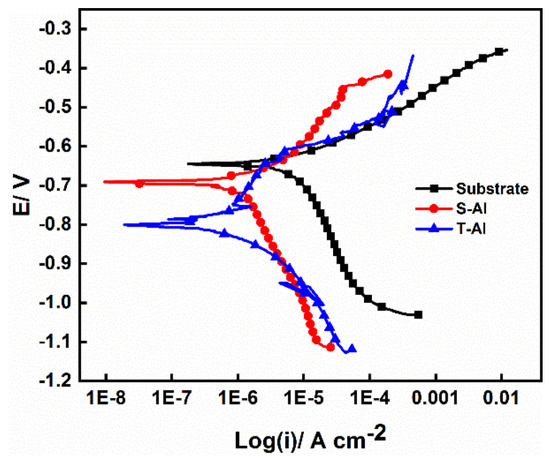
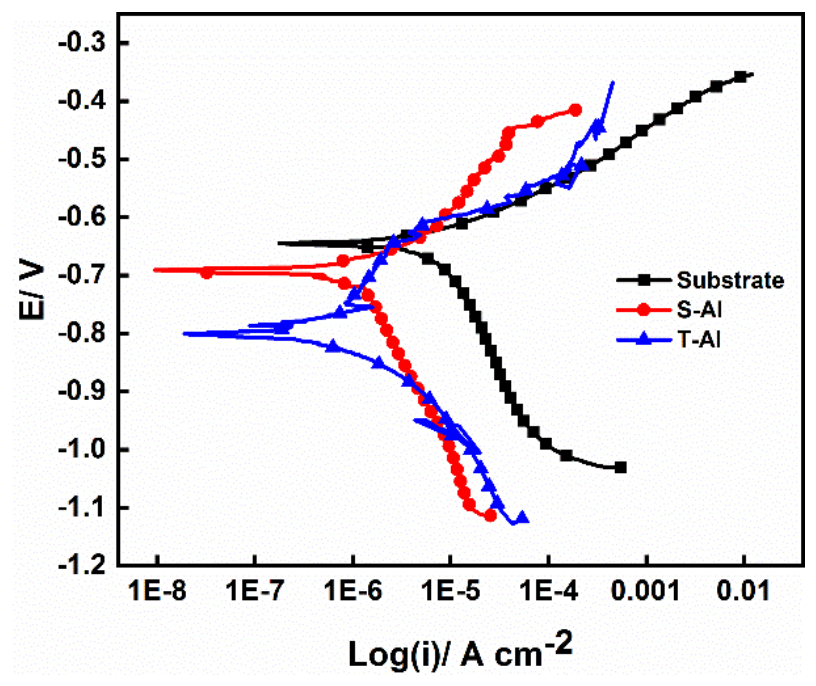
To quantitatively evaluate the protective capability of the aluminized coatings against environmental degradation, electrochemical potentiodynamic polarization tests were conducted in a 3.5 wt.% NaCl solution [48]. Figure 10 presents the representative polarization curves for the uncoated AISI 5140 substrate, the S-Al, and the T-Al. The derived electrochemical corrosion parameters, including Ecorr and Icorr, are summarized in Table 1. As evidenced by Figure 10 and Table 1, the bare AISI 5140 substrate exhibits typical active dissolution behavior, characterized by a high Icorr on the order of ~7.21 μA·cm−2 and an Ecorr of approximately −645 mV vs. SCE, accompanied by a continuous active anodic branch without any passivation plateau [48,49]. Following pack aluminizing, both S-Al and T-Al coatings demonstrate a dramatic improvement in electrochemical stability. The polarization curves for both coated specimens shift significantly toward the lower current density region, reducing Icorr by nearly an order of magnitude down to ~1.08–1.12 μA·cm−2 compared to the bare substrate. This substantial reduction in corrosion rate is primarily attributed to the formation of dense iron-aluminum intermetallic compounds (Fe2Al5 and minor FeAl3), which effectively suppress charge transfer and ionic transport across the coating–electrolyte interface [48,49].
Figure 10.
Potentiodynamic polarization curves for the untreated substrate, untorsioned aluminizing specimen (S-Al), and pre-torsion aluminizing specimen (T-Al).
Table 1.
Electrochemical corrosion parameters (Ecorr, Icorr, and nominal corrosion rate (Corr rate)) of various samples.
In the potential range from −691 mV to −450 mV vs. SCE, S-Al exhibits a wide and stable anodic passivation plateau, indicating prompt passivation and high stability of the outer oxide layer [8,48]. In contrast, the T-Al displays a negative shift to approximately −0.80 V vs. SCE. A critical analysis reveals that this marginal negative shift originates from fine Kirkendall microporosity generated near the surface during the accelerated solid–liquid coupled reaction and high-flux Al inward diffusion. These localized micropores slightly increase the effective initial electrolyte contact area, leading to temporary active dissolution sites during early immersion [43,44]. However, despite the more negative Ecorr, T-Al maintains an exceptionally low corrosion current density (1.12 μA·cm−2) that is virtually identical to that of S-Al, alongside an extended passive-like response. The significantly enhanced intermetallic diffusion layer thickness achieved via pre-torsion (298.5 μm for T-Al vs. 236.4 μm for S-Al) effectively compensates for the localized outer microporosity by providing a prolonged, tortuous barrier path that impedes deep corrosive medium penetration. Consequently, the pre-torsion-assisted low-temperature pack-aluminizing process successfully optimizes coating growth kinetics while preserving robust, long-term corrosion protection [12,49].
4. Conclusions
The effects of room-temperature pre-torsion on the low-temperature pack aluminizing of quenched-and-tempered AISI 5140 steel were investigated at 700 °C for 3 h. Pre-torsion introduced a radial strain gradient and promoted deformation-induced substructure formation near the surface, increasing the effective coating thickness from 236.4 to 298.5 μm (approximately 26.3%). Both coatings consisted predominantly of orthorhombic Fe2Al5, while FeAl3 was observed throughout the coating of T-Al. Although pre-torsion reduced the maximum coating microhardness from 1010 to 920 HV0.2, it increased the hardened-layer depth from approximately 210–240 μm for S-Al to 270–330 μm for T-Al. Both coatings also exhibited substantially improved corrosion resistance in 3.5 wt.% NaCl solution, with corrosion current densities of 1.08–1.12 μA cm−2 compared with 7.21 μA cm−2 for the bare substrate. These findings demonstrate that room-temperature pre-torsion can enhance coating growth and hardening depth while maintaining corrosion resistance, offering a potential approach to tailoring aluminized layers through substrate deformation.
Author Contributions
Conceptualization, L.M. and D.W.; Validation, S.S.; Investigation, L.M. and D.W.; Resources, J.H.; Data curation, H.W.; Writing—original draft, L.M. and D.W.; Writing—review and editing, S.S., H.W., J.H. and N.G.; Supervision, H.W., J.H. and N.G. All authors have read and agreed to the published version of the manuscript.
Funding
This research was funded by the Science and Technology Research Program of Chongqing Municipal Education Commission, China (Project No. KJZD-K202404102).
Data Availability Statement
The data presented in this study are available on request from the corresponding author.
Conflicts of Interest
The authors declare no conflict of interest.
References
- Hu, J.; Zhang, Y.; Yang, X.; Li, H.; Xu, H.; Ma, C.; Dong, Q.; Guo, N.; Yao, Z. Effect of pack-chromizing temperature on microstructure and performance of AISI 5140 steel with Cr-coatings. Surf. Coat. Technol. 2018, 344, 656–663. [Google Scholar] [CrossRef] [Scilit]
- GB/T 3077-2015; Alloy Structure Steels. China Standards Press: Beijing, China, 2015. (In Chinese)
- Zhu, X.-L.; Yao, Z.-J.; Gu, X.-D.; Cong, W.; Zhang, P.-Z. Microstructure and corrosion resistance of Fe-Al intermetallic coating on 45 steel synthesized by double glow plasma surface alloying technology. Trans. Nonferrous Met. Soc. China 2009, 19, 143–148. [Google Scholar] [CrossRef] [Scilit]
- Yu, L.; Xiao, C.; Jiang, W.; Li, W.; Ni, S.; Song, M. Effects of Aluminizing on the Microstructure and Wear Resistance of AISI 321 Steel. Surf. Coat. Technol. 2024, 483, 130753. [Google Scholar] [CrossRef] [Scilit]
- Xiang, Z.D.; Datta, P.K. Pack aluminisation of low alloy steels at temperatures below 700 °C. Surf. Coat. Technol. 2004, 184, 108–115. [Google Scholar] [CrossRef] [Scilit]
- Majumdar, S.; Paul, B.; Chakraborty, P.; Kishor, J.; Kain, V.; Dey, G.K. Formation of Al2O3/FeAl coatings on a 9Cr-1Mo steel, and corrosion evaluation in flowing Pb-17Li loop. J. Nucl. Mater. 2017, 486, 60–65. [Google Scholar] [CrossRef] [Scilit]
- Chen, W.; La, P.; Li, Z.; Li, Y.; Wan, L. The Microstructure of Aluminide Coatings on 310S and 347H Steels Formed by Pack Aluminizing and Their Corrosion Behavior in Molten Chloride Salts. Coatings 2024, 14, 1507. [Google Scholar] [CrossRef] [Scilit]
- Jiang, C.; Feng, M.; Chen, M.; Chen, K.; Geng, S.; Wang, F. Corrosion behaviour of iron and nickel aluminide coatings under the synergistic effect of NaCl and water vapour. Corros. Sci. 2021, 187, 109484. [Google Scholar] [CrossRef] [Scilit]
- Wang, D. Phase evolution of an aluminized steel by oxidation treatment. Appl. Surf. Sci. 2008, 254, 3026–3032. [Google Scholar] [CrossRef] [Scilit]
- McKamey, C.G.; DeVan, J.H.; Tortorelli, P.F.; Sikka, V.K. A review of recent developments in Fe3Al-based alloys. J. Mater. Res. 1991, 6, 1779–1805. [Google Scholar] [CrossRef] [Scilit]
- Awan, G.H.; Hasan, F.U. The morphology of coating/substrate interface in hot-dip-aluminized steels. Mater. Sci. Eng. A 2008, 472, 157–165. [Google Scholar] [CrossRef] [Scilit]
- Liu, Z.-X.; Shi, L.; Jiang, A.-Y.; Liu, J.; Zhang, B.; Zhou, Y.; Zhang, G. Corrosion protection investigations of oxide-silane composite coating on hot dip aluminized steel. Mater. Corros. 2025, 76, 87–98. [Google Scholar] [CrossRef] [Scilit]
- Wen, F.; Zhang, D.; Wang, W.; Teng, X.; Chu, X. Preparation and Formation Mechanism of Fe-Al Coating on 316L Stainless Steel by Pack Cementation Aluminizing. Chin. J. Mater. Res. 2024, 38, 759–767. [Google Scholar] [CrossRef]
- Li, N.; Chen, Y.; Chen, X.; Yin, L.; Chen, G. Preparation Method and Diffusion Mechanism of Fe-Al Coating on Q235 Low Carbon Steel by Pack Aluminizing. Chin. J. Mater. Res. 2021, 35, 572–582. [Google Scholar] [CrossRef]
- Lin, S.; Wu, Y.; Li, C.; Cai, Z.; Nie, L.; Ren, Q.; Luo, B.; Yang, H.; Huang, H. Preparation of Fe-Al Coating on 316LSS by Low-Temperature and High-Activation Pack Aluminizing. Fusion Eng. Des. 2025, 215, 114978. [Google Scholar] [CrossRef] [Scilit]
- Hu, J.; Wang, D.; Guo, N.; Yang, X.; Li, H.; Xu, H. Microstructure and Performance of Aluminized Coatings Prepared by Pack-Cementation Promoted by Surface Gradient Crystal Defects on 40Cr Steel. J. Mech. Eng. 2023, 59, 114–122. [Google Scholar] [CrossRef] [Scilit]
- Xiang, Z.D.; Datta, P.K. Relationship between pack chemistry and aluminide coating formation for low-temperature aluminisation of alloy steels. Acta Mater. 2006, 54, 4453–4463. [Google Scholar] [CrossRef] [Scilit]
- Bates, B.L.; Wang, Y.Q.; Zhang, Y.; Pint, B.A. Formation and oxidation performance of low-temperature pack aluminide coatings on ferritic–martensitic steels. Surf. Coat. Technol. 2009, 204, 766–770. [Google Scholar] [CrossRef] [Scilit]
- Wang, Y.Q.; Zhang, Y.; Wilson, D. Formation of aluminide coatings on ferritic–martensitic steels by a low-temperature pack cementation process. Surf. Coat. Technol. 2010, 204, 2737–2744. [Google Scholar] [CrossRef] [Scilit]
- Kung, S.-C.; Rapp, R.A. Fundamental kinetic study of aluminization of iron by pack cementation at 900 °C. Surf. Coat. Technol. 1987, 32, 41–56. [Google Scholar] [CrossRef] [Scilit]
- Wu, H.; Liu, Y.; Cai, Y.; Guo, N. Microstructure and Properties of Aluminizing Coatings on 0Cr21Al6Nb Stainless Steel Prepared by Pack Cementation. Coatings 2026, 16, 999. [Google Scholar] [CrossRef] [Scilit]
- Xiang, Z.D.; Datta, P.K. Formation of aluminide coatings on low alloy steels at 650 °C by pack cementation process. Mater. Sci. Technol. 2004, 20, 1297–1302. [Google Scholar] [CrossRef] [Scilit]
- Xiang, Z.D.; Datta, P.K. Low temperature aluminisation of alloy steels by pack cementation process. Mater. Sci. Technol. 2006, 22, 1177–1184. [Google Scholar] [CrossRef] [Scilit]
- Shen, M.; Zhu, S.; Wang, F. A general strategy for the ultrafast surface modification of metals. Nat. Commun. 2016, 7, 13797. [Google Scholar] [CrossRef] [Scilit] [PubMed]
- Wang, Z.B.; Tao, N.R.; Tong, W.P.; Lu, J.; Lu, K. Diffusion of chromium in nanocrystalline iron produced by means of surface mechanical attrition treatment. Acta Mater. 2003, 51, 4319–4329. [Google Scholar] [CrossRef] [Scilit]
- Tao, N.R.; Wang, Z.B.; Tong, W.P.; Sui, M.L.; Lu, J.; Lu, K. An investigation of surface nanocrystallization mechanism in Fe induced by surface mechanical attrition treatment. Acta Mater. 2002, 50, 4603–4616. [Google Scholar] [CrossRef] [Scilit]
- Tong, W.P.; Tao, N.R.; Wang, Z.B.; Lu, J.; Lu, K. Nitriding iron at lower temperatures. Science 2003, 299, 686–688. [Google Scholar] [CrossRef] [Scilit] [PubMed]
- Balusamy, T.; Sankara Narayanan, T.S.N.; Ravichandran, K.; Park, I.S.; Lee, M.H. Effect of surface mechanical attrition treatment (SMAT) on pack boronizing of AISI 304 stainless steel. Surf. Coat. Technol. 2013, 232, 60–67. [Google Scholar] [CrossRef] [Scilit]
- Guo, N.; Luan, B.; Liu, Q. Influence of pre-torsion deformation on microstructures and properties of cold drawing pearlitic steel wires. Mater. Des. 2013, 50, 285–292. [Google Scholar] [CrossRef] [Scilit]
- Guo, N.; Zhang, Z.; Dong, Q.; Yu, H.; Song, B.; Chai, L.; Liu, C.; Yao, Z.; Daymond, M.R. Strengthening and toughening austenitic steel by introducing gradient martensite via cyclic forward/reverse torsion. Mater. Des. 2018, 143, 150–159. [Google Scholar] [CrossRef] [Scilit]
- Song, B.; Pan, H.; Chai, L.; Guo, N.; Zhao, H.; Xin, R. Evolution of gradient microstructure in an extruded AZ31 rod during torsion and annealing and its effects on mechanical properties. Mater. Sci. Eng. A 2017, 689, 78–88. [Google Scholar] [CrossRef] [Scilit]
- Takata, N.; Nishimoto, M.; Kobayashi, S.; Takeyama, M. Crystallography of Fe2Al5 phase at the interface between solid Fe and liquid Al. Intermetallics 2015, 67, 1–11. [Google Scholar] [CrossRef] [Scilit]
- Van Alboom, A.; Lemmens, B.; Breitbach, B.; De Grave, E.; Cottenier, S.; Verbeken, K. Multi-method identification and characterization of the intermetallic surface layers of hot-dip Al-coated steel: FeAl3 or Fe4Al13 and Fe2Al5 or Fe2Al5+x. Surf. Coat. Technol. 2017, 324, 419–428. [Google Scholar] [CrossRef] [Scilit]
- Humphreys, F.J. Characterisation of fine-scale microstructures by electron backscatter diffraction (EBSD). Scr. Mater. 2004, 51, 771–776. [Google Scholar] [CrossRef] [Scilit]
- Wright, S.I.; Nowell, M.M.; Field, D.P. A review of strain analysis using electron backscatter diffraction. Microsc. Microanal. 2011, 17, 316–329. [Google Scholar] [CrossRef] [Scilit] [PubMed]
- Calcagnotto, M.; Ponge, D.; Demir, E.; Raabe, D. Orientation gradients and geometrically necessary dislocations in ultrafine grained dual-phase steels studied by 2D and 3D EBSD. Mater. Sci. Eng. A 2010, 527, 2738–2746. [Google Scholar] [CrossRef] [Scilit]
- Son, Y.I.; Chung, C.H.; Gowkanapalli, R.R.; Moon, C.H.; Park, J.S. Kinetics of Fe2Al5 phase formation on 4130 steel by Al pack cementation and its oxidation resistance. Met. Mater. Int. 2015, 21, 1–6. [Google Scholar] [CrossRef] [Scilit]
- Procházka, I.; Vlasák, T.; Čížek, J.; Lukac, F.; Liedke, M.; Anwand, W.; Jiraskova, Y.; Janickovic, D. Quenched-in Vacancies and Hardening of Fe–Al Intermetallics. Acta Phys. Pol. A 2020, 137, 255–259. [Google Scholar] [CrossRef] [Scilit]
- Cheng, W.-J.; Wang, C.-J. Study of microstructure and phase evolution of hot-dipped aluminide mild steel during high-temperature diffusion using electron backscatter diffraction. Appl. Surf. Sci. 2011, 257, 4663–4668. [Google Scholar] [CrossRef] [Scilit]
- Bouché, K.; Barbier, F.; Coulet, A. Intermetallic compound layer growth between solid iron and molten aluminium. Mater. Sci. Eng. A 1998, 249, 167–175. [Google Scholar] [CrossRef] [Scilit]
- Kobayashi, S.; Yakou, T. Control of intermetallic compound layers at interface between steel and aluminum by diffusion-treatment. Mater. Sci. Eng. A 2002, 338, 44–53. [Google Scholar] [CrossRef] [Scilit]
- Maki, J. Formation of Kirkendall Pores in Aluminized Steel Sheets and Effect of Si in Aluminizing Bath. ISIJ Int. 2022, 62, 1251–1257. [Google Scholar] [CrossRef] [Scilit]
- Fan, D.W.; Kim, H.S.; Oh, J.K.; Chin, K.G.; De Cooman, B.C. Coating Degradation in Hot Press Forming. ISIJ Int. 2010, 50, 561–568. [Google Scholar] [CrossRef] [Scilit]
- Yu, L.; Jiang, W.; An, X.; Ni, S.; Bo, G.; Li, W.; Song, M. Introducing both chemical and structural gradients in AISI 321 stainless steel via aluminizing and laser shock peening for superior properties. Surf. Coat. Technol. 2023, 472, 129942. [Google Scholar] [CrossRef] [Scilit]
- Balusamy, T.; Sankara Narayanan, T.S.N.; Ravichandran, K. Effect of surface mechanical attrition treatment (SMAT) on boronizing of EN8 steel. Surf. Coat. Technol. 2012, 213, 221–228. [Google Scholar] [CrossRef] [Scilit]
- Kepa, T.; Pedraza, F.; Rouillard, F. Intermetallic formation of Al-Fe and Al-Ni phases by ultrafast slurry aluminization (flash aluminizing). Surf. Coat. Technol. 2020, 397, 126011. [Google Scholar] [CrossRef] [Scilit]
- Kumar, S.; Majumdar, S.; Paul, B.; Kishor, J.; Kain, V. Kinetics of formation of pack aluminized coating on 9Cr-1Mo steel and interdiffusional behaviour of iron aluminides at intermediate temperatures. Surf. Coat. Technol. 2021, 426, 127794. [Google Scholar] [CrossRef] [Scilit]
- Haftlang, F.; Habibolahzadeh, A.; Sohi, M.H. Improving electrochemical properties of AISI 1045 steels by duplex surface treatment of plasma nitriding and aluminizing. Appl. Surf. Sci. 2015, 329, 240–247. [Google Scholar] [CrossRef] [Scilit]
- Rao, D.L.; Vishwakarma, P.; Yadav, A.; Chandra, S.S.V.S.; Srivastava, C. Iron aluminide coatings as hydrogen permeation barriers with enhanced corrosion resistance. Int. J. Hydrogen Energy 2026, 201, 152983. [Google Scholar] [CrossRef] [Scilit]

Disclaimer/Publisher’s Note: The statements, opinions and data contained in all publications are solely those of the individual author(s) and contributor(s) and not of MDPI and/or the editor(s). MDPI and/or the editor(s) disclaim responsibility for any injury to people or property resulting from any ideas, methods, instructions or products referred to in the content. |
© 2026 by the authors. Licensee MDPI, Basel, Switzerland. This article is an open access article distributed under the terms and conditions of the Creative Commons Attribution (CC BY) license.