


Abstract
Background: Carbapenem-resistant Enterobacterales (CRE) are a major therapeutic challenge, particularly in settings where metallo-β-lactamases are prevalent. Aztreonam–avibactam (AZA) may provide activity against metallo-β-lactamase-producing isolates, whereas ceftazidime–avibactam (CZA) has limited activity against the isolates that harbor these enzymes. This study aimed to evaluate the in vitro activity of aztreonam–avibactam and ceftazidime–avibactam against invasive carbapenem-resistant Enterobacterales isolates and to characterize the distribution of carbapenemase genes in a tertiary-care center in Türkiye. Methods: A total of 100 non-duplicate CRE isolates recovered from blood cultures and sterile body fluids between January 2024 and January 2026 were included. Species identification and routine antimicrobial susceptibility testing were performed using MALDI-TOF MS and an automated system. CZA and AZA MICs were determined by gradient diffusion testing, whereas CZA–aztreonam synergy was assessed separately using a disk/gradient diffusion-based method. Carbapenemase genes were detected by real-time PCR. Whole-genome sequencing was performed for the two AZA-resistant Escherichia coli isolates. Results: The isolate collection was dominated by Klebsiella pneumoniae (87.0%), and most isolates were recovered from blood cultures (80.0%). CZA susceptibility was observed in 31.0% of isolates, with MIC50/90 values of 256/256 mg/L. In contrast, AZA showed high in vitro activity, with 98.0% of isolates categorized as susceptible and MIC50/90 values of 0.25/0.50 mg/L. CZA–aztreonam synergy was detected in 98.0% of isolates. Qualitative CZA–aztreonam synergy testing did not fully concord with direct AZA MIC-based susceptibility categorization: one AZA-resistant isolate showed a positive synergy result, whereas one synergy-negative isolate remained AZA-susceptible. Carbapenemase genes were detected in 99.0% of isolates; blaNDM was the most frequent gene (81.0%), followed by blaOXA-48 (72.0%), blaKPC (14.0%), and blaVIM (4.0%). The most common carbapenemase profile was blaNDM + blaOXA-48 (62.0%). blaNDM carriage was strongly associated with CZA resistance, and CZA MICs were significantly higher among blaNDM-positive isolates. The two AZA-resistant E. coli isolates belonged to ST500 and ST410, and both carried a YRIK insertion in PBP3; one of them additionally showed ompF disruption associated with a 4 bp insertion. Conclusions: AZA demonstrated potent in vitro activity against invasive CRE isolates in this setting, whereas CZA activity was substantially limited, likely reflecting the high prevalence of blaNDM and frequent carbapenemase co-carriage. These findings support the potential value of AZA in regions with emerging metallo-β-lactamase predominance and highlight the importance of local molecular surveillance to guide antimicrobial strategies.
1. Introduction
The rise of antimicrobial resistance (AMR) has been recognized by the World Health Organization (WHO) as one of the most serious threats to global public health. Carbapenem-resistant Enterobacterales (CRE) were initially classified within the “critical priority” tier of pathogens requiring the urgent development of new antimicrobial agents by WHO in 2017, and they continue to retain this highest-urgency designation in the updated 2024 WHO Bacterial Priority Pathogens List [1,2]. CRE are defined as Enterobacterales resistant to one or several carbapenem antibiotics [3].
Carbapenem resistance in Enterobacterales may arise through several mechanisms, including alterations in penicillin-binding proteins, reduced outer membrane permeability, efflux pump overexpression, and most importantly, the production of carbapenemase enzymes. Carbapenemases are β-lactamases capable of hydrolyzing a broad range of β-lactam antibiotics, including penicillins, cephalosporins, monobactams, and carbapenems. The most frequently encountered carbapenemases in CRE isolates are class A enzymes (such as KPC), class B metallo-β-lactamases (such as NDM, VIM, and IMP), and class D enzymes (such as OXA-48) [4].
The global dissemination of metallo-β-lactamase (MBL)-producing Gram-negative bacteria represents a major therapeutic challenge, as these enzymes hydrolyze most β-lactam antibiotics, including carbapenems, while monobactams such as aztreonam remain relatively stable against MBL-mediated hydrolysis [4]. However, ceftazidime–avibactam, imipenem–relebactam, and meropenem–vaborbactam generally lack in vitro activity against MBL-producing Gram-negative bacilli, as the corresponding β-lactamase inhibitors do not inhibit class B metallo-β-lactamases [5]. This limitation creates a critical gap in current antimicrobial treatment options and highlights the urgent need for new therapeutic strategies.
In contrast, the combination of aztreonam and avibactam has emerged as a promising therapeutic option for infections caused by MBL-producing Enterobacterales. Aztreonam remains stable against hydrolysis by MBLs, while avibactam inhibits co-produced serine β-lactamases that would otherwise inactivate aztreonam [6]. Preliminary in vitro studies from different regions have demonstrated potent activity of aztreonam–avibactam against MBL-producing Enterobacterales; however, regional data remain limited.
The epidemiology of carbapenemase-producing Enterobacterales in Türkiye has been characterized by an OXA-48-endemic background, while recent reports have also documented NDM-producing isolates and multiple-carbapenemase profiles, including OXA-48/NDM and KPC/NDM/OXA-48 co-carriage [7,8,9,10]. In addition to OXA-48-like enzymes, NDM-type metallo-β-lactamases have increasingly been reported in Türkiye, either alone or as part of multiple-carbapenemase profiles, including OXA-48/NDM co-production, which has been associated with hospital outbreaks and poses additional challenges for treatment and infection control [9,10]. These findings indicate a dynamic and evolving epidemiological landscape of carbapenem resistance in Türkiye and highlight the need for continuous surveillance and evaluation of novel antimicrobial combinations active against these resistance mechanisms.
However, available data including isolates from Türkiye remain limited, particularly for invasive carbapenem-resistant Enterobacterales collections with local carbapenemase characterization [11]. Since aztreonam–avibactam is not yet available for clinical use in Türkiye, evaluating its potential activity against local CRE isolates is of particular importance.
Therefore, this study aimed to evaluate the in vitro activity of aztreonam–avibactam and ceftazidime–avibactam against invasive carbapenem-resistant Enterobacterales isolates and to characterize the distribution of carbapenemase genes in a tertiary-care center in Türkiye.
2. Materials and Methods
2.1. Study Design and Isolate Selection
This retrospective, observational, cross-sectional in vitro study was conducted at Ege University Faculty of Medicine, Department of Medical Microbiology Laboratory, a tertiary-care center in İzmir, Türkiye. Between 1 January 2024 and 20 January 2026, all CRE strains isolated from blood cultures and sterile body fluids (cerebrospinal fluid, pleural fluid, and peritoneal aspirates) were screened from the institutional microbiology archive. In cases where multiple isolates were obtained from the same patient, only the first isolate was included to avoid duplication. All archived isolates had been stored at −80 °C and were retrieved for the present study. Each isolate was subcultured on 5% sheep blood agar (BioMérieux, France). Isolates that failed to regrow after subculture were excluded from further analysis.
Initially, 101 non-duplicate CRE isolates met the inclusion criteria. During molecular analysis, one isolate repeatedly failed to yield PCR amplification despite three independent DNA extraction and amplification attempts. This isolate was therefore excluded from the study to maintain a consistent denominator across phenotypic susceptibility analyses, molecular analyses, and genotype–phenotype comparisons. Consequently, the final study population consisted of 100 non-duplicate CRE isolates, and all reported percentages were calculated using this final study population.
2.2. Bacterial Identification and Carbapenem Resistance Confirmation
In routine laboratory practice, bacterial isolates were identified to the species level using matrix-assisted laser desorption/ionization time-of-flight mass spectrometry (VITEK MS; BioMérieux, Marcy-l’Étoile, France) and antimicrobial susceptibility testing was performed using the VITEK 2 automated system (AST-N420 cards; BioMérieux, Marcy-l’Étoile, France).
When resistance to any carbapenem was detected, gradient diffusion testing (E test, BioMérieux, Marcy-l’Étoile, France) was performed to determine minimum inhibitory concentration (MIC) of the corresponding carbapenem, namely imipenem, meropenem or ertapenem. Results were interpreted according to EUCAST 2025 clinical breakpoints [12].
2.3. Aztreonam–Avibactam, Ceftazidime–Avibactam MIC Determination
Isolates were purified by subculturing a single colony onto blood agar plates and incubated at 35 ± 2 °C for 24 h. Bacterial suspensions equivalent to a 0.5 McFarland standard were prepared in sterile saline and inoculated onto Mueller–Hinton agar (BioMérieux, France).
Ceftazidime–avibactam (BioMérieux, France) and aztreonam–avibactam (Liofilchem S.r.l., Roseto degli Abruzzi, Italy) gradient test strips were applied to the agar surface. Plates were incubated under atmospheric conditions for 18–24 h at 35 ± 2 °C. Results were interpreted according to EUCAST 2025 guidelines [12]. For aztreonam–avibactam, Enterobacterales isolates were categorized as susceptible at MIC values ≤ 4 mg/L and resistant at MIC values > 4 mg/L.
2.4. Ceftazidime–Avibactam/Aztreonam Synergy Testing
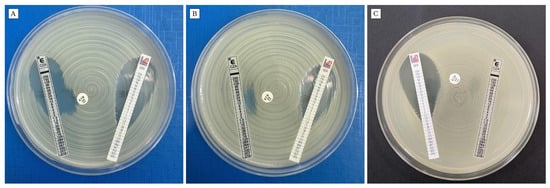
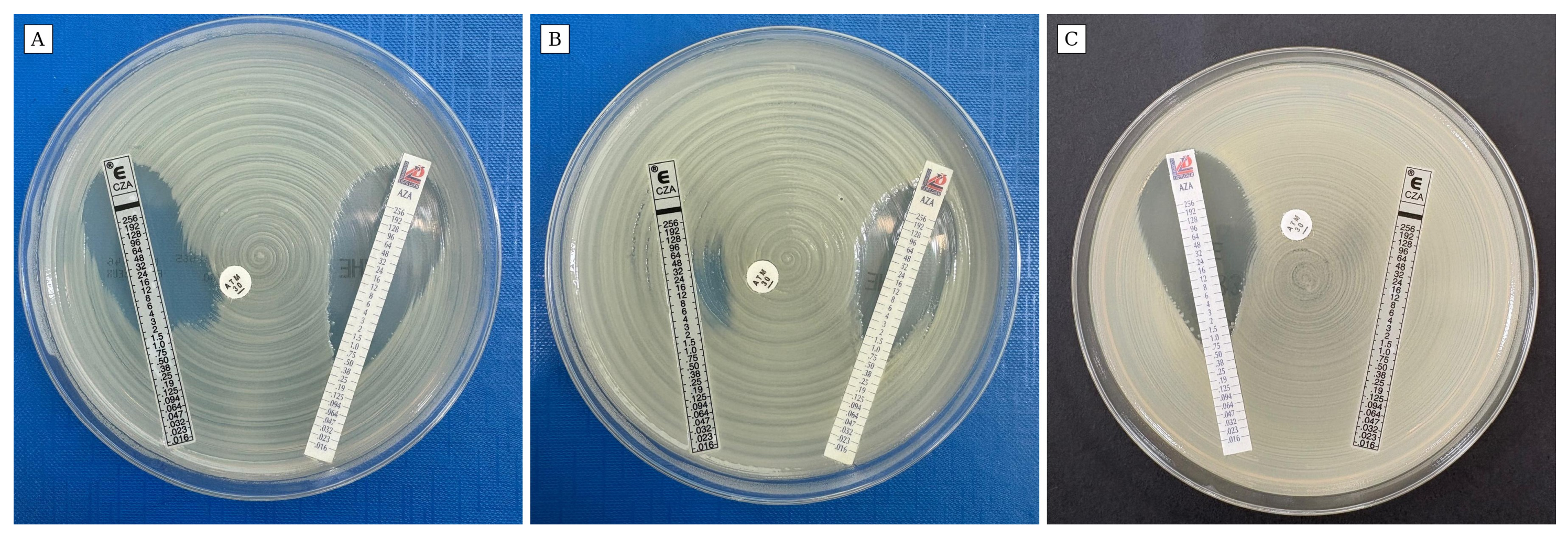
Ceftazidime–avibactam/aztreonam synergy was assessed using a disk/gradient diffusion-based method adapted from Taha et al. [13]. A 30-µg aztreonam disk (Oxoid, Thermo Fisher Scientific, Basingstoke, UK) was placed at a 15 mm distance from the center of the disk to the longitudinal midline of the ceftazidime–avibactam gradient strip on the inoculated Mueller–Hinton agar plate [13]. Plates were incubated under atmospheric conditions for 18–24 h at 35 ± 2 °C. Synergy was interpreted visually by a microbiologist according to predefined criteria, based on enhancement of the aztreonam inhibition zone toward the ceftazidime–avibactam strip or the presence of an inverse-D-shaped inhibition pattern (Figure 1).
Figure 1.
Representative ceftazidime–avibactam/aztreonam synergy test images. Panels (A,B) demonstrate positive synergy, indicated by enhancement of the aztreonam inhibition zone toward the ceftazidime–avibactam gradient strip, whereas panel (C) shows no visible synergy.
This assay was used to assess phenotypic interaction between aztreonam and avibactam and was not considered a substitute for direct aztreonam–avibactam MIC determination.
2.5. Quality Control and Reference Strains
The following well-characterized reference strains were included as quality controls for antimicrobial susceptibility testing and real-time PCR assays: Klebsiella pneumoniae CCUG 56233 (KPC-2), K. pneumoniae NCTC 13442 (OXA-48), K. pneumoniae NCTC 13443 (NDM-1), K. pneumoniae NCTC 13440 (VIM), and Escherichia coli NCTC 13476 (IMP).
2.6. Real-Time PCR for Carbapenemase Gene Detection
To investigate the molecular mechanisms underlying carbapenem resistance, carbapenemase-encoding genes were analyzed using a polymerase chain reaction (PCR)-based approach. Genomic DNA required for molecular assays was obtained from bacterial culture isolates using a standardized nucleic acid extraction protocol.
2.7. DNA Extraction
Genomic DNA was extracted from bacterial isolates using the Bio-Speedy® Fast Nucleic Acid Extraction Kit (Bioeksen R&D Technologies, İstanbul, Türkiye) according to the manufacturer’s instructions.
Fresh bacterial colonies obtained from overnight cultures on blood agar plates were used for nucleic acid extraction. Briefly, 1–3 well-isolated colonies were transferred into sterile microcentrifuge tubes containing Bio-Speedy® lysis buffer (STL-B) and vortexed thoroughly.
Proteinase K was added to facilitate enzymatic cell lysis and protein degradation. The resulting lysates were subsequently processed using a magnetic bead–based automated nucleic acid extraction system (Zybio EXM3000; Zybio Inc., Chongqing, China), enabling selective binding and purification of nucleic acids.
2.8. Real-Time PCR Assay
Carbapenemase-encoding genes were detected using the Bio-Speedy® Carbapenem Resistance qPCR Kit (Bioeksen R&D Technologies, Türkiye) according to the manufacturer’s instructions. The assay enables qualitative detection of major carbapenemase genes, including blaKPC, blaNDM, blaVIM, blaIMP, and blaOXA-48, as well as blaCTX-M–type β-lactamases.
Real-time PCR amplification was performed using the Magnetic Induction Cycler (Mic IVD; Bio Molecular Systems, Upper Coomera, Australia) under the thermal cycling conditions recommended by the manufacturer. Fluorescence signals were monitored in the FAM, HEX, ROX, and CY5 channels, corresponding to the respective carbapenemase targets.
Negative and positive controls supplied with the kit were included in each run. In addition, well-characterized ATCC/NCTC reference strains harboring known carbapenemase genes were used as external quality controls to verify assay performance. Each run was considered valid only when both internal and external controls produced the expected results.
Samples showing sigmoidal amplification curves exceeding the predefined threshold values were interpreted as positive for the corresponding carbapenemase gene.
2.9. Whole-Genome Sequencing and Bioinformatic Analysis
Whole-genome sequencing (WGS) was performed on two Escherichia coli isolates in which resistance to aztreonam–avibactam was detected at the Medical Microbiology Laboratory, Faculty of Medicine, İnönü University. Genomic DNA was extracted using standard protocols suitable for Gram-negative bacteria. Sequencing libraries were prepared using the NEBNext® DNA Library Prep Kit (New England Biolabs, Ipswich, MA, USA) according to the manufacturer’s instructions. WGS was performed on the Illumina NovaSeq 6000 platform (Illumina, San Diego, CA, USA), generating 150 bp paired-end reads. Raw sequencing reads were obtained in FASTQ format, and the mean sequencing depth was approximately 225×.
Initial quality control, genome assembly, annotation, antimicrobial resistance gene detection, and multilocus sequence typing (MLST) were performed using the Bactopia pipeline (v3.2.0) with default parameters (https://bactopia.github.io/). Within Bactopia, read quality control was performed with fastp (v0.23.4) and FastQC (v0.12.1); de novo assembly was performed with Shovill (v1.1.0) using the SKESA (v2.5.1) assembler; genome annotation was performed with Prokka (v1.14.6); antimicrobial resistance and stress-response gene screening was performed with NCBI AMRFinderPlus (v4.0.19, database v4.0.19); and MLST was performed using mlst (v2.23.0; T. Seemann) against the PubMLST database. Genome sketches for taxonomic/contamination checks were generated with Mash (v2.3) and Sourmash (v4.8.2).
Preliminary gene-level comparisons were conducted by extracting relevant coding sequences (ftsI, ompF, ompC) from assembled genomes and performing multiple sequence alignment using Clustal Omega (v1.2.4) via the EMBL-EBI web server (https://www.ebi.ac.uk/jdispatcher/msa/clustalo/ (accessed on 22 July 2026)). Observed sequence differences were subsequently confirmed through reference-based mapping and variant analysis.
For variant-level investigation, raw reads were aligned to the Escherichia coli K-12 MG1655 reference genome (RefSeq accession: NC_000913.3) using BWA-MEM (BWA v0.7.17-r1188). Alignment files were sorted and indexed using SAMtools (v1.13). Variant calling and normalization were performed using BCFtools (v1.13).
The ES_73 ompF insertion was manually inspected and confirmed by visualization of the corresponding read alignments in Integrative Genomics Viewer (v2.19.7).
Coding sequence (CDS)-level analyses focused on genes previously implicated in reduced aztreonam susceptibility through alterations in target affinity, outer membrane permeability, efflux regulation, or chromosomal β-lactamase expression, including ftsI (PBP3), ompF, ompC, marR, acrR, soxR/soxS, ompR, envZ, acrA, acrB, tolC, and the ampC promoter/attenuator region. Gene coordinates were extracted from the reference genome annotation, and gene-specific variants were retrieved from normalized VCF files. Gene-specific variant extraction, CDS reconstruction, and translation analyses were performed using Python scripts in a Google Colab environment with Python v3.12.13 [GCC 11.4.0].
Mutant CDS sequences were reconstructed in silico based on identified variants and translated to evaluate amino acid substitutions, frameshift mutations, and premature stop codons. Disruptive mutations were defined as frameshift insertions/deletions or premature stop codons predicted to alter the open reading frame and impair protein function. Pairwise nucleotide and amino acid sequence alignments were additionally performed using EMBOSS Stretcher (EMBOSS v6.6.0.0) via the EMBL-EBI platform to support comparative analyses.
2.10. Statistical Analysis
Statistical analyses were performed using jamovi version 2.6.44 (The jamovi Project, Sydney, Australia). Categorical variables were summarised as frequencies and percentages and group comparisons were made using Pearson’s chi-square test; Fisher’s exact test was used when expected cell counts were <5. MIC values were non-normally distributed and were therefore summarized as medians and ranges. MIC values between two groups were compared using the Mann–Whitney U test. To account for the frequent co-carriage of carbapenemase genes, multivariable binary logistic regression analysis was performed using CZA resistance as the dependent variable and blaNDM, blaOXA-48, blaKPC, and blaVIM carriage as predictor variables. CZA-susceptible isolates were used as the outcome reference category, and gene-negative isolates were used as the reference category for each carbapenemase gene. blaIMP was not included in the model because it was not detected in any isolate. Logistic regression results were reported as adjusted odds ratios (aORs) with 95% confidence intervals (CIs). No formal adjustment for multiple comparisons was applied, as the statistical analyses were limited to hypothesis-driven comparisons directly related to the study objectives. A two-sided p-value < 0.05 was considered statistically significant.
3. Results
3.1. Isolate Characteristics
A total of 100 non-duplicate clinical Enterobacterales isolates were included in the study. The majority were Klebsiella pneumoniae (n = 87), followed by Escherichia coli (n = 6) and members of the Enterobacter cloacae complex (n = 5; including three isolates reported at the complex level and two identified as Enterobacter hormaechei). Single isolates of Klebsiella aerogenes (formerly Enterobacter aerogenes) and Citrobacter braakii (n = 1 each) were also identified.
All isolates were recovered from invasive clinical specimens. Most originated from blood cultures (n = 80, 80.0%), while the remaining isolates were obtained from sterile body fluids, including peritoneal fluid (n = 12, 12.0%), pleural fluid (n = 5, 5.0%), and cerebrospinal fluid (n = 3, 3.0%).
3.2. Antimicrobial Susceptibility and Synergy Findings
Ceftazidime–avibactam susceptibility testing demonstrated that 31 isolates (31.0%) were categorized as susceptible, whereas 69 isolates (69.0%) were resistant according to EUCAST criteria. CZA MIC values ranged from 0.5 to 256 mg/L, with MIC50 and MIC90 both at 256 mg/L.
Aztreonam–avibactam exhibited markedly high in vitro activity. A total of 98 isolates (98.0%) were categorized as susceptible, while 2 isolates (2.0%) were resistant. AZA MIC values ranged from 0.032 to 32 mg/L, with an MIC50 of 0.25 mg/L and an MIC90 of 0.50 mg/L.
Synergy testing based on zone enhancement demonstrated positive synergy in 98 isolates (98.0%), whereas 2 isolates (2.0%) showed no evidence of synergy. Among the two isolates with a negative CZA–aztreonam synergy result, one isolate had an AZA MIC of 1 mg/L and remained susceptible according to EUCAST 2025 criteria, whereas the other isolate, ES_73, had an AZA MIC of 32 mg/L and was categorized as AZA-resistant. Thus, absence of visible synergy did not uniformly correspond to AZA resistance. Conversely, the two AZA-resistant isolates had AZA MICs of 8 mg/L and 32 mg/L, respectively; ES_64 showed a positive synergy result, whereas ES_73 was synergy-negative. The synergy-negative isolate with an AZA MIC of 1 mg/L harbored blaNDM, blaKPC, and blaCTX-M, whereas ES_73 carried blaKPC.
3.3. Year-Specific Susceptibility Patterns
Because the 2026 subset included only five isolates and represented a partial-year dataset, these isolates were included in the overall analysis but excluded from year-to-year trend interpretation. Therefore, year-specific comparisons were restricted to 2024 and 2025. In 2024, 20 of 41 isolates (48.8%) were resistant to ceftazidime–avibactam, whereas in 2025, 46 of 54 isolates (85.2%) were resistant. The CZA MIC50 and MIC90 were 4 mg/L and 256 mg/L in 2024, respectively, and both were 256 mg/L in 2025. For aztreonam–avibactam, in vitro activity remained high in both years, with AZA MIC50 and MIC90 values of 0.25 mg/L and 0.50 mg/L in both 2024 and 2025.
3.4. Distribution of Carbapenemase Genes
Carbapenemase genes were detected in 99 of 100 isolates (99.0%). The most frequently detected gene was blaNDM (81 isolates, 81.0%), followed by blaOXA-48 (72 isolates, 72.0%). blaKPC was identified in 14 isolates (14.0%) and blaVIM in 4 isolates (4.0%), whereas blaIMP was not detected.
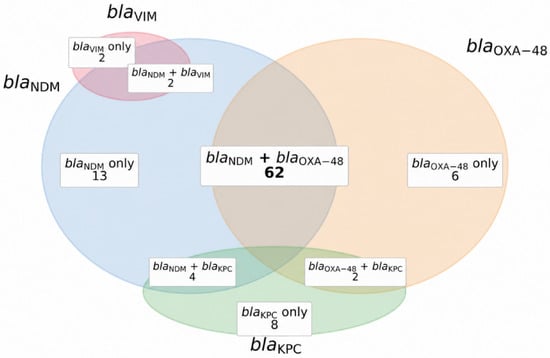
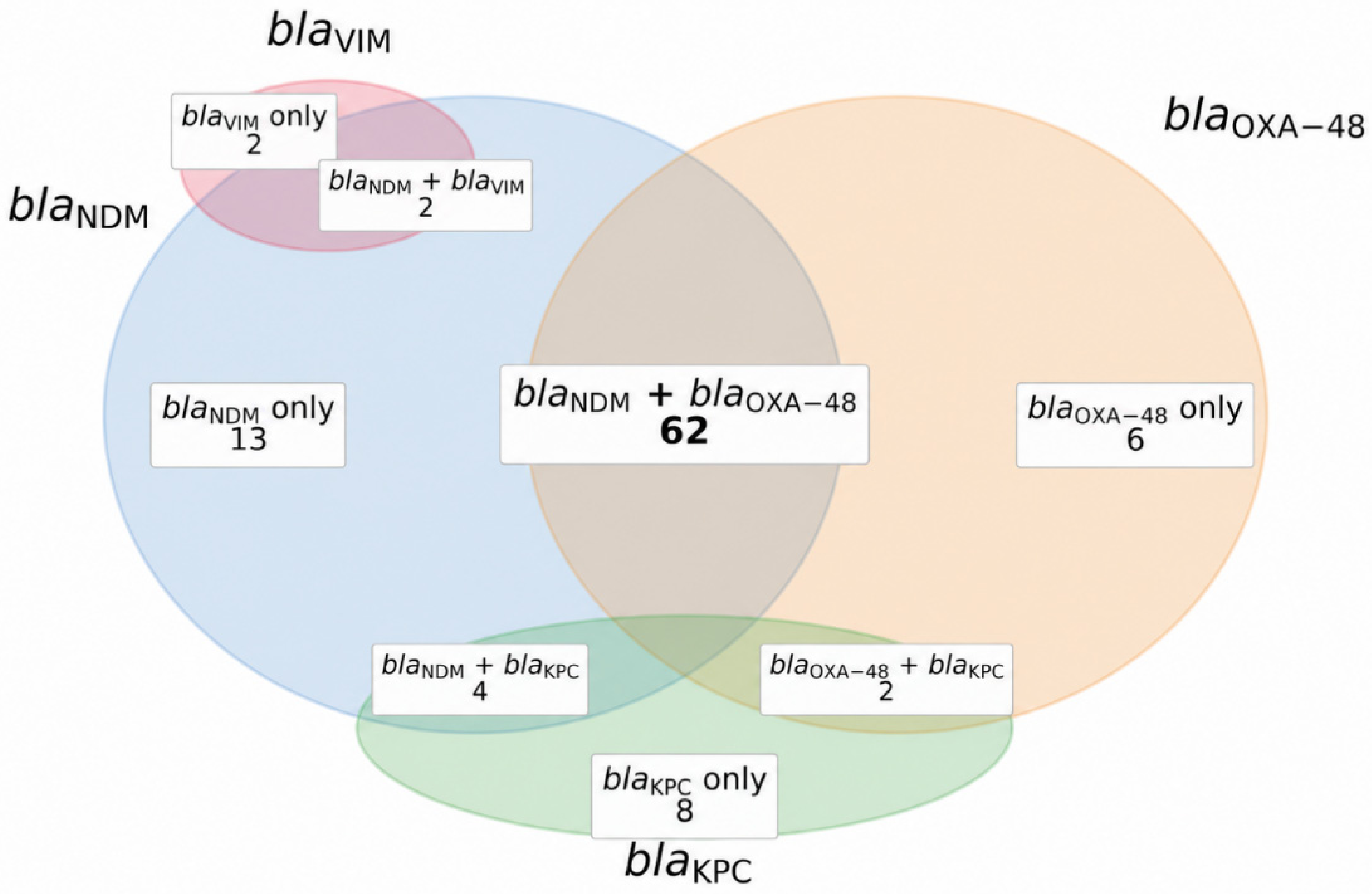
Among the isolates, the most common carbapenemase gene combination was blaNDM + blaOXA-48, detected in 62 isolates (62.0%). Co-production of multiple carbapenemases was frequently observed, whereas single carbapenemase gene carriage occurred less commonly. The distribution and co-carriage of carbapenemase genes among carbapenem-resistant Enterobacterales isolates are presented in Figure 2. The ESBL gene CTX-M was detected in 80 isolates (80.0%). One isolate carried blaCTX-M alone without detection of any carbapenemase gene.
Figure 2.
Distribution and co-carriage of carbapenemase genes among carbapenem-resistant Enterobacterales isolates. Colored circles represent carbapenemase gene categories: blue, blaNDM; orange, blaOXA-48; green, blaKPC; and pink, blaVIM.
The mutually exclusive carbapenemase gene profiles were as follows: blaNDM + blaOXA-48, 62 isolates (62.0%); blaNDM alone, 13 isolates (13.0%); blaKPC alone, 8 isolates (8.0%); blaOXA-48 alone, 6 isolates (6.0%); blaNDM + blaKPC, 4 isolates (4.0%); blaVIM alone, 2 isolates (2.0%); blaOXA-48 + blaKPC, 2 isolates (2.0%); and blaNDM + blaOXA-48 + blaVIM, 2 isolates (2.0%). One isolate carried blaCTX-M alone without detection of any carbapenemase gene. No blaIMP-positive isolate was detected.
3.5. Genotype–Phenotype Associations
Of the 69 CZA-resistant isolates, 67 (97.1%) harbored blaNDM and 54 (78.3%) blaOXA-48, whereas blaKPC and blaVIM were each detected in 3 isolates (4.3%). Also, 60 (87.0%) isolates had blaCTX-M. Co-production of carbapenemase genes was common among CZA-resistant isolates, most frequently blaNDM + blaOXA-48 (n = 52, 75.4%), followed by blaNDM + blaKPC (n = 2, 2.9%) and the triple combination blaNDM + blaOXA-48 + blaVIM (n = 2, 2.9%).
Susceptibility rates varied according to carbapenemase gene distribution (Table 1). CZA resistance was strongly associated with blaNDM carriage, whereas aztreonam–avibactam retained activity against the majority of the isolates regardless of carbapenemase profile.
Table 1.
Ceftazidime–Avibactam Susceptibility According to Carbapenemase Gene Category.
Among CZA-susceptible isolates (n = 31), blaNDM was detected in 14 (45.2%), blaOXA-48 in 18 (58.1%), and blaCTX-M in 20 (64.5%) isolates. In contrast, blaKPC and blaVIM were identified in 11 (35.5%) and 1 isolate (3.2%), respectively. Gene co-production patterns in this group included blaNDM + blaOXA-48 (n = 10, 32.3%), blaNDM + blaKPC (n = 2, 6.5%), and blaKPC + blaOXA-48 (n = 2, 6.5%). No isolate in either group carried blaIMP.
The presence of blaNDM was strongly associated with CZA resistance (χ2 = 37.5, p < 0.001). Conversely, blaKPC was more frequently detected among CZA-susceptible isolates (χ2 = 17.2, p < 0.001).
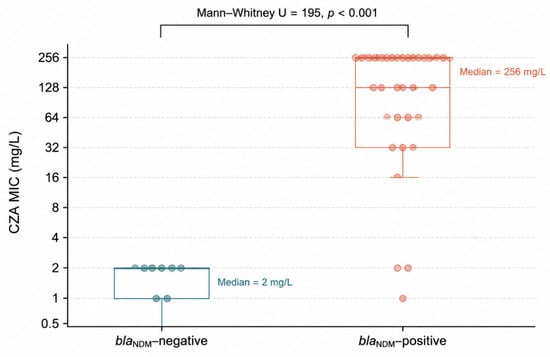
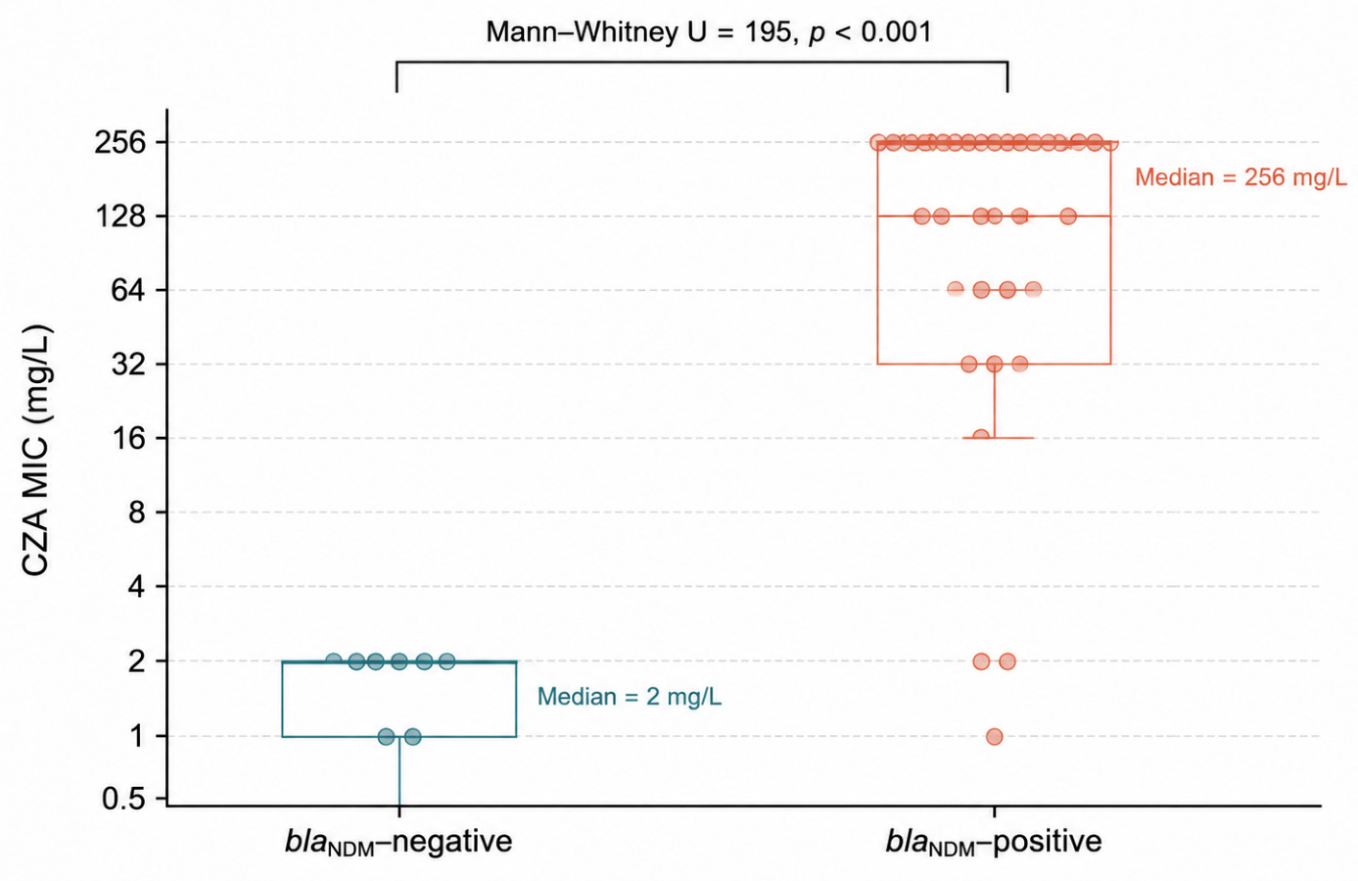
CZA MIC values were substantially higher among blaNDM-positive isolates (median 256 mg/L) compared with blaNDM-negative isolates (median 2 mg/L) (Mann–Whitney U = 195, p < 0.001) (Figure 3). To account for the frequent co-carriage of multiple carbapenemase genes, a multivariable binary logistic regression analysis was performed using CZA resistance as the dependent variable. The overall model was statistically significant (χ2 = 40.4, df = 4, p < 0.001; McFadden’s R2 = 0.327). In this model, blaNDM carriage remained independently associated with CZA resistance (adjusted OR, 52.08; 95% CI, 5.89–460.49; p < 0.001). In contrast, blaKPC (adjusted OR, 0.37; 95% CI, 0.04–3.58; p = 0.389), blaOXA-48 (adjusted OR, 0.92; 95% CI, 0.20–4.31; p = 0.917), and blaVIM (adjusted OR, 10.60; 95% CI, 0.30–372.21; p = 0.193) were not independently associated with CZA resistance.
Figure 3.
Distribution of ceftazidime–avibactam MIC values according to blaNDM carriage among carbapenem-resistant Enterobacterales isolates.
Two E. coli isolates (2.0%), designated ES_64 and ES_73, were resistant to aztreonam–avibactam. Both AZA-resistant isolates were also resistant to ceftazidime–avibactam. ES_64 had an AZA MIC of 8 mg/L, carried blaCTX-M and blaNDM, and showed a positive CZA–aztreonam synergy result. In contrast, ES_73 had an AZA MIC of 32 mg/L, harbored blaKPC, and did not demonstrate CZA–aztreonam synergy.
3.6. Whole-Genome Sequencing Findings
Whole-genome sequencing was performed for the two aztreonam–avibactam-resistant Escherichia coli isolates. Multilocus sequence typing identified ES_64 as ST500 and ES_73 as ST410. Assembly quality metrics were as follows: ES_64 comprised 133 contigs, with an N50 of 84,244 bp and a total assembly size of 4,790,113 bp, whereas ES_73 comprised 96 contigs, with an N50 of 221,752 bp and a total assembly size of 5,193,477 bp.
Resistome analysis revealed that ES_64 harbored blaNDM-5, blaCTX-M-15, blaOXA-1, and a chromosomal ampC (BlaEC family) β-lactamase. In contrast, ES_73 carried blaKPC-3 and blaOXA-1, together with a chromosomal ampC (BlaEC family) β-lactamase.
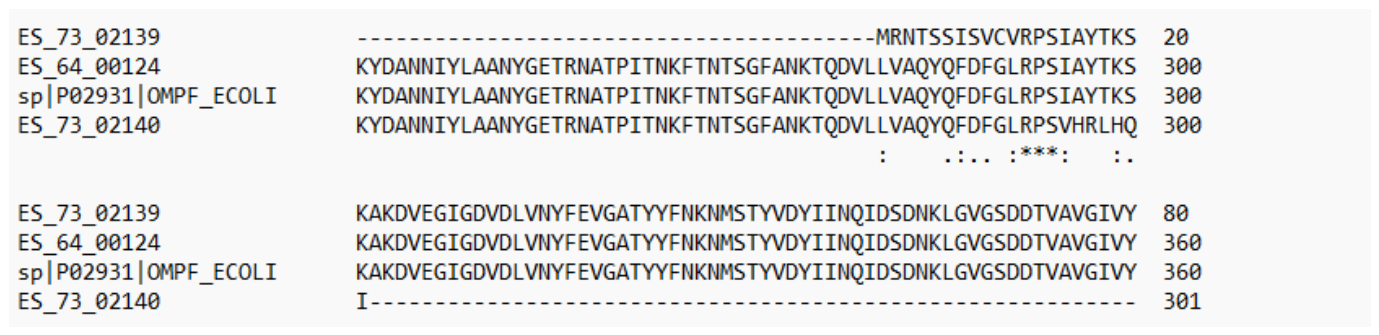
The ftsI (PBP3) YRIK four-amino-acid insertion was detected in both ES_64 and ES_73. Because this target-site modification was shared by both isolates, it may have contributed to reduced AZA susceptibility in both isolates but is unlikely to fully explain the higher AZA MIC observed in ES_73 compared with ES_64 (Figure 4).
Figure 4.
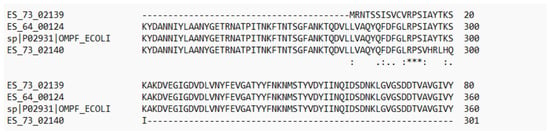
Local Clustal Omega alignment of the FtsI/PBP3 region surrounding the four-amino-acid insertion. Both ES_64 and ES_73 carried an identical YRIK insertion in PBP3 (after position 333) relative to the Escherichia coli K-12 MG1655 reference sequence. The inserted residues are boxed, and dashes indicate the corresponding gap in the reference sequence. Asterisks indicate fully conserved amino acid positions in the alignment. The complete FtsI/PBP3 amino acid alignment is provided as Supplementary Figure S1.
Whole-genome sequencing of ES_73 followed by mapping-based variant analysis against the Escherichia coli K-12 MG1655 reference genome identified a 4 bp insertion within the ompF coding region (T→TGGAC at position NC_000913.3:986100). The insertion was supported by high sequencing depth and mapping quality (DP = 181, MQ = 60), and manual inspection of read alignments in Integrative Genomics Viewer (IGV) confirmed that the insertion was consistently present in ES_73, whereas no corresponding insertion was observed in ES_64 (Supplementary Figure S2).
Consistent with this frameshift event, de novo genome annotation of the ES_73 assembly did not identify a single intact full-length ompF coding sequence. Instead, the region was annotated as two overlapping partial ompF-like coding sequences (ompF_1 and ompF_2), corresponding to a truncated OmpF-like fragment and a partial OmpF sequence. Protein-level alignment further demonstrated disruption and premature truncation of the ES_73 OmpF sequence compared with ES_64 and the reference OmpF protein (Figure 5; Supplementary Figure S3).
Figure 5.
Predicted protein-level consequence of the ompF frameshift mutation in ES_73. Focused amino acid alignment of OmpF sequences showing disruption and premature truncation of the ES_73 OmpF sequence compared with ES_64 and the Escherichia coli reference OmpF protein. Asterisks indicate fully conserved amino acid positions in the alignment. Full-length alignments and IGV confirmation of the underlying 4 bp insertion are provided in Supplementary Figures S2 and S3.
In contrast, no disruptive mutations were detected in the ompF locus of ES_64. Analysis of ompC in ES_73 demonstrated localized amino acid substitutions but preserved an intact open reading frame.
To explore alternative mechanisms potentially contributing to aztreonam–avibactam resistance, we screened key efflux pump regulatory genes and β-lactamase-associated loci. Variant analysis of marR, acrR, soxR/soxS, ompR, and envZ did not reveal disruptive mutations such as frameshift insertions or premature stop codons in either isolate. Although several single nucleotide polymorphisms were detected in ES_73, no loss-of-function alterations were identified in these regulatory genes.
Similarly, comparative analysis of the ampC upstream promoter/attenuator region did not demonstrate mutations suggestive of derepressed chromosomal AmpC overexpression. Both isolates carried their respective β-lactamase genes without evidence of structural disruption or promoter alterations in the chromosomal context.
These WGS findings should be interpreted as descriptive genomic observations in two AZA-resistant isolates rather than definitive evidence of causality, because AZA-susceptible comparator genomes from the same collection were not sequenced. The comparative genomic and phenotypic features of the two aztreonam–avibactam-resistant E. coli isolates are summarized in Table 2.
Table 2.
Comparative Genomic and Phenotypic Features of the Two Aztreonam–Avibactam-Resistant E. coli Isolates.
4. Discussion
Carbapenem-resistant Enterobacterales represent a major global health threat due to limited therapeutic options and the rapid emergence of complex resistance mechanisms. In this study, we evaluated the in vitro activity of ceftazidime–avibactam and aztreonam–avibactam against invasive CRE isolates collected in a tertiary-care hospital in Türkiye. The most notable finding of the present study was the markedly higher in vitro activity of aztreonam–avibactam compared with ceftazidime–avibactam, with 98% of isolates categorized as susceptible. In addition, the present study demonstrated a striking predominance of blaNDM among the isolates, frequently detected together with blaOXA-48, reflecting the complex carbapenemase landscape that may influence the effectiveness of currently available β-lactam/β-lactamase inhibitor combinations.
In the present study, Klebsiella pneumoniae was the predominant species among invasive CRE isolates. This distribution was not the result of preferential selection for K. pneumoniae; rather, the study included consecutive, non-duplicate CRE isolates recovered from blood cultures and normally sterile body fluids during a predefined cross-sectional study period, and only the first isolate from each patient was included to avoid duplication. Therefore, the predominance of K. pneumoniae most likely reflects the local epidemiology of invasive CRE infections at our center, where K. pneumoniae is the most frequently recovered CRE pathogen. The restriction to blood cultures and sterile body fluids was intentional, as the study aimed to evaluate clinically significant invasive infections and to avoid inclusion of colonizing isolates from non-sterile specimens. However, this invasive-isolate-focused design should be considered when generalizing the species distribution to all CRE isolates encountered in routine clinical microbiology.
In the present study, aztreonam–avibactam demonstrated markedly higher in vitro activity than ceftazidime–avibactam against CRE isolates, with 98% of isolates categorized as susceptible and MIC50/90 values of 0.25 and 0.50 mg/L, respectively. These findings are consistent with recent European and global large-scale surveillance studies showing that aztreonam–avibactam retains potent in vitro activity against CRE isolates, including those harboring diverse carbapenemase genes, with reported MIC50/90 values of 0.25/0.5 mg/L and susceptibility rates exceeding 99% in European collections [14,15]. The consistently high activity of aztreonam–avibactam observed in these studies is largely attributed to the stability of aztreonam against metallo-β-lactamases combined with the inhibitory activity of avibactam against co-produced serine β-lactamases that would otherwise hydrolyze aztreonam. Together, these data support the potential role of aztreonam–avibactam as an effective therapeutic option for infections caused by carbapenem-resistant Enterobacterales, particularly in settings where metallo-β-lactamases such as NDM are prevalent.
Ceftazidime–avibactam was initially introduced as an effective therapeutic option against carbapenem-resistant Enterobacterales, particularly those producing class A and class D carbapenemases. However, its activity is limited against metallo-β-lactamase producers such as NDM, VIM, and IMP because avibactam does not inhibit class B metallo-β-lactamases [5]. This limitation has contributed to interest in combination approaches such as ceftazidime–avibactam plus aztreonam for infections caused by MBL-producing Enterobacterales [16]. In the present study, only 31% of isolates were susceptible to ceftazidime–avibactam, and MIC values were markedly elevated, with both MIC50 and MIC90 reaching 256 mg/L. This high resistance rate appears to be closely related to the predominance of blaNDM detected in our isolate collection, which was present in 81%. Consistent with this observation, blaNDM carriage showed a strong association with CZA resistance, and blaNDM-positive isolates exhibited markedly higher CZA MIC values than blaNDM-negative isolates. The reduced activity of ceftazidime–avibactam in this setting is biologically plausible, as avibactam inhibits class A, class C, and some class D β-lactamases but does not inhibit metallo-β-lactamases such as NDM. Consequently, NDM-producing Enterobacterales generally show resistance to ceftazidime–avibactam because avibactam does not inhibit metallo-β-lactamases. Similar findings have been reported in recent in vitro surveillance studies showing that CZA retains activity mainly against serine carbapenemase-producing isolates, particularly KPC-producing isolates, but has limited activity against MBL-producing isolates such as NDM producers [5]. Taken together, our findings highlight the substantial impact of NDM dissemination on CZA susceptibility and suggest that the spread of MBL-producing CRE may significantly compromise the clinical utility of ceftazidime–avibactam in certain geographic regions. Although the confidence intervals were wide, likely reflecting the limited number of isolates in some genotype categories, the multivariable analysis supported blaNDM carriage as the main genomic correlate of CZA resistance in this cohort.
In Türkiye, OXA-48-like enzymes have historically been the predominant carbapenemases among CRE isolates, whereas NDM has generally been reported at substantially lower frequencies in molecular epidemiological studies from different regions of the country. However, more recent reports suggest an increasing emergence of NDM-producing isolates and strains co-harboring multiple carbapenemase genes, indicating a progressively evolving resistance landscape [17,18,19,20]. In contrast to the epidemiological pattern reported in previous studies from Türkiye, the present study demonstrated a markedly higher prevalence of blaNDM (81%), frequently co-occurring with blaOXA-48 (72%), with dual carbapenemase production observed in 62% of isolates. These findings may suggest a possible shift toward an increased contribution of NDM-producing strains in our local epidemiology. This discrepancy may reflect local clonal expansion of NDM-producing strains or horizontal dissemination of NDM-harboring plasmids within hospital environments. This changing molecular epidemiology may have important therapeutic implications, particularly for β-lactam/β-lactamase inhibitor combinations such as ceftazidime–avibactam.
Previous non-overlapping isolate collections from our center provide useful context for interpreting the carbapenemase distribution observed in the present study. In an earlier study conducted in our center between 2015 and 2016, blaOXA-48 was the predominant carbapenemase, detected in 61% of isolates, whereas blaNDM was rare and detected in only 3.7% of isolates, although 35% of strains harbored both enzymes [21]. In a subsequent study including isolates collected between 2017 and 2019, blaOXA-48 remained the dominant carbapenemase (87.7%), while blaNDM increased to 23.1%, and co-production of blaOXA-48 and blaNDM was detected in 16.9% of isolates [22]. Similarly, another study from our institution reported blaOXA-48 in 68.1% of isolates and blaNDM in 54.3%, with co-production observed in 44% of strains [23]. In the present study, blaNDM was detected in 81% of isolates and frequently co-occurred with blaOXA-48, with dual carbapenemase production observed in 62% of isolates. Although these findings appear to indicate a greater representation of NDM-producing and NDM/OXA-48-co-producing CRE in the current collection, direct comparisons across studies should be interpreted cautiously because of differences in study periods, isolate selection, specimen types, molecular methods, and interpretive criteria. The present study was not designed to determine the epidemiological factors underlying these differences, and the relative roles of antimicrobial selection pressure, clonal expansion, and plasmid-mediated dissemination cannot be assessed without dedicated longitudinal genomic and epidemiological analyses. Therefore, these findings should be interpreted as descriptive surveillance data supporting the need for continued molecular monitoring and antimicrobial stewardship.
The disk/gradient diffusion-based synergy assay was used as an adjunctive phenotypic assessment of the interaction between aztreonam and ceftazidime–avibactam. Zone enhancement indicating a positive interaction was observed in 98% of isolates, suggesting frequent in vitro synergy between these agents, consistent with previous data reporting synergy in 98.8% of Klebsiella spp. and 95% of E. coli isolates [13]. This interaction is biologically plausible because aztreonam is relatively stable against metallo-β-lactamase-mediated hydrolysis, whereas avibactam inhibits co-produced serine β-lactamases, including ESBLs and AmpC enzymes, that may otherwise hydrolyze aztreonam. Therefore, these findings support the microbiological rationale for aztreonam–avibactam activity in settings where NDM-producing CRE are prevalent. However, the visual CZA–aztreonam synergy result was not fully concordant with direct AZA MIC-based susceptibility categorization: one synergy-negative isolate remained AZA-susceptible with an MIC of 1 mg/L, whereas one AZA-resistant isolate with an MIC of 8 mg/L retained a detectable synergy pattern. These findings suggest that disk/gradient diffusion-based synergy testing may provide useful supportive information but should be interpreted cautiously and should not replace direct AZA MIC testing where available.
A previous study from Türkiye reported ST410 among E. coli isolates recovered from hospital and municipal wastewater, indicating that this lineage has previously been detected in the region [24]. However, that ecological finding is distinct from the present invasive clinical cohort and should not be interpreted as evidence of the source or route of acquisition of the clinical isolate. In the present study, ST410 was identified in an invasive carbapenem-resistant E. coli isolate carrying blaKPC-3, adding clinical-context data on this high-risk lineage in Türkiye. International surveillance data support the broad in vitro activity of AZA against CRE [14], whereas a recent genomic study identified AZA-resistant E. coli isolates, including ST410, and described a multifactorial resistance background involving PBP3 alterations and reduced outer-membrane permeability [25].
Whole-genome sequencing of the aztreonam–avibactam-resistant isolates identified several genomic features previously linked to reduced aztreonam or aztreonam–avibactam susceptibility. Both isolates carried a four-amino-acid insertion (YRIK) in the penicillin-binding protein 3 encoded by the ftsI gene. Insertions such as YRIN or YRIK in PBP3 have previously been associated with reduced susceptibility to aztreonam and aztreonam–avibactam in Enterobacterales, as they alter the target site of β-lactam antibiotics and decrease binding affinity [26]. Previous studies have demonstrated that decreased susceptibility to aztreonam–avibactam may result from alterations in penicillin-binding protein 3 together with reduced outer membrane permeability and the presence of additional β-lactamases. Recent genomic analyses of clinical Escherichia coli isolates have shown that PBP3 insertions and impermeability mechanisms can contribute to elevated aztreonam–avibactam MIC values, particularly when combined with other resistance determinants [25]. Accordingly, we additionally investigated genes involved in porin expression, efflux regulation, and chromosomal AmpC regulation. Although no disruptive mutations were identified in these loci, this analysis did not provide genomic evidence for several previously proposed mechanisms associated with reduced aztreonam–avibactam susceptibility.
This study has several strengths. It provides clinically relevant data based on consecutive, non-duplicate invasive CRE isolates collected in a tertiary-care center and directly compares ceftazidime–avibactam and aztreonam–avibactam within the same isolate collection. In addition, the integration of phenotypic susceptibility testing, carbapenemase gene profiling, and multivariable genotype–phenotype analysis allowed assessment of the relationship between carbapenemase carriage and CZA resistance in a setting with frequent carbapenemase co-carriage. Another strength is the parallel evaluation of direct AZA MIC testing and CZA–aztreonam synergy testing, which provided practical information on the interpretation of qualitative synergy assays. Whole-genome sequencing of the two AZA-resistant E. coli isolates enabled descriptive characterization of genomic features previously associated with reduced aztreonam–avibactam susceptibility. Finally, because aztreonam–avibactam was not routinely available in Türkiye during the study period, this study provides local baseline data from invasive CRE isolates before potential routine clinical implementation. To the best of our knowledge, no previous study from Türkiye has combined phenotypic AZA/CZA susceptibility testing, carbapenemase gene profiling, synergy testing, and WGS-based characterization in a single-center cohort of invasive CRE isolates.
The main limitations of this study should be acknowledged. This was a single-center study of invasive CRE isolates, and the predominance of Klebsiella pneumoniae limited species-specific comparisons. Aztreonam–avibactam MICs were determined by gradient diffusion and were not confirmed by broth microdilution; therefore, MIC values close to the EUCAST susceptibility breakpoint should be interpreted cautiously, particularly in isolates carrying PBP3 insertions. Clinical outcome data, clonal relatedness analysis of the full isolate collection, and plasmid characterization were not available, limiting assessment of clinical correlates and dissemination mechanisms underlying the observed resistance patterns, including the high rate of blaNDM/blaOXA-48 co-carriage. Finally, whole-genome sequencing was limited to the two AZA-resistant E. coli isolates and was not complemented by AZA-susceptible comparator genomes, gene expression analysis, or functional validation experiments; therefore, the WGS findings should be interpreted as descriptive genomic observations rather than definitive mechanistic evidence.
5. Conclusions
In conclusion, because aztreonam–avibactam was not listed among licensed human medicinal products in Türkiye during the study period, this study provides clinically relevant local baseline susceptibility data on AZA MIC distributions among invasive CRE isolates before routine clinical implementation of AZA in the country. Our findings demonstrate that AZA retains potent in vitro activity against invasive CRE isolates in our setting, including a collection characterized by a high prevalence of blaNDM and frequent carbapenemase co-production. The observed discordance between qualitative CZA–aztreonam synergy testing and direct AZA MIC-based susceptibility categorization further indicates that synergy assays should be interpreted cautiously and should not replace direct AZA MIC determination where available. In contrast, the predominance of blaNDM substantially limits the utility of ceftazidime–avibactam, highlighting the clinical relevance of local carbapenemase epidemiology when selecting treatment strategies. The observed shift toward increasing NDM prevalence further emphasizes the need for continuous molecular surveillance to monitor evolving resistance patterns and to guide antimicrobial stewardship in regions where metallo-β-lactamase-producing CRE are emerging.
Supplementary Materials
The following supporting information can be downloaded at: https://www.mdpi.com/article/10.3390/antibiotics15080724/s1, Figure S1: Full-length Clustal Omega multiple sequence alignment of FtsI/PBP3 amino acid sequences from ES_64, ES_73, and E. coli K-12 MG1655; Figure S2: IGV visualization of the ompF insertion in ES_73; Figure S3: Full Clustal Omega alignment of OmpF amino acid sequences.
Author Contributions
Conceptualization, M.Y.D., F.Ç. and Ş.A.; methodology, M.Y.D., M.K. and E.S.T.; software, M.Y.D.; validation, M.Y.D., M.K., E.S.T., F.Ç. and Ş.A.; formal analysis, M.Y.D.; investigation, M.Y.D., M.K. and E.S.T.; resources, F.Ç. and Ş.A.; data curation, M.Y.D. and M.K.; writing—original draft preparation, M.Y.D.; writing—review and editing, M.Y.D., M.K., E.S.T., F.Ç. and Ş.A.; visualization, M.Y.D.; supervision, F.Ç. and Ş.A.; project administration, M.Y.D.; funding acquisition, none. All authors have read and agreed to the published version of the manuscript.
Funding
This research received no external funding.
Institutional Review Board Statement
The study was conducted in accordance with the Declaration of Helsinki and approved by the Ege University Medical Research Ethics Committee (Approval No. 25-5T/66, approved on 8 May 2025).
Informed Consent Statement
Patient consent was waived because the study was based exclusively on archived bacterial isolates and anonymized laboratory data, and no identifiable patient information was collected or analyzed.
Data Availability Statement
The normalized VCF files and gene-level variant tables generated during whole-genome sequencing analysis are provided as Supplementary Data S1 (Supplementary_Data.zip). All analyses were performed against the Escherichia coli K-12 MG1655 reference genome (NC_000913.3). Raw sequencing reads are available from the corresponding author upon reasonable request.
Acknowledgments
The authors would like to thank Barış Otlu for his valuable assistance and support regarding the whole-genome sequencing analyses. During the preparation of this manuscript, the authors used ChatGPT (OpenAI) (GPT-5.4 Thinking; OpenAI, San Francisco, CA, USA) for language editing, text refinement, code troubleshooting, and the generation of preliminary graphical concepts. All scientific analyses, results, interpretations, and conclusions were performed and verified by the authors. The authors take full responsibility for the content of this publication.
Conflicts of Interest
The authors declare no conflicts of interest.
References
- Tacconelli, E.; Carrara, E.; Savoldi, A.; Harbarth, S.; Mendelson, M.; Monnet, D.L.; Pulcini, C.; Kahlmeter, G.; Kluytmans, J.; Carmeli, Y.; et al. Discovery, research, and development of new antibiotics: The WHO priority list of antibiotic-resistant bacteria and tuberculosis. Lancet Infect. Dis. 2018, 18, 318–327. [Google Scholar] [CrossRef] [Scilit] [PubMed]
- World Health Organization. WHO Bacterial Priority Pathogens List, 2024: Bacterial Pathogens of Public Health Importance to Guide Research, Development and Strategies to Prevent and Control Antimicrobial Resistance; World Health Organization: Geneva, Switzerland, 2024; Available online: https://www.who.int/publications/i/item/9789240093461 (accessed on 30 June 2026).
- Centers for Disease Control and Prevention. About Carbapenem-Resistant Enterobacterales; CDC: Atlanta, GA, USA, 2024. Available online: https://www.cdc.gov/cre/about/ (accessed on 30 June 2026).
- Tompkins, K.; van Duin, D. Treatment for carbapenem-resistant Enterobacterales infections: Recent advances and future directions. Eur. J. Clin. Microbiol. Infect. Dis. 2021, 40, 2053–2068. [Google Scholar] [CrossRef] [Scilit] [PubMed]
- Sader, H.S.; Mendes, R.E.; Duncan, L.; Kimbrough, J.H.; Carvalhaes, C.G.; Castanheira, M. Ceftazidime-avibactam, meropenem-vaborbactam, and imipenem-relebactam activities against multidrug-resistant Enterobacterales from United States Medical Centers (2018–2022). Diagn. Microbiol. Infect. Dis. 2023, 106, 115945. [Google Scholar] [CrossRef] [Scilit] [PubMed]
- Al Musawa, M.; Bleick, C.R.; Herbin, S.R.; Caniff, K.E.; Van Helden, S.R.; Rybak, M.J. Aztreonam-avibactam: The dynamic duo against multidrug-resistant gram-negative pathogens. Pharmacotherapy 2024, 44, 927–938. [Google Scholar] [CrossRef] [Scilit] [PubMed]
- Mert, A.; Derin, O.; Akalın, H.; Dumlu, R.; Gündeş, S.; Zengin, R.; Kocagöz, S.; Gündoğdu, Y.; Köksal, I.; Yalçın, D.; et al. Multicenter evaluation of ceftazidime-avibactam use in carbapenem-resistant Klebsiella pneumoniae bloodstream infections in OXA-48 endemic regions. Sci. Rep. 2024, 14, 26337. [Google Scholar] [CrossRef] [Scilit] [PubMed]
- Şanlı, K.; Öncel, B. Analysis of rectal carbapenem-resistant Enterobactericeae colonization results first report in Istanbul/Turkiye: Klebsiella pneumoniae co-producing blaKPC + blaNDM + blaOXA-48 in a single strain. BMC Infect. Dis. 2025, 25, 773. [Google Scholar] [CrossRef] [Scilit] [PubMed]
- Koçer, I.; Demirbakan, H. Assessment of carbapenemase genes and antibiotic resistance profiles in ceftazidime-avibactam resistant Klebsiella pneumoniae isolates: A single-center cross-sectional study. Medicine 2025, 104, e45289. [Google Scholar] [CrossRef] [Scilit] [PubMed]
- Süzük Yıldız, S.; Tavukcu, E.; Şahin, S.; İskender, G.; Ünaldı, Ö.; Demirhan, B.; Avşar, Z.; Orman, E.Ö.; Mumcuoğlu, İ.; Dal, T. Outbreak caused by multidrug-resistant OXA-48 and NDM-1 producing Klebsiella pneumoniae in the intensive care unit of a cancer hospital. Acta Microbiol. Immunol. Hung. 2024, 71, 206–210. [Google Scholar] [CrossRef] [Scilit] [PubMed]
- Wise, M.G.; Stone, G.G.; Perez, K.K.; Sahm, D.F.; Hackel, M.A. Susceptibility of Enterobacterales collected in the Middle East and Turkey to aztreonam/avibactam and comparator agents stratified by infection source: ATLAS Surveillance Program 2018–2022. J. Glob. Antimicrob. Resist. 2024, 39, 12–13. [Google Scholar] [CrossRef] [Scilit]
- The European Committee on Antimicrobial Susceptibility Testing. Breakpoint Tables for Interpretation of MICs and Zone Diameters, Version 15.0; 2025. Available online: https://www.eucast.org (accessed on 22 July 2026).
- Taha, R.; Kader, O.; Shawky, S.; Rezk, S. Ceftazidime-avibactam plus aztreonam synergistic combination tested against carbapenem-resistant Enterobacterales characterized phenotypically and genotypically: A glimmer of hope. Ann. Clin. Microbiol. Antimicrob. 2023, 22, 21. [Google Scholar] [CrossRef] [Scilit] [PubMed]
- Sader, H.S.; Kimbrough, J.H.; Winkler, M.L.; Castanheira, M.; Mendes, R.E. Aztreonam/avibactam activity against Enterobacterales from European medical centres: Summary of 5 years of surveillance prior to approval for clinical use (2019–2023). J. Antimicrob. Chemother. 2025, 80, 2070–2079. [Google Scholar] [CrossRef] [Scilit] [PubMed]
- Lee, Y.L.; Wang, W.Y.; Huang, Y.T.; Ho, M.W.; Ko, W.C.; Hsueh, P.R. Activity of aztreonam–avibactam and distribution of carbapenemase genes in ceftazidime–avibactam-resistant carbapenem-resistant Enterobacterales: Data from the global Antimicrobial Testing Leadership and Surveillance, 2019–2023. Antimicrob. Agents Chemother. 2026, 70, e0154925. [Google Scholar] [CrossRef] [Scilit] [PubMed]
- Falcone, M.; Daikos, G.L.; Tiseo, G.; Bassoulis, D.; Giordano, C.; Galfo, V.; Leonildi, A.; Tagliaferri, E.; Barnini, S.; Sani, S.; et al. Efficacy of ceftazidime-avibactam plus aztreonam in patients with bloodstream infections caused by metallo-β-lactamase–producing Enterobacterales. Clin. Infect. Dis. 2021, 72, 1871–1878. [Google Scholar] [CrossRef] [Scilit] [PubMed]
- Su, H.R.; Turhan, Ö.; Erman Daloğlu, C.A.; Öğünç, D.; Özhak, B.; Öngüt, G.; Kuşkucu, M.A.; Midilli, K.; Mamıkoğlu, L. Molecular epidemiology of carbapenem-resistant Enterobacterales strains isolated from blood cultures in Antalya, Turkey. Lab. Med. 2020, 51, 601–605. [Google Scholar] [CrossRef] [Scilit] [PubMed]
- Milletli Sezgin, F.; Ünalan-Altıntop, T.; Onarer, P.; Yıldırım, T. Molecular analysis of resistance genes in multidrug-resistant Klebsiella pneumoniae isolates. Ahi Evran Med. J. 2025, 9, 373–378. [Google Scholar] [CrossRef] [Scilit]
- Tanriverdi Cayci, Y.; Biyik, I.; Korkmaz, F.; Birinci, A. Investigation of NDM, VIM, KPC and OXA-48 genes, blue-carba and CIM in carbapenem resistant Enterobacterales isolates. J. Infect. Dev. Ctries. 2021, 15, 696–703. [Google Scholar] [CrossRef] [Scilit] [PubMed]
- Süzük Yıldız, S.; Şimşek, H.; Bakkaloğlu, Z.; Numanoğlu Çevik, Y.; Hekimoğlu, C.H.; Kılıç, S.; Alp Meşe, E.; Akçali, A.; Karaca, A.U.; Bayraktar, B.; et al. Türkiye’de 2019 Yılı İçinde İzole Edilen Escherichia coli ve Klebsiella pneumoniae İzolatlarında Karbapenemaz Epidemiyolojisi [The Epidemiology of Carbapenemases in Escherichia coli and Klebsiella pneumoniae Isolated in 2019 in Turkey]. Mikrobiyol. Bul. 2021, 55, 1–16. [Google Scholar] [CrossRef] [Scilit] [PubMed]
- Tekintaş, Y.; Çilli, F.; Eraç, B.; Yaşar, M.; Aydemir, Ş.Ş.; Hoşgör Limoncu, M. Comparison of phenotypic methods and polymerase chain reaction for the detection of carbapenemase production in clinical Klebsiella pneumoniae isolates. Mikrobiyol. Bul. 2017, 51, 269–276. [Google Scholar] [CrossRef] [Scilit] [PubMed]
- Yaşar-Duman, M.; Çilli, F.; Tekintaş, Y.; Polat, F.; Hoşgör-Limoncu, M. Carbapenemase investigation with rapid phenotypic test (RESIST-4 O.K.N.V) and comparison with PCR in carbapenem-resistant Enterobacterales strains. Iran. J. Microbiol. 2022, 14, 328–333. [Google Scholar] [CrossRef] [Scilit] [PubMed]
- Yaşar-Duman, M.; Çilli, F.F. Investigation of the presence of carbapenemases in carbapenem-resistant Klebsiella pneumoniae strains by MALDI-TOF MS (matrix-assisted laser desorption ionization-time of flight mass spectrometry) and comparison with real-time PCR method. Indian J. Med. Microbiol. 2021, 39, 300–305. [Google Scholar] [CrossRef] [Scilit] [PubMed]
- Güneri, C.Ö.; Stingl, K.; Grobbel, M.; Hammerl, J.A.; Kürekci, C. Different fosA genes were found on mobile genetic elements in Escherichia coli from wastewaters of hospitals and municipals in Turkey. Sci. Total Environ. 2022, 824, 153928. [Google Scholar] [CrossRef] [Scilit] [PubMed]
- Tellapragada, C.; Razavi, M.; Peris, P.S.; Jonsson, P.; Vondracek, M.; Giske, C.G. Resistance to aztreonam-avibactam among clinical isolates of Escherichia coli is primarily mediated by altered penicillin-binding protein 3 and impermeability. Int. J. Antimicrob. Agents 2024, 64, 107256. [Google Scholar] [CrossRef] [Scilit] [PubMed]
- Le Terrier, C.; Nordmann, P.; Buchs, C.; Poirel, L. Effect of modification of penicillin-binding protein 3 on susceptibility to ceftazidime-avibactam, imipenem-relebactam, meropenem-vaborbactam, aztreonam-avibactam, cefepime-taniborbactam, and cefiderocol of Escherichia coli strains producing broad-spectrum β-lactamases. Antimicrob. Agents Chemother. 2024, 68, e0154823. [Google Scholar] [CrossRef] [Scilit] [PubMed]



Disclaimer/Publisher’s Note: The statements, opinions and data contained in all publications are solely those of the individual author(s) and contributor(s) and not of MDPI and/or the editor(s). MDPI and/or the editor(s) disclaim responsibility for any injury to people or property resulting from any ideas, methods, instructions or products referred to in the content. |
© 2026 by the authors. Licensee MDPI, Basel, Switzerland. This article is an open access article distributed under the terms and conditions of the Creative Commons Attribution (CC BY) license.