


Abstract
Background: Vancomycin-resistant Enterococcus faecium (VREfm) infection treatment remains challenging. Oritavancin is active against vanA-VREfm, but clinical evidence is limited to case reports or combined treatments. This study aims to describe the characteristics and outcomes of vanA-VREfm infections treated with oritavancin monotherapy. Methods: We conducted a retrospective, single-center study at a tertiary hospital in Spain, including all adults treated with oritavancin monotherapy for vanA-VREfm infections (January 2024–December 2025). Oritavancin was administered as a 1200-mg initial dose, with weekly doses as needed. Primary outcomes were 30-day all-cause mortality and clinical failure. Secondary outcomes included 90-day mortality, relapse, microbiological recurrence, and adverse events. Susceptibility was determined by commercial broth microdilution (ComASP® Oritavancin 0.001-16, Liofilchem s.r.l.) according to CLSI criteria. Results: Ten patients received oritavancin, and seven fulfilled the inclusion criteria. The median age was 55 years (IQR 44.5–69), and the median age-adjusted Charlson comorbidity index was 7 (IQR 7–7.5). The most common source of infection was the urinary tract (n = 3). Three patients had bacteremia. All vanA-VREfm isolates were susceptible to oritavancin. Five patients had co-infection with another microorganism at the time of VREfm infection diagnosis. Three patients had a drainable focus, and all underwent source control. The median duration of oritavancin therapy was 21 days (IQR 7–42). None of the patients experienced clinical failure on day 30. The only death within 90 days was attributable to progression of underlying disease. One patient experienced an infusion-related adverse event of vomiting and shivering. No infection relapses or microbiological recurrences were observed within three months. Conclusions: In this small cohort, oritavancin monotherapy appeared to be safe and effective for treating vanA VREfm infections.
1. Introduction
The management of infections caused by vancomycin-resistant Enterococcus faecium (VREfm) remains a major clinical challenge. The marked increase in its incidence among healthcare-associated infections in recent years, particularly in critically ill patients, together with the limited therapeutic options currently available, has made VREfm a high-priority target for research and antimicrobial development [1,2].
Glycopeptide resistance in Enterococcus spp. is characterized by distinct susceptibility patterns depending on the underlying resistance genotype. While vanA is typically associated with high-level resistance to both vancomycin and teicoplanin, isolates carrying vanB generally remain susceptible to teicoplanin despite being resistant to vancomycin. These two genotypes are the most prevalent worldwide, although at least nine different glycopeptide resistance genotypes have been identified (vanA–vanE, vanG, and vanL–vanN) [3,4].
The introduction of daptomycin and linezolid in the early 2000s marked a major therapeutic advance. Nevertheless, both agents have important limitations. Regarding daptomycin, the European Committee on Antimicrobial Susceptibility Testing (EUCAST) does not provide clinical breakpoints for Enterococcus spp. because of insufficient evidence and pharmacokinetic/pharmacodynamic uncertainty regarding the attainment of adequate exposure, even with high-dose regimens of 10–12 mg/kg/day [5,6,7]. In this context, combination therapy with beta-lactams has been proposed, although mainly based on in vitro studies, and clinical evidence remains limited [8,9,10]. On the other hand, the bacteriostatic activity of linezolid may limit its clinical efficacy, particularly in patients with endocarditis or immunosuppression [11]. Moreover, the emergence of E faecium resistant to both vancomycin and linezolid further narrows therapeutic options and creates additional challenges for patient management [12]. Given the severity of these infections, their association with poor clinical outcomes, and the challenges in achieving optimal antimicrobial exposure and sustained bactericidal activity, the identification of novel therapeutic alternatives is a critical priority. Oritavancin represents a potential therapeutic option. It is a bactericidal lipoglycopeptide with broad-spectrum activity against Gram-positive organisms, including Enterococcus spp., and has demonstrated in vitro efficacy against vanA and vanB-VREfm. Its prolonged half-life (393 h) enables simplified dosing regimens (single-dose or once-weekly administration), offering potential advantages in selected clinical settings [13]. Previous experience with daptomycin treatment failures in enterococcal infections, together with concerns regarding linezolid-associated toxicity, prompted the use of oritavancin as an alternative therapeutic option for vanA-VREfm infections.
To date, published evidence on the use of oritavancin for the treatment of VREfm infections remains scarce and is largely limited to case reports and small case series [14,15,16,17,18,19,20,21,22,23]. Notably most available data involve combination regimens, and the role of oritavancin as monotherapy remains poorly defined. Therefore, further descriptive studies may provide valuable insights into its effectiveness and safety in real-world clinical practice.
We aimed to describe the clinical characteristics and outcomes of consecutive patients treated with oritavancin monotherapy for vanA-VREfm infections at a referral center.
2. Methods
We conducted a retrospective study at Vall d’Hebron University Hospital, a 1000-bed tertiary care center in Barcelona, Spain. The study included all consecutive adult patients (≥18 years) diagnosed with infections caused by vanA-VREfm Enterococcus faecium and treated with oritavancin between January 2024, when the drug became available at our institution, and December 2025.
All patients who received oritavancin were identified through the hospital pharmacy database. We included patients with vanA-VREfm infections treated with oritavancin as monotherapy during the study period. We excluded patients who received concomitant antibiotic with activity against VREfm, and those who received more than 72 h of active antibiotics previous to oritavancin use.
Clinical data were retrospectively extracted from electronic medical records and entered a purpose-designed database. Collected variables included epidemiological data (age and sex), baseline conditions including immunodepression, microbiological data (type of culture, microbiological isolation, and antimicrobial susceptibility patterns) and clinical characteristics (type of infection, presence of bacteremia, antimicrobial therapy, source control, and clinical outcomes). Patients were followed for at least 90 days after completion of treatment to assess recurrence.
During the study period, all patients were prospectively evaluated by an infectious diseases physician. The microbiology laboratory reported blood culture results and all multidrug-resistant isolates, including VREfm, on a daily basis (including weekends and holidays) during a multidisciplinary meeting with the infectious diseases and infection control teams. In addition, all oritavancin prescriptions were prospectively reviewed by the hospital Antimicrobial Stewardship Team.
Microbiological Methods
Bacterial isolates were identified by matrix-assisted laser desorption ionization–time of flight mass spectrometry (VITEK® MS; bioMérieux, Marcy-l’Étoile, France). Antimicrobial susceptibility testing was performed by disk diffusion, and MICs of glycopeptides were determined by gradient diffusion strips (Etest®; bioMérieux) or using the VITEK® 2 system (bioMérieux) according to the manufacturer’s instructions. Results were interpreted using the EUCAST clinical breakpoints applicable between 2024 and 2025. The presence of vancomycin resistance genes (vanA and vanB) was assessed by real-time PCR (Allplex™ Entero-DR Assay; Seegene, Seoul, South Korea). Additionally, oritavancin susceptibility was determined by commercial broth microdilution using ComASP® Oritavancin 0.001–16 mg/L (Liofilchem S.r.l, Roseto degli Abruzzi, Italia) and interpreted according to CLSI breakpoints. During the study, plasma oritavancin concentrations were not measured.
We defined infections according to the Centers for Disease Control and Prevention criteria [24]. Oritavancin was administered at a dose of 1200 mg as a 1-h intravenous infusion. Treatment duration was defined as 7 days for patients receiving a single dose and as 7 days multiplied by the number of weekly doses for those receiving multiple administrations. Additional weekly doses were administered at the discretion of the treating physician. Source control was defined as the removal of any infected foreign bodies or devices or drainage of infected collections or tissues.
The primary outcomes were 30-day all-cause mortality and clinical failure within 30 days from initiation of oritavancin therapy. Clinical failure on day 30 was defined as the occurrence of any of the following: (i) persistence or worsening of signs or symptoms attributable to the index infection despite appropriate therapy, including persistent fever, hemodynamic instability, or lack of improvement of local or systemic manifestations of infection; (ii) persistent bacteremia or persistent microbiological isolation from the primary site of infection, when follow-up cultures were clinically indicated and available; or (iii) the need to add or switch to another antimicrobial agent with activity against VREfm because of an insufficient clinical response.
Secondary outcomes included 90-day all-cause mortality, infection relapse within 90 days after completion of therapy and adverse events related to oritavancin.
Infection relapse was defined as the onset of a second microbiologically confirmed infection caused by vanA-VREfm, along with the reappearance of clinical signs and symptoms at the same site of infection.
Descriptive statistics are used to summarize patient characteristics. Quantitative variables are expressed as median with interquartile range (25th–75th percentiles). Qualitative variables are reported as absolute frequencies. Statistics were performed with SPSS 23.0 Statistics version 23.
The study protocol received approval from the Vall d’Hebron University Hospital ethics committee (EOM(AG)016/2026(6666)).
3. Results
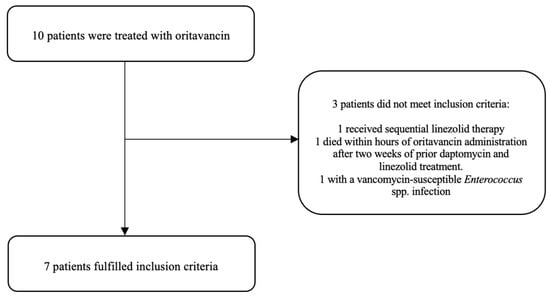
During the study period, 10 patients who received oritavancin were assessed for eligibility (Figure 1). Seven patients with an infection caused by vanA-VREfm met the inclusion criteria and were included in the analysis. Three patients were excluded: one who received sequential linezolid therapy; one who died within 48 h of receiving oritavancin after two weeks of prior daptomycin and linezolid treatment; and one with a vancomycin-susceptible Enterococcus faecium infection. Table 1 summarizes the clinical characteristics and outcomes of the seven included patients.
Figure 1.
Flow chart representing the patient selection process.
Table 1.
Demographic, clinical, and outcome characteristics of the 7 patients with infections caused by vanA-vancomycin-resistant Enterococcus faecium infections treated with oritavancin monotherapy.
The median age of the patients was 55 years (IQR 44.5–69) and four were male. The median age-adjusted Charlson comorbidity index was 7 (IQR 7–7.5). Patients had a wide range of underlying conditions, including solid tumors (Ewing sarcoma and metastatic urothelial carcinoma, n = 2), hematologic malignancy (acute lymphoblastic leukemia, n = 1), hepatobiliary disease (Caroli disease, n = 1), and urologic conditions such as ureteral lithiasis, renal transplantation after ureteropelvic anastomotic surgery, and prior cystoprostatectomy with Indiana-type urinary diversion (n = 1).
Sources of infection were heterogeneous and included urinary tract infection (n = 3), postoperative deep wound infection with intraabdominal abscess (n = 1), orthopedic implant infection (n = 1), biliary tract infection (n = 1), and intestinal bacterial translocation (n = 1). Three patients presented with concomitant bacteremia.
All isolates showed low minimum inhibitory concentrations (MICs) to oritavancin, ranging from 0.032 to 0.06 mg/L. Antibiotic susceptibility of the VREfm isolates to the remaining antibiotics tested are presented in Table 2.
Table 2.
Antibiotic susceptibility of the VREfm isolates. MIC values in µg/m.
Coinfection with other microorganisms was identified in five patients. Four patients had a single copathogen: Pseudomonas aeruginosa in two patients, Klebsiella pneumoniae in one, and Candida krusei in one. The remaining patient had a polymicrobial coinfection with P. aeruginosa and Escherichia coli. Overall, P. aeruginosa was identified in three patients. A drainable or surgically manageable infectious focus was identified in three patients. One patient had a paracolic collection that was drained under ultrasound guidance, another underwent surgical wound debridement, and a third patient, who presented with fever and hematuria in the setting of a urinary tract infection and underlying urothelial carcinoma, underwent radical cystectomy.
Oritavancin was administered at a dose of 1200 mg per infusion. The duration of therapy ranged from 7 to 42 days (one to six doses per patient). Three patients received a single dose (7 days), two received three doses (21 days), and two received six doses (42 days). Three patients received prior targeted therapy for VREfm before switching to oritavancin: two received daptomycin monotherapy for 72 h, and one received combination therapy with daptomycin, linezolid, and meropenem for 24 h.
Only one patient experienced a drug-related adverse event, consisting of chills and nausea likely associated with the infusion, which recurred in a mild form with each administration. However, no serious adverse reactions occurred, and the patient was able to complete all doses without further complications.
No patients experienced clinical failure on day 30. In all three patients with bacteremia, follow-up blood cultures became negative within 48–72 h after oritavancin administration, confirming microbiological clearance of bloodstream infection. One patient died within 90 days due to progression of underlying urothelial carcinoma and was considered not related to the infectious disease. The remaining six patients survived without relapse or microbiological recurrence during follow-up.
4. Discussion
In this small cases series, the main finding is the absence of clinical failure among patients treated with oritavancin monotherapy for infections caused by vanA-VREfm, with good tolerability and a low rate of adverse events.
Clinical evidence supporting the use of oritavancin in VREfm infections remains limited and is largely based on case reports and small observational studies describing its off-label use in different clinical settings, including endocarditis, bloodstream infections, and bone and joint infections [14,15,16,17,18,19,20,21,22,23]. In these reports, oritavancin has been used in different off-label therapeutic strategies, including sequential or consolidation therapy [16,17,18,20,21], prolonged suppressive treatment [19], and multidose regimens [14,19,22,23]. Nonetheless, available in vitro evidence suggests a potential role for oritavancin. It exhibits concentration-dependent bactericidal activity against several Gram-positive pathogens, including VREfm, with more rapid killing kinetics compared with vancomycin, teicoplanin, linezolid, or daptomycin [25,26,27] and its prolonged terminal half-life, which allows for simplified dosing regimens and may facilitate outpatient management [16,20].
Current treatment options for VREfm infections mainly include linezolid and high-dose daptomycin; however, uncertainties remain regarding comparative effectiveness [11,28,29,30] and optimal dosing strategies [31]. While some evidence suggests improved outcomes with higher-dose daptomycin and combination regimens, results are inconsistent and pharmacodynamic target attainment appears to be critical [10,32,33]. In a recent Delphi document for the management of Enterococcus faecium bloodstream infections, the optimal suggested treatment of VREfm is daptomycin or linezolid depending on the MIC [34]. Moreover, panelists agreed on the need for a clinical trial analyzing oritavancin for the treatment of VREfm infections. These concerns are particularly relevant in cases where isolates exhibit elevated MIC values (>2 µg/mL) to both daptomycin and linezolid [35]. In such scenarios, oritavancin may represent a potential therapeutic alternative.
In our study, oritavancin was used as monotherapy with minimal prior exposure to targeted therapy, providing insight into its potential role as a primary treatment option in this setting. This approach may be particularly relevant given the limitations of current therapies, as well as the long half-life of oritavancin. These features, together with its demonstrated activity against VREfm, support further exploration of oritavancin as a therapeutic alternative, particularly given the lack of previous studies evaluating its effectiveness as monotherapy in this specific setting.
However, its pharmacokinetic advantages must be considered alongside the uncertainty surrounding optimal multidose regimens. Evidence regarding the most appropriate maintenance dose and dosing interval remains insufficient, particularly in patients requiring prolonged therapy [36].
Across our cohort, none of the patients treated with oritavancin experienced infection recurrence or lack of clinical improvement. These favorable outcomes may be explained by several factors. First, adequate source control was achieved in all patients with a drainable focus of infection, which is a key determinant of treatment success in invasive infections. Therefore, none required prolonged suppressive therapy. Second, although therapeutic drug monitoring was not performed, all microbiological isolates were susceptible to oritavancin in vitro.
Furthermore, in our case series, three of seven patients had solid malignancies, one was a kidney transplant recipient, and one had a hematological malignancy receiving chemotherapy at the time of treatment. Overall, five of seven patients were immunocompromised to varying degrees and three presented with bacteremia. Although conclusions are limited by sample size, these findings suggest that oritavancin may be a feasible option even in high-risk clinical scenarios.
Regarding adverse events, oritavancin was well tolerated, with only one patient experiencing a mild infusion-related reaction. These findings are consistent with previously published data [19,20].
Beyond clinical effectiveness, the potential economic implications of oritavancin use should also be considered. Its prolonged half-life and infrequent administration may facilitate outpatient management, reduce the need for prolonged intravenous access, and potentially shorten hospital stays [17]. However, these benefits must be weighed against the high acquisition cost of oritavancin, particularly with repeated dosing. While prior studies have primarily explored oritavancin as sequential or suppressive therapy, our findings add to the limited body of evidence by suggesting a potential role for oritavancin as monotherapy in the treatment of vanA-VREfm infections.
This study has several limitations. First, its retrospective and single-center design may limit generalizability and introduces a potential risk of information bias. Second, the small sample size precludes meaningful statistical analysis and limits the ability to draw definitive conclusions regarding efficacy and safety. Third, the absence of a control group prevents comparison with standard-of-care therapies, making it difficult to determine the relative effectiveness of oritavancin. In addition, the clinical heterogeneity of the cohort, including differences in underlying conditions, infection sources, and severity, may have influenced outcomes. Importantly, five of the seven patients had concomitant infections caused by other clinically relevant pathogens, which complicates assessment of the specific contribution of VREfm to the clinical presentation and of the effect attributable to oritavancin. Moreover, we were unable to measure plasma concentrations of oritavancin, and a weekly 1200 mg regimen may have achieved supratherapeutic concentrations Finally, only three patients had documented bacteremia, limiting the conclusions that can be drawn regarding its efficacy in bloodstream infections.
In conclusion, in this small real-world cohort, oritavancin used as monotherapy was associated with favorable clinical outcomes and good tolerability in patients with vanA-VREfm infections. While these findings should be interpreted with caution, they suggest that oritavancin may represent a feasible therapeutic option in selected clinical scenarios. Further studies are warranted to better define its role in this setting.
Author Contributions
J.R.-S., I.L.-A., N.F.-H., D.R.-P. and E.d.B.-T. contributed to the conceptualization and methodology of the study. J.R.-S. performed data collection. J.R.-S., I.L.-A., N.F.-H., D.R.-P. and E.d.B.-T. performed the analyses and wrote the original draft. All the authors discussed the results and commented on the final version of the manuscript. All authors have read and agreed to the published version of the manuscript.
Funding
This research received no external funding.
Institutional Review Board Statement
The study was conducted in accordance with the Declaration of Helsinki and approved by Vall d’Hebron University Hospital ethics committee (EOM(AG)016/2026(6666)).
Informed Consent Statement
The requirement for informed consent was waived in accordance with the decision of our institution’s ethics committee.
Data Availability Statement
The data supporting the findings of this study are included in the article. Further inquiries can be directed to the corresponding author.
Acknowledgments
ChatGPT (GTP-6, OpenAI) was used solely to assist with English language editing and stylistic refinement. No generative AI was used for data generation, statistical analysis, or drawing scientific conclusions. The authors take full responsibility for the final content of this manuscript.
Conflicts of Interest
I.L.-A. has received honoraria for speaking at educational events from Merck, Shionogi, Pfizer, and Takeda, and has received travel support from Gilead, Merck, Menarini, Shionogi, and Mundipharma for scientific purposes. D.R.-P. has received honoraria for scientific advisory boards, scientific meetings, and travel and accommodation support for scientific purposes from Astellas, MSD, Tillotts, Menarini, Pfizer, and Angelini. C.K.-B. has received honoraria for scientific meetings from Shionogi and Mundipharma.
Abbreviations
The following abbreviations are used in this manuscript:
| CCI | Charlson comorbidity index |
| UTI | Urinary tract infection |
| MIC | Minimum inhibitory concentration |
| DAP | daptomycin |
| LZD | linezolid |
| MEM | meropenem |
| SCH | high level streptomycin resistance |
| GCH | high level gentamicin resistance |
References
- Cairns, K.A.; Udy, A.A.; Peel, T.N.; Abbott, I.J.; Dooley, M.J.; Peleg, A.Y. Therapeutics for vancomycin-resistant enterococcal bloodstream infections. Clin. Microbiol. Rev. 2023, 36, e0005922. [Google Scholar] [CrossRef] [Scilit] [PubMed]
- World Health Organization. WHO Bacterial Priority Pathogens List, 2024: Bacterial Pathogens of Public Health Importance to Guide Research, Development and Strategies to Prevent and Control Antimicrobial Resistance; World Health Organization: Geneva, Switzerland, 2024. [Google Scholar]
- Turner, A.M.; Kinsella, P.; Miller, W.R.; Carter, G.P.; Tran, T.T.; Howden, B.P.; Arias, C.A. Therapeutic approach to difficult-to-treat multidrug-resistant enterococcal infections. Antimicrob. Agents Chemother. 2025, 69, e0106024. [Google Scholar] [CrossRef] [Scilit] [PubMed]
- Gorrie, C.; Higgs, C.; Carter, G.; Stinear, T.P.; Howden, B. Genomics of vancomycin-resistant Enterococcus faecium. Microb. Genom. 2019, 5, e000283. [Google Scholar] [CrossRef] [Scilit] [PubMed]
- Humphries, R.M.; Pollett, S.; Sakoulas, G. A current perspective on daptomycin for the clinical microbiologist. Clin. Microbiol. Rev. 2013, 26, 759–780. [Google Scholar] [CrossRef] [Scilit] [PubMed]
- Moellering, R.C. Linezolid: The first oxazolidinone antimicrobial. Ann. Intern. Med. 2003, 138, 135–142. [Google Scholar] [CrossRef] [Scilit] [PubMed]
- Turnidge, J.; Kahlmeter, G.; Cantón, R.; MacGowan, A.; Giske, C.G.; European Committee on Antimicrobial Susceptibility Testing. Daptomycin in the treatment of enterococcal bloodstream infections and endocarditis: A EUCAST position paper. Clin. Microbiol. Infect. 2020, 26, 1039–1043. [Google Scholar] [CrossRef] [Scilit] [PubMed]
- Smith, J.R.; Barber, K.E.; Raut, A.; Rybak, M.J. β-Lactams enhance daptomycin activity against vancomycin-resistant Enterococcus faecalis and Enterococcus faecium in in vitro pharmacokinetic/pharmacodynamic models. Antimicrob. Agents Chemother. 2015, 59, 2842–2848. [Google Scholar] [CrossRef] [Scilit] [PubMed]
- Chuang, Y.C.; Wang, J.T.; Yang, J.L.; Lin, C.Y.; Huang, S.H.; Chen, Y.C.; Chang, S.-C. The combination of daptomycin with β-lactam antibiotics is more effective than daptomycin alone for vancomycin-resistant Enterococcus faecium bloodstream infection. J. Infect. Public Health 2022, 15, 1396–1402. [Google Scholar] [CrossRef] [Scilit] [PubMed]
- Chuang, Y.C.; Chen, P.Y.; Lin, C.Y.; Chen, Y.C.; Wang, J.T.; Chang, S.C. A retrospective clinical comparison of daptomycin versus daptomycin plus a β-lactam antibiotic for treating vancomycin-resistant Enterococcus faecium bloodstream infections. Sci. Rep. 2018, 8, 1632. [Google Scholar] [CrossRef] [Scilit] [PubMed]
- Britt, N.S.; Potter, E.M.; Patel, N.; Steed, M.E. Comparison of the Effectiveness and Safety of Linezolid and Daptomycin in Vancomycin-Resistant Enterococcal Bloodstream Infection: A National Cohort Study of Veterans Affairs Patients. Clin. Infect. Dis. 2015, 61, 871–878. [Google Scholar] [CrossRef] [Scilit] [PubMed] [PubMed Central]
- Olearo, F.; Both, A.; Belmar Campos, C.; Hilgarth, H.; Klupp, E.M.; Hansen, J.L.; Maurer, F.P.; Christner, M.; Aepfelbacher, M.; Rohde, H. Emergence of linezolid-resistance in vancomycin-resistant Enterococcus faecium ST117 associated with increased linezolid-consumption. Int. J. Med. Microbiol. 2021, 311, 151477. [Google Scholar] [CrossRef] [Scilit] [PubMed]
- Zhanel, G.G.; Calic, D.; Schweizer, F.; Zelenitsky, S.; Adam, H.; Lagacé-Wiens, P.R.; Rubinstein, E.; Gin, A.S.; Hoban, D.J.; Karlowsky, J.A. New lipoglycopeptides: A comparative review of dalbavancin, oritavancin and telavancin. Drugs 2010, 70, 859–886. [Google Scholar] [CrossRef] [Scilit] [PubMed]
- Johnson, J.A.; Feeney, E.R.; Kubiak, D.W.; Corey, G.R. Prolonged use of oritavancin for vancomycin-resistant Enterococcus faecium prosthetic valve endocarditis. Open Forum Infect. Dis. 2015, 2, ofv156. [Google Scholar] [CrossRef] [PubMed]
- Wenzler, E.; Santarossa, M.; Meyer, K.A.; Harrington, A.T.; Reid, G.E.; Clark, N.M.; Albarillo, F.S.; Bulman, Z.P. In vitro pharmacodynamic analyses to guide treatment of multidrug-resistant Enterococcus faecium and carbapenem-resistant Enterobacter cloacae bacteremia in a liver transplant patient. Open Forum Infect. Dis. 2020, 7, ofz545. [Google Scholar] [CrossRef] [Scilit] [PubMed]
- Texidor, W.M.; Miller, M.A.; Molina, K.C.; Krsak, M.; Calvert, B.; Hart, C.; Storer, M.; Fish, D.N. Oritavancin as sequential therapy for Gram-positive bloodstream infections. BMC Infect. Dis. 2024, 24, 127. [Google Scholar] [CrossRef] [Scilit] [PubMed]
- Vena, A.; Mezzogori, L.; Bassetti, M.; Mastroianni, A.; Greco, S.; Vangeli, V.; López-Cárdenas, S.; Murillo-Pineda, M.; de la Villa-Martínez, S.; Estévez-Prieto, A.; et al. ORIBAC Study Group. Oritavancin in complicated bloodstream infections and endocarditis in Spain and Italy (ORIBAC Study): A retrospective multicenter observational study. Infect. Dis. Ther. 2026, 15, 1075–1092. [Google Scholar] [CrossRef] [Scilit] [PubMed]
- Petropoulou, C.; Eleftherakis, G.; Tousis, A.; Bibis, T.; Nikas, A.; Drosou, E.; Davoulos, C.; Assimakopoulos, S.F. Oritavancin as sequential therapy for vancomycin-resistant Enterococcus faecium prosthetic valve endocarditis: A case report. J. Chemother. 2026, 1–7. [Google Scholar] [CrossRef] [Scilit] [PubMed]
- Krsak, M.; Morrisette, T.; Damioli, L.; Flues, B.; Liu, E.W.; Zhou, A.Y.; Msdi, A.S.; McLeod, C.; Akundi, S.; Redell, M.; et al. Can oritavancin be used for treatment and/or suppressive antimicrobial therapy of bone and joint infections caused by vancomycin-resistant Enterococcus faecium? Clin. Orthop. Relat. Res. 2025, 483, 1225–1233. [Google Scholar] [CrossRef] [Scilit] [PubMed]
- Frondizi, F.; Leanza, G.M.; Chiuchiarelli, M.; Catania, F.; Sangiorgi, F.; Giovannenze, F.; Taddei, E.; Tamburrini, E.; Torti, C.; Scoppettuolo, G. The use of oritavancin as consolidation therapy for infective endocarditis caused by Enterococcus spp. Open Forum Infect. Dis. 2025, 12, ofaf416. [Google Scholar] [CrossRef] [Scilit] [PubMed]
- Di Cecco, C.; Monticelli, J.; Di Bella, S.; Di Maso, V.; Luzzati, R. Vancomycin-resistant enterococcus bloodstream infection successfully managed with oritavancin and fosfomycin as sequential treatment. J. Chemother. 2024, 36, 31–34. [Google Scholar] [CrossRef] [Scilit] [PubMed]
- Foster, R.A.; Philavong, K.P.; Weissman, S.; Tang, X.; Bookstaver, P.B. Oritavancin for the treatment of daptomycin nonsusceptible vancomycin-resistant enterococci osteomyelitis. Infect. Dis. Clin. Pract. 2018, 26, 97–99. [Google Scholar] [CrossRef] [Scilit]
- Dahesh, S.; Wong, B.; Nizet, V.; Sakoulas, G.; Tran, T.T.; Aitken, S.L. Treatment of multidrug-resistant vancomycin-resistant Enterococcus faecium hardware-associated vertebral osteomyelitis with oritavancin plus ampicillin. Antimicrob. Agents Chemother. 2019, 63, e02622-18. [Google Scholar] [CrossRef] [Scilit] [PubMed]
- Centers for Disease Control and Prevention. National Healthcare Safety Network (NHSN) Surveillance Definitions for Specific Types of Infections; Centers for Disease Control and Prevention: Atlanta, GA, USA, 2023. [Google Scholar]
- Meyer, K.A.; Deraedt, M.F.; Harrington, A.T.; Danziger, L.H.; Wenzler, E. Efficacy of oritavancin alone and in combination against vancomycin-susceptible and -resistant enterococci in an in vivo Galleria mellonella survival model. Int. J. Antimicrob. Agents 2019, 54, 197–201. [Google Scholar] [CrossRef] [Scilit] [PubMed]
- Jones, R.N.; Turnidge, J.D.; Moeck, G.; Arhin, F.F.; Mendes, R.E. Use of in vitro vancomycin testing results to predict susceptibility to oritavancin. Antimicrob. Agents Chemother. 2015, 59, 2405–2409. [Google Scholar] [CrossRef] [Scilit] [PubMed]
- Belley, A.; Lalonde-Séguin, D.; Arhin, F.F.; Moeck, G. Comparative pharmacodynamics of single-dose oritavancin and daily high-dose daptomycin regimens against vancomycin-resistant Enterococcus faecium isolates in an in vitro pharmacokinetic/pharmacodynamic model of infection. Antimicrob. Agents Chemother. 2017, 61, e01265-17. [Google Scholar] [CrossRef] [Scilit] [PubMed]
- Chou, C.H.; Lee, N.Y.; Lee, H.C.; Chang, C.M.; Lee, C.C.; Ko, W.C. Emergence of vancomycin-resistant enterococcal bloodstream infections in southern Taiwan. J. Microbiol. Immunol. Infect. 2012, 45, 221–227. [Google Scholar] [CrossRef] [Scilit] [PubMed]
- Ye, J.J.; Shie, S.S.; Cheng, C.W.; Yang, C.C.; Huang, P.Y.; Wu, T.S.; Lee, M.-H.; Huang, C.-T. Clinical characteristics and treatment outcomes of vancomycin-resistant Enterococcus faecium bacteremia. J. Microbiol. Immunol. Infect. 2018, 51, 705–716. [Google Scholar] [CrossRef] [Scilit] [PubMed]
- Chuang, Y.C.; Lin, H.Y.; Chen, P.Y.; Lin, C.Y.; Wang, J.T.; Chang, S.C. Daptomycin versus linezolid for the treatment of vancomycin-resistant enterococcal bacteraemia: Implications of daptomycin dose. Clin. Microbiol. Infect. 2016, 22, 890.e1–890.e7. [Google Scholar] [CrossRef] [Scilit] [PubMed]
- Hwang, L.E.; Yang, J.L.; Lin, C.Y.; Huang, S.H.; Chuang, Y.C.; Wang, J.T.; Chen, Y.-C.; Chang, S.-C. High-dose daptomycin versus linezolid for vancomycin-resistant Enterococcus faecium bloodstream infections: Role of pharmacodynamic target attainment. J. Microbiol. Immunol. Infect. 2026, 59, 237–243. [Google Scholar] [CrossRef] [Scilit] [PubMed]
- Smith, J.R.; Barber, K.E.; Raut, A.; Aboutaleb, M.; Sakoulas, G.; Rybak, M.J. Β-Lactam combinations with daptomycin provide synergy against vancomycin-resistant enterococci. J. Antimicrob. Chemother. 2015, 70, 1738–1743. [Google Scholar] [CrossRef] [Scilit] [PubMed]
- Hindler, J.A.; Wong-Beringer, A.; Charlton, C.L.; Miller, S.A.; Kelesidis, T.; Carvalho, M.; Sakoulas, G.; Nonejuie, P.; Pogliano, J.; Nizet, V.; et al. In vitro activity of daptomycin combinations against daptomycin-nonsusceptible enterococci. Antimicrob. Agents Chemother. 2015, 59, 4279–4288. [Google Scholar] [CrossRef] [Scilit] [PubMed]
- Rinaldi, M.; Bartoletti, M.; Cojutti, P.; Escolà-Vergé, L.; Fernández-Hidalgo, N.; Hornuss, D.; Gatti, M.; Gudiol, C.; Gutiérrez-Gutiérrez, B.; López-Cortés, L.E.; et al. Managing Enterococcus faecium bloodstream infection: A Delphi document on clinical recommendations and research agenda. EClinicalMedicine 2026, 95, 103925. [Google Scholar] [CrossRef] [Scilit] [PubMed]
- Kamus, L.; Auger, G.; Gambarotto, K.; Houivet, J.; Ramiandrisoa, M.; Picot, S.; Lugagne-Delpon, N.; Jaffar-Bandjee, M.-C.; Zouari, A.; Birer, A.; et al. Investigation of a vanA linezolid- and vancomycin-resistant Enterococcus faecium outbreak in the Southwest Indian Ocean (Reunion Island). Int. J. Antimicrob. Agents 2022, 60, 106686. [Google Scholar] [CrossRef] [Scilit] [PubMed]
- Baiardi, G.; Pontali, E.; Marini, V.; Cristina, M.L.; Sartini, M.; Mattioli, F. Extrapolation of oritavancin PK/PD targets to inform therapeutic drug monitoring: A systematic review. J. Antimicrob. Chemother. 2026, 81, dkag117. [Google Scholar] [CrossRef] [Scilit] [PubMed]

Disclaimer/Publisher’s Note: The statements, opinions and data contained in all publications are solely those of the individual author(s) and contributor(s) and not of MDPI and/or the editor(s). MDPI and/or the editor(s) disclaim responsibility for any injury to people or property resulting from any ideas, methods, instructions or products referred to in the content. |
© 2026 by the authors. Licensee MDPI, Basel, Switzerland. This article is an open access article distributed under the terms and conditions of the Creative Commons Attribution (CC BY) license.