


Abstract
Background: It is estimated that approximately 20–30% of women suffer from recurrent urinary tract infections (rUTIs). The disease is primarily bacterial, especially Escherichia coli, making antibiotics the standard treatment. Increasing antibiotic resistance of uropathogens reduces treatment effectiveness. Therefore, non-antibiotic approaches are increasingly being investigated for the management of rUTIs. This narrative review provides a comprehensive overview of currently available and emerging methods of treatment and prevention of rUTIs in women. Methods: This paper employs a narrative review with a structured literature search and synthesizes data from three major databases, including PubMed, Web of Science, and Scopus. The review was conducted in accordance with the Scale for the Assessment of Narrative Review Articles (SANRA) checklist. Scientific articles were searched using the following keywords: ‘recurrent urinary tract infections in women’, ‘antibiotic prophylaxis’, ‘immunoprophylaxis’, ‘urinary microbiome’. Results: Observational evidence has reported an association between continuous antibiotic prophylaxis and severe outcomes, including pyelonephritis and septicemia; however, these findings are susceptible to confounding by indication and should not be interpreted as evidence of a causal relationship. Clinical studies suggest that immunomodulatory approaches, such as OM-89 bacterial lysate, next-generation polybacterial mucosal vaccines (e.g., MV140), and oral immunostimulants, have potential to reduce the frequency of rUTI recurrences in women, although the strength and certainty of evidence vary between interventions. Bacteriophage therapy is an emerging and exploratory targeted approach supported by early clinical and experimental evidence, but its efficacy for preventing recurrent uncomplicated UTIs remains uncertain, though rapid development of phage resistance remains a potential limitation. Prophylactic strategies, including Lactobacillus-based probiotics, low-dose estriol, and microbiota transplantation, have shown preliminary or variable results, with limited evidence for rUTI prevention. In particular, findings on vaginal dysbiosis and microbiota modulation should not be interpreted as a direct evidence of rUTI prevention. Conclusions: While antibiotic therapy remains essential, continuous prophylaxis may contribute to antimicrobial resistance and disrupt microbial balance. Therefore, novel therapeutic strategies are still being studied. Several non-antibiotic strategies, including immunoprophylaxis and microbiome modulation, represent potential preventive approaches, whereas bacteriophage therapy and vaginal microbiota transplantation remain exploratory and require further clinical validation. Their preventive efficacy against rUTIs remains unestablished. Moreover, antimicrobial peptides (AMPs), nanotechnology, molecularly targeted therapies, and precision medicine strategies are being investigated. Plant-based therapies may provide benefit, but their clinical efficacy remains to be established. Overall, further clinical studies are needed to confirm the preventive efficacy of these emerging approaches.
1. Introduction
Recurrent urinary tract infections (rUTIs) are a significant clinical and epidemiological problem in the female population worldwide. In women, rUTIs are commonly defined as ≥2 symptomatic episodes within 6 months or ≥3 episodes within 12 months. This definition is commonly applied to recurrent uncomplicated urinary tract infections, whereas these infections may also occur in the presence of complicating factors, including urinary catherization or structural and functional abnormalities of the urinary tract. The problem of recurrence stems from individual anatomical predispositions, functional factors, and hormonal disorders that promote colonization of the urinary tract by uropathogens. It is estimated that over 50% of women experience at least one episode of urinary tract infection (UTI) in their lifetime, while approximately 20–30% of women who have experienced an initial UTI develop a recurrent infection [1,2]. Escherichia coli remains the most commonly isolated bacterium, but other bacteria, including Klebsiella pneumoniae, Staphylococcus saprophyticus, and Proteus mirabilis, can also cause infections [2,3].
In addition to these common bacterial pathogens, certain viruses and protozoa can also contribute to urinary tract infections, especially in immunocompromised individuals. To date, antibiotics remain the mainstay of treatment for urinary tract infections, but their effectiveness is now limited by antibiotic-resistant bacterial strains. The resistance of uropathogens, particularly E. coli, to fluoroquinolones, trimethoprim-sulfamethoxazole, and other commonly used antibiotics significantly complicates empirical therapy [1,3]. Chronic and often excessive exposure to antimicrobial drugs is the primary driver of antibiotic resistance in urology [1,4].
There is also an increased risk of microbiota disorders and adverse effects associated with long-term treatment [1,4]. The growing resistance of multidrug-resistant strains makes urinary tract infections increasingly difficult to treat [3,4]. The problem of antibiotic resistance has increased the need to develop and implement non-antibiotic approaches [4,5,6]. Promising non-antibiotic therapies and complementary treatment strategies include immunoprophylaxis and microbiome modulation (including fecal microbiota transplantation [FMT], anti-adhesion therapies, and new molecules with distinct mechanisms of action) [5,6,7].
While recent reviews have addressed non-antibiotic prevention of rUTIs, this review additionally focuses on emerging therapeutic approaches and differentiates strategies according to the maturity of the available clinical and experimental evidence.
The aim of this paper is to provide a comprehensive overview of modern and future-oriented methods for the treatment and prevention of rUTIs in women, with particular emphasis on alternative, safe, non-antibiotic interventions [4,8].
2. Materials and Methods
This study was designed as a narrative review based on a structured literature search. The review was conducted in accordance with the Scale for the Assessment of Narrative Review Articles (SANRA) checklist to enhance transparency, methodological consistency, and reporting quality [9]. It should be noted that this review was not conducted as a systematic review, and no formal meta-analysis was applied.
Databases such as PubMed, Web of Science, and Scopus were used in the initial literature search. The search was performed from March 2026 to August 2026, with the final search conducted in August 2026. No predefined restriction on publication year was applied, and the search included relevant publications available up to August 2026. The literature search included combinations of the following key terms: “recurrent urinary tract infections in women”, “antibiotic prophylaxis”, “immunoprophylaxis”, and “urinary microbiome”, together with additional terms related to vaccines, probiotics, vaginal microbiota, microbiome modulation, bacteriophages, antimicrobial peptides, biofilms, and other emerging non-antibiotic strategies. The search strategy was iterative, allowing additional searches when specific topics or emerging preventive approaches required further clarification (Table 1).
Table 1.
Databases and search terms used, and number of identified records.
The initial literature search and screening of titles and abstracts were performed by two authors. Duplicate records identified across the searched databases were removed before further assessment. Potentially relevant publications were subsequently assessed in full text, and the final selection was discussed among the authors based on relevance to the objectives and thematic scope of the review, study design, and availability of clinically relevant information. In cases of uncertainty regarding the relevance of a publication, the decision was discussed among the authors until consensus was reached.
At the full-text stage, publications were assessed for relevance to the review’s main objectives and thematic scope, as well as the availability of clinically relevant information. Studies addressing the same preventive strategies or clinical questions were considered based on the relevance and quality of the available evidence. Studies addressing catheter-associated biofilms, vaginal dysbiosis, or treatment of active urinary tract infections were included when they provided mechanistic or clinical evidence relevant to pathophysiology, microbial persistence, or potential prevention of rUTIs. Such studies were not considered direct evidence of efficacy in preventing rUTIs. This distinction was maintained throughout the evidence synthesis to avoid interpreting indirect, experimental, or preclinical findings as established clinical efficacy for the prevention of recurrent uncomplicated UTIs in women.
Studies were included if they were focused on preventive strategies for recurrent urinary tract infections in women, encompassing both well-established and novel therapeutic approaches. Conference abstracts, publications in languages not accessible to the authors, and publications lacking relevant data were excluded. No formal restriction based on publication date was applied.
Across the three databases, a total of 1535 records were identified. Following screening for relevance and removal of duplicate and irrelevant records, 98 publications were ultimately selected for inclusion in the narrative review. The final body of evidence included original clinical studies, observational studies, experimental studies, and relevant reviews, with the strength of evidence considered according to study design. Randomized clinical trials and well-designed clinical studies were given greater weight in the synthesis, whereas observational studies, uncontrolled cohorts, in vitro studies, and animal studies were interpreted according to their respective limitations and primarily used to provide supportive, mechanistic, or exploratory evidence. To facilitate a structured presentation of the evidence, the study’s literature was organized into the following sections: pathophysiology of recurrent urinary tract infections, limitations of conventional antibiotic therapy, immunoprophylaxis and vaccines, microbiome-based therapies, bacteriophage therapy, and other emerging approaches.
3. Pathophysiological Background of Recurrent UTIs
3.1. Intracellular Bacterial Communities and Biofilm Formation in UTI Persistence and Virulence
Biofilm formation, predominantly by E. coli, is common among catheterized patients [10]. E. coli generally forms weak biofilm [11], while uropathogenic Escherichia coli (UPEC) forms biofilms significantly more often than commensal strains [12]. In vitro biofilm formation is also more frequent among uropathogens isolated from women with recurrent UTIs than from those with isolated episodes [13]. Silicone catheters may reduce biofilm formation, whereas pharmacological approaches, such as JUC Spray Dressing, can further inhibit catheter-associated biofilms [14]. Importantly, biofilms may persist on urinary catheters despite antibiotic therapy, highlighting the need for novel antibiofilm strategies [15]. Experimental approaches, including chitosan-based rosemary oil nanophytosomes and azithromycin- and ciprofloxacin-impregnated urinary catheters, have demonstrated antibiofilm activity against uropathogens, including Pseudomonas aeruginosa [16,17]. Disperazol combined with ciprofloxacin has also shown promising results in a murine model of catheter-associated UTIs [18]. However, these studies predominantly address catheter-associated or experimental UTIs rather than the prevention of recurrent uncomplicated UTIs in women. Therefore, their findings provide mechanistic and proof-of-concept evidence rather than direct clinical evidence for rUTI prevention.
3.2. The Role of Adhesion
Adhesion is crucial for the invasion of urothelial cells in UTIs [19]. UPEC adhesion and invasion are associated with bladder inflammation [20], while adhesion-related virulence genes are more prevalent in the urinary tract than in fecal E. coli isolates [21]. Sheikhi et al. reported that biofilm-forming UPEC shows an increased prevalence of adhesin-associated genes, including fimH, kpsMTII, csgA, afa/draBC, and pap [22]. These findings support bacterial adhesion as a potential therapeutic and vaccine target. For example, immunization against A. baumanii adhesion-related antigens reduced bacterial loads in bladder tissue and on catheter surfaces [23]. FimH, a fimbrial-tip adhesin that binds mannosylated urothelial proteins, is another promising target, with FimH-based vaccination conferring protection against FimH-expressing E. coli and eliciting antibody responses associated with reduced bacterial binding [24]. Nevertheless, these findings are largely derived from experimental models and studies of bacterial virulence or active infection, and therefore should not be interpreted as direct evidence of efficacy in preventing recurrent uncomplicated UTIs in women. Although the aforementioned studies were conducted in a mouse model, they may provide valuable insights for the development of future therapies.
3.3. The Relation Between Vagina and Bowel Dysbiosis in UTIs
The intestinal microbiota is associated with susceptibility to UTIs, with recurrent UTIs patients exhibiting altered abundances of several taxa, including Anaerotruncus, Dorea, Eubacterium nodatum, Odoribacter, Senegalimassilia, Tyzzerella3, Lachnospiraceae ND3007 and UCG001 groups, Ruminococcaceae, and Bacillales [24]. Individuals with recurrent UTIs also exhibit reduced microbial richness and fewer butyrate-producing bacteria, suggesting a role for the gut–bladder axis in disease susceptibility and immune regulation [25]. These observations describe associations with dysbiosis and susceptibility rather than establishing a preventive effect against recurrent uncomplicated UTI. Gut dysbiosis may enhance inflammatory responses, impair the bladder epithelial barrier, and promote E. coli persistence. Fecal microbiota transplantation has therefore been proposed as a potential strategy to modulate excessive inflammation and reduce recurrent UTIs [26,27]. However, evidence for microbiota-based interventions remains preliminary, and these approaches should be distinguished from interventions with established clinical evidence for rUTI prevention. Similarly, vaginal Lactobacillus spp. inhibit UPEC growth through antimicrobial metabolites, thereby supporting a protective role of the vaginal microbiota [28]. Vaginal and combined oral-vaginal probiotics may reduce vaginal E. coli colonization and potentially prevent recurrent symptomatic episodes [29]. In postmenopausal women, low-dose estriol may additionally contribute to prophylaxis by restoring an unfavorable vaginal pH for uropathogens [30]. Thus, evidence concerning vaginal dysbiosis and microbiota modulation should be interpreted separately from direct evidence of clinical prevention of recurrent uncomplicated UTI.
3.4. The Physiology of Immune Response in UTIs
The host immune response is an important determinant of susceptibility to recurrent UTIs [31]. Women are more prone to UTIs than men, but men more often suffer from complicated UTIs. In a mouse model, only male and testosterone-treated mice developed chronic infection, whereas female mice showed higher IL-17 expression and increased numbers of γδ T cells and group 3 innate lymphoid cells in the bladder [32]. Mucosal-associated invariant T (MAIT) cell numbers are similar in patients with recurrent UTIs and healthy controls, but MAIT cells in patients with recurrent UTIs exhibit altered activation, including increased T-bet expression and a higher activation threshold [33]. Overall, these findings provide mechanistic insight into host susceptibility and immune responses, but evidence from animal models or immunological studies should be distinguished from direct clinical evidence supporting a preventive intervention in women with recurrent uncomplicated UTIs.
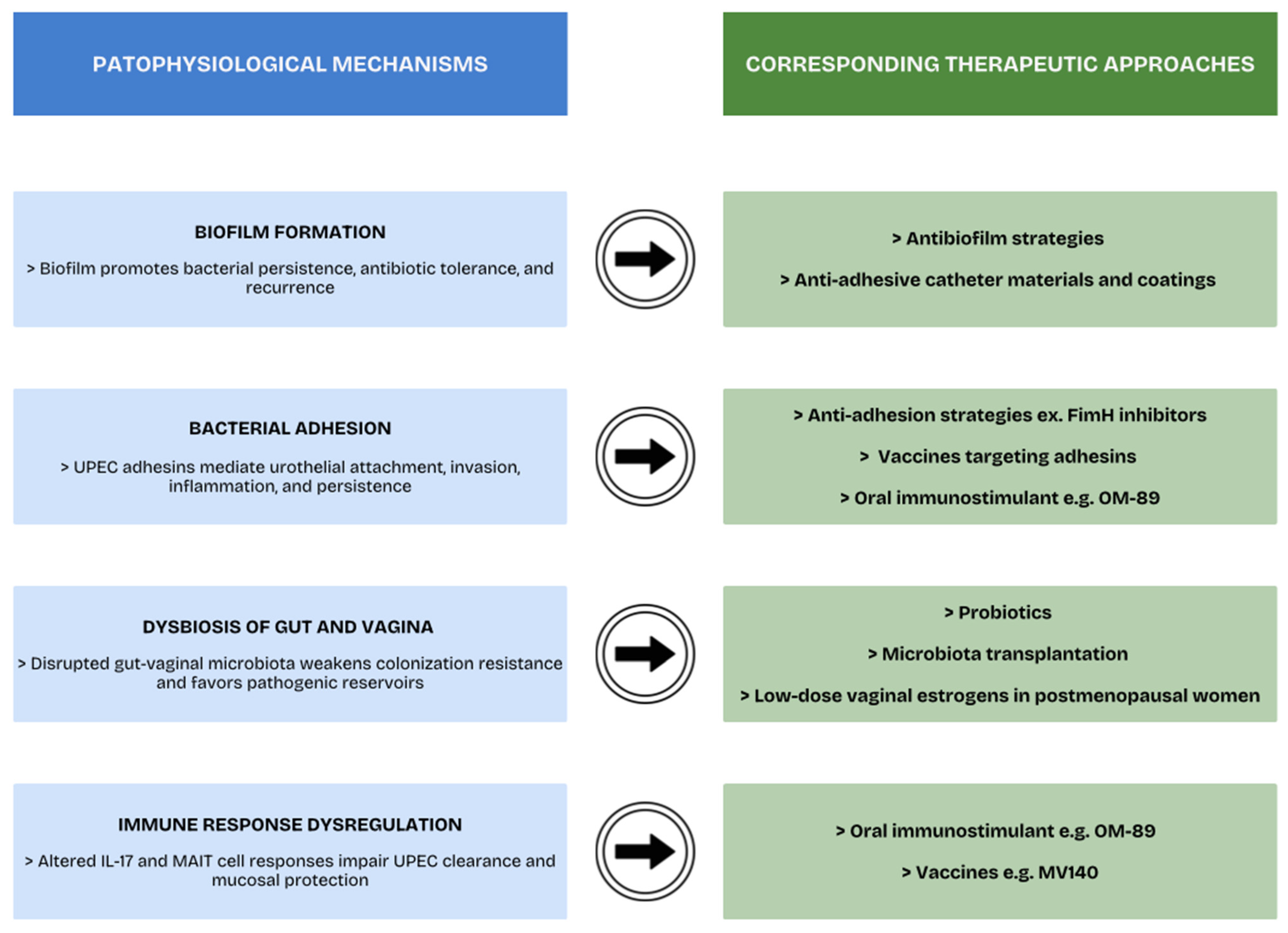
Pathophysiological background of recurrent UTIs with corresponding therapeutic approaches summarized in Figure 1.
Figure 1.
Pathophysiological background of recurrent UTIs with corresponding therapeutic approaches. Abbreviations: UPEC—Uropathogenic Escherichia coli; IL—interleukin; MAIT—Mucosal-associated invariant T.
4. Limitations of Conventional Antibiotic Therapy
There are distinct strategies for managing recurrent UTIs: one focuses on administering antibiotics episodically when symptoms and infections occur, while the other relies on continuous suppressive therapy to inhibit bacterial growth. In a randomized trial directly addressing which strategy is better, continuous prophylaxis achieved superior symptom suppression compared to patient-administered therapy (0.2 vs. 2.2 recurrences per patient-year) [34]. However, this continuous approach carries potential adverse effects, as long-term antibiotic use can lead to significant clinical consequences. Long-term antibiotic exposure may promote the selection of antimicrobial-resistant organisms, alter the gut and vaginal microbiota, and increase the risk of antibiotic-associated adverse events. In a randomized study, prolonged trimethoprim-sulfamethoxazole prophylaxis was associated with a substantial rise in antimicrobial resistance among Escherichia coli isolates, followed by a reduction in resistance after treatment cessation [35]. Similarly, the ALTAR randomized trial reported a higher proportion of antimicrobial-resistant E. coli isolates among women receiving daily antibiotic prophylaxis compared with those receiving methenamine hippurate [36]. That being said, self-start therapy remains effective, safe, and economical, particularly given that women were able to accurately diagnose a UTI based on symptoms in 92% of cases [37]. A prominent retrospective study in this field, conducted by Carl Llor et al., compared patients receiving continuous suppressive therapy with those receiving episodic treatment (in which antibiotics were administered only at symptom onset). The study tracked severe outcomes, including COVID-19, pyelonephritis, pneumonia, septicemia, influenza, and death. These adverse events were observed in 12.6% of women treated with suppressive prophylactic antibiotic therapy, compared to only 6.4% in the episodic treatment group. However, because this was a retrospective observational comparison, these findings may be influenced by confounding by indication and should not be interpreted as evidence of a causal relationship. The most significant correlation was observed with pyelonephritis, where the risk increased by 64 to 133 percent. The second most common severe adverse effect was septicemia, exhibiting a risk increase of 13 to 59 percent. The most frequently prescribed drug to manage UTIs was fosfomycin [38]. Overall, these findings represent associations rather than demonstrated causal effects of suppressive antibiotic therapy. A higher incidence of complications was observed in patients undergoing suppressive therapy, although differences in baseline risk between the groups may have contributed to this finding. Another effective therapeutic approach for healthy young women prone to recurrent urinary tract infections is postcoital prophylaxis. This method has shown promising results, substantially reducing the incidence of UTIs from 3.6 to 0.3 episodes per patient-year [39].
Several theories attempt to explain the higher incidence of adverse effects associated with continuous antibiotic therapy. One prominent hypothesis focuses on the vaginal microbiota and the role of local microorganisms [40,41,42,43]. The Lactobacillus population can be adversely affected by various factors, including estrogen depletion during menopause, recurrent UTIs, and notably, the use of antimicrobial agents [44]. Consequently, antibiotic therapy can deplete Lactobacillus colonies, inadvertently increasing the risk of subsequent UTIs. This depletion impairs several protective mechanisms, such as the production of hydrogen peroxide [45], competitive inhibition of uropathogen adhesion [46], maintenance of an acidic environment via lactic acid production, and the secretion of type 1 interferons, which decreases the intracellular bacterial burden [40]. Notably, Lactobacillus crispatus exhibits the most robust protective effect.
Another critical aspect is the proliferation of antibiotic-resistant strains within the patient’s microflora. According to the updated 2025 AUA/CUA/SUFU guidelines, fluoroquinolones and cephalosporins are highlighted as frequently prescribed antibiotics that significantly contribute to multidrug resistance. Specifically, their widespread use has been linked to the emergence of resistant pathogens, including methicillin-resistant Staphylococcus aureus (MRSA), ESBL-producing Klebsiella pneumoniae, and β-lactam-resistant Acinetobacter species. Researchers also highlight poor patient adherence; individuals frequently adjust dosages independently or prematurely discontinue their treatment courses [47]. That being said, not all antimicrobial agents inevitably lead to increased resistance [48].
5. Immunoprophylaxis and Vaccines
The growing problem of antibiotic resistance has led to a shift in approaches to preventing recurrent urinary tract infections in women, with greater emphasis on harnessing the patient’s immune system. These strategies intend to activate both the innate and adaptive immune responses. The most extensively studied groups of preparations include oral immunostimulants and next-generation mucosal vaccines [49,50,51].
5.1. Oral Immunostimulants
Of the available oral immunostimulatory preparations, OM-89 is among the best documented for clinical efficacy. It is a bacterial lysate derived from 18 of the most frequently occurring UPEC [52]. After oral administration, the preparation activates the lymphoid tissue associated with the gastrointestinal mucosa (GALT). This occurs through stimulation of Toll-like receptors (TLRs) on macrophages, which triggers the Nuclear factor of kappa light-chain enhancer of B cells (NF-κB) signaling cascade and induces the production of pro-inflammatory cytokines. B lymphocytes activated in GALT differentiate into plasma cells, which then migrate via the bloodstream to mucosal surfaces throughout the body, including the urinary bladder. There, they secrete secretory immunoglobulin A (sIgA), which may inhibit the adhesion and invasion of uropathogens, thereby increasing the urinary tract’s resistance [53,54,55].
Available clinical data suggest that OM-89 may reduce recurrent UTI frequency in women, although the certainty of the evidence is limited by heterogeneity and methodological limitations across the available trials. In the systematic review and meta-analysis by Beerepoot et al., comprising a total of 891 participants, four randomized placebo-controlled trials showed a pooled risk ratio (RR) of 0.61 (95% CI: 0.48–0.78; p < 0.05) for UTI recurrence, with a safety profile compared to placebo [56]. The included trials evaluated adults with recurrent UTIs and generally assessed recurrence over approximately 6 months, although study populations, outcome definitions, and follow-up periods varied across individual trials. Thus, the pooled estimate supports a potential preventive effect but should be interpreted in the context of the relatively heterogeneous and older evidence base. A prospective cohort study by Kim et al., involving 34 patients with chronically recurrent cystitis, reported a marked reduction in recurrences: the immunostimulant was administered once daily for three months, followed by six months of follow-up, and the mean number of recurrences fell from 4.26 during the six months before treatment to 0.35 after the course (p < 0.001), with 82.4% of women becoming infection-free. However, this uncontrolled study provides lower-certainty evidence than the randomized data [57]. Taken together, OM-89 has supportive randomized evidence for reducing rUTI recurrence, but the certainty of evidence should not be considered equivalent to that of a contemporary, large, multicenter clinical trial.
5.2. Next-Generation Vaccines
Alongside the development of bacterial lysates, the limitations of the oral route were recognized, as was the need to broaden the antigenic spectrum, finally leading to the development of next-generation polybacterial vaccines. An example of such a preparation is MV140 (Uromune® ((Inmunotek S.L., Alcalá de Henares, Spain)) contains whole, inactivated cells of four bacteria: E. coli, K. pneumoniae, P. vulgaris, and E. faecalis, all of which are common uropathogens implicated in recurrent UTIs [58].
The vaccine is administered sublingually at a dose of two sprays per day. It is absorbed through the sublingual mucosa, where a dense network of dendritic cells (DCs) plays an essential role in linking innate and adaptive immune responses and enabling the induction of mucosal immunity [58]. Earlier mucosal vaccine strategies included vaginal preparations in the form of suppositories; however, due to limited patient acceptance and local adverse effects, such as mucosal irritation, the sublingual route has become more widely adopted [56,59].
A multicenter, double-blind, randomized, placebo-controlled trial in Spain and the United Kingdom included 240 women aged 18–75 years with rUTIs, randomized to MV140 for 3 or 6 months or placebo for 6 months and followed for 12 months. The median number of UTI episodes was 3.0 (IQR 0.5–6.0) with placebo versus 0.0 (IQR 0.0–1.0) with MV140 (p < 0.001), while UTI-free rates were 25% (95% CI 15–35%) versus 56% (95% CI 44–67%) and 58% (95% CI 44–67%) after 3 and 6 months of MV140, respectively [60]. Although these results provide randomized evidence of benefit, the study was of modest size and duration, and the findings should therefore be interpreted as supportive rather than definitive evidence of long-term preventive efficacy. Subsequent secondary analyses demonstrated that in the group receiving MV140, there was a significant reduction in UTIs symptom severity (102.2 vs. 194.2; p = 0.0002), an almost threefold shortening of antibiotic treatment duration (12.4 vs. 28.7 days; p = 0.0001), and a significant improvement in quality of life across all SF-36 domains (overall difference: 15.7; 95% CI: 8.80–22.64; p < 0.0001) [61].
Another key piece of evidence is the prospective, multicenter cohort study by Ramírez Sevilla et al. (2024), which involved 1104 women with uncomplicated rUTIs and at least three UTI episodes at baseline (mean age, 72 years). The study was uncontrolled and assessed outcomes at 3, 6, and 12 months after immunoprophylaxis. Efficacy was predefined as having 0–2 UTI episodes during follow-up. After a three-month course, the predefined efficacy criterion (0–2 UTI episodes throughout follow-up) was met by 95.8% of patients; at 12 months, this proportion was 57.6%, and 64.7% among women with a milder disease history (3–4 UTI episodes per year). Because there was no placebo or untreated comparator, these results cannot establish the causal preventive efficacy of MV140, and the findings should be considered lower-certainty evidence than those from the randomized trial [62].
Overall, OM-89 and MV140 have supportive clinical evidence for reducing rUTI recurrence, including randomized evidence for both interventions, but the certainty of evidence varies and should be interpreted in light of study size, follow-up duration, heterogeneity, and methodological limitations. Their regulatory availability also varies between countries, and evidence of clinical efficacy should not be equated with universal regulatory approval or routine availability. Clinical use may also depend on product availability and appropriate patient selection.
6. Microbiome-Based Therapies
The vaginal microbiome of a healthy woman is predominantly composed of Lactobacillus spp., which maintain a low pH and limit pathogen colonization by producing lactic acid and other metabolites. These characteristics support homeostasis and protect against bacterial and fungal infections [63]. Dysbiosis of the urogenital tract occurs when the proportion of Lactobacillus decreases, and anaerobic bacteria increase, leading primarily to bacterial vaginosis (BV) and its potential complications [64,65].
Following the success of fecal microbiota transplantation in treating C. difficile infection, researchers have begun investigating the vaginal microbiome. Clinical trials are currently underway to evaluate approaches to support the restoration and modulation of a healthy vaginal microbiome in states of dysbiosis [64]. Although numerous clinical studies and meta-analyses indicate potential benefits of probiotic therapy in treating infections and microbiome disturbances, its clinical efficacy and impact on reducing recurrence remain uncertain. This is largely due to strain heterogeneity, differences in routes of administration, inconsistent study quality, and challenges in defining a standardized clinical dose [66,67]. In dysbiosis-targeted therapy, probiotics may act through lactic acid production, competition for adhesion sites, and immune-modulation mechanisms relevant to both the prevention and treatment of BV and fungal infections [63].
A study involving 36 asymptomatic women with vaginal dysbiosis evaluated oral probiotic therapy (L. acidophilus, L. rhamnosus, and L. reuteri) administered for six weeks. Participants were classified according to the Nugent score (NS) into Low-NS (n = 26) and High-NS (n = 10) groups. The results showed that 60% of women with a high Nugent score shifted toward a lower Nugent score and showed increased vaginal colonization, while four remained in the High-NS group. Among women with low NS, 11.5% shifted to a high-NS profile characterized by increased anaerobic bacteria [64]. Importantly, this study did not assess symptomatic UTI or rUTI recurrence; therefore, its findings provide evidence of vaginal microbiota modulation instead of rUTI prevention.
Meta-analyses and systematic reviews consistently report improvements in clinical and microbiological parameters following probiotic therapy with Lactobacillus strains [65,68]. However, despite promising findings, many commercial probiotics fail to achieve stable vaginal colonization or demonstrate clear clinical efficacy. The limited number of studies and their inconclusive results highlight the need for larger, well-designed clinical trials [65].
Vaginal microbiota transplantation (VMT) is a promising therapeutic strategy to restore Lactobacillus dominance in patients with recurrent dysbiosis. In the scoping review by Luo H [69], 12 studies were included: seven published (three human studies and four animal studies) and five ongoing clinical trials. Across 36 women, VMT restored a Lactobacillus-dominated microbiome and improved symptoms of BV and other forms of urogenital dysbiosis. In animal models, reductions in inflammatory markers were observed, and two mouse studies demonstrated increased Lactobacillus abundance following VMT [65]. However, these studies did not evaluate prevention of recurrent UTI as a clinical endpoint. Therefore, evidence supporting VMT for rUTI prevention is currently indirect and preliminary, and dedicated clinical trials in women with rUTI are required before conclusions regarding preventive efficacy can be drawn.
In summary, evidence supporting Lactobacillus-based probiotics for preventing rUTI recurrence remains heterogeneous and inconclusive. Although some randomized clinical studies have demonstrated a reduction in symptomatic rUTI recurrence, the available evidence does not establish consistent efficacy across probiotic strains and routes of administration. Vaginal microbiota transplantation represents a promising but still experimental approach; current evidence mainly comes from studies of vaginal dysbiosis, bacterial vaginosis, and does not directly assess rUTI prevention. Dedicated, well-designed clinical trials in women with rUTIs are needed before preventive efficacy can be established.
7. Bacteriophage Therapy
Bacteriophage (phage) therapy is an emerging approach that has gained renewed interest, particularly in the context of multidrug-resistant urinary tract infections. Several phage-based therapies are currently being evaluated in clinical studies, including LBP-EC01. Bacteriophages are highly specific viruses that infect and lyse susceptible bacteria, offering the potential for targeted pathogen elimination while preserving the host microbiota. This characteristic is particularly relevant in rUTIs, where repeated antibiotic exposure may contribute to dysbiosis [69].
New clinical data, observed on 100 patients, suggest that phage therapy may be associated with microbiological and clinical improvement in approximately 77.2% of cases, with complete bacterial eradication reported in 61.3% of patients [69,70]. Follow-up studies have reported low rates of reinfection after treatment. However, further studies are needed to confirm these findings.
These findings provide preliminary clinical evidence regarding the use of personalized bacteriophage therapy in bacterial infections, but they do not establish its efficacy in preventing recurrent uncomplicated UTIs. Clinical or microbiological improvement and bacterial eradication should not be interpreted as equivalent to a reduction in subsequent UTI recurrence. The preventive role of bacteriophage therapy therefore remains investigational.
Routes of administration include intravesical instillation, commonly used for UTIs, as well as oral administration. In vivo on mice studies have also investigated phage-antibiotic synergy (PAS). For example, in a study using the Acinetobacter baumannii AB900 strain, combination therapy with phage øFG02 and ceftazidime resulted in a greater reduction in bacterial burden than phage monotherapy [71].
Phage immunogenicity may also limit therapeutic efficacy, as neutralizing antibodies can develop relatively rapidly following administration [72,73]. However, researchers emphasize that this immune response is highly dependent on patient susceptibility and the specific route of administration. Notably, clinical observations by Łusiak-Szelachowska et al. suggest that oral intake may offer the optimal efficacy profile by minimizing the rapid production of neutralizing antibodies compared with other systemic routes [73].
Overall, bacteriophage therapy shows promising potential as a targeted approach to rUTIs, particularly in the context of antimicrobial resistance. However, the available evidence remains limited and heterogeneous, with important concerns regarding phage resistance, immunogenicity, treatment standardization, and patient selection. Further well-designed clinical trials are required before phage therapy can be considered for routine management of rUTIs.
8. Other Emerging Approaches
In addition to established strategies such as immunoprophylaxis and antibiotic therapy, several other approaches are being investigated for the prevention and treatment of rUTIs, including antimicrobial peptides (AMPs), nanotechnology, molecularly targeted therapies, and precision medicine strategies [74,75].
AMPs are cationic molecules that are part of innate immunity, providing protection against uropathogens on mucosal surfaces. In the urinary tract, the primary AMPs include alpha- and beta-defensins, cathelicidins (particularly LL-37), ribonucleases, and Tamm–Horsfall protein (uromodulin) [76]. These peptides interact with bacterial membranes and may cause membrane disruption and pathogen death [77]. In addition, the cathelicidin LL-37 has immunomodulatory properties and may promote the recruitment of immune cells to sites of inflammation [78]. Human evidence is mainly observational or translational, showing altered AMP expression in women with UTI or rUTI, whereas direct AMP-based treatments have so far been evaluated predominantly in experimental models [79,80]. No randomized clinical trials have demonstrated that direct AMP administration prevents rUTI in women.
Estrogens may also enhance urothelial immune mechanisms by increasing AMP expression, potentially limiting the formation of intracellular bacterial communities (IBCs) [81]. Urinary AMP levels have therefore been investigated as potential biomarkers of rUTI recurrence. Cathelicidin expression increases following exposure to E. coli, whereas persistent LL-37 deficiency after a previous infection may be associated with an increased risk of recurrence [78]. In contrast to direct AMP-based therapies, vaginal estrogen is supported by randomized controlled trials and meta-analytic evidence for the prevention of rUTI in postmenopausal women. A meta-analysis of randomized trials demonstrated a significant reduction in recurrence with vaginal estrogen compared with placebo (RR 0.42, 95% CI 0.30–0.59; [82], with additional support from more recent randomized trials [30].
Nanotechnology may facilitate intravesical drug delivery by addressing limitations of conventional therapies, including rapid urinary clearance and the glycosaminoglycan (GAG) barrier [83]. In preclinical studies, organic nanoparticles loaded with ciprofloxacin showed greater activity against UPEC and more effective inhibition of biofilm formation than the free antibiotic [84]. Similarly, nanogels with cell-penetrating peptides (CPPs) may enable direct delivery of gentamicin to the urothelium, with preclinical studies suggesting a substantial reduction in IBCs [83]. Among inorganic carriers, selenium and zinc oxide nanoparticles have also been investigated for their ability to induce oxidative stress in pathogens [85]. Another experimental approach involves biodegradable platelet-like nanostructures designed to improve interaction with colonizing bacteria and the urothelium [86]. Despite these encouraging findings, the evidence for nanoparticle-based treatment of UTIs remains predominantly preclinical, with the highest level of direct therapeutic evidence derived from in vitro experiments and animal models [83,84,85,86]. In particular, there is currently insufficient evidence that nanoparticle-based interventions reduce symptomatic recurrence in women with rUTIs.
Host-directed therapies (HDTs) represent an alternative approach that strengthens the urothelium’s endogenous resistance rather than directly targeting pathogens. Potential targets include the urothelial barrier, innate immune pathways such as TLRs, and epigenetic regulation of immune gene expression [74,76]. Although most HDTs for rUTI remain at the preclinical stage, some have now progressed to clinical evaluation. Experimental studies have shown that targeting dysregulated host inflammatory responses, particularly COX-2- and IL-1-mediated pathways, can reduce bladder inflammation and bacterial burden and, in animal models, decrease susceptibility to recurrent cystitis [87,88]. More recently, a randomized, open-label Phase 2 trial evaluated the IL-1 receptor antagonist anakinra in 30 women with recurrent cystitis. Anakinra improved cystitis symptoms and was non-inferior to nitrofurantoin, while recurrence rates during the 6-month follow-up were lower than during the 6 months before enrolment [89]. However, the study was small and conducted at a single centre, and these findings require confirmation in larger randomized trials. Anakinra is not currently approved for the treatment or prevention of rUTI; therefore, its use for this indication would be off-label. At present, the available evidence is insufficient to support HDTs as an established or routinely prescribed treatment for rUTI.
Biofilm formation represents another important therapeutic target, as biofilm-associated UPEC may tolerate substantially higher antibiotic concentrations than planktonic bacteria and contribute to recurrent infection [90]. Anti-adhesive molecules, including mannose-based compounds, may interfere with UPEC attachment to host tissues, while synthetic inhibitors targeting fimbrial adhesins such as FimH have been investigated as potential anti-biofilm strategies [91]. Mannose-based anti-adhesive strategies have focused primarily on synthetic mannosides and related compounds designed to inhibit FimH, the type 1 fimbrial adhesin that mediates UPEC attachment to the urothelium. These compounds have shown potent inhibition of UPEC adhesion in vitro and significant reductions in urinary and bladder bacterial burden in murine UTI models, including after oral administration [92,93]. FimH-targeting mannosides have also been shown to reduce intestinal UPEC reservoirs in experimental models, suggesting a potential role in preventing recurrent infection [94]. However, the evidence remains predominantly preclinical. A small pilot study in six healthy volunteers demonstrated urinary excretion of the FimH inhibitor 1-deoxymannose following oral administration but did not assess its efficacy in the treatment or prevention of rUTI [95]. Thus, although synthetic mannose-based FimH inhibitors represent a promising anti-adhesive strategy, clinical evidence is currently insufficient to support their routine use.
rUTIs are increasingly recognized as a heterogeneous condition in which susceptibility may be influenced by immune responses, the microbiome, genetic factors, and hormonal status. Urinary biomarkers, including sIgA, AMPs, and cytokine profiles, have been investigated to identify women at increased risk of recurrence. The potential genetic contribution is illustrated by studies of the DEFA1A3 polymorphism, in which copy-number variation has been associated with UTI risk. Such findings raise the possibility of identifying patients with reduced AMP expression who could benefit from targeted supplementation or immunostimulation.
Overall, emerging approaches including AMPs, nanotechnology, host-directed therapies, and anti-biofilm strategies show promising potential, particularly based on mechanistic and preclinical findings. However, most remain at an early experimental stage, with evidence derived predominantly from in vitro studies, animal models, or small clinical studies. Further well-designed clinical trials are needed to establish their efficacy, safety, and appropriate patient selection before routine clinical implementation.
9. Future Directions and Clinical Implications
Future strategies for preventing recurrent urinary tract infections increasingly focus on non-antibiotic approaches that target multiple pathogenic mechanisms of uropathogens, with the aim of reducing antibiotic resistance. However, the long-term efficacy of many of these interventions remains uncertain, highlighting the need for further well-designed clinical trials to confirm their effectiveness and durability [96,97].
Vaccinations and plant-based therapies are among the most promising strategies. Although vaccines may reduce the burden of rUTIs, their effectiveness may be limited by host-related factors, pathogen replacement within the urogenital niche, and the complexity and cost of vaccine development [96]. Similarly, medicinal plants represent a potential source of novel antibacterial agents, but their mechanisms of action and clinical efficacy require further investigation before they can be implemented in routine practice [96].
Furthermore, a topic worth exploring regarding future therapeutic approaches is the use of D-mannose as a potential non-antibiotic intervention for the prevention of recurrent urinary tract infections in women. Although previous studies have suggested a beneficial effect of D-mannose in reducing rUTI recurrence [98], these findings were not confirmed in a recent large randomized, placebo-controlled trial, which found no significant reduction in subsequent clinically suspected UTIs among women receiving daily D-mannose [99]. These findings suggest that D-mannose alone should not currently be considered an effective prophylactic strategy for rUTIs [99]. Nevertheless, further research may help determine whether D-mannose could provide benefits in specific patient populations or when combined with other non-antibiotic preventive strategies.
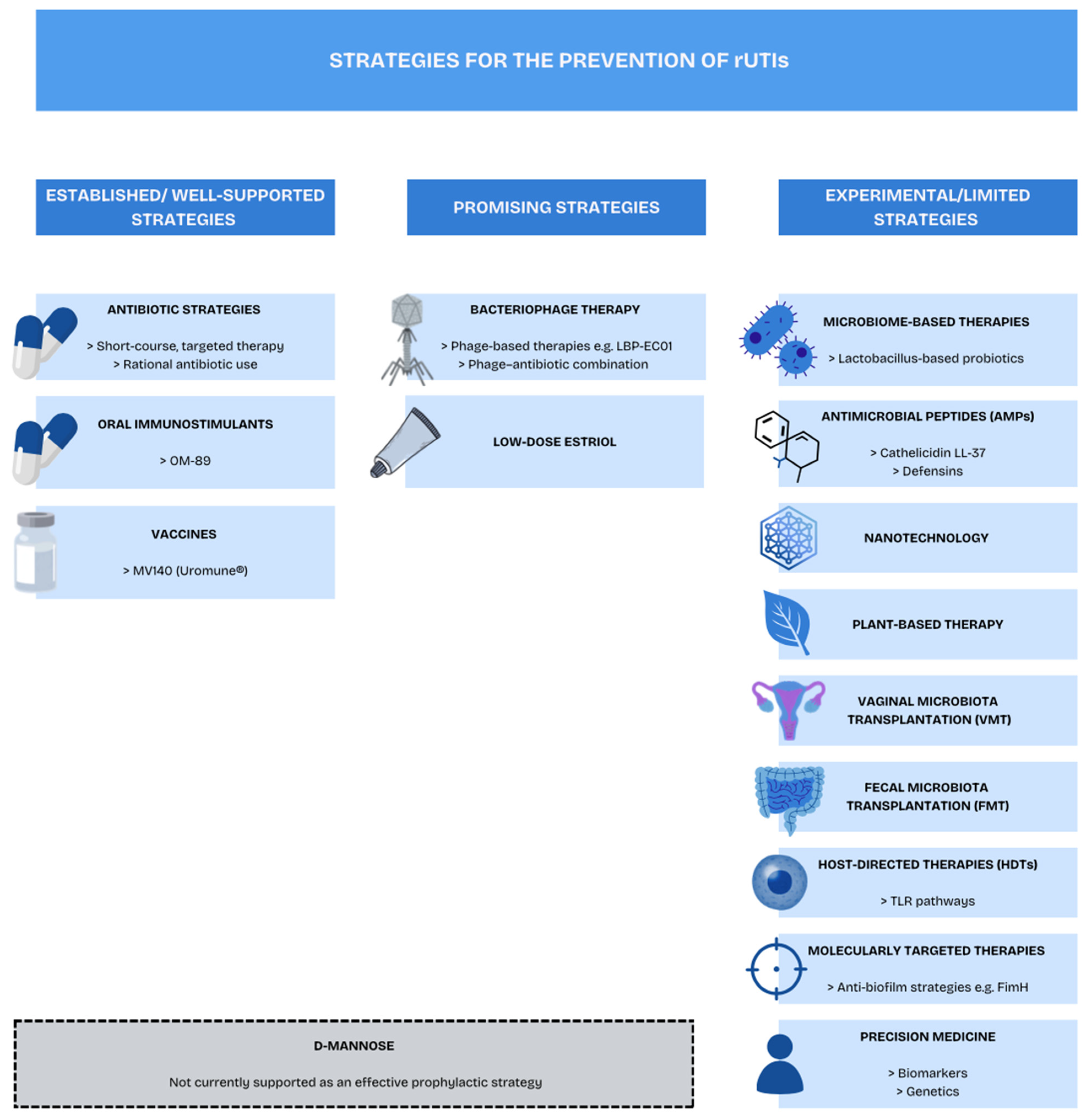
The main preventive strategies, together with their study designs, sample sizes, main findings and limitations are summarized in Table 2. The classification of these strategies according to the level of available evidence is presented in Figure 2.
Table 2.
Characteristics and level of evidence of studies evaluating strategies for the prevention of recurrent urinary tract infections. Abbreviations: UTI—urinary tract infection; RR—risk ratio; CI—confidence interval; RCT—randomized controlled trial; rUTIs—recurrent urinary tract infections; UPEC—uropathogenic Escherichia coli.
Figure 2.
Strategies for the prevention of rUTIs divided into three categories: established/well-supported, promising, and experimental. Abbreviations: rUTIs—Recurrent urinary tract infections; AMPs—Antimicrobial peptides; VMT—Vaginal microbiota transplantation; FMT—Fecal microbiota transplantation; HDTs—Host-directed therapies; TLR—Toll-like receptor. Note: Evidence categories reflect the overall level and maturity of evidence described in this narrative review and do not represent a formal risk-of-bias or GRADE assessment.
10. Conclusions
Contemporary management of recurrent UTIs continues to rely on antibiotic therapy, while selected non-antibiotic strategies have gained increasing attention as preventive approaches. Clinically supported interventions include immunoprophylaxis and selected vaccines, whereas microbiome-targeted therapies and bacteriophage therapies remain promising but exploratory and require further validation before their preventive efficacy can be established. The strength of clinical evidence varies between interventions and study designs. Other approaches, including AMPs, host-directed therapies, nanotechnology-based drug delivery systems, and anti-biofilm strategies, remain largely preclinical or investigational. Vaginal microbiota transplantation, FimH-targeted approaches, and anakinra also remain exploratory and should not be considered established preventive interventions in women with recurrent uncomplicated UTIs. Evidence from studies of vaginal dysbiosis or bacterial eradication alone should not be interpreted as direct evidence of preventive efficacy against recurrent UTIs. Advances in understanding host immune responses and the role of the intestinal and vaginal microbiota may further support the development of personalized prevention. Although several emerging interventions, including plant-derived compounds, show promise, others, such as D-mannose, have not demonstrated consistent clinical benefit and require further high-quality clinical studies to clarify their role in preventing rUTIs before consideration for routine clinical implementation. Overall, the available evidence for several emerging strategies remains indirect, experimental, or preclinical, and their potential role in rUTI prevention requires confirmation in well-designed clinical studies.
Author Contributions
Conceptualization, D.Z., W.K., T.S. and B.M.; methodology, D.Z., N.L., M.K. and W.K.; investigation, D.Z., N.L., M.K., H.G., O.R., M.H., P.M., Ł.N. and D.J.; data curation, D.Z., N.L., M.K., H.G. and O.R.; writing—original draft preparation, D.Z., N.L., M.K., H.G., O.R., M.H., P.M., Ł.N. and D.J.; writing—review and editing, D.Z., N.L., M.K., H.G., O.R., M.H., P.M., Ł.N., D.J., W.K., T.S. and B.M.; visualization, D.Z., M.K. and H.G.; supervision, W.K., T.S. and B.M.; project administration, D.Z., W.K. and B.M. All authors have read and agreed to the published version of the manuscript.
Funding
This work was supported by Wroclaw Medical University Research Grant No. SUBZ.C090.26.080.
Institutional Review Board Statement
Not applicable.
Informed Consent Statement
Not applicable.
Data Availability Statement
No new data were created or analyzed in this study. Data sharing is not applicable to this article.
Conflicts of Interest
The authors declare no conflicts of interest.
References
- EAU Guidelines on Urological Infections—Introduction. Available online: https://uroweb.org/guidelines/urological-infections (accessed on 29 August 2026).
- Medina, M.; Castillo-Pino, E. An introduction to the epidemiology and burden of urinary tract infections. Ther. Adv. Urol. 2019, 11, 1756287219832172. [Google Scholar] [CrossRef] [Scilit] [PubMed]
- Sokhn, E.S.; Salami, A.; Roz, A.E.; Salloum, L.; Bahmad, H.F.; Ghssein, G. Antimicrobial Susceptibilities and Laboratory Profiles of Escherichia coli, Klebsiella pneumoniae, and Proteus mirabilis Isolates as Agents of Urinary Tract Infection in Lebanon: Paving the Way for Better Diagnostics. Med. Sci. 2020, 8, 32. [Google Scholar] [CrossRef] [Scilit] [PubMed]
- McCallin, S.; Kessler, T.M.; Leitner, L. Management of uncomplicated urinary tract infection in the post-antibiotic era: Select non-antibiotic approaches. Clin. Microbiol. Infect. 2023, 29, 1267–1271. [Google Scholar] [CrossRef] [Scilit] [PubMed]
- Hjelholt, A.J.; Hjelholt, T.J.; Azuz, S. Pharmacological prevention of recurrent urinary tract infections. Ugeskr. Laeger 2025, 187, V01250039. [Google Scholar] [CrossRef] [Scilit] [PubMed]
- Hsu, Y.T.; Wu, H.C.; Tsai, C.C.; Tsai, Y.C.; Kuo, C.Y. Plant Extracts and Natural Compounds for the Treatment of Urinary Tract Infections in Women: Mechanisms, Efficacy, and Therapeutic Potential. Curr. Issues Mol. Biol. 2025, 47, 591. [Google Scholar] [CrossRef] [Scilit] [PubMed]
- Cassir, N.; Ghani, R.; Biehl, L.M.; Graells, T.; Kuijper, E.J.; Mullish, B.H.; Marchesi, J.R.; Benech, N. Nonantimicrobial therapies for recurrent urinary tract infection in women: Is there a place for faecal microbiota transfer? Clin. Microbiol. Infect. 2025, 31, 1985–1992. [Google Scholar] [CrossRef] [Scilit] [PubMed]
- Haley, E.; Luke, N. From Awareness to Action: Pioneering Solutions for Women’s UTI Challenges in the Era of Precision Medicine. Int. J. Womens Health 2024, 16, 1595–1605. [Google Scholar] [CrossRef] [Scilit] [PubMed]
- Baethge, C.; Goldbeck-Wood, S.; Mertens, S. SANRA—A scale for the quality assessment of narrative review articles. Res. Integr. Peer Rev. 2019, 4, 5. [Google Scholar] [CrossRef] [Scilit] [PubMed]
- Sabir, N.; Ikram, A.; Zaman, G.; Satti, L.; Gardezi, A.; Ahmed, A.; Ahmed, P. Bacterial biofilm-based catheter-associated urinary tract infections: Causative pathogens and antibiotic resistance. Am. J. Infect. Control 2017, 45, 1101–1105. [Google Scholar] [CrossRef] [Scilit] [PubMed]
- Mahshouri, P.; Alikhani, M.Y.; Momtaz, H.E.; Doosti-Irani, A.; Shokoohizadeh, L. Analysis of phylogroups, biofilm formation, virulence factors, antibiotic resistance and molecular typing of uropathogenic Escherichia coli strains isolated from patients with recurrent and non-recurrent urinary tract infections. BMC Infect. Dis. 2025, 25, 267. [Google Scholar] [CrossRef] [Scilit] [PubMed]
- Mahale, R.P.; Anuradha, K.; Princy, A.; Maheshwarappa, Y.D.; Sumana, M.N. Comparative evaluation of biofilm-forming capacity in uropathogenic and commensal Escherichia coli. Front. Cell. Infect. Microbiol. 2025, 15, 1570422. [Google Scholar] [CrossRef] [Scilit] [PubMed]
- Falk, K.N.; Satola, S.W.; Chassagne, F.; Northington, G.M.; Quave, C.L. Biofilm Production by Uropathogens in Postmenopausal Women with Recurrent and Isolated Urinary Tract Infection. Urogynecology 2022, 28, e127. [Google Scholar] [CrossRef] [Scilit]
- He, W.; Ma, P.; Li, L.; Wang, D.; Li, X.; Wen, X.; Zuo, Y.; Guo, Q.; Zhang, Y.; Cheng, R.; et al. Efficacy and safety of preventing catheter-associated urinary tract infection by inhibiting catheter bacterial biofilm formation: A multicenter randomized controlled trial. Antimicrob. Resist. Infect. Control 2024, 13, 96. [Google Scholar] [CrossRef] [Scilit] [PubMed]
- Walker, J.N.; Flores-Mireles, A.L.; Lynch, A.J.L.; Pinkner, C.; Caparon, M.G.; Hultgren, S.J.; Desai, A. High-resolution imaging reveals microbial biofilms on patient urinary catheters despite antibiotic administration. World J. Urol. 2020, 38, 2237–2245. [Google Scholar] [CrossRef] [Scilit] [PubMed]
- Wen, M.M.; Abdelwahab, I.A.; Abozahra, R.; Abdelhamid, S.M.; Baraka, K.; Ahmed, H.E.S.; El-Hadidy, W.F. Sustainable nanophytosome-based therapies against multidrug-resistant Escherichia coli in urinary tract infections: An in vitro and in vivo study. J. Nanobiotechnol. 2025, 23, 174. [Google Scholar] [CrossRef] [Scilit] [PubMed]
- Saini, H.; Vadekeetil, A.; Chhibber, S.; Harjai, K. Azithromycin-Ciprofloxacin-Impregnated Urinary Catheters Avert Bacterial Colonization, Biofilm Formation, and Inflammation in a Murine Model of Foreign-Body-Associated Urinary Tract Infections Caused by Pseudomonas aeruginosa. Antimicrob. Agents Chemother. 2017, 61, e01906-16. [Google Scholar] [CrossRef] [Scilit] [PubMed]
- Hultqvist, L.D.; Andersen, J.B.; Nilsson, C.M.; Jansen, C.U.; Rybtke, M.; Jakobsen, T.H.; Nielsen, T.E.; Qvortrup, K.; Moser, C.; Graz, M.; et al. High efficacy treatment of murine Pseudomonas aeruginosa catheter-associated urinary tract infections using the c-di-GMP modulating anti-biofilm compound Disperazol in combination with ciprofloxacin. Antimicrob. Agents Chemother. 2024, 68, e01481-23. [Google Scholar] [CrossRef] [Scilit] [PubMed]
- Leclercq, S.Y.; Sullivan, M.J.; Ipe, D.S.; Smith, J.P.; Cripps, A.W.; Ulett, G.C. Pathogenesis of Streptococcus urinary tract infection depends on bacterial strain and β-hemolysin/cytolysin that mediates cytotoxicity, cytokine synthesis, inflammation and virulence. Sci. Rep. 2016, 6, 29000. [Google Scholar] [CrossRef] [Scilit] [PubMed]
- Zheng, H.; Liu, Y.; Zhang, Y.; Jiang, S.; Yu, X.; Wang, C.; Wang, G.; Liu, C.; Liu, J.; Wang, F. Cynaroside attenuates uropathogenic Escherichia coli adhesion and invasion by suppressing bacterial virulence and down-modulating urothelial Caveolin-1 signaling. Phytomedicine 2026, 150, 157594. [Google Scholar] [CrossRef] [Scilit] [PubMed]
- Fang, Y.; Tao, S.; Chen, H.; Xu, Y.; Chen, L.; Liang, W. Influence of bacterial morphotype on urine culture and molecular epidemiological differences in Escherichia coli harboring bacterial morphotype-induced urinary tract infections. Microbiol. Spectr. 2025, 13, e00980-24. [Google Scholar] [CrossRef] [Scilit] [PubMed]
- Sheikhi, R.; Amini, M.E.; Alidoust, L.; Roushan, Z.A.; Nikokar, I. Evaluation of adhesin genes and risk factors associated with urinary tract infections by drug-resistant uropathogenic Escherichia coli in North of Iran. J. Infect. Dev. Ctries. 2024, 18, 761–769. [Google Scholar] [CrossRef] [Scilit] [PubMed]
- Timm, M.R.; Tamadonfar, K.O.; Nye, T.M.; Villicaña, J.B.; Pinkner, J.S.; Dodson, K.W.; Ellebedy, A.H.; Hultgren, S.J. Vaccination with Acinetobacter baumannii adhesin Abp2D provides protection against catheter-associated urinary tract infection. Nat. Commun. 2025, 16, 7341. [Google Scholar] [CrossRef] [Scilit] [PubMed]
- de Monerri, N.C.S.; Che, Y.; Lees, J.A.; Jasti, J.; Wu, H.; Griffor, M.C.; Kodali, S.; Hawkins, J.C.; Lypowy, J.; Ponce, C.; et al. Structure-based design of an immunogenic, conformationally stabilized FimH antigen for a urinary tract infection vaccine. PLoS Pathog. 2025, 21, e1012325. [Google Scholar] [CrossRef] [Scilit] [PubMed]
- Worby, C.J.; Schreiber, H.L.; Straub, T.J.; van Dijk, L.R.; Bronson, R.A.; Olson, B.S.; Pinkner, J.S.; Obernuefemann, C.L.P.; Muñoz, V.L.; Paharik, A.E.; et al. Longitudinal multi-omics analyses link gut microbiome dysbiosis with recurrent urinary tract infections in women. Nat. Microbiol. 2022, 7, 630–639. [Google Scholar] [CrossRef] [Scilit] [PubMed]
- Jeong, S.H.; Vasavada, S.P.; Lashner, B.; Werneburg, G.T. Fecal Microbiota Transplant Is Associated with Resolution of Recurrent Urinary Tract Infection. Urology 2025, 204, 69–75. [Google Scholar] [CrossRef] [Scilit] [PubMed]
- Yang, Y.; Chen, H.; Lu, J.; Yang, N.; Liu, L.; Zhang, Q.; Tang, M.; Li, X.; Meng, B.; Li, Y.; et al. Modulating the gut-bladder axis: Fecal transplantation protects antibiotic-treated mice from E. coli cystitis via the Ahr/Prg4 pathway. Microbiome 2025, 14, 15. [Google Scholar] [CrossRef] [Scilit] [PubMed]
- Leccese Terraf, M.C.; Juarez Tomás, M.S.; Rault, L.; Le Loir, Y.; Even, S.; Nader-Macías, M.E.F. In vitro effect of vaginal lactobacilli on the growth and adhesion abilities of uropathogenic Escherichia coli. Arch. Microbiol. 2017, 199, 767–774. [Google Scholar] [CrossRef] [Scilit] [PubMed]
- Gupta, V.; Mastromarino, P.; Garg, R. Effectiveness of Prophylactic Oral and/or Vaginal Probiotic Supplementation in the Prevention of Recurrent Urinary Tract Infections: A Randomized, Double-Blind, Placebo-Controlled Trial. Clin. Infect. Dis. 2024, 78, 1154–1161. [Google Scholar] [CrossRef] [Scilit] [PubMed]
- Muiños Fernández, N.; Martínez Salamanca, J.I.; Pardo González de Quevedo, J.I.; Diz Morales, M.P.; Palomo Alameda, L.; Duce Tello, S.; González Béjar, M.; Rabanal Carrera, A.; Rosado Martín, J.; Noguera Vera, L.; et al. Efficacy and safety of an ultra-low-dose 0.005% estriol vaginal gel in the prevention of urinary tract infections in postmenopausal women with genitourinary syndrome of menopause: A randomized double-blind placebo-controlled trial. Maturitas 2024, 190, 108128. [Google Scholar] [CrossRef] [Scilit] [PubMed]
- Peelaerts, W.; Mercado, G.; George, S.; Villumsen, M.; Kasen, A.; Aguileta, M.; Linstow, C.; Sutter, A.B.; Kuhn, E.; Stetzik, L.; et al. Urinary tract infections trigger synucleinopathy via the innate immune response. Acta Neuropathol. 2023, 145, 541–559. [Google Scholar] [CrossRef] [Scilit] [PubMed]
- Scharff, A.Z.; Rousseau, M.; Mariano, L.L.; Canton, T.; Consiglio, C.R.; Albert, M.L.; Fontes, M.; Duffy, D.; Ingersoll, M.A. Sex differences in IL-17 contribute to chronicity in male versus female urinary tract infection. JCI Insight 2019, 4, e122998. [Google Scholar] [CrossRef] [Scilit] [PubMed]
- Terpstra, M.L.; Remmerswaal, E.B.M.; van Aalderen, M.C.; Wever, J.J.; Sinnige, M.J.; van der Bom-Baylon, N.D.; Bemelman, F.J.; Geerlings, S.E. Circulating mucosal-associated invariant T cells in subjects with recurrent urinary tract infections are functionally impaired. Immun. Inflamm. Dis. 2020, 8, 80–92. [Google Scholar] [CrossRef] [Scilit] [PubMed]
- Wong, E.S.; McKevitt, M.; Running, K.; Counts, G.W.; Turck, M.; Stamm, W.E. Management of recurrent urinary tract infections with patient-administered single-dose therapy. Ann. Intern. Med. 1985, 102, 302–307. [Google Scholar] [CrossRef] [Scilit] [PubMed]
- Beerepoot, M.A.J.; ter Riet, G.; Nys, S.; van der Wal, W.M.; de Borgie, C.A.J.M.; de Reijke, T.M.; Prins, J.M.; Koeijers, J.; Verbon, A.; Stobberingh, E.; et al. Cranberries vs. antibiotics to prevent urinary tract infections: A randomized double-blind noninferiority trial in premenopausal women. Arch. Intern. Med. 2011, 171, 1270–1278. [Google Scholar] [CrossRef] [Scilit] [PubMed]
- Harding, C.; Chadwick, T.; Homer, T.; Lecouturier, J.; Mossop, H.; Carnell, S.; King, W.; Abouhajar, A.; Vale, L.; Watson, G.; et al. Methenamine hippurate compared with antibiotic prophylaxis to prevent recurrent urinary tract infections in women: The ALTAR non-inferiority RCT. Health Technol. Assess. 2022, 26, 1–172. [Google Scholar] [CrossRef] [Scilit] [PubMed]
- Schaeffer, A.J.; Stuppy, B.A. Efficacy and safety of self-start therapy in women with recurrent urinary tract infections. J. Urol. 1999, 161, 207–211. [Google Scholar] [CrossRef] [Scilit]
- Llor, C.; Ouchi, D.; Fernández-García, S.; Giner-Soriano, M.; Moragas, A.; Morros, R. Exposure to suppressive antibiotic therapy in women with recurrent urinary tract infections and severity of infections: A retrospective population-based cohort study. BMJ Open 2025, 15, e098371. [Google Scholar] [CrossRef] [Scilit] [PubMed]
- Stapleton, A.; Latham, R.H.; Johnson, C.; Stamm, W.E. Postcoital Antimicrobial Prophylaxis for Recurrent Urinary Tract Infection: A Randomized, Double-blind, Placebo-Controlled Trial. JAMA 1990, 264, 703–706. [Google Scholar] [CrossRef] [Scilit]
- Song, C.H.; Kim, Y.H.; Naskar, M.; Hayes, B.W.; Abraham, M.A.; Noh, J.H.; Suk, G.; Kim, M.J.; Cho, K.S.; Shin, M.; et al. Lactobacillus crispatus Limits Bladder Uropathogenic E. coli Infection by Triggering a Host Type I Interferon Response. Proc. Natl. Acad. Sci. USA 2022, 119, e2117904119. [Google Scholar] [CrossRef] [Scilit]
- Abad, C.L.; Safdar, N. The Role of Lactobacillus Probiotics in the Treatment or Prevention of Urogenital Infections—A Systematic Review. J. Chemother. 2009, 21, 243–252. [Google Scholar] [CrossRef] [Scilit] [PubMed]
- Falagas, M.E.; Betsi, G.I.; Tokas, T.; Athanasiou, S. Probiotics for Prevention of Recurrent Urinary Tract Infections in Women. Drugs 2006, 66, 1253–1261. [Google Scholar] [CrossRef] [Scilit] [PubMed]
- Pan, M.; Hidalgo-Cantabrana, C.; Goh, Y.J.; Sanozky-Dawes, R.; Barrangou, R. Comparative Analysis of Lactobacillus gasseri and Lactobacillus crispatus Isolated from Human Urogenital and Gastrointestinal Tracts. Front. Microbiol. 2020, 10, 3146. [Google Scholar] [CrossRef] [Scilit] [PubMed]
- Stapleton, A.E. The Vaginal Microbiota and Urinary Tract Infection. Microbiol. Spectr. 2016, 4. [Google Scholar] [CrossRef] [Scilit]
- Eschenbach, D.A.; Davick, P.R.; Williams, B.L.; Klebanoff, S.J.; Young-Smith, K.; Critchlow, C.M.; Holmes, K.K. Prevalence of hydrogen peroxide-producing Lactobacillus species in normal women and women with bacterial vaginosis. J. Clin. Microbiol. 1989, 27, 251–256. [Google Scholar] [CrossRef] [Scilit] [PubMed]
- Osset, J.; Bartolomé, R.M.; García, E.; Andreu, A. Assessment of the Capacity of Lactobacillus to Inhibit the Growth of Uropathogens and Block Their Adhesion to Vaginal Epithelial Cells. J. Infect. Dis. 2001, 183, 485–491. [Google Scholar] [CrossRef] [Scilit] [PubMed]
- Ackerman, A.L.; Bradley, M.; D’Anci, K.E.; Hickling, D.; Kim, S.K.; Kirkby, E. Updates to Recurrent Uncomplicated Urinary Tract Infections in Women: AUA/CUA/SUFU Guideline (2025). J. Urol. 2026, 215, 3–12. [Google Scholar] [CrossRef] [Scilit] [PubMed]
- Naber, K.G.; Schito, G.; Botto, H.; Palou, J.; Mazzei, T. Surveillance Study in Europe and Brazil on Clinical Aspects and Antimicrobial Resistance Epidemiology in Females with Cystitis (ARESC): Implications for Empiric Therapy. Eur. Urol. 2008, 54, 1164–1178. [Google Scholar] [CrossRef] [Scilit] [PubMed]
- Mak, Q.; Greig, J.; Dasgupta, P.; Malde, S.; Raison, N. Bacterial Vaccines for the Management of Recurrent Urinary Tract Infections: A Systematic Review and Meta-analysis. Eur. Urol. Focus 2024, 10, 761–769. [Google Scholar] [CrossRef] [Scilit] [PubMed]
- Prattley, S.; Geraghty, R.; Moore, M.; Somani, B.K. Role of Vaccines for Recurrent Urinary Tract Infections: A Systematic Review. Eur. Urol. Focus 2020, 6, 593–604. [Google Scholar] [CrossRef] [Scilit] [PubMed]
- Aziminia, N.; Hadjipavlou, M.; Philippou, Y.; Pandian, S.S.; Malde, S.; Hammadeh, M.Y. Vaccines for the prevention of recurrent urinary tract infections: A systematic review. BJU Int. 2019, 123, 753–768. [Google Scholar] [CrossRef] [Scilit] [PubMed]
- Volontè, S.; De Vicari, D.; Cola, A.; Barba, M.; Frigerio, M. Efficacy and Safety of Uro-Vaxom in Urinary Tract Infection Prevention: A Systematic Literature Review. J. Clin. Med. 2025, 14, 3836. [Google Scholar] [CrossRef] [Scilit] [PubMed]
- Ulett, G.C.; Totsika, M.; Schaale, K.; Carey, A.J.; Sweet, M.J.; Schembri, M.A. Uropathogenic Escherichia coli virulence and innate immune responses during urinary tract infection. Curr. Opin. Microbiol. 2013, 16, 100–107. [Google Scholar] [CrossRef] [Scilit] [PubMed]
- Gilbart, J. Recurrent uncomplicated urinary tract infections-the place of immuno-prophylaxis. Eur. Urol. Rev. 2011, 6, 114–119. [Google Scholar]
- Taha Neto, K.A.; Nogueira Castilho, L.; Reis, L.O. Oral vaccine (OM-89) in the recurrent urinary tract infection prophylaxis: A realistic systematic review with meta-analysis. Actas Urol. Esp. 2016, 40, 203–208. [Google Scholar] [CrossRef] [Scilit]
- Beerepoot, M.A.J.; Geerlings, S.E.; Van Haarst, E.P.; Van Charante, N.M.; Ter Riet, G. Nonantibiotic Prophylaxis for Recurrent Urinary Tract Infections: A Systematic Review and Meta-Analysis of Randomized Controlled Trials. J. Urol. 2013, 190, 1981–1989. [Google Scholar] [CrossRef] [Scilit] [PubMed]
- Kim, K.S.; Kim, J.-Y.; Jeong, I.G.; Paick, J.-S.; Son, H.; Lim, D.J.; Shim, H.B.; Park, W.H.; Jung, H.C.; Choo, M.-S. A Prospective Multi-center Trial of Escherichia coli Extract for the Prophylactic Treatment of Patients with Chronically Recurrent Cystitis. J. Korean Med. Sci. 2010, 25, 435. [Google Scholar] [CrossRef] [Scilit] [PubMed]
- Yang, B.; Foley, S. First experience in the UK of treating women with recurrent urinary tract infections with the bacterial vaccine Uromune®. BJU Int. 2018, 121, 289–292. [Google Scholar] [CrossRef] [Scilit] [PubMed]
- Hopkins, W.J.; Elkahwaji, J.; Beierle, L.M.; Leverson, G.E.; Uehling, D.T. Vaginal Mucosal Vaccine for Recurrent Urinary Tract Infections in Women: Results of a Phase 2 Clinical Trial. J. Urol. 2007, 177, 1349–1353. [Google Scholar] [CrossRef] [Scilit] [PubMed]
- Lorenzo-Gómez, M.-F.; Foley, S.; Nickel, J.C.; García-Cenador, M.-B.; Padilla-Fernández, B.-Y.; González-Casado, I.; Martínez-Huélamo, M.; Yang, B.; Blick, C.; Ferreira, F.; et al. Sublingual MV140 for Prevention of Recurrent Urinary Tract Infections. NEJM Evid. 2022, 1, EVIDoa2100018, Correction in NEJM Evid. 2022, 1, EVIDx2200081. [Google Scholar] [CrossRef] [Scilit] [PubMed]
- Curtis Nickel, J.; Foley, S.; Yang, B.; Casanovas, M.; Caballero, R.; Diez-Rivero, C.M.; Lorenzo-Gómez, M.-F. Reducing Recurrent Urinary Tract Infections in Women with MV140 Impacts Personal Burden of Disease: Secondary Analyses of a Randomized Placebo-controlled Efficacy Study. Eur. Urol. Open Sci. 2024, 63, 96–103. [Google Scholar] [CrossRef] [Scilit] [PubMed]
- Ramírez Sevilla, C.; Gómez Lanza, E.; Puyol Pallàs, M. Immunoactive Prophylaxis Protocol of Uncomplicated Recurrent Urinary Tract Infections in a Cohort of 1104 Women Treated with Uromune® Vaccine. Life 2024, 14, 464. [Google Scholar] [CrossRef] [Scilit] [PubMed]
- Patki, A.; Pandit, S.; Ashraf, N.; Makhwana, S.; Ghosh Dastidar, B. Expert Opinion on the Use of Probiotics in General Gynecological Conditions. Cureus 2025, 17, e80875. [Google Scholar] [CrossRef] [Scilit] [PubMed]
- Ansari, A.Z.; Son, D.; Hur, Y.M.; Park, S.; You, Y.A.; Kim, S.M.; Lee, G.; Kang, S.; Chung, Y.; Lim, S.; et al. Lactobacillus Probiotics Improve Vaginal Dysbiosis in Asymptomatic Women. Nutrients 2023, 15, 1862. [Google Scholar] [CrossRef] [Scilit] [PubMed]
- Chen, R.; Li, R.; Qing, W.; Zhang, Y.; Zhou, Z.; Hou, Y.; Shi, Y.; Zhou, H.; Chen, M. Probiotics are a good choice for the treatment of bacterial vaginosis: A meta-analysis of randomized controlled trial. Reprod. Health 2022, 19, 137. [Google Scholar] [CrossRef] [Scilit] [PubMed]
- Rezazadeh, M.B.; Zanganeh, M.; Jarahi, L.; Fatehi, Z. Comparative efficacy of oral and vaginal probiotics in reducing the recurrence of bacterial vaginosis: A double-blind clinical trial. BMC Womens Health 2024, 24, 575. [Google Scholar] [CrossRef] [Scilit] [PubMed]
- Vinueza, A.M.Z. Probiotics for the Prevention of Vaginal Infections: A Systematic Review. Cureus 2024, 16, e64473. [Google Scholar] [CrossRef] [Scilit] [PubMed]
- Mei, Z.; Li, D. The role of probiotics in vaginal health. Front. Cell. Infect. Microbiol. 2022, 12, 963868. [Google Scholar] [CrossRef] [Scilit] [PubMed]
- Luo, H.; Zhou, C.; Zhou, L.; He, Y.; Xie, R.-H. The effectiveness of vaginal microbiota transplantation for vaginal dysbiosis and bacterial vaginosis: A scoping review. Arch. Gynecol. Obstet. 2024, 310, 643–653. [Google Scholar] [CrossRef] [Scilit] [PubMed]
- Pirnay, J.-P.; Djebara, S.; Steurs, G.; Griselain, J.; Cochez, C.; De Soir, S.; Glonti, T.; Spiessens, A.; Berghe, E.V.; Green, S.; et al. Personalized bacteriophage therapy outcomes for 100 consecutive cases: A multicentre, multinational, retrospective observational study. Nat. Microbiol. 2024, 9, 1434–1453. [Google Scholar] [CrossRef] [Scilit] [PubMed]
- Altamirano, F.L.G.; Kostoulias, X.; Subedi, D.; Korneev, D.; Peleg, A.Y.; Barr, J.J. Phage-antibiotic combination is a superior treatment against Acinetobacter baumannii in a preclinical study. eBioMedicine 2022, 80, 104045. [Google Scholar] [CrossRef] [Scilit] [PubMed]
- Terwilliger, A.; Clark, J.; Karris, M.; Hernandez-Santos, H.; Green, S.; Aslam, S.; Maresso, A. Phage Therapy Related Microbial Succession Associated with Successful Clinical Outcome for a Recurrent Urinary Tract Infection. Viruses 2021, 13, 2049. [Google Scholar] [CrossRef] [Scilit] [PubMed]
- Łusiak-Szelachowska, M.; Żaczek, M.; Weber-Dąbrowska, B.; Międzybrodzki, R.; Kłak, M.; Fortuna, W.; Letkiewicz, S.; Rogóż, P.; Szufnarowski, K.; Jończyk-Matysiak, E.; et al. Phage Neutralization by Sera of Patients Receiving Phage Therapy. Viral Immunol. 2014, 27, 295–304. [Google Scholar] [CrossRef] [Scilit] [PubMed]
- Engel, D.R.; Wagenlehner, F.M.E.; Shevchuk, O. Scientific Advances in Understanding the Pathogenesis, Diagnosis, and Prevention of Urinary Tract Infection in the Past 10 Years. Infect. Dis. Clin. N. Am. 2024, 38, 229–240. [Google Scholar] [CrossRef] [Scilit] [PubMed]
- Zacchè, M.M.; Giarenis, I. Therapies in early development for the treatment of urinary tract inflammation. Expert Opin. Investig. Drugs 2016, 25, 531–540. [Google Scholar] [CrossRef] [Scilit] [PubMed]
- Kuhn, H.W.; Hreha, T.N.; Hunstad, D.A. Immune defenses in the urinary tract. Trends Immunol. 2023, 44, 701–711. [Google Scholar] [CrossRef] [Scilit] [PubMed]
- Voss, H.; Robert Engel, D.; Wagenlehner, F.; Shevchuk, O. Discovery of Antimicrobial Peptides in Urinary Tract Infections. Eur. Urol. Focus 2024, 10, 710–712. [Google Scholar] [CrossRef] [Scilit] [PubMed]
- Sorić Hosman, I.; Cvitković Roić, A.; Vuković Brinar, I.; Gulin, T.; Ćorić, M.; Rogić, D.; Lončar Vrančić, A.; Lamot, L. Cathelicidin in Urinary Tract Diseases: Diagnostic, Prognostic and Therapeutic Potential of an Evolutionary Conserved Antimicrobial Protein. Medicina 2024, 60, 2015. [Google Scholar] [CrossRef] [Scilit] [PubMed]
- Nielsen, K.L.; Dynesen, P.; Larsen, P.; Jakobsen, L.; Andersen, P.S.; Frimodt-Møller, N. Role of Urinary Cathelicidin LL-37 and Human β-Defensin 1 in Uncomplicated Escherichia coli Urinary Tract Infections. Infect. Immun. 2014, 82, 1572–1578. [Google Scholar] [CrossRef] [Scilit] [PubMed]
- Ali, A.S.M.; Mowbray, C.; Lanz, M.; Stanton, A.; Bowen, S.; Varley, C.L.; Hilton, P.; Brown, K.; Robson, W.; Southgate, J.; et al. Targeting Deficiencies in the TLR5 Mediated Vaginal Response to Treat Female Recurrent Urinary Tract Infection. Sci. Rep. 2017, 7, 11039. [Google Scholar] [CrossRef] [Scilit] [PubMed]
- Lüthje, P.; Lindén Hirschberg, A.; Brauner, A. Estrogenic action on innate defense mechanisms in the urinary tract. Maturitas 2014, 77, 32–36. [Google Scholar] [CrossRef] [Scilit] [PubMed]
- Chen, Y.-Y.; Su, T.-H.; Lau, H.-H. Estrogen for the prevention of recurrent urinary tract infections in postmenopausal women: A meta-analysis of randomized controlled trials. Int. Urogynecol. J. 2021, 32, 17–25. [Google Scholar] [CrossRef] [Scilit] [PubMed]
- Zacchè, M.M.; Srikrishna, S.; Cardozo, L. Novel targeted bladder drug-delivery systems: A review. Res. Rep. Urol. 2015, 7, 169–178. [Google Scholar] [CrossRef] [Scilit] [PubMed]
- Esim, O.; Kiymaci, M.E.; Hascicek, C. Ciprofloxacin HCl-loaded Albumin Nanoparticles for the Treatment of Recurrent Urinary Tract Infections: Preparation, Optimization, and Evaluation of Antibacterial Activity. J. Pharm. Innov. 2023, 18, 1100–1110. [Google Scholar] [CrossRef] [Scilit]
- Crintea, A.; Carpa, R.; Mitre, A.-O.; Petho, R.I.; Chelaru, V.-F.; Nădășan, S.-M.; Neamti, L.; Dutu, A.G. Nanotechnology Involved in Treating Urinary Tract Infections: An Overview. Nanomaterials 2023, 13, 555. [Google Scholar] [CrossRef] [Scilit] [PubMed]
- Song, Y.; Elsabahy, M.; Collins, C.A.; Khan, S.; Li, R.; Hreha, T.N.; Shen, Y.; Lin, Y.-N.; Letteri, R.A.; Su, L.; et al. Morphologic Design of Silver-Bearing Sugar-Based Polymer Nanoparticles for Uroepithelial Cell Binding and Antimicrobial Delivery. Nano Lett. 2021, 21, 4990–4998. [Google Scholar] [CrossRef] [Scilit] [PubMed]
- Hannan, T.J.; Roberts, P.L.; Riehl, T.E.; van der Post, S.; Binkley, J.M.; Schwartz, D.J.; Miyoshi, H.; Mack, M.; Schwendener, R.A.; Hooton, T.M.; et al. Inhibition of Cyclooxygenase-2 Prevents Chronic and Recurrent Cystitis. EBioMedicine 2014, 1, 46–57. [Google Scholar] [CrossRef] [Scilit] [PubMed]
- Ambite, I.; Puthia, M.; Nagy, K.; Cafaro, C.; Nadeem, A.; Butler, D.S.C.; Rydström, G.; Filenko, N.A.; Wullt, B.; Miethke, T.; et al. Molecular Basis of Acute Cystitis Reveals Susceptibility Genes and Immunotherapeutic Targets. PLoS Pathog. 2016, 12, e1005848. [Google Scholar] [CrossRef] [Scilit] [PubMed]
- Ambite, I.; Pilatz, A.; Buch-Heberling, M.; Ahmadi, S.; Godaly, G.; Wagenlehner, F.; Svanborg, C. Targeted innate immune inhibition therapy compared with antibiotics for recurrent acute cystitis: A randomized, open-label phase 2 trial. Nat. Microbiol. 2026, 11, 638–647. [Google Scholar] [CrossRef] [Scilit] [PubMed]
- Lila, A.S.A.; Rajab, A.A.H.; Abdallah, M.H.; Rizvi, S.M.D.; Moin, A.; Khafagy, E.-S.; Tabrez, S.; Hegazy, W.A.H. Biofilm Lifestyle in Recurrent Urinary Tract Infections. Life 2023, 13, 148. [Google Scholar] [CrossRef] [Scilit] [PubMed]
- Sarshar, M.; Behzadi, P.; Ambrosi, C.; Zagaglia, C.; Palamara, A.T.; Scribano, D. FimH and Anti-Adhesive Therapeutics: A Disarming Strategy Against Uropathogens. Antibiotics 2020, 9, 397. [Google Scholar] [CrossRef] [Scilit] [PubMed]
- Klein, T.; Abgottspon, D.; Wittwer, M.; Rabbani, S.; Herold, J.; Jiang, X.; Kleeb, S.; Lüthi, C.; Scharenberg, M.; Bezençon, J.; et al. FimH Antagonists for the Oral Treatment of Urinary Tract Infections: From Design and Synthesis to In Vitro and In Vivo Evaluation. J. Med. Chem. 2010, 53, 8627–8641. [Google Scholar] [CrossRef] [Scilit] [PubMed]
- Kleeb, S.; Pang, L.; Mayer, K.; Eris, D.; Sigl, A.; Preston, R.C.; Zihlmann, P.; Sharpe, T.; Jakob, R.P.; Abgottspon, D.; et al. FimH antagonists: Bioisosteres to improve the in vitro and in vivo PK/PD profile. J. Med. Chem. 2015, 58, 2221–2239. [Google Scholar] [CrossRef] [Scilit] [PubMed]
- Spaulding, C.N.; Klein, R.D.; Ruer, S.; Kau, A.L.; Schreiber, H.L.; Cusumano, Z.T.; Dodson, K.W.; Pinkner, J.S.; Fremont, D.H.; Janetka, J.W.; et al. Selective depletion of uropathogenic E. coli from the gut by a FimH antagonist. Nature 2017, 546, 528–532. [Google Scholar] [CrossRef] [Scilit] [PubMed]
- Hayashi, H.; Miyazaki, N.; Kawakami, T.; Izumi, S.; Yoshinaga, K. A Pilot Study in Humans on the Urinary Tract Excretion of the FimH Inhibitor 1-Deoxymannose. Antibiotics 2025, 14, 498. [Google Scholar] [CrossRef] [Scilit] [PubMed]
- Zhou, Y.; Zhou, Z.; Zheng, L.; Gong, Z.; Li, Y.; Jin, Y.; Huang, Y.; Chi, M. Urinary Tract Infections Caused by Uropathogenic Escherichia coli: Mechanisms of Infection and Treatment Options. Int. J. Mol. Sci. 2023, 24, 10537. [Google Scholar] [CrossRef] [Scilit] [PubMed]
- Chen, Y.-C.; Lee, W.-C.; Chuang, Y.-C. Emerging Non-Antibiotic Options Targeting Uropathogenic Mechanisms for Recurrent Uncomplicated Urinary Tract Infection. Int. J. Mol. Sci. 2023, 24, 7055. [Google Scholar] [CrossRef] [Scilit] [PubMed]
- Nunzio, C.D.; Bartoletti, R.; Tubaro, A.; Simonato, A.; Ficarra, V. Role of D-Mannose in the Prevention of Recurrent Uncomplicated Cystitis: State of the Art and Future Perspectives. Antibiotics 2021, 10, 373. [Google Scholar] [CrossRef] [Scilit] [PubMed]
- Hayward, G.; Mort, S.; Hay, A.D.; Moore, M.; Thomas, N.P.B.; Cook, J.; Robinson, J.; Williams, N.; Maeder, N.; Edeson, R.; et al. d-Mannose for Prevention of Recurrent Urinary Tract Infection Among Women: A Randomized Clinical Trial. JAMA Intern. Med. 2024, 184, 619–628. [Google Scholar] [CrossRef] [Scilit] [PubMed]

Disclaimer/Publisher’s Note: The statements, opinions and data contained in all publications are solely those of the individual author(s) and contributor(s) and not of MDPI and/or the editor(s). MDPI and/or the editor(s) disclaim responsibility for any injury to people or property resulting from any ideas, methods, instructions or products referred to in the content. |
© 2026 by the authors. Licensee MDPI, Basel, Switzerland. This article is an open access article distributed under the terms and conditions of the Creative Commons Attribution (CC BY) license.