


Abstract
Background/Objectives: Antimicrobial Resistance (AMR) remains a growing public health threat, underscoring the need for robust surveillance of Antimicrobial Consumption (AMC) and Antimicrobial Use (AMU). This study analysed AMC and AMU trends in Zambia’s human and animal health sectors, identifying priority areas for antimicrobial stewardship (AMS) under a One Health framework. Methods: A retrospective study was conducted in February 2025, utilising data from 2018 to 2023. Sources of data included the Zambia Medicines Regulatory Authority (ZAMRA) and the WOAH Animal Antimicrobial Use (ANIMUSE) Global Database platform. AMC was analysed using the WHO Global Antimicrobial Resistance and Use Surveillance System (GLASS) methodology. Antimicrobials were classified using the WHO Anatomical Therapeutic Chemical (ATC) system, and consumption was measured in Defined Daily Doses (DDDs) per 1000 inhabitants per day (DID). Antibiotics were further categorised using the WHO Access, Watch, and Reserve (AwaRe) classification. Data analysis was performed using IBM SPPS version 25.0. Results: In the human health sector, oral antibiotics accounted for 88% of total consumption. Penicillins (33%), cephalosporins (19.2%), and macrolides (12.4%) were the most consumed classes. In 2023, 98,651,882.42 DDDs per 1000 inhabitants/day were recorded, with amoxicillin, ceftriaxone, and sulfamethoxazole/trimethoprim leading as the most consumed antibiotics. According to the consumption of antibiotics by the WHO AwaRe classification, 47% were Access, 40% Watch, and 3% Reserve group antibiotics. In animal health, tetracyclines dominated (63%), followed by sulphonamides (26%) and penicillins (11%). AMU in animal health peaked in 2023. Conclusions: This study found high AMC and AMU, especially Watch-group antibiotics and tetracyclines, highlighting the need for strengthened antimicrobial stewardship, regulatory oversight, and integrated One Health surveillance to mitigate AMR risks in Zambia.
1. Introduction
The increasing global threat of Antimicrobial Resistance (AMR) has prompted the call for coordinated action across the human, animal and environmental health sectors [1,2,3,4]. AMR occurs when microorganisms stop responding to treatment with antimicrobials [5,6,7,8]. This phenomenon arises primarily from the inappropriate use of antimicrobials, leading to reduced effectiveness of treatments and heightened risks of morbidity, mortality, and economic burdens [6,9,10]. The World Health Organisation (WHO), the Food and Agriculture Organisation (FAO), and the World Organisation for Animal Health (WOAH) have emphasised the need for comprehensive surveillance of Antimicrobial Consumption (AMC) and utilisation patterns to inform policy interventions and mitigate the spread of resistant pathogens [11,12,13,14]. Additionally, there are concerns of increasing rates of AMC, which calls for attention as this could contribute to a rise in AMR [15,16,17].
In human health, antimicrobials are commonly prescribed for bacterial infections, yet empirical prescribing practices, over-the-counter access, and self-medication contribute to excessive consumption [10,18,19,20]. Previous studies in sub-Saharan Africa have demonstrated that a significant proportion of antibiotic prescriptions are unnecessary or inappropriate, highlighting the need for improved regulatory oversight and prescriber education [18,21,22,23]. A recent systematic review and meta-analysis of point prevalence surveys (PPS) across African health facilities reported a pooled antimicrobial prescription rate of 60%, with substantial variation in prescription quality and guideline compliance, underscoring the need for strengthened antimicrobial stewardship (AMS) and surveillance systems across the continent [24].
Globally, there has been an increase in the use of antimicrobials in food-producing animals [25,26,27]. Antibiotics are frequently administered to prevent and treat infections in poultry, cattle, and fish farming, often without veterinary oversight [28,29,30]. The livestock and aquaculture industries also represent key contributors to antimicrobial use (AMU) in Zambia [31,32,33,34]. The use of antimicrobials as growth promoters, a practice discouraged by global health agencies, further exacerbates the risk of AMR transmission from animals to humans through the food chain and the environment [35,36]. Evidence has shown that tetracyclines, sulphonamides, quinolones, and penicillins are highly used in the animal health sector [37,38]. A clearer understanding of AMU patterns in animal health is necessary to promote responsible antimicrobial use while sustaining agricultural production and productivity [39,40].
Several strategies have been instigated to address the overconsumption and misuse of antimicrobials across the One Health sectors globally [20,27,41,42,43]. Countries have strengthened monitoring of AMU through periodic surveys, including point-prevalence surveys (PPS) and prescription audits [44,45]. Alongside this, emphasis has been made on the need for healthcare workers to adhere to global, national, and local treatment guidelines [46,47,48]. Among the available guidelines that promote the rational use of antibiotics are the WHO Access, Watch, and Reserve group antibiotics [49,50,51]. The Access group antibiotics are recommended as first- or second-choice treatments for common infectious syndromes due to their proven efficacy, safety, and lower potential to drive AMR [52,53,54]. The Watch group antibiotics have a higher resistance potential and are prioritised as key targets for stewardship interventions because their overuse may accelerate the development of AMR [52,53,55]. The Reserve group antibiotics are designated as last-resort options for treating confirmed or suspected infections caused by multidrug-resistant (MDR) organisms, and their use should be restricted to preserve their effectiveness for critical clinical situations [52,56]. Additionally, rational use of antibiotics is promoted through the development and enhancement of AMS programmes [57,58,59,60,61,62]. Similarly, there is a need to reduce AMU in food-producing animals through global strategies, including implementing enforceable international regulations that capture AMU, promoting adherence to nutritional guidelines that reduce meat consumption, and introducing a global user fee on veterinary antimicrobials [63].
Zambia, like many low- and middle-income countries (LMICs), faces significant challenges in addressing AMR due to weak regulation and enforcement of AMU, limited access to quality medicines, and critical gaps in surveillance data [64,65,66]. Both the human and animal health sectors contribute to AMU, with antibiotics widely used for therapeutic, prophylactic, and growth-promoting purposes [67,68,69,70]. In the absence of stringent monitoring mechanisms, the indiscriminate use of antimicrobials in livestock production and healthcare settings may accelerate the emergence of resistant bacterial strains, compromising treatment outcomes and food security [71,72]. Many efforts have been implemented to address AMR in Zambia through improved surveillance [73,74,75,76,77]. Through the implementation of the National Action Plan (NAP) on AMR and the integrated AMR surveillance framework, Zambia has made progress in the fight against AMR [78,79]. The main objective of this study was to evaluate AMC in humans and AMU in the animal health sector in Zambia to identify the most consumed antimicrobials and classify them by the WHO AWaRe classification, with the overarching goal of reducing AMC and optimising AMU, thereby minimising the emergence and spread of AMR.
2. Results
2.1. Human Health AMC Findings
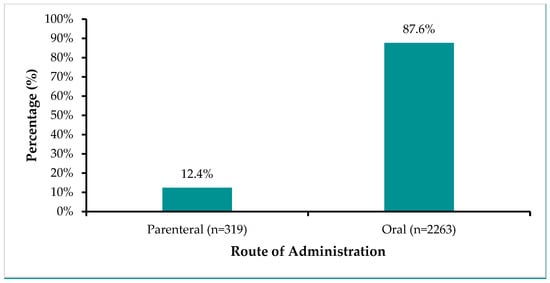
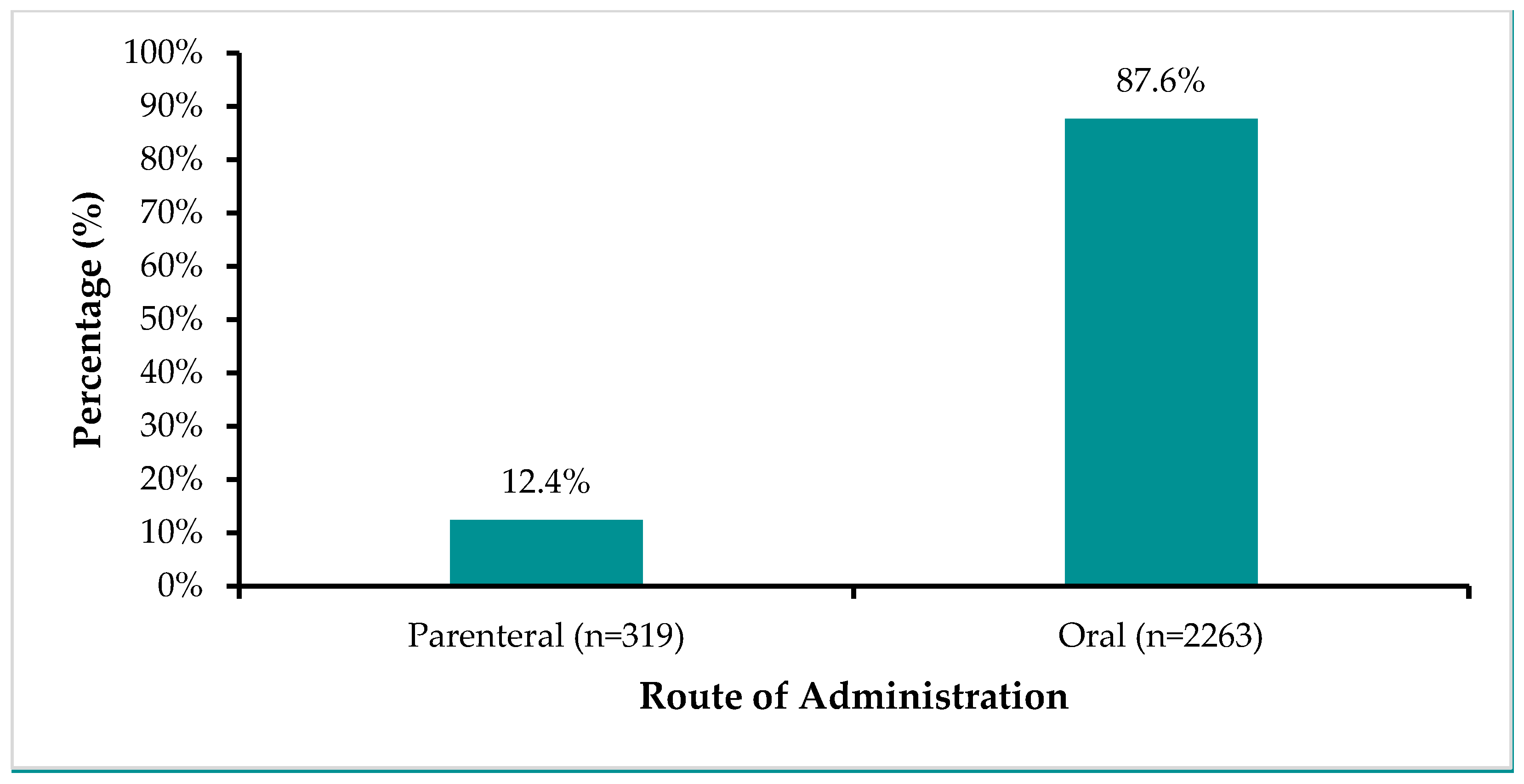
Out of 2294 antimicrobials found on the ZAMRA database in 2023, the most consumed antibiotics by route of administration were oral formulations at 2263 (87.6%), as shown in Figure 1.
Figure 1.
Frequency and Percentage of Antibiotics by Formulation Type, 2023.
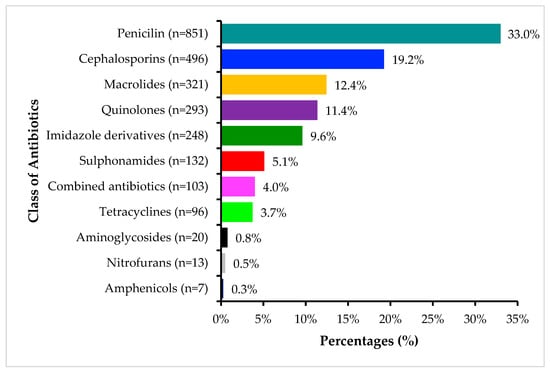
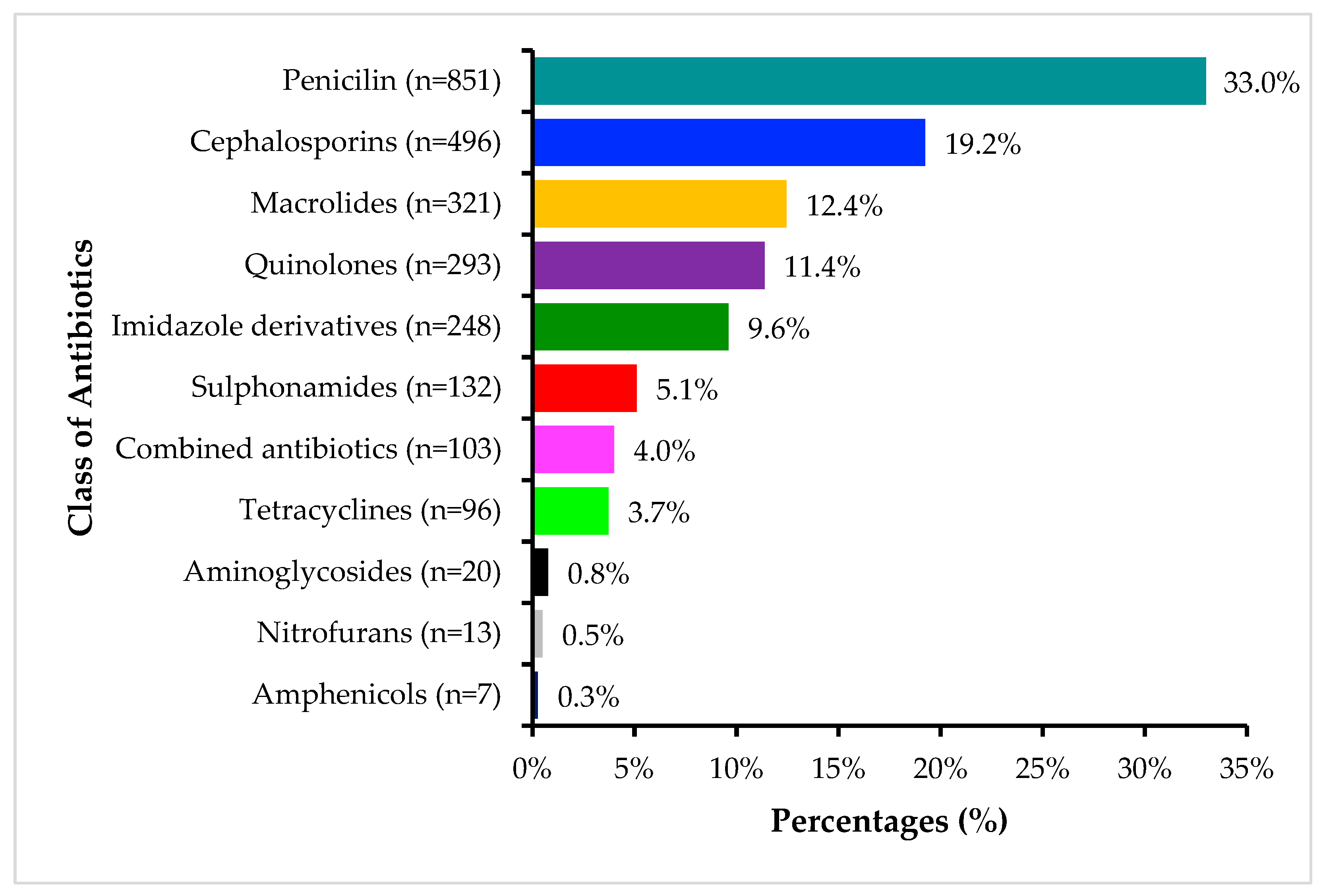
Figure 2 shows that out of the 2582 consumed antimicrobials, penicillins were the most used class at 851 (33.0%), followed by cephalosporins at 496 (19.2%), macrolides at 321 (12.4%), and quinolones at 293 (11.4%). The least consumed antimicrobials were amphenicols at 7 (0.3%).
Figure 2.
Most Consumed Classes of Antibiotics in the Human Health Sector in Zambia, 2023.
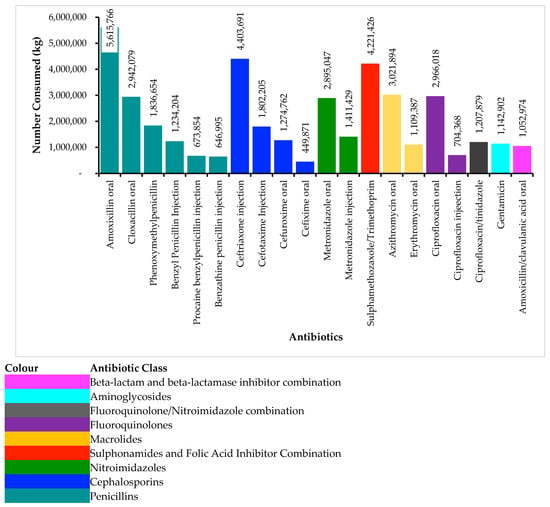
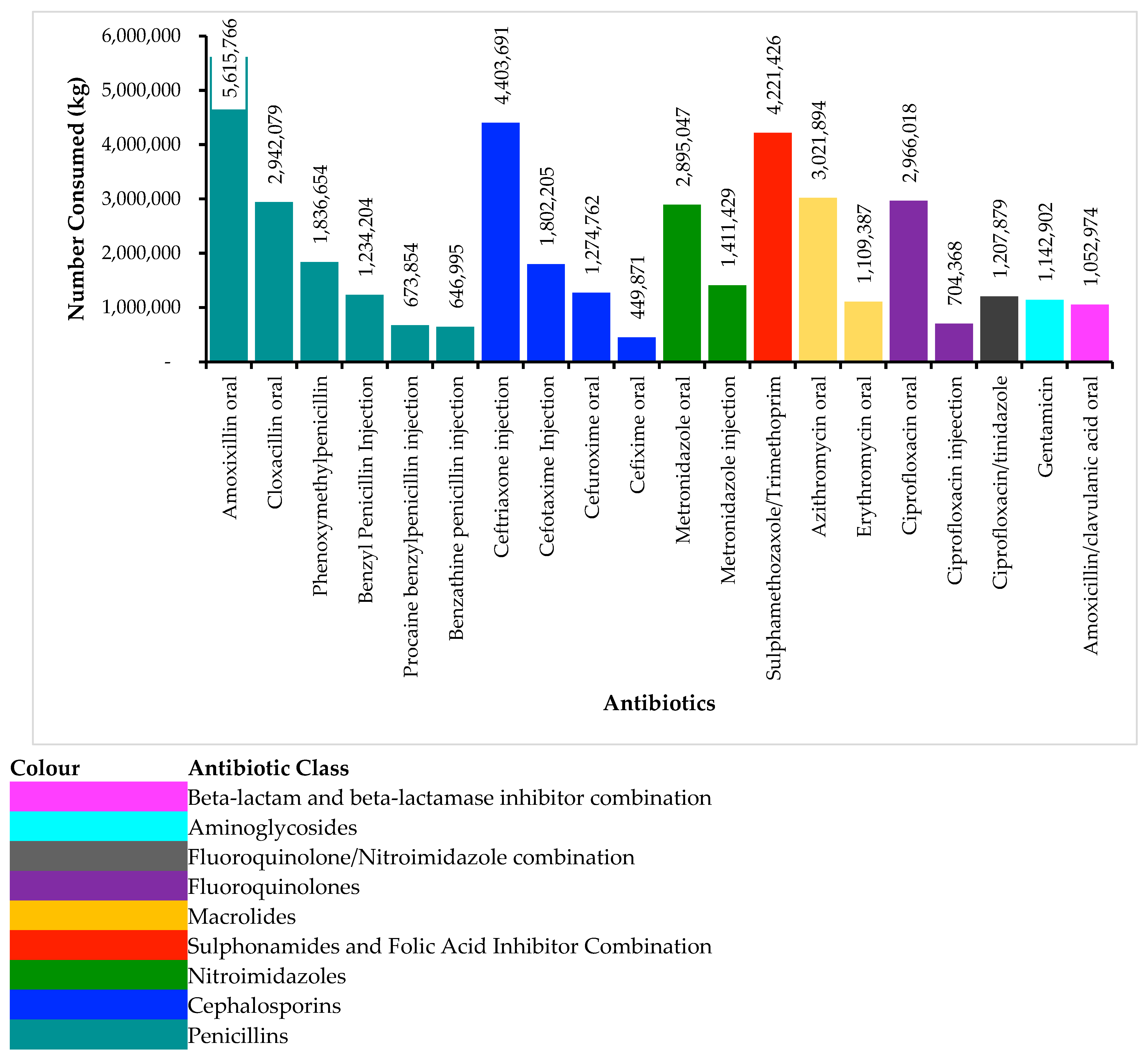
Evaluation of the top 20 antibiotics grouped into classes that were consumed in human health in Zambia in 2023 (as shown in Figure 3) revealed a total consumption of 40,613,405 antibiotics. Those that ranked the highest included amoxicillin oral 5,615,766 (12.9%), ceftriaxone 4,403,691 (10.12%), sulphamethoxazole/trimethoprim oral 4,221,426 (9.7%), azithromycin oral 3,021,894 (6.94%), ciprofloxacin oral 2,966,018 (6.82%), cloxacillin oral 2,942,079 (6.76%), and metronidazole oral 2,989,547 (6.65%) (Figure 3).
Figure 3.
The top 20 antibiotics, colour-coded by class, that were consumed in human health in Zambia in 2023.
The total defined daily doses (DDDs) of antibiotics consumed in Zambia in 2023 amounted to 98,651,882.42, with a Defined Daily Dose per 1000 inhabitants per day (DID) of 13.78. The most consumed individual antibiotic was oral amoxicillin, contributing 8.4 million DDDs (12.91%), followed closely by ceftriaxone injection with 8.8 million DDDs (10.12%), and sulfamethoxazole/trimethoprim oral with 33.7 million DDDs (9.7%). Other frequently used antibiotics included ciprofloxacin oral (6.82%), azithromycin oral (6.94%), cloxacillin oral (6.76%), and oral metronidazole (6.65%) (Table 1).
Table 1.
Antibiotic consumption in human health in Zambia, 2023.
In terms of the WHO AwaRe classification, Access group antibiotics dominated, accounting for over 46.8% of total consumption, with agents like amoxicillin, metronidazole, cloxacillin, and sulfamethoxazole/trimethoprim leading. Watch group antibiotics, such as ceftriaxone, cefotaxime, azithromycin, ciprofloxacin, and levofloxacin, made up a significant portion of the remaining consumption (40.3%), while Reserve group antibiotics, comprising linezolid and daptomycin, were minimally used (3.2%), reflecting appropriate stewardship in terms of reserving last-line therapies (Table 1).
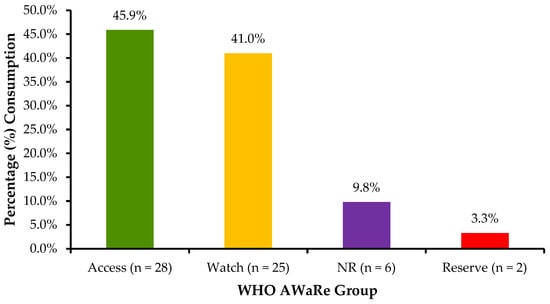
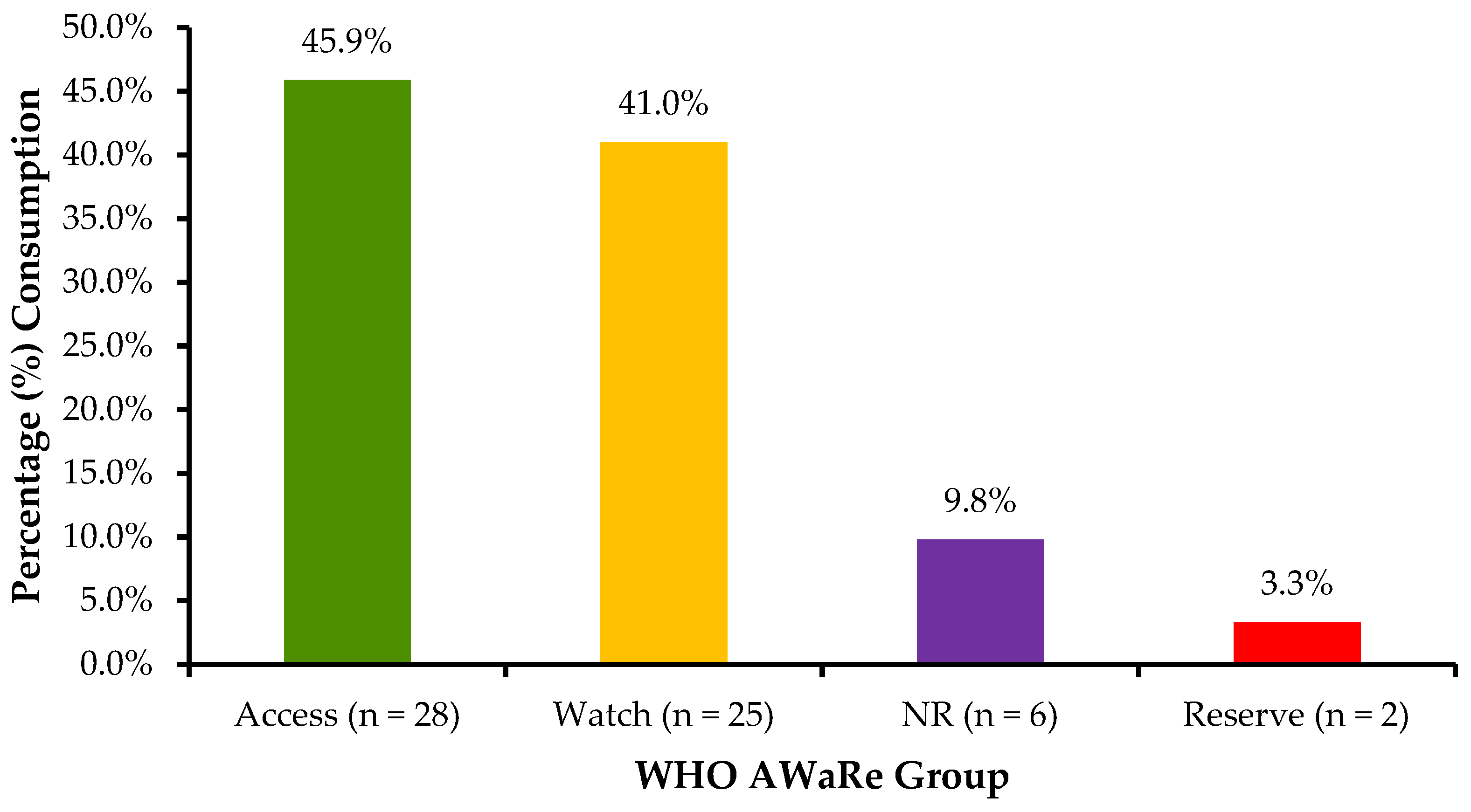
Figure 4 shows the proportion of antibiotics categorised by the WHO AwaRe classification framework. The results indicate that a total of 61 antibiotics were consumed in 2023, with the majority being ‘Access’ at 28 (45.9%) and the least being ‘Reserve’ at 2 (3.3%).
Figure 4.
Consumption of antibiotics based on the WHO AwaRe classification.
2.2. Animal Health AMU Findings
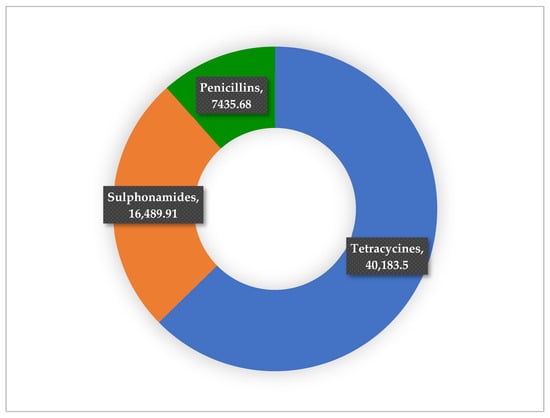
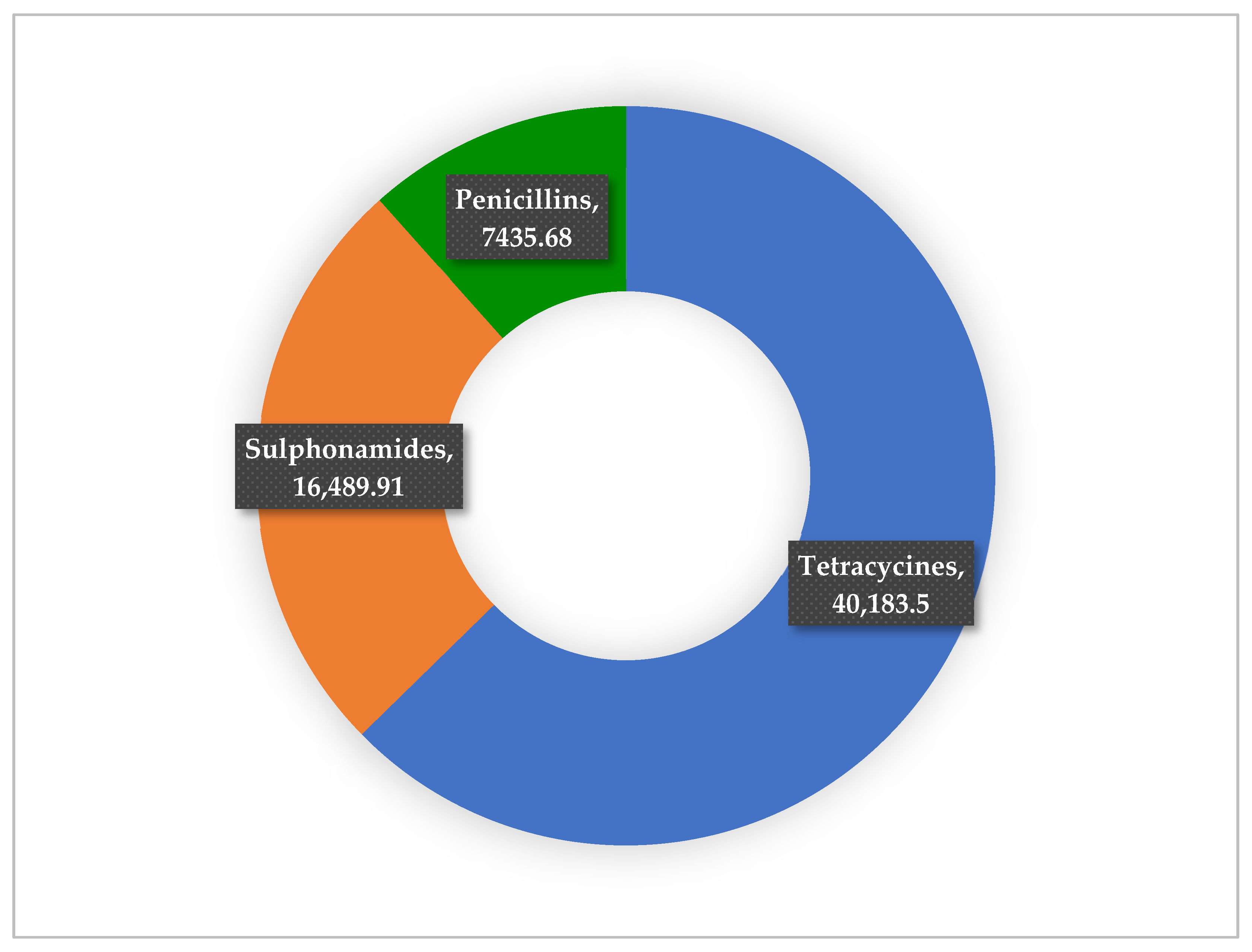
The data shows that tetracycline use was the highest at 40,183.5 kg (63%), followed by sulphonamides at 16,489.91 kg (26%), with the least being penicillins at 7435.68 kg (11%) (Figure 5).
Figure 5.
Shows the percentages of the most used antibiotics in animal health.
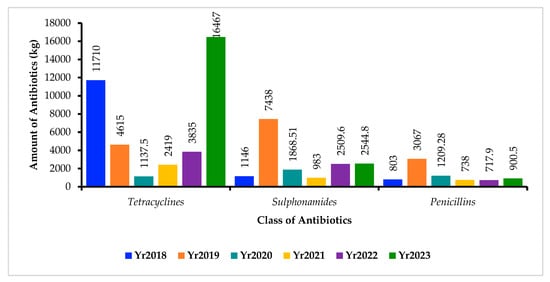
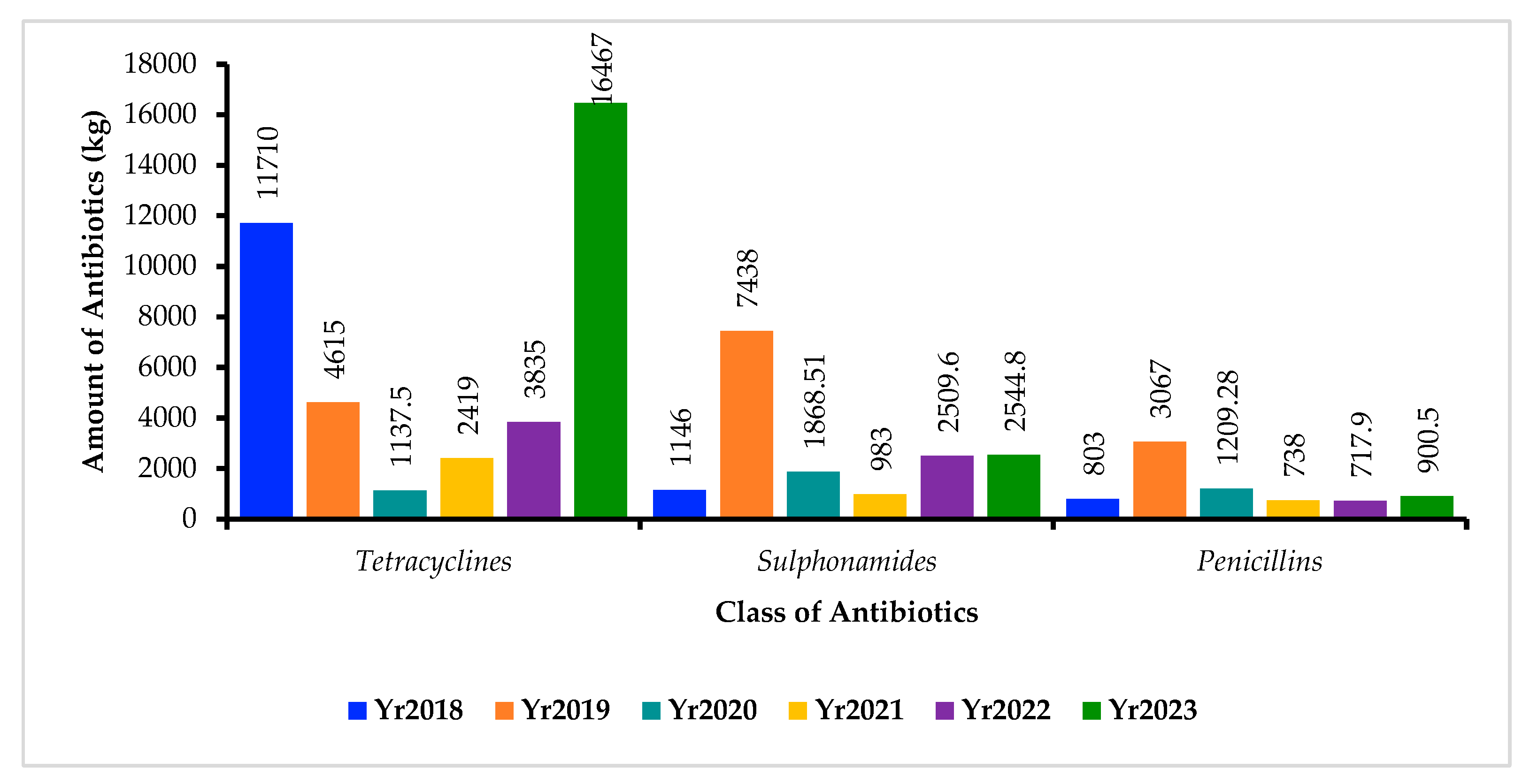
When split by year, the data shows that in 2018, tetracycline was the highest at 11,710 kg, followed by sulphonamides at 1146 kg, with the least being penicillin at 803 kg. In 2019, sulphonamides were the highest at 7438 kg, tetracycline at 4614 kg and penicillin at 3067 kg. In 2020, sulphonamide use was at 1868.51 kg, penicillin at 1209.28 kg, and tetracycline was the least used at 1137.5 kg. In 2021, tetracycline had the highest use at 2419 kg, sulphonamides at 983 kg and penicillin at 738 kg. In 2022, the use of tetracyclines was the highest at 3835 kg, followed by sulphonamides at 2509.6 kg, and penicillin at 717.9 kg. In 2023, tetracyclines were the highest at 16,467 kg, followed by sulphonamides at 2544.8 kg and penicillin at 900.5 kg. In the period between 2018 and 2023, 2023 had the highest use of antibiotics at 19,912.3 kg, followed by 2019 at 15,120 kg. The least use of antibiotics was seen in 2022 at a total of 4140 kg (Figure 6).
Figure 6.
Shows the Most Common Antibiotics Consumed (in Kilograms) in Animal Health between 2018 and 2023. Note: Yr = Year.
3. Discussion
To the best of our knowledge, this is the first national study on AMC and AMU across the human and animal health sectors in Zambia. The study found that the most consumed classes in the human health sector were oral antibiotics, which accounted for the majority of use, followed by penicillins, cephalosporins, and macrolides. It also established that the most frequently used antibiotics were amoxicillin, ceftriaxone, and sulfamethoxazole/trimethoprim. According to the WHO AwaRe classification, antibiotic use was predominantly in the Access category, followed closely by Watch antibiotics, with a small proportion classified as Reserve. In the animal health sector, tetracyclines were the most used class, followed by sulphonamides and penicillins. Total antimicrobial consumption reached its highest level in 2023. These findings highlight the need for continuous monitoring of AMC and AMU in both the human and animal health sectors in Zambia.
Our study found that oral formulations consistently accounted for 87.6% of total antimicrobial consumption each year, highlighting a strong and sustained preference for oral administration in Zambia. This trend aligns with findings from African countries where AMC of oral antibiotics was 97% in Sierra Leone from 2017 to 2019 [80] and exceeded 87% in Ethiopia between 2020 and 2022 [16], respectively. Additionally, these results are consistent with studies in Uganda, where oral antimicrobials constituted 80.7% of total consumption, and 86% of products supplied by the Joint Medical Store (JMS) were oral formulations [81,82]. Comparable trends were observed in the WHO European and ESAC-Net countries, where oral amoxicillin/clavulanic acid ranked as the most consumed antibiotic in 52% and 33% of countries, respectively, while oral amoxicillin ranked second overall [83]. Japan also reported a dominant reliance on oral formulations, accounting for 93% of total AMU over 13 years [84]. The preference for oral administration is likely attributed to its convenience, affordability, and ease of use, especially in outpatient settings [85]. However, this widespread use also raises concerns about inappropriate antimicrobial use and the potential for resistance development, particularly in settings with limited diagnostic capacity and over-the-counter antibiotic access. Therefore, targeted interventions such as stricter regulation, public education, and improved access to diagnostics are essential to optimise oral antibiotic use and mitigate the risk of antimicrobial resistance.
In this study, the most widely consumed classes of antibiotics in Zambia were penicillins (33%), cephalosporins (19.2%), macrolides (12.4%), quinolones (11.4%), and imidazoles (9.6%). This pattern reflects a global reliance on broad-spectrum and commonly prescribed antimicrobials in clinical settings. The high use of penicillins aligns with findings from Uganda, where penicillins consistently accounted for the largest share of AMC over three years—41% in 2017, 42% in 2018, and 36% in 2019 [81]. Similar trends were observed in the WHO European and ESAC-Net countries, where penicillins also ranked among the most commonly used classes, followed by tetracyclines, cephalosporins, and quinolones [83]. However, some regional variations are evident. In Ethiopia, tetracyclines (35.81%) were the most consumed class, followed by fluoroquinolones (20.19%), macrolides (13.92%), antiretrovirals (10.57%), and cephalosporins (9.63%) [86]. In contrast, a study in Japan identified macrolides (32%) and cephalosporins (28%) as the dominant classes, with fluoroquinolones also ranking highly at 19% [84]. These variations may reflect differences in disease epidemiology, prescribing habits, availability, and regulatory environments. The high consumption of cephalosporins and quinolones in Zambia is noteworthy, given their classification in the WHO AwaRe framework as Watch group antibiotics, agents that should be used with caution due to their higher potential for driving AMR. These findings highlight the need to strengthen AMS programmes and promote the rational use of antibiotics, particularly those in the Watch group, to mitigate AMR risks in Zambia.
The present study found that the most frequently consumed antimicrobials in Zambia in 2023 were amoxicillin (oral) at 5,615,766 units (12.9%), followed by ceftriaxone (4,403,691; 10.1%), sulfamethoxazole/trimethoprim (4,221,426; 9.7%), azithromycin (3,021,894; 6.9%), and ciprofloxacin (2,966,018; 6.8%). Other notable antibiotics included cloxacillin (6.8%), metronidazole (oral and injectable, 6.7% and 3.2%, respectively), phenoxymethyl penicillin (4.2%), and cefotaxime injection (4.1%). These findings mirror consumption patterns observed in several LMICs, where broad-spectrum antibiotics such as amoxicillin and ceftriaxone remain the mainstay of empirical therapy. The high usage of amoxicillin aligns with studies from Uganda and across multiple countries, where it ranked as the most consumed antibiotic in both oral form and in combination with clavulanic acid [81,83,87,88]. Similarly, the widespread use of sulfamethoxazole/trimethoprim and azithromycin has been reported in East African settings, often attributed to their availability, affordability, and inclusion in national treatment guidelines [81]. However, the substantial consumption of ceftriaxone and other parenteral antibiotics such as cefotaxime and benzylpenicillin raises concerns about potential overuse of Watch group antibiotics, especially in outpatient or empiric settings. The high use of ceftriaxone has been reported in other LMIC settings, raising concerns of misuse and potential for the development and spread of highly resistant pathogens against this Watch group antibiotic [76,77,89,90,91,92,93,94,95]. The high use of ceftriaxone has been reported in previous studies in Zambia, which raises a lot of concerns [75,76,77,96,97,98,99]. Ceftriaxone, a WHO highest-priority critically important antimicrobial, is being overused in Zambia, driving the rise in ESBL-producing pathogens. Without stronger stewardship and regulation, this misuse threatens to undermine one of the few effective treatments for severe infections. On the other hand, a study conducted in Japan reported that clarithromycin and ceftriaxone were the top used antibiotics, reflecting variations in prescribing practices and regulatory environments [84], while Tanzania showed a slightly different trend with doxycycline and amoxicillin leading [88]. These differences likely reflect variations in prescribing practices, diagnostic capacity, and national formulary preferences. The predominance of oral antibiotics observed in our study underscores the importance of monitoring AMC trends to inform stewardship interventions and minimise the risk of resistance development.
In this study, a total of 98.7 million DDDs of antibiotics were consumed in Zambia’s human health sector in 2023, yielding a Defined Daily Dose per 1000 inhabitants per day (DID) of 13.78. The most frequently consumed antibiotics were oral amoxicillin (12.91%), ceftriaxone injection (10.12%), and oral sulfamethoxazole/trimethoprim (9.7%), followed by other commonly used agents such as azithromycin, ciprofloxacin, cloxacillin, and oral metronidazole. These findings are consistent with previous studies from the region, including those by Namugambe et al. (2021) in Uganda, where oral amoxicillin and sulfamethoxazole/trimethoprim were among the most widely used antibiotics [81]. Similarly, Robertson et al. (2021) identified oral amoxicillin as the top-ranked antibiotic in six countries and second overall across two surveillance networks, highlighting its widespread use as a first-line agent [83]. The high consumption of ceftriaxone, a parenteral β-lactam antibiotic, aligns with findings from both Uganda and India, where it was also the most consumed injectable antibiotic [81,100].
Using the WHO AWaRe classification, Access group antibiotics accounted for approximately 46% of total consumption, including high-use agents like amoxicillin, cloxacillin, and metronidazole. Watch group antibiotics such as ceftriaxone, azithromycin, and ciprofloxacin comprised approximately 40%, while Reserve antibiotics such as linezolid and daptomycin were used minimally (3.3%), indicating appropriate stewardship of last-resort therapies. These findings are in line with trends observed in other LMICs, including Ethiopia, Uganda, Tanzania, and Sierra Leone, where Access group antibiotics comprised the majority of consumption [16,80,81,82,88]. The presence of non-recommended (NR) fixed-dose combinations (9.8%) also warrants further regulatory attention to ensure rational use of antimicrobials and alignment with WHO guidelines. Despite Access group antibiotics being the most consumed antibiotics, the rate of consumption is lower than that recommended by the WHO, which was initially set at a 60% threshold [52,53,55,56], but now stands at 70% [101]. The challenge of failing to meet the earlier 60% and currently 70% threshold of using Access group antibiotics has been reported in other studies. This highlights the high use of Watch group antibiotics, indicating deviations from the treatment guidelines and protocols [102,103,104,105,106]. Therefore, there is a need to strengthen stewardship interventions to promote the rational use of antibiotics and reduce the overuse of Watch group antibacterials.
The present study revealed considerable year-to-year variation in AMU within the veterinary sector in Zambia between 2018 and 2023. Overall, tetracyclines emerged as the most consumed class, accounting for 63% (40,183.5 kg) of total usage, followed by sulphonamides (26%) and penicillins (11%). Similarly, local sales data reported by other authors in Zambia showed high consumption of tetracyclines and sulphonamides [34,107,108,109]. The consumption pattern has been reported in the sub-Sharan African region [37]. This trend mirrors global patterns where tetracyclines are frequently used in animal health due to their broad-spectrum activity, affordability, and ease of access [17]. The high consumption of medically important antibiotics in animal health has also been reported in other countries [110]. Yearly disaggregation showed that tetracyclines dominated usage in 2018 (11,710 kg), dropped sharply in 2020 (1137.5 kg), but rebounded significantly to reach a peak in 2023 (16,467 kg). Conversely, sulphonamides peaked in 2019 (7438 kg), followed by a decline and then a modest increase in 2023 (2544.8 kg). Penicillin usage showed a gradual rise from 803 kg in 2018 to 3067 kg in 2019, before declining steadily through 2022 (717.9 kg), with a slight rebound in 2023 (900.5 kg). These fluctuations may reflect variations in disease outbreaks, shifts in treatment protocols, or supply chain dynamics. The highest total antibiotic use was recorded in 2023 (19,912.3 kg), possibly influenced by increased livestock production or relaxed restrictions post-COVID-19, whereas 2022 saw the lowest usage (4140 kg), which may indicate improved AMS efforts or reduced demand. Similar year-to-year variations in veterinary antibiotic use have been documented elsewhere, reinforcing the need for robust AMU surveillance systems [19,111,112]. The increase in global AMC and AMU in animal health has been reported in other studies and is among the major causes of AMR [17,111,113,114,115,116]. The high demand for animal proteins, especially in LMICs, has contributed to the increased AMU, which is also linked to the development and spread of AMR [113]. These trends underscore the importance of national strategies aimed at rationalising antibiotic use in animal health, especially in the context of Zambia’s One Health response to AMR.
Overall, these results highlight critical trends in AMC and AMU in Zambia and reinforce the importance of strengthening surveillance and AMS programmes, developing treatment guidelines in animal health and updating national treatment guidelines in human health, and integrating the WHO AWaRe categorisation into procurement and prescribing policies to combat the growing threat of AMR. The study highlights high AMC and AMU in Zambia, which, when connected to animal health, reflects weak veterinary stewardship programmes and gaps in enforcing prescription-only regulations, record-keeping, and quality control of veterinary medicines. These regulatory shortcomings contribute to inappropriate antimicrobial use in livestock, amplifying the risk of resistance transmission across human, animal, and environmental sectors.
Our findings underscore the need for multifaceted One Health strategies to address the high levels of AMC and AMU observed across both the human and animal health sectors. Such strategies should not only focus on reducing inappropriate prescribing and dispensing practices in healthcare settings but also on strengthening regulatory frameworks to curb over-the-counter sales and unsupervised use in the community [44,117]. In the animal health sector, targeted interventions are required to promote prudent veterinary oversight, restrict non-therapeutic use of antimicrobials such as growth promotion, and encourage alternative disease prevention methods, including vaccination, biosecurity, and improved husbandry practices [20,118,119,120]. Furthermore, investment in diagnostic capacity, surveillance systems, and AMS programmes is essential to generate high-quality evidence that informs policy and guides rational AMU [121,122,123]. These actions align with global and regional recommendations and are critical to mitigating the risk of AMR while safeguarding the efficacy of existing drugs for both human and animal health. The policy recommendations and implications of the present study findings are outlined in Table 2.
Table 2.
Policy Recommendations and Practice Implications for Strengthening AMR Control in Zambia’s Animal and Human Health Sectors (One Health Approach).
We are aware that this study has some limitations. First, as in many LMICs, antimicrobials in Zambia are frequently sold over the counter without prescriptions, making it difficult to capture the actual quantities used and the specific populations treated. Second, farm-level data were limited by poor record-keeping, particularly among smallholder farmers, which may have obscured detailed usage patterns. Third, the lack of veterinary oversight in many rural areas restricted the ability to monitor antimicrobial use comprehensively in the animal health sector. Fourth, the study relied primarily on importation and sales data as proxies for consumption, which may not fully reflect actual end-user use due to possible stockpiling, wastage, or informal distribution channels. Finally, the analysis did not capture environmental antimicrobial residues or their contribution to AMR, an area warranting further investigation.
Future studies on AMC and AMU in Zambia should focus on bridging data and practice gaps. Community- and hospital-based surveys are needed to capture actual prescribing, dispensing, and self-medication patterns. At the farm level, detailed investigations should assess antimicrobial use among commercial and smallholder farmers and its link to resistance in humans, food, and the environment. Environmental surveillance should examine residues and resistant organisms in water, soil, and waste streams.
Research should also evaluate how limited diagnostic capacity affects prescribing and explore low-cost diagnostic innovations. Studies assessing the effectiveness of AMS interventions, including digital tools, treatment guidelines, and training, are vital for both human and animal health sectors. Integrated One Health surveillance linking human, animal, and environmental data remains a priority.
Further, policy-focused research should assess the impact of regulations on prescribing and veterinary drug sales. Investigating alternatives to antimicrobials, such as vaccines, probiotics, and biosecurity measures, will provide sustainable solutions. Behavioural and cultural studies can illuminate factors driving antibiotic misuse, while economic evaluations should quantify the burden of AMR and cost-effectiveness of AMS interventions.
4. Materials and Methods
4.1. Study Setting and Data Sources
This was a retrospective study that was conducted in December 2024, utilising routine data collected between 2018 and 2023 in the human and animal health sectors. The routine AMC and AMU data were obtained from human and animal health databases in Zambia.
4.2. Antimicrobial Consumption (AMC) in Human Health in Zambia
Zambia, a landlocked nation in Southern Africa, has a pharmaceutical sector that includes both public and private providers. The majority of medicines used in the country are imported from India, Kenya, the Netherlands, South Africa, and China, with only 10% to 15% of pharmaceutical production coming from local manufacturers [124]. The Zambia Medicines Regulatory Authority (ZAMRA) is responsible for regulating the pharmaceutical sector, including granting marketing authorisations, ensuring compliance with good manufacturing practices, licencing pharmaceutical outlets, and overseeing import and export activities [125].
The approval process for pharmaceutical products is managed by technical committees specialising in human and veterinary medicines. To strengthen regulatory oversight, ZAMRA implemented the Integrated Regulatory Information Management System (IRIMIS), an online platform designed to systematically collect data on all imported consignments of finished pharmaceutical products and raw materials, including antimicrobials. This system enables national-level monitoring of medicine consumption, ensuring alignment with long-term health priorities. Additionally, IRIMIS has digitised import data, replacing the previous paper-based system. Historical records were retrieved and entered into the system, which captures key data on antimicrobial imports and exports at designated ports of entry.
The primary data sources for this report included ZAMRA’s import permits, proforma and commercial invoices, based on the data that is submitted to the WHO Global Antimicrobial Resistance and Use Surveillance System (GLASS) methodology. Human health AMC data were collected for 2023.
All import data on antimicrobials were included in the analysis as they serve as a proxy for overall national consumption, encompassing both the public and private sectors, given that ZAMRA authorises all imports regardless of their final distribution. The key variables assessed included product details (name, active ingredient(s), strength, dosage form, and route of administration), batch size, quantity, unit cost, WHO ATC classification, WHO AWaRe classification of antibiotics, and DDD. The WHO AWaRe classifications of antibiotics were performed based on the recommended guidelines [49,51]. The extracted data from IRIMIS was compiled into Microsoft Excel® for further analysis.
4.3. Antimicrobial Use (AMU) in Animal Health in Zambia
Animal health data were sourced from the WOAH Animal Antimicrobial Use (ANIMUSE) Global Database, managed by the World Organisation for Animal Health (WOAH). This dataset includes AMU data submitted by Zambia to the WHO’s Global Antimicrobial Resistance and Use Surveillance System (GLASS) and WOAH from 2018 to 2023. Additionally, the report incorporates defined daily dose (DDD) data for animal health to evaluate trends over time.
4.4. Animal Health Data Collection
Animal health data were collected and analysed using the ANIMUSE Global Database, a platform managed by WOAH that facilitates access to critical and expanding information on AMU in animals [126]. This database compiles country-level data on antimicrobial quantities and usage patterns in animal health. Zambia has been submitting AMC data to ANIMUSE since 2018, and this report reviews data from 2018 to 2023. Antibiotics were classified by their classes.
4.5. Data Analysis
The collected data were entered into a Microsoft Excel sheet and checked for completeness and duplication. Data analysis was conducted using IBM SPSS (Version 25.0; IBM Corp., Armonk, NY, USA). The analysis of AMC and AMU focused on calculating and visualising key indicators. At the national level, antibiotic quantities were determined using DDD and DID calculations [127,128,129]. The analysis also identified the 20 most frequently consumed antibiotic substances. Additionally, the distribution of AMC was examined using the Drug Utilisation 75% (DU75) and 90% (DU90) metrics to highlight the most commonly used antibiotics [130]. Data were further stratified based on the route of administration to better understand usage patterns across different delivery methods, similar to previous studies [81,82].
5. Conclusions
This study provides the first comprehensive national analysis of AMC and AMU in both the human and animal health sectors in Zambia, offering critical insights for optimising antimicrobial stewardship across the One Health spectrum. The findings reveal a high reliance on oral formulations in human health and a predominance of penicillins, cephalosporins, and macrolides, many of which fall under the WHO Watch category, signalling the need for cautious use. The high utilisation of tetracyclines and sulphonamides in animal health further underscores the importance of prudent AMU in veterinary settings to curb the emergence and spread of AMR.
The substantial consumption of broad-spectrum and Watch group antibiotics in human health, along with year-to-year variability in veterinary AMU, highlights gaps in AMS, surveillance infrastructure, and regulatory enforcement. Importantly, the observed use of non-recommended (NR) antibiotic combinations calls for strengthened regulatory oversight and alignment with WHO guidelines.
To mitigate AMR threats, Zambia must prioritise the integration of the WHO AWaRe classification into procurement and prescribing policies, enhance diagnostic capacity to support rational antibiotic use, and expand the coverage and quality of AMU surveillance. Additionally, scaling up multisectoral collaboration, investing in stewardship training, research, and enforcing national treatment guidelines are critical steps toward safeguarding antimicrobial efficacy.
Overall, this study establishes a foundation for evidence-based policy development and targeted interventions to ensure the sustainable use of antimicrobials in Zambia, in alignment with global One Health strategies to combat AMR.
Author Contributions
Conceptualisation, S.M. (Steward Mudenda), J.Y.C., F.G., J.B.M. and R.C.; methodology, S.M. (Steward Mudenda), J.Y.C., W.M., J.H., C.C. (Chikwanda Chileshe), T.S., A.S., M.H., F.M.S., K.K., E.J., S.M. (Samson Mukale), A.B., C.C. (Charles Chileshe), B.C., M.M., G.M., Y.S., F.G., J.B.M. and R.C.; software, S.M. (Steward Mudenda), J.Y.C., W.M., A.S., M.H., F.M.S., K.K., M.C., Z.M., E.J., M.S. (Makomani Siyanga), S.M. (Samson Mukale), A.B. and R.C.; validation, S.M. (Steward Mudenda), J.Y.C., V.D., M.K., W.M., K.M., J.H., P.G., C.C. (Chikwanda Chileshe), N.B.M., T.S., B.S.J.P., A.S., M.H., F.M.S., K.K., M.C., Z.M., E.J., M.S. (Makomani Siyanga), P.L., F.M., S.M. (Samson Mukale), A.B., M.S. (Misheck Shawa), C.C. (Charles Chileshe), B.C., M.M., G.M., Y.S., F.G., J.B.M. and R.C.; formal analysis, S.M. (Steward Mudenda), W.M., A.S., S.M. (Samson Mukale), and A.B.; investigation, S.M. (Steward Mudenda), J.Y.C., W.M., J.H., C.C. (Chikwanda Chileshe), T.S., A.S., M.H., F.M.S., K.K., E.J., S.M. (Samson Mukale), A.B., B.C., M.M., G.M., Y.S., F.G., J.B.M. and R.C.; resources, J.Y.C., Y.S., F.G. and R.C.; data curation, S.M. (Steward Mudenda), J.Y.C. and R.C.; writing—original draft preparation, S.M. (Steward Mudenda), J.Y.C., V.D., M.K., W.M., K.M., J.H., P.G., C.C. (Chikwanda Chileshe), N.B.M., T.S., B.S.J.P., A.S., S.M. (Samson Mukale), A.B., M.M., G.M., Y.S., F.G., J.B.M. and R.C.; writing—review and editing, S.M. (Steward Mudenda), J.Y.C., V.D., M.K., W.M., K.M., J.H., P.G., C.C. (Chikwanda Chileshe), N.B.M., T.S., B.S.J.P., A.S., M.H., F.M.S., K.K., M.C., Z.M., E.J., M.S. (Makomani Siyanga), P.L., F.M., S.M. (Samson Mukale), A.B., M.S. (Misheck Shawa), C.C. (Charles Chileshe), B.C., M.M., G.M., Y.S., F.G., J.B.M. and R.C.; visualisation, S.M. (Steward Mudenda), W.M., A.S., S.M. (Samson Mukale), and A.B.; supervision, Y.S., F.G., J.B.M. and R.C.; project administration, S.M. (Steward Mudenda), J.Y.C., T.S., A.S., M.H., F.M.S., K.K., M.C., Z.M., E.J., P.L., F.M., C.C. (Charles Chileshe), B.C., Y.S., F.G., J.B.M. and R.C.; funding acquisition, J.Y.C., M.C., C.C. (Charles Chileshe), B.C., Y.S., F.G. and R.C. All authors have read and agreed to the published version of the manuscript.
Funding
This research was funded by Fleming Fund Zambia Country Grant, Zambia Multisectoral Pandemic Preparedness and Response (ZaMPPR) Project, World Health Organisation, and in part by the Japan Agency for Medical Research and Development (AMED) under Grant Number JP20wm0125008 and JP223fa627005 to YS, through the Antimicrobial Resistance Coordinating Committee (AMRCC) at the Zambia National Public Health Institute, Ministry of Health.
Institutional Review Board Statement
Ethical approval was obtained from the Tropical Diseases Research Centre Ethics Committee with a protocol ID number TRC/C4/09/2023. All data collectors were informed of the purpose of the study. Approval to collect the AMC and AMU data obtained from the Ministry of Health and the Ministry of Fisheries and Livestock.
Informed Consent Statement
Informed consent was obtained from all subjects involved in the study.
Data Availability Statement
The data supporting the reported results can be made available on request from the corresponding authors.
Acknowledgments
We would like to acknowledge the Ministry of Health and the Ministry of Fisheries and Livestock for the support they provided during data collection, analysis, and report writing. We are grateful to all the staff who participated in the activities that led to the development of this manuscript.
Conflicts of Interest
The authors declare no conflicts of interest.
Abbreviations
The following abbreviations are used in this manuscript:
| AMC | Antimicrobial Consumption |
| AMR | Antimicrobial Resistance |
| AMS | Antimicrobial Stewardship |
| AMU | Antimicrobial Use |
| ANIMUSE | Animal Antimicrobial Use |
| ATC | Anatomical Therapeutic Chemical |
| AWaRe | Access, Watch, Reserve |
| DDD | Define Daily Dose |
| WHO | World Health Organisation |
| ZAMRA | Zambia Medicines Regulatory Authority |
References
- Velazquez-Meza, M.E.; Galarde-López, M.; Carrillo-Quiróz, B.; Alpuche-Aranda, C.M. Antimicrobial resistance: One Health approach. Vet. World 2022, 15, 743–749. [Google Scholar] [CrossRef] [Scilit]
- Nadimpalli, M.; Delarocque-Astagneau, E.; Love, D.C.; Price, L.B.; Huynh, B.T.; Collard, J.M.; Lay, K.S.; Borand, L.; Ndir, A.; Walsh, T.R.; et al. Combating Global Antibiotic Resistance: Emerging One Health Concerns in Lower-and Middle-Income Countries. Clin. Infect. Dis. 2018, 66, 963–969. [Google Scholar] [CrossRef] [Scilit]
- Walsh, T.R. A one-health approach to antimicrobial resistance. Nat. Microbiol. 2018, 3, 854–855. [Google Scholar] [CrossRef] [Scilit]
- Ferdinand, A.S.; Coppo, M.J.C.; Howden, B.P.; Browning, G.F. Tackling antimicrobial resistance by integrating One Health and the Sustainable Development Goals. BMC Glob. Public Health 2023, 1, 11. [Google Scholar] [CrossRef] [Scilit]
- Tang, K.W.K.; Millar, B.C.; Moore, J.E. Antimicrobial Resistance (AMR). Br. J. Biomed. Sci. 2023, 80, 11387. [Google Scholar] [CrossRef] [Scilit]
- Prestinaci, F.; Pezzotti, P.; Pantosti, A. Antimicrobial resistance: A global multifaceted phenomenon. Pathog. Glob. Health 2015, 109, 309–318. [Google Scholar] [CrossRef] [Scilit]
- Belay, W.Y.; Getachew, M.; Tegegne, B.A.; Teffera, Z.H.; Dagne, A.; Zeleke, T.K.; Abebe, R.B.; Gedif, A.A.; Fenta, A.; Yirdaw, G.; et al. Mechanism of antibacterial resistance, strategies and next-generation antimicrobials to contain antimicrobial resistance: A review. Front. Pharmacol. 2024, 15, 1444781. [Google Scholar] [CrossRef] [Scilit] [PubMed]
- World Health Organization. Antimicrobial Resistance. 2023. Available online: https://www.who.int/news-room/fact-sheets/detail/antimicrobial-resistance (accessed on 8 October 2024).
- Salam, M.A.; Al-Amin, M.Y.; Salam, M.T.; Pawar, J.S.; Akhter, N.; Rabaan, A.A.; Alqumber, M.A.A. Antimicrobial Resistance: A Growing Serious Threat for Global Public Health. Healthcare 2023, 11, 1946. [Google Scholar] [CrossRef] [Scilit] [PubMed]
- Murray, C.J.; Ikuta, K.S.; Sharara, F.; Swetschinski, L.; Robles Aguilar, G.; Gray, A.; Han, C.; Bisignano, C.; Rao, P.; Wool, E.; et al. Global burden of bacterial antimicrobial resistance in 2019: A systematic analysis. Lancet 2022, 399, 629–655. [Google Scholar] [CrossRef] [Scilit] [PubMed]
- World Health Organization. Global Antimicrobial Resistance and Use Surveillance System (GLASS) Report 2022; WHO: Geneva, Switzerland, 2022; pp. 1–82. ISBN 9789240005587. Available online: https://www.who.int/publications/i/item/9789240062702 (accessed on 21 December 2022).
- Ajulo, S.; Awosile, B. Global antimicrobial resistance and use surveillance system (GLASS 2022): Investigating the relationship between antimicrobial resistance and antimicrobial consumption data across the participating countries. PLoS ONE 2024, 19, e0297921. [Google Scholar] [CrossRef] [Scilit]
- World Health Organization. Global Action Plan on Antimicrobial Resistance. 2015. Available online: https://apps.who.int/iris/handle/10665/193736 (accessed on 6 January 2023).
- Klein, E.Y.; Impalli, I.; Poleon, S.; Denoel, P.; Cipriano, M.; Van Boeckel, T.P.; Pecetta, S.; Bloom, D.E.; Nandi, A. Global trends in antibiotic consumption during 2016-2023 and future projections through 2030. Proc. Natl. Acad. Sci. USA 2024, 121, e2411919121. [Google Scholar] [CrossRef] [Scilit]
- Mapunjo, S.; Mbwasi, R.; Nkiligi, E.A.; Wilbroad, A.; Francis, E.N.; Msovela, K.; Yahya, T.; Mpembeni, R.; Masunga, E.; Nkungu, K.; et al. National consumption of antimicrobials in Tanzania: 2020–2022. JAC-Antimicrob. Resist. 2025, 7, dlaf026. [Google Scholar] [CrossRef] [Scilit]
- Eshete, H.; Tileku, M.; Aschenaki, A.; Shiferaw, E.; Mulugeta, H.; Teferi, M.; Shute, T.; Alemu, A.; Gerba, H.; Fentie, A.M. Ethiopian antimicrobial consumption trends in human health sector: A surveillance report 2020–2022. PLoS ONE 2025, 20, e0319295. [Google Scholar] [CrossRef] [Scilit]
- Van Boeckel, T.P.; Pires, J.; Silvester, R.; Zhao, C.; Song, J.; Criscuolo, N.G.; Gilbert, M.; Bonhoeffer, S.; Laxminarayan, R. Global trends in antimicrobial resistance in animals in low- and middle-income countries. Science 2019, 365, eaaw1944. [Google Scholar] [CrossRef] [Scilit]
- Otaigbe, I.I.; Elikwu, C.J. Drivers of inappropriate antibiotic use in low- and middle-income countries. JAC-Antimicrob. Resist. 2023, 5, dlad062. [Google Scholar] [CrossRef] [Scilit]
- Mulchandani, R.; Tiseo, K.; Nandi, A.; Klein, E.; Gandra, S.; Laxminarayan, R.; Van Boeckel, T. Global trends in inappropriate use of antibiotics, 2000–2021: Scoping review and prevalence estimates. BMJ Public Health 2025, 3, e002411. [Google Scholar] [CrossRef] [Scilit] [PubMed]
- Mudenda, S.; Chabalenge, B.; Daka, V.; Mfune, R.L.; Salachi, K.I.; Mohamed, S.; Mufwambi, W.; Kasanga, M.; Matafwali, S.K. Global Strategies to Combat Antimicrobial Resistance: A One Health Perspective. Pharmacol. Pharm. 2023, 14, 271–328. [Google Scholar] [CrossRef]
- Nahar, P.; Unicomb, L.; Lucas, P.J.; Uddin, M.R.; Islam, M.A.; Nizame, F.A.; Khisa, N.; Akter, S.M.S.; Rousham, E.K. What contributes to inappropriate antibiotic dispensing among qualified and unqualified healthcare providers in Bangladesh? A qualitative study. BMC Health Serv. Res. 2020, 20, 656. [Google Scholar] [CrossRef] [Scilit] [PubMed]
- Sono, T.M.; Yeika, E.; Cook, A.; Kalungia, A.; Opanga, S.A.; Acolatse, J.E.E.; Sefah, I.A.; Jelić, A.G.; Campbell, S.; Lorenzetti, G.; et al. Current rates of purchasing of antibiotics without a prescription across sub-Saharan Africa; rationale and potential programmes to reduce inappropriate dispensing and resistance. Expert Rev. Anti-Infect. Ther. 2023, 21, 1025–1055. [Google Scholar] [CrossRef] [Scilit] [PubMed]
- Erah, P.O.; Olumide, G.; Okhamafe, A.O. Prescribing practices in two health care facilities in Warri, Southern Nigeria: A comparative study. Trop. J. Pharm. Res. 2003, 2, 175–182. [Google Scholar] [CrossRef] [Scilit]
- Gobezie, M.Y.; Tesfaye, N.A.; Faris, A.G.; Hassen, M. Surveillance of antimicrobial utilization in Africa: A systematic review and meta-analysis of prescription rates, indications, and quality of use from point prevalence surveys. Antimicrob. Resist. Infect. Control 2024, 13, 101. [Google Scholar] [CrossRef] [Scilit] [PubMed]
- Mulchandani, R.; Wang, Y.; Gilbert, M.; Van Boeckel, T.P. Global trends in antimicrobial use in food-producing animals: 2020 to 2030. PLoS Glob. Public Health 2023, 3, e0001305. [Google Scholar] [CrossRef] [Scilit]
- Van Boeckel, T.P.; Brower, C.; Gilbert, M.; Grenfell, B.T.; Levin, S.A.; Robinson, T.P.; Teillant, A.; Laxminarayan, R. Global trends in antimicrobial use in food animals. Proc. Natl. Acad. Sci. USA 2015, 112, 5649–5654. [Google Scholar] [CrossRef] [Scilit]
- Mudenda, S.; Hakayuwa, C.M.; Lubanga, A.F.; Kasanga, M.; Daka, V.; Salachi, K.I.; Mwaba, M.; Chileshe, C.; Champo, M.; Kamayani, M.; et al. Global Antimicrobial Stewardship, Surveillance, and Infection Prevention and Control Programs: Leveraging One Health, Nanotechnology, and Artificial Intelligence to Combat Antimicrobial Resistance in a Climate-Impacted World. Pharmacol. Pharm. 2025, 16, 197–291. [Google Scholar] [CrossRef]
- Bamidele, O.; Amole, T.A.; Oyewale, O.A.; Bamidele, O.O.; Yakubu, A.; Ogundu, U.E.; Ajayi, F.O.; Hassan, W.A. Antimicrobial Usage in Smallholder Poultry Production in Nigeria. Vet. Med. Int. 2022, 2022, 7746144. [Google Scholar] [CrossRef] [Scilit]
- Mikecz, O.; Pica-Ciamarra, U.; Felis, A.; Nizeyimana, G.; Okello, P.; Brunelli, C. Data on antimicrobial use in livestock: Lessons from Uganda. One Health 2020, 10, 100165. [Google Scholar] [CrossRef] [Scilit]
- Khan, X.; Rymer, C.; Ray, P.; Lim, R. Quantification of antimicrobial use in Fijian livestock farms. One Health 2021, 13, 100326. [Google Scholar] [CrossRef] [Scilit]
- Delamare-deboutteville, J.; Mohan, C.V. Antimicrobial Resistance: Preventing the Silent Pandemic in Aquatic Food Systems; WorldFish: Penang, Malaysia, 2021; pp. 1–22. Available online: https://digitalarchive.worldfishcenter.org/handle/20.500.12348/4996 (accessed on 18 November 2021).
- Mudenda, S.; Bumbangi, F.N.; Yamba, K.; Munyeme, M.; Malama, S.; Mukosha, M.; Hadunka, M.A.; Daka, V.; Matafwali, S.K.; Siluchali, G.; et al. Drivers of antimicrobial resistance in layer poultry farming: Evidence from high prevalence of multidrug-resistant Escherichia coli and enterococci in Zambia. Vet. World 2023, 16, 1803–1814. [Google Scholar] [CrossRef] [Scilit]
- Sinyawa, T.; Shawa, M.; Muuka, G.M.; Goma, F.; Fandamu, P.; Chizimu, J.Y.; Khumalo, C.S.; Mulavu, M.; Ngoma, M.; Chambaro, H.M.; et al. Antimicrobial Use Survey and Detection of ESBL-Escherichia coli in Commercial and Medium-/Small-Scale Poultry Farms in Selected Districts of Zambia. Antibiotics 2024, 13, 467. [Google Scholar] [CrossRef] [Scilit]
- Mudenda, S.; Mulenga, K.M.; Nyirongo, R.; Chabalenge, B.; Chileshe, C.; Daka, V.; M’kandawire, E.; Jere, E.; Muma, J.B. Non-prescription sale and dispensing of antibiotics for prophylaxis in broiler chickens in Lusaka District, Zambia: Findings and implications on one health. JAC-Antimicrob. Resist. 2024, 6, dlae094. [Google Scholar] [CrossRef] [Scilit] [PubMed]
- Lekshmi, M.; Ammini, P.; Kumar, S.; Varela, M.F. The food production environment and the development of antimicrobial resistance in human pathogens of animal origin. Microorganisms 2017, 5, 11. [Google Scholar] [CrossRef] [Scilit]
- Roca, I.; Akova, M.; Baquero, F.; Carlet, J.; Cavaleri, M.; Coenen, S.; Cohen, J.; Findlay, D.; Gyssens, I.; Heure, O.E.; et al. The global threat of antimicrobial resistance: Science for intervention. New Microbes New Infect. 2015, 6, 22–29. [Google Scholar] [CrossRef] [Scilit]
- Mouiche, M.M.M.; Moffo, F.; Betsama, J.D.B.; Mapiefou, N.P.; Mbah, C.K.; Mpouam, S.E.; Penda, R.E.; Ciake, S.A.C.; Feussom, J.M.K.; Kamnga, Z.F.; et al. Challenges of antimicrobial consumption surveillance in food-producing animals in sub-Saharan African countries: Patterns of antimicrobials imported in Cameroon from 2014 to 2019. J. Glob. Antimicrob. Resist. 2020, 22, 771–778. [Google Scholar] [CrossRef] [Scilit]
- Sangeda, R.Z.; Baha, A.; Erick, A.; Mkumbwa, S.; Bitegeko, A.; Sillo, H.B.; Fimbo, A.M.; Chambuso, M.; Mbugi, E.V. Consumption Trends of Antibiotic for Veterinary Use in Tanzania: A Longitudinal Retrospective Survey From 2010–2017. Front. Trop. Dis. 2021, 2, 694082. [Google Scholar] [CrossRef] [Scilit]
- Aenishaenslin, C.; Häsler, B.; Ravel, A.; Parmley, E.J.; Mediouni, S.; Bennani, H.; Stärk, K.D.C.; Buckeridge, D.L. Evaluating the Integration of One Health in Surveillance Systems for Antimicrobial Use and Resistance: A Conceptual Framework. Front. Vet. Sci. 2021, 8, 611931. [Google Scholar] [CrossRef] [Scilit] [PubMed]
- Bennani, H.; Cornelsen, L.; Stärk, K.D.C.; Häsler, B. Characterisation and mapping of the surveillance system for antimicrobial resistance and antimicrobial use in the United Kingdom. Vet. Rec. 2021, 188, e10. [Google Scholar] [CrossRef] [Scilit] [PubMed]
- Nashwan, A.J.; Barakat, M.; Niaz, F.; Tariq, S.; Ahmed, S.K. Antimicrobial Resistance: Stewardship and One Health in the Eastern Mediterranean Region. Cureus 2024, 16, e58478. [Google Scholar] [CrossRef] [Scilit]
- de With, K.; Allerberger, F.; Amann, S.; Apfalter, P.; Brodt, H.R.; Eckmanns, T.; Fellhauer, M.; Geiss, H.K.; Janata, O.; Krause, R.; et al. Strategies to enhance rational use of antibiotics in hospital: A guideline by the German Society for Infectious Diseases. Infection 2016, 44, 395–439. [Google Scholar] [CrossRef] [Scilit]
- Kahn, L.H. Antimicrobial resistance: A One Health perspective. Trans. R. Soc. Trop. Med. Hyg. 2017, 111, 255–260. [Google Scholar] [CrossRef] [Scilit]
- Godman, B.; Egwuenu, A.; Haque, M.; Malande, O.O.; Schellack, N.; Kumar, S.; Saleem, Z.; Sneddon, J.; Hoxha, I.; Islam, S.; et al. Strategies to improve antimicrobial utilization with a special focus on developing countries. Life 2021, 11, 528. [Google Scholar] [CrossRef] [Scilit]
- Amponsah, O.K.O.; Nagaraja, S.B.; Ayisi-Boateng, N.K.; Nair, D.; Muradyan, K.; Asense, P.S.; Wusu-Ansah, O.K.; Terry, R.F.; Khogali, M.; Buabeng, K.O. High Levels of Outpatient Antibiotic Prescription at a District Hospital in Ghana: Results of a Cross-Sectional Study. Int. J. Environ. Res. Public Health 2022, 19, 10286. [Google Scholar] [CrossRef] [Scilit]
- Negi, G.; Arjun, K.; Panda, P.K. Ground level utility of Access, Watch, Reserve classification: Insights from a tertiary care center in North India. World J. Exp. Med. 2023, 13, 123–133. [Google Scholar] [CrossRef] [Scilit]
- Nabadda, S.; Kakooza, F.; Kiggundu, R.; Walwema, R.; Bazira, J.; Mayito, J.; Mugerwa, I.; Sekamatte, M.; Kambugu, A.; Lamorde, M.; et al. Implementation of the World Health Organization Global Antimicrobial Resistance Surveillance System in Uganda, 2015-2020: Mixed-Methods Study Using National Surveillance Data. JMIR Public Health Surveill. 2021, 7, e29954. [Google Scholar] [CrossRef] [Scilit]
- Robbins, S.N.; Goggs, R.; Kraus-Malett, S.; Goodman, L. Effect of institutional antimicrobial stewardship guidelines on prescription of critically important antimicrobials for dogs and cats. J. Vet. Intern. Med. 2024, 38, 1706–1717. [Google Scholar] [CrossRef] [Scilit]
- World Health Organization. The 2019 WHO AWaRe Classification of Antibiotics for Evaluation and Monitoring of Use. 2019. Available online: https://www.who.int/publications/i/item/WHOEMPIAU2019.11 (accessed on 14 May 2024).
- World Health Organization. AWaRe Classification of Antibiotics for Evaluation and Monitoring of Use. 2023. Available online: https://www.who.int/publications/i/item/WHO-MHP-HPS-EML-2023.04 (accessed on 28 January 2024).
- World Health Organization. 2021 AWaRe Classification. 2023. Available online: https://www.who.int/publications/i/item/2021-aware-classification (accessed on 30 June 2024).
- Zanichelli, V.; Sharland, M.; Cappello, B.; Moja, L.; Getahun, H.; Pessoa-Silva, C.; Sati, H.; van Weezenbeek, C.; Balkhy, H.; Simão, M.; et al. The WHO AWaRe (Access, Watch, Reserve) antibiotic book and prevention of antimicrobial resistance. Bull. World Health Organ. 2023, 101, 290–296. [Google Scholar] [CrossRef] [Scilit]
- Hsia, Y.; Lee, B.R.; Versporten, A.; Yang, Y.; Bielicki, J.; Jackson, C.; Newland, J.; Goossens, H.; Magrini, N.; Sharland, M. Use of the WHO Access, Watch, and Reserve classification to define patterns of hospital antibiotic use (AWaRe): An analysis of paediatric survey data from 56 countries. Lancet Glob. Health 2019, 7, e861–e871. [Google Scholar] [CrossRef] [Scilit]
- Moja, L.; Zanichelli, V.; Mertz, D.; Gandra, S.; Cappello, B.; Cooke, G.S.; Chuki, P.; Harbarth, S.; Pulcini, C.; Mendelson, M.; et al. WHO’s essential medicines and AWaRe: Recommendations on first- and second-choice antibiotics for empiric treatment of clinical infections. Clin. Microbiol. Infect. 2024, 30, S1–S51. [Google Scholar] [CrossRef] [Scilit]
- Mudenda, S.; Daka, V.; Matafwali, S.K. World Health Organization AWaRe framework for antibiotic stewardship: Where are we now and where do we need to go? An expert viewpoint. Antimicrob. Steward. Healthc. Epidemiol. 2023, 3, e84. [Google Scholar] [CrossRef] [Scilit] [PubMed]
- Sharland, M.; Zanichelli, V.; Ombajo, L.A.; Bazira, J.; Cappello, B.; Chitatanga, R.; Chuki, P.; Gandra, S.; Getahun, H.; Harbarth, S.; et al. The WHO essential medicines list AWaRe book: From a list to a quality improvement system. Clin. Microbiol. Infect. 2022, 28, 1533–1535. [Google Scholar] [CrossRef] [Scilit] [PubMed]
- Dyar, O.J.; Huttner, B.; Schouten, J.; Pulcini, C. What is antimicrobial stewardship? Clin. Microbiol. Infect. 2017, 23, 793–798. [Google Scholar] [CrossRef] [Scilit] [PubMed]
- Mendelson, M.; Morris, A.M.; Thursky, K.; Pulcini, C. How to start an antimicrobial stewardship programme in a hospital. Clin. Microbiol. Infect. 2020, 26, 447–453. [Google Scholar] [CrossRef] [Scilit]
- Amponsah, O.K.O.; Courtenay, A.; Kwame Ayisi-Boateng, N.; Abuelhana, A.; Opoku, D.A.; Kobina Blay, L.; Abruquah, N.A.; Osafo, A.B.; Danquah, C.B.; Tawiah, P.; et al. Assessing the impact of antimicrobial stewardship implementation at a district hospital in Ghana using a health partnership model. JAC-Antimicrob. Resist. 2023, 5, dlad084. [Google Scholar] [CrossRef] [Scilit]
- Mudenda, S.; Daka, V.; Kamayani, M.; Mohamed, S.; Kasanga, M.; Mufwambi, W. The Effect of Educational Intervention on Healthcare Workers’ Awareness and Knowledge of Antimicrobial Resistance, Stewardship, and Surveillance: Opportunities for Antimicrobial and Diagnostic Stewardship. Pharmacol. Pharm. 2025, 16, 125–149. [Google Scholar] [CrossRef]
- Khadse, S.N.; Ugemuge, S.; Singh, C. Impact of Antimicrobial Stewardship on Reducing Antimicrobial Resistance. Cureus 2023, 15, e49935. [Google Scholar] [CrossRef] [Scilit] [PubMed]
- Lim, L.; Kassym, L.; Kussainova, A.; Aubakirova, B.; Semenova, Y. Optimizing antibiotic stewardship and reducing antimicrobial resistance in Central Asia: A study protocol for evidence-based practice and policy. PLoS ONE 2025, 20, e0307784. [Google Scholar] [CrossRef] [Scilit] [PubMed]
- Van Boeckel, T.P.; Glennon, E.E.; Chen, D.; Gilbert, M.; Robinson, T.P.; Grenfell, B.T.; Levin, S.A.; Bonhoeffer, S.; Laxminarayan, R. Reducing antimicrobial use in food animals. Science 2017, 357, 1350–1352. [Google Scholar] [CrossRef] [Scilit] [PubMed]
- Sartorius, B.; Gray, A.P.; Davis Weaver, N.; Robles Aguilar, G.; Swetschinski, L.R.; Ikuta, K.S.; Mestrovic, T.; Chung, E.; Wool, E.E.; Han, C.; et al. The burden of bacterial antimicrobial resistance in the WHO African region in 2019: A cross-country systematic analysis. Lancet Glob. Health 2024, 12, e201–e216. [Google Scholar] [CrossRef] [Scilit]
- Mudenda, S.; Mufwambi, W.; Mohamed, S. The Burden of Antimicrobial Resistance in Zambia, a Sub-Saharan African Country: A One Health Review of the Current Situation, Risk Factors, and Solutions. Pharmacol. Pharm. 2024, 15, 403–465. [Google Scholar] [CrossRef]
- Kariuki, S.; Kering, K.; Wairimu, C.; Onsare, R.; Mbae, C. Antimicrobial Resistance Rates and Surveillance in Sub-Saharan Africa: Where Are We Now? Infect. Drug Resist. 2022, 15, 3589–3609. [Google Scholar] [CrossRef] [Scilit]
- Babu Rajendran, N.; Arieti, F.; Mena-Benítez, C.A.; Galia, L.; Tebon, M.; Alvarez, J.; Gladstone, B.P.; Collineau, L.; De Angelis, G.; Duro, R.; et al. EPI-Net One Health reporting guideline for antimicrobial consumption and resistance surveillance data: A Delphi approach. Lancet Reg. Health—Eur. 2022, 26, 100563. [Google Scholar] [CrossRef] [Scilit]
- Ariyawansa, S.; Gunawardana, K.N.; Hapudeniya, M.M.; Manelgamage, N.J.; Karunarathne, C.R.; Madalagama, R.P.; Ubeyratne, K.H.; Wickramasinghe, D.; Tun, H.M.; Wu, P.; et al. One Health Surveillance of Antimicrobial Use and Resistance: Challenges and Successes of Implementing Surveillance Programs in Sri Lanka. Antibiotics 2023, 12, 446. [Google Scholar] [CrossRef] [Scilit]
- Nowbuth, A.; Asombang, A.; Tazikeng, N.; Makinde, O.; Sheets, L. Antimicrobial Resistance in Zambia: A Systematic Review. Int. J. Infect. Dis. 2022, 116, S17–S18. [Google Scholar] [CrossRef] [Scilit]
- Nowbuth, A.A.; Asombang, A.W.; Tazinkeng, N.N.; Makinde, O.Y.; Sheets, L.R. Antimicrobial resistance from a One Health perspective in Zambia: A systematic review. Antimicrob. Resist. Infect. Control 2023, 12, 15. [Google Scholar] [CrossRef] [Scilit]
- Economou, V.; Gousia, P. Agriculture and food animals as a source of antimicrobial-resistant bacteria. Infect. Drug Resist. 2015, 8, 49–61. [Google Scholar] [CrossRef] [Scilit]
- Ahmed, S.K.; Hussein, S.; Qurbani, K.; Ibrahim, R.H.; Fareeq, A.; Mahmood, K.A.; Mohamed, M.G. Antimicrobial resistance: Impacts, challenges, and future prospects. J. Med. Surg. Public Health 2024, 2, 100081. [Google Scholar] [CrossRef] [Scilit]
- Yamba, K.; Chizimu, J.Y.; Mudenda, S.; Lukwesa, C.; Chanda, R.; Nakazwe, R.; Simunyola, B.; Shawa, M.; Kalungia, A.C.; Chanda, D.; et al. Assessment of Antimicrobial Resistance Laboratory-based Surveillance Capacity of Hospitals in Zambia: Findings and Implications for System Strengthening. J. Hosp. Infect. 2024, 148, 129–137. [Google Scholar] [CrossRef] [Scilit] [PubMed]
- Chizimu, J.Y.; Mudenda, S.; Yamba, K.; Lukwesa, C.; Chanda, R.; Nakazwe, R.; Simunyola, B.; Shawa, M.; Kalungia, A.C.; Chanda, D.; et al. Antimicrobial stewardship situation analysis in selected hospitals in Zambia: Findings and implications from a national survey. Front. Public Health 2024, 12, 1367703. [Google Scholar] [CrossRef] [Scilit]
- Chizimu, J.Y.; Mudenda, S.; Yamba, K.; Lukwesa, C.; Chanda, R.; Nakazwe, R.; Shawa, M.; Chambaro, H.; Kamboyi, H.K.; Kalungia, A.C.; et al. Antibiotic use and adherence to the WHO AWaRe guidelines across 16 hospitals in Zambia: A point prevalence survey. JAC-Antimicrob. Resist. 2024, 6, dlae170. [Google Scholar] [CrossRef] [Scilit]
- Mudenda, S.; Lubanga, A.F.; Jamshed, S.; Biemba, B.; Sakala, R.; Chiyabi, M.; Kavubya, L.; Milambo, L.T.; Bumbangi, F.N.; Chizimu, J.Y.; et al. Point Prevalence Survey of Antibiotic Use in Level 1 hospitals in Zambia: Future Prospects for Antimicrobial Stewardship Programs. Infect. Drug Resist. 2025, 18, 887–902. [Google Scholar] [CrossRef] [Scilit]
- Kalungia, A.C.; Mukosha, M.; Mwila, C.; Banda, D.; Mwale, M.; Kagulura, S.; Ogunleye, O.O.; Meyer, J.C.; Godman, B. Antibiotic Use and Stewardship Indicators in the First- and Second-Level Hospitals in Zambia: Findings and Implications for the Future. Antibiotics 2022, 11, 1626. [Google Scholar] [CrossRef] [Scilit]
- Zambia National Public Health Institute. Multi-sectoral National Action Plan on Antimicrobial Resistance. 2017. Available online: https://www.afro.who.int/publications/multi-sectoral-national-action-plan-antimicrobial-resistance-2017-2027 (accessed on 24 July 2022).
- Zambia National Public Health Institute. Zambia’s Integrated Antimicrobial Resistance Surveillance Framework. 2020. Available online: https://www.afro.who.int/publications/zambias-integrated-antimicrobial-resistance-surveillance-framework (accessed on 27 July 2022).
- Kanu, J.S.; Khogali, M.; Hann, K.; Tao, W.; Barlatt, S.; Komeh, J.; Johnson, J.; Sesay, M.; Vandi, M.A.; Tweya, H.; et al. National antibiotic consumption for human use in sierra leone (2017–2019): A cross-sectional study. Trop. Med. Infect. Dis. 2021, 6, 77. [Google Scholar] [CrossRef] [Scilit] [PubMed]
- Namugambe, J.S.; Delamou, A.; Moses, F.; Ali, E.; Hermans, V.; Takarinda, K.; Thekkur, P.; Nanyonga, S.M.; Koroma, Z.; Mwoga, J.N.; et al. National antimicrobial consumption: Analysis of central warehouses supplies to in-patient care health facilities from 2017 to 2019 in Uganda. Trop. Med. Infect. Dis. 2021, 6, 83. [Google Scholar] [CrossRef] [Scilit] [PubMed]
- Murungi, M.; Ndagije, H.B.; Kiggundu, R.; Kesi, D.N.; Waswa, J.; Rajab, K.; Barigye, M.; Serwanga, A.; Manirakiza, L.; Kasujja, H.; et al. Antimicrobial consumption surveillance in Uganda: Results from an analysis of national import data for the human health sector, 2018–2021. J. Infect. Public Health 2023, 16, 45–51. [Google Scholar] [CrossRef] [Scilit]
- Robertson, J.; Vlahović-Palčevski, V.; Iwamoto, K.; Högberg, L.D.; Godman, B.; Monnet, D.L.; Garner, S.; Weist, K. Variations in the Consumption of Antimicrobial Medicines in the European Region, 2014–2018: Findings and Implications From ESAC-Net and WHO Europe. Front. Pharmacol. 2021, 12, 639207. [Google Scholar] [CrossRef] [Scilit] [PubMed]
- Tsutsui, A.; Yahara, K.; Shibayama, K. Trends and patterns of national antimicrobial consumption in Japan from 2004 to 2016. J. Infect. Chemother. 2018, 24, 414–421. [Google Scholar] [CrossRef] [Scilit]
- Murdan, S.; Wei, L.; van Riet-Nales, D.A.; Gurmu, A.E.; Usifoh, S.F.; Tăerel, A.E.; Yıldız-Peköz, A.; Krajnović, D.; Azzopardi, L.M.; Brock, T.; et al. Association between culture and the preference for, and perceptions of, 11 routes of medicine administration: A survey in 21 countries and regions. Explor. Res. Clin. Soc. Pharm. 2023, 12, 100378. [Google Scholar] [CrossRef] [Scilit]
- Tirfe, M.; Alemu, A.; Alemu, W.; Woldearegay, M.; Asfaw, G.; Gerba, H.; Kadi, D.; Fentie, A.M. A three years antimicrobials consumption in Ethiopia from 2017 to 2019: A cross- sectional study. PLoS ONE 2023, 18, e0284038. [Google Scholar] [CrossRef] [Scilit]
- Sangeda, R.Z.; Saburi, H.A.; Masatu, F.C.; Aiko, B.G.; Mboya, E.A.; Mkumbwa, S.; Bitegeko, A.; Mwalwisi, Y.H.; Nkiligi, E.A.; Chambuso, M.; et al. National antibiotics utilization trends for human use in Tanzania from 2010 to 2016 inferred from Tanzania medicines and medical devices authority importation data. Antibiotics 2021, 10, 1249. [Google Scholar] [CrossRef] [Scilit]
- Mbwasi, R.; Mapunjo, S.; Wittenauer, R.; Valimba, R.; Msovela, K.; Werth, B.J.; Khea, A.M.; Nkiligi, E.A.; Lusaya, E.; Stergachis, A.; et al. National Consumption of Antimicrobials in Tanzania: 2017–2019. Front. Pharmacol. 2020, 11, 585553. [Google Scholar] [CrossRef] [Scilit]
- Fwoloshi, S.; Chola, U.; Nakazwe, R.; Tatila, T.; Mateele, T.; Kabaso, M.; Muzyamba, T.; Mutwale, I.; Jones, A.S.C.; Islam, J.; et al. Why local antibiotic resistance data matters—Informing empiric prescribing through local data collation, app design and engagement in Zambia. J. Infect. Public Health 2023, 16, 69–77. [Google Scholar] [CrossRef] [Scilit]
- Costantine, J.K.; Bwire, G.M.; Myemba, D.T.; Sambayi, G.; Njiro, B.J.; Kilipamwambu, A.; Ching’oro, N.; Shungu, R.S.; Mganga, M.; Majigo, M.V. WHO/INRUD prescribing indicators among tertiary regional referral hospitals in Dar es Salaam, Tanzania: A call to strengthen antibiotic stewardship programmes. JAC-Antimicrob. Resist. 2023, 5, dlad093. [Google Scholar] [CrossRef] [Scilit]
- Seni, J.; Mapunjo, S.G.; Wittenauer, R.; Valimba, R.; Stergachis, A.; Werth, B.J.; Saitoti, S.; Mhadu, N.H.; Lusaya, E.; Konduri, N. Antimicrobial use across six referral hospitals in Tanzania: A point prevalence survey. BMJ Open 2020, 10, e042819. [Google Scholar] [CrossRef] [Scilit]
- Fentie, A.M.; Degefaw, Y.; Asfaw, G.; Shewarega, W.; Woldearegay, M.; Abebe, E.; Gebretekle, G.B. Multicentre point-prevalence survey of antibiotic use and healthcare-associated infections in Ethiopian hospitals. BMJ Open 2022, 12, e054541. [Google Scholar] [CrossRef] [Scilit] [PubMed]
- Demoz, G.T.; Kasahun, G.G.; Hagazy, K.; Woldu, G.; Wahdey, S.; Tadesse, D.B.; Niriayo, Y.L. Prescribing pattern of antibiotics using who prescribing indicators among inpatients in Ethiopia: A need for antibiotic stewardship program. Infect. Drug Resist. 2020, 13, 2783–2794. [Google Scholar] [CrossRef] [Scilit]
- Abubakar, U.; Salman, M. Antibiotic Use Among Hospitalized Patients in Africa: A Systematic Review of Point Prevalence Studies. J. Racial Ethn. Health Disparities 2023, 11, 1308–1329. [Google Scholar] [CrossRef] [Scilit] [PubMed]
- Afriyie, D.K.; Amponsah, S.K.; Dogbey, J.; Agyekum, K.; Kesse, S.; Truter, I.; Meyer, J.C.; Godman, B. A pilot study evaluating the prescribing of ceftriaxone in hospitals in Ghana: Findings and implications. Hosp. Pract. 2017, 45, 143–149. [Google Scholar] [CrossRef] [Scilit]
- Mudenda, S.; Chilimboyi, R.; Matafwali, S.K.; Daka, V.; Lindizyani Mfune, R.; Arielle, L.; Kemgne, M.; Bumbangi, F.N.; Hangoma, J.; Chabalenge, B.; et al. Hospital prescribing patterns of antibiotics in Zambia using the WHO prescribing indicators post-COVID-19 pandemic: Findings and implications. JAC-Antimicrob. Resist. 2024, 6, dlae023. [Google Scholar] [CrossRef] [Scilit]
- Mudenda, S.; Nsofu, E.; Chisha, P.; Daka, V.; Chabalenge, B.; Mufwambi, W.; Kainga, H.; Kanaan, M.H.G.; Mfune, R.L.; Mwaba, F.; et al. Prescribing Patterns of Antibiotics According to the WHO AWaRe Classification during the COVID-19 Pandemic at a Teaching Hospital in Lusaka, Zambia: Implications for Strengthening of Antimicrobial Stewardship Programmes. Pharmacoepidemiology 2023, 2, 42–53. [Google Scholar] [CrossRef] [Scilit]
- Mudenda, S.; Chomba, M.; Chabalenge, B.; Hikaambo, C.N.; Banda, M.; Daka, V.; Zulu, A.; Mukesela, A.; Kasonde, M.; Lukonde, P.; et al. Antibiotic Prescribing Patterns in Adult Patients According to the WHO AWaRe Classification: A Multi-Facility Cross-Sectional Study in Primary Healthcare Hospitals in Lusaka, Zambia. Pharmacol. Pharm. 2022, 13, 379–392. [Google Scholar] [CrossRef]
- Mudenda, S.; Kapolowe, K.; Chirwa, U.; Chanda, M.; Chanda, R.; Kalaba, R.; Fwoloshi, S.; Phiri, C.; Mwamba, M.; Chirwa, R.K.; et al. Antimicrobial Stewardship Impact on Antibiotic Use in Three Tertiary Hospitals in Zambia: A Comparative Point Prevalence Survey. Antibiotics 2025, 14, 284. [Google Scholar] [CrossRef] [Scilit]
- Birdie Wahlang, J.; Syiem, R.P.; Sarkar, C.; Lyngdoh, N.M.; Tiewsoh, I.; Brahma, D.K.; Surong, A.; Langstieh, A.J. Evaluation of antibiotic consumption using WHO—Antimicrobial consumption tool and AWaRe classification. J. Fam. Med. Prim. Care 2024, 13, 5805–5811. [Google Scholar] [CrossRef] [Scilit]
- United Nations Environment Programme. World Leaders Commit to Decisive Action on Antimicrobial Resistance. 2024. Available online: https://www.unep.org/news-and-stories/press-release/world-leaders-commit-decisive-action-antimicrobial-resistance (accessed on 11 December 2024).
- Semenova, Y.; Yergaliyeva, A.; Aimurziyeva, A.; Manatova, A.; Kuntuganova, A.; Makalkina, L.; Aldiyarova, N.; Semenov, D.; Lim, L. A Nationwide Evaluation of Antibiotic Consumption in Kazakhstan from 2019 to 2023. Antibiotics 2024, 13, 1123. [Google Scholar] [CrossRef] [Scilit]
- Zhussupova, G.; Utepova, D.; Orazova, G.; Zhaldybayeva, S.; Skvirskaya, G.; Tossekbayev, K. Evaluation of Antibiotic Use in Kazakhstan for the Period 2017-2019 Based on WHO Access, Watch and Reserve Classification (AWaRe 2019). Antibiotics 2021, 10, 58. [Google Scholar] [CrossRef] [Scilit]
- Pauwels, I.; Versporten, A.; Drapier, N.; Vlieghe, E.; Goossens, H. Hospital antibiotic prescribing patterns in adult patients according to the WHO Access, Watch and Reserve classification (AWaRe): Results from a worldwide point prevalence survey in 69 countries. J. Antimicrob. Chemother. 2021, 76, 1614–1624. [Google Scholar] [CrossRef] [Scilit]
- Kassym, L.; Kussainova, A.; Semenov, D.; Aimurziyeva, A.; Uzbekova, S.; Semenova, Y. National trends in Azithromycin consumption during 2017–2023 in Kazakhstan: Impact of the COVID-19 pandemic and the imperative for enhanced clinical guidelines. Sci. Rep. 2025, 15, 6309. [Google Scholar] [CrossRef] [Scilit]
- Mthombeni, T.C.; Burger, J.R.; Lubbe, M.S.; Julyan, M. Antibiotic consumption by Access, Watch and Reserve index in public sector of Limpopo province, South Africa: 2014–2018. South. African J. Infect. Dis. 2022, 37, 463. [Google Scholar] [CrossRef] [Scilit]
- Chileshe, C.; Shawa, M.; Phiri, N.; Ndebe, J.; Khumalo, C.S.; Nakajima, C.; Kajihara, M.; Higashi, H.; Sawa, H.; Suzuki, Y.; et al. Detection of Extended-Spectrum Beta-Lactamase (ESBL)-Producing Enterobacteriaceae from Diseased Broiler Chickens in Lusaka District, Zambia. Antibiotics 2024, 13, 259. [Google Scholar] [CrossRef] [Scilit] [PubMed]
- Mudenda, S.; Mukosha, M.; Godman, B.; Fadare, J.; Malama, S.; Munyeme, M.; Hikaambo, C.N.; Kalungia, A.C.; Hamachila, A.; Kainga, H.; et al. Knowledge, attitudes and practices of community pharmacy professionals on poultry antimicrobial dispensing, use and resistance in Zambia: Implications on antibiotic stewardship and WHO AWaRe classification of antibiotics. Antibiotics 2022, 11, 1210. [Google Scholar] [CrossRef] [Scilit] [PubMed]
- Chilawa, S.; Mudenda, S.; Daka, V.; Chileshe, M.; Matafwali, S.; Chabalenge, B.; Mpundu, P.; Mufwambi, W.; Mohamed, S.; Mfune, R.L. Knowledge, Attitudes, and Practices of Poultry Farmers on Antimicrobial Use and Resistance in Kitwe, Zambia: Implications on Antimicrobial Stewardship. Open J. Anim. Sci. 2023, 13, 60–81. [Google Scholar] [CrossRef]
- Mohsin, M.; Van Boeckel, T.P.; Saleemi, M.K.; Umair, M.; Naseem, M.N.; He, C.; Khan, A.; Laxminarayan, R. Excessive use of medically important antimicrobials in food animals in Pakistan: A five-year surveillance survey. Glob. Health Action 2019, 12, 1697541. [Google Scholar] [CrossRef] [Scilit]
- Tiseo, K.; Huber, L.; Gilbert, M.; Robinson, T.P.; Van Boeckel, T.P. Global trends in antimicrobial use in food animals from 2017 to 2030. Antibiotics 2020, 9, 918. [Google Scholar] [CrossRef] [Scilit] [PubMed]
- Sanders, P.; Mevius, D.; Veldman, K.; Van Geijlswijk, I.; Wagenaar, J.A.; Bonten, M.; Heederik, D. Comparison of different antimicrobial use indicators and antimicrobial resistance data in food-producing animals. JAC-Antimicrob. Resist. 2021, 3, dlab172. [Google Scholar] [CrossRef] [Scilit] [PubMed]
- Moore, C.E. Changes in antibiotic resistance in animals. Science 2019, 365, 1251–1252. [Google Scholar] [CrossRef] [Scilit]
- Ardakani, Z.; Canali, M.; Aragrande, M.; Tomassone, L.; Simoes, M.; Balzani, A.; Beber, C.L. Evaluating the contribution of antimicrobial use in farmed animals to global antimicrobial resistance in humans. One Health 2023, 17, 100647. [Google Scholar] [CrossRef] [Scilit]
- Mshana, S.E.; Sindato, C.; Matee, M.I.; Mboera, L.E.G. Antimicrobial use and resistance in agriculture and food production systems in africa: A systematic review. Antibiotics 2021, 10, 976. [Google Scholar] [CrossRef] [Scilit]
- Odey, T.O.J.; Tanimowo, W.O.; Afolabi, K.O.; Jahid, I.K.; Reuben, R.C. Antimicrobial use and resistance in food animal production: Food safety and associated concerns in Sub-Saharan Africa. Int. Microbiol. 2024, 27, 1–23. [Google Scholar] [CrossRef] [Scilit]
- Godman, B.; Egwuenu, A.; Wesangula, E.; Schellack, N.; Kalungia, A.C.; Tiroyakgosi, C.; Kgatlwane, J.; Mwita, J.C.; Patrick, O.; Niba, L.L.; et al. Tackling antimicrobial resistance across sub-Saharan Africa: Current challenges and implications for the future. Expert Opin. Drug Saf. 2022, 21, 1089–1111. [Google Scholar] [CrossRef] [Scilit] [PubMed]
- Musoke, D.; Kitutu, F.E.; Mugisha, L.; Amir, S.; Brandish, C.; Ikhile, D.; Kajumbula, H.; Kizito, I.M.; Lubega, G.B.; Niyongabo, F.; et al. A one health approach to strengthening antimicrobial stewardship in Wakiso District, Uganda. Antibiotics 2020, 9, 764. [Google Scholar] [CrossRef] [Scilit]
- Espinosa-Gongora, C.; Jessen, L.R.; Dyar, O.J.; Bousquet-Melou, A.; González-Zorn, B.; Pulcini, C.; Re, G.; Schwarz, S.; Timofte, D.; Toutain, P.L.; et al. Towards a better and harmonized education in antimicrobial stewardship in European veterinary curricula. Antibiotics 2021, 10, 364. [Google Scholar] [CrossRef] [Scilit]
- Allerton, F.; Russell, J. Antimicrobial stewardship in veterinary medicine: A review of online resources. JAC-Antimicrob. Resist. 2023, 5, dlad058. [Google Scholar] [CrossRef] [Scilit]
- Sallam, M.; Snygg, J. Improving Antimicrobial Stewardship Program Using the Lean Six Sigma Methodology: A Descriptive Study from Mediclinic Welcare Hospital in Dubai, the UAE. Healthcare 2023, 11, 3048. [Google Scholar] [CrossRef] [Scilit] [PubMed]
- Holm, M.; MacWright, W.R.; Poudyal, N.; Shaw, A.G.; Joh, H.S.; Gallagher, P.F.; Kim, J.H.; Shaikh, A.T.; Seo, H.J.; Kwon, S.Y.; et al. Capturing Data on Antimicrobial Resistance Patterns and Trends in Use in Regions of Asia (CAPTURA). Clin. Infect. Dis. 2023, 77, S500–S506. [Google Scholar] [CrossRef] [Scilit] [PubMed]
- Umair, M.; Mohsin, M.; Sönksen, U.W.; Walsh, T.R.; Kreienbrock, L.; Laxminarayan, R. Measuring Antimicrobial Use Needs Global Harmonization. Glob. Chall. 2021, 5, 2100017. [Google Scholar] [CrossRef] [Scilit] [PubMed]
- Policy Monitoring and Research Centre. PMRC Presentation to Parliament—The Pharmaceutical Manufacturing Industry in Zambia—PMRC. 2022; pp. 1–8. Available online: https://pmrczambia.com/wp-content-uploads-2022-01-the-pharmaceautical-manufacturing-industry-in-zambia-pdf/ (accessed on 11 September 2025).
- Republic of Zambia Ministry of Health. The Medicines and Allied Substances Act, 2013 (No. 3 of 2013). National Assembly of Zambia. 2013; pp. 1–44. Available online: https://www.ecolex.org/details/legislation/medicines-and-allied-substances-act-2013-no-3-of-2013-lex-faoc133737/ (accessed on 11 March 2023).
- Jeannin, M.; Magongo, M.; Gochez, D.; Valsson, O.; Erlacher-Vindel, E.; Davies, B.; Kuribreña, M.A.; Yugueros-Marcos, J. Antimicrobial use in animals: A journey towards integrated surveillance. OIE Rev. Sci. Tech. 2023, 42, 201–209. [Google Scholar] [CrossRef] [Scilit]
- Leung, V.; Langford, B.J.; Ha, R.; Schwartz, K.L. Metrics for evaluating antibiotic use and prescribing in outpatient settings. JAC-Antimicrob. Resist. 2021, 3, dlab09. [Google Scholar] [CrossRef] [Scilit]
- Hutchinson, J.M.; Patrick, D.M.; Marra, F.; Ng, H.; Bowie, W.R.; Heule, L.; Muscat, M.; Monnet, D.L. Measurement of antibiotic consumption: A practical guide to the use of the Anatomical Therapeutic Chemical classification and Defined Daily Dose system methodology in Canada. Can. J. Infect. Dis. 2004, 15, 29–35. [Google Scholar] [CrossRef] [Scilit]
- World Health Organization. Total Use of Antibiotics Expressed as Defined Daily Doses (DDD) Per 1000 Inhabitants Per Day. 2024. Available online: https://www.who.int/data/gho/indicator-metadata-registry/imr-details/5766 (accessed on 26 June 2025).
- Zhang, W.; Shen, X.; Bergman, U.; Wang, Y.; Chen, Y.; Huang, M.; Zeng, Q.; Wei, J.; Lu, Q.; Wang, G.; et al. Drug utilisation 90% (DU90%) profiles of antibiotics in five Chinese children’s hospitals (2002-2006). Int. J. Antimicrob. Agents 2008, 32, 250–255. [Google Scholar] [CrossRef] [Scilit]

Disclaimer/Publisher’s Note: The statements, opinions and data contained in all publications are solely those of the individual author(s) and contributor(s) and not of MDPI and/or the editor(s). MDPI and/or the editor(s) disclaim responsibility for any injury to people or property resulting from any ideas, methods, instructions or products referred to in the content. |
© 2025 by the authors. Licensee MDPI, Basel, Switzerland. This article is an open access article distributed under the terms and conditions of the Creative Commons Attribution (CC BY) license (https://creativecommons.org/licenses/by/4.0/).