


Abstract
Introduction: Over the years there have been several interventions targeted at the public to increase their knowledge and awareness about Antimicrobial Resistance (AMR). In this work, we updated a previously published review by Price et al. (2018), on effectiveness of interventions to improve the public’s antimicrobial resistance awareness and behaviours associated with prudent use of antimicrobials to identify which interventions work best in influencing public behaviour. Methods: Five databases—Medline (OVID), CINAHL (EBSCO), Embase, PsycINFO, and Cochrane Central Register of Controlled Trials (CENTRAL-OVID)—were searched for AMR interventions between 2017 and 2021 targeting the public. All studies which had a before and after assessment of the intervention were considered for inclusion. Results: In total, 17 studies were found to be eligible for inclusion in the review. Since there was a variety in the study interventions and in particular outcomes, a narrative synthesis approach was adopted for analysis. Whereas each study showed some impact on awareness and knowledge, none measured long-term impact on behaviours towards antibiotic use, awareness, or knowledge. Engagement was higher in interventions which included interactive elements such as games or videos. Social media was not used for recruitment of participants or as a mode of communication in any AMR interventions included in this review.
1. Introduction
Antimicrobial resistance (AMR) has been recognised as one of the greatest threats to human health over the last decade [1,2,3,4,5]. The World Health Organization (WHO) have estimated that antimicrobials add approximately 20 years to life expectancy globally, but this advantage is diminishing due to AMR [6]. In 2019 there were an estimated 4.95 million deaths globally due to AMR [1].
Over the years it has been noticed that a person’s knowledge, attitudes, and beliefs about antimicrobials drives their use. This can be seen in their consultation behaviour by requesting antimicrobials from their GPs or by self-medication [7]. Therefore, one important strategy to control AMR and influence behaviour is appropriate communication about unnecessary antimicrobial use and the spread of AMR [8].
With the growth of social media and its use in every sphere of our lives, it can be expected to have a role in health interventions. Social media for health intervention has been widely used during the COVID-19 pandemic [9,10,11]. A review of the use of social media during the COVID-19 pandemic showed it was the fastest mode of communication for distribution of preventive information and that it can efficiently be used for education, knowledge dissemination, and healthcare awareness [9]. Social media in AMR public health interventions is not well explored and potentially underused.
A systematic review by Price et al. (2018) explored the effectiveness of interventions to improve the public’s awareness of antimicrobial resistance and behaviours associated with prudent use of antimicrobials suggested to use segmentation of the entire population into target groups and devising campaigns for each of these groups [12]. Furthermore, the review showed that school-based interventions and parental educational interventions work best in influencing behavioural change in society [12]. However, the comparison of different public health interventions is challenging due to differences in geographical and economical background as well as different outcomes being measured around the world.
The aforementioned review covered a period from 2000 to 2016 and did not observe any social media aspects as part of these interventions [12]. To explore the impact of social media to improve communication and education in antibiotic consumption and resistance, we aimed to update this review with a particular interest in the use of social media in interventions [12].
2. Methods
2.1. Search Strategy
The search strategy presented in the supplementary materials of the original review article was adapted to search the various databases—Medline (OVID), CINAHL (EBSCO), Embase, PsycINFO, and Cochrane Central Register of Controlled Trials (CENTRAL-OVID) from 2017 to 2021. The review aimed to replicate the original search strategy as much as possible and search terms were modified to suit each database. The full search strategy is available in Supplementary Materials File S1.
Additional search terms to include the use of social media in public health interventions such as digital marketing, Facebook, LinkedIn, Instagram, Pinterest, TikTok, Twitter, Telegram, and Reddit were added to the intervention keywords during the search. A snowball search through the reference lists of full-text papers was also performed.
Two reviewers (NG and SP) conducted the search on the databases. The search was adapted from the original review to report on the evidence published after the original review and to find out if social media is being used in AMR interventions.
2.2. Study Selection
The study selection criteria for study design were similar to the original review which was according to the Cochrane’s Effective Practice and Organization of Core (EPOC) guidelines. However, we also considered study designs with a before and after assessment of the intervention. A time filter was applied and only studies published from 2017 to October 2021 were considered.
Following the PICO criteria for study selection, this review considered all studies that target members of the public. Studies for which participants were recruited from healthcare settings (e.g., patients, hospital staff) were excluded. All interventions designed to increase public awareness and improve antimicrobial stewardship through mass media, social marketing, or printed media campaigns were included with a focus on identifying the use of social media in public health interventions from 2017 onwards, the type of public health interventions conducted, and the messaging used in these public health interventions.
The review considered all studies without any control conditions such as time bound or geographical controls. Main outcomes were all relevant short-, medium-, or long-term outcomes related to AMR and/or antimicrobial stewardship behaviours (knowledge/awareness, learning, public behavioural, and cognition outcomes).
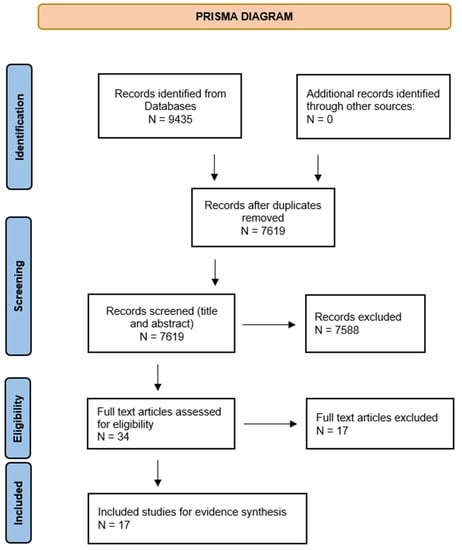
A total of 9435 papers were identified after database screening and 7629 records remained after removing the duplicates. Two reviewers (SP and NG) independently screened the title and abstracts of 7629 records for inclusion. Rayyan software [13,14] was used to screen the title and abstracts by the two reviewers with the blinds turned on.
Conflicts between reviewers were discussed and full texts of such papers were screened. If a consensus could not be reached, a third reviewer was involved to resolve the conflict (AV).
Out of the 9435 records identified, 34 full texts were assessed for eligibility and for inclusion in the study. The full texts of each study were reviewed by two reviewers independently and discussed by all reviewers.
2.3. Data Extraction
For data extraction, NG and SP developed a standard tool which was discussed and finalised by all the reviewers. It was agreed it was imperative to extract maximum relevant data to ensure a correct analysis. Table 1 shows the data extraction for all the included studies (detailed version available in Supplementary Materials File S2). All reviewers independently extracted the data for the studies assigned to them and it was crosschecked by a second reviewer.
2.4. Quality Assessment
Risk of bias was assessed by three reviewers (S.P., N.G., and D.A.) independently by allocating a subset of included studies to each of the three reviewers. Each study was reviewed by two reviewers independently and the results were crosschecked after. Any conflicts or disagreements in the assessment were resolved by the three reviewers in a discussion meeting. Standard EPOC risk of bias criteria were used for randomised trials, non-randomised trials, and controlled before–after studies. In the previous review, risk of bias was not assessed for Before–After Studies with No Control Group and the risk of bias was assumed to be high for these studies [12]. However, in this review we assessed the risk of bias for Before–After (Pre–Post) studies with no control group using the quality assessment tool developed by NHLBI in 2013 [15]. This was done as the potential biases are likely to be more significant for non-randomised studies than randomised trials, especially if they compare the results between the same group of designs [16].
2.5. Data Analysis
The studies included were diverse with respect to the study design, intervention, population, and outcomes. It was not possible to perform further meta-analyses and a narrative synthesis of evidence was adopted.
3. Results
For this review, 17 studies were identified and included for evidence synthesis (Table 2). The excluded studies and reasons for exclusion are provided in Supplementary Materials File S3.
The 17 studies included have varied kinds of intervention addressing the public. Intervention types included are educational intervention [3,17,18,19,20,21,22,23,24], theatre intervention [2,25], gamification [26,27], animated film [28], fear-based messaging [29], musical [30], and a digital intervention [31]. Table 1 shows the types of interventions and outcomes from each of these interventions included in this study.
While most of the studies were successful in increasing knowledge of its participants in the short-term (4–6 weeks), long-term impacts of these studies were not evaluated. In one study [28] the authors mentioned that after 6 weeks the impact of the intervention was low and intentions of participants not requesting an antibiotic had waned. In another study [21], it was noted that while the educational intervention helped in increasing the knowledge, there was little impact on the attitudes of participants (public) towards antibiotics.
Interventions targeting school students [3,20,25,30] were impactful and this was also observed in the previous review by Price et al. They reported a substantial increase in knowledge gained and retention of messages between 3 and 6 months after the intervention [3,30].
Table 1.
Types of interventions and outcomes.
None of the interventions used social media as a tool to reach their participants or convey a message to them. Two interventions [2] and [25] uploaded videos of their interventions on YouTube which shows there is a possibility to reach a bigger audience through social media as well as increase the longevity as videos can be replayed any time.
Intervention showing animated film [28], musical [30] or theatre shows [2] and [25] had a positive impact on the knowledge gained and attitudes of the participants. There was a 4% reduction in intentions to ask for antibiotics in comparison to the control group after watching the animated film [28] which may show the potential of social media for AMR intervention as videos constitute 80% of internet traffic [32].
Table 2.
Details of Interventions.
Quality of Studies
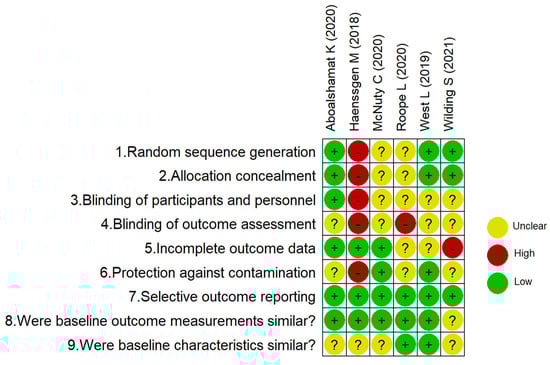
The risk of bias of included studies is summarised in Figure 1 and Figure 2 separating controlled studies and Before–After (Pre–Post) Studies with No Control Group. These assessments are described in more detail in Supplementary Materials File S4.
Figure 1.
Prisma diagram.
Figure 2.
Risk of bias for studies with a separate control group.
Concerning the risk of bias for studies with a separate control group (Figure 1), three of six studies had a low risk of selection bias due to the generation of a random sequence, with the exception of McNulty et al. (2020) and Roope et al. (2020), where there was insufficient information to allow judgement [3,29]. The study of Haenssgen et al. (2018) was considered to have a high risk of selection bias and protection against contamination being a quasi-experimental design (non-randomised) [21]. Most of the studies that presented an unclear risk for performance and detection bias resulted from the difficulty of blinding, but no description was included in relation to its possible implications [3,21,24,26,28,29].
One study presented a high risk of attrition bias as 13% of data was missing at the second time point [28]. Four studies had insufficient information about the intervention and it was unclear to judge if baseline characteristics were similar [3,26,28] and [21].
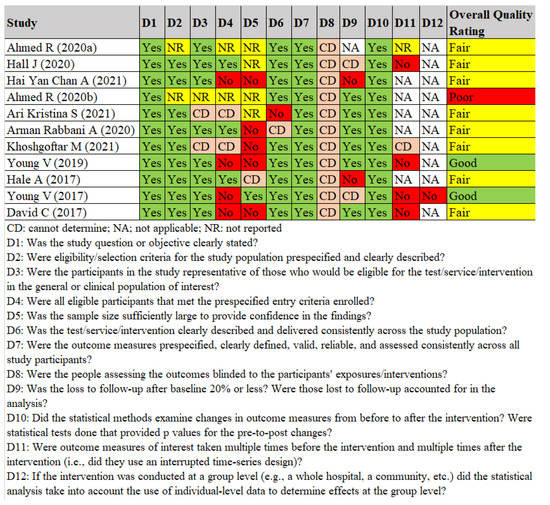
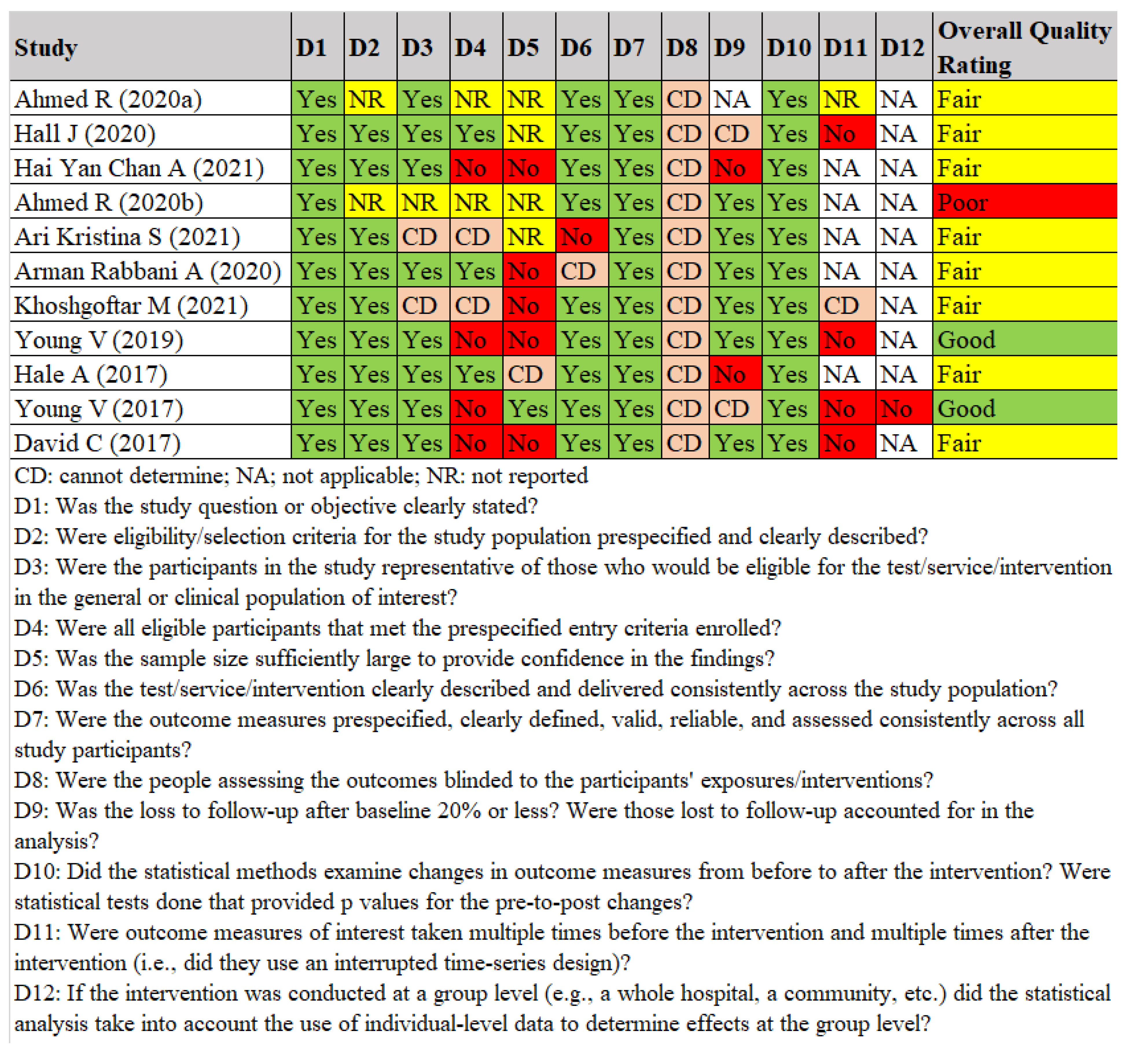
The quality assessment for Before–After (Pre–Post) studies with no control group are shown in Figure 3. Overall, 7 of 10 studies had a fair quality as not all domains were reported or other information was missing, in particular in relation to the domain on blinding the people assessing the outcomes [2,17,18,19,30,31]. Furthermore, the statistical methods of Ahmed et al. (2020) and Ari et al. (2021) were unclear [17,25].
Figure 3.
Quality assessment for Before–After (Pre–Post) studies with no control group [2,17,18,19,20,22,23,25,27,30,31].
4. Discussion
Each intervention had unique characteristics and structure which makes direct comparison difficult. However, all the interventions included in this review had a positive impact on the level of knowledge gained about AMR and achieved their desired goal among their targeted audience.
There is still widespread absence in understanding, awareness, and general knowledge about antibiotics and their use among the public and interactive, engaging interventions such as theatre plays or videos, have a positive impact on raising public awareness and improving attitudes towards AMR. The scale of each project is, however, reducing the potential impact [2].
Gualano et al. found 50% of the participants had incorrect behaviour towards antimicrobial consumption. The results of their meta-analysis confirmed this finding [33]. To address this challenge, experts in infectious diseases, health communication, and social marketing should be an integral part of antimicrobial awareness campaign planning teams [8].
An interesting aspect highlighted by Ahmed et al. [2] is that important messages are often ‘pushed’ onto the audience in public health interventions, and that in interactive play format, concerns are presented and the audience is challenged to examine their understanding. The audience gets ‘drawn’ into the important concepts in this way, giving them a deeper sense of ownership, involvement, and engagement with the subject.
The success of an intervention which used gamification was presented by Aboalshamat et al., who found not only an immediate but also long-term retention if the game was engaging. This can be explained by Csikszentmihalyi’s flow theory which states that when a person is immersed in an event, they are more likely to be fully engrossed and focused on the work at hand [26].
Overall, the use of social media is absent in the delivery of interventions to improve AMR awareness. Although, it was shown that engagement seems to be the key in gathering attention as well as having long-term impact. Social media is considered one of the main tools in current society to get engagement. In 2021, a global record 4.5 billion active social media users were observed, a 13 % year on year increase [34].
Studies on social media during the pandemic found beneficial connections between the components of a social media campaign, public health awareness, and behavioural change amid COVID-19 [9,10,11]. However, different countries have different favourite social media platforms, use different types of messages, and vary in source sender types [11]. While social media has clear advantages, it can also quickly spread false information [10]. For instance, false information was being tweeted far more than correct information even though it had a lower engagement rate or retweets while scientifically correct tweets had higher retweets and engagement [10].
Social media use during the pandemic shows its potential for AMR information campaigns and provides lessons. One of which is that clinicians and health experts/researchers should serve as the source of correct information [35]. Additionally, appropriate social media platforms should be used depending on the target audience—the younger generation would prefer Instagram or TikTok while the older generations would prefer Facebook [36].
Additionally, a common measurement tool such as a questionnaire needs to be developed to standardise the measure the effect in each intervention. Currently, the lack of such a common outcome measurement tool makes it difficult to compare these interventions against one another and find out what works best in educating the public and truly influencing behaviour change.
Limitations
Our study aimed to identify the interventions to educate the public about AMR and we had to adapt a narrative synthesis approach as each intervention had different outcome and methods of evaluation, due to which a meta-analysis was not possible. This made it impossible to evaluate the interventions against each other directly by using a statistical analysis. Additionally, no intervention measured long-term outcomes, beyond 6 months, and it was therefore not possible to confirm if there was any real long-term retention of knowledge in any intervention.
5. Conclusions
As seen from the different interventions included in this review, the long-term impact of any intervention is not evaluated. While most of the interventions have an impact on knowledge gained immediately after the intervention, a shift in attitudes towards sustained knowledge on AMR and use of antibiotics is lacking. The mode of engagement and its role in long-term retention needs to be considered and future interventions can take learnings from the pandemic social media campaigns.
Supplementary Materials
The following supporting information can be downloaded at: https://www.mdpi.com/article/10.3390/antibiotics11050669/s1, File S1: Evidence search report in electronic databases, File S2: Data extraction, File S3: List of studies excluded and reasons for their exclusion—full text, File S4: Risk of bias; File S5: Revised Search Strategy to check for Telegram and Reddit.
Author Contributions
Conceptualization, A.V. and S.P.; methodology S.P., N.G.-O. and D.A.; software, S.P. and N.G.-O.; validation, S.P. and N.G.-O.; formal analysis, all authors; writing-original draft preparation, S.P.; writing review and editing, all authors; supervision A.V. and P.M. All authors have read and agreed to the published version of the manuscript.
Funding
This research was funded by the Health Research Board (HRB), Ireland and grant number is RL2020003.
Institutional Review Board Statement
Not applicable.
Informed Consent Statement
Not applicable.
Data Availability Statement
Not applicable.
Conflicts of Interest
The authors declare no conflict of interest.
References
- Murray, C.J.; Ikuta, K.S.; Sharara, F.; Swetschinski, L.; Aguilar, G.R.; Gray, A.; Han, C.; Bisignano, C.; Rao, P.; Wool, E.; et al. Global burden of bacterial antimicrobial resistance in 2019: A systematic analysis. Lancet 2022, 399, 629–655. [Google Scholar] [CrossRef] [Scilit]
- Ahmed, R.; Bashir, A.; Brown, J.; Cox, J.; Hilton, A.; Hilton, C.; Lambert, P.; Theodosiou, E.; Tritter, J.; Watkin, S.; et al. The drugs don’t work: Evaluation of educational theatre to gauge and influence public opinion on antimicrobial resistance. J. Hosp. Infect. 2020, 104, 193–197. [Google Scholar] [CrossRef] [Scilit] [PubMed]
- McNulty, C.A.M.; Syeda, R.B.; Brown, C.L.; Bennett, C.V.; Schofield, B.; Allison, D.G.; Verlander, N.Q.; Francis, N. Peer-education as a tool to educate on antibiotics, resistance and use in 16–18-year-olds: A feasibility study. Antibiotics 2020, 9, 146. [Google Scholar] [CrossRef] [Scilit] [PubMed]
- WHO. Antimicrobial Resistance: Global Report on Surveillance; WHO: Geneva, Switzerland, 2014. [Google Scholar]
- WHO. Global action plan on antimicrobial resistance. In Global Action Plan on Antimicrobial Resistance; WHO: Geneva, Switzerland, 2015. [Google Scholar]
- National Institute for Health and Care Excellence. NICE Guideline: Antimicrobial Stewardship: Changing Risk-Related Behaviours in the General Population. 2017. Available online: https://www.nice.org.uk/guidance/ng63/resources/antimicrobial-stewardship-changing-riskrelated-behaviours-in-the-general-population-pdf-1837572082117 (accessed on 23 February 2022).
- McNulty, C.A.; Nichols, T.; French, D.P.; Joshi, P.; Butler, C.C. Expectations for consultations and antibiotics for respiratory tract infection in primary care: The RTI clinical iceberg. Br. J. Gen. Pract. 2013, 63, e429–e436. [Google Scholar] [CrossRef] [Scilit] [PubMed]
- Huttner, B.; Saam, M.; Moja, L.; Mah, K.; Sprenger, M.; Harbarth, S.; Magrini, N. How to improve antibiotic awareness campaigns: Findings of a WHO global survey. BMJ Glob. Health 2019, 4, e001239. [Google Scholar] [CrossRef] [Scilit]
- Verma, B. Social Media Analysis during Covid-19: A Systematic Review. Int. J. Recent Technol. Eng. (IJRTE) 2021, 10, 115–118. [Google Scholar] [CrossRef] [Scilit]
- Tsao, S.-F.; Chen, H.; Tisseverasinghe, T.; Yang, Y.; Li, L.; Butt, Z.A. What social media told us in the time of COVID-19: A scoping review. Lancet Digit. Health 2021, 3, e175–e194. [Google Scholar] [CrossRef] [Scilit]
- Abuhashesh, M.Y.; Al-Dmour, H.; Masa’Deh, R.; Salman, A.; Al-Dmour, R.; Boguszewicz-Kreft, M.; AlAmaireh, Q.N. The Role of Social Media in Raising Public Health Awareness during the Pandemic COVID-19: An International Comparative Study. Informatics 2021, 8, 80. [Google Scholar] [CrossRef] [Scilit]
- Price, L.; Gozdzielewska, L.; Young, M.; Smith, F.; Macdonald, J.; McParland, J.; Williams, L.; Langdridge, D.; Davis, M.D.M.; Flowers, P. Effectiveness of interventions to improve the public’s antimicrobial resistance awareness and behaviours associated with prudent use of antimicrobials: A systematic review. J. Antimicrob. Chemother. 2018, 73, 1464–1478. [Google Scholar] [CrossRef] [Scilit]
- Kellermeyer, L.; Harnke, B.; Knight, S. Covidence and Rayyan. J. Med. Libr. Assoc. 2018, 106, 580–583. [Google Scholar] [CrossRef] [Scilit]
- Ouzzani, M.; Hammady, H.; Fedorowicz, Z.; Elmagarmid, A. Rayyan—A web and mobile app for systematic reviews. Syst. Rev. 2016, 5, 210. [Google Scholar] [CrossRef] [Scilit] [PubMed]
- Nhlbi, N. Study Quality Assessment Tools National Heart, Lung and Blood Institute. 2022. Available online: https://www.nhlbi.nih.gov/health-topics/study-quality-assessment-tools (accessed on 16 January 2022).
- Reeves, B.C.; Deeks, J.J.; Higgins, J.P.T.; Shea, B.; Tugwell, P.; Wells, G.A.; the Cochrane Non-Randomized Studies of Interventions Methods Group. Chapter 24: Including non-randomized studies on intervention effects. In Cochrane Handbook for Systematic Reviews of Interventions, 2nd ed.; Higgins, J.P.T., Thomas, J., Chandler, J., Cumpston, M., Li, T., Page, M.J., Welch, V.A., Eds.; Wiley & Sons: New York, NY, USA, 2019. [Google Scholar]
- Kristina, S.A.; Salsabila, N.N.; Yulianto, Y.; Fortwengel, G. Effect of didactic educational intervention on improving knowledge of antibiotics use and resistance in Yogyakarta Community. Pharm. Sci. Asia 2021, 48, 346–353. [Google Scholar] [CrossRef] [Scilit]
- Rabbani, S.A.; Sridhar, S.B.; Abazer, D.; Ahmed, H.S.; Usman, H.A.; Mahtab, A.; El-Dahiyat, F. Impact of community-based educational intervention on antibiotic use and resistance awareness among the people living in Ras Al Khaimah, United Arab Emirates. J. Pharm. Health Serv. Res. 2020, 11, 197–204. [Google Scholar] [CrossRef] [Scilit]
- Pirzadeh, A.; Khoshgoftar, M.; Zamani-Alavijeh, F.; Kasaian, N.; Shahzamani, K.; Rostami, S.; Nakhodian, Z. The effect of public health educational campaign regarding antibiotic use and microbial resistance on knowledge, attitude, and practice in the Iran. J. Educ. Health Promot. 2021, 10, 3. [Google Scholar] [CrossRef] [Scilit] [PubMed]
- Young, V.L.; Berry, M.; Verlander, N.Q.; Ridgway, A.; McNulty, C.A. Using debate to educate young people in schools about antibiotic use and resistance: A before and after evaluation using a questionnaire survey. J. Infect. Prev. 2019, 20, 281–288. [Google Scholar] [CrossRef] [Scilit] [PubMed]
- Haenssgen, M.J.; Xayavong, T.; Charoenboon, N.; Warapikuptanun, P.; Zaw, Y.K. The Consequences of AMR Education and Awareness Raising: Outputs, Outcomes, and Behavioural Impacts of an Antibiotic-Related Educational Activity in Lao PDR. Antibiotics 2018, 7, 95. [Google Scholar] [CrossRef] [Scilit]
- Young, V.L.; Cole, A.; Lecky, D.M.; Fettis, D.; Pritchard, B.; Verlander, N.Q.; Eley, C.V.; McNulty, C.A.M. A mixed-method evaluation of peer-education workshops for school-aged children to teach about antibiotics, microbes and hygiene. J. Antimicrob. Chemother. 2017, 72, 2119–2126. [Google Scholar] [CrossRef] [Scilit]
- David, C.M.; O’Neal, K.S.; Miller, M.J.; Johnson, J.L.; Lloyd, A.E. A literacy-sensitive approach to improving antibiotic understanding in a community-based setting. Int. J. Pharm. Pract. 2017, 25, 394–398. [Google Scholar] [CrossRef] [Scilit]
- West, L.M.; Cordina, M. Educational intervention to enhance adherence to short-term use of antibiotics. Res. Soc. Adm. Pharm. 2019, 15, 193–201. [Google Scholar] [CrossRef] [Scilit]
- Ahmed, R.; Bashir, A.; Brown, J.E.; Cox, J.A.; Hilton, A.C.; Jordan, S.L.; Theodosiou, E.; Worthington, T. Aston University’s Antimicrobial Resistance (AMR) Roadshow: Raising awareness and embedding knowledge of AMR in key stage 4 learners. Infect. Prev. Pract. 2020, 2, 100060. [Google Scholar] [CrossRef] [Scilit]
- Aboalshamat, K.; Khayat, A.; Halwani, R.; Bitan, A.; Alansari, R. The effects of gamification on antimicrobial resistance knowledge and its relationship to dentistry in Saudi Arabia: A randomized controlled trial. BMC Public Health 2020, 20, 680. [Google Scholar] [CrossRef] [Scilit] [PubMed]
- Hale, A.R.; Young, V.L.; Grand, A.; McNulty, C.A.M.; De Quincey, E.; Ridgway, A.; Dockterman, D. Can gaming increase antibiotic awareness in children? a mixed-methods approach. JMIR Serious Games 2017, 5, e5. [Google Scholar] [CrossRef] [Scilit] [PubMed]
- Wilding, S.; Kettu, V.; Thompson, W.; Howard, P.; Jeuken, L.J.C.; Pownall, M.; Conner, M.; Sandoe, J.A.T. Development and randomized controlled trial of an animated film aimed at reducing behaviours for acquiring antibiotics. JAC-Antimicrob. Resist. 2021, 3, dlab083. [Google Scholar] [CrossRef] [Scilit] [PubMed]
- Roope, L.S.J.; Herd, N.M.S.; Pouwels, K.B.; Castro-Sanchez, E.; Sallis, A.; Hopkins, S.; Robotham, J.V.; Crook, D.W.; Peto, T.; Peters, M.; et al. Reducing expectations for antibiotics in primary care: A randomised experiment to test the response to fear-based messages about antimicrobial resistance. BMC Med. 2020, 18, 110. [Google Scholar] [CrossRef] [Scilit]
- Hall, J.; Jones, L.; Robertson, G.; Hiley, R.; Nathwani, D.; Perry, M.R. ‘The Mould that Changed the World’: Quantitative and qualitative evaluation of children’s knowledge and motivation for behavioural change following participation in an antimicrobial resistance musical. PLoS ONE 2020, 15, e0240471. [Google Scholar] [CrossRef] [Scilit]
- Chan, A.H.Y.; Horne, R.; Lycett, H.; Raebel, E.; Guitart, J.; Wildman, E.; Ang, K. Changing Patient and Public Beliefs About Antimicrobials and Antimicrobial Resistance (AMR) Using a Brief Digital Intervention. Front. Pharmacol. 2021, 12, 608971. [Google Scholar] [CrossRef] [Scilit]
- Video, L. 80% of the Internet Is Video—Are You Using It Effectively? 2021. Available online: https://wwwlaivideocom/blog/80-internet-video-are-you-using-it-effectively (accessed on 7 February 2022).
- Gualano, M.R.; Gili, R.; Scaioli, G.; Bert, F.; Siliquini, R. General population’s knowledge and attitudes about antibiotics: A systematic review and meta-analysis. Pharmacoepidemiol. Drug Saf. 2015, 24, 2–10. [Google Scholar] [CrossRef] [Scilit]
- Dean, B. Social Network Usage & Growth Statistics: How Many People Use Social Media in 2022? 2021. Available online: https://backlinko.com/social-media-users (accessed on 15 January 2022).
- Malecki, K.M.C.; Keating, J.A.; Safdar, N. Crisis Communication and Public Perception of COVID-19 Risk in the Era of Social Media. Clin. Infect. Dis. 2020, 72, 697–702. [Google Scholar] [CrossRef] [Scilit]
- Auxier, B.; Anderson, M. Social Media Use in 2021. Pew Res. Cent. 2021, 1, 1–4. [Google Scholar]
Publisher’s Note: MDPI stays neutral with regard to jurisdictional claims in published maps and institutional affiliations. |
© 2022 by the authors. Licensee MDPI, Basel, Switzerland. This article is an open access article distributed under the terms and conditions of the Creative Commons Attribution (CC BY) license (https://creativecommons.org/licenses/by/4.0/).