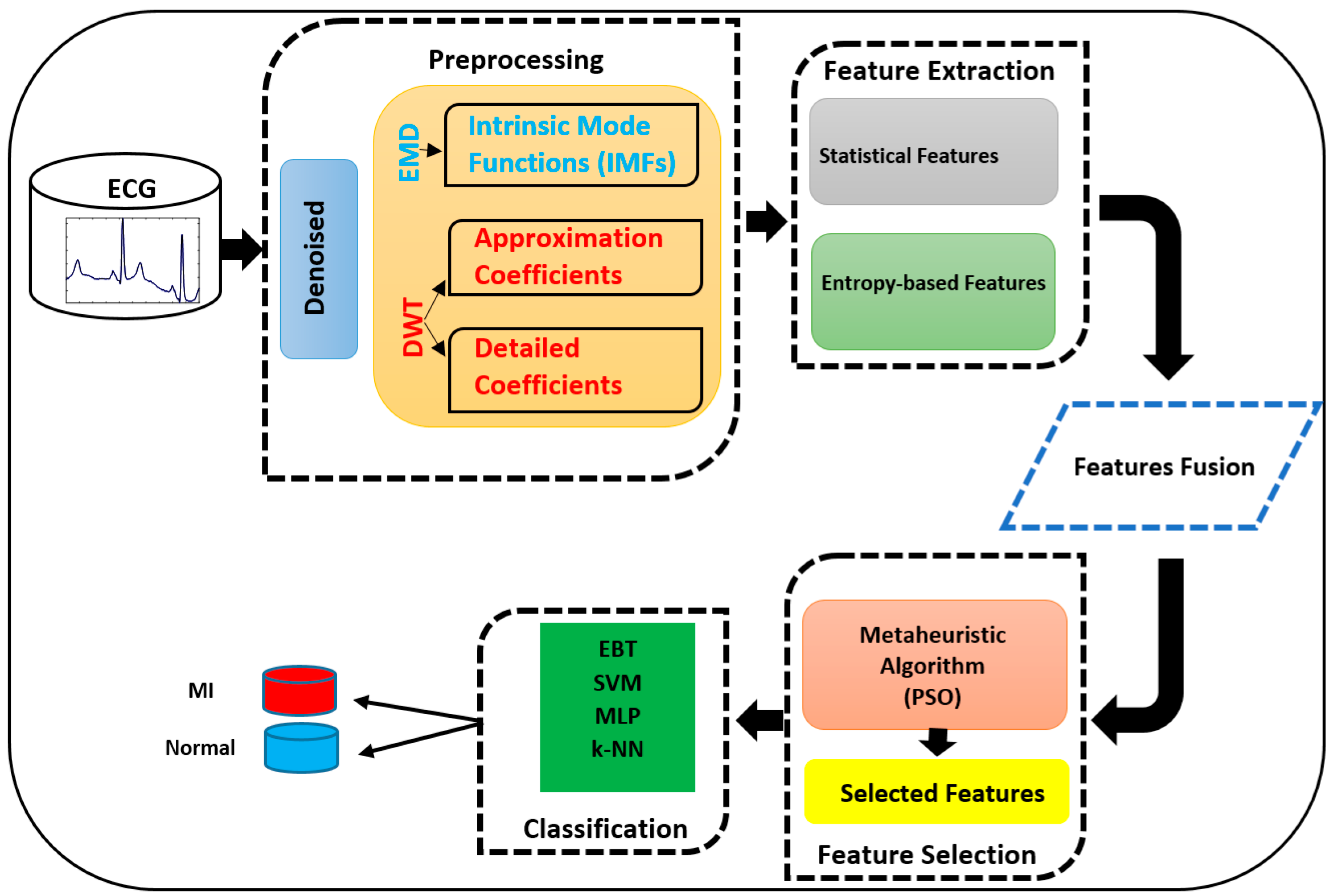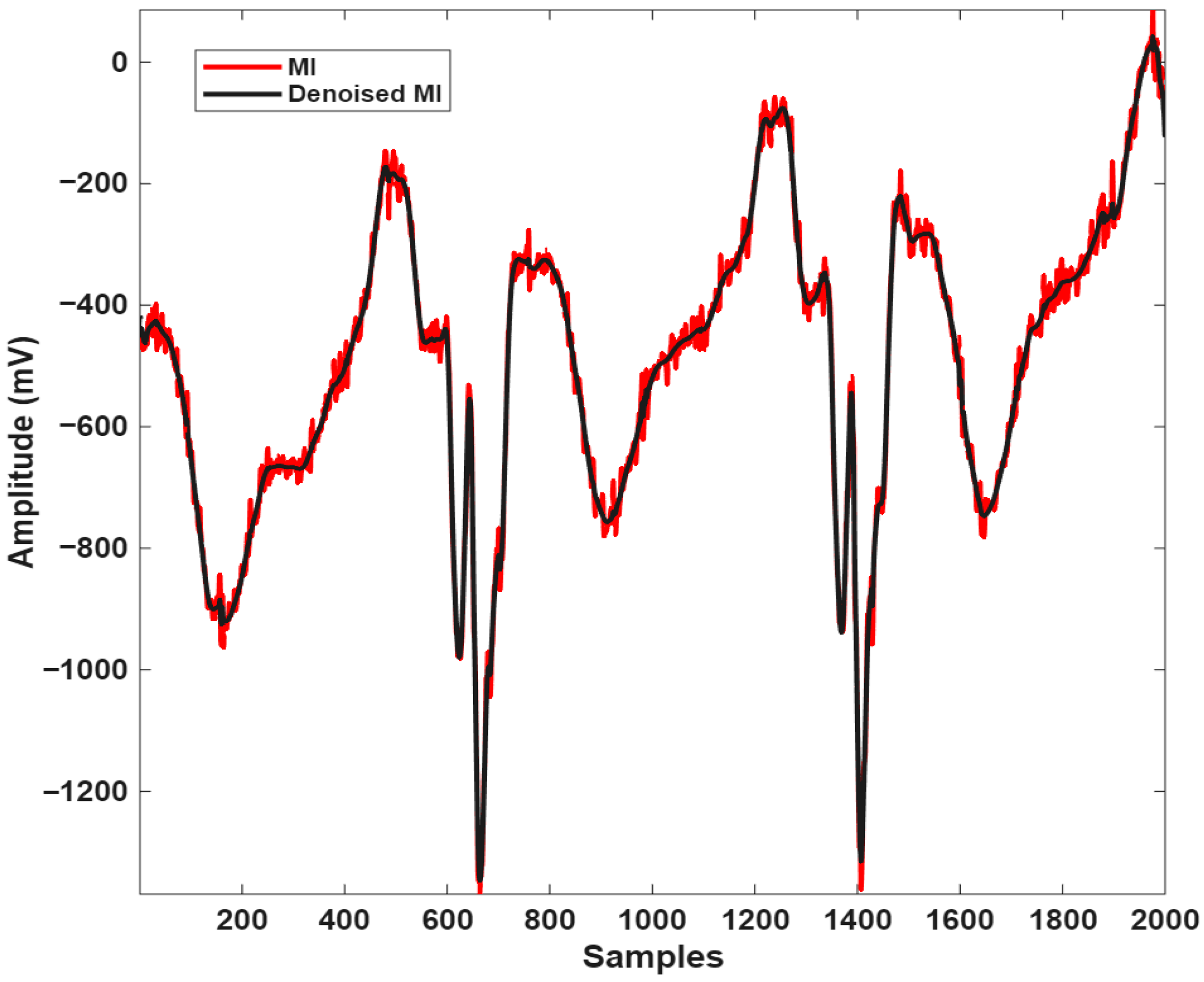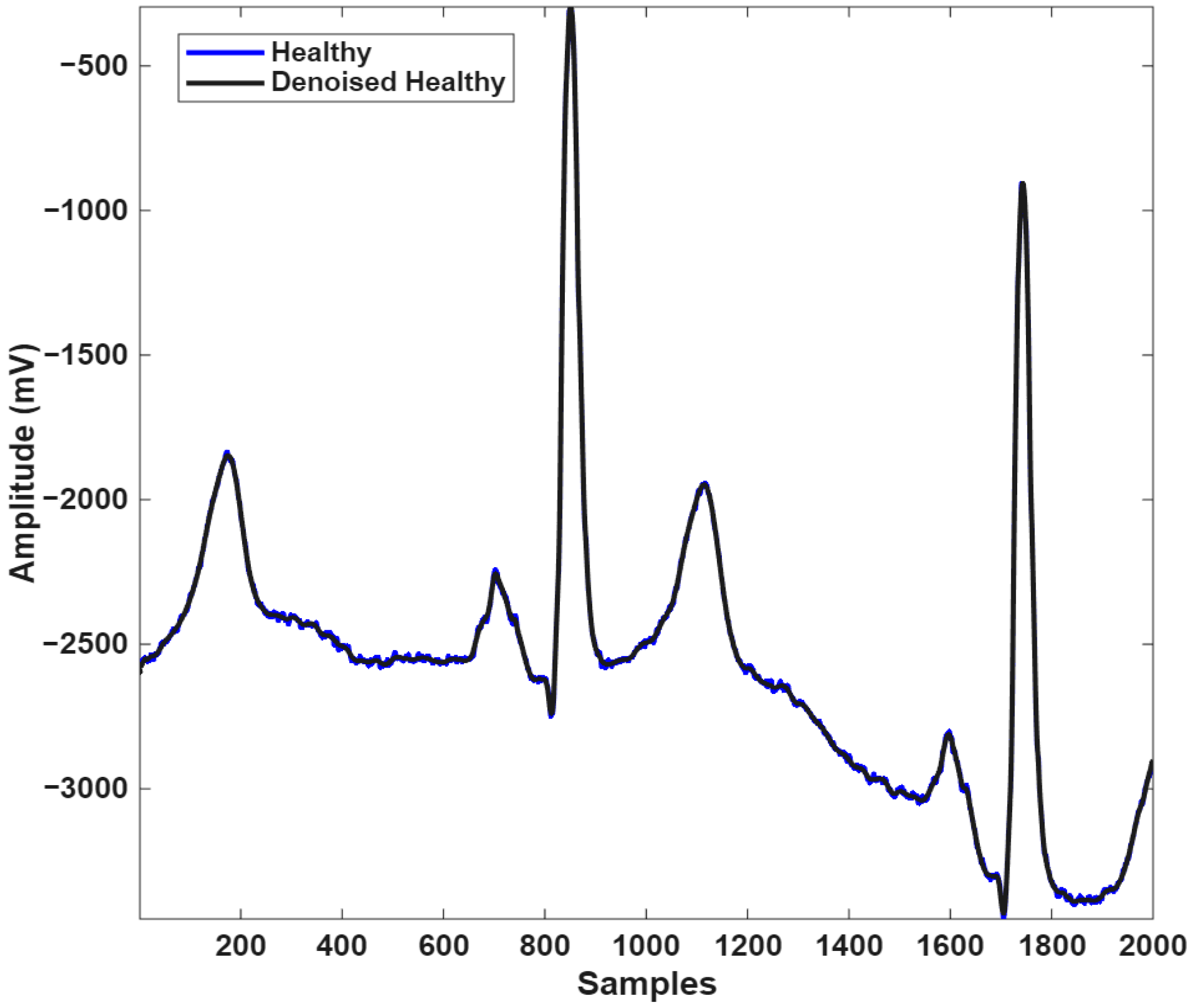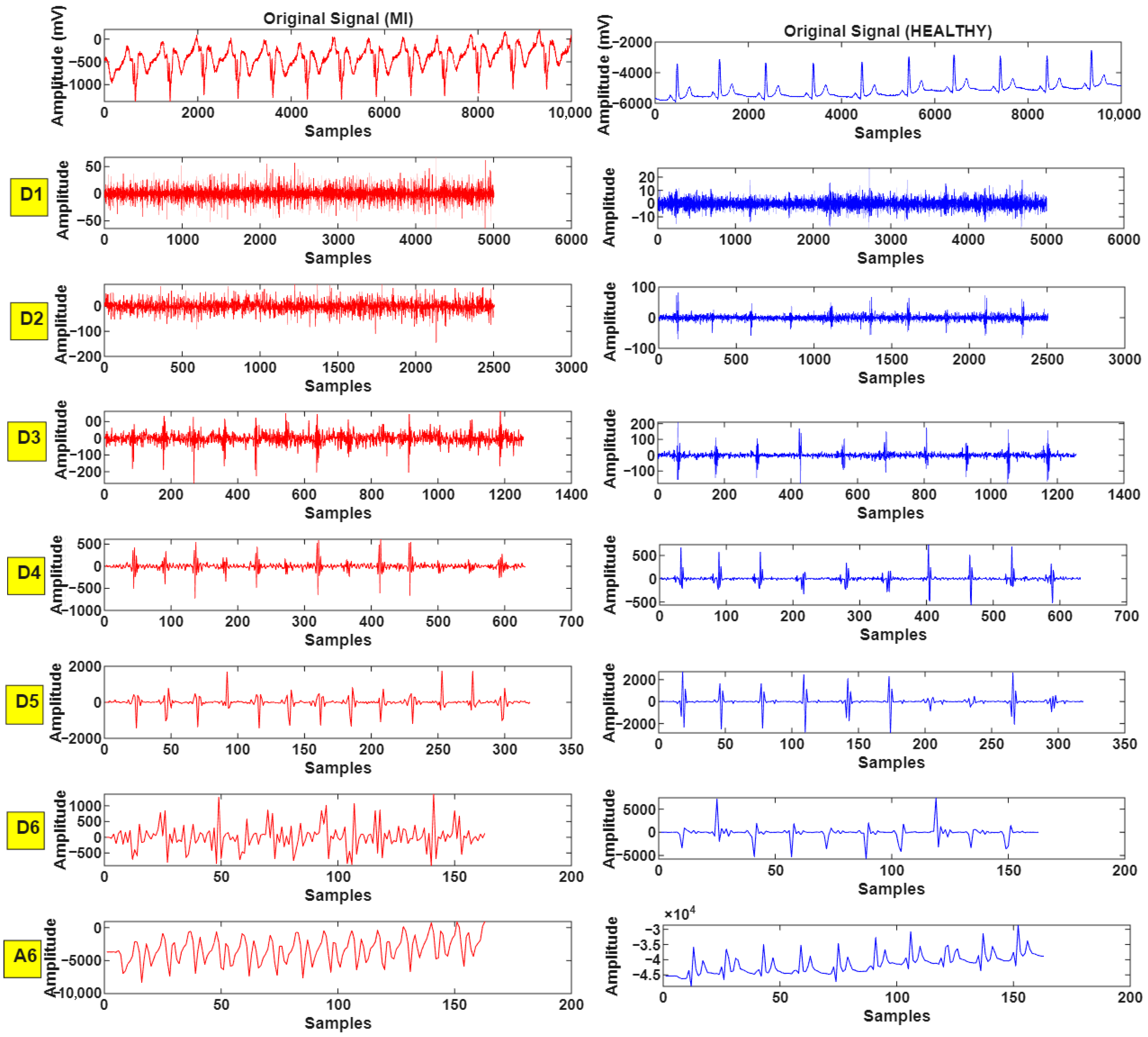
Nonlinear Feature-Based MI Detection Supported by DWT and EMD on ECG: A High-Performance Decision Support Approach


Abstract
1. Introduction
2. Material and Methods
2.1. Data Set
2.2. Discrete Wavelet Transform
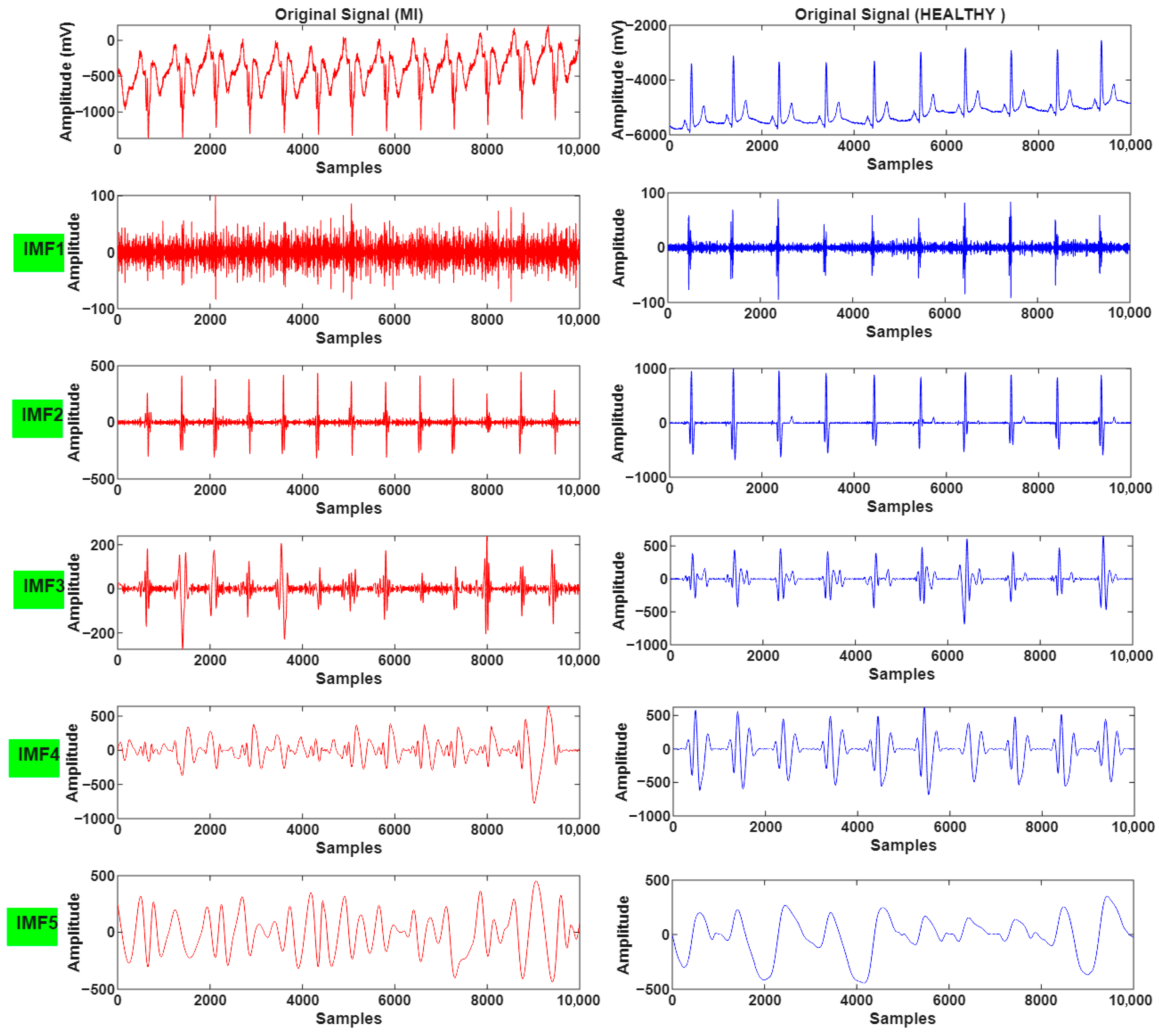
2.3. Empirical Mode Decomposition
2.4. Feature Extraction
2.4.1. Time Domain Measurements
2.4.2. Entropy-Based Feature Extraction
2.5. Feature Selection with PSO
| Algorithm 1 Pseudocode of the PSO-based feature selection procedure used to determine the optimal subset of discriminative ECG features. |
| Input: Feature matrix (X), Class labels (y) Output: Optimal feature subset (gBest) Procedure PSO_Feature_Selection() Initialize the particle population with random binary feature subsets Initialize particle velocities and PSO parameters (ω, c1, c2) while termination condition not met do for each particle in the population do Evaluate fitness using selected features (e.g., classification accuracy) Update personal best position (pBest) and global best (gBest) Update velocity and position using standard PSO equations Apply sigmoid transfer function to binarize new positions end for Update global best solution if needed end while Return: gBest → selected optimal feature subset |
2.6. Classification Algorithms
2.6.1. Bagged Trees
2.6.2. Support Vector Machines
2.6.3. Artificial Neural Networks
2.6.4. k-Nearest Neighbor
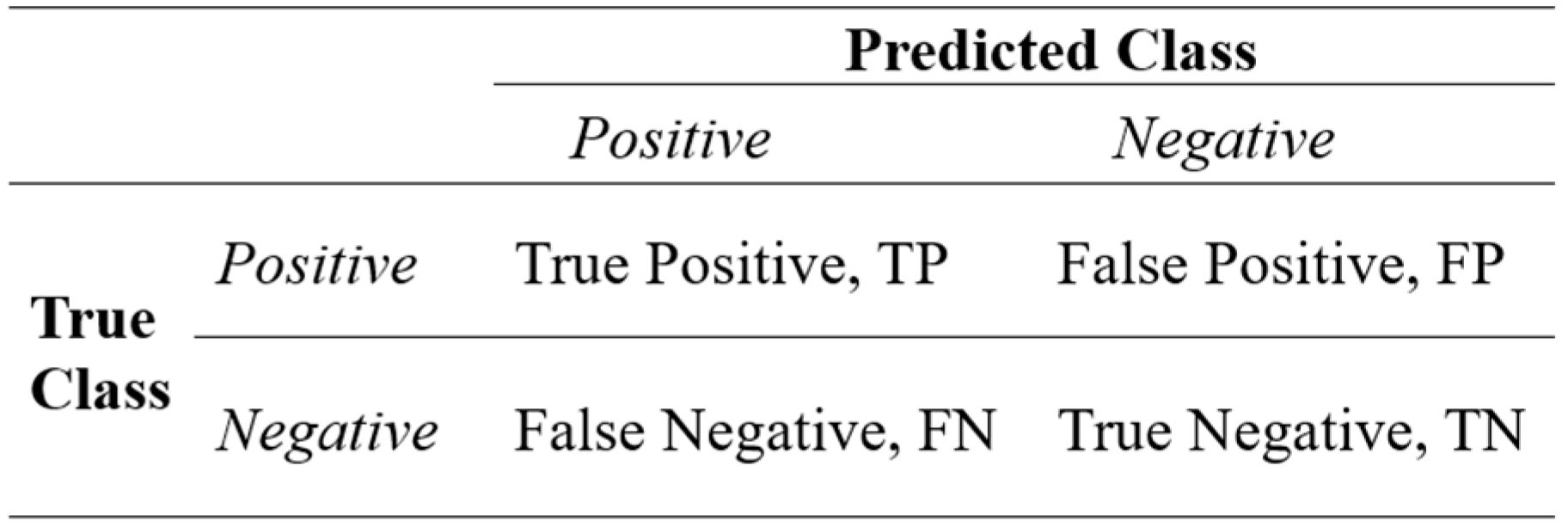
2.7. Performance Metrics
3. Experimental Results
3.1. Effect of Discrete Wavelet Transform Method on Myocardial Infarction Detection
3.2. Effect of the Experimental Mode Decomposition Method on MI Detection
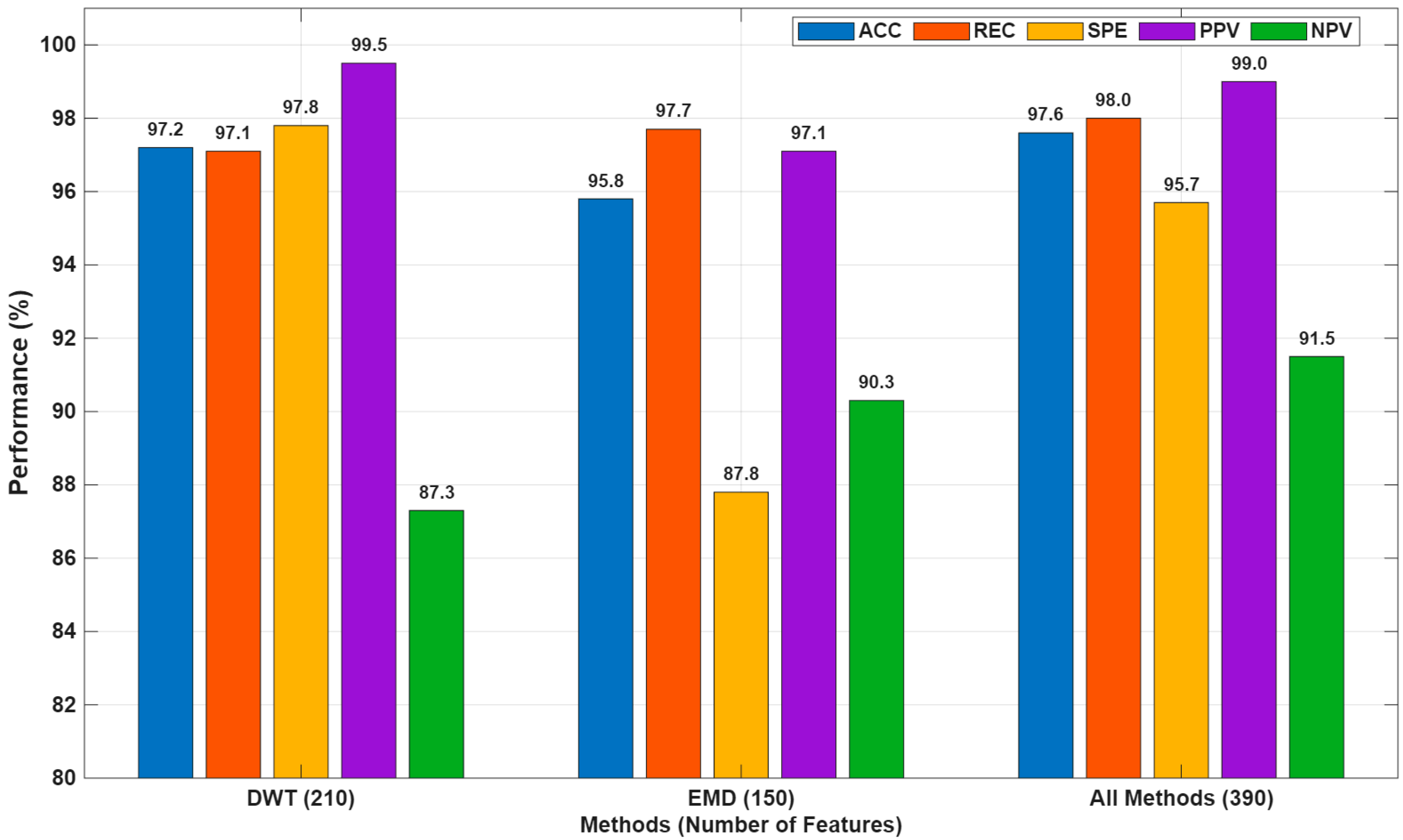
3.3. Performance of All Features in MI
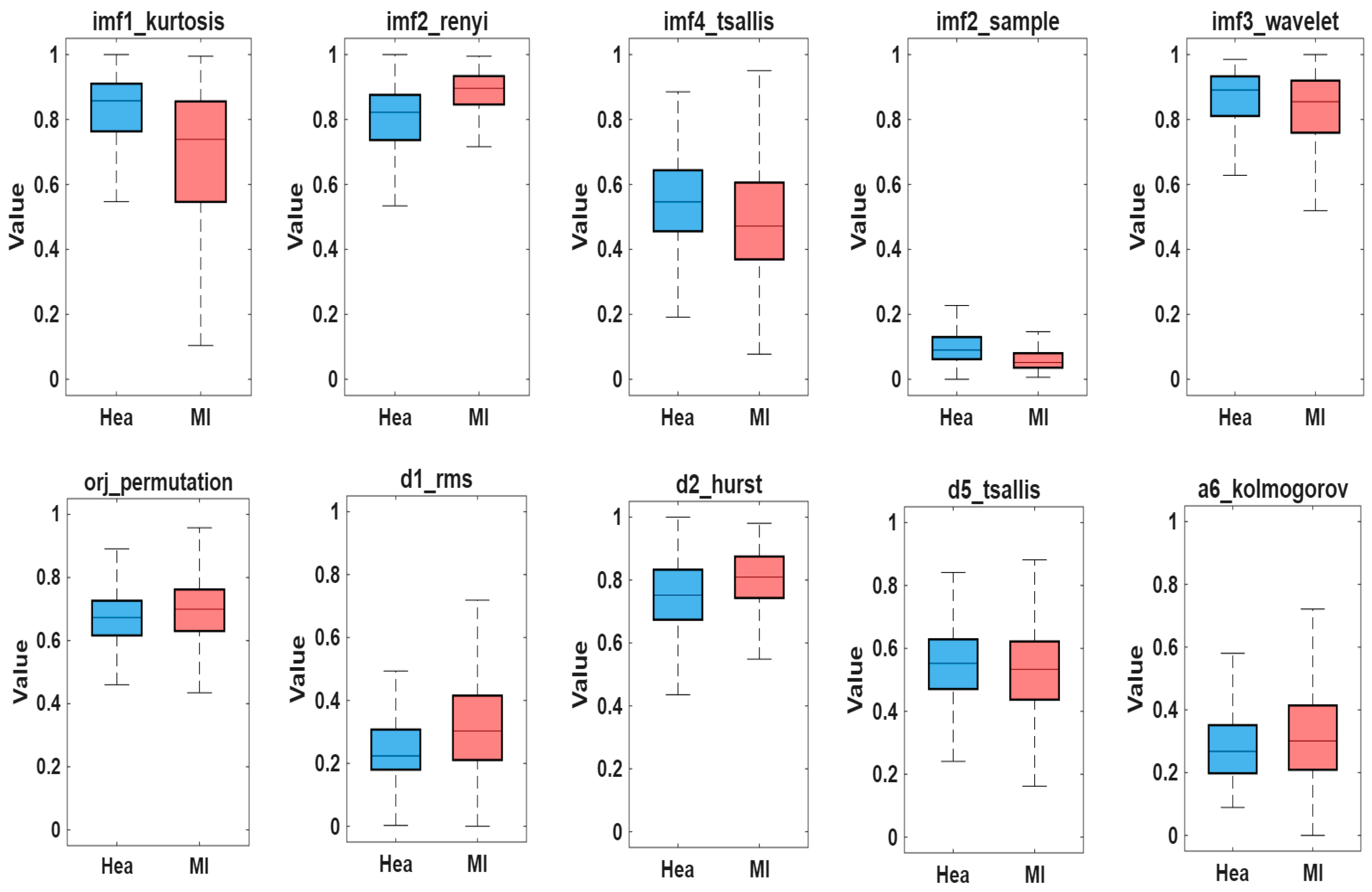
3.4. Performance Analysis of PSO-Based Feature Selection in MI Detection
4. Discussion
Limitations of the Study and Future Work
5. Conclusions
Author Contributions
Funding
Institutional Review Board Statement
Informed Consent Statement
Data Availability Statement
Acknowledgments
Conflicts of Interest
References
- Peirlinck, M.; Costabal, F.S.; Yao, J.; Guccione, J.M.; Tripathy, S.; Wang, Y.; Kuhl, E. Precision medicine in human heart modeling: Perspectives, challenges, and opportunities. Biomech. Model. Mechanobiol. 2021, 20, 803–831. [Google Scholar] [CrossRef]
- Lüscher, T.F. Myocardial infarction: Mechanisms, diagnosis, and complications. Eur. Heart J. 2015, 36, 947–949. [Google Scholar] [CrossRef] [PubMed]
- World Health Organization. Cardiovascular Diseases (CVDs). Available online: https://www.who.int/news-room/fact-sheets/detail/cardiovascular-diseases-(cvds) (accessed on 15 December 2025).
- Unger, S.A.; Kucia, A.M. Diagnostic procedures. In Cardiac Care: A Practical Guide for Nurses; Springer: Cham, Switzerland, 2022; pp. 76–102. [Google Scholar]
- Li, J.; Zhao, W.; Tian, Z.; Hu, Y.; Xiang, J.; Cui, M. Correlation between coronary microvascular dysfunction and cardiorespiratory fitness in patients with ST-segment elevation myocardial infarction. Sci. Rep. 2024, 14, 26564. [Google Scholar] [CrossRef]
- Fernandez, R.; Ellwood, L.; Barrett, D.; Weaver, J. Safety and effectiveness of strategies to reduce radiation exposure to proceduralists performing cardiac catheterization procedures: A systematic review. JBI Evid. Synth. 2021, 19, 4–33. [Google Scholar] [CrossRef]
- Höllriegel, R.; Mangner, N.; Schuler, G.; Erbs, S. Physical exercise training and coronary artery disease. Rev. Health Care 2013, 4, 175–191. [Google Scholar] [CrossRef]
- Kligfield, P.; Gettes, L.S.; Bailey, J.J.; Childers, R.; Deal, B.J.; Hancock, E.W.; van Herpen, G.; Kors, J.A.; Macfarlane, P.; Mirvis, D.M.; et al. Recommendations for the Standardization and Interpretation of the Electrocardiogram. Circulation 2007, 115, 1306–1324. [Google Scholar] [CrossRef]
- Thygesen, K.; Alpert, J.S.; Jaffe, A.S.; Chaitman, B.R.; Bax, J.J.; Morrow, D.A.; White, H.D. Fourth Universal Definition of Myocardial Infarction. Circulation 2018, 138, e618–e651. [Google Scholar] [CrossRef] [PubMed]
- Salerno, S.M.; Alguire, P.C.; Waxman, H.S. Training and competency evaluation for interpretation of 12-lead electrocardiograms: Recommendations from the American College of Physicians. Ann. Intern. Med. 2003, 138, 747–750. [Google Scholar] [CrossRef]
- Velandia, H.; Pardo, A.; Vera, M.I.; Vera, M. Systematic Review of Artificial Intelligence and Electrocardiography for Cardiovascular Disease Diagnosis. Bioengineering 2025, 12, 1248. [Google Scholar] [CrossRef] [PubMed]
- Gong, M.; Liang, D.; Xu, D.; Jin, Y.; Wang, G.; Shan, P. Analyzing predictors of in-hospital mortality in patients with acute ST-segment elevation myocardial infarction using an evolved machine learning approach. Comput. Biol. Med. 2024, 170, 107950. [Google Scholar] [CrossRef]
- Han, C.; Zhou, Y.; Que, W.; Li, Z.; Shi, L. Algorithms for myocardial infarction diagnostics using ECG signals: Advances and challenges. IEEE Trans. Instrum. Meas. 2024, 73, 2522713. [Google Scholar] [CrossRef]
- Arif, M.; Malagore, I.A.; Afsar, F.A. Automatic detection and localization of myocardial infarction using back propagation neural networks. In Proceedings of the 4th International Conference on Bioinformatics and Biomedical Engineering, Chengdu, China, 18–20 June 2010; pp. 1–4. [Google Scholar]
- Zeng, W.; Yuan, C. Myocardial infarction detection using ITD, DWT and deterministic learning based on ECG signals. Cogn. Neurodyn. 2023, 17, 941–964. [Google Scholar] [CrossRef]
- Sahu, G.; Ray, K.C. An efficient method for detection and localization of myocardial infarction. IEEE Trans. Instrum. Meas. 2021, 71, 4001312. [Google Scholar] [CrossRef]
- Zeng, W.; Shan, L.; Yuan, C.; Du, S. Detection of myocardial infarction using Shannon energy envelope, FA-MVEMD and deterministic learning. Complex. Intell. Syst. 2024, 10, 4755–4773. [Google Scholar] [CrossRef]
- Zhou, Y.; Ma, Z.; Fu, L. A review of key signal processing techniques for structural health monitoring. Algorithms 2025, 18, 318. [Google Scholar] [CrossRef]
- Kumar, M.; Pachori, R.B.; Acharya, U.R. Automated diagnosis of myocardial infarction ECG signals using sample entropy. Entropy 2017, 19, 488. [Google Scholar] [CrossRef]
- Han, C.; Shi, L. Automated interpretable detection of myocardial infarction fusing energy entropy and morphological features. Comput. Methods Programs Biomed. 2019, 175, 9–23. [Google Scholar] [CrossRef] [PubMed]
- Acharya, U.R.; Fujita, H.; Adam, M.; Oh, S.L.; Sudarshan, V.K.; Tan, J.H.; Koh, J.E.W.; Hagiwara, Y.; Chua, C.K.; Poo, C.K.; et al. Automated characterization and classification of coronary artery disease and myocardial infarction by ECG decomposition. Inf. Sci. 2017, 377, 17–29. [Google Scholar] [CrossRef]
- Chaitanya, M.K.; Sharma, L.D. Cross-subject myocardial infarction detection using binary Harris hawks feature selection. IEEE Access 2024, 12, 28247–28259. [Google Scholar] [CrossRef]
- Siddiqui, H.U.R.; Zafar, K.; Saleem, A.A.; Sehar, R.; Rustam, F.; Dudley, S.; Ashraf, I. Artificial intelligence-based myocardial infarction diagnosis: A comprehensive review. Multimed. Tools Appl. 2024, 83, 41951–41979. [Google Scholar] [CrossRef]
- Jain, S.; Kumar, R.; Kushwah, R.; Saini, M.; Kumari, S. Utilizing ensemble learning and XAI to enhance AMI prediction. In Intelligent Computing and Communication Techniques; CRC Press: Boca Raton, FL, USA, 2025; pp. 615–620. [Google Scholar]
- Xiong, P.; Lee, S.M.Y.; Chan, G. Deep learning for detecting and locating myocardial infarction by ECG: A review. Front. Cardiovasc. Med. 2022, 9, 860032. [Google Scholar] [CrossRef]
- Jahmunah, V.; Ng, E.Y.K.; Tan, R.S.; Oh, S.L.; Acharya, U.R. Explainable detection of myocardial infarction using Grad-CAM technique on ECG signals. Comput. Biol. Med. 2022, 146, 105550. [Google Scholar] [CrossRef]
- Riek, N.T.; Akcakaya, M.; Bouzid, Z.; Gokhale, T.; Helman, S.M.; Kraevsky, K.; Ji, R.Q.; Sejdic, E.; Zègre-Hemsey, J.K.; Martin-Gill, C.; et al. ECG-Smart-Net: A deep learning architecture for occlusion myocardial infarction diagnosis. IEEE Trans. Biomed. Eng. 2025, 72, 3613–3620. [Google Scholar] [CrossRef]
- Cao, Y.; Liu, W.; Zhang, S.; Xu, L.; Zhu, B.; Cui, H.; Geng, N.; Han, H.; Greenwald, S.E. Detection and localization of myocardial infarction based on multi-scale ResNet. Front. Physiol. 2022, 13, 783184. [Google Scholar] [CrossRef] [PubMed]
- Xiong, P.; Xue, Y.; Zhang, J.; Liu, M.; Du, H.; Zhang, H.; Hou, Z.; Wang, H.; Liu, X. Localization of myocardial infarction with multilead ECG based on DenseNet. Comput. Methods Programs Biomed. 2021, 203, 106024. [Google Scholar] [CrossRef]
- Rai, H.M.; Chatterjee, K. Hybrid CNN-LSTM deep learning model and ensemble technique for automatic detection of myocardial infarction using big ECG data. Appl. Intell. 2022, 52, 5366–5384. [Google Scholar] [CrossRef]
- Wang, J.; Guo, X. Automated detection of myocardial infarction using refined LSTM/GRU. Artif. Intell. Med. 2024, 152, 102865. [Google Scholar] [CrossRef]
- Bousseljot, R.; Kreiseler, D.; Schnabel, A. The PTB Diagnostic ECG Database. PhysioNet. 2004. Available online: https://physionet.org/content/ptbdb/ (accessed on 23 June 2022).
- Issa, M.F.; Yousry, A.; Tuboly, G.; Juhasz, Z.; AbuEl-Atta, A.H.; Selim, M.M. Heartbeat classification based on single lead-II ECG using deep learning. Heliyon 2023, 9, e17974. [Google Scholar] [CrossRef] [PubMed]
- Yousuf, A.; Hafiz, R.; Riaz, S.; Farooq, M.; Riaz, K.; Rahman, M.M.U. Inferior myocardial infarction detection from lead ii of ecg: A gramian angular field-based 2d-cnn approach. IEEE Sens. Lett. 2024, 8, 6012104. [Google Scholar] [CrossRef]
- Limaye, H.; Deshmukh, V.V. ECG noise sources and various noise removal techniques: A survey. Int. J. Appl. Innov. Eng. Manag. 2016, 5, 86–92. [Google Scholar]
- Mallat, S. A Wavelet Tour of Signal Processing; Elsevier: Amsterdam, The Netherlands, 1999. [Google Scholar]
- Vetterli, M.; Herley, C. Wavelets and filter banks: Theory and design. IEEE Trans. Signal Process. 1992, 40, 2207–2232. [Google Scholar] [CrossRef]
- McDonald, A.J.; Baumgaertner, A.J.G.; Fraser, G.J.; George, S.E.; Marsh, S. Empirical mode decomposition of atmospheric wave fields. Ann. Geophys. 2007, 25, 375–384. [Google Scholar] [CrossRef]
- Ge, H.; Chen, G.; Yu, H.; Chen, H.; An, F. Theoretical analysis of empirical mode decomposition. Symmetry 2018, 10, 623. [Google Scholar] [CrossRef]
- Zamudio-Ramirez, I.; Saucedo-Dorantes, J.J.; Antonino-Daviu, J.A.; Osornio-Rios, R.A.; Dunai, L. Detection of uniform gearbox wear using statistical features. IEEE Trans. Ind. Appl. 2022, 58, 4648–4656. [Google Scholar] [CrossRef]
- Anbalagan, T.; Nath, M.K.; Anbalagan, A. Detection of atrial fibrillation from ECG signal using efficient feature selection and classification. Circuits Syst. Signal Process. 2024, 43, 5782–5808. [Google Scholar] [CrossRef]
- Aljalal, M.; Aldosari, S.A.; Molinas, M.; AlSharabi, K.; Alturki, F.A. Detection of Parkinson’s disease from EEG using wavelets. Sci. Rep. 2022, 12, 22547. [Google Scholar] [CrossRef]
- Wang, W.; Zhao, X.; Luo, L.; Zhang, P.; Mo, F.; Chen, F.; Chen, D.; Wu, F.; Wang, B. A Fault Diagnosis Method of Rolling Bearing Based on Attention Entropy and Adaptive Deep Kernel Extreme Learning Machine. Energies 2022, 15, 8423. [Google Scholar] [CrossRef]
- Chanwimalueang, T.; Mandic, D.P. Cosine Similarity Entropy: Self-Correlation-Based Complexity Analysis of Dynamical Systems. Entropy 2017, 19, 652. [Google Scholar] [CrossRef]
- Azami, H.; Faes, L.; Escudero, J.; Humeau-Heurtier, A.; Silva, L.E. Entropy analysis of univariate biomedical signals: Review and comparison of methods. In Frontiers in Entropy Across the Disciplines: Panorama of Entropy: Theory, Computation, and Applications; World Scientific Publishing Company: Singapore, 2023; pp. 233–286. [Google Scholar]
- Li, P.; Liu, C.; Li, K.; Zheng, D.; Liu, C.; Hou, Y. Assessing the complexity of short-term heartbeat interval series by distribution entropy. Med. Biol. Eng. Comput. 2015, 53, 77–87. [Google Scholar] [CrossRef]
- Yan, C.; Li, P.; Liu, C.; Wang, X.; Yin, C.; Yao, L. Novel gridded descriptors of poincaré plot for analyzing heartbeat interval time-series. Comput. Biol. Med. 2019, 109, 280–289. [Google Scholar] [CrossRef]
- Liu, X.; Wang, X.; Zhou, X.; Jiang, A. Appropriate use of the increment entropy for electrophysiological time series. Comput. Biol. Med. 2018, 95, 13–23. [Google Scholar] [CrossRef]
- Rohila, A.; Sharma, A. Phase entropy: A new complexity measure for heart rate variability. Physiol. Meas. 2019, 40, 105006. [Google Scholar] [CrossRef]
- Li, Y.; Gao, P.; Tang, B.; Yi, Y.; Zhang, J. Double feature extraction method of ship-radiated noise signal based on slope entropy and permutation entropy. Entropy 2021, 24, 22. [Google Scholar] [CrossRef]
- Grivel, E.; Berthelot, B.; Colin, G.; Legrand, P.; Ibanez, V. Benefits of zero-phase or linear phase filters to design multiscale entropy: Theory and application. Entropy 2024, 26, 332. [Google Scholar] [CrossRef]
- Kumar, N.; Dixit, A.; Vijay, V. Entropy measures and their applications: A comprehensive review. arXiv 2025, arXiv:2503.15660. [Google Scholar] [CrossRef]
- Kennedy, J.; Eberhart, R. Particle swarm optimization. In Proceedings of ICNN’95-International Conference on Neural Networks; IEEE: New York, NY, USA, 1995; pp. 1942–1948. [Google Scholar]
- Shami, T.M.; El-Saleh, A.A.; Alswaitti, M.; Al-Tashi, Q.; Summakieh, M.A.; Mirjalili, S. Particle swarm optimization: A comprehensive survey. IEEE Access 2022, 10, 10031–10061. [Google Scholar] [CrossRef]
- Mousavi, R.; Eftekhari, M. A new ensemble learning methodology based on hybridization of classifier ensemble selection approaches. Appl. Soft Comput. 2015, 37, 652–666. [Google Scholar] [CrossRef]
- Mishra, P.K.; Yadav, A.; Pazoki, M. A novel fault classification scheme for series capacitor compensated transmission line based on bagged tree ensemble classifier. IEEE Access 2018, 6, 27373–27382. [Google Scholar] [CrossRef]
- Polikar, R. Ensemble based systems in decision making. IEEE Circuits Syst. Mag. 2006, 6, 21–45. [Google Scholar] [CrossRef]
- Vapnik, V.N. An overview of statistical learning theory. IEEE Trans. Neural Netw. 1999, 10, 988–999. [Google Scholar] [CrossRef]
- Duda, R.O.; Hart, P.E.; Stork, D.G. Pattern Classification, 2nd ed.; Wiley: New York, NY, USA, 2001. [Google Scholar]
- Martínez-Otzeta, J.M.; Sierra, B.; Lazkano, E.; Astigarraga, A. K Nearest neighbor edition to guide classification tree learning: Motivation and experimental results. In Data Mining: Theory, Methodology, Techniques, and Applications; Springer: Berlin/Heidelberg, Germany, 2006; pp. 53–63. [Google Scholar]
- Valafar, F. Applications of neural networks in medicine. In Intelligent Control Systems; CRC Press: Florida, FL, USA, 2001; pp. 67–92. [Google Scholar]
- Narin, A. Detection of focal and non-focal epileptic seizure using continuous wavelet transform-based scalogram images and pre-trained deep neural networks. IRBM 2022, 43, 22–31. [Google Scholar] [CrossRef]
- Sadhukhan, D.; Pal, S.; Mitra, M. Automated identification of myocardial infarction using harmonic phase distribution pattern of ECG data. IEEE Trans. Instrum. Meas. 2018, 67, 2303–2313. [Google Scholar] [CrossRef]
- Diker, A.; Comert, Z.; Avci, E.; Velappan, S. Intelligent system based on Genetic Algorithm and support vector machine for detection of myocardial infarction from ECG signals. In SIU 2018; IEEE: New York, NY, USA, 2018; pp. 1–4. [Google Scholar]
- Lui, H.W.; Chow, K.L. Multiclass classification of myocardial infarction with convolutional and recurrent neural networks for portable ECG devices. Inform. Med. Unlocked 2018, 13, 26–33. [Google Scholar] [CrossRef]
- Feng, K.; Pi, X.; Liu, H.; Sun, K. Myocardial infarction classification based on convolutional neural network and recurrent neural network. Appl. Sci. 2019, 9, 1879. [Google Scholar] [CrossRef]
- Sun, Q.; Li, J.; Liang, C.; Liu, R.; Pang, J.; Chen, Y.; Wang, C. A multi-lead group network for myocardial infarction detection and localization based on clinical knowledge-driven and dynamic-static feature fusion. Expert. Syst. Appl. 2025, 274, 126901. [Google Scholar] [CrossRef]
- Sopic, D.; Aminifar, A.; Aminifar, A.; Atienza, D. Real-time event-driven classification technique for early detection and prevention of myocardial infarction on wearable systems. IEEE Trans. Biomed. Circuits Syst. 2018, 12, 982–992. [Google Scholar] [CrossRef]
- Shahnawaz, M.B.; Dawood, H. An Effective Deep Learning Model for Automated Detection of Myocardial Infarction Based on Ultrashort-Term Heart Rate Variability Analysis. Math. Probl. Eng. 2021, 2021, 6455053. [Google Scholar] [CrossRef]
- Jian, J.-Z.; Ger, T.-R.; Lai, H.-H.; Ku, C.-M.; Chen, C.-A.; Abu, P.A.R.; Chen, S.-L. Detection of myocardial infarction using ECG and multi-scale feature concatenate. Sensors 2021, 21, 1906. [Google Scholar] [CrossRef] [PubMed]
- Sheth, K.A.; Upreti, C.; Prusty, M.R.; Satapathy, S.K.; Mishra, S.; Cho, S.-B. Time-frequency transformation integrated with a lightweight convolutional neural network for detection of myocardial infarction. BMC Med. Imaging 2024, 24, 326. [Google Scholar] [CrossRef] [PubMed]



| Class | Total Record Length | Used Length | Obtained Records |
|---|---|---|---|
| MI | 39,340,000 | 10,000 | 3934 |
| Normal | 928,000 | 10,000 | 928 |
| Data | Number of Feature | Acc (%) | |||
|---|---|---|---|---|---|
| BT | SVM | ANN | k-NN | ||
| Original | 30 | 94.7 | 94.8 | 94.8 | 84.2 |
| D1 | 30 | 87.6 | 87.1 | 86.1 | 86.1 |
| D2 | 30 | 91.0 | 89.9 | 89.6 | 89.4 |
| D3 | 30 | 92.7 | 92.0 | 92.5 | 93.9 |
| D4 | 30 | 94.4 | 93.6 | 94.1 | 95.4 |
| D5 | 30 | 92.0 | 88.3 | 89.9 | 86.3 |
| D6 | 30 | 90.3 | 86.5 | 88.1 | 86.9 |
| A6 | 30 | 86.5 | 84.5 | 85.9 | 86.1 |
| All A and D | 210 | 97.2 | 95.8 | 96.3 | 94.8 |
| Data | Number of Feature | Acc (%) | |||
|---|---|---|---|---|---|
| BT | SVM | ANN | k-NN | ||
| Original | 30 | 94.7 | 94.8 | 94.8 | 84.2 |
| IMF1 | 30 | 92.8 | 92.0 | 92.1 | 91.9 |
| IMF2 | 30 | 89.8 | 90.1 | 89.4 | 90.4 |
| IMF3 | 30 | 87.2 | 87.1 | 86.9 | 86.4 |
| IMF4 | 30 | 84.3 | 84.0 | 82.7 | 84.2 |
| IMF5 | 30 | 83.6 | 83.5 | 82.4 | 82.2 |
| All IMFs | 150 | 94.9 | 95.2 | 95.3 | 95.8 |
| Methods | Number of Features Used and Performance Results (%) | Number of Features Selected with PSO and Performance Results (%) | ||||||||||
|---|---|---|---|---|---|---|---|---|---|---|---|---|
| Num. of Fea. | Acc | Rec | Spe | PPV | NPV | Num. of Fea. | Acc | Rec | Spe | PPV | NPV | |
| DWT | 210 | 97.2 | 97.1 | 97.8 | 99.5 | 87.3 | 106 | 96.6 | 96.5 | 97.0 | 99.4 | 84.7 |
| EMD | 150 | 95.8 | 97.7 | 87.8 | 97.1 | 90.3 | 65 | 95.0 | 96.2 | 89.7 | 97.7 | 83.6 |
| Orj+DWT+EMD | 390 | 97.6 | 98.0 | 95.7 | 99.0 | 91.5 | 196 | 97.4 | 97.7 | 95.9 | 99.1 | 90.1 |
| Author/s | Methods | Data | Results |
|---|---|---|---|
| Sadhukhan et al. [63] | DWT, Six features//5-fold//Logistic regression | N: 65 MI: 308 | Acc: %95.6 Rec: %96.5 Spe: %92.7 |
| Sopic et al. [68] | Time, Frequency features 72 features//10-fold//Ensemble Random Forest | N: 52 MI: 52 | Acc: %82.4 Rec: %87.9 Spe: %78.8 |
| Diker et al. [64] | Morphological, time domain, and discrete wavelet transform properties, 9 features//10-fold//SVM | N: 52 MI: 148 | Acc: %87.8 Rec: %86.9 Spe: %88.6 |
| Lui and Chow [65] | Time domains HRV analysis features. 26 features//10-fold//CNN | N: 80 MI: 368 | Acc: %92.4 Rec: %97.7 |
| Feng et al. [66] | Feature extraction has not been used. 10 k-fold//CNN | N: 80 MI: 368 | Acc: %95.4 Rec: %98.2 Spe: %86.5 |
| Shahnawaz and Dawood [69] | Time–frequency domain, nonlinear features. 23 features//10 k-fold//ANN | N: 52 MI: 148 | Acc: %99.1 Rec: %100 Spe: %99.0 |
| Jian [70] | MSN-Net//5-fold CV | N: 52 MI: 148 | Acc: %95.7 Rec: %98.0 Spe: %95.7 |
| Sheth et al. [71] | DWT//5 k-fold//CNN | N: 52 MI: 148 | Acc: %91.2 Rec: - Spe: - |
| Sun [67] | FEC-KML//5 k-fold//Multi-channel residual neural networks | N: 52 MI: 148 | Acc: %97.7 Rec: %98.6 Spe: %89.5 |
| This study | Time–frequency domain, nonlinear features. 390 features//10-fold//BT | N: 52 (928) MI: 148 (3934) | Acc: %97.6 Rec: %98.0 Spe: %95.7 |
| This study | Time–frequency domain, nonlinear features, PSO, 196 features//10-fold//BT | Acc: %97.4 Rec: %97.7 Spe: %95.9 |
Disclaimer/Publisher’s Note: The statements, opinions and data contained in all publications are solely those of the individual author(s) and contributor(s) and not of MDPI and/or the editor(s). MDPI and/or the editor(s) disclaim responsibility for any injury to people or property resulting from any ideas, methods, instructions or products referred to in the content. |
© 2026 by the authors. Licensee MDPI, Basel, Switzerland. This article is an open access article distributed under the terms and conditions of the Creative Commons Attribution (CC BY) license.
Share and Cite
Narin, A.; Keser, M. Nonlinear Feature-Based MI Detection Supported by DWT and EMD on ECG: A High-Performance Decision Support Approach. Biosensors 2026, 16, 150. https://doi.org/10.3390/bios16030150
Narin A, Keser M. Nonlinear Feature-Based MI Detection Supported by DWT and EMD on ECG: A High-Performance Decision Support Approach. Biosensors. 2026; 16(3):150. https://doi.org/10.3390/bios16030150
Chicago/Turabian StyleNarin, Ali, and Merve Keser. 2026. "Nonlinear Feature-Based MI Detection Supported by DWT and EMD on ECG: A High-Performance Decision Support Approach" Biosensors 16, no. 3: 150. https://doi.org/10.3390/bios16030150
APA StyleNarin, A., & Keser, M. (2026). Nonlinear Feature-Based MI Detection Supported by DWT and EMD on ECG: A High-Performance Decision Support Approach. Biosensors, 16(3), 150. https://doi.org/10.3390/bios16030150