


Abstract
Multi-terrain adaptability and metabolic reduction are critical for translating load-carrying lower-limb exoskeletons into practical use. However, conventional single-mode sensing cannot synchronously quantify human–exoskeleton interaction forces and physiological metabolic responses across complex terrains. To address this limitation, this study develops a rigid–flexible coupled load-carrying lower-limb exoskeleton and constructs a dual-modal test platform for interaction force and metabolic energy expenditure. Using DYMH-102 diaphragm box load cells and the Cosmed K5 portable gas metabolism analyzer, a standardized outdoor multi-scenario sensing protocol is established. This protocol quantifies exoskeleton assistance performance and human metabolic benefits under a 15 kg load over three representative terrains: hard level ground (HLG), gently uneven grassland (GUG), and gently sloped mountain road (GMR). The experimental results show that terrain complexity directly affects sensor measurement outcomes and exoskeleton assistance performance: under the three terrain conditions, the shoulder load transfer efficiencies of the exoskeleton are 55.97%, 54.76%, and 42.45%, respectively, and the peak impact load reduction rates reach 78.26%, 80.00%, and 66.67%. A descriptive gradual decline in metabolic saving was observed, likely attributable to terrain perturbations, gait distortion, and human–machine interface slippage, with metabolic cost reductions of 16.28%, 11.93%, and 11.48%. Unlike conventional exoskeleton evaluations relying on isolated performance metrics, this work integrates mechanical and physiological dual-modal sensing to create a synchronous quantitative assessment method for wearable devices in complex outdoor environments. The proposed method mitigates the poor terrain adaptability and lack of multi-parameter coupled evaluation that plague current wearable biosensing systems.
1. Introduction
Lower-limb load-carrying exoskeletons can effectively offload human body load, enhance locomotion performance, and reduce metabolic cost and have been widely deployed in diverse load-bearing operation scenarios [1,2,3]. Conventional rigid exoskeletons suffer from limited kinematic degrees of freedom and large moving inertia, resulting in poor postural stability over complex terrains and insufficient adaptability to unstructured working environments [4,5]. Furthermore, rigid structures transmit impact loads directly, which increases spinal loading and deteriorates wear comfort [6]. Most existing exoskeleton studies focus primarily on structural refinement and mechanical assistance validation while treating sensing systems merely as auxiliary measurement tools. Such frameworks cannot synchronously capture coupled human–robot mechanical and human metabolic signals, making it difficult to precisely quantify the dynamic characteristics of human–exoskeleton interaction across multiple terrains [7,8]. Accordingly, establishing a force-metabolism dual-modal synchronous sensing and evaluation framework adaptable to multi-terrain conditions is critical to advancing wearable bionic technology and breaking the bottleneck in human–exoskeleton co-optimization.
To mitigate impact disturbances and metabolic penalty induced by load-carrying walking, numerous existing studies have adopted suspended load-carrying devices for vibration attenuation and energy-saving validation [9,10]. These investigations mainly focus on structural optimization, backpack metabolic reduction, and dynamic impact suppression; nevertheless, many works fail to achieve comprehensive characterization of multi-dimensional parameters under multiple working conditions. Xia et al. developed a passive nonlinear-stiffness suspended backpack via topological optimization. Force-sensor measurements revealed that the peak dynamic shoulder force could be reduced by up to 73.34%, with an average reduction of 59.12% across all tested conditions. However, the mechanical tests were only performed on a level treadmill, and physiological metrics including metabolism and electromyography (EMG) were not incorporated for comprehensive assessment [11]. Evaluation relying solely on single indicators cannot fully capture the overall effects of wearable devices on the human body, which necessitates multi-sensor systems for synchronous characterization of multi-dimensional parameters under diverse scenarios. He et al. proposed an active vibration-dampening backpack equipped with a disturbance observer. Integrating IMUs, EMG electrodes, and indirect calorimetry systems, their setup synchronously acquired load acceleration, lower-limb muscle activation, and metabolic data. Their level-ground experiments achieved a 98.5% reduction in vertical load acceleration and an 11.0% drop in metabolic power compared with conventional backpacks. Still, the validation was restricted to treadmill tests on flat terrain without multi-terrain verification [12]. Cao et al. designed an active suspended backpack capable of load transfer and bio-inspired vibration isolation. Embedded barometric sensors, inertial units, and metabolic acquisition modules enabled simultaneous quantification of shoulder pressure, load vibration, and metabolic expenditure over level ground, stairs, and composite terrain. Metabolic cost decreased by 18.68% on flat ground and 12.35% on composite terrain [13]. Lin et al. constructed a lightweight phase-tunable suspended backpack. Combined with motion capture, instrumented treadmills and metabolic analyzers, the system synchronously recorded ground reaction force, trunk phase, and metabolic cost. Their indoor trials yielded a maximum 23.40% reduction in net metabolic cost, while outdoor transport energy consumption was lowered by 9.01% [14].
In summary, multi-sensor collaboration enables synchronous acquisition of multi-dimensional quantitative data including mechanical, kinematic, and physiological measurements. Compared with single-metric evaluation, this approach allows more objective and comprehensive assessment of the overall performance of wearable devices [15]. Nevertheless, all the aforementioned suspended backpacks lack ground-mounted leg unloading mechanisms. The carried load is fully transferred to the human torso and lower-limb muscles. These devices can only achieve vibration attenuation and metabolic optimization, without the capability to directly offload loads to the ground, which forms a critical bottleneck for their practical deployment. Zhu et al. [16] developed a constant-force suspended lower-limb exoskeleton with ground-contacting leg structures, which provides the mechanical capacity to transfer loads to the ground. Taking inertial impact force and metabolic cost as evaluation metrics, their device effectively reduces walking impact loads and achieves a 10.95% reduction in metabolic expenditure at a level-ground walking speed of 5 km/h. However, all validations in this study were conducted solely on a laboratory treadmill under level-ground conditions. Only walking speed was adjusted, and comprehensive performance tests over multi-terrain scenarios such as stairs, slopes, and real outdoor roadways were absent.
To address the above-mentioned shortcomings of existing studies, this paper develops a rigid–flexible coupled load-carrying exoskeleton with both vibration buffering and shoulder load transfer functions. Different from our previous work [17,18,19], which only focused on structural optimization and level-ground assist-performance validation of the exoskeleton prototype using thin-film plantar-pressure sensors for indoor quasi-static ground-force acquisition, the present work constructs a force-metabolism dual-modal biosensing test platform adapted to outdoor multi-terrain scenarios. Equipped with DYMH-102 diaphragm-box load cells and a portable metabolic analyzer, this platform enables synchronous acquisition of dynamic human–machine-interface contact force and human metabolic energy expenditure across multiple terrains. Experimental results verify that the exoskeleton can realize efficient load transfer and impact attenuation, delivering stable assistance and energy-saving benefits under complex-terrain conditions. The main contributions are summarized as follows:
(1) Synergistic innovation of structure and sensing: A modular rigid–flexible coupled exoskeleton is developed to simultaneously realize load transfer, impact suppression, and metabolic reduction. Its structure accommodates the requirements of dual-modal synchronous acquisition, providing hardware support for stable and high-precision measurement of mechanical and physiological signals under complex terrains. (2) Dual-modal sensing and testing methodology: An outdoor multi-terrain dual-modal sensing evaluation method is designed. Multi-dimensional metrics including load transfer efficiency, impact peak magnitude, and metabolic energy expenditure are adopted for quantitative system assessment. This work improves the evaluation framework for wearable bionic devices operating in unstructured terrains.
The remainder of this paper is organized as follows. Section 2 describes the mechanical design of the exoskeleton test platform. Section 3 presents the system dynamic modeling and analysis. Section 4 introduces the experimental protocol and reports the primary results. Section 5 provides discussion and analysis.
2. Exoskeleton Performance Evaluation Test Platform
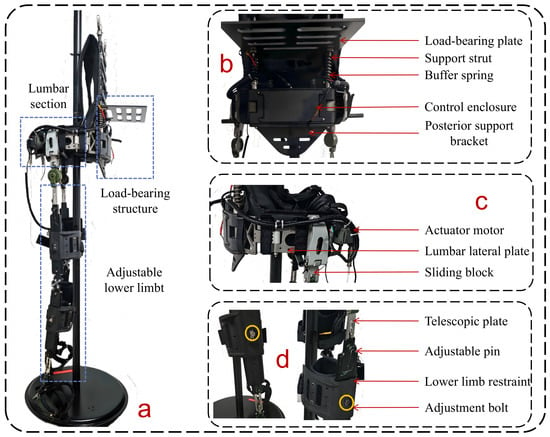
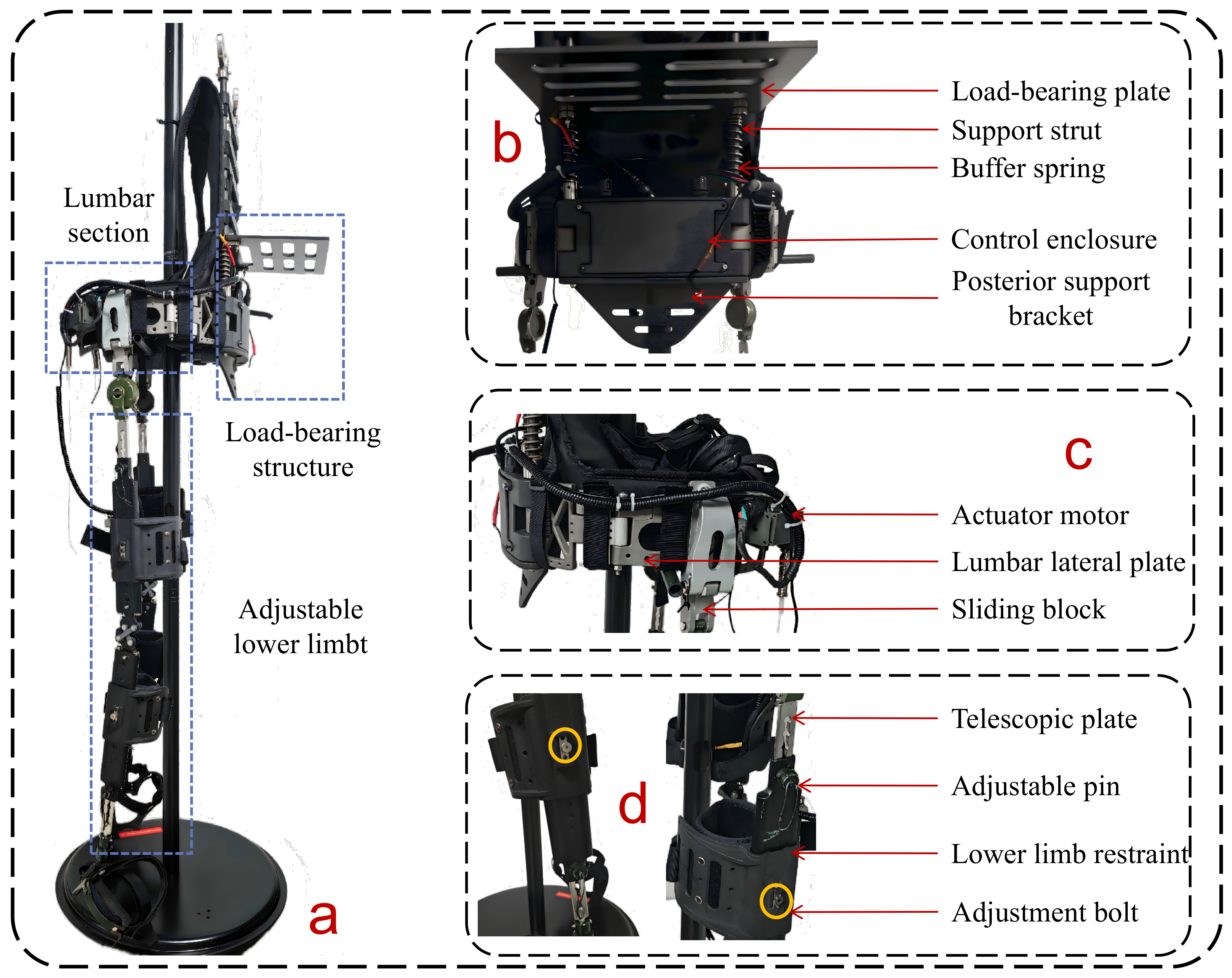
This work establishes a test platform for the rigid–flexible coupled lower-limb load-carrying exoskeleton, aiming to characterize shoulder load transfer, metabolic reduction, and impact load risk characteristics during load-carrying walking across multiple terrains via multimodal parameters. Figure 1a illustrates the mechanical configuration and modular design of the exoskeleton. The test platform can be rapidly adapted to wearers with varying heights and body morphologies. Its core working principle is described as follows: the back-borne load is transmitted to the ground through the rigid frame; meanwhile, flexible components and the back vibration-damping module attenuate dynamic walking impacts to improve human–exoskeleton interaction and wearing comfort. To quantitatively evaluate the shoulder load transfer capacity and metabolic optimization efficacy of the device under multi-terrain conditions, this study adopts pressure sensors and a metabolic analyzer to conduct synchronous force-metabolism bimodal acquisition tests.
Figure 1.
Exoskeleton test platform and main components. (a) Overall view of the load-bearing exoskeleton. (b) Load-bearing module. (c) Lumbar frame. (d) Lower-limb adaptation and adjustment module.
2.1. Mechanical Design
The load-bearing module consists of a load-bearing plate, support struts, buffer springs, a control enclosure, and a posterior support bracket (Figure 1b). The load-bearing plate directly bears external loads and transmits them to the lumbar frame through series-connected support struts and buffer springs, forming a series elastic unit with stiffness and damping characteristics. The support struts ensure stable axial load transmission and structural rigidity, while the buffer springs absorb dynamic shocks induced by load inertia and ground reaction forces. Fixed beneath the control enclosure, the posterior support bracket balances the overturning moment through contact with the hips to avoid gait deviation. The lumbar frame (Figure 1c) integrates components including an actuator motor, lumbar lateral plates, and a sliding block. The front-mounted actuator motor delivers precise assistance for hip flexion. The lumbar lateral plates and control enclosure collectively constitute a rigid lumbar frame, which transfers back loads to the lower-limb mechanism and mitigates redundant stress on the human waist. The sliding block enables fore-aft fine adjustment along the sagittal plane to achieve precise alignment between the exoskeleton hip joint and the human anatomical hip joint, improving adaptability for wearers with different body sizes. The lower-limb adaptation adjustment module comprises telescopic plates, adjustable pins, lower limb restraints, and adjustment bolts (Figure 1d). The telescopic plates allow continuous length adjustment along the limb axis to accommodate wearers of varying heights; adjustable pins lock the position to ensure stable load transfer and assistive output. The lower limb restraints fit closely to human lower limbs via strapping structures to suppress relative human–exoskeleton slippage. The adjustment bolts can fine-tune the fixing position according to the wearer’s limb circumference and wearing requirements, achieving a trade-off between structural reliability and wearing comfort.
2.2. Dual-Modal Sensing Test System
This work constructs a dual-modal sensing test system consisting of DYMH-102 (Bengbu Dayang Sensing System Engineering Co., Ltd., Bengbu, China) diaphragm-box load cells and the Cosmed K5 (K5, Cosmed, Roma, Italy) metabolic analyzer. Fabricated from alloy steel, the diaphragm-box load cell has a 30 min creep of 0.1% FS, static hysteresis of 0.1% FS, and zero-point temperature drift of 0.05% FS. Mounted at the shoulder-strap contact interface, the load cell acquires dynamic shoulder impact loads at a sampling frequency of 500 Hz. Average load and load-transfer efficiency under different terrain conditions can be obtained through data post-processing. Equipped with a breathing mask, the Cosmed K5 captures real-time gas-exchange metabolic parameters, which are converted into standardized human metabolic expenditure using the Brockway formula. Force signals and metabolic data are synchronously recorded with unified timestamps to ensure data matching and comparative reliability of results for multi-terrain experiments. Compared with the RX-ES42-18 (Guantuo Electronic Technology Co., Ltd., Luoyang, China) thin-film plantar-pressure sensor adopted in previous studies, the present dual-modal test system exhibits the following advantages: (1) Repeatability: The overall accuracy of the present system is better than 0.1% FS, while the manufacturer-specified repeatability of the RX-ES42-18 sensor is ±10% FS. (2) Dynamic-measurement performance: The 500 Hz sampling rate of the present system enables the capture of transient impact loads. Although the RX-ES42-18 sensor features a response time below 20 ms, its maximum reading stabilization time reaches 5 s, which makes it difficult to meet the measurement requirements for high-frequency dynamic impacts. (3) Synchronization-related hardware foundation: The present system supports RS485 communication and hardware-level triggering for data recording with unified timestamps. The RX-ES42-18 only transmits data packets periodically via serial port or Bluetooth and has no hardware-triggered sampling function. (4) Integrated-sensing suitability: Designed for axial dynamic-force and impact-load acquisition, the present system satisfies the measurement requirements of outdoor multi-terrain human–exoskeleton interaction-force tests. The RX-ES42-18 is suitable for indoor quasi-static plantar-pressure-distribution measurements.
2.3. Actuation and Control
The assistive system in this work is parameterized based on hip angle and torque profiles from the Winter dataset. At a walking speed of 5 km/h, the hip joint torque during the swing phase ranges from 50 to 70 N·m. The maximum assistive torque is set to 35 N·m, corresponding to 50% of human joint torque [20]. The system adopts DJI RoboMaster M2006 (DJI Innovations, Shenzhen, China) motors paired with C610 motor drivers (DJI Innovations, Shenzhen, China) at a reduction ratio of 36:1. The continuous maximum motor output torque is 1 N·m. With a spool radius of 0.08 m, the theoretical maximum output force reaches 125 N. Accounting for transmission losses, the peak assistive force is defined as 100 N. Given a hip moment arm of 0.35 m, the system can deliver 35 N·m torque to satisfy the assistance requirement for load-carrying walking.
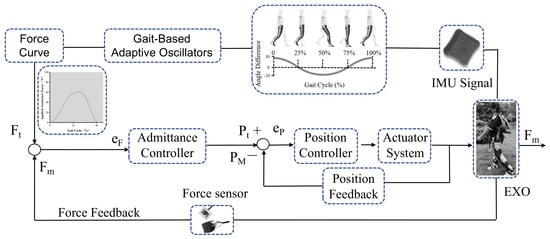
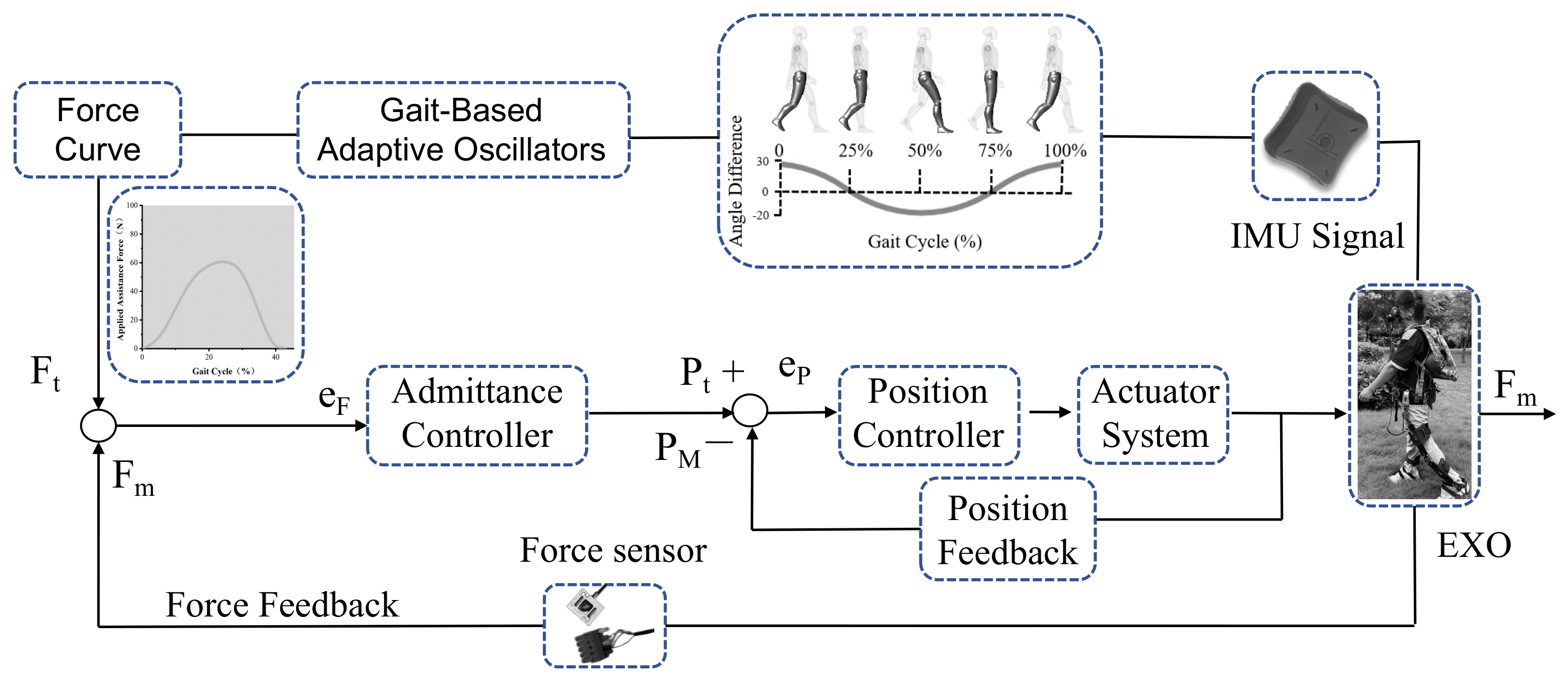
This study uses a gait adaptive oscillator (AO) to estimate gait phase, and sinusoidal-fitted hip torque serves as the control reference [21,22]. This approach reduces metabolic expenditure while preventing injuries induced by excessive torque. The system integrates force feedback and admittance control (Figure 2). IMUs acquire hip joint angles and generate the target assistive force combined with gait phase. A force sensor mounted at the transmission end measures the actual output force . The admittance controller computes the desired motor position from the force error . The inner position loop corrects motor outputs in real time according to the position deviation , enabling dynamic adaptive regulation of assistive force.
Figure 2.
Block diagram of AO-based adaptive control.
The target assistive force is jointly determined by the hip joint angle difference and gait phase (Equation (1)), where denotes the gait phase; n, a, and b are tuning parameters calibrated according to the subject’s physical characteristics. The weighting coefficient c is adjusted based on physiological status to accommodate different load conditions and individual preferences. As the main control unit, the admittance controller calculates the desired motor position from the force error and its differential term. The control law is expressed in Equation (2), in which and represent the proportional and derivative gains, respectively; and correspond to the instantaneous force error and its differential. The inner position loop is implemented to improve the control accuracy of the assistive force.
3. Experimental Validation and Results
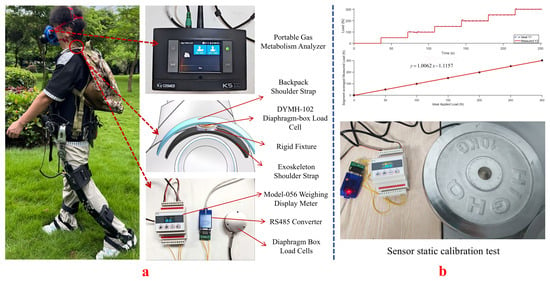
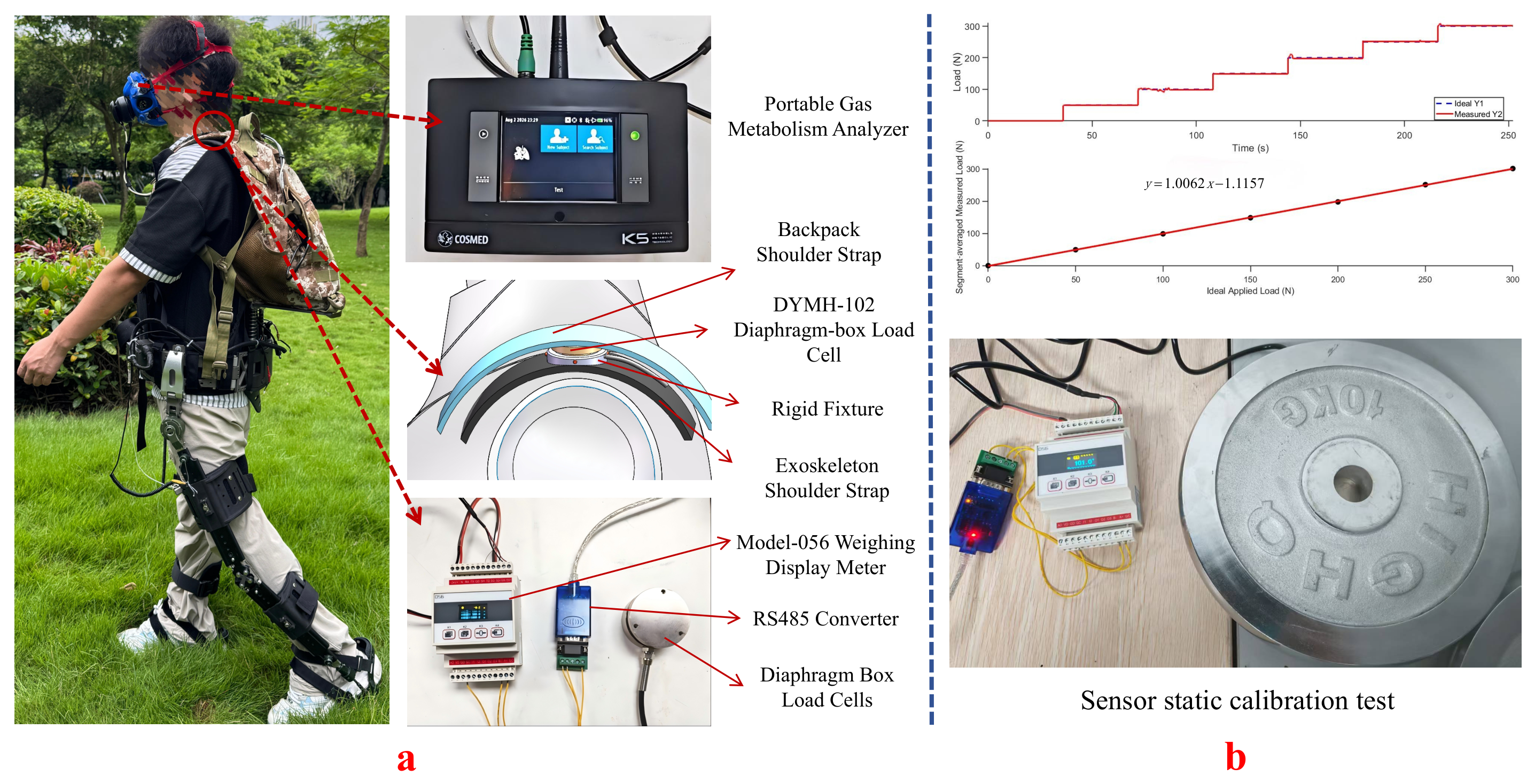
Seven male participants were recruited in this study to conduct shoulder load measurements and metabolic tests under a 15 kg payload across three terrain conditions: hard level ground, gently uneven grassland, and gently sloped mountain road (Figure 3a). During outdoor trials, experimenters used a visual speed indicator to prompt participants to adjust their walking pace in real time, maintaining an average walking speed of 5 km/h. The same 28 L reference backpack was used for load carrying in both exoskeleton and no-exoskeleton conditions. The backpack was fitted with 45 mm woven shoulder straps, and the payload center of mass was positioned 150 mm posterior to the trunk in the sagittal plane. Insets in Figure 3a illustrate the shoulder-sensor assembly. The DYMH-102 diaphragm-box load cell is mounted on a rigid fixture attached to the exoskeleton shoulder strap assembly and does not make direct contact with human skin. The rigid fixture and exoskeleton shoulder strap jointly alleviate localized pressure and deformation of shoulder muscle tissue to maximize measurement fidelity. The backpack shoulder strap is arranged above the sensor, and the residual backpack load transmitted through the exoskeleton acts on the human shoulder. In the no-exoskeleton experimental group, a shoulder strap with equivalent cushioning performance is also placed beneath the rigid fixture to mitigate localized pressure and shoulder muscle tissue deformation and maintain identical contact conditions. The tested terrains included HLG with a 0% grade and GMR with a 5% grade. Due to equipment limitations, terrain surface parameters for the GUG condition were not acquired. All participants completed standardized familiarization training prior to formal testing to eliminate the influence of equipment proficiency on assistive performance [23]. This study was approved by the Institutional Review Board of the Shenzhen Institutes of Advanced Technology (SIAT-IRB-231115-H0681), and all participants provided written informed consent. Results are reported as mean ± standard error of the mean (Mean ± SEM). Two-tailed paired t-tests were applied for inter-group statistical analysis with a significance threshold of . Participant baseline characteristics are summarized in Table 1.
Figure 3.
Experimental validation. (a) Collection of human metabolic and load data during experiments; (b) static calibration of the sensor.
Table 1.
Physiological characteristics of subjects.
3.1. Experimental Design
3.1.1. Shoulder Load Testing
The DYMH-102 diaphragm-box load cell (Bengbu Dayang Sensing System Engineering Co., Ltd., Bengbu, China) was mounted on the rigid fixture at the shoulder strap–human contact interface to acquire shoulder load signals across the three terrains. Static calibration was completed before formal testing. Seven levels of axial loads (0 N, 50 N, 100 N, 150 N, 200 N, 250 N, and 300 N) were applied at room temperature, and three load–unload cycles were performed (Figure 3b). Calibration results show that the full-scale error of the sensor meets specification requirements, and the measured values have a linear relationship with the weight loads, as expressed in Equation (3). This one-dimensional sensor only detects axial trunk pressure and cannot capture off-axis shear components induced by trunk inclination during uphill walking. The sensor orientation was manually calibrated before each trial to keep the sensitive axis parallel to the longitudinal direction of the trunk. With all other variables held constant, the dynamic pressure transmitted from the backpack to the shoulder was recorded under the conditions with and without the exoskeleton (pressure : without exoskeleton; pressure : with exoskeleton). Limited by the sensor configuration, this study cannot independently isolate the impact component or decouple the pure load transfer ratio. Since impact peaks represent instantaneous loads acting on the human body, impacts and static loads were analyzed together. The average value of continuous valid data over 10 min within steady gait segments was adopted as the analytical baseline, and the shoulder load transfer efficiency is defined by Equation (4).
3.1.2. Metabolic Cost Measurement
Evaluating the metabolic cost of locomotion assisted by the exoskeleton has been established as a standard criterion for quantifying the energy expenditure of the wearer. In this study, a portable gas analysis system (K5, Cosmed, Roma, Italy) was employed to quantitatively measure the metabolic cost of load carriage walking under two conditions (with and without the exoskeleton) across three different terrains. The experimental protocol strictly followed a standardized procedure. First, each participant stood quietly in an unloaded state, and resting metabolic data were collected continuously for 10 min. Subsequently, the participant performed load carriage walking at an average speed of 5 km/h; once the gait and metabolic profiles reached a steady state, real-time metabolic data were recorded for another 10 min. A rest interval of more than 15 min was set between individual trials to allow the subjects’ resting oxygen consumption to return to the baseline level. No significant inter-group differences were observed, which eliminates fatigue accumulation induced by the preceding trial and ensures the reliability of subsequent test results. The metabolic rate was calculated using the modified Brockway formula [24], as presented in Equation (5).
where denotes the energy consumption in watts per kilogram (W/kg), and the coefficients and are set to 16.89 and 4.84, respectively. and represent the oxygen consumption rate and carbon dioxide production rate, respectively, and W is the body mass of the participant.
3.2. Experimental Results
3.2.1. Load Data Analysis
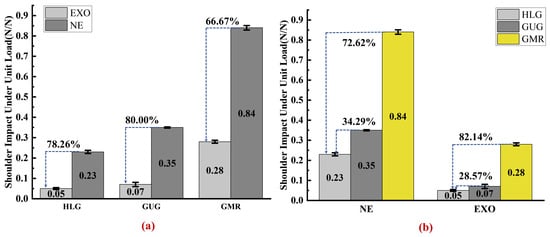
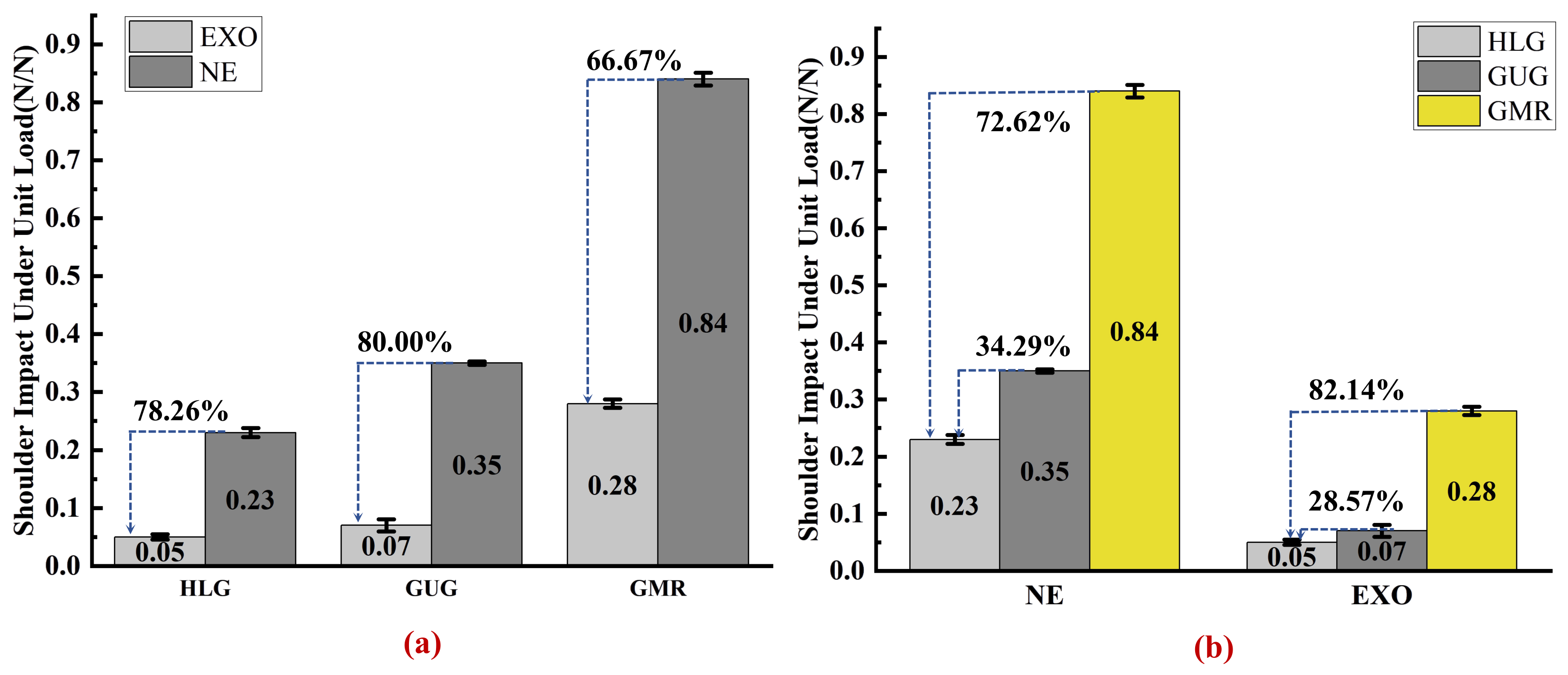
Table 2 summarizes the peak normalized shoulder impact load characteristics under different terrain conditions with and without exoskeleton assistance. As shown in Figure 4a, the exoskeleton (EXO) significantly reduced the peak shoulder impact load by 78.26%, 80.00%, and 66.67% on level ground, grassland, and gently sloped mountain road, respectively (values under the NE condition serve as the denominator). Benefiting from the synergistic effect of elastic elements and the load transfer mechanism, the exoskeleton delivers stable impact protection across all tested terrains. As illustrated in Figure 4b, terrain complexity exerts a pronounced amplifying effect on shoulder impact loading. In the no-exoskeleton condition (NE), compared with level ground, the peak impact load increased by 34.29% on grassland (values under the GUG condition serve as the denominator) and by 72.62% on the gently sloped mountain road (values under the GMR condition serve as the denominator). When wearing the exoskeleton, the corresponding increments were 28.57% and 82.14%, respectively. The similar growth rates observed on grassland with and without the exoskeleton indicate that the exoskeleton provides stable mechanical buffering against mild terrain irregularities. In contrast, the significantly higher increment under gently sloped mountain road conditions demonstrates that this type of terrain disturbance imposes more severe disruptive effects on the human–machine system, which cannot be fully counteracted by the current structural design.
Table 2.
Effects of shoulder load on peak impact load under different terrains with and without exoskeleton assistance.
Figure 4.
Characterization of shoulder impact loading. (a) Effects of the exoskeleton on shoulder loading across three terrains. (b) Terrain-dependent variations in shoulder impact loading with and without exoskeleton assistance.
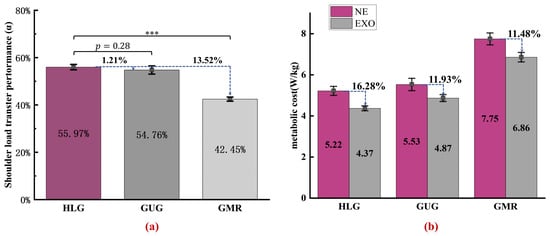
As shown in Table 3 and Figure 5a, the average shoulder load transfer efficiency may be correlated with terrain complexity: 55.97 ± 1.15% for the hard level ground (HLG), 54.76 ± 1.73% for the gently uneven grassland (GUG), and 42.45 ± 0.90% for the gently sloped mountain road (GMR). Compared with the HLG condition, the exoskeleton load transfer efficiency decreased by 1.21% and 13.52% under GUG and GMR terrain, respectively (p = 0.28, p = 0.0002). These results preliminarily indicate that complex terrain may restrict the load-offloading performance of the exoskeleton. For the GUG terrain, the load transfer efficiency exhibits no significant difference compared with HLG. Given its uneven ground surface and higher standard error of the mean (SEM = 1.73%, higher than 1.15% for HLG and 0.90% for GMR), we speculate that irregular terrain undulations may amplify inter-subject gait variability and increase the dispersion of human–machine interaction forces, which could slightly weaken the load-transfer performance of the exoskeleton. For the GMR terrain, the slope gradient alters the geometric matching relationship between the exoskeleton and the ground during walking, which tends to form an acute-angle force-bearing posture and may induce abnormal phenomena such as knee forward tilt and displacement of lower-limb strapping. This phenomenon is likely the primary reason for the marked reduction in shoulder load transfer performance under the GMR terrain.
Table 3.
Shoulder load transfer efficiency of the exoskeleton under different terrains.
Figure 5.
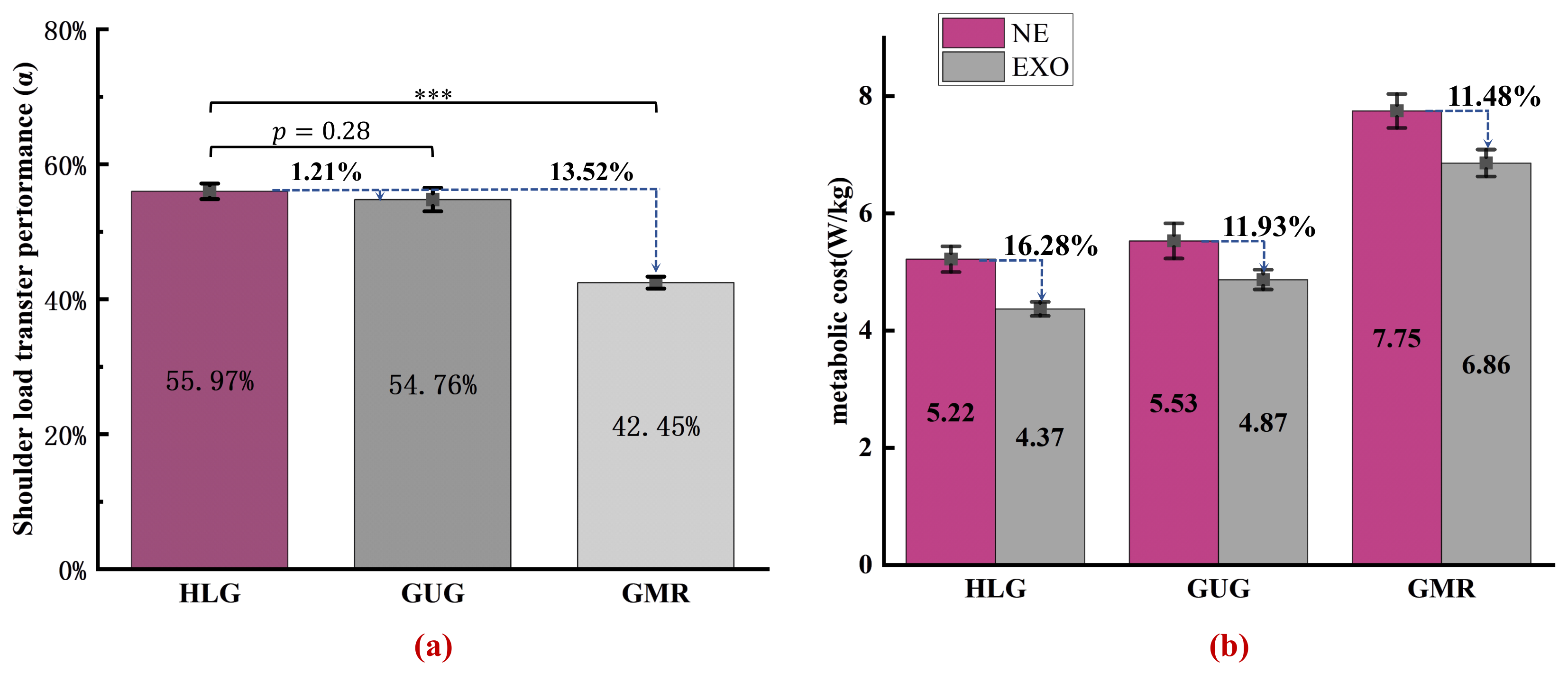
Shoulder load transfer performance of the exoskeleton and human metabolic cost. (a) Shoulder load transfer performance of the exoskeleton under three terrain conditions. *** indicates the significance level of . (b) Metabolic cost reduction enabled by the exoskeleton across three terrains.
In summary, the exoskeleton can effectively reduce shoulder impact loads, yet its assistance performance varies significantly across different terrains. Terrain disturbances may amplify impact loads by inducing lower-limb human–machine interface slippage and gait distortion. Reduction in shoulder force can effectively characterize shoulder unloading performance, yet this parameter serves only as an indirect surrogate for quantifying load transfer to the ground. Dedicated biomechanical experiments are still required to verify the coupling relationship between terrain and exoskeleton assistive efficacy and to clarify the roles of lower-limb human–machine interface slippage and gait distortion in this process.
3.2.2. Metabolic Data Analysis
Table 4 quantifies the normalized net metabolic cost of human locomotion for seven participants across three typical terrains (level ground, grassland, and gently sloped mountain road) under both exoskeleton (EXO) and no-exoskeleton (NE) conditions, revealing the coupled effects of terrain disturbance and exoskeleton assistance on human locomotor energy expenditure. In the NE condition, the normalized net metabolic cost was 5.22 ± 0.22 W/kg on level ground, 5.53 ± 0.30 W/kg on grassland, and 7.75 ± 0.29 W/kg on the gently sloped mountain road. The metabolic increase on the gently sloped mountain road relative to level ground reached 48.47%, confirming that rugged sloped terrain significantly elevates human locomotor energy consumption.
Table 4.
Metabolic cost under various experimental conditions.
As shown in Figure 5b, wearing the exoskeleton induced statistically significant reductions in human metabolic cost under all three terrain conditions (paired t-test; all calculations adopted the values of the no-exoskeleton (NE) group as the denominator). The normalized net metabolic costs under HLG, GUG, and GMR conditions decreased to 4.37 ± 0.12 W/kg, 4.87 ± 0.17 W/kg, and 6.86 ± 0.23 W/kg, respectively. Results of simple-effect paired t-tests revealed that the metabolic cost reduction was 16.28% () for HLG, 11.93% () for GUG, and 11.48% () for GMR. This indicates that the exoskeleton can effectively reduce human locomotor metabolic expenditure for each individual terrain. Statistical analysis reveals that the magnitude of metabolic saving exhibits a descriptive declining trend with increased terrain complexity. The optimal unloading performance is observed under HLG, owing to tight exoskeleton–lower-limb contact and continuous force transmission path, which effectively shares payloads and reduces active muscular work. GUG induces slight gait distortion and strap slippage on the lower limbs, leading to a moderate reduction in metabolic saving. Under GMR conditions, increased vertical gravitational work combined with lower-limb interface slippage further degrades the load-transfer efficiency of the exoskeleton. Although significant reductions in metabolic cost are detected for each individual terrain, the terrain-by-device interaction is not statistically significant. Accordingly, inter-terrain differences in the magnitude of metabolic saving cannot be confirmed. This declining trend is merely descriptive, and further experiments are required to validate the association between terrain conditions and metabolic reduction magnitude.
Two-way repeated-measures MANOVA was further conducted to evaluate the terrain-by-device interaction, and the statistical outputs are summarized in Table 5. Nevertheless, the terrain-by-device interaction was non-significant (Wilks’ , , ). This result indicates that, based on the present sample, there is no clear statistical evidence that the magnitude of exoskeleton-induced metabolic saving differs across terrain conditions. The observed downward trend in metabolic-saving magnitude with increasing terrain complexity is only descriptive. This phenomenon may stem from inter-subject random variability caused by gait distortion and slippage at the lower-limb human–machine interface. Despite the non-significant interaction effect, the mechanical support provided by the exoskeleton can still reduce muscular load during load-carrying walking, verifying its assistive capacity under complex terrain conditions.
Table 5.
Two-way repeated-measures MANOVA to test the terrain-by-device interaction effect on metabolic cost.
4. Discussion
Based on the force-metabolism bimodal sensing test platform established in this work, the evaluation results indicate that the shoulder load transfer performance of the exoskeleton may be jointly affected by terrain conditions and human body size. Under the HLG condition, gait remains stable with favorable human–exoskeleton fit and smooth force transmission pathways, yielding the optimal load transfer efficiency of 55.97 ± 1.15%. Participant D with superior fitting performance achieves a peak efficiency of 60.95%. The GUG terrain has irregular disturbances, which are presumed to induce gait distortion and micro-slippage at the lower-limb human–machine interface, reducing the average load transfer efficiency to 54.76 ± 1.73%. For participants D and G, the measured efficiency under GUG slightly exceeds that on level ground. This phenomenon may be associated with transient load fluctuations triggered by terrain impacts and indirectly demonstrates the interference of weak terrain perturbations on load transmission. Under the GMR condition, the coupling and superposition of gravitational and inertial loads can further aggravate gait abnormalities and lateral slippage of the lower-limb straps, resulting in a significant drop of load transfer efficiency to 42.45 ± 0.90%. For subject E with a smaller body size, the slippage of lower-limb strapping is more pronounced, and the minimum efficiency reaches only 39.84%. This result reveals the structural deficiency of insufficient lateral constraint of the flexible lower-limb strapping, which is a critical cause for the degraded performance of bimodal evaluation under complex terrains [25,26]. The slippage at the lower-limb human–machine interface breaks the force transmission path, reduces the ground load-sharing capacity of the exoskeleton, and thereby weakens the actual assistance performance.
Metabolic cost during load-carriage walking is closely associated with terrain complexity and inter-subject differences in cardiopulmonary function. Under the no-exoskeleton condition, subject G had a relatively high baseline metabolic level (HLG: 6.08 W/kg, GMR: 8.45 W/kg) and thus achieved a more prominent metabolic reduction after exoskeleton intervention. In contrast, subject D exhibited a low baseline metabolic power of 4.36 W/kg under the HLG condition, reflecting high intrinsic locomotor efficiency and limited potential for energy-saving improvement. Comparisons based on the dual-mode test platform demonstrate that the proposed rigid–flexible coupled exoskeleton achieves superior terrain adaptability compared with conventional suspension unloading devices. The maximum measured reduction efficiency of shoulder force reaches 55.97%, which serves only as an indirect indicator of load transfer to the ground. The peak reduction in impact load is 80%, and the maximum reduction in metabolic cost under a single terrain is 16.28%. These performance metrics are slightly lower than the indoor experimental results reported by He et al. [11] and Lin et al. [13], who achieved an impact attenuation rate of 98.5% and a metabolic reduction of 23.40%, respectively. This discrepancy is presumably caused by extra locomotive energy consumption introduced by the exoskeleton’s lower-limb structure, as well as elevated human baseline metabolic levels triggered by real-world outdoor terrain perturbations and gait distortion. However, as shown in Table 5, the terrain-by-device interaction was non-significant within the study sample. Thus, there is no statistical evidence to confirm significant inter-terrain differences in the magnitude of exoskeleton-mediated metabolic saving. In addition, field metabolic measurements with portable gas analyzers are susceptible to artifacts arising from poor mask sealing, which distorts metabolic readings. Such measurement confounders require strict control during data acquisition and constitute a prevalent practical technical challenge for outdoor human–exoskeleton experiments.
High-load outdoor experiments were performed in this study using the bimodal test platform. Owing to the high physical exertion required during trials, only seven male participants were recruited. This leads to limitations including a small sample size and homogeneous participant cohort; accordingly, the observed relationships between load transmission and metabolic changes may not generalize to all populations. Future work will expand participant diversity on this platform by recruiting subjects of different genders to comprehensively validate the universal assistive performance of the exoskeleton. The DYMH-102 diaphragm box load cell was used for quantitative measurement of mechanical parameters. Its accuracy and stability satisfy the requirements for outdoor load detection. Nevertheless, due to its structural features and working principle, this sensor cannot characterize distributed interfacial pressure and micro-slip behaviours. Flexible sensing devices enable conformal human–machine perception and accurate capture of interfacial slip and shear characteristics [27,28]. However, flexible sensors suffer from calibration drift and insufficient quantitative accuracy under heavy-load outdoor dynamic experimental conditions. The diaphragm-box load cell adopted in this study exhibits superior repeatability for measuring the total contact force of the shoulder strap. In future work, we plan to combine the rigid high-precision force measurement scheme with flexible sensor arrays to simultaneously acquire total load and distributed interfacial pressure data.
5. Conclusions
Using the force–metabolism bimodal test platform established in this work, a rigid–flexible coupled lower-limb load-carrying exoskeleton with load shunting and impact buffering functions was developed. Field experiments were conducted across three outdoor terrains: hard level ground, grassland, and gently sloped mountain roads. The experimental results demonstrate that the exoskeleton achieves load transfer and shock suppression across all tested terrains, lowering metabolic cost during loaded walking. Although assistive performance exhibits a declining trend as terrain complexity increases, the statistical tests reveal no significant inter-terrain differences in the magnitude of metabolic benefit. The association between terrain conditions and the magnitude of metabolic reduction warrants further investigation. Aiming at the inter-subject differences in body fit and lower-limb human–machine interface slippage observed in the experiments, the human–machine coupling performance of the device can be improved by optimizing the lower-limb strapping structure. Meanwhile, lightweight design should be implemented to reduce unnecessary energy consumption originating from the additional mass of the device. In summary, further refined design targeting multi-scenario robustness can be performed based on this bimodal platform. It is expected to realize low-energy, high-adaptability, and high-stability field assistance and advance the engineering deployment of load-carrying exoskeletons in complex real-world environments.
Author Contributions
Conceptualization, Y.T. and C.C.; methodology, Y.T. and W.C.; software, Y.T., X.W. (Xiaojun Wu), and X.W. (Xinyu Wu); validation, Y.T. and C.C.; formal analysis, C.C. and X.W. (Xiaojun Wu); investigation, Y.T.; resources, Y.T. and C.C.; data curation, Y.T.; writing—original draft preparation, Y.T.; writing—review and editing, C.C. and W.C.; visualization, Y.T. and W.C.; supervision, X.W. (Xiaojun Wu) and X.W. (Xinyu Wu); project administration, C.C. and X.W. (Xinyu Wu); funding acquisition, C.C. and W.C. All authors have read and agreed to the published version of the manuscript.
Funding
This work was supported in part by the Key Program of Chinese Academy of Sciences (RCJJ-145-24-18), in part by the National Natural Science Foundation of China (62273325, 62533020, 62303444, and 52227807), in part by the Guangdong Basic and Applied Basic Research Foundation (2023B1515130007 and 2025A1515060014), in part by the Guangdong S&T Program under Grant 2025B0909020002, in part by the Shenzhen Science and Technology Program (20240902153742001, RCBS20231211090614029, and JCYJ20250604182837050), and in part by the Science and Technology Innovation Program of Hunan Province (2024WK2022).
Institutional Review Board Statement
This work involved human subjects in its research. Approval of all ethical and experimental procedures and protocols was granted by Medical Ethics Committee of Shenzhen Institutes of Advanced Technology under Application No. SIAT-IRB-231115-H0681 and performed in line with the Declaration of Helsinki.
Informed Consent Statement
Informed consent was obtained from all subjects involved in the study.
Data Availability Statement
The readers can obtain data from the authors.
Acknowledgments
The authors express their gratitude to the participants of the study and acknowledge the contributions of the SIAT exoskeleton team.
Conflicts of Interest
The authors declare no conflicts of interest.
Abbreviations
The following abbreviations are used in this manuscript:
| NE | No-exoskeleton |
| EXO | Exoskeleton |
| HLG | Hard level groun |
| GUG | Gently uneven grassland |
| GMR | Gently sloped mountain road |
References
- Zhang, B.; Liu, T.; Zhang, B.; Pecht, M.G. Recent Development of Unpowered Exoskeletons for Lower Extremity: A Survey. IEEE Access 2021, 9, 138042–138056. [Google Scholar] [CrossRef] [Scilit]
- Wang, J.; Fei, Y.; Chen, W. Integration Sensing and Control of a Modular Soft-Rigid Pneumatic Lower Limb Exoskeleton. Soft Robot. 2020, 7, 140–154. [Google Scholar] [CrossRef] [Scilit]
- Qiu, S.; Pei, Z.; Wang, C.; Tang, Z. Systematic Review on Wearable Lower Extremity Robotic Exoskeletons for Assisted Locomotion. J. Bionic Eng. 2023, 20, 436–469. [Google Scholar] [CrossRef] [Scilit]
- Fox, S.; Aranko, O.; Heilala, J.; Vahala, P. Exoskeletons: Comprehensive, Comparative and Critical Analyses of Their Potential to Improve Manufacturing Performance. J. Manuf. Technol. Manag. 2020, 31, 1261–1280. [Google Scholar]
- Cao, W.; Chen, C.; Wang, D.; Wu, X.; Chen, L.; Xu, T.; Liu, J. A Lower Limb Exoskeleton with Rigid and Soft Structure for Loaded Walking Assistance. IEEE Robot. Autom. Lett. 2021, 7, 454–461. [Google Scholar] [CrossRef] [Scilit]
- Talukder, A.; Jo, J. Elastic Textile-Based Wearable Modulation of Musculoskeletal Load: A Comprehensive Review of Passive Exosuits and Resistance Clothing. Wearable Technol. 2025, 6, e11. [Google Scholar] [CrossRef] [Scilit]
- Sun, T.; Chen, Z.; Guo, Q.; Yan, Y. Lower-limb Exoskeleton Trajectory and Structure Co-Optimization for Maximum Assistive Efficiency. IEEE Trans. Med. Robot. Bion. 2026, 8, 763–773. [Google Scholar] [CrossRef] [Scilit]
- Wang, X.; Bai, S.; Li, L.; Li, Y.; Yu, H. Enhancing Locomotion-Mode Recognition and Transition Prediction with (Bio)mechanical Sensor Fusion for Intelligent Prosthetic Knees. IEEE J. Biomed. Health Inform. 2025, 29, 7955–7968. [Google Scholar] [CrossRef] [Scilit]
- Zhen, T.; Chen, Q. A Predictive Walking Energy Model Based on Gait Phase with Suspended Backpack. Heliyon 2024, 10, e38193. [Google Scholar] [CrossRef] [Scilit]
- Huang, L.; Yang, Z.; Wang, R.; Xie, L. Physiological and Biomechanical Effects on the Human Musculoskeletal System While Carrying a Suspended-Load Backpack. J. Biomech. 2020, 108, 109894. [Google Scholar] [CrossRef] [Scilit]
- Xia, S.; Wang, N.; Chen, B.; Zhang, X.; Chen, W. Nonlinear Stiffness Mechanism Designed by Topology Optimization Reduces Backpack Vibration. Int. J. Mech. Sci. 2023, 252, 108345. [Google Scholar] [CrossRef] [Scilit]
- He, L.; Xiong, C.; Zhang, Q.; Chen, W.; Fu, C.; Lee, K.-M. A Backpack Minimizing the Vertical Acceleration of the Load Improves the Economy of Human Walking. IEEE Trans. Neural Syst. Rehabil. Eng. 2020, 28, 1994–2004. [Google Scholar] [CrossRef] [Scilit]
- Cao, Y.; Zhang, M.; Huang, J.; Mohammed, S. Load-Transfer Suspended Backpack with Bio-Inspired Vibration Isolation for Shoulder Pressure Reduction Across Diverse Terrains. IEEE Trans. Robot. 2025, 41, 3059–3077. [Google Scholar] [CrossRef] [Scilit]
- Lin, X.; Yin, S.; Du, H.; Leng, Y.; Fu, C. Improving Energetic Efficiency and Practicality with a Suspended Backpack During Load Carriage. IEEE/ASME Trans. Mechatron. 2025, 30, 6997–7008. [Google Scholar] [CrossRef] [Scilit]
- Sun, D.; Ma, J.; Ding, Y.; Luo, D. Human-Exoskeleton Oscillation Model and Qualitative Analysis of Interaction and Functional Practicality of Exoskeletons. Appl. Math. Modell. 2023, 120, 40–56. [Google Scholar] [CrossRef] [Scilit]
- Li, H.; Sui, D.; Ju, H.; An, Y.; Zhao, J.; Zhu, Y. Mechanical Compliance and Dynamic Load Isolation Design of Lower Limb Exoskeleton for Locomotion Assistance. IEEE/ASME Trans. Mechatron. 2022, 27, 5392–5402. [Google Scholar] [CrossRef] [Scilit]
- Tian, Y.-T.; Chen, C.-J.; Wu, X.-J.; Cao, W.-J. A Rigid-Flexible Coupled Lower Limb Exoskeleton for Enhancing Load-Bearing Ambulation. Biomimetics 2025, 10, 757. [Google Scholar] [CrossRef] [Scilit]
- Chen, C.; Zhang, Y.; Li, Y.; Wang, Z.; Liu, Y.; Cao, W.; Wu, X. Iterative Learning Control for a Soft Exoskeleton with Hip and Knee Joint Assistance. Sensors 2020, 20, 4333. [Google Scholar] [CrossRef] [Scilit]
- Wang, X.; Guo, S.; Bai, S. A Cable-Driven Parallel Hip Exoskeleton for High-Performance Walking Assistance. IEEE Trans. Ind. Electron. 2024, 71, 2705–2715. [Google Scholar] [CrossRef] [Scilit]
- Wang, T.; Zhang, B.; Liu, C.; Liu, T.; Han, Y.; Wang, S.; Ferreira, J.P.; Dong, W.; Zhang, X. A Review on the Rehabilitation Exoskeletons for the Lower Limbs of the Elderly and the Disabled. Electronics 2022, 11, 388. [Google Scholar] [CrossRef] [Scilit]
- Wang, X.; Ma, Y.; Chen, C. Effective Prediction of Gait Phase for Assisted Walking by Means of Gait-Based Adaptive Oscillators. IEEE Trans. Autom. Sci. Eng. 2024, 22, 10205–10215. [Google Scholar] [CrossRef] [Scilit]
- Zhang, T.; Ning, C.; Li, Y.; Wang, M. Design and Validation of a Lightweight Hip Exoskeleton Driven by Series Elastic Actuator with Two-Motor Variable Speed Transmission. IEEE Trans. Neural Syst. Rehabil. Eng. 2022, 30, 2456–2466. [Google Scholar] [CrossRef] [Scilit]
- Siviy, C.; Baker, L.M.; Quinlivan, B.T.; Porciuncula, F.; Swaminathan, K.; Awad, L.N.; Walsh, C.J. Opportunities and Challenges in the Development of Exoskeletons for Locomotor Assistance. Nat. Biomed. Eng. 2023, 7, 456–472. [Google Scholar] [CrossRef] [Scilit]
- Brockway, J. Derivation of Formulae Used to Calculate Energy Expenditure in Man. Hum. Nutr. Clin. Nutr. 1987, 41, 463–471. [Google Scholar]
- Cappello, L.; Binh, D.K.; Yen, S.-C.; Masia, L. Design and preliminary characterization of a soft wearable exoskeleton for upper limb. In Proceedings of the 2016 6th IEEE International Conference on Biomedical Robotics and Biomechatronics (BioRob), Singapore, 26–29 June 2016; pp. 623–630. [Google Scholar]
- Shi, Y.; Dong, W.; Lin, W.; Gao, Y. Soft wearable robots: Development status and technical challenges. Sensors 2022, 22, 7584. [Google Scholar] [CrossRef] [Scilit]
- Han, F.; Chen, S.; Wang, F.; Liu, M.; Li, J.; Liu, H.; Yang, Y.; Zhang, H.; Liu, D.; He, R.; et al. High-conductivity, self-healing, and adhesive ionic hydrogels for health monitoring and human-machine interactions under extreme cold conditions. Adv. Sci. 2025, 12, 2412726. [Google Scholar] [CrossRef] [Scilit]
- Jeon, C.; Kim, M.; Kim, K.; Lim, B.; Nayak, B.; Jung, Y.; Lee, B.-Y.; Jeon, T.; Kim, J.; Oh, S.; et al. Development of a Three-Axis Planar Hall Magnetoresistance Sensor Using a Superparamagnetic Nanoparticle-Based Flux Guide. Adv. Funct. Mater. 2026, 36, e76501. [Google Scholar] [CrossRef] [Scilit]

Disclaimer/Publisher’s Note: The statements, opinions and data contained in all publications are solely those of the individual author(s) and contributor(s) and not of MDPI and/or the editor(s). MDPI and/or the editor(s) disclaim responsibility for any injury to people or property resulting from any ideas, methods, instructions or products referred to in the content. |
© 2026 by the authors. Licensee MDPI, Basel, Switzerland. This article is an open access article distributed under the terms and conditions of the Creative Commons Attribution (CC BY) license.