


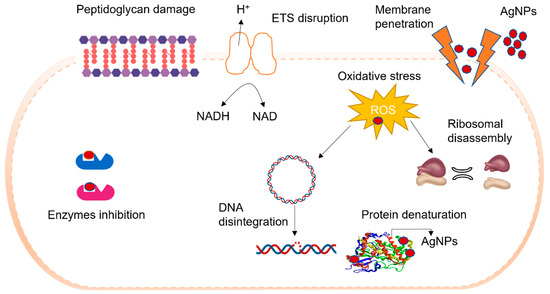
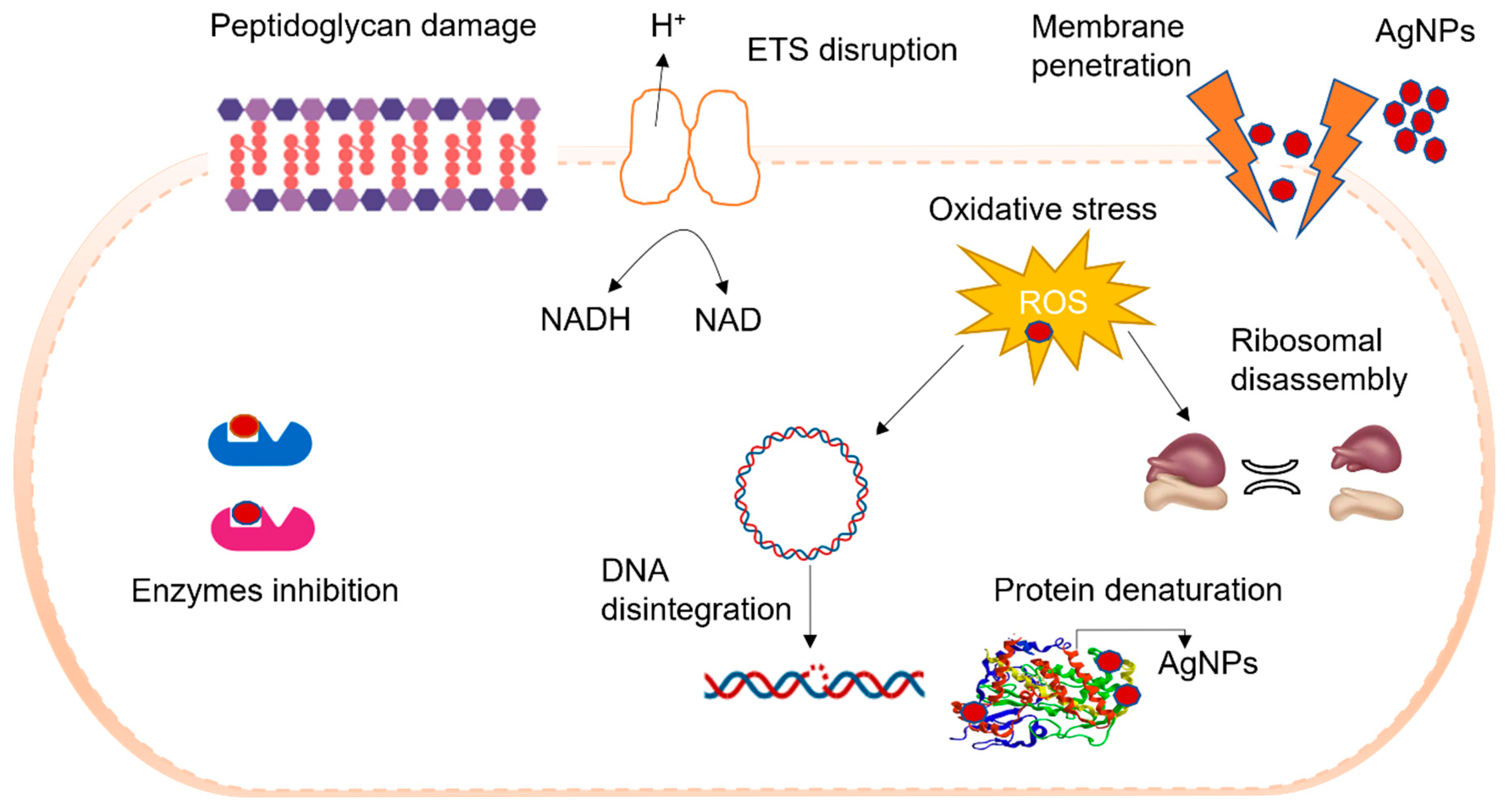
In the original publication [1], there is a mistake in Figure 3 as published. The figure, which illustrates the antibacterial mechanism of Chinese herb-synthesized silver nanoparticles (AgNPs), incorrectly depicts a mitochondrion within the bacterial cell. As bacteria are prokaryotic organisms, they do not possess mitochondria. The corrected Figure 3 appears below.
Figure 3.
Antibacterial mechanism of Chinese herb-synthesized AgNPs. Antibacterial mechanism possibly shows that AgNPs bind to the bacterial cells and lead to the following results: (1) cell wall and cell membrane degradation, (2) penetrate intracellularly and denature proteins and damage DNA, (3) enzyme inactivation by oxidative stress generated by ROS.
The authors state that the scientific conclusions are unaffected. This correction was approved by the Academic Editor. The original publication has also been updated.
Reference
- Islam, R.; Sun, L.; Zhang, L. Biomedical Applications of Chinese Herb-Synthesized Silver Nanoparticles by Phytonanotechnology. Nanomaterials 2021, 11, 2757. [Google Scholar] [CrossRef] [Scilit] [PubMed]
Disclaimer/Publisher’s Note: The statements, opinions and data contained in all publications are solely those of the individual author(s) and contributor(s) and not of MDPI and/or the editor(s). MDPI and/or the editor(s) disclaim responsibility for any injury to people or property resulting from any ideas, methods, instructions or products referred to in the content. |
© 2026 by the authors. Licensee MDPI, Basel, Switzerland. This article is an open access article distributed under the terms and conditions of the Creative Commons Attribution (CC BY) license.