


Abstract
Electrocatalytic H2O2 production via the two-electron oxygen reduction reaction (ORR) is a highly sustainable alternative to industrial methods. To further optimize non-noble catalysts, we report an interfacial engineering strategy to stabilize the metastable P63/mmc-La2O3 phase on SrTiO3. This symmetry evolution from the low-symmetry (trigonal) to the high-symmetry P63/mmc (hexagonal) space group yields a composite with >95% H2O2 selectivity. Mechanistic studies demonstrate that the symmetry-regulated interface optimizes *OOH conversion and suppresses O–O bond cleavage. This work offers a robust design principle for high-performance, noble-metal-free H2O2 electrosynthesis.
1. Introduction
Hydrogen peroxide (H2O2) is a versatile and industrially important oxidant that has been widely used in fields such as textile bleaching, wastewater treatment, chemical synthesis, and biological disinfection [1,2,3,4]. To date, the anthraquinone process remains the dominant industrial route for large-scale H2O2 production. However, this method involves multistep hydrogenation/oxidation cycles and extensive solvent management, which translate into energy-intensive operation, a complex reaction flow, and non-negligible environmental burdens [5,6]. In contrast, electrocatalytic synthesis has emerged as a promising alternative owing to its low energy requirements, mild reaction conditions, and minimal environmental impact. Among these, the two-electron oxygen reduction reaction (ORR) provides a sustainable and environmentally friendly pathway to generate H2O2 under mild conditions [7,8,9,10].
One of the major challenges of the ORR lies in controlling the selectivity between two competing reaction pathways: the four-electron pathway to H2O and the two-electron pathway to H2O2 [8,11,12]. An effective two-electron ORR catalyst requires intermediate oxygen binding, which is sufficient to enable O2 activation and *OOH formation, while avoiding excessive adsorption that drives O–O bond scission and the four-electron pathway. Noble metals such as platinum (Pt) and palladium (Pd) typically exhibit high O–O bond dissociation ability, thus favoring the four-electron pathway and resulting in poor H2O2 selectivity [13,14,15,16]. Therefore, the development of cost-effective, stable, and highly selective non-noble metal catalysts for the two-electron ORR is of great significance [12,17,18].
Rare-earth oxides and perovskite-type oxides have been increasingly explored as electrocatalysts, because their electronic structures and defect chemistry can be engineered over a wide range, enabling tailored surface reactivity [19,20,21,22]. Rare earth oxides, especially La2O3, have been extensively studied in heterogeneous catalysis due to their tunable electronic structures [23]. However, the influence of crystal symmetry on their electrocatalytic behavior remains insufficiently explored. La2O3 can exist in various polymorphs with different space groups, such as and P63/mmc, which differ in atomic arrangement, coordination environment, and symmetry operation. This structural variation may affect the distribution of surface electronic states and the uniformity of active sites, thereby influencing the adsorption configuration of reaction intermediates. Nevertheless, the relationship between La2O3 symmetry evolution and the pathway selectivity of ORR, particularly for H2O2 formation, has not been systematically investigated. Perovskite oxides (e.g., SrTiO3) have been extensively studied as electrocatalysts due to their structural stability and tunable electronic properties. SrTiO3 can provide efficient electron transport channels and stable catalyst supports [24,25]. However, due to the imperfect binding of oxygen intermediates, the intrinsic activity of SrTiO3 for the selective 2e− ORR is generally limited. On the other hand, although La2O3 exhibits good adsorption properties for oxygen-containing species, its relatively low conductivity may hinder effective charge transfer in the electrocatalytic process. Constructing a composite system that integrates La2O3 and SrTiO3 therefore presents a promising strategy to combine their complementary advantages. More importantly, the formation of the La2O3/SrTiO3 heterointerface may induce electronic structure redistribution, thereby optimizing the adsorption strength of the *OOH intermediate and improving the selectivity for H2O2. Furthermore, the SrTiO3 matrix may serve as a structural template to stabilize specific polymorphs of La2O3, enabling symmetry evolution that is otherwise difficult to achieve under conventional conditions. However, the interaction mechanisms between interfacial interactions, symmetry evolution, and catalytic selectivity in such composite systems remain unclear.
In this study, the metastable phase of hexagonal La2O3 with P63/mmc symmetry has been stabilized and grown on SrTiO3 template powders via a conventional solid-state reaction method. By tuning La2O3 content, we observe a composition-dependent symmetry evolution of the hexagonal La2O3 phase, where the phase assignment shifts from to P63/mmc. This enhanced symmetry thus improved the uniformity of surface electronic distribution. Electrochemical measurements demonstrated that, compared with pure La2O3 with symmetry and SrTiO3, the optimized La2O3/SrTiO3 composite catalyst delivers significantly higher H2O2 yield and two-electron selectivity. These results highlight the pivotal role of crystallographic symmetry evolution in steering the ORR toward the two-electron pathway. This study provides new insights into the role of crystallographic symmetry and interfacial synergy in regulating ORR selectivity.
2. Materials and Methods
2.1. Catalyst Synthesis
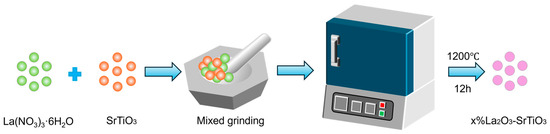
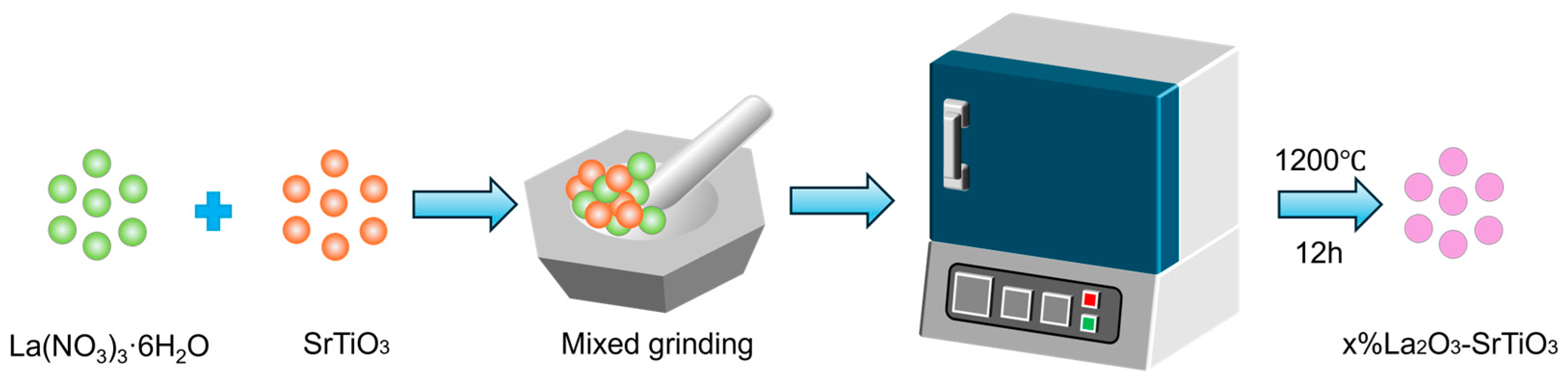
The schematic representation of the synthesis of Catalyst Synthesis is given in Figure 1. In this study, La2O3-SrTiO3 composite electrocatalysts with different La2O3 content were synthesized via a conventional high-temperature solid-state reaction route. Specifically, SrTiO3 and La(NO3)3·6H2O powders were weighed to match the desired molar ratios between La2O3 and SrTiO3, followed by thorough mixing and grinding for 1 h. The resulting mixture was heated to 1200 °C in air at a heating rate of 10 °C/min and calcined for 12 h to ensure complete decomposition of the nitrate precursor and formation of crystalline La2O3. At the same time, the high-temperature treatment promoted the interfacial interaction between La2O3 and SrTiO3, which helped La2O3 to partially transform from the thermodynamically stable phase to the metastable P63/mmc phase, thereby obtaining La2O3-SrTiO3 electrocatalysts with different La2O3 contents. The obtained samples are denoted as x%La2O3-SrTiO3 (x = 1, 3, 5, 10, 15, and 20) according to the nominal La2O3 content, where x represents the molar percentage of La2O3 relative to SrTiO3. For example, the 10% La2O3–SrTiO3 sample corresponds to a molar ratio of La2O3:SrTiO3 = 1:9. For comparison, pure La2O3 powders were yielded by annealing La(NO3)3·6H2O powder under the same conditions.
Figure 1.
Schematic illustration of the synthesis procedure of La2O3-SrTiO3 composite electrocatalysts.
2.2. Physical Characterization
The phase composition of the samples was analyzed by X-ray diffraction (XRD, SmartLab, Rigaku, Tokyo, Japan). The morphology of the catalysts was examined by cold-field emission scanning electron microscopy (SEM, SU8600, Hitachi, Tokyo, Japan) and transmission electron microscopy (TEM, JEM-2100, JEOL Co., Ltd., Tokyo, Japan). X-ray photoelectron spectroscopy (XPS, Al Kα, ESCALAB QXi, Thermo Fisher Inc., Waltham, MA, USA) was employed to analyze the surface chemical composition of the electrocatalysts. In situ Fourier transform infrared spectroscopy (FTIR, Nicolet iS50 FT-IR, Thermo Fisher Scientific Inc., Waltham, MA, USA) and high-resolution mass spectrometry (HRMS, Q Extractive plus, Thermo Fisher Scientific Inc., Waltham, MA, USA) were employed to monitor the formation and evolution of surface reaction intermediates during the oxygen reduction reaction (ORR) process, thereby elucidating the reaction pathway and the underlying mechanism for H2O2 generation.
2.3. Electrochemical Measurements
Electrochemical measurements were carried out using an electrochemical workstation (CHI760E, CH Instruments, Shanghai, China) coupled with a rotating ring-disk electrode (RRDE) system (AFMSRCE type, Pine Instruments Corporation, Durham, NC, USA). Prior to the measurements, catalyst inks were prepared as follows: 5 mg of the as-synthesized catalyst powder was dispersed in 1 mL of anhydrous ethanol and mixed with 10 µL of Nafion solution (5 wt%, DuPont, Wilmington, DE, USA). The mixture was ultrasonicated for 30 min to form a homogeneous suspension.
When conducting tests using an electrochemical workstation, different doses of catalyst ink were taken and dropped onto an indium tin oxide (ITO) conductive glass fixed with a rubber sealing ring using a pipette. The ink was then dried under an infrared lamp and used as the working electrode. Ag/AgCl was used as the reference electrode, and a Pt mesh was used as the counter electrode. Based on this, the electrochemical behavior under different reaction conditions in 0.1 M KCl solution was studied, and the yield of H2O2 in the solution after each reaction was determined using the iodometric titration method.
In RRDE experiments, the geometric areas of the ring and disk electrodes were 0.2475 cm2 and 0.1866 cm2, respectively. A 10 µL aliquot of the catalyst ink was drop-cast onto the disk electrode and allowed to dry naturally, forming a uniform catalytic film. The Ag/AgCl electrode and a Pt mesh were used as the reference and counter electrodes, respectively. The reference electrode potential was calibrated to the reversible hydrogen electrode (RHE) using the following equation:
E (V vs. RHE) = E (V vs. Ag/AgCl) + EΘ(Ag/AgCl) + 0.059 × pH
2.4. Theoretical Calculations
We used the DFT as implemented in the Vienna Ab initio simulation package (VASP) in all calculations. The exchange-correlation potential is described by using the generalized gradient approximation of Perdew–Burke–Ernzerhof (GGA-PBE). The projector augmented-wave (PAW) method is employed to treat interactions between ion cores and valence electrons. The plane-wave cutoff energy was fixed to 450 eV. Given structural models were relaxed until the Hellmann–Feynman forces were smaller than −0.02 eV/Å and the change in energy was smaller than 105 eV. Grimme’s DFT-D3 methodology was used to describe the dispersion interactions among all the atoms in adsorption models.
The Gibbs free energy change is defined as:
where ΔE is the electronic energy calculated with VASP, ΔZPE and ΔS are the zero-point energy difference and the entropy change between the products and reactants, respectively, and T is the temperature (298.15 K).
ΔG = ΔE + ΔZPE − TΔS
3. Results and Discussion
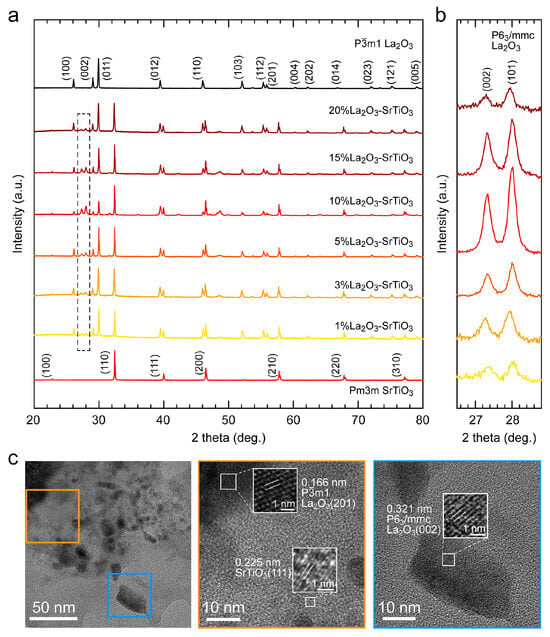
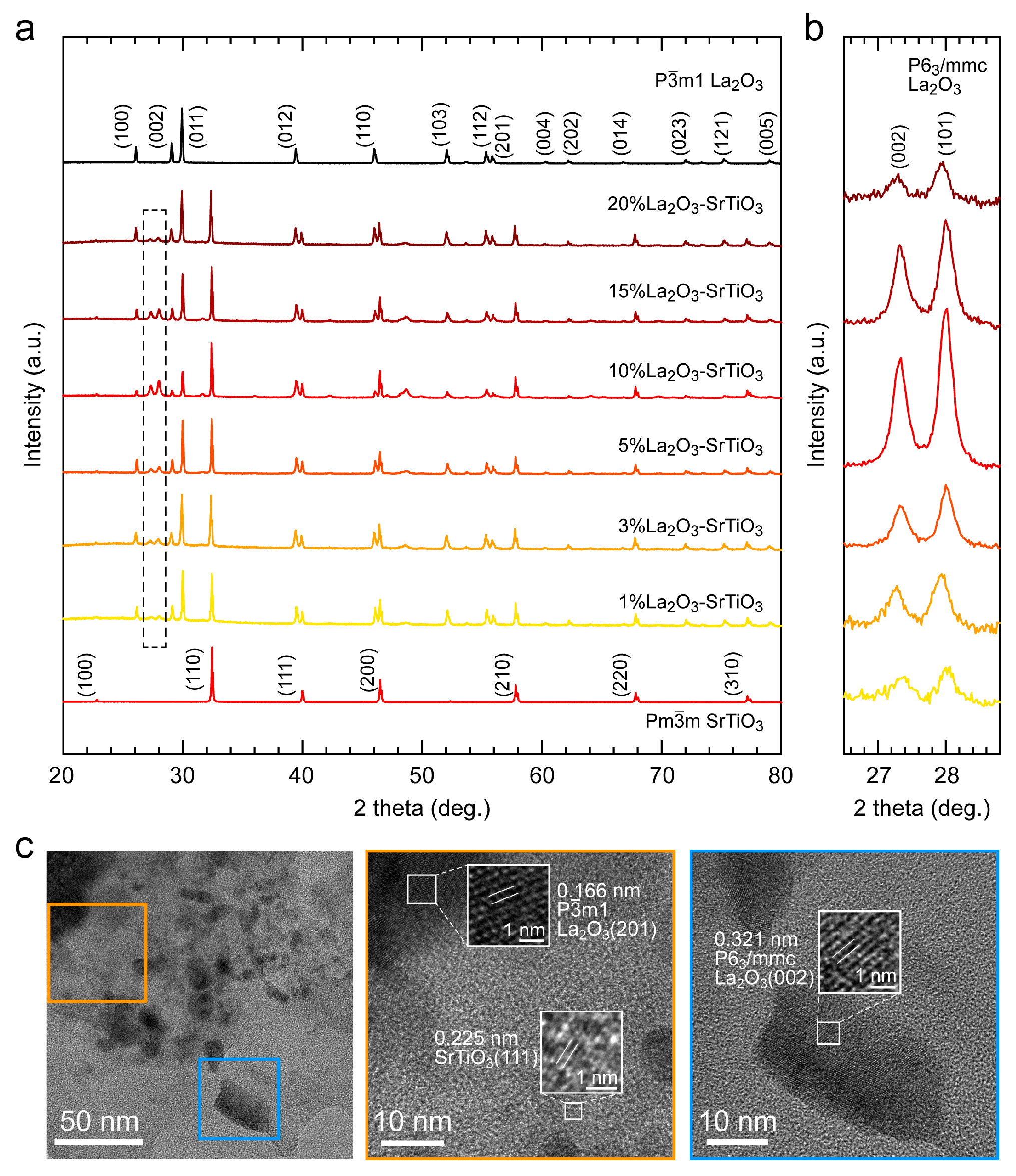
As illustrated by the X-ray diffraction (XRD, SmartLab, Rigaku) patterns in Figure 2a,b, annealing the mixture of La(NO3)3·6H2O and SrTiO3 effectively induces the formation of a La2O3/SrTiO3 heterostructure. The diffraction peaks of La2O3 can be indexed to two phases with different symmetries. For the phase, the main characteristic peaks are observed at 2θ ≈ 26.08°, 29.08°, 29.92°, 39.46°, 46.02°, 52.1°, 55.38° and 55.9°, corresponding to the (100), (002), (011), (012), (110), (103), (112) and (201) planes. The appearance of diffraction peaks at 2θ ≈ 27.42° and 28.11° can be assigned to the (002) and (101) planes of the P63/mmc phase. With increasing La2O3 fraction, the relative contribution of the P63/mmc phase exhibits a non-monotonic dependence, reaching its peak at x = 10% and decreasing at higher La2O3 loading. It is worth noting that the is considered the most thermodynamically favored polymorph of La2O3 under ambient conditions, whereas formation of the metastable P63/mmc phase typically occurs only at temperatures exceeding 2000 °C [26]. Moreover, annealing pure La(NO3)3·6H2O powder exclusively yields the phase. Consequently, the appearance of the P63/mmc phase in the composites can be attributed to the SrTiO3 matrix acting as a structural template. Such stabilization may arise from the epitaxial strain originating from the SrTiO3 lattice, which could lower the energetic penalty for forming the metastable P63/mmc phase. To further elucidate the phase distribution and interfacial structure between the La2O3 and SrTiO3 phases, transmission electron microscopy (TEM, JEM-2100, JEOL Co., Ltd.) analysis was performed on the representative 10%La2O3-SrTiO3 sample. As shown in Figure 2c, it shows lattice stripes of 0.166 nm, 0.225 nm and 0.321 nm, which belong to the (201) crystal plane of La2O3 (), the (111) crystal plane of SrTiO3 and the (002) crystal plane of La2O3 (P63/mmc), respectively. By combining the EDS plot (Figure S1 and Table S1), we can see that the elements are uniformly distributed. It is inferred that La2O3 domains (in both and P63/mmc phases) with the particle size of 10~30 nm are well dispersed on the surface of the SrTiO3 matrix. It is hypothesized that during the initial stage of annealing, the decomposition of La(NO3)3·6H2O releases acidic gaseous species, which may mildly etch the SrTiO3 surface and promote subsequent La2O3 nucleation [27,28]. This process could create additional active sites, enabling more uniform dispersion of La2O3 upon high-temperature conversion of the precursor [29]. As a result, a uniform distribution of La2O3 is achieved, promoting efficient contact between the active species and the catalyst during electrocatalysis. X-ray photoelectron spectroscopy (XPS) results showed that the La 3d spectrum exhibited characteristic peaks corresponding to La3+, confirming the presence of La–O bonds in La2O3. The Ti 2p spectrum showed two main peaks belonging to Ti4+, indicating the presence of Ti–O bonds in the SrTiO3 lattice. While high concentrations of oxygen vacancies and La doping would induce Ti3+ formation [25,30], no Ti3+ was observed in this study, suggesting a negligible donor-doping effect from either La3+ or oxygen vacancy. This further indicates that the compositing between La2O3 and SrTiO3 did not introduce a donor doping from La3+ to the Ti 3d orbital, where only Ti 2p peaks attributed to Ti4+ can be observed (Figure S2). Therefore, these observations support the formation of a surface-decorated La2O3/SrTiO3 composite, where La2O3 is primarily located or near the SrTiO3 surface rather than being incorporated into the SrTiO3 lattice.
Figure 2.
Structural characterization of La2O3-SrTiO3 composite powders. (a) XRD patterns of La2O3-SrTiO3 composite powders with different La2O3 fractions. (b) Magnified XRD patterns of the dashed box in (a). (c) TEM images of 10% La2O3-SrTiO3 sample.
When comparing the catalytic performance of catalysts, differences in electrochemically active surface area (ECSA) must be considered to more accurately assess the surface effect on ORR activity. Bilayer capacitance (Cdl) is used to estimate the corresponding ECSA differences. Bilayer capacitance is determined by CV curves using the following equation:
Δj = (ja − jc)/2 = Cdl × v
In the charging current density plot, the scan rate (v) is plotted on the x-axis and Δj on the y-axis, where ja and jc represent the anode and cathode current densities at ΔE = 0 V (potential window was 0.927 V to 1.027 V vs. RHE), respectively, and v represents the scan rate in mV s−1. The slope of the plot represents the electric double-layer capacitance (Cdl). The non-Faradic current density based on the ECSA was then estimated using the following equation:
where Cs represented the specific capacitance of the electrode. The corresponding CV curves and the difference between the charging current density Δj and the scan rate (v) are shown in Figure S3. The Cdl values of different catalysts are shown in Table S2. Compared to SrTiO3, the Cdl values of all catalysts increased, with the 10% La2O3-SrTiO3 composite exhibiting the highest Cdl value, indicating that it possesses the largest electrochemically active surface area and a higher density of active sites. These results demonstrate that the introduction of La2O3 can effectively increase the exposure of catalytic sites and improve the electrochemical interface.
ECSA = Cdl/Cs
Furthermore, we conducted stability tests using chronoamperometry in an oxygen-rich KCl electrolyte at a reaction potential of 0 V (vs. RHE) to evaluate the catalyst’s durability. As shown in Figure S4, the current density of the 10% La2O3-SrTiO3 electrocatalyst remained relatively stable during the test, indicating that the composite catalyst has good electrochemical stability.
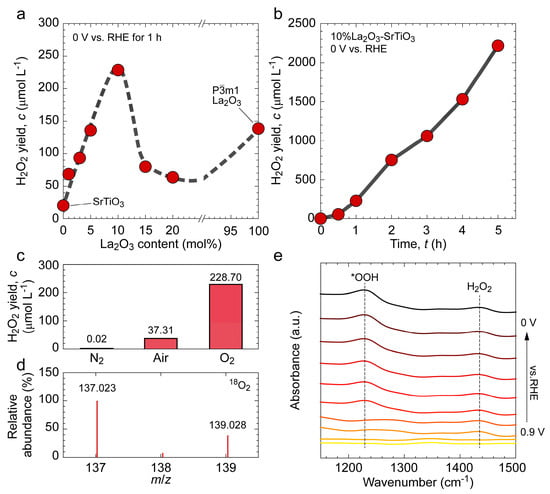
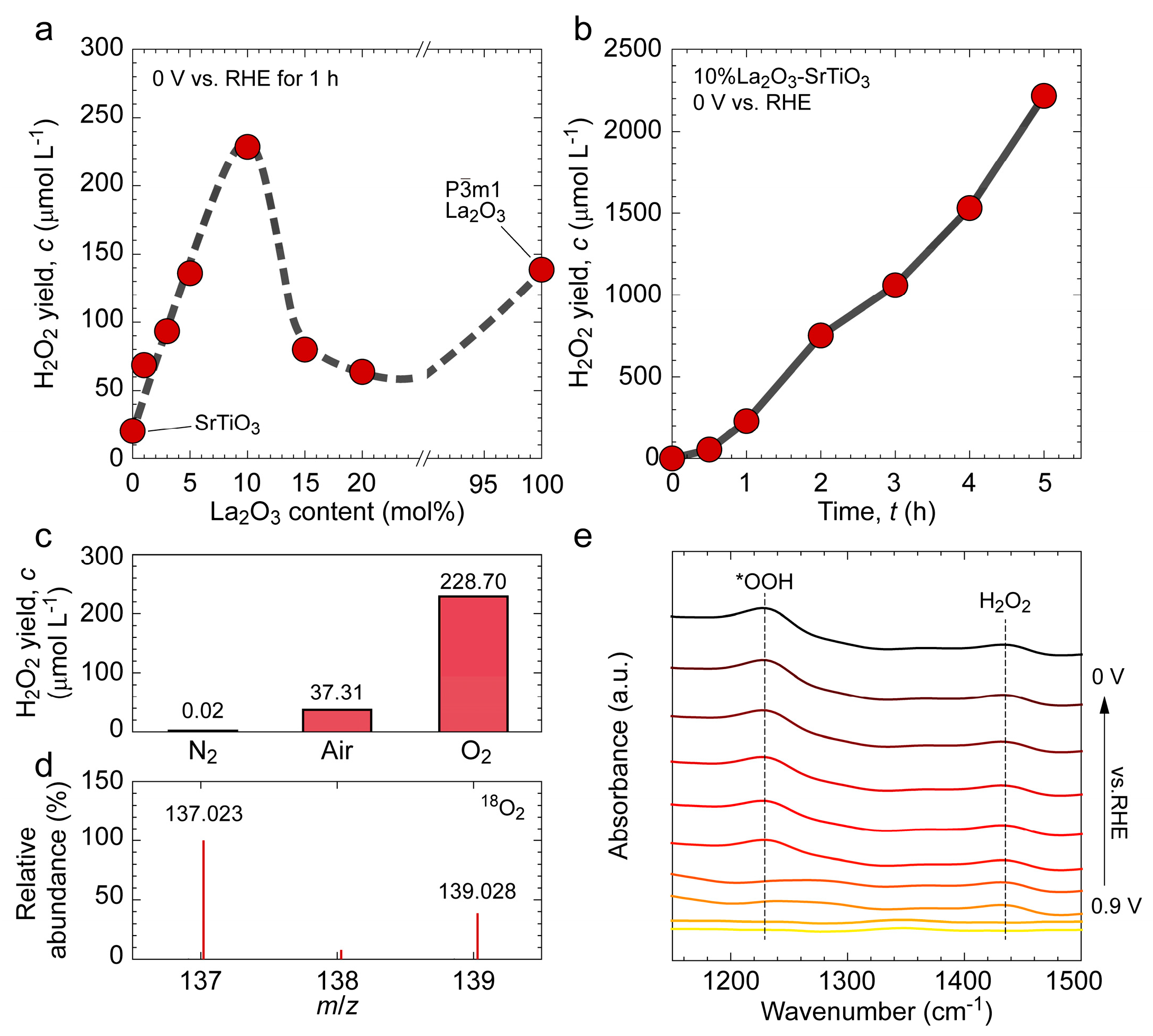
The H2O2 electrosynthesis performance of La2O3-SrTiO3 catalysts with different La2O3 content was evaluated at 0 V vs. reversible hydrogen electrode (RHE) using a standard three-electrode configuration, and the results are summarized in Figure 3. Figure 3a shows that with a fixed catalyst loading of 0.5 mg and electrolysis time of 1 h, the produced concentration of H2O2 follows a clear volcano-type trend with increasing La2O3 content. A maximum H2O2 yield of 228.70 μmol L−1 was obtained in the 10%La2O3-SrTiO3 sample. Notably, this volcano-like tendency is well consistent with the evolution of the P63/mmc La2O3 phase (Figure 2c), suggesting that the presence of the P63/mmc polymorph and its interface with SrTiO3 contributes positively to H2O2 formation. Meanwhile, the pure La2O3 with symmetry displays a lower H2O2 yield of 138.64 μmol L−1, suggesting that the enhanced performance of the composite cannot be explained by La2O3 alone and is instead linked to the symmetry-modulated La2O3 phase and interfacial effect. In the case of the 10%La2O3-SrTiO3 sample, we further tested the time-dependent electrocatalytic performance. As shown in Figure 3b, prolonging the electrolysis to 5 h leads to a constant increase in H2O2 production without any decay of the reaction rate, indicating a robust catalytic activity over the tested duration. The generation of H2O2 usually involves two pathways, which are water oxidation reaction (WOR) and ORR. In order to clarify the reaction pathway in this study, we compared the electrocatalytic performance under different atmospheres (N2, air, and O2). As shown in Figure 3c, H2O2 formation is essentially suppressed under N2, whereas it is significantly enhanced under O2, with air giving an intermediate level. Therefore, these atmosphere-resolved results indicate that dissolved O2 is required for H2O2 formation, supporting ORR as the dominant pathway under the applied conditions. In addition, further evidence is provided by the 18O2 isotope labeling experiment using 4-hydroxybenzoic acid (4-HPBA) as a molecular probe to trace the oxygen source in the generated H2O2. The emergence of a distinct signal at m/z = 139.028 in the high-resolution mass spectrum confirms incorporation of oxygen from O2 into the generated H2O2 (Figure 3d) [31]. To further probe the evolution of reaction intermediates and the reaction mechanism of the La2O3-SrTiO3 electrocatalyst during the ORR process, in situ Fourier-transform infrared (FTIR) spectroscopy (Nicolet iS50 FT-IR, Thermo Fisher Scientific Inc.) was performed on the 10%La2O3-SrTiO3 sample in 0.1 M KCl solution. Figure 3e presents the FTIR spectra recorded at various applied potentials (vs. RHE). As the applied potential was gradually shifted to more negative values, an absorption band emerged and gradually intensified at approximately 1230 cm−1 from 0.7 V, which can be assigned to the O–O stretching vibration of the hydroperoxyl (*OOH) intermediate during the reaction. In addition, the signals observed in the range of 1400–1450 cm−1 are attributed to the vibrational features of H2O2.
Figure 3.
Electrocatalytic H2O2 production performance and mechanistic evidence for La2O3-SrTiO3 composite. (a) La2O3 content-dependent H2O2 yield of La2O3-SrTiO3 composite powders under the O2 saturation condition. (b) Time-dependent H2O2 yield over an optimized 10%La2O3-SrTiO3 sample under the O2 saturation condition. (c) H2O2 yields over a 10%La2O3-SrTiO3 sample under different atmospheres. (d) LC-MS results of TECatal reaction by 18O isotope labeling. (e) In situ FTIR spectroscopy of a 10% La2O3-SrTiO3 sample at different applied voltages.
Based on the results above, a plausible reaction pathway involving a two-electron reduction mechanism has been deduced [11]:
O2 + H+ + e− → *OOH
*OOH + H+ + e− → H2O2
To further reveal the interfacial charge transport behavior of the La2O3-SrTiO3 composite material, electrochemical impedance spectroscopy (EIS) was performed on different La2O3-SrTiO3 composite material samples (Figure S5). The charge transfer resistance (R1) was simulated using the equivalent circuit model shown in Figure S6, and the results are presented in Table S3. The composite catalyst with 10% La2O3 content exhibited the lowest R1 values, indicating that this sample not only has the lowest bulk resistance but also the most rapid interfacial charge transfer process. This suggests that the introduction of an appropriate amount of La2O3 helps to construct a more efficient electron transport network and significantly reduces the energy barrier during the electrode reaction process.
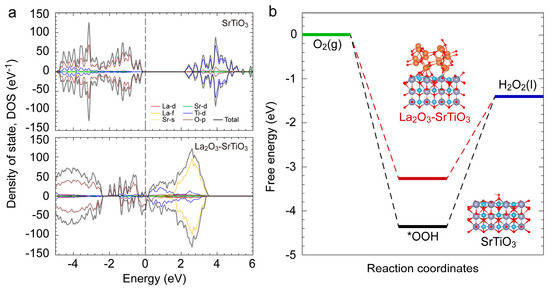
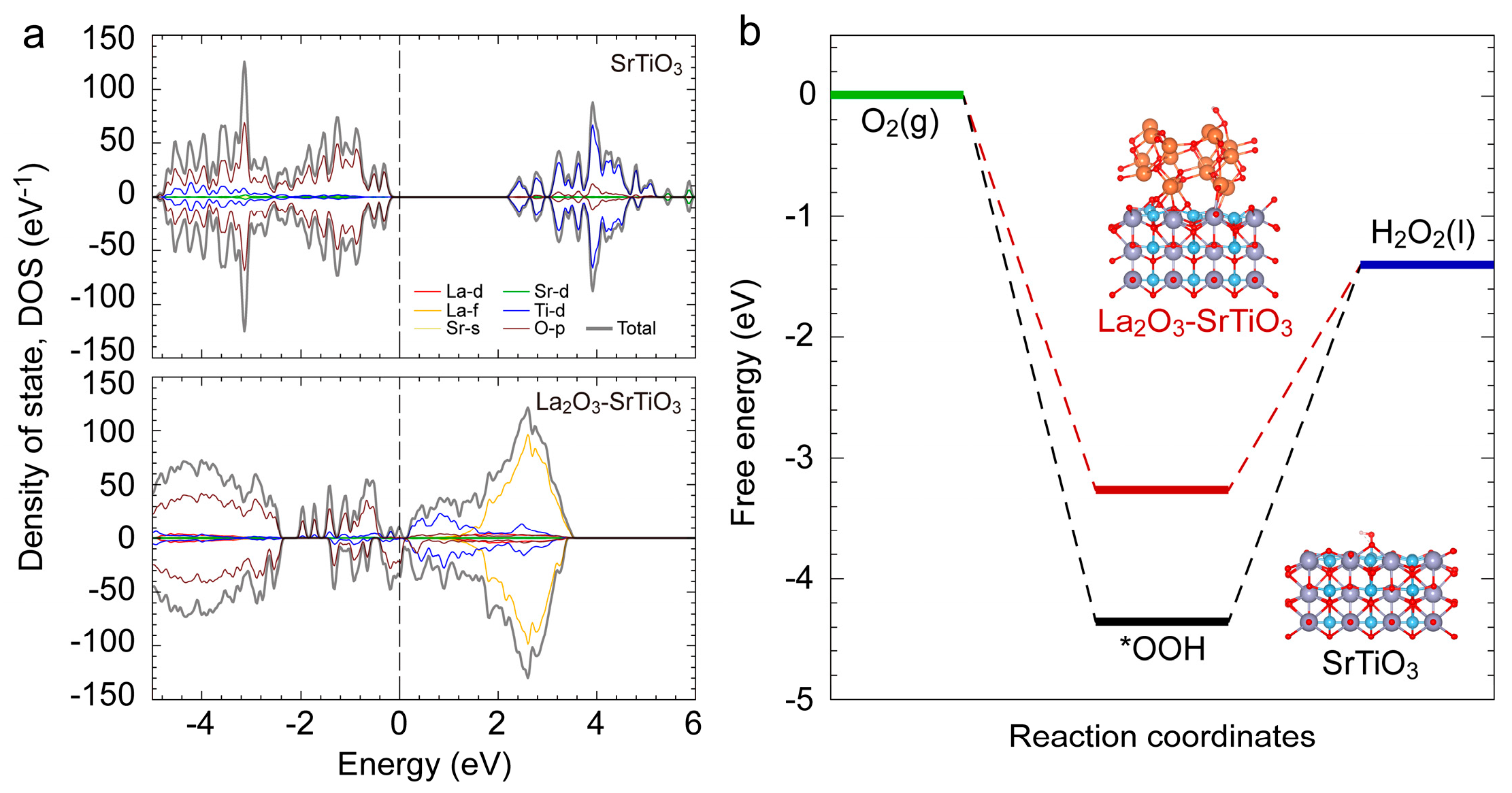
To gain an in-depth understanding of the two-electron ORR pathway and catalytic mechanism of the La2O3-SrTiO3 composite catalyst, density functional theory (DFT) calculations were further performed to analyze the electronic structure and the energetics of key reaction steps. Figure 4a presents the calculated electronic density of states (DOS) for SrTiO3 and La2O3-SrTiO3 composite model. The composite shows an increased density of electronic states near the Fermi level relative to pristine SrTiO3, resulting from interfacial electronic reconstruction. Such a feature is expected to improve the electrical conductivity of the catalyst and thereby facilitate charge transfer during the electrocatalytic process. Moreover, the computed free energy profiles shown in Figure 4b reveal that pristine SrTiO3 suffers from a large uphill free energy change for the rate-determining step (*OOH + H+ + e− → H2O2), with a ΔG value of approximately 2.95 eV, indicating its unfavorable energetics to further activate and convert the *OOH intermediate. In contrast, this uphill free-energy requirement is significantly reduced in the La2O3-SrTiO3 composite structure, with a ΔG value of approximately 1.87 eV, demonstrating that the composite interface effectively lowers the energetic barrier associated with H2O2 formation. These DFT results are in good agreement with the experimentally observed enhancement in H2O2 generation, supporting that interfacial coupling in La2O3-SrTiO3 composite electrocatalyst can tune the adsorption energetics of oxygenated intermediates and lower the thermodynamic penalty for H2O2-forming steps in the two-electron ORR pathway.
Figure 4.
Theoretical investigation of the two-electron ORR mechanism. (a) Total and partial electronic density of states (DOS) for the catalysts. (b) Gibbs free energy profiles for the two-electron ORR pathway on pristine SrTiO3 and La2O3-SrTiO3 composite surfaces. The insets display the optimized adsorption configurations of reaction intermediates.
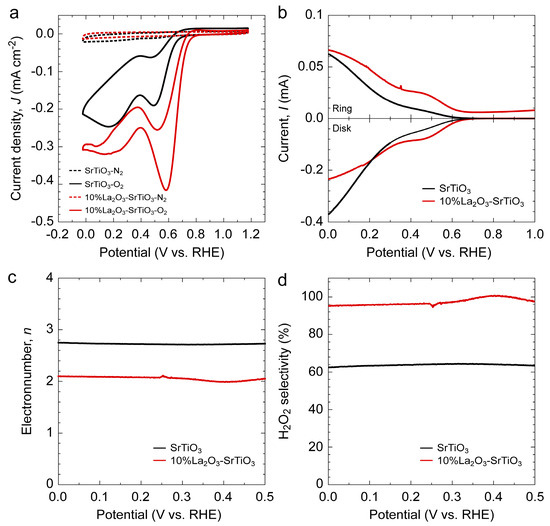
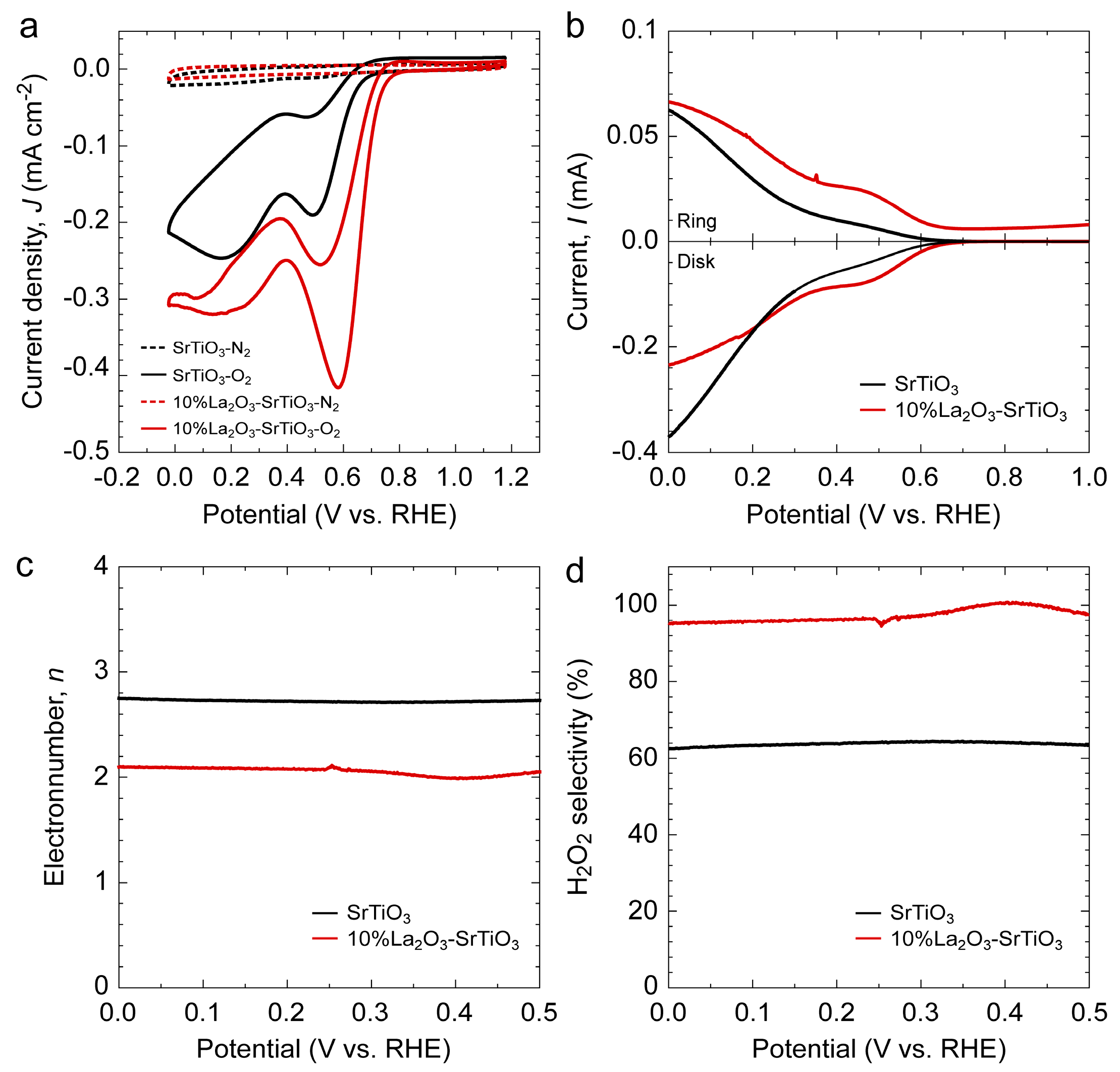
In the electrocatalytic H2O2 production process, driving ORR toward a two-electron pathway is essential for efficient H2O2 generation. However, the competing four-electron reduction to H2O often occurs on many oxide surfaces, making selectivity control a key criterion for catalyst design [32,33]. To quantify the two-electron ORR selectivity, rotating ring–disk electrode (RRDE) measurements were conducted in a conventional three-electrode system using the 10%La2O3-SrTiO3 and pure SrTiO3 as catalysts. All tests of the ring-disk electrode were performed in 0.1 M KOH electrolyte. As shown in Figure 5a, cyclic voltammetry (CV) curves were recorded in N2 and O2-saturated electrolytes to confirm ORR activity. Both catalysts exhibit negligible reduction peaks in N2-saturated solution, whereas distinct reduction peaks appear under O2-saturated conditions. Compared to SrTiO3, the 10%La2O3-SrTiO3 sample displays a higher reduction current and a more positive onset potential, indicating its superior ORR activity. Further evaluation was performed using linear sweep voltammetry (LSV) under different rotation rates for the 10%La2O3-SrTiO3 sample, where the limiting diffusion current increases progressively with increasing rotation speed due to the enhanced mass transport and the reduced thickness of the diffusion layer (Figure S7) [34]. At a rotation rate of 1600 rpm, both disk and ring currents of 10%La2O3-SrTiO3 and SrTiO3 samples were recorded, as shown in Figure 5b. The 10%La2O3-SrTiO3 sample delivers higher disk and ring currents than SrTiO3, suggesting accelerated ORR kinetics and improved H2O2 formation. Based on the RRDE data, the H2O2 selectivity and electron transfer number (n) were calculated according to the following equations [35,36]:
where IDisk is the disk current, IRing is the ring current, and N is the collection efficiency, which is 0.37 in this system. As illustrated in Figure 5c, the n value for the 10%La2O3-SrTiO3 is close to 2, indicating a predominant two-electron ORR pathway for H2O2 production. Correspondingly, the H2O2 selectivity of 10%La2O3-SrTiO3 exceeds 95% across the tested potentials (Figure 5d), whereas SrTiO3 remains below 70%. As a result, compositing La2O3 with P63/mmc symmetry into SrTiO3 brings a significant enhancement in the two-electron pathway, which improves the H2O2 production rate.
Figure 5.
Selectivity of ORR in H2O2 production by La2O3-SrTiO3 composite powders. (a) Cyclic voltammogram (CV) curves, (b) disk and ring currents at 1600 rpm, (c) electron transfer number, and (d) H2O2 selectivity calculated from rotating ring–disk electrode (RRDE) responses for pure SrTiO3 and 10%La2O3-SrTiO3 powders.
4. Conclusions
In this study, a series of La2O3-SrTiO3 composite electrocatalysts with different La2O3 content were successfully synthesized via a solid-state method. The interaction between La2O3 and SrTiO3 leads to discernible electronic modulation, which in turn governs the surface reactivity toward oxygen reduction. Specifically, a metastable hexagonal La2O3 phase with P63/mmc symmetry can be stabilized in the presence of SrTiO3, which is typically inaccessible under conventional conditions. The evolution from a low-symmetry hexagonal phase (space group ) to a high-symmetry hexagonal phase (space group P63/mmc) correlates with improved H2O2 formation activity and selectivity, which we attribute to more favorable interfacial electronic structures and optimized adsorption energetics of *OOH intermediates. Furthermore, RRDE measurements confirm that the P63/mmc symmetry La2O3 significantly enhances the selectivity toward the two-electron ORR pathway, resulting in a high H2O2 selectivity of over 95%. These findings not only highlight the importance of structural symmetry in modulating oxygen reduction pathways but also demonstrate a robust “template-induction” strategy to stabilize metastable rare-earth oxides. This work provides a new paradigm for the rational design of high-performance, cost-effective non-noble metal catalysts for decentralized and efficient H2O2 electrosynthesis.
Supplementary Materials
The following supporting information can be downloaded at https://www.mdpi.com/article/10.3390/nano16080469/s1, Figure S1: Mapping diagram of 10%La2O3-SrTiO3 sample; Table S1: The atomic fraction of each element; Figure S2: High-resolution X-ray photoelectron spectroscopy (XPS) spectra of (a) La 3d and (b) Sr 3d and (c) Ti 2p and (d) O 1s (OC and OL denote the surface-adsorbed oxygen and lattice oxygen, respectively); Figure S3: (a–g) Cyclic voltammetry curves of different electrocatalysts. (h) The corresponding electrochemically active surface area (ECSA) diagram; Table S2: Bilayer capacitance (Cdl) of different catalysts; Figure S4: Stability testing of 10% La2O3-SrTiO3 electrocatalyst; Figure S5: Nyquist plots of different La2O3-SrTiO3 composite electrocatalysts; Figure S6: Equivalent circuit diagram for electrochemical impedance spectroscopy (EIS); Table S3: Electrochemical impedance spectroscopy fitting data; Figure S7: Linear sweep of voltammetry curves of the 10% La2O3-SrTiO3 sample at different rotation speeds.
Author Contributions
H.Y.: Investigation, methodology, data curation, formal analysis, writing—original draft. Y.G.: Investigation, methodology. Q.Y.: Investigation, methodology, writing—original draft. S.L., and J.Z.: Concept discussion, writing—review and editing. L.Z.: Writing—review and editing, supervision. Y.Z.: Supervision, funding acquisition, project administration, writing—review and editing. All authors have read and agreed to the published version of the manuscript.
Funding
The authors acknowledge the support from the National Natural Science Foundation of China (NSFC) [No. 52202242 (to Y.Z.), No. 22578183 (to S.L.)], the Ministry of Human Resources, Social Security of China [No. H20240006 (to Y.Z.), No. S20240318 (to J.Z.), No. H20250833 (to L.Z.)], the Zhenjiang Municipal Science and Technology Program [No. GJ2024010 (to L.Z.), No. JC2025021 (to L.Z.)], the Natural Science Foundation of Jiangsu Province [No. BK20230550 (to Q.Y.)], the Start-Up Fund of Jiangsu University [No. 5501310015 (to Y.Z.), No. 550130025 (to Q.Y.)], and the Jiangsu Provincial Senior Talent Program (Dengfeng).
Data Availability Statement
The data that support the findings of this study are available from the corresponding author upon reasonable request.
Conflicts of Interest
The authors declare no conflict of interest.
References
- Ciriminna, R.; Albanese, L.; Meneguzzo, F.; Pagliaro, M. Hydrogen peroxide: A key chemical for today’s sustainable development. ChemSusChem 2016, 9, 3374–3381. [Google Scholar] [CrossRef] [Scilit]
- Yu, F.-Y.; Zhou, Y.-J.; Tan, H.-Q.; Li, Y.-G.; Kang, Z.-H. Versatile photoelectrocatalysis strategy raising up the green production of hydrogen peroxide. Adv. Energy Mater. 2023, 13, 2300119. [Google Scholar] [CrossRef] [Scilit]
- Xue, Y.; Wang, Y.; Pan, Z.; Sayama, K. Electrochemical and photoelectrochemical water oxidation for hydrogen peroxide production. Angew. Chem. Int. Ed. 2021, 60, 10469–10480. [Google Scholar] [CrossRef] [Scilit]
- Lin, L.; Sun, Z.; Chen, H.; Zhao, L.; Sun, M.; Yang, Y.; Liao, Z.; Wu, X.; Li, X.; Tang, C. Recent advances in electrocatalytic two-electron water oxidation for green H2O2 production. Acta Phys.-Chim. Sin. 2024, 40, 2305019. [Google Scholar] [CrossRef] [Scilit]
- Wang, Z.; Liu, S.; Liu, Y.; Wei, X.; Liang, N.; Sang, Z.; Jiang, J.; Li, B. Challenges and prospects of catalyst design and environmental applications for on-site hydrogen peroxide production via diverse (photo) electrochemical reaction pathways. Small 2025, 21, 2410612. [Google Scholar] [CrossRef] [Scilit]
- Ding, Y.; Maitra, S.; Halder, S.; Wang, C.; Zheng, R.; Barakat, T.; Roy, S.; Chen, L.-H.; Su, B.-L. Emerging semiconductors and metal-organic-compounds-related photocatalysts for sustainable hydrogen peroxide production. Matter 2022, 5, 2119–2167. [Google Scholar] [CrossRef] [Scilit]
- Huang, K.; Ma, H.; Xiong, W. Green Hydrogen Peroxide: Advances of Electrocatalytic Generation and Applications in High-Value Chemical Conversion. ChemPlusChem 2025, 90, e202500189. [Google Scholar] [CrossRef] [Scilit] [PubMed]
- Wang, N.; Ma, S.; Zuo, P.; Duan, J.; Hou, B. Recent progress of electrochemical production of hydrogen peroxide by two-electron oxygen reduction reaction. Adv. Sci. 2021, 8, 2100076. [Google Scholar] [CrossRef] [Scilit]
- Song, M.; Liu, W.; Zhang, J.; Zhang, C.; Huang, X.; Wang, D. Single-atom catalysts for H2O2 electrosynthesis via two-electron oxygen reduction reaction. Adv. Funct. Mater. 2023, 33, 2212087. [Google Scholar] [CrossRef] [Scilit]
- Wang, Y.; Waterhouse, G.I.N.; Shang, L.; Zhang, T. Electrocatalytic oxygen reduction to hydrogen peroxide: From homogeneous to heterogeneous electrocatalysis. Adv. Energy Mater. 2021, 11, 2003323. [Google Scholar] [CrossRef] [Scilit]
- Liu, Y.; Wei, B.; Yang, L.; Han, X.; Wang, Y.; Zhao, X. Recent research progress in hydrogen peroxide synthesized by electrocatalytic process with two-electron transfer: A brief review. J. Environ. Chem. Eng. 2024, 12, 112972. [Google Scholar] [CrossRef] [Scilit]
- He, C.; Xia, C.; Li, F.-M.; Zhang, J.; Guo, W.; Xia, B.Y. Rational design of oxygen species adsorption on nonnoble metal catalysts for two-electron oxygen reduction. Adv. Energy Mater. 2024, 14, 2303233. [Google Scholar] [CrossRef] [Scilit]
- Bu, Y.; Ma, R.; Wang, Y.; Zhao, Y.; Li, F.; Han, G.-F.; Baek, J.-B. Metal-based oxygen reduction electrocatalysts for efficient hydrogen peroxide production. Adv. Mater. 2024, 36, 2412670. [Google Scholar] [CrossRef] [Scilit] [PubMed]
- Wen, Z.; Han, N.; Li, Y. Recent progress towards the production of H2O2 by electrochemical two-electron oxygen reduction reaction. Acta Phys.-Chim. Sin. 2024, 40, 2304001. [Google Scholar] [CrossRef] [Scilit]
- Dan, M.; Zhong, R.; Hu, S.; Wu, H.; Zhou, Y.; Liu, Z.-Q. Strategies and challenges on selective electrochemical hydrogen peroxide production: Catalyst and reaction medium design. Chem Catal. 2022, 2, 1919–1960. [Google Scholar] [CrossRef] [Scilit]
- Ren, X.; Dong, X.; Liu, L.; Hao, J.; Zhu, H.; Liu, A.; Wu, G. Research progress of electrocatalysts for the preparation of H2O2 by electrocatalytic oxygen reduction reaction. SusMat 2023, 3, 442–470. [Google Scholar] [CrossRef] [Scilit]
- Zheng, R.; Meng, Q.; Zhang, L.; Ge, J.; Liu, C.; Xing, W.; Xiao, M. Co-based Catalysts for Selective H2O2 Electroproduction via 2-electron Oxygen Reduction Reaction. Chem.—Eur. J. 2023, 29, e202203180. [Google Scholar] [CrossRef] [Scilit]
- Zhang, Y.; Jiang, H.; Zhang, C.; Feng, Y.; Feng, H.; Zhu, S.; Hu, J. High-efficiency oxygen reduction by late transition metal oxides to produce H2O2. J. Mater. Chem. A 2024, 12, 6123–6133. [Google Scholar] [CrossRef] [Scilit]
- Beall, C.E.; Fabbri, E.; Schmidt, T.J. Perovskite oxide based electrodes for the oxygen reduction and evolution reactions: The underlying mechanism. ACS Catal. 2021, 11, 3094–3114. [Google Scholar] [CrossRef] [Scilit]
- Baek, J.; Jin, Q.; Johnson, N.S.; Jiang, Y.; Ning, R.; Mehta, A.; Siahrostami, S.; Zheng, X. Discovery of LaAlO3 as an efficient catalyst for two-electron water electrolysis towards hydrogen peroxide. Nat. Commun. 2022, 13, 7256. [Google Scholar] [CrossRef] [Scilit]
- Zhao, J.-W.; Li, Y.; Luan, D.; Lou, X.W. Structural evolution and catalytic mechanisms of perovskite oxides in electrocatalysis. Sci. Adv. 2024, 10, eadq4696. [Google Scholar] [CrossRef] [Scilit]
- Humayun, M.; Li, Z.; Israr, M.; Khan, A.; Luo, W.; Wang, C.; Shao, Z. Perovskite type ABO3 oxides in photocatalysis, electrocatalysis, and solid oxide fuel cells: State of the art and future prospects. Chem. Rev. 2025, 125, 3165–3241. [Google Scholar] [CrossRef] [Scilit] [PubMed]
- Ingavale, S.; Gopalakrishnan, M.; Enoch, C.M.; Pornrungroj, C.; Rittiruam, M.; Praserthdam, S.; Somwangthanaroj, A.; Nootong, K.; Pornprasertsuk, R.; Kheawhom, S. Strategic design and insights into lanthanum and strontium perovskite oxides for oxygen reduction and oxygen evolution reactions. Small 2024, 20, 2308443. [Google Scholar] [CrossRef] [Scilit] [PubMed]
- Yu, C.; Scullin, M.L.; Huijben, M.; Ramesh, R.; Majumdar, A. Thermal conductivity reduction in oxygen-deficient strontium titanates. Appl. Phys. Lett. 2008, 92, 191911. [Google Scholar] [CrossRef] [Scilit]
- Yang, Q.; Gu, Y.; Liu, Y.; Wang, X.; Li, S.; Zhang, J.; Liu, W.; Zhang, L.; Zhan, Y. Efficient H2O2 production from a SrTiO3-based thermoelectrocatalyst for harvesting low-grade waste heat. Chem. Commun. 2024, 60, 13554–13557. [Google Scholar] [CrossRef] [Scilit]
- Aldebert, P.; Traverse, J.P. Etude par diffraction neutronique des structures de haute temperature de La2O3 et Nd2O3. Mater. Res. Bull. 1979, 14, 303–323. [Google Scholar] [CrossRef] [Scilit]
- Doan, T.-D.; Giocondi, J.L.; Rohrer, G.S.; Salvador, P.A. Surface engineering along the close-packed direction of SrTiO3. J. Cryst. Growth 2001, 225, 178–182. [Google Scholar] [CrossRef] [Scilit]
- Yue, M.; Liu, W.; Zhang, D.; Jian, Z.; Cao, A.; Zhang, J. Tb nanoparticles doped Nd–Fe–B sintered permanent magnet with enhanced coercivity. Appl. Phys. Lett. 2009, 94, 092501. [Google Scholar] [CrossRef] [Scilit]
- Calì, E.; Thomas, M.P.; Vasudevan, R.; Wu, J.; Gavalda-Diaz, O.; Marquardt, K.; Saiz, E.; Neagu, D.; Unocic, R.R.; Parker, S.C. Real-time insight into the multistage mechanism of nanoparticle exsolution from a perovskite host surface. Nat. Commun. 2023, 14, 1754. [Google Scholar] [CrossRef] [Scilit]
- Zhang, Y.; Sugo, K.; Cho, H.J.; Ohta, H. Thermoelectric phase diagram of the SrTiO3-LaTiO3 solid-solution system through a metal to Mott insulator transition. Appl. Phys. 2019, 126, 075104. [Google Scholar] [CrossRef] [Scilit]
- Berbille, A.; Li, X.F.; Su, Y.; Li, S.; Zhao, X.; Zhu, L.; Wang, Z.L. Mechanism for generating H2O2 at water-solid interface by contact-electrification. Adv. Mater. 2023, 35, 2304387. [Google Scholar] [CrossRef] [Scilit]
- Yu, A.; Yang, Y. Atomically dispersed metal catalysts for oxygen reduction reaction: Two-electron vs. four-electron pathways. Angew. Chem. 2025, 137, e202424161. [Google Scholar] [CrossRef] [Scilit]
- Guo, Z.; Tian, Y.; He, J.; Song, H. Photocatalytic Water Splitting for H2 Production via Two-electron Pathway. ChemCatChem 2024, 16, e202301595. [Google Scholar] [CrossRef] [Scilit]
- Panomsuwan, G.; Saito, N.; Ishizaki, T. Simple one-step synthesis of fluorine-doped carbon nanoparticles as potential alternative metal-free electrocatalysts for oxygen reduction reaction. J. Mater. Chem. A 2015, 3, 9972–9981. [Google Scholar] [CrossRef] [Scilit]
- Yin, P.; Yao, T.; Wu, Y.; Zheng, L.; Lin, Y.; Liu, W.; Ju, H.; Zhu, J.; Hong, X.; Deng, Z. Single cobalt atoms with precise N-coordination as superior oxygen reduction reaction catalysts. Angew. Chem. 2016, 128, 10958–10963. [Google Scholar] [CrossRef] [Scilit]
- Koh, K.H.; Mostaghimi, A.H.B.; Chang, Q.; Kim, Y.J.; Siahrostami, S.; Han, T.H.; Chen, Z. Elucidation and modulation of active sites in holey graphene electrocatalysts for H2O2 production. EcoMat 2023, 5, e12266. [Google Scholar] [CrossRef] [Scilit]
Disclaimer/Publisher’s Note: The statements, opinions and data contained in all publications are solely those of the individual author(s) and contributor(s) and not of MDPI and/or the editor(s). MDPI and/or the editor(s) disclaim responsibility for any injury to people or property resulting from any ideas, methods, instructions or products referred to in the content. |
© 2026 by the authors. Licensee MDPI, Basel, Switzerland. This article is an open access article distributed under the terms and conditions of the Creative Commons Attribution (CC BY) license.