


Abstract
Industrialization and urbanization have increased emissions of toxic atmospheric pollutants (CO, NO2, NH3), threatening ecological security and human health. Twin graphene (TG) features large specific surface area and excellent electronic transport properties, but its practical gas-capture performance is limited by weak physisorption. Silicon doping serves as an eco-friendly strategy to modulate TG’s electronic structure and generate surface active sites. Herein, first-principles calculations based on density-functional-theory were implemented. Six Si-modified TG models were built, among which the most stable substitutional TG-Si1 and interstitial short-chain TG-Si6 were further investigated. Their adsorption-sensing behaviors toward CO, NO2, and NH3, as well as interfering H2O and O2, were systematically explored, and adsorption–desorption features at 298 K, 398 K and 498 K were evaluated. Results show that TG-Si1 produces strong chemisorption for NO2 and NH3 (Eads < −2.35 eV) suitable for long-term gas capture, though suffering from severe cross-interference. In comparison, TG-Si6 exhibits a marked binding preference and a strong electronic response toward NO2; interfering gases can be readily desorbed at 498 K to realize good recyclability. Both Si-doped configurations possess favorable resistance against O2 interference, and TG-Si6 additionally suppresses the H2O interference that limits TG-Si1. This work provides theoretical support for Si-modified TG applied in toxic-gas adsorption-sensing and offers new insights into modification of two-dimensional carbon-based materials.
1. Introduction
The rapid expansion of industrialization and urbanization has caused continuous growth in the emissions of toxic gaseous pollutants including CO, NO2 and NH3. These pollutants are highly toxic and easily spread in the atmosphere, and their coexistence will trigger more severe compound pollution, threatening ecological systems and human health [1,2,3]. Under such circumstances, developing efficient, stable and low-cost adsorbents for the precise capture and removal of these gases has become a prominent research direction at the intersection of environmental science and materials science [4,5,6]. Two-dimensional (2D) nanomaterials have attracted extensive attention for gas sensing and adsorption applications, owing to their large specific surface area, abundant active sites and superior electron transport capabilities [7,8]. However, intrinsic graphene suffers from an inherent zero band gap and chemically inert surface. It mainly relies on weak van der Waals forces to adsorb gas molecules with adsorption energy ranging from −0.2 eV to −0.4 eV, corresponding to typical weak physical adsorption. Such intrinsic drawbacks severely hinder its large-scale practical engineering applications [9,10,11].
Twin graphene (TG), a two-dimensional carbon allotrope first predicted by Jiang et al. [12], differs from conventional graphene and from other carbon allotropes in three structural respects that are directly relevant to gas adsorption and sensing. First, its framework is a triatomic-thick covalent sandwich: the upper and lower graphene-like layers are linked by C–C dimers rather than by van der Waals forces [13,14,15], so that both basal surfaces are simultaneously exposed to the ambient atmosphere while the interlayer spacing is fixed by chemical bonds. This architecture doubles the accessible adsorption area per unit mass and, more importantly, removes the interlayer sliding and restacking that plague van der Waals bilayers under repeated gas uptake and release. Second, TG is an intrinsic direct-band-gap semiconductor (about 0.98 eV in the original prediction [12]; 0.74 eV in the present PBE calculations) whose gap can be continuously tuned from 0.4 to 1.0 eV by in-plane strain [16,17]. In contrast to the zero-gap character of graphene, this gap suppresses the off-state leakage current and provides a finite conductance channel whose carrier concentration can be modulated by interfacial charge transfer, which is the physical prerequisite for a chemiresistive read-out [18,19,20,21]. Third, the mixed sp2/sp3 all-carbon network endows TG with excellent thermal stability and mechanical flexibility [22,23,24]. Benefiting from abundant adsorption sites, twin-graphene has also been theoretically explored for energy-storage-related applications such as potassium-ion battery anodes [25], and, geometrically, offers several crystallographically inequivalent sites—six-membered-ring hollows, the long carbon-chain channel and the short carbon-chain segment—that can accommodate a foreign atom in chemically distinct ways. This site diversity is precisely what makes a systematic comparison of modification modes on the same substrate possible. Silicon is a particularly suitable modifier for this purpose. Being in the same main group as carbon, Si is tetravalent and forms directional covalent bonds with the carbon matrix; however, its larger covalent radius and lower electronegativity (1.90 versus 2.55) make the Si–C bond (about 1.87 Å) longer and strongly polarized relative to the C–C bond (1.42 Å). An incorporated Si atom therefore simultaneously expands and buckles the local carbon lattice, transfers electron density to the neighboring carbon atoms and creates a local dipole, and exposes partially occupied 3p/3d-derived orbitals. These features turn an otherwise inert sp2 carbon surface into a localized electrostatic and orbital anchor for molecules carrying lone pairs (CO, NO2, NH3 and H2O) and for open-shell O2. In addition, Si is earth-abundant, low-cost and non-toxic, which makes Si-modified carbon materials compatible with scalable and environmentally benign fabrication [26,27,28].
Previous studies on Si-doped graphene have indeed demonstrated that Si incorporation can convert the physisorption of NH3 into chemisorption [29], strengthen the binding of NO2 and CO [30,31], and improve hydrogen uptake [28]. However, these works were carried out on a gapless graphene matrix, considered essentially one Si incorporation motif, and typically addressed a single analyte without ambient interferents. Three questions therefore remain open and cannot be answered by transferring the graphene results: (i) whether these conclusions hold when the host lattice possesses a finite band gap and a dimer-bridged, channel-containing geometry; (ii) whether the incorporation mode—substitution inside a ring versus interstitial anchoring in a carbon chain—changes the adsorption behavior and, above all, the selectivity; and (iii) whether the modified surface can be regenerated at a practicable temperature after exposure to humid, oxygen-containing air. The present work is designed to answer these three questions on the same carbon host so that the effect of the modification mode can be isolated from the effect of the host lattice.
In this work, first-principles calculations based on density functional theory are employed to systematically explore the performance of Si-modified TG. CO, NO2 and NH3 are selected as typical toxic atmospheric pollutants, while H2O and O2 are introduced as common atmospheric interfering gases to simulate real service environments and evaluate the anti-interference ability of the materials. We systematically investigate the adsorption behaviors and microscopic interaction mechanisms of different Si modification configurations. A series of key parameters, including adsorption energy, charge transfer, density of states, band structure and electron density difference, are calculated to reveal the correlation between electronic structures and adsorption mechanisms. The adsorption and desorption properties at 298 K, 398 K and 498 K are also analyzed, aiming to screen out the optimal doping configuration with high adsorption activity and a pronounced preference for NO2. This work provides a theoretical basis for the use of Si-modified TG in the adsorption and removal of toxic gases, and offers new insights into doping modification and performance optimization of 2D carbon-based environmental adsorbents.
2. Computational Methods
All spin-polarized first-principles density functional theory (DFT) simulations are carried out in this work within Quantum ATK U-2022.12-SP1 software package [32]. Generalized gradient approximation with Perdew–Burke–Ernzerhof (GGA-PBE) functional is adopted to depict electron exchange-correlation interactions [33]. Grimme’s DFT-D3 dispersion correction is incorporated to accurately capture long-range van der Waals intermolecular forces between gas species and TG substrates, which is indispensable for reliable adsorption energy evaluation [34]. A periodic 1 × 3 × 3 super-cell is established for geometry relaxation of six Si-modified configurations. A vacuum slab with 20 Å is erected perpendicular to the TG basal plane to eliminate artificial interlayer coupling between periodic replicas [35]. Geometry optimizations were performed with a total-energy convergence criterion of 1 × 10⁻⁵ eV per atom [36]. The self-consistent-field (SCF) convergence threshold was set to 1 × 10⁻⁶ eV per atom, and a plane-wave cutoff energy of 75 Hartree was adopted throughout all calculations [37]. The K-point setting for structural optimization is 1 × 5 × 5, while the self-consistent and property calculations use 1 × 7 × 7.
Binding energy (Eb) is defined to evaluate the thermodynamic stability of Si-modified TG architectures:
where ETG-Si(n), ESi(n), and ETG represent the total energies of Si-modified twin graphene, pristine TG monolayer and isolated single Si atom, respectively. A negative Eb corresponds to exothermic and thermodynamically favorable modification reactions [38]. According to binding energy comparisons, TG-Si1 and TG-Si6, the two most stable configurations, are selected as primary research subjects. Adsorption calculations on intrinsic TG are also conducted as control groups to quantitatively reveal the promotional effect of Si modification on gas capture performance.
Eb = ETG-Si(n) − ESi(n) − ETG
Gas adsorption energy (Eads) is adopted to distinguish adsorption types and characterize interfacial interaction strength:
where Egas/TG-Si(n) and Egas denote the total energies of gas-loaded TG-Si composite and standalone gas molecule. An Eads value less than −0.80 eV is categorized as strong chemisorption, while adsorption energies ranging from −0.80 eV to −0.20 eV are defined as weak physisorption [39]. Negative Eads indicates spontaneous exothermic adsorption processes, and larger absolute values signify stronger interfacial bonding.
Eads = Egas/TG-Si(n) − Egas − ETG-Si(n)
The charge population analysis is performed with the Mulliken population scheme implemented in Quantum ATK, which is the default partitioning scheme of the code, so as to quantify the charge transfer quantity (QT) between adsorbates and TG substrates. Because Mulliken charges are basis-set dependent, the QT values are not interpreted as a standalone criterion: they are read together with the electron density difference isosurfaces and the projected density of states, both of which are independent of the population scheme, and the charge-transfer conclusions of this work therefore rest on the consistency of the three quantities rather than on the Mulliken values alone.
QT = Qafter − Qbefore
Qbefore and Qafter are the net charge of free gas molecules and adsorbed gas species, respectively. Negative QT implies the gas molecule acts as an electron acceptor, whereas positive QT corresponds to electron-donating gas molecules [40].
Total density of states (TDOS) and band structures are calculated to analyze orbital hybridization between Si modifier, carbon atoms and gas species, as well as band gap variation upon gas adsorption. Electron density difference (EDD) and electron localization function (ELF) are visualized to intuitively identify charge redistribution and covalent bonding features at adsorption interfaces. Transition state theory is further applied to calculate gas desorption recovery times at 298 K, 398 K and 498 K to systematically investigate temperature-dependent desorption behaviors and the recyclability of Si-modified TG materials. Multi-temperature simulation results can provide theoretical guidance for the practical deployment of TG-based adsorbents in complex atmospheric environments. Ultimately, the optimal Si incorporation architecture with superior adsorption activity and high gas selectivity is screened by synthetic assessments of adsorption energy, charge transfer magnitude, structural durability and desorption regenerability, offering theoretical strategies for the rational design of high-performance two-dimensional carbon gas sensing and adsorption materials.
Finite-temperature structural stability was examined using ab initio molecular dynamics (AIMD) performed with CP2K 2026.2 [41] (Quickstep module, PBE functional, DZVP-MOLOPT-SR-GTH basis sets and GTH-PBE-q4 pseudopotentials for C and Si, a 400 Ry plane-wave cutoff and a 60 Ry relative cutoff). The optimized supercells were kept fixed and propagated in the canonical (NVT) ensemble at 300 K with a CSVR thermostat [42] (coupling time 100 fs, time step 1.0 fs, 2500 steps, 2.5 ps), with atomic coordinates written every 10 fs. The protocol and the analysis of the trajectories are described in Supplementary Note S1.
3. Results and Discussion
3.1. Geometric and Electronic Properties of Pristine TG and TG-Sin (n = 1–6)
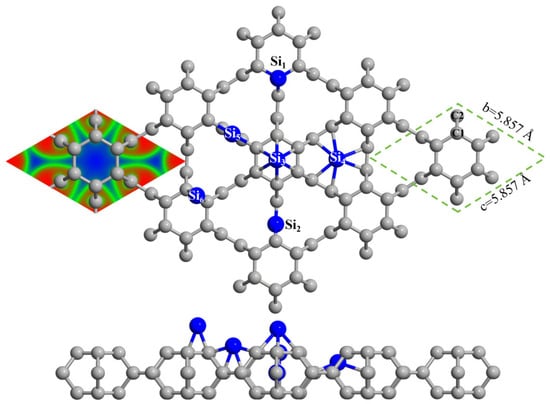
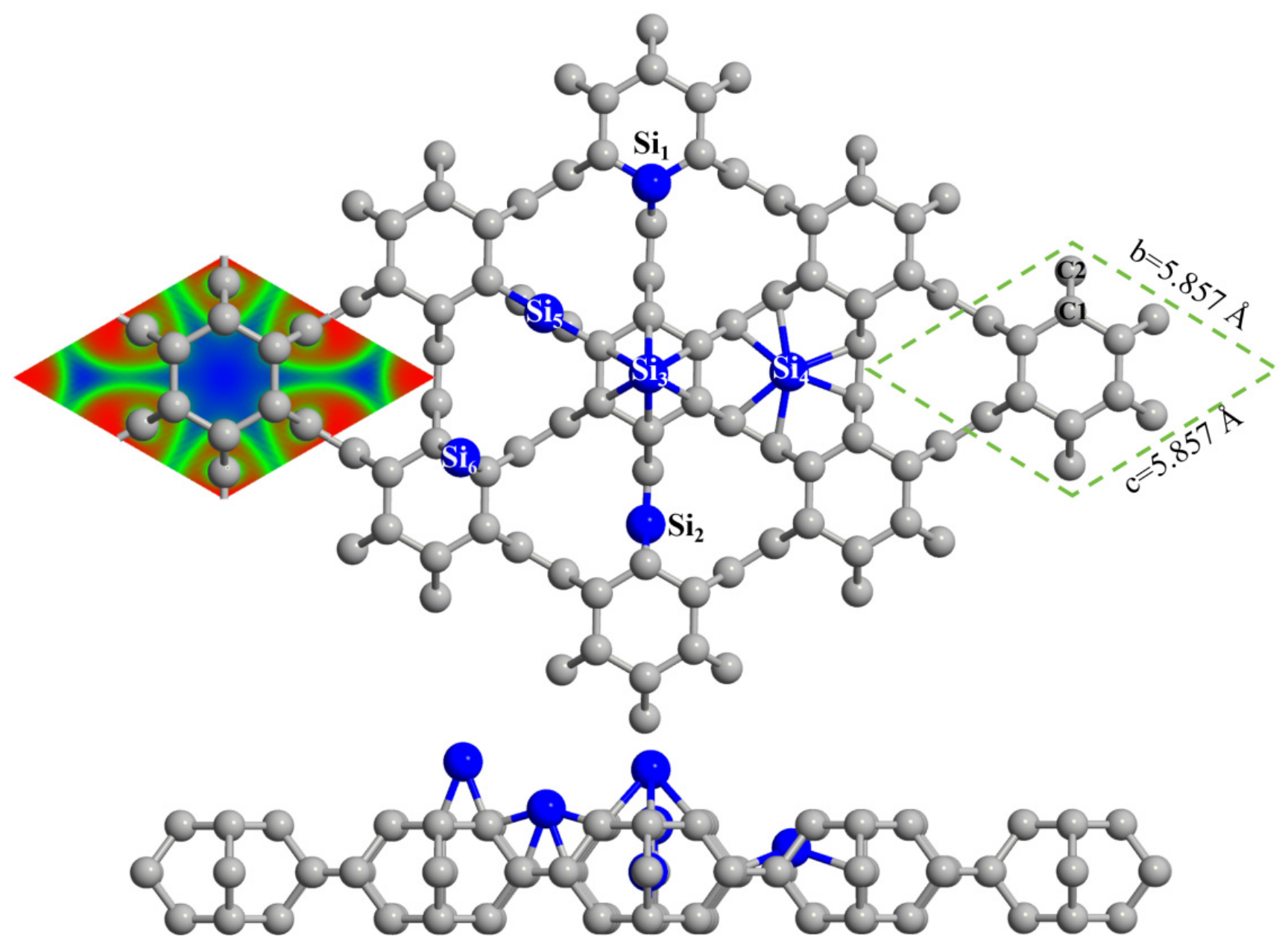
Prior to the systematic adsorption simulations of CO, NO2, NH3, H2O and O2 molecules, geometric optimization of intrinsic TG configuration was performed to validate the rationality and structural stability of the substrate model. After full atomic relaxation, the lattice constants of optimized primitive TG were determined as b = 18.347 Å, and c = 18.349 Å, with an equilibrium C1–C1 bond length of 1.418 Å and C1–C2 bond length of 1.529 Å. These structural parameters are highly consistent with previously reported theoretical results of twin graphene, which verifies the reliability of the constructed TG supercell model [43,44]. As displayed in Figure 1, six Si-modified TG architectures were designed according to the intrinsic lattice characteristics of TG, including two substitutional configurations (TG-Si1, TG-Si2) and four interstitial doping configurations (TG-Si3, TG-Si4, TG-Si5, TG-Si6). The total energies and binding energies of all six Si-doped structures together with pristine TG are summarized in Table 1, which provides quantitative criteria for screening thermodynamically stable doping configurations for subsequent gas adsorption research.
Figure 1.
The top and side views of the six modification models TG-Sin (n = 1–6). The unit cell of twin graphene is depicted by the rhombic box with the green dash lines.
Table 1.
Total energies and binding energies of pristine TG and six Si-modified TG configurations.
For substitutional systems, the binding energies of TG-Si1 and TG-Si2 were calculated to be −4.208 eV and −3.715 eV, respectively. The large absolute negative binding energies indicate that Si substitution reactions are exothermic and thermodynamically spontaneous, and the corresponding structures are thermodynamically stable. All four interstitial doped configurations also exhibit negative binding energies ranging from −3.916 eV to −4.102 eV, demonstrating the spontaneity of interstitial Si incorporation. Among all interstitial structures, TG-Si6 delivers the maximum absolute binding energy of −4.102 eV, which makes it the most stable interstitial doping architecture. Based on comprehensive comparison of thermodynamic stability, TG-Si1 (representative substitutional structure) and TG-Si6 (most stable doping structure) were selected as core research objects for the following gas adsorption investigations.
The binding energies above establish only that the modified structures are thermodynamically favored at 0 K; they do not show that the configurations survive at the temperature of the adsorption process. This was examined by AIMD at 300 K (Supplementary Note S1). Both TG-Si1 and TG-Si6 reach and maintain the target temperature (300.4 ± 16.3 K and 303.1 ± 18.3 K averaged over the last 0.5 ps of a 2.5 ps trajectory), and their potential energies increase by 34.774 and 41.969 meV/atom during the initial equilibration and then fluctuate without a secular trend; the increase is close to the (3/2)kBT = 38.8 meV/atom thermal energy of a harmonic lattice at 300 K and therefore reflects equilibration rather than structural drift. The RMSD of the carbon skeleton remains below 0.170 Å (final values 0.122 Å for TG-Si1 and 0.107 Å for TG-Si6), all 240 C–C bonds of TG-Si1 and all 243 C–C bonds of TG-Si6 are retained in each of the 251 frames, and the three-coordinate Si1 and two-coordinate Si6 environments are preserved, with Si–C bond lengths remaining between 1.80 and 2.05 Å. No reconstruction, dopant migration or bond-breaking event occurs in either trajectory, which confirms that the two selected configurations are dynamically stable at the operating temperature on the simulated time scale. Longer-term degradation and the 498 K regeneration treatment are not covered by this validation and are identified as open points in Supplementary Note S1.
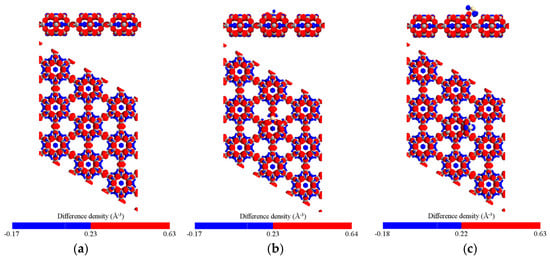
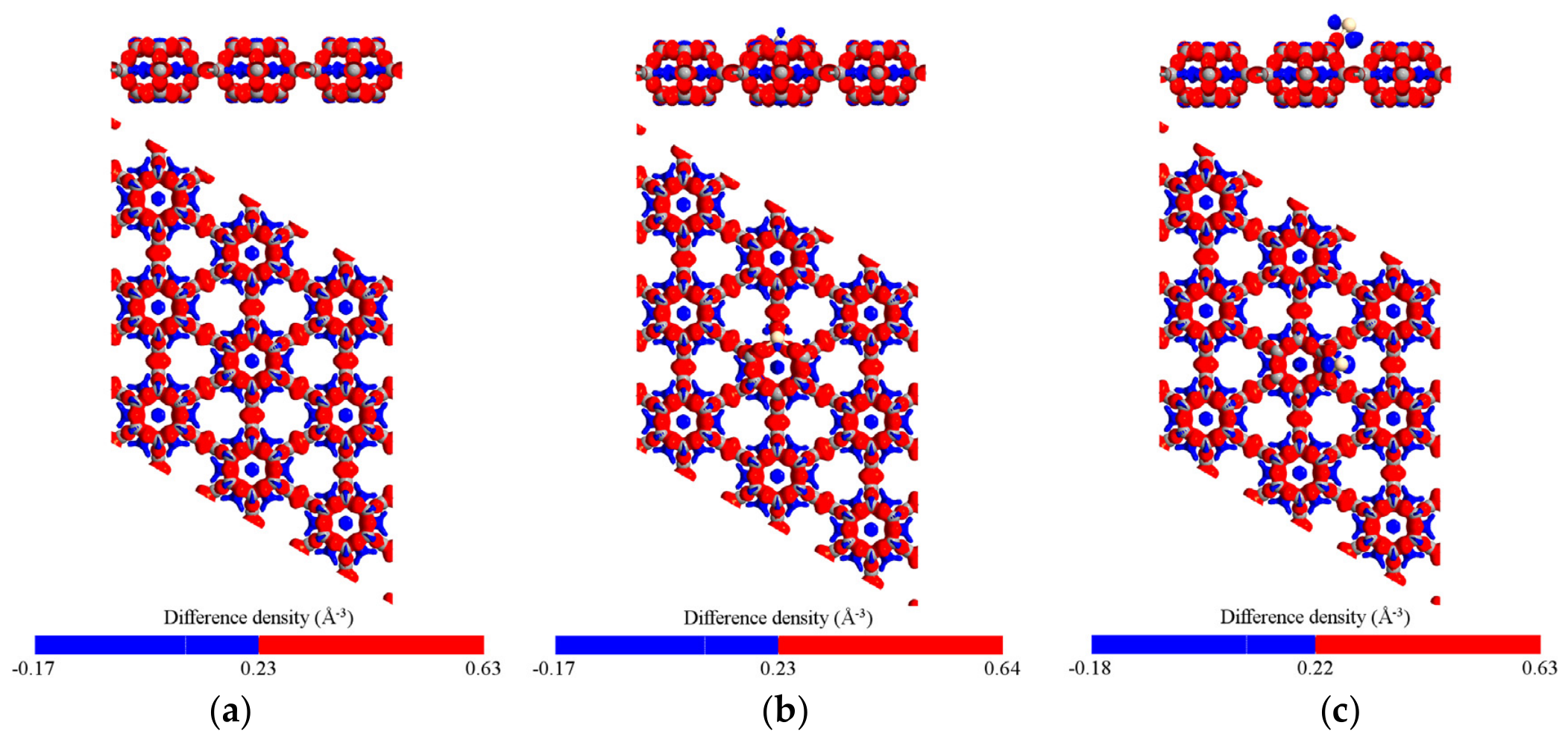
The electron density difference mappings (Figure 2) provide compelling visual evidence for the distinct electronic restructuring induced by various Si modification configurations. In the pristine TG basal plane, the EDD exhibits a strictly homogeneous distribution with a spatially uniform value of +0.25 e Å−3, signifying an electronically inert and symmetrically neutral surface with no intrinsic dipole moment. Upon Si1 substitutional doping, however, the EDD loses this uniformity: charge-depletion regions of negative sign emerge and intimately coexist with the positive domains. Note that the negative limit (−0.17 e Å−3) and the accumulation maxima (+0.63 and +0.64 e Å−3) are extreme scalar values of the EDD data set, whereas the surfaces displayed in Figure 2 are rendered at a fixed isovalue of ±0.005 e Å−3; the depletion lobes are therefore not encoded in the color scale and are most clearly resolved in the side views of Figure 2. This striking contrast unambiguously demonstrates a pronounced charge redistribution and local polarization around the Si1 dopant, giving rise to in-plane electric dipoles. Such localized electrostatic gradients serve as potent electronic traps, which are thermodynamically favorable for polarizing incoming gas molecules and enhancing the initial physisorption-to-chemisorption transition. Conversely, the Si6-doped substrate retains an EDD feature almost identical to that of pristine TG, with the predominant +0.25 e Å−3 distribution remaining intact. This preservation indicates that the Si6 configuration minimally disturbs the conjugated π-electron framework so that the intrinsic carrier-transport channel of the carbon matrix is retained. This statement refers to the preservation of the band dispersion and of the density of states at the Fermi level, and does not imply any specific value of the electrical conductivity or of the carrier mobility. Consequently, the synergistic combination of the chemically active polar sites provided by Si1 and the high-stability structural scaffold offered by Si6 renders this dual-doped system exceptionally suitable for gas-adsorption research. The Si1 component acts as the primary capturing center, while the Si6 component preserves an uninterrupted carrier-transport channel, establishing an ideal platform for subsequent studies on gas molecule adsorption performance. It should be noted that the top views of the panels appear similar at first sight: the substitutional Si1 site preserves the in-plane hexagonal symmetry, and the charge redistribution around it is nearly symmetric when projected along the surface normal. The differences between the three configurations are in fact most evident in the side views, where the Si1 atom protrudes out of the basal plane and the accumulation and depletion lobes above and below the surface are oriented in opposite directions, forming an out-of-plane dipole, whereas the Si6 site leaves the surface almost flat and only a weak out-of-plane charge separation remains. The side views should therefore be compared when the panels are read, since the in-plane projections alone cannot resolve this difference.
Figure 2.
Electron difference density of (a) TG, (b) TG-Si1, and (c) TG-Si6 systems. The isosurfaces are drawn at ±0.005 eÅ−3 with a common color scale, and the dashed frames mark the gas–substrate interfacial region that is compared among the panels.
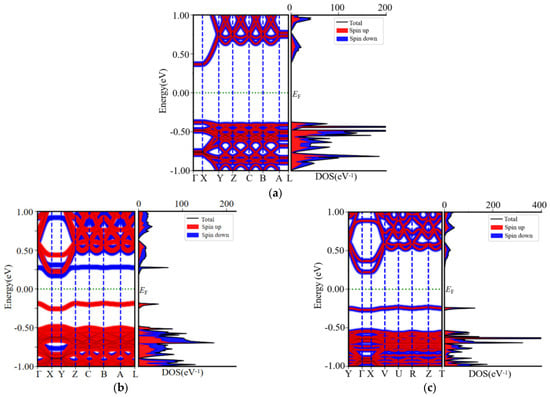
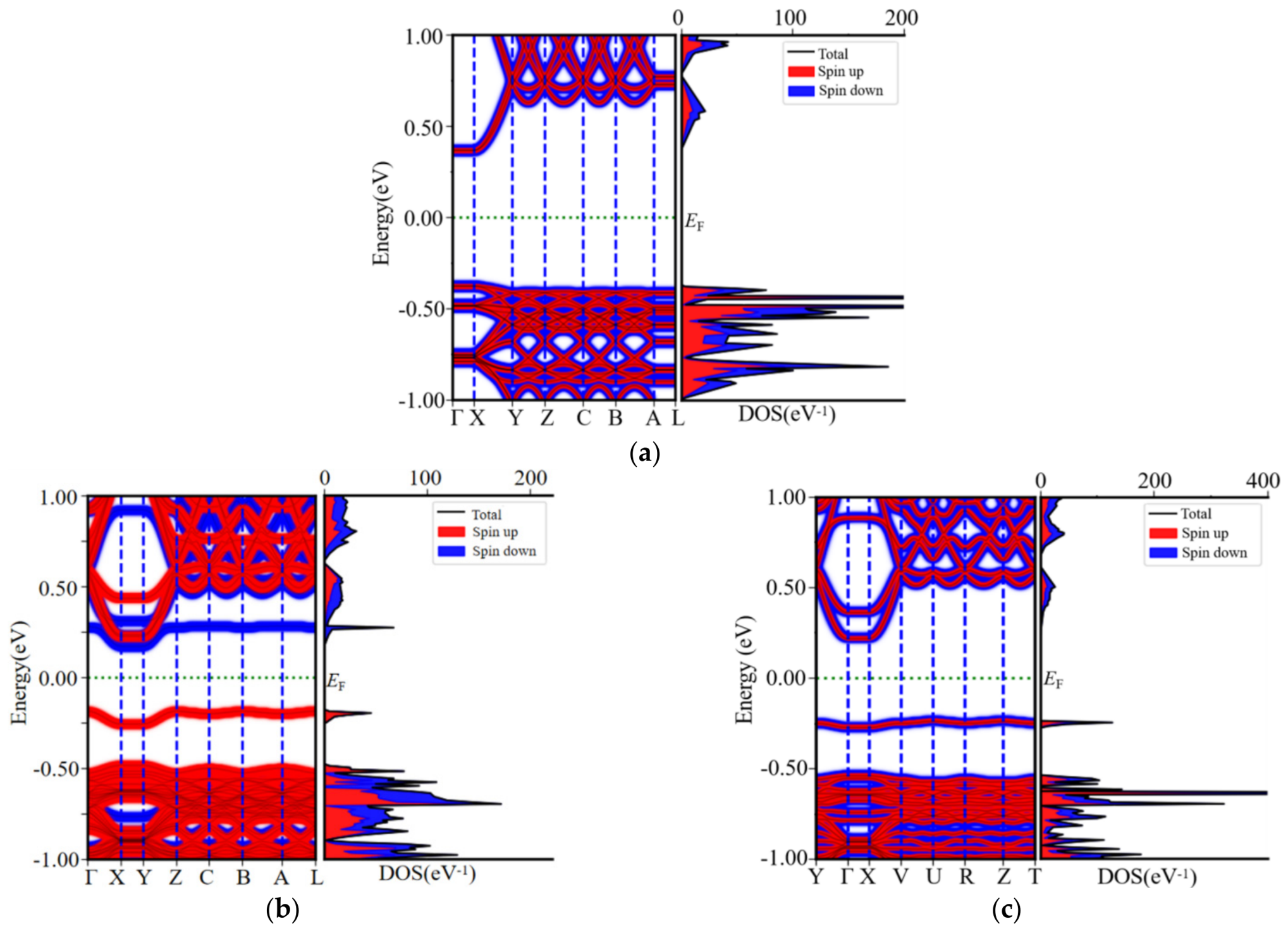
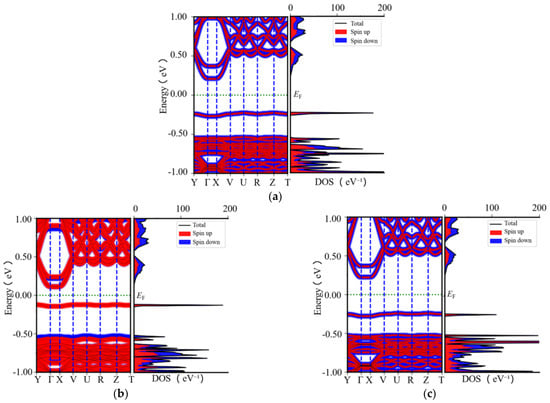
The TDOS combined with electronic band-structure profiles (Figure 3) provide critical insight into the electronic features that govern gas–surface interactions. For pristine TG, the density of states near the Fermi level (EF) is quite low, consistent with its intrinsic semiconductor character. This low density of states at EF makes pristine TG electronically inert toward strong gas-molecule binding, which explains its predominately physisorptive gas-adsorption behavior. After Si1 substitution, distinct impurity-derived states appear close to EF, which significantly raise the local density of states around the Fermi level. These newly formed hybridized orbitals serve as highly reactive interfacial sites, facilitating effective orbital overlap with gas-phase adsorbates and favoring the transition from weak physisorption to strong chemisorption. In comparison, the TG-Si6 system yields a moderate increase in DOS at EF. Unlike TG-Si1, TG-Si6 retains a band dispersion that closely resembles that of pristine TG so that no localized impurity states are introduced inside the gap. Therefore, TG-Si1 provides strong anchoring sites to achieve high adsorption energies for target gas molecules, whereas TG-Si6 retains a dispersed band edge and an essentially unchanged density of states at the Fermi level, which is a prerequisite for efficient carrier transport. No carrier mobility is claimed here, and the transport behavior is instead left to experimental verification. Collectively, both Si-modified configurations possess much more favorable electronic conditions for gas adsorption relative to pristine TG, demonstrating their great potential as candidate substrates for follow-up experimental exploration of gas-adsorption and -sensing applications.
Figure 3.
Electronic band structure and total density of states analysis of (a) TG, (b) TG-Si1, and (c) TG-Si6.
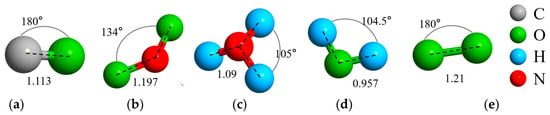
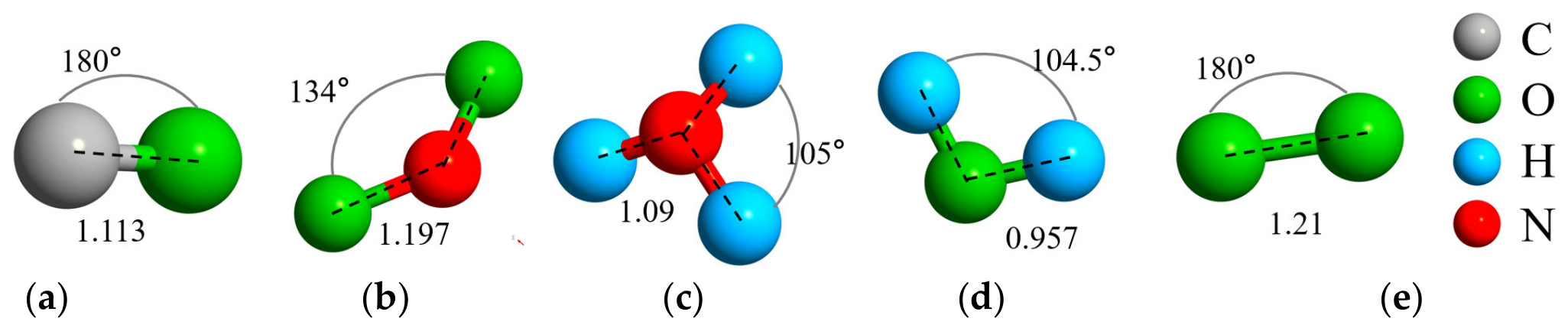
Based on the comprehensive analyses of geometry optimization, binding energy, EDD, band structure, and TDOS, the single-Si substitution and the long-chain Si hollow-site anchoring successfully break the inherent chemical inertness of pristine TG and achieve controllable tuning of its electronic properties. Consequently, TG-Si1 and TG-Si6 are ultimately identified as the target modified substrates for subsequent adsorption studies involving three toxic gases (CO, NO2 and NH3) and two interfering gases (H2O and O2). Prior to the gas-adsorption simulations, full geometry optimizations were performed on all five gas molecules to obtain their energetically stable equilibrium structures, as depicted in Figure 4. The total energies of the five isolated gas molecules, obtained after full geometry optimization with the same computational settings as in Table 1, are collected in Table S5 of the Supporting Information and were used as Egas in Equation (2); they are reported in the same form as the total energies of the TG-based configurations in Table 1, so that the adsorption energies of Table 2 can be reconstructed directly from the listed values.
Figure 4.
Optimized molecular structures of (a) CO, (b) NO2, (c) NH3, (d) H2O, and (e) O2.
Table 2.
The adsorption parameters of target gas molecules on pristine TG and two types of Si-TG systems.
3.2. Adsorption Performance of Gas Molecules on Pristine TG
Prior to exploring the gas-sensing performance of Sin-modified TG, the adsorption behaviors of five target gases on pristine TG were systematically evaluated. Key adsorption parameters are compiled in Table 2, and their corresponding optimized adsorption geometries are illustrated in Figure 5. Among the five gas species, NH3 delivers the weakest interfacial interaction with pristine TG, showing the adsorption energy of −0.213 eV. Comparatively, NO2 (−0.392 eV) and O2 (−0.391 eV) exhibit very close absolute adsorption energies near −0.39 eV, representing relatively stronger gas–substrate interactions. All calculated adsorption energies for pristine-TG systems lie between −0.5 eV and 0 eV, confirming that the adsorption of these five gases is dominated by physical van der Waals interactions without chemical-bond breaking or formation. As tabulated in Table 2, the adsorption distances are 1.158 Å for CO, 1.225 Å for NO2, 1.034 Å for NH3, 0.985 Å for H2O, and 1.250 Å for O2. H2O features the shortest adsorption distance and thus sits closest to the TG basal plane, whereas O2 shows the largest adsorption distance. It is worth noting that adsorption distance is not perfectly correlated with adsorption energy. This observation implies that the adsorption strength cannot be simply determined by interfacial spacing; charge transfer also plays a vital role in modulating gas–surface interactions.
Figure 5.
Schematic diagram of gas adsorption on TG.
Further analysis of the charge-transfer values shows that the net electron exchange across the gas–solid interface remains small for all five adsorbates, the magnitudes lying between 0.002 e (NO2) and 0.033 e (CO). The largest values are obtained for CO (0.033 e), NH3 (0.024 e) and H2O (0.018 e), whereas NO2 (0.002 e) and O2 (−0.008 e) transfer almost no net charge; among the latter pair the magnitude for O2 is about four times that for NO2, indicating a slightly stronger electronic coupling in the O2/TG system. Because no gas transfers a substantial net charge, the pronounced response of pristine TG toward NO2 and O2 does not arise from interfacial charge transfer but from the spin-polarized reconstruction of the band structure and of the density of states analyzed below. For CO, NH3 and H2O the adsorption is purely van der Waals driven. Such weak physical interaction fails to perturb the intrinsic electronic distribution of TG. Consequently, the electrical conductivity of the material remains nearly unchanged upon exposure to CO, NH3 and H2O, and pristine TG can hardly produce measurable electrical sensing signals for these three gases. Moreover, H2O shows a moderate adsorption energy alongside the shortest adsorption distance, revealing that water vapor can readily occupy surface sites of TG. Under practical atmospheric monitoring scenarios, adsorbed water molecules compete for available adsorption sites and disturb the detection of NO2 and O2, which signifies the poor humidity-resistance property of unmodified TG.
For full transparency, the total energies of the optimized adsorbate–substrate complex, of the clean substrate and of the isolated gas molecule entering Equation (2), together with Qbefore, Qafter and QT, are compiled in Table S5 of the Supporting Information, where the partitioning scheme is also specified (Mulliken population analysis, the default scheme of QuantumATK). The near-integer QT values occasionally obtained for weakly adsorbed species reflect the basis-set dependence of the Mulliken partition rather than any inconsistency of the calculations; these values are therefore cross-validated against the EDD and PDOS results rather than used as a standalone criterion.
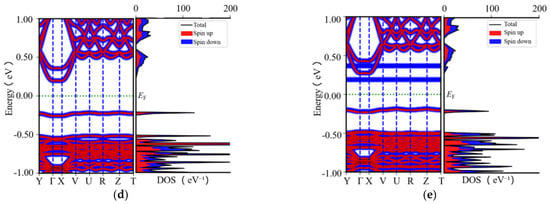
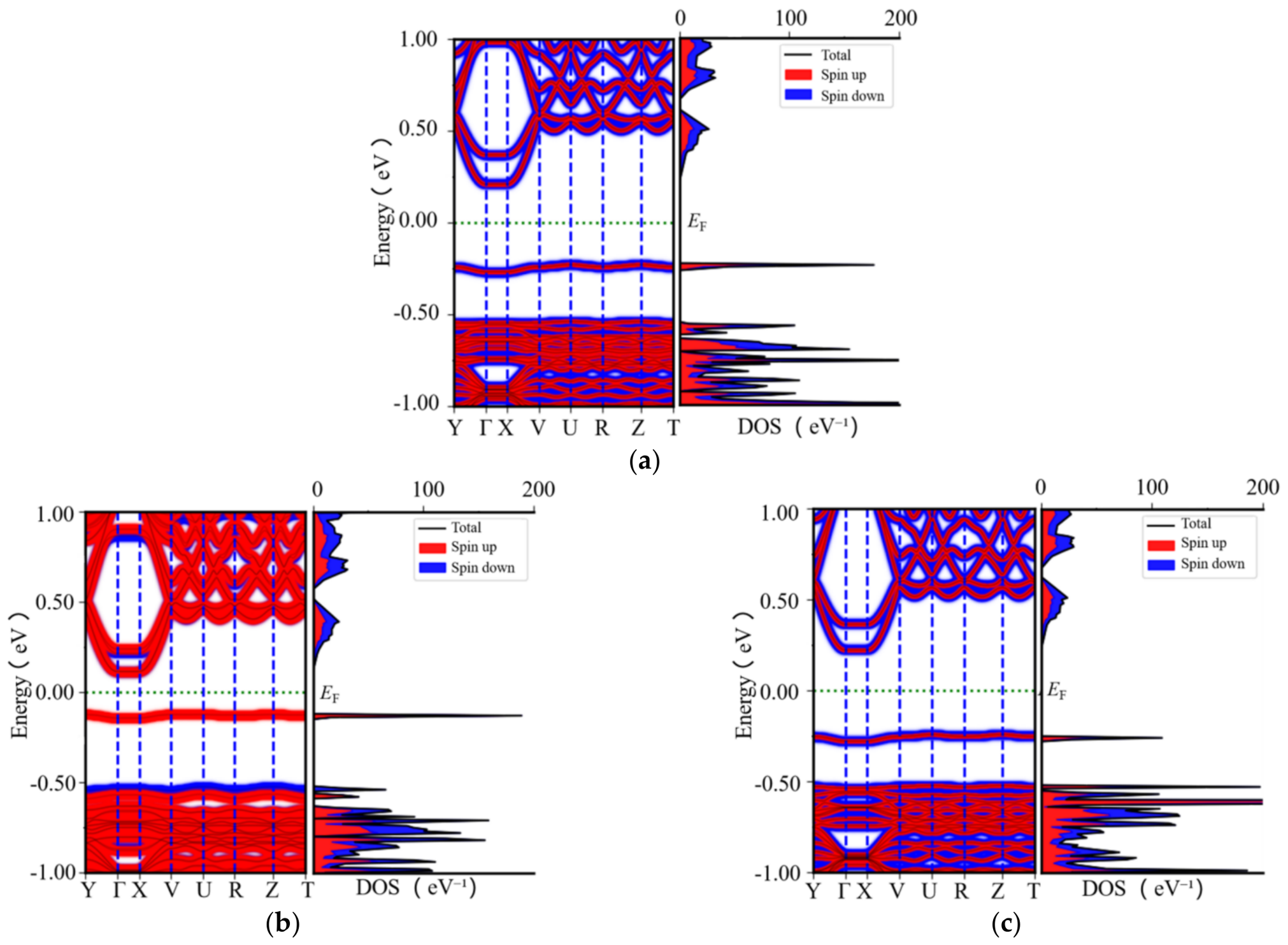
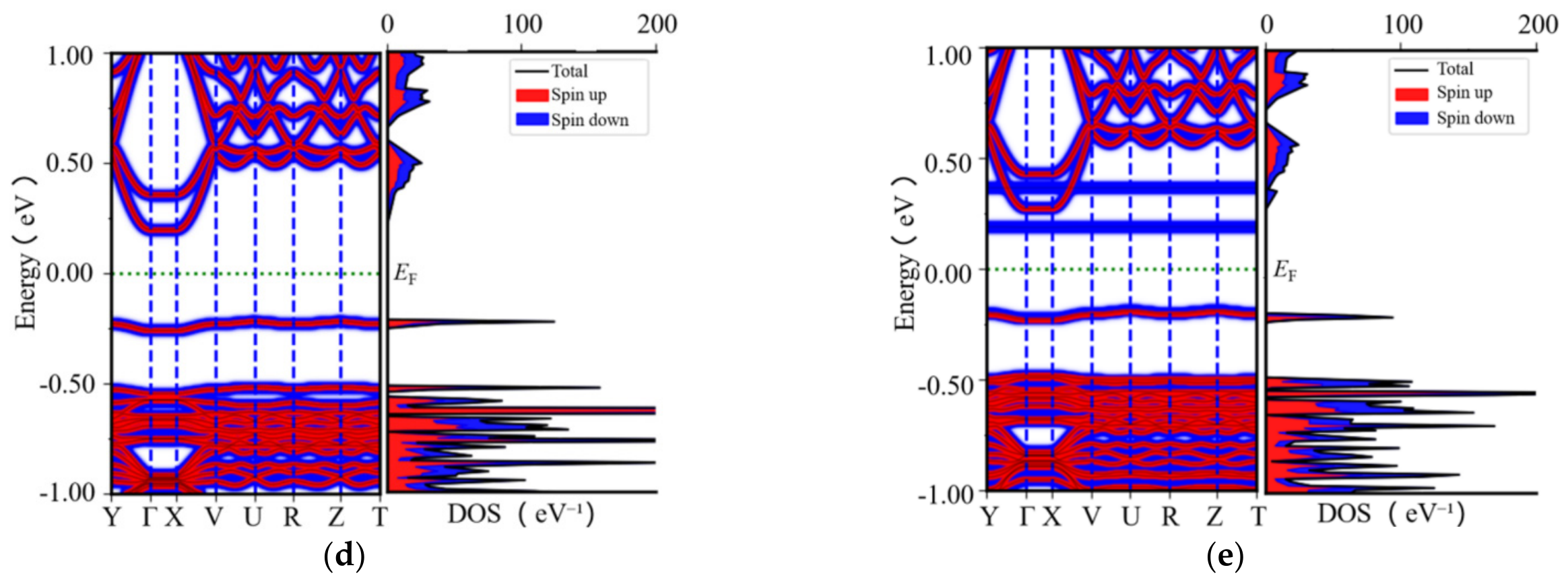
As displayed in Figure 6a–e, the band-structure and TDOS of pristine TG are compared against those of TG upon adsorption of the five target gas molecules. For the TG-CO, TG-NH3, and TG-H2O systems, the band dispersion, Fermi-level position, and TDOS profiles almost coincide with those of bare pristine TG. The spin-up and spin-down channels remain fully degenerate with no observable spin splitting, which reveals that these three gases exert negligible perturbation to the intrinsic electronic configuration of TG. Consequently, they hardly alter the carrier concentration and electrical conductivity of the substrate, so no measurable electrical sensing signal can be generated upon their adsorption. In sharp contrast, adsorption of NO2 and O2 breaks spin degeneracy and induces distinct spin splitting and spin polarization. Driven by interfacial charge redistribution, the TDOS features around the EF undergo substantial reconstruction. Notably, TG-O2 exhibits a higher degree of spin polarization and more pronounced modification of electronic structure relative to TG-NO2, which is consistent with its larger magnitude of charge transfer listed in Table 2. These observations confirm that pristine TG yields prominent sensing responses toward NO2 and O2, whereas it is insensitive to CO, NH3, and H2O. However, NO2 and O2 trigger qualitatively similar electronic perturbations on TG, which severely limits the gas-discrimination capability of unmodified TG. Furthermore, although H2O adsorption barely disturbs the electronic structure of TG, water vapor can competitively occupy surface adsorption sites and introduces humidity-related interference under practical atmospheric conditions. Such inherent drawbacks motivate Si modification as an effective strategy to amplify the electronic differences among target gases and enhance the gas-sensing selectivity of TG.
Figure 6.
Electronic band structure and total density of states analysis of (a) CO/TG, (b) NO2/TG, (c) NH3/TG, (d) H2O/TG, and (e) O2/TG.
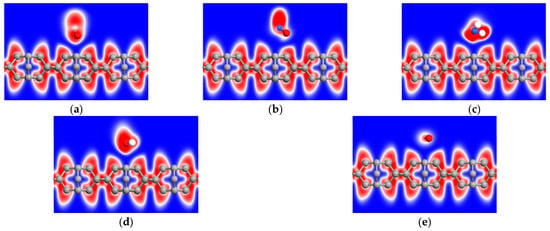
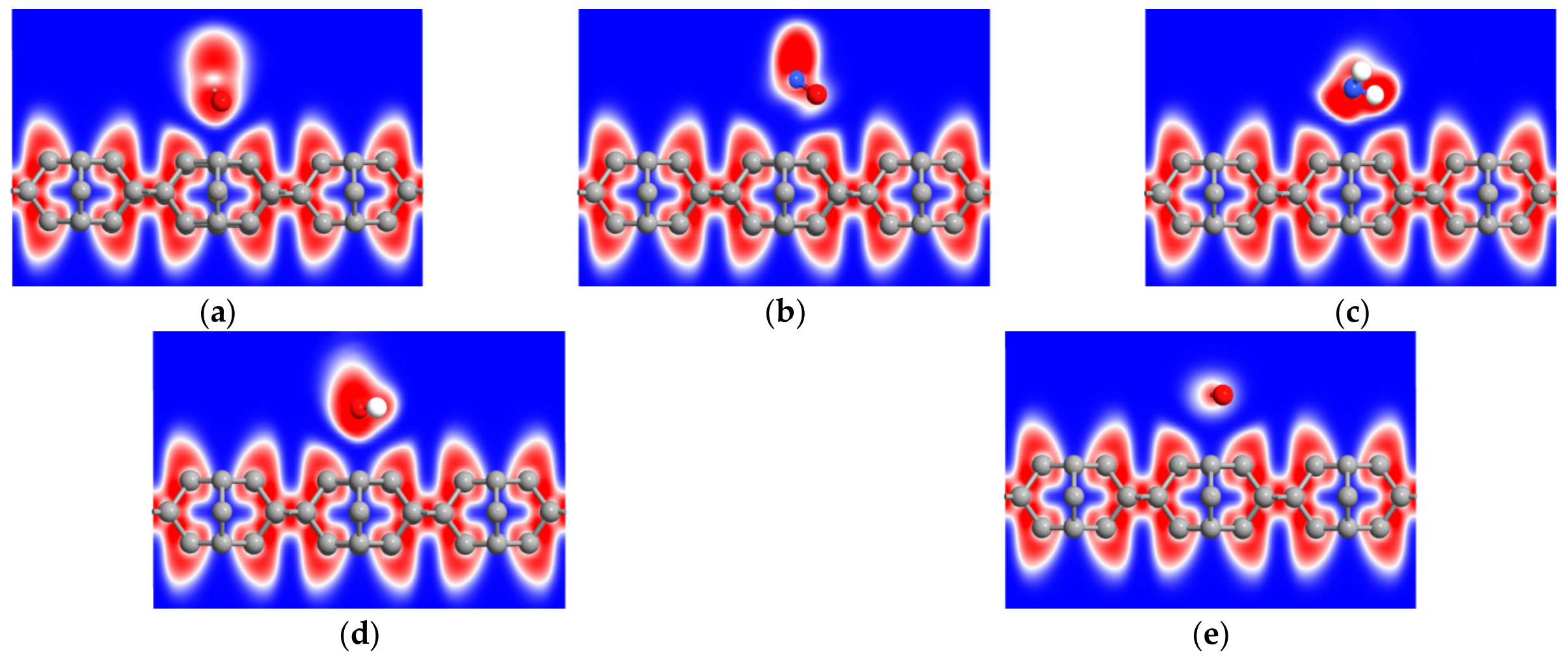
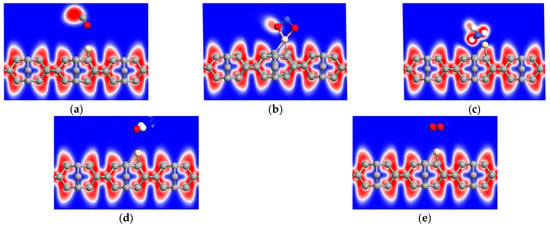
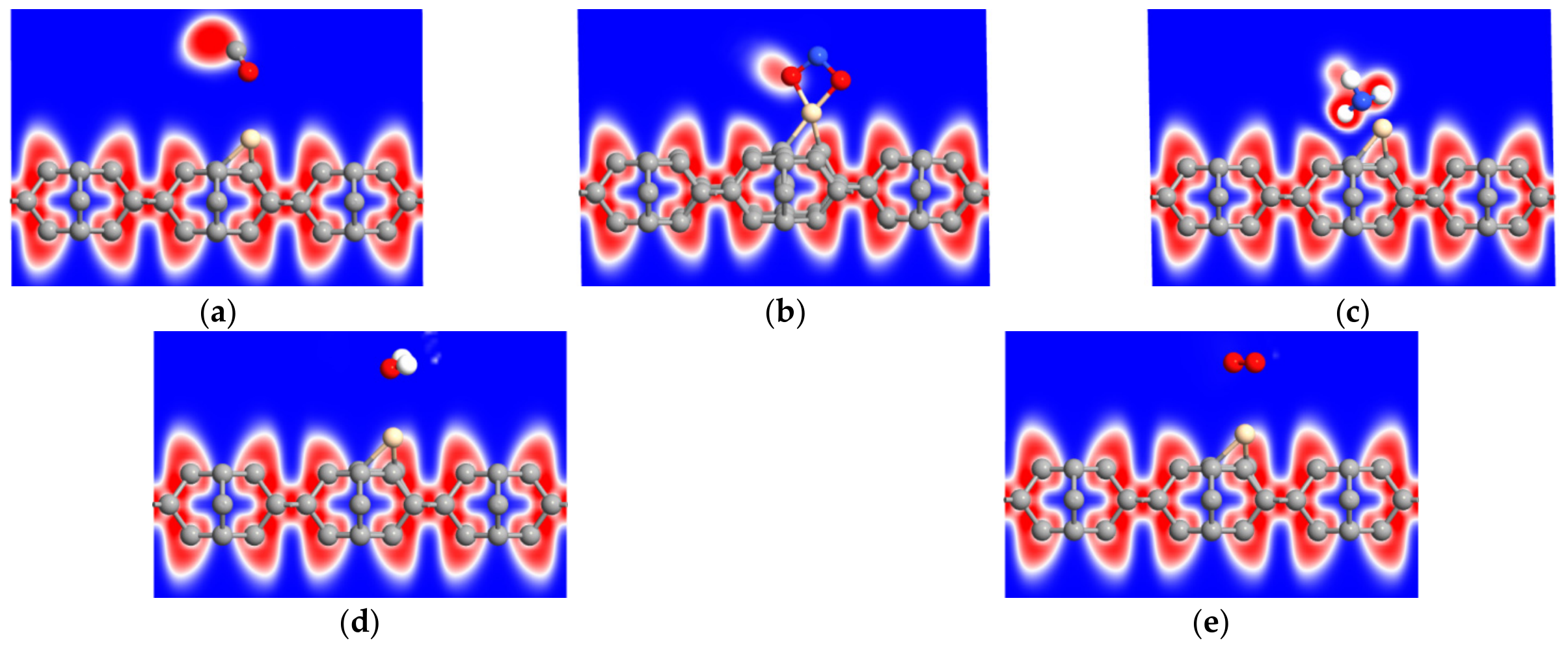
Presented in Figure 7, the ELF mappings further corroborate the physisorption-dominated gas–substrate interactions on pristine TG. In ELF contours, the blue regions represent fully delocalized electrons with no shared localized electron density, whereas the red regions denote strongly localized electrons. A purely blue interface signifies that only van-der-Waals-driven interaction takes place without interfacial shared-electron formation. For all five gas-adsorption systems on pristine TG, no continuous localized red electron domains are observed across the gas–TG interfaces, which confirms the physical-adsorption nature for all investigated systems. For CO/TG, NH3/TG and H2O/TG, the interfacial ELF regions remain entirely blue, demonstrating negligible interfacial charge redistribution. These three gases barely perturb the intrinsic electronic configuration of TG and cannot produce measurable electrical sensing responses. Even so, H2O molecules can competitively occupy surface adsorption sites and introduce humidity-related interference under practical atmospheric conditions. By comparison, the adsorption of NO2 and O2 induces partial electron localization at the gas–TG interfaces, accompanied by evident interfacial charge rearrangement and charge transfer, thereby generating detectable electrical sensing signals. Moreover, O2 adsorption gives rise to more prominent interfacial electron localization than NO2, indicating stronger electronic perturbation and higher theoretical sensing intensity for the O2/TG system. Nevertheless, pristine TG exhibits qualitatively similar ELF features for NO2 and O2 adsorption, leading to unsatisfactory discrimination capability between these two gases.
Figure 7.
ELF of (a) CO/TG, (b) NO2/TG, (c) NH3/TG, (d) H2O/TG, and (e) O2/TG.
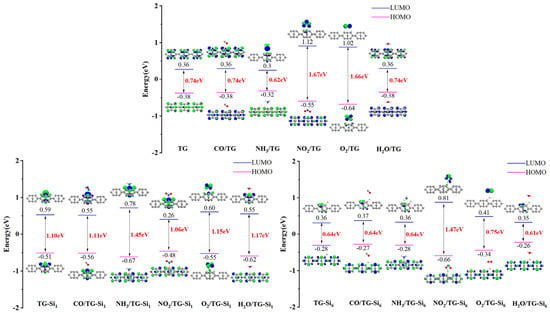
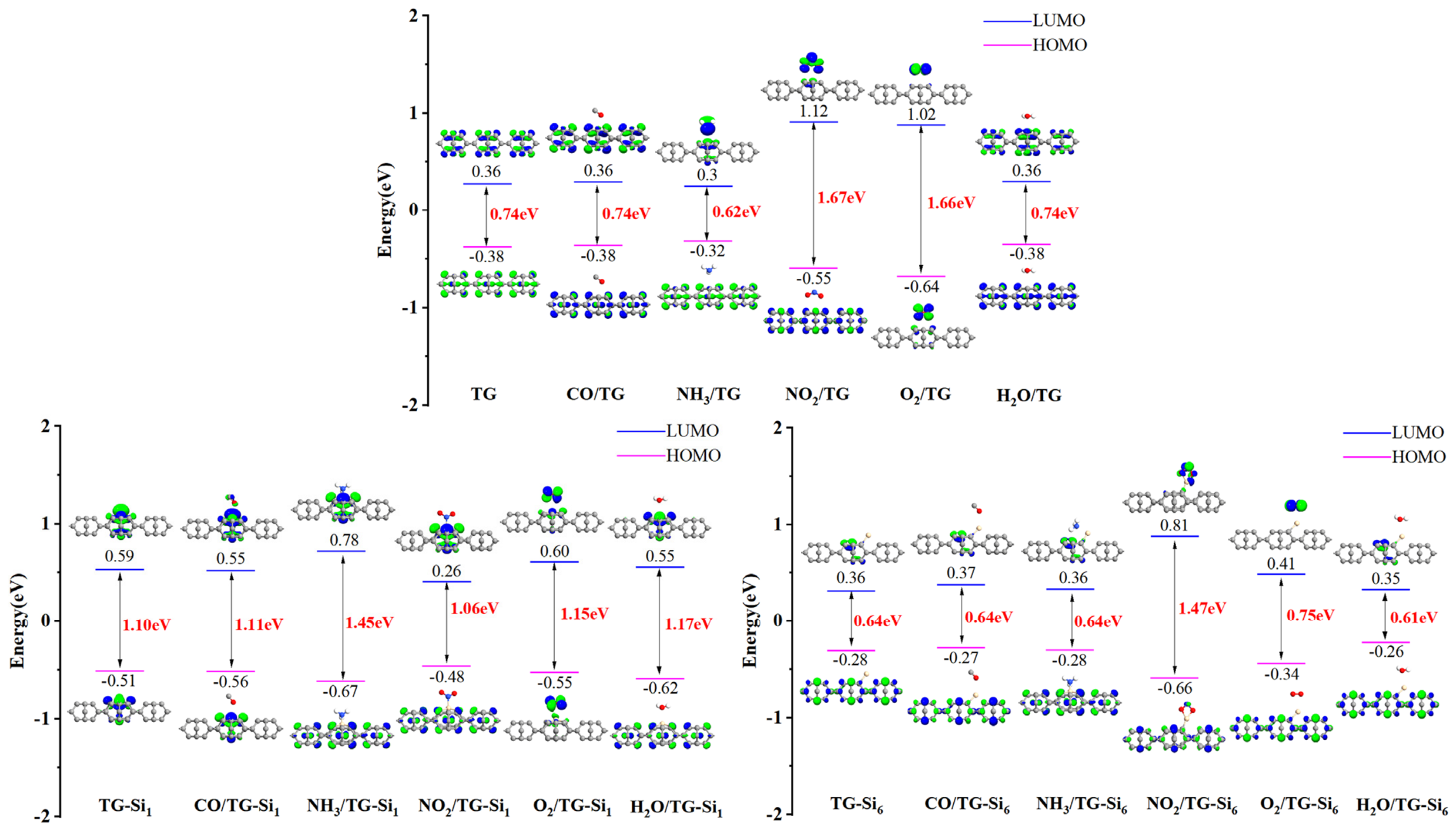
Frontier molecular orbital (FMO) analysis (Figure 17) offers complementary orbital-scale evidence to understand gas–surface interactions. For CO/TG, NH3/TG and H2O/TG, both the highest occupied molecular orbital (HOMO) and the lowest unoccupied molecular orbital (LUMO) are strictly confined within the carbon framework of TG, while almost no orbital density is distributed over adsorbed gas molecules. The adsorbed gases exert negligible influence on orbital spatial distribution, and no substantial interfacial orbital overlap or orbital hybridization can be identified. The HOMO energies of these three systems vary within a narrow range of −0.32 eV to −0.38 eV, and their LUMO energies stay approximately at 0.30–0.36 eV. Accordingly, the calculated HOMO-LUMO gaps remain close to the intrinsic band gap of pristine TG (0.74 eV), which is in good agreement with the conclusions derived from ELF and band-structure–TDOS analyses in the preceding sections.
In sharp contrast, NO2/TG and O2/TG experience significant orbital redistribution upon gas adsorption. For these two systems, the HOMO is predominantly localized on the adsorbed gas molecules, whereas the LUMO is distributed over the TG substrate, establishing feasible interfacial electron-transition channels between adsorbates and the carbon substrate. Correspondingly, their HOMO-LUMO gaps increase substantially to 1.67 eV and 1.66 eV for NO2/TG and O2/TG, respectively. The O2/TG system possesses a lower HOMO energy level and more intensive interfacial charge-transfer behavior relative to NO2/TG, which aligns with the larger QT value listed in Table 2. The highly analogous FMO evolution for NO2 and O2, together with the nearly invariant orbital characteristics for CO, NH3 and H2O upon adsorption, further validates the poor intrinsic gas-selectivity performance of unmodified TG.
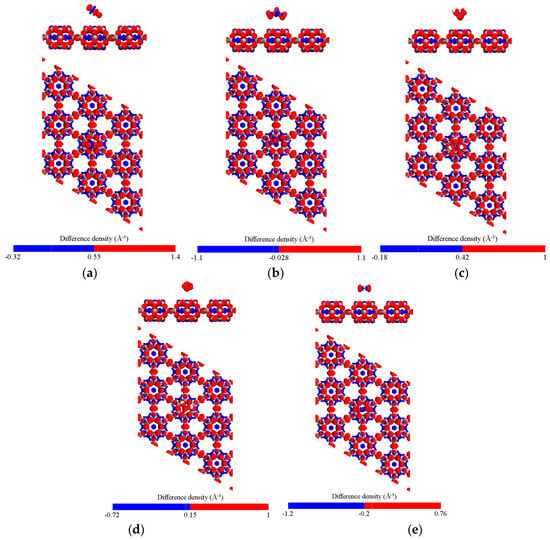
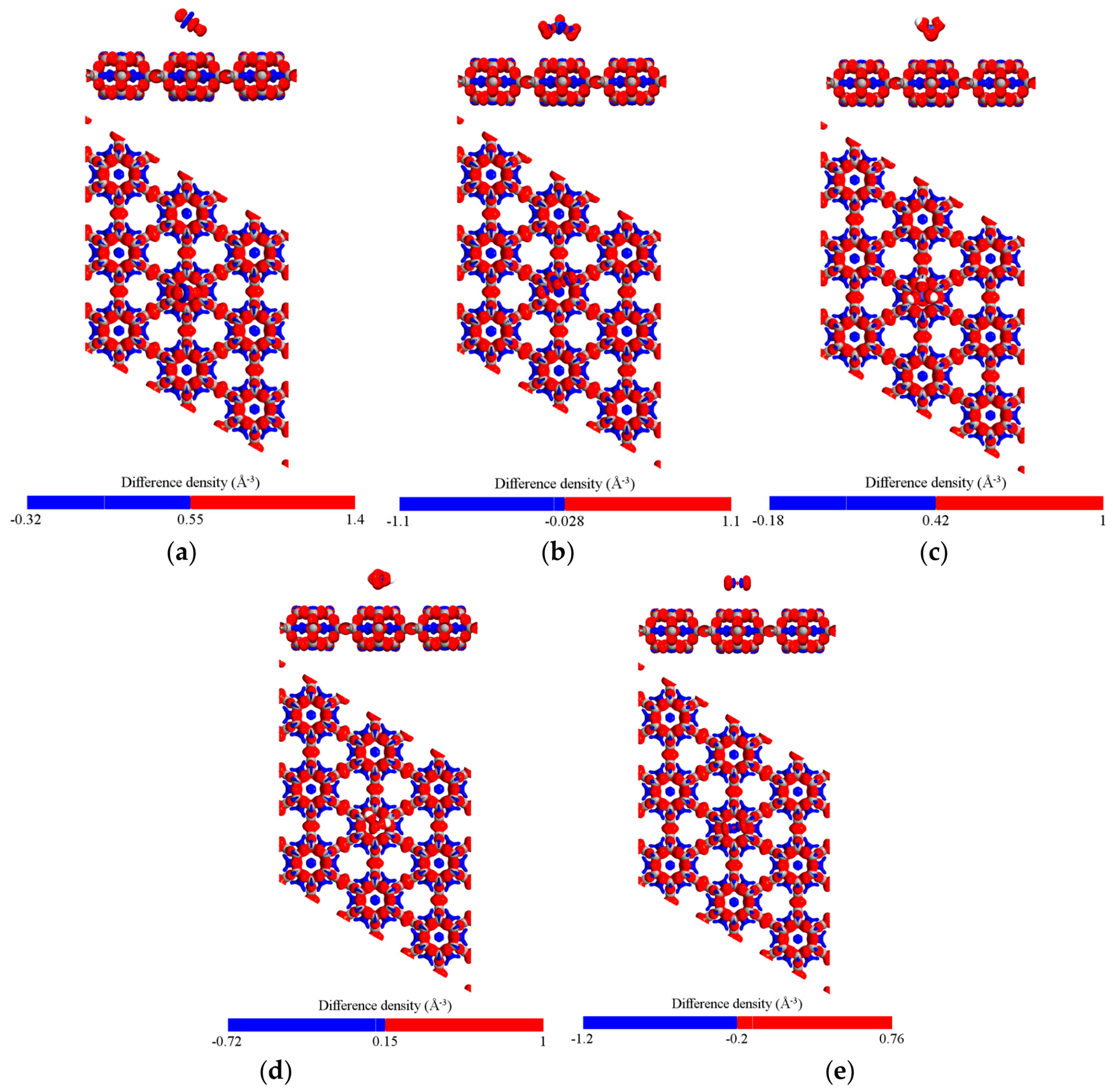
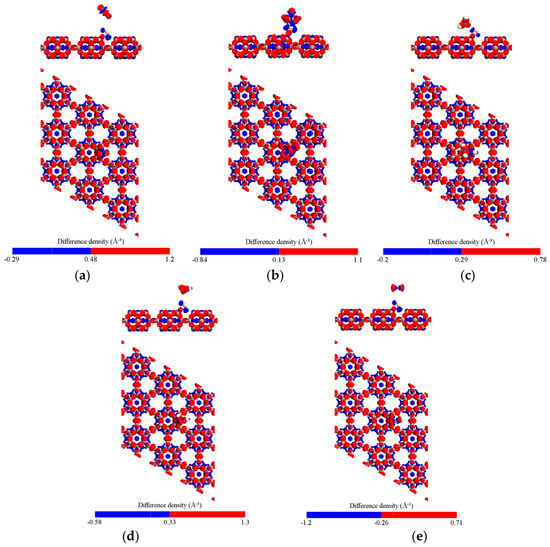
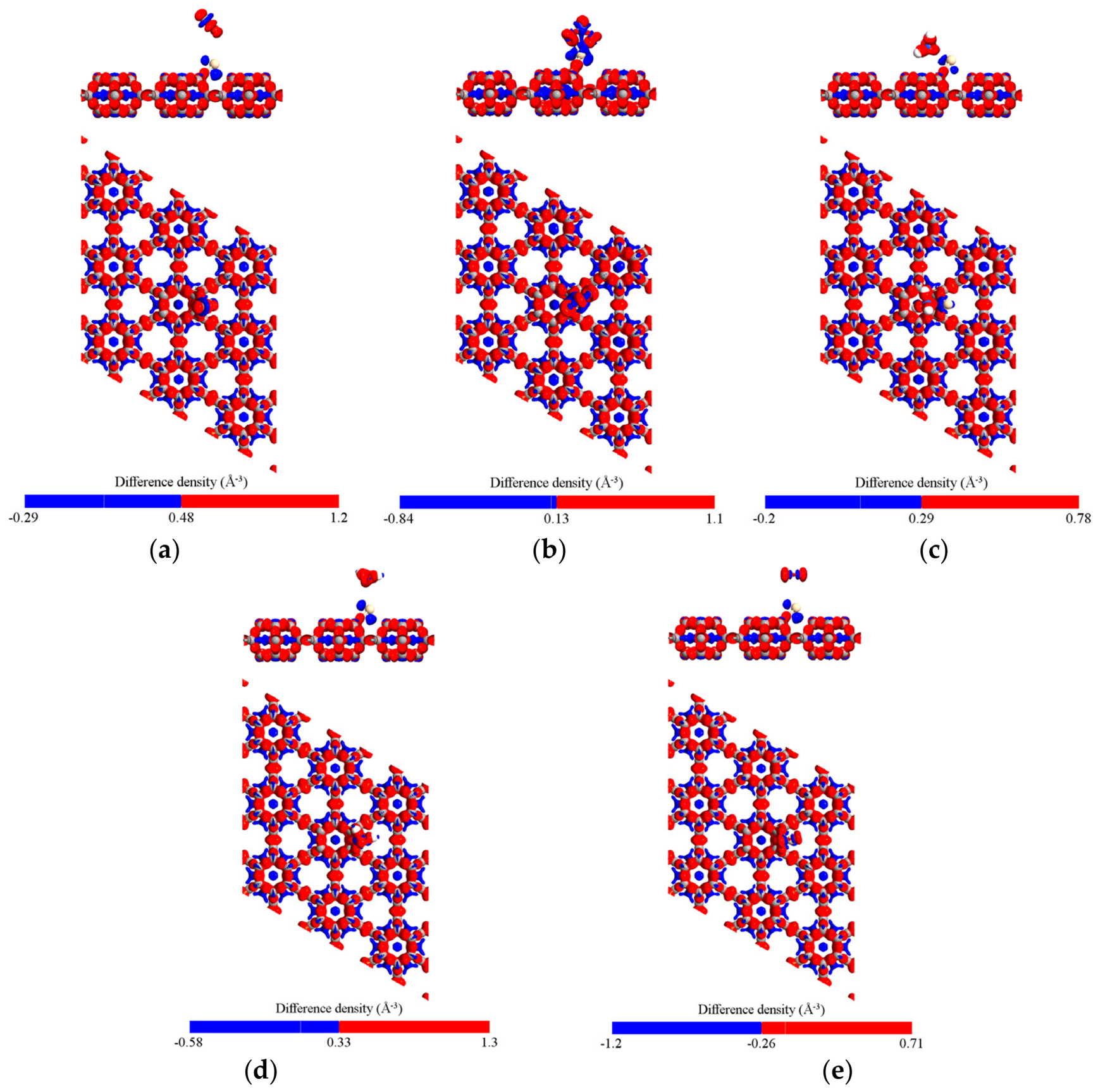
The EDD analysis (Figure 8a–e) provides intuitive visualization of interfacial charge-transfer behaviors. For CO/TG, NH3/TG and H2O/TG, charge accumulation and depletion are localized separately inside gas molecules and the TG basal plane, without observable charge redistribution across the gas–substrate interface, confirming negligible interfacial electron migration. These three gases therefore undergo pure physisorption and cannot produce detectable electrical sensing signals; water vapor merely induces humidity interference by competitively occupying surface adsorption sites. By contrast, alternating blue electron-depletion and red electron-accumulation regions emerge at the contact interfaces of NO2/TG and O2/TG, which verifies prominent interfacial electron exchange. O2/TG exhibits more significant charge rearrangement than NO2/TG, corresponding to its larger QT value and stronger theoretical electrical response. The highly analogous EDD features for NO2 and O2 further demonstrate the poor gas-discrimination capability of pristine TG, which is in good consistency with the above-mentioned band-structure, DOS, ELF and frontier-molecular-orbital results. It should be added that the weak alternating blue and red isosurface features observed for CO/TG originate from the polarization of the electron density within the CO molecule itself, and not from a net flow of charge across the gas–substrate interface; this is why the net QT of CO/TG remains marginal (0.033 e) in Table 2 although a local redistribution of the density is visible. When interfacial charge exchange is judged, the side views of Figure 8 should be consulted, since the top-view projections suppress the weak through-interface component.
Figure 8.
EDD of (a) CO/TG, (b) NO2/TG, (c) NH3/TG, (d) H2O/TG, and (e) O2/TG. The isosurfaces are drawn at ±0.005 eÅ−3 with a common color scale, and the dashed frames mark the gas–substrate interfacial region that is compared among the panels. The panels are compared along the side views, where the out-of-plane charge accumulation (red) and depletion (blue) lobes at the gas–substrate interface differ most clearly among the five gases.
3.3. Adsorption and Sensing Performance of Five Gases on TG-Si1
In this work, Si-substituted TG-Si1 is constructed as a high-activity sensing substrate to overcome the intrinsic chemical inertness and poor gas-response performance of pristine TG. Figure 9 shows the fully relaxed adsorption geometries of five target gases on TG-Si1. All gas molecules spontaneously bind to the localized active sites around the Si substituting agent, adopting favorable spatial orientations with shortened interfacial adsorption heights. Key adsorption parameters are compiled in Table 2 for quantitative comparison with unmodified TG. The calculated adsorption-energy sequence follows: NO2 (−2.781 eV) > NH3 (−2.359 eV) > H2O (−0.575 eV) > CO (−0.346 eV) > O2 (−0.182 eV). Si substitution markedly lowers the adsorption energies of NO2 and NH3 and reinforces their interfacial interactions, whereas the adsorption affinity toward O2 is weakened with Eads = −0.182 eV, the smallest magnitude among the five gases. Relative to pristine TG, the Si1 modification reshapes the gas-adsorption preference and amplifies the discrepancies in adsorption energy, equilibrium distance and QT across the five gas species. This resolves the poor discrimination between NO2 and O2 observed for bare TG.
Figure 9.
Schematic diagram of gas adsorption on Si1-TG.
Net charge-transfer values QT of 0.078 e (CO), −0.369 e (NO2), 0.340 e (NH3), 0.084 e (H2O) and −0.001 e (O2) quantify the interfacial electron redistribution on TG-Si1. NO2 and NH3 carry by far the largest magnitudes (0.369 e and 0.340 e), whereas CO and H2O transfer less than 0.1 e and O2 is essentially uninvolved. Following the sign convention of Equation (3), NO2 acts as an electron acceptor, whereas CO, NH3 and H2O donate electrons to the substrate. Si substitution therefore induces measurable electron exchange for CO, NH3 and H2O—gases whose net charge transfer on unmodified TG does not exceed 0.033 e. The Si dopant serves as the dominant electron-transfer mediator, and such interfacial charge rearrangement originates from orbital hybridization between Si-derived empty orbitals and the frontier molecular orbitals of the adsorbates, driving the transition from weak van der Waals physisorption on pristine TG to robust chemisorption for NO2 and NH3 on TG-Si1.
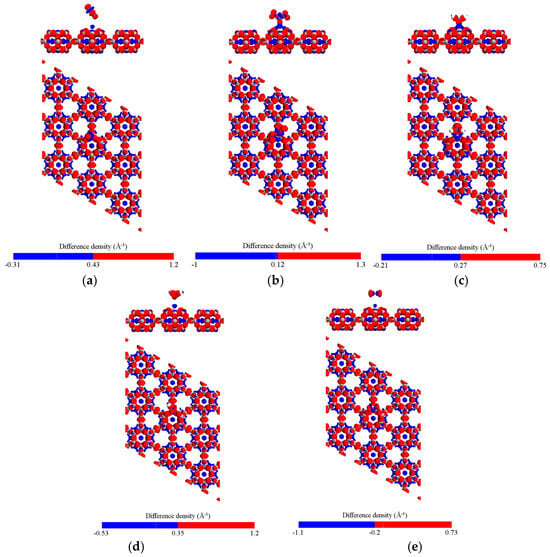
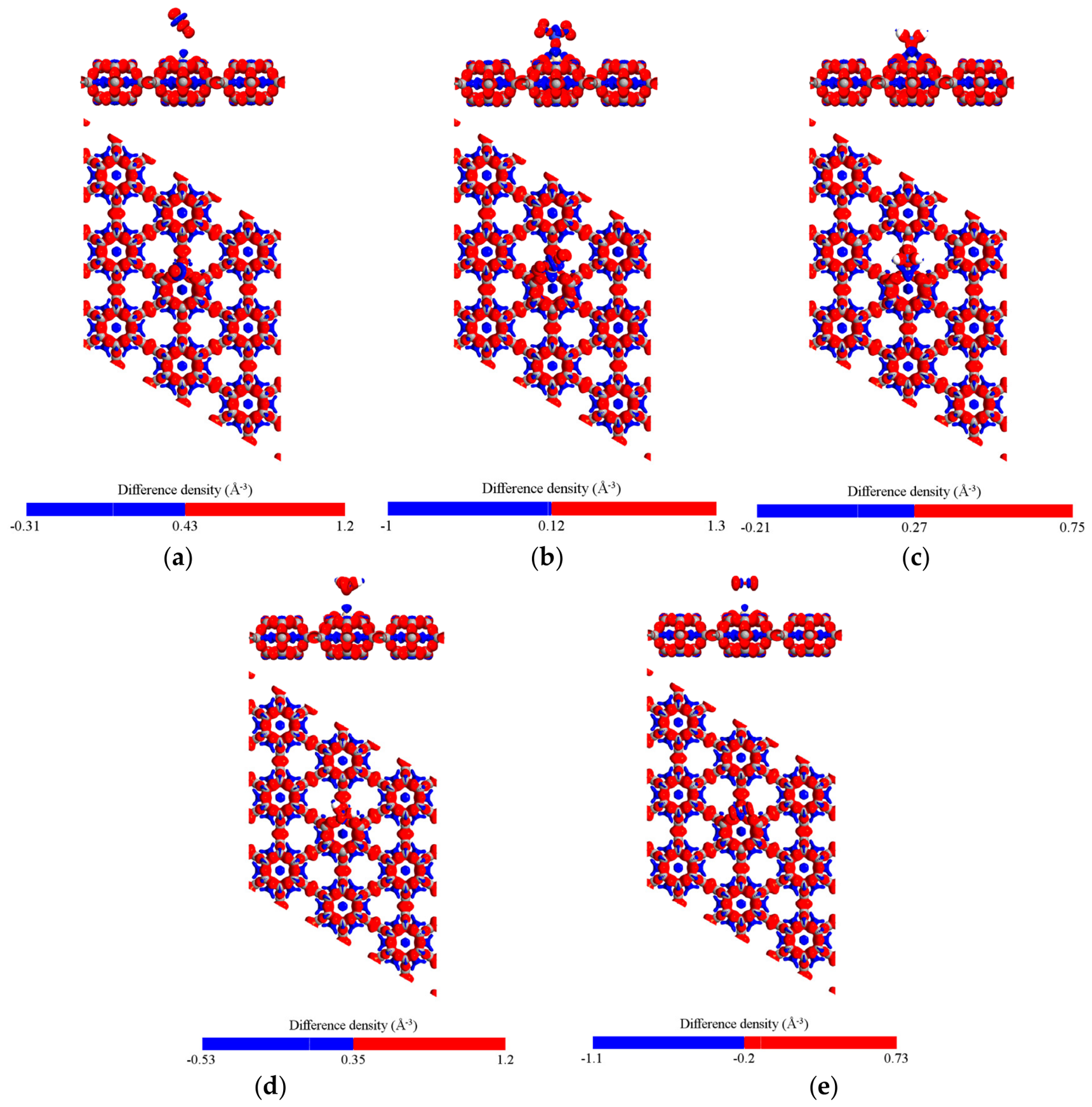
The EDD results in Figure 10 visualize the interfacial charge-redistribution behaviors for five gases adsorbed on TG-Si1. Alternating red–blue isosurfaces at the gas–substrate interfaces unambiguously confirm interfacial charge-transfer events. Quantitatively, the largest net transfers are obtained for NO2 (−0.369 e) and NH3 (0.340 e), whereas CO (0.078 e) and H2O (0.084 e) show only modest redistribution and O2 (−0.001 e) almost none (Table 2). H2O nevertheless produces a pronounced interfacial pattern and is responsible for the humidity interference of TG-Si1, while the strong charge response of NH3 accompanies its strong adsorption (Eads = −2.359 eV) and is the electronic counterpart of the NH3 cross-interference with NO2. Benefiting from Si-atom modification, measurable charge transfer can be triggered for all five gas species. These differentiated charge-redistribution features overcome the limitation of poor discrimination between NO2 and O2 found in pristine TG and enable multi-gas recognition.
Figure 10.
EDD of (a) CO/TG-Si1, (b) NO2/TG-Si1, (c) NH3/TG-Si1, (d) H2O/TG-Si1, and (e) O2/TG-Si1. The isosurfaces are drawn at ±0.005 eÅ−3 with a common color scale, and the dashed frames mark the gas–substrate interfacial region that is compared among the panels. The panels are compared along the side views, where the out-of-plane charge accumulation (red) and depletion (blue) lobes at the gas–substrate interface differ most clearly among the five gases.
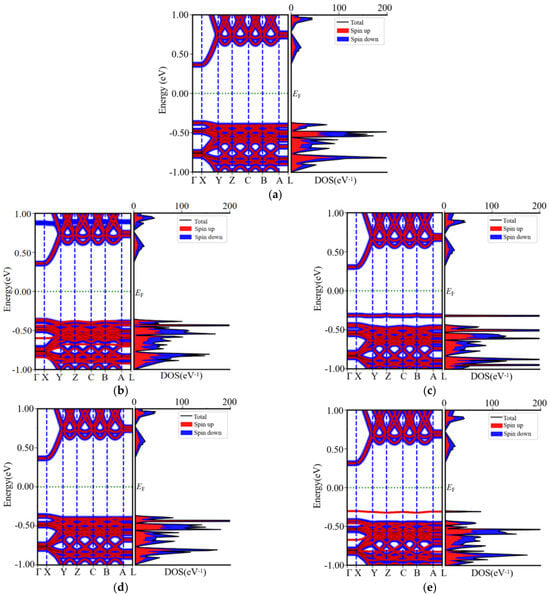
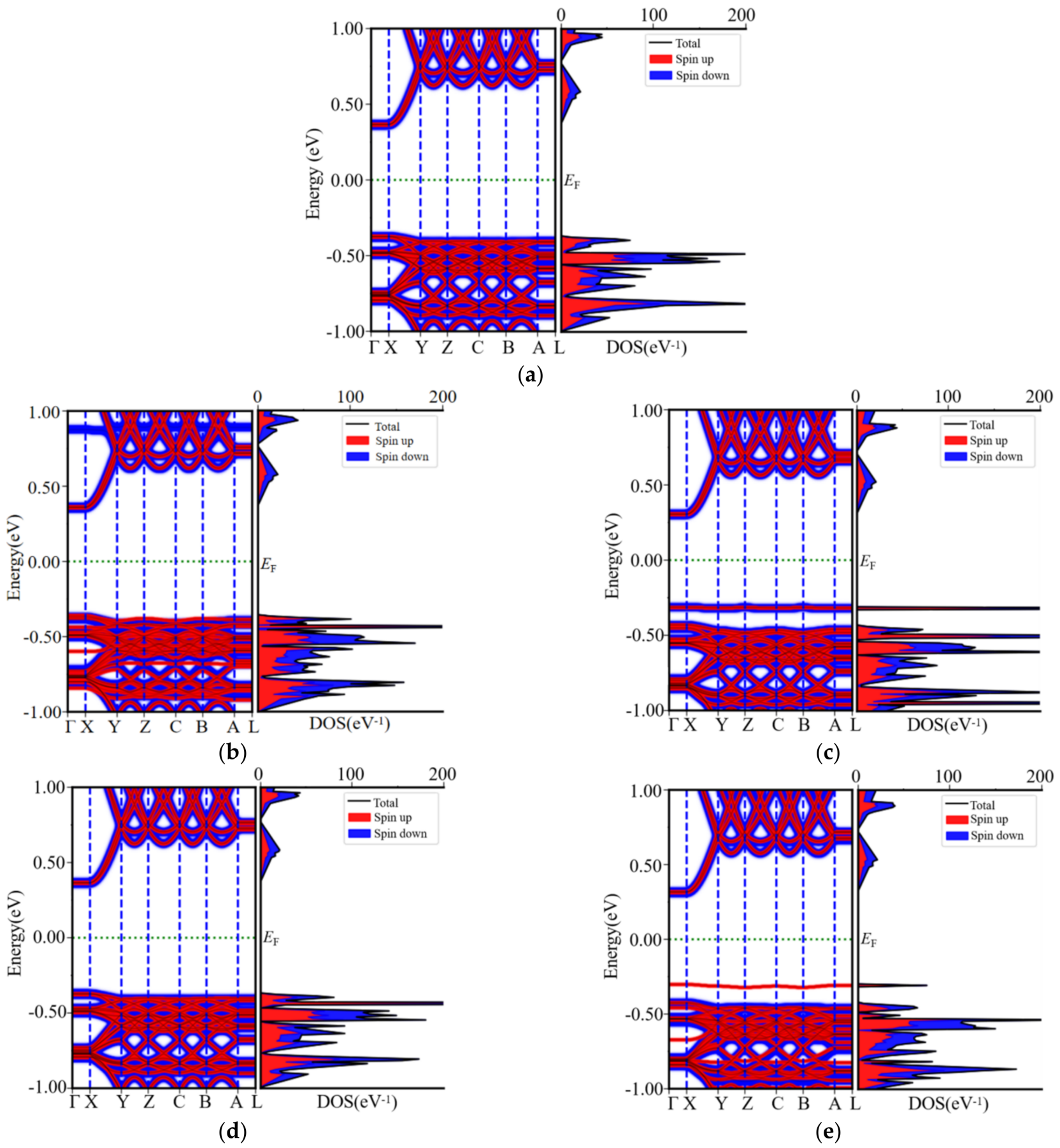
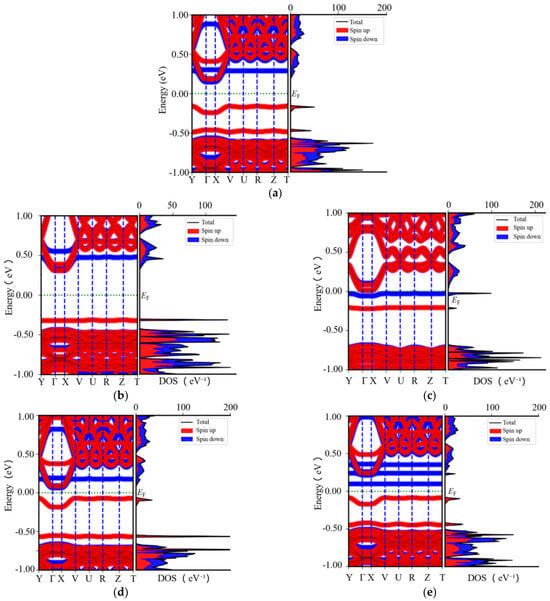
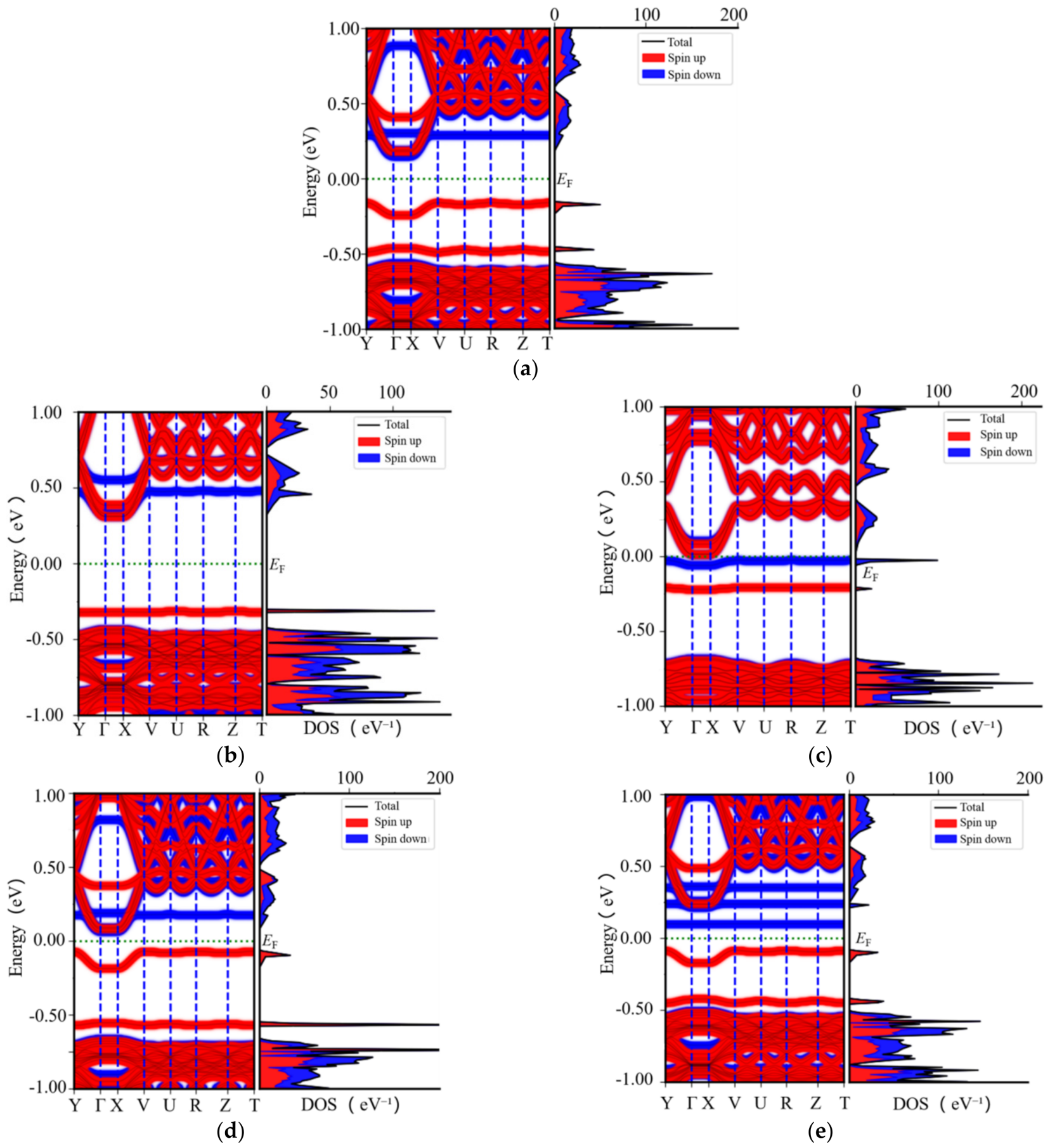
Band-structure and TDOS results in Figure 11 reveal that adsorption of the five gas molecules on the pristine TG-Si1 produces different extents of band bending, spin-splitting and Fermi-level displacement. Among all investigated systems, O2 adsorption brings about the most remarkable spin splitting and TDOS reconstruction, corresponding to the strongest electronic sensing response. H2O also gives rise to obvious Fermi-level shift and band distortion, which is responsible for severe humidity-related interference. After ruling out H2O and O2, NO2 induces conspicuous band bending, spin asymmetry and TDOS modification, thus yielding better sensing performance relative to CO and NH3. CO causes moderate electronic perturbation, whereas NH3 only slightly perturbs the band configuration and produces a weak sensing signal. Owing to the introduction of Si atoms, TG-Si1 exhibits detectable electronic structure variations upon adsorption of all five gases. The divergent band evolution behaviors enable effective differentiation between NO2 and O2. Even so, substantial electronic disturbance triggered by H2O restricts the practical applicability of TG-Si1 in high-humidity environments. These observations are highly consistent with the foregoing EDD analyses.
Figure 11.
Electronic band structure and total density of states analysis of (a) CO/TG-Si1, (b) NO2/TG-Si1, (c) NH3/TG-Si1, (d) H2O/TG-Si1, and (e) O2/TG-Si1.
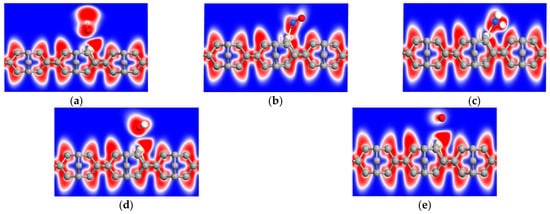
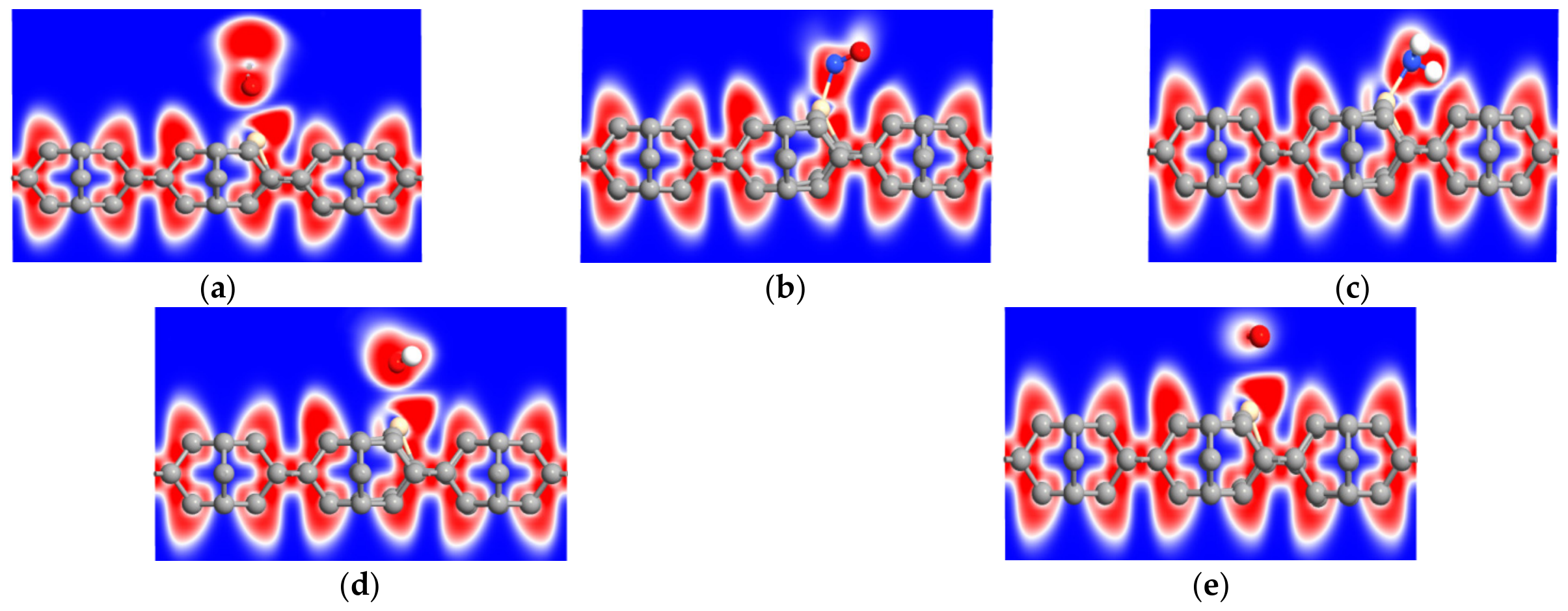
The corresponding ELF spectra of TG-Si1 substrate after adsorbing the five gases shown in Figure 12 reveal that continuous red domains spanning gas molecules and Si dopant sites are indicative of intense orbital hybridization and robust interfacial interaction. Among them, O2 exhibits the most extensive overlapping localized-electron regions with TG-Si1, giving rise to the strongest sensing response. Noticeable localized-electron connections can also be identified for H2O. After excluding H2O and O2, NO2 displays broader red localized domains and more significant orbital hybridization relative to CO and NH3, which accounts for its superior sensing performance. CO shows moderate interfacial electron localization, whereas NH3, consistent with its strong covalent Si–N coupling (ICOHP = −5.111 eV, Table S4), interacts with TG-Si1 nearly as strongly as NO2; this comparable interaction is the origin of its cross-interference with NO2. These divergent ELF characteristics allow effective discrimination between NO2 and O2. Integrating ELF, EDD, band-structure and charge-transfer results, TG-Si1 presents prominent adsorption performance toward NO2 and NH3. When the interferences originating from H2O and O2 are excluded, NO2 exhibits the most favorable comprehensive behaviors including charge transfer, band-structure perturbation and orbital hybridization among CO, NH3 and NO2, making it the primary target analyte for detection.
Figure 12.
The ELF spectra of (a) CO/TG-Si1, (b) NO2/TG-Si1, (c) NH3/TG-Si1, (d) H2O/TG-Si1, and (e) O2/TG-Si1.
3.4. Adsorption and Sensing Performance of Five Gases on TG-Si6
To reveal the structure–activity relationship of Si-modified twin graphene and compare the sensing differences between Si-substituted TG-Si1 and Si-doped TG-Si6, TG-Si6 is further investigated for the adsorption of five target pollutant gases, whose optimized adsorption geometries are presented in Figure 13. Analogous to TG-Si1, all gas molecules tend to adsorb at Si-related active sites of TG-Si6, and key adsorption parameters are listed in Table 2 for quantitative comparison. Negative Eads denotes spontaneous adsorption, and a larger absolute value corresponds to stronger interfacial interaction. For TG-Si6, the adsorption strength follows the sequence NO2 > NH3 > H2O > O2 > CO: NO2 exhibits the strongest chemisorption (Eads = −2.375 eV), followed by NH3 (−1.809 eV). By contrast, CO (−0.231 eV), O2 (−0.249 eV) and H2O (−0.436 eV) undergo weak physisorption. Relative to pristine TG, Si doping in TG-Si6 weakens the O2 adsorption (−0.249 eV versus −0.391 eV) and leaves H2O within the physisorption range (−0.436 eV, compared with −0.278 eV on pristine TG and −0.575 eV on TG-Si1); both interfering gases nevertheless remain readily removable by mild heating (Section 3.5.2), while the robust binding affinity for NO2 is preserved. TG-Si6 therefore exhibits a pronounced binding preference for NO2 rather than a demonstrated selectivity. CO maintains low adsorption energy across all three substrates. Based purely on adsorption-energy evidence, TG-Si6 enables stable capture of NO2 (Eads = −2.375 eV), whereas H2O (−0.436 eV) and O2 (−0.249 eV) remain physisorbed and are readily removed at elevated temperature (Section 3.5.2); the material is therefore promising for NO2 detection under humid atmospheric environments.
Figure 13.
Schematic diagram of gas adsorption on TG-Si6.
EDD plots in Figure 14 reveal that H2O exhibits substantially suppressed interfacial charge redistribution on TG-Si6 relative to TG-Si1 (0.056 e versus 0.084 e), and O2 transfers only −0.022 e, so the electronic interference of both gases remains weak. After excluding these two interfering gases, NO2 presents the most remarkable interfacial charge rearrangement and prominent alternating charge-accumulation/depletion isosurfaces, yielding superior sensing performance among the remaining species. By comparison, CO shows modest charge variation, whereas NH3, although it transfers a sizeable net charge (0.304 e), leaves the band structure and TDOS essentially unperturbed (Figure 15) and hence yields a feeble sensing signal. Si doping therefore selectively preserves strong interfacial interaction between TG-Si6 and NO2 while suppressing charge disturbance originating from water vapor and oxygen. Such differentiated EDD characteristics enable selective recognition of NO2, rendering TG-Si6 promising for targeted NO2 detection under humid atmospheric conditions.
Figure 14.
EDD of (a) CO/TG-Si6, (b) NO2/TG-Si6, (c) NH3/TG-Si6, (d) H2O/TG-Si6, and (e) O2/TG-Si6. The isosurfaces are drawn at ±0.005 eÅ−3 with a common color scale, and the dashed frames mark the gas–substrate interfacial region that is compared among the panels. The panels are compared along the side views, where the out-of-plane charge accumulation (red) and depletion (blue) lobes at the gas–substrate interface differ most clearly among the five gases.
Figure 15.
Electronic band structure and total density of states analysis of (a) CO/TG-Si6, (b) NO2/TG-Si6, (c) NH3/TG-Si6, (d) H2O/TG-Si6, and (e) O2/TG-Si6.
Analysis of the band-structure and TDOS plots in Figure 15 shows that the adsorption of H2O and O2 produces only minor perturbations to the band dispersion and TDOS of TG-Si6 relative to the bare TG-Si6 substrate, indicating their electronic effects are largely suppressed. In contrast, NO2 adsorption causes obvious band distortion, distinct spin splitting, and substantial TDOS reconstruction near the EF, which points to the strongest interfacial electronic interaction and the best sensing response. Meanwhile, CO and NH3 hardly modify the intrinsic electronic configuration of TG-Si6 and yield feeble sensing signals. These observations confirm that Si-doped TG-Si6 selectively maintains intense electronic response toward NO2. Different from TG-Si1, TG-Si6 effectively alleviates electronic interferences introduced by H2O and O2. These distinctive band-structure and DOS features enable the selective identification of NO2, which makes TG-Si6 suitable for targeted NO2 detection under humid atmospheric environments.
Figure 16 presents the ELF contours for TG-Si6 after adsorbing the five target gases. A broad continuous red localized domain spanning the NO2 molecule and Si dopant site indicates intensive orbital hybridization, which accounts for its superior sensing response. This observation demonstrates that Si doping selectively retains strong orbital coupling between TG-Si6 and NO2. In contrast, CO shows no observable interfacial electron localization, and NH3 exhibits only feeble orbital interaction; accordingly, both gases produce weak sensing signals. For H2O and O2, no connected red ELF domains are formed at the gas–substrate interface, confirming negligible orbital overlap and greatly suppressed electronic interference. These ELF results are highly consistent with the foregoing EDD and band-structure–TDOS analyses. Collectively, TG-Si6 is capable of resisting interference from water vapor and oxygen and realizes selective sensing toward NO2, which outperforms both pristine TG and TG-Si1 substrates.
Figure 16.
The ELF spectra of (a) CO/TG-Si6, (b) NO2/TG-Si6, (c) NH3/TG-Si6, (d) H2O/TG-Si6, and (e) O2/TG-Si6.
To further unveil the covalent-bonding nature at gas–solid interfaces, integrated crystal orbital Hamilton population (ICOHP) and projected crystal orbital Hamilton population (pCOHP) analyses were performed (see Supporting Information, Supplementary Note S2). More negative ICOHP values correspond to stronger covalent bonding interactions. For NO2 adsorbed on TG-Si6, the ICOHP values of two Si-O bonds reach −5.905 eV and −6.275 eV, indicating strong covalent coupling between Si6 site and NO2 molecule. By comparison, NH3/TG-Si6 gives a Si-N ICOHP of −3.817 eV, and CO/TG-Si6 only shows a Si-O ICOHP of −0.580 eV. The pCOHP profiles reveal broad bonding-state distributions below the Fermi level specifically for NO2 adsorption on TG-Si6, confirming substantial orbital overlap. Such a difference in covalent-bond strength provides additional microscopic origin for the NO2-preferred adsorption behavior of TG-Si6.
3.5. Comprehensive Sensing Performance Evaluation of TG-Si1 and TG-Si6
3.5.1. Sensitivity and Selectivity Analysis
Gas-sensing sensitivity is essentially determined by changes in electronic transition difficulty upon gas adsorption, which can be quantified via the variation in the HOMO-LUMO gap [45]. A larger change in the HOMO-LUMO gap corresponds to greater fluctuation in carrier mobility and electrical response, indicating higher sensing sensitivity [46]. To evaluate the sensing performance of TG-Si1 and TG-Si6 toward the five target gases, their HOMO-LUMO gap characteristics after gas adsorption are analyzed based on Figure 17. The intrinsic HOMO-LUMO gap of TG-Si6 (0.64 eV) is smaller than that of TG-Si1 (1.10 eV), which corresponds to a lower thermal-activation barrier for the excitation of carriers. For TG-Si1, NH3 induces the most prominent gap variation; meanwhile, H2O and O2 also produce non-negligible gap fluctuation, resulting in serious cross-interference and unsatisfactory selectivity for NO2. By comparison, TG-Si6 undergoes substantial HOMO-LUMO-gap widening ΔE = 0.83 eV) exclusively upon NO2 adsorption. In contrast, CO and NH3 hardly change its gap value, and H2O together with O2 only trigger trivial energy-level shifts. These results indicate that, among the five gases studied, TG-Si6 gives by far the largest change in the HOMO-LUMO gap for NO2 and only marginal changes for H2O, O2, CO and NH3. Compared with Si-atom substitution, Si-atom doping in TG-Si6 produces a much larger electronic response toward NO2.
Figure 17.
The HOMO-LUMO energy level diagrams of TG, TG-Si1, and TG-Si6 after adsorption of five gases.
It should be emphasized that large adsorption energy alone is insufficient to justify high sensing sensitivity, since adsorption can be driven by pure electrostatic interaction without effective orbital mixing. Multiple theoretical descriptors should be considered collectively, including ICOHP-quantified covalent orbital coupling, interfacial charge-transfer magnitude, HOMO-LUMO-gap variation, and density-of-states perturbation near Fermi level. Strong orbital hybridization reflected by highly negative ICOHP serves as an essential prerequisite for inducing obvious electronic-structure modification of the substrate. All these quantities obtained from DFT simulations represent theoretical prerequisites for good sensing performance, rather than direct computation of real-device electrical sensitivity. Experimental characterisations are still required to verify practical sensing responses.
3.5.2. Recovery Time Analysis
Recovery time (τ) is an important indicator for evaluating whether a gas sensor can be used for recycling and reuse, and it refers to the time required for gas desorption from the material surface. Based on previous research, the calculation formula of τ is as follows [47], where A represents the attempt frequency, usually 1012 s−1, K is the Boltzmann constant (8.62 × 10⁻⁵ eV K−1), T is the temperature, and Ea is the chemical bond energy that needs to be overcome by the desorption of gas molecules, assuming that it is numerically the same as Eads of the system. It can be seen from the formula that the value of τ is proportional to the absolute value of adsorption energy at the same temperature [48]. In this work, the desorption kinetics are treated within harmonic-approximation transition-state theory (TST) [49,50], and Equation (4) is the corresponding TST expression, in which the pre-exponential factor A is identified with the frequency factor of the desorption reaction and the barrier Ea with the adsorption energy Eads of the system. The calculation parameters adopted here are a fixed attempt frequency A = 1012 s−1, temperatures T = 298, 398 and 498 K, and Ea ≈ |Eads| for every gas–substrate pair. Because the barrier is approximated by the adsorption energy rather than located as a genuine saddle point, the absolute τ values are semi-quantitative; since the reversible and irreversible regimes are separated by many orders of magnitude, this approximation does not affect the classification of the adsorption behaviors discussed below.
τ = A−1 exp(Ea/kT)
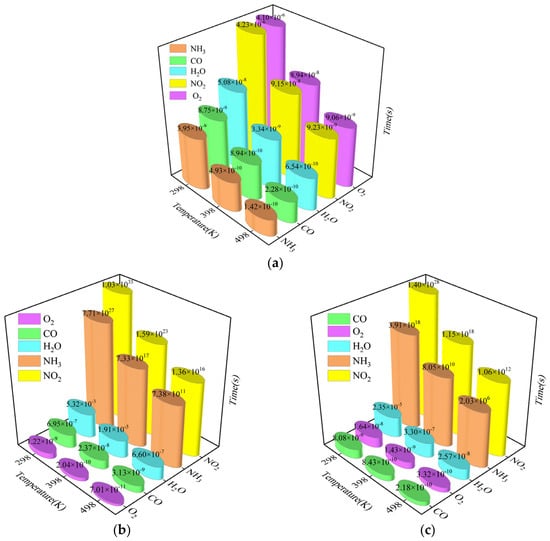
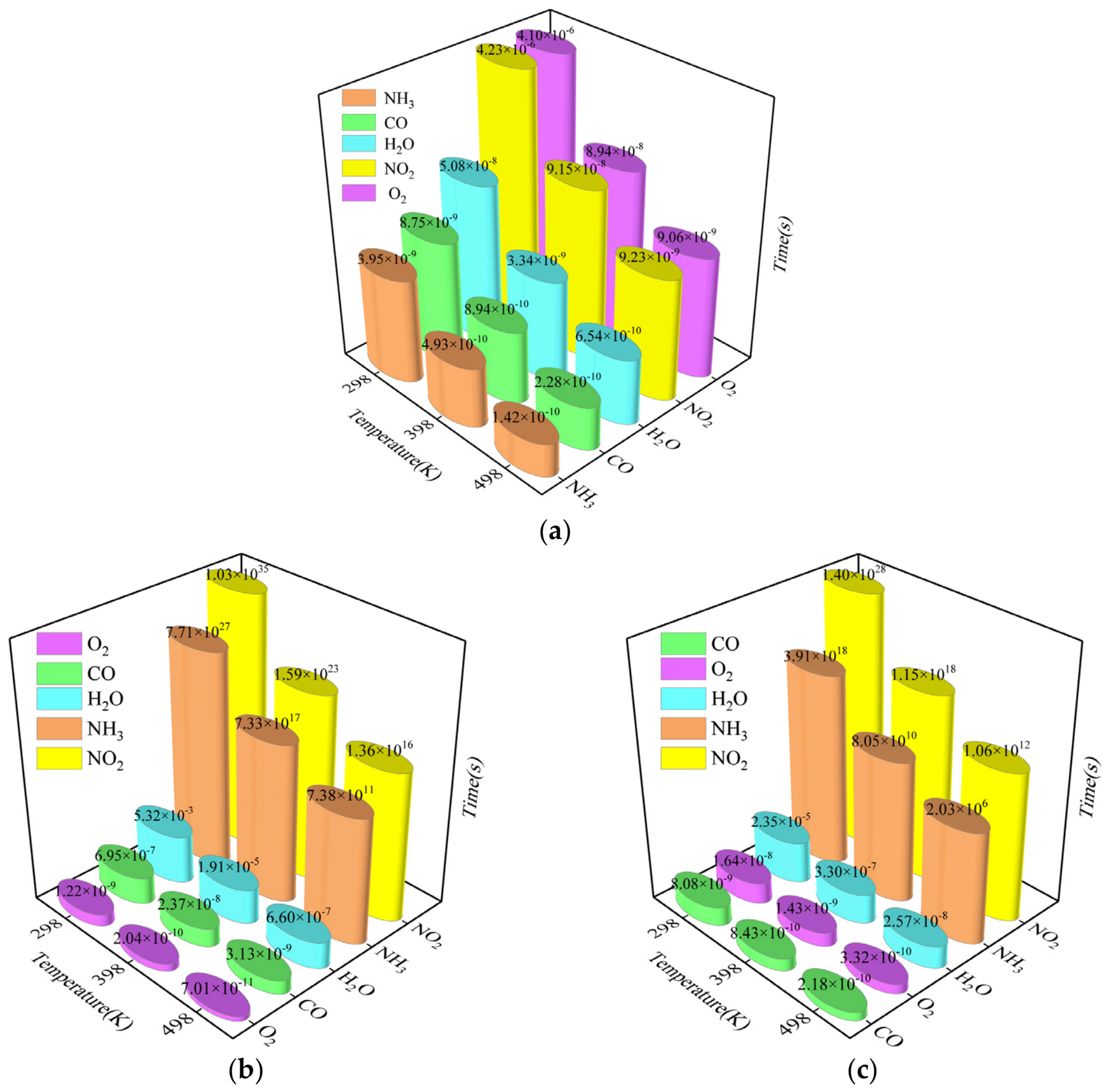
The theoretical recovery times at 298 K, 398 K and 498 K are summarized in Table 3 and visualized in Figure 18. For pristine TG, all five target gases exhibit ultra-short recovery times ranging from 10−10–10−6 s over the investigated temperature range. The recovery time of each gas decreases distinctly with increasing temperature, which is characteristic of weak physisorption; meanwhile, negligible difference in binding strength among these gases renders pristine TG incapable of selective NO2 capture. For TG-Si1, NO2 shows extremely long recovery times of 1.03 × 1035 s at 298 K and 1.36 × 10¹⁶ s at 498 K, indicative of strong irreversible chemisorption. However, NH3 also exhibits persistent adsorption with comparable huge τ values (7.71 × 1027 s at 298 K, 7.38 × 10¹¹ s at 498 K), giving rise to serious cross-interference. In comparison, CO, H2O and O2 possess much shorter recovery times and favorable thermal desorption reversibility on TG-Si1. In the TG-Si6 system, NO2 retains extraordinarily long recovery times across the whole temperature window (1.40 × 1028 s at 298 K, 1.06 × 10¹² s at 498 K), guaranteeing stable sensing signals. Upon heating, the adsorption of NH3 is substantially weakened, with its recovery time falling from 3.91 × 10¹⁸ s down to 2.03 × 10⁶ s at 498 K. Likewise, CO, H2O and O2 can be readily desorbed under high-temperature conditions. Collectively, TG-Si1 cannot effectively discriminate NO2 from NH3. By contrast, TG-Si6 achieves temperature-regulated selective sensing: NO2 remains stably anchored on the substrate, whereas interfering gases can be eliminated via thermal treatment, which makes TG-Si6 promising for recyclable NO2 gas-sensing applications, in contrast to the weaker NO2 binding of monolayer MoS2 and black phosphorene [51,52].
Table 3.
Calculated recovery time of the five gases on TG, TG-Si1, and TG-Si6 under three typical temperatures.
Figure 18.
Recovery times of CO, NO2, NH3, H2O and O2 on (a) TG, (b) TG-Si1 and (c) TG-Si6 monolayers.
4. Conclusions
In this work, first-principles calculations were performed to investigate the adsorption-sensing behaviors of CO, NO2, NH3, H2O and O2 on pristine TG, substitutional TG-Si1 and interstitial short-chain TG-Si6. Combining adsorption parameters and theoretical recovery times at 298 K, 398 K and 498 K, their adsorption strength, desorption reversibility and anti-interference performance were comprehensively assessed. Pristine TG only interacts with target gases via weak van der Waals physisorption. All gases possess short recovery times and readily desorb upon heating. Similar interfacial binding strength renders pristine TG incapable of selectively identifying NO2. TG-Si1 exhibits strong chemisorption toward both NO2 and NH3; both gases show extremely long recovery times under measured temperatures and cannot be thermally desorbed, causing severe cross-interference for NO2 detection. By contrast, TG-Si6 achieves differentiated gas affinity: NO2 maintains stable chemisorption with persistently long recovery time to guarantee reliable sensing signals, whereas NH3, CO, H2O and O2 can be efficiently removed by high-temperature treatment. Analyses of band structure, electron density difference, electron localization function and density of states further elucidate their interfacial interaction and selective-sensing mechanisms. This theoretical study demonstrates that Si-modification significantly improves the gas-recognition capacity of TG, and doping configurations dominate the material’s adsorption-sensing characteristics. Owing to temperature-regulated selective desorption, TG-Si6 is a promising candidate for recyclable NO2 chemiresistive sensing against multi-gas interferences.
Supplementary Materials
The following supporting information can be downloaded at https://www.mdpi.com/article/10.3390/nano16221504/s1. Figure S1: Potential energy (a, b) and temperature (c, d) of TG-Si1 (a, c) and TG-Si6 (b, d) during the 2.5 ps AIMD run at 300 K. Potential energies are normalized per atom and referenced to the initial (0 K) value; light lines are instantaneous values, dark lines are 101-point running averages, and the dashed line marks 300 K; Figure S2: (a) Mass-translation-removed RMSD of the carbon skeleton and (b) length evolution of the initial Si–C bonds during the 2.5 ps AIMD run at 300 K. Solid and dashed lines denote TG-Si1 and TG-Si6, respectively; in (b) the curves give the mean bond length of each system and the shaded bands span the shortest-to-longest bond in the same frame; Figure S3: Variation of the extended conserved quantity of TG-Si1 and TG-Si6 relative to the initial value, normalized per atom. The data are plotted at 1 fs intervals; the residual drift is linear in time and comparable for the two systems; Figure S4: pCOHP curves of CO/Si1, NO2/Si1, NH3/Si1, CO/Si6, NO2/Si6 (Si−O1), NO2/Si6 (Si−O2), NH3/Si6; Table S1: Performance comparison of typical 2D theoretical gas-sensing materials for NO2 detection; Table S2: Summary of the AIMD stability metrics for TG-Si1 and TG-Si6 at 300 K over 2.5 ps; Table S3: Initial (0 ps) and final (2.5 ps) lengths of the Si–C bonds of TG-Si1 and TG-Si6; Table S4: Calculated ICOHP values for different gas adsorption systems on TG-Si1 and TG-Si6; Table S5: Raw energy and Mulliken charge-partitioning data for all adsorption systems used in Table 2.
Author Contributions
Conceptualization, Y.W.; methodology, T.D.; software, T.D.; validation, T.C. and C.Y.; formal analysis, J.L.; investigation, J.L.; resources, Y.W.; data curation, J.L.; writing—original draft preparation, J.L.; writing—review and editing, Y.W.; visualization, T.C.; supervision, S.Z.; project administration, S.Z.; funding acquisition, Y.W. and C.Y. All authors have read and agreed to the published version of the manuscript.
Funding
This work was financially supported by the National Natural Science Foundation of China (22462033), Jiangxi Provincial Natural Science Foundation (20252BAC200215), the Dalian Science and Technology Talent Innovation Support Policy Project Plan (2024RQ073), and the National Innovation and Entrepreneurship Training Program Foundation for College Students of China (202513774012, S202513774011, S202513774013).
Data Availability Statement
The original contributions presented in this study are included in the article and Supplementary Material. Further inquiries can be directed to the corresponding authors.
Conflicts of Interest
The authors declare that they have no known competing financial interests or personal relationships that could have appeared to influence the work reported in this paper.
References
- Cui, H.; Ran, M.; Peng, X.; Zhang, G. First-principles design of noble metal (Rh and Pd) dispersed Janus WSTe monolayer for toxic gas sensing applications. J. Environ. Chem. Eng. 2024, 12, 112047. [Google Scholar] [CrossRef] [Scilit]
- Huang, H.; Sun, C.; Zhang, H.; Xiong, H. Tailoring the gas sensing properties of Janus Ga2SSe monolayers via Co, Ni, Cu doping for the detection of toxic gases: A DFT study. Colloids Surf. A Physicochem. Eng. Asp. 2026, 738, 140013. [Google Scholar] [CrossRef] [Scilit]
- Nga, H.T.N.; Tram, B.T.N.; Anh, D.P.N.; Tien, T.M. Physisorption and chemisorption of CO and NO on a SiSn nanoribbon: Insights into preferential toxic gas sensing. Next Nanotechnol. 2026, 10, 100674. [Google Scholar] [CrossRef] [Scilit]
- Attallah, I.M.; Aboelnga, M.M. Comparative DFT investigation of pristine and Cu-decorated MgO Nanorings as promising sensors for hazardous gases CO, HCN, and PH3. Sep. Purif. Technol. 2026, 395, 137637. [Google Scholar] [CrossRef] [Scilit]
- Mohammed, N.S.; Naief, F.M.; Mohammed, M.A.; Alkaoud, A.M.; Eisa, M.H.; Ramizy, A. High-performance NH3 and NO2 gas sensing using synthesized MWCNT-Au nanocomposites. J. Organomet. Chem. 2026, 1047, 124022. [Google Scholar] [CrossRef] [Scilit]
- Li, J.; Chen, Y.; Sun, Y.; Liu, T.; Yuan, L.; Zhang, H.; Feng, R.; Gao, R.; Yang, S.; Tan, X.; et al. Gas-sensing performance of B-doped irida-graphene toward O2, NO2, SO2, NO, and NH3: A first-principles study. Comput. Theor. Chem. 2026, 1265, 116026. [Google Scholar] [CrossRef] [Scilit]
- Zhu, X.; Zhang, W.; Tang, T.; Wang, H.; Xia, X.; Dai, P.; Ou, K.; Xia, Y.; Ni, Y. High-performance gas sensor based on vertically aligned 2D nanosheets. J. Alloys Compd. 2026, 1063, 187753. [Google Scholar] [CrossRef] [Scilit]
- Rhrissi, I.; Bouhmouche, A.; Abdelrhafor, I.; Moubah, R. Strain-engineered 2D h-BC2N monolayer as a potential gas sensor with exceptional sensitivity and selectivity for NO2 gas detection. Mater. Sci. Semicond. Process. 2024, 182, 108707. [Google Scholar] [CrossRef] [Scilit]
- Majidi, R.; Ramazani, A. Detection of HF and H2S with pristine and Ti-embedded twin graphene: A density functional theory study. J. Phys. Chem. Solids 2019, 132, 31–37. [Google Scholar] [CrossRef] [Scilit]
- Jia, X.; Zhang, H.; Zhang, Z.; An, L. First-principles investigation of vacancy-defected graphene and Mn-doped graphene towards adsorption of H2S. Superlattices Microstruct. 2019, 134, 106235. [Google Scholar] [CrossRef] [Scilit]
- Tit, N.; Said, K.; Mahmoud, M.N.; Kouser, S.; Yamani, Z.H. Ab-initio investigation of adsorption of CO and CO2 molecules on graphene: Role of intrinsic defects on gas sensing. Appl. Surf. Sci. 2017, 394, 219–230. [Google Scholar] [CrossRef] [Scilit]
- Jiang, J.; Leng, J.; Li, J.; Guo, Z.; Chang, T.; Guo, X.; Zhang, T. Twin graphene: A novel two-dimensional semiconducting carbon allotrope. Carbon 2017, 118, 370–375. [Google Scholar] [CrossRef] [Scilit]
- Majidi, R. First-principles study of twin 4–8 graphene in carbon and boron nitride nanostructures: Implications for mechanical and optoelectronic nanodevices. ACS Appl. Nano Mater. 2024, 7, 18219–18225. [Google Scholar] [CrossRef] [Scilit]
- Dua, H.; Deb, J.; Paul, D.; Sarkar, U. Twin-graphene as a Promising Anode Material for Na-Ion Rechargeable Batteries. ACS Appl. Nano Mater. 2021, 4, 4912–4918. [Google Scholar] [CrossRef] [Scilit]
- Yu, B.-Y.; Xie, Y.; Wu, X.; Gao, Y.; Wang, S.-F.; Zhang, J.-M. Structural and electronic properties of AlY (Y = B, N, O) dual-doped twin graphene: A density functional theory study. Phys. E Low-Dimens. Syst. Nanostruct. 2021, 128, 114619. [Google Scholar] [CrossRef] [Scilit]
- Li, J.; Zhang, H.; Chang, T. Mechanical properties of twin graphene nanotube. Sci. China Technol. Sci. 2025, 68, 1620205. [Google Scholar] [CrossRef] [Scilit]
- Liu, X.; Cheng, X.; Zhang, H. Insights into controllable electronic properties of 2D type-II twin-graphene/g-C3N4 and type-I twin-graphene/hBN vertical heterojunctions via external electric field and strain engineering. Phys. Lett. A 2022, 443, 128216. [Google Scholar] [CrossRef] [Scilit]
- Majidi, R.; Nadafan, M. Detection of exhaled gas by γ-graphyne and twin-graphene for early diagnosis of lung cancer: A density functional theory study. Phys. Lett. A 2020, 384, 126036. [Google Scholar] [CrossRef] [Scilit]
- Aggarwal, S.; Anand, M. Exploring strain-driven structural and optical responses in twin graphene. Int. J. Comput. Mater. Sci. Eng. 2025, 15, 2550011. [Google Scholar] [CrossRef] [Scilit]
- Chen, L.-Y.; Yu, B.-Y.; Xie, Y.; Wang, S.-F.; Zhang, J.-M. Tuning gas-sensitive properties of the twin graphene decorated with transition metal via small electrical field: A viewpoint of first principle. Diam. Relat. Mater. 2023, 133, 109707. [Google Scholar] [CrossRef] [Scilit]
- Wang, S.; Li, Y.; Zhou, T.; Tsiakaras, P. Investigating the effect of active site density in transition metal-doped graphene on CO gas sensing performance: A DFT study. Sensors 2026, 26, 2128. [Google Scholar] [CrossRef] [Scilit]
- Zhu, F.; Leng, J.; Guo, Z.; Chang, T. Size-dependent mechanical properties of twin graphene. Proc. Inst. Mech. Eng. Part N J. Nanomater. Nanoeng. Nanosyst. 2021, 235, 4–11. [Google Scholar] [CrossRef] [Scilit]
- Peng, Y.-N.; Yu, J.-F.; Cao, X.-H.; Wu, D.; Jia, P.-Z.; Zhou, W.-X.; Chen, K.-Q. An efficient mechanism for enhancing the thermoelectricity of twin graphene nanoribbons by introducing defects. Phys. E Low-Dimens. Syst. Nanostruct. 2020, 122, 114160. [Google Scholar] [CrossRef] [Scilit]
- Li, J.; Zhang, H.; Guo, Z.; Jiang, J.W.; Chang, T. Thermal stability of twin graphene: A Reaxff molecular dynamics study. Appl. Surf. Sci. 2023, 623, 157038. [Google Scholar] [CrossRef] [Scilit]
- Barman, N.; Sarkar, U. Twin graphene as an anode material for potassium-ion battery: A first principle study. Energy Storage 2024, 6, e673. [Google Scholar] [CrossRef] [Scilit]
- Thasan, S.B.K.; Poornimadevi, C.; Kala, P.C.; Thiruvadigal, D.J. Effect of C & Si decoration on the Boron Phosphide (BP) nanosheets for gas sensing applications—A first principles investigation. Mater. Sci. Semicond. Process. 2025, 189, 109295. [Google Scholar] [CrossRef] [Scilit]
- Kumar, P.; Damara, A.; Kumar, S. Half metallicity and ferromagnetic order in 2D-Mn2O3/Si-doped graphene van der Waals heterostructure. Appl. Res. 2026, 5, e70101. [Google Scholar] [CrossRef] [Scilit]
- Ganji, D.M.; Emami, S.; Khosravi, A.; Abbasi, M. Si-decorated graphene: A promising media for molecular hydrogen storage. Appl. Surf. Sci. 2015, 332, 105–111. [Google Scholar] [CrossRef] [Scilit]
- Bardan, H.K.; Ajeel, N.F.; Mohammed, H.M.; Khudhair, A.M.; Ahmed, A.B. DFT study of adsorption properties of the ammonia on both pristine and Si-doped graphene nanoflakes. Chem. Phys. Impact 2024, 8, 100561. [Google Scholar] [CrossRef] [Scilit]
- Chen, Y.; Gao, B.; Zhao, J.X.; Cai, Q.H.; Fu, H.G. Si-doped graphene: An ideal sensor for NO- or NO2-detection and metal-free catalyst for N2O-reduction. J. Mol. Model. 2012, 18, 2043–2054. [Google Scholar] [CrossRef] [Scilit]
- Tang, Y.; Chen, W.; Shen, Z.; Chang, S.; Zhao, M.; Dai, X. Nitrogen coordinated silicon-doped graphene as a potential alternative metal-free catalyst for CO oxidation. Carbon 2017, 111, 448–458. [Google Scholar] [CrossRef] [Scilit]
- Smidstrup, S.; Markussen, T.; Vancraeyveld, P.; Wellendorff, J.; Schneider, J.; Gunst, T.; Verstichel, B.; Stradi, D.; Khomyakov, P.A.; Vej-Hansen, U.G.; et al. QuantumATK: An integrated platform of electronic and atomic-scale modelling tools. J. Phys. Condens. Matter 2020, 32, 015901. [Google Scholar] [CrossRef] [Scilit]
- Perdew, J.P.; Burke, K.; Ernzerhof, M. Generalized gradient approximation made simple. Phys. Rev. Lett. 1996, 77, 3865–3868. [Google Scholar] [CrossRef] [Scilit]
- Grimme, S.; Antony, J.; Ehrlich, S.; Krieg, H. A consistent and accurate ab-initio parametrization of density functional dispersion correction (DFT-D) for the 94 elements H-Pu. J. Chem. Phys. 2010, 132, 154104. [Google Scholar]
- Louis, H.; Chukwuemeka, K.; Agwamba, E.C.; Abdullah, H.Y.; Pembere, A.M. Molecular simulation of Cu, Ag, and Au-decorated Si-doped graphene quantum dots (Si@QD) nanostructured as sensors for SO2 trapping. J. Mol. Graph. Model. 2023, 124, 108551. [Google Scholar] [CrossRef] [Scilit]
- Kumar, S.; Agnihotri, N. Adsorption and sensing of SF6 decomposition gases by ruthenium-decorated silicon-doped graphene quantum dots. Diam. Relat. Mater. 2025, 152, 111975. [Google Scholar] [CrossRef] [Scilit]
- Mehak, S.; Neena, J. Enhanced hydrogen gas adsorption properties of B, N, and Au co-doped graphene in o-, m-, and p-configurations: DFT study. Diam. Relat. Mater. 2022, 127, 109173. [Google Scholar] [CrossRef] [Scilit]
- Ibrahim, A.A.M.; Mahmoud, M.H.A.; Mekhemer, H.A.G.; El-Tayeb, M.A.; Khan, S.; Shoeib, T. Adsorption features of toxic pnictogen hydrides over pristine and C/Be-doped borophene nanosheets as potential sensors: A DFT investigation. ChemistrySelect 2025, 10, e00467. [Google Scholar] [CrossRef] [Scilit]
- Singh, D.; Kumar, D.; Chaturvedi, K.; Mishra, M. Interaction of environmental pollutants with HAT6 molecule: A DFT study for chemical sensing. Comput. Theor. Chem. 2026, 1258, 115709. [Google Scholar] [CrossRef] [Scilit]
- Patel, P.A.; Gajjar, V.J.; Roy, R.D. Effect of noble metal (Ag and Au) doping on the gas sensing performance of PC3 monolayers: A first-principles study for NH3, NO2, and NO detection. Comput. Condens. Matter 2026, 47, e01302. [Google Scholar] [CrossRef] [Scilit]
- Kühne, T.D.; Iannuzzi, M.; Del Ben, M.; Rybkin, V.V.; Seewald, P.; Stein, F.; Laino, T.; Khaliullin, R.Z.; Schütt, O.; Schiffmann, F.; et al. CP2K: An electronic structure and molecular dynamics software package–Quickstep: Efficient and accurate electronic structure calculations. J. Chem. Phys. 2020, 152, 194103. [Google Scholar] [CrossRef] [Scilit]
- Bussi, G.; Donadio, D.; Parrinello, M. Canonical sampling through velocity rescaling. J. Chem. Phys. 2007, 126, 014101. [Google Scholar] [CrossRef] [Scilit]
- Algreiby, A.; Aal, A.S. Adsorption performance of SF6 decomposition gases (SO2, SO2F2, SOF2, H2S, HF) on a Ni-anchored BC6N monolayer: Insights into selective gas sensing behavior. Surf. Interfaces 2026, 93, 109309. [Google Scholar] [CrossRef] [Scilit]
- Cheng, K.; Wang, M.; Wang, S.; Liu, N.; Xu, J.; Wang, H.; Su, Y. Monolayer Sc2CF2 as a potential selective and sensitive NO2 sensor: Insight from first-principles calculations. ACS Omega 2022, 7, 9267–9275. [Google Scholar] [CrossRef] [Scilit]
- Kaur, G.; Gupta, S.; Dharamvir, K. Theoretical investigation of adsorption of gas molecules on Li metal adsorbed at H-site of graphene: A search for graphene based gas sensors. Surf. Interfaces 2017, 8, 83–90. [Google Scholar] [CrossRef] [Scilit]
- Ling, H.; Lan, J.; Liu, Y.; Wu, H.; Cao, Y.; Zhou, X. First principles study on the adsorption of CH2Cl2 by N-doped V2C (MXene) modified with single-atom Mn. J. Phys. Conf. Ser. 2026, 3221, 012013. [Google Scholar] [CrossRef] [Scilit]
- Gallardo-Zazueta, J.U.; Meza-Aguilar, S.; Delgado-Nieblas, F.C.; Quevedo-Garcia, R. Single-atom transition metals (Fe, Co, Ni) on C70 fullerene for efficient CO and NO capture: A DFT study. Next Res. 2026, 13, 102416. [Google Scholar] [CrossRef] [Scilit]
- Jiang, Y.; Kong, D.; Tao, X.; Hung, C.; Lei, S.; Zhou, Z.-F. First-principles investigation of VOCs adsorption and sensing properties on Janus AsP monolayer. J. Phys. D Appl. Phys. 2026, 59, 065304. [Google Scholar] [CrossRef] [Scilit]
- Eyring, H. The activated complex in chemical reactions. J. Chem. Phys. 1935, 3, 107–115. [Google Scholar] [CrossRef] [Scilit]
- Vineyard, G.H. Frequency factors and isotope effects in solid state rate processes. J. Phys. Chem. Solids 1957, 3, 121–127. [Google Scholar] [CrossRef] [Scilit]
- Yue, Q.; Shao, Z.; Chang, S.; Li, J. Adsorption of gas molecules on monolayer MoS2 and effect of applied electric field. Nanoscale Res. Lett. 2013, 8, 425. [Google Scholar] [CrossRef] [Scilit]
- Cho, S.-Y.; Lee, Y.; Koh, H.-J.; Jung, H.; Kim, J.-S.; Yoo, H.-W.; Kim, J.; Jung, H.-T. Superior chemical sensing performance of black phosphorus: Comparison with MoS2 and graphene. Adv. Mater. 2016, 28, 7020–7028. [Google Scholar] [CrossRef] [Scilit]







Disclaimer/Publisher’s Note: The statements, opinions and data contained in all publications are solely those of the individual author(s) and contributor(s) and not of MDPI and/or the editor(s). MDPI and/or the editor(s) disclaim responsibility for any injury to people or property resulting from any ideas, methods, instructions or products referred to in the content. |
© 2026 by the authors. Licensee MDPI, Basel, Switzerland. This article is an open access article distributed under the terms and conditions of the Creative Commons Attribution (CC BY) license.