


Abstract
In this study, ZnO/Co3O4 composite thin-film room-temperature hydrogen (H2) sensors were prepared via the hydrothermal method and self-assembly techniques. The test results show that the composite sensor with a layer assembly ratio of 1:1 has good sensing performance for H2. The ZnO/Co3O4 composite sensor can detect a wide range of H2 concentrations from 100 to 50,000 ppm, and the response toward 300 ppm H2 is more than six-times that of a single nanomaterial. In addition, it has a faster response recovery speed, better repeatability, selectivity and long-term stability. The improvement in composite sensor performance results from the synergistic effect between ZnO and Co3O4 materials and the formation of heterostructures. The prepared ZnO/Co3O4 composite thin-film sensor was successfully applied to detect the H2 production concentration and behavior of an electrolytic cell for hydrogen production by water electrolysis.
1. Introduction
Excessive global greenhouse gas emissions have triggered multiple crises, such as climate warming and energy depletion, promoting the low-carbon transformation of the energy system [1]. Hydrogen energy, as a zero-carbon secondary energy carrier, has become one of the core paths to achieve the double-carbon goal [2]. Hydrogen (H2) is a colorless, tasteless, and odorless light elemental gas at normal temperature and pressure. Its density is only 1/14 of air, and its diffusion rate is much higher than that of conventional industrial gases [3,4]. The only product of H2 combustion or fuel cell electrochemical reaction is water. The entire process does not emit carbon oxides, sulfides or other pollutants, and it has the core advantages of cleanness, efficiency, and regeneration [5]. However, the size of H2 molecules is extremely small, the explosion limit is wide, and the minimum ignition energy is extremely low. H2 leakage and abnormal H2 production concentration during the electrolytic cell gas production process pose major safety risks [6]. Electrolytic water hydrogen production devices still lack real-time H2 monitoring methods that can operate at room temperature, have a wide concentration range, and are resistant to humidity interference [7,8]. Existing sensors have high power consumption and are large in size, making it difficult to integrate them into the electrolyzer monitoring systems, which restricts the safe and intelligent management and control of green hydrogen equipment [9,10].
Many metal oxide semiconductors (MOSs) have attracted much attention for gas-sensitive sensing of H2 due to their simple manufacturing process, low cost, nanoscale and high responsiveness [11,12]. ZnO is a typical n-type wide-bandgap metal oxide semiconductor with a bandgap width of 3.37 eV, which is non-toxic, has cheap raw materials, and has excellent chemical/thermal stability. It is one of the most mainstream base materials for resistive gas sensors [13]. Chen et al. prepared ZnO/Ti3C2Tx MXene, a heterojunction material with a high specific surface area, through self-assembly technology and achieved ultrafast gas sensing of H2 at 80 °C [14]. Sharma et al. used a low-cost hydrothermal process to prepare phase-pure vertically aligned ZnO nanorods. They have excellent performance at 60 ppm H2 gas and 100 °C and can achieve ppb-level H2 concentration detection [15]. However, the selectivity of a single ZnO nanomaterial is poor, and it needs to be used at a certain operating temperature, with large energy loss and complex equipment [16]. Prior research has shown that constructing heterojunctions can enhance the sensing behaviors of MOS-based gas sensors [17,18].
Cobalt oxide (Co3O4), as a typical p-type semiconductor sensing nanomaterial, shows excellent selectivity and sensing potential in H2 detection. Under normal and medium–low-temperature working conditions, there are a large amount of oxygen adsorption sites on the surface of cobalt oxide. For example, Zhang et al. synthesized bimetallic metal-organic framework-derived Co3O4/In2O3 nanocomposite sensors through hydrothermal treatment to monitor triethylamine (TEA), and the sensor delivered a remarkable response of 365.3 when exposed to 20 ppm TEA, which is 30.2-times the response of pure In2O3 [19]. Yin et al. prepared Pd-SnO2-Co3O4 composites through the hydrothermal method and applied them to H2 sensing. The response value of the composite sensor to H2 is 57.9, approximately 9.6-fold greater than pristine SnO2, and the response time to H2 is 12 s, much faster than original SnO2. The improvement in H2 sensing properties originates from the synergistic effect of p-n junction formation. It can be seen that the modification with Co3O4 could remarkably strengthen the gas sensing characteristics of the composite sensors and reduce their operating temperature [20].
In this work, the ZnO/Co3O4 composite film sensor was prepared using hydrothermal preparation combined with a self-assembly process, which achieved the sensitive detection of H2 in a wide concentration range at room temperature and demonstrated fast response, response speed, high selectivity and long-term stability. The response performance of the ZnO/Co3O4 composite film sensor is significantly improved compared to that of a single sensor due to the synergistic effect between ZnO and Co3O4 and the formation of a heterojunction. Finally, the composite film sensor was successfully used to detect the H2 production concentration and behavior of the electrolytic cell of the electrolytic water hydrogen production device, providing a new sensing solution for low-cost, low-power hydrogen monitoring during water electrolysis.
2. Experimental Section
2.1. Materials
Cobalt nitrate hexahydrate (Co(NO3)2·6H2O, >98.5%), trisodium phosphate (Na3PO4·12H2O, >98%), hydrazine hydrate (N2H4·H2O), zinc nitrate hexahydrate (Zn(NO3)2·6H2O), sodium hydroxide (NaOH), ethanol (C2H6O, ≥99.7%), polyelectrolyte solvent including 1.5 wt% poly(diallyldimethylammonium chloride) (PDDA) and 0.3 wt% poly(styrene sulfonate) (PSS) were from Aladdin Co. Ltd. (Shanghai, China).
2.2. Sensor Fabrication and Test Equipment
Zn(NO3)2·6H2O (2.08 g) was introduced into deionized water (140 mL), followed by ultrasonic stirring for 1 h. Separately, NaOH (3.2 g) was dissolved in deionized (DI) water (20 mL) to yield a NaOH mixed solution. We combined the two solutions and stirred for 1 h. Then, after ultrasonic vibration lasting 30 min, the as-obtained solution was poured into an autoclave and kept at 120 °C for a 12 h hydrothermal reaction to obtain ZnO nanomaterials.
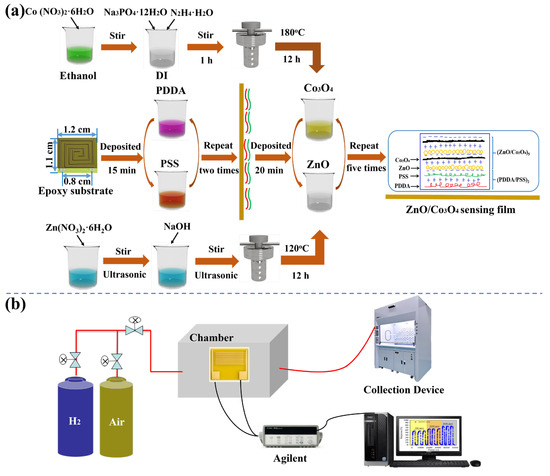
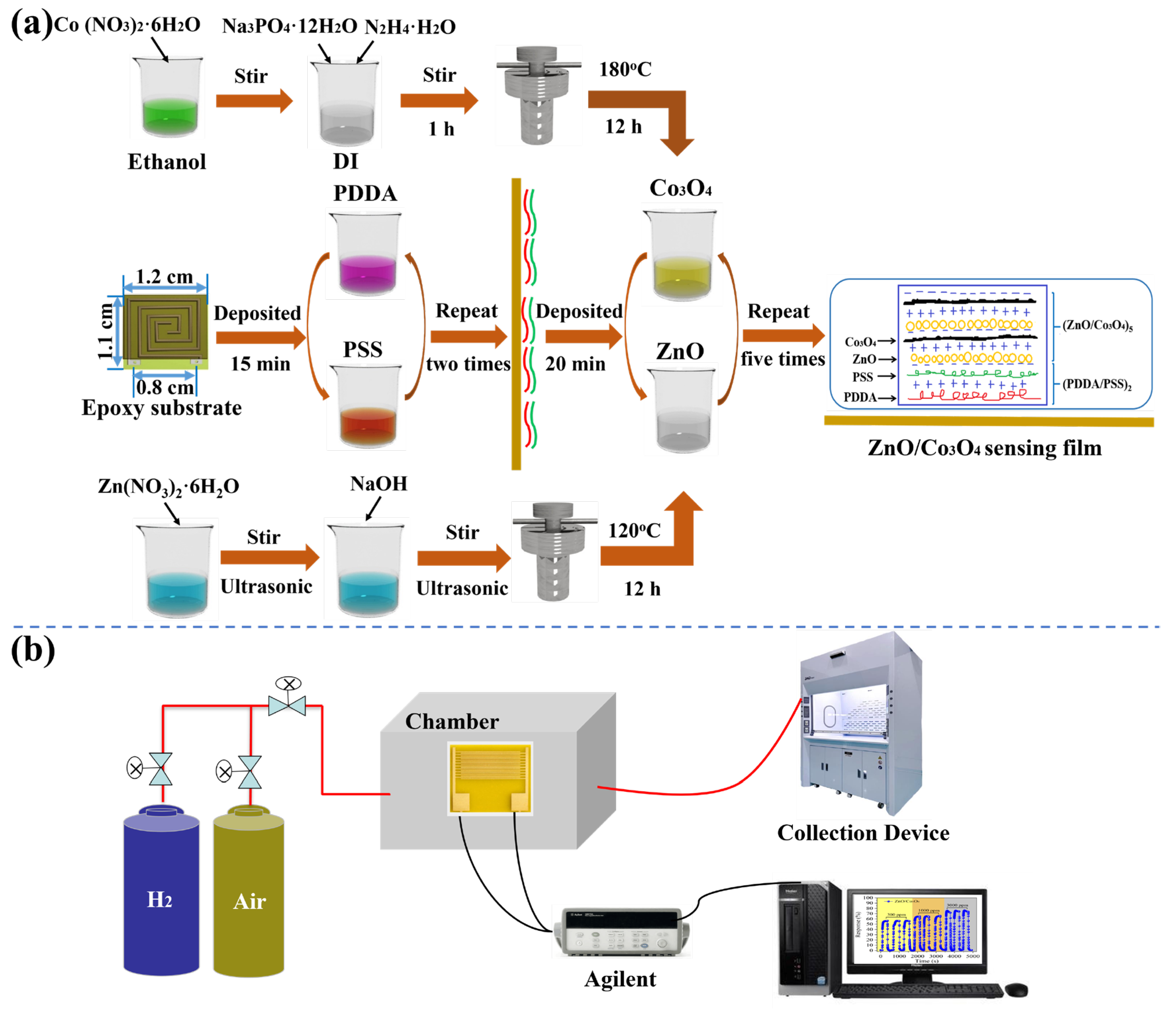
For the preparation of Co3O4, a certain mass of Co(NO3)2·6H2O was dissolved in ethanol; Na3PO4·12H2O and N2H4·H2O were dissolved in deionized (DI) water, stirred for 1 h, then transferred to a stainless-steel autoclave and heated at 180 °C for 12 h. The Co3O4 and ZnO solutions were washed several times with DI water to remove excess ions and collected for later use. To enhance the electrostatic interaction between Co3O4 and ZnO, equal volumes of PDDA and PSS were added to the Co3O4 and ZnO solutions as cationic and anionic polyelectrolytes, respectively.
Gas sensor based on nanocomposite materials was fabricated via self-assembly approach. A schematic diagram of material preparation and sensor preparation is shown in Figure 1a, which clearly demonstrates the detailed fabrication procedure of this strategy. The interdigital electrode used is shown in Figure 1a, with a length of 1.2 cm, a width of 1.1 cm, and the distance between the two electrodes is 0.8 cm. The interdigital electrode was repeatedly deposited in four different solutions in the figure to obtain the ZnO/Co3O4 composite sensor. The specific operating steps are as follows. First, immerse the interdigitated electrodes alternately in PDDA and PSS solutions for 15 min each, repeating the process twice to ensure sufficient deposition of the polyelectrolytes onto the electrodes. Then, alternately immerse the electrodes in stirred Co3O4 and ZnO solutions for 20 min each, repeating this five times to obtain a composite film with a total number of layers of 5, so that Co3O4 and ZnO can fully combine and firmly deposit onto the interdigitated electrodes under the electrostatic attraction provided by the polyelectrolyte precursor layer. The thin film with different numbers of layers was prepared using layer-by-layer self-assembly technique. The experimental equipment includes Agilent data acquisition instrument, ventilation chamber, H2 cylinder, and air cylinder to realize gas concentration configuration and real-time collection of sensor resistance, as shown in Figure 1b. The H2 gas detection experiment was conducted at room temperature (25 °C) and 43% relative humidity (RH). Agilent 34970A (Agilent Technologies, Longmont, CO, USA) was used to record the sensor resistance and expose the sensor to different H2 concentrations (100–50,000 ppm). The nanocomposite film sensor is suitable for higher-concentration H2 sensing. The response value of the sensor follows the formula: R = (Ra − Rg)/Ra × 100%, where Ra refers to the resistance under ambient air and Rg represents the resistance exposed to H2 gas.
Figure 1.
(a) Schematic of the preparation process for ZnO/Co3O4 composite. (b) Experimental test device diagram.
3. Results and Discussion
3.1. Material Characterization
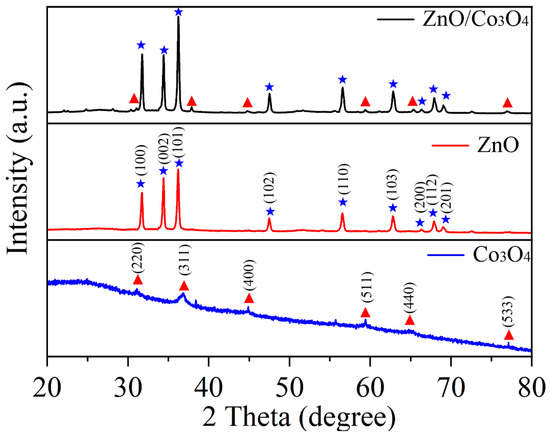
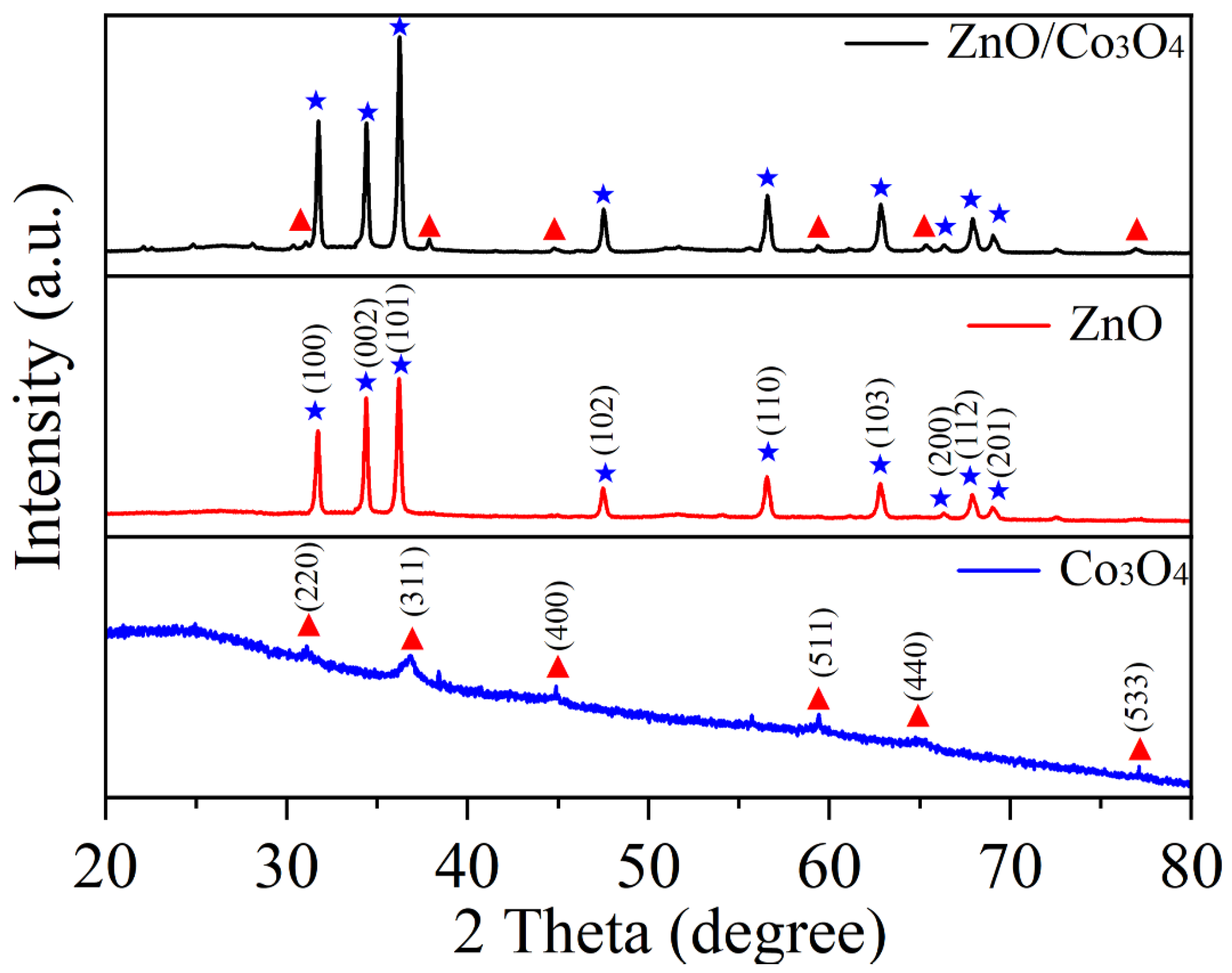
XRD patterns were recorded on an X-ray diffractometer (Bruker AXS, Karlsruhe, Germany) equipped with a Cu-Kα radiation source. XRD characterization was performed by compacting and evenly spreading approximately 80 mg of ground ZnO/Co3O4 composite powder or single nanomaterial powder was collected for characterization. The XRD curves of ZnO, Co3O4 and ZnO/Co3O4 composite materials are exhibited in Figure 2, which exhibits the XRD patterns of ZnO, Co3O4 and ZnO/Co3O4. The spectrum of ZnO is consistent with the phase spectrum of ZnO nanocrystal planes (JCPDS No. 36-1451) in the standard library, which is at 31.65°, 34.36°, 36.22°, 47.42°, 56.57°, 62.92°, 66.56°, 67.90° and 69.11°, pointing to (1 0 0), (0 0 2), (1 0 1), (1 0 2), (1 1 0), (1 0 3), (2 0 0), (1 1 2) and (2 0 1), respectively [21]. The spectrum of Co3O4 is consistent with the Co3O4 in the standard library (JCPDS NO. 43-1003), and the derivatives are at 19.1°, 31.2°, 36.9°, 38.4°, 44.9°, 55.7°, 59.4°, 65.3° and 77.1°. The emission peaks correspond to the (1 1 1), (2 2 0), (3 1 1), (2 2 2), (4 0 0), (4 2 2), (5 1 1), (4 4 0) and (5 3 3) lattice facets of Co3O4, respectively [22,23]. The XRD patterns of the ZnO/Co3O4 composite contains the relevant diffraction peaks of ZnO and Co3O4, confirming the existence of ZnO and Co3O4 in the nanocomposite.
Figure 2.
XRD patterns of Co3O4, ZnO and ZnO/Co3O4 composite (red triangle indicates the peaks of Co3O4, and blue star indicates the peaks of ZnO).
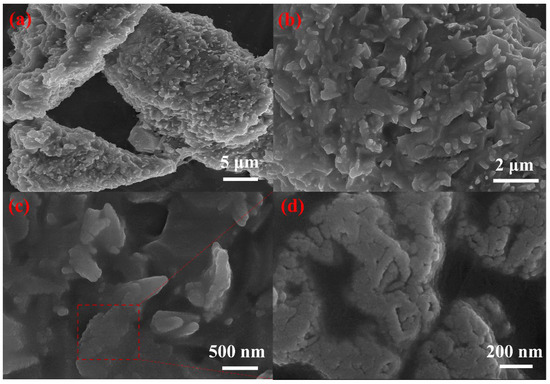
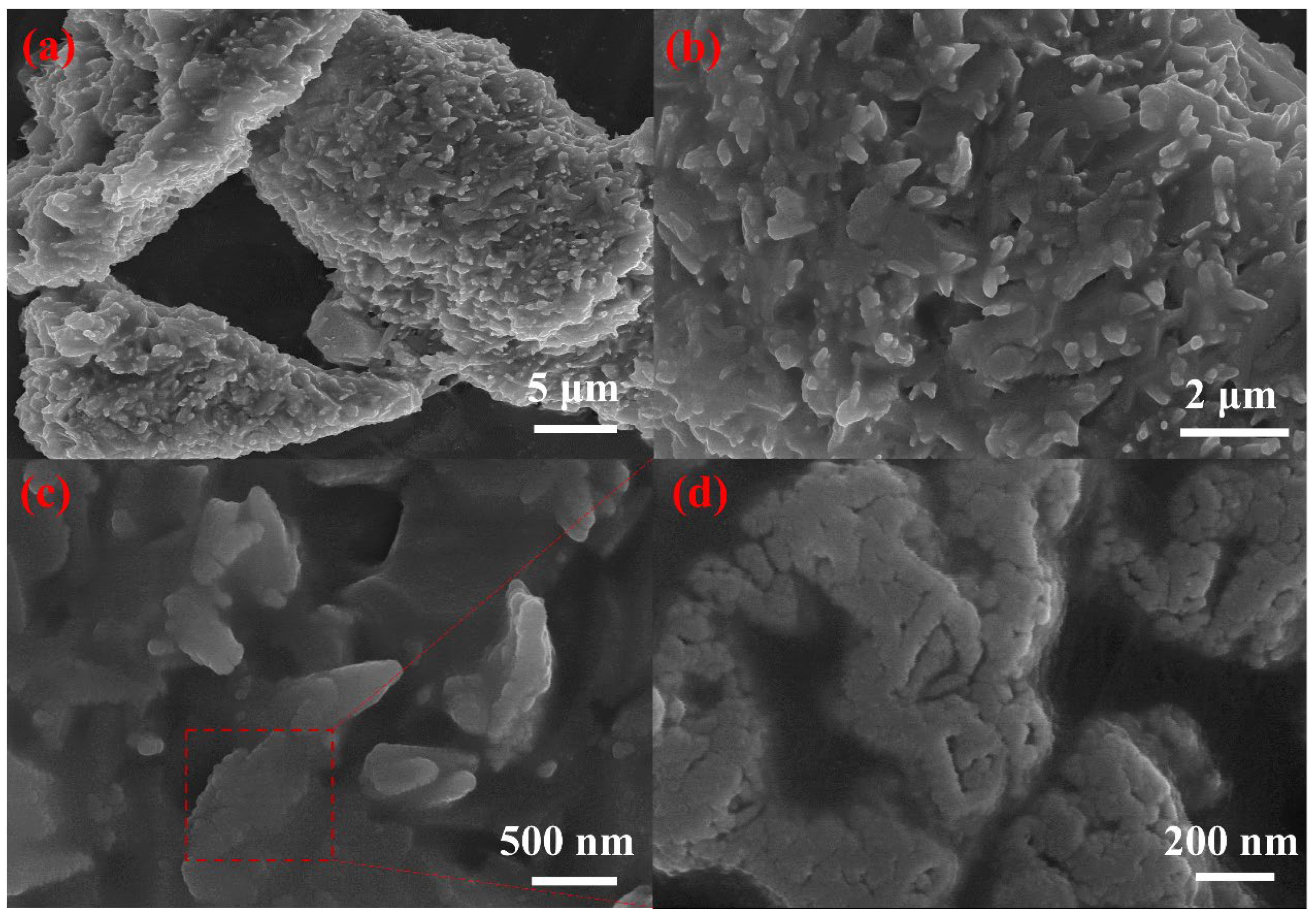
SEM characterization was performed using field-emission scanning electron microscopy (FESEM, Hitachi S-4800, Hitachi Ltd., Tokyo, Japan). Figure 3a–c show the morphology of ZnO/Co3O4 composite material. The SEM image of Co3O4 can be seen to be similar to an ellipsoid assembled by the agglomeration of nanorods. Figure 3d shows the pristine ZnO is in the shape of cauliflower, composed of nanospheres, tightly wrapped on the spheres composed of Co3O4 nanorods. From the nanocomposite materials, it is obvious that the two materials are in close and good contact.
Figure 3.
SEM images of (a–c) ZnO/Co3O4 nanocomposite, (d) ZnO.
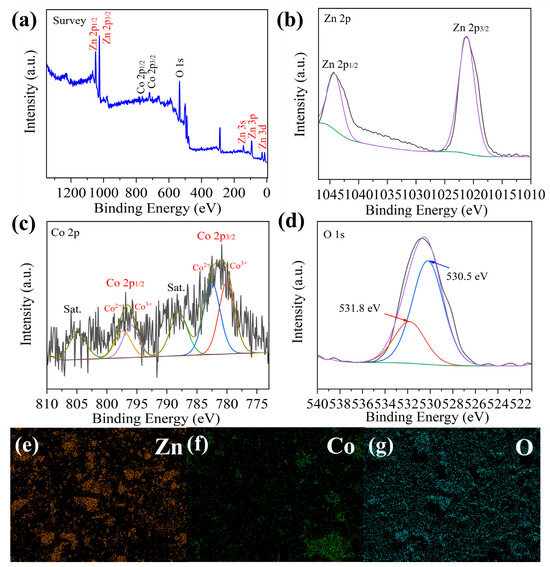
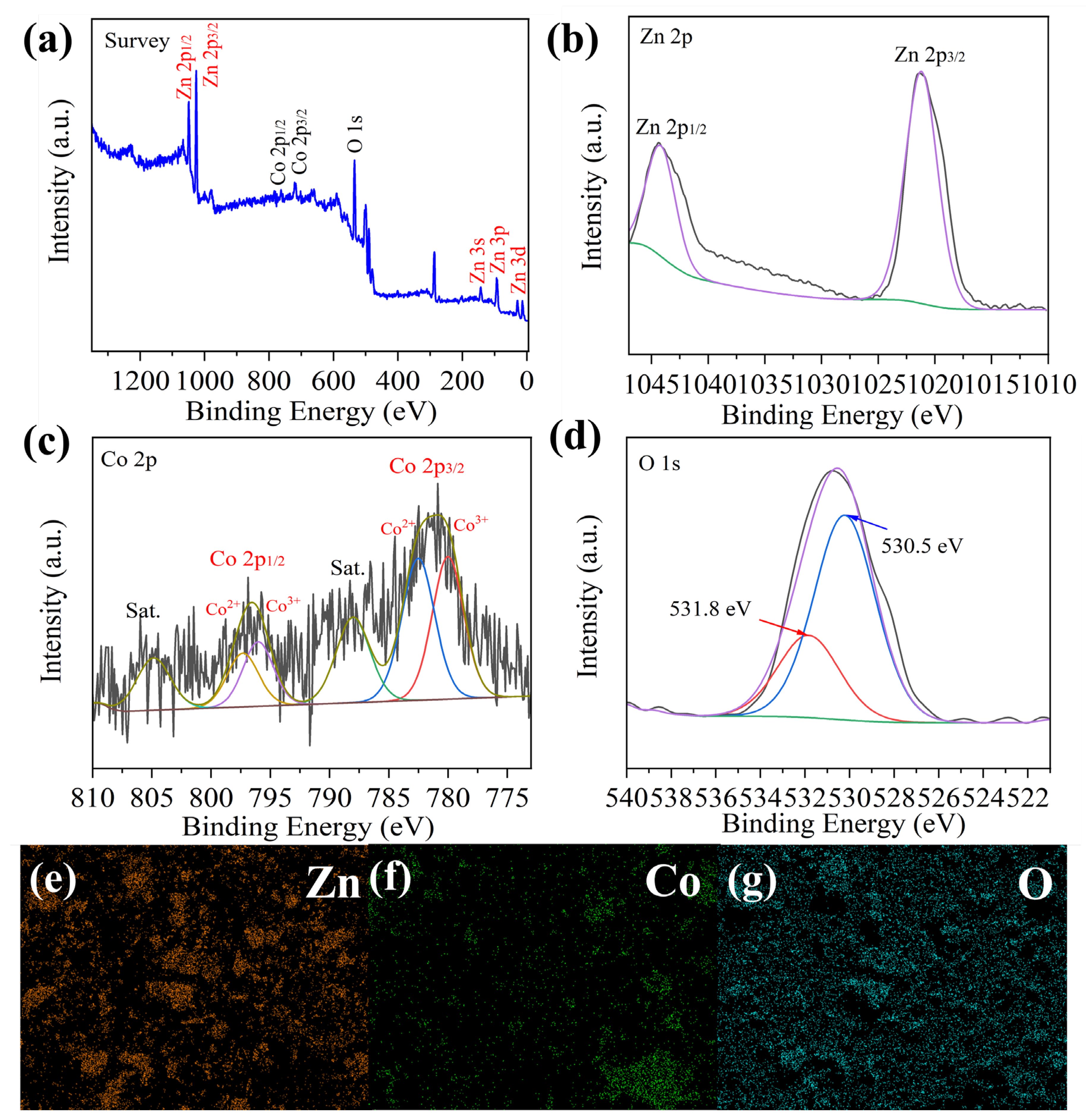
X-ray photoelectron spectroscopy (Thermo Scientific, Waltham, MA, USA) was used to analyze the surface composition and elemental state of ZnO/Co3O4 nanocomposites. Figure 4a shows the XPS spectrum curve. It can be seen that Zn, Co and O elements exist in the ZnO/Co3O4 composite material. Figure 4b shows the XPS spectrum of Zn 2p. The two peaks located at 1044.3 eV and 1021.2 eV correspond to Zn 2p1/2 and Zn 2p3/2, respectively, which indicates that the Zn state in the ZnO/Co3O4 nanocomposite is normal [14]. In Figure 4c, the XPS spectrum of Co 2p has two obvious peaks at 781.1 eV and 796.5 eV, corresponding to the Co 2p3/2 and Co 2p1/2 peaks, respectively. Co 2p3/2 as the main peak consists of Co3+ (780.1 eV) and Co2+ (782.5 eV). Co 2p1/2 as a shoulder consists of Co3+ (795.9 eV) and Co2+ (797.2 eV). This proves the successful synthesis and existence of Co3O4. There are two weak peaks at the binding energies of 787.8 and 804.7 eV, corresponding to the Co2+ shake-up satellite peak [24,25]. Figure 4d shows two peaks of O 1s located at 530.5 and 531.8 eV. The former corresponds to the O2− anions in ZnO and the lattice oxygen in the Co3O4 phase, and the latter corresponds to the O− anions and O2− anions generated by oxygen vacancies [26]. The element distribution and composition of the ZnO/Co3O4 composite were characterized by energy-dispersive X-ray spectroscopy (EDX). The elements Zn, Co and O are evenly distributed, as shown in Figure 4e–g, which proves the element composition and content.
Figure 4.
XPS spectra of ZnO/Co3O4 sample: (a) survey spectrum, (b) Zn 2p core level spectrum, (c) Co 2p core level spectrum, (d) O 1s core level spectrum. (e–g) EDX elemental mapping of Zn, Co, O.
3.2. H2 Sensing Properties
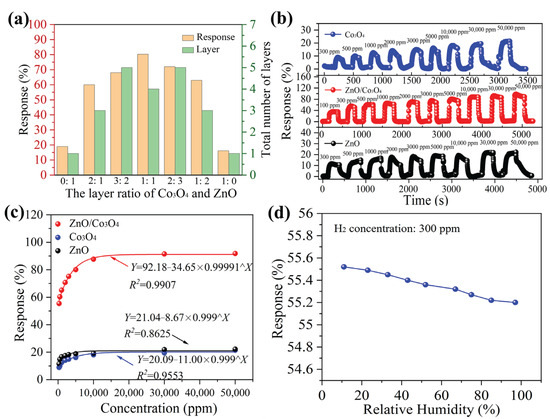
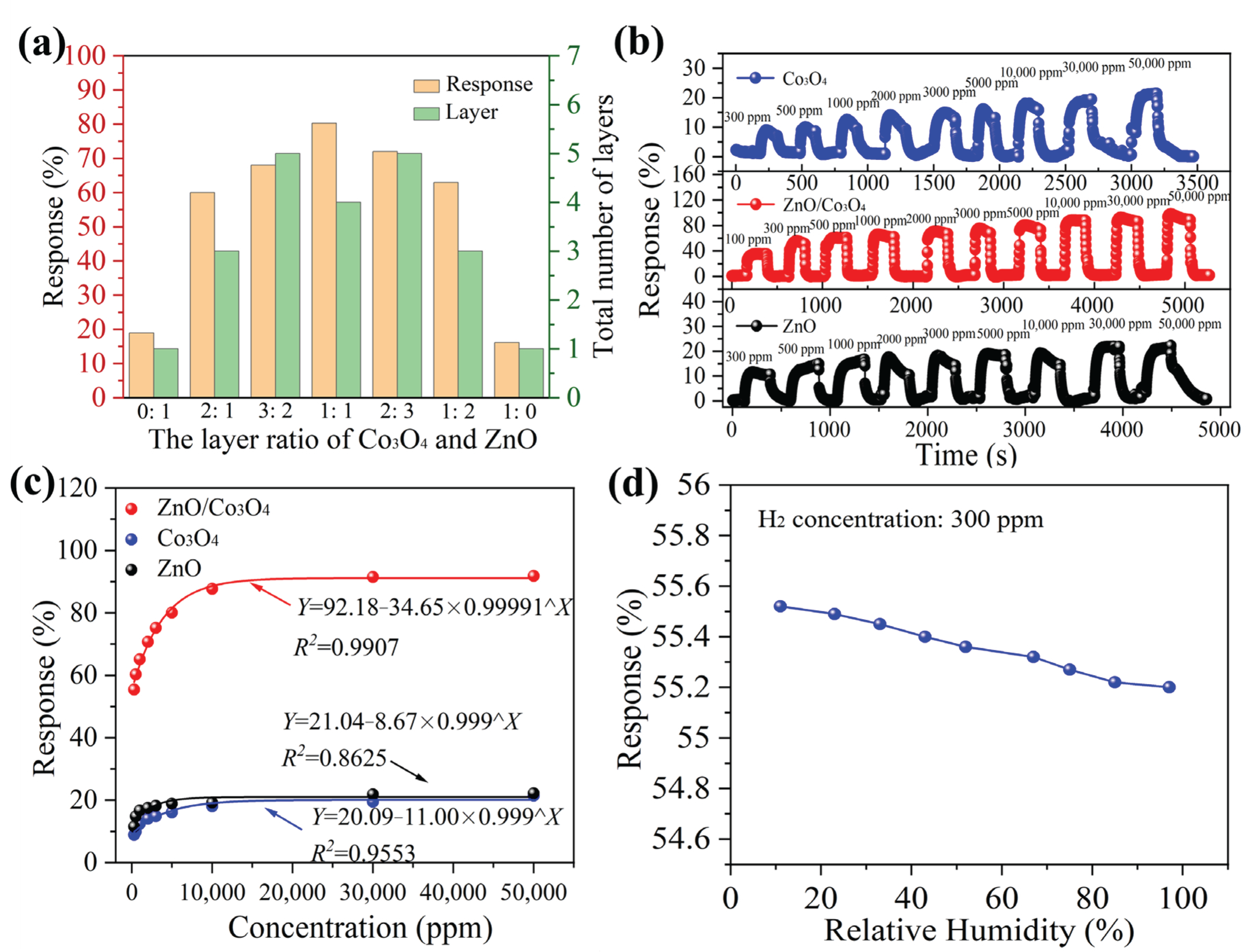
Figure 5a shows the response value of sensors based on different Co3O4 and ZnO layer ratios to H2. Seven sensors featuring distinct component ratios were measured upon exposure to 5000 ppm H2 under room-temperature conditions. The responses and total number of layers of the seven sensors are displayed in the form of a histogram. The specific values are displayed on the left and right Y coordinate axes. The total number of assembly layers from left to right is 1, 3, 5, 4, 5, 3 and 1. The results showed that the sample was fabricated at a 1:1 layer ratio, and a total number of four layers delivered the maximum response magnitude. This may be due to the low conductivity of sensors with fewer layers, while gas desorption is more difficult for sensors with more layers [27]. Hence, in subsequent experiments, Co3O4 and ZnO layers were used to assemble a sensor with a ratio of 1:1 and a total number of layers of 4. The responses of Co3O4, ZnO and ZnO/Co3O4 sensors to different H2 concentrations are shown in Figure 5b. It is evident that the ZnO/Co3O4 composite nanofilm has the highest response to H2 compared with the other two sensors. The response values of nanocomposite film sensors toward 100–50,000 ppm are 34.9%, 55.4%, 60.3%, 65.1%, 70.7%, 75.2%, 80.1%, 87.7%, 91.5%, 91.8%, respectively. The detection limit of the composite sensor is 100 ppm, which is lower than the detection limit of the single sensor of 300 ppm. It is worth noting that the 1:1 layered ZnO/Co3O4 nanocomposite sensor achieves a response of 55.4% at 300 ppm H2, far exceeding the value of 8.9% recorded for pristine Co3O4, and the response magnitude is roughly 6.22-fold higher. This is due to the synergistic effect between ZnO and Co3O4 nanomaterials and the formation of a heterojunction, which can improve the H2 sensing performance. It is also worth emphasizing that the H2 sensing range for the sensor is from 100 ppm to 50,000 ppm. The sensor has a wide H2 sensing detection range and can detect high concentrations of H2. Figure 5c displays the fitted curves correlating the response values of the three kinds of sensors with H2 concentrations. For ZnO, Co3O4 and ZnO/Co3O4 sensors, the fitting functions are Y = 21.04 − 8.67 × 0.999X, Y = 20.09 − 11.00 × 0.999X and Y = 92.18 − 34.65 × 0.99991X, respectively. The correlation coefficients (R2) were 0.8625, 0.9553 and 0.9907, respectively. Figure 5d illustrates the difference in response of the ZnO/Co3O4 composite sensors toward 300 ppm H2 at different relative humidity. It can be seen that when the relative humidity increases from 11% to 97%RH, the sensor response changes slightly within the range of 0.4%, indicating good humidity resistance.
Figure 5.
(a) The H2 sensing performance of ZnO/Co3O4 composite with different layer ratio of Co3O4 and ZnO. (b) Responses and (c) function fitting curves of ZnO/Co3O4 composite and individual sensors toward various concentrations of H2 at 25 °C. (d) The effect of relative humidity on the response of ZnO/Co3O4 composite sensor at 25 °C.
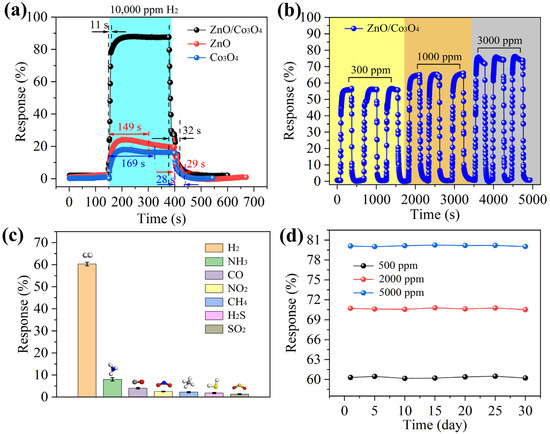
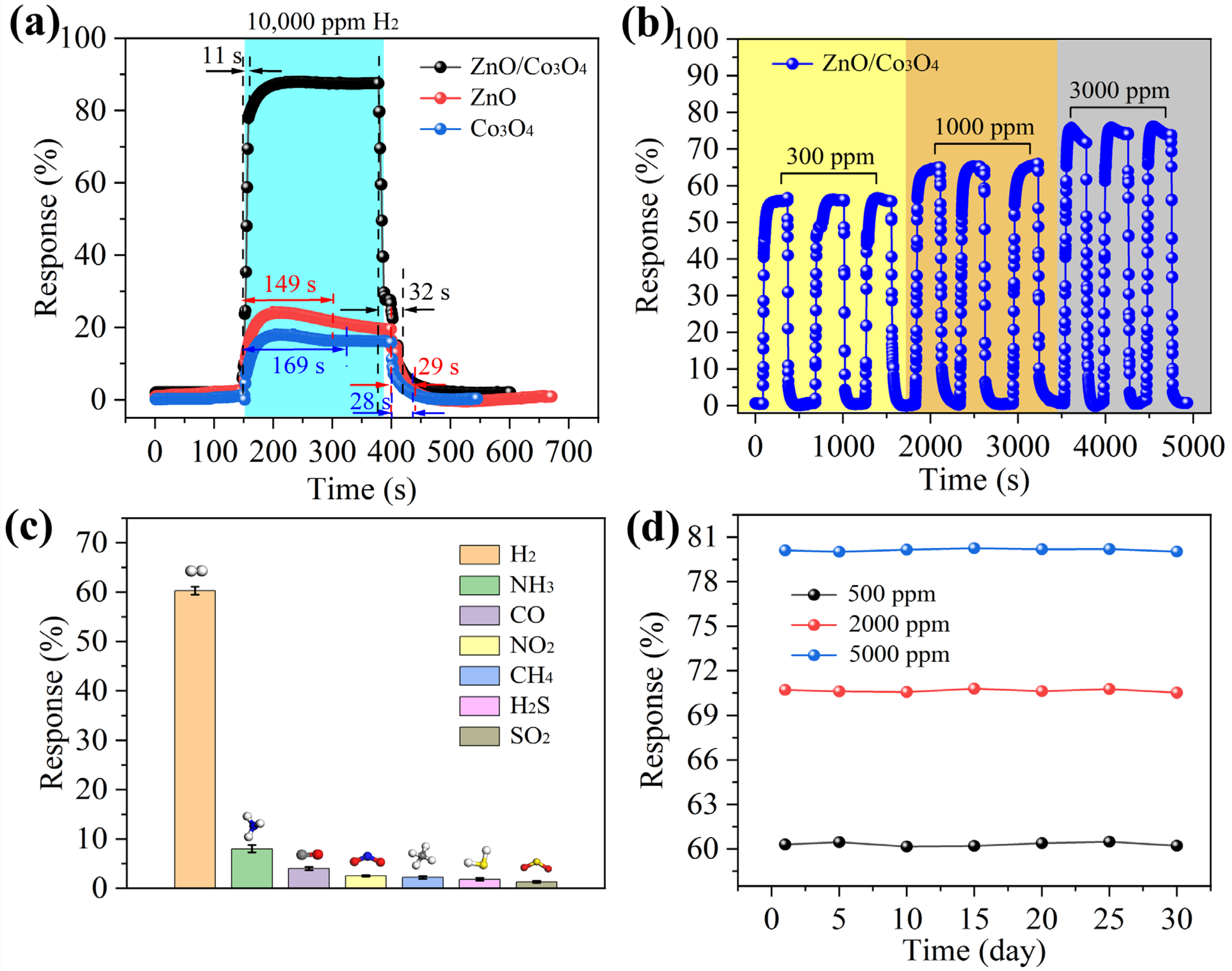
Figure 6a presents the response–recovery behaviors of pure and composite sensors upon exposure to 10,000 ppm H2. The response and recovery durations of Co3O4, ZnO and ZnO/Co3O4 sensors are 169 s/28 s, 149 s/29 s and 11 s/32 s, respectively. Obviously, the ZnO/Co3O4 sensor exhibits a faster response than a single-material sensor. Figure 6b shows the repeatability of the ZnO/Co3O4 composite sensors under 300, 1000 and 3000 ppm H2, demonstrating outstanding uniformity over three repeated measurement cycles for each concentration. Figure 6c exhibits the selectivity of the ZnO/Co3O4 composite sensor to 500 ppm hydrogen (H2), ammonia (NH3), carbon monoxide (CO), nitrogen dioxide (NO2), methane (CH4), hydrogen sulfide (H2S), and sulfur dioxide (SO2) at room temperature. It is evident that the selectivity of the ZnO/Co3O4 nanofilm sensors toward H2 gas is remarkably higher than that of other gases, which can reach more than six-times. The long-term stability measurement results of ZnO/Co3O4 nanocomposites at 500, 2000 and 5000 ppm H2 are shown in Figure 6d. The tests were conducted over a month, with 5 days between each test. It can be observed from the diagram that the ZnO/Co3O4 sensor possesses outstanding repeatability and favorable long-term stability.
Figure 6.
(a) Response–recovery curves of ZnO/Co3O4 composite and individual sensors toward 10,000 ppm H2. (b) Repeatability of the ZnO/Co3O4 composite sensor upon exposure to 300, 1000 and 3000 ppm H2. (c) Selectivity of the ZnO/Co3O4 composite sensor toward different interfering gases of 500 ppm. (d) Long-term stability of the ZnO/Co3O4 composite sensor upon exposure to 500, 2000 and 5000 ppm H2 at 25 °C.
The last row of Table 1 summarizes the H2 sensing characteristics of the ZnO/Co3O4 nanofilm sensor in this study and compares it with H2 sensors in recent years, including the most recent year in existing research [28,29,30,31,32,33,34,35,36,37,38,39,40,41]. The results show that the proposed ZnO/Co3O4 sensor achieves outstanding room-temperature H2 response that outperforms the H2 sensing devices reported so far in Table 1. At present, most H2 sensors work at a certain operating temperature. In this study, the room-temperature gas sensor can greatly lower the power consumption, which can make it more lightweight and convenient.
Table 1.
Comparison of H2 gas sensing performance in previous reports with that of this work.
3.3. H2 Gas Sensing Mechanism
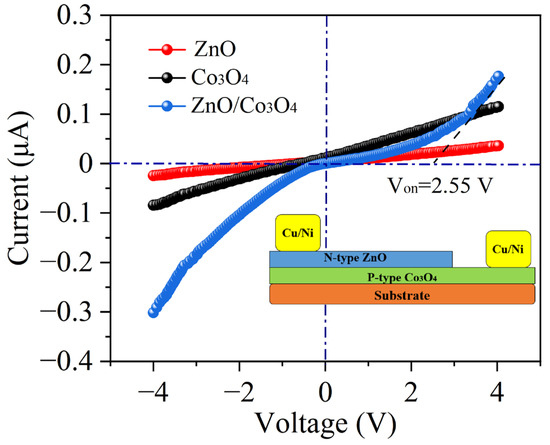
Keithley-2400 (Keithley Instruments, Solon, OH, USA) is used to test the current–voltage (I-V) curves of three types of sensors, using a voltage of −4 V to 4 V for scanning: ZnO, Co3O4 and ZnO/Co3O4 composite materials. Pristine ZnO and Co3O4 sensors exhibit linear current–voltage characteristics, as illustrated in Figure 7. Differently, the ZnO/Co3O4 heterostructure shows reverse saturation of junction current in the negative-bias region, whereas positive-bias current undergoes near-exponential growth. Such electrical behaviors confirm the prominent nonlinear rectification property of the ZnO/Co3O4 composite heterojunction [42,43]. The turn-on voltage is approximately 2.55 V. The electrode schematic is shown in the figure inset.
Figure 7.
Current–voltage curve of pure ZnO, Co3O4 and ZnO/Co3O4 composite-based sensors.
From the test, it can be found that the resistance of the ZnO/Co3O4 film sensor decreases in H2 gas, indicating that the composite film sensor is an n-type semiconductor [44]. The ZnO/Co3O4 composite film sensor has good sensing performance for H2 at room temperature. Due to the good combination of the two nanomaterials, the ZnO/Co3O4 heterostructure offers plentiful reactive sites for H2 adsorption, playing a vital role in optimizing and promoting the H2 sensing behavior. When the nanofilm is in the air, the following Reactions (1) and (2) occurs. When the sensor is in H2, the following Reaction (3) occurs, while reducing the resistance of the composite film [45,46].
O2(gas) → O2(ads)
O2(ads) + e− → O2− (ads)
H2(ads) + O2− → H2O(g) + e−
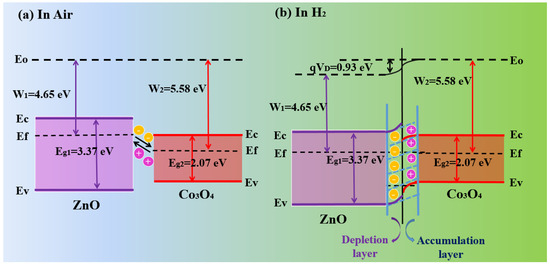
The H2 sensing performance of ZnO/Co3O4 films is remarkably better than that of pure ZnO and Co3O4, which can be ascribed to the synergistic effect between ZnO and Co3O4. The energy band diagrams of n-type ZnO and p-type Co3O4 are shown in Figure 8a. The energy gaps of ZnO and Co3O4 are approximately 3.37 and 2.07 eV [47]. ZnO is tightly wrapped on the surface of Co3O4, which helps to form a heterojunction at the interfacial region. Meanwhile, the work functions of ZnO and Co3O4 are different, which are 4.65 eV and 5.58 eV, respectively. Because the Co3O4’s work function is higher than that of ZnO, the Fermi level of Co3O4 is located in the lower part of ZnO. Therefore, electrons are transferred from the valence band of ZnO to the conduction band of Co3O4 to balance its Fermi level [48]. Figure 8b presents the energy band mechanism of the ZnO/Co3O4 heterojunction under H2 ambient conditions. Due to the formation of the heterogeneous interface between ZnO and Co3O4, H2 molecules can be readily adsorbed on the composite surface. On the one hand, the formation of p-n heterojunctions between ZnO and Co3O4 accelerates electron transfer and facilitates the rapid oxidation of H2 molecules [49]. On the other hand, the heterojunction structure suppresses electron–hole recombination, enabling more electrons to be efficiently transferred from H2 molecules to the surface of sensing nanomaterials [50]. Therefore, the interfacial heterojunction of ZnO and Co3O4 is responsible for the prominently enhanced H2 sensing performance of the ZnO/Co3O4 composite sensor.
Figure 8.
Schematic diagram of the gas sensing mechanism and energy band structure of ZnO/Co3O4 composite in (a) air and (b) H2 gas.
3.4. Hydrogen Production Test with Electrolyzing Water
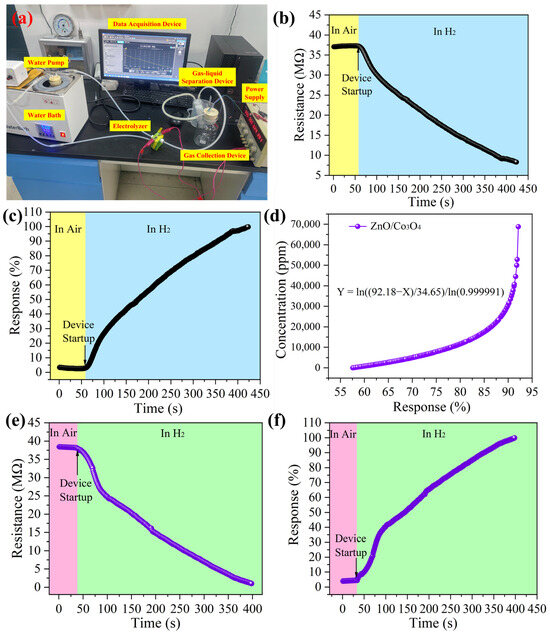
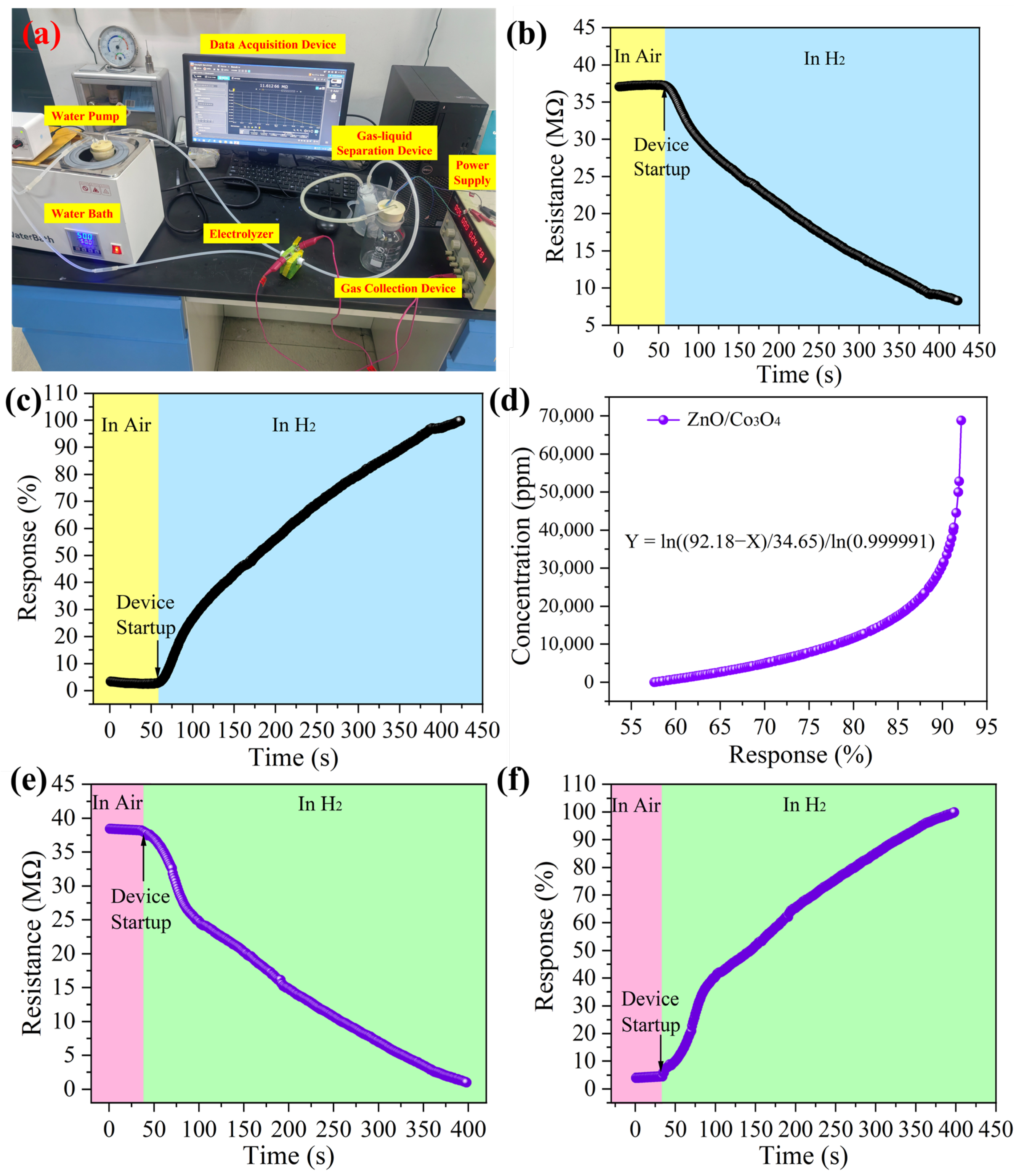
The hydrogen production via water electrolysis and using a hydrogen testing device is shown in Figure 9a, which mainly consists of a water bath, a water pump, an electrolyzer, a gas–liquid separation device, a power supply, a gas collection device and a data acquisition device. The electrolytic cell is powered by a power supply, and the positive and negative clips of the data acquisition device clamp both ends of the sensor electrode connection to record the sensor resistance value in real time. The H2 generated by electrolyzing water in the electrolyzer passes through the tube, passes through the gas–liquid separation device in the middle, and continuously flows into the gas collection container. The testing process is as follows: the H2 gas produced by electrolyzing water in the electrolytic cell is passed into the gas collection device through a tube, and a gas–liquid separation device is added in the middle to avoid the influence of greater humidity caused by the moisture in the H2 gas produced by electrolyzing water. Using the power supply to the electrolyzer, the H2 production process begins.
Figure 9.
(a) H2 gas production and H2 gas testing experimental device using water electrolysis hydrogen production device. (b) Resistance changes of the composite film sensor before and after the start-up of the water electrolysis hydrogen production device. (c) Changes in the response value of the composite film sensor before and after the start-up of the water electrolysis hydrogen production device. (d) Functional relationship between composite film sensor response and H2 gas concentration during hydrogen production. Changes in (e) resistance and (f) response value of the composite film sensor before and after the start-up of the electrolytic water hydrogen production device in another time period.
The initial resistance value of the composite sensor is about 37 MΩ. After the hydrogen production device by water electrolysis is started, as H2 gas continues to be introduced, the resistance of the composite film sensor continues to decrease, as shown in Figure 9b. The response is calculated using (Rair − Rgas)/Rair × 100% as shown in Figure 9c. The sensor response increases as H2 gas is introduced for a longer time. This is because the concentration of H2 gas continues to accumulate and increase as the gas introduction time increases. The functional relationship between the sensor response and H2 concentration in this process is shown in Figure 9d. This expression can be used to monitor the changes in H2 concentration during the H2 production process, thereby monitoring H2 production in real time. For example, it can be observed from Figure 9c that the sensor response value achieves 91.8% when the H2 gas is passed for about 300 s, and the corresponding H2 concentration is 50,000 ppm. The gas concentration calculation formula in ppm is Cppm = Vgas/Vtotal × 106, and the volume of the gas collection container is 500 mL, so the volume of H2 flowing into the gas collection container can be calculated as 25 mL, and the instantaneous H2 production rate of the electrolytic cell at this time can be further calculated as about 5 mL/min. In practical electrolysis tests, hydrogen gradually accumulates from low concentration to 50,000 ppm within 300 s, and most of the test process falls in the 100–30,000 ppm accurate quantitative range, with a high R2 of 0.9907 for accurate concentration calculation. The stable saturated response platform at 50,000 ppm acts as a definite concentration endpoint reference. The resistance and response curves of the composite film sensor tested in another time period before and after the start-up of the electrolytic water hydrogen production device are shown in Figure 9e,f, demonstrating real-time monitoring of hydrogen production by water electrolyzers was achieved using the prepared composite sensor.
4. Conclusions
In this work, hydrothermal synthesis coupled with layer-by-layer self-assembly was adopted to fabricate ZnO/Co3O4 composite films for high-performance room-temperature H2 detection. The p-n heterojunction formed at the ZnO-Co3O4 interface and the synergistic effect of the two metal oxides jointly contribute to the prominent promotion of comprehensive sensing performance, covering elevated response signal, rapid response/recovery speed, excellent cycling repeatability and long-term stability relative to pure ZnO and Co3O4. More importantly, the developed composite sensor was practically applied into a water electrolysis hydrogen production platform, realizing real-time measurement of hydrogen concentration and evaluation of electrolytic hydrogen production behavior.
Author Contributions
Conceptualization, D.Z. and W.P.; methodology, R.Z.; validation, L.M. and R.Z.; formal analysis, L.M. and W.P.; investigation, L.M. and R.Z.; data curation, W.P.; writing—original draft preparation, W.P.; writing—review and editing, L.M. and R.Z.; supervision, W.P. and D.Z.; funding acquisition, D.Z. All authors have read and agreed to the published version of the manuscript.
Funding
This research was funded by the Key R&D Program of Shandong Province, China (2024CXGC010706), and the Shandong Provincial Natural Science Foundation (ZR2023ME118).
Data Availability Statement
The data in this article will be made available upon reasonable request to the corresponding author.
Conflicts of Interest
The authors declare no conflicts of interest.
References
- Kim, E.B.; Shin, K.Y.; Oum, W.; Moon, S.; Mirzaei, A.; Kim, S.S.; Kim, H.W. Optimization of Al2O3 shell thickness on SnO2 nanowires for realization of sensitive and selective H2 sensing. Sens. Actuators B Chem. 2025, 426, 137021. [Google Scholar] [CrossRef] [Scilit]
- Jian, J.-J.; Chu, P.-Y.; Wang, J.-C.; Kuo, C.-K.; Lin, K.-W.; Liu, W.-C. A chemoresistive hydrogen gas sensor prepared by a sputtered indium tungsten oxide thin film and palladium nanoparticles. Int. J. Hydrogen Energy 2025, 99, 146–154. [Google Scholar] [CrossRef] [Scilit]
- He, J.W.; Meng, H.; Xu, Y.; Feng, L. Hollow mesoporous In2O3 derived from MIL-68(In) for dual gas sensing of NO2 and H2. Sens. Actuators B Chem. 2024, 418, 136336. [Google Scholar] [CrossRef] [Scilit]
- Liu, L.; Guo, C.F.; Wang, Y.Y.; Guan, K.J.; Qin, S.J.; Gou, X.S.; Sun, F.Q.; Zhang, C.; Zhou, W.F.; Cai, Z.Y.; et al. A comprehensive review of hydrogen sensor for thermal runaway monitoring: Fundamentals, recent advancements, and challenges. Microsyst. Nanoeng. 2026, 12, 108. [Google Scholar] [CrossRef] [Scilit] [PubMed]
- Yeasmin, R.; Jung, G.; Han, S.; Park, C.; Seo, H. Self-healing and self-adhesive hydrogen gas sensing tape for robust applications. Chem. Eng. J. 2024, 482, 148911. [Google Scholar] [CrossRef] [Scilit]
- Zhu, J.X.; Cho, M.; Li, Y.T.; He, T.; Ahn, J.; Park, J.; Ren, T.-L.; Lee, C.K.; Park, I. Machine learning-enabled textile-based graphene gas sensing with energy harvesting-assisted IoT application. Nano Energy 2021, 86, 106035. [Google Scholar] [CrossRef] [Scilit]
- Qiu, C.K.; Zhang, H.; Li, Q.R.; Song, Y.F.; An, F.; Wang, H.Z.; Wang, S.Q.; Zhu, L.; Lv, C.X.; Zhang, D.Z. Controllable synthesis of 3D PdCu/Ti3C2Tx hierarchical nanostructures for chemiresistive room temperature H2 sensors. Sens. Actuators B Chem. 2024, 417, 136215. [Google Scholar] [CrossRef] [Scilit]
- Wang, Y.D.; Chen, J.; Gong, L.K.; Tang, J.J.; Wang, X.W.; Guo, H.Y.; Zhou, X.H. P-doped W2C nanoparticles for hydrogen evolution reaction powered by a wind-driven triboelectric nanogenerator. Nano Energy 2024, 121, 109242. [Google Scholar] [CrossRef] [Scilit]
- Fan, S.C.; Zhang, F.Y.; Qu, Y.F. The collaborative development of sensors and artificial intelligence. Instrumentation 2025, 12, 1–10. [Google Scholar]
- Cheng, B.Z.; Ren, B.Z.; Lu, S. Smartphone-assisted electrochemical sensors for environmental monitoring. Instrumentation 2024, 11, 1–12. [Google Scholar] [CrossRef] [Scilit]
- He, J.W.; Li, C.; Wang, X.X.; Wei, Y.Y.; Meng, H.; Xu, Y.; Feng, L. Synergistically engineered mesoporous tin oxide for ultra-sensitive hydrogen detection at the parts per billion level. Sens. Actuators B Chem. 2026, 451, 139338. [Google Scholar] [CrossRef] [Scilit]
- Wang, T.; Zhang, Y.; Wu, H.L.; Feng, S.T.; Han, R.; Liang, X.S.; Liu, F.M.; Liu, F.M.; Lu, G.Y. Ag modified metal oxides (MOx) as sensing electrodes for CeO2 based mixed potential hydrogen sensors. Sens. Actuators B Chem. 2025, 427, 137172. [Google Scholar] [CrossRef] [Scilit]
- Kim, J.-Y.; Park, H.J.; Lee, J.-H.; Choi, M.S.; Shin, J.; Jeon, D.S.; Mirzaei, A. Machine learning-guided analysis of room-temperature H2 gas sensing using Au- and Pd-decorated ZnO sensors. J. Alloys Compd. 2025, 1040, 183606. [Google Scholar] [CrossRef] [Scilit]
- Chen, L.; Chen, X.; Wang, F.; Tong, Y.; Zhang, K.W.; Han, Z.B.; Zhang, M.Z. MOF-derived ZnO/Ti3C2Tx MXene heterostructures for ultrafast ppb-level detection of H2 and NO2 gases. Sens. Actuators B Chem. 2026, 447, 138802. [Google Scholar] [CrossRef] [Scilit]
- Sharma, M.; Prakash, C.; Yadav, A.K.; Pandey, A.; Singh, V.K.; Dixit, A. Enhanced hydrogen sensing response through controlled porosity and diameter of vertically aligned ZnO nanorods. Int. J. Hydrogen Energy 2025, 137, 1179–1190. [Google Scholar] [CrossRef] [Scilit]
- Kanth, S.; Domadiya, D.N.; Betty, C.A.; Kumar, S.; Choudhury, S. Highly selective hydrogen sensing by applying characteristic frequency at room temperature: Case study on TiO2–PdO hydrogen sensor. Int. J. Hydrogen Energy 2025, 106, 231–242. [Google Scholar] [CrossRef] [Scilit]
- Zhang, L.Y.; Jiang, N.; Zheng, Z.C.; Chi, H.W.; Huang, D.H.; Ye, Z.Z.; Jiang, J.; Zhu, L.P. Ultrasensitive detection of H2 based on WO3 nanocubes decorated with PtO nanoparticles. Int. J. Hydrogen Energy 2024, 94, 1464–1475. [Google Scholar] [CrossRef] [Scilit]
- Zhang, D.Z.; Pan, W.J.; Tang, M.C.; Wang, D.Y.; Yu, S.J.; Mi, Q.; Pan, Q.N.; Hu, Y.Q. Diversiform gas sensors based on two-dimensional nanomaterials. Nano Res. 2023, 16, 11959–11991. [Google Scholar] [CrossRef] [Scilit]
- Zhang, Z.K.; Yue, C.; Dastan, D.; Zhang, D.D.; Zhang, X.F.; Yin, X.-T.; Ma, X.G. High response and selectivity of bimetallic MOFs-derived metal oxides Co3O4/In2O3 nanoparticles to TEA. Sens. Actuators B Chem. 2024, 398, 134727. [Google Scholar] [CrossRef] [Scilit]
- Yin, X.-T.; Yang, Z.-Y.; Dastan, D.; Liu, Y.; Tan, X.-M.; Gao, X.-C.; Zhou, Y.-W.; Li, J.; Ma, X.-G. Sensitivity and selectivity Pt loaded SnO2–Co3O4 gas sensor for hydrogen detection. Ceram. Int. 2023, 49, 38717–38725. [Google Scholar] [CrossRef] [Scilit]
- Zhang, D.Z.; Pan, W.J.; Zhou, L.J.; Yu, S.J. Room-temperature benzene sensing with Au-doped ZnO nanorods/exfoliated WSe2 nanosheets and density functional theory simulations. ACS Appl. Mater. Interfaces 2021, 13, 33392–33403. [Google Scholar] [CrossRef] [Scilit] [PubMed]
- Yuan, J.H.; Zhang, X.C.; Yu, F.; Cao, J.L.; Yang, F.; Ma, J. Bacillus cereus-derived hollow carbon rods/oxygen-vacancy-rich Co3O4−x nanosheets by biomineralization strategy for boosting lead ions capture. Adv. Funct. Mater. 2026, 36, e17924. [Google Scholar] [CrossRef] [Scilit]
- Shang, C.Y.; Meng, N.; Huang, K.X.; You, J.; Liang, T.Y.; Qi, S.; Huo, Q.H.; Deng, C.; Li, X.J.; Zhang, X.; et al. Enhancing the electrochemical nitrate-to-ammonia performance on Co3O4 via 4f-2p-3d orbital hybridization engineering. Adv. Funct. Mater. 2026, 36, e26795. [Google Scholar] [CrossRef] [Scilit]
- Zhang, D.Z.; Jiang, C.X.; Li, P.; Sun, Y.E. Layer-by-layer self-assembly of Co3O4 nanorod decorated MoS2 nanosheet-based nanocomposite toward high-performance am monia detection. ACS Appl. Mater. Interfaces 2017, 9, 6462–6471. [Google Scholar] [CrossRef] [Scilit] [PubMed]
- Wang, K.; Cao, Y.; Hu, J.; Li, Y.; Xie, J.; Jia, D. Solvent-free chemical approach to synthesize various morphological Co3O4 for CO oxidation. ACS Appl. Mater. Interfaces 2017, 9, 16128–16137. [Google Scholar] [CrossRef] [Scilit] [PubMed]
- Zhang, D.Z.; Yang, Z.M.; Wu, Z.L.; Dong, G.K. Metal-organic frameworks-derived hollow zinc oxide/cobalt oxide nanoheterostructure for highly sensitive acetone sensing. Sens. Actuators B Chem. 2019, 283, 42–51. [Google Scholar] [CrossRef] [Scilit]
- Li, X.; Wang, J.; Xie, D.; Xu, J.L.; Dai, R.X.; Xiang, L.; Zhu, H.W.; Jiang, Y.D. Reduced graphene oxide/hierarchical flower-like zinc oxide hybrid films for room temperature formaldehyde detection. Sens. Actuators B Chem. 2015, 221, 1290–1298. [Google Scholar] [CrossRef] [Scilit]
- Qin, Y.X.; Zhang, Y.Z.; Lei, J.; Liu, X.Y. Achieving switchable CO/H2 detection with selectivity-tunable SnO2-Co3O4 sensors. ACS Appl. Mater. Interfaces 2025, 17, 41093–41101. [Google Scholar] [CrossRef] [Scilit] [PubMed]
- Chen, Z.; Yuan, P.; Chen, C.L.; Wang, X.H.L.; Wang, J.R.; Jia, J.Q.; Davaasuren, B.; Lai, Z.P.; Khashab, N.M.; Huang, K.-W.; et al. Balancing Pd–H interactions: Thiolate-protected palladium nanoclusters for robust and rapid hydrogen gas sensing. Adv. Mater. 2024, 36, 2404291. [Google Scholar] [CrossRef] [Scilit] [PubMed]
- Wang, Z.J.; Zhang, D.Z.; Tang, M.C.; Chen, Q.D.; Zhang, H.; Shao, X.Y. Construction of ultra-fast hydrogen sensor for dissolved gas detection in oil-immersed transformers based on titanium dioxide quantum dots modified tin dioxide nanosheets. Sens. Actuators B Chem. 2023, 393, 134141. [Google Scholar] [CrossRef] [Scilit]
- Li, P.; Diao, L.; Liao, X.; Wang, Z.; Feng, Y.; Wei, J. Rapid and selective detection of trace hydrogen by mesoporous SnO2 anchored with Au–Pd dual-atom sensitizers. Nano Lett. 2025, 25, 8243–8250. [Google Scholar] [CrossRef] [Scilit] [PubMed]
- Wei, Z.; Song, M.; Wang, H.; Zhang, Y.; Zeng, G.; Kong, M.; Gong, F.; Liu, J.; Wei, S. Rare earth single atoms steering hydrogen spillover over Pd/WO3 toward high-efficiency H2 sensor at near room temperature. Adv. Energy Mater. 2025, 15, 2501365. [Google Scholar] [CrossRef] [Scilit]
- Yang, Y.; He, Y.; Hu, S.; Li, Z.; Tan, L.; Zhang, M.; Xiong, J.; Hu, Y.; Wang, X.; Fei, L.; et al. Self-embedded schottky junctions in liquid-metal-derived 2D oxides for fast and selective room-temperature H2 sensing. Adv. Funct. Mater. 2025, 35, 2500605. [Google Scholar] [CrossRef] [Scilit]
- Badie, C.; Mirzaei, A.; Lee, J.-H.; Sayegh, S.; Bechelany, M.; Santinacci, L.; Kim, H.W.; Kim, S.S. Selective detection of H2 gas in gas mixtures using NiO-shelled Pd-decorated ZnO nanowires. Adv. Mater. Technol. 2024, 9, 2302081. [Google Scholar] [CrossRef] [Scilit]
- Li, Z.; Huang, H.; Zhang, Z.; Zhou, J.; Tang, T.; Zhao, D. Room temperature hydrogen gas sensor based on Pd-decorated bridging GaN nanowires. Sens. Actuators B Chem. 2024, 417, 136172. [Google Scholar] [CrossRef] [Scilit]
- Kim, S.-H.; Yun, K.-S. Room-temperature hydrogen gas sensor composed of palladium thin film deposited on NiCo2O4 nanoneedle forest. Sens. Actuators B Chem. 2023, 376, 132958. [Google Scholar] [CrossRef] [Scilit]
- Xu, X.; Liu, M.; Zhang, Y.; Wang, H.; Qian, L.; Yu, B.; Zhao, Z.-J. High-performance hydrogen sensors for ppb-level detection at room temperature using pd nanoparticle-coated si nanoforest. ACS Sens. 2025, 10, 5781–5790. [Google Scholar] [CrossRef] [Scilit] [PubMed]
- Dong, H.D.; Zhao, J.P.; Peng, M.X.; Zhang, Y.H.; Xu, P.Y. Au-modified spindle ZnO for high efficiency H2 sensors. Vacuum 2023, 207, 111597. [Google Scholar] [CrossRef] [Scilit]
- Li, Y.; Pan, Q.; Shi, K.; Liu, Q.; Guo, Y.; Wang, Q. Construction of heterojunction interface between SnO2 nanorods and MOF-derived Co3O4 nanoparticles fabricated via AACVD for H2 sensor. Ceram. Int. 2026, 52, 8112–8121. [Google Scholar] [CrossRef] [Scilit]
- Du, K.; Geng, H.F.; Zhao, Z.J.; Li, X.Y.; Li, G.J. PdPtMnCoNi high entropy alloy decorated Nb2O5 microspheres for rapid-response and high-selectivity hydrogen sensing. Mater. Sci. Semicond. Process. 2026, 206, 110410. [Google Scholar] [CrossRef] [Scilit]
- Deshmukh, R.B.; Shedam, R.M.; Patil, S.L.; Gadkari, A.B.; Kulkarni, V.K.; Shinde, M.D.; Shedam, M.R. Spin-coating synthesis of ZnO thin films for hydrogen gas sensing applications. Int. J. Hydrogen Energy 2026, 236, 155116. [Google Scholar] [CrossRef] [Scilit]
- Pan, W.J.; Zhang, Y.; Yu, S.J.; Liu, X.H.; Zhang, D.Z. Hydrogen sulfide gas sensing properties of metal organic framework-derived α-Fe2O3 hollow nanospheres decorated with MoSe2 nanoflowers. Sens. Actuators B Chem. 2021, 344, 130221. [Google Scholar] [CrossRef] [Scilit]
- Wang, Z.J.; Zhang, D.Z.; Tang, M.C.; Chen, Y.J.; Sun, Y.H.; Chen, Q.D.; Bian, J.D.; Shao, X.Y. Construction of ultra-sensitive hydrogen sensor based on two phases In2O3 nanoparticles modified by regular dodecahedral ZnO. Sens. Actuators B Chem. 2024, 420, 136422. [Google Scholar] [CrossRef] [Scilit]
- Lin, M.H.; Liu, Y.; Wang, T.L.; Din, Y.; Lu, J.D.; Chen, W.Y. Innovative optimized design of CeO2/SnO2 composites for power equipment oil achieving break through in high-performance H2 gas sensing. ACS Omega 2026, 11, 1587–1599. [Google Scholar] [CrossRef] [Scilit] [PubMed]
- Nam, G.B.; Eom, T.H.; Cho, S.H.; Kim, Y.J.; Choi, S.; Cheon, W.S.; Park, S.J.; Shokouhimehr, M.; Suh, J.M.; Ryu, J.-E.; et al. Maximized nanojunctions in Pd/SnO2 nanoparticles for ultrasensitive and rapid H2 detection. Chem. Eng. J. 2024, 494, 153116. [Google Scholar] [CrossRef] [Scilit]
- Meng, X.N.; Bi, M.S.; Xiao, Q.P.; Gao, W. Ultrasensitive gas sensor based on Pd/SnS2/SnO2 nanocomposites for rapid detection of H2. Sens. Actuators B Chem. 2022, 359, 131612. [Google Scholar] [CrossRef] [Scilit]
- Barala, S.; Kumar, A.; Kwoka, M.; Gupta, A.; Kumar, M. Spillover effect in Pd anchored NiO-ZnO nanostructures improves hydrogen gas sensor’s performance. Sens. Actuators B Chem. 2025, 433, 137534. [Google Scholar] [CrossRef] [Scilit]
- Yang, X.-Y.; Liu, S.-Y.; Gong, F.-L.; Xie, K.-F.; Wei, S.-Z.; Zhang, Y.-H. Revealing the role of metal-support interactions in Pd-modified SnO2-Co3O4 for hydrogen sensing. Sens. Actuators B Chem. 2026, 452, 139460. [Google Scholar] [CrossRef] [Scilit]
- Li, M.W.; Sun, X.Y.; Wang, Y.H.; Qin, C.; Cao, J.L.; Wang, Y. Preparation and room-temperature hydrogen sensing property of flower-like In2O3/SnS2 nanocomposite. Phys. E 2024, 160, 115938. [Google Scholar] [CrossRef] [Scilit]
- Shah, S.; Hussain, S.; Khan, L.A.; Yusuf, K.; Manavalan, R.K.; Tianyan, Y.; Zhang, X.Z.; Liu, G.W.; Qiao, G.J. Ppb-level H2 gas-sensor based on porous Ni-MOF derived NiO@CuO nanoflowers for superior sensing performance. Mater. Res. Bull. 2024, 180, 113021. [Google Scholar] [CrossRef] [Scilit]

Disclaimer/Publisher’s Note: The statements, opinions and data contained in all publications are solely those of the individual author(s) and contributor(s) and not of MDPI and/or the editor(s). MDPI and/or the editor(s) disclaim responsibility for any injury to people or property resulting from any ideas, methods, instructions or products referred to in the content. |
© 2026 by the authors. Licensee MDPI, Basel, Switzerland. This article is an open access article distributed under the terms and conditions of the Creative Commons Attribution (CC BY) license.