


Abstract
Executive function (EF)—higher-order cognitive control processes (inhibitory control, working memory, cognitive flexibility)—is related to, yet distinct from, general cognitive ability. EF develops rapidly in childhood and is sensitive to daily movement behaviors; compositional evidence from Chinese school-aged children is scarce. In 441 Chinese children aged 6–8 years (five regions; 252 boys, 189 girls), we examined cross-sectional associations of 24-h movement behaviors with EF—assessed via the Stroop, Corsi block-tapping, and Wisconsin Card Sorting tasks—and quantified expected EF changes under isotemporal substitutions involving moderate-to-vigorous physical activity (MVPA). Wrist-worn accelerometers measured the behaviors over 7 days. Compositional isometric log-ratio regression and 15 min substitution models, adjusted for sex, age, school, and anthropometrics, showed that relative to other behaviors, greater MVPA was associated with higher forward recall and fewer perseverative responses. Reallocating 15 min/day to MVPA from SB, LPA, or SLP was associated with fewer perseverative responses (B = −0.60 to −0.82; robust to outcome-stratified multiple comparison correction) and, in the LPA and SLP pairs, with higher forward recall (B = 0.16–0.22; not robust to correction). MVPA was the movement behavior component most consistently associated with executive function; reallocating time from SB, LPA, or SLP to MVPA may be associated with fewer perseverative responses.
1. Introduction
During childhood, physical activity, sedentary behavior, and sleep jointly constitute “24-h movement behaviors”; the allocation of these three behaviors across the day is mutually constraining and interdependent, together influencing children’s cognitive development (Chaput et al., 2014a, 2014b). However, for a long time, relevant research has largely focused on the association between a single behavior—particularly moderate-to-vigorous physical activity (MVPA)—and health, overlooking the moderating role of sedentary behavior and sleep in the health benefits of MVPA (Chaput et al., 2014a; Chastin et al., 2015). In 2016, Canada released the world’s first 24-h movement behavior guidelines for children and adolescents, integrating physical activity, sedentary behavior, and sleep into a continuous behavioral spectrum and prompting a shift in research focus from single behaviors to the combined effects of whole-day behaviors (Tremblay et al., 2016).
Executive function (EF) is a set of higher-order cognitive control processes encompassing inhibitory control, working memory, and cognitive flexibility (Diamond, 2013; Miyake & Friedman, 2012). Although EF is closely related to intelligence, the two constructs are not synonymous and show shared and distinct aspects (Miyake & Friedman, 2012). This relationship is evident in intelligent behavior, in which EF supplies the cognitive control needed to reason, plan, and adapt in novel situations (Blair, 2006; Friedman et al., 2006). Because of this close association, movement behavior associations with EF bear directly on the question of how everyday activity relates to intelligence in childhood. The present study therefore examines whether the full 24-h movement behavior composition, rather than single behaviors in isolation, is associated with a multidimensional, computerized assessment of EF. EF is the most commonly used cognitive outcome measure in research into exercise and intelligence. Compared with other cognitive abilities, it has an earlier sensitive period of development and responds most readily to activity behavior interventions, making it critical for children’s learning and social adaptation (Diamond, 2013). Childhood is a sensitive period for the rapid development of executive function (Thompson & Steinbeis, 2020), and the level of its development significantly predicts long-term outcomes in adulthood, including health, wealth, and public safety (Moffitt et al., 2011); this provides an evidence-based rationale for early intervention. Existing studies have shown that sufficient physical activity, moderate sedentary time, and adequate sleep are associated with better cognitive function in children (Chaddock-Heyman et al., 2014; Donnelly et al., 2016; Lubans et al., 2016): regular MVPA may enhance executive function through pathways such as promoting brain-derived neurotrophic factor (BDNF) expression and optimizing the activation of brain regions (Chaddock-Heyman et al., 2014; Lubans et al., 2016); recreational screen-based sedentary behavior is negatively associated with children’s cognitive flexibility (Cui et al., 2022; S. Li et al., 2022); and chronic sleep insufficiency has been linked to impaired attention and memory in children (Scarpelli et al., 2019).
At the methodological level, the time composition of 24-h movement behaviors has a “constant-sum constraint”: the total duration of all behavior categories is fixed at 1440 min, and a change in one behavior is necessarily accompanied by compensatory changes in other behaviors. Conventional multiple regression analysis is therefore vulnerable to collinearity and “spurious correlations” (Dumuid et al., 2017). Compositional data analysis (CoDA) handles closed data through isometric log-ratio (ilr) transformations and can examine associations between the activity time composition and health outcomes more appropriately (Chastin et al., 2015; Dumuid et al., 2017). The isotemporal substitution model developed on this basis can quantify the expected change in health outcomes associated with one-to-one time reallocation (Dumuid et al., 2019). In recent years, many researchers (Bezerra et al., 2021; Chang et al., 2025; Lu et al., 2023; L. Wang et al., 2026) have applied this approach to studies of 24-h movement behaviors and executive function in preschool children, finding that activity time composition is significantly associated with executive function and that time reallocation (e.g., replacing sedentary behavior with MVPA) is associated with better executive function. However, such studies remain scarce among school-aged children (i.e., studies that assess executive function using multidimensional computerized tasks and examine model-based expected change trajectories over 0–60 min), and evidence among Chinese school-aged children is particularly limited (Walsh et al., 2018; Zeng et al., 2022).
Therefore, from a compositional data perspective, this study selected school-aged children aged 6–8 years from five regions of China, objectively measured 24-h movement behaviors using accelerometers, and assessed the three core dimensions of executive function via computerized tasks. Three hypotheses were pre-specified: (H1) 24-h movement behavior composition is associated with executive function indicators, with a higher MVPA proportion showing the most consistent favorable associations; (H2) reallocating time from SB, LPA, or SLP to MVPA is associated with better executive function; and (H3) the favorable associations of reallocating time from SB, LPA, or SLP to MVPA accumulate progressively over 0–60 min as a model-based gradient over reallocation duration. The forward recall score (working memory) and perseverative responses (cognitive flexibility) were pre-specified as core outcomes based on prior evidence finding these are among the executive function outcomes most consistently associated with physical activity in children (Best, 2010; Xue et al., 2019); all remaining executive function indicators were treated as exploratory outcomes.
2. Materials and Methods
2.1. Study Participants
The five regions were purposively selected to represent different levels of economic development across eastern, central, and western China; within each region, one public primary school was selected in cooperation with local education authorities on the basis of accessibility and willingness to participate, and all first-grade students of the selected school were invited to take part (stratified cluster sampling). The study covered the following five regions (Shanghai Municipality; Changzhi City, Shanxi Province; Yantai City, Shandong Province; Karamay City, Xinjiang Uygur Autonomous Region; and Nanning City, Guangxi Zhuang Autonomous Region) between April and August 2024, yielding a total of 477 recruited children aged 6–8 years. Inclusion criteria: (1) first-grade primary school students, (2) no obvious exercise contraindications or cognitive impairment, and (3) informed consent signed by guardians. Exclusion criteria: accelerometer wear failing to meet the validity standard (daily wear time ≥600 min; ≥3 valid wear days, including at least 2 weekdays and 1 weekend day) (Marques et al., 2015), or missing/invalid executive function data. After excluding 28 children whose accelerometer wear did not meet the validity criteria and 8 children with missing executive function data, 441 children were ultimately included in the analysis, including 252 boys (57.1%) and 189 girls (42.9%). The regional distribution was as follows: Shanghai, 40 (9.1%); Changzhi, 100 (22.7%); Yantai, 126 (28.6%); Karamay, 58 (13.2%); and Nanning, 117 (26.5%).
2.2. Anthropometric Measurements
Following the specifications of the Detailed Rules for the National Survey on Students’ Physical Fitness and Health, all instruments were uniformly calibrated before testing. Height was measured to an accuracy of 0.1 cm and weight to an accuracy of 0.1 kg, with the participating children wearing only light, close-fitting clothing. Body mass index (BMI) was calculated as weight (kg)/height2 (m2).
2.3. Measurement of 24-h Movement Behaviors
Twenty-four-hour movement behaviors were objectively measured using an ActiGraph GT3X+ triaxial accelerometer (ActiGraph LLC., Pensacola, FL, USA). Participating children wore the accelerometer on the wrist for seven consecutive days (including five weekdays and two weekend days), except during bathing and water-based activities; the device was initialized with a sampling frequency of 1 s. Raw data were processed using the GGIR package in R version 4.4.3 (R Foundation for Statistical Computing, Vienna, Austria) (Migueles et al., 2019). Behavior categories were classified according to wrist accelerometer Euclidean norm minus one (ENMO) cut-points: SB (0–36 mg), LPA (36–200 mg), and MVPA (>200 mg) (Hildebrand et al., 2014, 2017). Sleep (SLP) duration was identified according to the GGIR algorithm, the validity of which has been supported by previous research (van Hees et al., 2015). Valid wear criteria followed those of prior studies (Marques et al., 2015): a day with ≥600 min of wear time was counted as one valid day, and participants with at least three valid days, including at least two weekdays and one weekend day, were included in the analysis. Non-wear periods were detected with the default GGIR algorithm (sustained near-zero acceleration outside expected sleep windows) and were excluded from wear time estimation; sleep periods were identified with the GGIR heuristic algorithm based on sustained low-activity windows during the night-time period, an approach validated against polysomnography in prior research (van Hees et al., 2015). ENMO cut-points (Hildebrand et al., 2014, 2017) were derived and validated in children and adolescents of comparable age wearing wrist-mounted accelerometers; however, fixed cut-points inevitably entail some misclassification of intensity categories in young children, and this source of measurement error was considered when interpreting the small observed associations.
2.4. Measurement of Executive Function
Executive function tests were uniformly administered via computer software in the school computer classroom. The testers were trained members of the research team (sports science graduate students) who had completed standardized training covering task instructions, timing, response recording, and handling of interruptions and had followed a written administration protocol to ensure consistency. Testing was conducted under supervision in the school computer classroom; the measurement sequence was standardized across schools (anthropometric measurements, distribution of accelerometers with wear instructions, and then the three executive function tasks), measuring the three core dimensions of executive function separately.
- (1)
- Inhibitory control—Stroop color–word task: E-prime 2.0 software (Psychology Software Tools, Inc., Pittsburgh, PA, USA) was used to program and present the color task, the word task, and the color–word interference task. The experimental materials consisted of “@@@@” symbols, four colors (red, blue, yellow, and green), and corresponding Chinese color characters. Children responded via keyboard, and the computer recorded the response outcome and reaction time for each key press (precision: 0.001 s). The time interference score and interference error score were calculated according to the formula of Caffarra et al. (2002); higher scores on both measures indicated weaker inhibitory control.
- (2)
- Working memory—Corsi block-tapping task: A 4 × 4 grid of squares was presented on screen, with certain squares illuminated in sequence. Participating children were required to indicate the illuminated positions in forward or backward order (time limit: 3000 ms). Before the formal test, two practice trials were provided for each condition, and children could proceed to the formal test only after answering all practice trials correctly. Forward recall scores and backward recall scores were recorded separately, with higher scores indicating a higher level of visuospatial working memory.
- (3)
- Cognitive flexibility—Wisconsin Card Sorting Test (WCST) (Heaton et al., 1993): Participating children were required to independently discover the classification rule based on “correct/incorrect” feedback after each match; the test ended after completing six correct categories or exhausting all 128 response cards. The categories completed (higher scores indicate better cognitive flexibility), perseverative responses (lower is better), and failure to maintain set (lower is better) were recorded.
2.5. Statistical Analysis
Data analysis followed the compositional data analysis (CoDA) framework for 24-h movement behaviors (Chastin et al., 2015; Dumuid et al., 2019). Continuous variables were described as mean ± standard deviation (M ± SD). For Table 1, approximate 95% confidence intervals of descriptive means were computed from the reported group sample sizes and rounded standard deviations using Student’s t critical values; between-group comparisons of normally distributed variables (height, weight, BMI, and the durations of SB, LPA, MVPA, and SLP) were conducted using independent-samples t-tests, whereas executive function indicators, which were non-normally distributed, were compared using the Mann–Whitney U test. The compositional data analysis proceeded as follows: (1) 24-h time use composition was described using geometric means and compositional proportions, and the degree of interdependence between components was characterized by the variation matrix (variances of pairwise log-ratios); (2) the four-component time use data were transformed using isometric log-ratio (ilr) coordinates, and compositional multiple linear regression models were constructed after adjusting for covariates, including sex, age, school (five schools entered as fixed effects), height, and weight to estimate the associations of each behavior relative to the remaining behaviors with the executive function indicators; (3) based on the isotemporal substitution model of Dumuid et al. (2019), with 15 min as the basic substitution unit, the unstandardized expected changes (B and 95% confidence intervals) in each executive function indicator associated with each of the 12 one-to-one substitution combinations were estimated; and (4) with 5 min increments, the expected change trajectories in the executive function indicators were simulated for pairwise substitutions between MVPA and SB, LPA, and SLP over a range of 0–60 min, using compositional (geometric) mean composition as the substitution anchor. Specifically, the four-part composition was transformed into three ilr coordinates using the sequential binary partition [SB|LPA, MVPA, SLP], [LPA|MVPA, SLP], [MVPA|SLP]: z1 = √(3/4)·ln[SB/g(LPA, MVPA, SLP)], z2 = √(2/3)·ln[LPA/g(MVPA, SLP)], and z3 = √(1/2)·ln(MVPA/SLP), where g(·) denotes the geometric mean of the enclosed parts. The estimates are unstandardized regression coefficients (B) for the original executive function scales, obtained by transforming the ilr coefficients to centered log-ratio (clr) space and scaling by 4/3; they express each behavior relative to the geometric mean of the other three behaviors. These unstandardized coefficients should therefore be interpreted in relative terms: for example, a positive MVPA coefficient indicates that a higher MVPA proportion relative to the other three behaviors is associated with a higher outcome, rather than an absolute, independent effect of MVPA. Because only five schools were sampled, school-level clustering cannot be reliably estimated with random effects; the primary models therefore include school as five fixed-effect indicators—a specification that fully conditions out school-level mean differences without relying on the distributional assumptions of random-effect estimation—and mixed models are used only as a sensitivity check.
Table 1.
Participant characteristics: mean (SD) and approximate 95% CI [lower limit, upper limit].
The forward recall score (working memory) and perseverative responses (cognitive flexibility) were pre-specified as the core (confirmatory) outcomes; all other executive function indicators were analyzed as exploratory outcomes. To assess the robustness of the conclusions, the following sensitivity analyses were conducted: (1) Benjamini–Hochberg false discovery rate correction was applied to the 84 15 min isotemporal substitution tests, stratified by outcome; (2) linear mixed models with school as a random intercept were used to replace the school covariate, re-estimating behavior composition effects and substitution effects; (3) all analyses were repeated after excluding physiologically implausible extreme wear records (average daily sleep <6 h or average daily sedentary time >1000 min); (4) Huber robust regression was used to re-examine the highly skewed time interference score; and (5) sex × behavior composition interaction effects were tested, with sex-stratified estimation performed for the forward recall score and perseverative responses. Complete results of the sensitivity analyses are provided in the Supplementary Materials. Regarding the treatment of the executive function outcomes, because these indicators were non-normally distributed, the main models were fitted on the original scales, the most skewed indicator (time interference score) was additionally re-estimated using Huber robust regression, and all results were re-examined after excluding extreme wear records. Multiple comparisons were handled by pre-specifying the forward recall score and perseverative responses as the confirmatory core outcomes and treating the other executive function indicators as exploratory. The Benjamini–Hochberg correction was applied separately within each of the seven executive function outcomes (seven outcome-specific families of 12 substitution tests each) rather than across all 84 tests as a single family: because each outcome measures a distinct executive function domain on a different scale, a single combined family would mix heterogeneous test statistics and obscure false discovery rate control within any one domain. The exploratory outcomes are reported at the nominal level and interpreted cautiously. School-level dependence was addressed by conditioning on school fixed effects in the primary models, with linear mixed models (random school intercepts) as a sensitivity check; the ICCs and effect directions are reported in Section 3.6 and the Supplementary Materials.
All statistical analyses described above were performed in R 4.4.3: compositional data analysis was conducted using the compositions package (version 2.0.9), mixed-effects models using the lme4 package (version 2.0.6), and robust regression using the MASS package (version 7.3.66). Figure 1 was plotted with the ggplot2 package (version 4.0.3), and a multi-panel layout was arranged using the gridExtra package (version 2.3.1). The statistical significance threshold was set at α = 0.05 (two-sided).
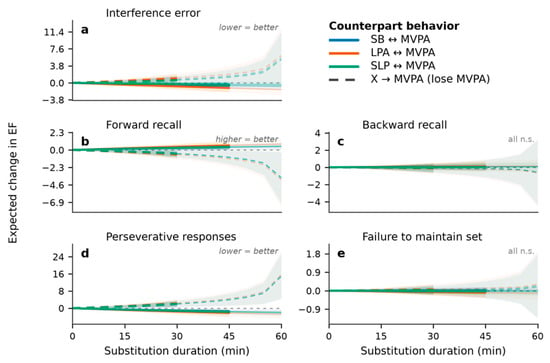
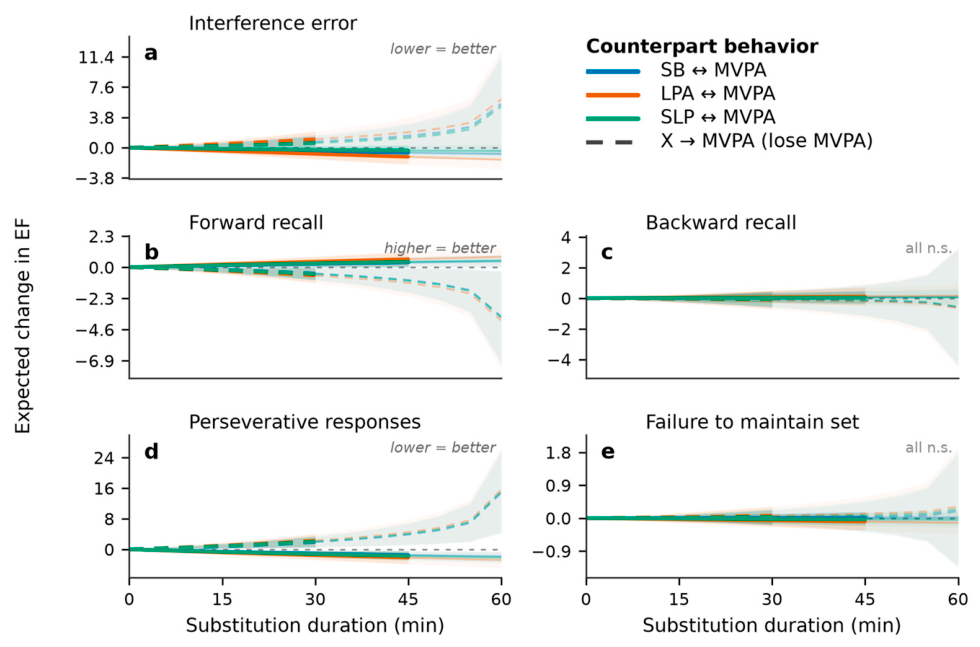
Figure 1.
Expected changes in executive function associated with isotemporal substitutions between 24 h movement behaviors. The vertical axis represents the expected change B (95% confidence interval) for each executive function indicator: (a) interference error score; (b) forward recall score; (c) backward recall score; (d) perseverative responses; (e) failure to maintain set. Solid lines indicate time reallocation from SB, LPA, or SLP to MVPA, and dashed lines indicate the reverse reallocation; the shaded bands represent 95% confidence intervals. n.s. indicates that the confidence interval for that pair of substitutions includes 0 over the 0–60 min range. The substitution trends for time interference score and categories completed were not statistically significant. Faded line segments mark the portions of the trajectories beyond the substantively interpretable range (forward substitutions beyond 45 min; reverse substitutions beyond 30 min), which constitute boundary extrapolations (see Section 3.5).
2.6. Ethics and Data Availability
This study was approved by the Science and Technology Ethics Committee of Ludong University (approval number: LDU-IRB202406033, approved in 2024) and complied with the requirements of the Declaration of Helsinki. Prior to testing, the children’s guardians were fully informed of the study content and signed written informed consent.
Data availability statement: The data presented in this study are available on reasonable request from the corresponding author.
3. Results
3.1. Basic Characteristics of 24-h Movement Behaviors and Executive Function
Table 1 shows that the participants’ mean daily durations of SB, LPA, MVPA, and SLP were 556.28 ± 66.63, 275.13 ± 44.60, 63.22 ± 20.78, and 545.37 ± 60.34 min, respectively. Independent-samples t-tests showed that boys’ mean daily MVPA (67.59 ± 21.81 min) was significantly higher than girls’ (57.39 ± 17.76 min) (p < 0.001); SB, LPA, and SLP showed no significant sex differences (all p > 0.05). With respect to executive function, boys’ forward recall score (4.85 ± 2.32) was significantly higher than girls’ (4.39 ± 2.35) (p = 0.032), while no significant sex differences were observed for the remaining measures (all p > 0.05).
3.2. Compositional Characteristics of 24-h Movement Behaviors
Table 2 shows that the geometric means of the 24-h time composition of the study participants were SB 558.98 min (38.8%), LPA 274.57 min (19.1%), MVPA 60.35 min (4.2%), and SLP 546.11 min (37.9%). The variation matrix showed that the log-ratio variance for the LPA–SB pair was the smallest (0.06), indicating that these two components were the most interdependent; the log-ratio variances for the MVPA–SB and MVPA–SLP pairs were larger (0.18 and 0.19), and the log-ratio variance for the MVPA–LPA pair was the smallest among the pairs involving MVPA (0.10). The variation matrix describes relative covariation; smaller pairwise log-ratio variances do not by themselves imply practical substitutability. Hypothetical isotemporal reallocations are not observed behavior changes.
Table 2.
Geometric means (proportions) and variation matrix of 24 h movement behaviors.
3.3. Compositional Linear Regression of 24-h Movement Behaviors and Executive Function
After adjusting for sex, age, school (five schools as fixed effects), height, and weight, compositional multiple linear regression models were constructed using ilr coordinates; Table 3 reports the unstandardized regression estimates (B) on the original outcome scales. Relative to the other three behaviors: a higher proportion of time spent in LPA was significantly positively associated with interference error score (B = 4.22, 95% CI [1.47, 6.97], p = 0.003); a higher proportion of time spent in MVPA was significantly positively associated with forward recall score (B = 0.96, 95% CI [0.08, 1.84], p = 0.033) and significantly negatively associated with perseverative responses (B = −3.87, 95% CI [−6.63, −1.11], p = 0.006); SLP was significantly positively associated with time interference score (B = 317.67, 95% CI [53.42, 581.93], p = 0.019) and significantly negatively associated with interference error score (B = −3.52, 95% CI [−5.55, −1.49], p < 0.001); and SB was significantly negatively associated with failure to maintain set (B = −0.59, 95% CI [−1.15, −0.02], p = 0.042) and was not significantly associated with the remaining indicators. Other associations did not reach statistical significance. After outcome-stratified Benjamini–Hochberg corrections, the perseverative response associations remained statistically significant, whereas the forward recall associations did not (Section 3.6).
Table 3.
Unstandardized compositional regression estimates (B) and 95% CI [lower limit, upper limit] for movement behaviors and executive function.
3.4. Associations of 15 Min Isotemporal Substitutions with Executive Function
Each of the 12 substitution combinations was modeled in 15 min units, and Table 4 presents unstandardized expected change estimates (B) with 95% CI [lower limit, upper limit]. After adjusting for covariates, substituting MVPA for SB was associated with fewer perseverative responses (B = −0.60, 95% CI [−1.06, −0.15]); the reverse substitution (MVPA replaced by SB) was associated with more perseverative responses (B = 0.79, 95% CI [0.20, 1.38]). Substituting MVPA for LPA was associated with a lower interference error score (B = −0.41, 95% CI [−0.76, −0.06]), a higher forward recall score (B = 0.22, 95% CI [0.03, 0.42]), and fewer perseverative responses (B = −0.82, 95% CI [−1.43, −0.21]); the reverse substitution was associated with a higher interference error score (B = 0.47, 95% CI [0.05, 0.89]), a lower forward recall score (B = −0.26, 95% CI [−0.50, −0.03]), and more perseverative responses (B = 1.00, 95% CI [0.26, 1.73]). Substituting MVPA for SLP was associated with a higher forward recall score (B = 0.16, 95% CI [0.01, 0.31]) and fewer perseverative responses (B = −0.68, 95% CI [−1.15, −0.22]); the reverse substitution was associated with a lower forward recall score (B = −0.21, 95% CI [−0.40, −0.02]) and more perseverative responses (B = 0.87, 95% CI [0.27, 1.46]). The forward recall change for the MVPA–SB pair (B = 0.15, 95% CI [−0.00, 0.29], p = 0.052) did not reach statistical significance. In addition, Table 4 shows that substituting SB for SLP was associated with a lower time interference score (B = −11.56, 95% CI [−21.38, −1.74]), whereas substituting SLP for SB was associated with a higher time interference score (B = 11.51, 95% CI [1.68, 21.34]), suggesting that substitutions between sleep and waking behaviors were bidirectionally associated with the processing efficiency of inhibitory control. As detailed in Section 3.6, the perseverative response associations remained statistically significant after outcome-stratified Benjamini–Hochberg correction, whereas the forward recall associations did not. All 84 estimates in Table 4 were re-computed from the raw data for this revision (school entered as fixed effects).
Table 4.
Unstandardized expected change estimates (B) and 95% CI [lower limit, upper limit] in executive function associated with 15 min isotemporal substitutions between 24 h movement behaviors.
3.5. Expected Change Trajectories Across MVPA Reallocation Durations (0–60 Min)
Using the compositional (geometric) mean composition of the study participants (SB 558.98, LPA 274.57, MVPA 60.35, SLP 546.11 min) as the anchor, we simulated the expected changes in each executive function indicator after pairwise isotemporal substitutions of 0–60 min of MVPA with SB, LPA, and SLP in 5 min increments (Figure 1). These trajectories are model-derived expected changes under hypothetical one-to-one reallocations within a fixed 24 h day; they are not empirical dose–response estimates obtained from observed variation in children’s actual activity durations and should be interpreted accordingly. The changes in the time interference score and categories completed with substitution duration were not statistically significant and were therefore not included in the trend analysis. Figure 1 shows that when MVPA replaced SB, LPA, and SLP, the expected changes in perseverative responses (Figure 1d) accumulated progressively with increasing substitution duration, with the 95% CI excluding 0 across the 0–60 min range in all three substitution pairs; the forward recall score (Figure 1b) showed progressive accumulation in the LPA and SLP pairs, whereas the 95% CI for the SB pair included 0 at durations beyond 15 min. The reciprocal substitutions (replacing MVPA with SB, LPA, or SLP) showed progressive changes in the opposite direction. Their magnitudes grew steeply with duration: at 60 min they reached implausible values (e.g., +14.8 perseverative responses, ≈2.3 SD), because the compositional mean anchor implies that replacing 60 min of MVPA drives MVPA to ≈0.35 min/day—at the zero boundary of the composition, where the log-ratio estimates become unstable. These reverse-direction 60 min values are therefore boundary extrapolations that are not behaviorally plausible and are shown in Figure 1 and Tables S9–S13 for completeness only; quantitatively, only the forward-direction trajectories (MVPA replacing other behaviors) and durations up to 45 min should be interpreted. For the interference error score, only the association in the LPA substitution pair strengthened with increasing substitution duration (Figure 1a), whereas the 95% CI for the SB and SLP pairs included 0. The backward recall score and failure to maintain set (Figure 1c,e) changed in the expected direction, but the 95% CI included 0 across the 0–60 min range, and the trends did not reach statistical significance. Overall, the associations of substituting MVPA for other behaviors accumulated progressively with increasing substitution duration.
3.6. Sensitivity Analyses
Regarding the multiple-comparison corrections, among the 84 isotemporal substitution tests, 21 were nominally significant (p < 0.05). After BH correction stratified by outcome, all six MVPA-related substitution pairs for perseverative responses remained significant (adjusted p = 0.0197), and eight items for interference error score remained significant (adjusted p = 0.0019–0.0424), whereas the five nominally significant substitution combinations for forward recall score did not remain significant after stratified correction (adjusted p = 0.0859). These findings indicate that the perseverative response and interference error associations are robust to multiple-comparison corrections, whereas the forward recall associations should be regarded as suggestive. Re-examination using linear mixed models with school as a random intercept showed that school-level variance was non-negligible for recall-type indicators (forward recall score ICC ≈ 0.25, backward recall score ICC ≈ 0.17) and that the school fixed effects included in the primary model already controlled for this; the effect directions of all substitution combinations were fully consistent with the main analysis, and the core conclusions remained unchanged. Because only five schools were sampled, school-level random-effect estimates are imprecise, and inferences based on five clusters are unreliable; for this reason, the primary analysis treats school as fixed effects (five indicator variables), and the mixed models serve only as a sensitivity check. After excluding two participants with extreme wear records, six borderline combinations (five involving SLP, one involving the forward recall SB → MVPA pair) changed in significance, while all six MVPA-related perseverative response pairs remained unchanged, and the core conclusions remained stable. Under Huber robust regression, the positive association of SLP relative to other behaviors with time interference score remained stable (B = 286.3, p = 0.010); the effect estimate for SB became significantly negative under robust regression (B = −340.7, p < 0.001), inconsistent with the non-significant association in the main analysis, suggesting that the SB effect estimate is susceptible to extreme values. The sex × behavior composition interaction effects were not statistically significant for any outcome (p = 0.276–0.803); sex-stratified estimates showed that the associations of substituting MVPA for other behaviors with forward recall score and perseverative responses were significant in boys (p = 0.002–0.045) and in the same direction but not significant in girls (p = 0.307–0.794). Complete results are provided in the Supplementary Materials. These subgroup differences should be interpreted cautiously: the sex × composition interaction tests were not significant, the study was not powered to test sex-specific associations, and the stratified results are post hoc and should not be used to infer sex-specific effects.
4. Discussion
4.1. MVPA—The Most Consistently Associated Component
MVPA was the movement behavior component most consistently associated with executive function. In compositional regression, a higher proportion of MVPA was associated with higher forward recall scores (B = 0.96, 95% CI [0.08, 1.84]) and fewer perseverative responses (B = −3.87, 95% CI [−6.63, −1.11]). Reallocating 15 min/day from SB, LPA, or SLP to MVPA was associated with fewer perseverative responses (B = −0.60 to −0.82). In the 0–60 min trajectories, when MVPA replaced SB, LPA, or SLP, the expected changes in perseverative responses accumulated progressively with increasing substitution duration, with the 95% CI excluding 0 in all three substitution pairs. The perseverative response associations were robust to outcome-stratified multiple comparison correction, whereas the forward recall associations did not survive correction and should be regarded as suggestive.
These findings are consistent with the overall conclusions of “exercise–cognition” research (Best, 2010; Verburgh et al., 2014) and with meta-analytic evidence that working memory and cognitive flexibility are among the executive function outcomes most consistently associated with physical activity in children (H. Wang et al., 2023; J. Li et al., 2025; Xue et al., 2019). The progressive accumulation of model-based expected changes over increasing reallocation durations is broadly consistent with the empirical dose–response associations reported in the physical activity literature (H. Wang et al., 2023), although the present trajectories are model-derived expected changes rather than empirical dose–response observations.
The mechanisms underlying these associations may arise from two possible sources. First, MVPA may promote executive function through BDNF expression, improved blood circulation in cognition-related brain regions, and enhanced neuroplasticity (Colcombe & Kramer, 2003; Lubans et al., 2016; Pontifex et al., 2009; Voss et al., 2011), and the progressive accumulation of model-based expected changes across durations is consistent with a cumulative role of neurotrophic factors such as BDNF (Lubans et al., 2016). Second, the MVPA–LPA contrast is also consistent with a hypothesized “intensity threshold effect”: MVPA may activate cognitive brain regions to a greater extent than LPA, such that LPA occupying time otherwise spent in MVPA could attenuate executive function development (Erickson et al., 2015; Esteban-Cornejo et al., 2015). Because these factors were not measured in the present study, these mechanistic explanations are hypotheses based on previous literature and require further experimental verification.
4.2. LPA—Opposite-Direction Associations
LPA showed associations in the opposite direction to MVPA: a higher proportion of LPA was associated with higher interference error scores (B = 4.22, 95% CI [1.47, 6.97]), and substituting LPA for MVPA was associated with a higher interference error score (B = 0.47, 95% CI [0.05, 0.89]), a lower forward recall score (B = −0.26, 95% CI [−0.50, −0.03]), and more perseverative responses (B = 1.00, 95% CI [0.26, 1.73]).
The opposite-direction associations of LPA are consistent with the hypothesized “intensity threshold effect” reported in previous studies (Erickson et al., 2015; Esteban-Cornejo et al., 2015). Erickson et al. (2015), reviewing the physical activity–cognition literature, concluded that the cognitive benefits of physical activity increase with exercise intensity, with higher-intensity aerobic activity producing the largest gains in executive function and in prefrontal and hippocampal structure and function. Consistently, a systematic review of 20 studies in adolescents (Esteban-Cornejo et al., 2015) found that cognitive performance was specifically associated with vigorous physical activity, whereas general physical activity was related to academic performance—an intensity gradient compatible with the present finding that lower-intensity LPA showed associations opposite in direction to those of MVPA. At the same time, this intensity gradient is not a uniform finding across the literature: a recent umbrella review of 133 systematic reviews (covering 2724 randomized trials) found that exercise improved executive function across intensities, with effects generally larger for low- and moderate-intensity interventions (Singh et al., 2025).
The intensity threshold interpretation should therefore be regarded as one hypothesis among several rather than as established evidence. LPA consists mostly of fragmented low-intensity activities with limited activation of core cognitive brain regions such as the frontal lobe and hippocampus, and excessive LPA may displace time for MVPA and high-quality sleep; a “moderation boundary” for LPA is therefore plausible.
4.3. Sleep—Dual Associations
Sleep showed a dual pattern: a higher proportion of SLP was associated with lower interference error scores (B = −3.52, 95% CI [−5.55, −1.49]) but higher time interference scores (B = 317.67, 95% CI [53.42, 581.93]). Replacing 15 min of SLP with MVPA was associated with a higher forward recall score (B = 0.16, 95% CI [0.01, 0.31]) and fewer perseverative responses (B = −0.68, 95% CI [−1.15, −0.22]). In addition, substitutions between SB and SLP were bidirectionally associated with the time interference score (B = −11.56 and 11.51, respectively), suggesting that under hypothetical reallocations between sleep and waking time, shifts in the sleep–wake balance may be associated with cognitive processing speed.
The dual SLP pattern is consistent with evidence of a hypothesized inverted U-shaped sleep–cognition relationship (Short et al., 2018; Zahran et al., 2024). Short et al. (2018), in a systematic review and meta-analysis of objectively measured sleep duration and cognition in children aged 5–13 years, found a small overall positive association between sleep duration and cognition (r = 0.06), which was significant for full/verbal IQ but not for memory, fluid IQ, processing speed, or attention, and noted that most children in the reviewed studies were sleep-restricted relative to guideline recommendations. Zahran et al. (2024), applying a compositional “Goldilocks day” analysis in 858 early-years children, identified an optimal sleep duration associated with better cognitive function, indicating that too little and too much sleep may be suboptimal.
These findings are broadly compatible with the dual SLP pattern observed here, in which sleep showed favorable associations with one interference indicator but unfavorable associations with another. The dual pattern may reflect an inverted U-shaped sleep–cognition relationship, whereby insufficient sleep impairs inhibitory control and excessive sleep compresses time for daytime activity and cognitive stimulation (Short et al., 2018; Zahran et al., 2024); however, the present cross-sectional analyses do not directly test non-linearity (no quadratic or spline terms were modeled), and thus, the inverted U interpretation remains a hypothesis for future studies with appropriate non-linear models. Regarding the MVPA–SLP substitutions, the observed associations should not be interpreted as endorsing reduced sleep, as sleep is essential for brain restoration and memory consolidation (Walker & Stickgold, 2004). The observed findings may instead reflect the cognitive associations of additional MVPA. Whether short-term reductions in sleep time remain cognitively harmless within some as-yet-unspecified range is an open hypothesis that the present data cannot evaluate.
4.4. Sedentary Behavior—Largely Null Associations
Sedentary behavior showed largely null associations with executive function: in compositional regression, SB was not significantly associated with any indicator except fewer failures to maintain set (B = −0.59, 95% CI [−1.15, −0.02]), and the SB-related substitution estimates were mostly small, with confidence intervals that included zero. The sensitivity analyses further showed that the SB association changed from non-significant to significantly negative under robust regression, indicating that at least some estimates are sensitive to influential observations.
The largely null SB associations differ from the findings of some previous studies (Fochesatto et al., 2024; Kostyrka-Allchorne et al., 2017). Kostyrka-Allchorne et al. (2017), in a systematic review and meta-analysis, reported small but consistent negative associations between screen time and cognitive performance in school-aged children, and Fochesatto et al. (2024) found that interruptions of prolonged sedentary time (sedentary breaks)—rather than total sedentary time—were associated with higher fluid intelligence in overweight/obese and physically inactive children. These findings indicate that the cognitive relevance of sedentary behavior may lie in its context and pattern rather than in its total volume: screen-based time showed negative associations with cognitive performance (Kostyrka-Allchorne et al., 2017), and interrupting prolonged sitting showed associations with higher fluid intelligence (Fochesatto et al., 2024)—neither of which is distinguishable using accelerometry-based total SB as measured in the present study. Consistent with this view, Aggio et al. (2016) found that objectively measured total sedentary time and time spent on homework at age 7 years were positively associated with cognition at age 11 years, whereas television viewing was negatively associated, demonstrating that different forms of sedentary behavior can have directionally opposite associations.
Two features of the present study may therefore explain the largely null SB results: first, the accelerometer-based SB measure aggregates contextually heterogeneous behaviors whose associations may offset one another; and second, the compositional model expresses SB relative to the other three behaviors, so the estimate reflects relative allocation rather than absolute SB volume, and any association specific to total SB volume would not be directly visible in this framework.
4.5. Strengths, Limitations, and Alternative Interpretations
The strengths of this study are mainly reflected in the following aspects: First, the sample covered five regions across eastern, central, and western China, and a wrist-worn accelerometer was used to objectively monitor 24-h movement behaviors for seven consecutive days, yielding relatively high measurement precision. Second, a compositional data analysis framework was employed; through isometric log-ratio transformation, the collinearity and spurious correlation problems arising from the constant-sum constraint of 24-h time use data were overcome. On this basis, 15-min isotemporal substitution and 0–60 min expected change trajectory analyses were conducted, which not only characterized the overall association between reallocation of movement time and executive function but also revealed its gradient characteristics. Third, the executive function assessment covered the three core dimensions of inhibitory control, working memory, and cognitive flexibility, providing relatively comprehensive outcome measures. Fourth, this study examined the substitution associations between MVPA and other movement behaviors together with their 0–60 min expected change trajectories in Chinese school-aged children (6–8 years), thereby providing local evidence for refining Chinese guidelines for children’s 24-h movement behaviors.
This study also has certain limitations and alternative interpretations. First, the cross-sectional design precludes causal inference; the isotemporal substitution results represent model-based “expected changes” rather than changes measured under an actual intervention, and future randomized controlled trials or longitudinal studies are needed to verify these findings. Second, although the sample covered five regions, only one school was included in each region, and school selection relied on accessibility and willingness to participate; geographic coverage should therefore not be interpreted as population representativeness. The participation rate was not systematically documented, and selection bias cannot be excluded. Generalization to Chinese children as a whole should be made with caution. Third, with only five school-level clusters, the effective sample size at the school level is very small. The primary analysis therefore conditions on school through fixed-effect indicators, which fully absorb school-level confounding without the distributional assumptions of random-effect estimation; the mixed-model sensitivity analysis showed effect directions fully consistent with the main analysis (and appreciable school-level clustering for the recall-type outcomes, ICC ≈ 0.17–0.25), supporting the adequacy of this choice. Cluster-level inference nevertheless remains limited, and because one school represents each region, school and region effects cannot be separated; generalization should be made with caution, and future studies should include more schools per region. Fourth, the reverse-direction expected change trajectories (replacing MVPA with SB, LPA, or SLP) become unstable at long durations: with the compositional mean anchor (MVPA = 60.35 min/day), replacing 60 min of MVPA drives MVPA to ≈0.35 min—at the zero boundary of the composition—where the estimates reach implausible magnitudes (+14.8 perseverative responses, ≈2.3 SD); these values are boundary extrapolations rather than behaviorally plausible changes. Although the full 0–60 min range is shown in Figure 1 and Tables S9–S13, only the forward-direction trajectories and durations up to 45 min should be interpreted quantitatively; trajectories beyond 60 min were not examined. More generally, apparent differences in magnitude between the two substitution directions can also arise from skewed outcome distributions, floor/ceiling effects in the executive function measures, the constant-sum constraint of compositional data, and model parameterization (e.g., the choice of substitution anchor); any empirical asymmetry in the estimated associations should therefore be distinguished from a hypothesized biological explanation, and we do not interpret the directional differences in magnitude as evidence of a behavioral asymmetry. Fifth, wrist-worn accelerometers have limited accuracy in detecting sedentary posture, and sleep duration was estimated indirectly by algorithms and may be confounded with non-wear time; more generally, the classification of sedentary behavior, physical activity intensity, and sleep from wrist acceleration involves non-trivial uncertainty in young children, and measurement error may attenuate the already small observed associations. Future studies could combine body posture sensors with sleep diaries and validate intensity classification against direct observation to improve accuracy. Sixth, this study did not differentiate types of sedentary behavior or dimensions of sleep quality, nor did it assess indicators of emotion and neural mechanisms; future work could incorporate neuroimaging techniques such as fNIRS and EEG and emotion regulation variables; whether exercise is similarly associated with emotional intelligence (emotion recognition and emotion regulation) is beyond the scope of this study and remains to be verified by future research integrating emotion assessment with neuroimaging.
4.6. Future Research Directions
Recognizing the methodological considerations and limitations of compositional data analysis (Alenazi, 2023), future research could consider integrating CoDA with dynamic structural equation modeling (DSEM; Asparouhov et al., 2018). With repeated assessments of movement behaviors and executive function, such an approach could distinguish within-person dynamic associations from between-person differences, examine autoregressive and reciprocal relationships, and investigate individual differences in these associations, thereby extending the present findings beyond cross-sectional associations toward the temporal processes linking daily movement behaviors with cognitive functioning. Furthermore, because the total daily duration is fixed at 24 h, future methodological investigations could compare models based on raw activity durations with those using compositional log-ratio transformations, while appropriately accounting for the constant-sum constraint; such comparisons could establish whether compositional transformations offer advantages in model fit, predictive performance, and substantive interpretation. Finally, randomized trials and longitudinal studies with repeated accelerometer and executive function assessments are needed to test whether the model-derived expected changes reported here correspond to observed changes in children’s cognitive functioning.
5. Conclusions
- (1)
- MVPA was the movement behavior component most consistently associated with executive function: its associations with fewer perseverative responses were the most robust, whereas its associations with higher forward recall did not survive correction and should be regarded as suggestive.
- (2)
- In model-based cross-sectional estimates, reallocating 15 min/day from SB, LPA, or SLP to MVPA was associated with fewer perseverative responses.
- (3)
- These favorable expected changes accumulated progressively with increasing substitution duration within the substantively interpretable range; beyond this range—notably the reverse-direction trajectories past 30 min, which approach the zero-MVPA boundary—the estimates are boundary extrapolations shown for completeness only. All findings are model-based expected changes under hypothetical reallocations and do not establish a general cognitive benefit across all executive function domains.
Supplementary Materials
The following supporting information can be downloaded at: https://www.mdpi.com/article/10.3390/jintelligence14110278/s1, Table S1: Main analysis: 84 estimates of 15-min isotemporal substitutions with Benjamini–Hochberg correction; Table S2: School random-intercept mixed models: variance components (lmer, REML); Table S3: Cluster-robust standard errors with schools as clusters: 84 substitution estimates; Table S4: After excluding extreme wear records (n = 439): 84 substitution estimates; Table S5: Huber robust regression: complete results for the seven outcomes; Table S6: Sex × behavior-composition interaction effects; Table S7: Sex-stratified analyses: 84 substitution estimates (boys n = 252/girls n = 189); Table S8: Standardized substitution effect sizes (d = B/SD): 84 estimates; Table S9: Expected-change trajectory data: Interference error score (source data of Figure 1 of the main manuscript; 0–60 min, 5-min increments); Table S10: Expected-change trajectory data: Forward recall score (source data of Figure 1 of the main manuscript; 0–60 min, 5-min increments); Table S11: Expected-change trajectory data: Backward recall score (source data of Figure 1 of the main manuscript; 0–60 min, 5-min increments); Table S12: Expected-change trajectory data: Perseverative responses (source data of Figure 1 of the main manuscript; 0–60 min, 5-min increments); Table S13: Expected-change trajectory data: Failure to maintain set (source data of Figure 1 of the main manuscript; 0–60 min, 5-min increments).
Author Contributions
Conceptualization, Y.S.; methodology, X.Y.; software, C.Z. and X.M.; validation, Y.S.; formal analysis, C.Z.; investigation, C.Z.; resources, X.Y. and Y.S.; data curation, C.Z.; writing—original draft preparation, C.Z.; writing—review and editing, Y.S.; visualization, B.L.; supervision, Y.S. and X.Y.; project administration, Y.S. All authors have read and agreed to the published version of the manuscript.
Funding
This study was supported by the 2023 Key Project of the Shandong Provincial Education Science Planning Program, “Research on the Construction of a Supervision System for Promoting Students, Physical Fitness and Health Standards” (Grant No. 2023ZD027).
Institutional Review Board Statement
The study was conducted in accordance with the Declaration of Helsinki and approved by the Ethics Committee of Ludong University (protocol code LDU-IRB202406033; approved in 2024).
Informed Consent Statement
Informed consent was obtained from all guardians of the children involved in the study.
Data Availability Statement
The data presented in this study are available on reasonable request from the corresponding author; an anonymized analysis dataset will be deposited in a public repository upon acceptance of the manuscript.
Acknowledgments
The authors would like to thank all the participants who voluntarily took part in this study.
Conflicts of Interest
The authors declare no conflicts of interest.
Abbreviations
The following abbreviations are used in this manuscript: BH, Benjamini–Hochberg; BMI, body mass index; CI, confidence interval; CoDA, compositional data analysis; DSEM, dynamic structural equation modeling; EF, executive function; ENMO, Euclidean norm minus one; ICC, intraclass correlation coefficient; ilr, isometric log-ratio; LPA, light physical activity; MVPA, moderate-to-vigorous physical activity; SB, sedentary behavior; SD, standard deviation; SLP, sleep; WCST, Wisconsin Card Sorting Test.
References
- Aggio, D., Smith, L., Fisher, A., & Hamer, M. (2016). Context-specific associations of physical activity and sedentary behavior with cognition in children. American Journal of Epidemiology, 183(12), 1075–1082. [Google Scholar] [CrossRef] [Scilit]
- Alenazi, A. (2023). A review of compositional data analysis and recent advances. Communications in Statistics—Theory and Methods, 52(16), 5535–5567. [Google Scholar] [CrossRef] [Scilit]
- Asparouhov, T., Hamaker, E. L., & Muthén, B. (2018). Dynamic structural equation models. Structural Equation Modeling: A Multidisciplinary Journal, 25(3), 359–388. [Google Scholar] [CrossRef] [Scilit]
- Best, J. R. (2010). Effects of physical activity on children’s executive function: Contributions of experimental research on aerobic exercise. Developmental Review, 30(4), 331–351. [Google Scholar] [CrossRef] [Scilit]
- Bezerra, T. A., Clark, C. C. T., Souza Filho, A. N. D., Fortes, L. D. S., Mota, J. A. P. S., Duncan, M. J., & Martins, C. M. D. L. (2021). 24-hour movement behaviour and executive function in preschoolers: A compositional and isotemporal reallocation analysis. European Journal of Sport Science, 21(7), 1064–1072. [Google Scholar] [CrossRef] [Scilit]
- Blair, C. (2006). How similar are fluid cognition and general intelligence? A developmental neuroscience perspective on fluid cognition as an aspect of human cognitive ability. Behavioral and Brain Sciences, 29(2), 109–125. [Google Scholar] [CrossRef] [Scilit]
- Caffarra, P., Vezzadini, G., Dieci, F., Zonato, F., & Venneri, A. (2002). Una versione abbreviata del test di Stroop: Dati normativi nella popolazione italiana. Nuova Rivista di Neurologia, 12(4), 111–115. [Google Scholar]
- Chaddock-Heyman, L., Hillman, C. H., Cohen, N. J., & Kramer, A. F. (2014). III. The importance of physical activity and aerobic fitness for cognitive control and memory in children. Monographs of the Society for Research in Child Development, 79(4), 25–50. [Google Scholar] [CrossRef] [Scilit]
- Chang, Z., Wang, L., & Zhu, A. (2025). Relationship between 24-hour movement behaviors and executive function in preschool children based on compositional data analysis. Acta Psychologica, 259, 105394, (Corrigendum in 2025, Acta Psychologica, 260, 105618). [Google Scholar] [CrossRef] [Scilit]
- Chaput, J.-P., Carson, V., Gray, C. E., & Tremblay, M. S. (2014a). Importance of all movement behaviors in a 24 hour period for overall health. International Journal of Environmental Research and Public Health, 11(12), 12575–12581. [Google Scholar] [CrossRef] [Scilit]
- Chaput, J.-P., Leduc, G., Boyer, C., Bélanger, P., LeBlanc, A. G., Borghese, M. M., & Tremblay, M. S. (2014b). Objectively measured physical activity, sedentary time and sleep duration: Independent and combined associations with adiposity in Canadian children. Nutrition & Diabetes, 4(6), e117. [Google Scholar] [CrossRef] [Scilit]
- Chastin, S. F. M., Palarea-Albaladejo, J., Dontje, M. L., & Skelton, D. A. (2015). Combined effects of time spent in physical activity, sedentary behaviors and sleep on obesity and cardio-metabolic health markers: A novel compositional data analysis approach. PLoS ONE, 10(10), e0139984. [Google Scholar] [CrossRef] [Scilit]
- Colcombe, S., & Kramer, A. F. (2003). Fitness effects on the cognitive function of older adults: A meta-analytic study. Psychological Science, 14(2), 125–130. [Google Scholar] [CrossRef] [Scilit]
- Cui, J., Li, L., & Dong, C. (2022). The associations between specific-type sedentary behaviors and cognitive flexibility in adolescents. Frontiers in Human Neuroscience, 16, 910624. [Google Scholar] [CrossRef] [Scilit]
- Diamond, A. (2013). Executive functions. Annual Review of Psychology, 64, 135–168. [Google Scholar] [CrossRef] [Scilit] [PubMed]
- Donnelly, J. E., Hillman, C. H., Castelli, D., Etnier, J. L., Lee, S., Tomporowski, P., Lambourne, K., & Szabo-Reed, A. N. (2016). Physical activity, fitness, cognitive function, and academic achievement in children: A systematic review. Medicine & Science in Sports & Exercise, 48(6), 1197–1222. [Google Scholar] [CrossRef] [Scilit]
- Dumuid, D., Pedišić, Ž., Stanford, T. E., Martín-Fernández, J.-A., Hron, K., Maher, C. A., Lewis, L. K., & Olds, T. (2019). The compositional isotemporal substitution model: A method for estimating changes in a health outcome for reallocation of time between sleep, physical activity and sedentary behaviour. Statistical Methods in Medical Research, 28(3), 846–857. [Google Scholar] [CrossRef] [Scilit]
- Dumuid, D., Stanford, T. E., Martín-Fernández, J.-A., Pedišić, Ž., Maher, C. A., Lewis, L. K., Hron, K., Katzmarzyk, P. T., Chaput, J.-P., Fogelholm, M., Hu, G., Lambert, E. V., Maia, J., Sarmiento, O. L., Standage, M., Barreira, T. V., Broyles, S. T., Tudor-Locke, C., Tremblay, M. S., & Olds, T. (2017). Compositional data analysis for physical activity, sedentary time and sleep research. Statistical Methods in Medical Research, 27(12), 3726–3738. [Google Scholar] [CrossRef] [Scilit]
- Erickson, K. I., Hillman, C. H., & Kramer, A. F. (2015). Physical activity, brain, and cognition. Current Opinion in Behavioral Sciences, 4, 27–32. [Google Scholar] [CrossRef] [Scilit]
- Esteban-Cornejo, I., Tejero-González, C. M., Sallis, J. F., & Veiga, O. L. (2015). Physical activity and cognition in adolescents: A systematic review. Journal of Science and Medicine in Sport, 18(5), 534–539. [Google Scholar] [CrossRef] [Scilit]
- Fochesatto, C. F., Brand, C., Cristi-Montero, C., da Costa, B. G. G., Dias, A. F., Gaya, A. C. A., & Gaya, A. R. (2024). Getting up for brain health: Association of sedentary behavior breaks with cognition and mental health in children. Applied Neuropsychology: Child, 1–8. [Google Scholar] [CrossRef] [Scilit]
- Friedman, N. P., Miyake, A., Corley, R. P., Young, S. E., DeFries, J. C., & Hewitt, J. K. (2006). Not all executive functions are related to intelligence. Psychological Science, 17(2), 172–179. [Google Scholar] [CrossRef] [Scilit]
- Heaton, R. K., Chelune, G. J., Talley, J. L., Kay, G. G., & Curtiss, G. (1993). Wisconsin card sorting test manual: Revised and expanded. Psychological Assessment Resources. [Google Scholar]
- Hildebrand, M., Hansen, B. H., van Hees, V. T., & Ekelund, U. (2017). Evaluation of raw acceleration sedentary thresholds in children and adults. Scandinavian Journal of Medicine & Science in Sports, 27(12), 1814–1823. [Google Scholar] [CrossRef] [Scilit]
- Hildebrand, M., Van Hees, V. T., Hansen, B. H., & Ekelund, U. (2014). Age group comparability of raw accelerometer output from wrist- and hip-worn monitors. Medicine & Science in Sports & Exercise, 46(9), 1816–1824. [Google Scholar] [CrossRef] [Scilit]
- Kostyrka-Allchorne, K., Cooper, N. R., & Simpson, A. (2017). The relationship between television exposure and children’s cognition and behaviour: A systematic review. Developmental Review, 44, 19–58. [Google Scholar] [CrossRef] [Scilit]
- Li, J., Huang, Z., Feng, X., & Liu, Y. (2025). Effects of physical activity on executive function in children and adolescents: A Bayesian dose-response network meta-analysis. Complementary Therapies in Clinical Practice, 61, 102016. [Google Scholar] [CrossRef] [Scilit]
- Li, S., Guo, J., Zheng, K., Shi, M., & Huang, T. (2022). Is sedentary behavior associated with executive function in children and adolescents? A systematic review. Frontiers in Public Health, 10, 832845. [Google Scholar] [CrossRef] [Scilit]
- Lu, Z., Qu, X., Chang, J., Xu, M., Song, G., Wang, X., Okely, A. D., Zhang, T., Guan, H., & Wu, J. (2023). Reallocation of time between preschoolers’ 24-h movement behaviours and executive functions: A compositional data analysis. Journal of Sports Sciences, 41(12), 1187–1195. [Google Scholar] [CrossRef] [Scilit]
- Lubans, D., Richards, J., Hillman, C., Faulkner, G., Beauchamp, M., Nilsson, M., Kelly, P., Smith, J., Raine, L., & Biddle, S. (2016). Physical activity for cognitive and mental health in youth: A systematic review of mechanisms. Pediatrics, 138(3), e20161642. [Google Scholar] [CrossRef] [Scilit]
- Marques, A., Santos, R., Ekelund, U., & Sardinha, L. B. (2015). Association between physical activity, sedentary time, and healthy fitness in youth. Medicine & Science in Sports & Exercise, 47(3), 575–580. [Google Scholar] [CrossRef] [Scilit]
- Migueles, J. H., Rowlands, A. V., Huber, F., Sabia, S., & van Hees, V. T. (2019). GGIR: A research community-driven open source R package for generating physical activity and sleep outcomes from multi-day raw accelerometer data. Journal for the Measurement of Physical Behaviour, 2(3), 188–196. [Google Scholar] [CrossRef] [Scilit]
- Miyake, A., & Friedman, N. P. (2012). The nature and organization of individual differences in executive functions: Four general conclusions. Current Directions in Psychological Science, 21(1), 8–14. [Google Scholar] [CrossRef] [Scilit]
- Moffitt, T. E., Arseneault, L., Belsky, D., Dickson, N., Hancox, R. J., Harrington, H., Houts, R., Poulton, R., Roberts, B. W., Ross, S., Sears, M. R., Thomson, W. M., & Caspi, A. (2011). A gradient of childhood self-control predicts health, wealth, and public safety. Proceedings of the National Academy of Sciences of the United States of America, 108(7), 2693–2698. [Google Scholar] [CrossRef] [Scilit]
- Pontifex, M. B., Hillman, C. H., Fernhall, B., Thompson, K. M., & Valentini, T. A. (2009). The effect of acute aerobic and resistance exercise on working memory. Medicine & Science in Sports & Exercise, 41(4), 927–934. [Google Scholar] [CrossRef] [Scilit]
- Scarpelli, S., Gorgoni, M., D’Atri, A., Reda, F., & De Gennaro, L. (2019). Advances in understanding the relationship between sleep and attention deficit-hyperactivity disorder (ADHD). Journal of Clinical Medicine, 8(10), 1737. [Google Scholar] [CrossRef] [Scilit]
- Short, M. A., Blunden, S., Rigney, G., Matricciani, L., Coussens, S., Reynolds, C. M., & Galland, B. (2018). Cognition and objectively measured sleep duration in children: A systematic review and meta-analysis. Sleep Health, 4(3), 292–300. [Google Scholar] [CrossRef] [Scilit]
- Singh, B., Bennett, H., Miatke, A., Dumuid, D., Curtis, R., Ferguson, T., Brinsley, J., Szeto, K., Petersen, J. M., Gough, C., Eglitis, E., Simpson, C. E., Ekegren, C. L., Smith, A. E., Erickson, K. I., & Maher, C. (2025). Effectiveness of exercise for improving cognition, memory and executive function: A systematic umbrella review and meta-meta-analysis. British Journal of Sports Medicine, 59(12), 866–876. [Google Scholar] [CrossRef] [Scilit]
- Thompson, A., & Steinbeis, N. (2020). Sensitive periods in executive function development. Current Opinion in Behavioral Sciences, 36, 98–105. [Google Scholar] [CrossRef] [Scilit]
- Tremblay, M. S., Carson, V., Chaput, J.-P., Connor Gorber, S., Dinh, T., Duggan, M., Faulkner, G., Gray, C. E., Gruber, R., Janson, K., Janssen, I., Katzmarzyk, P. T., Kho, M. E., Latimer-Cheung, A. E., LeBlanc, C., Okely, A. D., Olds, T., Pate, R. R., Phillips, A., … Zehr, L. (2016). Canadian 24-hour movement guidelines for children and youth: An integration of physical activity, sedentary behaviour, and sleep. Applied Physiology, Nutrition, and Metabolism, 41(6 Suppl. S3), S311–S327. [Google Scholar] [CrossRef] [Scilit]
- van Hees, V. T., Sabia, S., Anderson, K. N., Denton, S. J., Oliver, J., Catt, M., Abell, J. G., Kivimäki, M., Trenell, M. I., & Singh-Manoux, A. (2015). A novel, open access method to assess sleep duration using a wrist-worn accelerometer. PLoS ONE, 10(11), e0142533. [Google Scholar] [CrossRef] [Scilit] [PubMed]
- Verburgh, L., Königs, M., Scherder, E. J. A., & Oosterlaan, J. (2014). Physical exercise and executive functions in preadolescent children, adolescents and young adults: A meta-analysis. British Journal of Sports Medicine, 48(12), 973–979. [Google Scholar] [CrossRef] [Scilit]
- Voss, M. W., Nagamatsu, L. S., Liu-Ambrose, T., & Kramer, A. F. (2011). Exercise, brain, and cognition across the life span. Journal of Applied Physiology, 111(5), 1505–1513. [Google Scholar] [CrossRef] [Scilit]
- Walker, M. P., & Stickgold, R. (2004). Sleep-dependent learning and memory consolidation. Neuron, 44(1), 121–133. [Google Scholar] [CrossRef] [Scilit] [PubMed]
- Walsh, J. J., Barnes, J. D., Cameron, J. D., Goldfield, G. S., Chaput, J.-P., Gunnell, K. E., Ledoux, A.-A., Zemek, R. L., & Tremblay, M. S. (2018). Associations between 24 hour movement behaviours and global cognition in US children: A cross-sectional observational study. The Lancet Child & Adolescent Health, 2(11), 783–791. [Google Scholar] [CrossRef] [Scilit]
- Wang, H., Yang, Y., Xu, J., Niu, L., Zhang, Y., Shi, J., & Shen, L. (2023). Meta-analysis on the effects of moderate-intensity exercise intervention on executive functioning in children. PLoS ONE, 18(2), e0279846. [Google Scholar] [CrossRef] [Scilit]
- Wang, L., Luo, W., & Liu, Y. (2026). Sleep, sedentary behavior, and physical activity: A compositional data analysis of 24-hour movement behaviors and executive function in preschool children. PLoS ONE, 21(5), e0333563. [Google Scholar] [CrossRef] [Scilit]
- Xue, Y., Yang, Y., & Huang, T. (2019). Effects of chronic exercise interventions on executive function among children and adolescents: A systematic review with meta-analysis. British Journal of Sports Medicine, 53(22), 1397–1404. [Google Scholar] [CrossRef] [Scilit]
- Zahran, S., Cliff, D. P., Antczak, D., Aadland, E., Aadland, K. N., Burley, J., Carson, V., Draper, C. E., Dumuid, D., Kuzik, N., Silva, D. A. S., van Sluijs, E. M. F., Tremblay, M. S., Olds, T. S., Okely, A. D., Stanley, R., Santos, R., & Janssen, I. (2024). Optimal levels of sleep, sedentary behaviour, and physical activity needed to support cognitive function in children of the early years. BMC Pediatrics, 24(1), 735. [Google Scholar] [CrossRef] [Scilit]
- Zeng, X., Cai, L., Yang, W., Tan, W., Huang, W., & Chen, Y. (2022). Association between the 24-hour movement guidelines and executive function among Chinese children. BMC Public Health, 22(1), 1017. [Google Scholar] [CrossRef] [Scilit]

Disclaimer/Publisher’s Note: The statements, opinions and data contained in all publications are solely those of the individual author(s) and contributor(s) and not of MDPI and/or the editor(s). MDPI and/or the editor(s) disclaim responsibility for any injury to people or property resulting from any ideas, methods, instructions or products referred to in the content. |
© 2026 by the authors. Licensee MDPI, Basel, Switzerland. This article is an open access article distributed under the terms and conditions of the Creative Commons Attribution (CC BY) license.