


Abstract
Resource-constrained edge deployment of speaker verification systems requires reducing inference cost without unnecessarily invoking a high-capacity model. This study presents a margin-guided adaptive model-routing framework in which ReDimNet-b0 serves as a compact verifier and ReDimNet-b6 as an expert, with routing parameters derived from development and calibration data and frozen before evaluation. On development trials, the compact-model decision margin predicted expert-benefit cases with a ROC-AUC of 0.9797, and the lowest-margin 10% region captured 97.25% of such cases. On the 37,720-trial VoxCeleb1-O protocol, Frozen-B10 invoked ReDimNet-b6 on 9.653% of trials and achieved an EER of 0.7238%, compared with 1.5403% for static ReDimNet-b0 and 0.7158% for static ReDimNet-b6. However, its normalized minDCF was 0.1352, compared with 0.1640 and 0.0543 for the compact and expert models, respectively, showing that the near-expert EER does not extend to the low-false-alarm operating region. A 2000-replicate paired speaker-dependent bootstrap yielded a 95% confidence interval of percentage points for the EER difference between Frozen-B10 and ReDimNet-b6. This interval does not establish equivalence or non-inferiority, whereas the corresponding minDCF-difference interval remained strictly positive. On USC-SV TEST, source-frozen routing increased expert utilization from 9.653% on VoxCeleb1-O to 31.336%; system-specific decision thresholds were independently estimated on speaker-disjoint USC-SV CAL. In a cached-enrollment Raspberry Pi 5 benchmark, Frozen-B10 used the expert on 8% of trials and achieved a mean latency of 1.716 s per trial, reducing latency by 83.52% relative to unconditional sequential execution and by 81.84% relative to static ReDimNet-b6. Direct system-level energy measurements further showed consumption of J per trial, corresponding to reductions of 84.47% relative to sequential execution and 83.08% relative to static ReDimNet-b6. Substantial latency savings persisted up to 38% expert utilization, whereas process-isolated measurements showed no corresponding RAM reduction because both models remain resident. Overall, margin-guided routing concentrates expensive expert computation on a small subset of trials and substantially reduces measured edge-device latency and system-level energy, while its accuracy–efficiency trade-off remains operating-point, domain, and deployment-dependent.
1. Introduction
Automatic speaker verification (ASV) determines whether two speech samples originate from the same speaker and is widely used in biometric authentication and voice-based identity systems [1]. Recent progress has been driven by deep speaker-embedding architectures and large-scale corpora such as VoxCeleb, which have substantially improved verification performance under diverse recording conditions [2,3,4,5].
Alongside improvements in discrimination performance, computational efficiency has become increasingly important for speaker verification on resource-constrained devices. Scalable architectures such as ReDimNet provide multiple accuracy–cost operating points through speaker encoders with different model capacities [6], while lightweight architectures, compression, and knowledge distillation offer complementary ways to reduce inference cost [7,8,9,10]. However, these approaches generally retain a static inference path: once a model is deployed, essentially the same model capacity is used for every verification trial, regardless of whether additional capacity would be useful for that particular trial.
Conditional computation provides an alternative to this static deployment paradigm. Dynamic neural networks use mechanisms such as early exiting, conditional execution, and input-dependent routing to allocate computation selectively [11,12]. Applied to a heterogeneous speaker-verification system, a compact verifier can process every trial, while a higher-capacity expert is invoked only when additional model capacity is expected to be useful. The deployment problem therefore changes from selecting one fixed model to deciding when the expert should be executed.
A central difficulty is that compact-model uncertainty and expert benefit are related but distinct. A trial near the compact verifier’s decision boundary may indicate uncertainty, but expert invocation is beneficial only when the higher-capacity verifier corrects an error made by the compact model. Some uncertain trials remain incorrect after escalation, and expert intervention can occasionally replace a correct compact decision with an incorrect one. Consequently, a useful routing signal should be evaluated not only by its ability to identify compact-model errors, but also by its ability to rank trials that actually benefit from expert intervention.
Although dynamic inference, selective prediction, and expert-routing mechanisms provide relevant foundations, an important deployment question remains insufficiently characterized for speaker verification: whether a signal already produced by a compact pretrained verifier can identify the trials for which executing an independently pretrained high-capacity verifier is actually beneficial. This differs from simply identifying uncertain trials and from mixture-of-experts architectures in which routing and specialized experts are learned jointly. The research question addressed in this work is therefore whether the decision margin of a compact pretrained verifier can serve as a low-overhead proxy for expert benefit and support selective escalation to an unchanged high-capacity verifier while maintaining a useful verification–efficiency trade-off under real edge-device constraints.
We investigate this question using two pretrained members of the ReDimNet family [6]: ReDimNet-b0 as the compact verifier and ReDimNet-b6 as the high-capacity expert. Each trial is first evaluated by ReDimNet-b0, and its absolute decision margin relative to a calibration-derived threshold is used as the routing signal. Low-margin trials are escalated to ReDimNet-b6, whereas the remaining trials retain the compact model’s score. The approach requires no auxiliary routing network, score fusion, or retraining of either pretrained speaker encoder, and the routing parameters are determined from development/calibration data and frozen before the main evaluation.
The proposed strategy is evaluated from verification, transfer, and deployment perspectives. On VoxCeleb1-O [3,5], we separately evaluate compact-model error detection and expert-benefit prediction and examine the adaptive system using EER, minDCF, low-false-alarm behavior, and dependency-aware speaker-cluster bootstrap analysis. The USC-SV v1.0 speaker-verification protocol is used to evaluate transfer of the source-frozen routing policy and system-specific decision thresholds calibrated on USC-SV CAL. Finally, real-device deployment is evaluated on a Raspberry Pi 5 using cached enrollment embeddings, with measurements of expert utilization, mean and tail latency, routing overhead, system-level energy consumption, and process-level memory. These evaluations are intended to determine not only whether selective routing preserves verification performance, but also when and under which operating conditions its computational advantage remains practically meaningful.
The main contributions of this work are as follows:
- We explicitly formulate and evaluate trial-level expert benefit for heterogeneous compact–expert speaker verification and distinguish expert-benefit prediction from the more general problem of compact-model error detection. This provides a direct criterion for evaluating whether additional model capacity is useful for an individual verification trial.
- We develop a lightweight margin-guided routing strategy that conditionally escalates trials from a pretrained ReDimNet-b0 verifier to an independently pretrained ReDimNet-b6 expert without an auxiliary routing network, score fusion, or retraining of the speaker encoders. Routing parameters are determined using separated development and calibration data and remain frozen during evaluation.
- We characterize the verification–efficiency trade-off across different operating regions. The analysis shows that low expert utilization can closely approach the static expert’s EER while a substantial minDCF gap remains, and dependency-aware statistical analysis is used to avoid interpreting an unresolved EER difference as statistical equivalence.
- We examine the portability of frozen source-domain operating points on an external Uzbek speaker-verification protocol, demonstrating that threshold-swept discrimination and fixed-threshold routing behavior can respond differently under domain and language shift.
- We validate the routing strategy directly on a Raspberry Pi 5 under a cached-enrollment deployment protocol, including expert-utilization sensitivity, mean and tail latency, routing overhead, direct system-level energy measurement, and process-isolated memory analysis. This separates reductions in executed computation, latency, and energy from model-residency memory requirements.
The remainder of this paper is organized as follows. Section 2 reviews efficient speaker verification, dynamic inference, selective prediction, and expert-routing approaches. The subsequent sections introduce the margin-guided routing method and experimental protocol, present the in-domain, statistical, and cross-domain evaluations, report the Raspberry Pi 5 deployment results, discuss limitations and practical implications, and conclude the paper.
2. Related Work
2.1. Efficient and Scalable Speaker Verification
Deep speaker embeddings have progressively shifted automatic speaker verification (ASV) from conventional statistical representations toward discriminative neural encoders. ECAPA-TDNN demonstrated the effectiveness of multi-scale temporal processing, channel attention, and attentive statistics pooling for speaker representation learning [2]. Subsequent work has increasingly considered the accuracy–complexity trade-off, including scalable TDNN designs and progressive channel-fusion mechanisms intended to improve efficiency [13].
ReDimNet follows a different strategy by repeatedly reshaping intermediate representations between one-dimensional and two-dimensional processing domains [6]. Of particular relevance to the present work, ReDimNet provides a family of models with substantially different capacities under a common architectural design. ReDimNet2 further develops this principle through time-pooled dimension reshaping and improved accuracy–efficiency scaling [14]. Scalable model families therefore provide multiple static operating points from which a deployment model can be selected.
Static model selection, however, fixes the deployed capacity before an individual verification trial is observed. Our work considers a different deployment dimension: two pretrained members of the same scalable family are retained simultaneously, and the amount of computation allocated to an individual trial depends on the compact verifier’s decision margin. The objective is therefore not to introduce another speaker encoder, but to study trial-dependent allocation of computation between existing compact and high-capacity verifiers.
2.2. Lightweight Models, Compression, and Distillation
A complementary direction reduces ASV cost by constructing lightweight architectures or compressing high-capacity models. Such methods are particularly important for on-device verification, where memory, latency, and computational constraints may make direct deployment of large speaker encoders impractical. Lightweight speaker-verification pipelines have consequently combined compact speaker models with efficient front-end processing and embedded-oriented architectures [15].
Knowledge distillation (KD) addresses the same efficiency problem from a teacher–student perspective. Truong et al. investigated the role of non-target speaker knowledge during distillation [8]. Choi et al. combined a lightweight broadcasting CNN–Transformer architecture with self-attention distillation [9], while Jin et al. proposed adaptive temperatures for decoupled knowledge distillation [10]. Feature-level teacher–student discrepancies have also been addressed using diffusion-based denoising [16].
Compression and distillation differ from the inference problem studied here. Their usual objective is to obtain a cheaper model whose deployment no longer requires the original high-capacity teacher. In the present setting, both pretrained models remain available during deployment, and the question is whether the expert should be executed for a particular verification trial. These approaches are therefore complementary: compression changes the cost of a model invocation, whereas adaptive routing changes the frequency with which the expensive model is invoked. This distinction also means that quantized or distilled experts could, in principle, be combined with the routing mechanism, but such model-level optimization is outside the scope of the present study.
2.3. Dynamic Inference, Cascades, and Big–Little Computation
Dynamic neural networks relax the assumption that every input requires the same amount of computation. Depending on the input, a dynamic system may alter its executed depth, modules, computation graph, or exit location [12]. BranchyNet provided an early example through intermediate classifiers that allow for sufficiently confident inputs to terminate before traversing the complete network [11]. Later work has investigated jointly learned inference and exit decisions and has highlighted limitations of simple confidence-threshold gating [17].
A related family of methods uses cascaded or heterogeneous computation rather than exits embedded within a single backbone. Big–little and dual-module inference systems combine components of different computational capacities and allocate expensive computation selectively. Such approaches demonstrate that input-dependent use of a larger computational path can improve the accuracy–cost trade-off relative to executing that path unconditionally. This perspective is closely related to the compact–expert structure considered in the present work, although our two components are complete pretrained speaker-verification encoders rather than jointly designed internal modules.
The distinction between static and dynamic efficiency is important. Pruning, quantization, and other static optimizations reduce the cost of essentially every inference, whereas conditional computation attempts to avoid expensive execution on selected inputs [18,19]. Recent surveys organize these methods into categories including early exiting, conditional routing, and other forms of input-adaptive computation [20]. The present method belongs to the heterogeneous cascade/routing setting: ReDimNet-b0 is always evaluated first, and ReDimNet-b6 is invoked only for trials selected by the first-stage decision margin.
2.4. Selective Prediction and Learning to Defer
The routing problem is also related to selective prediction. In selective classification, a predictor may abstain from uncertain inputs rather than returning predictions for all samples. Methods such as SelectiveNet jointly optimize prediction and rejection decisions under a target coverage constraint [21]. The central idea is that reliability on the retained subset can be improved by declining decisions on difficult inputs.
Learning-to-defer extends this concept by allowing for a model to pass selected decisions to an external decision maker whose expected performance may differ across examples [22]. Instead of asking only whether the first predictor is uncertain, the deferral decision considers whether another expert is better suited to the instance. These formulations highlight a distinction that is directly relevant to model cascades: uncertainty of the first-stage model and utility of consulting the downstream expert are not necessarily the same event.
Our setting is related to learning-to-defer but differs in both objective and implementation. The downstream expert is not a human decision maker but a larger pretrained speaker verifier; no rejector or deferral network is trained; and every trial ultimately receives a verification score. The compact model’s decision margin is instead used as a deterministic routing signal under a fixed expert-computation budget. We therefore treat selective prediction and learning-to-defer as conceptual foundations for evaluating when a decision should be escalated, rather than claiming a new general deferral framework.
2.5. Confidence, Uncertainty, and Expert Benefit in Speaker Verification
Confidence and uncertainty have long been relevant to speaker-recognition systems, including confidence-based adaptation, and recent work has explicitly quantified predictive uncertainty in modern ASV. Jing et al. showed that training-data availability, test-utterance duration, and acoustic noise affect different sources of ASV uncertainty [23]. These findings reinforce the importance of trial-dependent reliability information when verification conditions vary.
For adaptive computation, however, uncertainty is not by itself the target event. Consider a compact verifier followed by a larger expert. A low-margin compact decision may remain incorrect after expert inference, in which case the additional computation provides no corrective benefit. Conversely, the expert may overturn a compact decision that was already correct. A useful routing signal should therefore be evaluated not only by its association with compact-model error, but also by its association with successful expert correction.
We define expert benefit as a trial for which the compact verifier is incorrect and the expert is correct. This permits two related questions to be separated empirically: whether the decision margin identifies compact-model errors and whether it specifically identifies trials for which expert execution is beneficial. The routing policy itself remains deliberately simple; the contribution lies in evaluating this simple signal against the corrective event that justifies additional computation and in testing the resulting frozen policy under verification and deployment constraints.
2.6. Expert Routing in Speaker Verification and Edge Deployment
Expert-based architectures have recently been investigated directly in speaker verification. Gu et al. proposed a noise-conditioned mixture-of-experts framework in which inputs are routed to specialized experts according to estimated noise characteristics [24]. Li et al. incorporated layer-wise mixture-of-experts modules into pretrained speaker-verification models, using dynamic routing to perform input-adaptive feature transformations [25]. Related work has also explored mixture-of-experts architectures for efficient speaker verification, including dynamically routed specialized encoders [26].
These studies establish that expert specialization and dynamic routing are already relevant to speaker verification. However, their routing mechanisms are integrated into the speaker-embedding architecture or learned as part of the expert model. The present work addresses a different deployment setting. ReDimNet-b0 and ReDimNet-b6 are independently pretrained verifiers and remain unchanged. Routing is performed at the verification-trial level after the compact model has produced its similarity score, using only the compact model’s decision margin to determine whether the high-capacity verifier should be executed.
The contribution is therefore not the general concept of mixture-of-experts or expert routing. Rather, the study investigates whether a score already available from a compact pretrained verifier can serve as a low-overhead proxy for expert benefit, enabling conditional escalation to an independently pretrained high-capacity verifier under frozen verification and deployment constraints.
2.7. Research Gap and Positioning
Prior work establishes several relevant but distinct foundations. Scalable speaker encoders provide static accuracy–complexity operating points [6,13,14]; lightweight architectures and knowledge distillation reduce the cost of a fixed deployed model [8,9,10,16]; dynamic networks and cascades allocate computation according to input difficulty [12,17,20]; and selective prediction and learning-to-defer formalize when a first-stage predictor should abstain or consult another decision maker [21,22].
Accordingly, we do not position margin thresholding, model cascading, or expert routing individually as new concepts. The narrower question investigated here is whether the decision margin of a pretrained compact speaker verifier can serve as a sufficiently informative and practically inexpensive routing signal for a pretrained high-capacity verifier, when usefulness is measured explicitly through expert-benefit events and when the resulting policy is frozen before evaluation.
The study addresses this question along four connected axes: (1) the ability of the compact-model margin to rank expert-benefit trials rather than merely compact-model errors; (2) the verification trade-off between expert utilization, EER, and low-false-alarm/minDCF behavior under frozen routing; (3) the transfer of the source-frozen routing policy and target-domain-calibrated decision behavior under an external domain and language shift; and (4) the extent to which selective expert invocation produces directly measured latency and system-level energy savings on a resource-constrained device while accounting for enrollment caching, routing load, tail latency, and memory residency. This positioning separates the present contribution from new speaker-encoder design, model compression, mixture-of-experts representation learning, and general learning-to-defer methods.
3. Margin-Guided Adaptive Model Routing
3.1. Problem Formulation
We consider speaker verification with a compact verifier and a higher-capacity expert. Let denote pretrained ReDimNet-b0 and denote pretrained ReDimNet-b6 [6]. The objective is not to fuse the two models, retrain their speaker encoders, or learn an auxiliary routing network. Instead, the objective is to determine, for each verification trial, whether the compact-model score is sufficiently far from its decision boundary or whether the additional computation of the expert should be invoked.
For an enrollment utterance and a test utterance , ReDimNet-b0 produces L2-normalized embeddings
The compact verification score is cosine similarity,
Because the embeddings are L2-normalized, this is equivalent to their inner product. Let denote the compact-model decision threshold used to define the routing margin. The corresponding compact binary decision is
where is the indicator function.
The important distinction in the proposed system is between a decision threshold and a routing threshold. The former defines the reference decision boundary of the compact verifier, whereas the latter determines how close a trial must be to that boundary before expert inference is triggered. These quantities are estimated for different purposes and are not interchangeable.
3.2. Decision Margin and Expert Benefit
The routing signal is obtained directly from the compact verification score. For trial i, its decision margin is
A small margin identifies a score close to the compact-model decision boundary, whereas a large margin identifies a score farther from that boundary. Routing therefore prioritizes trials in ascending order of . Once has been computed, evaluating the margin requires only scalar operations and no additional neural inference.
A small margin is not, however, assumed to imply useful expert execution. To distinguish compact-model uncertainty from successful expert intervention, we define an explicit expert-benefit event. Let be the ground-truth trial label, and let and be the decisions of the compact and expert verifiers under their respective reference thresholds. Then,
Thus, only when ReDimNet-b6 corrects an error made by ReDimNet-b0. This definition is asymmetric by design: model disagreement alone does not constitute expert benefit.
On the development partition, is evaluated as a ranking score for using ROC-AUC and PR-AUC. We additionally evaluate the same margin against the broader event of a compact-model error. This separates two questions: whether proximity to the decision boundary identifies errors made by the compact model, and whether it specifically identifies errors that the expert can correct. Benefit capture, routing precision, and harmful expert interventions are also evaluated for the selected routing region.
The development-time expert-benefit analysis is summarized in Algorithm 1.
| Algorithm 1 Development-Time Expert-Benefit Analysis |
| Require: Development trials Require: Compact verifier and expert verifier Require: Reference decision thresholds and Ensure: Margins M and expert-benefit labels B
|
3.3. Development and Calibration Protocol
To prevent evaluation-set tuning, routing design and decision-threshold estimation are separated from final evaluation. The development partition () is used to characterize compact–expert complementarity and to define margin-based routing regions. A separate speaker-disjoint calibration partition () is reserved for decision-threshold estimation. Neither final VoxCeleb1-O results nor Raspberry Pi measurements are used to choose the frozen routing parameters.
The compact reference threshold used by the routing margin is estimated on the calibration partition and fixed at
For expert-benefit labeling, the corresponding ReDimNet-b6 calibration threshold is
Given the compact margins on ,
a nominal routing budget b defines a development-time margin cutoff
where is the empirical b-quantile. Because smaller margins receive higher routing priority, routes approximately the lowest-margin fraction b of development trials. Nominal operating points of 5%, 10%, 20%, and 30% are examined to characterize the routing trade-off.
The B10 operating point corresponds to the 10% development routing region. Its frozen cutoff is
Accordingly, the Frozen-B10 routing policy used in subsequent evaluation is
The term “B10” therefore denotes a routing region defined from the development distribution; it does not constrain every evaluation domain to exactly 10% expert utilization. Once and are frozen, the realized expert-utilization rate is determined by the score distribution encountered at evaluation time.
No VoxCeleb1-O EER, minDCF, realized expert utilization, or edge-device latency is used to modify the Frozen-B10 rule.
The development-time cutoff estimation is summarized in Algorithm 2.
| Algorithm 2 Development-Time Routing-Threshold Estimation |
| Require: Development trials Require: Compact scores Require: Calibration-derived compact threshold Require: Nominal development routing fraction b Ensure: Frozen routing cutoff
|
3.4. Conditional Expert Invocation and Mixed Scores
At evaluation time, every trial is first scored by ReDimNet-b0. The expert is invoked only when the compact score lies inside the frozen routing region,
For a routed trial, ReDimNet-b6 produces L2-normalized embeddings
and an expert cosine score
The adaptive output is
This operation is conditional score replacement, not score fusion. The adaptive score stream therefore contains scores originating from two different pretrained verifiers.
This distinction is important for decision calibration. The routing reference threshold in Equation (4) determines proximity to the compact-model boundary and hence whether expert inference is triggered. It is not automatically the appropriate final decision threshold for the mixed score stream . Likewise, is solely a routing cutoff and has no role as a verification decision threshold.
For threshold-swept metrics such as EER and minDCF, the reported operating points are obtained by sweeping a common threshold over the final mixed score stream. When a fixed binary operating point is analyzed, its decision threshold must instead be estimated on calibration data and transferred without test-set retuning. We explicitly evaluate this transfer separately because replacing a subset of compact scores with expert scores can alter the score distribution. Consequently, routing calibration and final-score decision calibration are treated as distinct problems.
The conditional routing procedure is summarized in Algorithm 3.
| Algorithm 3 Margin-Guided Adaptive Model Routing |
| Require: Enrollment utterance and test utterance Require: Compact verifier and expert verifier Require: Frozen routing reference threshold Require: Frozen routing cutoff Ensure: Adaptive score and routing indicator r
|
3.5. Verification Operating Points
Because the adaptive output in Equation (15) is a mixed score stream, performance is evaluated across distinct verification operating regions rather than summarized by EER alone.
EER is computed by sweeping a common decision threshold over the evaluated score stream and locating the operating region at which false-acceptance and false-rejection rates are equal. Normalized minDCF is computed using
with
and normalization by
Thus,
The EER and minDCF thresholds are generally different. Therefore, similarity to the expert at the EER operating region does not imply similarity at the low-false-alarm operating region emphasized by the adopted minDCF configuration. DET and fixed low-FAR analyses are consequently used alongside the aggregate metrics when characterizing adaptive performance.
3.6. Computational and Deployment Interpretation
Let denote the cost of compact-model processing for a verification trial and the additional cost incurred when the trial is escalated to the expert. If U denotes the realized fraction of trials routed to the expert, an idealized additive cost model is
whereas unconditional sequential execution incurs
The corresponding idealized relative reduction is
These equations describe only the computational principle of conditional expert execution. No real-device latency or energy claim is inferred from Equations (20)–(22). Practical performance additionally depends on audio preprocessing, inference runtime, score computation, routing overhead, framework behavior, caching, and the distribution of utterance durations. Consequently, all deployment claims in this study are based on direct Raspberry Pi 5 measurements.
The deployment benchmark uses a cached-enrollment verification scenario. Enrollment embeddings are computed before the timed verification loop and retained for reuse, whereas test-side processing, compact-model inference, score computation, routing, and any routed expert inference remain inside the measured trial path. Cross-trial caching of test embeddings is disabled. This protocol therefore measures repeated verification against already enrolled speakers rather than enrollment construction itself.
The realized expert utilization is defined as
where indicates that trial i invokes ReDimNet-b6. Although the routing parameters are frozen before evaluation, U is not a fixed property of the policy: it depends on the score distribution and target–impostor composition of the deployment stream. Deployment behavior is therefore reported using realized utilization, and additional utilization-sensitivity experiments are used instead of assuming that latency or energy savings scale directly from the nominal B10 development condition.
System-level energy consumption is measured separately from latency at the Raspberry Pi 5 power input using an ATORCH AT085 USB-C power tester (Shenzhen, China). For each measured run, model initialization, enrollment-cache preparation, and warm-up are completed before the energy-measurement boundary. The warm-up stage uses five files per model and is explicitly excluded from the measured energy interval. After warm-up, the cumulative energy reading is recorded at the beginning and end of the 500-trial verification run. If and are the corresponding meter readings in Wh, energy per trial is computed as
and average system power is computed from the measured wall-clock duration T as
Three valid runs are retained for each reported pipeline. During the original Static-b0 measurements, one run was excluded because its end-energy reading was not recorded immediately at run completion; it was replaced by an additional valid run. The exclusion was therefore procedural rather than statistical and was not based on the observed energy value. The other reported configurations use their three valid repeated runs.
The cumulative AT085 readings are manually recorded from the instrument. The number of decimal places preserved in these records is treated only as recorded readout precision and not as a specification of meter accuracy, resolution, or calibration uncertainty. In particular, identical recorded energy differences across repeated runs are not interpreted as evidence of zero physical measurement uncertainty. Energy results are therefore used to characterize the large system-level differences among deployment configurations rather than to claim laboratory-grade electrical measurement precision.
Conditional computation and memory efficiency are also treated as distinct deployment properties. In the evaluated Frozen-B10 implementation, ReDimNet-b0 and ReDimNet-b6 remain resident so that routed trials can invoke the expert without model-loading delay. Avoiding expert execution therefore does not imply that expert model memory is released. Process-level resident set size (RSS) is consequently measured separately from latency and energy, using fresh processes for the evaluated configurations.
Finally, the deployment measurements should not be interpreted as evidence of an optimized embedded inference implementation. They characterize the evaluated Raspberry Pi 5 software pipeline and cached-enrollment operating scenario. No claim of absent thermal throttling is made because a preserved hardware-throttling status measurement was not available for these runs. The deployment analysis therefore focuses on directly observed latency, tail latency, realized expert utilization, process-level RSS, and system-level energy under the stated measurement protocol.
4. Experimental Methodology
4.1. Datasets and Evaluation Protocols
The experimental design distinguishes checkpoint pretraining from the evaluation protocols and enforces strict separation among routing development, decision-threshold calibration, primary verification evaluation, external-domain evaluation, and real-device deployment benchmarking. No VoxCeleb1-O or external-domain TEST result was used to select routing thresholds, routing budgets, decision thresholds, or model configurations reported in the primary evaluation.
VoxCeleb was used as the principal source-domain corpus family because it is a widely established benchmark for speaker recognition under unconstrained recording conditions [3,5]. The ReDimNet models evaluated in this study used publicly available checkpoints pretrained on VoxCeleb2; no VoxCeleb2 training was performed as part of the present work. Speaker-identity overlap between the original checkpoint pretraining data and the VoxCeleb1 DEV, CAL, and VoxCeleb1-O evaluation speakers has not been independently verified. The verified speaker-disjointness between DEV and CAL, and between the VoxCeleb1 development pool and VoxCeleb1-O, applies to the downstream evaluation protocol and does not establish disjointness from encoder pretraining. Routing development and decision calibration were performed separately using speaker-disjoint partitions constructed from the VoxCeleb1 development corpus. The available development pool contained 1211 speakers and 148,642 audio recordings. A deterministic speaker-level split with seed 42 assigned 969 speakers and 117,108 recordings to DEV and 242 speakers and 31,534 recordings to CAL, with zero speaker overlap between the two partitions.
Fixed verification protocols were generated independently within DEV and CAL. DEV contains 50,000 trials, comprising 25,000 target and 25,000 impostor trials, whereas CAL contains 20,000 trials, comprising 10,000 target and 10,000 impostor trials. Target trials pair two distinct utterances from the same speaker and were constrained to cross-session pairs; impostor trials pair utterances from different speakers. Identical enrollment and test paths and duplicate unordered trial pairs were prohibited. The resulting protocols reference 62,321 unique DEV recordings and 20,556 unique CAL recordings, with zero audio overlap between the two partitions.
DEV was used for compact–expert complementarity analysis, expert-benefit analysis, and development of the margin-routing regions. CAL was kept separate from routing development and was used for decision-threshold estimation and for freezing the operating policies required by the corresponding experiments. This separation prevents evaluation scores from being used retrospectively to define routing or verification operating points.
A dedicated reproducibility audit verified the integrity of the DEV/CAL infrastructure. All trial speakers were consistent with their assigned speaker partitions; no DEV–CAL speaker or audio overlap was detected; and no identical-path or duplicate unordered trial pairs were present. The audit also confirmed that the 1211 VoxCeleb1 development speakers used for DEV/CAL have zero overlap with the speakers in the primary VoxCeleb1-O evaluation protocol. Thus, routing development, decision calibration, and primary evaluation are separated at both the speaker and recording levels.
The primary source-domain evaluation used the canonical VoxCeleb1-O protocol. It contains 37,720 trials, comprising 18,860 target and 18,860 impostor trials, references 4715 unique recordings, and contains 40 evaluation speakers. These speakers are disjoint from the 1211 speakers used to construct DEV and CAL. VoxCeleb1-O was therefore kept outside both routing development and decision calibration and was evaluated only after the corresponding policies and thresholds had been frozen. It provides the primary EER, normalized minDCF, ROC-AUC, DET, low-false-alarm, and realized expert-utilization results reported in this study.
Protocol sensitivity was additionally examined using the official cleaned VoxCeleb1-O protocol without retuning any routing parameter. The cleaned protocol contains 37,611 trials, comprising 18,802 target and 18,809 impostor trials. For a more statistically informative low-false-alarm evaluation, the cleaned VoxCeleb1-E protocol was also used. It contains 579,818 trials, comprising 289,921 target and 289,897 impostor trials. These supplementary protocols were used only to test the robustness of conclusions obtained with the already frozen routing policy and were not used for policy selection or parameter tuning.
External-domain evaluation reused the independently predefined and hard-locked USC-SV v1.0 speaker-verification protocol, constructed from the Uzbek Speech Corpus (USC) introduced by Musaev et al. [27]. USC-SV v1.0 was defined and locked on 30 September 2026 in the separate KAA_SSL_SV workflow before its reuse in the present reviewer evaluation. USC was developed through collaboration between the Institute of Smart Systems and Artificial Intelligence (ISSAI) and the Image and Speech Processing Laboratory of the Tashkent University of Information Technologies. The published corpus contains 108,387 utterances from 958 speakers, corresponding to approximately 104.9 h of transcribed Uzbek speech. The corpus was developed primarily for automatic speech recognition and is publicly distributed under the Creative Commons Attribution 4.0 International license.
The published USC organization contains 100,767 training, 3783 validation, and 3837 test utterances from 879, 41, and 38 speakers, respectively. The corpus documentation reports manual checking of the transcriptions by native Uzbek speakers. USC also contains speech originating from more than one acquisition source. In particular, the published corpus description includes an audiobook component involving 20 Uzbek narrators, for which 30 min excerpts were segmented and aligned before manual inspection. The corpus developers also retained utterances containing background noise to represent more realistic speech conditions [27].
Because USC was originally developed for speech recognition rather than speaker verification, the present work does not treat its ASR organization, segmentation, or acquisition-source structure as an SV evaluation protocol. The cross-domain experiments reuse the independently predefined USC-SV v1.0 protocol rather than constructing a new protocol for this reviewer evaluation.
As part of defining USC-SV v1.0 in the separate workflow, the identity field available in the corpus representation was audited for its suitability as a speaker/reader identifier. As a positive-control check, a frozen ReDimNet-b6 model was evaluated on same-identity versus different-identity pairs. This diagnostic produced a ROC-AUC of 0.997959 and an EER of 1.0354%, providing empirical support for interpreting the audited field as speaker/reader identity. One anomalous identity detected during this audit was quarantined during protocol definition. This identity validation was performed as a protocol-quality check and was not used to optimize the routing method evaluated in the present work.
Eligibility for USC-SV v1.0 required at least 20 utterances per audited identity, resulting in 429 eligible identities. The predefined speaker-level split with seed 42 assigned 300 speakers to TRAIN, 40 to CAL, 40 to DEV, and 49 to TEST. The four partitions are mutually speaker-disjoint. USC-SV v1.0, including these speaker partitions and its trial-generation rules, had been fixed independently before its reuse in the present reviewer evaluation; no speaker assignment or verification trial was regenerated for this evaluation.
Only USC-SV CAL and TEST are used in the cross-domain evaluation reported here. USC-SV TRAIN and DEV were not used to train, fine-tune, or adapt the evaluated ReDimNet checkpoints and were not used to select or retune the source-domain Frozen-B10 routing policy. Thus, the external-domain experiment does not introduce target-domain model adaptation.
USC-SV CAL contains 4400 verification trials, comprising 400 target and 4000 impostor trials. USC-SV TEST contains 5390 trials, comprising 490 target and 4900 impostor trials from 49 speakers. Decision thresholds for Static-b0, Static-b6, and the Frozen-B10 mixed score stream were estimated independently on USC-SV CAL and frozen before evaluation on USC-SV TEST. USC-SV TEST was not used for threshold estimation, routing-policy selection, or model selection.
Importantly, target-domain decision calibration was kept distinct from routing-policy transfer. The Frozen-B10 routing threshold and margin width were transferred directly from the source-domain development procedure and were not re-estimated using USC-SV CAL or TEST. No USC-SV-specific expert utilization target was selected. Consequently, changes in realized expert utilization on USC-SV reflect cross-domain transfer of the frozen routing rule rather than target-domain budget tuning.
USC-SV target trials are not described as cross-session trials because the retained metadata used for protocol construction does not establish a session definition comparable to that imposed in the VoxCeleb DEV/CAL protocol. Similarly, acquisition-source or recording-condition labels were not used as constraints when constructing USC-SV trials. We therefore make no unsupported claim of cross-session or cross-condition separation. The external protocol is described at the level directly verified by the experiment artifacts: speaker-disjoint CAL and TEST partitions with fixed trial manifests.
The statistical uncertainty of the external-domain comparison was evaluated using a paired speaker-level bootstrap over the 49 USC-SV TEST speakers. This preserves the paired nature of the Static-b0, Static-b6, and Frozen-B10 comparisons while accounting for speaker-level dependence among verification trials. The bootstrap analysis is used to distinguish robust cross-domain EER effects from less stable operating-point-dependent minDCF differences.
USC is a pre-existing, publicly distributed speech corpus, and no new speech was collected from human participants for the present study. Public USC documentation and the original corpus publication were used to establish dataset provenance and corpus composition. Access and reuse remain subject to the terms accompanying the specific distribution used; relevant source and licensing notes are identified in the public reproducibility package. For the original USC collection, Musaev et al. [27], Section 3, report ethical approval by an Expert Committee and state that readers participated voluntarily and were informed about data collection and use procedures. The present study used existing speech datasets and collected no new recordings. No separate institutional ethics review was sought for this secondary computational analysis; no approval or exemption is claimed for the present study.
Real-device deployment was evaluated separately using a deterministic 500-trial subset of VoxCeleb1-O containing 250 target and 250 impostor trials. The subset was used exclusively for matched Raspberry Pi 5 latency, memory, energy, routing-utilization, and score-consistency measurements. It was not used for routing-policy development or for the principal verification conclusions, which remain based on the complete evaluation protocols. The deployment manifest was fixed before the additional hardware validation experiments, with SHA-256 digest
d4e26be792f1ebcb2bf83719d1ee303399cde0dbb299248b6258b4ad436aa2c0.
For reproducibility, the public score-level package identified in the Data Availability Statement provides speaker and recording identifiers, fixed verification-trial manifests, frozen policies and thresholds, evaluation scripts, and per-trial scores. The protocol audit verified zero DEV–CAL speaker and audio overlap, zero overlap between the VoxCeleb1 development speakers and VoxCeleb1-O evaluation speakers, consistency between trial speakers and their assigned partitions, and the absence of identical enrollment/test paths and duplicate unordered trial pairs. The released identifiers permit alignment of scores with trial endpoints and independent inspection of these protocol properties without access to speech recordings.
4.2. Model Configuration, Checkpoints, and Scoring
The principal compact–expert system used pretrained ReDimNet-b0 and ReDimNet-b6 speaker encoders [6]. ReDimNet-b0 served as the compact first-stage verifier and contained 1,004,251 parameters, whereas ReDimNet-b6 served as the high-capacity expert and contained 15,015,473 parameters. Thus, the expert contained approximately 14.95× as many parameters as the compact model. ReDimNet-b2, with 5,067,057 parameters, was additionally evaluated as an intermediate static reference but was not inserted into the Frozen-B10 routing chain.
The primary experiments used the official VoxCeleb2 pretraining-only ReDimNet checkpoint family (vox2/ptn). The corresponding checkpoint files were b0-vox2-ptn.pt, b2-vox2-ptn.pt, and b6-vox2-ptn.pt. These checkpoints were selected as the primary family because the routing hypothesis and the original DEV/CAL operating points had been developed and frozen with this family before the reviewer-driven robustness analyses. The choice was therefore retained to preserve the predefined primary experimental protocol rather than to select the checkpoint stage producing the most favorable test result.
The SHA-256 digests of the exact primary checkpoints were
7747c59fb22bc0e91f65a29465325fc26bfe889352d795c8099571d479e31b8e,
b0 PTN
c18a42926878bc8ac079623fbf36f0bc8054cda1199e96fbe1a3f8e131796647,
b2 PTN
b306026f7f469327d7a316105ab21d8d6ac3135d7eae1f5dd45c8ad656d251b2.
b6 PTN
Because official ReDimNet checkpoints with subsequent large-margin fine-tuning are also available, the use of the PTN family in the primary analysis could otherwise confound the routing observations with checkpoint training stage. We therefore repeated the compact–expert analysis as a separate robustness experiment using the official VoxCeleb2 large-margin-fine-tuned family (vox2/ft_lm). ReDimNet-b0, ReDimNet-b2, and ReDimNet-b6 from that family were loaded independently, and the complete DEV/CAL policy-development procedure was repeated before any VoxCeleb1-O evaluation. The FT-LM experiment is consequently treated as a checkpoint-family sensitivity analysis and does not replace or retrospectively modify the frozen PTN primary protocol.
All speaker encoders remained frozen throughout the study. No model fine-tuning, knowledge distillation, quantization, or learned routing controller was introduced into either the PTN primary experiment or the FT-LM robustness experiment.
Waveforms were decoded using soundfile. Multi-channel signals were converted to mono, and signals with a sampling rate different from 16 kHz were converted to 16 kHz using polyphase resampling implemented with scipy.signal.resample_poly. The same validated loading and preprocessing procedure was used across the verification experiments.
Each model output was converted to a single speaker embedding and L2-normalized,
Enrollment and test embeddings were compared using cosine similarity. For a non-routed trial, the final score was the ReDimNet-b0 cosine score. For a routed trial, the ReDimNet-b6 score replaced the compact score. Thus, the adaptive system performs conditional score replacement rather than score fusion.
The reported experiments use direct cosine scoring under this fixed preprocessing pipeline. Score normalization such as AS-Norm was not applied. Consequently, absolute verification results should be compared with published ReDimNet results only when checkpoint training stage, trial protocol, preprocessing, and score-normalization procedures are also taken into account. The objective of the present study is the controlled comparison of static and adaptively routed systems under a common scoring pipeline rather than reproduction of results obtained with a different ReDimNet evaluation recipe.
4.3. Development, Calibration, and Frozen Routing
The development and calibration partitions had distinct roles. The calibration partition was used to estimate the reference decision thresholds
for ReDimNet-b0 and ReDimNet-b6, respectively.
The compact threshold defines the reference boundary from which the routing margin is measured. On the development partition,
The empirical distribution of development margins was used to construct nominal routing regions of 5%, 10%, 20%, and 30%. The Frozen-B10 policy uses the development-derived cutoff
A trial is therefore routed when
The term B10 refers to the nominal 10% development routing region. It does not force the expert to process exactly 10% of trials in another domain. After the rule is frozen, realized expert utilization is determined by the evaluation-domain margin distribution.
The primary Frozen-B10 rule was not modified using VoxCeleb1-O verification metrics, Uzbek results, or Raspberry Pi latency measurements. Additional post-primary operating-point analyses were conducted to characterize alternative EER–minDCF trade-offs; these diagnostic analyses do not redefine the original Frozen-B10 policy.
4.4. Checkpoint-Family Robustness Validation
Checkpoint-family robustness was evaluated using the official ReDimNet VoxCeleb2 large-margin-fine-tuned checkpoint family (vox2/ft_lm). ReDimNet-b0 and ReDimNet-b6 retained their compact and expert roles, respectively, while ReDimNet-b2 was evaluated as an intermediate static reference.
The FT-LM experiment repeated the complete policy-development procedure independently rather than transferring the numerical PTN thresholds to a different score distribution. Static b0, b2, and b6 performance was first measured under the same scoring pipeline. Decision thresholds were estimated from the FT-LM CAL scores, compact–expert benefit and routing regions were analyzed on DEV, and the resulting routing policies were frozen using DEV/CAL evidence only. VoxCeleb1-O was then evaluated once with the frozen FT-LM policies. No VoxCeleb1-O score or metric was used to select an FT-LM routing cutoff or expert budget.
This design tests whether the principal routing behavior persists after a substantial change in checkpoint training stage while preserving the same compact–expert architecture and test firewall. The FT-LM experiment is therefore interpreted as a robustness validation of the routing hypothesis, not as a replacement for the predefined PTN primary experiment.
Protocol sensitivity was evaluated separately using the official cleaned VoxCeleb1-O trial list. In that analysis, the original PTN models and the original PTN Frozen-B10 parameters were retained without any policy redevelopment or test-set retuning. This second sensitivity analysis isolates the effect of the evaluation protocol from the checkpoint-family analysis.
4.5. Verification and Routing Metrics
Verification performance was evaluated using EER, normalized minDCF, and ROC-AUC. EER was estimated from the empirical ROC curve at the point minimizing the absolute difference between false-positive and false-negative rates, with the reported value defined as their mean at that operating point.
Normalized minDCF was computed as
with
The minimum cost over the evaluated threshold range was normalized by
Thus,
Because EER and minDCF emphasize different operating regions, DET behavior and false-negative rates at fixed low false-positive rates were additionally examined. In particular, similarity to the static expert at EER is not interpreted as evidence of equivalent low-false-alarm performance.
For adaptive inference, expert utilization was
where denotes expert invocation.
The margin was evaluated as a ranking signal for two distinct events: compact-model error and expert benefit. ROC-AUC and PR-AUC were computed for both tasks. For expert benefit, we additionally report benefit recall, routing precision, prevalence-normalized PR-AUC lift, harmful expert interventions, and net corrections within the selected routing region.
EER-gap recovery is retained as an EER-specific descriptive quantity,
It is not interpreted as recovery of minDCF, calibration quality, or verification performance at other operating points.
4.6. Calibration-Derived Fixed-Decision Evaluation
Threshold-swept EER and minDCF characterize the discrimination performance of a score stream when the decision threshold is allowed to vary on the evaluation set. A deployed verification system, however, must operate with a decision threshold selected before the evaluation data are observed. Accordingly, fixed-threshold performance was evaluated separately from the threshold-swept results.
This distinction is particularly important for the adaptive system because conditional score replacement creates a mixed output stream containing ReDimNet-b0 scores for non-routed trials and ReDimNet-b6 scores for routed trials. The compact reference threshold , which is used to construct the routing margin, is therefore not assumed to be an appropriate final decision threshold for either ReDimNet-b6 or the Frozen-B10 mixed score distribution.
For each evaluated system, decision thresholds were estimated independently on CAL using that system’s own score distribution. Two fixed operating points were considered. The first threshold was the CAL-derived EER threshold,
where . The second was the CAL-derived minimum-DCF threshold,
using and as defined in Section 4.5. Each resulting threshold was frozen and transferred unchanged to the corresponding evaluation score stream. No evaluation-set threshold optimization or retuning was performed for the fixed-decision analysis.
For the primary PTN Frozen-B10 mixed score stream, the CAL-derived thresholds were
The same system-specific procedure was applied independently to static ReDimNet-b0 and static ReDimNet-b6 rather than applying the compact-model threshold to all three systems. Fixed-threshold evaluation reports the resulting false-acceptance count, miss count, FAR, FRR, and actual normalized DCF. These quantities are kept distinct from EER and minDCF, because the latter are obtained by threshold sweeping on the evaluation score distribution.
The same calibration principle was used for the external USC-SV evaluation, but with strict target-domain separation: system-specific thresholds were estimated only from USC-SV CAL and were then frozen before application to the speaker-disjoint USC-SV TEST partition. The source-domain Frozen-B10 routing rule itself was not recalibrated or retuned on USC-SV. Thus, target-domain decision calibration and source-domain routing transfer are evaluated as separate questions.
Affine and routing-source-aware calibration alternatives were additionally examined during development. Because they did not provide a consistent transfer improvement, they were not adopted for the primary score stream. The reported fixed-decision experiments therefore use the raw system scores with independently estimated calibration thresholds rather than a learned post hoc score transformation.
4.7. USC-SV External Domain-Shift Evaluation
The USC-SV v1.0 evaluation examines cross-domain transfer using speaker-disjoint CAL and TEST partitions. The Frozen-B10 routing policy, developed using source-domain DEV/CAL evidence, was transferred to USC-SV unchanged; neither USC-SV CAL nor TEST was used to retune its routing parameters.
For each of static ReDimNet-b0, static ReDimNet-b6, and Frozen-B10, decision thresholds were estimated independently on USC-SV CAL and frozen before application to USC-SV TEST. Threshold-swept EER, normalized minDCF, and ROC-AUC are reported separately from fixed-threshold FAR, FRR, and actual DCF. This separation distinguishes score discrimination from deployment decisions and from transfer of the source-frozen routing policy.
4.8. Dependency-Aware Statistical Analysis
Verification trials are not statistically independent when the same speakers participate in multiple target and impostor comparisons [28]. A conventional trial-level bootstrap can therefore underestimate dependency in the evaluation protocol. The revised statistical analysis uses speaker-cluster resampling.
For VoxCeleb1-O, uncertainty was estimated from the existing frozen scores for all 37,720 trials using paired speaker-dependent resampling. In each of 2000 replicates, 40 speaker identities were sampled uniformly with replacement from the 40 evaluation speakers. NumPy PCG64 was used with seed 20261020. Let denote the multiplicity of speaker s in replicate k. A trial with enrollment speaker s and test speaker t received weight
Each target trial therefore belongs to one speaker cluster and receives that speaker’s multiplicity exactly once. For impostor trials, both distinct speaker identities contribute. The same speaker multiplicities are used across enrollment and test roles, and identical trial weights are applied to Static-b0, Static-b6, and Frozen-B10. Existing routing decisions and score values remain unchanged.
Zero-weight trials were excluded within each replicate, and target and impostor totals were normalized separately when constructing the weighted ROC. Equal scores were grouped, with the canonical ROC intermediate-point pruning retained. EER was calculated at the first ROC point minimizing the absolute difference between false-reject and false-accept rates, without interpolation. Normalized minDCF was calculated using and unit error costs:
These metric calculations do not alter deployed thresholds or routing policies.
For each ordered comparison , paired differences were calculated within replicate k as
and
EER differences are expressed in percentage points and minDCF differences in absolute normalized units. Individual-metric and paired-difference 95% confidence intervals use the 2.5th and 97.5th percentiles with linear quantile interpolation. All 2000 primary replicates were valid.
These are approximate pointwise intervals conditional on the existing recordings, scores, and trial protocol. With only 40 speakers and nonsmooth evaluation metrics, finite-sample coverage is not guaranteed. An interval containing zero does not establish equivalence or non-inferiority; no such margin was pre-specified.
4.9. Static Accuracy–Latency Reference
To determine whether adaptive routing was being compared only with the two extreme ReDimNet configurations, ReDimNet-b2 was evaluated as a representative intermediate static model. It used the same canonical VoxCeleb1-O scoring protocol as ReDimNet-b0 and ReDimNet-b6.
Its desktop latency was measured using the same deterministic 200-utterance manifest and timing procedure previously used for the static ReDimNet benchmarks. The benchmark was performed on an NVIDIA RTX 5060 Ti. The timing boundary included model forward execution, model-output handling, and embedding L2 normalization, while file I/O, resampling, and host-to-device transfer were excluded. Twenty warm-up iterations were performed, followed by three timed repetitions per utterance and model.
The intermediate model was used only to construct a representative accuracy–latency Pareto comparison. It was not used to redesign the Frozen-B10 policy.
4.10. Cached-Enrollment Raspberry Pi 5 Benchmark
Real-device deployment experiments were performed on a Raspberry Pi 5 using CPU inference. The environment used Python 3.13.5, PyTorch 2.13.0, aarch64 Linux, four PyTorch computation threads, and one inter-operation thread.
The deterministic 500-trial manifest contained 250 target and 250 impostor trials. The same manifest, trial ordering, checkpoints, preprocessing pipeline, and frozen routing parameters were used for every compared pipeline.
Unlike the earlier diagnostic deployment protocol, the revised benchmark precomputed enrollment embeddings before timed verification. Enrollment representations for the models required by a pipeline were therefore cached and reusable. Cache construction was excluded from the timed trial latency. Cross-trial caching of test embeddings remained disabled.
Four pipelines were compared:
- Static-b0: Cached ReDimNet-b0 enrollment embedding plus ReDimNet-b0 test inference.
- Static-b6: Cached ReDimNet-b6 enrollment embedding plus ReDimNet-b6 test inference.
- Sequential-All: Compact and expert test inference for every trial using their cached enrollment embeddings.
- Frozen-B10: Compact test inference for every trial, followed by expert test inference only when the frozen routing condition is satisfied.
The timed path included test-audio loading and preprocessing, test-side model inference, cosine scoring, routing, and routed expert test inference where applicable. Enrollment-cache construction was explicitly outside the timed region.
Per-trial runtime was summarized using mean, median, P95, and P99 latency. Real-time factor was calculated as
The directly measured latency reductions relative to Sequential-All and static ReDimNet-b6 were
and
These quantities are interpreted strictly as measured latency reductions. Energy consumption was not inferred from latency.
4.11. System-Level Energy Measurement
To determine whether the latency reduction obtained through adaptive expert routing also translates into lower energy consumption on the target edge platform, system-level energy was measured directly on the Raspberry Pi 5. An AT085 USB-C inline power meter was connected between the power supply and the Raspberry Pi 5. The resulting measurements therefore represent electrical energy consumed at the Raspberry Pi 5 power input and should not be interpreted as CPU-only or model-only energy.
The energy benchmark reused the same deterministic 500-trial cached-enrollment protocol described in the preceding subsection, comprising 250 target and 250 impostor trials. The trial manifest, model checkpoints, audio preprocessing pipeline, runtime configuration, and frozen routing parameters were kept unchanged. In particular, Frozen-B10 retained and throughout the energy experiments. No decision or routing parameter was estimated or modified using the energy measurements.
Four execution pipelines were evaluated: static ReDimNet-b0, static ReDimNet-b6, unconditional sequential execution of ReDimNet-b0 followed by ReDimNet-b6 (Sequential-All), and the Frozen-B10 adaptive pipeline. For all pipelines, enrollment embeddings were computed and cached before the measured workload. Model loading, model warm-up, and loading of the precomputed enrollment cache were completed before the measured workload and were excluded from the measurement boundary. Cross-trial caching of test embeddings remained disabled.
The measured region included test-audio loading and preprocessing, test-side embedding inference, cosine-similarity scoring, and the corresponding verification operations. For Frozen-B10, the same region additionally included the routing decision and conditional ReDimNet-b6 inference for trials selected by the frozen routing rule. Consequently, the energy measurement followed the same cached-enrollment execution boundary as the Raspberry Pi 5 latency benchmark.
The AT085 accumulated-energy reading was recorded immediately before the 500-trial workload as and immediately after its completion as , both in Wh. Energy consumed during one measured run was obtained from the difference
The accumulated value was converted to joules as
For the fixed workload of verification trials, system-level energy per trial was calculated as
Average system power over the complete measured workload was derived from the accumulated energy and the corresponding wall-clock execution time :
Energy savings of Frozen-B10 relative to a reference pipeline r were calculated as
where the primary reference pipelines were static ReDimNet-b6 and Sequential-All.
Each pipeline was measured in three independent runs. Energy per trial was treated as the primary energy-efficiency metric, while average system power and wall-clock latency were retained as complementary deployment measures. The Raspberry Pi 5 temperature was also recorded immediately before and after each measured workload to document the device thermal state. Temperature measurements were diagnostic only and were not used to modify the workload, routing decisions, or reported energy values.
Because the AT085 measurement was obtained at the Raspberry Pi 5 power input, the experiment characterizes end-to-end system-level energy under the specified deployment protocol rather than the isolated energy consumption of individual neural-network operations. The same hardware, software environment, trial set, preprocessing procedure, and measurement boundary were retained across all four pipelines to support a controlled within-device comparison.
4.12. Process-Isolated Memory Benchmark
Peak process memory was measured separately from latency because conditional execution does not necessarily reduce model residency. Each of the four deployment pipelines was executed in a fresh Python process to prevent model and allocator state from a previously executed pipeline from contaminating the next measurement.
The benchmark used the same 500-trial manifest and cached-enrollment protocol. Each child process loaded only the model or models required by its pipeline and constructed the corresponding enrollment cache. Process resident set size (RSS) was recorded at relevant execution stages, and the maximum sampled RSS was retained as the process-level memory statistic.
The reported RSS includes the Python and PyTorch runtimes, model parameters, inference workspaces, audio/preprocessing buffers, and cached enrollment representations. It is therefore a deployment-level process-memory measure, not a model-weight-size estimate.
Because both ReDimNet-b0 and ReDimNet-b6 must remain resident for immediate conditional expert invocation, the memory experiment was designed to determine whether reduced expert execution also produces a corresponding reduction in process-level memory. Small differences between dual-model pipelines are not treated as statistically meaningful because the memory experiment was not designed as a repeated significance test.
4.13. Reproducibility and Protocol Boundaries
Several protocol boundaries are maintained throughout the study. First, development data are used to define the routing regions, whereas the speaker-disjoint calibration partition is used to estimate the reference verification thresholds. Second, the original Frozen-B10 policy remains fixed throughout the primary, cross-domain, and deployment evaluations. Third, additional diagnostic analyses, including mixed-score calibration and alternative operating-point evaluations, are conducted after the primary policy is fixed and are used only to characterize its behavior and limitations; they do not modify or redefine the Frozen-B10 routing policy.
The original uncached Raspberry Pi measurements and the revised cached-enrollment measurements also represent different timing protocols. Their latency values are therefore not combined as though they were repeated measurements of the same pipeline boundary. Primary revised deployment claims are based on the cached-enrollment protocol described in Section 4.10.
Finally, the public package provides versioned trial definitions, frozen parameters, checkpoint identifiers and hashes, and score-level validation evidence. Its scope is reproduction of the released numerical analyses from existing scores and inspection of the supplied evaluation protocols. It does not provide full audio-to-result reproduction or renewed hardware measurements. The Data Availability Statement identifies the immutable release, execution instructions, integrity manifest, and verification entry points.
5. Adaptive Inference Results
5.1. Static Compact–Expert Trade-Off
We first evaluated the static ReDimNet configurations to establish the accuracy–cost operating points against which adaptive routing is compared. On the complete 37,720-trial VoxCeleb1-O protocol, ReDimNet-b0 achieved an EER of 1.5403%, a normalized minDCF of 0.163998, and an AUC of 0.998352. ReDimNet-b6 reduced the EER to 0.7158% and the minDCF to 0.054348, while increasing the AUC to 0.999240.
The two models differ substantially in capacity. ReDimNet-b0 contains 1.004 million parameters, whereas ReDimNet-b6 contains 15.015 million parameters. Under the matched population-level desktop timing protocol, their mean per-utterance latencies were 68.90 ms and 194.92 ms, respectively.
To determine whether this comparison represented only two arbitrarily chosen endpoints, ReDimNet-b2 was additionally evaluated as a representative intermediate member of the same model family. ReDimNet-b2 contained 5.067 million parameters and achieved an EER of 0.8987%, a normalized minDCF of 0.093849, and an AUC of 0.999061. Under the same population-level desktop timing protocol, its mean latency was 79.76 ms per utterance.
The complete static comparison is reported in Table 1.
Table 1.
Static ReDimNet performance on the 37,720-trial VoxCeleb1-O protocol and desktop latency under the specified GPU benchmark.
The intermediate ReDimNet-b2 configuration provides a meaningful static operating point between the compact and high-capacity models. Under the same population-level latency protocol, mean latency increased from 68.90 ms for ReDimNet-b0 to 79.76 ms for ReDimNet-b2 and 194.92 ms for ReDimNet-b6, while EER decreased from 1.5403% to 0.8987% and 0.7158%, respectively. Normalized minDCF similarly decreased from 0.163998 to 0.093849 and 0.054348. Consequently, all three configurations are non-dominated in both latency–EER and latency–minDCF space, with ReDimNet-b2 representing an intermediate static accuracy–latency trade-off between b0 and b6.
The static results therefore establish a meaningful compact–expert pair: b0 provides the lowest measured latency among the evaluated configurations, whereas b6 provides substantially better verification performance. The adaptive experiments investigate whether b6 computation can be concentrated on a subset of trials rather than executed unconditionally.
5.2. Decision Margin, Compact Errors, and Expert Benefit
We next examined whether the compact-model decision margin identifies trials for which additional expert computation is useful. On the 50,000-trial development protocol, both models were correct on 48,959 trials (CC). ReDimNet-b0 was correct while ReDimNet-b6 was wrong on 112 trials (CW); ReDimNet-b0 was wrong while ReDimNet-b6 was correct on 581 trials (WC); and both models were wrong on 348 trials (WW).
The compact model therefore made 929 errors in total, corresponding to 1.858% of the development trials, whereas 581 trials, or 1.162%, satisfied the stricter expert-benefit definition. The distinction is important: compact-model error is not equivalent to expert benefit because some compact errors remain incorrect after expert inference.
Using as the ranking score, the margin achieved a ROC-AUC of 0.947884 and a PR-AUC of 0.350323 for identifying compact-model errors. For the narrower expert-benefit event, the corresponding ROC-AUC increased to 0.979660, while the PR-AUC was 0.326428.
Because expert-benefit prevalence was only 1.162%, the PR-AUC of 0.326428 corresponds to a prevalence-normalized lift of approximately 28.09×. Thus, the high ROC-AUC is accompanied by substantial enrichment of beneficial trials rather than arising solely from the large number of negative cases. Table 2 summarizes the margin-ranking results.
Table 2.
Development-set margin ranking for compact-model error and expert-benefit events.
The margin distributions were consistent with this ranking behavior. The median margin for expert-benefit trials was 0.028532, compared with 0.299752 for non-benefit trials. Beneficial interventions were therefore strongly concentrated near the compact verifier’s reference decision boundary.
At the nominal B10 development region, 4999 of the 50,000 trials were routed. This subset contained 565 beneficial WC cases and 106 harmful CW cases, producing a net correction of 459 decisions. B10 captured 97.25% of all expert-benefit cases, with an expert-benefit precision of 11.30%. Among routed trials on which b0 was incorrect, 70.36% were corrected by the expert. The same region also captured 94.64% of the observed harmful compact-to-expert transitions.
These results clarify the interpretation of the routing signal. A low margin is strongly associated with expert benefit, but it is not a guarantee of beneficial escalation. The routed region contains both corrective and harmful expert interventions; its utility depends on their net effect. The concentration of expert-benefit cases in the low-margin region is shown in Figure 1.
Figure 1.
Concentration of expert-benefit trials in the low-margin development region. The nominal B10 region captures 97.25% of observed expert-benefit cases, while routing remains imperfect because both beneficial and harmful expert transitions occur near the decision boundary. The blue dashed guides mark the nominal B10 operating point at 10% lowest-margin trials and 97.25% benefit capture.
5.2.1. Independent Held-Out Potential Expert-Benefit Analysis
To assess whether the association between compact-model margin and expert benefit persists on unseen trials independently of the routing policy, we evaluated the frozen static ReDimNet-b0 and ReDimNet-b6 scores on all 37,720 VoxCeleb1-O trials. Each model’s accept/reject decision used its respective CAL-derived threshold: and . A trial was labeled as exhibiting potential expert benefit when b0 was incorrect and b6 was correct, and as exhibiting potential expert harm when b0 was correct and b6 was incorrect. These labels were calculated for every trial, irrespective of whether Frozen-B10 routed it to the expert. Neither the routing decision nor the routed system’s final prediction was used to define the potential-benefit ranking target.
The compact model made 683 errors. Across the complete held-out protocol, 396 trials exhibited potential expert benefit and 100 exhibited potential expert harm. Potential-benefit prevalence was therefore 1.049841%. Using the negative frozen compact-model absolute margin as the ranking score yielded a ROC-AUC of 0.979998 and a PR-AUC, calculated as average precision, of 0.298319. The ratio of average precision to benefit prevalence was 28.42×.
The lowest-margin 5%, 10%, 20%, and 30% of held-out trials contained 351, 382, 394, and 395 potential-benefit trials, respectively, corresponding to benefit recalls of 88.64%, 96.46%, 99.49%, and 99.75%. The same regions contained 84, 97, 100, and 100 potential-harm trials, respectively. Region membership was determined by ascending stored margin, with the trial identifier used to resolve ties deterministically. These percentile regions are descriptive ranking summaries, not newly selected routing policies; in particular, the lowest-margin 10% region is distinct from the region selected by the original DEV-frozen B10 cutoff. No routing cutoff or decision threshold was selected or modified using these held-out results. These results are reported as descriptive point estimates; confidence intervals from the earlier routed-outcome analysis are not transferred to the independently defined potential-benefit labels.
5.2.2. Actual Corrections and Harms Under Frozen-B10
Executed-policy outcomes were evaluated separately using the original Frozen-B10 routing decisions and the CAL-frozen mixed-system decision threshold, . The mixed system used the b6 score on routed trials and the b0 score otherwise. Thus, these outcomes compare the deployed mixed-system decision with the static-b0 decision and differ from potential benefit or harm defined using the two static models’ respective thresholds.
Frozen-B10 routed 3641 trials, corresponding to 9.652704% utilization. Relative to static b0, 36,935 trials remained correct, 378 incorrect decisions were corrected, 102 previously correct decisions became incorrect, and 305 trials remained incorrect. The resulting net improvement was 276 correct decisions. All corrections and newly introduced errors occurred on routed trials.
Of the 378 actual corrections, 252 corrected false acceptances and 126 corrected false rejections. Of the 102 actual harms, 93 introduced false acceptances and 9 introduced false rejections. These executed-policy counts reproduce the previous frozen-decision results; they are not the 396 potential-benefit and 100 potential-harm cases identified independently across all held-out trials.
The independent ranking results show that low compact-model margin is associated with potential expert benefit on held-out data without defining benefit through the router’s output. The concentration of potential harms in the same low-margin regions also shows that margin alone does not guarantee a beneficial intervention. The practical effect of Frozen-B10 must therefore be assessed separately through its actual corrections, harms, and net improvement.
To characterize the accuracy–expert-utilization trade-off without selecting an operating point on the test set, routing cutoffs corresponding to nominal development regions of 5%, 10%, 20%, and 30% were frozen before the primary VoxCeleb1-O evaluation. The resulting realized expert utilization and verification performance are reported in Table 3.
Table 3.
Frozen margin-guided routing on the 37,720-trial VoxCeleb1-O protocol. Nominal budgets refer to development-defined routing regions, whereas expert use denotes the realized test-domain utilization.
The margin-guided policies produce a steep initial improvement in EER. B5 invokes ReDimNet-b6 on only 5.029% of trials and reduces the EER from 1.5403% for static b0 to 0.8112%. Frozen-B10 increases realized expert utilization to 9.653% and reaches an EER of 0.7238%, compared with 0.7158% for static b6. Increasing expert utilization further provides only small additional EER gains: B20 and B30 use the expert on 19.080% and 28.730% of trials and obtain EERs of 0.7211% and 0.7185%, respectively. Thus, increasing expert utilization from Frozen-B10 to B30 changes EER by only 0.0053 percentage points. Relative to the static b0 and b6 point estimates, Frozen-B10 therefore recovers approximately 99% of the b0-to-b6 EER improvement while invoking the expert on fewer than one in ten trials.
The minDCF results exhibit a substantially different utilization profile. The normalized minDCF decreases from 0.163998 for static b0 to 0.156363, 0.135207, 0.070573, and 0.054030 for B5, B10, B20, and B30, respectively, while static b6 obtains 0.054348. Hence, the expert utilization required to approach the static-b6 operating point depends strongly on the evaluation criterion. Approximately 10% expert utilization is sufficient to approach the static-b6 EER, whereas considerably greater expert utilization is required to approach its performance in the low-target-prior region represented by minDCF.
Frozen-B10 is retained as the principal low-expert-use operating point in the subsequent deployment analysis because it corresponds to the frozen 10% development routing region, not because it was selected retrospectively from the VoxCeleb1-O results. The complete B5–B30 sequence is reported to show how verification performance evolves with expert utilization. In particular, the sequence reveals that the EER curve saturates much earlier than the minDCF curve.
The slightly lower threshold-swept minDCF point estimate obtained by B30 than by static b6 (0.054030 versus 0.054348) is not interpreted as evidence that the routed system outperforms the expert. The difference is small and results from evaluating different mixed score distributions under independent threshold sweeping. It therefore does not establish superiority at a fixed deployment decision threshold.
Figure 2 visualizes the EER–utilization relationship. The rapid reduction between static b0 and Frozen-B10, followed by the nearly flat B10–B30 region, illustrates why Frozen-B10 is a useful low-expert-use operating point for the deployment experiments. The figure is restricted to EER because EER and minDCF represent different operating criteria and should not be interpreted as interchangeable routing objectives.
Figure 2.
EER as a function of realized expert utilization on VoxCeleb1-O. Frozen-B10 reaches an EER of 0.7238% while invoking ReDimNet-b6 on 9.653% of trials, compared with 1.5403% for static b0 and 0.7158% for static b6. The figure reports EER only; the corresponding minDCF–utilization behavior is reported in Table 3 and analyzed separately because the routing trade-off depends on the verification operating point. The blue dashed line marks the nominal 10% B10 utilization budget.
Figure 3 complements the EER-based budget analysis by showing how normalized minDCF changes with realized expert utilization. The operating-point behavior differs substantially from the EER trend. Frozen-B10 reduces minDCF from 0.163998 for Static-b0 to 0.135207 at 9.653% expert utilization, but a considerable gap to Static-b6 (0.054348) remains. Increasing utilization to B20 reduces minDCF to 0.070573, while B30 reaches 0.054030 at 28.730% utilization. The small numerical difference between B30 and Static-b6 is not interpreted as evidence of superiority; rather, the two values indicate that B30 reaches approximately the static-expert minDCF region on this test protocol.
Figure 3.
Normalized minDCF as a function of realized ReDimNet-b6 utilization on VoxCeleb1-O. B5, B10, B20, and B30 are frozen margin-routing policies; Static-b0 and Static-b6 provide the 0% and 100% expert-utilization references, respectively. All adaptive operating points were frozen before VoxCeleb1-O evaluation, and no test-set routing retuning was performed.
The operating-point dependence was examined further using an additional joint EER–DCF routing policy developed and frozen exclusively from DEV/CAL evidence. The frozen joint policy first applies a DCF-oriented routing region and then an EER-oriented region, without any VoxCeleb1-O retuning. On VoxCeleb1-O, it invokes ReDimNet-b6 on 9.274% of trials, which is comparable to the 9.653% utilization of Frozen-B10. At this similar expert budget, the joint policy obtains an EER of 0.7900% and a minDCF of 0.0988, whereas Frozen-B10 obtains 0.7238% and 0.1352, respectively. The joint policy therefore reduces minDCF by 26.90% relative to Frozen-B10 while increasing EER by 0.0663 percentage points.
This comparison provides direct evidence that expert utilization alone does not determine the quality of an adaptive policy. At approximately the same expert budget, routing optimized to protect the low-target-prior operating region can substantially improve minDCF while sacrificing some EER performance. Conversely, the original Frozen-B10 policy is highly efficient at recovering the static-b6 EER but is not optimal for minDCF. These results support treating the routing objective and the intended verification operating region as explicit deployment choices rather than assuming that a single confidence-routing policy is uniformly optimal across metrics.
5.3. Operating-Region Analysis
The difference between the EER and minDCF trends was examined directly through the false-negative rate at fixed low false-positive rates. Table 4 compares static ReDimNet-b0, Frozen-B10, and static ReDimNet-b6 on VoxCeleb1-O.
Table 4.
False-negative rate at fixed low false-positive rates on VoxCeleb1-O. The extremely sparse 0.01% operating region is analyzed separately using attainable false-accept counts and a larger evaluation protocol.
At a false-positive rate of 1.00%, Frozen-B10 produced a false-negative rate of 0.6151%, close to the 0.5948% of static b6 and substantially below the 2.2524% of static b0. The gap between Frozen-B10 and static b6 increased as the operating point became more restrictive. At 0.10% FPR, for example, the FNR was 6.1400% for Frozen-B10 and 2.1463% for static b6, compared with 9.6572% for static b0.
The minDCF operating points show the same general pattern. Static b0 achieved a normalized minDCF of 0.163998 at an FPR of approximately 0.0318% and an FNR of 13.2503%. Static b6 achieved a substantially lower minDCF of 0.054348 at approximately 0.0212% FPR and 3.3351% FNR. Frozen-B10 achieved a minDCF of 0.135207 at approximately 0.0318% FPR and 10.3712% FNR. Thus, the adaptive system remains close to static b6 around the EER operating region but does not reproduce the expert’s advantage in the low-false-alarm region.
Figure 4 provides the corresponding DET comparison across a broader range of verification operating points. Frozen-B10 substantially reduces the error rates of Static-b0 and approaches Static-b6 around the EER region. As the false-acceptance requirement becomes more stringent, however, the Frozen-B10 and Static-b6 curves separate increasingly. The DET behavior therefore provides a direct operating-region view of the same distinction observed between the EER and minDCF results.
Figure 4.
DET curves for Static-b0, Frozen-B10, and Static-b6 on VoxCeleb1-O. Frozen-B10 approaches the static expert around the EER region, whereas a larger performance gap remains at stringent low false-acceptance operating points. The curves are constructed from the frozen per-trial scores without test-set routing retuning.
5.3.1. Low-FAR Reliability and Larger-Protocol Validation
The nominal 0.01% false-positive operating point requires additional care on VoxCeleb1-O because the protocol contains only 18,860 impostor trials. One false acceptance therefore corresponds to approximately 0.00530% FAR, and 0.01% FAR corresponds to only 1.886 false accepts. We therefore avoid interpolating this sparse operating point and instead report the nearest directly attainable point of two false accepts, corresponding to approximately 0.01060% FAR.
At this operating point, static b0, Frozen-B10, and static b6 produce false-rejection rates of 16.813%, 14.602%, and 5.005%, respectively. Frozen-B10 therefore improves over the compact model, but the comparison is based on only two false accepts and should not be treated as a precise characterization of stringent low-FAR behavior.
To obtain a more reliable low-FAR assessment, we repeated the analysis on the cleaned VoxCeleb1-E protocol, which contains 579,818 trials: 289,921 target and 289,897 impostor trials. At the directly attainable operating point of 29 false accepts, the FAR is approximately 0.01000%. Static b0 produces 56,579 misses, corresponding to an FRR of 19.515%, whereas static b6 produces 19,409 misses and an FRR of 6.695%. Frozen-B10 produces 51,446 misses, corresponding to an FRR of 17.745%.
The larger-protocol result confirms the qualitative conclusion from both the primary VoxCeleb1-O analysis and the DET curves. Frozen-B10 improves the compact verifier at stringent low-false-alarm operating points, but it remains substantially behind static b6. The approximately 99% EER-gap recovery observed on the primary VoxCeleb1-O evaluation should therefore not be generalized to minDCF or to applications requiring very low false-acceptance rates.
5.3.2. Target-Prevalence Sensitivity of Expert Utilization
Expert utilization also depends on the target–impostor composition of the verification stream. On VoxCeleb1-O, Frozen-B10 routed 1262 of the 18,860 target trials (6.691%) and 2379 of the 18,860 impostor trials (12.614%). The 9.653% expert utilization observed on this balanced evaluation protocol should therefore not be interpreted as a fixed deployment budget.
Let and denote the class-conditional routing rates for target and impostor trials, respectively. The expected expert utilization at deployment target prior is
Using the observed class-conditional routing rates, the expected expert utilization is 12.02% at , 12.32% at , 12.55% at , and 12.61% at . The expected utilization therefore increases as the target prior decreases because impostor trials enter the frozen routing region more frequently than target trials.
These results establish two distinct operating-point dependencies. First, the verification advantage of Frozen-B10 is strongest around the EER region and decreases relative to static b6 as the false-alarm requirement becomes more stringent. Second, the computational cost of the same frozen routing policy depends on target prevalence. Consequently, neither the approximately 99% EER-gap recovery nor the 9.653% expert utilization measured on the balanced VoxCeleb1-O protocol should be interpreted as operating-point-independent deployment guarantees.
5.4. Robustness Across Checkpoint Families and Evaluation Protocols
We first evaluated whether the margin-guided routing behavior observed with the primary PTN checkpoints persists under the independently released ReDimNet VoxCeleb2 large-margin-fine-tuned (FT-LM) checkpoint family. On VoxCeleb1-O, the static FT-LM models achieved EERs of 1.3335%, 0.6336%, and 0.5276% for b0, b2, and b6, respectively, confirming the expected accuracy scaling across model capacities. Table 5 summarizes the resulting checkpoint-family robustness comparison.
Table 5.
Checkpoint-family robustness of the EER-oriented margin-routing policy on VoxCeleb1-O. PTN denotes the checkpoint family used in the primary experiments, whereas FT-LM denotes the independently evaluated VoxCeleb2 large-margin-fine-tuned checkpoint family. Each routing policy was developed and frozen independently using its corresponding DEV/CAL evidence before VoxCeleb1-O evaluation.
More importantly, the relationship between the compact-model decision margin and actual expert benefit remained strong after changing checkpoint training stage. On DEV, the ROC-AUC for predicting b0 errors from the margin was 0.9514, whereas the ROC-AUC for predicting trials that actually benefited from b6 was 0.9814. The lowest-margin 10% of DEV trials captured 97.93% of all expert-benefit trials. On the speaker-disjoint CAL partition, the expert-benefit ROC-AUC was 0.9818 and the corresponding lowest-margin 10% region captured 97.96% of benefit trials.
The independently frozen FT-LM EER-oriented B10 policy invoked b6 on 10.003% of VoxCeleb1-O trials and achieved an EER of 0.5567%, compared with 1.3335% for static b0 and 0.5276% for static b6. This corresponds to 96.39% recovery of the b0-to-b6 EER improvement. The primary PTN Frozen-B10 policy, by comparison, invoked b6 on 9.653% of trials and recovered approximately 99% of the corresponding EER improvement. The central routing behavior therefore persists across checkpoint families and is not restricted to the PTN checkpoints used to define the primary experiment.
The checkpoint-family experiment also reproduced the operating-region dependence observed in the primary analysis. The FT-LM EER-oriented B10 policy recovered 96.39% of the available EER improvement but only 41.68% of the b0-to-b6 minDCF improvement. In contrast, a separately developed DCF-oriented B20 policy invoked b6 on 16.988% of VoxCeleb1-O trials and recovered 96.42% of the minDCF improvement, while recovering 45.73% of the EER improvement. Thus, changing the checkpoint training stage does not remove the distinction between EER-oriented and low-target-prior routing objectives.
We next examined whether the primary PTN conclusion was sensitive to the choice of VoxCeleb1-O trial protocol. The original PTN Frozen-B10 routing parameters were applied without modification to the official cleaned VoxCeleb1-O protocol; no routing threshold, expert budget, or decision rule was redeveloped using the cleaned test set. The cleaned protocol contained 37,611 trials, comprising 18,802 target and 18,809 impostor trials.
On the cleaned protocol, static b0 achieved an EER of 1.3852% and a minDCF of 0.161407, whereas static b6 achieved an EER of 0.5424% and a minDCF of 0.051742. The unchanged Frozen-B10 policy invoked b6 on 9.582% of trials and achieved an EER of 0.5716% and a minDCF of 0.132740. Table 6 summarizes these results.
Table 6.
Protocol-sensitivity evaluation on the official cleaned VoxCeleb1-O trial list. The original PTN Frozen-B10 routing parameters were transferred without retuning.
Relative to the static b0 and b6 EERs on the cleaned protocol, Frozen-B10 recovered 96.53% of the available b0-to-b6 EER improvement while invoking the expert on fewer than 10% of trials. The absolute verification values differ from those obtained with the original 37,720-trial protocol, as expected when the trial definition changes, but the principal adaptive-inference conclusion is unchanged: most of the static-b6 EER advantage can be recovered with sparse expert invocation.
Taken together, the checkpoint-family and protocol-sensitivity experiments show that the principal routing observation is not an artifact of either a single ReDimNet checkpoint training stage or the original VoxCeleb1-O trial list. At the same time, the results reinforce two boundaries of the claim. First, absolute ReDimNet performance depends on checkpoint stage and evaluation protocol and should therefore not be compared across recipes without accounting for these differences. Second, robustness of the EER-oriented routing behavior does not imply that the same frozen policy is optimal for minDCF or other deployment operating regions.
5.5. Routing Ablations and Alternative Deferral Baseline
To determine whether the observed improvement resulted merely from executing the expert on an additional subset of trials, we compared Frozen-B10 against two alternative routing strategies. The first is random routing at an approximately matched expert-invocation budget. The second is a learned deferral baseline designed to test whether a simple data-driven routing rule can identify useful expert invocations at a comparable utilization level.
For the random-routing ablation, 100 independent routing repetitions were evaluated. The mean EER was with a standard deviation of percentage points. Frozen-B10 achieved an EER of 0.7238%, and none of the 100 random repetitions produced an EER equal to or below the Frozen-B10 result. Thus, the improvement cannot be explained simply by executing ReDimNet-b6 on an arbitrary subset of trials.
As a stronger alternative, we evaluated a lightweight learned deferral rule. A logistic-regression classifier was trained on DEV using the compact ReDimNet-b0 score and its frozen binary verification decision as input features. Its routing cutoff was selected on CAL to approximately match the expert-utilization region of Frozen-B10 and was then transferred unchanged to VoxCeleb1-O. No VoxCeleb1-O labels or scores were used to train the classifier or select its routing cutoff.
Table 7 summarizes the resulting comparison. The learned deferral baseline realized 10.944% expert utilization on VoxCeleb1-O, compared with 9.653% for Frozen-B10. Despite invoking the expert slightly more frequently, learned deferral achieved an EER of 1.3627% and a normalized minDCF of 0.163415, whereas Frozen-B10 achieved 0.7238% EER and 0.135207 minDCF.
Table 7.
Routing ablations on VoxCeleb1-O. The learned deferral cutoff was selected on CAL to operate in approximately the same expert-utilization region as Frozen-B10; realized test utilization was not forced or matched using VoxCeleb1-O.
The two ablations provide complementary evidence. Random routing shows that expert utilization alone is insufficient, while the learned baseline shows that replacing the frozen margin rule with a simple trained deferral classifier does not reproduce the same verification improvement at a comparable expert-utilization level. In particular, Frozen-B10 achieves substantially lower EER and minDCF despite slightly lower realized expert usage than the learned baseline.
These results should not be interpreted as establishing the superiority of margin routing over all possible learned routers. The learned comparator is deliberately lightweight and uses only information already available from the compact verifier. Rather, the experiment provides a stronger control than random routing and supports the specific hypothesis tested in this work: the frozen compact-score margin identifies a high-value expert-invocation region without requiring an auxiliary routing network or additional end-to-end training. Static ReDimNet-b2, evaluated separately on the same Raspberry Pi 5 deployment protocol, provides the complementary comparison against an intermediate-capacity model.
5.6. Dependency-Aware Uncertainty Analysis
We quantified uncertainty for Static-b0, Static-b6, and Frozen-B10 using the corrected paired speaker-dependent bootstrap described in Section 4.8. The analysis used all 37,720 canonical trials, 40 speakers, 2000 paired replicates, and seed 20261020. Target trials received one speaker multiplicity, whereas impostor trials received the product of their two distinct speakers’ multiplicities. Table 8 reports full-sample estimates, bootstrap means, and 95% percentile confidence intervals.
Table 8.
Corrected paired speaker-dependent bootstrap on VoxCeleb1-O: 40 speakers, 37,720 trials, 2000 valid replicates, seed 20261020. Observed values are full-sample estimates; means and 95% percentile intervals are calculated across bootstrap replicates. EER is expressed in percent and EER differences in percentage points. minDCF quantities use absolute normalized units.
Relative to b0, Frozen-B10 had an observed EER difference of percentage points, with a 95% interval of . Its observed normalized minDCF difference was , with a 95% interval of . Both intervals were below zero, supporting lower EER and minDCF for Frozen-B10 under this resampling analysis.
Relative to b6, Frozen-B10 had an observed EER difference of percentage points, with a 95% interval of . This interval includes zero and does not establish equivalence or non-inferiority. The observed normalized minDCF difference was , with a strictly positive interval of , indicating higher minDCF for Frozen-B10.
Static-b6 also had lower EER and minDCF than b0: the respective paired intervals were percentage points and . These conclusions are based on paired differences rather than overlap between individual-system intervals.
Historical and Same-Draw Weighting Sensitivity
The earlier bootstrap (R5) applied endpoint multiplicities to every trial, thereby assigning squared multiplicities to same-speaker target trials. Its B10-minus-b6 intervals were percentage points for EER and for normalized minDCF. The earlier unit-weight speaker-presence sensitivity analysis (R13) gave corresponding intervals of and . These historical analyses used seed 20260921 and are retained as sensitivity evidence, not as the corrected primary estimates.
Additional sensitivity calculations used the same speaker draws as the corrected analysis, with seed 20261020. With squared target weights and the canonical ROC implementation, the B10-minus-b6 intervals were percentage points for EER and for minDCF. Unit-weight speaker-presence selection using the same draws gave intervals of and , respectively.
The qualitative B10-versus-b6 conclusion was unchanged across these calculations: the EER interval included zero, whereas the minDCF difference remained positive. This agreement does not validate squared target weighting or establish equivalence between resampling procedures. The corrected analysis remains primary because it assigns each target trial to exactly one speaker cluster.
5.7. Calibration-Derived Fixed-Threshold Evaluation
The preceding EER and minDCF results characterize score discrimination under threshold sweeping. To evaluate the systems under fixed deployment decisions, we additionally transferred system-specific decision thresholds estimated exclusively on CAL to VoxCeleb1-O without test-set retuning. Separate CAL-derived thresholds were used for static ReDimNet-b0, static ReDimNet-b6, and the Frozen-B10 mixed score stream, thereby avoiding the inappropriate use of the compact-model threshold for all systems.
Table 9 reports the resulting false-acceptance and miss counts, FAR, FRR, and actual normalized DCF. At the CAL-derived EER operating point, static b0 produced 479 false accepts and 204 misses, corresponding to a FAR of 2.540% and an FRR of 1.082%. Static b6 reduced these counts to 305 false accepts and 82 misses, with a FAR of 1.617% and an FRR of 0.435%. Frozen-B10 produced 320 false accepts and 87 misses, corresponding to a FAR of 1.697% and an FRR of 0.461%. Its fixed-decision behavior at this operating point therefore remained close to that of the static expert.
Table 9.
Fixed-threshold evaluation on VoxCeleb1-O using system-specific decision thresholds estimated on CAL and transferred without test-set retuning. FA and Miss denote false-acceptance and miss counts, respectively. Actual DCF is evaluated at with .
The transferred CAL-minDCF thresholds reveal a different behavior. Static b6 produced 5 false accepts and 601 misses, corresponding to a FAR of 0.027%, an FRR of 3.187%, and an actual normalized DCF of 0.0581. Frozen-B10 produced 25 false accepts and 944 misses, giving a FAR of 0.133%, an FRR of 5.005%, and an actual DCF of 0.1813. Thus, the EER-oriented Frozen-B10 policy transfers much less effectively to the low-target-prior decision region than to the EER region.
These fixed-threshold results are consistent with, but more deployment specific than, the threshold-swept analysis. Frozen-B10 closely approaches static b6 when evaluated around the transferred EER operating point, whereas a substantially larger gap remains when the decision threshold is optimized on CAL for the minDCF criterion. Importantly, this comparison does not imply that calibration itself fails: each system uses its own calibration-derived threshold. Rather, it shows that the EER-oriented routing policy changes the score distribution in a manner that is less favorable for the low-target-prior operating region.
The distinction between threshold-swept and fixed-threshold evaluation is therefore retained throughout the remaining analysis. EER and minDCF measure the discrimination capability of a score stream after threshold optimization, whereas FAR, FRR, and actual DCF under the transferred CAL thresholds measure the behavior of a frozen decision rule.
5.8. Summary of Adaptive-Inference Findings
The results establish several complementary properties of margin-guided routing. First, the compact-model decision margin is informative not only for identifying compact-model errors but, more specifically, for ranking trials on which the high-capacity model provides a corrective benefit. On the development protocol, the expert-benefit ranking achieved a ROC-AUC of 0.979660 and a PR-AUC of 0.326428, and the nominal B10 region captured 97.25% of observed beneficial interventions.
Second, Frozen-B10 substantially changes the accuracy–computation operating point. On VoxCeleb1-O, it invokes ReDimNet-b6 on 9.653% of trials and achieves an EER of 0.7238%, compared with 1.5403% for static b0 and 0.7158% for static b6. Random routing at comparable utilization does not produce a similar improvement. The same qualitative routing behavior also persists under the independently evaluated FT-LM checkpoint family and the cleaned VoxCeleb1-O protocol.
Third, the advantage is strongly operating-point-dependent. Frozen-B10 retains a normalized minDCF of 0.135207, compared with 0.054348 for static b6, and the dependency-aware bootstrap leaves the EER difference unresolved in sign while showing a persistent positive minDCF difference. The calibration-derived fixed-threshold evaluation leads to the same conclusion without optimizing the decision threshold on VoxCeleb1-O. At the transferred CAL-EER operating point, Frozen-B10 obtains a FAR of 1.697% and an FRR of 0.461%, close to static b6 at 1.617% and 0.435%, respectively. At the transferred CAL-minDCF operating point, however, Frozen-B10 yields an actual DCF of 0.1813 compared with 0.0581 for static b6.
Consequently, Frozen-B10 should be interpreted as an EER-efficient, low-expert-use operating point rather than as a universal replacement for static b6 across verification operating regions. Threshold-swept discrimination, calibration-derived fixed-decision performance, and low-target-prior behavior are therefore reported separately rather than being treated as interchangeable measures of adaptive-system quality.
The following cross-domain analysis examines whether these conclusions remain valid after language and domain shift, using independent USC-SV CAL and TEST partitions to separate target-domain decision calibration from evaluation while transferring the source-domain routing policy without retuning.
6. Cross-Domain Evaluation and Operating-Point Transfer
The preceding experiments evaluated margin-guided routing primarily within the VoxCeleb domain. A deployment-oriented verification system may, however, encounter score distributions that differ from those used to define its decision and routing operating points. Domain mismatch is a longstanding challenge in speaker recognition and can affect both discrimination and the transferability of decision thresholds [29,30].
We therefore evaluate the frozen compact–expert system on an independent Uzbek speaker-verification protocol without target-domain retuning of the routing rule. The analysis distinguishes two related but different questions. First, we measure threshold-swept discrimination using EER, normalized minDCF, and ROC-AUC. The source-frozen routing policy is evaluated unchanged on USC-SV, while system-specific decision thresholds are estimated on USC-SV CAL and then transferred to TEST. These analyses distinguish score discrimination, target-domain fixed-decision performance, and routing-policy transfer.
6.1. Threshold-Swept Cross-Domain Verification
Cross-domain verification was evaluated on the speaker-disjoint USC-SV TEST partition after all target-domain decision calibration had been completed using USC-SV CAL. The TEST protocol contains 5390 trials, comprising 490 target and 4900 impostor trials from 49 speakers. The source-domain Frozen-B10 routing parameters were transferred unchanged; no USC-SV routing threshold, routing budget, or policy parameter was optimized using either USC-SV CAL or TEST.
Table 10 reports threshold-swept discrimination performance on USC-SV TEST. Static ReDimNet-b0 achieved an EER of 6.6939%, a normalized minDCF of 0.777143, and an AUC of 0.978275. Static ReDimNet-b6 reduced the EER to 4.6837% and achieved an AUC of 0.981532, while its normalized minDCF was 0.823061. Frozen-B10 achieved an EER of 4.7449%, a normalized minDCF of 0.817755, and an AUC of 0.982067.
Table 10.
Threshold-swept cross-domain verification on the speaker-disjoint USC-SV TEST partition. The Frozen-B10 routing rule was transferred from the source domain without USC-SV-specific routing retuning.
The threshold-swept EER results show that the source-domain routing rule retains substantial verification benefit after the language and domain shift. Relative to static b0, static b6 reduces EER by 2.0102 percentage points, while Frozen-B10 reduces it by 1.9490 percentage points. Thus, Frozen-B10 recovers 96.95% of the available b0-to-b6 EER improvement while invoking the expert on 31.336% of TEST trials. Its EER is only 0.0612 percentage points above that of static b6.
The paired speaker-aware bootstrap further supports this EER result. Across 2000 paired bootstrap replicates, the difference had a mean of percentage points and a 95% confidence interval of percentage points. In contrast, the difference had a mean of percentage points with a 95% confidence interval of percentage points. The latter interval includes zero, so the small observed EER difference between Frozen-B10 and static b6 is not resolved in sign under the speaker-aware bootstrap.
The minDCF results lead to a different conclusion. None of the observed pairwise minDCF differences between the three systems was resolved by the paired bootstrap: the 95% confidence interval for was , while that for was . The external-domain results therefore provide stronger evidence for transfer of the EER-oriented routing behavior than for an advantage in the low-target-prior operating region.
The transferred routing rule also changed its computational demand substantially. Frozen-B10 invoked ReDimNet-b6 on 1689 of the 5390 TEST trials, corresponding to 31.336% overall expert utilization. Routing was class-dependent: 21.837% of target trials and 32.286% of impostor trials were routed to the expert. Standardizing these class-specific rates to gives an expected expert utilization of approximately 32.18%.
This behavior is important because “B10” identifies a routing region frozen from the source-domain development distribution; it does not impose a 10% expert-utilization constraint after domain transfer. The increase from 9.653% realized utilization on the primary VoxCeleb1-O protocol to 31.336% on USC-SV TEST therefore demonstrates that the computational cost of a fixed score-margin policy is itself domain-dependent. The accuracy transfer remains strong in EER, but the expert budget does not transfer unchanged.
6.2. Target-Domain Calibration and Fixed-Threshold Transfer
Threshold-swept metrics characterize discrimination after allowing for the decision threshold to vary on the evaluation score distribution. To evaluate a realistic fixed-decision setting after domain transfer, we instead used the speaker-disjoint USC-SV CAL and TEST partitions. Decision thresholds were estimated independently on USC-SV CAL for static ReDimNet-b0, static ReDimNet-b6, and the Frozen-B10 mixed score stream and were then transferred unchanged to USC-SV TEST. No TEST score was used for threshold selection.
This procedure deliberately separates two forms of adaptation. The source-domain Frozen-B10 routing rule remained unchanged, with and , so USC-SV did not modify the routing policy or its expert budget. In contrast, the final binary decision threshold was calibrated separately for each system using USC-SV CAL. The experiment therefore tests whether target-domain decision calibration can support a routing policy whose routing parameters remain frozen from the source domain.
On USC-SV CAL, the threshold-swept EERs were 7.2375%, 5.4625%, and 5.4250% for static b0, static b6, and Frozen-B10, respectively. The corresponding CAL-derived EER decision thresholds were
and
The corresponding CAL-derived minDCF thresholds were 0.555409789, 0.667877138, and 0.628192961 for static b0, static b6, and Frozen-B10, respectively. These thresholds were frozen before USC-SV TEST evaluation.
Table 11 reports the resulting TEST behavior. At the transferred CAL-EER operating point, static b0 produced 255 false accepts and 42 misses, corresponding to a FAR of 5.204% and an FRR of 8.571%. Static b6 reduced these values to 176 false accepts and 28 misses, with a FAR of 3.592% and an FRR of 5.714%. Frozen-B10 produced 183 false accepts and 28 misses, corresponding to a FAR of 3.735% and an FRR of 5.714%.
Table 11.
Fixed-threshold evaluation on the speaker-disjoint USC-SV TEST partition. Each system uses its own decision threshold estimated on USC-SV CAL and frozen before TEST evaluation. FA and Miss denote false-acceptance and miss counts, respectively. Actual DCF uses and .
At the CAL-EER operating point, the target-domain-calibrated Frozen-B10 system therefore retains most of the fixed-decision advantage of the static expert: its FRR is identical to that of static b6, while its FAR is only 0.143 percentage points higher. This result differs fundamentally from an analysis that applies the compact-model threshold to all systems, because each score distribution is now evaluated using its own independently calibrated and frozen decision threshold.
The low-target-prior operating region remains more difficult. When the CAL-derived minDCF thresholds are transferred to TEST, static b0, static b6, and Frozen-B10 obtain actual normalized DCF values of 0.8245, 0.8418, and 0.8382, respectively. The corresponding FRRs are high, ranging from 42.041% to 57.551%. These values should not be confused with the threshold-swept minDCF values in Table 10: the latter describe the minimum cost attainable after sweeping the TEST score distribution, whereas Table 11 evaluates decision rules frozen entirely from USC-SV CAL.
The results therefore refine the interpretation of cross-domain portability. They do not support the stronger claim that appropriate target-domain recalibration necessarily fails. System-specific USC-SV calibration produces substantially more meaningful fixed decisions around the EER operating region. However, the low-target-prior operating point remains sensitive to CAL-to-TEST score-distribution differences, and the source-domain routing budget itself is not portable: Frozen-B10 still invokes the expert on 31.336% of USC-SV TEST trials despite retaining its original source-domain routing parameters. Decision calibration and routing-policy portability are therefore distinct aspects of cross-domain deployment.
6.3. Routing Demand Under Domain Shift
The external-domain analysis also reveals that transfer of verification accuracy and transfer of routing behavior are distinct questions. The Frozen-B10 policy retains the source-domain routing parameters and , but these fixed score-space boundaries produce a substantially different routing rate on USC-SV TEST.
Of the 5390 USC-SV TEST trials, 1689 were routed to ReDimNet-b6, corresponding to 31.336% expert utilization. The routing rate was class-dependent: 107 of the 490 target trials were routed (21.837%), compared with 1582 of the 4900 impostor trials (32.286%). Consequently, the realized expert demand depends not only on the transferred score distribution but also on the target prevalence of the deployment environment.
Let and denote the class-conditional routing probabilities for target and impostor trials, respectively. The expected expert utilization at a deployment target prior is
Using the USC-SV TEST class-conditional routing rates, the expected expert utilization at is approximately 32.18%. Thus, the computational demand remains substantially above the source-domain Frozen-B10 utilization even under the low target prior used for DCF analysis.
This increase in expert use does not imply failure of the verification transfer. As shown in Table 10, Frozen-B10 still recovers 96.95% of the static b0-to-b6 EER improvement on USC-SV TEST. Rather, the result shows that a routing region defined by a fixed score margin does not impose a fixed computational budget after domain shift. The score distribution determines how frequently trials enter that region.
We therefore avoid defining cross-domain expert benefit and harm using a single decision threshold shared across different model score distributions. Such transition labels depend on the selected binary operating point and can be confounded by threshold mismatch. Held-out beneficial and harmful decision transitions are instead evaluated under explicitly frozen system decisions in the source-domain analysis, while the present external-domain experiment separately evaluates system-specific target-domain calibration, verification transfer, and routing demand.
6.4. Discrimination, Decision Calibration, and Routing-Budget Transfer
The USC-SV experiment distinguishes three aspects of cross-domain deployment: discrimination transfer, decision-calibration transfer, and routing-budget transfer. These properties are related but should not be treated as equivalent.
First, the threshold-swept results provide evidence of discrimination transfer. On USC-SV TEST, static ReDimNet-b6 reduces EER from 6.6939% for static b0 to 4.6837%, while Frozen-B10 achieves 4.7449%. Thus, Frozen-B10 recovers 96.95% of the available b0-to-b6 EER improvement. The paired speaker-aware bootstrap confirms a reduction relative to b0: the 95% confidence interval for is percentage points. In contrast, the interval for includes zero. The evidence for cross-domain transfer is therefore strongest for the EER-oriented discrimination behavior.
Second, fixed-decision performance depends on target-domain calibration. When each system uses its own decision threshold estimated from USC-SV CAL and frozen before USC-SV TEST evaluation, Frozen-B10 remains close to static b6 around the EER operating region. Their TEST FRRs are both 5.714%, while their FARs are 3.735% and 3.592%, respectively. This result shows that the poor behavior obtained by applying a single source-domain compact threshold across different score streams should not be interpreted as evidence that appropriate target-domain recalibration fails.
The low-target-prior operating region remains less stable. At the CAL-derived minDCF thresholds, the actual normalized DCF values on TEST are 0.8245, 0.8418, and 0.8382 for static b0, static b6, and Frozen-B10, respectively, and the paired bootstrap does not resolve the corresponding minDCF differences. Thus, successful EER-oriented discrimination transfer does not imply equally stable transfer of a low-target-prior operating point.
Third, decision calibration does not restore the source-domain computational budget. The unchanged Frozen-B10 routing rule invokes ReDimNet-b6 on 31.336% of USC-SV TEST trials, compared with 9.653% on the primary VoxCeleb1-O protocol. Because routing is class-dependent, the expected USC-SV expert utilization remains approximately 32.18% when standardized to . The source-domain routing region therefore transfers as a fixed score-space rule, not as a fixed expert-utilization budget.
An adaptive verifier involves at least three separate questions: whether the score distributions retain useful discrimination, whether an appropriate binary decision threshold can be calibrated for the target domain, and whether the frozen routing rule preserves its intended computational demand. The USC-SV results support strong transfer of the EER-oriented accuracy benefit, demonstrate the importance of system-specific target-domain decision calibration, and show that the expert-utilization budget itself is not portable without routing-policy adaptation.
6.5. Cross-Domain Findings
The USC-SV evaluation leads to three main observations.
First, the EER-oriented accuracy benefit transfers substantially across language and domain shift. Without USC-SV-specific routing retuning, Frozen-B10 achieves an EER of 4.7449% compared with 6.6939% for static b0 and 4.6837% for static b6, recovering 96.95% of the available b0-to-b6 EER improvement. The paired speaker-aware bootstrap supports the improvement over b0, while the small EER difference between Frozen-B10 and static b6 remains unresolved in sign.
Second, discrimination transfer and fixed-decision transfer should be evaluated separately. System-specific thresholds estimated exclusively on USC-SV CAL produce meaningful fixed decisions on the speaker-disjoint USC-SV TEST partition around the EER operating region: Frozen-B10 obtains a FAR of 3.735% and an FRR of 5.714%, compared with 3.592% and 5.714% for static b6. In contrast, the low-target-prior operating region is less stable, and the paired analysis does not establish a consistent minDCF advantage among the systems. Cross-domain performance therefore depends on both the evaluation metric and the selected operating point.
Third, the routing rule transfers as a fixed score-space policy rather than as a fixed computational budget. Expert utilization increases from 9.653% on the primary VoxCeleb1-O protocol to 31.336% on USC-SV TEST despite unchanged routing parameters. The class-conditional routing rates further imply an expected expert utilization of approximately 32.18% at . Thus, strong transfer of the EER-oriented accuracy benefit does not imply portability of the source-domain expert budget.
These findings delimit the scope of frozen margin-guided routing. Cross-domain deployment requires separate consideration of score discrimination, decision calibration, and routing-budget portability. The method can preserve much of the high-capacity model’s EER advantage under domain shift, but its realized computational demand remains dependent on the deployment-domain score distribution. The following section evaluates the complementary deployment question of whether selective expert invocation translates into directly measured computational and energy savings on resource-constrained edge hardware.
7. Real-Device Edge Deployment
The preceding experiments characterized margin-guided routing in terms of verification performance and expert utilization. For edge deployment, however, expert-invocation frequency alone does not determine practical efficiency. Runtime also depends on the target processor, model execution characteristics, preprocessing, embedding reuse, and the latency distribution of the conditional execution paths [31,32].
We therefore evaluated the complete compact–expert system directly on a Raspberry Pi 5. The deployment analysis addresses four questions. First, does Frozen-B10 reduce directly measured latency when enrollment embeddings are cached, as is natural in repeated verification against enrolled identities? Second, how does the latency advantage change when expert utilization increases? Third, does the reduction in expert computation translate into lower system-level energy consumption measured at the device power input? Fourth, does conditional execution reduce memory consumption as well as computation time?
These deployment dimensions were evaluated separately because latency, energy, and memory respond differently to conditional computation. Skipping expert execution can reduce runtime and total energy consumption even when both neural networks remain resident in memory. Consequently, reductions in computation time or energy do not necessarily imply a corresponding reduction in memory usage.
7.1. Cached-Enrollment Deployment Protocol
The principal Raspberry Pi 5 deployment benchmark used a deterministic 500-trial subset of VoxCeleb1-O containing 250 target and 250 impostor trials. All compared configurations used the same trial manifest, trial ordering, model checkpoints, audio-processing pipeline, and frozen routing parameters. This subset was used only for matched deployment measurements; the principal verification conclusions are based on the complete evaluation protocols described in Section 4.1.
The deployment environment consisted of a Raspberry Pi 5 running aarch64 Linux with Python 3.13.5 and PyTorch 2.13.0. PyTorch was configured with four computation threads and one inter-operation thread. ReDimNet-b0 and ReDimNet-b6 contained 1,004,251 and 15,015,473 parameters, respectively, and the same frozen checkpoints used in the source-domain verification experiments were retained for deployment evaluation. Before measurement, a warm-up stage processed five files per model. Warm-up was excluded from the timed and energy-measurement boundaries.
The principal benchmark represents repeated verification against previously enrolled identities. Enrollment embeddings were therefore generated before the timed verification loop and cached separately for the required models. The 500-trial protocol references 475 unique enrollment utterances. Complete eager provisioning of the b0 and b6 enrollment caches required approximately 4701.08 s, while the stored embedding tensors occupied approximately 0.696 MB. This one-time enrollment-provisioning operation was excluded from the principal per-trial latency and energy measurements.
Test-side embeddings were not cached across trials. Every timed verification trial therefore included test-audio loading and preprocessing, model inference, cosine scoring, and, for the adaptive configuration, the routing decision and any required expert test inference. The measurement boundary thus represents verification after enrollment provisioning rather than a complete enrollment-plus-verification transaction.
The adaptive pipeline retained the source-domain frozen parameters
with no Raspberry Pi-specific routing calibration or threshold adjustment. On the deterministic 500-trial subset, 40 trials invoked ReDimNet-b6, corresponding to 8.0% realized expert utilization.
To characterize the latency distribution induced by conditional execution, the routed and non-routed paths were analyzed separately. The 460 non-routed trials had a mean latency of 977.42 ms, a median of 641.98 ms, a P95 of 2715.41 ms, and a P99 of 4916.63 ms. The 40 expert-routed trials had a mean latency of 10,211.63 ms, a median of 7967.03 ms, a P95 of 26,276.15 ms, and a P99 of 41,008.99 ms. Thus, the high-latency tail is concentrated primarily in the small fraction of trials that execute the expert.
The corresponding mean test-utterance durations were 8.738 s for non-routed trials and 8.501 s for routed trials. The much larger latency of the routed path therefore cannot be explained by systematically longer routed audio in this benchmark. The routing operation itself required approximately 0.004 ms per trial and was negligible relative to neural inference.
The principal cached-enrollment protocol intentionally excludes the one-time 4701.08 s eager enrollment-provisioning cost. To quantify the consequences of this deployment assumption, an additional lazy expert-cache experiment was performed using the same 500 trials, trial order, checkpoints, and frozen routing decisions. All 475 b0 enrollment embeddings were provisioned initially, whereas the b6 enrollment cache started empty. An expert enrollment embedding was generated only on the first routed access to the corresponding identity, and this first-use computation was included in online trial latency.
Initial b0 provisioning required approximately 440.25 s. The 40 routed trials referenced 40 distinct enrollment utterances, so all 40 expert accesses were first-use cache misses in this deterministic sequence. Their b6 enrollment embeddings required approximately 366.28 s to construct. Total b0-plus-lazy-b6 provisioning was therefore approximately 806.53 s, an 82.84% reduction relative to the 4701.08 s complete eager b0+b6 provisioning cost. Only 40 of 475 possible b6 enrollment embeddings (8.42%) were materialized.
Under this deliberately conservative cold-start condition, overall mean online latency increased to 2441.77 ms, with a median of 693.40 ms, a P95 of 15,994.64 ms, and a P99 of 28,621.68 ms. The 460 non-routed trials remained close to the compact path, with a mean latency of 981.12 ms, whereas the 40 routed first-use trials required 19,239.26 ms on average because they included both expert enrollment and expert test-side inference. All routed accesses in this experiment were first-use misses; consequently, these measurements do not provide a steady-state expert-cache-hit latency estimate.
The lazy-cache modification did not alter verification behavior. The maximum score difference relative to the canonical eager-cache benchmark was zero, and no routing mismatch was observed. The two protocols therefore expose an explicit deployment trade-off: eager caching minimizes online verification latency at the cost of substantial up-front expert provisioning, whereas lazy expert caching substantially reduces provisioning when expert use is sparse but transfers part of that cost to the first expert access. No amortized per-verification enrollment cost is reported because such a quantity would depend on an assumed number of future verification attempts per enrolled identity.
Temperature readings were retained for the repeated energy measurements. Across the valid Static-b0, Static-b6, Sequential-All, and Frozen-B10 runs, recorded temperatures ranged from 43.00 to 52.35 °C at the start of the measured workload and from 65.55 to 70.50 °C at its end. In the additional Static-b2 measurements, the corresponding recorded ranges were 46.30–66.65 °C and 67.20–67.75 °C. These values document the observed thermal conditions during the measured runs but are not used to infer throttling behavior.
A preserved hardware-throttling status measurement was not available, and the retained experiment records do not provide sufficiently detailed evidence to reconstruct the exact cooling configuration. We therefore make no claim that thermal throttling was absent and do not infer a specific cooling mode retrospectively. Similarly, the reported P95 and P99 latencies are empirical quantiles of the fixed 500-trial benchmark rather than confidence bounds. Deployment conclusions are restricted to the directly observed latency, routing, memory, energy, and recorded temperature behavior under the specified Raspberry Pi 5 software and measurement configuration.
7.2. Direct Cached-Enrollment Pipeline Benchmark
Five complete inference configurations were evaluated on Raspberry Pi 5: Static-b0, Static-b2, Static-b6, Sequential-All, and Frozen-B10. Static-b0, Static-b2, and Static-b6 execute a single ReDimNet model for every trial. Sequential-All executes both b0 and b6 unconditionally, whereas Frozen-B10 first evaluates b0 and invokes b6 only when the frozen routing criterion is satisfied. Static-b2 was included as an intermediate-capacity control to determine whether conditional expert routing remains advantageous relative to a single model with intermediate computational cost.
Table 12 reports the directly measured runtime statistics. Enrollment embeddings were cached before the timed verification loop for these measurements.
Table 12.
Cached-enrollment Raspberry Pi 5 benchmark on the deterministic 500-trial protocol. Enrollment embeddings were computed before timing, while test-side inference and scoring were measured for every trial. Static-b2 is included as an intermediate-capacity control.
Static-b0 required a mean of 978.10 ms per trial. The intermediate Static-b2 control required 1004.01 ms, whereas Static-b6 required 9449.66 ms. Unconditional Sequential-All execution further increased mean latency to 10413.24 ms. Frozen-B10 required 1716.16 ms while invoking ReDimNet-b6 on 40 of the 500 trials, corresponding to 8.0% expert utilization. The routing operation itself required approximately 0.004 ms on average and was negligible relative to neural inference.
The intermediate-capacity control provides an important qualification to the adaptive comparison. On this 500-trial deployment subset, Static-b2 achieved an EER of 0.8%, matching the 0.8% EER obtained by Frozen-B10, while its mean latency was lower (1004.01 ms versus 1716.16 ms). Static-b2 therefore provides the more favorable latency–EER operating point on this particular small deployment subset. This observation does not contradict the full VoxCeleb1-O evaluation, where Static-b2 achieved an EER of 0.8987% compared with 0.7238% for Frozen-B10. Rather, it shows that adaptive b6 invocation should not be interpreted as dominating every static intermediate-capacity model on every finite deployment sample.
The latency distribution also illustrates the conditional nature of Frozen-B10. Its median latency was 685.40 ms, close to the 645.38 ms Static-b0 median because 92% of trials terminated after compact inference. However, its P95 and P99 latencies increased to 6526.43 ms and 12,213.95 ms, respectively, reflecting the expensive expert path taken by the routed trials. Static-b2, in contrast, had P95 and P99 latencies of 2589.01 ms and 4866.54 ms, respectively.
Accordingly, Frozen-B10 approaches the Static-b6 EER on the full VoxCeleb1-O benchmark while avoiding expert inference on most trials, but retains a substantial minDCF gap and is not universally optimal with respect to edge latency. Static-b2 is a strong intermediate baseline, particularly when predictable latency is more important than recovering the full b0-to-b6 accuracy improvement. The choice between static intermediate capacity and adaptive expert routing therefore depends on the required accuracy–latency operating point and tail-latency constraints.
7.3. Directly Measured Latency Reduction
The primary deployment comparison is between Frozen-B10 and Sequential-All, because both pipelines contain the same compact and expert models but differ in whether expert inference is conditional.
Using the directly measured cached-enrollment pipeline means,
Relative to unconditional Static-b6 execution,
These reductions were obtained directly from complete timed pipeline executions rather than reconstructed from isolated model latencies.
The corresponding mean RTF values were 0.1023 for Static-b0, 1.0640 for Static-b6, 1.1647 for Sequential-All, and 0.1868 for Frozen-B10. Thus, Frozen-B10 remained below an average RTF of one under this benchmark, whereas Static-b6 and Sequential-All were slightly above one.
This result is not interpreted as a worst-case real-time guarantee. The conditional pipeline exhibits substantial trial-to-trial variability, as shown by its P95 and P99 latencies.
7.4. Verification Consistency on the Deployment Subset
Verification outputs were retained during hardware benchmarking to confirm that the deployed pipelines reproduced the expected deterministic scoring behavior. Table 13 reports these subset-level results.
Table 13.
Verification consistency check on the deterministic 500-trial Raspberry Pi 5 subset. These values are not substitutes for the complete 37,720-trial VoxCeleb1-O evaluation.
Score-integrity checks confirmed that compact scores were identical between the corresponding Static-b0, Sequential-All, and Frozen-B10 paths and that expert scores were identical between Static-b6 and Sequential-All when the same model was executed.
The subset-level verification metrics are reported only as implementation checks. The 500-trial hardware subset is much smaller than the complete VoxCeleb1-O protocol, and no general verification conclusion is drawn from the difference between its 0.8% Frozen-B10 EER and 0.4% Static-b6 EER.
7.5. Sensitivity to Expert Utilization
The 8.0% expert utilization observed in the deployment subset represents one realization of the frozen B10 policy. As demonstrated by the cross-domain experiments, realized utilization can increase when the incoming margin distribution changes. We therefore examined whether the Raspberry Pi latency advantage persists under higher expert-use conditions.
Starting from the same 500-trial benchmark, deterministic workload-sensitivity conditions were constructed by ranking trials according to their already computed compact-model margins. The lowest-margin 100, 170, and 190 trials were routed to the expert, producing utilization levels of 20%, 34%, and 38%, respectively. These conditions are not newly optimized routing policies; they are controlled deployment workloads used to quantify the hardware sensitivity of conditional execution to increasing expert use.
The routed sets were nested, so every trial routed at a lower utilization level was also routed at each higher level. The resulting latency distributions are summarized in Table 14.
Table 14.
Raspberry Pi 5 cached-enrollment latency sensitivity to expert utilization. U20, U34, and U38 are controlled workload conditions rather than newly calibrated routing policies.
Mean latency increased monotonically with expert utilization, from 1.716 s at 8% to 2.694 s at 20%, 4.095 s at 34%, and 4.421 s at 38%. The tail of the latency distribution also increased substantially.
Despite this increase, conditional execution retained substantial mean-latency savings throughout the evaluated range. Relative to Sequential-All, the reductions were 83.52%, 74.13%, 60.68%, and 57.54% at 8%, 20%, 34%, and 38% expert utilization, respectively. Relative to Static-b6, the corresponding reductions were 81.84%, 71.49%, 56.67%, and 53.21%. Table 15 reports these measured reductions.
Table 15.
Directly measured mean-latency reductions as expert utilization increases.
The slight difference between the U34 and U38 P99 values is not interpreted as a tail-latency improvement; percentile estimates from a finite 500-trial set need not vary monotonically even when mean computational demand increases.
The sensitivity experiment therefore shows that the deployment advantage is not restricted to the observed 8% B10 utilization. On this hardware and protocol, substantial mean-latency savings persisted even when more than one third of the trials invoked the expert.
7.6. System-Level Energy Results
System-level energy consumption was measured at the Raspberry Pi 5 power input using an AT085 USB-C power meter. Table 16 summarizes three valid runs for each configuration under the same 500-trial cached-enrollment protocol. Enrollment-cache construction and model warm-up were completed before the energy-measurement boundary; the measured interval started immediately before execution of the 500 verification trials and ended after the final trial. Frozen-B10 preserved the frozen routing decisions in all runs and invoked ReDimNet-b6 for 40 of 500 trials (8.0% expert utilization).
Table 16.
System-level energy measurements on Raspberry Pi 5 under the cached-enrollment protocol. Energy was measured at the device power input using an AT085 USB-C power meter. Mean ± standard deviation summarizes variation across three valid runs where the recorded precision supports such reporting; it does not represent instrument uncertainty.
Frozen-B10 consumed J per trial, compared with J for Static-b6 and J for Sequential-All. This corresponds to measured energy reductions of 83.08% relative to Static-b6 and 84.47% relative to unconditional sequential execution.
The Static-b2 control consumed approximately 5.76 J per trial and therefore required less energy than Frozen-B10 on this device. Together with the matched latency and verification results in Section 7.2, this makes b2 an important intermediate-capacity edge baseline. Frozen-B10 is consequently not claimed to minimize energy among all evaluated configurations. Its deployment advantage is instead the ability to retain selective access to the b6 expert while avoiding the energy cost of static b6 or unconditional dual-model execution on most trials.
The large energy reduction of Frozen-B10 arises primarily from shorter execution time rather than from a comparable reduction in average electrical power. Frozen-B10 operated at W, compared with W for Static-b6 and W for Sequential-All. Their corresponding measured run durations were s, s, and s. Frozen-B10 therefore obtains most of its energy saving by avoiding b6 inference on 92% of the evaluated trials.
Measurement repeatability and instrument uncertainty are treated separately. The reported standard deviations describe only variation among the three valid recorded runs. They do not quantify the resolution, absolute accuracy, or calibration uncertainty of the AT085 meter. The original R9 cumulative energy readings were recorded to two decimal places in Wh, whereas the additional Static-b2 measurements were recorded to one decimal place in Wh. Accordingly, identical recorded Static-b0 energies are reported as 5.616 J/trial rather than as J/trial, and the Static-b2 result is reported only as approximately 5.76 J/trial. No finer claim about meter resolution or absolute accuracy is made because those quantities were not independently established in the retained experimental evidence.
For Static-b0, one originally recorded run was excluded because its final cumulative-energy reading was not taken immediately at the prescribed measurement boundary. This exclusion was procedural rather than statistical: the run was not rejected as an energy outlier and was replaced by an additional valid run. Thus, each configuration in Table 16 is summarized from exactly three valid runs obtained under the prescribed measurement procedure.
7.7. Process-Isolated Memory Analysis
Conditional computation does not necessarily reduce memory requirements. Frozen-B10 skips expert execution for most trials, but the evaluated deployment implementation keeps both ReDimNet-b0 and ReDimNet-b6 resident so that the expert is immediately available when routing occurs. Static-b2 was also evaluated as an intermediate-capacity control.
To separate the memory behavior of the five pipelines, each configuration was evaluated in a fresh process. Process resident set size (RSS) was sampled after the principal initialization and execution stages, and the maximum sampled RSS was retained. This measurement represents process-level memory usage and should not be interpreted as the raw size of model parameters alone.
The memory results differ fundamentally from the latency and energy results. Frozen-B10 substantially reduces executed expert computation, but its maximum sampled RSS was approximately 1018 MB, compared with approximately 1010 MB for Sequential-All and 997 MB for Static-b6. The nominal differences among these dual- or large-model configurations are small relative to the total process footprint and were not evaluated through repeated memory measurements. They are therefore not interpreted as evidence of a meaningful memory advantage or penalty.
The process-isolated memory measurements are summarized in Table 17.
Table 17.
Process-isolated Raspberry Pi 5 memory measurements. Maximum sampled RSS includes the models, runtime state, cached enrollment embeddings, and framework workspaces. Measurements characterize the observed process footprint and were not repeated to estimate memory-measurement uncertainty.
Static-b2 reached a maximum sampled RSS of 889.59 MB and an incremental RSS of 277.55 MB in its isolated run. This intermediate-capacity baseline therefore combines low measured latency and energy with a smaller observed process footprint than the dual-model adaptive configuration. However, because the memory measurements were not repeated, the numerical differences should be interpreted descriptively rather than as statistically established memory savings.
The absence of a memory reduction for Frozen-B10 is expected from the evaluated implementation. Both b0 and b6, together with their cached enrollment representations, remain resident during adaptive execution. Conditional routing avoids expert computation on non-routed trials but does not unload the expert model or its associated runtime state. Frozen-B10 should therefore be interpreted as a mechanism for reducing executed computation, latency, and system-level energy, rather than as a memory-compression method.
This distinction also clarifies the comparison with Static-b2. On the 500-trial Raspberry Pi 5 subset, Static-b2 provides a particularly favorable edge-efficiency operating point. On the full VoxCeleb1-O benchmark, Frozen-B10 achieves lower EER than Static-b2, whereas Static-b2 achieves lower minDCF than Frozen-B10. The two configurations therefore represent different accuracy–resource trade-offs, and neither universally dominates the other.
7.8. Deployment Scope and Optimization Boundary
The deployment experiments intentionally retain the pretrained models in their floating-point PyTorch form. Quantization, ONNX-based execution, model pruning, and hardware-specific graph optimization were not incorporated into the controlled routing study.
These optimizations are complementary to conditional model routing. For example, quantizing the expert could reduce its individual latency and memory footprint, but it could also alter verification scores and consequently the margin distribution, decision threshold, and routing behavior. Evaluating such effects would introduce an additional optimization dimension beyond the present comparison of static and conditional execution.
The reported results should therefore be interpreted as measurements of the routing mechanism under the specified FP32 PyTorch implementation rather than as the maximum achievable performance of ReDimNet on Raspberry Pi 5.
The hardware evaluation is also limited to a single Raspberry Pi 5 platform. Absolute latency and memory values should not be assumed to transfer directly to other edge processors, operating systems, inference runtimes, or thread configurations.
7.9. Edge Deployment Findings
The real-device experiments establish four principal deployment observations.
First, under the cached-enrollment protocol, Frozen-B10 invoked the expert on 8% of the deterministic hardware trials and required a mean of 1.716 s per trial, compared with 9.450 s for Static-b6 and 10.413 s for Sequential-All. This corresponds to directly measured mean-latency reductions of 81.84% and 83.52%, respectively.
Second, the latency advantage remained substantial as expert utilization was increased in controlled workload-sensitivity experiments. Even at 38% expert utilization, conditional execution reduced mean latency by 53.21% relative to Static-b6 and by 57.54% relative to Sequential-All.
Third, direct system-level energy measurements showed that Frozen-B10 consumed J per trial, corresponding to energy reductions of 83.08% relative to Static-b6 and 84.47% relative to Sequential-All.
Fourth, these latency and energy reductions did not produce a corresponding memory reduction. Process-isolated measurements placed Frozen-B10 and Sequential-All in approximately the same dual-model memory regime because both models remain resident during adaptive inference.
Together, these results show that margin-guided conditional execution can substantially reduce directly measured latency and system-level energy on the evaluated Raspberry Pi 5, while its memory footprint remains characteristic of a dual-resident compact–expert system.
8. Discussion
The experiments show that a compact verifier’s decision margin can support selective invocation of a substantially larger speaker-verification model, but they also show that the resulting accuracy–efficiency trade-off is strongly dependent on the evaluation metric, operating region, deployment domain, and hardware execution model. The principal result is therefore not that adaptive routing reproduces the expert uniformly. Rather, expert benefit is sufficiently structured near the compact verifier’s decision boundary that expensive inference can be concentrated on a relatively small subset of trials.
The proposed approach belongs to the broader family of conditional-computation and dynamic-inference methods [12]. Its distinguishing implementation characteristic is that no additional routing network is trained. Routing uses a scalar statistic already available from the compact verification process, while the underlying ReDimNet-b0 and ReDimNet-b6 encoders remain unchanged. This simplicity reduces routing overhead, but it also ties routing behavior directly to the calibration and distribution of the compact-model scores.
8.1. Uncertainty and Expert Benefit Are Different Events
The development analysis provides the main explanation for why margin-guided routing is effective. Among 50,000 development trials, ReDimNet-b0 made 929 errors, corresponding to 1.858% of the protocol. ReDimNet-b6 corrected 581 of these trials, whereas 112 trials changed in the opposite direction from a correct b0 decision to an incorrect b6 decision. Thus, compact-model error, expert benefit, and expert harm are related but distinct events.
This distinction is visible quantitatively. Ranking compact-model errors by negative decision margin produced a ROC-AUC of 0.947884 and a PR-AUC of 0.350323. When the positive class was restricted to trials on which b6 actually corrected b0, the corresponding expert-benefit ROC-AUC increased to 0.979660, with a PR-AUC of 0.326428. Relative to their respective positive class prevalences, these PR-AUC values correspond to substantial enrichment over random ranking.
The B10 routing region provides a more operational interpretation. On the development protocol, approximately 10% of trials were routed. This region contained 565 of the 581 expert-benefit cases, corresponding to 97.25% benefit recall. The routed subset also contained 106 of the 112 harmful compact-correct/expert-wrong cases. Overall, the routed trials comprised 4090 cases in which both systems were correct, 106 harmful transitions, 565 beneficial transitions, and 238 cases in which both systems were wrong. The net number of corrected decisions was therefore
Among routed trials, expert-benefit precision was 11.30%. More specifically, among routed trials on which b0 was incorrect, the probability that b6 corrected the error was approximately 70.36%.
These results clarify what the high routing AUC does and does not mean. A small margin identifies a region enriched in compact-model errors and, even more strongly, in expert-benefit cases. It does not imply that every low-margin trial should be escalated or that every expert invocation is beneficial. Some routed trials remain incorrect under both models, and some correct compact decisions are changed adversely by the expert.
This distinction connects the present problem to selective prediction and learning-to-defer: the relevant question is not only whether the first model is uncertain, but whether consulting a second decision maker is useful. In the present system, this distinction is evaluated empirically rather than learned through a separate deferral model.
8.2. The Accuracy–Computation Trade-Off Is Operating-Point-Dependent
The VoxCeleb1-O experiments show a strong but metric-dependent accuracy–computation trade-off. Static ReDimNet-b0 achieved an EER of 1.5403%, whereas static ReDimNet-b6 achieved 0.7158%. Frozen-B10 reduced EER to 0.7238% while invoking b6 on 9.653% of trials. Expressed specifically in terms of EER, this corresponds to 99.04% recovery of the compact-to-expert gap.
This result should not be generalized to verification performance at all operating points. The normalized minDCF values provide a substantially different picture:
Thus, B10 is close to b6 near the EER operating region but retains a substantial gap at the low-false-alarm operating region emphasized by the adopted detection-cost configuration.
The low-false-alarm analysis makes this difference explicit. At a false-alarm rate of 0.10%, the false-negative rates were 9.66% for b0, 6.14% for Frozen-B10, and 2.15% for b6. At a false-alarm rate of 0.05%, the corresponding values were 12.47%, 9.20%, and 2.73%. The adaptive policy therefore provides substantial improvement over the compact model but does not reproduce the expert’s low-false-alarm behavior.
This behavior follows from the routing objective. The original B10 policy prioritizes trials according to distance from the compact EER-oriented decision boundary. It was not optimized specifically for normalized minDCF. Additional diagnostic experiments confirmed that changing the routing objective toward the DCF operating region can substantially improve minDCF, but this comes at a cost in EER. A joint development-only routing diagnostic provided an intermediate trade-off, further demonstrating that no single low-budget routing region should be expected to optimize all verification operating points simultaneously.
The implication is that “near-expert” behavior must be stated with an explicit metric and operating region. Frozen-B10 approaches Static-b6 in EER under the canonical protocol; it should not be described as uniformly near-expert across minDCF or low-false-alarm conditions.
8.3. Statistical Interpretation of the Expert Comparison
The dependency-aware bootstrap analysis reinforces this metric-specific interpretation. Speaker-verification trials are not statistically independent when the same speakers participate in multiple enrollment–test pairs. Accordingly, uncertainty was estimated using the corrected paired speaker-dependent resampling rather than treating all 37,720 trials as independent observations.
Across 2000 corrected paired speaker-dependent bootstrap replicates, the 95% confidence intervals for EER were
and
For the paired EER difference,
the 95% confidence interval was
Because this interval includes zero, the data do not resolve the sign of the EER difference under this resampling analysis. Importantly, this result does not establish statistical equivalence or non-inferiority. Such conclusions would require a pre-specified and scientifically justified equivalence or non-inferiority margin, which was not defined for this study.
The minDCF comparison is more decisive. The 95% confidence intervals were for b6 and for B10, while the paired difference
had a 95% confidence interval of
The interval remains strictly positive. The statistical analysis therefore supports the same qualitative conclusion as the operating-point analysis: the small EER difference should not be generalized into equivalence with the expert, and a minDCF penalty remains under Frozen-B10.
8.4. Static Scaling Does Not Replace Conditional Routing
An alternative to adaptive execution is to deploy a single model of intermediate capacity. To examine this possibility, ReDimNet-b2 was evaluated as a representative intermediate member of the same model family.
On VoxCeleb1-O, b2 achieved an EER of 0.8987%, a normalized minDCF of 0.09385, and an AUC of 0.999061. Under the matched population-level desktop timing protocol, its mean latency was 79.76 ms per utterance, compared with 68.90 ms for b0 and 194.92 ms for b6. Thus, b2 provides an intermediate static operating point: relative to b0, it improves verification accuracy at a moderate increase in latency, whereas b6 provides a further accuracy improvement at substantially higher latency.
Accordingly, all three evaluated configurations are non-dominated in both latency–EER and latency–minDCF space. The b2 result therefore confirms that static model scaling can provide meaningful intermediate accuracy–latency trade-offs within the ReDimNet family.
However, static scaling and conditional routing address different deployment strategies. A static b2 system incurs the cost of b2 inference on every trial, whereas Frozen-B10 uses the compact b0 model as the default verifier and invokes the substantially more expensive b6 expert only for selected trials. The purpose of conditional routing is therefore not to replace the static accuracy–latency frontier, but to determine whether high-capacity computation can be allocated selectively according to trial-level need.
8.5. Cross-Domain Transfer and Operating-Point Dependence
The USC-SV v1.0 results distinguish discrimination, decision calibration, and routing-budget transfer. On USC-SV TEST, static b0, static b6, and Frozen-B10 achieved EERs of 6.6939%, 4.6837%, and 4.7449%, respectively. Frozen-B10 therefore recovered 96.95% of the b0-to-b6 EER improvement while retaining the source-frozen routing policy. Its realized expert utilization increased from 9.653% on VoxCeleb1-O to 31.336% on USC-SV TEST, showing that strong EER transfer does not imply a fixed expert budget across domains.
Decision thresholds for each system were independently estimated on speaker-disjoint USC-SV CAL and frozen before TEST evaluation. At the CAL-derived EER operating point, Frozen-B10 and b6 both had an FRR of 5.714%, with FARs of 3.735% and 3.592%, respectively. At the CAL-derived minDCF thresholds, actual DCF was 0.8382 for Frozen-B10 and 0.8418 for b6, with high FRRs. Thus, fixed-decision behavior depends on the calibration data and operating point, particularly in the low-target-prior/minDCF region; the current evaluation does not apply a source-domain decision threshold to USC.
For deployment across substantially different domains, a practical extension would therefore need to consider both routing adaptation and decision calibration, preferably without using labeled target-domain data when such data are unavailable.
8.6. From Selective Computation to Edge-Device Latency and Energy
The Raspberry Pi 5 experiments show that algorithmic selectivity translates into substantial device-level latency reduction under the evaluated cached-enrollment deployment protocol.
Caching enrollment embeddings is important in this interpretation. In a repeated verification scenario, enrollment representations can be computed before online verification rather than recomputed for every trial. Under this timing boundary, Static-b0 required a mean of 978.10 ms per trial, Static-b6 required 9449.66 ms, and Sequential-All required 10,413.24 ms. Frozen-B10 required 1716.16 ms while invoking the expert on 8% of trials.
The resulting directly measured reductions were 83.52% relative to Sequential-All and 81.84% relative to Static-b6. Routing itself required only approximately 0.004 ms on average, indicating that the scalar routing operation contributes negligibly to total runtime.
Mean latency alone does not describe the complete deployment behavior. Frozen-B10 had a median latency of 685.40 ms but P95 and P99 latencies of 6526.43 ms and 12,213.95 ms. This asymmetric distribution is an inherent consequence of conditional expert execution: most trials follow the compact path, whereas routed trials enter a substantially more expensive path.
The expert-utilization sensitivity experiment provides additional context for distribution shift. Increasing expert utilization from 8% to 20%, 34%, and 38% increased mean latency from 1.716 s to 2.694 s, 4.095 s, and 4.421 s, respectively. Nevertheless, at 38% utilization, the adaptive workload still reduced mean latency by 57.54% relative to Sequential-All and 53.21% relative to Static-b6 on the evaluated device.
These higher-utilization conditions are controlled hardware-sensitivity workloads rather than newly optimized routing policies. They nevertheless show that the computational advantage does not disappear immediately when domain shift or other factors cause substantially more expert invocations.
Direct system-level energy measurements confirm that the latency advantage of adaptive routing also translates into lower energy consumption on the evaluated Raspberry Pi 5. Frozen-B10 consumed J per trial, compared with J for Static-b6 and J for Sequential-All, corresponding to reductions of 83.08% and 84.47%, respectively. Because average system power differed much less than execution time, the energy advantage arises primarily from avoiding prolonged expert execution rather than from a substantially lower-power operating state.
This benefit does not extend to memory consumption. Frozen-B10 and Sequential-All retain both models in memory and therefore operate in approximately the same dual-model memory regime. Conditional routing thus reduces executed computation, latency, and total system-level energy, but not model-residency memory.
8.7. Latency and Energy Savings Do Not Imply Memory Savings
The memory experiment reveals an important difference between conditional execution and model compression. Process-isolated measurements produced maximum sampled RSS values of approximately 913.84 MB for Static-b0, 996.52 MB for Static-b6, 1009.61 MB for Sequential-All, and 1017.62 MB for Frozen-B10.
Frozen-B10 and Sequential-All should therefore be regarded as operating in approximately the same dual-model memory regime. Their nominal difference of approximately 8 MB is small relative to the total process footprint and was not evaluated through repeated memory measurements.
This result follows directly from the implementation. Both ReDimNet-b0 and ReDimNet-b6 remain resident so that the expert can be invoked without loading delay, and enrollment representations for both models are also cached. Conditional routing reduces how often the expert executes; it does not remove the expert from memory.
The deployment advantage demonstrated here is therefore primarily a reduction in executed computation and latency, not in model-residency memory. Systems with strict RAM constraints would require complementary techniques such as quantization, model compression, or a different model-loading strategy.
8.8. Practical Implications and Limitations
Several limitations define the scope of the results.
First, the routing signal is intentionally simple. The B10 threshold is an empirical quantile of development-set decision margins rather than a learned benefit predictor. This simplicity keeps routing overhead negligible and avoids additional training, but it should not be interpreted as a generally optimal routing rule. More sophisticated benefit-aware or operating-point-aware routing may provide different trade-offs.
Second, a nominal development budget does not guarantee the same deployment budget. B10 produced 9.653% expert utilization on VoxCeleb1-O, 31.336% on USC-SV TEST, and 8% on the deterministic Raspberry Pi subset. This domain-dependent routing demand means a fixed margin threshold does not guarantee a fixed deployment budget. Applications requiring a hard compute or latency ceiling would need an explicit budget-control mechanism rather than a fixed margin threshold alone.
Third, the strong canonical EER result is operating-point specific. Frozen-B10 achieved 0.7238% EER compared with 0.7158% for b6, but its normalized minDCF was 0.1352 compared with 0.0543 for b6. A roughly 10% expert budget therefore cannot be assumed to reproduce expert performance in the low-false-alarm region. This operating-point dependence was also observed with the independently evaluated FT-LM checkpoint family: the EER-oriented B10 policy recovered 96.39% of the b0-to-b6 EER improvement but only 41.68% of the corresponding minDCF improvement, whereas the DCF-oriented B20 policy recovered 96.42% of the minDCF improvement at 16.988% expert utilization on VoxCeleb1-O.
Fourth, the cross-domain experiment shows that source-domain decision thresholds are not automatically portable. Target-domain recalibration can be diagnostically informative, but the present experiments do not establish a general unsupervised solution for calibration under language and domain shift.
Fifth, the Raspberry Pi experiments were conducted on one hardware platform using the specified FP32 PyTorch implementation. Absolute latency, tail latency, and memory values may differ substantially under other CPUs, GPUs, NPUs, inference engines, operating systems, or threading configurations. Accordingly, the measurements establish behavior on the evaluated platform rather than universal edge-device performance.
Sixth, the pretrained models were not quantized, pruned, or converted to an optimized inference runtime. INT8 quantization and ONNX execution are complementary to the routing mechanism but would introduce additional variables, including quantization-induced score shifts and possible changes in routing decisions. These optimizations are therefore left for future work rather than being mixed into the controlled FP32 routing evaluation.
Seventh, conditional execution does not reduce RAM in the current dual-resident implementation. Memory-constrained deployment may therefore require combining routing with model-level compression or other memory-aware execution strategies.
Eighth, energy consumption was measured at the Raspberry Pi 5 power input using an inline AT085 USB-C power meter. The reported values therefore represent system-level rather than CPU-only or model-only energy consumption. The measurements support controlled within-device comparisons under the evaluated configuration, but should not be interpreted as laboratory-grade component-level power characterization.
Ninth, although the primary experiments use the ReDimNet PTN checkpoint family, the additional FT-LM evaluation provides evidence that the central routing behavior is not restricted to those particular checkpoints. With the independently released VoxCeleb2 large-margin-fine-tuned models, the compact-model decision margin remained strongly associated with actual expert benefit: the expert-benefit ROC-AUC was 0.9814 on DEV and 0.9818 on CAL, and the lowest-margin 10% of trials captured 97.93% and 97.96% of expert-benefit trials, respectively. On VoxCeleb1-O, the independently frozen FT-LM EER-oriented B10 policy used b6 on 10.003% of trials and achieved 0.5567% EER, recovering 96.39% of the b0-to-b6 EER improvement. These results strengthen the evidence for checkpoint-family robustness, but they do not establish architecture-level generalization.
The evaluated ReDimNet models relied on externally pretrained VoxCeleb2 checkpoints. Although the downstream DEV, CAL, and VoxCeleb1-O evaluation partitions were verified to be speaker-disjoint, possible speaker-identity overlap with the original checkpoint pretraining data was not independently assessed. Consequently, these results should not be interpreted as demonstrating generalization to speakers verified to be absent from encoder pretraining.
Finally, both the primary PTN evaluation and the additional FT-LM robustness evaluation remain within the ReDimNet architecture family, using ReDimNet-b0 as the compact verifier and ReDimNet-b6 as the expert. The routing formulation does not mathematically require ReDimNet, but its effectiveness with fundamentally different compact–expert architecture pairs has not been established. Evaluation with other speaker-verification model families is therefore required before making a broader architecture-independent generalization claim.
8.9. Overall Interpretation
Taken together, the results support a deliberately narrower conclusion than uniform “near-expert” performance. The compact-model decision margin provides a strong ranking of expert-benefit trials in the source development domain, allowing for expensive expert computation to be concentrated on a small region of the trial distribution.
Under canonical VoxCeleb1-O evaluation, this produces an EER of 0.7238% with 9.653% expert utilization, close to the 0.7158% EER of Static-b6. However, the corresponding minDCF remains substantially higher than that of the expert, and dependency-aware bootstrap analysis does not establish EER equivalence. The benefit is therefore metric- and operating-point-dependent.
Cross-domain evaluation on USC-SV shows that the source-frozen routing policy transfers unchanged, while realized expert utilization increases to 31.336%. System-specific decision thresholds are independently calibrated on USC-SV CAL. EER transfer remains strong, but fixed-decision behavior remains operating-point sensitive, particularly in the low-target-prior/minDCF regime.
On Raspberry Pi 5, selective expert invocation produced substantial deployment savings. Under cached enrollment, Frozen-B10 reduced directly measured mean latency by 83.52% relative to Sequential-All and by 81.84% relative to Static-b6. Direct system-level measurements additionally showed energy reductions of 84.47% and 83.08%, respectively. Substantial latency savings persisted under controlled expert utilization up to 38%. However, both models remain resident, so these latency and energy advantages do not produce a corresponding RAM reduction.
The resulting picture is therefore one of selective rather than universal efficiency. Margin-guided routing can substantially reduce the frequency, latency cost, and measured system-level energy cost of high-capacity inference when expert benefit is concentrated near the compact decision boundary. Its effectiveness nevertheless depends on the verification operating point, score calibration, expert utilization, and target hardware. These dependencies define both the practical value of the method and the main directions for future development.
9. Conclusions
This study investigated margin-guided adaptive model routing for resource-efficient speaker verification using ReDimNet-b0 as a compact verifier and ReDimNet-b6 as a high-capacity expert. The proposed approach uses the compact model’s decision margin to determine whether expert inference should be invoked, without retraining the pretrained encoders, introducing an auxiliary routing network, or performing score fusion.
Development analysis showed that expert benefit is strongly concentrated near the compact verifier’s decision boundary. The decision margin achieved a ROC-AUC of 0.979660 and a PR-AUC of 0.326428 for expert-benefit ranking, and the lowest-margin 10% region captured 97.25% of the trials on which ReDimNet-b6 corrected an error made by ReDimNet-b0. This concentration provides the empirical basis for selectively allocating high-capacity computation.
On the 37,720-trial VoxCeleb1-O protocol, Frozen-B10 invoked ReDimNet-b6 on 9.653% of trials and achieved an EER of 0.7238%, compared with 1.5403% for Static-b0 and 0.7158% for Static-b6. This corresponds to 99.04% recovery of the compact-to-expert EER gap. However, the same behavior did not extend to the low-false-alarm operating region: Frozen-B10 obtained a normalized minDCF of 0.1352, compared with 0.1640 for b0 and 0.0543 for b6. A 2000-replicate paired speaker-dependent bootstrap produced a 95% confidence interval of percentage points for the EER difference between Frozen-B10 and b6. This interval does not establish equivalence or non-inferiority, whereas the corresponding minDCF-difference interval remained strictly positive. The accuracy–computation trade-off is therefore metric- and operating-point dependent.
On USC-SV TEST, the source-frozen routing policy achieved an EER of 4.7449%, compared with 6.6939% for b0 and 4.6837% for b6, recovering 96.95% of the b0-to-b6 EER improvement. Expert utilization increased from 9.653% on VoxCeleb1-O to 31.336% on USC-SV TEST, demonstrating domain-dependent routing demand. Decision thresholds were independently estimated on USC-SV CAL; the fixed-decision results, especially in the low-target-prior/minDCF region, remain operating-point sensitive.
Real-device evaluation on a Raspberry Pi 5 confirmed that selective expert invocation translates into substantial deployment savings. Under the cached-enrollment protocol, Frozen-B10 invoked the expert on 8% of trials and required a mean latency of 1.716 s per trial, compared with 9.450 s for Static-b6 and 10.413 s for Sequential-All, corresponding to latency reductions of 81.84% and 83.52%, respectively. Direct system-level energy measurements further showed that Frozen-B10 consumed J per trial, compared with J for Static-b6 and J for Sequential-All. This represents energy reductions of 83.08% and 84.47%, respectively. Controlled utilization experiments showed that substantial latency savings persisted up to 38% expert use. However, both models remain resident during adaptive inference, and the adaptive and sequential pipelines therefore operate in approximately the same dual-model memory regime.
Overall, margin-guided routing provides a low-overhead mechanism for concentrating high-capacity speaker-verification inference on trials for which the expert is most likely to be useful. The results demonstrate substantial latency and system-level energy reductions on the evaluated edge platform, but do not support uniformly expert-equivalent verification performance or reduced model-residency memory. The practical trade-off depends on the verification operating point, score distribution, expert utilization, and target hardware. Future work will investigate explicit budget-aware routing, cross-domain calibration, quantization and optimized inference runtimes, alternative compact–expert model families, and evaluation across additional edge platforms.
Author Contributions
Conceptualization, P.N. and N.M.; methodology, P.N.; software, P.N.; validation, P.N.; formal analysis, P.N.; investigation, P.N.; resources, P.N.; data curation, P.N.; writing—original draft preparation, P.N.; writing—review and editing, P.N. and N.M.; visualization, P.N.; supervision, N.M.; project administration, P.N. All authors have read and agreed to the published version of the manuscript.
Funding
This research received no external funding.
Institutional Review Board Statement
The present study used existing speech datasets and collected no new recordings. Musaev et al. [27], Section 3, report ethical approval by an Expert Committee for the original USC collection. No separate institutional ethics review was sought for the present secondary computational analysis; no approval or exemption is claimed for this study.
Informed Consent Statement
Musaev et al. [27], Section 3, report that USC readers participated voluntarily and were informed about data collection and use procedures. The present study used existing speech datasets, recruited no new participants, and collected no new recordings.
Data Availability Statement
The speech recordings analyzed in this study originate from previously released VoxCeleb and Uzbek Speech Corpus datasets and are not redistributed here. Access to and reuse of the original recordings remain subject to the terms of the respective distribution sources. The authors’ score-level reproducibility package is publicly available at https://github.com/paranur/REDIMNET-SV-Reproducibility (accessed on 20 October 2026). The results reported in this revision correspond to the immutable commit https://github.com/paranur/REDIMNET-SV-Reproducibility/tree/8bfe7912a3be26f80cb2f5b2c46a1ba6f06c6b86 (accessed on 20 October 2026). The release includes VoxCeleb DEV/CAL speaker and trial manifests; original and cleaned VoxCeleb1-O verification lists; USC-SV CAL/TEST trial definitions; and aligned speaker and recording identifiers needed to inspect trial pairings and speaker dependence. Released score tables cover the primary PTN evaluation, FT-LM robustness analyses, cleaned VoxCeleb1-O evaluation, and USC-SV CAL/TEST evaluation. The corresponding frozen policies and decision thresholds are provided separately. The package also retains Raspberry Pi 5 trial manifests and recorded latency, memory, energy, and lazy-enrollment evidence. The independent potential expert-benefit analysis is implemented in evaluation/recalculate_independent_expert_benefit.py. It defines potential benefit and harm across all held-out trials independently of routing and reports actual Frozen-B10 transitions separately. The corrected paired speaker-dependent bootstrap is implemented in evaluation/corrected_speaker_dependent_paired_bootstrap.py. Its configuration, statistical design, expected outputs, and replicate-level evidence are supplied under evidence/mr01/ and evidence/mr02/. FT-LM and cleaned-protocol score artifacts are located under scores/ftlm/ and scores/cleaned/, respectively. The repository README provides environment requirements, exact execution commands, and expected outputs; dependency versions are recorded in requirements.txt. The file-level inventory and SHA-256 hashes are provided in RELEASE_MANIFEST.csv, with source provenance under provenance/. Package integrity can be checked with evaluation/verify_release_integrity.py, and the released score-level analyses can be reproduced with evaluation/run_package_reproduction.py. The latter compares regenerated outputs with the supplied reference results and applies a guard against external scientific-file reads and network access. Recorded release-validation results are provided in VALIDATION_REPORT.md. The package does not contain original speech recordings, checkpoint binaries, or embedding caches. Consequently, original audio inference, training, checkpoint conversion, embedding generation, renewed hardware measurements, and reconstruction of private upstream USC source manifests cannot be reproduced from the package alone. Checkpoint identifiers and byte hashes are provided in provenance/checkpoint_identifiers.csv; FT-LM state-dictionary export hashes need not equal those of upstream checkpoint containers. Dataset, model, and reuse limitations are documented in LICENSE_NOTES.md; publication of the package does not grant additional rights to the underlying resources.
Acknowledgments
During the preparation of this manuscript, the authors used ChatGPT (OpenAI) for language refinement, manuscript organization, and assistance with the presentation and interpretation of the experimental results. The authors independently verified the scientific content, numerical results, and references, reviewed and edited all AI-assisted output, and take full responsibility for the content of this publication.
Conflicts of Interest
The authors declare no conflicts of interest.
Abbreviations
The following abbreviations are used in this manuscript:
| ASV | Automatic Speaker Verification |
| AUC | Area Under the ROC Curve |
| CAL | Calibration Partition |
| DEV | Development Partition |
| EER | Equal Error Rate |
| FAR | False Acceptance Rate |
| FNR | False Negative Rate |
| FP32 | 32-bit Floating-Point |
| minDCF | Minimum Detection Cost Function |
| PR-AUC | Area Under the Precision–Recall Curve |
| ROC-AUC | Area Under the Receiver Operating Characteristic Curve |
| RTF | Real-Time Factor |
| RSS | Resident Set Size |
References
- Wang, W.; Zhao, H.; Yang, Y.; Yang, Y. A review of speaker verification: Methods, network architectures, tasks and challenges. Eng. Appl. Artif. Intell. 2025, 162, 112351. [Google Scholar] [CrossRef] [Scilit]
- Desplanques, B.; Thienpondt, J.; Demuynck, K. ECAPA-TDNN: Emphasized channel attention, propagation and aggregation in TDNN based speaker verification. In Proceedings of the Interspeech 2020, Shanghai, China, 25–29 October 2020; pp. 3830–3834. [Google Scholar] [CrossRef] [Scilit]
- Nagrani, A.; Chung, J.S.; Zisserman, A. VoxCeleb: A large-scale speaker identification dataset in the wild. In Proceedings of the Interspeech 2017, Stockholm, Sweden, 20–24 August 2017; pp. 2616–2620. [Google Scholar] [CrossRef] [Scilit]
- Chung, J.S.; Nagrani, A.; Zisserman, A. VoxCeleb2: Deep speaker recognition. In Proceedings of the Interspeech 2018, Hyderabad, India, 2–6 September 2018; pp. 1086–1090. [Google Scholar] [CrossRef] [Scilit]
- Nagrani, A.; Chung, J.S.; Xie, W.; Zisserman, A. VoxCeleb: Large-scale speaker verification in the wild. Comput. Speech Lang. 2020, 60, 101027. [Google Scholar] [CrossRef] [Scilit]
- Yakovlev, I.; Makarov, R.; Balykin, A.; Malov, P.; Okhotnikov, A.; Torgashov, N. Reshape Dimensions Network for speaker recognition. In Proceedings of the Interspeech 2024, Kos Island, Greece, 1–5 September 2024; pp. 3235–3239. [Google Scholar] [CrossRef] [Scilit]
- Zhao, Z.; Duan, H.; Min, G.; Wu, Y.; Huang, Z.; Zhuang, X.; Xi, H.; Fu, M. A lighten CNN-LSTM model for speaker verification on embedded devices. Future Gener. Comput. Syst. 2019, 100, 751–758. [Google Scholar] [CrossRef] [Scilit]
- Truong, D.T.; Tao, R.; Yip, J.Q.; Lee, K.A.; Chng, E.S. Emphasized non-target speaker knowledge in knowledge distillation for automatic speaker verification. In Proceedings of the IEEE International Conference on Acoustics, Speech and Signal Processing (ICASSP), Seoul, Republic of Korea, 14–19 April 2024; pp. 10336–10340. [Google Scholar] [CrossRef] [Scilit]
- Choi, J.-H.; Yang, J.-Y.; Chang, J.-H. Efficient lightweight speaker verification with broadcasting CNN-Transformer and knowledge distillation training of self-attention maps. IEEE/ACM Trans. Audio Speech Lang. Process. 2024. [Google Scholar] [CrossRef] [Scilit]
- Jin, Z.; Tu, Y.; Gan, C.X.; Mak, M.-W.; Lee, K.A. Adversarially adaptive temperatures for decoupled knowledge distillation with applications to speaker verification. Neurocomputing 2025, 624, 129481. [Google Scholar] [CrossRef] [Scilit]
- Teerapittayanon, S.; McDanel, B.; Kung, H.T. BranchyNet: Fast inference via early exiting from deep neural networks. In Proceedings of the 23rd International Conference on Pattern Recognition (ICPR), Cancún, Mexico, 4–8 December 2016; pp. 2464–2469. [Google Scholar] [CrossRef] [Scilit]
- Han, Y.; Huang, G.; Song, S.; Yang, L.; Wang, H.; Wang, Y. Dynamic neural networks: A survey. IEEE Trans. Pattern Anal. Mach. Intell. 2022, 44, 7436–7456. [Google Scholar] [CrossRef] [Scilit] [PubMed]
- Zhao, Z.; Li, Z.; Wang, W.; Xu, J. Progressive channel fusion for more efficient TDNN on speaker verification. Speech Commun. 2024, 163, 103105. [Google Scholar] [CrossRef] [Scilit]
- Yakovlev, I.; Okhotnikov, A. ReDimNet2: Scaling speaker verification via time-pooled dimension reshaping. arXiv 2026, arXiv:2603.11841. [Google Scholar]
- Hoang, K.A.; Le, T.; Nguyen, H.T. Lightweight speaker verification with integrated VAD and speech enhancement. Digit. Signal Process. 2025, 159, 104969. [Google Scholar] [CrossRef] [Scilit]
- Jin, Z.; Tu, Y.; Li, Z.; Huang, Z.; Gan, C.-X.; Mak, M.-W. Denoising student features with diffusion models for knowledge distillation in speaker verification. In Proceedings of the IEEE International Conference on Acoustics, Speech and Signal Processing (ICASSP), Hyderabad, India, 6–11 April 2025; pp. 1–5. [Google Scholar] [CrossRef] [Scilit]
- Regol, F.; Chataoui, J.; Coates, M. Jointly-learned exit and inference for a dynamic neural network. In Proceedings of the International Conference on Learning Representations (ICLR 2024), Vienna, Austria, 7–11 May 2024. [Google Scholar]
- Huang, G. Dynamic neural networks: Advantages and challenges. Natl. Sci. Rev. 2024, 11, nwae088. [Google Scholar] [CrossRef] [Scilit] [PubMed]
- Milovanović, T.; Predić, B.; Bertozzi, D.; Perić, Z.; Perić, S.; Nikolić, J. Dynamic neural networks for adaptive edge AI: Techniques, tools, and development directions. In Proceedings of the 34th International Conference on Microelectronics (MIEL), Niš, Serbia, 13–16 October 2025. [Google Scholar] [CrossRef] [Scilit]
- Montello, F.; Güldenring, R.; Scardapane, S.; Nalpantidis, L. A survey on dynamic neural networks: From computer vision to multi-modal sensor fusion. Image Vis. Comput. 2026, 170, 105980. [Google Scholar] [CrossRef] [Scilit]
- Geifman, Y.; El-Yaniv, R. SelectiveNet: A deep neural network with an integrated reject option. In Proceedings of the 36th International Conference on Machine Learning (ICML), Long Beach, CA, USA, 9–15 June 2019; pp. 2151–2159. [Google Scholar]
- Madras, D.; Pitassi, T.; Zemel, R. Predict responsibly: Improving fairness and accuracy by learning to defer. In Proceedings of the 32nd Conference on Neural Information Processing Systems (NeurIPS), Montreal, QC, Canada, 3–8 December 2018; pp. 6150–6160. [Google Scholar]
- Jing, M.; Sethu, V.; Ahmed, B.; Lee, K.A. Quantifying prediction uncertainties in automatic speaker verification systems. Comput. Speech Lang. 2025, 94, 101806. [Google Scholar] [CrossRef] [Scilit]
- Gu, B.; Zhao, H.; Wei, J. Noise-conditioned mixture-of-experts framework for robust speaker verification. IEEE Signal Process. Lett. 2026, 33, 1230–1234. [Google Scholar] [CrossRef] [Scilit]
- Li, Y.; Yu, Y.; Tu, Y.; Deng, S.; Gan, W. Enhancing speaker verification with layer-wise mixture-of-experts on pre-trained models. In Proceedings of the 2026 IEEE International Conference on Acoustics, Speech and Signal Processing (ICASSP), Barcelona, Spain, 4–8 May 2026. [Google Scholar] [CrossRef] [Scilit]
- Nguyen, H.; Thu, T.N.T.; Nguyen, T.T. AMMEX: A Mamba-based mixture of experts for efficient speaker verification. In Advances in Information and Communication Technology; Lecture Notes in Networks and Systems; Springer: Cham, Switzerland, 2026; Volume 1832, pp. 404–413. [Google Scholar] [CrossRef] [Scilit]
- Musaev, M.; Mussakhojayeva, S.; Khujayorov, I.; Khassanov, Y.; Ochilov, M.; Varol, H.A. USC: An Open-Source Uzbek Speech Corpus and Initial Speech Recognition Experiments. In Speech and Computer;Lecture Notes in Computer Science; Springer: Cham, Switzerland, 2021; Volume 12997, pp. 437–447. [Google Scholar] [CrossRef] [Scilit]
- Wu, J.C.; Martin, A.F.; Greenberg, C.S.; Kacker, R.N. Data Dependency on Measurement Uncertainties in Speaker Recognition Evaluation; NISTIR 7810; National Institute of Standards and Technology: Gaithersburg, Maryland, 2011. [Google Scholar] [CrossRef] [Scilit]
- Bai, Z.; Zhang, X.-L. Speaker recognition based on deep learning: An overview. Neural Netw. 2021, 140, 65–99. [Google Scholar] [CrossRef] [Scilit] [PubMed]
- Huh, J.; Chung, J.S.; Nagrani, A.; Brown, A.; Jung, J.-W.; Garcia-Romero, D.; Zisserman, A. The VoxCeleb speaker recognition challenge: A retrospective. IEEE/ACM Trans. Audio Speech Lang. Process. 2024, 32, 3850–3866. [Google Scholar] [CrossRef] [Scilit]
- Singh, R.; Gill, S.S. Edge AI: A survey. Internet Things Cyber-Phys. Syst. 2023, 3, 71–92. [Google Scholar] [CrossRef] [Scilit]
- Baller, S.P.; Jindal, A.; Chadha, M.; Gerndt, M. DeepEdgeBench: Benchmarking deep neural networks on edge devices. In Proceedings of the IEEE International Conference on Cloud Engineering (IC2E), San Francisco, CA, USA, 4–8 October 2021; pp. 20–30. [Google Scholar] [CrossRef] [Scilit]
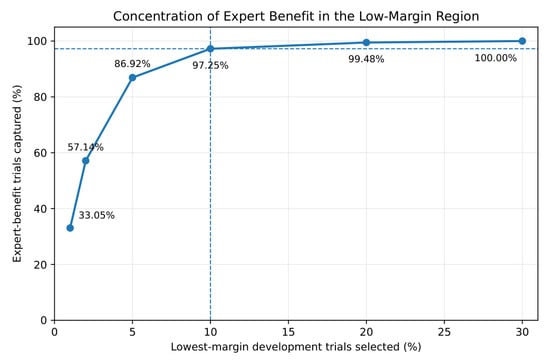
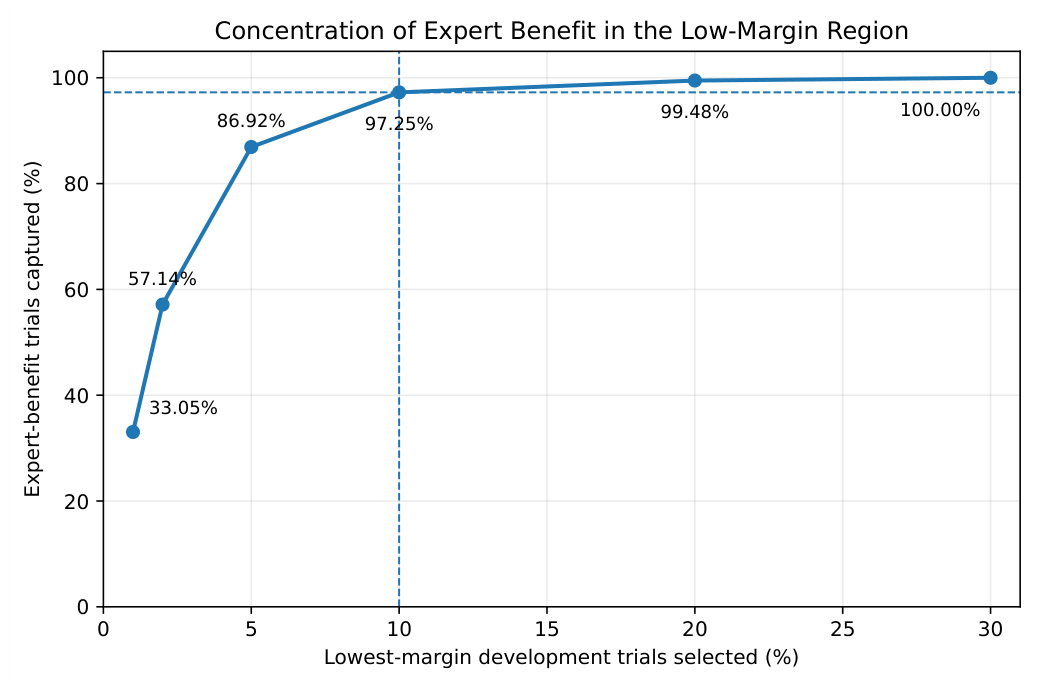
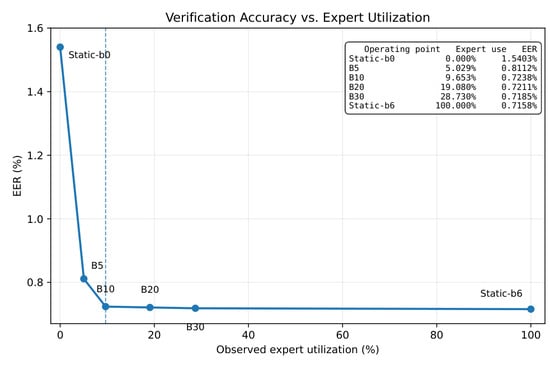
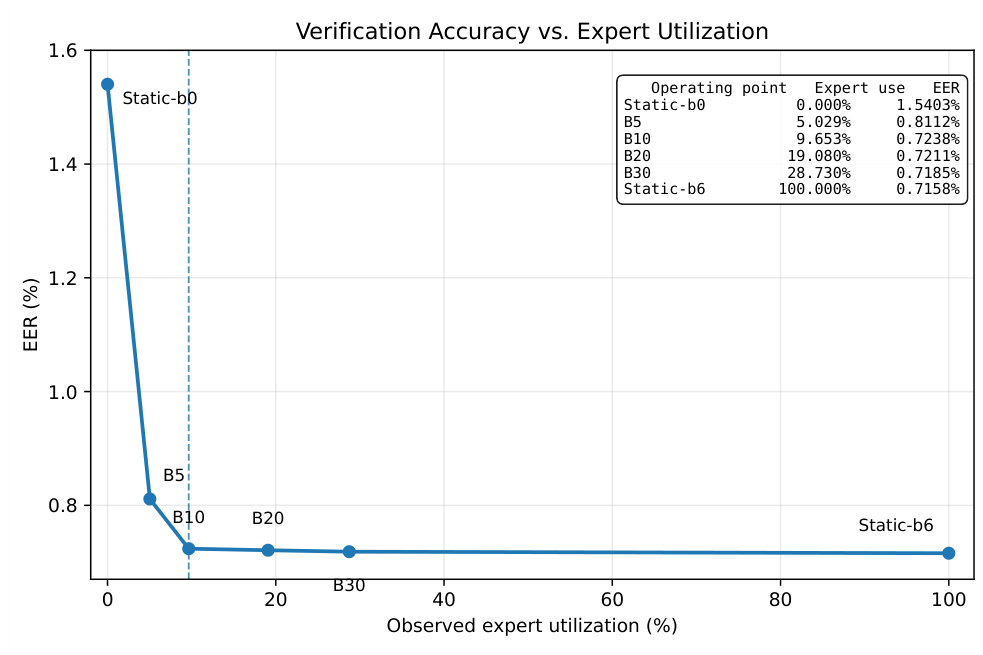
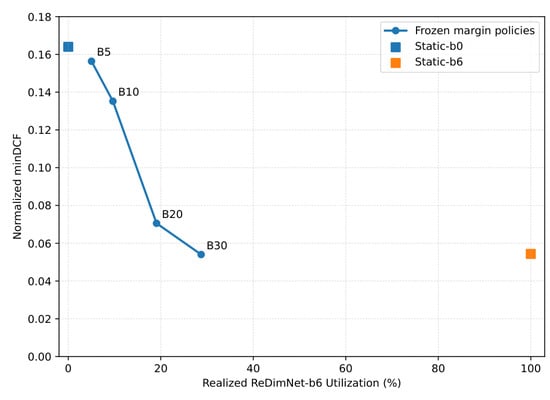
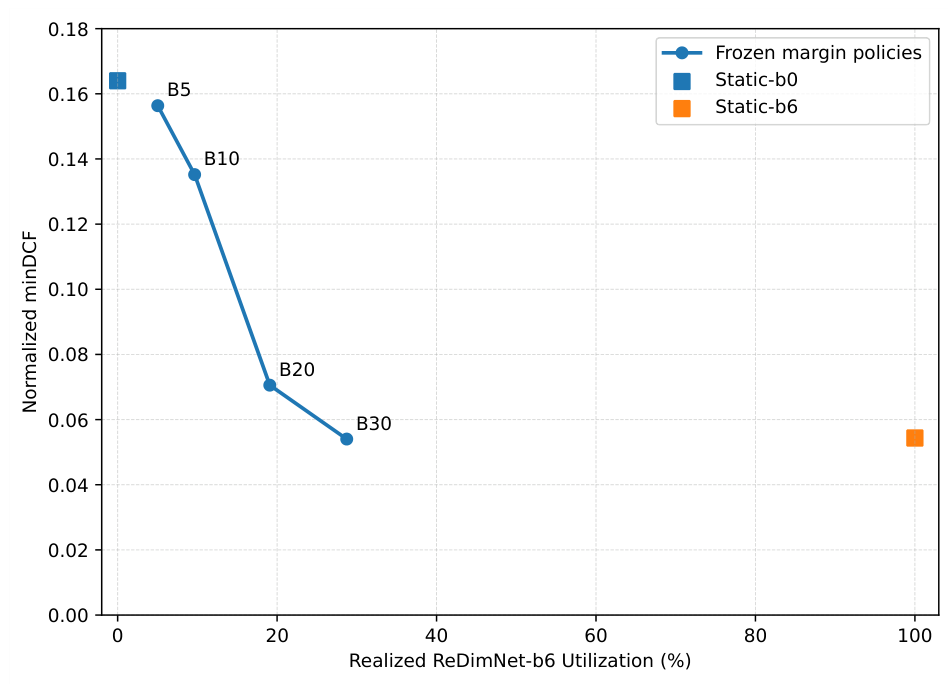
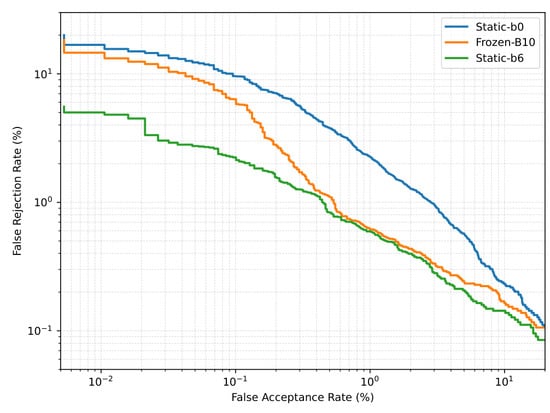
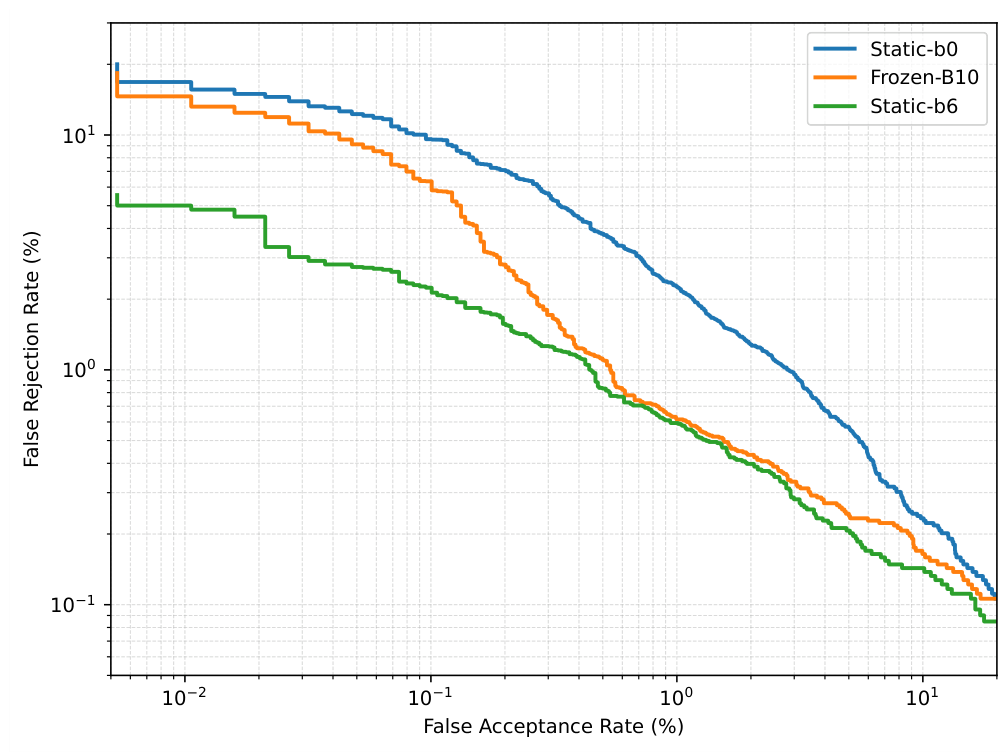

Disclaimer/Publisher’s Note: The statements, opinions and data contained in all publications are solely those of the individual author(s) and contributor(s) and not of MDPI and/or the editor(s). MDPI and/or the editor(s) disclaim responsibility for any injury to people or property resulting from any ideas, methods, instructions or products referred to in the content. |
© 2026 by the authors. Licensee MDPI, Basel, Switzerland. This article is an open access article distributed under the terms and conditions of the Creative Commons Attribution (CC BY) license.