


Abstract
White-box cryptography protects secret keys in untrusted execution environments but remains vulnerable to code lifting attacks. Hardware-binding offers a practical countermeasure by coupling cryptographic implementations with specific devices, yet a unified theoretical foundation is lacking. This paper establishes such a foundation by formalizing the white-box tweakable block cipher and introducing the tweak-binding property, which guarantees decryption failure upon tweak mismatch and underpins hardware-binding security. We prove that strong tweakable pseudo-random permutation security implies tweak-binding. A concrete construction is realized by embedding the WARX white-box block cipher into the framework, with provable security against key extraction. We further propose the tweak-unique mode as a mandatory operational paradigm, requiring a unique non-repeating tweak per encryption. Leveraging this mode with physical unclonable functions (PUFs), we design a hardware-binding scheme that stores only a single challenge-response pair per device, enabling deployment with commodity static random-access memory (SRAM) PUFs. Security proofs demonstrate provable resilience against code lifting. Performance evaluations on Intel server, Raspberry Pi 5, and Xilinx Zynq-7010 platforms show linear scaling with message size and minimal overhead, confirming suitability for both server-grade and resource-constrained internet of things (IoT) or mobile environments.
1. Introduction
White-box cryptography was first proposed by Chow et al. in 2002, primarily to address the issue of client-side key leakage in digital rights management (DRM) [1]. In DRM systems, the client (such as a set-top box) represents a typical white-box attack context, which assumes that an adversary has complete access to and control over the execution environment of cryptographic algorithms, including full visibility of implementation details and dynamic execution states, as well as the ability to arbitrarily modify the software at runtime. Traditional cryptographic algorithms, however, are designed with only black-box attack scenarios in mind, assuming that attackers can only access the inputs and outputs of the cryptographic algorithm. Consequently, conventional cryptographic algorithms are no longer suitable for DRM applications. Chow et al. introduced the concept of white-box cryptography, which involves designing cryptographic algorithms that remain secure under the white-box attack model [1,2]. They also developed the first two pioneering white-box cryptographic algorithms, implementing advanced encryption standard (AES) and data encryption standard (DES) using lookup tables constructed with random encodings.
Since then, white-box cryptography has flourished, achieving a series of results in theoretical models [3,4,5,6], algorithm designs [7,8,9,10,11], cryptanalysis [12,13,14], and applications [15,16,17,18]. Among these, the two most fundamental security goals of white-box cryptography are key extraction resistance and code lifting resistance. The former requires that an adversary must not be able to extract the secret key from the white-box implementation code. The latter requires that an adversary must not be able to isolate (copy or extract) the entire white-box implementation code from the device. This requirement primarily stems from the fact that the white-box implementation is a key-embedded implementation without explicit key input, meaning the adversary could potentially extract the entire code directly to acquire the full encryption/decryption ability, instead of extracting the key.
The existing methods for constructing white-box cryptography to achieve these two goals can be primarily divided into two categories. The first category involves the white-box implementation of standard cryptographic algorithms [1,7]. This approach primarily uses random encodings, such as bijective encodings or affine encodings, to bind the key with other operations and obfuscate the input-output mappings, thereby resisting key extraction attacks. Additionally, external encodings are employed to prevent the adversary from extracting the whole white-box implementation code from the device (or application). The second category involves the design of dedicated white-box algorithms, primarily white-box block ciphers [8,19,20,21,22,23,24,25,26,27]. This approach mainly relies on key-dependent secret components to achieve a security reduction for key extraction resistance. It also employs large-sized lookup tables to mitigate code lifting, combined with properties like incompressibility, space hardness, and weak white-box security for quantitative analysis of code lifting resistance. This is based on the assumption that the adversary’s communication capacity is limited and that no more compact equivalent implementation of the white-box code exists. This paper focuses on the second category, i.e., non-standard and dedicated designs, and standard implementations fall outside the scope of this paper.
While the approach of incompressibility is viable in DRM systems, it is less suitable for certain scenarios, such as mobile payments and internet of things (IoT), due to conflicts with the limited resources of such devices. Consequently, new solutions for resource-constrained scenarios are required.
In 2020, Bock et al. introduced the concept of hardware-binding as an effective countermeasure against code lifting attacks [4,16], and this direction has since been endorsed by several payment industry standards [28]. However, their constructions rely on indistinguishability obfuscation, which remains inefficient and far from practical deployment. Rasoamiaramanana et al. [29] proposed a generic framework for white-box encryption based on physical unclonable functions (PUFs) and the tweakable Even-Mansour structure, establishing a high-level security model for PUF-based white-box schemes. Nevertheless, their work falls short of revealing the intrinsic connection between PUF-based white-box designs and tweakable block ciphers, nor does it offer a concrete, readily instantiable construction. Asanuma et al. [30] explored the feasibility of combining space-hard white-box ciphers with PUFs, presenting several composition approaches along with cursory security and efficiency evaluations. Their security analysis, however, remains informal and lacks a rigorous reduction that substantiates hardware-binding guarantees.
Motivated by the need for a practical and provably secure hardware-binding white-box solution, this paper first investigates a suitable white-box primitive, the white-box tweakable block cipher, that inherently supports hardware-binding. We then present a concrete construction, and finally instantiate a full-fledged hardware-binding white-box scheme by integrating PUFs.
To better position our work, Table 1 compares the key features of existing hardware-binding white-box schemes with our proposal. The comparison is restricted to white-box schemes that explicitly address hardware binding; other white-box instantiations without hardware binding are not directly comparable on the same baseline. As summarized, Bock et al. [4] provide formal security definitions and introduce the concept of hardware-binding, while their follow-up work [16] establishes security reductions for white-box key storage in mobile payments; however, both rely on indistinguishability obfuscation and lack concrete instantiations. Rasoamiaramanana et al. [29] establish a high-level framework but do not offer a deployable construction. Asanuma et al. [30] present composition approaches with informal security analysis. In contrast, our scheme provides a complete package: formal security proofs, a concrete instantiation with full implementation, comprehensive performance evaluations, and lightweight storage of only a single challenge-response pair per device plus 640 KB of lookup tables.
Table 1.
Comparison of white-box schemes with hardware-binding properties. “✓” indicates that the scheme satisfies the corresponding property, and “✗” indicates that it does not.
Our contributions are as follows.
- Definition of White-Box Tweakable Block Cipher. We formally define the white-box tweakable block cipher primitive. Crucially, we identify and formalize the tweak-binding property, which ensures that decryption fails with an incorrect tweak. This property is fundamental for hardware-binding security in the white-box setting, whereas it is trivially satisfied in the conventional black-box context. We establish its formal relationship with strong tweakable pseudo-random permutation security, thereby providing the precise adversarial model for our application. The proposed primitive also opens up promising directions for future work, including its extension to authenticated encryption and hardware-binding white-box authenticated encryption with associated data (AEAD).
- Construction and Operation Mode of White-Box Tweakable Block Cipher. We construct a practical white-box tweakable block cipher by securely integrating the white-box block cipher WARX with the tweakable block cipher framework . We provide a formal security proof via a hybrid argument, demonstrating that the construction achieves the tweak-binding property. Crucially, we introduce the tweak-unique mode, proving it is essential for enabling hardware-binding security and thus defining the principal operational paradigm for white-box tweakable block ciphers.
- Hardware-Binding White-Box Scheme. We construct a full-fledged hardware-binding white-box scheme by integrating PUFs with our white-box tweakable block cipher construction. The scheme instantiates the tweak-unique mode by generating a unique tweak for each encryption via a device-specific PUF response and a counter, ensuring that the white-box implementation is cryptographically bound to the specific hardware device. The scheme’s security is formally proven under our adversarial model, demonstrating its resilience against key extraction and code lifting. Furthermore, its practical efficiency and low overhead are validated through a comprehensive performance evaluation on server-grade (Intel i7), embedded (Raspberry Pi 5), and resource-constrained field-programmable gate array (FPGA)-based (Xilinx Zynq-7010) platforms.
The remainder of this paper is organized as follows. Section 2 reviews preliminaries. Section 3 defines the white-box tweakable block cipher and the tweak-binding property. Section 4 presents the construction and its security analysis. Section 5 introduces the tweak-unique mode, describes the PUF-based hardware-binding scheme, and evaluates its performance. Section 6 concludes the paper.
2. Preliminaries
Let denote the Galois Field of order 2. For a positive integer n, denotes the n-dimensional vector space over , and denotes the extension field of . If X is some set, denotes the uniformly random drawing of x from X. The size of X is denoted by .
Let be the security parameter and be a negligible function in . An adversary is said to be probabilistic polynomial-time (PPT) if its running time is bounded by some polynomial in . All cryptographic primitives in this work are parameterized by ; specifically, the block size, key size, tweak size, and counter size are all set to bits.
2.1. White-Box Block Cipher
The white-box block cipher is a dedicated symmetric cryptographic primitive aiming to achieve the security of a block cipher in the white-box attack model. Let be a block cipher, where is the key space, and is the message space. A white-box block cipher is a mapping , together with a white-box key compiler , where is the equivalent key space whose elements are represented by lookup tables. For any , is equivalent to .
Apart from the fundamental black-box security, the security goal of a white-box block cipher typically includes key extraction resistance, formally depicted by the notion of unbreakability, and code-lifting resistance, evaluated by space hardness (incompressibility). Since space hardness is not relevant to this paper, it is omitted here.
- Unbreakability. The advantage of an adversary is , where . If for any PPT adversary , is negligible, then is said to achieve unbreakability.
2.2. Tweakable Block Cipher
The tweakable block cipher is a symmetric cryptographic primitive that provides variability to block ciphers by incorporating an additional input named “tweak” [31]. A tweakable block cipher is formally described as , where is the tweak space. For every and every , is a permutation on .
The security objectives of a tweakable block cipher include key recovery security and indistinguishability. The former aligns with that of standard block ciphers, whereas there are subtle differences in the notion of indistinguishability.
- Indistinguishability. Let consist of all functions such that , where is the set of all permutations over . The advantage of an adversary is , where , . If for any PPT adversary , is negligible, is said to achieve strong tweakable pseudo-random permutation (STPRP) security.
3. White-Box Tweakable Block Cipher: Definition
A white-box tweakable block cipher is formally described as with a white-box key compiler , where are defined as before. For any , is equivalent to .
3.1. Attack Model
In this paper, we investigate two distinct adversarial models: the black-box model and the white-box model. Under the black-box model, the adversary is restricted to observing the inputs and outputs of the algorithm and may mount conventional cryptanalytic attacks such as known-plaintext attacks and chosen-plaintext/ciphertext attacks. The adversary’s objective is either to recover the secret key embedded within the algorithm or to distinguish the white-box tweakable block cipher from an ideal tweakable random permutation. Note that the white-box tweakable block cipher differs fundamentally from conventional tweakable block ciphers, as it employs a white-box key compiler to transform the master key into an operationally equivalent form. Consequently, the adversary may also aim to recover this equivalent key representation.
In the white-box model, the adversary is granted full access to the implementation code and attempts to extract any embedded key material. We explicitly exclude code lifting attacks from our core security analysis at the primitive level, as these attacks pertain primarily to implementation-specific protections and fall outside the scope of cryptographic primitive security. A dedicated discussion of code lifting attacks and corresponding countermeasures will be provided in Section 5.
3.2. Security Notion
For white-box tweakable block ciphers, the definition of indistinguishability under the black-box model is similar to that of traditional tweakable block ciphers, whereas the security against equivalent key recovery differs in some aspects.
- Equivalent key recovery resistance. Let , where denotes a functional equivalent, i.e., . If for any PPT , is negligible, then has equivalent key recovery security.
The security against key extraction under the white-box model, which is depicted by unbreakability, is similar to that of white-box block ciphers and will not be restated here. Below, we formalize tweak-binding, an essential security property for hardware-binding white-box cryptography.
- Tweak-binding. Let , where . achieves tweak-binding if is negligible for any PPT adversary .
We prove that the STPRP security implies tweak-binding.
Proposition 1.
If a white-box tweakable block cipher has STPRP security, then achieves tweak-binding.
Proof.
We prove this by a reduction. Assume there exists an adversary that breaks the tweak-binding of with a non-negligible advantage ; we construct an adversary that uses as a subroutine to break the STPRP security of . receives oracle access to for a random k, or to a truly random tweakable permutation . runs , answering all its encryption and decryption queries using its own oracles. picks a random plaintext p, queries the encryption oracle and obtains the corresponding ciphertext c, where . picks another tweak , sends to , obtains its output , and checks whether . If true, outputs 1; otherwise, it outputs 0.
In the real cipher case, the advantage of is , and hence, . On the other hand, in the random permutation case, for each distinct tweak t, the mapping is an independent random permutation. Thus, for any fixed and plaintext p, the value is uniformly random and independent of . Consequently, , which is negligible for sufficiently large (e.g., ). By a union bound over all possible tweaks and plaintexts the adversary could query, the overall success probability remains negligible.
Therefore, distinguishes the real cipher from a random tweakable permutation with an advantage of at least . Note that is non-negligible, and hence, the advantage of is non-negligible. This contradicts the STPRP security assumption. Finally, any STPRP-secure white-box tweakable block cipher must also satisfy tweak-binding. □
4. White-Box Tweakable Block Cipher: Construction
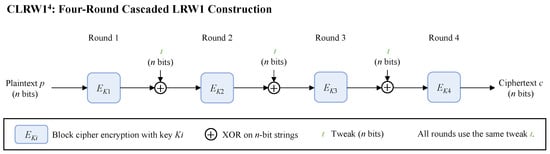
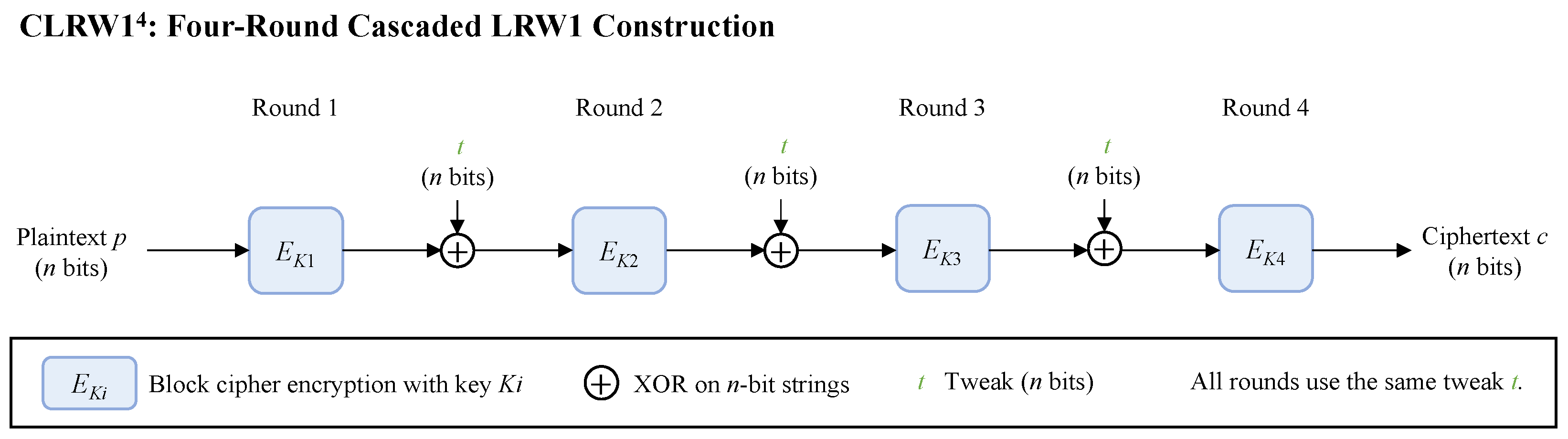
Figure 1.
Tweakable block cipher . Arrows indicate the direction of data flow.
They proved that if the block cipher E is a strong pseudo-random permutation (SPRP), then is an STPRP with security against adaptive adversaries making up to encryption/decryption queries. We will leverage this framework to construct a white-box tweakable block cipher.
4.1. Construction
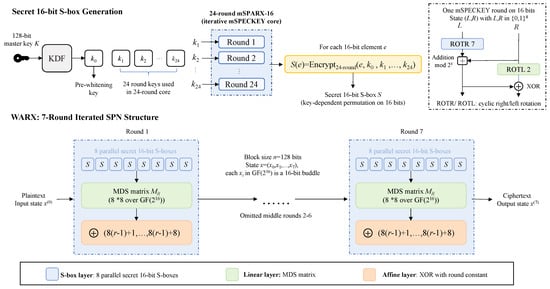
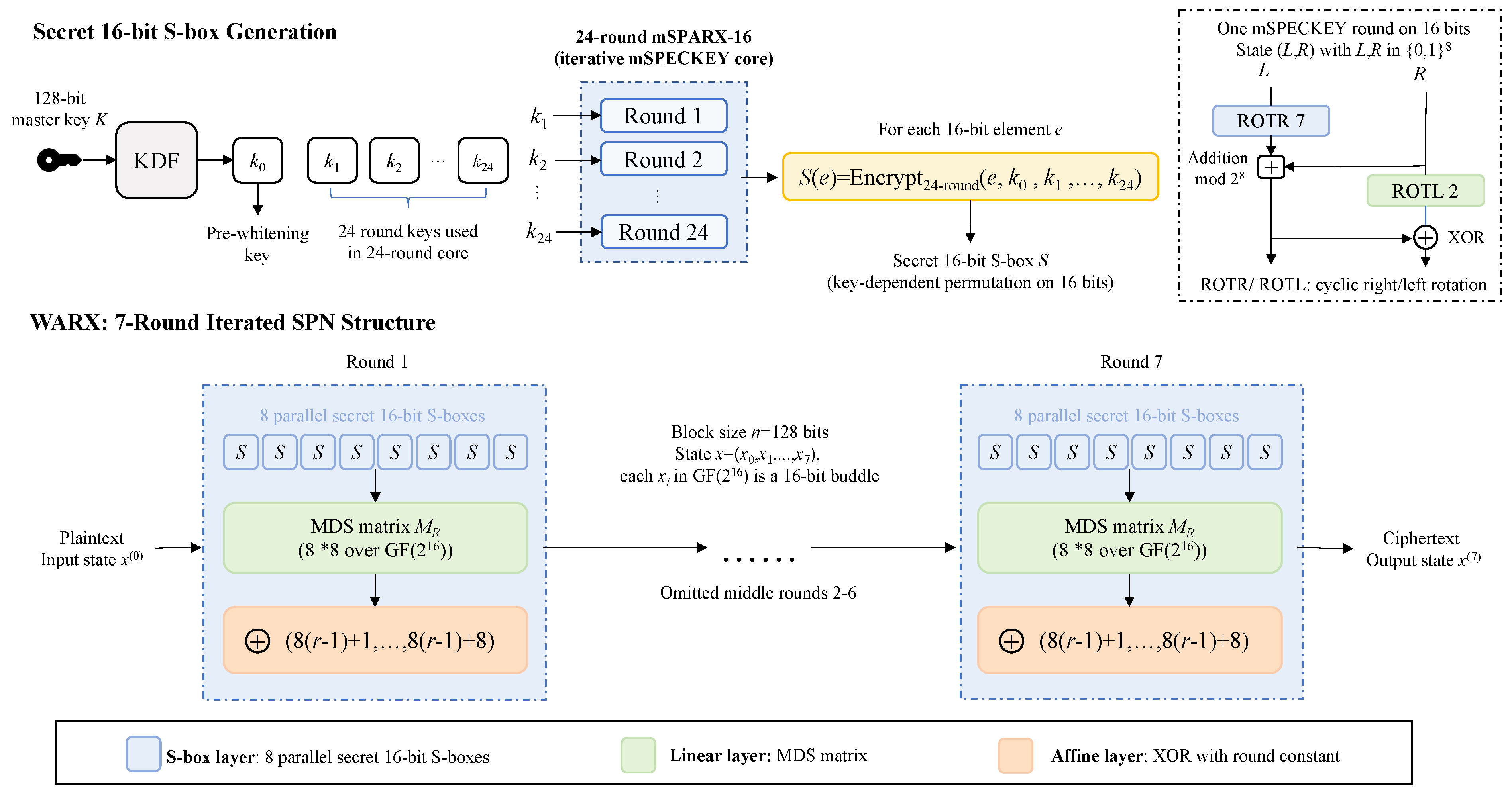
Liu et al. proposed an efficient white-box block cipher dubbed WARX [8], as shown in Figure 2. WARX belongs to the family of dedicated white-box block ciphers with provable SPRP security, as opposed to heuristic encoding-based white-box implementations like Chow-style AES [1] or others [33], which have a history of practical attacks [34]. The SPRP security of WARX is particularly relevant to our setting, as the framework requires the underlying block cipher to be an SPRP to achieve its STPRP security guarantee. Among the existing dedicated white-box block ciphers with provable SPRP security, WARX offers the best balance between security and efficiency, outperforming alternatives such as SPNbox [21] and WEM [24] in terms of implementation performance, as demonstrated in the original work [8].
Figure 2.
White-box block cipher WARX. Arrows indicate the direction of data flow.
We leverage the structure of , given its well-established security, together with WARX, to construct a white-box tweakable block cipher, as below.
- White-box key compiler C: For 4 randomly generated 128-bit master keys , the white-box key compiler is constructed as , where KDF, which is a key derivation function, and mSPARX−16, which is a small-size block cipher, are defined as in [8].
- Encryption function : The black-box block cipher E in the construction is replaced with the white-box block cipher WARX. Specifically, the corresponding keys are replaced with the equivalent keys derived from the master keys, resulting in the following encryption function:
- Decryption function :
4.2. Security Analysis of the White-Box Tweakable Block Cipher
4.2.1. Black-Box Equivalent Key Recovery Resistance
Since our construction employs four WARX instances instantiated with independent random keys, its security against equivalent key recovery in the black-box model can be reduced to the key recovery security of WARX in the black-box model, as stated in the following theorem.
Theorem 1.
For any PPT adversary against the equivalent key recovery security of , there exists a PPT adversary against WARX, such that:
Proof.
Let be a PPT adversary against with advantage . We employ a hybrid argument. Define five hybrid games :
- : Real game with four genuine keys .
- : Replace with a random key.
- : Replace with random keys.
- : Replace with random keys.
- : All four keys are random.
Let for .
Step 1: Bounding success probabilities. In , . In , , since must guess four independent random keys.
Step 2: Existence of a significant hybrid gap. By the telescoping sum, there is . Since , there exists some index such that . This means distinguishes from with advantage at least .
Step 3: Constructing a single adversary against WARX. For this specific , we construct an adversary against the -th WARX instance as follows:
operates with oracle access to an unknown WARX key (either real or random):
- For component : Use the provided oracle as the encryption/decryption function.
- For all other components :
- If : Use a randomly generated key as in .
- If : Use the real key as in both and .
- Simulate ’s environment using the above WARX components in the construction.
- When outputs , check if .
- If yes, output as the guessed key.
Step 4: Analysis of . When ’s oracle uses the real key , it perfectly simulates . When ’s oracle uses a random key, it perfectly simulates . Therefore, ’s success probability is exactly the probability that succeeds in the corresponding hybrid. This gives that .
Step 5: Final bound. Combining the inequalities yields
Equivalently:
According to Section 4 of [8], WARX is secure against equivalent key recovery in the black-box model, and hence, is negligible. Therefore, is negligible, and our construction achieves equivalent key recovery security under the black-box model. □
4.2.2. Black-Box Indistinguishability
According to the comprehensive cryptanalysis conducted in Section 4 of [8], we assume that WARX satisfies SPRP security, i.e., for any PPT adversary , . Subsequently, according to the security bound proved in Theorem 1 of [32], there exists a PPT adversary such that
where q represents the number of queries the adversary can make to the oracle and . Therefore, is negligible in , and our construction achieves indistinguishability in the black-box model. According to Proposition 1, our construction satisfies the tweak-binding property.
4.2.3. White-Box Unbreakability
Unbreakability of our construction is reduced to the unbreakability of WARX under the white-box model. For any PPT adversary against the unbreakability of , there exists a PPT adversary against WARX, such that:
The proof method is similar to Theorem 1. As elaborated in Section 5 of [8], WARX is secure against white-box key extraction attacks, and hence, is negligible. This implies that fulfills unbreakability.
It is worth noting that WARX is a dedicated white-box block cipher with provable security against key extraction in the white-box model, which is reduced to the key-recovery security of the underlying small block cipher in the black-box model [8]. This stands in contrast to white-box implementations of standard block ciphers, which have historically been broken shortly after their proposal. Since its publication in 2022, no practical key extraction attack against WARX in the white-box model has been publicly reported. The cascaded structure of four independent WARX instances further increases the difficulty of extraction, as an adversary would need to compromise all four layers simultaneously.
5. Tweak Unique Mode and Hardware-Binding White-Box Scheme
In this section, we first propose the operation mode of a white-box tweakable block cipher, namely the tweak-unique mode, and discuss its connection with hardware-binding. Then, we construct a hardware-binding white-box scheme based on PUF, formally prove its security, and present efficiency simulation results. Finally, we discuss the limitations of the proposed scheme and outline possible future directions.
5.1. Tweak-Unique Mode and Hardware-Binding
In traditional tweakable block ciphers, the tweak is a public parameter, and security relies on key secrecy. In the white-box setting, however, the key is embedded in the implementation code, making the entire code vulnerable to extraction, which is a challenge known as code lifting. Hardware-binding prevents such attacks by tying the white-box implementation to a specific device.
To realize hardware-binding, we introduce the tweak-unique mode as a mandatory operation mode for white-box tweakable block ciphers: each encryption must use a unique, non-repeating tweak. The tweak is generated dynamically by binding the process to the hardware environment, e.g., via device-unique identifiers, secure counters, or PUFs. Even if an attacker extracts the white-box code, migrating it to another device will produce different tweaks, as the hardware-dependent state cannot be replicated. When an adversary attempts decryption on a different device using a ciphertext encrypted on the original device, the tweak used in decryption will mismatch the encryption tweak. By the tweak-binding property we defined in Section 3.2, such a mismatch causes decryption failure with overwhelming probability. Thus, the white-box code remains operable only on the original hardware. Since Section 3.2 proves that STPRP security implies tweak-binding, any STPRP-secure white-box tweakable block cipher operated in tweak-unique mode achieves hardware-binding and resists code lifting.
This mechanism directly resists code lifting. An adversary who extracts the white-box implementation code from the original device and attempts to run it on another device will not be able to produce the correct tweak, because the new device’s PUF response differs. Without the correct tweak, decryption fails. Therefore, the extracted code is rendered useless on any device other than the one it was bound to. The failure of decryption on a different device is not a limitation, but the intended behavior that realizes hardware binding and resists code lifting.
5.2. PUF-Based Hardware-Binding Scheme
A PUF is a hardware primitive that exploits random manufacturing variations to generate device-unique, unpredictable, and unclonable output responses. In practice, a PUF is modeled as a noisy function , where denotes the challenge space and denotes the response space. Querying the same challenge multiple times yields slightly different responses due to environmental fluctuations. To extract stable cryptographic keys from noisy PUF responses, a fuzzy extractor is employed. During enrollment, outputs a uniform key and public helper data h. In the reconstruction phase, recovers the original key provided that y and are sufficiently close.
In practice, PUF responses are subject to environmental variations such as temperature fluctuations, supply voltage drifts, and aging effects. These factors may increase the bit error rate (BER) of the PUF response, potentially causing the fuzzy extractor to fail in recovering the correct key during the reconstruction phase. The fuzzy extractor employed in our scheme is designed to tolerate such variations through its error-correcting code (ECC), provided that the Hamming distance between the enrollment response y and the reconstruction response remains within the ECC’s correction capability. To further mitigate reliability issues in real-world deployments, several strategies can be adopted: (i) selecting an ECC with sufficient error-correction capacity based on empirical PUF characterization data; (ii) performing enrollment under stable environmental conditions to minimize initial noise; and (iii) implementing a retry mechanism that allows multiple reconstruction attempts when the first attempt fails. These measures can achieve high reconstruction success rates in practice without compromising the cryptographic security guarantees of the scheme, as they pertain only to the reliability of the PUF interface rather than the underlying cryptographic design.
It is important to distinguish between two cases of PUF response variation. If the variation remains within the error-correcting capability of the fuzzy extractor, the correct key is reconstructed and decryption succeeds. If the variation exceeds the correction capability, the reconstructed key differs, producing an incorrect tweak, and decryption fails. The latter case is not a design flaw but the intended consequence of hardware binding: a device whose PUF response has drifted beyond recovery is, in effect, no longer the same device for binding purposes.
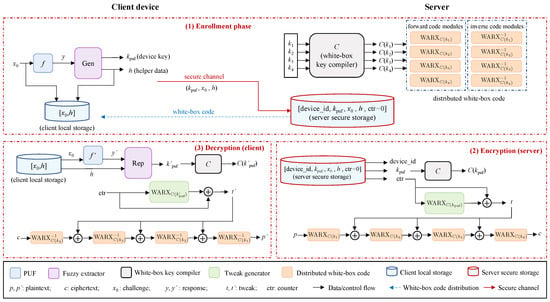
Our hardware-binding white-box scheme integrates a PUF into the tweak-unique mode. It consists of three core components: a PUF f, a fuzzy extractor , and the white-box tweakable block cipher from Section 4.1. The scheme, as demonstrated in Figure 3, operates in a server-client model as follows.
Figure 3.
PUF -based hardware-binding white-box scheme.
5.2.1. Enrollment Phase
The server generates four independent 128-bit keys and compiles them into a white-box implementation , which is then securely distributed to the client. Simultaneously, a PUF challenge is chosen, and its response is measured. The fuzzy extractor generates . The tuple is stored securely on the server, where ctr is a counter initialized to zero. The client retains .
The enrollment phase is assumed to take place during device manufacturing, where a trusted environment is a realistic and standard assumption for factory provisioning, consistent with the deployment model of most hardware-rooted security systems. In the event of device failure or key compromise, re-enrollment can be performed by physically returning the device to the factory and repeating the enrollment procedure with a fresh PUF challenge and a new white-box implementation. The security of re-enrollment reduces to that of the initial enrollment, as the new binding is established independently of the previous one.
5.2.2. Encryption (Server)
For each encryption, the server maintains a monotonic counter . It computes the tweak by the tweak generation function
where denotes WARX encryption under the PUF-derived key. The server then encrypts plaintext p
increments ctr, and sends to the client.
5.2.3. Decryption (Client)
Upon receiving , the target client reconstructs its PUF key
where is a fresh PUF measurement. It then recomputes the tweak
and decrypts:
Decryption succeeds only if the code runs on the original device, because any other device will produce a different (hence, a different ), and the tweak-binding property guarantees decryption failure with overwhelming probability. This achieves hardware-binding.
5.3. Security Analysis of the PUF-Based Hardware-Binding Scheme
Before analyzing the security of our scheme, we first state the core assumptions upon which our security proofs rely. These assumptions are summarized in Table 2, which also describes their roles in the scheme and their practical implications.
Table 2.
Core security assumptions and their practical implications.
The key extraction resistance of our scheme directly inherits from the key extraction resistance of the white-box tweakable block cipher constructed in Section 4.1. Therefore, it will not be elaborated further here.
Below, we analyze the security against code lifting and some other attacks.
5.3.1. Hardware-Binding Security Against Code Lifting
Theorem 2.
Let be the maximum advantage of any PPT adversary against the physical unclonability of the PUF, be the maximum advantage of any PPT adversary against the PRF security of , and be the maximum advantage of any PPT adversary against the tweak-binding property of . Then, for any PPT adversary attempting code lifting and execution on a different device,
which is negligible in λ.
Proof.
Consider a PPT adversary that extracts the code from device D and attempts operations on device . Let denote the number of queries made by . Since is PPT, . We analyze the execution through a sequence of games.
Game : The real game where runs the extracted code on .
Game : Same as , but we replace the PUF on device with an ideal unclonable function that produces responses independent of the original PUF on D.
Let be the probability that distinguishes from . We construct an adversary against the PUF’s unclonability. makes at most q queries to the PUF (simulating ’s q cryptographic operations, each requiring one PUF query for tweak generation). If distinguishes with advantage , then breaks PUF unclonability with the same advantage. Therefore, .
Game : Same as , but we replace with a truly random function .
Let be the probability that distinguishes from . We construct an adversary against the PRF security of . Then, we have .
Analysis of : In this game, when attempts to decrypt a ciphertext c originally encrypted on D with tweak t, it uses a random tweak . Since R is a truly random function, for any pair of encryption and decryption queries, . By a union bound over all possible pairs, the probability that any decryption query accidentally uses the correct tweak is at most , which is negligible in . Conditioned on the event that all decryption queries use tweaks different from the original encryption tweak, the tweak-binding property guarantees that for each decryption attempt,
where denotes the advantage against tweak-binding for a single query, which is negligible by definition. Taking a union bound over all decryption attempts,
which is negligible in .
Final bound: Combining the game transitions, we obtain
which is the sum of three negligible functions and, hence, negligible in . Therefore, our scheme achieves hardware-binding security against code lifting attacks. □
5.3.2. Discussion of Additional Attacks
In addition to the two primary security objectives in the white-box model, several other attacks are also discussed.
Counter replay attacks. An adversary may reuse old (ciphertext, counter) pairs to attempt unauthorized decryption. Our scheme mitigates this by maintaining a strictly monotonic counter ctr, ensuring each tweak is unique. Any attempt to replay an old counter produces a tweak that, with overwhelming probability, does not match the original encryption tweak, resulting in decryption failure. The counter is stored tamper-resistant to prevent rollback.
PUF modeling resistance. Modeling attacks aim to predict PUF responses from collected challenge-response pairs. Our design limits this by using only a single fixed challenge during normal operation, denying the adversary the diverse pairs needed for accurate modeling. Moreover, the fuzzy extractor provides information-theoretic privacy: helper data h leaks negligible information about response y, and key remains statistically independent of h. Thus, even with multiple noisy measurements of , predicting is infeasible.
Side-channel considerations. Side-channel attacks exploit physical leakages such as power consumption, electromagnetic emissions, or timing variations to extract secret information. In the white-box cryptography context, two classes of side-channel attacks have received particular attention: differential computation analysis (DCA) and differential fault analysis (DFA).
DCA, introduced as an adaptation of differential power analysis (DPA) to the white-box setting, collects execution traces, e.g., intermediate values or memory access patterns, from the white-box implementation and applies statistical tests to recover the embedded key. While our construction cascades four WARX instances rather than using a standard white-box implementation such as Chow’s AES, it remains a lookup-table-based implementation and, thus, produces observable execution traces. Consequently, DCA remains a relevant attack vector for our scheme. Several successful DCA attacks have been reported on various white-box implementations, and subsequent work has proposed countermeasures such as masking and shuffling to mitigate these attacks [13,14].
DFA, on the other hand, injects faults into the cryptographic computation, e.g., by corrupting lookup tables or skipping rounds via runtime manipulation, and analyzes the resulting erroneous outputs to extract key material. In our scheme, an adversary with full code access could potentially tamper with individual WARX instances or bypass entire layers of the cascade. Combined DCA and DFA attacks have also been explored, demonstrating that countermeasures targeting a single class of attacks may be insufficient against adversaries that exploit both leakage channels.
In our scheme, the following countermeasures can be applied without modifying the core cryptographic design:
- Masking. By splitting sensitive intermediate values into multiple random shares, masking breaks the statistical correlation between power consumption or computed traces and secret data, effectively resisting DCA. Several masking schemes have been proposed for white-box implementations, e.g., BU masking [35] and SEL masking [36]. While higher-order attacks remain a concern, masking remains a first-line defense against DCA in practice.
- Shuffling. Randomizing the order of independent operations complicates the alignment of leakage traces, increasing the number of traces required for a successful DCA. Dummy shuffling, introduced by Biryukov and Udovenko [37], extends classic shuffling by adding dummy computation slots and provides provable security against algebraic attacks of arbitrary predetermined degree. The Haystack cipher framework in recent work [6] further formalizes such countermeasures and their security properties.
- Redundancy and fault detection. To resist DFA, one can introduce redundancy in the computation, e.g., performing critical operations twice and comparing the results, or embedding checksums into lookup tables, so that injected faults are detected before the final output is produced. Several works have explored such fault detection mechanisms for white-box implementations, including the use of verifiable execution patterns and consistency checks [6]. While this introduces additional overhead, it provides a practical trade-off between performance and fault resilience.
We emphasize that these countermeasures are orthogonal to our cryptographic design and do not affect the formal security proofs. Their implementation is a matter of engineering practice and can be adopted as additional hardening measures depending on the security requirements and resource constraints of the target deployment environment.
5.4. Performance Evaluation
5.4.1. Overall Performance
We evaluate the encryption and decryption performance of our proposed hardware-binding white-box scheme on server and client platforms. The code is available at https://github.com/JUNLIU2026/Tweakable-White-Box- (accessed on 13 September 2026). In our experiments, the block size, key size, tweak size, and counter size are all set to 128 bits, consistent with the security parameter used in our security analysis. Table 3 summarizes the experimental environment. On the server side, the implementation leverages advanced vector extensions (AVX) instruction sets to achieve single instruction, multiple data (SIMD) parallelism, processing eight blocks simultaneously. On the client side, we utilize NEON instruction sets, ARM’s SIMD architecture, also with eight-way parallelism. All implementations are compiled with g++ 13.3.0 using the -O3 -march=native optimization flags to fully exploit platform-specific capabilities. On the Intel server and Raspberry Pi 5 platforms, the Givaro library (version 4.2.0) is used for finite field arithmetic in . On the Xilinx Zynq-7010 platform, however, deploying Givaro was not feasible due to toolchain and dependency constraints; instead, finite field multiplication is implemented via precomputed logarithm and antilogarithm lookup tables ( and , each derived from the same irreducible polynomial ), yielding an equivalent field arithmetic implementation at the cost of approximately 384 KB of additional lookup tables. Timing measurements are obtained using the clock_gettime function with the CLOCK_MONOTONIC timer, and each test is repeated 100,000 times to compute average results, ensuring statistical reliability.
Table 3.
Experimental setup.
Table 4 summarizes the performance of each component on all three platforms, based on lookup-table-based white-box implementations. WARX processes a single 16-byte block with high efficiency. On the Intel server, it achieves 3.33 cycles per byte (CPB), demonstrating the effectiveness of our AVX-optimized design. On the Raspberry Pi client, it achieves 5.30 CPB, remarkably efficient for an ARM-based embedded processor.
Table 4.
Performance evaluation of the proposed hardware-binding scheme. Encryption performance evaluated on Intel i7-14700KF (Server). Decryption performance evaluated on Raspberry Pi 5 (Client) and Xilinx Zynq-7010 (Client).
The operation exhibits nearly identical performance to single-block WARX encryption on all three platforms, as it performs one WARX encryption followed by a simple exclusive-or (XOR). This confirms that our implementation introduces negligible overhead beyond the core cryptographic operation.
Note that all experiments, on both server-side and client-side platforms, are based on the same lookup-table-based implementation. The measured throughput on all three platforms therefore reflects the performance of the lookup-table-based white-box construction on general-purpose CPUs, rather than ARX arithmetic instructions. The same construction can be significantly accelerated through ARX-based software implementations [8] or dedicated hardware accelerators for white-box block ciphers [17,38]. We emphasize that our software implementation serves as a baseline for evaluating the cryptographic construction. The performance limitation of the lookup-table-based implementation is addressable at the hardware level through dedicated accelerators such as UpWB [17] and SiWB [38], which report to speedup over optimized software on FPGA and to under 28 nm application-specific integrated circuit (ASIC) synthesis. These accelerators do not change the cryptographic security properties of the scheme; they only improve the implementation efficiency.
Regarding storage cost, each WARX instance requires 128 KB of lookup tables. Thus, the full scheme, including the component, occupies 640 KB for five instances. This storage cost is modest and well-suited for both server-class and resource-constrained client devices. We note that lookup tables are the fundamental building block of white-box implementations, and 640 KB for five WARX instances is moderate compared to other dedicated white-box schemes. The key advantage of our approach is not the elimination of lookup tables, but the combination of a standard white-box construction with hardware binding at minimal additional cost, i.e., a single challenge-response pair per device. Approaches that avoid table pre-computation would require a fundamentally different white-box design paradigm, which is beyond the scope of this work.
In terms of practical throughput, the 0.89 MB/s observed on the Raspberry Pi 5 corresponds to a latency of approximately 2.18 ms for a 2 KB message, which is well within the sub-second requirements of most IoT protocols. This translates to a capacity of roughly 27,300 messages per minute for 2 KB messages, which is sufficient for the majority of periodic sensor reporting and telemetry scenarios in resource-constrained IoT deployments. On the Zynq-7010, the 0.07 MB/s throughput corresponds to a latency of approximately 26 ms for a 2 KB message, which is still acceptable for low-frequency IoT telemetry scenarios but may be insufficient for real-time applications. This highlights the trade-off between hardware-binding security and performance on extremely resource-constrained devices.
On the Xilinx Zynq-7010, a resource-constrained ARM Cortex-A9 platform running at 666 MHz, single-block WARX encryption achieves 0.98 µs (CPB = 40.95), and achieves 0.99 µs (CPB = 41.08), confirming that the XOR step introduces negligible overhead. The full scheme on 2048-byte messages achieves 26.06 ms with a throughput of 0.07 MB/s (CPB = 8475.80). The significantly higher CPB compared to the Raspberry Pi 5 is primarily due to the lower clock frequency and the absence of platform-specific NEON optimizations on the Cortex-A9 architecture.
We note that the fuzzy extractor, while an integral part of the hardware-binding framework, operates only once per decryption session at the tweak reconstruction step, independent of the message length. Based on the established literature on PUF-based key generation, Huth et al. reported an implementation of a computational fuzzy extractor on an ARM Cortex-M3 microcontroller with a generation time of 0.4 s, and a memory footprint of 1.45 KB SRAM plus 9.8 KB Flash on a comparable 8-bit microcontroller [39]. While the exact figures depend on the specific error-correcting code and platform, the literature consistently indicates that the fuzzy extractor’s overhead is constant per session and does not scale with message length. For our Zynq-7010 implementation, where a full decryption of a 2048-byte message takes 26.06 ms, this overhead is additive and invoked only once per session, so its relative impact decreases further as the message size grows.
We also note that hardware binding can be achieved via trusted execution environments (TEEs) such as ARM TrustZone or Intel SGX, which typically offer higher performance. However, TEE-based solutions rely on specific hardware features that may not be available on low-cost IoT devices. In contrast, our scheme relies only on a standard PUF, which is a lightweight hardware primitive available in most modern chips and does not require dedicated hardware security features. This makes our approach more broadly deployable on low-cost hardware.
We evaluate performance scaling on 2048-byte messages by comparing WARX with our full scheme. On all three platforms, the full scheme’s execution time is approximately four times that of WARX (4.09× on server, 4.10× on the Raspberry Pi 5, and 4.07× on the Zynq-7010), closely matching the theoretical expectation from cascading four WARX instances in the construction. This consistent ratio confirms that performance is dominated by the four serial WARX invocations, with the three intermediate tweak XOR operations contributing minimal overhead.
5.4.2. Performance Scaling with Message Length
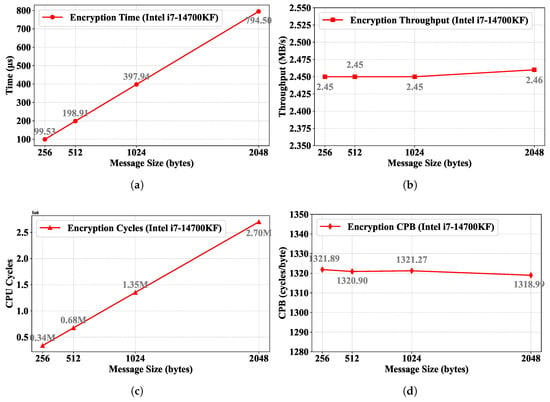
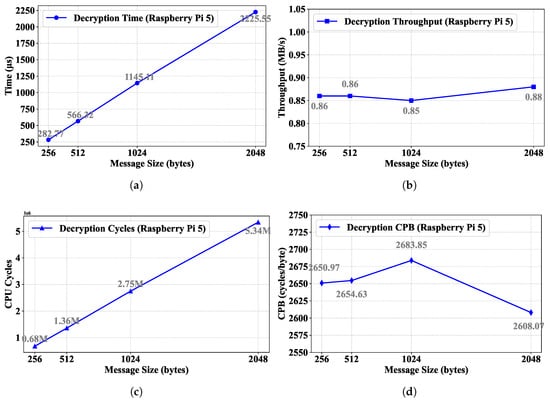
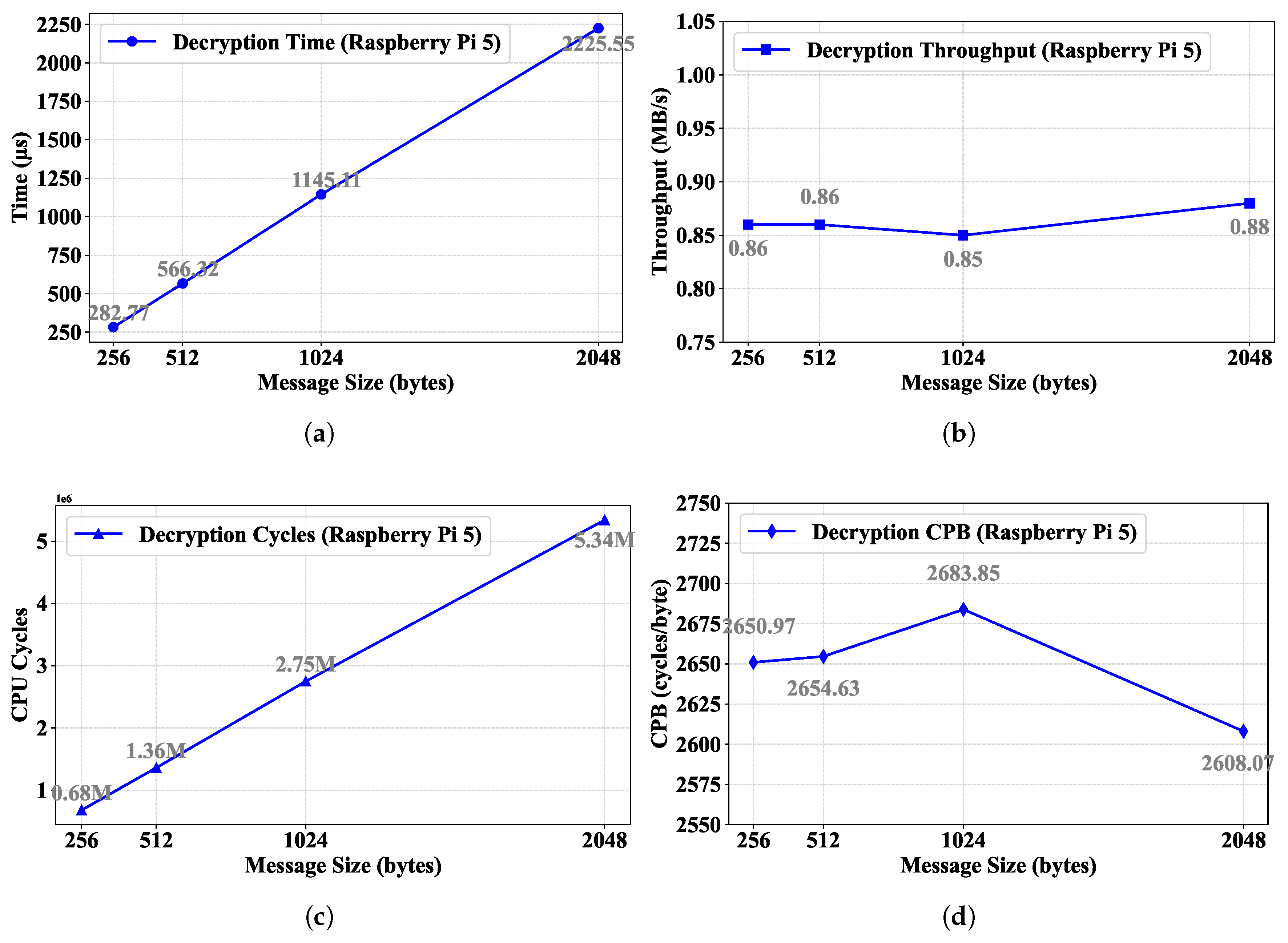
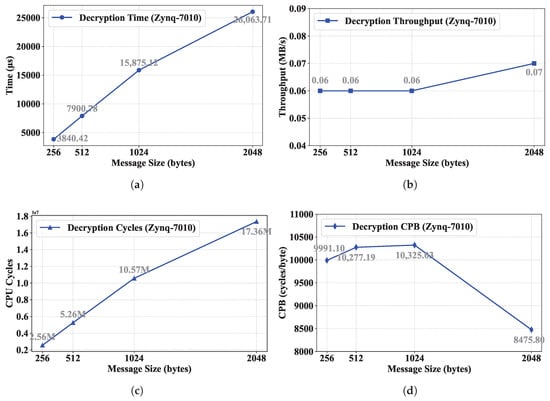
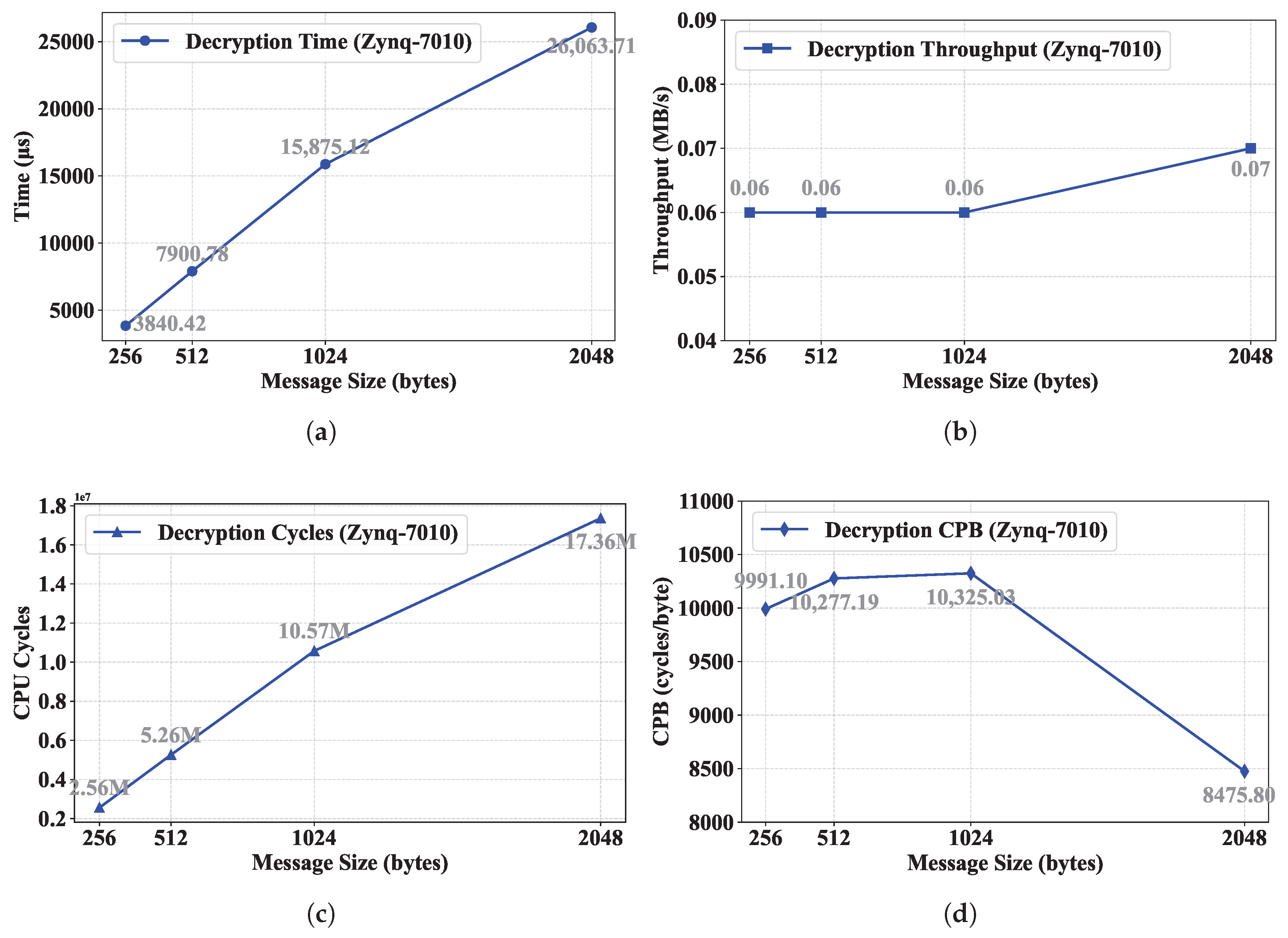
We evaluated the performance of the full scheme on message lengths from 256 to 2048 bytes (16 to 128 blocks) on all three platforms. Figure 4, Figure 5 and Figure 6 show the scaling behavior of encryption on Intel i7-14700KF, decryption on Raspberry Pi 5, and decryption on Xilinx Zynq-7010, respectively. Each data point is the average of 100,000 runs.
Figure 4.
Encryption performance scaling on Intel i7-14700KF. (a) Encryption time. (b) Encryption throughput. (c) Encryption cycles. (d) Encryption CPB.
Figure 5.
Decryption performance scaling on Raspberry Pi 5. (a) Decryption time. (b) Decryption throughput. (c) Decryption cycles. (d) Decryption CPB.
Figure 6.
Decryption performance scaling on Xilinx Zynq-7010. (a) Decryption time. (b) Decryption throughput. (c) Decryption cycles. (d) Decryption CPB.
As shown in Figure 4, the encryption time scales linearly with message length on the Intel i7-14700KF platform, closely matching the 8× data increase. The throughput remains remarkably stable across all message sizes, indicating efficient pipeline utilization. The CPU cycles scale proportionally, reflecting the linear increase in computational workload. CPB stays within an extremely narrow range of 1318.99–1321.89 (variation ), confirming that our AVX-optimized implementation successfully amortizes fixed overheads such as function calls and memory access patterns.
On the Raspberry Pi 5 platform, decryption exhibits linear scaling characteristics, as shown in Figure 5. The time scaling factor of 7.87 between 256 and 2048 bytes closely matches the 8× increase in data volume. Throughput ranges from 0.85 to 0.88 MB/s, with slight variation due to cache effects. CPB fluctuates between 2608.07 and 2683.85 (variation ), which is typical for ARM processors where NEON pipeline behavior and cache geometry introduce moderate performance variations across batch sizes.
On the Xilinx Zynq-7010 platform, decryption exhibits linear scaling characteristics, as shown in Figure 6. The time scaling factor of 6.79 between 256 and 2048 bytes is slightly below the ideal 8×, which we attribute to fixed overheads becoming relatively smaller for larger messages. Throughput remains stable at approximately 0.06–0.07 MB/s across all message sizes. The CPB fluctuates between 8475.80 and 10,325.03, with a notable decrease at 2048 bytes, likely due to improved cache utilization for larger data volumes.
All three platforms exhibit clear linear scaling in execution time. The server maintains exceptional stability (throughput variation , CPB variation ), reflecting the maturity of x86 AVX optimization and predictable cache hierarchy. The Raspberry Pi 5 shows moderate CPB fluctuation (≈2.9%), characteristic of embedded ARM architectures. The Zynq-7010 exhibits larger CPB variation (≈18%), which is typical for resource-constrained platforms with limited cache and no platform-specific NEON tuning. The server achieves approximately higher throughput and lower CPB than the Raspberry Pi 5 and roughly higher throughput than the Zynq-7010, consistent with their architectural differences and clock frequencies. These results confirm that our scheme is suitable for server-grade applications and resource-constrained IoT/mobile environments where data volumes are typically modest.
Discussion. The proposed scheme has two primary considerations. First, it requires a secure one-time enrollment, but stores only a single challenge-response pair per device, unlike most PUF protocols that require large challenge-response pair databases. This minimal storage makes it compatible with weak PUFs, particularly the widely available SRAM PUFs already integrated into many commodity devices. Second, PUF queries and fuzzy extraction introduce latency compared to software-only solutions, which may affect performance-sensitive applications. Future work could explore hybrid binding approaches combining PUF hardware-binding with lightweight software attestation, as well as adaptive PUF strategies for reliability under varying environmental conditions.
5.5. Future Directions
We discuss several promising directions for extending the present work as follows.
White-box authenticated encryption. A natural extension of our framework is towards white-box authenticated encryption. Since tweakable block ciphers serve as the underlying building block for efficient AEAD modes such as offset codebook mode (OCB) [40], instantiating OCB with our white-box tweakable block cipher would yield, at the cryptographic level, a white-box AEAD scheme whose security reduces to the STPRP security of the underlying primitive. However, the white-box setting introduces unique challenges beyond standard AEAD. In particular, the authentication tag itself becomes a sensitive asset: an adversary with full access to the implementation may attempt to extract the tag-generation key or to construct valid forgeries by manipulating the tag generation process through side-channel or fault-injection attacks. Moreover, the tweak-unique mode imposes constraints on tweak usage that may require careful reconsideration when combined with AEAD modes relying on flexible tweak scheduling. We therefore identify this as a meaningful direction for future work, rather than a straightforward extension.
Other directions. Additional avenues include integrating updatable white-box cryptography with hardware-binding to resist long-term code leakage, and exploring hybrid binding mechanisms that combine hardware and software roots of trust for broader deployment scenarios. Adaptive PUF strategies for maintaining reliability under varying environmental conditions also warrant further investigation.
6. Conclusions
This paper formalizes the white-box tweakable block cipher and introduces the tweak-binding property as a foundation for hardware-binding. By integrating WARX with the framework, we construct a provably secure white-box tweakable block cipher. By combining PUFs with a counter-based tweak-unique operation mode, we construct a hardware-binding white-box scheme that achieves provable resilience against key extraction and code lifting, while performance evaluations on Intel server, Raspberry Pi 5, and Xilinx Zynq-7010 platforms confirm its practical efficiency across server-grade, embedded, and resource-constrained deployment scenarios. Future directions include integrating updatable white-box cryptography with hardware-binding to resist long-term code leakage, extending the framework to authenticated encryption, and exploring hybrid binding mechanisms that combine hardware and software roots of trust for broader deployment scenarios.
Author Contributions
Conceptualization, J.L. and J.C.; methodology, J.L.; software, F.Z.; validation, J.L. and X.D.; formal analysis, Y.Z.; investigation, B.Y.; writing—original draft preparation, J.L.; writing—review and editing, J.C.; visualization, J.L.; supervision, B.Y.; project administration, B.Y.; funding acquisition, B.Y. All authors have read and agreed to the published version of the manuscript.
Funding
This research was funded by National Natural Science Foundation of China grant numbers 62302285 and U2001205, Young Talent Fund of Association for Science and Technology in Shaanxi of China grant number 20240124, Open Funding of State Key Laboratory of Integrated Services Networks grant number ISN26-11, the Research Fund for State Key Laboratory of Internet Architecture, Tsinghua University grant number HLW2025MS30, and the Fundamental Research Funds for the Central Universities grant number GK202602023.
Institutional Review Board Statement
Not applicable.
Informed Consent Statement
Not applicable.
Data Availability Statement
The original data presented in the study are openly available in GitHub at https://github.com/JUNLIU2026/Tweakable-White-Box- (accessed on 13 September 2026).
Acknowledgments
The authors would like to thank the anonymous reviewers for their valuable comments.
Conflicts of Interest
Author Feng Zhu was employed by Koal Software Company Ltd. The remaining authors declare that the research was conducted in the absence of any commercial or financial relationships that could be construed as a potential conflict of interest.
Abbreviations
The following abbreviations are used in this manuscript:
| PUF | Physical unclonable function |
| SRAM | Static random-access memory |
| IOT | Internet of things |
| DRM | Digital rights management |
| AES | Advanced encryption standard |
| DES | Data encryption standard |
| AEAD | Authenticated encryption with associated data |
| PPT | Probabilistic polynomial-time |
| STPRP | Strong tweakable pseudo-random permutation |
| SPRP | Strong pseudo-random permutation |
| KDF | Key derivation function |
| BER | Bit error rate |
| ECC | Error-correcting code |
| PRF | Pseudo-random function |
| DCA | Differential computation analysis |
| DFA | Differential fault analysis |
| DPA | Differential power analysis |
| AVX | Advanced vector extensions |
| SIMD | Single instruction, multiple data |
| CPB | Cycles per byte |
| XOR | Exclusive-or |
| FPGA | Field-programmable gate array |
| ASIC | Application-specific integrated circuit |
| OCB | Offset codebook mode |
| TEE | Trusted execution environment |
References
- Chow, S.; Eisen, P.; Johnson, H.; Van Oorschot, P.C. White-box cryptography and an AES implementation. In Proceedings of the 9th Annual International Workshop on Selected Areas in Cryptography (SAC), St. John’s, NL, Canada, 15–16 August 2002; pp. 250–270. [Google Scholar] [CrossRef] [Scilit]
- Chow, S.; Eisen, P.; Johnson, H.; Van Oorschot, P.C. A white-box DES implementation for DRM applications. In Proceedings of the ACM Workshop on Digital Rights Management (DRM), Washington, DC, USA, 18 November 2002; pp. 1–15. [Google Scholar] [CrossRef] [Scilit]
- Delerablée, C.; Lepoint, T.; Paillier, P.; Rivain, M. White-box security notions for symmetric encryption schemes. In Proceedings of the 20th International Conference on Selected Areas in Cryptography (SAC), Burnaby, BC, Canada, 14–16 August 2013; pp. 247–264. [Google Scholar] [CrossRef] [Scilit]
- Bock, E.A.; Amadori, A.; Brzuska, C.; Michiels, W. On the security goals of white-box cryptography. IACR Trans. Cryptogr. Hardw. Embed. Syst. 2020, 2, 327–357. [Google Scholar] [CrossRef]
- Hosoyamada, A.; Isobe, T.; Todo, Y.; Yasuda, K. A modular approach to the incompressibility of block-cipher-based AEADs. In Proceedings of the 26th International Conference on the Theory and Application of Cryptology and Information Security (ASIACRYPT), Taipei, Taiwan, 5–9 December 2022; pp. 585–619. [Google Scholar] [CrossRef] [Scilit]
- Charlès, A.; Udovenko, A. Haystack ciphers: White-box countermeasures as symmetric encryption. In Proceedings of the 31st International Conference on the Theory and Application of Cryptology and Information Security (ASIACRYPT), Melbourne, Australia, 8–12 December 2025; pp. 341–374. [Google Scholar] [CrossRef] [Scilit]
- Chen, J.; Luo, Y.; Liu, J.; Wang, C.; Zhang, Y.; Dong, X. A white-box implementation of SM4 with self-equivalence encoding. Comput. J. 2024, 67, 1087–1098. [Google Scholar] [CrossRef] [Scilit]
- Liu, J.; Rijmen, V.; Hu, Y.; Chen, J.; Wang, B. WARX: Efficient white-box block cipher based on ARX primitives and random MDS matrix. Sci. China Inf. Sci. 2022, 65, 132302. [Google Scholar] [CrossRef] [Scilit]
- Ranea, A.; Vandersmissen, J.; Preneel, B. Implicit white-box implementations: White-boxing ARX ciphers. In Proceedings of the 42nd Annual International Cryptology Conference (CRYPTO), Santa Barbara, CA, USA, 15–18 August 2022; pp. 33–63. [Google Scholar] [CrossRef] [Scilit]
- Tang, Y.; Gong, Z.; Guo, J.; Dong, X.; Zhao, L. Towards combined countermeasures against differential computation and fault analyses: An approach with the ASASA structure. In Proceedings of the 31st International Conference on the Theory and Application of Cryptology and Information Security (ASIACRYPT), Melbourne, Australia, 8–12 December 2025; pp. 441–474. [Google Scholar] [CrossRef] [Scilit]
- Shi, Y.; Gao, T.; Li, Y.; Gao, J.; Huang, K. WBSLT: A framework for white-box encryption based on substitution-linear transformation ciphers. In Proceedings of the 23rd Annual Network and Distributed System Security Symposium (NDSS), San Diego, CA, USA, 23–27 February 2026. [Google Scholar] [CrossRef] [Scilit]
- Liu, J.; Wang, D.; Hu, Y.; Chen, J.; Wang, B. Improved key-recovery attacks on reduced-round WEM-8. Des. Codes Cryptogr. 2022, 90, 2419–2448. [Google Scholar] [CrossRef] [Scilit]
- Tang, Y.; Gong, Z.; Li, B.; Zhao, L. Revisiting the computation analysis against internal encodings in white-box implementations. IACR Trans. Cryptogr. Hardw. Embed. Syst. (TCHES) 2023, 4, 493–522. [Google Scholar] [CrossRef] [Scilit]
- Tang, Y.; Gong, Z.; Zhao, L.; Li, D.; Liu, Z. Unboxing ARX-based white-box ciphers: Chosen-plaintext computation analysis and its applications. IACR Trans. Cryptogr. Hardw. Embed. Syst. (TCHES) 2024, 3, 634–670. [Google Scholar] [CrossRef] [Scilit]
- Liu, J.; Wang, D.; Zhu, F.; Yang, B. Robust and economic digital rights management solution based on white-box encryption scheme. Chin. J. Electron. 2026, 35, 293–306. [Google Scholar] [CrossRef] [Scilit]
- Alpirez Bock, E.; Brzuska, C.; Fischlin, M.; Janson, C.; Michiels, W. Security reductions for white-box key-storage in mobile payments. In Proceedings of the 26th International Conference on the Theory and Application of Cryptology and Information Security (ASIACRYPT), Virtual, 7–11 December 2020; pp. 221–252. [Google Scholar] [CrossRef] [Scilit]
- Chen, X.; Yang, B.; Zhu, J.; Liu, J.; Yin, S.; Yang, G.; Zhu, M.; Wei, S.; Liu, L. UpWB: An uncoupled architecture design for white-box cryptography using vectorized Montgomery multiplication. IACR Trans. Cryptogr. Hardw. Embed. Syst. (TCHES) 2024, 2, 677–713. [Google Scholar] [CrossRef] [Scilit]
- Shi, Y.; Ouyang, Q.; Li, Y.; Wang, J.; Ye, G.; Du, B.; Chen, Y.; Liu, J.; Gao, J. SHBC-VDRM: Space-hard block cipher for video digital rights management. IEEE Trans. Netw. Serv. Manag. 2025, 22, 4590–4602. [Google Scholar] [CrossRef] [Scilit]
- Biryukov, A.; Bouillaguet, C.; Khovratovich, D. Cryptographic schemes based on the ASASA structure: Black-box, white-box, and public-key (extended abstract). In Proceedings of the 20th International Conference on the Theory and Application of Cryptology and Information Security (ASIACRYPT), Kaohsiung, Taiwan, 7–11 December 2014; pp. 63–84. [Google Scholar] [CrossRef] [Scilit]
- Bogdanov, A.; Isobe, T. White-box cryptography revisited: Space-hard ciphers. In Proceedings of the 22nd ACM SIGSAC Conference on Computer and Communications Security (CCS), Denver, CO, USA, 12–16 October 2015; pp. 1058–1069. [Google Scholar] [CrossRef] [Scilit]
- Bogdanov, A.; Isobe, T.; Tischhauser, E. Towards practical whitebox cryptography: Optimizing efficiency and space hardness. In Proceedings of the 22th International Conference on the Theory and Application of Cryptology and Information Security (ASIACRYPT), Hanoi, Vietnam, 4–8 December 2016; pp. 126–158. [Google Scholar] [CrossRef] [Scilit]
- Fouque, P.A.; Karpman, P.; Kirchner, P.; Minaud, B. Efficient and provable white-box primitives. In Proceedings of the 22th International Conference on the Theory and Application of Cryptology and Information Security (ASIACRYPT), Hanoi, Vietnam, 4–8 December 2016; pp. 159–188. [Google Scholar] [CrossRef] [Scilit]
- Lin, T.; Lai, X.; Xue, W.; Jia, Y. A new Feistel-type white-box encryption scheme. J. Comput. Sci. Technol. 2017, 32, 386–395. [Google Scholar] [CrossRef] [Scilit]
- Cho, J.; Choi, K.Y.; Dinur, I.; Dunkelman, O.; Keller, N.; Moon, D.; Veidberg, A. WEM: A new family of white-box block ciphers based on the Even-Mansour construction. In Proceedings of the The Cryptographers’ Track at the RSA Conference (CT-RSA), San Francisco, CA, USA, 14–17 February 2017; pp. 293–308. [Google Scholar] [CrossRef] [Scilit]
- Kwon, J.; Lee, B.; Lee, J.; Moon, D. FPL: White-box secure block cipher using parallel table look-ups. In Proceedings of the The Cryptographers’ Track at the RSA Conference (CT-RSA), San Francisco, CA, USA, 24–28 February 2020; pp. 106–128. [Google Scholar] [CrossRef] [Scilit]
- Koike, Y.; Isobe, T. Yoroi: Updatable whitebox cryptography. IACR Trans. Cryptogr. Hardw. Embed. Syst. (TCHES) 2021, 4, 587–617. [Google Scholar] [CrossRef] [Scilit]
- Shiba, R.; Anand, R.; Minematsu, K.; Isobe, T. Cubicle: A family of space-hard ciphers for IoT. IET Inf. Secur. 2023, 17, 131–146. [Google Scholar] [CrossRef] [Scilit]
- EMVCo. Software-Based Mobile Payment Security Requirements; Technical Report; Technical specification; EMVCo: Redwood City, CA, USA, 2025. [Google Scholar]
- Rasoamiaramanana, S.; Minier, M.; Macario-Rat, G. A white-box encryption scheme using physically unclonable functions. In Proceedings of the 17th International Joint Conference on E-Business and Telecommunications (ICETE 2020)—SECRYPT, Virtual, 8–10 July 2020; pp. 279–286. [Google Scholar] [CrossRef] [Scilit]
- Asanuma, T.; Isobe, T. Even-Mansour space-hard cipher: White-box cryptography cipher meets physically unclonable function. J. Inf. Process. 2023, 31, 88–96. [Google Scholar] [CrossRef] [Scilit]
- Landecker, W.; Shrimpton, T.; Terashima, R.S. Tweakable blockciphers with beyond birthday-bound security. In Proceedings of the 32nd Annual International Cryptology Conference (CRYPTO), Santa Barbara, CA, USA, 19–23 August 2012; pp. 14–30. [Google Scholar] [CrossRef] [Scilit]
- Datta, N.; Dey, S.; Dutta, A.; Mandal, S. Cascading four round LRW1 is beyond birthday bound secure. IACR Trans. Symmetric Cryptol. (TOSC) 2023, 4, 365–390. [Google Scholar] [CrossRef] [Scilit]
- Shi, Y.; Liu, Q.; Zhao, Q. A secure implementation of a symmetric encryption algorithm in white-box attack contexts. J. Appl. Math. 2013, 2013, 431794. [Google Scholar] [CrossRef] [Scilit]
- Shi, Y.; Fan, H. On security of a white-box implementation of SHARK. In Proceedings of the 18th International Conference on Information Security (ISC 2015), Trondheim, Norway, 9–11 September 2015; pp. 455–471. [Google Scholar] [CrossRef] [Scilit]
- Biryukov, A.; Udovenko, A. Attacks and countermeasures for white-box designs. In Proceedings of the 24th International Conference on the Theory and Application of Cryptology and Information Security (ASIACRYPT), Brisbane, Australia, 2–6 December 2018; pp. 373–402. [Google Scholar] [CrossRef] [Scilit]
- Seker, O.; Eisenbarth, T.; Liskiewicz, M. A white-box masking scheme resisting computational and algebraic attacks. IACR Trans. Cryptogr. Hardw. Embed. Syst. (TCHES) 2021, 2, 61–105. [Google Scholar] [CrossRef] [Scilit]
- Biryukov, A.; Udovenko, A. Dummy shuffling against algebraic attacks in white-box implementations. In Proceedings of the 40th Annual International Conference on the Theory and Applications of Cryptographic Techniques (EUROCRYPTO), Zagreb, Croatia, 17–21 October 2021; pp. 219–248. [Google Scholar] [CrossRef] [Scilit]
- Chen, X.; Yang, B.; Zhu, W.; Wang, H.; Yang, J.; Zhu, M.; Zhang, A.; Liu, L. SiWB: A 28-nm 800-MHz 4.2-to-14.2-Gb/s/W configurable multi-core architecture for white-box block cipher with area-efficient random linear transformation and load-aware inter-core scheduling. IEEE J. Solid-State Circuits 2026, 61, 3731–3745. [Google Scholar] [CrossRef] [Scilit]
- Huth, C.; Becker, D.; Guajardo, J.; Duplys, P.; Güneysu, T. LWE-based lossless computational fuzzy extractor for the Internet of Things. In Proceedings of the 2017 IEEE International Symposium on Hardware Oriented Security and Trust (HOST), Mclean, VA, USA, 1–5 May 2017; p. 154. [Google Scholar] [CrossRef] [Scilit]
- Rogaway, P. Efficient instantiations of tweakable blockciphers and refinements to modes OCB and PMAC. In Proceedings of the 10th International Conference on the Theory and Application of Cryptology and Information Security (ASIACRYPT), Jeju Island, Republic of Korea, 5–9 December 2004; pp. 16–31. [Google Scholar] [CrossRef] [Scilit]

Disclaimer/Publisher’s Note: The statements, opinions and data contained in all publications are solely those of the individual author(s) and contributor(s) and not of MDPI and/or the editor(s). MDPI and/or the editor(s) disclaim responsibility for any injury to people or property resulting from any ideas, methods, instructions or products referred to in the content. |
© 2026 by the authors. Licensee MDPI, Basel, Switzerland. This article is an open access article distributed under the terms and conditions of the Creative Commons Attribution (CC BY) license.