


Abstract
Purpose: Enterprise generative artificial intelligence (GenAI) is producing a peculiar adoption pattern: many proofs-of-concept, few production deployments. Existing adoption frameworks, designed for technologies whose outputs are deterministic, struggle with foundation models. This paper develops a four-dimensional framework, the techno-functional framework, to guide enterprise GenAI adoption from initial use case screening through structured post-implementation learning. Its dimensions are relevance, operating model, agility, and retrospective. Design and methodology: The paper is conceptual. Its scaffolding rests on a PRISMA 2020-compliant systematic literature review of 60 high-impact peer-reviewed and adjacent works, combined with structured practitioner reflexivity drawn from the authors’ combined enterprise and higher-education AI implementation experience. Each dimension is anchored in established theory. Relevance sits within the technology–organization–environment tradition and Rogers’s diffusion of innovations; operating model draws on dynamic capabilities; agility on organizational ambidexterity; retrospective on absorptive capacity. Findings: Three asymmetries run through the recent literature. Antecedents of GenAI adoption are well studied, but what organizations do after first deployment is barely theorized. Technology-centric and organization-centric framings sit in separate compartments. Iteration is everywhere assumed but rarely specified as a continuous discipline rather than an implementation phase. The framework proposed here addresses each asymmetry. Twelve testable propositions render the path to empirical validation explicit, and four composite vignettes spanning financial services, industrial manufacturing, global retail, and a higher-education institutional setting illustrate the framework’s dimensions in interaction. Originality and value: To the authors’ knowledge, this is the first GenAI adoption framework to place structured retrospection as a first-class dimension grounded in absorptive capacity, and the first to bridge technology and organizational considerations within a single managerial instrument rather than across parallel streams. The framework is research-generative and managerially actionable.
1. Introduction
Most enterprise generative artificial intelligence (GenAI) initiatives stall before they reach production. Gartner [1] forecast in mid-2024 that at least thirty percent of enterprise GenAI projects would be abandoned after proof-of-concept by the end of 2025, citing poor data quality, inadequate risk controls, escalating costs, and unclear business value. The forecast is directional rather than precise, and other industry surveys use different definitions and time horizons; what they share is a common pattern of demonstration value that does not convert into durable enterprise capability. The dominant managerial problem of the current adoption wave, on this reading, is the gap between pilot and production rather than the gap between interest and pilot. The adoption literature has not yet caught up.
Part of the difficulty is that classical adoption theory was built around a different kind of artifact. The technology acceptance model [2,3], the unified theory of acceptance and use of technology [4,5], the technology–organization–environment framework [6], and Rogers’s diffusion of innovations have, between them, shaped four decades of scholarship. Each, however, was constructed around technologies that take defined inputs to deterministic outputs [7]. Foundation models do not behave that way. They produce probabilistic content that can be fluent and incorrect in the same sentence [8,9]. They create governance exposures that cannot wait for post-deployment review. And their unit economics keep moving: inference costs that look acceptable at pilot scale routinely become a material line item once traffic arrives.
Recent scholarship has begun to push into this territory. Empirical work has interrogated institutional and ethical antecedents of organizational GenAI adoption [10,11,12], the role of workflow compatibility in software-engineering settings [13], and capability frameworks for supply chain and operations contexts [14]. On the conceptual side, the past two years have seen phase-based adoption frameworks for midsize and enterprise organizations [15], implementation-science-informed approaches in healthcare [16], platform-level integration guidance for enterprise software [17], strategic human resource management frameworks for GenAI-augmented organizations [18], case-based maturity ladders for pilot-to-production progression [19], and platform-level analyses of how generative AI reshapes value creation in enterprise digital platforms [20]. Three patterns recur across this body of work. Sequential phase models dominate, which understates how iterative GenAI development actually is. Technology-centric framings (platforms, architecture, LLMOps, governance) sit in one stream and organization-centric framings (institutional pressures, change management, capability building) in another, with little crosswalk. And what an organization does after the first round of deployment, in order to inform the second, is rarely treated as a structured discipline, even though it tends in practice to be the decisive factor in whether GenAI investment compounds or stalls.
The framework offered here addresses these three asymmetries. Its dimensions, relevance, operating model, agility, and retrospective, operate concurrently rather than sequentially. Each binds technology and organizational considerations together rather than treating them in parallel. And each is anchored in an established theoretical tradition. Relevance draws on the technology–organization–environment framework and Rogers’s diffusion of innovations; operating model on dynamic capabilities [21,22]; agility on organizational ambidexterity [23]; retrospective on absorptive capacity [24]. Twelve testable propositions, developed across the four dimensions, give the framework an explicit empirical agenda.
The remainder of the paper unfolds as follows. Section 2 reviews the relevant literature on technology adoption theory and on GenAI-specific adoption, and identifies the gaps the framework addresses. Section 3 sets out the methodology, the systematic review protocol, and a reflexivity statement positioning the practitioner–academic perspective from which the framework was developed. Section 4 develops the four dimensions and their propositions. Section 5 illustrates the framework with four composite vignettes spanning enterprise practice and a higher-education institutional setting. Section 6 discusses theoretical contributions, distinguishes the framework from its closest published cousins, and draws out managerial implications. Section 7 addresses limitations and a research agenda. Section 8 concludes.
2. Theoretical Background and Literature Review
2.1. Foundations of Technology Adoption Theory
Four traditions dominate contemporary technology adoption research, and the present framework draws on each in different ways. The technology acceptance model, introduced by Davis in MIS Quarterly and developed further in Davis et al. [2,3] in Management Science, identified perceived usefulness and perceived ease of use as proximal determinants of an individual’s intention to adopt. TAM has accumulated more than sixty thousand citations and remains foundational. Its individual-level focus, however, sits uneasily with the architectural and organizational decisions GenAI adoption demands, so it requires extension rather than direct application.
The unified theory of acceptance and use of technology reconciled eight competing models into a four-determinant synthesis: performance expectancy, effort expectancy, social influence, and facilitating conditions, with moderating effects from gender, age, experience, and voluntariness [4]. UTAUT2 extended the model into consumer settings [5]. The most recent bridge to AI-specific questions is Venkatesh’s research agenda in Annals of Operations Research, which retools UTAUT for AI tools by identifying individual, technology, environmental, and intervention-level factors. It remains, to date, the cleanest theoretical bridge from classical adoption scholarship to AI [25].
The technology–organization–environment framework [6] shifted the unit of analysis from individual to organization, grouping antecedents into three contextual classes. TOE has been the dominant lens in recent empirical GenAI adoption work. Agrawal combined TOE with institutional theory and DOI in a study of 108 Indian organizations [26]. Al-Khatib applied TOE to GenAI in 260 managers and administrative employees in the Jordanian retail industry [27]. Sánchez et al. emerged TOE and DOI in a six-phase roadmap for SMEs [28], and Schwaeke et al. used the eight TOE clusters to organize a systematic review of 106 SME-focused articles [29]. The lens is empirically productive. It is also, by design, descriptive of antecedents rather than prescriptive about managerial sequencing, which limits its usefulness for the production-stall problem the present framework targets.
Diffusion of Innovations supplies a different vocabulary, organized around the attributes of the innovation itself: relative advantage, compatibility, complexity, trialability, and observability. These attributes condition the rate at which an innovation spreads through a population [7]. Russo found, against TAM’s traditional emphasis on perceived usefulness, that compatibility with existing workflows was the strongest predictor of early-stage GenAI adoption among software engineers [13]. The DOI tradition speaks directly to the relevance assessment that the present framework places at the front of the adoption process.
Three further theoretical streams furnish anchors for the dimensions developed in Section 4. Dynamic capabilities theory characterizes the firm’s ability to sense opportunity, seize it through resource mobilization, and transform itself in response [21,22,30]. It supplies the natural theoretical home for the operating model decisions GenAI demands. Absorptive capacity is among the most-cited constructs in organizational learning and captures the firm’s ability to recognize, assimilate, and apply external knowledge [24,31], It grounds the structured retrospection the framework proposes. Organizational ambidexterity names the persistent tension between exploring new possibilities and exploiting existing certainties [23,32]. The framework’s agility dimension operationalizes this tension through iterative GenAI experimentation cycles.
2.2. Generative AI Adoption Literature
GenAI-specific scholarship has expanded at unusual speed since the release of ChatGPT in late 2022. The corpus identified for this review spans cross-sector empirical surveys, single-case organizational studies, sectoral analyses, and conceptual frameworks. Foundational work by Feuerriegel et al. [33] in Business and Information Systems Engineering set the definitional scope. Brynjolfsson et al. [34], in a study of 5179 customer-service agents, documented an average productivity gain of about 15 percent from GenAI assistance, with the gain concentrated among less-experienced workers; [35] showed that capital markets responded differently to GenAI exposure across firms. Two things follow from these early empirical anchors. The economic impact of GenAI is meaningful. And it is heterogeneous in ways that demand organizational mediation rather than uniform deployment.
On the empirical adoption side, Rana et al. [11] surveyed 384 IT-services managers and found that institutional pressures (coercive, normative, mimetic) and ethical principles (fairness, accountability, transparency, accuracy, autonomy) jointly shape GenAI use, with organizational innovativeness as a moderator. Zhang et al. [12] ran a broadly similar test on 328 firms and confirmed institutional pressures as adoption drivers in enterprise digital platforms, with policy uncertainty and innovative culture as moderators. In the public sector, Mikalef et al. [36] found that AI capabilities affect organizational performance through process automation and cognitive insight generation across 168 European municipalities.
The conceptual literature has expanded in parallel. Weinberg’s FAIGMOE framework, the closest analog to the present contribution, synthesizes adoption theory and change management into four interconnected phases for midsize and enterprise organizations (Strategic Assessment, Planning and Use Case Development, Implementation and Integration, Operationalization and Optimization) [15]. Sánchez et al. offer a six-phase TOE-DOI roadmap for SMEs [28]. Chowdhury et al. develop a strategic HRM framework grounded in institutional entrepreneurship [18]. Haki et al. work at the platform-owner level using a Salesforce case, with guidance organized under capability, architecture, and governance [17]. Khanna and Bhusri propose an architecture-centric AI-Verse framework for cross-functional integration [37]. Rajaram and Tinguely, writing in Business Horizons, advance a sailing-metaphor framework for SME deployment structured around five strategic dimensions [38].
Sectoral applications round out the conceptual picture. Reddy et al. apply TAM and the non-adoption, abandonment, scale-up, spread and sustainability (NASSS) model to GenAI in healthcare [16]. Bodnari and Travis zoom in on healthcare governance [39]. Yandrapalli, Jackson et al. in International Journal of Production Research develop a capability-based framework mapping GenAI to thirteen supply chain and operations decision areas [14,40]. De Longueville et al. report a one-year retrospective of GenAI adoption at the European Commission’s Joint Research Centre and derive a JRC GenAI Compass with an AI-IQ construct [41]. The most ambitious empirical effort to date is Ganapam et al., who combine eight twelve-month longitudinal cases with a survey of 212 executives to construct a five-level maturity ladder for pilot-to-production progression and provide ROI estimates [19].
Three cross-cutting literatures shape the framework’s operating model and retrospective dimensions in particular. The first is responsible AI governance. Papagiannidis et al. in Journal of Strategic Information Systems offer a scoping review that synthesizes structural, relational, and procedural governance practices and identifies operationalization as the field’s central unmet challenge [42]. Camilleri et al. in Expert Systems [43] and Díaz-Rodríguez et al. in Information Fusion develop the requirements for trustworthy AI [44]. The NIST AI Risk Management Framework provides a non-sector-specific governance scaffold that has been widely adopted in enterprise practice. The second body of work concerns LLM hallucination and reliability. Huang et al. [8] in ACM Transactions on Information Systems and Farquhar et al. in Nature, working on semantic-entropy detection, establish that hallucination is intrinsic rather than incidental to current foundation models [9], which has direct implications for how governance and architecture must be designed. The third is the AI literacy and workforce capability literature. Tambe in Management Science shows empirically that AI and domain expertise are complements, and that firms which diffuse algorithmic literacy broadly outperform those that concentrate it among specialists [45]. That finding supplies the empirical backbone for the cross-hierarchical literacy the framework’s relevance dimension treats as a precondition. Almatrafi et al. systematize AI literacy constructs [46], Annapureddy et al. propose twelve GenAI-specific competencies [47], and Morandini et al. review upskilling and reskilling implications [48].
GenAI-specific writing on agility is thinner, which makes foundational MVP and lean startup scholarship doubly relevant. Stevenson et al. in Journal of Management articulate MVP dimensionality and trade-offs from a strategic perspective [49]. Alonso et al. provide a systematic mapping study of MVP software-engineering practices [50], and Saklamaeva and Pavlič survey AI-assisted scaled-agile development [51]. Bahi et al. and Sauvola et al. examine how GenAI is itself reshaping agile development workflows [52,53].
2.3. Identified Gaps
Three asymmetries run through the foregoing review, and together they motivate the framework developed below. The first concerns retrospection. Although adjacent ideas exist (implementation-science treatment of post-deployment learning in healthcare [16]; the JRC GenAI Compass lessons [41]; the broader absorptive capacity literature), no published GenAI adoption framework treats post-implementation retrospection as a recurring structured dimension with the kind of scope that practitioner experience suggests is needed: cost, capability fit, in-house-versus-buy reassessment, scaling readiness, and the absorption of outside-in technological and regulatory change. Retrospection in the existing literature is a footnote rather than a discipline.
The second asymmetry concerns integration. Technology-centric work organizes itself around platforms, architecture, LLMOps, and governance [17,19,37]. Organization-centric work organizes itself around institutional pressures, change management, HRM, and capability building [18,26,54]. The two streams reference each other politely but rarely cohabit. No published framework treats them as parts of a single managerial instrument intended for the same conversation rather than parallel ones.
The third asymmetry concerns the place of agility. Most existing frameworks treat iteration implicitly. Sequential phase models [15,28] and maturity ladders [19] describe progression without naming the cadence that produces it. In practice, GenAI development moves from proof-of-concept-to a foundational minimum viable product, then to an extended minimum viable product, and only then to production, with each step gated by hypothesis testing and fail-fast termination decisions. This cadence is broadly recognized in industry but not articulated as a continuous discipline in the adoption framework literature. The framework offered in Section 4 picks up each of these three asymmetries in turn.
3. Methodology
3.1. Research Design
The paper is conceptual. Its design integrates a systematic literature review with structured practitioner reflexivity and uses the combined corpus to develop and theoretically anchor the framework set out in Section 4. Conceptual contributions occupy a recognized place in the management and information systems traditions when they synthesize existing work, name an under-addressed gap, and offer an instrument that is research-generative through explicit testable propositions [55,56]. The present design fits within that tradition.
Three components make up the methodology. A PRISMA 2020-compliant systematic literature review [57] maps the GenAI adoption field and surfaces gaps in the framework literature. Foundational adoption theory works are added to the corpus to provide theoretical anchoring, and a reflexivity statement situates the perspective from which the framework was developed and through which the corpus was read.
3.2. Systematic Literature Review
The protocol for our systematic literature review was registered on the Open Science Framework (https://doi.org/10.17605/OSF.IO/9YCTQ). The review followed PRISMA 2020 reporting guidelines. Searches were executed between January and March 2026 across five databases: Scopus, Web of Science, IEEE Xplore, ACM Digital Library, and DBLP. Search strings combined two axes using Boolean operators. The technology axis combined “generative AI” OR “GenAI” OR “large language model” OR “foundation model”; the outcome axis combined “adoption” OR “implementation” OR “framework” OR “governance” OR “enterprise”. The two axes were joined with AND, applied to title, abstract, and keyword fields where each database supported these filters. Database-specific query syntax was adjusted only as required, while preserving the same semantic scope of the query. The date range ran from January 2020 to March 2026 for GenAI-specific work, with foundational adoption theory works admitted regardless of date on canonical-status grounds. Full search strings per database, applied filters, and result counts are archived on the Open Science Framework project page.
Beyond the scoping queries, eight thematic queries were executed: (i) GenAI adoption frameworks in enterprise settings; (ii) GenAI proof-of-concept to production scaling; (iii) responsible AI governance; (iv) AI literacy and workforce capability; (v) GenAI return-on-investment and business value; (vi) agile and minimum viable product approaches for AI; (vii) LLM hallucination and reliability; and (viii) classical adoption theories (TAM, UTAUT, TOE, DOI, dynamic capabilities, absorptive capacity). For inclusion, a work had to (a) be peer-reviewed, or fall into one of four narrowly-scoped exceptions permitted for well-defined reasons: canonical scholarly books that provide foundational theoretical grounding for the framework; influential working papers from established research programs with substantial subsequent citation impact; public technical standards issued by recognized standards bodies; and preprints retained only where they serve as direct comparators to a framework under review in this paper; (b) be either GenAI-relevant or hold canonical adoption theory status; and (c) be available in English full text. For exclusion, two main criteria were applied: strictly technical contributions without organizational or managerial implications were dropped, as were narrowly domain-bounded studies from which no transferable insight could be extracted.
The search yielded 2562 records identified across the five databases (IEEE Xplore, ACM Digital Library, Scopus, Web of Science, DBLP) plus 24 records from manual citation tracing, for 2586 records identified in total; 1539 remained after deduplication; 118 were retained for full-text review; 49 GenAI-relevant works were included after full-text screening, and 11 foundational adoption theory works were added on canonical-status grounds, yielding a total corpus of 60. Title-and-abstract screening and full-text screening were conducted independently by two reviewers against the pre-registered inclusion and exclusion criteria. Disagreements at each stage were resolved through discussion with reference to the pre-registered criteria; where consensus could not be reached, a third reviewer adjudicated. Each included paper was extracted into a structured matrix capturing citation, methodology, theoretical lens, sectoral focus, framework dimension addressed, key contribution, and explicit gap relative to the framework developed in this paper. The extraction matrix and the PRISMA 2020 flow diagram are provided as Supplementary Materials Figure S1.
Thematic synthesis used the constant comparison method and yielded nine themes: antecedents of GenAI adoption (TOE and institutional lenses); phase and stage models; GenAI governance and responsible AI; AI literacy and workforce capability; GenAI agility, MVP, and iterative development; post-implementation retrospection and learning; the pilot-to-production scaling gap; sectoral and SME adoption studies; and foundational adoption theory. Each theme was assessed against two questions: how much coverage it has received in the existing literature, and what gap, if any, the framework proposed here addresses within that theme.
3.3. Reflexivity Statement
The lead author works as a senior data and AI practitioner at a multinational organization and has been directly involved in numerous enterprise GenAI engagements between 2022 and the present. The co-authors are based at higher-education institutions, where they have led the development and implementation of institutional frameworks for AI adoption and have carried those frameworks through to live deployment. The framework proposed in this paper has been read, through the corpus, against both sets of implementation experiences. This combined positionality is treated methodologically as an interpretive lens rather than as a source of empirical evidence. Claims made about the framework rest on the systematic literature review; the vignettes in Section 5 are framed as composite illustrations and are not put forward as case-study data.
Practitioner–academic positionality carries known strengths and known risks. On the strength side, it tends to surface managerial questions that academic literature working at one remove from operational practice can underweight, particularly around scaling, cost dynamics, governance operationalization, and the political economy of implementation. The higher-education implementation experience held by the co-authors functions as an internal check against the framework’s enterprise-corporate framing being mistaken for sector-neutral: where the framework’s dimensions hold across enterprise and higher-education settings alike, that consistency supports the cross-sectoral claim; where they do not, the boundary is noted explicitly. On the risk side, practitioner positionality can bias the authors toward frameworks that resonate with their own experience and against those that do not. Three disciplines are intended to hold that risk in check: the systematic literature review, which forces a transparent corpus; the requirement that each framework dimension be anchored in a published theoretical construct rather than asserted on practitioner grounds alone; and a cross-author review of the framework’s claims against the co-authors’ implementation experience in higher-education contexts, which serves to test whether the enterprise-rooted dimensions generalize plausibly into adjacent institutional settings.
4. The Techno-Functional Framework
Four dimensions sit at the center of the framework: relevance, operating model, agility, and retrospective. They are not phases. They run concurrently across the adoption journey, with each drawing on a distinct theoretical foundation while answering a distinct managerial question. Each dimension emerged from the joint reading of the systematic review corpus and the authors’ practitioner reflexivity, with the two sources playing complementary roles: the corpus supplied the theoretical anchoring for every dimension and identified the specific gaps that motivated including it (retrospection as an under-treated construct in the GenAI adoption literature; the technology-organization compartmentalization; the implicit rather than explicit treatment of iteration), while practitioner reflexivity supplied the granularity of the managerial concerns within each dimension (for example, the four concerns within relevance, the five-layer architecture within operating model, and the two-step MVP progression within agility). The corpus made the case that each dimension was needed; practitioner reflexivity made the case for how each dimension should be articulated at a level actionable by managers. The label techno-functional is deliberate. Most published adoption frameworks treat technology architecture and organizational arrangements as parallel planning streams that converge only at execution. This framework folds them together at every dimension. The subsections below take each dimension in turn, lay out its theoretical anchor and its managerial substance, and develop the propositions it generates; two integrative propositions close the section. Figure 1 maps the dimensions and their interactions, and Figure 2 traces each one back to the theory it draws on.
Figure 1.
The techno-functional framework for enterprise GenAI adoption. The four dimensions operate concurrently on the adoption journey, with bidirectional interactions between adjacent dimensions reflecting their integrative character.
Figure 2.
Theoretical mapping of the four framework dimensions to established theoretical foundations in technology adoption, dynamic capabilities, organizational ambidexterity, and absorptive capacity [6,7,21,22,23,24,30,31,32,42,45,49,58].
4.1. Relevance
Relevance asks whether GenAI is the right technology for a given problem and whether the organization is equipped to recognize when it is not. Three findings from the recent literature shape this dimension. Workflow compatibility is, in early-stage settings, a stronger predictor of GenAI adoption than perceived usefulness [13]. Institutional pressures both encourage and complicate appropriate use case selection [11,12]. And the economic value of AI is greatest when algorithmic literacy is broadly diffused rather than concentrated among specialists [45]. The relevance dimension converts these findings into four managerial concerns, of which the first inverts a common sequencing in adoption frameworks.
Cross-hierarchical literacy is treated as a precondition for use case selection rather than as a downstream training outcome. Existing frameworks tend to position literacy either as an antecedent variable or as a change management activity to be addressed after deployment. The present framework inverts this on empirical grounds: Tambe shows that firms which diffuse algorithmic literacy across executive, middle, and operational layers outperform those that concentrate it among specialists [45]. Construct-level guidance on what GenAI literacy actually comprises is available from Annapureddy et al. [47], who specify twelve competencies, and from Almatrafi et al. [46], who systematize the literacy literature.
The second concern is use case identification through problem-first workshops rather than solution-first ideation. Workshops surface business pain points; only after that surfacing does the framework permit evaluation of whether GenAI, traditional machine learning, conventional software, process redesign, or no intervention is the appropriate response. The sequence directly addresses the force-fit pattern documented in the construction-industry adoption literature [59] and elsewhere, in which technology is selected before the problem is properly defined.
Third comes risk and financial appetite. The framework treats appetite as an explicit precondition rather than as a constraint discovered mid-project. Two appetite questions matter. The reliability appetite concerns hallucination [8,9], bias [60,61], and data sensitivity exposure. The investment appetite concerns infrastructure spend, talent spend, and the willingness to absorb experiments that fail. Organizations sensitive to either should set appetite explicitly before committing.
The fourth concern is return-on-investment calibration before initiation, rather than as a post-implementation evaluation activity. ROI hypothesis formulation belongs in relevance assessment because it disciplines the choice of use case at the moment that choice is most reversible. Marshall et al. report that C-suite expectations for GenAI value increasingly accrue through innovation rather than cost reduction [62]; Leoni et al., drawing on empirical evidence from organizations worldwide [63], find that AI-empowered knowledge management processes deliver the strongest decision-making improvements where they are embedded in upstream choices about which problems to address, rather than applied as ex post analytical overlays. Both findings are usable as ex ante reference points for the relevance dimension: Marshall et al. set the value direction, Leoni et al. set the embedding discipline.
From the Relevance dimension follow two propositions:
Proposition 1.
Organizations that establish cross-hierarchical GenAI literacy prior to use case selection achieve higher proof-of-concept-to-production conversion rates than organizations that treat literacy as a downstream consequence of adoption.
Proposition 2.
Use case selection processes that begin with problem identification and subsequently evaluate technology fit produce a higher proportion of relevant GenAI deployments than processes that begin with technology selection.
4.2. Operating Model
The operating model dimension addresses how people, process, technology, and governance must be configured to deliver enterprise GenAI capability. Its theoretical anchor is dynamic capabilities [21,22,30], which identify the firm’s ability to sense opportunity, seize it through resource mobilization, and reconfigure itself accordingly. Four concrete concerns flow from this anchor: talent and team structure, process design, technology architecture, and governance.
Talent and team structure come first because they constrain everything else. The literature on AI workforce transformation [48,64] suggests that a small set of roles must be present in some combination for enterprise GenAI to function. On the technical side, these include GenAI engineers, full-stack engineers, cloud engineers, data engineers, and operations engineers; on the functional side, business subject-matter experts and GenAI product owners. Configuration scales with use case complexity. Lightweight, moderate, complex, and advanced team archetypes can be distinguished by the depth of engineering required and by the compliance and governance perimeter of the use case.
Process is the next concern. The framework specifies a sequence of five activities that translate a problem statement into a deployable GenAI use case: idea gathering, feasibility assessment, architectural design, governance review, and execution planning. The structure borrows from FAIGMOE’s phased approach [15] and from Sánchez et al.’s six-phase TOE-DOI roadmap [28], and it incorporates the MLOps-derived disciplines emerging in the GenOps literature [19].
Technology architecture is specified in five layers, each of which has its own component requirements. The infrastructure layer covers on-premises hardware and cloud services. The data layer covers structured and unstructured data management, vector databases, and knowledge graphs. The GenAI core layer covers large language models, agentic frameworks, evaluation tooling, and orchestration. The application layer covers copilots, assistants, chatbots, and autonomous agents. The engagement layer covers standalone and enterprise-integrated consumption modes. This five-layer view is consistent with the platform-level guidance in Haki et al. [17] and the cross-functional architecture in Khanna and Bhusri [37], while remaining vendor-neutral.
Governance, finally, is treated as a continuous element of the operating model rather than as a separate compliance function. The design choice is deliberate: separating governance into its own dimension or planning stream reproduces exactly the technology-organization compartmentalization the framework is intended to close, and it is also inconsistent with the empirical evidence that governance failures in enterprise GenAI adoption manifest at every stage rather than at any single checkpoint. The position is consistent with the responsible AI governance synthesis in Papagiannidis et al. [42], which identifies operationalization as the field’s central unmet challenge; with the trustworthy AI requirements set out by Díaz-Rodríguez et al. [44]; and with the NIST AI Risk Management Framework [65]. The framework specifies four governance gates, one per stage, each with a concrete review scope. At ideation, governance gates use case relevance and alternative-solution selection, with attention to data sensitivity classification, regulatory exposure, and reputational risk if the use case were to fail publicly. At the foundational minimum viable product stage, governance reviews architecture against industry patterns, evaluates model choice against the reliability appetite established during relevance assessment, and confirms that data-flow and prompt-storage arrangements meet the applicable data-protection regime. At pilot, governance runs information technology, data, and model security checks, verifies human-in-the-loop controls where the use case demands them, and formalizes the monitoring plan that will operate in production. In production, governance delivers ongoing monitoring and audit, including drift detection, incident response, periodic re-evaluation of model choice, and structured feedback into the retrospective dimension. For senior managers responsible for GenAI strategy, the actionable implication is that governance should be resourced as a continuous capability with named ownership at each of the four gates, rather than as a checkpoint that a compliance function is asked to satisfy at the end of a delivery cycle.
Three propositions follow from the operating model dimension:
Proposition 3.
Organizations whose operating model integrates governance as a continuous discipline across adoption stages produce GenAI capabilities with lower incident rates and higher production stability than organizations that treat governance as a separate compliance checkpoint.
Proposition 4.
The configuration of technical and functional roles in GenAI delivery teams should scale with use case complexity, and mismatches between team archetype and complexity predict implementation failure.
Proposition 5.
Architectural readiness across the five technology layers (infrastructure, data, GenAI core, application, engagement) moderates the relationship between successful pilot and successful production deployment.
4.3. Agility
Agility governs the cadence and discipline through which GenAI capabilities are developed. Its theoretical anchor is organizational ambidexterity [23,32], which captures the simultaneous pursuit of exploration and exploitation; its operational vocabulary is drawn from the minimum viable product literature [49,50]. Four concerns follow from this anchor: a Smart Small disposition at initiation, continuous iteration during build, fail-fast termination of failed hypotheses, and a deliberate two-step MVP progression before production.
The Smart Small disposition prescribes that GenAI initiation should select one or two high-impact use cases rather than launching concurrent rollouts across many fronts. The case for restraint rests on two things: the documented stall-and-abandonment rates in practitioner reporting [1], and the dynamics of nascent capability building, where breadth tends to outpace depth. Trying to build five GenAI products at once tends to produce five proofs-of-concept and zero production systems.
Continuous iteration uses a build-measure-learn discipline that emphasizes rapid feedback over heavy upfront documentation [49,58]. GenAI’s probabilistic character and the monthly cadence of underlying model improvement make extensive specification documents obsolete more quickly than conventional software would. Build cycles measured in weeks beat build cycles measured in quarters when the model layer keeps changing.
Fail-fast termination treats proofs-of-concept as hypothesis tests with short time-to-decision and termination, when the hypothesis fails, as a successful outcome rather than a setback to be hidden. Holmström and Magnusson’s typology in Business Horizons distinguishing four innovation strategies along the automation-augmentation dimensions, supports the discipline of early hypothesis testing over committed scaling [66].
The fourth concern is the two-step MVP progression. Successful proofs-of-concept should not advance directly to production. They should pass through a foundational minimum viable product that establishes underlying capability, and then through an extended minimum viable product that templates that capability for reuse. The progression addresses the documented difficulty of scaling GenAI beyond first deployment [19,29]. The foundational minimum viable product is the architectural unit; the extended minimum viable product is the templating unit; production is what follows when both have succeeded.
From the agility dimension follow two propositions:
Proposition 6.
GenAI initiatives that proceed through a structured progression from proof-of-concept to foundational minimum viable product to extended minimum viable product to production achieve higher production stability than initiatives that advance directly from proof-of-concept to production.
Proposition 7.
Organizational willingness to terminate initiatives whose hypotheses have failed at the proof-of-concept stage is positively associated with eventual production success rate across a portfolio of GenAI initiatives.
4.4. Retrospective
Retrospective governs structured organizational learning after deployment. Its theoretical anchor is absorptive capacity [24,31,67,68], which captures the firm’s ability to recognize, assimilate, and apply external knowledge; the framework extends this to internal knowledge generated by the firm’s own GenAI initiatives. The extension is consistent with Storey’s argument that the diffusion of generative AI fundamentally alters the knowledge management function in organizations, not by automating it [68], but by reshaping how tacit and explicit knowledge interact in decision-making and capability building. This is the framework’s most distinctive contribution, in the sense that no published GenAI adoption framework treats retrospection as a recurring structured dimension. Four concerns make up the dimension, and each maps to a managerial activity that practitioner experience identifies as decisive.
Attention to learning is the first concern. After each major deployment, the framework prescribes a structured review of cost, capability fit, and capability gap. Concrete elements include unit cost relative to the original business case, effort and elapsed time relative to plan, quantified value delivered (hours saved, customers acquired, customers retained, employees enabled), assessment of which capabilities worked well and which did not, and explicit decisions on which use cases warrant scaling and which should be retired. The growing literature on GenAI ROI provides reference points for the cost-value reassessment specifically [62].
The second concern is outside-in monitoring. A small ongoing activity, configured deliberately as a research function rather than as a delivery function, tracks the rapidly evolving GenAI landscape. Items to monitor include large language model releases, agentic frameworks, emerging protocols such as model context protocol and agent-to-agent communication standards, and evolving regulation. The framework treats outside-in awareness as a continuous responsibility because the GenAI technology base evolves on a monthly cadence; treating it as an occasional strategy exercise produces architectural debt fast.
Build-versus-buy reassessment is the third concern. GenAI is a niche capability whose make-versus-buy economics shift with both the underlying model market and the firm’s internal capability trajectory. The framework therefore prescribes that each major retrospective revisits the build-versus-buy decision, converting implicit assumptions into deliberate choice. The partnerships literature on third-party relationships in GenAI deployment [38] supplies a partial taxonomy: competency of employees, leadership, organizational culture, and third-party relationships, but does not yet specify when partnership types of different intensity are appropriate, leaving the timing decision to the retrospective itself.
The fourth concern is scaling readiness. Scaling decisions need to be explicit retrospective outputs, not default progressions from one deployment to the next. The literature has documented six recurrent scaling challenges (technology stack, governance, AI pitfalls, performance, peer pressure, and time-to-market) [19,29]. The framework treats each of these as a gate between initial deployment and enterprise-wide scaling, and the gates are interrogated together rather than in isolation.
From the retrospective dimension follow three propositions:
Proposition 8.
Organizations that institutionalize structured retrospection following each major GenAI deployment exhibit higher absorptive capacity for subsequent GenAI initiatives than organizations that retrospect informally or not at all.
Proposition 9.
Continuous outside-in monitoring of GenAI technology and regulatory developments moderates the relationship between current architectural choices and future production stability.
Proposition 10.
Retrospective-driven build-versus-buy reassessment generates higher portfolio-level value than initial build-versus-buy decisions held constant across the adoption journey.
4.5. Integrative Propositions
The framework’s four dimensions are concurrent rather than sequential, and the interactions between them are not incidental. Two integrative propositions name what is at stake in those interactions. Before stating them, several constructs used in the propositions above and below are worth defining explicitly, since they will need operational specification for empirical testing. Proof-of-concept-to-production conversion rate is the proportion of proofs-of-concept initiated within a defined window (typically twelve months) that reach production deployment within the same window. Production stability is defined at the initiative level as a composite of three sub-indicators: (i) the incident rate per unit of usage during the first six months of production; (ii) the model-drift-triggered rework rate; and (iii) time-in-production before the initiative is either scaled, retired, or materially redesigned. A relevant deployment is one whose delivered use case matches the business problem originally surfaced in the problem-first workshop, evaluated against a documented match criterion; deployments that solve a different problem than the one they were commissioned to address, or solve no clearly named problem, are counted as non-relevant. Portfolio-level value is the sum of deployed-value scores across the GenAI portfolio at a point in time, where each initiative’s deployed-value score combines quantified value delivered, unit cost of delivery, and expected residual value at retirement. Dimensional maturity refers to the extent to which the four managerial concerns within each dimension have been established as recurring practices with named ownership; it is measured on a four-level ordinal scale (absent, ad hoc, defined, institutionalized). These definitions are pre-registrations for future empirical work rather than claims already validated; the research design discussion in Section 7 links each construct to specific measurement instruments. The two integrative propositions are:
Proposition 11.
The four dimensions are mutually reinforcing rather than additive: the marginal contribution of any single dimension is moderated by the maturity of the other three.
Proposition 12.
Organizations that treat the framework’s dimensions as concurrent disciplines outperform organizations that treat them as sequential phases on measures of proof-of-concept-to-production conversion rate, time-to-value, and post-deployment incident rate.
Summary of the twelve propositions generated by the techno-functional framework is represented in Table 1.
Table 1.
Summary of the twelve propositions generated by the techno-functional framework, cross-referenced to framework dimensions, theoretical anchors, and supporting citations.
5. Illustrative Application: Four Composite Vignettes
Four composite vignettes follow, drawn from observation across enterprise GenAI engagements and a higher-education institutional implementation. Identifying details have been removed and patterns synthesized to preserve confidentiality. The vignettes are positioned as illustrative applications of the framework, not as empirical case studies. Their purpose is to make the framework’s constructs visible in practice. They do not constitute evidence for the propositions in Section 4, which await dedicated empirical work to be tested properly.
5.1. Vignette One. Financial Services: Borrower Credit Assessment and Knowledge Access
Two parallel GenAI initiatives advanced through the adoption funnel at a global financial services firm. One was an external-news summarization capability supporting borrower credit-worthiness assessment; the other was an internal knowledge chatbot intended to speed retrieval of institutional knowledge across business lines. Both use cases had passed initial relevance assessment, with explicit value-check hypotheses formulated before pilot, and both passed pilot itself. Both then ran into substantial trouble at production scale. The architectural choices that had held under pilot load broke under enterprise traffic, and the governance perimeter, sufficient for a controlled pilot, needed extending before broader deployment. The Smart Small disposition embedded in the pilot phase did what it was supposed to do, with feasibility and value evidence surfaced cheaply, but the move from pilot-to-production demanded a different kind of architectural and operating model conversation than the pilot itself had required. A post-implementation retrospective surfaced one further finding: the unit cost of inference had been understated in the original business case. That finding triggered a dedicated cost-optimization workstream covering model selection, prompt economy, and inference-tier routing.
The vignette illustrates all four dimensions of the framework in interaction: relevance in the value-check discipline that gated initiation; operating model in the architectural and governance gaps surfaced under production load; agility through the pilot-first Smart Small disposition that surfaced those gaps cheaply; and retrospective in the cost finding that catalyzed the subsequent optimization strategy.
5.2. Vignette Two. Industrial Manufacturing: When the Wrong Tool Looks Right
At a multinational industrial manufacturer, executive sponsors initiated several GenAI proofs-of-concept aimed at predictive maintenance and product-quality classification. Engineering teams raised an early objection: the underlying problem, pattern detection across structured sensor data, was a near-textbook fit for conventional supervised machine learning. From an operating model perspective, conventional models would be cheaper to train, easier to govern, and more accurate on the metrics that mattered. The objection went unheeded, in part because cross-hierarchical literacy on the comparative strengths of generative versus discriminative AI had not been established before use case selection. Relevance assessment, in effect, had been skipped. The proofs-of-concept were technically completed but compared unfavorably with the conventional alternative on cost, performance, and explainability. They were retired, in a fail-fast termination that preserved budget for subsequent better-targeted initiatives. A retrospective absorbed the lesson and put in place a relevance-gating mechanism that subsequent use cases were required to pass.
The vignette illustrates all four dimensions of the framework in interaction: relevance as the framework’s first-order discipline when bypassed; operating model in the comparative analysis of training cost, governance burden, and accuracy that the engineering teams attempted to surface; agility through the willingness to terminate technically completed proofs-of-concept once their hypothesis had failed; and retrospective as the corrective discipline that subsequently put a relevance gate in place.
5.3. Vignette Three. Global Retail: From Boiling the Ocean to Templated Reuse
The marketing organization at a global retail group set out to automate copy generation across all regional brands and several content categories at once. By the second month, the integration surface, spanning brand-voice constraints, regional regulatory requirements, and varied content templates, had become unmanageable inside a single concurrent build. From an operating model perspective, the governance, technology, and process configuration required to handle that breadth simultaneously had not been built and could not be built in the time available. The team made a difficult choice. It terminated the initiative and re-scoped, rather than continuing past the point at which continuing made sense. The fail-fast decision preserved both budget and credibility. The restart confined itself to one brand and one content category, a tighter relevance scoping that aligned use case ambition with operating model readiness. That minimum viable product showed measurable lift, was decomposed into reusable components, and was extended to a second brand and a second category in a deliberately templated second iteration.
The vignette illustrates all four dimensions of the framework: relevance in the corrected scoping that aligned ambition with what could realistically be delivered; operating model in the integration surface limitations that the original breadth had ignored; agility as the binding discipline of Smart Small initiation, structured iteration, and willingness to terminate early; and retrospective in converting a failed first attempt into the architectural template for a successful second.
5.4. Vignette Four. Higher Education: Literacy as Gate, Retirement as Success
At a higher-education institution introducing GenAI capabilities across administrative and academic functions, leadership convened a cross-functional working group spanning academic affairs, information technology, research administration, the registrar, and library services before any use case was selected. The group’s first task was cross-hierarchical literacy rather than technology selection: ensuring decision-makers at every level understood what GenAI could and could not do, where governance obligations sat, and where the technology would and would not be appropriate. Two use cases subsequently passed the relevance gate, consistent with the framework’s Smart Small initiation discipline: a student-facing admissions and academic-advising chatbot, and a faculty-facing research literature support tool, both surfaced through problem-first workshops that identified operational pain points before evaluating whether GenAI was the right answer. The operating model treated governance as integrated from the start, with data-privacy review for student data, academic-integrity policy for the literature tool, and explicit guardrails against use in high-stakes decisions. Both initiatives moved through proof-of-concept, then foundational and extended minimum viable products, before broader deployment. A twelve-month retrospective produced divergent verdicts. The admissions chatbot delivered substantial productivity gains and was retained. The faculty research tool, after heavy initial use, dropped off as discipline-specific research databases already in faculty workflows proved more useful than generic literature scoping. The institution retired the research tool, redirected the budget into discipline-specific literacy training using existing platforms, and treated the early termination as a successful retrospective rather than a project failure.
The vignette illustrates all four dimensions of the framework in interaction: relevance through cross-hierarchical literacy preceding selection; operating model through integrated cross-functional governance from inception; agility through Smart Small initiation, the disciplined foundational-to-extended minimum viable product progression, and the willingness to retire what no longer earns its keep; and retrospective in the institutional decision to treat that retirement as a successful outcome rather than as a project failure.
6. Discussion
6.1. Theoretical Contributions
The techno-functional framework contributes to the GenAI adoption literature on three fronts. The first is the most distinctive. Structured retrospection becomes a first-class dimension of adoption rather than a post-implementation footnote, and the anchoring in absorptive capacity [24,31] extends a foundational organizational-learning construct into the specific context of GenAI, where the cadence of learning must keep up with the cadence of underlying technology change. Four specific managerial activities are named within the retrospective dimension: attention to learning, outside-in trend monitoring, in-house-versus-buy reassessment, and scaling readiness assessment. These activities are treated implicitly or not at all in the frameworks the review identifies.
The second contribution is integration. Existing frameworks divide cleanly between technology-centric [17,37] and organization-centric framings [11,18,26,54] with little crosswalk between them. The techno-functional structure makes integration explicit. Each of the four dimensions treats technology and organizational considerations within a single managerial conversation rather than as parallel planning streams.
The third contribution concerns agility. Sequential phase models [15,28] and maturity ladders [19] treat iteration implicitly, as something that happens within phases without being named as a discipline of its own. The agility dimension names it. Smart Small initiation, fail-fast termination, and the specific proof-of-concept to foundational minimum viable product to extended minimum viable product to production progression are explicit and continuous, anchored in organizational ambidexterity [23,32].
Across the four composite vignettes in Section 5, each of the framework’s four dimensions appears in interaction with the other three, and the interaction holds across both enterprise contexts (financial services, industrial manufacturing, global retail) and a higher-education institutional context. That interaction is what the framework’s integrative claim predicts: the marginal contribution of any single dimension is moderated by the maturity of the other three (Proposition 11). The vignettes are intended to make the prediction visible rather than to test it empirically, and dedicated empirical validation across both contexts remains a priority for future work.
6.2. Comparison with Adjacent Frameworks
The four frameworks selected for comparison were the closest published cousins of the present contribution among the 49 GenAI-relevant works in the corpus, identified against three criteria: they name themselves as adoption or integration frameworks for GenAI (rather than as empirical antecedent studies or governance-only frameworks); they aim at enterprise or comparable institutional scale (rather than narrowly at consumer, individual-user, or small-team contexts); and they have been published in venues that would place them within a reader’s plausible line of sight when searching for a GenAI adoption framework. FAIGMOE is the framework that sits closest to the present contribution, in that it synthesizes adoption theory and change management into four elements aimed at midsize and enterprise organizations [15]. The two share that four-element structure but differ on three structural questions. FAIGMOE’s phases (strategic assessment, planning and use case development, implementation and integration, operationalization and optimization) run in sequence; the present framework’s dimensions are concurrent. FAIGMOE treats post-implementation as a phase named operationalization and optimization; the present framework treats retrospective as a recurring discipline that operates across all stages and is grounded in absorptive capacity theory. FAIGMOE is offered as a perspective contribution awaiting empirical validation; the present framework is structured around twelve testable propositions so that the path to validation is explicit.
Other adjacent frameworks address different audiences or different scopes. The Salesforce platform-level framework is written for platform owners rather than adopting enterprises [17], where the present framework places its emphasis. The AI-Verse architecture [37] supplies cross-functional integration architecture but does not articulate relevance, agility, or retrospective disciplines. The JRC GenAI Compass [41] is empirically grounded but bounded to public-sector science-for-policy contexts. The Sánchez et al. six-phase TOE-DOI roadmap is SME-bounded and treats responsible AI as a TOE extension rather than as integrated within an operating model [28]. The capability-based framework in International Journal of Production Research is SCOM-bounded [14]. The strategic HRM framework is HRM-bounded [18].
The framework therefore positions itself as a cross-sector, institutionally scalable, dimensionally integrated, empirically actionable contribution, illustrated across enterprise, corporate and higher-education institutional settings and designed specifically to address the three asymmetries identified in Section 2.3. Table 2 summarizes the differentiation across five structural attributes.
Table 2.
Structural comparison of the techno-functional framework with the four most closely related published frameworks for enterprise GenAI adoption.
6.3. Managerial Implications
Four actionable disciplines follow from the framework for senior managers responsible for GenAI strategy. Literacy should be a precondition for use case selection, not a downstream training obligation. The empirical case for cross-hierarchical literacy is strong [45,47], and the sequencing implication is direct: literacy investment precedes use case selection workshops rather than following them. Governance should be integrated into the operating model rather than treated as a downstream compliance function. Papagiannidis et al. identify operationalization as the field’s central unmet challenge in responsible AI governance; integration is the structural answer [42]. The two-step minimum viable product progression (foundational, then extended) should be the default scaling sequence rather than a direct jump from proof-of-concept to production; the empirical evidence on stall-and-abandonment rates supports this discipline [1]. Retrospection should be institutionalized. It is the framework’s most distinctive contribution, and absorptive capacity theory provides robust theoretical support for the proposition that institutionalized learning compounds across initiatives in ways that informal learning does not [24,31].
7. Limitations and Future Research
The framework has two limitations that bound its current contribution and define a research agenda. The first and most important is that the framework is conceptual, not empirical. The twelve propositions developed in Section 4 are arguments for testing, not findings from tests. Appropriate next steps include quantitative testing through structural equation modeling on survey data, qualitative testing through multi-case research, and longitudinal testing through cohort comparison across firms that do and do not adopt the framework. The authors’ practitioner observations have shaped the framework’s structure but cannot validate its claims.
The second limitation concerns the practitioner reflexivity that grounds part of the framework’s structure. Practitioner–academic positionality introduces interpretive bias. While the systematic literature review provides external discipline, the framework’s specific dimensions and their integrative structure inevitably reflect the authors’ experience in particular industries and organizational scales. Validation across sectoral and geographic contexts is needed to establish generalizability, and one of the directions for follow-on work is precisely that. Empirical validation across both enterprise and higher-education contexts, where the practitioner experience that informed this framework suggests the dimensions transfer plausibly, remains a priority for future work.
A further, more practical observation also deserves mention. The GenAI technology base evolves on a monthly cadence, and specific architectural elements within the operating model dimension (vector databases, agentic frameworks, evaluation tooling) will date faster than the framework’s structural claims. The framework is intended to be invariant at the level of dimensions and propositions while implementations change underneath. Whether that invariance holds across the next wave of GenAI evolution, particularly the emergence of agentic AI systems where autonomy adds new dimensions of governance and operating model complexity, is itself a research question.
Three research priorities follow from these limitations. The first is empirical validation of each of the twelve propositions through dedicated studies. Different propositions call for different research designs. Propositions 1, 2, 6, 7, and 12, which name direct performance associations at the initiative or portfolio level, are best tested through survey-based research on a stratified sample of firms currently deploying GenAI, with the constructs defined in Section 4.5 operationalized as multi-item scales and analyzed through structural equation modeling; a proof-of-concept-to-production conversion rate can be captured through firm-level self-report validated against publicly disclosed initiative announcements. Propositions 3, 4, 5, and 9, which name moderation or configuration effects, are best tested through multi-case comparative research using a purposive sample of four to eight firms selected to vary systematically on the relevant moderator, with within-case pattern-matching and cross-case constant comparison. Propositions 8 and 10, which name compounding effects over time, are best tested through longitudinal cohort designs comparing firms that adopt the framework’s retrospective discipline against firms that do not, with panel data collected at six-month intervals over a two-to-three-year window. Proposition 11, the integrative claim, is best tested through configurational analysis (fuzzy-set qualitative comparative analysis) that treats each of the four dimensions as a condition and dimensional maturity as the outcome.
The second research priority is cross-cultural and cross-sectoral testing to establish generalizability. The vignettes in Section 5 span financial services, industrial manufacturing, global retail, and higher education, but three boundary conditions warrant explicit acknowledgement: the framework has been developed against a corpus and reflexivity base drawn predominantly from large enterprises and higher-education institutions, and its transferability to small- and medium-sized enterprises, to public-sector agencies outside higher education, and to firms operating under materially different regulatory regimes (for example, jurisdictions with restrictive data-transfer regimes or comprehensive AI-liability legislation) remains an empirical question.
The third research priority is a longitudinal study of organizations applying the framework, to test whether the predicted compounding effect of integrated dimensions over time is actually observable in practice. Adjacent opportunities include investigating the framework’s applicability to agentic AI systems, which the present framework treats only implicitly, and testing whether the boundary conditions above act as scope conditions on any of the twelve propositions.
8. Conclusions
Enterprise GenAI poses an adoption problem that classical theory was not built for. Foundation models behave probabilistically, their unit economics shift under load, and the technology base underneath them moves faster than enterprise planning cycles. The combined effect is that most GenAI initiatives stall before they reach production, and that the existing adoption literature, productive though it is on antecedents, leaves three observable gaps: retrospection treated implicitly or not at all; technology-centric and organization-centric framings sitting in separate compartments; agility framed as an implementation phase rather than as a continuous discipline.
The techno-functional framework picks up each of these gaps. Its four dimensions, relevance, operating model, agility, and retrospective, are concurrent rather than sequential. Each binds technology and organizational considerations together rather than separating them. And each carries explicit, testable propositions (twelve in total) that lay out a path to empirical validation. The framework is positioned within established adoption theory and contemporary GenAI scholarship, while contributing structurally novel elements, in particular the treatment of retrospection as a first-class dimension grounded in absorptive capacity.
We offer the framework to two audiences. For managers, it functions as a guide to GenAI adoption at institutional scale that addresses observable gaps in existing approaches. For researchers, it is a research-generative contribution whose propositions invite the empirical work that will determine whether the framework holds up at scale and across contexts. Whether it does or not is, in the end, a matter for testing rather than assertion.
Supplementary Materials
The following supporting information can be downloaded at: https://www.mdpi.com/article/10.3390/info17090899/s1, Figure S1: PRISMA 2020 flow diagram for the systematic literature review; Table S1: Data Extraction Matrix. PRISMA 2020 Checklist: From Proof-of-Concept to Production: A Techno-Functional Framework for Generative AI Adoption in Enterprise Settings.
Author Contributions
All authors contributed equally in writing this review. All authors have read and agreed to the published version of the manuscript.
Funding
This research received no external funding.
Data Availability Statement
No new data were created or analyzed in this study. Data sharing is not applicable to this article.
Acknowledgments
During the preparation of this manuscript, the authors used ChatGPT-5.4 by OpenAI San Francisco, United States to improve language clarity, grammar, and readability. After using this tool, the authors reviewed and edited the content as needed and take full responsibility for the content of the publication. No generative AI was used for design, analysis, literature interpretation, or the development of the framework, propositions, or findings presented in this work.
Conflicts of Interest
The authors declare no conflicts of interest.
References
- Gartner. Gartner Predicts 30% of Generative AI Projects Will Be Abandoned After Proof of Concept by End of 2025. Gartner. Available online: https://www.gartner.com/en/newsroom/press-releases/2024-07-29-gartner-predicts-30-percent-of-generative-ai-projects-will-be-abandoned-after-proof-of-concept-by-end-of-2025 (accessed on 29 July 2024).
- Davis, F.D. Perceived usefulness, perceived ease of use, and user acceptance of information technology. MIS Q. 1989, 13, 319–340. [Google Scholar] [CrossRef] [Scilit]
- Davis, F.D.; Bagozzi, R.P.; Warshaw, P.R. User acceptance of computer technology: A comparison of two theoretical models. Manag. Sci. 1989, 35, 982–1003. [Google Scholar] [CrossRef] [Scilit]
- Venkatesh, V.; Morris, M.G.; Davis, G.B.; Davis, F.D. User acceptance of information technology: Toward a unified view. MIS Q. 2003, 27, 425–478. [Google Scholar] [CrossRef] [Scilit]
- Venkatesh, V.; Thong, J.Y.L.; Xu, X. Consumer acceptance and use of information technology: Extending the unified theory of acceptance and use of technology. MIS Q. 2012, 36, 157–178. [Google Scholar] [CrossRef] [Scilit]
- Tornatzky, L.G.; Fleischer, M.; Chakrabarti, A.K. The Processes of Technological Innovation; Lexington Books: Lanham, MD, USA, 1990. [Google Scholar]
- Rogers, E.M. Diffusion of Innovations, 5th ed.; Free Press: New York, NY, USA, 2003. [Google Scholar]
- Huang, L.; Yu, W.; Ma, W.; Zhong, W.; Feng, Z.; Wang, H.; Chen, Q.; Peng, W.; Feng, X.; Qin, B.; et al. A survey on hallucination in large language models: Principles, taxonomy, challenges, and open questions. ACM Trans. Inf. Syst. 2025, 43, 1–55. [Google Scholar] [CrossRef] [Scilit]
- Farquhar, S.; Kossen, J.; Kuhn, L.; Gal, Y. Detecting hallucinations in large language models using semantic entropy. Nature 2024, 630, 625–630. [Google Scholar] [CrossRef] [Scilit]
- Madanchian, M.; Taherdoost, H. Ethical theories, governance models, and strategic frameworks for responsible AI adoption and organizational success. Front. Artif. Intell. 2025, 8, 1619029. [Google Scholar] [CrossRef] [Scilit]
- Rana, N.P.; Pillai, R.; Sivathanu, B.; Malik, N. Assessing the nexus of generative AI adoption, ethical considerations and organisational performance. Technovation 2024, 135, 103064. [Google Scholar] [CrossRef] [Scilit]
- Zhang, L.; Shao, Z.; Chen, B.; Benitez, J. Unraveling generative AI adoption in enterprise digital platforms: The effect of institutional pressures and the moderating role of internal and external environments. IEEE Trans. Eng. Manag. 2025, 72, 335–348. [Google Scholar] [CrossRef] [Scilit]
- Russo, D. Navigating the complexity of generative AI adoption in software engineering. ACM Trans. Softw. Eng. Methodol. 2024, 33, 1–50. [Google Scholar] [CrossRef] [Scilit]
- Jackson, I.; Ivanov, D.; Dolgui, A.; Namdar, J. Generative artificial intelligence in supply chain and operations management: A capability-based framework for analysis and implementation. Int. J. Prod. Res. 2024, 62, 6120–6145. [Google Scholar] [CrossRef] [Scilit]
- Weinberg, A.I. A framework for the adoption and integration of generative AI in midsize organizations and enterprises (FAIGMOE). arXiv 2025. [Google Scholar] [CrossRef] [Scilit]
- Reddy, S. Generative AI in healthcare: An implementation science informed translational path on application, integration and governance. Implement. Sci. 2024, 19, 27. [Google Scholar] [CrossRef] [Scilit]
- Haki, K.; Safaei, D.; Magan, A.; Griffiths, M. Integrating generative AI into enterprise platforms: Insights from Salesforce. Inf. Syst. J. 2025, 35, 1497–1512. [Google Scholar] [CrossRef] [Scilit]
- Chowdhury, S.; Budhwar, P.; Wood, G. Generative artificial intelligence in business: Towards a strategic human resource management framework. Br. J. Manag. 2024, 35, 1680–1691. [Google Scholar] [CrossRef] [Scilit]
- Ganapam, M.M.; Kumar, G.V.A.; Kasa, M. Integrating generative AI into digital transformation: A unified pilot-to-production framework for key economic sectors. In Proceedings of the 2025 5th International Conference on Emerging Research in Electronics, Computer Science and Technology (ICERECT); IEEE: New York, NY, USA, 2025. [Google Scholar] [CrossRef] [Scilit]
- Wessel, M.; Adam, M.; Benlian, A.; Majchrzak, A.; Thies, F. Generative AI and its transformative value for digital platforms. J. Manag. Inf. Syst. 2025, 42, 346–369. [Google Scholar] [CrossRef] [Scilit]
- Teece, D.J. Explicating dynamic capabilities: The nature and microfoundations of (sustainable) enterprise performance. Strateg. Manag. J. 2007, 28, 1319–1350. [Google Scholar] [CrossRef] [Scilit]
- Teece, D.J. Dynamic capabilities: Routines versus entrepreneurial action. J. Manag. Stud. 2012, 49, 1395–1401. [Google Scholar] [CrossRef] [Scilit]
- March, J.G. Exploration and exploitation in organizational learning. Organ. Sci. 1991, 2, 71–87. [Google Scholar] [CrossRef] [Scilit]
- Cohen, W.M.; Levinthal, D.A. Absorptive capacity: A new perspective on learning and innovation. Adm. Sci. Q. 1990, 35, 128–152. [Google Scholar] [CrossRef] [Scilit]
- Venkatesh, V. Adoption and use of AI tools: A research agenda grounded in UTAUT. Ann. Oper. Res. 2022, 308, 641–652. [Google Scholar] [CrossRef] [Scilit]
- Agrawal, K.P. Towards adoption of generative artificial intelligence in organisational settings: A study with information technology professionals. J. Comput. Inf. Syst. 2024, 64, 636–651. [Google Scholar] [CrossRef] [Scilit]
- Al-Khatib, A.W. Drivers of generative artificial intelligence to fostering exploitative and exploratory innovation: A TOE framework. Technol. Soc. 2023, 75, 102403. [Google Scholar] [CrossRef] [Scilit]
- Sánchez, E.; Calderón, R.; Herrera, F. Artificial intelligence adoption in SMEs: Survey based on the TOE–DOI framework, primary methodology, and challenges. Appl. Sci. 2025, 15, 6465. [Google Scholar] [CrossRef] [Scilit]
- Schwaeke, J.; Peters, A.; Kanbach, D.K.; Kraus, S.; Jones, P. The new normal: The status quo of AI adoption in SMEs. J. Small Bus. Manag. 2025, 63, 1297–1331. [Google Scholar] [CrossRef] [Scilit]
- Eisenhardt, K.M.; Martin, J.A. Dynamic capabilities: What are they? Strateg. Manag. J. 2000, 21, 1105–1121. [Google Scholar] [CrossRef] [Scilit]
- Zahra, S.A.; George, G. Absorptive capacity: A review, reconceptualization, and extension. Acad. Manag. Rev. 2002, 27, 185–203. [Google Scholar] [CrossRef] [Scilit]
- O’Reilly, C.A.; Tushman, M.L. Ambidexterity as a dynamic capability: Resolving the innovator’s dilemma. Res. Organ. Behav. 2008, 28, 185–206. [Google Scholar] [CrossRef] [Scilit]
- Feuerriegel, S.; Hartmann, J.; Janiesch, C.; Zschech, P. Generative AI. Bus. Inf. Syst. Eng. 2024, 66, 111–126. [Google Scholar] [CrossRef] [Scilit]
- Brynjolfsson, E.; Li, D.; Raymond, L.R. Generative AI at Work; Working Paper No. 31161; National Bureau of Economic Research: Cambridge, MA, USA, 2023. [Google Scholar] [CrossRef] [Scilit]
- Eisfeldt, A.L.; Schubert, G.; Zhang, M.B. Generative AI and Firm Values; Working Paper No. 31222; National Bureau of Economic Research: Cambridge, MA, USA, 2023. [Google Scholar] [CrossRef] [Scilit]
- Mikalef, P.; Lemmer, K.; Schaefer, C.; Ylinen, M.; Fjørtoft, S.O.; Torvatn, H.Y.; Gupta, M.; Niehaves, B. Examining how AI capabilities can foster organizational performance in public organizations. Gov. Inf. Q. 2023, 40, 101797. [Google Scholar] [CrossRef] [Scilit]
- Khanna, A.; Bhusri, A. Navigating AI adoption—An “AI-verse” framework for enterprises. In Proceedings of the 2025 IEEE Conference on Artificial Intelligence (CAI); IEEE: New York, NY, USA, 2025; pp. 1488–1491. [Google Scholar] [CrossRef] [Scilit]
- Rajaram, K.; Tinguely, P.N. Generative artificial intelligence in small and medium enterprises: Navigating its promises and challenges. Bus. Horiz. 2024, 67, 629–648. [Google Scholar] [CrossRef] [Scilit]
- Bodnari, A.; Travis, J. Scaling enterprise AI in healthcare: The role of governance in risk mitigation frameworks. npj Digit. Med. 2025, 8, 272. [Google Scholar] [CrossRef] [Scilit]
- Yandrapalli, V. Revolutionizing supply chains using power of generative AI. Int. J. Res. Publ. Rev. 2023, 4, 1556–1562. [Google Scholar] [CrossRef] [Scilit]
- De Longueville, B.; Sanchez, I.; Kazakova, S.; Luoni, S.; Zaro, F.; Daskalaki, K.; Inchingolo, M. The proof is in the eating: Lessons learnt from one year of generative AI adoption in a science-for-policy organisation. AI 2025, 6, 128. [Google Scholar] [CrossRef] [Scilit]
- Papagiannidis, E.; Mikalef, P.; Conboy, K. Responsible artificial intelligence governance: A review and research framework. J. Strateg. Inf. Syst. 2025, 34, 101885. [Google Scholar] [CrossRef] [Scilit]
- Camilleri, M.A. Artificial intelligence governance: Ethical considerations and implications for social responsibility. Expert Syst. 2024, 41, e13406. [Google Scholar] [CrossRef] [Scilit]
- Díaz-Rodríguez, N.; Del Ser, J.; Coeckelbergh, M.; López de Prado, M.; Herrera-Viedma, E.; Herrera, F. Connecting the dots in trustworthy artificial intelligence: From AI principles, ethics, and key requirements to responsible AI systems and regulation. Inf. Fusion 2023, 99, 101896. [Google Scholar] [CrossRef] [Scilit]
- Tambe, P. Reskilling the workforce for AI: Domain expertise and algorithmic literacy. Manag. Sci. 2025, 72, 515–537. [Google Scholar] [CrossRef] [Scilit]
- Almatrafi, O.; Johri, A.; Lee, H. A systematic review of AI literacy conceptualization, constructs, and implementation and assessment efforts (2019–2023). Comput. Educ. Open 2024, 6, 100173. [Google Scholar] [CrossRef] [Scilit]
- Annapureddy, R.; Fornaroli, A.; Gatica-Perez, D. Generative AI literacy: Twelve defining competencies. Digit. Gov. Res. Pract. 2025, 6, 1–21. [Google Scholar] [CrossRef] [Scilit]
- Morandini, S.; Fraboni, F.; De Angelis, M.; Puzzo, G.; Giusino, D.; Pietrantoni, L. The impact of artificial intelligence on workers’ skills: Upskilling and reskilling in organisations. Informing Sci. Int. J. Emerg. Transdiscipl. 2023, 26, 39–68. [Google Scholar] [CrossRef] [Scilit]
- Stevenson, R.; Burnell, D.; Fisher, G. The minimum viable product (MVP): Theory and practice. J. Manag. 2024, 50, 3202–3231. [Google Scholar] [CrossRef] [Scilit]
- Alonso, S.; Kalinowski, M.; Ferreira, B.; Barbosa, S.D.J.; Lopes, H. A systematic mapping study and practitioner insights on the use of software engineering practices to develop MVPs. Inf. Softw. Technol. 2023, 156, 107144. [Google Scholar] [CrossRef] [Scilit]
- Saklamaeva, V.; Pavlič, L. The potential of AI-driven assistants in scaled agile software development. Appl. Sci. 2024, 14, 319. [Google Scholar] [CrossRef] [Scilit]
- Bahi, A.; Gharib, J.; Gahi, Y. Integrating generative AI for advancing agile software development and mitigating project management challenges. Int. J. Adv. Comput. Sci. Appl. 2024, 15, 54–61. [Google Scholar] [CrossRef] [Scilit]
- Sauvola, J.; Tarkoma, S.; Klemettinen, M.; Riekki, J.; Doermann, D. Future of software development with generative AI. Autom. Softw. Eng. 2024, 31, 26. [Google Scholar] [CrossRef] [Scilit]
- Singh, K.; Chatterjee, S.; Mariani, M. Applications of generative AI and future organizational performance: The mediating role of explorative and exploitative innovation and the moderating role of ethical dilemmas and environmental dynamism. Technovation 2024, 133, 103021. [Google Scholar] [CrossRef] [Scilit]
- Whetten, D.A. What constitutes a theoretical contribution? Acad. Manag. Rev. 1989, 14, 490–495. [Google Scholar] [CrossRef] [Scilit]
- Cropanzano, R. Writing nonempirical articles for Journal of Management: General thoughts and suggestions. J. Manag. 2009, 35, 1304–1311. [Google Scholar] [CrossRef] [Scilit]
- Page, M.J.; McKenzie, J.E.; Bossuyt, P.M.; Boutron, I.; Hoffmann, T.C.; Mulrow, C.D.; Shamseer, L.; Tetzlaff, J.M.; Akl, E.A.; Brennan, S.E.; et al. The PRISMA 2020 statement: An updated guideline for reporting systematic reviews. BMJ 2021, 372, n71. [Google Scholar] [CrossRef] [Scilit]
- Ries, E. The Lean Startup: How Today’s Entrepreneurs Use Continuous Innovation to Create Radically Successful Businesses, 1st ed.; Crown Business: Mumbai, India, 2011. [Google Scholar]
- Ghimire, P.; Kim, K.; Acharya, M. Opportunities and challenges of generative AI in the construction industry: Focusing on adoption of text-based models. Buildings 2024, 14, 220. [Google Scholar] [CrossRef] [Scilit]
- Ferrara, E. Should ChatGPT be biased? Challenges and risks of bias in large language models. First Monday 2023, 28. [Google Scholar] [CrossRef] [Scilit]
- Lin, Z.; Guan, S.; Zhang, W.; Zhang, H.; Li, Y.; Zhang, H. Towards trustworthy LLMs: A review on debiasing and dehallucinating in large language models. Artif. Intell. Rev. 2024, 57, 243. [Google Scholar] [CrossRef] [Scilit]
- Marshall, A.; Bieck, C.; Dencik, J.; Goehring, B.C.; Warrick, R. How generative AI will drive enterprise innovation. Strategy Leadersh. 2024, 52, 23–28. [Google Scholar] [CrossRef] [Scilit]
- Leoni, L.; Gueli, G.; Ardolino, M.; Panizzon, M.; Gupta, S. AI-empowered KM processes for decision-making: Empirical evidence from worldwide organisations. J. Knowl. Manag. 2024, 28, 320–347. [Google Scholar] [CrossRef] [Scilit]
- Babashahi, L.; Barbosa, C.E.; Lima, Y.; Lyra, A.; Salazar, H.; Argôlo, M.; Almeida, M.A.; Souza, J.M. AI in the workplace: A systematic review of skill transformation in the industry. Adm. Sci. 2024, 14, 127. [Google Scholar] [CrossRef] [Scilit]
- Tabassi, E. Artificial Intelligence Risk Management Framework (AI RMF 1.0); NIST AI 100-1; National Institute of Standards and Technology: Gaithersburg, MD, USA, 2023. [Google Scholar] [CrossRef] [Scilit]
- Holmström, J.; Magnusson, J. Navigating the organizational AI journey: The AI transformation framework. Bus. Horiz. 2026, 69, 89–100. [Google Scholar] [CrossRef] [Scilit]
- Zhang, Q.; Zuo, J.; Yang, S. Research on the impact of generative artificial intelligence (GenAI) on enterprise innovation performance: A knowledge management perspective. J. Knowl. Manag. 2025, 29, 2238–2257. [Google Scholar] [CrossRef] [Scilit]
- Storey, V.C. Knowledge management in a world of generative AI: Impact and implications. ACM Trans. Manag. Inf. Syst. 2025, 16, 1–14. [Google Scholar] [CrossRef] [Scilit]
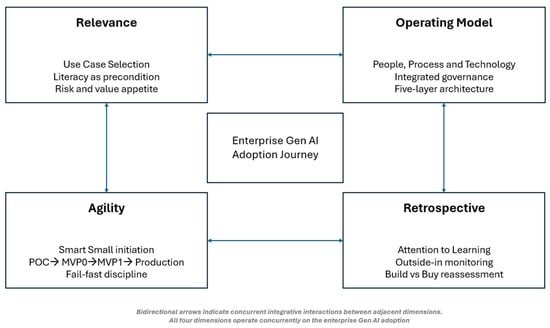
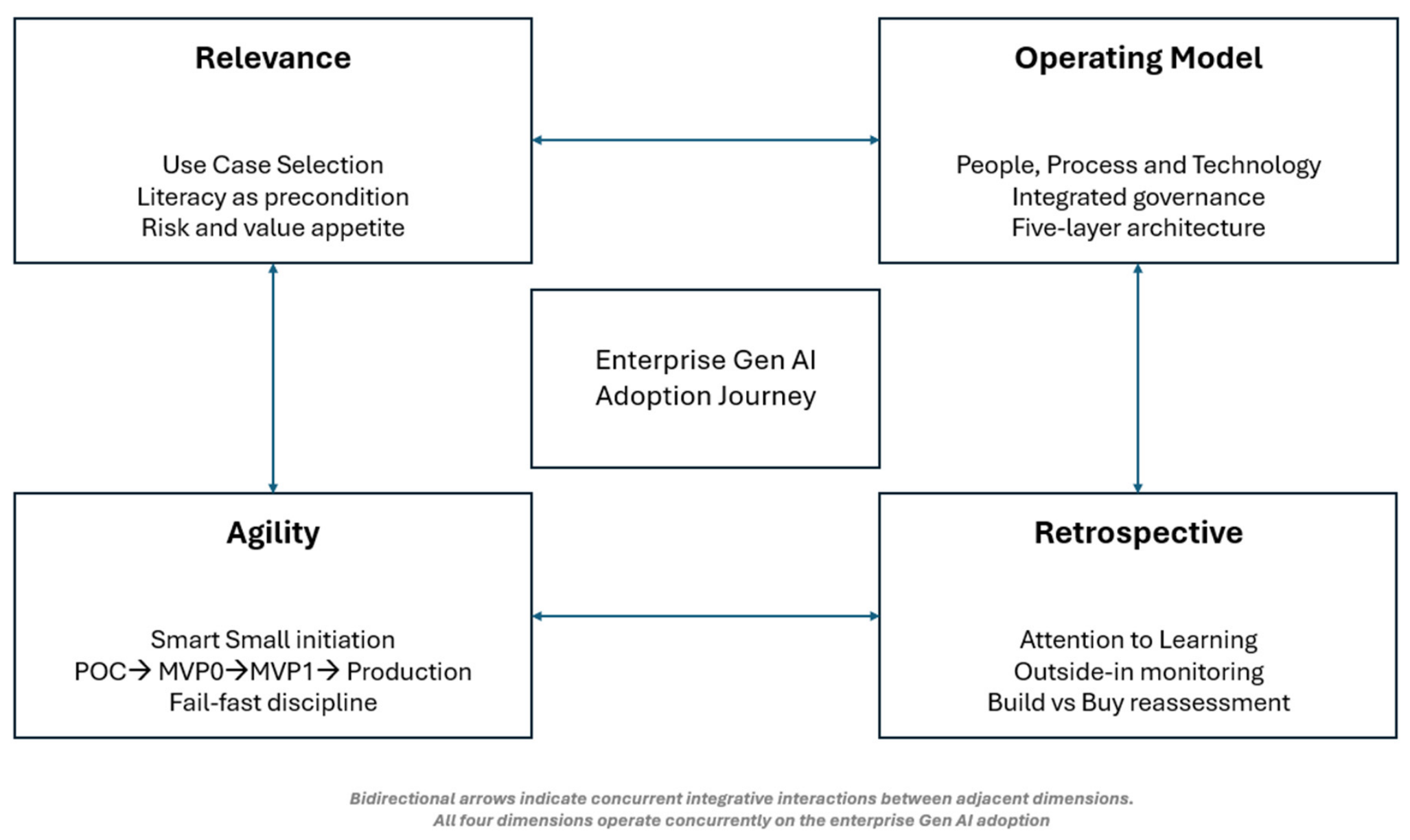
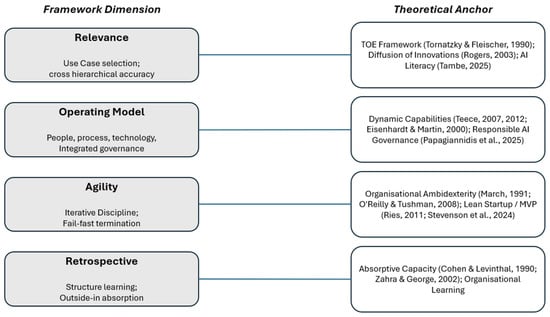
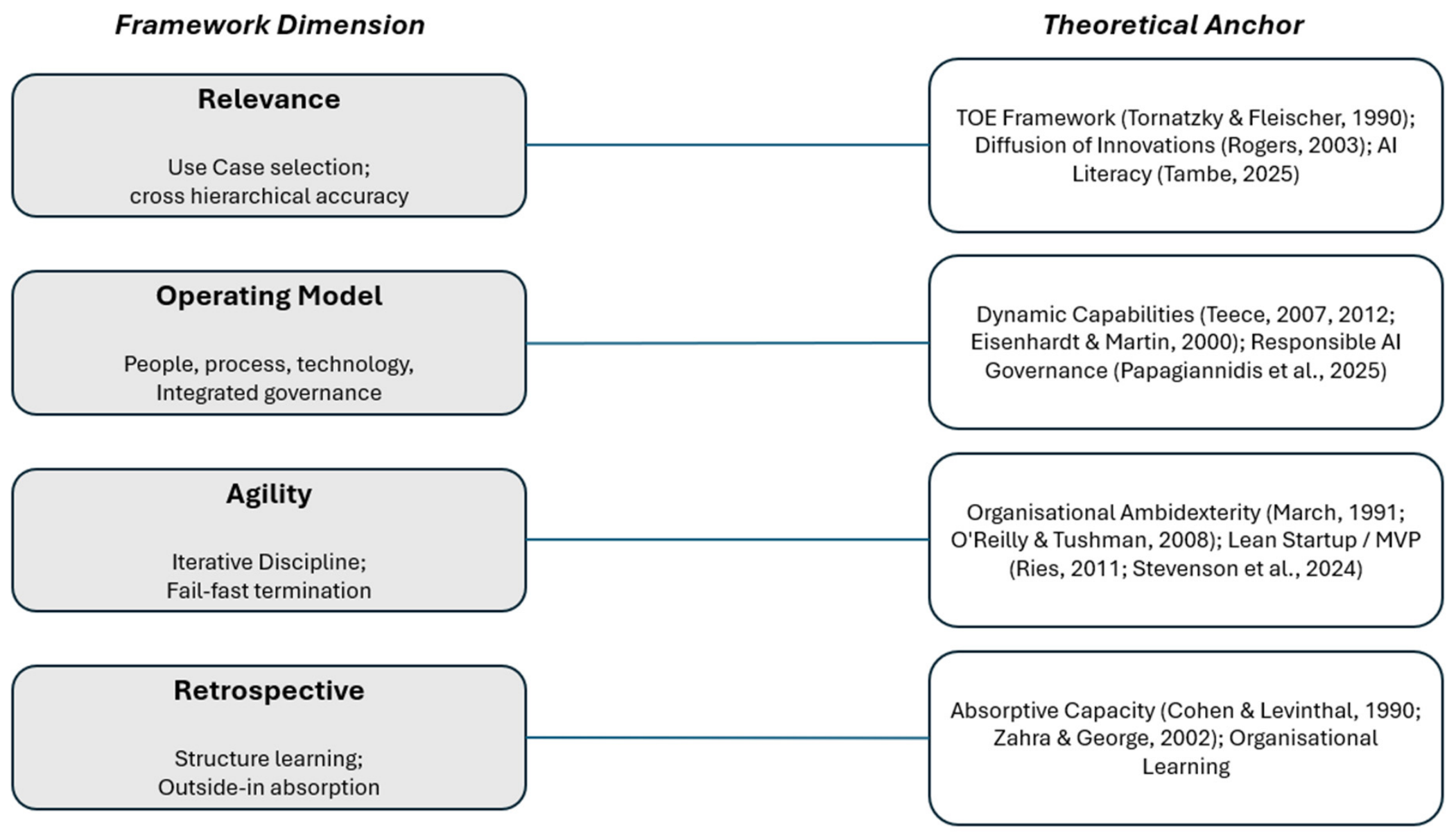

Disclaimer/Publisher’s Note: The statements, opinions and data contained in all publications are solely those of the individual author(s) and contributor(s) and not of MDPI and/or the editor(s). MDPI and/or the editor(s) disclaim responsibility for any injury to people or property resulting from any ideas, methods, instructions or products referred to in the content. |
© 2026 by the authors. Licensee MDPI, Basel, Switzerland. This article is an open access article distributed under the terms and conditions of the Creative Commons Attribution (CC BY) license.