From Proof-of-Concept to Production: A Techno-Functional Framework for Generative AI Adoption in Enterprise Settings


Abstract
1. Introduction
2. Theoretical Background and Literature Review
2.1. Foundations of Technology Adoption Theory
2.2. Generative AI Adoption Literature
2.3. Identified Gaps
3. Methodology
3.1. Research Design
3.2. Systematic Literature Review
3.3. Reflexivity Statement
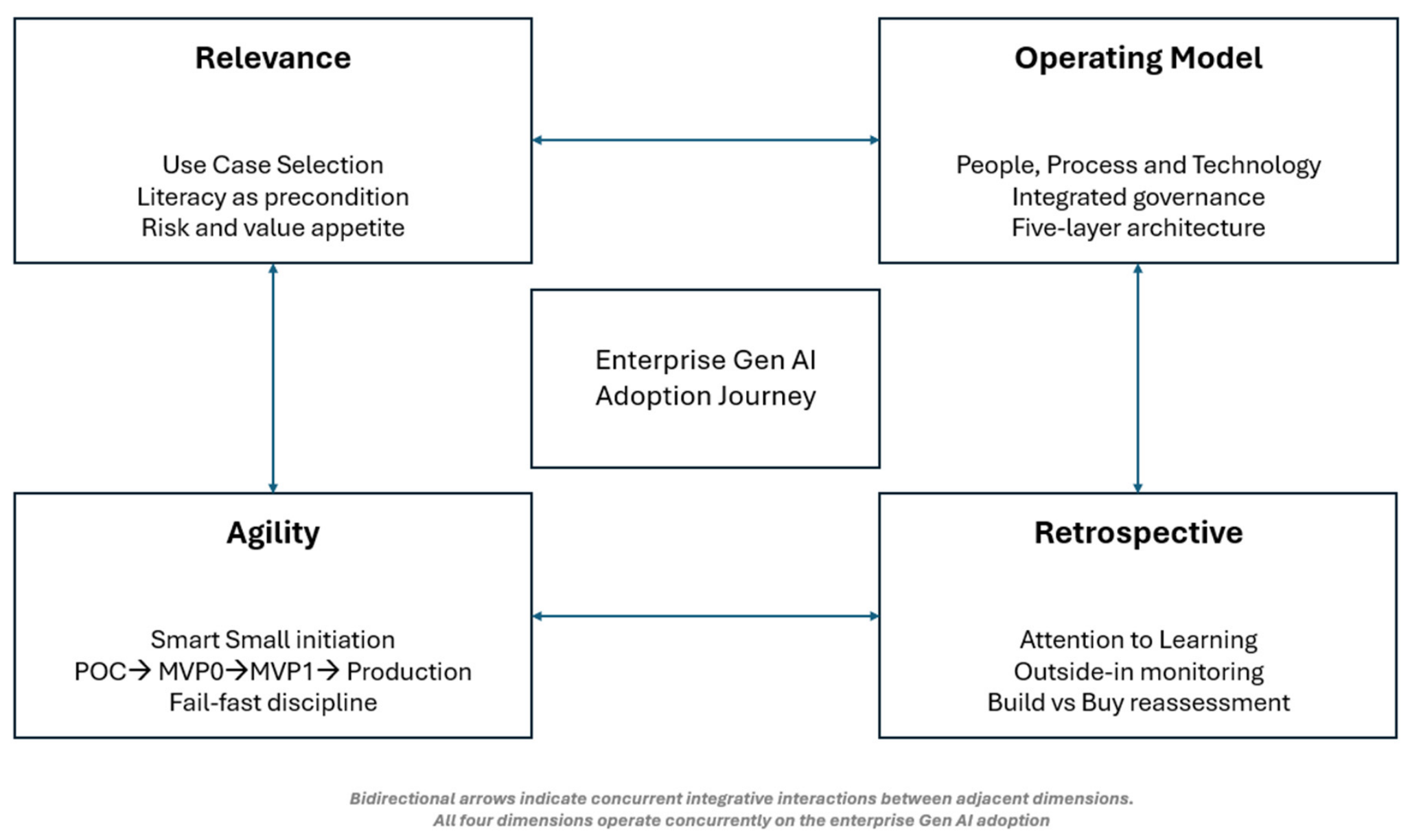
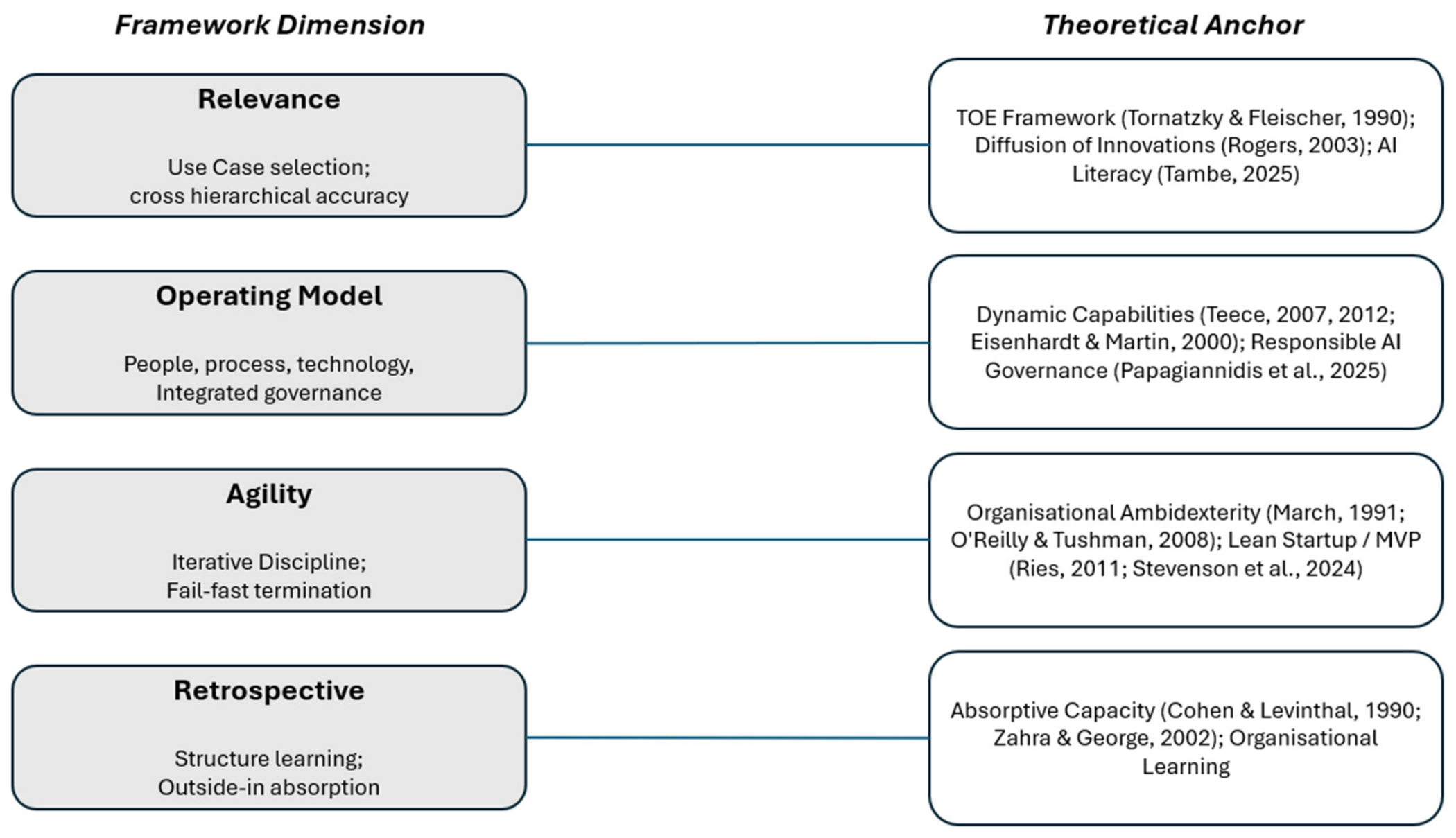
4. The Techno-Functional Framework
4.1. Relevance
4.2. Operating Model
4.3. Agility
4.4. Retrospective
4.5. Integrative Propositions
5. Illustrative Application: Four Composite Vignettes
5.1. Vignette One. Financial Services: Borrower Credit Assessment and Knowledge Access
5.2. Vignette Two. Industrial Manufacturing: When the Wrong Tool Looks Right
5.3. Vignette Three. Global Retail: From Boiling the Ocean to Templated Reuse
5.4. Vignette Four. Higher Education: Literacy as Gate, Retirement as Success
6. Discussion
6.1. Theoretical Contributions
6.2. Comparison with Adjacent Frameworks
6.3. Managerial Implications
7. Limitations and Future Research
8. Conclusions
Supplementary Materials
Author Contributions
Funding
Data Availability Statement
Acknowledgments
Conflicts of Interest
References
- Gartner. Gartner Predicts 30% of Generative AI Projects Will Be Abandoned After Proof of Concept by End of 2025. Gartner. Available online: https://www.gartner.com/en/newsroom/press-releases/2024-07-29-gartner-predicts-30-percent-of-generative-ai-projects-will-be-abandoned-after-proof-of-concept-by-end-of-2025 (accessed on 29 July 2024).
- Davis, F.D. Perceived usefulness, perceived ease of use, and user acceptance of information technology. MIS Q. 1989, 13, 319–340. [Google Scholar] [CrossRef] [Scilit]
- Davis, F.D.; Bagozzi, R.P.; Warshaw, P.R. User acceptance of computer technology: A comparison of two theoretical models. Manag. Sci. 1989, 35, 982–1003. [Google Scholar] [CrossRef] [Scilit]
- Venkatesh, V.; Morris, M.G.; Davis, G.B.; Davis, F.D. User acceptance of information technology: Toward a unified view. MIS Q. 2003, 27, 425–478. [Google Scholar] [CrossRef] [Scilit]
- Venkatesh, V.; Thong, J.Y.L.; Xu, X. Consumer acceptance and use of information technology: Extending the unified theory of acceptance and use of technology. MIS Q. 2012, 36, 157–178. [Google Scholar] [CrossRef] [Scilit]
- Tornatzky, L.G.; Fleischer, M.; Chakrabarti, A.K. The Processes of Technological Innovation; Lexington Books: Lanham, MD, USA, 1990. [Google Scholar]
- Rogers, E.M. Diffusion of Innovations, 5th ed.; Free Press: New York, NY, USA, 2003. [Google Scholar]
- Huang, L.; Yu, W.; Ma, W.; Zhong, W.; Feng, Z.; Wang, H.; Chen, Q.; Peng, W.; Feng, X.; Qin, B.; et al. A survey on hallucination in large language models: Principles, taxonomy, challenges, and open questions. ACM Trans. Inf. Syst. 2025, 43, 1–55. [Google Scholar] [CrossRef] [Scilit]
- Farquhar, S.; Kossen, J.; Kuhn, L.; Gal, Y. Detecting hallucinations in large language models using semantic entropy. Nature 2024, 630, 625–630. [Google Scholar] [CrossRef] [Scilit]
- Madanchian, M.; Taherdoost, H. Ethical theories, governance models, and strategic frameworks for responsible AI adoption and organizational success. Front. Artif. Intell. 2025, 8, 1619029. [Google Scholar] [CrossRef] [Scilit]
- Rana, N.P.; Pillai, R.; Sivathanu, B.; Malik, N. Assessing the nexus of generative AI adoption, ethical considerations and organisational performance. Technovation 2024, 135, 103064. [Google Scholar] [CrossRef] [Scilit]
- Zhang, L.; Shao, Z.; Chen, B.; Benitez, J. Unraveling generative AI adoption in enterprise digital platforms: The effect of institutional pressures and the moderating role of internal and external environments. IEEE Trans. Eng. Manag. 2025, 72, 335–348. [Google Scholar] [CrossRef] [Scilit]
- Russo, D. Navigating the complexity of generative AI adoption in software engineering. ACM Trans. Softw. Eng. Methodol. 2024, 33, 1–50. [Google Scholar] [CrossRef] [Scilit]
- Jackson, I.; Ivanov, D.; Dolgui, A.; Namdar, J. Generative artificial intelligence in supply chain and operations management: A capability-based framework for analysis and implementation. Int. J. Prod. Res. 2024, 62, 6120–6145. [Google Scholar] [CrossRef] [Scilit]
- Weinberg, A.I. A framework for the adoption and integration of generative AI in midsize organizations and enterprises (FAIGMOE). arXiv 2025. [Google Scholar] [CrossRef] [Scilit]
- Reddy, S. Generative AI in healthcare: An implementation science informed translational path on application, integration and governance. Implement. Sci. 2024, 19, 27. [Google Scholar] [CrossRef] [Scilit]
- Haki, K.; Safaei, D.; Magan, A.; Griffiths, M. Integrating generative AI into enterprise platforms: Insights from Salesforce. Inf. Syst. J. 2025, 35, 1497–1512. [Google Scholar] [CrossRef] [Scilit]
- Chowdhury, S.; Budhwar, P.; Wood, G. Generative artificial intelligence in business: Towards a strategic human resource management framework. Br. J. Manag. 2024, 35, 1680–1691. [Google Scholar] [CrossRef] [Scilit]
- Ganapam, M.M.; Kumar, G.V.A.; Kasa, M. Integrating generative AI into digital transformation: A unified pilot-to-production framework for key economic sectors. In Proceedings of the 2025 5th International Conference on Emerging Research in Electronics, Computer Science and Technology (ICERECT); IEEE: New York, NY, USA, 2025. [Google Scholar] [CrossRef] [Scilit]
- Wessel, M.; Adam, M.; Benlian, A.; Majchrzak, A.; Thies, F. Generative AI and its transformative value for digital platforms. J. Manag. Inf. Syst. 2025, 42, 346–369. [Google Scholar] [CrossRef] [Scilit]
- Teece, D.J. Explicating dynamic capabilities: The nature and microfoundations of (sustainable) enterprise performance. Strateg. Manag. J. 2007, 28, 1319–1350. [Google Scholar] [CrossRef] [Scilit]
- Teece, D.J. Dynamic capabilities: Routines versus entrepreneurial action. J. Manag. Stud. 2012, 49, 1395–1401. [Google Scholar] [CrossRef] [Scilit]
- March, J.G. Exploration and exploitation in organizational learning. Organ. Sci. 1991, 2, 71–87. [Google Scholar] [CrossRef] [Scilit]
- Cohen, W.M.; Levinthal, D.A. Absorptive capacity: A new perspective on learning and innovation. Adm. Sci. Q. 1990, 35, 128–152. [Google Scholar] [CrossRef] [Scilit]
- Venkatesh, V. Adoption and use of AI tools: A research agenda grounded in UTAUT. Ann. Oper. Res. 2022, 308, 641–652. [Google Scholar] [CrossRef] [Scilit]
- Agrawal, K.P. Towards adoption of generative artificial intelligence in organisational settings: A study with information technology professionals. J. Comput. Inf. Syst. 2024, 64, 636–651. [Google Scholar] [CrossRef] [Scilit]
- Al-Khatib, A.W. Drivers of generative artificial intelligence to fostering exploitative and exploratory innovation: A TOE framework. Technol. Soc. 2023, 75, 102403. [Google Scholar] [CrossRef] [Scilit]
- Sánchez, E.; Calderón, R.; Herrera, F. Artificial intelligence adoption in SMEs: Survey based on the TOE–DOI framework, primary methodology, and challenges. Appl. Sci. 2025, 15, 6465. [Google Scholar] [CrossRef] [Scilit]
- Schwaeke, J.; Peters, A.; Kanbach, D.K.; Kraus, S.; Jones, P. The new normal: The status quo of AI adoption in SMEs. J. Small Bus. Manag. 2025, 63, 1297–1331. [Google Scholar] [CrossRef] [Scilit]
- Eisenhardt, K.M.; Martin, J.A. Dynamic capabilities: What are they? Strateg. Manag. J. 2000, 21, 1105–1121. [Google Scholar] [CrossRef] [Scilit]
- Zahra, S.A.; George, G. Absorptive capacity: A review, reconceptualization, and extension. Acad. Manag. Rev. 2002, 27, 185–203. [Google Scholar] [CrossRef] [Scilit]
- O’Reilly, C.A.; Tushman, M.L. Ambidexterity as a dynamic capability: Resolving the innovator’s dilemma. Res. Organ. Behav. 2008, 28, 185–206. [Google Scholar] [CrossRef] [Scilit]
- Feuerriegel, S.; Hartmann, J.; Janiesch, C.; Zschech, P. Generative AI. Bus. Inf. Syst. Eng. 2024, 66, 111–126. [Google Scholar] [CrossRef] [Scilit]
- Brynjolfsson, E.; Li, D.; Raymond, L.R. Generative AI at Work; Working Paper No. 31161; National Bureau of Economic Research: Cambridge, MA, USA, 2023. [Google Scholar] [CrossRef] [Scilit]
- Eisfeldt, A.L.; Schubert, G.; Zhang, M.B. Generative AI and Firm Values; Working Paper No. 31222; National Bureau of Economic Research: Cambridge, MA, USA, 2023. [Google Scholar] [CrossRef] [Scilit]
- Mikalef, P.; Lemmer, K.; Schaefer, C.; Ylinen, M.; Fjørtoft, S.O.; Torvatn, H.Y.; Gupta, M.; Niehaves, B. Examining how AI capabilities can foster organizational performance in public organizations. Gov. Inf. Q. 2023, 40, 101797. [Google Scholar] [CrossRef] [Scilit]
- Khanna, A.; Bhusri, A. Navigating AI adoption—An “AI-verse” framework for enterprises. In Proceedings of the 2025 IEEE Conference on Artificial Intelligence (CAI); IEEE: New York, NY, USA, 2025; pp. 1488–1491. [Google Scholar] [CrossRef] [Scilit]
- Rajaram, K.; Tinguely, P.N. Generative artificial intelligence in small and medium enterprises: Navigating its promises and challenges. Bus. Horiz. 2024, 67, 629–648. [Google Scholar] [CrossRef] [Scilit]
- Bodnari, A.; Travis, J. Scaling enterprise AI in healthcare: The role of governance in risk mitigation frameworks. npj Digit. Med. 2025, 8, 272. [Google Scholar] [CrossRef] [Scilit]
- Yandrapalli, V. Revolutionizing supply chains using power of generative AI. Int. J. Res. Publ. Rev. 2023, 4, 1556–1562. [Google Scholar] [CrossRef] [Scilit]
- De Longueville, B.; Sanchez, I.; Kazakova, S.; Luoni, S.; Zaro, F.; Daskalaki, K.; Inchingolo, M. The proof is in the eating: Lessons learnt from one year of generative AI adoption in a science-for-policy organisation. AI 2025, 6, 128. [Google Scholar] [CrossRef] [Scilit]
- Papagiannidis, E.; Mikalef, P.; Conboy, K. Responsible artificial intelligence governance: A review and research framework. J. Strateg. Inf. Syst. 2025, 34, 101885. [Google Scholar] [CrossRef] [Scilit]
- Camilleri, M.A. Artificial intelligence governance: Ethical considerations and implications for social responsibility. Expert Syst. 2024, 41, e13406. [Google Scholar] [CrossRef] [Scilit]
- Díaz-Rodríguez, N.; Del Ser, J.; Coeckelbergh, M.; López de Prado, M.; Herrera-Viedma, E.; Herrera, F. Connecting the dots in trustworthy artificial intelligence: From AI principles, ethics, and key requirements to responsible AI systems and regulation. Inf. Fusion 2023, 99, 101896. [Google Scholar] [CrossRef] [Scilit]
- Tambe, P. Reskilling the workforce for AI: Domain expertise and algorithmic literacy. Manag. Sci. 2025, 72, 515–537. [Google Scholar] [CrossRef] [Scilit]
- Almatrafi, O.; Johri, A.; Lee, H. A systematic review of AI literacy conceptualization, constructs, and implementation and assessment efforts (2019–2023). Comput. Educ. Open 2024, 6, 100173. [Google Scholar] [CrossRef] [Scilit]
- Annapureddy, R.; Fornaroli, A.; Gatica-Perez, D. Generative AI literacy: Twelve defining competencies. Digit. Gov. Res. Pract. 2025, 6, 1–21. [Google Scholar] [CrossRef] [Scilit]
- Morandini, S.; Fraboni, F.; De Angelis, M.; Puzzo, G.; Giusino, D.; Pietrantoni, L. The impact of artificial intelligence on workers’ skills: Upskilling and reskilling in organisations. Informing Sci. Int. J. Emerg. Transdiscipl. 2023, 26, 39–68. [Google Scholar] [CrossRef] [Scilit]
- Stevenson, R.; Burnell, D.; Fisher, G. The minimum viable product (MVP): Theory and practice. J. Manag. 2024, 50, 3202–3231. [Google Scholar] [CrossRef] [Scilit]
- Alonso, S.; Kalinowski, M.; Ferreira, B.; Barbosa, S.D.J.; Lopes, H. A systematic mapping study and practitioner insights on the use of software engineering practices to develop MVPs. Inf. Softw. Technol. 2023, 156, 107144. [Google Scholar] [CrossRef] [Scilit]
- Saklamaeva, V.; Pavlič, L. The potential of AI-driven assistants in scaled agile software development. Appl. Sci. 2024, 14, 319. [Google Scholar] [CrossRef] [Scilit]
- Bahi, A.; Gharib, J.; Gahi, Y. Integrating generative AI for advancing agile software development and mitigating project management challenges. Int. J. Adv. Comput. Sci. Appl. 2024, 15, 54–61. [Google Scholar] [CrossRef] [Scilit]
- Sauvola, J.; Tarkoma, S.; Klemettinen, M.; Riekki, J.; Doermann, D. Future of software development with generative AI. Autom. Softw. Eng. 2024, 31, 26. [Google Scholar] [CrossRef] [Scilit]
- Singh, K.; Chatterjee, S.; Mariani, M. Applications of generative AI and future organizational performance: The mediating role of explorative and exploitative innovation and the moderating role of ethical dilemmas and environmental dynamism. Technovation 2024, 133, 103021. [Google Scholar] [CrossRef] [Scilit]
- Whetten, D.A. What constitutes a theoretical contribution? Acad. Manag. Rev. 1989, 14, 490–495. [Google Scholar] [CrossRef] [Scilit]
- Cropanzano, R. Writing nonempirical articles for Journal of Management: General thoughts and suggestions. J. Manag. 2009, 35, 1304–1311. [Google Scholar] [CrossRef] [Scilit]
- Page, M.J.; McKenzie, J.E.; Bossuyt, P.M.; Boutron, I.; Hoffmann, T.C.; Mulrow, C.D.; Shamseer, L.; Tetzlaff, J.M.; Akl, E.A.; Brennan, S.E.; et al. The PRISMA 2020 statement: An updated guideline for reporting systematic reviews. BMJ 2021, 372, n71. [Google Scholar] [CrossRef] [Scilit]
- Ries, E. The Lean Startup: How Today’s Entrepreneurs Use Continuous Innovation to Create Radically Successful Businesses, 1st ed.; Crown Business: Mumbai, India, 2011. [Google Scholar]
- Ghimire, P.; Kim, K.; Acharya, M. Opportunities and challenges of generative AI in the construction industry: Focusing on adoption of text-based models. Buildings 2024, 14, 220. [Google Scholar] [CrossRef] [Scilit]
- Ferrara, E. Should ChatGPT be biased? Challenges and risks of bias in large language models. First Monday 2023, 28. [Google Scholar] [CrossRef] [Scilit]
- Lin, Z.; Guan, S.; Zhang, W.; Zhang, H.; Li, Y.; Zhang, H. Towards trustworthy LLMs: A review on debiasing and dehallucinating in large language models. Artif. Intell. Rev. 2024, 57, 243. [Google Scholar] [CrossRef] [Scilit]
- Marshall, A.; Bieck, C.; Dencik, J.; Goehring, B.C.; Warrick, R. How generative AI will drive enterprise innovation. Strategy Leadersh. 2024, 52, 23–28. [Google Scholar] [CrossRef] [Scilit]
- Leoni, L.; Gueli, G.; Ardolino, M.; Panizzon, M.; Gupta, S. AI-empowered KM processes for decision-making: Empirical evidence from worldwide organisations. J. Knowl. Manag. 2024, 28, 320–347. [Google Scholar] [CrossRef] [Scilit]
- Babashahi, L.; Barbosa, C.E.; Lima, Y.; Lyra, A.; Salazar, H.; Argôlo, M.; Almeida, M.A.; Souza, J.M. AI in the workplace: A systematic review of skill transformation in the industry. Adm. Sci. 2024, 14, 127. [Google Scholar] [CrossRef] [Scilit]
- Tabassi, E. Artificial Intelligence Risk Management Framework (AI RMF 1.0); NIST AI 100-1; National Institute of Standards and Technology: Gaithersburg, MD, USA, 2023. [Google Scholar] [CrossRef] [Scilit]
- Holmström, J.; Magnusson, J. Navigating the organizational AI journey: The AI transformation framework. Bus. Horiz. 2026, 69, 89–100. [Google Scholar] [CrossRef] [Scilit]
- Zhang, Q.; Zuo, J.; Yang, S. Research on the impact of generative artificial intelligence (GenAI) on enterprise innovation performance: A knowledge management perspective. J. Knowl. Manag. 2025, 29, 2238–2257. [Google Scholar] [CrossRef] [Scilit]
- Storey, V.C. Knowledge management in a world of generative AI: Impact and implications. ACM Trans. Manag. Inf. Syst. 2025, 16, 1–14. [Google Scholar] [CrossRef] [Scilit]



| P | Statement (Abridged) | Dimension | Theoretical Anchor | Refs. |
|---|---|---|---|---|
| P1 | Cross-hierarchical literacy preceding use case selection raises POC-to-production conversion rates. | Relevance | TOE; AI literacy | [45,47] |
| P2 | Problem-first selection yields a higher proportion of relevant deployments than technology-first selection. | Relevance | DOI; compatibility | [7,13,66] |
| P3 | Integrated governance reduces incident rate and raises production stability. | Operating model | Responsible AI governance | [42,65] |
| P4 | Team archetype must scale with use case complexity; mismatches predict failure. | Operating model | Dynamic capabilities; HRM | [18,64] |
| P5 | Five-layer architectural readiness moderates the pilot-to-production transition. | Operating model | Dynamic capabilities | [17,19] |
| P6 | Stepwise POC → MVP0 → MVP1 → Production yields higher production stability than direct progression. | Agility | Lean startup; MVP theory | [49,50,58] |
| P7 | Willingness to terminate failed POCs is positively associated with portfolio production success. | Agility | Ambidexterity; real options | [23,32] |
| P8 | Institutionalized retrospection raises absorptive capacity for subsequent initiatives. | Retrospective | Absorptive capacity | [24,31] |
| P9 | Outside-in monitoring moderates the current-choice/future-stability relationship. | Retrospective | Dynamic sensing capability | [21,30] |
| P10 | Retrospective-driven build-vs-buy reassessment generates higher portfolio value than a constant initial decision. | Retrospective | Dynamic capabilities | [22] |
| P11 | The four dimensions are mutually reinforcing; each is moderated by the maturity of the others. | Integrative | Synthesis of all anchors | (integration argument) |
| P12 | Concurrent dimensional treatment outperforms sequential treatment on conversion, time-to-value, and incident rate. | Integrative | Ambidexterity; dynamic capabilities | [21,23] |
| Framework (Reference) | Structural Form | Treatment of Retrospection | Technology-Organization Integration | Empirical Grounding Reported |
|---|---|---|---|---|
| FAIGMOE [15] | Interconnected; 4 phases | Implicit (within Phase 4 Operationalization and Optimization) | Partial; phases treat technology and organization as separate streams | Conceptual; no empirical validation reported (preprint) |
| JRC GenAI Compass [41] | Concentric layers with AI-IQ construct | Implicit (post-deployment lessons) | Embedded in JRC operational context | Single-case empirical (one organization, one year) |
| Six-phase TOE-DOI [28] | Sequential; 6 phases | Absent as a named dimension | TOE-based; antecedent-focused | Conceptual with case-study insights; SME-bounded |
| Maturity ladder [19] | Sequential; 5 maturity levels | Implicit (per maturity level) | Strong (LLMOps, trust layers, fusion teams) | 8 longitudinal cases plus survey of 212 executives |
| Techno-Functional Framework (this paper) | Concurrent; 4 dimensions | Explicit, recurring, named dimension | Integrated within each dimension | Conceptual; 12 testable propositions with empirical agenda specified |
Disclaimer/Publisher’s Note: The statements, opinions and data contained in all publications are solely those of the individual author(s) and contributor(s) and not of MDPI and/or the editor(s). MDPI and/or the editor(s) disclaim responsibility for any injury to people or property resulting from any ideas, methods, instructions or products referred to in the content. |
© 2026 by the authors. Licensee MDPI, Basel, Switzerland. This article is an open access article distributed under the terms and conditions of the Creative Commons Attribution (CC BY) license.
Share and Cite
Rabbani, S.S.; Nisa, S.; El-Tanani, M.; Rabbani, S.A. From Proof-of-Concept to Production: A Techno-Functional Framework for Generative AI Adoption in Enterprise Settings. Information 2026, 17, 899. https://doi.org/10.3390/info17090899
Rabbani SS, Nisa S, El-Tanani M, Rabbani SA. From Proof-of-Concept to Production: A Techno-Functional Framework for Generative AI Adoption in Enterprise Settings. Information. 2026; 17(9):899. https://doi.org/10.3390/info17090899
Chicago/Turabian StyleRabbani, Syed Salman, Syeedun Nisa, Mohamed El-Tanani, and Syed Arman Rabbani. 2026. "From Proof-of-Concept to Production: A Techno-Functional Framework for Generative AI Adoption in Enterprise Settings" Information 17, no. 9: 899. https://doi.org/10.3390/info17090899
APA StyleRabbani, S. S., Nisa, S., El-Tanani, M., & Rabbani, S. A. (2026). From Proof-of-Concept to Production: A Techno-Functional Framework for Generative AI Adoption in Enterprise Settings. Information, 17(9), 899. https://doi.org/10.3390/info17090899