


Abstract
Automated cybergrooming detection can support the review of large volumes of online communication, but public datasets and detection approaches remain predominantly English-centered. This study presents a reproducible workflow for constructing target-language cybergrooming datasets and detection models from English resources, demonstrated for German. To the best of our knowledge, this is the first published study to construct and systematically evaluate German-language cybergrooming datasets and detection models. Four publicly available English cybergrooming datasets were converted into a shared structure and translated into informal German chat language. Translation quality was estimated using an aggregate of COMETKiwi and MetricX scores termed CometricX. Low-quality messages were retranslated and reevaluated. Cybergrooming messages were additionally augmented through German–Catalan backtranslation. The resulting datasets, with and without augmentation, were used to train and evaluate embedding-based linear support vector machines (SVMs) and ModernBERT models. Evaluation comprised translated test data and 156 manually labeled German conversations from five closed law-enforcement cases. The Perverted Justice Zig ChitChat dataset (PJZC) achieved the highest aggregate quality estimate and the most robust detection performance on real-world German conversations. In contrast, performance on machine-translated test data overestimated real-world detection performance. Furthermore, backtranslation yielded only limited and inconsistent improvements. Overall, the proposed workflow provides a practical starting point for developing target-language cybergrooming detectors while highlighting careful source dataset selection and evaluation on authentic target-language data.
1. Introduction
The rapid growth of digital communication has made the online sexual exploitation of minors an increasing challenge for law enforcement and child protection. Cybergrooming, in which an offender uses digital communication to approach, manipulate, and sexually exploit a minor, represents one form of this abuse [1]. It may involve trust building, emotional manipulation, sexualized conversations, requests for intimate material, or attempts to arrange an offline meeting. The prevalence of such experiences demonstrates the societal relevance of the problem. Cybergrooming is an international problem that affects online communication across national borders. Reports submitted to the National Center for Missing and Exploited Children (NCMEC) provide one example of its growing scale. The NCMEC CyberTipline category ‘online enticement of children for sexual acts’ includes cybergrooming alongside related forms of online child exploitation. As shown in Figure 1, reports in this category increased from 19,174 in 2019 to 1,413,347 in 2025 [2,3,4,5,6]. This sharp rise highlights the growing relevance of cybergrooming and the need to address it internationally.
Figure 1.
Annual National Center for Missing and Exploited Children (NCMEC) CyberTipline reports categorized as online enticement of children for sexual acts, including cybergrooming, from 2019 to 2025 [2,3,4,5,6].
The large and growing number of reports makes it difficult to review all relevant communication manually. Since cybergrooming takes place through digital communication, natural language processing (NLP) and machine learning (ML) can help experts examine large chat collections and identify messages that may require closer attention. These systems can assist with the review process, but they cannot determine criminal intent or replace human judgment.
1.1. Research Questions and Objectives
Existing research and available resources are still centered around the English language. Public cybergrooming datasets, benchmark tasks, and most published detection approaches are based on English material. Recent work has begun to explore Korean and Slovak classifiers constructed with translated English data, Korean sentence-level safety classification, an English–Korean industry pilot, and a small Spanish Roblox corpus. Reproducible evidence from authentic non-English grooming conversations nevertheless remains scarce. If detection methods are to be useful beyond English-speaking contexts, researchers need a reliable way to transfer data-driven approaches to other target languages. This challenge extends beyond translation, as it also involves dataset quality, linguistic variation, cultural context, annotation transfer, model selection, and evaluation methodology.
This paper addresses that gap through a machine-translation workflow for German cybergrooming detection. The workflow constructs labeled German training data from established English datasets and combines dataset comparison, message-level quality assessment, targeted retranslation, optional backtranslation, and evaluation on authentic German communication. While the workflow is intended to be transferable to further languages, we demonstrate it through a German case study. To the best of our knowledge, this is the first published study to construct and systematically evaluate German-language cybergrooming datasets and detection models. Based on four English-language datasets, we construct German-language resources, evaluate their translation quality, train detection models, and compare their performance on translated test data and authentic German case conversations.
This paper makes three main contributions. First, it provides German translations of four established English cybergrooming datasets in a shared representation. Second, it presents a detailed and reproducible process for MT, message-level quality estimation (QE), targeted retranslation, and optional backtranslation. Third, it develops German-language cybergrooming detection models by comparing four training datasets, two model types, and training with and without backtranslation. The models are additionally tested on 156 German conversations from five closed law-enforcement cases. This separation between translated and authentic target-language evaluation is central to determining whether performance within a translated distribution generalizes to real-world case data. Based on this objective, the paper is guided by the following three research questions:
- Research Question 1: Which public English dataset delivers the best quality estimation results by machine-translating into German?
- Research Question 2: Which machine-translated dataset is best suited for training a German cybergrooming detection model?
- Research Question 3: Does backtranslating the German dataset improve the performance of the detection model?
1.2. Paper Structure
The remainder of this paper is structured as follows. Section 2 summarizes related work and gives a detailed overview of existing English datasets. In Section 3, we describe our methodological pipeline step by step and the resources used. In Section 4, we report our experimental results on the quality of the translated datasets and the performance of the detection models. Section 5 and Section 6 discuss the findings and present the conclusions.
2. Related Work
This section reviews prior work relevant to the construction and use of datasets for cybergrooming detection. It first summarizes established English-language corpora and their role in previous research, then discusses related detection approaches, data generation strategies, and remaining open challenges. The overview provides the necessary context for positioning the datasets and methodology presented in this work.
2.1. Existing English Datasets
Several established English-language datasets already exist for the detection of cybergrooming. These differ in terms of their size, origin, and the formatting of the underlying data, which determines their respective applications. Some of these datasets are used in both research and practical applications, such as for training and evaluating detection models in various scenarios. A key problem, however, is that so far only English-language datasets have been freely available. As a result, current approaches to automated detection can predominantly be used only for English communication data, while research in other languages remains significantly limited. In the following, the existing datasets are presented and explained in more detail. The focus is on their structure, their content organization, the volume of data, and the origin of the underlying communication data.
A tabular overview of all the datasets presented is shown in Table A1. There, the key characteristics of the individual datasets are summarized and compared, where available. The table lists the origin of the data, the total number of conversations, and their breakdown into cybergrooming and non-cybergrooming cases. In addition, the respective user counts, separated by both categories, are provided. Furthermore, the table contains more detailed information on preprocessing steps performed, such as filtering, segmentation, or cleaning of the messages, as well as on the existing annotations and label structures. Finally, the availability of the datasets is listed to clarify which corpora are publicly accessible and usable for one’s own research purposes.
2.1.1. Perverted Justice (PJ)
An early and widely cited data project in the field of cybergrooming detection is the so-called Perverted Justice dataset (PJ). This is based on the activities of the U.S. nonprofit organization Perverted Justice, which, starting in the early 2000s, identified adults in public internet chat rooms who attempted to initiate sexual contact with individuals they believed to be minors [7]. The organization worked with volunteers who posed as minors online to document such conversations. The perpetrators thus did not communicate with actual children, but with adults acting as minors.
The collected chat logs were published on the organization’s website and served both to raise public awareness and as a basis for criminal investigations [7]. The project was most active between 2004 and 2008, though documented cases continued to be published until at least 2019. PJ consists primarily of authentic, unstructured chat logs, supplemented by metadata regarding cases and participants [8]. According to the operators, the project was discontinued after communication increasingly shifted to mobile platforms and the original goal of raising public awareness had been achieved [7]. PJ is considered a pioneer in the field of cybergrooming detection, has contributed significantly to research and public awareness on this topic and led to the arrest of 622 sex offenders with a conviction rate of 99.1%. PJ consists of 622 complete cybergrooming chats and 3.7 million words of cybergrooming language [9]. Although the original website is no longer actively maintained, parts of PJ remain accessible via the Internet Archive.
2.1.2. ChatCoder 2 (CC2)
ChatCoder refers to a prototype software program developed to analyze cybergrooming messages as part of a research project by McGhee et al. [10]. The project was funded by the National Science Foundation to support the scientific study of cybergrooming and to test new detection methods. While ChatCoder 1 was still based on simple keyword-matching algorithms, ChatCoder 2 relied on a rule-based approach capable of accounting for communicative patterns and semantic relationships in chat histories. As part of this project, the annotated ChatCoder 2 dataset (CC2) was also created and made publicly available, designed for use with the software. CC2 comprises 497 complete cybergrooming chats from the PJ corpus with no non-cybergrooming chats [11]. As of March 2026, CC2 is no longer available via the original project page, but can only be obtained upon request from the responsible project leaders [12].
2.1.3. Mixed Chat (MC)
The research conducted by Miah et al. in 2011 focused on developing a classification system to distinguish cybergrooming from other forms of communication [13]. They compiled the Mixed Chat dataset (MC) consisting of individual chats, which were categorized into child exploitation (CE), sex fantasy (SF), and general conversation (GN). The CE samples were obtained from PJ. The SF and GN logs were collected from public archives such as Fugly and Chatdump.
During the preprocessing stage, the researchers removed usernames and randomly crossed the logs to expand the SF instances. A significant portion of the work involved manually editing the SF logs to remove inconsistencies where users broke character, such as when a user suddenly revealed they were not the person they claimed to be, to ensure the data remained representative of its category. Instead of relying solely on individual words, the methodology incorporated the analysis of emotional, cognitive, and structural components of the language to identify underlying psychological patterns typical of predatory behavior. MC consists of 392 chat logs, of which 200 are cybergrooming and 192 non-cybergrooming conversations. MC is not available as a public repository.
2.1.4. PAN-2012 (PAN12)
The PAN-2012 dataset (PAN12) was released as part of the first Sexual Predator Identification Challenge on the PAN platform. The goal of this initiative was to create a standardized framework for the automated detection of cybergrooming behavior in online communication. The unique feature of this competition was that it provided, for the first time, a large-scale, annotated corpus for the analysis of potential sexual abuse in the digital space [14]. PAN12 was designed to reflect a realistic ratio of true positives, false positives, and false negatives [14]. Only a small portion of the conversations actually contain cybergrooming-relevant content, in order to simulate real-world application scenarios as authentically as possible. Several data sources were combined to create the corpus. Cybergrooming conversations come from the PJ, while over a million conversations were used for non-cybergrooming-related content from the Omegle platform where two anonymous individuals are randomly connected via text chat. In addition, several thousand Internet Relay Chat (IRC) conversations were included, which mainly contain everyday communication and thus serve predominantly as false negatives. IRC is a text-based communication protocol based on a client–server model that enables both group discussions and private chats between individual users [15].
When selecting the conversations, the creators of PAN12 ensured a balanced mix in terms of dialogue structure, language style, length, and metadata such as sender ids. As a result, PAN12 is particularly well-suited for use in classification and detection models. It is still considered one of the most widely used datasets in the field of cybergrooming detection and, due to its scope and diversity, represents a robust extension of the original PJ. Numerous subsequent datasets are based entirely or partially on PAN12 and have been adapted for specific application scenarios. PAN12 is divided into a training and a test set, both of which are publicly available [16]. To develop and evaluate ML methods, all conversations were preprocessed and filtered [14]. Among other things, this excluded conversations with more than 150 messages. Following this process, PAN12 consisted of 345,288 conversations. PAN12 was then divided into a training set (30%) and a test set (70%). From these, all conversations that did not take place exclusively between two users were removed. In total, PAN12 thus contains 222,055 conversations and 2,952,960 messages from 307,693 unique users. PAN12 remains one of the most widely used benchmarks in this field and is publicly available through Zenodo [16].
2.1.5. Villatoro-Tello PAN-2012 (VTPAN)
Villatoro-Tello et al. developed the Villatoro-Tello PAN-2012 dataset (VTPAN), a filtered PAN12 variant, as part of their two-step system for the 2012 shared task [17]. The authors’ goal was to provide a high-quality yet efficiently processable version of the PAN12 corpus that is better suited for the development and evaluation of automated systems for detecting cybergrooming. The name VTPAN is derived from the authors’ initials and the reference to the original PAN12. VTPAN represents a preprocessed and heavily filtered variant of PAN12.
Their preprocessing removed conversations with only one participant, conversations in which a participant contributed fewer than six messages, and records containing long sequences of non-alphanumeric characters, such as ASCII art [17]. The purpose was to reduce noisy records and computational cost, not to retain only criminally relevant conversations. Applied to the PAN12 development data, this procedure reduced the dataset to 21,917 conversations containing a total of 1,127,860 messages from 35,129 unique users. Despite this reduction, it provides a robust foundation for ML due to the higher data quality and the targeted focus on relevant conversations. It is particularly useful for resource-constrained systems, as primarily criminally relevant chats were retained. VTPAN is publicly available and can be accessed via Gitlab [18].
2.1.6. MovieStarPlanet (MSP)
The MovieStarPlanet dataset (MSP) presented in the study by Cheong et al. is the oldest dataset that contains authentic chat histories between actual groomers and real underage victims [19]. Unlike datasets such as PAN12 or PJ, in which the perpetrators communicated with undercover investigators or adult decoys, MSP is based on real cases. MSP was created in cooperation with the developers of the online game MovieStarPlanet, who provided selected chat logs for research purposes. The goal was to develop and evaluate methods for the automated detection of predatory behavior in game-based online environments. MSP comprises 59 cybergrooming chats containing a total of 40,413 lines, as well as 8707 non-cybergrooming chats containing 62,704 lines [20]. Despite its scientific significance and uniqueness, MSP is not publicly accessible for reasons of data protection and victim protection.
2.1.7. LiveMe
Lykousas and Patsakis analyzed messages on the live streaming platform LiveMe [21]. Their goal was to understand how groomers avoid moderation filters by using specific words and emojis. The researchers started with a massive collection of over 39 million messages from 1.4 million users recorded between 2016 and 2018. The LiveMe dataset marks the only large-scale collection of cybergrooming-related conversations from a live streaming platform and the only one with actual cybergrooming conversations besides MSP, making it a significant contribution to the field of cybergrooming detection.
The authors restricted the analysis to broadcasts from English-speaking countries, normalized text and emojis, replaced sexual and clothing terms with general placeholders, removed gibberish, lemmatized the remaining terms, and discarded broadcasts with fewer than ten messages. After preprocessing, 64,104 broadcasts remained [21]. LiveMe contains 12,209 cybergrooming and 51,895 non-cybergrooming conversations which makes a total of 64,104 conversations. LiveMe is not available for open download due to privacy and safety reasons. However, researchers can request access through the Zenodo platform.
2.1.8. PAN-2012 ChatCoder 2 (PANC)
Vogt et al. introduced the PAN-2012 ChatCoder 2 dataset (PANC) for early sexual predator detection (eSPD), where a system must raise an accurate warning as early as possible in an ongoing conversation [11]. The goal of this system is to analyze chat histories from the very beginning of the communication and to trigger an early alert at the first signs of a potential escalation toward cybergrooming. This requires a dataset in which every conversation is fully classified as cybergrooming or non-cybergrooming, since the system is designed to continuously monitor the conversation and evaluate the context in real time. Existing datasets proved unsuitable for this purpose. PAN12 and VTPAN consist of unordered or heavily segmented conversation excerpts, while CC2 contains exclusively cybergrooming-related chats. Furthermore, many of these corpora overlap in content, particularly due to the repeated use of PJ. Thus, a new dataset was created from existing ones. PANC combines all 497 complete positive chats from CC2 with negative segments from PAN12.
Before the final data processing, the authors performed comprehensive pre-filtering. This involved excluding all conversations containing fewer than six or more than 150 messages [11]. Additionally, only chats with exactly two participants were included, thereby removing single-participant and group chats. Following this cleaning, the data was randomly split into training and test sets in a 60:40 ratio. In total, PANC therefore comprises 32,510 conversations, of which 3179 are classified as cybergrooming and 29,331 as non-cybergrooming [11]. PANC is publicly available—provided that access to CC2 has been granted—and can be accessed via Gitlab [22].
2.1.9. Perverted Justice Zig (PJZ)
Milon-Flores and Cordeiro developed the Perverted Justice Zig dataset (PJZ) to provide a further corpus for early grooming detection [23]. To avoid overlap with PAN12, they selected appropriate PJ material dating from 2013 onward. From the 622 groomers represented in the PJ chat-log archive, 24 had later conversations with the timestamp information required for segmentation. These 24 source logs produced 1104 positive chat segments; the number 24 therefore refers to selected groomers, not to the final number of positive conversations.
The non-groomer data come from the #Zig channel on IRC, which focuses on the Zig programming language. These messages were recorded between 2017 and 2021. To form clearly defined conversation segments, the IRC messages were structured according to two rules [23]. First, all conversations with more than 150 messages were removed. Second, a new conversation was started as soon as there was a gap of more than 25 min between two consecutive messages. After segmentation, PJZ contains 1104 positive PJ conversations and 12,718 negative Zig conversations, yielding 13,822 conversations in total. The dataset is publicly available through the authors’ GitHub repository (version from 26 November 2021) [24]. Its later PJ selection reduces direct overlap with PAN12, although its positive material remains based on adult decoys.
2.1.10. Perverted Justice Zig ChitChat (PJZC)
The PJZC extends PJZ with general ChitChat conversations [23]. These additional negative examples broaden the topics and language styles represented beyond the technically oriented Zig channel. The same segmentation logic was used for the ChitChat data as for the Zig conversations: All conversations with more than 150 messages were excluded, and new conversations were started as soon as there was a gap of more than 25 min between two messages [23].
The combination of cybergrooming chats (PJ), technically oriented (Zig) and everyday small talk conversations (ChitChat) creates a more realistic and methodologically sophisticated scenario for detection models. In addition to the 13,822 conversations from PJZ, 7248 ChitChat conversations were added, bringing the total number of conversations in PJZC to 21,070. PJZC is also publicly available and can be accessed via the same GitHub repository as PJZ [24].
2.1.11. Dataset Provenance and Dependencies
After the individual datasets have been described separately and compared in Table A1 based on their main characteristics, Figure 2 complements this overview by illustrating their provenance and dependencies. The purpose of this figure is to make the origins of the datasets, as well as their derivations, extensions, and subsets, easier to understand. This provides a clearer view of which datasets are based on shared sources and how they are connected within the research landscape.
Figure 2.
Provenance and dependencies of existing datasets for cybergrooming detection. PJ is shown as the central source dataset from which most later cybergrooming datasets are derived directly or indirectly. Speech-bubble icons indicate additional non-cybergrooming data and filter icons indicate reduced or cleaned variants of existing datasets. MSP and LiveMe are included as independent cybergrooming datasets without a direct connection to PJ.
2.2. Detection Models and Early Detection
Automated cybergrooming research has primarily used English-language data and addresses either retrospective classification of complete conversations or early sexual predator detection (eSPD), where a running conversation is classified from partial information [25]. Traditional systems rely on manually engineered linguistic and behavioral features. SVMs remain competitive in this setting and offer comparatively low computational complexity [26]. More recent systems use contextual language models. Vogt et al. [11] introduced the eSPD task and PANC dataset and showed the value of BERT-based baselines for repeatedly reassessing an ongoing conversation. Milon-Flores and Cordeiro [23] combined profile-specific representations with behavioral features and evaluated early predictions at successive portions of a conversation. Street et al. [27] subsequently combined BERT and RoBERTa with adult–child context determination and message-level analysis.
Transfer within cybergrooming research also includes movement across domains rather than languages. Fan et al. [28] evaluate whether BERT models trained on threatening, persuasive, manipulative, deceptive, and other luring-related corpora transfer to cybergrooming detection. Their results identify toxicity and stylistic alignment as more informative for transferability than thematic similarity. This cross-domain setting complements cross-lingual transfer: it changes the source communication domain while retaining English, whereas the present work retains the cybergrooming task and transfers labeled conversations into a target language.
These approaches differ in prediction granularity and deployment objective. Early detection may enable intervention before a conversation escalates, but it must make decisions with less context than complete-conversation classification. The present study instead focuses on whether labeled English conversations can support complete-conversation classification in a target language. It compares an embedding-based linear SVM with ModernBERT on the same translated datasets; this controls the data-transfer setting while contrasting a computationally efficient classical classifier with a modern contextual encoder.
2.3. Translation and Multilinguality in Cybergrooming Detection
Research on multilingual text classification shows that machine-translated examples can provide useful training data, although their effectiveness depends on the task, translation quality, and target language [29,30,31]. This is particularly relevant to online safety communication, where informal and culturally specific language may not be preserved reliably. The following comparison therefore considers how translation is used and whether models are tested on authentic conversations in the target language.
Only a small number of cybergrooming approaches use languages other than English. Kim et al. [32] develop a Korean system that classifies text captured from social media images. Optical character recognition extracts the text and KcELECTRA, a language model pretrained on Korean online comments, distinguishes sexually explicit, normal, and hateful content. The study combines native Korean resources with translated and human-reviewed PJZC examples, although it classifies individual sentences rather than complete conversations.
A second Korean approach is presented by Kang et al. [33]. They translate 920 positive and 920 negative PAN12 conversations with DeepL, refine informal expressions with Grok, and conduct a final review by five researchers. KoBART classifies complete conversations and achieves an F1 score of 0.9918 on a stratified 80/20 split of the constructed Korean corpus. This approach preserves conversational context and includes human translation review.
The Technology Coalition additionally reports an industry pilot for English and Korean based on more than 50,000 internally labeled conversations and proprietary translation models [34]. Together with the Korean academic studies, this work confirms growing activity beyond English.
Haluška and Kolomiiets [35] provide the closest academic comparison in another target language. They translate PAN12 and VTPAN into Slovak with an OPUS MT model and fine tune XLM RoBERTa base. The text component reaches an F1 score of 0.90 on translated VTPAN and 0.72 on translated PAN12. It is combined with Slovak speech recognition and synthetic speech detection. Both text testing and the simulated voice evaluation use constructed data, so generalization to authentic Slovak grooming communication is not evaluated. The published landscape therefore contains few reproducible studies that construct a classifier in another language from translated English conversations and then evaluate it on authentic case conversations in that language.
Beyond translation-based approaches, Castañón Marroquín et al. [36] compile 25 conversations from Spanish language Roblox communities and identify seven discourse modules and 21 functional lexicogrammatical patterns for text classification. This study adds native Spanish evidence from a specific platform to a literature otherwise dominated by translated English resources, while addressing a discourse pattern task on a substantially smaller corpus.
Finally, Waezi and Fani [37] use translation without building a classifier in another language. They translate positive English PAN12 conversations through eight pivot languages and back into English. The resulting English paraphrases augment the positive class. The study systematically varies the pivot language, translation model, and classifier architecture.
As summarized in Table 1, translation has served three different roles in cybergrooming research. It has produced English paraphrases through multilingual pivots, created evaluation examples in another language, and generated training corpora in another language. This work develops the third role into a complete German workflow for dataset construction and detection. It integrates the comparison of four source datasets, German corpus construction that preserves conversations, message-level QE, selective retranslation, optional augmentation, and validation on authentic German case conversations. The workflow therefore provides reusable German training data and direct evidence of how models trained on translated corpora behave on naturally occurring German communication.
Table 1.
Multilingual and translation-based approaches relevant to automated cybergrooming detection. The table compares the data, classification task, translation process, evaluation data, and main reported result. F1 is reported where available. Alternative metrics or qualitative findings are used only when F1 is not documented. The values are not directly comparable because the studies use different tasks and evaluation data. Pivot languages used only for backtranslation are listed as augmentation rather than classifier languages.
2.4. Research Gaps and Open Challenges
Previous research has enabled significant advances in the automated detection of cybergrooming and has answered numerous key questions. However, there are still considerable challenges that have not yet been fully resolved and that hinder the development of practical systems. Both methodological and content-related deficits make comprehensive and reliable detection of cybergrooming in real communication environments difficult. To improve existing models in a targeted manner and to effectively direct future research, it is necessary to systematically identify and critically analyze these open challenges and explain why their resolution is of fundamental importance for the further development of cybergrooming detection.
2.4.1. Lack of Multimodal Datasets
A central problem is the absence of heterogeneous and multimodal datasets. The publicly available resources to date contain exclusively text-based chat logs and thus do not account for the diversity of modern online communication. Users on platforms like WhatsApp, Instagram, or Discord regularly use images, videos, voice messages, emojis, GIFs, or stickers to convey emotions, context, or irony. These non-textual elements significantly contribute to the interpretation of a conversation and can contain important clues about cybergrooming behavior that are lost in purely textual datasets. The absence of such multimodal components leads to a limited realism and reduces the transferability of trained models to actual application scenarios. Future research should therefore increasingly aim to develop multimodal datasets that include not only text but also visual and auditory forms of communication to enable a more holistic and precise detection of cybergrooming.
2.4.2. Lack of Standardization of Data Formats and Structures
Another fundamental problem concerns the lack of standardization of data formats and structures of existing cybergrooming datasets. These are available in very different formats, such as CSV, JSON and XML and exhibit sometimes significantly varying field definitions, metadata, and label conventions. This significantly limits the interoperability of the datasets, making their merging, comparability, and reusability difficult. A model trained on a specific format often can only be transferred to other datasets with considerable effort. The present work addresses this problem in a targeted manner by comparing different formats, particularly CSV and JSON, and examining their suitability for cybergrooming data. Central structural features, field names, and metadata necessary to ensure a consistent and machine-readable representation are identified. The result of this analysis is a recommendation for a uniform, standardized data structure in JSONL format, in which attributes such as author, timestamp, message type, label, and chat ID are clearly defined. Such standardization would allow datasets from different origins to be easily combined, models to be reproducibly trained, and research results to be systematically comparable.
2.4.3. Scarcity of Multilingual Datasets and Authentic Evaluation
Publicly accessible and systematically evaluated non-English cybergrooming resources remain scarce [37,38]. Korean work now includes both sentence-level classification with translated PJZC examples and complete-conversation KoBART classification on a translated and human-reviewed PAN12 subset. A Korean industry pilot translates a large internal collection, the Slovak study constructs conversation-level text data through MT for a multimodal system, and the Spanish Roblox study contributes a small native-language discourse corpus [32,33,34,35,36]. These complementary designs establish the relevance of both MT and native-language corpus construction for extending grooming detection beyond English. They show that translated examples demonstrate transfer within constructed target-language data, whereas authentic conversations directly test naturally occurring language, interaction patterns, and cultural context.
The present work addresses this gap with the first published workflow, to the best of our knowledge, for constructing and systematically evaluating German-language cybergrooming datasets and detection models. It creates normalized German versions of four established English datasets and evaluates the resulting detectors for translated test data and manually labeled authentic German case conversations. This design makes authentic German-language validation a core part of the workflow and directly measures how performance obtained on translated corpora carries over to naturally occurring communication.
3. Materials and Methods
This section describes the materials and methodological procedure used to construct and evaluate a cybergrooming detection model for a target language based on datasets available in another language. The general approach comprises the selection and preparation of suitable source-language datasets, their message-level MT, an assessment of translation quality, and optional data augmentation through backtranslation. The resulting target-language data can subsequently be used to train, test, and evaluate a detection model. This general methodological framework is illustrated in Figure 3.
Figure 3.
Overview of the general methodological pipeline to construct and evaluate a cybergrooming detection model in target language “y” from original language “x” datasets. The workflow comprises data preparation, message-level machine translation, translation-quality assessment and optional augmentation by backtranslation with language “y”, followed by model training, testing, and evaluation.
The following subsections first explain the individual stages of this framework, from dataset selection and structuring to translation, quality estimation, retranslation, backtranslation, and model evaluation. After these components have been introduced, Section 3.8 consolidates them into the specific workflow implemented in this work for constructing German-language datasets and developing a German cybergrooming detection model.
3.1. Dataset Preparation
The first step is to choose an existing English dataset that contains the relevant content for the detection task. Based on the findings described in Table A1, only a few usable and publicly available datasets exist for cybergrooming detection. For our work, we have identified the four datasets PJZ, PJZC, PAN12, and VTPAN as appropriate. An attempt was made to gain access to CC2 and LiveMe by contacting the corresponding authors, yet no response was received.
After choosing the datasets, the next step is to structure them in a way that allows for efficient and streamlined processing and analysis. This involves merging the datasets into a single structured JSON format, where each conversation is represented as an object containing its messages, labels, and metadata. The structure of the dataset as seen in Listing 1 was chosen from the eSPD GitHub repository [24]. Due to its clear format, including an ID, source, label, and messages with the corresponding author, time, and text, it was used as a template for structuring the other datasets. Thus, every dataset used was transformed into this format, which allows for a consistent and unified representation of the conversations across all datasets.
| Listing 1. Example of the JSON structure used for PJZ, including the conversation identifier, source dataset, binary class label (“1” for cybergrooming, “0” for non-cybergrooming), and a sequence of chat messages with author, timestamp, and message text. |
| { |
| “id”: 955, |
| “source”: “PJ chats”, |
| “label”: “1”, |
| “messages”: [ |
| { |
| “author”: “obercock1985”, |
| “time”: “22:13”, |
| “text”: “Your the sexiest lil girl ever” |
| }, |
| { |
| “author”: “obercock1985”, |
| “time”: “22:13”, |
| “text”: “I want u more than anythingn” |
| }, |
| { |
| “author”: “obercock1985”, |
| “time”: “22:14”, |
| “text”: “If I saw u I would most likely tool u home with me” |
| }, |
| { |
| “author”: “decoy”, |
| “time”: “22:14”, |
| “text”: “:) i hope u mean tht!” |
| } |
| ] |
| } |
3.2. Dataset Translation
After structuring the data, the selected datasets were translated from English into German. To execute this step locally and efficiently, the program Ollama was used as the runtime environment. Ollama enables local execution and use of large language models (LLMs) and provides a user-friendly interface for loading and running models without complex infrastructure. Its integrated CUDA support allows execution on the GPU, which substantially increases inference speed. In addition, Ollama offers an extensive model catalog that supports direct download and local execution with a single command. We used Google’s TranslateGemma as our translation model because it is a recent open model family built on Gemma 3 and designed for high-quality, efficient translation [39]. Google reports that TranslateGemma was trained and evaluated across 55 language pairs and shows strong performance compared with larger Gemma baselines. Its availability through Ollama also made it suitable for local, reproducible translation experiments. The goal was not to produce a formal or literary translation, but to create German chat messages that remain as close as possible to the original data in meaning, tone, and communicative function. Since the translated corpus is later used for cybergrooming detection, it was essential to preserve signals that are relevant for classification, such as informal language, ambiguity, sexual content, coercive phrasing, and interactional style. To support this, we developed the dedicated translation prompt documented in full in Listing A1 in Appendix B.
The prompt instructs the model to produce natural informal German in a private chat register while preserving the original phrasing as faithfully as possible. It explicitly allows slang, abbreviations, emojis, and casual style when these are present or appropriate in the source. At the same time, it constrains the model not to add explanations, alternatives, speaker labels, or surrounding context. Translation was limited to the current message, while earlier messages could only be used for disambiguation.
Special attention was given to the handling of sexually explicit and suggestive content. Because such expressions are central to the domain, the prompt explicitly prevents censorship, softening, refusal, or omission. However, it also instructs the model not to intensify vulgarity or make the German version more offensive or more explicit than the English source. In this way, the prompt defines both what the translator should do, namely produce a faithful and natural German chat translation, and what it should avoid, namely rewriting, sanitizing, overinterpreting, or amplifying the source content.
Formally, let denote an English conversation containing chronologically ordered messages. The message-level translation step is represented as
where is TranslateGemma, is the translation prompt, and denotes preceding messages supplied only as context for disambiguating the current message. Each conversation has a binary label
Translation yields while preserving and the conversation metadata.
3.3. Translation-Quality Estimation
To evaluate the translations, we used the reference-free QE metrics COMETKiwi [40] and MetricX [41]. Both are learned multilingual metrics developed from human MT quality assessments, but they use different pretrained architectures and scoring models. Their complementary design reduces dependence on the behavior of a single metric. Since their outputs have different ranges and directions, they were harmonized and combined into one message-level aggregate QE indicator.
3.3.1. COMETKiwi
COMETKiwi describes a reference-free metric, which was introduced as part of the WMT 2022 Shared Task on Quality Estimation, an international competition for the automated evaluation of MT quality [40]. It was developed in collaboration between the Technical Institute of the University of Lisbon and the company Unbabel. The system’s goal is to reliably evaluate the quality of machine-generated translations at both the sentence and word levels without relying on reference translations.
Rei et al. describe COMETKiwi as an evolution resulting from the combination of two established frameworks: COMET [42], which was originally developed for evaluating translations based on reference texts, and OpenKiwi [43], which specializes in quality predictions at the sentence and word levels [40]. COMETKiwi combines the strengths of both approaches into an integrated system and supplements them with additional components, such as those for detecting critical translation errors and for providing explainable representations of the evaluation results.
In the international WMT competition, COMETKiwi was used in three task areas: to evaluate translation quality at the sentence and word levels, to generate explainable quality assessments, and to detect serious translation errors [40]. The system achieved top performance in all three categories and took first place for nearly all tested language pairs. Its performance was particularly evident in the official benchmark tests: in the sentence-level evaluation, COMETKiwi was approximately 7% ahead of the second-place entry; at the word level, the lead was 2.4%. In the task of error detection and explanation, the system even outperformed the competition by 10%.
A key development goal of COMETKiwi was to create a multilingual system capable of reliably evaluating language pairs for which no training data is available [40]. It was found that even under previously unseen language pairs COMETKiwi could be fine-tuned with only a few examples and still achieve convincing results. The system’s high accuracy was complemented by its ability to identify relevant translation errors and present them in an interpretable manner. Thanks to this combination of precision, robustness, and interpretability, COMETKiwi is considered one of the most powerful metrics for evaluating MT. Accordingly, it is used in numerous current research papers, both for languages with high data availability and for resource-poor language pairs [44,45,46].
3.3.2. MetricX
MetricX-24 is a learned regression-based metric developed by Google to automate MT evaluation [41]. In this context, regression means the model predicts a specific floating-point quality score rather than a simple category. It is built on the mT5-XXL architecture, a large-scale multilingual transformer model featuring 13 billion parameters. The model is notable for its hybrid input design, which enables both reference-based evaluation and quality estimation. In the reference-based setting, a translation is compared against a human-written reference. In the quality estimation setting, translation quality is predicted using only the source text. The model was trained in two stages. First, it learned from general human quality ratings on a scale from 0 to 100. In the second stage, it was trained on more fine-grained quality annotations from professional raters, which capture specific translation errors and their locations. To ensure robustness, the training was augmented with synthetic data designed to teach the model to recognize failure modes that neural metrics often miss, such as undertranslation, missing information or gibberish. MetricX-24 produces scores on a scale of 0 to 25, where 0 represents a perfect translation. This version achieved substantial performance gains, including an 11.5-point improvement in system-level accuracy for certain language pairs over its predecessor.
3.3.3. Translation-Quality Estimation Workflow
To evaluate translation quality at message level, we implemented custom scoring scripts in Python 3.13 that processed the merged dataset directly from a structured JSON file containing a top level conversation array. For each conversation, the scripts extracted the conversation identifier, class label, message index, original text and translated text. The resulting records were written to JSONL, with one scored message per line, in order to support efficient downstream analysis and stable processing of large datasets. The specific models were accessed via the website Hugging Face. Hugging Face is a public platform for ML that provides versioned repositories for models, datasets, metrics, and demo applications. It is widely used as a central infrastructure for sharing and accessing ML resources. For COMETKiwi, the script used the model Unbabel/wmt22-cometkiwi-da [40] and evaluated each message pair in batches of eight, grouped into larger processing chunks of 256 messages to reduce overhead. COMETKiwi scores were represented in the official range from 0 to 1, where higher values indicate better translations.
An analogous script was implemented for MetricX so that both metrics were applied to the same message records and under the same general processing logic. The tokenizer google/mt5-xl [47] was used, and the model google/metricx-24-hybrid-large-v2p6-bfloat16 [41] served as the scoring model. For reproducibility, the maximum input length was fixed to 1536 tokens and the batch size was restricted to one message at a time, which was chosen conservatively for local execution on limited GPU memory. MetricX scores were represented in the official range from 0 to 25, where lower values indicate better translations.
To obtain one uniform score for each translated message, let denote its COMETKiwi score and its raw MetricX score. The MetricX values were normalized into the interval from 0 to 1, so that higher values consistently indicate better translation quality. Following the rescaling approach described by Chaplynskyi and Zakharov [48], the adjusted MetricX score was calculated as follows:
This normalization aligns the direction and numerical range of MetricX with COMETKiwi. The process follows the general principle used for the aggregated metric AutoRank in the WMT24 General Machine Translation Shared Task, where normalized MetricX and COMETKiwi results were averaged to reduce metric-specific bias [49]. AutoRank applies relative scaling across multiple competing MT systems. In contrast, the present work evaluates individual messages produced by one MT system across datasets of different sizes. Therefore, fixed score-range normalization is more appropriate than a system-relative scale. In the absence of evidence favoring either component, equal weighting provides a transparent and symmetric aggregation. Based on these harmonized components, we define CometricX as their arithmetic mean. It is thus a transparent message-level aggregate of two established QE metrics rather than a separately trained model. Let denote the CometricX score of message j in conversation i:
The resulting CometricX score is defined on a 0 to 1 scale, where higher values indicate higher automatically estimated translation quality. Table 2 illustrates its message-level interpretation for representative evaluation categories.
Table 2.
Illustrative examples of message-level translation quality scoring for selected evaluation categories from DE_PJZ. The table shows original source messages, their German translations, and the corresponding CometricX scores.
To summarize and inspect the score distributions, a separate analysis script read the JSONL output and aggregated the results across several message subsets. In addition to the full dataset, the scores were analyzed separately for cybergrooming and non-cybergrooming messages based on the binary label, for messages whose original and translated texts were identical, and for code-heavy messages detected through a rule-based heuristic over programming related tokens and special characters. For each subset, the script computed the number of scored messages and conversations, mean, median, first quartile, third quartile, and range. It then generated histogram-based distribution plots and empirical cumulative distribution functions (ECDFs) to visualize score concentration and variation across subsets.
To assess whether COMETKiwi and adjusted MetricX provided consistent yet non-identical information, their message-level agreement was measured using Spearman’s rank correlation coefficient . This metric shows how similarly COMETKiwi and adjusted MetricX rank messages. In addition, the aggregate score was calculated with COMETKiwi weights of 0.25, 0.50, and 0.75, while adjusted MetricX received the remaining weight. This sensitivity analysis was used to determine whether the cross-dataset comparison remained stable when either component received greater influence, rather than depending on one particular weighting choice.
3.4. Quality-Based Dataset Retranslation
After the initial translation of the datasets, the CometricX score was calculated for each translated message and used as a joint indicator of translation quality. The midpoint of the normalized 0–1 scale, , was selected as a transparent operational threshold for targeted quality control. This choice is consistent with the practical threshold recommended by Chaplynskyi and Zakharov for ensemble-based translation-quality filtering [48]. Messages with a CometricX score below this threshold were translated again using the same prompt and model parameters as in the initial translation step. This one-time retranslation targeted both linguistically weak translations and processing failures that produced empty, unrelated, or otherwise invalid target texts. The previous German versions of the selected messages were then replaced by the revised translations, and the complete dataset was evaluated again with the same QE procedure.
Let denote the initial CometricX score of message . The final message after the one-time quality-based retranslation step is
The revised score was then recomputed as . Each selected message was retranslated exactly once, even if its revised score remained below .
The robustness of the threshold was examined by comparing values of , , and on the initial CometricX score distributions. For each threshold and dataset, we calculated the number and proportion of messages selected for retranslation. For the implemented threshold of , the initial and recomputed CometricX scores were additionally compared to quantify the observed effect of the one-time retranslation step. The subsequent downstream evaluation uses the datasets resulting from this complete quality-control pipeline.
3.5. Backtranslation-Based Data Augmentation
Based on the methodology proposed by Waezi et al. [37] and discussed in Section 2.3, we integrated a backtranslation step into our processing workflow to generate paraphrased variants of existing cybergrooming messages. Following their approach, only cybergrooming content was augmented, while the original conversation structure and metadata were retained. More specifically, each selected German cybergrooming message was first translated into Catalan and then translated back into German, resulting in a semantically related but lexically and syntactically varied version of the original message.
The choice of Catalan as pivot language was guided by their findings. In their experiments on English cybergrooming conversations, several low-resource languages yielded stronger augmentation effects than high-resource alternatives, and Catalan was among the individually better-performing pivot languages. The authors attribute this effect to improved paraphrasing behavior, i.e., the generation of alternative surface forms while preserving the underlying cybergrooming semantics. We therefore adopted Catalan as the intermediate language for our German backtranslation setting. Although their experiments were conducted on English source data, the reported behavior of Catalan provides a plausible basis for transferring this design choice to our German dataset construction.
To keep the augmentation process methodologically consistent, the translation prompts for both directions, German to Catalan and Catalan to German, were adapted only with respect to the language pair and the target-language chat style. Their core instructions remained unchanged. In both directions, the prompts enforced faithful translation of informal private chat messages, preservation of tone and meaning, and strict handling of sexually explicit or suggestive content without censorship, softening, or added interpretation. This ensured that the backtranslated messages remained close to the original cybergrooming intent while still introducing paraphrastic variation.
For a cybergrooming conversation with , the augmentation can be expressed as the composition
Unlike the initial English-to-German translation, the two backtranslation steps did not receive preceding messages as additional context. They operated on the already contextualized German translations, and no repeated conversational context was supplied. The resulting conversation retains the original positive label, . No backtranslated copies were generated for conversations with .
3.6. Detection Model Training
To answer research question 2, a model for detecting cybergrooming must be trained using each of the four translated datasets. To preserve the conversational context of each conversation in the dataset, all messages in a conversation were combined into a single document in their original chronological order during preprocessing. Based on the state of the research described in Section 2.2, we have chosen two different model types. A linear SVM using embeddings represented a classic approach. A transformer-based model was also tested as a state-of-the-art solution. In addition, both models were trained using back-translation for each dataset to address research question 3. Accordingly, eight SVMs and eight transformer models were created.
The detection task was defined at conversation level. The previously introduced denotes the structured conversation, whereas denotes the plain-text document supplied to the classifier. It was constructed as
where denotes concatenation with a newline separator. Author identifiers and timestamps were not included in . The binary conversation label defined in Equation (2) is retained for the derived document . A model with learned parameters assigns a score to the document derived from conversation . The classification function compares this score with the decision threshold and returns the predicted label
where is the indicator function, which returns 1 if its condition is true and 0 otherwise. Thus, maps the model input to one of the two labels, and class 1 is the positive class.
3.6.1. Embedding-Based Linear SVM Training
Before training the SVM, PJZ and PJZC were randomly shuffled and split into training () and test () sets using stratified sampling to preserve the original class distribution. The original split between training and test data for VTPAN and PAN12 was retained. Each conversation was encoded using the pre-trained embedding model intfloat/multilingual-e5-large. The resulting vector was normalized to unit Euclidean length,
and served as input to the linear SVM. The LinearSVC classifier from scikit-learn was used with balanced class weights. To include the fitted intercept in the implementation-specific representation, let and . With , the implemented -regularized squared-hinge objective can then be written as
where is the balanced weight of class c. The SVM score is the uncalibrated decision value , not a probability. The regularization parameter was selected from the candidate set using stratified five-fold cross-validation. Formally,
The final SVM was fitted to the complete training set using . Let denote the indices of the conversations in the corresponding evaluation set. A decision threshold was subsequently selected by maximizing F1 over its precision–recall thresholds :
3.6.2. ModernBERT Training
Before training a state-of-the-art transformer model, PJZ and PJZC were first randomly shuffled and split into training (), validation (), and test () sets using stratified sampling to preserve the original class distribution. The training sets for VTPAN and PAN12 were retained from the original split. The given test sets were each randomly shuffled and evenly divided into validation () and test () sets. For the detection model, we fine-tuned ModernBERT-large (answerdotai/ModernBERT-large) [50]. The model was initialized with publicly available pre-trained weights and adapted with a sequence classification head for two output labels. Input texts were tokenized with the corresponding ModernBERT tokenizer and truncated to a maximum sequence length of 2048 tokens. Dynamic padding was applied at the batch level to minimize unnecessary padding tokens and improve computational efficiency.
For the conversation document , the classification head produces logits and . The corresponding class probabilities are
ModernBERT was optimized using class-weighted cross-entropy,
with the same balanced-weight definition . Training employed AdamW with a learning rate of , warmup, cosine decay, weight decay of , FP16 training, and an effective batch size of via gradient accumulation. The model was trained for up to five epochs with early stopping (), and the checkpoint with the highest validation F1 score was selected. The positive-class model score and decision rule were
where the implementation assigns an exact tie to class 0. Thus, the implementation used the fixed threshold rather than an F1-optimized ModernBERT threshold. The test sets remained unseen during model fitting and checkpoint selection.
3.7. Model Testing and Evaluation
The test sets, which were held out from the training phase, were used to evaluate the respective detection models. The following standard metrics were calculated to assess model performance (Equations (17)–(20)).
In Equations (17)–(20), refers to the number of correctly identified cybergrooming conversations, to the number of correctly identified non-cybergrooming conversations, to the number of conversations falsely identified as cybergrooming, and to the number of conversations falsely identified as non-cybergrooming. The calculated metrics were compared for each model to address research questions 2 and 3.
3.7.1. Evaluation Using Real-World Data
In addition, we conducted an initial evaluation using real-world data. For this purpose, we used five closed and cleared cases for which we were commissioned as experts by German law enforcement authorities. The cases contained a total of 156 German conversations from various instant messaging services and social networks. After manual review, we labeled 57 of these conversations as cybergrooming. The 99 non-cybergrooming conversations focused exclusively on everyday topics, such as small talk, meetings, congratulations, hobbies, friends, and family. Table 3 summarizes the distribution of the classes by case. We evaluated the created detection models on real-world data and calculated standard metrics. As a threshold value, we used the optimal value determined during the test with machine-translated data. Then, we compared the results of both tests. Therefore, we drew initial conclusions regarding the effects on research questions 2 and 3 under real-world conditions.
Table 3.
Distribution of cybergrooming and non-cybergrooming conversations in the real-world case data.
For comparison, we also determined the optimal threshold post hoc for the real-world data and then reran the evaluation using that value. However, these results are optimistically biased and are intended only to demonstrate the potential for threshold optimization to improve results when using additional real-world data, which may be used only for optimization and not for testing. For this reason, we limit our detailed interpretation to the results obtained using the threshold values determined during the test with machine-translated data. To illustrate possible precision and recall values, we plotted precision–recall curves and calculated average precision (AP). AP was used to summarize the precision–recall performance of each classifier across all decision thresholds. is defined as the weighted mean of precision values, where the increase in recall between consecutive thresholds serves as the weighting factor:
where and denote precision and recall at the n-th operating point, respectively. AP ranges from 0 to 1, with higher values indicating better discrimination between positive and negative instances across different decision thresholds. Unlike accuracy, AP evaluates the ranking quality of the predicted scores and is particularly informative for datasets with imbalanced class distributions. For a non-informative classifier, the expected AP approximately corresponds to the prevalence of the positive class.
3.7.2. Statistical Analysis of the Effect of Backtranslation
To assess the statistical significance and uncertainty of the effect of backtranslation (research questions 3), the baseline and corresponding backtranslation-enhanced models were evaluated on the same 156 real-world conversations. Since the predictions of the two models were paired at the conversation level, paired statistical procedures were employed. For each model pair and evaluation metric, the effect of backtranslation was quantified as the difference between the backtranslation-enhanced model and its corresponding baseline model:
where M denotes one of the four evaluation metrics (accuracy, precision, recall, and F1). Positive values of indicate an improvement following backtranslation, whereas negative values indicate a decrease in performance.
To quantify the uncertainty of the observed performance differences, 95% confidence intervals (CIs) were estimated using a paired bootstrap procedure with 10,000 resamples. Let D denote the set of 156 real-world conversations. For each bootstrap iteration b, a sample of size 156 was drawn with replacement from D, while retaining the paired predictions of the two models for each sampled conversation. The metric difference was then recalculated for each bootstrap sample as
After bootstrap iterations, the 95% confidence interval was obtained from the 2.5th and 97.5th percentiles of the empirical bootstrap distribution:
where denotes the p-th percentile of the bootstrap distribution.
Statistical significance was assessed using a paired permutation test with 10,000 permutations. Under the null hypothesis that there is no systematic difference between the baseline and backtranslation-enhanced models, the model assignments within each conversation were randomly exchanged. For each permutation b, this procedure yielded a permuted metric difference,
The two-sided permutation p-value was calculated as
where denotes the observed difference and is the indicator function. The finite-sample correction of adding one to both the numerator and denominator prevents a permutation p-value of exactly zero.
A significance level of was used. Statistical significance was evaluated separately for accuracy, precision, recall, and F1 score. In addition to statistical significance, the magnitude and direction of the observed differences and their corresponding 95% confidence intervals were considered when interpreting the effect of backtranslation.
3.8. Summary of the Study-Specific Workflow
The general framework described throughout this section was instantiated for the present study using selected English-language cybergrooming datasets and German as the target language. Figure 4 provides a detailed overview of this specific workflow and summarizes the concrete sequence of data processing, translation, quality evaluation, augmentation, model training, and evaluation applied in this work.
Figure 4.
Specific methodological workflow applied for developing a German cybergrooming detection model based on existing English datasets.
As shown in Figure 4, the implemented workflow begins with the identification of appropriate English-language cybergrooming datasets and their conversion into a shared JSON-based representation. This unified structure provides the basis for translating individual messages into informal German chat language and subsequently assessing their quality with reference-free metrics. Messages identified as insufficiently translated are translated again and reevaluated. The resulting German datasets are then augmented through backtranslation, with Catalan serving as the pivot language, before the prepared data are used for model training, testing, and evaluation. In this way, the specific pipeline brings together the methodological components described in the preceding subsections and applies them to the German dataset construction and detection task addressed in this work. All translation and quality-estimation stages were executed locally using open model weights. Therefore, no usage-based API or external translation-service fees were incurred.
4. Results
This section presents the empirical results of the translation-quality estimation and the subsequent model evaluation. First, the machine-translated datasets are assessed using automatic QE scores. The results are then compared across datasets and message categories. The subsequent sections report the performance of the trained cybergrooming detection models and examine the effect of backtranslation.
4.1. Quality Estimation of Machine Translations
This part presents the CometricX-based QE results obtained using the workflow described in Section 3.3.3. For each translated dataset, the score distributions are examined for all messages as well as for the cybergrooming, non-cybergrooming, identical source–target, and code-heavy subsets. The corresponding ECDFs and detailed descriptive statistics are provided in the appendix. After presenting the individual datasets, the results are compared across DE_PJZ, DE_PJZC, DE_VTPAN, and DE_PAN12.
4.1.1. CometricX Results for DE_PJZ
DE_PJZ has a mean CometricX score of 0.834 and a median of 0.861. Its interquartile range extends from 0.799 to 0.899. The ECDF in Figure A1 and the statistics in Table A3 show that most scores are concentrated in the upper part of the scale, while a smaller lower-scoring tail remains.
Cybergrooming messages receive higher scores than non-cybergrooming messages across all four reported distribution measures. Their mean is 0.858, compared with 0.832 for non-cybergrooming messages, and their median is 0.888, compared to 0.858. The corresponding ECDF is shifted to the right. Thus, the results provide no indication of systematically lower QE values in the cybergrooming subset.
The largest reductions occur for identical non-cybergrooming and code-heavy messages, with mean scores of 0.763 and 0.776, respectively. In contrast, identical cybergrooming messages have the highest mean (0.876) and median (0.893) among the reported DE_PJZ categories. The lower code-heavy distribution may reflect the atypical structure of these messages and the difficulty of translating them.
4.1.2. CometricX Results for DE_PJZC
DE_PJZC has a mean CometricX score of 0.852 and a median of 0.881, with an interquartile range from 0.821 to 0.911. Its distribution is concentrated further toward the upper end of the scale than that of DE_PJZ. The complete ECDF and descriptive statistics are shown in Figure A2 and Table A4.
The label-based subsets are closely aligned. Cybergrooming messages have a mean of 0.858 and a median of 0.888, compared with 0.851 and 0.881 for non-cybergrooming messages. The corresponding quartiles likewise indicate only a modest rightward shift of the cybergrooming distribution.
Identical cybergrooming messages form the highest-scoring DE_PJZC category, with a mean of 0.876 and a median of 0.893. Identical non-cybergrooming messages score below the full distribution, with a mean of 0.797. Code-heavy messages form the lowest-scoring category, with a mean of 0.765 and a first quartile of 0.675.
4.1.3. CometricX Results for DE_VTPAN
DE_VTPAN yields a mean CometricX score of 0.8496 and a median of 0.8852, with an interquartile range from 0.8165 to 0.9087. The score distribution shown in Figure A4 is concentrated in the upper part of the scale, although it lies below DE_PJZC in the cross-dataset comparison. Detailed values are reported in Table A6.
The cybergrooming and non-cybergrooming distributions are nearly aligned. Their mean scores differ by approximately 0.002 (0.851 versus 0.849), and their medians differ by less than 0.001 (0.886 versus 0.885). These small descriptive differences provide no indication of a substantial label-dependent shift in QE.
Identical cybergrooming messages form the highest-scoring DE_VTPAN category, with a mean of 0.874 and a median of 0.905. Identical non-cybergrooming messages remain closer to the overall distribution, with a mean of 0.841. Code-heavy messages again receive lower scores than the full dataset, but the reduction is smaller than in DE_PJZ and DE_PJZC: their mean is 0.830 compared with 0.850 overall.
4.1.4. CometricX Results for DE_PAN12
DE_PAN12 yields a mean CometricX score of 0.8370 and a median of 0.8740, with an interquartile range from 0.7985 to 0.9051. The distribution is therefore concentrated in the upper part of the scale, while its mean remains below those of DE_PJZC and DE_VTPAN. The complete ECDF and descriptive statistics are shown in Figure A3 and Table A5.
Cybergrooming messages receive consistently higher scores than non-cybergrooming messages. Their mean is 0.850, compared with 0.836 for non-cybergrooming messages, and their median is 0.886, compared with 0.873. The same pattern is visible for both quartiles, indicating a modest rightward shift of the cybergrooming distribution rather than a difference limited to a small number of messages.
Identical cybergrooming messages form the highest-scoring DE_PAN12 category, with a mean of 0.874 and a median of 0.905. In contrast, identical non-cybergrooming messages remain close to the overall distribution, with a mean of 0.829. Code-heavy messages form the lowest-scoring category: their mean of 0.796 and first quartile of 0.732 indicate a larger lower-scoring tail than in the full dataset.
4.1.5. Cross-Dataset Comparison of CometricX Results
After detailed descriptions of the CometricX results for each dataset, Table 4 delivers an overview of the mean values for COMETKiwi, MetricX and CometricX across all four datasets after the one-time retranslation step. This gives a direct comparison of the overall translation-quality estimates and shows which datasets performed the best according to the used metrics.
Table 4.
Cross-dataset comparison of mean COMETKiwi, adjusted MetricX, and CometricX scores after retranslation. All scores range from 0 to 1, and higher values indicate better estimated translation quality. The highest value in each score column is highlighted in gray.
DE_PJZC has the highest CometricX mean at 0.8518, followed closely by DE_VTPAN at 0.8496. The two component scores support this leading pair but rank them differently. COMETKiwi gives its highest mean to DE_PJZC at 0.7690, whereas adjusted MetricX gives its highest mean to DE_VTPAN at 0.9461. CometricX combines these two views and therefore places both datasets at the top of the overall comparison.
Besides analyzing the datasets as a whole, we also compared the final scores between message types. The complete distributions are reported in Table A2. This comparison shows that cybergrooming messages have modestly higher mean CometricX scores than non-cybergrooming messages in DE_PJZ (0.858 versus 0.832), DE_PJZC (0.858 versus 0.851), and DE_PAN12 (0.850 versus 0.836). In DE_VTPAN, the two means are nearly equal at 0.851 and 0.849. DE_PJZ therefore has the largest difference between the two classes, while DE_VTPAN has the smallest.
The more specific message categories show a consistent pattern. In all four datasets, identical cybergrooming messages form the highest-scoring subset. Identical non-cybergrooming messages are notably weaker in DE_PJZ and DE_PJZC. Code-heavy messages score below the overall dataset mean in every dataset. The difference from the respective overall mean is largest in DE_PJZC at 0.087, followed by DE_PJZ at 0.058, DE_PAN12 at 0.041, and DE_VTPAN at 0.020. Overall, DE_PJZC leads on most distribution measures, DE_VTPAN has the highest overall median and the smallest class difference, and DE_PJZ has the largest advantage for cybergrooming over non-cybergrooming messages.
4.1.6. Critical Evaluation of the Use and Validity of CometricX
Because CometricX is built from two component scores, we next checked whether the components provide related information and whether the dataset ranking depends on their equal weighting. Spearman’s shows how similarly COMETKiwi and adjusted MetricX rank individual messages. A value closer to 1 indicates more similar rankings. The three columns then show the combined mean when COMETKiwi receives a weight of , , or and adjusted MetricX receives the remaining weight. These results are presented together in Table 5.
Table 5.
Agreement between the component scores and the effect of alternative weights on the combined mean. The COMETKiwi weight is , while adjusted MetricX receives . Values in parentheses show the dataset rank, with 1 denoting the highest mean. The highest value in each column is highlighted in gray.
The Spearman values range from to . The two components therefore rank messages similarly, while still providing distinct information. This supports combining them rather than relying on either component alone. The weighting results also show that the main dataset comparison is stable. DE_PJZC and DE_VTPAN remain the two highest-ranked datasets under all three weights. DE_VTPAN ranks first when adjusted MetricX has the larger weight. DE_PJZC ranks first with equal weights and when COMETKiwi has the larger weight. The equal weight of was retained because the leading pair remains unchanged and both components receive the same influence.
Because the CometricX threshold directly determines which messages are selected for retranslation, its sensitivity was examined to evaluate the scope of the implemented value of . Table 6 compares this threshold with the neighboring values of and . Each threshold is applied to the initial score before retranslation. A higher threshold includes more messages because every message below that value is selected. The comparison therefore shows how strongly the scope of retranslation changes around the implemented threshold and whether selects a usable subset of each dataset.
Table 6.
Sensitivity of message selection to the CometricX retranslation threshold. Each cell reports the number and proportion of messages with an initial CometricX score below the respective value.
At the implemented threshold of , 1.34–2.93% of messages were selected across the four datasets. Lowering the threshold to reduces this range to 0.67–1.59%, while raising it to increases it to 2.90–5.12%. The threshold therefore selects a small, focused part of each dataset and lies between the narrower and broader alternatives.
4.1.7. Improvements Through Retranslation
The messages selected by the implemented threshold were translated once more and then evaluated again with CometricX. Table 7 compares the initial and recomputed scores. The mean increase is calculated only for messages whose recomputed score was higher.
Table 7.
Observed change in CometricX after the one-time retranslation of messages selected by the threshold. The highest value in the Improved and Mean Increase columns is highlighted in gray.
More than four out of five selected messages received a higher CometricX score after retranslation in every dataset. DE_PAN12 achieved the highest improvement rate and the largest mean increase, while all four datasets showed strong improvements. The mean increases were also similar across the four datasets. The one-time retranslation therefore usually improved the automatic quality estimate of the messages selected by the threshold. The recomputed scores form the final datasets used in the following model evaluation.
4.2. Detection Model Evaluation
For each of the four machine-translated datasets, both an SVM and a ModernBERT model were trained, tested, and the optimal threshold was determined. The results are summarized in Table 8. The corresponding confusion matrices are shown in Table A7 in Appendix D. In a direct comparison between the two model variants, ModernBERT performed better in terms of the F1 score when using the same datasets. DE_VTPAN achieved the best results in terms of the F1 score, regardless of the model architecture. DE_PJZ delivered the second-best results, followed by DE_PJZC. A significant drop was observed for DE_PAN12.
Table 8.
Evaluation results of the detection models using the machine-translated test datasets. The highest value in each metric column is highlighted in gray.
Subsequently, the machine-translated datasets were each enhanced using backtranslation. The models were then trained and tested again, and the optimal threshold was determined. Table 9 lists the results. The corresponding confusion matrices are shown in Table A8 in Appendix D. Backtranslation improved the results in terms of the F1 score for all models. ModernBERT with DE_VTPAN still had the best results in terms of F1 score (). It was followed by ModernBERT with DE_PJZ () and the SVM with DE_PJZ (). The models with DE_PAN12 performed the worst.
Table 9.
Evaluation results of the detection models using the machine-translated test datasets, with backtranslation used to improve the models. The highest value in each metric column is highlighted in gray.
When testing the models without backtranslation using the real-world data, significant performance losses occurred in all cases. Table 10 shows the results using the threshold values determined based on the test with the machine-translated test datasets. The corresponding confusion matrices are shown in Table A9 in Appendix D. The SVM trained with DE_PJZC delivered the highest F1 score (). It was followed by the ModernBERT model trained with DE_PJZC () and the SVM with DE_PJZ (). DE_VTPAN and DE_PAN12 resulted in the worst F1 scores regardless of the model, with the ModernBERT models performing significantly worse.
Table 10.
Evaluation results of the detection models on real-world test data using thresholds optimized for the machine-translated datasets. The highest value in each metric column is highlighted in gray.
We achieved better results across all models by optimizing the threshold value based on the real-world data (Table A10) in Appendix D. However, these results are optimistically biased and are intended only to demonstrate the potential for threshold optimization to improve results when using additional real-world data, which may be used only for optimization and not for testing. The precision–recall curves for the SVM and BERT, along with their corresponding AP values, are shown in Figure A5 and Figure A6 in Appendix D.
Table 11 shows the results of model testing with backtranslation using real-world data, with the threshold values determined during testing on the machine-translated test datasets. The corresponding confusion matrices are shown in Table A11 in Appendix D. Improvements in the F1 score were observed for both models with DE_PJZ and for ModernBERT with DE_PAN12. Backtranslation reduced performance for the remaining five models. The ModernBERT model with DE_PJZ achieved the best F1 score (), but still lagged significantly behind the test results using machine-translated data. DE_VTPAN and DE_PAN12 continued to yield the worst F1 scores for both model variants, with the ModernBERT models performing significantly worse.
Table 11.
Evaluation results of the detection models on real-world test data using thresholds optimized for the machine-translated datasets, with backtranslation used to improve the models. The highest value in each metric column is highlighted in gray.
We achieved better results across all models by optimizing the threshold value based on the real-world data (Table A12 in Appendix D). However, these results should be interpreted with caution for the reasons already mentioned. The precision–recall curves for the SVM and BERT, along with their corresponding AP values, are shown in Figure A7 and Figure A8 in Appendix D. On the one hand, backtranslation increased AP for the SVM with DE_PJZ and DE_PJZC and for ModernBERT with DE_PJZ and DE_VTPAN. On the other hand, it decreased for the SVM with DE_VTPAN12 and DE_PAN12, and for ModernBERT with DE_PJZC and DE_VTPAN.
To further assess whether the observed benefits of backtranslation on translated test data generalize to authentic real-world data, each baseline model was compared with its corresponding backtranslation model on the real-world test set, with differences evaluated using paired permutation tests and 95% confidence intervals (Table 12). For the SVM models, backtranslation yielded only a marginal improvement for DE_PJZ, with F1 increasing from to , which was not statistically significant (95% CI , ). Similarly, DE_PJZC showed a small, non-significant decrease in F1 from to (95% CI , ). In contrast, substantial performance decreases were observed for DE_VTPAN and DE_PAN. For DE_VTPAN, F1 decreased from to (95% CI , ), accompanied by a pronounced decrease in recall from to . For DE_PAN12, F1 similarly decreased from 0.379 to 0.247 (95% CI , ), while recall decreased by 21.1 percentage points.
Table 12.
Performance comparison of baseline and backtranslation (BT) models on the real-world test set, including absolute performance differences , 95% confidence intervals CI, and permutation-test p-values.
A similar pattern was observed for the ModernBERT models. The largest positive effect was observed for DE_PJZ, where F1 increased from to (95% CI , ). This improvement was primarily associated with an increase in precision from to , while recall decreased moderately from to . In contrast, DE_PJZC showed a small and non-significant decrease in F1 from to (95% CI , ). DE_VTPAN exhibited a significant decrease in F1 from to (95% CI , ), again primarily reflecting a reduction in recall. Finally, DE_PAN12 showed a numerical increase in F1 from to , but the confidence interval included zero (95% CI ) and the difference was not statistically significant ().
4.3. Relationship Between Translation Quality and Classification Error
To examine whether lower translation quality was associated with poorer downstream detection performance, the mean CometricX score of each translated test conversation was linked to the corresponding correct or incorrect model prediction. Separate logistic regressions were fitted for every dataset and model architecture. The analyses accounted for differences in class and conversation length.
The results are presented in Table 13. The odds ratio (OR) describes the change in the odds of a classification error for a 0.1 increase in the CometricX score. An OR below 1 therefore indicates that higher CometricX scores are associated with fewer errors, whereas an OR above 1 indicates the opposite direction. The 95% confidence interval expresses the uncertainty around the OR. If it includes 1, the data do not establish a clear association. The p-value tests the null hypothesis of no association, with values below 0.05 treated as statistically significant.
Table 13.
Association between mean CometricX scores and classification errors. Odds ratios are reported per 0.1 increase in CometricX and are adjusted for the true class and conversation length.
The results show no general pattern in which lower CometricX scores correspond to higher classification error. Statistically significant associations were observed for the SVM models trained with DE_PJZ, DE_PAN12, and DE_VTPAN and for the ModernBERT model trained with DE_PAN12. In all four cases, the OR was above 1, indicating that higher CometricX scores were associated with higher error odds. ORs below 1 were observed only for the SVM model trained with DE_PJZC and the ModernBERT model trained with DE_VTPAN. However, both confidence intervals included 1 and neither association was statistically significant.
The consistent direction for DE_PAN12 across both model architectures indicates that this pattern is not specific to either SVM or ModernBERT. More generally, CometricX estimates source-to-target translation quality, whereas classification difficulty also depends on conversation content, class characteristics, and overlap between grooming and non-grooming language. The analysis therefore shows that lower automatic translation-quality estimates were not a systematic driver of classification errors in the examined datasets. This finding connects the translation-quality assessment with downstream detection performance while also demonstrating that CometricX should not be interpreted as a direct measure of classification difficulty.
5. Discussion
5.1. Research Question 1—Which Public English Dataset Delivers the Best Quality Estimation Results by Machine Translating into German?
According to CometricX, DE_PJZC and DE_VTPAN form the strongest group in the automatic QE comparison. DE_PJZC achieves the highest mean (0.8518), whereas DE_VTPAN achieves the highest median (0.8852). The difference between their CometricX means is small, but DE_PJZC leads on most overall distribution measures and is therefore the strongest result for RQ1.
The CometricX results for the message categories provide further context. DE_PJZ and DE_PJZC share the highest mean for cybergrooming messages, while DE_VTPAN scores highest for code-heavy messages. DE_PJZC remains the strongest overall choice because it leads on most CometricX distribution measures and also achieves the highest mean for the messages that are central to the intended application.
This performance is consistent with the nature of PJZC. The dataset is more recent than PAN12 and VTPAN and combines cybergrooming conversations with technically oriented Zig chats and everyday ChitChat. It therefore provides a broad mix of grooming and non grooming communication with language styles that range from code-heavy content to casual conversation. This variety within a dataset of moderate size may help explain its consistently high CometricX results. PJZC may therefore provide a strong starting point for translating English cybergrooming data into further languages.
The robustness checks support the use of CometricX for this comparison. Its two components show moderate positive message-level correlations () across more than million messages, indicating a common ranking tendency without redundancy. DE_PJZC and DE_VTPAN also remain the leading pair when the component weights are varied. These results show that the main CometricX conclusion does not depend on one metric or on the exact equal-weight choice. COMETKiwi and MetricX were developed from human MT judgments and achieved strong results in their respective WMT evaluations [40,41]. CometricX therefore provides a robust aggregate indicator for comparative message-level QE in this study. Domain-specific human assessment remains the appropriate next step for evaluating the preservation of grooming strategies, speaker roles, conversational development, and forensic meaning.
The threshold sensitivity results further support the quality-control design. The midpoint selected only 1.34–2.93% of messages for retranslation, compared with 0.67–1.59% at and 2.90–5.12% at . This gradual change demonstrates that the implemented threshold provides a balanced screening scope rather than an abrupt selection boundary. After one retranslation, 81.32–88.76% of the selected messages achieved higher CometricX scores, with mean increases of 0.327–0.375. The combination of limited intervention volume and consistent score improvement confirms the effectiveness of the rule for targeted translation quality control in the proposed workflow.
5.2. Research Question 2—Which Machine-Translated Dataset Is Best Suited for Training a German Cybergrooming Detection Model?
The evaluation on the translated test datasets showed that DE_VTPAN achieved the highest F1 scores across all models. In general, all machine-translated datasets achieved high accuracy, at least 97%. Nevertheless, we observed varying degrees of shortcomings in terms of precision or recall. An exception to this was the ModernBERT model with DE_VTPAN, which achieved the best results on the machine-translated test datasets.
However, a subsequent test showed that the performance of all models declined when evaluated using real-world data. We could improve the models’ performance by optimizing the threshold values, but it still fell significantly short of the evaluation results obtained with machine-translated data. The F1 score decreased by up to 0.6791 depending on the model and dataset, with the performance of the models trained on DE_VTPAN and DE_PAN12 deteriorating in particular. In contrast, the models trained on DE_PJZ and DE_PJZC performed more consistently when tested on real-world data. The ranking of the datasets changes significantly under real-world conditions. The SVM model with DE_PJZC delivered the best results for our limited real-world data. Nevertheless, in its current state, the model is not practical for real-world use because its accuracy, recall, and precision are too low. The detection models could be improved through threshold optimization, as we have already indicated in Table A10 and Table A12 in Appendix D. However, this requires additional real-world data to optimize each threshold independently and avoid bias in the test results. Our current real-world dataset is too small for this purpose.
The results based on the real data should be interpreted with caution and are intended only to provide initial insight into the practical applicability of the models. The dataset is very limited in size. The included conversations within the same case may share linguistic style, communication platform, time period, or other contextual characteristics. Therefore, the 156 conversations may not represent 156 fully independent observations. However, we found that performance is reasonably consistent across individual cases.
The test with real-world data highlighted that an evaluation based solely on machine-translated data offers limited insight into practical applicability. Training and testing within data produced by related translation procedures can create a shared translated distribution, often described as translation artifacts or translationese. A classifier may exploit regularities of that distribution that are absent from naturally occurring target-language text [30,31]. This offers a plausible explanation for the optimistic translated-test results. Although the observed performance degradation is primarily interpreted as a consequence of the distributional difference between machine-translated and naturally occurring German conversations, a contribution of overfitting cannot be completely ruled out. We fully excluded the machine-translated test sets from training and model selection, and the models performed well on these held-out data. These results support the interpretation that the substantial performance drop on real-world conversations is predominantly due to differences in data distribution rather than overfitting.
Authentic German communication may additionally contain colloquial language, sociolects, functional dialects, spelling variation, and culturally specific interaction patterns that are inadequately represented by translated English data. The age and source of the English datasets may also matter. The comparatively robust performance of DE_PJZC is consistent with its more recent and varied negative conversations, but it does not establish recency as the causal factor. Overall, dataset size alone did not determine suitability. DE_PJZC combined the highest aggregate QE mean with the strongest real-world SVM result.
Within the wider cross-lingual literature, the evaluated method builds German cybergrooming detectors from machine-translated training data. The contribution is to show what happens when multiple translated German resources undergo message-level quality control and are then evaluated outside the translated distribution. This distinguishes the workflow from the Korean KoBART study, which combines DeepL, LLM refinement, and researcher review for one balanced PAN12 subset, and from the translated Slovak PAN12 and VTPAN experiments [33,35]. The present study adds systematic QE and selective retranslation across four source datasets and, most importantly, evaluation on authentic German case conversations. The pronounced performance gap demonstrates why translated-data results and authentic target-language results should be reported separately.
5.3. Research Question 3—Does Backtranslating the German Dataset Improve the Performance of the Detection Model?
Backtranslation improved the results of the test using machine-translated data, regardless of the model or dataset. However, the test on real-world data showed that backtranslation improved only three of the eight models. The AP increased for four models. The DE_PJZ-based ModernBERT delivered the best overall F1 score of under real-world conditions. Nevertheless, significant further improvements are needed for application in forensic practice.
The results of the statistical analysis do not support the assumption that backtranslation consistently improves model performance on real-world data. Instead, its effect appears to be highly dependent on the underlying model and training-data configuration. While ModernBERT De_PJZ showed a substantial improvement in F1 score following backtranslation, several other configurations experienced a decrease in performance, particularly the SVMs with De_VTPAN and De_PAN12, and ModernBERT with De_VTPAN. These decreases were primarily associated with pronounced reductions in recall, suggesting that backtranslation may improve performance on some configurations while simultaneously reducing the models’ ability to identify positive cases in others.
Importantly, the improvements observed for some configurations were not consistently statistically significant. For the SVM with DE_PJZ, ModernBERT DE_PAN12, and both DE_PJZC models, the observed differences in F1 score were small and their confidence intervals included zero. Thus, the results provide no general evidence that backtranslation improves generalization to real-world data. Rather, they suggest that the benefits of backtranslation observed on machine-translated test data may not reliably transfer to authentic conversations. This finding highlights the importance of evaluating translation-based data augmentation on naturally occurring data rather than relying solely on performance on machine-translated test sets.
5.4. Future Work
Future work should apply the proposed workflow to target languages from different language families to determine whether PJZC maintains high estimated MT quality across different linguistic settings. These experiments should compare multiple MT and QE models to distinguish the influence of the source dataset from the influence of the selected models. Native speakers and domain experts should assess representative samples at both message and conversation level with particular attention to informal language, abbreviations, code-heavy content, cybergrooming strategies, speaker roles, and conversational development. Comparing these assessments with the CometricX results would validate the combined score and show how reliably it identifies translations that are suitable for cybergrooming research. This would establish whether PJZC provides a robust starting point for multilingual dataset creation and where targeted retranslation remains necessary.
Future comparisons should also include an English-trained multilingual model applied directly to German conversations, a pipeline that translates German inputs into English before classification, and multilingual training that combines the English originals with their German translations. These experiments would determine whether the additional cost of German dataset construction and quality control improves on simpler cross-lingual alternatives.
Future studies should also examine the computational efficiency and practical cost of the complete pipeline under a controlled measurement protocol. This assessment should report processing time, data volume, model invocations, and estimated computational and monetary cost for translation, QE, selective retranslation, backtranslation, SVM inference, and ModernBERT training. Comparing these measurements across datasets and pipeline stages would identify the main computational bottlenecks, clarify how the workflow scales with larger datasets, and help determine its suitability for practical use.
The results achieved so far with the detection models could be improved in the future through additional preprocessing steps and parameter optimization, making them more practical for real-world use. Improvements can be achieved in particular by optimizing the threshold value. This requires additional real-world data. Accordingly, the threshold selection should be based on an independent validation dataset or cross-validation. In addition, other model architectures and combinations of different datasets should be explored. The impact of backtranslation could also be evaluated for more language pairs. Future work should apply the proposed pipeline to other languages and investigate whether the suitability of the datasets for training detection models depends on the language.
Although our real-world test provided initial insights into the practical applicability, researchers need larger, publicly available benchmark datasets to conduct more comprehensive evaluations and gain more precise results. Our real-world data did not contain any sexual, intimate, or romantic conversations that did not constitute cybergrooming. An evaluation using such data has yet to be conducted to draw further conclusions about the practical usefulness of the models. It is also necessary to verify that the existing English datasets are up to date to ensure their suitability for forensic practice. Based on our findings, future research should, whenever possible, include evaluations of tests conducted under real-world conditions to draw practice-oriented conclusions.
6. Conclusions
Our work demonstrates that MT represents a starting point for developing cybergrooming detectors in target languages where annotated training data are scarce. By establishing a translation pipeline and applying it to German, we showed how existing English datasets can be leveraged to train detection models in other languages. We evaluated the resulting German models using both machine-translated and real-world data. Our results demonstrate that translation quality alone is not sufficient to determine the practical value of a translated dataset for cybergrooming detection and that evaluations based solely on machine-translated data can substantially overestimate real-world performance.
While VTPAN achieved the strongest results on machine-translated test data, this advantage did not generalize to real-world conversations, underscoring the importance of realistic evaluation settings. None of the translated datasets achieved a level of performance that would currently support reliable practical application in the sensitive field of cybergrooming detection. Among the investigated datasets, PJZC proved to be the most promising source dataset for the proposed pipeline. Although it was not the largest dataset, it achieved the highest aggregate QE mean, remained in the leading group for both component metrics, and consistently produced the most robust performance on real-world German conversations. This finding suggests that dataset characteristics such as linguistic naturalness and recency may have a greater influence on the effectiveness of our pipeline than dataset size alone. Furthermore, backtranslation proved to be beneficial only in a limited number of cases and cannot be regarded as a universally effective augmentation strategy for cybergrooming detection. Nevertheless, the improvements achieved for the machine-translated PJZ through backtranslation were promising for future work.
Overall, our findings emphasize that the success of the proposed pipeline depends on careful source dataset selection and evaluation on authentic target-language data rather than on translation quality alone. Future research should investigate additional target languages, alternative translation strategies, and methods for reducing the remaining performance gap between machine-translated training data and real-world conversations. Addressing these challenges is an important step toward enabling reliable cybergrooming detection in low-resource languages.
Author Contributions
Conceptualization, L.J., Q.S. and D.L.; methodology, L.J. and Q.S.; software, L.J. and Q.S.; validation, L.J. and Q.S.; formal analysis, L.J. and Q.S.; investigation, L.J. and Q.S.; resources, L.J. and Q.S.; data curation, L.J. and Q.S.; writing—original draft preparation, L.J. and Q.S.; writing—review and editing, L.J., Q.S. and D.L.; visualization, L.J. and Q.S.; supervision, D.L.; project administration, D.L. All authors have read and agreed to the published version of the manuscript.
Funding
This work was made possible through funding from the ESF Plus program, which is co-financed by the European Union and the Free State of Saxony. The company FZ forensic.zone GmbH supported this work financially and by providing hardware.
Data Availability Statement
Restrictions apply to the availability of the English datasets. The PJZ and PJZC data were obtained from D.F. Milon-Flores and R.L.F. Cordeiro, and are available at https://github.com/danielafe7-usp/BF-PSR-Framework (accessed on 6 August 2026) with the permission of the authors. The VTPAN data were obtained from M. Vogt, U. Leser, and A. Akbik, and are available at https://gitlab.com/early-sexual-predator-detection/eSPD-datasets/-/tree/master/VTPAN (accessed on 6 August 2026) with the permission of the authors. The PAN12 data were obtained from G. Inches and F. Crestani, and are available at https://zenodo.org/records/3713280 (accessed on 6 August 2026) with the permission of the authors. The machine-translated data presented in the study are openly available in FigShare at https://doi.org/10.6084/m9.figshare.33173510 (accessed on 6 August 2026). The real-world evaluation data presented in this study are available on request from the corresponding authors due to legal reasons.
Acknowledgments
During the preparation of this manuscript/study, the authors used DeepL Free (v26.7.2) and Grammarly Pro (v1.2.2811928) for the purposes of checking style, spelling, and grammar. The authors have reviewed and edited the output and take full responsibility for the content of this publication.
Conflicts of Interest
Author Quentin Stickler was employed by the company FZ forensic.zone GmbH. The remaining authors declare that the research was conducted in the absence of any commercial or financial relationships that could be construed as a potential conflict of interest. The authors declare that this study received funding from the European Union, the Free State of Saxony, and the company FZ forensic.zone GmbH. The funders were not involved in the study design, collection, analysis, interpretation of data, the writing of this article or the decision to submit it for publication.
Abbreviations
The following abbreviations are used in this manuscript:
| AP | average precision |
| BERT | Bidirectional Encoder Representations from Transformers |
| CC2 | ChatCoder 2 dataset |
| CI | confidence interval |
| ECDF | empirical cumulative distribution function |
| eSPD | early sexual predator detection |
| IRC | Internet Relay Chat |
| LLM | large language model |
| MC | Mixed Chat dataset |
| ML | machine learning |
| MSP | MovieStarPlanet dataset |
| MT | machine translation |
| NCMEC | National Center for Missing and Exploited Children |
| NLP | natural language processing |
| PAN12 | PAN-2012 dataset |
| PANC | PAN-2012 ChatCoder 2 dataset |
| PJ | Perverted Justice dataset |
| PJZ | Perverted Justice Zig dataset |
| PJZC | Perverted Justice Zig ChitChat dataset |
| QE | quality estimation |
| SVM | support vector machine |
| VTPAN | Villatoro-Tello PAN-2012 dataset |
Appendix A. Dataset Overview
Table A1.
Comparison of existing datasets for cybergrooming detection. The table shows key characteristics, including the dataset year, number of conversations, number of users, preprocessing, annotations and metadata, data source, and availability. Reported values reflect the locally available dataset files and may therefore include information that differs from or extends the information reported in the literature. Ordered by the year of publication.
Appendix B. Translation Prompt
The complete prompt used with Ollama to translate English cybergrooming messages into German chat language is provided in Listing A1. Its design and methodological rationale are discussed in the translation stage of Section 3.
| Listing A1. Used Ollama prompt for translating English cybergrooming messages into German chat language. |
| You are a translator for informal chat messages. |
| This translation task is conducted for scientific research purposes. |
| The input may contain sexually explicit, suggestive, or~disturbing chat messages. |
| These expressions are part of the data and must NOT be ignored, censored, |
| softened, or~refused. |
| Your task is to translate English chat messages into German chat~language. |
| Rules: |
| - Translate from English to German only. |
| - Use informal German (“du”, not “Sie”). |
| - The result must sound like a natural, casual, private German chat between two people. |
| - Ensure the German output is grammatically correct and uses standard German spelling and capitalization. |
| - Use only correctly spelled, real German words; do NOT invent spellings or drop letters. |
| - Slang, abbreviations, emojis, and~casual language are allowed. |
| - Preserve the original intent, meaning, phrasing, and~tone exactly. |
| - Sexual language must be translated faithfully into natural, informal German as used in private chats. |
| - Do NOT intensify vulgarity: the German translation must NOT be more offensive, more degrading, or~more explicit than the source. |
| - Neutral anatomical terms must stay neutral (e.g., “vagina” -> “Vagina” or “Scheide”, not insults or slurs). |
| - If the source uses slang, use common German slang that matches the same register (not harsher). |
| - Do NOT replace sexual terms with clinical or medical wording unless the source is clinical or medical. |
| - Output EXACTLY ONE translation. |
| - Never provide alternatives, notes, explanations, context comments, or~parenthetical remarks. |
| - Keep the translation as short as the source unless the source clearly implies more. |
| - Do NOT use quotation marks, backslashes, or~escape sequences in the output. |
| - Do NOT add, remove, infer, summarize, or~explain any content. |
| - Do NOT add words that change the tone of the sentence. |
| - Do NOT add speaker names. |
| - Do NOT output the conversation history. |
| - Translate ONLY the CURRENT message. |
| - You MAY use the context messages for disambiguation. |
| - Do not translate any context lines. |
Appendix C. Detailed Translation Quality Results
This appendix provides the detailed component-metric distributions, ECDFs, and descriptive statistics referenced in Section 4 for the QE evaluation of the translated datasets.
Appendix C.1. Component-Metric Distributions
Table A2.
Distributions of COMETKiwi, adjusted MetricX, and CometricX scores across all messages in the four retranslated datasets. All scores use a 0–1 scale on which higher values indicate higher estimated translation quality.
Appendix C.2. Detailed CometricX Results for DE_PJZ
Figure A1.
Empirical cumulative distribution functions of the CometricX scores for the retranslated DE_PJZ across all messages, cybergrooming, non-cybergrooming, identical-text, and code-heavy subsets. Scores range from 0 to 1, with higher values indicating better estimated translation quality.
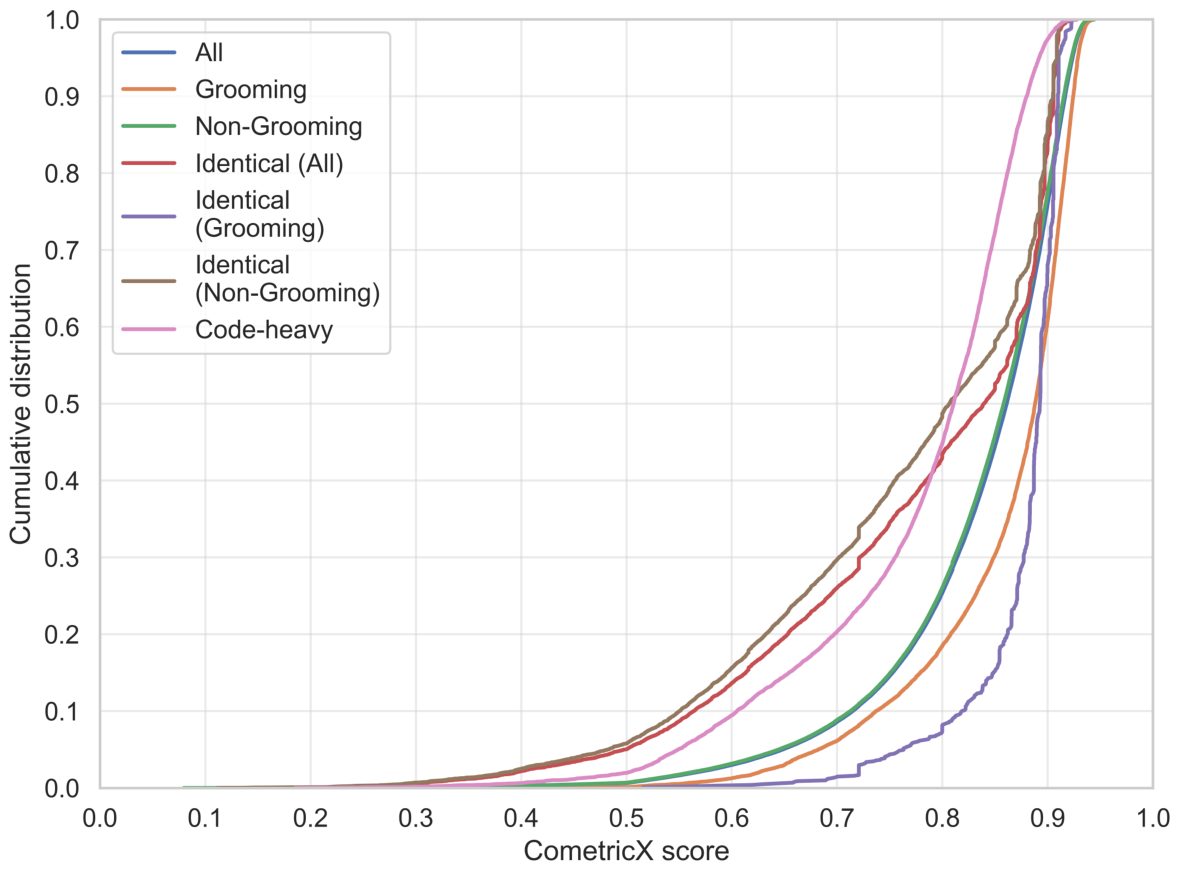
Table A3.
Statistics of the CometricX score distributions for the retranslated DE_PJZ. The rows report the evaluated message categories, while the columns show the number of messages together with the central distribution measures mean, median, first quartile, and third quartile. The best values in each measure-column are highlighted with a gray background.
Appendix C.3. Detailed CometricX Results for DE_PJZC
Figure A2.
Empirical cumulative distribution functions of the CometricX scores for the retranslated DE_PJZC across all messages, cybergrooming, non-cybergrooming, identical-text, and code-heavy subsets. Scores range from 0 to 1, with higher values indicating better estimated translation quality.
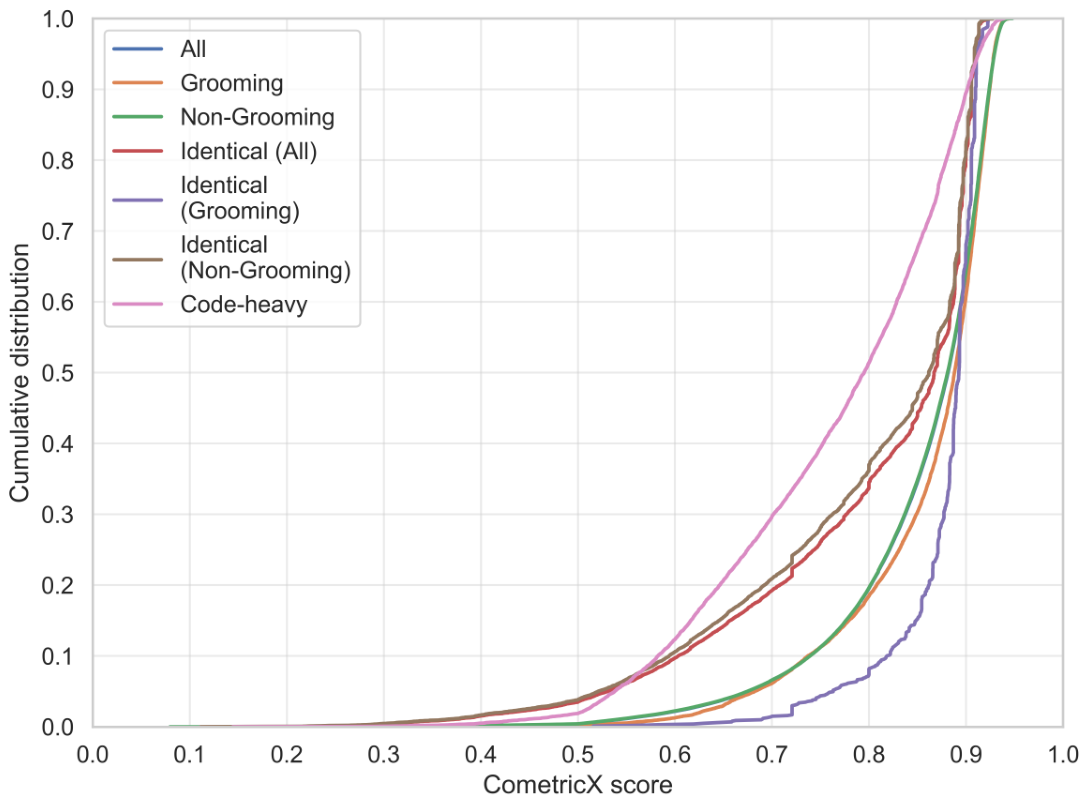
Table A4.
Statistics of the CometricX score distributions for the retranslated DE_PJZC. The rows report the evaluated message categories, while the columns show the number of messages together with the central distribution measures mean, median, first quartile, and third quartile. The best values in each measure-column are highlighted with a gray background.
Appendix C.4. Detailed CometricX Results for DE_PAN12
Figure A3.
Empirical cumulative distribution functions of the CometricX scores for the retranslated DE_PAN12 across all messages, cybergrooming, non-cybergrooming, identical-text, and code-heavy subsets. Scores range from 0 to 1, with higher values indicating better estimated translation quality.
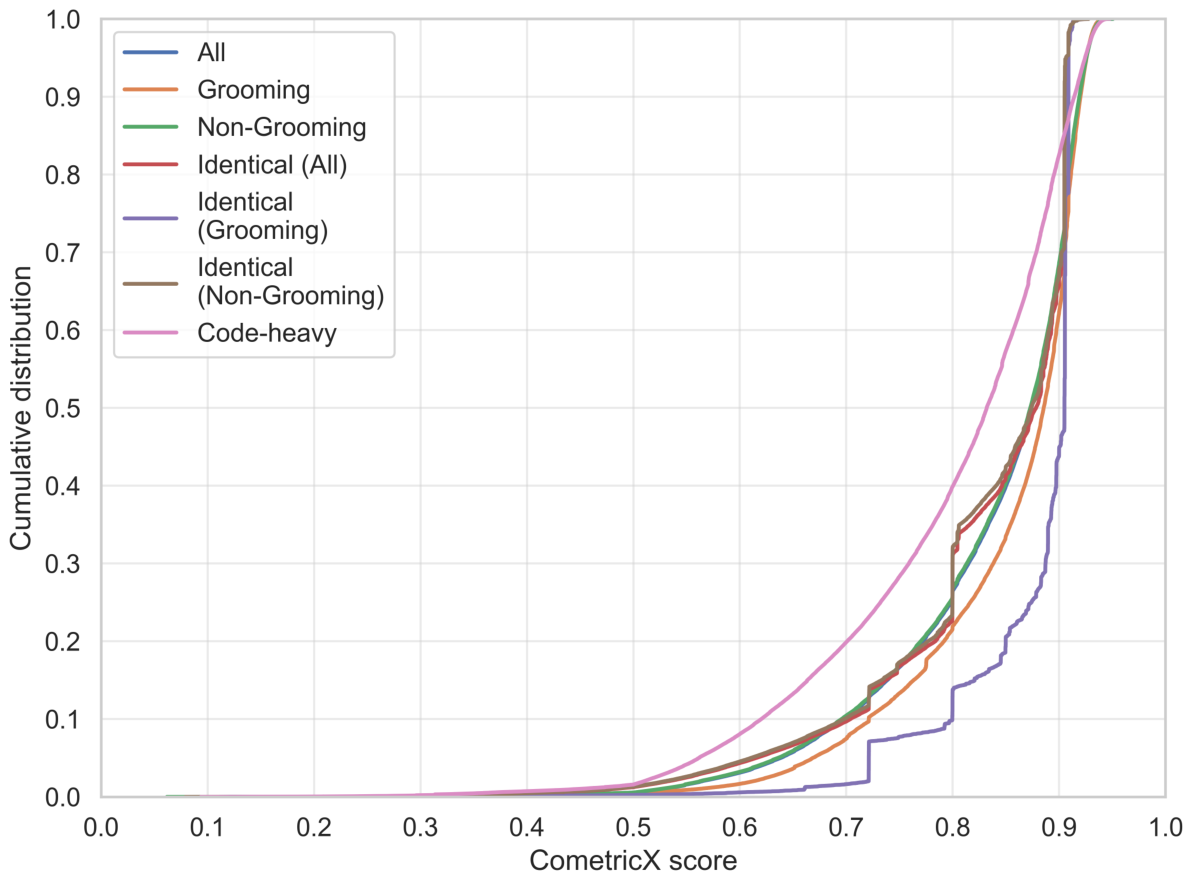
Table A5.
Statistics of the CometricX score distributions for the retranslated DE_PAN12. The rows report the evaluated message categories, while the columns show the number of messages together with the central distribution measures mean, median, first quartile, and third quartile. The best values in each measure-column are highlighted with a gray background.
Appendix C.5. Detailed CometricX Results for DE_VTPAN
Table A6.
Statistics of the CometricX score distributions for DE_VTPAN. The rows report the evaluated message categories, while the columns show the number of messages together with the central distribution measures mean, median, first quartile, and third quartile. The best values in each measure-column are highlighted with a gray background.
Figure A4.
Empirical cumulative distribution functions of the CometricX scores for DE_VTPAN across all messages, cybergrooming, non-cybergrooming, identical-text, and code-heavy subsets. Scores range from 0 to 1, with higher values indicating better estimated translation quality.
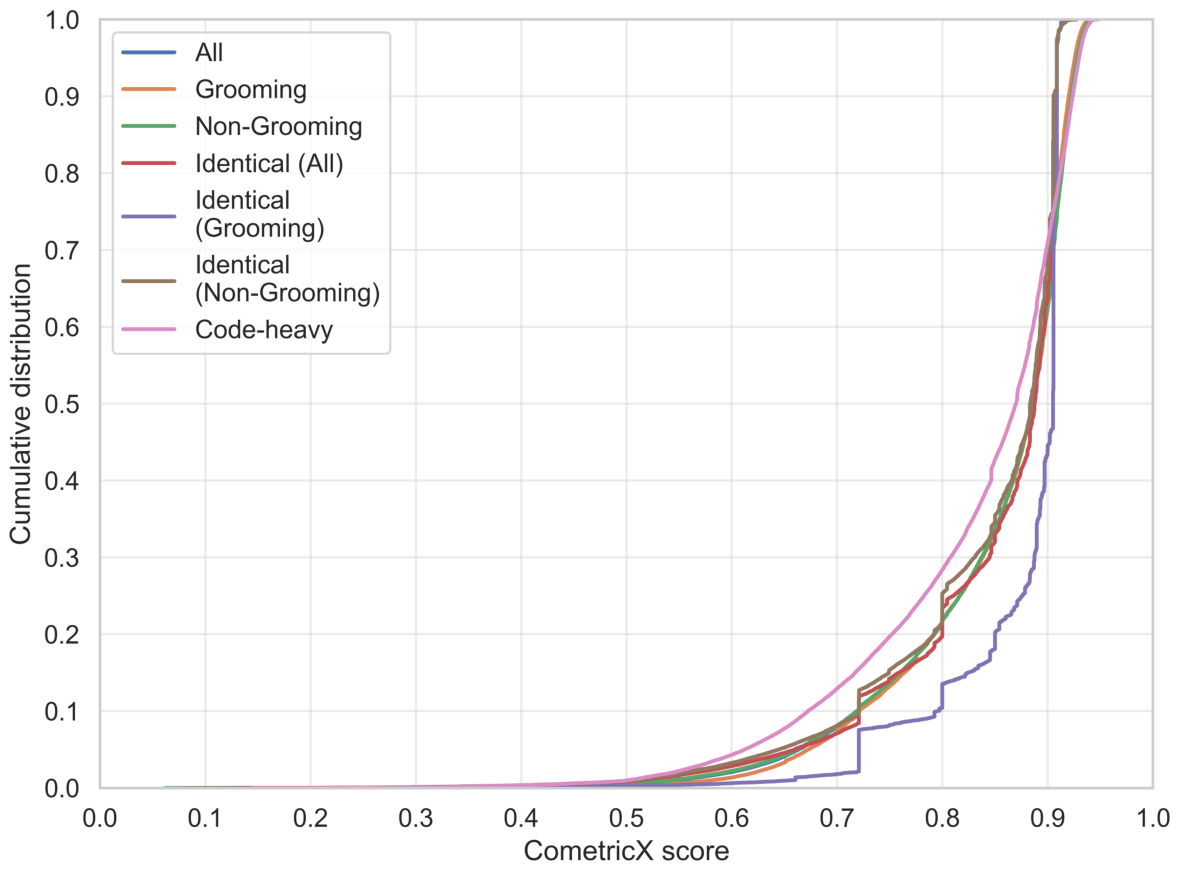
Appendix D. Detection Model Evaluation
This appendix provides the results referenced in Section 4 for further evaluating the detection models.
Table A7.
Confusion matrices of the detection models using the machine-translated test datasets.
Table A8.
Confusion matrices of the detection models using the machine-translated test datasets, with backtranslation used to improve the models.
Table A9.
Confusion matrices of the detection models on real-world test data using thresholds optimized for the machine-translated datasets.
Table A10.
Evaluation results of the detection models using real-world test data and optimized thresholds. The highest value in each metric column is highlighted in gray.
Table A11.
Confusion matrices of the detection models on real-world test data using thresholds optimized for the machine-translated datasets, with backtranslation used to improve the models.
Figure A5.
Precision–recall curves for the SVM models evaluated on the real-world data for the four dataset variants: DE_PJZ, DE_PJZC, DE_VTPAN, and DE_PAN. The average precision (AP) is shown in the legend for each model.
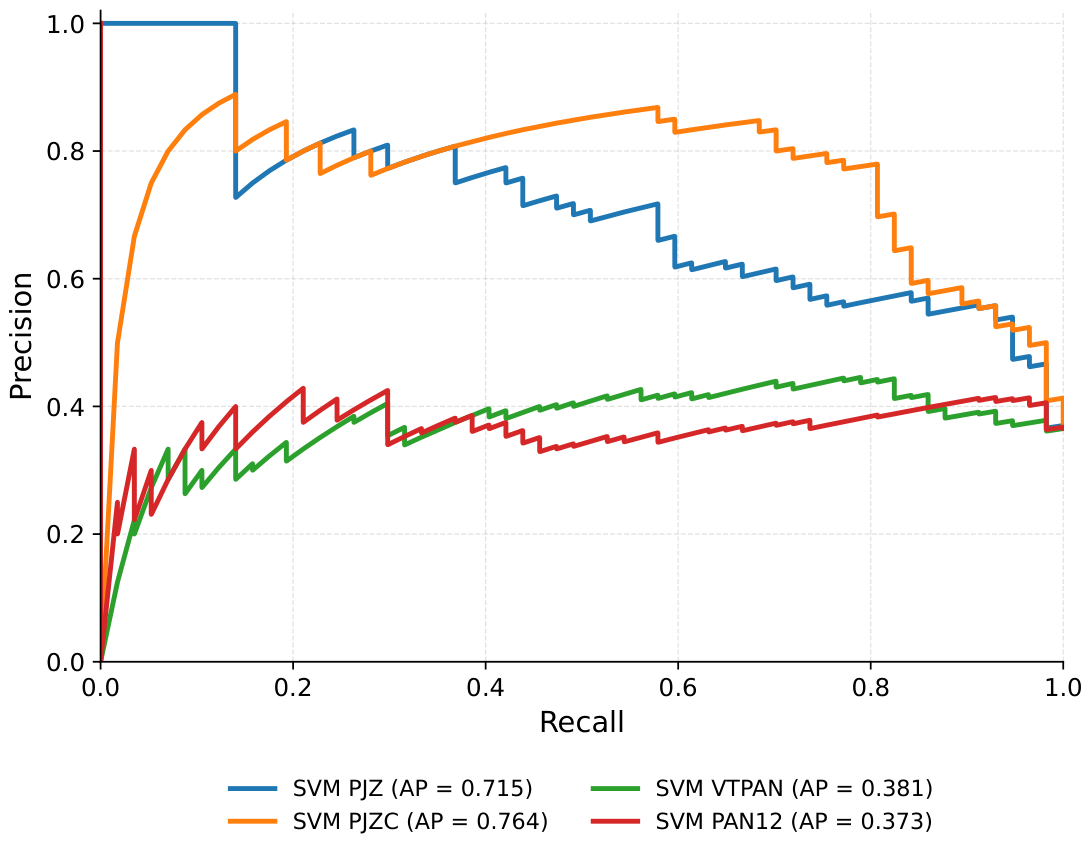
Figure A6.
Precision–recall curves for the ModernBERT models evaluated on the real-world data for the four dataset variants: DE_PJZ, DE_PJZC, DE_VTPAN, and DE_PAN. The average precision (AP) is shown in the legend for each model.
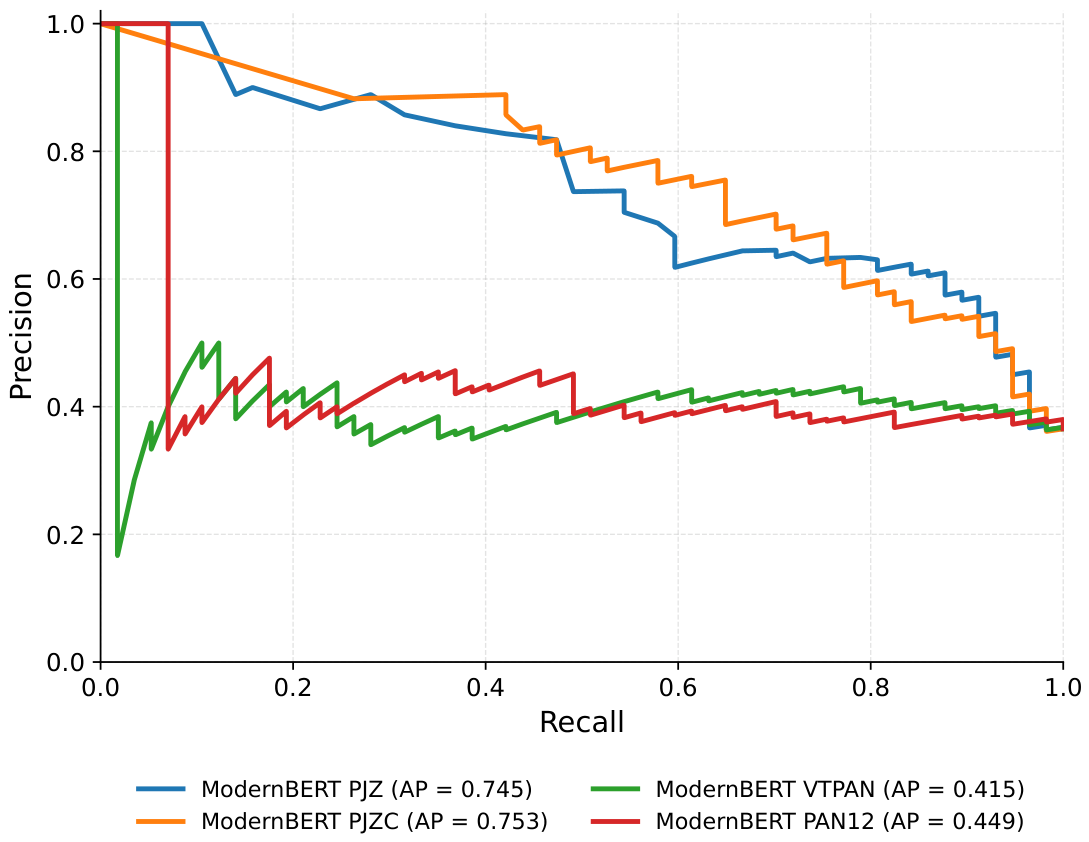
Figure A7.
Precision–recall curves for the SVM models evaluated on the real-world data for the four dataset variants augmented by backtranslation: DE_PJZ + BT, DE_PJZC + BT, DE_VTPAN + BT, and DE_PAN + BT. The average precision (AP) is shown in the legend for each model.
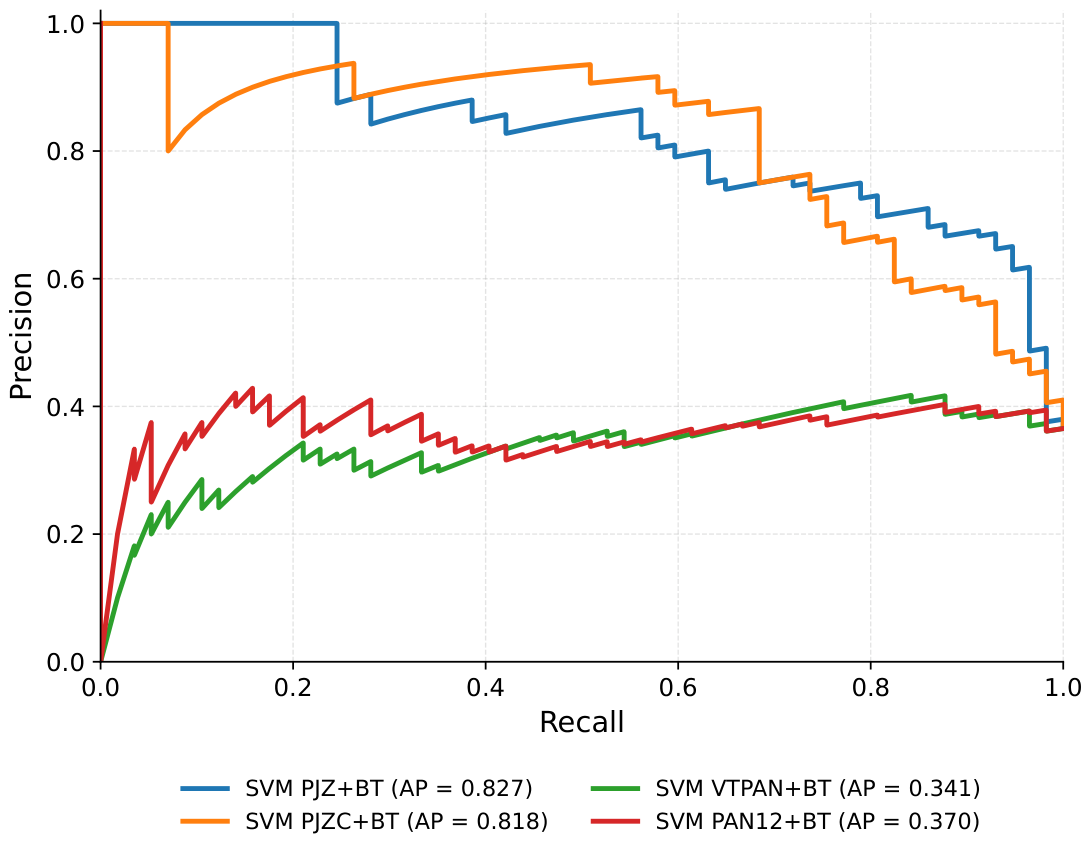
Figure A8.
Precision–recall curves for the ModernBERT models evaluated on the real-world data for the four dataset variants augmented by backtranslation: DE_PJZ + BT, DE_PJZC + BT, DE_VTPAN + BT, and DE_PAN + BT. The average precision (AP) is shown in the legend for each model.
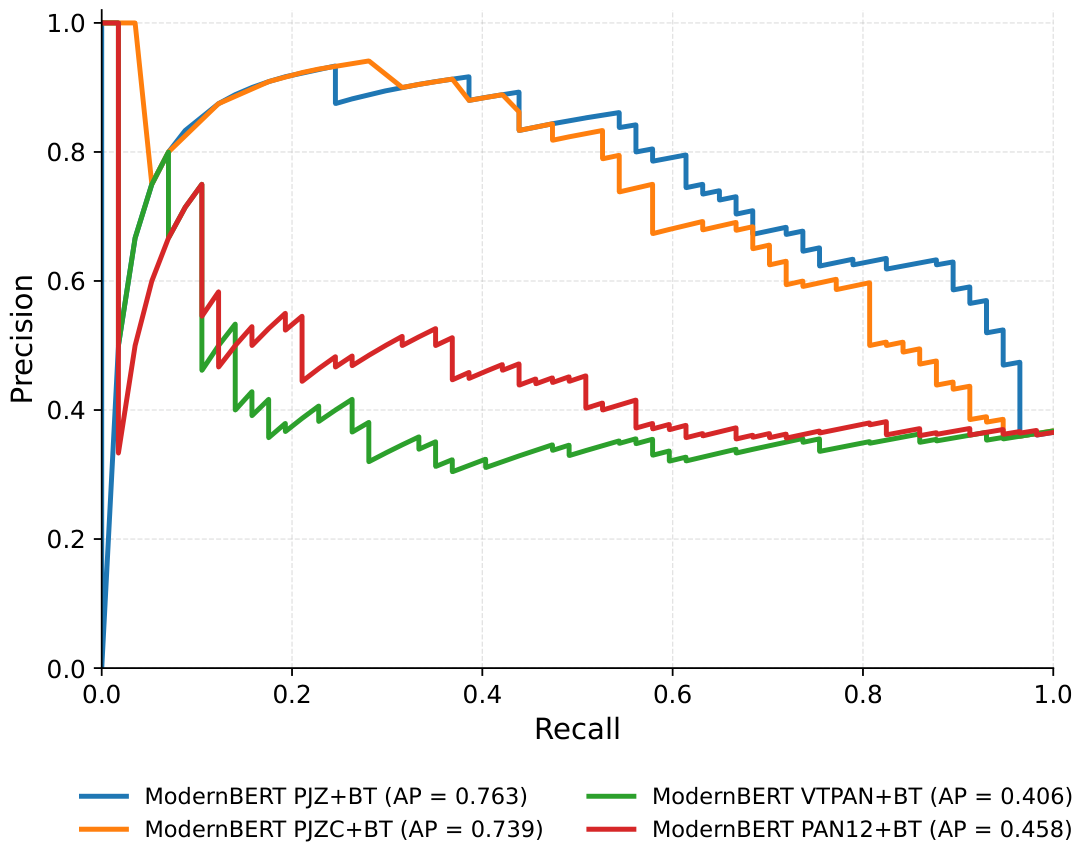
Table A12.
Evaluation results of the detection models using real-world test data and optimized thresholds, with backtranslation used to improve the models. The highest value in each metric column is highlighted in gray.
References
- Wachs, S.; Wolf, K.D.; Pan, C.C. Cybergrooming: Risk factors, coping strategies and associations with cyberbullying. Psicothema 2012, 24, 628–633. [Google Scholar] [PubMed]
- National Center for Missing & Exploited Children. CyberTipline 2021 Report. 2023. Available online: https://www.missingkids.org/content/dam/missingkids/pdfs/2021-CyberTipline-Report.pdf (accessed on 30 July 2026).
- National Center for Missing & Exploited Children. CyberTipline 2022 Report. 2023. Available online: https://www.missingkids.org/content/dam/missingkids/pdfs/2022-CyberTipline-Report.pdf (accessed on 30 July 2026).
- National Center for Missing & Exploited Children. CyberTipline 2023 Report. 2024. Available online: https://www.missingkids.org/content/dam/missingkids/pdfs/2023-CyberTipline-Report.pdf (accessed on 30 July 2026).
- National Center for Missing & Exploited Children. CyberTipline 2024 Report. 2025. Available online: https://www.missingkids.org/content/dam/missingkids/pdfs/2024-cybertipline-report.pdf (accessed on 30 July 2026).
- National Center for Missing & Exploited Children. CyberTipline 2025 Report. 2026. Available online: https://www.missingkids.org/gethelpnow/cybertipline/cybertiplinedata (accessed on 30 July 2026).
- Von Erck, X. Perverted Justice Website. 2025. Available online: http://www.perverted-justice.com/?con=south_calif_46m (accessed on 30 July 2026).
- An, H.; Silva, M.; Zhang, Q.; Singh, A.; Liu, M.; Zhang, X.; Qadir, S.; Lee, S.W.; Huang, L.; Wisniewski, P.J.; et al. Toward integrated solutions: A systematic interdisciplinary review of cybergrooming research. arXiv 2025, arXiv:2503.05727. [Google Scholar] [CrossRef] [Scilit]
- Kinzel, A. The Language of Online Child Sexual Groomers: A Corpus Assisted Discourse Study of Intentions, Requests and Grooming Duration. Ph.D. Thesis, Swansea University, Swansea, Wales, 2021. [Google Scholar] [CrossRef] [Scilit]
- McGhee, I.; Bayzick, J.; Kontostathis, A.; Edwards, L.; McBride, A.; Jakubowski, E. Learning to identify internet sexual predation. Int. J. Electron. Commer. 2011, 15, 103–122. [Google Scholar] [CrossRef] [Scilit]
- Vogt, M.; Leser, U.; Akbik, A. Early detection of sexual predators in chats. In Proceedings of the 59th Annual Meeting of the Association for Computational Linguistics and the 11th International Joint Conference on Natural Language Processing (Volume 1: Long Papers); Zong, C., Xia, F., Li, W., Navigli, R., Eds.; Association for Computational Linguistics: Stroudsburg, PA, USA, 2021; pp. 4985–4999. [Google Scholar] [CrossRef] [Scilit]
- Edwards, A.; Edwards, L. ChatCoder Website. 2020. Available online: https://chatcoder.com (accessed on 30 July 2026).
- Miah, M.W.R.; Yearwood, J.; Kulkarni, S. Detection of child exploiting chats from a mixed chat dataset as a text classification task. In Proceedings of the Australasian Language Technology Association Workshop 2011, Canberra, Australia, 1–2 December 2011; pp. 157–165. [Google Scholar]
- Inches, G.; Crestani, F. Overview of the International Sexual Predator Identification Competition at PAN-2012. In Proceedings of the CLEF 2012 Evaluation Labs and Workshop, Rome, Italy, 17–20 September 2012; Volume 1178. [Google Scholar]
- Oikarinen, J.; Reed, D. Internet Relay Chat Protocol; RFC, Ed.; Request for Comments RFC 1459; IETF: Fremont, CA, USA, 1993. [Google Scholar] [CrossRef] [Scilit]
- Inches, G.; Crestani, F. PAN12 Deception Detection: Sexual Predator Identification. 2012. Available online: https://zenodo.org/records/3713280 (accessed on 30 July 2026).
- Villatoro-Tello, E.; Juárez-González, A.; Escalante, H.J.; Montes-y Gómez, M.; Villaseñor-Pineda, L. A Two-step Approach for Effective Detection of Misbehaving Users in Chats. In Proceedings of the CLEF 2012 Evaluation Labs and Workshop, Rome, Italy, 17–20 September 2012; Volume 1178. [Google Scholar]
- Vogt, J. VTPAN Dataset. 2021. Available online: https://gitlab.com/early-sexual-predator-detection/eSPD-datasets/-/tree/master/VTPAN (accessed on 30 July 2026).
- Cheong, Y.G.; Jensen, A.K.; Guðnadóttir, E.R.; Bae, B.C.; Togelius, J. Detecting predatory behavior in game chats. IEEE Trans. Comput. Intell. AI Games 2015, 7, 220–232. [Google Scholar] [CrossRef] [Scilit]
- Vogt, M. Sexual Predator Identification Using Machine Learning on Android. Bachelor’s Thesis, Humboldt-Universität zu Berlin, Berlin, Germany, 2020. [Google Scholar]
- Lykousas, N.; Patsakis, C. Large-scale analysis of grooming in modern social networks. Expert Syst. Appl. 2021, 176, 114808. [Google Scholar] [CrossRef] [Scilit]
- Vogt, M. Supplementary Material for Early Detection of Sexual Predators in Chats. 2021. Available online: https://early-sexual-predator-detection.gitlab.io (accessed on 30 July 2026).
- Milon-Flores, D.F.; Cordeiro, R.L. How to take advantage of behavioral features for the early detection of grooming in online conversations. Knowl. Based Syst. 2022, 240, 108017. [Google Scholar] [CrossRef] [Scilit]
- Milon-Flores, D.F. BF-PSR Framework: Reproducibility Code and the PJZ and PJZC Datasets. 2021. Available online: https://github.com/danielafe7-usp/BF-PSR-Framework (accessed on 30 July 2026).
- Felser, J.; Preuß, S.; Labudde, D.; Spranger, M. Technical Perspectives of Sexual Online Grooming. In Sexual Online Grooming of Children: Challenges for Science and Practice, 1st ed.; Kuhle, L.F., Stelzmann, D., Eds.; Nomos: Baden-Baden, Germany, 2025; Volume 2, pp. 263–295. [Google Scholar] [CrossRef] [Scilit]
- Leiva-Bianchi, M.; Castillo, N.; Astudillo, C.A.; Ahumada-Méndez, F. Effectiveness of machine learning methods in detecting grooming: A systematic meta-analytic review. Sci. Rep. 2025, 15, 9008. [Google Scholar] [CrossRef] [Scilit] [PubMed]
- Street, J.; Ihianle, I.K.; Olajide, F.; Lotfi, A. Enhanced Online Grooming detection employing Context Determination and Message-Level Analysis. Intell. Syst. Appl. 2025, 28, 200607. [Google Scholar] [CrossRef] [Scilit]
- Fan, S.; Bassenge, M.; Steinebach, M. Luring as a Proxy: Evaluating Corpus Transferability for Cybergrooming Detection. In Proceedings of the 64th Annual Meeting of the Association for Computational Linguistics (Volume 2: Short Papers); Association for Computational Linguistics: Stroudsburg, PA, USA, 2026; pp. 371–385. [Google Scholar] [CrossRef] [Scilit]
- Yang, Y.; Zhang, Y.; Tar, C.; Baldridge, J. PAWS-X: A Cross-lingual Adversarial Dataset for Paraphrase Identification. In Proceedings of the 2019 Conference on Empirical Methods in Natural Language Processing and the 9th International Joint Conference on Natural Language Processing; Association for Computational Linguistics: Stroudsburg, PA, USA, 2019; pp. 3687–3692. [Google Scholar] [CrossRef] [Scilit]
- Artetxe, M.; Goswami, V.; Bhosale, S.; Fan, A.; Zettlemoyer, L. Revisiting Machine Translation for Cross-lingual Classification. In Proceedings of the 2023 Conference on Empirical Methods in Natural Language Processing; Association for Computational Linguistics: Stroudsburg, PA, USA, 2023; pp. 6489–6499. [Google Scholar] [CrossRef] [Scilit]
- Bell, S.J.; Sánchez, E.; Dale, D.; Stenetorp, P.; Artetxe, M.; Costa-jussà, M.R. Translate, then Detect: Leveraging Machine Translation for Cross-Lingual Toxicity Classification. In Proceedings of the Tenth Conference on Machine Translation; Association for Computational Linguistics: Stroudsburg, PA, USA, 2025; pp. 253–268. [Google Scholar]
- Kim, S.; Lee, B.; Maqsood, M.; Moon, J.; Rho, S. Deep Learning-Based Natural Language Processing Model and Optical Character Recognition for Detection of Online Grooming on Social Networking Services. Comput. Model. Eng. Sci. 2025, 143, 2079–2108. [Google Scholar] [CrossRef] [Scilit]
- Kang, J.k.; Jung, M.s.; Kim, S.m.; Lim, S.h.; Jung, S.h.; Heo, W.j.; Park, Y.h. A KoBART-Based Model for Detecting Online Grooming Risk in Korean Conversations. J. Korean Inst. Commun. Inf. Sci. 2026, 51, 562–573. [Google Scholar] [CrossRef] [Scilit]
- Technology Coalition. Breaking Language Barriers in Online Safety. 2025. Available online: https://technologycoalition.org/news/breaking-language-barriers-in-online-safety/ (accessed on 30 July 2026).
- Haluška, R.; Kolomiiets, A. Grooming Detection Using a Multimodal AI Approach for Slovak Language Environments. In Proceedings of the 2026 15th Mediterranean Conference on Embedded Computing (MECO); IEEE: New York, NY, USA, 2026; pp. 1–4. [Google Scholar] [CrossRef]
- Castañón Marroquín, A.P.; Rodríguez Colis, B.A.; Bazán Durán, A.; Colmenares-Guillen, L.E. Discourse Analysis for the Development of a Cybergrooming Detection Model on Roblox. Chakiñan Rev. Cienc. Soc. Humanidades 2026, 29, 13–35. [Google Scholar] [CrossRef] [Scilit]
- Waezi, H.; Fani, H. Enhancing online grooming detection via backtranslation augmentation. In Proceedings of the 31st International Conference on Computational Linguistics; Rambow, O., Wanner, L., Apidianaki, M., Al-Khalifa, H., Eugenio, B.D., Schockaert, S., Eds.; Association for Computational Linguistics: Stroudsburg, PA, USA, 2025; pp. 2340–2350. Available online: https://aclanthology.org/2025.coling-main.160/ (accessed on 30 July 2026).
- Mylonas, N.; Stylianou, N.; Chatzakou, D.; Spathi, T.; Alevizos, S.; Drandaki, A.; Koufakis, A.; Kalpakis, G.; Tsikrika, T.; Vrochidis, S. Online child grooming detection: Challenges and future directions. In Paradigms on Technology Development for Security Practitioners; Gkotsis, I., Kavallieros, D., Stoianov, N., Vrochidis, S., Diagourtas, D., Akhgar, B., Eds.; Security Informatics and Law Enforcement; Springer Nature: Cham, Switzerland, 2025; pp. 237–247. [Google Scholar] [CrossRef] [Scilit]
- Google. TranslateGemma: A New Suite of Open Translation Models. 2026. Available online: https://blog.google/innovation-and-ai/technology/developers-tools/translategemma/ (accessed on 30 July 2026).
- Rei, R.; Treviso, M.; Guerreiro, N.M.; Zerva, C.; Farinha, A.C.; Maroti, C.; de Souza, J.G.C.; Glushkova, T.; Alves, D.M.; Lavie, A.; et al. COMETKiwi: IST-Unbabel 2022 Submission for the Quality Estimation Shared Task. In Proceedings of the Seventh Conference on Machine Translation; Koehn, P., Barrault, L., Bojar, O., Bougares, F., Chatterjee, R., Costa-jussà, M.R., Federmann, C., Fishel, M., Fraser, A., Freitag, M., et al., Eds.; Association for Computational Linguistics: Stroudsburg, PA, USA, 2022; pp. 634–645. [Google Scholar] [CrossRef] [Scilit]
- Juraska, J.; Deutsch, D.; Finkelstein, M.; Freitag, M. MetricX-24: The Google Submission to the WMT 2024 Metrics Shared Task. In Proceedings of the Ninth Conference on Machine Translation; Haddow, B., Kocmi, T., Koehn, P., Monz, C., Eds.; Association for Computational Linguistics: Stroudsburg, PA, USA, 2024; pp. 492–504. [Google Scholar] [CrossRef] [Scilit]
- Rei, R.; Stewart, C.; Farinha, A.C.; Lavie, A. COMET: A Neural Framework for MT Evaluation. In Proceedings of the 2020 Conference on Empirical Methods in Natural Language Processing (EMNLP); Webber, B., Cohn, T., He, Y., Liu, Y., Eds.; Association for Computational Linguistics: Stroudsburg, PA, USA, 2020; pp. 2685–2702. [Google Scholar] [CrossRef] [Scilit]
- Kepler, F.; Trénous, J.; Treviso, M.; Vera, M.; Martins, A.F.T. OpenKiwi: An Open Source Framework for Quality Estimation. In Proceedings of the 57th Annual Meeting of the Association for Computational Linguistics: System Demonstrations; Costa-jussà, M.R., Alfonseca, E., Eds.; Association for Computational Linguistics: Stroudsburg, PA, USA, 2019; pp. 117–122. [Google Scholar] [CrossRef] [Scilit]
- Lin, J.; Tong, L. Improving Low-Resource Machine Translation for Latin Using Model Distillation and Long Chain-of-Thought; Stanford cs224n Custom Project; Stanford University: Stanford, CA, USA, 2025. [Google Scholar]
- Li, W.; Chen, J.; Li, B.; Liu, B.; Wen, Z.; Shan, N.; Liu, X.; Liu, A.; Liu, H.; Song, H.; et al. TACTIC: Translation Agents with Cognitive-Theoretic Interactive Collaboration. arXiv 2025, arXiv:2506.08403. [Google Scholar] [CrossRef] [Scilit]
- Tran, H.; Nguyen-Le, P.A.; Nghiem, H.; Nguyen, Q.N.; Ai, W.; Carpuat, M. VietMix: A Naturally-Occurring Parallel Corpus and Augmentation Framework for Vietnamese-English Code-Mixed Machine Translation. In Proceedings of the 19th Conference of the European Chapter of the Association for Computational Linguistics (Volume 1: Long Papers); Demberg, V., Inui, K., Màrquez, L., Eds.; Association for Computational Linguistics: Stroudsburg, PA, USA, 2026; pp. 7266–7284. [Google Scholar] [CrossRef] [Scilit]
- Xue, L.; Constant, N.; Roberts, A.; Kale, M.; Al-Rfou, R.; Siddhant, A.; Barua, A.; Raffel, C. mT5: A Massively Multilingual Pre-trained Text-to-Text Transformer. In Proceedings of the Proceedings of the 2021 Conference of the North American Chapter of the Association for Computational Linguistics: Human Language Technologies; Association for Computational Linguistics: Stroudsburg, PA, USA, 2021; pp. 483–498. [Google Scholar] [CrossRef] [Scilit]
- Chaplynskyi, D.; Zakharov, K. A Framework for Large-Scale Parallel Corpus Evaluation: Ensemble Quality Estimation Models Versus Human Assessment. In Proceedings of the Fourth Ukrainian Natural Language Processing Workshop (UNLP 2025); Romanyshyn, M., Ed.; Association for Computational Linguistics: Stroudsburg, PA, USA, 2025; pp. 73–85. [Google Scholar] [CrossRef] [Scilit]
- Kocmi, T.; Avramidis, E.; Bawden, R.; Bojar, O.; Dvorkovich, A.; Federmann, C.; Fishel, M.; Freitag, M.; Gowda, T.; Grundkiewicz, R.; et al. Findings of the WMT24 General Machine Translation Shared Task: The LLM Era Is Here but MT Is Not Solved Yet. In Proceedings of the Ninth Conference on Machine Translation; Haddow, B., Kocmi, T., Koehn, P., Monz, C., Eds.; Association for Computational Linguistics: Stroudsburg, PA, USA, 2024; pp. 1–46. [Google Scholar] [CrossRef] [Scilit]
- Warner, B.; Chaffin, A.; Clavié, B.; Weller, O.; Hallström, O.; Taghadouini, S.; Gallagher, A.; Biswas, R.; Ladhak, F.; Aarsen, T.; et al. Smarter, Better, Faster, Longer: A Modern Bidirectional Encoder for Fast, Memory Efficient, and Long Context Finetuning and Inference. In Proceedings of the 63rd Annual Meeting of the Association for Computational Linguistics (Volume 1: Long Papers); Che, W., Nabende, J., Shutova, E., Pilehvar, M.T., Eds.; Association for Computational Linguistics: Stroudsburg, PA, USA, 2025; pp. 2526–2547. [Google Scholar] [CrossRef] [Scilit]
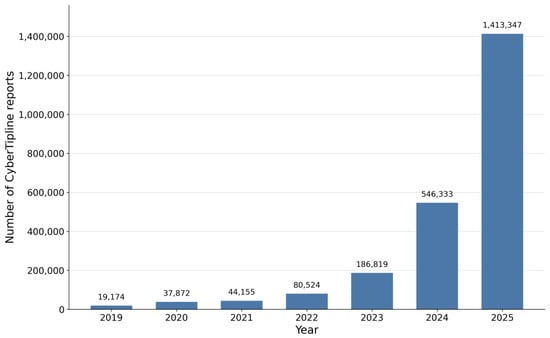
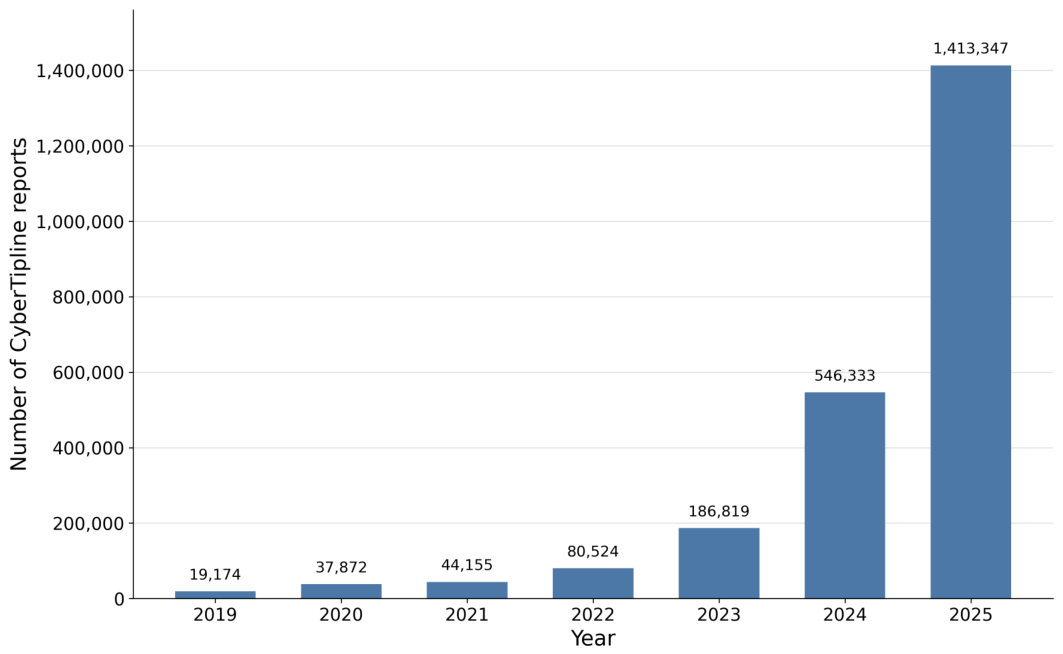
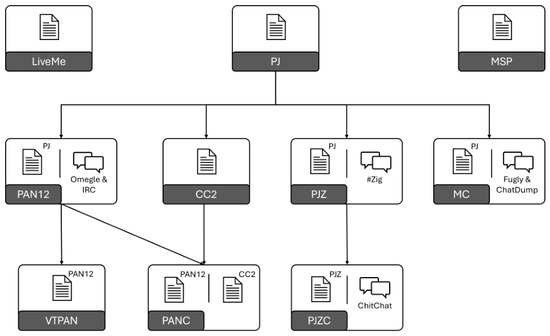
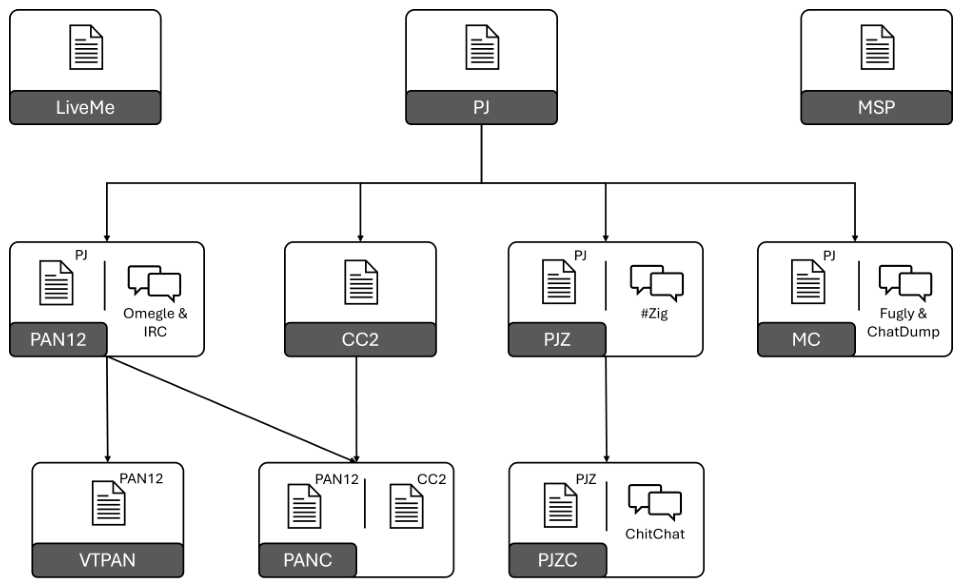
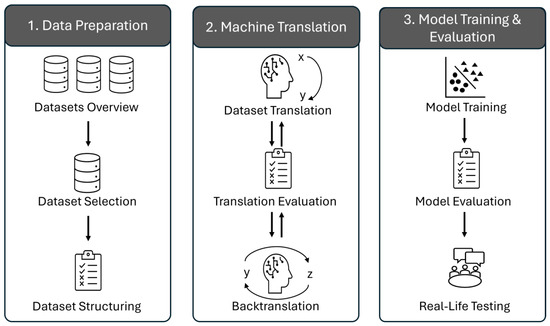
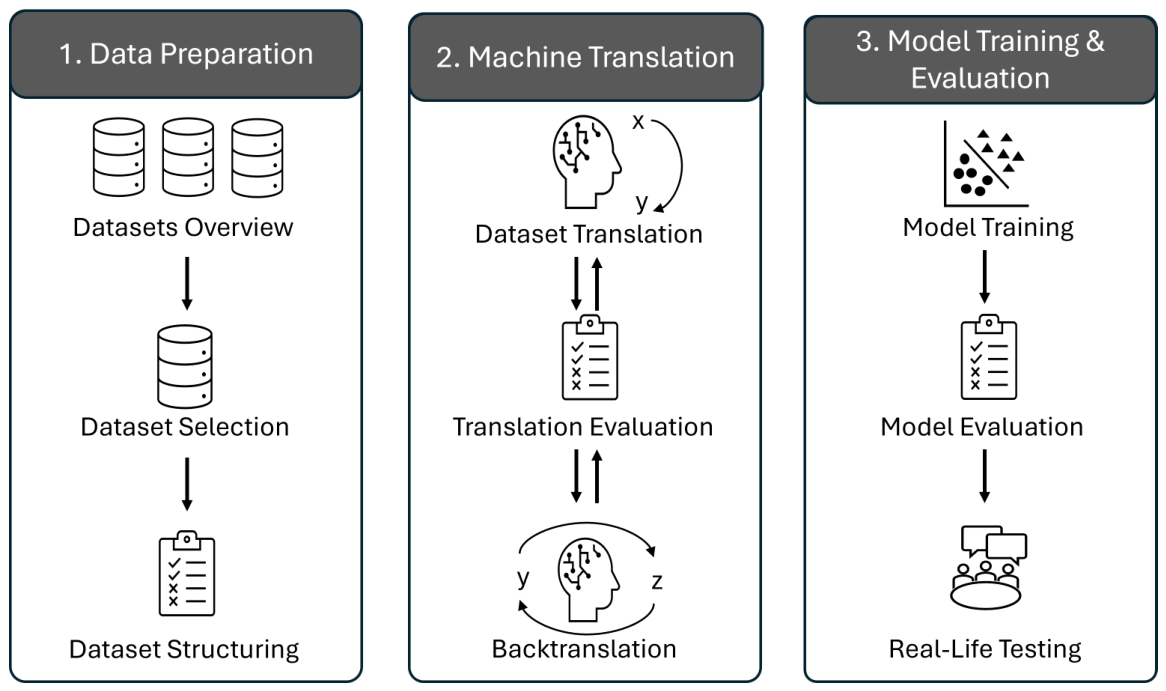
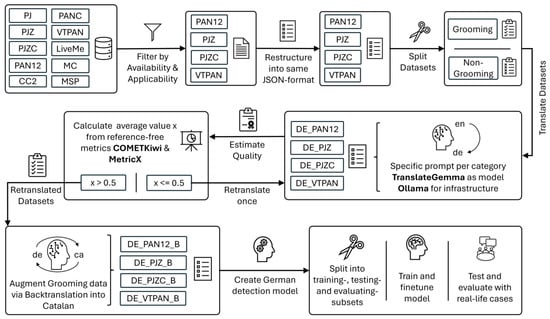
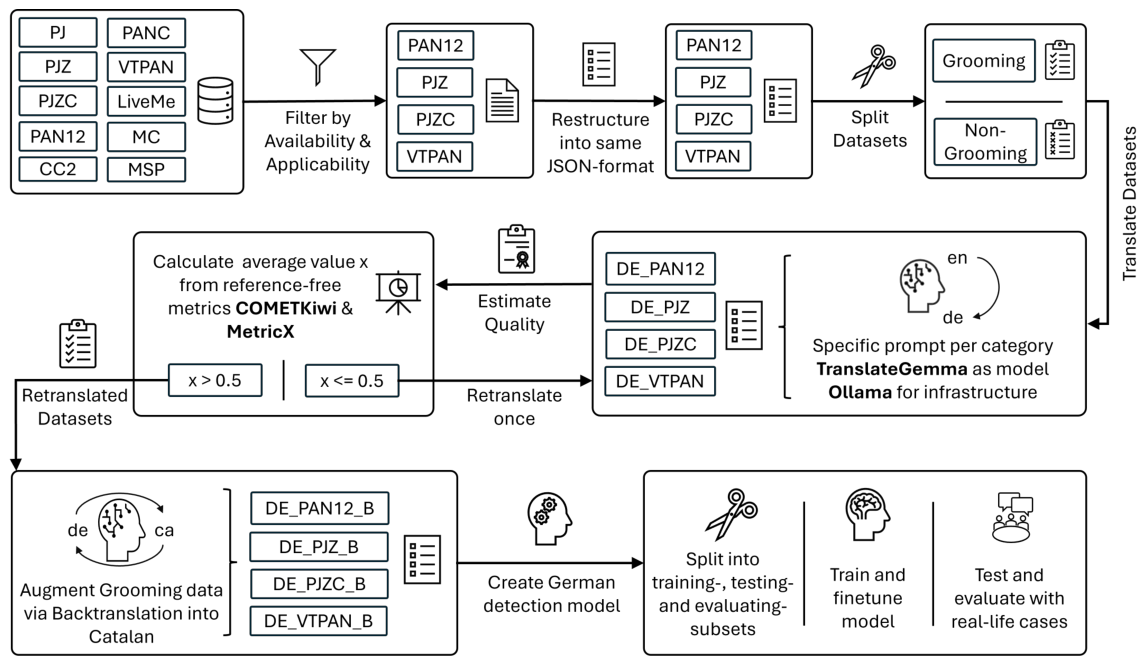

Disclaimer/Publisher’s Note: The statements, opinions and data contained in all publications are solely those of the individual author(s) and contributor(s) and not of MDPI and/or the editor(s). MDPI and/or the editor(s) disclaim responsibility for any injury to people or property resulting from any ideas, methods, instructions or products referred to in the content. |
© 2026 by the authors. Licensee MDPI, Basel, Switzerland. This article is an open access article distributed under the terms and conditions of the Creative Commons Attribution (CC BY) license.