


Abstract
Thai Buddhist funeral services constitute a substantial multi-actor service ecosystem that remains largely dependent on conventional, fragmented coordination among bereaved families, temples, service providers, and administrative actors, with limited digital integration. This study reports a pre-deployment acceptance evaluation of a conceptually specified GenAI-assisted funeral-coordination service and proposes an Evidence-to-Design Translation Framework (EDTF) for translating acceptance evidence into initial design and governance requirements. Using non-probability convenience sampling through online recruitment, 342 screened adults with prior funeral-arrangement experience in the Bangkok Metropolitan Area evaluated a standardized vignette and representative interface mockups rather than an operational platform. PLS-SEM was used to examine prospective acceptance under five predefined safeguards: traceability, auditability, contestability and redress, verification, and risk-based human review. Perceived usefulness was the strongest predictor of intention to use, while attitude toward use provided a secondary pathway. The EDTF maps empirically supported user-evaluation signals to candidate workflow features, accountability controls, required records, monitoring indicators, and escalation rules. The findings provide bounded pre-deployment evidence for subsequent prototyping and pilot validation; they do not demonstrate actual adoption, live-system effectiveness, safeguard causality, or realized industry transformation.
1. Introduction
Thai Buddhist funeral coordination can be conceptualized as a substantial multi-actor service ecosystem involving bereaved families, temples, funeral service providers, administrative processes, payment services, and related support actors. In the service context examined in this study, coordination remains largely dependent on conventional and fragmented interactions across these actors, requiring families to assemble information, documentation, service options, schedules, and payments through multiple channels [1,2,3,4]. This fragmentation creates a practical need for a more integrated digital coordination layer that can improve information visibility, reduce coordination burdens, and support cross-actor workflows while preserving human accountability for consequential decisions.
Generative artificial intelligence (GenAI) is increasingly being integrated into digital service platforms that support information search, comparison, recommendation, communication, documentation, and decision making across multiple organizational actors. In such platforms, users may interact with service providers, institutional actors, payment mechanisms, and support functions through a common information environment. The value of these systems therefore depends not only on their ability to improve efficiency and coordination but also on whether consequential decisions remain understandable, reviewable, and correctable [5,6].
The integration of GenAI introduces additional challenges because generated recommendations, summaries, rankings, and draft communications may influence user actions before independent verification occurs [7,8]. This issue becomes particularly important in information-intensive service contexts where decisions are time-sensitive, involve multiple handoffs, and may be difficult or costly to reverse. Pre-deployment evaluation of GenAI-assisted information applications should therefore consider not only whether prospective users are willing to adopt the system but also how empirical evidence about user expectations can inform system design, accountability mechanisms, and governance requirements before live deployment.
Existing research provides important foundations for understanding digital platform governance [5,6], human–AI transparency and risk control [9,10], and trustworthy reliance on AI-enabled systems [11,12]. Technology acceptance research also explains how beliefs such as perceived usefulness, perceived ease of use, social influence, trust, and attitude shape users’ intentions to adopt emerging technologies. However, a gap remains between identifying these behavioral determinants and translating them into concrete design and governance requirements for GenAI-assisted digital service platforms. Statistical evidence that users perceive a system as useful or trustworthy does not, by itself, specify which workflow features should be prioritized, which decisions require human review, what records should be retained, or how errors and disputes should be escalated.
These interdependent coordination activities often occur during bereavement, when practical post-death responsibilities can be stressful and time-consuming and when families may have limited familiarity with funeral-service processes and available options [3,4]. Fragmented information across temples, service providers, administrative procedures, and related actors may further increase coordination burdens and reduce visibility into service availability, pricing, procedural requirements, and culturally appropriate choices. A GenAI-assisted digital service platform could potentially reduce information-search burdens, clarify next steps, assist with documentation and communication, improve cost visibility, and support multi-actor coordination. At the same time, inaccurate recommendations, unverified service information, unexpected price changes, or inappropriate automation may have consequences that are difficult to reverse.
Research on digital death-care also shows that technological change in funeral and memorial practices is shaped by the institutional and cultural roles of funeral professionals, the expansion of digital death and commemoration practices, the digitalization of Buddhist memorial artifacts, and emerging cemetery technologies [13,14,15,16]. This domain literature suggests that death-care digitalization is not simply a generic platform-adoption problem: digital functionality is mediated by ritual expectations, professional intermediation, memorial practices, and the sensitivity of bereavement contexts. These considerations strengthen the rationale for evaluating GenAI-assisted funeral coordination as a culturally situated information-service problem before operational deployment.
This study therefore evaluates prospective acceptance under a predefined minimum safeguard condition comprising five mechanisms: traceability, auditability, contestability and redress, verification, and risk-based human review [9,10,17]. These safeguards establish baseline conditions under which AI-supported actions can be reconstructed, reviewed, corrected, verified, and escalated. The study does not treat acceptance evidence as evidence of operational readiness. Instead, user evaluation is conducted within these predefined safeguards so that the resulting behavioral evidence can be interpreted as an input to early-stage system design and rollout planning.
To bridge the gap between behavioral evaluation and system specification, this study proposes an Evidence-to-Design Translation Framework (EDTF). The EDTF is an illustrative pre-deployment translation framework rather than a validated standalone scientific method. It organizes the movement from empirically screened acceptance evidence to candidate workflow features, governance controls, accountability records, monitoring indicators, and escalation rules, with structured expert review used to challenge and refine the resulting specification. In this way, behavioral evidence informs a reviewable design rationale without being treated as evidence of deployment readiness or operational effectiveness.
The present study is deliberately bounded to pre-deployment acceptance and design translation. It does not report software development, pilot use, field performance, or realized industry transformation. Any broader ecosystem implication is therefore prospective: improved information integration, multi-actor coordination, and accountable GenAI-assisted workflows are treated as hypotheses for subsequent prototype development, pilot deployment, and field evaluation rather than as outcomes established by the current data.
The study makes three bounded contributions. First, it distinguishes minimum governance safeguards from behaviorally informed design priorities, avoiding the assumption that prospective acceptance indicates deployment readiness. Second, it provides context-specific evidence on prospective acceptance of GenAI-assisted coordination in a culturally sensitive and time-constrained service setting. Third, it proposes the EDTF as a structured translation framework linking acceptance evidence to candidate workflow requirements, accountability controls, records, provisional KPI anchors, and escalation mechanisms before pilot deployment. The theoretical novelty therefore lies less in introducing previously unseen TAM extensions than in integrating established acceptance constructs with a fixed responsible-AI governance baseline and an explicit evidence-to-design translation layer.
Research Questions and Design Objectives
This study addresses three research questions and one exploratory moderation analysis. RQ1 asks which user beliefs are most strongly associated with intention to use a GenAI-assisted digital service platform under predefined safeguards. RQ2 examines how social influence, perceived AI trustworthiness, perceived ease of use, cultural compatibility, and related beliefs influence intention to use directly or through perceived usefulness and attitude toward use. RQ3 asks how the main empirical findings from pre-deployment user evaluation can be systematically translated into an initial design and governance specification for a GenAI-assisted digital service platform. E1 examines whether birth-year cohort moderates the association between social influence and perceived usefulness. RQ1 and RQ2 address behavioral evaluation, RQ3 addresses evidence-to-design translation through EDTF, and E1 is treated as an exploratory moderation check rather than as a basis for strong cohort-level generalization.
2. Conceptual Background and Theory Development
This study treats GenAI-assisted funeral coordination as a digital service platform-mediated service exchange. Digital platforms create value by connecting users, complementors, and institutional actors while governing participation, interfaces, information quality, and dispute handling [5,6]. The proposed application is the user-facing interface through which requests, recommendations, bookings, documentation guidance, payments, support, and redress are coordinated.
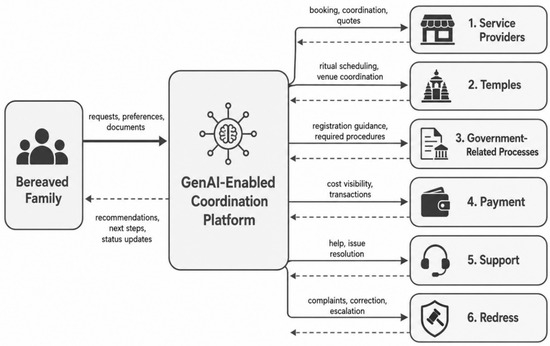
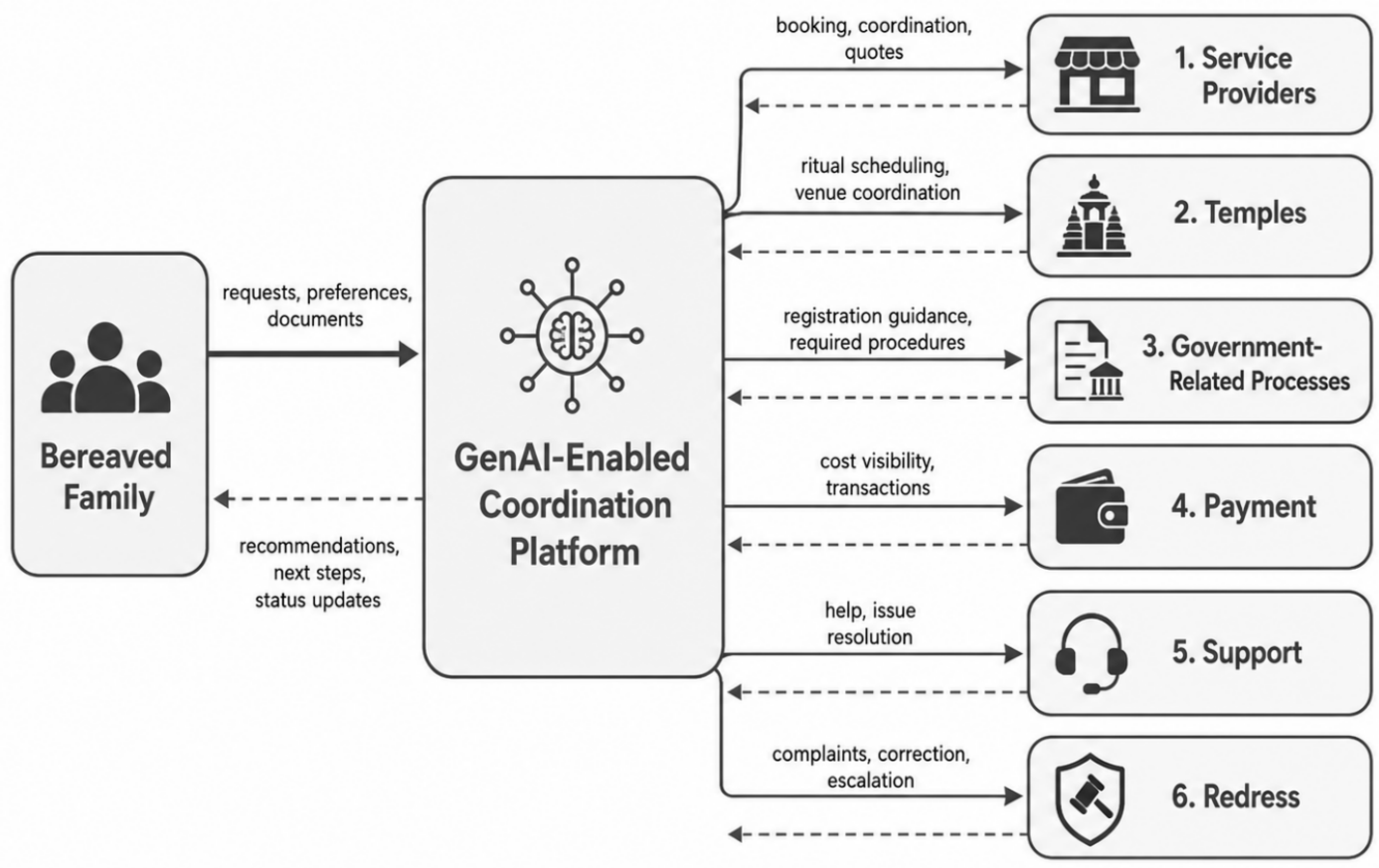
The platform must connect bereaved families, temples, providers, government-related procedures, payment services, support functions, and redress mechanisms. These handoffs create coordination frictions, information asymmetry, cost opacity, and accountability challenges that adoption evidence alone cannot resolve.
2.1. Minimum Safeguard Condition
The safeguard condition defines how AI-supported actions can be traced, reviewed, corrected, and escalated before routine use. Recommendations must be reconstructable; quote and invoice changes reviewable; complaints correctable; provider credentials verifiable; and difficult-to-reverse actions escalated for human review [9,10,17]. Adoption evidence can prioritize system features only after these baseline controls are specified; it cannot establish operational readiness by itself.
Table 1 summarizes the five minimum governance controls, their associated decision points, required log fields, and monitoring indicators used to define the baseline safeguard condition.
Table 1.
Minimum governance controls and required logs.
2.2. Role of Adoption Evidence in Pre-Deployment Design
Before rollout, respondents cannot judge service performance, provider compliance, incident recovery, or audit outcomes. They can judge application-level beliefs, including usefulness, ease of use, and trustworthy reliance under visible safeguards [11,12,18,19]. Thus, adoption evidence informs early design priorities and monitoring requirements only after safeguards are specified [17,20].
2.3. Design Principles for Pre-Deployment Design
Four principles guide the study: safeguards are baseline accountability requirements; hard-to-reverse actions need predefined human-review gates; contestability and redress belong in the workflow; and traceability should be the default condition, with logs for actors, outputs, sources, decisions, changes, exceptions, and escalation outcomes [9,10,17].
3. Research Model and Hypotheses Development
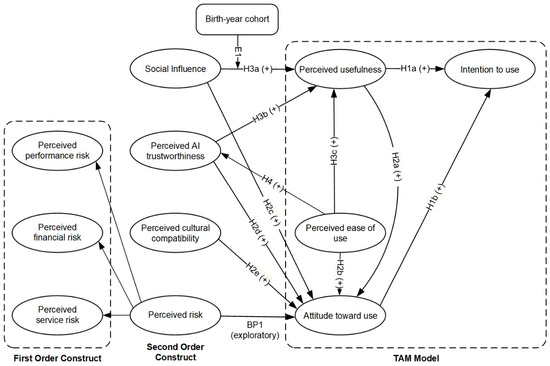
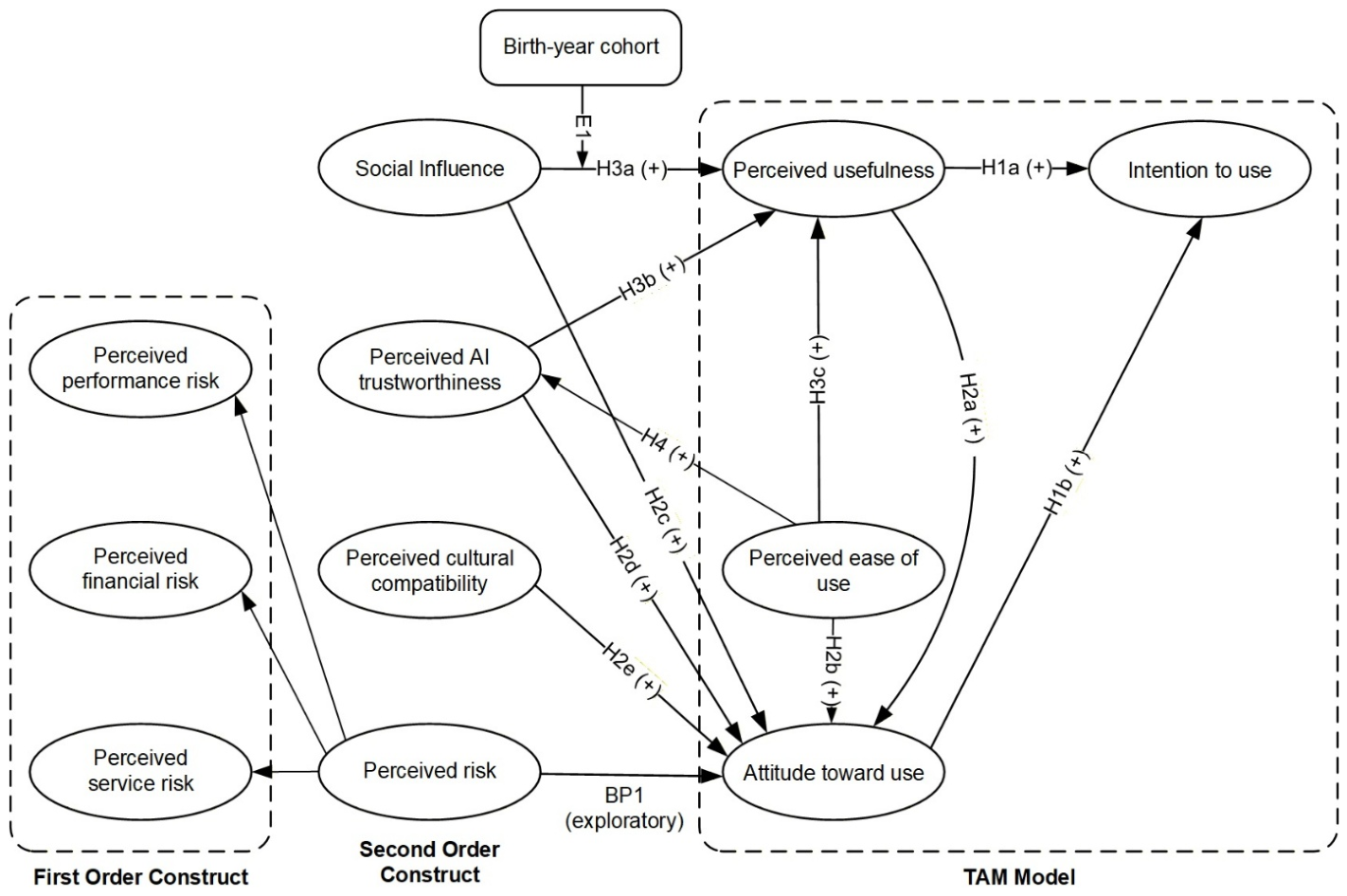
Respondents evaluated a standardized vignette and representative interface mockups (Figure S2 in Supplementary Materials), not actual use. Figure 1 presents the acceptance model; the EDTF then translates results into workflow controls, logs, monitoring indicators, and escalation rules.
Figure 1.
Extended technology acceptance model (TAM) for pre-deployment evaluation of a GenAI-assisted digital service platform for funeral coordination. Note. The model reflects pre-deployment evaluation under specified safeguards, not unconstrained or post-adoption use.
The technology acceptance model (TAM) and its extensions identify perceived usefulness (PU), perceived ease of use (PEU), attitude toward use (ATU), and intention to use (ITU) as central adoption constructs [18,19,21]. Recent studies published in Information likewise show that AI and GenAI adoption is shaped by combinations of usefulness or performance expectancy, ease or effort expectancy, social influence, trust, attitude, and perceived risk across educational, banking, logistics, human–AI collaboration, and recommendation contexts [22,23,24,25,26]. Here, PU captures expected coordination support: less search, clearer steps, documentation support, cost visibility, and multi-actor coordination under time pressure.
H1a.
PU is positively associated with ITU.
H1b.
ATU is positively associated with ITU.
PU and PEU are expected to shape ATU [18,19]. Here, ATU also reflects legitimacy, cultural fit, and acceptable reliance under safeguards: social influence (SI) captures normative support [21,24], perceived cultural compatibility (PC) captures fit with local funeral routines [1,27], and perceived AI trustworthiness (AIT) captures acceptable AI reliance [11,12].
H2a.
PU is positively associated with ATU.
H2b.
PEU is positively associated with ATU.
H2c.
SI is positively associated with ATU.
H2d.
AIT is positively associated with ATU.
H2e.
PC is positively associated with ATU.
PU may carry the influence of legitimacy, trustworthiness, and usability cues because users should see the application as more useful when it is easier to use, socially supported, and trustworthy for consequential coordination tasks [18,21,28,29].
H3a.
SI is positively associated with PU.
H3b.
AIT is positively associated with PU.
H3c.
PEU is positively associated with PU.
PEU is expected to strengthen AIT because understandable, controllable interactions help users judge when to rely on the system and when to question or escalate outputs. For GenAI-assisted digital service platforms, reliance cues should be visible through rationale display, transparent interaction design, and risk-aware governance [9,10,25,29].
H4.
PEU is positively associated with AIT.
PU should mediate upstream effects on ITU when ease of use, social support, and trustworthiness increase perceived coordination value [18,21,28,29]. It may also mediate the AIT-ATU relationship because AIT captures acceptable reliance, while perceived risk captures anticipated harm if reliance fails despite safeguards [28,29,30].
H5a.
PU mediates the relationship between SI and ITU.
H5b.
PU mediates the relationship between AIT and ITU.
H5c.
PU mediates the relationship between PEU and ITU.
H6.
PU mediates the relationship between AIT and ATU.
Two checks clarify robustness under safeguards: E1 examines whether birth-year cohort moderates the SI–PU association, and BP1 examines the incremental association between perceived risk and ATU when safeguards and comprehension are held constant [10,17,30,31].
- E1: Birth-year cohort moderates the association between SI and PU.
- BP1: Perceived risk is examined as an exploratory boundary condition for its incremental association with attitude toward use under the stated safeguards and verified comprehension.
4. Materials and Methods
The study used a three-stage pre-deployment design: user evaluation under safeguards, EDTF-based translation into candidate rollout requirements, and structured expert review before live use [32,33].
4.1. Population, Sampling, and Sample Size
The population comprised adults in the Bangkok Metropolitan Area who had prior experience participating in or assisting with funeral arrangements. A non-probability convenience-sampling strategy was used. The questionnaire was administered exclusively online through Google Forms; access links or QR codes were disseminated through multiple online communication channels, including Facebook, LINE contacts, LINE community and professional groups, and a Microsoft Teams community. These channels served as access points for potentially eligible respondents under the non-probability convenience-sampling strategy and did not constitute a probability-based sampling frame. Online recruitment was conducted during August–September 2025; eligibility required residence in the Bangkok Metropolitan Area, age of at least 18 years, prior experience participating in or assisting with funeral arrangements, and completion of the specified data-quality and comprehension checks. The article-level screening record documents 446 submitted questionnaires: 104 were excluded (62 satisficing/longstring flags, 13 attention-check failures, and 29 failures of the two-item comprehension gate), leaving 342 cases for the main model. This corresponds to a submission-to-analysis retention rate of 76.7%. Because convenience-link dissemination did not provide a known sampling-frame denominator for all individuals exposed to the invitation, a conventional population response rate could not be calculated; retention from submitted questionnaires is reported instead. Participation was voluntary, and no monetary or non-monetary incentives were offered for completing the questionnaire, consistent with the approved ethics documentation.
An a priori power analysis (α = 0.05, power = 0.80, six predictors, f2 = 0.05) indicated a minimum sample of 279 [34,35]. The final analytic sample of 342 exceeded this threshold and is interpreted as a screened subgroup of adults with prior funeral-arrangement experience rather than as a population-representative cross-section [36].
The simplified Thai Buddhist funeral-journey map and full standardized vignette are reported in Figure S1 and Appendix S1 in Supplementary Materials.
4.2. Data Collection Procedure
Because no operational platform had been deployed, respondents evaluated a standardized vignette describing a GenAI-enabled coordination application within a broader service platform and viewed representative interface mockups (Figure S2 in Supplementary Materials). The vignette covered coordination support, procedural information, cost visibility, provider and price verification, logging, escalation, redress, and mandatory human review for sensitive or hard-to-reverse actions [1,2,10,31]. Within this scenario, GenAI was limited to assistive functions such as drafting messages or forms, summarizing user-provided information, and presenting explanation-supported recommendations; it could not independently finalize bookings, payments, or other hard-to-reverse commitments. Accordingly, PU, ATU, AIT, PR, and ITU are prospective stated-preference judgments conditioned on the described scenario, not measures of experienced system performance or observed behavior. Standardized exposure improves comparability across respondents [37], but it cannot reproduce learning effects, usability friction, service failures, emotional pressure during an actual case, or consequences of repeated use. The estimates are therefore interpreted as pre-deployment acceptance evidence and not as behavioral adoption, realized trust, or implementation readiness.
Respondents passed two comprehension gates before the main instrument: identifying cross-actor funeral coordination as the application’s purpose and recognizing that sensitive or irreversible actions required human approval [37].
4.3. Measures and Analytical Procedure
Partial least squares structural equation modeling (PLS-SEM) was selected because the study emphasizes prediction-oriented assessment and design prioritization in a model containing multiple mediating paths and a higher-order construct. The analysis assessed the measurement and structural models, estimated structural paths and mediation effects, examined measurement invariance using the measurement invariance of composites (MICOM) procedure, evaluated predictive performance using PLSpredict and the cross-validated predictive ability test (CVPAT), and identified priority drivers through importance–performance map analysis (IPMA) [20,38,39,40]. All first-order constructs were specified reflectively. Perceived risk (PR) was modeled as a reflective–reflective higher-order construct comprising financial risk (FIN), service risk (SER), and performance risk (PER) using a disjoint two-stage approach. In Stage 1, FIN, SER, and PER were estimated as separate lower-order constructs, and their latent variable scores were obtained. In Stage 2, these scores were used as reflective indicators of the higher-order PR construct, which was then included in the structural model as a predictor of attitude toward use. This approach preserved the multidimensional structure of perceived risk while allowing its overall association with attitude toward use to be estimated within the structural model.
Reflective measurement quality was assessed using indicator loadings, Cronbach’s alpha, composite reliability, average variance extracted (AVE), and the heterotrait–monotrait ratio (HTMT). Structural-model assessment included collinearity using variance inflation factors (VIFs), path coefficients, effect sizes, explained variance, and predictive relevance. Predictive performance was further evaluated using PLSpredict and CVPAT, while IPMA was used to support the prioritization of design-relevant user beliefs [20,38,40]. For the theoretically adjacent AIT and PR constructs, HTMT inference was additionally examined using a bias-corrected bootstrap confidence interval, with the upper bound evaluated against the 0.90 criterion [20]. Because all focal constructs were collected in a single self-report wave, common-method bias was formally assessed using Harman’s single-factor diagnostic [41]. All 50 substantive measurement items were entered simultaneously into an unrotated principal component analysis with extraction constrained to one factor; demographic, screening, and cohort variables were excluded. Full-collinearity VIFs were retained as a complementary partial diagnostic rather than treated as conclusive evidence against common-method bias. All PLS-SEM analyses were conducted using SmartPLS Version 4.1. Detailed Harman single-factor diagnostic results are reported in Table S22 in Supplementary Materials.
Birth-year cohort was examined only as an exploratory robustness analysis. The main structural model retained all 342 respondents. The exploratory comparison focused on respondents born in 1966–1980 (n = 73) and 1981–2000 (n = 254), yielding n = 327; respondents born in 1965 or earlier (n = 2) and 2001 onward (n = 13) remained in the main model but were excluded from the cohort interaction because the outlying cohort sizes were insufficient for a meaningful comparison. The two focal ranges correspond to birth-year categories already defined in the study instrument before outcome analysis; accordingly, the exploratory comparison follows the original questionnaire categories rather than cut points constructed post hoc from the observed structural results. These categories are treated as pragmatic birth-year cohorts and are not claimed to represent universal or fixed generational definitions (Table S21 in Supplementary Materials). A Cohort × SI interaction tested whether the SI-PU relationship differed across the two focal groups, and MICOM was used as a supplementary measurement-comparability check. Consistent with Ravid et al. [42], the birth-year grouping is treated as a pragmatic proxy for shared sociohistorical experience rather than as evidence of deterministic generational traits. Because MICOM supported partial rather than full measurement invariance, all cohort findings remain exploratory and are not used for strong subgroup generalization.
4.4. Evidence-to-Design Translation Framework (EDTF)
The Evidence-to-Design Translation Framework (EDTF) was developed as an illustrative pre-deployment framework for organizing how empirically screened user-evaluation evidence can inform a reviewable initial design and governance specification. The EDTF does not claim that statistically significant paths are design prescriptions, nor is it presented as a universally validated method. It provides a transparent sequence for linking behavioral evidence to candidate requirements under an explicitly stated safeguard baseline.
- Step 1—Evidence screening and relevance classification. Findings are reviewed jointly across structural-path significance, effect-size magnitude, explained variance, predictive assessment, and IPMA [20,40]. For this study, statistical support means a bootstrapped path or indirect effect meeting p < 0.05, whereas practical relevance means that a finding is decision-useful for a concrete user-facing feature, workflow checkpoint, governance control, or monitoring requirement when considered alongside its effect magnitude, IPMA importance/performance position, and predictive evidence. Statistical significance alone does not mandate translation. When statistical and practical signals conflict, the finding is retained only as secondary evidence unless it is corroborated by the broader evidence set and can be linked to a reviewable design or governance decision.
- Step 2—Design prioritization. Screened evidence is converted into candidate user-facing priorities rather than deterministic feature requirements. Higher-importance IPMA drivers and material performance opportunities receive greater design attention, while statistically significant but very small effects are treated as supporting rather than dominant evidence. For example, perceived usefulness informs coordination features such as triage, drafting, scheduling, and bundled guidance, whereas perceived ease of use informs workflow simplification through templates, smart defaults, and reduced data-entry burden.
- Step 3—Safeguard mapping. Each candidate requirement is mapped to one or more of the five safeguards instantiated in this study: traceability, auditability, contestability and redress, verification, and risk-based human review. This mapping links user-facing functionality to accountability mechanisms for consequential GenAI-assisted actions and is informed by established AI risk-management, transparency, auditing, and design-science principles [9,10,17,33].
- Step 4—Operational specification, adjudication, and expert challenge. The authors translate each retained priority into a provisional operational specification identifying the workflow feature, required records, decision checkpoint, monitoring indicator, escalation trigger, and accountable actor. Where evidence signals conflict, the authors document the rationale for retaining, downgrading, or excluding a candidate requirement. The resulting specification is then challenged by the eight-member expert panel for relevance, clarity, feasibility, and risk coverage using the predefined review criteria reported in Tables S12–S15; expert feedback is used to refine the pre-deployment specification.
The EDTF therefore functions as a traceable evidence-to-requirements framework rather than a post hoc interpretation of significant paths. It makes the translation logic reviewable by recording the evidence signal, design rationale, safeguard mapping, accountable actor, required record, KPI anchor, and escalation condition. Detailed mappings, accountability assignments, KPI definitions, provisional thresholds, and breach actions are reported in Tables S16–S18 of the Supplementary Materials. These elements support reproducibility of the reasoning process without implying that the resulting design choices have already been validated in live operation.
The KPI thresholds in the Supplementary Materials are provisional pilot-stage anchors derived from expert elicitation and service-operations reasoning, not empirically validated operating thresholds. In practice, an organization should assign each KPI to the accountable owner specified in the governance map, compute the metric from auditable event records, review it at a predefined pilot cadence, trigger the documented breach action when an anchor is exceeded, and version-control any threshold change. Thresholds should then be recalibrated using observed distributions, incident reviews, process variation, and governance-log evidence collected during pilot and field deployment.
The EDTF is not intended to replace established design-science methodologies or evaluation frameworks [32,33]. Its transferable element is the sequence of evidence screening, prioritization, safeguard mapping, operational specification, and expert challenge. The five-safeguard configuration is the study-specific instantiation, not a universal requirement set. Applications in other service, cultural, or regulatory contexts should re-specify the relevant safeguards, accountable actors, records, KPIs, and escalation conditions before applying the same translation sequence.
4.5. Structured Expert Review of the Initial Rollout Specification
Eight experts reviewed the draft rollout specification before deployment, covering temple operations, funeral services, transformative service research, Personal Data Protection Act (PDPA) compliance, service logistics, and AI auditing [32,33]. The review met the predefined relevance, clarity, feasibility, and risk-coverage thresholds; relevance reached an item-level content validity index (I-CVI) of 0.88, and mean ratings ranged from 3.25 to 3.63 on a four-point scale. Expert comments strengthened temple/hall information, audit-trail visibility, redress, provider verification, and human-in-the-loop (HITL) triggers; details are reported in Tables S12–S15 in Supplementary Materials.
4.6. Use of Generative AI in Manuscript Preparation
During manuscript preparation, the authors used ChatGPT (OpenAI; web-based service, with model versions varying as the service was updated) from 20 December 2025 onward for drafting support, language refinement, and readability improvement. ChatGPT was not used for participant recruitment, data generation, data collection, statistical analysis, or independent interpretation of the findings. All AI-assisted text was critically reviewed, verified against the study records and cited sources, and revised by the authors, who take full responsibility for the content of the manuscript.
5. Results
5.1. Descriptive Statistics
Table 2 summarizes the screened analytic sample. Most respondents were born between 1981 and 2000, were female, held a bachelor’s degree, and reported monthly income of 20,001–40,000 Baht. The exploratory moderation analysis followed the two focal birth-year categories defined in the study instrument (1966–1980 and 1981–2000), consistent with the prespecified exploratory cohort comparison described in Section 4.3.
Table 2.
Respondent characteristics (N = 342).
5.2. Measurement Invariance and Measurement Model
MICOM supported partial rather than full measurement invariance, so cohort-related analyses are interpreted as exploratory. The reflective measurement model showed satisfactory indicator reliability and convergent validity, with loadings ranging from 0.703 to 0.910, Cronbach’s alpha from 0.798 to 0.921, composite reliability (rhoC) from 0.861 to 0.938, and AVE from 0.553 to 0.752. Full-collinearity VIF values were low (maximum = 2.563), and HTMT supported discriminant validity for the present analytical purpose. In particular, the AIT-PR HTMT estimate was 0.124, with a 90% bias-corrected bootstrap confidence interval of 0.050–0.163; the upper bound of 0.163 remained well below 0.90, providing additional support for empirical discriminant validity between AIT and PR (Table S4 in Supplementary Materials). Nevertheless, the constructs remain theoretically adjacent: AIT combines reliability, information accuracy, security, and acceptable reliance, whereas PR represents anticipated financial, service, and performance downside. This conceptual proximity remains a boundary for future multidimensional measurement refinement. Common-method-bias diagnostics also did not indicate a dominant single factor. The Kaiser–Meyer–Olkin measure was 0.895, and Bartlett’s test of sphericity was significant (χ2 = 9790.686, df = 1225, p < 0.001). In the forced one-factor solution, the first unrotated component accounted for 22.348% of the total variance, well below the 50% heuristic commonly used for Harman’s diagnostic [41]. Together with the low full-collinearity VIFs (maximum = 2.563), this reduces concern that common method variance dominated the observed relationships, although residual common-method bias cannot be completely excluded. Detailed diagnostic statistics are provided in Table S22 in Supplementary Materials.
5.3. Structural Model and Predictive Assessment
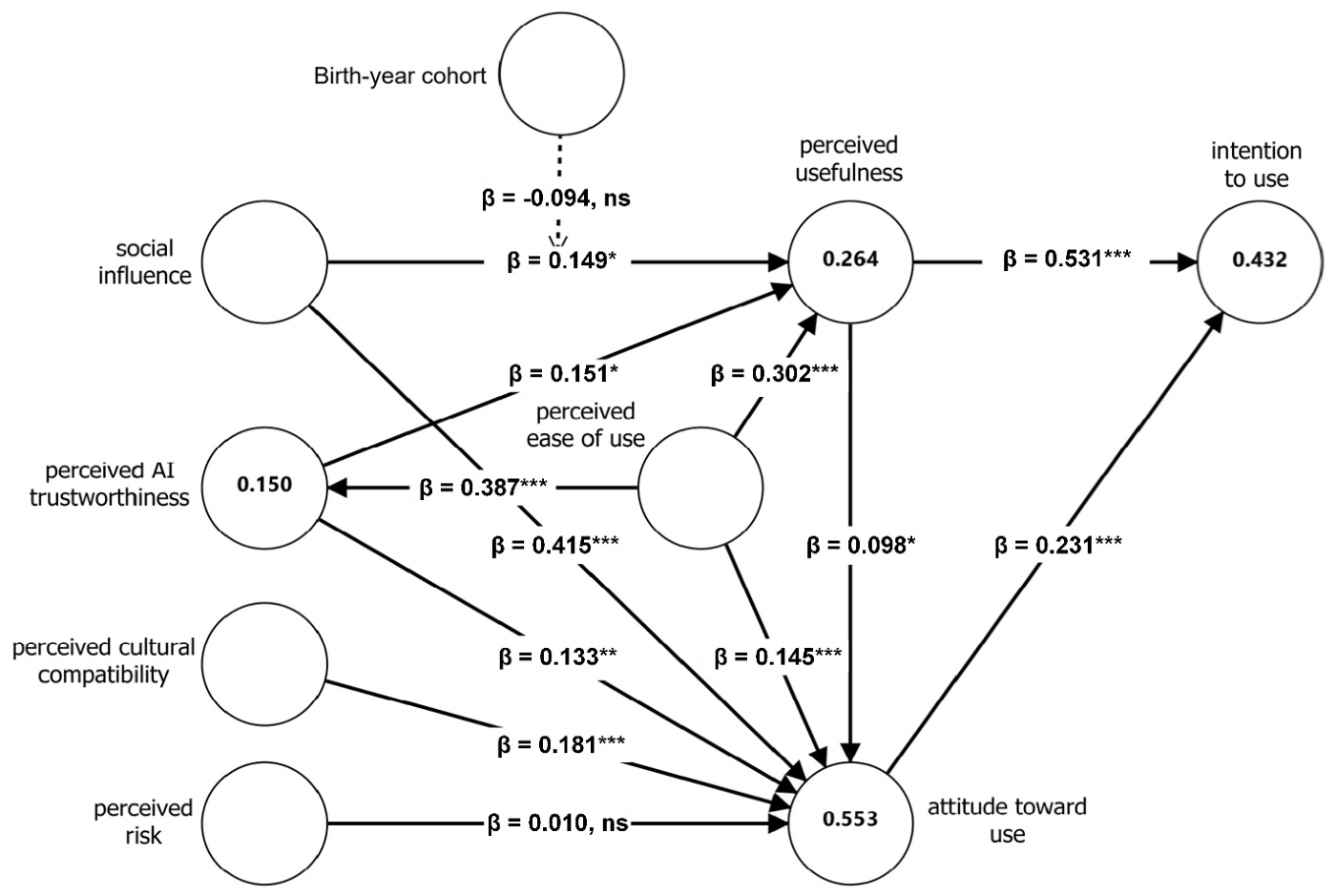
Structural collinearity was low (inner VIF = 1.000–2.126). Blindfolding showed predictive relevance for ATU (Q2 = 0.321), ITU (Q2 = 0.232), PU (Q2 = 0.159), and AIT (Q2 = 0.098). R2 values were 0.553 for ATU, 0.432 for ITU, 0.264 for PU, and 0.150 for AIT. PLSpredict was strongest for ATU and PU, moderate for ITU, and weaker for AIT, supporting design prioritization rather than uniformly strong prediction [20,38,40]. Detailed PLSpredict and CVPAT benchmarking results are reported in Table S7 of the Supplementary Materials.
5.4. Hypothesis Tests, Exploratory Robustness Check, and Boundary Check
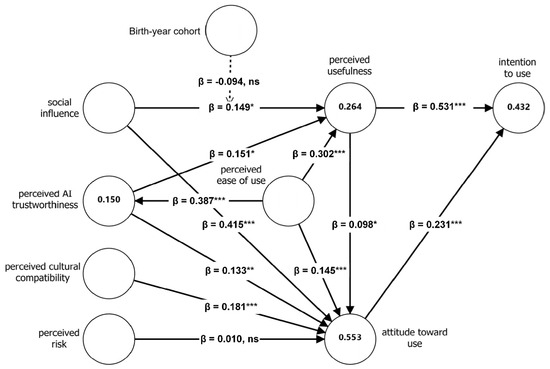
Figure 2 and Table 3 summarize the structural results. PU was the strongest direct predictor of ITU (H1a: β = 0.531, p < 0.001, f2 = 0.419), while ATU had a smaller direct path (H1b: β = 0.231, p < 0.001, f2 = 0.079). For ATU, SI was the strongest antecedent, followed by PC, PEU, AIT, and PU. For PU, PEU was the strongest upstream predictor; SI and AIT were weaker but positive. PEU also strongly predicted AIT. PU mediated SI, AIT, and PEU effects on ITU; H6 was not supported, suggesting that AIT contributed to ATU more directly than through PU. Perceived risk was not statistically associated with attitude toward use under the safeguarded vignette condition (β = 0.010, p = 0.821, f2 = 0.000). This finding indicates that no incremental association was detected after accounting for the other modeled predictors; it does not establish equivalence to zero and should not be interpreted as evidence that operational risk is absent or unimportant. The cohort interaction was exploratory; MICOM supported partial rather than full measurement invariance, so no strong subgroup inference was made [39].
Figure 2.
Structural model results for safeguarded pre-deployment evaluation. Note. Solid lines represent direct structural paths; the dashed line represents the exploratory cohort interaction. Direct structural-path estimates are based on the full analytic sample (N = 342), whereas the exploratory Cohort × SI interaction estimate is based on the two-cohort subsample (n = 327). Statistical significance is indicated by asterisks. Coefficients are standardized; values inside endogenous constructs are R2. * p < 0.05, ** p < 0.01, *** p < 0.001; ns = not significant.
Table 3.
Structural model results, mediation tests, and exploratory checks.
Overall, PU dominated ITU, ATU provided a secondary path, and SI and PEU were the most consequential upstream beliefs. PC and AIT played supporting roles, while perceived risk added little explanatory value under stated safeguards.
5.5. Importance–Performance Map Analysis (IPMA) Priorities and EDTF Translation
IPMA indicates that the initial rollout specification should prioritize PU for ITU, with ATU as a secondary priority. SI signals legitimacy [21,24]; PC reflects local institutional fit [1,27]; PEU highlights the need for workflow simplification [22,23]; and AIT points to the importance of transparent reliance cues [9,11].
IPMA prioritizes user-facing features; the EDTF specifies how those priorities are linked to candidate controls for safe operation, including coordination, verification, traceability, auditability, redress, records, and escalation paths.
Table 4 translates supported findings into prioritized workflow features, controls, and KPI anchors. Full controls, accountability assignments, traceability fields, KPI formulas, thresholds, and breach actions are reported in Tables S16–S18 in Supplementary Materials.
Table 4.
EDTF-based translation of IPMA priorities into workflow features, controls, and KPI anchors.
Together, Table 4 and Figure S3 in Supplementary Materials show how behavioral evidence informed the prioritization of design requirements under the fixed safeguard condition.
5.6. Rollout-Specification Evaluation Results
The expert review provides pre-deployment support for the rollout design, not evidence of live service effectiveness. Revisions strengthened temple/hall information, audit trails, redress pathways, provider verification, and HITL triggers; KPI thresholds remain provisional.
Figure 3 summarizes the actor-level rollout logic informed by the EDTF. The proposed platform is represented only as a pre-deployment coordination architecture linking bereaved families, temples, providers, payment and documentation services, support functions, and redress mechanisms under the five safeguards; the figure is not evidence of an implemented or tested system.
Figure 3.
GenAI-assisted digital service platform ecosystem for the initial rollout specification.
6. Discussion
Within the stated vignette, respondents judged the proposed application mainly by expected coordination value. PU dominated ITU, ATU added a secondary pathway, and SI, PEU, PC, and AIT supported prospective acceptance through legitimacy, usability, cultural fit, and acceptable reliance. The non-significant PR path is a descriptive boundary finding from this pre-deployment stated-preference design; it is not evidence that risk is absent, negligible, or behaviorally resolved. Operational risks remain relevant because errors, complaints, price changes, and irreversible commitments would still require traceability, review, correction, and escalation [9,10,17].
The prominence of PU is consistent with TAM-based research that treats expected performance value as a central determinant of adoption intention [18,19], while SI and PEU align with broader acceptance models and recent AI-adoption studies [21,22,23,24,25,26]. The present study found no detectable incremental PR–ATU association after accounting for the other modeled predictors. However, every respondent evaluated the same safeguarded vignette and there was no unsafeguarded or no-safeguard control condition. The null PR coefficient therefore cannot be causally attributed to safeguard disclosure. The safeguards define the context in which the coefficient was observed; testing whether safeguards themselves change risk perception or the PR-ATU relationship requires a controlled experimental or randomized-vignette comparison.
6.1. Methodological and Information-System Design Contributions
The methodological contribution is the EDTF as a transparent pre-deployment translation framework, not a claim that the study has established a new general-purpose scientific method. Its value is to make explicit how acceptance evidence is screened, prioritized, connected to governance safeguards, and converted into a reviewable operational specification before pilot deployment.
The theoretical contribution is likewise bounded. SI, AIT, PC, and perceived-risk extensions are not presented as previously unseen TAM constructs; related mechanisms are already established in AI-adoption research [22,23,24,25,26]. The incremental contribution lies in examining their joint role in a culturally sensitive funeral-coordination context under an explicit governance baseline and then linking the resulting demand-side evidence to information-system and accountability specifications through the EDTF. The study therefore contributes a contextually integrated acceptance-to-governance perspective rather than a wholly new acceptance theory.
6.2. Design and Practical Implications
Organizations should not treat prospective acceptance as deployment readiness. A safer sequence is to define minimum controls first, collect user evidence under those controls, translate the strongest and most decision-relevant signals into candidate features and checkpoints, and recalibrate the design through pilot evidence. The application should make coordination value visible through triage, next-step guidance, drafting, scheduling, documentation support, cost visibility, and simplified multi-actor coordination. It should signal legitimacy through temple-linked information, cultural sequencing, verified providers, transparent reviews, and escalation routes [1,27], while trustworthy reliance should be supported through source visibility, rationale display, verification, change logs, correction paths, and HITL triggers [9,10,17].
Effect magnitude should also guide implementation priorities. For example, H2a (PU → ATU; beta = 0.098, f2 = 0.016) is statistically significant but very small in practical magnitude. It should therefore not be treated as a standalone justification for investment. PU remains a primary design priority because it has a much larger direct relationship with ITU (f2 = 0.419) and the highest IPMA importance; H2a is best interpreted as supporting evidence that perceived utility also makes a modest contribution to attitude formation. Similarly, provisional KPI anchors should be operationalized through named owners, auditable event logs, predefined review intervals, breach actions, and post-pilot recalibration rather than treated as fixed performance standards.
6.3. Data Value and Prospective Ecosystem Implications
The findings also indicate how data integration could create value beyond the user-facing application if the proposed architecture is subsequently implemented and validated. Because PU was the strongest determinant of ITU, an initial data architecture should prioritize information directly supporting coordination value, including verified temple and provider records, service availability, schedules, itemized prices, document status, change histories, and service-recovery records. SI and cultural compatibility further suggest that shared information should preserve institutional legitimacy and local ritual context, while PEU and AIT indicate a need for visible provenance, confidence, consent, and correction mechanisms. Through the EDTF, these data categories are linked to traceability fields, accountability assignments, and provisional operational KPIs rather than treated as passive records. The potential ecosystem-level value is therefore a design proposition: a governed coordination infrastructure may support interoperability, service benchmarking, capacity planning, and iterative quality improvement. These possibilities require prototype, pilot, and field evidence before any claim of service-ecosystem or industry transformation is warranted.
6.4. Boundary Conditions, Limitations, and Future Research
Several boundary conditions apply. First, the findings derive from a standardized vignette and static interface representations rather than observed use; therefore PU, ATU, AIT, PR, and ITU reflect stated prospective judgments and may differ from behavior after users encounter real usability friction, provider variability, incidents, and emotionally consequential decisions. Second, although Harman’s single-factor diagnostic showed that the forced first factor accounted for only 22.348% of total variance and full-collinearity VIFs were low (maximum = 2.563), all focal constructs were collected in one cross-sectional self-report wave. These diagnostics reduce concern that a dominant common-method factor drove the results, but residual common-method bias cannot be completely ruled out [41]. Third, the sample is a screened convenience sample of adults with prior funeral-arrangement experience in the Bangkok Metropolitan Area and should not be interpreted as population-representative. Fourth, AIT combines reliability, accuracy, security, and acceptable reliance; although the AIT-PR HTMT estimate (0.124) and its 90% bias-corrected bootstrap upper bound (0.163) support empirical discriminant validity, these facets may be empirically separable and should be tested with more explicitly multidimensional specifications. Finally, the study contains no unsafeguarded control condition, so it cannot estimate the causal effect of safeguard disclosure on perceived risk or acceptance.
The bereavement context also requires ethical and cultural sensitivity. To reduce unnecessary elicitation of personal grief narratives, the survey used a standardized hypothetical coordination scenario and application-level judgments rather than asking respondents to recount a specific loss in detail. The study information emphasized confidentiality and academic use of the data, and informed consent was obtained under the approved exempt protocol. These design choices reduce direct exposure to sensitive narrative disclosure but do not eliminate the possibility that funeral-related content may evoke discomfort. Future live pilots should therefore define explicit distress, withdrawal, and human-support procedures alongside the technical safeguards.
Future research should combine longitudinal or pre–post adoption designs with actual-use evidence such as system logs, service-completion records, incident and recovery data, and feature-level behavior. It should experimentally compare safeguarded and unsafeguarded/no-safeguard conditions, validate the EDTF longitudinally during pilot operation, and test whether the governance and translation logic transfers to other cultural, regulatory, and high-stakes service contexts. Such work can determine which parts of the framework are portable and which require domain-specific redesign.
Screening altered the composition of the analytic sample, particularly with respect to birth-year cohort (Table S20). These differences reflect the study’s eligibility and response-quality screening procedures and may limit external validity. Accordingly, the findings should be interpreted as applying to a screened subgroup of adults with prior funeral-arrangement experience rather than to the broader Bangkok population or to all bereaved family members.
7. Conclusions
This study evaluated prospective acceptance of a conceptually specified GenAI-assisted service for Thai Buddhist funeral coordination under five stated safeguards. Intention to use was associated mainly with perceived usefulness, with attitude toward use as a secondary pathway; social influence, ease of use, cultural compatibility, and perceived AI trustworthiness contributed through supporting pathways, while perceived risk showed no significant incremental association with attitude in the evaluated vignette. These results describe stated pre-deployment judgments, not observed adoption or operational performance.
The contribution is to demonstrate a bounded way to connect pre-deployment acceptance evidence with responsible information-system design without treating acceptance as readiness. The EDTF structures this connection by screening evidence, prioritizing candidate requirements, mapping them to safeguards, converting them into reviewable specifications, and subjecting those specifications to expert challenge. It should be treated as an illustrative translation framework requiring pilot validation, not as a validated universal procedure.
For deployment, the platform should be treated as an information and coordination layer rather than as an autonomous decision maker. Pilot use should test whether it reduces coordination burden, improves clarity, supports culturally appropriate choices, maintains traceable GenAI outputs, and enables users to challenge, correct, or escalate consequential actions.
The findings establish a pre-deployment basis for subsequent prototype development and pilot implementation. From a managerial and policy perspective, the next step is to test whether a governed data-management and coordination model can work across participating actors. Candidate requirements include shared minimum data standards for provider credentials, service availability, schedules, prices, service changes, complaints, and outcomes; explicit responsibility for data quality and verification; consent, role-based access, retention, provenance, and audit controls; and operational indicators for service planning and quality improvement. Any broader ecosystem transformation claim must await field deployment, cross-actor integration, longitudinal evidence, and comparison of intended versus realized behavior.
Supplementary Materials
The following supporting information can be downloaded at https://www.mdpi.com/article/10.3390/info17080784/s1, Table S1: Measurement items; Tables S2–S8: Measurement diagnostics; Tables S9–S11: MICOM invariance checks; Tables S12–S15: Expert review evidence; Tables S16–S18: Governance blueprint specifications; Table S19: Comprehension gate items and screening rule; Table S20: Attrition and screening diagnostics; Table S21: Full respondent characteristics (N = 342); Table S22: Harman’s single-factor common-method-bias diagnostic; Figure S1: Simplified Thai Buddhist funeral journey underlying the study vignette; Figure S2: Representative interface mockups shown to respondents; Figure S3: Importance–performance map analysis (IPMA) of the key drivers of intention to use; Appendix S1: Standardized vignette used in the vignette survey.
Author Contributions
Conceptualization, C.B.; methodology, C.B.; formal analysis, C.B.; investigation, C.B.; data curation, C.B.; writing—original draft preparation, C.B.; visualization, C.B.; project administration, C.B.; supervision, D.M. and J.J.; writing—review and editing, D.M. and J.J. All authors have read and agreed to the published version of the manuscript.
Funding
This research received no external funding.
Institutional Review Board Statement
The study was conducted in accordance with the Declaration of Helsinki and was reviewed by the Human Research Ethics Committee of the University of the Thai Chamber of Commerce, which determined that the research project qualified for exemption (Project Code: S14046/2024; Certificate of Approval No. UTCCEC/Exemp070/2024; date of approval: 27 November 2024).
Informed Consent Statement
Informed consent was obtained from all subjects involved in the study.
Data Availability Statement
The participant-level data are not publicly available due to confidentiality commitments described in the informed consent provided to participants. Aggregated data supporting the findings are reported in the article and Supplementary Materials. Requests for access to de-identified data may be directed to the corresponding author and will be considered subject to applicable institutional requirements and consistency with the informed consent provided by participants.
Acknowledgments
During the preparation of this manuscript, the authors used ChatGPT (OpenAI) from 20 December 2025 onward for drafting support, language refinement, and readability improvement. The authors reviewed and edited all AI-assisted output and take full responsibility for the content of this publication.
Conflicts of Interest
The authors declare no conflicts of interest.
References
- Nothong, N. Funeral Rituals of Buddhists in Lopburi Province; Office of Arts and Culture, Thepsatri Rajabhat University: Lopburi, Thailand, 2018; p. 500. [Google Scholar]
- Bureau of Registration Administration, Ministry of Interior, Thailand. Civil Registration Guide: Death Registration; Ministry of Interior, Thailand: Bangkok, Thailand. Available online: https://www.bora.dopa.go.th/callcenter1548/guidebook (accessed on 13 August 2026).
- Blackburn, P.; Bulsara, C. “I am tired of having to prove that my husband was dead.” Dealing with practical matters in bereavement and the impact on the bereaved. Death Stud. 2018, 42, 627–635. [Google Scholar] [CrossRef] [Scilit]
- Aoun, S.M.; Lowe, J.; Christian, K.M.; Rumbold, B. Is there a role for the funeral service provider in bereavement support within the context of compassionate communities? Death Stud. 2019, 43, 619–628. [Google Scholar] [CrossRef] [Scilit]
- de Reuver, M.; Sørensen, C.; Basole, R.C. The digital platform: A research agenda. J. Inf. Technol. 2018, 33, 124–135. [Google Scholar] [CrossRef] [Scilit]
- Hein, A.; Schreieck, M.; Riasanow, T.; Setzke, D.S.; Wiesche, M.; Böhm, M.; Krcmar, H. Digital platform ecosystems. Electron. Mark. 2020, 30, 87–98. [Google Scholar] [CrossRef] [Scilit]
- Storey, V.C.; Yue, W.T.; Zhao, J.L.; Lukyanenko, R. Generative artificial intelligence: Evolving technology, growing societal impact, and opportunities for information systems research. Inf. Syst. Front. 2025, 27, 2081–2102. [Google Scholar] [CrossRef] [Scilit]
- Banh, L.; Strobel, G. Generative artificial intelligence. Electron. Mark. 2023, 33, 1–17. [Google Scholar] [CrossRef] [Scilit]
- Vössing, M.; Kühl, N.; Lind, M.; Satzger, G. Designing transparency for effective human-AI collaboration. Inf. Syst. Front. 2022, 24, 877–895. [Google Scholar] [CrossRef] [Scilit]
- Tabassi, E. Artificial Intelligence Risk Management Framework (AI RMF 1.0). In “NIST AI 100-1”, NIST Trustworthy and Responsible AI; National Institute of Standards and Technology: Gaithersburg, MD, USA, 2023. [Google Scholar] [CrossRef] [Scilit]
- Wanner, J.; Herm, L.-V.; Heinrich, K.; Janiesch, C. The effect of transparency and trust on intelligent system acceptance: Evidence from a user-based study. Electron. Mark. 2022, 32, 2079–2102. [Google Scholar] [CrossRef] [Scilit]
- Yang, R.; Wibowo, S. User trust in artificial intelligence: A comprehensive conceptual framework. Electron. Mark. 2022, 32, 2053–2077. [Google Scholar] [CrossRef] [Scilit]
- van Ryn, L.; Meese, J.; Arnold, M.; Nansen, B.; Gibbs, M.; Kohn, T. Managing the consumption of death and digital media: The funeral director as market intermediary. Death Stud. 2019, 43, 446–455. [Google Scholar] [CrossRef] [Scilit] [PubMed]
- Sas, C.; Schreiter, M.; Buscher, M.; Gamba, F.; Coman, A. Futures of digital death: Past, present and charting emerging research agenda. Death Stud. 2019, 43, 407–413. [Google Scholar] [CrossRef] [Scilit] [PubMed]
- Gould, H.; Kohn, T.; Gibbs, M. Uploading the ancestors: Experiments with digital Buddhist altars in contemporary Japan. Death Stud. 2019, 43, 456–465. [Google Scholar] [CrossRef] [Scilit] [PubMed]
- Allison, F.; Nansen, B.; Gibbs, M.; Arnold, M.; Holleran, S.; Kohn, T. Reimagining memorial spaces through digital technologies: A typology of CemTech. Death Stud. 2024, 48, 790–800. [Google Scholar] [CrossRef] [Scilit] [PubMed]
- Mokander, J.; Morley, J.; Taddeo, M.; Floridi, L. Ethics-Based Auditing of Automated Decision-Making Systems: Nature, Scope, and Limitations. Sci. Eng. Ethics 2021, 27, 44. [Google Scholar] [CrossRef] [Scilit] [PubMed]
- Davis, F.D. Perceived usefulness, perceived ease of use, and user acceptance of information technology. MIS Q. 1989, 13, 319–340. [Google Scholar] [CrossRef] [Scilit] [PubMed]
- Venkatesh, V.; Davis, F.D. A theoretical extension of the technology acceptance model: Four longitudinal field studies. Manag. Sci. 2000, 46, 186–204. [Google Scholar] [CrossRef] [Scilit]
- Hair, J.; Hult, G.T.M.; Ringle, C.; Sarstedt, M. A Primer on Partial Least Squares Structural Equation Modeling (PLS-SEM); Sage Publications: Thousand Oaks, CA, USA, 2022. [Google Scholar]
- Venkatesh, V.; Morris, M.G.; Davis, G.B.; Davis, F.D. User acceptance of information technology: Toward a unified view. MIS Q. 2003, 27, 425–478. [Google Scholar] [CrossRef] [Scilit]
- Balaskas, S.; Tsiantos, V.; Chatzifotiou, S.; Rigou, M. Determinants of ChatGPT Adoption Intention in Higher Education: Expanding on TAM with the Mediating Roles of Trust and Risk. Information 2025, 16, 82. [Google Scholar] [CrossRef] [Scilit]
- Papathomas, A.; Konteos, G.; Avlogiaris, G. Behavioral Drivers of AI Adoption in Banking in a Semi-Mature Digital Economy: A TAM and UTAUT-2 Analysis of Stakeholder Perspectives. Information 2025, 16, 137. [Google Scholar] [CrossRef] [Scilit]
- Sriwichien, W.; Wisaeng, K. Understanding AI Adoption in the Logistics and Supply Chain Industry in Thailand: An Integrated Technology-Organization-Environment, Task-Technology Fit, and Unified Theory of Acceptance and Use of Technology Framework. Information 2026, 17, 362. [Google Scholar] [CrossRef] [Scilit]
- Chae, H.-S.; Yoon, C. Factors Affecting Human-Generated AI Collaboration: Trust and Perceived Usefulness as Mediators. Information 2025, 16, 856. [Google Scholar] [CrossRef] [Scilit]
- Escolano, V.J.C.; Yee, Y.-M.; Shiang, W.-J.; Hernandez, A.A.; Nang, D.V. Generative AI Recommendations for Environmental Sustainability: A Hybrid SEM–ANN Analysis of Gen Z Users in the Philippines. Information 2026, 17, 203. [Google Scholar] [CrossRef] [Scilit]
- Moore, G.C.; Benbasat, I. Development of an instrument to measure the perceptions of adopting an information technology innovation. Inf. Syst. Res. 1991, 2, 192–222. [Google Scholar] [CrossRef] [Scilit]
- Mayer, R.C.; Davis, J.H.; Schoorman, F.D. An integrative model of organizational trust. Acad. Manag. Rev. 1995, 20, 709–734. [Google Scholar] [CrossRef] [Scilit]
- McKnight, H.D.; Choudhury, V.; Kacmar, C. The impact of initial consumer trust on intentions to transact with a web site: A trust building model. J. Strateg. Inf. Syst. 2002, 11, 297–323. [Google Scholar] [CrossRef] [Scilit]
- Featherman, M.S.; Pavlou, P.A. Predicting e-services adoption: A perceived risk facets perspective. Int. J. Hum.-Comput. Stud. 2003, 59, 451–474. [Google Scholar] [CrossRef] [Scilit]
- Mitchell, V.W.; Greatorex, M. Risk Perception and Reduction in the Purchase of Consumer Services. Serv. Ind. J. 1993, 13, 179–200. [Google Scholar] [CrossRef] [Scilit]
- Peffers, K.; Tuunanen, T.; Rothenberger, M.A.; Chatterjee, S. A design science research methodology for information systems research. J. Manag. Inf. Syst. 2007, 24, 45–77. [Google Scholar] [CrossRef] [Scilit]
- Venable, J.; Pries-Heje, J.; Baskerville, R. FEDS: A framework for evaluation in design science research. Eur. J. Inf. Syst. 2016, 25, 77–89. [Google Scholar] [CrossRef] [Scilit]
- Cohen, J. A power primer. Psychol. Bull. 1992, 112, 155–159. [Google Scholar] [CrossRef] [PubMed]
- Faul, F.; Erdfelder, E.; Buchner, A.; Lang, A.G. Statistical power analyses using G*Power 3.1: Tests for correlation and regression analyses. Behav. Res. Methods 2009, 41, 1149–1160. [Google Scholar] [CrossRef] [Scilit] [PubMed]
- Bethlehem, J. Selection bias in web surveys. Int. Stat. Rev. 2010, 78, 161–188. [Google Scholar] [CrossRef] [Scilit]
- Aguinis, H.; Bradley, K.J. Best practice recommendations for designing and implementing experimental vignette methodology studies. Organ. Res. Methods 2014, 17, 351–371. [Google Scholar] [CrossRef] [Scilit]
- Shmueli, G.; Sarstedt, M.; Hair, J.F.; Cheah, J.-H.; Ting, H.; Vaithilingam, S.; Ringle, C.M. Predictive model assessment in PLS-SEM: Guidelines for using PLSpredict. Eur. J. Mark. 2019, 53, 2322–2347. [Google Scholar] [CrossRef] [Scilit]
- Henseler, J.; Ringle, C.M.; Sarstedt, M. Testing measurement invariance of composites using partial least squares. Int. Mark. Rev. 2016, 33, 405–431. [Google Scholar] [CrossRef] [Scilit]
- Liengaard, B.D.; Sharma, P.N.; Hult, G.T.M.; Jensen, M.B.; Sarstedt, M.; Hair, J.F.; Ringle, C.M. Prediction: Coveted, yet forsaken? Introducing a cross-validated predictive ability test in partial least squares path modeling. Decis. Sci. 2020, 52, 362–392. [Google Scholar] [CrossRef] [Scilit]
- Podsakoff, P.M.; MacKenzie, S.B.; Lee, J.Y.; Podsakoff, N.P. Common method biases in behavioral research: A critical review of the literature and recommended remedies. J. Appl. Psychol. 2003, 88, 879–903. [Google Scholar] [CrossRef] [Scilit] [PubMed]
- Ravid, D.M.; Costanza, D.P.; Romero, M.R. Generational differences at work? A meta-analysis and qualitative investigation. J. Organ. Behav. 2025, 46, 43–65. [Google Scholar] [CrossRef] [Scilit]

Disclaimer/Publisher’s Note: The statements, opinions and data contained in all publications are solely those of the individual author(s) and contributor(s) and not of MDPI and/or the editor(s). MDPI and/or the editor(s) disclaim responsibility for any injury to people or property resulting from any ideas, methods, instructions or products referred to in the content. |
© 2026 by the authors. Licensee MDPI, Basel, Switzerland. This article is an open access article distributed under the terms and conditions of the Creative Commons Attribution (CC BY) license.