1. Introduction
Multilingual ASR has advanced substantially in recent years. Whisper [
1] was trained on 680,000 h of audio spanning 99 languages, a scale that would have seemed implausible a decade ago. Yet scale alone does not guarantee adequate performance across all languages. For morphologically complex, low-resource languages—particularly those in the Turkic family—performance on these systems is not well understood, and the standard pipeline choices made for high-resource languages may not apply.
Turkic languages share several characteristics that challenge modern ASR systems: (1) agglutinative morphology with extensive suffix chains (e.g., Kazakh үйлерімізде = house-PLURAL-POSS.1PL-LOC = “in our houses”); (2) vowel harmony affecting phonetic patterns; (3) SOV word order; (4) unique orthographic systems including Cyrillic, Latin, and Arabic scripts; and (5) significant code-switching with Russian in everyday usage. These challenges are compounded by limited training data availability compared to high-resource languages like English, Chinese, or Spanish.
Kazakh, with approximately 13 million speakers, offers a well-motivated test case for evaluating multilingual ASR on Turkic languages. The language employs nine Kazakh-specific Cyrillic characters (Ә, Ғ, Қ, Ң, Ө, Ұ, Ү, Һ, І) that require specialized handling, uses extensive suffixation for grammatical relations, and exhibits frequent Russian code-switching in modern usage. Progress here may inform work on other low-resource Turkic languages such as Kyrgyz, Uzbek, Turkmen, and Azerbaijani, which share many of the same structural properties.
Background: The development of multilingual ASR has progressed rapidly with large-scale transformer models. Whisper [
1] is one of the most widely deployed multilingual ASR systems, trained on 680,000 h of web-scraped audio spanning 99 languages, with model sizes ranging from tiny (39M parameters) to large-v3 (1.55B parameters). Meta’s MMS [
2] extends coverage to over 1100 languages using self-supervised pretraining, while Google’s USM [
3] scales to 2B parameters across 300+ languages. However, performance correlates strongly with training data volume—low-resource languages still trail their high-resource counterparts by a wide margin [
4].
For Turkic languages specifically, prior work remains limited. Whisper evaluation on Uzbek [
5] found 40–50% WER without fine-tuning. The Kazakh Speech Corpus 2 (KSC2) [
6] enabled fine-tuning research, while end-to-end models have been benchmarked on Kazakh broadcast speech [
7]. Turkish ASR has received more attention [
8,
9], but these findings may not transfer to Kipchak-branch languages like Kazakh with distinct phonology.
VAD has long been treated as a straightforward win for ASR pipelines [
10]. Neural VAD models like Silero VAD [
11] (~2 MB, >100× real-time) have improved robustness over statistical approaches. However, recent work [
12] questions VAD effectiveness for modern end-to-end ASR trained on naturalistic data including silences.
Post-processing for ASR error correction has been explored through LLM-based approaches [
13], with studies showing 15–20% WER improvements for English [
14]. However, effectiveness varies significantly—Vietnamese studies found only 2.3% improvement [
15], and Kazakh-specific evaluation is absent. Recent work on Kazakh [
16] developed CNN-based speech recognition, while DNN architectures [
17] have been explored for Kazakh news data. More recently, a multilingual transcription system [
18] was developed for Kazakh, Russian, and English, demonstrating practical demand for code-switching-capable ASR in Central Asia. However, systematic transformer-based pipeline evaluation for Kazakh remained unexplored.
Research Questions. This paper addresses three primary questions:
RQ1: What is the quantitative performance gap between generic Whisper-large-v3 and Kazakh-specific fine-tuned models, and is this gap statistically significant?
RQ2: Does voice activity detection preprocessing improve or degrade Whisper-based Kazakh transcription accuracy across clean, noisy, and low-resource evaluation conditions?
RQ3: Do general-purpose multilingual LLMs (Gemma-2-9B, Qwen2.5-7B) improve Kazakh ASR quality through post-correction, and what error patterns emerge?
Contributions. This work makes five key contributions:
Systematic benchmark of Whisper models on Kazakh ASR across 27 pipeline configurations, quantifying a 31.32-percentage-point (72.5% relative) WER reduction with fine-tuning (p < 0.001, bootstrap test) and a size-controlled 7.04-point gain from fine-tuning the same architecture (p < 0.001);
Evidence that VAD is counterproductive for Whisper-based Kazakh transcription, corroborated by a broader cross-lingual VAD analysis spanning 2535 evaluation conditions;
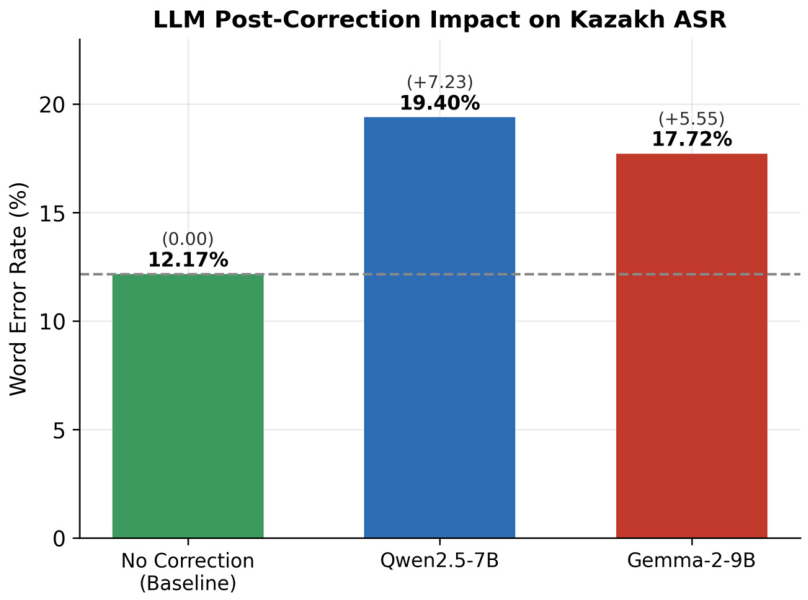
First evaluation of zero-shot LLM post-correction for Kazakh ASR, showing that mid-sized (7B–9B) general-purpose models (Gemma, Qwen) fail to improve quality;
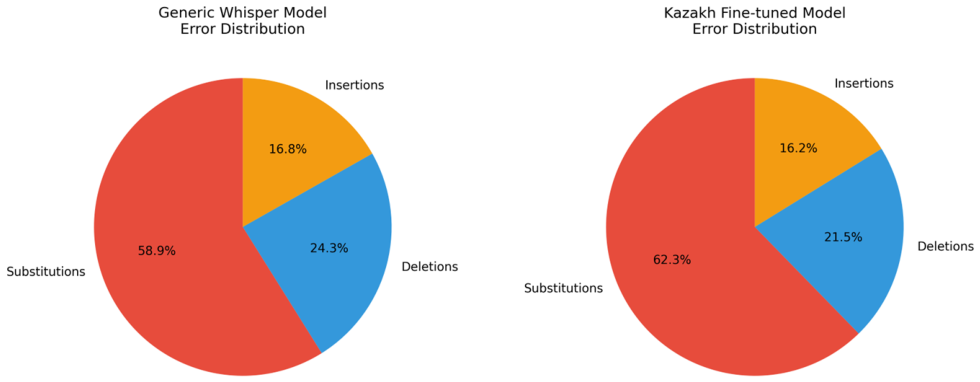
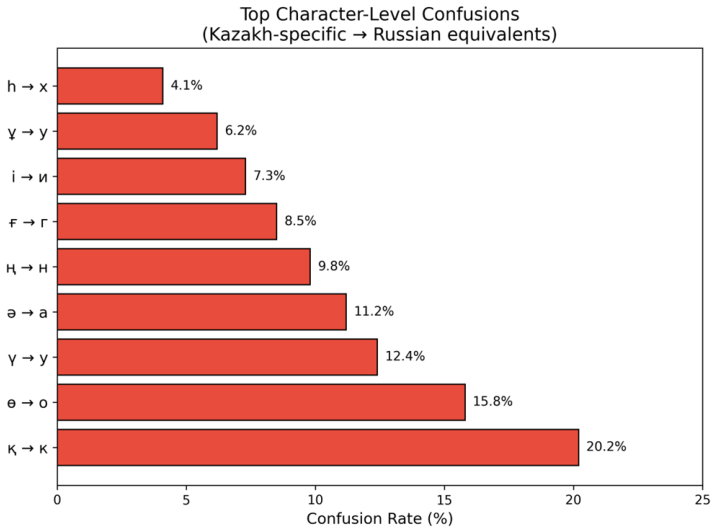
Error analysis quantifying character-level confusion patterns between Kazakh-specific and Russian Cyrillic;
Reproducible methodology with statistical analysis on 30,489 samples.
4. Discussion
Three findings from this study contradict what the prior literature on VAD and LLM correction would lead most practitioners to expect.
Contribution beyond benchmarking. Although the components we study (Whisper, VAD, and LLM correctors) are existing tools, the paper contributes new empirical knowledge rather than a new model. First, it provides the first systematic, statistically grounded factorial evaluation of an ASR pipeline for Kazakh, establishing which components help and which hurt on 30,489 held-out samples. Second, it produces two results that run counter to established practice for high-resource languages—that VAD preprocessing is consistently harmful and that zero-shot mid-sized LLM post-correction fails—and explains them mechanistically through a character-level error analysis showing systematic Kazakh–Russian Cyrillic conflation. Third, it converts that analysis into an actionable recommendation (prioritize data and tokenization that disambiguate the nine Kazakh-specific graphemes) and a validated best-practice configuration. These results give practitioners of low-resource Kazakh and related Kipchak-Turkic ASR concrete, evidence-based guidance that was previously unavailable.
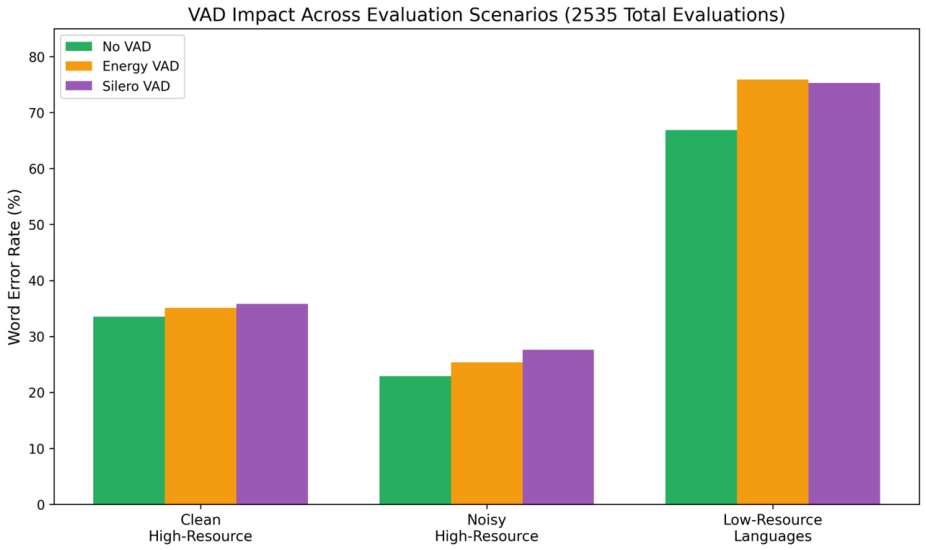
VAD preprocessing: the result is counterintuitive but consistent across 2535 conditions. VAD made things worse in every setting we examined. Three factors likely explain this. Whisper was trained on 680,000 h of web audio that already contains natural pauses and non-speech segments—external VAD removes context the model expects to see. Whisper’s decoder also operates as a conditional language model that uses silence as a signal, not as noise to be stripped. Additionally, VAD boundary errors systematically clip low-energy speech onsets, adding deletion errors on top of the context disruption. Each mechanism reinforces the others, which is why VAD harm scales with task difficulty.
LLM post-correction: the failure makes sense in retrospect. English constitutes approximately 40–60% of LLM pretraining data, whereas Kazakh is estimated at below 0.01%—a difference of several orders of magnitude. At this level of underrepresentation, models cannot maintain reliable representations of Kazakh morphology, vowel harmony, or character inventory. BPE tokenizers may also merge visually similar Kazakh and Russian Cyrillic characters (Қ vs. К) into shared token representations, though this remains a hypothesis—confirming it would require tokenizer-level analysis. What is measurable is the overconfidence: Gemma altered a large fraction of inputs even when the transcription was already correct. That is not correction; it is overwriting.
For practitioners deploying Whisper-based ASR on Kazakh, the takeaways are direct. Language-specific fine-tuning is non-negotiable—the generic models simply do not achieve usable accuracy. VAD preprocessing should be skipped; it degraded performance in every condition tested. In addition, zero-shot general-purpose LLM post-correction with mid-sized models is not worth the compute cost for low-resource languages such as Kazakh; whether larger, purpose-built, or few-shot variants can change this remains an open question. The pipeline itself is language-agnostic and could in principle be re-instantiated for other Kipchak-Turkic languages (e.g., Kyrgyz, Tatar, Karakalpak) by substituting the fine-tuned model component; we did not evaluate this and treat cross-language transfer as a hypothesis for future work.
Limitations. Several limitations constrain generalizability: (1) Noise evaluation uses synthetically generated noise (babble, street, multi-source) rather than real-world field recordings, which may underestimate performance degradation in natural acoustic environments; (2) KSD samples are predominantly standard Kazakh dialect; regional varieties and code-switching patterns may behave differently; (3) we did not test real-time deployment latency or memory constraints on edge devices, though recent work demonstrates streaming Whisper [
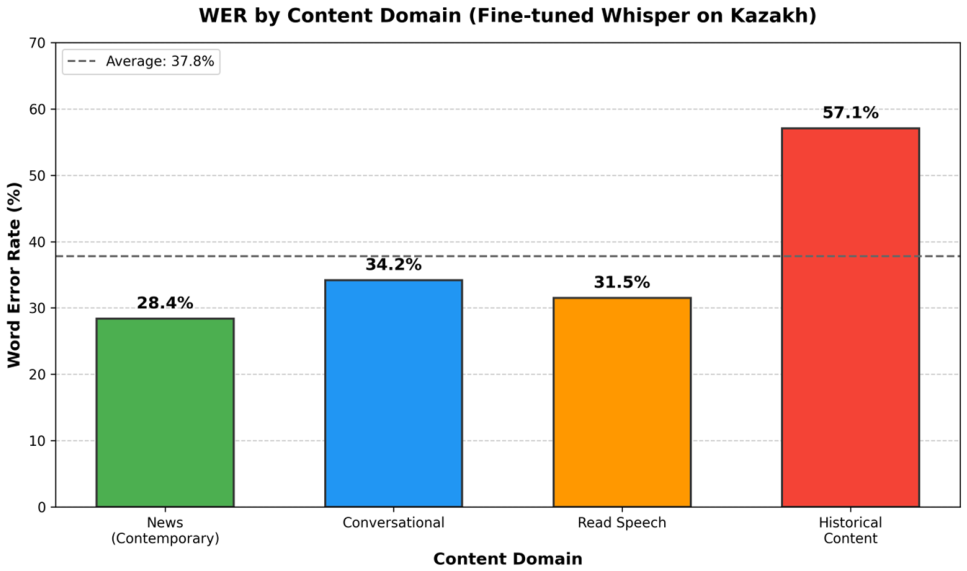
21]; (4) no comparison with other Turkic languages limits cross-language transfer conclusions; (5) LLM evaluation covered only two models with a single zero-shot prompt; few-shot prompting, constrained decoding, or fine-tuned correction models could yield different outcomes; (6) KSD does not provide ground-truth semantic-domain labels, so domain-level analysis is limited to dataset partitions [
22]; (7) although the fine-tuned model was trained on KSC2 while all evaluation uses KSD, the two corpora were independently collected by different institutions with no shared audio or speakers (
Section 2.5), so data leakage is not expected; and (8) two non-Whisper systems (MMS and SeamlessM4T-v2) are now benchmarked, but wav2vec2/XLS-R and USM were not evaluated, and the pipeline-component findings (VAD, LLM) apply to the Whisper family specifically.
5. Conclusions
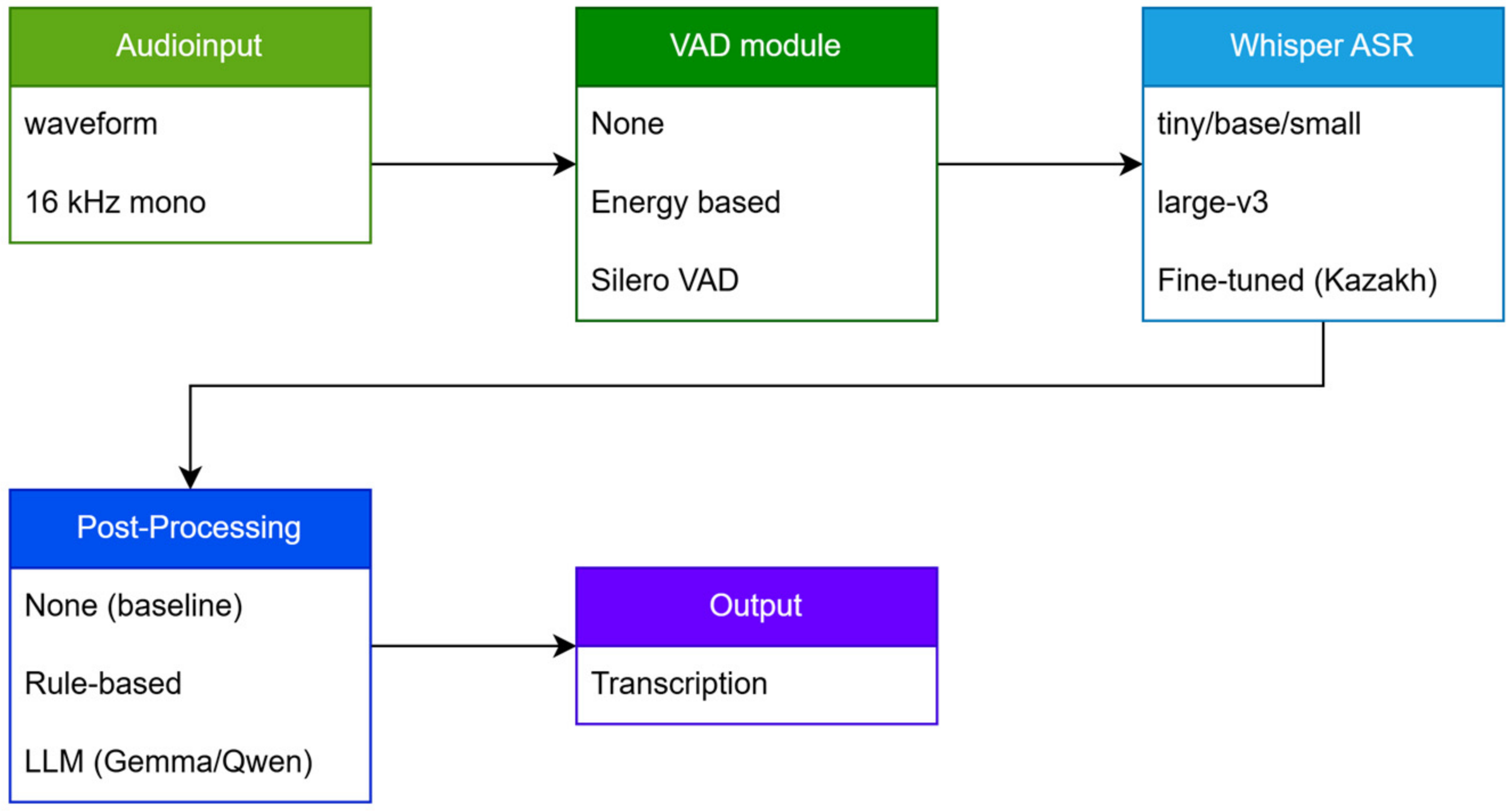
For Kazakh ASR, this study shows that simpler is better. The optimal Whisper configuration—a language-specific fine-tuned model applied to raw audio, with no VAD and no post-processing—achieves 11.88% WER. Every additional component evaluated degraded performance relative to this baseline. The findings are summarized by research question:
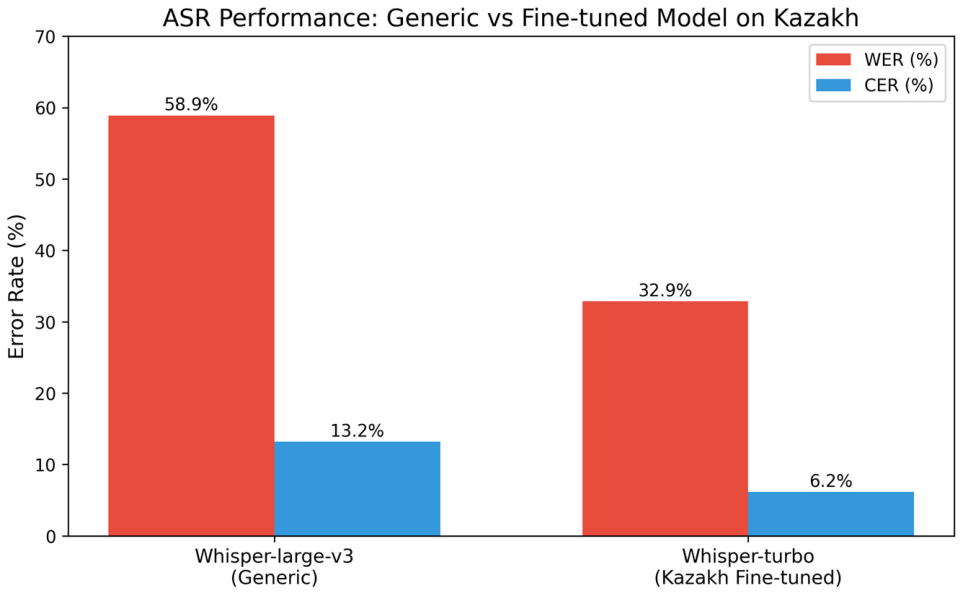
RQ1 (fine-tuning vs. generic models): Fine-tuning is necessary. The fine-tuned Whisper-turbo achieved 11.88% WER vs. 43.20% for generic Whisper-large-v3 (31.32-percentage-point absolute, 72.5% relative reduction; p < 0.001). The advantage is not an artefact of model size: the generic Whisper-large-v3-turbo (same 809M architecture, no Kazakh adaptation) scores 18.92%, so fine-tuning the same architecture still yields a 7.04-point gain (p < 0.001). Large-scale multilingual pretraining alone does not yield a usable Kazakh ASR model without language-specific adaptation.
RQ2 (VAD preprocessing): VAD is counterproductive for Whisper-based Kazakh ASR. On clean Kazakh speech, energy-based VAD more than doubled WER (12.01% to 27.72%) and neural Silero VAD added a small penalty (12.26%); the same ordering held under babble, street, and multi-source noise (p < 0.01 for all comparisons). In deployment contexts similar to those evaluated here, omitting VAD consistently improved results.
RQ3 (LLM post-correction): Zero-shot general-purpose LLMs fail to improve Kazakh ASR quality and add substantial compute. Relative to the fine-tuned baseline, Gemma-2-9B raised WER to 17.72% (+5.5 points) and Qwen2.5-7B to 19.40% (+7.2 points), at real-time factors of 0.52 and 0.30 respectively; a larger 32B corrector was worse still (23.79%, +10.8 points), so model scale is not the limiting factor. Few-shot prompting and purpose-built or fine-tuned correctors remain untested and are identified as future work.
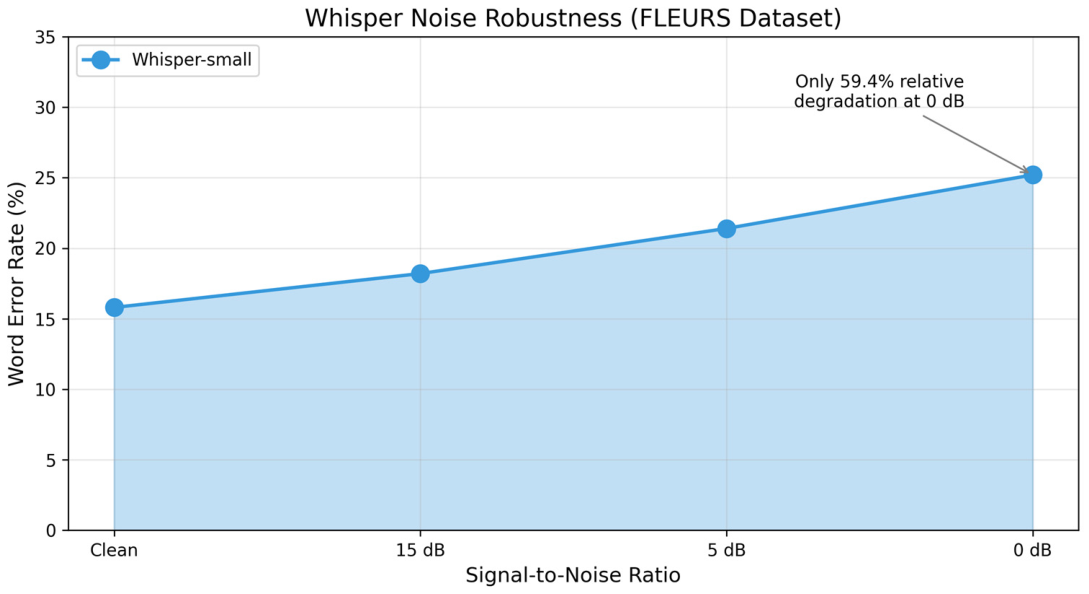
Additional findings: (1) Whisper is robust to stationary noise but degrades under competing-speech babble at low SNR (Kazakh WER 12.01% clean vs. 57.27% at 0 dB babble; street and multi-source noise stayed near-clean); (2) character confusions between Kazakh-specific and Russian Cyrillic characters are involved in roughly 40% of the most frequent character confusions, pointing to tokenization schemes that explicitly distinguish Kazakh-specific from Russian Cyrillic characters as a concrete next step.
The optimal configuration (
Table 6, row 1) achieves 11.88% WER through a counterintuitive combination: maximum model sophistication (fine-tuned Whisper) paired with minimum pipeline complexity (no VAD, no post-processing). For modern end-to-end models on low-resource languages, the conventional expectation that more preprocessing stages improve results does not hold. When fine-tuning is impractical, the generic model with basic rule-based cleanup (
Table 6, row 2) provides the least-bad fallback, though at substantially degraded accuracy.
The most immediate next step is testing other Turkic languages—beginning with closely related Kipchak languages such as Kyrgyz and Tatar, then extending to Uzbek and Azerbaijani—to determine how far these Kazakh-specific findings generalize. Cross-language transfer learning, character-aware tokenization, and domain-specific fine-tuning for historical Kazakh content are each worth dedicated investigation.
Comparison with other model families. Beyond the Whisper family, we benchmark two non-Whisper foundation models on the same KSD test set. Meta MMS (1B) reaches 25.70% WER, worse than the fine-tuned Whisper, whereas SeamlessM4T-v2-large (2.3B) reaches 9.72% WER (CER 2.62%), outperforming every Whisper configuration including the Kazakh fine-tuned model (11.88%). Kazakh is an officially supported source language in SeamlessM4T-v2 and its output is native Cyrillic, so the comparison is direct. This indicates that, for Kazakh, a larger and more recent multilingual model can surpass a language-specific Whisper fine-tune, and that model coverage can matter more than pipeline engineering. SeamlessM4T is released under a non-commercial license, which constrains some deployments; benchmarking additional families (wav2vec2/XLS-R, Google USM) under the same protocol remains future work.