


Abstract
The unilateral limb motor imagery paradigm can effectively address the cognitive dissociation problem among multiple limbs and provide strong technical support for extending the functionality of external devices. However, feature mining and accurate decoding of unilateral limb movements remain challenging. In this study, we propose a feature mining method that combines automatic frequency band boundary localization with regularized common spatial pattern (AFBBL-RCSP), and employ a pinball-loss-based twin support vector machine (Pin-UTSVM) to decode EEG signals corresponding to reaching, turning, and grasping movements. First, multiple optimal frequency band boundaries were identified for each subject using AFBBL. Then, regularized spatial features were extracted from each sub-band, and all features were reduced using Fisher’s discriminant analysis. Finally, the Pin-UTSVM classifier was used to categorize the three types of movement data. The results show that, compared with CSP and RCSP feature mining methods using the fixed 8–30 Hz band, the proposed method improves decoding accuracy by 9.52% and 3.89%, respectively. Compared with fixed single-band feature mining methods based on the α band, β band, and α + β band, the proposed method improves accuracy by 5.56%, 3.89%, and 3.73%, respectively. In addition, compared with existing unilateral limb decoding methods based on temporal-spatial features, temporal-frequency features, and temporal-spatial-temporal-frequency fusion CNN features, the proposed method improves decoding accuracy by 34.93%, 34.09%, and 28.11%, respectively. These results suggest that the proposed AFBBL-RCSP method is effective for unilateral limb motor imagery EEG decoding.
1. Introduction
Electroencephalography (EEG)-based brain–computer interface (BCI) systems are widely used in various fields because of their portability, low cost, and high temporal resolution. Common BCI paradigms include steady-state visual evoked potentials (SSVEPs) [1], P300 signals [2], and motor imagery (MI) [3]. Compared with the SSVEP and P300 paradigms, the MI paradigm does not require subjects to receive additional sensory stimuli, such as visual or auditory stimulation, and can reflect a subject’s limb movement intentions without external interference. As a result, MI has played an important role in areas such as neurological rehabilitation and stroke treatment [4], and has been successfully applied in practical scenarios such as exoskeleton control [5] and motorized wheelchairs [6]. Currently, MI research mainly focuses on decoding the movements of different limbs, such as imagined left-hand movements, right-hand movements, tongue movements, and foot movements. However, the range of decoding categories remains limited and cannot support many fine-grained movements required in real-life scenarios. For example, when an individual intends to control the arm to perform a stir-fry action, the actual process involves multiple movements, such as extending the arm, turning on the gas or electricity, pouring oil, adding vegetables, adding salt, grasping a spoon, and stirring. Only by extending motor imagery EEG decoding to fine movements of a single limb, such as extension, rotation, and grasping of the arm, can the range of decodable movements be further expanded to accomplish complex real-life tasks. Therefore, the study of unilateral limb MI decoding is of great practical significance.
With the development of MI research, increasing attention has been paid to fine-grained decoding of unilateral limb movements. Zhou et al. [7] employed a wavelet neural network by decomposing EEG signals into multiple sub-bands for feature extraction using wavelet packet decomposition (WPD), followed by feature selection using principal component analysis (PCA). Finally, they achieved an accuracy of 85.24% in six-class motor imagery tasks involving the same arm, including forearm forward/backward rotation, hand opening/closing, and elbow flexion/extension. Tavakolan et al. [8] used the CSP method combined with time-domain features to classify three unilateral limb motion states, namely resting, imagined grasping, and imagined elbow movement, and achieved an accuracy of 74.2% using a support vector machine (SVM). In 2017, Alazrai et al. [9] decoded five finger movements by constructing continuous time-frequency features using the Choi-Williams time-frequency distribution method, and achieved a classification accuracy of 85.5% in the final motor imagery decoding task using a four-layer classification model. In 2019, Ma et al. [10] extracted inter-channel correlation features using Pearson’s correlation coefficient and employed an integrated classifier to decode three types of motor imagery signals for the left hand, namely resting state, imagined hand movement, and imagined elbow movement, achieving a classification accuracy of 87.03%. These studies achieved promising decoding performance in multiclass unilateral limb tasks through feature extraction, feature selection, and classification of EEG motor signals. However, these methods generally emphasize feature selection while paying insufficient attention to feature mining. We believe that feature mining forms the basis of EEG signal decoding. At the same time, EEG band selection is critically important for motor imagery decoding, since an appropriate filter band can yield more discriminative features and improve decoding accuracy.
In recent years, common spatial pattern (CSP) [11] has become a widely used feature extraction method in the field of MI. Ramoser et al. [12] first proposed the application of the CSP algorithm to motor imagery classification tasks. CSP extracts highly discriminative spatial features by applying a spatial filter to two classes of motor imagery data. However, the performance of CSP is highly dependent on the choice of filter bands and is sensitive to spatial noise in the data. In current studies, fixed filter bands or manually selected frequency ranges are usually adopted [13,14]. The Filter Bank Common Spatial Pattern (FBCSP) usually sets several successive sub-bands in the range of 8–30 Hz and selects the optimal spatial features at different frequencies to decode the signal [15]. In 2020, Wang et al. [16] used the FBCSP method with multiple sub-band filtering for feature extraction and feature selection based on F1 scores, and achieved classification accuracies of 90.09% and 81.33% on two public datasets (Dataset IIIa of BCI Competition III and Dataset IIa of BCI Competition IV) using spiking neural networks. In 2021, Zhang et al. [17] filtered EEG signals through multiple sub-bands using the Sub-band Common Spatial Pattern (SBCSP) method, extracted spatial features using CSP, removed redundant features using the minimum redundancy maximum relevance (mRMR) method, and used an LDA classifier to achieve classification accuracies of 75.15% and 66.85% on the public datasets IIa and IIb, respectively. These improved methods for CSP-based frequency band selection have shown excellent performance in MI tasks [18,19,20]. However, these multi-band feature mining methods can only extract features by manually setting successive narrow frequency bands of equal length. This leads to substantial feature redundancy during feature extraction and requires additional feature selection steps for screening. Moreover, the number of bands and their boundaries usually need to be manually specified, which causes the selected bands to appear as narrow, consecutive, equal-length intervals. As a result, useful feature information in wider frequency ranges may be missed. To address this issue, we use a decision tree algorithm to adaptively localize important frequency band ranges and automatically generate the boundaries of important frequency bands within a predefined frequency range, so that feature information from both narrow and wide bands can be comprehensively utilized. Therefore, we propose an Automatic Frequency Band Boundary Localization-Regularized Common Spatial Pattern (AFBBL-RCSP) feature mining strategy. This strategy aims to achieve a reasonable balance between narrow and wide frequency bands through adaptive boundary localization, overcome feature redundancy and the omission of useful band information caused by manually defined frequency intervals, and reduce the sensitivity of CSP to spatial noise and outliers by incorporating the RCSP method.
The aim of this paper is to propose an AFBBL-RCSP feature mining method combined with a Pin-UTSVM-based classifier for multitask EEG decoding of unilateral limb movements. In this study, three types of data—forward extension, left rotation, and cup grasping—were collected from 25 healthy subjects performing imagined right-hand movements. First, the optimal set of frequency band boundaries for all individuals was obtained using the AFBBL method. Spatial features were then extracted separately across multiple bands using the RCSP algorithm, and the regularized spatial features under each band were further selected using Fisher’s discriminant analysis (FDA). Next, the multi-band features were fused using a weighted summation strategy. Finally, the three types of right-hand actions were decoded using a Pin-UTSVM-based classifier, and the performance of the proposed method was evaluated using decoding accuracy, precision, recall, and F1 score. Our main contributions are summarized as follows:
- (1)
- We propose a novel AFBBL-RCSP feature mining framework for unilateral limb motor imagery EEG decoding, in which automatic frequency band boundary localization enables subject-specific optimal sub-band selection and effectively overcomes the limitations of fixed frequency band assumptions.
- (2)
- A robust feature extraction and classification pipeline is constructed by integrating regularized common spatial pattern (RCSP), Fisher’s discriminant analysis (FDA), and a pinball-loss-based twin support vector machine (Pin-UTSVM), significantly enhancing feature discriminability and classification stability for multi-class unilateral limb movements.
- (3)
- Extensive experimental results demonstrate substantial performance improvements over conventional CSP/RCSP methods, fixed single-band and multi-band feature mining strategies, as well as existing temporal, spatial, and deep learning-based approaches, validating the effectiveness of the proposed method for accurate unilateral limb motor imagery decoding.
2. Materials and Methods
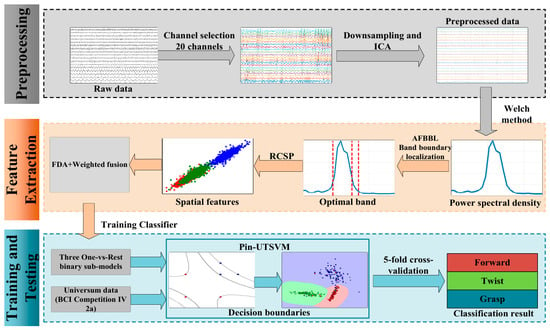
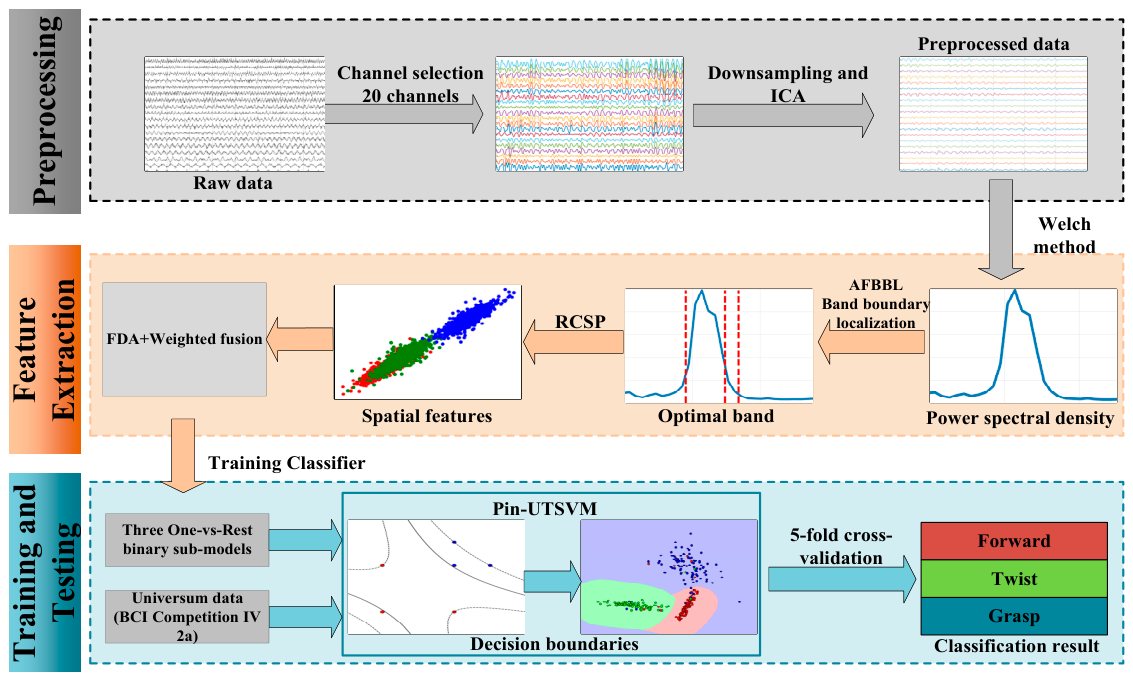
The overall framework of the proposed method is illustrated in Figure 1. First, raw EEG signals are preprocessed through denoising, channel selection, and downsampling. Then, in the feature extraction stage, informative frequency band intervals are adaptively localized based on power spectral density using the AFBBL method. Subsequently, spatial features are extracted from each selected sub-band using the RCSP algorithm and further reduced via Fisher’s discriminant analysis (FDA). Finally, the fused features are fed into a Pin-UTSVM classifier for training and classification.
Figure 1.
Overall framework of the proposed method.
2.1. Signal Pre-Processing
The preprocessing procedure included denoising, channel selection, and downsampling. Independent component analysis (ICA) was applied to the raw signals to remove artifacts. This is mainly because common EEG artifacts, such as ocular and muscle artifacts, are usually better modeled as statistically independent sources. ICA can separate these independent components from mixed EEG recordings, making it more suitable for artifact removal in the present study. During motor imagery tasks, event-related desynchronization (ERD) and event-related synchronization (ERS) occur in specific regions of the sensorimotor cortex [21]. Based on the spatial distribution of ERD and ERS, 20 EEG channels (C1–C6, FC1–FC6, CP1–CP6, Cz, and CPz) located in the corresponding regions were selected for analysis. To reduce computational cost, the EEG signals were downsampled to 250 Hz, and the 1 s segment preceding the onset of each trial was removed, since this period may contain phase noise caused by subjects’ physiological adjustments during task preparation. In this way, the EEG data segments of each subject in each session were represented as a 150 × 20 × 750 matrix A, where 150 is the number of samples, 20 denotes the number of channels, and 750 denotes the number of sampling points.
2.2. Decision Tree-Based Automatic Localization Algorithm for MI Signal Band Boundaries
To capture subject-specific and task-related spectral characteristics, an adaptive frequency band boundary localization method based on decision trees is employed. Decision trees are supervised learning models that recursively partition data through a greedy optimization process [22]. At each split, the algorithm selects the partition that maximizes a predefined criterion, such as information gain. In motor imagery research, band-pass filtering within the α band (8–13 Hz) and β band (13–30 Hz) is generally considered to provide favorable classification performance [23]. Based on this finding, together with the results of our preliminary experiments, the band-pass filtering range in this study was set to 6–30 Hz. The power spectral density (PSD) of EEG signals is estimated using Welch’s method [24]. In this framework, frequency is treated as the predictor variable, while the logarithmic PSD serves as the target variable. The decision tree partitions the frequency axis into multiple sub-intervals and assigns an optimal PSD estimate to each interval. The logarithmic power spectral density is as follows:
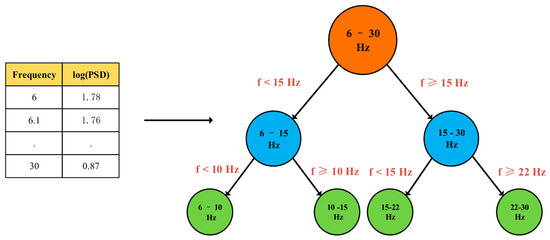
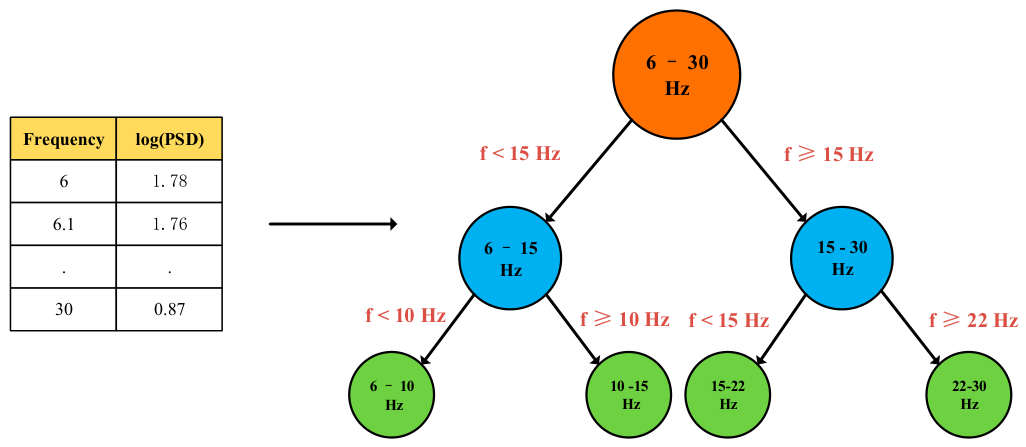
where is the th element of the target variable array, is the spectral estimate, and is the th frequency value obtained from the EEG signal decomposition. The decision tree divides the frequency values into subgroups and assigns a single target value estimate to each subgroup. A greedy search of the decision tree parameter space is performed to find the frequency partition that best reproduces the target [25]. Thus, through this optimization process, the optimal member-adjacent frequency bands can be automatically obtained for a predefined number of bands, as shown in the methodology in Figure 2.
Figure 2.
Decision tree based on power spectral density to divide the frequency range.
The number of frequency bands corresponds to the maximum number of splits used in decision tree training, but the method requires a predetermined number of frequency bands. The choice of the number of frequency bands is an optimization problem. Therefore, Talebi et al. [26] used the regression score to represent the extent to which the band boundaries reproduce the power spectrum, while introducing the Akaike Information Criterion (AIC) as a penalty function for the number of bands, and solved the overfitting problem by constructing an empirically derived quality score (QS).
The closer the score is to 1, the better the model fits the data. The AIC function is defined based on the maximum value of the model’s likelihood function and the number of parameters in the model:
Limiting the number of frequency bands using the AIC method, and applying a measure of the model quality of the regression scores, can be expressed in our method as follows:
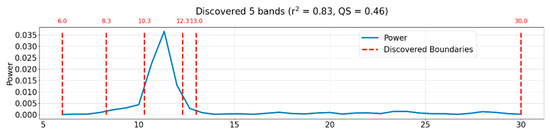
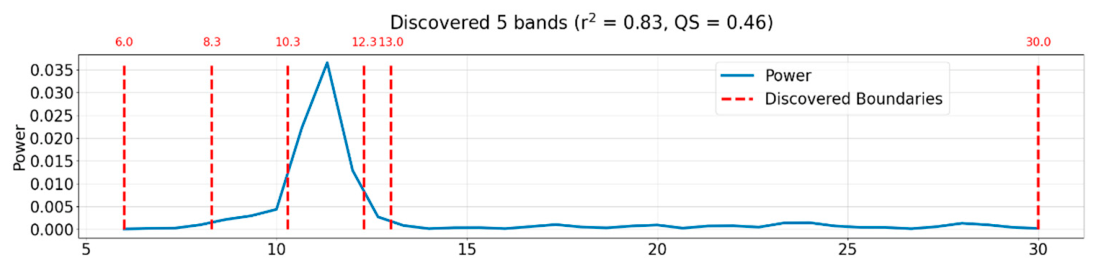
where is the total number of observations in each partition. QS provides a method for obtaining EEG band boundaries that consider both the goodness of fitness and the number of bands. Usually, a value between 0 and 2 and smaller values correspond to better models. The optimal EEG signal band boundaries can be found by calculating the quality score for each possible number of bands. Using this band-boundary localization strategy, the most appropriate filtered band intervals can be identified for MI signals. This approach helps balance the relative importance of narrow and wide bands while avoiding manual band-boundary selection. The optimal band-boundary localization results for all subjects can thus be obtained within the range of 6–30 Hz, as shown in Figure 3. Considering the low energy of the power spectrum presented in some band ranges, this paper sets the energy threshold in the experimental part and chooses to keep or delete some bands.
Figure 3.
Results of frequency band boundary localization.
2.3. Regularized Common Spatial Pattern Feature Extraction Algorithm
CSP is a spatial filtering-based feature extraction algorithm for binary classification tasks, which can extract the spatial distribution patterns of different classes from multi-channel EEG signals. The basic principle of the CSP algorithm is to find a set of optimal spatial filters through matrix diagonalization, such that the variance difference between two classes of signals is maximized, thereby obtaining highly discriminative feature vectors. In the classification task, let and denote the multi-channel EEG signals in form under a binary motor imagery task, where () is the number of channels and () is the number of sampling points acquired for each channel. The normalized covariance matrices and are defined as follows:
where denotes matrix transposition, and denotes the sum of the diagonal elements of the matrix. CSP obtains effective spatial discriminative patterns through sample-based covariance matrix estimation. However, the CSP algorithm is highly sensitive to the number of filter bands, the size of the time window, and channel selection [27,28]. To alleviate the sensitivity of CSP to noise and outliers, Friedman et al. [29] first proposed the use of regularized common spatial patterns. The RCSP algorithm extends CSP by introducing two regularization parameters, which bias the covariance estimates toward more stable values, thereby reducing estimation variance and improving robustness [30]. First, the regularized mean spatial covariance matrix for each class is computed as follows:
where and are two regularization parameters ( and ), and represents the covariance matrix over all trial counts. is the identity matrix of size . The composite spatial covariance matrix of RCSP can then be factorized as follows:
where represents the eigenvector matrix, the diagonal matrix of the corresponding eigenvalues. The eigenvalues and eigenvectors are arranged in descending order, and the projection matrix can be expressed as:
where is a weight matrix of and denotes the eigenvector matrix of the whitened spatial covariance matrix. In order to obtain the optimal discriminative pattern, the first m rows of and the last m rows are reserved to form the spatial projection matrix of (). In this study, was set to 2. In the RCSP feature extraction step, the input EEG data () are projected into a matrix , and the logarithm of the variance of is used to construct the feature vector:
where is the variance computation function, () is a set of regularized feature vectors, and two regularized parameter lists each containing three regularized parameter values can be obtained as () sets of regularized parameter pairs, and eventually each trial sample of all objects on the training and test sets will get the complete feature vector matrix , where is a matrix of . In order to reduce the computational complexity while extracting highly distinguishable features, we use the FDA technique for feature dimensionality reduction. FDA is able to find the optimal direction that can differentiate between different classes of data in the sense of minimizing the mean square error and is applied to maximize the interclass distance and minimize the intraclass distance [31,32]. The reduced feature can be represented as follows:
where denotes the FDA optimal feature selection process. Finally, the features extracted from all sub-bands are fused by weighted summation. In this study, the weights of all sub-bands were uniformly set to 1.
2.4. Pin-UTSVM-Based Multiclass Decoding Framework with Universum Data
MI signal decoding requires an appropriate classifier according to the data characteristics. Linear discriminant analysis (LDA), support vector machines (SVMs), and K-nearest neighbors (KNNs) [33] are commonly used classifiers. Among them, SVMs are widely used in EEG classification because of their strong generalization ability and good performance on small-sample datasets [34]. To reduce the computational complexity of conventional SVMs, Khemchandani et al. [35] proposed the bilateral support vector machine (TWSVM), which constructs two non-parallel proximal hyperplanes and decomposes the original quadratic programming problem into two smaller subproblems. Subsequently, Weston et al. [36] introduced the idea of incorporating universum data to enhance model generalization, and UTSVM [37] further improved classification performance by integrating the Universum learning mechanism into the TWSVM framework. Later, Huang et al. [38] introduced the pinball loss function, which enhanced the robustness of classifiers to noise and outliers and improved their stability under resampling. Inspired by this idea, Ganaie et al. [39] proposed the pinball-loss-based Universum Twin Support Vector Machine (Pin-UTSVM) and applied it to EEG signal classification. By preserving the twin-hyperplane classification framework while introducing pinball loss, this method alleviates the sensitivity of hinge loss to noise, thereby improving classifier robustness without sacrificing computational efficiency.
Considering that the original Pin-UTSVM was primarily developed for standard binary classification tasks, this study constructs a one-vs-rest multiclass decoding framework based on the core idea of Pin-UTSVM for three-class unilateral limb motor imagery EEG decoding. Specifically, three binary sub-models are established: Forward vs. Rest, Twist vs. Rest, and Grasp vs. Rest, where Rest denotes the other two motor imagery classes excluding the current target class. To further introduce task-related prior information into the classifier, the BCI Competition IV 2a dataset is incorporated as universum data. This dataset is a widely used public benchmark in motor imagery BCI research and contains 9 subjects, 2 sessions, 22 EEG channels, a sampling rate of 250 Hz, and four motor imagery classes (left hand, right hand, feet, and tongue). Since it also consists of motor imagery EEG signals, it belongs to the same data domain as the unilateral limb MI-EEG task considered in this study, while remaining independent of the supervised target classes in the current three-class decoding problem. Therefore, it can be treated as an independent universum sample set to provide supplementary prior information about the distribution of the MI-EEG data space. Because the channel configuration of BCI Competition IV 2a is not fully identical to that of the main task data, the dataset is first preprocessed and adapted to match the motor-related channel configuration used in this study. The original dataset contains 22 EEG channels. In this work, 20 channels covering the fronto-central, central, and centro-parietal motor-related regions are selected to construct the universum data, and the main task data are also mapped into the corresponding shared channel space to ensure comparability between the two datasets in the feature space. Since BCI Competition IV 2a is already sampled at 250 Hz, no additional resampling is required. Its original trial length is 4 s, and a fixed task window consistent with the main task setting is extracted to unify the input length and subsequent feature extraction conditions. After this adaptation, both the main task data and the universum data are processed using the same feature extraction pipeline, including band processing, RCSP-based feature extraction, and subsequent feature fusion.
Under the proposed one-vs-rest framework, for each binary subtask, the current target class samples are treated as the positive class , the samples of the remaining two classes are merged as the negative class , and the adapted BCI Competition IV 2a samples are incorporated as an independent universum set for classifier optimization. It should be noted that the universum data are used only during the training stage to help the classifier learn a more stable and robust decision boundary, and are not involved in the testing stage, thereby avoiding information leakage. All samples are divided into training and testing sets at a ratio of 8:2, and a grid-search strategy is employed during the training stage to optimize the model parameters. The candidate hyperparameter sets are defined as , and . Different optimal parameter combinations can thus be obtained for different subjects.
For each binary subtask, the Lagrange multipliers are solved by formulating two quadratic programming problems (QPPs), and the corresponding optimal hyperplanes are obtained by calculating the weight vectors and bias terms:
where is the weight vector, is the bias, , represents one class of the input signal, and represents the remaining two classes of signals. After obtaining the optimal hyperplane, assuming that and are the positive and negative classes corresponding to the input data, the classification results of the test data is determined as:
where stands for Radial Basis Function Kernel (RBF), . The final multiclass prediction is determined by majority voting over the outputs of the three binary sub-models. To verify the effectiveness of the proposed method, decoding experiments are conducted on three-class MI-EEG data, and classification accuracy, precision, recall, and F1-score are adopted as evaluation metrics. Model performance is assessed using five-fold cross-validation. Through this classification framework, the three classes of unilateral limb motor imagery EEG signals can be effectively decoded, thereby providing a basis for subsequent performance analysis. All experiments were implemented using MATLAB (R2022a, The MathWorks Inc., Natick, MA, USA) and Python (v3.10.0). The Python implementation used NumPy (v1.26.4), pandas (v2.2.1), SciPy (v1.12.0), scikit-learn (v1.4.2).
3. Results
3.1. Dataset
The data used in this study were obtained from the GigaDB public dataset collected by Jeong et al. [40]. This dataset contains upper limb movement data from 25 subjects, who were asked to perform three types of movements with 11 subcategories, including six directions of arm extension, three types of object-grasping movements, and two types of wrist-twisting movements. Each movement category was performed 50 times in random order. The recorded data consisted of 60 channels of electroencephalogram (EEG), 7 channels of electromyogram (EMG), and 4 channels of electrooculogram (EOG). In this study, only the 60-channel EEG data from the motor imagery task were used. The EEG electrodes were positioned according to the international 10–20 system, and the sampling frequency was 2500 Hz. Since the goal of this study was to classify three MI actions, one representative movement was selected for each action category, namely imagined forward arm extension, imagined wrist internal rotation, and imagined cup grasping, and the subsequent analysis was conducted based on these three types of data.
3.2. Task-Related Band Boundary Localization and Band Selection
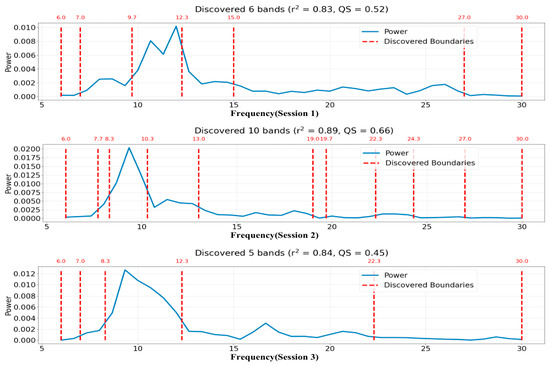
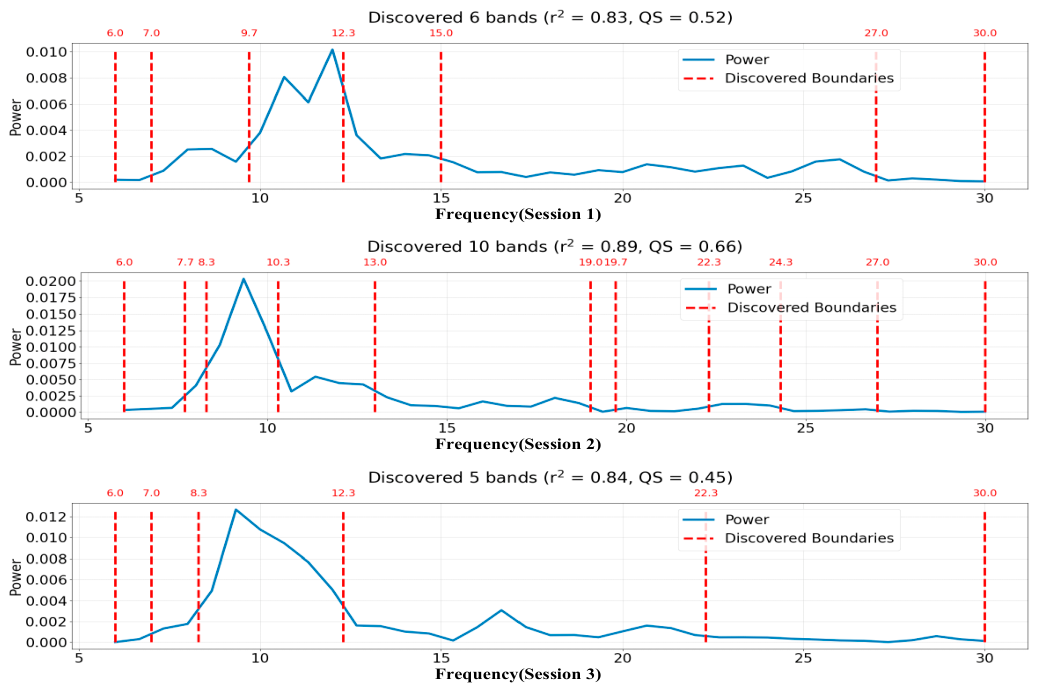
To illustrate the results of band boundary localization, one representative subject was selected, as shown in Figure 4. The results reveal substantial differences in band boundary localization across Session 1, Session 2, and Session 3 for the same subject. Specifically, six significant band intervals were identified in Session 1, ten in Session 2, and five in Session 3, with little or no overlap among them. AFBBL performs band boundary segmentation by tracking intervals with significant energy variations. This indicates that the cognitive state of the brain changes over time during the experiment. The AFBBL method can automatically adapt to such changes by identifying the optimal band boundaries according to variations in power spectral energy. As shown in Figure 4, the power spectral energy of this subject is particularly prominent in the alpha-band region, and AFBBL effectively captures the frequency bands with significant energy.
Figure 4.
Results of band boundary localization.
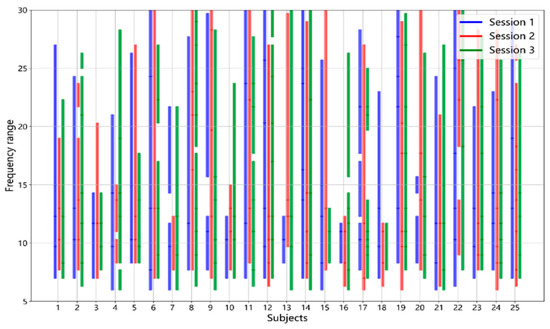
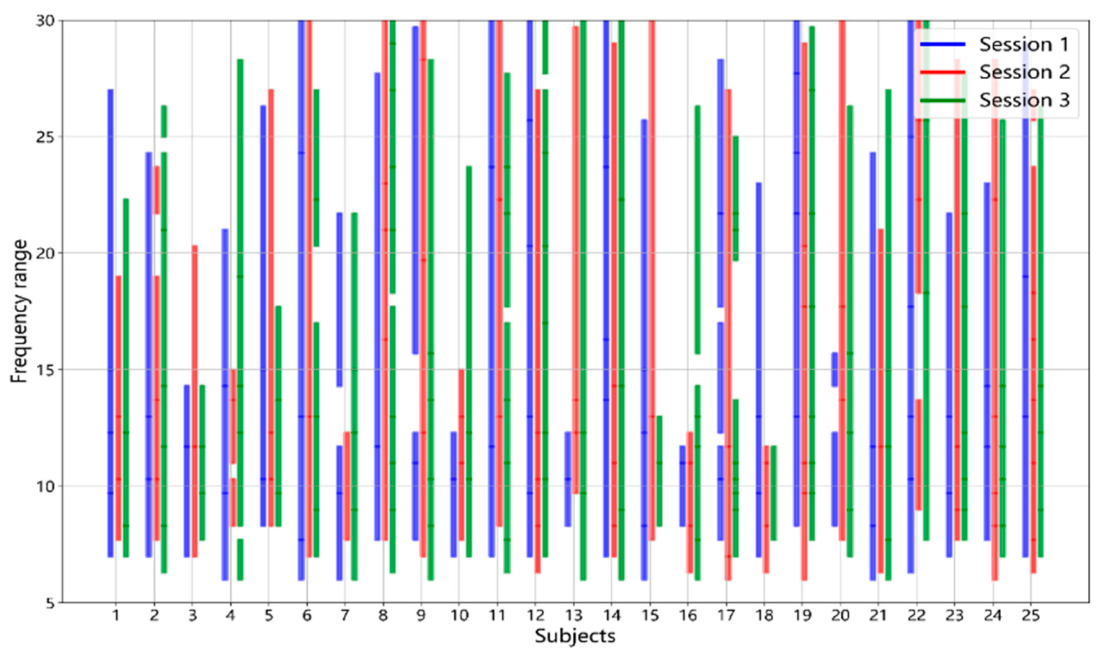
Figure 5 summarizes the band interval localization results obtained by applying the AFBBL procedure to all 25 subjects across three sessions. Consistent with the single-subject example shown in Figure 4, substantial variability can be observed in the selected frequency band ranges across subjects and sessions. The resulting band intervals are irregular, only partially overlapping, and often discontinuous, suggesting that the informative spectral components of unilateral limb motor imagery do not concentrate in a fixed frequency range. This finding highlights the limitation of conventional fixed-band filtering strategies and demonstrates the necessity of adaptively determining optimal frequency band combinations for MI feature extraction.
Figure 5.
Frequency band selection results of subjects under each Session.
3.3. Results Based on SVM Classifier
In this study, the hyperparameters of the radial basis function kernel were optimized using grid search combined with fivefold cross-validation under the Support Vector Machine (SVM) classification framework. Different optimal combinations of hyperplane hyperparameters were obtained for different subjects. All results were derived from fivefold cross-validation. To further evaluate the effectiveness of the decision tree algorithm in the band boundary optimization task, comparative experiments were conducted using the Genetic Algorithm (GA) [41], Particle Swarm Optimization. (PSO) algorithm [42], Wavelet Packet Decomposition (WPD) algorithm [43] and SWDA algorithm [44] and the Stepwise Discriminant Analysis (SWDA) band optimization algorithm to localize the optimal frequency band range of the data. The comparison results are presented in Table 1, Table 2 and Table 3. The results show that the proposed AFBBL-RCSP feature extraction method achieves the best overall classification performance. Specifically, it attains the highest classification accuracies of 72.91 ± 8.61%, 80.40 ± 9.41%, and 80.19 ± 7.80% in the three sessions, respectively, while also achieving the best results in terms of precision, recall, and F1-score. These findings demonstrate the superiority of the proposed AFBBL-RCSP feature extraction method.
Table 1.
Results of different band selection algorithms in session 1.
Table 2.
Results of different band selection algorithms in session 2.
Table 3.
Results of different band selection algorithms in session 3.
3.4. Results of Pin-UTSVM Classifier
We used grid search combined with fivefold cross-validation to optimize the hyperparameters of the radial basis function kernel. Taking the 25 subjects in Session 1 as an example, the corresponding optimal parameters are listed in Table 4. Different optimal combinations of hyperplane hyperparameters were obtained for different subjects. Based on the Pin-UTSVM model, we further compared the recognition performance of different frequency band selection and feature extraction methods. The comparison results for the three sessions are presented in Table 5, Table 6 and Table 7, respectively. The results show that the accuracy of the RCSP method is consistently higher than that of the CSP method across all three sessions. Compared with the CSP algorithm, AFBBL-CSP improves the classification accuracy by 5.62%, 2.25%, and 2.27% in Sessions 1, 2, and 3, respectively. Similarly, compared with the RCSP algorithm, AFBBL-RCSP improves the classification accuracy by 5.45%, 3.09%, and 3.14%, respectively. Among all methods, AFBBL-RCSP achieves the highest classification accuracy in all three sessions, reaching 81.99%, 87.57%, and 85.97%, respectively. Meanwhile, AFBBL-RCSP also achieves the best performance in terms of precision, recall, and F1-score, while showing a lower standard deviation in classification accuracy. This indicates that the AFBBL-RCSP method is more stable in the classification task and that its decoding performance is less affected by individual differences.
Table 4.
Final optimized hyperparameters for each subject in Session 1.
Table 5.
Classification results of different feature mining methods in session 1.
Table 6.
Classification results of different feature mining methods in session 2.
Table 7.
Classification results of different feature mining methods in session 3.
3.5. Comparison with Studies in Recent Years
Table 8 summarizes a comparison between the proposed method and currently reported approaches [45]. Although all methods used the same resampling rate, their window lengths were not completely identical. As shown in Table 8, the proposed method achieved an accuracy of 85.17%, which is 34.09, 34.93, and 28.11 percentage points higher than those reported for CNN, TF-CNN, and MF-CNN, respectively. These results indicate that the proposed method shows promising decoding performance on the current unilateral limb motor imagery task.
Table 8.
Comparison results with existing methods.
4. Discussion
In this paper, we proposed an AFBBL-RCSP feature mining framework combined with a Pin-UTSVM-based classifier for decoding three unilateral limb motor imagery tasks, namely forward reaching, wrist rotation, and grasping. Experimental results showed that the proposed method outperformed fixed-band filtering combined with CSP and RCSP, respectively, and also achieved higher decoding accuracy than the fixed single-band strategies based on the (8–13 Hz), (13–30 Hz), and (8–30 Hz) fixed frequency bands. In addition, the proposed method yielded substantially higher accuracy than the reported CNN-, TF-CNN-, and MF-CNN-based unilateral limb decoding methods. These results suggest that the proposed framework can more effectively capture discriminative information from unilateral limb MI-EEG signals.
The superior performance of the proposed method can mainly be attributed to three factors. First, AFBBL enables adaptive localization of informative frequency-band boundaries. Unlike fixed-band or manually segmented strategies, AFBBL identifies subject-specific and session-specific spectral intervals according to variations in power spectral energy. This is particularly important for unilateral limb motor imagery, where discriminative spectral components are not consistently concentrated within a fixed frequency range. Therefore, AFBBL can preserve more task-relevant spectral information while reducing redundant components, which explains its advantage over fixed-band CSP-, RCSP-, and α/β-based feature mining strategies. Second, RCSP improves the robustness of spatial feature extraction. Conventional CSP is sensitive to noise, outliers, and covariance estimation errors, especially under small-sample EEG conditions. By introducing regularization into the spatial filtering process, RCSP stabilizes covariance estimation and yields more reliable spatial representations. Since unilateral limb MI decoding involves relatively subtle inter-class differences, such robustness is essential for extracting discriminative spatial features. Third, the classification framework further enhances decoding performance. In addition to the Pin-UTSVM-based one-vs-rest strategy, the introduction of BCI Competition IV 2a as universum data provides supplementary same-domain prior information for classifier training. These universum samples do not belong to the target classes of the current task, but they help characterize the distribution of the MI-EEG feature space. Combined with the robustness of pinball loss, this mechanism enables the classifier to learn more stable decision boundaries under inter-subject variability and session-to-session fluctuations. Overall, the performance gain of the proposed method results from the coordinated effect of adaptive spectral localization, robust spatial filtering, and prior-informed classification, rather than from any single module alone.
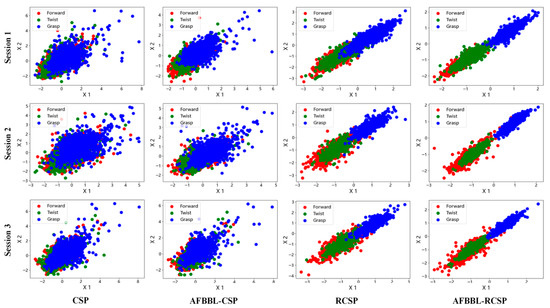
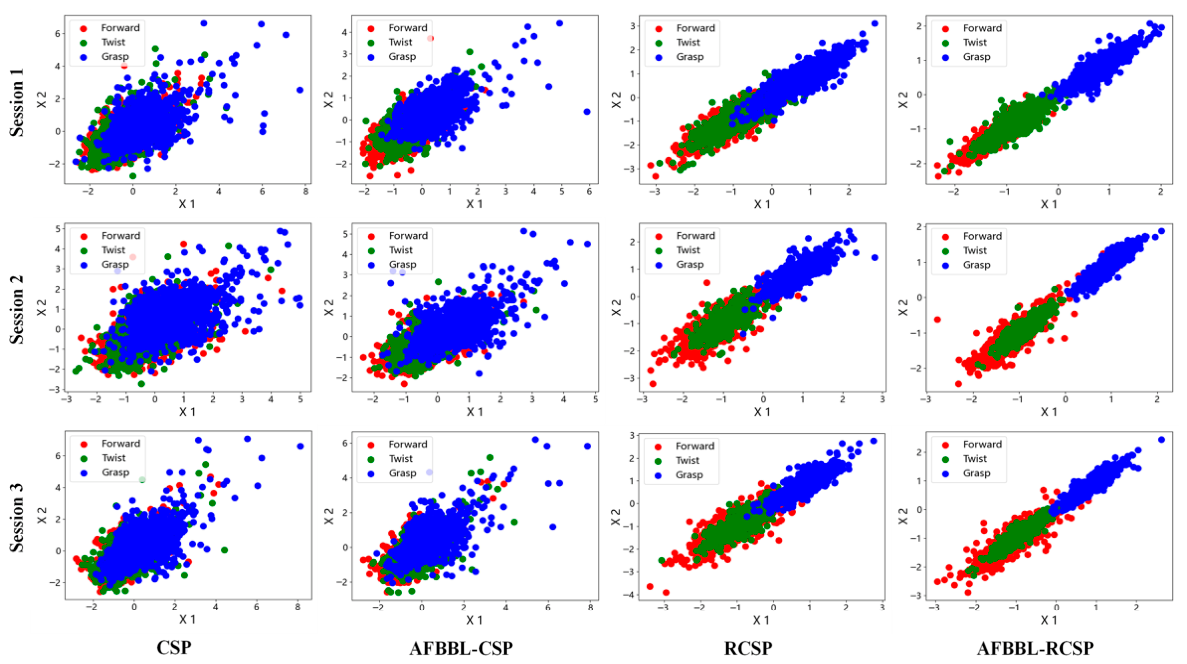
Furthermore, we found that grasping-related EEG features were easier to distinguish from those associated with reaching and wrist rotation. We speculate that unilateral limb MI-EEG signals are derived from subjects’ actual motor intentions and may therefore be strongly influenced by individual daily motor habits. In everyday life, grasping is a frequently performed movement, and individuals are generally more familiar with its corresponding neural activity patterns. This familiarity may lead to clearer and more stable EEG signals during motor imagery of grasping. Compared with reaching and wrist rotation, grasping may also be a more clearly defined movement, allowing participants to focus more effectively during the imagery task and thereby produce more consistent EEG patterns. As shown in Figure 6, under all methods, the features associated with grasping differ markedly from those of the other two movement types. This phenomenon may also be attributed to the fact that grasping more strongly activates specific brain regions related to motor control. Since the imagined grasping motion differs significantly from other motion features, BCI systems can decode user intentions more accurately based on this difference. This helps improve the accuracy and efficiency of BCI systems when performing specific tasks.
Figure 6.
Comparison of feature distribution of different mining strategies.
Although the proposed AFBBL-RCSP framework demonstrated promising performance, it still has some limitations. At present, band-boundary localization is mainly determined according to power spectral density, which serves as a single criterion for identifying informative frequency regions. However, not all relevant MI-EEG information may be fully reflected by spectral power alone. Some discriminative neural patterns may be encoded in other signal characteristics and therefore may not be captured by the current boundary localization strategy. In addition, although the introduction of BCI Competition IV 2a as universum data provides useful same-domain prior information, differences in channel configuration, task design, and data distribution between datasets may still affect the effectiveness of prior transfer. In future work, additional criteria for band-boundary localization, such as time-frequency structure, inter-channel interactions, or cross-session consistency, could be incorporated to further improve the adaptability and generalization ability of the method. It would also be meaningful to investigate more effective universum construction and cross-dataset adaptation strategies for improving classifier robustness.
Overall, the proposed method is effective not simply because it combines multiple modules, but because each component addresses a specific challenge in unilateral limb MI decoding. AFBBL captures subject- and session-specific informative frequency bands, RCSP enhances the robustness of spatial feature extraction, and the Pin-UTSVM-based universum learning framework improves decision stability by combining pinball-loss-based classification with additional same-domain prior information.
5. Conclusions
In this study, we proposed an AFBBL-RCSP feature mining framework combined with a Pin-UTSVM-based classifier for unilateral limb motor imagery EEG decoding. To overcome the limitations of fixed-band feature mining strategies in fine-grained unilateral limb decoding, AFBBL was introduced to adaptively localize informative frequency-band boundaries, while RCSP was employed to enhance the robustness of spatial feature extraction. Experimental results across three sessions demonstrated that the proposed method consistently outperformed conventional CSP- and RCSP-based methods under fixed-band settings and also showed competitive performance compared with recently reported unilateral limb decoding approaches. Overall, the proposed framework achieved promising decoding performance and offers an effective and interpretable solution for unilateral limb motor imagery EEG decoding, with potential value for future BCI-related applications.
Supplementary Materials
The following supporting information can be downloaded at: https://www.mdpi.com/article/10.3390/info17050482/s1, Table S1. The result of our method; Table S2. Results of EEGNet, 2DCNN, and LSTM; Table S3. Results of ShallowNet, DeepConvNet, and Conformer; Table S4. Results of the paired t-test analysis.
Author Contributions
Conceptualization, Y.M. and J.S.; methodology, Y.M. and J.S.; validation, J.N. and D.L.; formal analysis, Y.M., J.N. and W.F.; software, W.F.; visualisation, C.Y.; Data curation, J.N.; investigation, F.Z.; writing—original draft preparation, Y.M. and J.S.; review and editing, D.L., J.N., W.F. and F.Z.; supervision, D.L. and C.Y.; project administration, Y.M. All authors have read and agreed to the published version of the manuscript.
Funding
This work was supported by the Natural Science Foundation of Henan Province [No. 252300421518], the National Natural Science Foundation of China [No. 62476255 and No. 62303427], the Key Science Research Project of Colleges and Universities in Henan Province of China [No. 25A520003 and No. 26A510009], the Key Science and Technology Program of Henan Province [No. 242102211058, No. 242102211018, No. 262102211079, No. 262102211027, No. 262102211021 and No. 252102211056], and the Young Backbone Teacher Program of Zhengzhou University of Light Industry.
Institutional Review Board Statement
Not applicable.
Informed Consent Statement
Not applicable.
Data Availability Statement
The dataset used in this study is available at http://gigadb.org/dataset/100788 (accessed on 6 March 2026) and Supplementary Materials.
Conflicts of Interest
The authors declare no conflicts of interest.
References
- Zhang, R.; Xu, Z.; Zhang, L.; Cao, L.; Hu, Y.; Lu, B.; Shi, L.; Yao, D.; Zhao, X. The Effect of Stimulus Number on the Recognition Accuracy and Information Transfer Rate of SSVEP–BCI in Augmented Reality. J. Neural Eng. 2022, 19, 036010. [Google Scholar] [CrossRef] [Scilit]
- Fazel-Rezai, R.; Allison, B.Z.; Guger, C.; Sellers, E.W.; Kleih, S.C.; Kübler, A. P300 Brain Computer Interface: Current Challenges and Emerging Trends. Front. Neuroeng. 2012, 5, 14. [Google Scholar] [CrossRef] [Scilit]
- Baniqued, P.D.E.; Stanyer, E.C.; Awais, M.; Alazmani, A.; Jackson, A.E.; Mon-Williams, M.A.; Mushtaq, F.; Holt, R.J. Brain–Computer Interface Robotics for Hand Rehabilitation after Stroke: A Systematic Review. J. Neuroeng. Rehabil. 2021, 18, 15. [Google Scholar] [CrossRef] [Scilit] [PubMed]
- Wolpaw, J.R.; Birbaumer, N.; Heetderks, W.J.; McFarland, D.J.; Peckham, P.H.; Schalk, G.; Donchin, E.; Quatrano, L.A.; Robinson, C.J.; Vaughan, T.M. Brain-Computer Interface Technology: A Review of the First International Meeting. IEEE Trans. Rehabil. Eng. 2000, 8, 164–173. [Google Scholar] [CrossRef] [Scilit]
- Frisoli, A.; Loconsole, C.; Leonardis, D.; Banno, F.; Barsotti, M.; Chisari, C.; Bergamasco, M. A New Gaze-BCI-Driven Control of an Upper Limb Exoskeleton for Rehabilitation in Real-World Tasks. IEEE Trans. Syst. Man Cybern. Part C (Appl. Rev.) 2012, 42, 1169–1179. [Google Scholar] [CrossRef] [Scilit]
- Choi, K.; Cichocki, A. Control of a Wheelchair by Motor Imagery in Real Time. Intelligent Data Engineering and Automated Learning–IDEAL 2008; Springer: Berlin/Heidelberg, Germany, 2008. [Google Scholar]
- Zhou, X.; Zou, R.; Huang, X. Single Upper Limb Functional Movements Decoding from Motor Imagery EEG Signals Using Wavelet Neural Network. Biomed. Signal Process. Control 2021, 70, 102965. [Google Scholar] [CrossRef] [Scilit]
- Tavakolan, M.; Frehlick, Z.; Yong, X.; Menon, C. Classifying Three Imaginary States of the Same Upper Extremity Using Time-Domain Features. PLoS ONE 2017, 12, e0174161. [Google Scholar] [CrossRef] [Scilit]
- Alazrai, R.; Alwanni, H.; Baslan, Y.; Alnuman, N.; Daoud, M.I. Eeg-Based Brain-Computer Interface for Decoding Motor Imagery Tasks within the Same Hand Using Choi-Williams Time-Frequency Distribution. Sensors 2017, 17, 1937. [Google Scholar] [CrossRef] [Scilit]
- Ma, X.; Qiu, S.; Wei, W.; Wang, S.; He, H. Deep Channel-Correlation Network for Motor Imagery Decoding from the Same Limb. IEEE Trans. Neural Syst. Rehabil. Eng. 2019, 28, 297–306. [Google Scholar] [CrossRef] [Scilit] [PubMed]
- Jin, J.; Xiao, R.; Daly, I.; Miao, Y.; Wang, X.; Cichocki, A. Internal Feature Selection Method of CSP Based on L1-Norm and Dempster–Shafer Theory. IEEE Trans. Neural Netw. Learn. Syst. 2020, 32, 4814–4825. [Google Scholar] [CrossRef] [Scilit] [PubMed]
- Ramoser, H.; Muller-Gerking, J.; Pfurtscheller, G. Optimal Spatial Filtering of Single Trial EEG during Imagined Hand Movement. IEEE Trans. Rehabil. Eng. 2000, 8, 441–446. [Google Scholar] [CrossRef] [Scilit]
- Gaur, P.; Gupta, H.; Chowdhury, A.; McCreadie, K.; Pachori, R.B.; Wang, H. A Sliding Window Common Spatial Pattern for Enhancing Motor Imagery Classification in EEG-BCI. IEEE Trans. Instrum. Meas. 2021, 70, 1–9. [Google Scholar] [CrossRef] [Scilit]
- Jiang, J.; Wang, C.; Wu, J.; Qin, W.; Xu, M.; Yin, E. Temporal Combination Pattern Optimization Based on Feature Selection Method for Motor Imagery BCIs. Front. Hum. Neurosci. 2020, 14, 231. [Google Scholar] [CrossRef] [Scilit]
- Lin, C.-L.; Chen, L.-T. Improvement of Brain–Computer Interface in Motor Imagery Training through the Designing of a Dynamic Experiment and FBCSP. Heliyon 2023, 9, e13745. [Google Scholar] [CrossRef] [Scilit]
- Wang, H.; Tang, C.; Xu, T.; Li, T.; Xu, L.; Yue, H.; Chen, P.; Li, J.; Bezerianos, A. An Approach of One-vs-Rest Filter Bank Common Spatial Pattern and Spiking Neural Networks for Multiple Motor Imagery Decoding. IEEE Access 2020, 8, 86850–86861. [Google Scholar] [CrossRef] [Scilit]
- Zhang, X.; She, Q.; Chen, Y.; Kong, W.; Mei, C. Sub-Band Target Alignment Common Spatial Pattern in Brain-Computer Interface. Comput. Methods Programs Biomed. 2021, 207, 106150. [Google Scholar] [CrossRef] [Scilit]
- Suleiman, A.-B.R.; Fatehi, T.A.-H. Features Extraction Techniques of EEG Signal for BCI Applications; Faculty of Computer and Information Engineering, Department College of Electronics Engineering, University of Mosul: Mosul, Iraq, 2007. [Google Scholar]
- Liu, G.; Tian, L.; Zhou, W. Multiscale Time-Frequency Method for Multiclass Motor Imagery Brain Computer Interface. Comput. Biol. Med. 2022, 143, 105299. [Google Scholar] [CrossRef] [Scilit]
- Cherloo, M.N.; Amiri, H.K.; Daliri, M.R. Ensemble Regularized Common Spatio-Spectral Pattern (Ensemble RCSSP) Model for Motor Imagery-Based EEG Signal Classification. Comput. Biol. Med. 2021, 135, 104546. [Google Scholar] [CrossRef] [Scilit] [PubMed]
- McFarland, D.J.; Miner, L.A.; Vaughan, T.M.; Wolpaw, J.R. Mu and Beta Rhythm Topographies during Motor Imagery and Actual Movements. Brain Topogr. 2000, 12, 177–186. [Google Scholar] [CrossRef] [Scilit]
- Loh, W.-Y. Classification and Regression Trees. Wiley Interdiscip. Rev. Data Min. Knowl. Discov. 2011, 1, 14–23. [Google Scholar] [CrossRef] [Scilit]
- Akaike, H. A New Look at the Statistical Model Identification. IEEE Trans. Autom. Control 2003, 19, 716–723. [Google Scholar] [CrossRef] [Scilit]
- Welch, P. The Use of Fast Fourier Transform for the Estimation of Power Spectra: A Method Based on Time Averaging over Short, Modified Periodograms. IEEE Trans. Audio Electroacoust. 2003, 15, 70–73. [Google Scholar] [CrossRef] [Scilit]
- Kotsiantis, S.B. Decision Trees: A Recent Overview. Artif. Intell. Rev. 2013, 39, 261–283. [Google Scholar] [CrossRef] [Scilit]
- Talebi, S.; Waczak, J.; Fernando, B.A.; Sridhar, A.; Lary, D.J. Data-Driven EEG Band Discovery with Decision Trees. Sensors 2022, 22, 3048. [Google Scholar] [CrossRef] [Scilit]
- Tariq, M.; Trivailo, P.M.; Simic, M. Classification of Left and Right Foot Kinaesthetic Motor Imagery Using Common Spatial Pattern. Biomed. Phys. Eng. Express 2019, 6, 015008. [Google Scholar] [CrossRef] [Scilit]
- Dornhege, G.; Blankertz, B.; Krauledat, M.; Losch, F.; Curio, G.; Muller, K.-R. Combined Optimization of Spatial and Temporal Filters for Improving Brain-Computer Interfacing. IEEE Trans. Biomed. Eng. 2006, 53, 2274–2281. [Google Scholar] [CrossRef] [Scilit]
- Friedman, J.H. Regularized Discriminant Analysis. J. Am. Stat. Assoc. 1989, 84, 165–175. [Google Scholar] [CrossRef]
- Varsehi, H.; Firoozabadi, S.M.P. An EEG Channel Selection Method for Motor Imagery Based Brain–Computer Interface and Neurofeedback Using Granger Causality. Neural Netw. 2021, 133, 193–206. [Google Scholar] [CrossRef] [Scilit] [PubMed]
- Yuan, M.-D.; Feng, D.-Z.; Shi, Y.; Liu, W.-J. Dimensionality Reduction by Collaborative Preserving Fisher Discriminant Analysis. Neurocomputing 2019, 356, 228–243. [Google Scholar] [CrossRef] [Scilit]
- AbuZeina, D.; Al-Anzi, F.S. Employing Fisher Discriminant Analysis for Arabic Text Classification. Comput. Electr. Eng. 2018, 66, 474–486. [Google Scholar] [CrossRef] [Scilit]
- Saeidi, M.; Karwowski, W.; Farahani, F.V.; Fiok, K.; Taiar, R.; Hancock, P.A.; Al-Juaid, A. Neural Decoding of EEG Signals with Machine Learning: A Systematic Review. Brain Sci. 2021, 11, 1525. [Google Scholar] [CrossRef] [Scilit]
- Cervantes, J.; Garcia-Lamont, F.; Rodríguez-Mazahua, L.; Lopez, A. A Comprehensive Survey on Support Vector Machine Classification: Applications, Challenges and Trends. Neurocomputing 2020, 408, 189–215. [Google Scholar] [CrossRef] [Scilit]
- Khemchandani, R.; Chandra, S. Twin Support Vector Machines for Pattern Classification. IEEE Trans. Pattern Anal. Mach. Intell. 2007, 29, 905–910. [Google Scholar] [CrossRef] [Scilit]
- Weston, J.; Collobert, R.; Sinz, F.; Bottou, L.; Vapnik, V. Inference with the Universum. In Proceedings of the 23rd International Conference on Machine Learning, Pittsburgh, PA, USA, 25–29 June 2006; pp. 1009–1016. [Google Scholar]
- Richhariya, B.; Tanveer, M. A Reduced Universum Twin Support Vector Machine for Class Imbalance Learning. Pattern Recognit. 2020, 102, 107150. [Google Scholar] [CrossRef] [Scilit]
- Huang, X.; Shi, L.; Suykens, J.A. Support Vector Machine Classifier with Pinball Loss. IEEE Trans. Pattern Anal. Mach. Intell. 2013, 36, 984–997. [Google Scholar] [CrossRef] [Scilit]
- Ganaie, M.A.; Tanveer, M.; Jangir, J. EEG Signal Classification via Pinball Universum Twin Support Vector Machine. Ann. Oper. Res. 2023, 328, 451–492. [Google Scholar] [CrossRef] [Scilit]
- Jeong, J.-H.; Cho, J.-H.; Shim, K.-H.; Kwon, B.-H.; Lee, B.-H.; Lee, D.-Y.; Lee, D.-H.; Lee, S.-W. Multimodal Signal Dataset for 11 Intuitive Movement Tasks from Single Upper Extremity during Multiple Recording Sessions. GigaScience 2020, 9, giaa098. [Google Scholar] [CrossRef] [Scilit] [PubMed]
- Katoch, S.; Chauhan, S.S.; Kumar, V. A Review on Genetic Algorithm: Past, Present, and Future. Multimed. Tools Appl. 2021, 80, 8091–8126. [Google Scholar] [CrossRef] [Scilit]
- Wang, D.; Tan, D.; Liu, L. Particle Swarm Optimization Algorithm: An Overview. Soft Comput. 2018, 22, 387–408. [Google Scholar] [CrossRef] [Scilit]
- Senguler, T.; Karatoprak, E.; Seker, S.; Caglar, R. ICA and Wavelet Packet Decomposition Approaches for Monitoring the Incipient Bearing Damage in Electrical Motors. In Proceedings of the 2008 4th International IEEE Conference Intelligent Systems, Varna, Bulgaria, 6–8 September 2008; Volume 3, pp. 24-13–24-17. [Google Scholar]
- Meng, Y.; Zhu, N.; Li, D.; Nan, J.; Xia, Y.; Yao, N.; Han, C. Stepwise Discriminant Analysis Based Optimal Frequency Band Selection and Ensemble Learning for Same Limb MI Recognition. Clust. Comput. 2025, 28, 197. [Google Scholar] [CrossRef] [Scilit]
- Zhang, R.; Chen, Y.; Xu, Z.; Zhang, L.; Hu, Y.; Chen, M. Recognition of Single Upper Limb Motor Imagery Tasks from EEG Using Multi-Branch Fusion Convolutional Neural Network. Front. Neurosci. 2023, 17, 1129049. [Google Scholar] [CrossRef] [Scilit] [PubMed]

Disclaimer/Publisher’s Note: The statements, opinions and data contained in all publications are solely those of the individual author(s) and contributor(s) and not of MDPI and/or the editor(s). MDPI and/or the editor(s) disclaim responsibility for any injury to people or property resulting from any ideas, methods, instructions or products referred to in the content. |
© 2026 by the authors. Licensee MDPI, Basel, Switzerland. This article is an open access article distributed under the terms and conditions of the Creative Commons Attribution (CC BY) license.