


Abstract
As AI-powered learning tools become more common in educational settings, understanding their acceptance mechanisms is increasingly important. This study examines how the design attributes of AI museum guides—anthropomorphism, interactivity, and personalization—are associated with the acceptance intention and perceived learning outcomes among Chinese high school students with prior museum experience. Using structural equation modeling with 324 participants, we test whether these features relate to acceptance through two affective pathways: perceived warmth and anxiety reduction. The results reveal distinct patterns: anthropomorphism shows an indirect-only association with anxiety reduction through perceived warmth; interactivity is associated with anxiety reduction through responsive feedback; and personalization serves dual functions, enhancing both pathways. Anxiety reduction shows strong positive associations with both acceptance intention and perceived learning outcomes. The multi-group analysis shows that most pathways function equivalently across genders, with one exception where anxiety reduction more strongly predicts learning outcomes for females than males. These findings reveal distinct psychological functions within the Chinese educational context: anthropomorphism influences anxiety reduction exclusively through perceived warmth, while personalization and interactivity provide both affective and cognitive support. The implications for AI museum guide design in similar contexts are discussed. The generalizability to other cultural contexts and populations, such as Western students or adult learners, requires further investigation.
1. Introduction
Artificial intelligence (AI) tutoring systems are being deployed in K-12 classrooms worldwide, with the documented implementations ranging from automated writing feedback to adaptive mathematics practice [1]. These systems typically provide personalized content delivery, immediate feedback, and adaptive scaffolding [2]. A specific subset—AI museum guides (AIMGs)—has been adapted for informal learning environments [3]. The AIMGs are conversational interfaces deployed in museums through mobile apps, chatbots, or robotic platforms, typically leveraging large language models (LLMs) to answer visitor questions about artifacts and historical contexts [4,5]. This study examines three design attributes—anthropomorphism (human-like interface features), interactivity (system responsiveness to user input), and personalization (content adaptation to individual needs)—that prior research identifies as key determinants of educational technology acceptance [6,7]. These three attributes were selected because they represent the distinct psychological mechanisms that are relevant to museum learning: anthropomorphism addresses the social–emotional needs in solitary exploration [8], interactivity provides the cognitive scaffolding for uncertainty reduction [9], and personalization adapts the content to individual learning paces, which are all critical in self-directed museum contexts where neither teacher guidance nor peer support is available [2,10]. These design attributes address psychologically distinct challenges: anthropomorphism mitigates social isolation, interactivity reduces cognitive uncertainty, and personalization prevents information overload, each targeting specific barriers in self-directed contexts where teacher guidance is intermittent. This focus on design dimensions allows findings to inform AIMG development across diverse platforms and settings.
Museums constitute a distinct informal learning context. During school-organized museum visits, students engage in self-paced exploration within a structured field trip context. While teachers provide intermittent supervision and occasional guidance, students retain autonomy to navigate exhibits at individual tempos and seek AI support on demand [3]. This hybrid context—combining organizational structure with exploratory freedom—eliminates the continuous social evaluation anxiety that is present in classroom settings (where teachers monitor ongoing discussions) but introduces epistemic uncertainty when students encounter unfamiliar artifacts during their autonomous exploration [11]. These characteristics—an absence of evaluative pressure coupled with high epistemic uncertainty—make self-guided museum visits suitable for examining whether AI design features reduce anxiety through affective mechanisms (e.g., perceived warmth) rather than through authority-based credibility [12]. Unlike classrooms, where anxiety stems from performance evaluation and peer comparison [11,13], museum anxiety from self-directed exploration reflects a cognitive uncertainty about navigating unfamiliar content independently [14].
Classroom-based studies show that anthropomorphic features (such as emotional expression and conversational voice) make pedagogical agents more engaging and can increase learners’ self-efficacy [15]. The adaptive systems sustain user engagement and intrinsic motivation primarily through personalized interactions and tailored presentations [16], and personalization improves the learning outcomes by adapting the content difficulty [2]. However, these studies focus on the individual features in isolation, and their combined effects remain underexplored.
Four gaps limit the current understanding of AIMGs in museum contexts. First, whether these design attributes function independently or interact synergistically is unknown, as prior research tests them in isolation. Second, the affective pathways linking these attributes to anxiety reduction are unclear—specifically, whether anthropomorphism, interactivity, and personalization reduce anxiety directly or through intermediate affective states (e.g., warmth) [4]. Third, the Computers are Social Actors (CASA) theory posits that users apply social interaction norms to computers, but whether perceived warmth (a core dimension of social evaluation) mediates the design–acceptance relationships in informal learning remains untested [17,18]. Fourth, the gender differences in technology acceptance are well documented [19], but whether the affective pathways from warmth to acceptance and from anxiety to acceptance operate equivalently across genders in museums is unexamined.
This study examines whether three design attributes (anthropomorphism, interactivity, and personalization) influence the AIMG acceptance through affective pathways (warmth and anxiety reduction) in museum contexts. Drawing on the CASA theory and the stimulus–organism–response (S-O-R) framework [10,20], this study tests whether the design attributes (stimuli) are associated with SAI (response) through affective mediators (organism): perceived warmth and anxiety reduction [6]. The multi-group analysis examines whether these pathways function equivalently across genders [20].
This study makes four contributions. First, it tests how three design attributes jointly relate to AIMG acceptance through dual affective pathways. Second, it differentiates the direct effects of the design attributes on acceptance from indirect effects mediated by warmth and anxiety. Third, it tests gender-based pathway invariance using multi-group structural equation modeling (SEM) [21]. Fourth, it provides empirical guidelines for designing affect-sensitive AIMGs in informal learning contexts.
The paper is structured as follows: Section 2 reviews the literature and proposes research hypotheses; Section 3 describes the methodology and data collection; Section 4 presents the data analysis results; Section 5 discusses the findings and their implications; and Section 6 summarizes the contributions, limitations, and directions for future research.
2. Literature Review
2.1. Theoretical Foundation
This study applies the stimulus–organism–response (S-O-R) framework and Computers are Social Actors (CASA) theory to examine AI museum guide acceptance. The S-O-R framework structures our model into three components: design attributes as stimuli (anthropomorphism, interactivity, and personalization), affective states as organism variables (perceived warmth and anxiety reduction), and behavioral outcomes as responses (service acceptance intention and perceived learning outcomes) [10,20]. This framework models how environmental cues influence behavior through psychological states, explaining why design features affect acceptance.
The CASA theory explains the psychological mechanism underlying social responses to technology. Users mindlessly apply social rules to computers exhibiting minimal cues such as language output and interactivity, even when they consciously reject that computers warrant human treatment [22]. Anthropomorphic AI designs—featuring conversational tone, empathetic language, and human-like interaction patterns—amplify these social cues, potentially eliciting stronger affective responses, including perceived warmth. In museums, students explore independently without continuous peer or teacher support [23]. When AI museum guides exhibit social cues, they function as virtual companions during self-directed exploration [4,24].
Design attributes influence acceptance through two affective pathways: the perceived warmth is associated with psychological safety that supports voluntary learning engagement [7], while anxiety reduction—particularly through cute, non-threatening conversational styles—mitigates cognitive uncertainty and enables self-directed exploration [25].
In classrooms, students experience evaluative anxiety from grades and teacher assessments [26,27]. Self-paced museum visits eliminate the evaluative pressure from teachers and peers but create cognitive uncertainty when students encounter unfamiliar artifacts without expert guidance [23,28]. This distinction is critical: while classroom anxiety reduction may prioritize social reassurance (e.g., “your answer won’t be judged”), museum anxiety reduction requires cognitive scaffolding (e.g., “here’s how to interpret this artifact”). AI museum guides may reduce uncertainty, though these mechanisms remain empirically untested in museum contexts [29,30]. While anthropomorphism, interactivity, and personalization are universal design principles, their psychological mechanisms differ by context. In museums, anthropomorphism provides social compensation during solitary exploration, interactivity mitigates epistemic uncertainty, and personalization prevents cognitive overload—distinct from their classroom functions where teacher presence and evaluative structures dominate. Table 1 summarizes prior research on technology acceptance in museums and informal learning settings, highlighting the theoretical frameworks and key findings that inform our hypotheses.
Table 1.
A summary of prior research on technology acceptance in museums and informal learning settings.
2.2. AI Tool Attributes and Perceived Warmth
Having established why these three design features are theoretically relevant to museum learning (Section 1), this section reviews the empirical evidence for their specific psychological mechanisms. Drawing on the CASA theory and prior human–robot interaction research [23,35], the following subsections examine how anthropomorphism, interactivity, and personalization shape perceived warmth and anxiety reduction.
2.2.1. Anthropomorphism
Anthropomorphism in human–computer interactions has been extensively studied since the early applications of the CASA (Computers are Social Actors) theory [23,33], which demonstrated that users unconsciously apply social rules to computers exhibiting even minimal human-like cues [36]. Anthropomorphism is driven not only by cognitive factors but also by motivational forces—the need to understand agents’ behavior (effectance) and the desire for social connection (sociality) [8]. The research on anthropomorphic agents has evolved from simple avatar design to sophisticated natural language generation that is capable of producing empathetic responses and conversational repair strategies. A recent meta-analysis demonstrates that the anthropomorphic features in service agents significantly enhance users’ perceived warmth [37]. In museum contexts, where visitors often explore alone without teacher or peer support, anthropomorphic AI systems offering empathetic communication serve as virtual companions, addressing the cognitive uncertainty and isolation that are inherent in self-guided visits [24,30]. Regarding the reduction in user uncertainty and anxiety, the theoretical mechanism remains debated [38]. Some perspectives suggest that anthropomorphic features directly signal non-judgmental interaction partners, alleviating the technology-induced uncertainty through cognitive reassurance and enhanced AI self-efficacy [39]. However, drawing upon the CASA theory, an indirect pathway can be argued, where anthropomorphism first establishes emotional safety via perceived warmth, which subsequently enables anxiety reduction through social–emotional mechanisms rather than direct cognitive effects [18]. Therefore, this study proposes the following:
H1a:
The anthropomorphism of AI museum guides has a significant positive effect on K-12 students’ perceived warmth in museum learning contexts.
H1b:
The anthropomorphism of AI museum guides significantly enhances anxiety reduction among K-12 students during museum visits.
2.2.2. Interactivity
In tourism contexts, interactivity enhances visitor engagement [31]. Museum environments require visitors to engage in the deep processing of content, which involves mental exertion that is difficult to sustain [35]. The interactive feedback from mobile guides reduces ambiguity and provides tailored information that frees cognitive resources for deeper learning [40,41]. In K-12 AI education contexts, learner–interface interactivity with generative AI tools positively influences students’ perceived usefulness and ease of use, which in turn shapes their attitudes toward learning [1]. The applications of the S-O-R framework in virtual museums indicate that interactivity serves as an environmental stimulus affecting psychological states—particularly cognitive engagement—which influences learning behaviors [10]. For students engaged in independent museum exploration, interacting with responsive AI guides provides on-demand information support and a sense of control over the learning process. Interactive systems reduce uncertainty by providing immediate information and enhancing the perceived control [10,41]. Therefore, this study proposes the following:
H2a:
The interactivity of AI museum guides has a significant positive effect on K-12 students’ perceived warmth in museum learning contexts.
H2b:
The interactivity of AI museum guides significantly enhances anxiety reduction among K-12 students during museum visits.
2.2.3. Personalization
Personalization refers to adapting content to individual characteristics and preferences [2]. In educational technology, adaptive systems that tailor content, pacing, and feedback to learners’ cognitive and affective states enhance learning motivation and engagement [42]. The studies on AI conversational agents and service robots demonstrate that tailored responses build user trust and continuance intention, especially in complex service environments where individualized attention signals care and competence [43,44]. In museums, standardized information delivery often fails to accommodate individual differences, causing cognitive fatigue [23,35]. Adaptable robot guides and augmented reality applications overcome these limitations by providing situated, tailored information aligned with visitors’ locations and preferences [3,40]. By curating manageable content subsets, the personalized AI systems prevent information overload and reduce the cognitive effort required to navigate complex exhibitions. The adaptive systems that tailor interactions to individual user characteristics can reduce the cognitive load [2], while enhancing functional outcomes such as perceived usefulness and ease of use [45], which, in turn, supports the users’ intention to continue engagement [29]. When visitors receive tailored guidance aligned with their cognitive capacities and interests, they perceive the robot as valuable and sustain their interaction. This is particularly relevant in museums, where voluntary engagement depends on the perceived added value rather than obligation. Therefore, this study proposes the following:
H3a:
The personalization of AI museum guides has a significant positive effect on K-12 students’ perceived warmth in museum learning contexts.
H3b:
The personalization of AI museum guides significantly enhances anxiety reduction among K-12 students during museum visits.
2.3. Mediating Mechanisms
This section examines how affective states drive behavioral outcomes. These mediating mechanisms reflect the organism–response relationships in the S-O-R framework, where internal affective states transform external design stimuli into behavioral intentions and outcome perceptions.
2.3.1. The Role of Perceived Warmth
Following Fiske et al. (2007) [18], we conceptualize perceived warmth as a dimension of social cognition, assessing whether an agent is friendly and well-intentioned. In museum contexts, this construct operationalizes visitors’ sense of emotional safety when seeking help from AI guides, which is distinct from competence perceptions [18]. This construct has been extensively applied to human–robot interactions, where warmth manifests through approachable designs, friendly communication, and appropriate non-verbal cues [45,46]. In tourism, robot warmth enhances visitors’ experience and acceptance [6,47]. The perceived warmth influences outcomes through three pathways. First, warmth reduces interaction anxiety. Museum visits generate epistemic uncertainty [48,49]. When visitors perceive the robot as warm and approachable, they experience increased psychological safety and reduced apprehension in seeking assistance. Second, warmth enhances service acceptance. The perceived warmth fosters positive emotional connections, increasing willingness to interact with the robot [50]. Third, warmth improves learning outcomes. An affective rapport promotes deeper cognitive engagement with the content. Warmth operates through emotional pathways [12,37], a mechanism that is especially relevant in voluntary learning contexts like museums, where emotions significantly drive the visitor experience [23]. Therefore, this study proposes the following:
H4a:
The perceived warmth of AI museum guides significantly enhances anxiety reduction among K-12 students during museum exploration.
H4b:
The perceived warmth of AI museum guides has a significant positive effect on K-12 students’ service acceptance intention toward AI-assisted museum learning.
H4c:
The perceived warmth of AI museum guides has a significant positive effect on K-12 students’ perceived learning outcomes in museum contexts.
2.3.2. The Impact of Anxiety Reduction
Anxiety reduction refers to the psychological relief from uncertainty during museum exploration, enabled by warmth, interactivity, and personalization. Museum-specific anxiety differs from classroom anxiety but is not purely cognitive. While museums eliminate the evaluation from teachers and peers, students may still worry about being judged by the AI when asking basic questions. Thus, museum anxiety with AI guides has two components: uncertainty from navigating unfamiliar content, and concern about AI judgment [23,26]. In docent-led tours, expert guides mitigate this epistemic uncertainty through structured narratives, but this results in visitors sacrificing control over the pacing and topic exploration. Self-guided visits with AI support offer autonomy while addressing cognitive uncertainty through on-demand assistance [40,41]. Additionally, students may still worry about being judged by the AI when asking basic questions, which warmth-conveying design features can alleviate by establishing the AI as a non-judgmental learning partner. Anxiety consumes working memory resources, impairing comprehension and navigation [51]. In technology acceptance research, this translates to lower usage intentions [1,52]. When robot design features successfully alleviate anxiety, the liberated cognitive resources enable deeper information processing and improved learning efficiency [53,54]. Feeling psychologically comfortable with robotic guides is a fundamental prerequisite for visitor acceptance, as warm and interactive robot designs create psychologically safe environments that shift visitors’ cognitive focus from technology apprehension to meaningful cultural discovery [55]. The absence of evaluative pressure in voluntary museum settings—where visitors face no performance assessment or peer comparison—may amplify these anxiety reduction effects compared to formal educational contexts. Therefore, anxiety reduction serves as a critical affective pathway linking the design attributes to both service acceptance and learning outcomes:
H5a:
Anxiety reduction positively influences service acceptance intention toward AI-powered museum guide robots.
H5b:
Anxiety reduction positively influences perceived learning outcomes from AI-powered museum guide robots.
2.4. Perceived Learning Outcomes and Service Acceptance Intention
The perceived learning outcomes refer to visitors’ subjective evaluations of the knowledge, skills, and cognitive benefits that they have gained through interactions with AI museum guides [56,57]. This encompasses multiple dimensions, including knowledge acquisition, enhanced understanding of exhibition content, and increased interest in the subject matter [23]. In informal learning environments like museums, where participation is entirely voluntary and self-directed, the visitors’ perceived achievement of personal learning goals becomes a critical determinant of the overall experience satisfaction. Museum learning research reveals that digital technologies providing high-quality, tailored informational value significantly enhance the visitors’ cognitive experiences [58]. When visitors perceive that an AI museum guide effectively facilitates knowledge acquisition and deepens content understanding, this perceived usefulness validates the system’s educational value in informal learning contexts [30]. Furthermore, successful knowledge acquisition satisfies the visitors’ fundamental need for competence, intrinsically motivating continued interaction with the technology [59]. The service acceptance intention refers to users’ willingness to adopt and continue using a technology, serving as the most proximal predictor of actual usage behavior [60].
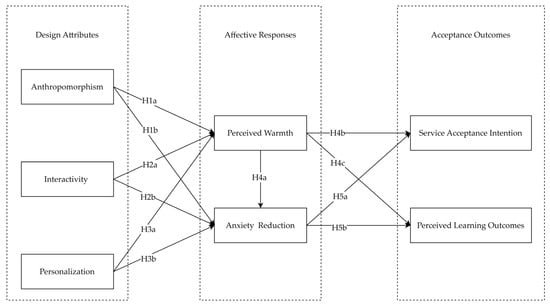
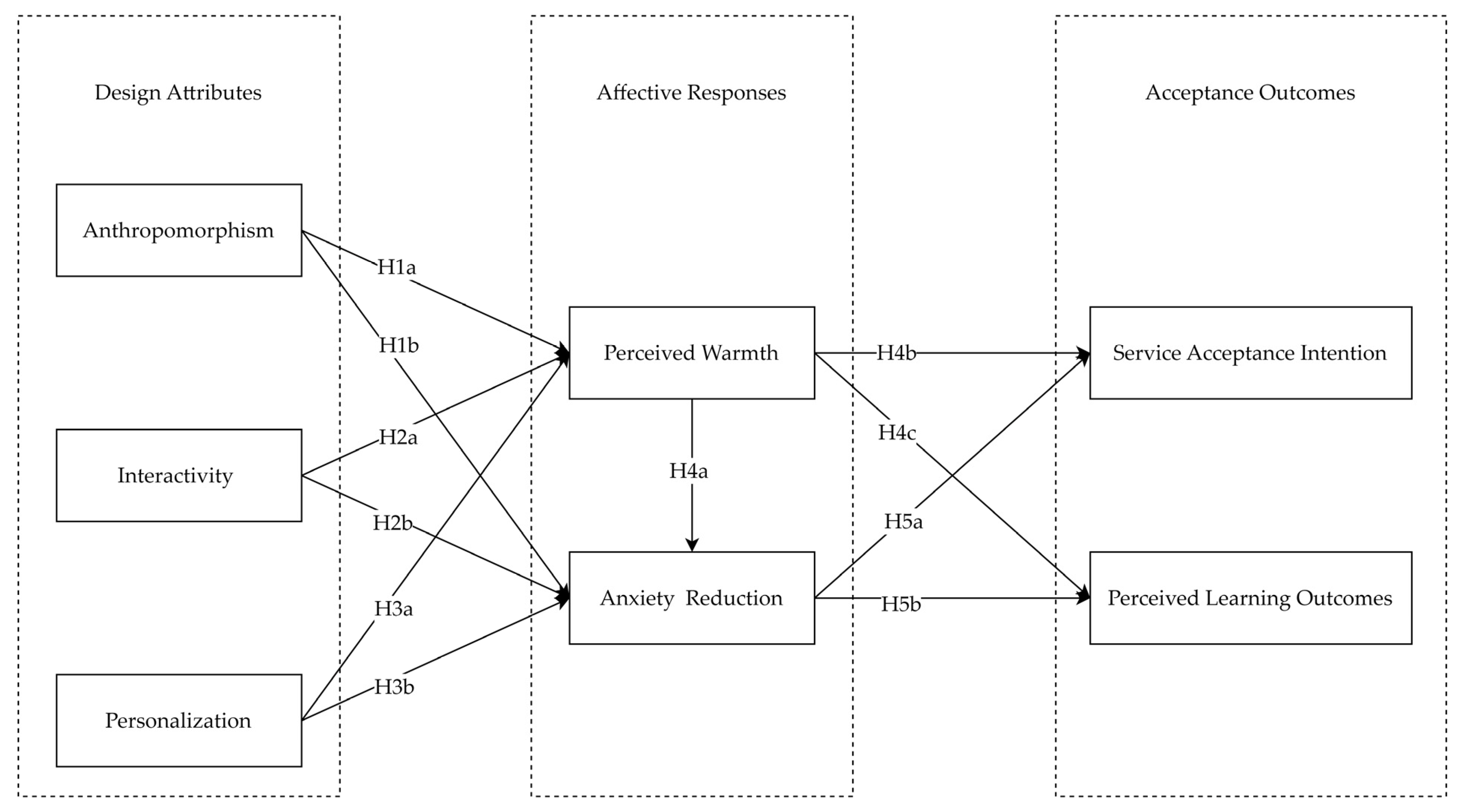
Figure 1 presents our integrated S-O-R model, depicting how AI design attributes (as stimuli) influence the affective states (as organism variables), which drive behavioral outcomes (as responses).
Figure 1.
The proposed research model based on the stimulus–organism–response framework.
3. Research Methods
This section outlines the research design and data collection procedures for examining factors influencing AI museum guide acceptance among K-12 students in museum learning contexts.
3.1. Measurement Instruments
Clarification of Measurement Focus: Following the S-O-R framework’s emphasis on perceived stimuli rather than objective features, this study measures the students’ subjective perceptions of AI museum guide characteristics. We assess how users experience and interpret system attributes (anthropomorphism, interactivity, and personalization) rather than evaluating the objective technical implementations. For example, anthropomorphism items capture whether students perceive the AI’s tone as natural and friendly (e.g., “The AI’s tone sounds natural like a friend”), not whether the designers programmed specific linguistic features. This perceptual approach aligns with the CASA theory’s core tenet: users’ social responses emerge from perceived human likeness regardless of the actual technical sophistication [22].
All the constructs were operationalized as latent variables representing users’ psychological evaluations of AI characteristics within the S-O-R framework, where “Stimulus” denotes the perceived environmental cues that trigger affective responses. The measurement instruments were adapted from validated scales in prior technology acceptance research (Table 2). For instance, anthropomorphism items assess the subjective impressions of conversational naturalness rather than objective linguistic algorithms; the personalization items evaluate the perceived content adaptiveness rather than the actual recommended engine specifications.
Table 2.
The measurement constructs and questionnaire items.
The anxiety reduction items (LA1–LA3) capture two related sources of psychological comfort: concern about being judged by the AI for asking simple questions (LA1, LA2) and tension relief through AI patience (LA3). This operationalization reflects that while the museum contexts eliminate teacher/peer evaluation, students may still worry about AI judgment. This construct is operationalized as the degree to which students perceive the AI learning environment as non-threatening and free from judgment. Higher scores indicate greater psychological safety and lower anxiety levels, which are consistent with the removal of the “anxiety-as-barrier” perspective in educational technology acceptance research.
The measurement instruments assessed the design attributes (anthropomorphism, interactivity, and personalization) and affective states (perceived warmth and anxiety reduction). For example, the anthropomorphism items measured the conversational tone and empathetic language, while the interactivity items assessed the responsiveness and dialog quality.
Anxiety reduction was measured using three items adapted from Saadé and Kira [66], assessing the psychological comfort in technology-mediated learning. We operationalized this construct as perceived psychological safety when interacting with AI guides, following the “anxiety-as-barrier” perspective in the educational technology [67]. Our measure captures both concern about AI judgment (LA1, LA2) and cognitive uncertainty about content (LA3).
3.2. Data Collection and Sample Profile
3.2.1. Participant Recruitment and Research Context
This study surveyed high school students who participated in school-organized museum field trips integrated into the history curriculum. The data collection was conducted in December 2025 at a Chinese secondary school that systematically incorporates museum visits as part of its social practice curriculum, ensuring all the participants had an authentic, curriculum-embedded AI museum guide experience. During these visits, the students engaged in self-directed exploration with intermittent teacher supervision, retaining autonomy to navigate the exhibits at their own individual pace while voluntarily using AI museum guides for on-demand learning support. This sampling approach ensured that the participants evaluated the actual AI museum guide usage rather than hypothetical scenarios.
3.2.2. AI Museum Guide Characteristics
The AI museum guides examined in this study are powered by large language models and function as voluntary learning support tools in museum contexts [5]. Despite variations in delivery platforms—mobile apps, WeChat chatbots, and kiosks—all systems shared three design features: anthropomorphic communication through conversational language [4], interactive engagement via real-time question-answering [68], and personalized scaffolding by tailoring explanations to students’ learning contexts [16]. This functional consistency enabled participants to evaluate these design attributes as perceived psychological characteristics of the technology category, rather than the technical performance of specific software products.
3.2.3. Data Collection Procedure
The data collection employed paper-based questionnaires distributed in classrooms with teacher assistance. The questionnaire consisted of two sections. The first section collected demographic information and general AI familiarity. The second section assessed design attributes and affective states based on students’ recent AI museum guide experiences. All the items used a five-point Likert scale ranging from 1 (strongly disagree) to 5 (strongly agree).
The ethical protocols included obtaining written consent from students and guardians. After excluding incomplete or inconsistent responses, the final dataset comprised 324 valid responses. This sample size exceeds the minimum requirement of 10 times the number of structural paths for partial least squares structural equation modeling (PLS-SEM) analysis [69].
To reduce the common-method bias, we applied two procedural remedies [70]: anonymous surveys with no identifying information, and a psychological distance reminder on the cover page stating “There are no right or wrong answers.”
3.2.4. Sample Characteristics
The demographic profile is presented in Table 3. The sample exhibited a balanced gender distribution: 52.5% female (n = 170) and 47.5% male (n = 154). Regarding the AI experience, 58.0% of participants used AI tools “frequently” or “always”. The interest levels were positively distributed: 56.4% expressed interest or strong interest in AI technology, while 51.8% showed similar attitudes toward historical content. The proactive learning tendencies demonstrated a moderate variance, with 32.4% reporting agreement or strong agreement.
Table 3.
The demographic profile of respondents.
3.3. Data Analysis
This study employed SPSS 27 for preliminary analysis and SmartPLS 4 for PLS-SEM analysis. PLS-SEM effectively handles the hierarchical structures and complex path relationships [67,69], making it appropriate for investigating factors influencing AI museum guide acceptance in educational contexts.
For model evaluation, we adopted the thresholds proposed by Fornell and Larcker [71] and Hair et al. [72]: factor loadings > 0.7, average variance extracted (AVE) > 0.5, and composite reliability (CR) > 0.7. The discriminant validity was assessed using the Heterotrait–Monotrait (HTMT) ratio with a threshold of <0.9 [73].
4. Results
This section presents the analysis of the research model, which examined the design features of the AI museum guides and their effects on acceptance intention and perceived learning outcomes. The analysis includes the measurement model validation, structural model testing, and multi-group analysis examining gender differences.
4.1. Common Method Bias (CMB)
To address the potential common method bias, Harman’s single-factor test and variance inflation factor (VIF) analysis were employed. Harman’s single-factor test revealed that a single factor explained 44.120% of the variance, which was below the 50% threshold [70], indicating that there was no significant common method bias. The VIF analysis showed that all constructs had VIF values below 5 [74], with values ranging from 1.933 to 2.276, confirming that there was no serious multicollinearity. These results indicate no significant common method bias.
4.2. Measurement Model
To evaluate the measurement model fit, this study examined the convergent validity, the discriminant validity, and the reliability. Table 4 reports the non-parametric descriptive statistics (median, mode, IQR, and range), which are appropriate for the ordinal Likert-scale data. All the items demonstrated concentrated distributions with medians of 3–4 and IQRs of 1–2, indicating adequate response variability for PLS-SEM analysis.
Table 4.
Scale reliability and validity.
Item INT3 was removed due to low factor loading (0.63), leaving INT1 and INT2 in the final model. The two retained items capture core interactivity dimensions—user control (INT1) and system responsiveness (INT2)—that are consistent with prior operationalizations in museum technology research [40,41]. The retained items demonstrated strong loadings (INT1: 0.908; INT2: 0.884), high inter-item correlation (r = 0.78), and an AVE of 0.803.
All the measurement indicators showed strong factor loadings, ranging from 0.798 (PER1) to 0.951 (PLO2). The AVE values for all constructs exceeded 0.50 [71], ranging from 0.717 to 0.878, satisfying the convergent validity requirements. All the reliability indicators exceeded the 0.70 threshold [74]: Cronbach’s Alpha (0.802–0.930) and Composite Reliability (0.884–0.956).
The discriminant validity was examined through the Fornell–Larcker criterion and the HTMT ratios (Table 5 and Table 6). The square root of the AVE for each construct (diagonal values in Table 5) exceeded its correlations with the other constructs. For example, personalization’s AVE square root (0.886) exceeded its correlations with interactivity (0.653) and anthropomorphism (0.623). The HTMT ratios further validated discriminant validity, with all values below 0.90 [73]. While two construct pairs (anxiety reduction–service acceptance intention: 0.890; interactivity–anthropomorphism: 0.886) slightly exceeded the conservative 0.85 threshold, they remained strictly below the 0.90 criterion that is appropriate for conceptually proximate constructs. This pattern is theoretically expected: anxiety reduction and acceptance intention represent the related positive outcomes within the S-O-R response stage, while interactivity and anthropomorphism are overlapping design attributes that jointly convey the social presence cues. These findings supported the structural model analysis.
Table 5.
The Fornell–Larcker criterion analysis.
Table 6.
The HTMT ratio.
4.3. Structural Model
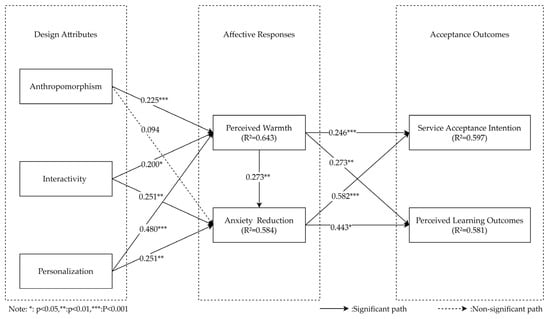
The structural model analysis examined the relationships between the constructs and their effects on the acceptance of AI museum guides. Personalization showed significant positive associations with the perceived warmth (β = 0.480, T = 7.881, and p < 0.001) and anxiety reduction (β = 0.251, T = 3.162, and p = 0.002). The interactivity significantly affected the perceived warmth (β = 0.200, T = 2.540, and p = 0.011) and anxiety reduction (β = 0.251, T = 3.455, and p = 0.001), with a stronger effect on anxiety.
The direct path from anthropomorphism to anxiety reduction was not significant (β = 0.094, t = 1.390, and p = 0.165). However, the bootstrapping analysis (5000 iterations) showed a significant indirect effect through perceived warmth (β_indirect = 0.062, 95% CI [0.018, 0.124], p < 0.05), indicating an indirect-only mediation relationship [73,74,75]. This mediation structure suggests that human-like features affected anxiety reduction indirectly through the perceived warmth.
Anxiety reduction showed significant positive associations with acceptance intention (β = 0.582, T = 9.582, and p < 0.001) and perceived learning outcomes (β = 0.443, T = 6.605, and p < 0.001), which is consistent with the research showing that psychological barriers impede learning engagement [28,76].
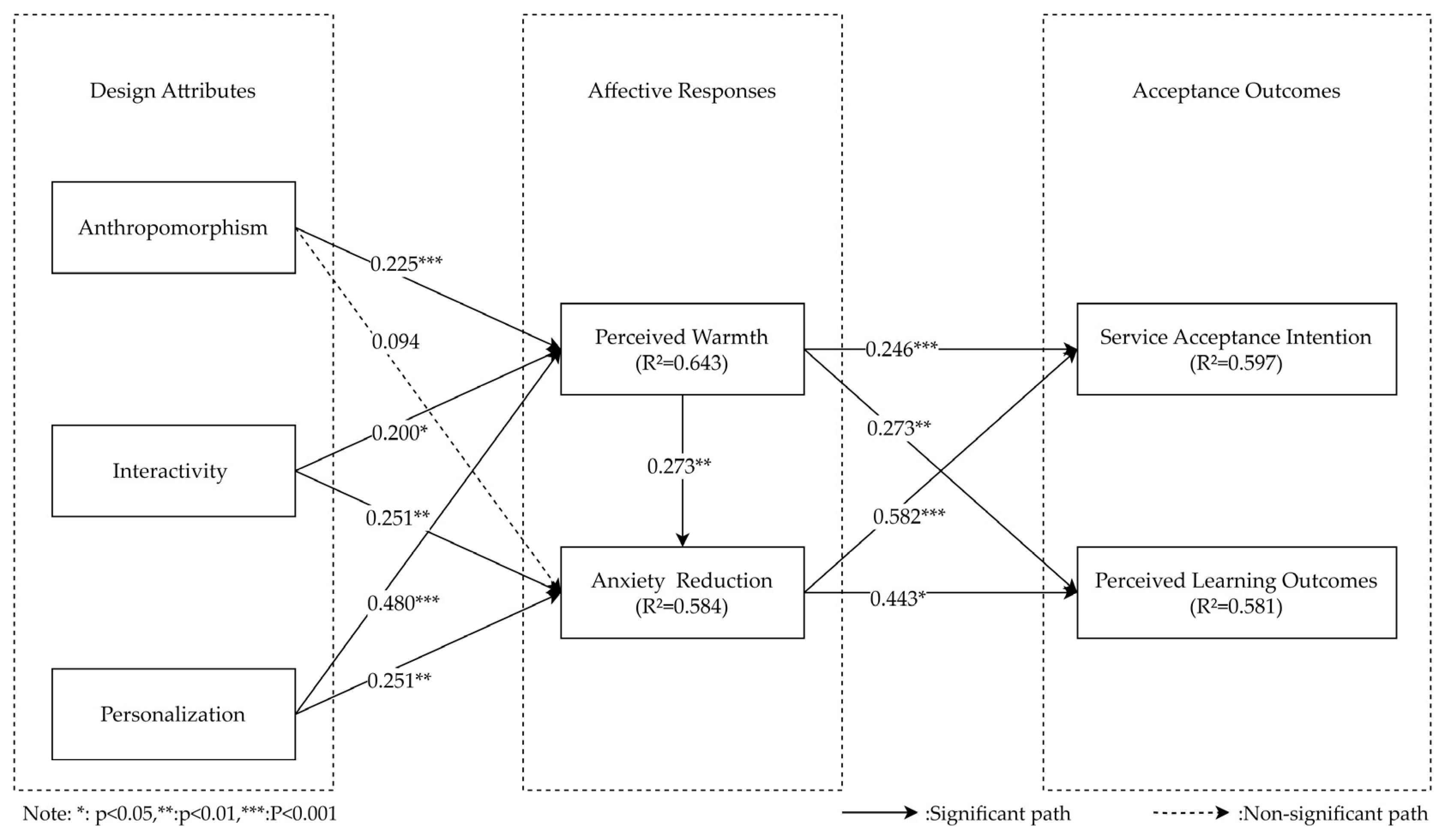
The hypothesis testing outcomes are summarized in Table 7, and Figure 2 displays the empirically validated structural model with standardized path coefficients and significance levels.
Figure 2.
The empirical structural model with standardized coefficients and p-values. Note: * p < 0.05; ** p < 0.01; and *** p < 0.001. M and F stand for male and female, respectively. Difference ∆β is calculated as M minus F; the negative values indicate stronger effects for females. For example, H5b shows ∆β = −0.280, indicating that anxiety reduction more strongly translates into learning outcomes for female students compared to male students. Difference ∆β (M-F) p-values test whether path coefficients differ significantly between gender groups. Non-significant p-values (p > 0.05) indicate statistically equivalent effects across genders, supporting the universal design applicability. Only H5b showed a significant gender moderation (p = 0.039).
Table 7.
A summary of the hypothesized associations.
Table 8.
The mediation analysis results via perceived warmth.
4.4. Multi-Group Analysis
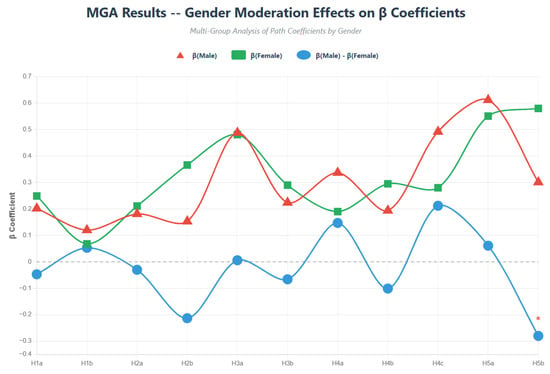
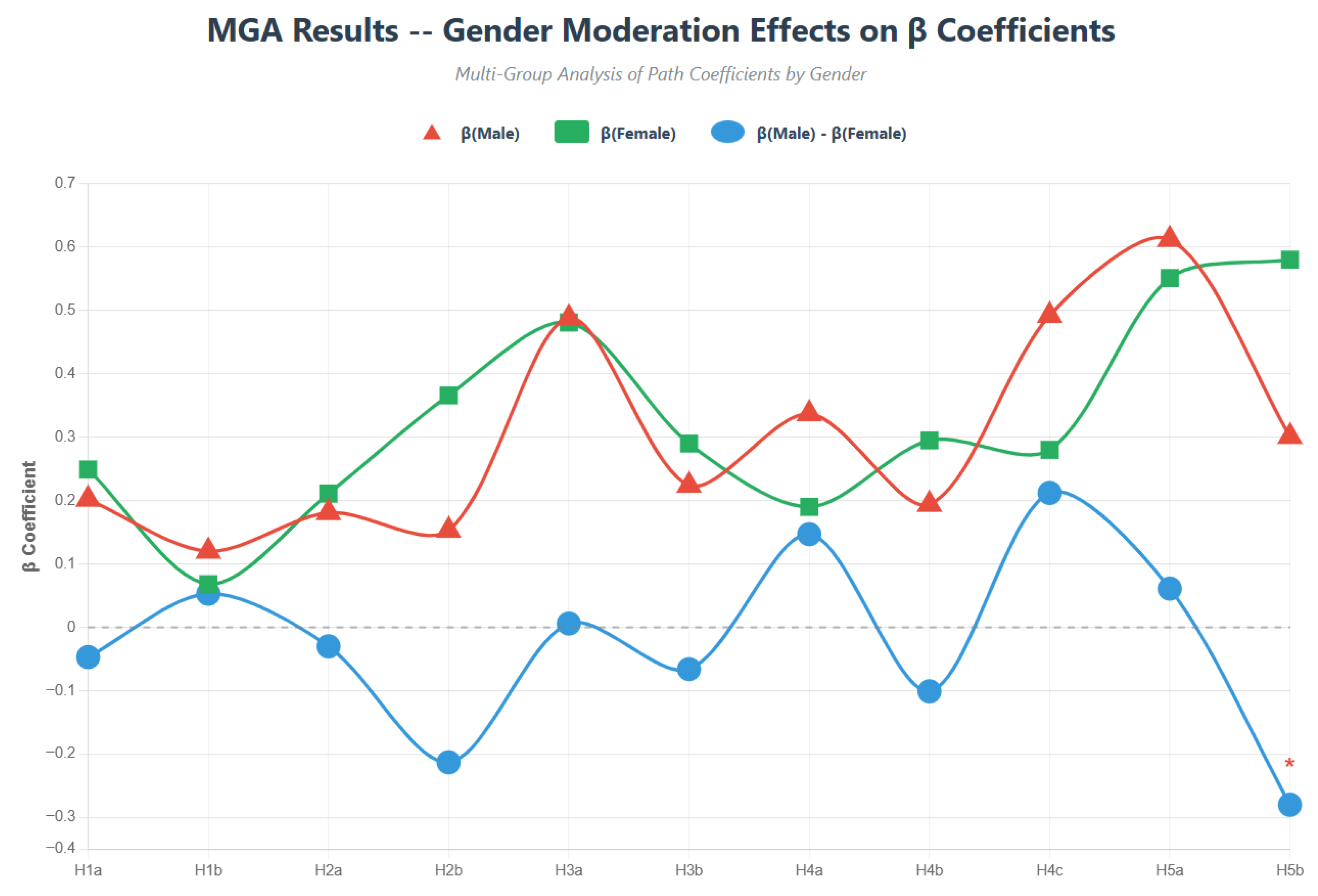
To assess the robustness of the design effects across the user groups, we compared path coefficients between the male and female students using partial least squares multi-group analysis (PLS-MGA) in SmartPLS 4. Figure 2 presents the empirical structural model with standardized coefficients and significance levels. The multi-group analysis results are reported in Table 9, and Figure 3 visualizes the path coefficient comparisons across all the hypothesized relationships.
Table 9.
The multi-group analysis: the gender moderation effects on structural paths.
Figure 3.
The multi-group analysis results: the gender moderation effects on path coefficients. The significance levels: * p < 0.001.
The multi-group analysis showed consistency in the design effects across genders. Ten of the eleven tested pathways showed no significant differences (all Δβ p > 0.05), indicating that the core design features—anthropomorphism, interactivity, and personalization—produced similar effects regardless of gender. The key design-to-perception pathways showed no gender moderation (all p > 0.05).
Anxiety reduction’s effect on the perceived learning outcomes was significantly stronger for female students (β = 0.580) than male students (β = 0.301; ∆β = −0.280 and p = 0.039) [13,77]. This difference emerged not in how design features reduce anxiety (equivalent across genders), but in the downstream translation of psychological comfort into the learning outcome perceptions. This suggests that gender may moderate the relationship between anxiety reduction and learning outcome perceptions, though the underlying mechanism requires further investigation. Overall, 90.9% of tested mechanisms operated consistently across genders, supporting the universal design principles for AI museum guides in museum learning contexts.
5. Discussion
This study examined how AI museum guide design features influence acceptance and perceived learning outcomes through psychological pathways in museum contexts. Throughout this discussion, ‘learning outcomes’ denotes the students’ subjective evaluations rather than objectively verified knowledge gains, which is a distinction warranting caution given the possible fluency-based metacognitive biases. Testing the proposed stimulus–organism–response (S-O-R) framework integrated with the Computers are Social Actors (CASA) principles [22]. The integration of the CASA theory within the S-O-R framework provides a theoretical lens for understanding AI acceptance, where design features serve as environmental stimuli (S) that influence the psychological states (O), which in turn affect the behavioral responses (R). The findings support the S-O-R framework, showing that anxiety reduction is a critical mediator, with mechanisms operating consistently across genders except for one pathway. The following discussion interprets findings within the specific context of Chinese high school students participating in curriculum-integrated museum visits. The cultural and educational factors—such as examination-oriented schooling and attitudes toward authority—may shape these results. Readers should exercise caution when extending these findings to other populations or cultural settings.
This study makes three key contributions. First, indirect-only mediation reveals that anthropomorphism is associated with anxiety reduction exclusively through perceived warmth rather than direct cognitive reassurance. Second, museum anxiety stems from cognitive uncertainty when navigating unfamiliar content independently, distinct from social-evaluative anxiety in classroom settings, necessitating a context-specific design. Third, anthropomorphism, personalization, and interactivity serve as psychologically distinct functions: anthropomorphism compensates for the limited human interaction, while personalization and interactivity address the cognitive uncertainty through both direct and warmth-mediated pathways.
The gender invariance finding (the equivalent of 10 of the 11 paths) validates the mechanism’s robustness and simplifies the design decisions by prioritizing mechanism optimization over demographic segmentation. However, this should not overshadow the primary theoretical advances regarding affective pathway differentiation.
5.1. Pathway Differentiation Among Design Features
While anthropomorphism, interactivity, and personalization are common design principles, their psychological mechanisms differ between supervised and self-directed learning contexts. Anthropomorphism shows the strongest association with perceived warmth, a pattern that is consistent with a social compensation function during solitary exploration. The indirect-only mediation pattern suggests that human-like features are associated with anxiety reduction exclusively through emotional warmth rather than directly. Interactivity addresses cognitive uncertainty by providing non-judgmental inquiry support. Personalization serves dual functions—enhancing the affective bonds and directly reducing anxiety—because self-directed learning requires both emotional support and adaptive content [2]. This indirect-only mediation pattern aligns with the CASA theory’s prediction that social cues require affective intermediation [22], and extends Fernandes and Oliveira’s findings on anthropomorphic technology acceptance by specifying the perceived warmth as the critical mediating mechanism [38].
The non-significant direct effect invites a nuanced interpretation [16]. While museum contexts eliminate the continuous social evaluation from teachers and peers, students may transfer evaluative concerns to AI interaction partners. Anthropomorphism’s indirect-only mediation through warmth suggests that human-like features reduce anxiety specifically by establishing the AI as a non-judgmental, approachable interaction partner (captured by LA1 and LA2). This pattern suggests that anthropomorphism functions primarily as a social–emotional resource for establishing psychological safety with the AI, while personalization and interactivity provide more direct cognitive scaffolding for navigating unfamiliar content. As noted in our operationalization, the anxiety measure captured both the judgment concerns and the uncertainty relief. The significant path from warmth to anxiety reduction suggests the perceived warmth addresses both components—establishing the AI as non-judgmental while creating psychological safety for asking questions.
The mediation analysis reveals three distinct pathways (see Table 8). Anthropomorphism exhibits indirect-only mediation through warmth. In contrast, personalization and interactivity exhibit partial mediation, maintaining significant direct effects alongside the warmth-mediated pathways. This pattern shows that functional features provide immediate cognitive utility through direct anxiety reduction, while social cues require affective intermediation. This finding is consistent with Li et al.’s S-O-R framework application in virtual museums, where interactivity directly influenced psychological states [10], and extends He and Wang’s work on museum guides by demonstrating the anxiety-specific pathway.
Research on anthropomorphic robots in museum exhibitions confirms that while humanoid features create pleasant interactions, sustained engagement requires substantive dialog capabilities beyond superficial appearance [4], supporting the finding that social presence through anthropomorphism and anxiety reduction operate through distinct pathways.
This dissociation supports coordinated design: anthropomorphism for emotional rapport, personalization for adaptive scaffolding, and interactivity for uncertainty resolution. This dual function supports Plass and Pawar’s taxonomy of adaptivity, demonstrating that personalization operates through both cognitive and affective channels in informal learning contexts [2].
5.2. Anxiety Reduction as Critical Pathway
The findings support the S-O-R framework’s proposal that psychological states mediate design feature effects. Anxiety reduction emerged as the strongest predictor of both acceptance intention and learning outcomes, consistent with research identifying anxiety as a barrier in educational technology adoption [78]. This effect was achieved through personalization, interactivity, and perceived warmth. This finding extends Wang et al.’s work on AI anxiety as a learning barrier [78] and aligns with Yan et al.’s demonstration that anxiety-reducing design features enhance service acceptance [25].
Museum characteristics may amplify these anxiety reduction mechanisms. The low- threat environment characterized by voluntary participation, absence of evaluative judgment, and self-paced exploration contrasts with both formal classrooms (where students face performance evaluation) and structured docent tours (where pacing is externally controlled). This combination of autonomy and low evaluative pressure may allow design features to reduce anxiety more effectively than in high-stakes classroom settings. In such contexts, AI systems may be perceived as providing challenges without the threat of maintaining intellectual stimulation while minimizing evaluative pressure. This pattern supports Falk’s characterization of museums as identity-relevant contexts where affective states significantly shape engagement [23], and extends Wong and Wong’s service robot acceptance model by identifying anxiety reduction as the primary affective mechanism [30].
These findings suggest that the anxiety-sensitive design merits prioritization because anxiety reduction predicted both outcomes. The AI systems could acknowledge content complexity to normalize learner concerns while providing progressive support, preventing feelings of inadequacy. The absence of evaluative pressure in museums makes them contexts where anxiety reduction can be treated as a core design consideration.
5.3. Robustness Across Gender Groups and Individual Variation
The multi-group analysis demonstrated substantial consistency across genders. Ten of the eleven tested pathways (90.9%) operated equivalently: anthropomorphism enhancing warmth, interactivity reducing anxiety, and personalization serving dual functions showed no significant gender moderation (all Δβ p-values > 0.05; see Table 7 and Figure 3). This consistency suggests the psychological processes underlying AI acceptance in museum contexts reflect the common human responses to technology design rather than gender-differentiated preferences. This consistency contrasts with Goetz et al.’s findings of gender differences in classroom anxiety [13], suggesting that the informal museum context may attenuate gender-specific technology interaction patterns documented in formal educational settings [79].
This consistency reveals characteristics about museum anxiety and technology acceptance in informal learning. The low-threat, self-directed character of museum learning appears to reduce many gender-specific technology interaction patterns documented in formal educational settings [79]. When the evaluative pressure is absent and exploration is voluntary, both genders respond similarly to the features providing cognitive scaffolding and emotional support.
One pathway showed significant gender moderation: anxiety reduction’s association with perceived learning outcomes was stronger for females than males. Importantly, this difference emerged in the downstream translation of psychological comfort into learning perceptions, not in how design features reduce anxiety (which operated equivalently across genders) [13]. This differential translation of anxiety reduction into learning perceptions echoes patterns in mathematics anxiety research, where females show stronger relationships between affective states and performance outcomes [13,79]. The mechanism underlying this difference warrants further investigation.
For design purposes, this finding suggests monitoring individual behavioral indicators (e.g., help-seeking patterns and confidence calibration) rather than demographic categories when calibrating affective support, thereby addressing individual variation without gender stereotyping.
5.4. Theoretical Contributions and Practical Implications
This study extends the S-O-R and CASA frameworks by demonstrating that AI acceptance in museums operates through dual affective pathways—emotional warmth and anxiety reduction—rather than primarily through cognitive utility evaluations. The observed pathway structure is consistent with a sequential process where affective features establishing emotional readiness may precede cognitive features providing anxiety reduction, though the cross-sectional design cannot confirm temporal ordering.
We demonstrated mechanistic specialization among the design features previously treated as interchangeable. Anthropomorphism functions as a social presence builder, enhancing warmth with indirect anxiety reduction. Personalization serves dual functions, providing both warmth enhancement and direct anxiety reduction through adaptive content. Interactivity functions as a cognitive scaffold, showing direct association with anxiety reduction via uncertainty mitigation. We also identified that cognitive uncertainty anxiety is museum-specific compared to the social-evaluative anxiety in classrooms, highlighting the importance of a context-sensitive design. The gender invariance provides evidence that identified pathways reflect fundamental human–AI interaction patterns rather than demographic artifacts.
These findings suggest three design considerations. The design frameworks could implement layered architectures: anthropomorphic features establish emotional readiness, personalization provides adaptive cognitive support, and responsive interactivity confirms comprehension. An anxiety-sensitive design merits prioritization, given that anxiety reduction predicted both outcomes. The substantial gender invariance (90.9% of pathways) supports deploying unified implementations while monitoring individual behavioral indicators to calibrate affective support dynamically.
These contributions should be interpreted within the study’s boundary conditions that are detailed in Section 6.2.
Future research should conduct controlled experiments manipulating the specific anthropomorphic features, interactivity modalities, and personalization algorithms to establish causal relationships. The longitudinal studies tracking acceptance over extended periods would clarify whether the mechanisms remain stable as the novelty diminishes. Cross-cultural replications would test whether affective pathways operate similarly across societies and whether anxiety sources vary across cultural norms for informal learning.
6. Conclusions and Future Works
This study examined how AI museum guide design features influence acceptance through emotional engagement, anxiety reduction, and gender moderation in museum contexts, contributing to the understanding of AI acceptance in informal learning environments.
6.1. Conclusions
This study makes three key contributions. First, anthropomorphism showed the strongest association with perceived warmth among the three design features. The indirect-only mediation pattern—where anthropomorphism relates to anxiety reduction exclusively through warmth rather than directly—represents a novel finding for museum contexts. Second, the findings show mechanistic differentiation: anthropomorphism reduces anxiety through perceived warmth, while personalization and interactivity directly reduce anxiety through adaptive content and cognitive scaffolding. This distinction enables layered design strategies where features address complementary psychological needs. Third, ten of the eleven pathways operated equivalently across genders, validating the mechanism’s robustness. The single exception in anxiety’s effect on learning suggests that adaptive systems could respond to individual behavioral indicators rather than demographic categories.
These findings apply the CASA principles to museum contexts, showing that AI acceptance operates through emotional warmth and anxiety reduction. For design, anthropomorphic features should prioritize empathetic tone over superficial visual resemblance, personalization should include adaptive content to build warmth and reduce cognitive overload, and interactive features should use open-ended prompts to normalize uncertainty. The adaptive systems could monitor behavioral indicators such as follow-up question frequency and self-assessment confidence to calibrate support rather than using demographic segmentation.
These findings and recommendations should be interpreted within the boundary conditions of this study: Chinese high school students in curriculum-integrated museum programs. While the dual-pathway mechanism offers a theoretically grounded framework, practitioners implementing AI museum guides in different cultural or educational contexts should consider local factors that may moderate the pathway strengths.
6.2. Limitations and Future Research
There are several limitations that should be noted. First, cultural and contextual boundaries constrain generalizability. The sample comprised Chinese high school students in policy-mandated museum programs, where curriculum integration creates a structured institutional environment differing from voluntary Western museum visits. Although students retained autonomy in navigation and AI usage, the curriculum-embedded context may retain implicit academic expectations despite the absence of a formal assessment. Therefore, the strong anxiety reduction effect should be interpreted within this hybrid voluntary–mandatory context rather than as evidence from purely self-directed visits. Future research should compare mandatory field trips with voluntary museum visits to isolate the contextual effects on the anxiety mechanisms. Additionally, cultural factors may influence generalizability: Confucian values that emphasize respect for authority may increase trust in AI guidance, and China’s favorable policy environment toward educational technology may create more positive baseline attitudes than in other societies. Cross-cultural replications should examine whether these pathways remain stable across educational philosophies and cultural contexts, comparing Chinese students with Western samples and extending to other age groups such as university students and adult learners.
Second, the methodological constraints limit the causal and ecological validity. Classroom-based administration ensured ethical oversight for minors but reduced the ecological validity—future studies should collect the data during actual museum visits. Additionally, this study did not conduct a formal pilot test with a separate sample prior to the main data collection. While all measurement instruments were adapted from previously validated scales, and item refinement was performed during the measurement model validation, a dedicated pilot study could have strengthened the measurement quality. The cross-sectional design captures the AI novelty effects; the longitudinal studies are needed to track the mechanism stability as habituation occurs. Additionally, prior museum familiarity and domain knowledge may moderate the AI feature effects and should be controlled in future research.
Third, the measurement limitations constrain conclusions about actual learning. This study relied on self-reported perceived learning, which may be inflated through fluency misattribution, effort-outcome decoupling, or affective halo effects. The students receiving extensive scaffolding report higher perceived learning but show equivalent or lower retention, suggesting affective comfort does not guarantee knowledge consolidation. While perceived learning aligns with S-O-R’s subjective focus, future research should incorporate objective assessments such as pre- and post-tests and delayed recall to validate whether AI features enhancing perceived learning also promote actual retention. This limitation is particularly relevant given our emphasis on anxiety reduction. When AI interactions feel comfortable, students may experience inflated learning confidence—the strong path from anxiety reduction to perceived learning may partly reflect fluency-based judgment bias rather than genuine learning gains.
Fourth, the social compensation interpretation remains speculative. Our anthropomorphism items assessed perceived naturalness of AI communication but did not measure loneliness or social needs during visits. Alternatively, the observed warmth effect may simply reflect that human-like features increase general approachability regardless of social needs. Future research should include loneliness measures to distinguish these mechanisms.
Fifth, our anxiety measure combines concern about AI judgment (LA1, LA2) and cognitive uncertainty relief (LA3). This integrated measure cannot determine whether design features differentially address these two sources. Future research could develop separate subscales to test whether anthropomorphism primarily reduces judgment concerns while interactivity primarily addresses cognitive uncertainty. Additionally, the single significant gender moderation among the eleven tested paths raises the possibility of a Type I error, and the underlying mechanism remains speculative without measuring variables such as metacognitive processing or baseline anxiety levels.
Future research could address these limitations through controlled experiments establishing causal relationships, longitudinal designs capturing affective adaptation, multi-method approaches combining self-reports with physiological measures, and objective learning assessments (pre- and post-tests and delayed recall), validating whether perceived learning gains reflect actual retention.
Author Contributions
Conceptualization, L.W., X.W., C.W. and G.R.; methodology, L.W., X.W., C.W. and Y.Z.; software, X.W. and Y.Z.; validation, L.W., C.W. and G.R.; formal analysis, X.W. and Y.Z.; investigation, L.W. and X.W.; resources, C.W. and G.R.; data curation, X.W. and Y.Z.; writing—original draft preparation, L.W., X.W. and Y.Z.; writing—review and editing, L.W., X.W., C.W. and G.R.; visualization, X.W.; supervision, G.R.; project administration, L.W. All authors have read and agreed to the published version of the manuscript.
Funding
This study was supported by (1) the Fujian Provincial Science and Technology Program (no. 2025R0103) and (2) the General Program of the National Natural Science Foundation of China (no. 42171243).
Institutional Review Board Statement
This research adhered to the principles outlined in the Declaration of Helsinki and received ethical approval from the Institutional Review Board of School of Design Arts, Xiamen University of Technology (Approval Number: XMUT-SDA-IRB-2025-09/012). All participants provided informed consent prior to their involvement in the research.
Informed Consent Statement
Informed consent was obtained from all subjects involved in the study.
Data Availability Statement
All data are contained within the manuscript. Raw data are available from the corresponding author upon request.
Conflicts of Interest
The authors declare no conflicts of interest.
References
- Li, W.; Zhang, X.; Li, J.; Yang, X.; Li, D.; Liu, Y. An explanatory study of factors influencing engagement in AI education at the K-12 level: An extension of the classic TAM model. Sci. Rep. 2024, 14, 13922. [Google Scholar] [CrossRef] [Scilit]
- Plass, J.L.; Pawar, S. Toward a taxonomy of adaptivity for learning. J. Res. Technol. Educ. 2020, 52, 275–300. [Google Scholar] [CrossRef] [Scilit]
- Velentza, A.-M.; Heinke, D.; Wyatt, J. Museum robot guides or conventional audio guides? An experimental study. Adv. Rob. 2020, 34, 1571–1580. [Google Scholar] [CrossRef] [Scilit]
- Maniscalco, U.; Minutolo, A.; Storniolo, P.; Esposito, M. Towards a more anthropomorphic interaction with robots in museum settings: An experimental study. Rob. Auton. Syst. 2024, 171, 104561. [Google Scholar] [CrossRef] [Scilit]
- Varitimiadis, S.; Kotis, K.; Pittou, D.; Konstantakis, G. Graph-based conversational AI: Towards a distributed and collaborative multi-chatbot approach for museums. Appl. Sci. 2021, 11, 9160. [Google Scholar] [CrossRef] [Scilit]
- Gao, J.; Guo, J.; Yao, S.; Yin, Y. The impact of anthropomorphic AI devices on tourists’ revisit intentions: Based on the stimulus-organism-response framework. Tour. Rev. 2026, 1–18. [Google Scholar] [CrossRef] [Scilit]
- Glikson, E.; Woolley, A.W. Human trust in artificial intelligence: Review of empirical research. Acad. Manag. Ann. 2020, 14, 627–660. [Google Scholar] [CrossRef] [Scilit]
- Epley, N.; Waytz, A.; Cacioppo, J.T. On seeing human: A three-factor theory of anthropomorphism. Psychol. Rev. 2007, 114, 864–886. [Google Scholar] [CrossRef] [Scilit]
- Chi, M.T.H.; Wylie, R. The ICAP framework: Linking cognitive engagement to active learning outcomes. Educ. Psychol. 2014, 49, 219–243. [Google Scholar] [CrossRef] [Scilit]
- Li, J.; Zhou, L.; Wei, W. Analyzing factors influencing learning motivation in online virtual museums using the S-O-R model: A case study of the national museum of natural history. Information 2025, 16, 573. [Google Scholar] [CrossRef] [Scilit]
- Abinaya, M.; Vadivu, G. Identification of social anxiety in high school: A machine learning approaches to real-time analysis of student characteristics. IEEE Access 2024, 12, 77932–77946. [Google Scholar] [CrossRef] [Scilit]
- Cai, N.; Gao, S.; Yan, J. How the communication style of chatbots influences consumers’ satisfaction, trust, and engagement in the context of service failure. Humanit. Soc. Sci. Commun. 2024, 11, 687. [Google Scholar] [CrossRef] [Scilit]
- Goetz, T.; Bieg, M.; Lüdtke, O.; Pekrun, R.; Hall, N.C. Do girls really experience more anxiety in mathematics? Psychol. Sci. 2013, 24, 2079–2087. [Google Scholar] [CrossRef] [Scilit]
- Wang, Y.-Y. “Just learn it?” How individual differences and HMSAM impact learners’ intention to engage in AI-related education. Educ. Inf. Technol. 2025, 30, 959–983. [Google Scholar] [CrossRef] [Scilit]
- Baylor, A.L.; Kim, Y. Simulating instructional roles through pedagogical agents. Int. J. Artif. Intell. Educ. 2005, 15, 95–115. [Google Scholar] [CrossRef] [Scilit]
- Pianesi, F.; Graziola, I.; Zancanaro, M.; Goren-Bar, D. The motivational and control structure underlying the acceptance of adaptive museum guides–an empirical study. Interact. Comput. 2009, 21, 186–200. [Google Scholar] [CrossRef] [Scilit]
- Hou, P.; Qiu, H.; Ren, L.; Jia, B.; Wang, J. Understanding visitors’ trust in human−robot interaction in museum scene: An elaboration likelihood perspective. J. Hosp. Tour. Technol. 2025; in press. [CrossRef] [Scilit]
- Fiske, S.T.; Cuddy, A.J.C.; Glick, P. Universal dimensions of social cognition: Warmth and competence. Trends Cogn. Sci. 2007, 11, 77–83. [Google Scholar] [CrossRef] [Scilit] [PubMed]
- Ren, G.; Wu, X.; Huang, Z.; Zhang, B. Investigating service robot acceptance factors: The role of emotional design, communication style, and gender groups. Information 2025, 16, 463. [Google Scholar] [CrossRef] [Scilit]
- Uslu, A.; Tosun, P. Examining the impact of the fear of missing out on museum visit intentions. J. Hosp. Tour. Res. 2024, 48, 1097–1112. [Google Scholar] [CrossRef] [Scilit]
- Kline, R.B. Response to Leslie Hayduk’s review of principles and practice of structural equation modeling. Can. Stud. Popul. 2018, 45, 188. [Google Scholar] [CrossRef] [Scilit]
- Nass, C.; Moon, Y. Machines and mindlessness: Social responses to computers. J. Soc. Issues 2000, 56, 81–103. [Google Scholar] [CrossRef] [Scilit]
- Falk, J.H. Identity and the Museum Visitor Experience; Left Coast Press: Walnut Creek, CA, USA, 2009. [Google Scholar]
- Iio, T.; Satake, S.; Kanda, T.; Hayashi, K.; Ferreri, F.; Hagita, N. Human-like guide robot that proactively explains exhibits. Int. J. Soc. Robot. 2020, 12, 549–566. [Google Scholar] [CrossRef] [Scilit]
- Yan, J.; Luo, B.; Zhang, T. Can cuteness soften my anxiety? The impact of conversational styles of service robots on consumer service acceptance. Int. J. Contemp. Hosp. Manag. 2025, 37, 763–782. [Google Scholar] [CrossRef] [Scilit]
- Turner, J.E. Researching state shame with the experiential shame scale. J. Psychol. 2014, 148, 577–601. [Google Scholar] [CrossRef] [Scilit]
- Zhang, B.; Li, W.; Jou, M. The influence of generative artificial intelligence support on learning anxiety and academic expectation stress: The mediating role of self-efficacy. Interact. Learn. Environ. 2025, 1–17. [Google Scholar] [CrossRef] [Scilit]
- Litman, J.A. Interest and deprivation factors of epistemic curiosity. Personal. Individ. Differ. 2008, 44, 1585–1595. [Google Scholar] [CrossRef] [Scilit]
- Yang, Y.; Cho, H.-K.; Kim, M.-Y. A study on factors affecting the continuance usage intention of social robots with episodic memory: A stimulus–organism–response perspective. Appl. Sci. 2025, 15, 5334. [Google Scholar] [CrossRef] [Scilit]
- Wong, A.; Wong, J. Service robot acceptance in museums: An empirical study using the service robot acceptance model (sRAM). J. Serv. Mark. 2024, 38, 619–635. [Google Scholar] [CrossRef] [Scilit]
- Komarac, T.; Ozretić Došen, Đ. Discovering the determinants of museum visitors’ immersion into experience: The impact of interactivity, expectations, and skepticism. Curr. Issues Tour. 2022, 25, 3675–3693. [Google Scholar] [CrossRef] [Scilit]
- Hao, X.; Xu, J.; Wang, Y. How generative AI shapes user perceived value and adoption intention in digital museum experiences. NPJ Herit. Sci. 2025, 13, 608. [Google Scholar] [CrossRef] [Scilit]
- Cheng, A.; Ma, D.; Pan, Y.; Qian, H. Enhancing museum visiting experience: Investigating the relationships between augmented reality quality, immersion, and TAM using PLS-SEM. Int. J. Hum.-Comput. Interact. 2024, 40, 4521–4532. [Google Scholar] [CrossRef] [Scilit]
- Cheng, A.; Zhang, W.; Feng, A.; Wu, Y.; Li, W. Exploring psychological dimensions of augmented reality in education: A study on learning motivation and achievement in museums. Front. Psychol. 2025, 16, 1514117. [Google Scholar] [CrossRef] [Scilit]
- Bitgood, S. An Attention-Value Model of Museum Visitors; Center for Advancement of Informal Science Education: Washington, DC, USA, 2010. [Google Scholar]
- Nass, C.; Steuer, J.; Tauber, E.R. Computers are social actors. In Proceedings of the SIGCHI Conference on Human Factors in Computing Systems, Boston, MA, USA, 24–28 April 1994; pp. 72–78. [Google Scholar]
- Zhang, F.; Zhou, Z.; Sheng, D. Explore the anthropomorphism of service bots in tourism: A MASEM analysis based on stereotype content model. Curr. Issues Tour. 2025, 1–21. [Google Scholar] [CrossRef] [Scilit]
- Fernandes, T.; Oliveira, E. Understanding consumers’ acceptance of automated technologies in service encounters: Drivers of digital voice assistants adoption. J. Bus. Res. 2021, 122, 180–191. [Google Scholar] [CrossRef] [Scilit]
- Wang, Y.-Y.; Chuang, Y.-W. Artificial intelligence self-efficacy: Scale development and validation. Educ. Inf. Technol. 2024, 29, 4785–4808. [Google Scholar] [CrossRef] [Scilit]
- He, Y.; Wang, W. Factors influencing visitors’ use of augmented reality technology in museum guided tours. PLoS ONE 2025, 20, e0332688. [Google Scholar] [CrossRef] [Scilit]
- Kang, J.H.; Jang, J.C.; Jeong, C. Understanding museum visitor satisfaction and revisit intentions through mobile guide system: Moderating role of age in museum mobile guide adoption. Asia Pac. J. Tour. Res. 2018, 23, 95–108. [Google Scholar] [CrossRef] [Scilit]
- Lin, G.-Y.; Jhang, C.-C.; Wang, Y.-S. Factors affecting parental intention to use AI-based social robots for children’s ESL learning. Educ. Inf. Technol. 2024, 29, 6059–6086. [Google Scholar] [CrossRef] [Scilit]
- Liu, X.; He, X.; Wang, M.; Shen, H. What influences patients’ continuance intention to use AI-powered service robots at hospitals? The role of individual characteristics. Technol. Soc. 2022, 70, 101996. [Google Scholar] [CrossRef] [Scilit]
- Zhang, K.; Luo, J.; Huang, Q.; Zhang, K.; Du, J. The effect of perceived interactivity on continuance intention to use AI conversational agents: A two-stage hybrid PLS-ANN approach. J. Theor. Appl. Electron. Commer. Res. 2025, 20, 255. [Google Scholar] [CrossRef] [Scilit]
- Chattaraman, V.; Kwon, W.-S.; Gilbert, J.E.; Ross, K. Should AI-based, conversational digital assistants employ social- or task-oriented interaction style? A task-competency and reciprocity perspective for older adults. Comput. Hum. Behav. 2019, 90, 315–330. [Google Scholar] [CrossRef] [Scilit]
- Hirano, T.; Shiomi, M.; Iio, T.; Obaid, M.; Nishio, S.; Ishiguro, H. How do communication cues change impressions of human–robot touch interaction? Int. J. Soc. Robot. 2018, 10, 21–31. [Google Scholar] [CrossRef] [Scilit]
- Belanche, D.; Casaló, L.V.; Schepers, J.; Flavián, C. Examining the effects of robots’ physical appearance, warmth, and competence in frontline services: The humanness-value-loyalty model. Psychol. Mark. 2021, 38, 2357–2376. [Google Scholar] [CrossRef] [Scilit]
- Wong, J.; Wong, A. Consumer resistance to service robots: A stressor-based perspective on engagement and wellbeing. J. Consum. Mark. 2025, 42, 56–71. [Google Scholar] [CrossRef] [Scilit]
- Ma, D.; Cheng, A.; Qian, H. Exploring the structural relationships between augmented reality quality, perceived value, and psychological well-being in museum applications: A PLS-SEM analysis. Libr. Hi Tech 2025, 43, 1137–1156. [Google Scholar] [CrossRef] [Scilit]
- Xiao, J.; Xu, J. Exploring Gen Z’s perceptions of virtual tour guide narratives in heritage tourism: An integrated approach of TAM and destination image theory. J. China Tour. Res. 2025, 1–27. [Google Scholar] [CrossRef] [Scilit]
- Eysenck, M.W.; Derakshan, N.; Santos, R.; Calvo, M.G. Anxiety and cognitive performance: Attentional control theory. Emotion 2007, 7, 336–353. [Google Scholar] [CrossRef] [Scilit]
- Abreh, M.K.; Arthur, F.; Akwetey, F.A.; Nortey, S.A. Modelling STEM students’ intention to learn artificial intelligence (AI) in Ghana: A PLS-SEM and fsQCA approach. Discov. Atif. Intell. 2025, 5, 223. [Google Scholar] [CrossRef] [Scilit]
- Fuentes-Moraleda, L.; Lafuente-Ibañez, C.; Fernandez Alvarez, N.; Villace-Molinero, T. Willingness to accept social robots in museums: An exploratory factor analysis according to visitor profile. Libr. Hi Tech 2022, 40, 894–913. [Google Scholar] [CrossRef] [Scilit]
- Lin, H.; Chen, Q. Artificial intelligence (AI)-integrated educational applications and college students’ creativity and academic emotions: Students and teachers’ perceptions and attitudes. BMC Psychol. 2024, 12, 487. [Google Scholar] [CrossRef] [Scilit]
- Zhou, X.B. Exploring the Impact of Design Features on Users’ Continuance Intention in Mixed Reality Museums: Evidence from PLS-SEM. Available online: https://papers.ssrn.com/sol3/papers.cfm?abstract_id=5370830 (accessed on 15 March 2026).
- Hooper-Greenhill, E. Museums and Education: Purpose, Pedagogy, Performance; Routledge: London, UK, 2007. [Google Scholar]
- Jeilani, A.; Abubakar, S. Perceived institutional support and its effects on student perceptions of AI learning in higher education: The role of mediating perceived learning outcomes and moderating technology self-efficacy. Front. Educ. 2025, 10, 1548900. [Google Scholar] [CrossRef] [Scilit]
- Puspasari, S.; Ermatita; Zulkardi. Innovative virtual museum conceptual model for learning enhancement during the pandemic. In Proceedings of the 2022 11th Electrical Power, Electronics, Communications, Controls and Informatics Seminar (EECCIS), Malang, Indonesia, 1–3 August 2022; pp. 339–344. [Google Scholar] [CrossRef] [Scilit]
- Ryan, R.M.; Deci, E.L. Self-determination theory and the facilitation of intrinsic motivation, social development, and well-being. Am. Psychol. 2000, 55, 68–78. [Google Scholar] [CrossRef] [PubMed]
- Davis, F.D. Perceived usefulness, perceived ease of use, and user acceptance of information technology. MIS Q. 1989, 13, 319–340. [Google Scholar] [CrossRef] [Scilit]
- Lu, L.; Cai, R.; Gursoy, D. Developing and validating a service robot integration willingness scale. Int. J. Hosp. Manag. 2019, 80, 36–51. [Google Scholar] [CrossRef] [Scilit]
- Kai, C.; Ping, W.; Xiaomin, J. AI anxiety and adoption intention in higher education based on an extended TAM-UTAUT and PLS-SEM analysis. Sci. Rep. 2026, 16, 3672. [Google Scholar] [CrossRef] [Scilit]
- Molinillo, S.; Rejón-Guardia, F.; Anaya-Sánchez, R. Exploring the antecedents of customers’ willingness to use service robots in restaurants. Serv. Bus. 2023, 17, 167–193. [Google Scholar] [CrossRef] [Scilit]
- Soncini, A.; Visintin, E.P.; Matteucci, M.C.; Tomasetto, C.; Butera, F. Positive error climate promotes learning outcomes through students’ adaptive reactions towards errors. Learn. Instr. 2022, 80, 101627. [Google Scholar] [CrossRef] [Scilit]
- Pan, J.; Ishak, N.A.; Qin, Y. The application of Moore’s online learning interactions model in learning outcomes: The SOR (stimulus-organism-response) paradigm perspective. Heliyon 2024, 10, e28505. [Google Scholar] [CrossRef] [Scilit]
- Saade, R.; Kira, D. Computer anxiety in E-learning: The effect of computer self-efficacy. J. Inf. Technol. Educ. Res. 2009, 8, 177–191. [Google Scholar] [CrossRef] [Scilit]
- Pekrun, R.; Stephens, E.J. Academic emotions. In APA Educational Psychology Handbook, Vol 2: Individual Differences and Cultural and Contextual Factors; Harris, K.R., Graham, S., Urdan, T., Graham, S., Royer, J.M., Zeidner, M., Eds.; American Psychological Association: Washington, DC, USA, 2012; pp. 3–31. [Google Scholar] [CrossRef] [Scilit]
- Gao, J.; Pan, Y. Evaluating influencing factors of tourists’ experiences with smart tour guide system: A mixed method research. Sustainability 2022, 14, 16320. [Google Scholar] [CrossRef] [Scilit]
- Hair, J.F.; Sarstedt, M.; Ringle, C.M. Rethinking some of the rethinking of partial least squares. Eur. J. Mark. 2019, 53, 566–584. [Google Scholar] [CrossRef] [Scilit]
- Podsakoff, P.M.; MacKenzie, S.B.; Lee, J.-Y.; Podsakoff, N.P. Common method biases in behavioral research: A critical review of the literature and recommended remedies. J. Appl. Psychol. 2003, 88, 879–903. [Google Scholar] [CrossRef] [Scilit]
- Fornell, C.; Larcker, D.F. Evaluating structural equation models with unobservable variables and measurement error. J. Mark. Res. 1981, 18, 39–50. [Google Scholar] [CrossRef] [Scilit]
- Hair, J.F.; Risher, J.J.; Sarstedt, M.; Ringle, C.M. When to use and how to report the results of PLS-SEM. Eur. Bus. Rev. 2019, 31, 2–24. [Google Scholar] [CrossRef] [Scilit]
- Henseler, J.; Ringle, C.M.; Sarstedt, M. A new criterion for assessing discriminant validity in variance-based structural equation modeling. J. Acad. Mark. Sci. 2015, 43, 115–135. [Google Scholar] [CrossRef] [Scilit]
- Leguina, A. A primer on partial least squares structural equation modeling (PLS-SEM). Int. J. Res. Method Educ. 2015, 38, 220–221. [Google Scholar] [CrossRef] [Scilit]
- Zhao, X.; Lynch, J.G.; Chen, Q. Reconsidering Baron and Kenny: Myths and truths about mediation analysis. J. Consum. Res. 2010, 37, 197–206. [Google Scholar] [CrossRef] [Scilit]
- Xiao, H.; Zhao, C.; Tarabashkina, L.; Chen, Y. The effect of zoomorphic AI robot design on consumer tolerance of service failures: The mediating role of perceived warmth. J. Consum. Behav. 2026, 25, 138–158. [Google Scholar] [CrossRef] [Scilit]
- Mo, J.; Chen, H.; Ye, C.; Wang, Z.; Chen, C. Exploring the drivers of users’ adoption of museum digital humans. NPJ Herit. Sci. 2026, 14, 43. [Google Scholar] [CrossRef] [Scilit]
- Wang, Y.-M.; Wei, C.-L.; Lin, H.-H.; Wang, S.-C.; Wang, Y.-S. What drives students’ AI learning behavior: A perspective of AI anxiety. Interact. Learn. Environ. 2022, 32, 2584–2600. [Google Scholar] [CrossRef] [Scilit]
- Devine, A.; Fawcett, K.; Szűcs, D.; Dowker, A. Gender differences in mathematics anxiety and the relation to mathematics performance while controlling for test anxiety. Behav. Brain Funct. 2012, 8, 33. [Google Scholar] [CrossRef] [Scilit] [PubMed]

Disclaimer/Publisher’s Note: The statements, opinions and data contained in all publications are solely those of the individual author(s) and contributor(s) and not of MDPI and/or the editor(s). MDPI and/or the editor(s) disclaim responsibility for any injury to people or property resulting from any ideas, methods, instructions or products referred to in the content. |
© 2026 by the authors. Licensee MDPI, Basel, Switzerland. This article is an open access article distributed under the terms and conditions of the Creative Commons Attribution (CC BY) license.