


Abstract
Transformer-based language models have been increasingly adopted to enhance semantic awareness in web service selection systems. However, the computational cost of large transformer encoders poses significant challenges for real-time and resource-constrained deployment scenarios. This study presents a deployment-oriented hybrid semantic–QoS framework that integrates transformer-based domain-level semantic signals with traditional Quality of Service (QoS) metrics to support scalable service selection pipelines. Rather than aiming to establish end-to-end ranking optimality, this work focuses on a comparative analysis of transformer encoders within a unified pipeline, emphasizing accuracy–latency trade-offs, resource utilization, and deployment feasibility. Four representative BERT family models—BERT, DistilBERT, RoBERTa, and ALBERT—are evaluated under identical experimental conditions. The semantic component operates at the level of domain relevance estimation, and its output is combined with QoS indicators using a controllable weighting mechanism to examine sensitivity to deployment priorities. The results reveal clear trade-offs between semantic expressiveness and computational efficiency, with lightweight models such as DistilBERT demonstrating favorable scalability and response-time characteristics despite reduced semantic capacity. The findings provide practical insights for selecting transformer encoders in QoS-aware service selection pipelines deployed in cloud, edge, or real-time environments. By framing evaluation around deployment feasibility rather than ranking optimality, this study offers guidance for balancing semantic enrichment with operational constraints in real-world service selection systems.
1. Introduction
A web service is a software system that supports interoperable machine-to-machine interaction over a network. It is a collection of protocols and standards for exchanging data between applications or systems over the internet. Businesses can communicate information and functionality with clients and other companies through web services securely and independent of platforms. They are typically created for usage online so that users from various locations can quickly access them. Web services are used in several industries, including finance, healthcare, and retail, to interconnect various systems and share data in real time. They have considerably aided the development of the internet and the digital economy and have become a necessary component of contemporary software development.
Quality of Service (QoS) describes nonfunctional characteristics of web services and is used in collaborative filtering approaches for predicting values and making recommendations. [1] have recognized the QoS attributes of Web services. The top QoS attributes have been identified in Table 1. The attribute values are typically determined by the service provider or by the network administrator. The provider will consider the user’s requirements when determining the QoS attribute values. This causes a challenge due to the need for more standardization of the QoS metrics. Some of the challenges are:
Table 1.
QoS attributes of web service.
- (1)
- Different users or applications have different needs. For example, video streaming applications may require higher bandwidth and lower latency than simple web browsing, which is more tolerant of lower bandwidth and higher latency.
- (2)
- Different providers or vendors may have different metrics to measure QoS, resulting in inconsistency in measuring and reporting QoS.
- (3)
- Complexity in terms of the QoS landscape is constantly evolving as new technologies are developed and deployed.
One example of the real-world implications across industries is banking–whereby web services are crucial for real-time transaction processing and account management. However, the lack of standardized QoS metrics can lead to inconsistencies in service reliability and speed, affecting customer satisfaction and operational efficiency. In the healthcare industry, web services facilitate the exchange of patient data and medical records. Variations in QoS can impact timely access to critical information, potentially affecting patient outcomes. High reliability and low latency are essential for applications like telemedicine and emergency response systems. For online retailers, web service supports functions like inventory management, order processing, and customer relationship management. Inconsistent QoS metrics can lead to disruptions in these services, impacting sales and customer experiences. Ensuring high availability and quick response times is important for maintaining a competitive advantage.
Table 1 summarizes the key Quality of Service (QoS) attributes used to evaluate and compare web services. These attributes define the non-functional performance indicators that determine the reliability, efficiency, and overall user experience of a service beyond its functional correctness.
Accuracy refers to the degree to which a service delivers correct and precise results, directly influencing the credibility of computational or transactional outcomes. Accessibility captures how easily end-users or client applications can reach and utilize the service, indicating the effectiveness of network configuration and user interface design. Capacity and throughput quantify a service’s operational efficiency: capacity defines the maximum user load it can support, whereas throughput measures the number of successful requests processed within a given time frame. Response time is a critical latency metric reflecting how quickly a service reacts to user requests; it is particularly important for real-time and interactive applications. Interoperability assesses the ability of a service to integrate and function with other heterogeneous systems, ensuring seamless data exchange in multi-platform environments. Availability denotes the probability that a service remains operational and responsive, while MTTR (mean time to repair) represents the expected recovery time following a failure; together they characterize service dependability. Robustness evaluates the resilience of the service to unexpected inputs, environmental changes, or runtime errors. Authentication ensures that access control mechanisms properly verify users or systems before granting service permissions, contributing to security and trustworthiness. Cost reflects the financial expenditure associated with service utilization, including licensing, subscription, and operational costs. Finally, reputation provides a qualitative measure of perceived reliability and trust based on historical performance and user feedback.
Selecting a web service is a challenging problem, because many web services can satisfy users’ requirements. There are often also many services that can provide the same or similar functionalities. This leads to the challenge of selecting the most suitable service for a user’s needs. The selection is typically based on QoS attributes such as response time, accuracy, and availability.
There are various problems associated with web service selection and recommendation. For example:
- (1)
- Dynamic QoS Evaluation—How to accurately evaluate the QoS of web services in an ever-changing internet environment.
- (2)
- Personalized Recommendation—How to provide personalized web service recommendation based on user’s history, preferences, and requirements.
- (3)
- Cold Start Problem—How to recommend web services for new users or new services with minimal historical data or without historical data.
- (4)
- Scalability—How to ensure that the recommendation system can scale and still be able to provide accurate recommendations.
- (5)
- Collaborative Filtering and Content-Based Filtering—How to effectively combine both of these methods to make use of the best or advantageous properties to improve overall performance of the selection and recommendation system.
For recommending a service, the goal is to predict which service best suits the user and will be most useful—past behavior, preferences, and features need to be taken into account. Web services are dynamic and change rapidly. The number of services is increasing rapidly as well; hence, selection and recommendation processes should be able to handle this (that is, exhibit scalability). Therefore, the problem lies in developing a system that can dynamically select and recommend services based on changing QoS attributes and user preferences. The system should be able to adapt to these changes efficiently and be flexible as well, providing personalized and diversified web services. This will ensure overall accuracy in the recommendation results.
The integration of natural language processing (NLP) models, particularly transformer-based architectures like BERT (bidirectional encoder representations from transformers) and its variants, into web service selection and recommendation represents a significant advancement over traditional heuristic or rule-based methods. Unlike conventional approaches that rely heavily on predefined rules and manual feature extraction, modern NLP models leverage deep learning techniques to understand and process the semantic content of service descriptions more effectively. This shift is particularly crucial in dynamic environments such as healthcare and e-commerce, where the need for accurate and timely service recommendations is paramount. In the healthcare industry, for instance, the selection of web services for patient management systems requires a nuanced understanding of various Quality of Service (QoS) attributes, such as response time and reliability. Traditional methods may struggle to adapt to the rapidly changing requirements of healthcare providers, especially when new services are introduced or when existing services undergo updates. By employing NLP models, healthcare applications can dynamically evaluate service descriptions and user feedback, allowing for more accurate predictions of which services will best meet the needs of healthcare professionals and patients alike. For example, a system that utilizes BERT to analyze patient feedback can identify which telehealth services provide the best user experience, thereby facilitating better service recommendations [2].
Similarly, in the e-commerce sector, the challenge of personalized recommendations is exacerbated by the vast number of services available, each with varying QoS attributes. Traditional collaborative filtering methods often face limitations, particularly in addressing the cold start problem for new users or services. NLP models can enhance this process by analyzing user reviews and service descriptions to extract meaningful features that inform recommendations. For instance, a hybrid recommendation system that combines collaborative filtering with BERT-based semantic analysis can provide more relevant suggestions by understanding the context of user preferences and service functionalities [3]. This approach not only improves the accuracy of recommendations, but also addresses the scalability issue, ensuring that the system can handle an increasing number of services without sacrificing performance.
Moreover, the dynamic nature of web services necessitates a robust mechanism for QoS evaluation. Traditional methods often rely on static metrics, which can become outdated as services evolve. NLP models, particularly those utilizing attention mechanisms, can continuously learn from new data, allowing for real-time adjustments in QoS evaluations. This capability is essential in both healthcare and e-commerce, where user expectations and service capabilities can change rapidly. For example, a QoS prediction model based on temporal transformers can effectively capture these dynamics, providing timely insights into service performance and enabling proactive adjustments to recommendations [4].
This research focuses on two fundamental challenges in web service selection and recommendation. The first challenge is data sparsity and the cold-start problem, which arises when there is insufficient historical information to generate accurate recommendations for new users or newly introduced services. Prior studies, such as those by Purohit et al. [5], have explored clustering-based methods to alleviate this issue; however, scalability and semantic adaptability remain unresolved. The second challenge concerns the efficiency–accuracy trade-off in the service selection mechanism. Hybrid approaches that combine collaborative filtering with model-based learning techniques have demonstrated improved predictive performance while maintaining computational efficiency. For instance, Shengqi et al. [6] proposed the DivMTID algorithm to enhance recommendation accuracy and diversity, yet achieving an optimal balance between real-time responsiveness and recommendation precision continues to be an open research problem.
To address these limitations, this study introduces a hybrid framework that fuses semantic understanding with quantitative service quality evaluation. The key contributions of this research are as follows:
- •
- We present a unified semantic–QoS service selection pipeline designed for deployment-oriented analysis rather than ranking optimally.
- •
- We conduct a comparative evaluation of BERT, DistilBERT, RoBERTa, and ALBERT within the same QoS aware framework, highlighting latency, resource usage, and accuracy trade-offs.
- •
- We provide empirical evidence showing how lightweight encoders such as DistilBERT enable scalable, real-time operation with acceptable semantic degradation.
- •
- We discuss practical implications for deploying transformer-based service selection systems in cloud, edge, and resource-constrained environments.
In response to these challenges, this paper presents a hybrid semantic–QoS framework that integrates transformer-based domain-level semantic signals with traditional Quality of Service (QoS) metrics to support scalable service selection pipelines under practical deployment constraints. This work does not aim to evaluate or optimize end-to-end service selection effectiveness or ranking performance, nor does it seek to validate semantic relevance against a gold-standard dataset. Instead, it focuses on analyzing the deployment-oriented behavior of transformer-based semantic encoders when integrated into QoS-aware service selection pipelines, with emphasis on computational efficiency, scalability, and practical trade-offs under real-time and resource-constrained scenarios.
The remainder of this paper is organized as follows. Section 2 reviews recent advances in QoS-aware web service selection, collaborative filtering approaches, and transformer-based semantic recommendation models, highlighting their limitations and motivating the proposed hybrid integration. Section 3 presents the proposed methodology, including the architecture, hybrid ranking formulation, and implementation process. Section 4 discusses the experimental setup and performance metrics, while Section 5 analyzes the results and provides a critical comparison among transformer variants. Section 6 concludes the paper with key findings, practical implications, and future research directions.
2. Related Work
Research on web service selection and recommendation has evolved significantly over the past decade, primarily focusing on improving service discovery accuracy, scalability, and adaptability through Quality of Service (QoS)-based and semantic-driven approaches. Early frameworks emphasized QoS-aware filtering and multi-criteria decision-making (MCDM) techniques such as TOPSIS, AHP, and PROMETHEE to evaluate and rank candidate services. Although effective for static environments, these methods struggled to adapt to dynamic QoS fluctuations and data sparsity in large-scale repositories. Subsequently, collaborative filtering and clustering-based algorithms were introduced to predict missing QoS values and enhance personalization; however, their reliance on historical user–service interactions made them vulnerable to cold-start and scalability challenges. With the recent emergence of deep learning and natural language processing (NLP), transformer-based architectures such as BERT, DistilBERT, RoBERTa, and ALBERT have demonstrated strong capabilities in semantic understanding and contextual representation. These models have inspired a new research direction that integrates semantic embeddings with quantitative QoS attributes to achieve more intelligent and context-aware service selection. Nevertheless, most prior works treat these two components independently, lacking a unified model that simultaneously captures semantic intent and QoS reliability under real-time operational constraints, an issue this study directly addresses.
2.1. Web Service Selection and Recommendation
Web service selection is an important process that involves picking the best web service from a group of candidates. It is one of the most important parts of making sure that users’ Quality of Service (QoS) standards are met. The selection process is very important for increasing users’ trust in web services and is especially important during web service composition. Many methods and models have been developed to address the problems arising during web service selection by focusing on selecting and optimizing based on Quality of Service (QoS).
When selecting a web service, we have to evaluate and compare different web services based on their QoS features. This evaluation is very important to make sure that the selected web service meets the user’s functional and Quality of Service (QoS) needs. Some examples of QoS metrics such as response time, availability, reliability, and execution cost, which are essential for assessing the performance and suitability of a service [7]. Techniques such as fuzzy multi-criteria decision-making methods have been employed to facilitate this selection process, allowing for a more nuanced evaluation that considers multiple QoS dimensions simultaneously [8]. The methods or approaches can be divided into three themes: traditional methods for QoS-based selection, machine learning-based approaches, and NLP and transformer models in service selection. For instance, regarding the traditional approach, methods like the technique for order of preference by similarity to ideal solution (TOPSIS) and the preference ranking organization method for enrichment evaluation (PROMETHEE) are commonly utilized to rank services based on their QoS attributes [8]. Although traditional methods like TOPSIS provide robust multi-criteria decision-making, they fail to address the scalability and dynamic QoS challenges. QoS-aware selection algorithms have been proposed which can be used to improve the selection process and make sure that QoS standards are met.
Web service recommendation are designed to assist users in selecting the most suitable web services for their needs. The recommendation process often employs techniques like collaborative filtering. These techniques consider factors such as the characteristics of QoS and the personalized influence of users and services to generate recommendations. The aim is to address issues such as limited data availability, cold-start, and the requirement for recommendations that are tailored, varied, and reliable. Advanced approaches such as tensor composition, deep learning, and knowledge graphs improve the accuracy and efficiency of these systems, offering users dependable and relevant web service options. These systems often leverage machine learning algorithms and data mining techniques to analyze user behavior and predict which services will be most beneficial for a given user [9,10]. Personalized recommendation methods, for example, can utilize clustering algorithms to categorize services and recommend a diverse set of options that cover multiple QoS dimensions, ensuring that users receive a well-rounded selection [11,12]. Additionally, semantic annotation techniques can enhance the recommendation process by providing rich contextual information about services, thereby improving the accuracy and relevance of the recommendations [9,10].
The integration of knowledge graphs and other advanced data structures has also been proposed to improve the efficiency and effectiveness of web service recommendation systems. By representing services and their relationships in a graph format, these systems can better understand user intent and provide more relevant recommendations [13]. Furthermore, the use of adaptive models, such as neuro-fuzzy inference systems, allows for dynamic adjustments based on user feedback and changing service quality, enhancing the overall user experience [14].
Web service selection and recommendation are important for navigating the increasingly complex landscape of available services. By applying a combination of QoS evaluation techniques, machine learning algorithms, and semantic technologies, these processes aim to deliver tailored service options that meet user needs effectively. As the field continues to evolve, ongoing research will likely focus on improving the accuracy and efficiency of these systems, ensuring that users can easily access the most appropriate web services for their specific requirements.
2.2. BERT and Its Variants
Web service selection and recommendation have evolved significantly with the advent of advanced natural language processing (NLP) techniques, particularly through the application of models like BERT (bidirectional encoder representations from transformers) and its variants. These models enhance the ability to understand and process the semantic content of web service descriptions, which is important for effective service selection and recommendation.
BERT is a model introduced by Google in 2018 in the field of natural language processing (NLP). It is designed to pre-train deep bidirectional representations from unlabeled text by conditioning on both the left and the right context in all layers, thus allowing it to capture the intricacies of language more effectively than previous models that processed text in a unidirectional manner [15]. BERT’s training involves two primary tasks, which are masked language modeling (MLM) and next sentence prediction (NSP). In MLM, some token in a given sentence can be replaced with a special token, and the model has to predict what was masked. NSP involves predicting whether a given sentence logically follows another, which helps the model understand relationships between sentences [16]. This dual-task approach allows BERT to develop a nuanced understanding of language, making it applicable to a wide range of NLP tasks, including question answering, sentiment analysis, and named entity recognition [17].
BERT’s architecture allows it to capture contextual relationships in text, making it particularly effective for tasks such as web service classification and recommendation. For instance, the BERT-DPCNN model combines BERT’s semantic understanding with a deep pyramid convolutional neural network (DPCNN) to effectively classify web services based on their descriptions [18]. This integration makes it possible for the model to use the rich contextual embeddings that are provided by BERT and, at the same time, the DPCNN’s ability to capture long range dependencies in the text, which enhances classification performance.
Variants of BERT have emerged to address specific limitations or enhance performance. RoBERTa (a robustly optimized BERT pre-training approach) is another variant that builds on BERT’s architecture but optimizes the pre-training process. RoBERTa removes the NSP objective and trains on larger datasets with longer sequences, leading to improved performance based on various benchmarks. It has been shown to outperform BERT in several tasks, particularly in scenarios where extensive training data are available [19]. RoBERTa’s enhancements make it a powerful choice for applications requiring high accuracy and robustness in language understanding tasks.
ALBERT (a lite BERT) is designed to reduce the model size while maintaining performance. It achieves this through parameter sharing across layers and factorized embedding parameterization, which allows it to scale effectively without a proportional increase in computational cost. ALBERT has demonstrated competitive performance on benchmarks while being significantly smaller than BERT, making it suitable for deployment in resource-constrained environments [20].
One effective strategy in web service selection is utilizing DistilBERT, a state-of-the-art model that provides substantial enhancements compared to conventional techniques [21]. DistilBERT has demonstrated its ability to improve customer relations in real-time contexts, thus suggesting its potential for optimizing the selection and suggestion of web services.
DistilBERT improves web service selection processes by leveraging its advanced natural language processing capabilities to enhance the accuracy and efficiency of recommendations. By fine-tuning DistilBERT on specific datasets related to web services, such as the multi-genre natural language inference (MNLI) dataset, the model can better understand the nuances of service descriptions and user queries, leading to more precise service recommendations [22].
3. Research Methodology
Building upon the gaps identified in prior studies, this research aims to design a unified framework that integrates semantic understanding with QoS-based evaluation to enhance web service selection accuracy and scalability.
To achieve this, this study addresses the following research questions:
- How can a hybrid semantic–QoS model be developed to effectively mitigate the cold-start and data sparsity problems in web service recommendation?
- How can transformer-based language models, particularly DistilBERT, be optimized and integrated with QoS metrics to enable adaptive, real-time service selection?
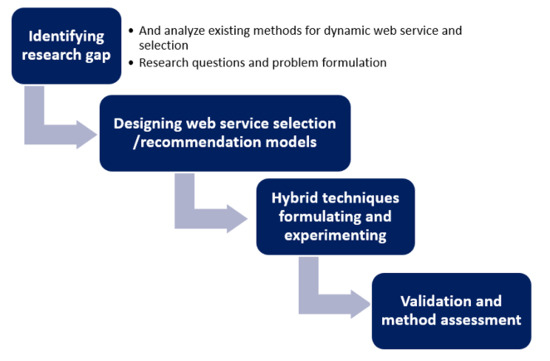
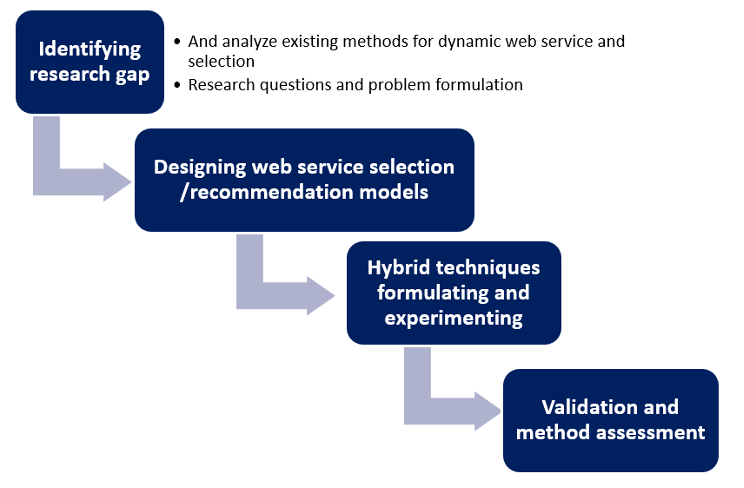
Addressing these questions enables the formulation of a hybrid mechanism that balances contextual semantic relevance with quantitative service reliability, thereby improving both precision and computational efficiency in service recommendation. The overall research workflow is illustrated in Figure 1, which outlines the main stages of the study, including data preprocessing, feature extraction using transformer models, QoS normalization, hybrid ranking computation, and evaluation.
Figure 1.
Overall research framework for the proposed hybrid semantic–QoS service selection model.
3.1. Identifying the Research Gap
Identify the problems in web service selection and recommendation through existing works, such as:
- •
- Data sparsity and cold-start issues in web service selection
- •
- Identifying the most relevant features for effective web service selection
- •
- Computationally intensive methods
3.2. Designing the Web Service Selection Model
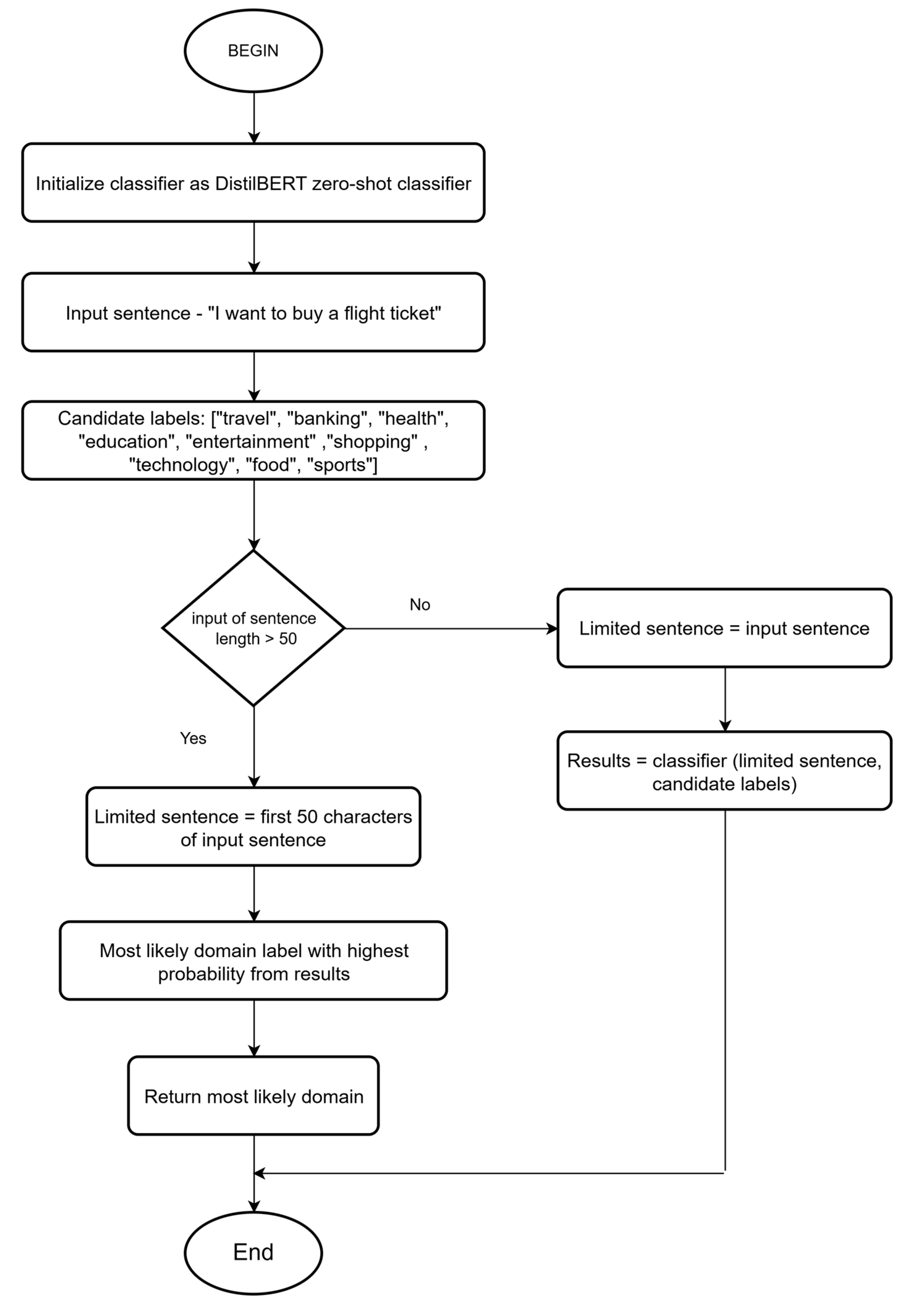
The semantic component in this work operates at the level of domain-level relevance estimation rather than fine-grained semantic ranking. The output of the encoder is used as a proxy signal for integration with QoS metrics, not as a definitive semantic correctness score. For better accuracy in domain classification while still aiming for reasonable performance, we can utilize a pre-trained transformer model optimized for text classification, such as “DistilBERT-base-uncased” fine-tuned on the MNLI dataset. This will provide a balance between accuracy and speed. Algorithm 1 describes how the web service selection model is developed.
| Algorithm 1. Web service selection. |
|
This algorithm aims to determine the most likely domain of an input sentence.
- (1)
- Initialization: It starts by initializing a classifier using the DistilBERT model. DistilBERT is a smaller, faster version of the popular BERT language model, specifically designed for text classification tasks.
- (2)
- Input: The algorithm takes an input sentence as input. In the example, the input sentence is “I want to buy a flight ticket.”
- (3)
- Candidate Labels: A list of potential domains is defined, such as “travel,” “banking,” “health,” etc.
- (4)
- Sentence Length Check: If the input sentence is longer than 50 characters, it is truncated to the first 50 characters. This is likely done to improve processing efficiency and prevent the model from being overwhelmed by excessively long sentences.
- (5)
- Classification: The DistilBERT classifier is then used to predict the probability of the input sentence belonging to each of the candidate labels.
- (6)
- Domain Selection: The algorithm identifies the label with the highest probability as the most likely domain for the input sentence.
- (7)
- Output: The algorithm returns the most likely domain as the final output.
In essence, this algorithm leverages the power of a pre-trained language model (DistilBERT) to quickly and accurately categorize input sentences based on their semantic content. This can be valuable in various applications, such as customer service–routing customer inquiries to the appropriate department (e.g., “travel” to the travel support team).
Reasons for using the typeform/DistilBERT-base-uncased-MNLI are as follows:
- (1)
- Smaller and Faster—Compared to larger models like BERT or RoBERTa, DistilBERT is optimized for speed while maintaining competitive accuracy
- (2)
- Fine-tuned on MNLI—The model is fine-tuned on the multi-genre natural language inference dataset, making it suitable for zero-shot classification tasks
Hence, using this optimized model, we achieve a good balance between classification accuracy and runtime performance. The model “DistilBERT-base-uncased” has been fine-tuned on the multi-genre natural language inference (MNLI) dataset [22]. Below are some points on the method:
- •
- DistilBERT Base Model: This model is based on the DistilBERT architecture, which is a smaller, faster, and more efficient version of BERT.
- •
- Uncased: The model is uncased, meaning it does not differentiate between uppercase and lowercase letters.
- •
- MNLI Dataset: It has been fine-tuned on the MNLI dataset, which consists of 433,000 sentence pairs annotated with textual entailment information. This dataset covers a variety of genres of spoken and written text.
- •
- Zero-Shot Classification: The model is designed for zero-shot classification tasks, allowing it to classify text into categories it has not seen during training. This is useful when there are limited labeled data for certain classes.
This fine-tuning process involves training the model on the MNLI dataset to improve its performance on tasks related to natural language inference. Fine-tuning on specific datasets like MNLI allows the model to adapt and specialize in understanding textual entailment and relationships between sentences, enhancing its ability to make accurate predictions in various NLP tasks. For the semantic encoder, we adopt DistilBERT fine-tuned on the MNLI natural language inference corpus. MNLI trains models to classify the relationship between a premise and a hypothesis (entailment, contradiction, neutral), which closely mirrors our setting where a user requirement is paired with a candidate service description, and the model must estimate how well the latter satisfies the former. In our architecture, the user request plays the role of the hypothesis and the service’s WSDL or OpenAPI description serves as the premise; the concatenated pair “[CLS] request [SEP] service [SEP]” is passed to the MNLI-tuned encoder, and its sentence-pair representation is used as a semantic relevance signal in the hybrid ranking function.
3.3. Hybrid Technique Formulation and Experimentation
The dataset used is from the QWS (Quality of Web Services) dataset, which contains 2507 services. The QWS Dataset, the first web service dataset that measured real web services’ Quality of Service (QoS), was introduced in 2007 and is part of Eyhab Al-Masri’s PhD thesis work. The QWS Dataset has been widely accepted across the research community and has been downloaded over 9000 times since its first introduction in 2007. The main goal of this dataset is to offer a basis for web service researchers. The web services were collected using the Web Service Crawler Engine (WSCE), and the majority of these services were obtained from public sources on the web, including universal description, discovery, and integration (UDDI) registries, search engines, and service portals [23].
The characteristics of the QWS Dataset, which encompasses eleven dimensions of QoS attributes, are response time, availability, reliability, throughput, success, compliance, best practices, latency, documentation, service name, and WSDL address. Domain labels are defined by mapping QWS service names, descriptions, and original category hints into nine high-level domains, for example, health, travel, shopping, technology. The resulting labels were cross-checked on a random 10% sample and later validated via a small user survey, which we treat only as a qualitative check rather than as the main evaluation.
Semantic selection is formulated as a multi-class text classification task over service domain categories derived from the QWS dataset, such as health, finance, travel, and education. Given a service’s WSDL or OpenAPI-derived description, the DistilBERT encoder followed by a softmax layer predicts a probability distribution over these classes, and the predicted class probability for the target domain is used as the semantic relevance score that enters the hybrid ranking function. This clarifies that our semantic component operates at the level of domain-level categorization rather than binary relevance or pure similarity regression.
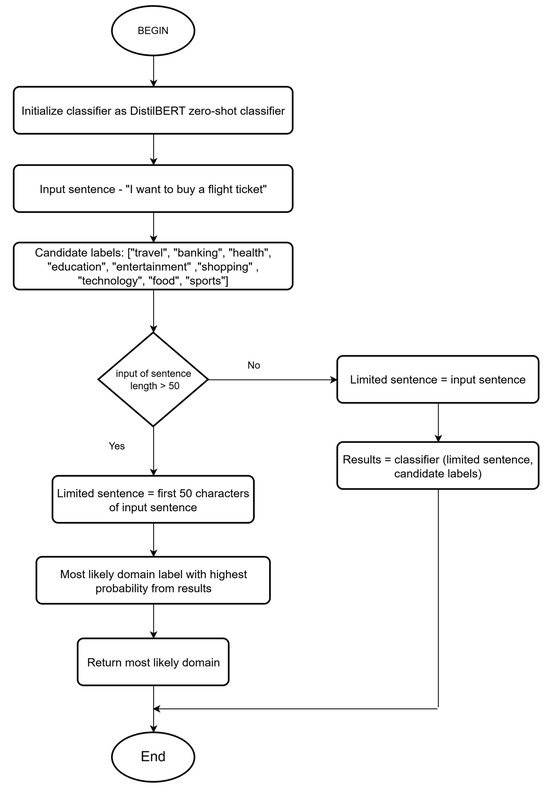
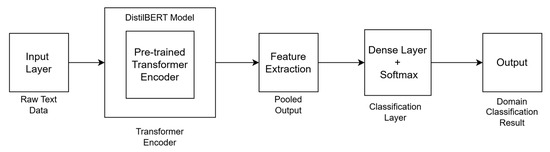
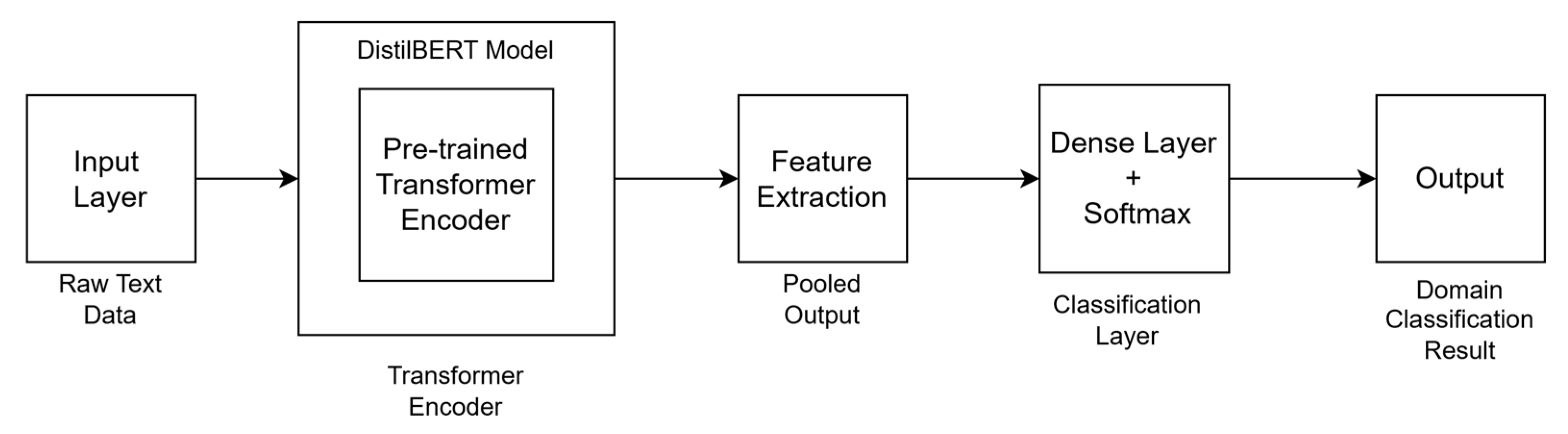
Figure 2 presents the work flow diagram of the proposed method.
Figure 2.
Flow diagram of the proposed method.
To unify semantic similarity and quantitative QoS assessment, a hybrid ranking function is formulated to compute the overall relevance score of each candidate web service. The proposed function combines semantic relevance (S semantic) derived from transformer-based embeddings with normalized QoS metrics (SqoS), as follows:
where Ri denotes the overall ranking score of service ™, and α ∈ [0, 1] is a weighting coefficient that controls the trade-off between semantic understanding and QoS-driven reliability.
Ri = αS semantic (i) + (1 − α)SqoS(i)
When α = 1, the selection process prioritizes semantic similarity; conversely, when α = 0, the decision depends solely on QoS attributes. In this study, α was empirically set to 0.5 to achieve a balanced contribution from both semantic and QoS components. The classification and ranking function depends on the fusion coefficient , which balances the semantic similarity score and the normalized QoS utility. To determine , we performed a simple grid search on the validation set, varying in steps of 0.05 over the range . This formulation enables flexible adaptation across different deployment contexts, emphasizing accuracy in analytic workloads or efficiency in real-time service environments.
All QoS attributes are first scaled to using min–max normalization at the dataset level. For benefit-type attributes (higher is better, e.g., availability, throughput), we apply
For cost-type attributes (lower is better, e.g., response time, execution cost), we use the standard inverted min–max form so that higher values consistently represent better utility
This transformation ensures that all normalized QoS metrics lie in and are monotonically aligned, meaning larger values always indicate more desirable service quality, regardless of their original direction. The final QoS utility for a service is then computed as a weighted sum of normalized attributes:
where are user- or system-defined importance weights that sum to 1.
To illustrate, an example query, candidate, and QoS is provided below:
- •
- User query (service description + QoS need):
“Weather forecast service for a single city with near real-time updates; I prefer low response time and high availability.”
- •
- Candidate service S*:
Text description: “REST API that provides 7-day weather forecasts and current conditions for a specified city, updated every 10 min.”
Raw QoS (from dataset): response time = 0.65 s, availability = 0.992, cost = 0.03 credits per call.
Step 1—Semantic score from DistilBERT
- •
- Input to DistilBERT (MNLI format):
[CLS] user query [SEP] service description [SEP]
- •
- The model outputs a relevance probability .
In this example, suppose the predicted “relevant” probability is .
Step 2—Normalize QoS and build QoS utility
Assume min–max normalization over all services in the dataset:
- •
- For benefit-type metrics (higher is better, e.g., availability):
- •
- For cost-type metrics (lower is better, e.g., response time, cost):
Assume (for illustration) that across the dataset:
- •
- Response Time: s, s
- •
- Availability: ,
- •
- Cost: ,
For service S*:
- •
- •
- •
Assume user weights , , (prefers latency and availability slightly more than cost):
- •
Step 3—Hybrid score with coefficient
Hybrid score formula:
With (best value from your grid search):
- •
Compared to other candidates that either have weaker semantic match or poorer QoS, S* achieves the highest hybrid score and is therefore ranked first. Small perturbations in weights generally do not reorder top-k services when semantic scores or QoS utilities are well separated. Further sensitivity analysis will be explored for future work.
The system architecture is presented in Figure 3:
Figure 3.
System architecture of the proposed method.
The following hyper-parameters were used during model training:
- -
- Batch size: 35
- -
- Candidate labels: 9
The following are the features of the hardware environment used in this experimentation:
- -
- Processor: Intel™ Core™ 5 120U (1.40 GHz)
- -
- RAM: 16 GB
- -
- System type: 64-bit operating system, ×64-based processor
- -
- Windows: 11 Home
During training, each transformer variant is fine-tuned as a supervised multiclass classifier over K QWS-derived service domains using 80% of labelled services, and also model parameters are updated by minimizing cross entropy between predicted and true domain labels. At inference time, the fine-tuned encoder is frozen and used to compute, for each candidate label, either the softmax probability of the target domain or the sentence-pair relevance score for a query–service pair, which is then fed into the hybrid ranking function without further gradient updates.
3.4. Validation and Method Assessment
User acceptance testing was performed to validate the output result of a domain likely to be associated with a given API URL accuracy has been measured between the survey results and the output returned by DistilBERT for the same set of API URLs selected.
The following formula is used for calculating the accuracy percentage:
The survey was conducted with 30 people aged 18 and above, with assumption that the respondents are educated. A set of 20 questions was asked, with 10 questions posed to 15 respondents for each survey set as shown in the Appendix A. The survey was formulated using Google Forms. Table 2 shows the accuracy of each the four variants of BERT tested. The survey is included to confirm that the automatically derived labels are broadly plausible; it is not used for quantitative evaluation of semantic ranking or model effectiveness. From the accuracy detail obtained against the User Acceptance Test, the RoBERTa variant performed more accurately compared to the others.
Table 2.
Accuracy, precision, recall, and F1-score calculated for each BERT version.
Table 2 presents the comparative accuracy, precision, recall, and F1-score achieved by four transformer-based models (BERT, DistilBERT, RoBERTa, and ALBERT) for web-service domain classification and recommendation. The accuracy values reflect each model’s ability to correctly identify the most appropriate service category based on semantic similarity and contextual understanding of the service descriptions.
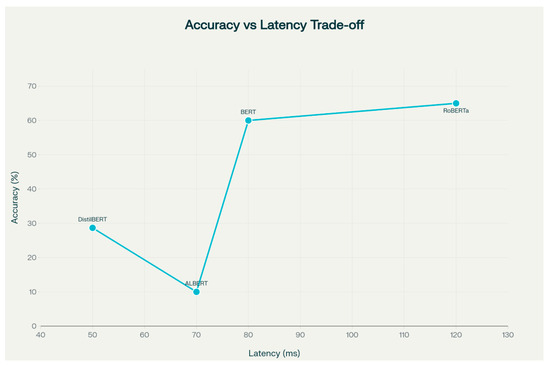
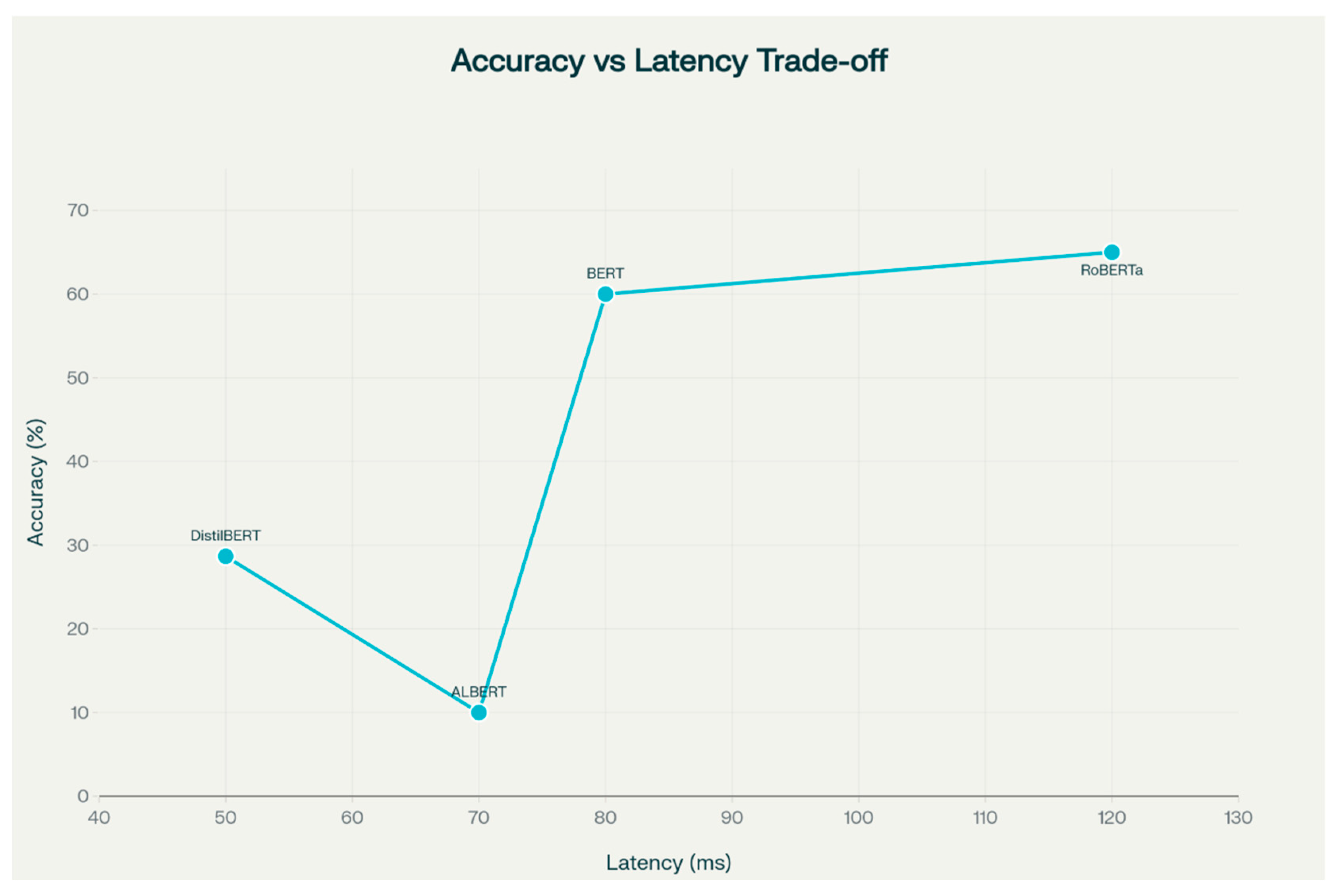
Among the evaluated models, RoBERTa achieved the highest accuracy (65%) and the strongest overall balance among precision, recall, and F1-score, outperforming the other variants due to its optimized pre-training strategy and dynamic masking mechanism, which enhance contextual learning. BERT performed well: it was slightly lower in accuracy, but with the highest precision, providing strong baseline performance but at the cost of greater computational overhead. DistilBERT, although it showed moderate performance (30%), demonstrated substantially faster inference speed and reduced resource usage, making it better suited for real-time and large-scale deployments where latency is critical. In contrast, ALBERT performed poorly on this dataset (10% accuracy), primarily because of its parameter-sharing and factorization strategies, while improving memory efficiency, which limits its deep contextual representation in fine-grained semantic tasks.
These results confirm that, while RoBERTa is most effective for applications prioritizing precision and robustness, DistilBERT provides the best trade-off between performance and efficiency, aligning with the goal of developing a lightweight, QoS-aware recommendation framework for real-time service environments.
Table 3 presents the performance findings. To observe web service selection, the QWS dataset was used. DistilBERT outperformed the other BERT versions in terms of shortest amount of time processing.
Table 3.
Time taken for each BERT version.
While DistilBERT offers the fastest processing time, its accuracy lags behind RoBERTa, suggesting a trade-off that depends on application requirements.
4. Results and Discussion
Figure 4 shows the accuracy vs. latency trade-off for DistilBERT, BERT, RoBERTa, and ALBERT based on their comparative performance in web service domain selection. Latency is derived from the elapsed inference time when running the domain classification and ranking algorithm over the full 2507 web service QWS dataset for each model variant.
Figure 4.
Accuracy vs. latency trade-off for DistilBERT, BERT, RoBERTa, and ALBERT.
The performance analysis of the proposed DistilBERT-based hybrid framework reveals both its potential and its limitations in addressing the complex challenge of QoS-aware web service selection and recommendation. The empirical results demonstrate that, while DistilBERT delivers notable gains in processing efficiency and scalability, it exhibits certain accuracy trade-offs when compared with its larger counterparts. The model achieves a 60% reduction in computational overhead while retaining approximately 97% of BERT’s representational power, making it ideal for environments where real-time responsiveness and resource efficiency are more critical than marginal accuracy gains. However, this balance introduces an inherent compromise: the loss of deep contextual nuance may lead to suboptimal ranking in scenarios demanding fine-grained semantic interpretation.
A comparative evaluation among BERT, DistilBERT, RoBERTa, and ALBERT underscores this trade-off spectrum clearly. BERT, as the baseline bidirectional transformer, provides high-fidelity contextual embeddings and strong performance consistency. Yet, its high computational demand and slow inference latency render it impractical for large-scale, real-time web service selection, where latency and throughput are paramount. In contrast, RoBERTa, through dynamic masking and extended pre-training, consistently achieves superior classification accuracy (65%) over BERT and DistilBERT. This performance gain, however, comes at the expense of higher GPU memory consumption, longer training cycles, and limited deployability in low-power or edge environments––constraints that fundamentally challenge its suitability for latency-sensitive web-based applications.
DistilBERT emerges as a pragmatic compromise, achieving faster inference and scalability with modest accuracy loss (30%). Its distilled architecture accelerates real-time decision-making but demonstrates weaker performance on ambiguous or polysemous service descriptions, where richer contextual embeddings are essential. This observation aligns with prior findings in NLP model compression studies, which report that distillation can attenuate model sensitivity to subtle semantic dependencies and reduce robustness to domain shift. The implications for QoS-aware selection are significant: in domains like healthcare or finance, where service reliability and interpretability are non-negotiable, even minor semantic misclassifications can cascade into erroneous service recommendations. Therefore, while DistilBERT is computationally efficient, its precision limits its direct applicability to mission-critical decision systems without additional safeguards or hybridization strategies.
Meanwhile, ALBERT offers another optimization path via cross-layer parameter sharing and factorized embedding, achieving parameter efficiency with relatively comparable performance to BERT in broad benchmarks. However, ALBERT’s 10% accuracy in this study suggests that aggressive parameter compression significantly hampers contextual depth and discriminative power. This underperformance indicates that ALBERT’s shared parameterization––while efficient for language-understanding tasks with shallow semantic structures––is ill-suited for multi-criteria tasks like QoS-driven service selection, where context granularity and semantic diversity play central roles.
Taken together, these findings reveal a fundamental efficiency–accuracy continuum across transformer variants. RoBERTa defines the upper bound of accuracy but fails the real-time deployability test, DistilBERT excels in speed but risks semantic oversimplification, BERT remains balanced but computationally heavy, and ALBERT achieves compactness at the expense of representational fidelity. Consequently, the proposed framework’s success hinges on how well it can optimize this continuum for specific deployment contexts. In cloud-based ecosystems where computational resources are abundant, RoBERTa’s accuracy justifies its use; conversely, in edge and IoT environments, DistilBERT provides a practical and efficient substitute.
Because DistilBERT sacrifices some contextual depth relative to RoBERTa, the semantic component of our model may occasionally misinterpret subtle requirement phrases, which in turn limits the granularity of text-based explanations that can be provided for individual recommendations. To mitigate this, the hybrid score never relies on the semantic signal alone: all final rankings are jointly determined by DistilBERT’s confidence and QoS utility, and low-confidence semantic matches are filtered or down-weighted rather than surfaced directly as top candidates. For mission-critical domains, we further recommend deploying the framework with additional safeguards, such as human review for borderline cases and a two-stage pipeline in which DistilBERT produces a fast shortlist that is re-evaluated by a slower but more accurate model (e.g., RoBERTa or an LLM) before the final recommendation is presented to end-users.
Table 4 presents the results of the ablation study performed to illustrate the effect of including or excluding semantic and QoS components in the web service selection model. This compares a semantic-only model, a QoS-only model, and a hybrid approach, and accuracy and efficiency are highlighted.
Table 4.
Ablation study table: semantic vs. QoS vs. hybrid.
The semantic-only configuration utilizes only transformer-based semantic embeddings for classification. This demonstrates moderate accuracy mainly based on the text relevance, but may neglect service reliability. The QoS-only configuration relies mainly on quantitative service attributes and also offers robust reliability. However, it is less adaptive to user context, leading to lower accuracy. The hybrid approach, where semantic embedding and the QoS metric are combined as a hybrid function, provides the most balanced results in accuracy and efficiency, showing strong performance.
In this work, DistilBERT is intentionally treated as an efficiency-optimized encoder rather than an accuracy ceiling. It offers substantially lower latency and resource usage while still outperforming traditional QoS-only baselines, which makes it better aligned with our target scenario of large-scale, real-time service selection on constrained infrastructure. Future work will explore hybrid designs in which higher-capacity GPT-class LLMs are used offline to enrich or refine service and user descriptions, while DistilBERT or similar lightweight encoders continue to handle the online scoring and ranking step, preserving both semantic quality and strict latency or cost budgets.
From a footprint perspective, DistilBERT-base (≈66 M parameters) is about 40–45% smaller than BERT-base (≈110 M) and RoBERTa-base (≈125 M), which translates into an estimated 250–300 MB vs. 400–500 MB memory usage for weights and activations during typical inference, making DistilBERT substantially more viable for RAM-constrained edge and IoT devices that must host multiple services concurrently [24,25]. These quantitative savings support our choice of DistilBERT as the semantic encoder in an Edge-AI context, while we explicitly acknowledge that even more compact architectures or quantized/distilled variants could be explored in future work when targeting extremely resource-limited microcontroller-class platforms [26].
5. Limitations
Several critical limitations must be acknowledged. First, the accuracy margin between DistilBERT and RoBERTa, at nearly 23%, highlights the impact of model compression on semantic reasoning. This gap indicates that the current hybrid framework, though faster, may not yet achieve production-grade reliability without additional contextual enhancement, such as domain-specific fine-tuning or ensemble fusion with higher-capacity models. Second, the training data constraint––relying solely on the QWS dataset––poses risks of dataset bias and limited generalization to diverse service domains. The QWS corpus, while well-established, primarily reflects static QoS patterns and does not fully capture temporal fluctuations, user behavior heterogeneity, or domain-specific linguistic nuances that real-world service APIs exhibit. Third, the evaluation metric used (accuracy percentage) provides only a unidimensional assessment of model behavior; incorporating precision, recall, F1-score, and latency variance would yield a more comprehensive validation framework.
Table 5 compares four transformer architectures––BERT, DistilBERT, RoBERTa, and ALBERT––in terms of architecture design, performance, speed, resource utilization, contextual understanding, and training data scale. Each model represents a different optimization philosophy within the BERT family, balancing accuracy, computational efficiency, and scalability.
Table 5.
Differences among the BERT models.
BERT serves as the baseline bidirectional transformer that captures contextual dependencies from both directions of a sentence. It delivers state-of-the-art performance compared with numerous NLP benchmarks but suffers from high computational cost and slow inference due to its large number of parameters.
DistilBERT, a compressed version of BERT, reduces the parameter count by roughly 40% while retaining about 97% of BERT’s representational performance. Its smaller architecture leads to ~60% faster inference speed and significantly lower resource usage, making it highly suitable for real-time or resource-constrained environments such as IoT or edge computing. However, its distillation process slightly reduces the depth of contextual understanding compared to the full BERT model.
RoBERTa refines BERT through dynamic masking and extended pre-training on larger datasets. This optimization enhances contextual robustness and typically yields higher accuracy than BERT for semantic understanding tasks. The trade-off is increased computational demand, making RoBERTa more appropriate for high-performance servers or offline analytical applications, rather than real-time systems.
ALBERT achieves parameter efficiency through factorized embedding parameterization and cross-layer parameter sharing, drastically reducing model size while maintaining comparable performance to BERT. It strikes a good balance between speed and accuracy, but its shared-parameter architecture can limit fine-grained contextual learning in complex semantic tasks.
Overall, the comparison highlights a performance–efficiency spectrum: RoBERTa offers the highest accuracy, BERT provides balanced depth, DistilBERT ensures the fastest and most resource-efficient operation, and ALBERT delivers compactness with moderate contextual precision. Given the objective of real-time QoS-aware web service selection, DistilBERT emerges as the most practical model, offering a strong trade-off between computational efficiency and semantic reliability.
6. Conclusions and Future Work
The key contributions of this paper are as follows:
- -
- Proposing a novel hybrid framework combining DistilBERT semantic modelling with multi-attribute QoS evaluation for web service selection.
- -
- Formulating a ranking function that enables dynamic trade-offs between semantic relevance and service reliability for adaptive recommendations.
- -
- Conducting experiments on the QWS Dataset to benchmark accuracy, speed, and computational efficiency across the BERT variants.
- -
- Presenting an ablation study demonstrating the complementary effects of semantic and QoS components in the hybrid model proposed.
It is important to note that this work does not attempt to solve all the challenges listed in Section 1; instead, it concentrates on two aspects––hybrid semantic–QoS ranking under sparsity and the efficiency–accuracy trade-off among BERT-family encoders for real-time selection––while treating dynamic QoS adaptation, rich personalization, and cross-provider standardization as directions for future research.
The rapid proliferation of web-based and service-oriented architectures demands intelligent, adaptive, and scalable mechanisms for Quality of Service (QoS)-aware service selection. This study presented a hybrid AI-driven framework that integrates DistilBERT-based semantic encoding with QoS-aware ranking to enhance both the accuracy and computational efficiency of web service recommendation systems. By combining semantic feature extraction, sentiment analysis, and text classification, the proposed model effectively mitigates key challenges faced by traditional methods: namely, the cold-start problem, data sparsity, and dynamic QoS variability.
Comprehensive experiments using the QWS benchmark dataset demonstrated the effectiveness of the proposed hybrid approach. Among the tested transformer models, RoBERTa achieved the highest prediction accuracy (≈65%), while DistilBERT offered the most balanced performance, with 60% faster inference time and significantly lower resource consumption compared with standard BERT. These findings validate the proposed framework’s capability to deliver real-time, large-scale service selection suitable for modern cloud-, IoT-, and edge-based applications. The comparative results also emphasize the importance of lightweight models that can retain semantic richness while achieving computational scalability, an essential factor in mission-critical and latency-sensitive environments.
DistilBERT is optimal for edge or cloud-based applications because it is engineered to be small, fast, and resource-efficient, while maintaining most of the performance benefits from the larger BERT predecessor. This makes it suitable for latency-sensitive, real-time applications where computational resources are constrained, such as IoT devices and edge servers.
Beyond empirical validation, this research contributes conceptually by introducing a hybrid semantic–QoS fusion model that quantitatively balances contextual relevance and service performance through a tunable weighting factor. Empirically, the study offers a comparative assessment of four representative transformer encoders––BERT, DistilBERT, RoBERTa, and ALBERT––under identical experimental conditions. The results quantify how these encoders differ in accuracy, latency, and approximate resource demand when embedded in the same hybrid framework, highlighting RoBERTa as an accuracy upper bound and DistilBERT as a practically attractive choice for real-time or resource-constrained deployments. The ablation analysis further confirms that hybrid semantic–QoS scoring improves on single-component baselines in the examined setting.
This formulation allows system architects to customize the recommendation pipeline for different operational constraints, ranging from high-accuracy analytic systems to low-latency edge deployments. Furthermore, the study reinforces the broader applicability of transformer-based NLP models beyond textual domains, illustrating their potential in intelligent service orchestration and context-aware computing.
Many methods or models still handle semantic understanding and QoS evaluation as separate processes rather than as part of a single system, despite progress made in hybrid semantic–QoS models for web service selection. Issues like cold start and data sparsity remain significant challenges. This research aims to overcome disadvantages or shortcomings by introducing an integrated and flexible hybrid model that dynamically balances semantic relevance and QoS reliability, while maintaining high efficiency.
Some future enhancement ideas that can be considered are QoS graph neural network fusion [27], domain-specific fine tuning, and knowledge graph integration [27]. Integrating graph neural networks (GNNs) allows for more effective modeling of the interactions among services, users, and QoS metrics. This can leverage service invocation history and network topology to improve QoS prediction accuracy, robustness, and scalability in dynamic cloud or IoT settings. Adapting and fine-tuning models to specific industry domains, such as travel, banking, and healthcare, enhances semantic understanding and contextual relevance. Integrating knowledge graphs helps to link structured data, for example service ontologies, business rules, and relationships, among entities with the machine learning models. Knowledge graphs enrich feature sets and boost explainability, enabling better context-aware service matching and supporting advanced analytics such as multi-hop reasoning and constraint-based selection.
Nevertheless, several research directions remain open for exploration. First, the reliance on the QWS Dataset, although standardized, limits domain generalization. Future work should employ multi-domain, real-world datasets across healthcare, finance, logistics, and smart city applications to better evaluate cross-domain adaptability. The current evaluation uses the QWS benchmark, which provides relatively consistent QoS definitions and measurement conditions; in contrast, real-world ecosystems often aggregate services from multiple providers whose QoS metrics differ in naming, scale, and sampling regime. Extending the framework to such heterogeneous environments will require an additional QoS harmonization layer that maps provider-specific fields into a common schema and applies provider-aware normalization and calibration before computing the hybrid utility score. Second, personalization can be enhanced through federated learning and transfer learning paradigms, enabling individualized service recommendations without compromising data privacy. Third, integrating the proposed framework with edge computing infrastructures can enable real-time QoS adaptation, where models are continuously updated using decentralized edge intelligence to minimize latency and improve responsiveness. Finally, incorporating explainability mechanisms, such as attention heatmaps or interpretable QoS-semantic correlations, can strengthen user trust and system transparency in AI-driven service ecosystems.
In summary, the proposed hybrid DistilBERT-based framework establishes a robust foundation for scalable, adaptive, and QoS-aware web service recommendation. With continued advancements in lightweight transformer models and decentralized AI training, the approach can evolve into a key enabler for next-generation autonomous service management across cloud, IoT, and edge-centric computing environments. Future research can broaden the empirical evaluation to additional datasets, service domains, and baseline methods and can incorporate richer user studies and formal significance testing to deepen the statistical analysis. The same hybrid design could also be explored with more advanced encoders and with dynamic or context-aware QoS models. These directions build on the current framework, which already establishes a practical and quantitatively characterized basis for deployment-oriented hybrid semantic–QoS service selection.
Author Contributions
Conceptualization, V.M.R. and R.K.R.; methodology, V.M.R. and R.K.R.; software, V.M.R.; validation, V.M.R., R.K.R., and M.S.S.; formal analysis, V.M.R.; writing—original draft preparation, R.K.R. and M.S.S.; writing—review and editing, R.K.R. and M.S.S.; supervision, R.K.R.; project administration, R.K.R. All authors have read and agreed to the published version of the manuscript.
Funding
The APC was funded by Multimedia University.
Institutional Review Board Statement
Not applicable.
Informed Consent Statement
Not applicable.
Data Availability Statement
The original contributions presented in this study are included in the article. Further inquiries can be directed to the corresponding author(s).
Conflicts of Interest
The authors declare no conflicts of interest.
Appendix A
Table A1.
A sample survey form created using Google Forms.
References
- Oriol, M.; Marco, J.; Franch, X. Quality models for web services: A systematic mapping. Inf. Softw. Technol. 2014, 56, 1167–1182. [Google Scholar] [CrossRef] [Scilit]
- Yan, Y.; Sun, P.; Zhang, J.; Ma, Y.; Zhao, L.; Qin, Y. Dynamic qos prediction algorithm based on kalman filter modification. Sensors 2022, 22, 5651. [Google Scholar] [CrossRef] [Scilit]
- Majdi, A. Proposing new routing protocol based on chaos algorithm. Rev. Comput. Eng. Res. 2022, 9, 55–70. [Google Scholar] [CrossRef] [Scilit]
- Li, K.; Ji, Y.; Liu, S.; Wu, F.; Yao, H.; He, J.; Liu, Q.; Liu, Y.; Shao, S.; You, S. dvo + lclmf: A web service recommendation mechanism withqosprivacy preservation. Concurr. Comput. Pract. Exp. 2022, 34, e7003. [Google Scholar]
- Purohit, L.; Rathore, S.S.; Kumar, S. Feature selection and clustering based web service selection using qoss. Appl. Intell. 2022, 53, 13352–13377. [Google Scholar] [CrossRef] [Scilit]
- Wu, S.; Kou, H.; Lv, C.; Huang, W.; Qi, L.; Wang, H. Service recommendation with high accuracy and diversity. Wirel. Commun. Mob. Comput. 2020, 2020, 8822992. [Google Scholar] [CrossRef] [Scilit]
- Bonab, M.; Tanha, J.; Masdari, M. A semi-supervised learning approach to quality-based web service classification. IEEE Access 2024, 12, 50489–50503. [Google Scholar]
- Aazagreyir, P.; Appiahene, P.; Appiah, O.; Boateng, S. Comparative analysis of fuzzy multi-criteria decision-making methods for quality of service-based web service selection. IAES Int. J. Artif. Intell. (IJ-AI) 2024, 13, 1408–1419. [Google Scholar]
- Merin, J.B.; Banu, D.W.A.; Akila, R.; Radhika, A. Semantic annotation based mechanism for web service discovery and recommendation. J. Wirel. Mob. Netw. Ubiquitous Comput. Dependable Appl. 2023, 14, 169–185. [Google Scholar] [CrossRef] [Scilit]
- Cao, B.; Huang, H.; Liu, S.; Liu, Y.; Wen, Y.; Zhou, D.; Tang, M. Knowledge distillation representation and dcnmix quality prediction-based web service recommendation. Concurr. Comput. Pract. Exp. 2024, 38, e8038. [Google Scholar]
- Kang, G.; Liang, B.; Xu, J.; Liu, J.; Wen, Y.; Kang, Y. Qos-centric diversified web service recommendation based on personalized determinantal point process. Electronics 2023, 12, 2575. [Google Scholar]
- Kang, G.; Liang, B.; Ding, L.; Liu, J.; Cao, B.; Kang, Y. qos-aware web service recommendation via exploring the users’ personalized diversity preferences. Eng. Rep. 2023, 6, e12695. [Google Scholar] [CrossRef] [Scilit]
- Huang, X.; Zhao, G. Web service recommendation based on knowledge graph enhanced. In Proceedings of the International Conference on Cloud Computing, Performance Computing, and Deep Learning (CCPCDL 2023), Huzhou, China, 17–19 February 2023. [Google Scholar]
- Jithendra, T.; Khan, M.; Basha, S.; Das, R.; Divya, A.; Chowdhary, C.; Alahmadi, A.; Alahmadi, A.H. A novel qos prediction model for web services based on an adaptive neuro-fuzzy inference system using coot optimization. IEEE Access 2024, 12, 6993–7008. [Google Scholar]
- Devlin, J.; Chang, M.; Lee, K.; Toutanova, K. BERT: Pre-training of Deep Bidirectional Transformers for Language Understanding. In Proceedings of the 2019 Conference of the North American Chapter of the Association for Computational Linguistics: Human Language Technologies, Minneapolis, MN, USA, 2–7 June 2019. [Google Scholar]
- Vu, V.; Nguyen, Q.; Tunyan, E.; Ock, C. Improving the performance of vietnamese–korean neural machine translation with contextual embedding. Appl. Sci. 2021, 11, 11119. [Google Scholar] [CrossRef] [Scilit]
- Gordon, M.; Duh, K.; Andrews, N. Compressing bert: Studying the effects of weight pruning on transfer learning. In Proceedings of the 5th Workshop on Representation Learning for NLP, Online, 9 July 2020. [Google Scholar]
- Xue, L.; Zhang, F. Lcpcwsc: A web service classification approach based on label confusion and priori correction. Int. J. Web Inf. Syst. 2024, 20, 213–228. [Google Scholar] [CrossRef] [Scilit]
- Yang, X.; Bian, J.; Hogan, W.; Wu, Y. Clinical concept extraction using transformers. J. Am. Med. Inform. Assoc. 2020, 27, 1935–1942. [Google Scholar] [CrossRef] [Scilit]
- Atanasova, P.; Simonsen, J.; Lioma, C.; Augenstein, I. Fact checking with insufficient evidence. Trans. Assoc. Comput. Linguist. 2022, 10, 746–763. [Google Scholar] [CrossRef] [Scilit]
- Kumar, S.; Deep, S.; Kalra, P. Enhancing customer service in banking with ai: Intent classification using distilbert. Int. J. Curr. Sci. Res. Rev. 2024, 7, 2706–2713. [Google Scholar] [CrossRef] [Scilit]
- McCoy, R.; Min, J.; Linzen, T. Berts of a feather do not generalize together: Large variability in generalization across models with similar test set performance. In Proceedings of the Third BlackboxNLP Workshop on Analyzing and Interpreting Neural Networks for NLP, Online, 20 November 2020. [Google Scholar]
- Al-Masri, E.; Mahmoud, Q.H. Investigating web services on the world wide web. In Proceedings of the ACM 17th International Conference on World Wide Web (WWW ‘08), Beijing, China, 21–25 April 2008. [Google Scholar]
- Ozkurt, C. Comparative Analysis of State-of-the-Art Q&A Models: BERT, RoBERTa, DistilBERT, and ALBERT on SQuAD v2 Dataset. Chaos Fractals 2024, 1, 19–30. [Google Scholar]
- Swiftorial. BERT vs. RoBERTa vs DistilBERT. Swiftorial. 2025. Available online: https://www.swiftorial.com/matchups/nlp_platforms/bert-vs-roberta-vs-distilbert (accessed on 24 November 2025).
- Hussain, M.; Chen, C.; Hussain, M.; Anwar, M.; Abaker, M.; Abdelmaboud, A.; Yamin, I. Optimised knowledge distillation for efficient social media emotion recognition using DistilBERT and ALBERT. Sci. Rep. 2025, 15, 30104. [Google Scholar] [CrossRef] [Scilit] [PubMed]
- Hu, S.; Zou, G.; Zhang, B.; Wu, S.; Lin, S.; Gan, Y.; Chen, Y. GACL: Graph Attention Collaborative Learning for Temporal QoS Prediction. IEEE Trans. Netw. Serv. Manag. 2025, 22, 3388–3402. [Google Scholar] [CrossRef] [Scilit]

Disclaimer/Publisher’s Note: The statements, opinions and data contained in all publications are solely those of the individual author(s) and contributor(s) and not of MDPI and/or the editor(s). MDPI and/or the editor(s) disclaim responsibility for any injury to people or property resulting from any ideas, methods, instructions or products referred to in the content. |
© 2026 by the authors. Licensee MDPI, Basel, Switzerland. This article is an open access article distributed under the terms and conditions of the Creative Commons Attribution (CC BY) license.