


Abstract
The rapid advancement of Industry 5.0 and the concurrent growth of the Industrial Internet of Things (IIoT) present significant cybersecurity challenges necessitating advanced solutions. Digital Twin technology, which enables the creation of near-perfect digital replicas of physical systems, offers a promising approach to enhancing security and safety. This paper presents a literature review of the existing research to identify the challenges and future directions for integrating DT technology into IIoT from a security perspective. We aim to establish a comprehensive understanding of emerging features, including predictive analytics, real-time threat detection, and cybersecurity management. Additionally, this review highlights critical gaps, including complexity, model fidelity, real-time data processing, and scalability, which hinder the successful deployment of DT technology. Our study will assist researchers, cybersecurity practitioners, and policymakers in understanding the potential, limitations, and future advancements of this crucial area.
1. Introduction
Industry 5.0 represents a paradigm shift toward human-centric, resilient, and sustainable industrial systems, driven by the deep integration of the Industrial Internet of Things (IIoT). While this interconnectedness enables self-optimized autonomous systems, it exponentially expands the attack surface for cyber–physical threats [1,2]. Recent high-profile breaches ranging from critical infrastructure shutdowns in Europe to sustained attacks on water treatment facilities underscore a critical reality: traditional perimeter-based security is insufficient for the dynamic complexity of IIoT environments [3,4].
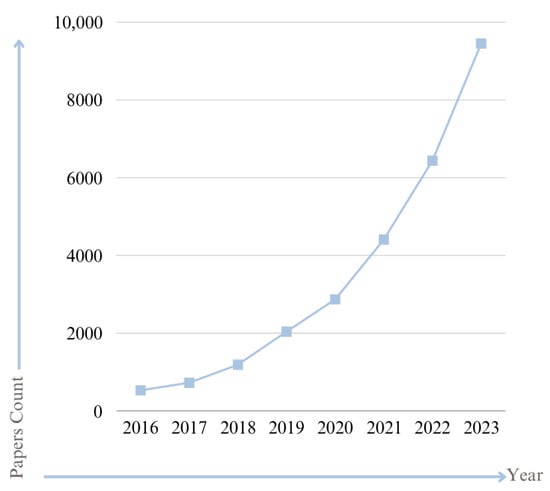
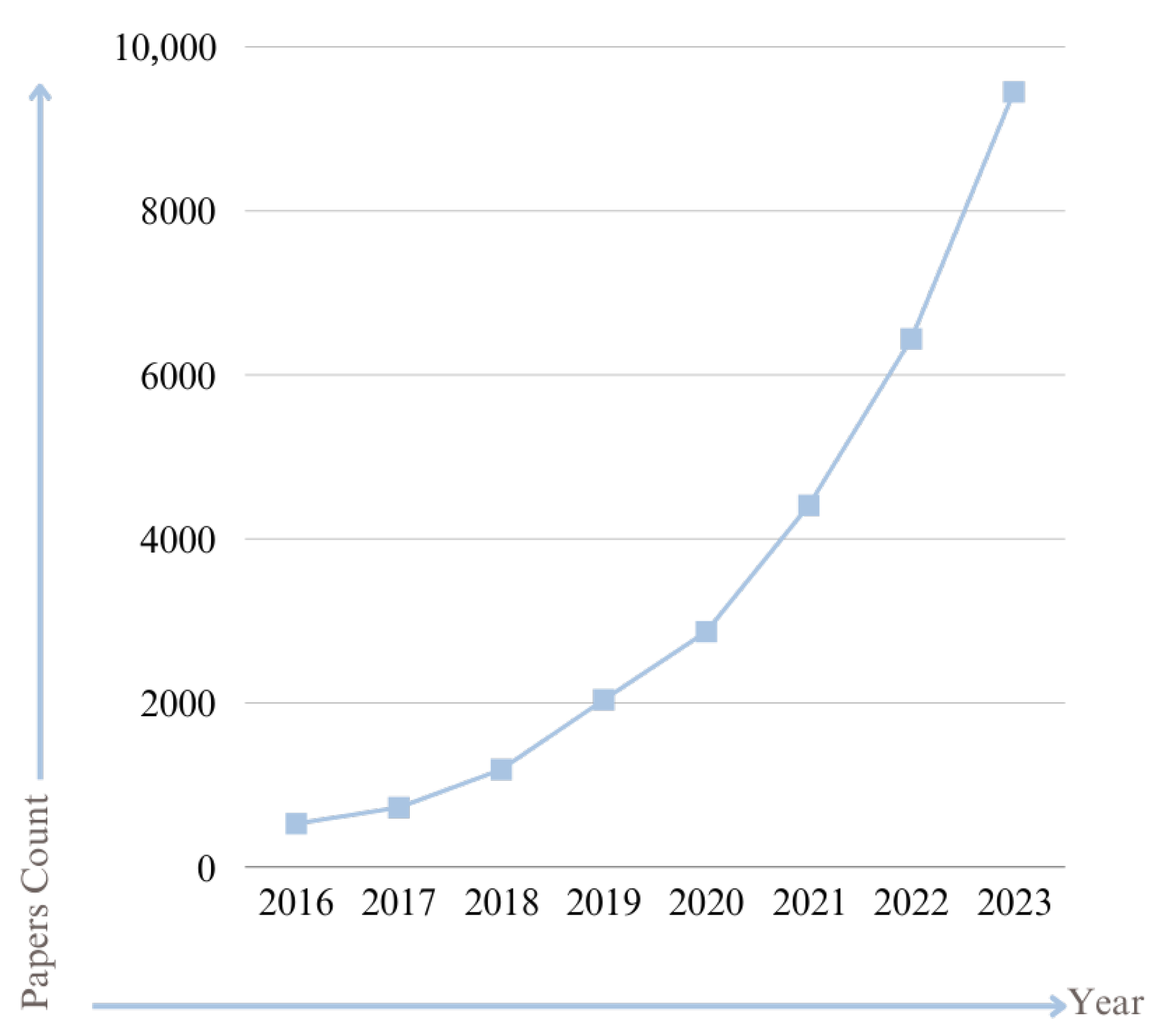
Digital Twin (DT) technology has emerged as a cornerstone for Industry 5.0 resilience. By maintaining a high-fidelity virtual mirror of physical assets, DTs enable proactive defence mechanisms, such as real-time anomaly detection and Zero Trust Architecture (ZTA) validation [5]. Despite the growing volume of research evidenced by the rising publication trends (Figure 1), the current literature remains fragmented. Existing studies often focus on narrow technical implementations, leaving a gap in understanding which DT architectures are most effective across diverse industrial contexts and how they scale within the Industry 5.0 framework.
Figure 1.
Trend in DT research in cybersecurity by years.
This study synthesizes 110 peer-reviewed studies to move beyond a mere summary of publications. We categorize current research into a functional taxonomy spanning monitoring, predictive analytics, and crisis management to provide a comparative analysis of DT-based security solutions. Unlike previous surveys, this work explicitly evaluates the trade-offs between model fidelity and computational overhead, identifying specific contexts where DT implementations succeed or fail.
The primary scientific contributions of this study are as follows:
- DT security applications are grouped into thematic clusters, shifting the focus from individual paper characteristics to a synthesized overview of technical approaches.
- The evaluation of the performance of different DT frameworks (e.g., Edge-based vs. Cloud-based) to identify the most effective solutions for real-time IIoT protection is demonstrated.
- This study analyzes the “fidelity–complexity–latency” triad, providing a roadmap for overcoming the technical bottlenecks that currently hinder large-scale DT deployment.
- Rather than listing scattered issues, a coherent summary of research gaps (e.g., machine trust and cross-layer scalability) is provided and a unified direction for future development in Industry 5.0 is proposed.
2. Methodology
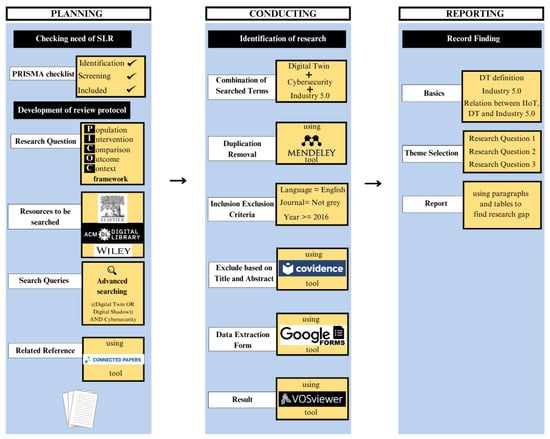
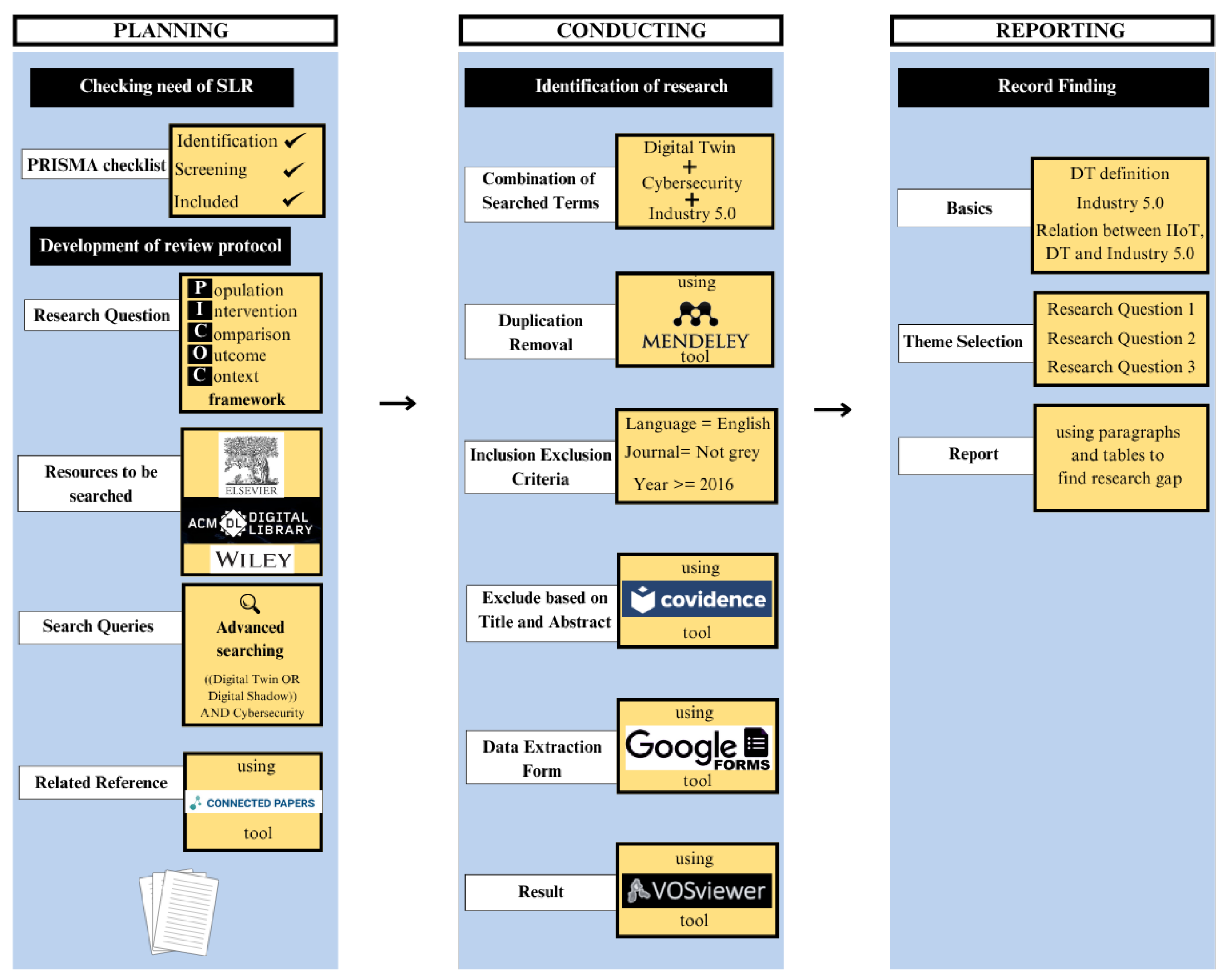
Figure 2 illustrates the step-by-step procedure for planning, conducting, and reporting this literature review.
Figure 2.
Literature review process diagram.
2.1. Research Questions
The primary objective of this paper is to present a comprehensive survey of the role of DTs in cybersecurity within the context of the Industrial Internet of Things (IIoT). The paper will delve into the challenges and potential solutions for integrating DTs as a cybersecurity tool within the framework of Industry 5.0. To achieve this, three key research questions need to be addressed, as follows:
RQ1: Compared to traditional approaches, how is DT technology striving to mitigate cyber attacks in IIoT?
RQ2: What technical challenges should be considered while integrating DT for security in Industry 5.0?
RQ3: What innovative solutions can address challenges faced in DT to enhance cybersecurity in IIoT and Industry 5.0?
These research questions are created using Kitchenham & Charters’ [6] PICOC framework. Table 1 shows the PICOC elements along with their corresponding meanings [7] for the queries:
Table 1.
PICOC component definitions for the research questions.
2.2. Search Queries
Appropriate search term generation helps to identify the most relevant articles from all the available databases and libraries. Some of the key terms this study focused on while performing the search include: “cyber attack”, “digital twin”, “iiot”, “cybersecurity”, and “industry 5.0”.
2.2.1. Identification of Research
(a) Combination of search terms.
Query 1: ((“cyber attack” OR “cyber threat” OR “attack*” OR “intrusion” OR “data breach”) AND (“digital twin” OR “digital replica” OR “simulation”) AND (“industrial iot” OR “iiot” OR “iot”) AND (“response” OR “measure” OR “mitigation strategy”) AND (“cybersecurity” OR “security” OR “information security” OR “cyber safety”.))
Query 2: ((“digital twin” OR “digital replica”) AND (“challenges” OR “technical challenges” OR “difficulties” OR “problems” OR “troubles” OR “issues”) AND (“integrate” OR “integra*”) AND (“security” OR “secur*” OR “safety” OR “protec*”) AND (“industry” OR “industry 5.0” OR “iiot”) AND (“data complexity” OR “complexity” OR “real time” OR “processing”.))
Query 3: ((“digital twin” Or “digital replica”) AND ( “innovation” OR “development” OR “invent*” OR “creat*”) AND (“enhance*” OR “improve*”) AND (“cybersecurity” OR “security” OR “safety”) AND (“industry” OR “industry 5.0” OR “iiot”) AND (“solution” Or “solv*”.))
(b) Study selection criteria.
The initial screening and selection of papers follows a structured list of eligible and non-eligible articles. Articles that pass the criteria are retrieved and sent to more extensive screening. Table 2 depicts the inclusion and exclusion criteria set for selecting relevant articles.
Table 2.
Inclusion and exclusion criteria.
(c) Screening based on title and abstract.
We mainly focused on ‘digital twin’ to obtain relevant papers from these repositories.
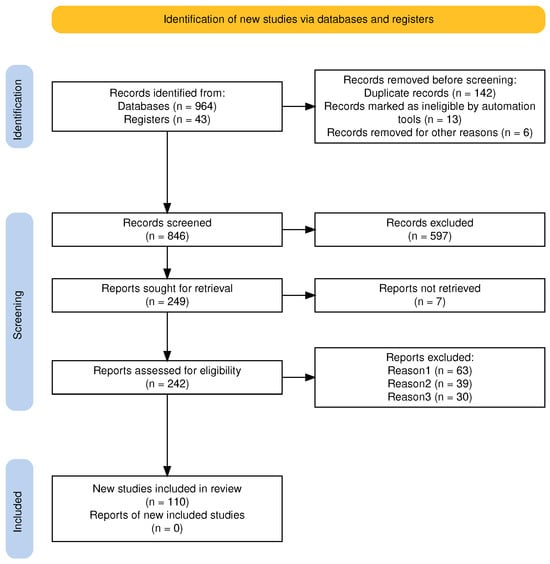
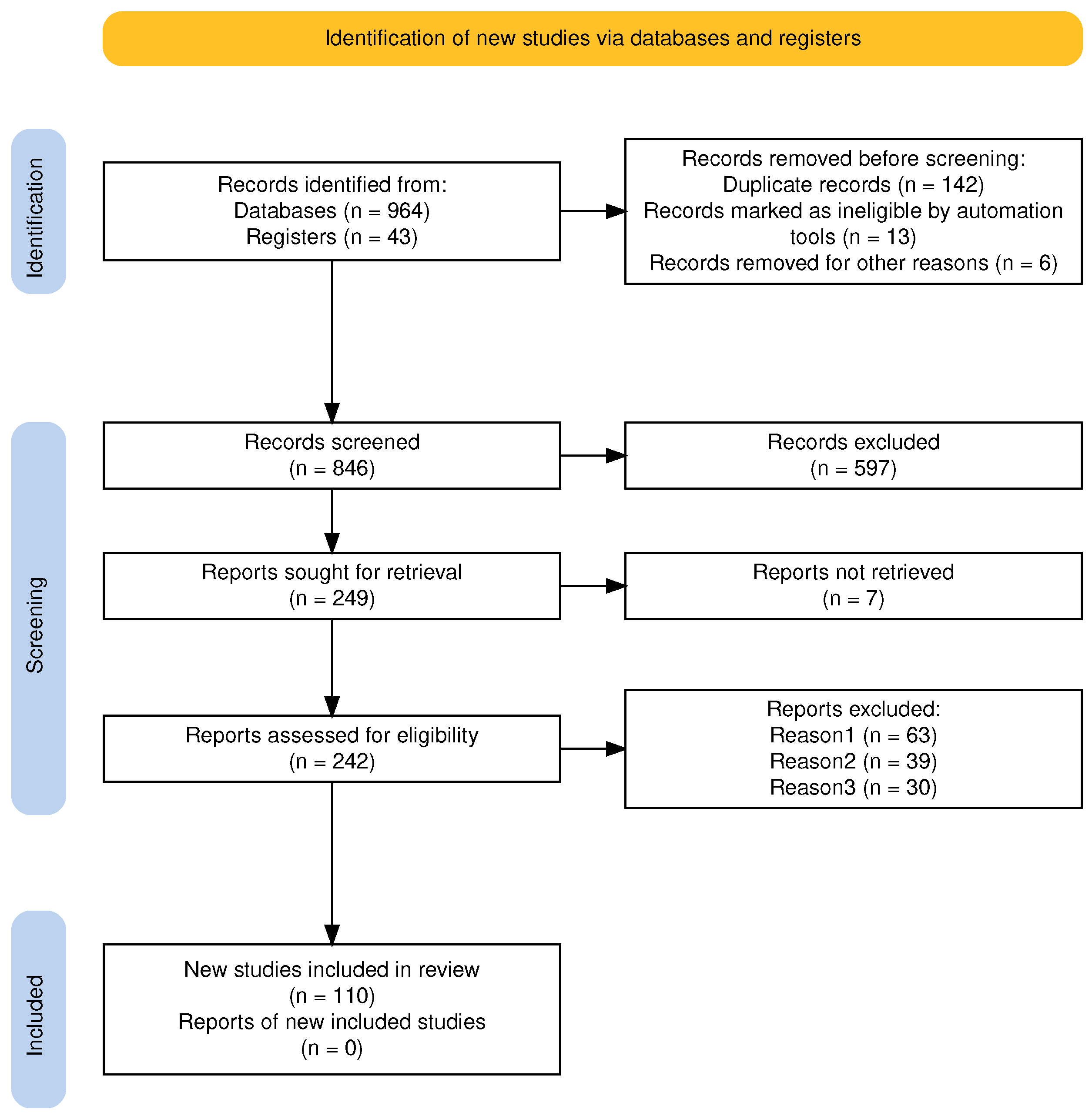
As depicted in Figure 3, the initial search resulted in 1007 papers containing the terms “digital twin” AND “cybersecurity”. After duplication removal, 846 unique research articles were subjected to screening. The first stage of screening (title and abstract screening) excluded 597 irrelevant articles, and full-text screening was performed on the remaining articles. After full-text screening, 110 articles were retrieved based on their relevance to research questions, adequate study quality, and accessibility. Finally, 110 articles were included in our study. All these selected articles passed the inclusion and exclusion criteria as per Table 2.
Figure 3.
PRISMA flow diagram. The systematic review was conducted following the PRISMA guidelines; the completed PRISMA checklist is provided in the Supplementary Materials.
Each paper was evaluated against a Quality Assessment Rubric consisting of four criteria scored on a scale of zero to two (zero: no, one: partial, and two: yes):
- 1.
- Is the DT architecture clearly defined?
- 2.
- Does the study provide empirical results (e.g., accuracy and latency)?
- 3.
- Is the security threat model explicitly stated?
- 4.
- Is the contribution to Industry 5.0 (human-centricity/resilience/sustainability) clear?
Only papers scoring ≥ five out of eight were included in the final 110-paper corpus.
(d) Data extraction form.
The study selected through the application of all the screening techniques is finally analyzed for extracting specific details. Table 3 presents the data extraction form for retrieving complete and consistent information from the selected studies.
Table 3.
Data extraction form.
2.2.2. Industry 5.0 Concept
The industrial revolution represents the most significant transformation in human history since the Neolithic period [8].
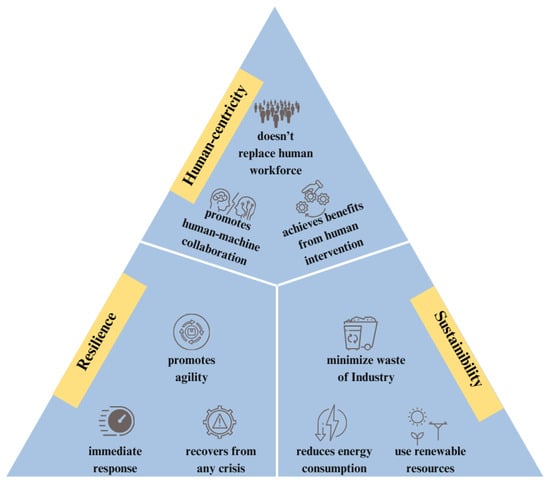
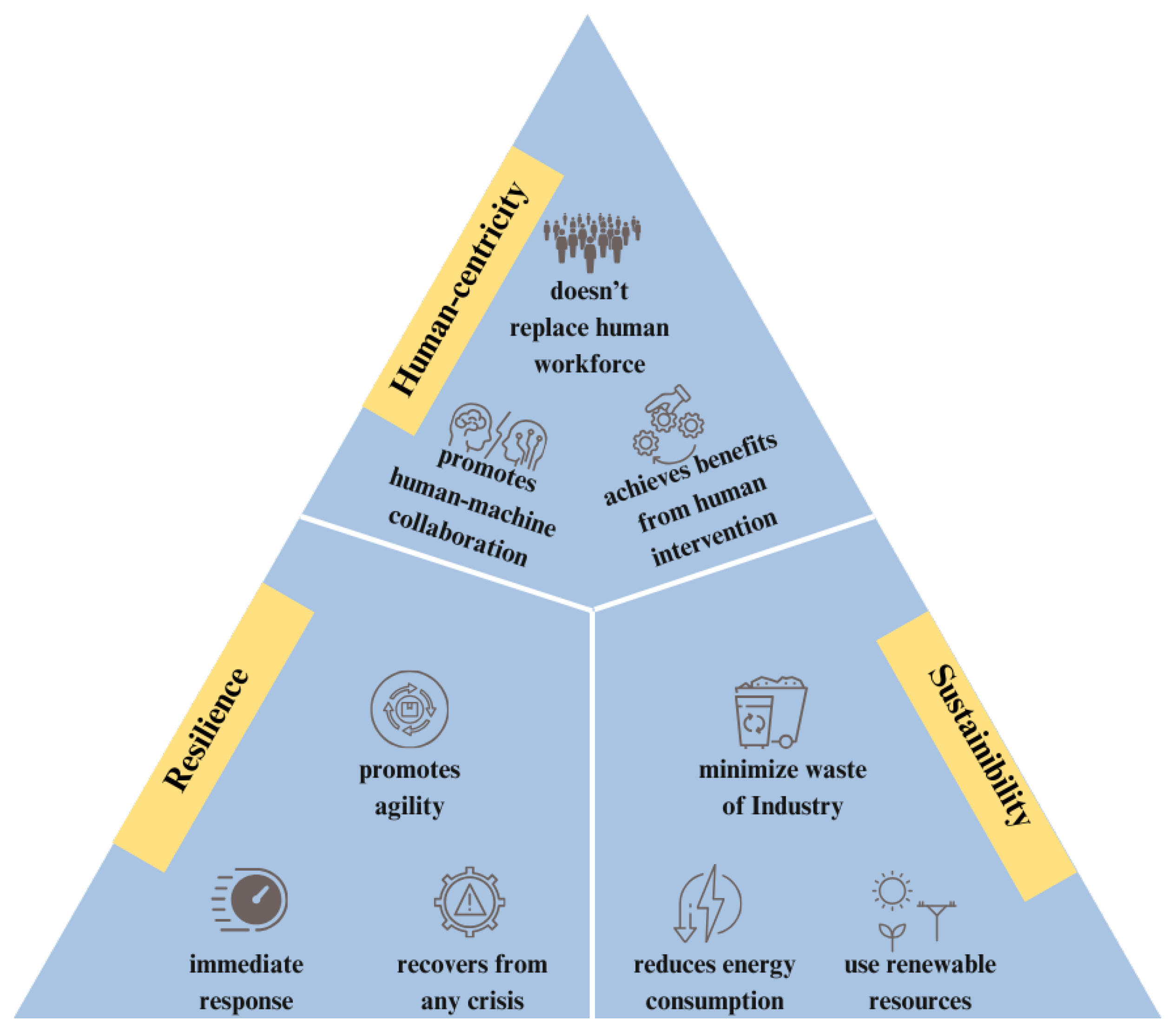
While IIoT and DTs are key components of Industry 4.0 [9], Industry 5.0 builds upon these technologies, incorporating advanced concepts that prioritize human creativity and intuition. This approach has a collaborative, flexible, and optimized manufacturing environment. The fifth industrial revolution changes the approach from economic to social value and well-being. It will revolutionise manufacturing systems worldwide by providing technologies to avoid repetitive human tasks [10]. This industrial phenomenon will also make manufacturing, supply chain, and other sectors automotive, robust, and efficient. Figure 4 shows the goals and opportunities of Industry 5.0.
Figure 4.
Goals and opportunities of Industry 5.0.
2.2.3. Relation of Industry 5.0, IIoT, and DT
The Industrial Internet of Things (IIoT) is the utilisation of internet-connected smart sensors and intelligent devices for industrial applications. To investigate the correlation between the Industry 5.0 revolution, Industrial IoT, and DT, the importance of IIoT in the fifth industrial revolution must be discussed first.
- 1.
- In Industry 5.0, human involvement is necessary to improve the accuracy of the system. Devices of the IoT interact and communicate with each other to help in industrial processes which helps to reduce human effort.
- 2.
- Industry-customised software-connected factories and collaborative robotics are required to develop Industry 5.0, all of which is impossible without the IIoT.
- 3.
- Real-time information processing and the Internet of Things must be adopted for Industry 5.0 [11,12,13,14]. The core ingredients of real-time processing are the sensors and actuators of the Industrial Internet of Things. IIoT makes the machines, systems of manufacturing, and the different industries connected through networks.
- 4.
- In Industry 5.0, robots help humans to work faster by leveraging advanced technologies such as big data analytics [15,16]. Big data is produced through the IIoT.
- 5.
- Industry 5.0 is all about reducing costs in storage, reducing latency, and expanding interoperability, which requires the IIoT.
As the IIoT is an important and compulsory technology in Industry 5.0, the security of the IIoT must be the biggest challenge for Industry 5.0. This is where DT comes into the picture, protecting Industrial IoT for eras. DT provides all kinds of monitoring, assessment, and platforms to secure the IIoT and helps Industry 5.0 achieve increased cybersecurity, predictive maintenance, and immediate recovery.
2.2.4. Use of DT in Industry
Digital Twin is one such technology helping to gain increasing importance across industries [17]. This section of the systematic review surveys the use of DTs across industries for resilience, sustainability, and increased productivity.
- Manufacturing and Process Optimization: Research indicates that approximately 85% of DT applications focus on manufacturing assets [18]. The primary objective has evolved from simple asset mirroring to enhancing sustainability and process efficiency [19]. Current effective solutions utilize Hybrid (HT) and Cognitive Twins (CT) within layered architectures (e.g., the COGNITWIN Toolbox) to reduce overheads [20]. Furthermore, the integration of Heuristic Scheduling and Deep Reinforcement Learning (DRL) has proven effective in managing real-time data transmission and optimising energy consumption in energy-intensive environments [21,22].
- Healthcare and Secure Data Management: In healthcare, DT effectiveness is measured by the transition from passive monitoring to predictive diagnostics. Effective frameworks now utilise three-phase models (prediction, monitoring, and correction) for early disease detection [23]. However, given the sensitivity of medical data, the most successful implementations integrate blockchain to ensure secure data sharing and mathematical validation of the digital–physical link [24]. Emerging “Metaverse” platforms are also being explored for remote diagnosis, though they remain constrained by significant privacy and security gaps [25].
- Critical Infrastructure and Energy Resilience: The energy sector utilises DTs primarily for grid safeguarding and asset lifecycle management [26,27]. Blockchain-enabled digital grids represent the most effective solution for protecting against cyber–physical attacks, while real-time monitoring via FPGA-based twins allows for early fault diagnostics in power transformers [28,29]. In urban contexts, the focus is on interoperability; frameworks like the “DUET Project” use T-cell models to create reliable, citizen-centric urban twins that fuse multi-sensor IoT data with spatial visualisation for safer city planning [30,31,32].
- Automotive and Construction (Lifecycle Management): In the automotive industry, DT is most effective during the pre-production phase, enabling virtual testing and simulation to reduce prototype costs—a strategy adopted by industry leaders like Tesla and Bosch [33,34]. Similarly, in construction, DT enhances safety through mixed reality and deep learning for hazard identification [35,36]. In both sectors, the move toward Cognitive DTs (CDT) supports building and vehicle lifecycle management, ensuring interoperability across the design-to-operation spectrum [37].
- Telecommunications and Agriculture (Optimization): For dynamic environments like agriculture and telecommunications, DTs act as sophisticated simulation engines. In agriculture, they capture multi-parameter data for real-time farm behaviour modelling and resource optimisation in vertical farming [38,39]. In telecommunications, DTs are increasingly effective for optimising Radio Access Networks (RAN) and Network Slicing, providing the simulation depth required to meet Quality of Service (QoS) standards in 5G and beyond [40,41,42].
3. Results
- RQ1: Compared to traditional approaches, how is dt technology striving to mitigate cyber attacks in IIoT?
Digital Twin technology is transforming industrial processes by linking physical and virtual systems, enabling better monitoring and stronger defence against attacks. Training analysts with diverse attack scenarios further enhances system resilience. Table 4 summaries articles on DT applications in industrial cybersecurity and the technologies employed.
Table 4.
Summary of DT applications in cybersecurity.
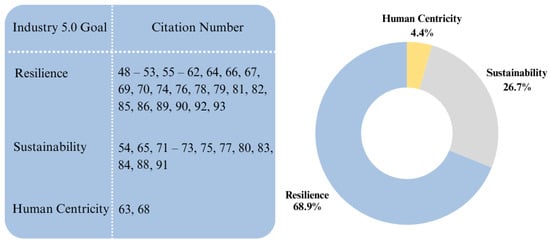
Figure 5 presents the articles that fulfil one or more goals of Industry 5.0 using DT. According to the analysis, 68.0% of the articles provide Resilience, 26.7% of the articles achieve Sustainability, followed by 4.4% of the articles obtaining Human-Centricity.
Figure 5.
Articles materialising Industry 5.0 goals using DT. The specific studies categorized are represented by references [48,49,50,51,52,53,54,55,56,57,58,59,60,61,62,63,64,65,66,67,68,69,70,71,72,73,74,75,76,77,78,79,80,81,82,83,84,85,86,88,89,90,91,92,93].
The research question 1 also identified the different types of cyber attacks each of the articles under study tried to address, as presented in Table 5, and applied different mitigation strategies.
Table 5.
Types of attacks discussed in various papers.
Other than DT, several approaches have been employed from time to time to enhance cybersecurity in smart industries, which are susceptible to frequent cyber attacks. Among these traditional methods, AI [88], deep learning [89], machine learning [90], blockchain [91], cryptography [92], etc., have been commonly used for this purpose. However, DT is a more advanced technology and can be highly efficient in providing improved security in combination with these approaches.
The findings show that DT technology enhances cybersecurity in IIoT by enabling real-time system monitoring and realistic cyber attack simulation. DT-based approaches improve intrusion detection, anomaly identification, and incident response compared to traditional static security methods. These solutions effectively mitigate advanced attacks such as man-in-the-middle, denial of service, and ransomware attacks. Additionally, DT-driven cybersecurity frameworks strongly support Industry 5.0 goals, particularly system resilience.
- RQ2: What technical challenges should be considered while integrating DT for security in Industry 5.0 (focusing on data complexity, model fidelity, real-time processing, and scalability)?
Digital Twin integration for enhancing security in Industry 5.0 faces significant technical challenges that must be addressed for effective implementation [93].
1. Data Complexity. Data complexity poses a significant challenge in integrating DT for cybersecurity. In [52], Danilczyk et al. highlighted how monitoring data from multiple sensors in a microgrid leads to data volume issues. Similarly ref. [64], by Stergiou et al. noted that IoT-based big data in cloud computing faces storage, management, and processing challenges due to rapid data growth. Finally ref. [83], emphasised that incorporating diverse historical, state, and semantic data into DT analytics further increases data processing complexity. The IoT, a core component of Industry 5.0, generates massive continuous data from sensors, devices, machinery, and human interactions [94], giving rise to big data. Safely managing this data and extracting insights while preserving privacy is a key concern for employing DT in Industry 5.0 cybersecurity [95].
2. Scalability and Multi-Modal Data Fusion. Monitoring, protection, and recovery using DTs require multiple components, and the system must be scalable. In [43], DTs detected attacks in ICS, where scalability is challenging due to the complexity of the infrastructure. Norton et al. [55] used ontology-based modelling and DTs to simulate access control devices and fire sensors in healthcare, where data fusion and scalability for numerous devices and events remain difficult. Similarly ref. [48], identified scalability in the design process as a challenge. A blockchain-based DT proposed in [46] enhances security and energy management, but managing many smart meters and devices in real-time is complex. Industry 5.0 converges technologies such as industrial big data, human–robot collaboration, the IIoT and 5G, cybersecurity, CPS, and Visual computing [96]. Scaling operations and fusing diverse data sources are crucial [97], yet managing the vast volume, velocity, and variety of data, especially from DTs and cybersecurity measures, is challenging.
3. Model Fidelity. DT model fidelity refers to how accurately a DT reflects its physical counterpart, which is vital for cybersecurity. Holmes et al. [71] showed that CyberDTs (CDTs) help operators test configurations before real deployment, while low fidelity risks flawed security decisions. A DT-based intrusion detection system in [53] suffered from poor integration of physical data, reducing its effectiveness. Suhail et al. [60] explored gamification for CPS security testing, but complex frameworks with cloud IoT hubs may compromise fidelity. Eckhart et al. [61] emphasised the high cost and difficulty of achieving fidelity, noting that state mismatches [62] reduce accuracy. In ERTMS integration, translating BPMN to Petri Nets requires fidelity for conformance checks [69], while ref. [85] also identified high-fidelity representation as a challenge. In Industry 5.0, fidelity is critical for resilient human–robot collaboration and optimised manufacturing despite its complexity [98].
4. Real-Time Processing. Real-time processing is vital for DTs in anomaly and security detection. DT frameworks may run asynchronously but assume time-stamped streaming [48]. Edge integration demands real-time analysis, posing challenges [70]. In cloud robotics, DT offloads heavy tasks with strict latency needs unmet by 5G [93]. DT cybersecurity depends on accurate real-time data across insecure channels and handling blockchain, SDN, and deep learning loads without latency [46], while preemptive malware detection faces rapid change capture issues [68]. Industry 5.0 requires real-time insights with DT enabling system monitoring [99], making smooth real-time processing critical.
5.Cyber–Physical System’s Security. DT-CPS integrations have faced 1100 major cyber attacks in the last 5 years [100]. Spyrou et al. highlighted hybrid attack concerns in CPS-DT security [60], where DT solutions, instead of only providing resilience for Industry 5.0, create new attack surfaces like malware and sabotage. Building DT without raising cyber risks remains a major challenge [71], and concerns persist for DT implementation in CPS cybersecurity [86]. A DT approach for cybersecurity testing in smart metering was proposed [81]. Key aspects include avoiding single points of failure, ensuring confidentiality, and addressing recovery issues. Though DT supports intrusion detection, it may also heighten cyber risks [101].
6. Interoperability and Integration. Interoperability in DTs faces challenges across security, data formats, and legacy integration. Zhang et al. [102] noted the difficulties in building interconnected DTs, while González-Herbón et al. [103] emphasised secure communication in Industry 5.0. Ensuring accuracy in SCADA remains critical [44]. Issues arise with diverse components [45], heterogeneous data [52], AR integration [54], CPS and legacy systems [61], SOC workflows [66], cyber ranges [74], and SIEM/LMS [75]. Blockchain use [85] and compliance in CCIs [87] further complicate matters. Differing formats and protocols [57], and Industry 5.0 technologies [69] heighten interoperability concerns.
7. Autonomy and Trustworthiness. DT in security often requires autonomous decisions from upper layers, making trustworthy choices essential. In [59], a reference architecture, Decentralised Autonomous Manufacturing (DAM), combining Decentralised Manufacturing (DM) and Autonomous Manufacturing (AM), was proposed to enhance resilience in Industry 5.0. Here, the virtual resource and task layer uses DT to emulate the current manufacturing context, requiring upper-layer decisions. In [45], device data are stored and analysed for insights and decisions in gas pipeline systems, which may raise trust issues. The Biopharma framework (Observe, Orient, Decide, and Act) in [78] provides a four-step decision-making approach for DT outputs, but ensuring reliable autonomous decisions remains challenging. Key Industry 5.0 components include intelligent decision making, automation, and the integration of human creativity with technology. AI and other enabling technologies support sustainable, resilient, human-centric services [104], but AI-driven DT for cyber attack detection must maintain trustworthiness and resilience, which can be difficult.
8. Metaverse. In [58], Far et al. highlighted that Metaverse-based DTs are more secure and reliable than centralised ones. However, the Metaverse can enable criminal activity, making identity management for users and DTs essential. Ensuring the uniqueness of DTs is crucial, as duplication can reduce validity and security. The Metaverse, central to Industry 5.0, aims to enhance innovation, productivity, and well-being through tailored solutions [105]. While DT–Metaverse integration facilitates visualisation and decision making, robust security measures are necessary to prevent disruptions.
9. Human–Machine Interaction and Trust. Paper [77] discussed how the fear of being replaced prevented healthcare professionals from trusting DT cybersecurity. Industry 5.0 has seen a huge paradigm shift from Industry 4.0, focusing more on being human-centric. The progress of this economy is assumed to be based on human–machine collaborations [106,107]. On the other hand, this human–machine interaction (HMI), being a typical application in DT, requires trust realisations through the implementation of machine learning algorithms for analysis [108]. However, the complexity of technologies and the potential for error or malfunctions, can hinder trustworthy communication and collaboration between humans and machines in Industry 5.0.
10. Protocol-related issues. DT communication relies on protocols. Reference [47] identified ‘Modbus’ as weak, being attack-prone due to a lack of encryption, clear text messages, a built-in function code system, and a serial network. While a DT could detect attacks, Modbus’s limited resilience may cause issues in Industry 5.0 cybersecurity implementations. In [47], a DT was implemented as an intrusion detection tool in industrial control systems, using a MiniCPS-based implementation that supports only Modbus and ENIP, which may lead to major drawbacks. Reference [76] evaluated system security in a Cooperative Intelligent Transport System using MAL and SecuriCAD, but struggled with detailed system design and protocol-specific risks. Reference [84] noted that a TLS-encrypted Modbus mitigates vulnerabilities but adds performance overhead, making secure implementation challenging. Diverse Industry 5.0 protocols may also hinder blockchain [109] and DT integration, so resolving protocol issues is essential for seamless DT communication and collaboration.
11. Dynamic Access Control and Authorization. As more devices/systems connect to the IoT network to provide security through DT, the attack surface for hackers expands, and preventing real-time unauthorised access to critical systems becomes challenging [70]. In paper [79], Sellitto et al. proposed a DT-based zero-trust architecture for smart grids to connect new devices to the grid. Although the framework could improve system resilience, the dynamic enforcement of security policies to reflect topology change over time is difficult to maintain. In [83,110], the authors mentioned the limitations of their access control models.
12. Privacy-Preserving Data Analysis. Data sharing in DT must be limited to protect personal data. In [111], Khan et al. discussed IoT data frameworks for Society 5.0, stressing privacy in security. The transparency of data use is essential. Jiang [63] studied HRC in CPS and flagged CWE-260 for storing plain text passwords. DTs collect sensitive data [74], and GDPR compliance is challenging. Cloud–IoT–DT integration raises data security and policy issues [64]. Atalay et al. [56] proposed DT-based smart grid security, highlighting the risks of unauthorised access. Pirbhulal et al. [77] used DT in IoT–healthcare security testing, but confidentiality remains difficult. Trustworthy DT in IIoT requires safeguarding sensor data and trade secrets [85]. Integrating FL with DT also complicates privacy [50]. Security and privacy are vital in Industry 5.0 [112], yet sensitive data in DT for healthcare and manufacturing remain at risk.
13. Adversarial Resilience and Robustness. In [113] Natalia et al. and [114] Leng et al. proposed blockchain-based security solutions for Industry 5.0 to provide resilience. Since Industry 5.0 systems are prone to adversarial attacks, security solutions must include self-healing capabilities for safety and consistent support. Most proposed frameworks integrate resilience with DT. However, Ref. [44] showed that recreating HSR rings for network resilience is unsuitable for DTs, reducing robustness compared to a physical test bed. In [48], a cybersecurity framework using DT was proposed, but it lacks resilience and recovery features. Similarly, ref. [51] introduced a Cyber-Resilient Smart Grid with anomaly detection; however, without an incident management strategy, resilience is compromised. In [67], DT-based anomaly detection using curriculum learning and GANs improved adversarial resilience, though the increasing attack complexity and noise posed challenges. In [80], Cyber DT performed system tests and monitoring but lacked self-healing, risking overall security. Industry 5.0 emphasises resilience as a core goal [115], linking resilience with sustainability. Thus, DT-based security in Industry 5.0 must ensure both resilience and robustness.
The analysis reveals that integrating Digital Twins for cybersecurity in Industry 5.0 faces substantial technical challenges related to data complexity, scalability, model fidelity, and real-time processing. Managing large-scale, heterogeneous, and privacy-sensitive data while ensuring accurate cyber–physical representation remains difficult. Achieving low-latency processing and seamless interoperability across legacy systems, protocols, and emerging technologies further complicates DT deployment. Additionally, concerns related to trustworthiness, autonomy, and expanded attack surfaces highlight the need for robust, resilient, and secure DT architectures.
- RQ3: What innovative solutions can address challenges faced in DT to enhance cybersecurity in the IIoT and Industry 5.0?
Digital Twin, as an enabling technology in Industry 5.0, offers solutions to many challenges and significantly enhances the system’s overall efficiency. The following section will discuss some notable applications of DT technology in addressing challenges and improving industrial processes.
(1) Data Complexity:
- Edge Computing: Mobile Edge Computing can optimally handle data complexity. It analyses and processes part of the data using computing, storage, and network resources. This edge computing creates a sustainable environment for Industry 5.0 to integrate DT as cybersecurity [116].
- Data Aggregation and Filtering: A DT-based data aggregation scheme can help to manage data complexity [117].
- Machine Learning and AI: Hybrid ML and DL algorithms are used for anomaly detection [118,119]. If DT is integrated with ML or AI to create a scheme, it can result in recognising patterns and anomalies, thus reducing data complexity.
- Cybersecurity Data Lakes: Data lakes [120] can be designed for cybersecurity to store raw data in large quantities. This can solve the issue of the data complexity of DT.
(2) Scalability and Multi-Modal Data Fusion:
- Cloud-Based Architectures: Refs. [121,122] used cloud-based architecture, which can lead to increased scalability. In DT, the integration of cloud can solve scalability problems.
- Containerisation: In [123], container virtualisation-based simulation as a service (CVSimaaS) is used for DT system deployment. Containers like Docker and Kubernetes can be used for scalability while integrating DT as cybersecurity in Industry 5.0.
(3) Model Fidelity:
- Multi-fidelity model: Multi-fidelity models are effective in improving model fidelity by using low-fidelity neural network metamodels and auto regressive schemes, as discussed in [124].
- Continuous Feedback Loops: Regular feedback between the DT and the physical system can enhance model fidelity.
(4) Real-Time Processing:
- Edge Computing: Edge computing processes data near the source, which helps in the real-time processing of DT in cybersecurity monitoring.
- Real-Time Data Analytics Platforms: Real-time stream processing platforms like Flink [125] and Kafka [126] help in the real-time processing of large amounts of data. These platforms can detect anomalies in DT integration and improve real-time performance.
- Optimised Data Pipelines: Digital Twin pipelines [127] can improve real-time performance for cybersecurity.
(5) Interoperability and Integration:
- Standardized APIs and Protocols: Protocols that support interoperability, such as MQTT and RESTful API, can greatly benefit Cyber DTs.
- Adoption of Industry Standards: Industry cybersecurity standards, for instance, ISO/IEC 27001 [128] and the guidelines of Industrial Internet Consortium (IIC) frameworks [129], help to maintain interoperability and security in DT.
(6) Cyber–Physical System Security:
- Comprehensive Threat Modelling and Risk Assessment: An approach to threat modelling and risk assessment should be performed on CPS before integrating DT with cybersecurity [130].
- Secure Communication Protocols: These should be developed to integrate DT with CPS.
- Strong Authentication Mechanisms: Multi-factor authentication (MFA) [131] and other strong authentication mechanisms should be used.
- Compliance with Standards: The established industry standards and guidelines for CPS security, such as IEC 62443 [132] and the NIST Cybersecurity Framework [133], can be followed to reduce the vulnerabilities of DT.
(7) Autonomy and Trustworthiness:
- Human-in-the-Loop Systems: Augmented Decision Making should have human observation to validate; this will also enable Industry 5.0’s human involvement goal.
- Institutional Oversight: In some cases, human observation can be delusional, so shift to institutional oversight to better verify the upper layers’ autonomous decisions [134].
- Cryptographic Techniques: Cryptographic methods like digital signatures and encryption can be used to create the trustworthiness of data.
(8) Metaverse:
- Decentralized Identity Management: Blockchain can be used along with decentralized identifiers to prevent duplication of DT in the Metaverse.
- Biometric security: Some mechanisms, like face recognition and fingerprint protection can be applied to restrict unauthorised access to Metaverse when DT is being used as cybersecurity [135].
(9) Human–Machine Interaction and Trust:
- Intuitive Interfaces: User interfaces should be interactive to guide humans in machine interactions to build trust.
- User Feedback Mechanisms: The feedback mechanism can be implemented so that the cybersecurity provided by DT can be improved.
- Implement Explainable AI (XAI): This can explain decision-making processes to humans to increase trust.
(11) Protocol-related issues:
- CoAP, DTDL, FDTF, FIWARE, Modbus TCP/IP, MQTT, OPC UA, and URLLC are widely used protocols that should be used accordingly, and they must be interoperable.
- Implement TLS and SSL for the security enhancement of protocols.
- Proper quality assessment of the protocol should be undertaken before implementation.
(12) Dynamic Access Control and Authorisation:
- Role-Based Access Control (RBAC), Attribute-Based Access Control (ABAC), and Policy-Based Access Control (PBAC) can provide dynamic authorisation.
- Zero-trust architecture never assumes trust and every access is verified [136], so DT can apply this for dynamic access in Industry 5.0 cybersecurity.
- Real-Time Access Monitoring and Auditing can ensure unauthorised access.
(14) Privacy-Preserving Data Analysis:
- The addition of classical and quantum noise guarantees privacy [137].
- A privacy budget can be deployed so that it limits data consumption, which will restrict private data use in DT for cybersecurity.
- Role-based access control can efficiently provoke DT to access data that is not personal.
(15) Adversarial Resilience and Robustness:
- All systems should have a recovery plan for automatic recovery.
- A backup system should be created when implementing DT for security so that if the system fails, all data are not lost.
- Timely updates of software/systems can provide robustness.
- The implementation of resilient architecture can be a solution.
- Advanced defensive technologies and algorithms can be applied to make the system robust.
The analysis show that DT-based cybersecurity in the IIoT and Industry 5.0 can be enhanced using AI-driven analytics, edge and cloud processing, and standardised interoperable frameworks. Human-in-the-loop control, zero-trust access, privacy-preserving methods, and resilient system designs further strengthen security and robustness.
4. Discussion
The analysis of 110 selected publications reveals that DT technology has transitioned from a monitoring tool to a core architecture for security orchestration in Industry 5.0. This section synthesizes the findings to evaluate the effectiveness of current solutions, their contextual applicability, and the trajectory of future research.
4.1. Comparative Effectiveness of DT Security Solutions
The “most effective” security solution in the current literature is not a single architecture but rather a hybrid integration tailored to specific security objectives. Based on our review, we categorize effectiveness as follows (also see Table 6):
Table 6.
Comparative analysis of DT-based security frameworks.
- AI-Augmented Detection: For identifying zero-day threats and complex anomalies, the integration of deep learning (DL) with DT is the most robust solution. While standard DTs monitor state deviations, AI-augmented models predict the intent behind deviations, significantly reducing false alarm rates in high-noise IIoT environments.
- Blockchain-Enabled Integrity: For maintaining the “Digital Thread” and ensuring data non-repudiation, blockchain-integrated DTs are the gold standard. These are particularly effective against man-in-the-Middle (MitM) and data injection attacks by providing an immutable ledger of the physical asset’s state changes.
- Edge vs. Cloud Trade-offs: Edge-based DTs offer the lowest latency for real-time response (e.g., in robotics), whereas Cloud-based DTs provide superior computational depth for long-term forensics and big-data analytics.
4.2. Contextual Success and Failure Analysis
The effectiveness of a DT is highly sensitive to the operational context. This study identifies specific environments where DT implementations succeed or face significant bottlenecks:
- Success Contexts: DT works optimally in high-value critical national infrastructure (CNI), such as smart grids and water treatment plants. In these sectors, the high cost of maintaining a high-fidelity twin is justified by the requirement for zero downtime and the ability to run “what-if” attack simulations without risking physical hardware.
- Constraint Points: DT implementations frequently struggle in legacy IIoT systems with low-bandwidth sensors. Here, the “Synchronization Gap”, the latency between a physical change and its digital update, creates a window of vulnerability that can be exploited for “State Desynchronization” attacks.
5. Research Challenges and Future Directions
This study found some research scopes to perfect DT as a reliable security tool.
- 1.
- A standardized framework for DT is needed for IIoT protection. The common framework should include reference architecture for IIoT, highly efficient algorithms like XAI or ensemble for real-time processing, complete lifecycle management, and secure layers for operations.
- 2.
- DT’s performance as a security tool mostly depends on the immediate response. Zero-latency physical–virtual communication could be a groundbreaking contribution to this field of research.
- 3.
- An integration platform should be developed so that all types of integration with DT can be performed smoothly by offering iPaas (Integration Platform as a Service).
- 4.
- More research on DT implementation in Industry 5.0 should be conducted, for instance, secure boot processes to increase trustworthiness, energy optimisation strategies for sustainability, more fruitful biometric recognition for authentication, and advanced algorithms for increasing robustness.
The vulnerabilities and integration issues of DT in Industry 5.0 have been addressed by many researchers by introducing several mitigation strategies. However, an ideal solution is to prevent an incident from happening rather than take action to recover from it. Secure-by-design could be the ultimate solution for DT, ensuring its robustness and safety from the design and development phases.
6. Conclusions
In this study, we investigated the role of DT technology as a functional cybersecurity component within the IIoT environments of Industry 5.0. By synthesising findings from 110 peer-reviewed articles, this research identifies the current state of DT implementation across sectors such as manufacturing, healthcare, and energy. The findings demonstrate that while DT offers significant potential for proactive defence and anomaly detection, it is not a standalone security panacea and typically requires integration with complementary technologies like blockchain or machine learning to ensure resilience. Crucially, integrating DT into cyber–physical systems can expand the attack surface, requiring robust security-by-design principles to address technical bottlenecks like data complexity and model fidelity. Moving forward, research should focus on developing standardised, secure-by-design IIoT frameworks that integrate efficient real-time algorithms, low-latency communication grounded in physical constraints, and interoperable iPaaS platforms to enhance trustworthiness and sustainability in Industry 5.0.
Supplementary Materials
The following supporting information can be downloaded at: https://www.mdpi.com/article/10.3390/info17020209/s1. The PRISMA checklist for this article is available as Supplementary Material.
Author Contributions
Conceptualization, M.W. and N.T.M.; methodology, M.W., N.T.M. and S.T.H.; validation, S.S.; formal analysis, N.T.M.; investigation, N.T.M. and S.T.H.; resources, M.W.; data curation, S.T.H.; writing—original draft preparation, N.T.M.; writing—review and editing, T.J. and A.B.; visualization, N.T.M.; and supervision, M.W., T.J. and A.B. All authors have read and agreed to the published version of the manuscript.
Funding
This work was partially funded by the Australian Research Council project DP220101516.
Institutional Review Board Statement
Not applicable.
Informed Consent Statement
Not applicable.
Data Availability Statement
All data used in this study were obtained from published academic articles and publicly available databases. No new datasets were generated. Extracted data supporting the findings of this review are available from the corresponding author upon reasonable request.
Conflicts of Interest
The authors declare no conflicts of interest.
Abbreviations
The following abbreviations are used in this manuscript:
| Abbreviation | Meaning |
| DT | Digital Twin |
| IIoT | Industrial Internet of Things |
| ICS | Industrial Control Systems |
| CPS | Cyber–Physical Systems |
| ML | Machine Learning |
| DL | Deep Learning |
| AI | Artificial Intelligence |
| IDS | Intrusion Detection System |
| DoS | Denial of Service |
| DDoS | Distributed Denial of Service |
| HMI | Human–Machine Interaction |
| AR | Augmented Reality |
References
- Babayigit, B.; Abubaker, M. Industrial internet of things: A review of improvements over traditional SCADA systems for Industrial Automation. IEEE Syst. J. 2024, 18, 120–133. [Google Scholar] [CrossRef] [Scilit]
- Hassan, M.A.; Zardari, S.; Farooq, M.U.; Alansari, M.M.; Nagro, S.A. Systematic analysis of risks in industry 5.0 architecture. Appl. Sci. 2024, 14, 1466. [Google Scholar] [CrossRef] [Scilit]
- European Union Agency for Cybersecurity (ENISA). 2024 Report on the State of the Cybersecurity in the Union. 2024. Available online: https://www.enisa.europa.eu/sites/default/files/2024-11/2024%20Report%20on%20the%20State%20of%20the%20Cybersecurity%20in%20the%20Union.pdf (accessed on 1 February 2025).
- Zurich Resilience Solutions. Cyber Attacks on Critical Infrastructure Pose Major Risk to Communities. 2025. Available online: https://www.zurichresilience.com/knowledge-and-insights-hub/articles/cyber-attacks-on-critical-infrastructure-pose-major-risk-to-communities (accessed on 1 February 2025).
- Office of Management and Budget. Moving the U.S. Government Toward Zero Trust Cybersecurity Principles; Memorandum M-22-09; Executive Office of the President: Washington, DC, USA, 2022. Available online: https://www.whitehouse.gov/wp-content/uploads/2022/01/M-22-09.pdf (accessed on 1 February 2025).
- Kitchenham, B.; Charters, S. Guidelines for Performing Systematic Literature Reviews in Software Engineering; Technical Report EBSE 2007-001; Keele University: Keele, UK; Durham University: Durham, UK, 2007. [Google Scholar]
- CEBMa. What Is a PICOC? Available online: https://cebma.org/resources/frequently-asked-questions/what-is-a-picoc/ (accessed on 1 February 2025).
- Fremdling, R. Industrial revolution and scientific and technological progress. Jahrb. Wirtsch. Econ. Hist. Yearb. 1997, 38, 147–168. [Google Scholar] [CrossRef] [Scilit]
- Attaran, S.; Attaran, M.; Celik, B. Digital Twins and Industrial Internet of Things: Uncovering operational intelligence in industry 4.0. Decis. Anal. J. 2024, 10, 100398. [Google Scholar] [CrossRef] [Scilit]
- Ietto, B.; Ancillai, C.; Sabatini, A.; Carayannis, E.; Gregori, G. The role of External Actors in SMEs’ Human-Centered Industry 4.0 adoption: An Empirical perspective on Italian Competence centers. IEEE Trans. Eng. Manag. 2024, 71, 1057–1072. [Google Scholar] [CrossRef] [Scilit]
- Abdelmageed, S.; Zayed, T. A study of literature in modular integrated construction—Critical review and future directions. J. Clean. Prod. 2020, 277, 124044. [Google Scholar] [CrossRef] [Scilit]
- Sun, W.; Wang, Q.; Zhou, Y.; Wu, J. Material and energy flows of the iron and steel industry: Status quo, challenges and perspectives. Appl. Energy 2020, 268, 114946. [Google Scholar] [CrossRef] [Scilit]
- Tripathy, H.; Pattanaik, P. Birth of Industry 5.0: “The Internet of Things” and next-generation technology policy. Int. J. Adv. Res. Eng. Technol. (IJARET) 2020, 11, 1904–1910. [Google Scholar]
- Wang, Y.; Han, J.; Beynon-Davies, P. Understanding blockchain technology for future supply chains: A systematic literature review and research agenda. Supply Chain Manag. Int. J. 2019, 24, 62–84. [Google Scholar] [CrossRef] [Scilit]
- Javaid, M.; Haleem, A.; Singh, R.; Haq, M.; Raina, A.; Suman, R. Industry 5.0: Potential applications in COVID-19. J. Ind. Integr. Manag. 2020, 5, 507–530. [Google Scholar] [CrossRef] [Scilit]
- Martos, V.; Ahmad, A.; Cartujo, P.; Ordoñez, J. Ensuring Agricultural Sustainability through Remote Sensing in the Era of Agriculture 5.0. Appl. Sci. 2021, 11, 5911. [Google Scholar] [CrossRef] [Scilit]
- Jiang, Y.; Yin, S.; Li, K.; Luo, H.; Kaynak, O. Industrial applications of Digital Twins. Philos. Trans. R. Soc. A Math. Phys. Eng. Sci. 2021, 379, 20200360. [Google Scholar] [CrossRef] [Scilit]
- Lu, Y.; Liu, C.; Wang, K.I.K.; Huang, H.; Xu, X. Digital twin-driven smart manufacturing: Connotation, erence model, applications and research issues. Robot. Comput.-Integr. Manuf. 2020, 61, 101837. [Google Scholar] [CrossRef] [Scilit]
- Rojek, I.; Mikołajewski, D.; Dostatni, E. Digital Twins in product lifecycle for sustainability in manufacturing and maintenance. Appl. Sci. 2020, 11, 31. [Google Scholar] [CrossRef] [Scilit]
- Abburu, S.; Berre, A.J.; Jacoby, M.; Roman, D.; Stojanovic, L.; Stojanovic, N. COGNITWIN—Hybrid and cognitive digital twins for the process industry. In Proceedings of the 2020 IEEE International Conference on Engineering, Technology and Innovation (ICE/ITMC), Cardiff, UK, 15–17 June 2020. [Google Scholar] [CrossRef] [Scilit]
- Chen, H.; Jeremiah, S.R.; Lee, C.; Park, J.H. A Digital Twin-Based Heuristic Multi-Cooperation Scheduling Framework for Smart Manufacturing in IIoT Environment. Appl. Sci. 2023, 13, 1440. [Google Scholar] [CrossRef] [Scilit]
- Ma, S.; Ding, W.; Liu, Y.; Ren, S.; Yang, H. Digital Twin and Big Data-Driven Sustainable Smart Manufacturing Based on Information Management Systems for Energy-Intensive Industries. Appl. Energy 2022, 326, 119986. [Google Scholar] [CrossRef] [Scilit]
- Elayan, H.; Aloqaily, M.; Guizani, M. Digital Twin for Intelligent Context-Aware IoT Healthcare Systems. IEEE Internet Things J. 2021, 8, 16749–16757. [Google Scholar] [CrossRef] [Scilit]
- Akash, S.S.; Ferdous, M.S. A Blockchain Based System for Healthcare Digital Twin. IEEE Access 2022, 10, 50523–50547. [Google Scholar] [CrossRef] [Scilit]
- Jagatheesaperumal, S.K.; Barreto, A.G.; Cde Albuquerque, V.H. Metaverse Platforms for Immersive Healthcare: A Survey on Telemedicine Solutions. ACM Comput. Surv. 2025, 58, 31. [Google Scholar] [CrossRef] [Scilit]
- Barricelli, B.R.; Casiraghi, E.; Fogli, D. A survey on digital twin: Definitions, characteristics, applications, and design implications. IEEE Access 2019, 7, 167653–167671. [Google Scholar] [CrossRef] [Scilit]
- Wanasinghe, T.R.; Wroblewski, L.; Petersen, B.K.; Gosine, R.G.; James, L.A.; De Silva, O.; Mann, G.K.; Warrian, P.J. Digital twin for the oil and gas industry: Overview, research trends, opportunities, and challenges. IEEE Access 2020, 8, 104175–104197. [Google Scholar] [CrossRef] [Scilit]
- Sifat, M.M.H.; Mukarram Choudhury, S.; Das, S.K.; Ahamed, H.; Muyeen, S.M.; Hasan, M.M.; Ali, M.F.; Tasneem, Z.; Islam, M.M.; Islam, M.R.; et al. Towards Electric Digital Twin Grid: Technology and Framework Review. Energy AI 2023, 11, 100213. [Google Scholar] [CrossRef] [Scilit]
- Nwoke, J.; Milanesi, M.; Viola, J.; Chen, Y.; Visioli, A. A reduced-order digital twin fpga-based implementation with self-awareness capabilities for power electronics applications. IEEE J. Radio Freq. Identif. 2024, 8, 493–505. [Google Scholar] [CrossRef] [Scilit]
- Khajavi, S.H.; Motlagh, N.H.; Jaribion, A.; Werner, L.C.; Holmström, J. Digital Twin: Vision, benefits, boundaries, and creation for buildings. IEEE Access 2019, 7, 147406–147419. [Google Scholar] [CrossRef] [Scilit]
- Raes, L.; Michiels, P.; Adolphi, T.; Tampere, C.; Dalianis, A.; McAleer, S.; Kogut, P. DUET: A framework for building interoperable and trusted digital twins of smart cities. IEEE Internet Comput. 2021, 26, 43–50. [Google Scholar] [CrossRef] [Scilit]
- Kaur, H.; Sood, S. A Survey on Digital Twin and its Applications. Comput. Sci. Rev. 2021, 40, 100413. [Google Scholar] [CrossRef] [Scilit]
- Kamran, S.S.; Haleem, A.; Bahl, S.; Javaid, M.; Nandan, D.; Verma, A.S. Role of smart materials and digital twin (DT) for the adoption of electric vehicles in India. Mater. Today Proc. 2022, 52, 2295–2304. [Google Scholar] [CrossRef] [Scilit]
- Piromalis, D.; Kantaros, A. Digital Twins in the Automotive Industry: The Road toward Physical-Digital Convergence. Appl. Syst. Innov. 2022, 5, 65. [Google Scholar] [CrossRef] [Scilit]
- Tao, F.; Qi, Q.; Wang, L.; Nee, A. Digital Twins and Cyber–Physical Systems toward Smart Manufacturing and Industry 4.0: Correlation and Comparison. Engineering 2019, 5, 653–661. [Google Scholar] [CrossRef] [Scilit]
- Omrany, H.; Mehdipour, A.; Oteng, D. Digital twin technology and social sustainability: Implications for the construction industry. Sustainability 2024, 16, 8663. [Google Scholar] [CrossRef] [Scilit]
- Xu, W.; Yang, H.; Ji, Z.; Ba, M. Cognitive digital twin-enabled multi-robot collaborative manufacturing: Framework and approaches. Comput. Ind. Eng. 2024, 194, 110418. [Google Scholar] [CrossRef] [Scilit]
- Nasirahmadi, A.; Hensel, O. Toward the next generation of digitalization in agriculture based on digital twin paradigm. Sensors 2022, 22, 498. [Google Scholar] [CrossRef] [Scilit]
- Monteiro, J.; Barata, J.; Veloso, M.; Veloso, L.; Nunes, J. Towards sustainable digital twins for vertical farming. In Proceedings of the 2018 Thirteenth International Conference on Digital Information Management (ICDIM), Berlin, Germany, 24–26 September 2018; pp. 234–239. [Google Scholar]
- Bellavista, P.; Giannelli, C.; Mamei, M.; Mendula, M.; Picone, M. Digital twin oriented architecture for secure and QoS aware intelligent communications in industrial environments. Pervasive Mob. Comput. 2022, 85, 101646. [Google Scholar] [CrossRef] [Scilit]
- Liu, M.; Fang, S.; Dong, H.; Xu, C. Review of Digital Twin about Concepts, Technologies, and Industrial Applications. J. Manuf. Syst. 2021, 58, 346–361. [Google Scholar] [CrossRef] [Scilit]
- Polese, M.; Bonati, L.; D’Oro, S.; Johari, P.; Villa, D.; Velumani, S.; Gangula, R.; Tsampazi, M.; Robinson, C.P.; Gemmi, G.; et al. Colosseum: The open RAN digital twin. IEEE Open J. Commun. Soc. 2024, 5, 5452–5466. [Google Scholar] [CrossRef] [Scilit]
- Pisani, J.; Cavone, G.; Pascucci, F.; Giarré, L. Using Digital Twin to Detect Cyber-Attacks in Industrial Control Systems. In Proceedings of the IEEE EUROCON 2023—20th International Conference on Smart Technologies, Torino, Italy, 6–8 July 2023. [Google Scholar] [CrossRef] [Scilit]
- Kandasamy, N.; Venugopalan, S.; Wong, T.; Leu, N. An electric power digital twin for cyber security testing, research and education. Comput. Electr. Eng. 2022, 101, 108061. [Google Scholar] [CrossRef] [Scilit]
- Al-Hawawreh, M.; Hossain, M. Digital twin-driven secured edge-private cloud Industrial Internet of Things (IIoT) framework. J. Netw. Comput. Appl. 2024, 226, 103888. [Google Scholar] [CrossRef] [Scilit]
- Kumar, P.; Kumar, R.; Aljuhani, A.; Javeed, D.; Jolfaei, A.; Islam, A. Digital twin-driven SDN for smart grid: A deep learning integrated blockchain for cybersecurity. Sol. Energy 2023, 263, 111921. [Google Scholar] [CrossRef] [Scilit]
- Grasselli, C.; Melis, A.; Rinieri, L.; Berardi, D.; Gori, G.; Sadi, A. An Industrial Network Digital Twin for enhanced security of Cyber-Physical Systems. In Proceedings of the 2022 International Symposium on Networks, Computers and Communications (ISNCC), Shenzhen, China, 19–22 July 2022. [Google Scholar] [CrossRef] [Scilit]
- Balta, E.; Pease, M.; Moyne, J.; Barton, K.; Tilbury, D. Digital Twin-Based Cyber-Attack Detection Framework for Cyber-Physical Manufacturing Systems. IEEE Trans. Autom. Sci. Eng. 2024, 21, 1695–1712. [Google Scholar] [CrossRef] [Scilit]
- Verma, A.; Bhattacharya, P.; Madhani, N.; Trivedi, C.; Bhushan, B.; Tanwar, S.; Sharma, G.; Bokoro, P.N.; Sharma, R. Blockchain for Industry 5.0: Vision, opportunities, key enablers, and future directions. IEEE Access 2022, 10, 69160–69199. [Google Scholar] [CrossRef] [Scilit]
- Gupta, D.; Moni, S.; Tosun, A. Integration of Digital Twin and Federated Learning for Securing Vehicular Internet of Things. In Proceedings of the International Conference on Research in Adaptive and Convergent Systems, Gdansk, Poland, 6–10 August 2023. [Google Scholar] [CrossRef] [Scilit]
- Coppolino, L.; Nardone, R.; Petruolo, A.; Romano, L. Building Cyber-Resilient Smart Grids with Digital Twins and Data Spaces. Appl. Sci. 2023, 13, 13060. [Google Scholar] [CrossRef] [Scilit]
- Danilczyk, W.; Sun, Y.; He, H. ANGEL: An Intelligent Digital Twin Framework for Microgrid Security. In Proceedings of the 2019 North American Power Symposium (NAPS), Wichita, KS, USA, 13–15 October 2019. [Google Scholar] [CrossRef] [Scilit]
- Varghese, S.; Ghadim, A.; Balador, A.; Alimadadi, Z.; Papadimitratos, P. Digital twin-based intrusion detection for industrial control systems. In Proceedings of the 2022 IEEE International Conference on Pervasive Computing and Communications Workshops and Other Affiliated Events (PerCom Workshops), Pisa, Italy, 21–25 March 2022. [Google Scholar] [CrossRef] [Scilit]
- Böhm, F.; Dietz, M.; Preindl, T.; Pernul, G. Augmented reality and the digital twin: State-of-the-Art and Perspectives for Cybersecurity. J. Cybersecur. Priv. 2021, 1, 519–538. [Google Scholar] [CrossRef] [Scilit]
- Norton, B.; Normann, M. Digital Twins and Semantic Data Fusion for Security in a Healthcare Environment. In Proceedings of the International Workshop on Semantic Digital Twins Co-Located with the 17th Extended Semantic Web Conference, SeDiT@ESWC, Heraklion, Greece, 31 May–4 June 2020; Volume 2615. [Google Scholar]
- Atalay, M.; Angin, P. A Digital Twins Approach to Smart Grid Security Testing and Standardization. In Proceedings of the 2020 IEEE International Workshop on Metrology for Industry 4.0 & IoT, Roma, Italy, 3–5 June 2020. [Google Scholar] [CrossRef] [Scilit]
- Mohsin, A.; Janicke, H.; Nepal, S.; Holmes, D. Digital Twins and the Future of Their Use Enabling Shift Left and Shift Right Cybersecurity Operations. In Proceedings of the 2023 5th IEEE International Conference on Trust, Privacy and Security in Intelligent Systems and Applications (TPS-ISA), Atlanta, GA, USA, 1–4 November 2023. [Google Scholar] [CrossRef] [Scilit]
- Far, S.; Rad, A. Applying Digital Twins in Metaverse: User Interface, Security and Privacy Challenges. J. Metaverse 2022, 2, 8–15. [Google Scholar]
- Leng, J.; Zhong, Y.; Lin, Z.; Xu, K.; Mourtzis, D.; Zhou, X.; Zheng, P.; Liu, Q.; Zhao, J.L.; Shen, W. Towards resilience in Industry 5.0: A decentralized autonomous manufacturing paradigm. J. Manuf. Syst. 2023, 71, 95–114. [Google Scholar] [CrossRef] [Scilit]
- Spyrou, O.; Ariza-Sentís, M.; Vélez, S. Enhancing Education in Agriculture via XR-Based Digital Twins: A Novel Approach for the Next Generation. Appl. Syst. Innov. 2025, 8, 38. [Google Scholar] [CrossRef] [Scilit]
- Eckhart, M.; Ekelhart, A. Digital Twins for Cyber-Physical Systems Security: State of the art and outlook. In Security and Quality in Cyber-Physical Systems Engineering: With Forewords by Robert M. Lee and Tom Gilb; Springer eBooks; Springer: New York, NY, USA, 2019; pp. 383–412. [Google Scholar] [CrossRef] [Scilit]
- Eckhart, M.; Ekelhart, A.; Weippl, E. Enhancing Cyber Situational Awareness for Cyber-Physical Systems through Digital Twins. In Proceedings of the 2019 24th IEEE International Conference on Emerging Technologies and Factory Automation (ETFA), Zaragoza, Spain, 10–13 September 2019. [Google Scholar] [CrossRef] [Scilit]
- Jiang, Y.; Wang, W.; Ding, J.; Lu, X.; Jing, Y. Leveraging digital twin technology for enhanced cybersecurity in Cyber–Physical production systems. Future Internet 2024, 16, 134. [Google Scholar] [CrossRef] [Scilit]
- Stergiou, C.; Bompoli, E.; Psannis, K. Security and privacy issues in IoT-Based big data cloud systems in a digital twin scenario. Appl. Sci. 2023, 13, 758. [Google Scholar] [CrossRef] [Scilit]
- Scheibmeir, J.; Malaiya, Y. Multi-Model security and social media analytics of the digital twin. Adv. Sci. Technol. Eng. Syst. J. 2020, 5, 323–330. [Google Scholar] [CrossRef] [Scilit]
- Allison, D.; Smith, P.; Mclaughlin, K. Digital Twin-Enhanced Incident Response for Cyber-Physical Systems. In Proceedings of the 18th International Conference on Availability, Reliability and Security (ARES ’23), Benevento, Italy, 29 August–1 September 2023; Association for Computing Machinery: New York, NY, USA, 2023. [Google Scholar] [CrossRef] [Scilit]
- Xu, Q.; Ali, S.; Yue, T. Digital Twin-based Anomaly Detection with Curriculum Learning in Cyber-physical Systems. ACM Trans. Softw. Eng. Methodol. 2023, 32, 113. [Google Scholar] [CrossRef] [Scilit]
- Cha, H.; Yang, H.; Song, Y.; Kang, A. Intelligent Anomaly Detection System through Malware Image Augmentation in IIoT Environment Based on Digital Twin. Appl. Sci. 2023, 13, 10196. [Google Scholar] [CrossRef] [Scilit]
- De Benedictis, A.; Flammini, F.; Mazzocca, N.; Somma, A.; Vitale, F. Digital Twins for anomaly detection in the industrial Internet of Things: Conceptual Architecture and Proof-of-Concept. IEEE Trans. Ind. Inform. 2023, 19, 11553–11563. [Google Scholar] [CrossRef] [Scilit]
- Yigit, Y.; Chrysoulas, C.; Yurdakul, G.; Maglaras, L.; Canberk, B. Digital Twin-Empowered Smart Attack Detection System for 6G Edge of Things networks. In Proceedings of the 2023 IEEE Globecom Workshops (GC Wkshps), Kuala Lumpur, Malaysia, 4–8 December 2023. [Google Scholar] [CrossRef] [Scilit]
- Holmes, D.; Papathanasaki, M.; Maglaras, L.; Ferrag, M.; Nepal, S.; Janicke, H. Digital twins and cyber security—Solution or challenge? In Proceedings of the 2021 6th South-East Europe Design Automation, Computer Engineering, Computer Networks and Social Media Conference (SEEDA-CECNSM), Preveza, Greece, 24–26 September 2021. [Google Scholar] [CrossRef] [Scilit]
- Wang, Z.; Saddik, A. DTITD: An intelligent insider threat detection framework based on digital twin and Self-Attention based deep learning models. IEEE Access 2023, 11, 114013–114030. [Google Scholar] [CrossRef] [Scilit]
- Akbarian, F.; Fitzgerald, E.; Kihl, M. Intrusion detection in digital twins for industrial control systems. In Proceedings of the 2020 International Conference on Software, Telecommunications and Computer Networks (SoftCOM), Hvar, Croatia, 17–19 September 2020. [Google Scholar] [CrossRef] [Scilit]
- Becue, A.; Fourastier, Y.; Praca, I.; Savarit, A.; Baron, C.; Gradussofs, B.; Pouille, E.; Thomas, C. CyberFactory#1—Securing the industry 4.0 with cyber-ranges and digital twins. In Proceedings of the 2018 14th IEEE International Workshop on Factory Communication Systems (WFCS), Imperia, Italy, 13–15 June 2018. [Google Scholar] [CrossRef] [Scilit]
- Vielberth, M.; Glas, M.; Dietz, M.; Karagiannis, S.; Magkos, E.; Pernul, G. A digital Twin-Based cyber range for SOC analysts. In IFIP Annual Conference on Data and Applications Security and Privacy; Lecture Notes in Computer Science; Springer International Publishing: Cham, Switzerland, 2021; pp. 293–311. [Google Scholar] [CrossRef] [Scilit]
- Sellitto, G.; Masi, M.; Pavleska, T.; Aranha, H. A cyber security digital twin for critical infrastructure protection: The Intelligent Transport System use case. In IFIP Working Conference on The Practice of Enterprise Modeling; Lecture notes in Business Information Processing; Springer International Publishing: Cham, Switzerland, 2021; pp. 230–244. [Google Scholar] [CrossRef] [Scilit]
- Pirbhulal, S.; Abie, H.; Shukla, A. Towards a Novel Framework for Reinforcing Cybersecurity using Digital Twins in IoT-based Healthcare Applications. In Proceedings of the 2022 IEEE 95th Vehicular Technology Conference: (VTC2022-Spring), Helsinki, Finland, 19–22 June 2022. [Google Scholar] [CrossRef] [Scilit]
- Mylrea, M.; Fracchia, C.; Grimes, H.; Austad, W.; Shannon, G.; Reid, B.; Case, N. BioSecure Digital Twin: Manufacturing Innovation and cybersecurity resilience. In Engineering Artificially Intelligent Systems; Springer International Publishing: Cham, Switzerland, 2021; pp. 53–72. [Google Scholar] [CrossRef] [Scilit]
- Sellitto, G.; Aranha, H.; Masi, M.; Pavleska, T. Enabling a zero trust architecture in smart grids through a digital twin. In Communications in Computer and Information Science; Springer International Publishing: Cham, Switzerland, 2021; pp. 73–81. [Google Scholar] [CrossRef] [Scilit]
- Marksteiner, S.; Bronfman, S.; Wolf, M.; Lazebnik, E. Using Cyber Digital Twins for automated automotive cybersecurity testing. In Proceedings of the 2021 IEEE European Symposium on Security and Privacy Workshops (EuroS&PW), Vienna, Austria, 6–10 September 2021. [Google Scholar] [CrossRef] [Scilit]
- Olivares-Rojas, J.; Reyes-Archundia, E.; Gutierrez-Gnecchi, J.; Molina-Moreno, I.; Cerda-Jacobo, J.; Mendez-Patino, A. Towards cybersecurity of the smart grid using digital twins. IEEE Internet Comput. 2022, 26, 52–57. [Google Scholar] [CrossRef] [Scilit]
- Krishnaveni, S.; Chen, T.; Sathiyanarayanan, M.; Amutha, B. CyberDefender: An integrated intelligent defense framework for digital-twin-based industrial cyber-physical systems. Clust. Comput. 2024, 27, 7273–7306. [Google Scholar] [CrossRef] [Scilit]
- Kamdjou, H.; Ouchani, S. A Secure Architecture for Digital Twins in Resource-Constrained Industrial Systems. Comput. Sci. Eng. 2025, 1–12. [Google Scholar] [CrossRef] [Scilit]
- Dietz, M.; Hageman, L.; Von Hornung, C.; Pernul, G. Employing digital twins for Security-by-Design system testing. In Proceedings of the 2022 ACM Workshop on Secure and Trustworthy Cyber-Physical Systems (Sat-CPS ’22), Baltimore, MD, USA, 27 April 2022; Association for Computing Machinery: New York, NY, USA, 2022. [Google Scholar] [CrossRef] [Scilit]
- Suhail, S.; Hussain, R.; Jurdak, R.; Hong, C. Trustworthy digital twins in the industrial internet of things with blockchain. IEEE Internet Comput. 2022, 26, 58–67. [Google Scholar] [CrossRef] [Scilit]
- Somma, A.; Casola, V.; Cavalli, A.; De Benedictis, A.; Mallouli, W.; Valdés, V. A Cyber Digital Twin framework to support Cyber-Physical systems security. In Proceedings of the 2023 IEEE Smart World Congress (SWC), Portsmouth, UK, 28–31 August 2023. [Google Scholar] [CrossRef] [Scilit]
- Salvi, A.; Spagnoletti, P.; Noori, N. Cyber-resilience of Critical Cyber Infrastructures: Integrating digital twins in the electric power ecosystem. Comput. Secur. 2022, 112, 102507. [Google Scholar] [CrossRef] [Scilit]
- Czeczot, G.; Rojek, I.; Mikołajewski, D.; Sangho, B. AI in IIoT Management of Cybersecurity for Industry 4.0 and Industry 5.0 Purposes. Electronics 2023, 12, 3800. [Google Scholar] [CrossRef] [Scilit]
- Salam, A.; Ullah, F.; Amin, F.; Abrar, M. Deep Learning Techniques for Web-Based Attack Detection in Industry 5.0: A Novel approach. Technologies 2023, 11, 107. [Google Scholar] [CrossRef] [Scilit]
- Wazid, M.; Singh, J.; Das, A.; Rodrigues, J. An Ensemble-Based Machine Learning-Envisioned intrusion detection in industry 5.0-Driven healthcare applications. IEEE Trans. Consum. Electron. 2024, 70, 1903–1912. [Google Scholar] [CrossRef] [Scilit]
- Anbalagan, S.; Raja, G.; Gurumoorthy, S.; R, D.S.; Ayyakannu, K. Blockchain Assisted Hybrid Intrusion Detection System in Autonomous Vehicles for Industry 5.0. IEEE Trans. Consum. Electron. 2023, 69, 881–889. [Google Scholar] [CrossRef] [Scilit]
- Shaikh, Z.; Hajjej, F.; Uslu, Y.; Yüksel, S.; Dınçer, H.; Alroobaea, R.; Baqasah, A.M.; Chinta, U. A New Trend in Cryptographic Information Security for Industry 5.0: A Systematic review. IEEE Access 2024, 12, 7156–7169. [Google Scholar] [CrossRef] [Scilit]
- Balogh, M.; Földvári, A.; Varga, P. Digital Twins in Industry 5.0: Challenges in Modeling and communication. In Proceedings of the NOMS 2023—2023 IEEE/IFIP Network Operations and Management Symposium, Miami, FL, USA, 8–12 May 2023. [Google Scholar] [CrossRef] [Scilit]
- Zhang, Y.; Luo, J.; Yang, H. A digital twin-based human-robot collaborative system for the assembly of complex-shaped architectures. Proc. Inst. Mech. Eng. Part B J. Eng. Manuf. 2025, 239, 1708–1720. [Google Scholar] [CrossRef] [Scilit]
- Alqahtani, H.; Kumar, G. Cybersecurity in electric and flying vehicles: Threats, challenges, AI solutions & future directions. ACM Comput. Surv. 2024, 57, 84. [Google Scholar] [CrossRef] [Scilit]
- Zeb, S.; Mahmood, A.; Khowaja, S.; Dev, K.; Hassan, S.; Gidlund, M.; Bellavista, P. Towards defining industry 5.0 vision with intelligent and softwarized wireless network architectures and services: A survey. J. Netw. Comput. Appl. 2024, 223, 103796. [Google Scholar] [CrossRef] [Scilit]
- Wang, X.; Wang, Y.; Yang, J.; Jia, X.; Li, L.; Ding, W.; Wang, F.Y. The survey on multi-source Data Fusion in cyber-physical-social systems: Foundational infrastructure for industrial metaverses and industries 5.0. Inf. Fusion 2024, 107, 102321. [Google Scholar] [CrossRef] [Scilit]
- Alves, J.; Lima, T.; Gaspar, P. Is Industry 5.0 a Human-Centred Approach? A systematic review. Processes 2023, 11, 193. [Google Scholar] [CrossRef] [Scilit]
- Mincă, E.; Filipescu, A.; Cernega, D.; Șolea, R.; Filipescu, A.; Ionescu, D.; Simion, G. Digital Twin for a Multifunctional Technology of Flexible Assembly on a Mechatronics Line with Integrated Robotic Systems and Mobile Visual Sensor—Challenges towards Industry 5.0. Sensors 2022, 22, 8153. [Google Scholar] [CrossRef] [Scilit]
- Riggs, H.; Tufail, S.; Parvez, I.; Tariq, M.; Khan, M.; Amir, A.; Vuda, K.V.; Sarwat, A.I. Impact, vulnerabilities, and mitigation strategies for Cyber-Secure critical infrastructure. Sensors 2023, 23, 4060. [Google Scholar] [CrossRef] [Scilit]
- Saeed, S.; Altamimi, S.; Alkayyal, N.; Alshehri, E.; Alabbad, D. Digital Transformation and Cybersecurity Challenges for businesses Resilience: Issues and recommendations. Sensors 2023, 23, 6666. [Google Scholar] [CrossRef] [Scilit]
- Zhang, L.; Zhou, L.; Horn, B. Building a right digital twin with model engineering. J. Manuf. Syst. 2021, 59, 151–164. [Google Scholar] [CrossRef] [Scilit]
- González-Herbón, R.; González-Mateos, G.; Rodríguez-Ossorio, J.; Domínguez, M.; Alonso, S.; Fuertes, J. An approach to develop digital twins in industry. Sensors 2024, 24, 998. [Google Scholar] [CrossRef] [Scilit]
- Yadav, N.; Maurya, N.; Mehta, N. When Industry meets Trustworthy AI: A Systematic Review of AI for Industry 5.0. Int. J. Adv. Res. Sci. Commun. Technol. 2024, 616–622. [Google Scholar] [CrossRef] [Scilit]
- Mourtzis, D. The Metaverse in Industry 5.0: A Human-Centric Approach towards Personalized Value Creation. Encyclopedia 2023, 3, 1105–1120. [Google Scholar] [CrossRef] [Scilit]
- Adel, A. Future of industry 5.0 in society: Human-centric solutions, challenges and prospective research areas. J. Cloud Comput. Adv. Syst. Appl. 2022, 11, 40. [Google Scholar] [CrossRef] [Scilit] [PubMed]
- Himi, S.T.; Monalisa, N.T.; Whaiduzzaman, M.; Barros, A.; Uddin, M.S. MedAi: A smartwatch-based application framework for the prediction of common diseases using machine learning. IEEE Access 2023, 11, 12342–12359. [Google Scholar] [CrossRef] [Scilit]
- Wang, T.; Li, J.; Deng, Y.; Wang, C.; Snoussi, H.; Tao, F. Digital twin for human-machine interaction with convolutional neural network. Int. J. Comput. Integr. Manuf. 2021, 34, 888–897. [Google Scholar] [CrossRef] [Scilit]
- Oliveira, M.; Chauhan, S.; Pereira, F.; Felgueiras, C.; Carvalho, D. Blockchain Protocols and edge computing targeting Industry 5.0 needs. Sensors 2023, 23, 9174. [Google Scholar] [CrossRef] [Scilit] [PubMed]
- Nobel, S.M.N.; Sultana, S.; Singha, S.P.; Chaki, S.; Mahi, M.J.N.; Jan, T.; Barros, A.; Whaiduzzaman, M. Unmasking banking fraud: Unleashing the power of machine learning and explainable AI (XAI) on imbalanced data. Information 2024, 15, 298. [Google Scholar] [CrossRef] [Scilit]
- Khan, S.; Arsalan, H. Sustainable Progress through IoT Safety and Knowledge Management in Society 5.0. 2024. Available online: https://www.researchgate.net/publication/380151598_Sustainable_Progress_through_IoT_Safety_and_Knowledge_Management_in_Society_50 (accessed on 1 February 2026).
- Dmitrieva, E.; Balmiki, V.; Bhardwaj, N.; Kumar, K.; Sharma, A.; Shruthi, C. Security and Privacy in AI-Driven Industry 5.0: Experimental insights and threat analysis. BIO Web Conf. 2024, 86, 01097. [Google Scholar] [CrossRef] [Scilit]
- Natalia, T.; Pathani, A.; Dhaliwal, N.; Rajasekhar, N.; Khatkar, M. Blockchain Integration in Industry 5.0: A security Experiment for resilience assessment. BIO Web Conf. 2024, 86, 01070. [Google Scholar] [CrossRef] [Scilit]
- Leng, J.; Chen, Z.; Huang, Z.; Zhu, X.; Su, H.; Lin, Z.; Zhang, D. Secure Blockchain Middleware for Decentralized IIoT towards Industry 5.0: A Review of Architecture, Enablers, Challenges, and Directions. Machines 2022, 10, 858. [Google Scholar] [CrossRef] [Scilit]
- Sindhwani, R.; Afridi, S.; Kumar, A.; Banaitis, A.; Luthra, S.; Singh, P. Can industry 5.0 revolutionize the wave of resilience and social value creation? A multi-criteria framework to analyze enablers. Technol. Soc. 2022, 68, 101887. [Google Scholar] [CrossRef] [Scilit]
- Zhang, Y. Edge computing for digital Twin. In Simula SpringerBriefs on Computing; Springer: New York, NY, USA, 2024; pp. 41–59. [Google Scholar] [CrossRef] [Scilit]
- Islam, A.; Shin, S. A Digital Twin-Based Drone-Assisted Secure Data Aggregation Scheme with Federated Learning in Artificial Intelligence of Things. IEEE Netw. 2023, 37, 278–285. [Google Scholar] [CrossRef] [Scilit]
- Abbas, Z.; Al-Ani, A. An adaptive combination algorithm based on deep learning and genetic algorithm for anomalous events detection. Indones. J. Electr. Eng. Comput. Sci. 2023, 31, 902–908. [Google Scholar] [CrossRef] [Scilit]
- Eze, P.; Geard, N.; Mueller, I.; Chades, I. Anomaly detection in endemic disease surveillance data using machine learning techniques. Healthcare 2023, 11, 1896. [Google Scholar] [CrossRef] [Scilit]
- Rashid, A.; Ahmed, M.; Ullah, A. Data Lakes: A Panacea for Big Data Problems, Cyber Safety Issues, and Enterprise Security; CRC Press eBooks; CRC Press: Boca Raton, FL, USA, 2022; pp. 135–162. [Google Scholar] [CrossRef] [Scilit]
- Zhang, G.; MacCarthy, B.; Ivanov, D. The Cloud, Platforms, and Digital Twins—Enablers of the Digital Supply Chain; Elsevier eBooks; Elsevier: Amsterdam, The Netherlands, 2022; pp. 77–91. [Google Scholar] [CrossRef] [Scilit]
- Alam, K.; Saddik, A. C2PS: A digital twin architecture erence model for the Cloud-Based Cyber-Physical systems. IEEE Access 2017, 5, 2050–2062. [Google Scholar] [CrossRef] [Scilit]
- Lin, T.; Shi, G.; Yang, C.; Zhang, Y.; Wang, J.; Jia, Z.; Guo, L.; Xiao, Y.; Wei, Z.; Lan, S. Efficient container virtualization-based digital twin simulation of smart industrial systems. J. Clean. Prod. 2021, 281, 124443. [Google Scholar] [CrossRef] [Scilit]
- Cao, Y.; Currie, C.; Onggo, B.; Higgins, M. Simulation optimization for a digital twin using a Multi-Fidelity Framework. In Proceedings of the 2021 Winter Simulation Conference (WSC), Phoenix, AZ, USA, 12–15 December 2021. [Google Scholar] [CrossRef] [Scilit]
- Zhang, H. Research and design of real time big data Visualization analysis platform based on Flink. J. Phys. Conf. Ser. 2023, 2504, 012053. [Google Scholar] [CrossRef] [Scilit]
- Papachristopoulou, K.; Agorogiannis, E.; Ipektsidis, C.; Gkioni, A.; Parasyris, A.; Metheniti, V.; Ristolainen, A. StreamHandler as a Real-Time Decision Support System for Environmental Monitoring in Digital Twins of the Ocean. In Proceedings of the 2025 6th International Conference in Electronic Engineering & Information Technology (EEITE), Chania, Greece, 4–6 June 2025; pp. 1–6. [Google Scholar]
- Fotre, S.; McCann, J.; Wallace, J.; Motawa, I.; McKane, M.; McChesney, I.; Bond, R.; Carracedo, J.M. A Digital-Twin pipeline for the optimisation of marine outfitting. In Proceedings of the 2023 IEEE Smart World Congress (SWC), Portsmouth, UK, 28–31 August 2023. [Google Scholar] [CrossRef] [Scilit]
- ISO/IEC 27001:2022; Information Security, Cybersecurity and Privacy Protection—Information Security Management Systems—Requirements. International Organization for Standardization: Geneva, Switzerland, 2022.
- Industry IoT Consortium. Industrial Internet Security Framework—Industry IoT Consortium; Industry IoT Consortium: Boston, MA, USA, 2023. [Google Scholar]
- Tantawy, A.; Abdelwahed, S.; Erradi, A.; Shaban, K. Model-based risk assessment for cyber physical systems security. Comput. Secur. 2020, 96, 101864. [Google Scholar] [CrossRef] [Scilit]
- Ibrokhimov, S.; Hui, K.; Al-Absi, A.; Lee, H.; Sain, M. Multi-Factor Authentication in Cyber Physical System: A state of art survey. In Proceedings of the 2019 21st International Conference on Advanced Communication Technology (ICACT), PyeongChang, Republic of Korea, 17–20 February 2019. [Google Scholar] [CrossRef] [Scilit]
- ISA/IEC. ISA/IEC 62443 Series of Standards: Security for Industrial Automation and Control Systems; International Society of Automation: Research Triangle Park, NC, USA, 2018. [Google Scholar]
- The NIST Cybersecurity Framework (CSF) 2.0; National Institute of Standards and Technology: Gaithersburg, MD, USA, 2024.
- Evani, P.K. Agentic Ai Security: A Control Framework for Autonomous Decision-Making Systems. Available online: https://ssrn.com/abstract=5332681 (accessed on 1 January 2020).
- Huang, Y.; Li, Y.; Cai, Z. Security and Privacy in Metaverse: A Comprehensive survey. Big Data Min. Anal. 2023, 6, 234–247. [Google Scholar] [CrossRef] [Scilit]
- Raheman, F. From Standard Policy-Based Zero Trust to Absolute Zero Trust (AZT): A quantum leap to Q-Day security. J. Comput. Commun. 2024, 12, 252–282. [Google Scholar] [CrossRef]
- Angrisani, A.; Doosti, M.; Kashefi, E. A unifying framework for differentially private quantum algorithms. arXiv 2023, arXiv:2307.04733. [Google Scholar] [CrossRef] [Scilit]

Disclaimer/Publisher’s Note: The statements, opinions and data contained in all publications are solely those of the individual author(s) and contributor(s) and not of MDPI and/or the editor(s). MDPI and/or the editor(s) disclaim responsibility for any injury to people or property resulting from any ideas, methods, instructions or products referred to in the content. |
© 2026 by the authors. Licensee MDPI, Basel, Switzerland. This article is an open access article distributed under the terms and conditions of the Creative Commons Attribution (CC BY) license.