1. Introduction
Online forums, particularly those with antisocial or conspiratorial leanings, have become fertile ground for the pervasive spread and normalization of prejudiced language [
1,
2]. While empirical understanding of the dynamics and language used on these forums is growing [
3,
4,
5,
6], the reasons and causes by which hateful rhetoric escalates have yet to receive sufficient attention.
In response to moderation efforts and social stigma against overt hate speech, online communities have strategically shifted towards the use of implicit language, commonly referred to as “dog whistles” [
2,
7,
8]. This form of coded communication is designed to convey specific messages to a targeted in-group possessing specialized knowledge, while keeping other groups, such as platform moderators or external observers, ignorant of the underlying hateful meaning [
9]. This strategic adaptation is largely attributable to the risk of deplatforming and content removal by social media platforms and forums aiming to minimize harmful language and misinformation [
10,
11,
12].
While implicit representations may seem innocuous, particularly in comparison to explicit ones which are readily identified as potential hate speech, they nonetheless represent a potent vehicle for spreading and promoting hate in encoded ways. This dynamic interplay between platform moderation and user adaptation highlights an ongoing “arms race”: when platforms suppress explicit hate, radicalized communities bent on hate innovate through the use of implicit and coded language or change platforms [
13,
14,
15]. This dynamic makes the detection and countering of hate speech significantly more challenging, as the meaning is deliberately concealed from outsiders, allowing communication within the in-group while retaining both obscurity and plausible deniability. While the use of implicit language may not seem particularly significant, its use contributes to a normalization of hateful rhetoric, making the escalation of expressions to explicit hate speech and overt aggression more likely. With empirical studies supporting the notion that hate speech serves as a precursor to physical harm [
16], and that hateful and radical language can serve as a significant component in mass violence through the normalization of stereotypes, dehumanization, and alienation [
17,
18,
19,
20,
21], the need to further understand language escalation becomes salient.
Semantic and rhetorical analysis approaches offer a sturdy framework for understanding how collective identity and subcultural belonging emerge through patterned language use in online communities. By modeling meaning as networks of co-occurring terms rather than isolated words, semantic analysis captures how shared vocabularies, symbols, and associations stabilize in-group boundaries and encode collective worldviews [
2,
22]. Applied studies show that these networks reveal how individuals align themselves with group identities by adopting distinctive rhetorical repertoires, whether in political movements [
23] or oppositional online communities [
24]. Work on subcultural jargon further demonstrates that specialized vocabularies function as signals of membership, with dense semantic clusters marking insider status and reinforcing ideological cohesion [
25]. Together, this literature underscores how semantic networks are especially well suited to identifying an individual’s adoption of subcultural rhetoric, their status or position within a group, and the ways language use both reflects and reproduces collective identity in online social groups.
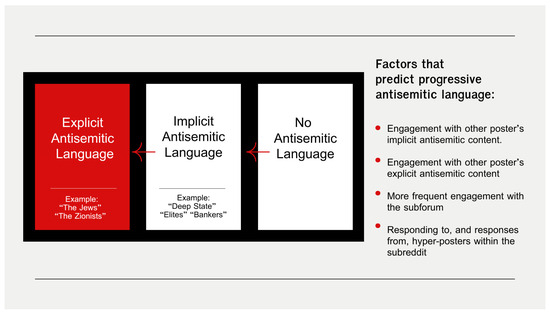
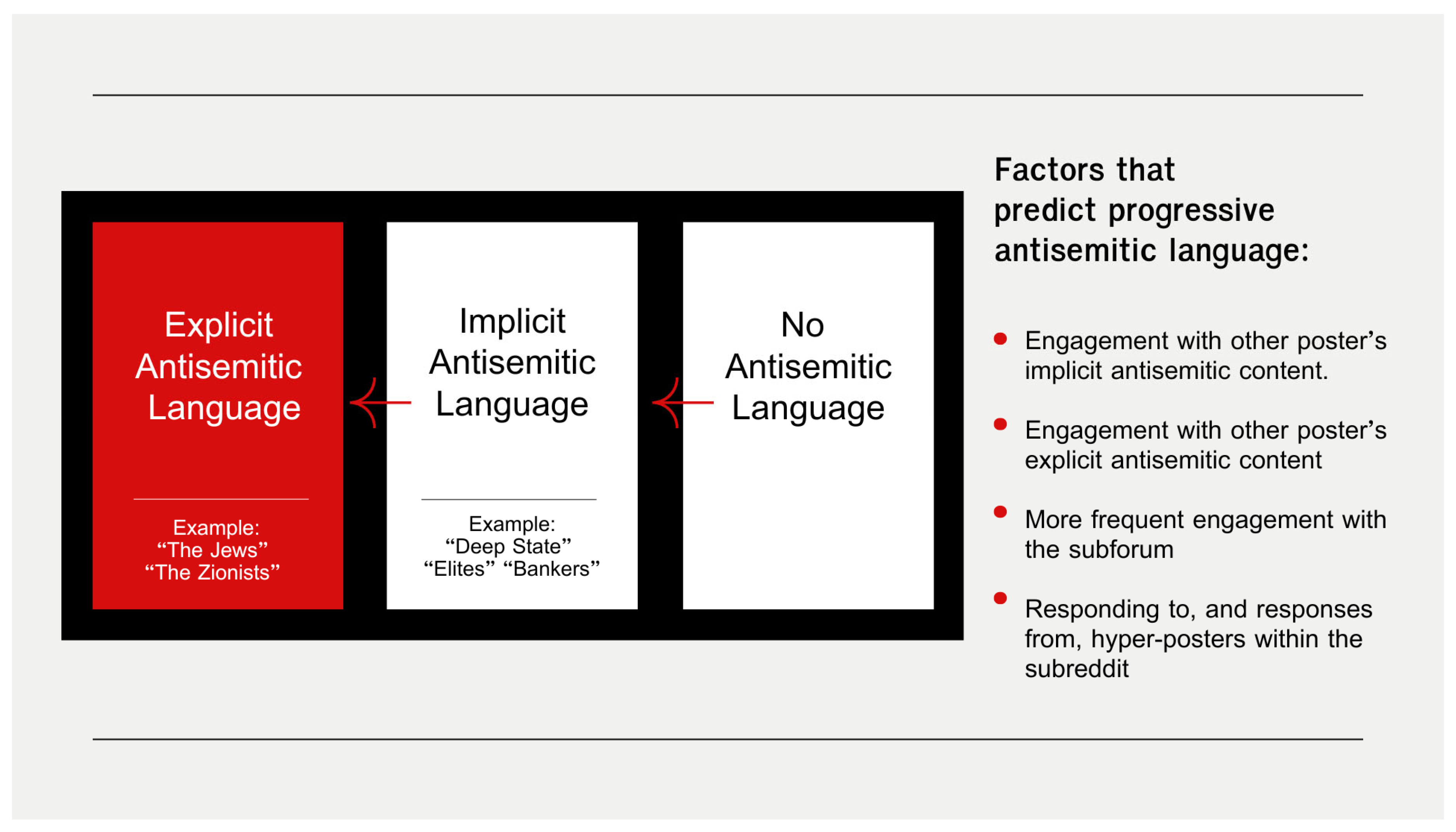
In this paper, we describe the process through which users in an online community become actively engaged with hate speech, mapping the semantic progression from responding to posts containing hateful rhetoric to posting and spreading it themselves. Key to this process is participation in the escalation of rhetoric from coded or implicit to overt or explicit, both in responses to posts with such content and in creation of them.
3. Hypotheses
We posit a structured, multi-stage model of language escalation within online subcultures, influenced by individual engagement and community dynamics. The following hypotheses detail the expected relationships between user behavior, language type (implicit/explicit), and posting patterns, grounded in the theoretical framework of language games and observed patterns of online radicalization.
The general unacceptability and social stigma associated with explicit antisemitic rhetoric suggest that new users may initially gravitate towards less overt forms of hate speech. Implicit language provides a potentially more accessible entry point into the community’s language game [
2]. Use of implicit rather than explicit language enables new participants to engage in the community’s specific lexicon and connect with the in-group identity without immediately risking exposure to social backlash. Similarly, we anticipate users will demonstrate an initial preference to engage with implicit content, reflecting a strategic adaptation to the online environment, where responding coded content carries less risk of social stigma or censure than responding to explicit content.
H1. New users (in the first month of participating in the forum) who engage with antisemitic content are more likely to engage with implicit content, either by posting responses to implicit submissions or to implicit comments, than with explicit content.
As previous research has shown, increased frequency of posting and social involvement directly correlates with greater immersion and identification with the online community as active involvement shapes positive perceptions of the in-group while vilifying opposition [
70,
71]. This heightened engagement provides users with more consistent and intensive exposure to the community’s evolving norms, shared lexicon, and the nuances of the language game. High posting frequency is thus a strong indicator of deeper socialization within the radicalizing environment. We therefore anticipate that high posting frequency increases the likelihood of users adopting more extreme forms of expression, including explicit hate speech.
H2. More frequent posters—those more engaged with/self-identified with the group—are more likely than others to use explicit language in their posts.
Engagement with explicit antisemitic content through commenting may represent a key escalation within extremist subcultural forums that reduces inhibition and validates perceptions of acceptable discourse. This initial alignment with overtly hateful language is expected to facilitate a deeper desensitization and integration into the forum’s radicalized language system and ideology. As a result, we anticipate that users who comment on posts explicit content are more likely to shift from reactive engagement to proactive participation. By contributing to other users’ explicit submissions, users will be more likely to escalate their involvement within the forum to the posting of original submissions containing explicit antisemitic language.
H3A. Users who engage with explicit content by commenting on explicit submissions or comments are more likely to post explicit submissions themselves.
The contribution towards explicit antisemitic conversation by posting explicit content indicates increased involvement and identification with the beliefs proliferated within the subcultural forum. Active participation of the highest degree of the subcultural lexicon, even when building on the conversation initiated by another user, indicates significant buy-in into the collective identity for individuals and thus an increased willingness to utilize subcultural, antisocial rhetoric. Therefore, we anticipate that users will shift from contributing to other authors’ explicit submissions with explicit comments, to engaging with their own explicit submissions. This transition would showcase active belief and initiative with explicit antisemitism in a forum with which they are familiar with and involved.
H3B. Users who post explicit comments are more likely to post explicit submissions.
Hyper-posters, determined by the disproportionate amount of content generated, are recognized as dominant and highly influential users who frequently set the tone and push ideological boundaries within online communities [
3]. Within subcultural forums, the content produced by these actors typically operates and extends the forum’s subcultural language system, normalizing antisocial and exclusionary ideology through both coded and overt forms of expression. Therefore, engagement with hyper-posters’ content signals buy-in within the forum’s hateful core ideology. As users respond to these influential figures, they are increasingly drawn into the subcultural language game, which lowers normative barriers to reproducing both implicit and explicit antisemitic content. Accordingly, we hypothesize that responding to hyper-posters increases a user’s likelihood of engaging with both implicit and explicit antisemitic language.
H4A. A user who responds to hyper-posters (top 1% of users) are more likely to engage with both implicit and explicit antisemitic content.
Hyper-posters’ direct engagement with another user’s content, such as through replies or comments, may serve as a powerful form of validation or implicit instruction just as the reinforcement of outrage can lead to the normalization and increased use of outrage filled rhetoric [
72]. This interaction may signal approval for certain types of rhetoric and encourage the recipient user to escalate their own language to align with the community’s radicalized norms as they receive attention from key figureheads. Therefore, we anticipate a direct social influence mechanism, where the endorsement from influential community members reinforces and accelerates a user’s progression into both implicit and explicit antisemitic language.
H4B. Hyper-posters (top 1% of users), by responding to posts published by a given user, will increase the likelihood that the user posts implicit and explicit antisemitic content.
6. Results
6.1. Descriptive Statistics of Language Use and User Transitions
The analysis of descriptive statistics provides initial evidence for the prevalence of different language types and the patterns of user transitions within the QAnon subreddits.
Table 3 describes the distribution of comments and submissions across authors and language states. Across the corpus, the proportion of implicit comments (~8%) and submissions (~13%) significantly dwarfed that of explicit comments (<1%) and submissions (<1%), indicating that coded language serves as the dominant mode of antisemitic expression.
Table 4 shows descriptive statistics for the average number of comments and submissions per user. The average number of comments per user was 35.03, with a median of 3.0 and a mode of 1.0, indicating a long tail of highly active users. For submissions, the mean was 7.88, with a median of 2.0 and a mode of 1.0. Together with the high proportion of comments among all posts, these findings show that most user communication takes place in response to posts by others rather than generation of new content. Moreover, they suggest that most users post relatively infrequently, while a small proportion of users may post an outsized number of comments and submissions relative to the average user.
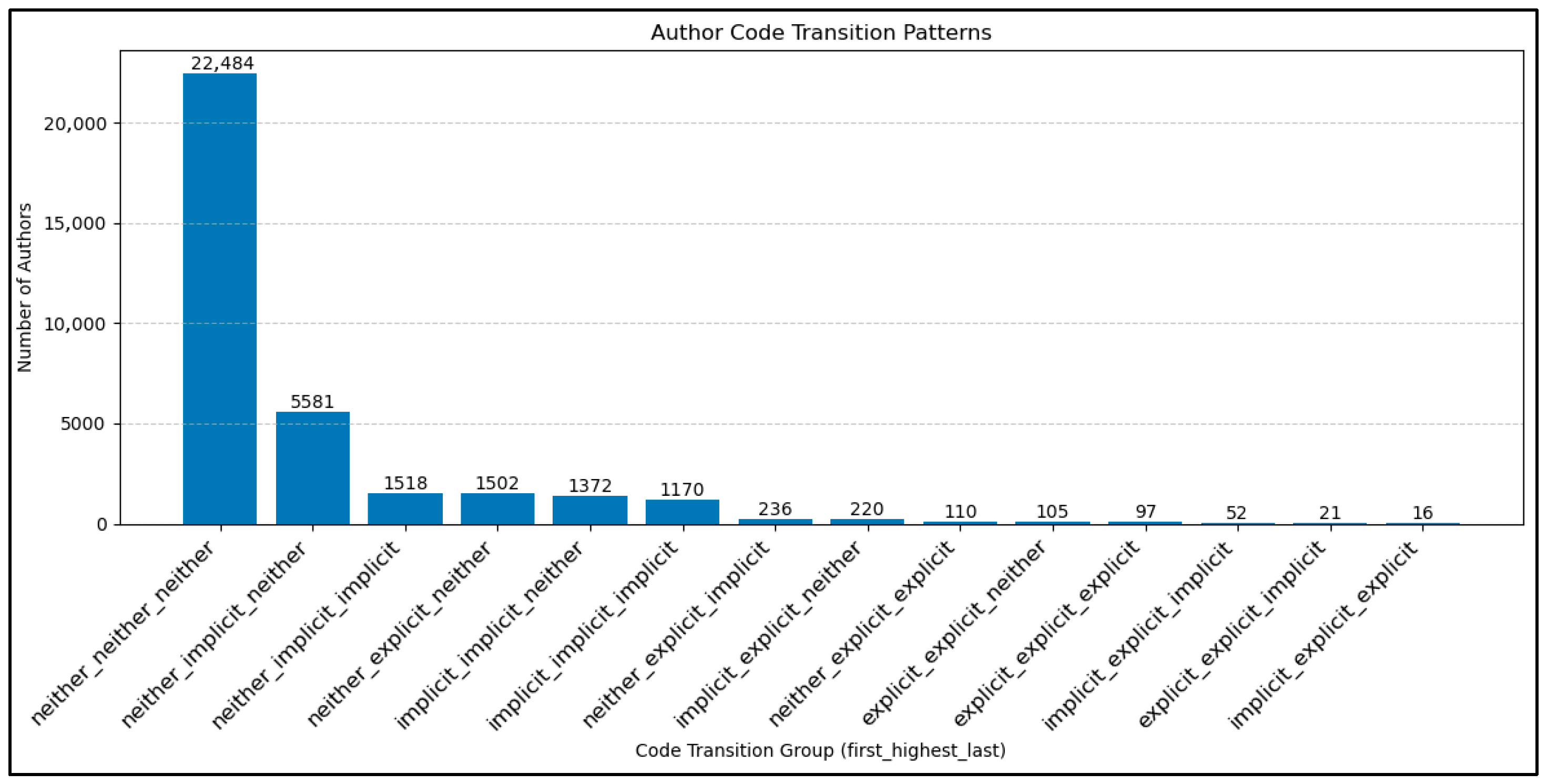
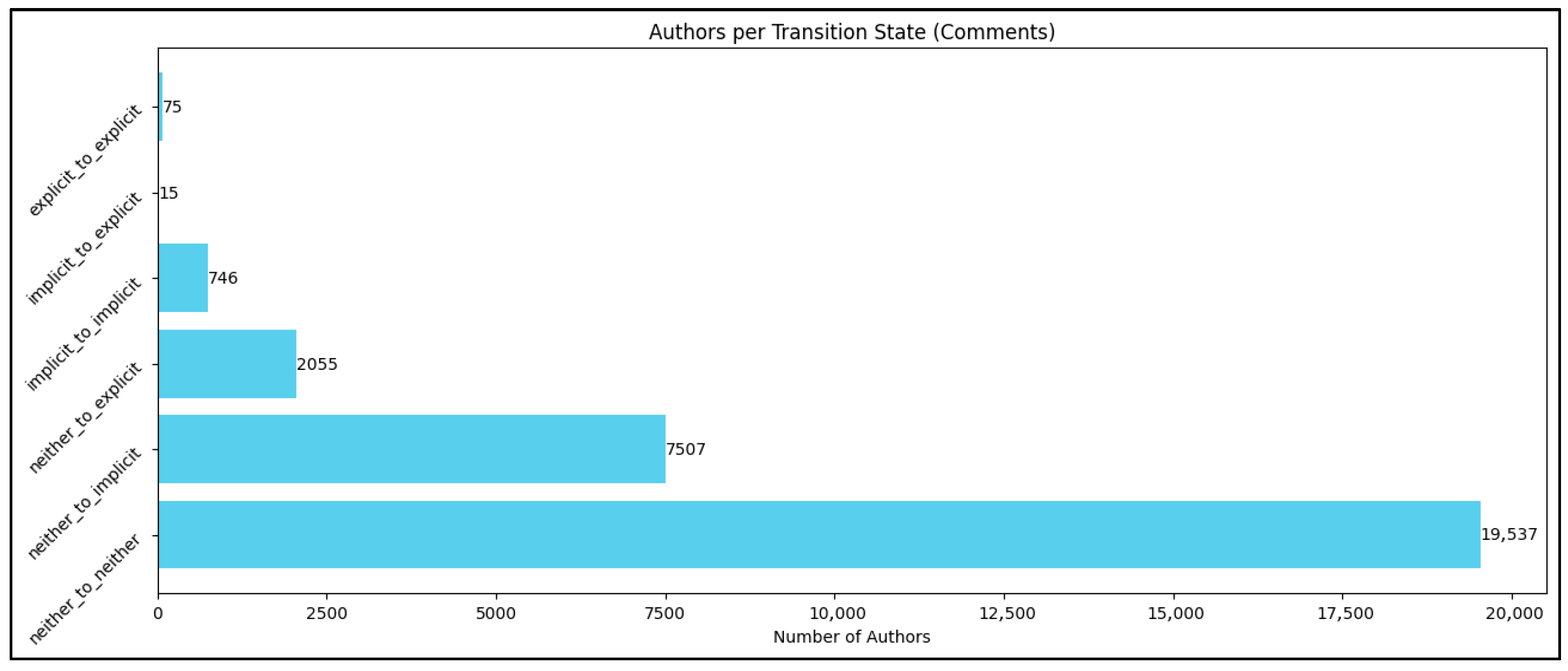
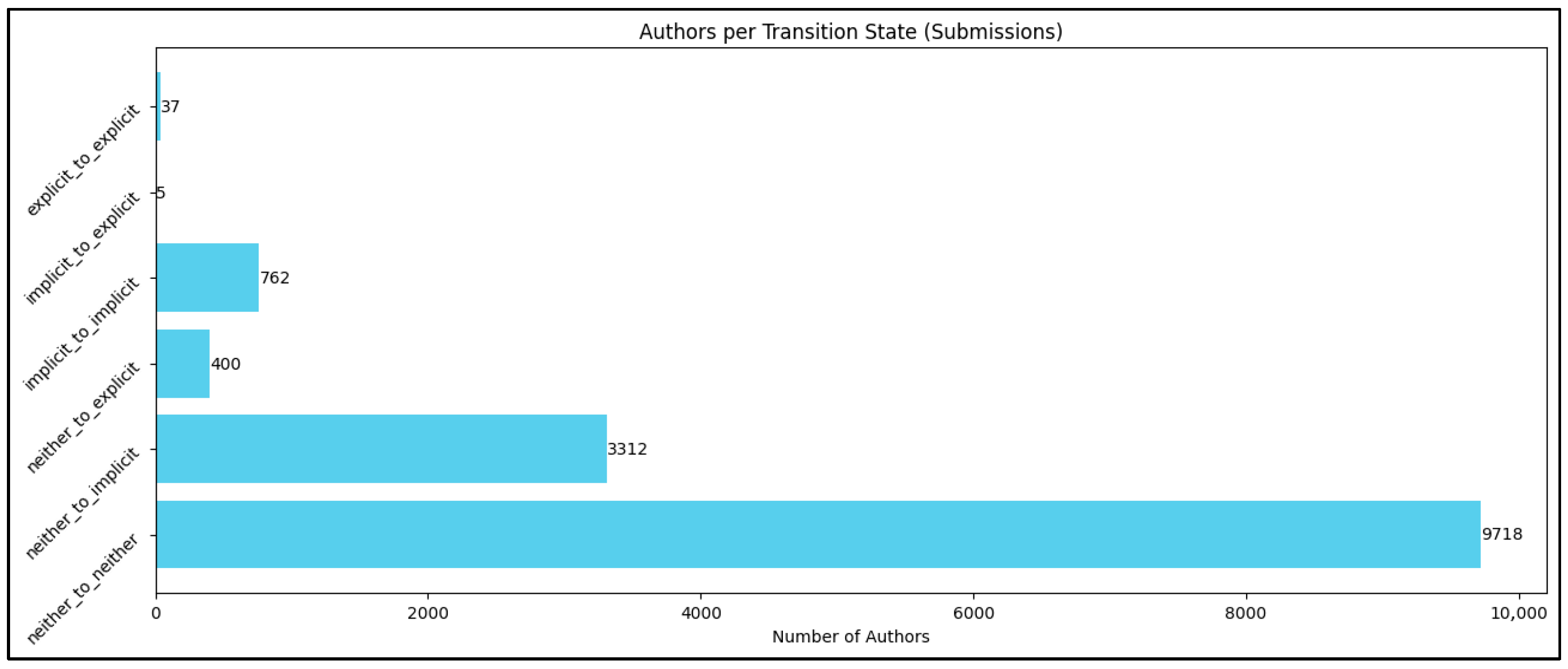
Figure 2 and
Figure 3 shows the distribution of irreversible transition states for each of the users in the study in comments and submissions, respectively, with state categories accounting for the content of any submissions or comments a user posted.
A majority of users remained in the “neither” category, indicating that most participants refrained from using implicit or explicit antisemitic language throughout the measured period. This suggests that while the subreddits contained antisemitic content, not all users actively engaged in its dissemination.
The transition from “neither” to using implicit language was observed as the second most common transition for both submissions and comments, accounting for 23.3% and 25.1% of the samples, respectively. In terms of submissions alone, a mere 3% of users transitioned from neither to explicit. Very few users entered the subreddits initially using either implicit (5.4%) or explicit language (~0%) in their submissions. Together, these findings suggest that users learn the language game through their involvement in the forum and that implicit language usage rather than explicit usage is the primary entry point for users into the language game.
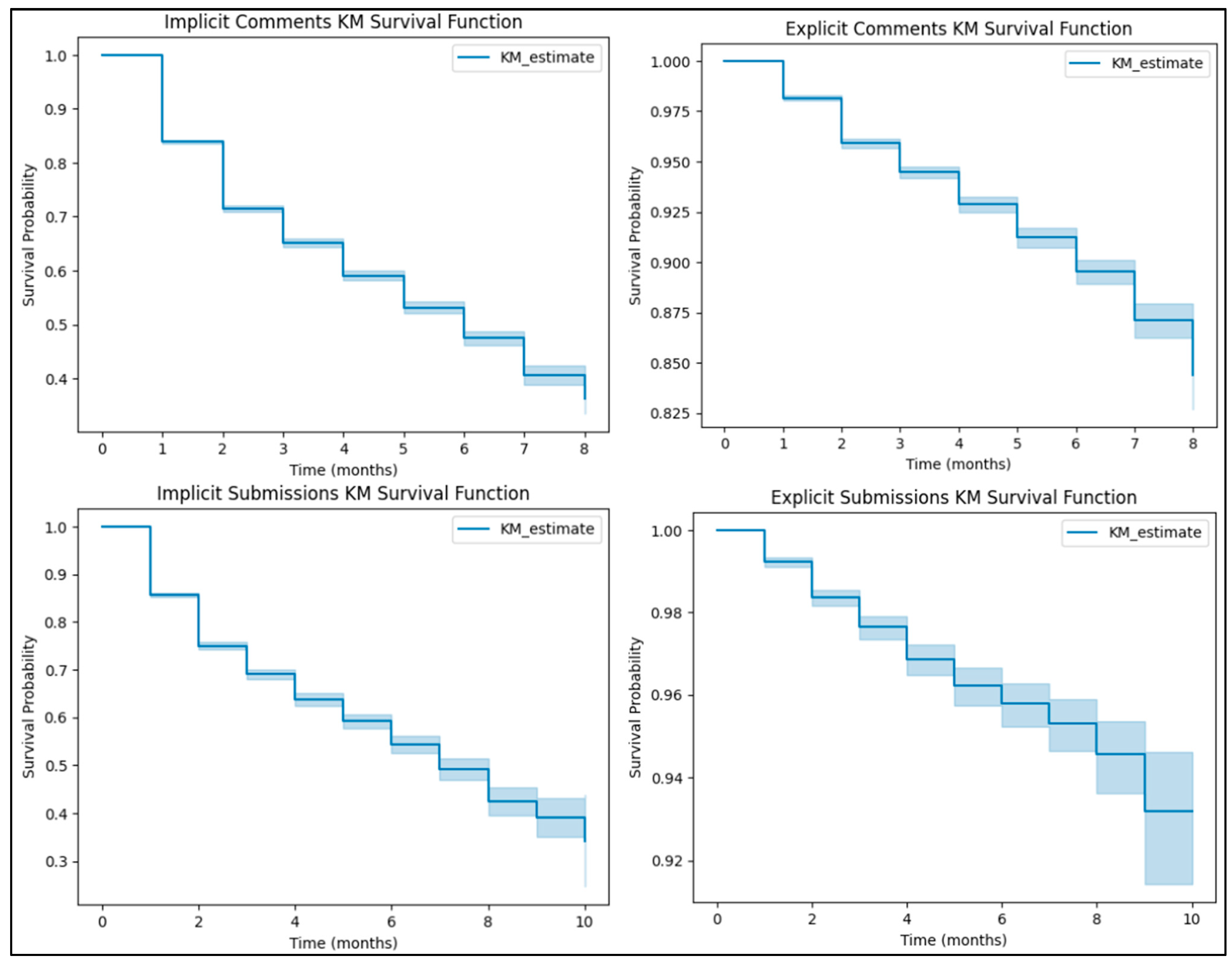
The Kaplan–Meier models, shown in
Figure 4, revealed a significant difference in the survival rate of users before their escalation to implicit and explicit involvement within the forums. The survival rates for users regarding explicit content were substantially higher than those for implicit content, indicating that users are significantly more likely to adopt implicit language earlier and more frequently than explicit language.
When examining the comment graphs, the survival model estimates that users active in the QAnon subreddit community for one month (T = 1) had approximately a 16% predicted probability of posting an implicit comment, compared to only about a 2% predicted probability of posting an explicit comment. Over an eight-month involvement period, the model predicts that nearly 60% of active users would be expected to post an implicit comment, while only about 15% would be expected to post an explicit comment (if they remained active for that duration). A similar pattern was observed for implicit and explicit submissions, where the model-estimated probability of adopting implicit language (63%) was much higher, and spread across a larger proportion of users, than for explicit language (6.5%) over a comparable ten-month timeline.
Importantly, these estimates do not indicate that these percentages of users produced such content; rather, they represent predicted probabilities from the survival model, conditional on continued participation in the community. This substantial disparity in survival-based estimates reinforces the idea of implicit language as a lower barrier to entry and a primary mechanism for initial radicalization, while explicit language remains a more exclusive, later-stage phenomenon among a smaller, more committed subset of users.
6.2. Hypothesis Test Outcomes
The statistical tests conducted provide strong support for the hypothesized relationships between user engagement, posting frequency, influential users, and language escalation.
To test Hypotheses 1, 2, and 3A/B, Chi-Square models were employed to determine significant variation between groups of users. The results, summarized in
Table 5, indicate strong support for each while
Table 6,
Table 7 and
Table 8 provide additional insight.
We find that new users who engage with antisemitic content are indeed more likely to engage with implicit content than explicit content. This finding suggests implicit language serves as the entry point into the community’s language game, allowing users to engage the lexicon and connect with the in-group identity without immediate exposure to overt social or platform-level consequences.
With regard to H2, namely that more frequent posters are more likely than others to use explicit language, we find that the top 1% of users, based on content created, post 12.04% of explicit antisemitic content, while the top 10% posts a full 60.32% of that content. This finding builds upon previous literature, showcasing how hyper-posters, and more active posters, take an active role in shaping the language game by posting a higher proportion of explicit language than the rest of the community members.
The findings also provide support for H3A and H3B, showing that users who comment on explicit content (χ2 = 6578.25) and those whose comments contain explicit content (χ2 = 1571.63), whether in response to explicit content or not, are more likely to progress to posting explicit submissions. Of those who engage with explicit content, 45.09% posted their own explicit content compared to only 3.66% of those who never engaged with such content. Similarly, among users who posted explicit comments, more than half (51.58%) posted explicit submissions. In comparison, of those who did not post explicit comments, only 5.63% posted explicit submissions. These results demonstrate that users transition from reactive engagement to proactive dissemination of hateful or radicalizing rhetoric, indicating a deeper integration into the community’s radicalized discourse and a higher level of commitment.
The logistic regression models shown in
Table 9 further elucidate the factors influencing the utilization of antisemitic responses, providing support for H4A and H4B, shining additional light on the progressive role of language escalation.
We model predictors for the likelihood of a user posting implicit and explicit content, respectively. Users who engage with implicit content are more likely to post implicit content (OR = 6.89, ρ < 0.05) and explicit content (OR = 3.00, ρ < 0.05). Similarly, engagement with explicit content increases the probability of posting implicit content (OR = 4.66, ρ < 0.05) and explicit content (OR = 6.05, ρ < 0.05).
Two predictor variables capture interactions with hyper-posters, namely whether a user engages posts from a hyper-poster (User responded to hyper-poster) or whether someone in the top 1% of posters responds to a user (Hyper-poster responded to user). Users who respond to hyper-posters show highly significant effects for increased likelihood of posting implicit content (OR = 9.98 × 1042, ρ < 0.05). For explicit content, we obtain OR = 4582.50 with ρ ≈ 0.11. Although the results of the model fall slightly outside conventional significance thresholds, the direction and magnitude of the effect remain consistent with the broader pattern, suggesting that engagement with hyper-posters may also elevate the likelihood of producing explicit antisemitic content, albeit with weaker statistical confidence. This effect indicates that directly engaging with hyper-posters dramatically increases the likelihood of producing antisemitic content, especially in the implicit case. Conversely, receiving a response from a hyper-poster shows an even stronger positive association with posting behavior than responding to hyper-posters. Receiving a response from a hyper-poster is associated with significantly higher odds of posting implicit content (OR = 1.26 × 1060, ρ < 0.05) and explicit content (OR = 45,251.90, ρ < 0.05). This complementary relationship helps develop the broader narrative of social influence: users who seek out and engage with hyper-posters as well as those who receive recognition or validation from hyper-posters are further integrated into the social structure that sustains radical discourse. The bidirectional dynamic between attention-seeking and attention-receiving behaviors thus reinforces participation and ideological alignment, amplifying the use of antisemitic communication within the network. Together, these findings support a social model in which engagement with highly active, influential users facilitates the diffusion and normalization of hate speech across the community.
Finally, examining the association between posting implicit and explicit content demonstrates a process of progressive radicalization. Posting implicit antisemitic content increases the likelihood of a user posting explicit antisemitic content (OR = 5.10, ρ < 0.05). The results of these models reveal that online radicalization is a highly structured acceleration of collective identity and rhetorical strategies. The findings show that, while individual journeys may vary, there are discernible, patterned pathways that users follow.
7. Discussion
This study demonstrates the way that individuals interact with and contribute to a subcultural community’s semantic network. We find that antisemitic language in QAnon subreddits follows a structured, multi-stage process shaped by both individual behavior and community dynamics. Across models, the results confirm that users typically enter the community through implicit “dog whistles” before escalating to explicit hate speech. In this study, collective identity and radicalization manifest in relation to an underlying semantic network through patterned transitions from neutral language to implicit and then explicit rhetoric. The findings of the study indicate that users learn and internalize group identities via shared, increasingly extreme linguistic associations rather than isolated expressions. This escalation reflects a semantic normalization process in which repeated exposure to, and participation in, subcultural vocabularies cements in-group belonging and normalizes radicalized meaning structures. By empirically capturing rhetorical escalation, this study provides a useful framework for semantic analysis that enables scholars to more effectively map rhetorical escalation, trace the evolution of meaning within subcultures, and identify the mechanisms through which online communities produce and sustain radicalized semantic networks.
Previous research on semantic networks has found that explicit antisemitic language is rare compared to implicit language in both submissions and comments within QAnon subreddits [
2]. Looking specifically at user behavior, we corroborate this finding at the user rather than the post level. We find that coded speech is the dominant method users employ for expressing antisemitic beliefs in these subreddits, likely due to a combination of the social taboo associated with explicit language and the reduced social and platform-level consequences it incurs. In addition, the dominance of implicit rhetoric demonstrates that users are more likely to engage with (comment on) posts containing implicit language than with those containing explicit language, more likely to post implicit language than explicit language to the extent they post any hateful rhetoric, and more likely to post such rhetoric when they frequently engage with it by responding to posts that contain it. We find evidence of a process of escalation of rhetoric, working in the form of a funnel, moving from engaging with and posting implicit content, to that of explicit content creation. In short, building from previous work demonstrating the social significance of this subcultural community’s antisemitic semantic network linking implicit and explicit language, we uncover the process through which individuals enter and actively contribute to this network of antisemitic discourse.
This study has shown that general involvement and self-identification with the group are significant predictors of increased utilization of antisemitic rhetoric. Specifically, the more frequently an active user posts and engages with the subgroup, the more likely they are to use explicit language. Hypotheses 1–3 underscore that consistent immersion in the community’s discourse accelerates the adoption of more extreme linguistic forms. Active contribution, showcased by individuals who engage both in the forum and with explicit rhetoric, leads to a proactive position in advancing and disseminating harmful rhetoric within the community. The difference in engagement levels, with a vast majority of active users utilizing implicit comments or submissions over an 8-to-10-month period, while only a small minority engage in explicit rhetoric, further underscores the funnel-like nature of this escalation.
The influence of hyper-posters, who represent central nodes within the group’s social network, suggests a social contagion model of radicalization, where these active and influential users act as vectors for the spread of hate speech. Direct engagement with a hyper-poster’s content, such as through replies or comments, and attention by the hyper-poster to a user, both serve as a form of validation or implicit instruction that may serve to boost perceived in-group identification and linguistic capital within the subcultural community [
33,
36] by reinforcing in-group/out-group dynamics outlined in the language game. This bidirectional relationship signals approval for certain types of rhetoric and encouragement of the recipient to escalate their own language use to engage more fully in the language game and the community’s identity construction. This dynamic creates a powerful feedback loop where influential users reinforce and accelerate the radicalization of others, making the community a dynamic system of social influence and collective identification. Together, our findings indicate a strong relationship between a subcultural community’s social network, the identity built within online subcultures, and its semantic network, giving further support to the important role language games play in establishing insider status and group identity.
This study offers important insights into rhetorical escalation within online, subcultural communities; however, several limitations should be noted. First, the study primarily examines rhetorical escalation and, while
Figure 1 showcases the observable transition states, these analyses remain exploratory. Although these transition states provide some insight into possible rhetorical de-escalation, the current study does not systematically analyze these processes. Future research is necessary to determine whether de-radicalization follows structured, identifiable patterns comparable to those observed in escalation. Future work should build on this capability to better understand how and when users reduce or abandon extremist language within online communities.
Second, the dataset may be incomplete or skewed due to deleted, abandoned, or auto-moderated accounts and posts, which could have influenced the detected antisemitic language, potentially biasing the sample towards more visible or persistent users or users with multiple accounts over the studied timeline. However, this limitation is a documented challenge in online forum and social media research [
77] and is not considered a fundamental drawback to the study’s primary objectives. Additionally, while the dataset used in this study is slightly dated and while there have been concerns over a lack of moderation in online communities in recent years, we believe that this does not impact the findings of this study, the role that dog-whistles play within both subcultural and online communities, nor change the dynamics of social capital in these communities.
Future research should address these limitations and expand beyond them to more fully understand the complex pathways and processes of radicalization and potential disengagement. Expanding this approach to investigate possible pathways for de-escalation would be crucial. Furthermore, future studies could explore the specific mechanisms through which hyper-posters exert their influence, perhaps through network analysis of user interactions. By pursuing these avenues, the field would continue to move closer to understanding not only how antisemitic rhetoric proliferates, but also how it might be effectively countered within the ever-changing landscape of digital communities.
Author Contributions
Conceptualization, N.D.C. and D.B.W.; Methodology, N.D.C., P.A., D.B.W. and M.L.; Software, P.A. and M.L.; Validation, N.D.C., P.A., D.B.W. and M.L.; Formal analysis, N.D.C., D.B.W. and M.L.; Investigation, D.B.W.; Resources, D.B.W.; Data curation, D.B.W. and M.L.; Writing—original draft, N.D.C., P.A., D.B.W. and J.S.K.; Writing—review & editing, N.D.C., P.A., D.B.W. and J.S.K.; Visualization, N.D.C., P.A. and M.L.; Supervision, N.D.C., D.B.W., M.L. and J.S.K.; Project administration, N.D.C. and D.B.W.; Funding acquisition, D.B.W. All authors have read and agreed to the published version of the manuscript.
Funding
This material is based on research sponsored by The United States Air Force under agreement number FA88650-22-2-6438. The U.S. Government is authorized to reproduce and distribute reprints for Governmental purposes notwithstanding any copyright notation thereon. The views and conclusions contained herein are those of the authors and should not be interpreted as necessarily representing the official policies or endorsements, either expressed or implied, of the United States Air Force or the U.S. Government.
Institutional Review Board Statement
The Queens College-CUNY IRB classified this study as exempt from human subject research because it involved analysis of publicly available, de-identified Reddit posts and comments. Under these criteria, the research did not involve interaction with individuals, collection of private information, or access to identifiable data, and therefore did not require additional IRB approval.
Informed Consent Statement
The Queens College-CUNY IRB classified this study as exempt from human subject research because it involved analysis of publicly available, de-identified Reddit posts and comments. Under these criteria, the research did not involve interaction with individuals, collection of private information, or access to identifiable data, and therefore did not require additional participant informed consent.
Data Availability Statement
All data, dictionaries, and code have been uploaded to a github repository QAnonSubreddits:
https://github.com/e2unlimitedtech/QAnonSubreddits (accessed on 31 December 2025). While all of the data is available directly on Reddit, the data could not be included in full due to the platform’s terms of use. For purposes of reliability, we have included a file in the github repository that contains all of the post ID’s used in our data.
Conflicts of Interest
The authors declare no conflict of interest.
References
- Siegel, A.A. Online Hate Speech. In Social Media and Democracy: The State of the Field, Prospects for Reform; Persily, N., Tucker, J.A., Eds.; Cambridge University Press: Cambridge, UK, 2020; pp. 56–88. [Google Scholar]
- Weinberg, D.B.; Levy, M.D.; Edwards, A.; Kopstein, J.S.; Frey, D.; Antonaros, P.; Baci, N.; Cohen, N.D.; Fernandez, J.A.; Ni, Y. Hidden in plain sight: Antisemitic content in QAnon subreddits. PLoS ONE 2025, 20, e0318988. [Google Scholar] [CrossRef]
- Baele, S.J.; Brace, L.; Coan, T.G.; Naserian, E. Super-(and hyper-) posters on extremist forums. J. Polic. Intell. Count. Terror. 2023, 18, 243–281. [Google Scholar] [CrossRef]
- Litterer, S.; Scrivens, R.; Wojciechowski, T.W.; Frank, R. Exploring the evolution of posting behavior and language use in a racially and ethnically motivated extremist forum. Behav. Sci. Terror. Political Aggress. 2025, 1–20. [Google Scholar] [CrossRef]
- Rieger, D.; Kümpel, A.S.; Wich, M.; Kiening, T.; Groh, G. Assessing the extent and types of hate speech in fringe communities: A case study of alt-right communities on 8chan, 4chan, and Reddit. Soc. Media + Soc. 2021, 7, 20563051211052906. [Google Scholar] [CrossRef]
- Scrivens, R.; Davies, G.; Gaudette, T.; Frank, R. Comparing online posting typologies among violent and nonviolent right-wing extremists. Stud. Confl. Terror. 2022, 48, 369–391. [Google Scholar] [CrossRef]
- Haney-López, I. Dog Whistle Politics: How Coded Racial Appeals Have Reinvented Racism and Wrecked the Middle Class; Oxford University Press: Oxford, UK, 2013. [Google Scholar]
- Tuters, M.; Hagen, S. (((They))) rule: Memetic antagonism and nebulous othering on 4chan. New Media Soc. 2020, 22, 2218–2237. [Google Scholar] [CrossRef]
- Becker, M.J.; Troschke, H. Decoding implicit hate speech: The example of antisemitism. In Challenges and Perspectives of Hate Speech Research; Strippel, C., Paasch-Colberg, S., Emmer, M., Trebbe, J., Eds.; Digital Communication Research: Berlin, Germany, 2023; pp. 335–352. [Google Scholar] [CrossRef]
- Boberg, S.; Schatto-Eckrodt, T.; Frischlich, L.; Quandt, T. The moral gatekeeper? Moderation and deletion of user-generated content in a leading news forum. Media Commun. 2018, 6, 58–69. [Google Scholar] [CrossRef]
- Gongane, V.U.; Munot, M.V.; Anuse, A.D. Detection and moderation of detrimental content on social media platforms: Current status and future directions. Soc. Netw. Anal. Min. 2022, 12, 129. [Google Scholar] [CrossRef]
- Kalsnes, B.; Ihlebæk, K.A. Hiding hate speech: Political moderation on Facebook. Media Cult. Soc. 2021, 43, 326–342. [Google Scholar] [CrossRef]
- Jardine, E. Online content moderation and the dark web. First Monday 2019, 24, 1–15. [Google Scholar] [CrossRef]
- Logie, K.; Cohen, N.D.; Taylor, E.; Perry, K. Hidden hate: Analysis of hate speech on a darknet forum. Justice Q. 2025, 42, 1255–1278. [Google Scholar] [CrossRef]
- Vu, A.V.; Hutchings, A.; Anderson, R. No easy way out. In 2024 IEEE Symposium on Security and Privacy (SP), San Francisco, CA, USA, 20–22 May 2024; IEEE: Piscataway, NJ, USA, 2024; pp. 717–734. [Google Scholar]
- Byman, D.L. How Hateful Rhetoric Connects to Real-World Violence; Brookings Institution: Washington, DC, USA, 2021; Available online: https://www.brookings.edu/articles/how-hateful-rhetoric-connects-to-real-world-violence/ (accessed on 31 December 2025).
- Bauman, Z. Modernity and the Holocaust; Cornell University Press: Ithaca, NY, USA, 2000. [Google Scholar]
- Genocide Watch. The 10 Stages of Genocide. Available online: https://www.genocidewatch.com/tenstages (accessed on 31 December 2025).
- Matulewska, A. Between Freedom of Speech and Hate Speech: Similarities Between Stages of Genocide and Aggression in Modern Media. In Handbook on Cyber Hate: The Modern Cyber Evil; Springer: Cham, Switzerland, 2024; pp. 173–189. [Google Scholar]
- Timmermann, W. Counteracting hate speech as a way of preventing genocidal violence. Genocide Stud. Prev. 2008, 3, 353–374. [Google Scholar] [CrossRef][Green Version]
- VandenBerg, R.J. Legitimating extremism. Terror. Political Violence 2021, 33, 1237–1255. [Google Scholar] [CrossRef]
- Borge-Holthoefer, J.; Arenas, A. Semantic networks: Structure and dynamics. Entropy 2010, 12, 1264–1302. [Google Scholar] [CrossRef]
- Xi, Y.; Chen, A.; Zhang, W. Expression of cultural identities in Hong Kong’s protest movement. Soc. Sci. Comput. Rev. 2022, 40, 1436–1455. [Google Scholar] [CrossRef]
- Eddington, S.M. Alt-resilience. J. Appl. Commun. Res. 2020, 48, 114–135. [Google Scholar] [CrossRef]
- Farrell, T.; Araque, O.; Fernandez, M.; Alani, H. On the use of jargon and word embeddings. In Proceedings of the 12th ACM Conference on Web Science, Southampton, UK, 7–10 July 2020; Association for Computing Machinery: New York, NY, USA, 2020; pp. 221–230. [Google Scholar]
- Mouffe, C. Agonistics: Thinking the World Politically; Verso: London, UK, 2013. [Google Scholar]
- Wittgenstein, L. Philosophical Investigations; Basil Blackwell: Oxford, UK, 1953. [Google Scholar]
- Buchanan, I. A Dictionary of Critical Theory; Oxford University Press: Oxford, UK, 2010. [Google Scholar]
- Grundlingh, L. Memes as speech acts. Soc. Semiot. 2018, 28, 147–168. [Google Scholar] [CrossRef]
- Laclau, E. On Populist Reason; Verso: London, UK, 2005. [Google Scholar]
- Milner, R.M. The World Made Meme: Discourse and Identity in Participatory Media; MIT Press: Cambridge, MA, USA, 2016. [Google Scholar]
- Miltner, K. ‘There’s no place for lulz on LOLCats’: The role of genre, gender, and group identity in the interpretation and en-joyment of an internet meme. First Monday 2014, 19. [Google Scholar] [CrossRef]
- Nissenbaum, A.; Shifman, L. Internet memes as contested cultural capital: The case of 4chan’s/b/board. New Media Soc. 2017, 19, 483–501. [Google Scholar] [CrossRef]
- Baele, S.J.; Brace, L.; Coan, T.G. From “Incel” to “Saint”: Analyzing the violent worldview behind the 2018 Toronto attack. Terror. Political Violence 2021, 33, 1667–1691. [Google Scholar] [CrossRef]
- Howard, R.G. The vernacular web of participatory media. Crit. Stud. Media Commun. 2008, 25, 490–513. [Google Scholar] [CrossRef]
- Bourdieu, P. Language and Symbolic Power; Harvard University Press: Cambridge, MA, USA, 1991. [Google Scholar]
- Phillips, W. This Is Why We Can’t Have Nice Things: Mapping the Relationship Between Online Trolling and Mainstream Culture; MIT Press: Cambridge, MA, USA, 2015. [Google Scholar]
- Phillips, W. It wasn’t just the trolls: Early internet culture, ‘fun’, and the fires of exclusionary laughter. Soc. Media + Soc. 2019, 5, 2056305119849493. [Google Scholar] [CrossRef]
- Tannen, D. The Power of Talk: Who Gets Heard and Why. Harv. Bus. Rev. 1995, 73, 138–148. [Google Scholar]
- Graham, T.; Wright, S. Discursive equality and everyday talk online: The impact of “superparticipants”. J. Comput.-Mediat. Commun. 2014, 19, 625–642. [Google Scholar] [CrossRef]
- Arthur, C. What is the 1% Rule? The Guardian. Available online: https://www.theguardian.com/technology/2006/jul/20/guardianweeklytechnologysection2 (accessed on 19 July 2006).
- Awan, A.N. Radicalization on the Internet? The Virtual Propagation of Jihadist Media and its Effects. RUSI J. 2007, 152, 76–81. [Google Scholar] [CrossRef]
- Ducol, B. Uncovering the French-speaking jihadisphere: An exploratory analysis. Media War Confl. 2012, 5, 51–70. [Google Scholar] [CrossRef]
- Brace, L.; Baele, S.J.; Ging, D. Where do ‘mixed, unclear, and unstable’ ideologies come from? A data-driven answer centred on the incelosphere. J. Polic. Intell. Count. Terror. 2024, 19, 103–124. [Google Scholar] [CrossRef]
- Gaudette, T.; Scrivens, R.; Davies, G.; Frank, R. Upvoting extremism: Collective identity formation and the extreme right on Reddit. New Media Soc. 2021, 23, 3491–3508. [Google Scholar] [CrossRef]
- Shrestha, A.; Kaati, L.; Cohen, K. A machine learning approach towards detecting extreme adopters in digital communities. In 2017 28th International Workshop on Database and Expert Systems Applications (DEXA), Lyon, France, 28–31 August 2017; IEEE: Piscataway, NJ, USA, 2017; pp. 1–5. [Google Scholar]
- Cialdini, R.; Goldstein, N. Social influence: Compliance and conformity. Annu. Rev. Psychol. 2004, 55, 591–621. [Google Scholar] [CrossRef]
- Edwards, C.; Gribbon, L. Pathways to Violent Extremism in the Digital Era. RUSI J. 2013, 158, 40–47. [Google Scholar] [CrossRef]
- Passy, F.; Giugni, M. Social networks and individual perceptions: Explaining differential participation in social movements. Sociol. Forum 2001, 16, 123–153. [Google Scholar] [CrossRef]
- Postmes, T.; Spears, R.; Sakhel, K.; de Groot, D. Social Influence in Computer-Mediated Communication: The Effects of Anonymity on Group Behavior. Personal. Soc. Psychol. Bull. 2001, 27, 1243–1254. [Google Scholar] [CrossRef]
- Williams, J.P.; Copes, H. “How edge are you?” Constructing authentic identities and subcultural boundaries in a straightedge internet forum. Symb. Interact. 2005, 28, 67–89. [Google Scholar] [CrossRef]
- Shashkova, N.V.; Kudruavtseva, M.E. Breaking Taboos in the Digital Space as a Communication Strategy. In Proceedings of the ComSDS Conference, St. Petersburg, Russia, 14 April 2021; IEEE: Piscataway, NJ, USA, 2021; pp. 18–21. [Google Scholar]
- Melamed, D.; Simpson, B.; Montgomery, B.; Patel, V. Inequality and cooperation in social networks. Sci. Rep. 2022, 12, 6789. [Google Scholar] [CrossRef]
- Weinberg, D.B.; Levy, M.; Cohen, N.D.; Ni, Y. The Use of Military Language and Narratives in Far-Right Chatrooms on Telegram. MIROR J. 2024, 2, 89–106. [Google Scholar]
- Cha, M.; Haddadi, H.; Benevenuto, F.; Gummadi, K. Measuring user influence in twitter: The million follower fallacy. In Proceedings of the Fourth International Conference on Weblogs and Social Media, ICWSM, Washington, DC, USA, 23–26 May 2010; Association for the Advancement of Artificial Intelligence: Palo Alto, CA, USA, 2010; Volume 4, pp. 10–17. [Google Scholar]
- Meddaugh, P.M.; Kay, J. Hate speech or “reasonable racism?” The other in Stormfront. J. Mass Media Ethics 2009, 24, 251–268. [Google Scholar] [CrossRef]
- Alorainy, W.; Burnap, P.; Liu, H.; Williams, M.L. “The enemy among us” detecting cyber hate speech with threats-based othering language embeddings. ACM Trans. Web 2019, 13, 1–26. [Google Scholar] [CrossRef]
- Postmes, T.; Haslam, S.A.; Swaab, R.I. Social influence in small groups: An interactive model of social identity formation. Eur. Rev. Soc. Psychol. 2005, 16, 1–42. [Google Scholar] [CrossRef]
- Kofta, M.; Soral, W.; Bilewicz, M. What breeds conspiracy antisemitism? The role of political uncontrollability and uncertainty in the belief in Jewish conspiracy. J. Personal. Soc. Psychol. 2020, 118, 900–918. [Google Scholar] [CrossRef]
- Bilewicz, M.; Winiewski, M.; Kofta, M.; Wójcik, A. Harmful Ideas, The Structure and Consequences of Anti-Semitic Beliefs in Poland. Political Psychol. 2013, 34, 821–839. [Google Scholar] [CrossRef]
- Allington, W. Holocaust denial online: The rise of pseudo-academic antisemitism on the early Internet. J. Contemp. Antisemitism 2017, 1, 33–54. [Google Scholar] [CrossRef]
- Schwarz-Friesel, M. ‘Antisemitism 2.0’—The spreading of Jew-hatred on the World Wide Web. In Comprehending and Confronting Antisemitism; De Gruyter: Berlin, Germany, 2019; pp. 311–338. [Google Scholar]
- Zannettou, S.; Finkelstein, J.; Bradlyn, B.; Blackburn, J. A quantitative approach to understanding online antisemitism. In Proceedings of the Fourteenth International AAAI Conference on Web and Social Media, ICWSM, Online, 8–11 June 2020; Association for the Advancement of Artificial Intelligence: Palo Alto, CA, USA, 2020; pp. 786–797. [Google Scholar]
- Allington, D.; Hirsh, D.; Katz, L. Antisemitism is predicted by anti-hierarchical aggression, totalitarianism, and belief in malevolent global conspiracies. Humanit. Soc. Sci. Commun. 2023, 10, 155. [Google Scholar] [CrossRef]
- Center for Strategic & International Studies. Examining Extremism: QAnon. 2019. Available online: https://www.csis.org/blogs/examining-extremism/examining-extremism-qanon (accessed on 31 December 2025).
- Papasavva, A.; Blackburn, J.; Stringhini, G.; Zannettou, S.; De Cristofaro, E. “Is it a qoincidence?”: An exploratory study of qanon on voat. In Proceedings of the Web Conference 2021, Ljubljana, Slovenia, 19–23 April 2021; Association for Computing Machinery: New York, NY, USA, 2021; pp. 460–471. [Google Scholar]
- Kaplan, T. QAnon and Social Media. In The Social Science of QAnon; Miller, M.K., Ed.; Cambridge University Press: Cambridge, UK, 2023; pp. 271–290. [Google Scholar]
- Amarasingam, A.; Argentino, M.A. The QAnon Conspiracy Theory: A Security Threat in the Making? CTC Sentinel 2020, 13, 37–44. [Google Scholar]
- Renton, J.; Gidley, B. Introduction: The shared story of Europe’s ideas of the Muslim and the Jew—A diachronic framework. In Antisemitism and Islamophobia in Europe; Palgrave Macmillan: London, UK, 2017; pp. 1–21. [Google Scholar]
- Hornsey, M.J. Social identity theory and self-categorization theory: A historical review. Soc. Personal. Psychol. Compass 2008, 2, 204–222. [Google Scholar] [CrossRef]
- Williams, T.J.V.; Tzani, C. How does language influence the radicalisation process? A systematic review of research exploring online extremist communication and discussion. Behav. Sci. Terror. Political Aggress. 2022, 16, 310–330. [Google Scholar] [CrossRef]
- Brady, W.J.; McLoughlin, K.; Doan, T.N.; Crockett, M.J. How social learning amplifies moral outrage expression in online social networks. Sci. Adv. 2021, 7, eabe5641. [Google Scholar] [CrossRef]
- Tuckwood, C. Hatebase: Online Database of Hate Speech. Available online: https://www.hatebase.org (accessed on 31 December 2025).
- Belnik, S. Racial Slur Database. Available online: http://www.rsdb.org/ (accessed on 31 December 2025).
- Anti-Defamation League. Hate on Display™ Hate Symbols Database. Available online: https://www.adl.org/resources/hate-symbols/search (accessed on 31 December 2025).
- Tangherlini, T.R.; Shahsavari, S.; Shahbazi, B.; Ebrahimzadeh, E.; Roychowdhury, V. An automated pipeline for the discovery of conspiracy and conspiracy theory narrative frameworks: Bridgegate, Pizzagate and storytelling on the web. PLoS ONE 2020, 15, e0233879. [Google Scholar] [CrossRef] [PubMed]
- Rajadesingan, A.; Resnick, P.; Budak, C. Quick, community-specific learning: How distinctive toxicity norms are maintained in political subreddits. In Proceedings of the Fourteenth International AAAI Conference on Web and Social Media, ICWSM, Online, 8–11 June 2020; Association for the Advancement of Artificial Intelligence: Palo Alto, CA, USA, 2020; pp. 557–568. [Google Scholar]
| Disclaimer/Publisher’s Note: The statements, opinions and data contained in all publications are solely those of the individual author(s) and contributor(s) and not of MDPI and/or the editor(s). MDPI and/or the editor(s) disclaim responsibility for any injury to people or property resulting from any ideas, methods, instructions or products referred to in the content. |




 ,
,