


Abstract
Modern software development fundamentally relies on agile methodologies and DevOps practices to facilitate accelerated software delivery. Continuous integration and continuous deployment CI/CD are among the most critical DevOps practices that require considerable attention to execute successfully. Therefore, this study proposes a multi-class XGBoost-based model to improve the performance of CI/CD failure prediction. The proposed model was trained and tested using the comprehensive TravisTorrent dataset, which contains extensive build information from several projects developed in various programming languages. The experimental results demonstrate that the proposed model achieves a statistically significant performance improvement of nearly 18% over SVM and the Random Forest models. Beyond the performance improvement, SHAP (SHapley Additive exPlanations) analysis was employed to explain the model’s decision-making process, revealing that the most influential features, ranked in descending order of importance, are build log status, build duration, build start time, the number of commits in the repository, and repository age. This interpretability enhances both the reliability and transparency of the proposed model.
1. Introduction
The landscape of software development is in a state of constant flux, shaped by growing application complexity, shifting requirements, and continuous technological innovation. In this environment, customers’ demand for rapid delivery remains non-negotiable, regardless of any challenges, which creates huge pressure on software engineers to adopt more effective methodologies. This pressure has directly catalyzed the evolution of modern approaches like DevOps [1,2]. At its core, DevOps addresses the critical need to bridge the historical divide between development and operations teams. It cultivates a culture characterized by shared responsibility and intensive collaboration, transforming foundational aspects of software construction, testing, and deployment [3]. This philosophy integrates both cultural shifts and technical practices to achieve a primary goal: the consistent delivery of high-quality software at speed [4].
Successful software delivery revolves around interconnected activities [5], which inherently require extensive collaboration among diverse roles, from stakeholders and engineers to IT operators [6]. DevOps emerged precisely from the business imperative for both speed and quality [7]. It represents a cultural transformation that aligns development, quality assurance, and operations, supported by a toolkit of automation technologies that streamline the entire development lifecycle [6,8]. Consequently, various automation tools have been developed and incorporated into the DevOps paradigm.
In practice, software developers combine their code into a primary branch, commonly referred to as the main branch, multiple times a day [9]. This practice is necessary to respond to the increasing changes in the digital environment and business needs. CI is an essential pipeline system that focuses on enabling new software versions to be automatically integrated with earlier versions if they pass specific tests in the pipeline logic [10].
Rapid software delivery is one of the key requirements that the software development process faces while preserving software quality. The agile methodology has transformed the traditional software development process to focus on delivering the required software iteratively, allowing customers to benefit from some of their software’s requirements as quickly as possible. This means that the software is developed in versions, where each version must be integrated with the previously integrated versions and then deployed to the user. This is a continuous process; therefore, it must be automated to prevent potential errors and ensure software quality. It is widely accepted that the crucial aim of CI/CD is to automate software release. This automation reduces traditional manual processes, starting from the point of committing code to its deployment in production.
From a development perspective, after selecting the version requirements during the planning stage, developers write the code, and each developer must frequently push the code to the version control systems. Testing automation is the core of CI, which aims to run a set of tests to ensure the compatibility of the existing code [11].
In practice, software CI/CD pipelines comprise frequent code changes over time. Therefore, it is very important to predict failures early. An accurate failure prediction model helps software teams address issues before they affect the next stages of software production. This plays a crucial role in reducing downtime, accelerating releases, and enhancing the productivity of software developers [12].
Despite their foundational roles, CI/CD pipelines often face some critical obstacles: the lack of highly reliable and accurate failure prediction models. Current predictive systems, based on traditional machine learning or deep learning, often exhibit low accuracy, exhibit insufficient generalization across diverse projects, and struggle with imbalanced data. These issues stem from two fundamental limitations. Firstly, existing models often treat build outcomes as a simple binary pass/failure, ignoring crucial intermediate states like ‘errored’ or ‘canceled’ that provide a more granular view of pipeline health. Secondly, their ‘black-box’ nature prevents developers from understanding why a build is predicted to fail, eroding trust and hindering proactive intervention. Consequently, inaccurate predictions, whether flagging successful builds as failed or missing potential failures, undermine developer confidence in automation, ultimately impeding the widespread adoption and full realization of CI/CD’s benefits.
To address these critical shortcomings, this study proposes a multi-class XGBoost (eXtreme Gradient Boosting) model to significantly enhance the accuracy and reliability of CI/CD failure prediction.
This research advances the state-of-the-art by delivering two primary contributions. First, it presents a high-performance, intelligent classification model specifically designed to handle the multi-class nature of build outcomes, moving beyond the limitations of traditional binary predictors. Second, it identifies the most influential features driving prediction outcomes, providing a detailed, interpretable analysis that directly fills a critical research gap concerning the ‘black-box’ nature of previous models.
The methodological novelty of the proposed model is the adaptation of XGBoost specifically for DevOps CI/CD failure prediction. It combines a systematic, structured feature engineering and selection approach oriented to failure prediction, extracting the temporal relations and interactions specific to the context of DevOps CI/CD, which is not considered by the standard XGBoost. Furthermore, a hybrid hyperparameter optimization process was developed to balance model interpretability with predictive performance. In addition, the proposed model integrates SHAP to ensure actionable insights, feature relevance validation, and enhance model refinement. This methodology clearly distinguishes the proposed model from generic deep-learning approaches and other boosting-based models.
The remainder of this paper is organized as follows: Section 2 presents a detailed review of the literature on DevOps CI/CD. Section 3 introduces the proposed model in detail. Section 4 presents the evaluation results and detailed discussions. Section 5 provides some important practical implications. Finally, Section 6 concludes the paper and highlights future work.
2. Related Work
Since the emergence of DevOps, a notable number of researchers have sought to leverage AI/ML to automate DevOps practices.
An empirical study was conducted by [13], who analyzed over 104,000 CI builds across 67 open-source projects, attempting to address a critical overlooked aspect of CI that directly affects developer productivity and workflow. They adapted mixed-effects logistic modeling to investigate the possible key factors behind the excessively long build durations of the projects. One of the remarkable highlights of this study is the importance of performing a proper CI system configuration. Moreover, it revealed that build duration is a significant metric for assessing the effectiveness of DevOps CI practices.
A traditional solution was proposed by [14] to predict CI build failures. This study employed multi-objective genetic programming (MOGP), a search-based software engineering technique. The dual objectives were to detect failures and minimize the number of false alarms. Their proposed work was evaluated on a dataset consisting of 15,383 builds from two projects, which is relatively small.
The application of DevOps CI/CD generates a huge amount of data and logs, making manual anomaly inspection time-consuming and error-prone. A notable framework, called the DevOps anomaly detection framework, was proposed to solve this problem [15]. This framework utilizes ML, namely the local outlier factor technique, to detect possible anomalies before production, and the vector auto-regression technique to perform anomaly detection after staging.
Targeting software defect prediction, ref. [16] proposed a multi-stage deep learning framework to advance CI/CD pipelines. Their framework utilized the modified synthetic minority over-sampling technique (M-SMOTE) to avoid overfitting and normalization to rescale the data appropriately. For software defect prediction, a hybrid approach was constructed by integrating bidirectional long short-term memory (Bi-LSTM) into the convolutional gated recurrent unit (GRU) model (Bi-CGRU).
From the CI build failure prediction perspective, ref. [17] proposed the DL-CIBuild model, leveraging LSTM based on recurrent neural networks (RNNs) to model temporal dependencies from the histories of continuous build outcomes. For hyperparameter tuning, a genetic algorithm was employed, which caused the model to outperform traditional ML models in both online (chronological) and cross-project validation. The DL-CIBuild model was trained on a dataset of 91,330 CI builds from ten large and long-lived software projects.
A significant contribution to the state-of-the-art AI-powered DevOps and CI analytics was made by [18]. They attempted to move the current trend beyond traditional machine learning towards hybrid deep learning models to handle sequential software process data efficiently. They identified four interdependent key metrics, namely build time, long commit, time between successive commits, and build break fixing time, that influence the builds’ outcomes in the CI environment. Furthermore, they proposed a hybrid model that utilized LSTM for long-range dependency modeling and GRU for efficient computation. This hybrid model was augmented by the innovative dynamic build success optimization (DBSO) algorithm to improve the process of CI build outcome prediction.
Kamath et al. [19] investigated the use of commit grouping and build skip predication to reduce the possible redundant CI builds, which increases computational resources usage and developers’ time. They argue that a large amount of CI activity is wasteful, frequently resulting from quick and continuous commits, even with no effect on the final build outcome. Therefore, the authors proposed the ML-CI model and a timeout rule to overcome these issues, and the evaluation was carried out on a dataset of 79,482 builds from 20 open-source projects. The results indicate that the proposed combined approach can significantly reduce CI build activity.
A recent study conducted by Dileepkumar and Mathew [20] provides a comprehensive approach to address the predominant challenges of reliability and efficiency within modern CI/CD pipelines. They proposed an SVM-based model that focuses on failure prediction and resource optimization. Their model was evaluated against industry-scale datasets, and the results demonstrated remarkable accuracy improvement, achieving an accuracy of 88%.
However, despite the great attempts that have been made, there is still significant room for further improvement in the prediction performance of CI/CD failures. Another important gap, to the best of our knowledge, is that most existing research has not paid attention to either investigating the influential features or exploring the interaction between these features that affect the performance of the CI/CD failure predictions. Therefore, this paper aims to fulfil these gaps and to advance the current state of the art.
3. The Proposed Model and Hyperparameter Optimization
Most companies maintain software repositories where all historical data about their software projects is stored. Nowadays, among a set of available tools, GitHub is a cloud-based platform built around Git, providing developers with core functionalities such as hosting, management, and collaboration on software development projects [21]. Regardless of the repository’s type (public or private), a vast amount of historical data is stored, forming a wealth of information that helps companies improve their software development processes. Therefore, researchers have attempted to integrate machine learning techniques to optimize DevOps practices [22,23]. Thus, the focus of this study is to optimize CI/CD failure prediction.
3.1. Dataset
This study employs the publicly accessible TravisTorrent dataset [24]. This dataset contains 3,881,993 instances with 66 features, encompassing over 1000 projects developed in multiple programming languages such as Ruby, Python, and Java. The full dataset description can be found in [25].
The primary objective of the proposed model is to enhance CI/CD failure prediction accuracy. The dataset consists of five classes as values of the tr_status feature (target feature), including canceled, errored, failed, passed, and started, which are encoded into {0,1,2,3,4}, respectively. These classes represent all possible statuses for any CI/CD process output. The classes were categorical, which was perfect for supervised learning using XGBoost [26].
3.2. Data Preprocessing
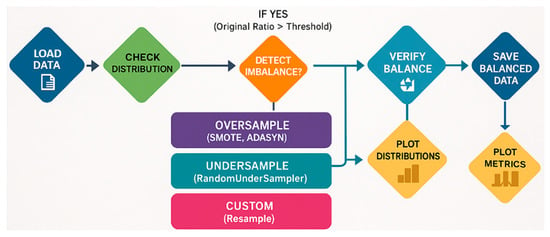
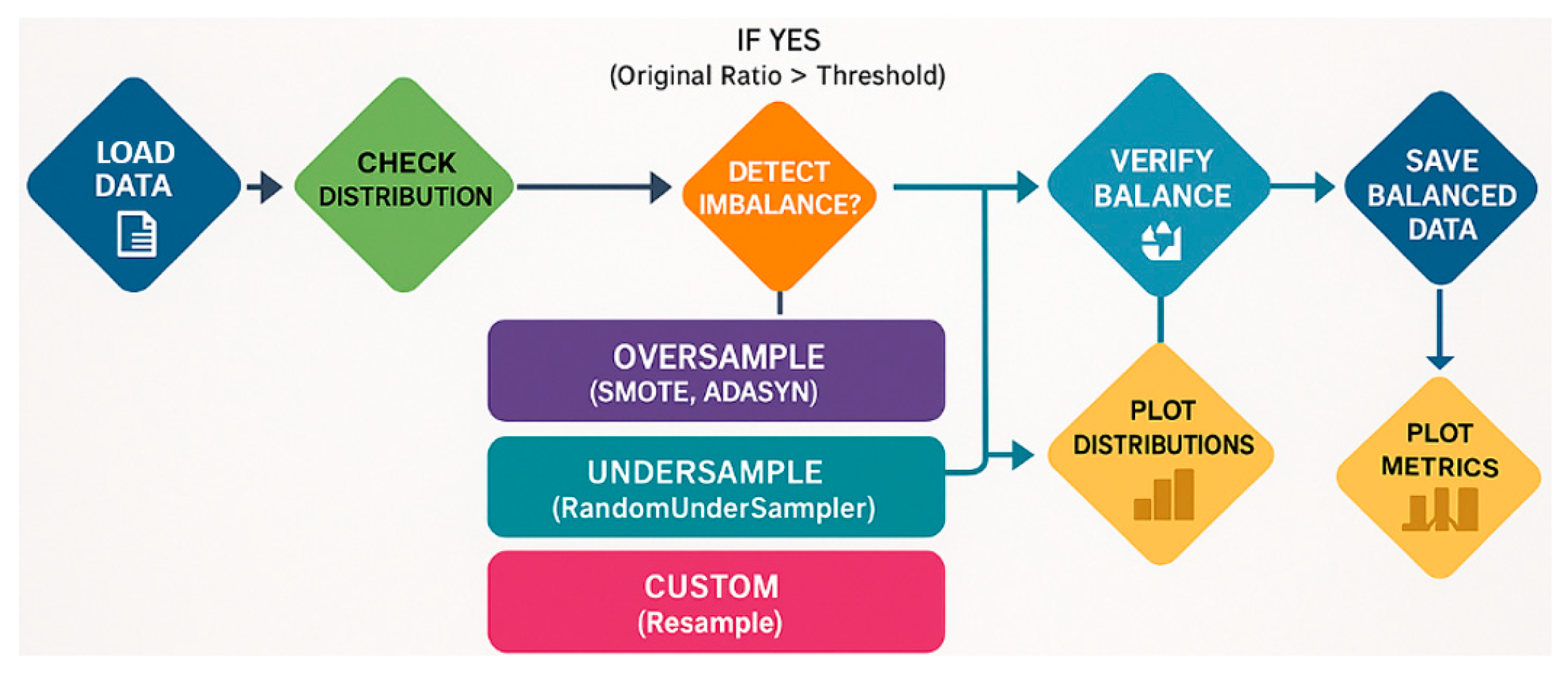
XGBoost can mitigate class imbalance issues, which are limited to binary classification and may not be suitable for addressing imbalance when the dataset has multiple classes. Furthermore, preprocessing is crucial to ensure that the algorithm does not favor classes with higher instance counts. The target goal of this pipeline is not only to improve model performance across all classes, but also to boost model interpretation. The full data preprocessing pipeline is illustrated in Figure 1.
Figure 1.
Dataset Preprocessing Pipeline.
The preprocessing process was carefully executed, starting with an analysis of the distribution of the target feature tr_status, which showed an imbalanced distribution. To overcome this problem and ensure that no single class dominates, the oversampling technique was utilized through the synthetic minority oversampling technique (SMOTE) when possible, with a fallback to random oversampling. A logical condition, “Original ratio > Threshold” was set as a conceptual criterion for imbalance detection instead of a fixed ratio. Thus, the SMOTE technique is applied only when the dataset is considered imbalanced to mitigate bias during the proposed model training. Moreover, to prevent the domination of features with larger scales, each feature was standardized.
3.3. Model Architecture
The proposed predictive model employs XGBoost, an advanced implementation of the gradient boosting algorithm. The rationale for selecting XGBoost for CI/CD failure prediction over alternatives like Random Forest, other gradient boosting variants, or deep learning models is grounded in its specific optimizations for this problem context:
- Optimized for Structured Data: XGBoost is expressly designed for the structured, heterogeneous tabular data typical of CI/CD pipeline telemetry. It excels at handling a mix of numeric features (e.g., build durations, commit counts) and categorical fields (e.g., log status), which are common in software engineering datasets [27].
- Robustness and Overfitting Control: The algorithm provides native handling of missing values and incorporates built-in L1/L2 regularization. These features are critical for curbing overfitting in high-dimensional settings, a frequent challenge with CI/CD data.
- Superior Bias-Variance Control: Compared to Random Forest, XGBoost offers more precise control over the bias-variance trade-off [26,28]. It achieves this through advanced techniques such as shrinkage (learning rate), column subsampling per tree, and a regularized tree-building process [29].
- Efficiency and Practicality: In contrast to deep or hybrid sequential models (e.g., LSTM/GRU), XGBoost does not require the heavy temporal supervision needed to model long-term dependencies, which is advantageous when building outcome labels are noisy or inconsistent. Furthermore, its calibrated multi-class softmax learning is well-aligned with the distinct semantics of CI/CD events (passed, failed, errored, canceled) and meets the low-latency operational constraints required for real-time prediction.
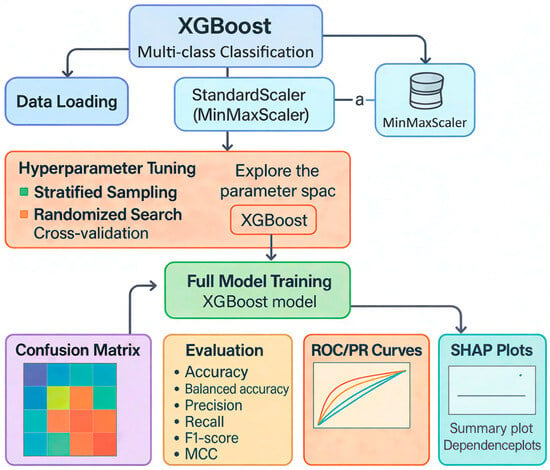
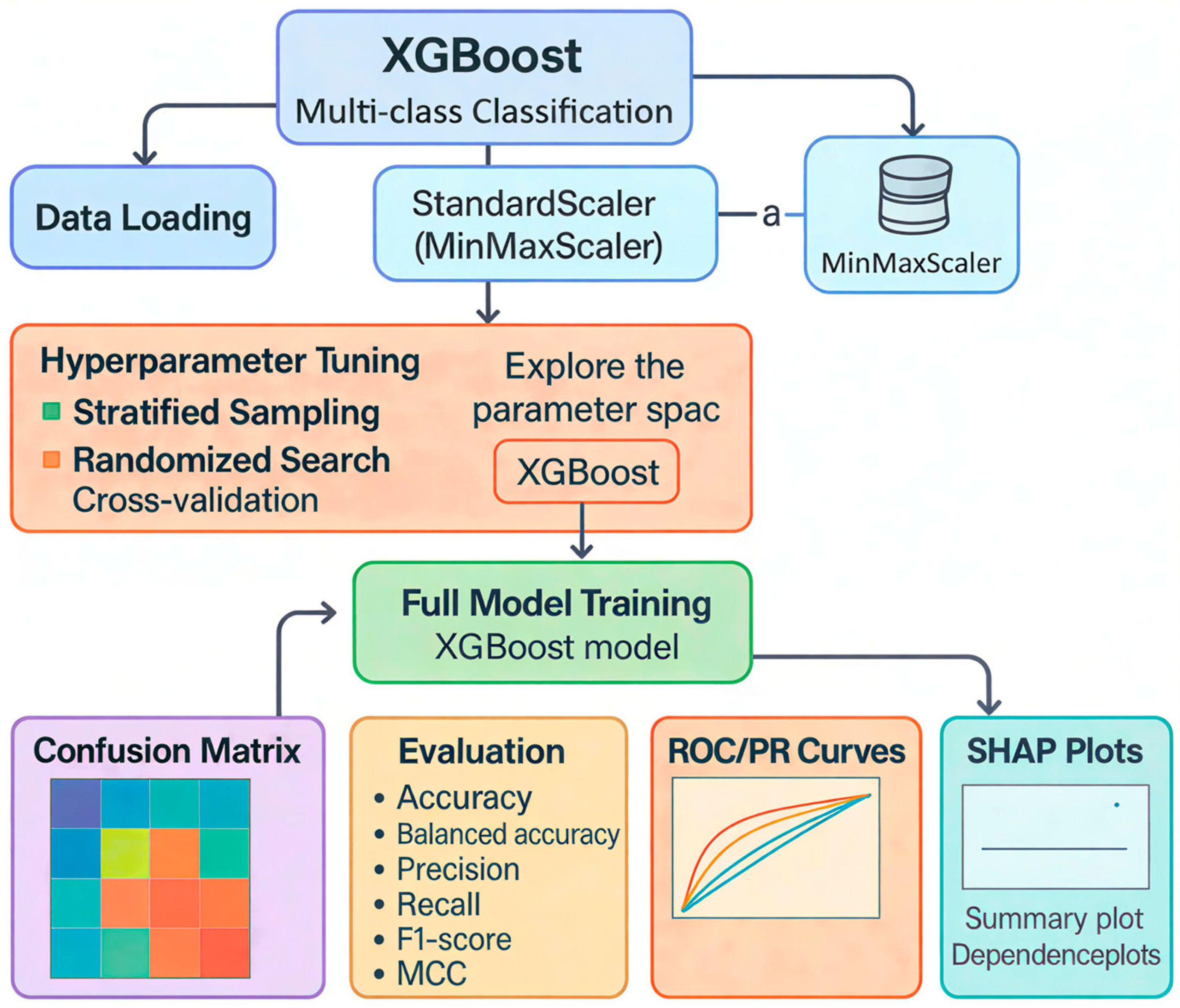
The proposed model process consists of five main phases: data preparation, preprocessing, hyperparameters optimization, model training, and evaluation. The process starts by loading the data, which undergoes rigorous preprocessing using scaling techniques to make the feature values fall in consistent ranges for optimizing model performance. The next phase is hyperparameter optimization, which aims to find the optimal hyperparameter settings to maximize the proposed model’s performance across multiple classes. The output of this phase is a set of best parameters that is used to enhance the full model training. Subsequently, the trained model undergoes a comprehensive evaluation to assess its performance and interpretability analysis. The overall architecture of the multi-class XGBoost-based model is illustrated in Figure 2.
Figure 2.
The Proposed Model Architecture.
3.4. Hyperparameters Optimization
Typically, XGBoost models’ implementation often relies on manual or default parameter tuning, which requires more effort to search for the optimized hyperparameters. Instead, the proposed model adds an outer layer through the employment of RandomizedSearchCV with stratified k-fold cross-validation on a stratified sample of the dataset. The mathematical formula of this optimization objective is as follows:
where is the target optimal set of hyperparameters that gives the highest average accuracy, Θ represents the set of all possible hyperparameters, represents the core optimization process that makes the expression on the right as large as possible, , the summation refers to K-fold cross-validation, which is the average over K folds, and is the accuracy of the model M trained and evaluated with hyperparameters θ on k-th fold of the dataset. The optimized hyperparameters for the proposed model are illustrated in Table 1.
Table 1.
The Optimized Hyperparameters of the Proposed Model.
The hyperparameter optimization process is the backbone for controlling convergence stability, bias-variance trade-off, and gradient-boosting algorithms’ generalization capacity. The proposed model retains the XGBoost formulation; however, it optimizes the key hyperparameters and utilizes stratified sampling for randomized search to efficiently improve the learning performance of the proposed model across all classes.
The core mathematical foundation of XGBoost remains grounded in its originality and is represented in this equation:
where is the objective function.
The proposed optimization process effectively regulates how the values of Hessian and gradient are aggregated across iterations by adjusting tree depth, learning rate, and regularization strength. These optimizations enhance the behavior of the optimization process while preserving the underlying equation, resulting in smoother convergence and enhanced class discrimination.
To control the maximum depth (max_depth) of each decision tree to a specific, predefined depth is critical for constraining the complexity of each base learner through the number of leaf nodes. The split-gain function is:
where H and G denote the aggregated Hessian and gradient of each node. Therefore, max_depth is set to 10 to allow the trees to grow quite deep, enabling them to capture more complex relationships from the dataset. The reason behind choosing this value is to balance between learning capacity and generalization at an optimal depth. Therefore, this tuning controls how deeply the optimization of Gain can explore, ensuring only statistically significant splits are accepted.
The value of the learning rate η parameter controls the contribution of each new tree ft to the model update:
This parameter is given a value of 0.1 to determine the small fraction for updating the model’s predictions for the new tree’s output. A small value indicates a small learning rate. The choice of 0.1 as the value of the η parameter increases the stability of the boosting process, but it requires more trees. This tuned value stabilizes the convergence of and in the objective function, enhancing the convergence term to apply a more constant penalty on complex trees.
The colsample_bytree parameter ensures that all features are considered during the building of each tree. Therefore, this parameter is assigned a value of 1.0 to prevent overfitting and guarantee diversity among trees. Furthermore, the subsample parameter is set to 0.8 to introduce stochasticity by training the proposed model on random subsets of samples, acting as implicit regularization.
Both max-depth and subsample parameters serve as functional equivalents to α and γ regularization; hence, they reduce variance and improve generalization. This simplifies the objective function to .
The number of estimators (boosting rounds) has a direct impact on the summation of additive trees:
, where each new tree () minimizes the residuals of the previous round. The n_estimators parameter is given the value of 300 to control the total number of boosting rounds (trees) to train. The trees are built in a sequential order, where each tree corrects the errors of the previously built tree. This configuration achieves the optimal balance, minimizing training loss without overfitting by stopping when additional trees provide no meaningful improvement.
3.5. Model Evaluation Metrics
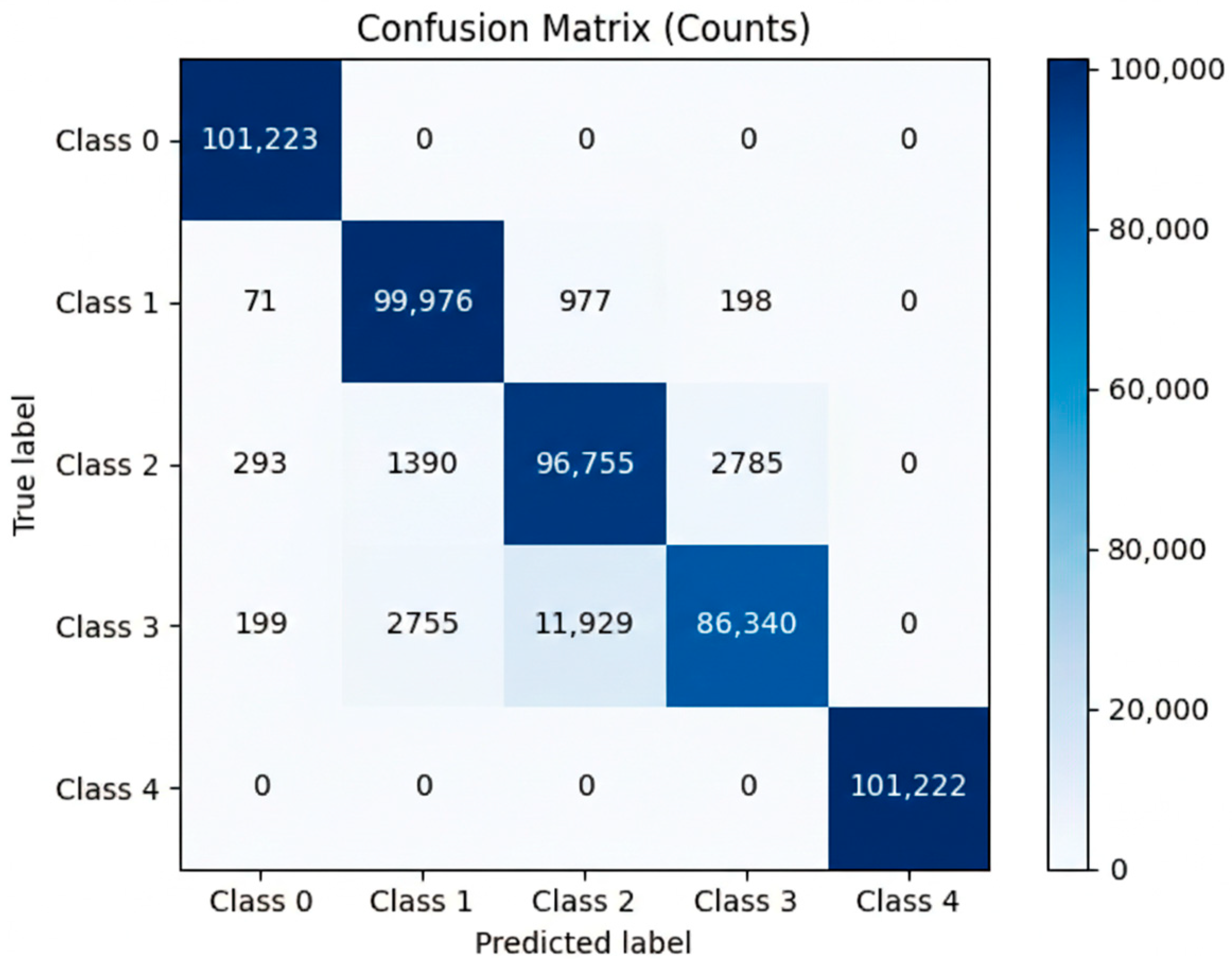
The evaluation of the proposed model was designed to ensure a rigorous multifaceted assessment of predictive performance in the context of CI/CD failure classification. Therefore, a range of well-known metrics was leveraged to avoid overreliance on a single metric. The accuracy metric is used to calculate the correctly classified samples and to demonstrate the overall performance summary. The precision metric is used to measure the proportion of samples that are truly correct among those predicted to be in a particular class, whereas recall (or sensitivity) measures the percentage of real positive samples that the model correctly detects. A trade-off between recall and precision is encapsulated by the F1-score to harmonize the mean of recall and precision. The confusion matrix visually represents the number of correct and incorrect predictions for each class, illustrating how predictions are distributed.
Cohen’s Kappa computes the agreement between the actual and predicted classifications, while correcting for agreement that could occur by chance. Cohen’s Kappa indicates that values closer to 1 demonstrate stronger agreement [30]. Matthews Correlation Coefficient (MCC) assesses the quality of multi-class classification considering all confusion matrix categories (TP, TN, FP, FN). The values of MCC range between +1 and −1, where +1 indicates perfect prediction, −1 total disagreement, and 0 random prediction [31].
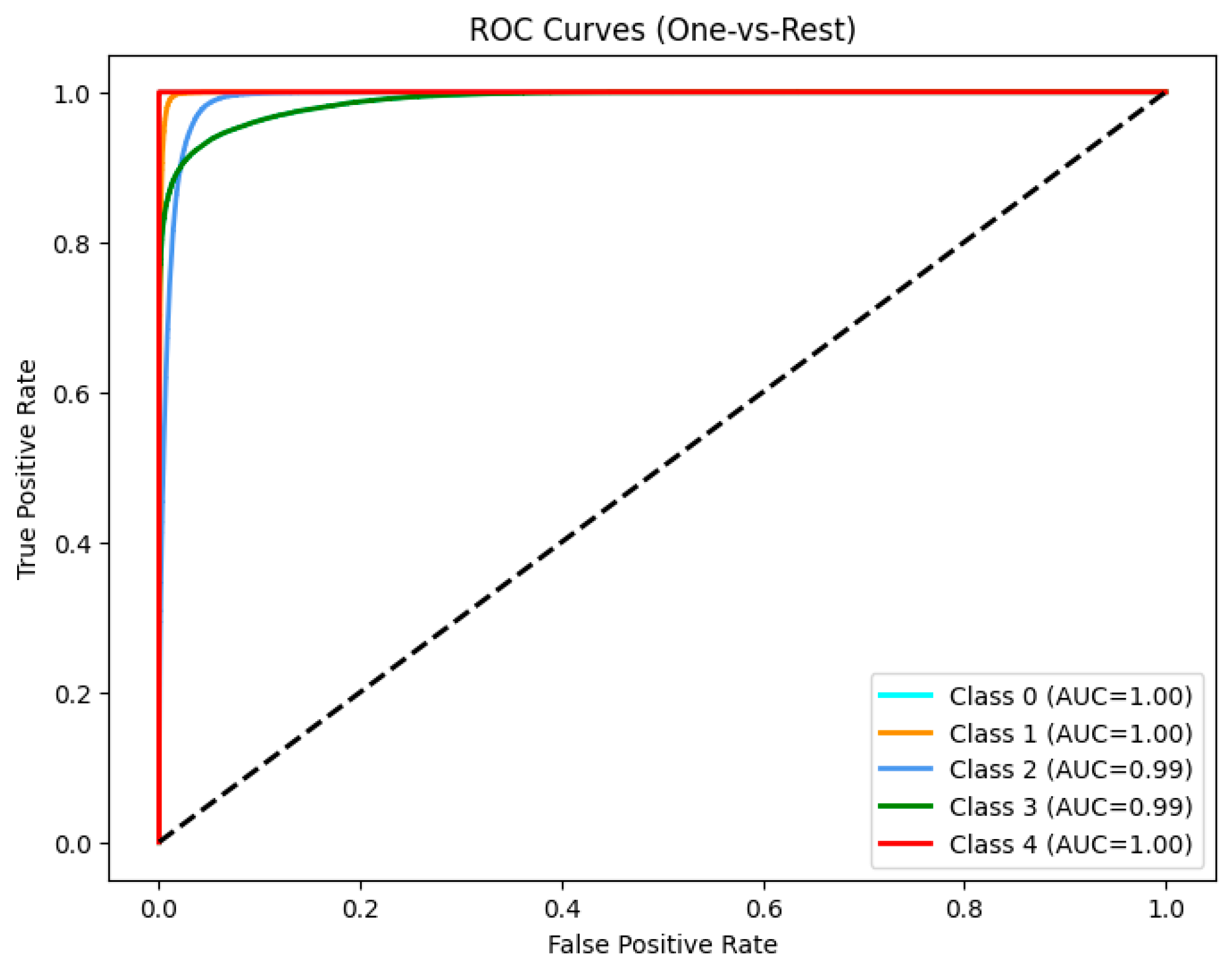
In addition, ROC Curves (One-vs.-Rest) are used to evaluate the model’s ability to distinguish each specific class from the rest. The SHAP analysis is employed to visually present the contribution of each feature to the model’s predictions and to indicate the direction of the feature’s impact (positive or negative).
Together, this set of common metrics and interpretability analysis provides a holistic evaluation. This combination ensures that the proposed model performance undergoes a rigorous evaluation process and proves that it is not only accurate but robust and explainable, making it reliable for multi-class CI/CD failure prediction in DevOps practice.
4. Results and Discussion
The model implemented in Python 3.11.9 was trained and evaluated using the TravisTorrent dataset, a common benchmark in this field that provides a reliable testbed for predictive tasks. Its performance was assessed using a standard set of evaluation metrics to ensure a complete analysis.
Table 2 compares the model’s performance with the results of the SVM and Random Forest models using the same dataset within the same context. The results demonstrate that the model achieved an overall accuracy of 95.9%, which is greater than that of other models by nearly 18% improvement. Therefore, the model demonstrates a significant outperformance of the benchmark models. The balanced accuracy of the proposed model is 95.9%, which is very nearly the same as the overall accuracy. This confirms that class imbalance had no significant influence on the model’s performance, implying that the predictions were consistently accurate across all classes. The obtained results of precision (96.0%), recall (95.9%), and F1-score (95.8%), which are higher than the benchmark models’ results, provide justifiable evidence of the reliability of the proposed model, indicating that it does not favor particular classes. In contrast, SVM achieves the lowest performance compared to the Random Forest and the proposed model.
Table 2.
Performance Comparison.
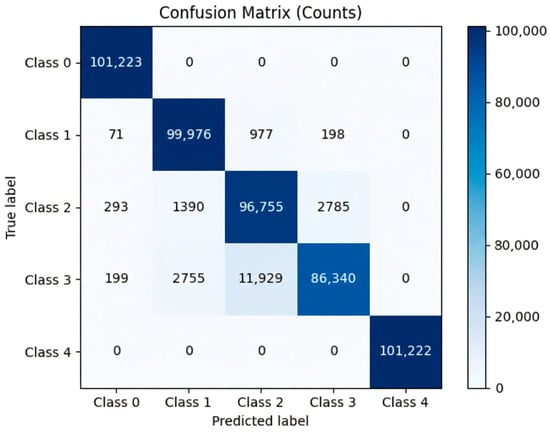
The confusion matrix depicted in Figure 3 shows the strong performance of the proposed model. Classes 0, 1, and 4 were classified with almost perfect accuracy and less error. However, there are overlapping patterns in the data between classes 2 and 3, which cause the main source of error. To the best of our knowledge, this is an expected behavior in the context of failure prediction, where these classes represent failure severity or adjacent stages of degradation, rather than distinct fault modes. Potential mitigation approaches include applying cost-sensitivity learning to penalize misclassification between adjacent severity levels or incorporating richer features.
Figure 3.
The Confusion Matrix Results.
This misclassification rate is low relative to the total number of predictions, highlighting the reliability and robustness of the proposed model. Moreover, these results show solid statistical evidence of the generalizability and practical applicability of the proposed model.
The results of Cohen’s Kappa and MCC (Matthews Correlation Coefficient) are calculated to evaluate the mode reliability. The model achieved 94.9% as a Cohen’s Kappa result that falls within the almost perfect agreement. This result is close to the model accuracy result (95.9%), which reveals that the high performance of the proposed model is not due to chance; thus, the proposed model’s predications are in near-perfect agreement with true labels. Furthermore, Cohen’s Kappa result confirms that the model has successfully learned discriminative classes. Notably, the result of MCC is 94.9%, indicating a very strong positive correlation between actual and the predicted class labels. The results of Cohen’s Kappa and MCC are close to the accuracy result, confirming that the proposed model demonstrates reliable underlying patterns capturing, confirming robust generalization across classes, and guaranteeing highly effective performance for multi-class classification tasks.
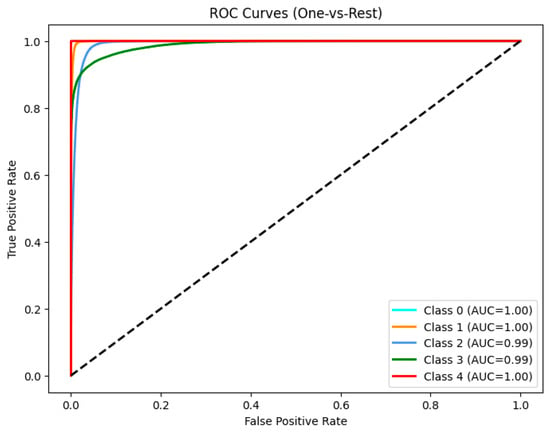
Figure 4 shows the results of the ROC Curves to visually and quantitatively examine where and how the proposed model is succeeding or failing across all the classes using a one-vs.-rest approach. ROC Curves plot true positive rate (TPR) against the false positive rate (FPR). In this context, every class is independently compared against all other classes to evaluate the model’s ability to discriminate each class. All tr_status classes achieve AUC ≥ 99.0%, indicating that the proposed model effectively discriminates every class from all others with minimal error. Regarding classes 2 and 3, they achieve an AUC = 99.0%, which is less than 1, demonstrating that there is a slight overlap between classes 2 and 3. However, the distinction ability of the proposed multi-class model remains highly accurate.
Figure 4.
ROC Curves (One-vs.-Rest) Results.
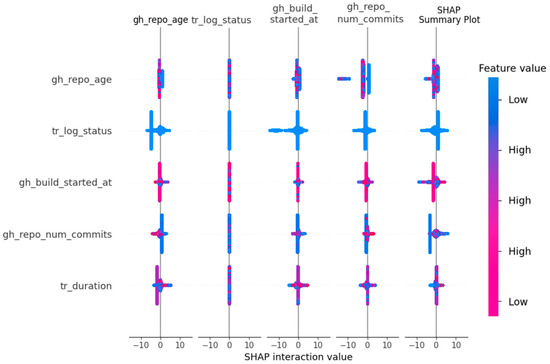
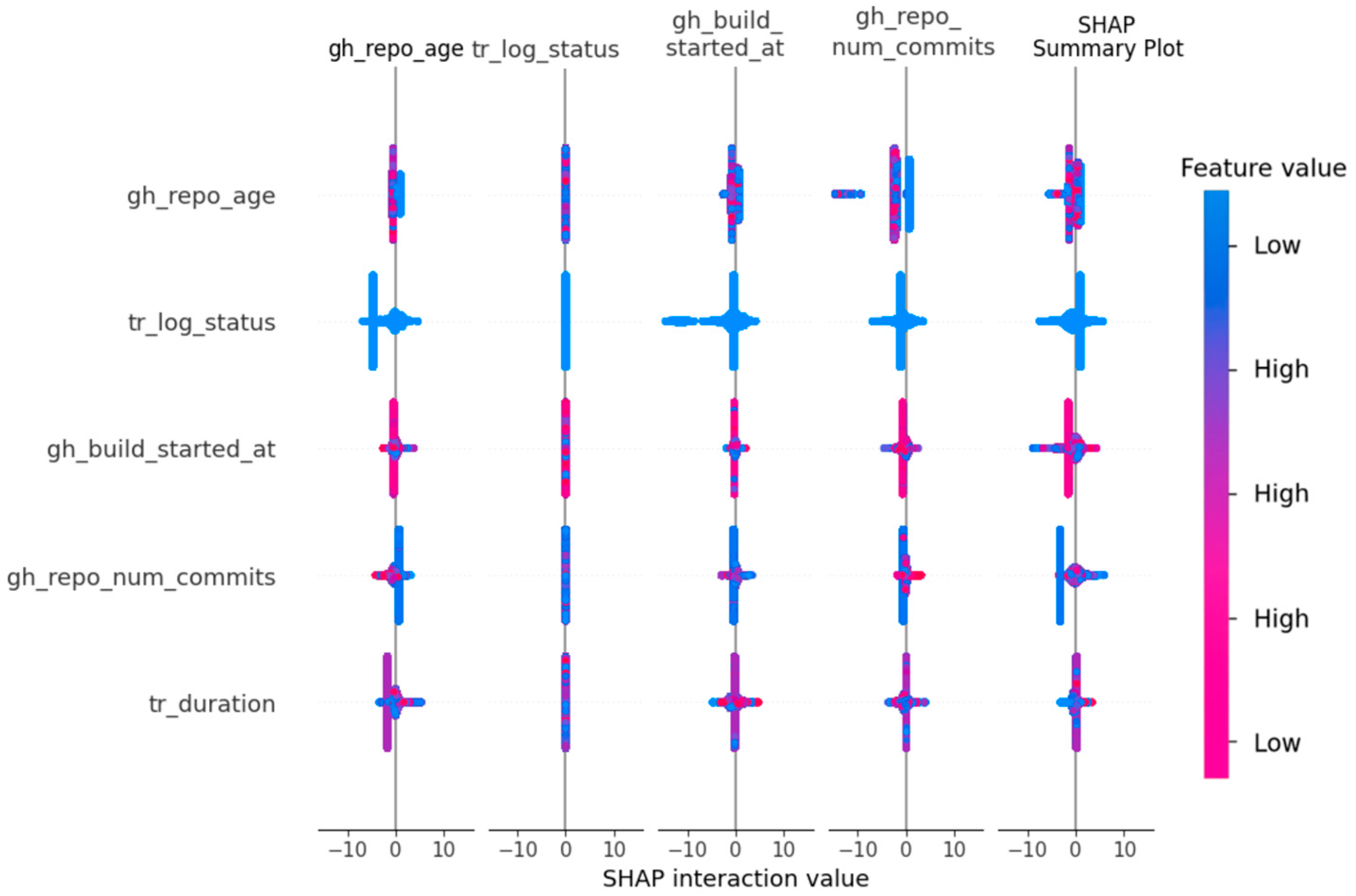
However, the results of the metrics discussed above alone are neither sufficient to reveal why the proposed model performs well nor to identify the factors that drive its predictions. To overcome this, SHAP interaction analysis was performed to interpret and explain feature interactions and contributions. Figure 5 illustrates the results of SHAP interaction analysis.
Figure 5.
SHAP Interaction Analysis Results.
As shown in Figure 5, five key features were analyzed, including: tr_duration for build duration, gh_repo_num_commits representing the number of commits in the repository, gh_build_started_at denoting the build start time, tr_log_status for the build log status, and repository age represented by gh_repo_age. The SHAP analysis highlights that tr_log_status is the key dominant interacting feature with a SHAP value between −10 and 10. This indicates that warnings or anomalies in build logs directly contribute to failure predictions and strongly interact with other features, thereby increasing their effects. Likewise, tr_duration demonstrates significant interaction spread, with longer CI/CD builds mostly linked with higher risks of failure. These results are consistent with experimental observations that suggest that prolonged builds increase the probability of instability or timeout errors. The gh_build_started_at feature has a noticeable interaction effect, in which the build start time influences outcomes along with other features, implying that factors such as server load or peak development hours may impact build stability. Moreover, the gh_repo_num_commits feature shows adequate but stable interactions, revealing that repositories with a high volume of commits that introduce rapid changes are highly prone to unstable builds when combined with other risk factors. Furthermore, gh_repo_age exhibits average interaction in such a way that older repositories are stable due to their maturity, while younger repositories show less predictable outcomes when associated with other features.
These interpretative findings offer direct guidance for proactive pipeline management. For instance, the dominance of tr_log_status suggests that teams should implement real-time log monitoring systems that flag warnings or anomalies as they occur, rather than waiting for a build to complete. Similarly, the high impact of tr_duration indicates that teams could set dynamic, context-aware timeouts or automatically parallelize builds that are predicted to run excessively long, thereby optimizing resource usage.
Overall, the evaluation results provide sound evidence that the model obtained a high degree of precision, stability, and generalization. Its reliability in multi-class decision-making related to CI/CD failure prediction tasks is confirmed through the performance consistency across all commonly adopted evaluation metrics. Furthermore, the results further validate that the model is genuinely learned on multi-class discriminative tasks, where the results neither stem from class imbalance nor random chance.
5. Practical Implications
The experimental results demonstrate a model capable of high-accuracy, interpretable failure prediction. This capability offers several actionable implications for enhancing DevOps practices:
- Increased CI/CD pipeline reliability: By accurately identifying builds at high risk of failure, software engineering teams can shift from reactive fixing to proactive intervention, thereby increasing overall pipeline reliability and developer productivity.
- Data-driven resource optimization: The SHAP analysis provides a clear, empirical basis for optimizing resource allocation. For instance, by comprehending the effects of build time and scheduling standards, teams can improve these procedures, resulting in a notable decrease in wasted computational resources and developer time.
- Role-specific decision-making integration: The model’s outputs can be tailored to inform decision-making for different stakeholders.
- For Developers: Integration into IDE tools or pull-request dashboards can provide immediate feedback on the failure risk of a code change, serving as an early warning system.
- For DevOps Engineers: Feature importance rankings offer a strategic guide for prioritizing infrastructure investments, refining test suite design, and tuning pipeline configuration parameters.
- For Project Managers: Improved prediction of build outcomes enhances release schedule predictability, aids in risk assessment for sprint planning, and can ultimately reduce time-to-market and development costs.
- Scalability for enterprise: The model’s validation on the large, heterogeneous TravisTorrent dataset confirms its robustness across different project contexts. This scalability lowers the barrier to adoption for large organizations with diverse technology stacks, moving the approach from a theoretical framework to a practical tool for enterprise-scale CI/CD governance.
6. Conclusions
This paper advances the process of failure prediction in the context of DevOps CI/CD practices, as confirmed by the experimental results that show significant performance improvement. The proposed multi-class classification model is built on the core process of the XGBoost algorithm, and the hyperparameters were carefully tuned through an extensive process that used RandomizedSearchCV with stratified k-fold cross-validation. The Python programming language was used for the implementation of the proposed model. The public and large-scale TravisTorrent dataset was used during model training and evaluation, which underwent extensive preprocessing and feature engineering to increase prediction performance.
For the evaluation purpose, a wide range of evaluation metrics was used, including accuracy, confusion matrix precision, F1-score, recall, ROC curves, and Cohen’s Kappa and MCC. The evaluation results indicate outstanding performance improvement compared to the benchmark models, with approximately 18%. Furthermore, the ROC-AUC results, which are above 99% for all classes, indicate near-perfect discrimination ability, and the obtained scores of Cohen’s Kappa and MCC were close to 95%, proving that the proposed model provides dependable classification. The findings, along with a small misclassification rate, attest to the model’s strength and the ability to accurately classify different classes, thus being a useful tool for predicting CI/CD failures in the real world.
Moreover, the examination of feature interactions implies that the adjustment of scheduling rules and build times will lead to the substantial reduction of resource loss and the betterment of development. Therefore, it is recommended that future projects take the integration of this model with ongoing CI/CD pipelines as their main focus, which will provide the possibility for real-time failure predictions and automatic proactive interventions. In general, this study is a bridge over a major gap in the current literature and the source of a framework for the enhancement of the practice of DevOps with the help of AI-based insights. In future works, the integration of the suggested model into current CI/CD pipelines must be the main area of research. In that manner, the forecasts could be done instantly and trigger the automatic execution of preventive measures. Another interesting direction for future work is to investigate the correlation between tr_status and log_status.
Author Contributions
Conceptualization, I.A.A.-B.; methodology, I.A.A.-B. and N.A.-S.; software, I.A.A.-B., M.M.A.-G., and S.Y.A.-S.; validation, I.A.A.-B., N.A.-S., and M.A.; formal analysis, I.A.A.-B. and N.A.-S.; investigation, I.A.A.-B., N.A.-S., and M.A.; resources, I.A.A.-B. and N.A.-S.; writing—original draft preparation, I.A.A.-B. and M.A.; writing—review and editing, I.A.A.-B., N.A.-S., M.A., M.M.A.-G., and S.Y.A.-S.; visualization, I.A.A.-B.; supervision, I.A.A.-B. and N.A.-S.; project administration, M.A.; funding acquisition, M.A. All authors have read and agreed to the published version of the manuscript.
Funding
This research received no external funding.
Institutional Review Board Statement
Not applicable.
Informed Consent Statement
Not applicable.
Data Availability Statement
The original data presented in the study are openly available in FigShare at https://figshare.com/articles/dataset/TravisTorrent/19314170 (accessed on 15 August 20225) [24].
Conflicts of Interest
The authors declare no conflict of interest.
References
- Manolov, V.; Gotseva, D.; Hinov, N. Practical Comparison Between the CI/CD Platforms Azure DevOps and GitHub. Future Internet 2025, 17, 153. [Google Scholar] [CrossRef] [Scilit]
- Yarlagadda, R.T. How DevOps enhances the software dévelopment quality. Int. J. Creat. Res. Thoughts 2019, 7, 358–364. [Google Scholar]
- Enemosah, A. Enhancing DevOps efficiency through AI-driven predictive models for continuous integration and deployment pipelines. Int. J. Res. Publ. Rev. 2025, 6, 871–887. [Google Scholar] [CrossRef] [Scilit]
- Kolawole, I.; Fakokunde, A. Machine Learning Algorithms in DevOps: Optimizing Software Development and Deployment Workflows with Precision. Int. J. Res. Publ. Rev. 2025, 6, 247–264. [Google Scholar] [CrossRef] [Scilit]
- Moeez, M.; Mahmood, R.; Asif, H.; Iqbal, M.W.; Hamid, K.; Ali, U.; Khan, N. Comprehensive Analysis of DevOps: Integration, Automation, Collaboration, and Continuous Delivery. Bull. Bus. Econ. 2024, 13, 662–672. [Google Scholar] [CrossRef] [Scilit]
- Almeida, F.; Simões, J.; Lopes, S. Exploring the Benefits of Combining DevOps and Agile. Future Internet 2022, 14, 63. [Google Scholar] [CrossRef] [Scilit]
- Elberzhager, F.; Arif, T.; Naab, M.; Süß, I.; Koban, S. From Agile Development to DevOps: Going Towards Faster Releases at High Quality—Experiences from an Industrial Context. In Software Quality. Complexity and Challenges of Software Engineering in Emerging Technologies; Springer International Publishing: Cham, Switzerland, 2017; pp. 33–44. [Google Scholar]
- Ebert, C.; Gallardo, G.; Hernantes, J.; Serrano, N. DevOps. IEEE Softw. 2016, 33, 94–100. [Google Scholar] [CrossRef] [Scilit]
- Thatikonda, V.K. Beyond the buzz: A journey through CI/CD principles and best practices. Eur. J. Theor. Appl. Sci. 2023, 1, 334–340. [Google Scholar] [CrossRef] [Scilit]
- Bildiri, F.; Akdemir, Ö. From agile to devops, holistic approach for faster and efficient software product release management. AYBU Bus. J. 2021, 1, 26–33. [Google Scholar]
- Kolawole, I.; Fakokunde, A. Improving Software Development with Continuous Integration and Deployment for Agile DevOps in Engineering Practices. Int. J. Comput. Appl. Technol. Res. 2024, 14, 25–39. [Google Scholar]
- Kumar, R.; Kollipara, D.N.D.; Mohammed, A.H.; Kumar, S.; Mohammed, F.B.; Kumar, A. Optimizing CI/CD Pipelines with AI-Driven Build Failure Prediction: An Empirical Study on Machine Learning Models for Early Failure Detection. Spectr. Eng. Sci. 2025, 3, 1945–1954. [Google Scholar]
- Ghaleb, T.A.; da Costa, D.A.; Zou, Y. An empirical study of the long duration of continuous integration builds. Empir. Softw. Eng. 2019, 24, 2102–2139. [Google Scholar] [CrossRef] [Scilit]
- Saidani, I.; Ouni, A.; Chouchen, M.; Mkaouer, M.W. On the prediction of continuous integration build failures using search-based software engineering. In Proceedings of the 2020 Genetic and Evolutionary Computation Conference Companion, Cancún, Mexico, 8–12 July 2020. [Google Scholar] [CrossRef] [Scilit]
- Fawzy, A.H.; Wassif, K.; Moussa, H. Framework for automatic detection of anomalies in DevOps. J. King Saud Univ.-Comput. Inf. Sci. 2023, 35, 8–19. [Google Scholar] [CrossRef] [Scilit]
- Mishra, A.; Sharma, A. Deep learning based continuous integration and continuous delivery software defect prediction with effective optimization strategy. Knowl.-Based Syst. 2024, 296, 111835. [Google Scholar] [CrossRef] [Scilit]
- Saidani, I.; Ouni, A.; Mkaouer, M.W. Improving the prediction of continuous integration build failures using deep learning. Autom. Softw. Eng. 2022, 29, 21. [Google Scholar] [CrossRef] [Scilit]
- Benjamin, J.; Mathew, J. Enhancing continuous integration predictions: A hybrid LSTM-GRU deep learning framework with evolved DBSO algorithm. Computing 2024, 107, 9. [Google Scholar] [CrossRef] [Scilit]
- Kamath, D.M.; Fernandes, E.; Adams, B.; Hassan, A.E. On combining commit grouping and build skip prediction to reduce redundant continuous integration activity. Empir. Softw. Eng. 2024, 29, 145. [Google Scholar] [CrossRef] [Scilit]
- Dileepkumar, S.; Mathew, J. Optimizing continuous integration and continuous deployment pipelines with machine learning: Enhancing performance and predicting failures. Adv. Sci. Technology. Res. J. 2025, 19, 108–120. [Google Scholar]
- Cosentino, V.; Luis, J.; Cabot, J. Findings from GitHub: Methods, datasets and limitations. In Proceedings of the 13th International Conference on Mining Software Repositories, Austin, TX, USA, 14–15 May 2016. [Google Scholar] [CrossRef] [Scilit]
- Karamitsos, I.; Albarhami, S.; Apostolopoulos, C. Applying DevOps Practices of Continuous Automation for Machine Learning. Information 2020, 11, 363. [Google Scholar] [CrossRef] [Scilit]
- Kumar, A.; Nadeem, M.; Shameem, M. Machine learning based predictive modeling to effectively implement DevOps practices in software organizations. Autom. Softw. Eng. 2023, 30, 21. [Google Scholar] [CrossRef] [Scilit]
- Beller, M.; Gousios, G.; Zaidman, A. TravisTorrent. figshare. Dataset (v1 ed.). 2022. Available online: https://figshare.com/articles/dataset/TravisTorrent/19314170 (accessed on 15 August 2025).
- Beller, M.; Gousios, G.; Zaidman, A. TravisTorrent: Synthesizing Travis CI and GitHub for full-stack research on continuous integration. In Proceedings of the 14th International Conference on Mining Software Repositories, Buenos Aires, Argentina, 20–21 May 2017. [Google Scholar] [CrossRef] [Scilit]
- Mitchell, R.; Frank, E. Accelerating the XGBoost algorithm using GPU computing. PeerJ Comput. Sci. 2017, 3, e127. [Google Scholar] [CrossRef] [Scilit]
- Zhang, P.; Jia, Y.; Shang, Y. Research and application of XGBoost in imbalanced data. Int. J. Distrib. Sens. Netw. 2022, 18, 15501329221106935. [Google Scholar] [CrossRef] [Scilit]
- Dhaliwal, S.S.; Nahid, A.-A.; Abbas, R. Effective Intrusion Detection System Using XGBoost. Information 2018, 9, 149. [Google Scholar] [CrossRef] [Scilit]
- Chen, T.; Guestrin, C. XGBoost: A Scalable Tree Boosting System. In Proceedings of the 22nd ACM SIGKDD International Conference on Knowledge Discovery and Data Mining, San Francisco, CA, USA, 13–17 August 2016. [Google Scholar] [CrossRef] [Scilit]
- Landis, J.R.; Koch, G.G. The measurement of observer agreement for categorical data. Biometrics 1977, 33, 159–174. (In English) [Google Scholar] [CrossRef] [Scilit] [PubMed]
- Matthews, B.W. Comparison of the predicted and observed secondary structure of T4 phage lysozyme. Biochim. Biophys. Acta (BBA)—Protein Struct. 1975, 405, 442–451. [Google Scholar] [CrossRef] [Scilit]

Disclaimer/Publisher’s Note: The statements, opinions and data contained in all publications are solely those of the individual author(s) and contributor(s) and not of MDPI and/or the editor(s). MDPI and/or the editor(s) disclaim responsibility for any injury to people or property resulting from any ideas, methods, instructions or products referred to in the content. |
© 2026 by the authors. Licensee MDPI, Basel, Switzerland. This article is an open access article distributed under the terms and conditions of the Creative Commons Attribution (CC BY) license.