


Abstract
Privacy-preserving eligibility checks in decentralized finance often cache a successful authorization to reduce repeated access costs. With a shared revocation epoch, revoking one credential can invalidate other holders’ cached access. We study this spillover in a reproducible token-deposit component comparing selective signed and shared-epoch zero-knowledge (ZK) caches on Ethereum execution. For 100 deposits over 90 days with a 30-day rolling authorization lifetime, two unrelated revocations lead to three, four or five full ZK authorizations, depending on their timing. Across a uniform reference grid of 3916 pairs of distinct integer revocation days (1–89), ZK uses more projected gas in 57.07% of schedules (83.53% for pairs at most a week apart), whereas the mean difference is only +5013 gas with historical unit means and −1041 to −693 gas with storage states. Each additional full ZK authorization cancels the savings from about 23 cache hits. With fixed unit costs, Poisson expected-gas parity occurs near two epoch-advancing updates per 90 days, so this design suits small holder sets or sparsely published epochs. A signed control with shared invalidation reproduces the authorization counts. Public issuer partitions reduce spillover while revealing smaller issuer groups and increasing setup gas. Reimbursement reallocates the gas bill; per-proof limits bound the remaining proving budget.
1. Introduction
Decentralized finance services increasingly need to restrict access to users who satisfy some admission policy, for example, a jurisdiction rule or an investor tier. At the same time, publishing the credential, its issuer, and the underlying attributes on a public blockchain contradicts the very idea of privacy-preserving finance. Two technical answers are commonly discussed: (i) an issuer can sign a compact eligibility assertion, or (ii) the user can prove the required predicates in zero knowledge (ZK). Both approaches are well studied and their verification costs are usually compared one transaction at a time.
In practice, however, a user deposits repeatedly and a contract can cache a successful authorization so that later deposits can take a cheaper path. Such a cache has to react to credential expiry, policy changes, and their revocation. As a result, the cost of access is determined not only by the price of one verification, but also by the sequence of state changes during the whole period of use.
This sequence is where signed and private access differ in an important way. Let us consider an eligible user whose own credential never changes. If the contract checks this user’s public credential identifier, the revocation of somebody else’s credential leaves the cached authorization valid. A private presentation hides that identifier, so a natural implementation validates a shared security epoch instead. Then, an unrelated revocation invalidates the cache of every holder and each of them must produce a new proof and pay for a new full authorization. We call this effect a revocation spillover: a status update of one credential raises the operating cost of other, still eligible users.
The timing of such updates turns out to be as important as their number. A full authorization resets the cache’s time to live (TTL). A revocation that arrives just after a planned renewal forces one more expensive authorization, whereas a revocation that arrives close to a renewal that was due anyway costs almost nothing extra. Therefore, two services with the same number of revocations can rank signed and private access in opposite order. Cost sharing adds a second economic layer: a service can reimburse part of the user’s expense, but such a transfer changes who pays and leaves the network bill unchanged.
The aim of this work is to quantify how invalidation scope and rolling expiry determine the cost of repeated private access, and to show under which schedules a shared-epoch ZK cache stops being cheaper than a signed one. To achieve this aim, we solve the following tasks:
- to measure, on complete contract traces, whether a shared epoch forces additional authorizations on unaffected users, and to check that a signed implementation, with the same shared invalidation, reproduces the effect;
- to determine whether the timing of a fixed number of unrelated revocations can reverse the gas ranking, using exhaustive enumeration of schedules and a finite-horizon renewal model;
- to evaluate a design alternative, in which issuers are split into public groups, and to measure what it gains in cost and loses in privacy;
- to translate the resulting gas differences into user-payment conditions when the service reimburses part of the ZK cost and proving expenses are treated separately.
The building blocks used herein, namely, caching, revocation, witness updates, renewal theory, and payment allocation, are well known. In particular, it is known that a revocation can oblige unaffected holders to refresh their non-revocation witnesses (Section 2). What has not been quantified is the next step: when a shared update invalidates an authorization already stored on chain, the forced full authorization also restarts the rolling expiry clock, so the cost depends on when the updates fall relative to planned renewals and not only on how many there are. This timing effect, measured for a shared-epoch ZK cache against a selective signed cache, is the specific contribution of the paper. The shared epoch is one design choice among several; Section 5 discusses the alternatives. Our contribution thus lies in the interaction of the known building blocks inside a reproducible eligibility component. We connect invalidation scope and rolling expiry to complete receipt traces, classify all two-revocation schedules, derive a simple threshold rule in terms of the number of accesses, and measure a partitioned alternative. The study evaluates one component on a local chain and does not describe a deployed DeFi platform or a new anonymous-credential primitive.
The rest of the paper is organized as follows. Section 2 summarizes related work concerning private on-chain permissioning, revocation in anonymous-credential systems, and execution costs on the Ethereum Virtual Machine. Section 3 describes the eligibility semantics, the contract replay setup, and the analytical gas and payment models used for evaluation. Section 4 presents the obtained results, including the two-revocation timing distribution, expected authorization counts, the impact of public issuer partitions, and the final payment conditions under various schedules. Section 5 discusses the design implications of invalidation scope and rolling expiry, together with the limitations of the study. Finally, Section 6 concludes the paper by summarizing the primary findings and outlining directions for future research.
2. Related Work
In this section, we focus on three groups of studies: private on-chain permissioning, revocation in anonymous-credential systems, and execution costs on the Ethereum Virtual Machine (EVM). The source register in the data package lists the ten studies of our original focused review together with the foundational and implementation sources added later. Published results are compared qualitatively, since per-proof gas, proving time, and a 90-day user bill are different quantities.
2.1. Revocation, Witness Maintenance, and Cached Authorization
Camenisch and Lysyanskaya introduced dynamic accumulators for efficient revocation of anonymous credentials in 2002 [1]. In such schemes, an unaffected holder may need a fresh membership witness after other members are removed, so the transfer of work from one credential to other holders is a known phenomenon. The AnonCreds v1.0 draft describes the same dependency in operational terms: before producing a non-revocation proof, the holder obtains current revocation information and recomputes the witness [2]. In iden3, non-revocation is expressed as non-membership of a nonce in a sparse Merkle tree, and the Reverse Hash Service supplies the current issuer state and witnesses [3]. These mechanisms differ in detail, and the amount of work they impose on each holder varies.
Our measurements concern the next layer of the system. An authorization that is still valid is already stored in an EVM contract. A shared epoch invalidates this stored state, and the following full authorization restarts the rolling TTL. We count the resulting calls, storage transitions, and user gas. Witness maintenance precedes this step and is left unpriced in our model. The question we address is how shared invalidation changes the schedule of contract-level authorizations compared with selective signed status checks.
Semaphore offers group membership proofs, removal of members, and a configurable acceptance window for older roots [4], while World ID uses Semaphore membership in a deployed system [5]. Therefore, membership groups, root freshness, and anonymity sets are existing design dimensions. Our partition experiment measures one concrete choice in this space with a fixed circuit and TTL.
2.2. Private Access and Execution Costs
Piper, Wolf, and Heiss [6] study private on-chain permissioning with several predicate types; their commit-and-prove design checks credential authenticity outside the proof circuit and leaves revocation for future work. ZEBRA [7] (available as an ePrint manuscript) already combines on-chain verification with access-map caching, revocation, and batching. Thus, private DeFi access and cached authorization as such are not new, but we take these ideas as given and study how invalidation interacts with rolling expiry on a fixed deposit trace.
The zk-creds system [8] supports flexible anonymous credentials and the reuse of precomputed membership witnesses. Such a reuse reduces prover work, which is different from reusing an authorization stored in a contract. REGKYC [9] combines attribute-based access control with privacy and regulated de-anonymization; its deposit and withdrawal flows have other privacy and execution boundaries than our visible-wallet deposit gate. Di Francesco Maesa et al. [10] analyze which parties pay for verifier deployment, policy deployment, and access evaluation; we follow their approach of attributing expenses to actors. Table 1 summarizes the just mentioned studies with a brief functional comparison.
Table 1.
Functional comparison with the studies closest to ours. Published timings and gas values are not normalized to the 90-day totals of this paper.
Other works provide useful context but they are quite different from ours. CanDID [11] deals with identity issuance and accountability, while Coconut [12] with threshold issuance and selective disclosure in blockchain applications. BAAR [13], S-Cred [14], and the Merkle accumulator by Sitouah et al. [15] address revocation, while Garcia-Grau et al. [16] consider anonymous access with a limited number of uses. Privacy Pools [17] use proofs of association with selected sets of transaction origins; their privacy–compliance trade-off concerns transaction provenance, while ours concerns a public issuer group at an eligibility gate.
The proof system is Groth16 [18]. EVM verification costs depend on the pricing of pairing precompiles [19], calldata [20], and storage transitions [21,22], while GASPER shows how bytecode and compiler choices affect gas consumption [23]. For this reason, we keep compiler settings, transaction bytes, and storage states in the evidence instead of combining a verifier-only cost with a separate access model.
Finally, MiCA and the European Digital Identity Framework form the regulatory background for crypto-asset services and digital identity in Europe [24,25]. Our gate models a stipulated admission policy; legal compliance, identity wallets, and full KYC processes are beyond the scope of the considered benchmark.
3. Materials and Methods
3.1. Eligibility Semantics and Disclosure
All five methods execute the same token transfer, nonce update, and deposit accounting; they are the following: unchecked, signed direct, signed cache, ZK direct, and ZK cache.
The unchecked method performs no eligibility check and serves as the common gas reference. A signed credential binds the holder, credential identifier, policy version, validity interval, and eligibility bit under an issuer signature; thus, raw attributes stay hidden already in this variant. The ZK circuit proves that the credential belongs to an active issuer tree, that the issuer belongs to the registry, that a tier threshold is met, that the jurisdiction is allowed, and that the proof lies within its validity window. Both mechanisms implement the same admission decision, provided that the issuers evaluate eligibility honestly and publish status updates on time.
The ZK presentation hides the selected issuer, the credential leaf, and the private attributes. It reveals a scope-specific pseudonym, the proof window, and the public roots. Wallets, token amounts, and transaction times stay visible, the pseudonym is stable within one application, while the gate binds its first use to a wallet. Therefore, wallet reuse and metadata can still link activity; whereas issuance and witness delivery are outside the fixture. Accordingly, our disclosure claim is limited to the eligibility gate itself (Table 2).
Table 2.
Disclosure and status checks of the two considered families. Equal admission decisions rely on the issuer assumptions stated in the text.
At this gate, the privacy bought by the additional gas is therefore narrow. Because the first use binds the pseudonym to a visible wallet, all deposits of a holder are linkable within the service on both paths. What the ZK path adds is issuer hiding and the absence of a public credential identifier, which on the signed path acts as a handle that links the same credential across services and to the issuer’s records. Issuer partitions reduce the first of these benefits; Section 4.4 quantifies the remaining issuer ambiguity.
3.2. Revocation and Rolling Authorization Expiry
In the main policy, a revocation takes effect immediately after the authoritative update. A signed cache hit checks the holder’s issuer, credential identifier, and policy version against the current registry, so the revocation of another credential leaves this cache usable. A ZK cache stores the security epoch at the moment of authorization. Any security update advances the epoch and, thereby, invalidates all old caches, because the contract cannot know which hidden credential was used. Publications that only add credentials leave the epoch unchanged; we assume that the issuer classifies updates correctly, since an opaque root cannot show that only leaves were added.
The registry updates the signed public-ID status and the hidden active-set root in one atomic operation. This matters because revoking only the public ID would leave the corresponding hidden credential valid. With the atomic update, both paths reject an affected old authorization right after the matched authoritative update. Delays in detection, classification, or publication on the issuer side take place before this point and lie outside the measured guarantee. Disabling an issuer or changing the policy also invalidates caches immediately.
Let the access times be and the time of the most recent full authorization be . The cached authorization expires at , where T is the authorization TTL and L is the credential expiry. A still-eligible user needs a full ZK authorization at access in three cases: (i) no cache exists yet, (ii) has reached the expiry, or (iii) at least one security update happened after and no later than . In all other cases, the user takes the cache-hit path, and only a full authorization resets the TTL. On the signed path, unrelated revocations do not enter this condition. If an update and an access share a timestamp, the model processes the update first.
The core configuration uses days and a credential that remains valid over the whole 90-day horizon. A 300 s grace period for roots superseded by additions is configured, but it applies to additions only and leaves the immediate effect of revocation unchanged. The fixture also contains policies with a positive revocation delay; since they provide weaker freshness, we exclude them from the main comparison.
3.3. Execution Environment and Workload
The contracts implement unchecked deposits, signed direct and cached eligibility, and ZK direct and cached eligibility. The considered circuit has 7409 constraints, with Merkle depths 10, 2, and 3 for credentials, issuers, and allowed jurisdictions, respectively. The historical gas measurements were made with Solidity 0.8.37, optimizer runs equal to 200, Cancun-target bytecode, and an Osaka EVM runtime. The new traces keep these settings and the dependency lock and run on Node.js 24.22.1, with Hardhat 3.20.0. The circuit is compiled with circom2 0.2.23, proofs are generated and verified with snarkjs 0.7.6, and transactions are sent with ethers 6.17.0. All credentials and tokens are synthetic.
The historical dataset contains 1036 successful receipts in 105 operation–policy cells: 72 cells with one observation, 32 cells with 30 observations, and one cell with four. From these data, we take the unit costs for a 90-day model with one service, four issuers, 1, 10, or 100 deposits per user, a 90-day credential, and a rolling 30-day TTL. Access i takes place at day , starting from . In the economic reference, twelve revocations of other users’ credentials occur weekly, on days 7, 14, …, 84. When we speak of 1000 users, we simply scale identical modeled users; no load test was performed.
Within each eligibility family, the direct or cached variant with the lower user transaction gas is selected before financing is applied. The selection counts both approval and successful deposits, while deployment, issuer publications, and off-chain infrastructure are accounted for separately.
3.4. Contract Replay and Controls
The replay uses 100 accesses at days 0, 0.9, …, 89.1. Both caches are executed for four schedules: two unrelated revocations on days 30/60, 15/45, or 31/63, and the weekly schedule with twelve revocations. The first two schedules repeat timing cases studied earlier; the 31/63 schedule places each revocation just after a renewal; the weekly schedule reproduces the economic reference. The expected numbers of full ZK authorizations are 3, 4, 5, and 13, while the signed cache needs three in each case. These four schedules serve as EVM anchors for the model-based sweep of Section 3.5.
Every run deploys the same contracts with the same fixture population. Besides the original eight credentials, the fixture contains twelve additional leaves of another issuer, which allows twelve distinct paired revocations of public IDs and hidden leaves. The evaluated holder stays eligible throughout. Before each access, the script tests whether the cache is usable in the actual contract state and then submits the corresponding successful deposit. We keep receipts, calldata, decoded cache failure reasons, deadline, epoch, nonce, and token balances; the saved receipts, traces and proofs are provided in Supplementary Material S1. An independent integer-time recurrence reconstructs every path from the saved trace. As in the model, updates with the same timestamp precede the access; the local runtime allows separate blocks with identical timestamps.
Each of the four paired schedules was first executed once. Then, we executed each complete paired schedule three more times from fresh deployments under one newly generated demonstration setup (phase one and phase two produced by a single local process). Access times, credentials, and contract code remain fixed, so the three replays differ only in proof randomness and their range shows how much proof encoding moves the receipts. In addition, five fresh synthetic holders were used to observe first registration, cache hits, and authorization exactly at the TTL.
To check that the effect comes from invalidation scope, we also ran an existing signed mode that validates the global publication state. This control shares invalidation like the ZK cache, but it uses no proof. Its status-check branch is different from the selective signed baseline, so we use it to attribute authorization counts; all gas rankings in the paper compare selective signed access with shared-epoch ZK access.
The partition experiment deploys disjoint issuer registries with their own ZK gates, keeping four issuer slots and the same circuit. For , the public groups are and ; for , each issuer forms its own group. The holder uses issuer 0. The same two unrelated credentials are revoked on day 31 (issuer 3) and on day 63 (issuer 1), and each update must advance only the epoch of its own group. We record 100 ZK deposits per partition, gate and registry setup, and issuer publication gas. Then, we revoke the holder’s own credential and test both the cached authorization and a proof prepared before the update. For , a proof prepared for one group gate is also presented to another gate.
The negative controls include a replayed proof nonce, use of either cache exactly at expiry, use of either cache after the holder’s own paired revocation, a revoked signed credential, and a proof prepared before the authoritative root change. Each failure must occur for the expected reason and leave token balances, deposit accounting, nonce, and cache unchanged. After TTL expiry, a fresh full authorization must succeed while the credential is still valid.
3.5. Exhaustive Schedules and Renewal Model
To obtain the timing distribution, we enumerate every unordered pair of distinct integer revocation days, pairs in total. Each pair is evaluated on the same 100-access grid with the same recurrence. Giving each pair equal weight defines a synthetic reference distribution. An exact dynamic program extends the count to subsets of distinct days by tracking the last full-authorization index, the number of selected updates, and the authorization count. Its total weight is checked against and the case must coincide with direct enumeration.
As a continuous-time alternative, let unrelated security updates form a homogeneous Poisson process with rate per day. Accesses are spaced by days. Put and . After a full authorization, the number W of access intervals until the next full authorization has the distribution
Indeed, the next full authorization takes place in the first access interval that contains an update, or at TTL expiry if no update comes earlier. Poisson increments are independent, thus, successive intervals are independent as well, and several updates between two accesses merge into one authorization. Denoting , we obtain the exact finite-horizon expectation
Herein, is the probability of a full authorization at access i and includes the initial authorization. For , one has , but on a horizon of only 100 accesses, the ratio is inaccurate, so we can use the recurrence. At , we get and . Equation (2) was checked with an independent age/count dynamic program and, on short grids, by enumerating all binary update patterns. In the figures, denotes the expected number of updates in 90 days, whereas in the integer-day experiment, m is a fixed count.
If independent updates are spread uniformly over B equal issuer groups, Poisson thinning replaces by for a given holder. The relevant update rate falls by factor B, but the authorization count falls less, because TTL renewals remain and the count depends nonlinearly on the rate. Unequal issuer rates or correlated incidents would change this simple picture.
Finally, we vary one factor at a time around the two-update reference. The TTL takes the values 7, 14, 30, and 60 days. At a fixed 90-day horizon, the number of regular accesses and their spacing are linked: means days. A separate grid keeps 100 accesses and the original first and last timestamps but it groups the accesses into bursts. Credential expiry days tests the cap; accesses at or after L are rejected and we assume no renewal. Two clustered laws give equal weight to the day pairs that are at most one or seven days apart. All 39,843 pair evaluations of the twelve configurations agree with an independent event-queue implementation. Appendix C reports the counts and the cache-to-cache gas projections based on historical means.
3.6. Gas Model and Payment Boundary
For n accesses and k full authorizations, let a be the approval gas, b the gas of the first authorization, r the gas of a later full authorization, and h the gas of a cache hit. With fixed unit costs, the total is
This identity separates the number of events from the cost of each operation: every extra full authorization replaces a hit at the marginal cost . The complete receipt sums show how well the fixed unit costs approximate state-dependent execution. Table 3 lists the historical means.
Table 3.
Historical mean gas used in the projection. Fractional values are means of integer receipts.
With and three signed authorizations, these means give 8,227,440 gas for the signed cache and
The sign changes between four and five ZK authorizations. More generally, when the signed cache requires three full authorizations in 90 days, including the initial authorization, Equation (3) gives
The ZK cache saves 12,362 gas on every hit, while each additional full authorization costs 288,129.8 gas more than a hit. One revocation-forced authorization therefore cancels the savings of about 23 cached accesses, and the ZK cache is cheaper only for , that is, from , 88 and 111 accesses for , 4 and 5. These thresholds compare the two caches and assume that the signed cache needs three full authorizations in 90 days (the initial one and two TTL renewals). We return to this rule in Section 5.
Let denote the gas of the unchecked method, q the fee in gwei/gas, and E the EUR/ETH rate. The common gas bill is , and the incremental access cost of method j is . A user of the signed path pays . A ZK user first pays , and the service then reimburses the fraction of . Hence,
The identity shows that reimbursement redistributes the network bill without reducing it. We do not implement a refund transaction, paymaster or sponsorship mechanism. The threshold gives gas-only parity for the user, and means that no reimbursement is needed. A service with margin M left after its other costs can afford the transfer only if ; when , parity requires at least of margin per user.
Proving and other off-chain expenses are hard to price reliably, so we keep them as explicit parameters. Let c be the user’s expense per ZK proof and D all other differences in user expense, with signed-side off-chain expenses entering with a negative sign. For k proofs, user parity requires
For , the largest admissible expense per proof is whenever the numerator is nonnegative. We read as a budget available for proving. Costs borne by the service reduce M instead and should be counted only once.
3.7. Fee and Prover Observations
The monetary scenarios use archived p50 and p90 fees of 0.130658648 and 0.716536567 gwei and a dated rate of 2164.73 EUR/ETH. The fee statistic is a percentile of equally weighted within-block medians over 7200 Ethereum mainnet blocks (26,228,002–26,235,201), recorded on 19–20 October 2026 UTC. For each block, the archived value is the base fee plus the median effective priority fee of the block’s transactions, weighted by gas used, as returned by the eth_feeHistory method; it is thus an effective execution gas price. All transactions included in a block enter its median, and no block in the window was empty. The p50 and p90 values are nearest-rank percentiles of these 7200 block medians, each block weighted equally, and not percentiles over all transactions. The compact summary and the complete raw responses are archived as results/fee_snapshot.json and results/fee_history_raw.json.gz in examples/pets4defi_access_v2 at the repository commit given in Appendix B. Three activity levels and five values of give 15 scenarios, each priced at two fees. Appendix A adds 15 and 30 gwei as stress values.
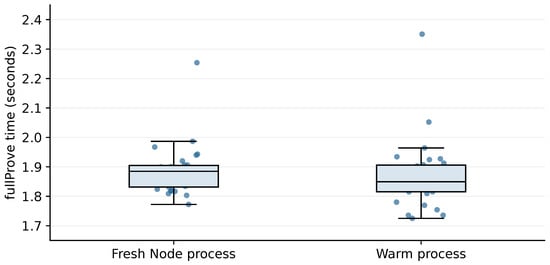
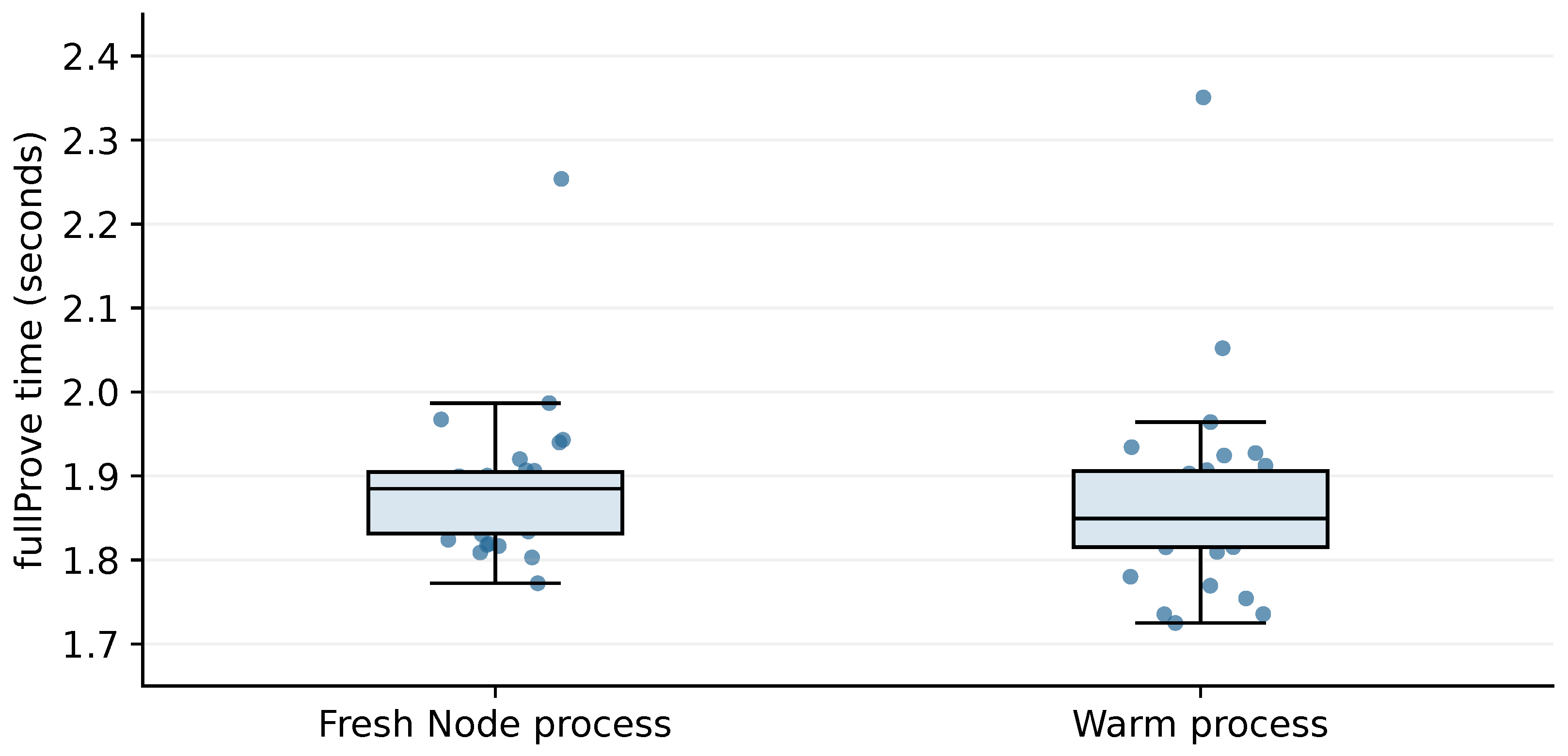
The prover data come from a server benchmark of 20 October 2026 whose circuit hash matches the current circuit. It contains 30 samples in fresh Node processes and 30 samples in a warm process after one excluded warm-up, all with verified proofs. The fullProve timer includes witness generation and artifact reads, and excludes separate verification and process start-up; the operating-system cache was not flushed. The host was an AMD EPYC 9V74 (Advanced Micro Devices, Inc., Santa Clara, CA, USA) with Node.js 24.19.0; thus, the numbers characterize a server and say little about phones or browsers. The 38 proofs generated during the original EVM replay had a median of 4.07 s on an Intel Xeon Platinum 8573C (Intel Corporation, Santa Clara, CA, USA) host with Node.js 24.22.1. They were produced in a different run context and are kept apart from the benchmark; the difference itself shows that one server timing does not transfer to user devices.
4. Results
4.1. The Two-Revocation Timing Distribution
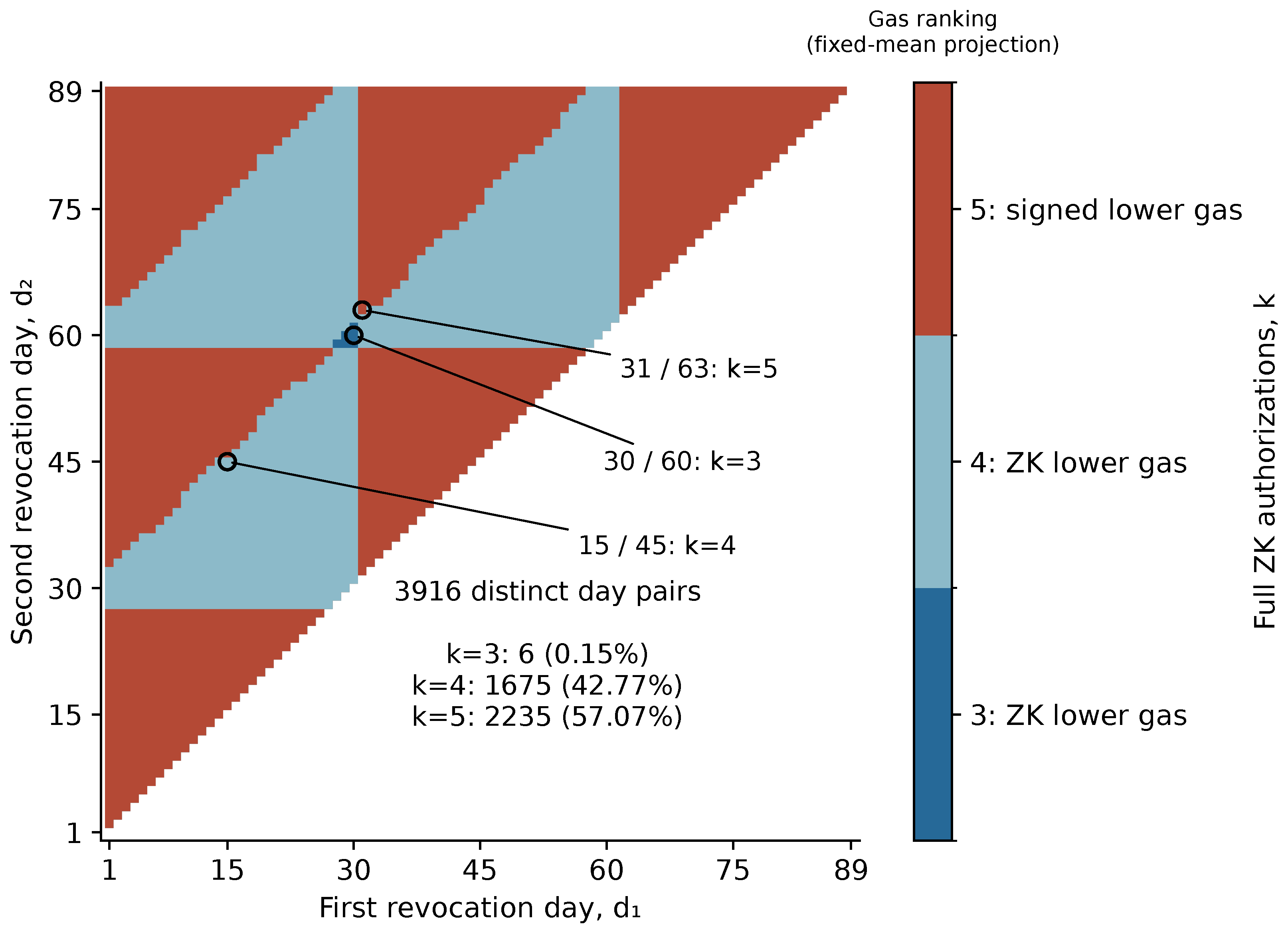
Among the 3916 date pairs, only six require three ZK authorizations (0.153%), 1675 require four (42.773%) and 2235 require five (57.074%). Equation (4) gives , , and gas for these cases. Consequently, under the uniform grid, the ZK cache uses more projected gas in 57.1% of schedules and less in 42.9%. This share is a property of the equal weighting of day pairs, a synthetic reference without empirical justification, and not an estimate for deployed systems. Real revocations are plausibly correlated, for example, after a shared incident or a batch of policy-driven updates, so the clustered laws of Section 3.5 are informative: if only pairs at most seven days apart are weighted equally, the share rises to 83.53%, and for pairs at most one day apart to 90.91% (Appendix C). Close updates rarely fall into the same access interval, so each of them tends to force its own authorization. What does not depend on the weighting is the mapping from the authorization count to the sign of the gas difference; the share itself moves with the timing law. The favorable 30/60 schedule belongs to the rare three-authorization case. At the same time, all four-authorization cases are still cheaper for ZK, so the private cache does not need an exact coincidence of revocations with planned renewals (Figure 1).
Figure 1.
All 3916 pairs of distinct integer revocation days. Color shows the number of full ZK authorizations and the sign of the projected gas difference with respect to the selective signed cache. Markers show the three two-revocation schedules executed on the contracts. The weekly reference has twelve revocations and thus it does not appear in this grid.
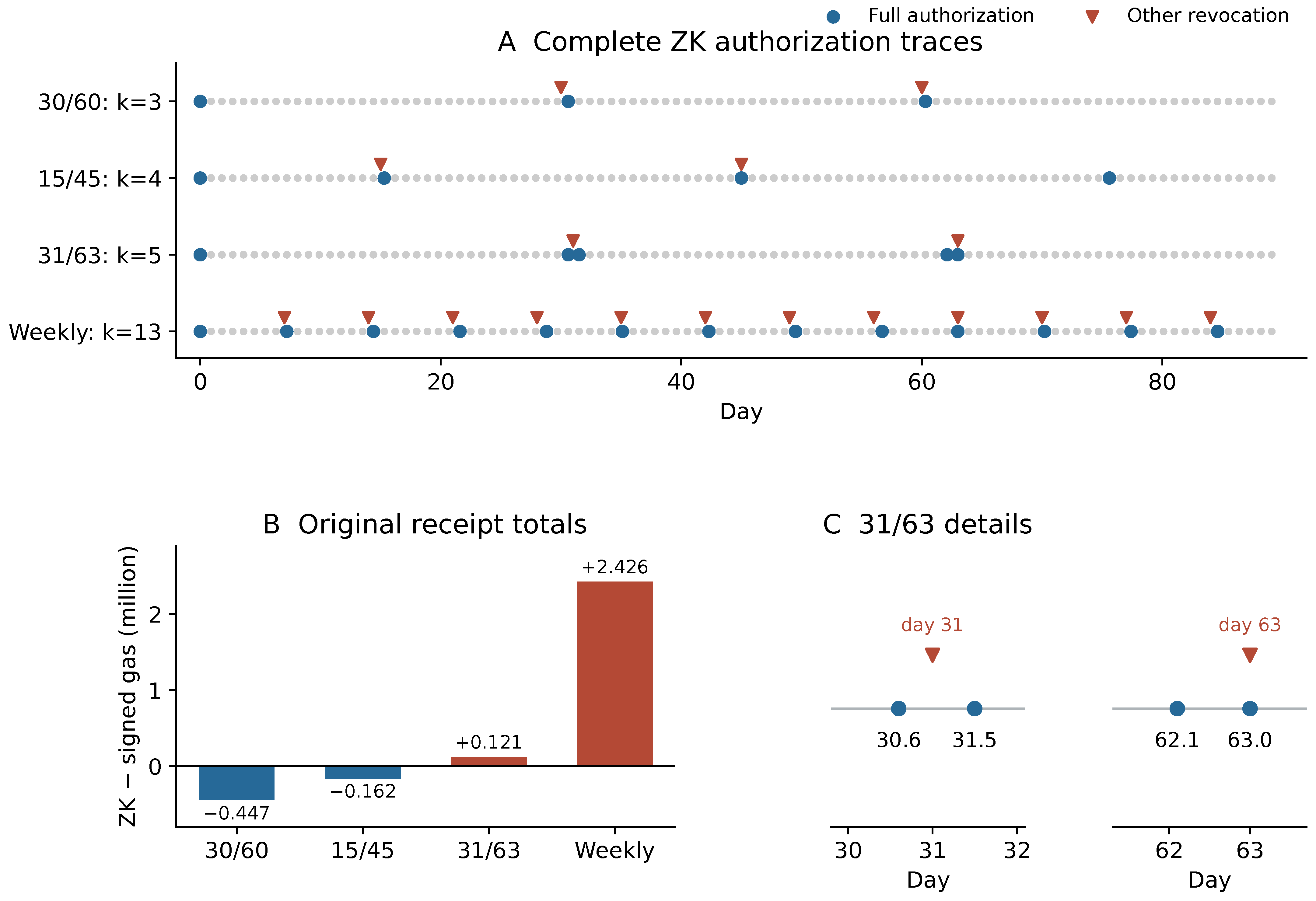
All 800 main access paths agree with the recurrence and the expected counts (Table 4). In the 30/60 schedule, full ZK authorization happens on days 0, 30.6, and 60.3; in the 31/63 schedule, on days 0, 30.6, 31.5, 62.1, and 63.0, because each unrelated revocation follows shortly after an expiry renewal. The two schedules have the same eligibility, the same access times, and the same number of revocations, yet the measured gas difference moves from −447,310 to +120,532. For a rolling-TTL architecture, the number of revocations alone thus does not determine which method is cheaper (Figure 2).
Table 4.
Receipt totals for approval plus 100 deposits (original single traces). The selective signed baseline needs three full authorizations and 8,227,683 gas in every row, 243 gas above its projection. The last column gives ZK actual minus ZK projected gas. Setup and issuer updates are reported separately.
The three paired replays keep the same ranking in every schedule (Table 5), and all selective signed totals equal 8,227,683 gas. The signed control with shared invalidation needs 3, 4, 5, and 13 full authorizations, exactly as the ZK cache, and all 400 control accesses agree with the recurrence and the published update times. The extra authorizations at 15/45 and 31/63 therefore come from shared invalidation itself. The control uses a different status-check branch, so we compare its counts, and not its gas, with the ZK cache.
Table 5.
Three paired replays that differ only in proof randomness under one setup, and one signed control with shared invalidation per schedule. The ZK column gives the observed range over the three replays. Each total includes approval and 100 deposits.
4.2. Expected Counts Under Random Schedules
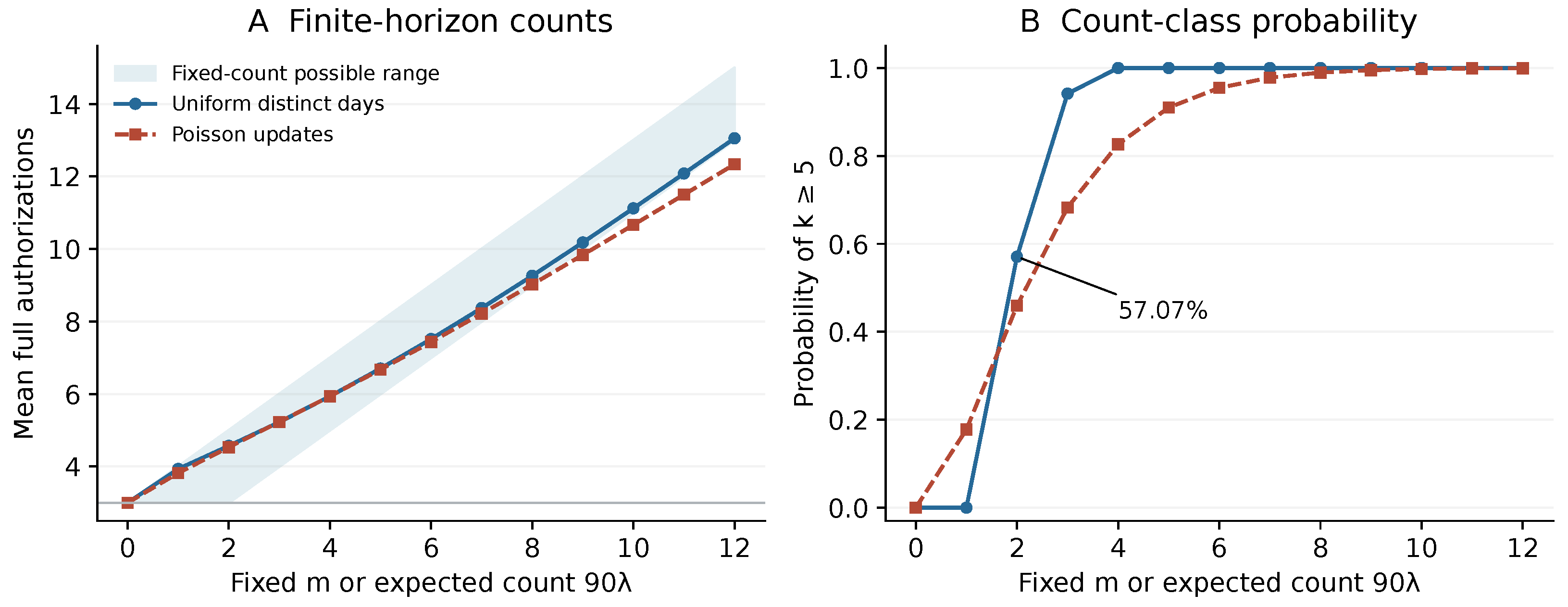
For one, two, and three uniformly chosen distinct days, the exact model gives , and . With twelve events, the mean is 13.0542 and the count ranges from 13 to 15; the weekly reference with is one trace from this range. For Poisson updates with , the mean is lower, , because the number of events is random and several events may fall between two accesses (Figure 3).
With historical unit means, the expected gas difference first becomes positive at , and for Poisson updates, parity is reached at . For exactly three uniformly chosen update days, ZK is more expensive in 94.17% of schedules. These figures count all updates that advance the shared epoch, including those unrelated to the evaluated holder and policy changes such as an updated jurisdiction list. The Poisson parity value uses the fixed historical unit costs of Equation (3). Under the storage-state refinement of Section 4.3, the two-update mean becomes slightly negative, so the parity point would lie slightly above two updates; we did not recompute the Poisson curve with state-dependent gas. Two kinds of statements should be distinguished here: (i) that ZK is more expensive in most two-update schedules is a robust result; (ii) that the average difference for two updates, only gas, is small and, as the next subsection shows, changes sign once storage states are taken into account.
Figure 2.
Complete local traces. (A): full authorizations (circles), unrelated revocations (triangles), and cache hits (small gray points). (B): actual user transaction gas relative to the selective signed cache. (C): close views of the two near-adjacent authorization pairs in the 31/63 schedule. The weekly row is the twelve-revocation reference.
4.3. Execution State Refines the Mean-Cost Projection
Projected and actual rankings agree in all four schedules. In the original traces, the largest absolute deviation is 8363.2 gas, about 0.10% of the projected ZK total; in the repeated runs, it reaches 8447.2 gas, again without changing the sign. The deviation has a clear cause: a later full authorization does not always change both the cached epoch and the expiry. A renewal triggered only by the TTL leaves the epoch unchanged and, once the credential-expiry cap is reached, a revocation can leave the stored deadline unchanged.
For all 27 later full ZK authorizations in the original traces, holder samples, and negative-control preparation, and for all 72 such authorizations in the repeated and partition traces, the following decomposition holds exactly:
Herein, equals 4 gas per zero byte plus 16 gas per nonzero byte of calldata, equals one if the stored authorization deadline changes and zero otherwise, and is defined in the same way for the stored security epoch. In the original evidence, fourteen transactions change both fields and use 355,725–355,761 gas, while thirteen change one field and use 352,925–352,961 gas. The difference of 2800 gas agrees with the cost of updating a warm nonzero slot compared with a no-op write under EIP-2200 and EIP-2929 [21,22]. The constant 342,621 is specific to this fixture and random proof encoding also shifts calldata gas. The signed path depends on state too: its later full authorizations use 104,247–104,430 gas against the historical mean of 104,235, which together with first-use encoding explains the 243-gas difference between the signed receipts and their projection.
Figure 3.
Synthetic schedule models on the 100-access grid. (A): exact mean number of full authorizations; the band shows the possible range for uniformly chosen distinct integer days. (B): probability of at least five full authorizations, which is where the projected gas sign changes. Fixed m and Poisson have different distributions of the event count.
The five fresh holders give 215,235–215,255 gas for the first signed authorization and 464,182–464,230 gas for the first ZK authorization, while cache hits stay at 79,972 and 67,610. Combining these ranges with the recurring-state ranges gives a ZK-minus-signed interval of for four ZK authorizations and for five. The sign is the same at both ends, so the ranking survives the observed variation for this circuit, compiler, and token.
Applying the storage expression to every two-day schedule changes the picture for the average. With the pooled first-use range 464,182–464,230, calldata range 7456–7540, and the signed receipt baseline, the average ZK-minus-signed difference lies in gas. Every five-authorization pair remains positive and every three- or four-authorization pair remains negative. Thus, for the uniform grid, the 57.1% majority result is stable, while the small positive average is not.
All seven original negative controls fail for the intended reason and leave the state unchanged; each was submitted as a transaction and produced a failed receipt with the expected revert reason. Use of the cache exactly at the TTL is rejected, whereas a fresh authorization succeeds for the still-valid credential. The holder’s own paired revocation blocks the cached paths, the revoked signed full path, and a ZK proof prepared against the old root. All 38 saved proofs verify under the saved key; the contract still enforces freshness and nonces on top of proof validity.
4.4. Public Issuer Partitions Reduce the Invalidation Scope
With the same publications on day 31 (issuer 3) and day 63 (issuer 1), the holder needs five, four, and three full authorizations for (Table 6). Each registry permanently disables the issuers outside its group, and a publication attempt by such an issuer is rejected, so updates outside the holder’s group leave its epoch unchanged. All 300 access paths agree with the recurrence over relevant updates. The six own-revocation checks (a cached authorization and a proof prepared before the update, for each B) were submitted as transactions; they fail for the expected reason with failed receipts and keep the state unchanged. The 16 publication attempts by excluded issuers and the presentation of a proof to the gate of another group in both nontrivial partitions were checked through contract calls, which reverted without a transaction being submitted.
Table 6.
Enforced issuer partitions, one complete ZK trace per row. All rows publish the same two unrelated revocations; relevant days are those that update the holder’s group. Issuer options give the size of the public issuer set.
Fixture setup totals are 10,641,015, 14,948,654, 23,912,642 gas for ; the two publication totals are 980,636, 725,354, 597,712. Setup includes the common token, verifier and hasher, all registries and ZK gates, initial publications, group exclusions, and one signed diagnostic gate. The additional 13.3 million gas of the setup is paid once; spread over 1000 users, it amounts to about 13,000 gas per user, against a saving of 573,430 gas per user in this trace. This saving applies to a holder whose group received neither revocation, as for issuer 0 here. Under , holders of issuers 1 and 3 would each see one relevant update, need four full authorizations and, by Equation (4), save about 288,000 gas instead. The 1000-user illustration is therefore the most favorable case for this schedule.
This alternative trades some privacy for locality of invalidation: the gate address reveals the issuer group. The number of candidate issuers is four, two, or one, so at , the issuer is no longer hidden. These numbers describe the public membership set; the anonymity actually achieved also depends on how many holders each issuer has and in our fixture these populations are unequal. Table 7 gives a simple measure for the fixture. Let be the number of active credentials of issuer i and the number in group g. The credential anonymity set at the gate of group g is , and the issuer ambiguity can be summarized by the effective number of issuers with . Already at , the unequal populations reduce the effective number of issuers from four to 2.56. At , the issuer is revealed, so the only remaining benefit of the ZK path at this gate is the hidden credential identifier. These are fixture values that illustrate the measure; a deployment would apply it to its own populations.
Table 7.
Effective anonymity per public issuer group for the fixture population before the two unrelated revocations (issuers 0–2 hold two credentials each, issuer 3 holds fourteen). The evaluated holder uses issuer 0.
Registry deployment and publication costs are reported separately, and policy changes across several registries would require coordination between them.
Under the equal-rate Poisson illustration with twelve expected global updates in 90 days, the mean numbers of full authorizations are 12.3373, 7.4350, and 5.2284 for , respectively. Therefore, reducing the relevant rate to does not divide the authorization count or the gas bill by B. Group-level batching, correlated issuers, and witness delivery would need further modeling.
4.5. Proving Latency and the Remaining Expense Budget
Table 8.
Historical fullProve timings for the current circuit on a server host.
Figure 4.
Thirty fresh-process and thirty warm-process proof measurements. Points are individual observations; boxes show quartiles and the median. One warm-up run is excluded.
Multiplying the warm median by 3 or 13 authorizations gives 5.55 or 24.04 s of serial proving per trace. A user would not necessarily wait this long, since proofs can be prepared in advance, while witness delivery and a slower device would add time. The earlier 496-constraint pilot is not used for latency estimates of the present 7409-constraint statement.
4.6. Payment Conditions for the Measured Schedules
The financing calculation can be applied to each timing schedule. Table 9 uses the historical unit-gas projection throughout, including the unchecked reference, so that gas and monetary inputs remain consistent.
Table 9.
Gas-only parity threshold and per-proof expense ceilings at the archived p50 fee with , based on historical unit-gas projections. A threshold above 100% means that no reimbursement is needed; “No nonnegative budget” means that the ZK gas bill already exceeds the signed one.
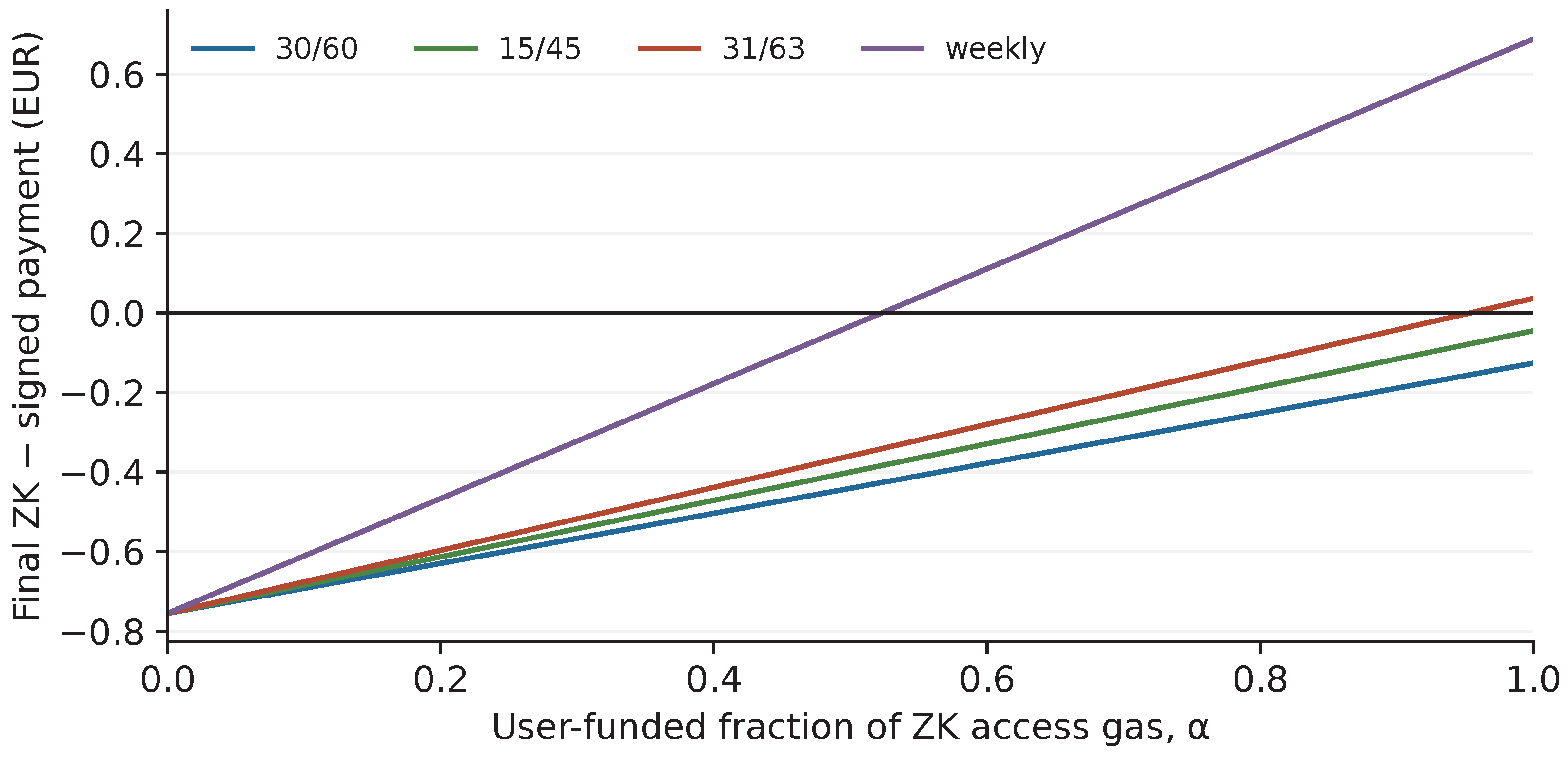
For 30/60 and 15/45, we have , so the user reaches gas parity without any reimbursement. Even then, at , the budget per proof is only EUR 0.04215 and EUR 0.01124 at the archived p50 fee. All per-proof amounts in this subsection are conditional: they assume , i.e., that all other user expenses are equal for both families, that the reimbursement share is actually paid, and that the archived p50 fee and the stated EUR/ETH rate apply. They are budgets available for proving, not estimates of proving cost. For 31/63, parity requires before other expenses, and for the weekly reference, . At , the per-proof ceiling falls from EUR 0.14698 to EUR 0.002574 as the number of authorizations grows from three to thirteen. In other words, frequent revocations leave almost no room for proving costs, even when the service covers half of the access cost.
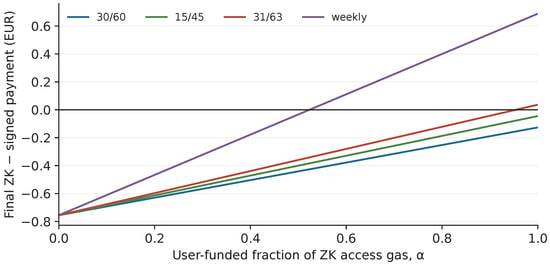
In the historical model, direct access is selected for one and ten deposits and cached access for 100. The weekly reference at and p50 shows the difference between payment and resources well: a transfer of EUR 0.721946 gives the user an advantage of EUR 0.033462, although the network bill is EUR 0.688484 higher (Figure 5).
Figure 5.
Final user payment difference for 100 deposits over 90 days at the archived p50 fee, for the four timing schedules, using historical unit-gas projections. A negative difference requires a transfer whenever the ZK bill is higher. The curves change who pays and leave gas unchanged.
5. Discussion
The main result of the study is a quantitative link between invalidation scope, rolling expiry, and the cost of repeated access. The private cache saves 12,362 gas on every hit compared with the selective signed cache, but each full ZK authorization is much more expensive, and additional authorizations can consume these savings. Their number depends on the order of revocations and accesses, while their individual cost depends on which stored fields change. A benchmark of a single verification captures neither effect. If the arrival process is specified, the finite-horizon recurrence gives the expected count; a mean rate alone does not determine the cost distribution.
Equation (5) gives a compact rule of thumb for designers. Each authorization forced by an unrelated revocation must be paid back by about 23 cached accesses, given a signed cache with three full authorizations. Therefore, a shared-epoch ZK cache is attractive for users who access the service often while it loses its advantage quickly for occasional users or under frequent revocations. The sensitivity analysis confirms this: with two random updates, ZK is more expensive in all schedules for and , in 57.07% for , and in none for . Thus, the 57.07% share is specific to the chosen access count, which lies between the thresholds for four and five authorizations. The low-activity figures are cache-to-cache comparisons (Appendix C); in the economic analysis of Section 4.6, direct access is selected for both families at one and ten deposits, so they do not compare the cheapest available methods. Shorter TTLs act in the same direction as more revocations: with or 14 days, signed access is cheaper in every schedule.
For the present fixture, about two relevant updates per 90 days already reach expected-gas parity under the Poisson model. This low threshold is useful when choosing an architecture, although its exact value depends on the timing law, the TTL, the access density, and the gas calibration. Grouping the accesses into bursts lowers the share of schedules with higher ZK gas from 57.07% to 35.88%, whereas consecutive update days raise it to 90.91%.
The size of the anonymity set enters through the update rate. If each of H holders independently triggers a published update with rate r and updates are not batched, the shared epoch sees the rate . Then, a larger shared population creates more invalidation pressure for every unaffected holder, so privacy and scale pull in opposite directions. Issuer partitions relieve this pressure at the price of revealing the issuer group, while batching or correlated incidents can change the relation.
How large r is in practice remains open. We are not aware of public data on the frequency of status updates in deployed anonymous-credential registries, and none of the systems discussed in Section 2 reports it; our results are therefore a parametric analysis and not a calibrated forecast. The closest public evidence comes from the Web PKI, where over 1% of fresh TLS certificates were revoked even before the Heartbleed incident and over 8% afterwards [26]. If an order of magnitude of 1% of credentials per year applied to an eligibility registry, then would reach the parity value of about two updates per 90 days at roughly 820 holders, and 100,000 holders would advance an unbatched epoch almost three times a day. Policy changes advance the epoch as well. The regime in which the timing of individual updates decides the ranking is therefore narrow: it covers small shared holder sets and registries that publish updates in batches whose period is comparable to the TTL. Weekly batches already correspond to the weekly reference with 13 full authorizations, for which Equation (5) requires at least 297 accesses per 90 days before the ZK cache breaks even; with daily or per-event publication in a large population, almost every access becomes a full authorization. Outside this regime, the shared-epoch ZK cache is more expensive than a selective signed cache for practically every holder, and the design question becomes the invalidation scope rather than the timing of updates.
The signed controls reproduce the count effect at the same two-revocation schedules, including the ranking counterexample, which confirms that the effect is caused by the invalidation scope rather than by the proof system. The partition implementation shows that narrower public groups reduce spillover without changing the circuit, while giving up issuer ambiguity and adding deployment work. The choice between them is a design trade-off. Delaying revocation would also reduce costs, but it weakens freshness and it does not provide equal security.
The shared epoch we measure is one point in a wider design space; we chose it because it is the simplest invalidation rule that keeps the credential hidden and makes revocation immediate. Several alternatives change the trade-off without changing the mechanism. (i) Scheduled epochs: the registry publishes revocations in batches at fixed times, which bounds the number of forced authorizations by the number of batches and allows renewals to be aligned with known batch times, at the price of a revocation delay of up to one batch period. (ii) A root-acceptance window, as in Semaphore [4], accepts recent roots for a bounded time and has a similar freshness cost. (iii) A lighter refresh: after an epoch change, the holder proves only that the credential bound to the cached pseudonym is still active under the new root, instead of repeating the full eligibility proof; this can lower the marginal cost in Equation (3), although a pairing-based verification remains, and it keeps the number of events, so the timing effect persists at a lower price. (iv) Selective invalidation by pseudonym: an issuer able to derive a credential’s scope pseudonym could revoke that pseudonym directly and leave other caches valid, but it could then also recognize the holder’s activity at the gate, which removes much of the privacy the ZK path is meant to provide. (v) Public issuer partitions, measured in Section 4.4, narrow the scope at the cost of issuer ambiguity. Equations (3) and (5) apply to each alternative with its own authorization count and unit costs; we measured only the shared epoch and the partitions.
It is also worth stating clearly how our result relates to the literature on accumulators. Accumulator updates and non-revocation witnesses already transfer work from one credential’s status change to other holders: we build on this known dependency. What we add is the scheduling effect that appears when shared status invalidates an on-chain authorization whose renewal restarts a TTL. Witness work, authorization count, state-dependent gas, and the allocation of payment are separate quantities and keeping them apart is necessary for interpreting the result.
We measured the mechanism on L1 execution because receipts give a clear gas baseline there; this choice is not a deployment recommendation. Lower fees reduce both the gas premium and the reimbursement budget, while fixed off-chain expenses become relatively more important. On L2, the complete fee rule has to be measured: OP Mainnet, for example, charges for execution, L1 data and operator components [27], and proof payloads and compression affect the total. Such a comparison is a natural extension of this work. Since much private DeFi activity is likely to take place on L2 networks, our absolute gas values and monetary amounts should not be transferred to them. The counting mechanism, Equation (3) and the renewal recurrence, carries over, but the unit costs and therefore the threshold of about 23 cache hits must be measured under the L2 fee rule.
Cost sharing remains a secondary aspect. A transfer can help the user while increasing the obligations of the service, and its reliability, delay, and implementation cost matter. The service-margin and per-proof conditions make the missing quantities explicit; estimating willingness to pay or service profitability would require market data.
Limitations
The traces were executed locally with synthetic schedules and a small credential population. Five new holders cover selected first-use and renewal states, while the 72 historical singleton cells remain a limited dataset. The exhaustive grid gives shares for uniformly distributed integer days, a weighting chosen as a reference and not justified empirically, the renewal model holds under its Poisson assumptions, and the twelve sensitivity configurations are controlled alternatives that were not calibrated on deployed services. Gas outside the four executed schedules is projected from receipts. The three replays per schedule capture proof-encoding variation under one local setup. We used one circuit, one token implementation, one runtime, and one compiler configuration; first registration, signature encoding, and state costs can differ in other settings.
Moreover, we assume correct eligibility facts, correct classification of opaque root updates, and timely publication. Wallets, amounts, times and scope pseudonyms remain observable. Issuance and witness distribution were not implemented as privacy services, while the local demonstration ceremonies had no independent participants, so the setup is suitable for research and not for production. Our tests of valid and rejected transactions do not replace a cryptographic audit. Finally, device performance, infrastructure charges, operator publication costs, and reimbursement settlement are not priced.
6. Conclusions
This paper examined how unrelated revocations affect the cost of repeated private access when a ZK eligibility cache is invalidated through a shared security epoch, compared with a selective signed cache that checks each credential’s own status, on L1 execution. The main obtained results are the following:
- Unrelated revocations increase the number of full on-chain authorizations and shift them relative to rolling expiry. For two revocation days drawn uniformly from 1–89, 100 deposits, and a 30-day TTL, five authorizations are needed in 57.07% of the 3916 schedules, and in these cases, the ZK cache uses more gas than the selective signed cache, both under historical means and under the observed storage and calldata variation. This share reflects the synthetic uniform weighting; for clustered updates at most seven or one day apart, it rises to 83.53% and 90.91%. The favorable 30/60 case is rare. The mean difference is small and sign-sensitive, +5013 gas with historical unit means and between −1041 and −693 gas with storage states, so the share of costlier schedules, not the mean, is the robust result.
- Under the historical gas means and a signed baseline with three full authorizations, each additional ZK authorization cancels the savings from about 23 cache hits. The ZK cache has lower projected gas from 64, 88, and 111 accesses per 90 days when it requires three, four, and five full authorizations, respectively. For the 100-access configuration and fixed unit costs, the Poisson model reaches expected-gas parity near two epoch-advancing updates per 90 days, a rate that a shared population of fewer than a thousand holders can reach if roughly 1% of credentials are revoked per year. With three distinct update days sampled uniformly from 1–89, signed access has lower projected gas in 94.17% of schedules.
- A signed implementation with shared invalidation reproduces the authorization counts, which attributes the effect to invalidation scope. Three replays that differ only in proof randomness change the ZK totals by tens of gas and never change the ranking.
- Public issuer partitions reduce the number of relevant invalidations, at the cost of revealing a smaller issuer group and higher deployment gas. Since wallet binding already links deposits within the service, the privacy bought by the ZK path at this gate is issuer hiding and a hidden credential identifier; at , only the latter remains.
- Reimbursement changes who pays but not the gas bill. Under frequent revocations, the budget left for proving falls to fractions of a cent per proof even with half of the access cost reimbursed.
These results show that verifier-only benchmarks can underestimate the cost of private access in systems with shared revocation state, and that the access frequency, the TTL, and the revocation rate should be considered together when choosing an architecture. Because the parity rate is low, a shared-epoch ZK cache is economical mainly for small holder sets or sparse, batched epochs. The absolute values refer to L1 execution; on L2 networks, the unit costs, and hence the thresholds, must be measured anew.
Future work will include measurements on L2 networks, proving on user devices, evaluation of scheduled epochs and lighter refresh proofs, as well as calibration of revocation arrival processes on real issuer data.
Supplementary Materials
The following supporting information can be downloaded at: https://www.mdpi.com/article/10.3390/info17121204/s1, Supplementary Material S1: saved validation data, transaction receipts and zero-knowledge proofs, exhaustive timing and sensitivity results, source registers, and scripts for regenerating the figures and tables (Supplementary_Material_S1.zip).
Author Contributions
Conceptualization, O.K.; methodology, O.K. and N.K.; software, O.K., N.K. and V.C.; validation, O.K.; formal analysis, O.K. and N.K.; investigation, O.K.; resources, R.P. and M.A.; data curation, O.K.; writing—original draft preparation, O.K. and N.K.; writing—review and editing, O.K., N.K., V.C., R.P. and M.A.; visualization, O.K.; supervision, O.K.; project administration, R.P. and M.A.; funding acquisition, R.P. and M.A. All authors have read and agreed to the published version of the manuscript.
Funding
This work was developed within the PETs4DeFi research programme, funded by the European Union under Horizon Europe, Grant Agreement No. 101308999, through the European Cybersecurity Industrial, Technology and Research Competence Centre (ECCC). Views and opinions expressed are those of the authors only and do not necessarily reflect those of the European Union or ECCC. Neither the European Union nor ECCC can be held responsible for them.
Institutional Review Board Statement
Not applicable. The experiments use synthetic credentials and local token transactions.
Informed Consent Statement
Not applicable.
Data Availability Statement
The contracts, circuit, historical measurements, complete revocation traces, saved proofs, and economic code are openly available in the zksnark-benchmark repository (https://github.com/KuznetsovKarazin/zksnark-benchmark/tree/6bf3feddd9cee85c46ed7209fbdadecb307ec38e, accessed on 19 November 2026) at the commit given in Appendix B, together with the reproduction commands. The source package of the article (Supplementary Material S1) contains the figure inputs, the plotting and table scripts, and the registers of consulted sources.
Acknowledgments
During the preparation of this manuscript, the authors used ChatGPT (GPT-6-astra, OpenAI) for language editing. The authors have reviewed and edited the output and take full responsibility for the content of this publication.
Conflicts of Interest
V.C. is employed by Zpoken OÜ. The other authors declare no conflicts of interest. The funders had no role in the design of the study; in the collection, analyses, or interpretation of data; in the writing of the manuscript; or in the decision to publish the results.
Appendix A. Uniform Fee Sensitivity
Table A1 keeps the historical weekly gas totals for , , and EUR/ETH fixed and reprices them at higher fees; 15 and 30 gwei are stress values. Every amount covers the whole 90-day trace.
Table A1.
Uniform repricing of the weekly reference. The fee changes the amounts of money, while the gas ranking and the threshold remain the same. Off-chain expenses are not included.
Appendix B. Reproduction and Versioned Evidence
The code and saved evidence are available at https://github.com/KuznetsovKarazin/zksnark-benchmark accessed on 19 November 2026, fixed to commit 6bf3feddd9cee85c46ed7209fbdadecb307ec38e. The original revocation evidence was recorded in cca0ecd48fe79819895058a020aaf03e05c78c9b and incorporated through dde8b677c4f1fb01673041ece76fe3b87fce97dc. Its receipts are unchanged. Historical measurement and economic-input versions remain pinned in their manifests, including 8e71e52fbfef382b96b75266a7c78d816c7e1751 and 9e5cde998cf15a2fda24d54a2bfad288b107642f, respectively.
The new evidence contains 3100 complete access paths, 90 proofs, and six rejected transactions; the original evidence contains 1034 access and diagnostic rows and 38 proofs. The new run was made from an exported directory without Git metadata, so its recorded Git head is empty and the executed files are identified by their source hashes and setup metadata. Saved copies of the earlier runner, package file, and setup script allow these hashes to be checked after later maintenance, while contracts, circuit, fixtures, and the dependency lock must match exactly.
From the repository root, check the economic core and both saved receipt sets:
- python3 projects/pets4defi/economics/reproduce.py
- cd examples/pets4defi_access_v2
- python3 scripts/check_revocation_validation.py
- python3 scripts/check_revocation_validation.py --out results/revocation_review
- python3 -m unittest discover -s scripts -p ’test_revocation*.py’ -v
- python3 scripts/revocation_model.py --out /tmp/pets4defi-model
- diff -r results/revocation_model /tmp/pets4defi-model
- python3 scripts/revocation_sensitivity.py --out /tmp/pets4defi-sensitivity
- diff -r results/revocation_sensitivity /tmp/pets4defi-sensitivity
- npm ci
- node scripts/verify_revocation_proofs.mjs
- node scripts/verify_revocation_proofs.mjs --out results/revocation_review
The numeric model needs only the Python standard library. It enumerates the two-day grid, checks the fixed-count dynamic program, and computes the Poisson renewal expectation. Nine tests compare the model and the sensitivity analysis with independent event-driven or exhaustive calculations, check the expiry boundaries, and alter the gas source on purpose to test the consistency guard. The proof check verifies the saved proof objects under their saved key.
For a fresh EVM replay, remain in examples/pets4defi_access_v2. The ordinary setup downloads a public powers-of-tau transcript and verifies its pinned BLAKE2b-512 digest. The optional full public-ceremony check is requested with --verify-public-phase1; local demonstration transcripts and the resulting circuit-specific zkey retain algebraic verification. A local copy of that exact transcript can instead be supplied through PTAU_FILE; its digest is checked. If network access is unavailable, the explicit local demonstration option generates its own transcript:
- npm run setup
- # Alternative using the same pinned public transcript:
- # PTAU_FILE=/absolute/path/powersOfTau28_hez_final_14.ptau npm run setup
- # Alternative for local demonstration only:
- # node scripts/setup.mjs --local-demo
- VALIDATION_OUT=/tmp/pets4defi-review node scripts/revocation_review.mjs
- python3 scripts/check_revocation_validation.py --out /tmp/pets4defi-review
- node scripts/verify_revocation_proofs.mjs --out /tmp/pets4defi-review
The saved new run used the local demonstration option, in which both setup phases come from a single local process; such a setup is suitable for research only. The option is never used as a silent fallback. Writing to a separate output directory keeps the recorded evidence intact; the original runner also accepts VALIDATION_OUT.
A fresh setup and new proof randomness change proof bytes and, therefore, calldata gas by small amounts. A rerun should reproduce the event paths, the rejections, the preserved state, the group boundaries, and the gas decomposition. The recorded environment is Node.js 24.22.1, npm 11.9.0 and Python 3.12, and the lockfile pins the JavaScript dependencies.
The article source archive (Supplementary Material S1) includes all plotted inputs and their SHA-256 digests. Running python3 scripts/make_figures.py from that archive regenerates Figure 1, Figure 2, Figure 3, Figure 4 and Figure 5 with NumPy and Matplotlib (NumPy 2.3.5, Matplotlib 3.10.8), without a blockchain connection. The companion scripts/make_ tables.py rebuilds Table 5, Table 6, and Table 9 and Appendix Table A2 from the same checked inputs. The source registers list the consulted full-text versions together with their publication records.
The repository report projects/pets4defi/REVOCATION_REVIEW_V011.md maps each figure and results table to its data and checker. The release archive and manuscript source package have separate SHA-256 manifests.
Appendix C. Sensitivity of the Timing Result
Table A2 varies one factor at a time around the reference configuration: two uniformly chosen distinct integer update days from 1–89, 100 accesses at days , TTL days, and credential expiry days. Each row without a gap condition enumerates all 3916 pairs. Since the horizon is fixed at 90 days, the number of regular accesses and their spacing change together, . Updates after the last accepted access do not affect the trace. Gas is computed with Equation (3) for both caches from the signed and ZK counts, without re-selecting between direct and cached variants.
Table A2.
Model sensitivity around the two-update reference. All rows compare the two caches using historical unit means. is the share of update-day pairs in which ZK uses more gas; it is omitted for , where 33 scheduled accesses fall after credential expiry.
The burst row keeps and the first and last accesses on days 0 and 89.1. It consists of twenty bursts of five accesses spaced 0.1 days apart, with burst starts spread evenly over days 0–88.7 and rounded to whole seconds. With the same number of accesses and the same observation window, the share of schedules with higher ZK gas falls to 35.88%.
The clustered laws restrict the uniform grid to pairs with or , which leaves 88 and 595 equally weighted pairs. The shares rise to 90.91% and 83.53%, showing how strongly the result depends on the assumed timing law.
With expiry on day 60, only the first 67 scheduled accesses are eligible; the remaining 33 are rejected, and we compare no full-workload gas for this case. Extending expiry to day 120 leaves all authorization counts unchanged, but it raises the mean number of later deadline writes from to . Historical unit means cannot reflect this storage difference, so a stable count distribution can still hide a change in state-dependent gas.
All pair evaluations agree with an independent event-queue implementation. Complete EVM replays exist for the four designated schedules; the gas values in Table A2 are model projections.
References
- Camenisch, J.; Lysyanskaya, A. Dynamic Accumulators and Application to Efficient Revocation of Anonymous Credentials. In Advances in Cryptology—CRYPTO 2002, LNCS; Springer: Berlin/Heidelberg, Germany, 2002; Volume 2442, pp. 61–76. Available online: https://cs.brown.edu/people/alysyans/papers/camlys02.pdf (accessed on 3 November 2026). [CrossRef] [Scilit]
- AnonCreds Working Group. AnonCreds Specification, v1.0 Draft, Sections “Collecting Data for Generating the Non-Revocation Proof” and “Generate the Non-Revocation Proof”. Available online: https://anoncreds.github.io/anoncreds-spec/ (accessed on 3 November 2026).
- Iden3. Reverse Hash Service: Non-Revocation Proof. Official Protocol Documentation. Available online: https://docs.iden3.io/services/rhs/ (accessed on 3 November 2026).
- Semaphore. Semaphore Groups, V4: Member Removal and Historical-Root Validity. Official Documentation. Available online: https://docs.semaphore.pse.dev/guides/groups (accessed on 3 November 2026).
- World Foundation. Achieving Proof of Human. World Whitepaper, Section “World’s Implementation: Semaphore Set Registration”. Available online: https://whitepaper.world.org/achieving-proof-of-human (accessed on 3 November 2026).
- Piper, F.; Wolf, K.; Heiss, J. Privacy-Preserving On-chain Permissioning for KYC-Compliant Decentralized Applications. In Proceedings of the 2025 7th Conference on Blockchain Research & Applications for Innovative Networks and Services (BRAINS), Zurich, Switzerland, 18–21 November 2025. [Google Scholar] [CrossRef] [Scilit]
- Rathee, D.; Policharla, G.V.; Xie, T.; Cottone, R.; Song, D. ZEBRA: SNARK-Based Anonymous Credentials for Practical, Private and Accountable On-Chain Access Control. IACR ePrint 2022/1286, Revision 20 June 2023. Available online: https://eprint.iacr.org/2022/1286 (accessed on 1 November 2026).
- Rosenberg, M.; White, J.; Garman, C.; Miers, I. zk-creds: Flexible Anonymous Credentials from zkSNARKs and Existing Identity Infrastructure. In Proceedings of the IEEE Symposium on Security and Privacy, San Francisco, CA, USA, 21–25 May 2023; pp. 790–808. Available online: https://eprint.iacr.org/2022/878 (accessed on 1 November 2026). [CrossRef] [Scilit]
- Xiong, X.; Huth, M.; Knottenbelt, W. REGKYC: Supporting Privacy and Compliance Enforcement for KYC in Blockchains. In Proceedings of the 2025 IEEE International Conference on Blockchain and Cryptocurrency (ICBC), Pisa, Italy, 2–6 June 2025; Available online: https://eprint.iacr.org/2025/579 (accessed on 1 November 2026). [CrossRef] [Scilit]
- Di Francesco Maesa, D.; Lisi, A.; Mori, P.; Ricci, L.; Boschi, G. Self sovereign and blockchain based access control: Supporting attributes privacy with zero knowledge. J. Netw. Comput. Appl. 2023, 212, 103577. [Google Scholar] [CrossRef] [Scilit]
- Maram, D.; Malvai, H.; Zhang, F.; Jean-Louis, N.; Frolov, A.; Kell, T.; Lobban, T.; Moy, C.; Juels, A.; Miller, A. CanDID: Can-Do Decentralized Identity with Legacy Compatibility, Sybil-Resistance, and Accountability. In IEEE Symposium on Security and Privacy; IEEE: Piscataway, NJ, USA, 2021; pp. 1348–1366. Available online: https://www.fanzhang.me/publications/21-candid/ (accessed on 1 November 2026). [CrossRef] [Scilit]
- Sonnino, A.; Al-Bassam, M.; Bano, S.; Meiklejohn, S.; Danezis, G. Coconut: Threshold Issuance Selective Disclosure Credentials with Applications to Distributed Ledgers. In Network and Distributed System Security Symposium; The Internet Society: Reston, VA, USA, 2019; Available online: https://www.ndss-symposium.org/ndss-paper/coconut-threshold-issuance-selective-disclosure-credentials-with-applications-to-distributed-ledgers/ (accessed on 3 November 2026).
- Ahmed, M.; Ahmad, A.; Zeshan, F.; Akram, S. BAAR: A framework for blockchain-based anonymous and revocable user authentication scheme. PLoS ONE 2026, 21, e0343696. [Google Scholar] [CrossRef] [Scilit]
- Cheng, H.; Li, X.; Zhao, H.; Zhou, T.; Yu, B.; Sheng, N. S-Cred: An accountable anonymous credential scheme with decentralized verification and flexible revocation. J. Inf. Secur. Appl. 2024, 82, 103735. [Google Scholar] [CrossRef] [Scilit]
- Sitouah, N.; Bruschi, F.; Pallotta, F.L.; Mencucci, R.; Sciuto, D. An Untraceable Credential Revocation Approach Based on a Novel Merkle Tree Accumulator. In Proceedings of the 2024 IEEE International Conference on Blockchain and Cryptocurrency (ICBC), Dublin, Ireland, 27–31 May 2024. [Google Scholar] [CrossRef] [Scilit]
- Garcia-Grau, F.; Herrera-Joancomartí, J.; Dorca Josa, A. Anonymous Access System with Limited Number of Uses in a Trustless Environment. Appl. Sci. 2024, 14, 8581. [Google Scholar] [CrossRef] [Scilit]
- Buterin, V.; Illum, J.; Nadler, M.; Schär, F.; Soleimani, A. Blockchain privacy and regulatory compliance: Towards a practical equilibrium. Blockchain Res. Appl. 2024, 5, 100176. [Google Scholar] [CrossRef] [Scilit]
- Groth, J. On the Size of Pairing-Based Non-interactive Arguments. In Advances in Cryptology—EUROCRYPT 2016, LNCS; Springer: Berlin/Heidelberg, Germany, 2016; Volume 9666, pp. 305–326. Available online: https://eprint.iacr.org/2016/260 (accessed on 3 November 2026). [CrossRef] [Scilit]
- Salazar Cardozo, A.; Williamson, Z. EIP-1108: Reduce alt_bn128 Precompile Gas Costs. Ethereum Improvement Proposals. 2018. Available online: https://eips.ethereum.org/EIPS/eip-1108 (accessed on 3 November 2026).
- Akhunov, A.; Ben Sasson, E.; Brand, T.; Guthmann, L.; Levy, A. EIP-2028: Transaction Data Gas Cost Reduction. Ethereum Improvement Proposals. 2019. Available online: https://eips.ethereum.org/EIPS/eip-2028 (accessed on 3 November 2026).
- Tang, W. EIP-2200: Structured Definitions for Net Gas Metering. Ethereum Improvement Proposals. 2019. Available online: https://eips.ethereum.org/EIPS/eip-2200 (accessed on 3 November 2026).
- Buterin, V.; Swende, M. EIP-2929: Gas Cost Increases for State Access Opcodes. Ethereum Improvement Proposals. 2020. Available online: https://eips.ethereum.org/EIPS/eip-2929 (accessed on 3 November 2026).
- Chen, T.; Li, X.; Luo, X.; Zhang, X. Under-optimized smart contracts devour your money. In IEEE International Conference on Software Analysis, Evolution and Reengineering (SANER); IEEE: Piscataway, NJ, USA, 2017; pp. 442–446. Available online: https://www4.comp.polyu.edu.hk/~csxluo/Gasper.pdf (accessed on 3 November 2026). [CrossRef] [Scilit]
- European Parliament and Council. Regulation (EU) 2023/1114 of 31 May 2023 on Markets in Crypto-Assets. Official Journal of the European Union, L 150, 9 June 2023. Available online: https://eur-lex.europa.eu/eli/reg/2023/1114/oj/eng (accessed on 3 November 2026).
- European Parliament and Council. Regulation (EU) 2024/1183 of the European Parliament and of the Council of 11 April 2024 Amending Regulation (EU) No 910/2014 as Regards Establishing the European Digital Identity Framework. Official Journal of the European Union, 30 April 2024. Available online: https://eur-lex.europa.eu/eli/reg/2024/1183/oj/eng (accessed on 19 November 2026).
- Liu, Y.; Tome, W.; Zhang, L.; Choffnes, D.; Levin, D.; Maggs, B.; Mislove, A.; Schulman, A.; Wilson, C. An End-to-End Measurement of Certificate Revocation in the Web’s PKI. In Proceedings of the ACM Internet Measurement Conference (IMC), Tokyo, Japan; Association for Computing Machinery: New York, NY, USA, 2015; pp. 183–196. [Google Scholar] [CrossRef] [Scilit]
- Optimism. Transaction Fees on OP Mainnet. Official Documentation. Available online: https://docs.optimism.io/op-stack/transactions/fees (accessed on 3 November 2026).

Disclaimer/Publisher’s Note: The statements, opinions and data contained in all publications are solely those of the individual author(s) and contributor(s) and not of MDPI and/or the editor(s). MDPI and/or the editor(s) disclaim responsibility for any injury to people or property resulting from any ideas, methods, instructions or products referred to in the content. |
© 2026 by the authors. Licensee MDPI, Basel, Switzerland. This article is an open access article distributed under the terms and conditions of the Creative Commons Attribution (CC BY) license.