


Abstract
Digital transformation in the public sector has intensified the need to demonstrate not only adoption of ICT governance frameworks but sustained compliance with governance requirements. This systematic multivocal literature review developed a conceptual ICT Governance Compliance Measurement Framework for South Africa’s public service and was reported in accordance with PRISMA 2020. Peer-reviewed and authoritative grey literature published from January 2004 to May 2026 was searched across Scopus, Web of Science, IEEE Xplore, EBSCOhost, Google Scholar, and targeted institutional sources; the academic searches were updated through 31 May 2026. The protocol was registered on the Open Science Framework (DOI: 10.17605/OSF.IO/YZVB3). Of 1380 records identified, 130 full texts were assessed, 91 proceeded to source-appropriate quality appraisal, and 72 sources (52 academic and 20 grey/postgraduate) met the final quality threshold and informed an abductive thematic synthesis. Six interrelated compliance dimensions emerged: Strategic Alignment; Governance Structures and Accountability; Risk and Security Governance; ICT Investment and Procurement Governance; Regulatory and Policy Compliance; and Performance Monitoring and Continuous Improvement. These were integrated into a six-stage conceptual compliance-measurement workflow linking normative requirements, compliance dimensions, evidence triangulation, implementation rating, a six-dimensional compliance profile, and remediation/reassessment, bounded by organisational antecedents and public-value consequences. The framework offers a traceable basis for self-assessment and audit readiness, but requires empirical validation before formal scoring, benchmarking, or assurance use.
1. Introduction
Information and communication technology (ICT) has emerged as a strategic organisational ability that facilitates service provision, innovation, organisational performance and value creation. ICT governance thus involves strategic direction, oversight, accountability and decision rights that influence how technology is aligned to institutional goals, risks are managed, resources are allocated and performance is monitored [1,2]. There are principles and practices for these purposes already established in governance instruments but they do not necessarily mean that the governance requirement is being met in practice consistently across the organisations [3].
This difference poses a measurement problem. Typical existing research focuses on audit conformity, organisational capability, effectiveness, mechanisms, or ICT governance maturity. These constructs offer valuable partial views: maturity relates to the development of governance processes; capability relates to the capacity of an organisation to govern; audits test defined requirements/controls; and effectiveness relates to the impact of governance. None alone provides consistent coverage of all governance requirements applicable to an organisation [4,5].
This is especially relevant in the context of ICT governance in the South African public service, where a high level of governance policy, accountability, audit, and assurance is present. The Department of Public Service and Administration’s Corporate Governance of ICT Policy Framework (CGICTPF) specifies the roles of executive authorities and accounting officers and mandates alignment, appropriate structures, risk governance, performance monitoring, and accountability [6]. The requirements address public finance, information protection, corporate governance, audit, and sector-specific requirements, and the international instruments (COBIT and the ISO/IEC governance frameworks) offer complementary guidance for operations and assessment. South African studies nevertheless identify uneven implementation associated with executive commitment, fragmented structures, skills, communication, strategic alignment, and institutionalisation [7,8,9].
There are three related gaps that follow. ICT governance compliance is not clearly differentiated from maturity, capability, effectiveness, and regulatory conformity conceptually, all the time. Assessment typically focuses on individual processes, controls, maturity levels, or outcomes, and does not connect governance requirements to the evidence of implementation, monitoring, assurance, and improvement within a shared measurement architecture. In South Africa, the requirements for public-service governance and the expectations of the audit process have not been sufficiently aligned with other international audit frameworks to create a coherent audit compliance plan. The study, therefore, asks whether governance demands have become actualized in the form of demonstrable, monitored, and sustained organizational practice.
1.1. Scope, Aim, and Research Questions
The primary sphere of application is South African national and provincial public-service departments that work within the CGICTPF context. Evidence from the municipalities and public universities, state-owned entities, and other public sector organizations from Africa and international public institutions is used only if they provide transferable knowledge regarding the governance mechanisms, governance indicators, views of governance assessment, or measures of governance. The framework that emerged as a result is therefore not a blueprint for use across the entire public sector, but a conceptual framework that needs to be adapted for use in other public institutions, mapped, and empirically tested.
The goal is to create a conceptual ICT Governance Compliance Measurement Framework systematically using multi-voice synthesis of peer-reviewed and authoritative grey literature. The review is guided by four research questions (RQ):
- RQ1: How is ICT governance compliance conceptualised in academic and authoritative grey literature, and how is it distinguished from governance maturity, capability, and effectiveness?
- RQ2: What governance, policy, regulatory, and assurance requirements represented in the reviewed evidence shape ICT governance compliance within the South African public-service context?
- RQ3: What governance dimensions and candidate measurable indicators should be incorporated into an ICT Governance Compliance Measurement Framework for the South African public service?
- RQ4: How can the identified dimensions, indicators, evidence requirements, and assessment approaches be integrated into a conceptual framework for evaluating ICT governance compliance?
1.2. Contribution
The study is conceptually valuable by introducing a framework that is distinct from the concept of maturity, capability and effectiveness; methodologically valuable by demonstrating how independent pieces of evidence from various academic, policy, standards, audit and benchmarking sources can inform the design of a set of measurements; contextually valuable because it provides a framework that is grounded in the requirements of the South African public service with international guidance being selectively applied; and practically valuable because it gives a traceable basis for future self-assessment, audit readiness, remediation and benchmarking. The framework is a theoretical measurement structure and not a proven audit tool.
2. Literature Review and Theoretical Foundation
2.1. Public-Sector ICT Governance and Compliance
ICT governance emerged as a structure of decision rights, leadership direction, accountability, and oversight of technology. The field subsequently expanded to embrace a holistic perspective of structures, processes, and relational mechanisms that facilitate communication, shared responsibility, and strategic alignment [1,2]. Such mechanisms are implemented in public institutions in the context of other expectations of transparency, stewardship, service delivery, and accountability, and are thus not only dependent on technical capacity but also on institutional authority, inter-institutional coordination, and constraints in the public sector [3].
The concept of ICT governance compliance is not as well-defined as governance. Compliance in this study is defined as a consistent, ongoing conformance to applicable governance requirements, substantiated by functional structures, processes, controls, relational practices, evidence, monitoring and corrective action. This definition is intentionally limited to effectiveness and broadened from legal or audit consistency. Capability enables governance; maturity describes its development; compliance establishes demonstrable and sustained conformity; and effectiveness concerns the results produced. Defensible measurement requires these constructs to be kept separate [4,5].
2.2. Framework Fragmentation and the Measurement Gap
There is no single governance instrument, identified in the reviewed evidence, that gives a comprehensive indicator of multidimensional ICT governance compliance. Authoritative governance expectations are defined in South African instruments; COBIT provides detailed governance objectives and system components; ISO/IEC standards provide high-level principles and assessment guidance; King IV reinforces governing-body responsibility; and NIST CSF 2.0 provides rich risk and cybersecurity governance outcomes. They are complementary strengths, but when applied separately, they can lead to a disjointed assessment or a lack of clarity between governance development, conformity, and outcomes. The main roles relevant to this review are summarised in Table 1.
Table 1.
Principal governance instruments and their contribution to compliance measurement.
The review gap is thus an integrative one, meaning that the governance needs, organisational capability, implementation evidence, assurance and continuous improvement should be connected in one architecture and a professional framework, maturity level, audit result, or favourable outcome should not be considered compliance by itself.
2.3. Theoretical Sensitizing Framework
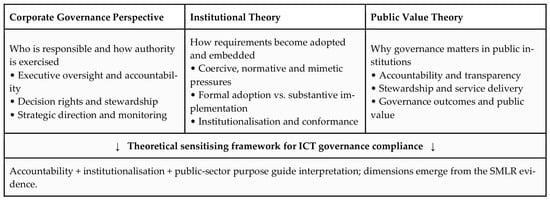
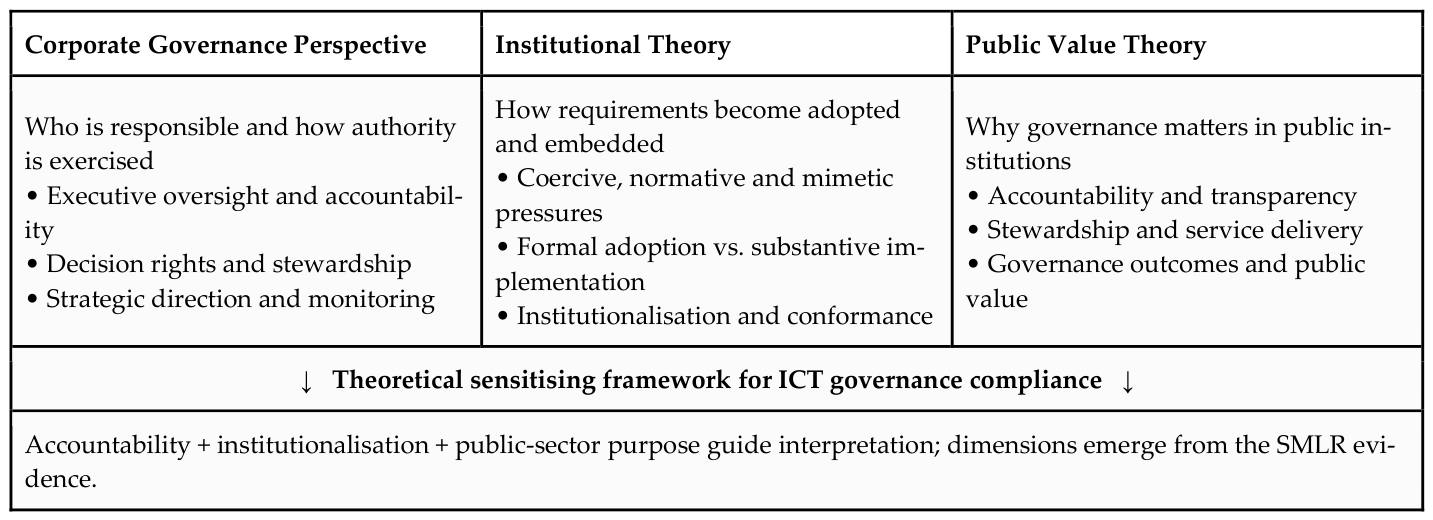
The study employs three theoretical lenses, not as preexisting measurement dimensions but as sensitising lenses to the study. A corporate-governance view is related to the question of accountability for ICT governance and how decision rights, stewardship, strategic direction and oversight are organised [2]. Institutional Theory explains why public organisations adopt recognised governance requirements and why formal adoption may diverge from substantive implementation under coercive, normative, and mimetic pressures [12,13]. Public Value Theory provides the answer to the question of why governance matters beyond conformity and situates accountability, stewardship, transparency, and service delivery within the broader aims of public administration [14].
The perspectives point to accountability, institutionalisation, conformance, organisational implementation and purpose of the public sector, while leaving the substantive compliance dimensions to emerge from the evidence. Theory cannot inform the six dimensions, but it can inform interpretation. The integration framework is given in Figure 1.
Figure 1.
Integrated theoretical sensitising framework for ICT governance compliance.
3. Materials and Methods
3.1. Design and Protocol
For the purpose of this study, the method used was Systematic Multivocal Literature Review (SMLR) due to the fact that the phenomenon is partly empirical and partly normative: peer-reviewed studies present evidence in terms of theories, diagnosis, maturity, capability, and measurement evidence, whereas policies, audit reports, public-service governance frameworks, standards, and institutional guidance define and operationalise many of the requirements by which public-service ICT governance can be assessed. The multivocal-review guidance [15] was used to guide the review, and identification and selection followed PRISMA 2020 reporting guidelines [16].
A protocol was developed before the formal search and registered on the Open Science Framework (DOI: 10.17605/OSF.IO/YZVB3). The original registration remains the prospective record of the review. Post-registration operational clarifications to the eligibility boundary, implemented information-source list, and totals-based hybrid quality-appraisal procedure were documented transparently in an amended protocol (Version 2; 19 September 2026) and the supplementary audit trail. Literature published from January 2004 to May 2026 was eligible, capturing the development of contemporary ICT governance and subsequent assessment approaches.
3.2. Search Strategy
Two parallel search streams were used. The academic stream searched Scopus, Web of Science, IEEE Xplore, EBSCOhost, and Google Scholar using combinations of ICT-governance terms; compliance, assessment, measurement, maturity, capability, audit, and implementation terms; and public-sector terms. The academic database searches were updated through 31 May 2026. Google Scholar was used as a supplementary source, with the first 200 returned results screened. The grey-literature stream targeted authoritative organisations responsible for public-service governance, audit, standards, and digital-government assessment, including DPSA, AGSA, IoDSA, ISO/IEC, ISACA, NIST, OECD, UN DESA, and the World Bank. Full database strings, source-specific search dates, and the grey-literature search log are reproduced in Supplementary Tables S1 and S2.
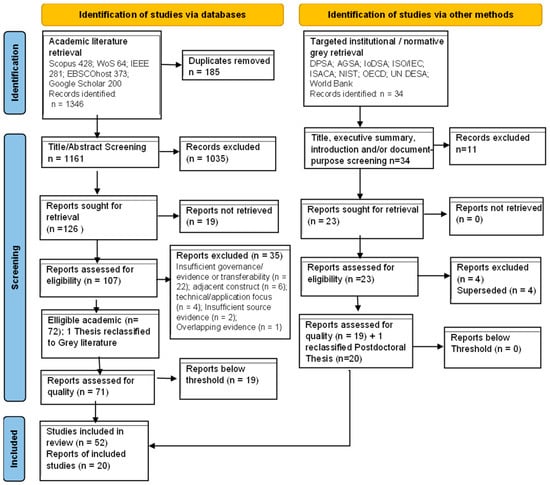
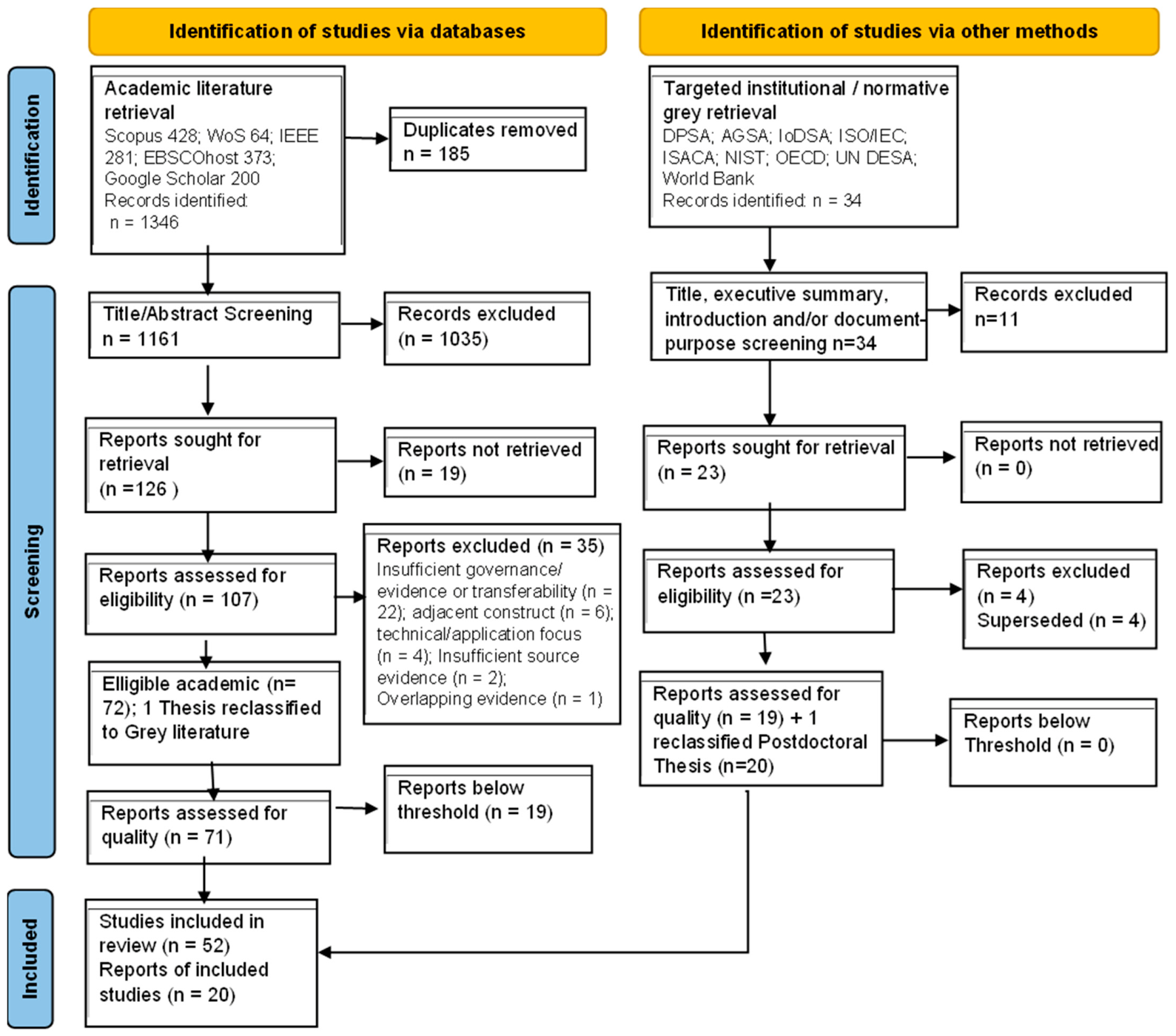
The academic stream yielded 1346 records and the targeted grey-literature search yielded 34, giving 1380 records overall. After screening and retrieval, 130 full texts were assessed against the final eligibility criteria; 39 were excluded and 91 proceeded to source-appropriate quality appraisal. The final appraisal pool comprised 71 academic-rubric sources and 20 grey/postgraduate sources. The complete numerical progression through identification, screening, retrieval, full-text eligibility, quality appraisal, and final synthesis is presented in the PRISMA flow diagram (Figure 2).
Figure 2.
PRISMA 2020 study-selection flow.
3.3. Eligibility and Study Selection
Eligibility required substantive relevance to ICT/IT governance and extractable evidence capable of informing governance compliance or assessment. Multidimensional coverage within a single source was not required. Domain-specific evidence was eligible where it (i) addressed governance rather than technical or operational implementation alone; (ii) contained extractable evidence on governance requirements, structures, decision rights, controls, assessment, assurance, monitoring, implementation, or measurable indicators; (iii) could reasonably inform organisation-level ICT-governance assessment rather than only the performance of a specific technology, application, or system; and (iv) had direct public-sector relevance or defensible transferability to public-sector governance. Academic sources comprised peer-reviewed journal articles, proceedings papers, scholarly book chapters, and relevant review studies; grey/postgraduate sources comprised government policies and directives, audit reports, standards, implementation guidance, authoritative institutional reports, professional governance frameworks, and relevant postgraduate research. Only English-language sources published from January 2004 to May 2026 were included. The final inclusion and exclusion criteria are given in Table 2.
Table 2.
Inclusion and exclusion criteria.
Title and abstract screening was conducted independently by two reviewers. At this initial screening stage, sensitivity was prioritised: a record progressed to full-text assessment if either reviewer considered it potentially eligible, whereas exclusion required agreement by both reviewers. No automated screening or machine-learning tools were used. Following screening, 126 academic reports and 23 grey literature reports were sought for retrieval (149 overall). Nineteen academic reports could not be obtained, leaving 107 academic and 23 grey-literature reports (130 overall) for full-text eligibility assessment. Initial full-text agreement was 56.1% (60/107; Cohen’s κ = 0.08) for the academic reports. For the 23 grey-literature reports, initial agreement was 82.6%, while κ was 0.00 because one reviewer initially classified all grey-literature reports as eligible. These statistics are reported as measures of the reviewers’ independent pre-consensus decisions. Where full-text decisions differed, the reviewers returned to the source, reconsidered the applicable eligibility criteria, and resolved the disagreement through documented discussion. The final eligibility assessment excluded 35 academic-search reports and 4 grey-literature reports (39 overall). Of the 72 eligible academic-search reports, one doctoral dissertation [17] was classified as grey/postgraduate evidence for source-appropriate appraisal; the final appraisal pool therefore comprised 71 academic-rubric sources and 20 grey/postgraduate sources (91 overall).
3.4. Quality Appraisal
Academic sources were evaluated against six criteria scored from 1 to 5: clarity of research objective (QA1), methodological rigour (QA2), conceptual contribution (QA3), validity/credibility of findings (QA4), relevance to ICT-governance compliance (QA5), and reporting quality (QA6). Grey/postgraduate evidence used six source-appropriate criteria: institutional authority (GA1), publisher credibility (GA2), methodological transparency (GA3), evidence quality (GA4), policy relevance (GA5), and governance relevance (GA6). For both rubrics, 1 = poor/not evidenced, 2 = weak, 3 = adequate, 4 = good, and 5 = excellent/fully evidenced; the maximum score was 30.
Quality appraisal was conducted independently by two reviewers. Each reviewer’s six criterion ratings were summed to an independent total out of 30. Where reviewer totals differed by three points or less, fell within the same quality band, and were on the same side of the 18/30 retention threshold, the two totals were averaged and conventionally rounded to the nearest whole number (0.5 rounded upward). Criterion-level discussion was triggered where totals differed by four or more points, fell in different quality bands, or crossed the 18/30 threshold; triggered cases were re-examined against the criterion-level evidence and assigned a final reconciled score. Final hybrid scores were classified as high quality (25–30), moderate quality (18–24), or low quality (<18), and only sources scoring at least 18/30 were retained for synthesis. Because the review integrated heterogeneous empirical, conceptual, policy, audit, standards, and normative evidence rather than intervention-effect estimates, source-appropriate methodological quality and credibility appraisal was used instead of an effect-estimate-specific risk-of-bias tool. Summary of quality appraisal outcomes is shown in Table 3, and source-level criterion scores and reconciliation outcomes are reported in Supplementary Tables S5 and S6C.
Table 3.
Summary of quality-appraisal outcomes.
Across the 91 sources appraised, the mean final hybrid score was 24.57/30. Academic evidence (n = 71) had a mean score of 24.03/30; 45 sources were High, 7 Moderate, and 19 Low, with 52 retained for synthesis. Grey/postgraduate evidence (n = 20) had a mean score of 26.50/30; 18 sources were High and 2 Moderate, and all 20 were retained. Overall, 63 sources were High quality, 9 Moderate, and 19 Low, yielding a final synthesis set of 72 sources. Grey/postgraduate evidence was interpreted according to evidentiary role: South African policy and audit sources anchored context-specific requirements and assurance expectations, while international standards, professional frameworks, and benchmarking sources informed operationalisation, risk governance, indicator design, and benchmarking.
3.5. Data Extraction and Management
Data were extracted using a predefined structured extraction form developed from the review questions and eligibility criteria. For each included source, the extraction captured bibliographic information, evidence stream, country or institutional context, study or document focus, governance framework or instrument, relevant ICT-governance concepts, compliance or assessment evidence, measurement approaches, key findings, analytical contribution, and mapping to the relevant research question and emerging compliance dimension. The resulting source-level extraction is summarised in Supplementary Table S4.
The data sought from each source were defined in relation to the four research questions and included: (i) conceptualisations and definitions of ICT governance compliance and its distinction from maturity, capability and effectiveness; (ii) governance, policy, regulatory and assurance requirements relevant to the South African public-service context; (iii) governance dimensions, practices, indicators and forms of evidence that could support compliance measurement; (iv) measurement, assessment, audit, maturity and capability approaches used in the source; and (v) the source’s analytical contribution and relevance to the development of the proposed compliance framework. All relevant findings within these domains that were extracted were reported.
Two reviewers independently extracted and coded the included sources. Extracted information was compared across reviewers, and disagreements were resolved through discussion and re-examination of the original source until consensus was reached. No information was inferred where a source did not report it clearly; such information was recorded as not reported or not applicable. No automated data-extraction, text-mining, or machine-learning tools were used. Following extraction, recurring concepts were coded and progressively organised into subthemes and higher-order compliance dimensions through the abductive thematic-analysis process. The code-to-theme development and supporting evidence are documented in Supplementary Table S7.
3.6. Analysis and Framework Development
Thematic analysis was performed following Braun and Clarke [18] using an abductive approach. All sources that satisfied the final eligibility criteria and achieved a final hybrid quality-appraisal score of at least 18/30 were included in the thematic synthesis and mapped to one or more research questions and emerging compliance dimensions according to their extracted content and analytical contribution. Existing ICT-governance concepts were used to sensitise coding, together with theoretical considerations of accountability, institutionalisation and public value, but these were not imposed as predetermined categories. Recurring concepts were compared, refined, synthesised and grouped into higher-order categories, with a dimension retained only where it was conceptually relevant to compliance measurement and supported by multiple forms of evidence. The code-to-theme development, representative evidence and candidate indicators are documented in Supplementary Table S7.
Synthesis results were presented through structured tables and conceptual figures that mapped included sources to research questions, analytical contributions, higher-order dimensions, and candidate indicators, while Supplementary Tables S4–S7 provide the corresponding source characteristics, quality-appraisal records, and coding audit trail. Framework development followed the thematic synthesis. Conceptual coverage, contextual relevance, and measurability were evaluated by comparing the higher-order dimensions with South African governance requirements and internationally recognised governance instruments. This process resulted in an evidence-based integration rather than direct replication of any single theory, standard or governance framework.
Formal statistical assessment of reporting bias was not undertaken because the review synthesised heterogeneous qualitative, conceptual, policy, audit, standards and other normative evidence rather than comparable quantitative effect estimates. Potential publication and availability bias were instead considered qualitatively when interpreting the evidence base, particularly given the English-language restriction, the supplementary use of the first 200 Google Scholar results, and the targeted nature of the grey-literature search.
A formal certainty-of-evidence grading approach, such as GRADE, was not applied because the review integrated heterogeneous empirical studies with policy documents, audit reports, standards, professional frameworks and other normative sources rather than a homogeneous body of intervention-effect evidence. Instead, confidence in the synthesis was supported through source-appropriate quality appraisal, independent reviewer assessment, triangulation across academic and grey-literature evidence, and maintenance of an analytical audit trail.
3.7. Trustworthiness and Ethics
The use of a registered protocol with documented operational amendments, transparent eligibility procedures, source-appropriate independent appraisal, criterion-level reconciliation, an analytical audit trail, and triangulation of empirical, normative, and institutional evidence helped to enhance credibility and dependability. Ethical approval to conduct this study was obtained from the College of Science, Engineering and Technology, School of Computing ERC (Ref. No. 11483). No human subjects, confidential information of organisations, or personal information were used in the review.
4. Results
4.1. Evidence Base
The final synthesis consisted of 72 sources: 52 academic sources and 20 grey/postgraduate sources. The grey/postgraduate stream comprised 3 postgraduate theses/dissertations, 7 South African policy/governance/audit documents, and 10 international standards, professional frameworks, or benchmarking reports. Among 71 academic sources appraised, 52 met the final quality threshold; the mean final hybrid score across academic appraisals was 24.03/30. All 20 grey/postgraduate sources met the threshold, with a mean final hybrid score of 26.50/30. The combined evidence base, summarized in Table 4, enabled triangulation between empirical and conceptual research, locally authoritative governance and audit requirements, and international assessment and measurement guidance.
Table 4.
Composition and analytical role of the final evidence base.
Across the evidence base, the literature shifts from decision structures, strategic alignment, communication, and COBIT-oriented maturity towards diagnostic assessment, regulatory verification, institutional capability, behavioural governance, risk, resilience, and transparent benchmarking [19,20,21,22,23,24]. This evolution supports moving beyond maturity alone toward evidence-based compliance. The full characteristics and analytical contributions of all 72 included sources are provided in Supplementary Table S4 for audit-trail purposes.
4.2. RQ1: Conceptualising ICT Governance Compliance
Three overlapping but analytically distinct perspectives informed the construct. Regulatory and audit-oriented evidence treats compliance as demonstrable conformity with identifiable prescriptions and artefacts, with non-conformities linked to action and monitored remediation [20,25]. Capability and institutionalisation studies show that formally adopted governance frameworks can coexist with weak structures, skills, communication, and implementation, making documentary adoption necessary but insufficient [8,9,26,27]. Outcome-oriented evidence connects effective governance with service quality, accountability, transparency, innovation, and resilience, but those outcomes cannot substitute for evidence that specific requirements have been implemented [21,24,28].
Drawing on these views, ICT-governance compliance is the ability of a public-service organisation to show that its ICT-governance principles, responsibilities, structures, processes, controls and relational practices are formally established, applied consistently, monitored to credible evidence, and enhanced based on identified deficiencies, and in accordance with organisation goals and to relevant governance obligations. Capability relates to the capacity to govern, maturity relates to the institutionalisation and development of governance processes, compliance relates to evidence of adherence and on-going implementation, and effectiveness relates to the outcomes of governance.
4.3. RQ2: Governance Requirements in the South African Public-Service Context
The evidence shows a multi-layered governance system and not a single controlling system as depicted in Table 5. DPSA instruments provide the most direct public-service governance layer by specifying executive responsibility, governance structures, alignment, risk, value, conformance, performance, reporting, and formal assessment expectations [6,29,30]. King IV reinforces the responsibility of the governing body over technology and information [31] and AGSA brings independent assurance over control environments, compliance, credible performance information, procurement and contract management, remediation, and leadership accountability [32,33,34].
Table 5.
Role of governance instruments in the proposed measurement architecture.
The International instruments contribute measurement methods and operational constructs rather than replacing South African requirements. COBIT 2019 provides governance objectives, system components, practices, and example metrics and emphasises contextual tailoring [35,36,37]. ISO/IEC 38503 supplies assessment approaches, criteria, evidence, and maturity guidance, while ISO/IEC 38506 addresses IT-enabled investment and acquisition governance [10,11]. NIST CSF 2.0 strengthens cybersecurity governance and supplier-risk oversight [38], and OECD, UN DESA, and World Bank frameworks contribute indicator and benchmarking architectures [39,40,41,42].
The review does not constitute a stand-alone legal audit of every statute or sector-specific directive. Statutory obligations mentioned within the included governance and audit instruments are treated as contextual requirements rather than independently synthesised legislation. A future operational instrument therefore requires a dedicated legal traceability exercise before deployment.
4.4. RQ3: Six Compliance Dimensions and Candidate Indicators
The thematic synthesis consolidated recurring governance concepts into six higher-order dimensions, as shown in Table 6. They are cross-source analytical categories rather than a direct copy of COBIT, ISO/IEC, the CGICTPF, or any other single framework. Concepts were consolidated where they shared governance function and measurement relevance, reducing overlap while preserving the underlying concepts as potential sub-elements and indicators.
Table 6.
Synthesised compliance dimensions, candidate indicators, and representative evidence.
4.4.1. Strategic Alignment
Strategic Alignment assesses whether ICT priorities, investments, architecture, projects, budgets, and performance measures are explicitly connected to the institutional mandate and strategic objectives. Evidence across public-sector studies and DPSA instruments supports executive prioritisation, portfolio alignment, and periodic strategic review as observable manifestations of this dimension [6,8,19,21,29].
4.4.2. Governance Structures and Accountability
Governance Structures and Accountability refer to the formal allocation and real implementation of governance authority. The functional committees, decision rights, role clarity, executive reporting, stakeholder participation, and governance communication are recurring throughout the evidence and are of significance; operational functionality must be demonstrated, not postulated on the basis of the presence of charters or committees [8,9,19,26].
4.4.3. Risk and Security Governance
Risk and Security Governance is the combination of ICT risk, cybersecurity, continuity, information protection, incident escalation, and third-party risk into enterprise governance. The dimension is not directly about the technical configuration, but about oversight, accountability, risk decisions, and assurance [24,38,43,44].
4.4.4. ICT Investment and Procurement Governance
ICT Investment and Procurement Governance addresses how public resources are prioritised, acquired, contracted, monitored, and evaluated for value. Business cases, portfolio prioritisation, sourcing decisions, supplier governance, service levels, benefits realisation, and post-implementation review are governance issues because they combine strategy, risk, accountability, decision rights, and stewardship [11,25,33,34,36].
4.4.5. Regulatory and Policy Compliance
Regulatory and Policy Compliance concerns the organisation’s ability to identify applicable obligations, translate them into internal policy and controls, retain evidence of implementation, and remediate non-conformities. The emphasis is traceability from requirement to operating practice, evidence, review, and closure rather than policy existence alone [6,20,25,29,30,33,34].
4.4.6. Performance Monitoring and Continuous Improvement
Performance Monitoring and Continuous Improvement assesses whether governance performance and conformance are measured, reported, assured, and used to improve governance. Dashboards, trend analysis, action tracking, lessons learned, reassessment, and closed corrective-action cycles convert governance from a once-off implementation exercise into a recurrent evaluate-direct-monitor-improve practice [4,19,20,45].
4.5. Measurement Approaches in the Included Evidence
Five broad measurement families were identified [46], as shown in Table 7: maturity/capability assessment [47,48,49,50,51], audit/conformance verification [52,53,54], diagnostic/design models [55,56,57,58,59,60,61,62,63,64,65,66], perception-based effectiveness models [67,68,69], and public-sector benchmarking/index models. None can achieve sustained multidimensional compliance alone, but all provide useful design features. Maturity offers developmental diagnosis; audit affords more evidence of conformity; diagnostic models offer evidence of contextual tailoring; perception studies provide evidence of testing mechanisms, but are inadequate for direct evidence of compliance; and benchmarks offer indicator architecture, but may or may not reflect legal obligations in that context. The suggested framework thus brings together their complementary strengths without destroying their complementary purposes.
Table 7.
Measurement approaches and implications for framework design.
4.6. RQ4: Integrated Compliance Framework and Evidence Model
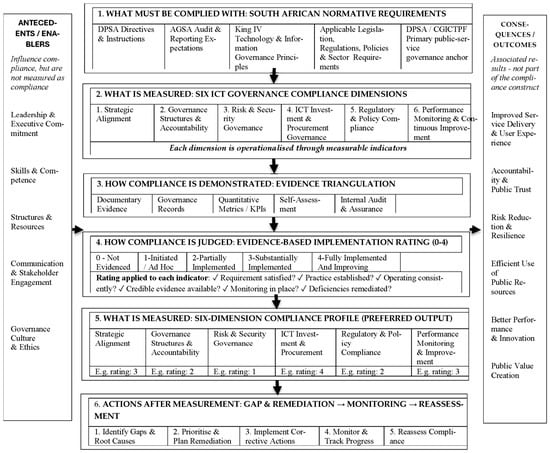
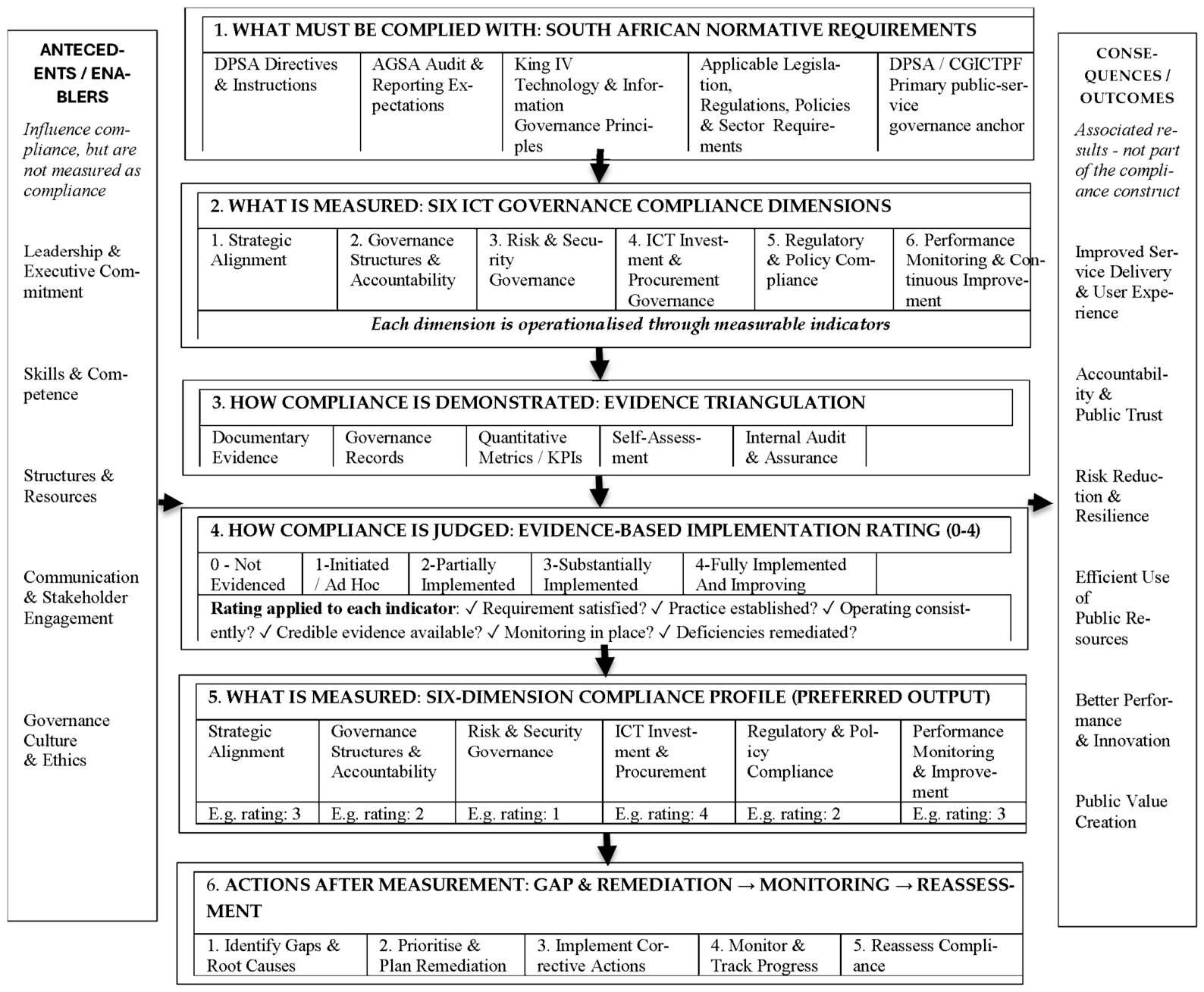
The four research questions are integrated in a six-stage conceptual compliance-measurement workflow bounded by antecedents/enablers and consequences/outcomes. Stage 1 identifies the applicable South African normative requirements. Stage 2 specifies the six ICT-governance compliance dimensions. Stage 3 triangulates documentary evidence, governance records, quantitative metrics, self-assessment, and assurance evidence. Stage 4 applies an evidence-based 0–4 implementation rating to each indicator, as represented in Table 8. Stage 5 produces a six-dimensional compliance profile that preserves material weaknesses rather than collapsing them into a compensatory total. Stage 6 links identified gaps to remediation, monitoring, and reassessment. Leadership, skills, structures, resources, communication, and governance culture are treated as antecedent conditions that influence implementation but are not themselves compliance scores; governance effectiveness and public-value outcomes are consequences and external validation rather than components of the compliance construct.
Table 8.
Conceptual evidence-rating anchors for future instrument validation.
Compliance should be determined by triangulation—documentary evidence, governance activity records, quantitative metrics, self-assessment, and independent assurance. In addition to its role in supporting organisational learning, self-report can also be used to support higher-stakes judgements through committee records, approved artefacts, risk and portfolio records, audit evidence, KPI trends, and remediation closure [10,20,25]. The 5-level implementation scale is offered as a design hypothesis and is not a validated national-scale score.
It is preferred that the initial output be a 6-dimensional profile, not a composite score. This will help to keep material weaknesses visible and not allow good performance in one area to offset weaknesses in another. Before any use of benchmarking or assurance, the weighting or thresholds and the overall index need to be empirically validated. A conceptual framework for compliance measurement is shown in Figure 3.
Figure 3.
Conceptual ICT Governance Compliance Measurement Framework for the South African public-service context.
5. Discussion
5.1. From Maturity and Formal Adoption to Evidence-Based Compliance
The first contribution of the synthesis is a change in the unit and purpose of ICT-governance measurement. While maturity is still valuable for diagnosing developmental progress, sophistication is not enough to ensure conformity to all obligations applicable. Advanced governance processes can be implemented without meeting minimum material accountability, risk, procurement and reporting obligations, and minimum requirements can be met with a modest maturity level. Therefore, treating maturity as compliance could lead to construct contamination and cloudy aggregation [4,22,44]. The proposed framework rather asks whether the required governance practices are in operation, applied consistently, documented, reviewed and corrected when a deficiency is detected.
The same relationship exists between formal and substantive compliance. Regulated organisations may demonstrate committees, charters, policies and assigned responsibilities but do not necessarily demonstrate that these arrangements have an impact on decisions, allocation of accountability, limitation of behaviour or an impact on corrective action. Existing evidence from the public sector indicates that formal governance artefacts can coexist with weak governance, poor skills and uneven institutionalisation [8,9,23]. Institutional Theory helps explain this adoption-implementation gap: external pressures can encourage formal conformity, but substantive compliance requires recurring organisational practice and credible evidence of enactment [12,13].
5.2. Compliance as a Governance System Rather than a Checklist
The six dimensions are analytically separable but operationally interconnected. Functioning decision rights and accountability are necessary for strategic alignment, investment governance is achieved through strategy, risk, and monitoring, and regulatory compliance is achieved through structures, decisions, controls, and feedback spread across the other dimensions. A lack in Governance Structures and Accountability can therefore have a negative impact on risk and procurement oversight, and weak Performance Monitoring can allow for weaknesses in other areas to remain. This systemic property implies that compliance should not first and foremost be seen as compensatory.
A single weak score could mask a material weakness when balanced by strength in other areas. The six-dimensional profile, therefore, preserves visibility of where compliance is strong or weak, while leaving weighting, materiality thresholds, and non-compensatory rules to empirical validation. The conceptual framework moves from control-completion logic to systems-governance logic: the substantive compliance is determined by whether the governance practices collectively constitute a coherent, functioning and self-correcting system, rather than by the number of discrete requirements that are checked as being met.
5.3. Local Normative Primacy and International Measurement Complementarity
A distinction between normative authority and measurement utility needs to be established in the context of the layered evidence base. The public-service duties of South African public servants are based on domestic governance, policy, audit and legal structures. International frameworks can provide more advanced practices, evidence expectations, metrics, and assessment methods, but these are not necessarily normatively equivalent. The framework thus starts with local requirement, moves to international operational mechanism—local requirement is what must be adhered to, and the international mechanism helps to specify how these requirements can be adhered to, evidenced, and assessed [6,10,11,29,30,35,36,37].
This design also makes transferability easier to understand. In another jurisdiction, the South African normative anchor would be swapped for its own legal and governance frameworks, but its guiding principles of requirement mapping, capability, evidence, multidimensional compliance, and feedback would remain intact [70]. Transfer, therefore, concerns measurement logic rather than export of South African obligations or creation of a universal compliance standard.
5.4. Compliance as a Dynamic Evidentiary State and Public Value as External Validation
The evidentiary requirement is also temporal. A point-in-time discovery will not provide proof of ongoing compliance if technology, risks, organizational priorities, and requirements evolve. Monitoring, deviation detection, remediation, and reassessment are thus elements of compliance, not maturity enhancements. Repeated findings and un-actioned actions are particularly critical as they indicate that the governance system is not working to ensure conformity. This means the nature of Performance Monitoring and Continuous Improvement is a part of the closed governance cycle. The compliance score should not include public-value outcomes. There are a number of ICT governance requirements that have been linked to evidence of positive outcomes in terms of service quality, accountability, transparency, resource use, and resilience [21,24,28]; however, positive outcomes do not necessarily mean that all ICT governance requirements were met. The external placement of outcomes prevents circularity and provides a clear function to the Public Value Theory: it offers a rationale as to why substantive compliance should matter, and offers a set of criteria to test the significance of stronger compliance profiles subsequently [14,71].
5.5. Integrated Explanatory Logic
The synthesis ties together the three theoretical perspectives in a recursive explanation, not parallel labels. Governance expectations are set by institutional pressures, and they can be a catalyst for adoption; corporate-governance arrangements give authority, decision rights, accountability, and oversight [72] to help make the expectations realisable; the capability of the organisation is a precondition to whether the expectations can be made real; and evidence is needed to determine whether a substantive compliance can be shown. Governance effectiveness and public-value outcomes subsequently offer external validation, and audit results, performance information, new risks and evolving requirements help to reinforce reassessment and adaptation.
Governance authority and organisational capability → governance requirement and pressures → substantive implementation across six dimensions → evidence-based compliance profile → governance effectiveness and public-value outcomes ↺ feedback and adaptation.
This sequence is not causal in the SMLR. It is an integrative theoretical proposition for empirical testing: future studies could investigate the relationship between institutional pressures, governance arrangements and capability with substantive compliance; the association between stronger compliance profiles and the effectiveness of governance and public value; and the effect of corrective feedback on the sustainability of compliance over time.
6. Contributions and Implications
6.1. Research Contributions
On the conceptual level, the study defines ICT governance compliance as a separate, multidimensional, evidence-based construct and provides a six-dimensional vocabulary to evaluate it without mixing the concepts of capability, maturity and outcomes. In theory, it combines institutional pressures, governance authority, organisational capability, substantive implementation, evidence, outcomes, and feedback in a recursive explanatory proposition. Methodologically, the SMLR shows role-sensitive synthesis, where empirical studies identify mechanisms and relationships, where policy and standards identify requirements and practices, where audit evidence identifies observable deficiencies and assurance expectations, and where benchmarking sources inform indicator architecture. It is therefore not about “invention” of a new governance standard, but about integration.
6.2. Practical and Policy Implications
The framework provides a structured approach for self-diagnosis, evidence management, annual governance planning and remediation prioritisation for departments, CIOs and Government Information Technology Officers in strategic, structural, risk, investment, regulatory and monitoring areas. It can coordinate evidence already collected as part of strategy, committees, risk management, procurement, internal audit, performance reporting and compliance assessment, and minimise the risk of building governance evidence just in time for an audit.
The architecture can link each future measurement item to an authoritative source, evidence requirement, responsible role, evidence assessment frequency, and remediation rule for DPSA and other policy owners. It can be used in addition to statutory audit criteria for AGSA and internal audit to deliver a more comprehensive governance picture and a pathway for continuous improvement from findings. The explicit Investment and Procurement dimension combines business-case quality, portfolio prioritisation, sourcing, contract governance, vendor risk, and benefits’ realisation as governance concerns, as opposed to as downstream administrative activities in the case of National Treasury and procurement.
6.3. Roadmap for Instrument Development
The conceptual architecture is designed for instrument-development research rather than national scoring. Authoritative requirements should be first mapped to candidate items, and then the content should be expertly validated by public sector ICT executives, GITOs/CIOs, internal auditors, risk and security practitioners, procurement specialists, policy officials and assurance stakeholders to validate the content and ensure it is relevant. This should then be followed by exploratory and confirmatory factor analysis, reliability assessment, convergent and discriminant validity, and criterion validation to ensure the validity of the factors against other independent data, such as recurring audit findings, remediation performance, control quality, risk incidents, procurement performance, and selected service outcomes. It is recommended that measurement invariance be demonstrated first and weighting or an overall composite index considered only after measurement invariance has been achieved, before direct comparison across institutional types.
7. Limitations and Future Research
7.1. Limitations
The framework has been qualified by six limitations. First, it is based on a secondary source and thus does not provide psychometric validity, a causal relationship or operational feasibility for each indicator. Second, the academic literature is not uniform in terms of the terminology used, the unit of analysis, the method, and the purpose, and thus some conceptual translation was inevitable. Third, international evidence can not be used by itself in national, provincial, municipal, higher education, or state-owned contexts. Fourth, authoritative grey literature is normative or mandate-based and should not be considered as causal evidence in its own right. Lastly, as ICT governance transforms in the era of cloud sourcing, AI, digital identity, data sharing, cybersecurity risks and other third parties, this framework will need to be periodically reviewed [38,40,41,42].
The review process also has limitations. First, restricting inclusion to English-language sources may have excluded relevant evidence published in other languages. Second, Google Scholar was used as a supplementary source, and screening was limited to the first 200 results generated by the predefined search strategy, which may have reduced the retrieval of lower-ranked relevant studies. Third, the grey-literature search was targeted to selected authoritative organisations rather than designed as an exhaustive search of all possible repositories, creating potential availability and indexing bias. Fourth, 19 reports sought for full-text assessment could not be retrieved and therefore could not be evaluated for eligibility. Fifth, the relatively low initial inter-reviewer agreement for academic full-text screening reflects the interpretive difficulty of determining relevance where ICT-governance compliance or measurement was only indirectly addressed, although all disagreements were subsequently resolved against the final eligibility criteria. Finally, the abductive thematic synthesis necessarily involved interpretive judgment in coding, grouping concepts, and developing higher-order dimensions; this risk was mitigated through independent review, consensus procedures, triangulation across evidence types, and maintenance of an analytical audit trail.
7.2. Empirical Validation Agenda
Further studies should focus on content validation, scale construction, construct and criterion validation, Measurement Invariance, longitudinal measurement and controlled extension to new governance areas. Comparative research should ensure that the core indicators are consistent across all public institutions, while the context-dependent indicators are customized. For cross-country African validation, the dimensions that do not vary between different resource, institutional and regulatory contexts could be particularly valuable [22,27]. New issues, like the governance of AI, cloud governance, data ethics, digital identity, and platform governance, should be incorporated only when their empirical validation indicates that they necessitate new dimensions, and not just new indicators within existing ones, to maintain parsimony and longitudinal comparability.
8. Conclusions
This study tackles an issue that has long plagued the public sector: the governance measurement problem. Governance frameworks, maturity models, audits, and performance measures are insufficient to confirm the existence of a sustained and demonstrative implementation of the needs of good governance. The multivocal synthesis conceptualises compliance with ICT governance as a separate, multidimensional, evidence-based construct that occurs when the demands of governance become part of the functioning, monitoring and sustaining of an organisation.
The principal contribution is integration rather than another governance standard. The proposed framework links locally authoritative requirements, organisational capability, six interrelated compliance dimensions, a multi-source evidence model, and governance/public-value outcomes while keeping compliance distinct from its antecedents and consequences. South African requirements remain the normative anchor and international frameworks provide complementary operational and measurement guidance. The framework should therefore be treated as a conceptual measurement architecture for the South African public service; adaptation to other settings requires legal mapping and contextual validation, and formal scoring, benchmarking, or assurance should follow only after empirical validation.
Supplementary Materials
The following supporting information can be downloaded at: https://www.mdpi.com/article/10.3390/info17111071/s1, Table S1: Full academic database search strategies and records retrieved; Table S2: Grey-literature search routes; Table S3: Final full-text exclusions and reasons (n = 39); Table S3A: final study-selection and quality-appraisal flow; Table S3B: Reviewer 1 eligibility re-audit under the clarified four-part transferability rule; Table S3C: Reviewer 2 eligibility re-audit under the clarified four-part transferability rule; Table S3D: Final reconciliation register and downstream outcomes for the 21 disputed R1/R7 records; Table S4: Characteristics and analytical contribution of the final 72-source synthesis set; Table S5: Final combined academic-source quality appraisal (n = 71); Table S5A: Reviewer 1 criterion-level academic quality appraisal (n = 71); Table S5B: Reviewer 2 criterion-level academic quality appraisal (n = 71); Table S5C: Academic cases requiring hybrid reviewer reconciliation (n = 30); Table S6: Final combined grey/postgraduate quality appraisal (n = 20); Table S6A: Reviewer 1 criterion-level grey/postgraduate quality appraisal (n = 20); Table S6B: Reviewer 2 criterion-level grey/postgraduate quality appraisal (n = 20); Table S6C: Grey/postgraduate cases requiring hybrid reviewer reconciliation (n = 5); Table S6D: Final combined quality-appraisal outcomes for manuscript reporting; Table S7: Coding and theme-development audit trail for the final 72-source synthesis.
Author Contributions
Conceptualization, C.M. and M.P.; methodology, C.M. and M.P.; validation, C.M. and M.P.; formal analysis, C.M. and M.P.; investigation, C.M. and M.P.; resources, C.M. and M.P.; data curation, C.M. and M.P.; writing—original draft preparation, C.M. and M.P.; writing—review and editing, C.M. and M.P.; visualization, C.M. and M.P.; supervision, C.M. and M.P.; project administration, C.M. and M.P. All authors have read and agreed to the published version of the manuscript.
Funding
This research received no external funding.
Institutional Review Board Statement
Ethical approval for this study was obtained from the College of Science, Engineering and Technology, School of Computing ERC (Ref. No. 11483). No human subjects, confidential organisational information, or personal information were used in the review.
Informed Consent Statement
Not applicable.
Data Availability Statement
No new primary data were generated. The review protocol is registered on the Open Science Framework (DOI: 10.17605/OSF.IO/YZVB3), and supporting search, appraisal, and coding information is described in the Supplementary Materials.
Acknowledgments
During the preparation of this manuscript, the authors used OpenAI ChatGPT (GPT-5.6 Sol) for language editing, formatting assistance, and the conversion and consistency checking of citations and references according to the journal’s requirements. The tool was not used to generate research data, conduct the systematic review, perform data analysis, or determine the study findings and conclusions. The authors reviewed and edited all AI-assisted output and take full responsibility for the content of the manuscript.
Conflicts of Interest
The authors declare no conflicts of interest.
Abbreviations
| AGSA | Auditor-General South Africa |
| AI | Artificial Intelligence |
| CGICTPF | Corporate Governance of Information and Communication Technology Policy Framework |
| CIO | Chief Information Officer |
| COBIT | Control Objectives for Information and Related Technologies |
| CSF | Cybersecurity Framework |
| DOI | Digital Object Identifier |
| DPSA | Department of Public Service and Administration |
| DR | Disaster Recovery |
| ERC | Ethics Review Committee |
| GITO | Government Information Technology Officer |
| ICT | Information and Communication Technology |
| IEEE | Institute of Electrical and Electronics Engineers |
| IoDSA | Institute of Directors in Southern Africa |
| ISACA | Information Systems Audit and Control Association* |
| ISO | International Organization for Standardization |
| ISO/IEC | International Organization for Standardization/International Electrotechnical Commission |
| IT | Information Technology |
| I&T | Information and Technology |
| KPI | Key Performance Indicator |
| NIST | National Institute of Standards and Technology |
| OECD | Organisation for Economic Co-operation and Development |
| OSF | Open Science Framework |
| PAM | Process Assessment Model |
| PFMA | Public Finance Management Act |
| PLS-SEM | Partial Least Squares Structural Equation Modelling |
| PRISMA | Preferred Reporting Items for Systematic Reviews and Meta-Analyses |
| RQ | Research Question |
| SLA | Service-Level Agreement |
| SMLR | Systematic Multivocal Literature Review |
| UN DESA | United Nations Department of Economic and Social Affairs |
| WoS | Web of Science |
References
- De Haes, S.; Van Grembergen, W. An exploratory study into IT governance implementations and its impact on business/IT alignment. Inf. Syst. Manag. 2009, 26, 123–137. [Google Scholar] [CrossRef] [Scilit]
- Weill, P.; Ross, J.W. IT Governance: How Top Performers Manage IT Decision Rights for Superior Results; Harvard Business School Press: Brighton, MA, USA, 2004. [Google Scholar]
- Jonathan, G.M.; Rusu, L. IT governance in public organizations: A systematic literature review. Int. J. IT/Bus. Alignment Gov. 2018, 9, 30–52. [Google Scholar] [CrossRef] [Scilit]
- Simonsson, M.; Johnson, P.; Ekstedt, M. The effect of IT governance maturity on IT governance performance. Inf. Syst. Manag. 2010, 27, 10–24. [Google Scholar] [CrossRef] [Scilit]
- Novotny, A.; Bernroider, E.W.N.; Koch, S. Dimensions and operationalisations of IT governance: A literature review and meta-case study. In CONF-IRM 2012 Proceedings (Paper 23); Association for Information Systems: Atlanta, GA, USA, 2012. [Google Scholar]
- Department of Public Service and Administration. Public Service Corporate Governance of Information and Communication Technology Policy Framework (Version 2); Department of Public Service and Administration (DPSA): Pretoria, South Africa, 2022.
- Mathase, E.; Phahlane, M.; Ochara, N.M. Review of IT governance frameworks implementation in the context of the South African public sector. In Proceedings of the 2019 Open Innovations (OI); IEEE: New York, NY, USA, 2019; pp. 351–355. [Google Scholar] [CrossRef] [Scilit]
- Ngqondi, T.; Mauwa, H. Information technology governance model for a low resource institution with fragmented IT portfolio. S. Afr. J. High. Educ. 2020, 34, 246–262. [Google Scholar] [CrossRef] [Scilit]
- Phahlane, M.M. An institutional perspective of CGICTPF implementation and in the public sector. In Innovation, Strategy, and Transformation Frameworks for the Modern Enterprise; Correia, A., Agua, P., Eds.; IGI Global: Hershey, PA, USA, 2023; pp. 294–309. [Google Scholar] [CrossRef] [Scilit]
- ISO/IEC 38503:2022; Information Technology—Governance of IT—Assessment of the Governance of IT. International Organization for Standardization: Geneva, Switzerland, 2022.
- ISO/IEC 38506:2020; Information Technology—Governance of IT—Application of ISO/IEC 38500 to the Governance of IT Enabled Investments. International Organization for Standardization: Geneva, Switzerland, 2020.
- Oliver, C. Strategic responses to institutional processes. Acad. Manag. Rev. 1991, 16, 145–179. [Google Scholar] [CrossRef] [Scilit]
- Scott, W.R. Institutions and Organizations: Ideas, Interests, and Identities, 4th ed.; SAGE: Thousand Oaks, CA, USA, 2014. [Google Scholar]
- Moore, M.H. Creating Public Value: Strategic Management in Government; Harvard University Press: Cambridge, MA, USA, 1995. [Google Scholar]
- Garousi, V.; Felderer, M.; Mäntylä, M.V. Guidelines for including grey literature and conducting multivocal literature reviews in software engineering. Inf. Softw. Technol. 2019, 106, 101–121. [Google Scholar] [CrossRef] [Scilit]
- Page, M.J.; McKenzie, J.E.; Bossuyt, P.M.; Boutron, I.; Hoffmann, T.C.; Mulrow, C.D.; Shamseer, L.; Tetzlaff, J.M.; Akl, E.A.; Brennan, S.E.; et al. The PRISMA 2020 statement: An updated guideline for reporting systematic reviews. BMJ 2021, 372, n71. [Google Scholar] [CrossRef] [Scilit] [PubMed]
- Johnson, R.L. An Analysis of IT Governance Practices in the Federal Government: Protecting U.S. Critical Infrastructure from Cyber Terrorist Attacks. Ph.D. Dissertation, Walden University, Minneapolis, MN, USA, 2012. [Google Scholar]
- Braun, V.; Clarke, V. Thematic Analysis: A Practical Guide; SAGE: Thousand Oaks, CA, USA, 2021. [Google Scholar]
- Ali, S.; Green, P. Effective information technology governance mechanisms in public sectors: An Australian case. In Proceedings of the Pacific Asia Conference on Information Systems 2006 (Paper 99); Association for Information Systems: Atlanta, GA, USA, 2006. [Google Scholar]
- Clara, A.M.C.; Dias Canedo, E.; de Sousa Júnior, R.T. A synthesis of common guidelines for regulatory compliance verification in the context of ICT governance audits. Inf. Polity 2018, 23, 221–237. [Google Scholar] [CrossRef] [Scilit]
- Luna-Reyes, L.F.; Juiz, C.; Gutierrez-Martinez, I.; Duhamel, F.B. Exploring the relationships between dynamic capabilities and IT governance: Implications for local governments. Transform. Gov. People Process Policy 2020, 14, 149–169. [Google Scholar] [CrossRef] [Scilit]
- Nfuka, E.N.; Rusu, L. IT governance maturity in the public sector organizations in a developing country: The case of Tanzania. In Proceedings of the AMCIS 2010 Proceedings (Paper 536); Association for Information Systems: Atlanta, GA, USA, 2010. [Google Scholar]
- Olaitan, O.; Herselman, M.; Wayi, N. A data governance maturity evaluation model for government departments of the Eastern Cape province, South Africa. S. Afr. J. Inf. Manag. 2019, 21, a996. [Google Scholar] [CrossRef] [Scilit]
- Plevnik, M. Communication and information systems user support as a governance mechanism in a high-security public organization. Systems 2026, 14, 288. [Google Scholar] [CrossRef] [Scilit]
- Dias Canedo, E.; Morais do Vale, A.P.; Patrão, R.L.; Camargo de Souza, L.; Machado Gravina, R.; Eloy dos Reis, V.; Lúcio Lopes Mendonça, F.; de Sousa, R.T., Jr. Information and communication technology (ICT) governance processes: A case study. Information 2020, 11, 462. [Google Scholar] [CrossRef] [Scilit]
- Al Qassimi, N.; Rusu, L. IT governance in a public organization in a developing country: A case study of a governmental organization. Procedia Comput. Sci. 2015, 64, 450–456. [Google Scholar] [CrossRef] [Scilit]
- Nfuka, E.N.; Rusu, L. Critical success framework for implementing effective IT governance in Tanzanian public sector organizations. J. Glob. Inf. Technol. Manag. 2013, 16, 53–77. [Google Scholar] [CrossRef] [Scilit]
- Sofyani, H.; Riyadh, H.A.; Fahlevi, H. Improving service quality, accountability and transparency of local government: The intervening role of information technology governance. Cogent Bus. Manag. 2020, 7, 1735690. [Google Scholar] [CrossRef] [Scilit]
- Department of Public Service and Administration. Corporate Governance of ICT Policy Framework: Implementation Guideline, Version 2; Department of Public Service and Administration: Pretoria, South Africa, 2013. Available online: https://www.dpsa.gov.za/dpsa2g/documents/psictm/2013/CGICTPF%20Implementation%20Guideline.pdf (accessed on 1 September 2026).
- Department of Public Service and Administration. Determination and Directive on the Implementation of the Public Service Corporate Governance of Information and Communication Technology Policy Framework; Department of Public Service and Administration: Pretoria, South Africa, 2022. Available online: https://www.dpsa.gov.za/policy-updates/e-gov/ps_corporate_governance_of_ict/ps_corporate_governance_of_ict-1/ (accessed on 1 September 2026).
- Institute of Directors in Southern Africa. King IV Report on Corporate Governance for South Africa 2016; Institute of Directors in Southern Africa: Sandton, South Africa, 2016. [Google Scholar]
- Auditor-General South Africa. Citizen’s Report on National and Provincial Government 2020–21; Auditor-General South Africa: Pretoria, South Africa, 2021; Available online: https://www.agsa.co.za/reports/pfma-general-reports (accessed on 1 September 2026).
- Auditor-General South Africa. Consolidated General Report on National and Provincial Audit Outcomes: PFMA 2020–21; Auditor-General South Africa: Pretoria, South Africa, 2021; Available online: https://pfma-2020-2021.agsa.co.za/ (accessed on 1 September 2026).
- Auditor-General South Africa. Consolidated General Report on National and Provincial Audit Outcomes: PFMA 2021–22; Auditor-General South Africa: Pretoria, South Africa, 2022; Available online: https://pfma-2021-2022.agsa.co.za/ (accessed on 1 September 2026).
- ISACA. COBIT 2019 Framework: Introduction and Methodology; ISACA: Schaumburg, IL, USA, 2018. [Google Scholar]
- ISACA. COBIT 2019 Framework: Governance and Management Objectives; ISACA: Schaumburg, IL, USA, 2018. [Google Scholar]
- ISACA. COBIT 2019 Design Guide: Designing an Information and Technology Governance Solution; ISACA: Schaumburg, IL, USA, 2018. [Google Scholar]
- National Institute of Standards and Technology. The NIST Cybersecurity Framework (CSF) 2.0; NIST CSWP 29; U.S. Department of Commerce: Washington, DC, USA, 2024. [Google Scholar] [CrossRef] [Scilit]
- OECD. The OECD Digital Government Policy Framework: Six Dimensions of a Digital Government; OECD Public Governance Policy Papers No. 2; OECD Publishing: Paris, France, 2020. [Google Scholar] [CrossRef]
- OECD. The E-Leaders Handbook on the Governance of Digital Government; OECD Publishing: Paris, France, 2021. [Google Scholar] [CrossRef] [Scilit]
- United Nations Department of Economic and Social Affairs. United Nations E-Government Survey 2024: Accelerating Digital Transformation for Sustainable Development with the Addendum on Artificial Intelligence; United Nations: New York, NY, USA, 2024. [Google Scholar]
- World Bank. GovTech Maturity Index 2025 Update; World Bank: Washington, DC, USA, 2025. [Google Scholar]
- Al Hilali, R.A.; Vijaya, P. An exploratory study of the key enabling factors of IT projects governance (ITPG) implementation in the public sector in Oman. Int. J. Comput. Digit. Syst. 2021, 10, 639–658. [Google Scholar] [CrossRef] [Scilit] [PubMed]
- Zainuddin, Z.; Winarno, E.; Ningsi, N.; Pasrun, Y.P.; Muliyadi, M. IT governance evaluation at the Population and Civil Registry Office in Kolaka District using COBIT 5 framework. Regist. J. Ilm. Teknol. Sist. Inf. 2020, 6, 86–96. [Google Scholar] [CrossRef] [Scilit]
- Muniz dos Santos, V.; Moura, L.F.; Zarelli, P.R. Diagnostic model for IT governance assessment in federal public universities. Rev. De Adm. Contemp. 2025, 29, e240318. [Google Scholar] [CrossRef] [Scilit]
- Vaya-Arboledas, Á.; Ferrer-Oliva, M.; Medina-Merodio, J.A. Evolution and perspectives in IT governance: A systematic literature review. Computers 2025, 14, 520. [Google Scholar] [CrossRef] [Scilit]
- Ab Razak, R.; Zakaria, M.S. The information and communication technology governance maturity level for Malaysian public sector. In Proceedings of the Second International Conference on Internet of Things, Data and Cloud Computing; ACM: New York, NY, USA, 2017; pp. 1–8. [Google Scholar] [CrossRef] [Scilit]
- Al Omari, L. IT Governance Evaluation: Adapting and Adopting the COBIT Framework for Public Sector Organisations. Doctoral Dissertation, Queensland University of Technology, Brisbane, Australia, 2016. [Google Scholar]
- Rizal, R.A.; Sarno, R.; Sungkono, K.R. COBIT 5 for analysing information technology governance maturity level on masterplan e-government. In Proceedings of the 2020 International Seminar on Application for Technology of Information and Communication (iSemantic); IEEE: New York, NY, USA, 2020; pp. 517–522. [Google Scholar] [CrossRef] [Scilit]
- Solekhan; Affandi, A.; Endroyono. Assessment of IT governance in supporting XYZ University KPIs using COBIT 2019. In Proceedings of the 2024 International Seminar on Intelligent Technology and Its Applications (ISITIA 2024); IEEE: New York, NY, USA, 2024; pp. 436–441. [Google Scholar] [CrossRef] [Scilit]
- Utomo, D.; Wijaya, M.; Suzanna, E.; Sagala, N.T.M. Leveraging COBIT 2019 to implement IT governance in SME context: A case study of higher education in Campus A. CommIT (Commun. Inf. Technol.) J. 2022, 16, 129–141. [Google Scholar] [CrossRef] [Scilit]
- Al-Taee, S.H.H.; Flayyih, H.H. Impact of the electronic internal auditing based on IT governance to reduce auditing risk. Corp. Gov. Organ. Behav. Rev. 2023, 7, 94–100. [Google Scholar] [CrossRef] [Scilit]
- Arief, A.; Natsir, D.; Khairan, A.; Sensuse, D.I. IT governance audit and determination of work priorities using analytical hierarchy process: Case study the Government of North Maluku, Indonesia. J. Phys. Conf. Ser. 2020, 1577, 012046. [Google Scholar] [CrossRef] [Scilit]
- Pagayonan, S.M.S.; Wenceslao, F.V. AI-enabled continuous IT auditing using process mining and risk-based analytics: A framework for Philippine state universities and colleges. In Proceedings of the 2026 7th International Conference on Mobile Computing and Sustainable Informatics (ICMCSI); IEEE: New York, NY, USA, 2026. [Google Scholar] [CrossRef] [Scilit]
- Amali, L.N.; Katili, M.R.; Suhada, S. Core model of information technology governance system design in local government. TELKOMNIKA (Telecommun. Comput. Electron. Control) 2023, 21, 750–761. [Google Scholar] [CrossRef] [Scilit]
- Arpandi, D.; Affandi, A.; Endroyono. Stakeholder perspective on the architecture of the electronic based government system (SPBE) in regional hospitals. In Proceedings of the 5th Technology Innovation Management and Engineering Science International Conference (TIMES-iCON 2024); IEEE: New York, NY, USA, 2024. [Google Scholar] [CrossRef] [Scilit]
- Canedo, E.D.; do Vale, A.P.M.; Gravina, R.M.; de Vasconcelos Sales, A.; Praciano, B.J.G.; dos Reis, V.E.; Mendonça, F.L.L.; de Sousa Júnior, R.T. ICT governance and management macroprocesses of a Brazilian federal government agency. Information 2022, 13, 231. [Google Scholar] [CrossRef] [Scilit]
- Gerke, L.; Ridley, G. Towards an abbreviated COBIT framework for use in an Australian state public sector. In ACIS 2006 Proceedings (Paper 83); Association for Information Systems: Atlanta, GA, USA, 2006. [Google Scholar]
- Juiz, C.; Guerrero, C.; Lera, I. Implementing good governance principles for the public sector in information technology governance frameworks. Open J. Account. 2014, 3, 9–27. [Google Scholar] [CrossRef]
- Kalkhoran, S.D.; Babalhavaeji, F.; Hariri, N.; Mozafari, A. Providing a governance model for information technology (COBIT) in the enterprise architecture of Iran Public Libraries Foundation. Int. J. Inf. Sci. Manag. 2025, 23, 1–21. [Google Scholar] [CrossRef]
- Katili, M.R.; Amali, L.N.; Suhada, S. Design factors in evaluating and formulating IT governance systems in public organizations. J. RESTI (Rekayasa Sist. Dan Teknol. Inf.) 2023, 7, 1182–1191. [Google Scholar] [CrossRef] [Scilit]
- Parfitt, M.; Tryfonas, T. Painless: A model for IT governance assessment in the UK public sector. EDPACS 2009, 39, 1–25. [Google Scholar] [CrossRef] [Scilit]
- Steuperaert, D.; Poels, G.; Devos, J. A reference model for information quality in an IT governance context. Inf. Syst. Manag. 2025, 42, 346–364. [Google Scholar] [CrossRef] [Scilit]
- Terblanche, J. An information Technology Governance Framework for the Public Sector. Master’s Thesis, Stellenbosch University, Stellenbosch, South Africa, 2011. [Google Scholar]
- Toaza, G.; Montenegro, C.; Salazar, C. Designing an I&T governance system in the context of strategic public sector based on COBIT 2019 framework. Case study in a developing country. In Proceedings of the 5th International Conference on Information Management and Management Science; ACM: New York, NY, USA, 2022; pp. 401–406. [Google Scholar] [CrossRef] [Scilit]
- Zdravkovic, J.; Rychkova, I.; Speckert, T. Requirements for IT governance in organizations experiencing decentralization. In Information Systems Engineering in Complex Environments; Bider, I., Gaaloul, K., Krogstie, J., Nurcan, S., Proper, H.A., Schmidt, R., Soffer, P., Eds.; Lecture Notes in Business Information Processing; Springer: Berlin/Heidelberg, Germany, 2014; Volume 204, pp. 269–285. [Google Scholar] [CrossRef] [Scilit]
- Wiedenhöft, G.C.; Luciano, E.M. Going the extra mile: Impact of individuals’ behavior on information technology governance. Rev. De Adm. Contemp. 2021, 25, e190237. [Google Scholar] [CrossRef] [Scilit]
- Borja, S.; Kim, K.; Yoon, H.; Hwang, J. Mechanisms that influence IT governance effectiveness: Empirical analysis in private and public sector in Colombia. In Proceedings of the 2022 Portland International Conference on Management of Engineering and Technology (PICMET); IEEE: New York, NY, USA, 2022; pp. 1–9. [Google Scholar] [CrossRef] [Scilit]
- Wiedenhöft, G.C.; Luciano, E.M.; Pereira, G.V. Information technology governance institutionalization and the behavior of individuals in the context of public organizations. Inf. Syst. Front. 2020, 22, 1487–1504. [Google Scholar] [CrossRef] [Scilit]
- Martin, N.; Gregor, S. ICT governance: Frameworks for managing Australian e-government. J. E-Gov. 2006, 2, 19–49. [Google Scholar] [CrossRef] [Scilit]
- Vogt, M.; Hales, K. Strategic alignment of ICT projects with community values in local government. In Proceedings of the 2010 43rd Hawaii International Conference on System Sciences; IEEE: New York, NY, USA, 2010; pp. 1–10. [Google Scholar] [CrossRef] [Scilit]
- Al-Shamayleh, G.M.Y.A.; Alwahshat, Z.; Al-Shabatat, M.A.Z.; Al-Sarayrah, A.A.K.M. IT governance perspective on the nature of public office in the Jordanian Constitution: A comparative study. EDPACS 2026. [Google Scholar] [CrossRef] [Scilit]

Disclaimer/Publisher’s Note: The statements, opinions and data contained in all publications are solely those of the individual author(s) and contributor(s) and not of MDPI and/or the editor(s). MDPI and/or the editor(s) disclaim responsibility for any injury to people or property resulting from any ideas, methods, instructions or products referred to in the content. |
© 2026 by the authors. Licensee MDPI, Basel, Switzerland. This article is an open access article distributed under the terms and conditions of the Creative Commons Attribution (CC BY) license.