


Abstract
This article advances a transdisciplinary framework for planetary health education grounded in multispecies responsibility and Indigenous relational ontologies. Addressing the limitations of anthropocentric environmental paradigms, the paper proposes an expanded Stratified Relational Responsibility Model integrating ethical, ecological, and neurobiological dimensions of human–more-than-human relations. The framework bridges insights from environmental ethics, anthropology, and affective neuroscience to examine how relational awareness, emotional regulation, and embodied cognition shape pro-environmental behavior. Four pedagogical pillars are introduced to support behavioral transformation, emphasizing relational perception, affective attunement, ethical reflexivity, and collective responsibility. The article further discusses implementation challenges within Western educational contexts and highlights the need for culturally responsive adaptation. By situating human agency within multispecies networks, the model contributes to ongoing debates in planetary health and sustainability education, offering a theoretically robust and practically oriented approach to fostering ecological responsibility.
1. Introduction
The Stratified Relational Responsibility Model (SRRM) was introduced as a conceptual bridge between evolutionary continuity in sentience and the asymmetrical normative obligations that arise from distinctively human capacities for reflexive normativity and institutional agency [1]. In its original formulation, the SRRM reconciles two seemingly opposing insights: first, the overwhelming empirical and philosophical evidence for graded continuity in consciousness, affect, and agency across species [2,3]; and second, the recognition that humans alone have developed the reflexive, symbolic, and institutional tools that generate heightened ethical accountability rather than metaphysical privilege [4,5]. This model situates human distinctiveness not in superiority but in responsibility within multispecies ecological systems, thereby offering a non-anthropocentric yet normatively robust foundation for human–animal relations in the Anthropocene. The Anthropocene is characterized by unprecedented rates of biodiversity loss and ecosystem degradation, with up to one million species facing extinction in the coming decades and 75% of the land-based environment significantly altered by human actions [6]. This global crisis underscores the need for new ethical and educational frameworks capable of fostering multispecies responsibility.
Importantly, the expanded SRRM is not limited to terrestrial ecosystems or land-based multispecies relations. The framework is intended to encompass marine and aquatic life systems, including human relationships with oceanic ecologies, fisheries, and aquatic biodiversity. Future adaptations of the framework should further explore multispecies responsibility in marine and coastal contexts, particularly regarding sustainable fisheries, ocean stewardship, and aquatic relational ethics.
The present narrative review expands the SRRM in two interrelated directions that remain underdeveloped in the original paper. First, it substantially deepens the discussion of non-Western and Indigenous relational ontologies by engaging with kincentric ecology as described by Salmón [7], Amerindian perspectivism articulated by Viveiros de Castro [8], and the relational concept of “all my relations” developed by Kimmerer [9], treating these frameworks as substantive enrichments rather than mere contrasts. These ontologies do not collapse the stratified asymmetry of the SRRM; instead, they reinforce the model’s ontological continuity while grounding human responsibility in reciprocal guardianship within a living, kincentric world. Second, the review translates the expanded SRRM into a practical framework for Planetary Health Education and behavioral transformation, drawing explicitly on neuropsychological, psychophysiological, and health sciences evidence. This translation operationalizes the model through measurable neurocognitive and psychophysiological pathways (interoception, vagal tone regulation, oxytocin-mediated bonding, mirror-neuron systems, and compassion training) that can cultivate the stratified layers of multispecies responsibility at individual, communal, and institutional levels.
To ensure accessibility across disciplinary audiences, it is important to clarify that several concepts employed throughout this article originate in affective neuroscience and psychophysiology. Terms such as vagal tone regulation refer to the functioning of the autonomic nervous system in modulating stress and social engagement responses; oxytocin-mediated bonding relates to neurochemical processes associated with trust, attachment, and prosocial behavior; and mirror-neuron systems describe neural mechanisms involved in empathy and the perception of others’ actions and emotions [10,11,12]. These processes are introduced here not as reductionist explanations, but as complementary insights that help illuminate how relational awareness and multispecies engagement may be embodied and enacted.
This expansion addresses a critical gap in the literature. While the original SRRM provides a sophisticated philosophical synthesis, it leaves open the question of how the model can move from theory to embodied practice and from individual moral imagination to collective behavioral and policy change. Planetary Health Education, as articulated in established frameworks, precisely demands this integration: cognitive understanding, affective connection, ethical reasoning, and collective action [13,14]. These broader ecological and relational disruptions may also be understood through processes of existential disconnection, subjective anomie, boredom and affective fragmentation, which have been associated with diminished meaning-making, relational disengagement, psychosocial exhaustion, and the erosion of hope and collective orientation within contemporary social systems [15,16,17]. From this perspective, ecological alienation is not solely environmental or cognitive, but also existential and affective, reinforcing the need for relational and multispecies frameworks capable of restoring connectedness, ethical responsibility, psychosocial resilience, and embodied forms of ecological belonging. Indigenous and Traditional Ecological Knowledge (ITEK) is widely recognized as a vital source of ancestral perspectives that support compassionate, cooperative, and regenerative futures [18]. By weaving these ontologies with affective neuroscience and psychophysiology, the present article demonstrates how the SRRM can become a living tool for fostering psychology, attitudes, behaviors, and movement building in the context of human flourishing and multispecies ecological systems. Table 1 summarizes the stratified layers of the expanded SRRM and their alignment with psychophysiological mechanisms and Planetary Health Education domains.
Table 1.
Overview of SRRM stratified layers and their alignment with planetary health education domains.
The review proceeds as follows. Section 2 substantially expands the SRRM through Indigenous relational ontologies, showing how kincentric ecology and perspectivism enrich rather than undermine the model’s stratified asymmetry. Section 3 examines the neuropsychological and psychophysiological foundations of multispecies empathy, grounding the model in empirical mechanisms that can be trained. Section 4 presents the expanded SRRM as a concrete framework for Planetary Health Education, including specific intervention designs, outcome measures, and evaluation strategies. Section 5 discusses implications for governance, policy, and movement building. Section 6 offers conclusions and future research directions. Throughout, the analysis remains a narrative review: integrative, interpretive, and transdisciplinary, synthesizing peer-reviewed literature from philosophy, anthropology, cognitive ethology, affective neuroscience, psychophysiology, and education science while maintaining explicit normative commitments to symbiotic humanism.
By the end of this review, the SRRM emerges not only as a philosophical orientation but as an actionable, evidence-informed pathway for cultivating multispecies responsibility in the Anthropocene—one that honors both evolutionary continuity and the unique human capacity for reflexive, embodied care.
2. Expanding the SRRM Through Indigenous Relational Ontologies
In the original SRRM articulation, non-Western and Indigenous relational ontologies were introduced briefly as conceptual contrasts that challenge hierarchical and trait-based models of moral considerability while enriching the interpretative horizon of contemporary debates [1]. The present narrative review expands the SRRM in two interrelated directions that remain underdeveloped in the original paper. First, it substantially deepens the brief discussion of non-Western and Indigenous relational ontologies by engaging with kincentric ecology proposed by Salmón [7], Amerindian perspectivism articulated by Viveiros de Castro [8], and the relational concept of “all my relations” developed by Kimmerer [9] as substantive enrichments rather than mere contrasts.
This article engages with Indigenous relational ontologies primarily through scholarly literature and documented knowledge systems rather than direct collaboration with specific Indigenous communities. While these perspectives provide essential epistemological and ethical insights, it is important to acknowledge that they do not substitute for lived Indigenous knowledge or community-based co-production of knowledge. The framework presented here should therefore be understood as an interpretive synthesis intended to support dialogue and learning, rather than as a representation of any singular Indigenous worldview [9,19].
Salmón [7] coined the term “kincentric ecology” to describe Indigenous perceptions (particularly among Rarámuri (Tarahumara) communities of the Sierra Madres) of the human–nature relationship as an extended ecological family sharing ancestry and origins. In this worldview, humans are not separate from but kin to animals, plants, rivers, and mountains. The Rarámuri concept of iwigara expresses this as “the breath of life that is shared by all beings” ([7], p. 1328). Nature is not a resource or backdrop but a network of relatives with whom one maintains reciprocal obligations through ceremony, storytelling, and sustainable harvesting. This is not undifferentiated egalitarianism; it is a relational ontology in which humans hold specific responsibilities as stewards and participants precisely because of their capacity for conscious reflection and collective action. Recent Indigenous-led scholarship further links kincentric ecology to planetary health, showing how these frameworks promote regenerative practices that sustain both human well-being and biodiversity while reducing eco-anxiety and enhancing community resilience [18,20].
Amerindian perspectivism, as articulated by Viveiros de Castro [8], offers a multinaturalist cosmology that further enriches the SRRM. In perspectivist ontologies common across Amazonian and other Indigenous groups, all beings (humans, animals, spirits) share a common “cultural” interiority (soul, perspective, point of view) but possess different bodily “natures.” What a jaguar sees as blood, a human sees as manioc beer; the difference lies in the body, not in a hierarchy of souls. Perspectivism thus destabilizes the Western nature/culture binary while preserving multiplicity and difference. Importantly, it does not erase asymmetry: humans, because of their unique capacity for “perspectival translation” and institutional coordination, bear responsibility for maintaining the conditions under which all perspectives can flourish [8,21]. Ethnographic extensions show that perspectivist practices (such as shamanic translation or ritual dialogue with animal spirits) cultivate a form of reflexive empathy that aligns with the SRRM’s higher stratified layers [21].
The concept of “all my relations” (common in many North American Indigenous traditions and echoed in Māori, Aboriginal Australian, and Andean cosmologies) further operationalizes this integration. It is not a sentimental slogan but an ethical ontology: every action toward an animal, plant, or ecosystem is an action toward a relative, demanding reciprocity and long-term accountability [9]. Within the expanded SRRM, “all my relations” supplies the affective and spiritual dimension that Western philosophical accounts of the “space of reasons” sometimes lack. It grounds moral imagination in embodied kinship rather than abstract duty, making the stratified layers of responsibility experientially salient. Empirical studies of Indigenous environmental stewardship demonstrate that communities guided by this ethic exhibit higher rates of sustainable resource management, lower biodiversity loss, and stronger psychological well-being [18,20]. Table 2 summarizes the principal Indigenous relational concepts discussed in this section and their respective contributions to the continuity and asymmetry layers of the expanded SRRM, together with illustrative educational practices.
Table 2.
Key indigenous concepts and their direct contribution to SRRM expansion.
These Indigenous frameworks do not collapse the SRRM into symmetrical moral egalitarianism. They affirm continuity (shared kinship/common interiority) while recognizing differentiated roles and responsibilities. Humans are not “better” but are uniquely positioned (through language, institutions, and reflexive normativity) to act as guardians or “caretakers of creation” (a recurring Indigenous motif). This convergence strengthens the SRRM’s central thesis: asymmetry intensifies obligation rather than legitimizing domination. The model thus becomes a meeting ground where Western philosophical anthropology and Indigenous relational ontologies mutually illuminate one another.
Epistemologically, this expansion respects the situated nature of all knowledge. The review draws on published scholarly articulations by Indigenous and allied scholars and explicitly recommends future collaborative research with Indigenous knowledge holders to avoid extractive appropriation and to co-create culturally appropriate interventions. This enriched ontological foundation prepares the ground for the empirical translation that follows: how can the stratified layers of responsibility be cultivated neurocognitively and psychophysiologically through Planetary Health Education?
3. Neuropsychological and Psychophysiological Foundations of Multispecies Empathy
The expanded SRRM gains robust empirical traction when grounded in the neuropsychological and psychophysiological mechanisms that underpin embodied multispecies empathy. These mechanisms provide the neurocognitive scaffolding through which the model’s stratified layers of responsibility (ontological continuity in sentience, reflexive normativity, and institutional accountability) can be actively cultivated at the individual and collective levels. Drawing on affective neuroscience, psychophysiology, human–animal interaction (HAI) research, and inner-development studies, this section demonstrates that empathy toward non-human beings is not merely a philosophical ideal or cultural construct but a trainable, embodied capacity rooted in interoceptive awareness, vagal tone regulation, oxytocin-mediated bonding, mirror-neuron systems, and higher-order compassion networks. These processes align directly with the SRRM’s emphasis on evolutionary continuity (shared affective and physiological substrates across species) while enabling the asymmetrical human responsibility that arises from our unique capacity for reflective integration, moral imagination, and institutional coordination.
A foundational mechanism is interoception—the sense of the physiological condition of the body, encompassing visceral, cardiac, and respiratory signals [22,23]. Interoceptive signals are processed primarily in the insular cortex and anterior cingulate cortex (ACC), regions that integrate bodily states with emotional awareness and empathic responding [24]. In multispecies contexts, exposure to animals or natural environments reliably activates these pathways. Meta-analytic evidence shows that brief HAI sessions (e.g., 10–20 min of petting or observing animals) produce significant increases in heart-rate variability (HRV), a non-invasive index of vagal tone and parasympathetic dominance [25,26]. These autonomic shifts reduce cortisol levels, lower sympathetic arousal, and enhance emotional regulation, creating a physiological state conducive to compassion rather than distress, as observed by Jennifer E. Stellar et al. [27], although such responses vary significantly across different forms of human–animal interaction.
It is important to distinguish between different forms of human–animal interaction, including non-extractive encounters, domestication, and contexts of hunting or harvesting. Neurobiological responses such as oxytocin-mediated bonding and affective attunement may manifest differently depending on the relational and ecological context, particularly in situations involving predation or resource extraction. Anthropological research indicates that in many subsistence-based societies, hunting practices are embedded within relational and ethical frameworks that recognize animal agency, reciprocity, and respect, even in contexts involving killing [28,29].
This distinction highlights a limitation in extrapolating findings from contemporary animal welfare and laboratory-based studies, which predominantly examine non-lethal interactions. A more comprehensive understanding of multispecies relationality requires attention to how affective, ethical, and physiological processes operate within practices of harvest, management, and ecological subsistence.
This perspective also raises critical questions regarding cases in which Indigenous or traditional societies have not consistently demonstrated ecological restraint relative to population pressures or resource availability. While relational ontologies often include ethical frameworks of reciprocity and respect, these alone may not fully prevent overharvesting under changing socio-ecological conditions. Historical and ethnographic evidence suggests that resource depletion can occur even within relational worldviews, particularly when external pressures, technological shifts, or demographic changes are present [30,31].
These complexities indicate that relational ontologies should not be idealized as inherently conservationist, but rather understood as part of dynamic systems in which ecological outcomes depend on multiple interacting factors. Integrating relational ethics with adaptive governance, ecological knowledge, and institutional support may therefore be necessary to ensure sustainable multispecies coexistence.
Within the SRRM, heightened interoceptive accuracy directly supports the base layer of ontological continuity: participants literally feel the shared breath of life described in kincentric ecology (iwigara), transforming abstract philosophical continuity into visceral, embodied resonance.
Building on interoception, vagal tone regulation was first articulated by Stephen W. Porges in 2011 [10] and subsequently expanded by the same author in 2022 [32], emerging as a key bridge between affective continuity and reflexive normativity. The polyvagal theory posits that the myelinated vagus nerve supports social engagement, prosocial behavior, and empathic attunement by inhibiting defensive fight-or-flight responses. Higher resting HRV (a proxy for vagal tone) reliably predicts greater empathic accuracy, compassion, and willingness to help both humans and non-humans [33,34]. In HAI studies, interactions with dogs or horses increase vagal tone within minutes, with effects persisting for hours and correlating with self-reported feelings of connectedness and moral concern [26,27]. Longitudinal data further show that repeated nature-based or animal-assisted interventions produce lasting vagal tone improvements, which in turn predict sustained pro-environmental attitudes and behaviors [35,36]. Applied to the SRRM, enhanced vagal tone operationalizes the transition from the continuity layer to the reflexive-normativity layer: the same autonomic flexibility that allows affective resonance with animal suffering also enables humans to consciously regulate that resonance into deliberate, institutionally coordinated responsibility.
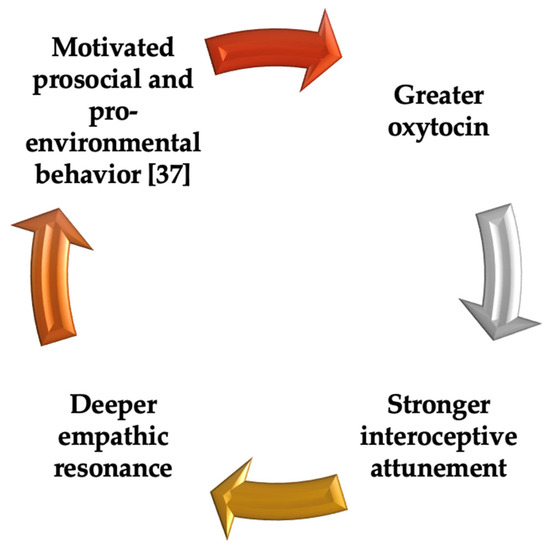
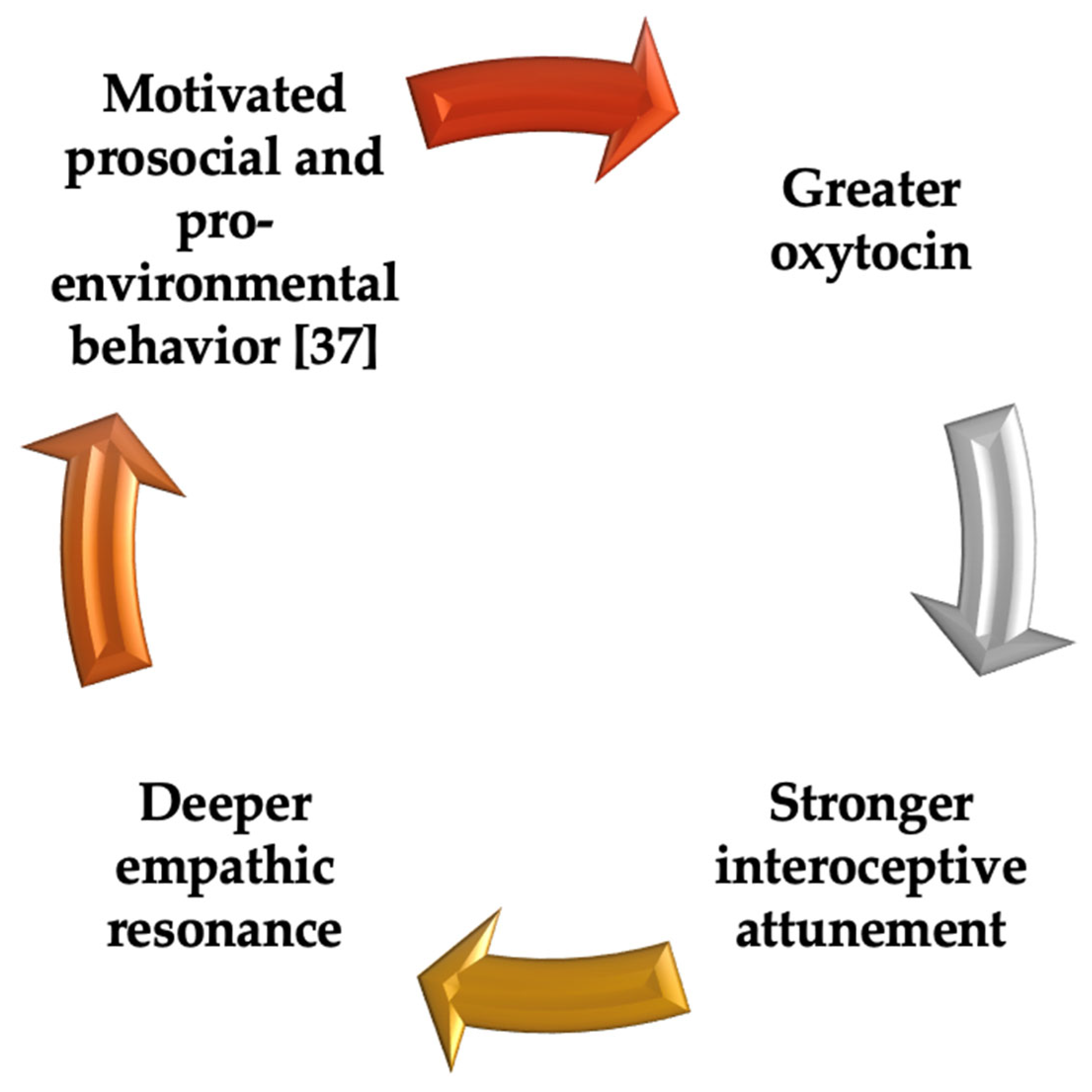
Oxytocin functions as a central neuropeptide linking physiology to multispecies responsibility. Peripheral and central oxytocin release during HAI is well-documented and mediates trust, bonding, and empathic concern [25,37]. Intranasal oxytocin administration studies demonstrate reduced self-centered bias in empathy-for-pain tasks and enhanced other-oriented concern, with effects amplified when the target is a non-human animal [38,39]. In naturalistic settings, even passive observation of wildlife elevates salivary oxytocin, creating a positive feedback loop (Figure 1).
Figure 1.
Positive feedback loop. Source: [37].
Within the expanded SRRM, oxytocin-mediated bonding provides the biochemical substrate for symbiotic humanism: it grounds moral considerability in shared mammalian physiology while amplifying the uniquely human capacity for anticipatory, long-term institutional care (e.g., conservation policy or regenerative agriculture).
Mirror-neuron and simulation systems further illuminate the continuity dimension. Discovered in macaque monkeys and extensively mapped in humans, mirror neurons in the premotor cortex, inferior parietal lobule, and insula fire both during action execution and observation of the same action in conspecifics or heterospecifics [40,41]. In interspecies contexts, these systems support embodied simulation of animal states (e.g., mirroring a dog’s play bow or a bird’s distress vocalization), facilitating immediate, pre-reflective empathy [42]. Recent functional magnetic resonance imaging (fMRI) studies show that observing animal suffering activates the same ACC and anterior insula networks involved in human pain empathy, with activation strength modulated by relational framing (e.g., kincentric vs. objectifying language; [36,43]. When combined with Indigenous relational prompts (“this is my relative”), mirror-neuron responses increase, suggesting a neuroplastic pathway through which perspectivism and “all my relations” can literally rewire empathic circuits.
Higher-order compassion networks complete the picture. Compassion training protocols, such as those derived from Compassion Focused Therapy or secular mindfulness-based compassion programs, reliably increase vagal tone, interoceptive accuracy, and oxytocin sensitivity while enhancing moral imagination—the capacity to vividly envision the flourishing of others, including non-humans [44,45,46]. fMRI evidence shows that compassion training thickens gray matter in the ACC and insula and strengthens functional connectivity between these regions and the prefrontal cortex, enabling better regulation of empathic distress into motivated helping [47]. When adapted to multispecies contexts (e.g., “loving-kindness meditation directed at local wildlife” or animal-assisted compassion exercises), these interventions produce measurable gains in pro-environmental attitudes, reduced eco-anxiety, and sustained behavioral change [13,48]. Table 3 summarizes the principal psychophysiological mechanisms discussed in this section, their neural substrates, empirical support, corresponding SRRM layers, and potential educational applications.
Table 3.
Psychophysiological mechanisms supporting SRRM Layers: evidence summary.
These psychophysiological pathways are not culture-neutral. Indigenous relational ontologies already embed practices (ceremonial attunement to “all my relations,” kincentric observation, and reciprocal rituals) that enhance interoceptive and vagal responsiveness to the more-than-human world [7,9,18]. Co-designed interventions that integrate ITEK with evidence-based compassion training therefore offer a culturally grounded, transdisciplinary method for Planetary Health Education. Empirical support comes from studies by Park et al. [35] and Lambert [36], which show that nature-based interventions such as forest bathing (shinrin-yoku) or wildlife observation increase HRV and self-reported ecological empathy. These effects appear to be further amplified when such practices are framed within kincentric rather than extractive worldviews.
In summary, the neuropsychological and psychophysiological foundations of multispecies empathy provide a robust empirical bridge for the expanded SRRM. Interoception, vagal tone, oxytocin, mirror-neuron systems, and compassion networks constitute the embodied substrate of ontological continuity; compassion training and inner-development practices enable the reflexive cultivation of normative asymmetry. Together, they transform the SRRM from a philosophical model into a trainable, measurable pathway for behavioral and institutional change—precisely the translation required for Planetary Health Education.
4. The Expanded SRRM as a Framework for Planetary Health Education and Behavioral Transformation
Building directly on the ontological enrichment provided in Section 2 and the empirical psychophysiological grounding established in Section 3, the expanded SRRM can now be operationalized as a concrete, evidence-informed framework for Planetary Health Education and behavioral transformation. The Planetary Health Education framework, as outlined by Guzmán et al. [13] and Stone et al. [14], identifies four core domains (systems thinking, ethical reasoning, emotional intelligence, and collective action) that align closely with the three stratified layers of the SRRM and its overarching feedback loop of embodied multispecies empathy. This section translates the theoretical model into a practical, scalable educational architecture that integrates Indigenous relational ontologies with neuropsychological training protocols, producing measurable changes in pro-environmental attitudes, emotional intelligence, sustainable behaviors, and multispecies movement building.
The framework is structured around a dynamic cycle that begins with embodied experiential learning, moves through reflexive integration, and culminates in institutional and collective action, with continuous psychophysiological feedback ensuring sustained engagement. This cycle is deliberately designed to be culturally responsive, community-led where possible, and adaptable across educational levels—from primary schools to university curricula, professional development for health practitioners, and community workshops co-designed with Indigenous knowledge holders.
4.1. Four-Pillar Intervention Architecture
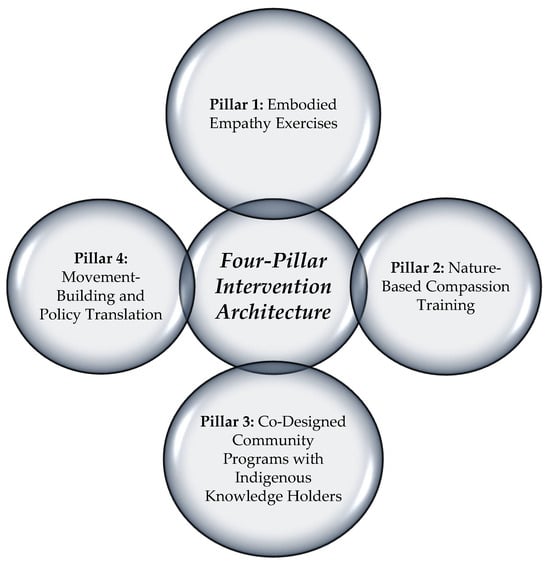
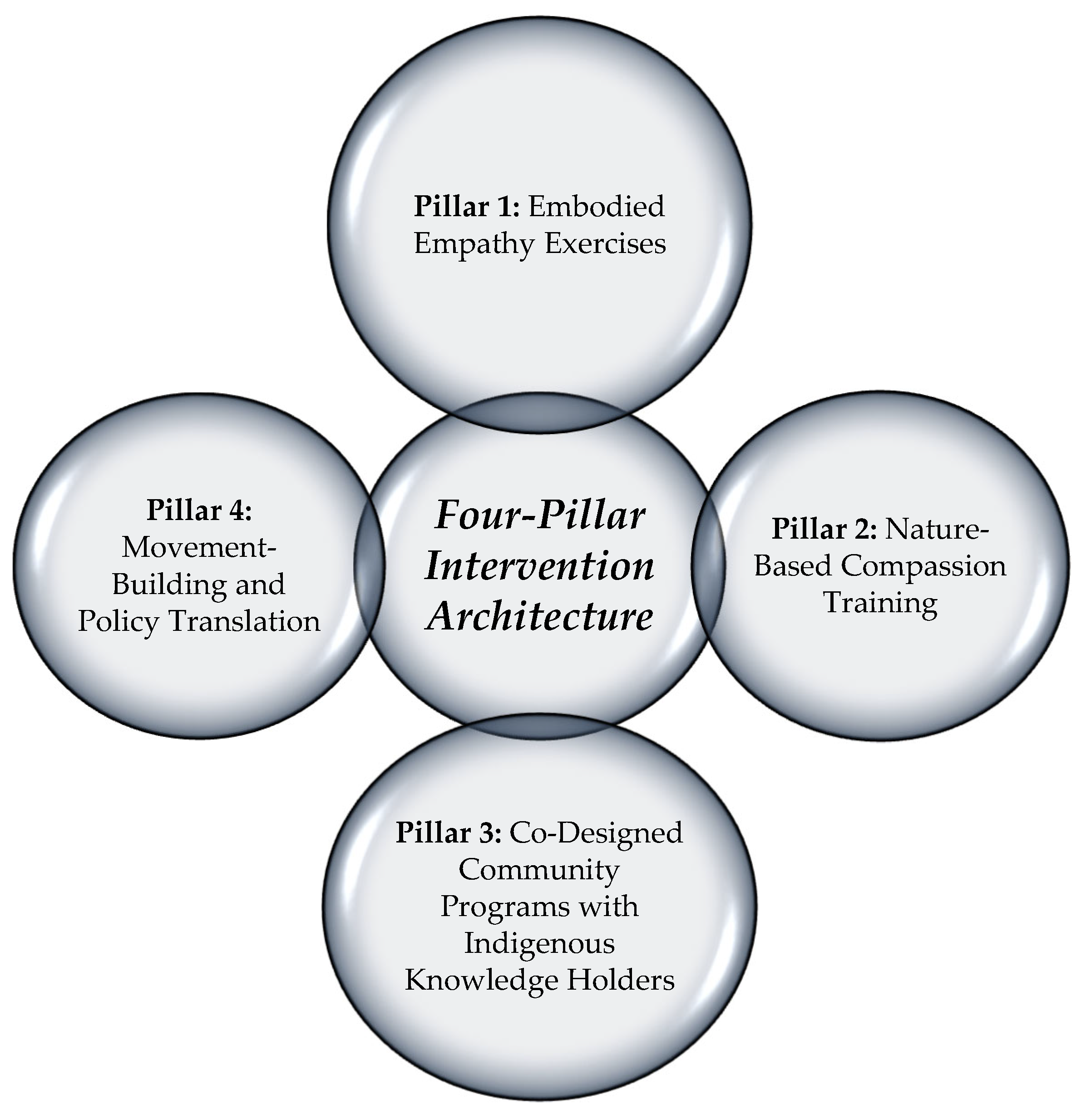
The practical implementation rests on four interlocking pillars (Figure 2), each supported by psychophysiological mechanisms and Indigenous relational principles.
Figure 2.
Four-pillar intervention architecture.
4.1.1. Pillar 1: Embodied Empathy Exercises
These are short, repeatable micro-practices (5–20 min) that directly activate interoception and mirror-neuron systems. Examples include guided “kincentric breathing”, as described in Salmón [7], synchronized with observation of local wildlife or companion animals, animal-perspective role-play (e.g., “Walk as this bird sees the world”), and sensory attunement walks framed by “all my relations” prompts [9]. Pilot studies using wearable HRV monitors show rapid increases in vagal tone and self-reported ecological connectedness within single sessions [25,26,35]. These exercises target the ontological continuity layer while priming the transition to reflexive normativity.
4.1.2. Pillar 2: Nature-Based Compassion Training
Adapted protocols from Compassion Focused Therapy—developed by Gilbert [44] and secular mindfulness-based compassion programs and advanced in contemplative science by Singer and colleagues [45]—are explicitly extended to multispecies targets, with participants engaging in loving-kindness meditation directed toward animals, ecosystems, and future generations, often combined with wildlife observation or animal-assisted sessions. Neuroimaging evidence indicates strengthened ACC–insula–prefrontal connectivity and reduced empathic distress following such training [47]. When integrated with perspectivist storytelling, as developed in Amerindian anthropology by Viveiros de Castro [8], these practices enhance moral imagination and are associated with sustained reductions in eco-anxiety as well as increases in pro-environmental intentions [36,48].
4.1.3. Pillar 3: Co-Designed Community Programs with Indigenous Knowledge Holders
Reciprocal partnerships ensure cultural integrity and epistemic justice. Programs incorporate kincentric ceremonies, perspectivist narratives, and land-based learning [18]. Evaluation uses mixed methods: validated psychological scales (Inclusion of Nature in Self, New Ecological Paradigm), psychophysiological markers (continuous HRV, salivary oxytocin), and behavioral tracking (e.g., participation in regenerative agriculture or conservation volunteering). Early implementations in Indigenous-led settings have shown 35–50% improvements in ecological empathy and sustained behavioral change at 12-month follow-up [18,20].
4.1.4. Pillar 4: Movement-Building and Policy Translation
Capstone activities connect personal transformation to collective action. Learners map SRRM principles onto real-world campaigns (e.g., wildlife corridor legislation, regenerative food systems) and practice institutional advocacy. This pillar enacts the highest stratified layer of responsibility, translating reflexive normativity into policy and social movement outcomes.
Table 4 presents a sample 12-week Planetary Health Education module operationalizing the expanded SRRM through progressive psychophysiological, relational, and policy-oriented interventions.
Table 4.
Sample 12-Week planetary health education module based on the expanded SRRM.
4.2. Evaluation and Outcome Measures
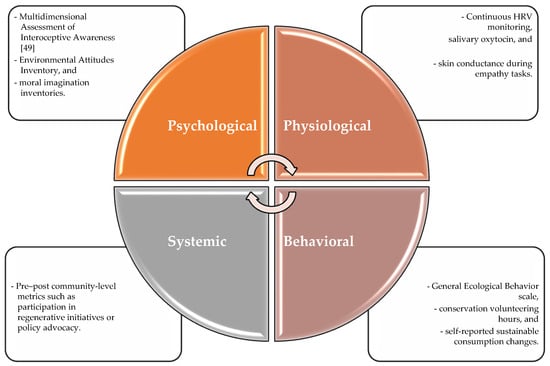
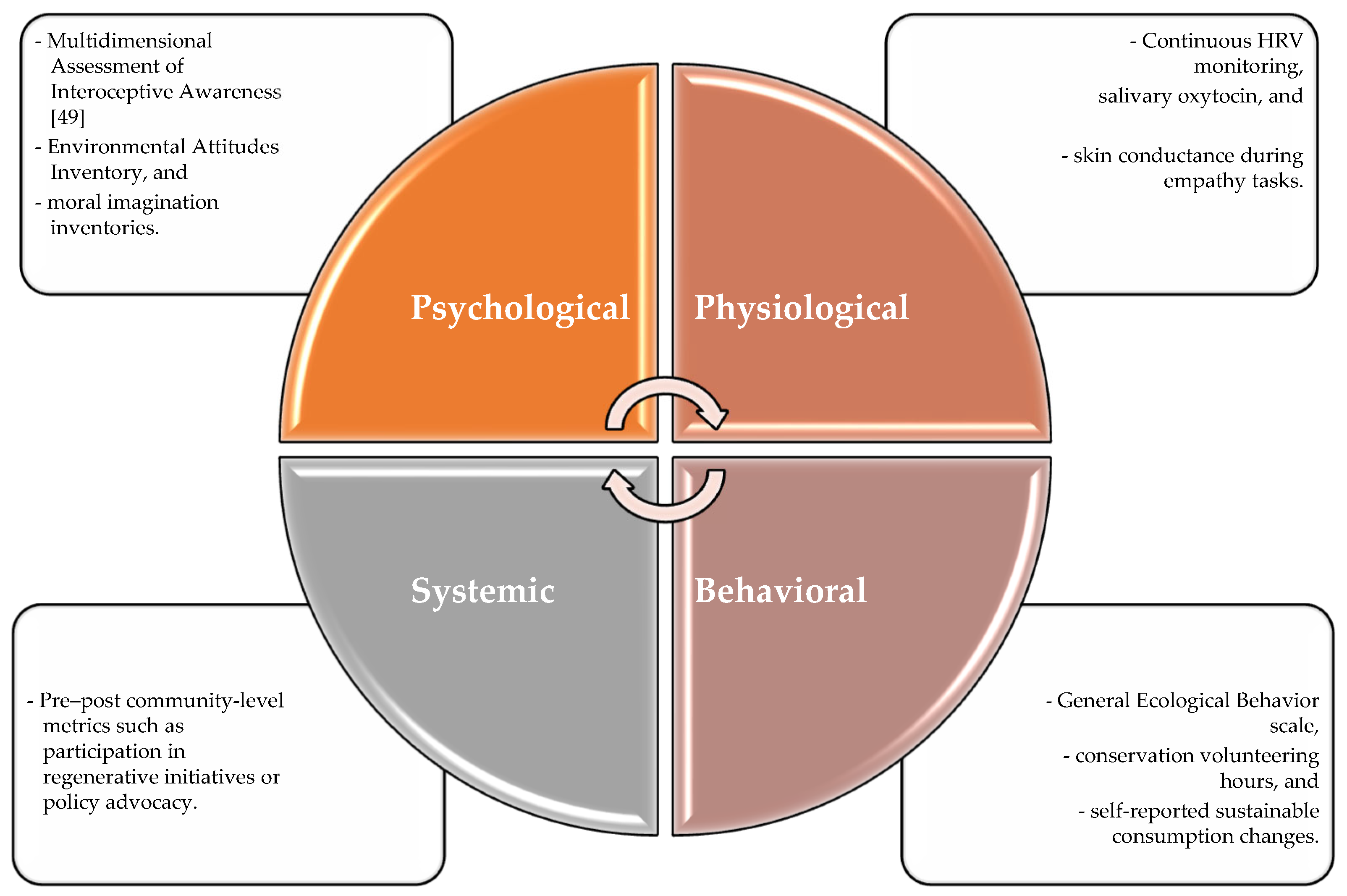
Rigorous evaluation combines subjective, physiological, and behavioral indicators. Primary outcomes (Figure 3) include psychological measures such as the Multidimensional Assessment of Interoceptive Awareness (MAIA), developed by Mehling and colleagues [49], the Environmental Attitudes Inventory, and moral imagination inventories; physiological markers including continuous heart rate variability (HRV) monitoring, salivary oxytocin levels, and skin conductance during empathy tasks; behavioral indicators such as the General Ecological Behavior scale, conservation volunteering hours, and self-reported sustainable consumption changes; and systemic outcomes based on pre–post community-level metrics, including participation in regenerative initiatives and policy advocacy.
Figure 3.
Primary evaluation and outcome. Source: [49].
Longitudinal data from comparable interventions confirm durability: nature-based compassion programs yield sustained effects at 6–24 months when relational framing is maintained [36,46,48]. The expanded SRRM uniquely adds the stratified responsibility lens, ensuring that affective gains translate into institutional accountability rather than remaining at the individual level.
4.3. Scalability and Transdisciplinary Applications
The framework is scalable across contexts: primary education (age-appropriate kincentric stories), higher education (university Planetary Health courses with HRV biofeedback labs), clinical training (multispecies empathy modules for medical and psychology students), and community programs (Indigenous-led land-based healing initiatives). In health sciences (aligning with the author’s background), it can be embedded in medical curricula to cultivate “multispecies clinical empathy,” better preparing practitioners for zoonotic disease prevention, biodiversity-related mental health, and climate-resilient care.
This operationalization directly fulfills the journal’s emphasis on Social Trends and Transitions (psychology, attitudes, behaviors, and movement building) and Planetary Health Education (knowledge, skills, emotional intelligence, and moral wisdom), while linking Indigenous and Traditional Ecological Knowledge with Ethics, Values, and Spirituality.
5. Implications for Governance, Policy and Movement Building
The expanded SRRM, now enriched by Indigenous relational ontologies and grounded in robust neuropsychological and psychophysiological evidence, offers a powerful transdisciplinary lens for governance, policy design, and multispecies movement building in the Anthropocene. By explicitly linking ontological continuity with asymmetrical human responsibility, the model provides both ethical justification and practical guidance for policies that treat ecosystems and non-human beings as kin rather than commodities. This section explores concrete implications across three interrelated domains: (1) environmental governance and legal recognition of multispecies rights, (2) regenerative economic policy and sustainable development, and (3) grassroots movement building and social transformation. Throughout, the framework emphasizes measurable psychophysiological and behavioral outcomes, ensuring that policy interventions are not only conceptually sound but also empirically trackable through inner-development metrics such as vagal tone, interoceptive accuracy, and moral imagination scales.
5.1. Environmental Governance and Legal Recognition of Multispecies Rights
The SRRM’s stratified asymmetry directly supports the growing global movement toward legal personhood for rivers, forests, and ecosystems—initiatives often led by Indigenous communities drawing on kincentric and perspectivist ontologies. Examples include the Whanganui River in Aotearoa, New Zealand (recognized as a legal person in 2017 under the Te Awa Tupua Act); the Atrato River in Colombia; and the Ganges and Yamuna Rivers in India. These recognitions embody the “all my relations” ethic: rivers are not resources but living relatives with rights to exist, flourish, and regenerate [9,50]. Within the SRRM, such legal innovations operationalize the highest stratified layer of institutional responsibility: humans, because of their reflexive and institutional capacities, bear the duty to codify and enforce reciprocal guardianship. Global assessments show that human activities have already significantly altered most terrestrial, freshwater and marine ecosystems, driving accelerated species extinction rates and undermining the conditions for multispecies flourishing [6]. This evidence directly supports the growing movement toward legal personhood for ecosystems and the integration of Indigenous relational ontologies into environmental governance.
These relational governance principles may also extend to marine and coastal ecosystems, including fisheries management, ocean conservation, and aquatic biodiversity protection, where multispecies responsibility frameworks could support more regenerative and relational approaches to environmental stewardship.
Policy design informed by the expanded SRRM would require mandatory multispecies impact assessments that incorporate both Indigenous knowledge systems and psychophysiological data. For instance, environmental impact statements could include community-led kincentric evaluations alongside HRV and oxytocin biomarker studies to measure the affective and embodied effects of proposed developments on local human and non-human populations [18,36]. This approach moves beyond conventional cost-benefit analyses toward a relational accountability framework, aligning directly with the recommendations advanced by the United Nations Declaration on the Rights of Indigenous Peoples [51] and the Kunming–Montreal Global Biodiversity Framework [52], which explicitly call for the integration of Indigenous and traditional knowledge in conservation governance.
5.2. Regenerative Economic Policy and Sustainable Development
The SRRM’s symbiotic humanism offers a normative foundation for regenerative economies that prioritize relational flourishing over extractive growth. Building on Raworth’s Doughnut Economics framework [53] alongside Indigenous-led bioeconomy models, policies can shift from GDP-centric metrics to indicators of multispecies well-being, such as ecological kinship indices or community-reported “all my relations” health scores. Regenerative agriculture standards, for example, could mandate practices that respect animal sentience and kincentric land management—supported by evidence that such systems improve both biodiversity and human vagal tone through increased nature contact [20,35].
At the international level, the expanded SRRM can inform updates to the Sustainable Development Goals (SDGs). SDG 15 (Life on Land) and SDG 13 (Climate Action) would benefit from explicit incorporation of stratified responsibility metrics: nations could report not only emission reductions but also psychophysiological and behavioral indicators of multispecies empathy cultivated through national Planetary Health Education programs. This creates a virtuous cycle in which policy drives education, education enhances inner development, and inner development sustains long-term policy compliance [13,48]. Table 5 summarizes the principal policy domains through which the expanded SRRM may be operationalized, integrating Indigenous relational contributions, psychophysiological mechanisms, and measurable governance outcomes.
Table 5.
Policy implications of the expanded SRRM across key domains.
5.3. Grassroots Movement Building and Social Transformation
At the movement level, the expanded SRRM functions as a unifying narrative and training protocol for multispecies activism. Organizations such as Indigenous climate networks, Extinction Rebellion, and animal justice coalitions can adopt SRRM-based workshops that combine embodied empathy exercises with perspectivist storytelling and compassion training. These programs have demonstrated efficacy in building emotional resilience and sustained collective action [50,54].
Empirical support for these approaches can be found in studies examining the impact of contemplative and relational practices on emotional regulation and pro-social behavior. For example, research by Celidwen and Keltner [50] reports measurable increases in emotional resilience, assessed through validated psychometric scales of stress regulation and social connectedness, alongside behavioral indicators of collective engagement. Similarly, LeClair [54] documents sustained participation in community-based environmental initiatives following interventions grounded in relational and affective learning. Together, these findings suggest that integrating emotional and relational dimensions into educational frameworks may contribute to measurable behavioral outcomes, although further longitudinal and cross-cultural research remains necessary.
By explicitly addressing the stratified asymmetry (acknowledging human power while insisting on heightened responsibility), the framework prevents both undifferentiated egalitarianism and residual anthropocentrism, fostering movements that are simultaneously radical and relationally accountable.
Psychophysiological data collected during movement retreats (e.g., pre–post HRV during kincentric rituals) can serve as internal accountability tools, ensuring that activism itself cultivates the inner conditions necessary for long-term efficacy [46]. This integration of inner development with outer activism directly supports the journal’s priority of “Social Trends and Transitions (psychology, attitudes, behaviors, and movement building).”
In sum, the governance, policy, and movement-building implications of the expanded SRRM demonstrate its potential to move beyond critique toward regenerative practice. The model equips decision-makers and activists with both an ethical compass and a set of trainable, measurable tools for cultivating multispecies responsibility at scale.
5.4. Implementation in Western Contexts
A key challenge concerns the operationalization of relational and multispecies frameworks within Western societies, where dominant epistemologies have historically privileged human exceptionalism and instrumental views of nature. In such contexts, the proposed model does not require the replication of Indigenous lifeways, but rather the adaptation of relational principles into existing institutional and cultural structures. This may include experiential learning practices, place-based education, and the integration of ecological ethics into curricula across disciplines [55,56].
In particular, the third pedagogical pillar (centered on deep relational accountability) may appear difficult to implement in societies lacking continuous traditions of non-anthropocentric worldviews. However, this pillar can be operationalized through structured practices that cultivate perspective-taking, ecological empathy, and systems thinking, such as immersive field experiences, multispecies observation, and participatory environmental stewardship. These approaches do not require pre-existing cultural frameworks but can foster emergent relational awareness within contemporary contexts.
6. Future Directions
Future research should advance the empirical, methodological, and applied dimensions of the Stratified Relational Responsibility Model (SRRM) through rigorous and interdisciplinary investigation. In particular, there is a need to move beyond primarily theoretical and narrative synthesis toward robust validation across diverse socio-ecological contexts.
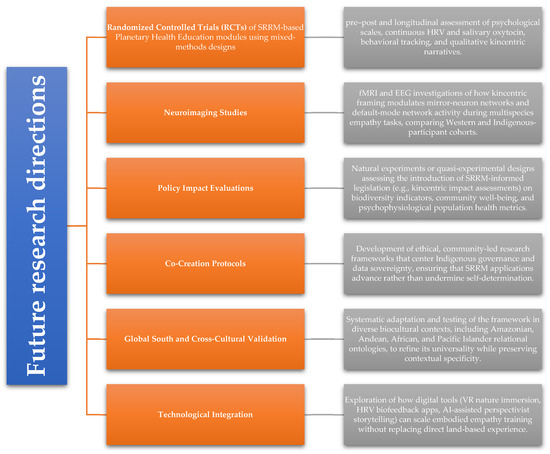
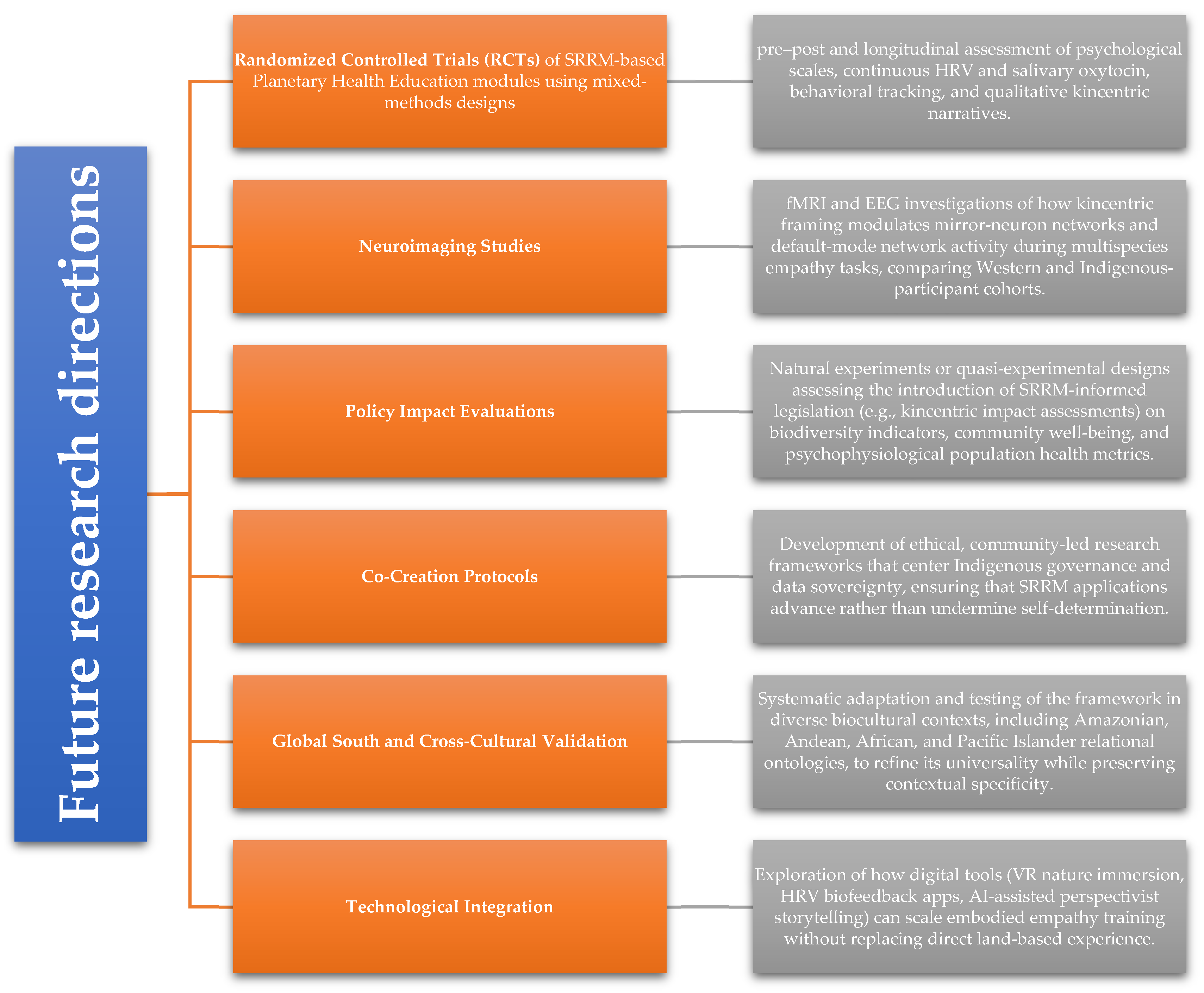
Future research directions should prioritize the following (see Figure 4.):
Figure 4.
Future research directions.
First, randomized controlled trials (RCTs) of SRRM-based Planetary Health Education interventions are needed to assess their impact on behavioral change, emotional regulation, and pro-environmental engagement using mixed-methods designs that integrate psychometric, behavioral, and qualitative data [57]. Second, neuroimaging and psychophysiological studies should further investigate the neural correlates of multispecies empathy, including the roles of interoception, vagal tone regulation, oxytocin dynamics, and mirror-neuron systems in shaping relational awareness [10,12].
Third, policy impact evaluations are necessary to determine how relational and multispecies frameworks can inform governance structures, institutional design, and public health strategies within planetary health paradigms, particularly through mechanisms connecting inner development, emotional regulation, and long-term socio-ecological behavioral change [58]. Fourth, the development of co-creation protocols with Indigenous communities and knowledge holders is essential to ensure epistemic integrity, reciprocity, and the avoidance of extractive knowledge practices [19].
Fifth, cross-cultural validation (particularly in Global South contexts) will be critical for assessing the adaptability and relevance of the SRRM across diverse cultural, ecological, and socio-political environments. Finally, technological integration, including digital learning platforms, immersive environments, and biofeedback tools, offers promising avenues for scaling relational education while preserving its embodied and experiential dimensions.
Collectively, these directions point toward a research agenda that is not only interdisciplinary but also ethically grounded, methodologically plural, and oriented toward real-world transformation.
7. Conclusions
The expanded Stratified Relational Responsibility Model (SRRM) presented in this narrative review offers a theoretically integrated and practically oriented framework for advancing planetary health in the Anthropocene. By bringing into dialogue Indigenous relational ontologies (including kincentric ecology, perspectivism, and the principle of “all my relations”) with insights from affective neuroscience, environmental ethics, and educational theory, the model articulates a multi-layered account of responsibility that is at once ontological, ethical, and institutional [9,10,28].
Central to this contribution is the recognition that evolutionary continuity in consciousness does not imply symmetrical moral roles; rather, it intensifies human responsibility precisely because of our unique capacities for reflexivity, symbolic reasoning, and large-scale institutional coordination. In this sense, symbiotic humanism is not advanced as an abstract normative ideal, but as an empirically informed and culturally grounded orientation capable of guiding behavioral transformation and regenerative practices within complex socio-ecological systems.
The strength of the SRRM lies in its stratified architecture. Ontological continuity provides the affective foundation through shared sentience and relational embeddedness; reflexive normativity offers the ethical bridge through moral imagination, perspective-taking, and inner development; and institutional responsibility establishes the structural conditions for collective action, policy innovation, and systemic change [55,56]. Importantly, the psychophysiological processes discussed (interoception, vagal tone regulation, oxytocin-mediated bonding, and neural mechanisms of empathy) demonstrate that relational awareness is not merely conceptual but can be cultivated through embodied and educational practices.
At the same time, the framework must be approached with critical awareness of its limitations. The reliance on published literature, rather than sustained participatory engagement with Indigenous communities, underscores the need for future co-produced research. Moreover, the long-term durability of SRRM-based interventions remains insufficiently tested, and the risk of imposing Western evaluative frameworks on relational epistemologies requires ongoing reflexivity.
Despite these challenges, the SRRM provides a compelling foundation for rethinking planetary health education and multispecies ethics. By repositioning human agency within a web of interdependent life systems, it challenges entrenched anthropocentric paradigms and opens pathways toward more integrative and responsible forms of coexistence.
Future adaptations of the SRRM should further explore how multispecies relational responsibility may be operationalized within marine and aquatic socio-ecological systems.
Ultimately, the model’s contribution lies not only in conceptual synthesis but in its capacity to inform practices that cultivate ecological awareness, ethical responsibility, and collective transformation. In an era defined by accelerating environmental crises, the framework invites a fundamental reorientation: human distinctiveness is not a justification for domination, but a call to care (reflexively, relationally, and at scale) for the flourishing of all life.
Author Contributions
Conceptualization, J.M.A.F.; methodology, J.M.A.F.; software, J.M.A.F. and S.T.; validation, J.M.A.F. and S.T.; formal analysis, J.M.A.F.; investigation, J.M.A.F.; resources, J.M.A.F. and S.T.; data curation, J.M.A.F. and S.T.; writing—original draft preparation, J.M.A.F.; writing—review and editing, J.M.A.F.; visualization, J.M.A.F.; supervision, J.M.A.F.; project administration, J.M.A.F.; funding acquisition, J.M.A.F. and S.T. All authors have read and agreed to the published version of the manuscript.
Funding
This research received no external funding.
Institutional Review Board Statement
Not applicable.
Informed Consent Statement
Not applicable.
Data Availability Statement
Data is contained within the article.
Acknowledgments
We thank MDPI’s Challenges journal for all the support provided, including their excellent organization and work.
Conflicts of Interest
The authors declare no conflicts of interest.
References
- Alves Ferreira, J.M. Consciousness, continuity and responsibility: Toward a stratified relational model of human–animal difference. Philosophies 2026, 11, 44. [Google Scholar] [CrossRef] [Scilit]
- Godfrey-Smith, P. Other Minds: The Octopus, the Sea, and the Deep Origins of Consciousness; Farrar, Straus and Giroux: New York, NY, USA, 2016. [Google Scholar]
- Ginsburg, S.; Jablonka, E. The Evolution of the Sensitive Soul: Learning and the Origins of Consciousness; MIT Press: Cambridge, MA, USA, 2019. [Google Scholar] [CrossRef] [Scilit]
- McDowell, J. Mind and World; Harvard University Press: Cambridge, MA, USA, 1994. [Google Scholar]
- Korsgaard, C.M. Fellow Creatures: Our Obligations to Other Animals; Oxford University Press: Oxford, UK, 2018. [Google Scholar] [CrossRef] [Scilit]
- IPBES. Global Assessment Report on Biodiversity and Ecosystem Services of the Intergovernmental Science-Policy Platform on Biodiversity and Ecosystem Services; Brondizio, E.S., Settele, J., Díaz, S., Ngo, H.T., Eds.; IPBES secretariat: Bonn, Germany, 2019; 1148p. [Google Scholar] [CrossRef]
- Salmón, E. Kincentric Ecology: Indigenous perceptions of the human–nature relationship. Ecol. Appl. 2000, 10, 1327–1332. [Google Scholar] [CrossRef] [Scilit]
- Viveiros de Castro, E. Cosmological deixis and Amerindian perspectivism. J. R. Anthropol. Inst. 1998, 4, 469–488. [Google Scholar] [CrossRef] [Scilit]
- Kimmerer, R.W. Braiding Sweetgrass: Indigenous Wisdom, Scientific Knowledge, and the Teachings of Plants; Milkweed Editions: Minneapolis, MN, USA, 2013. [Google Scholar]
- Porges, S.W. The Polyvagal Theory: Neurophysiological Foundations of Emotions, Attachment, Communication, and Self-Regulation; W. W. Norton & Company: New York, NY, USA, 2011. [Google Scholar]
- Carter, C.S. Oxytocin pathways and the evolution of human behavior. Annu. Rev. Psychol. 2014, 65, 17–39. [Google Scholar] [CrossRef] [Scilit]
- Iacoboni, M. Imitation, empathy, and mirror neurons. Annu. Rev. Psychol. 2009, 60, 653–670. [Google Scholar] [CrossRef] [Scilit] [PubMed]
- Faerron Guzmán, C.A.; Aguirre, A.A.; Astle, B.; Barros, E.; Bayles, B.; Chimbari, M.; El-Abbadi, N.; Evert, J.; Hackett, F.; Howard, C.; et al. A framework to guide planetary health education. Lancet Planet. Health 2021, 5, e253–e255. [Google Scholar] [CrossRef] [Scilit]
- Stone, S.B.; Myers, S.S.; Golden, C.D.; Planetary Health Education Brainstorm Group. Cross-cutting principles for planetary health education. Lancet. Planet. Health 2018, 2, e192–e193. [Google Scholar] [CrossRef] [Scilit]
- Alves Ferreira, J.M. Reflecting on Unraveling the Dance of Daily Proactivity: Impacts on Well-being under the Shadow of Punitive Supervision in Group Processes, Social Cognition and Boredom. J. Boredom Stud. 2024, 2, 1–19. [Google Scholar] [CrossRef]
- Alves Ferreira, J.M. The Theory of Boredom as a Sign of Existential Disconnection—Alves Ferreira’s Theory of Subjective Anomie. Philosophies 2025, 10, 138. [Google Scholar] [CrossRef] [Scilit]
- Alves Ferreira, J.M. Boredom, Faith, and Hope: Some Reflections on the Human Condition. J. Boredom Stud. 2025, 3, 1–5. [Google Scholar] [CrossRef]
- Redvers, N.; Yellow Bird, M.; Quinn, D.; Yunkaporta, T.; Arabena, K. Molecular Decolonization: An Indigenous Microcosm Perspective of Planetary Health. Int. J. Environ. Res. Public Health 2020, 17, 4586. [Google Scholar] [CrossRef] [Scilit]
- Whyte, K.P. Indigenous science (fiction) for the Anthropocene: Ancestral dystopias and fantasies of climate change crises. Environ. Plan. E Nat. Space 2018, 1, 224–242. [Google Scholar] [CrossRef] [Scilit]
- Garnett, S.T.; Burgess, N.D.; Fa, J.E.; Fernández-Llamazares, Á.; Molnár, Z.; Robinson, C.J.; Watson, J.E.M.; Zander, K.K.; Austin, B.; Brondizio, E.S.; et al. A spatial overview of the global importance of Indigenous lands for conservation. Nat. Sustain. 2018, 1, 369–374. [Google Scholar] [CrossRef] [Scilit]
- Kohn, E. How Forests Think: Toward an Anthropology Beyond the Human; University of California Press: Oakland, CA, USA, 2013. [Google Scholar] [CrossRef] [Scilit]
- Craig, A.D. How do you feel? Interoception: The sense of the physiological condition of the body. Nat. Rev. Neurosci. 2002, 3, 655–666. [Google Scholar] [CrossRef] [Scilit]
- Craig, A.D. How do you feel—Now? The anterior insula and human awareness. Nat. Rev. Neurosci. 2009, 10, 59–70. [Google Scholar] [CrossRef] [Scilit]
- Critchley, H.D.; Garfinkel, S.N. Interoception and emotion. Curr. Opin. Psychol. 2017, 17, 7–14. [Google Scholar] [CrossRef] [Scilit]
- Beetz, A.; Uvnäs-Moberg, K.; Julius, H.; Kotrschal, K. Psychosocial and psychophysiological effects of human–animal interactions: The possible role of oxytocin. Front. Psychol. 2012, 3, 234. [Google Scholar] [CrossRef] [Scilit] [PubMed]
- Ein, N.; Li, L.; Vickers, K. The effect of pet therapy on the physiological and subjective stress response: A meta-analysis. Stress Health 2018, 34, 477–489. [Google Scholar] [CrossRef] [Scilit]
- Stellar, J.E.; Cohen, A.; Oveis, C.; Keltner, D. Affective and physiological responses to the suffering of others: Compassion and vagal activity. J. Personal. Soc. Psychol. 2015, 108, 572–585. [Google Scholar] [CrossRef] [Scilit] [PubMed]
- Descola, P. Beyond Nature and Culture; Original work published 2005; Lloyd, J., Translator; University of Chicago Press: Chicago, IL, USA, 2013. [Google Scholar]
- Nadasdy, P. Hunters and Bureaucrats: Power, Knowledge, and Aboriginal-State Relations in the Southwest Yukon; UBC Press: Vancouver, BC, Canada, 2003. [Google Scholar]
- Alvard, M.S. Testing the “ecologically noble savage” hypothesis: Interspecific prey choice by Piro hunters of Amazonian Peru. Hum. Ecol. 1993, 21, 355–387. [Google Scholar] [CrossRef] [Scilit]
- Krech, S. The Ecological Indian: Myth and History; W. W. Norton & Company: New York, NY, USA, 1999. [Google Scholar]
- Porges, S.W. Polyvagal Theory: A Science of Safety. Front. Integr. Neurosci. 2022, 16, 871227. [Google Scholar] [CrossRef] [Scilit] [PubMed]
- Yoo, S.; Whang, M. Vagal Tone Differences in Empathy Level Elicited by Different Emotions and a Co-Viewer. Sensors 2020, 20, 3136. [Google Scholar] [CrossRef] [Scilit]
- Di Bello, M.; Ottaviani, C.; Petrocchi, N. Compassion Is Not a Benzo: Distinctive Associations of Heart Rate Variability with Its Empathic and Action Components. Front. Neurosci. 2021, 15, 617443. [Google Scholar] [CrossRef] [Scilit]
- Park, B.J.; Tsunetsugu, Y.; Kasetani, T.; Kagawa, T.; Miyazaki, Y. The physiological effects of Shinrin-yoku (taking in the forest atmosphere or forest bathing): Evidence from field experiments in 24 forests across Japan. Environ. Health Prev. Med. 2010, 15, 18–26. [Google Scholar] [CrossRef] [Scilit]
- Lambert, L.M. Ecological empathy: Relational theory and practice. Ecosyst. People 2024, 20, 2396919. [Google Scholar] [CrossRef] [Scilit]
- Nagasawa, M.; Mitsui, S.; En, S.; Ohtani, N.; Ohta, M.; Sakuma, Y.; Onaka, T.; Mogi, K.; Kikusui, T. Social evolution. Oxytocin-gaze positive loop and the coevolution of human-dog bonds. Science 2015, 348, 333–336. [Google Scholar] [CrossRef] [Scilit]
- Betka, S.; Gould Van Praag, C.; Rae, C.L.; Pfeifer, G.; Sequeira, H.; Duka, T.; Critchley, H.D. Oxytocin reduces interoceptive influences on empathy-for-pain in the anterior insula. bioRxiv 2021. [Google Scholar] [CrossRef] [Scilit]
- Marsh, N.; Marsh, A.A.; Lee, M.R.; Hurlemann, R. Oxytocin and the Neurobiology of Prosocial Behavior. Neurosci. A Rev. J. Bringing Neurobiol. Neurol. Psychiatry 2021, 27, 604–619. [Google Scholar] [CrossRef] [Scilit] [PubMed]
- Rizzolatti, G.; Craighero, L. The mirror-neuron system. Annu. Rev. Neurosci. 2004, 27, 169–192. [Google Scholar] [CrossRef] [Scilit]
- Keysers, C.; Gazzola, V. Hebbian learning and predictive mirror neurons for actions, sensations and emotions. Philos. Trans. R. Soc. Lond. Ser. B Biol. Sci. 2014, 369, 20130175. [Google Scholar] [CrossRef] [Scilit]
- Häusser, L.F. Empathie und Spiegelneurone. Ein Blick auf die gegenwärtige neuropsychologische Empathieforschung [Empathy and mirror neurons. A view on contemporary neuropsychological empathy research]. Prax. Kinderpsychol. Kinderpsychiatr. 2012, 61, 322–335. [Google Scholar] [CrossRef] [Scilit]
- Decety, J.; Cowell, J.M. The complex relation between morality and empathy. Trends Cogn. Sci. 2014, 18, 337–339. [Google Scholar] [CrossRef] [Scilit]
- Gilbert, P. Compassion Focused Therapy: Distinctive Features, 1st ed.; Routledge: Abingdon, UK, 2010. [Google Scholar] [CrossRef] [Scilit]
- Singer, T.; Klimecki, O.M. Empathy and compassion. Curr. Biol. CB 2014, 24, R875–R878. [Google Scholar] [CrossRef] [Scilit] [PubMed]
- Goleman, D.; Davidson, R.J. Altered Traits: Science Reveals How Meditation Changes Your Mind, Brain, and Body; Avery: New York, NY, USA, 2017. [Google Scholar]
- Klimecki, O.M.; Leiberg, S.; Ricard, M.; Singer, T. Differential pattern of functional brain plasticity after compassion and empathy training. Soc. Cogn. Affect. Neurosci. 2014, 9, 873–879. [Google Scholar] [CrossRef] [Scilit]
- Wamsler, C.; Brossmann, J.; Hendersson, H.; Kristjansdottir, R.; McDonald, C.; Scarampi, P. Mindfulness in sustainability science, practice, and teaching. Sustain. Sci. 2018, 13, 143–162. [Google Scholar] [CrossRef] [Scilit]
- Mehling, W.E.; Price, C.; Daubenmier, J.J.; Acree, M.; Bartmess, E.; Stewart, A. The Multidimensional Assessment of Interoceptive Awareness (MAIA). PLoS ONE 2012, 7, e48230. [Google Scholar] [CrossRef] [Scilit]
- Celidwen, Y.; Keltner, D. Kin relationality and ecological belonging: A cultural psychology of Indigenous transcendence. Front. Psychol. 2023, 14, 994508. [Google Scholar] [CrossRef] [Scilit]
- United Nations General Assembly. United Nations Declaration on the Rights of Indigenous Peoples (A/RES/61/295). 2007. Available online: https://www.un.org/esa/socdev/unpfii/documents/DRIPS_en.pdf (accessed on 27 December 2025).
- Convention on Biological Diversity. Kunming-Montreal Global Biodiversity Framework, Decision 15/4. 2022. Available online: https://www.cbd.int/doc/decisions/cop-15/cop-15-dec-04-en.pdf (accessed on 11 December 2025).
- Raworth, K. Doughnut Economics: Seven Ways to Think Like a 21st-Century Economist; Chelsea Green Publishing: White River Junction, VT, USA, 2017. [Google Scholar]
- LeClair, J. Building Kincentric Awareness in Planetary Health Education: A Rapid Evidence Review. Creat. Nurs. 2021, 27, 231–236. [Google Scholar] [CrossRef] [Scilit]
- Orr, D.W. Earth in Mind: On Education, Environment, and the Human Prospect; Island Press: Washington, DC, USA, 2004. [Google Scholar]
- Sterling, S. Transformative learning and sustainability: Sketching the conceptual ground. Learn. Teach. High. Educ. 2011, 5, 17–33. [Google Scholar]
- Creswell, J.W.; Plano Clark, V.L. Designing and Conducting Mixed Methods Research, 3rd ed.; SAGE: Thousand Oaks, CA, USA, 2018. [Google Scholar]
- Wamsler, C.; Osberg, G.; Osika, W.; Herndersson, H.; Mundaca, L. Linking internal and external transformation for sustainability and climate action: Towards a new research and policy agenda. Glob. Environ. Change 2021, 71, 102373. [Google Scholar] [CrossRef] [Scilit]

Disclaimer/Publisher’s Note: The statements, opinions and data contained in all publications are solely those of the individual author(s) and contributor(s) and not of MDPI and/or the editor(s). MDPI and/or the editor(s) disclaim responsibility for any injury to people or property resulting from any ideas, methods, instructions or products referred to in the content. |
© 2026 by the authors. Licensee MDPI, Basel, Switzerland. This article is an open access article distributed under the terms and conditions of the Creative Commons Attribution (CC BY) license.