


Abstract
The Buddhist Wheel of Life (bhavacakra) circulated from Tibet to Europe through Catholic missionary scholarship, becoming part of wider intellectual and artistic exchanges between the seventeenth and nineteenth centuries. This study examines the depiction of the Wheel of Life in Agostino Giorgi’s Alphabetum Tibetanum (1762) and its possible influence on Zahari Zograf’s Wheel of Life mural (1849–1850) at the Transfiguration Monastery in Bulgaria. The presence of a copy of Giorgi’s engraving in Zograf’s collection raises questions concerning the transmission of Buddhist iconographic motifs and their role within Orthodox visual culture. The study employs an interdisciplinary approach combining historical, theological, and iconographical analysis with cross-religious comparison, informed by Raimon Panikkar’s concept of homeomorphic equivalence. The findings demonstrate that a historical channel of transmission between Tibet, Italy, and Bulgaria can be documented and that notable formal and compositional parallels exist between the Buddhist and Orthodox Wheels of Life. However, the available evidence is insufficient to establish direct artistic influence. Instead, the comparison shows that the two images function as homeomorphic equivalents, fulfilling analogous cosmological, moral, eschatological, and soteriological roles within different religious traditions. The case study further demonstrates how religious iconographic motifs circulated across cultural boundaries while preserving their distinct doctrinal identities.
1. Introduction
The Wheel of Life (also known as the Wheel of Existence or Cycle of Existence), like the Wheel of Time, appears in numerous religious and spiritual traditions worldwide. It occupies a central position in Tibetan Buddhist visual culture as a complex diagram articulating fundamental Buddhist conceptions of existence, causality, and liberation from suffering in saṃsāra (‘khor ba). Known as the bhavacakra (srid pa’i ’khor lo), this image functions as a symbolic representation of cosmological, philosophical and didactic knowledge. The article approaches the bhavacakra from within its Tibetan epistemological and spiritual framework, reconsidering the Alphabetum Tibetanum (1762), the influential Augustinian work by Agostino Antonio Giorgi (1711–1797), which presented one of the earliest European reproductions of the bhavacakra. The study situates it within the broader context of missionary knowledge production and cross-religious mediation. It further traces the subsequent circulation of the image in the collection of Zahari Hristovich Dimitrov, known as Zograf1 (1810–1853), a prominent icon painter of the Bulgarian National Revival,2 and considers the possibility that he may have drawn upon this engraving when creating his Wheel of Life mural (1849–1850) at the Transfiguration Monastery in Bulgaria. By situating these encounters within their historical and visual contexts, the study offers a comparative perspective on how cosmological, soteriological, and moral imagery was reinterpreted across Buddhist, Catholic, and Eastern Orthodox traditions.
The central research question in this study is the extent to which the depiction of the Wheel of Life in Agostino Giorgi’s Alphabetum Tibetanum may have served as a source of influence for Zahari Zograf’s Wheel of Life mural at the Transfiguration Monastery, and what this case study reveals about the circulation and reinterpretation of religious iconographic motifs from Tibet to Europe between the seventeenth and nineteenth centuries. To address this question, the article explores the historical channels through which the Tibetan Buddhist Wheel of Life reached Italy in the eighteenth century and Bulgaria in the nineteenth century, the theological meaning and symbolism of the Wheel of Life in Alphabetum Tibetanum and of the Orthodox Wheel of Life at the Transfiguration Monastery and compares their symbolism, composition, and artistic elements.
By examining the engraving of the Wheel of Life in Giorgi’s Alphabetum Tibetanum and its relationship to Zahari Zograf’s mural at the Transfiguration Monastery, this study offers insights into the ways in which Buddhist iconography intersected with Eastern Orthodox Christian art in nineteenth-century Bulgaria. It sheds light on the historical, theological, and artistic exchanges that took place through missionary channels, particularly highlighting the role of Italian Capuchin missionaries in Tibet and the contribution of the Italian Augustinian scholarship.
The article contributes to the growing field of Buddhist–Christian Studies, a subfield of comparative religious studies. This field has been shaped by scholars such as John B. Cobb Jr. and Lewis L. Ford, whose Beyond Dialogue: Toward a Mutual Transformation of Buddhism and Christianity (Cobb and Ford 1983) contributed significantly to Buddhist–Christian dialogue. Further developments include the comparative studies of Donald S. Lopez Jr. and Steven C. Rockefeller in Christ and the Bodhisattva (1987), Perry Schmidt-Leukel’s exploration of Buddhist–Christian theological dialogue in Buddhism and Christianity in Dialogue (2005), John Makransky’s reflections on Buddhist engagement with Christian theology (Makransky 2011), Paul F. Knitter’s integration of Buddhist perspectives into Christian thought in Without Buddha I Could Not Be a Christian (Knitter 2013), and S. Mark Heim’s comparative theological reflections on Christ and the Bodhisattva in Crucified Wisdom (Heim 2018). Together, these scholars have contributed to the development of Buddhist–Christian dialogue and comparative theological approaches to the study of both traditions.
In the context of historical Buddhist–Christian encounters between Tibet and Italy, research on Jesuit and Capuchin missions in Tibet has illuminated the intellectual exchanges between Catholic missionaries and Tibetan Buddhists. Recent scholarship emphasizes how missionary texts like Giorgi’s work not only documented Tibetan Buddhist beliefs but also played a role in the cross-cultural transmission of religious symbols and ideas. Michael J. Sweet translated and edited Ippolito Desideri’s accounts in Mission to Tibet: The Extraordinary Eighteenth-Century Account of Father Ippolito Desideri S.J. (Sweet and Zwilling 2010), offering insights into Jesuit missions in Tibet. Sweet also explores the First Capuchin Mission in Tibet, particularly Fr. Domenico Da Fano’s Report of 1713 (Sweet 2022). Donald S. Lopez Jr. and Thupten Jinpa, in their 2017 work Dispelling the Darkness: A Jesuit’s Quest for the Soul of Tibet, examine Desideri’s mission and its impact on Tibetan-Christian relations. Trent Pomplun investigates Giorgi’s Alphabetum Tibetanum in the context of Augustinianism and the history of religions (Pomplun 2020), as well as its iconographical program (2025).
The Wheel of Life in Bulgarian Orthodox art has been the subject of scholarly research by Bakalova (2003, 2005), Kovacheva (2012), Sabev and Vachev (2014), Sabev (2018), Shabarkova-Petrova (2018), among others.
The main objectives of the study are to investigate the historical context of the circulation of Buddhist iconographic motifs from Tibet to Europe between the seventeenth and nineteenth centuries. This includes examining the intellectual contributions of Giorgi and his work Alphabetum Tibetanum, as well as tracing the journey of the Wheel of Life engraving from this book to Zahari Zograf’s collection. The study also aims to analyse the theological and iconographical dimensions of the Wheel of Life by examining its significance in both religious traditions and conducting a cross-religious comparative analysis of its representations in Tibetan Buddhism and Eastern Orthodox Christianity.
Drawing on the concept of homeomorphic equivalents developed by the Spanish Catholic priest and pioneer of comparative theology Panikkar (1981), the article examines the Buddhist and Eastern Orthodox Wheels of Life as distinct religious symbols that fulfil analogous cosmological, moral, eschatological, and soteriological functions within their respective traditions. A multidisciplinary approach is applied, incorporating historical, theological, and iconographical analysis, alongside cross-religious comparative research (Anthony et al. 2015). The historical analysis involves a direct examination of primary sources, including the Wheel of Life in Tibetan Buddhism as presented in Giorgi’s Alphabetum Tibetanum and in Zahari Zograf’s mural at the Transfiguration Monastery, contextualising their historical connections. This includes an exploration of the missionary encounters between Tibet and Italy during the creation of the Alphabetum Tibetanum and the circulation of Buddhist symbols, such as the Wheel of Life, into Eastern Orthodox Christianity in Bulgaria. Secondary sources, including scholarly literature on the Wheel of Life in both Buddhist and Christian contexts, as well as studies on Antonio Giorgi and Zahari Zograf, are also utilised. The theological analysis examines the doctrinal and religious meanings of the Wheel of Life in Buddhist teachings, focusing on key concepts such as saṃsāra, karma (las), nirvāṇa (mya ngan las ‘das pa), and dependent origination (pratītyasamutpāda, rten ’brel), as well as related concepts within the Eastern Orthodox tradition. The iconographical analysis explores the philosophical significance of the Wheel of Life and its distinctive iconography within both religious traditions. The cross-religious comparative research focuses on the similarities, differences, and interconnections among the Wheel of Life in Buddhist and Eastern Orthodox traditions, without claiming direct equivalence.
The research addresses a significant gap in religious studies by providing a comparative analysis of the Wheel of Life across Tibetan Buddhist, Catholic missionary, and Eastern Orthodox contexts. Little scholarly attention has been paid to the engraving of the missionary Wheel of Life in Zahari Zograf’s collection and its possible influence on his Wheel of Life mural at the Transfiguration Monastery. The study therefore offers new insights into how missionary scholarship contributed to cross-religious visual exchanges beyond the scope of direct conversion efforts.
2. Historical Background: The Wheel of Life Across Buddhist–Christian Encounters
In the historical overview, I trace the origins of the Wheel of Life in a Buddhist context, as well as the transmission of a copy of a seventeenth-century Tibetan mural of the Wheel of Life from Lhasa to Italy, where, by the eighteenth century, it appeared as an illustration in Alphabetum Tibetanum, produced within the context of the Italian Catholic mission in Tibet. Although this mission failed to establish Christianity in Tibet and exercised no political authority, its textual and iconographic legacy represents a significant stage in the early development of Tibetology in the West, albeit mediated through a Christian missionary perspective. Copies of the “missionary” Wheel of Life illustration circulated across Western Europe and reached Eastern Europe, notably entering the collection of Zahari Zograf, who painted one of the most striking examples of a nineteenth-century Eastern Orthodox Wheel of Life. In order to better understand the specific character of his Wheel of Life, this study also traces the origins and spread of the Wheel of Life within a Christian context, particularly in Eastern Orthodoxy in Bulgaria.
2.1. Origin and Spread of the Wheel of Life in Buddhism
The Wheel of Life (Figure 1) is a visual representation of the cycle of existence, or saṃsāra—the continual process of birth, death, and rebirth governed by the law of karma. The earliest known use of the Wheel of Life as a visual symbol of saṃsāra appears in a painting executed on a porch of cave 17 in the Ajaṇṭā cave complex in India (Waddell 1892, p. 133), dating to approximately 460–480 CE (Pomplun 2025, p. 287).3 By the ninth century, paintings of the Wheel had spread along the Silk Road to China, and they likely began to appear in Tibet by the late tenth century (Pomplun 2025).
Figure 1.
The Wheel of Life at Norbulingka Institute, Dharamshala, India. Author’s photo.
According to several early Indian texts, the Buddha—said to have been the author of the original figure (Waddell 1892, p. 134)—instructed that the Wheel be displayed at the entrances of monasteries so that lay people might learn from it. However, the iconography is traditionally attributed to the Buddha himself—who is said to have commanded that the image be painted in monastery vestibules (Pomplun 2025, p. 287).
A copy of the image came into the possession of the Indian philosopher Ārya Asaṅga (phags pa thogs med), who lived in the fourth century CE and was the founder of the Vijñānavāda (“Consciousness-Only”) school of Māhāyana Buddhism, and was later brought to Tibet by the great Indian paṇḍit Atiśa (Waddell 1892, p. 135). In Tibetan tradition, two distinct styles of the Wheel of Life are recognised. The older style is attributed to Nāgārjuna (c. second century CE), the reputed founder of the Mādhyamaka school, and was painted in the Samye (bsam yas) Monastery in the eighth century. The newer style, which differs from the former in several respects, was introduced to Tibet by Atiśa in approximately the mid-eleventh century (Waddell 1892, pp. 134–35). Although many of the pictorial details are Indian in origin, the majority are cast in a Tibetan mould, as is to be expected given that the artists responsible for these depictions have been Tibetan for several centuries.
2.2. The Missionary Wheel of Life in the Alphabetum Tibetanum
The Wheel of Life appeared as an illustration for the Alphabetum Tibetanum, written in late scholarly Latin by the Italian monk, theologian, and orientalist Agostino Antonio Giorgi (1711–1797). Giorgi (born Francesco Maria Giorgi) became a novice in the Order of Hermits of Saint Augustine4 in 1726, and made his novitiate in Bologna, taking the name Agostino Antonio after professing his vows the following year. He studied physics, mathematics, meteorology, philosophy, metaphysics, and theology, and was fluent in Latin as well as the major modern European languages; he is also said to have known eleven ancient languages. After completing his studies, he was ordained in 1738 by Cardinal Prospero Lambertini (1675–1758), the future Pope Benedict XIV. He subsequently served as rector in Augustinian convents in L’Aquila, Siena, Florence, Padua, and Bologna. In 1746, Pope Benedict XIV appointed him to the Chair of Sacred Scripture at the papal university La Sapienza (Archiginnasio della Sapienza) in Rome, and in 1752 he became director of the prestigious Biblioteca Angelica in Rome. He also served for eighteen years as Procurator General of his order (Pomplun 2020, pp. 196–200).
Giorgi’s Alphabetum Tibetanum was published in Rome by Sacrae Congregationis De Propaganda Fide5 in two editions in 1759 and in 1762 as an elaborate survey of Tibetan alphabet, orthography, grammar, geography, and religion in the time when Tibetan culture was not properly known. It constitutes the first publication of its kind in the Western world, representing the earliest large-scale, encyclopaedic attempt to understand Tibetan culture, language, and religion from a Western perspective. The book was among the very first academic monographs on Tibetan religion and culture published in Europe (Pomplun 2025, p. 277) and an important contribution to Europe’s understanding of Tibet and Tibetan Buddhism (Lundquist 1996; Pomplun 2020, p. 207). As John Bray has noted, for several decades Alphabetum Tibetanum remained the most detailed source of publicly available information on Tibet in Europe (Bray 2011, p. 99).
The first edition of the book introduced readers to the alphabet, grammar, and syntax of the Tibetan language; offered translations of several Christian prayers; and commented on the Tibetan manuscripts (Pomplun 2020, p. 193). The second edition with its over nine hundred pages is “among the most unapologetically erudite tomes of the Catholic Enlightenment–if not the entire eighteenth century” (Pomplun 2020, p. 194). The first part of book is a theoretical history of religions; the second, an historical dissertation on the relationship of Tibetan Buddhism to Manichaeism; the third, an academic monograph on Tibetan history, geography, and culture (Pomplun 2020, p. 205).6
Although Giorgi never travelled to Tibet, his Alphabetum Tibetanum was based on materials collected by missionaries and was intended as a resource for future missionaries preparing to travel there (Lundquist 1996). It was produced as a result of Jesuit and Capuchin missionary activity in Lhasa during the early to mid-eighteenth century7 and aimed to assist missionaries travelling to Tibet (Lundquist 1996). Jesuit missionaries entered Tibet between 1624 and 1721, followed by the Capuchins, who established a presence in Lhasa from 1707 to 1745 (Wallenböck 2025, p. 402). The first Catholic Jesuit missionaries to arrive in Tibet were the Portuguese António de Andrade (1580–1634) and Manuel Marques (d. 1640), who reached the Kingdom of Guge (western Tibet) in 1624. In 1661, the Austrian Jesuit Johann Grueber (1623–1680) traversed Tibet and reached Lhasa. During his six-year stay in Tibet (1715–1721), the Italian Jesuit Ippolito Desideri (1684–1733), founder of the Catholic Church in Tibet (Lopez and Jinpa 2017, p. 2) and one of the earliest documented Tibetologists, conducted extensive missionary and scholarly work.8 Several Capuchin missionaries were also active in Tibet during the eighteenth century, among whom Francesco Orazio della Penna (1680–1745) played a prominent role. He, along with Desideri, studied Tibetan language under the guidance of rabjampa9 Yonten Ngawang Pelzang (yon tan ngag dbang dpal bzang), who was an attendant at the famous Ramoche (ra mo che) Temple in Lhasa (Pomplun 2020, p. 208; Venturi 2023, p. 59). Later, Orazio della Penna compiled a Tibetan–Italian and Italian–Tibetan dictionary.10
Giorgi’s Alphabetum Tibetanum draws extensively on reports and materials produced by Francesco Orazio della Penna.11 In particular, Giorgi’s descriptions of Tibetan cosmography, monasticism, history, geography, customs, and the calendar were largely derived from Orazio della Penna’s writings (Pomplun 2020, p. 208). He also relied on the accounts of Costantino da Loro (1704–1770) and Cassiano da Macerata (1708–1791), who travelled to Tibet in 1741 and wrote extensively on Tibetan rituals, temples, and texts (Pomplun 2025, pp. 280–82).
The scholarly significance of the Alphabetum Tibetanum is further enhanced by its five illustrations, among which the Wheel of Life occupies a prominent position and developed an independent afterlife, circulating separately from Giorgi’s work.12 Five of them are engravings executed by the engraver Alessio Giardoni (1760–1791), who worked with Giorgi’s interpretation, and were designed by the artist Paolo Antonio Ciccolini on the basis of a seventeenth- or early eighteenth-century Tibetan prototype from a temple in Lhasa (Pomplun 2025, p. 289). The prototype was attributed to a Tibetan iconographer (lha ’bri pa) named Ion-de, corresponding to the Tibetan name Yonten (yon tan, “virtue”).
Giorgi referred to the Wheel of Life as Cyclus Transmigrationum (“The Cycle of Transmigrations”) (1762, pp. 486–87). It is assumed to be the first Tibetan work of art published in the Western world (Lundquist 1996). According to Pomplun, its iconographic programme “marks a significant advance both in the Western depiction of Tibetan Buddhist images and in the European understanding of Tibetan Buddhism” (Pomplun 2025, p. 282). The direct copying of Tibetan images, attributed to Tibetan artists, and their reproduction in accordance with Tibetan iconographic norms “had not been done in previous works on Buddhism published in Europe” (Pomplun 2025, p. 282). Moreover, Giorgi reproduced these images in line with Tibetan artistic conventions and explained them with reference to texts from the Buddhist canon (Pomplun 2025, p. 277). This does not, however, imply that he fully understood Buddhist terminology, as he relied on missionaries for his knowledge of Tibetan religion and culture. The illustrations in the Alphabetum Tibetanum function as visual complements to the text, illustrating various aspects of Buddhist teaching. In the case of the Wheel of Life, the image operates as a scholarly diagram, with letters (from A to O) marking different sections in order to facilitate the detailed explanation of its meaning, as much as Giorgi was able to comprehend (see Giorgi 1762, pp. 487–99).
2.3. The Circulation of the Wheel of Life Associated with Alphabetum Tibetanum
Alphabetum Tibetanum, as a large, illustrated scholarly volume, circulated among missionary centres, ecclesiastical institutions, and learned circles across Europe. The Wheel of Life engraving travelled as part of the book itself, but reproductions of it also circulated independently, entering European collections and libraries where they were preserved and consulted by later scholars. This represents an important shift in its function—from a missionary document to a scholarly visual reference. A copy of the Wheel of Life from Alphabetum Tibetanum was published by the Carmelite missionary and orientalist Paulinus a Sancto Bartholomaeo (1748–1806) in his Systema Brahmanicum (Bartholomaeo 1791, p. 385, tab. XXIII). The image there, titled “The Tribunal of Yama” (Tribunal dei Yama), has been simplified in several respects and differs slightly from the original engraving (Pomplun 2025, pp. 302–3). Copies of the Wheel of Life engraving are preserved primarily within extant copies of Giorgi’s Alphabetum Tibetanum, held in major libraries such as the Vatican Library,13 the National Central Library of Florence,14 Biblioteca Teresiana in Mantua,15 the Bavarian State Library in Munich,16 the library of the University of Barcelona,17 the New York Public Library,18 as well as in other international collections.
Reproductions of the engraving became part of important collections, including that of Cardinal Stefano Borgia (1731–1804). Borgia, an Italian theologian, antiquarian, and historian born in Velletri, was appointed Secretary of the Sacra Congregatio de Propaganda Fide in 1770, a position that enabled him to acquire valuable antiquities and manuscripts through missionary networks. He founded the Museo Borgiano in Velletri, located south of Rome, where he preserved manuscripts and artefacts obtained via these channels, which are of considerable importance for the study of early European encounters with Asian religions, including Tibetan Buddhism. Among the collection’s treasures was the original thangka (thang ka) of the Wheel of Life, painted by Yonten and brought from Lhasa, which served as the model for the engraving in Alphabetum Tibetanum. According to Lundquist (1996), this original thangka has since disappeared.
Following Stefano Borgia’s death, the Museo Borgiano was dispersed; in 1817, the majority of the collection was sold by his heirs to Ferdinand I of the Two Sicilies (1751–1825) for the newly established Museo Borbonico in Naples (now part of the National Archaeological Museum of Naples). By the mid-nineteenth century, some of the manuscripts from the Museo Borgiano had been transferred to the Vatican Library, where they are preserved today. Reproductions of the Wheel of Life associated with the Museo Borgiano circulated across different parts of Europe, reflecting parallel channels of transmission within eighteenth- and nineteenth-century missionary, scholarly, and artistic networks. One notable example reached Bulgaria via Austria and is now preserved at the National Gallery in Sofia. This transmission of the missionary image of the Wheel of Life to Bulgaria can be traced to the late eighteenth century and is associated with the prominent Orthodox icon painter Hristo Dimitrov (1745–1819), the father of Zahari Zograf.
Hristo Dimitrov, known by the nickname Dospevski after his native village of Dospey, was a famous Bulgarian painter and iconographer, and founder of the famous Samokov Iconographic School during the period of the Bulgarian National Revival. He had studied iconography at Mount Athos and in 1770, travelled with one of his uncles through the Austrian territories, including Vienna, where he received further artistic training (Popova 2001).19 This experience influenced the development of his own style, which gradually moved away from the norms of late Byzantine iconography and marked the beginning of Bulgarian Revival painting. Dimitrov brought from Vienna a rich collection of engravings and prints by European artists,20 and among them a copy of the engraving of the Wheel of Life from the Museo Borgiano (Figure 2). The collection was preserved and expanded by his son Zahari Zograf, along with Dimitrov’s drawings (Sokolova 2010, pp. 7, 75).
Figure 2.
Alessio Giardoni (engraver) and Paolo Antonio Ciccolini (designer) (after “Yonten the Iconographer”), The Cycle of Transmigrations (Cyclus Transmigrationum). From (Giorgi 1762). Engraving, 48 × 37.8 cm. National Gallery, Bulgaria. Inventory number II-gr. 1695. Photo courtesy of National Gallery (Sokolova 2010, p. 153).
Zahari Zograf was born in Samokov, western Bulgaria, and received his iconographic training from his father, Hristo Dimitrov and from his brother Dimitar Zograf. Zahari lived and worked on Mount Athos between 1851 and 1852, during which time he decorated the entrance area (narthex) of the main church (katholikon) of the Monastery of the Great Lavra (Megistē Lavra). He is most celebrated for his frescoes in the main church of the Rila Monastery in Bulgaria, as well as in the chapel and the St Nicholas Church of the Bachkovo Monastery, and at the Troyan Monastery. Zograf painted the murals at the Transfiguration Monastery between 1849 and 1851. Among its wall paintings is the emblematic Wheel of Life, rendered in the Eastern Orthodox iconographic tradition, which stands as a major masterpiece of the Bulgarian National Revival period.
The collection of Hristo Dimitrov and Zahari Zograf subsequently became the first, largest, and most significant assemblage of European engravings in Bulgaria, comprising nearly one thousand sheets dating from the sixteenth to the eighteenth centuries. It was discovered in 1927 in the family house, built by Hristo Zografski, the second of Zahari’s four sons and in 1940 was acquired for the National Gallery of Bulgaria from the artist’s heirs (Sokolova 2010, p. 74). In 2010, the collection was presented to the Bulgarian public for the first time as part of an exhibition marking the bicentenary of Zograf’s birth, curated by the art historian Doroteya Sokolova.21 The retrospective exhibition was accompanied by a catalogue authored by Sokolova and published by the Ministry of Culture of the Republic of Bulgaria and the National Art Gallery.
The reproduction of the Wheel of Life was published in the catalogue under the title “Cycle of Change” (Kpъг нa пpoмянaтa).22 The Italian engraver is not identified; only the Tibetan painter of the prototype, Yonten, is named.23 His name, written in Tibetan, is visible in the lower left corner of the engraving; however, the names of the engraver and the painter are absent, in contrast to the illustration published in the book. The absence of a page number further indicates that the image functioned as an independent engraving rather than as an illustration within the volume. This is further supported by the presence of a Latin inscription in the upper left corner, which is absent from other copies, such as the example held by the New York Public Library. Pomplun translates the inscription as follows: “Cycle of Transmigrations from the Theology of the Lamas that was copied from the canvas of the Tibetan painter Yonten the Iconographer in the Museo Borgiano in Velletri from a sacred prototype expressed in colors and preserved in the Bla brang24 in Lhasa.” (Pomplun 2025, p. 287, n. 18).25
The catalogue provides no indication of any connection between the Wheel of Life and Alphabetum Tibetanum. Instead, the image is accompanied by entirely incorrect information, identifying the engraving as a representation of the ancient Book of Changes26 with the Tao symbol at its centre (the spiral of yin and yang), as interpreted by an eighteenth-century Italian engraver.27 The incorrect identification of the image reflects a broader pattern of interpretive misreading in some modern European reception of Tibetan visual traditions. Furthermore, the author of the catalogue claims that Zahari Zograf captured the “global meaning” of the image and employed this visual interpretation in his famous Wheel of Life mural at the Transfiguration Monastery.28 This bold assertion is not supported by sufficient argumentation or evidence; nevertheless, it merits attention and raises important questions, such as whether one can speak of direct borrowing, conceptual influence, merely visual parallels, or simple coincidence. These possibilities, in turn, bear directly on the broader question of whether Zahari Zograf perceived the Buddhist Wheel of Life simply as an artistic motif or engaged with its deeper philosophical and theological meaning. In order to address this question, it is necessary to examine not only the theology and iconography of the Buddhist Wheel of Life, particularly in the context of Alphabetum Tibetanum, but also Zograf’s own representation of the Wheel of Life within the framework of the Eastern Orthodox tradition.
2.4. Origin and Spread of the Wheel of Life in the Eastern Orthodox Christianity
The motif of the Wheel of Life entered Eastern Orthodox Christianity from Western Europe—either directly or via Mount Athos—during the seventeenth century (Bakalova 2003, p. 19), though it was based on much earlier sources. It gained particular prominence during the eighteenth century and especially in the nineteenth century in monumental painting across the Balkans (Bakalova 2003, p. 18). The Wheel of Life constitutes a complex visual structure composed of numerous figures, personifications, and symbols (Bakalova 2003, p. 10). It visually articulates the ideas of transience and cyclicality, encompassing both biological and spiritual dimensions. Its composition depicts the cycles of nature—such as the seasons, the months, and occasionally the zodiac—alongside the rise and decline of human life, with particular emphasis on spiritual liberation from worldly vanity.
The iconographic source of the Eastern Orthodox Wheel of Life is generally identified as the Western European Wheel of Fortune (Rota Fortunae), which emerged in the eleventh and twelfth centuries (Bakalova 2003, p. 14). In traditional Western European depictions of the “Wheel of Fortune,” the wheel is typically turned by Fortuna, the goddess of fortune. The Roman goddess Fortuna (Fortūna, equivalent to the Greek goddess Tyche) was originally associated with fertility; later, under the influence of the cult of Fortuna Primigenia, she came to embody fate, chance, and luck. In medieval and ancient philosophy, the Wheel of Fortune symbolises the capricious nature of fate. The wheel belongs to the goddess Fortuna, who spins it at random, altering the positions of those upon it: some suffer great misfortune, while others gain sudden windfalls. Fortuna, the goddess of fate, is typically depicted as a woman with billowing garments or nude, often winged, standing upon a globe or a wheel, and sometimes blindfolded (Shabarkova-Petrova 2018).
Both the goddess and her wheel were incorporated into Western medieval thought. The Roman philosopher and Christian theologian Anicius Manlius Severinus Boethius (c. 480–524) played a key role, invoking Fortuna and her wheel in his philosophical work The Consolation of Philosophy (De consolatione philosophiae) (Patch 1927). Written in 523 as a dialogue between Boethius and a female personification of philosophy, the book explores the transitory nature of wealth, fame, and power, and the ultimate superiority of the life of the mind. The “Lady Philosophy” contends that true happiness comes from within, and that virtue is all one truly possesses, since it cannot be imperilled by the vicissitudes of fortune (Boethius 1897)—an idea that resonates with the meaning of the Eastern Orthodox Wheel of Life. In Boethius’s work, the Roman goddess Fortuna is granted a new role: that of an agent executing God’s providence (Bakalova 2003, p. 14).
During the twelfth and thirteenth centuries, two principal portrayals of Fortuna were established in Western medieval art. One notable example appears in a miniature from a manuscript of the Carmina Burana, held at the Bavarian State Library in Munich (MS lat. 4660, fol. 1).29 At the Wheel of Fortune depicted in the Carmina Burana codex, the figures are labelled: “I reign, I reigned, I have no kingdom, I shall reign” (Regno, Regnavi, Sum sine regno, Regnabo) (Bakalova 2003, p. 16).
Medieval wheels, turned by Fortuna, are typically populated with ascending and descending human figures. In the literature and visual art of the Late Middle Ages, the inexorable wheel—raising beggars and casting down kings—operated ceaselessly. At one stage, this image was even employed to illustrate key episodes in the life of Christ (Shabarkova-Petrova 2018). This motif of ascending and descending figures can be seen in many Orthodox Wheels.
Some of the earliest known examples are found in Greece, where the motif is referred to as Trokhos tes Zoes (Τροχός της Ζωής, “Wheel of Life”) or Trokhos tou Khronou (Τροχός του Χρόνου, “Wheel of Time”). A particularly significant example is preserved in the Church of the “All-Powerful Taxiarchs (Archangels)” (Ναός των Παμμεγίστων Ταξιαρχών) at Milies on the Pelion Peninsula.30 The church is believed to have undergone renovation in 1741, although the precise date of its original construction remains uncertain. The fresco is traditionally attributed to an anonymous Athonite monk who is said to have worked on the decoration of the church for thirty-three years.31 The composition bears the inscription “The Vain Life of the Deceitful World.”
Instructions for painters concerning the depiction of this composition can be found in the manual32 of Dionysios of Fourna (Διονύσιος ὁ ἐκ Φουρνᾶς; 1670–1744), who lived in a monastic community on Mount Athos. Born in Fourna, Greece, then part of the Ottoman Empire, Dionysios was a monk, painter, and author of one of the most influential manuals on Orthodox iconography, entitled Explanation of the Art of Painting (Ἑρμηνεία τῆς ζωγραφικῆς τέχνης). Compiled between 1730 and 1734 from a range of earlier sources, the treatise served as an essential reference for painters on Mount Athos during the second half of the eighteenth century, providing detailed guidance for the decoration of Byzantine churches with religious imagery (Patricios 2022). The title by which the work is commonly known today derives from its English edition, Painter’s Manual of Dionysios of Fourna (1974, 1989). The text constitutes a synthesis of Byzantine and post-Byzantine artistic traditions and practices, organised as a series of instructions for painters and apprentices, and remains an indispensable source for the study of Orthodox Christian iconography (Ferens 2015, pp. 21, 25).
In Bulgaria, the motif became known as Koleloto na zhivota (Koлeлoтo нa живoтa), the Bulgarian term for the Wheel of Life. During the seventeenth century, significant changes took place in Bulgarian religious art, as Bulgarian icon painters “departed from strict religious canons and engaged in reflections of a different nature, showing a growing interest in ideas and sensibilities arriving from European countries” (Kovacheva 2012, p. 17). At the same time, drawing on various models of the Wheel of Life, Bulgarian painters reinterpreted these motifs through the lens of their own conceptual frameworks, shaped by local religious traditions and folk visual culture.
The earliest Wheel of Life discovered on the territory of present-day Bulgaria is located in the Church of the Nativity of Christ in Arbanasi, a village in central northern Bulgaria (Figure 3). It was painted in 1649 and differs significantly from later examples.33 This is the only known Wheel of Life in Bulgaria that bears inscriptions in Greek rather than in the more commonly used Old Bulgarian. The remaining examples found in Bulgaria date primarily from the nineteenth century.
Figure 3.
The Wheel of Life. The Church of the Nativity of Christ, Arbanasi, Bulgaria, 1649. Author’s photo.
It may be assumed that other Wheels of Life existed in various locations across the country during the seventeenth and eighteenth centuries, but they have not been preserved, as very few monuments from this period have survived (Kovacheva 2012, p. 58). A possible reason for this loss is that Bulgaria was under Ottoman rule at the time, as well as the impact of natural conditions, since the Wheel of Life was traditionally painted on the exterior walls of churches. It was precisely during the eighteenth century—and especially in the nineteenth century—that the theme of the Wheel of Life became significant in monumental art in the Bulgarian lands and across the Balkans more broadly (Bakalova 2003, p. 18).34 It gained prominence in Bulgarian Orthodox monumental art largely due to Zahari Zograf’s Wheel of Life (Figure 4), becoming a distinctive feature of National Revival painting in the nineteenth century (Bakalova 2003, p. 9).
Figure 4.
Zahari Zohgraf, the Wheel of Life at the Transfiguration Monastery, Bulgaria, 1849–1850. Author’s photo.
The themes represented in the Wheels of Life found in Bulgaria are closely connected with biblical scenes of the Last Judgement and the Apocalypse, forming a coherent semantic complex structured around the idea of the transience of human life (Kovacheva 2012, p. 58). Although the overall composition follows strict conventions, the Orthodox iconographic canon allows for considerable variation in the depiction of the Wheel of Life. As a result—and owing to the interplay of multiple influences—the individual elements of these wheels differ significantly.35
3. Theological and the Iconographical Analysis of the Wheel of Life
3.1. The Wheel of Life in the Alphabetum Tibetanum
In the following analysis, this image will be examined from the perspective of the Tibetan iconographic canon and the Buddhist philosophy. The imagery of the Wheel of Life (Figure 2) is organised into a series of concentric circles. At the centre of the wheel are three animals that symbolise the three poisons (triviṣa, dug gsum), also known as the three primary afflictions (kleśa, nyon mongs)—destructive mental states that are the cause of suffering (duḥkha, sdug bsngal) and bind beings to saṃsāra. These afflictions keep the Wheel of Life turning. The bird (rooster) represents desire or attachment, the snake represents hatred or anger, and the pig represents ignorance or confusion (Buswell and Lopez 2013, pp. 59, 68). The animals are usually depicted chasing one another in a circle, sometimes biting the tail of the animal ahead of them, illustrating the mutually reinforcing nature of these poisons. This symbolism draws on traditional Indian associations: the pig is considered the most foolish of animals because it sleeps in filth and eats indiscriminately; the snake is linked to anger because it reacts aggressively to the slightest provocation; and the bird symbolizes desire and clinging due to its strong attachment to its mate. Stirred by these three mental poisons, the entire cycle of existence unfolds and perpetuates itself (Tulku 2005, p. 30).
In Alphabetum Tibetanum, Giorgi designates the afflictions with the letter O, the final letter in his description of the wheel. He begins his descriptions at the periphery of the wheel and moves inward toward the centre. Notably, Giorgi associates the pig with jealousy rather than with ignorance, diverging from the more conventional interpretation (Giorgi 1762, p. 490) (Table 1).
Table 1.
Three mental poisons.
The second circle represents the fruits of karma, which are motivated by the three poisons. It is divided into two semicircles. The white semicircle depicts individuals who have accumulated positive karma, ascending towards a fortunate rebirth in the three higher realms of gods, demigods, and humans, or possibly towards liberation from saṃsāra. By contrast, those with negative karma appear in the dark (black) semicircle, moving towards one of the three lower realms: animals, hungry ghosts, or hell beings.
The number and iconography of the figures in this circle vary across different paintings of the wheel. Typically, the figures in the white semicircle are shown wearing monks’ robes, indicating that the path of the Dharma is the victorious one, while the figures in the black semicircle are depicted as naked and being pulled by a rope, held by one or more figures positioned in the lower part of the composition. In Alphabetum Tibetanum, both semicircles–marked with the letters M (good actions) and N (bad actions)–contain three figures each (Giorgi 1762, p. 489).
Buddhist cosmology typically identifies six realms of existence and rebirth or six classes of beings (ṣaḍgati, rigs drug) within saṃsāra: gods, demigods, humans, animals, hungry ghosts and hells. They are depicted in the third and the largest circle of the wheel and may be understood as physical places or as mental or psychological states. Each realm is caused and dominated by a particular destructive emotion (Table 2).
Table 2.
Six classes of beings.
The fourth circle of the wheel depicts the twelve links of dependent origination (dvādaśāṅga pratītyasamutpāda, rten ‘brel yan lag bcu gnyis). The outer rim of the wheel is divided into twelve sections, each representing one of these links. Together, they illustrate the cyclical process that leads from birth to death and onward to rebirth. The twelve links may be represented in various ways, but certain iconographic conventions are widely shared. The first link, ignorance, is commonly depicted as a blind person. This is followed by volitional formations, often illustrated by a potter shaping vessels. The sequence continues through the development of the skandhas and various forms of consciousness, culminating in birth, which constitutes the eleventh link. The cycle concludes with old age and death as the twelfth link.
In the Alphabetum Tibetanum, Giorgi provides descriptions of each of the links together with their accompanying symbols (Giorgi 1762, p. 499) (Table 3).
Table 3.
The twelve links of dependent origination.
As can be seen, Giorgi’s list of the twelve links is not entirely accurate, and the iconographic images likewise follow a different sequence.36 According to Lundquist, the incorrect order of the links presumably either replicates the original in Lhasa or indicates that the Tibetan artist who painted the Museo Borgiano thangka was inept (Lundquist 1996). The peculiarities of Giorgi’s depiction of the twelve links of dependent arising are discussed by Pomplun (2025, pp. 299–300), who argues that “the depictions, based largely on missionary reports c presumably reports with little concern for artistic form—follow Western visual conventions, with anachronistic—and often comical—results” (Pomplun 2025, p. 294). Pomplun rightly observes that Giorgi omits becoming or existence (srid pa), which is usually included as the tenth link in most standard lists of the twelve links. Instead, Giorgi inserts ideation or perception (‘du shes) as the second step, positioned between ignorance and mental formations. Pomplun identifies a certain internal logic in this arrangement, arguing that ideation corresponds to the third of the five aggregates,37 which precedes mental formations in the traditional Buddhist list of aggregates that constitute sentient beings (Pomplun 2025, p. 300).
This is not the case, however, with the first link of ignorance (ma rig pa), which Giorgi associates with the image of a man carrying a corpse, traditionally linked to death. He even assigns a new meaning to this image in order to connect it with ignorance, or as he calls it, “the lack of understanding (intellectu carens),” comparing it to a “burdenbearer” (bajulus), which most clearly demonstrates that he did not fully understand the images associated with each link.
The terrifying figure holding the Wheel of Life is the Lord of Death, Yama (gshin rje), who embodies impermanence. Originally a Hindu deity, Yama is described in the Vedas as the first mortal to die, after which he became the lord of death and the underworld. In Buddhism, he is transformed into a Dharma protector (dharmapāla, chos skyong). He is typically depicted as red or dark-blue, with fangs and a crown of skulls, holding the wheel with long, clawed fingers. Traditionally, he bites the wheel itself; in the Alphabetum Tibetanum wheel; however, his mouth is wide open but does not touch it. Giorgi describes Yama as a rākṣasa or “rock demon” (brag srin po) and a symbol of fate (fati), who “crowned with a human skull, holds the entire circle of transmigration in his fierce claws.”38
Other symbols may appear outside the wheel. Traditionally, a standing Buddha is depicted in the upper right corner of the painting. His right hand is raised in the gesture of fearlessness (abhayamudrā), often pointing toward a moon in the upper left corner. His left hand is shown in the gesture of teaching (vitarkamudrā).
In the Alphabetum Tibetanum, under the description of letter A, the text reads: Sangye Konchok (sangs rgyas dkon mchog, “the Jewel of the Buddha”)39 and “the right-hand points to the heavenly spheres.”40 The Buddha points to the moon, which represents enlightenment and demonstrating that liberation from saṃsāra is attainable. Some depictions include a temple or open gate in the left corner, symbolising nirvāṇa, or other Buddhas and bodhisattvas. Certain images even indicate a direct path between the human realm and nirvāṇa, highlighting the accessibility of liberation through spiritual practice.
In the Alphabetum Tibetanum wheel, however, the sun is incorrectly marked on the left side (Letter D) and the moon on the right (Letter C). This is an easy mistake to make, as both are represented simply as circles. Beneath the circle marked C lies a smaller circle, marked with the letter B, which contains the same lines as the halo (prabhāmaṇḍala) of the Buddha. According to Giorgi, this is a symbol of the heavens, which Tibetans associate with “voidness.” Giorgi, however, admits he cannot distinguish it from fate.41 In Tibetan painting, the little circle traditionally represents a bindu (thig le), meaning “drop” or “point.” It symbolises the primordial, unmanifest source of all existence, closely linked to emptiness (śūnyatā, stong pa nyid) and space (ākāśa, nam mkha’), representing the boundless, luminous, and indivisible ground of reality from which phenomena arise and into which they dissolve. This concept, however, would likely have appeared abstract and complex within Giorgi’s seventeenth-century Catholic intellectual framework, which may explain why he interpreted it more readily through the concept of fate.
3.2. The Wheel of Life in the Transfiguration Monastery
The Wheel of Life mural at the Transfiguration Monastery (Figure 4) comprises four concentric circles accompanied by inscriptions in Old Church Slavonic,42 characteristic of Bulgarian Revival-period mural painting and iconography of the eighteenth and nineteenth centuries. In the analysis of this wheel, I shall draw comparisons between its elements and those of earlier examples—most notably the earliest surviving wheel in Bulgaria at Arbanasi (Figure 3), and the descriptions found in The “Painter’s Manual” of Dionysius of Fourna (1729–1732, translated by Hetherington 1989), which served as a model for many Orthodox Wheels of Life. In this way, it will be possible to identify the changes introduced or modified by Zahari Zograf within the established iconographic scheme.
At the centre of the Wheel of Life at the Transfiguration Monastery, occupying the first and innermost circle, a young woman is depicted dressed in Revival-period attire, holding a cup in her right hand. Prior to the introduction of this female figure at the centre of the Orthodox Wheel of Life, the central position was occupied by the sun—a symbol of the Divine uncreated light that illuminates the soul upon its union with God (Kovacheva 2023b, p. 129). A rare example of this earlier convention may be seen at Arbanasi, which preserves the earliest surviving Wheel of Life in Bulgaria (1649). In the later eighteenth-century examples, the central figure is replaced by a male figure, often named as Cosmos (Κόσμος) or the Vain World (Ὁ Mάταιος Κόσμος).43 He is crowned as a symbol of earthly authority and represents all the peoples of the world, rather than the whole of creation.44 The male figure of the Cosmos at the centre of the Wheel of Life was gradually replaced by a female figure symbolising the World, a development that reflects the influence of the Western European image of the goddess Fortuna, blended with other female figures from the Russian Orthodox iconographic tradition of the sixteenth and seventeenth centuries such as that of the Pure Soul (Дyшa чиcтaя). This allegorical image representing a scene from the Book of Revelation of John the Theologian, Chapter 12. (Butskikh n.d.). The subject has been known in Russian art since the second half of the sixteenth century, and from the seventeenth century onward, the icon sought to interpret the essence of sin and virtue and their eternal opposition in the world.45
The female figure at the centre of the Wheel of Life at the Transfiguration Monastery represents a personification of the World. On either side of her head appears the inscription “Vain, deceitful, and seductive World,”46 identifying her as an emanation of the deceptive world, that is, of life itself (Lyubenov and Vutova 2025, p. 45). She is further associated with the soul that unites with the Spirit—that is, with God—as the bride of the Christ (Kovacheva 2023a, p. 142), as well as with the goddess Fortuna (Bakalova 2005, p. 47; Shabarkova-Petrova 2018) and with the Whore of Babylon (Sokolova 2010, p. 14)—a metaphor for temptation and moral degradation, symbolising all that opposes spiritual purity and truth. In her right hand she holds the cup of pleasures, serving simultaneously as a symbol of life itself and of “the mystical union of the soul with Christ” (Kovacheva 2023b, p. 128).47 The female figure in the Wheel of Life is not merely a symbol of the sinful world or of moral fall, but also of spiritual renewal and the union of the soul with the divine. As a personification of life itself, she is deeply connected to the cyclical nature of time, embodying the unceasing cycle of existence—life, death, and regeneration—that underlies all natural processes.
The second circle of the Wheel of Life at the Transfiguration Monastery is notably narrow and divided into twelve sections, upon which the names of the twelve months48 are inscribed against a green background. These symbolise the cyclical nature of time, which passes through recurring phases. In the iconographic treatise of Dionysius of Fourna, the months occupy the third circle of the wheel, where the signs of the twelve zodiac signs are inscribed in association with the months, rather than the names of the months themselves as in Zograf’s wheel. In the Arbanasi wheel, the twelve zodiac signs, again in the third circle, are depicted as figures.
The months mark the cyclical nature of the natural world, expressed in the perpetual succession of the seasons. The four seasons49 are depicted in the third and widest circle, which is divided into four sections. Spring, encompassing the months of March, April, and May, is represented by a figure of a child playing a stringed instrument, seated against a background of green cypresses, and symbolises the stage of growth, learning, creativity, and contemplation. Summer, corresponding to June, July, and August, is depicted as a young man sowing wheat, developing and perfecting his skills. Autumn, corresponding to September, October, and November, is represented by a mature man harvesting the fruits of his labour. Winter, encompassing December, January, and February, is depicted as an elderly man warming himself by a fire. This dignified figure, resembling a monk, radiates humility, harmony, and contentment—warming himself in the cold winter of old age by the fire kindled from the fruits of his labour, virtuous deeds, contemplation, and wisdom. The scythe of death passes behind his body, yet he does not grasp it, nor does he succumb to the fear of death; instead, he turns his spiritual gaze toward the fire, as though taking stock of his existence. All four scenes incorporate natural landscapes that convey the atmosphere of each season, creating a unified conception of the cyclical nature of life and the relationship between humanity and the natural world.
In the treatise of Dionysius of Fourna, the seasons are described as the second circle, though Spring begins from the upper left corner rather than the lower left, as in Zograf’s composition. In the Arbanasi wheel, the seasons are represented as four identical nude figures, thereby emphasising their cyclical character. The seasons, depicted through the successive stages of human life, symbolise the cyclical nature of existence and the natural order, whilst simultaneously reflecting the spiritual development of the individual within the context of Eastern Orthodox Christianity. This circle also symbolises the spiritual path, whose fruits of fulfilment supplant material wealth. The blessings arising from spiritual development bring contentment even at the end of life, for the fruits of one’s labour endure beyond the full turning of the Wheel of Life.
The fourth and outermost circle of the Wheel of Life at the Transfiguration Monastery depicts the stages of human life driven by the pursuit of power and material wealth, leading directly toward death. It contains human figures at seven stages of life. In Orthodox Christianity, the concept of seven stages of human life may be understood as part of the symbolism of the number seven, which carries profound significance in Christian theological and philosophical thought. The figures are depicted against a black background, a convention established in Bulgarian painting as early as the seventeenth century (Kovacheva 2012, p. 17) and maintained by Zahari Zograf in the nineteenth century. The movement of human life is depicted clockwise. The first three figures ascend toward the fourth, which occupies the central position and personifies material achievement, holding a sceptre and a purse. The three ascending figures are depicted with their left arms outstretched, whilst the subsequent three figures descend toward death, their arms directed downward.
The first figure depicts a child of four years of age, accompanied by the inscription “infant”50 and the sentence “When shall I ascend on higher (grow up)?”51 The second figure is fourteen years of age, inscribed “child”52 and accompanied by the sentence “Hasten, o time, with diligence, that I may soon ascend (grow up)!”53 The third figure is twenty-one years of age, inscribed “youth/boy.”54 Between the second and third figures appears the inscription “Behold, the time has come for me to sit upon the throne!”55 The fourth figure, positioned at the upper centre of the outermost circle, is thirty years of age and inscribed “young man.”56 It bears a crown and holds a sceptre in the right hand—a symbol of strength, power, and glory—and a purse in the left hand, symbolising money and wealth. Beside it stands the inscription “Who is like me and who is greater than me?”57
The remaining three figures begin to descend in the direction of the wheel’s movement. The fifth figure is forty-eight years of age, inscribed “man”58 and accompanied by the sentence “As for time, as I can see—youth has passed.”59 The sixth figure is fifty-six years of age, inscribed “old”60 and accompanied by the sentence “O world, how quickly you have passed me by, wretched that I am!”61 The seventh figure is an elderly man of seventy years of age, again inscribed “old” and accompanied by the sentence “Alas, o death—there is no escaping thee!”62 This figure holds the scythe of death. The three figures symbolising youth—at the ages of four, fourteen, and twenty-one—correspond to the seasons of spring and summer, depicted on the left side of the circle, whilst the figures symbolising old age—at the ages of forty-eight, fifty-six, and seventy—correspond to autumn and winter, depicted on the right side of the circle.
In the Arbanasi wheel, the figures number nine and are arranged clockwise along the outermost edge of the composition, without being demarcated as a separate circle. In the treatise of Dionysius of Fourna, the figures are described as seven in number, arranged counter-clockwise and at different ages (7, 14, 21, 28, 48, 56, 75) (Hetherington 1989, p. 83).
The iconographic scheme depicting the stages of human life through ascending and descending figures is borrowed from the Wheel of Fortune, and the connection between them may also be observed in another compositional type known as the “Ladder of Life,” which originated in Western European prints of the sixteenth century and subsequently became widespread in the Russian Orthodox tradition.63 On the steps of the ladder are people of different ages, starting from youth to deep old age; the steps rise up to the maturity of the person, and then they begin to descend, in the direction of death.
The symbols distributed across the various circles and at the centre of the Wheel of Life express not only the phases of human life, but also the stages of spiritual development, reflecting events that unfold on an inner spiritual plane and are connected to the stages of human regeneration. These depend upon the degree of the individual’s receptivity to and union with God, the indwelling and active presence of the Holy Spirit, and the transformation wrought by the Spirit into a new creation in Christ (Kovacheva 2023b, p. 128).
Below the wheel stands an erect nude figure personifying death, holding the scythe of death with which it cuts down the two figures of elderly men from the first and second circles. To its left, from where the figures ascend clockwise, appears the inscription “life in the world,”64 whilst to its right, toward which the figures descend, appears the inscription “death.”65 The figure stands within a rectangular form symbolising a tomb. Before it looms the enormous head of a monster with a wide-open mouth, devouring a human figure of whom only the legs remain visible, accompanied by the inscription “Alas, who shall save me from the all-devouring Hell?”66 The image symbolises the gaping mouth of Hell, “in which the figures fall, familiar from the scenes of the Last Judgment” (Bakalova 2003, p. 18). This monster, described as “an enormous dragon” by Dionysius of Fourna (Hetherington 1989, p. 83), is a being from the netherworld that early Christians associated with demonic creatures embodying evil and the primordial chaos of non-being. In Christian art, the dragon’s head serves as a symbol of the Devil, of sinners, and of evil (Kovacheva 2012, p. 45).
In the two lower corners of the composition, beneath the wheel, stand two angels clad in long red robes, holding a rope in their hands with which they set the Wheel of Life in motion.67 Beside the angel in the left corner appears the inscription “day.”68 This angel holds a coiled rope that encircles and sets the Wheel of Life in motion. Beside the angel in the right corner appears the inscription “night,”69 and this angel pulls the same rope downward, sustaining the wheel’s rotation. The angels, as personifications of day and night, reinforce the concept of transience, which is the central theme of the Wheel of Life (Bakalova 2003, p. 18). According to Kovacheva, this image derives from “the antique representation of a nude youth participating in the movement of two rotating wheels: a symbol not only of the fleeting, hastening life, but also of the decisive moment of time” (Kovacheva 2012, p. 16).
4. A Comparative Analysis of the Wheel of Life in Tibetan Buddhism and Eastern Orthodox
The comparative analysis situates the Buddhist and Orthodox Wheels of Life within their distinct cultural and religious contexts, discussing their respective origins, meanings, functions, and relationships to time, death, and liberation, whilst also identifying points of visual and symbolic convergence without imposing universalising assumptions. In this analysis, I approach the two wheels as homeomorphic equivalents, a term coined by Panikkar (1981) to denote „functional equivalences”—deep correspondences extending beyond simple analogy that may be established between words and concepts belonging to distinct religions or cultures. As a conceptual tool, homeomorphic equivalence draws inspiration from the Indian philosophical concept of advaita, or non-duality, and brings out the commonalities between religions without eliminating their differences. It safeguards the distinctive identity of each religion and culture whilst simultaneously enabling mutual exchange and communication (Panikkar 1981; Pandimaki 2009, p. 77).
The Buddhist Wheel of Life originates in early Indian Buddhism and was visualised in South Asian and Tibetan contexts, with the earliest surviving visual depictions dating to the fifth century CE, whilst the Eastern Orthodox Wheel of Life, which spread from the seventeenth century onwards, derives ultimately from the eleventh–twelfth-century Western Wheel of Fortune, itself rooted in sixth-century philosophical conceptions of the goddess Fortuna. Buddhist and Christian wheels emerge from distinct intellectual, religious, and visual genealogies.
The bhavacakra constitutes a cosmological and soteriological diagram grounded in Buddhist epistemology. By contrast, the Eastern Orthodox wheel belongs to a different historical trajectory, shaped by medieval Christian moral philosophy, eschatology, and Orthodox theological concerns. These parallels affirm the plurality of origins through which circular imagery has articulated ethical and cosmological reflection across cultures.
The bhavacakra functions primarily as a didactic and contemplative image, visually explaining the structure of saṃsāra whilst guiding practitioners toward insight and nirvāṇa. Its pedagogical role is inseparable from contemplative practice and ethical self-awareness grounded in Buddhist philosophy. By contrast, the Eastern Orthodox Wheel of Life serves a predominantly moral and eschatological function. It instructs viewers on the vanity of worldly existence, the dangers of sin, and the inevitability of death, directing moral reflection toward repentance and salvation. Rather than explaining cosmological mechanics, it operates as a visual exhortation within a Christian theological worldview.
The Buddhist and Orthodox Wheels of Life articulate fundamentally different relationships to time, life, and death, shaped by their respective epistemologies and soteriological goals. In the bhavacakra, time is conceived as cyclical, structured by karma and dependent origination, with death marking a transitional moment (bar do) within the ongoing continuum of saṃsāra. Liberation lies in breaking this cycle through insight and ethical transformation. Nirvāṇa is simply the cessation of becoming (bhava), of all saṃskāras, of all links (nidāna), of every craving (tṛṣṇā)—it is the blowing out of all karma (Panikkar 1978, p. 80). By contrast, the Eastern Orthodox Wheel of Life presents time as linear and finite, moving inexorably toward death and final judgement. Death signifies the end of earthly existence, whilst salvation, or sōtēría (σωτηρία), is achieved through redemption in Christ. Sōtēría is liberation from sin and from death, and it appears to be eternal, for it is the salvation of all lives (Panikkar 1978, pp. 80–81).
Thus, both wheels, as homeomorphic equivalents, offer parallel solutions to different theological problems, and these distinct epistemic and theological horizons affirm the plurality of religious ways of understanding and transcending human suffering.
The parallels between the Buddhist and the Eastern Orthodox wheels include their shared placement on the exterior walls of religious buildings, greeting visitors upon entry (Figure 5 and Figure 6).70
Figure 5.
Mural of the Wheel of Life at Palyul Namdroling Monastery, Bodhgaya, India. Author’s photo.
Figure 6.
The Wheel of Life at the Transfiguration Monastery, Bulgaria, 1849–1850. Author’s photo.
Both wheels belong to a canonical iconographic scheme within their respective traditions, which nonetheless permits certain variations. Both of them comprise four concentric circles, divided into a differing number of sectors. The innermost circles of both wheels depict the driving force that keeps beings trapped in the cycle of existence. In the Buddhist Wheel of Life, this force is represented by the three poisons—ignorance, hatred, and desire—personified as a pig, a snake, and a bird biting each other’s tails, illustrating the self-perpetuating nature of karmic bondage. The animal imagery emphasises the unconscious, instinctual, and impersonal character of these forces. In Zograf’s Orthodox Wheel of Life, the driving force is personified as a deceptively attractive female figure, representing the World, who ensnares the soul through temptation and sin, operating through the conscious human faculties. This contrast reveals the deepest theological divergence between the two traditions. In Buddhism, the root problem is ignorance (avidyā)—a cognitive failure—whilst human nature is understood as fundamentally pure, obscured Buddha nature, and the goal is the awakening of what already exists. In Christianity, the root problem is sin—a moral failure rooted in the doctrine of the Fall—and human nature is understood as fundamentally fallen, with salvation conceived as the restoration of what was lost. Notably, the female personification of the World in Zograf’s mural bears a conceptual parallel to the Buddhist concept of illusion (māyā)—the deceptive appearance of reality that ensnares consciousness.
In the second circle of the Buddhist Wheel, rising and falling human figures are depicted, representing good and bad karma respectively. In Zograf’s Orthodox Wheel, this motif appears in the outermost circle, similarly expressing the idea of human ascent and descent through the different stages of life.71 This motif was borrowed from the Western Wheel of Fortune, and there is no evidence of a direct connection to the Buddhist Wheel.
In the Buddhist Wheel, the outermost circle is divided into twelve sections representing the twelve links of dependent origination. In the Orthodox Wheel, a similarly divided circle depicts the twelve months, or in some cases the twelve zodiac signs, which may appear in the second or outermost circle. The twelve links depict causally conditioned time—each moment of existence arising from and producing the next in an unbroken chain of cause and effect. The twelve months or zodiac signs depict cosmological and liturgical time—the cycle of the natural year governing human life and destiny. In the Orthodox context, this carries moral and eschatological weight—human actions are situated within God’s created order and will ultimately be judged.
The outer circle of the bhavacakra depicts birth (jāti) as the eleventh link of dependent origination, followed directly by the twelfth link of old age and death (jarāmaraṇa), with the intervening stages of life left unrepresented. In the outer circle of Zograf’s Wheel of Life, which depicts the human ages from birth to death, birth is not depicted at all. Instead, there is an empty space next to the first figure—a child of four years of age—inscribed with the words “life in the world.” Thus, whilst the Orthodox Wheel foregrounds the stages of human life as its central subject, the bhavacakra treats birth merely as a causal link within the chain of dependent origination, subordinating lived experience to the mechanics of karmic causation.
The Buddhist Wheel of Life is depicted in the grasp of Yama, the Lord of Death. Giorgi, through his Catholic worldview, interprets Yama as a symbol of fate (Giorgi 1762, p. 487)—another parallel with the Western Wheel of Fortune. The fearsome male figure of Yama, as Lord of Death, holds the Wheel of Life, driven by karma. Similarly, Fortuna, the Roman goddess of fate, turns her own wheel.72 In Zograf’s Orthodox Wheel of Life, this figure finds a parallel in the female personification of the World at the centre of the composition.
A symbol of death depicted as a wide-open mouth devouring the bodies of the dying is also present in the Orthodox Wheel of Life. The image represents the gaping mouth of Hell, “in which the figures fall, familiar from the scenes of the Last Judgement” (Bakalova 2003, p. 18). This monstrous figure is a “being from the netherworld,” which early Christians associated with dragons and serpents—demonic creatures embodying evil and the primordial chaos of non-being (Kovacheva 2012, p. 45). A significant difference, however, is that in the Orthodox Wheel this symbol of Hell appears outside the wheel itself, whereas in the Buddhist Wheel of Life, Hell is located within the circle of cyclic existence as one of the six realms.
5. Findings
The Buddhist Wheel of Life circulated through Tibet, Italy, and Bulgaria between the seventeenth and nineteenth centuries. Its encounter with Europe began through the activities of Catholic missionaries in Tibet and culminated in the publication of Agostino Giorgi’s Alphabetum Tibetanum, which introduced Tibetan Buddhist iconography into wider European intellectual circulation. During the eighteenth and nineteenth centuries, the missionary image of the Wheel of Life became part of broader European artistic and scholarly networks, while the Orthodox iconographic genre of the Wheel of Life continued to develop within its own theological and artistic framework.
Although the Buddhist image may have been accessible within the European milieu, including the visual environment of Zahari Zograf, the available evidence does not support the conclusion that Alphabetum Tibetanum’s depiction served as a direct source for the Wheel of Life mural at the Transfiguration Monastery. The presence of the Buddhist missionary Wheel of Life within Zograf’s surroundings from an early age is nevertheless significant and may have informed his artistic treatment of the Orthodox genre.
A distinctive feature of Zograf’s composition is the integration of figures representing different stages of human life within the outermost circle rather than placing them separately in the surrounding space, as in other Orthodox examples. This compositional decision creates a visual affinity with the Buddhist Wheel of Life. Nevertheless, the formal similarities—including their placement on the exterior walls of religious buildings, circular organisation, concentric divisions, representations of human destiny, figures associated with death, and engagement with questions of fate–are insufficiently specific to demonstrate direct borrowing. These features are not unique to either tradition and may instead reflect broader symbolic strategies for representing human existence.
6. Conclusions
This study concludes that, although the Alphabetum Tibetanum’s Wheel of Life may have formed part of the visual and intellectual environment available to Zahari Zograf, it cannot be identified as a direct source for the Wheel of Life mural at the Transfiguration Monastery. The documented transmission of the Buddhist Wheel of Life from Tibet to Europe demonstrates the existence of a historical channel of contact, but the available formal, compositional, and historical evidence remains insufficient to establish direct artistic influence. The possibility of indirect influence through the Western European Wheel of Fortune likewise remains speculative, as no textual, artistic, or theological evidence substantiates such a chain of transmission.
Rather than interpreting the Buddhist and Eastern Orthodox Wheels of Life as historically derived from one another, this cross-religious comparative study argues that they are best understood as homeomorphic equivalents: distinct religious symbols that perform analogous cosmological, moral, eschatological, and soteriological functions within different religious systems. Although they emerged from different Buddhist and Christian cosmologies, both images organise existence as a cyclical process and provide visual frameworks for understanding suffering, moral order, human destiny, and transcendence. Their similarity therefore lies not in demonstrable historical borrowing but in their comparable symbolic roles within different theological traditions.
This case study further demonstrates that the circulation of religious iconographic motifs from Tibet to Europe between the seventeenth and nineteenth centuries was neither linear nor unidirectional. The Wheel of Life travelled through missionary scholarship, artistic exchange, and intellectual networks, while each receiving tradition reinterpreted it according to its own theological and visual framework. The comparison between the Buddhist bhavacakra and the Orthodox Wheel of Life by Zahari Zograf demonstrates how analogous visual forms from different religious traditions circulate, reach distinct cultural settings, and are sometimes reinterpreted, whilst retaining their own doctrinal integrity.
Funding
This research was conducted under the fellowship programme “Independent Bulgarian-Swiss Fellowships for Bulgarian Junior Scholars and Bulgarian Academic Diaspora,” funded by the Centre for Advanced Study Sofia with the support of the Ministry of Education and Science of the Republic of Bulgaria and the Swiss State Secretariat for Education, Research and Innovation.
Institutional Review Board Statement
Not applicable.
Informed Consent Statement
Not applicable.
Data Availability Statement
Data are contained within the article.
Acknowledgments
The author would like to thank Iaroslava Boubnova, Director of the National Gallery (2018–2025); initiator of the research on the collection; Alexandra Yaneva, curator at the National Gallery; Kalin Yordanov, Bulgarian Academy of Sciences; Tsvetan Vasilev and Dimitar Peev, Sofia University “St. Kliment Ohridski”; and Javor Rahnev.
Conflicts of Interest
The author declares no conflicts of interest.
Notes
| 1 | The Bulgarian word zograf (зoгpaφ) derives from the Greek zōgráphos (ζωγράφος) and literally means “painter” or, in the Orthodox context, “icon painter.” In the Eastern Orthodox tradition, the term refers to an artist who paints icons and frescoes, emphasising both the painter’s profession and spiritual vocation. |
| 2 | The Bulgarian National Revival (Бългapcкo нaциoнaлнo възpaждaнe) was a period of cultural, religious, educational, and political awakening that began in the eighteenth century under Ottoman rule. Bulgarian territories had been under Ottoman rule from 1396 until 1878, when, following the Russo-Turkish War of 1877–1878, the autonomous Principality of Bulgaria (Kняжecтвo Бългapия) was established as a tributary state under the suzerainty of the Ottoman Empire. During the National Revival, Bulgarians sought to revive their language, literature, Orthodox religious traditions, and historical consciousness while establishing secular schools, promoting printing and publishing, and advocating for an independent Bulgarian Church. |
| 3 | For scholarly interpretations of the Wheel of Life at Ajanta, see (Tagliatesta 2015, p. 726). |
| 4 | The Order of Saint Augustine (Ordo Sancti Augustini), commonly known as the Augustinians and, until 1968, as the Order of Hermits of Saint Augustine (Ordo Eremitarum Sancti Augustini), is a religious order of the Catholic Church founded in 1244 in Italy. |
| 5 | The Sacrae Congregationis de Propaganda Fide (“The Sacred Congregation for the Propagation of the Faith”), commonly known as the Propaganda Fide, was a congregation of the Roman Curia of the Catholic Church in Rome. It was founded in 1622 by Pope Gregory XV (1554–1623) to promote and supervise the spread of the Catholic faith in non-Catholic regions, and to coordinate missionary work, education, and the publication of religious texts. Later, it was renamed the Congregation for the Evangelization of Peoples (Congregatio pro Gentium Evangelizatione), and on 5 June 2022 it was merged with the Pontifical Council for Promoting the New Evangelization to form the Dicastery for Evangelization, a department of the Roman Curia. |
| 6 | On the different editions of Giorgi’s Alphabetum (see Pomplun 2020, pp. 202–5). |
| 7 | It remains an open question whether Giorgi was familiar with the Jesuit writings of Ippolito Desideri (Pomplun 2025, p. 280), and to what extent, if any, he drew upon them as a source. For example, following Desideri, Giorgi used the term rang grub dkon mchog to denote “God” in the Tibetan versions of the Lord’s Prayer and the Apostles’ Creed included in the appendix of his work (Bray 2011, p. 99). The term rang grub means “natural” or “spontaneously arisen,” while dkon mchog signifies “precious” or “supreme,” commonly referring to the Three Jewels (dkon mchog gsum)—the Buddha, Dharma, and Saṅgha. The use of this expression to convey the concept of God in Desideri’s writings has been examined by Pomplun (2009). |
| 8 | For his life in Tibet and his interpretation of Buddhist concepts, see (Bargiacchi 2008) and (Pomplun 2010). |
| 9 | Rabjampa (rabs byams pa) is the highest level of the geshe (dge bshes) academic degree in Buddhist philosophy. |
| 10 | For the history of the dictionary and the first notice of its existence in the Alphabetum Tibetanum, see Venturi (2023). |
| 11 | According to Andrea Loseries, the letters sent by Capuchin missionaries to Rome, primarily those of Francesco Orazio della Penna, were compiled in Latin by Giorgi in his Alphabetum Tibetanum (Presentation: “Methodological Changes in Tibetan Buddhist Studies in the Course of History,” International Conference on Rethinking Traditions: Shifting Perspectives in Cultural Interpretation, 27 February 2026, Guru Ghasidas Vishwavidyalaya, Bilaspur, Chhattisgarh, India). |
| 12 | The remaining four illustrations include The Procession by which Ministers of the Sacred Proceed to the Final Act of Solemn Sacrifice (Pompa qua Sacrorum Ministri ad ultimam Solemnis Sacrificii actionem procedunt) (Giorgi 1762, pp. 212–13); the True Image of the World (Figura Mundi Sincera) (Giorgi 1762, pp. 472–73); The Prayer Oṃ Maṇi Padme Hūṃ (Oratio Hom-manì-pemehum) (Giorgi 1762, pp. 508–9); and an illustration of deities, lamas, monks, sorcerers, meditators, governors, and Tibetan men and women from Lhasa (Giorgi 1762, pp. 552–53). For a detailed discussion of these illustrations, see Pomplun (2025, pp. 282–94). |
| 13 | Biblioteca Apostolica Vaticana. https://opac.vatlib.it/stp/detail/10166349, www.opac.vatlib.it/stp/detail/10166345 (accessed on 11 May 2026). |
| 14 | Biblioteca Nazionale Centrale di Firenze. www.opac.bncf.firenze.sbn.it/Record/RLZE010074. A digital copy from the National Central Library of Florence is available through the Internet Archive. www.archive.org/details/bub_gb_LH46KYAyPxoC/page/n5/mode/2up (accessed on 11 May 2026). |
| 15 | Biblioteca Teresiana. www.bibliotecateresiana.it/index.php/it/?catid=18&id=265&option=com_content&view=article&utm (accessed on 11 May 2026). |
| 16 | Bayerische Staatsbibliothek, München. www.digitale-sammlungen.de/en/view/bsb10903885?page=,1 (accessed on 13 May 2026). |
| 17 | CRAI Biblioteca de Reserva, Universitat de Barcelona. www.ub.edu/reserva/orient-occident/exhibits/show/d-orient-a-occident/item/12 (accessed on 11 May 2026). |
| 18 | The New York Public Library Digital Collections. https://digitalcollections.nypl.org/items/510d47e3-ed06-a3d9-e040-e00a18064a99 (accessed on 8 January 2026). |
| 19 | It was not uncommon for Orthodox icon painters from Eastern Europe to travel to Vienna during the eighteenth century to study painting and engraving. As one of the leading artistic and publishing centers of Central Europe, Vienna played a major role in the dissemination of engraved models that influenced Orthodox painting throughout the Balkans. |
| 20 | For further information on this collection, see the catalogue published by the Ministry of Culture of the Republic of Bulgaria and the National Art Gallery (Sokolova 2010, pp. 105–53), as well as the National Gallery’s online archive of Zachari Zograph: https://nationalgallery.bg/collections/archive-zachariy-zograph/ (accessed on 11 August 2026). |
| 21 | “Пpaзнyвaмe 200 г. Зaxapи Зoгpaφ c yникaлнa излoжбa.” www.marica.bg/kultura/praznuvame-200-g-zahari-zograf-s-unikalna-izlojba (accessed on 8 January 2026). |
| 22 | The full inscription from the catalogue reads: “Unknown Italian engraver, eighteenth century, after the Tibetan artist Jon-de Lahu-ri, Cycle of Change. Engraving, 48 × 37.8 cm. Acquired in 1940. National Art Gallery, inventory no. II-gr. 1695” (Sokolova 2010, p. 153). |
| 23 | Yonten is rendered in a manner similar to that found in Giorgi’s Alphabetum Tibetanum (“Ion-de La-hu-ri”), though spelled slightly differently as “Jon-de-La-hu-ri.” |
| 24 | In this context, labrang (bla brang) denotes the residence or household of a lama (bla ma). It should not be confused with Labrang Monastery (bla brang bkra shis ‘khyil), one of the six major monasteries of the Gelug (dge lugs) tradition of Tibetan Buddhism, situated in Labrang Town, Gannan Tibetan Autonomous Prefecture, Gansu Province, in the traditional Tibetan region of Amdo. |
| 25 | The original Latin transcription reads: “Cyclus Transmigrationum ex Theologia Lhamarum ex linteo quod fixum est Velitris in Museo Borgiano Pictor Tibetanus Ion-de Lahu-ri ex archetypo sacro in Lhapranga Lhassensi asservato coloribus expressit,” The Latin inscription as published in the catalogue of Zograf’s collection is incomplete: “Cyclus Transmigrationum in museo Borgiano Pictor Tibetanus Ion-de La-hu-ri ex archetypo sacro in Lhapranga Lhassensi asservato coloribus expressit.” (Sokolova 2010, p. 153). |
| 26 | The Book of Changes (I Ching) is an ancient Chinese text of considerable historical and cultural significance, originating between the tenth and ninth centuries BC. Encompassing divination, cosmology, morality, and philosophy, and closely associated with Confucian and Daoist traditions, it has been interpreted in various ways over the centuries. Ultimately, it represents an early attempt to understand the nature of the world and humanity’s place within it. |
| 27 | „Гpaвюpaтa пpeдcтaвлявa дpeвнaтa Kнигa нa пpoмeнитe cъc cимвoлa Дao в цeнтъpa (cпиpaлaтa c Ин и Ян), тaкa кaктo итaлиaнcкият гpaвьop oт XVIII вeк я e paзбpaл.” (Sokolova 2010, p. 153). |
| 28 | „Зaxapи Зoгpaφ e yлoвил глoбaлния зaмиcъл и изпoлзвaл визyaлнaтa интepпpeтaция зa пpoчyтoтo „Koлeлo нa живoтa”.” (Sokolova 2010, p. 153). |
| 29 | Carmina Burana. Bavarikon: Bavaria’s digital treasury. https://www.bavarikon.de/object/bav:BSB-CMS-0000000000003987?lang=en (accessed on 8 January 2026). |
| 30 | David. 2018. The Wheel of Time. Icons and Their Interpretation. https://russianicons.wordpress.com/tag/zodiac-wheel/ (accessed on 8 March 2026). |
| 31 | The Church of the Pammegistown Taxiarchs in Milies. Thessaly Greece. https://visitthessaly.gr/en/suggestions/church-pammegistown-taxiarchs-milies (accessed on 16 April 2026). |
| 32 | In the context of Orthodox icon painting, hermēneia (ἑρμηνεία) refers to a manual or guide that explains how sacred images should be painted. Bulgarian icon painters in the early nineteenth century tended to use the term in its Modern Greek pronunciation, erminia, to refer to these manuals. In the Russian tradition, comparable iconographic manuals are known as podlinniki (пoдлинники). For the development of hermēneiai in the eighteenth century and their dissemination throughout the Balkans during the nineteenth century, see Moutafov (2006, pp. 69–79). |
| 33 | The Wheel of Life in Arbanasi has been examined from both iconographic and theological perspectives by Bakalova (2003, 2005), Kovacheva (2012, 2023a, 2023b), and Sabev (2018). |
| 34 | For comparative analyses of the Wheel of Life in Bulgaria in relation to examples from various regions of Europe, Asia, and Africa, see Kovacheva (2012, 2023b), Bakalova (2003), and Shabarkova-Petrova (2018). |
| 35 | I identified seventeen representations of the Wheel of Life in Bulgaria, five of which remain undated. They are located in churches, monasteries, and houses. |
| 36 | The same errors in the order of the twelve links can be seen in Paulinus’s Systema Brahmanicum (Pomplun 2025, p. 303). |
| 37 | The five skandhas (pañcaskandha, phung po lnga) are the five psycho-physical aggregates which, according to Buddhist philosophy, form the basis of self-grasping. They are: form (rūpa, gzugs); feeling or sensation (vedanā, tshor ba); perception (saṃjñā, ‘du shes); formations (saṃskāra, ‘du byed); and consciousness (vijñāna, rnam shes). |
| 38 | Qui humanis calvariis coronatus, feris unguibus totum Transmigrationum circulum apprehensum (Giorgi 1762, p. 487). |
| 39 | The Tibetan term that Giorgi records (sangs rgyas dgoon) is incorrectly written, and its pronunciation is transcribed in an unusual way (sang-kje-con-ciok), as is often the case throughout the book. |
| 40 | Xaca indicant dextera supernos Orbes (Giorgi 1762, p. 487). |
| 41 | Cæli fymbolum. Cælos Tibetani vacuum appellant. Xacaica, cujus finem vacuum effe distitant, fatis difcernere nequeo. (Giorgi 1762, p. 487). |
| 42 | Old Church Slavonic is the first Slavic literary language, developed in the ninth century by Saints Cyril and Methodius. It is also known as Old Bulgarian, reflecting its Bulgarian linguistic foundations. |
| 43 | This figure is described in the treatise of Dionysius of Fourna as follows: „An old man with a rounded beard, wearing a crown on his head and royal robes. He is seated on a stool with his hands outstretched to either side and holding a veil, like the World beneath the Apostoles in the representation of Pentecost.” (Hetherington 1989, p. 83). |
| 44 | Pentecost Icon as an Icon of the Church. A Reader’s Guide to Orthodox Icons. https://iconreader.wordpress.com/2011/06/14/pentecost-icon-as-an-icon-of-the-church/ (accessed on 18 April 2026). |
| 45 | The Pure Soul is depicted as a winged maiden in royal garments with a crown upon her head. Дyшa чиcтaя. Live Journal. https://leonovvaleri.livejournal.com/412979.html (accessed on 20 April 2026). |
| 46 |  The Old Bulgarian inscriptions were published in the Corpus of Mural Paintings from the First Half of the Nineteenth Century in Bulgaria (Kuyumdzhiev et al. 2018, p. 784), but without translation. Decipherment was kindly assisted by Assoc. Prof. Tsvetan Vasilev, PhD, and Asst. Prof. Dimitar Peev, PhD, of Sofia University “St. Kliment Ohridski.” |
| 47 | The female figure at the center of Zahari Zograf’s Wheel of Life bears a resemblance to his portrait of Christiania Zografska (1844), the wife of his brother, which belongs to the National Gallery of Bulgaria. This portrait gave rise to legends of “the painter’s sinful love,” which are, however, unsupported by factual evidence (Sokolova 2010, p. 12; Topaldzhikova 2021). Whilst the portrait of Christiania was executed with a degree of realism, the female figure in the Wheel of Life at the Transfiguration Monastery is rendered in a more stylised manner consistent with the overall composition and with a more sorrowful expression. Nevertheless, the angle from which both figures are depicted is identical, as are, in part, their pose and attire. |
| 48 |  The first month of the Orthodox ecclesiastical year is September. This is why the first month of the Wheel of Life is September. |
| 49 |  |
| 50 |  |
| 51 |  |
| 52 |  |
| 53 |  |
| 54 |  |
| 55 |  |
| 56 |  |
| 57 |  |
| 58 |  |
| 59 |  |
| 60 |  |
| 61 |  |
| 62 |  |
| 63 | Eighteenth-century Russian images of the Ladder of Life (лecтницa жизни) with the Wheel of Fortune are found on ceramic tiles from the New Jerusalem Monastery, founded in 1656, as well as on the lid of a small casket from the collection of the State Historical Museum and in various manuscripts (Butskikh n.d.). |
| 64 |  |
| 65 |  |
| 66 |  |
| 67 | In other Bulgarian representations of the Wheel of Life, including the example from Arbanasi, the angels are rendered in white and red. |
| 68 |  |
| 69 |  |
| 70 | The earlier examples of the Orthodox Wheel of Life, such as those in the Church of the Nativity of Christ in Arbanasi, Bulgaria, and in the Church of the “Taxiarchs Panteleemon” in Greece, are found on the interior walls of churches. |
| 71 | Two ascending and two descending figures appear in the second circle of the wheel found at Arbanasi, Bulgaria, where they symbolise the four seasons rather than the moral ascent and decline characteristic of other Orthodox examples. |
| 72 | The Christian/European notion of Fortuna is more closely analogous to the Hindu concept of daiva than to the Buddhist or Hindu doctrine of karma, as both Fortuna and daiva relate to fate or destiny, although daiva is often understood as the manifestation of past karma rather than arbitrary chance. |
References
- Anthony, Francis-Vincent, Chris A. M. Hermans, and Carl Sterkens. 2015. Cross-religious Comparative Research. In Religion and Conflict Attribution. Leiden: Brill, pp. 47–85. [Google Scholar]
- Bakalova, Elka. 2003. The Wheel of Life in 17th Century Painting: Iconographic Sources. Matica Srpska Journal of Fine Arts 32–33: 9–19. [Google Scholar]
- Bakalova, Elka. 2005. Koleloto na zhivota v balgarskata zhivopis ot XVII–XIX vek: Ikonografski iztochnitsi. In Hristiyansko Izkustvo i Kultura v Yuzhnite Balgarski Zemi. Blagoevgrad: IIM-Blagoevgrad, vol. 4, pp. 193–228. [Google Scholar]
- Bargiacchi, Enzo Gualtiero. 2008. A Bridge Across Two Cultures. Ippolito Desideri (1684–1733). A Brief Biography. Florence: Istituto Geografico Militare. [Google Scholar]
- Bartholomaeo, Paulinus a Sanctae. 1791. Systema Brahmanicum Liturgicum, Mythologicum, Civile, Ex Monumentis Indicis Musei Borgiani Velitris Dissertationibus Historico-Criticis Illustratum. Roma: Antonius Fulgonius. [Google Scholar]
- Boethius. 1897. The Consolation of Philosophy. Translated by Henry Rosher James. London: Elliot Stock. [Google Scholar]
- Bray, John. 2011. Sacred Words and Earthly Powers: Christian Missionary Engagement with Tibet. The Transactions of the Asiatic Society of Japan 3: 93–118. [Google Scholar] [CrossRef] [Scilit]
- Buswell, Robert E., Jr., and Donald S. Lopez, Jr. 2013. The Princeton Dictionary of Buddhism. Princeton: Princeton University Press. [Google Scholar]
- Butskikh, Nikolay. n.d. Kolo Mira Sego: Izobrazheniia Kolesa Fortuny v Drevnerusskom Iskusstve. ZELO. Available online: https://zelomi.ru/journal/kolo (accessed on 28 June 2026).
- Cobb, John B., and Lewis L. Ford. 1983. Beyond Dialogue: Toward a Mutual Transformation of Christianity and Buddhism. Theology Today 40: 231–3. [Google Scholar] [CrossRef] [Scilit]
- Ferens, Mateusz J. 2015. Dionysius of Fourna: Artistic Identity Through Visual Rhetoric. Etna: Center for Traditionalist Orthodox Studies. [Google Scholar]
- Giorgi, Antonio Agostino. 1762. Alphabetum Tibetanum. Rome: Sacrae Congregationis De Propaganda Fide. [Google Scholar]
- Heim, S. Mark. 2018. Crucified Wisdom: Theological Reflection on Christ and the Bodhisattva. New York: Fordham University Press. [Google Scholar]
- Hetherington, Paul, trans. 1989. The “Painter’s Manual” of Dionysius of Fourna. Lower Hutt: Oakwood Publications. [Google Scholar]
- Knitter, Paul F. 2013. Without Buddha I Could Not Be a Christian. Richmond: Oneworld. [Google Scholar]
- Kovacheva, Eva. 2012. Koleloto na Zhivota v Balgarskata Tsarkovna Zhivopis. Pazardzhik: Barich. [Google Scholar]
- Kovacheva, Eva. 2023a. ‘Koleloto na zhivota’ v balgarskata tsarkovna zhivopis kato simvol za etapite na duhovno preobrazyavane na choveka do postigane na edinenie na dushata s Boga (Bibleyski analiz). In Mnogolikata Nauka. Sofia: Akademichno izdatelstvo “Za bukvite—O pismeneh”, pp. 134–52. [Google Scholar]
- Kovacheva, Eva. 2023b. Znachenieto na izobrazhenieto na ‘Koleloto na zhivota’ varhu hramove ot razlichni religiozni traditsii. In Turizam, Obrazovanie, Biznes. Sbornik s Dokladi ot Mezhdunarodna Nauchna Konferentsiya, Organizirana ot Kolezh po Turizam. Burgas: Universitet “Prof. d-r Asen Zlatarov”, pp. 127–30. [Google Scholar]
- Kuyumdzhiev, Aleksandar, Emmanuel Mutafov, Ivan Vanev, Ivanka Gergova, Elena Popova, Elena Genova, Margarita Kuyumdzhieva, Maya Zaharieva, Mariela Stoikova, Mina Christemova, and et al. 2018. Korpus na Stenopisite ot Parvata Polovina na 19 vek v Balgariya. Sofia: Institut za izsledvane na izkustvata—BAN. [Google Scholar]
- Lopez, Donald S., Jr., and Thupten Jinpa. 2017. Dispelling the Darkness: A Jesuit’s Quest for the Soul of Tibet. Harvard: Harvard University Press. [Google Scholar]
- Lundquist, John M. 1996. Alphabetum Tibetanum: The Beginnings of tibetology in the Western World: By Antonio Agostino Giorgio. Tricycle: The Buddhist Review 5: 102–3. Available online: www.tricycle.org/magazine/alphabetum-tibetanum-beginnings-tibetology-western-world/ (accessed on 8 January 2026).
- Lyubenov, Ivelin, and Desislava Vutova. 2025. Sadbata na stenopisa ‘Kolelo na zhivota’ na Zakhariya Hristovich v Troyanski manastir. In Muzeynoto Spisanie 12.13. Veliko Tarnovo: Izdatelstvo Faber. [Google Scholar]
- Makransky, John. 2011. Thoughts on Why, How, and What Buddhists Can Learn from Christian Theologians. Buddhist-Christian Studies 31: 119–33. [Google Scholar] [CrossRef] [Scilit]
- Moutafov, Emmanuel. 2006. Post-Byzantine hermeneiai zographikes in the eighteenth century and their dissemination in the Balkans during the nineteenth century. Byzantine and Modern Greek Studies 30: 69–79. [Google Scholar] [CrossRef] [Scilit]
- Pandimaki, Peter. 2009. The Life and Work of Raimon Panikkar, an ambassador of culture and civilization of India. Estudios Eclesiásticos 84: 61–86. [Google Scholar]
- Panikkar, Raimon. 1978. Intrareligious Dialogue. New York: Paulist Press. [Google Scholar]
- Panikkar, Raimon. 1981. The Unknown Christ of Hinduism: Towards an Ecumenical Christophany. New York: Orbis Books. [Google Scholar]
- Patch, Howard Rollin. 1927. The Goddess Fortuna in Medieval Literature. Cambridge: Harvard University Press. [Google Scholar]
- Patricios, Nicholas. 2022. The Painter’s Manual of Dionysios of Fourna and the Byzantine Church of the Monastery of Saint Gregorios. Orthodox Art Journal. Available online: https://orthodoxartsjournal.org/the-painters-manual-of-dionysios-of-fourna-and-the-byzantine-church-of-the-monastery-of-saint-gregorios/ (accessed on 18 April 2026).
- Pomplun, Trent. 2009. The Holy Trinity in Ippolito Desiderios Ke ri se ste an kyi chos lugs kyi snying po. Buddhist-Christian Studies 29: 117–29. [Google Scholar] [CrossRef] [Scilit]
- Pomplun, Trent. 2010. Jesuit on the Roof of the World. Ippolito Desideri’s Mission to Eighteenth Century Tibet. Oxford: Oxford University Press. [Google Scholar]
- Pomplun, Trent. 2020. The Alphabetum Tibetanum of Agostino Antonio Giorgi (1711–1797): Between Augustinianism and the History of Religions. History of Religions 59: 193–221. [Google Scholar] [CrossRef] [Scilit] [PubMed]
- Pomplun, Trent. 2025. Notes on the Iconographical Program of Giorgi’s Alphabetum Tibetanum (1762). Revue d’Etudes Tibétaines 76: 277–307. [Google Scholar]
- Popova, Elena. 2001. Zografat Hristo Dimitrov ot Samokov. Sofia: AGATA-A. [Google Scholar]
- Sabev, Plamen. 2018. ‘Koleloto na zhivota’ v tsarkvata ‘Rozhdestvo Hristovo’ v Arbanasi—Ot srednovekovnite vizualizatsii do modernite 3D modeli i animatsiya. In Ot Setivnoto kam Vizualnoto—V Tarsene na Identichnostta. Veliko Tarnovo: Universitetsko izdatelstvo “Sv. Sv. Kiril i Metodii”, pp. 377–89. [Google Scholar]
- Sabev, Plamen, and Hitko Vachev. 2014. Fragmenti ot stenopisi nad vhodnata vrata, svarzvashta galeriyata s nartetsa na hrama ‘Rozhdestvo Hristovo’ v Arbanasi. Izvestiya na Regionalen Istoricheski Muzey—Veliko Tarnovo 28–29: 293–305. [Google Scholar]
- Shabarkova-Petrova, Mariyana. 2018. ‘Koleloto na zhivota’—V sravnitelen aspekt s nyakoi himalayski i etiopski obraztsi. Inle. July 2. Available online: https://inlebooks.com/кoлелoтo-на-живoта-в-сравнителен-ас/ (accessed on 29 June 2026).
- Sokolova, Doroteya. 2010. Zahari Zograf 1810–1853. Sofia: Ministry of Culture of Republic Bulgaria, National Art Gallery. [Google Scholar]
- Sweet, Michael J. 2022. The First Capuchin Mission in Tibet: Fr. Domenico Da Fano’s Report of 1713. Buddhist-Christian Studies 42: 1–50. [Google Scholar] [CrossRef] [Scilit]
- Sweet, Michael J., and Leonard Zwilling. 2010. Mission to Tibet: The Extraordinary Eighteenth-Century Account of Father Ippolito Desideri, S.J. Boston: Wisdom Publications. [Google Scholar]
- Tagliatesta, Francesca. 2015. The iconographic representation of the Wheel of Life, from India to Italy, via Afghanistan, with particular reference to the third meeting of the Bodhisattva (Three Living Meet Three Dead). In South Asian Archaeology and Art. Turnhout: Brepols, vol. 2, pp. 725–40. [Google Scholar]
- Topaldzhikova, Anna. 2021. Koleloto na Zhivota. Sofia: Colibri. [Google Scholar]
- Tulku, Ringu. 2005. Daring Steps Toward Fearlessness: The Three Vehicles of Tibetan Buddhism. Ithaca: Snow Lion. [Google Scholar]
- Venturi, Federica. 2023. The Tibetan-Italian-Tibetan Dictionary of Fr. Orazio della Penna (1680–1745): An Untapped Resource for the History of Tibetan Language, Society and Early Buddhist-Christian Interreligious Contacts. Revue d’Etudes Tibétaines 60: 45–68. [Google Scholar]
- Waddell, Laurence Austine. 1892. The Buddhist Pictorial Wheel of Life. Journal of the Asiatic Society of Bengal 61: 133–155. [Google Scholar]
- Wallenböck, Ute. 2025. Catholic Missionary Reports on Food and Foodways in Tibet in the Seventeenth and Mid-Eighteenth Century. Journal of Jesuit Studies 12: 402–23. [Google Scholar] [CrossRef] [Scilit]
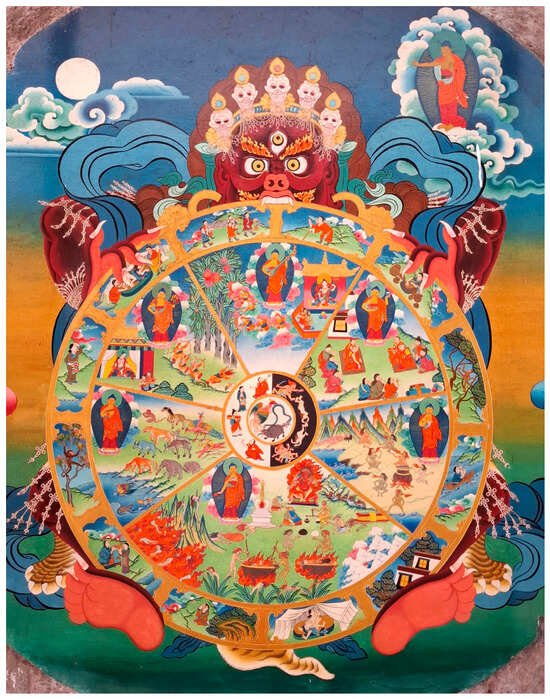
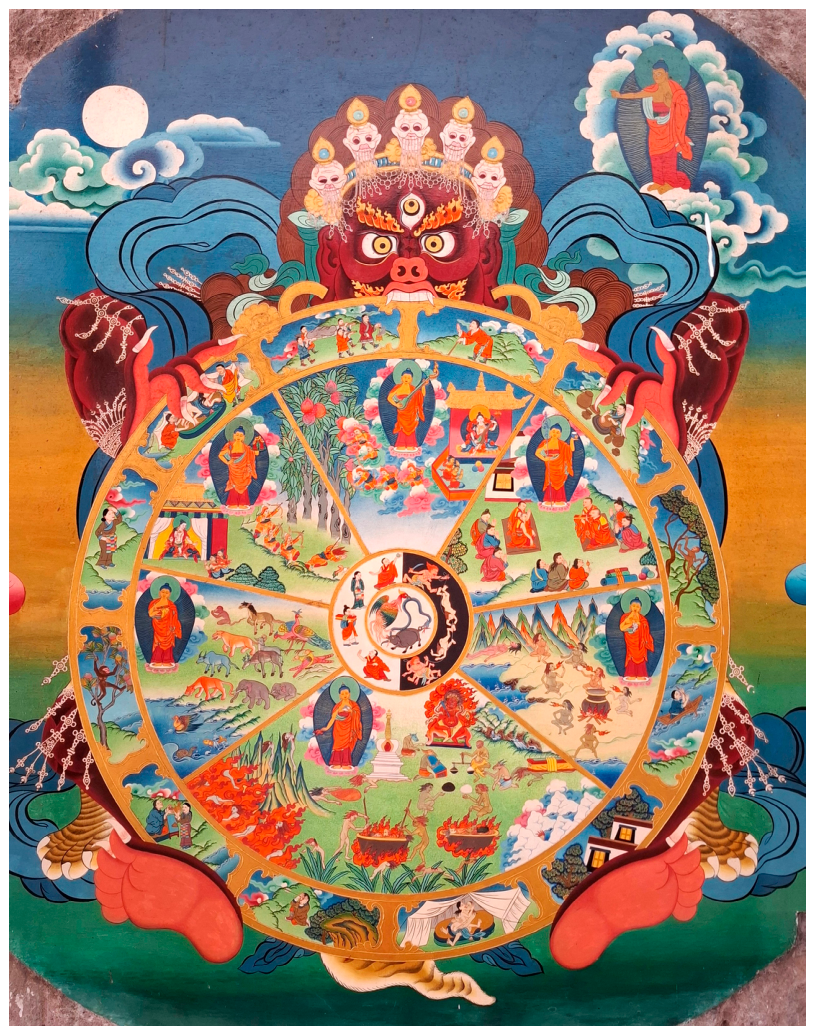
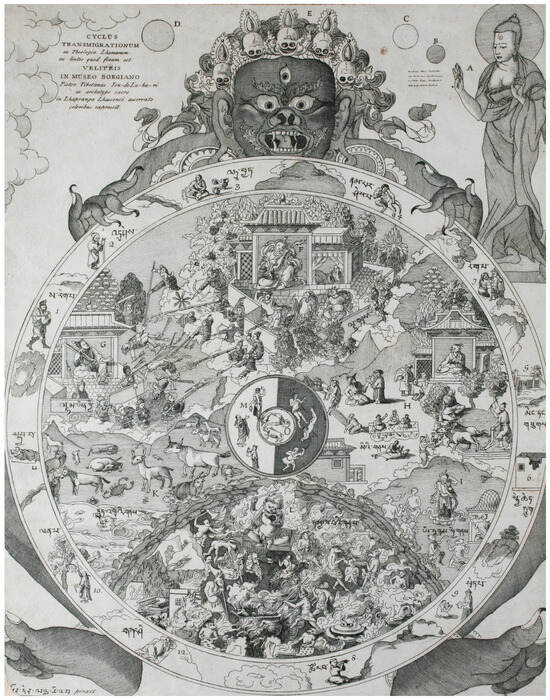
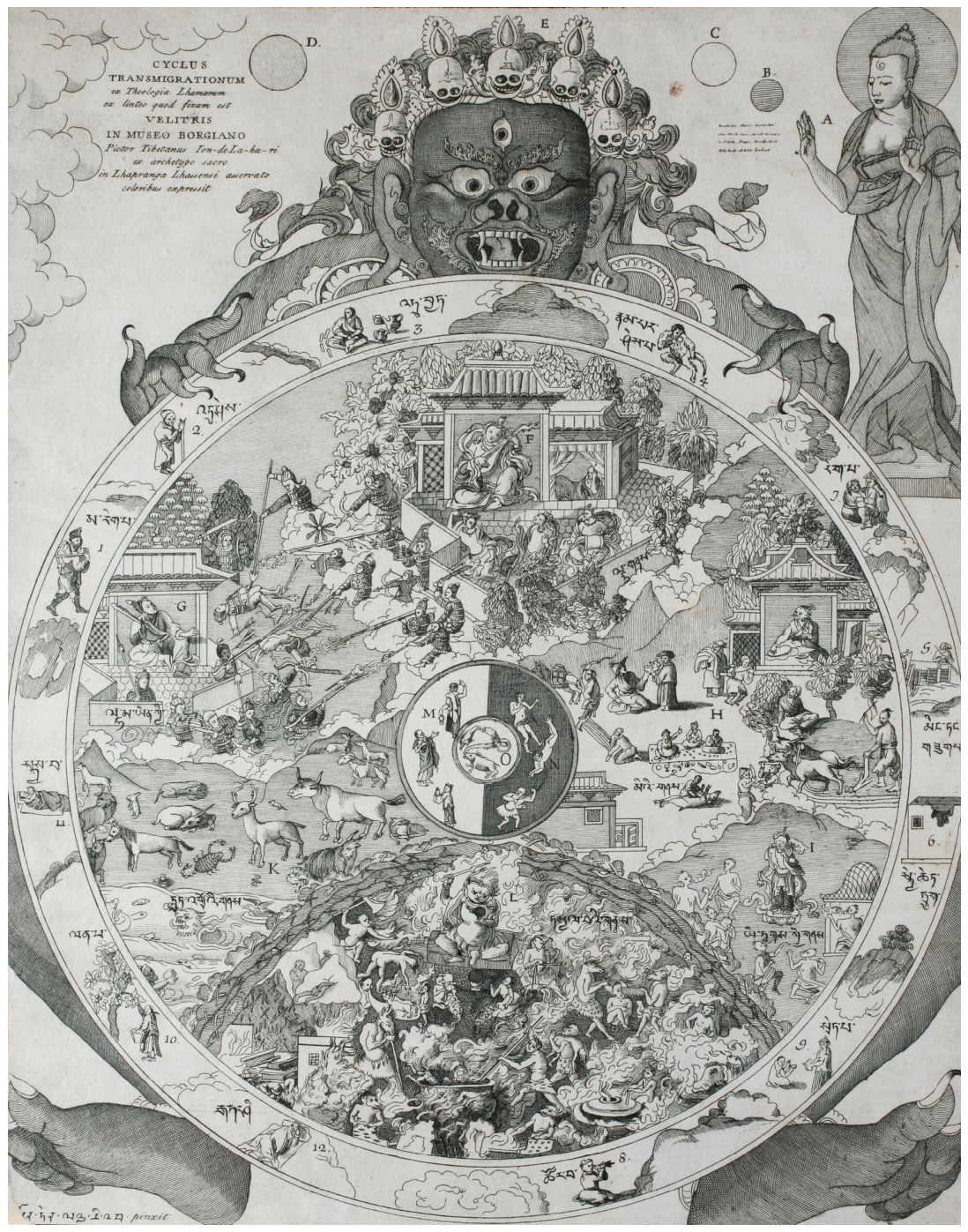
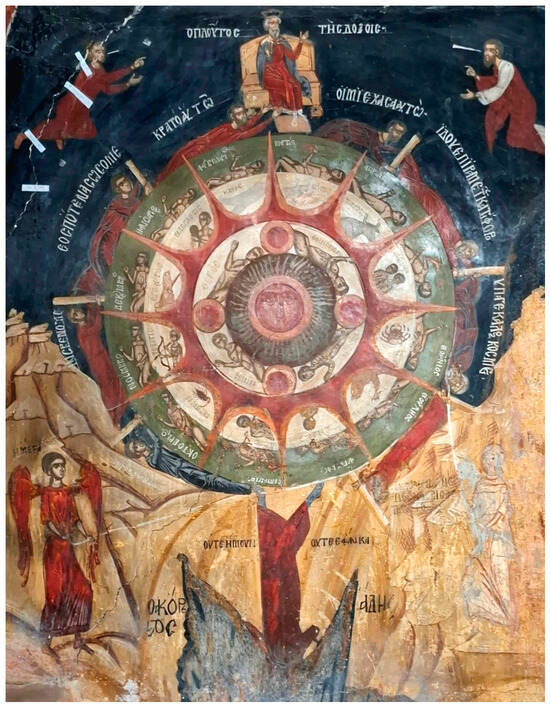
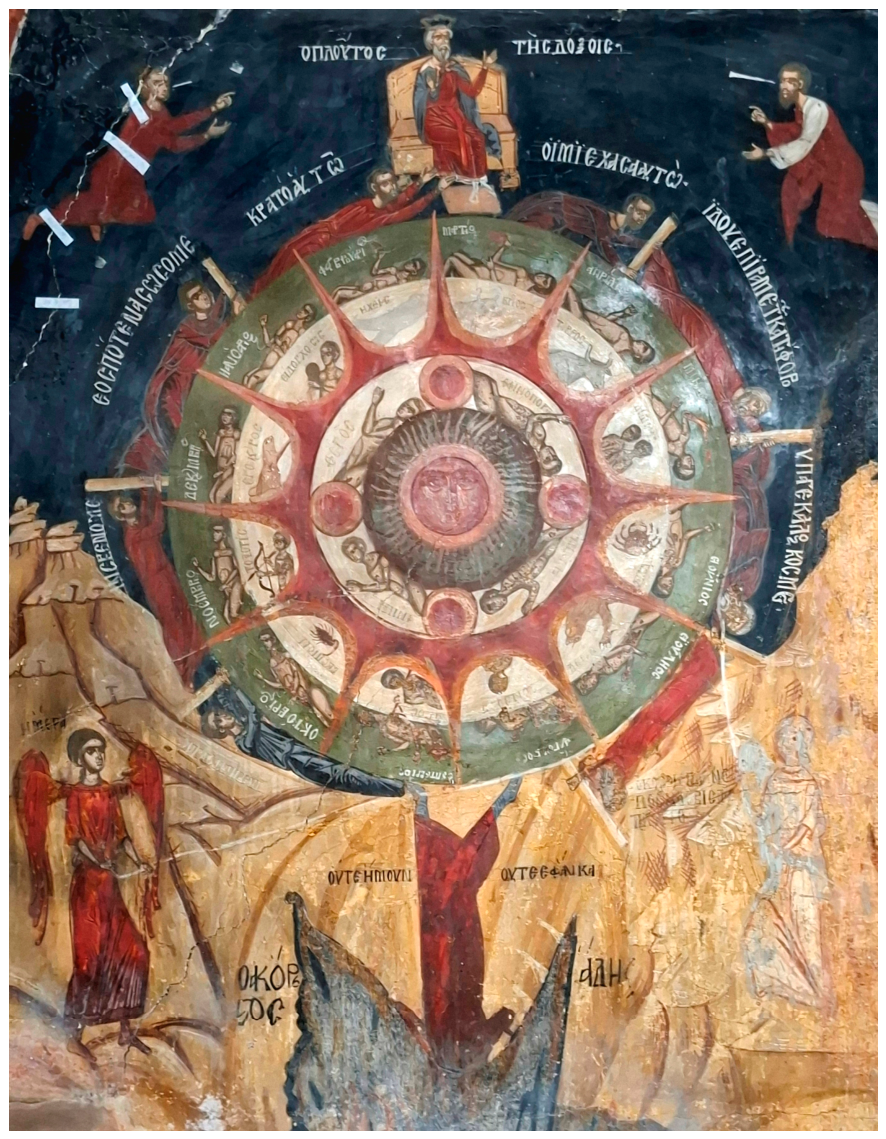
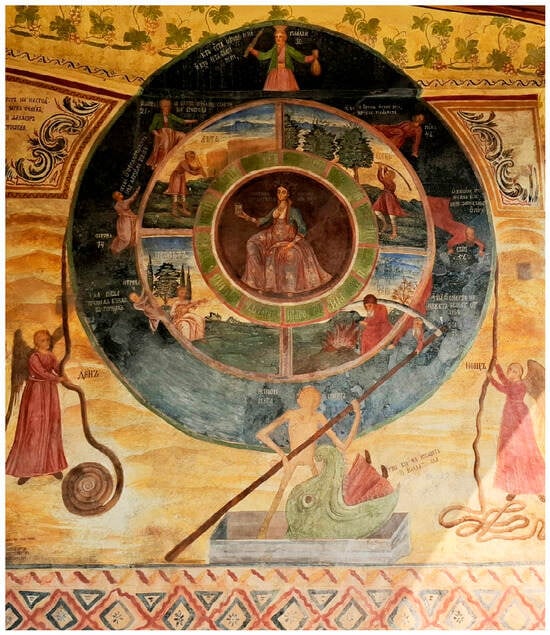
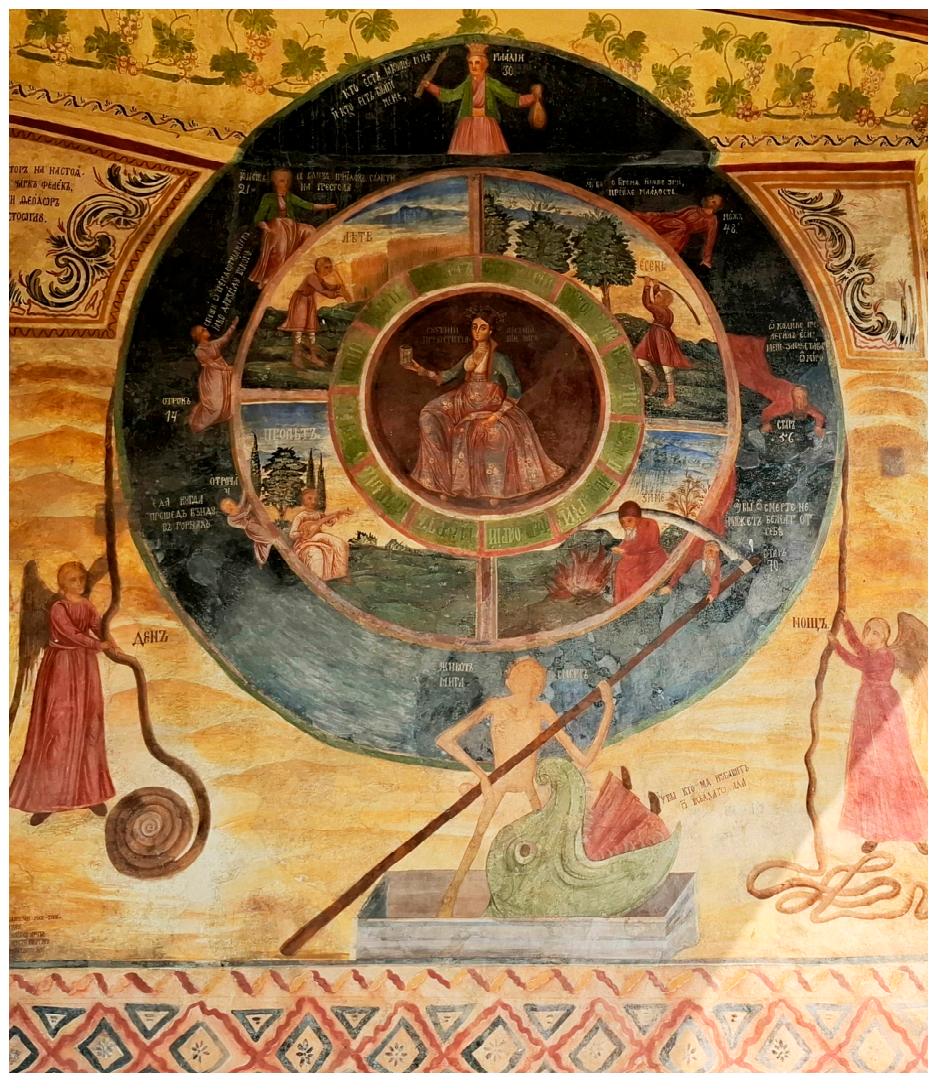
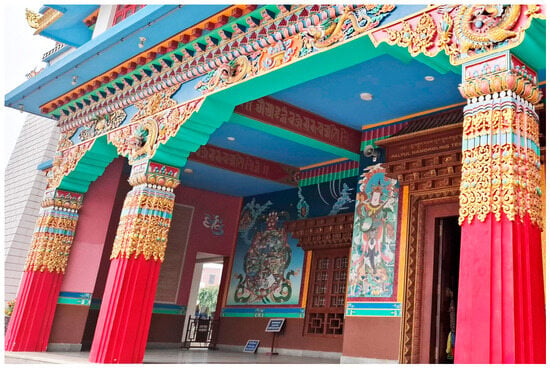
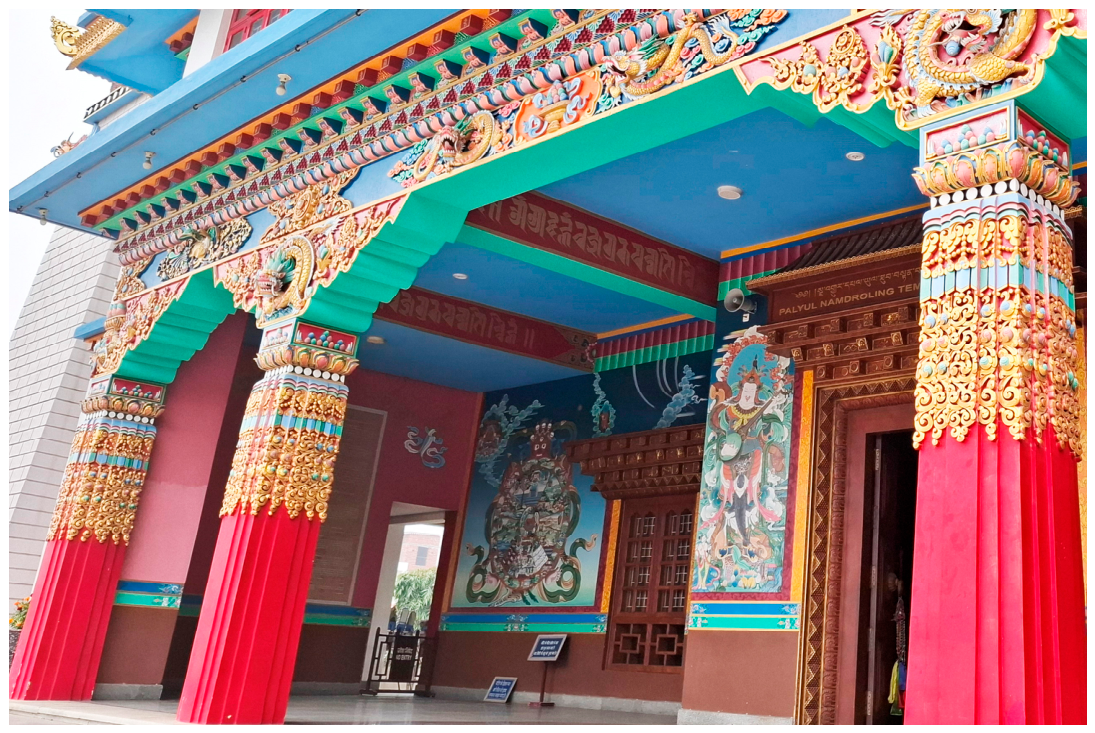
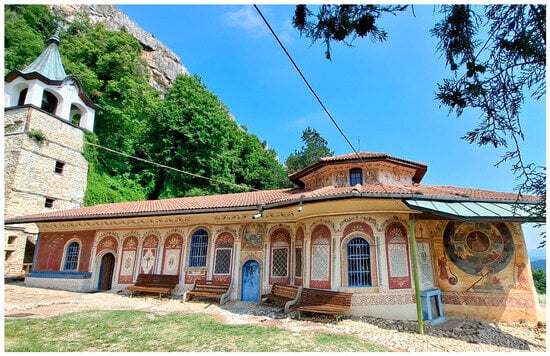
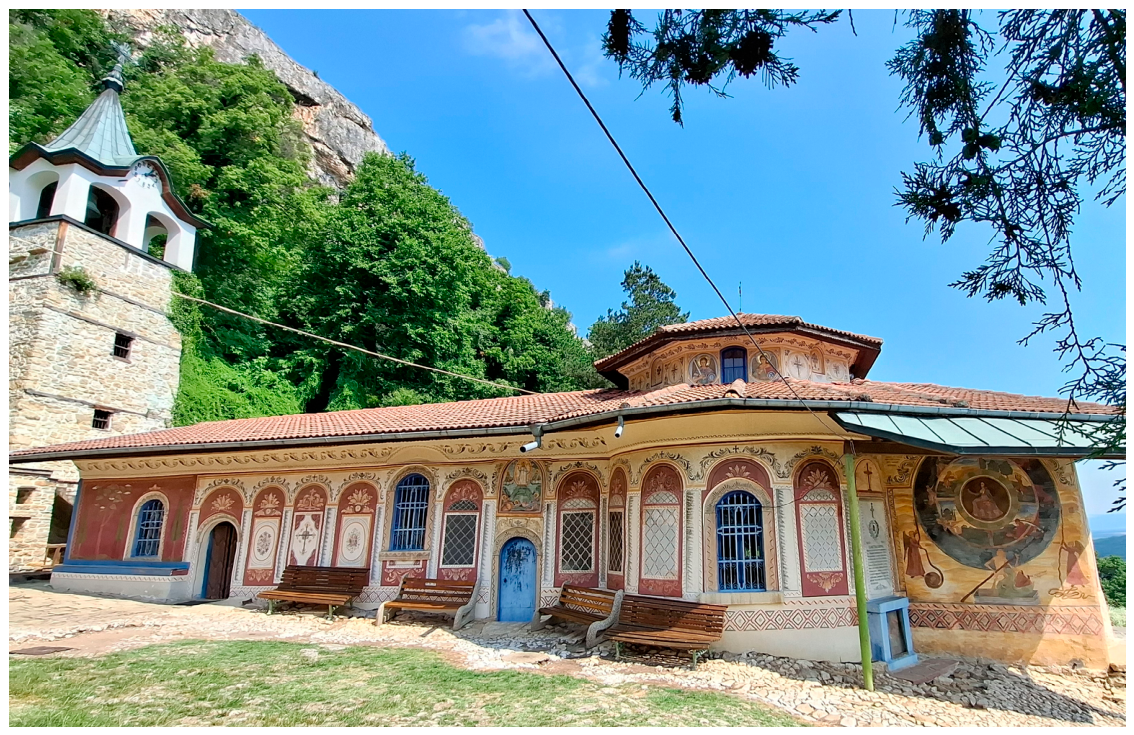

Disclaimer/Publisher’s Note: The statements, opinions and data contained in all publications are solely those of the individual author(s) and contributor(s) and not of MDPI and/or the editor(s). MDPI and/or the editor(s) disclaim responsibility for any injury to people or property resulting from any ideas, methods, instructions or products referred to in the content. |
© 2026 by the author. Licensee MDPI, Basel, Switzerland. This article is an open access article distributed under the terms and conditions of the Creative Commons Attribution (CC BY) license.