


Abstract
On the morning of Saturday, 7 October 2023, which was also the Jewish Festival of Simchat Torah, Israel was attacked by the Hamas terrorist organization based in the Gaza strip. The attack resulted in the murder of 1200 Israeli citizens and foreign workers, thousands were wounded, and some 250 women, men, elderly, and children were abducted, including babies of less than a year old. Hundreds were raped and all the bodies were mutilated, some beyond recognition. The extent of the attack and the extreme cruelty left Israeli citizens shocked and outraged, resulting in Israel’s involvement in the Gaza War. The current article seeks to characterize the responses of recognized influential rabbinical figures from different sectors of Israeli Orthodoxy in both the ultra-orthodox and religious Zionist sectors to these grave events, and to determine to what extent are they consistent with one of the most widely (especially on the political right) voiced secular arguments, namely that the 2005 Gaza withdrawal was one of the root causes of the October 7 massacre.
Methodological Note: This article analyzes rabbinical responses to the events of 7 October 2023, from within a specific standpoint: that of Israeli Orthodox scholarship, attentive to the internal theological logic of the communities studied. The authors are Israeli and Hungarian Jewish scholars with personal connections to the events described. This positionality necessarily shapes the framing and selection of sources, and readers should bear it in mind when evaluating the analysis. The rabbinical voices examined were selected on the basis of prominence and influence within their communities; they do not represent the full spectrum of Jewish responses to the war. The article’s goal is analytical rather than political: to map the theological frameworks through which Orthodox rabbis interpreted a national catastrophe, not to adjudicate the wisdom of Israeli policy.
1. Introduction—Approaches to Dealing with the Reality of Evil in the World
Jewish thought contains several approaches to dealing with the reality of evil in the world, including war: the causal approach, the indifferent approach, the silence approach and the purposeful approach (theodicy).
The causal approach contends that a person may suffer in the present due to sins committed in the past. This is guided by a process of cause and effect. The Torah says: ‘If you follow my decrees… I will send you rain in its season… and you will… live in safety in your land’ (Leviticus 26:3–5). However, ‘…if you reject my decrees… I will bring on you sudden terror… you will be defeated by your enemies’ (ibid., 15–17).
This approach is evident in the Bible and it was accepted by many over the generations. Thus, ‘If a person sees that suffering has befallen him, he should examine his actions’ (Bavli, Berakhot 5a). Also, ‘There is no death without sin; and there is no suffering without iniquity’ (Bavli, Shabbat 55a). If something happens there is a reason for it. Hence, one must repent and correct his ways.
It should be noted that the causal approach, which regards every event—whether good or ill—as a consequence of human actions, is the most prominent and well-known in the history of Jewish theology. However, the very assumption that God has a reason for everything He does or permits is precisely what gave rise to the need to understand and interpret His actions—and it is from this premise that additional theological approaches emerged, each seeking in its own way to grapple with the question of evil and suffering in the world. These approaches will be presented below.
The indifferent approach contends that God does not inflict evil on man, rather evil is the result of man’s folly. Human beings behave unwisely and must bear the results of their foolishness—‘A man’s folly subverts his way’ (Proverbs 19:3). This approach is also found in rabbinical literature, where it is said that everything is in God’s hands, aside from the damages caused by heat and cold and all human deeds of folly. Human beings bring disaster upon themselves (Bavli, Bava Metzia 107b, and Tosafot on site).
Although this approach is indeed mentioned in the Bible and in rabbinical literature, Maimonides too adhered to this line of thought (Moreh Nevokhim 3:11–12), and more recently Yeshayahu Leibowitz (Leibowitz 2002, pp. 142–43). Many objected to this approach, as if there is no religious meaning to the evil that exists in the world and God is not responsible for it, this may lead to a great sense of despair. ‘If our suffering and our wounded dignity have no higher function… then we will be seized by despair’ (Aviad 1943, p. 183; Mashiach 2022).
The purposeful approach (theodicy) contends that people suffer in the present because God wishes to grant them something in the future. This is not a punishment but rather a positive aim. One example in rabbinical literature is the leprosy of a house. The causal approach sees the leprosy of a house and the destruction of the stricken house as a punishment for past sins, while the purposeful approach sees the house’s destruction as an opportunity to discover a treasure.
When the Canaanites heard that Israel was coming upon them, they arose and concealed their money in the houses… What does the Holy One blessed be He do? He brings leprosy in one’s house, and [the owner] demolishes it and finds the concealed cache.(Vayikra Rabbah, Metzora 17)
Another common response is silence. Silence often derives from confusion and discomfiture at the calamity, as it defies all words and explanations. Then again, some remain silent as a matter of principle, opting for this as the correct response when no explanation is tenable. This was the Lubavitcher Rebbe’s response to the Holocaust. He claimed that one must be silent, as there can be no explanation for the Holocaust.
The cruel annihilation of six million Jews… cannot constitute a punishment for iniquities… We have no explanation to offer… for the Holocaust, rather we must only recognize the fact that ‘it is an enactment from before Me’… and certainly not the explanation that it is a punishment for iniquities.(Schneersohn 1991; 1:233)
We shall now relate to rabbinical responses to the events of 7 October 2023. The rabbis cited are recognized influential rabbinical figures from different sectors of Israeli orthodoxy in both the ultra-orthodox and religious Zionist sectors.
2. Rabbinical Attitudes to the Events of 7 October 2023
Preliminary Note—The rabbis featured in this article were selected on the basis of two primary criteria: their prominence and influence within their respective communities, and their affiliation with the distinct streams of Israeli Orthodoxy—the Haredi sector and the Religious Zionist sector. They hold senior rabbinic positions—chief rabbis, city rabbis, and yeshiva heads—or are active in the field of Jewish outreach (kiruv)—bringing secular Jews closer to religious observance—thereby shaping religious public opinion within their communities. Their selection enables a broad and representative picture of rabbinic responses to the events of 7 October.
In Israel, close to 100% of rabbis, and all rabbis who hold official rabbinical positions, are Orthodox; therefore, no women and no Conservative or Reform rabbis appear in this article. The detailed differences between the Litvish, Hasidic, Sephardic-Shas, and Religious Zionist approaches cannot be fully elaborated within this limited framework, but general statements are included to clarify which sector and worldview each cited rabbi represents.
The sources utilized in this article are primary textual sources: written works published by the rabbis in which they address the problem of evil in the world and the events of 7 October in particular, as well as interviews given to the media and lectures delivered to the general public in the aftermath of those events. The interviews and lectures were documented through recording with the rabbis’ knowledge and are publicly accessible via the internet.
A methodological clarification is warranted regarding the nature of the source material. The rabbinical statements analyzed here were not elicited through original interviews conducted by the authors; rather, they consist of primary material already in the public domain—recorded lectures, media interviews, and published writings disseminated online (via YouTube, news outlets, and the rabbis’ own institutional channels)—at the time of, or shortly after, the events of 7 October 2023. Quotations from Hebrew-language sources were translated by the authors, one of whom is a native Hebrew speaker, and were checked against the original recordings or publications to preserve the rhetorical precision required for the analysis—a consideration of particular importance given that several of the central distinctions drawn in this article (e.g., between R. Ashkenazi’s explicit rhetoric and R. Lau’s implicit one) rest on subtle linguistic nuances. Where multiple public statements by the same rabbi were available, the most comprehensive and detailed statement directly addressing the events of 7 October and the question of evil or suffering was selected; where statements were of comparable scope, the first one publicly released was selected—a formal criterion intended to reduce the risk of selection bias.
3. The Indifferent Approach
As stated, the indifferent approach contending that calamities are caused by human folly leads to despair; therefore, no such response was found to the events of 7 October. The statement ‘A man’s folly subverts his way’ (Proverbs 19:3) is indeed evident, but not as part of the indifferent approach rather as an accusatory statement. Some argue that the political leadership behaved foolishly in the context of the Disengagement Plan—an Israeli plan whereby all settlements and IDF forces were evacuated from the Gaza strip unilaterally, with no compensation(!), whereby Israel retreated with no prior agreement or conditions. Since then, every two or three years a mini-war has erupted versus Hamas, who controlled the Gaza Strip and its allies, culminating in the terrible tragedy perpetrated on 7 October 2023.
It should be noted that this accusatory use of the ‘folly’ framework remains analytically distinct from the indifferent approach proper: the rabbis who invoke it do not thereby abandon the idea of divine providence, but rather combine a political critique with a theological one. The indifferent approach, in its pure form, posits that God is absent from such events entirely—a position none of the rabbis examined here adopts.
4. The Silence Approach and Remaining Silent as a Matter of Principle
Notably, most rabbis opted to remain silent in response to the events of 7 October 2023, probably because the grave events are still strongly present among Israeli society. At the time this article is being written the Gaza War is still being waged (as it has been for nearly two years). In addition, the Hamas terrorist organization is holding captive dozens of abductees, with the effect of destabilizing Israeli society. Furthermore, a huge number of people have been murdered and killed in the war, and a very large number have been wounded, both physically and mentally. No home in Israel remains untouched by the events.
Hence, many are of the opinion that the correct response at present is to remain silent. This derives from confusion, discomfiture, and above all the sense that there is nothing to be said, resembling responses to the Holocaust during World War II, when six million Jews were murdered. Then too it took a long time for the rabbis to find their voice, and some still refuse to speak up about the tragedy. If this is true regarding an event perpetrated 80 years ago, all the more so in the context of a tragedy inflicted less than two years ago.
Although the silence of most of these rabbis is caused by discomfiture and confusion, some have argued for silence as a matter of principle. One example is R. Uri Cherki (b. 1959), a well-known influential religious Zionist rabbi who lost his son in a terrorist attack in 2015. When asked ‘Where was God on October 7?’, he replied ‘As God said to Job’s friends: You don’t understand me, don’t try to intervene’ (Cherki 2025). He claims that one cannot understand God, as Isaiah said: ‘For my thoughts are not your thoughts, neither are your ways my ways’ (Isaiah 55:8), so no questions can be asked in His regard.
What is significant in R. Cherki’s invocation of Isaiah 55:8 is not the source itself—it is a classical move within Jewish theology—but the use to which it is put: the verse functions here not as consolation but as a logical terminus. If divine thought is categorically inaccessible to human understanding, then the question “where was God on October 7?” is not merely unanswered but unanswerable in principle—not a puzzle awaiting a solution but a category error. This is silence as epistemological principle. It is worth noting that R. Cherki speaks from a position of personal loss—he lost his son to a terrorist attack in 2015—and this biographical context lends his principled silence a particular moral weight. His refusal to offer an explanation is not the refusal of someone who has not confronted the question personally; it is the considered position of someone who has.
This is the approach taken by R. David Stav (b. 1960), a well-known and prominent religious Zionist rabbi who currently serves as the Rabbi of Shoham. When asked to explain the grave events he replied: ‘From a religious perspective, such a war or such a blow that we suffer is no coincidence. We can’t explain it, we do not wish to suggest explanations, because we do not understand the thoughts of the Most Supreme’. He also rejected the way of those who try to provide explanations ‘and profess to have knowledge of Heavenly calculations’ and added ‘may their mouths fill with earth’, i.e., their mouths should be sealed. ‘We do not know the calculations of the Divine! No one knows why it happened’ (Stav 2023).
R. David Stav’s response adds a polemical dimension absent from R. Cherki’s. Where R. Cherki articulates a principled silence and leaves it there, R. Stav actively repudiates those who do offer explanations, condemning them in sharp terms—“may their mouths fill with earth.” This is a public intervention in the rabbinical discourse surrounding 7 October, not merely a personal theological position. R. Stav is implicitly criticizing the causal approach and all those who adopt it—the rabbis who “profess to have knowledge of Heavenly calculations.” To offer a causal explanation in the face of such suffering is, on his reading, not merely theologically mistaken but morally presumptuous.
This makes the contrast with R. Lau’s response, discussed above, analytically significant. Both are prominent Orthodox figures speaking to broad publics; yet their positions are, on close reading, directly incompatible. R. Lau implicitly invokes the causal logic—“before October 7, was our conduct satisfactory?”—while denying that he is doing so. R. Stav condemns precisely this move as a form of false certainty that the gravity of the events should forbid. That this tension exists openly within mainstream Israeli Orthodoxy, unresolved and apparently unacknowledged, is itself a finding: it suggests that the silence approach and the causal approach are not merely competing theological options but rival pastoral strategies, each with its own understanding of what a rabbi owes his community in the face of catastrophe.
5. The Causal Approach
This approach sees human suffering in the present as a punishment for past sins, following the concept of cause and effect. Accordingly, the proper response to any calamity is to repent and strengthen one’s observance of the religious commandments. Rabbinical literature throughout the generations shows evidence of this approach. It is easily conveyed to the public at large, as the concept of reward and punishment is one that everyone can understand.
Rabbis from the ultra-orthodox sector often tout this approach (Friedman 1991; Brown 2017; Caplan and Leon 2023). The prevalence of the causal approach among Haredi rabbis is not accidental; it reflects deep structural features of Haredi religious culture. Within this world, reward and punishment are not abstract theological propositions but operative principles of daily life, anchored in biblical and rabbinic literature and rehearsed across centuries of sermon literature. The Haredi rabbi’s primary social role is that of moral educator and community mobilizer rather than speculative theologian; his authority derives from demonstrated mastery of sources and from his capacity to translate textual tradition into normative guidance for his community. Philosophical hesitation about the causal framework—of the kind that characterizes Religious Zionist responses—is largely absent from this tradition, which has no comparable investment in reconciling messianic theology with empirical setbacks. For the Haredi community, the question “why did this happen?” is less a metaphysical puzzle than a pastoral one: what does God require of us now? The causal approach answers that question directly, and it is this directness—not naivety—that accounts for its prominence in Haredi responses to 7 October.
This sector is characterized by strict observance of the religious commandments, where most efforts are channeled towards Torah study. Despite the major focus on Torah study, philosophical studies are not included, and therefore the rabbis profess popular attitudes. Hence, in times of tragedy, they promptly call for repentance and stronger observance of the commandments, grasping the events as punishment for the sins of individuals and of society at large.
An example of an ultra-orthodox rabbi who takes this stance is R. Igal Cohen (b. 1972), a well-known and influential advocate for stronger religious commitment. When addressing the events of 7 October 2023, he began with ‘I don’t know why, but…’, starting with a type of apologetic silence but immediately proceeding to preach stronger observance of the Torah and the commandments. This led his listeners to understand that there had been a lapse that required strengthening and this is the reason for the grave event.
Why did God bring [upon us] October seventh?… I must ask myself: What does God want of me?… What should I mend in my actions?… I don’t know why. I can guess—unconditional love, stronger observance of the Sabbath, stronger observance of putting on tefillin, stronger observance of modesty, of the injunctions against slander, of love for fellow Jews… that’s what the Holy One blessed be He wants of us.(Y. Cohen 2025)
R. Igal Cohen’s response illustrates the causal approach in its most characteristic pastoral form. The opening hedge—“I don’t know why, but…”—is rhetorically significant: it performs epistemic humility while simultaneously clearing the ground for a confident normative message. The listener absorbs the impression of a rabbi who does not presume to know God’s calculations, yet the remainder of the statement leaves little doubt as to the implied causal logic: lapses in Sabbath observance, modesty, and love of fellow Jews have created a deficit that the events of 7 October have exposed. The move from apparent uncertainty to practical diagnosis is swift and effective—and it is precisely this combination of humility and clarity that gives the causal approach its rhetorical power in a Haredi context.
Another famous influential ultra-orthodox rabbi is R. Shneor Ashkenazi (b. 1980). He too adheres to the causal approach by calling for stronger observance, because people had insufficiently observed matters of Jewish law and Torah:
There is only one explanation—and no other. The Holy One blessed be He is simply calling out to us… pulling both our ears and slapping both our cheeks… because we didn’t do what needed to be done.(Ashkenazi 2024)
Where R. Cohen opens with a disclaimer, R. Ashkenazi strips the causal approach of all hedging. His statement is blunt and declarative: “there is only one explanation—and no other.” The image he employs—pulling ears and slapping cheeks—is drawn from the register of parental discipline, positioning the divine–human relationship as one of authority and correction in which suffering functions as a pedagogical instrument. Notably, he does not specify which failures are implicated; the vagueness may be intentional, allowing each listener to apply the indictment to whatever they privately feel requires repair. The contrast with R. Cohen is instructive: both operate within the same causal framework, but where R. Cohen gestures toward uncertainty before delivering his diagnosis, R. Ashkenazi offers no such concession. Together, they illustrate the range of rhetorical registers available within the causal approach—from the pastorally careful to the unambiguously direct.
Another famous ultra-orthodox rabbi is R. Zamir Cohen (b. 1965). He too adheres to the causal approach, based on the concept of cause and effect:
There is a biblical verse… ‘For the Lord your God moves about in your camp to protect you… Your camp must be holy, so that he will not see among you anything indecent and turn away from you’ (Deuteronomy 23:14). The Holy One blessed be He says clearly… Do you want me to be with you? [If so,] ‘Your camp must be holy’… The Holy One Blessed be He desires holiness. ‘so that he will not see among you anything indecent and turn away from you’—He says: If there will be such a thing, I can’t be here, I will go away. And when the Divine Presence does not dwell with Israel, heaven forbid, then the result is massacre and suffering.(Z. Cohen 2023)
He continues with a call to repent and to strengthen one’s observance: ‘We must urge ourselves to proceed! To proceed with dedication to stronger observance!’
R. Zamir Cohen’s response is distinctive within the causal framework for its grounding in a specific biblical proof-text. Rather than speaking in generalities about sin and consequence, he identifies a precise scriptural mechanism: the divine presence departs when the camp is not holy, and in the absence of that presence, catastrophe follows. The verse from Deuteronomy (23:14) functions here not merely as rhetorical support but as the theological premise of the entire reading—God has stated His conditions clearly, Israel failed to meet them, and the consequences follow by an internal logic that is neither arbitrary nor cruel but structural. This mode of argumentation—close scriptural reasoning leading to a practical call for repentance—reflects the yeshiva culture from which R. Cohen emerges and speaks, one in which authority is conferred not by emotional impact but by demonstrated command of sources. It represents the causal approach at its most textually rigorous.
Sometimes the causal approach is manifested more discreetly. For example, R. David Lau (b. 1966), former Chief Rabbi of Israel, when asked ‘Just as many have asked where was God in the Holocaust, many are also asking where was God on October 7’. He began by remaining silent but promptly found the culprits.
I don’t follow God’s calculations… I have a little question for us: Before October 7, was our conduct satisfactory? Were we a society deserving of mercy and assistance? So first let’s stop seeking who to blame aside from ourselves, whether God or others. We ourselves did not behave properly.(Kidon 2024)
Then he was asked: ‘So it’s a type of punishment?’, as if ‘we did not behave properly’ then this is an understandable punishment with a known cause. He immediately backed away, but stood by his words:
No, God forbid, not a punishment… but before I make demands of God, I should make demands of myself. I ask Him to help, and He will help me when I myself will improve my conduct. But if I do not do my best, why should He help me?… I do know one thing: Let’s behave properly before we make demands of others… and before we make demands of God.
R. David Lau’s response deserves separate attention as a distinct and more sophisticated variant of the causal approach: the implicit causal reading, or what might be called the rhetoric of deflection. When asked directly whether the events constituted a punishment, he retreated—“No, God forbid, not a punishment”—yet the surrounding logic left his audience with precisely that impression. The rhetorical structure is revealing: a question about God’s responsibility is redirected toward Israel’s own failures; those failures are identified as the appropriate object of moral scrutiny; and the implied conclusion—that improvement in conduct will bring improvement in circumstance—is the causal approach in functional terms, even if the word “punishment” is withheld. This pattern reflects a genuine pastoral sensitivity: the direct causal framing risks alienating or wounding an audience in acute grief. By stating the logic obliquely, R. Lau preserves the normative message while maintaining plausible deniability on the theological claim. This distinguishes his response from those of R. Cohen and R. Ashkenazi not in substance but in register: all three operate within the causal framework, but R. Lau navigates it with a rhetorical care that reflects his position as a former Chief Rabbi speaking to the broadest possible public.
This type of rabbinical rhetoric makes a statement that its hearers can accept, but further on alludes to weak points that should be strengthened, where the tragedy is a consequence of this weak point.
6. The Purposeful Approach (Theodicy)
The philosophers were not in favor of the causal approach. It is hard to perceive God as ‘our Father in Heaven’ or as a ‘merciful and gracious God’, if His relations with his sons are based on violence. If they follow his ways—very good, but if they deviate, even only marginally—they will be severely punished. The concept of reward and punishment is one that is understood by everyone, but it does not suit those with intellectual depth, who are more inclined towards the purposeful approach.
We find the purposeful approach among religious Zionist rabbis. Religious Zionism is a modern orthodox movement that grew from the intricate encounter between Jewish tradition and the Zionist ideology and modern life (Schwartz 2003, pp. 78–92; 2009; Hadad 2020). Historically, it was established by R. Reines in 1902 as the Mizrahi movement. Theologically, the Mizrahi continues the ideology of the Heralds of Zionism (Mashiach 2021). Rather than perceiving itself as forming a new Jewish identity, this outlook was seen as a resumption of the biblical Jewish identity (Mashiach 2014). Nearly all religious Zionists have a higher education and are active in all areas of life within Israeli society (Mashiach 2020).
Hence, religious Zionist rabbis do not profess the causal approach. They adopt the silent response, which results from instinctive or principled discomfiture, or alternately the purposeful approach. No human can follow God’s ‘calculations’, and they are not willing to portray God as a contentious character. In addition, religious Zionists as a society are unwilling to accept the causal approach.
Religious Zionism regards the establishment of the State of Israel as a messianic revelation and a divine instrument for the realization of redemption. Before turning to its rabbis’ responses to the events of 7 October 2023, it is worth noting that this movement had already confronted a profound theological crisis in the wake of the state’s earlier territorial withdrawals (Schwartz 2001): the peace agreement with Egypt (1979), the Oslo Accords (1993), and the Disengagement Plan (2005). The central question posed by these developments was whether the state could still be regarded as an instrument of redemption after choosing to act in direct contradiction to the messianic ideal.
Inbari (2012, 2019) identified three principal responses to this dilemma, as an example of religious Zionist theodicy. The first, representing a minority position, acknowledged the theological failure outright. Its most prominent representative was Rabbi Yehuda Amital, who declared in 1993 that he had erred in identifying the State of Israel with the inception of a messianic process, and announced his support for the Oslo Accords on pragmatic grounds. The second response, that of the statist stream, refused to acknowledge the collapse of the redemptive vision. Its leading figures—Rabbis Shlomo Aviner, Tzvi Tau, and Yoel Bin-Nun—argued that in the absence of definitive proof that the redemption had failed, the state must continue to be regarded as a sacred entity, and called for intensified missionary activity through the ‘Settlement of Hearts’ campaign, alongside deeper engagement with Kabbalah and esoteric Torah study. The third response, the radical one, was represented by the Jewish Leadership movement and Rabbi Yitzchak Ginsburgh, both of whom acknowledged the messianic setback and called for replacing the state as the vehicle of redemption—either through political action from within the system or through the establishment of alternative institutions. These three responses are significant for understanding the rabbinical responses to 7 October discussed below, as the same typological tensions re-emerge, now intensified by the scale of the catastrophe.
These responses lend themselves to analysis within the framework of cognitive dissonance theory. Festinger (1957) demonstrated that believers confronted with facts contradicting their convictions tend to deny those facts and intensify their missionary activity as a means of reducing dissonance. Dawson (1999) developed an expanded model proposing that prophetic failure generates three possible responses: intensification of missionary activity, rationalization of failure through the spiritualization of the prophecy or its reframing as a test of faith, and reaffirmation of the prophecy—all three of which are clearly identifiable in the behavior of messianic Religious Zionist rabbis. It should be noted that the principal distinction between this case and the new religious movements studied by Dawson lies in the absence of unambiguous end-date predictions within Religious Zionist eschatology, a factor that precludes any definitive declaration of prophetic failure and thereby affords the rabbis considerably greater theological flexibility in navigating the crisis.
Against this theological backdrop, we now turn to the teleological approach as articulated by prominent Religious Zionist rabbis in response to the events of 7 October.
We shall now demonstrate how the purposeful approach is expressed by several prominent religious Zionist rabbis. One senior religious Zionist rabbi is R. Yaakov Ariel (1937), the rabbi of the city of Ramat Gan. Immediately after the events of 7 October 2023, he published a book of articles on war that includes a reference to the recent events (Ariel 2023), where he voiced the purposeful approach.
In his opinion, the Gaza War is an opportunity to further clarify the Jewish identity and the differences between Judaism and Islam.
This religious war charges us with the duty of clarifying our Jewish identity. We must know what we are fighting, what is the difference between us and them… Our Torah requires us to worship the God of kindness and mercy, while their faith requires them to worship the ‘god’ of murder and sadism (p. 11).
Further on, he discussed the mission of the people of Israel to deliver the message of monotheism to the world. He quotes the verse ‘Let them know that you, whose name is the Lord—that you alone are the Most High over all the earth’ (Psalms 83:19). As he sees it, this is the responsibility of the people of Israel that is realized in war, which is the path to the desired global peace.
This places considerable responsibility on the champions of the Torah during wartime, as they are charged with granting spiritual meaning to the war and with being role models for their comrades in arms. The more the people of Israel will identify with their own values and aims the more they will draw the entire world closer to making peace with them (p. 16).
In this way, the people of Israel perform Tikkun Olam (i.e., better the world). ‘Only when the spiritual might will be contained within us, will it be capable of impacting our surroundings and the entire world, changing its values, its culture, and its beliefs… we must strive to better the world through ourselves’ (p. 20). As he sees it, the task can be completed only by more strongly clarifying Jewish identity. And that will be best undertaken through war.
R. Ariel sees Israel’s wars as bettering not only the Jewish nation but rather the entire world, where the final goal is universal redemption.
An Israeli victory—means a victory for Torah and increases the impact of that which is good and holy in the world… it is not for our own honor and life that we are fighting, but rather for God’s honor and the future and right of all humanity to exist (pp. 24–25).
Israel’s wars uphold God’s honor… hence, Israel’s victory over its enemies is the victory of the Divine idea… the Holy One Blessed be He is a ‘Master of Battles’ [from the Shacharit prayer], and sometimes it is precisely by means of war… that peace will appear and that perfection will appear in the world (p. 98).
Although war is harsh and terrible, the people of Israel come out of it strengthened (p. 54). That is the function of war, aimed at bettering the world and attaining redemption—i.e., the purposeful approach.
Another famous religious Zionist rabbi who adheres to the purposeful approach is R. Yaakov Medan (1950), head of the Har Etzion yeshiva in Alon Shvut, whose son was gravely injured in the war. Many religious Zionist rabbis were influenced by the philosophy of R. Kook (1865–1935), religious Zionism’s greatest thinker, who served as Israel’s Chief Rabbi. He wrote a composition entitled ‘Orot Hamilchama’ (The Lights of War) (Kook 1953, pp. 13–17), where he adheres to the purposeful approach while stressing that the reason for war is to expedite the redemption (p. 13). R. Medan quotes R. Kook and writes:
R. Kook wrote… that in times of war ‘the power of the Messiah emerges’. We certainly do not desire war, and we strive for (real and not fake) peace. But it has become clear that the war has managed to produce from us, from theory to practice, all the good that was contained within us [Authors’ note—i.e., Unity, volunteerism, helping others, and more]… I believe that this is the true strength of the Messiah… and when all the good that is within us will emerge and act, we will be able to do so much, with God’s help.(Medan 2023)
War is not a punishment, rather it is aimed at bringing redemption to the nation and to the world.
R. Medan’s response is notable for what it does not say as much as for what it does. Unlike the causal approach, he makes no reference to sin or transgression; unlike the silence approach, he does not refuse to engage. Instead, he draws explicitly on R. Kook’s theology of war as a redemptive catalyst—a well-established framework within Religious Zionist thought—and applies it to the specific circumstances of 7 October. The move is significant: by invoking “the power of the Messiah,” R. Medan transforms a national catastrophe into evidence of latent spiritual potential. The war does not reveal Israel’s weakness but its hidden strength—the unity, volunteerism, and mutual responsibility that emerged in its wake. This is a purposeful reading in its most developed form: suffering is not punishment, nor is it inexplicable, but rather a revelatory event that brings forth what was already present but dormant. Notably, R. Medan—whose own son was gravely wounded in the war—chooses this framework not despite his personal loss but, implicitly, through it, lending his theological position a particular moral weight.
Another prominent religious Zionist rabbi is R. Tamir Granot (1970), head of the Orot Shaul yeshiva in Tel Aviv, whose son was killed in the war. Addressing the events of 7 October 2023, he said: ‘This war prevented a civil war among us’ (Granot 2023). In the period preceding 7 October, a large protest took place in Israel in the context of the judicial overhaul. This initiative met with strong resistance, and many participated in huge demonstrations. The protestors perceived the legislation as a form of political upheaval aimed at disrupting Israel’s democratic regime. At the same time, tensions between the secular and religious communities reached new heights. About a week before the October 7 massacre, on Yom Kippur, the holiest day in the Jewish calendar, violent clashes erupted between religious worshippers and secular protestors in Tel Aviv, considered a mostly secular city. References to an internecine war appeared within the Israeli discourse.
R. Granot’s words ‘This war prevented a civil war among us’ refer to this polarization that resulted from ‘separation and controversy… and not listening to the other side’. He stated, ‘I tried to prevent this, I wanted to hold Second Hakafot in Tel Aviv for everyone together, but I did not manage to do so’. On Simchat Torah people dance with Torah scrolls, and on the night immediately after the festival there is more dancing in the streets, called ‘Second Hakafot’. R. Granot is referring to the plans to hold ‘Second Hakafot’ in Tel Aviv. The 7 October massacre that occurred on the morning of Simchat Torah interrupted these plans and there were no ‘Second Hakafot’ that day. R. Granot claims that he wasn’t even able to organize ‘Second Hakafot’, as when cultural figures, rabbis, and politicians met to try and think how to deal with the polarization, the word ‘destruction’ was already in the air. ‘We understood that if this continued, that is what would happen’. He continued: ‘We understood that the judicial overhaul could not be carried out at any cost, that it is necessary to see the virtues of the other sector… We understood that a different plan is necessary here, and we were unable to reach an agreement’.
He also criticizes the religious Zionist public: ‘There was arrogance there, and a lack of attention to the concerns of the other side… without pausing, without understanding the pain, without understanding the possible outcomes’. Hence, in his opinion the ultimate end of the war is not punishment but rather to lead to national unity.
R. Granot’s response stands out within the purposeful framework for its explicitly social-political dimension. Where R. Ariel and R. Medan locate the war’s meaning within a universal or national-redemptive narrative, R. Granot grounds it in a concrete internal Israeli crisis: the judicial overhaul and the resulting societal fracture. His claim that “this war prevented a civil war among us” is striking precisely because it inverts the expected theodical logic—rather than asking what the war was sent to punish or to achieve in a cosmic sense, he identifies its meaning in what it forestalled. This is a purposeful reading of a distinctly pragmatic kind: the war’s function was not transcendent but therapeutic, healing a wounded society by forcing it to confront a common external threat. Notably, R. Granot does not avoid self-criticism directed at his own camp—his acknowledgment of “arrogance” within the Religious Zionist public adds a dimension of intellectual honesty rarely found in theodical discourse, and distinguishes his response from the more universally redemptive readings of R. Ariel.
Another important religious Zionist rabbi who adheres to the purposeful approach is R. Binyamin Kalmanzon (1957), head of the Otniel yeshiva. On 7 October 2023 his two sons and his grandson left Otniel of their own initiative to provide assistance to members of Kibbutz Be’eri, a kibbutz that had been attacked by dozens of Hamas terrorists, who murdered more than 100 residents and abducted 32. Under fire, they toiled for 15 h to extract more than 100 of the kibbutz residents, until his eldest son was killed.
When asked ‘Why was the land fated?’, he indeed apologized ‘Is such a question even possible?!’ (Kalmanzon 2024) but also replied: ‘One cannot avoid asking. Why? What happened? Particularly if you are a person with an ideology, with faith, who thinks that things have a reason, then you will certainly ask’.
R. Kalmanzon links destruction to redemption, a decline prior to ascending.
The people of Israel never concluded with destruction, [they] always look forward towards redemption… It is precisely the event of the destruction that the sages utilize towards a process of growth. For example the midrash says [Eikha Rabbah 1]… the Messiah is born on Tisha b’Av… What do they mean? That the process of redemption begins with destruction… Yes, so we truly talk a lot about repairing, about the essential process involving the destruction that is essential for reaching the redemption.
He says that the decline not only occurs before the ascension, rather it is a necessary condition for rising. Without the decline there will be no ascension. R. Kalmanzon is alluding to the rabbinical statement: ‘Do not gloat over me, my enemy. Though I have fallen, I will rise. Though I sit in darkness, the Lord will be my light (Micah 7:8). If I had not fallen I would not have risen. If I had not sat in the darkness, the Lord would not have been my light’ (Yalkut Shimoni, Psalms 5). The destruction, say the midrash and R. Kalmanzon, is part of the process of redemption, and it is essential. Hence, tragedies in general, including the events of 7 October, are part of the ultimate end that God intends for Israel—redemption.
He further claims that the destruction and the calamity are part of a Divine process of growth, betterment, and redemption.
I would like to further specify the meaning of the destruction within the process of redemption, within the process of betterment. Why, even in this grave situation, is it possible to see that which will subsequently be generated from it? The Holy One blessed be He extracts the remedy from the blow… The blow they incurred enabled the [process of] repair… In Jewish thought, there is no blow that exists for its own purpose. There is only a blow for the purpose of betterment… We have an opportunity to take these things in the direction of repairing.
And of what does the repairing consist in his opinion?—‘The repairing requires true unity’. He refers to the split that existed before 7 October, due to the judicial overhaul.
I think that one thing you can learn from the destruction events endured by the Jewish people… they resulted from a split between factions, where each saw the justice of their own view… October seventh as a test of unity!… This repairing can occur within Israeli society, this process of repair must occur within Israeli society.
And war is the best producer of national unity. War makes people forget their disagreements and rally together. This is what happened on 7 October 2023. On that very day, the nation was united and all disagreements were forgotten. Hence, the ultimate end is unity, unity will lead to redemption, and it all began with war—i.e., the purposeful approach.
R. Kalmanzon’s choice of sources is theologically significant. By invoking the verse from Micah (7:8)—originally a personal lament—and grounding it in the well-established midrashic reading of Yalkut Shimoni, he performs a deliberate hermeneutical move: he elevates a personal expression of suffering and recovery to a structural principle of divine governance. The decline is not a failure of providence but its mechanism. This distinguishes his response sharply from the causal approach: where the causal reading locates the cause of suffering in human sin and looks backward, Kalmanzon’s purposeful reading locates its meaning in divine design and looks forward. Crucially, on this reading, the question “why did this happen?” is not answered by identifying a transgression but by identifying a destination—national unity as a precondition for redemption. The midrashic framework thus absorbs the catastrophe into the redemptive arc without requiring either an accusation or an apology.
A further clarification concerns how the Religious Zionist rabbis surveyed here relate to the war itself, as distinct from the massacre that precipitated it. None of the Religious Zionist rabbis surveyed here who adopt the purposeful approach treat the war as good in itself, or as a desirable outcome. War, in the sources analyzed, is consistently framed as a tragic necessity: forced upon Israel, not chosen by it, and productive of loss and grief even where it is also read as productive of unity, spiritual clarification, or providential meaning. R. Ariel’s language of “victory” and R. Medan’s invocation of “the power of the Messiah” describe what may emerge from the war, not the war as such; both rabbis, like R. Granot and R. Kalmanzon (the latter of whom lost a son in the war), write from within considerable personal and communal loss, and their theological readings do not efface that loss. In this respect, the purposeful approach, as articulated by these rabbis, differs from a triumphalist account of war: it is a claim about what suffering may yet be made to yield, not a claim that the suffering itself is good.
7. Comparing the Religious Approaches to the Practical Explanations—The Question of the Disengagement
Note on the structure of this section: The following discussion moves between two analytically distinct registers that the reader should bear in mind. The first is descriptive and empirical: what did the disengagement entail, and what were its measurable consequences? The second is interpretive: how can those consequences be read through the theological frameworks outlined above? The authors’ own assessments are clearly marked where they appear; they do not represent a political verdict on Israeli policy but rather an attempt to show how secular and religious frameworks can converge in their reading of historical events.
The 2005 disengagement constitutes the most concrete test case for the rabbinical theodicies surveyed above, for two reasons. First, it is regularly invoked in Israeli public discourse—including by some of the rabbis cited above—as a causal antecedent of the 7 October attack. Second, because the disengagement involved the active dismantling of Jewish settlements within the territory of the biblical Land of Israel, it raised theological questions in halakhic terms (concerning the obligation to settle the Land and the principle of pikuach nefesh) that the more general “why did this happen?” of 7 October does not. The aim of this section is therefore not to render a political judgment on the wisdom of the 2005 decision—that is a matter on which historians, political scientists and Israeli citizens themselves disagree, and on which neither of the present authors is in a position to pronounce definitively—but to examine how the four theodical frameworks set out earlier (causal, indifferent, silence, purposeful) map onto the disengagement debate, both as it took place in 2005 and as it is being retrospectively reread after 7 October.
8. Religious Approaches to the Practical Explanations of the Disengagement Around 2005
Gaza City has been continuously inhabited for some 5000 years and is mentioned in the biblical corpus (e.g., Genesis 10:19; Joshua 13:3; Amos 1:6–7) and in the Amarna letters (Mandell 2025). Over the longue durée the territory has been ruled by a succession of empires, briefly independent during the Philistine period (Faust and Lev-Tov 2014), and continuously under Muslim rule from the seventh century until the British Mandate, with brief interruptions during the Crusades and the Napoleonic campaign (Filiu and King 2014, pp. 17–33). This deep history matters here not because the rabbis we examine ground their arguments in archaeology or in the biblical record alone, but because the religious-Zionist insistence that Gaza is part of the Land of Israel—an issue we return to below in connection with the disengagement—rests on its inclusion within the biblical descriptions of the Promised Land. However, this interpretive framework almost entirely overlooks which religion, ethnicity, and culture are dominant among the population living in the Gaza Strip.
Under the British Mandate, Gaza was a predominantly Arab town with a small, long-established Jewish minority. The 1929 disturbances—part of the wider unrest across Mandate Palestine arising from the unresolved conflict over Jewish immigration, land purchase, and the political future of the territory—led to the permanent departure of the Jewish community from Gaza City; their lives were saved by the intervention of Arab neighbours, including the family of the former mayor Said Shawa (Filiu and King 2014, pp. 38–56). The Muslim Brotherhood, founded in Egypt by Hassan al-Banna, established a presence in Gaza during this period, owing in part to geographical proximity to Egypt; its later transformation into Hamas in the late 1980s gives this otherwise minor detail considerable analytic weight for our discussion below—because Hamas unequivocally excludes the possibility of any Jewish presence in the territory.
The contemporary contours of the Gaza Strip were the product of the 1947–1949 conflict. UN General Assembly Resolution 181 (II) of November 1947 envisaged Gaza as part of a much larger Arab state alongside a Jewish one (UN General Assembly 1947). The plan was accepted by the Jewish leadership and rejected by the Arab states and by Palestinian Arab leaders, who regarded partition as direct intervention of external powers on a territory in which Arabs constituted the demographic majority; the rejection, the ensuing inter-communal war and the 1948 Arab–Israeli war produced what Israelis remember as the War of Independence and what Palestinians remember as the Nakba (catastrophe). The Strip’s population roughly tripled in 1948 with the arrival of refugees from areas that became Israel; it has remained a refugee-majority territory ever since, a fact that conditions both Palestinian political consciousness and the regional geopolitics within which the rabbis examined here are operating. Between 1949 and 1967 the Strip was administered by Egypt under armistice terms (Filiu and King 2014, pp. 38–56).
In June 1967 Israel captured the Gaza Strip and subsequently built settlements there and maintained a military presence. By 2005 there were twenty-one Israeli settlements in Gaza with around 8000 or more settlers—alongside a Palestinian population that lived under Israeli military control, with the political, economic and humanitarian constraints that condition entailed. In December 2003 Prime Minister Ariel Sharon (then of the Likud Party) announced a plan to evacuate (with force, if it is necessary) the settlers and withdraw Israeli military forces from Gaza. Proponents argued that the Israeli presence in the Gaza Strip had become too costly in terms of human lives, economic burden and demographic challenge (i.e., growing Palestinian population vs. maintaining a Jewish democratic state, if we take the one state solution as a base), while opponents mainly argued it represented a concession made without reciprocal agreement and risked exporting instability. The Israeli Cabinet approved the plan in June 2004, and by 12 September 2005 the last Israeli military unit left the Gaza Strip. Ideologically, the withdrawal marked a shift from a maximalist territorial Zionist commitment toward a more pragmatic ‘territorialist’ perspective, which accepted that Israel might relinquish territory it judged difficult to hold long-term (Podeh 2025, pp. 719–21; Filiu and King 2014, pp. 279–300; Lewin 2016; Sheleg 2007).
The disengagement precipitated a major domestic political realignment in Israel. On the right and especially in the national-religious camp the plan was deeply opposed: these actors viewed the withdrawal as betrayal of Zionist principles and as surrendering land without reciprocal peace. Within Likud, Sharon’s move created a major fracture (politically, the disengagement led Sharon to leave Likud and found the centrist party Kadima in late 2005, marking a reshaping of the Israeli party system) (Lewin 2016, Sheleg 2007). Centrist and ‘security-oriented’ voices (including Sharon himself) argued that the withdrawal was a realistic security move: fewer soldiers exposed in remote settlements, reduced casualty risk, and relief of demographic pressures (in the case of a one state solution). On the left and among peace-camp actors, there was conditional support: many welcomed the physical withdrawal but criticised its unilateral nature, arguing that without negotiation and Palestinian reforms the move might not lead to durable peace (Geist Pinfold 2023, pp. 72–74).
But why did the relinquishment of such a small, mostly insignificant territory provoke such intense debate, especially on the Israeli right? The reason is largely religious, and only to a lesser extent attributable to the political factors outlined above. Primarily, it is because the Gaza Strip (unlike, for example, the Sinai Peninsula, which was handed over to Egypt in exchange for a peace treaty) is considered part of the Promised Land. Although the Tanakh contains several, sometimes differing, delineations of exactly where God set the geographical boundaries of the land promised to the Jewish people (Genesis 15:18–21; Exodus 23:31; Numbers 34:1–12; Deuteronomy 1:7–8; Deuteronomy 11:24; Joshua 1:4), the territory of the Gaza Strip is considered part of the Promised Land under all interpretations (Weinfeld 1993, pp. 52–67); and the conquest of the Promised Land is a divine command.
Of course, it is disputed whether this command should be understood in a military sense. According to Ramban, although the conquest of the Promised Land is a divine commandment, the manner of it does not necessarily require militant solutions. But it is also important to clarify, Ramban does not state that a war to gain control over the Promised Land will not be/could not be a commanded war—he only warns that the commandment of wiping out the seven nations (mentioned in the Tanakh) is not applicable anymore (Ramban (Nachmanides) 1270). Therefore, if a part of the Promised Land is taken in the wake of a commanded war, then it is justified to keep control over this territory. However, the most prominent figures of the contemporary religious Zionist rabbinical literature take a position that unequivocally prohibits the conquest of the Promised Land by war (neither based on commanded, nor on the basis of discretionary war), rather endorse settling and inheriting the land—although these views are subject of debates. Nevertheless, defensive and preemptive wars are allowed, since they fall in the category of commanded wars—and just like we mentioned above, if a part of the Promised Land is taken in the wake of a commanded war, then it is justified to keep control over this territory (Ravitzky 1996, p. 117). Basically, we can argue that since the control over the Gaza strip was obtained during a commanded war, the acquisition can be seen as justified from a certain religious point of view.
At the same time, if we argue against the previously discussed positions and claim that Israel has no right to exercise control over the Gaza Strip because it was achieved with military operations, certain religious problems still arise in connection with the unilateral withdrawal—namely, that the plan also required the Jewish population living there to leave the area. This, however, was clearly contrary to the commandments, and it was precisely this that formed the basis of the tension: how should those act who believe that by abandoning the settlements in the Gaza Strip they are committing a sin, even if convincing real-political arguments supported the maneuver?
From a religious perspective, the most straightforward solution was the precedence of the principle of pikuach nefesh—preservation of life—which was also emphasized by, among others, Rabbi Ovadia Yosef. According to this principle, if the transfer of a territory drastically reduces the likelihood of war and significantly increases the chances of long-term peace, then lives can be saved thereby; and the sanctity of life, together with the commandment to preserve it, overrides all other commandments (Yosef 1981–1982, p. 14). It should be noted here that there were also other significant interpretations of religious law. For example, Rabbi Shlomo Goren took the position that the Gaza Strip (although logic might suggest otherwise) cannot automatically be regarded as a sanctified territory, and therefore, from a halakhic point of view, there is no religious obligation to retain it. He believed that the fate of the Gaza Strip could be decided by Israel’s political leadership on pragmatic rather than halakhic grounds (Goren 2002, pp. 48–51).
It is here that the religious and secular interpretive frameworks intersect. The pikuach-nefesh argument as advanced by R. Yosef and others is, in form, a consequentialist claim: it depends on the empirical premise that withdrawal will, on balance, reduce the loss of life. Although it is not capable of providing a complete picture of the negative effects caused by the conflict, for the purposes of illustration and quantification, we will use data on fatalities. Between 1967 and 2005—in more than 38 years—230 Israelis and 2640 Palestinians were killed in the Gaza Strip; a large number of them during the Second Intifada (Fendel 2005; Bin-Nun 2024). The political and religious supporters of the disengagement thus sought, by means of it, to avoid such loss of human life. It is important to note that—albeit on the basis of differing perspectives—the Israeli left, centrist and security-oriented voices, and the overwhelming majority of Israeli Orthodox rabbis alike judged, between 2003 and 2005, that there was a realistic prospect of achieving this. The principle of pikuach nefesh therefore temporarily coincided entirely with the secular majority view on the disengagement, which saw in it an opportunity to spare Israeli (and Palestinian) lives. We must acknowledge that the religious and the political narratives did indeed momentarily converge, and that the ultimate argument—namely the paramount importance of preserving life—was likewise identical; it must be stressed, however, that the majority of Israel’s domestic political actors arrived at this conclusion not out of religious conviction, but out of political conviction or, in certain cases, out of realpolitik calculation.
9. Religious Approaches to the Practical Explanations of the Disengagement Nowadays
The disengagement, however, had an extremely significant impact not only on Israeli but also on Palestinian politics. The Gaza Strip became the principal arena of the Palestinian political schism: Hamas, an Islamist movement whose origins lie partly in the Muslim Brotherhood network referred to above and which had grown during the First and Second Intifadas as a rival to Fatah and the PLO, won the 2006 Palestinian Legislative Council elections. The ensuing power struggle—in which external actors, including Israel, also played a role—culminated in 2007 with Hamas establishing exclusive control over Gaza and the Palestinian Authority retaining the West Bank (Hilal 2010). The two territories have been governed separately, without further general elections, ever since. The internal Palestinian civil war that broke out resulted in the deaths of 454 Palestinians (Human Rights Watch 2008).
Since the disengagement took place, every two or three years a mini-war has erupted between Israel and Hamas, therefore subsequent events have produced data against which the premise of the previous chapter can be assessed. What we offer below is not a moral ledger but a description of the empirical record against which both the secular “mistake” thesis and the religious pikuach nefesh reading would have to be tested.
Since the withdrawal, up until 7 October 2023, in armed clashes primarily connected to the Gaza Strip, 308 Israelis and 3079 Palestinians were killed (Tan 2023); during the October 7 massacre itself, about 1200 Israelis lost their lives, and during the subsequent Gaza War a further 922 Israeli soldiers have fallen (so far) (Fabian 2025), while the number of Palestinian casualties is estimated at around 70,000 (Reuters 2025)1.
Read narrowly—that is, with reference only to Israeli casualties arising from Gaza-related conflict—the Figure 1 suggest that the post-2005 period was at least as costly as the period of direct military presence; the 7 October attack itself produced more Israeli civilian deaths in a single day than the preceding fifty-six years combined. Read more broadly, however, we get an even more depressing picture: Palestinian casualties since the withdrawal—and overwhelmingly during the post-October 7 war—have run an order of magnitude higher than Israeli ones, with the human consequences for the population of Gaza being on a scale that international humanitarian organisations have described as catastrophic. Given its scope and the complexity and sensitivity of the subject, the present study does not seek to set out the political or religious interpretations of the Palestinian side. Nor does it examine whether the population of Gaza regards the period before or after the disengagement as the more favourable one—a judgement that would rest not only on the number of deaths, but also on a range of other factors, impressions, and subjective experiences. We nonetheless regard all of these as questions whose careful study could do much to broaden the necessarily narrow focus of this article and to enrich the relevant literature substantially.
Figure 1.
Sources: 2005 and Bin-Nun (2024) for 1967–2005; Tan (2023) for 2005–6 October 2023; Fabian (2025) for Israeli soldiers killed in the post-October 7 war; Reuters (2025) for the 7 October 2023 attack and the subsequent Gaza war.
Both readings, the narrow and the wide, are present in the data; neither, on its own, settles the empirical question of whether the pikuach-nefesh argument for withdrawal has, in retrospect, been vindicated. What can be said with greater confidence is that the underlying premise of the 2005 decision—that physical disengagement, in the absence of any political settlement with the Palestinians, would over time produce a significant reduction in violence—has not been borne out. At the same time, it must be added that although the disengagement is indeed a frequently invoked explanation for the October 7 massacre (above all on the Israeli political right), the relevant international scholarly literature tends to identify more complex factors in this regard. While the disengagement does occupy a (limited) place within the prevailing scholarly narrative, it is by no means treated as the sole cause. At present, scholars of the subject hold that the October 7 massacre was produced by a combination of factors: alongside the disengagement (Geist Pinfold 2023, pp. 82–84; Podeh 2025, pp. 729–31), these comprise Israeli intelligence and military failure (Barnea 2024, pp. 1075–77; Barnea 2026, pp. 57–59); Benjamin Netanyahu’s Hamas strategy and the domestic-political context of the judicial reform (Roznai 2025); the transformation of Hamas’s offensive strategy and the strengthening of the “Axis of Resistance” (Sobelman 2026; Miller 2025); and the regional motivation of disrupting Saudi–Israeli normalization (Friedman and Krasna 2023) (see Figure 1).
From this point onward, our discussion turns from the empirical record to the theological frameworks set out earlier in the article: how have the four approaches outlined in the introduction been deployed, by the rabbis we examine and by their interpreters, to make sense of this record?
It is at this point that the four theodical frameworks set out earlier become analytically relevant. The three questions that follow are not advanced as our own verdict on the disengagement; they are reconstructions of the form an indifferent, a causal and a purposeful reading would respectively take, and we treat them as such.
An indifferent reading would frame the disengagement as a strategic miscalculation by the Israeli political leadership of the day—one product of the wider human capacity for misjudgment that, in this approach, accounts for most of what happens in history without divine involvement. Such a reading does not require us to dismiss the considered case for withdrawal that was advanced in 2005 (the costs of occupation, demographic pressures, the partial precedent of the Egyptian peace) but treats subsequent events as the working-out of human decisions in their full contingency. As noted in our discussion of the rabbinical responses, this is the framework least compatible with religious-Zionist messianic theology, and it is largely absent from the rabbinical literature we surveyed; it is, however, the dominant framework in much Israeli secular commentary on the disengagement.
A causal reading—the form most readily available within Haredi rhetoric—would identify the disengagement as a transgression (the abandonment of settlements within the Land) and read the events of 7 October as its delayed consequence. This reading, although it has appeared in some popular Haredi discourse, is constrained by the fact that the most authoritative pre-2005 halakhic decisors (notably R. Ovadia Yosef, drawing on pikuach nefesh; R. Shlomo Goren, on the halakhic status of the territory) considered withdrawal religiously permissible. The retrospective claim that the disengagement was a sin therefore requires the additional move—not made within most authoritative halakhic literature—that the empirical results of an act can transform a halakhically permitted action into a transgression. The causal reading, in other words, is theologically available but is in tension with the established halakhic framework on which it rhetorically draws.
A purposeful reading, finally, treats the disengagement and its long aftermath as part of a process whose meaning is given not by its immediate political logic but by the larger redemptive narrative within which religious-Zionist theology locates the State of Israel. On this reading, the painful course of events since 2005 forces a confrontation with the limits of unilateral action and with the assumption that physical withdrawal can substitute for an unresolved political conflict; whatever lessons emerge are part of the slow, non-linear process of redemption to which rabbis like Kalmanzon and Medan refer. We note this not as our own conclusion but because, of the four frameworks, it is this one that proves most resilient to the post-2005 record—precisely because, as Inbari (2012) has shown in another context, religious-Zionist theology has well-established techniques for absorbing apparent setbacks into the redemptive arc. The silence approach, by contrast, is in some respects the most epistemically modest response: it concedes that no available framework adequately accounts for what occurred and refuses to construct one prematurely.
10. Conclusions
At the beginning of this article, we indicated four approaches to dealing with manifestations of evil in the world, including war: the indifferent approach, the causal approach, the purposeful approach, and silence. The rabbinical responses surveyed have confirmed the basic typology—but they have also complicated it in ways that deserve explicit acknowledgment.
The indifferent approach was not discerned in rabbinical responses to the events of 7 October 2023. Rabbis see themselves as charged with lifting people’s spirits and instilling hope; the indifferent approach, which assigns no religious meaning to human suffering, leads listeners to despair and is therefore pastorally unavailable to a rabbi addressing a community in crisis. It does appear in certain works within the Jewish philosophical canon, but these are addressed to a narrow intellectual audience and are not suited for public discourse in a moment of national trauma.
The silence approach is clearly evident in the responses to 7 October, and it operates on two distinct levels. The first is silence stemming from discomfiture and shock—a recognition that the events are so grave as to defy explanation, and that the nation was not ready to receive one. The great majority of rabbis, across all sectors, chose this path. The second level is silence as a matter of principle: the considered position that divine thought is categorically inaccessible to human understanding, rendering the question “why did this happen?” not merely unanswered but unanswerable. R. Uri Cherki and R. David Stav represent this principled silence—though with an important difference. Where R. Cherki rests in the epistemological limit quietly, R. Stav transforms it into a polemical stance, actively condemning those who presume to offer explanations. His condemnation, read alongside R. David Lau’s implicit causal reasoning, reveals a live and unresolved tension within mainstream Israeli Orthodoxy: two prominent rabbis, speaking to overlapping publics, operating within frameworks that are directly incompatible—and apparently unaware of the contradiction.
The causal approach is evident primarily among rabbis from the ultra-orthodox sector, and the analysis here reveals that it is not a monolithic position. R. Igal Cohen employs it with pastoral care, opening with a hedge before delivering his normative message. R. Shneor Ashkenazi strips it of all qualification, offering a blunt declarative with no concession to uncertainty. R. Zamir Cohen grounds it in specific biblical proof-texts, making it the most textually rigorous of the three. And R. David Lau deploys it implicitly, denying that he is doing so while conveying precisely its logic—what we have called the rhetoric of deflection. Together, these four responses illustrate that the causal approach is not a single rhetorical act but a family of strategies, each calibrated to a different communal expectation and pastoral context.
The purposeful approach is found exclusively among religious Zionist rabbis, and here too the analysis reveals internal differentiation. R. Yaakov Ariel locates the war’s meaning in a universal-redemptive narrative: Israel’s military struggle advances the divine idea for all of humanity. R. Yaakov Medan draws on R. Kook’s theology of war as a redemptive catalyst, reading the unity and volunteerism that emerged in the war’s wake as evidence of latent messianic potential. R. Tamir Granot grounds his purposeful reading in a concrete social-political crisis—the judicial overhaul and the threat of civil fracture—identifying the war’s meaning not in what it achieved cosmically but in what it forestalled domestically. And R. Binyamin Kalmanzon, whose son was killed on October 7, develops the most theologically sophisticated version: destruction as a structural precondition for redemption, the decline that makes ascent possible. What unites all four is a forward-looking orientation that refuses both the backward accusation of the causal approach and the paralysis of silence—but each constructs that orientation from different sources and toward different ends.
It is tempting to conclude that the purposeful approach is the framework on which secular and religious accounts most readily converge, since both register the post-2005 trajectory as one from which something is to be learned. We resist that conclusion here for two reasons. First, such a convergence is one of conclusions rather than of premises: secular and religious frameworks may meet on the formula “something can be learned from this” while disagreeing entirely on whether anything is being directed by anyone, on what is being learned, and on what kind of action the “lesson” is supposed to motivate. Second, treating that convergence as the natural endpoint of the analysis risks underplaying the question that has not been answered in this article and on which a fully critical theology would have to take a position: namely, the political consequences of these theological frameworks—including for the Palestinian populations whose suffering is often offstage in religious-Zionist and Haredi discourse alike. We have noted, but not fully developed, this question; addressing it would require an article of a different kind, one in which the analytical mapping undertaken here is supplemented by a sustained engagement with the politicization of religion in contemporary Israel. The present study’s contribution is the typological mapping itself; its limitations—its Israeli-Jewish vantage point, its focus on the internal logic of the Israeli Orthodox rabbinical responses, its bracketing of broader political questions—mark out the directions in which it now needs to be extended.
Author Contributions
The article was written by the two authors together. All authors have read and agreed to the published version of the manuscript.
Funding
This research received no external funding.
Institutional Review Board Statement
Not applicable.
Informed Consent Statement
Not applicable.
Data Availability Statement
Data is contained within the article.
Conflicts of Interest
The authors declare no conflicts of interest.
Note
| 1 | In light of the high number of Palestinian casualties in the war in Gaza, the proportionality between the events of 7 October and the war that followed has become a pressing and recurring question—one that carries dimensions relating to international law, religion, society, politics, morality and ethichs. The present article focuses specifically on the events of 7 October itself; an assessment of the subsequent Israeli military operations—which, at the time of writing, are not fully concluded—thus falls outside its scope, as does the broader question of how Israeli Orthodox rabbis, more generally, evaluate the Gaza war as such. A sufficiently thorough examination of these questions, while maintaining the appropriate level of academic rigor, can only be undertaken in separate, stand-alone scholarly publications. Attempting to incorporate them into the present analysis would exceed its intended scope, both in terms of length and thematic focus. |
References
- Ariel, Yisrael. 2023. Master of Battles, Facilitator of Salvation. Nitzan: Center for Torah and State. [Google Scholar]
- Ashkenazi, Rabbi Shneor. 2024. Jewish View: Why Did October 7th Happen? A Powerful Message [Video]. YouTube, October 7. Available online: https://www.youtube.com/watch?v=PnRpuwm660Y (accessed on 30 July 2026).
- Aviad, Isaiah. 1943. In the Corridor. Jerusalem: Mossad Harav Kook. (In Hebrew) [Google Scholar]
- Barnea, Avner. 2024. Israeli Intelligence Was Caught Off Guard: The Hamas Attack on 7 October 2023—A Preliminary Analysis. International Journal of Intelligence and CounterIntelligence 37: 1056–82. [Google Scholar] [CrossRef] [Scilit]
- Barnea, Avner. 2026. “Hamas is deterred” as wishful thinking: An analysis of how Israel empowered Hamas to attack Israel on October 7. Journal of Strategic Studies 49: 34–64. [Google Scholar]
- Bin-Nun, Yoel. 2024. In Hindsight, Was the Withdrawal from Gaza Moral? Times of Israel, January 29. [CrossRef] [Scilit]
- Brown, Benjamin. 2017. The Haredim: A Guide to Their Beliefs and Sectors. Tel Aviv: Am Oved and The Israel Democracy Institute. (In Hebrew) [Google Scholar]
- Caplan, Kimi, and Nissim Leon, eds. 2023. Contemporary Israeli Haredi Society—Profiles, Trends, and Challenges. London: Routledge. [Google Scholar]
- Cherki, U. 2025. Where Was God on October 7? [Video]. YouTube. Available online: https://www.youtube.com/watch?v=-doLABRCmoI (accessed on 15 June 2026).
- Cohen, Yigal. 2025. This Is Rabbi Yigal Cohen’s Answer to the Question of What Happened on October Seventh. [CrossRef] [Scilit]
- Cohen, Zamir. 2023. Where Was God in All the Grave Events We Experienced on October 7 [Video]. YouTube, October 30. Available online: https://www.youtube.com/watch?v=WULebNL6fB0 (accessed on 30 July 2026).
- Dawson, Lorne L. 1999. When Prophecy Fails and Faith Persists: A Theoretical Overview. Nova Religio: The Journal of Alternative and Emergent Religions 3: 60–82. [Google Scholar] [CrossRef] [Scilit]
- Fabian, Emanuel. 2025. Authorities Name 922 Soldiers, 70 Police Officers Killed in Gaza War. Times of Israel, November 8. [CrossRef] [Scilit]
- Faust, Avraham, and Justin Lev-Tov. 2014. Philistia and the Philistines in the Iron Age I. HIPHIL Novum 1: 1–24. [Google Scholar] [CrossRef] [Scilit]
- Fendel, Haggai. 2005. Modern Israeli History in Gaza. Arutz7, September 12.
- Festinger, Leon. 1957. A Theory of Cognitive Dissonance. Redwood: Stanford University Press. [Google Scholar]
- Filiu, Jean-Pierre, and John King. 2014. Gaza: A History. Oxford: Oxford University Press. [Google Scholar]
- Friedman, Brandon, and Joshua Krasna. 2023. Between Swords of Iron and the Al Aqsa Deluge: The Regional Politics of the Israel-Hamas War. Philadelphia: Foreign Policy Research Institute, November 1, Available online: https://www.fpri.org/article/2023/11/between-swords-of-iron-and-the-al-aqsa-deluge-the-regional-politics-of-the-israel-hamas-war/ (accessed on 30 July 2026).
- Friedman, Menachem. 1991. Haredi (Ultra-Orthodox) Society: Sources, Trends and Processes. Jerusalem: Jerusalem Institute for Policy Research. (In Hebrew) [Google Scholar]
- Geist Pinfold, Rob. 2023. Security, Terrorism and Territorial Withdrawal. International Studies Perspectives 24: 67–87. [Google Scholar]
- Goren, Shlomo. 2002. The Sanctity of the Region of the Olei Mitzrayim—After the Six-Day War. Emunat Itecha 50: 44–52. [Google Scholar]
- Granot, Tomer. 2023. This War Prevented a Civil War Among Us. Jerusalem: Srugim. (In Hebrew) [Google Scholar]
- Hadad, Noam. 2020. Religious Zionism: Religion, Nationalism and Politics. Jerusalem: Carmel. (In Hebrew) [Google Scholar]
- Hilal, Jamil. 2010. The Polarization of the Palestinian Political Field. Journal of Palestine Studies 39: 24–39. [Google Scholar] [CrossRef] [Scilit]
- Human Rights Watch. 2008. Internal Fight—Palestinian Abuses in Gaza and the West Bank. New York: Human Rights Watch. [Google Scholar]
- Inbari, Motti. 2012. Messianic Religious Zionism Confronts Israeli Territorial Compromises. Cambridge: Cambridge University Press. [Google Scholar]
- Inbari, Motti. 2019. Messianic Religious Zionist Rabbis Cope with the Disengagement Plan. In From Kashrut Supervisor to Train Driver: Religious Zionism and Israeli Society. Edited by Yair Sheleg. Jerusalem: Israel Democracy Institute. (In Hebrew) [Google Scholar]
- Kalmanzon, Benyamin. 2024. Why Was the Land Fated? [Video]. YouTube, August 13. Available online: https://www.youtube.com/watch?v=v5CbEZvbf_o (accessed on 3 March 2026).
- Kidon, Sharon. 2024. Chief Rabbi David Lau: Before October 7 We Were Not Good as a Society, We Must Be Together. Rishon LeZion: Ynet. (In Hebrew) [Google Scholar]
- Kook, Abraham Isaac. 1953. Orot [Lights]. Jerusalem: Mossad Harav Kook. (In Hebrew) [Google Scholar]
- Leibowitz, Yeshayahu. 2002. Faith, History, and Values. Jerusalem: Akademon. (In Hebrew) [Google Scholar]
- Lewin, Eyal. 2016. The Disengagement from Gaza: Understanding the Ideological Background. Jewish Political Studies Review 27: 15–32. [Google Scholar]
- Mandell, Alice. 2025. Canaanite Literary Culture Before the Bible. Religions 16: 970. [Google Scholar] [CrossRef] [Scilit]
- Mashiach, Amir. 2014. From past to present. Social Issues in Israel 17: 38–68. [Google Scholar]
- Mashiach, Amir. 2020. Religious Zionism—Theology and social integration. Israel Affairs 26: 819–32. [Google Scholar] [CrossRef] [Scilit]
- Mashiach, Amir. 2021. The Heralds of Zionism as theological revolutionaries. Religions 12: 1100. [Google Scholar] [CrossRef] [Scilit]
- Mashiach, Amir. 2022. The Holocaust in the teachings of R. Isaiah Aviad (Wolfsberg). HTS Teologiese Studies/Theological Studies 78: 7439. [Google Scholar] [CrossRef] [Scilit]
- Medan, Yaakov. 2023. Swords of Iron—Some Thoughts on the War. Alon Shvut: Torat Etzion. (In Hebrew) [Google Scholar]
- Miller, Benjamin. 2025. Israel’s Post-October 7 Wars and the International Order. Tel Aviv: Strategic Assessment, Institute for National Security Studies (INSS). Available online: https://www.inss.org.il/strategic_assessment/post-october-7/ (accessed on 30 July 2026).
- Podeh, Elie. 2025. Israel’s 2005 Disengagement from Gaza: A multilateral move under unilateral façade. Middle Eastern Studies 61: 719–35. [Google Scholar] [CrossRef] [Scilit]
- Ramban (Nachmanides). 1270. Hasagot HaRamban on Sefer HaMitzvot, Positive Commandments Omitted by Rambam, Mitzvah 4. Jerusalem: Mossad Harav Kook. [Google Scholar]
- Ravitzky, Aviezer. 1996. Prohibited Wars in the Jewish Tradition. In The Ethics of War and Peace. Edited by Terry Nardin. Princeton: Princeton University Press, pp. 115–27. [Google Scholar]
- Reuters. 2025. In Gaza War, Tens of Thousands Killed and Widespread Destruction, October 7. Available online: https://www.reuters.com/world/middle-east/gaza-war-tens-thousands-killed-widespread-destruction-2025-10-07/ (accessed on 30 July 2026).
- Roznai, Yaniv. 2025. The Judicial Overhaul in Israel Before and After October 7: The Amalgamation of Constitutional Crisis & Security Crisis. In Constitutional Polycrisis and Emergency Constitutionalism. Federalism and Internal Conflicts. Edited by Martin Belov. Cham: Palgrave Macmillan, pp. 391–417. [Google Scholar]
- Schneersohn, Menachem Mendel. 1991. Sefer Hasichos. Brooklyn: Otzar Hahasidim. (In Hebrew) [Google Scholar]
- Schwartz, Dov. 2001. Challenge and Crisis in Rabbi Kook’s Circle. Tel Aviv: Am Oved. (In Hebrew) [Google Scholar]
- Schwartz, Dov. 2003. Religious Zionism from Logic to Messianism. Tel Aviv: Am Oved. (In Hebrew) [Google Scholar]
- Schwartz, Dov. 2009. Religious Zionism and the concept of the new man. Yisra’el 16: 143–64. (In Hebrew) [Google Scholar]
- Sheleg, Yair. 2007. The Political and Social Ramifications of Evacuating Settlements in Judea, Samaria, and the Gaza Strip. Jerusalem: Israel Democracy Institute. [Google Scholar]
- Sobelman, Daniel. 2026. The Strategic Origins of Hamas’s October 7 Attack. Studies in Conflict & Terrorism, 1–28. [Google Scholar] [CrossRef] [Scilit]
- Stav, David. 2023. How Can You Live in a World That Contains Such Evil? Kan 11. Available online: https://www.kan.org.il/content/dig/digital/p-11412/s7/582866/ (accessed on 20 January 2026). (In Hebrew)
- Tan, Joanna. 2023. Charts Show a Stark Difference in the Human Cost of Israeli-Palestinian Conflicts. CNBC, November 12.
- United Nations General Assembly. 1947. Future Government of Palestine, Resolution 181 (II), UN Doc. A/RES/181. New York: United Nations, November 29. [Google Scholar]
- Weinfeld, Moshe. 1993. The Promise of the Land: The Inheritance of the Land of Canaan by the Israelites. Oakland: University of California Press. [Google Scholar]
- Yosef, Ovadia. 1979. Haḥzarat Sheṭaḥim me-Erets Yisra’el bi-Meqom Pikuaḥ Nefesh [Returning Territories from the Land of Israel in Cases of Danger to Life]. In Masa Ovadia. Jerusalem: Mossad Harav Kook, pp. 331–38. [Google Scholar]
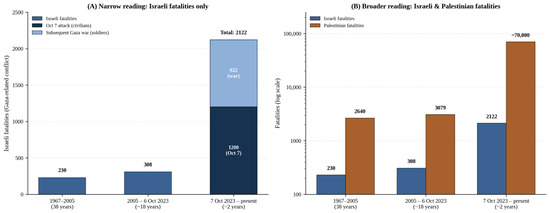
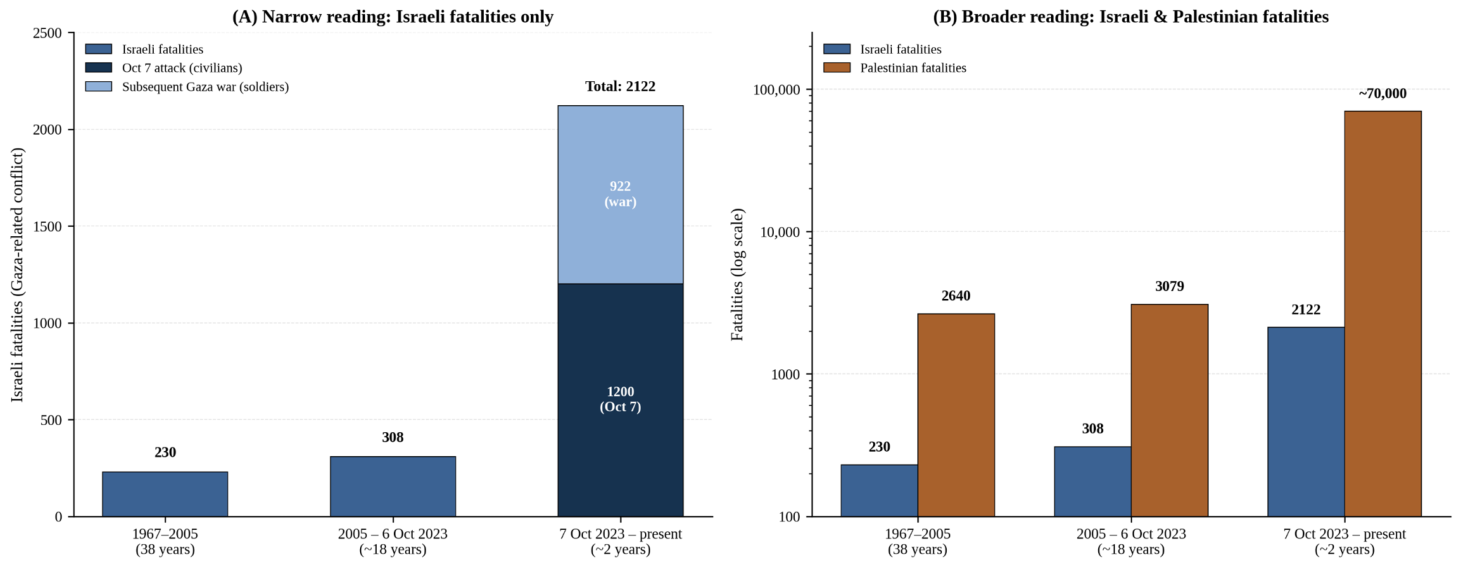
Disclaimer/Publisher’s Note: The statements, opinions and data contained in all publications are solely those of the individual author(s) and contributor(s) and not of MDPI and/or the editor(s). MDPI and/or the editor(s) disclaim responsibility for any injury to people or property resulting from any ideas, methods, instructions or products referred to in the content. |
© 2026 by the authors. Licensee MDPI, Basel, Switzerland. This article is an open access article distributed under the terms and conditions of the Creative Commons Attribution (CC BY) license.