


Abstract
In modern Jewish thought in Eastern Europe, the biblical narratives of the Flood (Mabul) and Noah’s Ark took on new symbolic meanings. Although these narratives had long occupied a place in religious interpretation and storytelling, they gained renewed significance in the nineteenth and early twentieth centuries, especially in Yiddish literature and modern Jewish intellectual discourse. This article examines how the Flood transformed from a biblical episode into a modern symbol through which Jewish writers, historians, and synagogue painters conceived of disaster, revolution, exile, and the fragile continuity of communal existence. In Yiddish literature, the Flood became a metaphor for pogroms, political upheaval, and social collapse, expressing a profound sense of historical instability and collective disorientation. By contrast, Noah’s Ark came to symbolize an uncertain refuge whose ability to preserve Jewish life was repeatedly questioned. In synagogue painting, however, representations of Noah’s Ark and the Flood softened these catastrophic meanings, transforming them into images of suspended survival and fragile continuity amidst ongoing historical turmoil. By examining literary and visual responses together, this article argues that modern Jewish culture in Eastern Europe reinterpreted biblical imagery as a means of coping with uncertainty, vulnerability, and the ongoing struggle for communal survival.
1. Introduction: Catastrophe and the Crisis of Meaning
During the second half of the nineteenth century, a modern Yiddish public sphere rapidly emerged, highlighted by the growth of the Yiddish press in the Russian Empire from the 1860s. Concurrently, Enlightenment ideas and European nationalist movements inspired Jewish intellectuals to produce literary and scholarly work aligned with these broader social and national developments. However, increasing violence against Jews—coinciding with this literary and journalistic growth—dampened the enthusiasm of Yiddish writers. These Jewish intellectuals found themselves in a liminal position—rejected by the Christian intellectual community and unable to rejoin traditional Jewish life (Roskies 1984, pp. 61–64). In this context, Jewish intellectuals—writers, historians, and politicians—endeavored to address emerging issues that sometimes threatened Jewish existence through narrative, historical, and political writings. This environment encouraged new ways of exploring biblical themes, shaping Yiddish-speaking Jewish culture, which became the focal point of Ashkenazi Jewish life in the late nineteenth century. These developments also influenced Jewish thinkers and writers across Europe and America, who wrote in various languages.
In modern Yiddish literature, written in a language functioning as a distinct semiotic system embedded in Jewish life (Harshav 1990, p. 8), catastrophe appears as a structural condition of experience, based on ancient collective trauma (pp. 119–23; Roskies 1984, pp. 5–11, 83, 100–1). From the late nineteenth century onward, Jewish writers dealt with a world characterized by increasing violence, social disintegration, and the decline of customary frameworks of meaning. These changes characterized modern Jewish life by instability, described as “not here, not as now, not as we are” (Harshav 1990, pp. 130–33). In response, they repeatedly turned to images of violent natural forces, such as floods—of water or blood—storms, and fires (Roskies 1984, pp. 83, 125). These metaphors were used to depict destruction on the one hand, and on the other, to express a deeper sense of being engulfed by processes beyond human control. This mindset and catastrophic vocabulary also characterized contemporary Jewish visual art, for example, in the paintings of Shmuel Hirschenberg and Marc Chagall, which express Jewish suffering in exile (pp. 276–85).
Images of turbulence and catastrophe in Yiddish literature depict violence and convey a sense of loss of control and of being overwhelmed by forces beyond human understanding. These representations must also be understood within the wider framework of a transformation of Jewish historical consciousness: the Jewish world of this period had already undergone prolonged instability, in which inherited historical, social, political, and philosophical structures were eroded and replaced (Harshav 1993, pp. 10–13; Funkenstein 1993, pp. 220–56; Katz 1973, pp. 124–41; Miron 1995, pp. 96–98), which forced intellectuals and writers to negotiate their ideological positions. Features such as irony, narrative fragmentation, and the absence of closure in the works of Mendele the Bookpeddler and others highlight a deep crisis of narrative authority (pp. 105–11).
Modern Yiddish discourse often reimagined traditional religious and Talmudic language as tools to express feelings of emotional fracture, existential worry, and societal instability. Consequently, biblical idioms, e.g., the binding of Isaac and the selling of Joseph (Roskies 1984, pp. 40, 61) remained part of modern Jewish culture as adaptable symbols that could communicate the crises of modern times (Finkin 2010, pp. 65–69). The biblical Flood is one of many allegorical expressions of a fractured historical landscape. It shifts from a closed story of sin, punishment, and redemption to an open, flexible metaphor for ongoing societal collapse driven by a changing world. Furthermore, it goes beyond a mere allegory of destruction and disorder, serving as a structural model for understanding Jewish modernity.
Alongside depictions of the Flood in Yiddish literature, another key motif from the biblical story—Noah’s Ark—began to take on a distinct symbolic meaning. In the biblical narrative, these two motifs are intertwined to convey a message of miraculous salvation for humanity, whereas in Yiddish literature they are portrayed separately in relation to Jewish reality during the late nineteenth and early twentieth centuries. The Flood came to symbolize the violence inflicted upon the Jews, while the ark represented the fragile Jewish existence that persists despite these threats.
This article explores how four influential Jewish intellectuals from the nineteenth century to World War II, whose works span literature, historiography, and political thought, referenced the Flood and the Ark. The authors examined include Sholem Aleichem, Sholem Asch, Simon Dubnow, and Israel Zangwill. While all used the Flood as a symbol of crisis and instability and some referred to the Ark as a symbol of sustained existence, each interpreter viewed it through their unique worldview.
Additionally, the article compares these literary reinterpretations with Flood and Noah’s Ark imagery found in Eastern European synagogues, which represent a significant form of Jewish folk art. Rather than implying direct influence, this comparison demonstrates that both literature and visual culture engaged in a shared symbolic language through which Jewish communities interpreted catastrophe, insecurity, and survival. Although synagogue paintings rarely depict violence explicitly, they nonetheless reflect the same historical anxieties expressed in literary works by authors such as Sholem Aleichem and, subsequently, in Jewish folk poetry, including Mordechai Gebirtig’s writings following the pogroms of the early twentieth century (Roskies 1984, p. 107). In contrast to the predatory scenes typical of early modern synagogue painting (Rodov 2004, pp. 115–16), the prominent depiction of the Flood and Noah’s Ark indicates the emergence of new symbolic concerns rooted in the realities of modern Jewish life.
2. The Flood
2.1. Sholem Aleichem and the Ambivalence of the Flood
Sholem Aleichem (1859–1916; Shmeruk 1980) provides the most multilayered reference to the Flood. For him, the Flood is neither a one-time event nor a single-layered phenomenon. Sholem Aleichem deconstructs the Flood into an existential-historical disturbing state of mind. In his ironic preface to Der Mabul, published in 1907 (later republished as In Shturm—“In the Storm”), he presents this all-embracing motif—encompassing the private and national—in one paragraph (Sholem Aleichem n.d., p. 6, translation by the author):
[…] The tumult has already passed, the life of the people is no more… yes, it was a conflagration, a great fire, a cloudburst, a storm, a Flood, an entire flood, a Flood mixed with blood and tears—and there was I among all my millions of brothers and sisters, carried upon the great waters of the great Flood in our small shattered little ship, which has been drifting for nearly two thousand years without a helmsman and without a rudder; God alone knows where and when we may come to shore […] If this is so, and if the Flood sweeps us away little by little, wave after wave, then how can one remain silent? One must cry out, shout, and lament […] The sea grows stormier, the waves rise higher, and people seize one another and pull each other beneath the waters […].
This passage depicts the outcomes of the 1905 revolution and the pogroms that followed. The writer likens this period to a powerful force of nature, which includes fire and violently pouring water. This imagery powerfully conveys the catastrophic and overwhelming nature of these events (Frankel 2009, p. 73). On the one hand, Sholem Aleichem describes the deaths of individuals—lives destroyed. On the other, he describes the Jewish people’s collective fate—sailing in a little boat, lost within the waves, with no captain, and no divine guidance.
Further images of a stormy sea and comparisons to the Flood are prominently featured within the text. In the chapter “The Flood,” Sholem Aleichem describes the crowd fleeing the Cossack attack on the first day of the first Russian constitution (18 October 1905) as waves in a stormy, surging sea. Later in the book, the pogroms that befell Russian Jews in 1905 are depicted as a Flood, with people drowning in the chaos, violently thrown about by the waters, and pulling each other under. Sholem Aleichem concludes that such a Flood creates a world in which faces, shapes, and identities are transformed due to the profoundly dehumanizing effects of violence and catastrophe (Sholem Aleichem 1991, pp. 271, 297).
Sholem Aleichem’s works do not feature a dove with an olive branch or a rainbow signifying a covenant after the Flood. In this respect, he participates in a broader Eastern European literary imagination in which floods, storms, and overwhelming natural forces became metaphors for historical collapse and collective helplessness. As will be discussed below in relation to visual culture, modern representations of the Flood increasingly emphasized destruction, fragmentation, and bodily suffering as hopes for salvation grew rarer.
Sholem Aleichem’s use of the Flood as a metaphor for overwhelming violence imposed upon a community by hostile external forces has an important literary precedent in Polish literature, particularly in the works of Henryk Sienkiewicz (1846–1916). In 1886, Sienkiewicz published his novel The Deluge (Potop) as the second part of his trilogy about the devastating events in the mid-seventeenth-century Polish-Lithuanian Commonwealth (Krzyżanowski 1991). Sienkiewicz’s The Deluge dramatizes the invasion of Polish territories by Sweden. Since then, the phrase “the Deluge” or “the Swedish Deluge” has come to symbolize the horrors of this period, which contributed significantly to the decline of Polish sovereignty (Biskupski 2000, pp. 153–64; Makiłła 2016, pp. 83–113).
In Sienkiewicz’s The Deluge, “the Flood” refers to hostile forces, primarily the Swedes, against whom Poland waged a desperate battle for survival. This struggle was especially poignant during the siege of the Jasna Góra monastery. The biblical Flood and the Swedish invasion are portrayed as analogous not only because of their shared capacity for destruction but also due to the significant parallel numerology: the forty days and nights of the biblical Flood (Genesis 7:17) and the forty-day siege of Jasna Góra, which lasted from 18 November to 27 December 1655 (On the siege of Jasna Góra and its miraculous defense, see Niedźwiedź 2010, pp. 94–96).
In Sholem Aleichem’s Der Mabul, further meanings of the Flood are revealed as the plot unfolds. One of the most significant dimensions of the Flood is its revolutionary meaning. In chapter 12, he describes how “the best, the poorest, the fearless” young boys craved the Flood and awaited the great day it would come, to look it in the eyes and laugh at death. Facing the Flood, they hoped “to liberate the land from a thousand-year darkness” (Sholem Aleichem n.d., p. 107). In this secularized language of redemption, the Flood becomes a metaphor for political revolution. However, in Sholem Aleichem’s view, this is a false redemption, one that only catalyzes violence, bloodshed, and chaos. Hence, in Der Mabul, the Flood becomes a profoundly ambivalent image. It simultaneously embodies destruction and redemption, alongside despair and revolutionary expectation. Yet the novel ultimately undermines the possibility that violence can truly lead to renewal.
2.2. Before the Flood: Sholem Asch and Apocalyptic Modernity
Whereas Sholem Aleichem presents the revolutionary Flood from a narrator’s viewpoint that reveals its false promise of salvation, Sholem Asch moves the discussion into the ideological world of the revolution itself. In Before the Flood (Farn Mabul, 1929–1931), the Flood becomes a language through which competing political visions interpret the upheavals of the modern world. Spanning the final decades of Tsarist rule, the First World War, and the Bolshevik Revolution, the trilogy presents the Flood as a historical force capable of both destroying existing structures and generating radically opposed visions of renewal. Within this framework, revolutionary socialist ideology interprets the Flood as a purifying force that will eliminate corruption and oppression, paving the way for a new socialist society based on justice and equality. In the second volume, Warsaw, one character declares (p. 296, translation by the author):
A Flood, a Flood will come upon the world and purify it. Oh! It will bring purification! A Flood that they brought upon themselves with their atrocious sins! […] The whole dirty, repulsive world—may it fall! May it be buried under the burden of the sins it has brought upon itself! Then, when it is laid waste and burned—we will rise from the ruins, rise out and build the world anew, on completely different foundations; on justice and humanity. There will be no more oppressed and oppressors […].
This optimistic view is immediately challenged by another character who contends that revolutionaries intend to build the future on bloodshed and destruction: “Do you want to build your world on blood[shed]?! No, no! The spilled blood will flood you, and you will be buried under the ruins! No good will grow from evil” (Asch 2020, vol. 2, p. 246). Hence, Asch depicts the Flood both as a symbol of destruction and as a revolutionary idea of purification. However, the novel also questions whether a morally renewed world can arise from violence and bloodshed.
This tension intensifies in the third volume, where revolutionary violence is repeatedly associated with rivers of blood. For example, a character named Zoshka promises, “we will drown Russia in rivers of blood.” Mirkin’s approach is more considerate, as he claims, “I think we are eager to spill rivers of blood that will drown us in filth and sin that we will spread around us” (Asch 2020, vol. 3, pp. 232, 250). As in many modern Jewish literary responses to catastrophe discussed by Roskies (1984), liquid imagery here serves as a language for conceptualizing collective historical violence on an overwhelming scale. Yet Asch ultimately resists a purely apocalyptic conclusion. Yet, toward the end of the trilogy, renewal, also symbolized by liquids, appears possible through slow, gradual acts of education and moral reconstruction: “a few drops every day” (Rubinstein 2018, p. 305). Unlike Sholem Aleichem, Asch ultimately shifts the possibility of renewal away from divine intervention and toward gradual moral reconstruction through human action.
2.3. Floods of History: Dubnow and Historical Consciousness
Simon Dubnow (1860–1941; Steinberg 1963), a writer and historian, approached the Flood from a markedly different perspective. Whereas Sholem Aleichem and Sholem Asch used the Flood as a literary metaphor, Dubnow transformed it into a historiographical category for understanding historical change. He was more focused on the larger historical processes shaping modern Jewish life than on emotional crisis or revolutionary chaos. As a result, the Flood marks an ongoing condition through which modern Jewish history could be understood.
Although Dubnow uses imagery similar to that found in modern Yiddish literature, its function is fundamentally different. Dubnow repeatedly describes the contemporary Jewish reality as an era of the “Flood,” emphasizing the destructive forces threatening the continuity of Jewish life in Eastern Europe. Yet his use of the term was not apocalyptic. Unlike Sholem Aleichem’s Flood, which often conveys the collapse of narrative coherence, Dubnow’s Flood marks a violent transitional phase within a broader process of historical transformation (Frankel 2009, p. 272).
Like Sholem Aleichem, Dubnow does not confine the Flood to water imagery. In the second volume of his autobiographical writings, Kniga zhizni: Vospominaniia i razmyshleniia, he cites his 1919 diary: “The streams of lava are flowing over the old culture, clearing a way for the new—will it be better or worse? I am inclined to think worse” (p. 271). Also, in the 1930s, Dubnow continues to employ a catastrophic vision, albeit with a cautious belief in renewal. Dubnow believes that, despite the regressive and destructive nature of the time, it would ultimately give way to a period of growth and future achievements. When he published the first volume of his autobiography in 1934, he stressed that, in such a time of Flood that would wipe out all the achievements of his generation, “We, its last representatives, have an obligation to set up a memorial to this disappearing epoch” (pp. 272–73).
In this sense, Dubnow marks a crucial transformation in modern Jewish historiography. The biblical paradigm of the Flood is retained, yet it is detached from its traditional theological framework and reformulated as a historiographical category. For Dubnow, the Flood does not mark the drowning of individuals but the submergence of a historical era. Yet unlike an individual life, which ends in drowning, a nation may reemerge from the waters and reconstruct itself anew.
Despite their very different intellectual outlooks, Dubnow and Asch ultimately converge on one important point. Neither regards the Flood as the final word. For Asch, the devastation of the Flood can eventually be overcome through gradual moral and educational reconstruction—“a few drops every day.” For Dubnow, the task is different but equally future-oriented: to document and preserve the cultural and historical achievements of East European Jewry so that, even if the Flood were to sweep away the existing world, they could serve as the foundation for whatever would follow.
2.4. The Flood as a Modern Symbol in Synagogue Painting
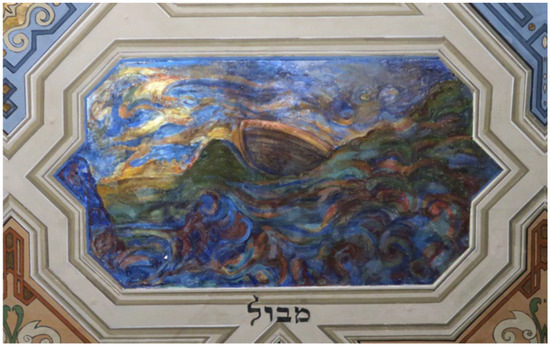
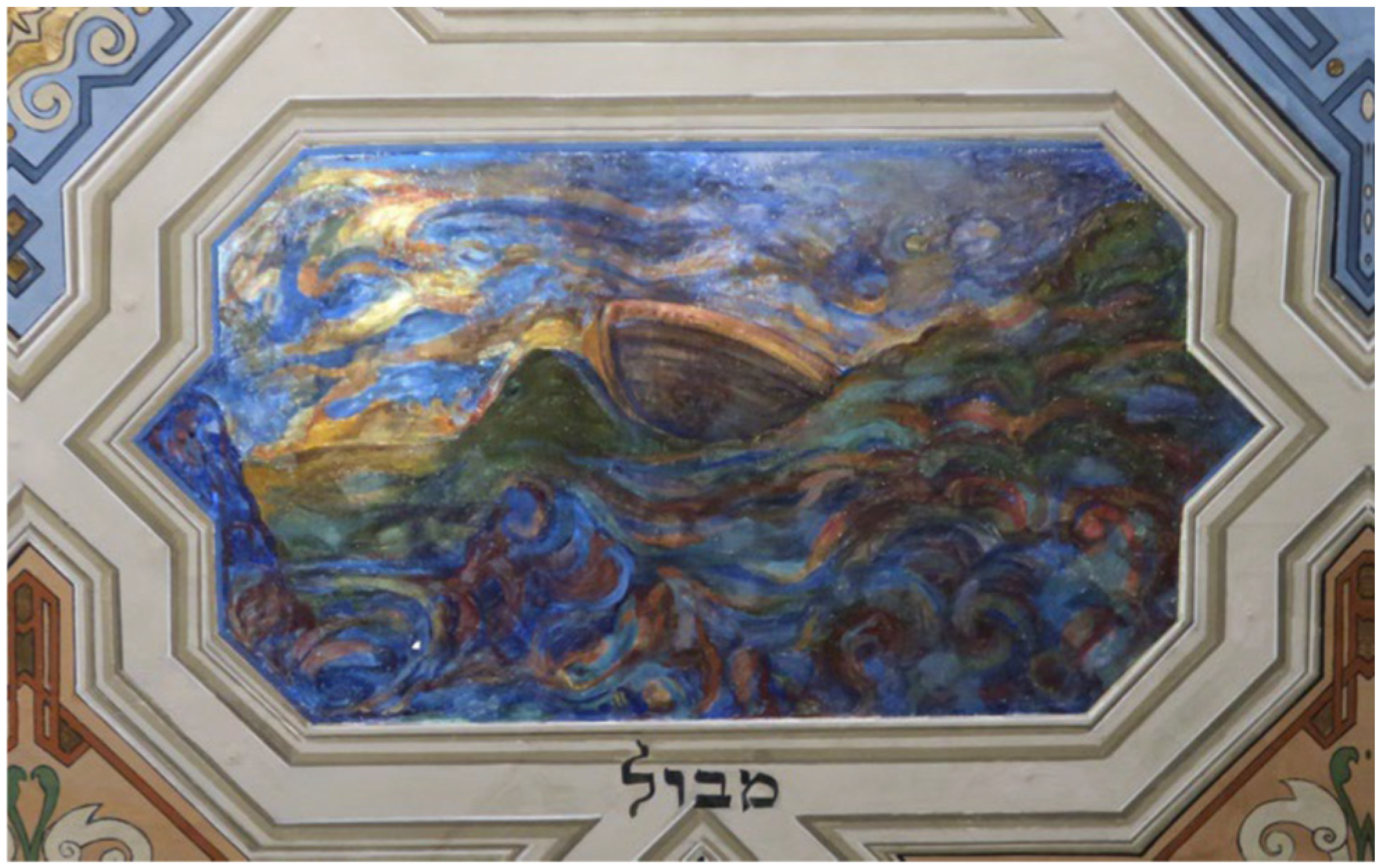
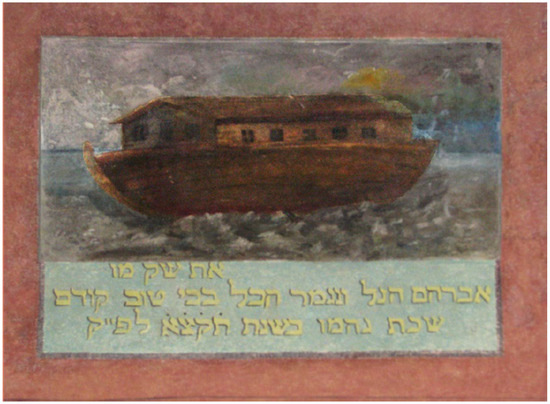
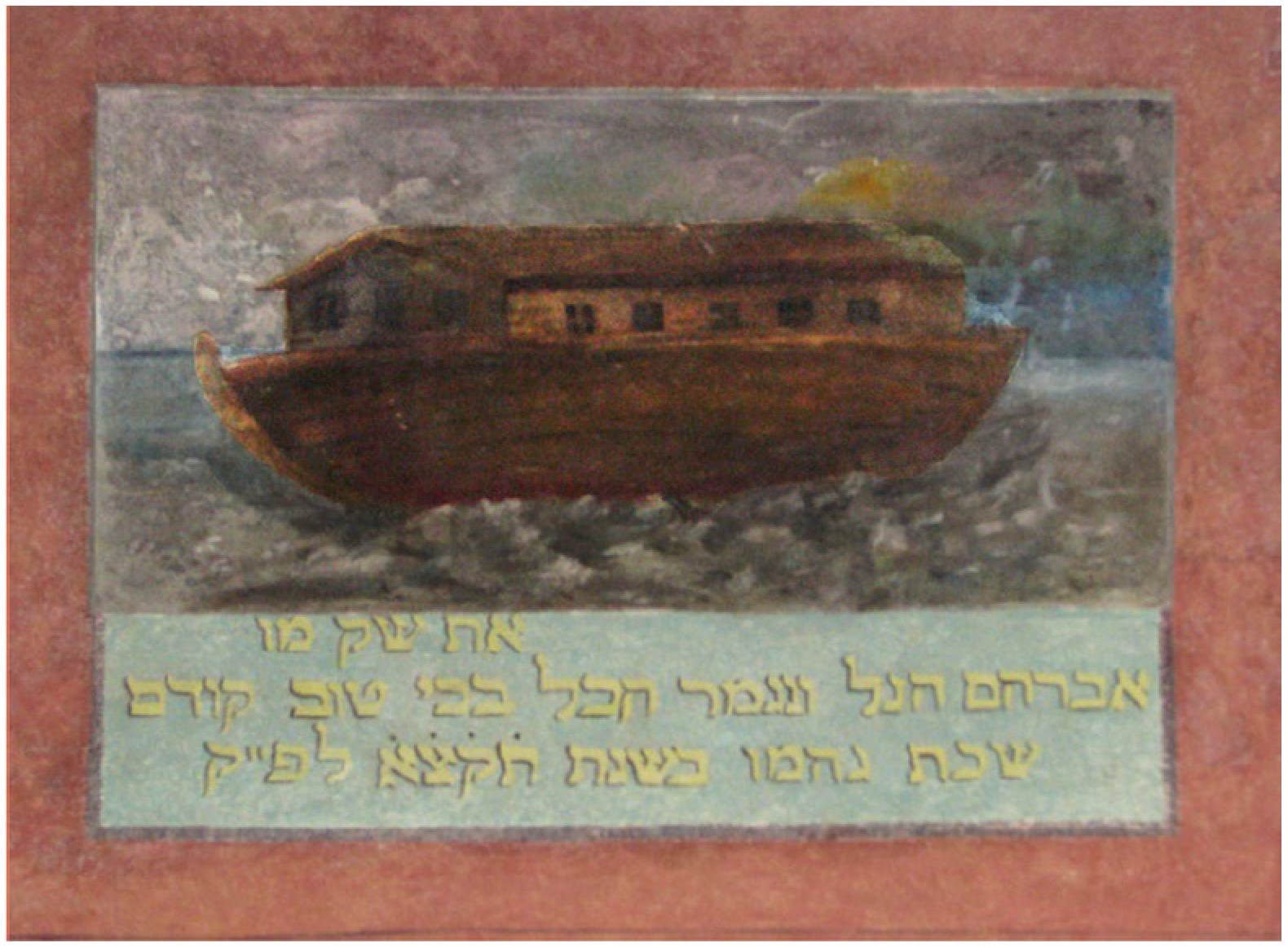
The same symbolic concerns and historical anxieties that preoccupied modern Jewish writers and intellectuals also surfaced in Jewish folk art, particularly in synagogue decoration. A striking example appears on the ceiling of the Kupa Synagogue in Kraków. Painted between 1920 and 1939, the work depicts Noah’s Ark battling powerful waves (Figure 1). Rather than resting peacefully on Mount Ararat, as described in the biblical narrative, the Ark appears to collide violently with the mountain. Significantly, the scene is titled Mabul (“The Flood”) rather than the conventional Tevat Noaḥ (“Noah’s Ark”), directing the viewer’s attention to the catastrophe rather than to the vessel of salvation.
Figure 1.
“Mabul (The Flood).” Kraków, Kupa Synagogue, ceiling, 1920–39.
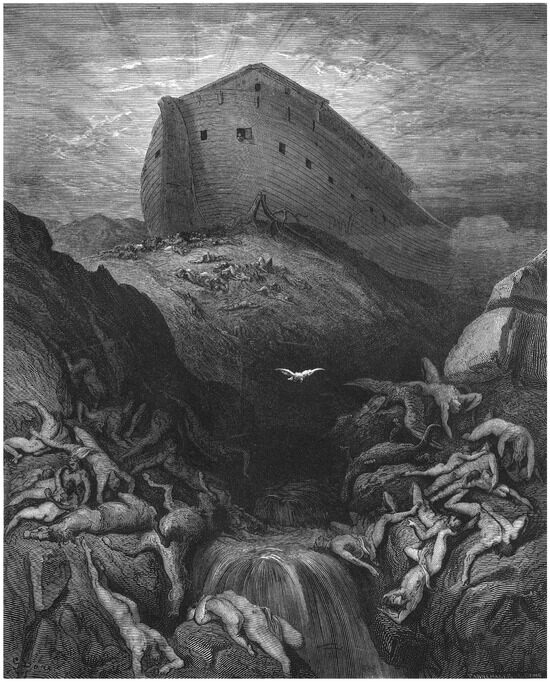
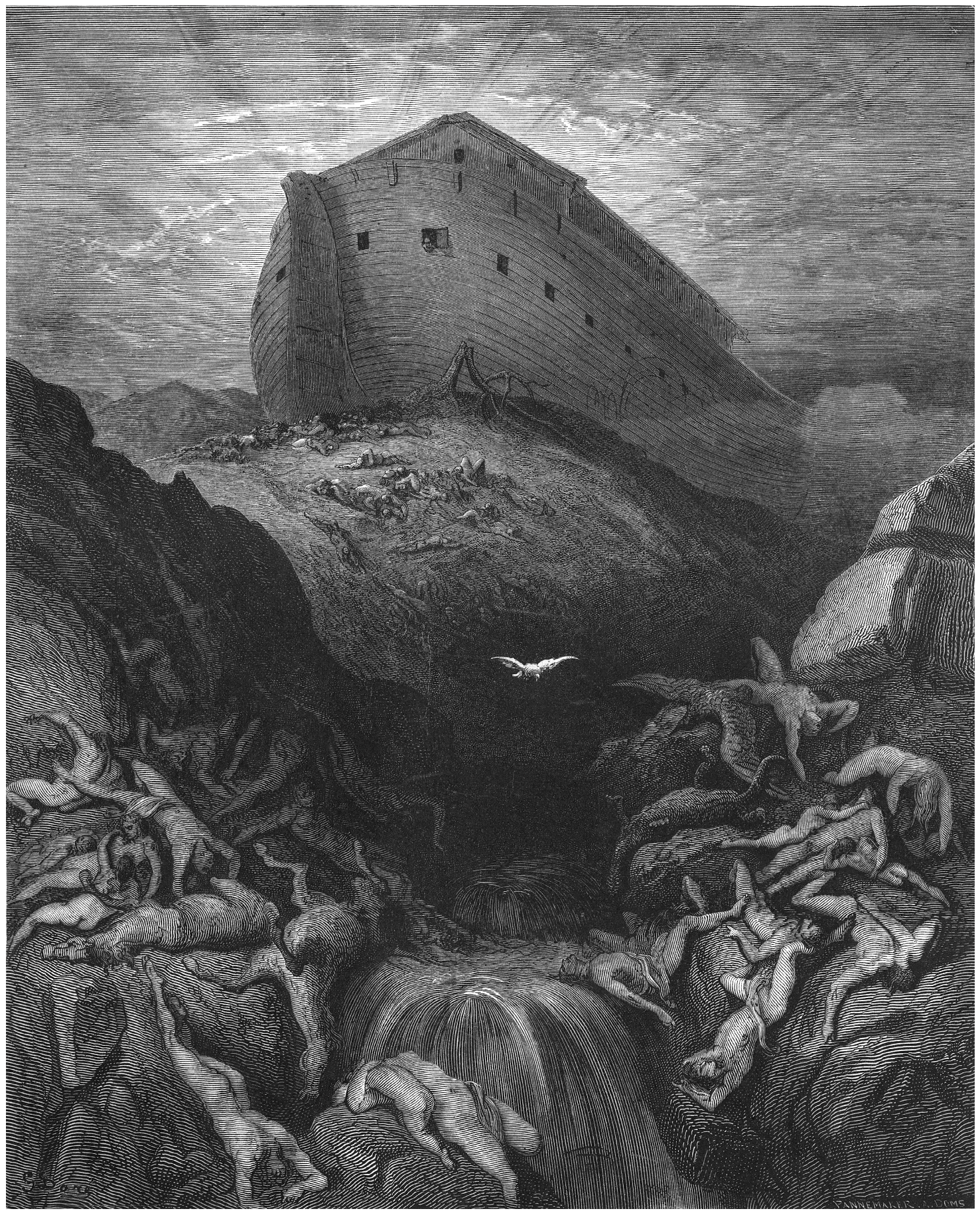
Like in the works of Sholem Aleichem, Sholem Asch, and Simon Dubnow, this painting symbolizes the fragile state of Jewish existence, teetering between despair and hope while being threatened by violent attacks. While it retains the biblical narrative, the painting’s composition draws heavily from Gustave Doré’s well-known engraving “The Dove Sent Forth from the Ark” (Figure 2) from his La Grande Bible de Tours, first published in 1866 and translated into many languages (Schaffer 2021). Doré’s scene shows the Ark sailing towards the viewer with a striking perspective. The foreground is filled with drowned human and animal bodies, while a white dove flies across the dark central background. The synagogue version omits Doré’s explicit corpses and scenes of destruction. Conversely, it also avoids overt hope—the image of the dove. The message is clear: even if salvation and peace are anticipated after the Flood, they will not come easily or supernaturally on the wings of a dove—they come at a high cost. This visual message resonates with the chaotic atmosphere of Sholem Aleichem and Sholem Asch, as well as with Simon Dubnow’s grim historiographical analysis.
Figure 2.
Gustave Doré, The Dove Sent Forth from the Ark, engraving from La Sainte Bible (La Grande Bible de Tours), 1866–1870. Public domain image via Wikimedia.
3. Noah’s Ark
This chapter examines the motif of Noah’s Ark in the works of Israel Zangwill, Sholem Aleichem, and Sholem Asch. Although Zangwill wrote in English, his life in England—on the periphery of Ashkenazi life during the nineteenth and twentieth centuries—shaped his writing through Yiddish culture, literature, and the Jewish national movement. The discussion concludes with Noah’s Ark imagery in synagogue painting, allowing comparison between literary interpretations and their visual counterparts in Jewish folk art.
3.1. Zangwill, Territorialism, and the Search for Refuge
In 1899, the Anglo-Jewish writer and political thinker Israel Zangwill (1864–1926; Wohlgelernter 1961; Sholem Aleichem 1981, pp. 221–27) published his book Ghetto Tragedies (Zangwill 1899b). Within this collection of stories, the short story “Noah’s Ark” (Zangwill 1899a) refers to a forgotten historical episode that was about 80 years old at the time, as well as to its tragic Jewish heroes (Crane 2019, p. 44). It conjures a peculiar proposal: the declaration of a city of refuge for the Jewish nation in Grand Island, New York. The suggestion was made by Mordecai Manuel Noah (1785–1851), a well-known Jewish-American politician, journalist, and playwright who served briefly as consul and sheriff of New York City (Sarna 1981, pp. 15–59). Motivated by genuine concern for the welfare of European Jews after the antisemitic “Hep Hep riots” in 1819 in the German Confederation (Kaplan 2013, pp. 240–41), as well as the desire for fame, Noah sought to establish a “New Jerusalem” on American soil, to be called Ararat, after the site at which Noah’s Ark landed after the Flood, and in honor of his last name.
Initial attempts to create this haven between 1820 and 1822 were unsuccessful. In 1824, Noah finally bought part of Grand Island. Meanwhile, he publicized his initiative among German Jewish communities and attracted the interest of the Verein für Kultur und Wissenschaft der Juden—an association of young Jews in German-speaking lands. On 15 September 1825, Noah founded the city of Ararat. The ceremony took place at St. Paul’s Episcopal Church in Buffalo (Sarna 1981, pp. 62–66). Attendees were transported to the event aboard a ship named “Noah’s Ark.”
Noah hoped that Ararat would provide Jews with the freedom necessary to learn the liberal principles, which would later enable them to rule the “Land of the Patriarchs” (Sarna 1981, p. 68). Thus, he viewed the town as a stepping stone toward a national home for Jews in the Land of Israel. However, the endeavor faced harsh criticism in American newspapers and among European Jewish congregation leaders. The town was never built, and in 1826, the project was abandoned (pp. 72–75).
In Zangwill’s story, Noah’s initiative is related through the eyes of the fictional Pelony, which in rabbinic literature means “Anyman.” Pelony, a Frankfurt Jew, moves to Mordecai Manuel Noah’s Ararat, intending to be one of the city’s pioneers. After spending some time in the deserted city, however, Pelony falls into despair and throws himself into Niagara Falls (Zangwill 1899a, pp. 122–23). This was not the first reference in Yiddish literature to the failure of Jewish colonies in the United States. In 1884, for example, Sholem Aleichem published a review of a book written by a Jewish student who accompanied a group of immigrants on their way to the “Am-Olam” colonies in the USA. The author cynically referred to the failure of these colonies, which, in his words, God sent as a remedy for the pogroms of 1881 (Shmeruk and Turniansky 2000, p. 148).
Zangwill’s story may reflect his political stance on the rescue of European Jews. A renowned author and intellectual, Zangwill met Theodor Herzl, founder of the Zionist movement, in London in 1896. The two agreed on the goal of “territorial independence” for European Jews. The following year, Zangwill visited the Land of Israel and mentioned the difficulties he had foreseen in building a homeland for the Jewish people, mainly because of the 600,000 Arabs who lived there. After the final rejection of the Uganda Plan by the Seventh Zionist Congress (1905), Zangwill was involved in the foundation of the Jewish Territorial Organization (ITO), pursuing safe territories for Eastern European Jews across the globe, and he became the organization’s first president (Cheyette 2024, p. 5; On the Jewish Territorial Organization, see Alroey 2015). Therefore, although Israel Zangwill primarily wrote in English and was active in Anglo-Jewish intellectual circles, his ideas about territorialism and his literary creativity were heavily influenced by the crises faced by Eastern European Jewry and by their massive westward immigration (Melzer 1997; Weinryb 1997).
When Zangwill wrote “Noah’s Ark,” the USA had already become home to a large number of Eastern European Jews. From 1880 to the 1930s, more than two million Polish and Russian Jews entered the United States, most of them from Poland, establishing Polish Jewish congregations throughout the US (Weinryb 1997, pp. 377–80). Yet Pelony’s suicide at the end of Zangwill’s story reflected his pessimism—already at the turn of the twentieth century, before the establishment of the ITO—that the “ghetto Jews” could integrate into the “outside” world.
Zangwill’s pessimistic approach continued into the twentieth century, exemplified by his 1904 story, “Khad Gadya.” This story depicted the tension between the secure, yet secluded, life of a young Jew within the Venetian Jewish Ghetto and the uncertain opportunities of assimilation (Cheyette 2024, pp. 11–12). Although Zangwill was a territorialist, not a Zionist, he recognized the deep connection between the Jewish people and the Land of Israel, publicly affirming this link in speeches throughout the 1910s (Wohlgelernter 1961, pp. 206–7; Kruk 1970, pp. 237, 279). Consequently, his story “Noah’s Ark” could be interpreted as a metaphor for Zionism, aligning with his later efforts to support a national home for Jews in the Land of Israel. Furthermore, the character of Mordecai Manuel Noah could embody Theodor Herzl, given their numerous similarities (Weingrad 2007, p. 86).
Zangwill’s Ark fundamentally lacks traditional notions of redemption. Unlike biblical or theological concepts, Ararat serves as a secular refuge rooted in territory, political structure, and social rebuilding rather than divine intervention. The story, however, remains bleak about the prospect of genuine renewal. Zangwill illustrates the effort to physically remove Jews from the ghetto while neglecting the psychological and cultural impacts of centuries of exile and marginalization. Consequently, the Ark seems inherently fragile: many Jews hesitate to step out, and those who do are haunted by despair, disconnection, and an inability to envision a shared future of change. Therefore, Noah’s Ark and Ararat’s failure signifies not only a political failure but also a deeper crisis in Jewish modernity.
3.2. Sholem Aleichem’s Battered Ship
Eight years after Zangwill published “Noah’s Ark,” Sholem Aleichem also depicts the “chosen people” inside an Ark in his Der Mabul. Unlike Zangwill’s literal Noah’s Ark, which is not preceded by an explicit Flood, Sholem Aleichem’s Ark is a motif parallel to the Flood. In distinguishing the Ark from the Flood, Sholem Aleichem could have been influenced by Henryk Sienkiewicz’s The Flood. Already in this book, Sienkiewicz refers not only to the destructive Flood but to divine redemption embodied in the Ark. Sienkiewicz likens the Jasna Góra monastery to Noah’s Ark (Sienkiewicz 1966, pp. 278, 312), in terms of their miraculous rescue. The comparison derives from the roles of both the monastery and the Ark in providing sanctuary and protection, thus serving as symbols of hope. This comparison was originally made in the Nova Gigantomachia, the memoirs of Abbot Augustyn Kordecki (1603–1673), curate and provincial of the Jasna Góra monastery. Kordecki compared the divine rescue of humanity from the Flood through Noah’s Ark to the rescue of the Polish King John Casimir—entrusted to the care of the Virgin Mary (The Black Madonna of Częstochowa)—and the Polish Kingdom through the Jasna Góra monastery from the Swedish Deluge (Kordecki 1858, p. 454).
Sienkiewicz not only compared the Jasna Góra monastery to Noah’s Ark but also to the “Temple of God” or the “Tabernacle” (przybytek Boży) (Sienkiewicz 1886, p. 236). Such an analogy can also rely on the similarity of biblical verses describing Noah’s Ark and those describing the building of the Tabernacle—the mobile temple carried by the Israelites during their forty-year journey in the desert (Frish 2010, pp. 9–24). This comparison further underscores the drama of the heavenly intervention, siding with the Polish defenders trapped inside an Ark amid stormy waters.
Unlike Sienkiewicz’s Ark, a temple guided by divine providence, and Zangwill’s Ark, which embodies (failed) human efforts to save lives, Sholem Aleichem’s Ark has neither divine nor human guidance. It appears as a small, battered ship drifting for two thousand years through the Flood, without a helmsman, a rudder, or a safe harbor in sight (Sholem Aleichem 1991, p. 10). Like Jasna Góra’s defenders in The Deluge, its passengers continue to hope for divine intervention, yet no rescue arrives.
3.3. Sholem Asch: Inadequate Ark
Sholem Asch offers a different reinterpretation. His Ark is not directionless but inadequate. It provides only temporary refuge while demanding painful sacrifice. In the chapter “Noah’s Ark,” families hiding from the advancing Bolsheviks are forced to abandon their beloved pets because their cries threaten the safety of everyone in hiding (Asch 2020, pp. 31–35). The Ark thus ceases to symbolize salvation and instead becomes a space of moral compromise and loss.
Like Zangwill’s Ark, Asch’s offers no secure solution to the Jewish predicament. Yet unlike Sholem Aleichem’s directionless vessel, it provides shelter—though at a significant moral expense. Survival depends on sacrificing those who cannot be accommodated within the Ark. Unlike the biblical narrative, in which the Ark preserves every species and ensures life’s continuity, Asch’s Ark cannot safeguard everyone equally. It highlights the difficult choices driven by political disaster, where rescue is partial rather than comprehensive. Thus, the Ark remains a refuge, but only temporarily and without the biblical promise of full preservation.
3.4. The Ark in Synagogue Painting
In the first half of the twentieth century, Noah’s Ark was painted in several synagogues in Eastern Europe. Each painting depicts a single stage of the biblical story. Two main themes can be discerned. The most popular of these depicts the Ark sailing on calm water or resting on Ararat. Such depictions were painted on the west wall of the Rema synagogue in Kazimierz, the historic Jewish district of Kraków (Figure 3), and on the ceiling of Moshke’s Shul in Roman, Romania (Moshke’s Shul in Roman—Ceiling n.d.). A similar depiction of the ark was painted on the Bimah (Torah reading platform) in the Łańcut synagogue (Figure 4). In this painting, the dove rests on an olive tree, with an olive branch in its beak.
Figure 3.
Noah’s Ark. Kraków, Rema Synagogue, west wall, eighteenth century(?).
Figure 4.
Noah’s Ark. Łańcut, Synagogue, bimah, twentieth century.
These scenes followed early modern conventions. For example, by the mid-eighteenth century, an ark sailing on steady waters appeared in the Great Synagogue in Józefów nad Wisłą, Poland (Great Synagogue in Józefów nad Wisłą, Poland n.d.). However, in twentieth-century paintings, there is an emphasis on turbulent waters: in the Rema synagogue, they surge and foam beneath the ark; in Łańcut, the restless waters occupy about two-thirds of the scene. This emphasis shifts the symbolic weight from the Ark, which in earlier synagogue paintings symbolized miraculous salvation, to the surging waters that prevent the ark from finding rest.
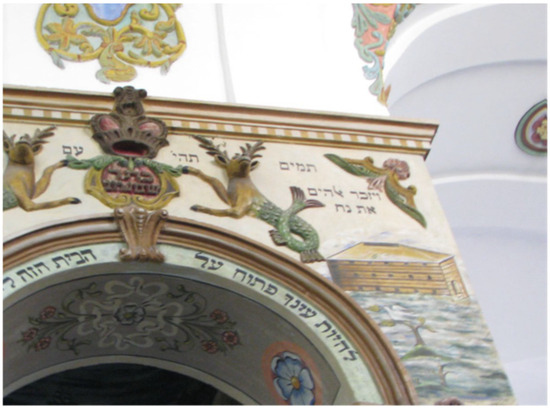
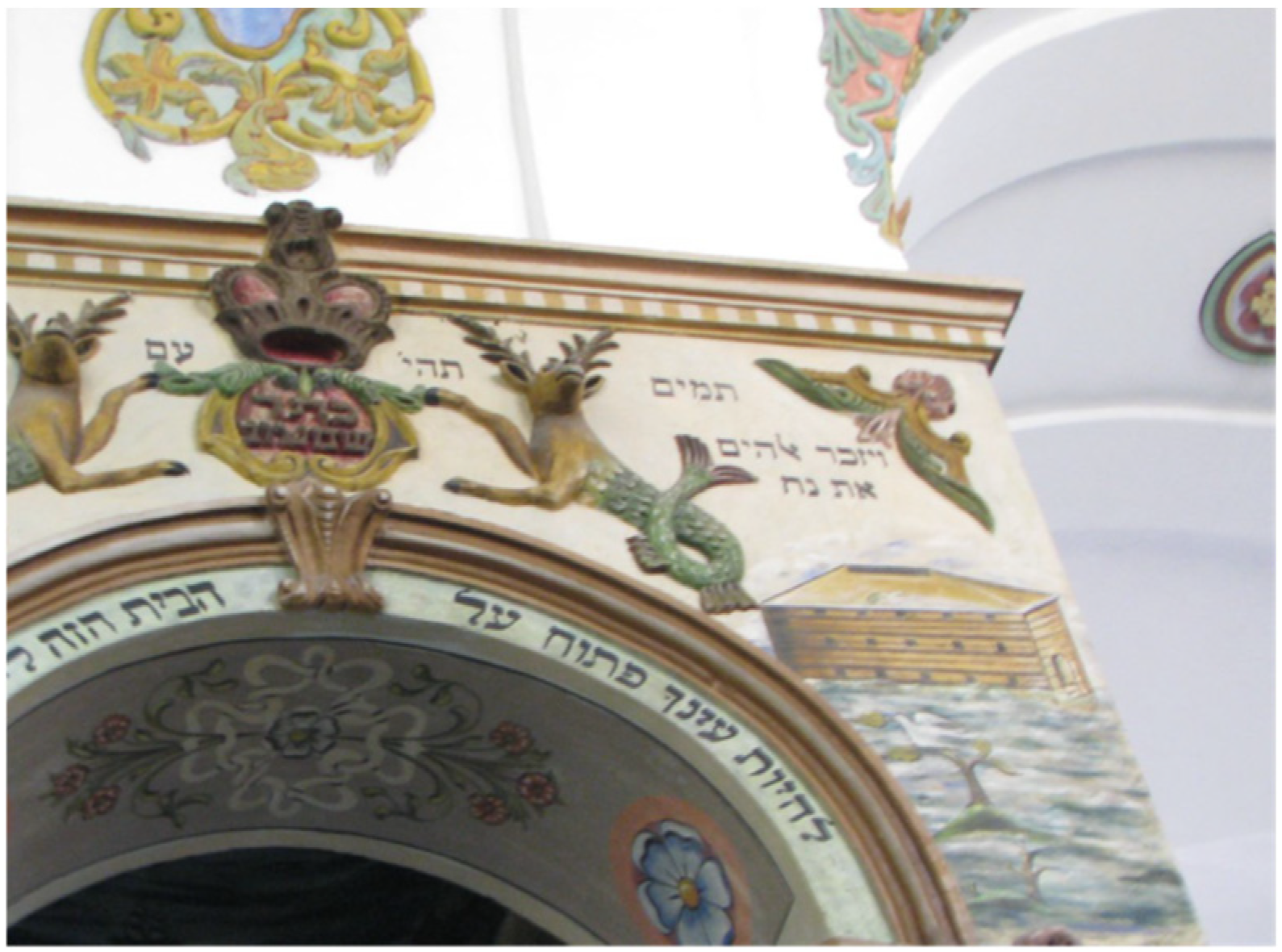
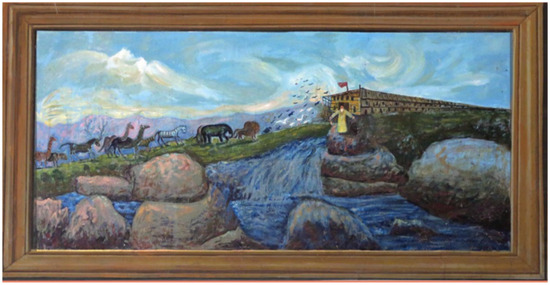
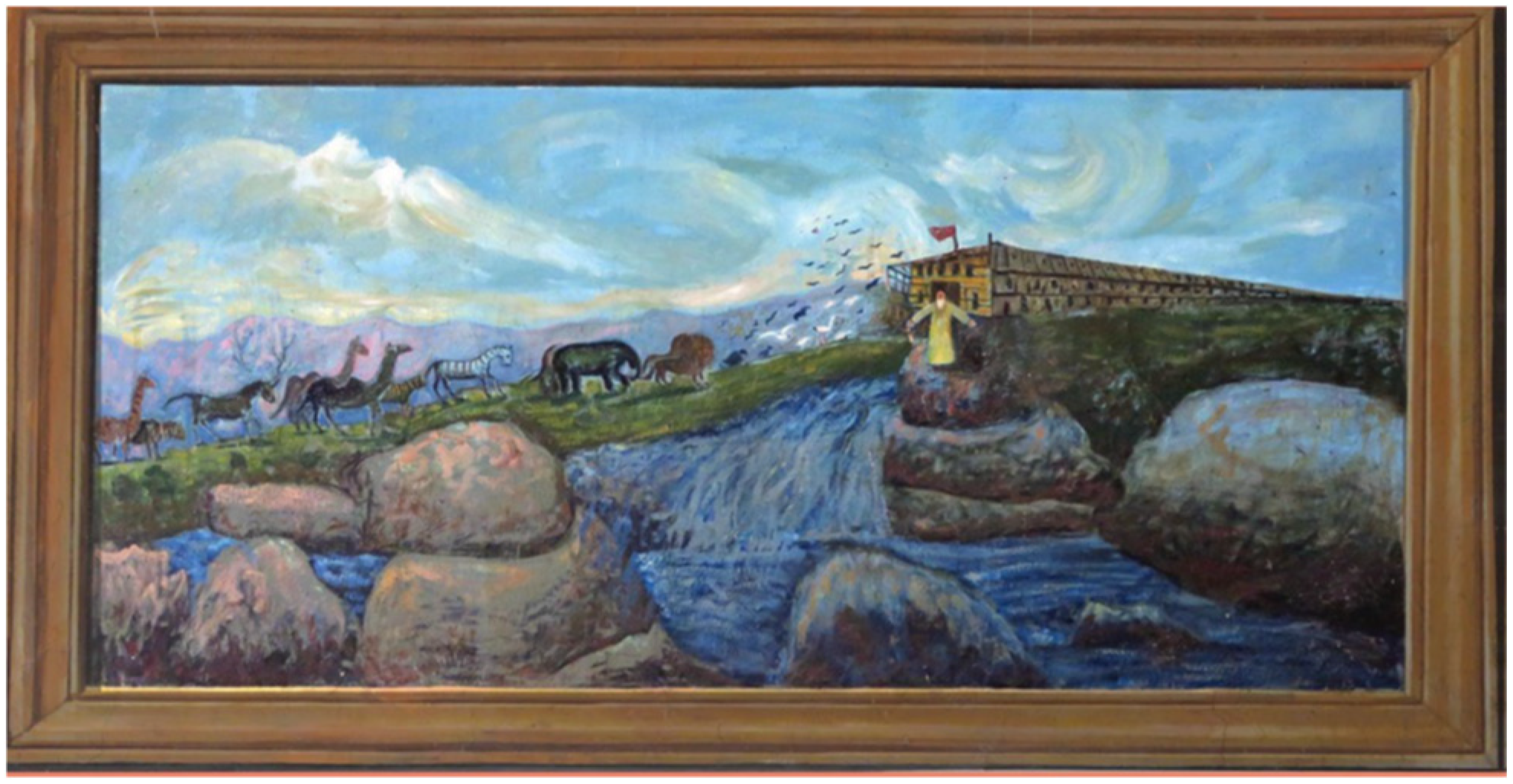
In contrast to this theme, the second one entered synagogue paintings only in the twentieth century, paralleling discussions of the Ark in Yiddish literature. This visual approach portrays the Ark resting on solid ground before the Flood, awaiting the animals to gather inside. This portrayal was common in early modern Ze’enah u-Re’enah books (Ze’enah u-Re’enah 1692, fol. 7), Passover Haggadot (Amsterdam Yaakov Shamash Haggadah 1728, title page), and Hebrew prayer books (BL Seder Tikkunei Shabbat 18th Century n.d., fol. 93). An example of this scene in a synagogue appears in a painting created during the interwar period on the west wall of the Kupa synagogue, depicting Noah standing before the Ark, welcoming pairs of animals as they appear to board it. The lower portion of the painting features a flowing stream, subtly alluding to the impending Flood (Figure 5).
Figure 5.
Painting of Noah welcoming the animals into the Ark on the west wall of the Kupa Synagogue, Kraków, 1920–39.
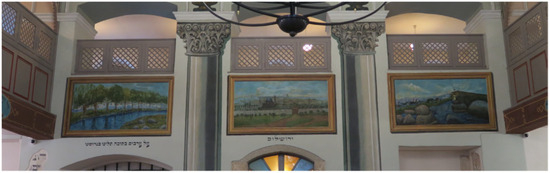
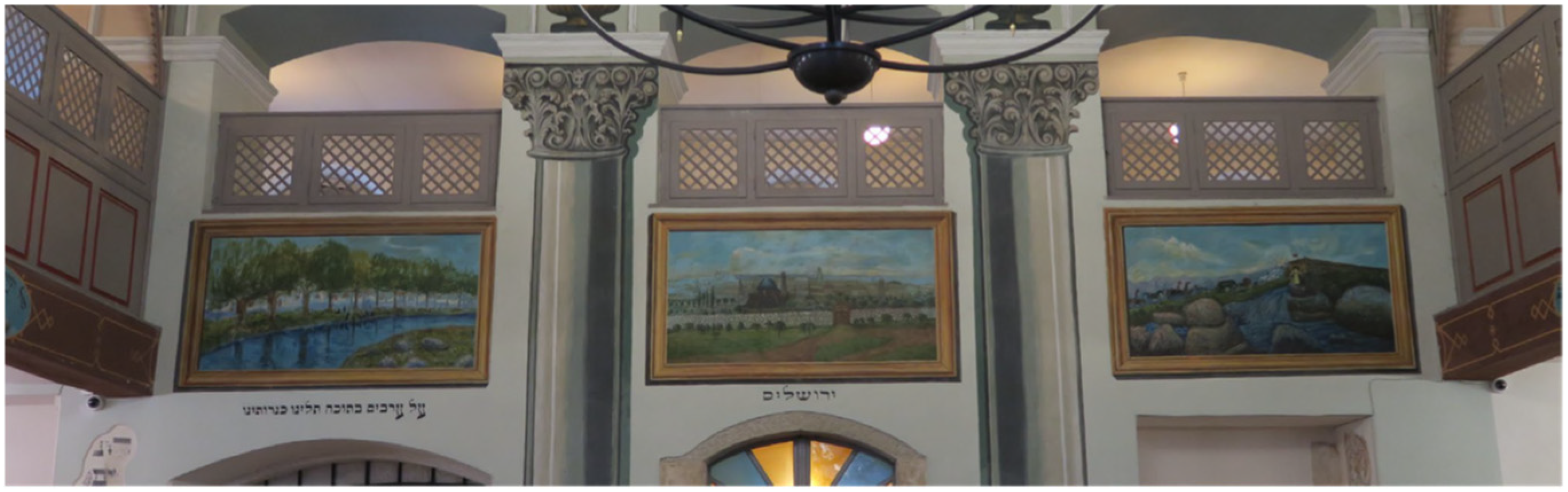
As in other instances of the emigration of painted motifs into synagogue art throughout history, these two themes met the psychological, religious, or social needs of Jewish communities and communicated in a symbolic language readily understood by contemporary Jewish communities (Orgad 2020, pp. 2–17; 2025, pp. 139–59). Numerous references to Noah’s Ark in Jewish intellectual discourse and literature became firmly rooted in the Eastern European Jewish public consciousness, coinciding with a demand for new synagogue scenes portraying it. However, in places of worship, these depictions could not directly express despair or political debate, as in the works of Israel Zangwill, Sholem Aleichem, and Sholem Asch. Instead, the synagogue paintings tempered the message, transforming it into a suspended state of fragile continuity amid an ongoing historical Flood. The image of Noah welcoming animals into the Ark at the Kupa synagogue (Figure 5) effectively portrays such a suspended state. Similar to many other synagogues (e.g., Great Synagogue in Józefów nad Wisłą, Poland n.d.), the Ark’s placement suggests that it could be understood as a metaphor for a journey to the Land of Israel: to its left is a painting of Jerusalem, and further left, one of “The Rivers of Babylon” (Figure 6). This scene represents a transitional phase—not a miraculous event, but a journey driven by human agency.
Figure 6.
Wall paintings on the west wall of the Kupa Synagogue, Kraków, 1920–39.
The painting also recalls modern literary interpretations of Noah’s Ark. In Zangwill’s “Noah’s Ark,” Mordecai Manuel Noah is explicitly associated with the biblical Noah (“father Noah is drunk again”) (Zangwill 2024, pp. 18–19), and the Jews are metaphorically compared to the animals entering the Ark. Likewise, the bearded figure beneath a red flag—the symbol of the tribe of Judah and the Messiah’s house of David—may allude to Theodor Herzl.
The meaning of the scene becomes fully apparent when viewed alongside the Flood painted on the synagogue ceiling (Figure 1). The west wall depicts the moment before the Ark embarks on its journey; the ceiling reveals what awaits it. Instead of resting peacefully on Mount Ararat, the Ark is hurled against the mountain by violent waves. Read together, the two paintings transform the biblical narrative into a modern allegory in which refuge remains possible but never secure. Like the Arks described by Zangwill, Sholem Aleichem, and Sholem Asch, the Kupa Ark no longer promises miraculous salvation. Instead, it represents the fragile possibility of continuity amid an ongoing historical Flood.
4. Conclusions
Few biblical stories have proven as relevant to the crises of modern Jewish existence as the story of the Flood. In Eastern European Jewish communities in the late nineteenth and early twentieth centuries, the Flood shifted from a distant biblical disaster to a potent symbol. Writers, thinkers, and painters used it to interpret modern upheavals. The rise in pogroms, revolutions, emigration, secularization, political violence, and social chaos transformed the Flood into a metaphor for catastrophe, violence, and instability, while the Ark came to symbolize the fragile and uncertain continuation of Jewish communal life amid that catastrophe.
Although all four authors discussed in this article employ the Flood as a symbol of catastrophe, they ascribe different meanings to it. Sholem Aleichem presents it as the condition of Jewish existence while exposing the false promise of revolutionary renewal. Sholem Asch turns it into an ideological language through which competing visions of the future confront one another. Simon Dubnow transforms it into a historiographical category that explains the rise and collapse of historical epochs, while Israel Zangwill shifts the focus toward Noah’s Ark as an inadequate political solution to the Jewish predicament. Accordingly, the Ark assumes different roles: a failed refuge in Zangwill, a battered vessel without direction in Sholem Aleichem, and a temporary shelter that demands painful sacrifice in Asch.
Synagogue paintings participated in the same symbolic discourse but adapted it to the religious setting. Rather than reproducing the political debates or ideological conflicts found in modern literature, they transformed the Flood and the Ark into visual metaphors for fragile continuity. The Flood remained a sign of historical danger, while the Ark no longer guaranteed miraculous salvation but represented the precarious possibility of communal continuity amid an ongoing catastrophe.
Once separated from one another, the Flood and Noah’s Ark ceased to function merely as consecutive episodes in a biblical narrative. Instead, they became complementary symbols through which modern Jewish culture interpreted catastrophe and the fragile possibility of continuity. In the literature, this symbolic language accommodated political, ideological, and historiographical debates; in synagogue art, it was reshaped into a visual language that preserved continuity without erasing uncertainty.
Funding
This research was supported by the Israel Science Foundation (ISF), grant no. 2872/25.
Institutional Review Board Statement
Not applicable.
Informed Consent Statement
Not applicable.
Data Availability Statement
Data sharing is not applicable. No new data were created or analyzed in this study.
Conflicts of Interest
The author declares no conflicts of interest.
References
- Alroey, Gur. 2015. Angolan Zion: The Jewish Territorial Organization and the idea of a Jewish state in Western Africa, 1907–1913. Journal of Modern Jewish Studies 14: 179–98. [Google Scholar] [CrossRef] [Scilit]
- Amsterdam Yaakov Shamash Haggadah. 1728. Copied and Illuminated by Yaakov ben Yehudah Leib Shamash of Berlin. Amsterdam: Bibliotheca Rosenthaliana, Ros. 383. Available online: https://cja.huji.ac.il/sch/browser.php?mode=set&id=23755 (accessed on 29 October 2024).
- Asch, Sholem. 2020. Lifney ha-Mabul/Shalosh Arim: Peterburg, Varsha, Moskva. Translated by Bilha Rubinstein. Jerusalem: Carmel, vols. 2–3. (In Hebrew) [Google Scholar]
- Biskupski, Mieczysław B. 2000. The History of Poland. Westport: Greenwood Press. [Google Scholar]
- BL Seder Tikkunei Shabbat. 18th Century n.d. London: British Library, Add. 8881. Available online: https://cja.huji.ac.il/browser.php?mode=alone&id=225740&utm_source=chatgpt.com (accessed on 29 October 2024).
- Cheyette, Bryan. 2024. Israel Zangwill: Past, Present and Future—An Introduction. European Judaism 57: 4–19. [Google Scholar] [CrossRef] [Scilit]
- Crane, Jacob. 2019. Ararat Revisited. Melus 44: 43–64. [Google Scholar] [CrossRef] [Scilit]
- Finkin, Jordan D. 2010. A Rhetorical Conversation: Jewish Discourse in Modern Yiddish Literature. University Park: The Pennsylvania State University Press. [Google Scholar]
- Frankel, Jonathan. 2009. Crisis, Revolution, and Russian Jews. Cambridge: Cambridge University Press. [Google Scholar]
- Frish, Ariel. 2010. Bein parashat Noaḥ le-parshiyot ha-mishkan. Megadim 51: 9–24. (In Hebrew) [Google Scholar]
- Funkenstein, Amos. 1993. Perceptions of Jewish History. Berkeley and Los Angeles: University of California Press. [Google Scholar]
- Great Synagogue in Józefów nad Wisłą, Poland. n.d.The Bezalel Narkiss Index of Jewish Art. Available online: https://cja.huji.ac.il/browser.php?mode=set&id=22162 (accessed on 29 October 2024).
- Harshav, Benjamin. 1990. The Meaning of Yiddish. Berkeley and Los Angeles: University of California Press. [Google Scholar]
- Harshav, Benjamin. 1993. Language in Time of Revolution. Stanford: Stanford University Press. [Google Scholar]
- Kaplan, Louis. 2013. Mapping Ararat: Augmented Reality, Virtual Tourism, and Grand Island’s Jewish Ghosts. The New Centennial Review 13: 239–64. [Google Scholar] [CrossRef] [Scilit]
- Katz, Jacob. 1973. Out of the Ghetto: The Social Background of Jewish Emancipation, 1770–1870. Cambridge: Harvard University Press. [Google Scholar]
- Kordecki, Augustyn. 1858. Nowa Gigantomachia. Warsaw: S. Orgelbrand. [Google Scholar]
- Kruk, Joseph. 1970. Taḥat diglan shel shalosh mahapekhot. Tel Aviv: Defus Mofet, vol. 2. (In Hebrew) [Google Scholar]
- Krzyżanowski, Jerzy R., ed. 1991. The Trilogy Companion: A Reader’s Guide to the Trilogy of Henryk Sienkiewicz. New York: Hippocrene Books. [Google Scholar]
- Makiłła, Dariusz. 2016. Wojna północna (1655–1660): Jako casus wczesnonowożytnej geopolityki. Studia Maritima 29: 83–113. [Google Scholar] [CrossRef] [Scilit]
- Melzer, Emanuel. 1997. Ha-maarakḥ ha-politi shel yahadut polin nokhaḥ haktsanat ha-antishemiyut, 1930–1939. In Kiyum va-shever: Yehudey polin le-doroteiyhem. Edited by Israel Bartal and Israel Gutman. Jerusalem: Merkaz Zalman Shazar, vol. 1, pp. 427–50. (In Hebrew) [Google Scholar]
- Miron, Dan. 1995. The Image of the Shtetl and Other Studies of Modern Jewish Literary Imagination. Syracuse: Syracuse University Press. [Google Scholar]
- Moshke’s Shul in Roman—Ceiling. n.d.The Bezalel Narkiss Index of Jewish Art. Available online: https://cja.huji.ac.il/browser.php?mode=set&id=21758 (accessed on 29 October 2024).
- Niedźwiedź, Anna. 2010. The Image and the Figure: Our Lady of Częstochowa in Polish Culture and Popular Religion. Cracow: Jagiellonian University Press. [Google Scholar]
- Orgad, Zvi. 2020. Prey of Pray: Allegorizing the Liturgical Practice. Arts 9: 3. [Google Scholar] [CrossRef] [Scilit]
- Orgad, Zvi. 2025. Feathered Fortitude: Ostrich Representations in Early Modern Synagogues. Ars Judaica 21: 139–59. [Google Scholar] [CrossRef] [Scilit]
- Rodov, Ilia. 2004. The Eagle, its Twin Heads and Many Faces: Synagogue Chandeliers Surmounted by Double-Headed Eagles. Studia Rosenthaliana 37: 78–129. [Google Scholar] [CrossRef] [Scilit]
- Roskies, David G. 1984. Against the Apocalypse: Responses to Catastrophe in Modern Jewish Culture. Cambridge: Harvard University Press. [Google Scholar]
- Rubinstein, Bilha. 2018. Tsimukim u-shkedim. Rishon LeZion: Yedioth Ahronoth Books and Ḥemed Books. (In Hebrew) [Google Scholar]
- Sarna, Jonathan D. 1981. Jacksonian Jew: The Two Worlds of Mordecai Noah. New York: Holmes & Meier. [Google Scholar]
- Schaffer, Sarah C. 2021. Gustave Doré and the Modern Biblical Imagination. New York: Oxford University Press. [Google Scholar]
- Shmeruk, Khone. 1980. Sholem Aleichem: Madrikh le-ḥayav ule-yetsirato. Tel Aviv: Hakibbutz Hameuchad. (In Hebrew) [Google Scholar]
- Shmeruk, Khone, and Chava Turniansky, eds. 2000. Ayarot u-krakhim: Prakim bi-yetsirato shel Sholem Aleichem. Jerusalem: Magnes Press. (In Hebrew) [Google Scholar]
- Sholem Aleichem. 1981. Le-shem ma tsrikhim ha-yehudim erets mi-shelahem. Tel Aviv: Y. L. Peretz Publishing House. (In Hebrew) [Google Scholar]
- Sholem Aleichem. 1991. Ha-Mabul. Translated by Arie Aharoni. Tel Aviv: Y. L. Peretz Publishing House. (In Hebrew) [Google Scholar]
- Sholem Aleichem. n.d. Der Mabul. Warsaw: Digitized in the Steven Spielberg Digital Yiddish Library, National Yiddish Book Center. Available online: https://archive.org/details/nybc203674/mode/2up?utm_source=chatgpt.com (accessed on 29 May 2026).
- Sienkiewicz, Henryk. 1886. Potop. Warsaw: Gebethner i Wolff, vol. 5. [Google Scholar]
- Sienkiewicz, Henryk. 1966. Ha-Mabul. Translated by Avraham Levinson. Tel Aviv: Yizreel Publishing House, vol. 2. (In Hebrew) [Google Scholar]
- Steinberg, Aaron, ed. 1963. Simon Dubnow, the Man and His Work: A Memorial Volume on the Occasion of the Centenary of His Birth, 1860–1960. Paris: World Jewish Congress, French Section. [Google Scholar]
- Weingrad, Michael. 2007. Messiah, American Style: Mordecai Manuel Noah and the American Refuge. AJS Review 31: 75–108. [Google Scholar] [CrossRef] [Scilit]
- Weinryb, Dov. 1997. Yehudey polin el miḥuts le-polin. In Kiyum va-shever: Yehudey polin le-doroteiyhem. Edited by Israel Bartal and Israel Gutman. Jerusalem: Merkaz Zalman Shazar, vol. 1, pp. 369–98. (In Hebrew) [Google Scholar]
- Wohlgelernter, Maurice. 1961. Israel Zangwill: A Study. Ph.D. thesis, Columbia University, New York, NY, USA. [Google Scholar]
- Zangwill, Israel. 1899a. Ghetto Tragedies. Philadelphia: The Jewish Publication Society of America. [Google Scholar]
- Zangwill, Israel. 1899b. Noah’s Ark. In Ghetto Tragedies. Philadelphia: The Jewish Publication Society of America, pp. 79–126. [Google Scholar]
- Zangwill, Israel. 2024. Teivat Noaḥ. Translated by Oded Volkstein. Tel Aviv: Tesha Neshamot. (In Hebrew) [Google Scholar]
- Ze’enah u-Re’enah. 1692. Sulzbach: Bloch Press, Bayerische Staatsbibliothek, Munich, A. Hebr. 106. Available online: https://cja.huji.ac.il/browser.php?mode=alone&id=218991&utm_source=chatgpt.com (accessed on 29 October 2024).
Disclaimer/Publisher’s Note: The statements, opinions and data contained in all publications are solely those of the individual author(s) and contributor(s) and not of MDPI and/or the editor(s). MDPI and/or the editor(s) disclaim responsibility for any injury to people or property resulting from any ideas, methods, instructions or products referred to in the content. |
© 2026 by the author. Licensee MDPI, Basel, Switzerland. This article is an open access article distributed under the terms and conditions of the Creative Commons Attribution (CC BY) license.